 Official document
Full dossier
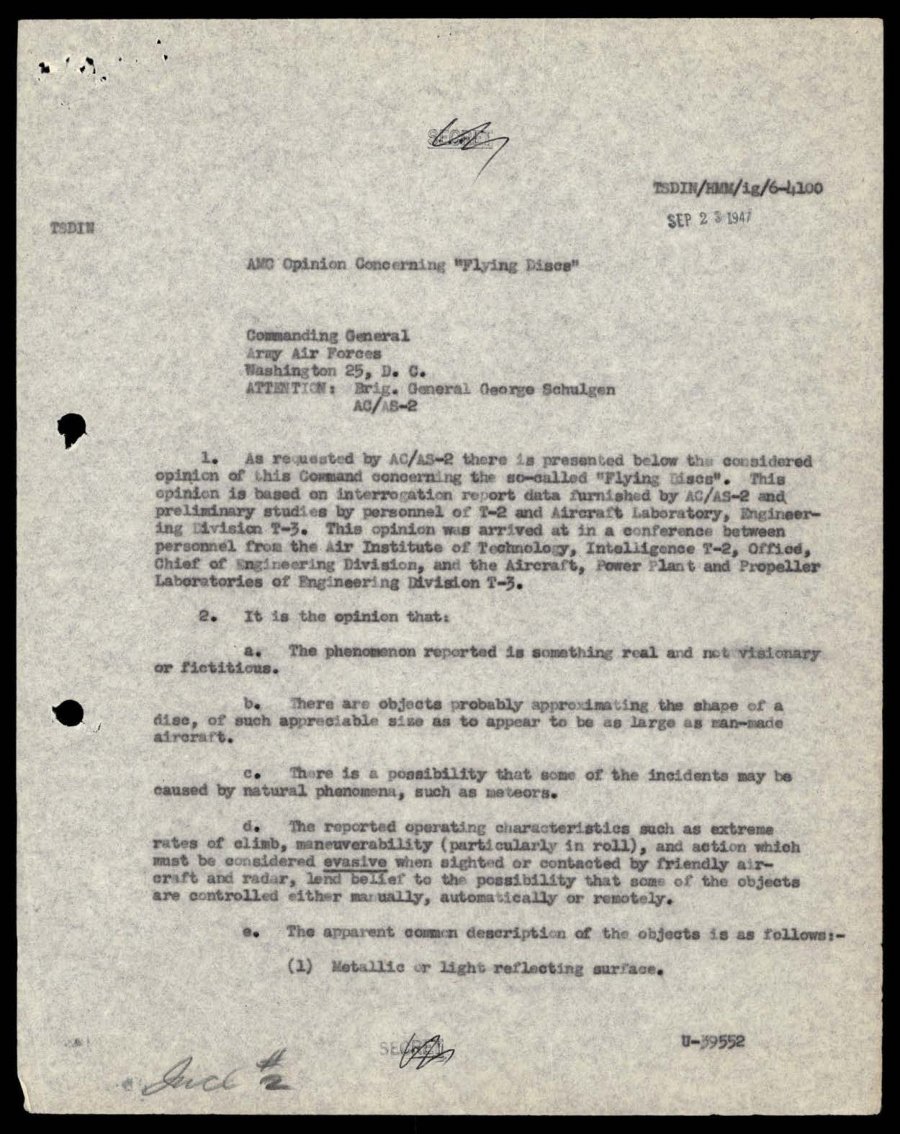
The opinion that called for investigation
In 1947, the air materiel command treated the reported phenomenon as a matter that deserved detailed study.
Open the casePATHS THROUGH THE ARCHIVE
Stories connected by a shared form of observation or investigation.
Official documentIn 1947, the air materiel command treated the reported phenomenon as a matter that deserved detailed study.
Open the case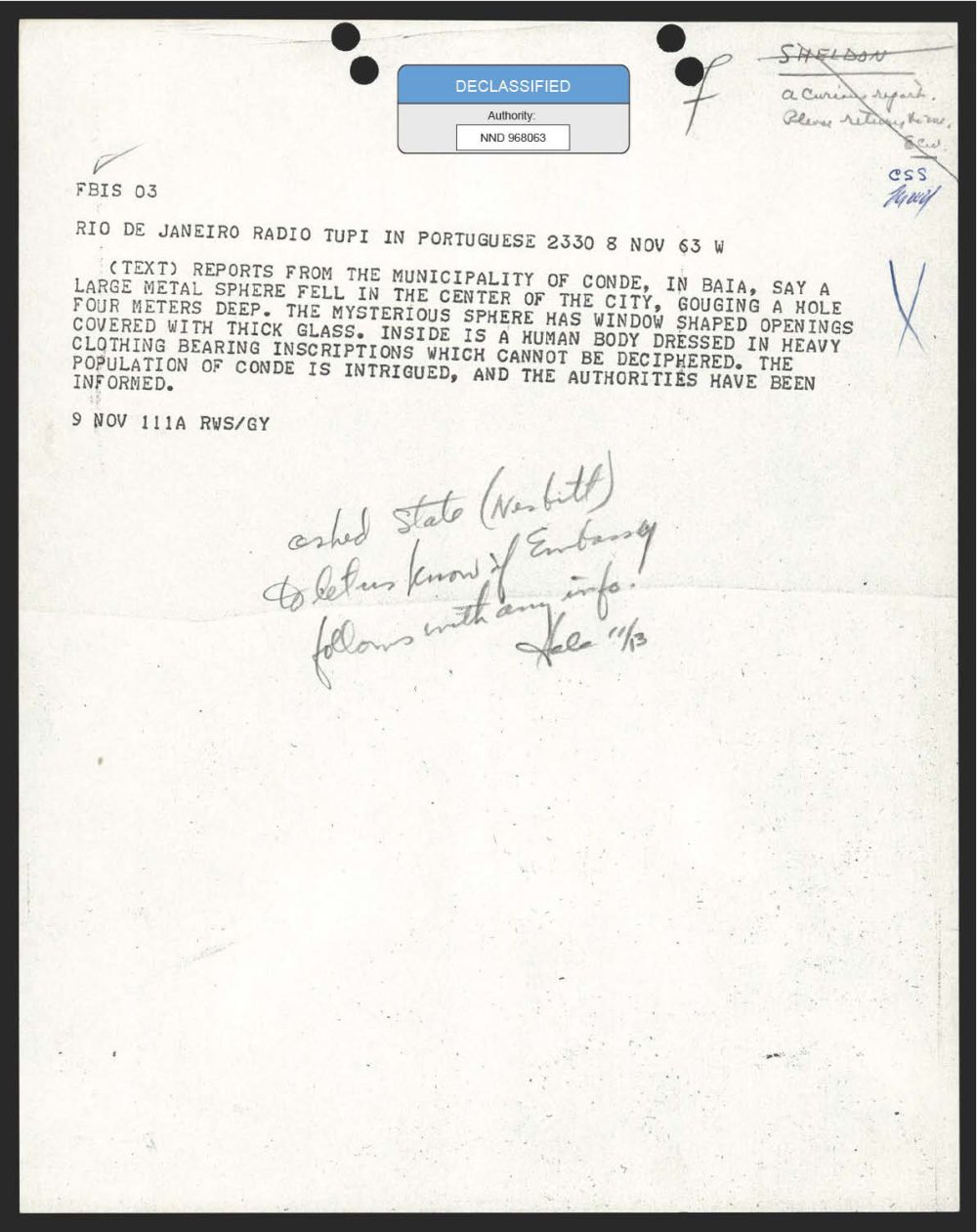 Translated radio bulletin
A news report about a metallic sphere in Conde prompts U.S. inquiries and leaves a sequence of diplomatic documents about Brazil.
Open the caseA U.S. military memorandum records a hypothesis of an origin outside the Earth attributed to Swedish interlocutors and a naval search in a lake. Read the translated passages.
Open the case Official letter
A secret bulletin of the War Department Intelligence Division summarized, in January 1947, the wave of “ghost rockets” over Scandinavia. The analysis accepted only a few cases as consistent with V-1-type missiles and attributed the high-altitude reports to meteors or fireworks.
Open the case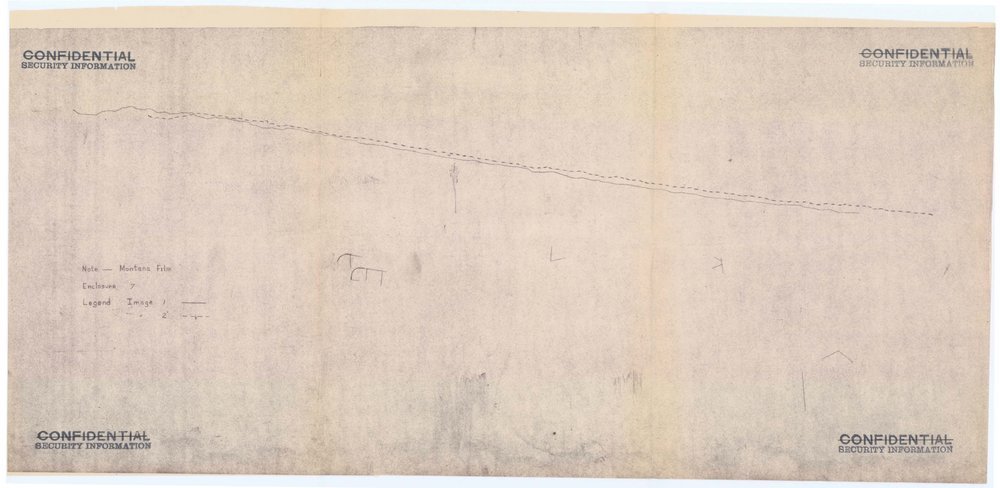 Analysis diagram
Nicholas Mariana filmed two bright UFOs over Great Falls in 16 mm, and the Air Force took the film to the Navy for analysis in 1952. The Navy's speed calculations started from an arbitrary distance of five miles, much greater than the one estimated by the witness himself.
Open the case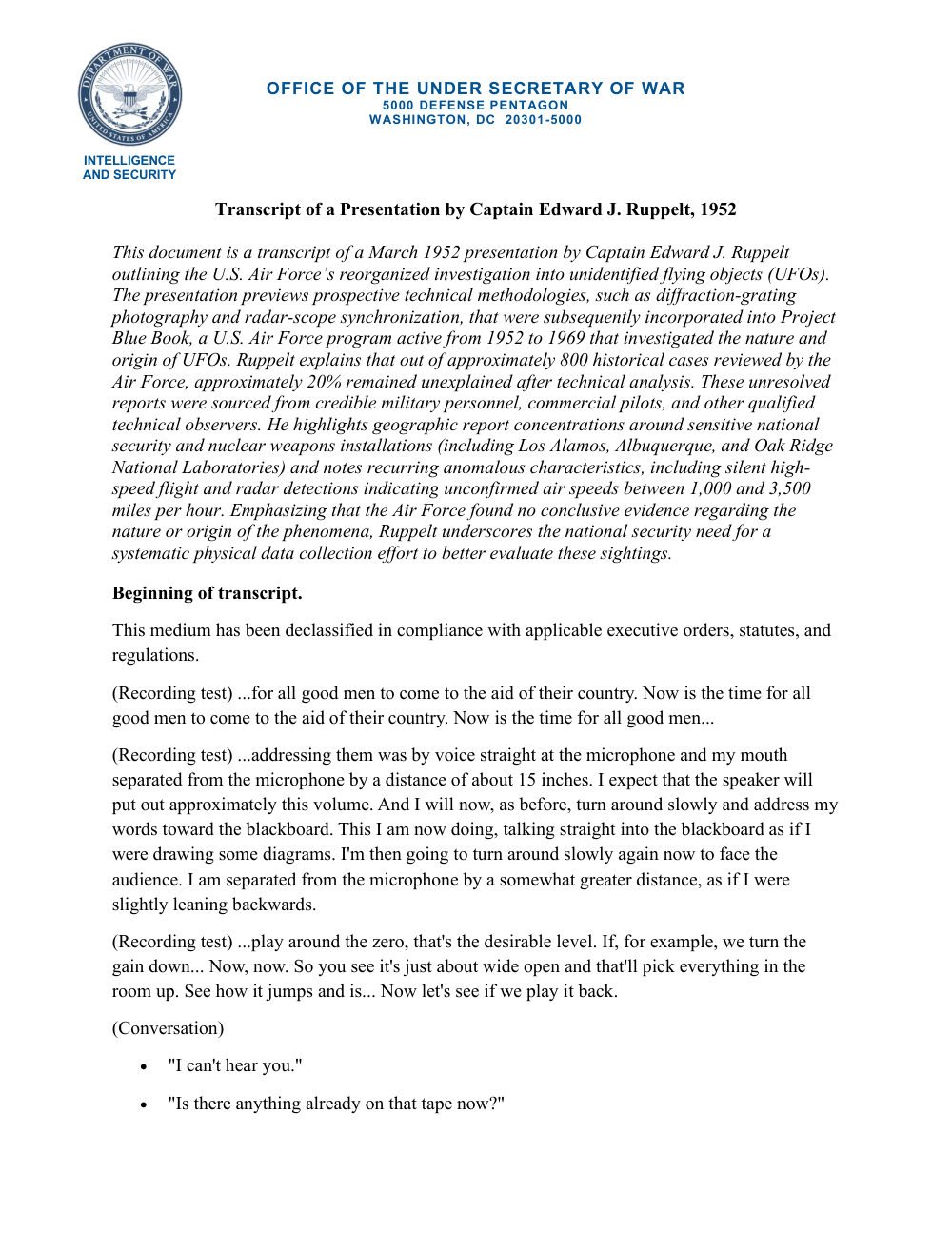 First transcript page
The transcript of a lecture by Captain Edward J. Ruppelt shows how the Air Force reorganized the UFO investigation in early 1952. He counts about 800 cases, of which some 20% would be good reports without explanation, and describes cameras and radars he intended to use to obtain physical data.
Open the case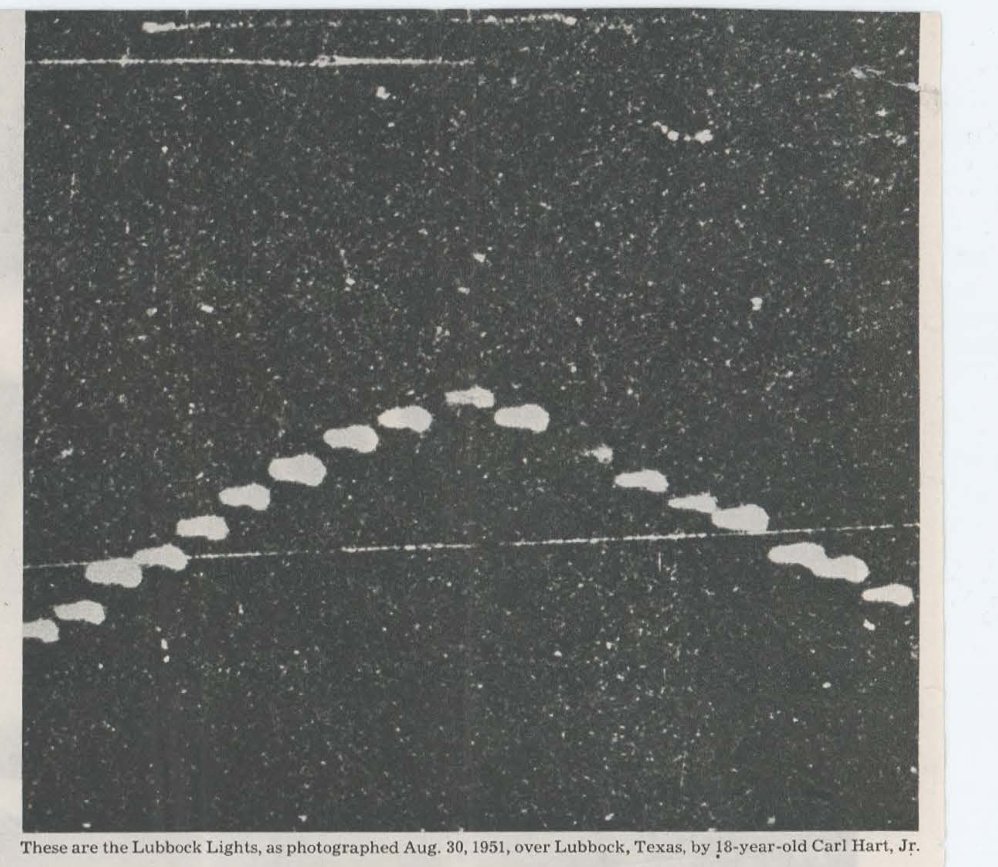 Magazine clipping with photograph
In the 1952 lecture, Captain Ruppelt called Lubbock the most interesting case the Air Force had ever had. Texas Tech professors saw and measured groups of UFOs, a freshman photographed them, and the investigation ended between an unproven hoax and the hypothesis of ducks lit by the city.
Open the case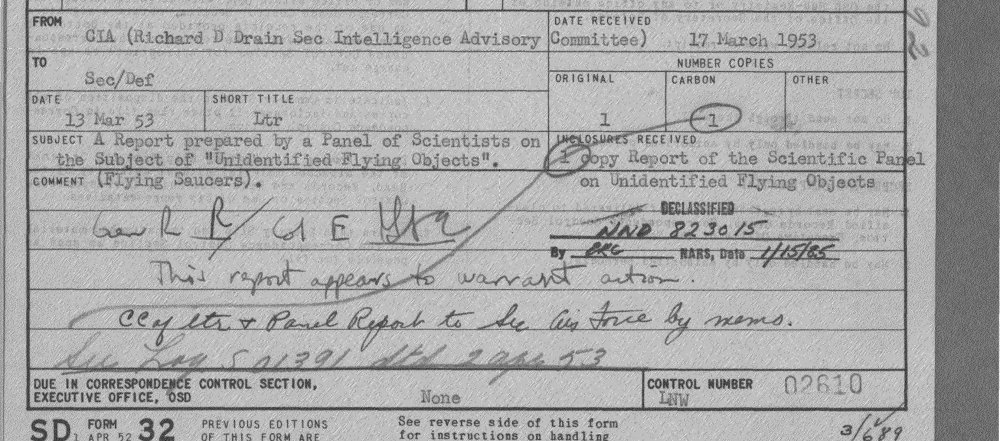 Routing slip with handwritten note
In January 1953 the CIA brought together five scientists to assess whether flying saucers threatened national security. The panel concluded that there was no direct physical threat, but that the excess of reports could clog defense communications, and it recommended stripping the subject of its 'special status'.
Open the case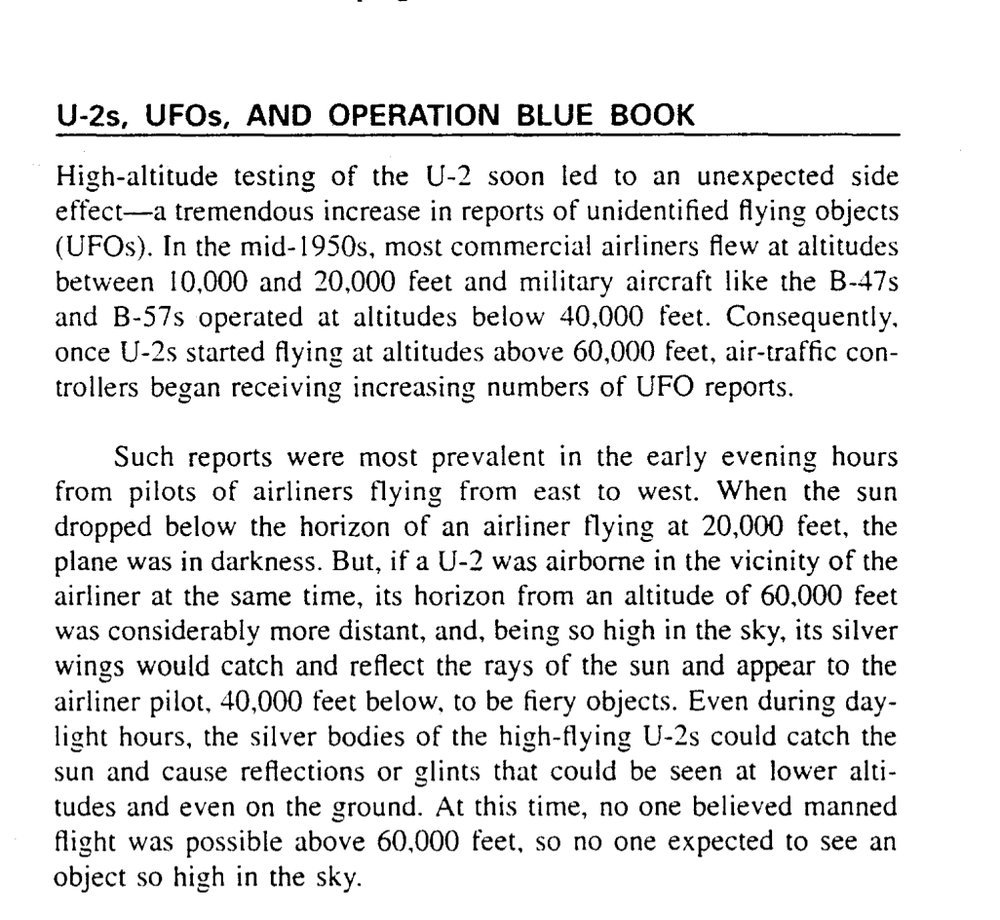 Page facsimile
The CIA's internal history of the U-2 and OXCART spy planes, written in 1992, states that the high-altitude flights caused a large increase in UFO reports. According to the text, Blue Book investigators checked the reports against CIA flight records but could not reveal the cause to the public.
Open the case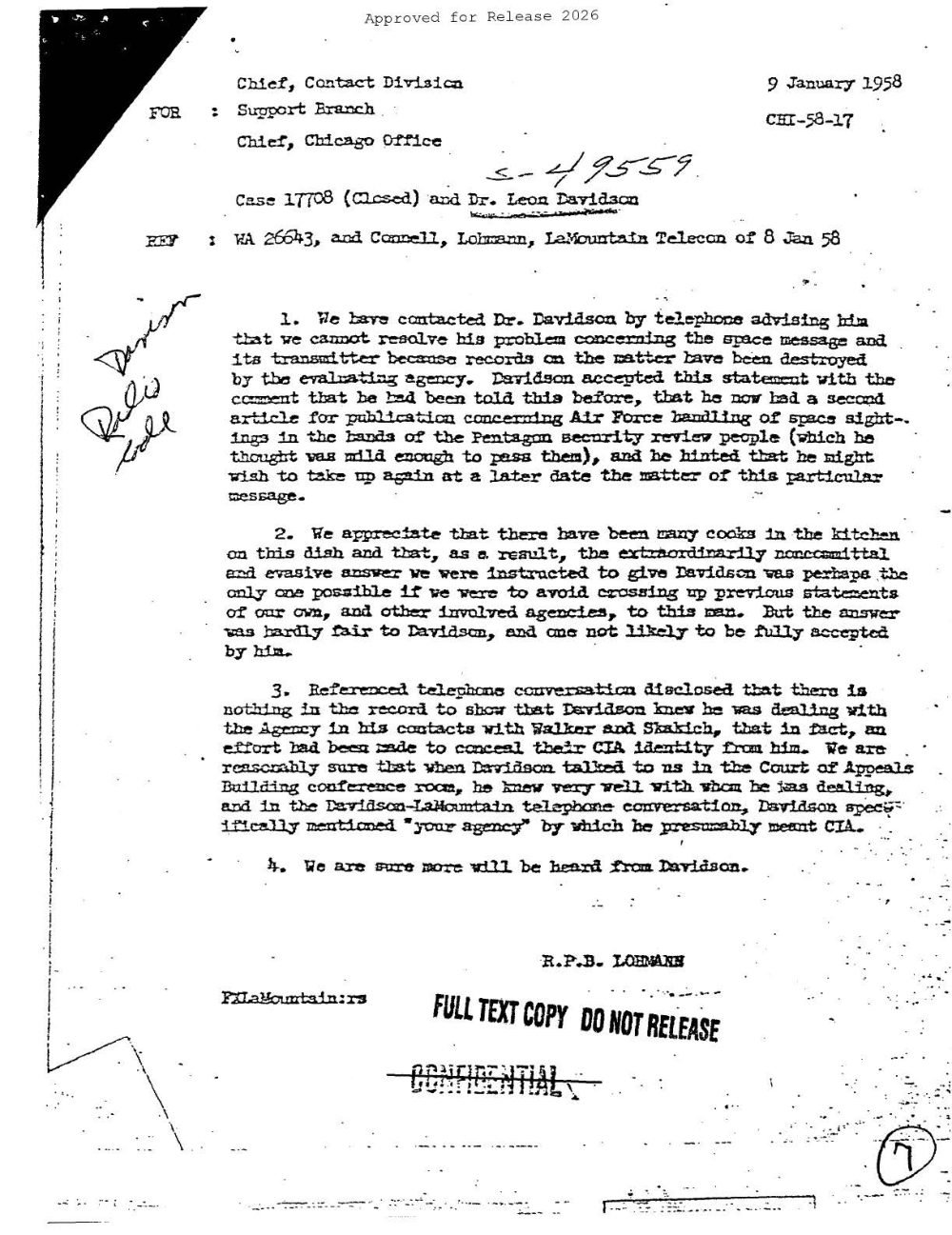 Official memorandum
An internal memorandum records that the CIA told researcher Leon Davidson that it could not resolve his question about a 'space message' because the records had been destroyed. The author himself admits that the answer, given on instructions from above, was evasive and hardly fair to Davidson.
Open the case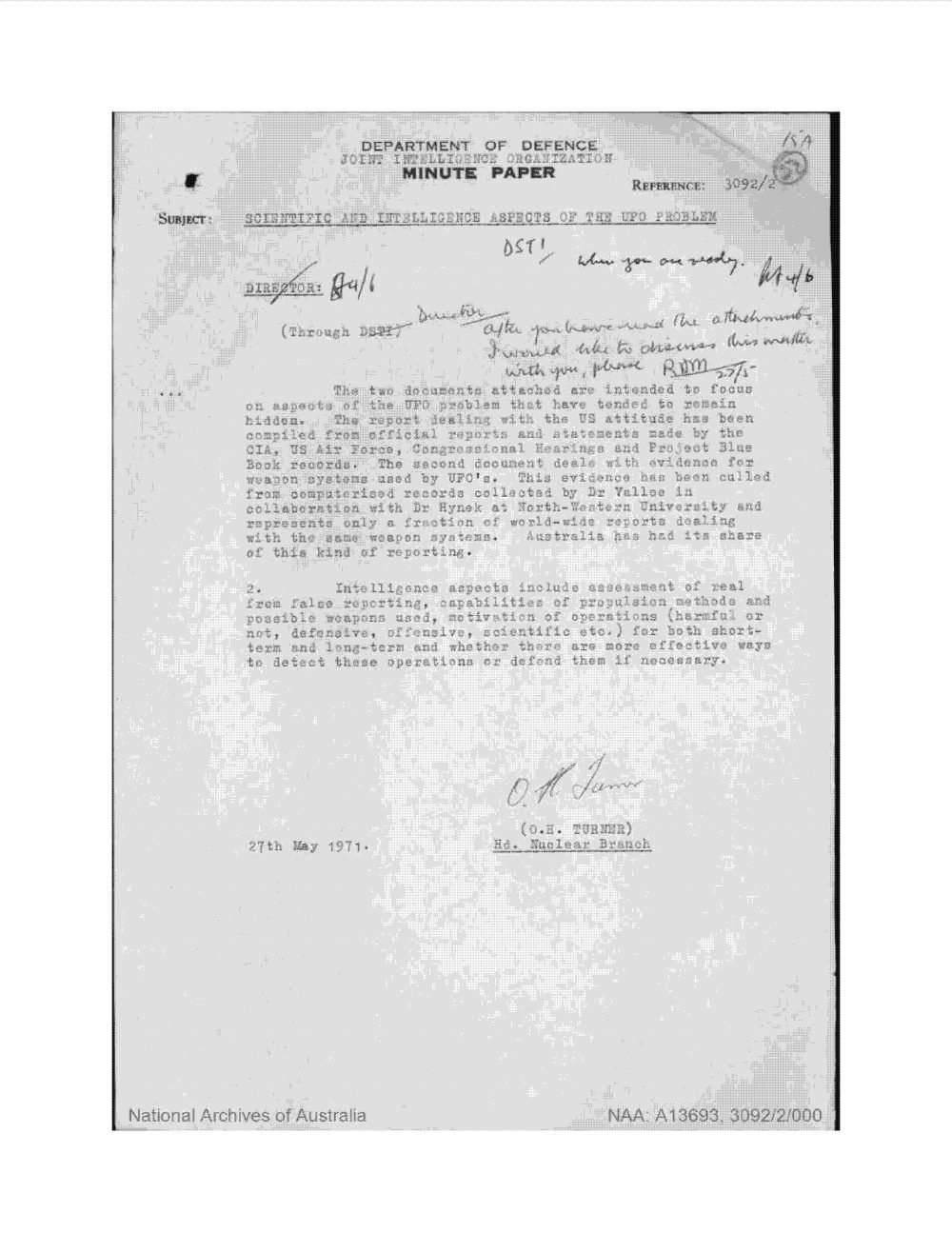 Official memorandum
A section head in Australian defense intelligence sent his director, in 1971, a study on the American attitude toward UFOs. The text claims that the CIA used the 1953 panel and Blue Book to discredit the subject and recommends that Australia create its own, more open program.
Open the case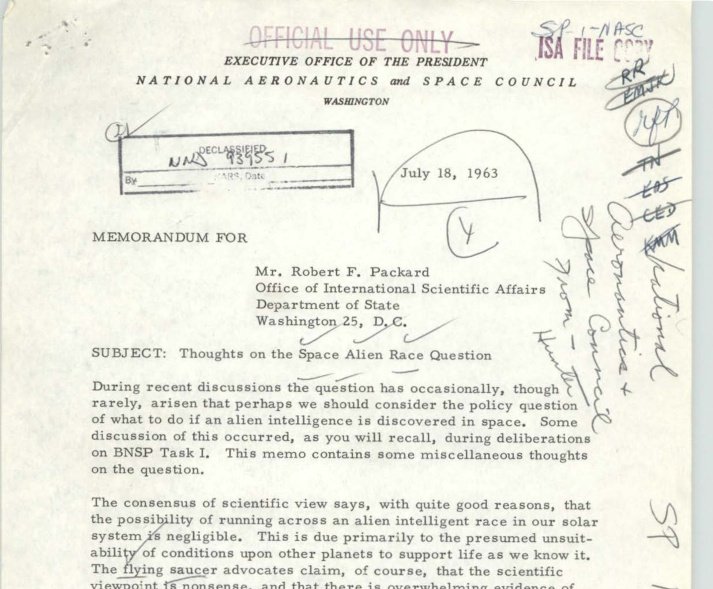 Official memorandum
A member of the National Aeronautics and Space Council wrote to the Department of State about what to do if an alien intelligence were discovered. The text distances itself from the flying saucer advocates and ends with irony about the "traditional panic."
Open the case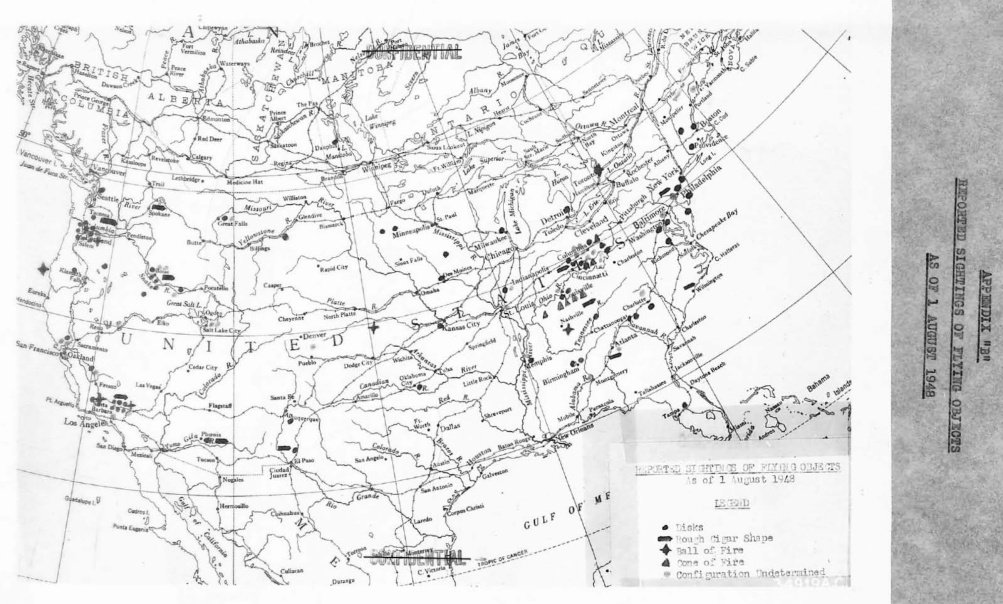 Map
The study Analysis of Flying Object Incidents in the U.S., classified top secret, examined about 210 reports and concluded that “some type of flying object” was being observed, without being able to say what it was. Among the hypotheses, it placed side by side American launches, natural phenomena and foreign aircraft, with emphasis on a possible Soviet origin.
Open the case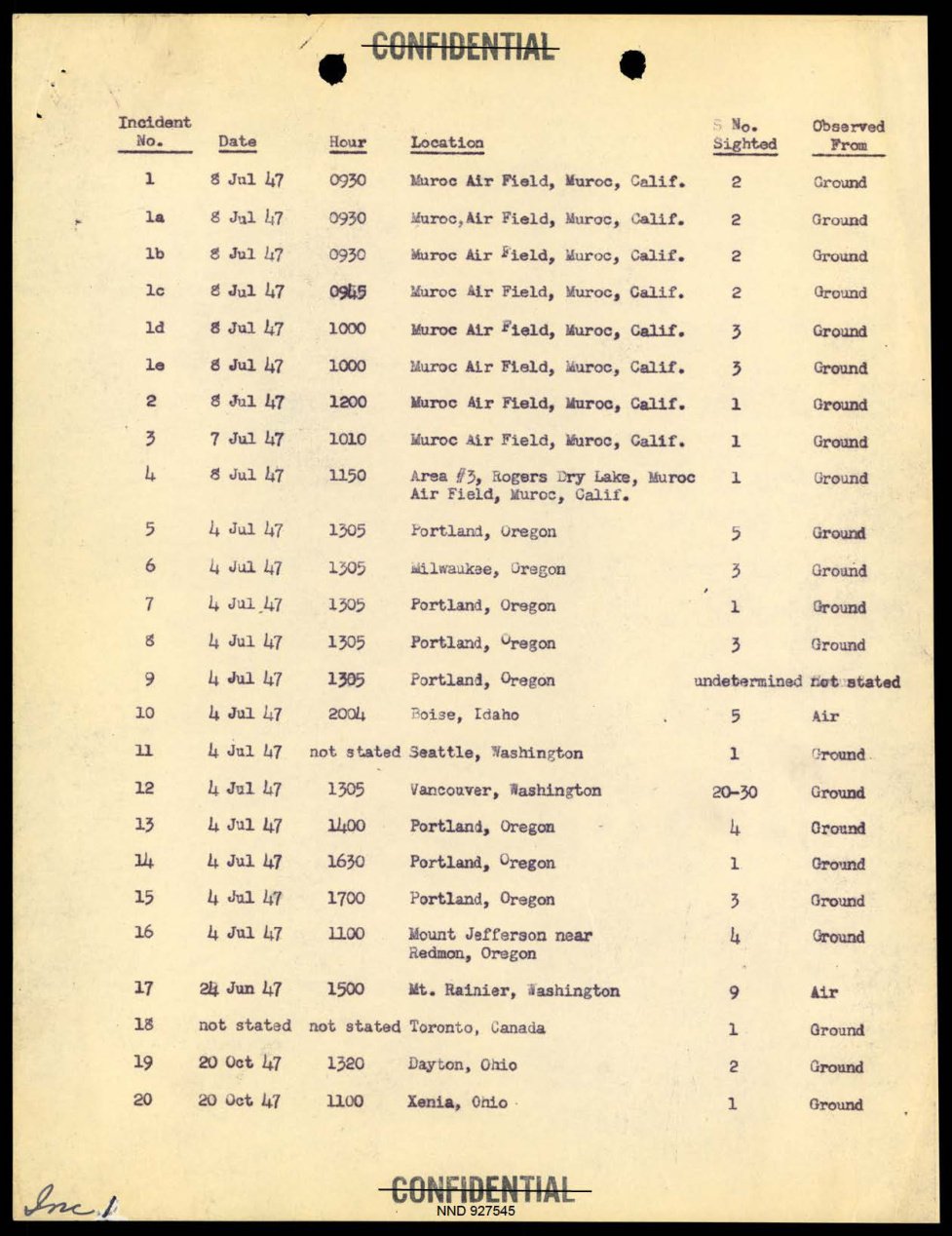 Table
Three months after its creation, Project Sign sent the Air Force Staff its initial report, with a tabulation of the reports received up to February 1º, 1948. The document counts shapes, numbers and flight paths, evaluates the photographs of incident 40 and records the opinion of scientist Irving Langmuir that the data were insufficient to identify anything.
Open the case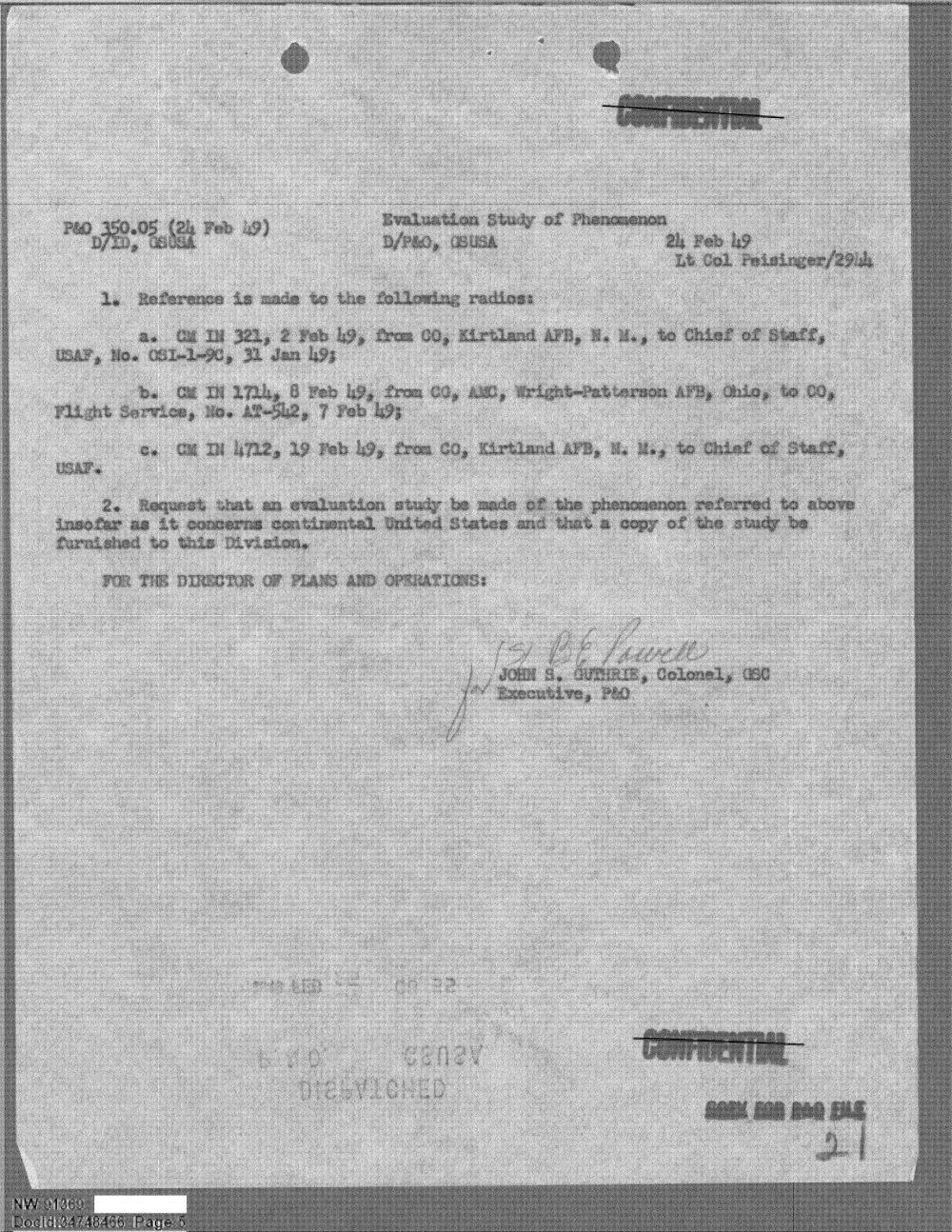 Official memorandum
At the request of the Plans and Operations section, the Army Intelligence Division prepared in 1949 a short evaluation of the flying saucers: about 20% of 210 cases explained and no tangible evidence of foreign activity. When broadcaster Walter Winchell said that the saucers were missiles coming from Russia, intelligence replied that it had no way to confirm the claim.
Open the caseAt the Air Force's request, a committee of its Scientific Advisory Board, chaired by Brian O'Brien, reviewed Project Blue Book and recommended a deeper scientific investigation of selected cases, carried out by universities. The recommendation led to the contract with the University of Colorado and, in 1969, to the Condon report.
Open the case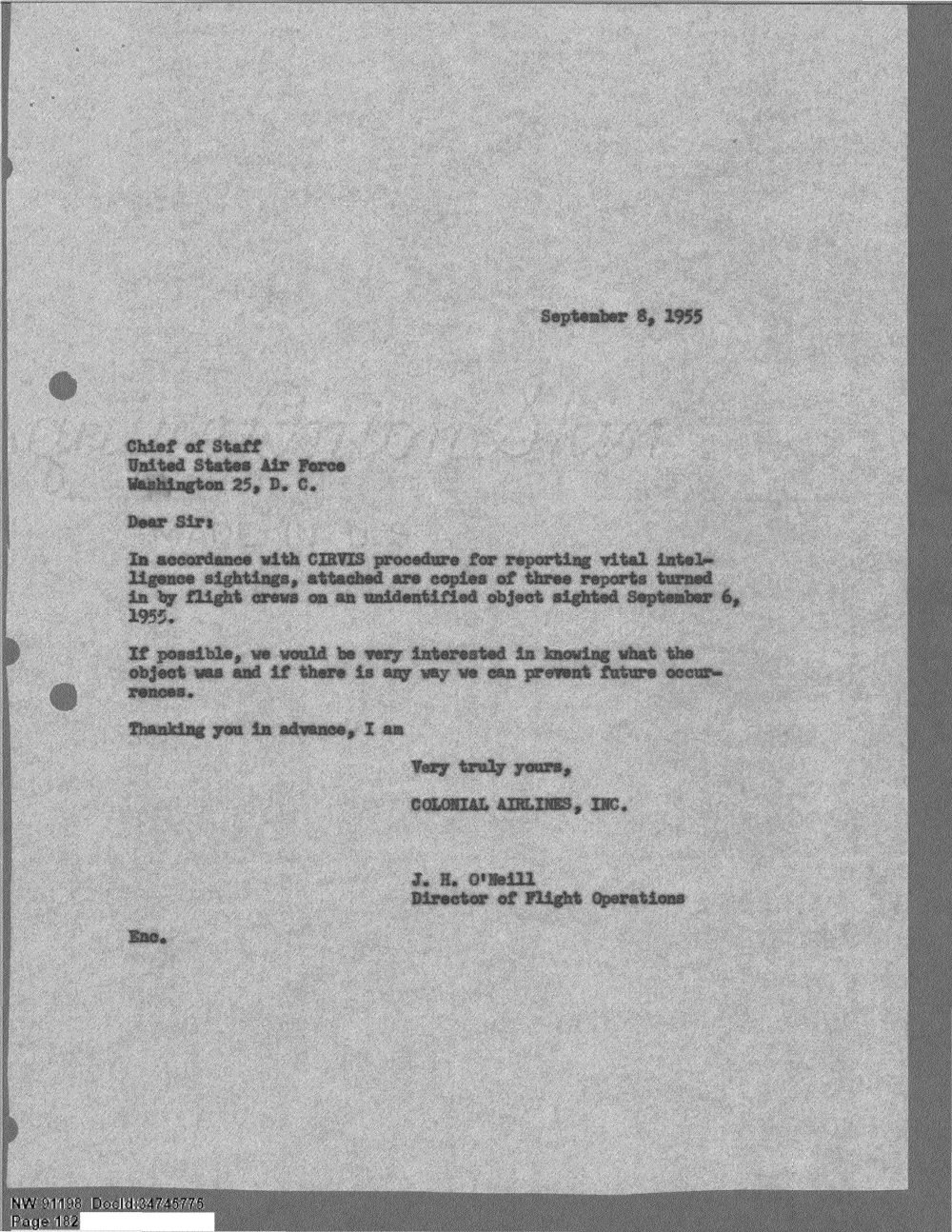 Official letter
The captain of Colonial Airlines Flight 14 saw a UFO with a bluish-white exhaust flame cross in front of the airplane, throw off sparks and explode in a blinding flash. Crew members of another of the company's flights saw the flash, and the airline asked the Air Force to tell it what it was.
Open the case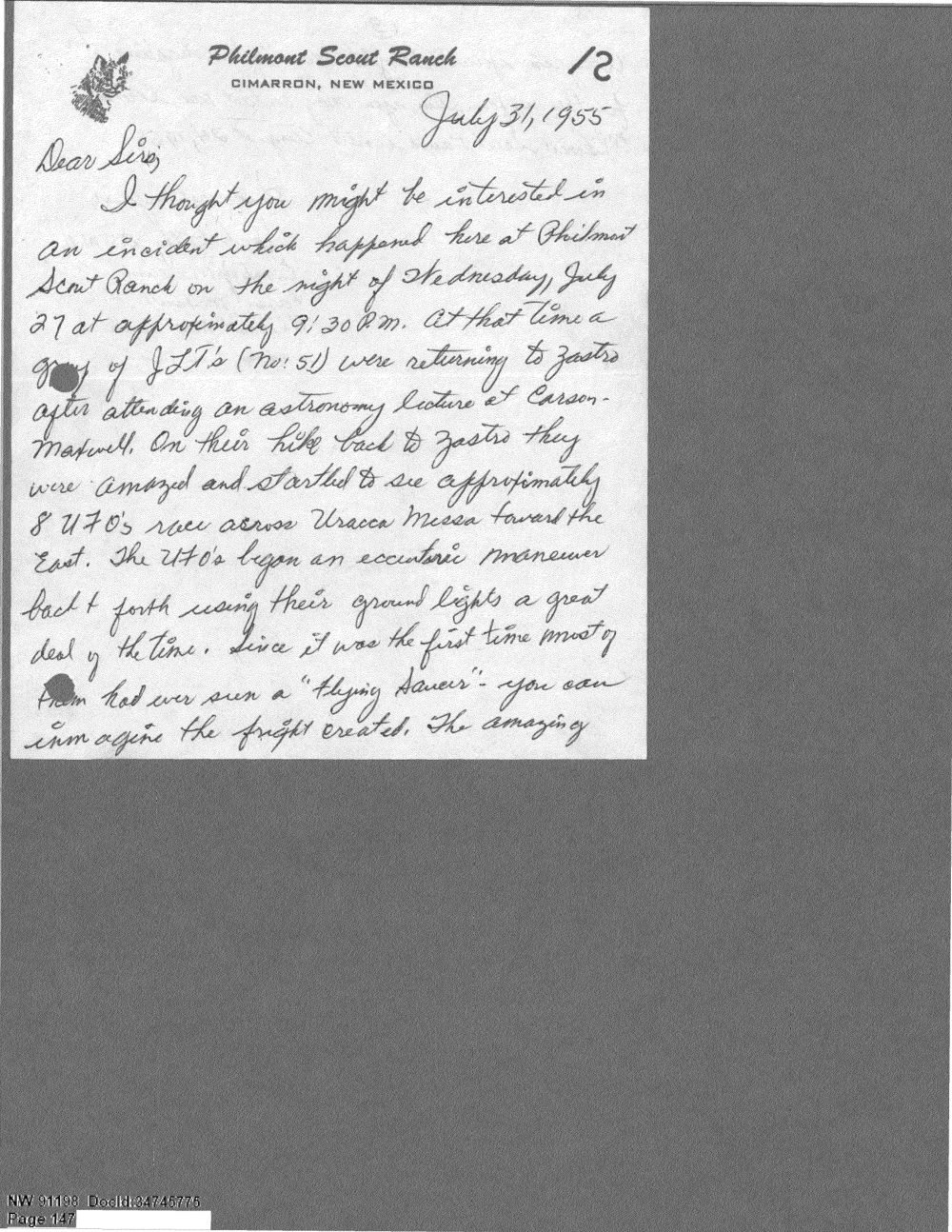 Handwritten letter
The curator of a museum at Philmont Scout Ranch wrote to the Air Force recounting that a group of young people in leadership training saw about eight UFOs cross Urraca Mesa, and that two boys, trying to communicate, reportedly received back the same signal they had sent. The Air Force thanked him and said it had passed the report on to its analysts.
Open the case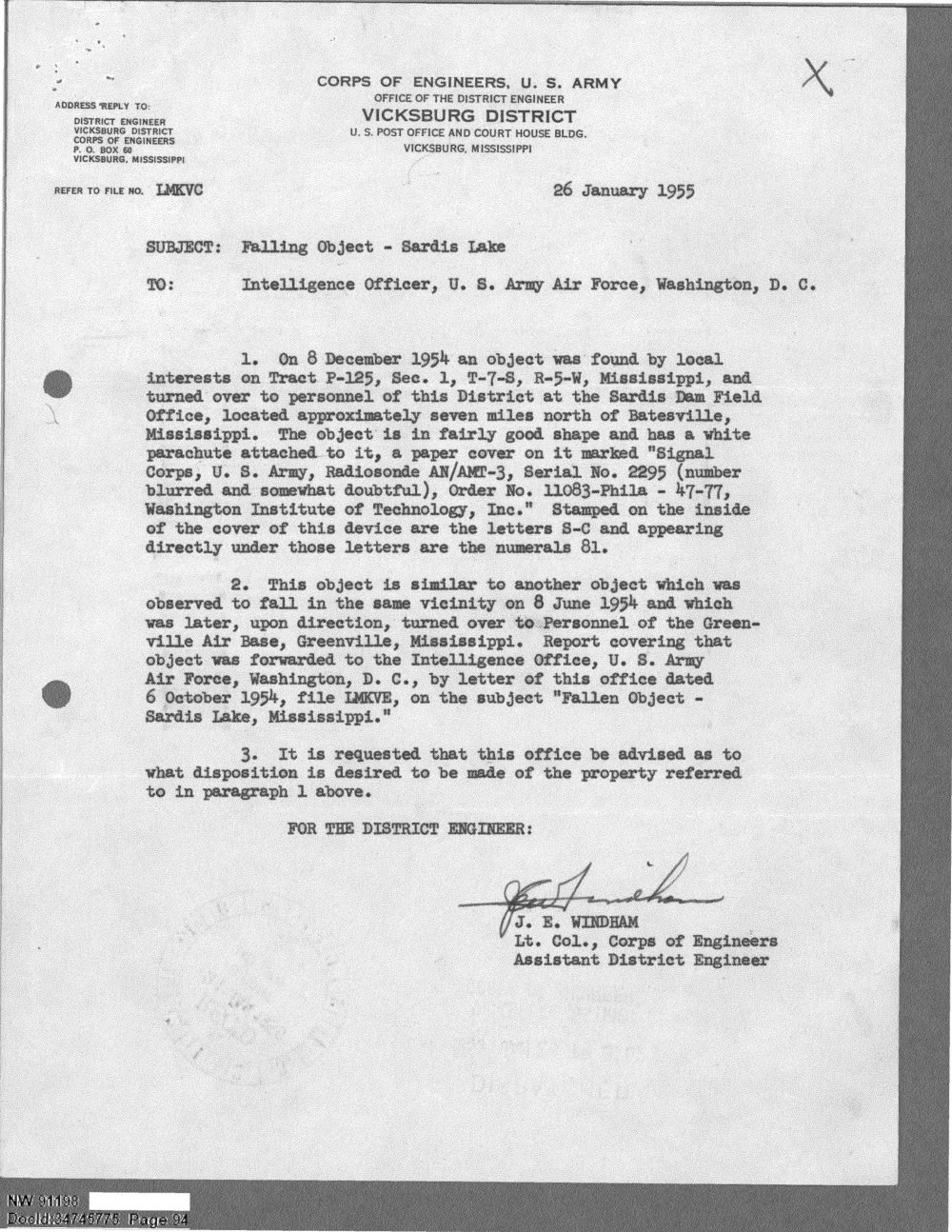 Official letter
A device with a white parachute found near Sardis Dam was handed over to the Army Corps of Engineers, which asked the Air Force what to do with it. The reply identified the object as an upper-atmosphere sounding instrument and asked that it be returned for reconditioning.
Open the case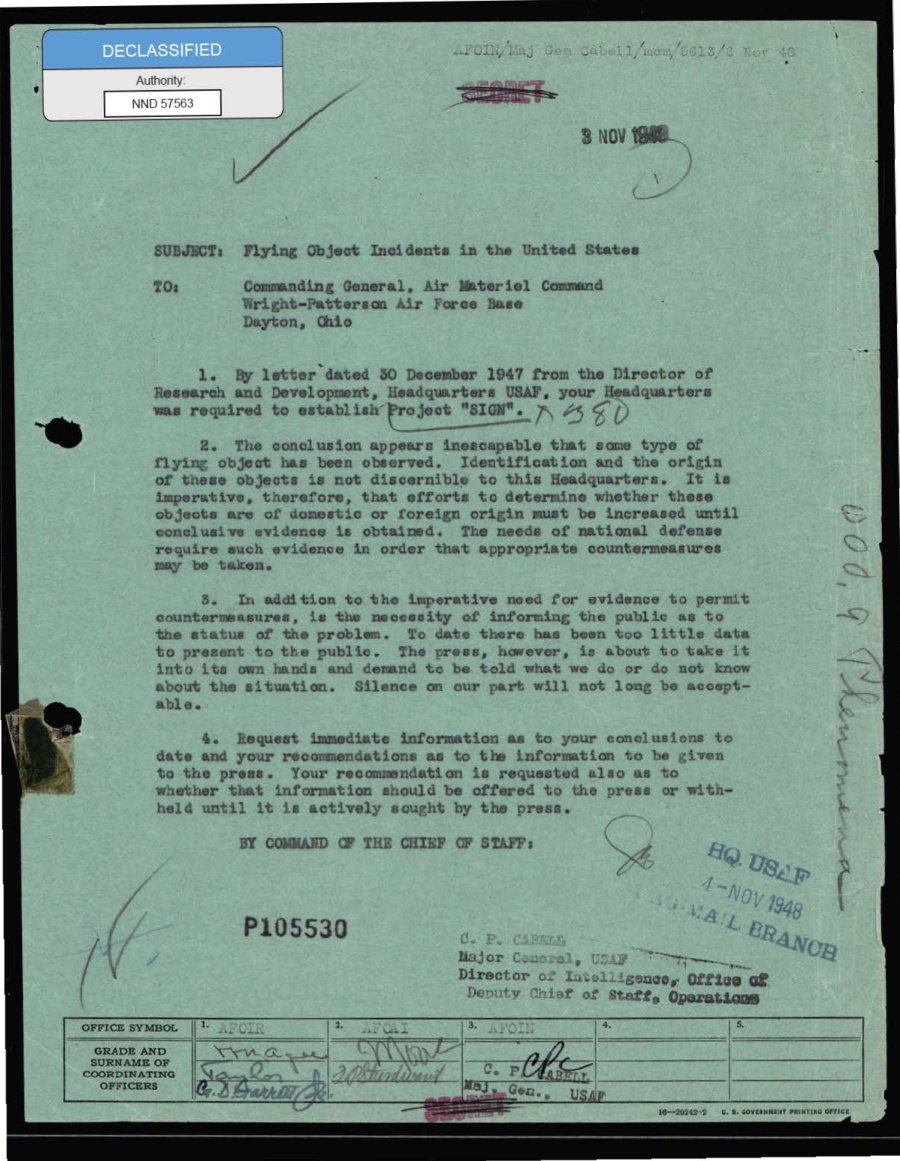 Official letter
In November 1948, the Air Force Air Staff asked the Air Materiel Command for the conclusions of Project Sign and a recommendation on what to tell the press. The reply, signed by Colonel H. M. McCoy, reports the study of about 180 incidents, acknowledges unexplained cases and advises against releasing what could not be identified.
Open the case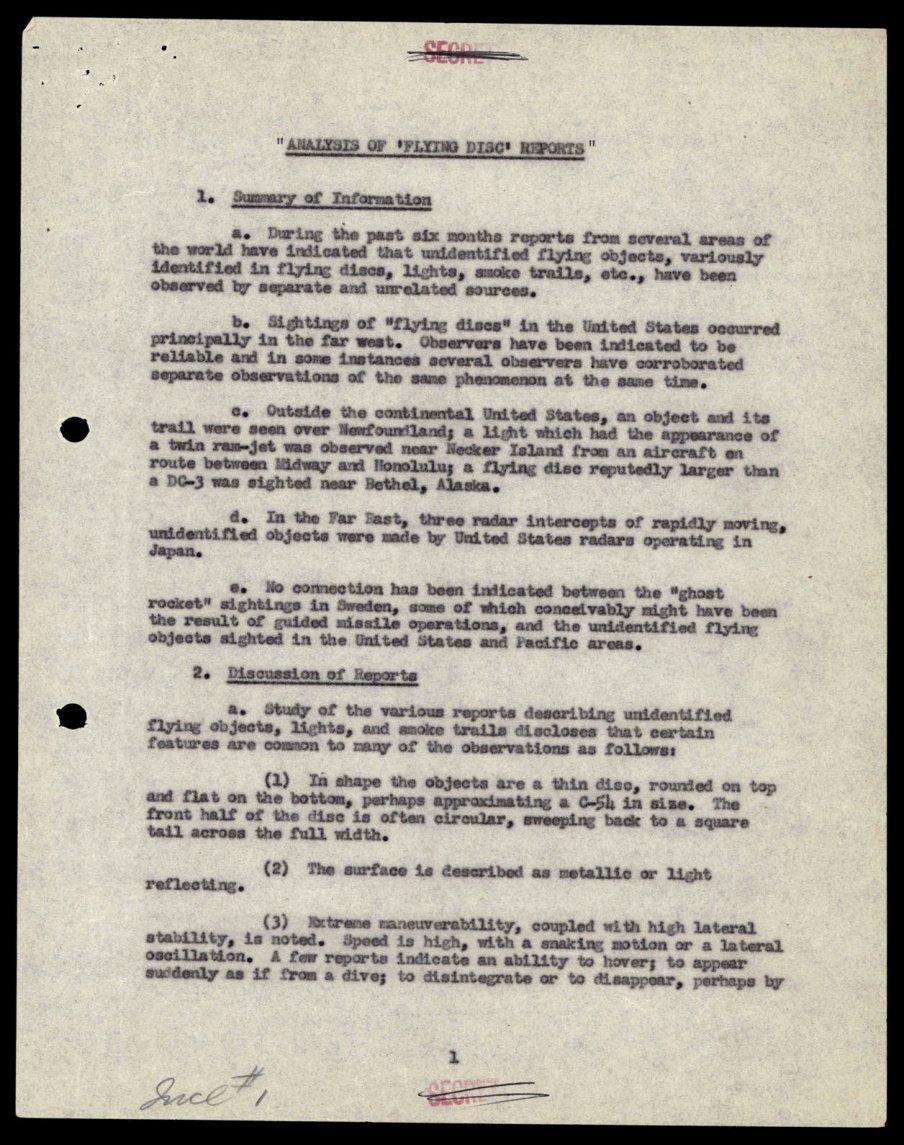 Official report
In December 1947, the Air Force Directorate of Intelligence prepared a five-sheet study on flying disc reports and sent it, with the Air Materiel Command's opinion, to the Director of Research and Development. The text lists reports, radar contacts in Japan and inquiries carried out, and concludes that some of the reports represented something real, without physical proof.
Open the case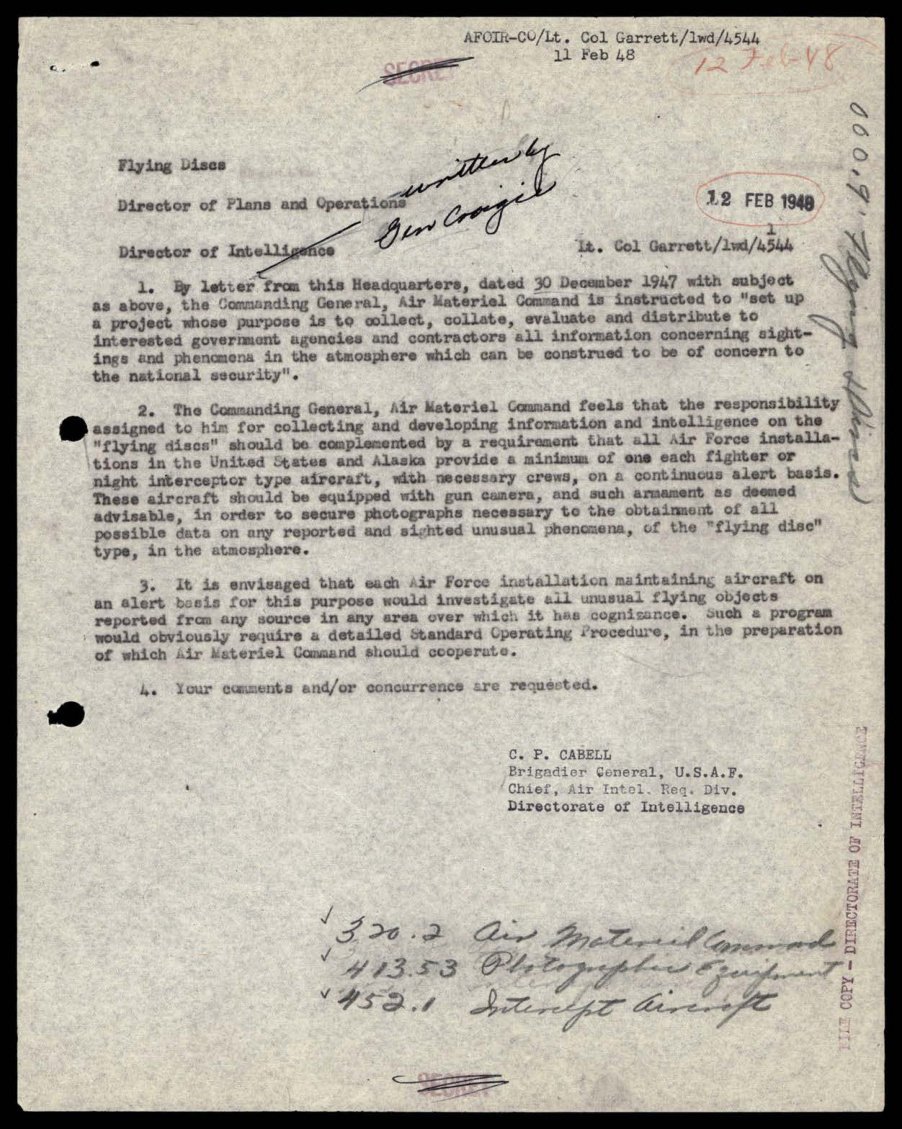 Official memorandum
In early 1948, the Air Materiel Command suggested that every Air Force installation in the United States and Alaska keep at least one fighter on permanent alert, with a camera, to investigate flying discs. The Directorate of Plans and Operations rejected the idea as unfeasible.
Open the case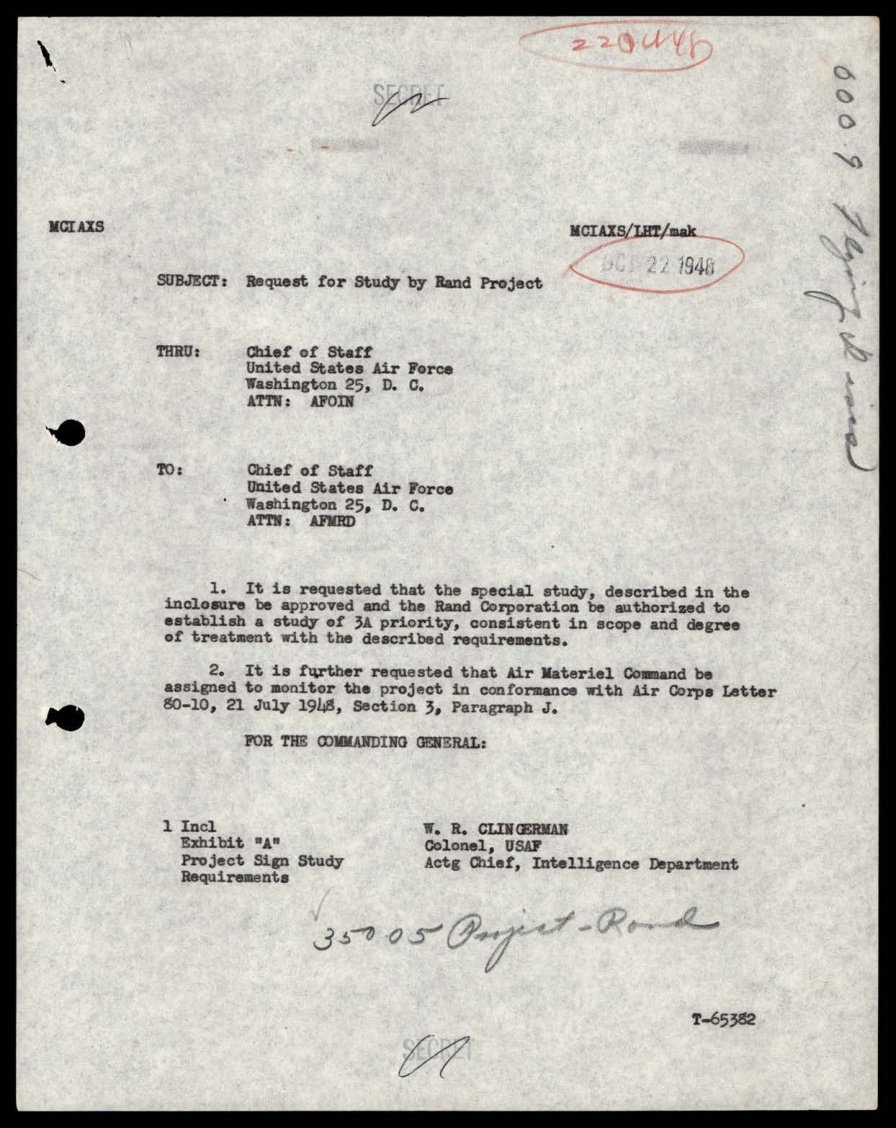 Official letter
In October 1948, the Air Materiel Command's Intelligence Department asked the Air Staff for authorization for the Rand Corporation to conduct a study on the design and performance characteristics of spaceships. The attachment says that the command had considered the hypothesis of experimental craft, but judged the effort of a foreign nation more likely than something coming from outside the Earth.
Open the case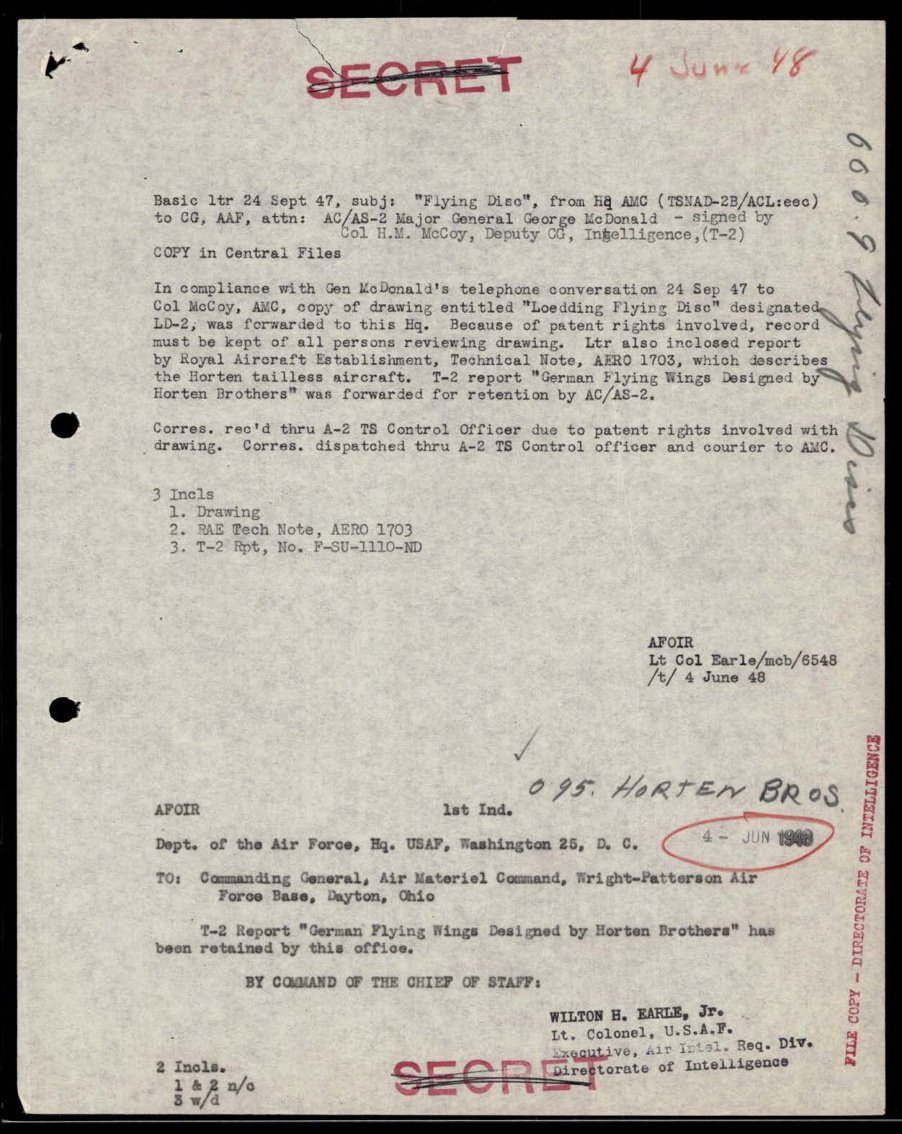 Official memorandum
In September 1947, the Air Materiel Command sent to Washington, under top secret material control, a drawing called "Loedding Flying Disc" and reports on the flying wings of the Horten brothers. In 1948, Air Force intelligence tried to interview the German designers, and by April it still had no result.
Open the case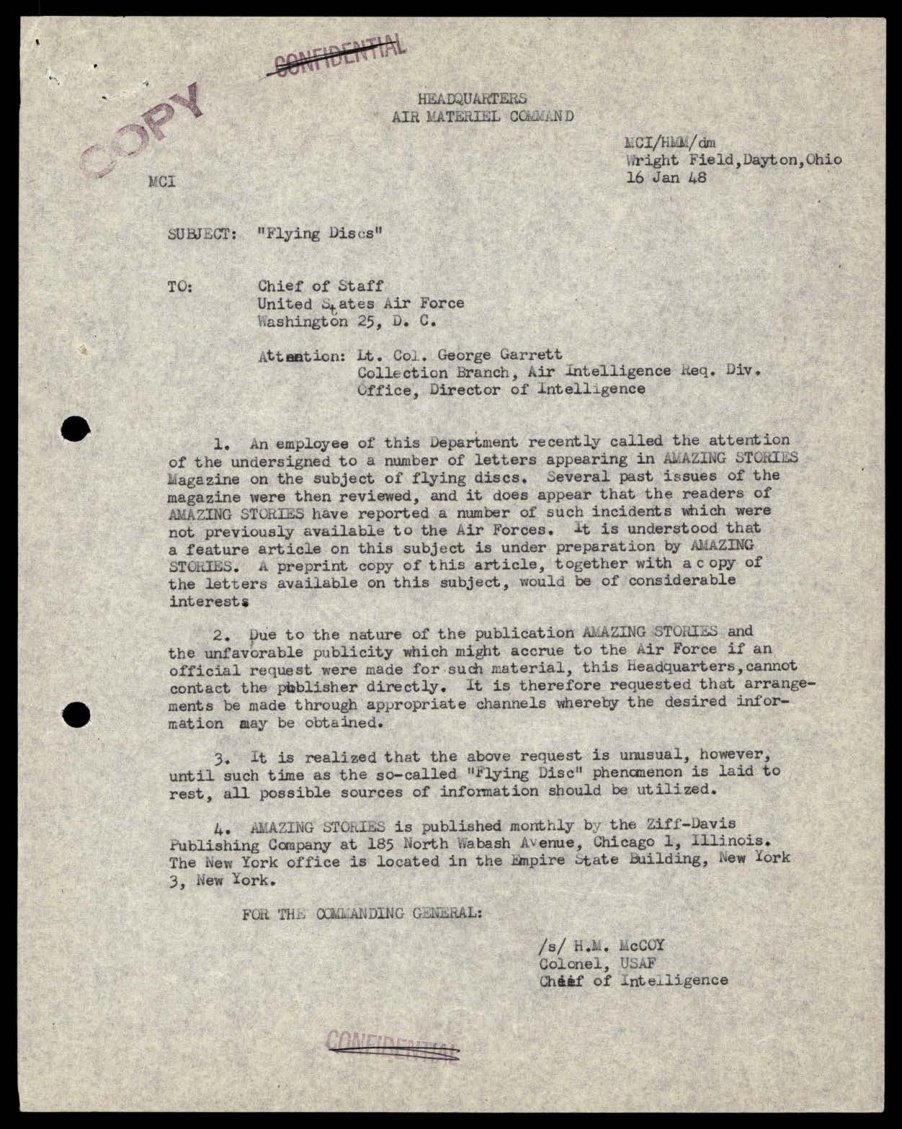 Official letter
In January 1948, the chief of intelligence of the Air Materiel Command asked that the Amazing Stories magazine readers' letters about flying discs be obtained through discreet channels. The CIA approached the publisher and concluded that the letters had no value; the Air Force ordered the matter closed.
Open the case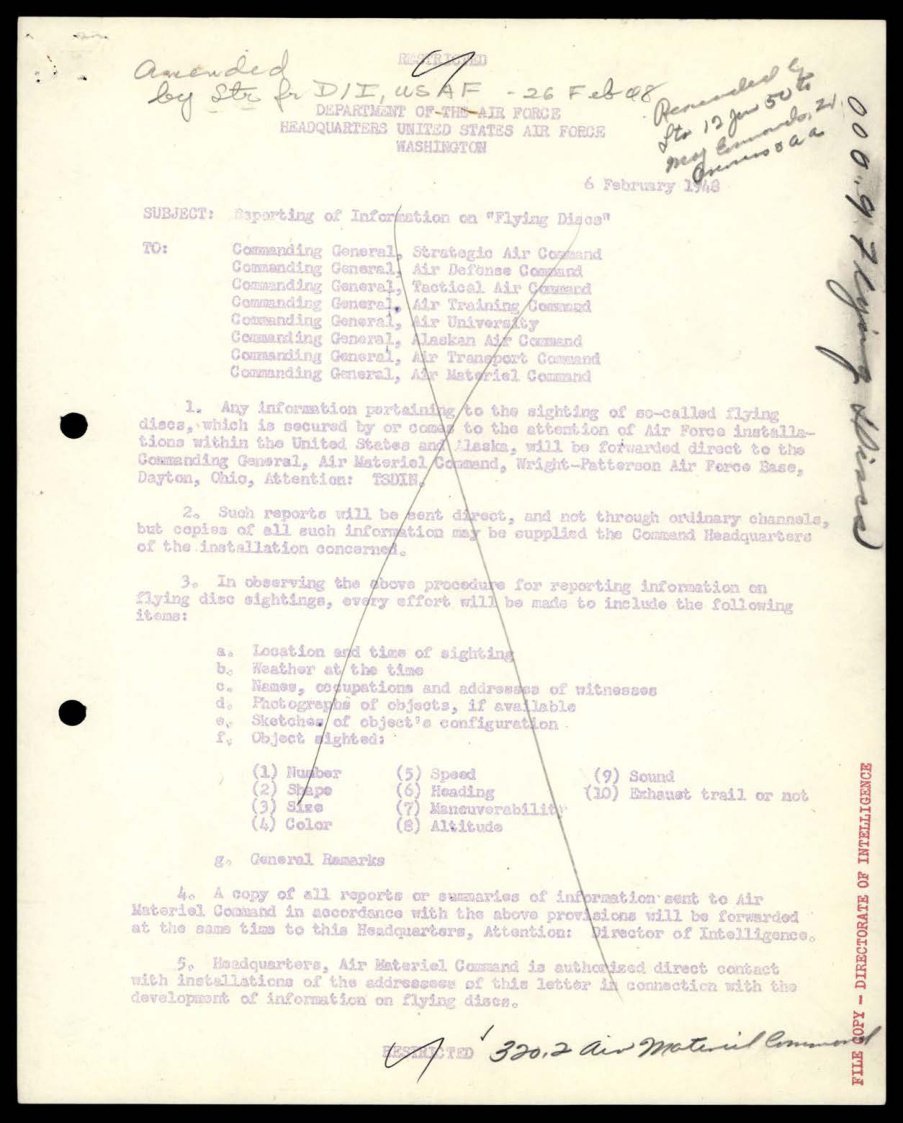 Official circular letter
Between December 1947 and February 1948, the Air Staff made the Air Materiel Command the central destination for all flying disc reports, first in the United States and Alaska and then worldwide. The circular letters contain the list of data each report was to include.
Open the case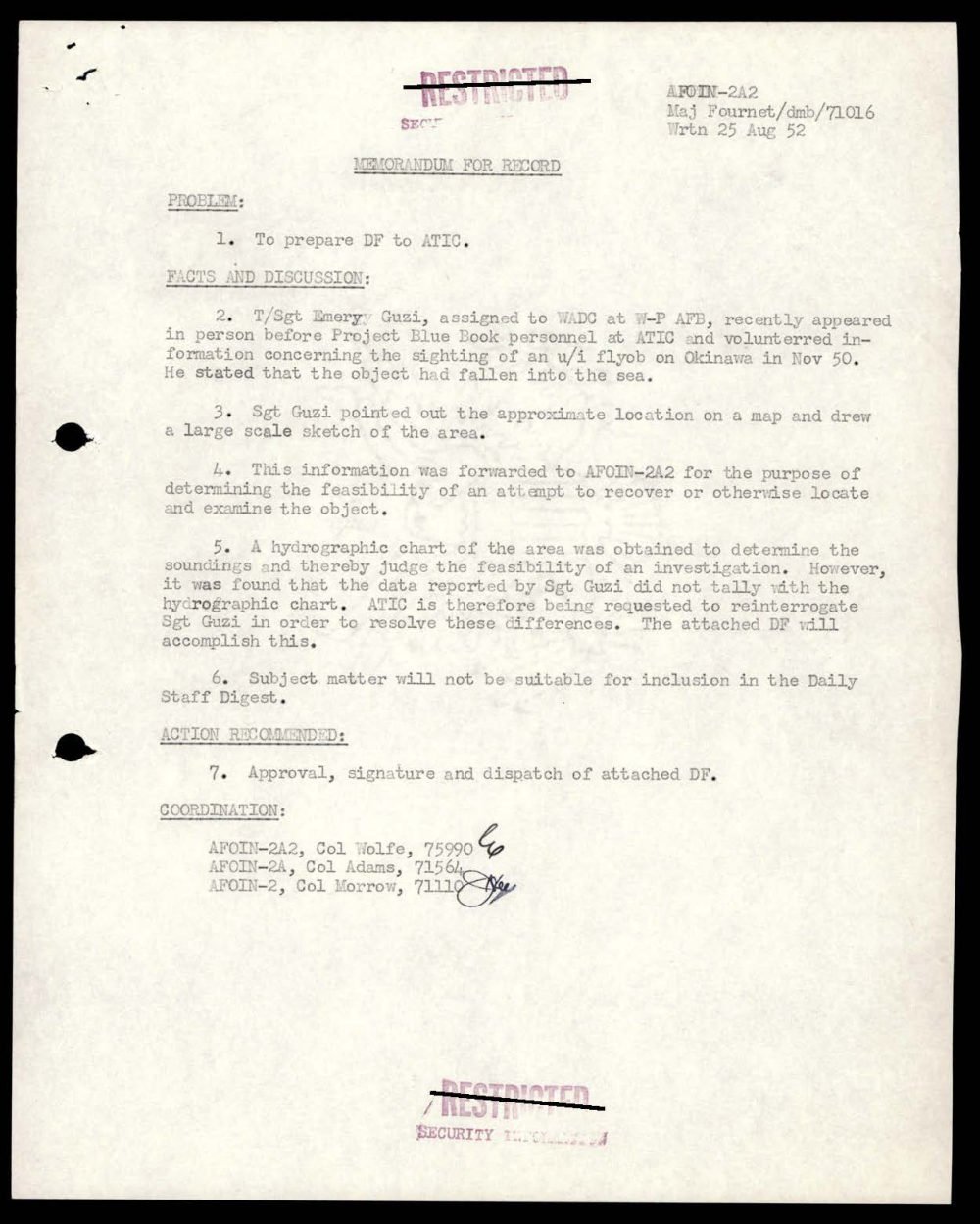 Internal record
In 1952, a sergeant stationed at Wright-Patterson approached Project Blue Book to report that, in November 1950, he had seen a UFO fall into the sea at Okinawa. The Air Force studied nautical charts to assess a search, but concluded that the indicated spot was in water that was too deep and filed the case away for a future attempt.
Open the case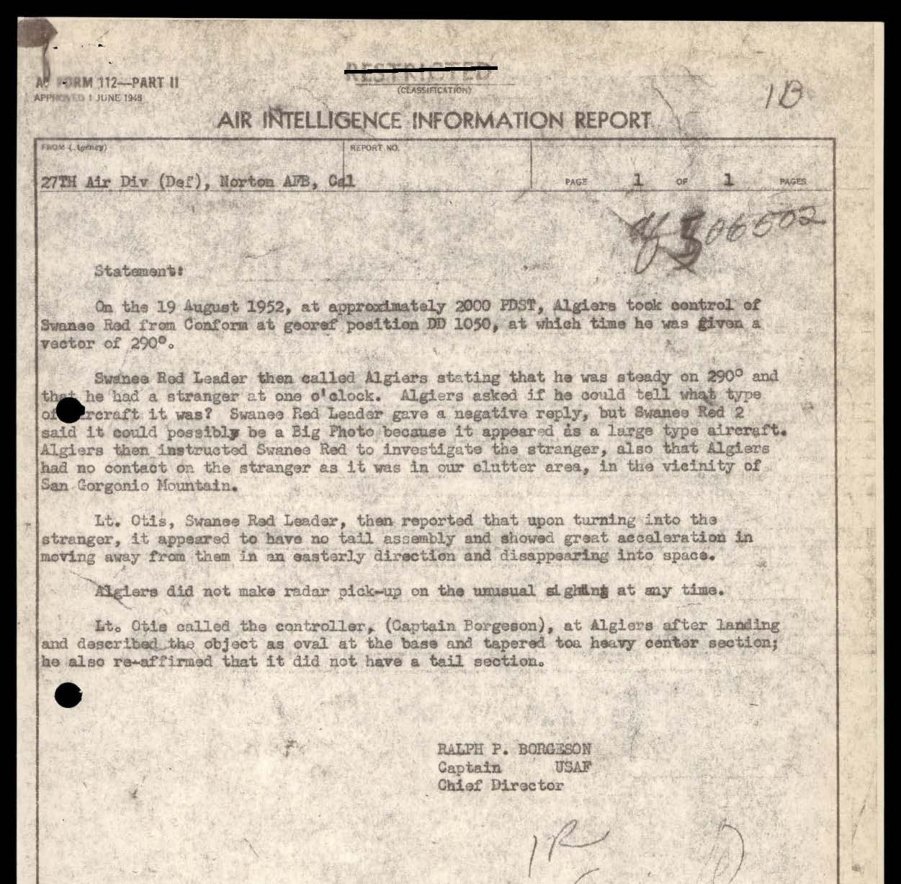 Document facsimile
A flight of fighters directed by the 27th Air Division's intercept control was sent to investigate a "stranger" spotted by the pilots near Mount San Gorgonio. The leader said the UFO had no tail and moved away to the east with great acceleration; the ground radar never picked it up.
Open the case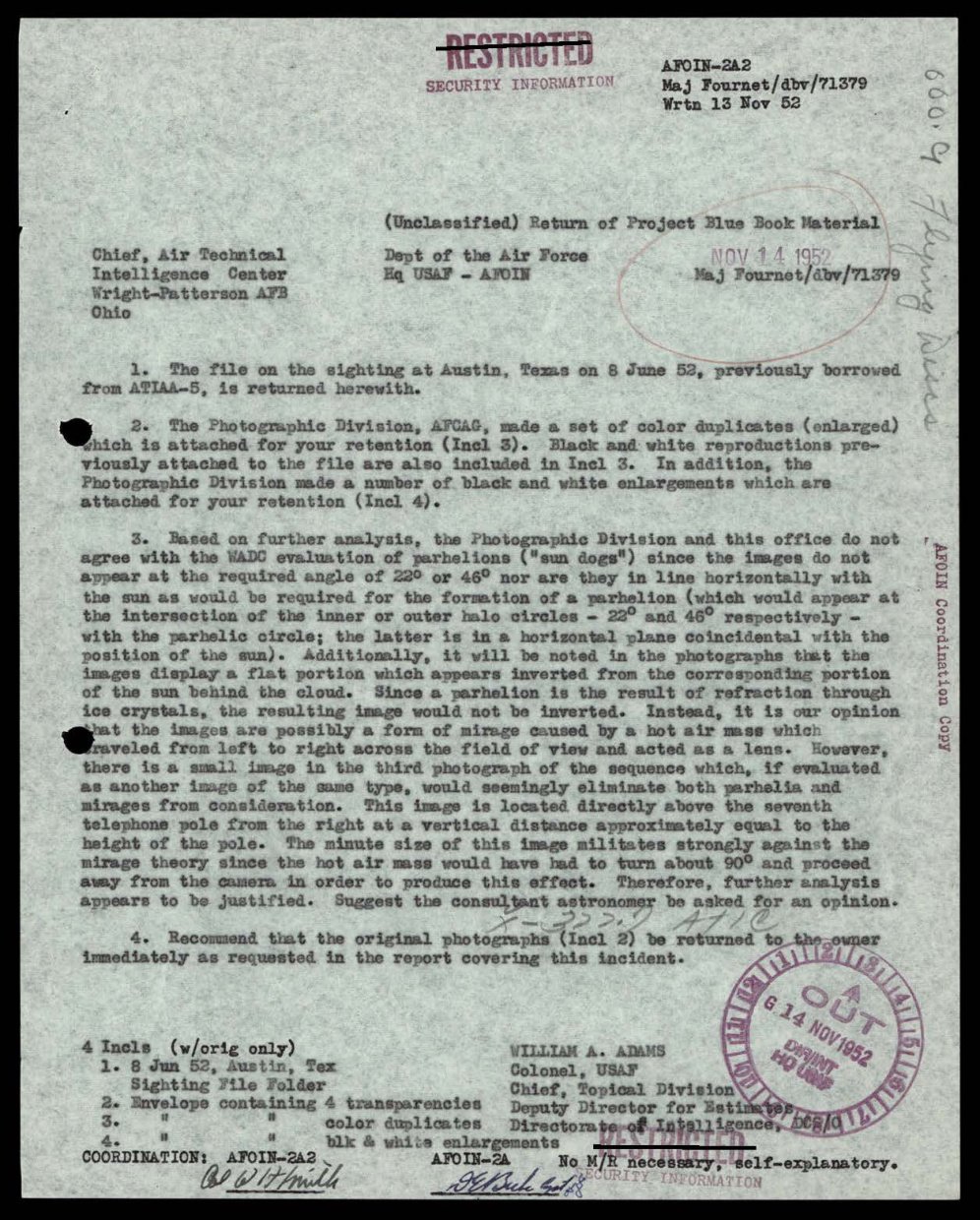 Document facsimile
A sequence of photos taken in Austin on June 8, 1952 showed images near the Sun, behind a cloud. The Air Force development center spoke of a parhelion; the Photographic Division in Washington rejected that explanation, considered a mirage possible, but pointed out a detail that did not fit and suggested consulting an astronomer.
Open the case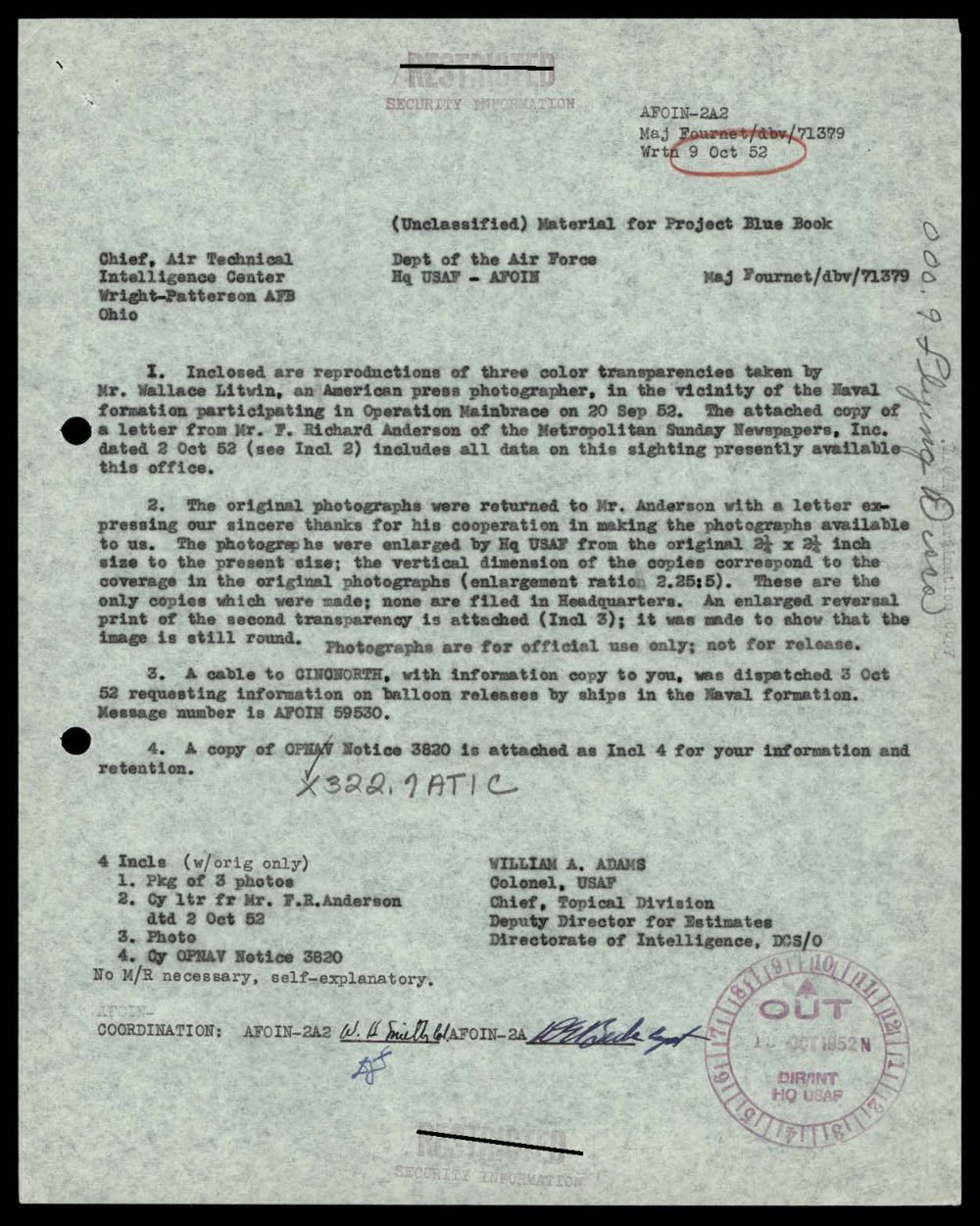 Official memorandum
An American press photographer, Wallace Litvin, made three color transparencies near the fleet taking part in the Mainbrace exercise, on September 20, 1952. The Air Force enlarged the images, confirmed that the UFO was still round in the enlargement and asked the naval command for information on balloons launched by the ships.
Open the case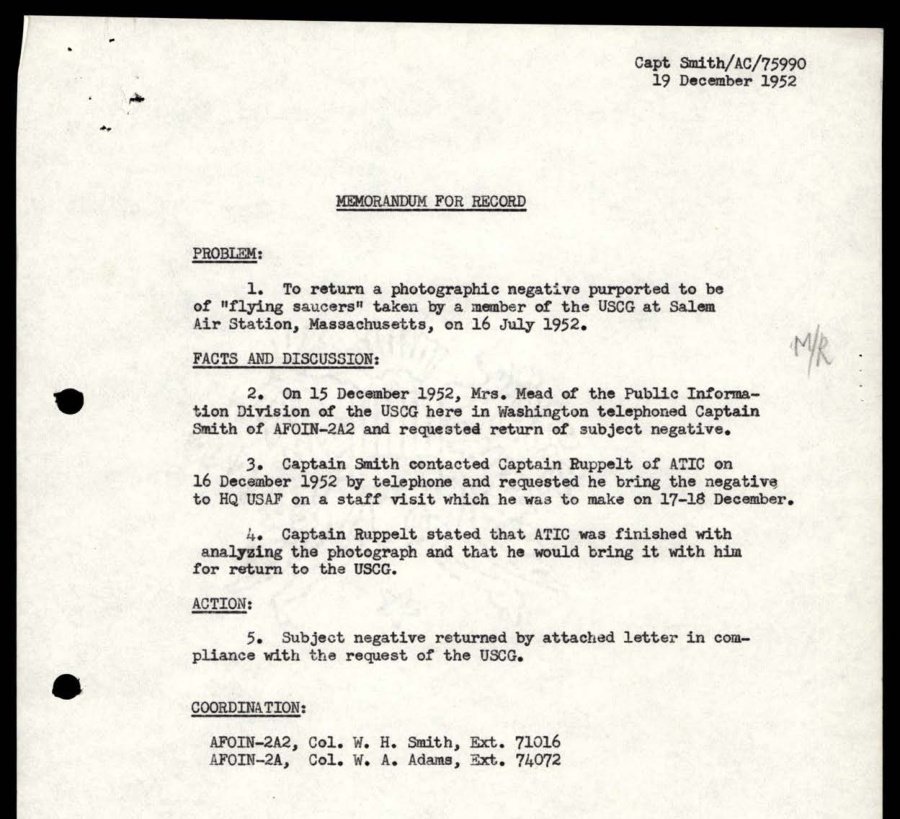 Document facsimile
A member of the Coast Guard photographed UFOs at Salem Air Station on July 16, 1952, and the negative was analyzed by the Air Force technical center. In December, at the Coast Guard's request, Captain Ruppelt brought the negative to Washington, and it was returned with a letter of thanks.
Open the case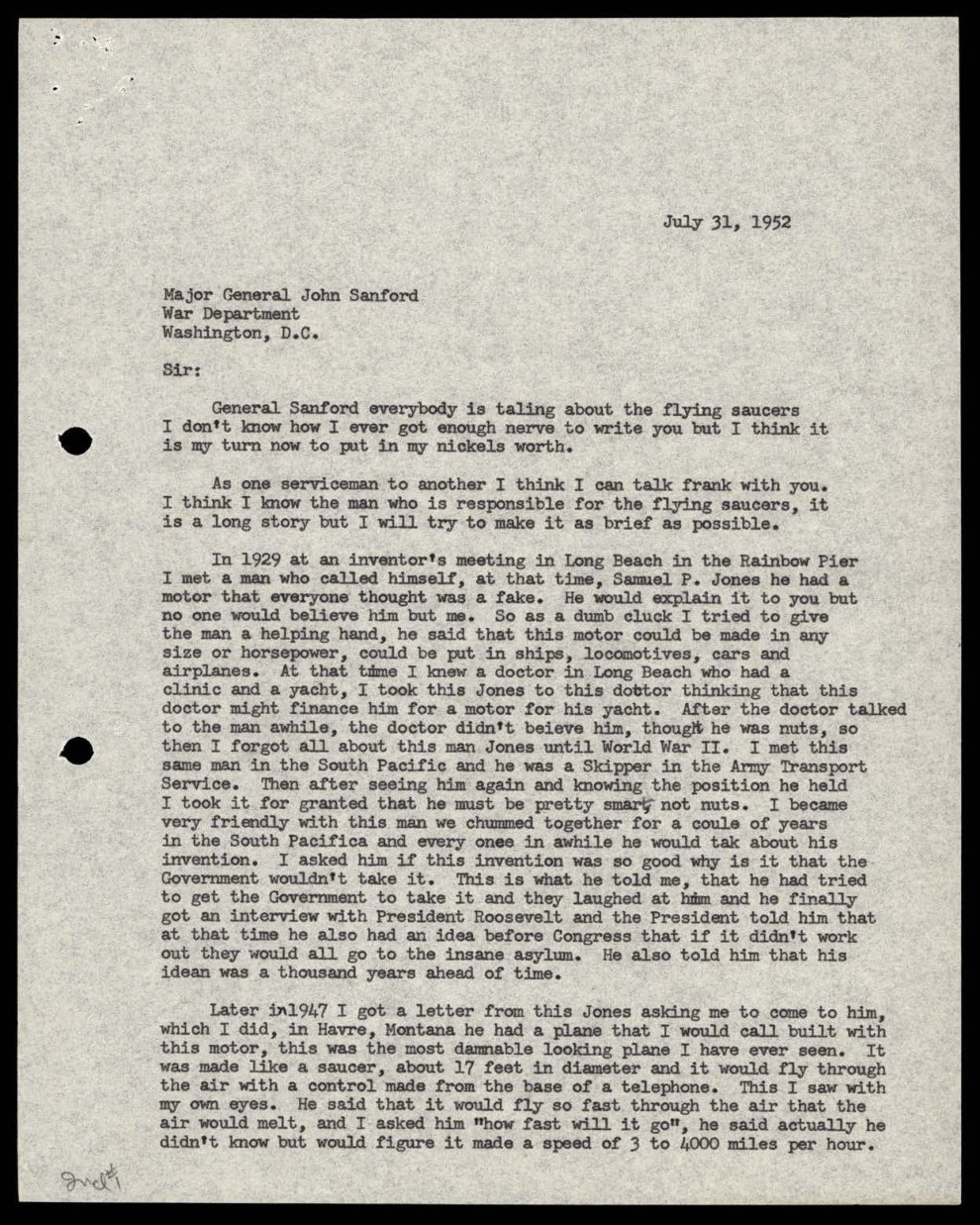 Letter from a private citizen
In July 1952, a former serviceman wrote to the Air Force intelligence chief saying that an inventor he had known since 1929 had built a disc-shaped craft, which he himself had allegedly seen fly in Havre, Montana, in 1947. The Air Force asked counterintelligence to locate the writer in order to evaluate the story.
Open the case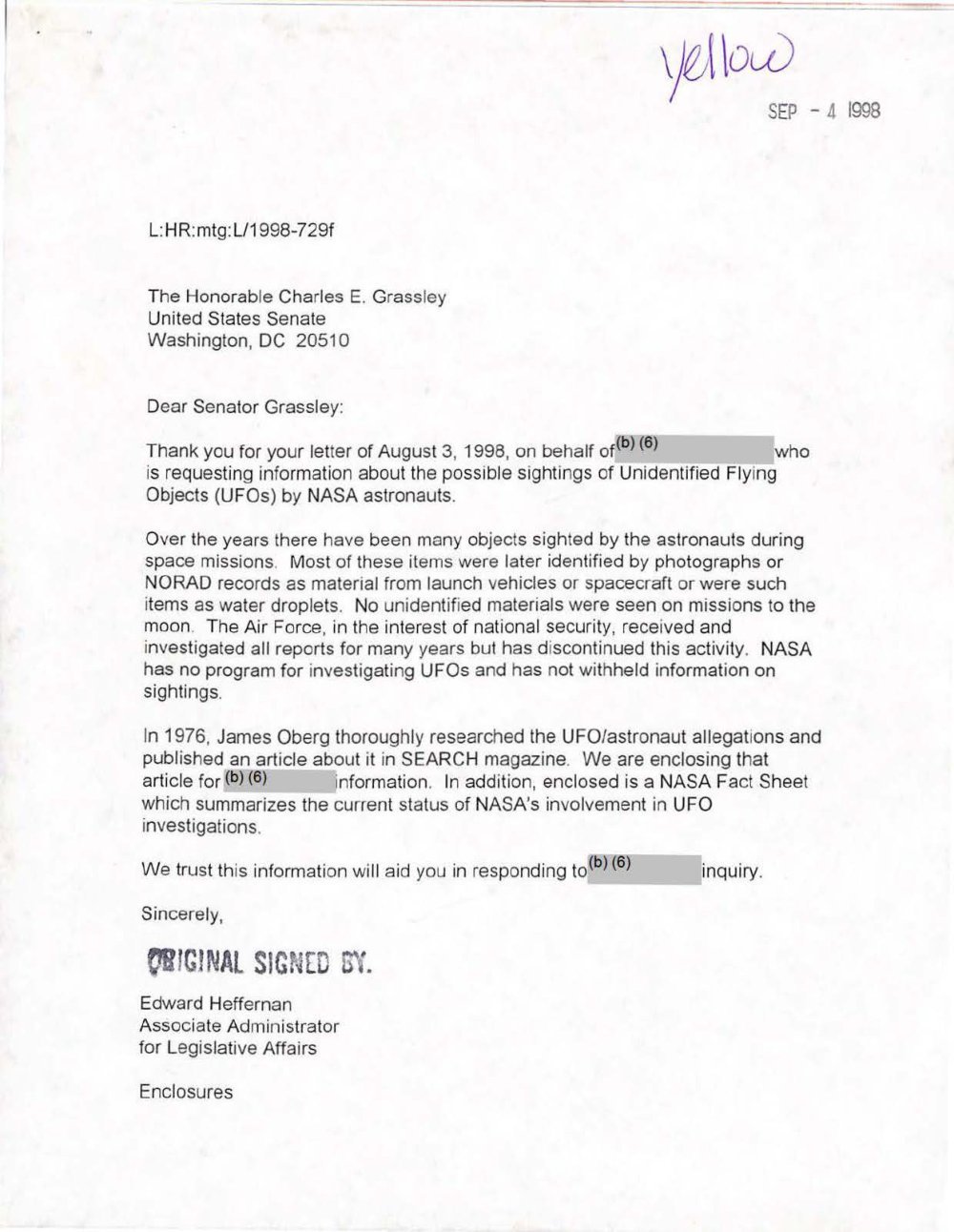 Official letter
A constituent sent Senator Charles Grassley a third-party account of a UFO seen on NASA TV in 1997 and a compilation of stories about astronauts. NASA replied that it did not investigate UFOs and enclosed a critical essay from 1976.
Open the case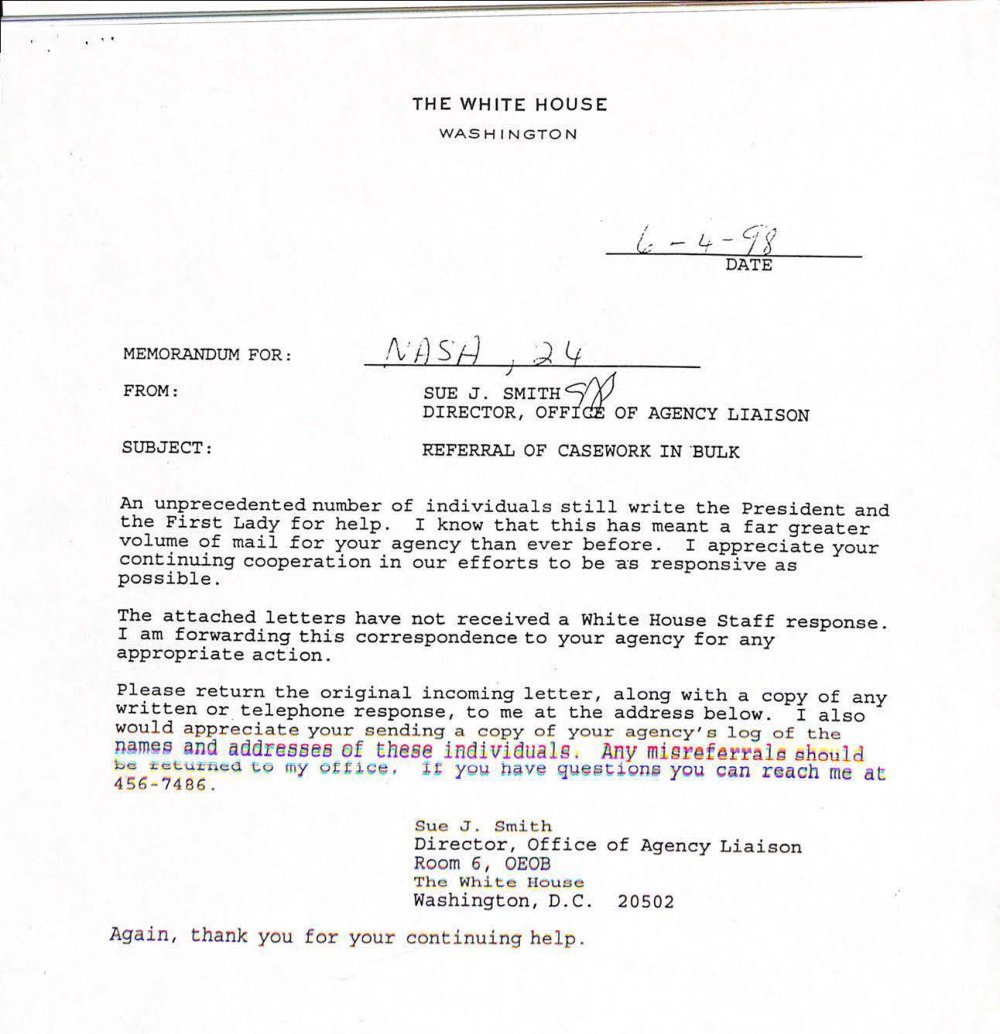 Official memorandum
Two citizens wrote to President Clinton in 1998 asking for public hearings on UFOs, in the wake of the campaign by Steven Greer and CSETI. The White House forwarded the messages to NASA, which replied that it knew of no scheduled hearings and attached its fact sheet on the subject.
Open the case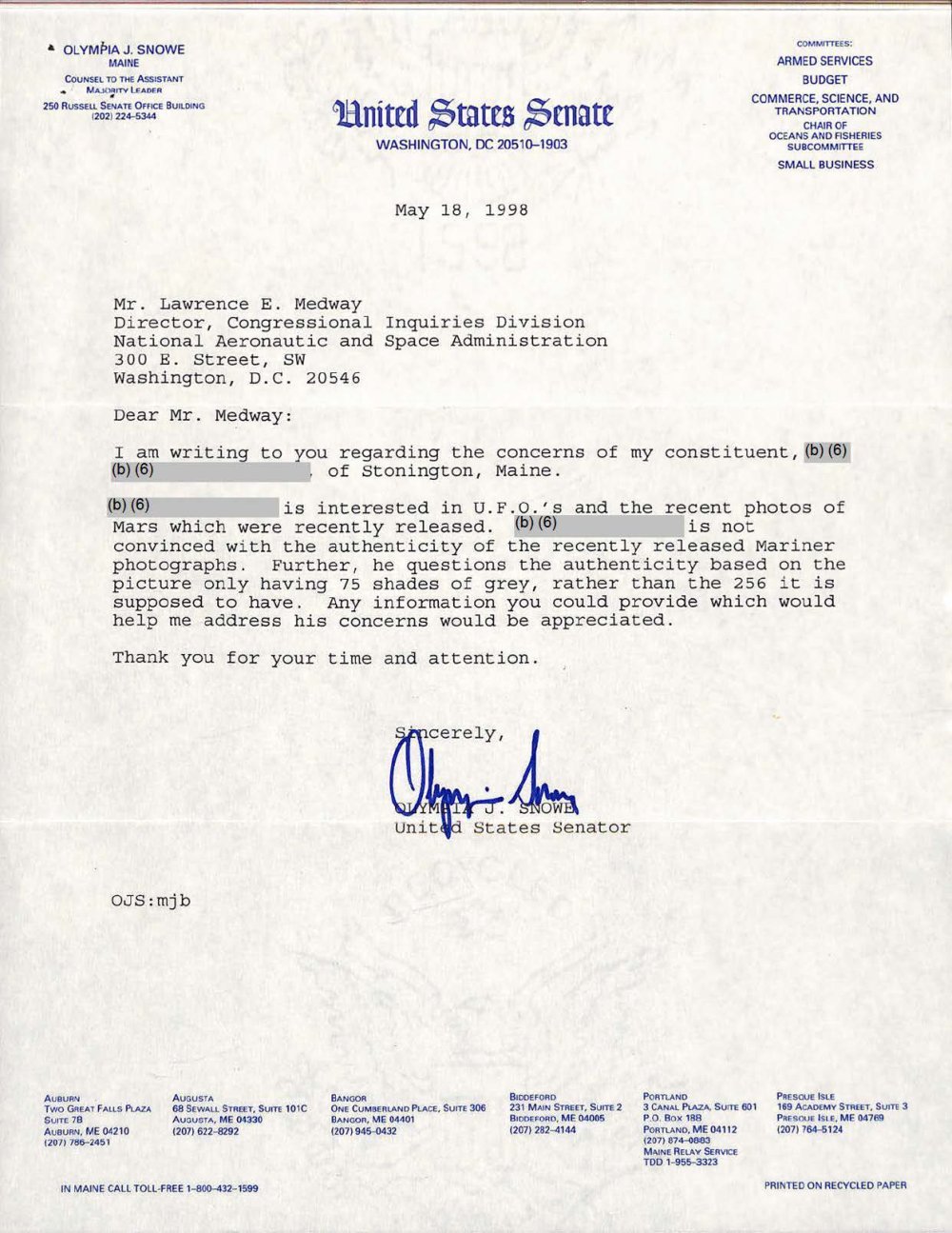 Official letter
In May 1998, Senator Olympia Snowe forwarded to NASA two letters from Maine constituents: one doubted the new photos of Mars, the other, from a 12-year-old boy, asked for documents about Roswell. NASA replied to the first by explaining the processing of the Mars Global Surveyor images and to the second with a fax of its fact sheet on UFOs.
Open the case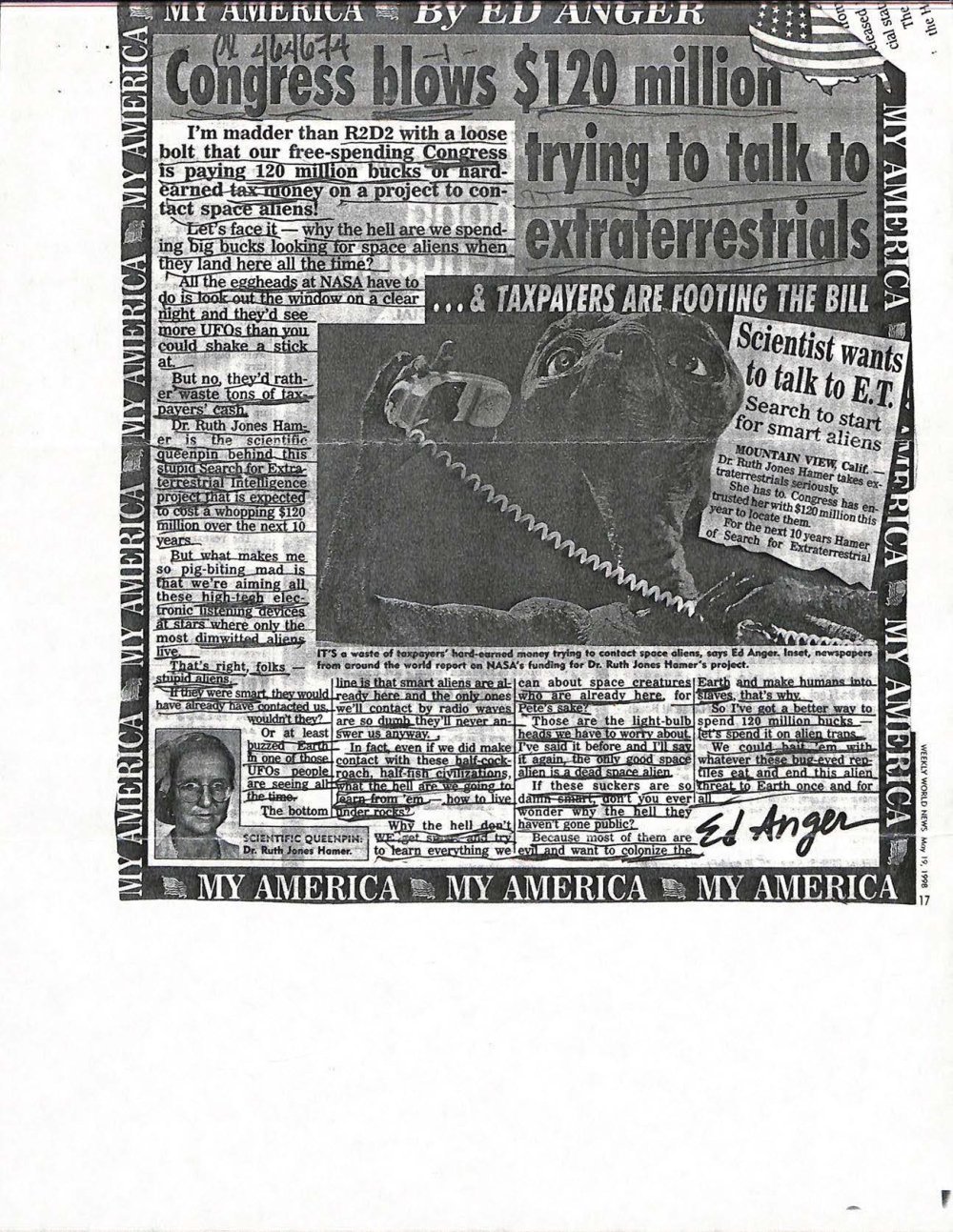 Newspaper clipping
A constituent of Representative Bart Gordon sent him a Weekly World News column that accused Congress of spending 120 million dollars to “talk to extraterrestrials”. NASA replied that Congress had ended its search program in 1993 and attached the official fact sheet on UFOs, which summarizes the government's position in 1997.
Open the case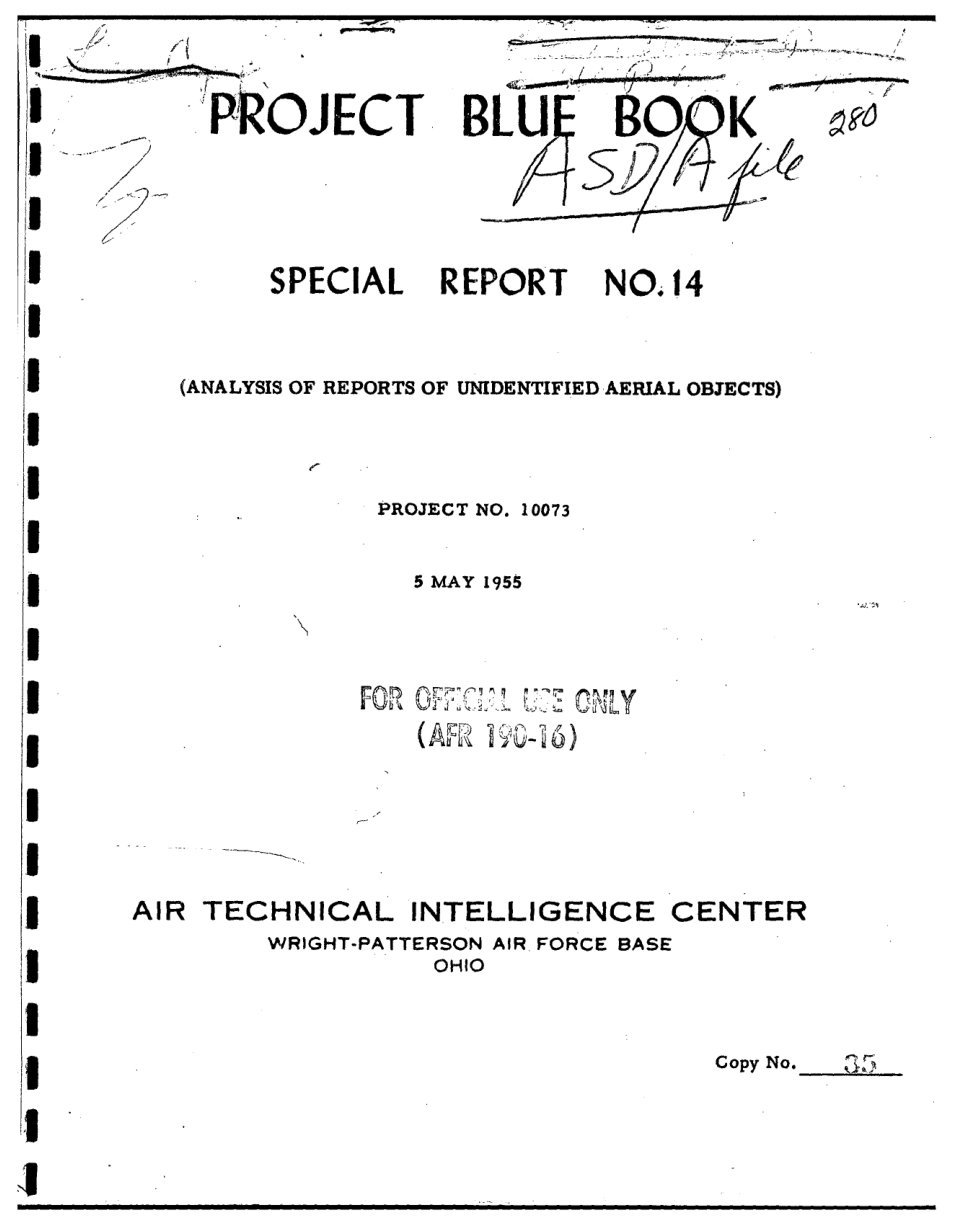 Cover of official report
The largest statistical study by the U.S. Air Force (USAF) on flying saucers gathered about 4.000 reports from 1947 to 1952, used 3.201 and classified 434 phenomena as unknowns. The official conclusion was that nothing indicated technology beyond the knowledge of the time, although the text itself admits that this could never be proven absolutely.
Open the case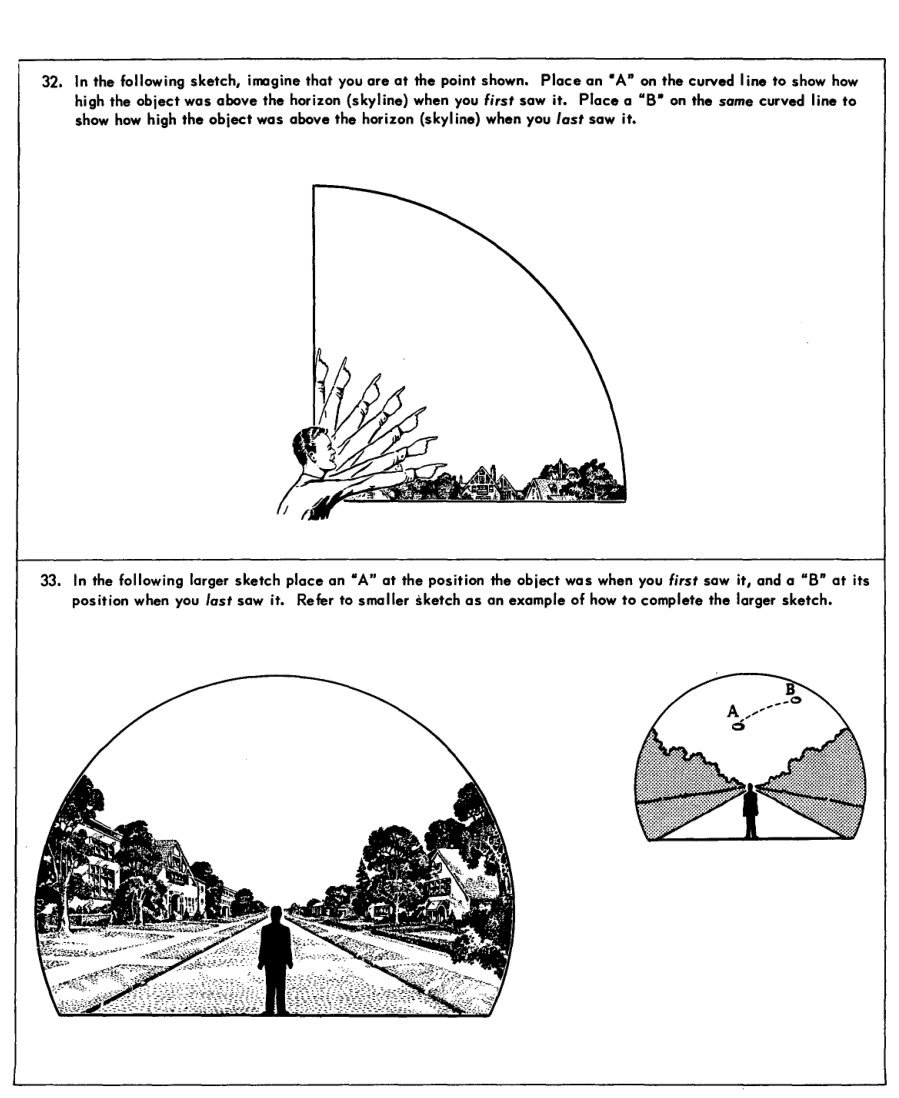 Official form with printed drawings
Special Report 14 explains step by step how witness reports became numbers: three questionnaire versions, a master code, serial numbers by year and a four-person conference to decide each identification. The text itself admits an important limitation: the maneuvers of the UFOs, which later proved decisive, were never coded.
Open the case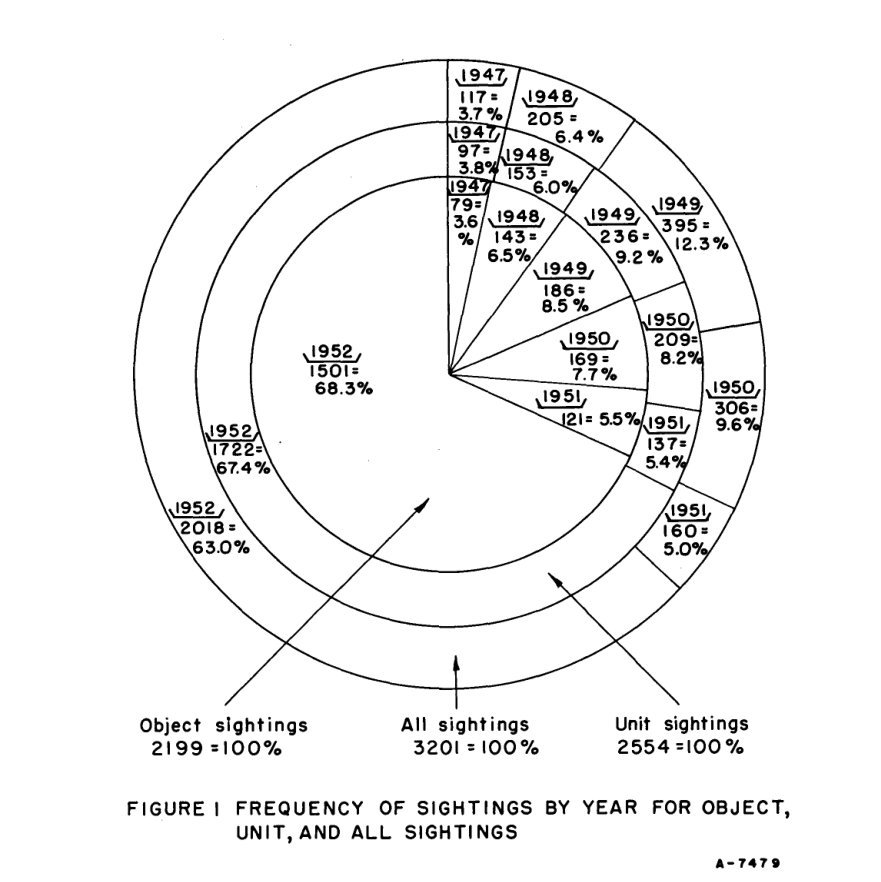 Official report chart
The charts in Special Report 14 show that 1952 accounted for about two-thirds of the reports and that 434 of the 2.199 phenomena studied remained unknowns. The most cited figure comes from Figure 8: among reports of "excellent" reliability, the proportion of unknowns was higher, not lower.
Open the case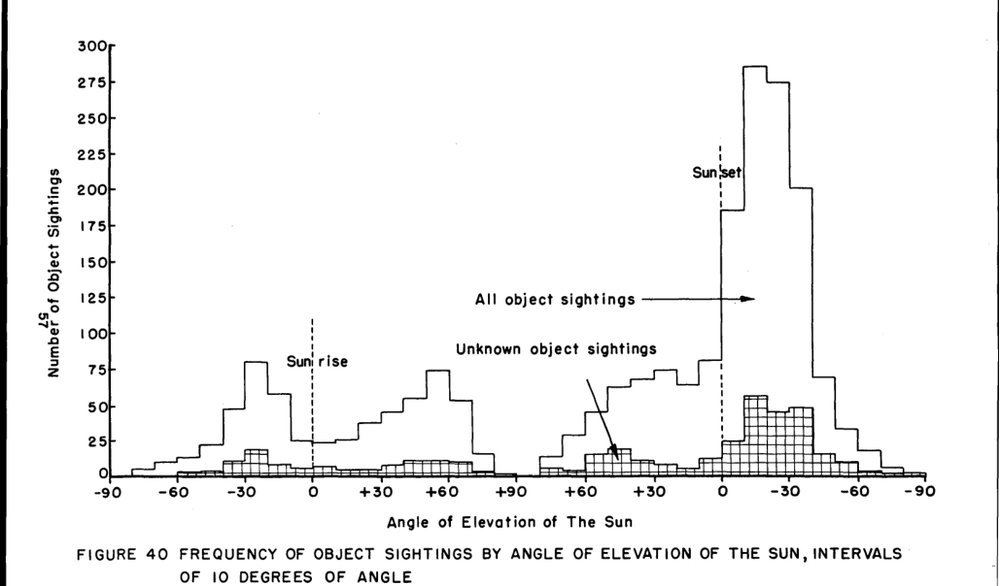 Official report chart
The Special Report 14 team calculated the position of the Sun for each sighting and compared, using the chi-square test, the explained cases and the unknowns. In five of six characteristics the difference was statistically significant, and even after removing the astronomical cases the result remained, in the report's own words, "inconclusive".
Open the case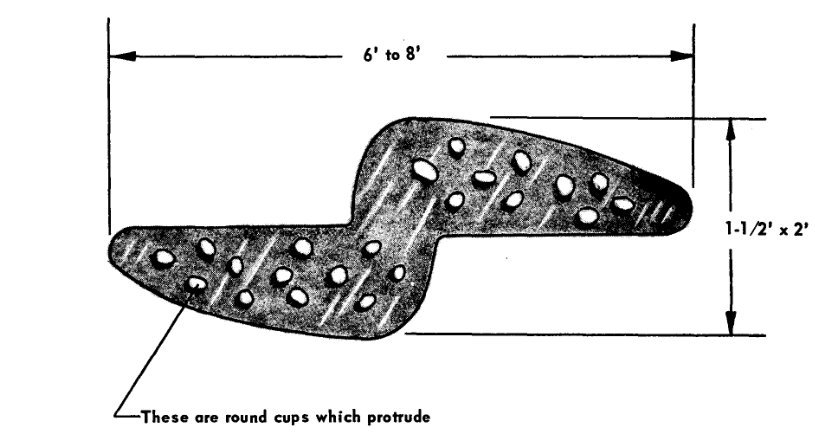 Official report drawing
Of the 434 cases classified as unknowns, the Special Report 14 team singled out only 12 described in enough detail to draw the UFO. The shapes ranged from propeller and cigar to disk with windows, and the report concluded that no common model fit all of them.
Open the case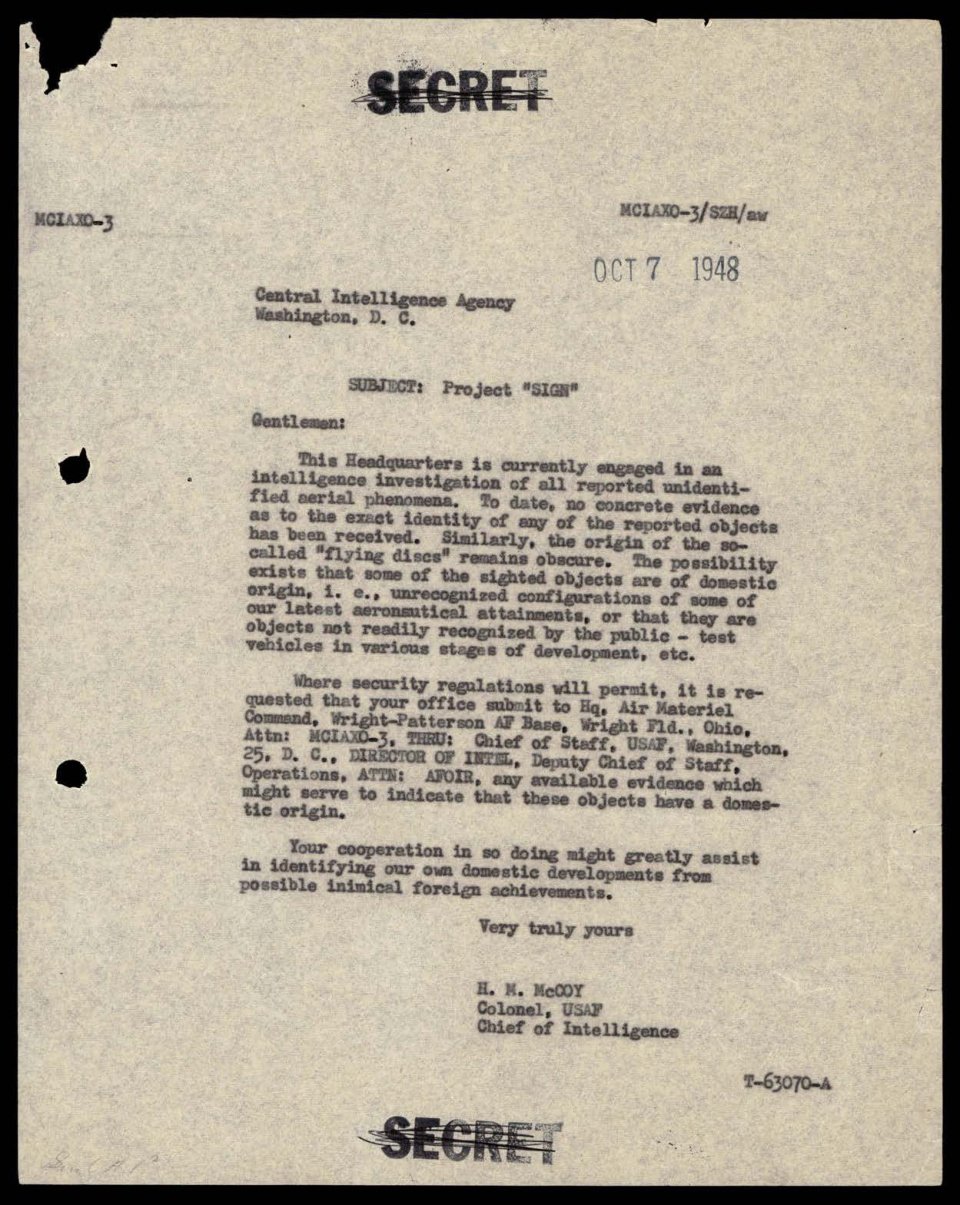 Official letter
In October 1948, the chief of intelligence of the Air Materiel Command wrote to the CIA that the origin of the flying discs remained obscure and asked for any evidence that they were American projects. The Air Force Staff forwarded the request to the Director of Central Intelligence in a nearly identical memorandum.
Open the case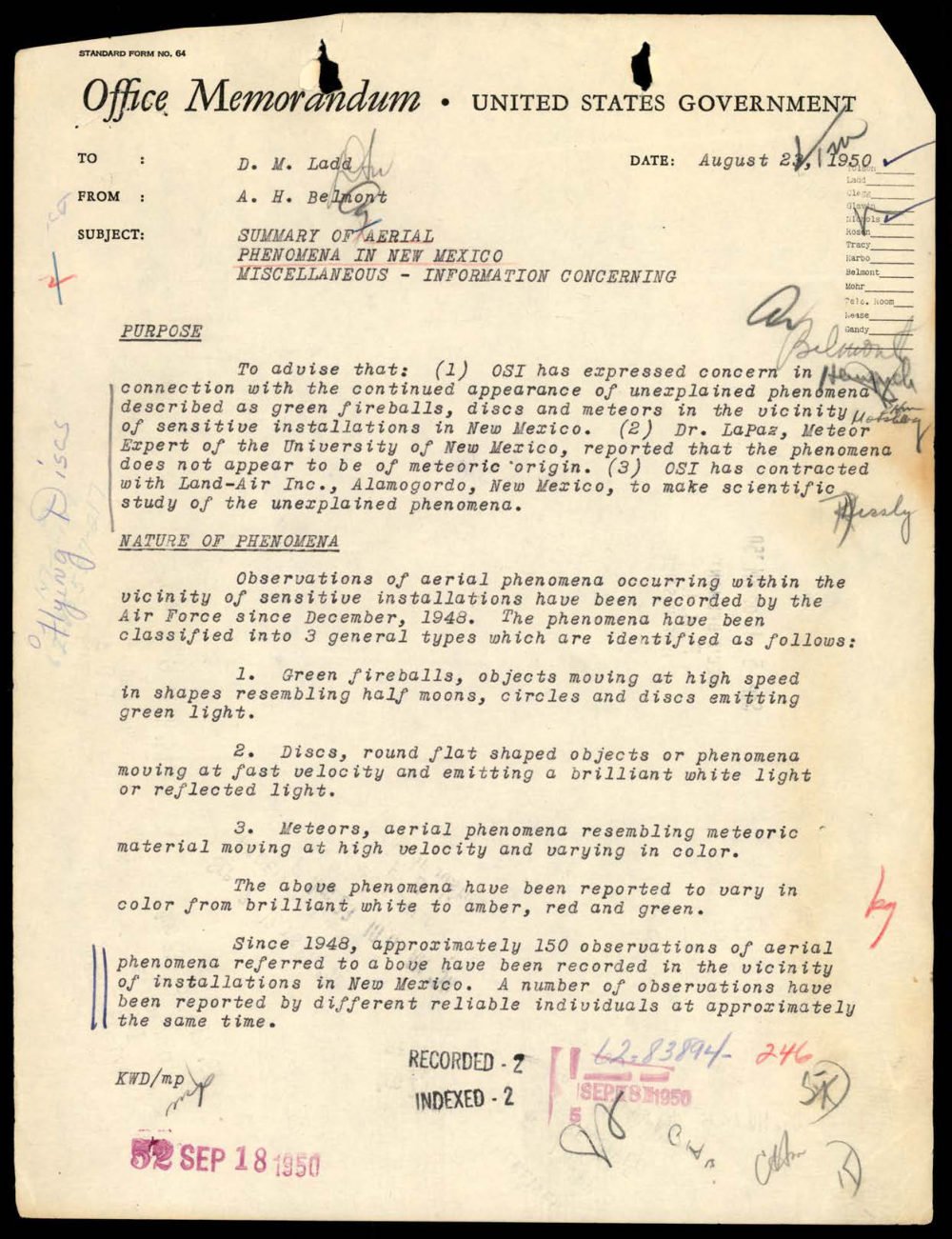 FBI memorandum (facsimile)
Internal FBI memoranda from 1950 record that the Air Force contracted the company Land-Air to set up observation posts near Vaughn, New Mexico, and photograph the UFOs known as green fireballs in a 24-hour watch called Project Twinkle. On May 24, 1950 the team reportedly sighted 8 to 10 UFOs, but as of October the Air Force had not passed any results on to the FBI.
Open the case Army folder cover
A confidential Navy circular from December 1948 passes on to the units of the 5th Naval District the warning from Air Force intelligence that a “cycle of reappearance” of flying saucers was becoming evident. The text orders that any UFO be reported and photographed whenever possible.
Open the case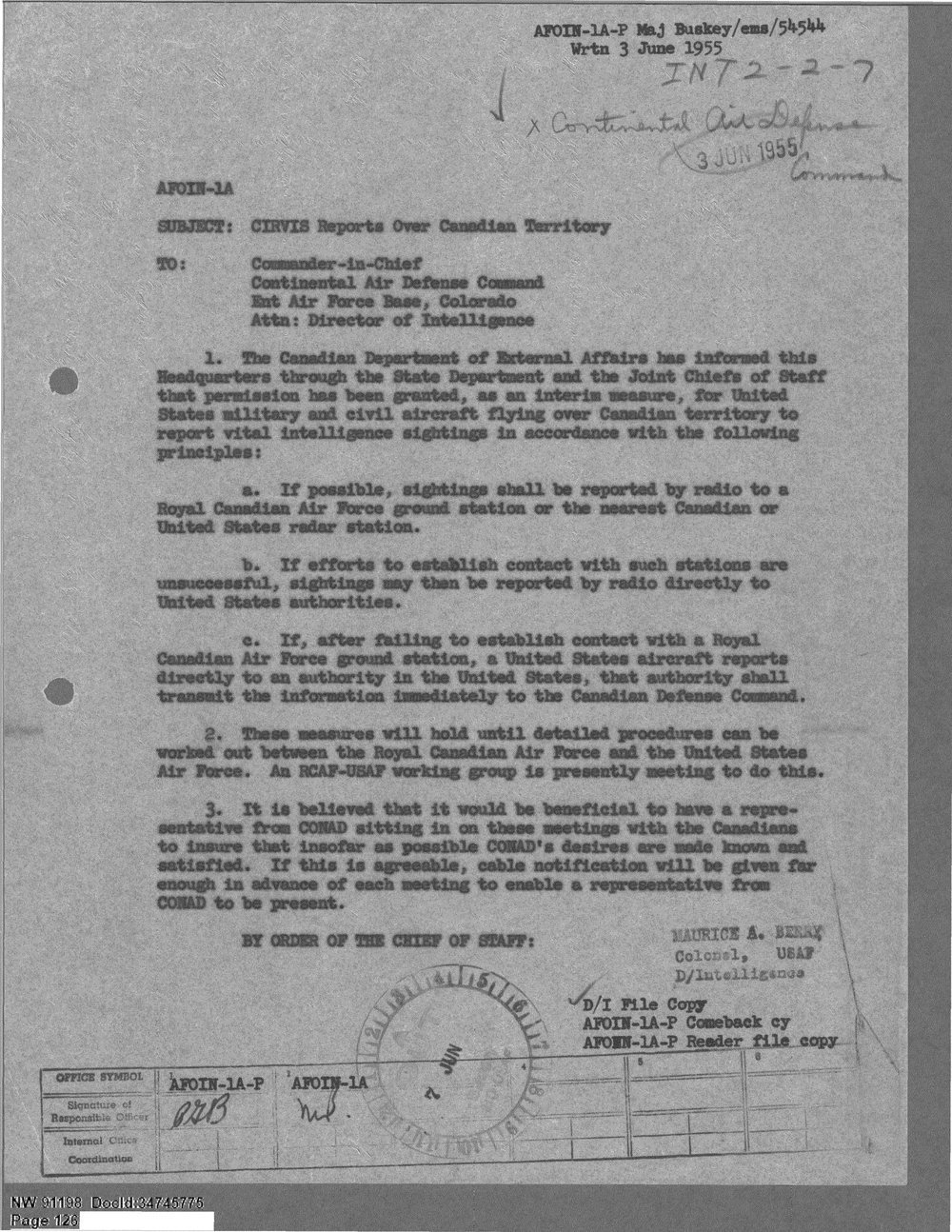 Official letter
In 1955 the U.S. Air Force (USAF) and the Royal Canadian Air Force drafted a combined version of CIRVIS, the radio procedure for reporting sightings vital to intelligence. The Continental Air Defense Command proposed taking the system to NATO, but Washington decided to test the agreement between the two countries first.
Open the case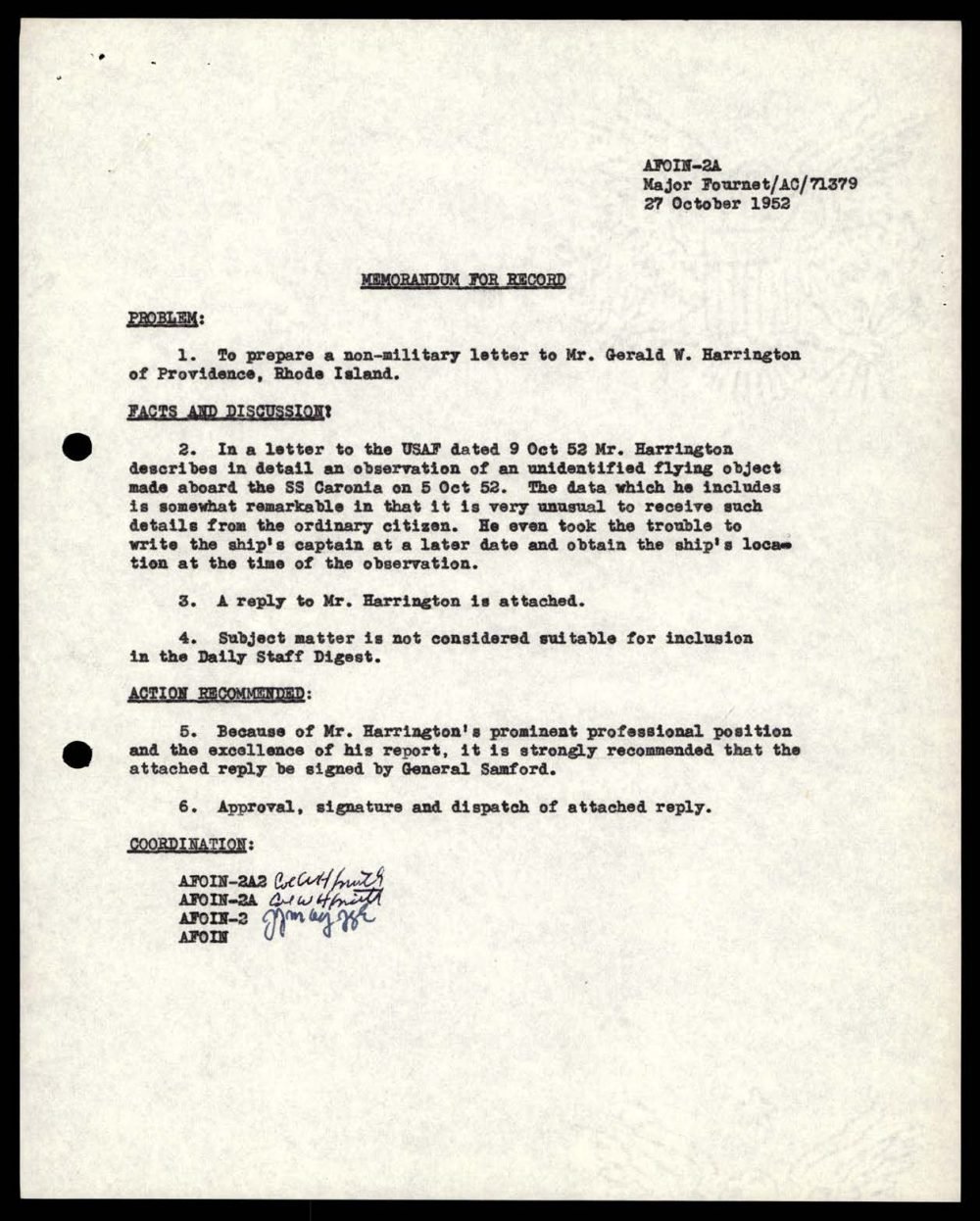 Air Force memorandum
On October 9, 1952, Gerald W. Harrington, of Providence, Rhode Island, wrote to the Air Force to describe a UFO he had observed aboard the ship SS Caronia on October 5. The Directorate of Intelligence considered the report of unusual quality, to the point of recommending that the chief of intelligence himself sign the reply, but the original letter went to Project Blue Book and is not in this file.
Open the case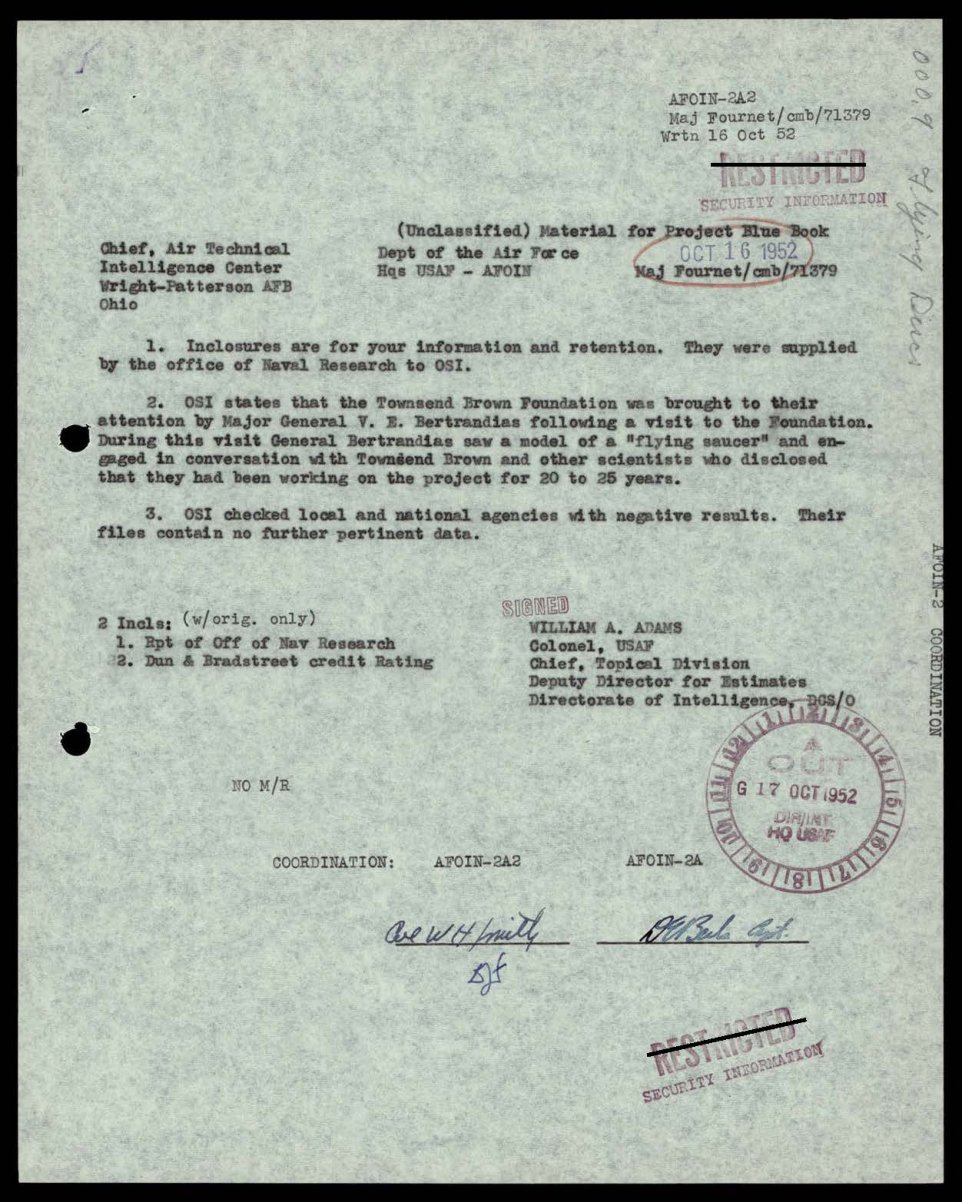 Air Force memorandum
In October 1952, the Air Force Directorate of Intelligence sent Project Blue Book a report on the Townsend Brown Foundation, brought to the special investigations service (OSI) by General V. E. Bertrandias after a visit in which he saw a model of a "flying disc." The scientists told him they had been working on the project for 20 to 25 years; OSI's inquiries found nothing further on the foundation.
Open the case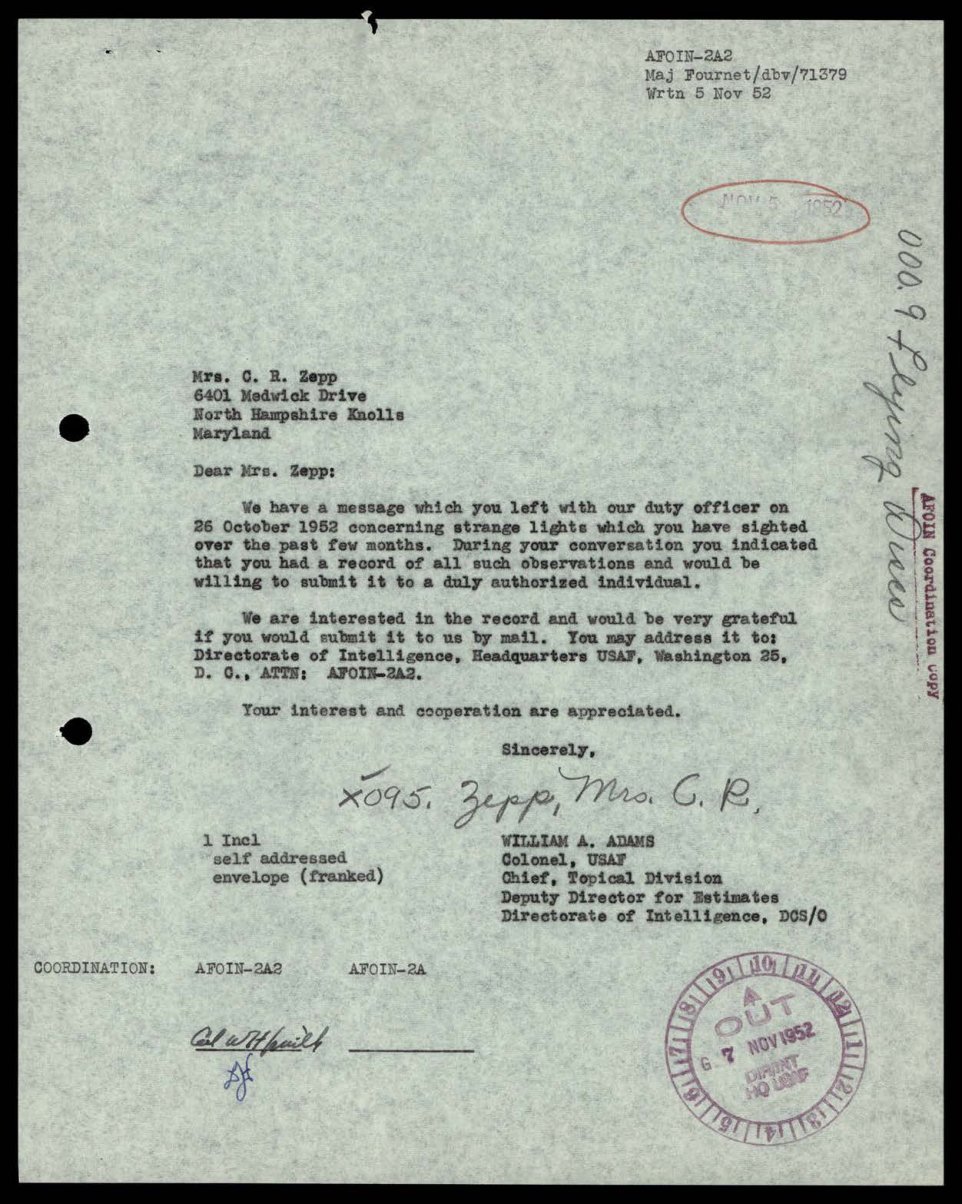 Air Force letter
On October 26, 1952, Mrs. C. R. Zepp, of Hyattsville, Maryland, telephoned the duty officer of the Air Force Directorate of Intelligence to say that she had been seeing luminous UFOs for some months and that she had a record of all the sightings. The Air Force requested the record by letter, received it in November and sent it to Project Blue Book, but the content of the notes is not in the file.
Open the case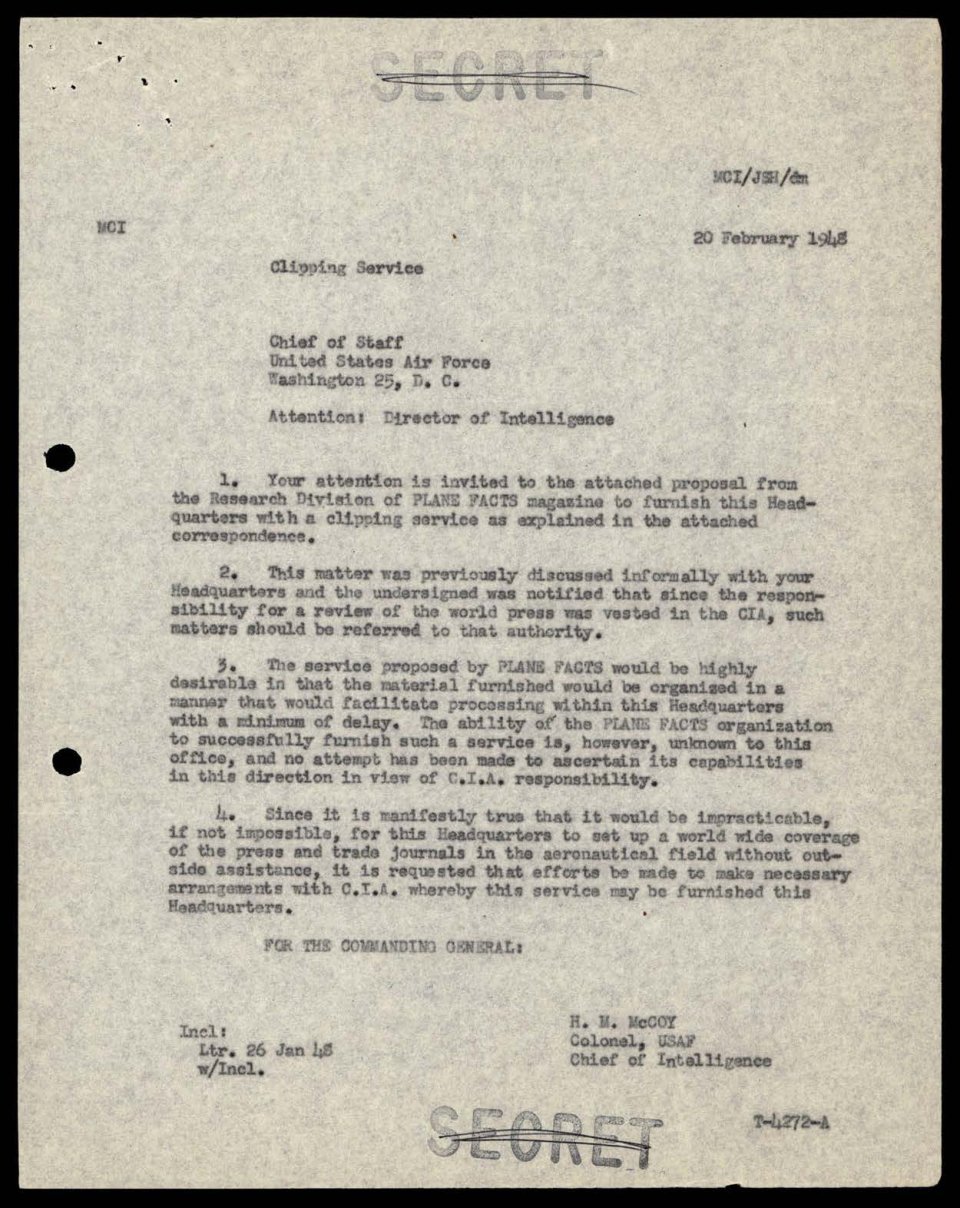 Air Materiel Command letter
Between February and April 1948, the intelligence section of the Air Materiel Command asked Washington for a service of newspaper and magazine clippings from around the world on flying discs, for Project Sign. A proposal from a Dayton magazine was vetoed, and the Air Staff suggested that a civilian of the command subscribe to the service in his own name, with a post office box and payment by postal money order.
Open the case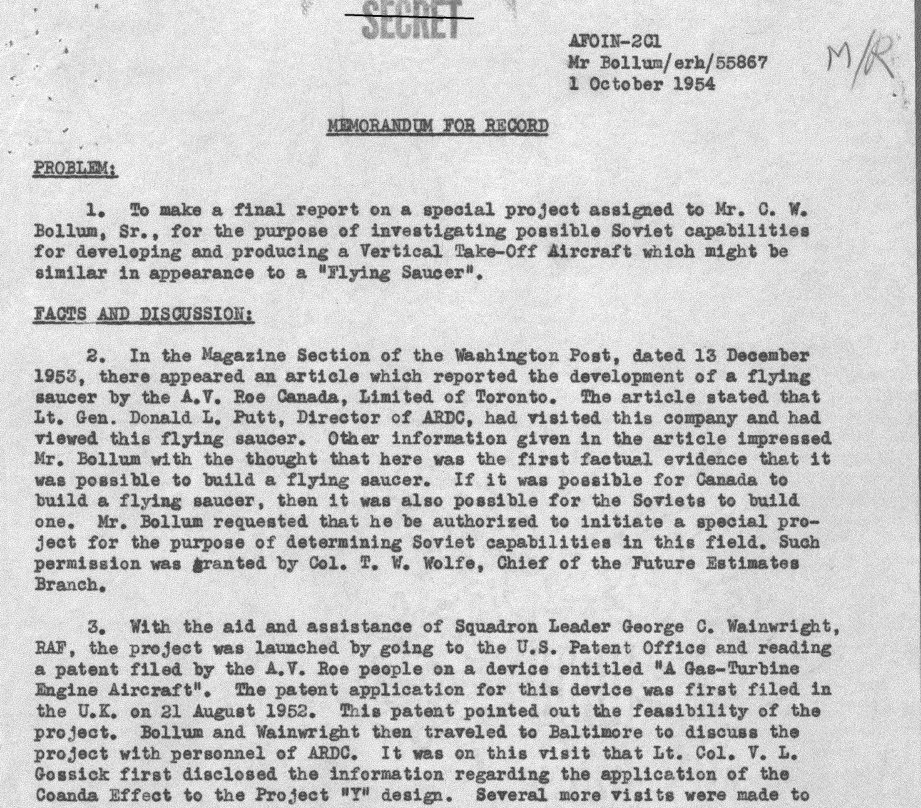 Official memorandum
In 1954, a U.S. Air Force (USAF) intelligence analyst investigated Project Y2, a circular vertical-takeoff aircraft by the Canadian firm A. V. Roe, and concluded that if the West could build a 'flying disc,' the Soviet Union could too. An optimistic article in the internal intelligence magazine provoked a reaction: the Air Force scientific advisory board advised against supporting the project, and the matter was taken out of the analyst's hands.
Open the case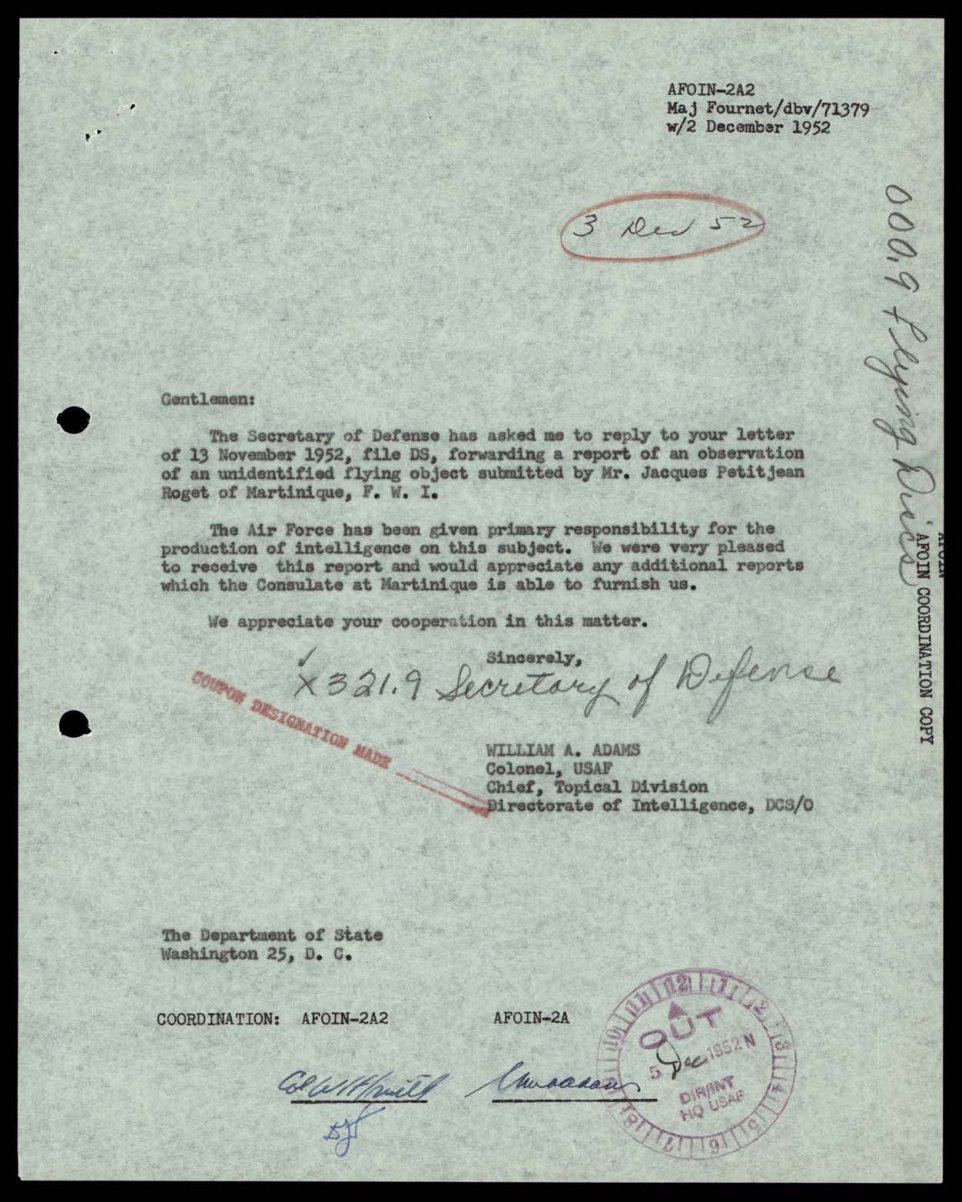 Official document
In November 1952 the Department of State sent Defense the letter from Jacques Petitjean Roget, of Martinique, which described a UFO, and asked whether the Air Force wanted more reports like it. On December 2 the Directorate of Intelligence replied that it did, through the Consulate.
Open the case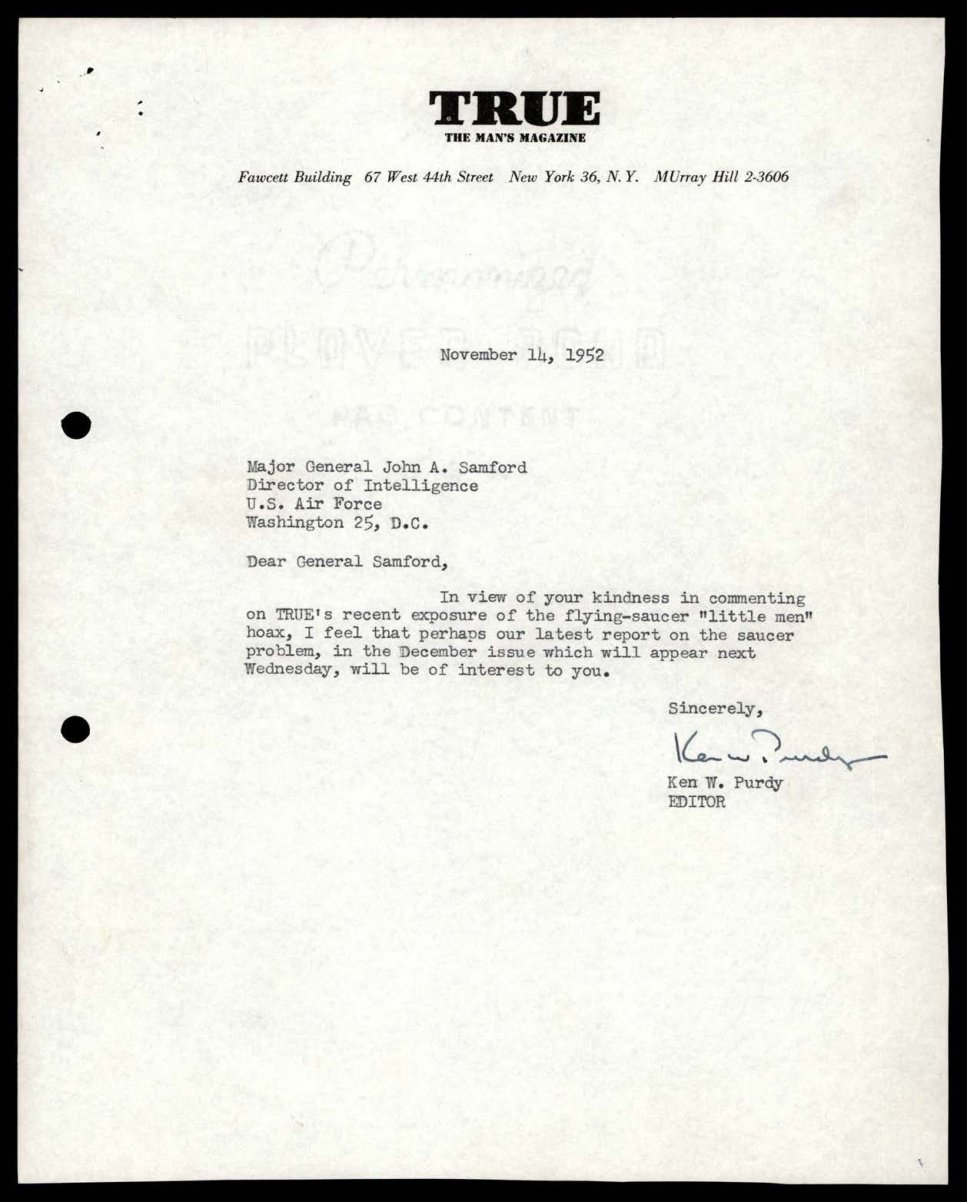 Official document
On November 14, 1952 the editor of TRUE, Ken W. Purdy, wrote to General John A. Samford offering the December issue, which carried an article by Donald Keyhoe on flying saucers. The Directorate of Intelligence prepared a courtesy acknowledgment.
Open the case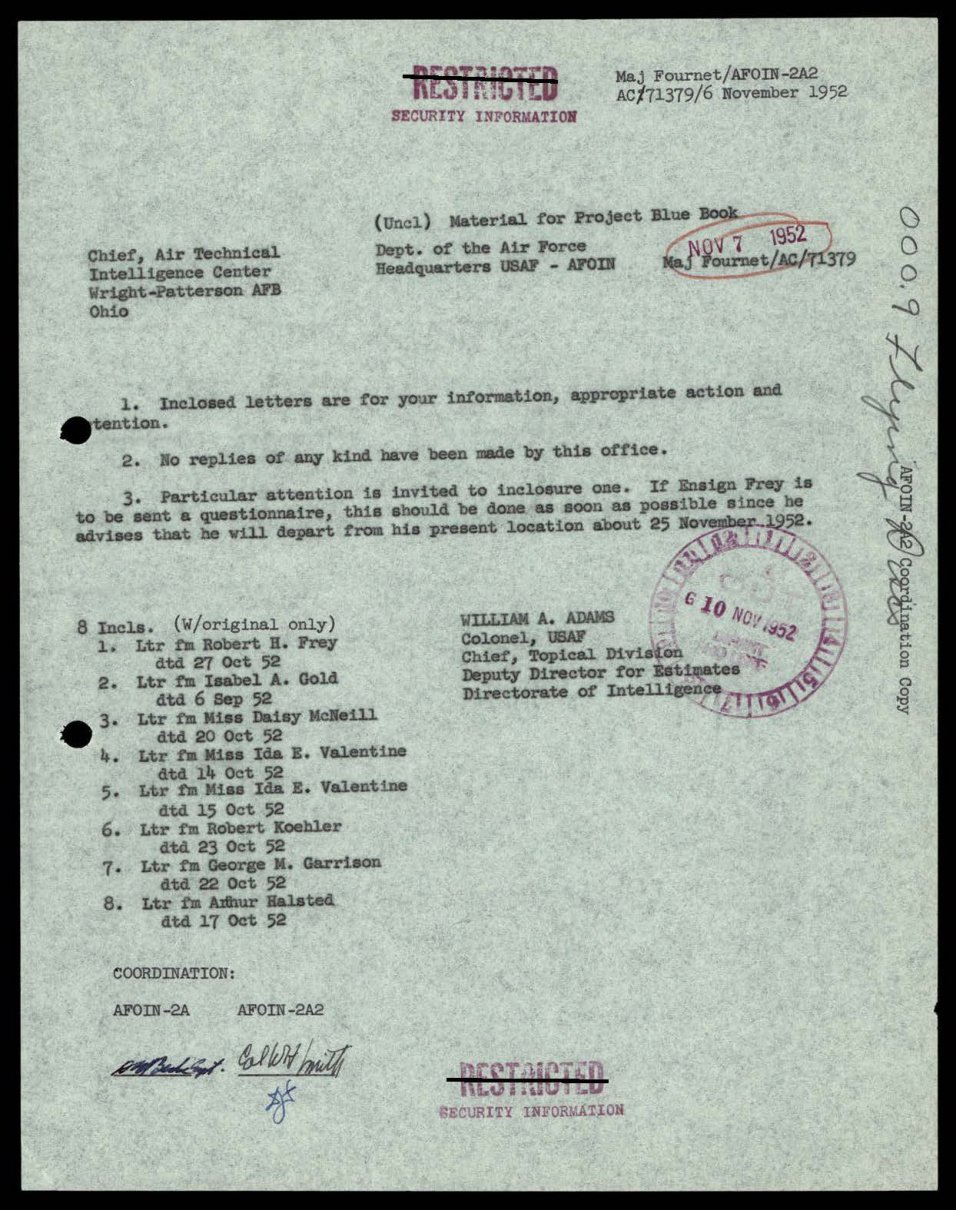 Official document
In November 1952 the Topical Division of the Directorate of Intelligence answered citizens who wrote about flying saucers with form letters, questionnaires and acknowledgments, and sent the letters, questionnaires and clippings to the Air Technical Intelligence Center at Wright-Patterson.
Open the case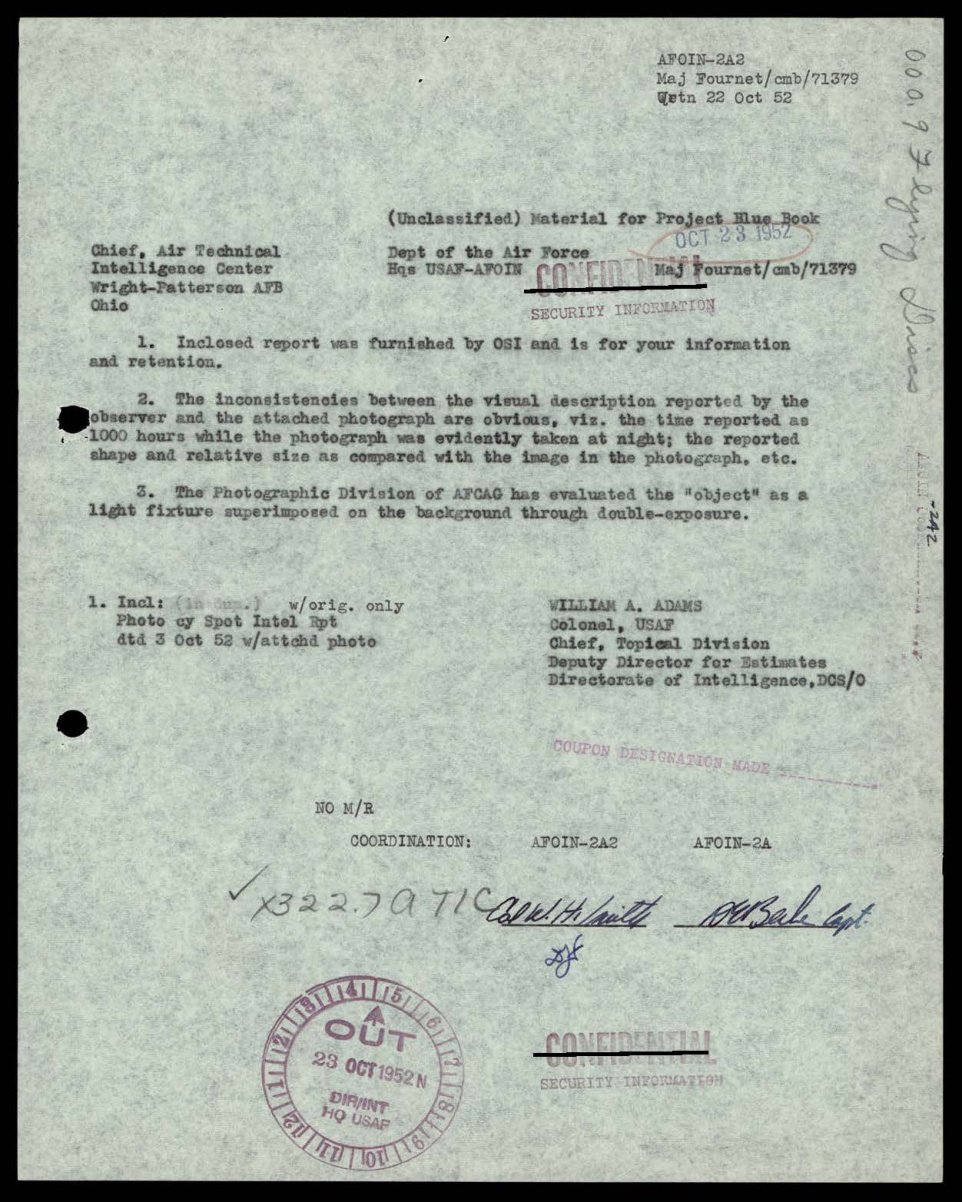 Official document
On October 22, 1952 the Directorate of Intelligence informed ATIC that an OSI photographic report of October 3 had a description inconsistent with the photo, which the photographic division assessed as a light fixture in a double exposure. On November 10, another memorandum explained why a Tucson report of September 2 was not forwarded.
Open the case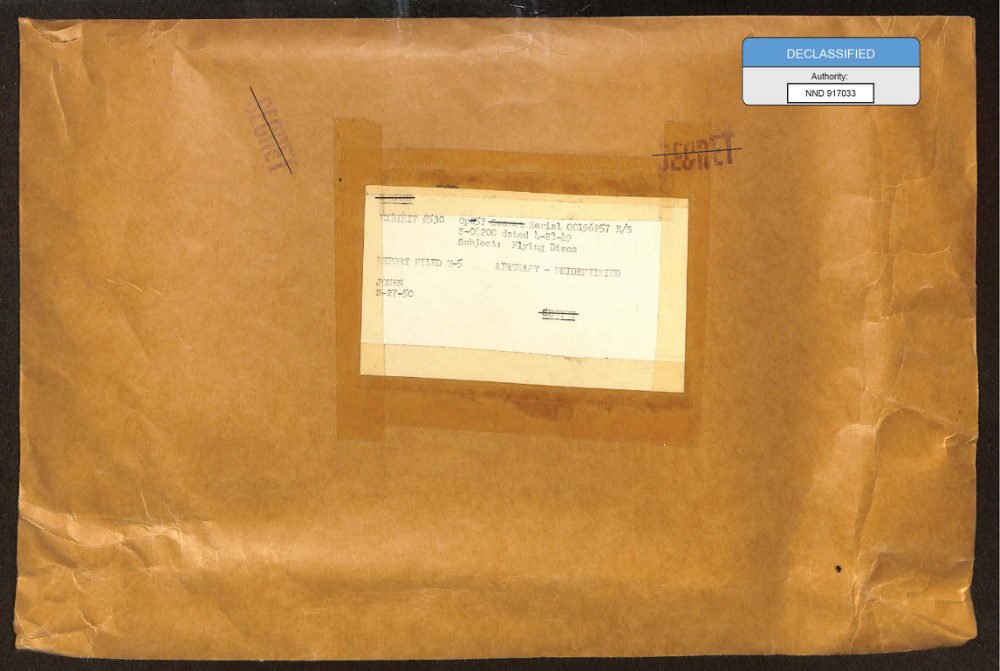 File envelope
This dossier brings together Project Sign pages with no account: the envelope and cover of the volume of forms 101 to 172 and five forms that carry only the name of the observer or the place. They show how the file was assembled and which incidents exist only as a record.
Open the case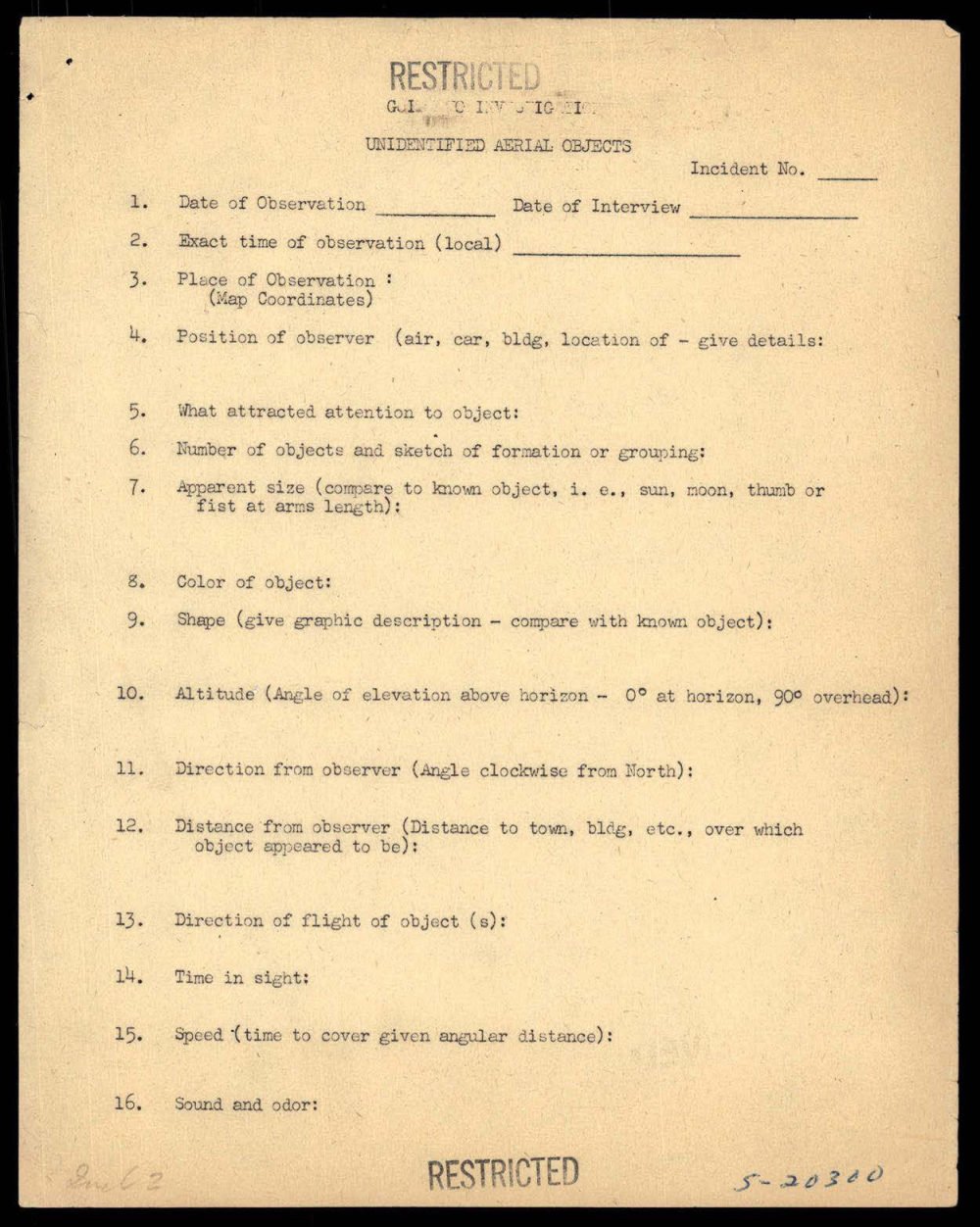 Form
Four blank pages, stamped RESTRICTED, list what an Air Force investigator was to ask a UFO witness: from coordinates and angles to checks with the police, the FBI and radar. The guide shows what Project Sign considered essential data.
Open the case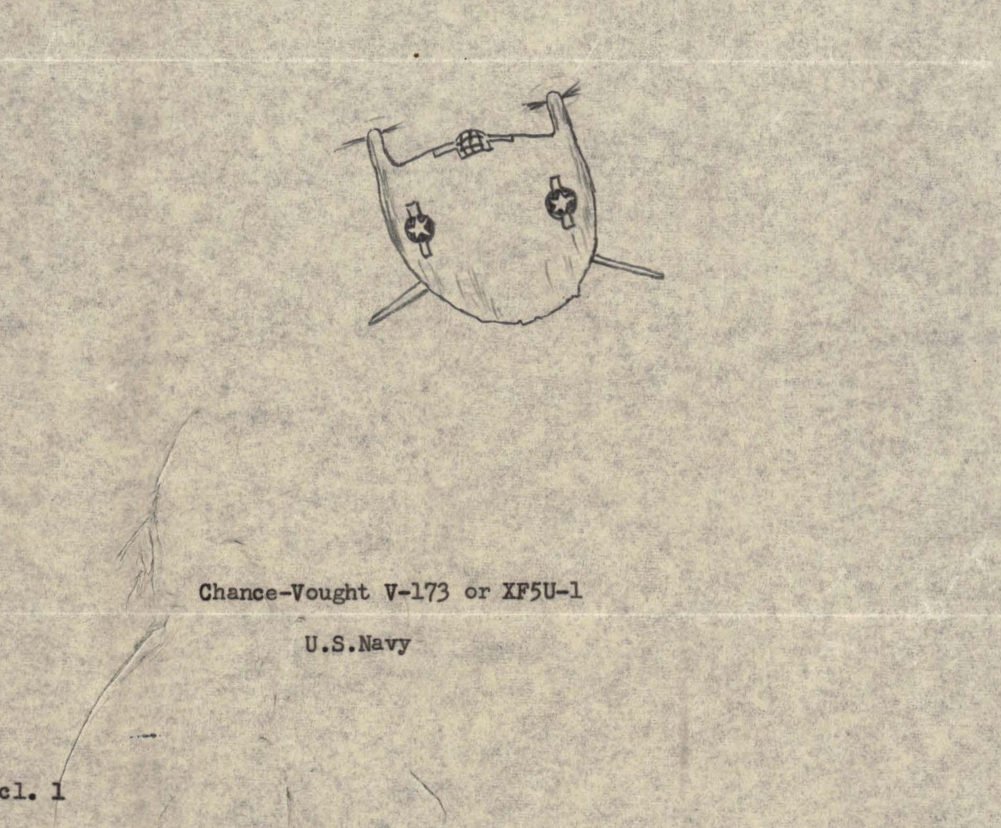 Sketch
On February 17, 1949, the Intelligence Division of the Air Materiel Command informed Project Sign that a British aircraft recognition periodical had published the photo of the Navy's Chance-Vought V-173 with the caption “flying disc.” It enclosed a tracing of the photo's outline.
Open the case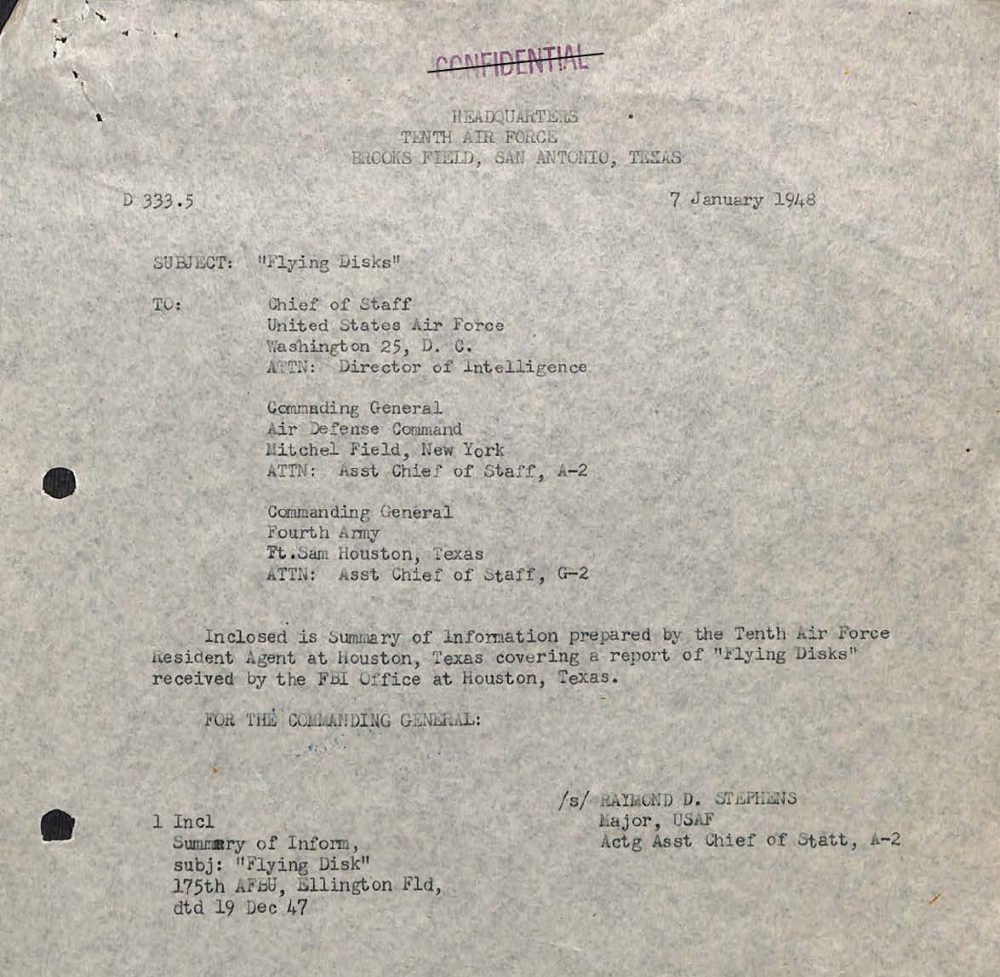 Letter
In January 1948, Tenth Air Force headquarters sent to Air Force headquarters and other commands the summary of a report of “flying discs” received by the FBI in Houston. In March, headquarters passed it on to the Air Materiel Command. The enclosed summary is not among the pages.
Open the case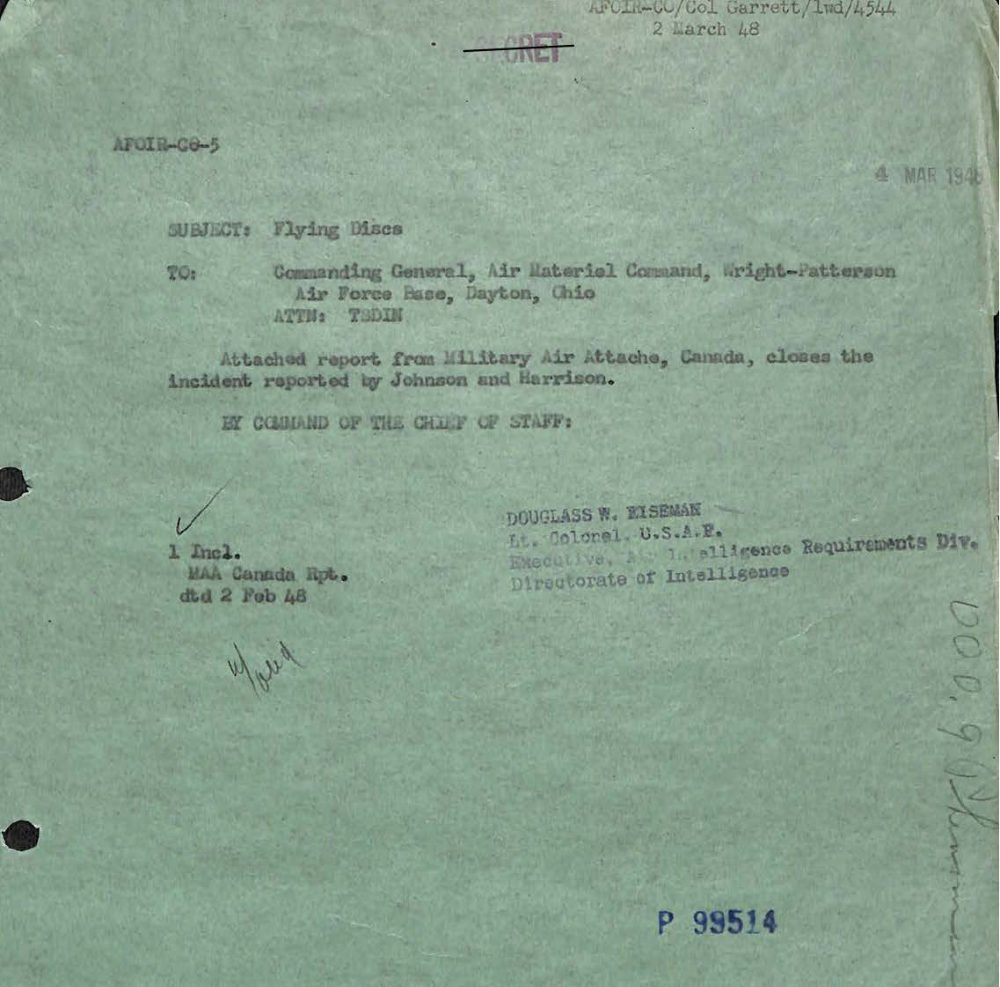 Transmittal memorandum
Two 1948 sheets from Air Force intelligence forward reports that are not in the pages: the one from the air attaché in Canada, which closed the incident reported by Johnson and Harrison, and a flying disc report sent by the Fourth Air Force, at Hamilton Field.
Open the case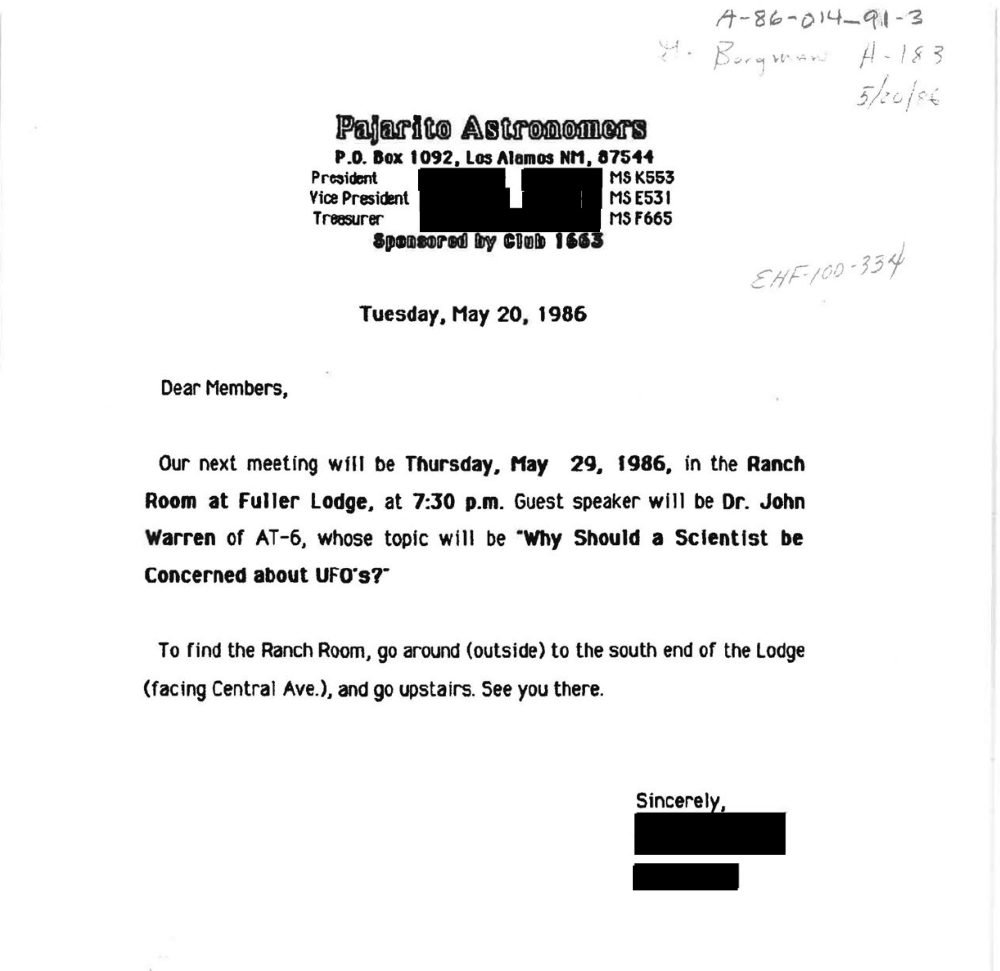 Circular
A May 20, 1986 circular from the Pajarito Astronomers astronomy club, of Los Alamos, invites members to a talk by Dr. John Warren, of AT-6, on May 29, about why a scientist should care about UFOs.
Open the case Official document
Between January 10 and February 17, 1955, the Air Force Directorate of Intelligence and its Legislative Liaison answered about two dozen letters from the public with a standard text and the enclosure "Summary of events and information on the unidentified flying objects program." The pages show what people were asking for and how the institution handled the correspondence.
Open the case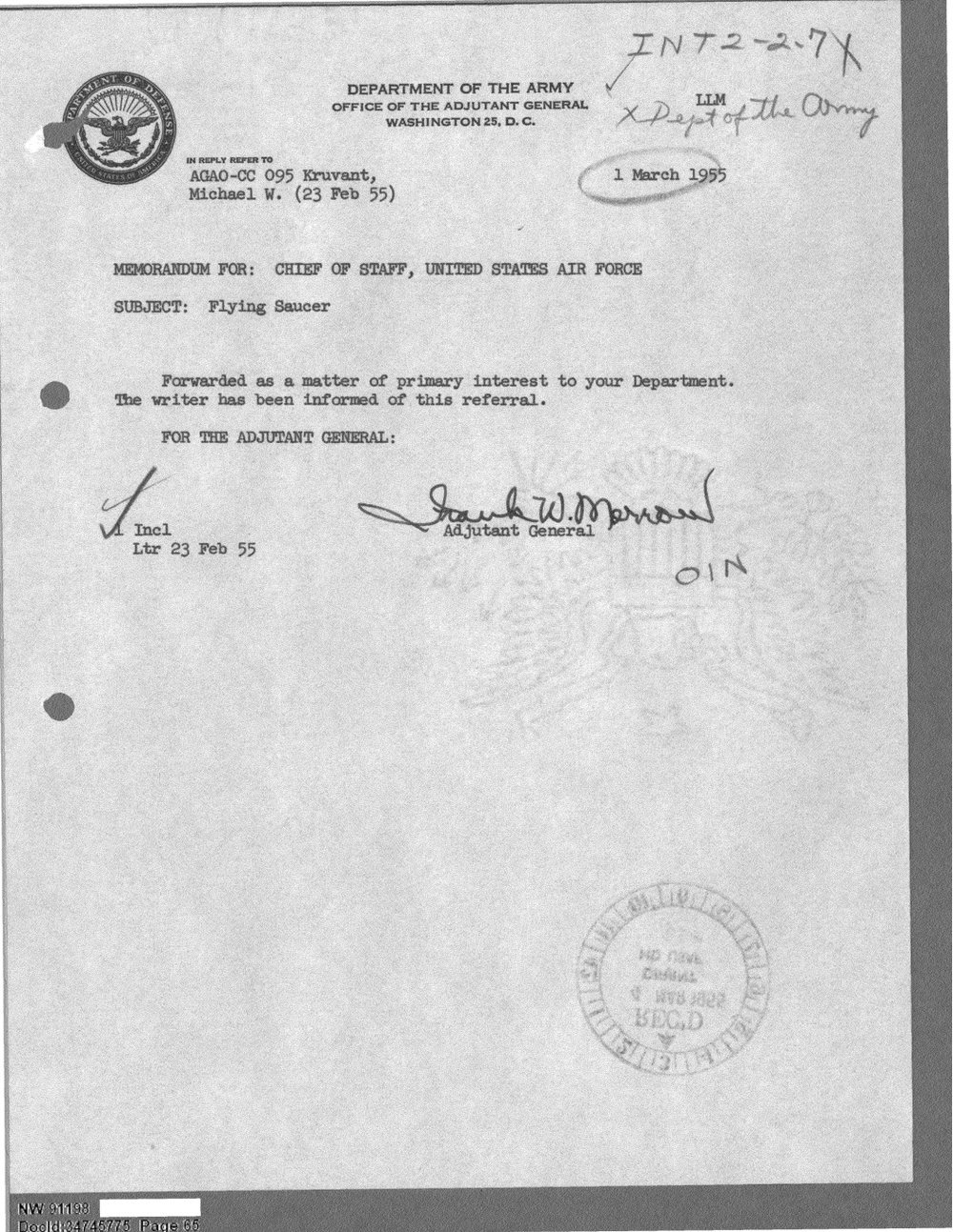 Official document
From February to April 1955 the Air Force kept answering letters from the public, some sent to the President and others passed on by the Army, always enclosing the public summary of the UFO program. Some replies confirm that sighting reports were turned over to the analysts.
Open the case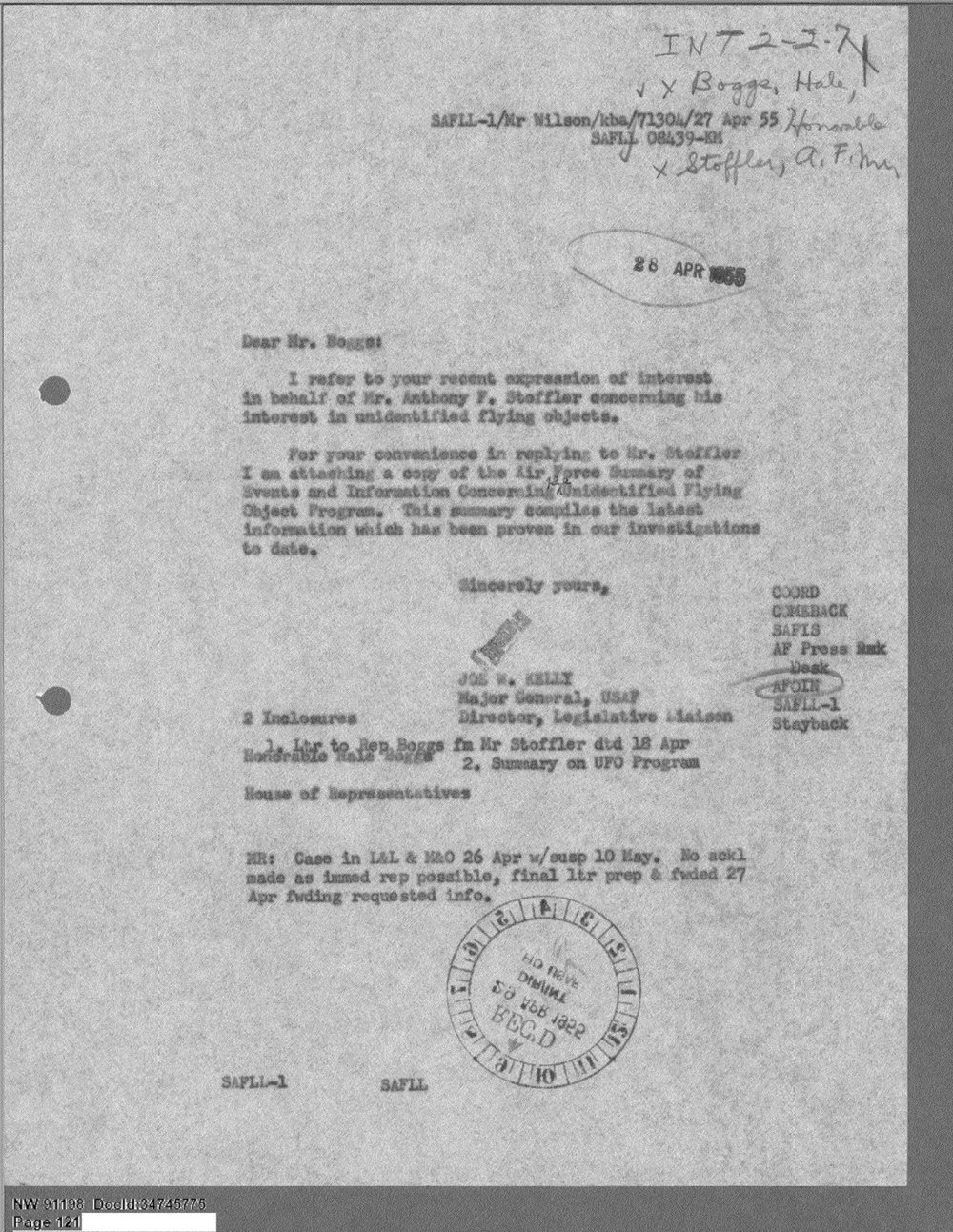 Official document
Between May and August 1955 the Air Force kept answering correspondence from the public: letters to the President, a congressman's request on behalf of a constituent, requests from a Dutchman and from residents of several states, almost all answered with the public summary of the program.
Open the case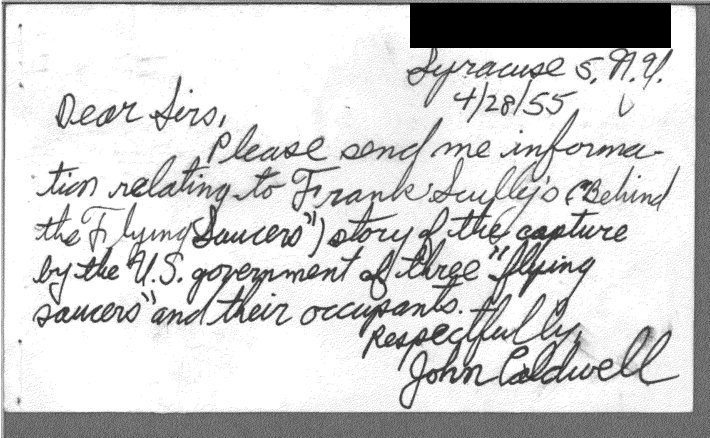 Official document
On April 28, 1955, John Caldwell, of Syracuse, sent a postcard to "Project Saucer," at the Pentagon, asking for information about Frank Scully's story that the U.S. government had allegedly captured three flying discs and their occupants. The Inspector General's office acknowledged receipt and passed the matter to the Directorate of Intelligence.
Open the case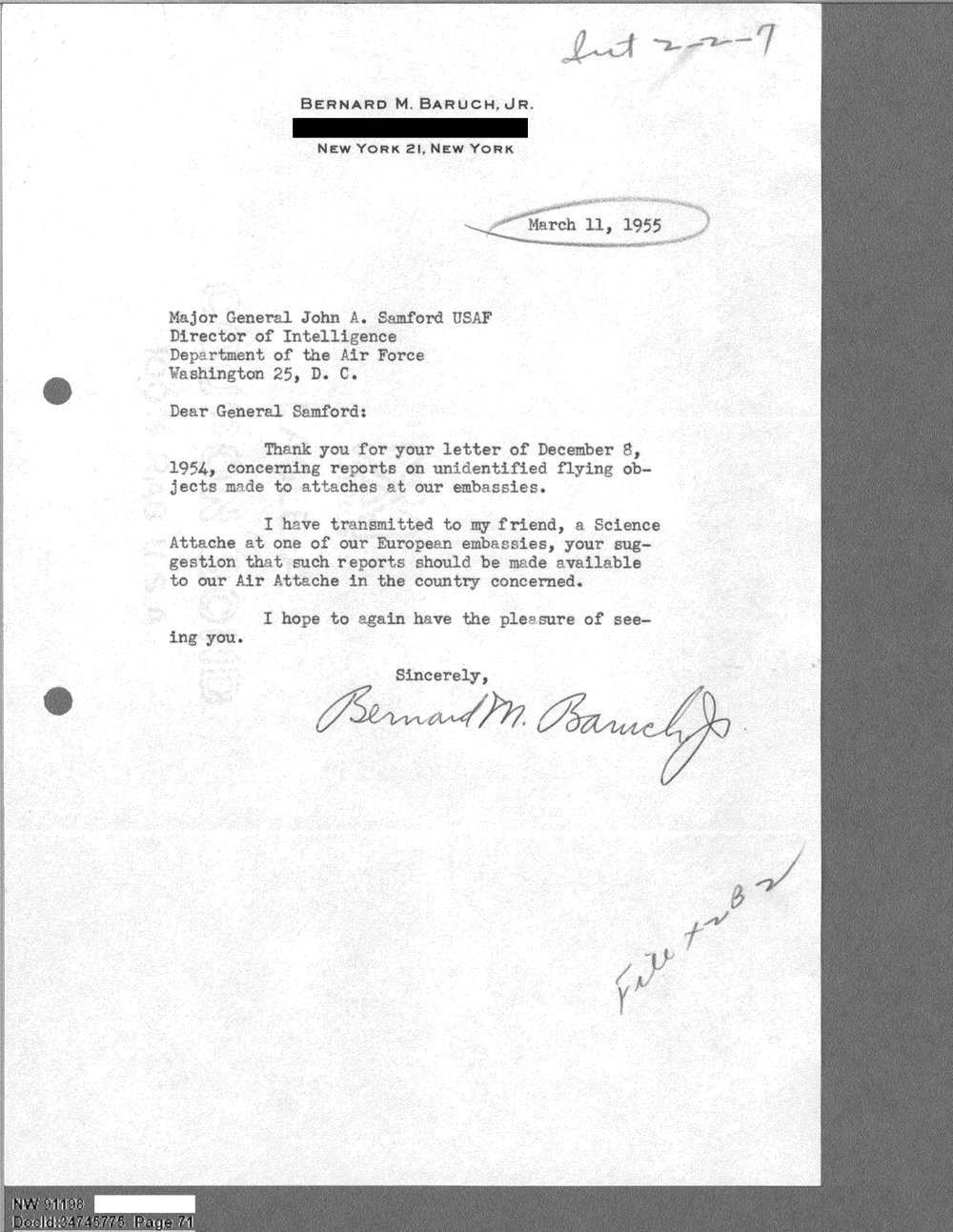 Official document
On March 11, 1955, Bernard M. Baruch Jr. wrote to General John A. Samford, Director of Intelligence of the Air Force, saying he had passed on to a friend, a science attaché at a European embassy, the suggestion that UFO reports received by attachés be handed over to the air attaché in that country.
Open the case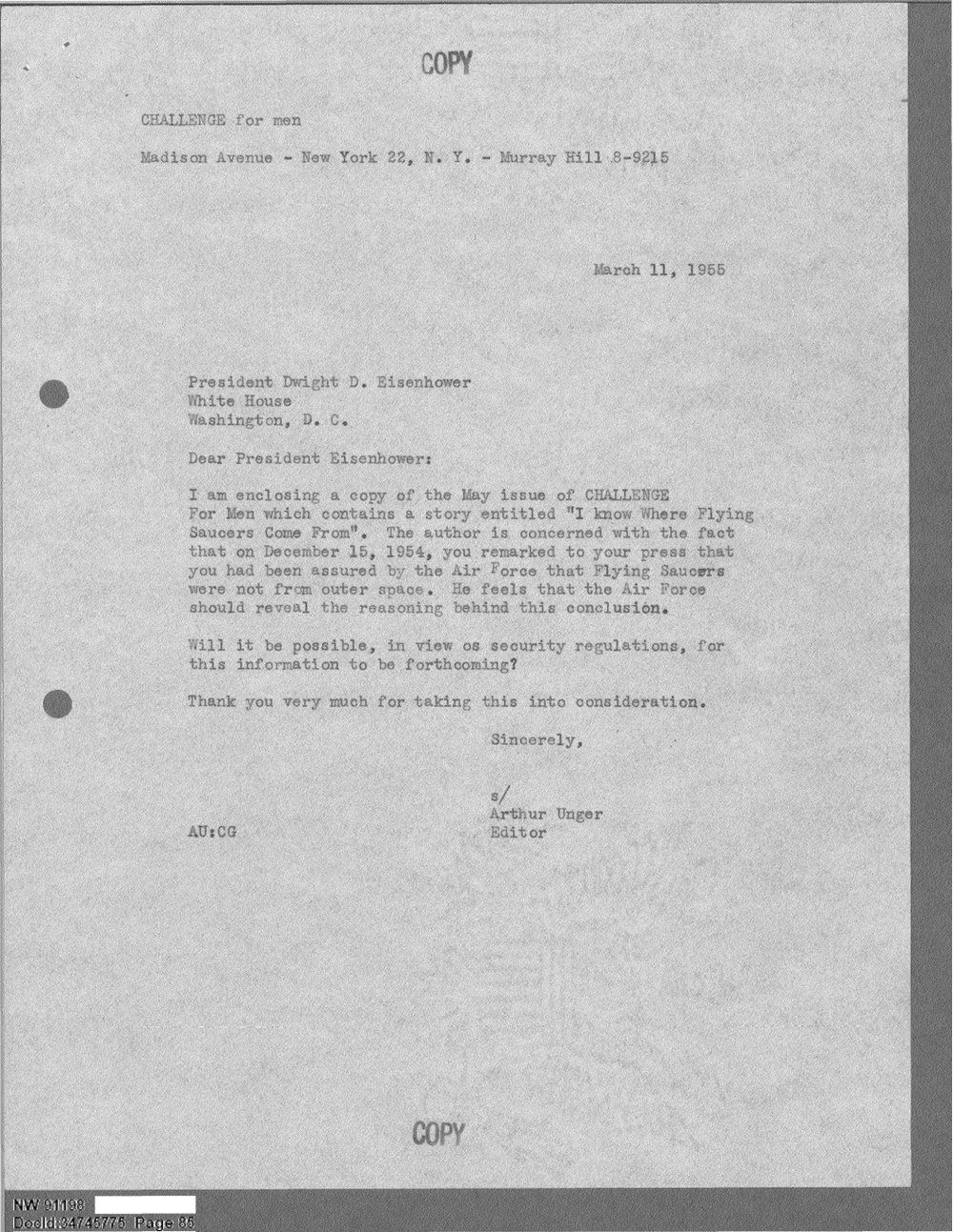 Official document
On March 11, 1955, the editor of Challenge for Men magazine wrote to President Eisenhower asking on what basis the Air Force assured that flying saucers do not come from space. The letter reached Legislative Liaison, and on 1.º de abril the Directorate of Intelligence returned it without a reply.
Open the case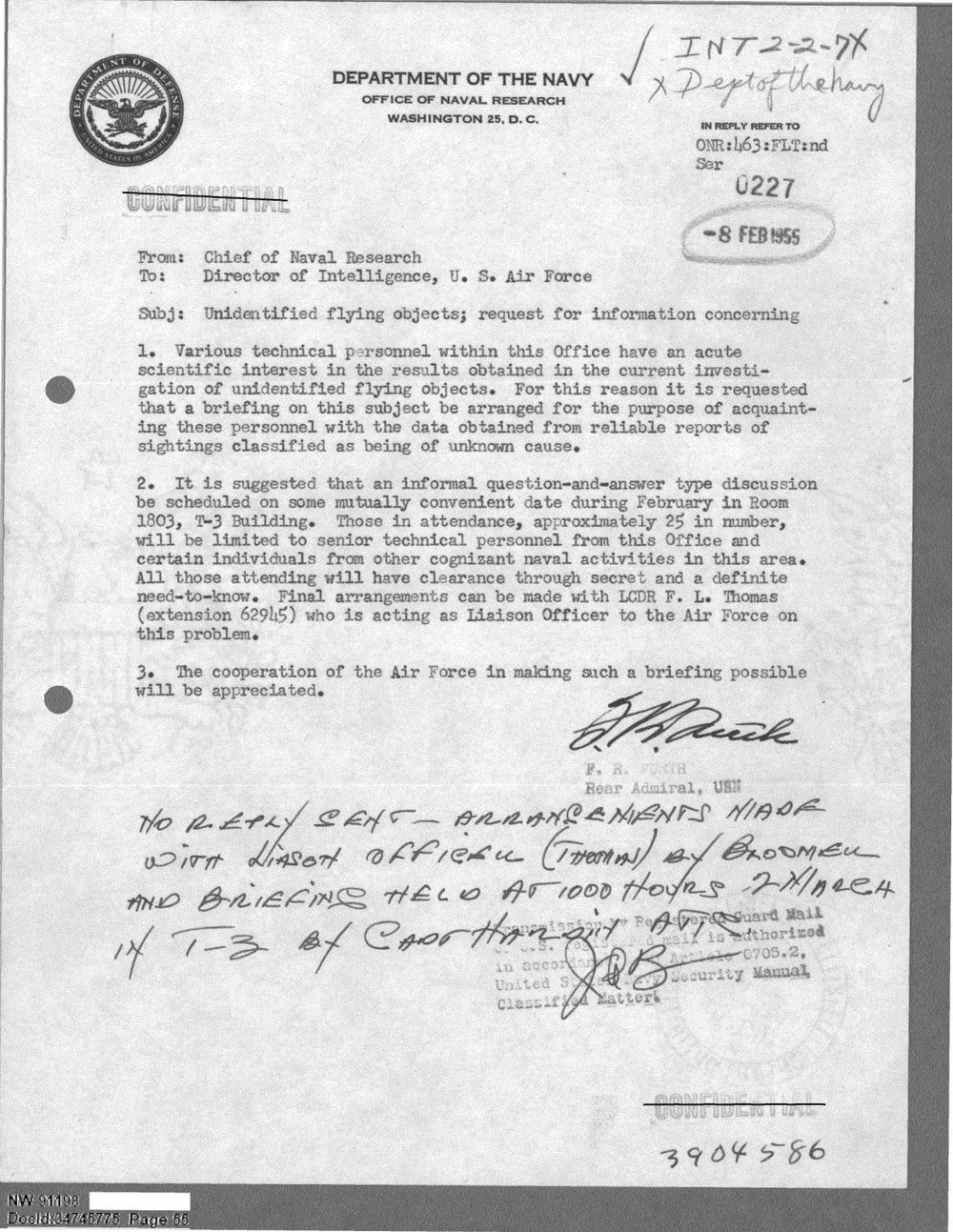 Official document
In February 1955, the Chief of Naval Research asked the Air Force Directorate of Intelligence for a briefing, for about 25 technical personnel, on sighting reports classified as being of unknown cause. A handwritten note says it was given on March 2 by Captain Hardin, of ATIC.
Open the case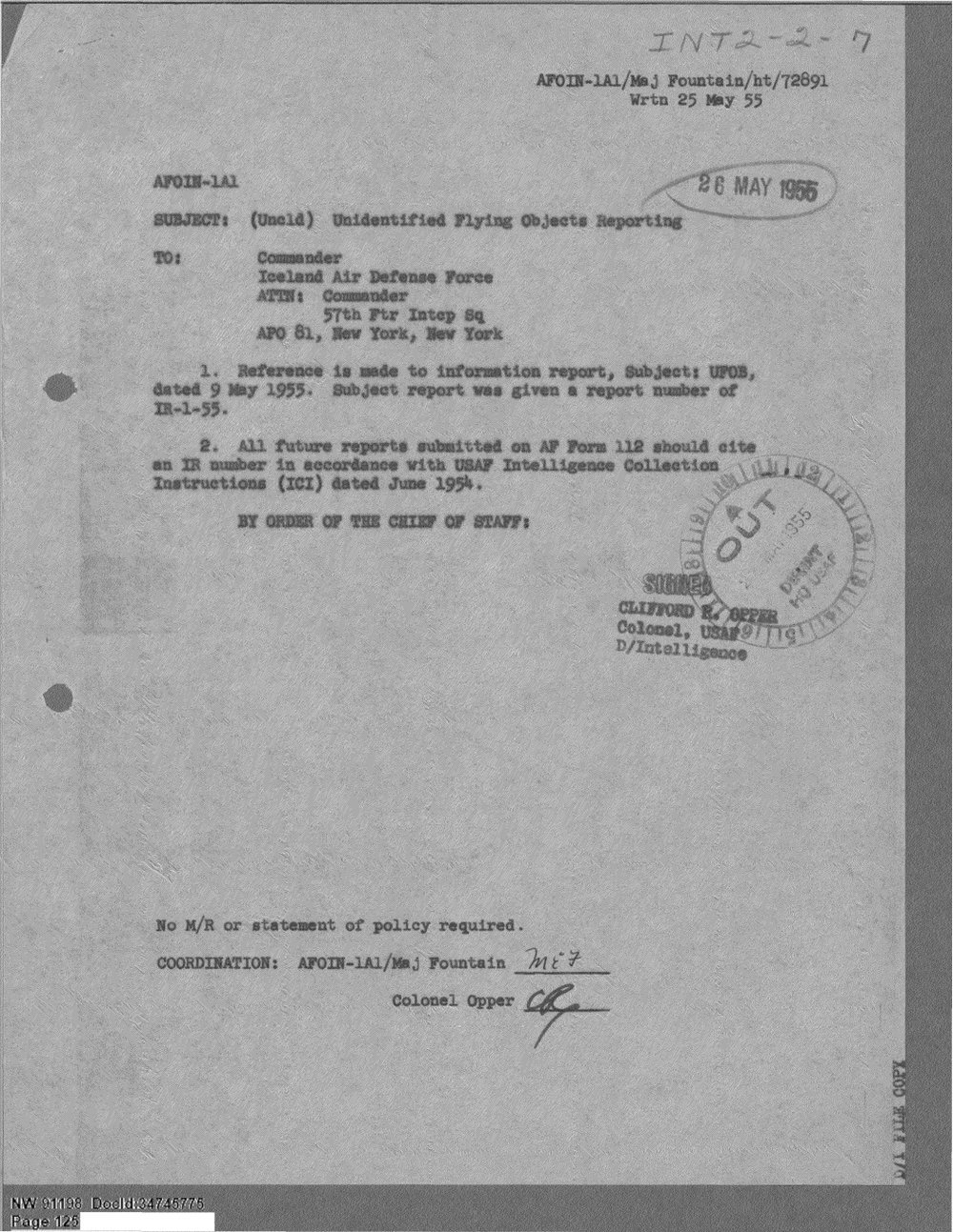 Official document
On May 26, 1955, the Air Force Directorate of Intelligence informed the fighter squadron in Iceland that the May 9 intelligence report on UFOs had been assigned number IR-1-55 and that subsequent reports should cite an IR number. The content of the report does not appear on the page.
Open the case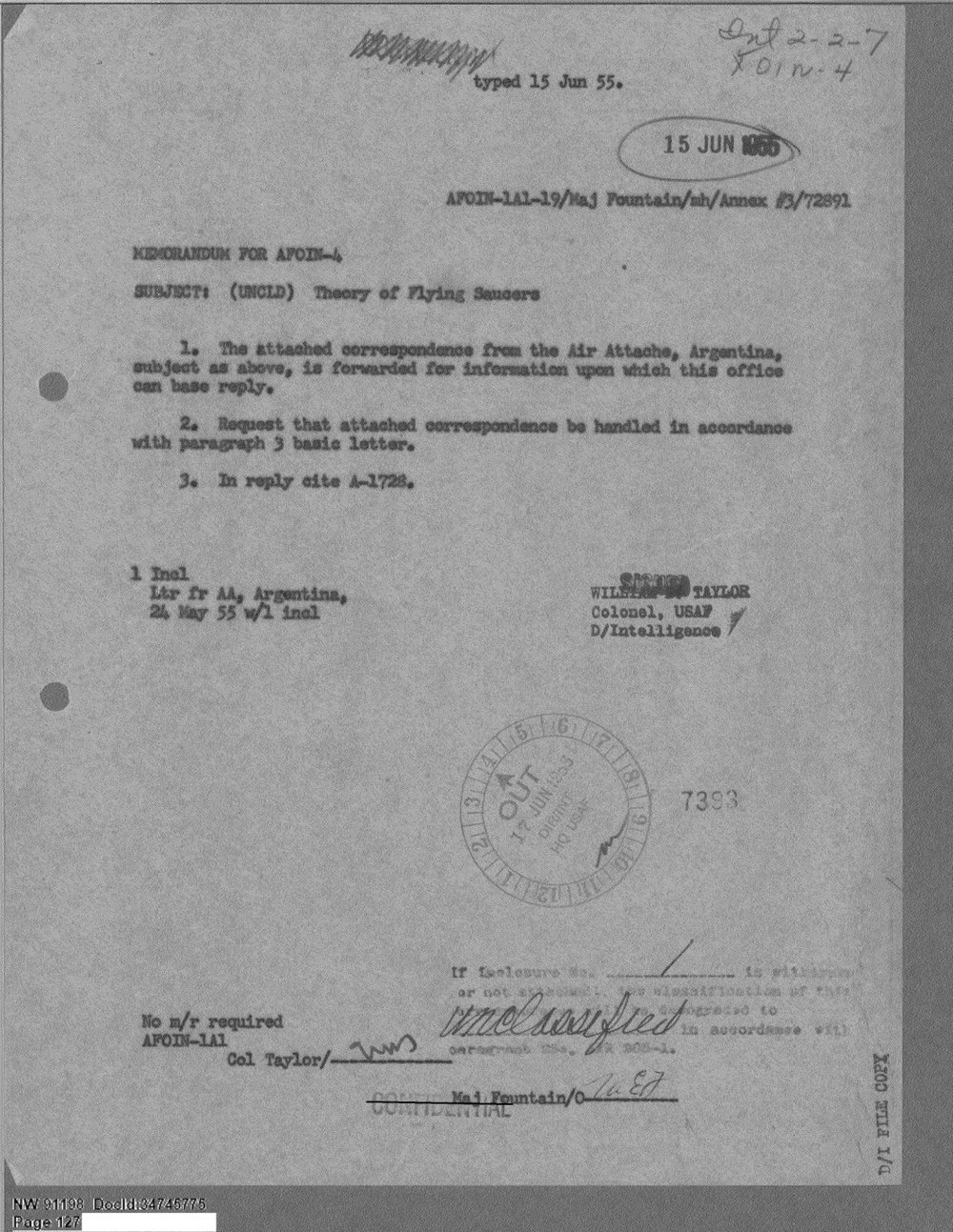 Official document
On June 15, 1955, the Directorate of Intelligence forwarded to section AFOIN-4 a letter from the U.S. air attaché in Argentina, dated May 24, about a "flying saucer theory", for preparation of the reply. The letter and the manuscript are not on the page.
Open the case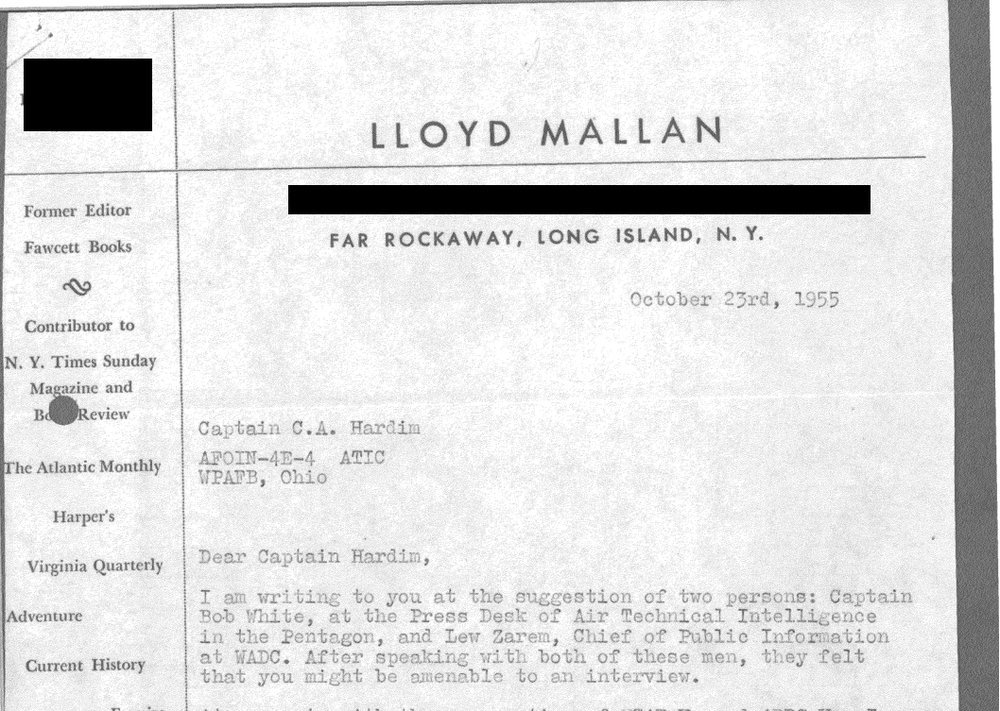 Official document
On October 23, 1955, writer Lloyd Mallan wrote to Captain C. A. Hardim, of ATIC, requesting an interview for a chapter on flying saucers in a book on aeronautical research and development. ATIC sent the letter to the Directorate of Intelligence, and a note records that Lieutenant Colonel Johnson tried to contact him without success.
Open the case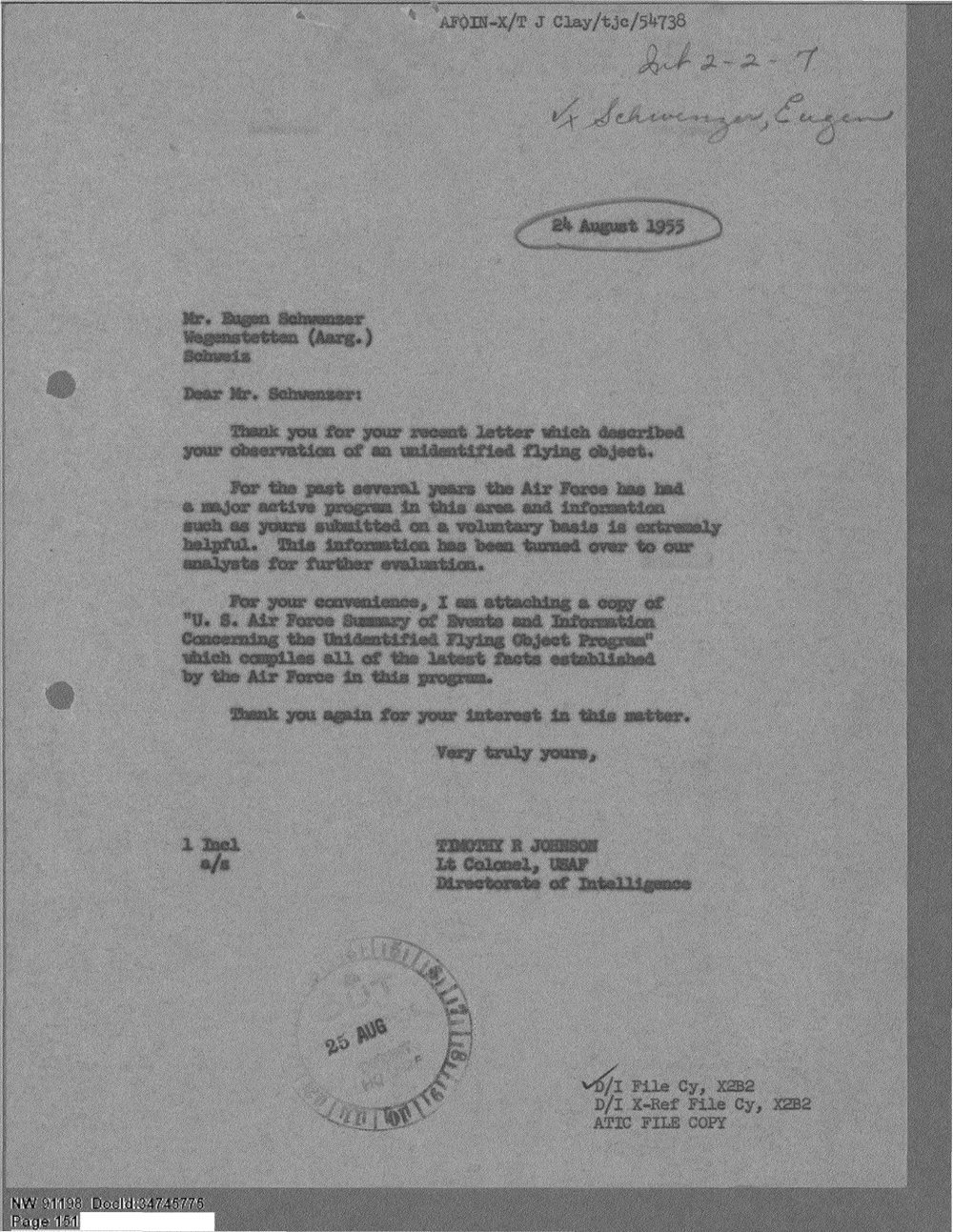 Official document
On August 24 and 25, 1955, Lieutenant Colonel Timothy R. Johnson, of the Directorate of Intelligence, replied with the same letter to Eugen Schwenzer, Richard Ericson, Ernest C. K. Brown and Mrs. John Olwyler, who had sent sighting reports. The reports were passed on to the analysts and to ATIC; their content does not appear in the pages.
Open the case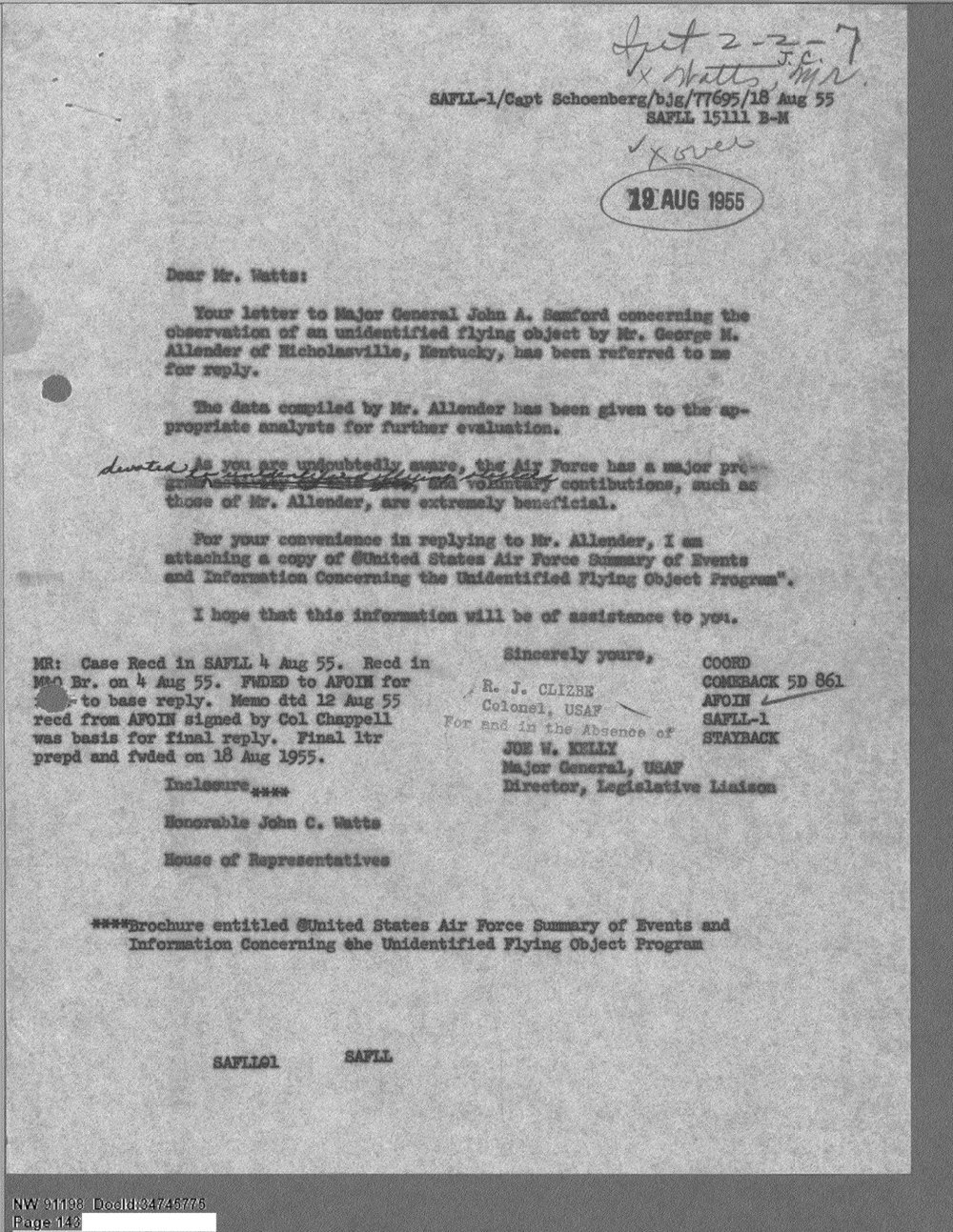 Official document
Congressman John C. Watts, of Kentucky, wrote to General Samford sending the data on a UFO sighting made by George M. Allender, of Nicholasville. The Directorate of Intelligence drafted the text of the reply on August 12, 1955, and Legislative Liaison sent it on August 18, saying that the data had been turned over to the analysts.
Open the case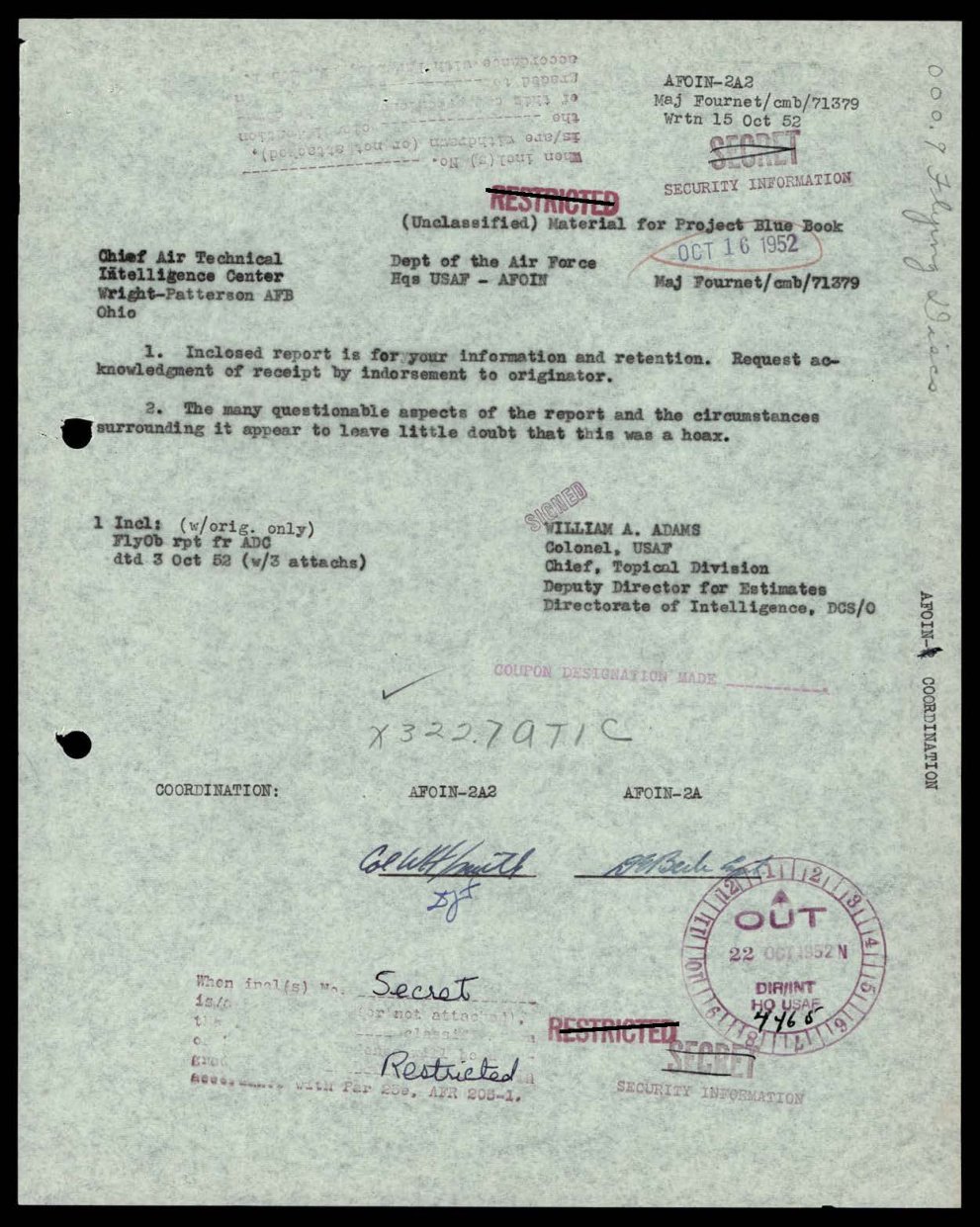 Memorandum
In two October 1952 memoranda, the USAF Topical Intelligence Division returned to ATIC a secret file called Flyobrpt and forwarded an Air Defense Command (ADC) report dated October 3, which it considered a probable hoax. Neither document describes the sighting.
Open the case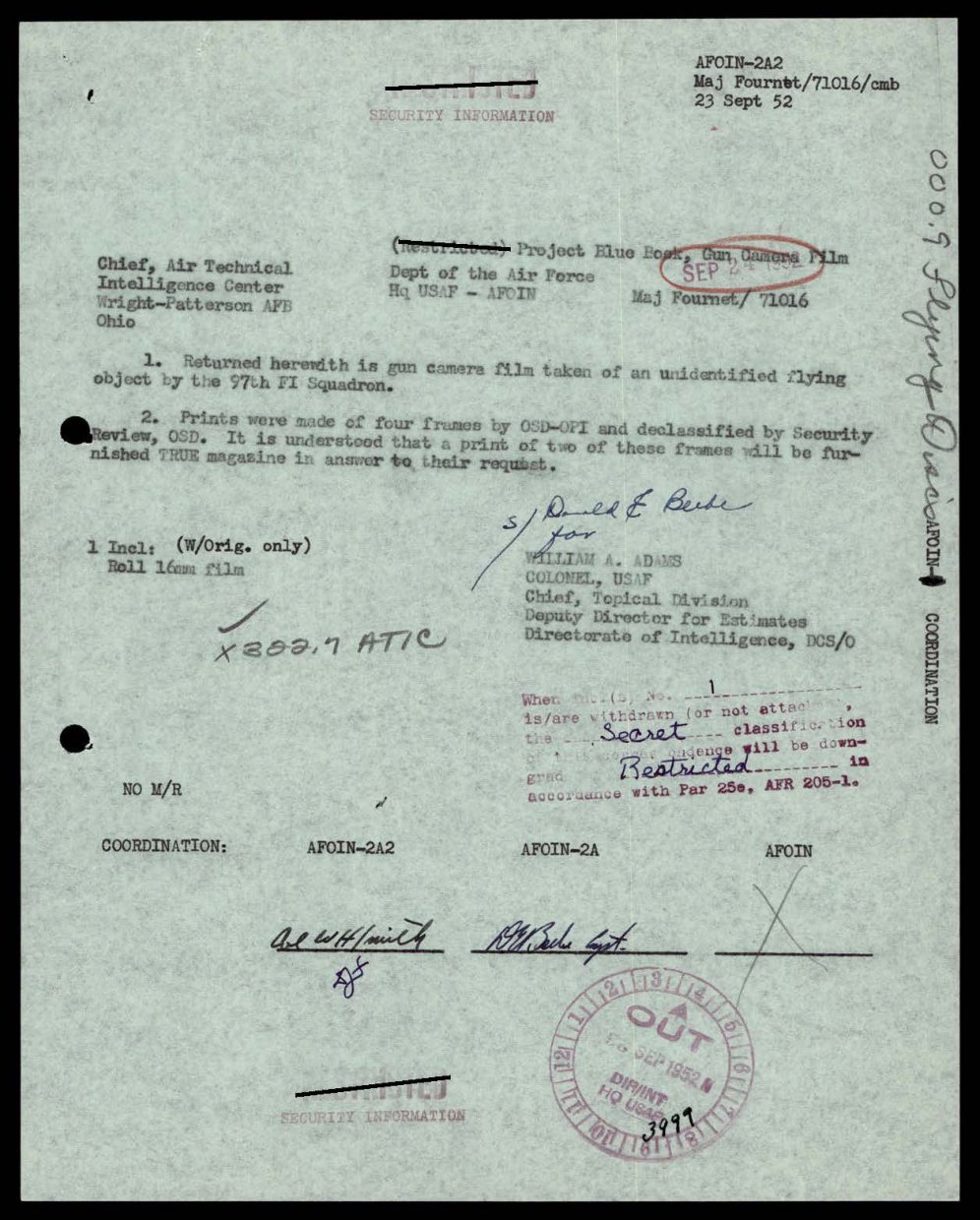 Memorandum
On September 23, 1952, the USAF Topical Intelligence Division returned to ATIC a roll of 16 mm gun camera film, taken by the 97.º FI Squadron. The memorandum says that four frames were copied and declassified and that two of them would be given to TRUE magazine.
Open the case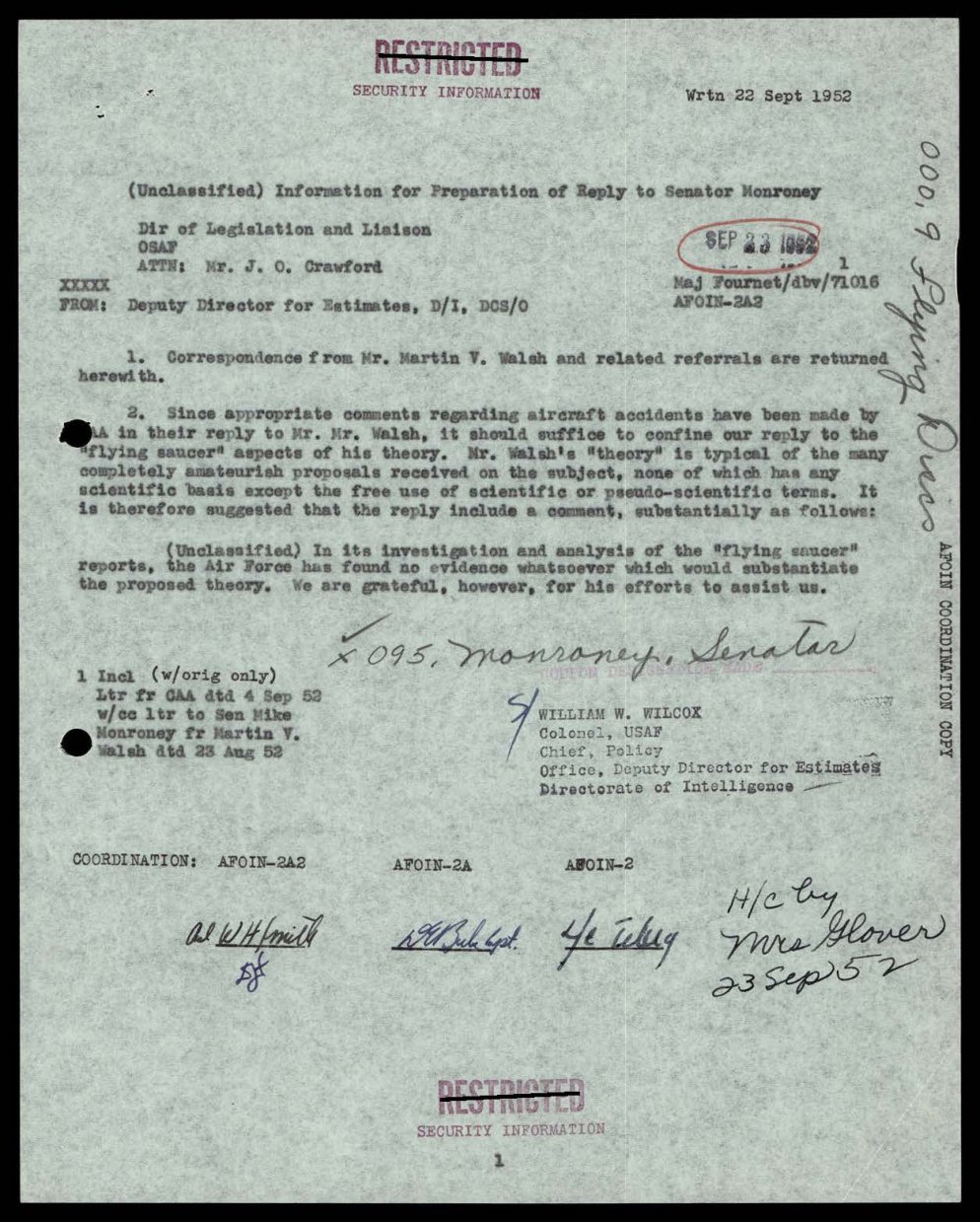 Memorandum
Martin V. Walsh sent a theory about aircraft accidents and flying saucers to Senator Mike Monroney, who passed it on to the CAA and the Air Force. On September 22, 1952, the Directorate of Intelligence called the theory amateurish and suggested a short reply.
Open the case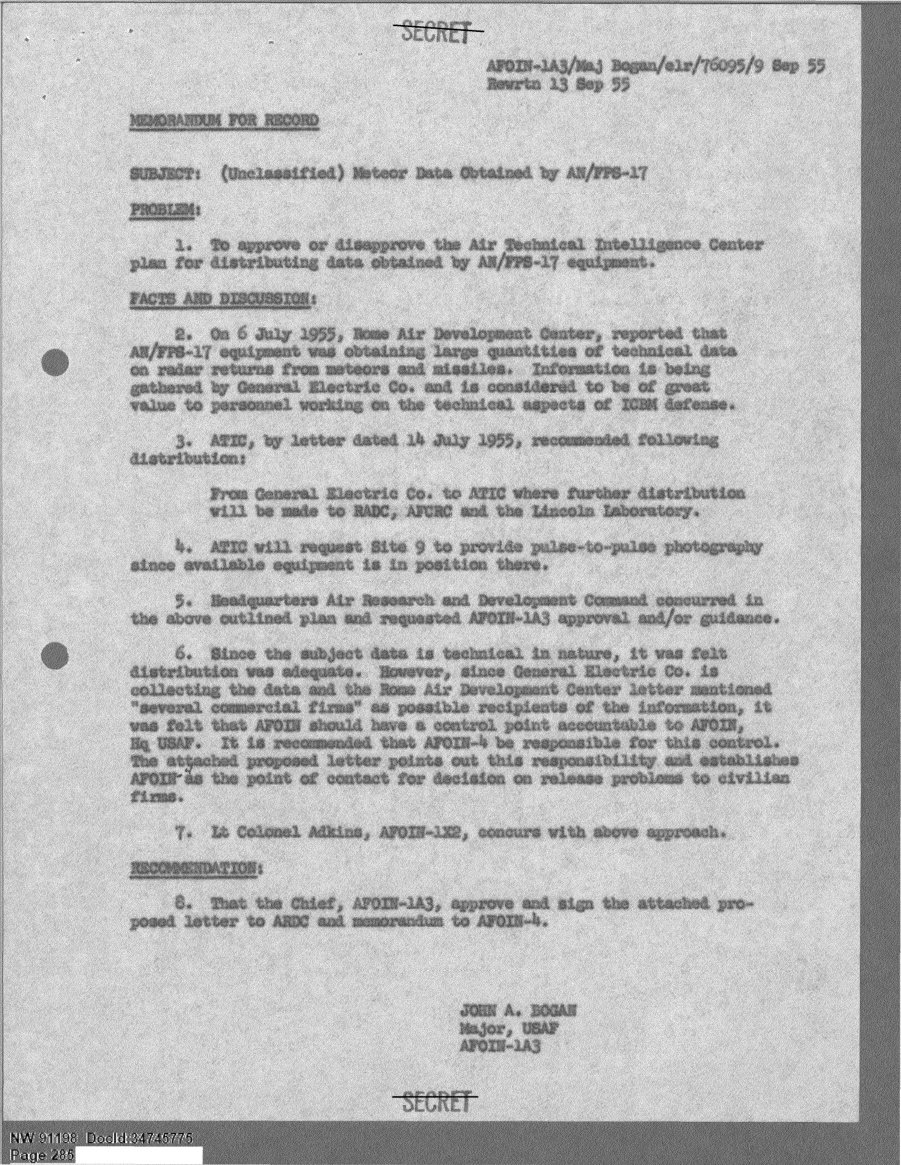 Memorandum
Between July and September 1955, the U.S. Air Force (USAF) exchanged letters about who would receive and who would control the technical data on meteors and missiles collected by the AN/FPS-17 radar. The letters describe no sighting at all and are in the folder “Unidentified Flying Objects.”
Open the case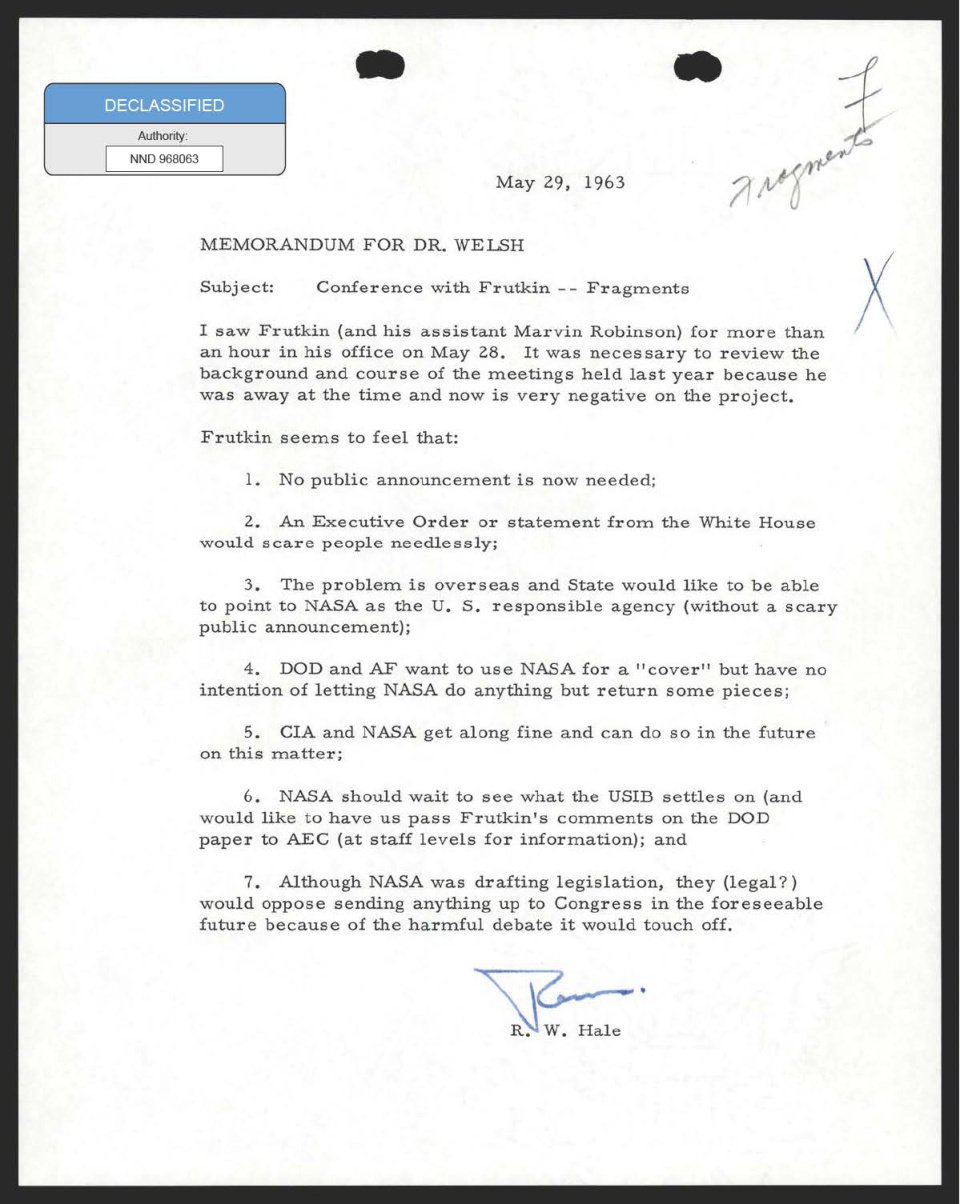 Document
An internal memo of the U.S. Executive Office of the President summarizes a meeting with Frutkin, of NASA, who opposed publicly announcing a joint plan to recover fragments coming from space. According to the text, he thought an announcement would frighten people and that Defense and the Air Force wanted to use NASA as a front.
Open the case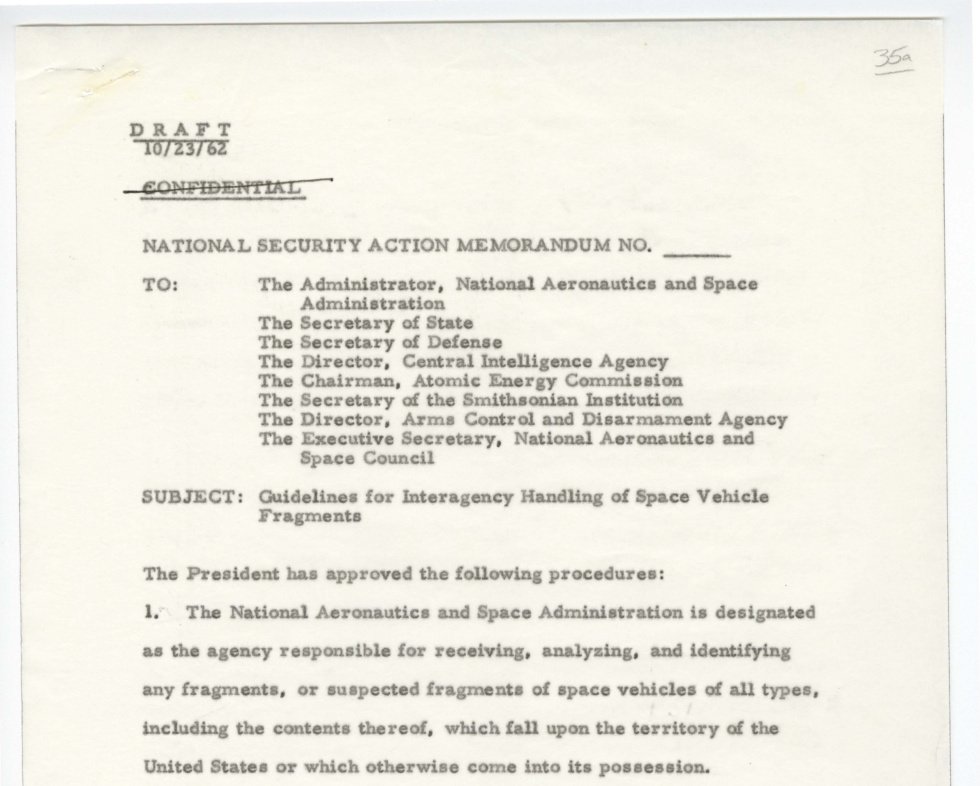 Official document (facsimile)
A National Security Council folder brings together 72 pages on how the U.S. government should receive, analyze and return fragments of space vehicles. NASA became the principal recipient, the Department of Defense took on the intelligence analysis of foreign pieces, and the CIA joined the discussion late.
Open the case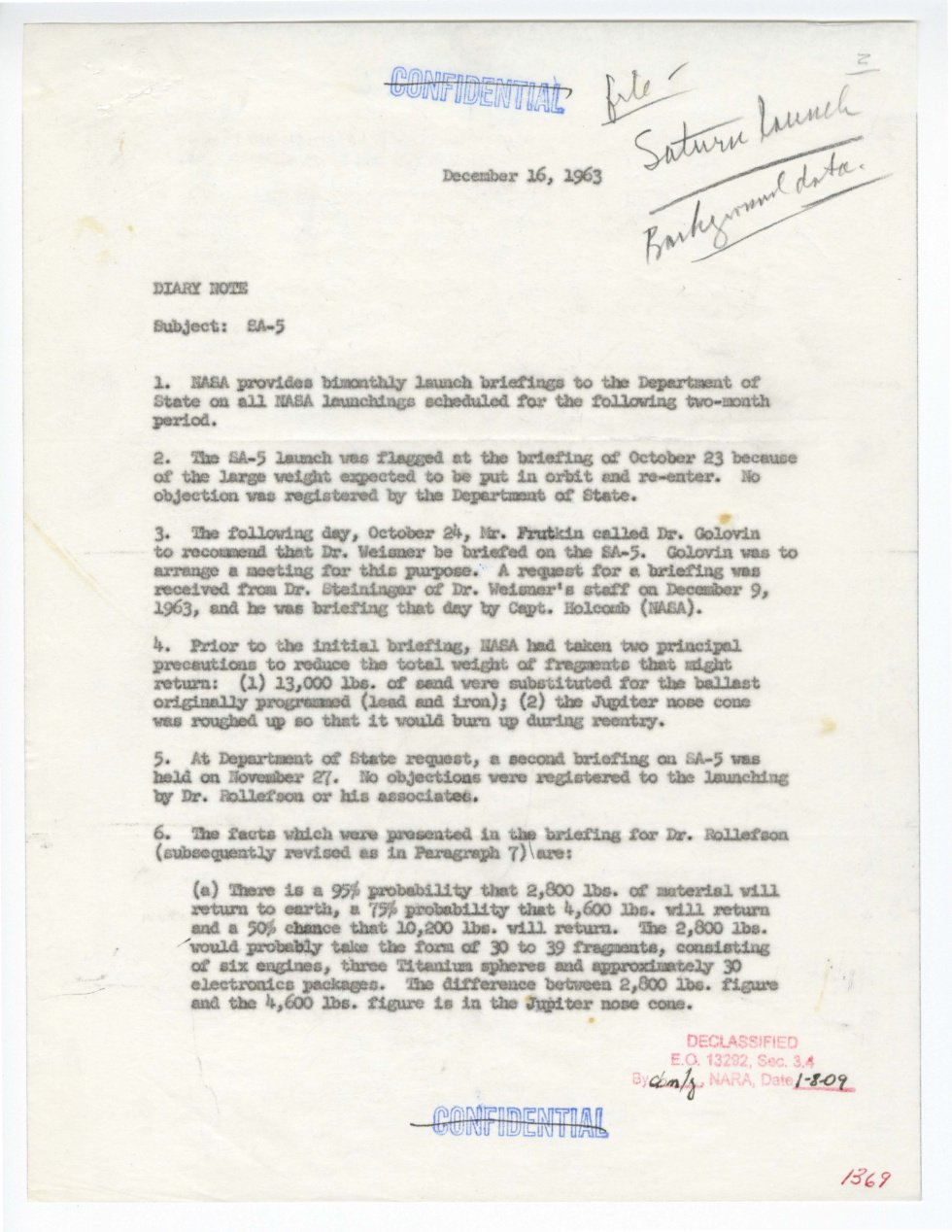 Official document (facsimile)
A NASA diary note from December 1963 records the briefings to the Department of State and the White House on the Saturn SA-5, which would place in orbit a large weight destined to reenter. The agency estimated the amount of material that would come back, the chance of casualties, and explained why it could not destroy the satellite in space.
Open the case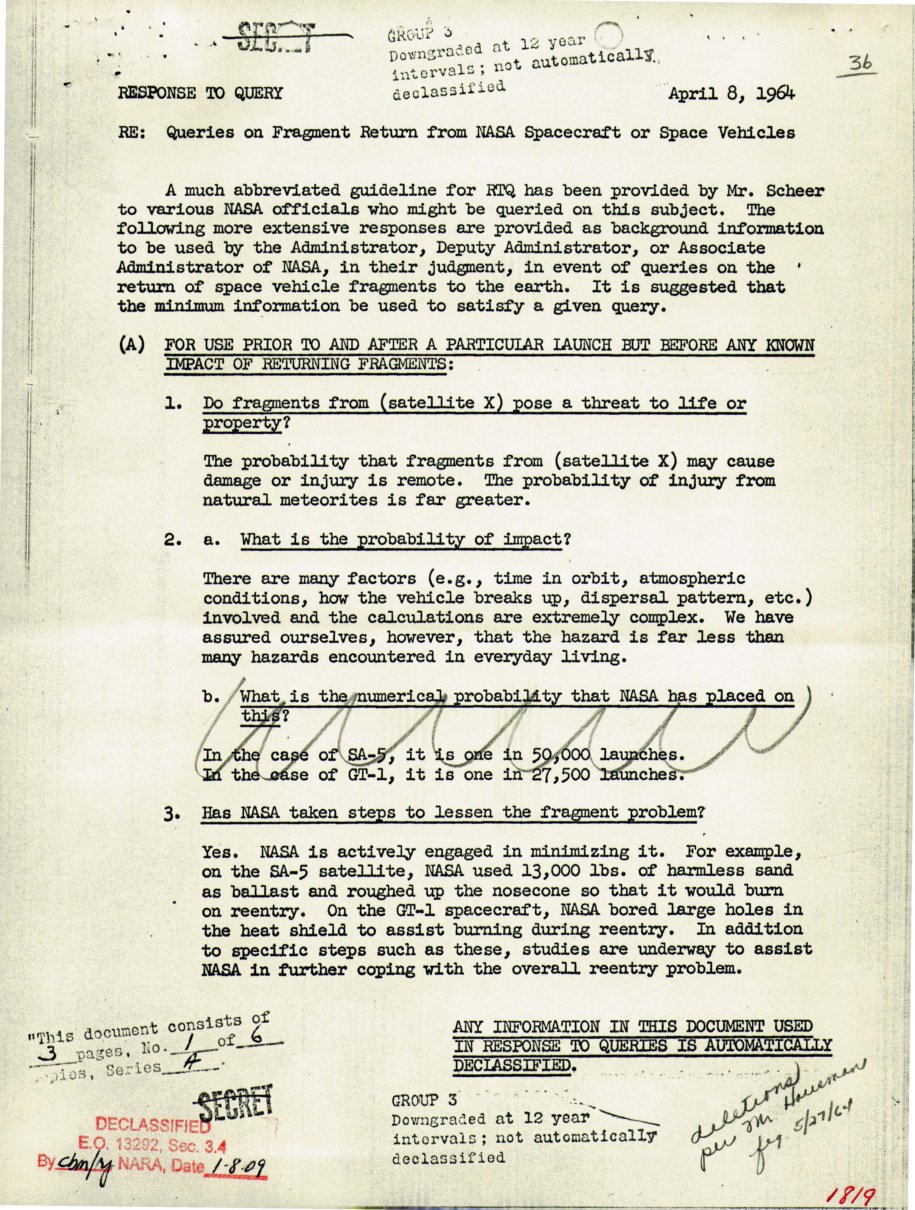 Official document (facsimile)
A secret NASA document of April 8, 1964 lists questions the public might ask about spacecraft fragments and the answers the agency's top leadership should give. The text mentions the GT-1 spacecraft and the SA-5 satellite, and some figures were struck out by hand before use.
Open the case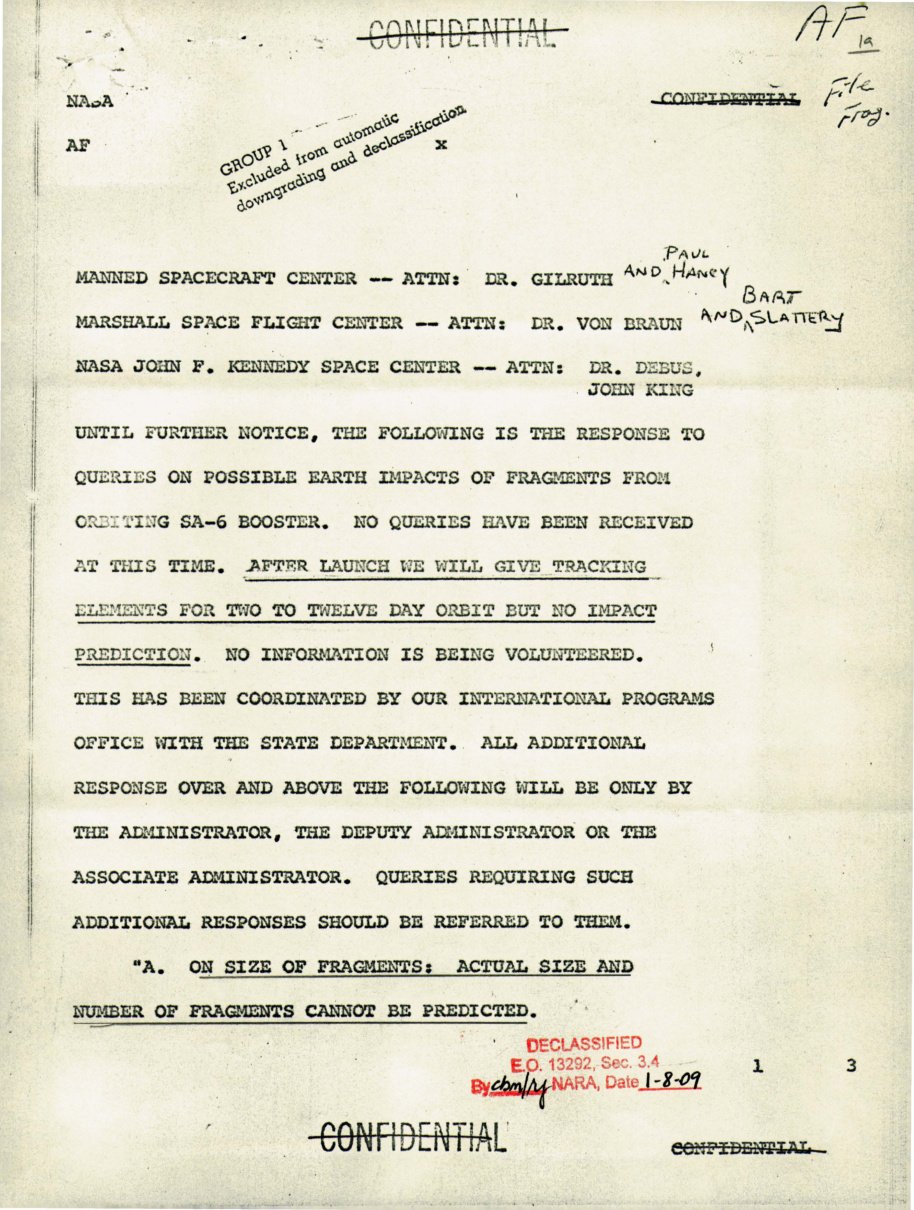 Official document (facsimile)
A confidential NASA message, sent in May 1964 to the National Security Council, sets the standard answer to questions about fragments of the SA-6 rocket in orbit. The government would give only tracking elements, no impact prediction, and would not speculate on the origin of fallen objects.
Open the case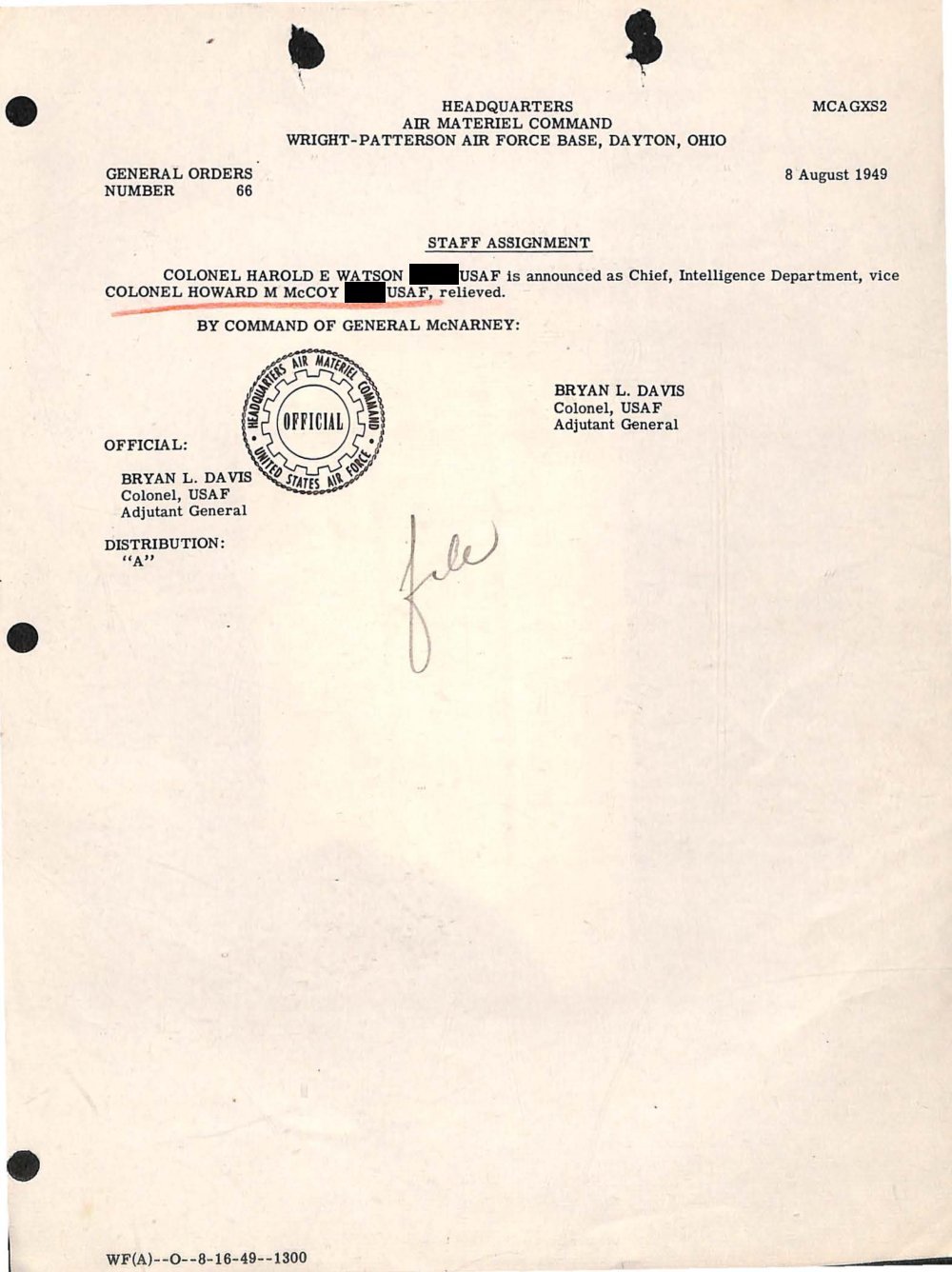 General order (official document)
The final personnel file of Colonel Howard M. McCoy shows the career of the officer who headed the technical intelligence of the Air Materiel Command, at Wright-Patterson, in the Project Sign years. It records positions, courses, decorations, evaluations attributed to his superiors and his voluntary retirement in 1954.
Open the case