Date: Method developed from 1952 onward; report of 05/05/1955Location: Air Technical Intelligence Center, Wright-Patterson Air Force Base, Ohio, USA
Special Report 14, 1952-1955: how the Air Force turned flying saucer reports into IBM punched cards
Special Report 14 explains step by step how witness reports became numbers: three questionnaire versions, a master code, serial numbers by year and a four-person conference to decide each identification. The text itself admits an important limitation: the maneuvers of the UFOs, which later proved decisive, were never coded.
- Event date
- Method developed from 1952 onward; report of 05/05/1955
- Location
- Air Technical Intelligence Center, Wright-Patterson Air Force Base, Ohio, USA
- Topic
- History of the investigation
- Source agencies
- CIA
- Documents
- 1 document · 312 pages
- Reading time
- 82 min
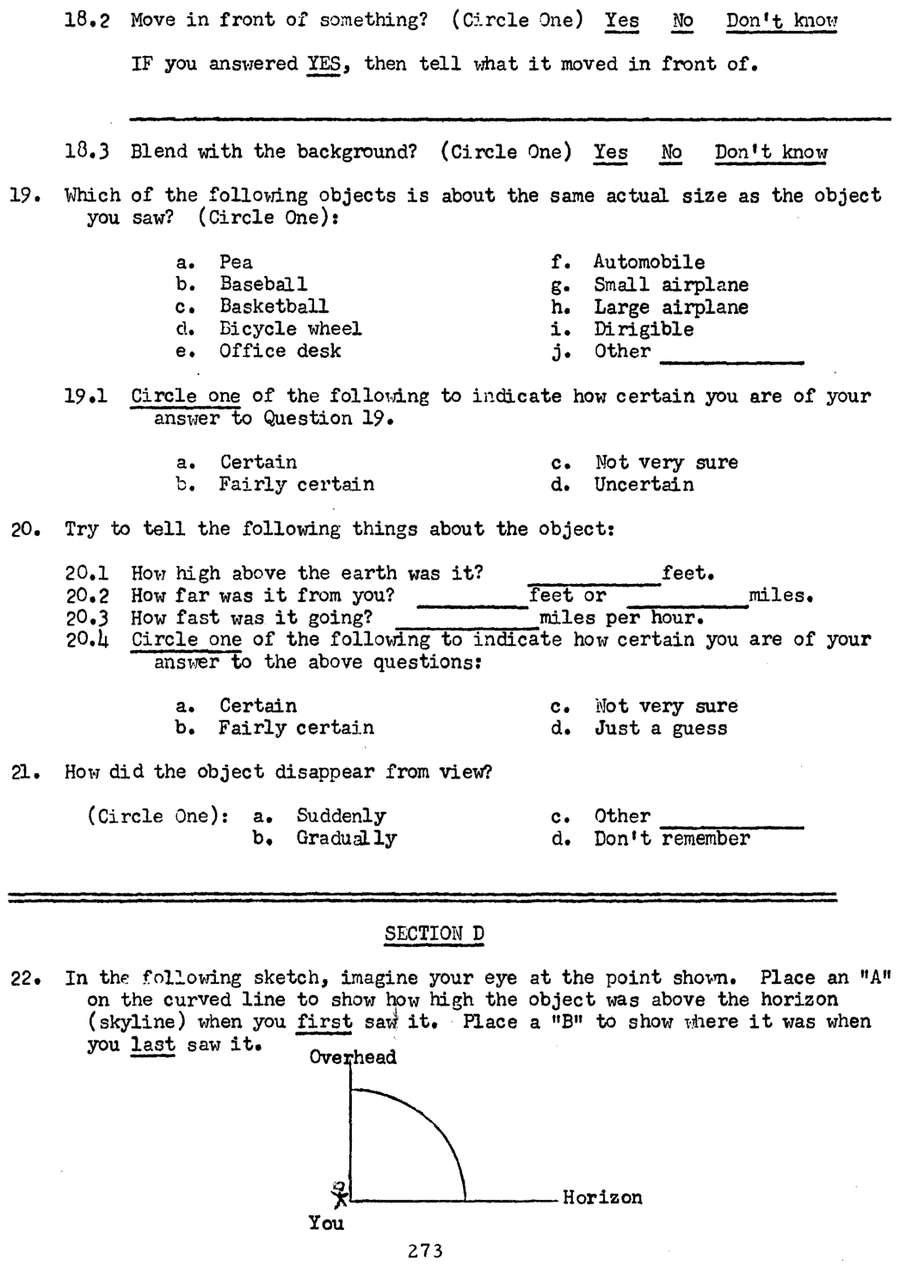
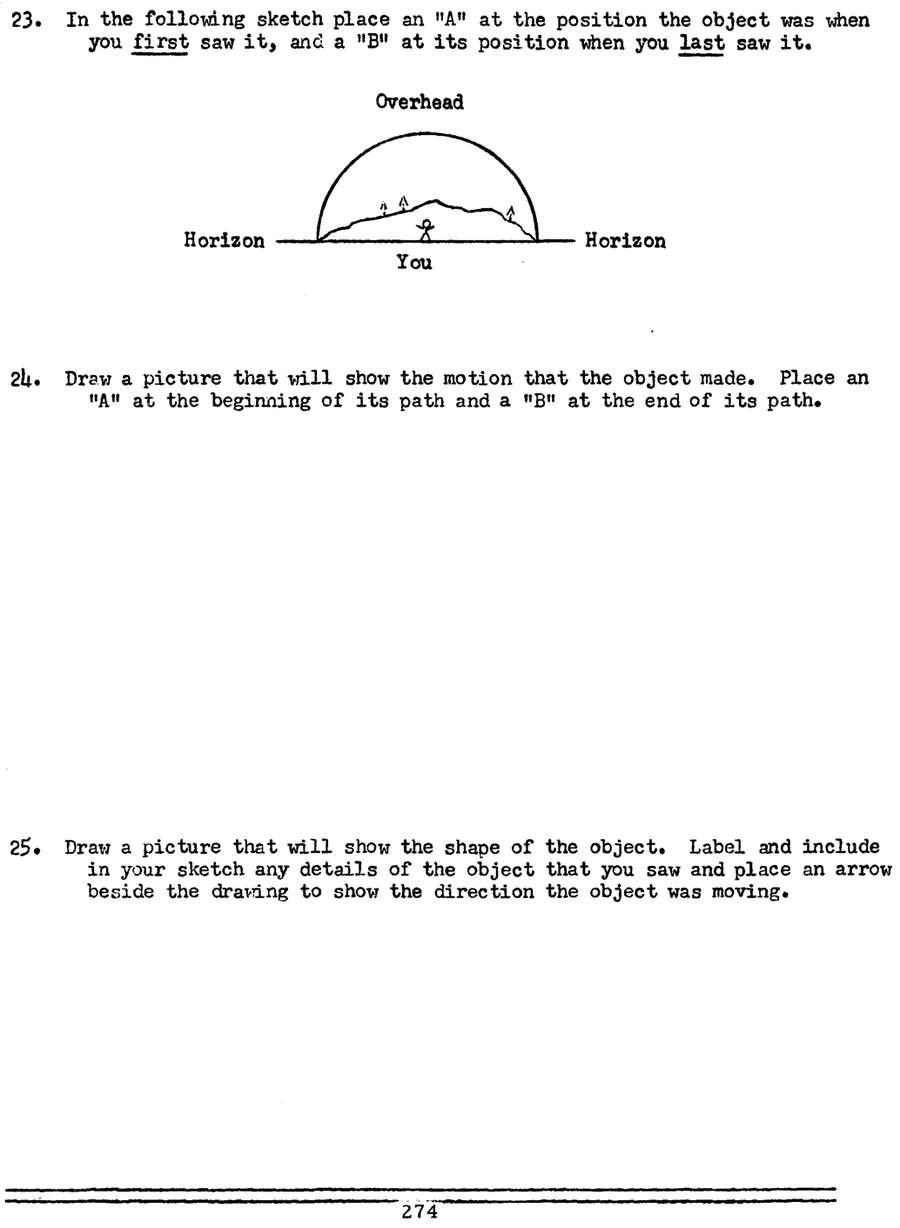
 Official form with printed drawingsPhysical page 286
DOCUMENTARY SOURCES · CIA
What the records tell
Before any statistics, the Special Report 14 team had to solve a practical problem: the reports arriving at the Air Technical Intelligence Center were not, in the document's words, in a form suitable "even for a quasi-scientific study." There were military teletypes, letters from civilians and forms filled out in different ways. The plan adopted had four stages: list the necessary factors, create a scheme for transfer to mechanized computation, link each piece of data to the source paper and standardize the identification of the phenomenon.
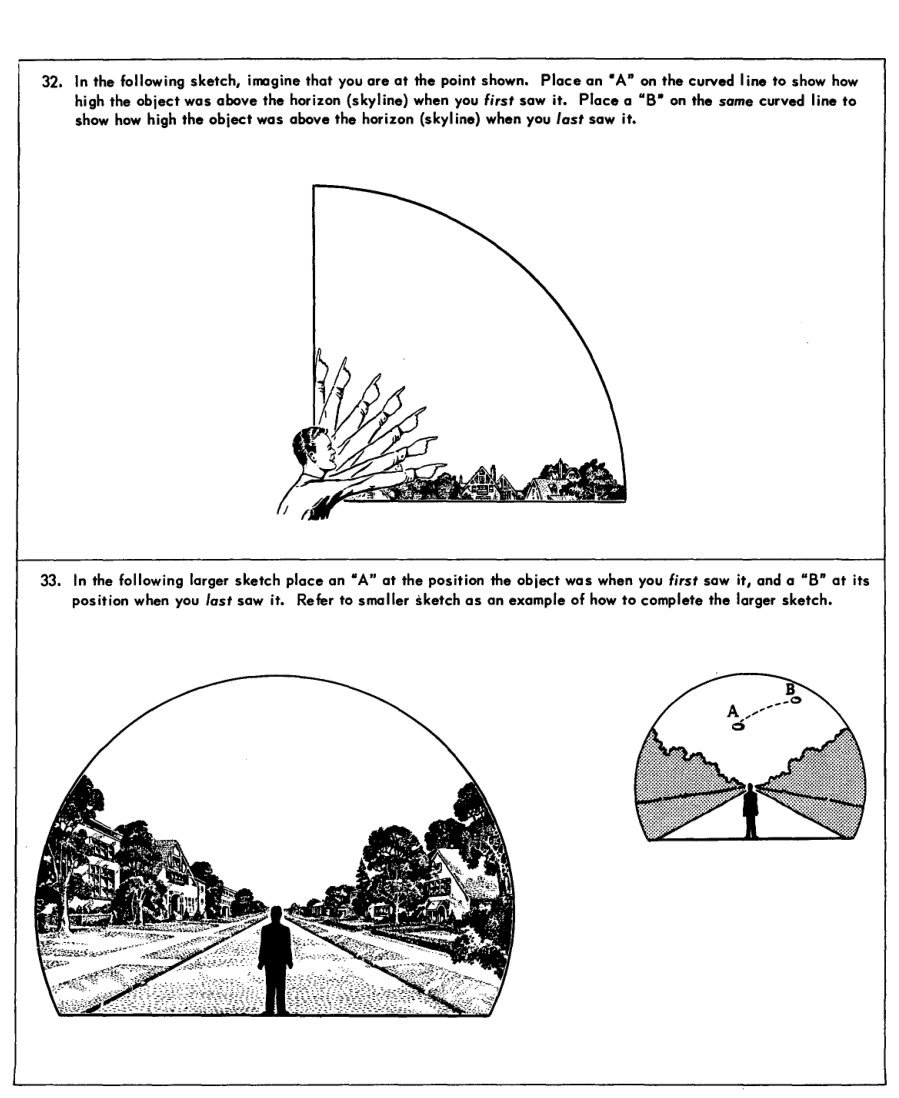
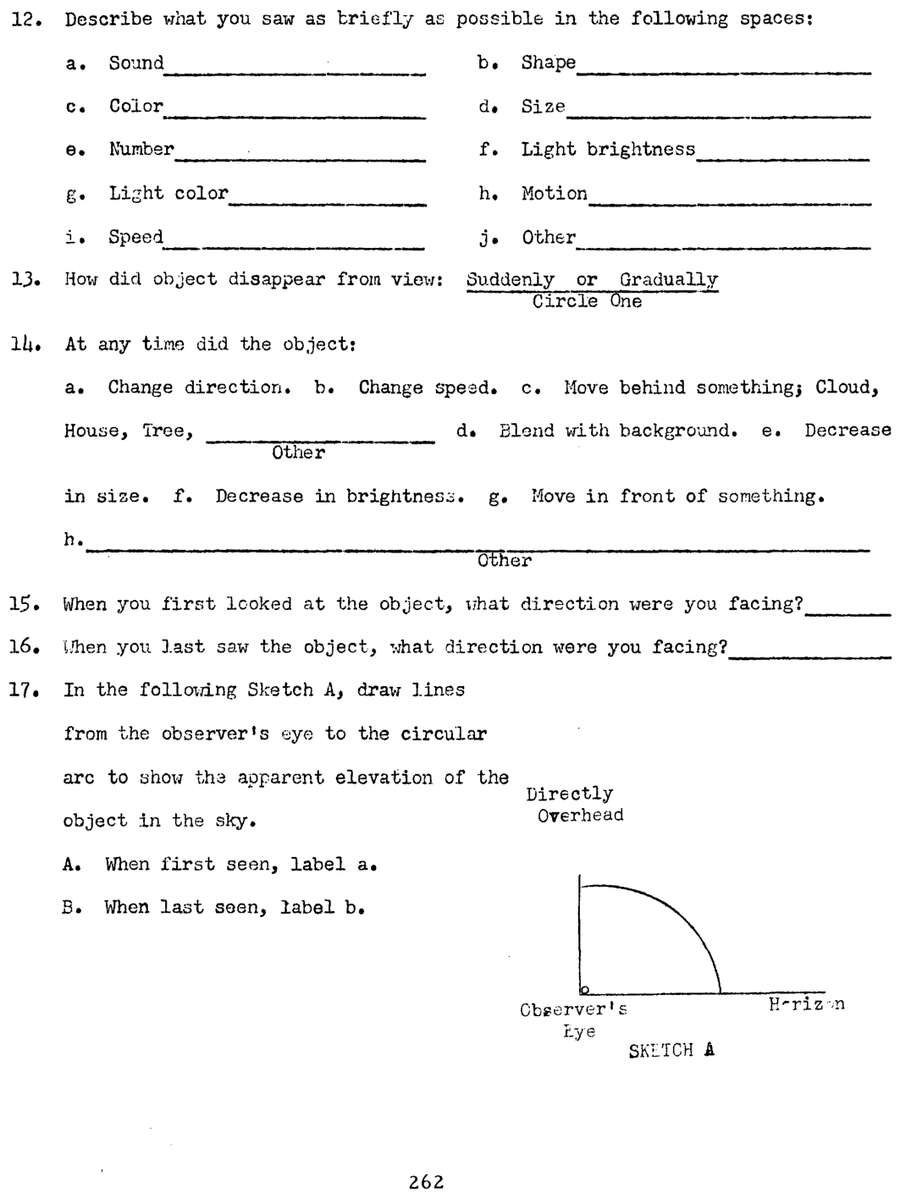
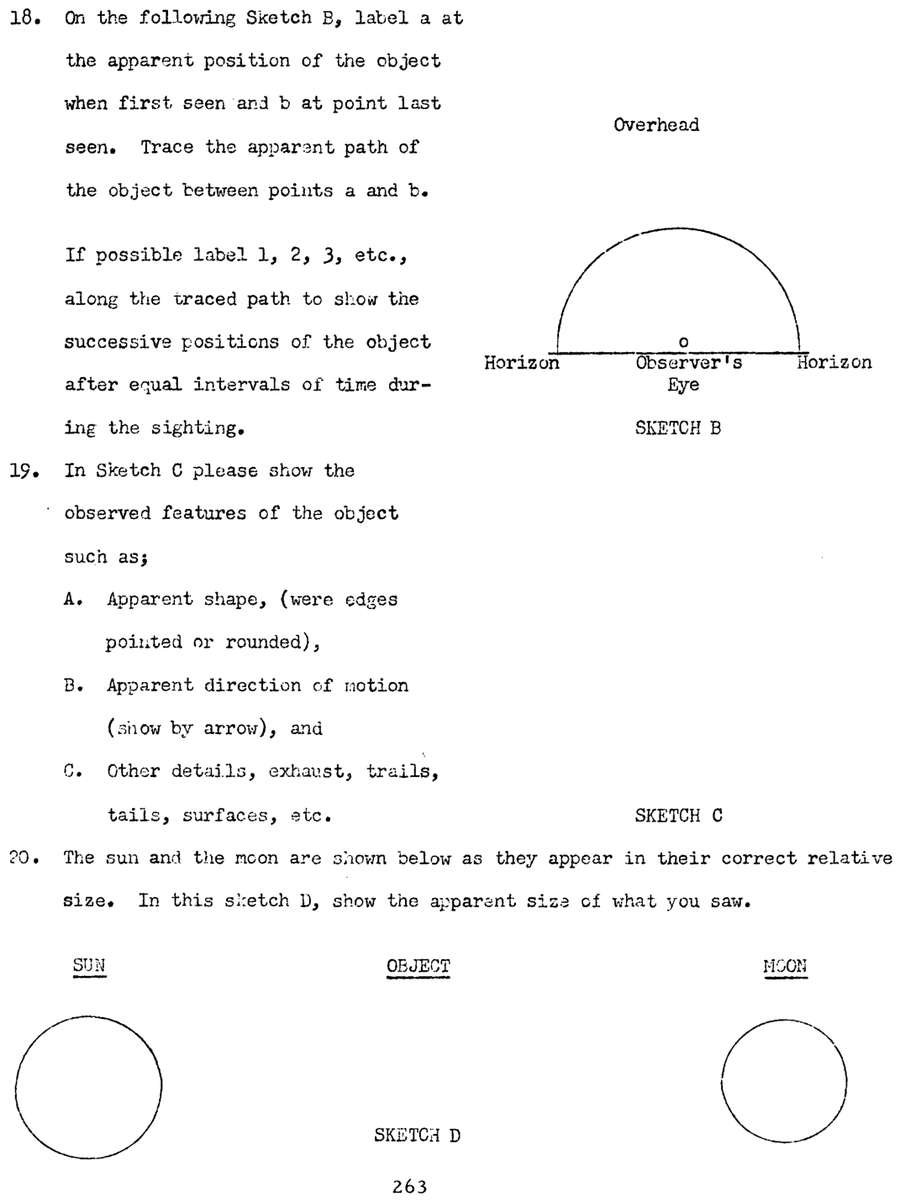
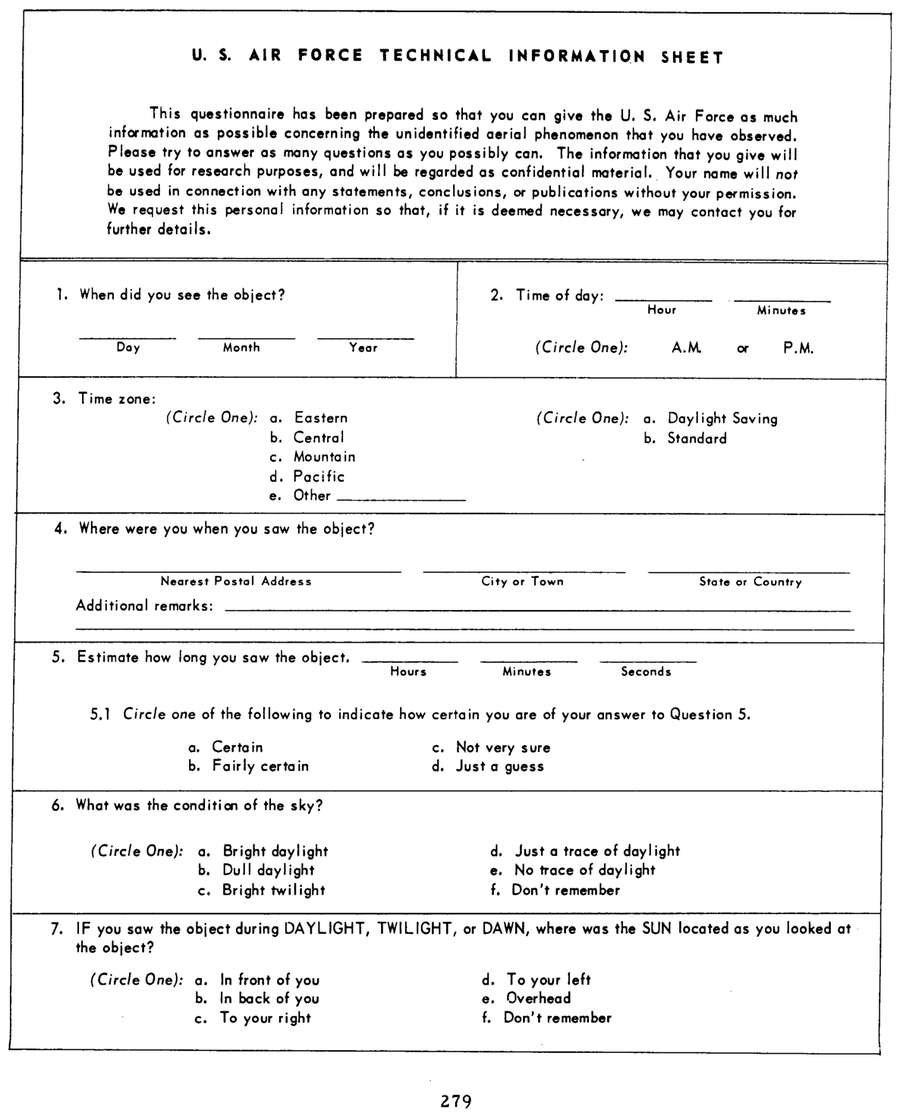
The first tool was the questionnaire. The panel of consultants produced three versions. The second was tested in 1952: of the first 300 questionnaires returned in July and August, 168 were analyzed by a consulting psychologist. The final version, the Air Force Technical Information Sheet, even asked the witness to mark on a printed drawing the height of the UFO in the sky at the first and last moment of the sighting. The free narrative served to corroborate the data and, according to the text, to indirectly reveal the reasoning ability and suggestibility of the writer.
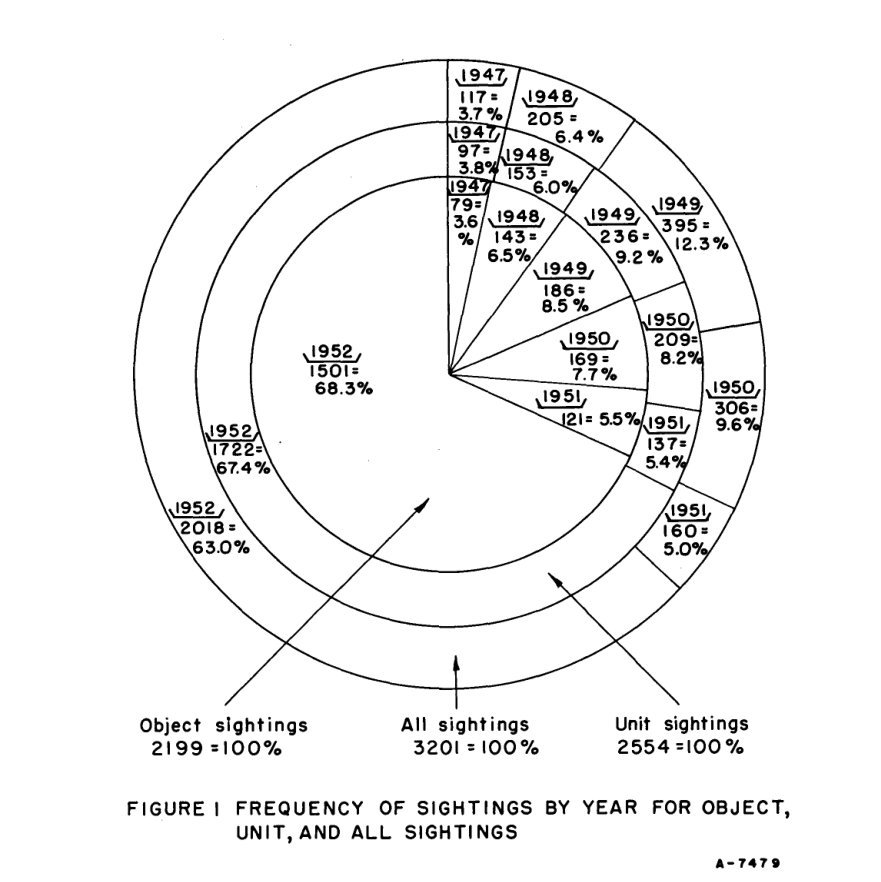
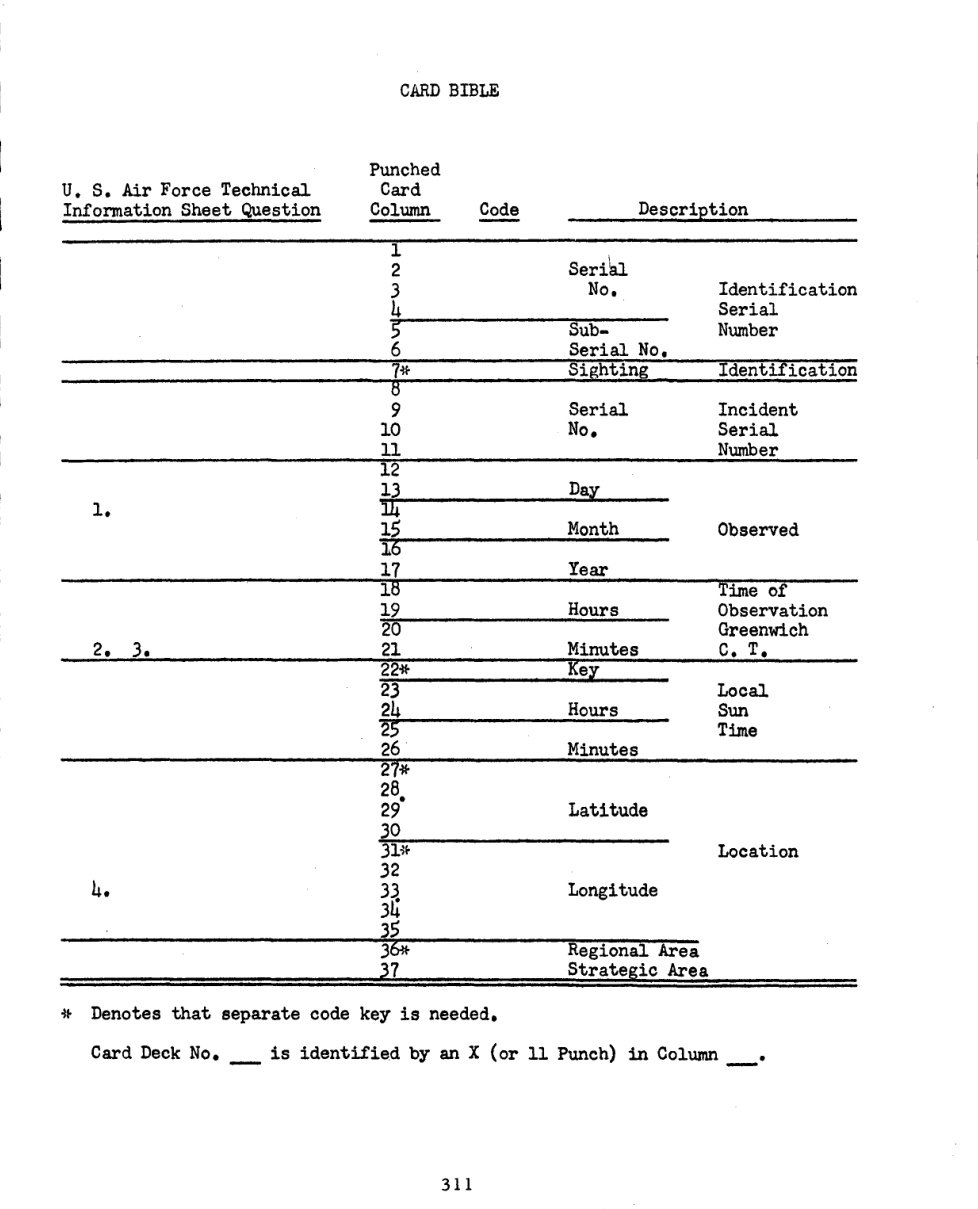
Then came the code. Everything that could influence an identification was assigned a number, and an intermediate worksheet, later called the "card bible," allowed several people to transcribe the data at the same time onto IBM punched cards. Each sighting received a four-digit serial number with ranges by year, from 0001 to 0500 for 1947 up to 2501 to 4900 for 1952, and each additional witness was given a suffix. Duplicate reports were merged only when it was proven that they came from the same source.
Identification went through two filters. Whoever transcribed made a preliminary classification; then a four-person conference, two from ATIC and two from the panel, decided the final one without seeing ATIC's earlier conclusions. The categories ranged from balloon, astronomical and aircraft to insufficient information, psychological manifestation and unknown. Every case classified as unknown required a group decision; if the deadlock persisted, the report remained unknown. "Certain" identifications had to have more than a 95% chance of being correct, and "doubtful" ones more than 50%.
The text also records the limits of the method. About 800 reports were eliminated for being vague or contradictory. Variables such as size, altitude and angular velocity ended up unusable. And, when the team realized that the reported maneuvers were the critical factor for separating knowns from unknowns, it was too late to re-evaluate everything: no maneuver code went onto the cards. This gap is admitted by the report itself.
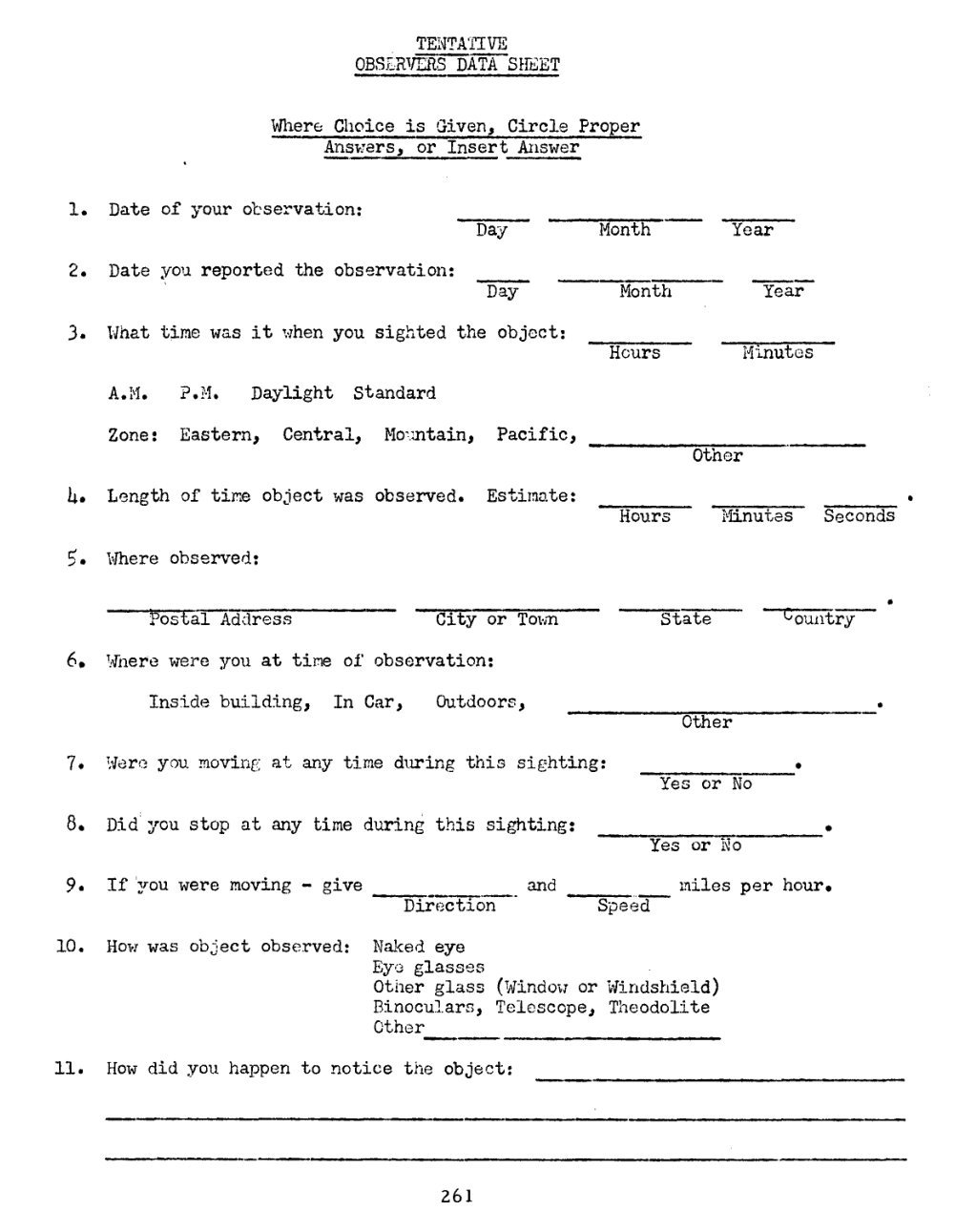
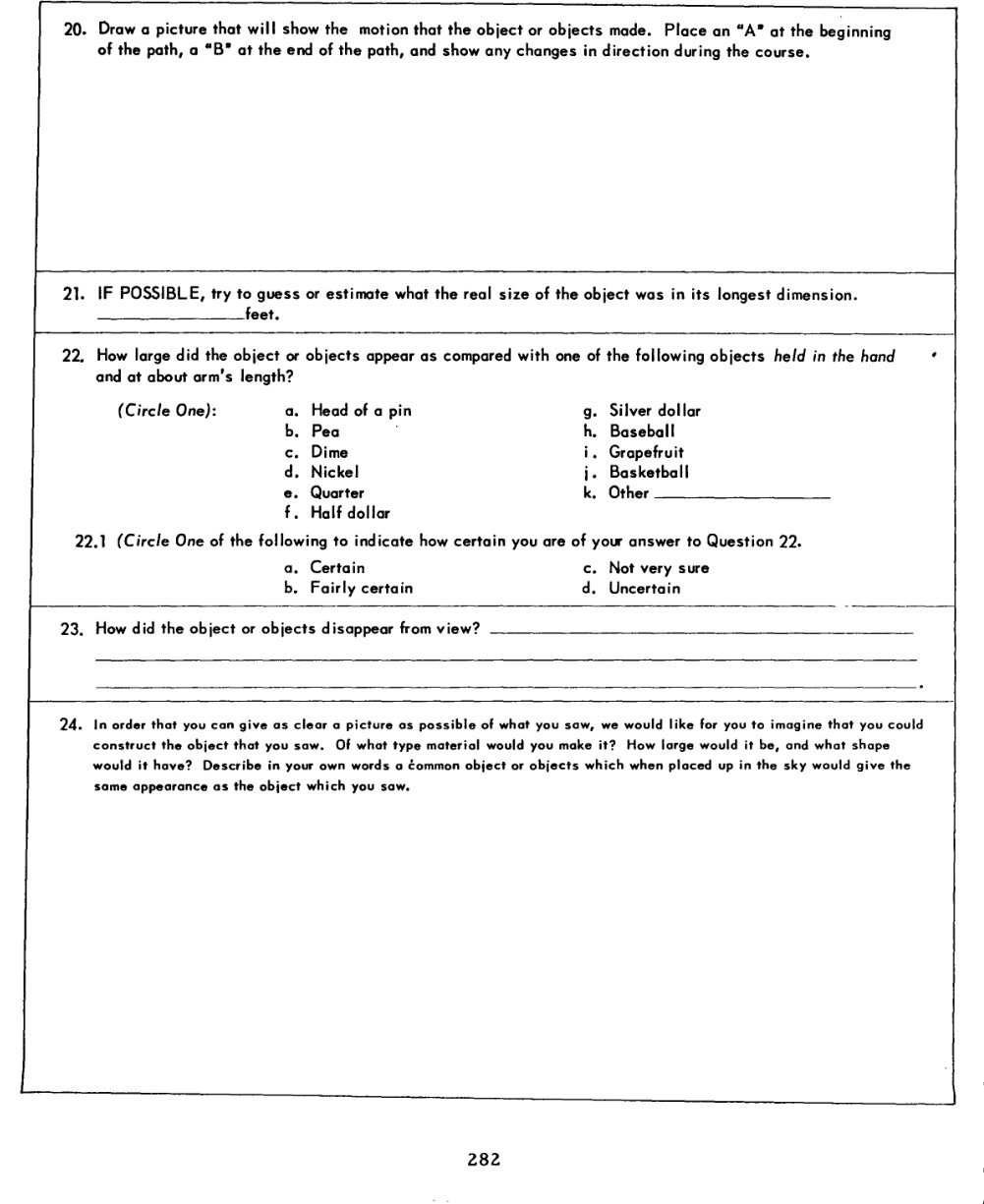
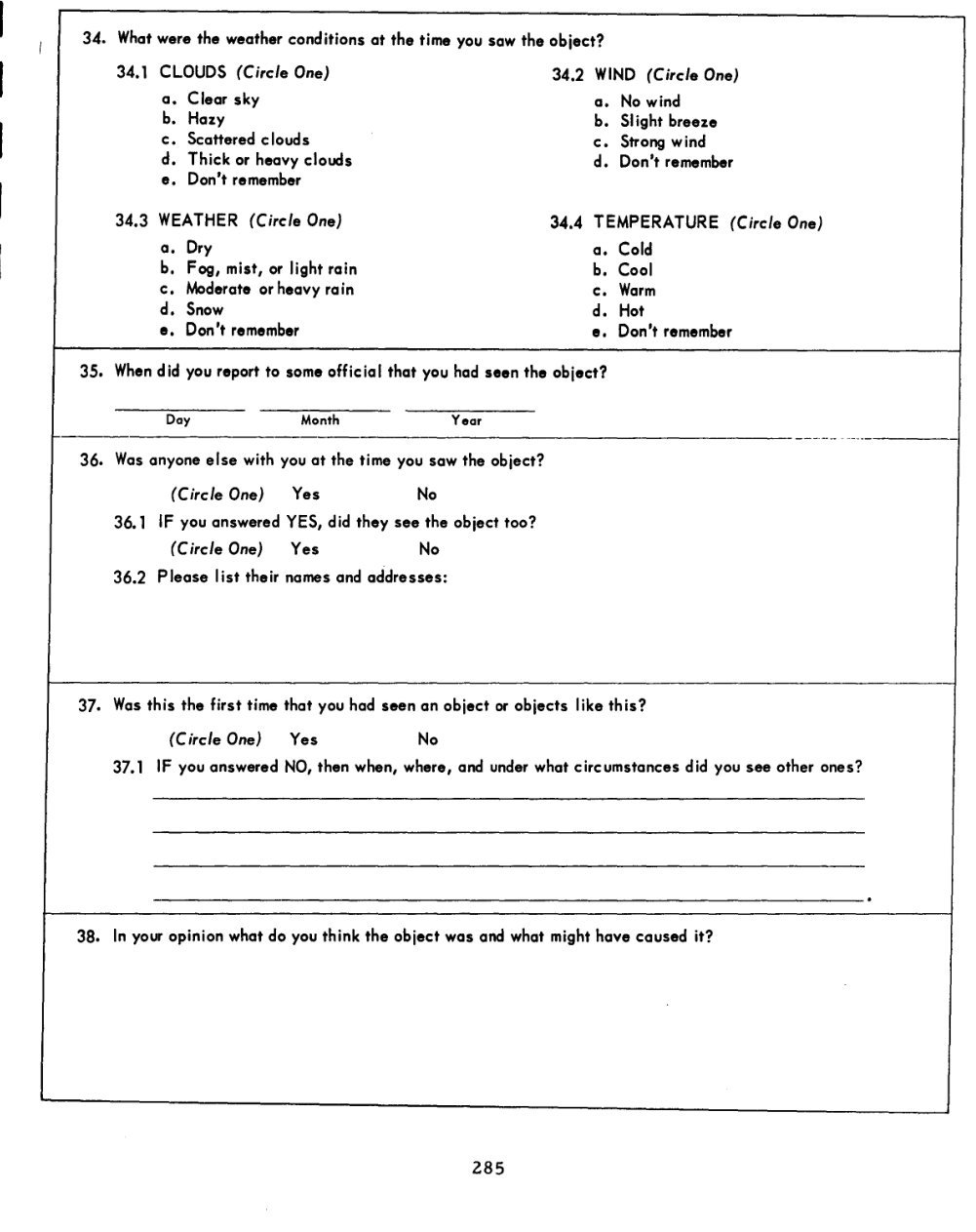
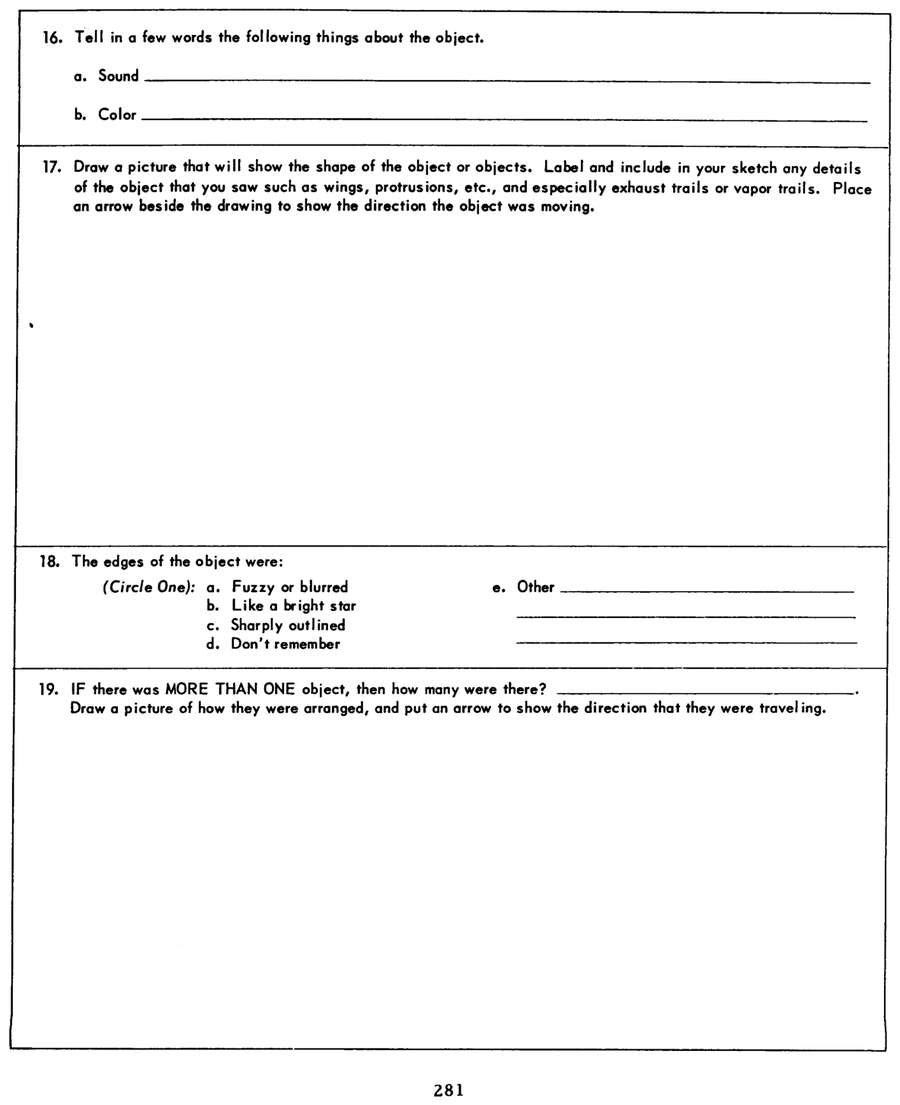
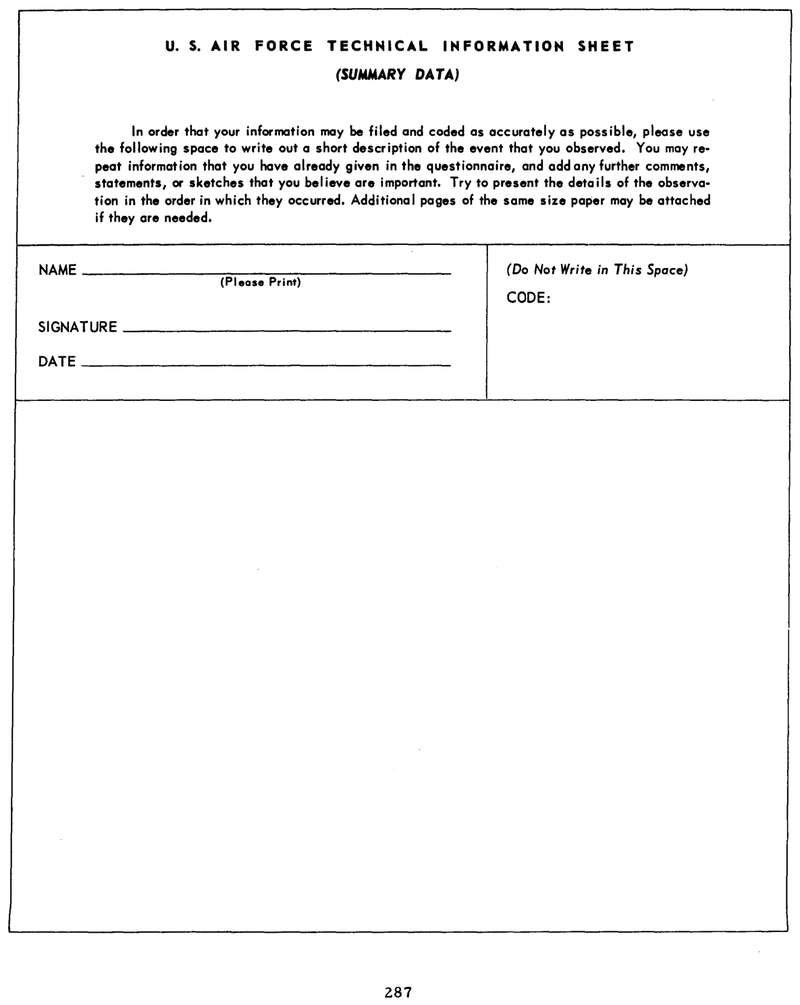
Appendix B holds the blank templates of the forms. The Provisional Observer Data Sheet and the Provisional Questionnaire, test versions, asked for date, time, time zone, where the person was, whether they were moving and what they were doing in the previous 30 minutes, in addition to asking for a free narrative with the weather, wind and clouds. The final version, the Technical Information Sheet, asked for a drawing of the path with points A and B, compared the apparent size with objects held at arm's length, from a pinhead to a basketball, and asked the witness to imagine what material they would make the UFO from. At the end, it asked whether there were other witnesses, whether it was the first time and what the person thought they had seen.
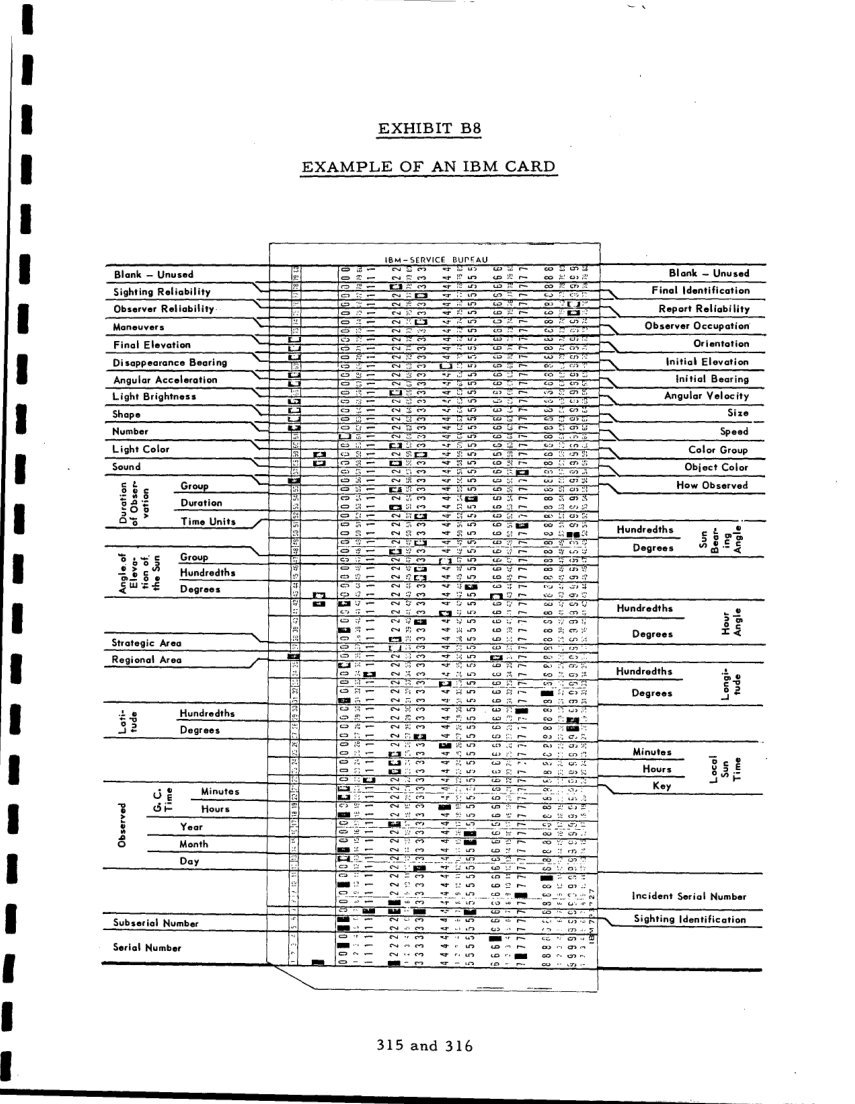
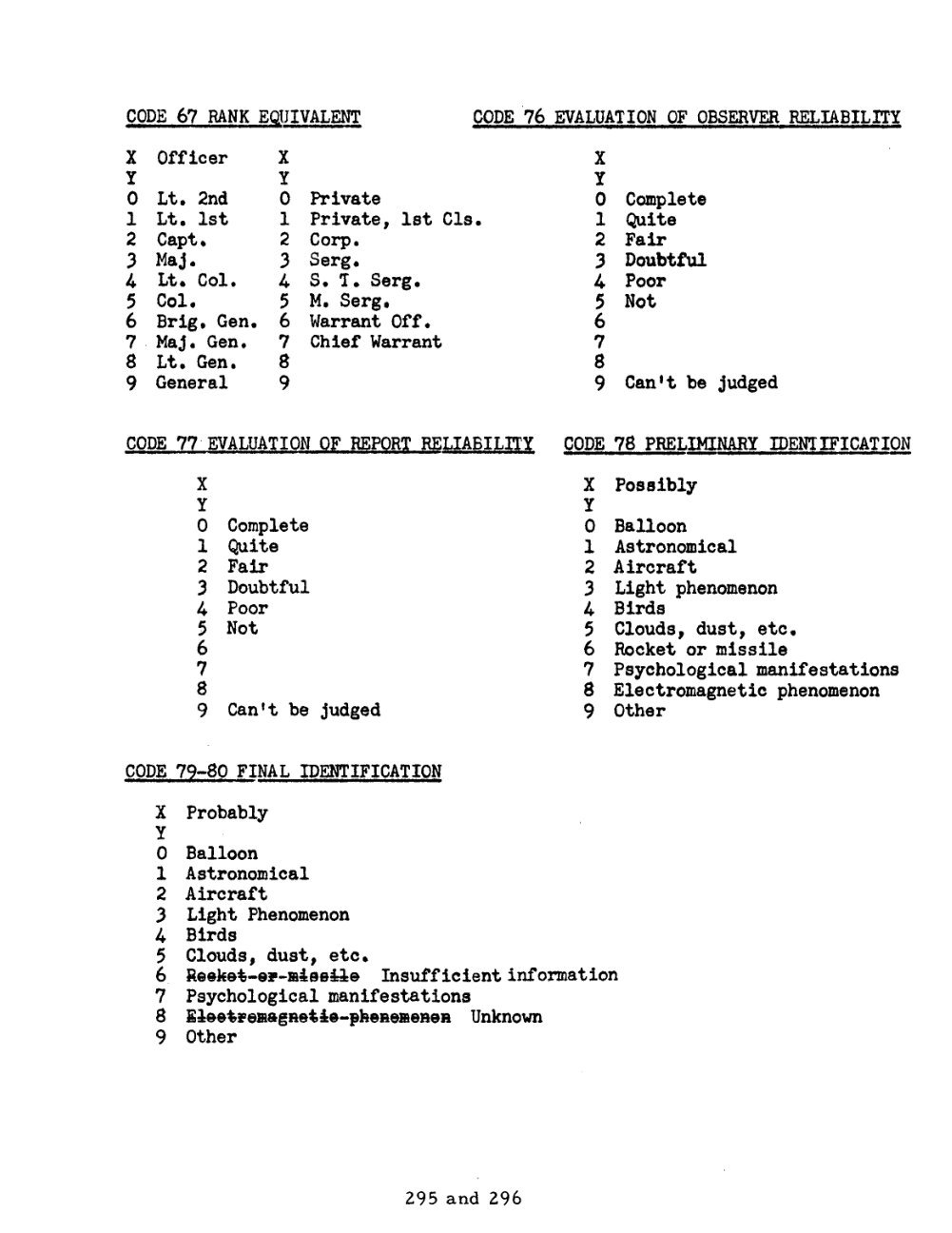
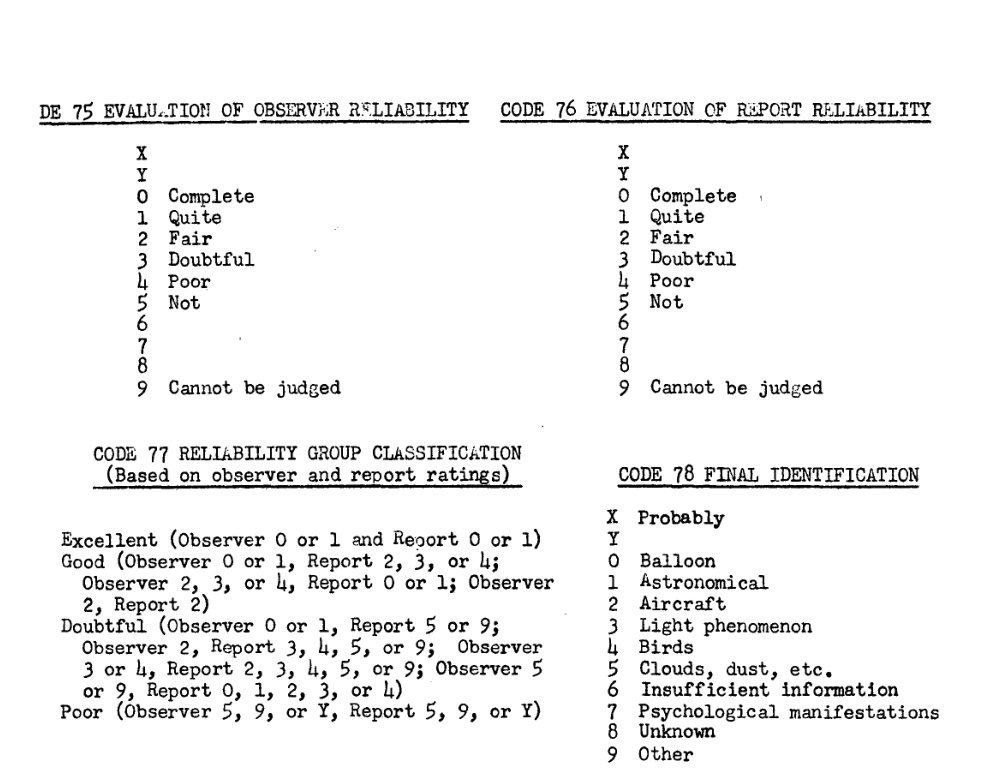
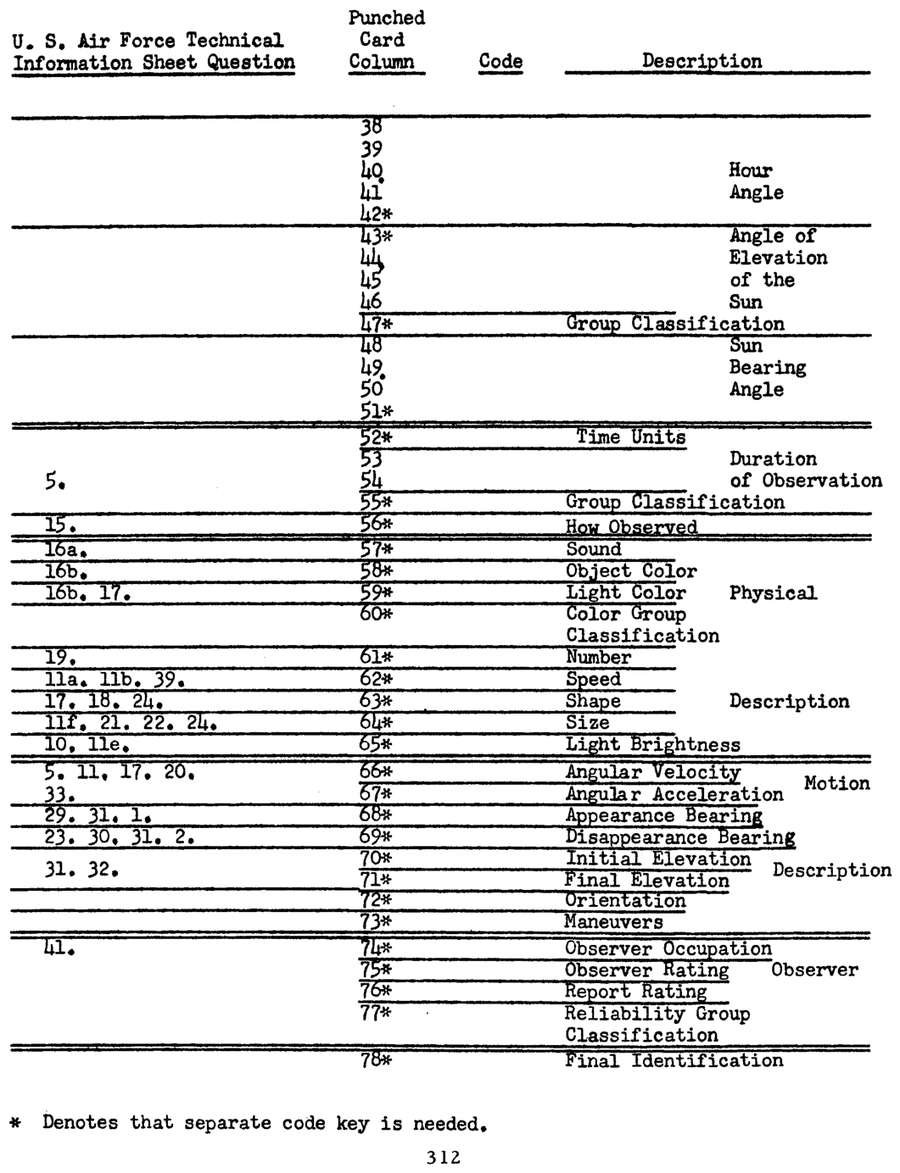
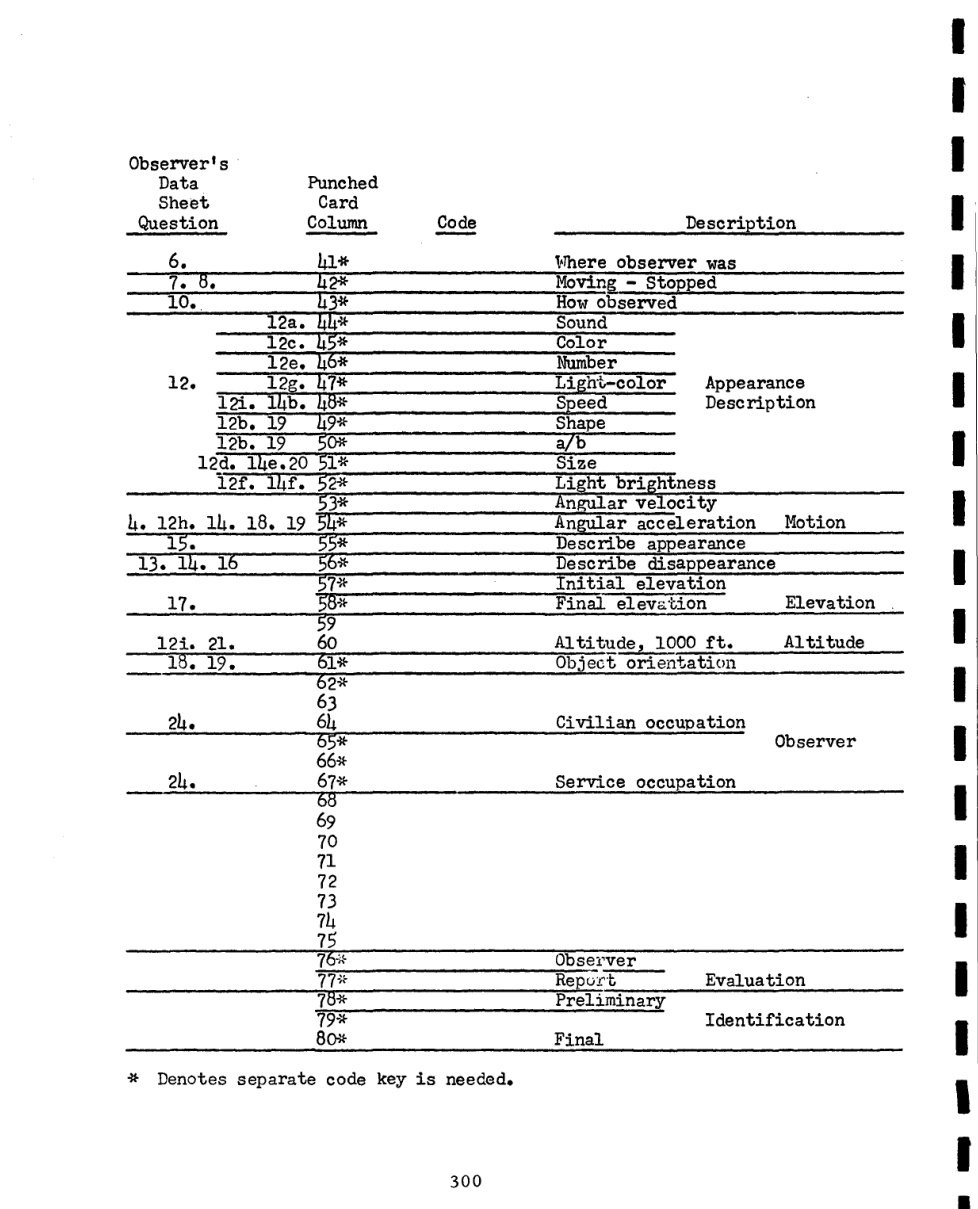
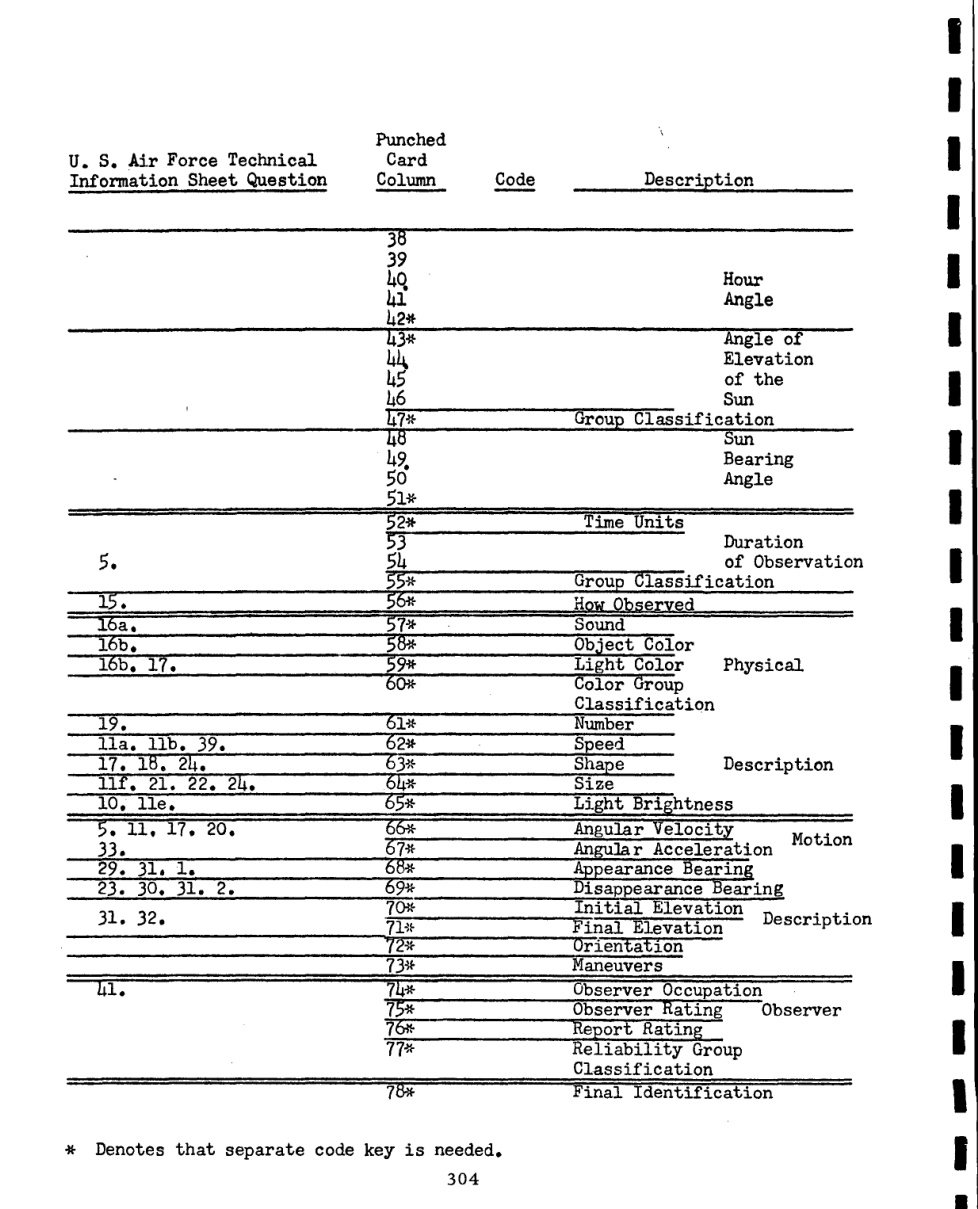
The code sheets show how each answer became a hole in the card. There were codes for sound ("different from airplane," "hissing"), shape ("unconventional aircraft," "lenticular"), angular velocity in degrees per second and brightness, compared to sunlight in a mirror or to the Moon. Reliability combined two ratings, one for the observer and another for the report, under a fixed rule: only a case rated 0 or 1 on both was excellent. On a code sheet from the first version, the final identification list included "rocket or missile" and "electromagnetic phenomenon"; the two items appear typed over and replaced by "insufficient information" and "unknown." The sheet does not explain the change.
The codes confirm the gap that the report itself admits. Column 73 of the card was reserved for "maneuvers," but the key for code 73 was left blank, with no category. The behavior of the UFO in the sky, which the team later considered decisive for separating knowns and unknowns, was never coded. The witness's occupation, on the other hand, got a detailed code, from the Army to commercial aviation and government contractors, and there was even a table of equivalent military ranks, from second lieutenant to general and from private to warrant officer.
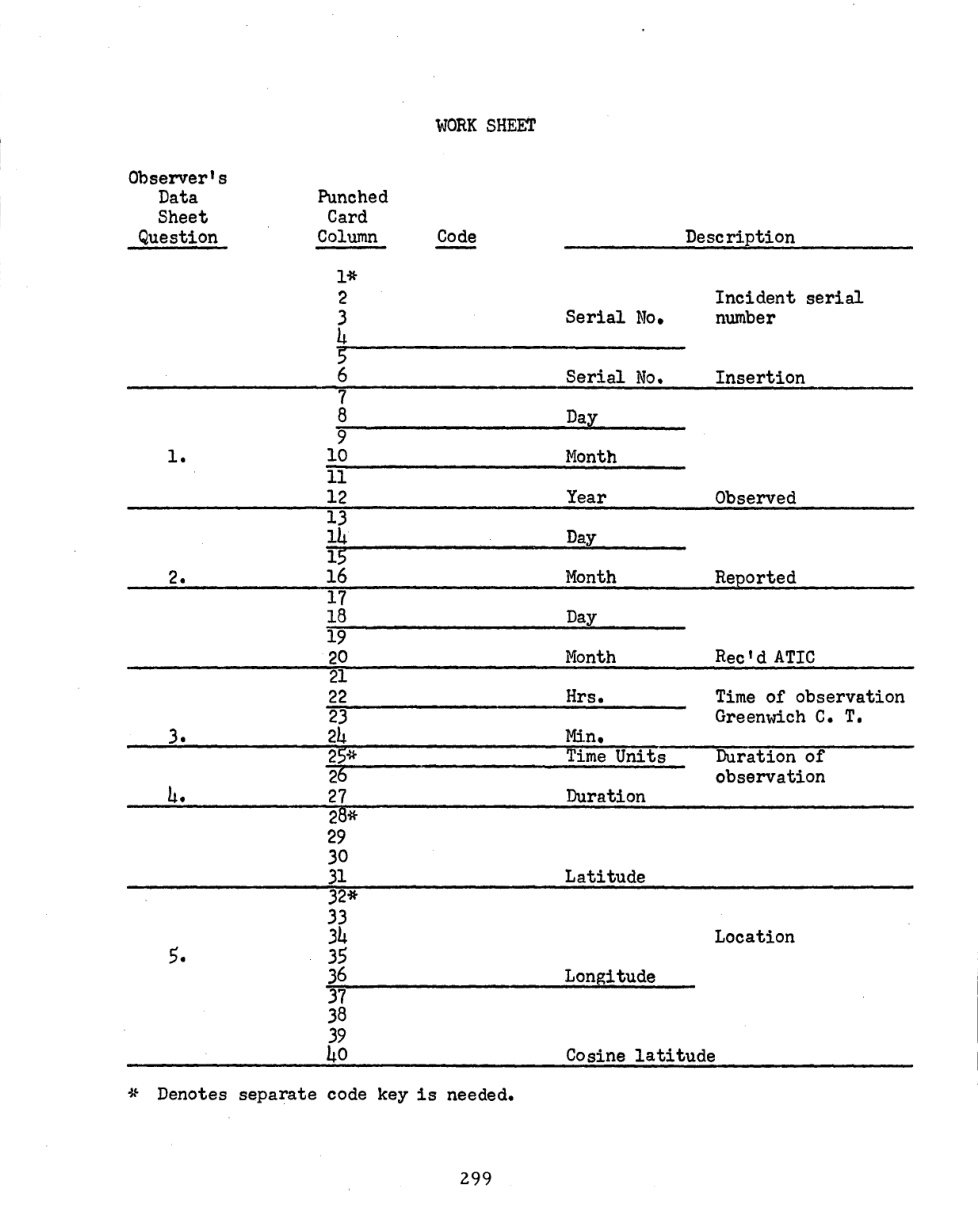
The Appendix B forms show two generations of the card. On the first worksheet, linked to the provisional questionnaire, columns 1 to 40 held the serial number, three dates (that of the sighting, that of the report and that of arrival at ATIC), Greenwich time, duration, latitude, longitude and even the cosine of the latitude. In the final version, the Card Bible, linked to the Technical Information Sheet, only the sighting date remained, and local solar time and two columns for the regional area and the strategic area of the location were added, the same divisions used in the report's maps.
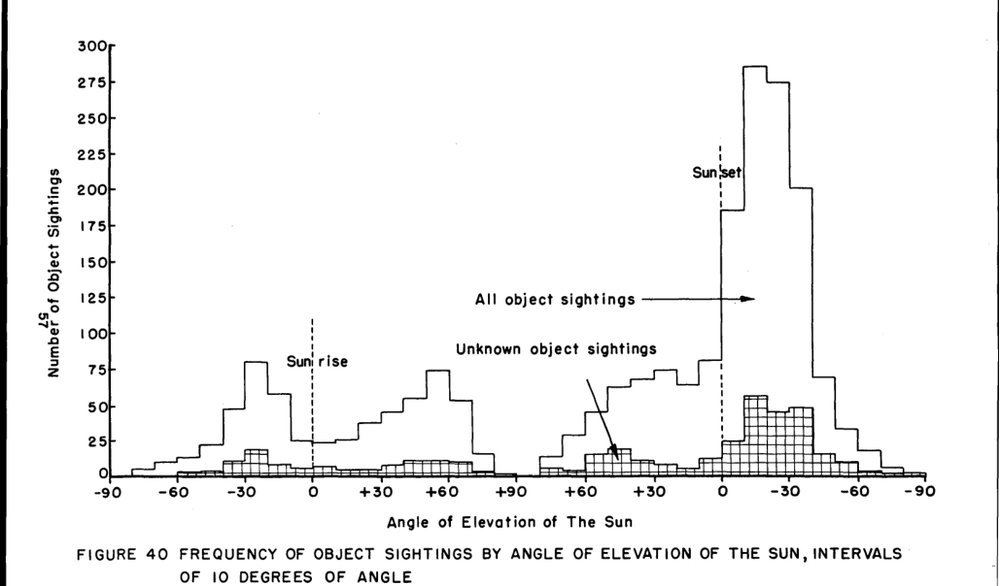
The biggest new feature of the final version is in columns 38 to 51: hour angle, Sun elevation angle and Sun azimuth. No question on the Technical Information Sheet corresponds to them in the equivalence table. They were values the team calculated from the date, time and place of each report, and they served as the basis for the study of the Sun's position carried out in the body of the report. In the same table, column 73, for maneuvers, also appears without a corresponding question, which confirms the gap admitted in the text.
The code keys show the vocabulary available for each report. The method of observation ranged from naked eye, eyeglasses, window and windshield to binoculars, telescope, theodolite, radar and photography. The number of objects was grouped in ranges up to "31 or more." Speed had only four ranges, from stationary in the air to more than 400 miles per hour, plus "like a meteor" and "not reported." It was in this highest range that the chi-square test, described in another chapter of the report, found the largest excess of unknowns relative to the explained cases.
More images from the document
DIRECT READING OF THE FILE
The document, in the original
U.S. government document. Translated in full: physical pages 14 to 24 (data reduction, questionnaire, codes, serial numbers and evaluation), the index of forms (p. 264), questions 32 and 33 of the final questionnaire (p. 286) and the labels of the sample IBM card (p. 311). The other forms in Appendix B (physical pages 263 to 311) were not translated in full: they are blank templates and code tables, with no sighting report; they remain pending for expansion.
EXCERPT 1 · PHYSICAL PAGE 14
Physical page 14 (p. 4): sources, period and data reduction plan
I
forgetting the subjectivity of the data at the time that conclusions are I
drawn from the analysis. It must be emphasized, again and again, that any
conclusions contained in this report are based NOT on facts, but on what I
many observers thought and estimated the true facts to be.
Altogether, the data for this study consisted of approximately 4, 000 I
reports of sightings of unidentified aerial objects. The majority were :received through military channels or in the form of observer-completed
questionnaires; a few were accepted in the form of direct letters from un I
-questionably reliable sources. Sightings made between June, 1947, and
December, 1952, were considered for this study. Sightings alleged to have I
occurred prior to 1947 were not considered, since they were not reported
to official sources until after public interest in "flying saucers" had been
stimulated by the popular press. I
I
REDUCTION OF DA TA TO MECHANIZED COMPUTATION FORM I
As received by the Air Technical Intelligence Center, the sighting
reports were not in a form suitable for even a quasi-scientific study. A I
preliminary review of the data indicated the need for standardized interrogation procedures and supplemental forms for the reduction of currently I held and subsequently acquired data to a form amenable to scientific
appraisal. I
The plan for reduction of the data to usable form consisted of a program of development comprising four major steps: ( 1) a systematic listing
of the factors necessary to evaluate the observer and his report, and to I
identify the unknown object observed; (2) a standard scheme for the transfer of data to a mechanized computation system; (3) an orderly means of I
relating the original data to_ all subsequent forms; and (4} a consistent procedure for the identification of the phenomenon described by the original
data. I
Questionnaire I
I I
The first reports received by A TIC varied widely in completeness
and quality. Air Force Letter 200-5(2} and Air Force Form 112( 1) were
attempts to fix responsibility for and improve the quality of the reports of I
sightings. To coordinate past efforts and to provide standardization for the
(1) A modified Air Force Form 112 lists pertinent questions to be answered in regard to an unidentified-object I
sighting.
(2) Air Force Letter 200-5 places responsibility with the Air Force for the investigation, reporting, and
analysis of unidentified aerial objects. This letter is dated 29 April 1952. I
4 I
ICheck the original PDF
forgetting the subjectivity of the data at the time that conclusions are drawn from the analysis. It must be emphasized, again and again, that any conclusions contained in this report are based NOT on facts, but on what many observers thought and estimated the true facts to be. Altogether, the data for this study consisted of approximately 4,000 reports of sightings of unidentified aerial objects. The majority were received through military channels or in the form of observer-completed questionnaires; a few were accepted in the form of direct letters from unquestionably reliable sources. Sightings made between June, 1947, and December, 1952, were considered for this study. Sightings alleged to have occurred prior to 1947 were not considered, since they were not reported to official sources until after public interest in "flying saucers" had been stimulated by the popular press. REDUCTION OF DATA TO MECHANIZED COMPUTATION FORM As received by the Air Technical Intelligence Center, the sighting reports were not in a form suitable for even a quasi-scientific study. A preliminary review of the data indicated the need for standardized interrogation procedures and supplemental forms for the reduction of currently held and subsequently acquired data to a form amenable to scientific appraisal. The plan for reduction of the data to usable form consisted of a program of development comprising four major steps: (1) a systematic listing of the factors necessary to evaluate the observer and his report, and to identify the unknown object observed; (2) a standard scheme for the transfer of data to a mechanized computation system; (3) an orderly means of relating the original data to all subsequent forms; and (4) a consistent procedure for the identification of the phenomenon described by the original data. Questionnaire The first reports received by ATIC varied widely in completeness and quality. Air Force Letter 200-5(2) and Air Force Form 112(1) were attempts to fix responsibility for and improve the quality of the reports of sightings. To coordinate past efforts and to provide standardization for the (1) A modified Air Force Form 112 lists pertinent questions to be answered in regard to an unidentified-object sighting. (2) Air Force Letter 200-5 places responsibility with the Air Force for the investigation, reporting, and analysis of unidentified aerial objects. This letter is dated 29 April 1952.View the document record ↗ · Physical page 14, counting the cover.
EXCERPT 2 · PHYSICAL PAGE 15
Physical page 15 (p. 5): the three questionnaires
I
I
I
future, it was imperative to develop a questionnaire form listing the factors
necessary for evaluation of the observer and his report, and identification
of the unknown objects. In addition, it was decided that such a questionnaire
should be designed to serve as an interrogator's guide, and as a form for
I the observer himself to complete when personal interrogation was not possible or practicable.
I Ideally, a questionnaire for the purposes required should contain
I
questions pertaining to all technical details considered to be essential for
the statistical approach, and should serve to obtain a maximum of information from the average individual who had made a sighting in the past or
would be likely to be reporting sightings in the future. Besides these ~isI crete facts, an integrated written description of a sighting would be required, thus enabling the reported facts of the sighting to be corroborated.
I Also, a narrative description might allow subtle questions to be answered
concerning the observer's ability, such as indirect questions that would
I
reveal his reasoning ability, suggestibility, and general mental attitude.
As a whole, then, the information contained in a questionnaire should make
possible the classification and evaluation of the sighting, the rating of the
observer, the probability of accuracy of reported facts, and the identifica I tion of what was reported by the observer as unidentified.
I During the course of this project, three questionnaire forms were
I
developed, each intended to be an improved revision of the one preceding.
The improvements were suggested and confirmed by members of the panel
of consultants connected with this project.
I The original form was evolved by the panel of consultants as their
first work on this project. It was intended to allow the start of the reduction of reports to discrete data, and was immediately subjected to extenI sive review and revision by the panel. The revised ( second) form was
subjected to a trial test before adoption. A TIC sent a copy to observers
reporting sightings, with the request that the form be completed and reI turned. Of the first 300 questionnaires returned during July and August,
I
1952, 168 were analyzed by a consulting psychologist. On the basis of this
analysis, plus the experience gained in working with past reports, the final
form of the questionnaire - the U. S. Air Force Technical Information
I
Sheet - was evolved. Copies of the three forms of the questionnaire, in
the order of their development, are shown as Exhibits BI, B2, and B3 in
Appendix B.
I In order to implement the transcription of data from past sighting
I
reports, each succeeding form was put to use as soon as it was developed
and approved. Accordingly, experience was obtained with each form in
relation to past data, an important factor in the improvement of the quality
and completeness of the later reports included in this study.
I
I
5
ICheck the original PDF
future, it was imperative to develop a questionnaire form listing the factors necessary for evaluation of the observer and his report, and identification of the unknown objects. In addition, it was decided that such a questionnaire should be designed to serve as an interrogator's guide, and as a form for the observer himself to complete when personal interrogation was not possible or practicable. Ideally, a questionnaire for the purposes required should contain questions pertaining to all technical details considered to be essential for the statistical approach, and should serve to obtain a maximum of information from the average individual who had made a sighting in the past or would be likely to be reporting sightings in the future. Besides these discrete facts, an integrated written description of a sighting would be required, thus enabling the reported facts of the sighting to be corroborated. Also, a narrative description might allow subtle questions to be answered concerning the observer's ability, such as indirect questions that would reveal his reasoning ability, suggestibility, and general mental attitude. As a whole, then, the information contained in a questionnaire should make possible the classification and evaluation of the sighting, the rating of the observer, the probability of accuracy of reported facts, and the identification of what was reported by the observer as unidentified. During the course of this project, three questionnaire forms were developed, each intended to be an improved revision of the one preceding. The improvements were suggested and confirmed by members of the panel of consultants connected with this project. The original form was evolved by the panel of consultants as their first work on this project. It was intended to allow the start of the reduction of reports to discrete data, and was immediately subjected to extensive review and revision by the panel. The revised (second) form was subjected to a trial test before adoption. ATIC sent a copy to observers reporting sightings, with the request that the form be completed and returned. Of the first 300 questionnaires returned during July and August, 1952, 168 were analyzed by a consulting psychologist. On the basis of this analysis, plus the experience gained in working with past reports, the final form of the questionnaire - the U. S. Air Force Technical Information Sheet - was evolved. Copies of the three forms of the questionnaire, in the order of their development, are shown as Exhibits B1, B2, and B3 in Appendix B. In order to implement the transcription of data from past sighting reports, each succeeding form was put to use as soon as it was developed and approved. Accordingly, experience was obtained with each form in relation to past data, an important factor in the improvement of the quality and completeness of the later reports included in this study.View the document record ↗ · Physical page 15, counting the cover.
EXCERPT 3 · PHYSICAL PAGE 16
Physical page 16 (p. 6): coding system and worksheet
I
Coding System and Work Sheet I
I
The reduction of non-numerical data to numerical form is mandatory
in the machine handling of data. Thus, the selection of the IBM punchedcard system for analysis of data forced the adoption of a master coding I
plan. Since it was impracticable to transfer detailed data of a~ exact
nature from the questionnaire to the IBM card, an intermediate transfer
form, coordinated with the master code, was necessary.
I
The master coding plan was evolved during the early stages of the I
preli~inary analysis of data, and was reviewed by the panel of consultants
before use. It was recognized that this system of coding would be the
heart of the analysis, that is, the completeness of the facility for trans I
lation of data could make or break the study. Accordingly, every conceivable factor that might influence the identification of unidentified aerial I objects was included, together with a wide range of variations within each
factor. The original coding system (with minor corrections) was used
throughout the translation of the original data with marked success. A copy I
of this system, called CODES, is enclosed as Exhibit IH, Appendix B.
To facilitate the preparation of the punched-card abstract, an inter I
mediate form called the WORK SHEET (later, the CARD BIBLE) was
developed. Referenced to both the data from the questionnaire and the sys I
tem of report identification, the WORK SHEET permitted an orderly
transcription of data simultaneously by several people. In conjunction
with the CODES, the WORK SHEET was used during the reduction of the I
original data to code form necessary for transfer to punched cards. A
sample is included as Exhibit BS, Appendix B. I
After the analysis was under way, it became apparent that the mechanics of machine processing could be improved by incorporating in the I
IBM card system group classifications of certain factors requiring more
than one column for discrete expression. In addition, the inclusion of
certain data relating to the evaluation and bearing of the sun with respect I
to the observer was considered necessary. Finally, a critical examination
of certain segments of the data indicated the need for the definition of a I
new factor relating to the maneuvers of the object or objects sighted.
Prior to the start of the analytical study, it had been assumed that a combination of stated factors would, by inference, define the maneuver pattern. I
All these additions have been incorporated in a revised set of CODES
and CARD BIBLE that are illustrated as Exhibits B6 and B7, Appendix B. I
However, at the time that the maneuver factor was determined to be critical, it was physically impracticable to make the required definitions and I
re-evaluate the original data. Therefore, no code for maneuverability has
been included in the CODES, CARD BIBLE, or IBM cards. I
6 I
IEditorial note: The original says "evaluation and bearing of the sun"; from the context it should be "elevation", but the word was kept and marked with [sic].
Check the original PDF
Coding System and Work Sheet The reduction of non-numerical data to numerical form is mandatory in the machine handling of data. Thus, the selection of the IBM punched-card system for analysis of data forced the adoption of a master coding plan. Since it was impracticable to transfer detailed data of an exact nature from the questionnaire to the IBM card, an intermediate transfer form, coordinated with the master code, was necessary. The master coding plan was evolved during the early stages of the preliminary analysis of data, and was reviewed by the panel of consultants before use. It was recognized that this system of coding would be the heart of the analysis, that is, the completeness of the facility for translation of data could make or break the study. Accordingly, every conceivable factor that might influence the identification of unidentified aerial objects was included, together with a wide range of variations within each factor. The original coding system (with minor corrections) was used throughout the translation of the original data with marked success. A copy of this system, called CODES, is enclosed as Exhibit B4, Appendix B. To facilitate the preparation of the punched-card abstract, an intermediate form called the WORK SHEET (later, the CARD BIBLE) was developed. Referenced to both the data from the questionnaire and the system of report identification, the WORK SHEET permitted an orderly transcription of data simultaneously by several people. In conjunction with the CODES, the WORK SHEET was used during the reduction of the original data to code form necessary for transfer to punched cards. A sample is included as Exhibit B5, Appendix B. After the analysis was under way, it became apparent that the mechanics of machine processing could be improved by incorporating in the IBM card system group classifications of certain factors requiring more than one column for discrete expression. In addition, the inclusion of certain data relating to the evaluation and bearing of the sun with respect to the observer was considered necessary. Finally, a critical examination of certain segments of the data indicated the need for the definition of a new factor relating to the maneuvers of the object or objects sighted. Prior to the start of the analytical study, it had been assumed that a combination of stated factors would, by inference, define the maneuver pattern. All these additions have been incorporated in a revised set of CODES and CARD BIBLE that are illustrated as Exhibits B6 and B7, Appendix B. However, at the time that the maneuver factor was determined to be critical, it was physically impracticable to make the required definitions and re-evaluate the original data. Therefore, no code for maneuverability has been included in the CODES, CARD BIBLE, or IBM cards.View the document record ↗ · Physical page 16, counting the cover.
EXCERPT 4 · PHYSICAL PAGE 17
Physical page 17 (p. 7): serial numbers and definitions
I
I Identification of Working Papers
I
I
The actual reduction of data to IBM punched-card form presented a
problem of mass transfer of figures by several workers. Recognizing that
an orderly system of relating the original data to the questionnaire, the
WORK SHEET, and the IBM card was imperative, a scheme of SERIAL
I NUMBERS was developed to answer this need.
I The first data consisted of a series of letter-file folders identified by
the year and location of the sighting or sightings they contained. The numI
ber of reports of sightings in a single folder varied from 1 to over 20.
Under these conditions, there was a great possibility for incorrect transcription of data, duplication of transcription, or misplacement of intermediate forms. Further, it was considered desirable to relate all sightings I of the same object or objects to one another. The concept of a four-digit
I
serial number (major), followed by a two-digit subserial number (minor),
was adequate to fulfill these requirements.
To expedite handling of the data, temporary serial numbers were
I assigned until each report had been evaluated and the phenomenon had been
I
placed i11:, a category of identification. The use of temporary serial numbers permitted the consolidation of duplicate reports from apparently
diverse sources, such as a teletype message and an Air Force Form 112.
I
However, this consolidation was made ONLY when it could be proved conclusively that the sources of the two documents were one and the same.
Factors of the observer's location, date and time of observation, description of the phenomenon, and finally, the name of the observer were conI sidered. In this manner, the assignment of major serial and minor subI
serial numbers in continuous series was made only to the reports accepted
for the statistical study. It is believed that the reports accepted represent
unique and unduplicated instances of sightings.
I In the establishment of the serial-number system, it was necessary
to define certain terms,' so that a standard interpretation could be achieved.
The terms and corresponding definitions were:
I OBSERVER -
I
SIGHTING
I
I
I
I
I
Any witness reporting to a proper authority that
he had seen unidentified aerial objects.
The report or group of reports of the same
observed phenomenon that remained unidentified to the observer or observers, at least
until reported.
7Editorial note: The order was restored as in the image.
Check the original PDF
Identification of Working Papers The actual reduction of data to IBM punched-card form presented a problem of mass transfer of figures by several workers. Recognizing that an orderly system of relating the original data to the questionnaire, the WORK SHEET, and the IBM card was imperative, a scheme of SERIAL NUMBERS was developed to answer this need. The first data consisted of a series of letter-file folders identified by the year and location of the sighting or sightings they contained. The number of reports of sightings in a single folder varied from 1 to over 20. Under these conditions, there was a great possibility for incorrect transcription of data, duplication of transcription, or misplacement of intermediate forms. Further, it was considered desirable to relate all sightings of the same object or objects to one another. The concept of a four-digit serial number (major), followed by a two-digit subserial number (minor), was adequate to fulfill these requirements. To expedite handling of the data, temporary serial numbers were assigned until each report had been evaluated and the phenomenon had been placed in a category of identification. The use of temporary serial numbers permitted the consolidation of duplicate reports from apparently diverse sources, such as a teletype message and an Air Force Form 112. However, this consolidation was made ONLY when it could be proved conclusively that the sources of the two documents were one and the same. Factors of the observer's location, date and time of observation, description of the phenomenon, and finally, the name of the observer were considered. In this manner, the assignment of major serial and minor subserial numbers in continuous series was made only to the reports accepted for the statistical study. It is believed that the reports accepted represent unique and unduplicated instances of sightings. In the establishment of the serial-number system, it was necessary to define certain terms, so that a standard interpretation could be achieved. The terms and corresponding definitions were: OBSERVER - Any witness reporting to a proper authority that he had seen unidentified aerial objects. SIGHTING - The report or group of reports of the same observed phenomenon that remained unidentified to the observer or observers, at least until reported.View the document record ↗ · Physical page 17, counting the cover.
EXCERPT 5 · PHYSICAL PAGE 18
Physical page 18 (p. 8): types of observation and number ranges by year
I
SINGLE OBSERVATION - A SIGHTING consisting of a single I
report from ( 1) one OBSERVER with no knowledge
of additional OBSERVERS of the same phenom I
enon, or (2) a group of witnesses of the same
phenomenon, each cognizant of the others. The
witness who made the report is called a SINGLE I
OBSERVER.
MULTIPLE OBSERVATION - A SIGHTING consisting of I
several reports from OBSERVERS of the same
phenomenon who were cognizant of each other. I
The witnesses who made reports are called
MULTIPLE OBSERVERS. I
ALL SIGHTINGS - ( 1) The group of reports consisting of one
report for each OBSERVER, including both I SINGLE and MULTIPLE OBSERVERS. (2) The
questionnaire, work sheet, and IBM card
representing the report from each OBSERVER - I
in other words, the representation of each report
accepted for the statistical study. I
UNIT SIGHTINGS - ( 1) The group of reports consisting of one
report for each SIGHTING, including all the I
reports of SINGLE OBSERVATIONS and the one
most representative report from each MULTIPLE
OBSERVATION. (2) The questionnaire, work I
sheet, and IBM card representing the report for
each SIGHTING accepted for the statistical study. I
A major serial number (four digits) was assigned to each sighting,
segregating the year of occurrence by selection of limits for each year, as I
follows:
0001 to 0500 reserved for 1947 I
0501 to 1000 reserved for 1948
1001 to 1500 reserved for 1949 I 150lto2000 reserved for 1950
2001 to 2500 reserved for 1951
2501 to4900 reserved for 1952 I
While this scheme would serve to identify any individual sighting, identification of each report and its subsequent forms was necessary. The minor I
subserial numbers (two digits) fulfiiled this requirement. For all SINGLE
OBSERVATIONS, a major serial number followed by two (2) zeros, for I
example, 2759. 00, was sufficient identification. For MULTIPLE OBSERVATIONS, the major serial number followed by a series of two-digit numbers ranging from 00 to 99 was used to identify the individual reports. In I
general, the most complete report from the most reliable observer of that
8 I
ICheck the original PDF
SINGLE OBSERVATION - A SIGHTING consisting of a single report from (1) one OBSERVER with no knowledge of additional OBSERVERS of the same phenomenon, or (2) a group of witnesses of the same phenomenon, each cognizant of the others. The witness who made the report is called a SINGLE OBSERVER. MULTIPLE OBSERVATION - A SIGHTING consisting of several reports from OBSERVERS of the same phenomenon who were cognizant of each other. The witnesses who made reports are called MULTIPLE OBSERVERS. ALL SIGHTINGS - (1) The group of reports consisting of one report for each OBSERVER, including both SINGLE and MULTIPLE OBSERVERS. (2) The questionnaire, work sheet, and IBM card representing the report from each OBSERVER - in other words, the representation of each report accepted for the statistical study. UNIT SIGHTINGS - (1) The group of reports consisting of one report for each SIGHTING, including all the reports of SINGLE OBSERVATIONS and the one most representative report from each MULTIPLE OBSERVATION. (2) The questionnaire, work sheet, and IBM card representing the report for each SIGHTING accepted for the statistical study. A major serial number (four digits) was assigned to each sighting, segregating the year of occurrence by selection of limits for each year, as follows: 0001 to 0500 reserved for 1947 0501 to 1000 reserved for 1948 1001 to 1500 reserved for 1949 1501 to 2000 reserved for 1950 2001 to 2500 reserved for 1951 2501 to 4900 reserved for 1952 While this scheme would serve to identify any individual sighting, identification of each report and its subsequent forms was necessary. The minor subserial numbers (two digits) fulfilled this requirement. For all SINGLE OBSERVATIONS, a major serial number followed by two (2) zeros, for example, 2759.00, was sufficient identification. For MULTIPLE OBSERVATIONS, the major serial number followed by a series of two-digit numbers ranging from 00 to 99 was used to identify the individual reports. In general, the most complete report from the most reliable observer of thatView the document record ↗ · Physical page 18, counting the cover.
EXCERPT 6 · PHYSICAL PAGE 19
Physical page 19 (p. 9): object sightings and incident numbers
I
I MULTIPLE OBSERVATION was identified with the . 00 subserial number.
As an example, a MULTIPLE OBSERVATION consisting of six sighting I reports would have the following serial numbers:
I 1132. 00 representing the best report and observer
1132.01 representing an additional observer
1132. 02 representing an additional observer
I 1132. 03 representing an additional observer
I
1132. 04 representing an additional observer
1132. 05 representing an additional observer
I
During the course of the transcription of the data to machine card
form, it became obvious that certain reports could have been independent
observations of the same phenomenon. So, if the presentation of an
analysis based on one report for each sighting was valid (the concept of
I UNIT SIGHTINGS}, a presentation of an analysis based on one report for
each phenomenon should be valid also. Further, the examination of data
I relating to the actual number of phenomena was considered to be the proper
basis for assessing the probability of technological developments outside
the range of present-day scientific knowledge. Therefore, a designation of
I OBJECT SIGHTINGS was established, with the following definition:
OBJECT SIGHTING - ( 1) The group of reports consisting of I one report for each phenomenon. (2) The
I
questionnaire, work sheet, and IBM card
representing a report for each phenomenon
accepted for the statistical study.
I In brief review, ALL SIGHTINGS refer to all reports, UNIT SIGHTINGS
refer to actual sightings, and OBJECT SIGHTINGS refer to the assumed
I number of phenomena.
I
It must be recognized that the process of identifying OBJECT
SIGHTINGS was deductive, while that for UNIT SIGHTINGS was definitive.
A conservative approach was adopted in the determination of OBJECT
SIGHTINGS, using the factors of date and time of observations, location I of observers, duration of observations, and range, bearing, track direcI
tion, and identification of the phenomena. Any error of selection of OBJECT
SIGHTINGS will tend to be in the direction of reducing the actual number of
phenomena observed ( several instances of UNIT SIGHTINGS that might be
one OBJECT SIGHTING were noted, but the evidence was not conclusive
I enough to justify consolidation of the reports).
I Following the determination of OBJECT SIGHTINGS, a series of
serial numbers, called the INCIDENT SERIAL NUMBERS, was established
I
to facilitate any future study of a specific object sighting. Each reported
sighting that relates to an OBJECT SIGHTING received the same incident
serial number, a four-digit code paralleling the major serial number
series.
I 9
ICheck the original PDF
MULTIPLE OBSERVATION was identified with the .00 subserial number. As an example, a MULTIPLE OBSERVATION consisting of six sighting reports would have the following serial numbers: 1132.00 representing the best report and observer 1132.01 representing an additional observer 1132.02 representing an additional observer 1132.03 representing an additional observer 1132.04 representing an additional observer 1132.05 representing an additional observer During the course of the transcription of the data to machine card form, it became obvious that certain reports could have been independent observations of the same phenomenon. So, if the presentation of an analysis based on one report for each sighting was valid (the concept of UNIT SIGHTINGS), a presentation of an analysis based on one report for each phenomenon should be valid also. Further, the examination of data relating to the actual number of phenomena was considered to be the proper basis for assessing the probability of technological developments outside the range of present-day scientific knowledge. Therefore, a designation of OBJECT SIGHTINGS was established, with the following definition: OBJECT SIGHTING - (1) The group of reports consisting of one report for each phenomenon. (2) The questionnaire, work sheet, and IBM card representing a report for each phenomenon accepted for the statistical study. In brief review, ALL SIGHTINGS refer to all reports, UNIT SIGHTINGS refer to actual sightings, and OBJECT SIGHTINGS refer to the assumed number of phenomena. It must be recognized that the process of identifying OBJECT SIGHTINGS was deductive, while that for UNIT SIGHTINGS was definitive. A conservative approach was adopted in the determination of OBJECT SIGHTINGS, using the factors of date and time of observations, location of observers, duration of observations, and range, bearing, track direction, and identification of the phenomena. Any error of selection of OBJECT SIGHTINGS will tend to be in the direction of reducing the actual number of phenomena observed (several instances of UNIT SIGHTINGS that might be one OBJECT SIGHTING were noted, but the evidence was not conclusive enough to justify consolidation of the reports). Following the determination of OBJECT SIGHTINGS, a series of serial numbers, called the INCIDENT SERIAL NUMBERS, was established to facilitate any future study of a specific object sighting. Each reported sighting that relates to an OBJECT SIGHTING received the same incident serial number, a four-digit code paralleling the major serial number series.View the document record ↗ · Physical page 19, counting the cover.
EXCERPT 7 · PHYSICAL PAGE 20
Physical page 20 (p. 10): evaluation and identification categories
I
For machine manipulation, it was desirable to be able to select the I
sample of cards (all reports, all sightings, or all phenomena) to be included in a particular study. The concept of a SIGHTING IDENTIFICATION I
NUMBER was evolved to fill this desire. Using one column of the IBM
card, and the correlated working papers,· the code for this function was
developed. Multiple punching eliminated the need to use several columns I
for discrete expression of the variations. Selection of the proper number
in this column thus permitted selection of the desired sample of cards. ·1
Evaluation of Individual Reports I
Evaluation of sighting reports was recognized as a crucial step in the I
preparation of data for statistical treatment; inconsistent evaluations would
have invalidated any conclusions to be derived from this study. A method I of evaluation was, therefore, determined simultaneously with the development of the questionnaire, the coding system, and the work sheet. It is
emphasized that all phases of evaluation, even including the tedious prep I
aration of the original data for statistical treatment, were entrusted only
to selected, specially qualified scientists and engineers. I
Evaluation consisted of a standardized procedure to be followed for:
( 1) the deduction of discrete facts from data which depended on human im I
pressions rather than scientific measurements, (2) the rating of the observer and his report as determined from available information, and ( 3) the
determination of the probable identification of the phenomenon observed. I
Categories of identification, established upon the basis of previous experience, were as follows: I
Balloon
Astronomical I
Aircraft
Light phenomenon
Birds I
Clouds, dust, etc.
Insufficient information I Psychological manifestations
Unknown
Other I
The first step in evaluation, the deduction of discrete facts from
subjective data, required certain calculations based on the information I
available in the sighting report. An example was the finding of the approximate angular velocity and acceleration of the object or objects sighted. I
Care was taken during this phase of the work to insure against the deduction of discrete facts not warranted by the original data. Thus, even
though there was a complete lack of any valid evidence consisting of I
10 I
ICheck the original PDF
For machine manipulation, it was desirable to be able to select the sample of cards (all reports, all sightings, or all phenomena) to be included in a particular study. The concept of a SIGHTING IDENTIFICATION NUMBER was evolved to fill this desire. Using one column of the IBM card, and the correlated working papers, the code for this function was developed. Multiple punching eliminated the need to use several columns for discrete expression of the variations. Selection of the proper number in this column thus permitted selection of the desired sample of cards. Evaluation of Individual Reports Evaluation of sighting reports was recognized as a crucial step in the preparation of data for statistical treatment; inconsistent evaluations would have invalidated any conclusions to be derived from this study. A method of evaluation was, therefore, determined simultaneously with the development of the questionnaire, the coding system, and the work sheet. It is emphasized that all phases of evaluation, even including the tedious preparation of the original data for statistical treatment, were entrusted only to selected, specially qualified scientists and engineers. Evaluation consisted of a standardized procedure to be followed for: (1) the deduction of discrete facts from data which depended on human impressions rather than scientific measurements, (2) the rating of the observer and his report as determined from available information, and (3) the determination of the probable identification of the phenomenon observed. Categories of identification, established upon the basis of previous experience, were as follows: Balloon Astronomical Aircraft Light phenomenon Birds Clouds, dust, etc. Insufficient information Psychological manifestations Unknown Other The first step in evaluation, the deduction of discrete facts from subjective data, required certain calculations based on the information available in the sighting report. An example was the finding of the approximate angular velocity and acceleration of the object or objects sighted. Care was taken during this phase of the work to insure against the deduction of discrete facts not warranted by the original data. Thus, even though there was a complete lack of any valid evidence consisting ofView the document record ↗ · Physical page 20, counting the cover.
EXCERPT 8 · PHYSICAL PAGE 21
Physical page 21 (p. 11): rejected reports, observer qualification and identification check
I
I physical matter in any case of a reported unidentified aerial object, this
I was not assumed to be prima facie evidence that "flying saucers" did not
exist.
I In those cases in which an attempt to reduce the information to a
1·
factual level failed completely, the report was eliminated from further consideration, and thus not included in the statistical analysis. About 800
I
reports of sightings were eliminated or rejected in this manner. Most of
these reports were rejected because they were extremely nebulous; the
rest were rejected because they contained highly conflicting statements.
The second step in evaluation, the rating of the observer and his
I report, logically followed the first step, the reduction of the data to usable
form. Ratings were assigned on the basis of the following factors of inI formation, considered in relation to one another:
I
( 1) The experience of the observer, deduced from his
occupation, age, and training;
( 2) The consistency among the separate portions of the I description of the sighting;
I (3) The general quality and completeness of the report;
(4) Consideration of the observer's fact-reporting ability
I and attitude, as disclosed by his manner of describing
the sighting.
I In cases in which insufficient information was available to make a judgment
of the observer or report, none was made, but the report was accepted for
I the statistical study.
The third step in the process of evaluation, the attempted identificaI tion of the object or objects sighted, was done twice, first by the individual
I
who made the transcription of the data (the preliminary identification), and
later (the final identification} by a conference of four persons, two representatives from ATIC and two from the panel of consultants. Although
representatives of A TIC participated in making the final identifications, it
I must be emphasized that any previous identification of a sighting made by
A TIC was not introduced or referred to in any way.
I In the coding system, the choices provided for final identifications
were based on A TIC' s previous experience in analysis of the data. They
I had found that the majority of sightings could be classified as misinterpretations of common objects or natural phenomena. Accordingly, categories
I
for objects most frequently present in the air were provided. Balloons,
aircraft, astronomical bodies ( such as meteors), birds, and clouds or dust
I
were recognized as major categories. The less frequent, but common
objects, such as kites, fireworks, flares, rockets, contrails, and
11
ICheck the original PDF
physical matter in any case of a reported unidentified aerial object, this was not assumed to be prima facie evidence that "flying saucers" did not exist. In those cases in which an attempt to reduce the information to a factual level failed completely, the report was eliminated from further consideration, and thus not included in the statistical analysis. About 800 reports of sightings were eliminated or rejected in this manner. Most of these reports were rejected because they were extremely nebulous; the rest were rejected because they contained highly conflicting statements. The second step in evaluation, the rating of the observer and his report, logically followed the first step, the reduction of the data to usable form. Ratings were assigned on the basis of the following factors of information, considered in relation to one another: (1) The experience of the observer, deduced from his occupation, age, and training; (2) The consistency among the separate portions of the description of the sighting; (3) The general quality and completeness of the report; (4) Consideration of the observer's fact-reporting ability and attitude, as disclosed by his manner of describing the sighting. In cases in which insufficient information was available to make a judgment of the observer or report, none was made, but the report was accepted for the statistical study. The third step in the process of evaluation, the attempted identification of the object or objects sighted, was done twice, first by the individual who made the transcription of the data (the preliminary identification), and later (the final identification) by a conference of four persons, two representatives from ATIC and two from the panel of consultants. Although representatives of ATIC participated in making the final identifications, it must be emphasized that any previous identification of a sighting made by ATIC was not introduced or referred to in any way. In the coding system, the choices provided for final identifications were based on ATIC's previous experience in analysis of the data. They had found that the majority of sightings could be classified as misinterpretations of common objects or natural phenomena. Accordingly, categories for objects most frequently present in the air were provided. Balloons, aircraft, astronomical bodies (such as meteors), birds, and clouds or dust were recognized as major categories. The less frequent, but common objects, such as kites, fireworks, flares, rockets, contrails, andView the document record ↗ · Physical page 21, counting the cover.
EXCERPT 9 · PHYSICAL PAGE 22
Physical page 22 (p. 12): definitions of insufficient information, psychological manifestation and unknown
I
meteorological phenomena like small tornadoes, were collected into a I
category called OTHER. A separate category for the uncommon natural
phenomena associated with light reflections or refractions, such as mirages, I
sun dogs, inversion-layer images, and distortions caused by airborne ic.e,
was established with the title of LIGHT PHENOMENON. Categories for
INSUFFICIENT INFORMATION, PSYCHOLOGICAL MANIFESTATIONS, and I
UNKNOWN were provided for the sightings that could not be fitted into the
preceding identifications. An explanation of their use follows: I
INSUFFICIENT INFORMATION - This identification category
was assigned to a report when, upon final con I
sideration, there was some essential item of
information missing, or there was enough
doubt abou._t what data were available to disallow I •identification as a common object or some
natural phenomenon. It is emphasized that this I category of identification was not used as a
convenient way to dispose of what might be
called "poor unknowns", but as a category for I
reports that, perhaps, could have been one of
several known objects or natural phenomena.
No reports identified as INSUFFICIENT INFORMA I
TION contain authenticated facts or impressions
concerning the sighting that would prevent its I
being identified as a known object or phenomenon;
PSYCHOLOGICAL MANIFESTATIONS - This identification I
category was assigned to a report when,
although it was well established that the observer had seen something, it was also I
obvious that the description of the sighting
had been overdrawn. Religious fanaticism, a I
desire for publicity, or an over-active imagination were the most common mental aberrations causing this type of report; I
UNKNOWN - This designation in the identification code was
assigned to those reports of sightings wherein I
the description of the object and its maneuvers
could not be fitted to the pattern of any known I
object or phenomenon.
For the purposes of this study, two groups of identifications were I
recognized, the KNOWNS (including all identification categories except the
UNKNOWNS) and the UNKNOWNS. I
All possible identifications provided in the code system, except
INSUFFICIENT INFORMATION and UNKNOWN, could be assigned accord I
ing to two degrees of certainty, designated "Certain" and "Doubtful".
I
I
12Check the original PDF
meteorological phenomena like small tornadoes, were collected into a category called OTHER. A separate category for the uncommon natural phenomena associated with light reflections or refractions, such as mirages, sun dogs, inversion-layer images, and distortions caused by airborne ice, was established with the title of LIGHT PHENOMENON. Categories for INSUFFICIENT INFORMATION, PSYCHOLOGICAL MANIFESTATIONS, and UNKNOWN were provided for the sightings that could not be fitted into the preceding identifications. An explanation of their use follows: INSUFFICIENT INFORMATION - This identification category was assigned to a report when, upon final consideration, there was some essential item of information missing, or there was enough doubt about what data were available to disallow identification as a common object or some natural phenomenon. It is emphasized that this category of identification was not used as a convenient way to dispose of what might be called "poor unknowns", but as a category for reports that, perhaps, could have been one of several known objects or natural phenomena. No reports identified as INSUFFICIENT INFORMATION contain authenticated facts or impressions concerning the sighting that would prevent its being identified as a known object or phenomenon; PSYCHOLOGICAL MANIFESTATIONS - This identification category was assigned to a report when, although it was well established that the observer had seen something, it was also obvious that the description of the sighting had been overdrawn. Religious fanaticism, a desire for publicity, or an over-active imagination were the most common mental aberrations causing this type of report; UNKNOWN - This designation in the identification code was assigned to those reports of sightings wherein the description of the object and its maneuvers could not be fitted to the pattern of any known object or phenomenon. For the purposes of this study, two groups of identifications were recognized, the KNOWNS (including all identification categories except the UNKNOWNS) and the UNKNOWNS. All possible identifications provided in the code system, except INSUFFICIENT INFORMATION and UNKNOWN, could be assigned according to two degrees of certainty, designated "Certain" and "Doubtful".View the document record ↗ · Physical page 22, counting the cover.
EXCERPT 10 · PHYSICAL PAGE 23
Physical page 23 (p. 13): degrees of certainty and decision procedure
I
I
I
A "Certain" identification indicated a minimum amount of doubt regarding
the validity of the evaluation. By "rule-of-thumb" reasoning, the probability of the identification being correct was better than 95 per cent. A
"Doubtful'' identification indicated that the choice was less positive, but
I that there was a better than even chance of being correct.
I It is emphasized again that, as was tr.ue for other phases of evaluation, preliminary and final identification was entrusted only to scientists
and engineers who, in addition to their broad scientific background, had
I received instruction, where necessary, in specialized subjects. The panel
of consultants provided background information for this instruction. Many
of the cases representing unusual features or maneuvers were submitted to
I and discussed with various members of the panel of consultants prior to the
final identification.
I Consistency in the application of the knowledge necessary for making
identifications was maintained by frequent collaboration among the personI nel involved, and systematic spot checks of the work. In addition to the
general fund of knowledge required to identify satisfactorily a reported
unidentified aerial object, an attempt was made to correlate specific data I such as flight plans of aircraft, records of balloon releases, weather conditions, and an astronomical almanac with the reported sighting.
I The procedure followed in making final identifications deserves explanation because of the importance assumed by the identification as a basis
I for statistical treatment. As was mentioned, a conference of four qualified
I
persons, two from A TIC and two from the panel of consultants, decided
upon the final identification for each sighting report. This work was done
at A TIC, periodically, as reports became ready.
I During an identification conference, each sighting report was first
studied, from the original data, by one person. If that person arrived at a
decision, it was checked against the preliminary identification; if the two
I identifications were the same, the report was appropriately marked and
I
considered finished. If the two identifications did not agree, the report
was considered later by everyone participating in the conference until a
group decision could be made.
I If an evaluator was unable to categorize the report as one of the
common objects or as a natural phenomenon, and his opinion was that the
sighting should be recorded as UNKNOWN, a group decision was also re I quired on that report before it was considered finished. A group decision
I
was necessary on all reports finally recorded as UNKNOWN, regardless of
what the preliminary identification had been. In cases where a group
I
decision was not made within a reasonable time, the report was put aside
and later submitted to certain members of the panel of consultants for their
op1n1ons. If, after this, disagreement continued to exist, the report of the
sighting was identified as UNKNOWN.
I 13
ICheck the original PDF
A "Certain" identification indicated a minimum amount of doubt regarding the validity of the evaluation. By "rule-of-thumb" reasoning, the probability of the identification being correct was better than 95 per cent. A "Doubtful" identification indicated that the choice was less positive, but that there was a better than even chance of being correct. It is emphasized again that, as was true for other phases of evaluation, preliminary and final identification was entrusted only to scientists and engineers who, in addition to their broad scientific background, had received instruction, where necessary, in specialized subjects. The panel of consultants provided background information for this instruction. Many of the cases representing unusual features or maneuvers were submitted to and discussed with various members of the panel of consultants prior to the final identification. Consistency in the application of the knowledge necessary for making identifications was maintained by frequent collaboration among the personnel involved, and systematic spot checks of the work. In addition to the general fund of knowledge required to identify satisfactorily a reported unidentified aerial object, an attempt was made to correlate specific data such as flight plans of aircraft, records of balloon releases, weather conditions, and an astronomical almanac with the reported sighting. The procedure followed in making final identifications deserves explanation because of the importance assumed by the identification as a basis for statistical treatment. As was mentioned, a conference of four qualified persons, two from ATIC and two from the panel of consultants, decided upon the final identification for each sighting report. This work was done at ATIC, periodically, as reports became ready. During an identification conference, each sighting report was first studied, from the original data, by one person. If that person arrived at a decision, it was checked against the preliminary identification; if the two identifications were the same, the report was appropriately marked and considered finished. If the two identifications did not agree, the report was considered later by everyone participating in the conference until a group decision could be made. If an evaluator was unable to categorize the report as one of the common objects or as a natural phenomenon, and his opinion was that the sighting should be recorded as UNKNOWN, a group decision was also required on that report before it was considered finished. A group decision was necessary on all reports finally recorded as UNKNOWN, regardless of what the preliminary identification had been. In cases where a group decision was not made within a reasonable time, the report was put aside and later submitted to certain members of the panel of consultants for their opinions. If, after this, disagreement continued to exist, the report of the sighting was identified as UNKNOWN.View the document record ↗ · Physical page 23, counting the cover.
EXCERPT 11 · PHYSICAL PAGE 24
Physical page 24 (p. 14): beginning of the data analysis
I
Upon completion of final identifications, all data were transferred to I
IBM cards, preparatory to analysis. I
I
I
ANALYSIS OF THE DATA
Broadly stated, the problem at this point consisted of the judicious
application of scientific met~ods of categorizing and analyzing the subjective data in reports of sightings of unidentified aerial objects. It was I
recognized that an approach to this problem could best be made by a systematic sorting and tabulation program to give frequency and percentage
distributions of the important characteristics of sightings. A suggestion I
that an attempt be made to anticipate all questions that might be asked in
the future about a sighting or a group of sightings, and to provide answers, I
was rejected. The systematic approach also made it possible to develop
a detailed reference manual of the attributes of the sightings included in
this study. I
Thus, at the beginning of the analysis, a detailed plan was developed
for sorting, counting, and tabulating the information from the punched-card I
abstracts of reports of sightings. It was believed at the time, and later
substantiated, that the results of the program for sorting and tabulating I
would serve as a, guide for the more sophisticated treatment involving
statistical methods. I
Also, it was anticipated that any patterns or trends that might be
found could be subjected to concentrated study in the hope of discovering I significant information relating to the characteristics of "flying saucers".
Further, it was believed that these trends could serve as certain of the
criteria of validity for any concepts (models) developed in the attempt to I
discover a class of "flying saucers".
The three parts of this study ( 1) the sorting and tabulation program, I
(2) the advanced study of the results of that program, and (3) the investigation of the possibility of conceiving a model of a "flying saucer" from I
descriptions reported, are discussed in sections entitled "Frequency and
Percentage Distributions by Characteristics", "Advanced Study of the Data",
and "The I Flying Saucer' Model". I
Frequency and Percentage Distributions by Characteristics I
I
The original conception of this study assumed the availability of
sufficient data to describe adequately the physical appearance, maneuver
characteristics, range, direction, and probable path of the object or I
objects observed. However, familiarity with the data, acquired during the
14 I
ICheck the original PDF
Upon completion of final identifications, all data were transferred to IBM cards, preparatory to analysis. ANALYSIS OF THE DATA Broadly stated, the problem at this point consisted of the judicious application of scientific methods of categorizing and analyzing the subjective data in reports of sightings of unidentified aerial objects. It was recognized that an approach to this problem could best be made by a systematic sorting and tabulation program to give frequency and percentage distributions of the important characteristics of sightings. A suggestion that an attempt be made to anticipate all questions that might be asked in the future about a sighting or a group of sightings, and to provide answers, was rejected. The systematic approach also made it possible to develop a detailed reference manual of the attributes of the sightings included in this study. Thus, at the beginning of the analysis, a detailed plan was developed for sorting, counting, and tabulating the information from the punched-card abstracts of reports of sightings. It was believed at the time, and later substantiated, that the results of the program for sorting and tabulating would serve as a guide for the more sophisticated treatment involving statistical methods. Also, it was anticipated that any patterns or trends that might be found could be subjected to concentrated study in the hope of discovering significant information relating to the characteristics of "flying saucers". Further, it was believed that these trends could serve as certain of the criteria of validity for any concepts (models) developed in the attempt to discover a class of "flying saucers". The three parts of this study (1) the sorting and tabulation program, (2) the advanced study of the results of that program, and (3) the investigation of the possibility of conceiving a model of a "flying saucer" from descriptions reported, are discussed in sections entitled "Frequency and Percentage Distributions by Characteristics", "Advanced Study of the Data", and "The 'Flying Saucer' Model". Frequency and Percentage Distributions by Characteristics The original conception of this study assumed the availability of sufficient data to describe adequately the physical appearance, maneuver characteristics, range, direction, and probable path of the object or objects observed. However, familiarity with the data, acquired during theView the document record ↗ · Physical page 24, counting the cover.
EXCERPT 12 · PHYSICAL PAGE 264
Physical page 264: index of the Appendix B forms
I
I
I
I
I
I
I
I
I
I
I
I
I
I
I
I
I
I
I
I
I
I
INDEX OF FORMS
Exhibit Bl. Tentative Observers Data Sheet .
Exhibit B2. Tentative Observers Questionnaire
Exhibit B3. U. S. Air Force Technical Information Sheet.
Exhibit B4. Codes for Work Sheet
Exhibit BS. Work Sheet .
Exhibit B6. Codes for Card Bible.
Exhibit B7. Card Bible .
Exhibit BS. Example of an IBM Card
257 and Z58
Page
259
267
277
289
297
301
309
313Check the original PDF
INDEX OF FORMS. Exhibit B1. Tentative Observers Data Sheet, page 259. Exhibit B2. Tentative Observers Questionnaire, 267. Exhibit B3. U. S. Air Force Technical Information Sheet, 277. Exhibit B4. Codes for Work Sheet, 289. Exhibit B5. Work Sheet, 297. Exhibit B6. Codes for Card Bible, 301. Exhibit B7. Card Bible, 309. Exhibit B8. Example of an IBM Card, 313. [page number: 257 and 258]View the document record ↗ · Physical page 264, counting the cover.
EXCERPT 13 · PHYSICAL PAGE 286
Physical page 286 (p. 284): questions 32 and 33 of the Technical Information Sheet
32. In the following sketch, imagine that you are at the point shown, Place an •A" on the curved I ine to show how
high the object was above the horizon {skyline) when you first saw it, Place a "B• on the same curved line to
show how high the object was above the horizon (skyline) when you last saw it.
33. In the following larger sketch place an "A" at the position the object was when you first saw it, and a "Bn at its
position when you last saw it. Refer to smaller sketch as an example of how to complete the larger sketch.
284
I
I
I
I
I
I
I
I
I
I
I
I
I
I
I
I
I
I
I
I
I
ICheck the original PDF
32. In the following sketch, imagine that you are at the point shown. Place an "A" on the curved line to show how high the object was above the horizon (skyline) when you first saw it. Place a "B" on the same curved line to show how high the object was above the horizon (skyline) when you last saw it. 33. In the following larger sketch place an "A" at the position the object was when you first saw it, and a "B" at its position when you last saw it. Refer to smaller sketch as an example of how to complete the larger sketch. [page 284]View the document record ↗ · Physical page 286, counting the cover.
EXCERPT 14 · PHYSICAL PAGE 311
Physical page 311: Annex B8, sample IBM card (labels)
----------------------
w
.....
u,
Pl
;::s
0..
w
.....
CJ'
~ ~ ~ ~ ~ r z ~ r ► o ~ ~ o ~ ~
~ c Observed Lati- co ;;' Angle.of Duration g 10 ~ if CD ::, ,. ::, g II'" ui" 0
Q ~ tude ~ G Eleva• of Obser- ~ ~ cr ] ;:- cg .g ~ Cl i ! ~ -ct ::,a:ii • f . ct Q"0 c<::, z -· 0 -· t1on o . vat1on n .. CD .. <1 m : 11 10 1 c 2. G C - n the Sun !!.. -· ► a i" ~ ~ 3 •• ►~ a "'nil<,.~~C: er Z Time "" ~ "" 3:" n :, o O !- :, ., c oa :son:!. __ c
~ g. O~-< o::i: 00 O::I:C'l _.OC'l ::i" 0 g ii·g.: Cl 00ct I (DC CDCO 3CO •DOJ IT 0.
., '<~a 'E!E._ ~g_c c,Cc -g -·- ~ i!: :;; :o"" c:i· g:: . .:t'"< sE "'!- 111 !- :?.:, ~ Ill O ; ; : C/1
I I 11',/t/i/i/t(t/i/i.l
/ I ' ' ' I ' ' ; •• " 11 ,: !,, " ,s ,: " ,a 19 m:·;," 1' 1) 2( :J " 29 :J 3' 12,•: ,, "E •; 03 JS" "42 '3 ~ •5 ,& ., ,s,,s :J 51 51 5) s., s: Ii )) ";9rt1~1q.c1~pj~Ljl-1'31"1''1'TT81'9 '1
I aJ OC
o o I o II a o ;o I o o ~ I o o:o I ~ c:D a o o o o o o o c D 010 o C o o o E o s C o o a o n O' o o o o o a o o n il c o Co o o o o o c a o a o o o o o o il o o
; ; ; ; ; ; I ; i; 'i ;' ;' 1;J ~ 1
;
1
;:~· ;' ;s :
1
:1'1' C ',' \' \' 2
1
a ',' 1,' \9 ;c J,' ~21;: C :,: ',' j' ',' ',' ;c ;' ;: ;, ~ ~ ;1 \' ~ ~ c; 5
1
1 ~ \' ;• ;c ;: \' \' '{ 'i ',' ~ 'i' ',' '{ 'i \' '{ '; '{ ',' ',' 'i' ',' ,
1 '{ ;' ;a ;s;
~; ! '. '. '.' !:: ~ '. ,i; ! '. .'.~ ,; ,'. ;j'. :~~ ~ '.; :, ;,; ; ;1;; :.: ~~ :,,; ;; ;,;,;;:,~1.1
,'.; :, ~:. ~;; 2;:;; :~ ;,~;,,'.;; :, : : '.}, 1
,;, ~ :,; 1
3 3 3 3 3 3l 3i3 3 3 l/3 3 3 31
3 3 3 313 3 3 3 3 3C 3 3 3 3 31\3 3 3 3 3 3 313 3 3 D 3 3\'c 3 JC 3 3 3 3 3 3 □ 3 3 3 3 3 3 3 3 3 3 3 3 3 :i O 3 3 C 3 3 3 ~ I ' I - 4 4 4 4 4 4 ,: 4 /4 4 4 4 i4 4 4 4 4 4 I ~ 1
4 4 4 4 4 E 4 4 4 4 4 4 t 4 4 4 4 4 4 4 C 4 4 4 4 4: 4 4 4 4 4 4 4 4 4 4 4 4 4 4 4 4 ~ ~ 4 4 ~ C 4 4 4 4 4 4 4 4 4 4 4 : 1 ~ -: .; ~ t' i F. ·g :: 11 L' 1
1, ;: 1~ :r i'i ;f. F! :·:·:~· ~? (.~ 2! .:5 2V 21 2i: ::1 :;o jl rr:i ~.! :!5 jC ~i J~ :E 4: .;; !,( .;3 4-: ~:> !C !7 ,).;~ 50 51 ~2 53 ~.; 5~ ~,[; 51 58 ~S :-'JC C.: G CCC b [:: 1 , i i I 1· ?~ i· ;; i JS t C
5 5 5 5 5 51s:s55 s!s sn 5 5 5 51: 5 5 5 5 5 5 5 5 5 5 sls 5 5 5 5 5 5 5 5 5 sm 5 5 5 sls 5 5 5 sD 5 5 5 5 5 5 5 5 5 5 5 5 5 5 5 :, 5 5 5 5 5 5 5 5 5 5;
i I I I I C
s 6 s Is s E z;s s s s's s 6 s,s s s s:s s s s Es s s 6 E 6 61
6 6 GD s s s 6 s sC s 6 sf. 6J6 s s s s s s Gs s s s s s s El, s s s s 6 s Es cs s s 6 s s
; I;; ; ; ; ;, ; ~• ~!~ ; ; ;j;;; ~•j;' ~ ~ 1
:; ;, ~ ;' 7l I;' ;t~ ;• ~ 7 ~ ~ ;; ; ~;; ~; ~ t; 5; I~~~~·;: C;; ~; ~;;;; ~;;;;; ~ ;· ;' ~ ;
7; ;; ;
i I I I I
8 8 8 ti~ i BBB SI :a ea 8;~ B 8 8;~ 8 2 E 2 e 8 8 B sl:s 8 g 8 8 s 8 8 f: 2 8 8 8 8 8 2 8 g 8 8 8 E 8 s C 818!Sieisi5!618l~]E!8lEle!8!6~v! 818 8 ')·• • l.,,' •~ .• - 1 ~••11 ;. •··•·0 ---;····~--••;.,'···• ···1·"• ''1••••·•••~ti:~~r-c•cr:.r•· ·•-·"•r··~•.·r, , 1-~·-:;• ·1rr ~999~;~,;~~ ·c i;::;;;..s ::~;~~-a~·3~lg; ;;;";;~~;;,~;~t:·~~;g\~ s;ts~s~-9~~'2 s~~icc~ ~~~.· ~ 3 :. :· 7 ; ~ i~ ~- ~: ,J ~- ;_'.~; ~i; ~ ;~ > ;: ;~ ~J ;t ;1 .·: -~ ;.! Jl ;2b3 ;.; ~~ ~c- -:~ .:-. ~! :: t~} ~ ~5 :.s j~;t!:i!;~ ;i ~: ;j ~I;;; !I~ ~~- ~9 L :; 6~; [ z- [ ~- ;, -~ ;, :, ; ~ t ;~ ·c ; ;5 6
_.!.!. 1VI 7h , 27
I' I
r:lrlf ~ -;-
"' n
:!" a:
;· .. CD a
'ii: ~
.. .. ~
::,
- " - z
I I
;;· Local
;_ C
3 Sun
0 .,. Time ::, ~
::i:
C
0 ll ..
"' ;;
..
..
Langi•
tude
::i:
C
0 ::,
.. ~
"' .. 0 !?: .. ~
.. ..
Hour
Angle
::i:
0 I§ .. ~ "' ~ .. a. .. .. -
~
C/1 ..
Sun
Bearing
Angle.
I
/!IY~YVVYVIIYY
0
.,. ~
C/1 ~ ;· ► ;- ~ .. ~ !! ::, < "Cl
::c "' '[ - ~ g_ 'ii: a 0 0 C a ::,
~ !!'. n r -- ~ 0 .. .,,.
0 ~ ;o ::, 0 .. m n !.. -I .,. !!. Q < ~ f .. n C/1 !.. a C ii" - C: C'l "' .. .. "Cl n ::, n "Cl
~ ~-
~ ~ 2. 0 !: ; C < 0 0 .. ~ = .. .. Q C .. .. '< ::, 0 ii" a .. a. "Cl a. .. "' ::, ::, "· -c ::, a.
1:11
X
>
s=:
,:j
t"
1:11 1:11
0 X
::i:: 1-rj H
> tp
H
z t--3
H tp tp 00
s=:
()
>
~
dEditorial note: The punched numbers on the card were not transcribed: it is a filled-in example, with no identified case.
Check the original PDF
EXHIBIT B8. EXAMPLE OF AN IBM CARD. IBM-SERVICE BUREAU. Left labels: Blank - Unused; Sighting Reliability; Observer Reliability; Maneuvers; Final Elevation; Disappearance Bearing; Angular Acceleration; Light Brightness; Shape; Number; Light Color; Sound; Duration of Observation (Group, Duration, Time Units); Angle of Elevation of the Sun (Group, Hundredths, Degrees); Strategic Area; Regional Area; Latitude (Hundredths, Degrees); Observed G.C. Time (Minutes, Hours), Year, Month, Day; Subserial Number; Serial Number. Right labels: Blank - Unused; Final Identification; Report Reliability; Observer Occupation; Orientation; Initial Elevation; Initial Bearing; Angular Velocity; Size; Speed; Color Group; Object Color; How Observed; Sun Bearing Angle (Hundredths, Degrees); Hour Angle (Hundredths, Degrees); Longitude (Hundredths, Degrees); Local Sun Time (Minutes, Hours, Key); Incident Serial Number; Sighting Identification. [page 315 and 316]View the document record ↗ · Physical page 311, counting the cover.
EXCERPT 15 · PHYSICAL PAGE 265
Physical page 265 (pp. 259 and 260): title page of Annex B1
I
I
I
I
I
I
I
I
I
I
I
I
I
I
I
I
I
I
I
I
I
I
EXHIBIT Bl
TENTATIVE OBSERVERS DA TA SHEET
259 and 260Editorial note: Sheet with only the title.
Check the original PDF
EXHIBIT B1. TENTATIVE OBSERVERS DATA SHEET. [259 and 260]View the document record ↗ · Physical page 265, counting the cover.
EXCERPT 16 · PHYSICAL PAGE 266
Physical page 266 (p. 261): Annex B1, questions 1 to 11
I
I
I
I
I
I
I
I
I
I
I
I
I
I
I
I
I
I
I
I
I.
I
1.
2.
J.
4.
s.
8.
10.
11.
Date
Date
lJhat
A.M.
Zone:
TENTAT'IVE
OBSERVERS DATA Slf.ti:ET
WherE: Choice is Given, Circle Proper
Answers, or Insert Answer
of your ot,servation:
Day Month
you reported the observation:
Day Month
time was it when you sighted the object:
Hours
P.H. Daylight standard
Eastern, Central, Mo,.mtain, Pacific,
Length of time object was observed. Estimate:
Year
Ye°ar
Hinutos
Other
Hours 1".finutas Seconds
Where observed:
l5ostal Address City or Toi-m State Country
Where were you at time of observation:
Inside building, In Car, Outdoors,
Other
~Vero you movir1g at any time du.ring this sighting: •
Yes or No
Did you stop at any time during this sighting: •
Yes or No
If 'you were moving - give and miles per hour. --D-ir,_e_c..,..t"'"i-on-- --S-i!-~e-ed
How was object observed: Na.1-(ed eye
Ey,:, glasses
Other glass (Window or Windshield)
BinocuJ.ars, Telescope, Theodolite
Other ------·------- How did you happen to notice the object:
261
•
•Check the original PDF
TENTATIVE OBSERVERS DATA SHEET. Where Choice is Given, Circle Proper Answers, or Insert Answer. 1. Date of your observation: Day, Month, Year. 2. Date you reported the observation: Day, Month, Year. 3. What time was it when you sighted the object: Hours, Minutes. A.M. P.M. Daylight Standard. Zone: Eastern, Central, Mountain, Pacific, Other. 4. Length of time object was observed. Estimate: Hours, Minutes, Seconds. 5. Where observed: Postal Address, City or Town, State, Country. 6. Where were you at time of observation: Inside building, In Car, Outdoors, Other. 7. Were you moving at any time during this sighting: Yes or No. 8. Did you stop at any time during this sighting: Yes or No. 9. If you were moving - give Direction and Speed miles per hour. 10. How was object observed: Naked eye; Eye glasses; Other glass (Window or Windshield); Binoculars, Telescope, Theodolite; Other. 11. How did you happen to notice the object: [261]View the document record ↗ · Physical page 266, counting the cover.
EXCERPT 17 · PHYSICAL PAGE 269
Physical page 269 (p. 264): Annex B1, question 21
21. In your own words please describe the sighting you observed. Use sketches
if desired. All observations from the time of first sighting to the time
of dissappearance are important. Include a description of the weather,
wind, and cloud condttions at the time of this sighting.
264
I
I
I
I
I
I
I
I
I
I
I
I
I
I
I
I
I
I
I
I
I
IEditorial note: 'dissappearance' is spelled this way in the original. The rest of the sheet is blank space for the answer.
Check the original PDF
21. In your own words please describe the sighting you observed. Use sketches if desired. All observations from the time of first sighting to the time of dissappearance are important. Include a description of the weather, wind, and cloud conditions at the time of this sighting. [264]View the document record ↗ · Physical page 269, counting the cover.
EXCERPT 18 · PHYSICAL PAGE 270
Physical page 270 (pp. 265 and 266): Annex B1, questions 22 to 28
I
I
I
I
I
I
I
I
I
I
I
I
I
I
I
I
I
I
I
I
I
I
22. Your fuJ.1 name:
23. Your address:
24. Your occupation:
25. Last school you attended:
26. Year of last attendd.Dce at this school:
27. ?lease list the names and addresses o.f persons who di.scussed thj_s sighting
with you. It is not necessary to li.st t:1e names of officials or investigators.
28. Further cor.JJ:,Gnts which you believe are i:nportant shou.ld be entered here.
Use additional s!v,ets of the same sizc-3 if nocr::ss~r:y.
265 and 266Editorial note: Blank form, with no personal data filled in.
Check the original PDF
22. Your full name: 23. Your address: 24. Your occupation: 25. Last school you attended: 26. Year of last attendance at this school: 27. Please list the names and addresses of persons who discussed this sighting with you. It is not necessary to list the names of officials or investigators. 28. Further comments which you believe are important should be entered here. Use additional sheets of the same size if necessary. [265 and 266]View the document record ↗ · Physical page 270, counting the cover.
EXCERPT 19 · PHYSICAL PAGE 272
Physical page 272 (p. 269): Annex B2, section A, questions 1 to 3.1
I
I
I
I
I
I
I
I
I
I
I
I
I
I
I
I
I
I
I
I
I
11
I
TErJTATIVE
OBSERVERS QUESTIONNAIRE
SECTION A
1. When did you see the object:
1.1 Date: -...-- Day Month Year
1.2 Time of Day: A,M, or P.M. (Circle One)
Hrs. Min.
l.J Time Zone: (Circle One):
a. Eastern d. Pacific
b. Central e. Other
c. Mountain
(Circle One): a. Daylight Saving
b. Standard
1.4 Circle one of the following to indicate how certain you are of
your answer to the above question 1.2:
a. Certain c. Not very sure
b. Fairly certain d. Just a guess
2. Where were you when you saw the object:
Postal Address
Additional Remarks:
City or Town
3. Where were you located when you saw the object:
(Circle One): a.
b.
c.
Inside a building
In a car
Outdoors
d. In an airplane
e. At sea
f. Other
state
------ 3,1 Were you:
(Circle One): a. In the business section of a city?
b. In the residential section of a city?
c • In open countryside?
d. Flying near an airfield?
e. Flying over a city?
r. Flying over open country?
g. Ot)lEJr
-------------- 269
CountryCheck the original PDF
TENTATIVE OBSERVERS QUESTIONNAIRE. SECTION A. 1. When did you see the object: 1.1 Date: Day, Month, Year. 1.2 Time of Day: Hrs., Min., A.M. or P.M. (Circle One). 1.3 Time Zone (Circle One): a. Eastern; b. Central; c. Mountain; d. Pacific; e. Other. (Circle One): a. Daylight Saving; b. Standard. 1.4 Circle one of the following to indicate how certain you are of your answer to the above question 1.2: a. Certain; b. Fairly certain; c. Not very sure; d. Just a guess. 2. Where were you when you saw the object: Postal Address, City or Town, State, Country. Additional Remarks. 3. Where were you located when you saw the object (Circle One): a. Inside a building; b. In a car; c. Outdoors; d. In an airplane; e. At sea; f. Other. 3.1 Were you (Circle One): a. In the business section of a city? b. In the residential section of a city? c. In open countryside? d. Flying near an airfield? e. Flying over a city? f. Flying over open country? g. Other. [269]View the document record ↗ · Physical page 272, counting the cover.
EXCERPT 20 · PHYSICAL PAGE 273
Physical page 273 (p. 270): Annex B2, questions 4 to 8
4. How did you happen to notice the object?
,. When did you report to some official that you had seen the object?
Day Month Year
SECTION B
6. What were you doing at the time you saw the object?
6.1 What had you been doing for the JO minutes before you saw the object?
Try to list the activity or activities and the approximate amount
of time spent on each.
7. Were you moving at any time while you saw the object? (Circle One):
Yes or No
IF you answered YES, then complete the following questions:
7.1 What directionwere you moving?
(Circle One): a. North
b. rlortheast
c. East
d. Southeast
e.
r.
South
Southwest
g. West
h. Northwest
7. 2 How fast were you moving? miles per hour. ------ 7.3 Did you stop at any time while you were looking at the object?
(Circle One): Yes or No
8. What direction were you looking when you first saw the object?
(Circle One): a. North e. South
b. Northeast f. Southwest
c. East g. West
d. Southeast h. Northwest
270
I
I
I
I
I
I
I
I
I
I
I
I
I
I
I
I
I
I
I
I
I
ICheck the original PDF
4. How did you happen to notice the object? 5. When did you report to some official that you had seen the object? Day, Month, Year. SECTION B. 6. What were you doing at the time you saw the object? 6.1 What had you been doing for the 30 minutes before you saw the object? Try to list the activity or activities and the approximate amount of time spent on each. 7. Were you moving at any time while you saw the object? (Circle One): Yes or No. IF you answered YES, then complete the following questions: 7.1 What direction were you moving? (Circle One): a. North; b. Northeast; c. East; d. Southeast; e. South; f. Southwest; g. West; h. Northwest. 7.2 How fast were you moving? miles per hour. 7.3 Did you stop at any time while you were looking at the object? (Circle One): Yes or No. 8. What direction were you looking when you first saw the object? (Circle One): a. North ... h. Northwest. [270]View the document record ↗ · Physical page 273, counting the cover.
EXCERPT 21 · PHYSICAL PAGE 279
Physical page 279 (p. 276): Annex B2, question 30
JO. Please add here any further comments which you believe are important.
Use adcli.tional sheets of the same size paper, if necessary.
276
I
I
I
I
I
I
I
I
I
I
I
I
I
I
I
I
I
I
I
I
I
ICheck the original PDF
30. Please add here any further comments which you believe are important. Use additional sheets of the same size paper, if necessary. [276]View the document record ↗ · Physical page 279, counting the cover.
EXCERPT 22 · PHYSICAL PAGE 284
Physical page 284 (p. 282): Technical Information Sheet, questions 20 to 24
20. Draw a picture that will show the motion that the object or objects made. Place an "A• at the beginning
of the path, a •B• at the end of the path, and show any changes in direction during the course.
21. IF POSSIBLE, try to guess or estimate what the real size of the object was in its longest dimension.
feet.
22. How large did the object or objects appear as compared with one of the following objects held in the hand
and at about arm's length?
(Circle One): a. Head of a pin g. Silver dollar
b. Pea h. Baseball
c. Dime i. Grapefruit
d. Nickel j. Basketball
e. Quarter k. Other
f. Half dollar
22.1 (Circle One of the following to indicate how certain you are of your answer to Question 22.
a. Certain c. Not very sure
b. Fairly certain d. Uncertain
1------------------------------------------------------;
23. How did the object or objects disappear from view?
---------------------------------------------·
24. In order that you can give as clear a picture as possible of what you saw, we would like for you to imagine that you could
construct the object that you saw, Of what type material would you make it? How large would it be, and what shape
would it have? Describe in your own words a common object or objects which when placed up in the sky would give the
same appearance as the object which you saw.
282
I
I
I
I
I
I
I
I
I
I
I
I
I
I
I
I
I
I
I
I
I
IEditorial note: Blank form, with no drawing filled in.
Check the original PDF
20. Draw a picture that will show the motion that the object or objects made. Place an "A" at the beginning of the path, a "B" at the end of the path, and show any changes in direction during the course. 21. IF POSSIBLE, try to guess or estimate what the real size of the object was in its longest dimension. ___ feet. 22. How large did the object or objects appear as compared with one of the following objects held in the hand and at about arm's length? (Circle One): a. Head of a pin; b. Pea; c. Dime; d. Nickel; e. Quarter; f. Half dollar; g. Silver dollar; h. Baseball; i. Grapefruit; j. Basketball; k. Other. 22.1 (Circle One of the following to indicate how certain you are of your answer to Question 22.) a. Certain; b. Fairly certain; c. Not very sure; d. Uncertain. 23. How did the object or objects disappear from view? 24. In order that you can give as clear a picture as possible of what you saw, we would like for you to imagine that you could construct the object that you saw. Of what type material would you make it? How large would it be, and what shape would it have? Describe in your own words a common object or objects which when placed up in the sky would give the same appearance as the object which you saw. [282]View the document record ↗ · Physical page 284, counting the cover.
EXCERPT 23 · PHYSICAL PAGE 285
Physical page 285 (p. 283): Technical Information Sheet, questions 25 to 31
I
I
I
I
I
I
I
I
I
I
I
I
I
I
I
I
I
I
I
I
I
11
25,
27,
28.
29.
30.
31.
Where were you located when you saw the object? 26, Were you (Circle One)
(Circle One):
a. In the business section of a city?
a. Inside a building b. In the residential section of a city?
b. In a car c. In open countryside?
c. Outdoors d. Flying near an airfield?
d. In an airplane e. Flying over a city?
e. At sea f. Flying over open country?
f. Other g. Other
What were you doing at the time you saw the object, and how did you happen to notice it?
.
IF you were MOVING IN AN AUTOMOBILE or o1her vehicle at the time, then complete the following questions:
28.1 What direction were you moving? (Circle One)
a. North C, East e, South 9• West
b. Northeast d. Southeast f. Southwest h. Northwest
28.2 How fast were you moving? miles per hour.
28.3 Did you stop at any time while you were looking at the object?
(Circle One) Yes No
What direction were you looking when you first saw the object? (Circle One)
a. North c. East e. South g. West
b. Northeast d. Southeast f. Southwest h. Northwest
What direction were you looking when you last saw the object? (Circle One)
a. North c. East e. South 9• West
b. Northeast d. Southeast f. Southwest h. Northwest
If you are familiar with bearing terms (angular direction), try to estimate the number of degrees the object was
from true North and also the number of degrees it was upward from the horizon (elevation).
31.1 When it first appeared:
a. From true North degrees.
b. From horizon degrees,
31.2 When it disappeared:
a. From true North degrees.
b. From horizon degrees.
283Editorial note: The eight directions (north, northeast, east, southeast, south, southwest, west, northwest) are repeated in questions 28.1, 29 and 30; abbreviated with ellipses in both versions.
Check the original PDF
25. Where were you located when you saw the object? (Circle One): a. Inside a building; b. In a car; c. Outdoors; d. In an airplane; e. At sea; f. Other. 26. Were you (Circle One): a. In the business section of a city? b. In the residential section of a city? c. In open countryside? d. Flying near an airfield? e. Flying over a city? f. Flying over open country? g. Other. 27. What were you doing at the time you saw the object, and how did you happen to notice it? 28. IF you were MOVING IN AN AUTOMOBILE or other vehicle at the time, then complete the following questions: 28.1 What direction were you moving? (Circle One) a. North ... h. Northwest. 28.2 How fast were you moving? ___ miles per hour. 28.3 Did you stop at any time while you were looking at the object? (Circle One) Yes No. 29. What direction were you looking when you first saw the object? (Circle One) a. North ... h. Northwest. 30. What direction were you looking when you last saw the object? (Circle One) a. North ... h. Northwest. 31. If you are familiar with bearing terms (angular direction), try to estimate the number of degrees the object was from true North and also the number of degrees it was upward from the horizon (elevation). 31.1 When it first appeared: a. From true North ___ degrees. b. From horizon ___ degrees. 31.2 When it disappeared: a. From true North ___ degrees. b. From horizon ___ degrees. [283]View the document record ↗ · Physical page 285, counting the cover.
EXCERPT 24 · PHYSICAL PAGE 287
Physical page 287 (p. 285): Technical Information Sheet, questions 34 to 38
I
I
I
I
I
I
I
I
I
I
I
I
I
I
I
I
I
I
I
I
I
I
34. What were the weather conditions at the time you saw the object?
34.1 CLOUDS (Circle One) 34.2 WIND (Circle One)
a. Clear sky a. No wind
b. Hazy b. SI ight breeze
c. Scattered clouds c. Strong wind
d. Thick or heavy clouds d. Don't remember
e. Don't remember
34.3 WEATHER (Circle One) 34.4 TEMPERATURE (Circle One)
a. Dry a, Cold
b. Fog, mist, or light rain b. Cool
c. Moderate or heavy rain c. Warm
d. Snow d. Hot
e, Don't remember e. Don't remember
35, When did you report to some off ic ia I that you had seen the object?
Day Month Year
f----------------------------------------·-·· ··-··------'
36, Was anyone else with you at the time you saw the object?
(Circle One) Yes No
36. 1 IF you answered YES, did they see the object too?
(Circle One) Yes No
36.2 Please list their names and addresses:
37, Was this the first time that you had seen an object or objects like this?
(Circle One) Yes No
37.1 IF you answered NO, then when, where, and under what circumstances did you see other ones?
-----------------------------------·
38, In your opinion what do you think the object was and what might have caused it?
285Check the original PDF
34. What were the weather conditions at the time you saw the object? 34.1 CLOUDS (Circle One): a. Clear sky; b. Hazy; c. Scattered clouds; d. Thick or heavy clouds; e. Don't remember. 34.2 WIND (Circle One): a. No wind; b. Slight breeze; c. Strong wind; d. Don't remember. 34.3 WEATHER (Circle One): a. Dry; b. Fog, mist, or light rain; c. Moderate or heavy rain; d. Snow; e. Don't remember. 34.4 TEMPERATURE (Circle One): a. Cold; b. Cool; c. Warm; d. Hot; e. Don't remember. 35. When did you report to some official that you had seen the object? Day, Month, Year. 36. Was anyone else with you at the time you saw the object? (Circle One) Yes No. 36.1 IF you answered YES, did they see the object too? (Circle One) Yes No. 36.2 Please list their names and addresses. 37. Was this the first time that you had seen an object or objects like this? (Circle One) Yes No. 37.1 IF you answered NO, then when, where, and under what circumstances did you see other ones? 38. In your opinion what do you think the object was and what might have caused it? [285]View the document record ↗ · Physical page 287, counting the cover.
EXCERPT 25 · PHYSICAL PAGE 292
Physical page 292 (p. 291): worksheet codes, codes 1, 25, 28, 32, 41 and 42
I
I
I
I
I
I
I
I
I
I
I
I
I
I
I
I
I
I
I
I
I
I
CODES
CODE 1. GENERAL
a. Every column must have at least one entry. If no data are
available for any column, the Y should be used.
b. If a number in any column is used to enter data, then X
qualifies the data as indicated in the Code for the specific
column.
CODE 25 DURATION UNITS
X
y
O Days
1 Hours
2 Minutes
3 Seconds
4
5
6
7
8
9
CODE 41 POSITION
X Variable
y
0
1 In car
2 Outdoors
3 In plane
4 In building
5
6
7
8
9 Other
CODE 28 IA T ITUDE
X South latitude
y
0
1
2
3
4
5
6
7
8
9
CODE 32 LONGITUDE
X East longitude
y
0
1
2
3
4
5
6
7
8
9
CODE 42·MOVEMENT OF OBSERVER
X
y
0 Wasn't moving
1 Was moving - stopped
2 Was moving - didn't stop
3
4
5
6
7
8
9
291Editorial note: X and Y are the two extra punch positions of the IBM card, above 0.
Check the original PDF
CODES. CODE 1. GENERAL. a. Every column must have at least one entry. If no data are available for any column, the Y should be used. b. If a number in any column is used to enter data, then X qualifies the data as indicated in the Code for the specific column. CODE 25 DURATION UNITS: X; Y; 0 Days; 1 Hours; 2 Minutes; 3 Seconds; 4-9 [blank]. CODE 28 LATITUDE: X South latitude; Y; 0-9 [blank]. CODE 32 LONGITUDE: X East longitude; Y; 0-9 [blank]. CODE 41 POSITION: X Variable; Y; 0 [blank]; 1 In car; 2 Outdoors; 3 In plane; 4 In building; 5-8 [blank]; 9 Other. CODE 42 MOVEMENT OF OBSERVER: X; Y; 0 Wasn't moving; 1 Was moving - stopped; 2 Was moving - didn't stop; 3-9 [blank]. [291]View the document record ↗ · Physical page 292, counting the cover.
EXCERPT 26 · PHYSICAL PAGE 293
Physical page 293 (p. 292): codes 43 to 49
I
I
QQDE 43 OBSERVATION METHOD CODE 44 SOUND
X Variable X Variable
y y
0 Naked eye 0 Motors
1 Eye glasses 1 Jet or rockets
2 Window 2 Explosion
3 Windshield 3 Unlike aircraft
4 Binocular 4 Hiss, swishing, whining
5 Telescope 5 Rumbling
6 Theodolite 6 Humming or buzzing
7 Radar 7 None
8 Photographic 8 Not stated
9 Other 9 Other
CODE 45 COLOR CODE 46 NUMBER CODE 47 LIGHT-COLOR
X Variable X X Variable
y y y
0 Metallic 0 - 1 0 White
1 Light-glow-luminous 1 - 2 1 Black
2 Red 2 - 3 2 Grey
3 Orange 3 - 4 3 Red
4 Yellow 4 - 5 4 Orange
5 Green 5 - 6 5 Yellow
6 Blue 6 - 7 - 10 6 Green
7 Violet 7 - 11 - 20 7 Blue
8 Black 8 - 20 - 30 8 Violet
9 White 9 - 31 or more 9 Other
CODE 48 SPEED CODE 49 SHAPE
X Variable X Variable
y • y
0 Hovering, stationary 0 Ellipse l Less than 100 m.p.h. l Rocket
2 100-400 m.p.h. 2 Conventional aircraft
3 More than 400 m.p.h. 3 Unconventional aircraft
4 Meteor like 4 Meteor, comet
5 Not stated 5 Lenticular
6 6 Conical
7 7 Tear drop
8 8 Flame, tails, fire
9 Other 9 Other
292
I
I
I
I
I
I
I
I
I
I
I
I
I
I
I
I
I
I
I
I
I
IEditorial note: In code 46 the original writes '8 - 20 - 30', overlapping 20 with the previous range; in the later version (code 61, physical page 304) the range is 21-30.
Check the original PDF
CODE 43 OBSERVATION METHOD: X Variable; Y; 0 Naked eye; 1 Eye glasses; 2 Window; 3 Windshield; 4 Binocular; 5 Telescope; 6 Theodolite; 7 Radar; 8 Photographic; 9 Other. CODE 44 SOUND: X Variable; Y; 0 Motors; 1 Jet or rockets; 2 Explosion; 3 Unlike aircraft; 4 Hiss, swishing, whining; 5 Rumbling; 6 Humming or buzzing; 7 None; 8 Not stated; 9 Other. CODE 45 COLOR: X Variable; Y; 0 Metallic; 1 Light-glow-luminous; 2 Red; 3 Orange; 4 Yellow; 5 Green; 6 Blue; 7 Violet; 8 Black; 9 White. CODE 46 NUMBER: X; Y; 0 - 1; 1 - 2; 2 - 3; 3 - 4; 4 - 5; 5 - 6; 6 - 7 - 10; 7 - 11 - 20; 8 - 20 - 30; 9 - 31 or more. CODE 47 LIGHT-COLOR: X Variable; Y; 0 White; 1 Black; 2 Grey; 3 Red; 4 Orange; 5 Yellow; 6 Green; 7 Blue; 8 Violet; 9 Other. CODE 48 SPEED: X Variable; Y; 0 Hovering, stationary; 1 Less than 100 m.p.h.; 2 100-400 m.p.h.; 3 More than 400 m.p.h.; 4 Meteor like; 5 Not stated; 6-8 [blank]; 9 Other. CODE 49 SHAPE: X Variable; Y; 0 Ellipse; 1 Rocket; 2 Conventional aircraft; 3 Unconventional aircraft; 4 Meteor, comet; 5 Lenticular; 6 Conical; 7 Tear drop; 8 Flame, tails, fire; 9 Other. [292]View the document record ↗ · Physical page 293, counting the cover.
EXCERPT 27 · PHYSICAL PAGE 296
Physical page 296 (pp. 295 and 296): codes 67, 76, 77, 78 and 79-80
I
I
I
I
I
I
I
I
I
I
I
I
I
I
I
I
I
I
I
I
I
CODE 67 RANK EQUIVALENT CODE 76 EVALUATION OF OBSERVER RELIABILITY
X Officer X
y y
0 Lt. 2nd 0 Private
1 Lt. 1st 1 Private, 1st Cls.
2 Capt. 2 Corp.
J Maj. J Serg.
4 Lt. Col. 4 S. 'I. Serg.
5 Col. 5 M. Serg.
6 Brig. Gen. 6 Warrant Off.
7 Maj. Gen. 7 Chief Warrant
8 Lt. Gen. 8
9 General 9
CODE 77 EVALUATION OF REPORT RELIABILITY
X
y
0 Complete
1 Quite
2 Fair
3 Doubtful
4 Poor
5 Not
6
7
8
9 Can't be judged
CODE 79-80 FINAL IDENTIFICATION
X Probably
y
0 Balloon
l Astronomical
2 Aircraft
J Light Phenomenon
4 Birds
5 Clouds, dust, etc.
X
y
0 Complete
1 Quite
2 Fair
J Doubtful
4 Poor
5 Not
6
7
8
9 Can't be judged
CODE 78 PREL,RgNARY IDEN'IIFICATION
X Possibly
y
0 Balloon
1 Astronomical
2 Aircraft
J Light phenomenon
4 Birds
5 Clouds, dust, etc.
6 Rocket or missile
7 Psychological manifestations
8 Electromagnetic phenomenon
9 Other
6 Reeke~-eP-mieeile Insufficientinformation
7 Psychological manifestations
8 i~ee~Femagaetie-paeaemeeeR Unknown
9 Other
295 and 296Editorial note: In the final identification, 'Rocket or missile' and 'Electromagnetic phenomenon' appear struck out by typewriter, with 'Insufficient information' and 'Unknown' typed beside them. Rank equivalences translated by the usual ranks; 'S. T. Serg.' and 'M. Serg.' abbreviate the Air Force ranks of technical sergeant and master sergeant of the time.
Check the original PDF
CODE 67 RANK EQUIVALENT: X Officer; Y; 0 Lt. 2nd; 1 Lt. 1st; 2 Capt.; 3 Maj.; 4 Lt. Col.; 5 Col.; 6 Brig. Gen.; 7 Maj. Gen.; 8 Lt. Gen.; 9 General. [second column] X; Y; 0 Private; 1 Private, 1st Cls.; 2 Corp.; 3 Serg.; 4 S. T. Serg.; 5 M. Serg.; 6 Warrant Off.; 7 Chief Warrant; 8-9 [blank]. CODE 76 EVALUATION OF OBSERVER RELIABILITY: X; Y; 0 Complete; 1 Quite; 2 Fair; 3 Doubtful; 4 Poor; 5 Not; 6-8 [blank]; 9 Can't be judged. CODE 77 EVALUATION OF REPORT RELIABILITY: X; Y; 0 Complete; 1 Quite; 2 Fair; 3 Doubtful; 4 Poor; 5 Not; 6-8 [blank]; 9 Can't be judged. CODE 78 PRELIMINARY IDENTIFICATION: X Possibly; Y; 0 Balloon; 1 Astronomical; 2 Aircraft; 3 Light phenomenon; 4 Birds; 5 Clouds, dust, etc.; 6 Rocket or missile; 7 Psychological manifestations; 8 Electromagnetic phenomenon; 9 Other. CODE 79-80 FINAL IDENTIFICATION: X Probably; Y; 0 Balloon; 1 Astronomical; 2 Aircraft; 3 Light Phenomenon; 4 Birds; 5 Clouds, dust, etc.; 6 [struck through: Rocket or missile] Insufficient information; 7 Psychological manifestations; 8 [struck through: Electromagnetic phenomenon] Unknown; 9 Other. [295 and 296]View the document record ↗ · Physical page 296, counting the cover.
EXCERPT 28 · PHYSICAL PAGE 299
Physical page 299 (p. 300): worksheet, correspondence between questions and card columns (continued)
Observer's
Data
Sheet
Question
Punched
Card
Column Code Description
6. 41* Where observer was
_ __,,1,..,,._B_. ____ ,..4~~,.,.....---------==M.-ovi_n~ - Stopped 10. 43* How observed
12a. 44* Sound
12c. 45* Color
12e. 46* Number
12g. 47* Light-color
Speed
Appearance
Description
12b. 19 49*
12b. 19 50*
12d. lfie.20 51*
i2r. 14r. 5°2*
53*
4. 12h. 14. 18. 19 54*
1 . * 13. 14. 16
17.
9
Shape
a/b
Size
Light brightness
Angular velocity
An ar acceleration
Describe appearance
Describe disappearance
Initial elevation
Final elevc:.tion
__ l_,,2,;;.,;i,;...•~21.,...;.... ____ 6,.,,0 __________ A,.,.1..,.t_i tude, 1000 ft.
18. 19. 61* Object orientation
2*
63
64
69
70
71
72
73
74
75
Civilian occupation
Service occupation
76-:;:. Observer
Motion
Elevation
Altitude
Observer
"""'7"""7--~---------'""R"'"'e-pu:ct Evaluation
7B* Preliminary
Identification
Final
* Denotes separate code key is needed.
300
I
I
I
I
I
I
I
I
I
I
I
I
I
I
I
I
I
I
I
I
I
IEditorial note: 'a/b' is the ratio between the axes of the object. The 'Code' column is empty in the original.
Check the original PDF
Observer's Data Sheet Question / Punched Card Column / Code / Description: 6. - 41* - Where observer was; 7. 8. - 42* - Moving - Stopped; 10. - 43* - How observed; 12. [12a. - 44* - Sound; 12c. - 45* - Color; 12e. - 46* - Number; 12g. - 47* - Light-color; 12i. 14b. - 48* - Speed; 12b. 19 - 49* - Shape; 12b. 19 - 50* - a/b; 12d. 14e. 20 - 51* - Size; 12f. 14f. - 52* - Light brightness] (Appearance Description); 53* - Angular velocity; 4. 12h. 14. 18. 19 - 54* - Angular acceleration (Motion); 15. - 55* - Describe appearance; 13. 14. 16 - 56* - Describe disappearance; 57* - Initial elevation; 17. - 58* - Final elevation (Elevation); 59; 12i. 21. - 60 - Altitude, 1000 ft. (Altitude); 18. 19. - 61* - Object orientation; 62*; 63; 24. - 64 - Civilian occupation; 65*; 66*; 24. - 67* - Service occupation (Observer); 68; 69; 70; 71; 72; 73; 74; 75; 76* - Observer; 77* - Report (Evaluation); 78* - Preliminary; 79*; 80* - Final (Identification). * Denotes separate code key is needed. [300]View the document record ↗ · Physical page 299, counting the cover.
EXCERPT 29 · PHYSICAL PAGE 302
Physical page 302 (p. 304): Card Bible, correspondence between the Technical Information Sheet and columns 38 to 78
U. s. Air Force Technical
Information Sheet Question
5.
15.
16a.
16b.
Punched
Card
Column
3
39
4q
41
42*
43*
4~
45
46
47J,f48
49.
50
51*
52*
3
54
55*
s&
57~,f,
SB-iiCode Description
Hour
Angle
Angle of
Elevation
of the
Sun
Group Classification
sun
Bearing
Angle
Time Units
Duration
of Observation
Group Classification
How Observed
Sound
Object Color
16b. 17. 59*
60*
Light Color Physical ------------~:,":'"'--------:c==-0-=1"'"0-r--,is-Gr-o-up
19. 61*
Classification
Number
62*
6y1-
lla. llb. 39. Sp
__ 1~7~•;,....;..l_B~._24~•;;.......,...-------,.:;'-----------,S~h-a.p_e__ Description llf. 21. 22. 24. 64* Size
10. lle. 65* Light Brightness
66-ii67*
5. 11, 17. 20. Angular Velocity Motion
33. Angular Acceleration
68*
69*
29. 31, 1. Appearance Bearing
Disappearance Bearing
70*
11~1-
* 73 1-
41. 74*
75*
7&.-
77*
78-if
* Denotes that separate code key is needed.
304
Initial Elevation
Final Elevation Description
rientation
Maneuvers
Observer Occupation
Observer Rating Observer
Report Rating
Reliability Group
Classification
Final Identification
I
I
I
I
I
I
I
I
I
I
I
I
I
I
I
I
I
I
I
I
I
IEditorial note: The 'Code' column is empty in the original.
Check the original PDF
U. S. Air Force Technical Information Sheet Question / Punched Card Column / Code / Description: 38, 39, 40, 41, 42* - Hour Angle; 43*, 44, 45, 46 - Angle of Elevation of the Sun; 47* - Group Classification; 48, 49, 50, 51* - Sun Bearing Angle; 52* - Time Units; 5. - 53, 54, 55* - Duration of Observation, Group Classification; 15. - 56* - How Observed; 16a. - 57* - Sound; 16b. - 58* - Object Color; 16b. 17. - 59* - Light Color; 60* - Color Group Classification (Physical); 19. - 61* - Number; 11a. 11b. 39. - 62* - Speed; 17. 18. 24. - 63* - Shape; 11f. 21. 22. 24. - 64* - Size; 10. 11e. - 65* - Light Brightness (Description); 5. 11. 17. 20. - 66* - Angular Velocity; 33. - 67* - Angular Acceleration (Motion); 29. 31. 1. - 68* - Appearance Bearing; 23. 30. 31. 2. - 69* - Disappearance Bearing; 31. 32. - 70* - Initial Elevation; 71* - Final Elevation; 72* - Orientation; 73* - Maneuvers (Description); 41. - 74* - Observer Occupation; 75* - Observer Rating; 76* - Report Rating; 77* - Reliability Group Classification (Observer); 78* - Final Identification. * Denotes that separate code key is needed. [304]View the document record ↗ · Physical page 302, counting the cover.
EXCERPT 30 · PHYSICAL PAGE 304
Physical page 304 (p. 306): Card Bible codes 59 to 66
CODE 59 LIGHT COLOR
X Variable
y
0 White
1 Black
2 Grey
3 Red
4 Orange 5 Yellow
6 Green
7 Blue
8 Violet
9 Other
CODE 62 SPEED
CODE 60 COLOR GROUP CLASSIFICATION CODE 61 NUNBER
X Light glow
y
0 White
1 Metallic
2 Red
3 Orange
4 Yellow
5 Green
6 Blue
7 Violet
8 Black
9 Other
CODE 63 SHAPE
X
y
0 1
1 2
2 .3
3 4
4 5
5 6
6 7 -10
1 11-20
8 21-30
9 31 or more
CODE 64 SUBTENDED VISUAL ANGLE
(Referred to sun diameter)
Variable X Variable
y
X Decreased in size
y
Hovering, stationary
Less than 100 mph
100 - 400 mph
More than 400 mph
Meteor-like
Not stated
Other
0 Ellipse
1 Rocket
2 Conventional aircraft
3 Unconventional aircraft
4 Meteor, comet
5 Lenticular
6 Conical
7 Teardrop
8 Flame, t ails, fire
9 Fire
0 0.1
1 0.2
2 o.5
3 0.15
4 1.0
5 1.5
6 2.0
7 4.o
8 4.0 to 10.0
9 Other
CODE 65 LIGHT BRIGHTNESS (Intensity) CODE 66 ANGULAR VELOCITY
X Decreased
y
0 Sunlight on mirror
l Sunlight on aluminum
2 Sunlight on plaster
3 Sunlight on stone
4 Sunlight on soil
5 Brighter than moon
6 Like moon
7 Duller than moon
8 Barely visible
9 Other
306
X Variable
y
O Zero
1 Very slow, 1° per second
2 Slow, 3° per second
3 Moderate, 6° per second
4 Rapid, 12° per second
5 Very fast, 30° second
6 Extremely fast, 90° per second
7 More than 90° per second
8
9 Other
I
I
I
I
I
I
I
I
I
I
I
I
I
I
I
I
I
I
I
I
I
IEditorial note: In code 62 the original does not print the digits next to the categories. In code 63 item 9 is printed as 'Fire', not 'Other' as in code 49; kept as is.
Check the original PDF
CODE 59 LIGHT COLOR: X Variable; Y; 0 White; 1 Black; 2 Grey; 3 Red; 4 Orange; 5 Yellow; 6 Green; 7 Blue; 8 Violet; 9 Other. CODE 60 COLOR GROUP CLASSIFICATION: X Light glow; Y; 0 White; 1 Metallic; 2 Red; 3 Orange; 4 Yellow; 5 Green; 6 Blue; 7 Violet; 8 Black; 9 Other. CODE 61 NUMBER: X; Y; 0 1; 1 2; 2 3; 3 4; 4 5; 5 6; 6 7-10; 7 11-20; 8 21-30; 9 31 or more. CODE 62 SPEED: Variable; Hovering, stationary; Less than 100 mph; 100 - 400 mph; More than 400 mph; Meteor-like; Not stated; Other. CODE 63 SHAPE: X Variable; Y; 0 Ellipse; 1 Rocket; 2 Conventional aircraft; 3 Unconventional aircraft; 4 Meteor, comet; 5 Lenticular; 6 Conical; 7 Teardrop; 8 Flame, tails, fire; 9 Fire. CODE 64 SUBTENDED VISUAL ANGLE (Referred to sun diameter): X Decreased in size; Y; 0 0.1; 1 0.2; 2 0.5; 3 0.75; 4 1.0; 5 1.5; 6 2.0; 7 4.0; 8 4.0 to 10.0; 9 Other. CODE 65 LIGHT BRIGHTNESS (Intensity): X Decreased; Y; 0 Sunlight on mirror; 1 Sunlight on aluminum; 2 Sunlight on plaster; 3 Sunlight on stone; 4 Sunlight on soil; 5 Brighter than moon; 6 Like moon; 7 Duller than moon; 8 Barely visible; 9 Other. CODE 66 ANGULAR VELOCITY: X Variable; Y; 0 Zero; 1 Very slow, 1° per second; 2 Slow, 3° per second; 3 Moderate, 6° per second; 4 Rapid, 12° per second; 5 Very fast, 30° second; 6 Extremely fast, 90° per second; 7 More than 90° per second; 8 [blank]; 9 Other. [306]View the document record ↗ · Physical page 304, counting the cover.
EXCERPT 31 · PHYSICAL PAGE 305
Physical page 305 (p. 307): Card Bible codes 67 to 74
I --
1
I
I
I
I
I
I
I
I
I
I
I
I
I
I
I
I
I
I
I
I
CODE 67 ANGULAR ACCELERATION
(Change in angular velocity)
X Variable
y
0 Zero, V • constant
l Increasing slowly
2 Decreasing slowly
3 Increasing fast
4 Decreasing fast
5 Increasing very fast
6 Decreasing very fast
7
8
9
CODE 69 DISAPPEARANCE BEARING
X Disappeared suddenly
y
0 N
l Ne
2 E
3 Se
4 s
5 SW
6 w
7 NW
8
9
CODE 72 OBJECT ORIENTATION
Apparent inclination of principal
CODE 68 APPBARJ:J1
TCE BEARING
X
y
O N
l NE
2 E
3 SE
4 s
5 SW
6 W
7 NW
8
9
CODE 70-71 ELEVATION
WITH RESPECT TO GROUND 1 DEGREES
Initial Final
X Variable X Variable
y y
0 0-9 0 0-9
l 10-19 1 10-19
2 20-29 2 20-29
3 30-39 3 30-39
4 40-49 4 40-49
5 50-59 5 50-59
6 60-69 6 60-69
7 70-79 7 70-79
8 80-89 8 80-89
9 9
axis of object from horizontal CODE 73 MANEUVERS CODE 74 OBSERVER OCCUPATION
X Variable
y
0 +90° to 60°
l +60° to 30°
2 +30° to 10°
3 +10° to 0°
4 oo
5 OQ to -10°
6 -10° to -30°
7 -30° to -60°
8 -60° to -90°
9
X
y
0
l
2
3
4
5
6
7
8
9
307
X
Y Civilian, occupation r.ot stated
O Army, military
l NavY, military
2 Marine, military
3 Air force, military 4 Coast guard, military 5 Merchant marine, military 6 Commercial air, civilian
7 CAA, civilian
8 Government contractor, civilian
9 Civilian, otherEditorial note: Code 73 (maneuvers) is printed only with positions X, Y and 0 to 9, without any category. The Merchant Marine appears as 'military' in the original.
Check the original PDF
CODE 67 ANGULAR ACCELERATION (Change in angular velocity): X Variable; Y; 0 Zero, V = constant; 1 Increasing slowly; 2 Decreasing slowly; 3 Increasing fast; 4 Decreasing fast; 5 Increasing very fast; 6 Decreasing very fast; 7-9 [blank]. CODE 68 APPEARANCE BEARING: X; Y; 0 N; 1 NE; 2 E; 3 SE; 4 S; 5 SW; 6 W; 7 NW; 8-9 [blank]. CODE 69 DISAPPEARANCE BEARING: X Disappeared suddenly; Y; 0 N; 1 Ne; 2 E; 3 Se; 4 S; 5 SW; 6 W; 7 NW; 8-9 [blank]. CODE 70-71 ELEVATION WITH RESPECT TO GROUND, DEGREES. Initial and Final: X Variable; Y; 0 0-9; 1 10-19; 2 20-29; 3 30-39; 4 40-49; 5 50-59; 6 60-69; 7 70-79; 8 80-89; 9 [blank]. CODE 72 OBJECT ORIENTATION. Apparent inclination of principal axis of object from horizontal: X Variable; Y; 0 +90° to 60°; 1 +60° to 30°; 2 +30° to 10°; 3 +10° to 0°; 4 0°; 5 0° to -10°; 6 -10° to -30°; 7 -30° to -60°; 8 -60° to -90°; 9 [blank]. CODE 73 MANEUVERS: X; Y; 0-9 [all blank]. CODE 74 OBSERVER OCCUPATION: X; Y Civilian, occupation not stated; 0 Army, military; 1 Navy, military; 2 Marine, military; 3 Air force, military; 4 Coast guard, military; 5 Merchant marine, military; 6 Commercial air, civilian; 7 CAA, civilian; 8 Government contractor, civilian; 9 Civilian, other. [307]View the document record ↗ · Physical page 305, counting the cover.
EXCERPT 32 · PHYSICAL PAGE 306
Physical page 306 (p. 308): Card Bible codes 75 to 78
DE 75 EVALU.aTiot! OF OBSERV};R a:~LIABILITY CODE 76 EVALUA'rION OF RSPORT RELIABILITY
X
y
0 Complete
l Quite
2 Fair
3 Doubtful
4 Poor
5 Not
6
7
8
9 Cannot be judged
CODE 77 RELllBILITY GROUP CLASSIFICATION
(Based on observer and report ratings)
Excellent (Observer O or 1 and Reoort O or 1)
Good (Observer O or 1, Report 2, 3, or 4;
Observer 2, 3, or 4, Report O or l; Observer
2, Report 2)
Doubtful (Observer O or 1, Report 5 or 9;
Observer 2, Report 3, 4, S, or 9; Observer
3 or 4, Report 2, 3, 4, S, or 9; Observer S
or 9, Report o, 1, 2, 3, or 4)
Poor (Observer 5, 9, or Y, Report 5, 9, or Y)
308
X
y
0 Complete I
1 Quite
2 Fair
3 Doubtful
4 Poor
5 Not
6
7
8
9 Cannot be judged
CODE 78 FINAL IDENTIFICATION
X Probably
y
0 Balloon
1 Astronomical
2 Aircraft
3 Light phenomenon 4 Birds
5 Clouds, dust, etc.
6 Insufficient information
7 Psychological manifestations
8 Unknown
9 Other
I
I
I
I
I
I
I
I
I
I
I
I
I
I
I
Ii
I
I
I
I
I
IEditorial note: The title of code 75 is cut off at the left margin of the copy ('DE 75'). The rule, as printed, does not say which group the combination of observer Y (no data) with report 0 to 4, or the reverse, falls into.
Check the original PDF
CODE 75 EVALUATION OF OBSERVER RELIABILITY: X; Y; 0 Complete; 1 Quite; 2 Fair; 3 Doubtful; 4 Poor; 5 Not; 6-8 [blank]; 9 Cannot be judged. CODE 76 EVALUATION OF REPORT RELIABILITY: X; Y; 0 Complete; 1 Quite; 2 Fair; 3 Doubtful; 4 Poor; 5 Not; 6-8 [blank]; 9 Cannot be judged. CODE 77 RELIABILITY GROUP CLASSIFICATION (Based on observer and report ratings): Excellent (Observer 0 or 1 and Report 0 or 1). Good (Observer 0 or 1, Report 2, 3, or 4; Observer 2, 3, or 4, Report 0 or 1; Observer 2, Report 2). Doubtful (Observer 0 or 1, Report 5 or 9; Observer 2, Report 3, 4, 5, or 9; Observer 3 or 4, Report 2, 3, 4, 5, or 9; Observer 5 or 9, Report 0, 1, 2, 3, or 4). Poor (Observer 5, 9, or Y, Report 5, 9, or Y). CODE 78 FINAL IDENTIFICATION: X Probably; Y; 0 Balloon; 1 Astronomical; 2 Aircraft; 3 Light phenomenon; 4 Birds; 5 Clouds, dust, etc.; 6 Insufficient information; 7 Psychological manifestations; 8 Unknown; 9 Other. [308]View the document record ↗ · Physical page 306, counting the cover.
EXCERPT 33 · PHYSICAL PAGE 307
Physical page 307 (pp. 309 and 310): title page of Annex B7
I
I
I
I
I
I
I
I
I
I
I EXHIBIT B7
I CARD BIBLE
I
I
I
I
I
I
I
I
I 309 and 310Editorial note: Sheet with only the title.
Check the original PDF
EXHIBIT B7. CARD BIBLE. [309 and 310]View the document record ↗ · Physical page 307, counting the cover.
EXCERPT 34 · PHYSICAL PAGE 263
Physical page 263 (pp. 255 and 256): opening page of Appendix B
I
I
I
I
I
I
I
I
I
I
I
I
I
I
I
I
I
I
I
I
I
I
APPENDIX B
WORKING PAPER FORMS
255 and 256Editorial note: Opening sheet of the appendix; no other text.
Check the original PDF
APPENDIX B. WORKING PAPER FORMS. 255 and 256View the document record ↗ · Physical page 263, counting the cover.
EXCERPT 35 · PHYSICAL PAGE 267
Physical page 267 (p. 262): Annex B1, questions 12 to 17
12.
lJ.
16.
17.
Describe what you saw as criefly as possible in the following spaces:
a. Sound b. Shape
c. Color de Size
e. Number f. Light brightness
g. LiGht color h. Motion
i. Speed j. Other ------------- How did object disappear from view: Suddenly or Gradually
Circle One •
At any time did the object:
a. Change direction. b. Change speed. c. Hove behind something; Cloud,
House, Tree, d. Blond with backgrou..'1d. e. Decrease
Other
in size. f. Decrease in brightnes.:o. g. Move in front of something.
h.
When you first looked at the object, uhat direction were you facing? ---- L'hen you last saw the object, ,·Jhat direction were you facing?
In the follouing Sketch A, draw lines
from the observer's eye to the circular
arc to show tha apparent elevation of the
Directly
object in the sky. Overhead
A. When first seen, label a.
B. When last seen, label b.
262
Ob~erver 1 s
:tye
SETCH A
-------
I
I
I
I
I
I
I
I
I
I
I
I
I
I
I
I
I
I
I
I
I
IEditorial note: Blank form of the provisional version of the questionnaire. The arc drawing is where the witness marked the apparent height of the object at the beginning and end of the sighting.
Check the original PDF
12. Describe what you saw as briefly as possible in the following spaces: a. Sound ___ b. Shape ___ c. Color ___ d. Size ___ e. Number ___ f. Light brightness ___ g. Light color ___ h. Motion ___ i. Speed ___ j. Other ___. 13. How did object disappear from view: Suddenly or Gradually (Circle One). 14. At any time did the object: a. Change direction. b. Change speed. c. Move behind something; Cloud, House, Tree, ___ Other. d. Blend with background. e. Decrease in size. f. Decrease in brightness. g. Move in front of something. h. ___ Other. 15. When you first looked at the object, what direction were you facing? ___ 16. When you last saw the object, what direction were you facing? ___ 17. In the following Sketch A, draw lines from the observer's eye to the circular arc to show the apparent elevation of the object in the sky. A. When first seen, label a. B. When last seen, label b. [Sketch A: a quarter-circle arc; labels: Directly Overhead; Observer's Eye; Horizon; SKETCH A.] [262]View the document record ↗ · Physical page 267, counting the cover.
EXCERPT 36 · PHYSICAL PAGE 268
Physical page 268 (p. 263): Annex B1, questions 18 to 20 and Sketches B, C and D
I
I
I
I
I
I
I
I
I
I
I
I
I
I
I
I
I
I
I
I
I
I
18.
19.
:?O •
On the following Sketch B, label a at
the apparent position of the object
when first, seen and b at point last
seen. Trace the appar:3nt path of
the ob,ject between points a and b.
If possible label 1, 2, 3, etc.,
along the traced path to show the
successive positions of the object
after equal intervals of time during the sighting.
In Sketch C please show the
observed features of the object
such as;
A, Apparent shape, {were edges
poil..ted or rounded),
13, Apparent direction of r:iotion
( .si1 ow by arrow), a'1d
C. Other detall::i, exhaust, trails,
tails, surfaces, etc.
Overhead
(/ 0
Horizon Obser_v_e_r~•-s--~Horizon
Eye
SKETCH B
SKETCH C
The sun and the moon are ::,;1ovm below as they appear in their correct relative
size. In this s::etch D, show the appar.snt siza of what you saw.
SUN OBJECT
SKETC;-J: D
263Editorial note: Blank form. The three sketches asked the witness to draw the path, the appearance and the apparent size of the object compared with the Sun and the Moon.
Check the original PDF
18. On the following Sketch B, label a at the apparent position of the object when first seen and b at point last seen. Trace the apparent path of the object between points a and b. If possible label 1, 2, 3, etc., along the traced path to show the successive positions of the object after equal intervals of time during the sighting. [Sketch B: a half-circle arc over the horizon line; labels: Overhead; Horizon; Observer's Eye; Horizon; SKETCH B.] 19. In Sketch C please show the observed features of the object such as: A. Apparent shape, (were edges pointed or rounded), B. Apparent direction of motion (show by arrow), and C. Other details, exhaust, trails, tails, surfaces, etc. [SKETCH C: blank space.] 20. The sun and the moon are shown below as they appear in their correct relative size. In this sketch D, show the apparent size of what you saw. [SKETCH D: SUN (a circle); OBJECT (blank space); MOON (a smaller circle).] [263]View the document record ↗ · Physical page 268, counting the cover.
EXCERPT 37 · PHYSICAL PAGE 271
Physical page 271 (pp. 267 and 268): opening page of Annex B2
I
I
I
I
I
I
I
I
I
I
I
I
I
I
I
I
I
I
I
I
I
I
EXHIBIT B2
TENTATIVE OBSERVERS QUESTIONNAIRE
267 and 268Editorial note: Opening sheet of the annex; no other text.
Check the original PDF
EXHIBIT B2. TENTATIVE OBSERVERS QUESTIONNAIRE. 267 and 268View the document record ↗ · Physical page 271, counting the cover.
EXCERPT 38 · PHYSICAL PAGE 274
Physical page 274 (p. 271): Annex B2, questions 8.1 to 12
I
I
I
I
I
I
I
I
I
I
I
I
I
I
I
I
I
I
I
I
I
I
\
8.1 What.direction were you looking when the object disappeared?
(Circle One): a. North
b. Northeast
c. East
d. Southeast
e. South '
r. Southwest
g. West
h. Northwest
8.2 Circle one of the following to indicate how certain you are of
your answer to the above question and preceding question ( 8 and
8.1).
a. Certain
b. Fairly certain
c. Not very sure
d, Just a guess
9. Were you wearing eye glasses when you saw the object? (Circle One):
Yes or No
10. How was the object seen?
(Circle One): a. Through window glass
b. Through windshield
c. • Through binoculars
d. Through telescope
e. Through theodolite
r. Through sunglasses
g. Through open space
h. Other
11. What do you remember about the weather conditions at the time you saw the
object?
11.1 CLOUDS ( Circle One) 11.3 WEATHER {Circle One)
a. Clear sky a. Dry b. Hazy b. Fog, Mist, or light rain
c. Scattered clouds C, Moderate or heavy rain
d. Thick or heavy clouds d. Snow
e. Don't remember e. Don I t remember
11.2 WIND (Circle One) 11.4 TEMPERATURE (Circle One)
a, Ho wind a. Cold
b. Slight breeze b. Cool
c. Strong wind c. Wann
d. Don't remember d. Hot
e. Don't remember
SECTION C
12. Estimate how long you saw the object?
Hours Minutes Seconds
271Editorial note: Blank form. 'Hazy' was translated as dry haze. The questions about eyeglasses, means of observation and weather served to weigh the reliability of the report, not to identify the object.
Check the original PDF
8.1 What direction were you looking when the object disappeared? (Circle One): a. North b. Northeast c. East d. Southeast e. South f. Southwest g. West h. Northwest. 8.2 Circle one of the following to indicate how certain you are of your answer to the above question and preceding question (8 and 8.1). a. Certain b. Fairly certain c. Not very sure d. Just a guess. 9. Were you wearing eye glasses when you saw the object? (Circle One): Yes or No. 10. How was the object seen? (Circle One): a. Through window glass b. Through windshield c. Through binoculars d. Through telescope e. Through theodolite f. Through sunglasses g. Through open space h. Other ___. 11. What do you remember about the weather conditions at the time you saw the object? 11.1 CLOUDS (Circle One): a. Clear sky b. Hazy c. Scattered clouds d. Thick or heavy clouds e. Don't remember. 11.2 WIND (Circle One): a. No wind b. Slight breeze c. Strong wind d. Don't remember. 11.3 WEATHER (Circle One): a. Dry b. Fog, Mist, or light rain c. Moderate or heavy rain d. Snow e. Don't remember. 11.4 TEMPERATURE (Circle One): a. Cold b. Cool c. Warm d. Hot e. Don't remember. SECTION C. 12. Estimate how long you saw the object? ___ Hours ___ Minutes ___ Seconds. [271]View the document record ↗ · Physical page 274, counting the cover.
EXCERPT 39 · PHYSICAL PAGE 275
Physical page 275 (p. 272): Annex B2, questions 12.1 to 18.1
15.
16.
18.
12.l Circle one of the following to indicate how certain you are of your
answer to Question 12:
a. Certain c. Not very sure
b. Fairly sure d. Just a guess
Did the object look: ( Circle One) Solid
- or Transparent
Did the object at any time:
(Circle One for each question)
J.4.1 Change direction? Yes No Don't know
14.2 Change speed? Yes No Don't know
14.3 Change size? Yes No Don't know
14.4 Change color? Yes No Don 1 t know
14.5 Break up into parts or Yes No Don't know
explode? - 14.6 Give off smoke? Yes No Don 1t know
14.7 Change brightness? Yes No Don't know
14.8 Flicker., throb., or Yes No Don•t know
pulsate?
14.9 Remain motionless? Yes No Don't know - Did the object give off a light? ( Cj_rcle One): Yes No Don't know - - 15.1 IF you answered YES., what was the color of the light?
Tell in a few vJOrds the following things about the object?
16.1 Sound
----------------------- 16. 2 Color ----------------------- IF there was MORE THAN ONE object., then how many were there?
Draw a picture of how they were arranged and put an arrow to show the
direction they were traveling.
Did the object at any time:
18.1 Move behind something? (Circle One) Yes No Don't know
IF you answered~, then tell what it moved behind.
272
I
I
I
I
I
I
I
I
I
I
I
I
I
I
I
I
I
I
I
I
I
IEditorial note: Blank form. Question 14 is the list of behaviors the team wanted to record (change of direction, of speed, of size, of color, explosion, smoke, glow, oscillation and immobility); later the report acknowledges that the maneuvers were never coded on the cards.
Check the original PDF
12.1 Circle one of the following to indicate how certain you are of your answer to Question 12: a. Certain b. Fairly sure c. Not very sure d. Just a guess. 13. Did the object look: (Circle One) Solid or Transparent. 14. Did the object at any time: (Circle One for each question: Yes / No / Don't know) 14.1 Change direction? 14.2 Change speed? 14.3 Change size? 14.4 Change color? 14.5 Break up into parts or explode? 14.6 Give off smoke? 14.7 Change brightness? 14.8 Flicker, throb, or pulsate? 14.9 Remain motionless? 15. Did the object give off a light? (Circle One): Yes No Don't know. 15.1 IF you answered YES, what was the color of the light? ___. 16. Tell in a few words the following things about the object? 16.1 Sound ___ 16.2 Color ___. 17. IF there was MORE THAN ONE object, then how many were there? ___ Draw a picture of how they were arranged and put an arrow to show the direction they were traveling. [blank space for the drawing.] 18. Did the object at any time: 18.1 Move behind something? (Circle One) Yes No Don't know. IF you answered YES, then tell what it moved behind. [272]View the document record ↗ · Physical page 275, counting the cover.
EXCERPT 40 · PHYSICAL PAGE 276
Physical page 276 (p. 273): Annex B2, questions 18.2 to 22 and beginning of Section D
I
I
I
I
I
I
I
I
I
I
I
I
I
I
I
I
I
I
I
I
I
I
20.
21.
22.
18.2 Move in front of something? (C1.rcle One) ~ No Don't know
IF you answered~, then tell what it moved in front of.
18.3 Blend with the background? (Circle One) ~ No Don't know
Which of the following objects is about the same actual size as the object
you saw? (Circle One):
a. Pea f. Automobile
b. Baseball g. Small airplane
c. Basketball h. Large airplane
cl. Bicycle wheel i. Dirigible
e. Office desk j. Other
19.1 Circle one of the following to indicate how certain you are of your
answer to Question 19.
a. Certain c. Not very sure ,._
vo Fairly certain d. Uncertain
Try to tell the following things about the object:
20.1 How high above the earth was it? ________ feet.
20.2 How far was it from you? _____ feet or _____ miles.
20.3 How fast was it going? .,.....__,_.,..._...,..._miles per hour.
20.4 Circle one of the following to indicate how certain you are of your
ans·wer to the above questions:
a. Certain
b. Fairly certain
How did the object disappear from View?
(Circle One): a. Suddenly
b. Gradually
SECTION D
c. Wot very sure
d. Just a guess
c. Other
d. Don't --------- remember
In the fol:!.owing sketch, imagine your eye at the point shov-rn. Place an 11A11
on the curved line to show how high the object was above the horizon
( skyline) when you first saJ: it, Place a 11B11 to show v1here it was when
you last saw it. 0v h d - e ea
.:,
't,----_._----Horizon
You
273Editorial note: Blank form. Feet and miles are the original's units (1 foot = 0,3 m; 1 mile = 1,6 km). Question 19 uses everyday objects as a size scale, from a pea to a blimp.
Check the original PDF
18.2 Move in front of something? (Circle One) Yes No Don't know. IF you answered YES, then tell what it moved in front of. ___ 18.3 Blend with the background? (Circle One) Yes No Don't know. 19. Which of the following objects is about the same actual size as the object you saw? (Circle One): a. Pea b. Baseball c. Basketball d. Bicycle wheel e. Office desk f. Automobile g. Small airplane h. Large airplane i. Dirigible j. Other ___. 19.1 Circle one of the following to indicate how certain you are of your answer to Question 19. a. Certain b. Fairly certain c. Not very sure d. Uncertain. 20. Try to tell the following things about the object: 20.1 How high above the earth was it? ___ feet. 20.2 How far was it from you? ___ feet or ___ miles. 20.3 How fast was it going? ___ miles per hour. 20.4 Circle one of the following to indicate how certain you are of your answer to the above questions: a. Certain b. Fairly certain c. Not very sure d. Just a guess. 21. How did the object disappear from view? (Circle One): a. Suddenly b. Gradually c. Other ___ d. Don't remember. SECTION D. 22. In the following sketch, imagine your eye at the point shown. Place an 'A' on the curved line to show how high the object was above the horizon (skyline) when you first saw it. Place a 'B' to show where it was when you last saw it. [Sketch: a quarter-circle arc; labels: Overhead; Horizon; You.] [273]View the document record ↗ · Physical page 276, counting the cover.
EXCERPT 41 · PHYSICAL PAGE 277
Physical page 277 (p. 274): Annex B2, questions 23 to 25 (sketches)
In the following sketch place an 11A11 at the position the object was when
you~ saw it, and a "B" at its posi.tion when you~ saw it.
Overhead
Horizon ___ Q ._ _______ _.. __ Horizon
You
Dr~rw a picture that will show the motion that the object made. Place an
11A" at the beginning of its path and a 11B11 at the end of its path.
Draw a picture that will show the shape of the object. Label and include
in your sketch any details of the object that you saw and place an arrow
beside the dravnng to show the direction the object was moving.
274
I
I
I
I
I
I
I
I
I
I
I
I
I
I
I
I
I
I
I
I
I
IEditorial note: Blank form. The two open areas were the space for the witness's drawing of the path and shape of the object.
Check the original PDF
23. In the following sketch place an 'A' at the position the object was when you first saw it, and a 'B' at its position when you last saw it. [Sketch: a half-circle over the horizon line, with a hilly skyline and a small standing figure; labels: Overhead; Horizon; Horizon; You.] 24. Draw a picture that will show the motion that the object made. Place an 'A' at the beginning of its path and a 'B' at the end of its path. [blank space for the drawing.] 25. Draw a picture that will show the shape of the object. Label and include in your sketch any details of the object that you saw and place an arrow beside the drawing to show the direction the object was moving. [blank space for the drawing.] [274]View the document record ↗ · Physical page 277, counting the cover.
EXCERPT 42 · PHYSICAL PAGE 278
Physical page 278 (p. 275): Annex B2, Section E, questions 26 to 29.2
I
I
I
I
I
I
I
I
I
I
I
I
I
I
I
I
I
I
I
I
I
I
SECTION E
26. Was this the first time that you have seen an object like this?
(Circle One): Yes or No
26.1 IF you answered N01 then when, where, and under what conditions did
you see other ones?
--------------------- ____________________________ ,_
27. In your opinion what do you think the object was and what might have caused
it?
26. Give the following information about yourself:
NAME ----1 ....a_s_t_M,...am_e ___ _ First Name Middle Name
ADDRESS ___ _,.,,,.S.,.tr_e_e..,.t ___ _ City Zone State
TELEPHONE J\TUMBER
---------- What is your present job?
--------------------- Age ------ Sex ------ 29. Was anyone else with you at the time you saw the object?
(Circle One): Yes
- or No
- 29 .1 IF you answered ~ 1 did they see the object too?
(Circle One): ~ or No
- 29.2 Please list their names and addresses:
275Editorial note: Blank form, with no data on any person. The identification question, printed as '26', follows 27 and is 28 in the sequence.
Check the original PDF
SECTION E. 26. Was this the first time that you have seen an object like this? (Circle One): Yes or No. 26.1 IF you answered NO, then when, where, and under what conditions did you see other ones? ___ 27. In your opinion what do you think the object was and what might have caused it? ___ 28 [printed '26']. Give the following information about yourself: NAME (Last Name, First Name, Middle Name). ADDRESS (Street, City, Zone, State). TELEPHONE NUMBER ___. What is your present job? ___. Age ___. Sex ___. 29. Was anyone else with you at the time you saw the object? (Circle One): Yes or No. 29.1 IF you answered YES, did they see the object too? (Circle One): Yes or No. 29.2 Please list their names and addresses: ___ [275]View the document record ↗ · Physical page 278, counting the cover.
EXCERPT 43 · PHYSICAL PAGE 280
Physical page 280 (pp. 277 and 278): opening page of Annex B3
I
I I
I
I
I
I
I
I
I
I
I
I
I
I
I
I
I
I
I
I
I
I
EXHIBIT B3
U. S. AIR FORCE TECHNICAL INFORMATION SHEET
277 and 278Editorial note: Cover sheet of the annex; no other text. It is the final model of the questionnaire, the Air Force Technical Information Sheet.
Check the original PDF
EXHIBIT B3. U. S. AIR FORCE TECHNICAL INFORMATION SHEET. 277 and 278View the document record ↗ · Physical page 280, counting the cover.
EXCERPT 44 · PHYSICAL PAGE 281
Physical page 281 (p. 279): Annex B3, Technical Information Sheet, questions 1 to 7
I
I
I
I
I
I
I
I
I
I
I
I
I
I
I
I
I
I
I
I
I
I
1.
3.
4.
5.
6.
7.
u. s. AIR FORCE TECHNICAL INFORMATIO.N SHEET
This questionnaire has been prepared so that you can give the U. S. Air Force as much
information as possible concerning the unidentified aerial phenomenon that you have observed.
Please try to answer as many questions as you possibly can. The information that you give will
be used for research purposes, and will be regarded as confidential material. Your name will not
be used in connection with any statements, conclusions, or publications without your permission.
We request this personal information so that, if it is deemed necessary, we may contact you for
further details.
When did you see the object? 2. Time of day:
Hour Minutes
Day Month Year (Circle One): A.M. or P.M.
Time zone:
(Circle One): a, Eastern (Circle One): a. Daylight Saving
b. Central b. Standard
C, Moun ta in
d. Pacific
e. Other
Where were you when you saw the object?
Nearest Postol Address City or Town Stote or Country
Additional remarks:
Estimate how long you saw the object,
Hours Minutes Seconds
5.1 Circle one of the following to indicate how certain you ore of your answer to Question 5.
a. Certain c. Not very sure
b. Fairly certain d. Just a guess
What was the conditia, of the sky?
(Circle One): a. Bright daylight d. Just a trace of daylight
b. Dull daylight e. No trace of daylight
c. Bright twi I ight f. Don't remember
IF you saw the object during DAYLIGHT, TWILIGHT, or DAWN, where was the SUN located as you looked at
the object?
(Circle One): a. In front of you d. To your left
b. In back of you e. Overhead
C, To your right f. Don't remember
279Editorial note: Blank form; the opening text is the explanation given to the witness. The promise of confidentiality and the request for personal data for follow-up contact appear on the form itself. The time zones are those of the U.S. (Eastern, Central, Mountain, Pacific).
Check the original PDF
U. S. AIR FORCE TECHNICAL INFORMATION SHEET. This questionnaire has been prepared so that you can give the U. S. Air Force as much information as possible concerning the unidentified aerial phenomenon that you have observed. Please try to answer as many questions as you possibly can. The information that you give will be used for research purposes, and will be regarded as confidential material. Your name will not be used in connection with any statements, conclusions, or publications without your permission. We request this personal information so that, if it is deemed necessary, we may contact you for further details. 1. When did you see the object? Day, Month, Year. 2. Time of day: Hour, Minutes (Circle One): A.M. or P.M. 3. Time zone: (Circle One): a. Eastern b. Central c. Mountain d. Pacific e. Other ___ (Circle One): a. Daylight Saving b. Standard. 4. Where were you when you saw the object? Nearest Postal Address; City or Town; State or Country. Additional remarks: ___ 5. Estimate how long you saw the object. Hours, Minutes, Seconds. 5.1 Circle one of the following to indicate how certain you are of your answer to Question 5. a. Certain b. Fairly certain c. Not very sure d. Just a guess. 6. What was the condition of the sky? (Circle One): a. Bright daylight b. Dull daylight c. Bright twilight d. Just a trace of daylight e. No trace of daylight f. Don't remember. 7. IF you saw the object during DAYLIGHT, TWILIGHT, or DAWN, where was the SUN located as you looked at the object? (Circle One): a. In front of you b. In back of you c. To your right d. To your left e. Overhead f. Don't remember. [279]View the document record ↗ · Physical page 281, counting the cover.
EXCERPT 45 · PHYSICAL PAGE 282
Physical page 282 (p. 280): Annex B3, Technical Information Sheet, questions 8 to 15
8.
9.
10.
11.
12.
13.
14.
15.
IF you saw the object at NIGHT, TWILIGHT, or DAWN, what did you notice concerning the STARS and MOON?
8.1 STARS (Circle One): 8.2 MOON (Circle One):
a. None a. Bright moonlight
b. A few b. Dull moonlight
c. Many c. No moonlight - pitch dark
d. Don't remember d. Don't remember
Was the object brighter than the background of the sky?
(Circle One): a. Yes b. No c. Don't remember
IF it was BRIGHTER THAN the sky background, was the brightness like that of an automobile headlight?:
(Circle One) a. A mile or more away (a distant car)?
b. Several blocks away?
c. A block away?
d. Severa I yards away?
e. Other
Did the object: (Circle One for each question)
a. Appear to stand still at any time? Yes No Don't Know
b. Suddenly speed up and rush away at any time? Yes No Don't Know
c. Break up into parts or explode? Yes No Don't Know
d. Give off smoke? Yes No Don't Know
e. Change brightness? Yes No Don't Know
f. Change shape? Yes No Don't Know
g. Flicker, throb; or pulsate? Yes No Don't Know
Did the object move behind something at anytime, particularly a cloud?
(Circle One): Yes No Don't Know. IF you answered YES, then tell what
it moved behind:
.
Did the object move in front of something at anytime, particularly a cloud?
(Circle One): Yes No Don't Know. IF you answered YES, than tell what
it moved in front of:
Did the object appear: (Circle One): a. Solid? b. Trans parent? c. Don't Know.
Did you observe the object through any of the fol lowing?
a. Eyeglasses Yes No e. Binoculars Yes No
b. Sun glasses Yes No f. Telescope Yes No
c. Windshield Yes No g. Theodolite Yes No
d. Window glass Yes No h. Other
280
I
I
I
I
I
I
I
I
I
I
I
I
I
I
I
I
I
I
I
I
I
IEditorial note: Blank form. Items 11 to 14 are the behaviors the team intended to record, such as stopping in midair, suddenly accelerating, giving off smoke, changing brightness and passing behind clouds. 1 mile = 1,6 km; 1 yard = 0,9 m.
Check the original PDF
8. IF you saw the object at NIGHT, TWILIGHT, or DAWN, what did you notice concerning the STARS and MOON? 8.1 STARS (Circle One): a. None b. A few c. Many d. Don't remember. 8.2 MOON (Circle One): a. Bright moonlight b. Dull moonlight c. No moonlight - pitch dark d. Don't remember. 9. Was the object brighter than the background of the sky? (Circle One): a. Yes b. No c. Don't remember. 10. IF it was BRIGHTER THAN the sky background, was the brightness like that of an automobile headlight? (Circle One) a. A mile or more away (a distant car)? b. Several blocks away? c. A block away? d. Several yards away? e. Other ___. 11. Did the object: (Circle One for each question: Yes / No / Don't Know) a. Appear to stand still at any time? b. Suddenly speed up and rush away at any time? c. Break up into parts or explode? d. Give off smoke? e. Change brightness? f. Change shape? g. Flicker, throb, or pulsate? 12. Did the object move behind something at anytime, particularly a cloud? (Circle One): Yes No Don't Know. IF you answered YES, then tell what it moved behind: ___ 13. Did the object move in front of something at anytime, particularly a cloud? (Circle One): Yes No Don't Know. IF you answered YES, then tell what it moved in front of: ___ 14. Did the object appear: (Circle One): a. Solid? b. Transparent? c. Don't Know. 15. Did you observe the object through any of the following? a. Eyeglasses Yes No b. Sun glasses Yes No c. Windshield Yes No d. Window glass Yes No e. Binoculars Yes No f. Telescope Yes No g. Theodolite Yes No h. Other ___. [280]View the document record ↗ · Physical page 282, counting the cover.
EXCERPT 46 · PHYSICAL PAGE 283
Physical page 283 (p. 281): Annex B3, Technical Information Sheet, questions 16 to 19
I
I
I
I
I
I
I
I
I
I
I
I
I
I
I
I
I
I
I
I
I
I
16. Tell in a few words the following things about the object.
a. Sound-----------------------------------------
b. Color---------------------------------------
17. Draw a picture that will show the shape of the object or objects. Label and include in your sketch any details
of the object that you saw such as wings, protrusions, etc., and especially exhaust trails or vapor trails. Place
an arrow beside the drawing to show the direction the object was moving.
18. The edges of the object were:
(Circle One): a. Fuzzy or blurred e. Other ________________ _
b. Like a bright star
c. Sharply outlined
d. Don't remember
19. IF there was MORE THAN ONE object, then how many were there?
Draw a picture of how they were arranged, and put an arrow to show the direction that they were traveling.
281Editorial note: Blank form. The two large boxes were for the drawing made by the witness, with no filled-in examples.
Check the original PDF
16. Tell in a few words the following things about the object. a. Sound ___ b. Color ___. 17. Draw a picture that will show the shape of the object or objects. Label and include in your sketch any details of the object that you saw such as wings, protrusions, etc., and especially exhaust trails or vapor trails. Place an arrow beside the drawing to show the direction the object was moving. [large blank frame for the drawing.] 18. The edges of the object were: (Circle One): a. Fuzzy or blurred b. Like a bright star c. Sharply outlined d. Don't remember e. Other ___. 19. IF there was MORE THAN ONE object, then how many were there? ___ Draw a picture of how they were arranged, and put an arrow to show the direction that they were traveling. [large blank frame for the drawing.] [281]View the document record ↗ · Physical page 283, counting the cover.
EXCERPT 47 · PHYSICAL PAGE 288
Physical page 288 (p. 286): Annex B3, Technical Information Sheet, questions 39 to 42
I
39. Do you think you can estimate the speed of the object?
(Circle One) Yes No
IF you answered YES, then what speed would you estimate? ________ m.p.h.
40. Do you think you can estimate how far away from you the object was?
(Circle One) Yes No
IF you answered YES, then how far oway would you say it was? _______ feet.
41. Please give the following information about yourself:
NAME-----,--,-~----- Last Name First Name Middle Name
ADDRESS
Street City Zone Stote
TELEPHONE NUMBER _______ _
What is your present job?--------------------------------
Age ____ _ Sex ______ _
Please indicate any special educational training that you have had.
a. Grade school __________ e. e, Technical school ____________ _
b. High school__________ (Type) _____________ _
c. College ____________ f. Other special training __________ _
d. Post graduate _________ _
42. Date you completed this questionnaire: Day Month Year
286
I
I
I
I
I
I
I
I
I
I
I
I
I
I
I
I
I
I
I
I
I
IEditorial note: Blank form, with no data on any person. The letter 'e' appears repeated ('e. e.') in the original. 1 foot = 0,3 m; 1 mile per hour = 1,6 km/h. Note that the form asks whether the witness thinks they can estimate speed and distance before asking for the number.
Check the original PDF
39. Do you think you can estimate the speed of the object? (Circle One) Yes No. IF you answered YES, then what speed would you estimate? ___ m.p.h. 40. Do you think you can estimate how far away from you the object was? (Circle One) Yes No. IF you answered YES, then how far away would you say it was? ___ feet. 41. Please give the following information about yourself: NAME (Last Name, First Name, Middle Name). ADDRESS (Street, City, Zone, State). TELEPHONE NUMBER ___. What is your present job? ___. Age ___. Sex ___. Please indicate any special educational training that you have had. a. Grade school ___ b. High school ___ c. College ___ d. Post graduate ___ e. e. [sic] Technical school ___ (Type) ___ f. Other special training ___. 42. Date you completed this questionnaire: Day, Month, Year. [286]View the document record ↗ · Physical page 288, counting the cover.
EXCERPT 48 · PHYSICAL PAGE 289
Physical page 289 (p. 287): Annex B3, Technical Information Sheet (summary data)
I
I
I
I
I
I
I
I
I
I
I
I
I
I
I
I
I
I
I
I
I
I
U. S. A I R FOR C E T EC H HI CAL I H FORMAT IO H SH E E T
(SUMMARY DA TA)
In order that your information may be filed and coded as accurately as possible, please use
the following space to write out a short description of the event that you observed. You may re•
peat information that you have already given in the questionnaire, and add any further comments,
statements, or sketches that you believe are important. Try to present the details of the observa•
tion in the order in which they occurred. Additional pages of the same size paper may be attached
if they are needed,
NAME __________________ _
(Please Print)
SIGNATURE _______________ _
DATE __________________ _
287
(Do Not Write in This Space)
CODE:Editorial note: Blank form. It is the free-narrative sheet, which, according to the text of the report, served to corroborate the data and to indirectly assess the reasoning ability and suggestibility of the writer. The 'CODE' field was reserved for the team.
Check the original PDF
U. S. AIR FORCE TECHNICAL INFORMATION SHEET (SUMMARY DATA). In order that your information may be filed and coded as accurately as possible, please use the following space to write out a short description of the event that you observed. You may repeat information that you have already given in the questionnaire, and add any further comments, statements, or sketches that you believe are important. Try to present the details of the observation in the order in which they occurred. Additional pages of the same size paper may be attached if they are needed. NAME ___ (Please Print). SIGNATURE ___. DATE ___. (Do Not Write in This Space) CODE: ___. [large blank frame for the narrative.] [287]View the document record ↗ · Physical page 289, counting the cover.
EXCERPT 49 · PHYSICAL PAGE 290
Physical page 290 (p. 288): blank continuation of the summary data sheet
I
I
I
. I
I
I
I
I
I
I
I
I
I
I
I
I
I
I
I
L_ _________
I
288
IEditorial note: Page with no text: only the continuation box for the free narrative. Recorded so that the sequence of the appendix is complete.
Check the original PDF
[Blank frame for the narrative, continuation of the previous page; no printed text.] [288]View the document record ↗ · Physical page 290, counting the cover.
EXCERPT 50 · PHYSICAL PAGE 291
Physical page 291 (pp. 289 and 290): opening page of Annex B4
I
I
I
I
I
I
I
I
I
I
I
I
I
I
I
I
I
I
I
I
I
I
EXHIBIT B4
CODES FOR WORK SHEET
289 and 290Editorial note: Opening sheet of the annex; no other text.
Check the original PDF
EXHIBIT B4. CODES FOR WORK SHEET. 289 and 290View the document record ↗ · Physical page 291, counting the cover.
EXCERPT 51 · PHYSICAL PAGE 294
Physical page 294 (p. 293): Annex B4, codes 50 to 55
I
I
I
I
I
I
I
I
I
I
I
I
I
I
I
I
I
I
I
I
I
I
CODE 50 SHAPE PARAMETER a/b
X - Variable
y
0 - o.o
l - 0.05
2 - 0.1
3 - 0.2
4 - 0 • .3
5 - 0.5
6 - 0.75
7 - 0.9
8 - 1.0
9 - Other
CODE 51 SUBTENDED VISUAL ANGLE
{Referred to sun diameter)
X - Decreased in size
y
0 - 0.1
l - 0.2
2 - 0.5
.3 - o.75
4 ... 1.0
5 - 1.5
6 - 2.0
7 - 4.0
8 - 4.0 to 10.0
9 - Other
CODE 52 LIGHT BRIGHTNESS (Intens.llzl
X Decreased
CODE 53 ANGULAR VELOCITY
X Variable
y y
0 Sunlight on mirror
l Sunlight on aluminum
2 Sunlight on plaster 3 Sunlight on stone
4 Sunlight on soil
5 Brighter than moon
6 Like moon
7 Duller than moon
8 Barely visible
9 Other
CODE 54 ANGULAR ACCELERATION
(Change in Angular Velocity)
X Variable
y
O Zero, v=constant
l Increasing slowly
2 Decreasing slowly
3 Increasing fast
4 Decreasing fast
5 Increasing very fast
6 Decreasing very fast
7
8
9
293
0 Zero
1 Very slow, 1° per second
2 Slow, .3° per second
.3 Moderate, 60 per second
4 Rapid, 12° per second
5 Very fast, 30° per second
6 Extremely fast, 900 per second
7 More than 900 per second
8
9 Other
CODE 55 APPEARANCE BEARING
X
y
0 - N
1 - NE
2 - E
3 - SE
4 - s
5 - SW
6-W
7 - NW
8
9Editorial note: Code sheet of the final version: each line has an 'X' (cases in which the characteristic varied or decreased) and a 'Y' with the numbers 0 to 9 that became holes in the card. The direction abbreviations are the English ones (E = east, W = west); in the translation, L = east and O = west. The a/b parameter is the ratio between the axes of the object.
Check the original PDF
CODE 50 SHAPE PARAMETER a/b: X - Variable. Y: 0 - 0.0; 1 - 0.05; 2 - 0.1; 3 - 0.2; 4 - 0.3; 5 - 0.5; 6 - 0.75; 7 - 0.9; 8 - 1.0; 9 - Other. CODE 51 SUBTENDED VISUAL ANGLE (Referred to sun diameter): X - Decreased in size. Y: 0 - 0.1; 1 - 0.2; 2 - 0.5; 3 - 0.75; 4 - 1.0; 5 - 1.5; 6 - 2.0; 7 - 4.0; 8 - 4.0 to 10.0; 9 - Other. CODE 52 LIGHT BRIGHTNESS (Intensity): X Decreased. Y: 0 Sunlight on mirror; 1 Sunlight on aluminum; 2 Sunlight on plaster; 3 Sunlight on stone; 4 Sunlight on soil; 5 Brighter than moon; 6 Like moon; 7 Duller than moon; 8 Barely visible; 9 Other. CODE 53 ANGULAR VELOCITY: X Variable. Y: 0 Zero; 1 Very slow, 1 degree per second; 2 Slow, 3 degrees per second; 3 Moderate, 6 degrees per second; 4 Rapid, 12 degrees per second; 5 Very fast, 30 degrees per second; 6 Extremely fast, 90 degrees per second; 7 More than 90 degrees per second; 8 [blank]; 9 Other. CODE 54 ANGULAR ACCELERATION (Change in Angular Velocity): X Variable. Y: 0 Zero, V=constant; 1 Increasing slowly; 2 Decreasing slowly; 3 Increasing fast; 4 Decreasing fast; 5 Increasing very fast; 6 Decreasing very fast; 7, 8, 9 [blank]. CODE 55 APPEARANCE BEARING: X [blank]. Y: 0 - N; 1 - NE; 2 - E; 3 - SE; 4 - S; 5 - SW; 6 - W; 7 - NW; 8, 9 [blank]. [293]View the document record ↗ · Physical page 294, counting the cover.
EXCERPT 52 · PHYSICAL PAGE 295
Physical page 295 (p. 294): Annex B4, codes 56 to 66
CODE 56 DISAPPEARANCE BEARING
X - Disappeared suddenly
y
0-N
l - NE
2 - E
3 - SE
4-S
5 - SW
6-W
7 - NW
8
9
CODE 61 OBJECT ORIENTATION
Apparent inclination of principal
..!!.!,s of object from horizontal
X • Variable
t
0 +90 to 60
l .. 60 to 30
2 .+30 to 10
3 +10 to O
4 O
5 0 to -10
6 -10 to -30
7 -JO to -60
8 -60 to -90
9
CODE 65 SERVICE
X
y
0 Army
1 Navy
2 Marine
.3 Air Force
4 Coast Guard
5 Merchant
6 Commercial Air
7 CAA
8 Gov•t. Contractor
9 Other
CODE 57-58 ELEVATION
WITH RESPECT TO GROUND. DEGREES
X
y
0
l
2
.3
4
5
6
7
8
9
Variable
Initi1l
X Variable
~
y
0-9 0 0-9
10-19 l 10-19
20-29 2 20-29
.30-.39 .3 .30-.39
40-49 4 40-49
50-59 5 50-59
60-69 6 60-69
70-79 7 70-79
80-89 8 80-89
9
QODE 62-63-64 CIVILIAN OCCUPATION
Dictionary of Occupational Titles,
Vol. II, 2nd Edition, PP• XIX-XXVI.
u.s. Department of Labor, Bureau of
Employment Security. U.S. Government
Printing Office, Washington, D. C., 1949.
See PP• XIX-XXVI.
CODE 66 DUTY
X
y
0 Pilot
1 Weather tech.
2 Radar tech.
3 Tower op.
4 Balloon obs.
5 Tech. spec.
6 Guards, lookouts
? Ground or deck crews
8 Navig. or bombardier
9 Other
294
I
I
I
I
I
I
I
I
I
I
I
I
I
I
I
I
I
I
I
I
I
IEditorial note: Code sheet of the final version. Civilian occupations were coded by reference to an official 1949 dictionary, not by a table of its own. Code 65 shows that the team treated military personnel and civilians connected to aviation as distinct groups of witnesses.
Check the original PDF
CODE 56 DISAPPEARANCE BEARING: X - Disappeared suddenly. Y: 0 - N; 1 - NE; 2 - E; 3 - SE; 4 - S; 5 - SW; 6 - W; 7 - NW; 8, 9 [blank]. CODE 57-58 ELEVATION WITH RESPECT TO GROUND, DEGREES: Initial (X Variable) and Final (X Variable). Y: 0 - 0-9; 1 - 10-19; 2 - 20-29; 3 - 30-39; 4 - 40-49; 5 - 50-59; 6 - 60-69; 7 - 70-79; 8 - 80-89; 9 [blank]. CODE 61 OBJECT ORIENTATION (Apparent inclination of principal axis of object from horizontal): X Variable. Y: 0 +90 to 60; 1 +60 to 30; 2 +30 to 10; 3 +10 to 0; 4 0; 5 0 to -10; 6 -10 to -30; 7 -30 to -60; 8 -60 to -90; 9 [blank]. CODE 62-63-64 CIVILIAN OCCUPATION: Dictionary of Occupational Titles, Vol. II, 2nd Edition, pp. XIX-XXVI. U.S. Department of Labor, Bureau of Employment Security. U.S. Government Printing Office, Washington, D. C., 1949. See pp. XIX-XXVI. CODE 65 SERVICE: 0 Army; 1 Navy; 2 Marine; 3 Air Force; 4 Coast Guard; 5 Merchant; 6 Commercial Air; 7 CAA; 8 Gov't. Contractor; 9 Other. CODE 66 DUTY: 0 Pilot; 1 Weather tech.; 2 Radar tech.; 3 Tower op.; 4 Balloon obs.; 5 Tech. spec.; 6 Guards, lookouts; 7 Ground or deck crews; 8 Navig. or bombardier; 9 Other. [294]View the document record ↗ · Physical page 295, counting the cover.
EXCERPT 53 · PHYSICAL PAGE 297
Physical page 297 (pp. 297 and 298): opening page of Annex B5
I
I
I
I
I
I
I
I
I
I
I EXHIBIT B5
I WORK SHEET
I
I
I
I
I
I
I
I
I 297 and 298Editorial note: Opening sheet of the annex; no other text.
Check the original PDF
EXHIBIT B5. WORK SHEET. 297 and 298View the document record ↗ · Physical page 297, counting the cover.
EXCERPT 54 · PHYSICAL PAGE 298
Physical page 298 (p. 299): Annex B5, worksheet, columns 1 to 40
I
I
I
WORK SHEET
I Observer's
I Data Punched
Sheet Card
Question Column Code Descri;etion
I l*
2 Incident serial
I 3 Serial No. number
4
I 6 Serial No. Insertion
7
8 Dal
I 9
1. 10 Month
11
I 12 Year Observed
13
14 Day:
I 1
2. 16 Month Re:eorted
17
I 18 Day
19
20 Month Rec I d ATIC
I 21
22 Hrs. Time of observation
23 Greenwich C. T.
I 3. 24 Min.
25* Time Units Duration of
2 observation
I 4. 27 Duration
2 *
29
I 30
31 Latitude
I 32*
33
34 Location
I ,. 35
36 Longitude
37
I 38
39
40 Cosine latitude
I ~· Denotes separate code key is needed.
I I
299
IEditorial note: First worksheet, the 'card bible'. The time was converted to Greenwich time and the latitude was entered twice, also as a cosine, for calculating the position of the Sun. The assignment of columns to fields follows the lines that separate the groups on the page.
Check the original PDF
WORK SHEET. Columns: Observer's Data Sheet Question; Punched Card Column; Code; Description. Column 1*: [no description]. Columns 2 to 4: Serial No. (Incident serial number). Columns 5 and 6: Serial No. (Insertion). Question 1: columns 7-8 Day, 9-10 Month, 11-12 Year (Observed). Question 2: columns 13-14 Day, 15-16 Month (Reported); columns 17-18 Day, 19-20 Month (Rec'd ATIC). Question 3: columns 21-22 Hrs., 23-24 Min. (Time of observation, Greenwich C. T.). Question 4: column 25* Time Units; columns 26-27 Duration (Duration of observation). Question 5 (Location): column 28* and columns 29-31 Latitude; column 32* and columns 33-36 Longitude; columns 37-40 Cosine latitude. * Denotes separate code key is needed. [299]View the document record ↗ · Physical page 298, counting the cover.
EXCERPT 55 · PHYSICAL PAGE 300
Physical page 300 (pp. 301 and 302): opening page of Annex B6
I
I
I
I
I
I
I
I
I
I
I
I
I
I
I
I
I
I
I
I
I
EXHIBIT B6
CODES FOR CARD BIBLE
301 and 302Editorial note: Opening sheet of the annex; no other text.
Check the original PDF
EXHIBIT B6. CODES FOR CARD BIBLE. 301 and 302View the document record ↗ · Physical page 300, counting the cover.
EXCERPT 56 · PHYSICAL PAGE 301
Physical page 301 (p. 303): Annex B6, general rules and codes 7, 22, 23-26, 27 and 31
I
I
I
I
I
I
I
I
I
I
I
I
I
I
I
I
I
I
I
I
I
I
X
y
0
CODES
CODE 1. GENERAL
a. These cards (and the corresponding WORK SHEETS) contain data from
several sources. Columns referenced to the u. s. Air Force Technical
Information Sheet (Form A) must have at least one entry. If no data
are available for any column, the Y (or 12 punch) should be used.
b. Columns 22, 23, 24, 25, 26, 36, 37, 38, 39, 40, 41, 42, 43, 44, 45, 46, 47, 48, 49, 50, and $1 are calculated from data appearing in the
u. s. Air Force Technical Information Sheet {Form A). If the basic
data for these calculations are not available, the appropriate columns
are left blank.
c. If a number in any column is used to enter data, then X (or 11 punch)
qualifies the data as indicated in the Code for the specific column,
CODE 7 SIGHTING IDENTIFICATION
{Ti.1is column may or may not
contain multiple punches)
CODE 22 LOCAL SUN TIME
(Refers to date of a.c.T. observation)
X
y
0 Same day
1 All sightings 1 Previous day
2 Unit sightings, all observers 2
3 Unit sightings, single observers
4 Unit sightings, multiple observers
5 Object sightings
6
7
8
9
CODE 23-26 LOCAL SUN TIME
{Calculated from G.C.T.,
date, latitude, and longitude)
3
4
5
6
7
8
9
CODE 27 LATITUDE
X South Latitude
y
0
1
2
3
4
5
6
7
8
9
303
CODE 31 LONGITUDE
X East Longitude
y
0
1
2
3
4
5
6
7
8
9Editorial note: General rules of the card: the 'Y' (punch 12) marked missing data and the 'X' (punch 11) qualified the data; ten calculated columns depended on date, time, latitude and longitude. Numbers 1 to 5 of code 7 correspond to the five counting bases of the report (all, unit sightings from all observers, from a single observer, from multiple observers, and object sightings).
Check the original PDF
CODES. CODE 1. GENERAL. a. These cards (and the corresponding WORK SHEETS) contain data from several sources. Columns referenced to the U. S. Air Force Technical Information Sheet (Form A) must have at least one entry. If no data are available for any column, the Y (or 12 punch) should be used. b. Columns 22, 23, 24, 25, 26, 36, 37, 38, 39, 40, 41, 42, 43, 44, 45, 46, 47, 48, 49, 50, and 51 are calculated from data appearing in the U. S. Air Force Technical Information Sheet (Form A). If the basic data for these calculations are not available, the appropriate columns are left blank. c. If a number in any column is used to enter data, then X (or 11 punch) qualifies the data as indicated in the Code for the specific column. CODE 7 SIGHTING IDENTIFICATION (This column may or may not contain multiple punches): X, Y [blank]; 1 All sightings; 2 Unit sightings, all observers; 3 Unit sightings, single observers; 4 Unit sightings, multiple observers; 5 Object sightings; 0, 6, 7, 8, 9 [blank]. CODE 22 LOCAL SUN TIME (Refers to date of G.C.T. observation): 0 Same day; 1 Previous day; 2 to 9 [blank]. CODE 23-26 LOCAL SUN TIME (Calculated from G.C.T., date, latitude, and longitude): [no key printed]. CODE 27 LATITUDE: X South Latitude; Y, 0 to 9 [blank]. CODE 31 LONGITUDE: X East Longitude; Y, 0 to 9 [blank]. [303]View the document record ↗ · Physical page 301, counting the cover.
EXCERPT 57 · PHYSICAL PAGE 303
Physical page 303 (p. 305): Annex B6, codes 47, 48-51, 52, 55, 56, 57 and 58
I
I
I
I
I
I
I
I
I
I
I
I
I
I
I
I
I
I
I
I
I
I
CODE 47 GROUP CLASSIFICATION
(Derived from the angle of elevation)
CODE 48-51 SUN BEARING ANGLE
(Calculated)
CODE 51 SUN BEARING ANGLE
X
y
0
l -79,99° to+ 79.99°
2 +80,00° to +89,99°
3 +90,00° to +100.00°
4 +100,01° to 130.00°
X East of the Meridian
y
0
1
2
3
4
5 +130.01° to +180,00 and -180,00° to -100,01°
6 -100.00° to -90.01°
5
6
7 -90.00° to -80,00°
8
9
CODE 52 DURATION Tl1'iE UNITS
X
y
0 Days
1 Hours
2 Minutes
3 Seconds
4
5
6
7
8
9
CODE 56 OBSERVATION METHOD
X Variable
y
0 Naked eye
1 Eye glasses
2 Window
3 Windshield
4 Binocular
5 Telescope
6 Theodolite
7 Radar
8 Photographic
9 Other
X
y
0
1
2
3
4
5
6
7
8
9
7
8
9
CODE 55 DURATION GROUP CLASSIFICATION
X
y
0 5 second and less
l 6 - 10 seconds
2 11 - 30 seconds
3 31 - 60 seconds
4 61 seconds - 5 minutes
5 6 - 30 minutes
6 Over 30 minutes
7
8
9
CODE 57 SOUND CODE 58 OBJECT COLOR
Variable X Variable
y
Motors 0 Metallic
Jets or rockets 1 Light., glow., luminous
Explosion 2 Red
Unlike aircraft 3 Orange
Hiss, swishing, whining 4 Yellow
Rumbling 5 Green
Humming or buzzing 6 Blue
None 7 Violet
8 Black
Other 9 White
305Editorial note: Final codes of the 'card bible'. The groups of code 47 are the seven Sun-elevation groups of the astronomical test (Table I of the report). The sound and color lists are the categories used in Figures 11 and 15 to 16 and in the tables of Appendix A.
Check the original PDF
CODE 47 GROUP CLASSIFICATION (Derived from the angle of elevation): X, Y [blank]; 1 -79.99 to +79.99 degrees; 2 +80.00 to +89.99; 3 +90.00 to +100.00; 4 +100.01 to 130.00; 5 +130.01 to +180.00 and -180.00 to -100.01; 6 -100.00 to -90.01; 7 -90.00 to -80.00; 0, 8, 9 [blank]. CODE 48-51 SUN BEARING ANGLE (Calculated). CODE 51 SUN BEARING ANGLE: X East of the Meridian; Y, 0 to 9 [blank]. CODE 52 DURATION TIME UNITS: 0 Days; 1 Hours; 2 Minutes; 3 Seconds; 4 to 9 [blank]. CODE 55 DURATION GROUP CLASSIFICATION: 0 5 second and less; 1 6 - 10 seconds; 2 11 - 30 seconds; 3 31 - 60 seconds; 4 61 seconds - 5 minutes; 5 6 - 30 minutes; 6 Over 30 minutes; 7, 8, 9 [blank]. CODE 56 OBSERVATION METHOD: X Variable. Y: 0 Naked eye; 1 Eye glasses; 2 Window; 3 Windshield; 4 Binocular; 5 Telescope; 6 Theodolite; 7 Radar; 8 Photographic; 9 Other. CODE 57 SOUND: X Variable. Y: 0 Motors; 1 Jets or rockets; 2 Explosion; 3 Unlike aircraft; 4 Hiss, swishing, whining; 5 Rumbling; 6 Humming or buzzing; 7 None; 8 [blank]; 9 Other. CODE 58 OBJECT COLOR: X Variable. Y: 0 Metallic; 1 Light, glow, luminous; 2 Red; 3 Orange; 4 Yellow; 5 Green; 6 Blue; 7 Violet; 8 Black; 9 White. [305]View the document record ↗ · Physical page 303, counting the cover.
EXCERPT 58 · PHYSICAL PAGE 308
Physical page 308 (p. 311): Annex B7, card bible, columns 1 to 37
I
I
I
I
I
I
I
I
I
I
I
I
I
I
I
I
I
I
I
I
I
I
u. s. Air Force Technical
Information Sheet Question
1.
4.
CARD BIBLE
Punched
Card
Column
1
2
3
4
5
6
8
9
10
11
12
13
:i1
15
1
17
18
19
20
21
23
24
26
27*
28.
29
30
3Hr
32
33.
34
35
3~
31
Code
~" Denotes that separate code key is needed.
Description
Serihl
No.
SubSerial No.
Sighting
Serial
No.
Day
Month
Year
Hours
Minutes
Key
Hours
Minutes
Latitude
Longitude
Regional Area
Strategic Area
Identification
Serial
Number
Identification
Incident
Serial
Number
Observed
Time of
Observation
Greenwich
C. T •
Local
Sun
Time
Location
Card Deck No._ is identified by an X (or 11 Punch) in Column_.
311Editorial note: Final version of the worksheet, the 'card bible'. Here the time appears twice, in Greenwich time and in local solar time, and the card already includes the region and the strategic area of the maps. The assignment of columns to fields follows the lines that separate the groups on the page; the spaces for the deck number are blank in the original.
Check the original PDF
CARD BIBLE. Columns: U. S. Air Force Technical Information Sheet Question; Punched Card Column; Code; Description. Columns 2 to 6: Identification Serial Number (columns 2-4 Serial No.; columns 5-6 Sub-Serial No.). Column 7*: Sighting Identification. Columns 8 to 11: Incident Serial Number (Serial No.). Question 1: columns 12-13 Day, 14-15 Month, 16-17 Year (Observed). Questions 2 and 3: columns 18-19 Hours, 20-21 Minutes (Time of Observation, Greenwich C. T.); column 22* Key; columns 23-24 Hours, 25-26 Minutes (Local Sun Time). Question 4: column 27* and columns 28-30 Latitude; column 31* and columns 32-35 Longitude (Location); column 36* Regional Area; column 37 Strategic Area. Column 1 and the first column of each group marked *: [no description]. * Denotes that separate code key is needed. Card Deck No. ___ is identified by an X (or 11 Punch) in Column ___. [311]View the document record ↗ · Physical page 308, counting the cover.
EXCERPT 59 · PHYSICAL PAGE 309
Physical page 309 (p. 312): Annex B7, card bible, columns 38 to 78
U. s. Air Force Technical
Infonnation Sheet Question
Punched
Card
Column
3
39
4q
41
42*
43*
~ 46
Code Description
Hour
Angle
Angle of
Elevation
of the
Sun
Group Classification
sun
Bearing
Angle
Time Units
Duration
54 of Observation
l.5. 56i How Observed
5.si Group Classification
16a. 57* Sound
16b. 58-ii- Object Color
16b. 17. 59"- Light Color Physical ______ ...... ________ __.6r!◊*,..--------c-01;.;..o-r_Gr ___ oup
Classification
19. 61* Number
lla. llb. 39. 62* Speed
17. lB. 24. 63-lf, Shape Description --=it"':::1,..,1:~.~21=-.----:2~2~.--:s24r-.-----~6"4-*--------=s-=-i--ze __ _
10, lle. 65* Light Brightness
5. 11, 17. 20. 66-ii- Angular Velocity Motion
33. 67* Angular Acceleration
29. 31. 1. 68i Appearance Bearing
23. JO, 31. 2. 69-ii'. Disappearance Bearing 7◊* Initial Elevation 31 • 32• 71* Final Elevation Description
41.
72* Orientation
73* Maneuvers
74* Observer Occupation 7$i Observer Rating Observer
7&t- Report Rating
77* Reliability Group
Classification
78-ii- Final Identification
* Denotes that separate code key is needed.
312
I
I
I
I
I
I
I
I
I
I
I
I
I
I
I
I
I
I
I
I
I
IEditorial note: Column 73, 'Maneuvers', appears with an asterisk, that is, with its own code key, but the key for code 73 was left blank, as the report acknowledges in the text. Columns 38 to 51 hold the calculation of the Sun's position; column 78 holds the final identification (balloon, astronomical, aircraft, unknown, etc.). The question numbers in the left column indicate which questionnaire answers each column was taken from; the distribution of lines follows the image.
Check the original PDF
CARD BIBLE (continued). Columns: U. S. Air Force Technical Information Sheet Question; Punched Card Column; Code; Description. Columns 38 to 42*: Hour Angle. Columns 43* to 46: Angle of Elevation of the Sun. Column 47*: Group Classification. Columns 48 to 51*: Sun Bearing Angle. Column 52*: Time Units. Columns 53 to 54: Duration of Observation (question 5). Column 55*: Group Classification (Duration). Column 56*: How Observed (question 15). Column 57*: Sound (question 16a). Column 58*: Object Color (question 16b). Column 59*: Light Color (questions 16b and 17). Column 60*: Color Group Classification. [Columns 56 to 60 are grouped as Physical Description.] Column 61*: Number (question 19). Column 62*: Speed (questions 11a, 11b, 39). Column 63*: Shape (questions 17, 18, 24). Column 64*: Size (questions 11f, 21, 22, 24). Column 65*: Light Brightness (questions 10, 11e). [Columns 61 to 65 are also grouped as Physical Description.] Column 66*: Angular Velocity (questions 5, 11, 17, 20, Motion). Column 67*: Angular Acceleration (question 33). Column 68*: Appearance Bearing (questions 29, 31, 1). Column 69*: Disappearance Bearing (questions 23, 30, 31, 2). Column 70*: Initial Elevation (questions 31, 32). Column 71*: Final Elevation. Column 72*: Orientation. Column 73*: Maneuvers. [Columns 66 to 73 are grouped as Motion Description.] Column 74*: Observer Occupation (question 41). Column 75*: Observer Rating. Column 76*: Report Rating. Column 77*: Reliability Group Classification. [Columns 74 to 77 are grouped as Observer.] Column 78*: Final Identification. * Denotes that separate code key is needed. [312]View the document record ↗ · Physical page 309, counting the cover.
EXCERPT 60 · PHYSICAL PAGE 310
Physical page 310 (pp. 313 and 314): opening page of Annex B8
I
I
I
I
I
I
I
I
I
I
I
I
I
I
I
I
I
I
I
I
I
I
EXHIBIT B8
EXAMPLE OF AN IBM CARD
313 and 314Editorial note: Cover sheet of the annex; no other text. The sample card is on the next physical page, already translated and reproduced.
Check the original PDF
EXHIBIT B8. EXAMPLE OF AN IBM CARD. 313 and 314View the document record ↗ · Physical page 310, counting the cover.
Dates and documentary context
- Event
- Not established — This is not a sighting. The study began in 1953 and covers reports from June 1947 to December 1952 (physical pages 8 and 14).
- Document
- 05/05/1955 — Date printed on the cover and the title page (physical pages 3 and 4).
- Publication
- Not established — "Approved for Release 2026" stamp on the CIA routing sheet (physical page 1). The PDF is part of batch 03 of released documents.
Origin and release
U.S. Air Force (USAF), Air Technical Intelligence Center (ATIC), Wright-Patterson AFB; copy released by the CIA · CIA-UAP-015-Project_Blue_Book_Special_Report_No_14.pdf
Related accounts and their differences
- Special Report 14: the report and its conclusions
- Special Report 14: the statistics from 1947 to 1952
- Special Report 14: position of the Sun and the chi-square test
- Special Report 14: the 12 "good unknowns"
Questions to continue the investigation
- Who was the consulting psychologist who analyzed the 168 questionnaires from 1952, and where is that analysis?
- If the maneuvers were the decisive factor, how much would the statistics change if they had been coded?
GEOGRAPHY OF THE CASE
Wright-Patterson Air Force Base, near Dayton, Ohio (ATIC headquarters)
Approximate reference to the base where the report was produced, placed by the editorial team. Does not indicate the location of any sighting.
DOCUMENTARY TRAIL
Go back to the sources
References use physical pages of the PDF, counting the cover. Summaries are presented in English; the documents keep their original language.
- CIA-UAP-015-Project_Blue_Book_Special_Report_No_14.pdf
Physical pages 14 to 24: data reduction, questionnaires, serial numbers and evaluation of the reports · Physical page 264: index of the Appendix B forms · Physical page 286: questions 32 and 33 of the Technical Information Sheet, with printed drawings · Physical page 311: Appendix B8, example of an IBM punched card
CIA · 312 pages
Editorial summary based on the collection's research notes. How we read the documents.