Date: 05/05/1955 (report date); reports from June 1947 to December 1952Location: Air Technical Intelligence Center, Wright-Patterson Air Force Base, Ohio, USA
Wright-Patterson, 1955: Project Blue Book Special Report 14 examines about 4.000 reports and concludes that an unknown technology is very unlikely
The largest statistical study by the U.S. Air Force (USAF) on flying saucers gathered about 4.000 reports from 1947 to 1952, used 3.201 and classified 434 phenomena as unknowns. The official conclusion was that nothing indicated technology beyond the knowledge of the time, although the text itself admits that this could never be proven absolutely.
- Event date
- 05/05/1955 (report date); reports from June 1947 to December 1952
- Location
- Air Technical Intelligence Center, Wright-Patterson Air Force Base, Ohio, USA
- Topic
- History of the investigation
- Source agencies
- CIA · DOW
- Documents
- 5 documents · 596 pages
- Reading time
- 49 min
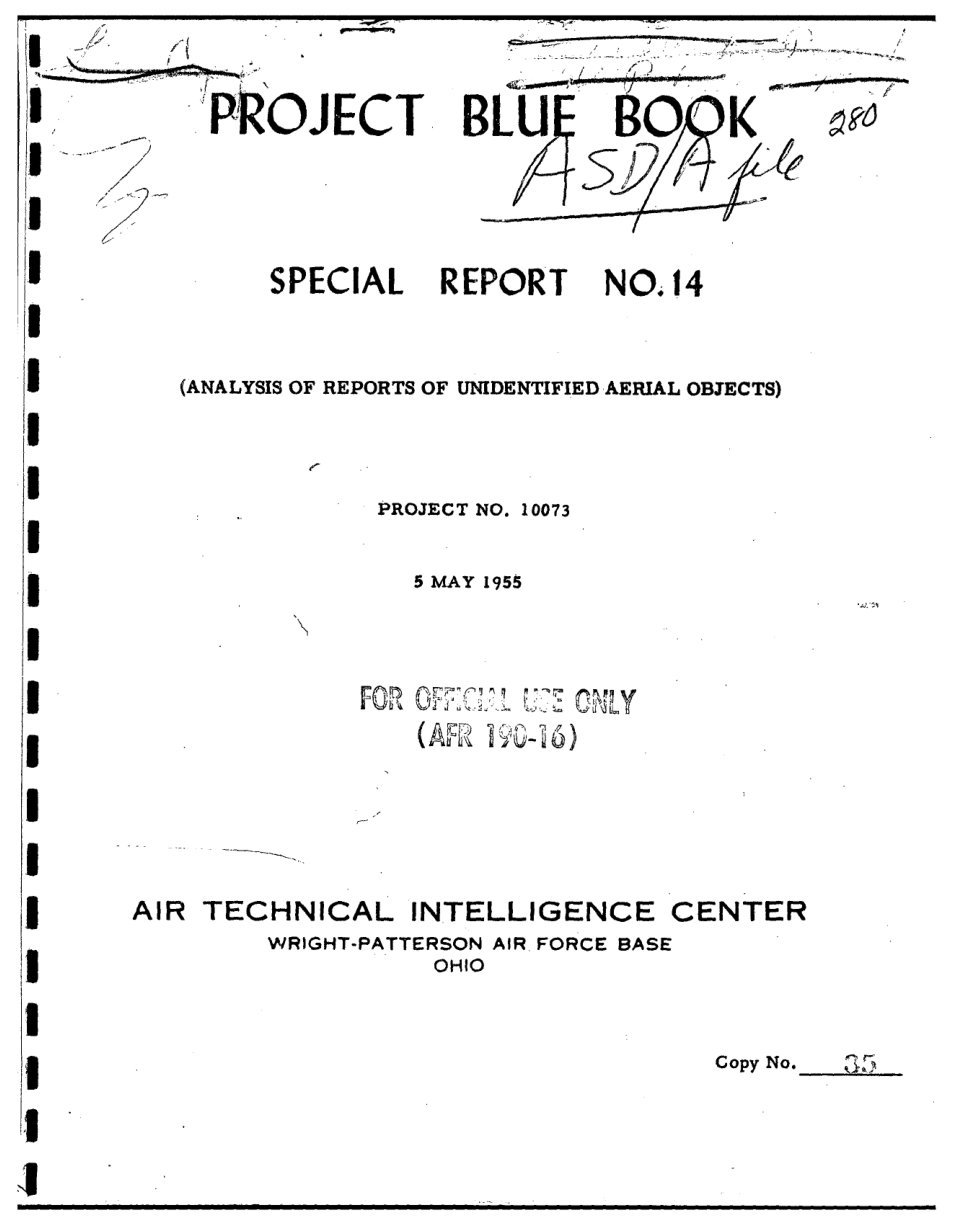 Cover of official reportPhysical page 3
DOCUMENTARY SOURCES · CIA / DOW
What the records tell
Project Blue Book Special Report No. 14, dated May 5, 1955, bears the title "Analysis of Reports of Unidentified Aerial Objects" and project number 10073. It was produced for the Air Technical Intelligence Center (ATIC), at Wright-Patterson Air Force Base, in Ohio, and marked "for official use only." The copy preserved here has 312 pages and reached the public through the CIA, with a 2026 release stamp and the notice that it is an official historical record of the agency.
According to the text itself, the study began in 1953, after the Air Force decided, in March 1952, to investigate all reports to find out whether "flying saucers" represented technology unknown to the United States. The work started from about 1.300 reports, which more than tripled with the 1952 wave and reached about 4.000. A panel of consultants from inside and outside ATIC guided the team. The report does not name the institution that did the analysis; the literature on the subject attributes it to the Battelle Memorial Institute, of Columbus, Ohio, information that does not appear in the pages of this PDF.
The report describes its raw material frankly. The reports came from scientists, housewives, farmers, students and military personnel; some were careful, others vague, and the interval between the sighting and the record ranged from one day to several years. The authors insist that their conclusions are based "NOT on facts," but on what the observers thought and estimated. About 800 reports were discarded for being hazy or contradictory, and 3.201 went into the statistics.
The opening summary contains a comparison that the body of the report does not detail. In the 854 reports from 1953 and 1954, evaluated by the same criterion, the unknowns fell to 9%. Between January 1 and May 5, 1955, with the rapid on-site investigations carried out by the 4602nd Air Intelligence Service Squadron, the proportion fell to 3%. For the Air Force, this indicated that better data would resolve almost all cases.
The conclusions, on page 94 of the report, have two layers. The first is a caveat: it can never be proven absolutely that flying saucers do not exist, and complete data might make it possible to demonstrate their existence, "IF" they existed. The second is the verdict: no striking pattern emerged, no model of a flying saucer could be built from the best reports, there was no valid physical evidence, and therefore it would be "highly improbable" that the reports represented technology beyond the scientific knowledge of the time. This verdict is a 1955 institutional assessment of a closed set of reports, and not an examination of each case. The dossiers linked to this one show how the method worked, what the statistics show and which were the 12 cases that the team itself considered the best described among the unknowns.
The 1955 correspondence of the Directorate of Intelligence shows how the report came out of the drawer. On September 20, Major General John A. Samford ordered it updated through June 1955 and set September 28 for delivery of the final version to the press office, saying he hoped the release would clear up 'the many false impressions' about the program. An earlier edition, distributed in August, was withdrawn: on September 29, the Caribbean command received copy No. 2 of the May 5 edition with orders to return the August one and not to pass it to the press. On October 4, the Air Force advised that the content was already with the journalists in Washington. Copies also went to Australia.
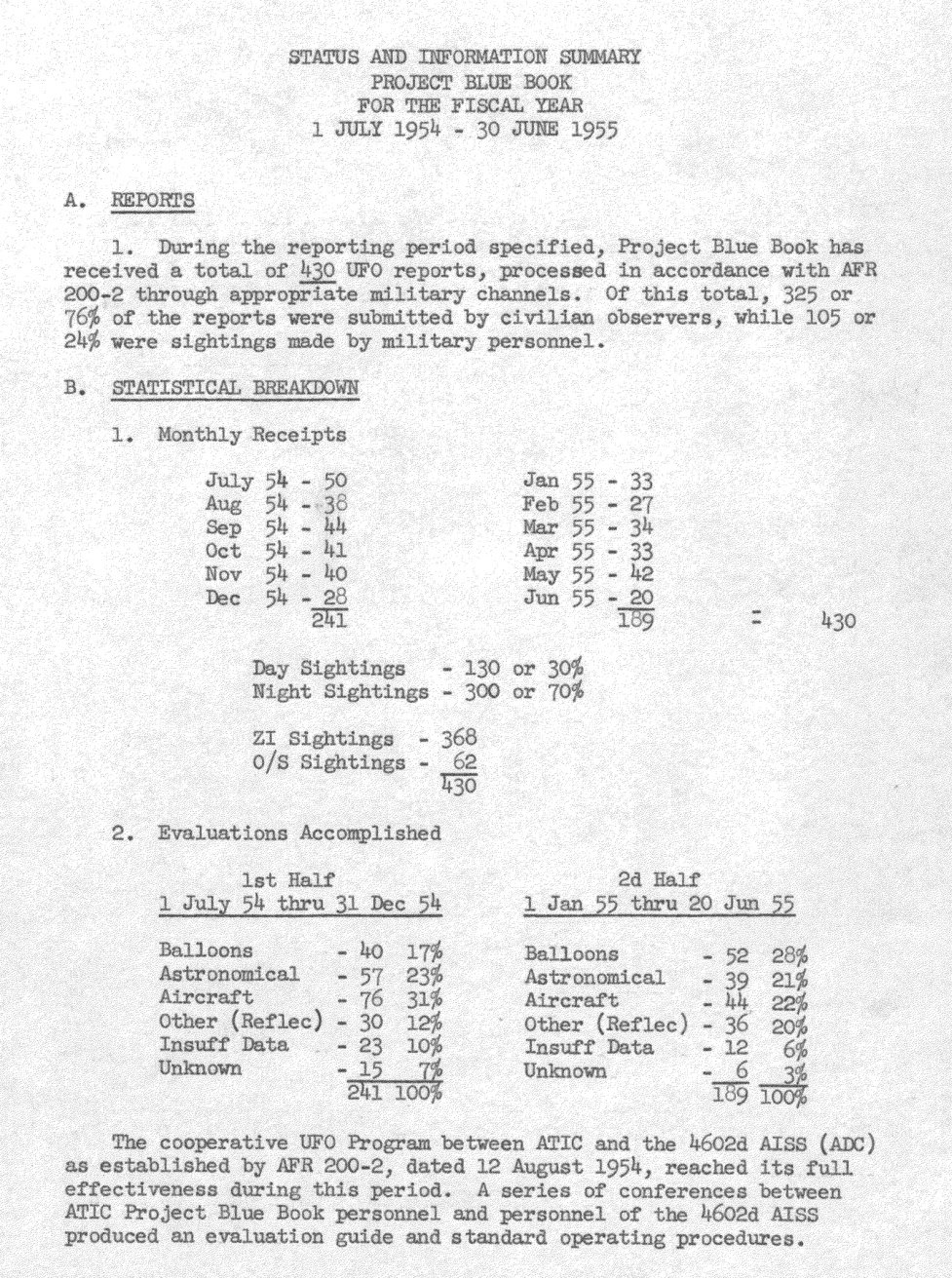
The same file holds the Blue Book summary for the fiscal year from July 1954 to June 1955, sent by ATIC on June 30. There were 430 reports, 76% from civilians, 70% at night, 62 coming from outside the USA. The final breakdown: 120 aircraft, 96 astronomical cases, 92 balloons, 66 reflections and others, 35 with insufficient data and 21 unknowns (5%). The document attributes the drop in unknowns, from 7% in the second half of 1954 to 3% in the first half of 1955, to the rapid on-site investigations carried out by the 4602nd Squadron, the same argument that the Report 14 summary uses with its 3% for 1955.
Two CIA documents kept in the same collection help place the origin of the study. A December 17, 1953 memorandum from the agency's Physics and Electronics Division records that Project STORK, then secret, had been preparing, at ATIC's request, "a comprehensive statistical report" on the sightings from 1947 to 1952, with completion expected in the middle of that month. The list of material presented to the CIA scientific panel in January 1953 defines STORK as the code name of the work contracted to the Battelle Memorial Institute in support of ATIC. Report 14 does not mention STORK or Battelle, but the period, the subject and the ATIC request match.
The 1955 Blue Book correspondence shows the report being promised before there was a released version. On July 10, George S. Wells, a writer from Mill Valley, California, who was considering a magazine article, asked the Air Force for the regulations on the subject and "an account of the early operations," which he believed was called Project Bluebook. The reply, dated September 7 and signed by Lieutenant Colonel Timothy R. Johnson, of the Directorate of Intelligence, said that the "Bluebook" was not yet ready for release and that a copy would be sent when it could be released. The letter does not cite the report number, but it bears the date of the meeting on the release of Report 14 mentioned by General Samford.
Three weeks later, on September 29, the same officer replied to J. C. Chamaillard, of Nice, France, who had written about a personal experience. The letter thanks him for the account, says it was passed on to the analysts, encloses a "Summary of Events" and states that the program's full conclusions would be released to the public "soon." In the same week, the Caribbean command was receiving the new copy of the report with the recommendation not to give it to the press. Chamaillard's account and the enclosed summary are not in the file, and it is not known what he saw.
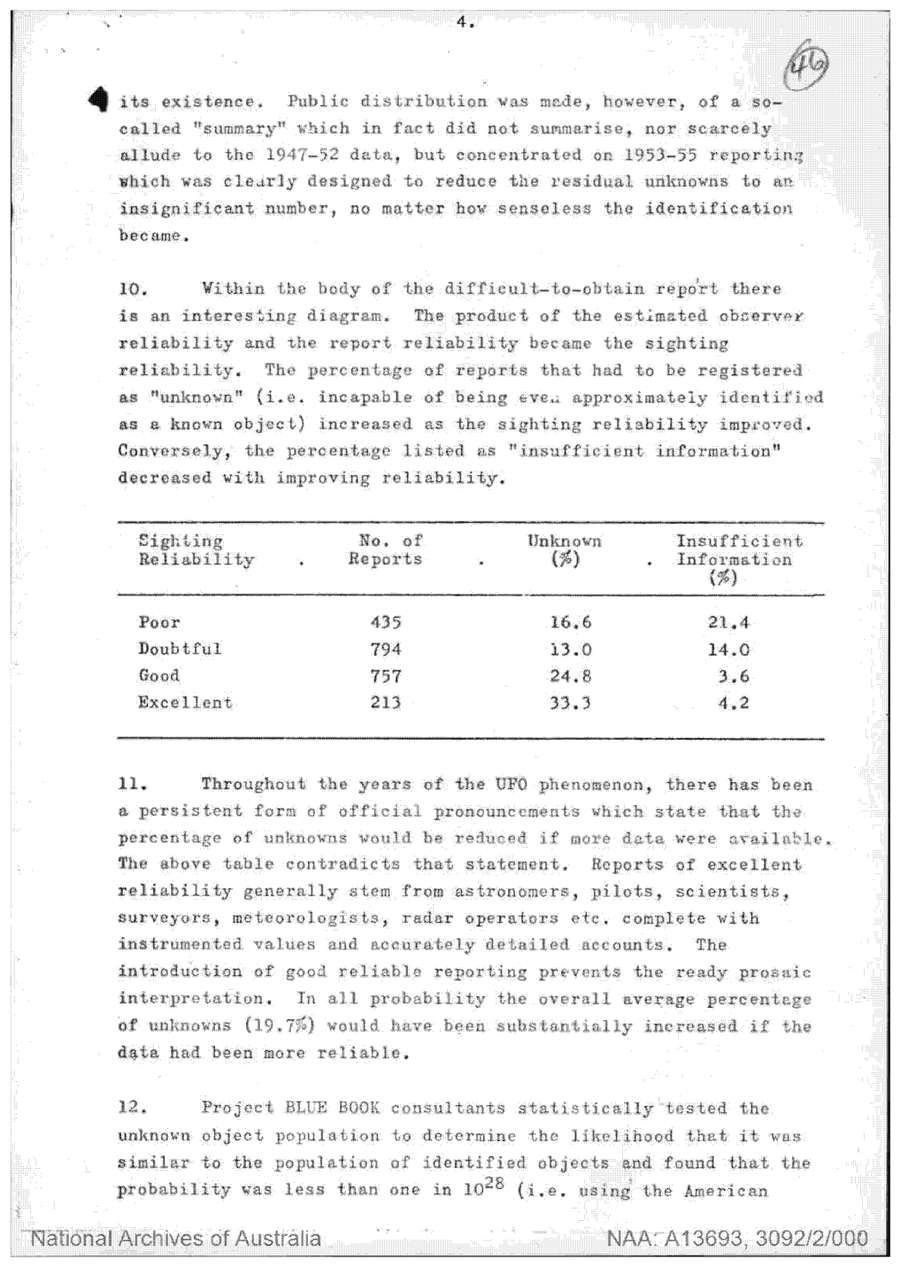
In 1971, a draft from the Joint Intelligence Organisation of Australia's Department of Defence gave a much more critical reading of the report. The Australian analyst wrote that the "summary" distributed to the public focused on the 1953 to 1955 reports and did not summarize the 1947 to 1952 data, and reproduced the figures from Figure 8 to argue that the proportion of unknowns increased with the quality of the report. He also attributed to the statistical test a chance of one in ten thousand trillion trillion of the unknowns being the same as the knowns. That figure does not appear in Report 14, which speaks only of a probability below 1% in five of six characteristics. The conclusions of the Australian text are the analyst's interpretation.
The copy released by the CIA has 312 pages. The table of contents shows the division of the volume: summary and introduction, the reduction of the reports to punched cards, the analysis with 41 figures and 13 numbered tables, the conclusions on page 94, Appendix A, with 240 frequency tables, starting on page 95, and Appendix B, with the working forms, starting on page 255. The back cover bears only the marking "For official use only," the same as the cover. A handwritten note on the CIA control sheet mentions 315 pages, a number that does not match the preserved volume.
More images from the document
DIRECT READING OF THE FILE
The document, in the original
U.S. government document. Translated in full: physical pages 1 to 4 (CIA routing sheet, cover and title page), 8 to 13 (summary and introduction) and 104 (conclusions). Pages 5 to 7 (table of contents and lists of figures) were left out because they are only an index; pages 14 to 103 are translated in the linked dossiers on method, statistics, position of the Sun and the 12 cases. Appendices A (tables A1 to A240, numbers only) and B (blank forms and codes) were not translated; only examples from them are presented in the dossier on the method.
EXCERPT 1 · PHYSICAL PAGE 1
Physical page 1: CIA control sheet (Form 2250)
----~.~ ..:_:._~,. /
FORM 2250 Approved fo..r: Release 2026 Under Section 1842 of the National Defen~5.e ,..,_ _.,-<,y-; ~ -- --<-4H~
6 64 1
• Authorizati6n Ac-e' for Fiscal Year 2024 ~ 5'f.J _: ~- _,.,/ 1
(PLACE FORM qgo HERE)
0 FFI C/IAL
J
RECORD
The,
Agenc.
in accc.
additior,
Records
.,.----------
RETURN IMMEDIATELY AFTER USE TO THE
CIA ARCHIVES AND RECORDS CENTEREditorial note: The handwritten annotations are only partially legible; the reviewer's name was not transcribed. Physical page 2 repeats the same form, without the annotations and with the full notice, which is the text transcribed here.
Check the original PDF
FORM 2250 6-64. Approved for Release 2026 Under Section 1842 of the National Defense Authorization Act for Fiscal Year 2024. (PLACE FORM 490 HERE). OFFICIAL RECORD COPY. [handwritten annotations, partly illegible: a reviewer's note dated 11/21/84(?) and "315 pages"]. WARNING: The attached document(s) must be safeguarded. It is the Agency's Official Historical Record and must be preserved in accordance with the Federal Records Act of 1950. For additional information, call the Chief, CIA Archives and Records Center, extension 2468. RETURN IMMEDIATELY AFTER USE TO THE CIA ARCHIVES AND RECORDS CENTER.View the document record ↗ · Physical page 1, counting the cover.
EXCERPT 2 · PHYSICAL PAGE 3
Physical page 3: cover
SJ
-:/). ,1/i . . . r ..~.. ,=,. _._,_- . :~ ·, ••,;-.,-·, C / , ' \ .- _.," _ :.--- _J: -~,,,, , -,_1: ... ~ - ~- ·~f·;•";,_,, ;: ~;..::;s.-..:.--:;_1-:,:,,•-'l(<..., --... ~·-....... --..._,,,!,.,,,,.,._ I -~ ~- I /) ,._;· C'.'.:'.: ?'e·--·('· ·~,-- ~~lt!L j ·•21u,c< ,.,.. # ·, • .."""-
1 I 'PROJECT BLLI ' B • d'" ; ti?0
1---7
I '/~
I SPECIAL REPORT N0.14
II
I (ANALYSIS OF REPORTS OF UNIDENTIFIED AERIAL OB1ECTS)
I
I
PROJECT NO. 10073
I
I 5 MAY 1955
I \
I
I
I
.I
I AIR TECHNICAL INTELLIGENCE CENTER
WRIGHT-PATTERSON AIR FORCE BASE
I OHIO
I
I Copy No. 35 --=----
,,
lEditorial note: Handwritten marks at the top partially illegible.
Check the original PDF
PROJECT BLUE BOOK. SPECIAL REPORT NO. 14 (ANALYSIS OF REPORTS OF UNIDENTIFIED AERIAL OBJECTS). PROJECT NO. 10073. 5 MAY 1955. FOR OFFICIAL USE ONLY (AFR 190-16). AIR TECHNICAL INTELLIGENCE CENTER, WRIGHT-PATTERSON AIR FORCE BASE, OHIO. Copy No. 35. [handwritten: "ASD/A file", "280" and other marks, partly illegible]View the document record ↗ · Physical page 3, counting the cover.
EXCERPT 3 · PHYSICAL PAGE 4
Physical page 4: title page
PROJECT BLUE BOOK
\I SPECIAL REPORT NO. 14
ii
'
(ANALYSIS OF REPORTS OF UNIDENTIFIED AERIAL OBJECTS)
il 1
I
I
I
PROJECT NO. 10073
I
:1 5 MAY 1955
I
1
11
!
ii FOR OffIC!Al USt ONlY
(AFR 190-16) I
:I
!1I
I
AIR TECHNICAL INTELLIGENCE GENTER I WRIGHT-PATTERSON AIR FORCE BASE
o:mo
I
I
No copyright materiel ls contained In this publication,
_ICheck the original PDF
PROJECT BLUE BOOK. SPECIAL REPORT NO. 14 (ANALYSIS OF REPORTS OF UNIDENTIFIED AERIAL OBJECTS). PROJECT NO. 10073. 5 MAY 1955. FOR OFFICIAL USE ONLY (AFR 190-16). AIR TECHNICAL INTELLIGENCE CENTER, WRIGHT-PATTERSON AIR FORCE BASE, OHIO. No copyright material is contained in this publication.View the document record ↗ · Physical page 4, counting the cover.
EXCERPT 4 · PHYSICAL PAGE 8
Physical page 8 (p. vii of the report): summary, part 1
I
I SUMMARY
I
I Reports of unidentified aerial objects (popularly termed "flying
saucers" or "flying discs") have been received by the U.S. Air Force
since mid-1947 from' many and diverse sources. Although there was no
evidence that the ·unexplained reports of unidentified objects constituted
I
a threat to the security of the U.S., the Air Force determined that all
rep,orts of unidentified aerial objects should be fovestigated and evaluated
to d,etermine if "flying saucers". represented technological developments
not known to this country.
I In order to discover any pertinent trend or pattern inherent in the
data, and to evaluate or explain any trend or pattern found, appropriate
I methods of reducing these data from reports of unidentified aerial objects
to a form amenable to scientific' appraisal were employed. In general, the
I
original data upon which this study was based consisted of impressions and
interpretations of apparently unexplainable events, and seldom contained
reliable measurements of physical attributes. This subjectivity of the data
I
presented a 'major limitation to the drawing of significant conclusions, but
did not invalidate the application of scientific methods bf study.
I
The reports received by the U.S. Air Force on unidentified aerial
objects were reduced to IBM punched-card abstracts of the data by means
of logically developed forms and standardized evaluation procedures.
Evaluation of sighting reports, a crucial step in the preparation of the data
I for statistical treatment, consisted of an appraisal of the reports and· the
subsequent categorization of the object or objects described in each report.
A detailed description of this phase of the study stresses the careful
I attempt to maintain complete objectivity and consistency.
I
Analysis of the refined and evaluated data derived from the original
reports of sightings consisted of (I) a systematic attempt to ferret out any
distinguishing characteristics _inherent in the data of any of their segments,
I
(2) a concentrated study of any trend or pattern found, and (3) an attempt
to determine the probability that any of the UNKNOWNS represent observa.:.
tions of technological' developments not known to this country.
I The first step in the 'analysis of the data revealed the existence of
I
certain apparent similarities between cases of objects definitely identified
.i.nd those not identified. Statistical methods of testing when applied indicated
a low probability that these apparent similarities were significant. An
attempt to determine the probability that any of the UNKNOWNS represeri'ted
observations of technological developments not known to this country necessiI tated a thorough re-examination and re-evaluation of the cases of objects not
originally identified; this led to the conclusion that this probability was very
small.
I
I The special study which resulted in this report (Analysis of Reports
of Unidentified Aerial Objects, 5 May 1955) started in 1953. To provide the
study group with a complete set of files, the informatio~ cut-off date was
established as of the end of 1952. It will accordingly be noted that the
statistics contained in all charts and tables in this report are terminated
I
vii
!I
ICheck the original PDF
SUMMARY Reports of unidentified aerial objects (popularly termed "flying saucers" or "flying discs") have been received by the U.S. Air Force since mid-1947 from many and diverse sources. Although there was no evidence that the unexplained reports of unidentified objects constituted a threat to the security of the U.S., the Air Force determined that all reports of unidentified aerial objects should be investigated and evaluated to determine if "flying saucers" represented technological developments not known to this country. In order to discover any pertinent trend or pattern inherent in the data, and to evaluate or explain any trend or pattern found, appropriate methods of reducing these data from reports of unidentified aerial objects to a form amenable to scientific appraisal were employed. In general, the original data upon which this study was based consisted of impressions and interpretations of apparently unexplainable events, and seldom contained reliable measurements of physical attributes. This subjectivity of the data presented a major limitation to the drawing of significant conclusions, but did not invalidate the application of scientific methods of study. The reports received by the U.S. Air Force on unidentified aerial objects were reduced to IBM punched-card abstracts of the data by means of logically developed forms and standardized evaluation procedures. Evaluation of sighting reports, a crucial step in the preparation of the data for statistical treatment, consisted of an appraisal of the reports and the subsequent categorization of the object or objects described in each report. A detailed description of this phase of the study stresses the careful attempt to maintain complete objectivity and consistency. Analysis of the refined and evaluated data derived from the original reports of sightings consisted of (1) a systematic attempt to ferret out any distinguishing characteristics inherent in the data of any of their segments, (2) a concentrated study of any trend or pattern found, and (3) an attempt to determine the probability that any of the UNKNOWNS represent observations of technological developments not known to this country. The first step in the analysis of the data revealed the existence of certain apparent similarities between cases of objects definitely identified and those not identified. Statistical methods of testing when applied indicated a low probability that these apparent similarities were significant. An attempt to determine the probability that any of the UNKNOWNS represented observations of technological developments not known to this country necessitated a thorough re-examination and re-evaluation of the cases of objects not originally identified; this led to the conclusion that this probability was very small. The special study which resulted in this report (Analysis of Reports of Unidentified Aerial Objects, 5 May 1955) started in 1953. To provide the study group with a complete set of files, the information cut-off date was established as of the end of 1952. It will accordingly be noted that the statistics contained in all charts and tables in this report are terminatedView the document record ↗ · Physical page 8, counting the cover.
EXCERPT 5 · PHYSICAL PAGE 9
Physical page 9 (p. viii): summary, part 2
I
I
with the year 1952. In these charts, 3201 cases have been used.
As the study progressed, a constant program was maintained for I
the purpose of making comparisons between the current cases received
after I January 1953, and those being used for the report. This was done
in order that any change or significant trend which might arise from I
current developments could be incorporated in the summary of this report.
The 1953 and 1954 cases show a general and expected trend of I
increasing percentages in the finally identified categories. They also.show
decreasing percentages in categories where there was insufficient information and those where the phenomena could not be explained. This trend had I
been:. anticipated in the light of improved reporting and investigating proceduJ;"es. I
Official reports on hand at the end of 1954 totaled 4834. Of these,
425 were produced in 1953 and 429 in 195'!. These 1953 and 1954 individual reports (a total of 854), were evaluated on the same basis as were I
those received before the end of 1952. The results are as follows:
Balloons - 16% I
Aircraft - 20% I
Astronomical - 25%
Other - 13% I
Insufficient Info 1 7% 1.
Unknown - 9%
As the study of the current cases progressed, it became increasingly I
obvious that if reporting and investigating procedures could be further improved,
the percentages of those cases which contained insufficient information and
those remaining unexplained would be greatly reduced. The key to a higher I
percentage of solutions appeared to be in rapid "on the spot" investigations
by trained personnel. On the basis of this, a revised program was established by AF Reg. 200-2 Subject: "Unidentified Flying Objects Reporting" I
(Short Title: UFOB) dated 12 August 1954.
This new program, which had begun to show marked results before I
January 1955, provided primarily that the 4602d Air Intelligence Service'
Squadron (Air Defense Command) would carry out all field investigations.
This squadron has sufficient units and is so deployed as to be able to arrive I
"on the spot" within a very short time after a report is received. After
treatment by the 4602d AISS, all information is supplied to the Air Technical
Intelligence Center for final evaluation. This cooperative program has re I
sulted, since 1 January 1955, in reducing the insufficient information cases
to 7o/o and the unknown cases to 3%, of the totals. I
The period l January 1955 to 5 May 1955 accounted for 131 unidentified
aerial object reports received. Evaluation percentages of these are as follows: I
I
viii
ICheck the original PDF
with the year 1952. In these charts, 3201 cases have been used. As the study progressed, a constant program was maintained for the purpose of making comparisons between the current cases received after 1 January 1953, and those being used for the report. This was done in order that any change or significant trend which might arise from current developments could be incorporated in the summary of this report. The 1953 and 1954 cases show a general and expected trend of increasing percentages in the finally identified categories. They also show decreasing percentages in categories where there was insufficient information and those where the phenomena could not be explained. This trend had been anticipated in the light of improved reporting and investigating procedures. Official reports on hand at the end of 1954 totaled 4834. Of these, 425 were produced in 1953 and 429 in 1954. These 1953 and 1954 individual reports (a total of 854), were evaluated on the same basis as were those received before the end of 1952. The results are as follows: Balloons - 16% Aircraft - 20% Astronomical - 25% Other - 13% Insufficient Info - 17% Unknown - 9% As the study of the current cases progressed, it became increasingly obvious that if reporting and investigating procedures could be further improved, the percentages of those cases which contained insufficient information and those remaining unexplained would be greatly reduced. The key to a higher percentage of solutions appeared to be in rapid "on the spot" investigations by trained personnel. On the basis of this, a revised program was established by AF Reg. 200-2 Subject: "Unidentified Flying Objects Reporting" (Short Title: UFOB) dated 12 August 1954. This new program, which had begun to show marked results before January 1955, provided primarily that the 4602d Air Intelligence Service Squadron (Air Defense Command) would carry out all field investigations. This squadron has sufficient units and is so deployed as to be able to arrive "on the spot" within a very short time after a report is received. After treatment by the 4602d AISS, all information is supplied to the Air Technical Intelligence Center for final evaluation. This cooperative program has resulted, since 1 January 1955, in reducing the insufficient information cases to 7% and the unknown cases to 3%, of the totals. The period 1 January 1955 to 5 May 1955 accounted for 131 unidentified aerial object reports received. Evaluation percentages of these are as follows:View the document record ↗ · Physical page 9, counting the cover.
EXCERPT 6 · PHYSICAL PAGE 10
Physical page 10 (p. ix): summary, part 3
I
I
- I Balloons
I Aircraft
I
.....
Astronomical
Other
I Insufficient Info - 7%
I
,,
Unknown - 3%
I
All available data were included in this study which was prepared by
a panel of scientists both in and out of the Air Force. On the basis of this
study it is believed that all the unidentified aerial objects could have been
explained if more complete observational data had been available. Insofar fi
as the reported aerial objects which still remain unexplained are concerned, I there exists little information other than the impressions and interpretations
I
of their observers. As these impressions and interpretations have been
replaced by the use of improved methods of investigation and reporting, and
,by scientific analysis, the number of unexplained cases has decreased rapidly
I towards the vanishing point.
Therefore, on the b_asis of this evaluation of the information, it is
r·
I
considered to be highly improbable that reports of unidentified aerial objects
examined in this study represent observations of technological developments
outside of the range of present-day scientific knowledge. It is emphasized
that there has been a complete lack of any valid evidence of physical 'matter I in any case of a
[1
I
I
'
I
I
'
f
I
I
I
I
I
- 26%
- 21%
- 23%
20%
reported unidentified aerial object.
ixEditorial note: They were restored to the order in the image.
Check the original PDF
Balloons - 26% Aircraft - 21% Astronomical - 23% Other - 20% Insufficient Info - 7% Unknown - 3% All available data were included in this study which was prepared by a panel of scientists both in and out of the Air Force. On the basis of this study it is believed that all the unidentified aerial objects could have been explained if more complete observational data had been available. Insofar as the reported aerial objects which still remain unexplained are concerned, there exists little information other than the impressions and interpretations of their observers. As these impressions and interpretations have been replaced by the use of improved methods of investigation and reporting, and by scientific analysis, the number of unexplained cases has decreased rapidly towards the vanishing point. Therefore, on the basis of this evaluation of the information, it is considered to be highly improbable that reports of unidentified aerial objects examined in this study represent observations of technological developments outside of the range of present-day scientific knowledge. It is emphasized that there has been a complete lack of any valid evidence of physical matter in any case of a reported unidentified aerial object.View the document record ↗ · Physical page 10, counting the cover.
EXCERPT 7 · PHYSICAL PAGE 11
Physical page 11 (p. 1): introduction, part 1
I
I INTRODUCTION
I
In June, 1947, Kenneth Arnold, a Boise, Idaho, businessman and
I private pilot, publicly reported the now-famous sighting of a chainlike
I
formation of disc-shaped objects near Mount Rainier, Washington. Resulting newspaper publicity of this incident caught the public interest, and,
shortly thereafter, a rash of reports of unidentified aerial objects spawned
the term "flying saucers". During the years since 1947, many reports of
I unidentified aerial objects have been received by the Air Force from many
and diverse sources.
I The unfortunate term "flying saucer", or "flying disc", because of
I
its widespread and indiscriminate use, requires definition. Many definitions have been offered, one of the best being that originated by Dr. J.
Allen Hynek, Director of the Emerson McMillin Observatory of The Ohio
I
State University, who has taken a scientific interest in_the problem of
unidentified aerial objects since 1949. Dr. Hynek' s definition of the term
·1
is "any aerial phenomenon or sighting that remains unexplained to the
viewer at least long enough for him to write a report about it11 ( 1). Dr. Hynek,
I
elaborating on his definition, says, "Each flying saucer, so defined, has
associated with it a probable lifetime. It wanders in the field of public inspection like an electron in a field of ions, until I captured' by an explanation which puts an end to its existence as a I flying saucer' 11 ( 1).
I This definition would be applicable to any and all of the sightings
I
which remained unidentified throughout this study. However, the term
"flying saucers" shall be used hereafter in this report to mean a novel,
airborne phenomenon, a manifestation that is not a part of or readily exI
plainable by the fund of scientific knowledge known to be possessed by the
Free World. This would include such items as natural phenomena that are
not yet completely understood, psychological phenomena, or intruder aircraft of a type that may be possessed by some source in large enough
I numbers so that more than one independent mission may have been flown
I
and reported. Thus, these phenomena are of the type which should have
been observed and reported more than once.
I
Since 1947, public interest in the subject of unidentified aerial objects
fluctuated more or less within reasonable limits until the summer of 1952,
I
when the frequency of reports of sightings reached a peak, possibly stimulated by several articles on the subject in leading popular magazines.
I
Early in 1952, the Air Force's cumulative study and analysis of
reported sightings indicated that the majority of reports could be accounted
for as misinterpretations of known objects ( such as meteors, balloons, or
aircraft), a few as the result of mild hysteria, and a very few as the result
I of unfamiliar meteorological phenomena and light aberrations. However,
I
(1) Hynek, J. A.• "Unusual Aerial Phenomena"• Journal of the Optical Society of America. 43 (4).
pp 311-314, April, 1953.
J
1Check the original PDF
INTRODUCTION In June, 1947, Kenneth Arnold, a Boise, Idaho, businessman and private pilot, publicly reported the now-famous sighting of a chainlike formation of disc-shaped objects near Mount Rainier, Washington. Resulting newspaper publicity of this incident caught the public interest, and, shortly thereafter, a rash of reports of unidentified aerial objects spawned the term "flying saucers". During the years since 1947, many reports of unidentified aerial objects have been received by the Air Force from many and diverse sources. The unfortunate term "flying saucer", or "flying disc", because of its widespread and indiscriminate use, requires definition. Many definitions have been offered, one of the best being that originated by Dr. J. Allen Hynek, Director of the Emerson McMillin Observatory of The Ohio State University, who has taken a scientific interest in the problem of unidentified aerial objects since 1949. Dr. Hynek's definition of the term is "any aerial phenomenon or sighting that remains unexplained to the viewer at least long enough for him to write a report about it"(1). Dr. Hynek, elaborating on his definition, says, "Each flying saucer, so defined, has associated with it a probable lifetime. It wanders in the field of public inspection like an electron in a field of ions, until 'captured' by an explanation which puts an end to its existence as a 'flying saucer'"(1). This definition would be applicable to any and all of the sightings which remained unidentified throughout this study. However, the term "flying saucers" shall be used hereafter in this report to mean a novel, airborne phenomenon, a manifestation that is not a part of or readily explainable by the fund of scientific knowledge known to be possessed by the Free World. This would include such items as natural phenomena that are not yet completely understood, psychological phenomena, or intruder aircraft of a type that may be possessed by some source in large enough numbers so that more than one independent mission may have been flown and reported. Thus, these phenomena are of the type which should have been observed and reported more than once. Since 1947, public interest in the subject of unidentified aerial objects fluctuated more or less within reasonable limits until the summer of 1952, when the frequency of reports of sightings reached a peak, possibly stimulated by several articles on the subject in leading popular magazines. Early in 1952, the Air Force's cumulative study and analysis of reported sightings indicated that the majority of reports could be accounted for as misinterpretations of known objects (such as meteors, balloons, or aircraft), a few as the result of mild hysteria, and a very few as the result of unfamiliar meteorological phenomena and light aberrations. However, (1) Hynek, J. A., "Unusual Aerial Phenomena", Journal of the Optical Society of America, 43 (4), pp 311-314, April, 1953.View the document record ↗ · Physical page 11, counting the cover.
EXCERPT 8 · PHYSICAL PAGE 12
Physical page 12 (p. 2): introduction, part 2
I
a significant number of fairly complete reports by reliable observers re I
mained unexplained. Although no evidence existed that unexplained reports
of sightings constituted_ a 1>hysical threat to the security of the U. S., in I
March, 1952, the Air Force decided that all reports of unidentified
aerial objects should be investigated and evaluated to determine if "flying
saucers" represented technological developments not known to this country. I
Originally, the problem involved the preparation and analysis of about I 1,300 reports accumulated by the Air Force between 1947 and the end of
March, 1952. During the course of the work, the number of reports submitted for analysis and evaluation more than tripled, the result of the un I
precedented increase in observations during 1952. Accordingly, this study
is based on a number of reports considered to be large enough for a preliminary statistical analysis, approximately 4, 000 reports. I
This study was undertaken primarily to categorize the available I
reports of sightings and to determine the probability that any of the reports
of unidentified aerial objects represented observations of "flying saucers".
With full cognizance of the quality of the data available for study, yet with I
an awareness of the proportions this subject has assumed at times in the
public mind, this work was undertaken with all the seriousness accorded
to a straightforward scientific investigation. In order to establish the I
probability that any of the reports of unidentified aerial objects represented
observations of "flying saucers", it was necessary to make an attempt to I
answer the question "What is a 'flying saucer'?". However, it must be
emphasized that this was only incidental to the primary purpose of the
study, the determination of the probability that any of the reports of un I
identified aerial objects represented observations of "flying saucers", as
defined on Page 1. I
The basic technique for this study consisted of reducing the available
data to a form suitable for mechanical manipulation, a prerequisite for the I
application of preliminary statistical methods .. One of International
Business Machine Corporation's systems was chosen as the best available
mechanical equipment. I
The reduction of data contained in sighting reports into a form suit I able for transfer to IBM punched cards was extremely difficult and time
consuming. I
For this study a panel of consultants was formed, consisting of both
experts within and outside A TIC. During the course of the work, guidance
and advice were received from the panel. The professional experience I
available from the panel covered major scientific fields and numerous
specialized fields. I
All records and working papers of this study have been carefully
preserved in an orderly fashion suitable for ready reference. These I
2 I
lEditorial note: The original spells "International Business Machine Corporation's", without the "s" of Machines.
Check the original PDF
a significant number of fairly complete reports by reliable observers remained unexplained. Although no evidence existed that unexplained reports of sightings constituted a physical threat to the security of the U. S., in March, 1952, the Air Force decided that all reports of unidentified aerial objects should be investigated and evaluated to determine if "flying saucers" represented technological developments not known to this country. Originally, the problem involved the preparation and analysis of about 1,300 reports accumulated by the Air Force between 1947 and the end of March, 1952. During the course of the work, the number of reports submitted for analysis and evaluation more than tripled, the result of the unprecedented increase in observations during 1952. Accordingly, this study is based on a number of reports considered to be large enough for a preliminary statistical analysis, approximately 4,000 reports. This study was undertaken primarily to categorize the available reports of sightings and to determine the probability that any of the reports of unidentified aerial objects represented observations of "flying saucers". With full cognizance of the quality of the data available for study, yet with an awareness of the proportions this subject has assumed at times in the public mind, this work was undertaken with all the seriousness accorded to a straightforward scientific investigation. In order to establish the probability that any of the reports of unidentified aerial objects represented observations of "flying saucers", it was necessary to make an attempt to answer the question "What is a 'flying saucer'?". However, it must be emphasized that this was only incidental to the primary purpose of the study, the determination of the probability that any of the reports of unidentified aerial objects represented observations of "flying saucers", as defined on Page 1. The basic technique for this study consisted of reducing the available data to a form suitable for mechanical manipulation, a prerequisite for the application of preliminary statistical methods. One of International Business Machine Corporation's systems was chosen as the best available mechanical equipment. The reduction of data contained in sighting reports into a form suitable for transfer to IBM punched cards was extremely difficult and time consuming. For this study a panel of consultants was formed, consisting of both experts within and outside ATIC. During the course of the work, guidance and advice were received from the panel. The professional experience available from the panel covered major scientific fields and numerous specialized fields. All records and working papers of this study have been carefully preserved in an orderly fashion suitable for ready reference. TheseView the document record ↗ · Physical page 12, counting the cover.
EXCERPT 9 · PHYSICAL PAGE 13
Physical page 13 (p. 3): origin and nature of the data
I
I records include condensations of all individual sighting reports, and the
IBM cards used in various phases of the study. I
I ORIGIN AND NATURE OF DA TA
I
I Reports of sightings were received by the U. S. Air Force from a
representative cross section of the population of the U. S., and varied
widely in completeness and quality. Included were reports from reputable
scientists, housewives, farmers, students, and technically trained memI bers of the Armed Forces. Reports varied in length from a few sentences
stating that a "flying saucer" had been sighted, to those containing thousands of words, including description, speculation, and advice on how to
I handle the "problem of the I flying saucers 1 ". Some reports were of high
I
quality, conservative, and as complete as the observer could make them;
a few originated from people confined to mental institutions. A critical
examination of the reports revealed, however, that a high percentage of
them was submitted by serious people, mystified by what they had seen and
I motivated by patriotic responsibility.
Three principal sources of reports were noted in the preliminary I review of the data. The bulk of the data arrived at A TIC through regular
military channels, from June, 1947, until the middle of 1952.
I A second type of data consisted of letters reporting sightings sent by
civilian observers directly to A TIC. Most of these direct communications
I were dated subsequent to April 30, 1952, and are believed to be the result
I
of a suggestion by a popular magazine that future reports be directed to the
Air Technical Intelligence Center. As could be expected, a large number
of letters was received following this publicity.
I A third type of data was that contained in questionnaire forms completed by the observer himself. A questionnaire form, developed during
the course of this study, was mailed by A TIC to a selected group of writers
I of direct letters with the request that the form be completed and returned.
Approximately 1,000 responses were received by ATIC.
I In general, the data were subjective, consisting of qualified estimates
I
of physical characteristics rather than of precise measurements. Furthermore, most of the reports were not reduced to written form immediately.
The time between sighting and report varied from one day to several years.
Both of these factors introduced an element of doubt concerning the validity I o,f the original data, and increased its subjectivity. This was intensified by
I
the recognized inability of the average individual to estimate speeds, distances, and sizes of objects in the air with any degree of accuracy. In
spite of these limitations, methods of statistical analysis of such reports m
sufficiently large groups are valid. The danger lies in the possibility of
I 3
ICheck the original PDF
records include condensations of all individual sighting reports, and the IBM cards used in various phases of the study. ORIGIN AND NATURE OF DATA Reports of sightings were received by the U. S. Air Force from a representative cross section of the population of the U. S., and varied widely in completeness and quality. Included were reports from reputable scientists, housewives, farmers, students, and technically trained members of the Armed Forces. Reports varied in length from a few sentences stating that a "flying saucer" had been sighted, to those containing thousands of words, including description, speculation, and advice on how to handle the "problem of the 'flying saucers'". Some reports were of high quality, conservative, and as complete as the observer could make them; a few originated from people confined to mental institutions. A critical examination of the reports revealed, however, that a high percentage of them was submitted by serious people, mystified by what they had seen and motivated by patriotic responsibility. Three principal sources of reports were noted in the preliminary review of the data. The bulk of the data arrived at ATIC through regular military channels, from June, 1947, until the middle of 1952. A second type of data consisted of letters reporting sightings sent by civilian observers directly to ATIC. Most of these direct communications were dated subsequent to April 30, 1952, and are believed to be the result of a suggestion by a popular magazine that future reports be directed to the Air Technical Intelligence Center. As could be expected, a large number of letters was received following this publicity. A third type of data was that contained in questionnaire forms completed by the observer himself. A questionnaire form, developed during the course of this study, was mailed by ATIC to a selected group of writers of direct letters with the request that the form be completed and returned. Approximately 1,000 responses were received by ATIC. In general, the data were subjective, consisting of qualified estimates of physical characteristics rather than of precise measurements. Furthermore, most of the reports were not reduced to written form immediately. The time between sighting and report varied from one day to several years. Both of these factors introduced an element of doubt concerning the validity of the original data, and increased its subjectivity. This was intensified by the recognized inability of the average individual to estimate speeds, distances, and sizes of objects in the air with any degree of accuracy. In spite of these limitations, methods of statistical analysis of such reports in sufficiently large groups are valid. The danger lies in the possibility ofView the document record ↗ · Physical page 13, counting the cover.
EXCERPT 10 · PHYSICAL PAGE 104
Physical page 104 (p. 94): conclusions
I
CONCLUSIONS I
I
It can never be absolutely proven that "flying saucers" do not exist.
This would be true if the data obtained were to include complete scientific
measurements of the attributes of each sighting, as well as complete and I
detailed descriptions of the objects sighted. It might be possible to demonstrate the existence of "flying saucers" with data of this type, IF they were I
to exist.
Although the reports considered in this study usually did not contain I
scientific measurements of the attributes of each sighting, it was possible
to establish certain valid conclusions by the application of statistical
methods in the treatment of the data. Scientifically evaluated and arranged, I
the data as a whole did not show any marked patterns or trends. The inaccuracies inherent in this type of data, in addition to the incompleteness of I
a large proportion of the reports, may have obscured any patterns Qr trends
that otherwise would have been evident. This absence of indicative relationships necessitated an exhaustive study of selected facets of the data in order I
to draw any valid conclusions.
A critical examination of the distributions of the important char I
acteristics of sightings, plus an intensive study of the sightings evaluated
as UNKNOWN, led to the conclusion that a combination of factors, prin I
cipally the reported maneuvers of the objects and the unavailability of
supplemental data such as aircraft flight plans or balloon-launching records,
resulted in the failure to identify as KNOWNS most of the reports of objects I
classified as UNKNOWNS. I An intensive study, aimed at finding a verified example of a "flying
saucer" or at deriving a verified model or models of "flying saucers" {as
defined on Page 1), led to the conclusion that neither goal could be attained I
using the pre sent data.
It is emphasized that there was a complete lack of any valid evidence I
consisting of physical matter in any case of a reported unidentified aerial
object. I
Thus, the probability that any of the UNKNOWNS considered in this
study are "flying saucers" is concluded to be extremely small, since the I
most complete and reliable reports from the present data, when isolated
and studied, conclusively failed to reveal even a rough model, and since
the data as a whole failed to reveal any marked patterns or trends. I
Therefore, on the basis of this evaluation of the information, it is I
considered to be highly improbable that any of the reports of unidentified
aerial objects examined in this study represent observations of technological developments outside the range of present-day scientific knowledge. I
I
94
ICheck the original PDF
CONCLUSIONS It can never be absolutely proven that "flying saucers" do not exist. This would be true if the data obtained were to include complete scientific measurements of the attributes of each sighting, as well as complete and detailed descriptions of the objects sighted. It might be possible to demonstrate the existence of "flying saucers" with data of this type, IF they were to exist. Although the reports considered in this study usually did not contain scientific measurements of the attributes of each sighting, it was possible to establish certain valid conclusions by the application of statistical methods in the treatment of the data. Scientifically evaluated and arranged, the data as a whole did not show any marked patterns or trends. The inaccuracies inherent in this type of data, in addition to the incompleteness of a large proportion of the reports, may have obscured any patterns or trends that otherwise would have been evident. This absence of indicative relationships necessitated an exhaustive study of selected facets of the data in order to draw any valid conclusions. A critical examination of the distributions of the important characteristics of sightings, plus an intensive study of the sightings evaluated as UNKNOWN, led to the conclusion that a combination of factors, principally the reported maneuvers of the objects and the unavailability of supplemental data such as aircraft flight plans or balloon-launching records, resulted in the failure to identify as KNOWNS most of the reports of objects classified as UNKNOWNS. An intensive study, aimed at finding a verified example of a "flying saucer" or at deriving a verified model or models of "flying saucers" (as defined on Page 1), led to the conclusion that neither goal could be attained using the present data. It is emphasized that there was a complete lack of any valid evidence consisting of physical matter in any case of a reported unidentified aerial object. Thus, the probability that any of the UNKNOWNS considered in this study are "flying saucers" is concluded to be extremely small, since the most complete and reliable reports from the present data, when isolated and studied, conclusively failed to reveal even a rough model, and since the data as a whole failed to reveal any marked patterns or trends. Therefore, on the basis of this evaluation of the information, it is considered to be highly improbable that any of the reports of unidentified aerial objects examined in this study represent observations of technological developments outside the range of present-day scientific knowledge.View the document record ↗ · Physical page 104, counting the cover.
EXCERPT 11 · PHYSICAL PAGE 135
Physical page 135: ATIC memorandum to the Directorate of Intelligence, 30/06/1955, 'UFO Summary' (full text)
,, ~ -;:t-
,,, "' .,(, I<:_ ' ..
AIR TECHNICAL INTELLIGENCE CENTER
WlltlGHT•PATTERSON AIR ftORCE BASE
OHIO
MEMORANOOK FOR DIRBC'R'JR OF lB'l!ZLLIGERCE
POLICY AID MAINllNIBT GROUP, AFOIN-X
SJBJECT: (Uncl) UFO Swmaary
4
Attached for you1 information is a summary of the tlPO Program
Incl
coveting Fiscal 1·ea:r 1955.
St&tua . & Info Summary M
1st Lt
stant AdjutantEditorial note: Handwritten notations 'Int 2-2-7' and 'X ATIC' not translated.
Check the original PDF
AIR TECHNICAL INTELLIGENCE CENTER, WRIGHT-PATTERSON AIR FORCE BASE, OHIO. 30 JUN 1955. MEMORANDUM FOR DIRECTOR OF INTELLIGENCE, POLICY AND MANAGEMENT GROUP, AFOIN-X. SUBJECT: (Uncl) UFO Summary. Attached for your information is a summary of the UFO Program covering Fiscal Year 1955. 1 Incl: Status & Info Summary. Mary L. Storm, 1st Lt, USAF, Assistant Adjutant.View the document record ↗ · Physical page 135, counting the cover.
EXCERPT 12 · PHYSICAL PAGE 137
Physical page 137: 'Status and information summary, Project Blue Book, fiscal year July 1, 1954 to June 30, 1955', sheet 1 (full text)
..
STATUS AND INFORMATION SUMMARY
PROJECT BLUE BOOK
FOR THE FISCAL YEAR
1 JULY 1954 - 30 JUNE 1955
A. REPORI'S
1. ~ing the reporting period specified, Project Blue Book has
received a total of mroreports, processed in accordance with AFR
200-2 through appropriate military channels. Of this total, 325 or
7 of the reports were subndtted by civilian observers, while 105 or
2 were sightings ma.de by mili.tary personnel.
B. STATISTICAL BREAKOOWN
1. Monthly Receipts
July 54 - 50 Jan 55 - 33
Aug 54 - 38 Feb 55 - 27
Sep 54 - 44 Mar 55 - 34
Oct 54 - 1+1 Apr 55 - 33
Nov 54 - 40 May 55 - 42
Dec 54 - 28 Jun 55 - 20
241 1 -- 430
De.y Sightings - 130 or 3
Night Sightings - 300 or 1oi
ZI Sightings - 368
o/s Sightings - 62
430
2. Evaluations Accomplished.
1st Halt 2d Half
1 Jul 4 thru 1 Dec 4 l Jan tbru 20 Jun
Balloons - 40 1 Balloons - 52 Astronomical - 57 23i Astronomical - 39 Aircraft - 76 31i A:i.rcraft - 44
Other (Reflec) - 30 121, Other (Reflec) - 36
Insuff Data - 23 1oi Insuff Data - 12
Unknown - 15 Unknown - 6
2 1 1 1
The cooperative UFO Program between ATIC and the 4602d AISS (AOO}
as established by AFR 200-2, dated 12 August 1954, reached its full
effectiveness during this period. A series of conferences between
ATIC Project Blue Book personnel and personnel of the 46o2d AISS
produ.ced an evaluation guide and standard operating procedures.Editorial note: The second half-year ends on '20 Jun 55' in the original, even though the fiscal year runs through June 30.
Check the original PDF
STATUS AND INFORMATION SUMMARY, PROJECT BLUE BOOK, FOR THE FISCAL YEAR 1 JULY 1954 - 30 JUNE 1955. A. REPORTS. 1. During the reporting period specified, Project Blue Book has received a total of 430 UFO reports, processed in accordance with AFR 200-2 through appropriate military channels. Of this total, 325 or 76% of the reports were submitted by civilian observers, while 105 or 24% were sightings made by military personnel. B. STATISTICAL BREAKDOWN. 1. Monthly Receipts: July 54 - 50; Aug 54 - 38; Sep 54 - 44; Oct 54 - 41; Nov 54 - 40; Dec 54 - 28 (241); Jan 55 - 33; Feb 55 - 27; Mar 55 - 34; Apr 55 - 33; May 55 - 42; Jun 55 - 20 (189) = 430. Day Sightings - 130 or 30%; Night Sightings - 300 or 70%. ZI Sightings - 368; O/S Sightings - 62; 430. 2. Evaluations Accomplished. 1st Half, 1 July 54 thru 31 Dec 54: Balloons - 40, 17%; Astronomical - 57, 23%; Aircraft - 76, 31%; Other (Reflec) - 30, 12%; Insuff Data - 23, 10%; Unknown - 15, 7%; 241, 100%. 2d Half, 1 Jan 55 thru 20 Jun 55: Balloons - 52, 28%; Astronomical - 39, 21%; Aircraft - 44, 22%; Other (Reflec) - 36, 20%; Insuff Data - 12, 6%; Unknown - 6, 3%; 189, 100%. The cooperative UFO Program between ATIC and the 4602d AISS (ADC) as established by AFR 200-2, dated 12 August 1954, reached its full effectiveness during this period. A series of conferences between ATIC Project Blue Book personnel and personnel of the 4602d AISS produced an evaluation guide and standard operating procedures.View the document record ↗ · Physical page 137, counting the cover.
EXCERPT 13 · PHYSICAL PAGE 138
Physical page 138: fiscal year 1955 summary, sheet 2 (full text)
..
This program provides primarily for rapid "on the spot" UFO
investigations and as a result the insufficient data cases.have been
reduced from 1 , during the :first half of FY 1955, to 6'/o duri the
last half of the year. Unknowns have been reduced from to 3
during the same time periods.
C. GRAND BREAKOOWN
Balloons - 92
Astronomical - 96
Aircraft - 120
Other {Reflection) - 66
Insufficient Data for Evaluation - 35
Unknown - 21
430 100Check the original PDF
This program provides primarily for rapid "on the spot" UFO investigations and as a result the insufficient data cases have been reduced from 10%, during the first half of FY 1955, to 6% during the last half of the year. Unknowns have been reduced from 7% to 3% during the same time periods. C. GRAND BREAKDOWN: Balloons - 92, 21%; Astronomical - 96, 22%; Aircraft - 120, 27%; Other (Reflection) - 66, 16%; Insufficient Data for Evaluation - 35, 9%; Unknown - 21, 5%; 430, 100%.View the document record ↗ · Physical page 138, counting the cover.
EXCERPT 14 · PHYSICAL PAGE 2
Physical page 2: second copy of the CIA control sheet (Form 2250)
6-64
FORM 2250
(PLACE FORM ~90 HERE}
OFFICIAL
J
RECORD
COPY
WARNING
The attached document (s) must be safeguarded. It is the
Agency's Official Historical Record and must be preserved
in accordance with the Federal Records Act of 1950. For
additional information, call the Chief, CIA Archives and
Records Center, extension 2468.
RETURN IMMEDIATELY AFTER USE TO THE
CIA ARCHIVES AND RECORDS CENTEREditorial note: Control sheet of the CIA file copy, without the release stamp of page 1. The handwritten annotation says '315 pages', but the PDF has 312 pages; the numerical marks are only partially legible and were not interpreted.
Check the original PDF
FORM 2250 6-64. (PLACE FORM 490 HERE). OFFICIAL RECORD COPY. [handwritten at top right: a number that appears to read '2,502 283', a mark '(42)', and '315 pages'.] WARNING. The attached document(s) must be safeguarded. It is the Agency's Official Historical Record and must be preserved in accordance with the Federal Records Act of 1950. For additional information, call the Chief, CIA Archives and Records Center, extension 2468. RETURN IMMEDIATELY AFTER USE TO THE CIA ARCHIVES AND RECORDS CENTER.View the document record ↗ · Physical page 2, counting the cover.
EXCERPT 15 · PHYSICAL PAGE 5
Physical page 5 (p. iii): table of contents
I
I
TABLE OF CONTENTS
I
SUMMARY. vii
I INTRODUCTION
ORIGIN AND NATURE OF DATA 3
I REDUCTION OF DATA TO MECHANIZED COMPUTATION FORM 4
I
Questionnaire . 4
Coding System and Work Sheet 6
Identification of Working Papers. 7
Evaluation of Individual Reports 10
I ANALYSIS OF THE DATA. 14
I
Frequency and Percentage Distributions by Characteristics 14
Graphical Presentation . 16
Advanced Study of the Data 16
Position of the Sun Relative to the Observer 16
Statistical Chi Square Test 60
The "Flying Saucer" Model 76
I CONCLUSIONS 94
I
APPENDIX A. TABULATION OF FREQUENCY AND PERCENTAGE
DISTRIBUTIONS BY CHARACTERISTICS 95
APPENDIX B. WORKING PAPER FORMS 255
I Figure
l
Figure 2
I Figure 3
I Figure 4
Figure 5
I Figure 6
Figure 7
I Figure 8
I Figure 9
I Figure 10
I Figure 11
Figure 12
I Figure 13
I
I
LIST OF ILLUSTRATIONS
Frequency of Sightings by Year for Object, Unit, and All Sightings 17
Distribution of Evaluations of Object, Unit, and All Sightings for All Years 18
Distribution of Object Sightings by Evaluation for All Years With Comparisons
of Each Year for Each Evaluation Group • 19
Distribution of Object Sightings by Evaluation for All Years and Each Year 20
Distribution of Object Sightings by Evaluation Within Months for All Years 21
Distribution of Object Sightings by Certain and Doubtful Evaluations for
All Years and Each Year • 22
Frequency of Object Sightings and Unknown Object Evaluations by
Months, 1947-1952. 23
Distribution of Object Sightings by Sighting Reliability Groups With
Evaluation Distributions for Each Group . 24
Distribution of Object Sightings Among the Four Sighting Reliability
Groups for All Years and Each Year . 25
Distribution of All Sightings by Sighting Reliability Groups, Segregated
by Military and Civilian Observers, With Evaluation Distribution
for Each Segregation 26
Distribution of Object Sightings by Reported Colors of Object(s) With
Evaluation Distribution for Each Color Group • 27
Distribution of Object Sightings by Number of Objects Seen per Sighting
With Evaluation Distribution for Each Group 28
Distribution of Object Sightings by Duration of Sighting With Evaluation
Distribution for Each Duration Group . 29
iii
IEditorial note: The table of contents gives the plan of the report: the text runs to page 94 and the two appendices take up the rest (Appendix A, tables, from page 95; Appendix B, forms, from page 255). The numbering is the one printed in the report.
Check the original PDF
TABLE OF CONTENTS. SUMMARY vii. INTRODUCTION 1. ORIGIN AND NATURE OF DATA 3. REDUCTION OF DATA TO MECHANIZED COMPUTATION FORM 4: Questionnaire 4; Coding System and Work Sheet 6; Identification of Working Papers 7; Evaluation of Individual Reports 10. ANALYSIS OF THE DATA 14: Frequency and Percentage Distributions by Characteristics 14; Graphical Presentation 16; Advanced Study of the Data 16; Position of the Sun Relative to the Observer 16; Statistical Chi Square Test 60; The 'Flying Saucer' Model 76. CONCLUSIONS 94. APPENDIX A. TABULATION OF FREQUENCY AND PERCENTAGE DISTRIBUTIONS BY CHARACTERISTICS 95. APPENDIX B. WORKING PAPER FORMS 255. LIST OF ILLUSTRATIONS. Figure 1: Frequency of Sightings by Year for Object, Unit, and All Sightings 17. Figure 2: Distribution of Evaluations of Object, Unit, and All Sightings for All Years 18. Figure 3: Distribution of Object Sightings by Evaluation for All Years With Comparisons of Each Year for Each Evaluation Group 19. Figure 4: Distribution of Object Sightings by Evaluation for All Years and Each Year 20. Figure 5: Distribution of Object Sightings by Evaluation Within Months for All Years 21. Figure 6: Distribution of Object Sightings by Certain and Doubtful Evaluations for All Years and Each Year 22. Figure 7: Frequency of Object Sightings and Unknown Object Evaluations by Months, 1947-1952 23. Figure 8: Distribution of Object Sightings by Sighting Reliability Groups With Evaluation Distributions for Each Group 24. Figure 9: Distribution of Object Sightings Among the Four Sighting Reliability Groups for All Years and Each Year 25. Figure 10: Distribution of All Sightings by Sighting Reliability Groups, Segregated by Military and Civilian Observers, With Evaluation Distribution for Each Segregation 26. Figure 11: Distribution of Object Sightings by Reported Colors of Object(s) With Evaluation Distribution for Each Color Group 27. Figure 12: Distribution of Object Sightings by Number of Objects Seen per Sighting With Evaluation Distribution for Each Group 28. Figure 13: Distribution of Object Sightings by Duration of Sighting With Evaluation Distribution for Each Duration Group 29. [iii]View the document record ↗ · Physical page 5, counting the cover.
EXCERPT 16 · PHYSICAL PAGE 6
Physical page 6 (p. iv): list of illustrations, continued
I
I
LIST OF ILLUSTRATIONS
(Continued)
Figure 14 Distribution of Object Sightings by Months Among the Eight Duration
Groups for All Years
Figure 15 Distribution of Object Sightings by Shape of Object(s) Reported With
Evaluation Distribution for Each Shape Group ,
Figure 16 Distribution of Object Sightings by Reported Speed of Object(s) With
Evaluation Distribution for Each Speed Group .
Figure 17 Distribution of All Sightings by Observer Location for All Years and Each Year
Figure 18 Comparison of Known and Unknown Object Sightings by Color, 1947-1952
Figure 19 Comparison of Known and Unknown Object Sightings by Number of Objects
per Sighting, 1947-1952
Figure 20 Comparison of Known and Unknown Object Sightings by Speed, 1947-1952
Figure 21 Comparison of Known and Unknown Object Sightings by Duration, 1947-1952
Figure 22 Comparison of Known and Unknown Object Sightings by Shape, 1947-1952
Figure 23 Comparison of Known and Unknown Object Sightings by Light Brightness, 1947-1952
Figure 24 Comparison of Monthly Distribution of Object Sightings Evaluated as Astronomical
Versus Total Object Sightings Less Astronomical.
Figure 25 Comparison of Monthly Distribution of Object Sightings Evaluated as Aircraft
Versus Total Object Sightings Less Aircraft
Figure 26 Comparison of Monthly Distribution of Object Sightings Evaluated as Balloon
Versus Total Object Sightings Less Balloon,
Figure 27 Comparison of Monthly Distribution of Object Sightings Evaluated as Insufficient
Information Versus Total Object Sightings Less Insufficient Information
Figure 28 Comparison of Monthly Distribution of Object Sightings Evaluated as Other
Versus Total Object Sightings Less Other
Figure 29 Comparison of Monthly Distribution of Object Sightings Evaluated as Unknown
Versus Total Object Sightings Less Unknown
Figure 30 Characteristics Profiles of Object Sightings by Total Sample, Known Evaluations,
and Individual Known Evaluations, With Unknown Evaluations Superimposed ,
Figure 31 Frequency of Object, Unit, and All Sightings Within the U. S., 1947-1952, by
Subdivisions of One Degree of Latitude and Longitude
Figure 32 Distribution of Object Sightings by Evaluation for the Twelve Regional Areas of
the U. S., With the Strategic Areas Located
Figure 33 Comparison of Evaluation of Object Sightings in the Strategic Areas of the
Central East Region
Figure 34 Comparison of Evaluation of Object Sightings in the Strategic Areas of the
Central Midwest Region
Figure 35 Comparison of Evaluation of Object Sightings in the Strategic Areas of the
Central Farwest Region
Figure 36 Comparison of Evaluation of Object Sightings in the Strategic Areas of the
South Midwest Region .
Figure 37 Comparison of Evaluation of Object Sightings in the Strategic Areas of the
South West Region
iv
Page I
30 I
31 I
32
33 I
34
35 I
36
37 I
38
39 I
40 I
41
42 I
43 I
44 I
45
,-
46
47 I
48
I
49
50 I
51 I
52
53 I
I
I
IEditorial note: In the original, each item repeats the complete title in full ('Comparison of Known and Unknown Object Sightings by ...'); here the repetitions are abbreviated with ellipses, with no loss of content. The pages cited are the printed ones.
Check the original PDF
LIST OF ILLUSTRATIONS (Continued). Figure 14: Distribution of Object Sightings by Months Among the Eight Duration Groups for All Years, page 30. Figure 15: Distribution of Object Sightings by Shape of Object(s) Reported With Evaluation Distribution for Each Shape Group, 31. Figure 16: Distribution of Object Sightings by Reported Speed of Object(s) With Evaluation Distribution for Each Speed Group, 32. Figure 17: Distribution of All Sightings by Observer Location for All Years and Each Year, 33. Figure 18: Comparison of Known and Unknown Object Sightings by Color, 1947-1952, 34. Figure 19: ... by Number of Objects per Sighting, 35. Figure 20: ... by Speed, 36. Figure 21: ... by Duration, 37. Figure 22: ... by Shape, 38. Figure 23: ... by Light Brightness, 39. Figure 24: Comparison of Monthly Distribution of Object Sightings Evaluated as Astronomical Versus Total Object Sightings Less Astronomical, 40. Figure 25: ... as Aircraft Versus Total Object Sightings Less Aircraft, 41. Figure 26: ... as Balloon Versus Total Object Sightings Less Balloon, 42. Figure 27: ... as Insufficient Information Versus Total Object Sightings Less Insufficient Information, 43. Figure 28: ... as Other Versus Total Object Sightings Less Other, 44. Figure 29: ... as Unknown Versus Total Object Sightings Less Unknown, 45. Figure 30: Characteristics Profiles of Object Sightings by Total Sample, Known Evaluations, and Individual Known Evaluations, With Unknown Evaluations Superimposed, 46. Figure 31: Frequency of Object, Unit, and All Sightings Within the U. S., 1947-1952, by Subdivisions of One Degree of Latitude and Longitude, 47. Figure 32: Distribution of Object Sightings by Evaluation for the Twelve Regional Areas of the U. S., With the Strategic Areas Located, 48. Figure 33: Comparison of Evaluation of Object Sightings in the Strategic Areas of the Central East Region, 49. Figure 34: ... Central Midwest Region, 50. Figure 35: ... Central Farwest Region, 51. Figure 36: ... South Midwest Region, 52. Figure 37: ... South West Region, 53. [iv]View the document record ↗ · Physical page 6, counting the cover.
EXCERPT 17 · PHYSICAL PAGE 7
Physical page 7 (p. v and vi): list of illustrations and tables, end
I
I
I LIST OF ILLUSTRATIONS
(Continued)
I Figure 38 Comparison of Evaluation of Object Sightings in the Strategic Areas of the
South Farwest Region . 54
I Figure 39 Diagram of a Celestial Sphere. 56
Figure 40 Frequency of Object Sightings by Angle of Elevation of the Sun, Intervals
of 10 Degrees of Angle. 57
I Figure 41 Frequency of Object Sightings by Local Sun Time, Intervals of One Hour 59
Table Object Sightings 60
I Table II Chi Square Test of Knowns Versus Unknowns on the Basis of Color 62
Table III Chi Square Test of Knowns Versus Unknowns on the Basis of Number 63
I Table IV Chi Square Test of Knowns Versus Unknowns on the Basis of Shape 64
Table V Chi Square Test of Knowns Versus Unknowns on the Basis of Duration of Observation 65
I Table VI Chi Square Test of Knowns Versus Unknowns on the Basis of Speed ti6
Table VII Chi Square Test of Knowns Versus Unknowns on the Basis of Light Brightness 67
I Table VIII Chi Square Test of Revised Knowns Versus Unknowns on the Basis of Color 70
Table IX Chi Square Test of Revised Knowns Versus Unknowns on the Basis of Number. 71
I Table X Chi Square Test of Revised Knowns Versus Unknowns on the Basis of Shape 72
Table XI Chi Square Test of Revised Knowns Versus Unknowns on the Basis of
Duration of Ob~ervation 73
I Table XII Chi Square Test of Revised Knowns Versus Unknowns on the Basis of Speed 74
Table XIII Chi Square Test of Revised Knowns Versus Unknowns on the Basis of Light Brightness. 75
I
I
I
I
I
I
I
I
I
v and vi
IEditorial note: The repetitions of the titles of Tables III to VII and IX to XIII are abbreviated with ellipses. The title of Table I says only 'Object Sightings'; the content of the table, the division of the phenomena into seven groups of Sun elevation, is translated in the dossier on the position of the Sun and the chi-square test.
Check the original PDF
LIST OF ILLUSTRATIONS (Continued). Figure 38: Comparison of Evaluation of Object Sightings in the Strategic Areas of the South Farwest Region, 54. Figure 39: Diagram of a Celestial Sphere, 56. Figure 40: Frequency of Object Sightings by Angle of Elevation of the Sun, Intervals of 10 Degrees of Angle, 57. Figure 41: Frequency of Object Sightings by Local Sun Time, Intervals of One Hour, 59. Table I: Object Sightings, 60. Table II: Chi Square Test of Knowns Versus Unknowns on the Basis of Color, 62. Table III: ... on the Basis of Number, 63. Table IV: ... on the Basis of Shape, 64. Table V: ... on the Basis of Duration of Observation, 65. Table VI: ... on the Basis of Speed, 66. Table VII: ... on the Basis of Light Brightness, 67. Table VIII: Chi Square Test of Revised Knowns Versus Unknowns on the Basis of Color, 70. Table IX: ... on the Basis of Number, 71. Table X: ... on the Basis of Shape, 72. Table XI: ... on the Basis of Duration of Observation, 73. Table XII: ... on the Basis of Speed, 74. Table XIII: ... on the Basis of Light Brightness, 75. [v and vi]View the document record ↗ · Physical page 7, counting the cover.
EXCERPT 18 · PHYSICAL PAGE 7
Study by the Joint Intelligence Organisation of the Australian Department of Defence (draft of 27/05/1971), p. 3, paragraph 9 (passage on Special Report 14); physical page 7
3.
f Dr J. All(m Hyrwk, staying at about this level until it was closed
dovn in December 1969. During Lhis t.inw BLUE BOO){ served mo.inly
as e. moo.ns of supplying unclo.ss ified su111maries of UFO identifice:Li<mB
to the public, a.nd did not form a vitn1 link in collection or
Berious analysis.
7. Control of public awareness of the UFO situati.:in vas
tightened by the issuing of JAKAP 146 in 1953 which prohibited
service personnel from di.,cussing UFO's by threatening defaulLerc;
with up to 10 years gaol and up to a $10,000 fine. When service
personnel resigned or re tired, howe..-er, 1 t wa.s po:iisible to reTeal
US.AF attitude~ o- opinions even if 11.ctual jR.ta was still rec1 t.dc Le(1 ,
Ia. this way many Intelligence .Dffi::crs associ-o.tcd·-_wi th the UFO problem,
including Major D. Fournet who was BI.CF. BOOK Project Officer at the
Pentagon until l~te 1952, Captatn E. Ruppolt who headed Project
GRUDGE and Prt,ject BLUE .BOOK until September 1')53 and Admiral
Hillenkoetter who directed CIA from it, inception until October 1950,
on retiring froffi tho services, all publicly s~ated that the U.S.
Gover:iment knc., UF0 1 s were extra-torrestial but vu.s ..,.ithholding
this fact fro!D the public.
8. When the National Investigation Committee on Aerial Phenom~na
(NICAP} was fornllHi in 1955 to counter the publicly suppre3sed USAF
invostigation of UFO's, the firet Cha.irman was Admiral D.S. Fahrney
who h~d directed the Navy's guided missile programme from its
inception. Apft,rt, from Admiral Hillenl~oettt>r, Major Keyboe and
Major Fo11rne-t, other Directors have incluilod Rear Admi!"al H.B. Kno1,les,
General A. Wedemeyer and t:ol J,J. Brye.a (who was .:i. special assistant
to the Ser.retl'l.ry of the Air Foree). To reduce the effect of these
&nd similar defections from o!ficia.l policy after rd,irernP.ni., the
revised JANAP 146E, passed in 1960, made it an offence under the
Eepionage Act if data on UFO's were revealed,
9. The change in style of USAF reporting before and after the
Robertson penel meeting is clearly indicated in the Project BLUE BOOK
Special Report No. 14, The body of the rl'port. prep<'-rell hetve.en
March 11)52 and early l95J, i:dthough bicsod in favour of a natural
expll:.na-Licn for UE'O' s, ne"",:irl.'rui l ciss shm,ed mathematically that the
evidence favoured an explanation that was scientifically unknown,
This sect.ion of the 116 page report was not released to the public
other then aa ~ copy to ho consulted, assuming the readnr kn~w uf
National Archives of Australia NAA: A:1 3693, 3092/2/000Editorial note: Reading by an Australian analyst, not of the report itself: Report 14 says the study began in 1953 and concludes that it is 'highly improbable' that the reports represent unknown technology; it also has 312 pages in this PDF, not 316. The rest of the page (paragraphs 6 to 8, on the end of Project Blue Book in 1969, the JANAP 146 regulations and the NICAP leaders) does not deal with the report and is left out of this dossier.
Check the original PDF
9. The change in style of USAF reporting before and after the Robertson panel meeting is clearly indicated in the Project BLUE BOOK Special Report No. 14. The body of the report prepared between March 1952 and early 1953, although biased in favour of a natural explanation for UFO's, nevertheless showed mathematically that the evidence favoured an explanation that was scientifically unknown. This section of the 316 page report was not released to the public other than as a copy to be consulted, assuming the reader knew of [continues on the next page]View the document record ↗ · Physical page 7, counting the cover.
EXCERPT 19 · PHYSICAL PAGE 8
Study by the Joint Intelligence Organisation of the Australian Department of Defence (draft of 27/05/1971), p. 4: paragraphs 9 (end), 10, 11 and 12 (beginning); physical page 8
4.
4 its existe-nce. Public disl.rihut.ion vaa !ll~de, ho,.-ev{lr, of a soee.lled 11 summa.ry" 1-hich in fa.ct did not Sul"lmariso, nor scarcely
&lludo to the 19·17-52 dc.ta 1 but conccntra.tcd or. 1953-55 rcportin.;
which vas cle~rly designed to reduce the residual unknowns to nn
insi{:nificant number, no matter how senseless tho identification
became.
10. Vi t.hin U1u body of the diffi cul t.-to-oh ta.in .repo'r l thei-e
il!I an intores~ing diagram. The product of the estimated obr.erv"r
relia.bil i ty and t.be rel)ort reliability be,ame the sighting
relinllility. Tht! ,percenlng!! of reporls that had to be register"'J
a.s t•unkno1.1n 11 (i.e. incapsble of being .,ye,. approximately identifi ,.-d
aa a. known object) increased as the sighting reliability impi.·o·:ed.
Conver5eJy, the percentage listed as "insufficient info~naLion"
d"creased with improving reliability.
~ighting No. of Uoknovn Insufficie111,
Relia.bili ty Reports (%) Informs.ti en (,t;)
Poor 435 16.6 21.4
Doubtful 794 13.0 14.0
Good 757 24.8 J.6
Excellent 213 33.3 '1.2
11. Throughout the years of the UFO phc,nomenon, there has been
e. persistent for:n of official pronouncements ',/hich state thut th-,
percentage of unknnwn5 would bA redu~ed if more data were c~ailnble.
The tshove table contradicts that statement. Reports of excellent
reliability g1merally s tom from a.strono:nerE:, pilots, scientists,
surveyorn 1 mctcorolo;:ists, radar operators etc, complete with
instrumented valueR and Rccund,ely cllit.fdlt~d uc:counts. The
introduction o~ good raliablo reporting pr•vnnts the roady prosaic
int.eq>ri~tation, In all probability the overall average percentr.g!J
of llnkno..,ns ( 19. T~) would h:~.ve be ,m subs len I, ia l ly increased if thE.'
dita hnd been more reliablo.
12, Project BLUE BOOK ccmsul tants sta.ti s t:i cal ly tos ted the
unknovn object popula~ion to determine the likelihood tbat it wn3
similar to the popult\tion of identified objects and found tha.t the
probability was less than one in 1028 (i,e. using the American
~ational Archives of Australia NAA A 13693, 3092/2/000Editorial note: The analyst's table repeats the figures from Figure 8 of the report (213, 757, 794 and 435 reports, with 33,3%, 24,8%, 13,0% and 16,6% unknowns). Physical page 9 of the PDF is an identical repetition of this one and was not translated again. The conclusions of each paragraph are the Australian analyst's, not the 1955 report's.
Check the original PDF
[9, continued:] its existence. Public distribution was made, however, of a so-called 'summary' which in fact did not summarise, nor scarcely allude to the 1947-52 data, but concentrated on 1953-55 reporting which was clearly designed to reduce the residual unknowns to an insignificant number, no matter how senseless the identification became. 10. Within the body of the difficult-to-obtain report there is an interesting diagram. The product of the estimated observer reliability and the report reliability became the sighting reliability. The percentage of reports that had to be registered as 'unknown' (i.e. incapable of being even approximately identified as a known object) increased as the sighting reliability improved. Conversely, the percentage listed as 'insufficient information' decreased with improving reliability. [Table: Sighting Reliability / No. of Reports / Unknown (%) / Insufficient Information (%): Poor 435, 16.6, 21.4; Doubtful 794, 13.0, 14.0; Good 757, 24.8, 3.6; Excellent 213, 33.3, 4.2.] 11. Throughout the years of the UFO phenomenon, there has been a persistent form of official pronouncements which state that the percentage of unknowns would be reduced if more data were available. The above table contradicts that statement. Reports of excellent reliability generally stem from astronomers, pilots, scientists, surveyors, meteorologists, radar operators etc. complete with instrumented values and accurately detailed accounts. The introduction of good reliable reporting prevents the ready prosaic interpretation. In all probability the overall average percentage of unknowns (19.7%) would have been substantially increased if the data had been more reliable. 12. Project BLUE BOOK consultants statistically tested the unknown object population to determine the likelihood that it was similar to the population of identified objects and found that the probability was less than one in 10^28 (i.e. using the American [continues on the next page]View the document record ↗ · Physical page 8, counting the cover.
EXCERPT 20 · PHYSICAL PAGE 10
Study by the Joint Intelligence Organisation of the Australian Department of Defence (draft of 27/05/1971), p. 5: end of paragraph 12; physical page 10
5.
4f system, the odds were ten thousand trillion trillion to one
ago.in:5t the unk,rni.n:5 being the same as the known:s). Since the
consultants !'tad arbitrarily called al 1 gni~n firoball!5 a.ml short
dura. tion (i.e. less than f i vc seconds) n.1.ght-timc si.ghtings ns
known nstronornicltl 0l1j11r. t.R !,here was tin undue preponderance in
tba.t cntogo1'y. Hence, as1rnming that 11'> ·'1'3trononlical objocts were
left in the unknni.ns, the :stati:stical tests ..-ere repented vith
astronomical i,lentifice.tions removed. Tne odds were reduced to
i.-~ tri l lior. ~ril lien to one-. The ena.lysts could not find a way
to reduce th.:?se odds sufficiently further to warrant additional
tel!!ting, and i rra.tionally considered. the results to ba "inconc lu~ ive 11 •
lJ. While PROJECT BLUE DOOK cndao.Tourcd to reduce the official
number of uukr_o.:ns - in 1957 they claimed. ouly 14 out of l tQQ(i
sightings remained unidentified - the covert programme expanded
considcra.bly. 'l'he govcrnn:ent agency ( al-no:it certainly CIA) tha.~
had been collecting da.ta on l:F(' per!orma:ice a.nd propulsion methods
durini; 1948-52 presu:nably inf' luenced U.S. goYernmen tal funding of
certain 'lava.need projec·l:i. One project was the Canadian Avro sau;:-er.
A dra.win1 oft.his saucer 1eleo.scd ill Gctober 1955. showed a typical
flying disc a!" dt~<;t~ r i !:rnd in many UFO reports. The Secretary of t¾I!
Air Force, D,J,., Q~.,arles, appeared moderately confident that such
a vehicle '1ould be s1:cce!'l:!irul1y develop!:!tl oy the U.S.
14. A more utounding deci:don en the part of the U.S. Government
was ·1,o allocate considerable:- funds to investigate gravity and a.
eans nf controiling g:ravity. Despite the fact that science b.::.d
not attained a Jqvel of competence to d~al with either gravity or
anti-gravity probler.1s aJld the only tt1oory tha.t mJ.ght be ui>:tilicuhle
W&! Einstein's Unified Field Theory 'l\'hich was still incomplete e.t the
time of his death, tbn U.S. chose to support gix universitios and
government agencies in an all-out drive to conquer the proble~.
TL is significant t.hat at this Lime thll' cu.-rent Urnories on UFO
pro:puhlon were a ndxture of gra:v.i ty con.trol and eleat:ro...ma.gn,etic
propul.lio.n..
15. Dli.r:lng J.. 955 1 beee,use :insuttie:i,t1.1:1t, $1:,aft C()U.J!,d. be recrtlli,i,•)•cl.
for the project, recourse waa made to an urgent appeal for theoretical
phy,.i:-,:d.. s1,$ e,ni:l. !1Ht1:,ha111.111,t,ie i,MUI. fr~11ll. A:~~1:u; Ha,rwell, U.K. Thtl Si.I.
Gravit:,, Rasea1•,ch C,entres btiinlil adabl islu?d Yere at thll: Institute for
A4vanced s:t.udy (P.1~:i..n.,111e1:,on., H,,J,), Prim:et,01:1 U111.. i.. nr'sity, Un.1.v,:rsU:y ,;I
..,,tiJatio,~,all Archives o•f Australia NAA: A136931 3~92/2t0q1
Q 11Editorial note: Only the passage of paragraph 12 on the statistical test was translated; the rest of the page (paragraphs 13 to 15, on the Avro disc program and gravity research) deals with other subjects and is left for the dossier on the Australian study. 'Trillion' and 'billion' follow the American system used by the text itself (ten thousand trillion trillion = 10^28; ten trillion trillion = 10^25).
Check the original PDF
[12, continued:] system, the odds were ten thousand trillion trillion to one against the unknowns being the same as the knowns). Since the consultants had arbitrarily called all green fireballs and short duration (i.e. less than five seconds) night-time sightings as known astronomical objects there was an undue preponderance in that category. Hence, assuming that no astronomical objects were left in the unknowns, the statistical tests were repeated with astronomical identifications removed. The odds were reduced to ten trillion trillion to one. The analysts could not find a way to reduce those odds sufficiently further to warrant additional testing, and irrationally considered the results to be 'inconclusive'.View the document record ↗ · Physical page 10, counting the cover.
EXCERPT 21 · PHYSICAL PAGE 215
Physical page 215: note from AFOIN-1B2 to the British Joint Services Mission (BJSM), 17/10/1955 (full text of what is visible)
Sia en gn anonNncsnint ib onteEditorial note: Extract of a standard letter: the rest of the text was replaced with asterisks. The acronym BJSM generally corresponds to the British Joint Services Mission in Washington, which is an editorial identification, not written on the page. Page 216 carries the same extract addressed to the Australian Joint Services Staff.
Check the original PDF
INT 2-2-7. 17 Oct 1955. FROM: AFOIN-1B2. TO: BJSM. Ltr. Approximately three (3) weeks ago we furnished your office one (1) copy of the following report published by Air Technical Intelligence Center: Project Blue Book * * *View the document record ↗ · Physical page 215, counting the cover.
EXCERPT 22 · PHYSICAL PAGE 169
Physical page 169: ATIC memorandum to the Directorate of Intelligence, 25/07/1955, 'Request for information on UFOs for publication purposes' (full text)
•
•
AIR TECHNICAL INTELLIGENCE CENTER
WRIGHT-PATTERSON MR PORCE IASE
OHIO·
2 5 JUL 1955
ME:MORANOOM FOR CHIEF, POI.ICY AND MANAGEMENT GROUP
DI.REC1'0RATE OF INTELLIGENCE
SUBJECT: (Uncl) Request tor UFO In:form&tion tor Publishing Purposes
The attached letter is forwarded for your disposition
1 Incl
Ltr fr Mr. G,.6. Wells
djutant
~· •
. ' 1 ..... ; , \.~ . ,. ,.. ,,. ' • l • ·.
~ •..,;~ .• tf'Editorial note: Forwards the 10/07/1955 letter on physical page 171.
Check the original PDF
AIR TECHNICAL INTELLIGENCE CENTER, WRIGHT-PATTERSON AIR FORCE BASE, OHIO. 25 JUL 1955. MEMORANDUM FOR CHIEF, POLICY AND MANAGEMENT GROUP, DIRECTORATE OF INTELLIGENCE. SUBJECT: (Uncl) Request for UFO Information for Publishing Purposes. The attached letter is forwarded for your disposition. 1 Incl: Ltr fr Mr. G.S. Wells. [signed] MARY L. STORM, 1st Lt, USAF, Assistant Adjutant. [handwritten in margin: X-1821; receipt stamp, mostly illegible]View the document record ↗ · Physical page 169, counting the cover.
EXCERPT 23 · PHYSICAL PAGE 171
Physical page 171: letter from George S. Wells, of Mill Valley (California), to the Wright-Patterson public information officer, 10/07/1955 (full text)
•••
7 lfillaiie lane
Mill Valley, Calif.
J'llly 10, 19;;
Pa\lic Infenatiea ottleer
Wright•Pattereen tir J'voe •••
DaJt•n, Cll,_.
Dear 81rt
I • stuying the P•••1:'ld.lity et (eing a agaaine pieoe •n the •l'b3ect
et Umclesrtifiei nying OltJen• an4 the .Ur J'eroe etferi te check •ut all
reports tur,ie4 in en aightingj or allegei ei&htin&•• I ua eapeoially
iatereet.. ·5.• whateTer Uldt• ha'fe been aaaipe4 the special taak •f a.king.
•uoh i11Te tigati•n• an• th.e pr•ceCurea invelT•••
Ca:a ,-u 1.t • auae prelillinary hternatien en thia AbJect and tell
ae what part .t the eperati•n, it any, will be cl&aaitiet an« therefore
tmebtainablet I•••re utere.tect, et c•urae, in 'the aen wh• •• the J•b,
than in preciee teobnical 4ata. AM. I u eure the •ubject can be handlei ia
•v.•h a way that tb• ,.,ul.aoe nee4 n•t be iiaturbet, but rather reaaeu.rei that
the Air J'erce ia •• thereughly •• the jeb.
I wuJ.« ap,reciate it if yeu could send• certain untl.aaeitie•
«•OUJlett't• which I beli•T• pertain 'I• the aub~ect. 'nle1e, weuli be a Regulatio• l00-2 &Di 200•T, Jlu an acoeunt ef early trrOB •peratione which I belieTe ia
tOallel. Prejeot Bluea•k•
It year •ffio• i• n•t the c•rrect ee t• &fproach ter the abeve iaf•raa.tien,
will yeu plea•e f•rwar• thi• letter t• the preper eentactT Hewever, I belieTe
that the illpetua t•r the e,eration aust et• tr.. 'l'right tieU.
8hwl• tlt.ia 1••• tun int• a at•ry, I prebably will•• it ia cellab.rati•n
witk anether Kill VallAy writer, 1'enty Waite, with wh• I werk oocasienally
tn cherea t•r P••t &DI C•lliera. Kany thanks fer any aaaiatanoe yeu c&11.giTe
Su,.cerel7 yours,Editorial note: Letter from an adult private individual who presents himself as a writer. UFOB was the Air Force acronym for unidentified flying object in regulation AFR 200-2. The reply is on physical page 168.
Check the original PDF
[handwritten: ATIA, 18 Aug] 7 Millside Lane, Mill Valley, Calif. July 10, 1955. Public Information Officer, Wright-Patterson Air Force Base, Dayton, Ohio. Dear Sir: I am studying the possibility of doing a magazine piece on the subject of Unidentified Flying Objects and the Air Force effort to check out all reports turned in on sightings or alleged sightings. I am especially interested in whatever units have been assigned the special task of making such investigations and the procedures involved. Can you send me some preliminary information on this subject and tell me what part of the operation, if any, will be classified and therefore unobtainable? I am more interested, of course, in the men who do the job, than in precise technical data. And I am sure the subject can be handled in such a way that the populace need not be disturbed, but rather reassured that the Air Force is so thoroughly on the job. I would appreciate it if you could send me certain unclassified documents which I believe pertain to the subject. These would be AF Regulations 200-2 and 200-7, plus an account of early UFOB operations which I believe is called Project Bluebook. If your office is not the correct one to approach for the above information, will you please forward this letter to the proper contact? However, I believe that the impetus for the operation must stem from Wright field. Should this idea turn into a story, I probably will do it in collaboration with another Mill Valley writer, Monty Waite, with whom I work occasionally on chores for Post and Colliers. Many thanks for any assistance you can give me. Sincerely yours, [signed] George S. Wells. [handwritten: CAT III - 4; N144794; receipt stamp, illegible]View the document record ↗ · Physical page 171, counting the cover.
EXCERPT 24 · PHYSICAL PAGE 312
Physical page 312: back cover of Special Report 14
I
11
I
I
I
I
I
I
I
I
I
I
I
I I
I
II
ii
I
I
I
I
I
FOR Off~(L'\t [St ONl Y
( Af [t ] ~{p-] 6 )Editorial note: Last sheet of the volume, with only the restriction marking that also appears on the cover.
Check the original PDF
FOR OFFICIAL USE ONLY (AFR 190-16)View the document record ↗ · Physical page 312, counting the cover.
EXCERPT 25 · PHYSICAL PAGE 161
full page
;;J. ....
'If°.
;;... -1
DEPARTMENT OF THE AIR FORCE
HEADQUARTERS UNITED STATIES AIR P'ORCIE
WASHINGTON IS, D. C.
Mr. R. Be G1ll1a
Downey, Oalifornia
Dear Mr. Gillis:
Tbank you for your recent letter which 4eacribed your
observation ot an un:l.4entified tly1Dg obJect.
For the pe.at several years the Air Foro• baa had a
ajor active program in this area and 1ntonat100 such as
J'OUr'S submitted on a voluntary basis is extremely helptul.
'.ftlia infor-.tian ba.a been turned over to our analyata for
tu.rtber evaJ.uatico..
For your convenience, I am attaching a copy o't "U. s.
Air Force SUllllll.rY ot Events and Inf'ormation Conceming the
Unidentif'ied Fl.yibg Object Program" which caapUea allot
the latest tac:ta establ1ahed by the Air Force on this prosram.
Very truly your,,
l Incl TIMOO!lY
8 Lt Col.Onel,
Directorate of 1.Dtelligence
~ PILE ROOM: X282
Replace tile ey With thia origiDal. Letter returned undelinred due
to inautticient a44reaa. 1or tutu:re reference 1D event reply' 1•
challenged.Editorial note: Standard reply from the Directorate of Intelligence to someone who reported an unidentified object; the letter was returned by mail due to an incomplete address, and the sergeant in charge of the file kept the original as proof that the reply had been sent.
Check the original PDF
;;J. ....
'If°.
;;... -1
DEPARTMENT OF THE AIR FORCE
HEADQUARTERS UNITED STATIES AIR P'ORCIE
WASHINGTON IS, D. C.
Mr. R. Be G1ll1a
Downey, Oalifornia
Dear Mr. Gillis:
Tbank you for your recent letter which 4eacribed your
observation ot an un:l.4entified tly1Dg obJect.
For the pe.at several years the Air Foro• baa had a
ajor active program in this area and 1ntonat100 such as
J'OUr'S submitted on a voluntary basis is extremely helptul.
'.ftlia infor-.tian ba.a been turned over to our analyata for
tu.rtber evaJ.uatico..
For your convenience, I am attaching a copy o't "U. s.
Air Force SUllllll.rY ot Events and Inf'ormation Conceming the
Unidentif'ied Fl.yibg Object Program" which caapUea allot
the latest tac:ta establ1ahed by the Air Force on this prosram.
Very truly your,,
l Incl TIMOO!lY
8 Lt Col.Onel,
Directorate of 1.Dtelligence
~ PILE ROOM: X282
Replace tile ey With thia origiDal. Letter returned undelinred due
to inautticient a44reaa. 1or tutu:re reference 1D event reply' 1•
challenged.View the document record ↗ · Physical page 161, counting the cover.
EXCERPT 26 · PHYSICAL PAGE 167
full page
"' A "RESEARCH CLUB STUDYING THE GREATEST PHENOMENA l N HISTORY
u naitw12al
SP CE BSERVERS LE UE
P.O. Box 441 Seattle I, Washington
July 19, 195.5
U. s. Air Force Intelligence
c/o Project Bluebook
The Pentagon
Washington, D. c.
Gentlmens
My subject is 1Flying Saucers•. I will keep my
letter short as I am aware that your time is very
important.
In the August issue of' Fate Magazine, there is
an article titled •Are The Saucers Mad.e On Earth?" by
a James W. Moseley. In this article Mr. Moseley contends
that the Saucers are made on earth, and in this country.
I have but one question to ask you. If' Mr. Moseley
is right then this means that the Air Force is 1'1.ring
it's test missiles, or whatever they are, over major
American cities, into the airways of' the major airlines,
with no regard to the hazard placed over the heads of'
millions of' Americans.
I personally, have great respect f'or the U~ s.
Air Force and the men who run it. I cannot make myself
belieTe that the Personal at the top have all lost
their marbles, and allow such a thing to ha.ppen.
Thousands et,peop1e will read that article, and
thousands will be a.sking themselves th.e same question
which I have asked you. Such an article is a disgrace
to our Air Force and all o~ it's members. This Moseley
should be slapped down publically.
PresidentEditorial note: Letter from the president of the International Space Observers League club, of Seattle, who is outraged by an article in Fate magazine (August 1955) suggesting the saucers were made in the U.S. and asks the Air Force to respond publicly; the opinions are the sender's.
Check the original PDF
"' A "RESEARCH CLUB STUDYING THE GREATEST PHENOMENA l N HISTORY
u naitw12al
SP CE BSERVERS LE UE
P.O. Box 441 Seattle I, Washington
July 19, 195.5
U. s. Air Force Intelligence
c/o Project Bluebook
The Pentagon
Washington, D. c.
Gentlmens
My subject is 1Flying Saucers•. I will keep my
letter short as I am aware that your time is very
important.
In the August issue of' Fate Magazine, there is
an article titled •Are The Saucers Mad.e On Earth?" by
a James W. Moseley. In this article Mr. Moseley contends
that the Saucers are made on earth, and in this country.
I have but one question to ask you. If' Mr. Moseley
is right then this means that the Air Force is 1'1.ring
it's test missiles, or whatever they are, over major
American cities, into the airways of' the major airlines,
with no regard to the hazard placed over the heads of'
millions of' Americans.
I personally, have great respect f'or the U~ s.
Air Force and the men who run it. I cannot make myself
belieTe that the Personal at the top have all lost
their marbles, and allow such a thing to ha.ppen.
Thousands et,peop1e will read that article, and
thousands will be a.sking themselves th.e same question
which I have asked you. Such an article is a disgrace
to our Air Force and all o~ it's members. This Moseley
should be slapped down publically.
PresidentView the document record ↗ · Physical page 167, counting the cover.
EXCERPT 27 · PHYSICAL PAGE 196
full page
PLEASE SEND TO YOUR NEAREST AIR FORCE BASE
DATE:
TIME qF SIGHTING: ___.
SIZE:
SHAPE:~'~:::,·-~~
COMPOSITION;
SPEED:
ALTITUDE:
DIRECTION OF TRAVEL:
MANEUVER PATTERN:
COLOR:
SOUND:
LENGTH OF TIME OBSERVED:
SKY CONDITIONS:
VISIBILITY:
ROUND DIRECTION OF WIND:
NAME, AGE, MAILING ADDRESS OF OBSERVER:
~EMARKS; (General description of what you saw) (¢se baok it neoeesary)
\.QEditorial note: Sighting report form filled out by hand by a resident of Flushing, New York, on September 13, 1955: a white light with no tail and no sound, at about 1.500 feet, seen for 2 minutes; the surname is spelled two different ways in the letters in the file.
Check the original PDF
PLEASE SEND TO YOUR NEAREST AIR FORCE BASE
DATE:
TIME qF SIGHTING: ___.
SIZE:
SHAPE:~'~:::,·-~~
COMPOSITION;
SPEED:
ALTITUDE:
DIRECTION OF TRAVEL:
MANEUVER PATTERN:
COLOR:
SOUND:
LENGTH OF TIME OBSERVED:
SKY CONDITIONS:
VISIBILITY:
ROUND DIRECTION OF WIND:
NAME, AGE, MAILING ADDRESS OF OBSERVER:
~EMARKS; (General description of what you saw) (¢se baok it neoeesary)
\.QView the document record ↗ · Physical page 196, counting the cover.
EXCERPT 28 · PHYSICAL PAGE 200
full page
" ..
, DEPARTMENT OF THE AIR FORCE
Hll:ADQUART&RS UNITED STATES AIR FORCE
WASHINGTON as. D. c. ..··"·"';:. b. r
: e.7'--'
l3 Sep'b811bar 1955
AJ'OD-X
StJBJ:D:,T: Letter Frc:a T.M. Ormarsaap, Bandung., Indone ia
TO: tJ. S. Air Attacbe
Aaericaa Dlbuay
D3alcarta, Indonesia
'1'he 1Dcloaed :Letter fraD. Mr. T.M. <:m.verzaagt, D4'alan l'a1llmd.D.g 9, Ban4wic, 1a fornr4e4 tor neceaaary aot.ion l,y' your ottice. 911.•
Bea4quartera bu no record ot the previou letter reterrecl to, pre •~deliwred to~ ottice.
2 Incle:
l. Ltr ta '1'.M.
cnv-ers&11&'\ Directorate ot Intelligence 2. Dl Tranllation '1•t\';,~l'l1A"'-"'•"'· ....~ ..." ·~ ,...,i...~."'1-'I''""""'~,...~"'
,,.,,,,..., -.....,
BIL 3-2 (13 Sep SS) 1st Ind.
OFFlD:1 or THI AIR JH£0BI, berioan r.baaa:,, DJaltarta, Indonesia
m, Du-eoto:r ot Intelligence, Hq usa, A.ftla AlOIH-X, W..hington 25, J>.c.
1. Subject letter na delinred. to the u.s. kay .lttaobe, th18
atnion, by Mr. Onversaagt.
2. It 1a belie.,.d llr. Onftrsaagt obtained the nae ot the Au
.lttaohe troa • n-pl.ate OD h18 cle•k, u the Air .lttaohe•• ottioe waa
ued to ub deliftrJ' of the letter. Thia procedure wu nec..eary u
"- kay .l.ttaohe11 otfioe na diaorganiud d:wa to redecoration.
3. The kay &ttache adrt.•• that the oan\ente ot the letter 18
of little Talue withllr Onverzaagt •xrr•••iD.e an in.tereai in amwtaoture
ot connnti011al airoratt and otherw:1.1• .ngeauoere), and nnt.i a
't'i91t \o the United Statee under official. statue.
2 Incla o
ajor, usa
~
1.1:r.Attaolle
)Editorial note: The Directorate of Intelligence passes on to the air attaché in Djakarta a letter from a resident of Bandung; the attaché's endorsement says the Army considered it of little value and that the author was interested in building aircraft, including "flying saucers," and wanted to visit the U.S. The letter itself is not on this page.
Check the original PDF
" ..
, DEPARTMENT OF THE AIR FORCE
Hll:ADQUART&RS UNITED STATES AIR FORCE
WASHINGTON as. D. c. ..··"·"';:. b. r
: e.7'--'
l3 Sep'b811bar 1955
AJ'OD-X
StJBJ:D:,T: Letter Frc:a T.M. Ormarsaap, Bandung., Indone ia
TO: tJ. S. Air Attacbe
Aaericaa Dlbuay
D3alcarta, Indonesia
'1'he 1Dcloaed :Letter fraD. Mr. T.M. <:m.verzaagt, D4'alan l'a1llmd.D.g 9, Ban4wic, 1a fornr4e4 tor neceaaary aot.ion l,y' your ottice. 911.•
Bea4quartera bu no record ot the previou letter reterrecl to, pre •~deliwred to~ ottice.
2 Incle:
l. Ltr ta '1'.M.
cnv-ers&11&'\ Directorate ot Intelligence 2. Dl Tranllation '1•t\';,~l'l1A"'-"'•"'· ....~ ..." ·~ ,...,i...~."'1-'I''""""'~,...~"'
,,.,,,,..., -.....,
BIL 3-2 (13 Sep SS) 1st Ind.
OFFlD:1 or THI AIR JH£0BI, berioan r.baaa:,, DJaltarta, Indonesia
m, Du-eoto:r ot Intelligence, Hq usa, A.ftla AlOIH-X, W..hington 25, J>.c.
1. Subject letter na delinred. to the u.s. kay .lttaobe, th18
atnion, by Mr. Onversaagt.
2. It 1a belie.,.d llr. Onftrsaagt obtained the nae ot the Au
.lttaohe troa • n-pl.ate OD h18 cle•k, u the Air .lttaohe•• ottioe waa
ued to ub deliftrJ' of the letter. Thia procedure wu nec..eary u
"- kay .l.ttaohe11 otfioe na diaorganiud d:wa to redecoration.
3. The kay &ttache adrt.•• that the oan\ente ot the letter 18
of little Talue withllr Onverzaagt •xrr•••iD.e an in.tereai in amwtaoture
ot connnti011al airoratt and otherw:1.1• .ngeauoere), and nnt.i a
't'i91t \o the United Statee under official. statue.
2 Incla o
ajor, usa
~
1.1:r.Attaolle
)View the document record ↗ · Physical page 200, counting the cover.
EXCERPT 29 · PHYSICAL PAGE 203
full page
..,
• SECRETARY OF DEFENSE ROUTING SLIP '
..
PREVIOUS EDITIONS ARE OBSOLETE. l\'-t;"81 82
TO
SECRETARY OF DEFENSE
DEPUTY SECRETARY OF DEFENSE
ADMINISTRATIVE SECRETARY
SECRETARY OF THE AIR FORCE
ASSISTANT SECRETARY OF DEFENSE (Co•pt)
ASSISTANT SECRETARY OF DEFEJ,S£ (ll&P)
ASSISTANT SECRETARY OF DEFENSE (ISA)
ASSISTANT SECRETARY OF DEFENSE (SAL)
ASSISTANT SECRETARY OF DEFENSE (DD)
THIS IS AN
ADVANCE ACTION COPY
ACTION COPY
NFORMATION COPY
FOR
PREPARATION OF DRAFT REPLY FOR WHITE
HOUSE SIGNATURE ANO
TRANSMITTAL LETTER FOR SECRETARY OF
DEFENSE SIGNATURE
PREPARATfON OF REPLY FOR SECRETARY OF
DEFENSE SIGNATURE
PREPARATION OF REPLY FOR DEPUTY
SECRETARY OF DEFENSE SIGHAtURE
NOTE AND FORWARD
APPROPRIATE ACTION
REPLY DIRECT FOR SECRETARY OF DEFENSE
ton,ard copy of reply to Sec o/ Def til••) 1--;r---------------------+---+---l----l.-·--·----·--
ASSISTANT SECRETARY OF DEFENSE (P•I) 'REPLY FOR DEPUTY SECRETARY OF DEFENSE
( for•ard copy of r&ply to Sec of Of! f Ii lea)
r--,------------------+---.J-----1----1-----
ASSISTANT SECRETARY OF DEFENSE (App'n• ~ni) INFORMATION AND RETENTION
ASSISTANT SECRETARY OF DEFENSE (Rldf} INFORMATION ANO RETURN FOR SECRETARY OF
DEFESkE ~I LES
r--;r------------------+----1----1----1---
A,SSISTANT SECRETARY OF DEFENSE (L6PA) DATA ON WHICH TO BASE A REPLY
DIR*, OFFICE OF PUBLIC INFORMATION COMMENT AHO/OR RECOMMENDATION
GENERAL COUNSEL COORDINATION WITH
ASSISTANT TO THE SECRETARY OF DEFENSE (AB) PREPARATION OF REPLY FOR SIGNATURE
OF
ASSISTANT TO THE SECRETARY OF DEFENSE
(Sp•c Opn•)
SPECIAL ASSISTANT FOR
REMARKS
PRIORITY
SUSPENSE DATE COITROL NUMBEREditorial note: Standard routing sheet from the Office of the Secretary of Defense, dated August 11, 1955, marked for the Secretary of the Air Force to take appropriate action; the remarks, priority and deadline fields are blank, and the page does not say which document it accompanied.
Check the original PDF
..,
• SECRETARY OF DEFENSE ROUTING SLIP '
..
PREVIOUS EDITIONS ARE OBSOLETE. l\'-t;"81 82
TO
SECRETARY OF DEFENSE
DEPUTY SECRETARY OF DEFENSE
ADMINISTRATIVE SECRETARY
SECRETARY OF THE AIR FORCE
ASSISTANT SECRETARY OF DEFENSE (Co•pt)
ASSISTANT SECRETARY OF DEFEJ,S£ (ll&P)
ASSISTANT SECRETARY OF DEFENSE (ISA)
ASSISTANT SECRETARY OF DEFENSE (SAL)
ASSISTANT SECRETARY OF DEFENSE (DD)
THIS IS AN
ADVANCE ACTION COPY
ACTION COPY
NFORMATION COPY
FOR
PREPARATION OF DRAFT REPLY FOR WHITE
HOUSE SIGNATURE ANO
TRANSMITTAL LETTER FOR SECRETARY OF
DEFENSE SIGNATURE
PREPARATfON OF REPLY FOR SECRETARY OF
DEFENSE SIGNATURE
PREPARATION OF REPLY FOR DEPUTY
SECRETARY OF DEFENSE SIGHAtURE
NOTE AND FORWARD
APPROPRIATE ACTION
REPLY DIRECT FOR SECRETARY OF DEFENSE
ton,ard copy of reply to Sec o/ Def til••) 1--;r---------------------+---+---l----l.-·--·----·--
ASSISTANT SECRETARY OF DEFENSE (P•I) 'REPLY FOR DEPUTY SECRETARY OF DEFENSE
( for•ard copy of r&ply to Sec of Of! f Ii lea)
r--,------------------+---.J-----1----1-----
ASSISTANT SECRETARY OF DEFENSE (App'n• ~ni) INFORMATION AND RETENTION
ASSISTANT SECRETARY OF DEFENSE (Rldf} INFORMATION ANO RETURN FOR SECRETARY OF
DEFESkE ~I LES
r--;r------------------+----1----1----1---
A,SSISTANT SECRETARY OF DEFENSE (L6PA) DATA ON WHICH TO BASE A REPLY
DIR*, OFFICE OF PUBLIC INFORMATION COMMENT AHO/OR RECOMMENDATION
GENERAL COUNSEL COORDINATION WITH
ASSISTANT TO THE SECRETARY OF DEFENSE (AB) PREPARATION OF REPLY FOR SIGNATURE
OF
ASSISTANT TO THE SECRETARY OF DEFENSE
(Sp•c Opn•)
SPECIAL ASSISTANT FOR
REMARKS
PRIORITY
SUSPENSE DATE COITROL NUMBERView the document record ↗ · Physical page 203, counting the cover.
EXCERPT 30 · PHYSICAL PAGE 205
full page
" .. ,,. .... .. ii ... ,
• "(
,. • • ·~ .
NW 91198: J)p,£jd:}474~77? , e205
• ,t
• I "'
... ~.L-~ ....
.........._.,
~-Editorial note: Handwritten letter in Dutch from a resident of Bandung, demanding a reply to his letter of June 21, 1955 about building "flying saucers," delivered to the office of the American air attaché in Djakarta; the June letter is not in this file.
Check the original PDF
[p. 205: sem texto extraído; tradução feita sobre a imagem da página]View the document record ↗ · Physical page 205, counting the cover.
EXCERPT 31 · PHYSICAL PAGE 207
Physical page 207, full text: Dutch-to-English translation made by the Army G-2 of the letter from T. M. Onverzaagt, Bandung, 01/08/1955
DEPARTMENT OF THE ARMY
OFFICE OF THE ASSISTANT CHIEF OF STAFF, G-2, INTELLIGENCE
• WASHINGTON 25, D. C . ..
..
G2 TRANSLATION NO. G-5144
LANGUAGE: 1& PA TRANSLATOR:___QQ_____
SUBJECT: Letter
• • • 0 • • • • • • • • ♦ • • • • • e • 9 • • 8 • • • • • • e ~ ♦ • • • • • 0 • • • 0 a
T. M. Onverzaact
Djalan Xamuninc 9 ll!.• 1 Aucuat 1955
Baniunc
Ind.oneeia
Department or Defense
Washington 251 D.C.
Suject: The manuf'acture or flying saucers and the like
Dear Sire,
Witll reference to my letter, 'Which I personally' ci.eliverei on 21 June
laat at tae Jlllerican em•aea7 in Djakarta in tlle office of Mr. Beanstatter,
wJd.ca voul.i attena to torwartinc it to the Pentagon, and since I llaTe not
yet received. an answer up to toiq, I ask 70u to please seni me an answer
re1arting it.
Otherwise, in the case of tu previous letter remaining unanawerei, I
ehall •e ccapellea to turn to another pover.
I lt.ope taat you will ae so ld.ni as to comply v.f.tll the uove request and.
ranain
Ve7:7 reapecttul.17 yours,
C201~2 /a/ T.M.·Olverzaact
DISSEMINATION FORM FOR G2 TRAEditorial note: Translation from Dutch, made by Army G-2, of a letter from a resident of Bandung to the Department of Defense; he says he had already delivered an earlier letter to the embassy in Djakarta and threatens to approach another power if there is no reply. The content of the earlier letter does not appear on this page.
Check the original PDF
DEPARTMENT OF THE ARMY
OFFICE OF THE ASSISTANT CHIEF OF STAFF, G-2, INTELLIGENCE
• WASHINGTON 25, D. C . ..
..
G2 TRANSLATION NO. G-5144
LANGUAGE: 1& PA TRANSLATOR:___QQ_____
SUBJECT: Letter
• • • 0 • • • • • • • • ♦ • • • • • e • 9 • • 8 • • • • • • e ~ ♦ • • • • • 0 • • • 0 a
T. M. Onverzaact
[endereço omitido]• 1 Aucuat 1955
Baniunc
Ind.oneeia
Department or Defense
Washington 251 D.C.
Suject: The manuf'acture or flying saucers and the like
Dear Sire,
Witll reference to my letter, 'Which I personally' ci.eliverei on 21 June
laat at tae Jlllerican em•aea7 in Djakarta in tlle office of Mr. Beanstatter,
wJd.ca voul.i attena to torwartinc it to the Pentagon, and since I llaTe not
yet received. an answer up to toiq, I ask 70u to please seni me an answer
re1arting it.
Otherwise, in the case of tu previous letter remaining unanawerei, I
ehall •e ccapellea to turn to another pover.
I lt.ope taat you will ae so ld.ni as to comply v.f.tll the uove request and.
ranain
Ve7:7 reapecttul.17 yours,
C201~2 /a/ T.M.·Olverzaact
DISSEMINATION FORM FOR G2 TRAView the document record ↗ · Physical page 207, counting the cover.
Dates and documentary context
- Event
- Not established — This is not a sighting. The study began in 1953 and covers reports from June 1947 to December 1952 (physical pages 8 and 14).
- Document
- 05/05/1955 — Date printed on the cover and the title page (physical pages 3 and 4).
- Publication
- Not established — "Approved for Release 2026" stamp on the CIA routing sheet (physical page 1). The PDF is part of batch 03 of released documents.
Origin and release
U.S. Air Force (USAF), Air Technical Intelligence Center (ATIC), Wright-Patterson AFB; copy released by the CIA · CIA-UAP-015-Project_Blue_Book_Special_Report_No_14.pdf
312-page PDF from the CIA-UAP series, batch 03 of released documents.
Related accounts and their differences
- Special Report 14: method, questionnaires and IBM cards
- Special Report 14: the statistics from 1947 to 1952
- Special Report 14: position of the Sun and the chi-square test
- Special Report 14: the 12 "good unknowns"
Questions to continue the investigation
- The body of the report ends in 1952; were the 1953 to 1955 percentages in the summary calculated with the same rigor? The document does not show the tables for those years.
- Who were the consultants and the staff who made the identifications? The report gives no names or the contracted institution.
GEOGRAPHY OF THE CASE
Wright-Patterson Air Force Base, near Dayton, Ohio (ATIC headquarters)
Approximate reference to the base where the report was produced, placed by the editorial team. Does not indicate the location of any sighting.
DOCUMENTARY TRAIL
Go back to the sources
References use physical pages of the PDF, counting the cover. Summaries are presented in English; the documents keep their original language.
- CIA-UAP-015-Project_Blue_Book_Special_Report_No_14.pdf
Physical pages 1 to 4: CIA control sheet, cover and title page of Special Report No. 14, of 5/5/1955 · Physical pages 8 to 13: summary and introduction of the report · Physical page 104: conclusions of the report
CIA · 312 pages - DOW-UAP-D096_Correspondence-Relating-to-Project-Blue-Book_1955.pdf
Physical pages 135, 137 and 138: Project Blue Book summary for fiscal year 1954-1955 (ATIC, 30/06/1955); pages 197, 208, 211, 212, 215 and 216: correspondence on the updating, distribution and release of Special Report 14 to the press, September and October 1955
DOW · 220 pages - CIA-UAP-019-Australian_Dept_of_Defense_Scientific_and_Intel_Aspects_of_the_UFO_Problem.pdf
Physical pages 7, 8 and 10: paragraphs 9 to 12 of the 1971 Australian study on Special Report 14 (page 9 repeats page 8)
CIA · 19 pages - CIA-UAP-007_Current_Status_of_Unidentified_Flying_Objects_UFO_Project.pdf
Physical page 2: CIA memorandum of 17/12/1953 on Project STORK, which was preparing, at ATIC's request, a statistical report on the sightings from 1947 to 1952
CIA · 3 pages - CIA-UAP-002_Scientific-Advisory-Panel-on-Unidentified-Flying-Objects_Report_1952-1953.pdf
Physical page 10: list of material presented to the CIA scientific panel, January 1953, item 3 (Project STORK, Battelle Memorial Institute contract)
CIA · 42 pages
Editorial summary based on the collection's research notes. How we read the documents.