Date: 23/04/1948Location: Headquarters, Air Materiel Command, Wright-Patterson Air Force Base, Dayton, Ohio, USA
Wright-Patterson, 1948: Project Sign's first report tabulates one hundred incidents and examines the Phoenix photos
Three months after its creation, Project Sign sent the Air Force Staff its initial report, with a tabulation of the reports received up to February 1º, 1948. The document counts shapes, numbers and flight paths, evaluates the photographs of incident 40 and records the opinion of scientist Irving Langmuir that the data were insufficient to identify anything.
- Event date
- 23/04/1948
- Location
- Headquarters, Air Materiel Command, Wright-Patterson Air Force Base, Dayton, Ohio, USA
- Topic
- History of the investigation
- Source agencies
- DOW
- Documents
- 1 document · 45 pages
- Reading time
- 109 min
 TablePhysical page 3
DOCUMENTARY SOURCES · DOW
What the records tell
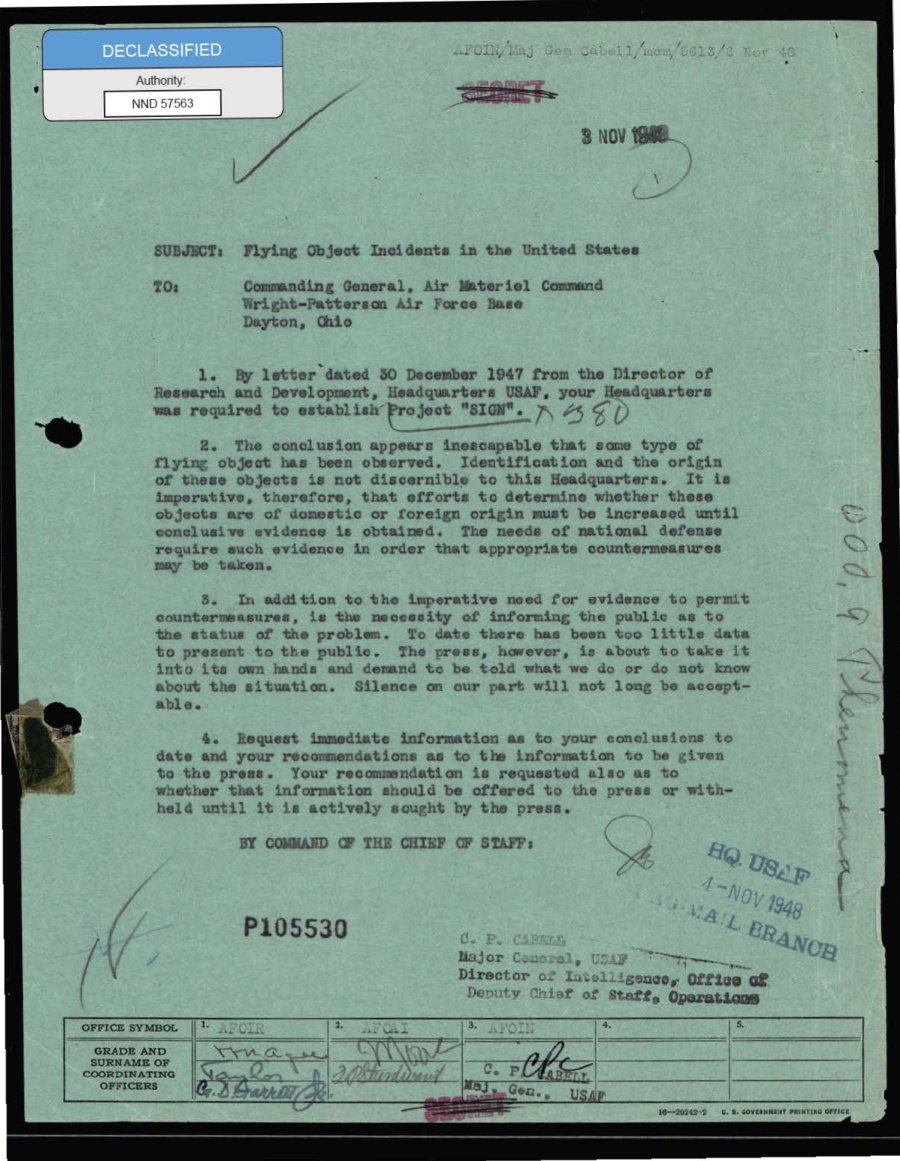
The letter of April 23, 1948, signed by Colonel H. M. McCoy, chief of intelligence of the Air Materiel Command, presents what it calls an initial report on unidentified flying objects. It explains the origin: a letter from Air Force headquarters of December 30, 1947, signed by General L. C. Craigie, led to the activation of the project on January 26, 1948, and a technical instruction was issued on February 11. The project files gathered reports received directly and others forwarded by the Directorate of Intelligence.
The report records simple checks, such as the schedule of illuminated advertising blimps that flew at night, checked as a possible source of reports. It then lists observations that drew attention: high rate of climb, apparent ability to hover in the air, an oval, disc or saucer shape cited 31 times, associated sound in 11 cases and exhaust trails in 23. The reported sizes ranged from that of a 25-cent coin to 250 feet in diameter. In 77 reports there was a single object; in 9, more than ten.
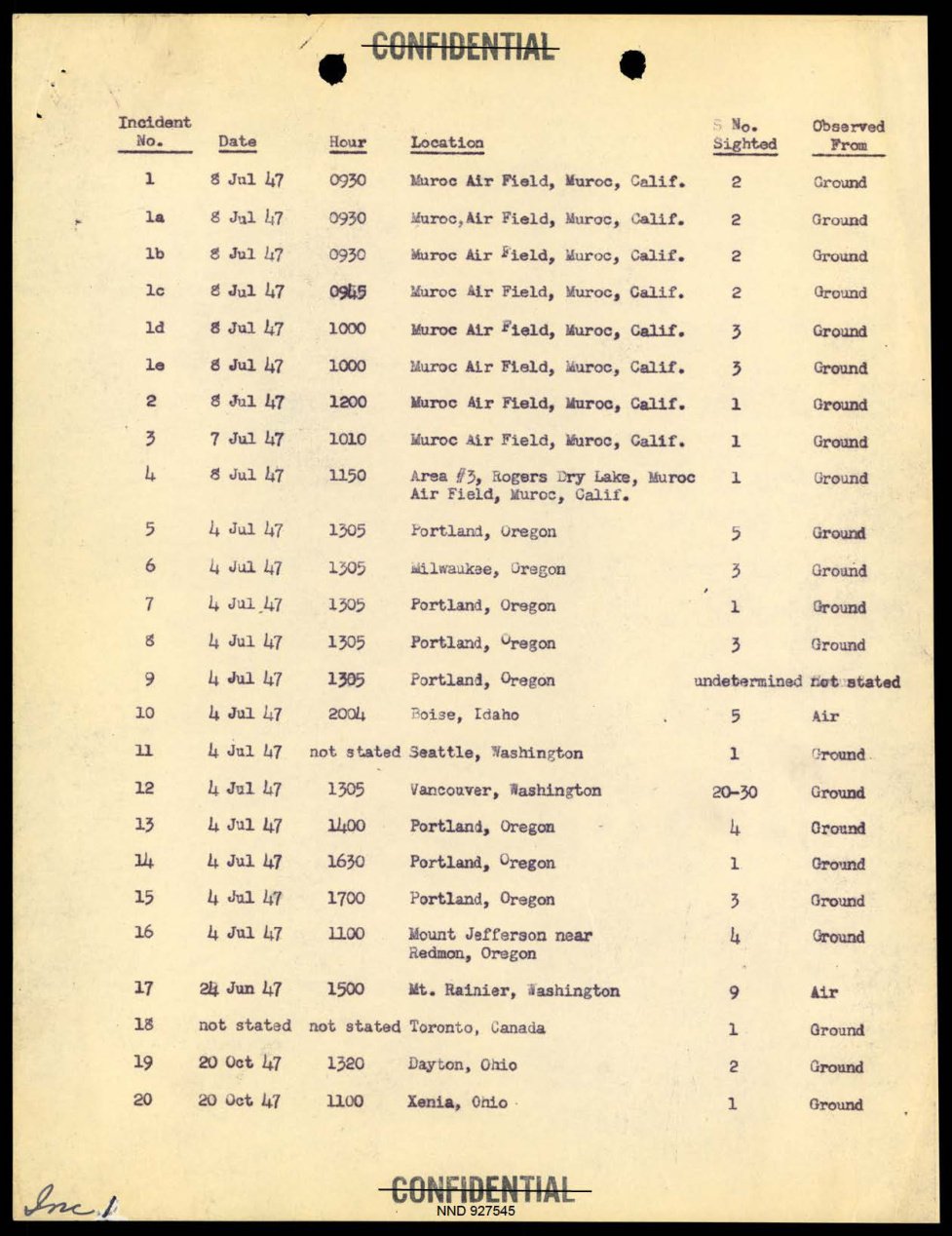
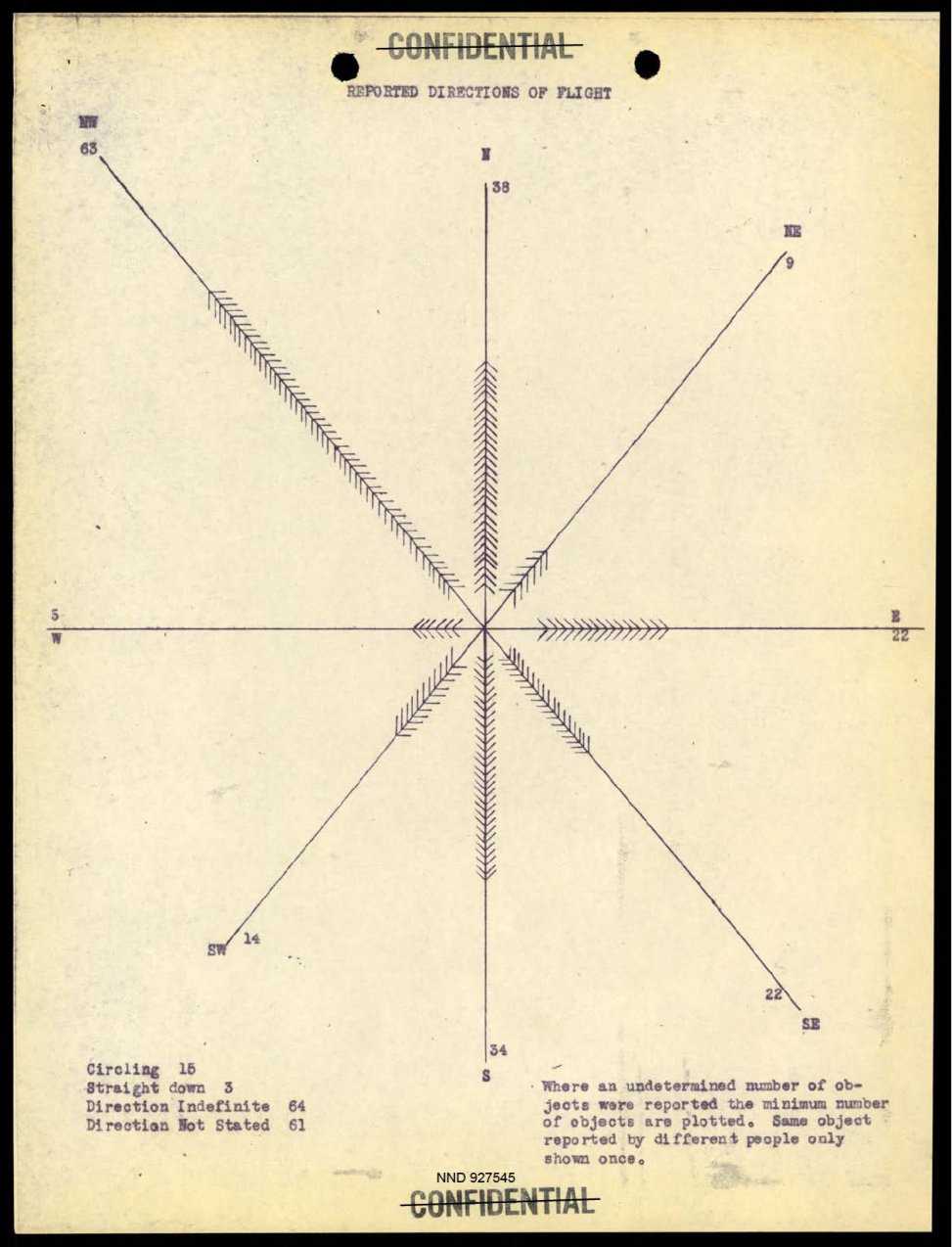
The attached tabulation takes up almost thirty pages. For each incident from 1 to 100 there is date, time, location, number of objects, whether it was seen from the ground or from the air, occupation of the witness, maneuvers, duration, color, shape, size, sound, heading, altitude and speed. The first sheet begins with the Muroc reports, on July 8, 1947, and continues with Portland, Boise, Seattle and Vancouver. A diagram summarizes the headings: 63 northwest, 38 north, 34 south and 64 undetermined. The notes warn that the same object seen by several people appears only once.
A sheet of notes contains harsh judgments. On incident 18, recorded in Toronto, it states that it was "definitely determined" that the photo and story were a hoax to gain publicity and money. On incident 8, it describes the author of the report as an excitable person with an overactive imagination. These are the project's assessments, without the evidence to support them in these pages. The two judgments show that the team was already sorting reports by witness reliability, a criterion that reappears in the record cards throughout the period.
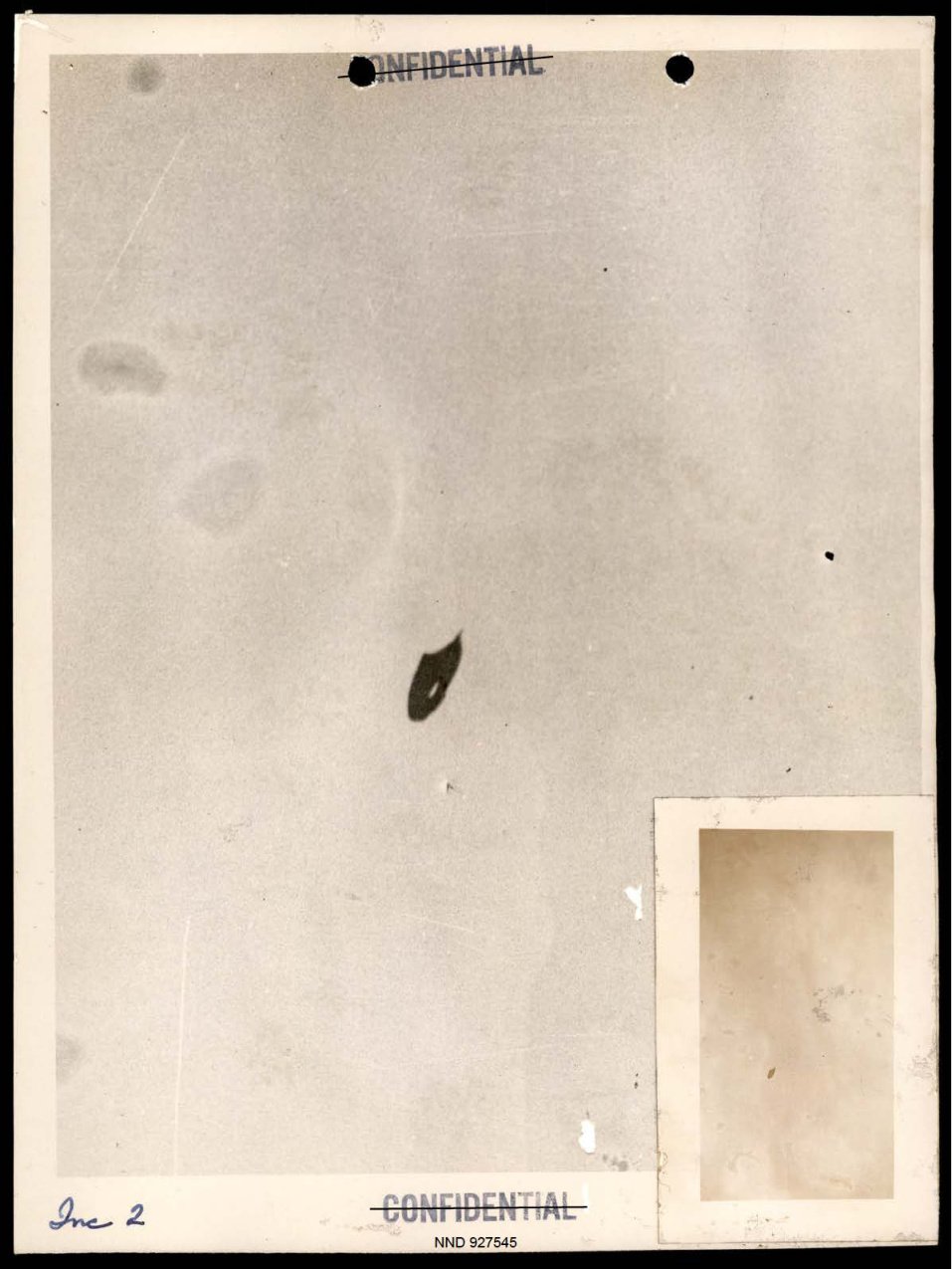
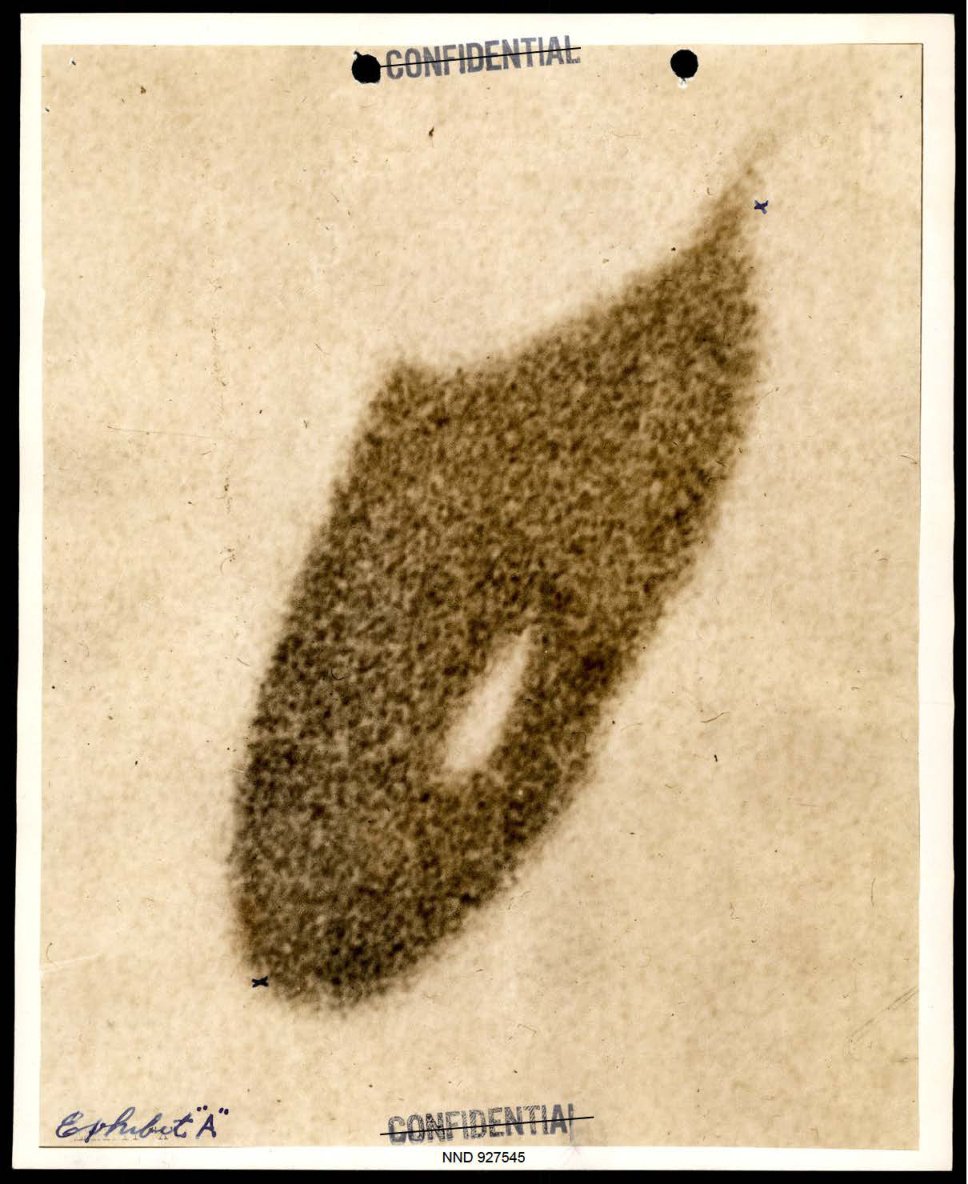
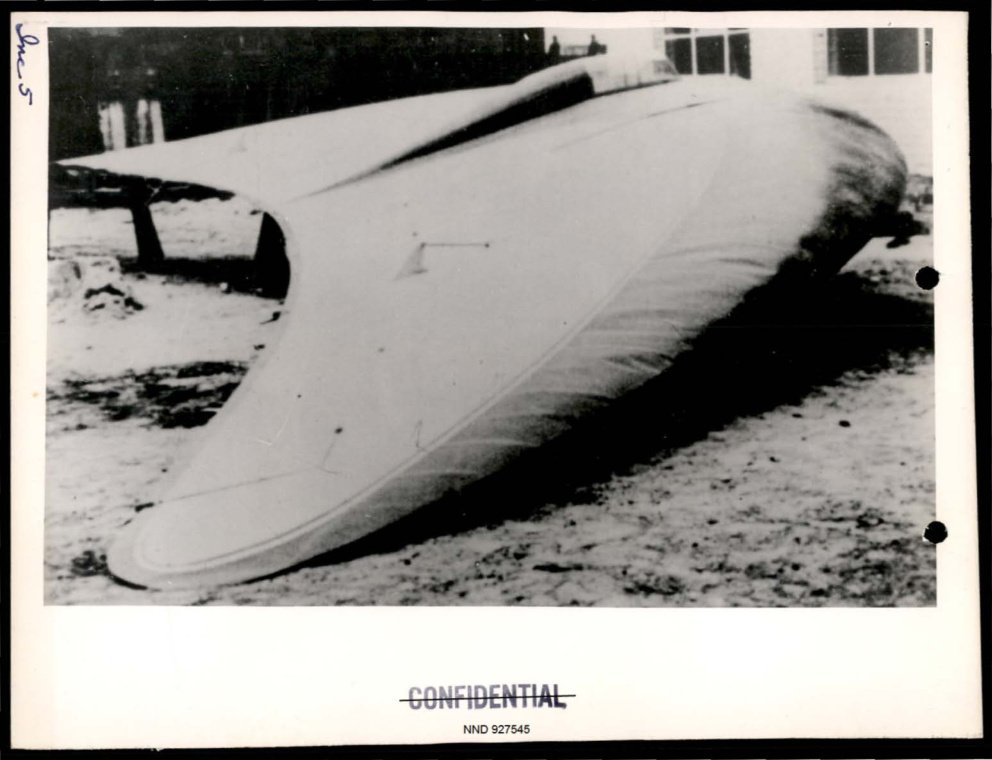
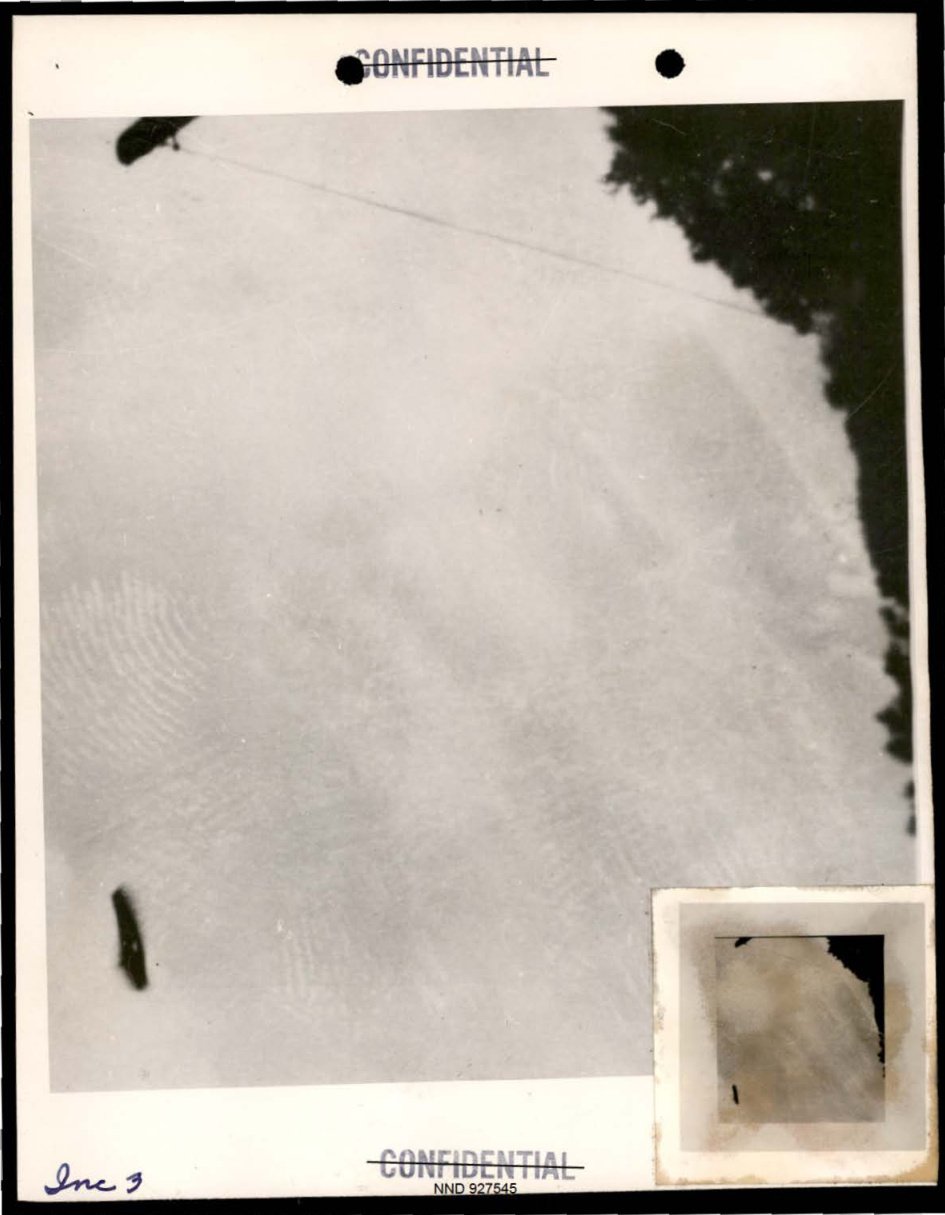
The report devotes attention to the photographs of incident 40, taken in Phoenix by William Rhodes. Exhibits 2 and 3 are enlargements, and exhibit 4 is an evaluation of February 19, 1948. It concludes that the image is of a true photographic nature, not an emulsion defect, and that the "tail" of the outline is the expected shutter distortion. Accepting the reported distance of 2.000 feet, it estimates the object's diagonal at 44 or 55 feet, depending on the negative format. The letter points to a resemblance to the German Horten Parabola glider, photographed in exhibit 5.
The closing section recounts the visit of command representatives to scientist Irving Langmuir, of General Electric. In his view, the available data did not allow positive identification, and he was reluctant to treat the discs as real. The command, for its part, considered it possible to build a low-aspect-ratio aircraft that would reproduce much of the reported appearance and performance, with boundary-layer control. The last exhibit, a technical article by A. R. Weyl on short-wing aircraft, shows that the terrestrial engineering hypothesis carried weight in the project in 1948.
Read in full, the tabulation in exhibit 1 shows a more varied picture of the reports than the letter's summary suggests. Of the 100 numbers, 72 are from June to September 1947, mostly July, and eight are from January 1948: Lockbourne and Wilmington, in Ohio, Godman Field and Danville, in Kentucky, Wildwood, in New Jersey, Hartford and two reports from Finland. Fifteen incidents were seen from the air and two from ships; the rest, almost all from the ground. There are also reports from outside the United States, such as Budapest, Newfoundland, the North Sea, Germany and a ship near Sydney.
The observer occupation column shows that the project recorded who was doing the seeing. There are Air Force officers and enlisted men, police officers from Portland and Oregon, a United Airlines captain, a TWA representative, a lieutenant governor, a judge, an astronomer, an aeronautical engineering professor, railroad workers, Hungarian peasants and a trout farm operator. In many incidents the occupation is listed as not stated. The table notes what came in each report; no sheet says how these occupations were confirmed.
In the description columns, the disc appears, but not alone. Alongside "disc," "saucer" and "round," the table records cones, a raindrop, a pencil-shaped object, cigars, a semicircle, a fire-colored ball, "a flock of geese" and something "like a comet." Sizes range from a large grapefruit and twelve inches to 175 to 250 feet in diameter. Silver and aluminum are frequent colors, but there are also amber, red, blue, black and gold. Sound appears in eleven lines, the same number the letter reports.
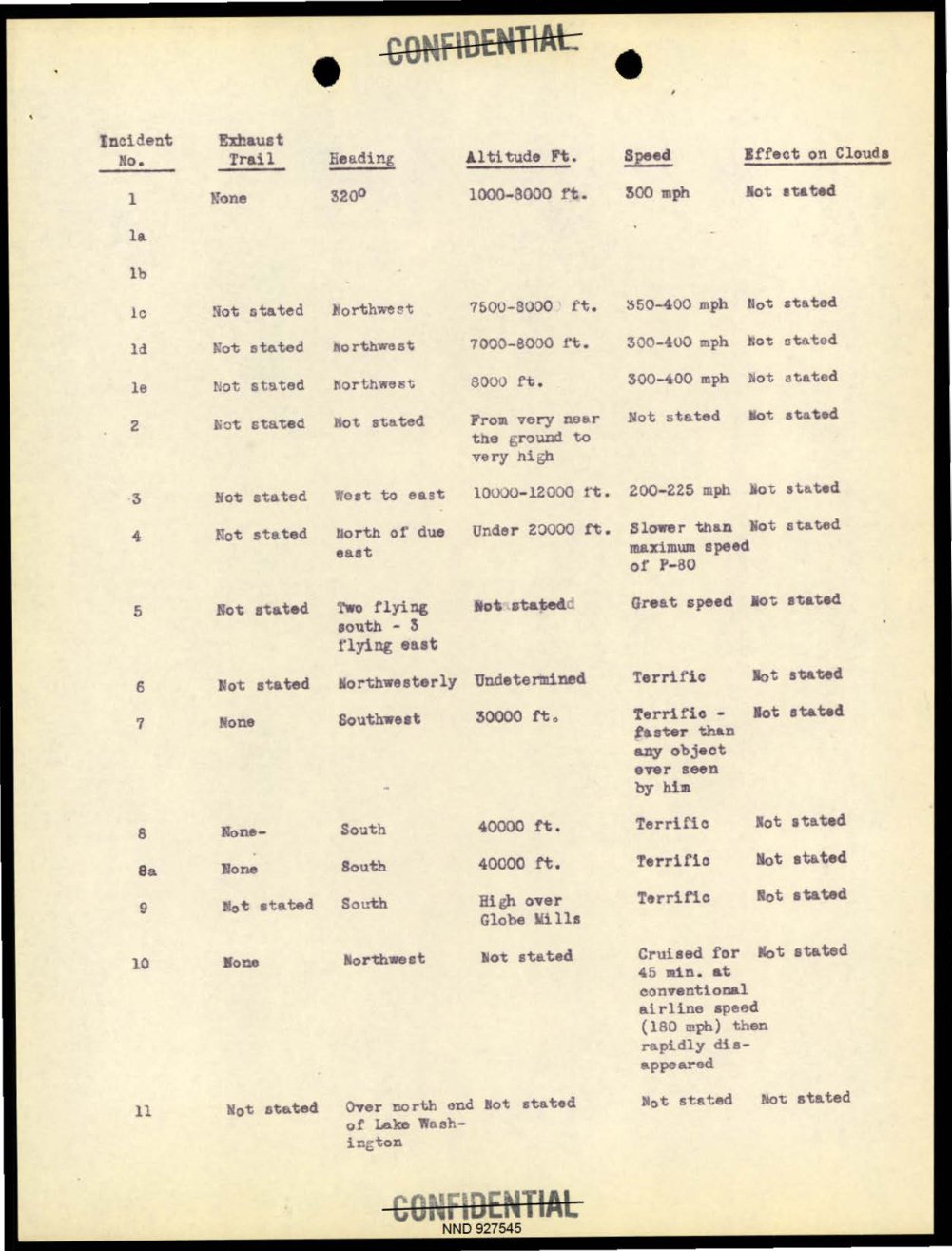
The heading, altitude and speed columns gather witness estimates, many of them only in words, such as "tremendous," "very fast" or "slow." When there is a number, it varies widely: 175 mph in incident 73, 285 mph in 53, 750 mph in 52a, 1.000 to 1.200 mph in 65, 1.000 knots in 59 and 1.350 mph "calculated" in 80, in which the report adds that the object seemed to move like a jet. These are reported values, without instruments. The diagram on page 30 totals 63 reports heading northwest, 38 north and 34 south, and leaves 64 with no defined direction.
The evaluation of the photographs of incident 40, in Phoenix, is the only part of the report with its own calculation. The command's technical section starts from the distance of 2.000 feet given by the witness and from the camera type, a 620, and assumes, depending on frame size, a lens of 4 or 5 inches focal length. With this it arrives at an object of 44 or 55 feet on the diagonal. The sheet itself says that the sample was cropped, that the frame size could not be confirmed and that the object had low contrast. The measurement is therefore an estimate that depends on a distance no one verified.
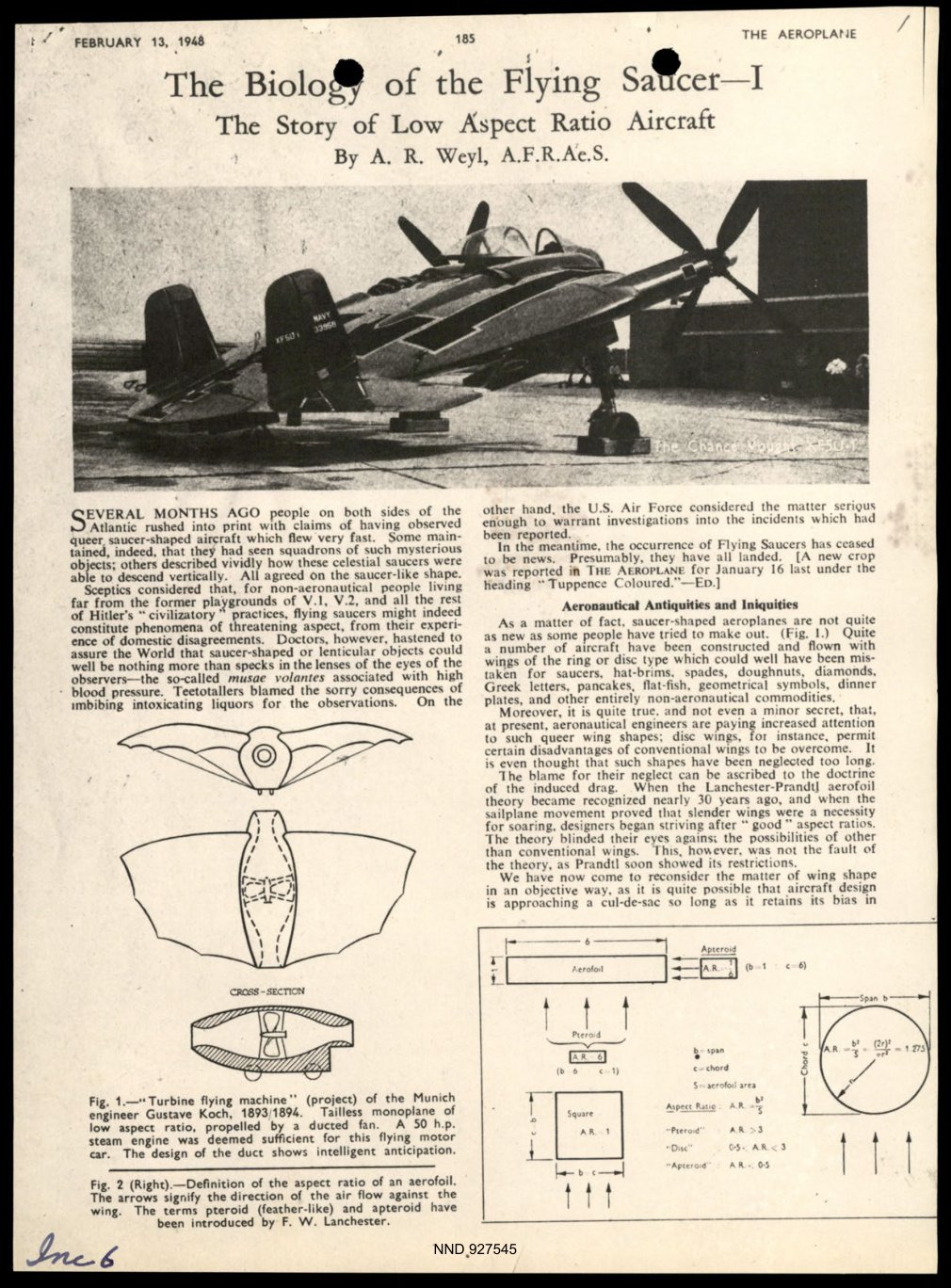
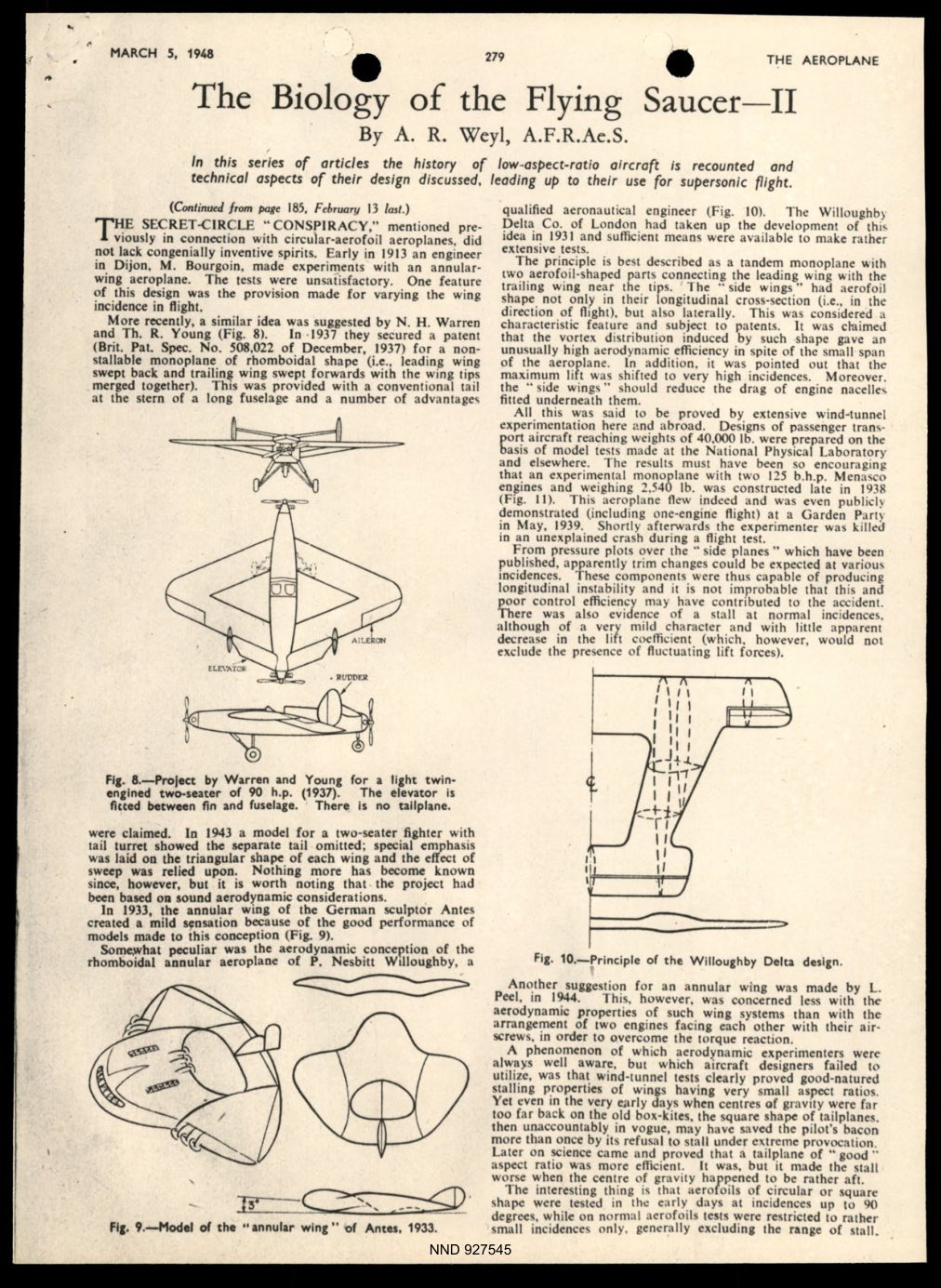
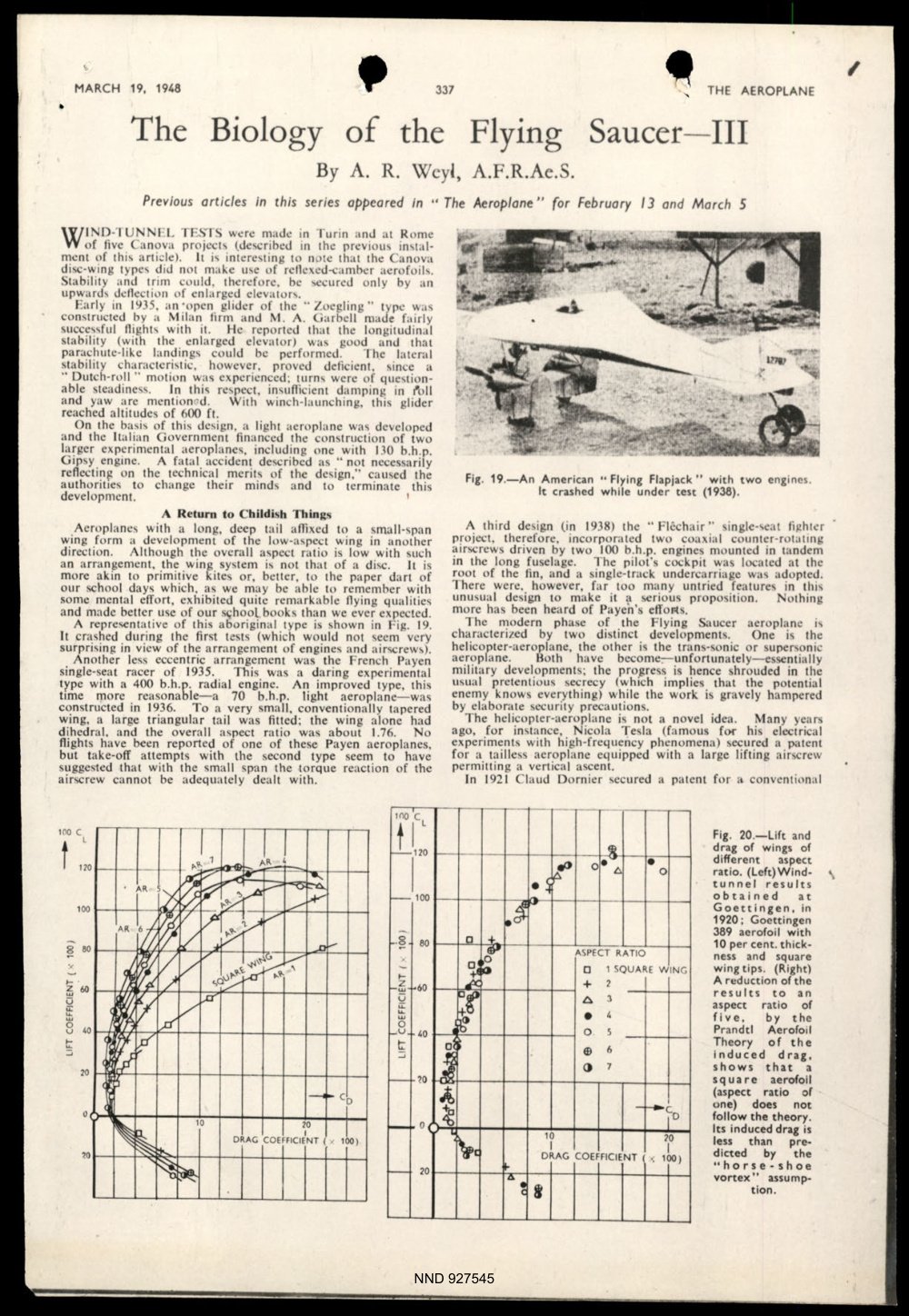
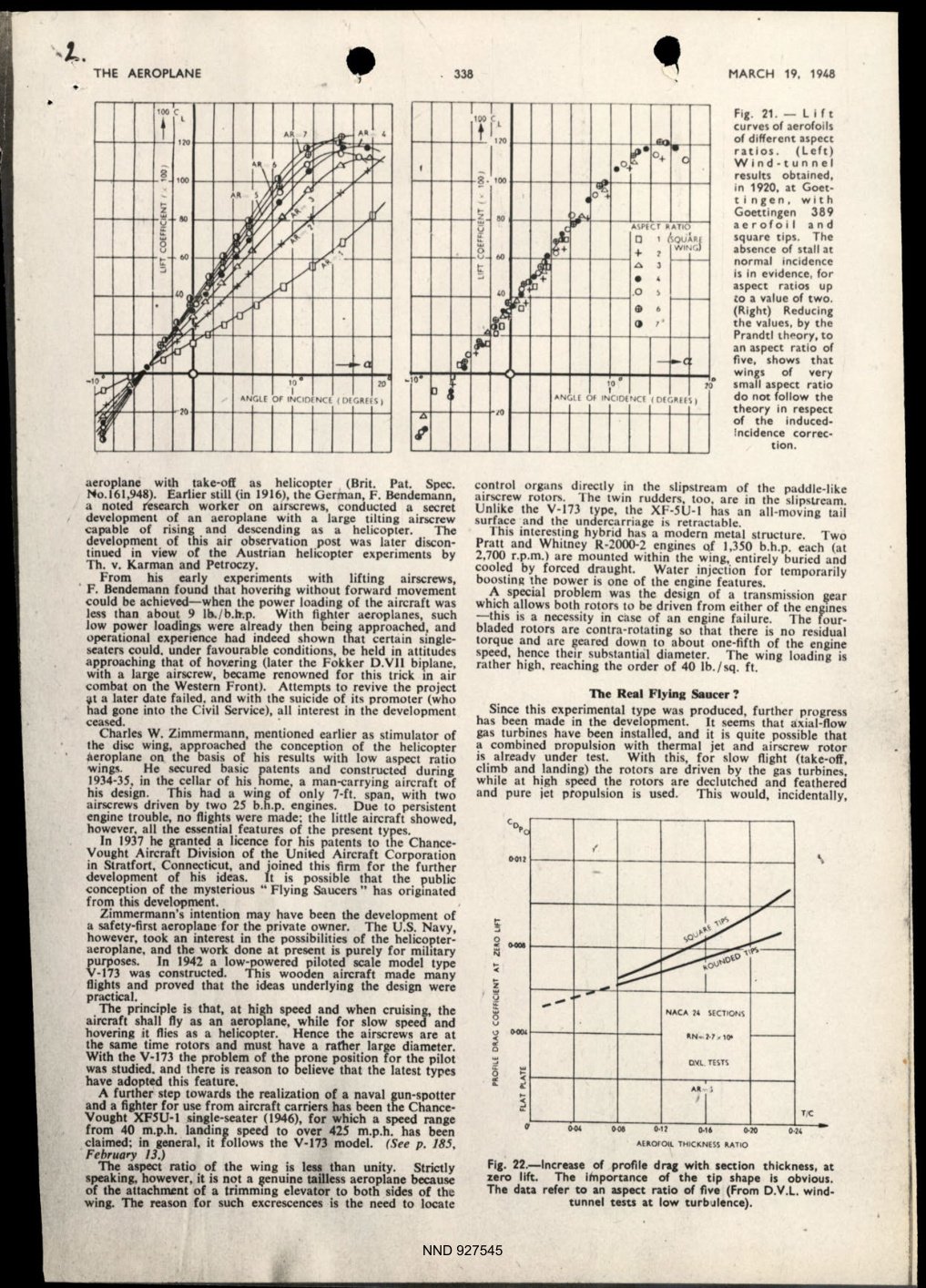
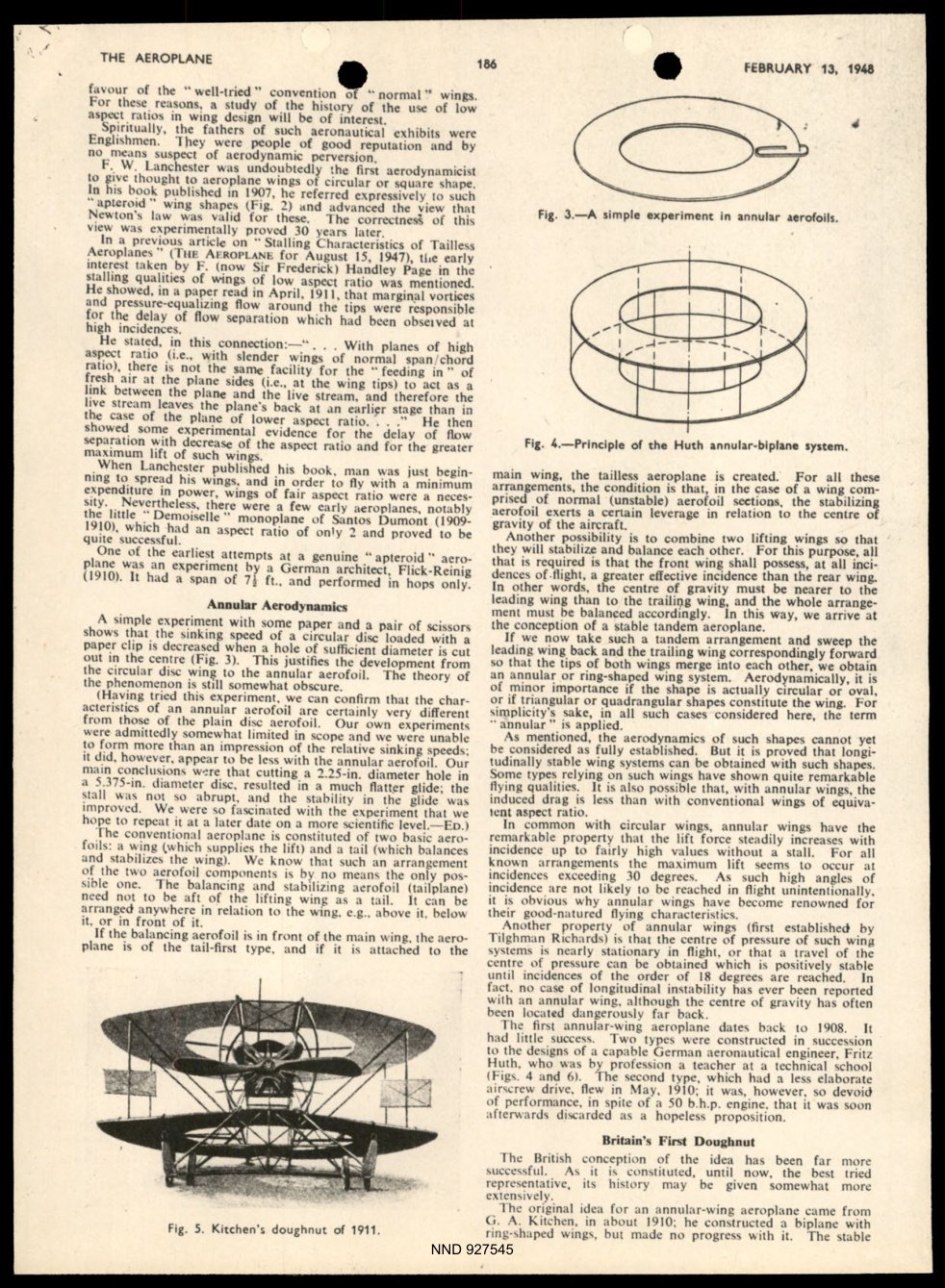
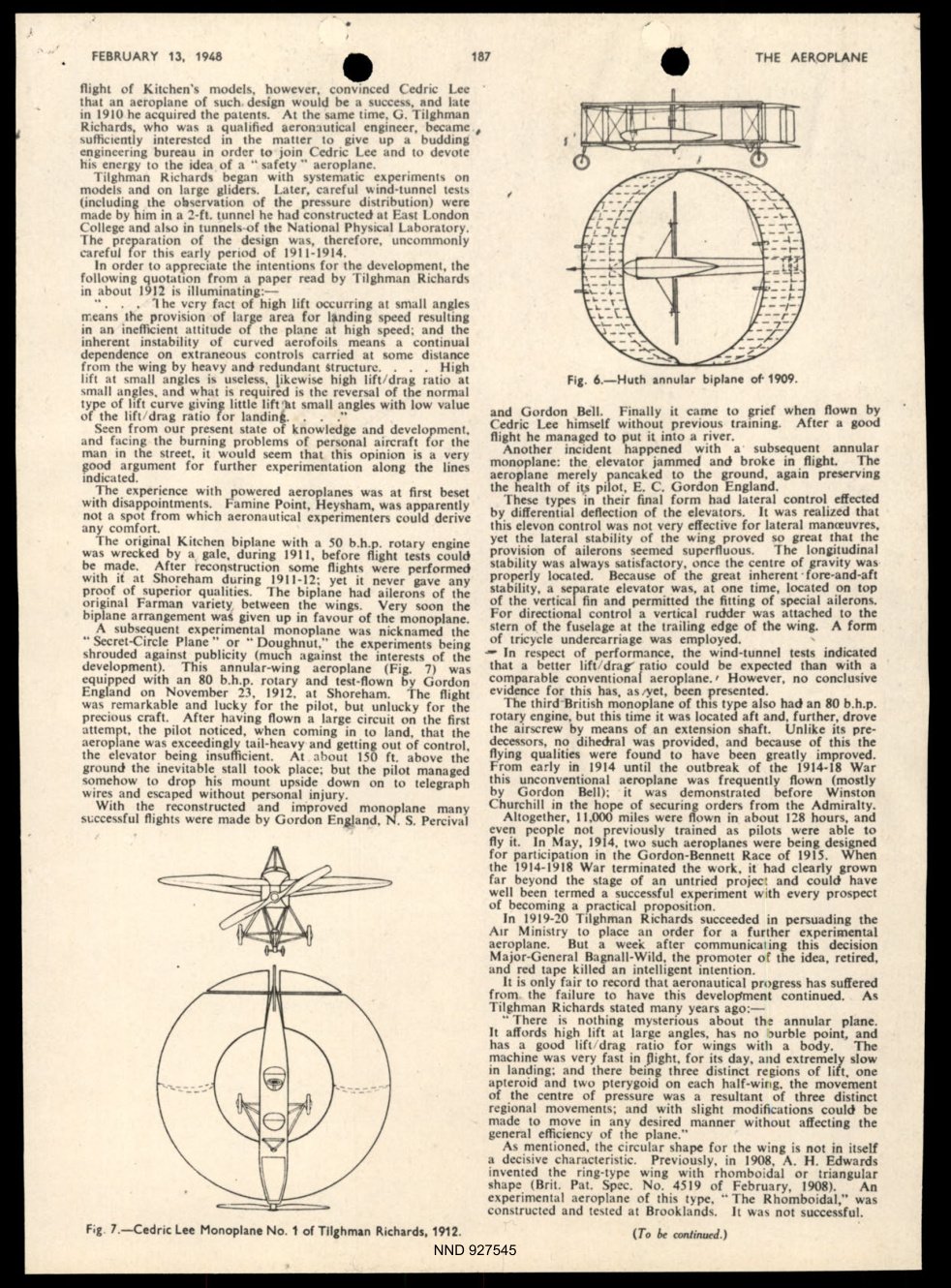
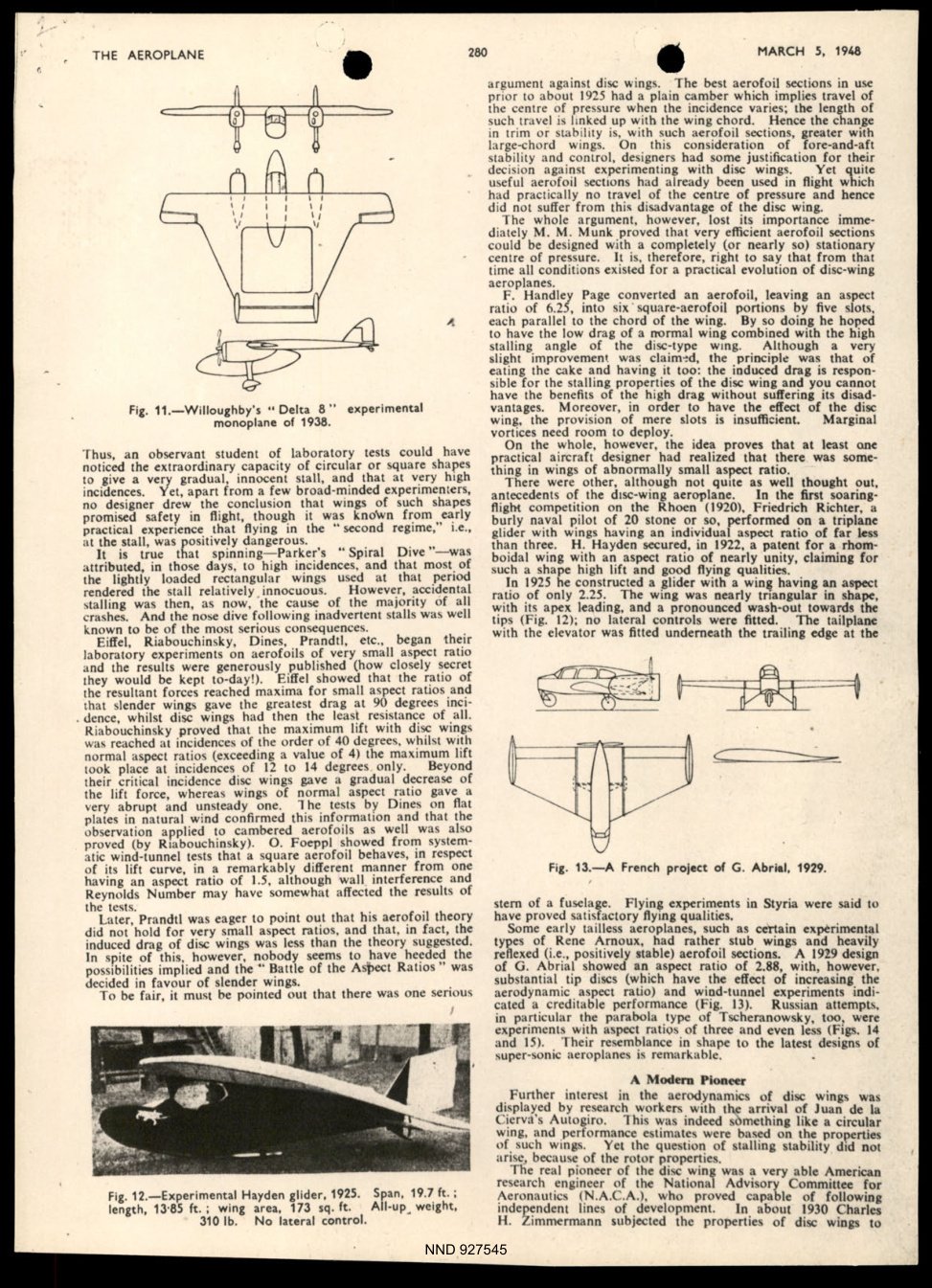
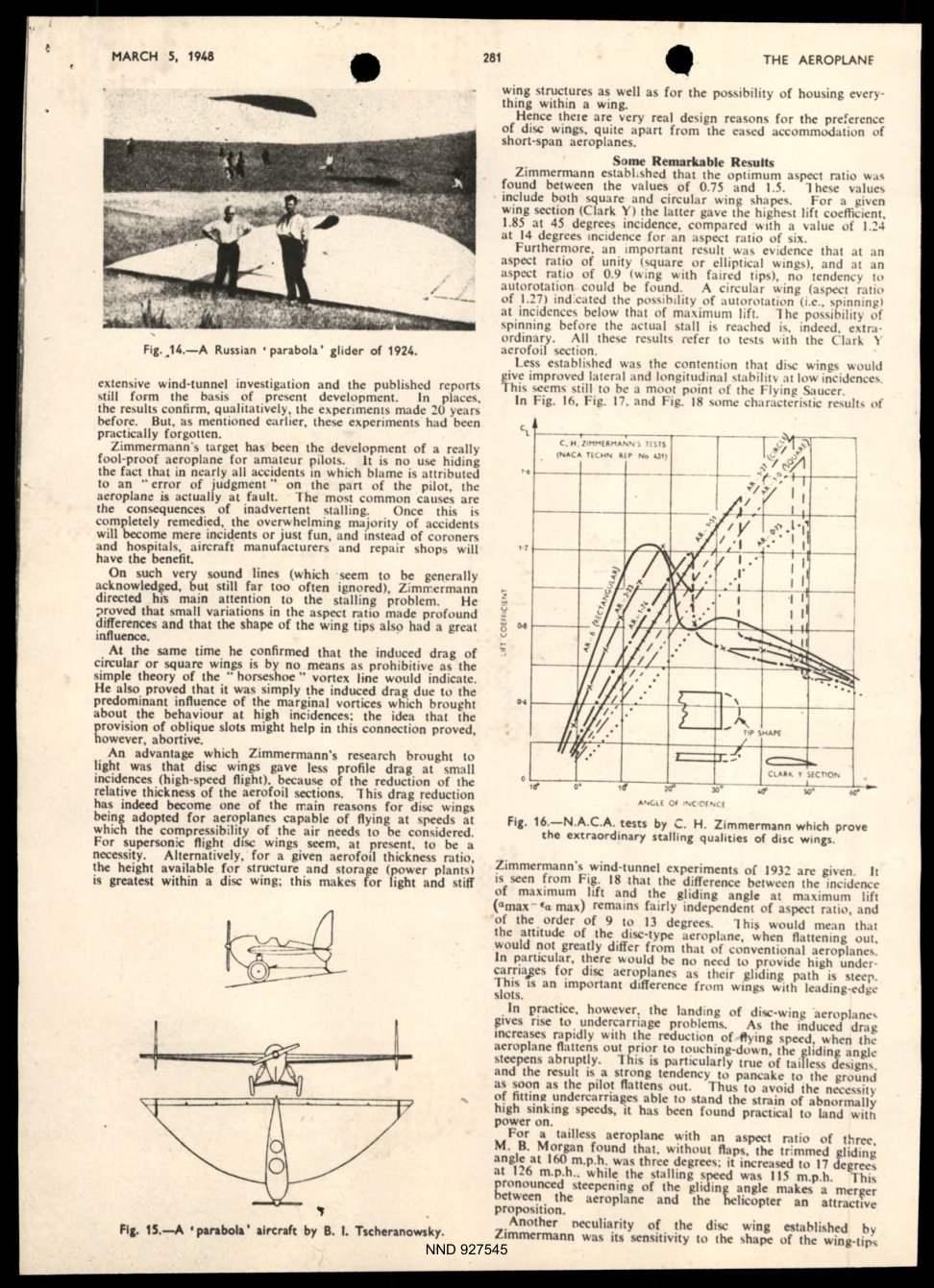
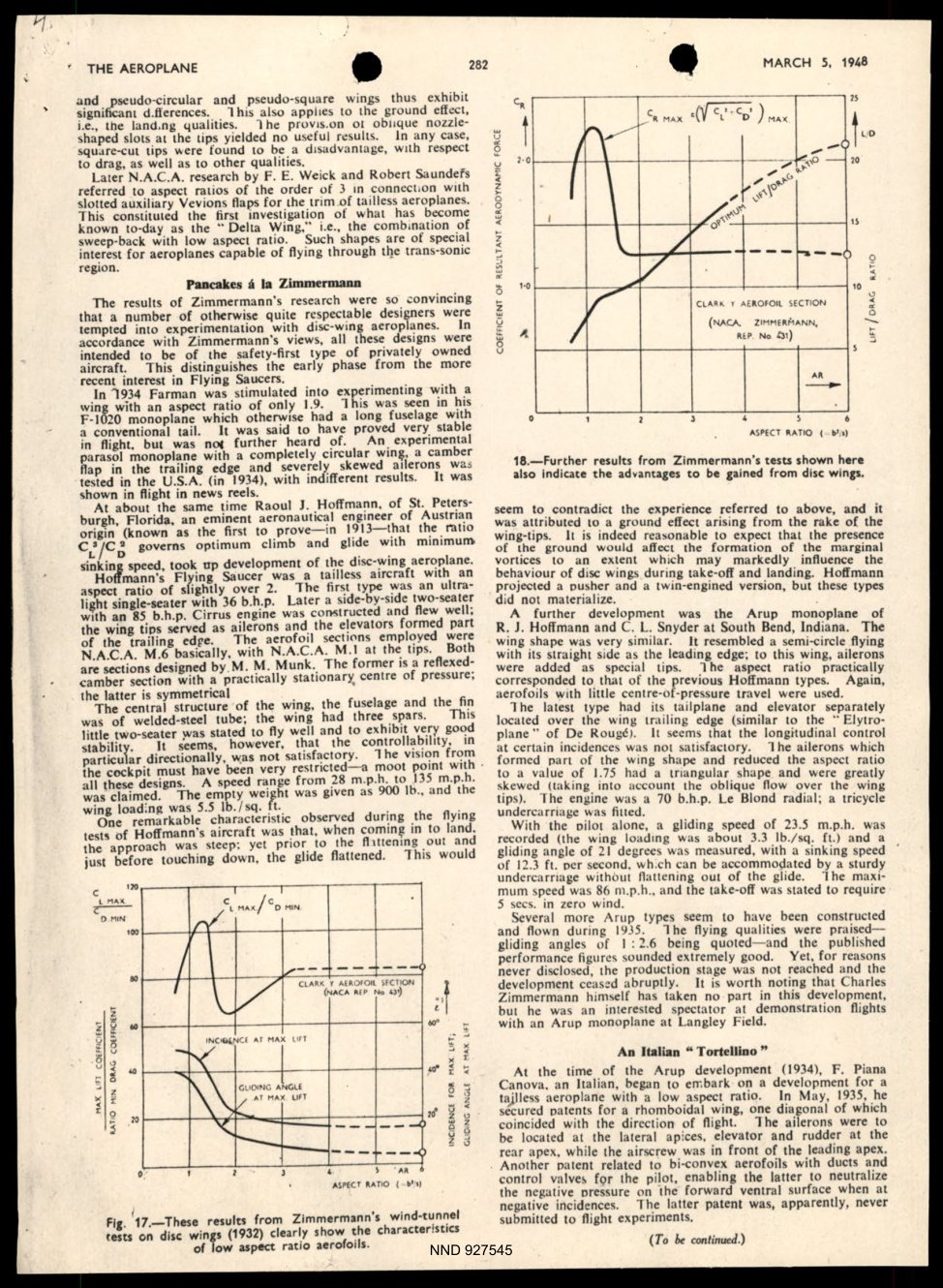
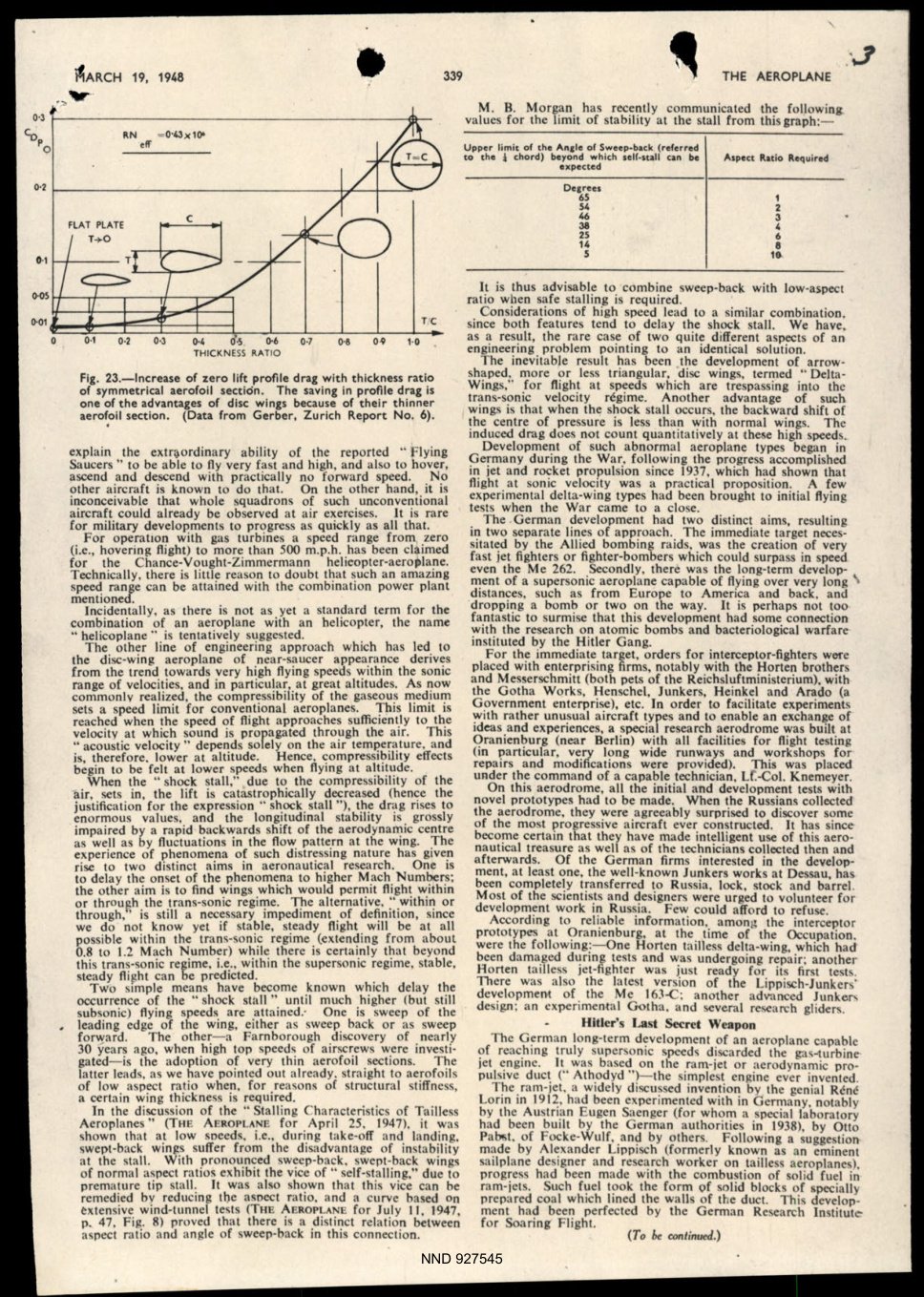
Annex 6 brings together three parts of an article by A. R. Weyl in the British magazine The Aeroplane, of February 13, March 5 and March 19, 1948. It tells the history of short-wing, circular or annular aircraft, from nineteenth-century designs to Chance Vought's XF5U-1. On the last page, the author observes that no other known aircraft hovered, climbed and descended like the reported discs, but he does not accept that entire squadrons of aircraft of this type were already flying in exercises. It is the opinion of a third party; the command's hypothesis is in the letter, in paragraph 7.
The tabulation should be read with caution. It is an inventory of reports received up to February 1º, 1948, not a set of measurements. Blank or "not stated" fields are frequent, incidents 21 (Des Moines) and 43 (Clarion) carry the same description, and there are misspellings of place names. Incident 93 appears in Hartford, Connecticut, on one page, and near Holyoke, Massachusetts, on another. These points do not invalidate the document, but call for care when using any single line.
Read page by page, the A. R. Weyl article attached to the report is above all a history of aeronautical engineering. Part I runs from the circular wings discussed by F. W. Lanchester in 1907 to G. A. Kitchen's annular-wing biplane and the monoplane nicknamed the "Doughnut," by Cedric Lee and Tilghman Richards, which flew at Shoreham in 1912 and was demonstrated to Winston Churchill in 1914. Part II covers the Willoughby Delta, whose designer died in a test flight in 1939, Russian and French gliders and the tests of Charles H. Zimmermann at NACA. None of these pages deals with sightings.
Zimmermann's graphs, reproduced on pages 41 and 42, are the technical basis of the exhibit. They indicate that wings with an aspect ratio near 1, square or circular, reach maximum lift at angles of incidence much greater than those of a conventional wing, near 45 degrees, and lose lift gradually. The article also recalls that, in the 1930s, broad-wing aircraft were already flying in the United States, such as Raoul J. Hoffmann's "Flying Saucer," in Florida, and the Arup monoplanes, of South Bend, Indiana. These are wind tunnel data and data on known aircraft, not on reported objects.
Part III, of March 19, 1948, records failures and secrecy. Italian projects by Canova and French ones by Payen were abandoned after accidents, and the American "Flying Flapjack" crashed in testing in 1938. Weyl states that the modern phase of the flying disc followed two lines, the airplane-helicopter and the transonic or supersonic airplane, both military and surrounded by secrecy. The attached copy ends with "(To be continued)," and the continuation is not part of the report. The exhibit shows that the command was gathering engineering literature in 1948, but does not prove that any of the tabulated objects was one of these aircraft.
More images from the document
DIRECT READING OF THE FILE
The document, in the original
Press clipping reproduced in full, with the English original and a complete translation.
EXCERPT 1 · PHYSICAL PAGE 1
Air Materiel Command letter, 23/04/1948, physical page 1 (full text)
Authority:
• NND927545
•
I
HEADQUARTERS
AIR KATERI BL COWAND
MClA/JCB/amb
Wright-Patterson Air Force Base
KCIA 2DjytAPH0
i948
SUBJECT, Projeot "BIOi" •
TOs Chief of Staft
United Statea ilr Poree
Waahington 26, D. Co
ATTN s Director ot Int-,lligenoe
l. Thie ie an initial report on unidentified flying objecta aa
direoted by Rq, USAY letter dated SO Deoember 1947, signed by General
L. C. Craigie, subjeot1 •r1~Jng Diaea~. Qtarterly reports will be
submitted beginning 1 July 1948.
2. Ae a reeult of thia letter, Pro~ot HT-304 was a.otiTated on
26 January 1948 and Technical Inatruotion 2185, dated 11 Pebruaiy 1948,
wns published. Present ti.lea on Projeot •s10~• represent a oonaolidation ot reports received directly by Hq, AMC and thoee forwa.rded by
the Direotor ot Intelligence, USAF.
~. Schedules of activities of lighted night-flying adTertising
blimps have been secured a.nd crosa-oheoked at thi.a Headquarters to
consider them as a possible souroe ot incident nporta.
4. Inoloaure l represents a tabulation am breakdoWll of all
available reports through l February 1948.
5o The following ia a series of interesting observation• that
were noted when rev19Wing the many incident 0ase11
a. Rigll rate of olimb, aa well aa the apparent a.bi lity to
remain mot1onleu or hover for a oonBiderable length of tiuo
bo The objeot was described aa being oval, d1ac or 1auoer- t
ehaped ~l times.
o. Assooiated sound was preae?It ll tim.H o
d. Reported sizes have varied from that of a 26-oent pitoe
to 260 feet in diameter, and from the aise or a purauit plane to tht
ePulk of six B-29 airpl.&nea.
,
NND 927545Editorial note: There is an illegible vertical handwritten annotation in the right margin. A U.S. quarter (25-cent coin) is about 24 mm; 250 feet are equivalent to about 76 meters.
Check the original PDF
[Stamp: DECLASSIFIED. Authority: NND 927545] [CONFIDENTIAL, struck through] HEADQUARTERS AIR MATERIEL COMMAND. MCIA/JCB/amb. Wright-Patterson Air Force Base, Dayton, Ohio. 23 APR 1948. MCIA. SUBJECT: Project "SIGN". TO: Chief of Staff, United States Air Force, Washington 25, D. C. ATTN: Director of Intelligence. 1. This is an initial report on unidentified flying objects as directed by Hq, USAF letter dated 30 December 1947, signed by General L. C. Craigie, subject: "Flying Discs". Quarterly reports will be submitted beginning 1 July 1948. 2. As a result of this letter, Project HT-304 was activated on 26 January 1948 and Technical Instruction 2185, dated 11 February 1948, was published. Present files on Project "SIGN" represent a consolidation of reports received directly by Hq, AMC and those forwarded by the Director of Intelligence, USAF. 3. Schedules of activities of lighted night-flying advertising blimps have been secured and cross-checked at this Headquarters to consider them as a possible source of incident reports. 4. Inclosure 1 represents a tabulation and breakdown of all available reports through 1 February 1948. 5. The following is a series of interesting observations that were noted when reviewing the many incident cases: a. High rate of climb, as well as the apparent ability to remain motionless or hover for a considerable length of time. b. The object was described as being oval, disc or saucer-shaped 31 times. c. Associated sound was present 11 times. d. Reported sizes have varied from that of a 25-cent piece to 250 feet in diameter, and from the size of a pursuit plane to the bulk of six B-29 airplanes. [CONFIDENTIAL, struck through] [NND 927545]View the document record ↗ · Physical page 1, counting the cover.
EXCERPT 2 · PHYSICAL PAGE 2
Air Materiel Command letter, 23/04/1948, physical page 2 (full text)
2 3 APir 1948
over 10
9
.. •
AMC
Subject, Project "SIG!i"
e. »umber of objects per aighting,
Objects per sighting l 2-6 6-10
Number of eightioga 77 21 8
t. Exhaust traile were reported 23 times.
g. Speed has been eetime.ted throughout the entire range from
very alow or hovering to supersonio.
6. Incloaures 2 and 5 are anlargementa of photographt taken of
Incident f40o Inoloaure 4 1s an evaluation of inolosure 2 by thie
Headquarters. Attention 1s iovited to the marked aimilarity between
incloaurea 2 ands. and inoloaure 6. Similarity also exiata between
inclosures 2 and 3 and oonfigur&tiona illustre.ted in inolosure 6.
7. Representatives from tbie Headquartere visited Dr. Ining
Langmuir of the P~sea.rch Laboratories. General Electric Comp&ny.
Schenectady, N. Y. to discuss Project "SIGN". It was the opinion of
this acienti st that prosent a.vai l!I. ble data does not encompass suffici ent information to enable a positive identific~tion to be ma.deo
Dr. :.a.n&muir was relucts.nt to consider the so-called "flying discsM
as a reality. However, it io be'lieved at this neadquarters that it
is possible to oonstruot a low aspeot ratio airoraft that would d~plioate many of the appearance and performance oharaoteriatics of reported
"flyint discs~. Experts have agreed that thie would be possible through
the intelligent application of boun:lary layer control.
FOR THE COMMANDING GENERAL:
~Me~
6 Inols H. M. ticC~!1. J l. Tabulation Co lone1. US&F
2. Photo Chief ot Intelli gence
3. Photo
4. Eval of Incl 2
6. Horten Parabola
6. Biology of I'lying Se.ucor
2
~
NND 927545Editorial note: The four ranges add up to 115 sightings, a number greater than the 100 numbers in the tabulation; the letter does not explain the difference. The title of enclosure 6, "Biology of the flying saucer", is transcribed as it appears in the list of enclosures.
Check the original PDF
[CONFIDENTIAL, struck through] AMC. Subject: Project "SIGN". 23 APR 1948. e. Number of objects per sighting: Objects per sighting 1 / 2-5 / 6-10 / over 10. Number of sightings 77 / 21 / 8 / 9. f. Exhaust trails were reported 23 times. g. Speed has been estimated throughout the entire range from very slow or hovering to supersonic. 6. Inclosures 2 and 3 are enlargements of photographs taken of Incident #40. Inclosure 4 is an evaluation of inclosure 2 by this Headquarters. Attention is invited to the marked similarity between inclosures 2 and 3, and inclosure 5. Similarity also exists between inclosures 2 and 3 and configurations illustrated in inclosure 6. 7. Representatives from this Headquarters visited Dr. Irving Langmuir of the Research Laboratories, General Electric Company, Schenectady, N. Y. to discuss Project "SIGN". It was the opinion of this scientist that present available data does not encompass sufficient information to enable a positive identification to be made. Dr. Langmuir was reluctant to consider the so-called "flying discs" as a reality. However, it is believed at this Headquarters that it is possible to construct a low aspect ratio aircraft that would duplicate many of the appearance and performance characteristics of reported "flying discs". Experts have agreed that this would be possible through the intelligent application of boundary layer control. FOR THE COMMANDING GENERAL: [signature] H. M. McCOY, Colonel, USAF, Chief of Intelligence. 6 Incls: 1. Tabulation 2. Photo 3. Photo 4. Eval of Incl 2 5. Horten Parabola 6. Biology of Flying Saucer. 2 [CONFIDENTIAL, struck through] [NND 927545]View the document record ↗ · Physical page 2, counting the cover.
EXCERPT 3 · PHYSICAL PAGE 3
Enclosure 1, tabulation of incidents 1 to 20, physical page 3 (full text)
/
• CONFIDENTIAL
-
Incident
No. Date
1 g Jul 47
; la g Jnl 47
lb e Jul 47
le g Jul 47
ld g Jul 47
le g Jul 47
2 g Jnl 47
~ 7 Jul 47
4 $ Jul 47
5 4 Jul 47
6 4 Jul 47
7 4 Jlll .47
~ 4 Jul 47
9 4 Jul 47
10 4 Jul 47
ll 4 Jul 47
12 4 Jul 47
1~ 4 Jul 47
14 4 Jul 47
15 4 Jul 47
l.6 4 Jul 47
17 2ll. Jun 47
l!S not stated
20 Oot 47
20
19
20 Oct 47
Hour
0930
0930
0930
09tl9
1000
1000
1200
1010
1150
1305
1305
1305
1305
1305
2004
N<>• Obser,ed
Location Sighted P'rom
Muroc ilT Field, M'uroc, Calif.
Muroc,Air Field, Muroc, Cali£.
Muroc Air li'ield, li&uroc, Cali.f.
Muroc .lir Field, lluroc, Calif.
lmroc Air Field, Muroc, Calif.
Uuroc A.Lr Field, itiuroc, Calif.
Muroc Air Field, Mu.roe, Call!.
Iifuroc Air Field, Vuroc, Calif.
Area 113, Rogers Dry Lake, Muroc
Air Field, Muroc, Calif.
~ortland, Oregon
1llli.lwaukee, Oregon
Portland, Oregon
Portland, Uregon
Portland, Oregon undetermined wt atated
Roi se, Idaho 5 Air
2 Ground
2 Ground
2 Ground
2 Ground
3 Ground
3 Ground
1 Ground
1 Ground
l Ground
5 Ground
3 Grotmd
1 Ground
3 Ground
not stated Seattle, Xashington l r.:.round
1305 Vancouver, Washington 20-30 Ground
1400 Portland, Oregon 4 Ground
16}0 Portland, Oregon 1 Ground
1700 Portland, Oregon 3 Ground
ll.00 Mount Jefferson near 4 Ground
Redmon, Oregon
1500 14t. Rainier, a.shington 9 11r
not stated Toronto, Canada 1 Ground
1320 Dayton, Ohio 2 Ground
1100 Xenia, Onio • l Ground
CONFIDENTIAL
NND 927545Editorial note: The time of incident 1c was typed with an overtyped correction and reads 0945. Lines 5 to 20 (Portland, Boise, Seattle, Vancouver, Mount Rainier, Toronto, Dayton, Xenia and others) belong to other cases; line 17, Kenneth Arnold's, is already translated in the kenneth-arnold-1947 dossier.
Check the original PDF
[CONFIDENTIAL, struck through] Incident No. / Date / Hour / Location / No. Sighted / Observed From:
1 | 8 Jul 47 | 0930 | Muroc Air Field, Muroc, Calif. | 2 | Ground
1a | 8 Jul 47 | 0930 | Muroc Air Field, Muroc, Calif. | 2 | Ground
1b | 8 Jul 47 | 0930 | Muroc Air Field, Muroc, Calif. | 2 | Ground
1c | 8 Jul 47 | 0945 | Muroc Air Field, Muroc, Calif. | 2 | Ground
1d | 8 Jul 47 | 1000 | Muroc Air Field, Muroc, Calif. | 3 | Ground
1e | 8 Jul 47 | 1000 | Muroc Air Field, Muroc, Calif. | 3 | Ground
2 | 8 Jul 47 | 1200 | Muroc Air Field, Muroc, Calif. | 1 | Ground
3 | 7 Jul 47 | 1010 | Muroc Air Field, Muroc, Calif. | 1 | Ground
4 | 8 Jul 47 | 1150 | Area #3, Rogers Dry Lake, Muroc Air Field, Muroc, Calif. | 1 | Ground
5 | 4 Jul 47 | 1305 | Portland, Oregon | 5 | Ground
6 | 4 Jul 47 | 1305 | Milwaukee, Oregon | 3 | Ground
7 | 4 Jul 47 | 1305 | Portland, Oregon | 1 | Ground
8 | 4 Jul 47 | 1305 | Portland, Oregon | 3 | Ground
9 | 4 Jul 47 | 1305 | Portland, Oregon | undetermined | not stated
10 | 4 Jul 47 | 2004 | Boise, Idaho | 5 | Air
11 | 4 Jul 47 | not stated | Seattle, Washington | 1 | Ground
12 | 4 Jul 47 | 1305 | Vancouver, Washington | 20-30 | Ground
13 | 4 Jul 47 | 1400 | Portland, Oregon | 4 | Ground
14 | 4 Jul 47 | 1630 | Portland, Oregon | 1 | Ground
15 | 4 Jul 47 | 1700 | Portland, Oregon | 3 | Ground
16 | 4 Jul 47 | 1100 | Mount Jefferson near Redmon, Oregon | 4 | Ground
17 | 24 Jun 47 | 1500 | Mt. Rainier, Washington | 9 | Air
18 | not stated | not stated | Toronto, Canada | 1 | Ground
19 | 20 Oct 47 | 1320 | Dayton, Ohio | 2 | Ground
20 | 20 Oct 47 | 1100 | Xenia, Ohio | 1 | Ground [NND 927545]View the document record ↗ · Physical page 3, counting the cover.
EXCERPT 4 · PHYSICAL PAGE 4
Enclosure 1, tabulation of incidents 21 to 35, physical page 4 (full text)
31
CO~FIDENTIAL e
No.
Sighted
l~
1
2
l
l
l
l
10
1
l
l
1
l
1
1
1
1
1
1
1
1
l , l ,l -
I.
~
\
\
\
I
Observed
From
not stated
Ground
Ground
Ground
Ground
Ground
Ground
Ground
Ground
Oroum
Ground
Ground
Ground
llr
Ground
Ground
. Ground
Ground
Ground
~
Ground
Ground
Boat
Incident
No. Date
21 29 Jun 47
22 21 Jwi 47
23 30 Jun 47
24 12 J\111 47
25 4 Jul 47
26 10 Jul 47
~ 10 Jul 47
2g 24 Jun 47
29 23 Jun 47
30 7 Jan 4!
30a 7 Jan 4g
30b 7 Jan 4a
30c 7 Jan 4g
1946
32
32 not stated
33c
33d
33e
331'
33g
34
35
7 Jan 41!
7 Jan~
7 Jan~
7 Jan 4g
7 Jan 4a
7 Jan 4g
7 Jan~
7 Jan~
13 Oct 47
12 Nov 41
dour
1645
about noon
1745
1&5
2345
not stated
~
not stated
not stated
Location
Des Moines, 1owa
Spokane, ·1ashingt,on
Boise, Idaho
Weiser, Idaho
Vfest Trenton, t~ . J.
Harmon Field, Newfoundland
Hamon Field, bewfoundland
Idaho
Bakersfield., Calif.
l~T Lockbourne AB, Co1umbus, Ohio
1925EST Lockbourne,!B, Columbus., Ohio
1915EST Lockbourne AB, Columbus, Ohio
1940 Lockbourne il, Columbus, Ohio
mid-December early a.m. Northern Arizona
after dark Columbus, Ohio
133&.l'T,OO"' Oocbnan Field, Ky. (south of)
l4000ST Godman Field, Ky.
1320CS'J.' · 0odman Field, Ky.
J..420 CST 2100 from Oodman Field, Ky.
J..430-1600
11!54-19()6
05}0
GQ'l.Jr a.m.
Gedman Field, Ky.
Godman Field, Ky.
Godman Field., Ky.
lladi.eomi-1.le, Ky.
l4 mi1es north of Dauphin,
J.lanitoba, Canada
ticonderoga at sea (40 miles
south of Cape dlanco, 20 miles
o£f shore)
CONFIDENTIAL
NND 927545Editorial note: The date of incident 31 is "mid-December 1946", written on two lines. The number "32" appears repeated, once by itself and once with the filled-in line. In the time of incident 33 there is an illegible overtyped final letter (1330-1700). Incidents 33 and 33a to 33g match in date and place the Godman Field episode, covered in its own dossier; here they are only table lines.
Check the original PDF
[CONFIDENTIAL, struck through] Incident No. / Date / Hour / Location / No. Sighted / Observed From:
21 | 29 Jun 47 | 1645 | Des Moines, Iowa | 18 | not stated
22 | 21 Jun 47 | about noon | Spokane, Washington | several | Ground
23 | 30 Jun 47 | 1745 | Boise, Idaho | 1 | Ground
24 | 12 Jun 47 | 1815 | Weiser, Idaho | 2 | Ground
25 | 4 Jul 47 | 2345 | West Trenton, N. J. | 1 | Ground
26 | 10 Jul 47 | not stated | Harmon Field, Newfoundland | 1 | Ground
27 | 10 Jul 47 | 2000Z | Harmon Field, Newfoundland | 1 | Ground
28 | 24 Jun 47 | not stated | Idaho | 1 | Ground
29 | 23 Jun 47 | not stated | Bakersfield, Calif. | 10 | Ground
30 | 7 Jan 48 | 1925EST | Lockbourne AB, Columbus, Ohio | 1 | Ground
30a | 7 Jan 48 | 1925EST | Lockbourne AB, Columbus, Ohio | 1 | Ground
30b | 7 Jan 48 | 1915EST | Lockbourne AB, Columbus, Ohio | 1 | Ground
30c | 7 Jan 48 | 1940 | Lockbourne AB, Columbus, Ohio | 1 | Ground
31 | mid-December 1946 | early a.m. | Northern Arizona | 1 | Ground
32 | not stated | after dark | Columbus, Ohio | 1 | Air
33 | 7 Jan 48 | 1330-1700 | Godman Field, Ky. (south of) | 1 | Ground
33a | 7 Jan 48 | 1400CST | Godman Field, Ky. | 1 | Ground
33b | 7 Jan 48 | 1320CST | Godman Field, Ky. | 1 | Ground
33c | 7 Jan 48 | 1420 CST | 210° from Godman Field, Ky. | 1 | Ground
33d | 7 Jan 48 | 1400 | Godman Field, Ky. | 1 | Ground
33e | 7 Jan 48 | 1430-1600 | Godman Field, Ky. | 1 | Ground
33f | 7 Jan 48 | 1445 | Godman Field, Ky. | 1 | Air
33g | 7 Jan 48 | 1854-1906 | Madisonville, Ky. | 1 | Ground
34 | 13 Oct 47 | 0530 | 14 miles north of Dauphin, Manitoba, Canada | 1 | Ground
35 | 12 Nov 47 | early a.m. | Ticonderoga at sea (40 miles south of Cape Blanco, 20 miles off shore) | 2 | Boat [NND 927545]View the document record ↗ · Physical page 4, counting the cover.
EXCERPT 5 · PHYSICAL PAGE 5
Enclosure 1, tabulation of incidents 36 to 55, physical page 5 (full text)
vu~FIDENTIAL
. -
DIOIDD'f lo. a...nect
Is, ;w. 12111:. r,ooat1cm SMaatfd rra
,6 Jot Stated lot Stated !oilt, Idaho 1 Ground
,1 12 oot 47 1200 Oa•• Creek, Ar1 ona 1 Qro\md
,s 10 Jun 47 lot Stated !udape1t, Bung&J"1 1 Ground
,9 9 Jlll 47 2,,0 Onnd Palla, levtoundland 5 OJ"ound
40 7 Jul 47 1600 Phoenix, Ar11ona 1 Oroun<S
1 Qro,md •n 11 JUl 47 lot Stated lltndort J1eld, llatlta
42 12 lUl 47 04,0'L BltndOl't J1eld, Alatll:a 1 Oroun4
I
18 Oro\lDd 43 29 Jun 47 1645 Clll"1on, Ion
28 Jun 47 1~, Roekt1tld, W1 cou1n 7-10 Ground " 7-10 Ql"0\1DC2 28 .Jun 47 Afternoon n11no11 -5
46 22 Jun 47 11,0 Ortent1eld, 1111, 1 Ground
47 6 Jul 47 lot Stated 1a1rt1tld-6uilm Air S.le, 01111. 1 Oround
48 7 Jan 48 1920-1955 V1la1Jllton, Ohio 1 Ground
. 48a 7 Jan ,s 1925 111111.ngton, Ob1o 1 Ground
_,,,.,.• 1 Qrowu1 481> 7 Jan 48 1910&ST V11111ngton, Ohio
4& 7 Jan~ 19,0 Y1la1Dgton, Ob1o 1 Orcnmd
-84 7 Jan 48 1920-1950 111.111ngton, Ohio 1 ll'ound
~ 9 Jan 48 2,00-2,15 J>aJffi11e , ltntllolq 1 Qroimd
One at tb11 Orouad 50 10 Jan Ji8 2200 11lcSVood, In Jei- r,
date, PNT1wa17 1 ..oh
27 Deo,, JUI
all at 2000 o1oloek.
'Sept lf 1215 on.ao, oneon 12-15 Ground 51
52 29 Jul 47 1450 1181111 ton 11eld, Cal1torn1a 2 Oroad
,,. 2 Ground 29 1111 •n Atter 1200 llllilton Jield, ca11tarn1a
53 28 Jan IJ7 1515 Lake Jllead, ore1on 5~ Air
1 Air 16 Jan IJ7 22:50 Jorth Sea (50 ail•• troa 54 tbe Dutch coa,t)
l Orolll\d BIJ'llCffl Pield, ltvtoundland 55 2:, Jul 47 o,45ZEditorial note: The other lines on these pages deal with other incidents and are already translated in full in the Project Sign report dossier. The table gives October 12 and a northeast heading; the card and the narrative give October 14 and a flight from northwest to southeast.
Check the original PDF
[CONFIDENTIAL, struck through] Incident No. / Date / Hour / Location / No. Sighted / Observed From:
36 | Not Stated | Not Stated | Boise, Idaho | 1 | Ground
37 | 12 Oct 47 | 1200 | Cave Creek, Arizona | 1 | Ground
38 | 10 Jun 47 | Not Stated | Budapest, Hungary | 1 | Ground
39 | 9 Jul 47 | 2330 | Grand Falls, Newfoundland | 5 | Ground
40 | 7 Jul 47 | 1600 | Phoenix, Arizona | 1 | Ground
41 | 11 Jul 47 | Not Stated | Elendorf Field, Alaska | 1 | Ground
42 | 12 Jul 47 | 0430Z | Elendorf Field, Alaska | 1 | Ground
43 | 29 Jun 47 | 1645 | Clarion, Iowa | 18 | Ground
44 | 28 Jun 47 | 1543 | Rockfield, Wisconsin | 7-10 | Ground
45 | 28 Jun 47 | Afternoon | Illinois | 7-10 | Ground
46 | 22 Jun 47 | 1130 | Greenfield, Mass. | 1 | Ground
47 | 6 Jul 47 | Not Stated | Fairfield-Suisun Air Base, Calif. | 1 | Ground
48 | 7 Jan 48 | 1920-1955 | Wilmington, Ohio | 1 | Ground
48a | 7 Jan 48 | 1925 | Wilmington, Ohio | 1 | Ground
48b | 7 Jan 48 | 1910EST | Wilmington, Ohio | 1 | Ground
48c | 7 Jan 48 | 1930 | Wilmington, Ohio | 1 | Ground
48d | 7 Jan 48 | 1920-1950 | Wilmington, Ohio | 1 | Ground
49 | 9 Jan 48 | 2300-2315 | Danville, Kentucky | 1 | Ground
50 | 10 Jan 48 | 2200 | Wildwood, New Jersey | One at this date, previously 1 each 27 Dec, 3 Jan all at 2000 o'clock. | Ground
51 | 3 Sept 47 | 1215 | Oswego, Oregon | 12-15 | Ground
52 | 29 Jul 47 | 1450 | Hamilton Field, California | 2 | Ground
52a | 29 Jul 47 | After 1200 | Hamilton Field, California | 2 | Ground
53 | 28 Jun 47 | 1515 | Lake Mead, Oregon | 5-6 | Air
54 | 16 Jan 47 | 2230 | North Sea (50 miles from the Dutch Coast) | 1 | Air
55 | 23 Jul 47 | 0345Z | Harmon Field, Newfoundland | 1 | Ground [NND 927545]View the document record ↗ · Physical page 5, counting the cover.
EXCERPT 6 · PHYSICAL PAGE 6
Enclosure 1, tabulation of incidents 56 to 79, physical page 6 (full text)
-CQ~F~DENTIAL
- -
IAo1c1ent
?fe, 15a. us. Looat1on
lo.
simaa
Ob1enec!
D:99
56 6 Jul 47 2945 1-10 Gi-oan4
57 20 lul 47 0015Z Abou-c! the BUl'aeo (at sea
one hr. troa 874ne7, Autft11a)
1 Boat
58 4 Aug 47 BYeJWII Bethel, Alaska 1 Ail"
59 14 Se»t 47 055ae1T Reeter Ialand 1 ill'
60 10 Jul 47 1000 Oor4707, Canac!a 1 OPOUDCS
61 8 Sept 47 22:,0 Salt Lllce CltJ, Unb 12 Ground
62 8 Sept 47 22:S0~:S00 Salt Like Cit7, Utah 5 Sl'0'QP8 Ground
eaoh oanta1D1Dg
:S5~0
01:tJecta.
6:s 29 JuJ. 47 1205 can,on 1em, llontana l Ol'om:ad
64 19 Aug 47 2130 Tv1n Jalll, Idaho A.pprox.
55.
Ol'oun4
65 2 Jun 47 lot stated Rehoboth Beaoh, Delevan 1 Ground
66 10 Aug 47 2100 811Yer 8pr1.ngt, Ohio l Ol'ound
67 llJ. Aug 47 1600 Placemlle, lalitornia 1 Ground
68 24 Jun 47 Hot 1tattd Cuoa4e lountaiJ:aa, Pwtlan4, 01-egon
6 Ground
69 6 Aug 47 22,0-2245 Ph1l.a4elph1a, Pa. 1 Ol'Ound
70 6 iug 47 1045 Ph1lt4elph1a, Pa. l Ol'oand
71 8 Oot 47 lot 1tatecl Laa Vega■, leYa4a 1 Ol'Ound
72 lot atate4 Jot 1tatec1 Port R1obardl0J1, Alllb 1 Ol"oand
7J 4 Aug 47 1600 Boston (101111e1 n) •••· 2 A1r
74 24 .JW'l 47 App. 1500 •t. A~IU, ftlh!ngton lot stated Ground
75 1, Aug 47 1300 saote Rl•er aaix,on, Idabo l Ground
76 1:5 Aug 47 Jlornlng Salaon Du, Ic!aho 2 Ornnd
77 :S 11117 47 1s,~ South BrookYille, Dine 10 Gl'O\IDl2
78 :,o Jun ~7 0910 JIST Oran4 ClllQ'on, AP1aoaa 2 ill'
79 Apr 47 1100 ES! R1oba0nd, V11"g1n.1a 1, other■ on Grcnmd
other ooou1onaEditorial note: The other lines on these pages deal with other incidents and are not translated here. "Deleware" is the spelling of the original. The table gives the date of June 2, 1947, which is the newspaper's date for the second observation, and "ground" as the observation point, although the card for incident 65 says Wenyon was airborne; the exhaust trail field is listed as not stated, while the card records jets of flame. 15 inches are equivalent to about 38 cm; 1.000 feet, to about 300 m; 1.000 to 1.200 miles per hour, to about 1.600 to 1.900 km/h.
Check the original PDF
[CONFIDENTIAL, struck through] Incident No. / Date / Hour / Location / No. Sighted / Observed From:
56 | 6 Jul 47 | 2045 | Birmingham, Alabama | 7-10 | Ground
57 | 20 Jul 47 | 0015Z | Aboard the Burgeo (at Sea one hr. from Sydney, Australia) | 1 | Boat
58 | 4 Aug 47 | Evening | Bethel, Alaska | 1 | Air
59 | 14 Sept 47 | 0558GCT | Necker Island | 1 | Air
60 | 10 Jul 47 | 1000 | Cordroy, Canada | 1 | Ground
61 | 8 Sept 47 | 2230 | Salt Lake City, Utah | 12 | Ground
62 | 8 Sept 47 | 2230-2300 | Salt Lake City, Utah | 5 groups each containing 35-60 objects. | Ground
63 | 29 Jul 47 | 1205 | Canyon Ferry, Montana | 1 | Ground
64 | 19 Aug 47 | 2130 | Twin Falls, Idaho | Approx. 55. | Ground
65 | 2 Jun 47 | Not stated | Rehoboth Beach, Deleware | 1 | Ground
66 | 10 Aug 47 | 2100 | Silver Springs, Ohio | 1 | Ground
67 | 14 Aug 47 | 1600 | Placerville, California | 1 | Ground
68 | 24 Jun 47 | Not stated | Cascade Mountains, Portland, Oregon | 6 | Ground
69 | 6 Aug 47 | 2230-2245 | Philadelphia, Pa. | 1 | Ground
70 | 6 Aug 47 | 1045 | Philadelphia, Pa. | 1 | Ground
71 | 8 Oct 47 | Not stated | Las Vegas, Nevada | 1 | Ground
72 | Not stated | Not stated | Fort Richardson, Alaska | 1 | Ground
73 | 4 Aug 47 | 1600 | Boston (10 miles NW) Mass. | 2 | Air
74 | 24 Jun 47 | App. 1500 | Mt. Adams, Washington | Not Stated | Ground
75 | 13 Aug 47 | 1300 | Smoke River Canyon, Idaho | 1 | Ground
76 | 13 Aug 47 | Morning | Salmon Dam, Idaho | 2 | Ground
77 | 3 July 47 | 1830Z | South Brookville, Maine | 10 | Ground
78 | 30 Jun 47 | 0910 MST | Grand Canyon, Arizona | 2 | Air
79 | Apr 47 | 1100 EST | Richmond, Virginia | 1, others on other occasions | Ground [NND 927545]View the document record ↗ · Physical page 6, counting the cover.
EXCERPT 7 · PHYSICAL PAGE 7
Enclosure 1, tabulation of incidents 80 to 100, physical page 7 (full text)
80
85
90
95
100
coNriBcNTIAL
lno1dent Jo. °'8tl"Ytd 19, em.. Looat1op SUhtn rrw
1 Ground
81 7 Jul 47 0900 Biokaa Jield, lava11 1
82 171117 47 2030-2100 0klahOllll CitJ, OklahOJII 1 Ground
83 9 hl 47 1217 Bo1 ■t (Between Boise and 1
hr1d1&n) Idaho
z,84 7 Jul 47 l:500•140<Bft Lakeland, Jlorida 5 Cll'ound
1200 Portland, oregon 10 Qromd
86 6 lulJ ~7 lot tated Hollywood, Cal1tonia l Qro,md
87 lot ,tated •ot 1tated HabMrbi1hopehiOJ1 {20 mile, 1 Ground
zx, r tb ) Gorm.any
88 S J.ug if Atternoon Baokenaaok, a. J. l Ground
89 6 Jul 47 lS45 lanaae City (100 miles west), l Air
Ke.neaa
29 Jun 47 1500-15:SO Lae Cruoe ■, !low Mexico l Groun4
91 28 Jun 41 2120-2146 Maxwell Pield, Alabama 1 Ground
• 92 lg Jun 47 l2l5-1Sl6 Colorado Springe, Colorado l Grcrund
ll Jan 48 l 1650 Harttord, Coumot1cut l Air
!O Deo 47 l926PSf Between Great l'alle, Montana l
and Pairfield, Ca!1tornia
SO Dec 47 l926PSf Rosedale, Oalitornia l A.ir
SO Deo 47 1926 Lov•look (30 m1lea weat), leTae1& l Ground
97 30 Dec 47 1926PST Between Medtord and •t. Chaata, l A1r
Oregon
98 2 l(oT 47 Daybreak Houston, Texas l Ground
~ Jan 46 lot stated Vasea, 11nland l Ground
5 Jan 46 lot 1tated Pretaraa&rl, F1nla1'ld l GroundEditorial note: The other lines on these pages deal with other incidents and are not translated here. The table says "20 miles north", while the card and the letter say northwest; it gives the time as not stated, while the card notes "at dusk"; and it puts "U.S. Army" as occupation, a field the card leaves as not stated. 5.000 feet are equivalent to about 1.500 m.
Check the original PDF
[CONFIDENTIAL, struck through] Incident No. / Date / Hour / Location / No. Sighted / Observed From:
80 | 7 Jul 47 | 2230-2300EDT | Arlington, Virginia | 1 | Ground
81 | 7 Jul 47 | 0900 | Hickam Field, Hawaii | 1 | Ground
82 | 17 May 47 | 2030-2100 | Oklahoma City, Oklahoma | 1 | Ground
83 | 9 Jul 47 | 1217 | Boise (Between Boise and Meridian) Idaho | 1 | Air
84 | 7 Jul 47 | 1300-1400EST | Lakeland, Florida | 5 | Ground
85 | 14 Jun 47 | 1200 | Portland, Oregon | 10 | Ground
86 | 6 July 47 | Not stated | Hollywood, California | 1 | Ground
87 | Not stated | Not stated | Habberbishopshiem (20 miles north ) Germany | 1 | Ground
88 | 3 Aug 47 | Afternoon | Hackensack, N. J. | 1 | Ground
89 | 6 Jul 47 | 1345 | Kansas City (100 miles west), Kansas | 1 | Air
90 | 29 Jun 47 | 1300-1330 | Las Cruces, New Mexico | 1 | Ground
91 | 28 Jun 47 | 2120-2145 | Maxwell Field, Alabama | 1 | Ground
92 | 19 Jun 47 | 1215-1315 | Colorado Springs, Colorado | 1 | Ground
93 | 11 Jan 48 | 1630 | Hartford, Connecticut | 1 | Air
94 | 30 Dec 47 | 1926PST | Between Great Falls, Montana and Fairfield, California | 1 | Air
95 | 30 Dec 47 | 1925PST | Rosedale, California | 1 | Air
96 | 30 Dec 47 | 1926 | Lovelock (30 miles west), Nevada | 1 | Ground
97 | 30 Dec 47 | 1925PST | Between Medford and Mt. Chasta, Oregon | 1 | Air
98 | 2 Nov 47 | Daybreak | Houston, Texas | 1 | Ground
99 | 3 Jan 48 | Not stated | Vassa, Finland | 1 | Ground
100 | 5 Jan 48 | Not stated | Pretarsaari, Finland | 1 | Ground [NND 927545]View the document record ↗ · Physical page 7, counting the cover.
EXCERPT 8 · PHYSICAL PAGE 8
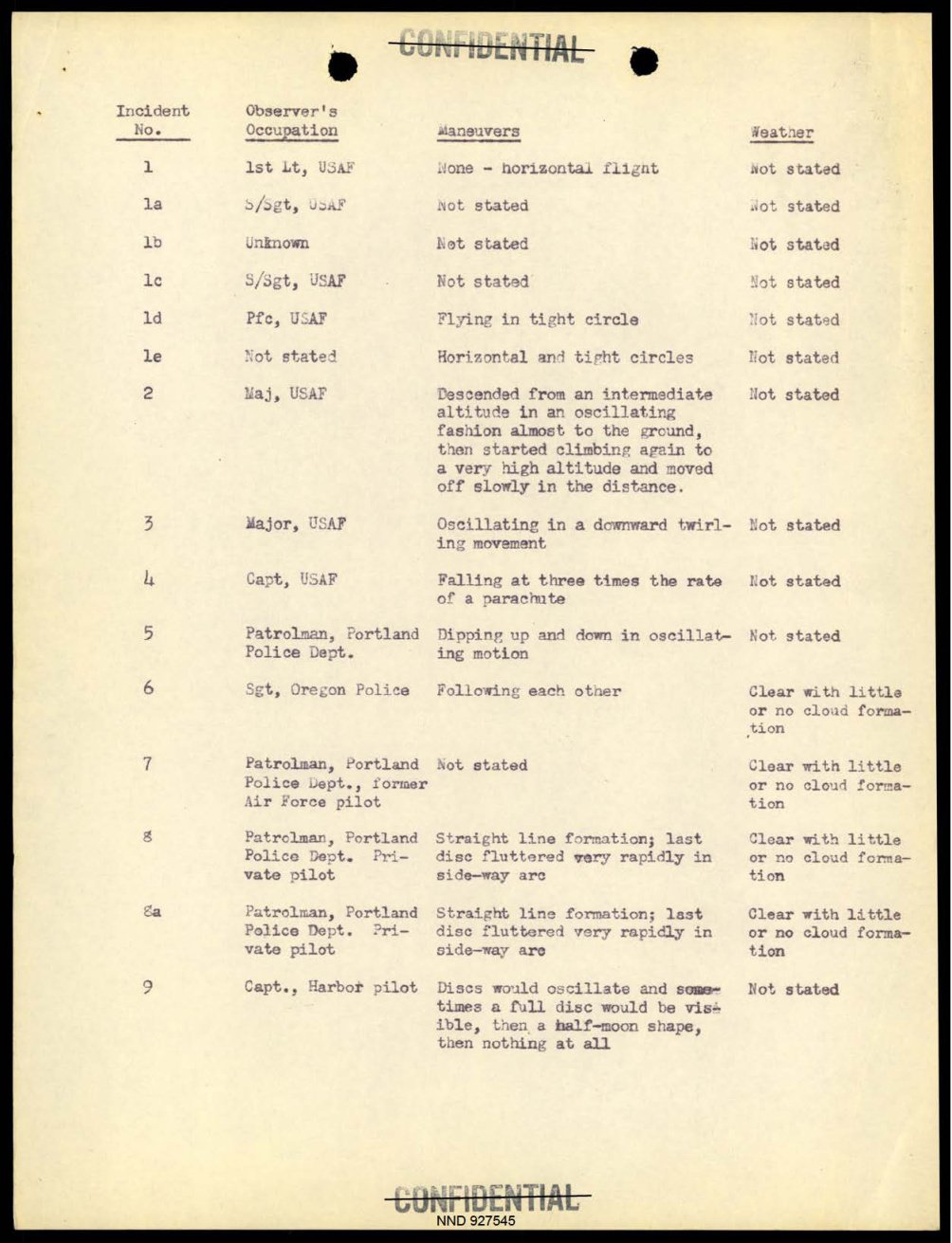
Enclosure 1, tabulation (part 2): incidents 1 to 9, observer's occupation, maneuvers and time, physical page 8 (full text)
Incident Observer'
•
s
No .
1
la
lb
le
l d
le
2
3
4
5
6
7
9
Occupation
1st Lt, UJAF
:,/::,gt, 0::i,v'
Uninown
s/sgt, USAF
Pfc, USAF
~fot stated
:Uaj, USAF
liajor, USAF
Capt, USAF
Patr olman, ?ortland
Police Dept.
Sgt, Oregon Police
Patr olman, Por tland
Police Dept., former
Air Force pilot
Patrolman, Portland
Police Dept. Private pilot
Patrolman, Portland
Police Dept . ?rivate pilot
Capt., Harbot pilot
Jo1aneuvers
1lone - horizontal fl1gnt
1"ot stated
t-:et stated
Not stated
Flying in tight circle
Horizontal anrl tipht circles
Descended from an intennediate
altitude in an oscillating
fashion almost to the ground,
then started climbing again to
a very high altitude and moved
off slowly in the distance.
Oscillating in a downward twirl- ing movement
Falling at three times the rate
of a parachute
Dippi nP, up and down in oscillat--
ing motion
Following each otner
Not stated
Str aight line formation; last
disc fluttered very rapidly in
side-way arc
Strai~ht line fonnation ; last
disc fluttered very rapidly in
side-way- are
Discs wo'.lld oscillat e and SOl11131-'
times a full disc would be vis~
ibl e, then a half-moon shape, t hen nothing at all
Heatner
IiOt stated
.,ot stated
l1 ot stated
~!ot stated
!fot stat'3d
!lot stated
Not stated
Not stated
?!ot stated
Not stated
Clear with little
or no cloud f ormation
Clear with little
or no cloud formation
Clear with little
or no cloud for.nation
Clear with little
or no cloud formation
Not stated
CUiqfiDE~~TIAL
NND 927545Editorial note: The ranks in the table do not all match the statements: Sergeant Ruvolo signed as technical sergeant (T/Sgt) and Sergeant Nauman as S/Sgt, while the table puts 'S/Sgt' in 1c and 'Pfc' (private first class) in 1d. The table uses 'USAF', the acronym of the Air Force created in September 1947, for service members who in July belonged to the Army Air Forces.
Check the original PDF
[CONFIDENTIAL, struck through] Incident No. / Observer's Occupation / Maneuvers / Weather:
1 | 1st Lt, USAF | None - horizontal flight | Not stated
1a | S/Sgt, USAF | Not stated | Not stated
1b | Unknown | Not stated | Not stated
1c | S/Sgt, USAF | Not stated | Not stated
1d | Pfc, USAF | Flying in tight circle | Not stated
1e | Not stated | Horizontal and tight circles | Not stated
2 | Maj, USAF | Descended from an intermediate altitude in an oscillating fashion almost to the ground, then started climbing again to a very high altitude and moved off slowly in the distance. | Not stated
3 | Major, USAF | Oscillating in a downward twirling movement | Not stated
4 | Capt, USAF | Falling at three times the rate of a parachute | Not stated
5 | Patrolman, Portland Police Dept. | Dipping up and down in oscillating motion | Not stated
6 | Sgt, Oregon Police | Following each other | Clear with little or no cloud formation
7 | Patrolman, Portland Police Dept., former Air Force pilot | Not stated | Clear with little or no cloud formation
8 | Patrolman, Portland Police Dept. Private pilot | Straight line formation; last disc fluttered very rapidly in side-way arc | Clear with little or no cloud formation
8a | Patrolman, Portland Police Dept. Private pilot | Straight line formation; last disc fluttered very rapidly in side-way arc | Clear with little or no cloud formation
9 | Capt., Harbor pilot | Discs would oscillate and sometimes a full disc would be visible, then a half-moon shape, then nothing at all | Not stated [NND 927545]View the document record ↗ · Physical page 8, counting the cover.
EXCERPT 9 · PHYSICAL PAGE 9
Enclosure 1, tabulation (part 2): incidents 10 to 30a, observer's occupation, maneuvers and time, physical page 9 (full text)
10
15
20
25
30
•
Incident ObaerTer' s
•oo Ocoupad.on Ka.neunra Weather
Capt, United Airlines Straight-away horizontal flight lot stated
ll
12
lS
14
16
17
18
19
21
22
23
24
26
27
28
29
30a
Coast Guard
Deputy Sheriff
!lot stated
Sot ste.ted
Jot stated
Mot stated
Private pilot
llot stated
Farmer
lot stated
lot stated
Wot stated
!lot stated
lot stated
Not stated
llecba.nic
TWA Representative
Lt Governor
ffest Coe.st Pilot.
7000 hrs.
Ca.pt. USAF. Asst
Operations Officer
VHF/DJ' Operator
Horizontal flight
Mot stated
Not stated
FUpping around
Not stated
Hot stated
Straight horizontal flight
Horizontal flight
Straight course - were flying
about a city block apart. one
behind the other
Straight course
Single file
Flashing
Horizontal flight
Shooting up and down
Hori&ontal flight
lot atated
llot stated
lot stated
Bot stated
Climbing and descending vertioally
Hovering, made three 3600
turns around one place. Moved
to another position and circled
more. Turns required 30-40 seo.
Diaaeter estimated at 2 miles.
Kot stated
Not stated
Bot stated
Mot stated
Iot stated
Mot stated
Clear as crystal
Clear
Cloudless and
sunny
lot stated
Rot stated
Bot stated
•ot stated
Clear
Bright moonlight
Not stated
Clear
Kot stated
lot stated
Solid overcast
Overcast. 1000 ft.Editorial note: "Lt Governor" was translated as lieutenant governor (Lieutenant Governor). "VHF/DF" is VHF direction finding. "Deputy Sheriff" appears as deputy sheriff.
Check the original PDF
[CONFIDENTIAL, struck through] Incident No. / Observer's Occupation / Maneuvers / Weather:
10 | Capt, United Airlines | Straight-away horizontal flight | Not stated
11 | Coast Guard | Horizontal flight | Not stated
12 | Deputy Sheriff | Not stated | Not stated
13 | Not stated | Not stated | Not stated
14 | Not stated | Flipping around | Not stated
15 | Not stated | Not stated | Not stated
16 | Not stated | Not stated | Not stated
17 | Private pilot | Straight horizontal flight | Clear as crystal
18 | Not stated | Horizontal flight | Clear
19 | Farmer | Straight course - were flying about a city block apart, one behind the other | Cloudless and sunny
20 | Not stated | Straight course | Not stated
21 | Not stated | Single file | Not stated
22 | Not stated | Flashing | Not stated
23 | Not stated | Horizontal flight | Not stated
24 | Not stated | Shooting up and down | Clear
25 | Not stated | Horizontal flight | Bright moonlight
26 | Mechanic | Not stated | Not stated
27 | TWA Representative | Not stated | Clear
28 | Lt Governor | Not stated | Not stated
29 | West Coast Pilot, 7000 hrs. | Not stated | Not stated
30 | Capt, USAF, Asst Operations Officer | Climbing and descending vertically | Solid overcast
30a | VHF/DF Operator | Hovering, made three 360° turns around one place. Moved to another position and circled more. Turns required 30-40 sec. Diameter estimated at 2 miles. | Overcast, 1000 ft. [NND 927545]View the document record ↗ · Physical page 9, counting the cover.
EXCERPT 10 · PHYSICAL PAGE 10
Enclosure 1, tabulation (part 2): incidents 30b to 40, observer's occupation, maneuvers and time, physical page 10 (full text)
Incident
loo
SOb
30o
32
33a
33c
33d
3:Sf
:S3g
34
35
36
37
38
39
40
- cor~FIDENTIAL
Observer's
Occupation Maneuvers
Traffic Air Controller Bobbing up and down
lot a~ated Climbing and de~oending
Profe11or and Bead Mone
or Aero Kn.gineering
Lt, USAP Bone
T/Sgt, USAF Jone
1,it.,Lt, USAF Bone
PFC lone
Capt, USA1 Kay have been turning
Capt, Us.Ar None
Col, Ky. State Police Kone
Capt, USAF (Plight Not stated
Leader •a 869)
Unknown Mot stated
Judge Bone
Second Officer.Wavy Mone
CAA Official Sot stated
Pilot Kone
Hungarian Peasants Not stated
Constable
Not stated Spiraled downward f'rom 5, 000
to 2,000 f't am then went
upward at a 450 angle
Weather
Overcast
High overcast
Clear
Overcast
High acattered olouds
Visibility unlimited.
High scattered
lfot stated
High overcast
with BIS
High ecattered,
vi ei bi lity unlimited
Clear
.Not stated
Not stated
Clear
!lot atated
Rot stated
Clear ..,-.'!
!lot stated
a.tVU. ~ d
Cumulus cloudsEditorial note: The number of incident 31 is typed over another number and reads "31". The code "BKS" in incident 33c and the identification "NG 869" in incident 33f follow the spelling of the document; BKS is an aviation abbreviation for broken clouds, but the document does not explain it. Lines 37 and 39 have "Not stated" partially obscured by overtyping.
Check the original PDF
[CONFIDENTIAL, struck through] Incident No. / Observer's Occupation / Maneuvers / Weather:
30b | Traffic Air Controller | Bobbing up and down | Overcast
30c | Not stated | Climbing and descending | High overcast
31 | Professor and Head of Aero Engineering | None | Clear
32 | Lt, USAF | None | Overcast
33 | T/Sgt, USAF | None | High scattered clouds
33a | 1st Lt, USAF | None | Visibility unlimited. High scattered
33b | PFC | None | Not stated
33c | Capt, USAF | May have been turning | High overcast with BKS
33d | Capt, USAF | None | High scattered, visibility unlimited
33e | Col, Ky. State Police | None | Clear
33f | Capt, USAF (Flight Leader NG 869) | Not stated | Not stated
33g | Unknown | Not stated | Not stated
34 | Judge | None | Clear
35 | Second Officer, Navy | None | Not stated
36 | CAA Official | Not stated | Not stated
37 | Pilot | None | Clear [overtyped: stated]
38 | Hungarian Peasants | Not stated | Not stated
39 | Constable | None | CAVU [overtyped: stated]
40 | Not stated | Spiraled downward from 5,000 to 2,000 ft and then went upward at a 45° angle | Cumulus clouds [NND 927545]View the document record ↗ · Physical page 10, counting the cover.
EXCERPT 11 · PHYSICAL PAGE 11
Enclosure 1, tabulation (part 2): incidents 41 to 56, observer's occupation, maneuvers and time, physical page 11 (full text)
(;J~iadJENTIAL 41 e
Ine14ent
lg,
1'1
Obaenv'•
QoogtS,on
Colonel. USU
•entuur•
. lot atated
42 ..jor, USU Jo\ atated
4, Bua Dl'"1"1" lone
"4 lot 1tated lone Jot ltated
IJ5 lot 1tated lot 1tated Jot atated
46 Wot 1tat.d lone Cloud Nnb.
~7 Captain, usu lolled frOII 11a. to lid• Jot ttate4
48 KaJor, USAJ uoerMlillg 1na deNen41na lot atawd
48a !/Bgt Up and down and 114• w lid• Cold and eleu Wi'll
t.. 11attffff 1101141.
Cpl. .lao•Ddtnc and 4eaoendbll r.t&bt aoattezaed
oloudl 1'11:la bait
tOIIU'dl S/1.
leeendina and deaoendiag ••'17
np'idl7
Clear nth onr•
eut 1Jl S/1.
48d
49
lot stated .. lot stated
laoendlng' and deaeendine
lone lot lbttd
50 En.1.ttlng deatan.er Approaohil!a llhON traa Ooean then
Pile and tall 1lovly. lot stated
51 Jot 1tated lot stated lot 1tawd
52 Capt, USU, ASS'!. Bon.aonal lett to ri&ht, ri&ht to
Opentiona ottieu 1•tt lib• cuard 1n an a1Pplane ~ inawuotor Pilot fOl'Mtian.
CltlP
52• lit Lt. 1n Air
Il•••ne• t01:1Mr
B-29 Pilot
SSll1lar to a ti&hter aiNNtta
aueu.•r• llben ue~
heaT1.eP 1h1p1.
lot stated
lit Lt, UW, Pilot Boruoul ftJl7 elon tCll'Mtim lot 1tated
Moaquito Pilot lot 1tat1d
G<JTernaent Bllplo1•• A)rupt 4atl Bieh toattered
oond1\1on Tie1\111'7
15 a.ilea.
'rNTel1ng in a detillt't1t are. lot 1tated
CONFIDENTIAL
NND 927545Editorial note: "Mosquito Pilot" was kept as Mosquito pilot, without the document clarifying whether it refers to the aircraft of the same name. "Knitting designer" appears as knitwear (knitting) designer. Incident 52 says the object moved "like a guard" (like an outrider or escort) in a formation.
Check the original PDF
[CONFIDENTIAL, struck through] Incident No. / Observer's Occupation / Maneuvers / Weather:
41 | Colonel, USAF | Not stated | Not stated
42 | Major, USAF | Not stated | Not stated
43 | Bus Driver | None | Not stated
44 | Not stated | None | Not stated
45 | Not stated | Not stated | Not stated
46 | Not stated | None | Cloud banks.
47 | Captain, USAF | Rolled from side to side | Not stated
48 | Major, USAF | Ascending and descending | Not stated
48a | T/Sgt | Up and down and side to side | Cold and clear with few scattered clouds.
48b | Cpl. | Ascending and descending | Light scattered clouds with haze towards S/W.
48c | S/Sgt | Ascending and descending very rapidly | Clear with overcast in S/W.
48d | Not stated | Ascending and descending | Clear to scattered.
49 | Not stated | None | Not stated
50 | Knitting designer | Approaching shore from Ocean then rise and fall slowly. | Not stated
51 | Not stated | Not stated | Not stated
52 | Capt, USAF, ASST. Operations Officer and instructor Pilot | Horizontal left to right, right to left like a guard in an airplane formation. | Clear
52a | 1st Lt. in Air Reserves former B-29 Pilot | Similar to a fighter aircrafts maneuvers when accompanying heavier ships. | Not stated
53 | 1st Lt, USAF, Pilot | Horizontal very close formation | Not stated
54 | Mosquito Pilot | Efficient controlled evasive action | Not stated
55 | Government Employee | Abrupt darts | High scattered condition visibility 15 miles.
56 | S/Sgt, USAF | Traveling in a definite arc. | Not stated [NND 927545]View the document record ↗ · Physical page 11, counting the cover.
EXCERPT 12 · PHYSICAL PAGE 12
Enclosure 1, tabulation (part 2): incidents 57 to 76, observer's occupation, maneuvers and time, physical page 12 (full text)
Incident Ol>aeryer's
-
110. Opomtion IM!¥I8 £1 Yt•Hitr
57 Bridge Corustruct1on Bot stated Clear and dark.
58 Chiet Pilot- Not atated lfot auted
Plying 1er-,1oe
59 Pilot Hone Rot stated
60 Storek:eepel" lot Stated Clear at duak
61 Kot stated lfone Wot stated
62 lot stated Not stated Cloudy
63 Hot stated BOYel"ing and fluttering, 1'1S1ng
and deecendtng.
Scattered aull
olouda,
64 Executive Direct- Hor11onal OnNalt
or ot Housing Authority.
65 P1lot lfot stated Not 1tated
66 Lt. Col, QSC
Sc1ent1t1c
Horizonal Pl1.g?\t lfot 1tated
Branch Research
Group.
67 Insurance Adjuster None Clear
68 Prospector Banking Cleu
69 Not stated Hot stated Not 1tated
70 Insurance Agent Not stated Clear
71 Capt. AC Reser-,es Not stated Clear
72 A1!S1 0tf1ce1' Not stated Cloud to1'118t1on
1oattered abOYe
10000 tt.
73 lavigator
(Conatellat1on
type ail"cNft)
Not stated 5/l.O acattered
cuaulus vith
tops at 10000,
Y111b111ty 10
a11H.
74 Prospector Standi.nc on edge and banking
1n the clouda.
Mot 1tated
75 Trout Parm Oper. Rode up and dovn oyer the hills
and hollow ot the canyon tloor.
Mot stated
County COlllliaaioner Hot stated Rot stated
It
NND 927545
76Editorial note: The document writes "Horizonal" (for horizontal) in incidents 64 and 66. "GSC" is the acronym for General Staff Corps; "AC Reserves" is the Air Corps Reserve. In "Storekeeper", the term covers stock clerk or shopkeeper; "Prospector" covers someone who searches for ores.
Check the original PDF
[CONFIDENTIAL, struck through] Incident No. / Observer's Occupation / Maneuvers / Weather:
57 | Bridge Construction | Not stated | Clear and dark.
58 | Chief Pilot-Flying service | Not stated | Not stated
59 | Pilot | None | Not stated
60 | Storekeeper | Not Stated | Clear at dusk
61 | Not stated | None | Not stated
62 | Not stated | Not stated | Cloudy
63 | Not stated | Hovering and fluttering, rising and descending. | Scattered small clouds.
64 | Executive Director of Housing Authority. | Horizonal | Overcast
65 | Pilot | Not stated | Not stated
66 | Lt. Col, GSC Scientific Branch Research Group. | Horizonal Flight | Not stated
67 | Insurance Adjuster | None | Clear
68 | Prospector | Banking | Clear
69 | Not stated | Not stated | Not stated
70 | Insurance Agent | Not stated | Clear
71 | Capt. AC Reserves | Not stated | Clear
72 | Army Officer | Not stated | Cloud formation scattered above 10000 ft.
73 | Navigator (Constellation type aircraft) | Not stated | 5/10 scattered cumulus with tops at 10000, visibility 10 miles.
74 | Prospector | Standing on edge and banking in the clouds. | Not stated
75 | Trout Farm Oper. | Rode up and down over the hills and hollows of the canyon floor. | Not stated
76 | County Commissioner | Not stated | Not stated [NND 927545]View the document record ↗ · Physical page 12, counting the cover.
EXCERPT 13 · PHYSICAL PAGE 13
Enclosure 1, tabulation (part 2): incidents 77 to 100, observer's occupation, maneuvers and time, physical page 13 (full text)
In.ctdent
Ko,
77
78
79
80
81
82
83
~
85
86
87
88
89
90
91
92
95
96
97
98
99
100
Ob erTer'•
Qo9upgt109
Astronomer
Lt, USI (P80 Pilot
Weather r-,o7tff
Lt. Col. USAP
C1T11 Service
bplo,ee
P1eld Bngtn,er
Pilot
Sign Painter
Pl'1Tate Pilot
Hot 1tated
U. S. Army
Not stated
Major, USAF
Administrative Asst,
Rocket Sonde Section
Captain
Railroad Employees
Capt, USAP
L~ Col, Hq, EPlf
C-47 orew
Bot stated
Airplane crew
Immigration Service
Not stated
lfot stated
Manemrp
Not stated
lot 1t1ted
Rot 1t1ted
Jot ltated
A1oendtng slowly
Bot stated
Slow roll or barrel
Cl1Jlb1ng
lot stated
'l'm"ned a corner and seemed
to roll.
Descended slowly and then
dropped in a spiral motion,
Not stated
dot stated
Not at~ted
Trave ling in zig-zag course
Climbing, diving and reversal
of direction whioh happened
enry few aeoonds.
Shooting toward, the eaat at
45° angle
Descending vertically - aeaned
to slow down on nearing the
earth
Not sta.ted
Bot stated
Not stated
Appeared to be spinning in
its descent
Bot atated
?lot stated
I L
NND 927545
J!eather
lot stated
lot tated
Clear
Scattered clouds
Y111b111t7 10-12 ailea.
lot stated
S<ae clouds
Clear...cattered cloud•
lot stated
Clear
~ot stated
Not stated
Clear
Clear
Cle ar alld 1unny
Not stated
•ot 1tated
Not stated
Not stated
tiot &tnted
lot stated
lot stated
Not ata.tedEditorial note: In incident 78 the parenthesis of "(P80 Pilot" is not closed in the original; the same applies to the translation. "EPW" in incident 94 follows the original, without expansion. "CAVU" is the aviation acronym for ceiling and visibility unlimited. In incidents 99 and 100 the lines are typed run together, with no space between them.
Check the original PDF
[CONFIDENTIAL, struck through] Incident No. / Observer's Occupation / Maneuvers / Weather:
77 | Astronomer | Not stated | Not stated
78 | Lt, USN (P80 Pilot | Not stated | Not stated
79 | Weather reporter | Not stated | Clear
80 | Lt. Col, USAF | Not stated | Scattered clouds visibility 10-12 miles.
81 | Civil Service Employee | Ascending slowly | Cloudy
82 | Field Engineer | Not stated | Not stated
83 | Pilot | Slow roll or barrel | Some clouds
84 | Sign Painter | Climbing | Clear-scattered clouds
85 | Private Pilot | Not stated | Not stated
86 | Not stated | Turned a corner and seemed to roll. | Clear
87 | U. S. Army | Descended slowly and then dropped in a spiral motion. | Not stated
88 | Not stated | Not stated | Not stated
89 | Major, USAF | Not stated | CAVU
90 | Administrative Asst, Rocket Sonde Section | Not stated | Clear
91 | Captain | Traveling in zig-zag course | Clear
92 | Railroad Employees | Climbing, diving and reversal of direction which happened every few seconds. | Clear and sunny
93 | Capt, USAF | Shooting towards the east at 45° angle | Not stated
94 | Lt Col, Hq, EPW | Descending vertically - seemed to slow down on nearing the earth | Not stated
95 | C-47 crew | Not stated | Not stated
96 | Not stated | Not stated | Not stated
97 | Airplane crew | Not stated | Not stated
98 | Immigration Service | Appeared to be spinning in its descent | Not stated
99 | Not stated | Not stated | Not stated
100 | Not stated | Not stated | Not stated [NND 927545]View the document record ↗ · Physical page 13, counting the cover.
EXCERPT 14 · PHYSICAL PAGE 14
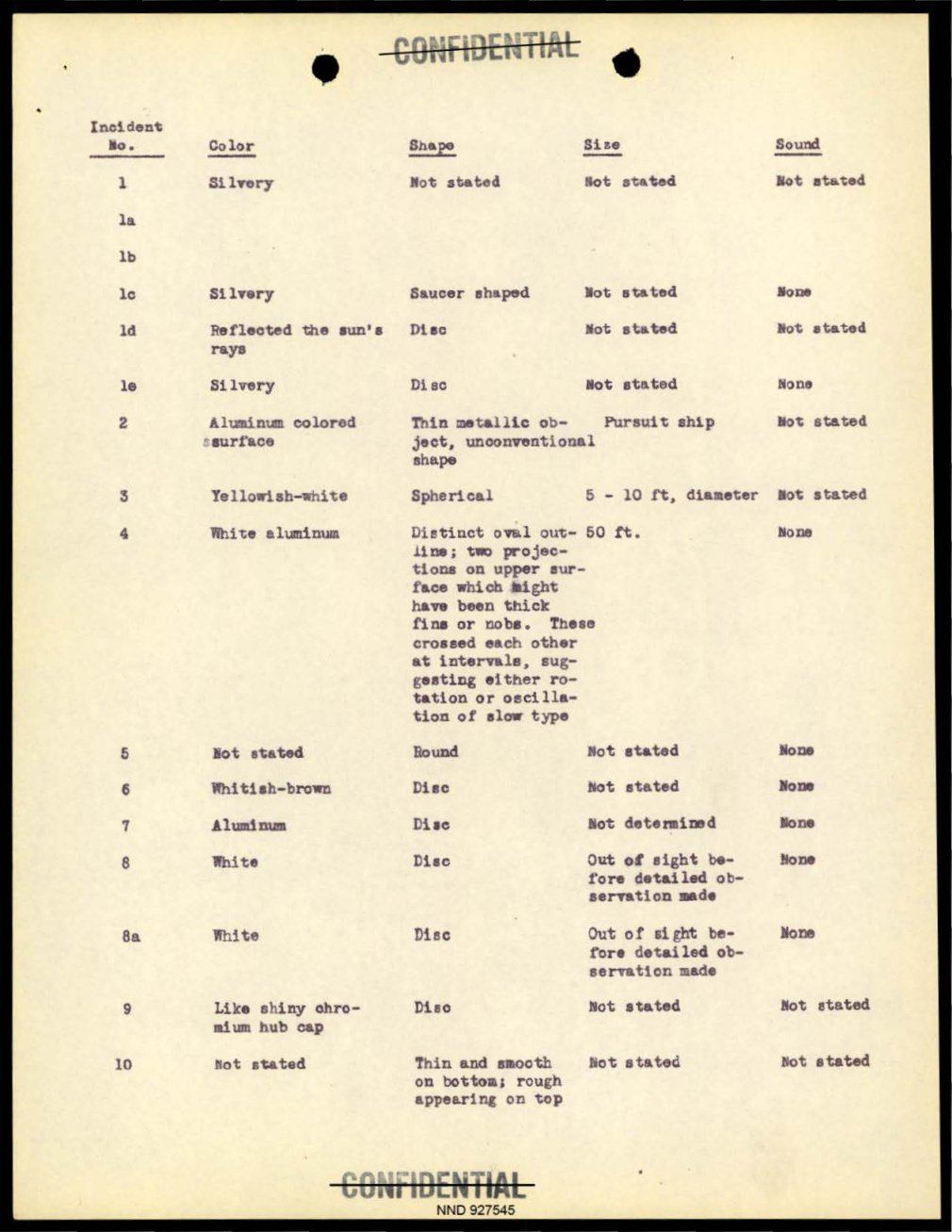
Enclosure 1, tabulation (part 3): incidents 1 to 10, color, shape, size and sound, physical page 14 (full text)
•
Incident
llo.
l
la
lb
lo
ld
le
2
s
4
5
6
7
8
Sa
9
10
Color
Silnr,-
S11Tery
Retleoted the •un'•
raya
Silvery
Ahai.num colored
1urface
Ye llowiab-llfhite
lihi'te aluminum
lot 1tated
1'h1tiah-brown
J.lumima
White
1'hite
Like shiny ohroaium hub cap
.bot 1tated
Shape Size
Not stated Not stated
Saucer shaped lot stated
Diac llot stated
Diec •ot stated
Thin metallic objeot, unconventi on
ah11pe
al
Purauit eh1p
Spherical 5 - 10 t't, dtaaeter
Dietinct oftl out- 50 tt.
J.1m; ta> projec- tiona on upper sur- face which llight
han been thick
fine or nob1. Tne,e
croaaed each other
at intervals, 1ugge1ting either rotation or oaci lla•
tion ot alow type
Round .Not 1tated
Diac Jllot atated
Di1e Mot determined
Dile Out ol light before det&iled obHrfttion •d•
Diec Out of 11 ght beror• detailed obaen-at1on made
Di,o Mot 1tated
Thin a.nd a.ooth Not stated
on bottoa, rough
appea.rinc on top
NND 927545
Sound
Mot atated
om
ltot atated
None
Mot stated
lot 1tated
.llom
Jllom
lone
!tone
Mone
!lot stated
Jot etatedEditorial note: 'nobs' is as in the original (for 'knobs', protrusions). The 50 feet of incident 4 repeat the record card; the statement on the back of the card compares the object to a 25-foot parachute canopy.
Check the original PDF
[CONFIDENTIAL, struck through] Incident No. / Color / Shape / Size / Sound:
1 | Silvery | Not stated | Not stated | Not stated
1a | | | |
1b | | | |
1c | Silvery | Saucer shaped | Not stated | None
1d | Reflected the sun's rays | Disc | Not stated | Not stated
1e | Silvery | Disc | Not stated | None
2 | Aluminum colored surface | Thin metallic object, unconventional shape | Pursuit ship | Not stated
3 | Yellowish-white | Spherical | 5 - 10 ft, diameter | Not stated
4 | White aluminum | Distinct oval outline; two projections on upper surface which might have been thick fins or nobs. These crossed each other at intervals, suggesting either rotation or oscillation of slow type | 50 ft. | None
5 | Not stated | Round | Not stated | None
6 | Whitish-brown | Disc | Not stated | None
7 | Aluminum | Disc | Not determined | None
8 | White | Disc | Out of sight before detailed observation made | None
8a | White | Disc | Out of sight before detailed observation made | None
9 | Like shiny chromium hub cap | Disc | Not stated | Not stated
10 | Not stated | Thin and smooth on bottom; rough appearing on top | Not stated | Not stated [NND 927545]View the document record ↗ · Physical page 14, counting the cover.
EXCERPT 15 · PHYSICAL PAGE 15
Enclosure 1, tabulation (part 3): incidents 11 to 30, color, shape, size and sound, physical page 15 (full text)
II~· ,DENTIAL
Inoident
llo.
11
12
13
lt
15
16
17
18
19
20
21
22
24
25
25
26
27
28
29
50
Color
ffbi t e
mot atated
Resembled •tallic
Lin a new di••
Sil•er
Not stated
ltirror brit ht
Jellow
Reflected the 1un
brilliantly
Silnr
Dirty 1'hite
Shiny d l nry
Bri ght and sil•ery
Gli&tened in av.n
Luminous
lot 1tated
Silvery
'
Not etated
!lot stated
White (.light)
Shape
Saucer
Like tlock ot
geese
llot 1tated
Like a nn dime
lilot atated
Approximately
circular. no tail
Like ci ga.ra -
11uch longer than
wide
Round
Betwe.n circle
nnd on.l - in
••rt•d aa.uc er
Slim body
Ral t-circle
Too far away to
dotenune ahe.pe
Plying saucer -
DO tail
lilot etated
Citoular in shape
like a wagon wheel
·eomet-11ke
Almo1t round
dot stated
NND 927545
She
Jlot stated
•ot stated
lot 1tated
Like .. run, di•
lot atated
Not stated
Diameter equal to
di atan ce between
outboard enginea
of DC 4:
llot st ated
Jlot atated
About 12 inches in
diameter
175-250 t't. dia:aeter
12 ft. t hiok
Quite large
Not atated
Too far away to
detenain. ahape
lot atated
Jiot sta'ted
Same apan •• C-54
at 10. 000 rt.
Not stated
lot stated
lot atated
Sound
~t stated
Low hmmdng
aound
l ot atated
lot etated
llot stated
lfot auted
lot atated
Not stated
Mom
Mone
Like electric
motor or dynmo
Not stat ed
lone
lot atated
lot atated
Wot stated
lot stated
!loneEditorial note: The number "25" appears twice in the column (once by itself, above the filled-in line). In incident 14, the description "Like a new dime" occupies the color, shape and size columns; a "dime" is the American ten-cent coin, about 18 mm. In incident 21 the size "175-250 ft. diameter 12 ft. thick" stays as written. The C-54 and the DC-4 are the same type of four-engine aircraft, used here as a size yardstick.
Check the original PDF
[CONFIDENTIAL, struck through] Incident No. / Color / Shape / Size / Sound:
11 | White | Saucer | Not stated | Not stated
12 | Not stated | Like flock of geese | Not stated | Low humming sound
13 | Resembled metallic | Not stated | Not stated | Not stated
14 | Like a new dime | Like a new dime | Like a new dime | Not stated
15 | Silver | Not stated | Not stated | Not stated
16 | Not stated | Disc | Not stated | Not stated
17 | Mirror bright | Approximately circular, no tail | Diameter equal to distance between outboard engines of DC 4 | Not stated
18 | Yellow | Ball | Not stated | Not stated
19 | Reflected the sun brilliantly | Like cigars - much longer than wide | Not stated | None
20 | Silver | Round | About 12 inches in diameter | None
21 | Dirty white | Between circle and oval - inverted saucer | 175-250 ft. diameter 12 ft. thick | Like electric motor or dynamo
22 | Shiny silvery | Slim body | Quite large | Not stated
23 | Bright and silvery | Half-circle | Not stated | Not stated
24 | Glistened in sun | Too far away to determine shape | Too far away to determine shape | None
25 | Luminous | Flying saucer - no tail | Not stated | Not stated
26 | Not stated | Not stated | Not stated | Not stated
27 | Silvery | Circular in shape like a wagon wheel | Same span as C-54 at 10,000 ft. | Not stated
28 | Not stated | Comet-like | Not stated | Not stated
29 | Not stated | Almost round | Not stated | Not stated
30 | White (light) | Not stated | Not stated | None [NND 927545]View the document record ↗ · Physical page 15, counting the cover.
EXCERPT 16 · PHYSICAL PAGE 16
Enclosure 1, tabulation (part 3): incidents 30a to 38, color, shape, size and sound, physical page 16 (full text)
vbV~r IDENTIAL
lnoident
No. Color Sha.pc Size Sound
30& Amber Round or oval C-47 airplane Jliono
!Ob Bright white to amber Cone-shaped. blunt
on top and tapering orr toward
bottom '
Rnonnou•
30c White lligbt) RoWlld Comparable 'to
way light
run- Bone
31 White Not stated lot stated ltone
52 Amber Mot stated tiot stated !lone
33 Sun flashes on metal
or metallic
Roughly circular At the distance and lone
altitude the object
appeared ~o be the
size of a11Ter dollar
ffll.1te or luminous.
·rurnod to be more
red aa the aun aet
Round teudi og to
be conical
Unknown - altitude
a.na distance too
great
Iona
~ot auted Cone.
red
topped with Jot stated lone
:53e Si lver with shadow Raindrop Unlcnown - believed
to be lar~
lJnJcnoa
53d 1'h1. te Round at time•
cone ~haped
- Uneert&in because
of distance
53e lfhi.te Round l/4: she full moon lone
33.f l(atallio Bot stated Tremendous
SSg "lfot stated Cone 100 ft. high.
43 .rt. acrose
!lone
Redish tinge Round Large gre.pef'ruit Ion•
35 Fire oolor Ball liot stated llot atatecl
36 )lot stated Bot stated Mot at&.ted Bot stated
38
Reddish with blue
background.. Black
with white baokground
SilTer
lot stated
Ball
S ft. from point of
view
.Not ate.ted
lone
Mot stated
NND 927545Editorial note: Spelling "Redish" kept as in the original. "Silver dollar" is the American silver dollar coin, about 38 mm. The color of incident 37 continues on the next line of the column.
Check the original PDF
[CONFIDENTIAL, struck through] Incident No. / Color / Shape / Size / Sound:
30a | Amber | Round or oval | C-47 airplane | None
30b | Bright white to amber | Cone-shaped, blunt on top and tapering off toward bottom | Enormous | None
30c | White (light) | Round | Comparable to runway light | None
31 | White | Not stated | Not stated | None
32 | Amber | Not stated | Not stated | None
33 | Sun flashes on metal or metallic | Roughly circular | At the distance and altitude the object appeared to be the size of silver dollar | None
33a | White or luminous. Turned to be more red as the sun set | Round tending to be conical | Unknown - altitude and distance too great | None
33b | Not stated | Cone, topped with red | Not stated | None
33c | Silver with shadow | Raindrop | Unknown - believed to be large | Unknown
33d | White | Round at times - cone shaped | Uncertain because of distance | None
33e | White | Round | 1/4 size full moon | None
33f | Metallic | Not stated | Tremendous | Not stated
33g | Not stated | Cone | 100 ft. high, 43 ft. across | None
34 | Redish tinge | Round | Large grapefruit | None
35 | Fire color | Ball | Not stated | Not stated
36 | Not stated | Not stated | Not stated | Not stated
37 | Reddish with blue background. Black with white background | Not stated | 3 ft. from point of view | None
38 | Silver | Ball | Not stated | Not stated [NND 927545]View the document record ↗ · Physical page 16, counting the cover.
EXCERPT 17 · PHYSICAL PAGE 17
Enclosure 1, tabulation (part 3): incidents 39 to 49, color, shape, size and sound, physical page 17 (full text)
GONfHltJ'TiAL
Incident
lo, 001or Shape ~ Soupd
39 Phosphoru1 Ba-shaped diaoa lot 1tated lot atate4
~o Gray El11pt1cal 20-,0 tt. Ho11e like Jet
airoratt prior
to 1ts appell" - .. No
audible sound
beai-d 11h11e
object va1 1n
Yiev.
Aluaim"- Round 3 tt. diameter lot atate4 "1
~2 OH.yilh Balloon 10 tt diaeter lot 1tate4
1'-3 Dirty 1'lite Between a o1.role IJ1d 12 tt thiolc and llectJ"ie Jlotor
an oval (ln-.erted 175-250 tt diameter ordynaao
sa~er)
44 lfot atat.d Jlyina Saueers Wot 1tated none
(not actually des- oribed as being
this shape)
lJ-5 Hot stated Rot stated Hot stated Bot stated
46 Silvery vh1te Round Small lot stated
47 No detin1te Bo detim.te shape C-51'. airplane lot deterained
oolor top due to the noise
ai(!e l"etleot- ot airplane.
ed 11ght.
lf.8 Red PllUli.ng Red cone Wot stated Rot stated
IJ.8a Bright light CirculU'-like a •tU' Ve17 lai-ge cOlll)U'ed Hone
ohangi.ne to 1n tbe ak7 only luga. to an aeroplane 11,;bt.
red then to
White OI" J"•llow
48b Red - ldltn Cone Hot detel'llintd Jot 1tated
descending
Red men IIO"fin8 lot atated Kot 1tated lot tated
then grean and
black to red.
lot stated lot 1tated 48d Yellow or tlame Rot 1tated
colored.
49 Not atated Pencil shaped ob3eot !lot tated lot stated
tEditorial note: Incident 43 (Clarion, Iowa) repeats the description of incident 21 (Des Moines, Iowa): same text for color, shape, size and sound; the tabulation does not say whether they are the same report. In incident 40 (the Phoenix photographs) the sound described is a jet-like noise before the appearance. The words "Flying Saucers (not actually described as being this shape)" are from the original.
Check the original PDF
[CONFIDENTIAL, struck through] Incident No. / Color / Shape / Size / Sound:
39 | Phosphorus | Egg-shaped discs | Not stated | Not stated
40 | Gray | Elliptical | 20-30 ft. | Noise like jet aircraft prior to its appearance. No audible sound heard while object was in view.
41 | Aluminum | Round | 3 ft. diameter | Not stated
42 | Grayish | Balloon | 10 ft diameter | Not stated
43 | Dirty white | Between a circle and an oval (Inverted saucer) | 12 ft thick and 175-250 ft diameter | Electric Motor or dynamo
44 | Not stated | Flying Saucers (not actually described as being this shape) | Not stated | None
45 | Not stated | Not stated | Not stated | Not stated
46 | Silvery white | Round | Small | Not stated
47 | No definite color top side reflected light. | No definite shape | C-54 airplane | Not determined due to the noise of airplane.
48 | Red | Flaming Red cone | Not stated | Not stated
48a | Bright light changing to red then to white or yellow | Circular-like a star in the sky only larger. | Very large compared to an aeroplane light. | None
48b | Red - when descending | Cone | Not determined | Not stated
48c | Red when moving then grean and black to red. | Not stated | Not stated | Not stated
48d | Yellow or flame colored. | Not stated | Not stated | Not stated
49 | Not stated | Pencil shaped object | Not stated | Not stated [NND 927545]View the document record ↗ · Physical page 17, counting the cover.
EXCERPT 18 · PHYSICAL PAGE 18
Enclosure 1, tabulation (part 3): incidents 50 to 67, color, shape, size and sound, physical page 18 (full text)
cot~FIDENTIAL
Incident
10. color Shape Si•e sound
50 Stated aa
queer 11.&ht.
Referred to aa aauoer
but not stated as being
ot thie detinite shape.
Kot stated Jfot atated
51 11lver Bomd Not stated •ot •tated
52 llhite. ah1Dy Circular like a ball
en the bott011 but not
completely round.
15-25 tt Diameter !lot atated
521 ilk mite Bot atated •ot stated lone
53 Whit. C1roular 36 inches diameter Rot stated
54 Rot atated Not etated Rot eta,ed Not stated
55 RecUab lot stated Bot atated None
56 Dia glow ot
light
Round 2 :tt. d1aaeter Hone
lfot stated Kot atated
58 Blaok Saucer (not det1n1tel7
1tated •• being tbia
shape)
Larger than C~4
airplane
Not stated
59 Incandescent
11Cht without
appreciable
blue and no
redd1eh tinae.
Hot stated Not atated Hot stated
60 Plame oolor Diec shaped (the 11'ter
glow •de 1t look like
a oone)
Barrel Bead, dinner
plate am the aise
ot a plane tl71,ng
hi&h.
Wot stated
61 White ancS
111Ullinated
Bot stated Sue ot Pigeons lfot 1tated
62 YelloV1ah
vhite
Bot stated 811811 Mot stated
Gleuaed and
Shialered
D1so (not actuall7
stated aa being ot
this shape)
, rt. a1aaeter and
ot no great th1ok•
neaa.
lot stated
64 Color 111111ar Kot stated
to eiectr1c 11.&ht.
lot stated Hot stated
65 lot ltated Bot stated 15 1nohea diaaeter lot stated
66 Bright onnge lot stated lot atated Hot stated
67 Jllutal col01" top 1urtaoe al1ghtly IJ.-6 tt 1n le~h ll'ot stated
57
h1ghl7 po111h- ournd-larger 1n front 4
ed chi-Ollium. than 1n the rear . :~e:O-l 1nchea liOMflDENTIAL
NND 927545Editorial note: In incident 60 the size is described by comparisons: barrel top, dinner plate and high-flying airplane. "Mutal" (incident 67) is a typing error in the original, probably for "metal". "Redish" in incident 55 is also as in the original.
Check the original PDF
[CONFIDENTIAL, struck through] Incident No. / Color / Shape / Size / Sound:
50 | Stated as queer light. | Referred to as saucer but not stated as being of this definite shape. | Not stated | Not stated
51 | Silver | Round | Not stated | Not stated
52 | White, shiny | Circular like a ball on the bottom but not completely round. | 15-25 ft Diameter | Not stated
52a | Milk white | Not stated | Not stated | None
53 | White | Circular | 36 inches diameter | Not stated
54 | Not stated | Not stated | Not stated | Not stated
55 | Redish | Not stated | Not stated | None
56 | Dim glow of light | Round | 2 ft. diameter | None
57 | Silver to Red | Not stated | Not stated | Not stated
58 | Black | Saucer (not definitely stated as being this shape) | Larger than C-54 airplane | Not stated
59 | Incandescent light without appreciable blue and no reddish tinge. | Not stated | Not stated | Not stated
60 | Flame color | Disc shaped (the after glow made it look like a cone) | Barrel Head, dinner plate and the size of a plane flying high. | Not stated
61 | White and illuminated | Not stated | Size of Pigeons | Not stated
62 | Yellowish white | Not stated | Small | Not stated
63 | Gleamed and Shimmered | Disc (not actually stated as being of this shape) | 3 ft. diameter and of no great thickness. | Not stated
64 | Color similar to electric light. | Not stated | Not stated | Not stated
65 | Not stated | Not stated | 15 inches diameter | Not stated
66 | Bright Orange | Not stated | Not stated | Not stated
67 | Mutal color highly polished chromium. | top surface slightly curved-larger in front than in the rear. | 4-6 ft in length and 10-14 inches wide. | Not stated [NND 927545]View the document record ↗ · Physical page 18, counting the cover.
EXCERPT 19 · PHYSICAL PAGE 19
Enclosure 1, tabulation (part 3): incidents 68 to 83, color, shape, size and sound, physical page 19 (full text)
•
flDENllAL e
Incident
68
ColOJ'
Hot stated
Shape
I
D1eo - appeare~
a tail.
to have
UU.
30 tt d1aaeter
sounc1
lone
69 White lot 1tated Not stated Bussing sound.
70 Not stated Giant til'e cracker Kot stated Bu11DI aound
not aa loud
aa a rocket
Ship.
71 Rot 1t1ted Hot 1t1ted lot atated Not stated
72 Silver Sphere( nt not like
1auoer or diac.
2·3 tt diameter Rot 1tated
Deep Gold 1111pt1oal 15 tt long 2·3 tt
1n length.
lot atated
74 Bot stated Tapered lbarpely to a
point in the tront end.
,o tt. diaaettr Hone
75 Slq blue Oblong like a broad rill
hat with a low crown.
20 tt. lona am
10 t,. thiolr.
Kade a
av1shiq sound.
76 Not stated Jot 1tated Hot stated Lite the eoho
ot • aotor.
77 Light colored Only oonerete evidence 50•100 tt lfide.
or tora appeared on the
lett tangent ot the group.
Loud roar
78 Light gray e1rou1ar 8 tt. diueter Bot tated
79 S1lftl' Bot atated Lu•er than a
Pibal balloon When
obaened through a
theodolite.
Not atated
80 Retleoted vh1te
light.
"Blob11 SMll ail"plane Hone
81 S11Yer
'
Large Balloon With silver Large d11c below it, no attaebing cables vere noticed.
lot etated
82 Proat7 ltbite Round and tlat Equal to b\11.k ot
6 eaob, B-29 air·
planes tdth dia ..
•t•r to tluomeas
ratio ot 10-1.
A 1l1gbt
mahing.
83 Black Round 'tVtnt,-.f'ive cent
piece.
lot atatedEditorial note: In incident 73 the size repeats "length" ("15 ft long 2-3 ft in length"), a probable typing error in the original. The parenthesis of "Sphere(" in incident 72 is not closed. "Pibal" is the pilot balloon used to measure winds; a theodolite is the instrument for measuring angles. In incident 81 the shape description also occupies the space of the size column, which reads "Large".
Check the original PDF
[CONFIDENTIAL, struck through] Incident No. / Color / Shape / Size / Sound:
68 | Not stated | Disc - appeared to have a tail. | 30 ft diameter | None
69 | White | Not stated | Not stated | Buzzing sound.
70 | Not stated | Giant fire cracker | Not stated | Buzzing sound not as loud as a rocket ship.
71 | Not stated | Not stated | Not stated | Not stated
72 | Silver | Sphere( was not like saucer or disc. | 2-3 ft diameter | Not stated
73 | Deep Gold | Elliptical | 15 ft long 2-3 ft in length. | Not stated
74 | Not stated | Tapered sharply to a point in the front end. | 30 ft. diameter | None
75 | Sky blue | Oblong like a broad rim hat with a low crown. | 20 ft. long and 10 ft. thick. | Made a swishing sound.
76 | Not stated | Not stated | Not stated | Like the echo of a motor.
77 | Light colored | Only concrete evidence of form appeared on the left tangent of the group. | 50-100 ft wide. | Loud roar
78 | Light gray | Circular | 8 ft. diameter | Not stated
79 | Silver | Not stated | Larger than a Pibal balloon when observed through a theodolite. | Not stated
80 | Reflected white light. | "Blob" | Small airplane | None
81 | Silver | Large Balloon with silver disc below it, no attaching cables were noticed. | Large | Not stated
82 | Frosty white | Round and flat | Equal to bulk of 6 each, B-29 airplanes with diameter to thickness ratio of 10-1. | A slight swishing.
83 | Black | Round | Twenty-five cent piece. | Not stated [NND 927545]View the document record ↗ · Physical page 19, counting the cover.
EXCERPT 20 · PHYSICAL PAGE 20
Enclosure 1, tabulation (part 3): incidents 84 to 100, color, shape, size and sound, physical page 20 (full text)
,.DENTIAL e
Incident
110,
84
color
Sb1Jm7
Ship,
Road lot ltated lore~ le11
SbJ-111.
85 Bot 1tated Reseabled the D5U•l. Jot 1tated lot 1tated
86 Not 1tated lot atate(! IOt ltated lot stated
87 JotS1t&ted Bot stated lot ata.ted lot atated
88 lot stated 1lying di ec (not aotual ly deaoribed aa
being ot thi• aha.pe)
)lot 1t1.ted lot atated
Ro\lDd di,o ahaped object 50-60 rt. diameter bot at&ted
Refleote4
light
Unitonn with no protuberano•• euoh •• wing•
of an airplane
Hot atatad Bot 1tt.t1d
Light lot atated Not stated looe
92 Silver lot ,tated S-11 lloli ata.ted
94
Bluish center Appeared to be a
·.rlth rod on
its edgH
!ot atatad lot 1tated
di10 Reaembled ~ shooting
at~r; however. ob- aervera not oertain
Not stated
Not etated
Not ,tated
95 Not stated Not stated Kot stated Bot stated
96 Not st:i.ted Hot etated Not stated Not atated
91 Flaah of
light
Kot atat•• Hot stated Hot atated
98 Bright light Ahaoat round or perhaps
oval or aauoer-ahaped
2ti-30 miles diametor lot etated
99 Shining Brightly ehining object
with long td1
lot atated Bot atated
100 Wot ,tated lot atated !lot stated
NND 927545Editorial note: The XF5U-1 was the U.S. Navy's experimental "Flying Flapjack" fighter prototype, of circular shape. On line 87 the first word has an "S" typed over it and was read as "not stated". The size of incident 98 is as in the original (26 to 30 miles in diameter).
Check the original PDF
[CONFIDENTIAL, struck through] Incident No. / Color / Shape / Size / Sound:
84 | Shinny | Round | Not stated | More or less Shrill.
85 | Not stated | Resembled the XF5U-1. | Not stated | Not stated
86 | Not stated | Not stated | Not stated | Not stated
87 | Not stated | Not stated | Not stated | Not stated
88 | Not stated | Flying disc (not actually described as being of this shape) | Not stated | Not stated
89 | Silvery | Round disc shaped object | 30-50 ft. diameter | Not stated
90 | Reflected light | Uniform with no protuberances such as wings of an airplane | Not stated | Not stated
91 | Light | Not stated | Not stated | None
92 | Silver | Not stated | Small | Not stated
93 | Bluish center with red on its edges | Appeared to be a disc | Resembled a shooting star; however, observers not certain | Not stated
94 | Not stated | Not stated | Not stated | Not stated
95 | Not stated | Not stated | Not stated | Not stated
96 | Not stated | Not stated | Not stated | Not stated
97 | Flash of light | Not stated | Not stated | Not stated
98 | Bright light | Almost round or perhaps oval or saucer-shaped | 26-30 miles diameter | Not stated
99 | Shining | Brightly shining object with long tail | Not stated | Not stated
100 | Shining | Not stated | Not stated | Not stated [NND 927545]View the document record ↗ · Physical page 20, counting the cover.
EXCERPT 21 · PHYSICAL PAGE 21
Enclosure 1, tabulation (part 4): incidents 1 to 11, exhaust trail, heading, altitude, speed and effect on clouds, physical page 21 (full text)
-COt~f\DENTlAL:- e -
Incident
No.
Exhaust
Trail Heading Altitude Ft. Speed lffect on Cloud•
l t:one 320° 1000-sooo rt. ~00 mph lot at&ted
la.
lb
le Not stated liorthwest 7500-8000 ft. ~50-400 mph Hot stated
ld f.ot stated northwest 7000-8000 f't. 300-400 mph tlot atatod
le tlot stated tiorthwest 6000 rt. 300-400 mph ~ot stated
2 tot stated Not at&ted From very near
the ground to
vory high
Not ste.tod llot atated
3 Not ata.ted frost to east 10000- 12000 rt. 200- 225 mph )lo-r; stated
4 Not stated North of due
east
Under 20000 ft . Slower than Hot stated
lllAXimUDl speed
or P- 80
5 Bot stated Two flying
aoutb - S
flying ea,t
Bo'\ stated.d Great speed lot atated
6 Not stated llorthweaterly Undetermined Terrifie lot stat.d
7 None Southweat 50000 fto Terrific -
faster than
any object
ever seen
by him
lot stat.cl
8
8a
9
RoneJlone
Not atated
South
South
S01..-th
40000 tt.
40000 rt.
High over
Globe Mille
Terrific
?errifio
Terrific
lot atated
Not ,tated
lot stated
10 !Jone Northwest llot stated Cruised for Not atated
46 min. at
oonventional
airline apeed
(180 mph) then
rapidly disappeared
11 Not stated OTer north end lot stated
ot Lake 1'o.shington
llot stated .ttoi; ata.ted
CG."f,DENTIAL NND 927545Editorial note: In incident 4, the table says 'North of due east', while the incident card in box 7 says 'slightly north of due west against prevailing wind'; the document does not explain the difference. In incident 1, the card gives 'Approx 8000 ft'; the range of 1.000 to 8.000 feet is from the table.
Check the original PDF
[CONFIDENTIAL, struck through] Incident No. / Exhaust Trail / Heading / Altitude Ft. / Speed / Effect on Clouds:
1 | None | 320° | 1000-8000 ft. | 300 mph | Not stated
1a | | | | |
1b | | | | |
1c | Not stated | Northwest | 7500-8000 ft. | 350-400 mph | Not stated
1d | Not stated | Northwest | 7000-8000 ft. | 300-400 mph | Not stated
1e | Not stated | Northwest | 8000 ft. | 300-400 mph | Not stated
2 | Not stated | Not stated | From very near the ground to very high | Not stated | Not stated
3 | Not stated | West to east | 10000-12000 ft. | 200-225 mph | Not stated
4 | Not stated | North of due east | Under 20000 ft. | Slower than maximum speed of P-80 | Not stated
5 | Not stated | Two flying south - 3 flying east | Not statedd | Great speed | Not stated
6 | Not stated | Northwesterly | Undetermined | Terrific | Not stated
7 | None | Southwest | 30000 ft. | Terrific - faster than any object ever seen by him | Not stated
8 | None- | South | 40000 ft. | Terrific | Not stated
8a | None | South | 40000 ft. | Terrific | Not stated
9 | Not stated | South | High over Globe Mills | Terrific | Not stated
10 | None | Northwest | Not stated | Cruised for 45 min. at conventional airline speed (180 mph) then rapidly disappeared | Not stated
11 | Not stated | Over north end of Lake Washington | Not stated | Not stated | Not stated [NND 927545]View the document record ↗ · Physical page 21, counting the cover.
EXCERPT 22 · PHYSICAL PAGE 22
Enclosure 1, tabulation (part 4): incidents 12 to 24, exhaust trail, heading, altitude, speed and effect on clouds, physical page 22 (full text)
Incident
Bo.
12
14
15
16
17
18
19
20
21
22
23
•
F1DENTIAl
E:xhauat
Trail
Wot atated
Bee.ding
Hot stated
.lltitude Ft.
Not atated
lot atated 3 west to
eaat. l north
Did not appear
Tery high
lot atated lot atated
Iot 1te.ted
lfot 1tated
l beaded
s outhea1t.
2 headed
north1a1t
.lot atated
High
lot 1tatad
lot ete.ted north to IOUth 9500 rt.
about 17<i'
Trail atreaa- aeenronr Jiot atated
1ng out be- weatend
him like of Toronto
vapor trail
'beh1m airplane on
misty day
Lim alight eat to east One 11.ile high
trace ot steam.
Disappeared
1m::nediat•ly.
Not atated Southwest About 1500 rt.
Rot stated ~.N.W. 1200 ft.
Bot stated S.W. ot S. 7000 tt.
Not stated !lot stated 5000 tt.
Cloud-lie 8outheut Very high
n.por - re- tained shape
a.nd persiated
tor onr an
hour
Spoed Effect on Cloud.a
lot •~d Hot at&t.<l
Tranlini BO
taat they
•ere out ot
llot ,te.ted
eight in eaat
in 2-4 aeoonda
JloT1ng slowly llot atat.d
onr aandy
dletr1ct
Sot atated lot atat.d
!tot atate4 llot atated
Not 1tated lot 1tated
Not stated Hot stated
Very taat Bot stated
Faat llot stated
About SOO lot atated
mph
Slower than lot atated
two-motored
U1lY plane
lfot ate.ted lot stated
Very tut Mot atat.d
\
NND 927545Editorial note: Incident 18 (Toronto) gives the trail description in the exhaust column and the location in the heading column. "S.W. of S." is transcribed as in the original, without expansion. "N.N.W." is north-northwest.
Check the original PDF
[CONFIDENTIAL, struck through] Incident No. / Exhaust Trail / Heading / Altitude Ft. / Speed / Effect on Clouds:
12 | Not stated | Not stated | Not stated | Not stated | Not stated
13 | Not stated | 3 west to east. 1 north | Did not appear very high | Traveling so fast they were out of sight in east in 2-4 seconds | Not stated
14 | Not stated | Not stated | Not stated | Moving slowly over sandy district | Not stated
15 | Not stated | 1 headed southeast. 2 headed northeast | High | Not stated | Not stated
16 | Not stated | Not stated | Not stated | Not stated | Not stated
17 | Not stated | north to south about 170° | 9500 ft. | Not stated | Not stated
18 | Trail streaming out behind like vapor trail behind airplane on misty day | Seen over westend of Toronto | Not stated | Not stated | Not stated
19 | Like slight trace of steam. Disappeared immediately. | West to east | One mile high | Very fast | Not stated
20 | Not stated | Southwest | About 1500 ft. | Fast | Not stated
21 | Not stated | N.N.W. | 1200 ft. | About 300 mph | Not stated
22 | Not stated | S.W. of S. | 7000 ft. | Slower than two-motored army plane | Not stated
23 | Not stated | Not stated | 3000 ft. | Not stated | Not stated
24 | Cloud-like vapor - retained shape and persisted for over an hour | Southeast | Very high | Very fast | Not stated [NND 927545]View the document record ↗ · Physical page 22, counting the cover.
EXCERPT 23 · PHYSICAL PAGE 23
Enclosure 1, tabulation (part 4): incidents 25 to 33b, exhaust trail, heading, altitude, speed and effect on clouds, physical page 23 (full text)
• CONFIDENTIAL e
Incident
Ho.
25
26
27
28
29
30
..'
S0b
300
SI
32
33
33a
B.xhaust
Trail Heading Altitude Ft.
Wot stated Bast High
Bluish-black Not sta.ted Bot stated
Bluish-black Not stated 10000 ft.
15 mi. long
Not stated Not stated Not stated
Not stated 10 flying High
north; on
reverse course
there were only 7
None (ap- West 3000
peared to
ha.ve bluish
streaks out
t'rom aides
Five times 1200 Prom .,ery near
length ot g?'Ound to 1000
object
Small streak 8.8.Wo
trailing object
Wot stated Kot atated di!teNn.~ al•
titudea ;
White., heavy West to eut 20000-50000 ft.
lone Stationary 3000 tt.
lone lone visible Unknolm
Jfone 210° from Extremely high
Godman Field
None Not stated Not stated
Speed Effect on Clouds
Fast Not stated
llot stated Cut a clear path
throup cloud•
Fast Seemed to out
0loud1 open
Did not
moveo
Seemed to
go below
horizon
Bot stated
with rotation
of earth
300-400 mph Bot ate.ted
Slow Bot stated
500 mph Jlot stated
rt. a,tter 1t
atartecl
to le&"ff
n.e1n1ty
bceeding Bot ate.ted.
600 aph
Jfotionlesa lot stated
~-~------ 600-~00 mph Bot 1ta1;ecl • •
Stat1anary "lone
nom n.aible Ione
Stationary !lone
Not stated Bot sta:t;ed
NND 927545Editorial note: The number of incident 31 is typed over another number. The speed of incident 31 uses the plus-or-minus sign (600 ± 200 mph). In incident 30 the opened parenthesis is not closed in the original. "S.S.W." is south-southwest.
Check the original PDF
[CONFIDENTIAL, struck through] Incident No. / Exhaust Trail / Heading / Altitude Ft. / Speed / Effect on Clouds:
25 | Not stated | East | High | Fast | Not stated
26 | Bluish-black | Not stated | Not stated | Not stated | Cut a clear path through clouds
27 | Bluish-black 15 mi. long | Not stated | 10000 ft. | Fast | Seemed to cut clouds open
28 | Not stated | Not stated | Not stated | Did not move. Seemed to go below horizon with rotation of earth | Not stated
29 | Not stated | 10 flying north; on reverse course there were only 7 | High | 300-400 mph | Not stated
30 | None (appeared to have bluish streaks out from sides | West | 3000 | Slow | Not stated
30a | Five times length of object | 120° | From very near ground to 1000 ft. | 500 mph after it started to leave vicinity | Not stated
30b | Small streak trailing object | S.S.W. | 2000-3000 ft. | Exceeding 500 mph | Not stated
30c | Not stated | Not stated | different altitudes | Motionless | Not stated
31 | White, heavy | West to east | 20000-50000 ft. | 600±200 mph | Not stated
32 | None | Stationary | 3000 ft. | Stationary | None
33 | None | None visible | Unknown | none visible | None
33a | None | 210° from Godman Field | Extremely high | Stationary | None
33b | None | Not stated | Not stated | Not stated | Not stated [NND 927545]View the document record ↗ · Physical page 23, counting the cover.
EXCERPT 24 · PHYSICAL PAGE 24
Enclosure 1, tabulation (part 4): incidents 33c to 48, exhaust trail, heading, altitude, speed and effect on clouds, physical page 24 (full text)
COhFIDENTIAL
.
. Ino14ent Ezhautt
-
Jo. Trf1l lta4w uutud• rt, Sptfd lf(n\ op Cln4f
)lot •••n Apptlll'ed to be Very h11b. Appeued lont
tat1onaJ7 . to 1M ''° 1tat1ozw-y.
?lont 210• t'Poa Uncei-tain- Stationary.Could be seen ''d GodMn Jld. ••PJ higb. throuab oi.ffU
,,. lone 210• t'Poa 25000 tt. Stationary.lone
Oodllan Pld .
,,r lot atated Approx. 210• 15000 tt. 500 IIPh lot atate4
frt• Oodllan Jld.
,,s Not tated Southw t ~ aile• lOJll)h lot atated
,4 llcmo , Vest to nat lot stated Speed ot a lcmt
aeteor ar
tallinC atar.
IOJ"tbwaterl7 Rot atated 700-900 IIPh lot atated ,5 81.N• ot
tire.
lortbeaat lot atated Jot atated ,6 lot atated Jot atated
,1 lot 1tated lortheut aooo-10000 tt. 350111'h lot tated
JIOt stated lot tated lot 1t1t.d ,e lot 1tated lfa,t stated
Ion• Bait ,0000 tt. V0'7 ta1t lot 1tated 39
40 Kot 1tated Appeared troa 5000 tt. ~0-600 aph lot 1tated
nOJ'tbeaat.
41 Jot atated South lot 1tated Great lot 1tated
lOOaph lot 1tated 42 lot ,tated Borihweat 1500
4, lot 1tated 11rat group 1200 ,oo mph Jot 1tat14
S S/£, 8HOnd
group 1/V.
lot 1tated South lot 1tat1d hat lot 1tate4 44
lot atat•d lot 1tatecS Jot stated lot stated lot stat•d 45
, ••tel" lot 1tated Jot stated lortbwtatff1,1 1000 46 than an air•
plane.
10000 J'uter 11ml lot 1tate4 IJ7 Jot etated 80'1thfllterl7
•ftT aiNratt
h• ba4 rnr
•••n.
Ga1eous Gained an~ lot stated green 5/V llhtn 1t Mot stated
101t alt1t• a11t. lett the
'f'101D.1t7 • NND 927545 udt at a
te1"1"1t1o nte. 60111 1uENTIALEditorial note: In incident 33c the heading and speed columns contain the same phrase (seemed to be stationary). "Fld." is an abbreviation of Field (airfield). "S S/E" and "N/W" in incident 43 and "S/W" in 48 follow the abbreviations of the original. The unit of the altitudes of incidents 42, 43, 46 and 47 is not written on the line; the column is in feet.
Check the original PDF
[CONFIDENTIAL, struck through] Incident No. / Exhaust Trail / Heading / Altitude Ft. / Speed / Effect on Clouds:
33c | Not seen | Appeared to be stationary. | Very high. | Appeared to be stationary. | None
33d | None | 210° from Godman Fld. | Uncertain-very high. | Stationary. | Could be seen through cirrus
33e | None | 210° from Godman Fld. | 25000 ft. | Stationary. | None
33f | Not stated | Approx. 210° from Godman Fld. | 15000 ft. | 500 mph | Not stated
33g | Not stated | Southwest | 4 miles | 10 mph | Not stated
34 | None | West to east | Not stated | Speed of a meteor or falling star. | None
35 | Stream of fire. | Northwesterly | Not stated | 700-900 mph | Not stated
36 | Not stated | Northeast | Not stated | Not stated | Not stated
37 | Not stated | Northeast | 8000-10000 ft. | 350 mph | Not stated
38 | Not stated | Not stated | Not stated | Not stated | Not stated
39 | None | East | 30000 ft. | Very fast | Not stated
40 | Not stated | Appeared from northeast. | 5000 ft. | 400-600 mph | Not stated
41 | Not stated | South | Not stated | Great | Not stated
42 | Not stated | Northwest | 1500 | 100 mph | Not stated
43 | Not stated | First group S S/E, second group N/W. | 1200 | 300 mph | Not stated
44 | Not stated | South | Not stated | Fast | Not stated
45 | Not stated | Not stated | Not stated | Not stated | Not stated
46 | Not stated | Northwesterly | 1000 | Faster than an airplane. | Not stated
47 | Not stated | Southwesterly | 10000 | Faster than any aircraft he had ever seen. | Not stated
48 | Gaseous green mist. | S/W when it left the vicinity. | Not stated | Gained and lost altitude at a terrific rate. | Not stated [NND 927545]View the document record ↗ · Physical page 24, counting the cover.
EXCERPT 25 · PHYSICAL PAGE 25
Enclosure 1, tabulation (part 4): incidents 48a to 56, exhaust trail, heading, altitude, speed and effect on clouds, physical page 25 (full text)
n
u NTIAL
?no1dent
10,
Exhauat
n:,11 leaflN Att1\Jde Pt. Spefd Btteot on ClOlldl
4aa ver, tatnt S/1 llhen 1t lett
emaut trail the Y1t1n1tJ.
llben 1IO'fing.
lot 1tate4 Lett Jfot stated
T10in1t)'
at nr,
h1gb 1peed.
Gl'eenlah
111st 1hen
deaoending.
S/W ldlen it lttt
the TlO1n1ty.
lot 1tated lot stated Not stated
lot 1tatect 210 degree, lllben
1 t lett the Tic - 1.nity.
15000-20000 lot stated Hot stated
~d lone Approxblately 1l'011 4000 to
due nat lalen 1t Ter1 hi&b.
lett the T1o1n1ty.
Slow Not stated
49 Lon, trail
ot Doke.
Vest Very hi&h lot atated lot stated
50 Kot stated Shor•wrd Rot atated but
•aid to be
quite close.
Slov until Bot stated
OTer land
then higher
speed lfbile
leaving.
51 Hot atated lot 1tated High Hot stated l ot stated
52 Bone Soutbnrd
;
8000-10000 JCade a P-80 Hot stated
look llke 1t
wu motionleH 1n the
air.
52& Wot stated 120• 6000 Approxiaate- Not stated
lT 150 aph.
53 Bot stated 120• 6000 285 aph. Not stated
5~ Bot 1tatecS Borth Sea to
lortolk
22000 Equal to Not stated
or greater
than • Brit- 1ab Mosquito .
55 lot 1tated DE 10000 Rip yel• Not tated
oc1t7• 1tated
to be taster
than conyent- 1onal airplane.
56 •ot lt&ted Soutb saat 2000 tt 500-600 mph.Mot atated
CONF1
DENTIAL
NND 927545Editorial note: Incident 54 compares the speed to that of a British Mosquito, the de Havilland wooden twin-engine aircraft, which confirms that "Mosquito Pilot" (page 11) refers to a pilot of that aircraft. Incidents 52a and 53 give very different speeds (750 and 285 mph) with the same heading and altitude, as in the original.
Check the original PDF
[CONFIDENTIAL, struck through] Incident No. / Exhaust Trail / Heading / Altitude Ft. / Speed / Effect on Clouds:
48a | Very faint exhaust trail when moving. | S/W when it left the vicinity. | Not stated | Left vicinity at very high speed. | Not stated
48b | Greenish mist when descending. | S/W when it left the vicinity. | Not stated | Not stated | Not stated
48c | Not stated | 210 degrees when it left the vicinity. | 15000-20000 | Not stated | Not stated
48d | None | Approximately due west when it left the vicinity. | From 4000 to very high. | Slow | Not stated
49 | Long trail of smoke. | West | Very high | Not stated | Not stated
50 | Not stated | Shoreward | Not stated but said to be quite close. | Slow until over land then higher speed while leaving. | Not stated
51 | Not stated | Not stated | High | Not stated | Not stated
52 | None | Southward | 8000-10000 | Made a P-80 look like it was motionless in the air. | Not stated
52a | Not stated | 120° | 6000 | Approximately 750 mph. | Not stated
53 | Not stated | 120° | 6000 | 285 mph. | Not stated
54 | Not stated | North Sea to Norfolk | 22000 | Equal to or greater than a British Mosquito. | Not stated
55 | Not stated | NNE | 10000 | High velocity, stated to be faster than conventional airplane. | Not stated
56 | Not stated | South East | 2000 ft | 500-600 mph. | Not stated [NND 927545]View the document record ↗ · Physical page 25, counting the cover.
EXCERPT 26 · PHYSICAL PAGE 26
Enclosure 1, tabulation (part 4): incidents 57 to 71, exhaust trail, heading, altitude, speed and effect on clouds, physical page 26 (full text)
»ioldent
lo,
57
58
59
60
61
62
64
65
66
67
68
69
70
71
rlDENTIAL • CO~
Bxbauat
m11 lltfflPI il\1'1\4• ,t.
lo\ 1tated DZ <,o• I ot ,o• ott the
true IOJ'th on llor1son at
bor1.Sonal plane. an ••t1111ted
1,A 1111• rap.
lot 1tattd 1/W 1000
9500-10000 lot attted ,50- later
ohaJll•d to 1or.
Liabt tlae JPrca 1/1 bead- 6000
oolor. 1DI Eutwrd.
2000-,000 lot 1tated lorthern
Jot atattd &e-nral lot atated thOUlud tt.
lot 1tattd lortheaaterly 3000
Jot 1tated lortbeaaterly lot atated
lot atattd Weit to la1t 1000
Lone atl'a - lorth to South Low
tsht '4\itt
1treak 11.llilar to th•
1treak left
by• traoer
bullet.
White bail lot 1tattd 500-1000
of Okt.
Wot 1tated Southea1terl1 6000
Thin 1treaJc South lot 1tateO
of gl"e7ill\
color.
Bi 1000-,000 tber 1aokt 1B to SV
or condeneat1on laatSAI 2 1eoonda.
Jilt)' hav• Southeaat then wot atated
been IIIOkt t\ll"Jled and vnt
or npor net.
tr• 1nttnae NND 927545
ltt1s\ on 212'94•
Jli,tl .el.. lot 1tated
001t7, 1tawd toM
taatu t:bUl
• tnoer
\,ullet.
510 apb. lot 1tattd
1000 lmota lot atat.4
raster than 1'0t 1tated
,ua,.
Jl1&b rate lot 1tated
of 1peed.
TrandOUI Jot stated
Speed.
terr1tlo Jot 1tattc1
1000•120011>h lot stated
Required ,-4 lot 1tattd
1econd1 to
tnffl 70•
an.
Tnr1tlo lot 1tated
lot 1tated lot 1tattd
Vff"f t11t. lot stated
a.oo,oo 1ot 1tated
7ooteoo lot stated
i,eed WI
aiaoet wit•.Editorial note: In incident 57 the "Altitude" column gives an angle above the horizon and an estimated distance, not an altitude in feet. "Horizonal" (for horizontal) and the opened, unclosed parenthesis are from the original. In incident 71 the speed is typed with overtyping ("7000800") and was read as 700 to 800. Incident 59 gives the speed in knots (1.000 knots, about 1.850 km/h), a different unit from the other lines, which use miles per hour.
Check the original PDF
[CONFIDENTIAL, struck through] Incident No. / Exhaust Trail / Heading / Altitude Ft. / Speed / Effect on Clouds:
57 | Not stated | NNE (30° E of true North on horizonal plane. | 30° off the horizon at an estimated 1/4 mile range. | High velocity, stated to be faster than a tracer bullet. | Not stated
58 | Not stated | N/W | 1000 | 510 mph. | Not stated
59 | Not stated | 350° later changed to 109°. | 9500-10000 | 1000 knots | Not stated
60 | Light flame color. | From N/W heading Eastward. | 6000 | Very high velocity. | Not stated
61 | Not stated | Northern | 2000-3000 | Faster than birds. | Not stated
62 | Not stated | Not stated | Several thousand ft. | High rate of speed. | Not stated
63 | Not stated | Northeasterly | 3000 | Tremendous Speed. | Not stated
64 | Not stated | Northeasterly | Not stated | Terrific | Not stated
65 | Not stated | West to East | 1000 | 1000-1200 mph | Not stated
66 | Long straight white streak similar to the streak left by a tracer bullet. | North to South | Low | Required 3-4 seconds to travel 70° arc. | Not stated
67 | White trail of smoke. | Not stated | 500-1000 | Terrific | Not stated
68 | Not stated | Southeasterly | 6000 | Not stated | Not stated
69 | Thin streak of greyish color. | South | Not stated | Very fast. | Not stated
70 | Either smoke or condensation lasting 2 seconds. | NE to SW | 1000-3000 | 400-500 | Not stated
71 | May have been smoke or vapor from intense speed, was almost white. | Southeast then turned and went west. | Not stated | 700-800 (digitação sobreposta, "7000800") | Not stated [NND 927545]View the document record ↗ · Physical page 26, counting the cover.
EXCERPT 27 · PHYSICAL PAGE 27
Enclosure 1, tabulation (part 4): incidents 72 to 89, exhaust trail, heading, altitude, speed and effect on clouds, physical page 27 (full text)
Incident
lo.
llxhauat
ffiil
-
Bgd1ng
~hr r~eE·~flAl: iiUuii i i
41t1t1»4e Pt,
•
Sp••4 Vtftt op Qlouf•
72 Iona South Below 10000 'flteaendou Jot 1tated
1, lone Ba1terl7
approxillatel1
110• -,netio.
7000 175 IIPh Rot 1tated
lot stated •ot 1tated Jlot tated Oreata
thd&ft7•
thm, n•r
Witneaaed.
75 lone Baat to wet 75 lot ,tated loi atated
76 lot stated Bot 1tated 4000-6000 lot atated Jot stated
77 lot stated Jfortihwat(Trut) •ot stated 600-1200 lot •ta'-4
78 lot stated 8va1&ht down. Deorna1Jlg tr•
approi111atelJ
25000.
Inaono~nblt lot stated
79 Jot atated Batt to lfe1t LIii t.ban 15000 Jot atated Kot 1tated
80 Jone southeast Lesa than 500 CCIIIPUttd at ·1:550 IIPh,
hOWffJI IP•
pelNd to
aOTe "1th
tbt speed
ot • Jet
11.Jlcntt.
lot atawd
81 lot stated • ortlnreat 6000 lot stated Bot stated
82 lone ,5t• 10000-18000 Tbree t1M1 lot 1tated
that ot a
Jet atrontt.
8:5 lot 1tated lot atated 11000 lot stated lot atated
84 lot atate4 lortbeaat 7500 lot atahd lot 1tated
85 Bot atated Borth 8500 35011Ph lot atated
86 Jfot etated IOJ1thard lot stated lot 1tated Rot atated
87 lot stated Not etated trom 6000 lot stated lot atated
88 lot stated lot 1tated 200 yards 110vhig ra,-
?idly
liot stated
89 llot etated Eaet 11000 210 mph JIJot stated
NND 927545
CONFIDENTIALEditorial note: The altitude of incident 88 is in yards (200 yards, about 180 m), different from the other lines, in feet; incident 80 gives a calculated speed of 1.350 mph (about 2.170 km/h) and, beside it, the remark that the object seemed to move like a jet. The altitude of incident 75 (75) follows the original, without a unit.
Check the original PDF
[CONFIDENTIAL, struck through] Incident No. / Exhaust Trail / Heading / Altitude Ft. / Speed / Effect on Clouds:
72 | None | South | Below 10000 | Tremendous | Not stated
73 | None | Easterly approximately 110° magnetic. | 7000 | 175 mph | Not stated
74 | Not stated | Not stated | Not stated | Greater than anything ever witnessed. | Not Stated
75 | None | East to west | 75 | Not stated | Not stated
76 | Not stated | Not stated | 4000-6000 | Not stated | Not stated
77 | Not stated | Northwest(True) | Not stated | 600-1200 | Not stated
78 | Not stated | Straight down. | Decreasing from approximately 25000. | Inconceivable | Not stated
79 | Not stated | East to West | Less than 15000 | Not stated | Not stated
80 | None | Southeast | Less than 500 | Computed at 1350 mph, however appeared to move with the speed of a jet aircraft. | Not stated
81 | Not stated | Northwest | 6000 | Not stated | Not stated
82 | None | 350° | 10000-18000 | Three times that of a jet aircraft. | Not stated
83 | Not stated | Not stated | 11000 | Not stated | Not stated
84 | Not stated | Northeast | 7500 | Not stated | Not stated
85 | Not stated | North | 8500 | 350 mph | Not stated
86 | Not stated | Northward | Not stated | Not stated | Not stated
87 | Not stated | Not stated | from 5000 | Not stated | Not stated
88 | Not stated | Not stated | 200 yards | moving rapidly | Not stated
89 | Not stated | East | 11000 | 210 mph | Not stated [NND 927545]View the document record ↗ · Physical page 27, counting the cover.
EXCERPT 28 · PHYSICAL PAGE 28
Enclosure 1, tabulation (part 4): incidents 90 to 100, exhaust trail, heading, altitude, speed and effect on clouds, physical page 28 (full text)
11JcnTIAl
Incident Bxh&uat
lo. Trail Beading lltitude Ft. Speed Ureot on Cloud•
90 One w1tneH lor'therly 8000-10000 lot atated lot atated
thought be
eaw Tapor
traile
91 lot stated Diaappeared Great height High rate lot atated
in the aoutb- ot apeed
weat
Jlot stated W.at Abon 1000 Oreat a pffd lot • tated
Dropped troa Iot atated Ver, high lot atatecl
sight on north Telooity
aide of •t.
Tom near
Holyoke. MaH.
Green and Deaoending Ter- Prom lSOOO 'fery high liot atated
blue tleaea tioally rate ot
apeed
95 Se..-eral color• Saatwa.rd Very high Jlot atated
ot r1..... - rate or
red and green apeed
predominating
96 lot stated Bot stated 1200-1500 lot atated Hot atatecl
97 Wot stated 1'ot atated Mot stated !lot etated Mot atated
98 lot stated Jlot atated lot at&ted lot atated lot stated
99 Mot atated lreat to eaat tilot stated lot stated llot atated
100 Grey streaks Borth to aouth lot atated .llot stated lot atated
were left in
eky
..
NND 927545Editorial note: Last sheet of the tabulation. The location of incident 93 in the first part of the table (physical page 7) is Hartford, Connecticut, and here the heading cites Mount Tom, near Holyoke, in Massachusetts; the document does not explain the difference.
Check the original PDF
[CONFIDENTIAL, struck through] Incident No. / Exhaust Trail / Heading / Altitude Ft. / Speed / Effect on Clouds:
90 | One witness thought he saw vapor trails | Northerly | 8000-10000 | Not stated | Not stated
91 | Not stated | Disappeared in the southwest | Great height | High rate of speed | Not stated
92 | Not stated | West | Above 1000 | Great speed | Not stated
93 | None | Dropped from sight on north side of Mt. Tom near Holyoke, Mass. | Not stated | Very high velocity | Not stated
94 | Green and blue flames | Descending vertically | From 13000 | Very high rate of speed | Not stated
95 | Several colors of flames - red and green predominating | Eastward | Low | Very high rate of speed | Not stated
96 | Not stated | Not stated | 1200-1300 | Not stated | Not stated
97 | Not stated | Not stated | Not stated | Not stated | Not stated
98 | Not stated | Not stated | Not stated | Not stated | Not stated
99 | Not stated | West to east | Not stated | Not stated | Not stated
100 | Grey streaks were left in sky | North to south | Not stated | Not stated | Not stated [NND 927545]View the document record ↗ · Physical page 28, counting the cover.
EXCERPT 29 · PHYSICAL PAGE 29
Enclosure 1, sheet of notes on incidents 18 and 84, physical page 29 (full text)
lfOtE: Inc1dent f 18
It has now been d•tinit•ly determined that both tho photograph
and story were t. hou:, perpetrated tor publioity e.nd aooey.
Incident #8•
The peraon malting t he report on thil 1nc1deat was detsrainod to
be &n excitable person, ••r/ talkt.tive, and poaseaaing a.n exaggerated.. iugination and 1nol1ned to iJlpreaa people with his
continuous uhatter.
NND 927545Editorial note: The previous note on the same sheet deals with incident 18 and is already translated in the Project Sign report dossier. The judgment is the project's; the sheet does not include the evidence on which it is based.
Check the original PDF
[CONFIDENTIAL, struck through] NOTE: Incident #18. It has now been definitely determined that both the photograph and story were a hoax, perpetrated for publicity and money. Incident #84. The person making the report on this incident was determined to be an excitable person, very talkative, and possessing an exaggerated imagination and inclined to impress people with his continuous chatter. [CONFIDENTIAL, struck through] [NND 927545]View the document record ↗ · Physical page 29, counting the cover.
EXCERPT 30 · PHYSICAL PAGE 30
Enclosure 1, diagram "Reported flight directions", physical page 30 (full text)
CONFIDENTIAL
REPORTED DIRECTIOIS OF PLIGHT
D
5 I
Circling 16
Straight down 5
Directi on Indefinite 64
Direction lot Stated 61
2Z
34
s
• 1'he re an undetermined number ot objecta ware reported the minimum number
of object& are plottedo Same object
reported by di!'terent p,ople only
shown oncto
NND 927545
CONFIDENTIALEditorial note: Eight-pointed star diagram, with hatched arrows whose length follows the counts. The cardinal points are in English in the original (N, NE, E, SE, S, SW, W, NW); the translation uses the same English abbreviations.
Check the original PDF
[CONFIDENTIAL, struck through] REPORTED DIRECTIONS OF FLIGHT. Points of the compass with counts: N 38; NE 9; E 22; SE 22; S 34; SW 14; W 5; NW 63. Circling 15. Straight down 3. Direction Indefinite 64. Direction Not Stated 61. Where an undetermined number of objects were reported the minimum number of objects are plotted. Same object reported by different people only shown once. [CONFIDENTIAL, struck through] [NND 927545]View the document record ↗ · Physical page 30, counting the cover.
EXCERPT 31 · PHYSICAL PAGE 31
Enclosure 2, photographic enlargement of incident 40, physical page 31 (only written information)
,
NND 927545Editorial note: The sheet contains only the photographic enlargement, with a small framed copy of the original photograph in the lower right corner. There is no printed caption. The command's assessment of this image is on page 33 (enclosure 4).
Check the original PDF
[CONFIDENTIAL, struck through] [handwritten, bottom left:] Inc 2 [CONFIDENTIAL, struck through] [NND 927545]View the document record ↗ · Physical page 31, counting the cover.
EXCERPT 32 · PHYSICAL PAGE 33
Enclosure 4, assessment dated 19/02/1948 of the incident 40 photographs, physical page 33 (full text)
eCONFIDENTIAL •
Identit1c&tlon ot Subjeot llatter (a, per ••Pl•)
IIOU 11CIT 19 Feb 48 l
l. Reterenoe 1a ade to th• £11&1 tann b7 llr. Rhoad•• (In.oident f,40) which
••re tonrarded tor exuination. Tb• tollcnriq data ••r• dtri·Hd. froa a atucly ot
the 1peciaen1
a. It ia oonoludecl that th• me• ii of tne pbotogn.phio m.ture, and
1• not due to 1~rteotion1 in th• nul.S.011. or lack o1 deTel opaent in the totion in quHtion. Th• im.c• •xhibit1 a "tt.11" indicating th• pn,per t)'~ ot
di1to·rtion due to the tne ot 1hutter u1ed, tht apt.cl of the o'bj•ot and tht
fixed •peed. of the abutter. Thll trailing ott oontona, to th• g.ntral intor••
tS.oD giT~ 1n th• report.
l>. Th• nport 1tatH th• objeot na •••n a.1- approxiat•ly 2000 t••t
at tho ti• ot expoaure. !he obaerHl" allO report, bein& abl• to Ht oltarl1
t. oanow of •nolo1v•. !h• Tiaual aouity ot an aTerag• perao!lf'woulcl allow tor
thi• peroeptioa, bu't oH•te:l Illy not auoh t'\ll'ther •• 'the 1ubjeot Md low fl nal
ooutraat, being cn.y againat a C!'&T •~• It•• ou e1tabl1ah the 41,teoe troe
o&aora ~o 1ubjeot, •• Will h&Te quntlty ,fl. !he report 1tate1 tha.t a 820 oaatrt.
n.1 u,.ct, in4ioat1ng Hnn.l po111Mlli1••• ti.not tht 620 ia ooa111cle.tur• for the
•pe>oli~ a.114 width ot the til.a •• aay h&Ye mptiT•I 2t' X 2t", 2f X ~ a.n4
2-t x 4f'. The aaapl• aubaitte4 ha.cl been out and it wa1 not po11ible to Ht&blilh
the 1xaot traat dse. !be 2t x 2f' Iii• waa rul•d out, 1-anrc 2¼ x st" a.nd i¼ x ~. It 1 t ftre th• ro,...r, them. the tooal leqtii ot the 101 would be •••
an4 uelisg 2000 teet ... the approid.u.te aubj•ot diatanoe and the lagt dH at
1/M•, .. ban an app,onaat• ••se ot '4 t••• a, the cllagonal of the objeot.
low 1t wa ohoo ■• the latter n.lue ot a• tor t.,eal length, •• h&Te an approxi•
•te T&lue ot' &&• tor th• cliagon&l. Poln-t:1 ot meaauNaent are 1ndioated troa .
x to x on lxhibit ••••
CONFIDENTIAL
NND 927545Editorial note: The document writes "Rhoades"; the portal uses the spelling Rhodes, as in the Phoenix dossier. The assessment is the command's (MCIT section), calculated from the distance of 2.000 feet reported by the witness; 44 feet are about 13,4 meters and 55 feet, about 16,8 meters. The phrase "quantity #1" stays as in the original. The "Exhibit A" cited is not on this sheet.
Check the original PDF
[CONFIDENTIAL, struck through] Identification of Subject Matter (as per sample). MCIA. MCIT. 19 Feb 48. 1. 1. Reference is made to the films taken by Mr. Rhoades (Incident #40) which were forwarded for examination. The following data were derived from a study of the specimen: a. It is concluded that the image is of true photographic nature, and is not due to imperfections in the emulsion, or lack of development in the section in question. The image exhibits a "tail" indicating the proper type of distortion due to the type of shutter used, the speed of the object and the fixed speed of the shutter. This trailing off conforms to the general information given in the report. b. The report states the object was seen at approximately 2000 feet at the time of exposure. The observer also reports being able to see clearly a canopy of enclosure. The visual acuity of an average person would allow for this perception, but certainly not much further as the subject had low visual contrast, being gray against a gray sky. If we can establish the distance from camera to subject, we will have quantity #1. The report states that a 620 camera was used, indicating several possibilities, since the 620 is nomenclature for the spooling and width of the film we may have negatives 2¼ x 2¼", 2¼ x 3¼" and 2¼ x 4¼". The sample submitted had been cut out and it was not possible to establish the exact frame size. The 2¼ x 2¼" size was ruled out, leaving 2¼ x 3¼" and 2¼ x 4¼". If it were the former, then the focal length of the lens would be 4", and using 2000 feet as the approximate subject distance and the image size at 7/64", we have an approximate size of 44 feet as the diagonal of the object. Now if we choose the latter value of 5" for focal length, we have an approximate value of 55' for the diagonal. Points of measurement are indicated from x to x on Exhibit "A". [handwritten, bottom left:] Inc 4 [CONFIDENTIAL, struck through] [NND 927545]View the document record ↗ · Physical page 33, counting the cover.
EXCERPT 33 · PHYSICAL PAGE 34
Enlarged photograph of incident 40 with the measurement points, physical page 34 (only written information)
•
" NND 927545Editorial note: This is the "Exhibit A" to which the assessment on page 33 refers: "measuring points x to x". The sheet has no printed caption. One cross is next to the upper right tip of the blot and the other next to the lower left tip.
Check the original PDF
[CONFIDENTIAL, struck through] [handwritten, bottom left:] Exhibit "A" [two small ink crosses mark the ends of the measured diagonal] [CONFIDENTIAL, struck through] [NND 927545]View the document record ↗ · Physical page 34, counting the cover.
EXCERPT 34 · PHYSICAL PAGE 35
Enclosure 5, photograph of the Horten glider, physical page 35 (only written information)
•
NND 927545Editorial note: The sheet contains only the photograph of a flying wing parked on the ground, with people in the background, and no printed caption. The letter of 23/04/1948 identifies enclosure 5 as "Horten Parabola" and draws attention to its similarity to the enlargements in enclosures 2 and 3.
Check the original PDF
[handwritten, top left, vertical:] Inc 5 [CONFIDENTIAL, struck through] [NND 927545]View the document record ↗ · Physical page 35, counting the cover.
EXCERPT 35 · PHYSICAL PAGE 36
Clipping from The Aeroplane, 13/02/1948, physical page 36 (full text)
THE AEROPLAtlE 18S
I
FEBRUARY 13, 194& #
The Biolo! of the Flying Saf cer- I
The Story of Low Aspect Ratio Aircraft
By A. R. Weyl, A.F.R.Ae.S.
other hand. the U.S. Air Force considered the matter seriQU\ SEVERAL MONTHS AGO people on both side.. of the
enough to warrant inve..tigations into the incidenis which had Atlantic rushed into print wnh claims of having ob~erved
queer saucer-shaped aircraft which new very fast. Some main been reported. tained, indeed. tha t they had seen ,quadron\ of , uch mysterious In the meantime. the occurrence of Flying Saucer\ ha.. ceased
ob{"ccts; others described vividly how these celestial saucers v.ere to be new\. Presuma bly. the~ have all landed. [A new crop
ab e 10 descend vertically. All agreed on the \aucer-hl.e , hapc. wa<; reported in Tur AER0PLANF for January 16 la~t under the
heading •• Tuppence Coloured."-Eo.] Sceptics considered that, for non-aeronautical people ltv1ng
far from the former playarounds of V. I. V.2, and all the rest Aerooaudc-al Aotlquities and lniquititt
of Hitler's "civilizatory • practices. flying saucer<; might indeed
As a matter of fact. saucer-\haped aeroplane.. are not quite constitute phenomena of threatening aspect, from their experi Quite ence of domestic disagreements. Doctors, however. hastened to as new as some people have tried to mal.e out. (Fig. I.)
assure the World that saucer-shaped or lenticular objects could a number of a1rernft have been constructed and nown with
well be nothing more than specks in the lenses of the eyes of the wi11gs of the ring or disc type which could well have been mis observers- the so-called m11sae 1·0/ames associated with high ta ken for saucers. hat-brims. ~pades, doughnut~. diamonds.
blood pressure. Teetotallers blamed the sorry consequence.. of Greek letter,. pancal.e\, nat fhh. geometrical symbols. dinner
imbibing intoxicating liquors for the observations. On the plates, and other entirely non-aeronautical commodities.
Moreover. it is quite true. .and not even a minor secret, that,
at present. aeronautical engineers are paying increased a ttention to s uch queer wing shapes: disc wings. for instance. permit
ceriain disadvantages of conventional wing\ to be overcome. It
1s even thought that such shares have been neglected too long
1 he blame for rheir neglect can be ascribed to the doctrine of the induced drng. When the Lanche..ter-Pranc.ltJ aerofoil
theory became recoi,1nized nearly 30 }ears ago, and \\hen the
!>a1lplane movement proved that slender wings were a necessity
fo r soaring. designer, began striving a fter .. good .. aspect ratios.
The theory blinded their eye~ agains, the poss1bili11es of other
than convenrional wings. Thi~. hO\\Cver. was not the fault C"f
the theory.,\\ Prandtl soon sho\\ ed its restrictions.
We have now come 10 reconsider the matter of wing shape
in an objective way. as it is quite possible that aircraft design
is approaching a cul-de-sac ~o long as it retains it~ bias in
--6----~ Apttro.l
1
L- ._
I ' _°' , -r.:--i, I c 6) - _____,_ _'°'_1 ______, ==~ (b
OCl5S• stCTIO!'I
\ ,pa"
C chor4
t \ )(•-,lod a,u
Fig. 1.-"Turbine flying machine" (project) of the Munich engineer Gustave Koch, 189311894. Tailless monoplane of SquHC'
low aspect ratio. propelled by a ducted fan. A SO h.p. ...~ , steim engine wu deemed sufficient for this flying motor car. The design of the duct shows intelligent anticipation. L ...._______. AR • 0-1 I- b ,__j l t t
Fig. 2 (Right).- Definitlon of the aspect ratio of an aerofoil.
The arrows signify the direction of the air flow against the t t t wing. The terms pteroid (feather-like) and apterold have
been introduced by F. W . Lanchester.
NND 927545Editorial note: Article by A. R. Weyl.
Check the original PDF
THE AEROPLAtlE 18S
I
FEBRUARY 13, 194& #
The Biolo! of the Flying Saf cer- I
The Story of Low Aspect Ratio Aircraft
By A. R. Weyl, A.F.R.Ae.S.
other hand. the U.S. Air Force considered the matter seriQU\ SEVERAL MONTHS AGO people on both side.. of the
enough to warrant inve..tigations into the incidenis which had Atlantic rushed into print wnh claims of having ob~erved
queer saucer-shaped aircraft which new very fast. Some main been reported. tained, indeed. tha t they had seen ,quadron\ of , uch mysterious In the meantime. the occurrence of Flying Saucer\ ha.. ceased
ob{"ccts; others described vividly how these celestial saucers v.ere to be new\. Presuma bly. the~ have all landed. [A new crop
ab e 10 descend vertically. All agreed on the \aucer-hl.e , hapc. wa<; reported in Tur AER0PLANF for January 16 la~t under the
heading •• Tuppence Coloured."-Eo.] Sceptics considered that, for non-aeronautical people ltv1ng
far from the former playarounds of V. I. V.2, and all the rest Aerooaudc-al Aotlquities and lniquititt
of Hitler's "civilizatory • practices. flying saucer<; might indeed
As a matter of fact. saucer-\haped aeroplane.. are not quite constitute phenomena of threatening aspect, from their experi Quite ence of domestic disagreements. Doctors, however. hastened to as new as some people have tried to mal.e out. (Fig. I.)
assure the World that saucer-shaped or lenticular objects could a number of a1rernft have been constructed and nown with
well be nothing more than specks in the lenses of the eyes of the wi11gs of the ring or disc type which could well have been mis observers- the so-called m11sae 1·0/ames associated with high ta ken for saucers. hat-brims. ~pades, doughnut~. diamonds.
blood pressure. Teetotallers blamed the sorry consequence.. of Greek letter,. pancal.e\, nat fhh. geometrical symbols. dinner
imbibing intoxicating liquors for the observations. On the plates, and other entirely non-aeronautical commodities.
Moreover. it is quite true. .and not even a minor secret, that,
at present. aeronautical engineers are paying increased a ttention to s uch queer wing shapes: disc wings. for instance. permit
ceriain disadvantages of conventional wing\ to be overcome. It
1s even thought that such shares have been neglected too long
1 he blame for rheir neglect can be ascribed to the doctrine of the induced drng. When the Lanche..ter-Pranc.ltJ aerofoil
theory became recoi,1nized nearly 30 }ears ago, and \\hen the
!>a1lplane movement proved that slender wings were a necessity
fo r soaring. designer, began striving a fter .. good .. aspect ratios.
The theory blinded their eye~ agains, the poss1bili11es of other
than convenrional wings. Thi~. hO\\Cver. was not the fault C"f
the theory.,\\ Prandtl soon sho\\ ed its restrictions.
We have now come 10 reconsider the matter of wing shape
in an objective way. as it is quite possible that aircraft design
is approaching a cul-de-sac ~o long as it retains it~ bias in
--6----~ Apttro.l
1
L- ._
I ' _°' , -r.:--i, I c 6) - _____,_ _'°'_1 ______, ==~ (b
OCl5S• stCTIO!'I
\ ,pa"
C chor4
t \ )(•-,lod a,u
Fig. 1.-"Turbine flying machine" (project) of the Munich engineer Gustave Koch, 189311894. Tailless monoplane of SquHC'
low aspect ratio. propelled by a ducted fan. A SO h.p. ...~ , steim engine wu deemed sufficient for this flying motor car. The design of the duct shows intelligent anticipation. L ...._______. AR • 0-1 I- b ,__j l t t
Fig. 2 (Right).- Definitlon of the aspect ratio of an aerofoil.
The arrows signify the direction of the air flow against the t t t wing. The terms pteroid (feather-like) and apterold have
been introduced by F. W . Lanchester.
NND 927545View the document record ↗ · Physical page 36, counting the cover.
EXCERPT 36 · PHYSICAL PAGE 44
Clipping from The Aeroplane, 19/03/1948, physical page 44 (full text)
THE AEROPLANE . 338 MARCH 19, 1948
•
t L l 100 C
1IO
AR 1 LA>- ...l' ~
--;? :a-: L-/ L,CI" ,_,... f
~ i\ ~ ~ / 100 I
-
,
... AR~
:z ~VvV
~
~ 80
~ ~ ~" LuV
V ,.I. 00 ,, ' t: 't.. ::; /
J v v l,o'
'° 1,,1" fif (r
~ v l.,o'
.#J~ 1- cf (l
10 ° 10 o·
.,. I
-
0 ' •NGt[ or INCll)[NC( ( O!GRCES i
10 ...
~
aeroplane with take·off as helicopter {Brit. Pat. Spec. No.161,948). Earlier still (in 1916), the German, F. Bendemann, a noted fesearcb worker on a1rscrews, conducted a secret
development of an aeroplane with a large tilting airscrew
capable of rising and descending as a helicopter. The
development of this air observation post was later discon• tinued in view ot the Austrian helicopter experiments by
Th. v. Karman and Petroczy.
From his early experiments with lifting airscrews, F. Bendemann found that hoverihg without forward movement
could be achieved- when the power loading of the aircraft was less than about 9 11,../ b.b-.p. With fighter aeroplanes, such
low power loadings were already then being approached and 1 operational experience bad indeed shown that certain single·
sealers could. under favourable conditions, be held in attitudes approaching that of hov.ering (later the Fokker D.Vll biplane,
with a large airscrew, became renowned for this trick 10 air
combat on the Western Front). Attempts to revive the project
~ta la ter date failed. and with the suicide of its promoter (who had gone into the Civil Service), all interest lo the development
ceased. • Charles W. Zimmermann, mentioned earlier as stimulator of
the disc wing, approached the conception of the helicopter Aeroplane on the basis of his results with low aspect ratio
wings. He secured basic patents and constructed during
1934·35, in the cellar of his home, a man-carrying aircraft of
bis design. This had a wing of only 7-ft. span, with two
airscrews driven by two 25 b.h.p. engines. Due to persistent engine trouble, no flights were made; the Little aircraft showed,
however. all the C$SCOtial features of the present types.
In 1937 he granted a licence for his patents to the Chance•
Vought Aircraft Division of the Unik:d Aircraft Corporation
in Strntfort, Connecticut, and /'oined this firm for the further
development of his ideas. t is possible that the public conception of the mysterious "Flying Saucers" has origmated from this develo,,ment. Zimmermann's intention may have been the development of a safety-first aeroplaoe for the private owner. The U.S. Navy, however, took an interest in the possibilities of the helicopter• aeroplane, and the work done at present is purely for military
purposes. In 1942 a low-powered piloted scale model type V-173 was constructed. This wooden aircraft made many flights and proved that the ideas underlying the design were practical.
The principle is that, at high speed and when cruising, the
aircraft shall fty as an aeroplane, while for slow speed and
hovering it flies as a helicopter. Hence the airscrews are at
the same time rotors and must have a rarher large diameter.
With the V-173 the problem of the prone position for the pilot was studied. and there is reason to believe that the latest types have adopted this feature. A further step towards the realization of a naval gun-spotter and a fia),ter for use from aircraft carriers bas been the Chance·
Vouaht XF5U·l single-seater (1946), for which a speed range
from 40 m.p.h. landing speed to over 425 m.p.h. has been
claimed; in general, it follows the V-173 model. (See p. 185, February 13.)
The aspect ratio of the wing is lesa than unity. Strictly
speaking, however, it is not a genuine tailless aeroplane because of the attachment of a trimmmg elevator to both sides ot the wina. The reason for such excrescences is the need to locate
I I Fig. 21 . - LI ft 100 Cl curves of aerofoils t 1,10 -- of different aspect ~· ratios. (Left) O+ Wind -tunnel -l . o,."'
..
C
results obtained, ~- 100 - in 1920, at Goet• o"'f3. I tlngcn, w ith I A . Goettlngen 389 ~ eo ASPIC.T RATIO aero fo i l and
~ a 1 Aou,hf square t ips. The
0 t ? WING absence of stall at V 00 + ,__ ,__ .0. J normal Incidence ::; Is In evidence, for
b • • aspect ratios up .o I ,__ to a value of two. I -
t:
'° t
I+
.. ro ~ (Right) Reducing
() ,· the values. by the
Prandtl theory.to ,,. an aspect ratio of
five, shows t hat wings of very 10 • 10 small aspect ratio
- - <
I
AN(;l[ Of tNCIO(N(( t OIGRH\ I do not follow the
IO theory in respect
of the inducedIncidence correc• tlon.
control organs directly in the slipstream of tht: paddle-like airscrew rotor... The twin rudders, too. are in the slipslfeam. Unlike the V-173 type, the XF-SU· l has an all-moving tail surface and the undercarriage is retractable.
This interesting hybrid has a modern metal structure. Two
Pratt and Whilney R-2000-2 engines Qf 1,350 b.h.p. each (at 2,700 r.p.m.) are mounted within the wing, entirely buried and
cooled by forced draught. Water injection for temporarily boosting the oower is one of the engine features. A special oroblem was the design of a transmission ~ear which allows both rotors to be driven from either of the eogmes - this is a necessity in case of an engine failure. The four·
bladed rotors are contra-rotating so that there is no residual
torque and are ,eared down to about one-fifth of the engine speed, hence their substanlial diameter. The wing loading is
rather high. reaching the order of 40 lb./sq. ft.
The Real Flying Saucer ?
Since this experimental type was produced, further progress has been made in the development. IL seems that axial-flow
gas turbines have been installed, and it is quite possible that a combined oropulsion with thermal jet and airscrew rotor
is alt:eadv under test. Wilh this, for slow flight (take-off,
climb and landing) the rotors a re driven by the gas turbines,
while at high speed the rotors are declutched and feathered and pure jet propulsion is used. This would, incidentally,
(
~01! 1---1---1------.1---1----1----1
;
0
,.
<
~ -
i
Q
::: ...- NACA 14 SEC11C)N:~ iS
V
.., 0-00, ._N•'1·1 , 10' ~ 0
0.~L T!HI i ,.
~ ...
I ~ T{C
~ - ~01 0-ll 0-16 ~IO 0 •1'
AU,0r0tL TMICKNESS A.ATIO
Fie. 22.-lncrease of profile drq with section thickness, at
:zero 11ft. The lfnporunce of the tip shape Is obvious.
The data refer to an aspect ratio of flve (From D.V.L. windtunnel tesu at low turbulence).
NND 927545Editorial note: Article by A. R. Weyl.
Check the original PDF
THE AEROPLANE . 338 MARCH 19, 1948
•
t L l 100 C
1IO
AR 1 LA>- ...l' ~
--;? :a-: L-/ L,CI" ,_,... f
~ i\ ~ ~ / 100 I
-
,
... AR~
:z ~VvV
~
~ 80
~ ~ ~" LuV
V ,.I. 00 ,, ' t: 't.. ::; /
J v v l,o'
'° 1,,1" fif (r
~ v l.,o'
.#J~ 1- cf (l
10 ° 10 o·
.,. I
-
0 ' •NGt[ or INCll)[NC( ( O!GRCES i
10 ...
~
aeroplane with take·off as helicopter {Brit. Pat. Spec. No.161,948). Earlier still (in 1916), the German, F. Bendemann, a noted fesearcb worker on a1rscrews, conducted a secret
development of an aeroplane with a large tilting airscrew
capable of rising and descending as a helicopter. The
development of this air observation post was later discon• tinued in view ot the Austrian helicopter experiments by
Th. v. Karman and Petroczy.
From his early experiments with lifting airscrews, F. Bendemann found that hoverihg without forward movement
could be achieved- when the power loading of the aircraft was less than about 9 11,../ b.b-.p. With fighter aeroplanes, such
low power loadings were already then being approached and 1 operational experience bad indeed shown that certain single·
sealers could. under favourable conditions, be held in attitudes approaching that of hov.ering (later the Fokker D.Vll biplane,
with a large airscrew, became renowned for this trick 10 air
combat on the Western Front). Attempts to revive the project
~ta la ter date failed. and with the suicide of its promoter (who had gone into the Civil Service), all interest lo the development
ceased. • Charles W. Zimmermann, mentioned earlier as stimulator of
the disc wing, approached the conception of the helicopter Aeroplane on the basis of his results with low aspect ratio
wings. He secured basic patents and constructed during
1934·35, in the cellar of his home, a man-carrying aircraft of
bis design. This had a wing of only 7-ft. span, with two
airscrews driven by two 25 b.h.p. engines. Due to persistent engine trouble, no flights were made; the Little aircraft showed,
however. all the C$SCOtial features of the present types.
In 1937 he granted a licence for his patents to the Chance•
Vought Aircraft Division of the Unik:d Aircraft Corporation
in Strntfort, Connecticut, and /'oined this firm for the further
development of his ideas. t is possible that the public conception of the mysterious "Flying Saucers" has origmated from this develo,,ment. Zimmermann's intention may have been the development of a safety-first aeroplaoe for the private owner. The U.S. Navy, however, took an interest in the possibilities of the helicopter• aeroplane, and the work done at present is purely for military
purposes. In 1942 a low-powered piloted scale model type V-173 was constructed. This wooden aircraft made many flights and proved that the ideas underlying the design were practical.
The principle is that, at high speed and when cruising, the
aircraft shall fty as an aeroplane, while for slow speed and
hovering it flies as a helicopter. Hence the airscrews are at
the same time rotors and must have a rarher large diameter.
With the V-173 the problem of the prone position for the pilot was studied. and there is reason to believe that the latest types have adopted this feature. A further step towards the realization of a naval gun-spotter and a fia),ter for use from aircraft carriers bas been the Chance·
Vouaht XF5U·l single-seater (1946), for which a speed range
from 40 m.p.h. landing speed to over 425 m.p.h. has been
claimed; in general, it follows the V-173 model. (See p. 185, February 13.)
The aspect ratio of the wing is lesa than unity. Strictly
speaking, however, it is not a genuine tailless aeroplane because of the attachment of a trimmmg elevator to both sides ot the wina. The reason for such excrescences is the need to locate
I I Fig. 21 . - LI ft 100 Cl curves of aerofoils t 1,10 -- of different aspect ~· ratios. (Left) O+ Wind -tunnel -l . o,."'
..
C
results obtained, ~- 100 - in 1920, at Goet• o"'f3. I tlngcn, w ith I A . Goettlngen 389 ~ eo ASPIC.T RATIO aero fo i l and
~ a 1 Aou,hf square t ips. The
0 t ? WING absence of stall at V 00 + ,__ ,__ .0. J normal Incidence ::; Is In evidence, for
b • • aspect ratios up .o I ,__ to a value of two. I -
t:
'° t
I+
.. ro ~ (Right) Reducing
() ,· the values. by the
Prandtl theory.to ,,. an aspect ratio of
five, shows t hat wings of very 10 • 10 small aspect ratio
- - <
I
AN(;l[ Of tNCIO(N(( t OIGRH\ I do not follow the
IO theory in respect
of the inducedIncidence correc• tlon.
control organs directly in the slipstream of tht: paddle-like airscrew rotor... The twin rudders, too. are in the slipslfeam. Unlike the V-173 type, the XF-SU· l has an all-moving tail surface and the undercarriage is retractable.
This interesting hybrid has a modern metal structure. Two
Pratt and Whilney R-2000-2 engines Qf 1,350 b.h.p. each (at 2,700 r.p.m.) are mounted within the wing, entirely buried and
cooled by forced draught. Water injection for temporarily boosting the oower is one of the engine features. A special oroblem was the design of a transmission ~ear which allows both rotors to be driven from either of the eogmes - this is a necessity in case of an engine failure. The four·
bladed rotors are contra-rotating so that there is no residual
torque and are ,eared down to about one-fifth of the engine speed, hence their substanlial diameter. The wing loading is
rather high. reaching the order of 40 lb./sq. ft.
The Real Flying Saucer ?
Since this experimental type was produced, further progress has been made in the development. IL seems that axial-flow
gas turbines have been installed, and it is quite possible that a combined oropulsion with thermal jet and airscrew rotor
is alt:eadv under test. Wilh this, for slow flight (take-off,
climb and landing) the rotors a re driven by the gas turbines,
while at high speed the rotors are declutched and feathered and pure jet propulsion is used. This would, incidentally,
(
~01! 1---1---1------.1---1----1----1
;
0
,.
<
~ -
i
Q
::: ...- NACA 14 SEC11C)N:~ iS
V
.., 0-00, ._N•'1·1 , 10' ~ 0
0.~L T!HI i ,.
~ ...
I ~ T{C
~ - ~01 0-ll 0-16 ~IO 0 •1'
AU,0r0tL TMICKNESS A.ATIO
Fie. 22.-lncrease of profile drq with section thickness, at
:zero 11ft. The lfnporunce of the tip shape Is obvious.
The data refer to an aspect ratio of flve (From D.V.L. windtunnel tesu at low turbulence).
NND 927545View the document record ↗ · Physical page 44, counting the cover.
EXCERPT 37 · PHYSICAL PAGE 37
Clipping from The Aeroplane, 13/02/1948, physical page 37 (full text)
\ I
THE AEROPLANE 186 FEBRUARY 13, 1948
C..HlUr of the "well-tried " convention, .. normal " wings. For the c reasons. a study of. the hi\lory of the u'IC of low
asp,.-ct. rat,o) m wing de:.11n will be of interest.
Sp1ruually, the fathers of uch acronauucal exhibits were Ens!"hmen. 1 hey were people of good reputation ttnd by no _me.ins suspect o( aerodynamic perversion.
F. W. Lanchcstcr was undoubtedlf the first acrodynamici,t to g,~e thought to aeroplane winis ot circular or squ.irc ,hapc. lo ht) bool.. publl\hcd m 1907, he referred c'<prcssivcly 10 ~uch "aptcrold" wmii hnpc~ {F1a. 2) i,nd advanced the view tha t Nc11.ton's law wa, valid for these. 1he correctncs; of thi~ Fig. 3.-A simple experiment In annular .ierofolls.
vie\\ wa~ c~pcrimentally proved 30 ~cars later.
In a prev1ou\ article on " Stalling Characteristics of Taille-.s Aeropl.rne~ •• ( lttE AFROl'LANI:. for August IS. 1947), tl,e early mtcrc-.t tal..cn by F. <i:iow Sir Frederick) Handley Pa~e m the stalling quahucs of wmgs of low aspect rauo was mentioned. He showed, 10 a pap~r read an April. 1911. that marginal vortices and pressurc-equalmng flow a round the tips were respon~iblc for the delay of flow separation which h.id been obmved at high incidence).
He stated. in this connection:-•· . .. With planes of high aspect ratio _(I.e.. with slender wings of normal span chord rnllo), \here " not the same facility for the " feedmg m " of f_rcsh air at the plane sides (i.e .. nt the wing tips) 10 act as a l~nk between the plane and the live stream. and therefore the live stream leaves the plane's b11ck at .in earlier st11i;e than in the ca,e of the plane of lower aspect ratio...." He then sho11.,ed_ some experimental evidence for the delay of flow
separauon with decrease of the aspect ratio and for the greater Fig. 4.-Prlnclple or th• Huth annular-biplane system. maximum lift of such wing~.
nma
. When
to_spre~d
Lanches
his
.tcr
wmgs.
published his bool.., man was ju~t begin main wing. the tailless aeroplane is created. For all these and in order 10 fly with a minimum ellpend1ture m power, wini:s of arrangements. the condition is that, in the case of a wina com fair aspect ratio were a neccs s11y. Neverthele\s, there were a few early aeroplanes. notably pmed of normal (unstable) aerofoil ~lions. the stabilizin&
the little :· Demo1~lle aerofoil exens a certain leverage in relation to the centre of •• monoplane of Santos Dumont (1909- gravity of the aircraft. 19 !0l, which had an aspect ratio of only 2 and proved to be quIle \Ucces,ful. Another possibility is to combine two lifting winas so that
One o( they will stabilize and balance each other. For this purpose, all the earlie~t attempts at a genuine •· apteroid" 11cro plane was an experiment by a German architect, Flick-Remig that is required is that the front wing shall possess, at all inci
( 1910). It had a span of 7 dence, of.flight, a greater effective incidence than the rear wiog. j ft .. and performed in hops only. In other words. the centre of gravity must be nearer to the
Annu le.iding wing than to the traili9g wing, and the whole arrange lar Aerodynamks ment must be balanced accordmgly. In this way, we arrive at A ,1mple experiment with ~ome paper and a pair of sci,sor; the conception of a stable tandem aeroplane. shows that the ~inl..ing speed of a circular disc loaded with a If we now take such a tandem arrangement and sweep the paper clip is decreased when a hole of suff1e1ent diameter is cut leading wing back and the trailing wina correspondingly forward out in the centre (Fig. 3). This justifies the development from so that the tips of both wings merge into each other, we obtain the circular d1-.c wmt; to the annular aerofoil. The theory of an annular or ring-shaped wing system. Aerodynamically, it is the phenomenon i~ still somewhat obscure. of minor importance if the shape is actually circular or oval, (Having tried thl\ experime01. we can confirm that the char or 1f triangular or quadrangular shapes con,titute the wing. For acteristics of an annular aerofoil are certainly very different ,implicity's ..ake, in all such cases considered here, the term from those of the plain d1-.c aerofoil. Our own experiment, .. annular" 1, applied.
11.cre admittedly somewhat lim1ted in scope and we were unable As mentioned, the aerodynamics of such shapes cannot yet !O form more than an imprc~10n of the relauve sinking ,peed,: be considered as fully established. But it i, proved that longi II did, howev~r. arpcar to be le,~ with the annular aerofoil. Our tudinally stable wing systems can be obtnined with such shapes. mam conclu\lon, w•!re that cutting a 2.25-in. diameter hole in Some type~ relying on such wings have shown quite remarkable
a .5 37S-in. diameter disc. resulted in a much flatt.er glide; the llying qualiue~. It is also pos,ible that, with annular wings. the ,tall 11. ,1, not ,o abrupt. and the stability in the glide wa, induced drai; i, less than with conventional wings of equiva 1mpm,cd. We were so fascinated with the e>tperiment th.it we lent aspect ratio. hope to repeat u ,U a later date on a more ..c:1entific levcl.- Eo.) In common with circular wing,. annular wings have the fhe conven11onal aeroplJne " constituted of two ba\ic aero remarl..able property that the lift force ,teadily increases with frnh: a "ing (,, h1ch ,uppl1e~ the lift) and ri tail (,, hich balances incidence up to fairly high values without a stall. For all and ~tabilize~ the wing). We I.now that \Uch an arrangement I.no" n arrangements the maximum lift seem, 10 occur at o.f the 111.0 aerofoil compnnenh i, by no mean, the only pos incidences exceeding 30 degree,. A, ,uch high angle~ of \tblc one. The balancing .ind st11b1lmng aerofoil (tailplane) incidence are not likely 10 be reached an flight unintentionally. need not to be aft of the lifting wing a, a tail. It can be It 1s obv1ou, "hy annular wings have become renowned for arranged anywhere 1n relation to the wing. e.g .. above It, belo11. their good-natured flying charac1eri,1il:,. it. or in front of it. Another property of annular wings (first establi,hed by If the balancing aerofoil i, in front of the main win~. the aero Tilghman Richard,) i, that the centre of pre,sure of ,uch wing plane i~ of the tail-first type. and if it i, attached to the ,y,tcm, i, nearly stationary in flight, or that a travel of the
centre of pre,wre can be obtained which i, po,itively stable unul incidences of the order of 18 degree are reached. In fact. no case of longitudmal in,tabihty ha, ever been reponcd w11h an annular wing. although the centre of gravity has often been located d:ingerou,ly far back.
The fi~t annular-wing aeroplane dates bacl.. 10 1908. It h,1d little succe\\. Two type, 11.ere con~tructed m ,ucces\ion tu the de,1gns of a capable German aeronautical engineer, Fritz Huth. who "as by profe\\1on a teacher at a technical ,;chool ( f-tg,. 4 and 61. The ,econd type. which had a less elaborate a1r,crcw drive. flew in May. 1910: it wa,. however. ,o devoid
of performance. in spite of a SO b.h.p. engine. that it was soon ,1f1erv.ards d1..carded as a hopeless proposition.
Britain'~ Fir..1 Doughnut
The Bri11,h concepuon of the idea has been for more ,ucccs,ful. A, it i, cun,1i1u1ed, until now. the best tried reprc,cntativc. it~ hi,1ory may be given somewhat more c,1cn,1vcly. Ihe ori~mal idea for an annular-wing aeroplane came from (,. A Kitchen. m about 1910; he con,tructed a b1pl.1ne with Fig. S. Kitchen's doughnut of 1911 . rini:-,haped wmg,, but made no progrcs, "ith it. The stable
NND 927545Editorial note: Article by A. R. Weyl.
Check the original PDF
\ I
THE AEROPLANE 186 FEBRUARY 13, 1948
C..HlUr of the "well-tried " convention, .. normal " wings. For the c reasons. a study of. the hi\lory of the u'IC of low
asp,.-ct. rat,o) m wing de:.11n will be of interest.
Sp1ruually, the fathers of uch acronauucal exhibits were Ens!"hmen. 1 hey were people of good reputation ttnd by no _me.ins suspect o( aerodynamic perversion.
F. W. Lanchcstcr was undoubtedlf the first acrodynamici,t to g,~e thought to aeroplane winis ot circular or squ.irc ,hapc. lo ht) bool.. publl\hcd m 1907, he referred c'<prcssivcly 10 ~uch "aptcrold" wmii hnpc~ {F1a. 2) i,nd advanced the view tha t Nc11.ton's law wa, valid for these. 1he correctncs; of thi~ Fig. 3.-A simple experiment In annular .ierofolls.
vie\\ wa~ c~pcrimentally proved 30 ~cars later.
In a prev1ou\ article on " Stalling Characteristics of Taille-.s Aeropl.rne~ •• ( lttE AFROl'LANI:. for August IS. 1947), tl,e early mtcrc-.t tal..cn by F. <i:iow Sir Frederick) Handley Pa~e m the stalling quahucs of wmgs of low aspect rauo was mentioned. He showed, 10 a pap~r read an April. 1911. that marginal vortices and pressurc-equalmng flow a round the tips were respon~iblc for the delay of flow separation which h.id been obmved at high incidence).
He stated. in this connection:-•· . .. With planes of high aspect ratio _(I.e.. with slender wings of normal span chord rnllo), \here " not the same facility for the " feedmg m " of f_rcsh air at the plane sides (i.e .. nt the wing tips) 10 act as a l~nk between the plane and the live stream. and therefore the live stream leaves the plane's b11ck at .in earlier st11i;e than in the ca,e of the plane of lower aspect ratio...." He then sho11.,ed_ some experimental evidence for the delay of flow
separauon with decrease of the aspect ratio and for the greater Fig. 4.-Prlnclple or th• Huth annular-biplane system. maximum lift of such wing~.
nma
. When
to_spre~d
Lanches
his
.tcr
wmgs.
published his bool.., man was ju~t begin main wing. the tailless aeroplane is created. For all these and in order 10 fly with a minimum ellpend1ture m power, wini:s of arrangements. the condition is that, in the case of a wina com fair aspect ratio were a neccs s11y. Neverthele\s, there were a few early aeroplanes. notably pmed of normal (unstable) aerofoil ~lions. the stabilizin&
the little :· Demo1~lle aerofoil exens a certain leverage in relation to the centre of •• monoplane of Santos Dumont (1909- gravity of the aircraft. 19 !0l, which had an aspect ratio of only 2 and proved to be quIle \Ucces,ful. Another possibility is to combine two lifting winas so that
One o( they will stabilize and balance each other. For this purpose, all the earlie~t attempts at a genuine •· apteroid" 11cro plane was an experiment by a German architect, Flick-Remig that is required is that the front wing shall possess, at all inci
( 1910). It had a span of 7 dence, of.flight, a greater effective incidence than the rear wiog. j ft .. and performed in hops only. In other words. the centre of gravity must be nearer to the
Annu le.iding wing than to the traili9g wing, and the whole arrange lar Aerodynamks ment must be balanced accordmgly. In this way, we arrive at A ,1mple experiment with ~ome paper and a pair of sci,sor; the conception of a stable tandem aeroplane. shows that the ~inl..ing speed of a circular disc loaded with a If we now take such a tandem arrangement and sweep the paper clip is decreased when a hole of suff1e1ent diameter is cut leading wing back and the trailing wina correspondingly forward out in the centre (Fig. 3). This justifies the development from so that the tips of both wings merge into each other, we obtain the circular d1-.c wmt; to the annular aerofoil. The theory of an annular or ring-shaped wing system. Aerodynamically, it is the phenomenon i~ still somewhat obscure. of minor importance if the shape is actually circular or oval, (Having tried thl\ experime01. we can confirm that the char or 1f triangular or quadrangular shapes con,titute the wing. For acteristics of an annular aerofoil are certainly very different ,implicity's ..ake, in all such cases considered here, the term from those of the plain d1-.c aerofoil. Our own experiment, .. annular" 1, applied.
11.cre admittedly somewhat lim1ted in scope and we were unable As mentioned, the aerodynamics of such shapes cannot yet !O form more than an imprc~10n of the relauve sinking ,peed,: be considered as fully established. But it i, proved that longi II did, howev~r. arpcar to be le,~ with the annular aerofoil. Our tudinally stable wing systems can be obtnined with such shapes. mam conclu\lon, w•!re that cutting a 2.25-in. diameter hole in Some type~ relying on such wings have shown quite remarkable
a .5 37S-in. diameter disc. resulted in a much flatt.er glide; the llying qualiue~. It is also pos,ible that, with annular wings. the ,tall 11. ,1, not ,o abrupt. and the stability in the glide wa, induced drai; i, less than with conventional wings of equiva 1mpm,cd. We were so fascinated with the e>tperiment th.it we lent aspect ratio. hope to repeat u ,U a later date on a more ..c:1entific levcl.- Eo.) In common with circular wing,. annular wings have the fhe conven11onal aeroplJne " constituted of two ba\ic aero remarl..able property that the lift force ,teadily increases with frnh: a "ing (,, h1ch ,uppl1e~ the lift) and ri tail (,, hich balances incidence up to fairly high values without a stall. For all and ~tabilize~ the wing). We I.now that \Uch an arrangement I.no" n arrangements the maximum lift seem, 10 occur at o.f the 111.0 aerofoil compnnenh i, by no mean, the only pos incidences exceeding 30 degree,. A, ,uch high angle~ of \tblc one. The balancing .ind st11b1lmng aerofoil (tailplane) incidence are not likely 10 be reached an flight unintentionally. need not to be aft of the lifting wing a, a tail. It can be It 1s obv1ou, "hy annular wings have become renowned for arranged anywhere 1n relation to the wing. e.g .. above It, belo11. their good-natured flying charac1eri,1il:,. it. or in front of it. Another property of annular wings (first establi,hed by If the balancing aerofoil i, in front of the main win~. the aero Tilghman Richard,) i, that the centre of pre,sure of ,uch wing plane i~ of the tail-first type. and if it i, attached to the ,y,tcm, i, nearly stationary in flight, or that a travel of the
centre of pre,wre can be obtained which i, po,itively stable unul incidences of the order of 18 degree are reached. In fact. no case of longitudmal in,tabihty ha, ever been reponcd w11h an annular wing. although the centre of gravity has often been located d:ingerou,ly far back.
The fi~t annular-wing aeroplane dates bacl.. 10 1908. It h,1d little succe\\. Two type, 11.ere con~tructed m ,ucces\ion tu the de,1gns of a capable German aeronautical engineer, Fritz Huth. who "as by profe\\1on a teacher at a technical ,;chool ( f-tg,. 4 and 61. The ,econd type. which had a less elaborate a1r,crcw drive. flew in May. 1910: it wa,. however. ,o devoid
of performance. in spite of a SO b.h.p. engine. that it was soon ,1f1erv.ards d1..carded as a hopeless proposition.
Britain'~ Fir..1 Doughnut
The Bri11,h concepuon of the idea has been for more ,ucccs,ful. A, it i, cun,1i1u1ed, until now. the best tried reprc,cntativc. it~ hi,1ory may be given somewhat more c,1cn,1vcly. Ihe ori~mal idea for an annular-wing aeroplane came from (,. A Kitchen. m about 1910; he con,tructed a b1pl.1ne with Fig. S. Kitchen's doughnut of 1911 . rini:-,haped wmg,, but made no progrcs, "ith it. The stable
NND 927545View the document record ↗ · Physical page 37, counting the cover.
EXCERPT 38 · PHYSICAL PAGE 38
Clipping from The Aeroplane, 13/02/1948, physical page 38 (full text)
FEBRUARY 13, 1948 187 THE AEROPLANE
flight of Kitchen's models. however. convinced Cedric Lee that an aeroplane of such de~ign would be
-a succes,. 11nd late
in 1910 he acquired the patents. At the same time, G. Tilghman
Richards, who was a qualifii:d aeron:iutical engineer, became , ~uffic1ently interested in the mailer to give up a budding engineering bureau in order to join Cedric Lee and 10 devote ·JUI· tl?,!i m
hib energy 10 tbe idea of a ·• safety " aeroplane. Tilghman Richards began with systematic experiment, on __.._ models and on large gJiders. Later, careful wind-tunnel test~
(including the observation of the pressure distribution) were made by him in a :!-ft. tunnel he had constructed at East London
College and al~o in tunnels-of tile National Physical Laboratory. The preparation of the design was, therefore, uncommonly
~-ardul for this early period of 1911 - 1914.
In order to ap(>reciate the intention~ for the development, the
following quota11on from a paper read by Tilghman Richards
in about 1912 is illuminating:- ... . . 1 he very fnct of high lift occurring at small angles rreans the provision of large area for l•nding speed resulting
in an inefficient altitude of the plane at high speed: and the
inherent instability of curved aerofoils means a continual
dependence on extraneou, controls carried at some distance
f_rom the wing by heavy and redundant Structure. . . . High
lift at small angles il> u~eles~. likewise high lift/ drag ratio at
,mall an,les, and what is required is the reversal of the normal
type of hft curve i:iving little lift •lit small angles with low value of the lift/ drag ratio for landini. . . ."
Seen from our pre.sent state of knowledge and development, and facing the burning problems of personal aircraft for the man in the street. it would seem that this opinion is a very i;o~ argument for further experimentation along the lines indicated. _The. experience with _powered aeroplanes was at first beset
with disappointment~. Famine P_oint, Heysham, was apparently not a spot from which aeronauucal experimenters could derive
any comfort.
The original Kitchen biplane with a 50 b.h.p. rotary engine was wrecked by a gale, during I 9 I I. before flight tests could
b~ m~de. After recort~truction some flight~ were performed wtth 11 at Sho!eham <!~ring 1911- 12: yet it never gave any
pr~~f of superior q~ah11es. The biplane had ailerons of the
or1gmal Farman variety between the wings. Very soon the
biplane arrangement w!1s given up in favour of the monoplane.
A subs~quent experimental monoplane was nicknamed the
" Sccret-C1rct1: Plane ".~r "Doughnut,'' the experiments being shrouded agamst pubhclly (much against the interests of the
dev~lopmen!), This annular-wing aeroplane (Fig. 7) was equipped with an 80 b.h.p. rotary and test-flown by Gordon
England on November 23, 1912. at Shoreham. The flight was _remarkable and luck>; for the pilot, but. unlucky for the
precious craft. After havmg flown a large circuit on the first attempt. the pilot noticed, when coming in to land that the
aeroplane was exceedingly tail-heavy and getting out ~f control
the elevator. bei!Jg insufficient. At about 150 ft. above th~
ground the inevttable stall took place: but the pilot managed
~~mehow to drop his mount upside down on to telegraph wire~ and escaped without personal injury.
Wtth the reconstructed and improved monoplane many s\iccessful flights were made by Gordon England, N. S. Percival
-:'x: --'-
Fig. 6.-Huth annular biplane of 1909.
and Gordon Bell. Finally it came to i;ricf when flown by
Cedric Lee himself without previous training. After a good fliaht he managed to put it into a river.
Another incident happened with a subsequent annular
monoplane: the elevator jammed anct broke in flight. The
aeroplane merely pancaked to the ground, again preserving
the health of i~ pilot, E. C. Gordon England. These types in their final form had lateral control effected
by differential deflection of the elevators. It was realized that
this elevon control was not very effective for lateral manceuvres. yet the lateral stability of the wing proved so great that the
provision of ailerons seemed superfluous. The loneitudinal stability was always satisfactory, once the centre of gravity was properly located. Because of the great inherent ·fore-and-aft
stability, a separate elevator was, at one time, located on top of the vertical fin and permitted the fitting of special ailerons. For directional control a vertical rudder was attached to the
stern of the fuselage at the trailing edge of the wing. A form
of tricycle undercarriage was employed.
- In respect of performance, the wind-tunnel tests indicated
that a better lift/ drag' ratio could be expected than with a comparable conventionaf aeroplane., However, no conclusive
evidence for this has, as,yet, been presented.
The third British monoplane of this type also had an 80 b.h.p. rotary engine. but this time it was located aft and. further, drove the airscrew by means of an extension shaft. Unlike its pred~cssors, ~~ dihedral was provided. and because of this the
flying qualities were found to have been greatly improved.
From early in 1914 until the outbreak of the 1914-18 War
this unconventional aeroplane was frequently flown (mostly
by Gordon Bell): it was demonstrated before Winston
Churchill in the hope of securing orders from the Admiralty. Altogether, 11,000 miles were flown in about 128 hours, and eve~ people not previously trained as pilots were able to fly 11. In May, 1914. two such aeroplanes were being designed for parlicipation in the Gordon-Bennett Race of 1915. When
the 1914-1918 War terminated the work. it had clearly grown far beyond the stage of an untried project and could have
well been termed a successful experiment with every prospect of becoming a practical proposition. In l?l~-10 Tilghman Richards succeeded in persuading the
Air Mm1stry 10 place an order for a further experiRlental
aeroplane. But a week after communica1ing this decision
Major-General Bagnall-Wild, the promoter of the idea, retired, and red tape killed an intelligent intention.
It is only fair to record that aeronautical progress has suffered
fr~m the failure to have this develop'ment continued. As
Tilghman Richards stated many years ago:- .. There i~ no!hing myMerious about th~ annular plane. It affords high ltft at large angles, ha~ no >urble point and
has ~ good lift/ drag . rati_o for wings with a body. ' The
!Tiachm~ was very fast in p,ght. for its day, and extremely slow m lan~mg: and there bei!)g three dislinct regions of lift, one aptero1d and two pterygo1d on each half-wing. the movement
of the centre of pressure was a resultant of three distinct regional movements; ,tnd with slight modifications could be
made 10 move in any desired manner without affecting the
general efficiency of 1he plane."
As _mentioned. th«: c!rcular shape for the wing is not in itself ~ dec1s1ve cha".\c1enst1c. ?reviously. in 1908, A. H. Edwards
invented the ring-type wing with rhomboidal or triangular shape_ (Brit. Pat. Spec. No. 4519 of February, 1908). An
experimental aeroplane of this type, "The Rhomboidal,'' was constructed and tested at Brooklands. It wa~ not successful.
F (To ~ conlit1u~d.) ig 7.-Cedric Lee Monoplane No. 1 of TIighman Richards, 1912.
NND 927545Editorial note: Article by A. R. Weyl.
Check the original PDF
FEBRUARY 13, 1948 187 THE AEROPLANE
flight of Kitchen's models. however. convinced Cedric Lee that an aeroplane of such de~ign would be
-a succes,. 11nd late
in 1910 he acquired the patents. At the same time, G. Tilghman
Richards, who was a qualifii:d aeron:iutical engineer, became , ~uffic1ently interested in the mailer to give up a budding engineering bureau in order to join Cedric Lee and 10 devote ·JUI· tl?,!i m
hib energy 10 tbe idea of a ·• safety " aeroplane. Tilghman Richards began with systematic experiment, on __.._ models and on large gJiders. Later, careful wind-tunnel test~
(including the observation of the pressure distribution) were made by him in a :!-ft. tunnel he had constructed at East London
College and al~o in tunnels-of tile National Physical Laboratory. The preparation of the design was, therefore, uncommonly
~-ardul for this early period of 1911 - 1914.
In order to ap(>reciate the intention~ for the development, the
following quota11on from a paper read by Tilghman Richards
in about 1912 is illuminating:- ... . . 1 he very fnct of high lift occurring at small angles rreans the provision of large area for l•nding speed resulting
in an inefficient altitude of the plane at high speed: and the
inherent instability of curved aerofoils means a continual
dependence on extraneou, controls carried at some distance
f_rom the wing by heavy and redundant Structure. . . . High
lift at small angles il> u~eles~. likewise high lift/ drag ratio at
,mall an,les, and what is required is the reversal of the normal
type of hft curve i:iving little lift •lit small angles with low value of the lift/ drag ratio for landini. . . ."
Seen from our pre.sent state of knowledge and development, and facing the burning problems of personal aircraft for the man in the street. it would seem that this opinion is a very i;o~ argument for further experimentation along the lines indicated. _The. experience with _powered aeroplanes was at first beset
with disappointment~. Famine P_oint, Heysham, was apparently not a spot from which aeronauucal experimenters could derive
any comfort.
The original Kitchen biplane with a 50 b.h.p. rotary engine was wrecked by a gale, during I 9 I I. before flight tests could
b~ m~de. After recort~truction some flight~ were performed wtth 11 at Sho!eham <!~ring 1911- 12: yet it never gave any
pr~~f of superior q~ah11es. The biplane had ailerons of the
or1gmal Farman variety between the wings. Very soon the
biplane arrangement w!1s given up in favour of the monoplane.
A subs~quent experimental monoplane was nicknamed the
" Sccret-C1rct1: Plane ".~r "Doughnut,'' the experiments being shrouded agamst pubhclly (much against the interests of the
dev~lopmen!), This annular-wing aeroplane (Fig. 7) was equipped with an 80 b.h.p. rotary and test-flown by Gordon
England on November 23, 1912. at Shoreham. The flight was _remarkable and luck>; for the pilot, but. unlucky for the
precious craft. After havmg flown a large circuit on the first attempt. the pilot noticed, when coming in to land that the
aeroplane was exceedingly tail-heavy and getting out ~f control
the elevator. bei!Jg insufficient. At about 150 ft. above th~
ground the inevttable stall took place: but the pilot managed
~~mehow to drop his mount upside down on to telegraph wire~ and escaped without personal injury.
Wtth the reconstructed and improved monoplane many s\iccessful flights were made by Gordon England, N. S. Percival
-:'x: --'-
Fig. 6.-Huth annular biplane of 1909.
and Gordon Bell. Finally it came to i;ricf when flown by
Cedric Lee himself without previous training. After a good fliaht he managed to put it into a river.
Another incident happened with a subsequent annular
monoplane: the elevator jammed anct broke in flight. The
aeroplane merely pancaked to the ground, again preserving
the health of i~ pilot, E. C. Gordon England. These types in their final form had lateral control effected
by differential deflection of the elevators. It was realized that
this elevon control was not very effective for lateral manceuvres. yet the lateral stability of the wing proved so great that the
provision of ailerons seemed superfluous. The loneitudinal stability was always satisfactory, once the centre of gravity was properly located. Because of the great inherent ·fore-and-aft
stability, a separate elevator was, at one time, located on top of the vertical fin and permitted the fitting of special ailerons. For directional control a vertical rudder was attached to the
stern of the fuselage at the trailing edge of the wing. A form
of tricycle undercarriage was employed.
- In respect of performance, the wind-tunnel tests indicated
that a better lift/ drag' ratio could be expected than with a comparable conventionaf aeroplane., However, no conclusive
evidence for this has, as,yet, been presented.
The third British monoplane of this type also had an 80 b.h.p. rotary engine. but this time it was located aft and. further, drove the airscrew by means of an extension shaft. Unlike its pred~cssors, ~~ dihedral was provided. and because of this the
flying qualities were found to have been greatly improved.
From early in 1914 until the outbreak of the 1914-18 War
this unconventional aeroplane was frequently flown (mostly
by Gordon Bell): it was demonstrated before Winston
Churchill in the hope of securing orders from the Admiralty. Altogether, 11,000 miles were flown in about 128 hours, and eve~ people not previously trained as pilots were able to fly 11. In May, 1914. two such aeroplanes were being designed for parlicipation in the Gordon-Bennett Race of 1915. When
the 1914-1918 War terminated the work. it had clearly grown far beyond the stage of an untried project and could have
well been termed a successful experiment with every prospect of becoming a practical proposition. In l?l~-10 Tilghman Richards succeeded in persuading the
Air Mm1stry 10 place an order for a further experiRlental
aeroplane. But a week after communica1ing this decision
Major-General Bagnall-Wild, the promoter of the idea, retired, and red tape killed an intelligent intention.
It is only fair to record that aeronautical progress has suffered
fr~m the failure to have this develop'ment continued. As
Tilghman Richards stated many years ago:- .. There i~ no!hing myMerious about th~ annular plane. It affords high ltft at large angles, ha~ no >urble point and
has ~ good lift/ drag . rati_o for wings with a body. ' The
!Tiachm~ was very fast in p,ght. for its day, and extremely slow m lan~mg: and there bei!)g three dislinct regions of lift, one aptero1d and two pterygo1d on each half-wing. the movement
of the centre of pressure was a resultant of three distinct regional movements; ,tnd with slight modifications could be
made 10 move in any desired manner without affecting the
general efficiency of 1he plane."
As _mentioned. th«: c!rcular shape for the wing is not in itself ~ dec1s1ve cha".\c1enst1c. ?reviously. in 1908, A. H. Edwards
invented the ring-type wing with rhomboidal or triangular shape_ (Brit. Pat. Spec. No. 4519 of February, 1908). An
experimental aeroplane of this type, "The Rhomboidal,'' was constructed and tested at Brooklands. It wa~ not successful.
F (To ~ conlit1u~d.) ig 7.-Cedric Lee Monoplane No. 1 of TIighman Richards, 1912.
NND 927545View the document record ↗ · Physical page 38, counting the cover.
EXCERPT 39 · PHYSICAL PAGE 39
Clipping from The Aeroplane, 05/03/1948, physical page 39 (full text)
.. ,. MARCH S, 1948 279 - THE AEROPLANE
.. - The Biology of the Flying Saucer- II
By A. R. Weyl, A.F.R.Ae.S.
In this series of articles the history of low-aspect-ratio aircraft is recounted and
technical aspects of their design discussed. leading up to their use for supersonic flight.
T
(Continued from J>Olt 185, February 13 /rut.)
HE SECRET-CIRCLE "CONSPIRACY;• mentioned previously in connection with circu)ar-aerofoil aeroplanes. did
not lack congenially inventive spirits. Early in 1913 an engineer
in Dijon. M. Bourgoin. made experiments with an annularwing aeroplane. The tests were unsatisfactory. One feature
of this design was the provision made for varying the wing
incidence in flight.
More recently, a similar idea was suggested by N. H. Warren and Th. R. Young (Fig. 8). In 1937 they secured a patent
(Brit. Pat. Spec. No. 508,022 of December, 1937) for a non stallable monoplane of rhomboidal shape (i.e., leading wing swept back and trailing wing swept forwards with the wing lips merged together). This was provided with a conventional tail
at 1he stern of a long fuselage and a number of advantage~
Fis. 8.-Project by W arren and Young for a liJht twln en1lned two-seater of 90 h.p. (1937). The elevator is
fitted between fin and fuselage. There Is no tailplane.
were claimed. lo 1943 a model for a two-seater fighter with
tail turret show~ the separate tail omitt~d; special emphasis was laid oo the triangular shape of each wing and the effect of sweep was relied upon. Nothing more bas become_ known
since however but it is worth noting that the proJect had
been'based oa ;ound aerodynamic considerations.
lo 1933 the annular wing of the German sculptor Antes created a mild s~nsation bc<:ause ?f the good performance oC
models made to this coocepuon (Fig. 9).
Some.what peculiar was the aerodynamic ~onceP.tion of the
rhomboidal annular aeroplane of P. Nesbitt W11loughby, a
=
Fis, 9.--Model of the "annular wing " ~f Antes. 1933.
qualified aeronautical engineer (Fig. 10). The Willoughb}
Delta Co. of London had taken up the development of th,.,
idea in 1931 and sufficient means were available to make rather
extensive tests.
The principle is best described as a tandem monoplane with
two aerofoil-shaped parts connecting the leading wing with the
trailing wing near the tips. The "side wings" had aerofoil shape not only in their longitudinal cross-section (i.e., in the direction of flight). but also laterally. This was considered a characteristic feature and subject to patents. It was claimed
tha t the vortex distribu1ion induced by such shape gave an unusually high aerodynamic efficiency in spite of the small span of the aeroplane. In addition. it was pointed out that the maximum lift was shifted to very high incidences. Moreover. the "side wings" should reduce the drag of engine nacelle,
filled underneath them.
All this was said to be proved by extensive wind-tunnel experimentation here and abroad. Designs of passenger trans pon aircraft reaching weights of 40,000 lb. were prepared on the basis of model tests made at the National Physical Laboratory and elsewhere. The results must have been so encouraging that an experimental monoplane with two 125 b.h.p. Menasco engines and weighing 2,540 lb. was constructed late in 1938
(Fig. 11). This aeroplane flew indeed and was even publicl~
demonstraled (including one-engine flight) a1 a Garden Party in May, 1939. Shortly afterwards the experimenter was killed
in an uneitplained c rash during a flight test.
From pressure plots over the "side planes" which have been
published, apparently trim changes could be eitpected at various aocidences. These components were thus capable of producing
longitudinal inslability and it is not improbable that this and
poor control efficiency may have contributed to the accident.
There was a lso evidence of a stall at normal incidences.
although of a very mild character and with little apparent decrease in the lift c~fficient (which. however, would not
exclude the presence of fl uctuating lift forces).
1 1
Fig. 10.-frinciple or the W illoughby Delta design.
Another suggestion for an annular wing was made by L.
Peel, in 1944. This. however. was concerned less with the
aerodynamic properties of such wing systems than with the arrangement of two engines facing each other with their air screws. in order to overcome the torque reacuon.
A phenomenon of which aerodynamic experimenters were alwa)ls well aware. but which aircraft designers failed 10
u1ilizc, was that wind-tunnel tests clearly proved good-natured
stalling p_roperties of wings having very small aspect ratios.
Yet even m the very e_arly days when centres of gravity were far
too far back on the old box-kites, the square shape of tailplanes. then unaccountably in vogue, may have saved the pilot's bacon more than once by its refusal to stall under eittreme provocation.
Later on science came and proved that a tailplane of "good"
aspect ratio was more eflkient. It was, but it made the stall worse when the centre of gravity happened to be rather aft.
The interesting thing is that aerofoils of circular or square
shape were tested in the early days at incidences up to 90
degrees, while on normal aerofoils tests were restricted to rather small incidences only. generally ucluding the range of stall.
NND 927545Editorial note: Article by A. R. Weyl.
Check the original PDF
.. ,. MARCH S, 1948 279 - THE AEROPLANE
.. - The Biology of the Flying Saucer- II
By A. R. Weyl, A.F.R.Ae.S.
In this series of articles the history of low-aspect-ratio aircraft is recounted and
technical aspects of their design discussed. leading up to their use for supersonic flight.
T
(Continued from J>Olt 185, February 13 /rut.)
HE SECRET-CIRCLE "CONSPIRACY;• mentioned previously in connection with circu)ar-aerofoil aeroplanes. did
not lack congenially inventive spirits. Early in 1913 an engineer
in Dijon. M. Bourgoin. made experiments with an annularwing aeroplane. The tests were unsatisfactory. One feature
of this design was the provision made for varying the wing
incidence in flight.
More recently, a similar idea was suggested by N. H. Warren and Th. R. Young (Fig. 8). In 1937 they secured a patent
(Brit. Pat. Spec. No. 508,022 of December, 1937) for a non stallable monoplane of rhomboidal shape (i.e., leading wing swept back and trailing wing swept forwards with the wing lips merged together). This was provided with a conventional tail
at 1he stern of a long fuselage and a number of advantage~
Fis. 8.-Project by W arren and Young for a liJht twln en1lned two-seater of 90 h.p. (1937). The elevator is
fitted between fin and fuselage. There Is no tailplane.
were claimed. lo 1943 a model for a two-seater fighter with
tail turret show~ the separate tail omitt~d; special emphasis was laid oo the triangular shape of each wing and the effect of sweep was relied upon. Nothing more bas become_ known
since however but it is worth noting that the proJect had
been'based oa ;ound aerodynamic considerations.
lo 1933 the annular wing of the German sculptor Antes created a mild s~nsation bc<:ause ?f the good performance oC
models made to this coocepuon (Fig. 9).
Some.what peculiar was the aerodynamic ~onceP.tion of the
rhomboidal annular aeroplane of P. Nesbitt W11loughby, a
=
Fis, 9.--Model of the "annular wing " ~f Antes. 1933.
qualified aeronautical engineer (Fig. 10). The Willoughb}
Delta Co. of London had taken up the development of th,.,
idea in 1931 and sufficient means were available to make rather
extensive tests.
The principle is best described as a tandem monoplane with
two aerofoil-shaped parts connecting the leading wing with the
trailing wing near the tips. The "side wings" had aerofoil shape not only in their longitudinal cross-section (i.e., in the direction of flight). but also laterally. This was considered a characteristic feature and subject to patents. It was claimed
tha t the vortex distribu1ion induced by such shape gave an unusually high aerodynamic efficiency in spite of the small span of the aeroplane. In addition. it was pointed out that the maximum lift was shifted to very high incidences. Moreover. the "side wings" should reduce the drag of engine nacelle,
filled underneath them.
All this was said to be proved by extensive wind-tunnel experimentation here and abroad. Designs of passenger trans pon aircraft reaching weights of 40,000 lb. were prepared on the basis of model tests made at the National Physical Laboratory and elsewhere. The results must have been so encouraging that an experimental monoplane with two 125 b.h.p. Menasco engines and weighing 2,540 lb. was constructed late in 1938
(Fig. 11). This aeroplane flew indeed and was even publicl~
demonstraled (including one-engine flight) a1 a Garden Party in May, 1939. Shortly afterwards the experimenter was killed
in an uneitplained c rash during a flight test.
From pressure plots over the "side planes" which have been
published, apparently trim changes could be eitpected at various aocidences. These components were thus capable of producing
longitudinal inslability and it is not improbable that this and
poor control efficiency may have contributed to the accident.
There was a lso evidence of a stall at normal incidences.
although of a very mild character and with little apparent decrease in the lift c~fficient (which. however, would not
exclude the presence of fl uctuating lift forces).
1 1
Fig. 10.-frinciple or the W illoughby Delta design.
Another suggestion for an annular wing was made by L.
Peel, in 1944. This. however. was concerned less with the
aerodynamic properties of such wing systems than with the arrangement of two engines facing each other with their air screws. in order to overcome the torque reacuon.
A phenomenon of which aerodynamic experimenters were alwa)ls well aware. but which aircraft designers failed 10
u1ilizc, was that wind-tunnel tests clearly proved good-natured
stalling p_roperties of wings having very small aspect ratios.
Yet even m the very e_arly days when centres of gravity were far
too far back on the old box-kites, the square shape of tailplanes. then unaccountably in vogue, may have saved the pilot's bacon more than once by its refusal to stall under eittreme provocation.
Later on science came and proved that a tailplane of "good"
aspect ratio was more eflkient. It was, but it made the stall worse when the centre of gravity happened to be rather aft.
The interesting thing is that aerofoils of circular or square
shape were tested in the early days at incidences up to 90
degrees, while on normal aerofoils tests were restricted to rather small incidences only. generally ucluding the range of stall.
NND 927545View the document record ↗ · Physical page 39, counting the cover.
EXCERPT 40 · PHYSICAL PAGE 40
Clipping from The Aeroplane, 05/03/1948, physical page 40 (full text)
e MARCH S, 1948 THE AEROPLANE 280
c >
\ I \ I
I I I I I I
\,' I I \,'
Fig. 11.-Willoughby's "Delta 8" experimental
monoplane of 1938.
Thus, an observant student of laboratory tests could have
noticed the extraordinary capacity of circular or square shapes 10 give a very gradual, innocent stall, an~ that at v!!rY high
incidences. Yet, apart from a few broad-minded experimenters, no designer drew the conclusion that wmgs of such shapes
promised safety in flight, t~oug_h it w~s known f~om ..~rly practical experience that fly1Dg 10 the second regime, 1.e., at the stall, was positively dangerous.
It is true that spinning- Pa rker's "Spiral Dive "-was
attributed. in those days, to high i~cideoces, and that most_of
the lightly loaded rectangular wmgs used at that period rendered the stall relatively. innocuous. Howeve_r, :iccidental ~tailing was then, as now. the cause of the maJonty of all crashes. And the nose dive following inadvertent stalls was well
known to be of the most serious consequences. . Eiffel, Riabouchinsky, D ines, . Prandtl, etc., began the_1r laboratory experiments on aerofoils of very small aspect rauo and the results were generously published (how closely secret
they would be kept to-day!). Eiffel showed that the ratio of
the resultant forces reached maxima for small aspect ratios_an~ that slender wings gave the greatest drag at ~ degrees 10c1- . <lence, whilst disc wings had then t_he leas) res\stanc_e of _all.
Riabouchinsky proved that the maximum 11ft with d15:C Wl1'!8S
wa~ reached at incidences of the order of 40 degrees. whilst with
normal aspect ratios (exceeding a value of 4) the maximum lift
took place at incidences of 12 to 14 degrees only. Beyond
their critical incidence disc wings gave a gradual decrease of
the lift force whereas wings of normal aspect ratio gave a very abrupt ; nd unsteady one. 1 he tests by Dines on flat
plates in natural wind confirmed this info_rmauon and that the
observation applied 10 cambered aerofoils as well was also
proved (by Riabouchiosky). 0. Foeppl s_howed frof!l system atic wind-tunnel tests that a square aerofoil behaves, ID respect
of its lift curve in a remarkably different manner from one having an aspec't ratio of 1.5, although wall interference and
Reynolds Number may have somewhat affected the results of
the tests. . Later, Prandtl was eager to point o~t that his aer~fo1l theory
did not hold for very small aspect ratios, and that, ID fact, the
induced drag of disc wings was less than the theory suggested.
In sP.ite of this, however, nobody seems to have he~ded the
possibilities implied and the " ~attle of the Aspect Ratios" was decided in favour of slende r wings. . To be fair, it must be pointed out that there was one senou~
I
Fig. 12.-Experimental Hayden glider, 1925. Span, 19.7 rt. : length, 13·85 rt.; wing area, 173 sq. rt. All-up_ weight,
310 lb. No lateral control.
argument against disc wings. The best aerofoil sections in use prior 10 about 1925 had a plain camber which implies travel of
the centre of pressure when the incidence varies; the length of
such travel is linked up with the wing chord. Hence the change
in trim or stabiluy is. with such aerofoil sections, greater with
large-chord wings. On this consideration of fore-and-aft stability and control, designers bad some justification for thcir
decision against experimenting with disc wings. Yet quite useful aerofoil secuons had already been used in flight which
had practically no travel of the centre of pressure and hence
did not suffer from thi~ disadvantage of the disc wing.
The whole argument, however, lost its importance immediately M. M. Munk proved that very efficient aerofoil sections could be designed with a completely (or nearly so) stationary
centre of pressure. It is. therefore, right to say that from that
time all conditions existed for a practical evolution of disc-wing
aeroplanes.
F. Handley Page converted an aerofoil, leaving an aspect ratio of 6.25, into six square-aerofoil portions by five slots.
each parallel to the chord of the wing. By so doing he hoped
to have the low drag of a oormal wing combined with the high stalling angle of the disc-type wmg. Although a very slight improvement was claim~d, the principle was that of
eating the cake and having it too: the induced drag is respon sible for the stalling properties of the disc wing and you cannot
have the benefits of the high drag without suffering its disad vantages. Moreover, in order to have the effect of the disc
wing, the provision of mere slots is insufficient. Marginal
vortices need room to deploy. On the whole, however, the idea proves that at least one practical aircraft designer had realized that there was some thing in wings of abnormally small aspect ratio.
There were other. although not quue as well thought out, antecedents of the disc-wing aeroplane. In the tint soaring flight competition on the Rhocn ( 1920), Friedrich Richter, a burly naval pilot of 20 stone or so, performed on a triplane
glider with wings having an individual aspect ratio of far kss
than three. H. Hayden secured, in 1922, a patent for a rhomboidal wing with an aspect ratio of nearly unity, claiming for such a shape high lift and good flying qualities. In 192S he constructed a glider with a win, having an aspect ratio of only 2.25. The wing was nearly tnangular in shape, with its apex leading, and a pronounced wash-out towards the
tips (Fig. 12); no lateral controls were fitted. The tailplane
with the elevator was fitted underneath the trailing edge at the
c ==---=--
Fig. 13.-A French project of G. Abrial, 1929.
stern of a f11selage. Flyinf experiments in Styria were said 10
have proved satisfactory flying qualities. Some early tailless aeroplanes, such as certain experimental
types of Rene Arnoux, had rather stub wings and heavily
reflexed (i.e., positively stable) aerofoil sections. A 19?9 design of G . Ab rial showed an aspect ratio of 2.88, with, however, substantial tip discs (which have the effect of increasing the
aerodynamic aspect ratio) and wind-tunnel experiments indicated a creditable performance (Fig. 13). Russian attempts, in particular the parabola type of Tscheranowsky, too, were experiments with aspect ratios of three and even less (Figs. 14 and IS). Their resemblance in shape to the latest designs of super-sonic aeroplanes is remarkable. .
A Modttn Pioneer
Further intcre~t in the aerodynamics of disc wings was displayed by research workers with th.e arrival of Juan de la
Cicrv:i's Autogiro. This was indeed s<>mcthing like a circular wing, and performance estimates were based on the properties
of such wings. Yet the question of stalling stability did not a rise, bccau~e of the rotor properties.
The real pioneer of the disc wing was a very able American research engineer of the National Advisory Committee for
Aeronautics (N.A.C.A.), who proved capable of following
independent lines of development. In about 1930 Charles H. Zimmermann subjected the properties of disc wings to
NND 927545Editorial note: Article by A. R. Weyl.
Check the original PDF
e MARCH S, 1948 THE AEROPLANE 280
c >
\ I \ I
I I I I I I
\,' I I \,'
Fig. 11.-Willoughby's "Delta 8" experimental
monoplane of 1938.
Thus, an observant student of laboratory tests could have
noticed the extraordinary capacity of circular or square shapes 10 give a very gradual, innocent stall, an~ that at v!!rY high
incidences. Yet, apart from a few broad-minded experimenters, no designer drew the conclusion that wmgs of such shapes
promised safety in flight, t~oug_h it w~s known f~om ..~rly practical experience that fly1Dg 10 the second regime, 1.e., at the stall, was positively dangerous.
It is true that spinning- Pa rker's "Spiral Dive "-was
attributed. in those days, to high i~cideoces, and that most_of
the lightly loaded rectangular wmgs used at that period rendered the stall relatively. innocuous. Howeve_r, :iccidental ~tailing was then, as now. the cause of the maJonty of all crashes. And the nose dive following inadvertent stalls was well
known to be of the most serious consequences. . Eiffel, Riabouchinsky, D ines, . Prandtl, etc., began the_1r laboratory experiments on aerofoils of very small aspect rauo and the results were generously published (how closely secret
they would be kept to-day!). Eiffel showed that the ratio of
the resultant forces reached maxima for small aspect ratios_an~ that slender wings gave the greatest drag at ~ degrees 10c1- . <lence, whilst disc wings had then t_he leas) res\stanc_e of _all.
Riabouchinsky proved that the maximum 11ft with d15:C Wl1'!8S
wa~ reached at incidences of the order of 40 degrees. whilst with
normal aspect ratios (exceeding a value of 4) the maximum lift
took place at incidences of 12 to 14 degrees only. Beyond
their critical incidence disc wings gave a gradual decrease of
the lift force whereas wings of normal aspect ratio gave a very abrupt ; nd unsteady one. 1 he tests by Dines on flat
plates in natural wind confirmed this info_rmauon and that the
observation applied 10 cambered aerofoils as well was also
proved (by Riabouchiosky). 0. Foeppl s_howed frof!l system atic wind-tunnel tests that a square aerofoil behaves, ID respect
of its lift curve in a remarkably different manner from one having an aspec't ratio of 1.5, although wall interference and
Reynolds Number may have somewhat affected the results of
the tests. . Later, Prandtl was eager to point o~t that his aer~fo1l theory
did not hold for very small aspect ratios, and that, ID fact, the
induced drag of disc wings was less than the theory suggested.
In sP.ite of this, however, nobody seems to have he~ded the
possibilities implied and the " ~attle of the Aspect Ratios" was decided in favour of slende r wings. . To be fair, it must be pointed out that there was one senou~
I
Fig. 12.-Experimental Hayden glider, 1925. Span, 19.7 rt. : length, 13·85 rt.; wing area, 173 sq. rt. All-up_ weight,
310 lb. No lateral control.
argument against disc wings. The best aerofoil sections in use prior 10 about 1925 had a plain camber which implies travel of
the centre of pressure when the incidence varies; the length of
such travel is linked up with the wing chord. Hence the change
in trim or stabiluy is. with such aerofoil sections, greater with
large-chord wings. On this consideration of fore-and-aft stability and control, designers bad some justification for thcir
decision against experimenting with disc wings. Yet quite useful aerofoil secuons had already been used in flight which
had practically no travel of the centre of pressure and hence
did not suffer from thi~ disadvantage of the disc wing.
The whole argument, however, lost its importance immediately M. M. Munk proved that very efficient aerofoil sections could be designed with a completely (or nearly so) stationary
centre of pressure. It is. therefore, right to say that from that
time all conditions existed for a practical evolution of disc-wing
aeroplanes.
F. Handley Page converted an aerofoil, leaving an aspect ratio of 6.25, into six square-aerofoil portions by five slots.
each parallel to the chord of the wing. By so doing he hoped
to have the low drag of a oormal wing combined with the high stalling angle of the disc-type wmg. Although a very slight improvement was claim~d, the principle was that of
eating the cake and having it too: the induced drag is respon sible for the stalling properties of the disc wing and you cannot
have the benefits of the high drag without suffering its disad vantages. Moreover, in order to have the effect of the disc
wing, the provision of mere slots is insufficient. Marginal
vortices need room to deploy. On the whole, however, the idea proves that at least one practical aircraft designer had realized that there was some thing in wings of abnormally small aspect ratio.
There were other. although not quue as well thought out, antecedents of the disc-wing aeroplane. In the tint soaring flight competition on the Rhocn ( 1920), Friedrich Richter, a burly naval pilot of 20 stone or so, performed on a triplane
glider with wings having an individual aspect ratio of far kss
than three. H. Hayden secured, in 1922, a patent for a rhomboidal wing with an aspect ratio of nearly unity, claiming for such a shape high lift and good flying qualities. In 192S he constructed a glider with a win, having an aspect ratio of only 2.25. The wing was nearly tnangular in shape, with its apex leading, and a pronounced wash-out towards the
tips (Fig. 12); no lateral controls were fitted. The tailplane
with the elevator was fitted underneath the trailing edge at the
c ==---=--
Fig. 13.-A French project of G. Abrial, 1929.
stern of a f11selage. Flyinf experiments in Styria were said 10
have proved satisfactory flying qualities. Some early tailless aeroplanes, such as certain experimental
types of Rene Arnoux, had rather stub wings and heavily
reflexed (i.e., positively stable) aerofoil sections. A 19?9 design of G . Ab rial showed an aspect ratio of 2.88, with, however, substantial tip discs (which have the effect of increasing the
aerodynamic aspect ratio) and wind-tunnel experiments indicated a creditable performance (Fig. 13). Russian attempts, in particular the parabola type of Tscheranowsky, too, were experiments with aspect ratios of three and even less (Figs. 14 and IS). Their resemblance in shape to the latest designs of super-sonic aeroplanes is remarkable. .
A Modttn Pioneer
Further intcre~t in the aerodynamics of disc wings was displayed by research workers with th.e arrival of Juan de la
Cicrv:i's Autogiro. This was indeed s<>mcthing like a circular wing, and performance estimates were based on the properties
of such wings. Yet the question of stalling stability did not a rise, bccau~e of the rotor properties.
The real pioneer of the disc wing was a very able American research engineer of the National Advisory Committee for
Aeronautics (N.A.C.A.), who proved capable of following
independent lines of development. In about 1930 Charles H. Zimmermann subjected the properties of disc wings to
NND 927545View the document record ↗ · Physical page 40, counting the cover.
EXCERPT 41 · PHYSICAL PAGE 41
Clipping from The Aeroplane, 05/03/1948, physical page 41 (full text)
MARCH S, 1948 281 e THE AEROPLANf
wing , tructures as well as for the pos\lbility of housing every· thing w11hm a wing. Hence 1hc1e a re very real design reasons for the preference of disc wings, quite a pan from the ea~cd accommoda11on of short-span aeroplanes.
Some Rernurkable Results
Zimmermann establ.shed that the optimum a~pcct rauo "'"~ found bet,..een the values of 0.75 and 1.5. l he,c value, include both ,quare and ctrcubr wmg ,hapes. For a g1Hn wing sccuon (Clark Y) the latter gave the h1gh~t hft coefficient. 1.85 at 45 degrees incidence, compared "uh a value of t.:!4
at 14 degree, mc1dencc for an aspect ratio of six. Funhcrmore. an important result "'•'\ evidence that at ~,n a,pect ra110 of unity hquare or elhpllcal .... ,ng,), and :11 an a,pect rauo of 0.9 ("mg "11h faired ups), no tendcnc)' 111
autorotauon could be found. A circular " mg (:1,ix-ct raw,
... /
--- of 1.27) ind c.llcd the po\\1hili1y of ~1urnrntation (1.e., ,rinningl
at incidence\ below that of maximum lif1. 1 he 1nm1biht)' of ,pinning before the actual ,tall is reached is. indeed, e,tra· ordinary. All these rcwh, r.:fer to te,t• "ith the ( lar~ ,
Fig. _14.-A Russian • puabola' glider of 1924. aerofoil section. Less establi,hed "as the contenuon th:11 d1..c wing would 11ive improved la11:ral and longuudmal ,1.1h1htv at low incidence, extensive wind-tunnel investigation and the publbhed reports 1 hi, ..ecm, ,11II 10 be a moot point of the Flyin!l Saucer. \till form the ba,is of prc~ent development. In places. In Fig. 16, Fig. 17. and Fig. 18 some charactcri,tic result, ,,f the re,ults confirm, qual1tat1vel)', the experiments made '.!O year~ before. But, as mentioned earlier, these experiments had been
praet1C111ly forgotten.
fool-proof
Zimmermann's
aeroplane target
for
has
amateur
been the
pilots. development
It is no
of
u<,c a
hiding
really 7
the fact that in n.:arly all accidents in which blame is attributed
to an .. error of /'udgment" on the part of the p1lo1, th.: aeroplane is :ietual y at fault. The moq common causes arc the consequences of inadvertent ~tailing. Once this 1~ completely remedied, the overwhelming majority of accident will become mere incidents or just fun, and instead of coroners and hospitals. aircr.1ft manufacturer) and repair shop) will I!
have the benefit I I On such very sound lines (which seem to be generally acknowled$ed, but still far too often ignored), Zimrrcrmann I I
directed his main attention to the stalling problem. He :;
., ;>roved that small variations in the aspect ratio made profound 't
differences and that the shape of the wing tips also had a great 0-,
influence. ...
~.
~
At the same time he confirmed that the induced drag of circular or square wings is by no means as proh1b111ve as the simple theory of the " horseshoe " vo rtex line would indicate. He also proved that it was simply the induced drag due to the predominant influence of the marginal vortices which brou~ht •• about the behaviour at high incidence~: the idea that the provision of oblique slots might help in this connection proved, however, abortive.
An advantaae which Z1mmermann's research brought to liaht was that disc wings gave less profile drag at small CIA°', IIC,,O,. incidences (high-speed flight). because of the reduction of the -1....____..._
relative thickness of .,,. JO' -: the aerofoil sections. 1 his drag reduction has indeed become one of the rr.ain reasons for di.c wings being adopted for aeroplanes capable of flying at ~reeds at which the compressibility of the air needs to be considered. Fl&, 16.-N.A.C.A. tests by C. H. Zimmermann which prove
Fo the extraordinuy sull1ng qual1t1es of disc wines, r supersonic flight disc wings seem, at P.rcscnt, to be a necessity. Alternatively, for a given aerofoil thickness ratio,
!he height avail_able f<?r st,:ucture _and stora1te (J?Ower plant_sl Zimmem1ann·~ _wind-tunnel experiments of 1932 are given. It
1s greatest within a disc wmg; this ma.,es for light and sutr 1~ seen from F,,. 18 that the difference between the mc1deoce of ma,umum hft and the gliding angle at m:i1t1mum hft
("ma'< •a ma'<) rem:im'I fairly independent of aspect ratt,,, and
of the o rder of 9 to 13 degree,. 1 h1~ would me:in th.11 the attitude of the . disc-type aeroplane, when flattening out, would not greatly differ from that of convcnuonal aeroplane, In particular, there "'ould be no need 10 provide h1g_h under· cama;ies for disc aeroplane, a .. their gliding path 1s steer Thi, 1s an important difference from "''"IJS w11h lead1ng-cd~~ ,lots.
. In P!'3Ctice, however: the landing of disc-wing aeroplane, ~•vcs rise to undercarriage problem,. As the induced dra~ mcrcascs rapidly "ith the reduction of !tying ~recd, when the
aeropla ne flattens o ut prior to touchina·do" n, the ihdtnti angle .iecpens abruptly. This 1s particularly true of ta1llc..s de"gn,. and the result •~. a strong tendency to pancake 10 the ground a, so~n as the p1lo_t fl:\ltcn, out. Thu~ to avoid the nccc\,il) of litt1!)2 _undercamal\cs able to sta nd the strain of abnormally high sink mg ~pecds, 1t has been found practical to land "Jtll
power on.
For a ta11le~s aeroplane " ith an aspect ratio of three, M. B. Morgan found that. without flaps, the trimmed l\liding angle at 160 m.p.h. was three degree,: it increased to 17 degree, at 126 m.p.h .. while the \tailing speed was I IS m.p.h. Thi, pronounced , teepcning of the g)idintt anttle makes a mer~er
,
hct""ce~. the aeroplane and the helicopter an attrac11ve
propos111on.
Fie, 15.-A ' puabola ' aircraft .Another occulia_rity of . !he di~ wing cstahlished b~ by B. I. Tschennowsky
NND 927545
. Zimmermann wns us scns111v11y to the , hape of the wing•ur,,Editorial note: Article by A. R. Weyl.
Check the original PDF
MARCH S, 1948 281 e THE AEROPLANf
wing , tructures as well as for the pos\lbility of housing every· thing w11hm a wing. Hence 1hc1e a re very real design reasons for the preference of disc wings, quite a pan from the ea~cd accommoda11on of short-span aeroplanes.
Some Rernurkable Results
Zimmermann establ.shed that the optimum a~pcct rauo "'"~ found bet,..een the values of 0.75 and 1.5. l he,c value, include both ,quare and ctrcubr wmg ,hapes. For a g1Hn wing sccuon (Clark Y) the latter gave the h1gh~t hft coefficient. 1.85 at 45 degrees incidence, compared "uh a value of t.:!4
at 14 degree, mc1dencc for an aspect ratio of six. Funhcrmore. an important result "'•'\ evidence that at ~,n a,pect ra110 of unity hquare or elhpllcal .... ,ng,), and :11 an a,pect rauo of 0.9 ("mg "11h faired ups), no tendcnc)' 111
autorotauon could be found. A circular " mg (:1,ix-ct raw,
... /
--- of 1.27) ind c.llcd the po\\1hili1y of ~1urnrntation (1.e., ,rinningl
at incidence\ below that of maximum lif1. 1 he 1nm1biht)' of ,pinning before the actual ,tall is reached is. indeed, e,tra· ordinary. All these rcwh, r.:fer to te,t• "ith the ( lar~ ,
Fig. _14.-A Russian • puabola' glider of 1924. aerofoil section. Less establi,hed "as the contenuon th:11 d1..c wing would 11ive improved la11:ral and longuudmal ,1.1h1htv at low incidence, extensive wind-tunnel investigation and the publbhed reports 1 hi, ..ecm, ,11II 10 be a moot point of the Flyin!l Saucer. \till form the ba,is of prc~ent development. In places. In Fig. 16, Fig. 17. and Fig. 18 some charactcri,tic result, ,,f the re,ults confirm, qual1tat1vel)', the experiments made '.!O year~ before. But, as mentioned earlier, these experiments had been
praet1C111ly forgotten.
fool-proof
Zimmermann's
aeroplane target
for
has
amateur
been the
pilots. development
It is no
of
u<,c a
hiding
really 7
the fact that in n.:arly all accidents in which blame is attributed
to an .. error of /'udgment" on the part of the p1lo1, th.: aeroplane is :ietual y at fault. The moq common causes arc the consequences of inadvertent ~tailing. Once this 1~ completely remedied, the overwhelming majority of accident will become mere incidents or just fun, and instead of coroners and hospitals. aircr.1ft manufacturer) and repair shop) will I!
have the benefit I I On such very sound lines (which seem to be generally acknowled$ed, but still far too often ignored), Zimrrcrmann I I
directed his main attention to the stalling problem. He :;
., ;>roved that small variations in the aspect ratio made profound 't
differences and that the shape of the wing tips also had a great 0-,
influence. ...
~.
~
At the same time he confirmed that the induced drag of circular or square wings is by no means as proh1b111ve as the simple theory of the " horseshoe " vo rtex line would indicate. He also proved that it was simply the induced drag due to the predominant influence of the marginal vortices which brou~ht •• about the behaviour at high incidence~: the idea that the provision of oblique slots might help in this connection proved, however, abortive.
An advantaae which Z1mmermann's research brought to liaht was that disc wings gave less profile drag at small CIA°', IIC,,O,. incidences (high-speed flight). because of the reduction of the -1....____..._
relative thickness of .,,. JO' -: the aerofoil sections. 1 his drag reduction has indeed become one of the rr.ain reasons for di.c wings being adopted for aeroplanes capable of flying at ~reeds at which the compressibility of the air needs to be considered. Fl&, 16.-N.A.C.A. tests by C. H. Zimmermann which prove
Fo the extraordinuy sull1ng qual1t1es of disc wines, r supersonic flight disc wings seem, at P.rcscnt, to be a necessity. Alternatively, for a given aerofoil thickness ratio,
!he height avail_able f<?r st,:ucture _and stora1te (J?Ower plant_sl Zimmem1ann·~ _wind-tunnel experiments of 1932 are given. It
1s greatest within a disc wmg; this ma.,es for light and sutr 1~ seen from F,,. 18 that the difference between the mc1deoce of ma,umum hft and the gliding angle at m:i1t1mum hft
("ma'< •a ma'<) rem:im'I fairly independent of aspect ratt,,, and
of the o rder of 9 to 13 degree,. 1 h1~ would me:in th.11 the attitude of the . disc-type aeroplane, when flattening out, would not greatly differ from that of convcnuonal aeroplane, In particular, there "'ould be no need 10 provide h1g_h under· cama;ies for disc aeroplane, a .. their gliding path 1s steer Thi, 1s an important difference from "''"IJS w11h lead1ng-cd~~ ,lots.
. In P!'3Ctice, however: the landing of disc-wing aeroplane, ~•vcs rise to undercarriage problem,. As the induced dra~ mcrcascs rapidly "ith the reduction of !tying ~recd, when the
aeropla ne flattens o ut prior to touchina·do" n, the ihdtnti angle .iecpens abruptly. This 1s particularly true of ta1llc..s de"gn,. and the result •~. a strong tendency to pancake 10 the ground a, so~n as the p1lo_t fl:\ltcn, out. Thu~ to avoid the nccc\,il) of litt1!)2 _undercamal\cs able to sta nd the strain of abnormally high sink mg ~pecds, 1t has been found practical to land "Jtll
power on.
For a ta11le~s aeroplane " ith an aspect ratio of three, M. B. Morgan found that. without flaps, the trimmed l\liding angle at 160 m.p.h. was three degree,: it increased to 17 degree, at 126 m.p.h .. while the \tailing speed was I IS m.p.h. Thi, pronounced , teepcning of the g)idintt anttle makes a mer~er
,
hct""ce~. the aeroplane and the helicopter an attrac11ve
propos111on.
Fie, 15.-A ' puabola ' aircraft .Another occulia_rity of . !he di~ wing cstahlished b~ by B. I. Tschennowsky
NND 927545
. Zimmermann wns us scns111v11y to the , hape of the wing•ur,,View the document record ↗ · Physical page 41, counting the cover.
EXCERPT 42 · PHYSICAL PAGE 42
Clipping from The Aeroplane, 05/03/1948, physical page 42 (full text)
--
10
282 ' THE AEROPLANE
and _pseudo-circular and pseudo-square wings thus exhibit
~ignificam d.fferences... 1 his also applies to the ground eff.:ct,
1.e., tbe tand.ng <juahues. 1 he prov1s.on 01 ob11que nozzleshaped slots at the lips yielded no useful r.:sults. In any case,
squo1re-cut tips Vvere found to be a disadvantage, w11h respect
to drag, as well as to other qualities.
Later N.A.C.A. research by F. E. Weick and Robert Saundefs
referred to aspect ratios of the order of 3 1n conncct,on w11h
slotted auxiliary Vevions flaps for the trim of tailless aeroplanes.
This constituted the first investigation of what has b.x:ome
known to-day as the .. Delta Wing.'' i.e., the combination of
sweep-back with low aspect ratio. Such shapes are of special
interest for aeroplanes capable of flying through the trans-sonic
region. •
Pancakes Ii la Zimmermann
The results of Zimmermann's research were so ~onvincing
that a number of otherwise quite respectable designers were tempted into experimentation with disc-wing aeroplanes. In
accordance with Zimmermann's views, all these designs were
intended to be of the safety-first type of privately owned
aircraft. This distinguishes the early phase from the more recent interest in Flying Saucers.
In '1934 Farman was stimulated into experimenting with a wing with an aspect ratio of only 1.9. 1 his was seen in his
F-1020 monoplane which otherwise had a long fuselage with a conventional tail. It was said to have proved very stable
in flight. but was noc further heard of. An experimental parasol monoplane with a completely circular win$, a camber
flap in the trailing edge and severely skewed ailerons Wl?.$
tested in the U.S.A. (in 1934), with indifferent results. It was
shown in flight in news reels.
At about the same time Raoul J. Hoffmann. of St. Peters· burgh, Florida, an eminent aeronautical engineer of Austrian
origin (known as the first to prove-in 1913-that the r:itio
C '/C 9 governs optimum climb and glide with minimum L D sinking speed, took up development of the disc-wing aeroplane.
Hoffmann's Flying Saucer was a tailless aircraft with an aspect ratio of slightly over 2. The fi rst type was an ultra·
li$ht single-seater with 36 b.h.p. Later a side-by-side two-seater
with an 85 b.h.p. Cirrus engine was constructed and flew well;
the wing tips served as ailerons and the elevators formed part of the trailing edre. The aerofoil sectir,ns employed were N.A.C.A. M.6 basically. with N.A.C.A. M.1 at the tips. Both
are sections designed by.M. M. Munk. The former is a reflexed camber section with a practically stationarY, centre of pressure;
the latter is symmetrical
The central structure of the wing, the fuselage and the fin was of welded-steel tube; the wing had three spars. This
little two-seater }"as stated to fly well and to exhibit ve_ry go(!d stability. It seems, however. that the controllab1hty, m particular directionally, was not satisf~ctory. 1 he visi(?n fr(?m the cockpit must have been very restncted--a moot point wllh • all these designs. A speed range from 28 m.p.h. to 13S m.p.h. was claimed. The empty weight was given as 900 lb •• and the
wing loading was 5.5 lb. / sq. ft.
One remarkable characteristic observed during the flying
tests of Hotrmann's aircraft was that, when comin(! in to land.
the approach was steep: yet prior to the fl lltening out and
just before touching down, the glide flattened. 1 his would
l MAJ(
C
C j c r- l MA.( 0 MIN
0 MIN
,001----.U---4---1---4----4-----+---~
CI..Akl( T AUl,OfOtL SfCTl()N
C,.ACA • IP No u,)
z ;•f .., .,,.
~ 60
~ J
::,., l5 " • r "
< ..
"
fl" It . !i "' z J
~ •>
• "It ~ It ti 0 11f 2 10 c!, " z ~ 6
t i;
AA o· •
ASP(Cf U flO ( •' 1J
Fig. 1
17.-These resulu from Zlmmermann's wind-tunnel
tests on disc; wings (1932) clearly show the character!stits
of low aspect ratio aerofoils.
• MARCH 5, 1948
c:,_
i
g
:
0 10
"
< Cl ARK I AEAO FOtl SECTION "' 0
(i-v-CA ZIMME~MANN, .. ~l P No ()1) :;
o'----~---L---JL_.__..L.__...L._......:~,
ASPECT AATIO ., .,
18.-Furthcr results from Zimmermann's tesu shown here
also indicate the advantages to be gained from disc wings.
seem to. contradict the experience referred to above and it w~s aunbuted. to. a ground effect arising from the rak~ of the
wing-tips. It 1s indeed rea:.onable to e)(pcct that the presence of t_he ground would affect the formation of the marginal
vort1c~s to an ex\ent which may markedly influence the
beh~v1our of disc wings during take-off and landing. Hoffmann
proJected a ousher and a twin-engined version but these types
did not materialize. •
A further development was the Arup monoplane of
R: J. Hoffmann and C._L: Snyder at South Bend, Indiana. The
w!ng _shape ~as v~ry s1m1lar. I~ resembled a semi-circle flying w11h 11s straight side a_s the_leading edge; to this wing, ailerons were added as special ups. 1 he aspect ratio practically corres~onded to. that of the previous Hoffmann types. Again,
aerofoils wtth little centre-of-pressure travel were used.
1 he latest type ~ad it~ _tailplane and elevator separately
locate~ over the wing tr:11lmg edge (similar to the .. Elytro·
plane of De Rouge!). It seems that the longitudinal control
at certain incidences was not satisfactory. 1 he ailerons which
formed part of the wing shape and reduced the aspecl ratio
to a value ~f I: 15 had a triangular shape and were greatly s_kewed (taking_ into account the obliqui: flow over the wing
tips). The engine was a 70 b.h.p. Le Blond radial; a tricycle
undercarriage was fitted.
With the oilot alone, a gliding speed of 23.S m.p.h. was r~o_rded (lhe wing loading was about 3.3 lb./sq. ft.) and a gliding angle of 21 degrees was mea~ured, with a sinking speed
of 12.3 ft. ocr si:cond. wh.ch ~an be accommopated by a sturdy undercarriage without nattening out of the glide. 1 he maxi·
mum speed was 86 m.p.h .. and the take-off was stated to require
S secs. in zero wind.
Several more Arup types seem to have been constructed an_d _flown during 1935. 1 h~ flying qualities were pr.iised ghding angle~ or I : 2.6 bemg quoted- and the published
performance figures sounded extremely good. Yet, for reasons never disclosed, the production stage was not reached and the
development ceased abruplly. It is worth noting that Charles
Zimmermann himself has taken no part in this development,
b1;11 he was an interested spectator at demonstration flights
wnh an Arup monoplane at Langley Field.
An Italian "Tortelllno "
At the time .of the Arup development (1934). F. Piana
Canova. an Italian, began to embark on a development for a tajlless aeroplane with a low aspect ratio. In May, 1935, he
secured patents for a rhomboidal wing, one diagonal of which
coincided with the direction of flight. 1 he ailerons were to
be located at the lateral apices. elevator and rudder at the
rear apex. while the airscrew was in front of the leading apex.
Another patent related to bi-convex aerofoils with ducts and
control valve~ for the pilot, enabling the latter to neutralize
the negative oressure on the forward ventral surface when at
negative incidences. The latter patent was, apparently, never
submitted to flight experiments.
NND 927545
(To ~ confin~d.)Editorial note: Article by A. R. Weyl.
Check the original PDF
--
10
282 ' THE AEROPLANE
and _pseudo-circular and pseudo-square wings thus exhibit
~ignificam d.fferences... 1 his also applies to the ground eff.:ct,
1.e., tbe tand.ng <juahues. 1 he prov1s.on 01 ob11que nozzleshaped slots at the lips yielded no useful r.:sults. In any case,
squo1re-cut tips Vvere found to be a disadvantage, w11h respect
to drag, as well as to other qualities.
Later N.A.C.A. research by F. E. Weick and Robert Saundefs
referred to aspect ratios of the order of 3 1n conncct,on w11h
slotted auxiliary Vevions flaps for the trim of tailless aeroplanes.
This constituted the first investigation of what has b.x:ome
known to-day as the .. Delta Wing.'' i.e., the combination of
sweep-back with low aspect ratio. Such shapes are of special
interest for aeroplanes capable of flying through the trans-sonic
region. •
Pancakes Ii la Zimmermann
The results of Zimmermann's research were so ~onvincing
that a number of otherwise quite respectable designers were tempted into experimentation with disc-wing aeroplanes. In
accordance with Zimmermann's views, all these designs were
intended to be of the safety-first type of privately owned
aircraft. This distinguishes the early phase from the more recent interest in Flying Saucers.
In '1934 Farman was stimulated into experimenting with a wing with an aspect ratio of only 1.9. 1 his was seen in his
F-1020 monoplane which otherwise had a long fuselage with a conventional tail. It was said to have proved very stable
in flight. but was noc further heard of. An experimental parasol monoplane with a completely circular win$, a camber
flap in the trailing edge and severely skewed ailerons Wl?.$
tested in the U.S.A. (in 1934), with indifferent results. It was
shown in flight in news reels.
At about the same time Raoul J. Hoffmann. of St. Peters· burgh, Florida, an eminent aeronautical engineer of Austrian
origin (known as the first to prove-in 1913-that the r:itio
C '/C 9 governs optimum climb and glide with minimum L D sinking speed, took up development of the disc-wing aeroplane.
Hoffmann's Flying Saucer was a tailless aircraft with an aspect ratio of slightly over 2. The fi rst type was an ultra·
li$ht single-seater with 36 b.h.p. Later a side-by-side two-seater
with an 85 b.h.p. Cirrus engine was constructed and flew well;
the wing tips served as ailerons and the elevators formed part of the trailing edre. The aerofoil sectir,ns employed were N.A.C.A. M.6 basically. with N.A.C.A. M.1 at the tips. Both
are sections designed by.M. M. Munk. The former is a reflexed camber section with a practically stationarY, centre of pressure;
the latter is symmetrical
The central structure of the wing, the fuselage and the fin was of welded-steel tube; the wing had three spars. This
little two-seater }"as stated to fly well and to exhibit ve_ry go(!d stability. It seems, however. that the controllab1hty, m particular directionally, was not satisf~ctory. 1 he visi(?n fr(?m the cockpit must have been very restncted--a moot point wllh • all these designs. A speed range from 28 m.p.h. to 13S m.p.h. was claimed. The empty weight was given as 900 lb •• and the
wing loading was 5.5 lb. / sq. ft.
One remarkable characteristic observed during the flying
tests of Hotrmann's aircraft was that, when comin(! in to land.
the approach was steep: yet prior to the fl lltening out and
just before touching down, the glide flattened. 1 his would
l MAJ(
C
C j c r- l MA.( 0 MIN
0 MIN
,001----.U---4---1---4----4-----+---~
CI..Akl( T AUl,OfOtL SfCTl()N
C,.ACA • IP No u,)
z ;•f .., .,,.
~ 60
~ J
::,., l5 " • r "
< ..
"
fl" It . !i "' z J
~ •>
• "It ~ It ti 0 11f 2 10 c!, " z ~ 6
t i;
AA o· •
ASP(Cf U flO ( •' 1J
Fig. 1
17.-These resulu from Zlmmermann's wind-tunnel
tests on disc; wings (1932) clearly show the character!stits
of low aspect ratio aerofoils.
• MARCH 5, 1948
c:,_
i
g
:
0 10
"
< Cl ARK I AEAO FOtl SECTION "' 0
(i-v-CA ZIMME~MANN, .. ~l P No ()1) :;
o'----~---L---JL_.__..L.__...L._......:~,
ASPECT AATIO ., .,
18.-Furthcr results from Zimmermann's tesu shown here
also indicate the advantages to be gained from disc wings.
seem to. contradict the experience referred to above and it w~s aunbuted. to. a ground effect arising from the rak~ of the
wing-tips. It 1s indeed rea:.onable to e)(pcct that the presence of t_he ground would affect the formation of the marginal
vort1c~s to an ex\ent which may markedly influence the
beh~v1our of disc wings during take-off and landing. Hoffmann
proJected a ousher and a twin-engined version but these types
did not materialize. •
A further development was the Arup monoplane of
R: J. Hoffmann and C._L: Snyder at South Bend, Indiana. The
w!ng _shape ~as v~ry s1m1lar. I~ resembled a semi-circle flying w11h 11s straight side a_s the_leading edge; to this wing, ailerons were added as special ups. 1 he aspect ratio practically corres~onded to. that of the previous Hoffmann types. Again,
aerofoils wtth little centre-of-pressure travel were used.
1 he latest type ~ad it~ _tailplane and elevator separately
locate~ over the wing tr:11lmg edge (similar to the .. Elytro·
plane of De Rouge!). It seems that the longitudinal control
at certain incidences was not satisfactory. 1 he ailerons which
formed part of the wing shape and reduced the aspecl ratio
to a value ~f I: 15 had a triangular shape and were greatly s_kewed (taking_ into account the obliqui: flow over the wing
tips). The engine was a 70 b.h.p. Le Blond radial; a tricycle
undercarriage was fitted.
With the oilot alone, a gliding speed of 23.S m.p.h. was r~o_rded (lhe wing loading was about 3.3 lb./sq. ft.) and a gliding angle of 21 degrees was mea~ured, with a sinking speed
of 12.3 ft. ocr si:cond. wh.ch ~an be accommopated by a sturdy undercarriage without nattening out of the glide. 1 he maxi·
mum speed was 86 m.p.h .. and the take-off was stated to require
S secs. in zero wind.
Several more Arup types seem to have been constructed an_d _flown during 1935. 1 h~ flying qualities were pr.iised ghding angle~ or I : 2.6 bemg quoted- and the published
performance figures sounded extremely good. Yet, for reasons never disclosed, the production stage was not reached and the
development ceased abruplly. It is worth noting that Charles
Zimmermann himself has taken no part in this development,
b1;11 he was an interested spectator at demonstration flights
wnh an Arup monoplane at Langley Field.
An Italian "Tortelllno "
At the time .of the Arup development (1934). F. Piana
Canova. an Italian, began to embark on a development for a tajlless aeroplane with a low aspect ratio. In May, 1935, he
secured patents for a rhomboidal wing, one diagonal of which
coincided with the direction of flight. 1 he ailerons were to
be located at the lateral apices. elevator and rudder at the
rear apex. while the airscrew was in front of the leading apex.
Another patent related to bi-convex aerofoils with ducts and
control valve~ for the pilot, enabling the latter to neutralize
the negative oressure on the forward ventral surface when at
negative incidences. The latter patent was, apparently, never
submitted to flight experiments.
NND 927545
(To ~ confin~d.)View the document record ↗ · Physical page 42, counting the cover.
EXCERPT 43 · PHYSICAL PAGE 43
Clipping from Aeroplane, 19/03/1948, physical page 43 (full text)
, MARCH 19, 1948 337 THE AEROPLANE
The Biology of the Flying Saucer- III
By A. R. Wcyl, A.F.R.Ac.S.
Previous articles In this series appeared In " The Aeroplane" for February 13 and Morch 5
WI 0 -·1UN l· L I F-••n S w.:rc made in I unn and at Rnme of five C:anovo1 project\ {de-.cnbcd m the prcvtom tn\1,11- "'!Cnl of 1h1, ar1de). It " in1erc,11ng 10 note that 1he Canov.1
d1-.c-wmg lype, d id not mal.e u,e of rellc'<ed~ambcr aerofoil,.
S1abili1y ,ind mm could. 1hercforc. be -..:cured only by an upward, dcllec1iu11 of enlarged eleva1or,.
F.arly in 1935. :in ·open ghdl!r of 1he " Zoegling" t} pc wo1~
con,1ructed by a ,~ilan firm and M. A. Garbell made fairly
~ucce,,ful l11ghh w11h 11. He reported that the longitudinal
stability (w11h the enlarged eleva1or) wa~ good and 1hat
par.i.chute-lil.e landing, could be performed. rhc lateral
stability ch.i.racteri\lic. however, proved deficient. ~ince a •• Dutch-roll " motion was experienced: turn, were of quc,tion·
able steadine,,. In this rc,pcct, in~uffidcnt damping 1n foll
and yaw a_re mentionr.d. Wi1h winch-launching, thi~ glider reached altitude~ of 600 fl.
On 1he ba"' of thi, dc,ign, a ligh1 aeroplane wa\ developed
and the Italian Government financed the conMruction of two
l~~gcr e,-perimental aeroplane~. includmg one with 130 b.h.p. Gip,y engine. A faial accident de~ribcd as "not necessarily
retlccti~f? on 1he 1echnical _merit5 of the design," cau,cd the Fig. 19.-An American "Flying Flapjack" with two engines. authorities to change 1hc1r minds and 10 terminate this It crashed while under test (1938). development. 1
A Return to Childish Things
Aeroplane, with a long, deep tail affi'<Cd to a smalhpan A third de,ign tin 1938) 1hc "Flcchair" \tngle-,cat fil!hlcr
wing form a development of lhe low•tl'pect wing in another rroiect. therefore. incorporalcd two co.1xial coun1cr•rot.11mg
direclion. Although the overall a~pect ratio is low wi1h such ~tf'>Crcws driven by two 100 b.h.p. engines mounted in 1andem
a n arr.rngemcnt. the wing system i, not tha1 of a di-.c. It is m the long fuselage. 1 he pilot's cockpit was located at the
more akin to primitive kites or. belier, to the paper dart of root of lhe fin, and a single·lrack undercarriage w.is adopted.
our school day~ which. a, we may be able to remember wi1h 1 here were. however, far too m.iny untried feature in th"
some mental effort, exhibited quite remarkable nying quali1ie, unusual design 10 make ii a ~rious proposi1ion. Nothing more has been heard of Payen's cffoA~. and made better use <>four schoolbooh than we ever expt-ctcd. A rcpresent:11ive of 1his aboriginal 1ype is shown in Fig. 19. l he ll)Odern ph:ll!e of . 1he Flying Saucer aeroplane i,
It crashed during the first tests (which would not seem very charactcn1ed by two d1,ttncl development~. One is the
surprising in view of the; arrangement of engine, and air;crew,). hclicop1er-aeroplane, 1he other is the tranb•\onic or buper,on1c
Ano1her Je,s eccentric arrangement was the French Payen aeroplane. Hoth have bccome:-unforiunately--cs<;entially
single-seat racer of 1935. This was a daring experimental military dcvcl_opment~; the proJ_!re~~ is ~cnce bhroudcd in the
type with a 400 b.h.p. radial engine. A n improved type, this u~ua I pretcnuou~ \ecrccy Iwhich implies that the potential
time more reasonable--a 70 b.h.p. light aeroplane- was enemy knows everything) v. hile the work is gravely hampered
constructed in 1936. To a very small. conventionally tapered by elabora1c securi1y precautions.
wing, a large triangu lar tail was fitted: the wing alone had The helicopter-aeroplane is not a novel idea. Many }Cars
d ihed ral. and the overall aspect ra1io was about 1.76. No ago, for in,iance, Nicola Te~la (famous for his elccirical
flights have bc.:n reported of one of these Payen aeroplanes. experiment~ wi1h high-frequency phenomena) bccured a pa1en1
but take-off attempts with the ~econd type seem to have for a taille,~ aeroplane equipped with a large lifting air~rcw
sugges1cd that with 1he small span the 1orque reaction of the pcrmi11ing a vertical ascent.
air,;crcw cannot be adequa1ely dealt with. In 1921 Claud Dornier ~ecured a pa1ent for a eonvcnlmnal
1/lO C - - ·-~ 1110 C
L Fig. 20.-Llft and lL: .__ ._ GI drag of wings of
different aspect f 120 ~ c• t • 0 ratio. (Left) Wind- \
I . : tunnel results
'--- 100 ,_ obtained at
Goettingen , in ~j 1920; Goettingen
- 389 aerofoil with n ... ~~ 80 10 per cent. t hick- ~ eo t--t--;illt":!'-~ -+7"lr--+--+..-t---c¥~--+~ 19" ASPECT RATIO ness and square ~ .» 0 1 SQUARE v, ING wing tips. (Right) " ... 1 2 A reduction of the
0
...a:; ~60 + r esults to an A 3 ~ ~( aspect ratio of ... h ' w
0 (t fi v e. by t he •
1·
._u ,o 0 5 Prandtl Aerofoil
Theory of t h e 6 :::;
t 4l Ind uced d rag , () 7 s h o ws t hat a ~ w squar e aerofoil
(aspect ratio of .t one) does not
oQ-"11~t---t--t--:,~o- r-+ ---l- +-~ 20-+--+--I I D follow the theory. - i--c
I
-I- 0 i€ I Its induced drag is ORAG C0EfFICIENT 100) 10 20 less than pre I ~ I I
DRAG COEFFICIENT dicted by t he < 100) "h orse-s h o e '-- 20 vortex " assump- 0. : I tion.
NND 927545Editorial note: Article by A. R. Weyl.
Check the original PDF
, MARCH 19, 1948 337 THE AEROPLANE
The Biology of the Flying Saucer- III
By A. R. Wcyl, A.F.R.Ac.S.
Previous articles In this series appeared In " The Aeroplane" for February 13 and Morch 5
WI 0 -·1UN l· L I F-••n S w.:rc made in I unn and at Rnme of five C:anovo1 project\ {de-.cnbcd m the prcvtom tn\1,11- "'!Cnl of 1h1, ar1de). It " in1erc,11ng 10 note that 1he Canov.1
d1-.c-wmg lype, d id not mal.e u,e of rellc'<ed~ambcr aerofoil,.
S1abili1y ,ind mm could. 1hercforc. be -..:cured only by an upward, dcllec1iu11 of enlarged eleva1or,.
F.arly in 1935. :in ·open ghdl!r of 1he " Zoegling" t} pc wo1~
con,1ructed by a ,~ilan firm and M. A. Garbell made fairly
~ucce,,ful l11ghh w11h 11. He reported that the longitudinal
stability (w11h the enlarged eleva1or) wa~ good and 1hat
par.i.chute-lil.e landing, could be performed. rhc lateral
stability ch.i.racteri\lic. however, proved deficient. ~ince a •• Dutch-roll " motion was experienced: turn, were of quc,tion·
able steadine,,. In this rc,pcct, in~uffidcnt damping 1n foll
and yaw a_re mentionr.d. Wi1h winch-launching, thi~ glider reached altitude~ of 600 fl.
On 1he ba"' of thi, dc,ign, a ligh1 aeroplane wa\ developed
and the Italian Government financed the conMruction of two
l~~gcr e,-perimental aeroplane~. includmg one with 130 b.h.p. Gip,y engine. A faial accident de~ribcd as "not necessarily
retlccti~f? on 1he 1echnical _merit5 of the design," cau,cd the Fig. 19.-An American "Flying Flapjack" with two engines. authorities to change 1hc1r minds and 10 terminate this It crashed while under test (1938). development. 1
A Return to Childish Things
Aeroplane, with a long, deep tail affi'<Cd to a smalhpan A third de,ign tin 1938) 1hc "Flcchair" \tngle-,cat fil!hlcr
wing form a development of lhe low•tl'pect wing in another rroiect. therefore. incorporalcd two co.1xial coun1cr•rot.11mg
direclion. Although the overall a~pect ratio is low wi1h such ~tf'>Crcws driven by two 100 b.h.p. engines mounted in 1andem
a n arr.rngemcnt. the wing system i, not tha1 of a di-.c. It is m the long fuselage. 1 he pilot's cockpit was located at the
more akin to primitive kites or. belier, to the paper dart of root of lhe fin, and a single·lrack undercarriage w.is adopted.
our school day~ which. a, we may be able to remember wi1h 1 here were. however, far too m.iny untried feature in th"
some mental effort, exhibited quite remarkable nying quali1ie, unusual design 10 make ii a ~rious proposi1ion. Nothing more has been heard of Payen's cffoA~. and made better use <>four schoolbooh than we ever expt-ctcd. A rcpresent:11ive of 1his aboriginal 1ype is shown in Fig. 19. l he ll)Odern ph:ll!e of . 1he Flying Saucer aeroplane i,
It crashed during the first tests (which would not seem very charactcn1ed by two d1,ttncl development~. One is the
surprising in view of the; arrangement of engine, and air;crew,). hclicop1er-aeroplane, 1he other is the tranb•\onic or buper,on1c
Ano1her Je,s eccentric arrangement was the French Payen aeroplane. Hoth have bccome:-unforiunately--cs<;entially
single-seat racer of 1935. This was a daring experimental military dcvcl_opment~; the proJ_!re~~ is ~cnce bhroudcd in the
type with a 400 b.h.p. radial engine. A n improved type, this u~ua I pretcnuou~ \ecrccy Iwhich implies that the potential
time more reasonable--a 70 b.h.p. light aeroplane- was enemy knows everything) v. hile the work is gravely hampered
constructed in 1936. To a very small. conventionally tapered by elabora1c securi1y precautions.
wing, a large triangu lar tail was fitted: the wing alone had The helicopter-aeroplane is not a novel idea. Many }Cars
d ihed ral. and the overall aspect ra1io was about 1.76. No ago, for in,iance, Nicola Te~la (famous for his elccirical
flights have bc.:n reported of one of these Payen aeroplanes. experiment~ wi1h high-frequency phenomena) bccured a pa1en1
but take-off attempts with the ~econd type seem to have for a taille,~ aeroplane equipped with a large lifting air~rcw
sugges1cd that with 1he small span the 1orque reaction of the pcrmi11ing a vertical ascent.
air,;crcw cannot be adequa1ely dealt with. In 1921 Claud Dornier ~ecured a pa1ent for a eonvcnlmnal
1/lO C - - ·-~ 1110 C
L Fig. 20.-Llft and lL: .__ ._ GI drag of wings of
different aspect f 120 ~ c• t • 0 ratio. (Left) Wind- \
I . : tunnel results
'--- 100 ,_ obtained at
Goettingen , in ~j 1920; Goettingen
- 389 aerofoil with n ... ~~ 80 10 per cent. t hick- ~ eo t--t--;illt":!'-~ -+7"lr--+--+..-t---c¥~--+~ 19" ASPECT RATIO ness and square ~ .» 0 1 SQUARE v, ING wing tips. (Right) " ... 1 2 A reduction of the
0
...a:; ~60 + r esults to an A 3 ~ ~( aspect ratio of ... h ' w
0 (t fi v e. by t he •
1·
._u ,o 0 5 Prandtl Aerofoil
Theory of t h e 6 :::;
t 4l Ind uced d rag , () 7 s h o ws t hat a ~ w squar e aerofoil
(aspect ratio of .t one) does not
oQ-"11~t---t--t--:,~o- r-+ ---l- +-~ 20-+--+--I I D follow the theory. - i--c
I
-I- 0 i€ I Its induced drag is ORAG C0EfFICIENT 100) 10 20 less than pre I ~ I I
DRAG COEFFICIENT dicted by t he < 100) "h orse-s h o e '-- 20 vortex " assump- 0. : I tion.
NND 927545View the document record ↗ · Physical page 43, counting the cover.
EXCERPT 44 · PHYSICAL PAGE 45
Clipping from Aeroplane, 19/03/1948, physical page 45 (full text)
~ ARCH 19, 1948 339 THE AEROPLANE
.,...
M. B. Morgan has recently communicated the following
0·3 r----------------------i~ values for the limit of stability at the stall from this araph:- <=o,
0 Upper llmic of th• Ansl• of Swetp,back (r•lerred to th• l chord) beyond which Hll••tall can be A,poc, Ratio 11.•qulr•d expected
Ocareu
6S 1 S4 2
46 3
38 ' 2S 6 14
••
8 s
It is thus advisable to combine sweep-back with low-aspect
ratio w!1en s~fc stallin_g is required.
. Consaderataon, of high speed lead to a ,imilar combination.
since both feature~ tend to delay the shock stall. We have.
04 as ~ res!lll, the rare ca~ i;,f two quite different aspects of an o-a 1·0
enginee~ing_ problem pointing to an identical solution. 1 he incv11able result has been the development of arrow sh<;1ped:. more ?r less triangular, . disc wings, termed " Oelta Fig. 23.-lncrease of xero lift profile drag with thickness ratio
Wangs, _for lhgh~ at sp~eds which are trespassing into the of symmetrical aerofoil sectldn. The saving In profile drag Is
tr~ns•s?nlC velocity rtg1me. Another advantage of such one of the advantages of disc wings because of their thinner
wings as that when the shock stall occurs. the backward shift of aero~oll section. (Data from Gerber, Zurich Report No. 6). !he centre of pressure is less than with normal wings. The induced drag doe, not count quantitatively at tbeg high speeds
explain the extr~ordinary ability of the reported •• Flying Development of such abnormal aeroplane types began i~
9e:many during the War_. following the progress accomplished Saucers·• to be able to fly very fast and high, and also to hover, •~ 1et and r~ket propulsion since 1937, which had shown that ascend _and de_sceod with practically no forward speed. No
flight . at sonic vcla<:IIY wa, a r,ractical proposition. A few ~ther a!rcraft 1s known to do tha t. On the other hand, it is
ll!(ODCeavable that whole squadrons of such unconventional experimental delta-wing types had been brought to initial flying
te~t, when the War came to a close. atreraft could already be observed at air exercises. It is rare . The German ~evclopmcnt had two distinct aims, resulting for military developments to progress as quickly as all that.
11_1 two separate hn_es of approach. The immediate target neces . For operatao~ with gas turbines a speed range from zero satat~d by the Allied bombing raids. was the creation of very (1.c., hovcrin~ flight) to more than .500 m.p.h. has been claimed
fast Jct fighters or fighter-bombers which could surpass in speed for t~e Chance:V~ught-Zimmcrmann helicopter-aeroplane. even the Mc 262. _Secondly, there was the long-term develop Technically. there 1s httlc reason to doubt that such an amazing
spec<! range can be attained with the combination power plant ~ent of a supersonic aeroplane capable of flying over very lon11 \
d1sta~es. such n, from Europe 10 America and back. and menuoned.
Jncidcntally, as there is not as yet a standard term for the dropp11_1g a born~ or two ~n the way. Jt i, perhaps not too
fa_ntastac to surm1,e that t~•s development had some connection combination of an aeroplane with an helicopter, the name with the research on atomic bombs and bacteriological warfare •• helicoplane •• is tentatively suggested.
The. oth~r line of engineering approach which has led to instituted by the Hitler Gang.
For th~ immcdia!e. target, orders for interceptor-fiahters were the da..c-winl! aeroplane of near-saucer appearance derives from the trend towards very high flying speeds within the sonic placed wath cnterpming firms, notably with the Honen brothers
and Messerschm111 (both pets of the Rcichsluftministerium) with
range of velocities. and in panicular1
at great altitudes. As now the Gotha Works, ttenschcl, Junkers, Heinke! and Arado (a commonly realized, the compres,ibi ity of the gaseous medium
sets a speed limit for conventional aeroplanes. This limit is G?vernment cntcrpra~). etc. In order to facilitate experiment~ reached when the speed of flight approaches sufficiently to the ~•th rather unu~ual aarcraJt ~ypcs and to enable an exchange of
veloc11v at which sound is propa&3ted through the air. This ideas.and expenences, a special research aerodrome was built at
"acoustic velocity" depends solely on the air temperature. and (?ranien~urg (near Berlin) with all facilities for flight testing
is, therefore. lower at altitude. Hence. compressibility effects (in ~anacular, ve_ry l~ng wide runway, and workshop, for
begin to be felt at lower speeds when flying at altitude. repairs and mod1fica11on, were provided). This was placed
When the "shock stall," due to the compre~sibility of the under th~ command of a capa~I~ _technician, Lf.-Col. Kncmeyer. On this aerodrome, all the in111al and development tests with air, ,;cts in, the lift is catastrophically decreased (hence the
novel prototypes had to be made. When the Russians collected justification for the expression "shock stall "), the dmg ri,cs to enormous values, and the longitudinal ~tability i, grossly the aerodrome, they were agreeably surpri,;ed to discover some impaired by a rapid backwards shift of the aerodynamic centre of the most progressive aircraft ever constructed. It has since
beco!11e cenain that thcr have made intelligent use of this aero a~ well as by fluctuations in the flow pattern at the wing. The
nau11cal treasure as wcl a, of the technicians collected then and experience of phenomena of such distressing nature has given
rise to two distinct aims in aeronautical rc,carch. One is afterwards. Of the German firms interested in the develop· ment, at least one. the well-known Junkers works at Ocssau has to delay the ono;et of the phenomena to higher Mach Numbers;
the other aim i, to find wings which would permit flight within been complete!y t!"llnsferred ~o Russia, lock, stock and barrel.
Most of the sc1cnt"_ts and ~e 1snen were urged to volunteer for or throuF,h the tran,-sonic regime. The alternative. " within or through,' is still a necessary impediment of definition, since developm~nt work 11_1 Rus~m. Fe~ could afford to refuse. we do not know yet if Mable, steady flight will be at all According to reh_able mrorma11on, amont: the interceptor
prototypes at 9ran1cnburg, at the time of the Occupation. possible within the tran,-sonic regime (extending from about
0.8 to 1.2 Mach Number) while there is certainly that beyond were the following:-One Honen taille,, delta-wing, which had
been dama_ged d(!rmg tests and ~as undergoing repair: another this tran~-sonic regime. i.1:., within the supersonic regime, ~table.
steady flifht can be predicted. Honen ta1lle,, Jct-fighter was J.ust ready for it~ first test,. There was also the latest version of the lippi-;ch-Junker,,· Two \ample mean, have become known which delay the dev~lopmem of. the Mc 16.\-C: another advanced Junker, occurrence of lhe "shock stall" until much higher (but still
sub,onic) flying speed, are attained.· One is sweep of the design: an experimental Gotha. and several re;,earch gliders.
, leading edge of the wing, either a, sweep hack or a, ,weep Hitler's Last Secret Weapon
forward. The othe~-a Farnborough _discovery of nearly The G~rman long-term development of an aeroplane capable
30 years ago, when high top ,peed, of a1r<.erew, were investi ~f reac_hing truly supersonic ,peed, discarded the gaHurbine
gated-i, the adoption of very thin aerofoil sections. The 1et engine. It wa, based on the ram-jct or aerodynamic prolatter lend,. as we ~ave pointed out already. straight to aerofoils puhivc due~ (" Ath_odyd ")-the simplc~t en11ine ever' invented
of low a,pect ratio when, for rea,on, of structural ,tiffness 1 ~e. ram-Jet, a widely d1,cu,,ed invention by the genial Rtnci a certain wing thickne,, is required. ' Lorin in 1~1~. had been c~pcrimented with in Germany, notably
ln the discu,sion of the "Stalling Characteristics of Toille,s hy the Austrian Cugcn Saenger (for whom a special laboratory
Aeroplanes'' (THP AER0PLANr for April 2.5. 1947). it was had been built hy the German authornie~ in 1938), by Otto
,hown that a_t low soecd,. i.e., duri_ng take-off and landing, Pabo\t, of Focke-Wulf, _an~ by others. Following a suuestion swept-back win1t,s ,uffer from the d1s.1dvanta11e of in,tability m~de by Al~xander L1pp1sch (formerly known as an eminent
at the ,tall. W11h pronou_n~ed sw«:ep-back, &wept-back wing, sa1lplnne des1(tner and resc~rch worker on _tnillcs, aeroplanes). of normal a~pcct rataos exh1b11 the vice of" ,clf-,talling," due to prog~e~, had been made wath the combustion of solid fuel in
premature tap stall. It was al'° shown that this vice can be ram-1ets. Such fuel took the form of ~olid blocks of ~pccinlly remedied bv reducing the a,r>ect ratio. and a curve based on r,rcpared coal which lined the walls of the doct. This develop exten,av~ wind-tunnel te,ts CT11c ~ER0P~~c for July t I. 1947, ment ha~ bee~ perfected by the German Research In1titutcp. 47, F111_. 8) proved that there 1, a dastmct relation between for Soarmg Fhaht. a,r,ect ratio and an11le of sweep-back in this connection. (To ~ continued.)
NND 927545Editorial note: Article by A. R. Weyl.
Check the original PDF
~ ARCH 19, 1948 339 THE AEROPLANE
.,...
M. B. Morgan has recently communicated the following
0·3 r----------------------i~ values for the limit of stability at the stall from this araph:- <=o,
0 Upper llmic of th• Ansl• of Swetp,back (r•lerred to th• l chord) beyond which Hll••tall can be A,poc, Ratio 11.•qulr•d expected
Ocareu
6S 1 S4 2
46 3
38 ' 2S 6 14
••
8 s
It is thus advisable to combine sweep-back with low-aspect
ratio w!1en s~fc stallin_g is required.
. Consaderataon, of high speed lead to a ,imilar combination.
since both feature~ tend to delay the shock stall. We have.
04 as ~ res!lll, the rare ca~ i;,f two quite different aspects of an o-a 1·0
enginee~ing_ problem pointing to an identical solution. 1 he incv11able result has been the development of arrow sh<;1ped:. more ?r less triangular, . disc wings, termed " Oelta Fig. 23.-lncrease of xero lift profile drag with thickness ratio
Wangs, _for lhgh~ at sp~eds which are trespassing into the of symmetrical aerofoil sectldn. The saving In profile drag Is
tr~ns•s?nlC velocity rtg1me. Another advantage of such one of the advantages of disc wings because of their thinner
wings as that when the shock stall occurs. the backward shift of aero~oll section. (Data from Gerber, Zurich Report No. 6). !he centre of pressure is less than with normal wings. The induced drag doe, not count quantitatively at tbeg high speeds
explain the extr~ordinary ability of the reported •• Flying Development of such abnormal aeroplane types began i~
9e:many during the War_. following the progress accomplished Saucers·• to be able to fly very fast and high, and also to hover, •~ 1et and r~ket propulsion since 1937, which had shown that ascend _and de_sceod with practically no forward speed. No
flight . at sonic vcla<:IIY wa, a r,ractical proposition. A few ~ther a!rcraft 1s known to do tha t. On the other hand, it is
ll!(ODCeavable that whole squadrons of such unconventional experimental delta-wing types had been brought to initial flying
te~t, when the War came to a close. atreraft could already be observed at air exercises. It is rare . The German ~evclopmcnt had two distinct aims, resulting for military developments to progress as quickly as all that.
11_1 two separate hn_es of approach. The immediate target neces . For operatao~ with gas turbines a speed range from zero satat~d by the Allied bombing raids. was the creation of very (1.c., hovcrin~ flight) to more than .500 m.p.h. has been claimed
fast Jct fighters or fighter-bombers which could surpass in speed for t~e Chance:V~ught-Zimmcrmann helicopter-aeroplane. even the Mc 262. _Secondly, there was the long-term develop Technically. there 1s httlc reason to doubt that such an amazing
spec<! range can be attained with the combination power plant ~ent of a supersonic aeroplane capable of flying over very lon11 \
d1sta~es. such n, from Europe 10 America and back. and menuoned.
Jncidcntally, as there is not as yet a standard term for the dropp11_1g a born~ or two ~n the way. Jt i, perhaps not too
fa_ntastac to surm1,e that t~•s development had some connection combination of an aeroplane with an helicopter, the name with the research on atomic bombs and bacteriological warfare •• helicoplane •• is tentatively suggested.
The. oth~r line of engineering approach which has led to instituted by the Hitler Gang.
For th~ immcdia!e. target, orders for interceptor-fiahters were the da..c-winl! aeroplane of near-saucer appearance derives from the trend towards very high flying speeds within the sonic placed wath cnterpming firms, notably with the Honen brothers
and Messerschm111 (both pets of the Rcichsluftministerium) with
range of velocities. and in panicular1
at great altitudes. As now the Gotha Works, ttenschcl, Junkers, Heinke! and Arado (a commonly realized, the compres,ibi ity of the gaseous medium
sets a speed limit for conventional aeroplanes. This limit is G?vernment cntcrpra~). etc. In order to facilitate experiment~ reached when the speed of flight approaches sufficiently to the ~•th rather unu~ual aarcraJt ~ypcs and to enable an exchange of
veloc11v at which sound is propa&3ted through the air. This ideas.and expenences, a special research aerodrome was built at
"acoustic velocity" depends solely on the air temperature. and (?ranien~urg (near Berlin) with all facilities for flight testing
is, therefore. lower at altitude. Hence. compressibility effects (in ~anacular, ve_ry l~ng wide runway, and workshop, for
begin to be felt at lower speeds when flying at altitude. repairs and mod1fica11on, were provided). This was placed
When the "shock stall," due to the compre~sibility of the under th~ command of a capa~I~ _technician, Lf.-Col. Kncmeyer. On this aerodrome, all the in111al and development tests with air, ,;cts in, the lift is catastrophically decreased (hence the
novel prototypes had to be made. When the Russians collected justification for the expression "shock stall "), the dmg ri,cs to enormous values, and the longitudinal ~tability i, grossly the aerodrome, they were agreeably surpri,;ed to discover some impaired by a rapid backwards shift of the aerodynamic centre of the most progressive aircraft ever constructed. It has since
beco!11e cenain that thcr have made intelligent use of this aero a~ well as by fluctuations in the flow pattern at the wing. The
nau11cal treasure as wcl a, of the technicians collected then and experience of phenomena of such distressing nature has given
rise to two distinct aims in aeronautical rc,carch. One is afterwards. Of the German firms interested in the develop· ment, at least one. the well-known Junkers works at Ocssau has to delay the ono;et of the phenomena to higher Mach Numbers;
the other aim i, to find wings which would permit flight within been complete!y t!"llnsferred ~o Russia, lock, stock and barrel.
Most of the sc1cnt"_ts and ~e 1snen were urged to volunteer for or throuF,h the tran,-sonic regime. The alternative. " within or through,' is still a necessary impediment of definition, since developm~nt work 11_1 Rus~m. Fe~ could afford to refuse. we do not know yet if Mable, steady flight will be at all According to reh_able mrorma11on, amont: the interceptor
prototypes at 9ran1cnburg, at the time of the Occupation. possible within the tran,-sonic regime (extending from about
0.8 to 1.2 Mach Number) while there is certainly that beyond were the following:-One Honen taille,, delta-wing, which had
been dama_ged d(!rmg tests and ~as undergoing repair: another this tran~-sonic regime. i.1:., within the supersonic regime, ~table.
steady flifht can be predicted. Honen ta1lle,, Jct-fighter was J.ust ready for it~ first test,. There was also the latest version of the lippi-;ch-Junker,,· Two \ample mean, have become known which delay the dev~lopmem of. the Mc 16.\-C: another advanced Junker, occurrence of lhe "shock stall" until much higher (but still
sub,onic) flying speed, are attained.· One is sweep of the design: an experimental Gotha. and several re;,earch gliders.
, leading edge of the wing, either a, sweep hack or a, ,weep Hitler's Last Secret Weapon
forward. The othe~-a Farnborough _discovery of nearly The G~rman long-term development of an aeroplane capable
30 years ago, when high top ,peed, of a1r<.erew, were investi ~f reac_hing truly supersonic ,peed, discarded the gaHurbine
gated-i, the adoption of very thin aerofoil sections. The 1et engine. It wa, based on the ram-jct or aerodynamic prolatter lend,. as we ~ave pointed out already. straight to aerofoils puhivc due~ (" Ath_odyd ")-the simplc~t en11ine ever' invented
of low a,pect ratio when, for rea,on, of structural ,tiffness 1 ~e. ram-Jet, a widely d1,cu,,ed invention by the genial Rtnci a certain wing thickne,, is required. ' Lorin in 1~1~. had been c~pcrimented with in Germany, notably
ln the discu,sion of the "Stalling Characteristics of Toille,s hy the Austrian Cugcn Saenger (for whom a special laboratory
Aeroplanes'' (THP AER0PLANr for April 2.5. 1947). it was had been built hy the German authornie~ in 1938), by Otto
,hown that a_t low soecd,. i.e., duri_ng take-off and landing, Pabo\t, of Focke-Wulf, _an~ by others. Following a suuestion swept-back win1t,s ,uffer from the d1s.1dvanta11e of in,tability m~de by Al~xander L1pp1sch (formerly known as an eminent
at the ,tall. W11h pronou_n~ed sw«:ep-back, &wept-back wing, sa1lplnne des1(tner and resc~rch worker on _tnillcs, aeroplanes). of normal a~pcct rataos exh1b11 the vice of" ,clf-,talling," due to prog~e~, had been made wath the combustion of solid fuel in
premature tap stall. It was al'° shown that this vice can be ram-1ets. Such fuel took the form of ~olid blocks of ~pccinlly remedied bv reducing the a,r>ect ratio. and a curve based on r,rcpared coal which lined the walls of the doct. This develop exten,av~ wind-tunnel te,ts CT11c ~ER0P~~c for July t I. 1947, ment ha~ bee~ perfected by the German Research In1titutcp. 47, F111_. 8) proved that there 1, a dastmct relation between for Soarmg Fhaht. a,r,ect ratio and an11le of sweep-back in this connection. (To ~ continued.)
NND 927545View the document record ↗ · Physical page 45, counting the cover.
EXCERPT 45 · PHYSICAL PAGE 1
full page
CLASSIF r. '
"
Authority
. NND 917033 1 I
"'
L
•
'f
'
/1Editorial note: Cover of the volume of summaries of incidents 1 to 100, with the security classifications crossed out and the declassification label.
Check the original PDF
CLASSIF r. '
"
Authority
. NND 917033 1 I
"'
L
•
'f
'
/1View the document record ↗ · Physical page 1, counting the cover.
EXCERPT 46 · PHYSICAL PAGE 106
full page
?~
wy tees
CHECK-LIST - UNIDENTIFIED FLYING OBJECTS BAS 7 3
1s Date 9 den Ne _— Engidont # hg
2, Time n/s
3
3. Location around Danville, Ky. s
le Mame of observer Mr & Mrs. Markem
5. Occupation of obsorvor y/S
6. Address of observor N/S - parspandly, Br: mou b ypu
Te Placo of observation Danville, Ky.
8. Numbor of objocts 1
9- Distance of object from observer 4/8
10, Timo in sight 4¥/S
ll, Altitude 3/8
12. Speed y/S :
13. Direction of flight West
1h. Tactics none
15. Soumd y/S
16. Size n/s
17. Color W/S
18, Shapo pencil~-shape
19. Odor dotectea N/S
20. Apparent construction n/ s
21. Exhaust trails | long trail of smoke or exhaust
22. Weather conditions y/S
eos Effoct on clouds y/S
ah. Sketches or photographs None
trail a |
25. Manner of disappoarance / exploded into a beatiful display of sparks, etc
26, Romarks: (over) ee ae
-
yo?Editorial note: Incident 49 card: a couple observes near Danville, Kentucky, a pencil-shaped UFO with a long smoke trail, reported by radio on January 9, 1948.
Check the original PDF
?~
wy tees
CHECK-LIST - UNIDENTIFIED FLYING OBJECTS BAS 7 3
1s Date 9 den Ne _— Engidont # hg
2, Time n/s
3
3. Location around Danville, Ky. s
le Mame of observer Mr & Mrs. Markem
5. Occupation of obsorvor y/S
6. Address of observor N/S - parspandly, Br: mou b ypu
Te Placo of observation Danville, Ky.
8. Numbor of objocts 1
9- Distance of object from observer 4/8
10, Timo in sight 4¥/S
ll, Altitude 3/8
12. Speed y/S :
13. Direction of flight West
1h. Tactics none
15. Soumd y/S
16. Size n/s
17. Color W/S
18, Shapo pencil~-shape
19. Odor dotectea N/S
20. Apparent construction n/ s
21. Exhaust trails | long trail of smoke or exhaust
22. Weather conditions y/S
eos Effoct on clouds y/S
ah. Sketches or photographs None
trail a |
25. Manner of disappoarance / exploded into a beatiful display of sparks, etc
26, Romarks: (over) ee ae
-
yo?View the document record ↗ · Physical page 106, counting the cover.
EXCERPT 47 · PHYSICAL PAGE 107
full page
According to a WHIO News Broadcast at 2300-2315, 9 Jan 48, relayed from
Danville, Kentucky, a Mr. &Mrs, Markhem were driving in their car in or ;
about Danville, Kentucky, when they saw a pencil-like object flying very high
which left a long trail of smoke or exhaust, The trail shortly afterwards
turned into a beautiful fireworks display of sparks, etc. The object appeared
to be traveling a straight course.
(Tx
sbOTRIGIEO
@ *
yeEditorial note: Incident 49 narrative: the WHIO radio broadcast about the pencil-shaped UFO seen in Danville, Kentucky, on January 9, 1948.
Check the original PDF
According to a WHIO News Broadcast at 2300-2315, 9 Jan 48, relayed from
Danville, Kentucky, a Mr. &Mrs, Markhem were driving in their car in or ;
about Danville, Kentucky, when they saw a pencil-like object flying very high
which left a long trail of smoke or exhaust, The trail shortly afterwards
turned into a beautiful fireworks display of sparks, etc. The object appeared
to be traveling a straight course.
(Tx
sbOTRIGIEO
@ *
yeView the document record ↗ · Physical page 107, counting the cover.
EXCERPT 48 · PHYSICAL PAGE 83
full page
Incid 'mt =II • - - UNIDEMT IFIED FLYHJG OBJECTS
•
.. •
between Boise and }.fountain HerneEditorial note: Form for incident 36: pulsating blue-green light seen between Boise and Mountain Home, in the state of Idaho, passed on by a journalist.
Check the original PDF
Incid 'mt =II • - - UNIDEMT IFIED FLYHJG OBJECTS
•
.. •
between Boise and }.fountain HerneView the document record ↗ · Physical page 83, counting the cover.
Dates and documentary context
- Event
- 23/04/1948 — Date stamped on the letter; the tabulation covers reports up to February 1, 1948.
- Document
- 23/04/1948 — Stamp 23 APR 1948 on pages 1 and 2; photographic evaluation of 19/02/1948.
- Publication
- Not established — Publication in the Department of War collection without a verified batch date.
Origin and release
U.S. Air Force (USAF), Headquarters, Air Materiel Command, Wright-Patterson; signature of Colonel H. M. McCoy, chief of intelligence · DOW-UAP-D097_Project-Sign-Progress-Report_1948.pdf
Related accounts and their differences
- Phoenix, 1947: William Rhodes's photographs
- Silver objects over Muroc
- Twining's opinion, 1947
- The Air Force intelligence analysis, December 1948
Questions to continue the investigation
- Are the quarterly reports promised starting in July 1948 preserved?
- What evidence led the project to declare incident 18, from Toronto, a hoax?
GEOGRAPHY OF THE CASE
Wright-Patterson Air Force Base, Ohio (project headquarters)
Analysis document with no single observation location; the tabulated incidents are spread across the USA and abroad.
DOCUMENTARY TRAIL
Go back to the sources
References use physical pages of the PDF, counting the cover. Summaries are presented in English; the documents keep their original language.
- DOW-UAP-D097_Project-Sign-Progress-Report_1948.pdf
Physical pages 1 and 2: Air Materiel Command letter of 23/04/1948 on Project Sign · Physical pages 3 to 30: tabulation of incidents 1 to 100 and flight direction diagram · Physical pages 29, 31 to 35: evaluation notes, enlargements of the incident 40 photographs, evaluation of 19/02/1948 and photograph of the Horten Parabola
DOW · 45 pages
Editorial summary based on the collection's research notes. How we read the documents.