Date: 09/01/1958Location: CIA office in Chicago, USA
Chicago, 1958: the CIA closes the case of a UFO researcher with an answer it itself calls evasive
An internal memorandum records that the CIA told researcher Leon Davidson that it could not resolve his question about a 'space message' because the records had been destroyed. The author himself admits that the answer, given on instructions from above, was evasive and hardly fair to Davidson.
- Event date
- 09/01/1958
- Location
- CIA office in Chicago, USA
- Topic
- History of the investigation
- Source agencies
- CIA · DOW
- Documents
- 2 documents · 221 pages
- Reading time
- 7 min
 Official memorandumPhysical page 1
DOCUMENTARY SOURCES · CIA / DOW
What the records tell
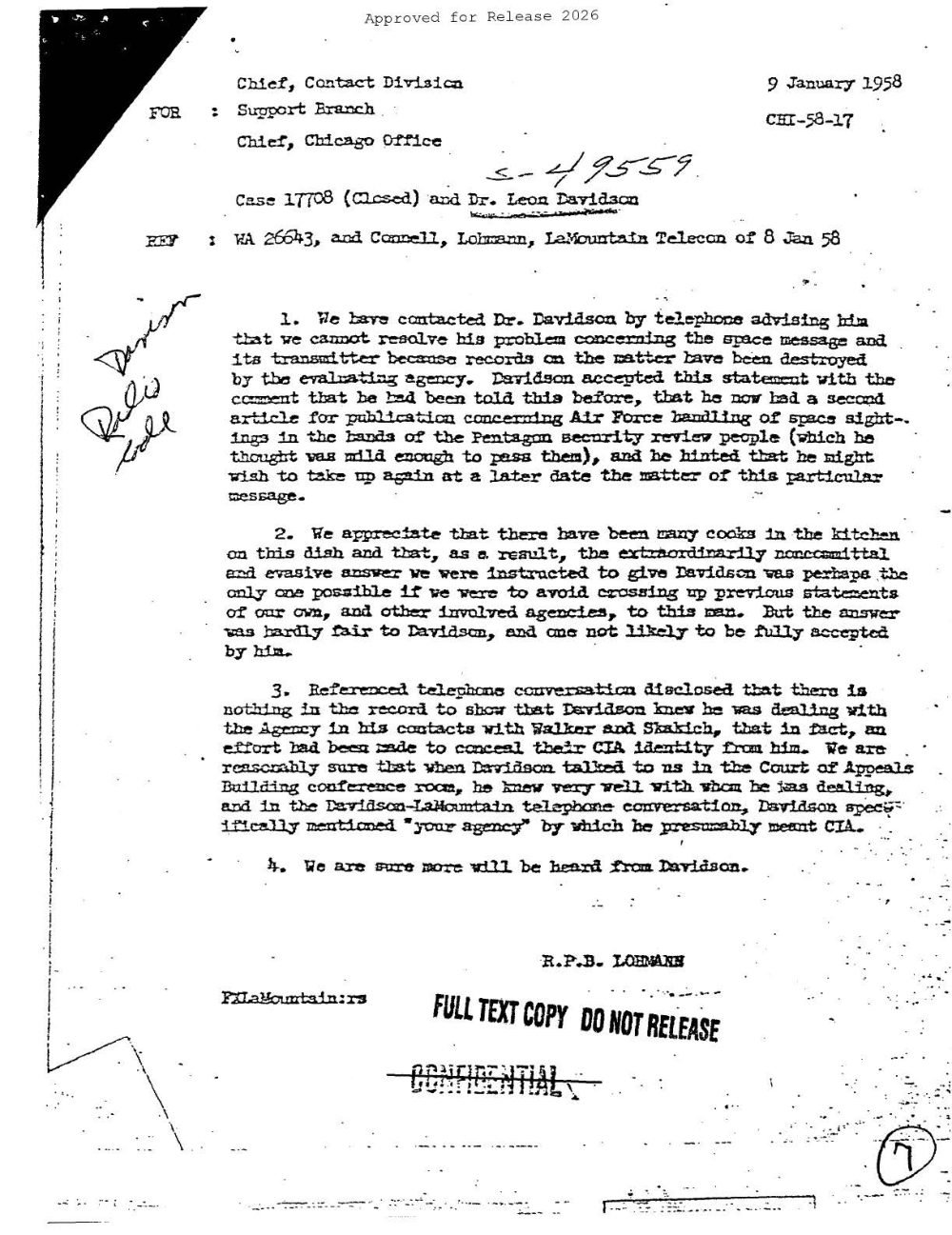
The document is a one-page memorandum, dated January 9, 1958, from the chief of the CIA office in Chicago to the chief of the Contact Division in Washington. It is signed by R. P. B. Lohmann, with drafting attributed to F. X. LaMountain. The subject is 'Case 17708 (closed) and Dr. Leon Davidson', a chemist and independent flying saucer researcher who published critical analyses of the Air Force's handling of the matter.
According to the text, the agency telephoned Davidson to tell him that it could not resolve his problem regarding 'the space message and its transmitter' because the records had been destroyed by the agency that evaluated them. Davidson accepted this, remarking that he had heard that before, said that a second article of his on the Air Force's handling of sightings was under Pentagon security review, and hinted that he might return to the subject of the message later.
The second paragraph is unusual. The author acknowledges that there had been 'many cooks in the kitchen' and that the 'extraordinarily evasive and noncommittal' answer they had been ordered to give was perhaps the only one possible to avoid contradicting previous statements by the CIA and other agencies. But he adds that the answer was 'hardly fair' to Davidson and that he would be unlikely to accept it.
The third paragraph discusses whether Davidson knew he was dealing with the CIA in his contacts with two people, Walker and Skakich, whose identity as agents the agency had tried to conceal. The Chicago office believes he did: at a meeting in a room of the Court of Appeals, he knew well whom he was talking to, and in a telephone conversation he mentioned 'your agency'. The memorandum ends with a prediction: 'we will hear more from Davidson'.
The document does not explain what the 'space message' was, who received it, when, or what it said, and this gap should not be filled by assumption. Its value lies in showing the CIA, in 1958, dealing with a persistent civilian researcher, admitting in writing that the official answer was evasive and that the goal was to avoid contradictions between agencies.
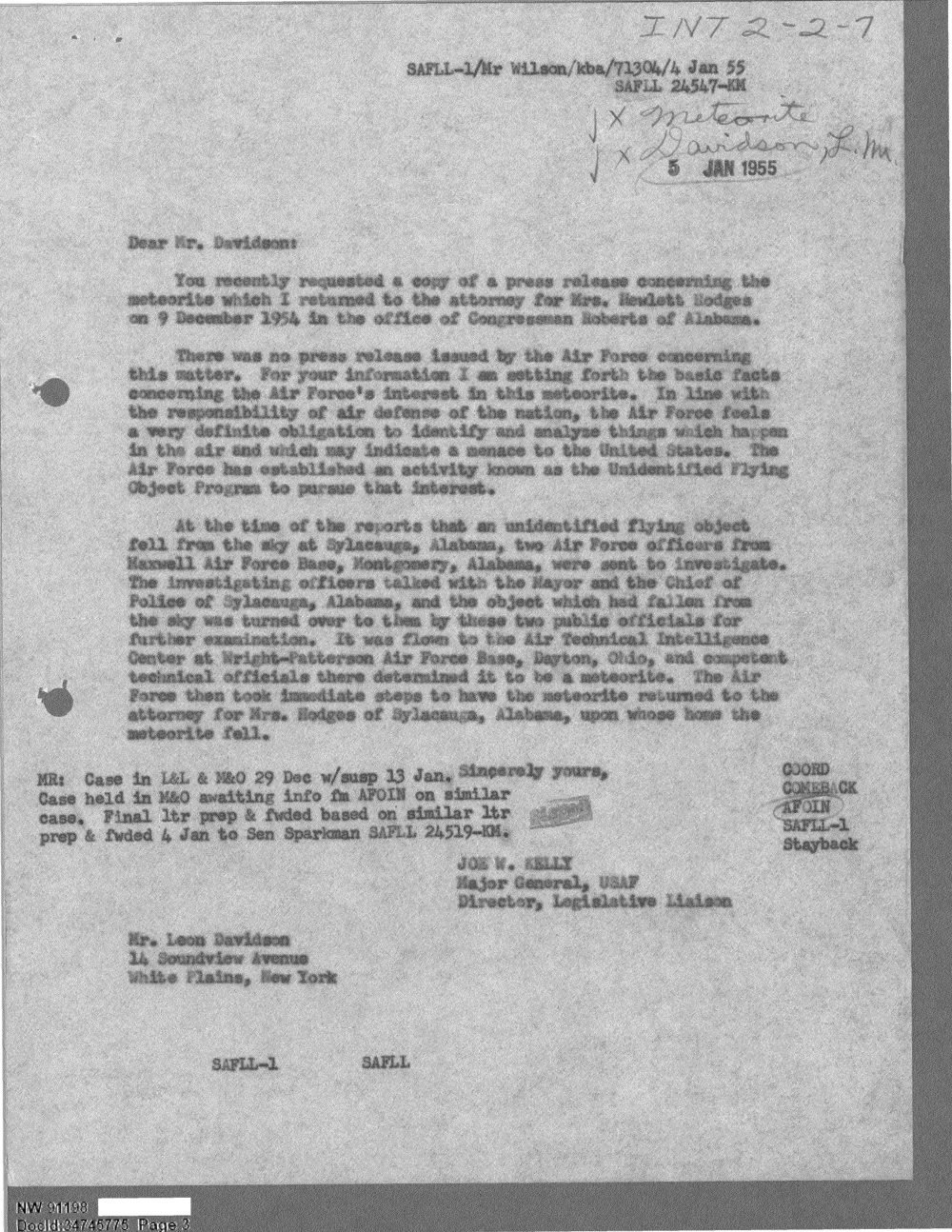
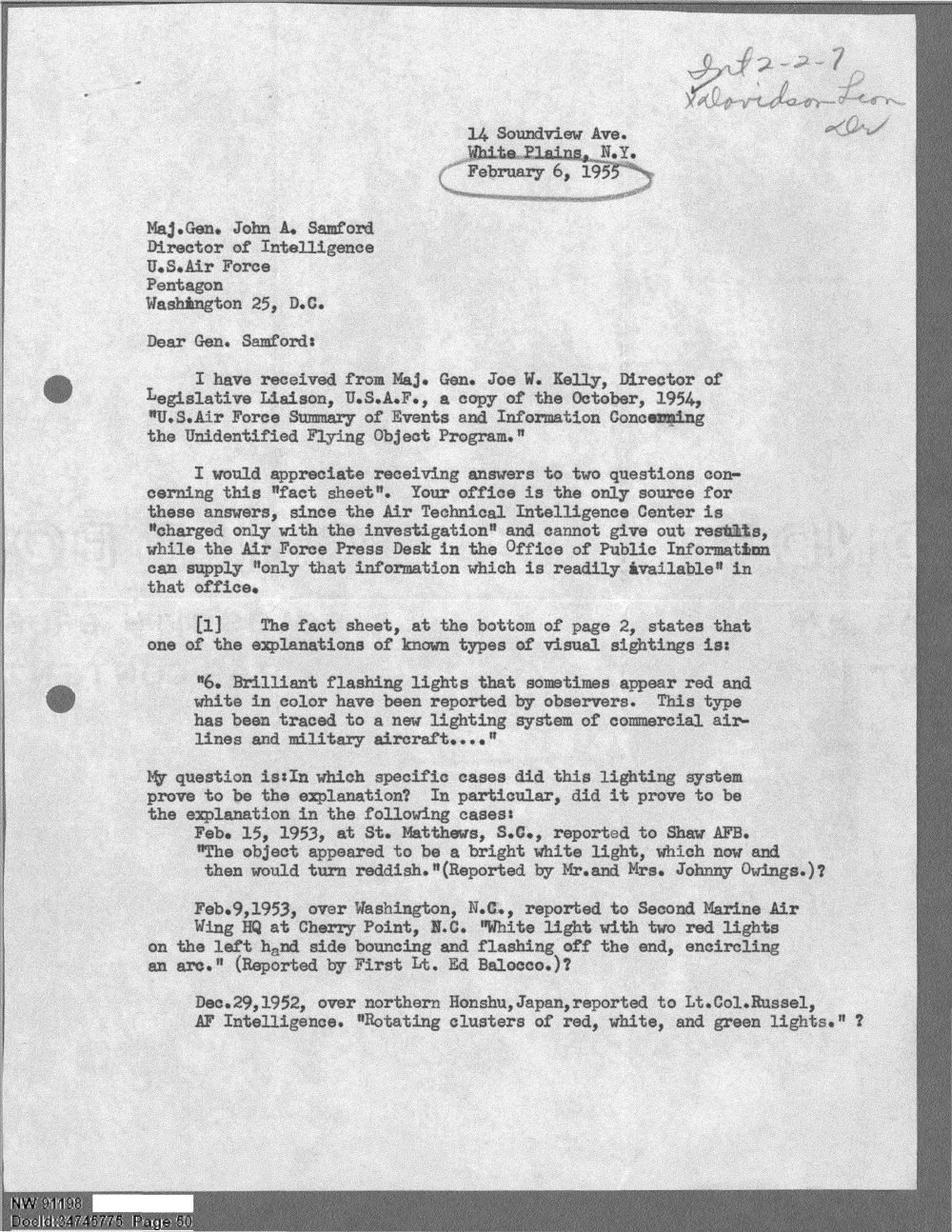
Davidson's persistence already appears in 1955, in Project Blue Book correspondence. In January, he asked the Air Force for the press release on the meteorite that fell on a house in Sylacauga, Alabama, and was told there had been no release. On February 6, he wrote to the director of Intelligence, Major General John A. Samford, with two questions about the official 1954 summary: in which cases the 'flashing red and white lights' had actually been explained by a new aircraft lighting system, and why the text no longer denied, as in 1952, that the saucers were secret American devices. Davidson concluded that the Air Force 'no longer denies' this hypothesis and asked for an explicit statement.
The same idea reached the archive by another route. In December 1954, Donald Keyhoe told the Office of Naval Research that 'an Atomic Energy Commission chemist named Leon Davidson' had written to him convinced that the saucers were secret Navy devices, and that two retired admirals had convinced him that the theory had no basis. The 1955 set contains no reply from Samford to Davidson's questions. The hypothesis of American devices is his; the Air Force, in these pages, neither confirms nor discusses it.
The header shows how the case was closed. The memorandum, registered as CHI-58-17 and signed at the Chicago office, is addressed to the Contact Division leadership and its support section, and cites two references: a document WA 26643 and a telephone conversation on January 8, 1958 between Connell, Lohmann and LaMountain. In other words, the answer to Davidson was agreed by telephone with Washington the day before, and the memorandum records that the order was carried out. The case already appears in the title as “closed”.
The third paragraph reveals a detail that the published summary only hinted at. Davidson had previously dealt with two people, Walker and Skakich, and the CIA had made “an effort” to hide from him that they were from the agency. The Chicago office believed, however, that the cover did not hold up: Davidson had talked with them in a meeting room of the Court of Appeals building knowing “very well” whom he was talking to, and, on the phone with LaMountain, he spoke of “your agency”, which the author understood as a reference to the CIA. Who Walker and Skakich were, and what they discussed with Davidson, the document does not say.
The markings on the sheet tell its later history. The “Confidential” classification was struck out; a stamp reads “full text copy, do not release”; a handwritten number, S-49559, was added below the header; and at the top appears the line “Approved for Release 2026”, approved for release in 2026. In the margin, a handwritten note bears Davidson's name and words of uncertain reading. The memorandum's final prediction, that “we will hear more from Davidson”, has no follow-up in any other document in the collection.
More images from the document
DIRECT READING OF THE FILE
The document, in the original
U.S. government document. Full translation of paragraphs 1 and 2; paragraphs 3 and 4 are summarized.
EXCERPT 1 · PHYSICAL PAGE 1
Physical page 1: heading, paragraphs 3 and 4, signature and markings of the memorandum of 09/01/1958 (supplement to the published translation of paragraphs 1 and 2)
.
App roved f or Re l ease 2026
•
Chief, Contact Divi.sicn 9 J'anuar,- 1958
: SupportBranc.h . · C!iI-58-l.7
Chid'., Chicago Office
. _$.- j?S-~7.
Case l.TT08 {CJ cseil) ·and Dr. teol2 Darld.ao:a '"'=' •IF • . e,· •• ... I • ;p;.adio:·
EEY l WA 26643, arid r.ooneJJ., Lobz:;s-nn, ~~ Tclecan o~ 8 Jan. 58
. ,.. ..
1. ~1e bm, c~ted Dr. Dav.td.son by ielepboce advising hi:a
that ve cannot. reaolve bis problem cocc-e:rrdng the spic-e message and
.i.ta t:ransmittcr beca:ose reco:rds en the t::e.~..er l::ave been. destroyed
by tho ~ti.:lg agency. Parldson accepted. thia sta.temait vitb the
cc=.1eI1t tba-t he b!4 been told thi.a bei'ore, tbat he Il01' had a seca:id
art:Lcl..e ~c,r pnbllcatiOll cOJJ.Ce:rn:1ng .Aj.r Force banditng or S];:BCS sight-.
1.ng3 1.n the l;anc'J:1 ~ the Penta.gr:m secorl:t;y revie-;, peopl~ (wich be
thought w.a mild e?lOtlgh to J;aSS them}. and he ll1nted that be lidglit
lid.sh to take ,::g, asz,1n at a la:ter date the ma.tte:r or this i:a-,rt1cul.ar
cessage.
2. tle a~ec!a~ that there have been rraey cQOks :1n •"the ki.~ •
on tbis dish and that, as e. result, the nonea:mt:I.ttal.
am evasive 8.l:l.SVe2" ve were inst.meted to give Davidsen w..s ~:pe .-;lle
only Cllle pos:ibl.e tt lie 'li'e::r'C to a-void czossillg up previous sta:te:,ent•
;
I ~ oar O'WJl, and other UlV'Ol.ved agellC:leS, to this man. :But the tUJsWc:r
~ bard1y tai.r to na:v1.d.scm, and cm~ not J1kelJ to be f'ully acc-epted I by h.iJ:a... •
!
I
I 3.. Be:texeDCed. te:l.epbone disclosed t=t the:ra 1a . .
!
I nothing ill tm :record to sbo;i- that Drnideon lmev he was ch.mBng vi.th
l the 1.n ?wJ contacta nth twalker aoo. Smk1.ch, that in fact., mi
ettort bad becsi ::sde to caiceru tbe.!r CL\ 1dem;:1ty- :Crcm·him. Ve- an, .
r~su:re tbat wen +ruJtea to us in the court of' ippeaJ.s I . I Building confc:xeace .rocu, h9 kru!,v ver.,-vell. v.lth. Yball he l.a.s deaUJ?g; : J run in the Davidsan-I.alfountaiu tel.eyhone eoxrrersati~ Davidson speett,· .f
j _i'fcalJJ l?leX1t:1.oned • )"O'l:U'" a~ rs-,- which he p;ns:11::sh.1.J" mem1t en. ·..- .
I. 4-. Tile ant s:a:re xaore 'V:ill. be hes.xd :f'rcm. l:!aT:1.d.so:n.
r . , !
i
I .. ·-- I
·! ·R.:P.13. LOmlAD
Fl:LaYcuntain:r.J
. ...
......... -~.. ::..-- - =--=-:-"·_· .":···--._;..-:.:- •.. ···- .......... .--
---- ....Editorial note: Paragraphs 1 and 2 are already translated in the dossier and were not repeated (marked with [...]). The margin note has Davidson's name and two words of uncertain reading, not transcribed.
Check the original PDF
Approved for Release 2026. FOR: Chief, Contact Division, Support Branch. Chief, Chicago Office. 9 January 1958. CHI-58-17. [Handwritten:] S-49559. Case 17708 (Closed) and Dr. Leon Davidson. REF: WA 26643, and Connell, Lohmann, LaMountain Telecon of 8 Jan 58. [Handwritten in margin, partly illegible:] Davidson [...]. [...] 3. Referenced telephone conversation disclosed that there is nothing in the record to show that Davidson knew he was dealing with the Agency in his contacts with Walker and Skakich, that in fact, an effort had been made to conceal their CIA identity from him. We are reasonably sure that when Davidson talked to us in the Court of Appeals Building conference room, he knew very well with whom he was dealing, and in the Davidson-LaMountain telephone conversation, Davidson specifically mentioned "your agency" by which he presumably meant CIA. 4. We are sure more will be heard from Davidson. R.P.B. LOHMANN. FXLaMountain:rs. [Stamp:] FULL TEXT COPY DO NOT RELEASE. [Struck through:] CONFIDENTIAL. [Handwritten, circled:] 7.View the document record ↗ · Physical page 1, counting the cover.
Dates and documentary context
- Event
- 08/01/1958 — Reference phone call ('Telecon of 8 Jan 58'); the contact with Davidson took place before the memorandum, with no exact day.
- Document
- 09/01/1958 — Date of the memorandum.
- Publication
- Not established — 'Approved for Release 2026' stamp at the top of the first page.
Origin and release
CIA, Contact Division, Chicago office; R. P. B. Lohmann, written by F. X. LaMountain · CIA-UAP-004-CASE_17708_CLOSED_AND_DR_LEON_DAVIDSON.pdf
Stamp 'FULL TEXT COPY DO NOT RELEASE' and 'Confidential' marking crossed out in the original.
Questions to continue the investigation
- What was the 'space message' in case 17708? The document does not say.
- Which Davidson articles were submitted for Pentagon review?
GEOGRAPHY OF THE CASE
Chicago, USA (CIA office)
Institutional document with no observation site.
DOCUMENTARY TRAIL
Go back to the sources
References use physical pages of the PDF, counting the cover. Summaries are presented in English; the documents keep their original language.
- CIA-UAP-004-CASE_17708_CLOSED_AND_DR_LEON_DAVIDSON.pdf
Physical page 1: memorandum from the CIA office in Chicago to the Contact Division, 09/01/1958, 'Case 17708 (Closed) and Dr. Leon Davidson'
CIA · 1 page - DOW-UAP-D096_Correspondence-Relating-to-Project-Blue-Book_1955.pdf
Physical pages 3 and 43: Air Force letters to Leon Davidson about the Sylacauga meteorite (05/01/1955 and 26/01/1955); pages 50 and 51: letter from Davidson to the director of Intelligence, 06/02/1955; page 36: mention of Davidson in Donald Keyhoe's letter to the Office of Naval Research, 02/12/1954
DOW · 220 pages
Editorial summary based on the collection's research notes. How we read the documents.