Date: 18/07/1963Location: Washington, D.C., USA
Washington, 1963: White House Space Council memorandum considers policy for an encounter with aliens
A member of the National Aeronautics and Space Council wrote to the Department of State about what to do if an alien intelligence were discovered. The text distances itself from the flying saucer advocates and ends with irony about the "traditional panic."
- Event date
- 18/07/1963
- Location
- Washington, D.C., USA
- Topic
- History of the investigation
- Source agencies
- Arquivo histórico
- Documents
- 1 document · 6 pages
- Reading time
- 19 min
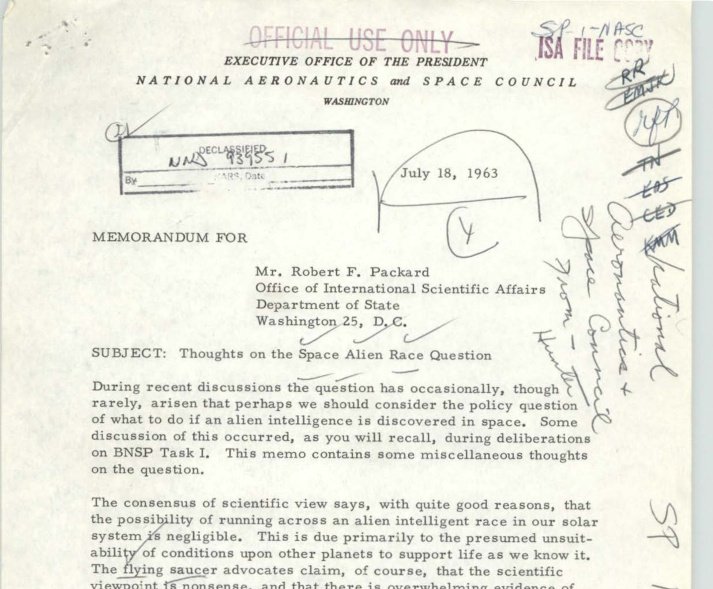 Official memorandumPhysical page 1
DOCUMENTARY SOURCES · Arquivo histórico
What the records tell
On July 18, 1963, Maxwell W. Hunter II, a member of the professional staff of the National Aeronautics and Space Council, an agency of the Executive Office of the President, sent a memorandum to Robert F. Packard, of the Department of State's Office of International Scientific Affairs. The subject was "Thoughts on the space alien race question." The document bore the marking "for official use only," later crossed out, and Department of State file stamps.
Hunter explains that, in recent discussions, the question had occasionally come up of what policy to adopt if an alien intelligence were discovered in space, including in the deliberations of a task identified as "BNSP Task I." He records the scientific consensus that the chance of finding an intelligent race in the solar system is negligible, and the position of the "flying saucer advocates," who see overwhelming evidence. He says he finds it difficult to side with the latter, but is also uncomfortable with the near-total impossibility upheld by most scientists.
The memorandum reviews the theory of planet formation, the probability of life in other systems and the "canals" of Mars. As an exercise, it examines the thesis, attributed to saucer advocates, that Martians would be mining the Moon, and lists three facts that, "if we were not so sure," would be taken as indications: gases in the Alphonsus crater, hot spots in infrared scans and the failure of lunar and planetary probes. Hunter presents them as possible readings, not as evidence.
He divides the hypotheses into three types of visitors: a race with chemical spaceflight, like the imagined "Martians"; interstellar colonizers with nuclear propulsion at half the speed of light; and a faster-than-light race, in case Einstein's theory is only an approximation. Faced with the latter, he writes, the policy "is better negotiate fast." In the conclusions, he says the probability is finite and that it would be necessary to know quickly which type was involved, and suggests "immediately burying all terrestrial hatchets."
The ending is ironic: there would be nothing to prepare, because the only material available in an emergency would be science fiction and no one of standing would take "this nonsense" seriously before it happened; so policy would be decided "in the traditional manner of the great panic." The memorandum does not deal with any sighting, presents no evidence of visitors and shows how the subject reached, in a speculative tone, a space policy body of the Presidency.
The full memorandum shows how Hunter's reasoning was built on space engineering figures. He calculates that Mars's escape velocity, of 16.500 feet per second, would make the Moon an easy target for Martians, who could get there with ordinary chemical rockets carrying almost 10% of their weight as payload. He cites the photos of the far side of the Moon taken by Lunik III and the Mariner II data on Venus, imagines ships at half or three quarters of the speed of light and calculates two hundred thousand years for a race to colonize the galaxy. He jokes that, if it were all true, the "Martian Atomic Energy Commission" would be on a top-priority schedule.
The markings on the first page show where the memorandum ended up. The "ISA FILE COPY" stamp indicates the file copy of the Department of State's Office of International Scientific Affairs, Robert F. Packard's office, and another stamp records its arrival at the office on July 22, 1963, four days after the date of the text. In the margin, someone handwrote "National Aeronautics and Space Council, from Hunter" and classified the paper as "SP 16," a number that also appears in the name of the digital file. A series of crossed-out initials indicates that the copy passed through several people in the office.
The first page carries the text in a version that is not the hand-signed one: at the bottom appears "(signed) Maxwell W. Hunter II," a sign that the Department of State copy reproduced the original. The handwritten signature is only on the sixth page. The "for official use only" marking, crossed out at the top and bottom of every sheet, was the document's only level of restriction; it was never secret. The National Archives declassification stamp, with NND authority number, is on the first sheet.
The memorandum deals with policy, not observation. Hunter reports no sighting and cites no flying saucer cases; he mentions the "flying saucer advocates" only as one side of the debate. The data he uses are from the astronomy and space engineering of the time: the Alphonsus crater, infrared scans of the Moon, the Lunik III photos, Mariner II, the escape velocity of Mars. The acronym "BNSP Task I" is not explained in the text; the most likely reading, the editors' own responsibility, is Basic National Security Policy, the U.S. government's guidelines document in those years.
A search of the archive for Hunter's name, for Packard and for the subject phrase finds only this memorandum. There is no reply from Packard, nor any record that the question about policy toward an alien intelligence was taken further at the Department of State or the Space Council. The value of the paper is to show, with date and authorship, that the topic was discussed in writing between an office of the Presidency and American scientific diplomacy in 1963, in a speculative tone and with the closing irony about the "great panic."
More images from the document

DIRECT READING OF THE FILE
The document, in the original
Full translation of the six pages of the memorandum, including handwritten margin annotations and stamps.
EXCERPT 1 · PHYSICAL PAGE 1
Physical page 1: header, addressee, subject and first paragraphs (page 1 of the memorandum)
.· {'\ Clf'l/\1 lll'\r- f'\ 11 \/
EXECUTIVE OFFICE OF THE PRESIDENT
NATION AL AERO N A UT I C S and SP A CE
WASIDNGTON
MEMORANDUM FOR
18, 1963
Mr. Robert F . Packard
Office of International Scientific Affairs
Department of State
WashiY'2~/
SUBJECT: Thoughts on the Space Alien Race Question
- During recent discussions the
----
question has occasionally, though
rarely, arisen that perhaps we should consider the policy question
of what to do if an alien intelligence is discovered in space. Some
discussion of this occurred, as you will recall, during deliberations
on BNSP Task I. This memo contains some miscellaneous thoughts
on the question.
The consensus of scientific view says, with quite good reasons, that
the p~ssib.lity of running across an alien intelligent race in our solar
system • s negligible. This is due primarily to the presumed unsuitabili of conditions upon other planets to support life as we know it.
The ..!.!Ying saucer advocates claim, of course, that the scientific
viewpoint ~sense, and that there is overwhelming evidence of
such beings. In my own mind, I find it difficult to side with the flying
saucer advocates, but the almost total impossibility envisioned by
most scientists also is disturbing. Therefore, I present th e problem
in current perspective, as I see it.
Up until a few decades ago it seemed very improbable that intelligent
life existed anywhere outside of the solar system. The chief reasons
for this were a combination of scientific theory, scientific knowledge,
and religious belief. The most widely accepted scientific theory as
to the formation of the solar planetary system held that it was a re-
-
f sult of the near collisfon of two stars. Since such a p r ~cise ne: r-miss
Q/ ~-j:f('IAI IIC'r 111, ~:'jf .-.J, n ... VVL ~
/ ,·u I~ 1
Av _ _.,_..,, .a , .. I.:> I ij I a I 6
AEditorial note: Fills in what the site's translation policy left out on p. 1. The initials belong to staff members not identified in the document; the last digit of the NND number is uncertain.
Check the original PDF
OFFICIAL USE ONLY [struck through]. EXECUTIVE OFFICE OF THE PRESIDENT. NATIONAL AERONAUTICS and SPACE COUNCIL. WASHINGTON. [stamp: DECLASSIFIED NND 93955 1] July 18, 1963. MEMORANDUM FOR Mr. Robert F. Packard, Office of International Scientific Affairs, Department of State, Washington 25, D.C. SUBJECT: Thoughts on the Space Alien Race Question. During recent discussions the question has occasionally, though rarely, arisen that perhaps we should consider the policy question of what to do if an alien intelligence is discovered in space. Some discussion of this occurred, as you will recall, during deliberations on BNSP Task I. This memo contains some miscellaneous thoughts on the question. The consensus of scientific view says, with quite good reasons, that the possibility of running across an alien intelligent race in our solar system is negligible. This is due primarily to the presumed unsuitability of conditions upon other planets to support life as we know it. The flying saucer advocates claim, of course, that the scientific viewpoint is nonsense, and that there is overwhelming evidence of such beings. In my own mind, I find it difficult to side with the flying saucer advocates, but the almost total impossibility envisioned by most scientists also is disturbing. Therefore, I present the problem in current perspective, as I see it. Up until a few decades ago it seemed very improbable that intelligent life existed anywhere outside of the solar system. The chief reasons for this were a combination of scientific theory, scientific knowledge, and religious belief. The most widely accepted scientific theory as to the formation of the solar planetary system held that it was a result of the near collision of two stars. Since such a precise near-missView the document record ↗ · Physical page 1, counting the cover.
EXCERPT 2 · PHYSICAL PAGE 2
Physical page 2: page 2 of the memorandum
-· . I ' I
- 2 -
of two stars would be an extremely rare event, it followed that there
would be very few other planetary systems in the universe and, indeed, perhaps this was the only one. Religious belief said, furthermore, that life was a gift bestowed by God. This was a relatively
undisputed point since no scientific data existed to bridge the gap
between non-living and living materials.
The situation today is vastly changed in these respects. The most
widely held theory of stellar formation would predict the formation of
planetary systems to be a natural consequence of stellar evolution.
On this basis, most stars would possess planetary systems, and the
number of habitable planets in our galaxy would be tremendous. Our
biggest telescopes cannot resolve planets at the distances even of the
nearest stars, so no direct confirmation is yet available. In my own
mind, however, the wide prevalence of multiple stars is an overwhelming hint in support of this theory. In addition, the biological sciences
have almost completely traced a series of natural occurrences which
lead from inanimate molecules to elementary living viruses. Thus,
we have the current scientific theory and data not only that there are
a huge number of planets in the galaxy, but that life is quite likely to
arise spontaneously on a large number of these. This, of course, does
not necessarily imply intelligent life. Modern theology is not necessarily
incompatible with this. The description in Genesis of the Creation certainly is a better picture of the current theory than of a stellar collision,
and since God only spent seven days on this system, He has clearly had
lots of time to create many more systems.
Even granting a probable existence of much life in the galaxy, there is
still the question of whether another intelligent race exists in our solar
system. There are, of course, two methods of its establishment in our
system. One of these is that it originated on some other planet, for
instance, Mars. Some of the spectacular markings of Mars have been
interpreted as indicating intelligence. In particular, the famous 11 Canali 11
are rather narrow, and always run from one prominent marking to
another, frequently with round splotches at intersections. As far as I
know, no one has discovered a II Canali11 which goes nowhere. This has
quite understandably stimulated much conversation. In fact, a number
of decades ago, when scientists thought that any life on other stellar
systems was very remote, they seemed to feel that intelligent life
iJ~FICIAL USE ONtV--Editorial note: Clear typewritten text.
Check the original PDF
of two stars would be an extremely rare event, it followed that there would be very few other planetary systems in the universe and, indeed, perhaps this was the only one. Religious belief said, furthermore, that life was a gift bestowed by God. This was a relatively undisputed point since no scientific data existed to bridge the gap between non-living and living materials. The situation today is vastly changed in these respects. The most widely held theory of stellar formation would predict the formation of planetary systems to be a natural consequence of stellar evolution. On this basis, most stars would possess planetary systems, and the number of habitable planets in our galaxy would be tremendous. Our biggest telescopes cannot resolve planets at the distances even of the nearest stars, so no direct confirmation is yet available. In my own mind, however, the wide prevalence of multiple stars is an overwhelming hint in support of this theory. In addition, the biological sciences have almost completely traced a series of natural occurrences which lead from inanimate molecules to elementary living viruses. Thus, we have the current scientific theory and data not only that there are a huge number of planets in the galaxy, but that life is quite likely to arise spontaneously on a large number of these. This, of course, does not necessarily imply intelligent life. Modern theology is not necessarily incompatible with this. The description in Genesis of the Creation certainly is a better picture of the current theory than of a stellar collision, and since God only spent seven days on this system, He has clearly had lots of time to create many more systems. Even granting a probable existence of much life in the galaxy, there is still the question of whether another intelligent race exists in our solar system. There are, of course, two methods of its establishment in our system. One of these is that it originated on some other planet, for instance, Mars. Some of the spectacular markings of Mars have been interpreted as indicating intelligence. In particular, the famous "Canali" are rather narrow, and always run from one prominent marking to another, frequently with round splotches at intersections. As far as I know, no one has discovered a "Canali" which goes nowhere. This has quite understandably stimulated much conversation. In fact, a number of decades ago, when scientists thought that any life on other stellar systems was very remote, they seemed to feel that intelligent lifeView the document record ↗ · Physical page 2, counting the cover.
EXCERPT 3 · PHYSICAL PAGE 3
Physical page 3: page 3 of the memorandum
I ISF ONLY - 3 -
probably existed on our other planets. Some of the discussions about
life on Mars at the turn of the century seem to indicate a strong urge
to want to find intelligent life elsewhere. Today, the situation is
completely reversed, and although intelligent life is considered quite
probable among the stars, it is held to be quite unlikely within the
solar system. We seem more eager to listen with Ozma than to look
closely at Canali.
One school of flying saucer advocates claims that the Martians have
been mining our moon for natural resources for some time. At first
thought, one would think they would rather mine earth. It is interesting
to speculate, however, upon space flight from the point of view of a
Martian. The escape speed of Mars is only 161 500 fps, and, of course,
braking speed on our moon is less than 10, 000 fps. Thus, Martians looking at earth would tend to view it the same way Terrestrials look at Jupiter.
Our moon might not be less work to get to, since atmospheric braking to
earth is possible, but would be very much easier to return from, while
the energy requirements to go to and return from the surface of the earth
might well be so high as to discourage interest, at least initially,. Interestingly enough, even a normal high energy chemical rocket could make
a trip from Mars to our moon at favorable times while carrying almost
10% of its gross weight in payload. Space flight starting from Mars,
then, is a much easier prospect than starting from Terra. If a suitable
refueling base had been painfully established on our moon, the operation
could be done quite commendably with merely chemical energy. (The aforementioned high energy chemical rocket could carry at favorable times
almost 50% payload back to Mars.) Of course, many flying saucer advocates claim that the discovery of both Martian moons within a week in the
latter part of the Nineteenth Century indicates that they are large artificial
space stations, otherwise they would have been found earlier. If we were
to discover Martians on the moon, it would result in surprisingly little readjustment of our scientific thinking. The biggest question would be why
they were there rather than among the Asteroids.
In fact, if we were not as scientifically sure of ourselves as we are, three
recent events would be hailed as broad hints of intelligent life on the moon.
( 1) The discovery of hot gasses eminating from the crater Alphonsus when
the moon was supposedly dead. This would be considered evidence of civilization and, since Alphonsus is close to the visible edge, interpreted to mean
that the other side of the moon was teaming with population which had begun
Off f t.;1 '' E U~O~I LY _,,,Editorial note: The original reads '16,500 fps' (feet per second). 'Ozma' is Project Ozma, for listening for radio signals from other stars (1960). 'Eminating' and 'teaming' appear that way in the original.
Check the original PDF
probably existed on our other planets. Some of the discussions about life on Mars at the turn of the century seem to indicate a strong urge to want to find intelligent life elsewhere. Today, the situation is completely reversed, and although intelligent life is considered quite probable among the stars, it is held to be quite unlikely within the solar system. We seem more eager to listen with Ozma than to look closely at Canali. One school of flying saucer advocates claims that the Martians have been mining our moon for natural resources for some time. At first thought, one would think they would rather mine earth. It is interesting to speculate, however, upon space flight from the point of view of a Martian. The escape speed of Mars is only 16,500 fps, and, of course, braking speed on our moon is less than 10,000 fps. Thus, Martians looking at earth would tend to view it the same way Terrestrials look at Jupiter. Our moon might not be less work to get to, since atmospheric braking to earth is possible, but would be very much easier to return from, while the energy requirements to go to and return from the surface of the earth might well be so high as to discourage interest, at least initially. Interestingly enough, even a normal high energy chemical rocket could make a trip from Mars to our moon at favorable times while carrying almost 10% of its gross weight in payload. Space flight starting from Mars, then, is a much easier prospect than starting from Terra. If a suitable refueling base had been painfully established on our moon, the operation could be done quite commendably with merely chemical energy. (The aforementioned high energy chemical rocket could carry at favorable times almost 50% payload back to Mars.) Of course, many flying saucer advocates claim that the discovery of both Martian moons within a week in the latter part of the Nineteenth Century indicates that they are large artificial space stations, otherwise they would have been found earlier. If we were to discover Martians on the moon, it would result in surprisingly little readjustment of our scientific thinking. The biggest question would be why they were there rather than among the Asteroids. In fact, if we were not as scientifically sure of ourselves as we are, three recent events would be hailed as broad hints of intelligent life on the moon. (1) The discovery of hot gasses eminating from the crater Alphonsus when the moon was supposedly dead. This would be considered evidence of civilization and, since Alphonsus is close to the visible edge, interpreted to mean that the other side of the moon was teaming with population which had begunView the document record ↗ · Physical page 3, counting the cover.
EXCERPT 4 · PHYSICAL PAGE 4
Physical page 4: page 4 of the memorandum
- 4 -
to spill around to this side. (2) The infra-red scans which show hot
spots. These would be interpreted as indications of cities or at least
mining camps. (3) The fact that no lunar or planetary probe of significance has been successful, in spite of major efforts on the part of
two very successful earth orbitfaring nations. It would be supposed
that someone was denying us deep space. (The other-side-of-the-moon
pictures from Lunik III show no details of consequence, and the same
can be said of the data from Mariner II compared to what we had already
known about Venus from earth-based measurements.) Should the Martians
have colonized the moon without discovering nuclear energy, then they
represent no real problem, and our current national policy would be
made to order for the situation. If all of this were true, of course, I
would expect the Martians to be scared to death of what they have seen
recently on this planet, and would expect that the highest priority development program in the solar system is being conducted by the Atomic
Energy Commission of Mars.
Even if we are secure in our belief that intelligent life never would develop
on Mars or some other solar planet, there is still the question of visitors
to the solar system from other stellar systems. This is normally written
off as an extremely low probability, due to the tremendous distances between stars, and the Einstein limitation on travel faster than the speed
of light. Therefore, even if there are a large number of intelligent life
forms in the galaxy, and even if they are continuously searching for other
races, the frequency of investigation of any stellar system would be only
on ce in many thousand of years and contact would rarely, if ever, be
achieved. It might never be achieved, since presumably intelligent races
die out. (What happened to the planet whose pieces now are spread around
the Asteroid Belt? Or, for that matter, why is Uranus lying on its side?)
I am not sure that this travel restriction is quite as infallible as it sounds.
I believe that it is possible with what we n ow know about nuclear energy
to envision ships driven at half to three-quarters of the speed of light.
This, since the galaxy is 100,000 light-years across, still does not make
a search of the entire galaxy feasible within the life span of the average
man. But suppose some race under pressure of population explosion were
expanding as fast as technically feasible from star to star throughout the
galaxy. If their ships averaged half the speed of light, and if, on the average,
they stopped every 10 light-years for a twenty-year stay at a stellar system
to d eposit colonists, refuel, and build extra ships, they would only take
two hundred thousand years, starting at the center of the galaxy, to spread
ur-t"'!=i FFr=-tl-:-:- C ltt:A+-L-HU s~[-----:...: GN-JCheck the original PDF
to spill around to this side. (2) The infra-red scans which show hot spots. These would be interpreted as indications of cities or at least mining camps. (3) The fact that no lunar or planetary probe of significance has been successful, in spite of major efforts on the part of two very successful earth orbitfaring nations. It would be supposed that someone was denying us deep space. (The other-side-of-the-moon pictures from Lunik III show no details of consequence, and the same can be said of the data from Mariner II compared to what we had already known about Venus from earth-based measurements.) Should the Martians have colonized the moon without discovering nuclear energy, then they represent no real problem, and our current national policy would be made to order for the situation. If all of this were true, of course, I would expect the Martians to be scared to death of what they have seen recently on this planet, and would expect that the highest priority development program in the solar system is being conducted by the Atomic Energy Commission of Mars. Even if we are secure in our belief that intelligent life never would develop on Mars or some other solar planet, there is still the question of visitors to the solar system from other stellar systems. This is normally written off as an extremely low probability, due to the tremendous distances between stars, and the Einstein limitation on travel faster than the speed of light. Therefore, even if there are a large number of intelligent life forms in the galaxy, and even if they are continuously searching for other races, the frequency of investigation of any stellar system would be only once in many thousand of years and contact would rarely, if ever, be achieved. It might never be achieved, since presumably intelligent races die out. (What happened to the planet whose pieces now are spread around the Asteroid Belt? Or, for that matter, why is Uranus lying on its side?) I am not sure that this travel restriction is quite as infallible as it sounds. I believe that it is possible with what we now know about nuclear energy to envision ships driven at half to three-quarters of the speed of light. This, since the galaxy is 100,000 light-years across, still does not make a search of the entire galaxy feasible within the life span of the average man. But suppose some race under pressure of population explosion were expanding as fast as technically feasible from star to star throughout the galaxy. If their ships averaged half the speed of light, and if, on the average, they stopped every 10 light-years for a twenty-year stay at a stellar system to deposit colonists, refuel, and build extra ships, they would only take two hundred thousand years, starting at the center of the galaxy, to spreadView the document record ↗ · Physical page 4, counting the cover.
EXCERPT 5 · PHYSICAL PAGE 5
Physical page 5: page 5 of the memorandum, with the start of the conclusions
Olf lCiAL - 5 -
throughout the whole system. Since the earliest known remains of
man have recently been dated at approximately one million sevenhundred thousand years, a sustained drive for merely two hundred
thousand years may not be unreasonable. Of course, if we were to
run across representatives of this kind of interstellar race, they
would not be nearly as tame as the previously hypothesized chemical
Martians, and our policy would need to be revised accordingly.
Fortunately, travel time restrictions would inhibit their ability to
bring all forces to bear, in case we should develop differences of
viewpoint.
The third possibility, scientifically abhorrent, is that the Einstein
theory may only be an approximation, and an alien race which actually
travels faster than light exists. If we were to meet such a race, our
policy had better be to negotiate fast, because the implications of their
far better understanding and control of the fundamental forces of nature
would be obvious. If all the scientific speculation were to turn out wrong
and we were to stumble across an alien race, we would want to know
as quickly as possible which of the three types I have indicated it was,
as our diplomatic policy would damned well be influenced by the results.
CONCLUSIONS
Although all plausible scientific thinking suggests that we will not find
any other intelligence race, the probability that we will is finite, and
perhaps should not be completely ignored. Were we to find one, the
question of whether it was a race with primitive chemical space flight,
space flight equivalent to our best understanding of nuclear energy, or
space flight based on physics beyond Einstein should be ascertained as
rapidly as possible, since our policies would be affected in the most
drastically possible way. In any event, a policy of the immediate burying
of all Terrestrial hatchets would likely be in order. Even if we only
found tame chemical Martians, or merely the debris from some intraglactic survey mission, it would be a good idea to proceed on the assumption that the human race would finally have found a bigger problem than
the ones it has created for itself. There likely is nothing to be done at
9FFIC~E ONLYEditorial note: 'Intelligence race' and 'intra-glactic' appear this way in the original. The full page is given here. 'Damned well' was rendered as 'com toda a certeza'.
Check the original PDF
throughout the whole system. Since the earliest known remains of man have recently been dated at approximately one million seven-hundred thousand years, a sustained drive for merely two hundred thousand years may not be unreasonable. Of course, if we were to run across representatives of this kind of interstellar race, they would not be nearly as tame as the previously hypothesized chemical Martians, and our policy would need to be revised accordingly. Fortunately, travel time restrictions would inhibit their ability to bring all forces to bear, in case we should develop differences of viewpoint. The third possibility, scientifically abhorrent, is that the Einstein theory may only be an approximation, and an alien race which actually travels faster than light exists. If we were to meet such a race, our policy had better be to negotiate fast, because the implications of their far better understanding and control of the fundamental forces of nature would be obvious. If all the scientific speculation were to turn out wrong and we were to stumble across an alien race, we would want to know as quickly as possible which of the three types I have indicated it was, as our diplomatic policy would damned well be influenced by the results. CONCLUSIONS. Although all plausible scientific thinking suggests that we will not find any other intelligence race, the probability that we will is finite, and perhaps should not be completely ignored. Were we to find one, the question of whether it was a race with primitive chemical space flight, space flight equivalent to our best understanding of nuclear energy, or space flight based on physics beyond Einstein should be ascertained as rapidly as possible, since our policies would be affected in the most drastically possible way. In any event, a policy of the immediate burying of all Terrestrial hatchets would likely be in order. Even if we only found tame chemical Martians, or merely the debris from some intra-glactic survey mission, it would be a good idea to proceed on the assumption that the human race would finally have found a bigger problem than the ones it has created for itself. There likely is nothing to be done atView the document record ↗ · Physical page 5, counting the cover.
EXCERPT 6 · PHYSICAL PAGE 6
Physical page 6: page 6 of the memorandum, closing and signature
. . ' . . ' . OfFl~,AL USE ONLY ,
- 6 -
the moment to prepare for these possibilities (the only body of writing
on the subject available in an emergency is science fiction), because
no one of consequence is going to take this rubbish seriously unless
it happens. At that point, our policy will be determined in the traditional manner of grand panic.
Maxwell W. Hunter, II
Member, Professional Staff
SFRCc.LA-11Ati--t--rrUS.,-E ~onrN Lv-Y ---Check the original PDF
the moment to prepare for these possibilities (the only body of writing on the subject available in an emergency is science fiction), because no one of consequence is going to take this rubbish seriously unless it happens. At that point, our policy will be determined in the traditional manner of grand panic. [signed] Maxwell W. Hunter, II. Member, Professional Staff. OFFICIAL USE ONLY [struck through].View the document record ↗ · Physical page 6, counting the cover.
EXCERPT 7 · PHYSICAL PAGE 1
Physical page 1: stamps and handwritten margin notes (the typewritten text is already translated on the site)
.· {'\ Clf'l/\1 lll'\r- f'\ 11 \/
EXECUTIVE OFFICE OF THE PRESIDENT
NATION AL AERO N A UT I C S and SP A CE
WASIDNGTON
MEMORANDUM FOR
18, 1963
Mr. Robert F . Packard
Office of International Scientific Affairs
Department of State
WashiY'2~/
SUBJECT: Thoughts on the Space Alien Race Question
- During recent discussions the
----
question has occasionally, though
rarely, arisen that perhaps we should consider the policy question
of what to do if an alien intelligence is discovered in space. Some
discussion of this occurred, as you will recall, during deliberations
on BNSP Task I. This memo contains some miscellaneous thoughts
on the question.
The consensus of scientific view says, with quite good reasons, that
the p~ssib.lity of running across an alien intelligent race in our solar
system • s negligible. This is due primarily to the presumed unsuitabili of conditions upon other planets to support life as we know it.
The ..!.!Ying saucer advocates claim, of course, that the scientific
viewpoint ~sense, and that there is overwhelming evidence of
such beings. In my own mind, I find it difficult to side with the flying
saucer advocates, but the almost total impossibility envisioned by
most scientists also is disturbing. Therefore, I present th e problem
in current perspective, as I see it.
Up until a few decades ago it seemed very improbable that intelligent
life existed anywhere outside of the solar system. The chief reasons
for this were a combination of scientific theory, scientific knowledge,
and religious belief. The most widely accepted scientific theory as
to the formation of the solar planetary system held that it was a re-
-
f sult of the near collisfon of two stars. Since such a p r ~cise ne: r-miss
Q/ ~-j:f('IAI IIC'r 111, ~:'jf .-.J, n ... VVL ~
/ ,·u I~ 1
Av _ _.,_..,, .a , .. I.:> I ij I a I 6
AEditorial note: Fills in what the site's translation policy left out on p. 1. The initials belong to staff members not identified in the document; the last digit of the NND number is uncertain.
Check the original PDF
[Carimbo, topo à direita:] ISA FILE COPY. [Manuscrito acima:] SP 1-NASC. [Iniciais manuscritas em coluna, várias riscadas:] RR, EMJK [?], [circulada, ilegível], TN, LOS, CED, KMM. [Manuscrito vertical na margem direita:] National Aeronautics + Space Council from - Hunter. [Manuscrito, grande:] SP 16. [Números circulados à esquerda e no centro:] 2 [?], 4, 5. [Carimbo retangular:] DECLASSIFIED NND 93955 [?] By [ilegível] NARS, Date [ilegível]. [Rodapé, carimbo:] INTERNATIONAL SCIENTIFIC AFFAIRS, ISA, JUL 22 1963, AM 7,8,9,10,11,12,1,2,3,4,5,6 PM. [Manuscrito sobre o carimbo:] (signed) Maxwell W. Hunter II. OFFICIAL USE ONLY [riscado].View the document record ↗ · Physical page 1, counting the cover.
Dates and documentary context
- Event
- Not established — There is no observation event; the document is a policy reflection.
- Document
- 18/07/1963 — Typed date on the memorandum.
- Publication
- Not established — Page 1 bears a NARA declassification stamp; public release not confirmed on these pages.
Origin and release
National Aeronautics and Space Council, Executive Office of the President; author Maxwell W. Hunter II; addressee at the Department of State · 59_214434_SP_16_[7.18.1963].pdf
Questions to continue the investigation
- Was there a response from Robert F. Packard or any other discussion of the topic by “BNSP Task I”?
- Did the memorandum circulate beyond the Office of International Scientific Affairs?
GEOGRAPHY OF THE CASE
Washington, D.C.
Approximate reference for the city where the memorandum was written and received, placed by the editors. It does not refer to any sighting.
DOCUMENTARY TRAIL
Go back to the sources
References use physical pages of the PDF, counting the cover. Summaries are presented in English; the documents keep their original language.
- 59_214434_SP_16_[7.18.1963].pdf
Physical pages 1 to 6: memorandum from Maxwell W. Hunter II to the Department of State, 18/07/1963
Arquivo histórico · 6 pages
Editorial summary based on the collection's research notes. How we read the documents.