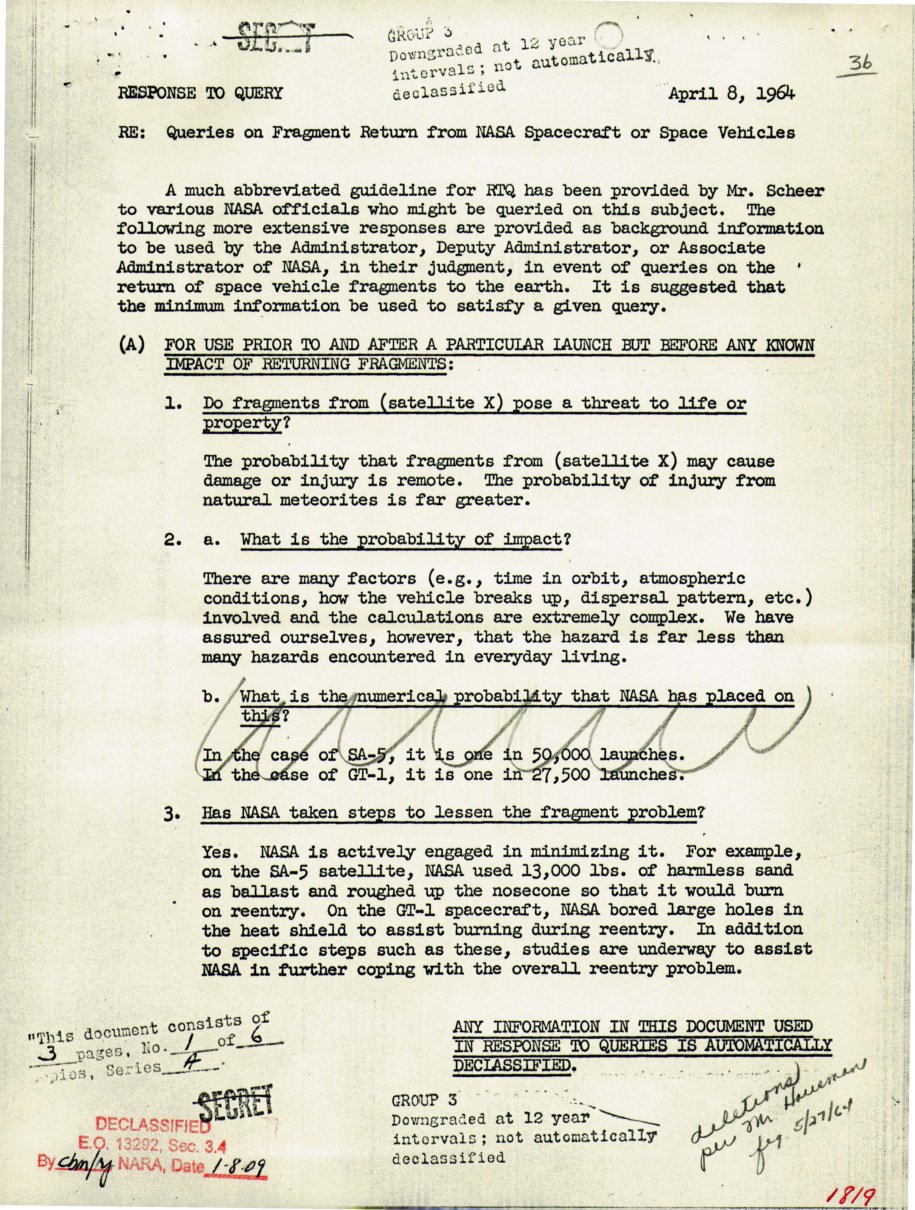
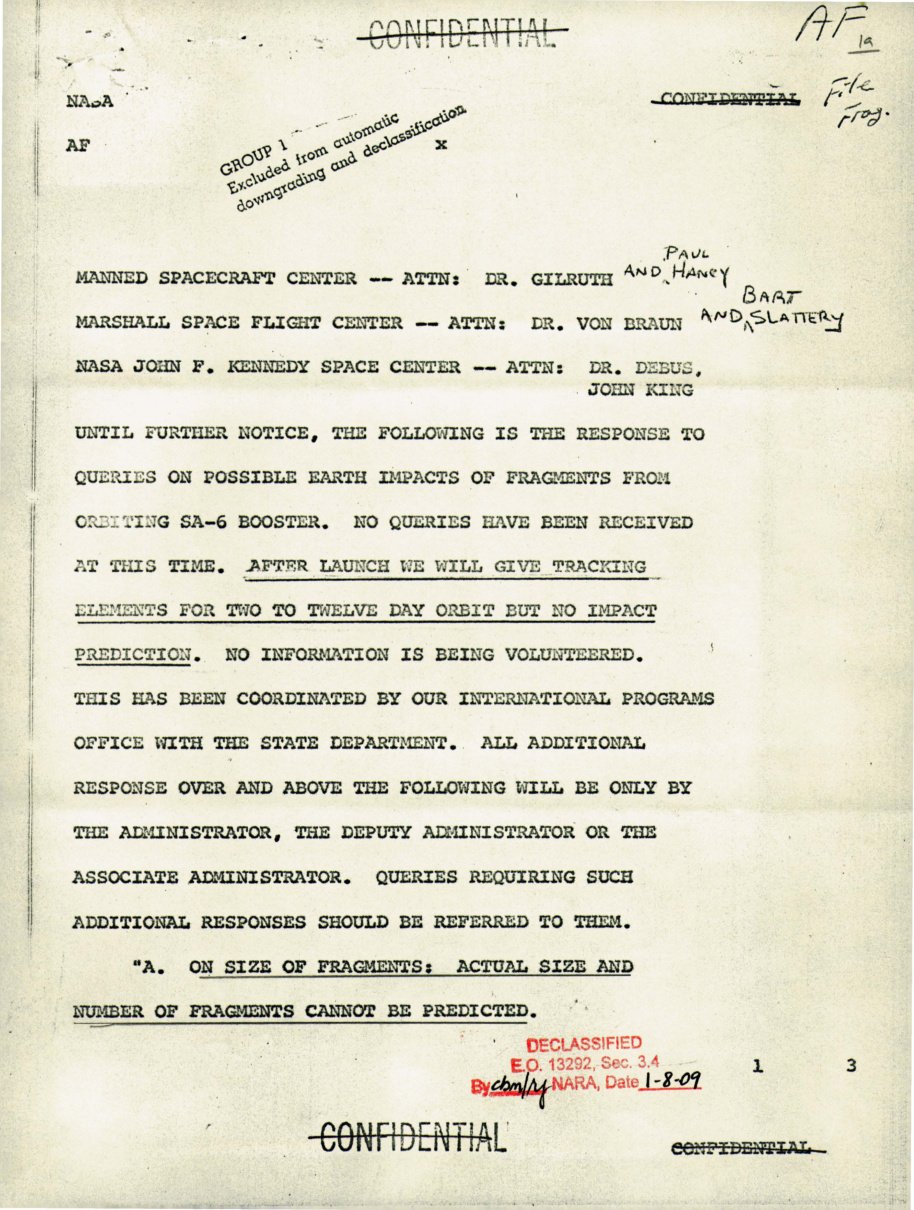
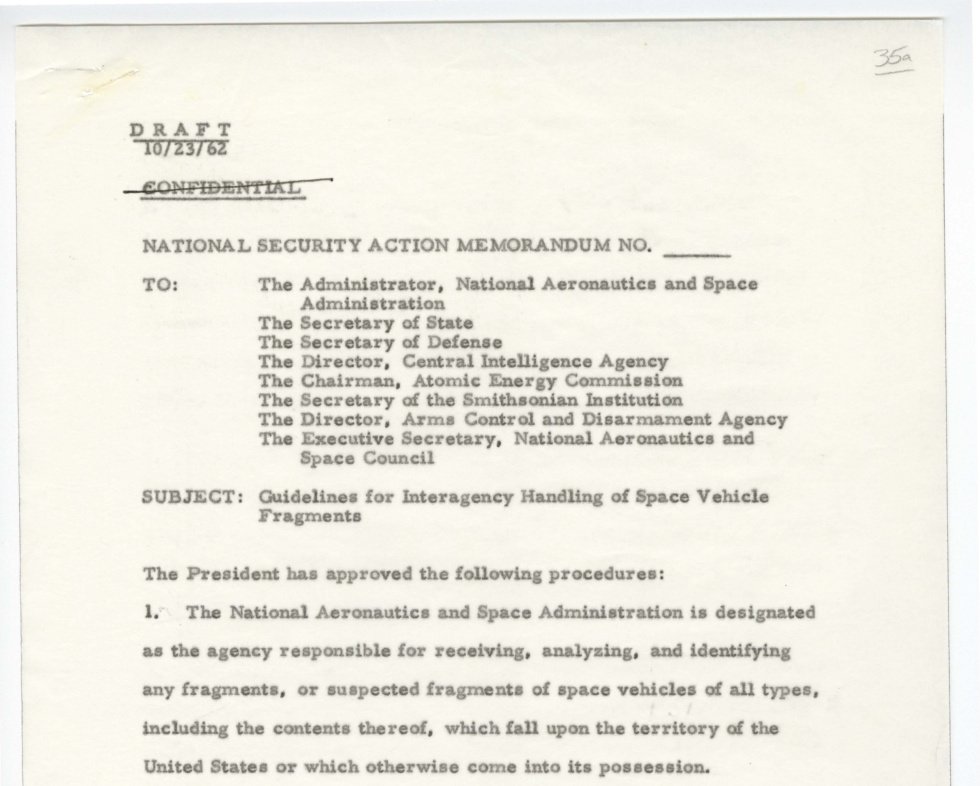
Date: 16/12/1963 (note with briefings of 23/10, 27/11 and 09/12/1963)Location: Cape Kennedy, Florida, USA (launch site; the pages do not name the place)
Cape Kennedy, 1963-1964: before the launch of the Saturn SA-5, NASA calculates how many kilos of rocket may fall to Earth
A NASA diary note from December 1963 records the briefings to the Department of State and the White House on the Saturn SA-5, which would place in orbit a large weight destined to reenter. The agency estimated the amount of material that would come back, the chance of casualties, and explained why it could not destroy the satellite in space.
- Event date
- 16/12/1963 (note with briefings of 23/10, 27/11 and 09/12/1963)
- Location
- Cape Kennedy, Florida, USA (launch site; the pages do not name the place)
- Topic
- History of the investigation
- Source agencies
- USG
- Documents
- 1 document · 72 pages
- Reading time
- 4 min
 Official document (facsimile)Physical page 7
DOCUMENTARY SOURCES · USG
What the records tell
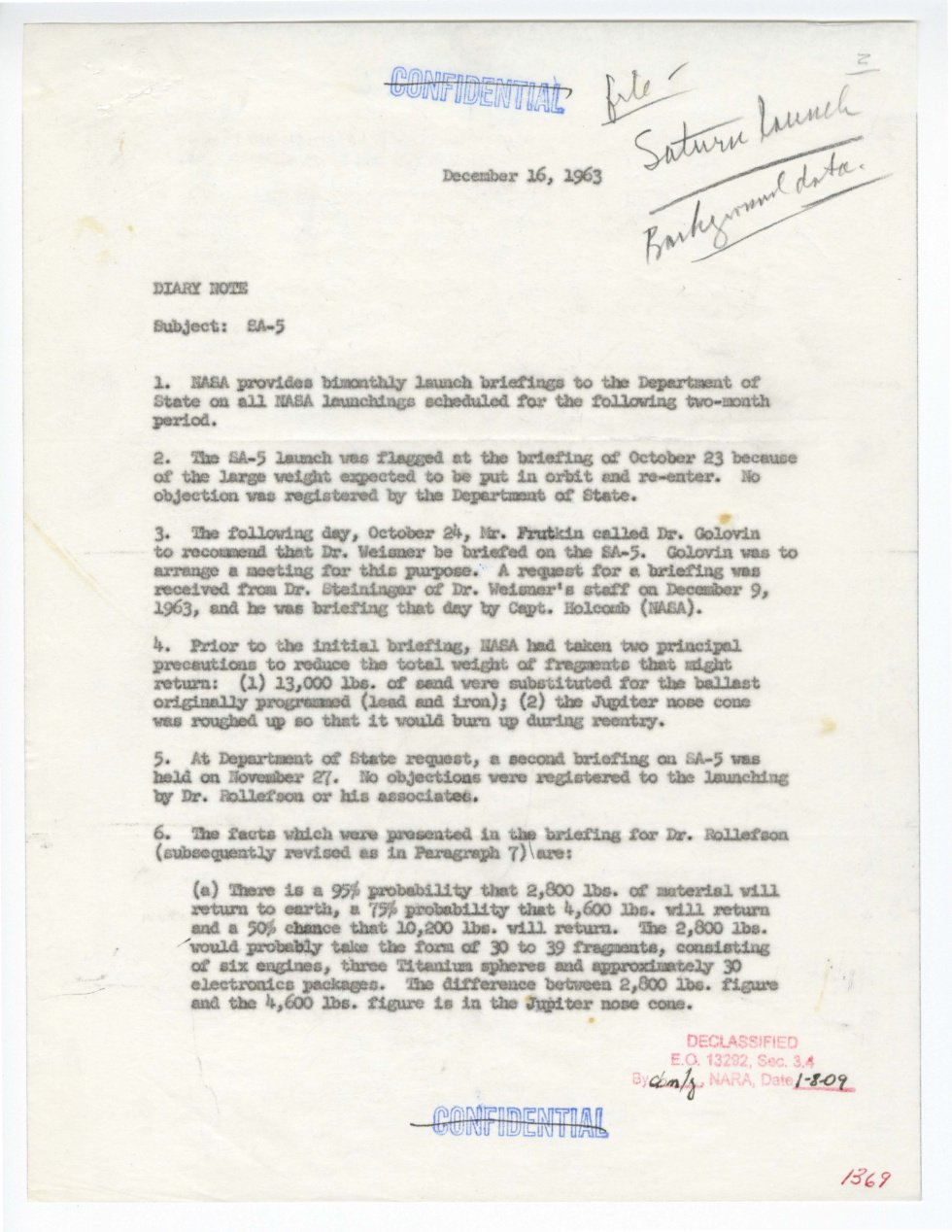
Date: December 16, 1963 (date of the note). Location: not reported in the pages; the Saturn SA-5 lifted off from Cape Kennedy, Florida, on January 29, 1964, according to public NASA records. The note, signed by James R. Morrison, of NASA's Office of International Programs, with a copy to Charles Johnson, of the White House, says that the launch was highlighted in the briefing to the Department of State on October 23, 1963 because of the great weight that would go into orbit and later reenter.
According to the note, NASA replaced the lead and iron ballast with 13.000 pounds (about 5,9 tons) of sand and roughened the Jupiter nose cone so that it would burn up on reentry. At the November 27 briefing, the figures presented were: a 95% chance of 2.800 pounds (about 1,3 tons) coming back, in 30 to 39 pieces, among them six engines, three titanium spheres and some 30 electronics packages. The revised data lowered this value to 2.361 pounds with a 95% chance.
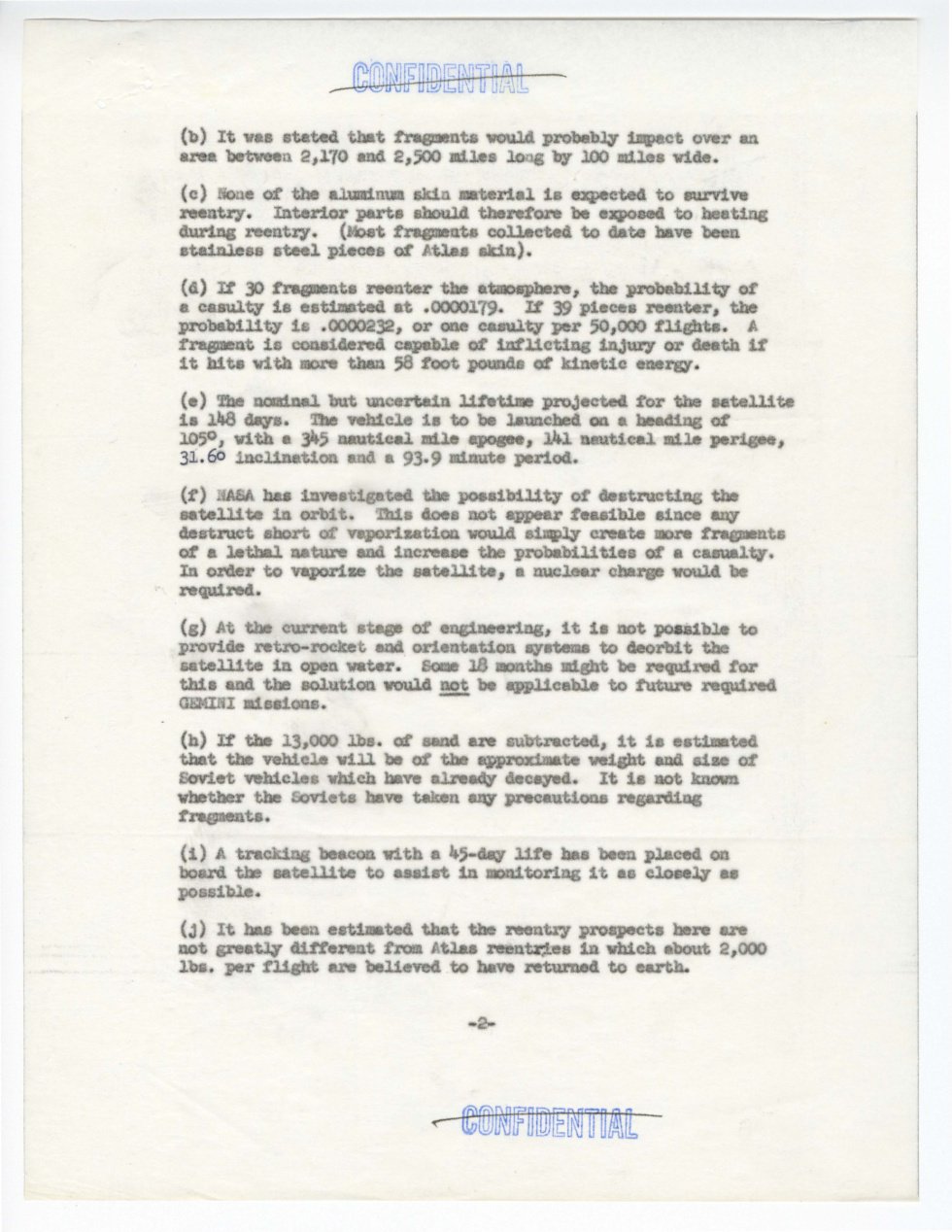
The probable impact area would be 2.170 to 2.500 miles long by 100 miles wide. The chance of a casualty was estimated at about one in every 50.000 flights; a piece would be dangerous above 58 foot-pounds of energy. NASA ruled out destroying the satellite in orbit, because that would create more fragments, and noted that only a nuclear charge would vaporize it. It also said that a retrorocket system to bring it down in the sea would take some 18 months.
The note compares the case to the Atlas reentries, from which about 2.000 pounds per flight would have come back to Earth, and to data from the Smithsonian Astrophysical Observatory: 310 meteorites per year in Africa alone, ten times more objects than those of the SA-5, with no proven casualty. These are NASA's own estimates and assessments, not measurements of a fall. The pages do not say where or whether any piece of the SA-5 was recovered.
More images from the document
DIRECT READING OF THE FILE
The document, in the original
All pages of this episode were translated in full, one per page, with handwritten notes and crossed-out passages indicated.
EXCERPT 1 · PHYSICAL PAGE 7
Physical page 7, full page
No objections vere registered to the launching
of State request, a second briefing on SA-5 was
by Dr. Rollefson or his associateé.
ht
held on Noveuber 27.
6. Wie Sake sOkse, aele gengeeiad Se ip weleting See De. Wie
%
(subsequently revised as in Peragrayh 7)
5.
x
figure
DECLASSIFIED
ter
A
Tritt
T
sfie]
eth |
iat
aint
jl
shibelt
&. sii
4
8Editorial note: Diary note of 16/12/1963 from NASA's office of international programs on the briefings given to the Department of State and the White House before the launch of Saturn SA-5.
Check the original PDF
No objections vere registered to the launching
of State request, a second briefing on SA-5 was
by Dr. Rollefson or his associateé.
ht
held on Noveuber 27.
6. Wie Sake sOkse, aele gengeeiad Se ip weleting See De. Wie
%
(subsequently revised as in Peragrayh 7)
5.
x
figure
DECLASSIFIED
ter
A
Tritt
T
sfie]
eth |
iat
aint
jl
shibelt
&. sii
4
8View the document record ↗ · Physical page 7, counting the cover.
EXCERPT 2 · PHYSICAL PAGE 8
Physical page 8, full page
(o) It wes steted that fragments would probebly impect over an
area between 2,170 and 2,500 miles long by 100 miles wide.
(c) Sone of the aluminum skia material is expected to survive
during reentry. (Most fragments collected to date have been
stainless steel pieces of Atles skin).
(4) If 30 fragments reenter the atmosphere, the probability of
@ casulty is estimated at .0000179. If 39 pieces reenter, the
probability is .0000232, or one casulty per 50,000 flights. A
fragment is considered capable of inflicting injury or death if
it hite with more than 58 foot pounds of kinetic energy.
(e) The nominal but wicertein lifetime projected for the satellite
is 148 days. The vehicle is to be lsunched on « heading of
105°, with e 345 nautical mile apogee, i141 neutical mile perigee,
31.60 inclinetion and a 93.9 minute period.
(f) NASA has investigated the possibility of destructing the
satellite in orbit. ‘This does not eppear feasible since any
destruct short of veporization would simply create more fragments
of a lethal nature end increase the probabilities of a casualty.
In order to vaporize the satellite, a nuclear charge would be
required.
(g) At the current stage of engineering, it is not possible toEditorial note: Second sheet of the note on SA-5: impact area, probability of casualties, predicted orbit, and why the satellite could not be destroyed in orbit.
Check the original PDF
(o) It wes steted that fragments would probebly impect over an
area between 2,170 and 2,500 miles long by 100 miles wide.
(c) Sone of the aluminum skia material is expected to survive
during reentry. (Most fragments collected to date have been
stainless steel pieces of Atles skin).
(4) If 30 fragments reenter the atmosphere, the probability of
@ casulty is estimated at .0000179. If 39 pieces reenter, the
probability is .0000232, or one casulty per 50,000 flights. A
fragment is considered capable of inflicting injury or death if
it hite with more than 58 foot pounds of kinetic energy.
(e) The nominal but wicertein lifetime projected for the satellite
is 148 days. The vehicle is to be lsunched on « heading of
105°, with e 345 nautical mile apogee, i141 neutical mile perigee,
31.60 inclinetion and a 93.9 minute period.
(f) NASA has investigated the possibility of destructing the
satellite in orbit. ‘This does not eppear feasible since any
destruct short of veporization would simply create more fragments
of a lethal nature end increase the probabilities of a casualty.
In order to vaporize the satellite, a nuclear charge would be
required.
(g) At the current stage of engineering, it is not possible toView the document record ↗ · Physical page 8, counting the cover.
EXCERPT 3 · PHYSICAL PAGE 9
Physical page 9, full page
7. Revised Information
Since the November 27 briefing, the following revised date has been
provided: 95% probability 2,361 lbs. will return; 50% probability
3,000 lbs. will retura.
ce: Mr. C. Johnson, White HouseEditorial note: Final sheet of the note on SA-5, with revised figures for the weight that would return to Earth and a comparison with meteorites that fall in Africa, signed by James R. Morrison.
Check the original PDF
7. Revised Information
Since the November 27 briefing, the following revised date has been
provided: 95% probability 2,361 lbs. will return; 50% probability
3,000 lbs. will retura.
ce: Mr. C. Johnson, White HouseView the document record ↗ · Physical page 9, counting the cover.
Dates and documentary context
- Event
- 16/12/1963 — Date of the diary note (p. 7). Briefings cited: 23/10/1963, 09/12/1963 and 27/11/1963. The launch on 29/01/1964 is public NASA information, not cited in the pages.
- Document
- 16/12/1963 — Note by James R. Morrison, pp. 7-9.
- Publication
- Not established — Release by war.gov, release 07; exact date not given in the PDF.
Origin and release
Lyndon B. Johnson Library (National Security File, Charles E. Johnson files); documents from the National Aeronautics and Space Council, NASA, CIA and National Security Council · USG-UAP-D002-Interagency_Correspondence_Concerning_Space_Fragments-1962_1964.pdf
Folder "Space vehicle fragments: responsibilities and procedures," box 018.
undefined ↗ — undefined
Related accounts and their differences
- Space fragments: the interagency correspondence, 1962-1964
- Gemini-Titan 1: answers about fragments
- Saturn SA-6: guidance on fragments
Questions to continue the investigation
- Was any fragment of SA-5 ever recovered and turned over under the 1963 guidelines?
- Who calculated the casualty probability, and with what method? The note only presents the numbers.
GEOGRAPHY OF THE CASE
Cape Kennedy (Cape Canaveral), Florida, USA
Approximate reference to the launch area, placed by the editorial team. It does not indicate a fragment impact site, which the documents do not predict.
DOCUMENTARY TRAIL
Go back to the sources
References use physical pages of the PDF, counting the cover. Summaries are presented in English; the documents keep their original language.
- USG-UAP-D002-Interagency_Correspondence_Concerning_Space_Fragments-1962_1964.pdf
Physical pages 7 to 9: diary note of 16/12/1963 on the SA-5, by James R. Morrison (NASA)
USG · 72 pages
Editorial summary based on the collection's research notes. How we read the documents.