Date: December 1953 to January 1955Location: Washington, D.C., and Malton (Toronto), Ontario, Canada
Washington and Toronto, 1954: Air Force intelligence studies Avro's Canadian 'flying disc' and fears the Soviets already have one
In 1954, a U.S. Air Force (USAF) intelligence analyst investigated Project Y2, a circular vertical-takeoff aircraft by the Canadian firm A. V. Roe, and concluded that if the West could build a 'flying disc,' the Soviet Union could too. An optimistic article in the internal intelligence magazine provoked a reaction: the Air Force scientific advisory board advised against supporting the project, and the matter was taken out of the analyst's hands.
- Event date
- December 1953 to January 1955
- Location
- Washington, D.C., and Malton (Toronto), Ontario, Canada
- Topic
- History of the investigation
- Source agencies
- DOW
- Documents
- 1 document · 57 pages
- Reading time
- 20 min
 Official memorandumPhysical page 13
DOCUMENTARY SOURCES · DOW
What the records tell
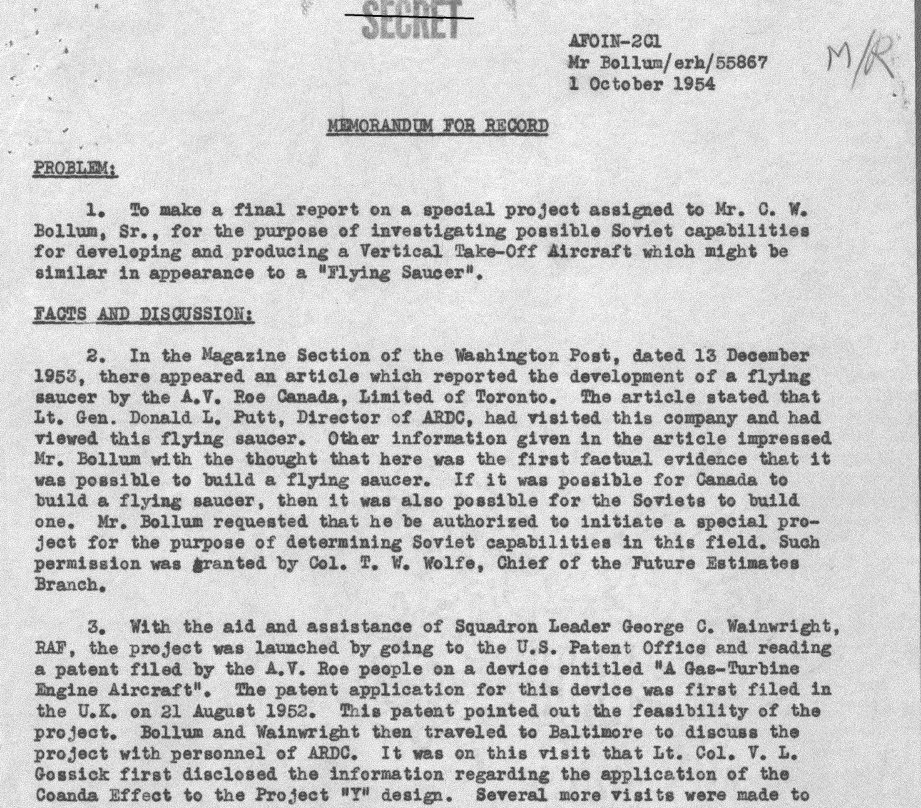
It all began with a news story. On December 13, 1953, the Washington Post Sunday magazine reported that A. V. Roe Canada, of Toronto, was developing a 'flying disc' and that General Donald L. Putt, of the U.S. Air Force, had visited the plant. For C. W. Bollum, an analyst at the Air Force Directorate of Intelligence, this was 'the first factual evidence' that it was possible to build a flying disc; and if Canada could, the Soviets could too. With authorization from the chief of the Future Estimates Section and the help of Squadron Leader George C. Wainwright, of the British RAF, Bollum opened a special project to assess Soviet capability in this field.
Bollum's final memorandum, dated October 1, 1954, describes the path he followed. At the patent office he read Avro's application for a 'gas turbine-powered aircraft,' visited the Air Force research command in Baltimore and went to Ottawa, where Canadian intelligence passed on to him rumors about four Germans linked to discs at the end of the war: George Klein, Otto Habermohl, Rudolf Schriever and Robert Miethe. On June 15, 1954, at Avro, chief engineer Jack Frost demonstrated with models the Coanda effect, the air bearings and the control system. According to Bollum, Frost said he had no doubt that the Soviets were ahead of the West in vertical takeoff aircraft.
Bollum's conclusion was bold. The chances of Project Y, called 'Ladybird' within the Air Force, seemed good; if it succeeded, the Soviets would have a similar capability, perhaps years ahead. He wrote that 'perhaps one of the most important results of this investigation' was that unconventional aircraft were no longer seen as fanciful, and that 'the emphasis will shift from disproving flying disc reports to proving them.' He recommended separating reports of 'earth-made flying discs' from ATIC's UFO work, reexamining sightings near the Soviet Union, locating and interrogating Miethe and a certain Bruno Berberich, and appointing a coordinator for the subject.
The attached briefing, presented to military chiefs, the CIA, the NSA and RAND, describes the project: a large disc-shaped radial engine, with vertical takeoff on a cushion of air, a projected speed of Mach 2,5 at 85 thousand feet in the first model, and a test flight expected in spring 1956. These are design figures, not measurements. The text also reproduces two reports that it itself calls 'low reliability': a cyclist in a Soviet satellite country who reportedly saw a disc descend, hover and climb while spinning, and a prisoner of war who reportedly saw a disc-shaped aircraft with Soviet markings land in a field. It admits that such reports 'may be fabricated.'
In December 1954, the internal magazine Air Intelligence Digest published the optimistic article 'The Flying Disc,' prepared with Bollum's material. The reaction was swift. The Air Force scientific advisory board, chaired on an acting basis by James H. Doolittle, sent three engineers to Avro on November 17 and 18, and their report recommended no contractual support: the project did not violate basic laws, but it sacrificed horizontal flight to hovering capability, drag appeared to be underestimated by half, and 'dreams must stand the test of rigorous theoretical and experimental evaluation.' On December 14, the board's secretary set these 'generally negative' conclusions against the article.
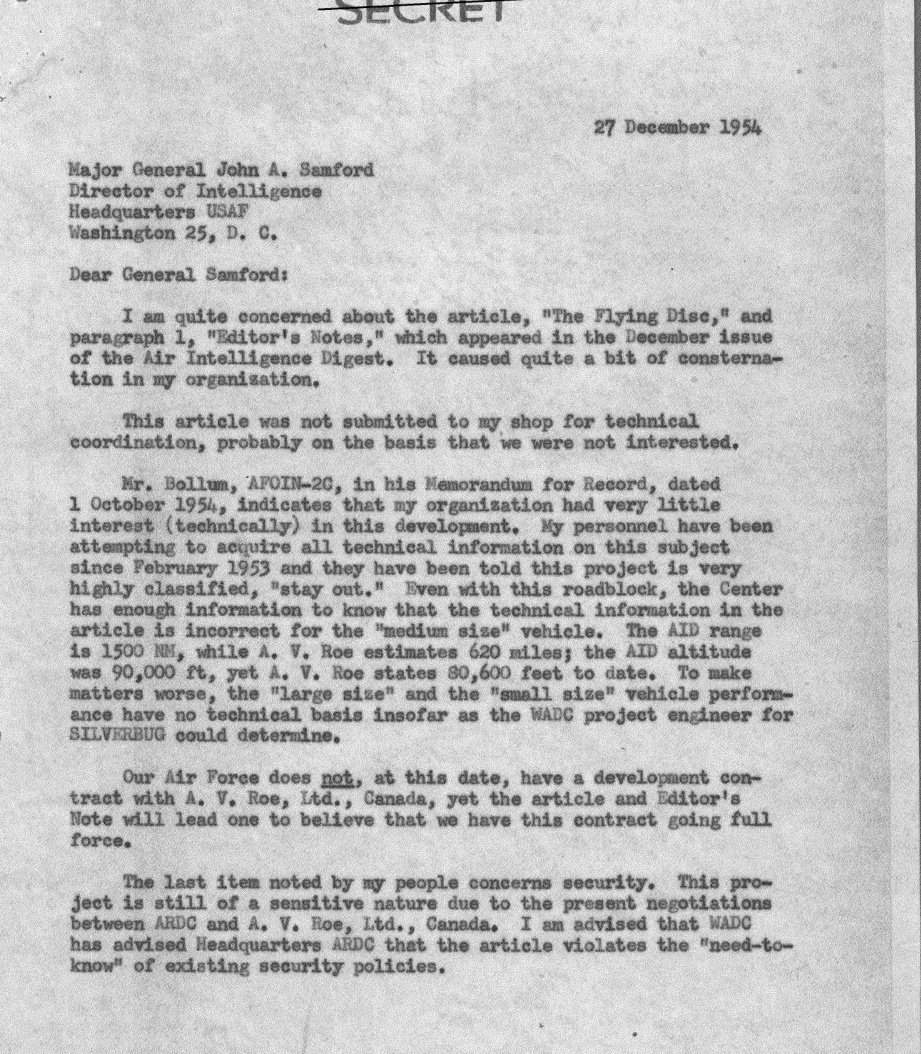
General H. E. Watson, of ATIC, complained that his staff had not been consulted and that the article contained wrong figures; he asked that the follow-up of the project, called SILVERBUG, be transferred to his center. On January 13, 1955, Lieutenant Colonel Joseph A. Bloomer recommended to General Samford that there be no further articles or briefings without his personal approval, and recorded that Bollum had received a verbal order to stop. On January 17, Watson reported that an Air Force technical division had given Avro a one-year study contract, dated December 29, 1954. The papers deal with an internal dispute over an experimental aircraft, not with a sighting.
More images from the document
DIRECT READING OF THE FILE
The document, in the original
Physical pages 2, 3, 4, 5 to 12 (Scientific Advisory Board report), 13 to 17 (Bollum memorandum), 18 to 23 (TAB A briefing), 24 to 26 (Bloomer memorandum) and 30 to 34 (SAB transmittal, Watson letter and Hosford memoranda) were translated in full. Pages 27 to 29 are another copy of the Bloomer memorandum, with the same typed text and the recipient's handwritten 'OK' approvals, recorded in separate entries. The two third-party accounts reproduced in the briefing (cyclist and prisoner of war) were translated as they stand, with the caveat of low reliability made by the document itself. The slides with 'artist's conceptions' cited in the briefing are not in the file.
EXCERPT 1 · PHYSICAL PAGE 3
Cover sheet of the Scientific Advisory Board report, physical page 3 (full text)
f
,
DEPARTMENT OF THE AIR FORCE
Head.quarters United States Air Force
Washington 251 D. C.
SCIENTIFIC ADVISORY BOARD TO THE CHIEF OF STAFF, tJSAF'
scn;NrIFIC ADVISORY BOARD :REPORT ON AVRO PROJECT Y2 ~
Novembex· 1951+
----------:"
This document consists of ______ pages
Copy Number~-- of _,l.1,, ··- copies.
0 ECRB±'Check the original PDF
[SECRET, riscado] [manuscrito: Int 2-2-7] DEPARTMENT OF THE AIR FORCE, Headquarters United States Air Force, Washington 25, D. C. SCIENTIFIC ADVISORY BOARD TO THE CHIEF OF STAFF, USAF. SCIENTIFIC ADVISORY BOARD REPORT ON AVRO PROJECT Y2. November 1954. [manuscrito: Report] This document consists of 9 pages. Copy Number 2 of 33 copies. [SECRET, riscado] [manuscrito: DS 55-0323-2]View the document record ↗ · Physical page 3, counting the cover.
EXCERPT 2 · PHYSICAL PAGE 4
Letter from J. H. Doolittle to General Putt, 10/12/1954, physical page 4 (full text)
.... .
, t DEPARTMENT OF TBE AIR FORCE
Head.quarters United States Air Foree
Washington 25, D. C.
10 December 1954
Lieutenant General Donald I .. Pu·tt
Deputy Chiet of Staff, Development
Headquarters United States Air Force
Washington, D. C..
Dear Don:
In response to your request tor BAB commen·t,s on the Avco
"Saucer'' project, the SAB baa taken the following action:
The Aircraft and Propulsion Panels were brieted on September
28 ·by represente.tivea ot Bq. ARDC, at ·the time of the Fall meet~j.ng
of the Board in Omaha. The tentat:ive conclusions ot bo·tb panels
immediately atter this briefing were to the ettect that th.is pro
.Ject warranted no more than limited support. l!oveve:r, to assu1·e
·thoro\lgb. consideration ot this project, I requested rt:?presentatives
of these two panels to supplement. the briefings given 'to -them at
~ by a. Tisi·t to A. V. Roe- Canada Ltd., Malton., Ontario.
With the advice of Clark Millikan and Dean Soderberg., a select
committee ,ms choaen to conclude this study. It was c~sed ot
Dean Soderberg, Chairman of the Propulsion Panel and senior member
o'f the group; Professor Markham, of the Aircraft Panel; and Mr .. Donovan, who has been serving both as a member or 'the Aircraft Panel
and as lie..:I.son member with the Propulsi,on Panel.
The attached report ot this ,group is ~orwarded with my «.PPt•oval,
representing the results ot the SAB's ccapleted study.
Sincerely,
/a/
J. H. DOOLr.rTLE
Actins Chairman
Scient.itic Advisory Board
Office ot the Chief of Sta.ff
Inclosure
•
S E C Ft B 'f -Check the original PDF
[SECRET, riscado] DEPARTMENT OF THE AIR FORCE, Headquarters United States Air Force, Washington 25, D. C. 10 December 1954. Lieutenant General Donald L. Putt, Deputy Chief of Staff, Development, Headquarters United States Air Force, Washington, D. C. Dear Don: In response to your request for SAB comments on the Avro "Saucer" project, the SAB has taken the following action: The Aircraft and Propulsion Panels were briefed on September 28 by representatives of Hq. ARDC, at the time of the Fall meeting of the Board in Omaha. The tentative conclusions of both panels immediately after this briefing were to the effect that this project warranted no more than limited support. However, to assure thorough consideration of this project, I requested representatives of these two panels to supplement the briefings given to them at Omaha by a visit to A. V. Roe Canada Ltd., Malton, Ontario. With the advice of Clark Millikan and Dean Soderberg, a select committee was chosen to conclude this study. It was composed of Dean Soderberg, Chairman of the Propulsion Panel and senior member of the group; Professor Markham, of the Aircraft Panel; and Mr. Donovan, who has been serving both as a member of the Aircraft Panel and as liaison member with the Propulsion Panel. The attached report of this group is forwarded with my approval, representing the results of the SAB's completed study. Sincerely, /s/ J. H. DOOLITTLE, Acting Chairman, Scientific Advisory Board, Office of the Chief of Staff. Inclosure. [SECRET, riscado]View the document record ↗ · Physical page 4, counting the cover.
EXCERPT 3 · PHYSICAL PAGE 5
Report of the SAB committee to General Doolittle, 06/12/1954, sheet 1, physical page 5 (full text)
December 6, 1954,
Generel James H. Doolittle, Acting Chairman
Scientific Advisory Board
Office of the Chief of Start
Keadquerters United States Air Fores
Washington, D, CG.
Dear General Doolittle: e
At your request we constituted ourselves an ad hoc group to ‘con
clude the studies of the A.V. Roe Company project 12, which vas pre~
sented to the Scientific Advisory Board at the Omaha meetings in Sep- -
tember of this year. We visited the A. V. Roe Company in Toronto on
‘November 17 and 18. After considering the information available to.
Us, we ‘Present the following eeport. ae
We wish to comend the officials of the A. V. Roo Company for
most courteous and ‘well-planned reception, asking, the fullest | 36
ble use of the svailsble time.
‘The 2 is. an airplane of elroular plan TGEM) originsliy | bud
se ‘sround a radial flo ‘turbojet with the exhaust copable of bein g do~
| flected downward in an annular jet for take-off and hovering sar
. the = ground, The airplane 4a designed for supersonic flight ab hi
@> under which condition the exhaua jet is directed
a1 : rearvards. the air is taken in vertically from the sbove forCheck the original PDF
[SECRET, riscado] December 6, 1954. General James H. Doolittle, Acting Chairman, Scientific Advisory Board, Office of the Chief of Staff, Headquarters United States Air Force, Washington, D. C. Dear General Doolittle: At your request we constituted ourselves an ad hoc group to conclude the studies of the A.V. Roe Company project Y2, which was presented to the Scientific Advisory Board at the Omaha meetings in September of this year. We visited the A. V. Roe Company in Toronto on November 17 and 18. After considering the information available to us, we present the following report. We wish to commend the officials of the A. V. Roe Company for a most courteous and well-planned reception, making the fullest possible use of the available time. The Y2 is an airplane of circular plan form, originally built up around a radial flow turbojet with the exhaust capable of being deflected downward in an annular jet for take-off and hovering near the ground. The airplane is designed for supersonic flight at high altitude, under which condition the exhaust jet is directed horizontally rearwards. The air is taken in vertically from the above for [continua] 1 [SECRET, riscado]View the document record ↗ · Physical page 5, counting the cover.
EXCERPT 4 · PHYSICAL PAGE 6
SAB committee report, sheet 2, physical page 6 (full text)
hovering; for devel alight | the. intake ie changed to a normal
frontal inlet by a sot of slides and. doors, In leter versions the
radial engine has been replaced by vadially disposed. axial flow
| turbojetse of conventions] type. ‘This modification was originally -
| considered as an intermediate version which might simplify the devel~
| oO opment procedures, but ag the vadial engine has been more realisti- Se
eally appraised, it is now Looked upon as en alternative form of
equal promise. , a
It 4a. avident thet the invention involves a whole array of for=
mideable problems of Peseerch and development. Even in the smallest
| ‘wirgioos the outer Aisnoter of ‘the radial flow turbine is about
, twenty feet.
‘The entire rotor must. be supported on air hearings in.
the radial es Well as the axial direction, and 1t is evident that —
the accompanying problems of mechanical design are very difficult.
The design requires that, very lerge air flow (a minimua of ebout
800 ‘Ub/s) be regulated by @ complicated systes of mechanical shutter:
a ‘the inlet as well as on the outlet side. The. problems of stability
Am hovering, in forwerd flight, and in the transition between the two Ze
eo nodes naturally demand 1 considerable attention, The many etructural .
- gtandard ile aircraft, Ths justistoation for entering 3 intoEditorial note: Metric conversion done by the editors.
Check the original PDF
hovering; for level flight the intake is changed to a normal frontal inlet by a set of slides and doors. In later versions the radial engine has been replaced by radially disposed axial flow turbojets of conventional type. This modification was originally considered as an intermediate version which might simplify the development procedures, but as the radial engine has been more realistically appraised, it is now looked upon as an alternative form of equal promise. It is evident that the invention involves a whole array of formidable problems of research and development. Even in the smallest versions the outer diameter of the radial flow turbine is about twenty feet. The entire rotor must be supported on air bearings in the radial as well as the axial direction, and it is evident that the accompanying problems of mechanical design are very difficult. The design requires that very large air flow (a minimum of about 800 lb/s) be regulated by a complicated system of mechanical shutters on the inlet as well as on the outlet side. The problems of stability in hovering, in forward flight, and in the transition between the two modes naturally demand considerable attention. The many structural problems of an unconventional nature likewise require much study. It is evident, even with only a casual study, that the process of development would be lengthy and costly in the extreme, even by present standards in military aircraft. The justification for entering into 2View the document record ↗ · Physical page 6, counting the cover.
EXCERPT 5 · PHYSICAL PAGE 7
SAB committee report, sheet 3, physical page 7 (full text)
SRERET
such an undertaking must depend on (a) the significance of the ob-
jectives which the nev airplane cleins to fill and (b) the sound-
ness of the means proposed to attain these objectives. .
The key feature on which the design of the 12 is based is the
utilisation for hovering of the pressure built up in the center of
@ an ennuler jet stream, This pressure build-up increases the ft |
at standstill close to the ground in such a fashion as to indicate Se
the practicability of hovering a few feet off the ground with en- |
_gines whose static sea level thrust, without this eugnentation fron
ground effect, ‘would ‘be less than the airplane gross weight. Also,
a ‘because of the nature of the ground effect, the aircraft would be
stable with rospect to height when hovering; that is, it would nut: Ye
require pilot attention to. hold & height above the ground, although S
it would Pequire contral to maintein its attitude. The thrust aug-
mentation for hovering obtained by A. V. Roe in enol], scale test
of the order of 60 to B0%. Because the appeocelte variables were
not investigated and the pertinent measurements not made during
tests, data are not svaileble to extrapolate this tomilt Proper:
: predict accurately ou scale augnentation factors. ‘There are
“features wich could make the full scale auguentation factors omaller —
ee : but very Little Likeldhood of ‘their being larger than in the —_— oe
a The possibility of stable hovering is, nevertheless, an engaging :
} feature. “Tafortmately, it has dominated the evolution of the con=
yoyCheck the original PDF
such an undertaking must depend on (a) the significance of the objectives which the new airplane claims to fill and (b) the soundness of the means proposed to attain these objectives. The key feature on which the design of the Y2 is based is the utilization for hovering of the pressure built up in the center of an annular jet stream. This pressure build-up increases the lift at standstill close to the ground in such a fashion as to indicate the practicability of hovering a few feet off the ground with engines whose static sea level thrust, without this augmentation from ground effect, would be less than the airplane gross weight. Also, because of the nature of the ground effect, the aircraft would be stable with respect to height when hovering; that is, it would not require pilot attention to hold a height above the ground, although it would require control to maintain its attitude. The thrust augmentation for hovering obtained by A. V. Roe in small scale tests is of the order of 60 to 80%. Because the appropriate variables were not investigated and the pertinent measurements not made during the tests, data are not available to extrapolate this result properly to predict accurately full scale augmentation factors. There are many features which could make the full scale augmentation factors smaller but very little likelihood of their being larger than in the model. The possibility of stable hovering is, nevertheless, an engaging feature. Unfortunately, it has dominated the evolution of the con- 3View the document record ↗ · Physical page 7, counting the cover.
EXCERPT 6 · PHYSICAL PAGE 8
SAB committee report, sheet 4, physical page 8 (full text)
“
figuration to such an extent. ‘that performance in level flight ape
pears to have been sontousl:y compromised. Since forward flight is,
after all, the important, function of any airplane, ’ oo) have attempted
to examine into the inventor's clain for the flight characteristics
with particular care. : . . ae
The inventor has advanced elains for favoreble forward ight eS
characteristics on the basis that the radial flow engine has a very a |
favorable thrust to weight ratio (about .22), that the specific thrust
. on the projected | area of the plane (about 600, excluding air intakes ;
: as. unusnaly highs i thet the ag characteristics of ‘the plane arEditorial note: The original says 'thrust to weight ratio (about .22)'; the value 0,22 only makes sense as weight per thrust (engine specific weight), as the following sentence indicates; the translation follows the technical meaning and records the ambiguity here.
Check the original PDF
figuration to such an extent that performance in level flight appears to have been seriously compromised. Since forward flight is, after all, the important function of any airplane, we have attempted to examine into the inventor's claim for the flight characteristics with particular care. The inventor has advanced claims for favorable forward flight characteristics on the basis that the radial flow engine has a very favorable thrust to weight ratio (about .22), that the specific thrust on the projected area of the plane (about 600, excluding air intakes) is unusually high, and that the drag characteristics of the plane are very favorable. While not enough information is available to settle all of these points, we are compelled to take exception to all three of these claims. The specific engine weight is no longer unusual and would not in itself justify the radial engine development. Moreover, the radial engine possesses certain inherent limitations in pressure ratio and component efficiencies which are detrimental to good fuel consumption in comparison with the axial flow type. The shift to conventional turbojets has, of course, altered the situation, but it has not strengthened the claims based on the engine. The high thrust per frontal area is in part due to the fact that all discussions so far have been made around planes with no pay load. The situation with respect to drag appears to us the most serious, however, since we feel that the drag may have been underestimated by a factor of two. Very 4View the document record ↗ · Physical page 8, counting the cover.
EXCERPT 7 · PHYSICAL PAGE 9
SAB committee report, sheet 5, physical page 9 (full text)
«
lengthy and expensive experiments are needed to settle these questions
with finality.
The inventor has aseuned that some improvement in the drag situ-
ation might be. obtained ‘through boundary layer suction. The alleged
gain from this source is associated with the distribution of the ox-
haust: jet over the trailing edge of the airplane, It is not wholly
o impossible that such a gain might in fact be present, but no reliable ae
test information is available at the present time a: this point. In : af eS
this respect this airplane differs from more conventional types sly
‘because the exhaust jot is distributed over the trailing edge of
" wing. ‘The cirouler plan form offers no particular advantage in
connection.
We are confronted, therefore, with an airplane development whitch |
does. not . aepene to possess any intrinsic advantages ater with the é
= turbojete, ‘The pressure recovery on the induction side ts corte
to be poor for both alternatives; even with the utmost development a
a of details it gould not approach the performance of conventional, air : eo
ao ducting on the exheust side presents equally formid 7
difficulties fron the Point of view of lésses, end the gein due
planes.
boundary ayer suction is only conjectural. Thess things | ,
- been” compensated for ig the drag ‘characteristics of the plane con~
figuration « could be ‘dononstrated to be favorable. There is noCheck the original PDF
lengthy and expensive experiments are needed to settle these questions with finality. The inventor has assumed that some improvement in the drag situation might be obtained through boundary layer suction. The alleged gain from this source is associated with the distribution of the exhaust jet over the trailing edge of the airplane. It is not wholly impossible that such a gain might in fact be present, but no reliable test information is available at the present time on this point. In this respect this airplane differs from more conventional types only because the exhaust jet is distributed over the trailing edge of the wing. The circular plan form offers no particular advantage in this connection. We are confronted, therefore, with an airplane development which does not appear to possess any intrinsic advantages either with the original radial engine or with the spoke arrangement of conventional turbojets. The pressure recovery on the induction side is certain to be poor for both alternatives; even with the utmost development of details it could not approach the performance of conventional airplanes. The ducting on the exhaust side presents equally formidable difficulties from the point of view of losses, and the gain due to boundary layer suction is only conjectural. These things might have been compensated for if the drag characteristics of the plane configuration could be demonstrated to be favorable. There is no 5View the document record ↗ · Physical page 9, counting the cover.
EXCERPT 8 · PHYSICAL PAGE 10
SAB committee report, sheet 6, physical page 10 (full text)
Sees
w
information to indicate thet this is so. No basic lews appear to have
been transgressed in the design. It is merely a question of overempha~
sis on the hovering characteristics without any assurance that the»
ievel, flight characteristics would be tolerable. a
In arriving at a recommendation for action by the United States
@ Air Force, we have attempted to bring into focus several considerations.
The Kind of imaginative thinking sbout unconventional aircraft whi
the inventor has displayed certainly has a plece, and there is per=
haps not enough of it in the planning operations of the USAF. When 2
scheme of this Kind is ready for more serious exploltation,. however
; Gevtain consideraticns are essential.
The dreams must stand the test
of hardheaded theoretical and experimental evaluation, The argument
that euch a procedure, if applied to aircraft developments fifty 2
. . years ago, ‘vould have prevented powered flight is a specious One. 2
The development of an engine ‘such as the Yay if it. 4s to be carried ;
to a flight article of some kind, is en undertaking of such a magni
, at it saply cannot be undertaken on @ mere hunch. We do n
at % the inventor can support the chads he has nade for it, :
larly with reference to level flight. Moreover, we find &
| lack of attempt at a syetenatic exploration of the: various
8 phonomena involved. There must also be a set of
the aircraft, which would place it in a class ‘ebeaa ofCheck the original PDF
information to indicate that this is so. No basic laws appear to have been transgressed in the design. It is merely a question of overemphasis on the hovering characteristics without any assurance that the level flight characteristics would be tolerable. In arriving at a recommendation for action by the United States Air Force, we have attempted to bring into focus several considerations. The kind of imaginative thinking about unconventional aircraft which the inventor has displayed certainly has a place, and there is perhaps not enough of it in the planning operations of the USAF. When a scheme of this kind is ready for more serious exploitation, however, certain considerations are essential. The dreams must stand the test of hardheaded theoretical and experimental evaluation. The argument that such a procedure, if applied to aircraft developments fifty years ago, would have prevented powered flight is a specious one. The development of an engine such as the Y2, if it is to be carried to a flight article of some kind, is an undertaking of such a magnitude that it simply cannot be undertaken on a mere hunch. We do not feel that the inventor can support the claims he has made for it, particularly with reference to level flight. Moreover, we find a serious lack of attempt at a systematic exploration of the various key aerodynamic phenomena involved. There must also be a set of goals for the aircraft, which would place it in a class ahead of 6View the document record ↗ · Physical page 10, counting the cover.
EXCERPT 9 · PHYSICAL PAGE 11
SAB committee report, sheet 7, physical page 11 (full text)
.
“ . Ses
*
*
"other developments in performance, if the basic ideas should be -
mo capable of realisation. : We do not feel thet “the objectives of
| the development have been clearly formated. in pertiouler, wo
feel that there has been a preoccupation with the hovering char-
acteristics to such an extent that the nore direct essentials of
the eircreft have been lost sight of. ee
We do not question the ability of the A. v. ‘he ; Coops Z
Go under teke successfully any well-coneeived project in the aire r
Pe field which lies within their material resources. Our as os
in jet aircraft and engines. We have developed the suspicion, h
designere in the A. V. Roe engines
old on the ¥2 Froject. Tt de mania
prcve this contention or ‘to make th
he company. We feel ¢ ised, hower
.* v. Roe ones ati 1 have not |Editorial note: The opinion about the inventor and about the company's designers is the committee's, recorded in the document as an unproven suspicion.
Check the original PDF
other developments in performance, if the basic ideas should be capable of realization. We do not feel that the objectives of the development have been clearly formulated. In particular, we feel that there has been a preoccupation with the hovering characteristics to such an extent that the more direct essentials of the aircraft have been lost sight of. We do not question the ability of the A. V. Roe Company to undertake successfully any well-conceived project in the aircraft field which lies within their material resources. Our visit confirmed our high opinion of their design and production activities in jet aircraft and engines. We have developed the suspicion, however, that the responsible designers in the A. V. Roe engineering groups are not thoroughly sold on the Y2 project. It is manifestly impossible for us to prove this contention or to make this assertion officially with the company. We feel convinced, however, that the best talents of the A. V. Roe organization have not been drawn upon in the evaluation of this project. This statement is made without prejudice toward the inventor, who impressed us as a talented and sincere man with a great deal of imagination, but who for this very reason cannot be expected to present a fully impartial critique. Full support from some of the leading designers outside of this particular group could perhaps have presented a more convincing argument for support. 7View the document record ↗ · Physical page 11, counting the cover.
EXCERPT 10 · PHYSICAL PAGE 12
SAB committee report, sheet 8, physical page 12 (full text)
On the basis of the above, We recommend sguinet any contractual
support, for this. Project until much greater potentialities have been oe
demonstrated by A. ve Roe!s own analysis.
Sincerely yours,
Allen F. Donovan
C, Richara Soderberg, Chairman z IeCheck the original PDF
[SECRET, riscado] On the basis of the above, we recommend against any contractual support for this project until much greater potentialities have been demonstrated by A. V. Roe's own analysis. Sincerely yours, Signed: Allen F. Donovan, John R. Markham, C. Richard Soderberg, Chairman. 8 [SECRET, riscado]View the document record ↗ · Physical page 12, counting the cover.
EXCERPT 11 · PHYSICAL PAGE 23
TAB A briefing, parts IV and V, physical page 23 (full text)
..
We h&Te preaate4 to 7011 ao e eT14ao• Uult fl7fac aaw,era ai-e w:lthia
the oapa'bili\iea of \he exiatinc •au.te •f Ille ar\1 in thia oeunv7 ad
0uad&. !he ••tat• of \he art• ia well boa in ~opeaa ceU11tri••• !he
a.au.a effeo\ baa \••• bon to all oou.triea aad ~• &PJ)lica,1oa ta ut
be70n4 ill• oapa'bili\iea of th• Sevieta. It 1• poaaibl.e ta&\ hnan projeota
tor flT,lq •ucea ena\ed at th• •a4 of tile var. 91.e au 00•114.ered
P•••i'bl• tei>• la thia field ia auppoaecl to b• 1a ~ u.a. aov. W• haYe
repor\a •• •P vit•••••• ot tl71ac aauea ia 8oTie\ \err1'9r7.
Ult.I
~1»11'211
1. !he eatlr• 1•-•lligen.oe oe1111W1l,7 be alerte4 to a poaalbl• SoT1et
aotivit7 h 11>.11 fiel4.
a. All exiatinc tt.1•• oa toreip tl.Jiac·aauoera ahoul.4 \e reT1ewe4
u4 anal7se4.
1. llrm Ba\eicah llhoul4 'be iaterropted '7 iatelllc•aoe aaalyata
11ho haTe a full baolr.gr.ad •• ex1a,1ac 1a,e111ceaoe.
,. le\•r• Kie\he llhould be feud. Poaail>l7 Kietae OM.14 1l&Ye uuce4
hi• name k llruao Jer'beioh er aoae • tiler al.iaa.
s • .A. oolleotloa reca.uiN•nt aheul.l be plaeed. ea all aceoi•• ia the
field. i:D.Olu41q the .A.itach•••Editorial note: The 'summary' is the position of the analyst who wrote the briefing; the term 'evidence' refers to technical feasibility and to rumors, not to verified observation.
Check the original PDF
[SECRET, riscado] PART IV. SUMMARY. We have presented to you some evidence that flying saucers are within the capabilities of the existing "state of the art" in this country and Canada. The "state of the art" is well known in European countries. The Coanda effect has been known to all countries and the application is not beyond the capabilities of the Soviets. It is possible that German projects for flying saucers existed at the end of the war. The man considered possible tops in this field is supposed to be in the U.S. now. We have reports on eye witnesses of flying saucers in Soviet territory. PART V. RECOMMENDATIONS. It is recommended that: 1. The entire intelligence community be alerted to a possible Soviet activity in this field. 2. All existing files on foreign flying saucers should be reviewed and analyzed. 3. Bruno Berberich should be interrogated by intelligence analysts who have a full background on existing intelligence. 4. Robert Miethe should be found. Possibly Miethe could have changed his name to Bruno Berberich or some other alias. 5. A collection requirement should be placed on all agencies in the field including the Attaches. 6 [SECRET, riscado]View the document record ↗ · Physical page 23, counting the cover.
EXCERPT 12 · PHYSICAL PAGE 27
Second copy of the memorandum from Bloomer to General Samford, 13/01/1955, sheet 1, physical page 27 (full text; text identical to that of page 24)
SECRET
DEPARTMENT OF THE AIR FORCE
HEADQUARTBM UNITED STATES AIR P'ORCIE
WASHIN<aTON &I. D. C.
JAN 131955
- POI IIIIIAL UWOD
81IBJJIC!lt Anicle "91e J'qi.. Diao• ill DeCIIDW I•- of-. Air
Iatellipae• lt:l.·•t
1. 111r1J1a tM latter ,-n ot ...,.._er I wu annached. _,
Jll.1or Boated. u4 uud fer a ..., auaar:, or atataat flt peai't1•
oa UPO' ■, pnt.-..q cluaitie&, 'for ue 1a '1w Air Iatellipaoe
Dipat ia ooamectica Yi'tll .. &niel.• OD.. rnelJl.tioury - wne
of aircraft. I atatei. oar }'Olit.1• reprtiq IJO'• &al Uliea\N.
-U.t wr beat etton■ 1• '111• ti•l.4 wre coutaa1.ly tirecte4 'to
li ccvacillC, ld.aia:lsiaa, u4 Jl.ayiJaa 4on. Ul1' ... all &\tellpta
a\ ,ulioi'Q', an uclwliDC cluaitied Tebiclea a11Cla u AID.
2. Ma..1or Boaton &coepte4 "111• atataen, iaticat1111 tat
the artiele oa ta...,. aircraft 1NNl.t. lte ,ultliallei. withod ._
•GIIJMlmoa piece • WO'• _. nae•tea "1».t I gl.aaoe a, 'tile tiu.1.
tran.
3. I r-4 the tia&l iraft u4 aiaoe I Ml not l>ea ·pnm.~
ltrietel. an 1-111• ect I ...,.r1.a IIIJor -..tor,. nprt1ac aom
Ul4 Air fiatt .•1;1oa. Be re.,lie4 in tu attimatift Ml
iatiea'W. \Mt we wre oa aolil pva4 em "11&, 'tbe »reJect lliernefore .... -·-llad1e4 Tery CircnlllQeCi;q. .,. tiul. ·-•Uoa ,,.. to el.1aillate the lut paracraph ~ the article witll a 1ll'O i1e-1a,
vtaicll vu prolNlltly cmarloek.e4 lteton ~lica\1011..
•• liaoe the reoeipt ot "1le aaoru4a trca the :lan.\i'ft
Seere\&ry at tile 8ciertitic .lbiaory Join. (!alt A), ., iawa\ipUeu
Mft revealed. '1ae tollowiq:
a. !lie eneat ot coonliu.Uoa Oil the article ia AD waa .. toll.on:
)Ir.~ - 2Cl.
Irr Jl&o-- - 2C1
Lt Colonel Pvrior - 2Cl
Celoul Zoller - 2C
Jlr. C11lllor• - 21
ColOIIMll. Mw - 2l
•• )Ir. hlJJa vu lllller u. erroaeou illprueiea that tu
proJen 1IIM1. -..... fa'YOl'Uly cQU1UN4 lo" tu Air coaeil. aD4 ao
a4'Yiae4 JltJor »>atod.
e. eol.eul 1. •• VnQ-, m.tet ot tbe ~ical Xnaioa,
Diree\orate o'f Jleae&Nll ..a D~t., &bi••• tlaat ,u pruen-t
••• Gt tM :pro.)ect w1'111a BCIJ/JJ ia u tollwa:
SECRET
✓Editorial note: Same typescript as page 24, with the handwritten filing note. The full translation of the text is the one on page 24, repeated here.
Check the original PDF
AFOIN-X/Lt Col Bloomer/tjc/54738, Wrtn 13 Jan 55. [SECRET, riscado] [manuscrito: X Samford, General] [carimbo: JAN 13 1955] MEMORANDUM FOR GENERAL SAMFORD. SUBJECT: Article "The Flying Disc" in December Issue of the Air Intelligence Digest. 1. During the latter part of November I was approached by Major Hosford and asked for a new summary or statement of position on UFO's, preferably classified, for use in the Air Intelligence Digest in connection with an article on a revolutionary new type of aircraft. I stated our position regarding UFO's and indicated that our best efforts in this field were constantly directed to discouraging, minimizing, and playing down any and all attempts at publicity, not excluding classified vehicles such as AID. 2. Major Hosford accepted this statement, indicating that the article on the new aircraft would be published without the companion piece on UFO's and suggested that I glance at the final draft. 3. I read the final draft and since I had not been previously briefed on this project I queried Major Hosford regarding AFOIN and Air Staff coordination. He replied in the affirmative and indicated that we were on solid ground but that the project heretofore had been handled very circumspectly. My final suggestion was to eliminate the last paragraph of the article with a UFO tie-in, which was probably overlooked before publication. 4. Since the receipt of the memorandum from the Executive Secretary of the Scientific Advisory Board (Tab A), my investigations have revealed the following: a. The extent of coordination on the article in AID was as follows: Mr. Bollum - 2C1; Mr Bachman - 2C1; Lt Colonel Farrior - 2C1; Colonel Zoller - 2C; Mr. Gilmore - 2B; Colonel Adams - 2A. b. Mr. Bollum was under an erroneous impression that the project had been favorably considered by the Air Council and so advised Major Hosford. c. Colonel R. M. Wray, Chief of the Aeronautical Division, Directorate of Research and Development, advises that the present state of the project within DCS/D is as follows: [SECRET, riscado] [Handwritten, lower left:] File, the [initials, uncertain]. [Release marking:] NW 91198 DocId:34746775 Page 258.View the document record ↗ · Physical page 27, counting the cover.
EXCERPT 13 · PHYSICAL PAGE 30
Transmittal of the SAB report to the Director of Intelligence, 14/12/1954, physical page 30 (full text)
DEPARTMENT .OF THE AIR FORCE
HEADQUARTERS UNITE£) STATES AIR··FORCE
WASHINGTON 25. D. C.
14 December 1954
MIIDWIDUM JOI. DIBl&TCll 07 IIDLLIGDCI, DOIi
SUBJJCT: Scientitio Advisor, Board bport on .A.VIO •n11nc Saucer"
Project.
1. J.ttached tor yora: intonation. ia a cow of a recent nport of the Scientitic Mriaor, Board on their atud7 ot the •t17- ing aaw»r• project ot .A.. v. aoe, Cu.ad&.
2. Your attention ia particul.arl.7 iDTited to ta. generally
negative tiDdiDga vit.b reprd to technical feasibility expreaaed
1D thia report, in contrut to~ pnenJ. 1.lqateaeion ot technical aouadDeaa ad optiJliatic expectation.a COllff,-d in the article.
on "The Pl1ing Diec• publiahed in the Decaber, 1954, iasue ot
1ihe .l1r Intelligence Dipat.
3. Thia report vu eul:aitted to Lt. Gen. D. L. Putt on
10 Deouber in reaponae to hie pretlou reqU11at tor SlB oaamta.
-,,,.'
Incloaure CBIS!II I. IWDT
l . .lvro rpt, 07 2 ._cutiw Secretary
lcien.titic .Adrlaor, Board -ottice ot 'tM Ohief ot StattCheck the original PDF
[SECRET, riscado] DEPARTMENT OF THE AIR FORCE, HEADQUARTERS UNITED STATES AIR FORCE, WASHINGTON 25, D. C. 14 December 1954. MEMORANDUM FOR DIRECTOR OF INTELLIGENCE, AFOIN. SUBJECT: Scientific Advisory Board Report on AVRO "Flying Saucer" Project. 1. Attached for your information is a copy of a recent report of the Scientific Advisory Board on their study of the "flying saucer" project of A. V. Roe, Canada. 2. Your attention is particularly invited to the generally negative findings with regard to technical feasibility expressed in this report, in contrast to the general impression of technical soundness and optimistic expectations conveyed in the article on "The Flying Disc" published in the December, 1954, issue of the Air Intelligence Digest. 3. This report was submitted to Lt. Gen. D. L. Putt on 10 December in response to his previous request for SAB comments. /s/ Chester N. Hasert, CHESTER N. HASERT, Executive Secretary, Scientific Advisory Board, Office of the Chief of Staff. Inclosure: 1. Avro rpt, cy 2. [manuscrito: A; AFCSA 631] [SECRET, riscado]View the document record ↗ · Physical page 30, counting the cover.
EXCERPT 14 · PHYSICAL PAGE 31
Letter from General H. E. Watson to General Samford, 27/12/1954, sheet 1, physical page 31 (full text)
••
A -.• -
.. •
•••• . .................
.......................
la ....
. ....... ' ·, , ,, ' '\ " ,, ''• ' , '
.:r,1,. . . ......
...... • ....
•'• IV.. UI
.. ..-. .... • • .... . • ·~ ... ........1JN\ •.·.. •
........., .....
............................
• IIEditorial note: The spelling of the project name is partially covered ('SILV?RBUG'); the reading SILVERBUG is confirmed by page 32.
Check the original PDF
[SECRET, riscado] 27 December 1954. Major General John A. Samford, Director of Intelligence, Headquarters USAF, Washington 25, D. C. Dear General Samford: I am quite concerned about the article, "The Flying Disc," and paragraph 1, "Editor's Notes," which appeared in the December issue of the Air Intelligence Digest. It caused quite a bit of consternation in my organization. This article was not submitted to my shop for technical coordination, probably on the basis that we were not interested. Mr. Bollum, AFOIN-2C, in his Memorandum for Record, dated 1 October 1954, indicates that my organization had very little interest (technically) in this development. My personnel have been attempting to acquire all technical information on this subject since February 1953 and they have been told this project is very highly classified, "stay out." Even with this roadblock, the Center has enough information to know that the technical information in the article is incorrect for the "medium size" vehicle. The AID range is 1500 NM, while A. V. Roe estimates 620 miles; the AID altitude was 90,000 ft, yet A. V. Roe states 80,600 feet to date. To make matters worse, the "large size" and the "small size" vehicle performance have no technical basis insofar as the WADC project engineer for SILVERBUG could determine. Our Air Force does not, at this date, have a development contract with A. V. Roe, Ltd., Canada, yet the article and Editor's Note will lead one to believe that we have this contract going full force. The last item noted by my people concerns security. This project is still of a sensitive nature due to the present negotiations between ARDC and A. V. Roe, Ltd., Canada. I am advised that WADC has advised Headquarters ARDC that the article violates the "need-to-know" of existing security policies. T54-18661 [rubrica] [SECRET, riscado]View the document record ↗ · Physical page 31, counting the cover.
EXCERPT 15 · PHYSICAL PAGE 26
full page
1
REYI'KJ LDS I!E':IS ' DECEW3ER 19, .,19 5l°i
LONI.DI!, ENGLAIIDJ \ '
I
MtllCI OJ TH~ LrC.L ,
AM!HICAl1 ~MF./SSY...,
t,Ol!JPOfi,. ~ Gt ..J)
lf6 FEB 16 1955
~t/~
. -
- -~- ---- ~ -.-- - ..-J
H
ERE • th ,, I h"is e rea trut
about Flying c.cers,
as told by Geor Klein,
former secret wea ons ex-
pert in the Gern,an War
Production Mintstry,• and
now an e n g i n e e r in
Switzerland.
"Flying Saucers," he says,
are top secret weapons of the
SA and Russia.
" They are a continuation of
.:re rm an wartime experi -
~.1ents. .
"Prototype Flying Saucers [
were built in Germany duringthe war. I saw one reach a
height of 40,000 feet in three minutes, near Prague in
1945." '
Klein says the Russians
captured a scale mode l and top
technicians at Breslau. The
technicians have not returned
to Germany.
And Walter Micthe, , V
ij
pon inventor and key an
i Saucer development, ed
\ e st and now works in he
1itcd States
lein in a Zurich interview
• spected by Field-Mar al Montgomery . says Klein.
..........-----·-·-------'-..J
..
~ ORG KLEI N
Flying Saucer bu ilt to-day-one with a diameter of 48ft.
powered by five jets and a
larger model with a diameter
of 126ft. and 12 jets.
This, he says, accounts for
the rumour that Saucers often appear to change size sud-
denly.
Raised wing flaps liCt both '
a\roraft like a helicopter. The
big 9ne c_an keep stationary by
turmng Jets _down to counter-
balan~e gravity .
Flyrng Saucers ,.teveloped in Canada by Joh%:'_!·ost, former
colleague of Sh Fi:ank Whittle,
have reached speeds upf to 1,500 mph and have been in-
Mr. Tnk~,:1
Mr. Br~··,i:nan_
Mr. Nichn1s ... -
Mr. Bdmon t;_,._
I\1r. Hnrbo ___
1\-Ir. ,~ioh!· ___
Ivfr. r~.:::;ons-
Mi'. r.~•cn_· _
:t,i r. T 1, · .....~1 .-
Mr. s::,-" ..-
i\i:r . -,, .: crrowd_
Tele. Room --
Mr. Hc:hman _
Miss Gan<lY--
.,.J
1-u
~{-
•Editorial note: Reynolds News report (London, 19/12/1954) repeating Georg Klein's claims that the discs were supposedly secret weapons of the U.S. and Russia derived from German projects; it was sent to the FBI by the U.S. Embassy in London. This page of file 65_hs1-834228961_62-hq-83894_sub_a.pdf is another scan of p. 26 of 65_HS1-834228961_62-HQ-83894_SUB_A.pdf, with the same translation.
Check the original PDF
1
REYI'KJ LDS I!E':IS ' DECEW3ER 19, .,19 5l°i
LONI.DI!, ENGLAIIDJ \ '
I
MtllCI OJ TH~ LrC.L ,
AM!HICAl1 ~MF./SSY...,
t,Ol!JPOfi,. ~ Gt ..J)
lf6 FEB 16 1955
~t/~
. -
- -~- ---- ~ -.-- - ..-J
H
ERE • th ,, I h"is e rea trut
about Flying c.cers,
as told by Geor Klein,
former secret wea ons ex-
pert in the Gern,an War
Production Mintstry,• and
now an e n g i n e e r in
Switzerland.
"Flying Saucers," he says,
are top secret weapons of the
SA and Russia.
" They are a continuation of
.:re rm an wartime experi -
~.1ents. .
"Prototype Flying Saucers [
were built in Germany duringthe war. I saw one reach a
height of 40,000 feet in three minutes, near Prague in
1945." '
Klein says the Russians
captured a scale mode l and top
technicians at Breslau. The
technicians have not returned
to Germany.
And Walter Micthe, , V
ij
pon inventor and key an
i Saucer development, ed
\ e st and now works in he
1itcd States
lein in a Zurich interview
• spected by Field-Mar al Montgomery . says Klein.
..........-----·-·-------'-..J
..
~ ORG KLEI N
Flying Saucer bu ilt to-day-one with a diameter of 48ft.
powered by five jets and a
larger model with a diameter
of 126ft. and 12 jets.
This, he says, accounts for
the rumour that Saucers often appear to change size sud-
denly.
Raised wing flaps liCt both '
a\roraft like a helicopter. The
big 9ne c_an keep stationary by
turmng Jets _down to counter-
balan~e gravity .
Flyrng Saucers ,.teveloped in Canada by Joh%:'_!·ost, former
colleague of Sh Fi:ank Whittle,
have reached speeds upf to 1,500 mph and have been in-
Mr. Tnk~,:1
Mr. Br~··,i:nan_
Mr. Nichn1s ... -
Mr. Bdmon t;_,._
I\1r. Hnrbo ___
1\-Ir. ,~ioh!· ___
Ivfr. r~.:::;ons-
Mi'. r.~•cn_· _
:t,i r. T 1, · .....~1 .-
Mr. s::,-" ..-
i\i:r . -,, .: crrowd_
Tele. Room --
Mr. Hc:hman _
Miss Gan<lY--
.,.J
1-u
~{-
•View the document record ↗ · Physical page 26, counting the cover.
Dates and documentary context
- Event
- 01/10/1954 — Date of Bollum's final memorandum; the project began after the news report of 13/12/1953 and the controversy continued until 17/01/1955.
- Document
- 01/10/1954 — Documents from 01/10/1954 to 17/01/1955.
- Publication
- Not established — Released in batch DOW-UAP-D095 (declassification authority NND 974373); the release date does not appear on the pages.
Origin and release
Directorate of Intelligence, USAF Headquarters (C. W. Bollum, Lt. Col. J. A. Bloomer, Maj. B. I. Hosford); Scientific Advisory Board (J. H. Doolittle, C. R. Soderberg, J. R. Markham, A. F. Donovan, C. N. Hasert); Air Technical Intelligence Center (Gen. H. E. Watson) · DOW-UAP-D095_Joint-US-Canadian-Aviation-Projects-and-UFO-Sighting-Reports_1954-1955.pdf
Related accounts and their differences
- Encounter over Newfoundland, 1955
- The Loedding disk and the Horten brothers, 1947-1948
- Australia, 1971: study citing the Avro disk
Questions to continue the investigation
- What did the last paragraph of the article 'The Flying Disc', with a link to UFOs, which Bloomer suggested cutting, say?
- Was the joint WADC/ATIC technical report scheduled for February 15, 1955 completed, and with what conclusions?
- Were Robert Miethe and Bruno Berberich ever located and interrogated?
GEOGRAPHY OF THE CASE
Malton, Ontario, Canada (A. V. Roe plant)
Approximate reference to the plant visited by Bollum and the SAB committee, placed by the editors. It does not indicate a sighting location; the case is an evaluation of an aircraft design.
DOCUMENTARY TRAIL
Go back to the sources
References use physical pages of the PDF, counting the cover. Summaries are presented in English; the documents keep their original language.
- DOW-UAP-D095_Joint-US-Canadian-Aviation-Projects-and-UFO-Sighting-Reports_1954-1955.pdf
Physical pages 13 to 23: memorandum for record by C. W. Bollum, 01/10/1954, and attached briefing (TAB A) 'Possible unconventional aircraft by 1960' · Physical pages 3 to 12 and 30: Scientific Advisory Board report on Project Y2, Doolittle letter of 10/12/1954 and transmittal of 14/12/1954 · Physical pages 24 to 29 and 31 to 34: Bloomer memorandum to General Samford (13/01/1955, two copies), letter from General Watson (27/12/1954) and memoranda from Major Hosford (17 and 28/12/1954) · Physical page 2: letter from the Air Technical Intelligence Center to General Samford, 17/01/1955
DOW · 57 pages
Editorial summary based on the collection's research notes. How we read the documents.