Date: 25/08/1951 and following nights; photographs of 31/08/1951Location: Lubbock, Texas, USA
Lubbock, 1951: professors measure UFOs in formation and reject a student's photos
In the 1952 lecture, Captain Ruppelt called Lubbock the most interesting case the Air Force had ever had. Texas Tech professors saw and measured groups of UFOs, a freshman photographed them, and the investigation ended between an unproven hoax and the hypothesis of ducks lit by the city.
- Event date
- 25/08/1951 and following nights; photographs of 31/08/1951
- Location
- Lubbock, Texas, USA
- Topic
- History of the investigation
- Source agencies
- DOW · FBI · CIA
- Documents
- 3 documents · 476 pages
- Reading time
- 27 min
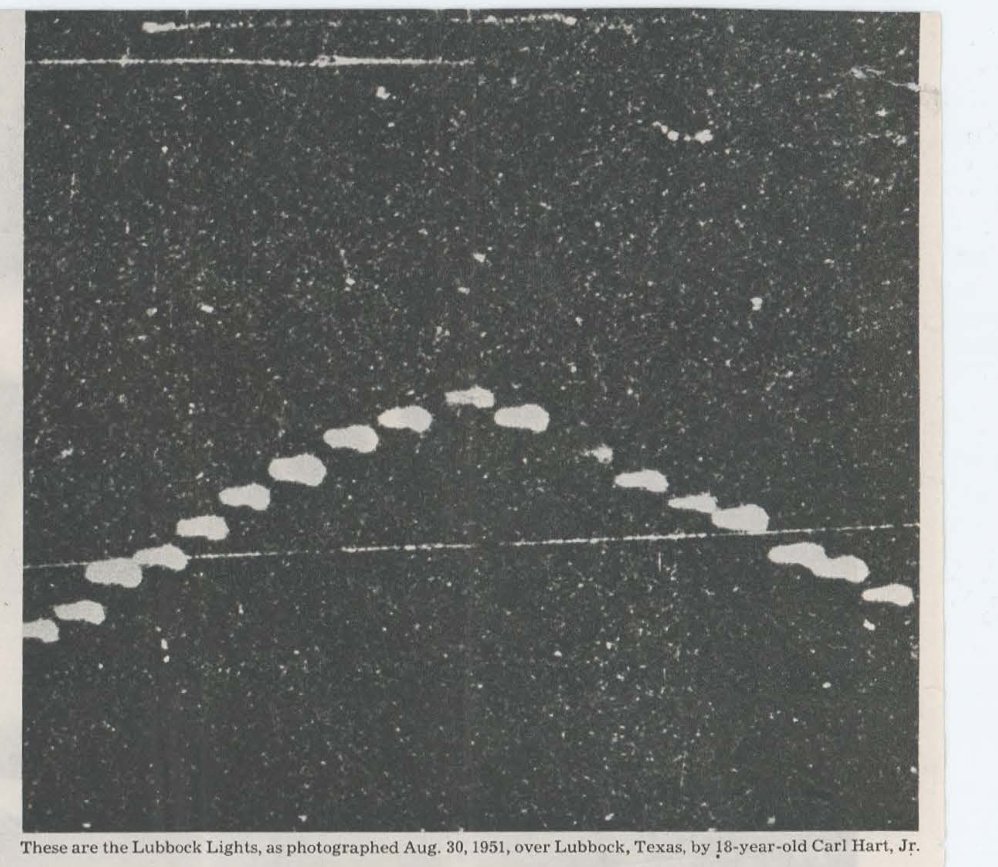 Magazine clipping with photographPhysical page 257
DOCUMENTARY SOURCES · DOW / FBI / CIA
What the records tell
The case reaches this archive through the voice of Captain Edward J. Ruppelt, head of the Air Force project, in a March 1952 lecture. According to him, on August 25 of the previous year, Texas Tech professors were in the backyard of one of them talking about meteors when a group of lights passed in the sky. About half an hour later, another group passed. Over five or six nights, they counted twelve passes, always along the same path and at roughly the same time. Ruppelt speaks of five professors and mentions the head of the physics department, the head of petroleum engineering, a researcher who had spent five years in Alaska studying the aurora, and a PhD in mathematics.
Thinking it was an Air Force missile, the group tried to measure the phenomenon. They marked angles on houses around the yard, timed the passes and set up a baseline perpendicular to the trajectory, with radios and homemade angle-measuring instruments at each end, to calculate the altitude. They did not get the altitude, but arrived at an angular velocity of 30 degrees per second, “the only measurement we have,” Ruppelt said. The Air Force only learned of the case about a month later. He went to Lubbock, suspected a hoax, but changed his mind after meeting the professors.
The professors published notes in the local newspaper asking for reports, and the city began watching the sky at night. On August 31, a Texas Tech freshman, an amateur photographer, said he had photographed two formations with a Kodak 35, at 1/10 of a second and f/3,5, on Plus-X film. Ruppelt talked with him twice, and the OSI about three times. On the last occasion, they offered to let him retract the story without consequences. He refused and signed a sworn statement. The laboratory confirmed the images were real on the negative, with positions that changed slightly in each frame and a density slightly greater than that of a bright planet.
The professors, however, said the photos were fake: what they had seen was too faint to be photographed. The student admitted he had thought the same and developed the film only two days later. Ruppelt added a detail he could not explain: in the enlarged frames, one row of lights seemed to catch up with the other and pass in front of it. For him, two possibilities remained: a large hoax planted by the professors, or ducks crossing the city at that time of year, reflecting the city lights. Tests to photograph ducks at night failed, and half the residents said they had seen ducks, while the other half denied it.
Ruppelt also cited two reports from the same period with no proven connection: two women who saw a silver, top-shaped object over the Texas plain, and a guard at the Sandia base, in Albuquerque, who with his wife saw a large dark shape, like a flying wing, at about 150 feet, on the same night as the photos. When shown to him, the photos looked to him like the exhaust flames he had seen. Ruppelt said it was probably a coincidence, but that he could not state so.
Everything here is a secondhand account, given from memory in a lecture, without the reports, the photographs or the names. There are internal inaccuracies: Ruppelt first says the photo was taken “last September” and then gives August 31. He calculates that ducks at 60 miles per hour would have to fly at 75 or 80 feet to cross 30 degrees per second; by the simple geometry of an object passing overhead, these numbers give about 170 feet, a calculation made by the editors. The duck hypothesis was raised by the investigation itself and was never demonstrated.
One of the student's photographs reached the FBI file by another route. The flying discs file holds pages from the June 1952 issue of Look magazine with the essay “The Truth About Flying Saucers,” by the astronomer Donald H. Menzel, professor of astrophysics at Harvard. One of the pages reproduces the image with the caption: “These are the Lubbock Lights, photographed on August 30, 1951 over Lubbock, Texas, by Carl Hart Jr., 18.” The photo shows, against a dark background, about twenty bright spots lined up in an open arc, like an inverted V.
The magazine caption gives August 30, and Ruppelt, in the March 1952 lecture, said August 31. No document in the collection resolves the discrepancy. The magazine is the only source in the collection that names the author of the photos; Ruppelt's lecture speaks only of a Texas Tech freshman, an amateur photographer. The negative, the other photos in the series and the Air Force laboratory analysis cited by Ruppelt are not in the collection.
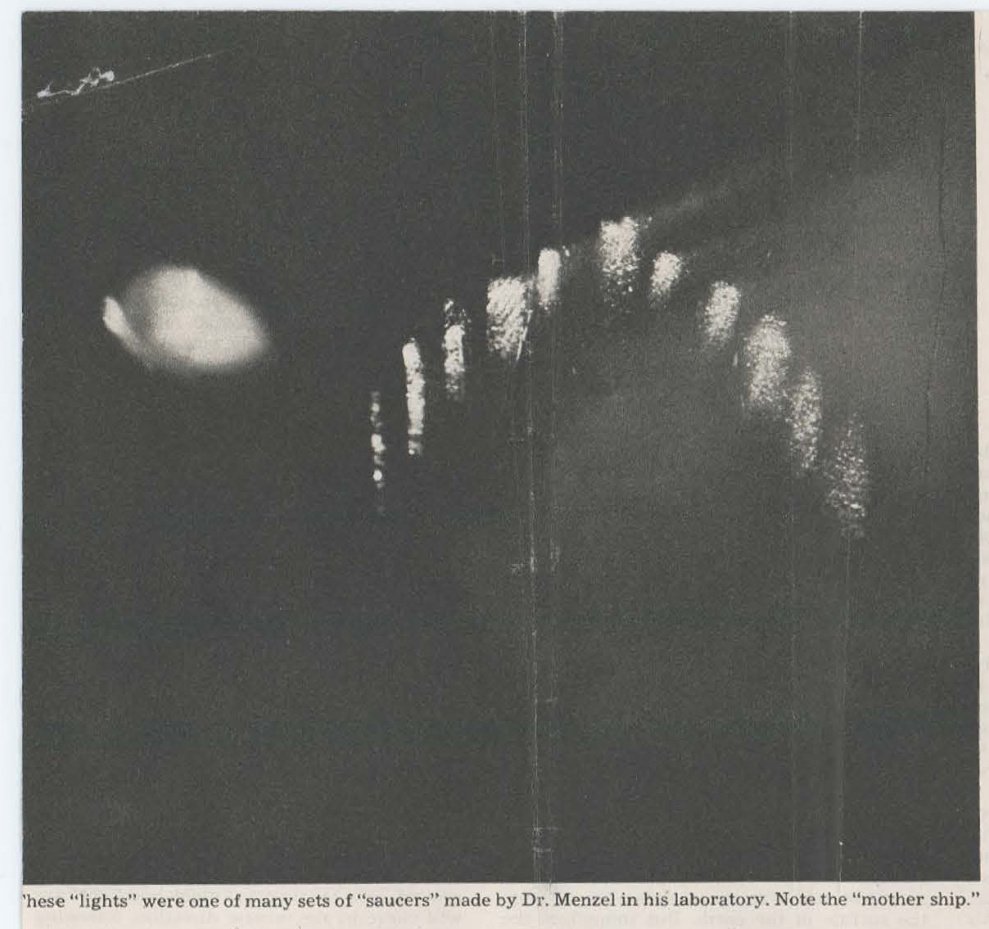
Menzel proposed another explanation, different from the ducks. For him, the Lubbock Lights would be mirages: layers of warm air over cold air, temperature inversions, would act as lenses and project into the sky images of distant city lights, such as a row of streetlights, which would appear to float in formation. He said he had developed and tested this idea in the laboratory, with a glass container and layers of benzene and acetone, and only afterward found in the journal Nature an 1893 account of similar lights at sea. It is a scientist's hypothesis, published in a magazine; it was not tested on site nor confirmed by the Air Force in the documents of the collection.
The magazine also published a photo taken by Menzel in the laboratory, with a row of bright spots and a larger spot in front, captioned as one of the many sets of “saucers” he produced, with the remark “note the mother ship.” It is a simulation made for the essay, not an image of the Lubbock sky. Alongside the student's photos, it shows what Menzel wanted to prove: that simple optical effects can produce similar formations.
Ruppelt's lecture in which the case is told also exists as an audio recording, released by the Department of War under the code DOW-UAP-PR160. According to the official description, the audio records the March 1952 presentation on the Air Force's reorganized investigation, of which the Lubbock case is one of the examples. The transcript published with the audio, the basis of this dossier, is translated in full in the dossier on Ruppelt's lecture, and allows the Lubbock passage to be followed while listening to the recording.
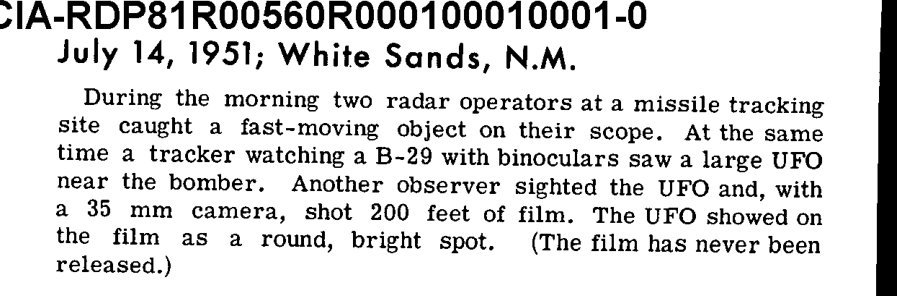
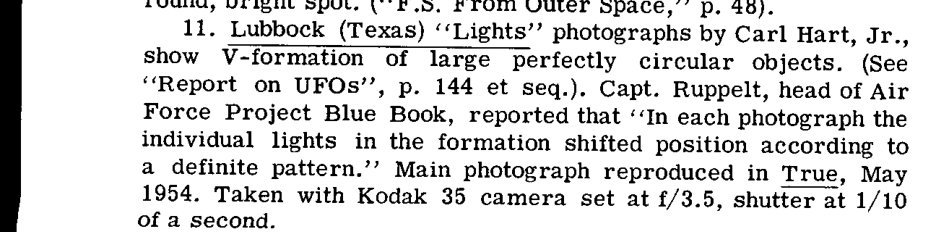
The report The UFO Evidence, published in 1964 by NICAP and kept by the CIA, lists the Lubbock photos as entry 11 of the photographic cases, with the date August 30, 1951, the same as in Look magazine, and gives the author's name: Carl Hart Jr. NICAP classifies the case as worthy of analysis and records that it saw copies, without full analysis. The summary on physical page 93 says the photos show a V formation of large, perfectly circular objects, cites Ruppelt, according to whom in each photo the lights changed position following a definite pattern, and gives the camera data: Kodak 35, f/3,5, 1/10 of a second.
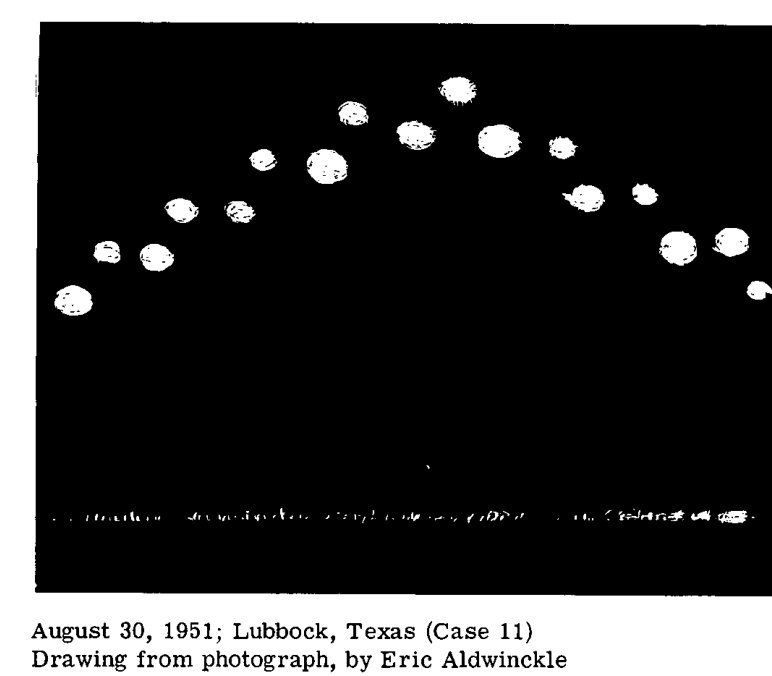
On physical page 97, NICAP publishes a drawing by the illustrator Eric Aldwinckle made from the photograph, with the caption of August 30, 1951: round white lights arranged in an arc, in two rows, on a black background. It is a drawn reproduction, not the original photo. According to NICAP, the main photo was published in True magazine in May 1954. The summary does not mention the professors' objection to the photos nor the duck hypothesis, which appear in Ruppelt's lecture reproduced in this dossier.
OFFICIAL MEDIA
Official video for this case
Files published by the United States Government on DVIDS. The title of each one is that of the official publication, translated; the description of what is seen is in the dossier text.

Historical audio recording · 1 h 05 min · the video only loads when you start playback, directly from the official server.
Official record ↗More images from the document
DIRECT READING OF THE FILE
The document, in the original
Transcript published by the U.S. government; short excerpts translated. The student's name does not appear in the source and was not sought in others. The Lubbock photographs are not in this PDF and were not reproduced.
EXCERPT 1 · PHYSICAL PAGE 7
The professors' objection, physical page 7
7
that. However, they did get their angular measurement across the sky, and it came out to be 30
degrees per second. Now, that's the only measurement we've got on these things. We didn't hear
about it till about a month after it happened, and I went down and spent quite a bit of time with
these people. At first, we thought it was just one big hoax, that they were just out to get some
publicity, but on investigating these people and talking to them, we found out that there was, the
professor of, I believe he's head of the physics department at Texas Tech, a gentleman who was
head of the petroleum engineering department at Texas Tech, a gentleman who'd spent the last
five years in Alaska studying the aurora, and a doctor of mathematics, and they had an
astronomer who actually who didn't see these, although he was in on the investigation. Well,
after they found out the Air Force was interested in it, they took an entirely different view. I
mean, when they found out that it wasn't one of our missiles, then they began to wonder what it
was, but the thing had happened and it was finished and they couldn't get any more information
for us. Now these pictures, well, incidentally, before that, they put a couple of pieces in the local
newspaper to try to determine who else had seen these things, and they put their names in the
paper so that people could write to them and say, "I saw it" or "I didn't see it," and they got a lot
of publicity. Consequently, everybody in Lubbock, Texas was sitting out at night waiting for
these things to go over. And a college freshman at Texas Tech had his camera ready when they
went over one night, and this is the picture that he got. Now these are, this is one formation that
went over and this is another formation. He, his story is that he saw one go over and all of a
sudden it dawned on him, "Well, I might try to get a picture." He was a fairly good amateur
photographer. He took these with a Kodak 35. He shot them at 1/10th of a second at F3.5 on
Plus-X film. He tracked them, and consequently, we don't know whether this blur is due to the
movement of the object or the movement of his camera since he shot them at 1/10th of a second.
This is the first formation that went over, and this is the second formation. Now, we've tried
every way that we know of to prove that these pictures are faked. I've talked to the kid, and in
fact, I talked to him twice. We've had OSI talk to him about three times, and the final, last time,
they got him alone and they said, "Now look, we'll let you back out on this if you want to. We'll
never tell anybody. As far as the newspaper's concerned and everybody you've sold these pictures
to, why they're really good photos, but if you'll just confess to the OSI, why we'll drop it." But he
said, "No," he said, "these are pictures of something that flew over Lubbock, Texas on..." Well,
this was, these happened to be taken on the 31st of August. He said, "I don't know what they are,
but," he said, "I took the pictures and that's all I know," and he signed a sworn statement for us,
so we had to drop it right there. I mean, we've got no way to...
(Question from audience)
• "Do these pictures check with the observations of those five?"
• "No, sir. I was going to just mention that. The college professors say that these pictures
are faked. I mean, they won't believe them at all. They say the things that they saw, they
know were too dim to ever take a picture of. Now, we cross-checked with the kid on that,
and he said, he said, 'That's right.' He said, 'After I took these pictures,' he said, 'I didn'tCheck the original PDF
The college professors say that these pictures are faked. I mean, they won't believe them at all. They say the things that they saw, they know were too dim to ever take a picture of.View the document record ↗ · Physical page 7, counting the cover.
EXCERPT 2 · PHYSICAL PAGE 92
Physical page 92, entry 11 of the list of photographic cases (excerpt)
Approved For Release 2001/04/02 : CIA-RDP81R00560R000100010001-0
¢ = color
b = black & white
FILM DATA. M = movie film
S = still photograph
Codes:
RATING. * = considered strongest evidence of UFOS
(*) = potentially strong evidence, worth priority analysis Status of NICAP Analysis
(#) = worth analysis; or possible value in conjunction VN = print viewed, complete analysis not possible because of
with other data Jack of data or lack of reference points and detail in
(X)= dubious, or negative evaluation photograph
(Inc) = incomplete; no rating possible because of lack of AN = analyzed by NICAP
information NN =NICAP unable to obtain for analysis.
bS/VN
bS/VN
M/NN
bM/NN
S/VN
M/NN
S/VN
M/NN
cM/VN
M/NN
bS/VN
bS/VN
cM/VN
bS/VN
bS/VN
M/VN (few frames)
M/VN (few frames)
cS/NN
cM/NN
bS/VN
M/NN
M/NN
bS/VN
bS/VN
/NN
cM/VN (few frames)
bS/VN
bS/VN
bS/VN
bS/VN
cM/NN
bS/VN
bS/VN
bS/VN
bS/VN
bS/VN
cM/NN
cM/NN
bS/VN
cS/VN
bS/NN
cM/AN
bS/VN
cM/NN
bM/AN
bS/VN
cS/AN
bS/VN
cM/AN
bS/AN
cS/AN
bS/VN
bS/AN
M/NN
bS/AN
cM/VN
cS/VN
bS/AN
cM/VN
bS/AN
bS/VN
bS/VN
bS/VN
cM/AN
March 1946. Fred J. Stange, Bernardston, Mass.
July 5, 1947. Frank Ryman, C, G., Seattle, Wash.
February 23, 1949. Cmdr. A. V. Orrego, Chile.
October 23, 1949. Norwood, Ohio, searchlight case.
April 24, 1950. Enrique Hausemann Muller, Balearic Islands.
April 27, 1950. White Sands theodolite photo.
May 11, 1950. Trent photographs, McMinnville, Ore.
May 29, 1950. White Sands theodolite photo.
August 15, 1950. Nick Mariana, Great Falls, Montana.
July 14, 1951. Near White Sands, tracking camera film.
August 30, 1951. Carl Hart, Jr., Lubbock lights, Texas.
May 7, 1952. Barra da Tijuca, Brazil. Ed Keffel.
July 2, 1952. Warrant Officer Newhouse, Tremonton, Utah.
July 16, 1952. Shell Alpert, Coast Guard, Salem, Mass.
July 19, 1952. Peru.
July 29, 1952. Ratph Mayher, Miami, Fla.
August 1, 1952. Wright-Patterson AFB, Ohio. gun-camera
September 19, 1952. Operation Mainbrace color photos.
November 16, 1952. David S. Bunch near Landrum, S. C.
December 13, 1952. Adamski "scout ship.”
August 12, 1953. Ellsworth AFB gun-camera, "best unknown" case.
August 31, 1953. Port Moresby, New Guinea, T. C. Drury
February 15, 1954. Stephen Darbishire, Coniston, England
March 1954, Rouen, France. RAF Flying Review.
May 24, 1954. USAF photo by RB-29 reconaissance plane
June 30, 1954. Scandinavian eclipse photos.
September 9, 1954. K. M. Gibbons, New Zealand
March 5, 1956. William L, Wannall, Hawaii (cS orig.)
July 17, 1956. Elizabeth Klarer, S. Africa.
July 19, 1956. Michael Savage, 15, San Bernardino, Calif.
September 18, 1956. Ray Stanford, Calif.
October 10, 1956. Joe Kerska, Twin Peaks, San Francisco, California
August 20, 1957. Japan. S, Takeda
November 6, 1957. Anaheim, California
November 16, 1957. Near Holloman AFB, New Mexico
December 1957. T. Fogl, radio officer, S.S. Ramse
December 1, 1957. Ralph Benn, Los Angeles, California
January 3, 1958. Cliff DeLacey, Hawaii.
January 16,1958. Trindade Isle, Brazil, sequence.
February 9, 1958. Troy, Michigan, airport
June 23, 1958. Near England AFB, Louisana State police.
July 28, 1959. Ray Stanford. Two movie films.
October 16, 1958. Mike Schultz, Newark, Ohio.
February 9, 1959. Purdon, Imperial Beach, California
September 24, 1959. Redmond, Ore. FAA case.
November 29, 1959. J. J. Rehill, USN, Miami, Florida
February 13, 1960. Joe Perry, Grand Blanc, Michigan
March 2, 1960. Schedelbauer, Vienna.
April 11, 1960. Mary Jo Curwen, Hazel Green, Wisconsin
August 3, 1960. Linz, Austria
August 9, 1960. Jay Rees, San Francisco, California
August 25, 1960. Grumman mystery satellite photo
January 1, 1961. A/3c Bellett, Golden, Colorado
January 22, 1961. Harry Caslar, Eglin AFB, Florida
May 27, 1961. Triangle, Nashville, Tenn.
May 29, 1961. Craig Seese, Newark, Ohio.
July 13, 1961. Bob Feldman, Akron, Ohio
September, 1961. Paccione moon photos
September 29, 1961. Savage, Warrenton, Virginia
March 9, 1962. Jeanne B, Johnson, Hawaii.
May 25, 1962. F, DiMambro, Woburn, Mass.
November 18, 1962. Bruce Fox, Bayonne, New Jersey
December 15 & 16, 1962. Ronald Gounad, New Jersey
December 21, 1962. Ali R. Diaz, Angel Falls, Venezuela.
PHOTOGRAPHIC CASES
1. Fred J. Stange, Bernardston, Mass. Photograph sub-
mitted in 1954 to Rev. Albert Baller (nowNICAP Board member).
Witness states he first saw three discs in a group, then two other
single objects. Photograph shows all five, according to Leonard
H. Stringfield (CRIFO Newsletter; Vol. II No. 3, June 3, 1955).
Lead object of V-formation is largest image. Photo taken with
box camera. Other camera data not available. The slide
viewed by NICAP, a copy of the original, is of very poor quality.
Many splotches are apparent, but no easily discernible UFO
images.
2. Frank Ryman, U.S. Coast Guard, Seattle, Wash. At 5:45
p.m. Mr. Ryman photographed a circular white object moving
across the wind. (See Popular Science, August 1951; ‘Report
on UFO”, Ruppelt, p. 37), Photograph reproduced in ‘‘Coming of
the Saucers’’, by Arnold & Palmer, shows small, white, elliptical
image. Photo carries identification: ‘‘Acme Telephoto, SE86-7/5
Seattle.”
Approved For Release 2001/04/02 ¢°>CIA-RDP81R00560R000100010001-0Check the original PDF
[p. 92: texto da publicação privada não reproduzido; ver o resumo]View the document record ↗ · Physical page 92, counting the cover.
EXCERPT 3 · PHYSICAL PAGE 93
Physical page 93, photographic case 11 (excerpt)
Approved For Release 2001/04/02 : CIA-RDP81R00560R000100010001-0
Photographic Cases (Continued)
3. Cmdr. A. V. Orrego, Chilean Navy. Reported sighting
and photographing UFOs over an Antarctic base. Objects de-
scribed as ‘‘one above the other, turning at tremendous speeds.’”’
Major Donald E, Keyhoe queried the Chilean Embassy and was
told the films were classified. (‘Flying Saucers From Outer
Space,’’ p. 44), Other sources indicate movie film was taken.
4. Norwood, Ohio, searchlight case. Rev. Gregory Miller,
Norwood, Ohio, in the presence of other witnesses, with help
of Norwood police officer, obtained 16 mmblackand white movies
of a large disc hovering in a searchlight beam. The disc emitted
“‘two distinct groups of triangular-shaped objects.’’ (CRIFO News-
letter, Vol. I No. 5, August 6, 1954). One of series of well-
witnessed sightings logged by Army searchlight operator, Sgt.
Donald R. Berger. Three 25 foot rolls of movie film were ex-
posed, using a Hugo Meyer F-19-3 camera with telephoto lens;
also several still photographs with a Speed-Graphic and 14 inch
Wallensach telephoto lens, the best of which were submitted to
Time-Life and reportedly never returned. One photograph re-
produced in ‘‘Inside Saucer Post. . .3-0 Blue,’’ by L. H,. String-
field, Cincinnati, 1957.
5. Balearic Islands. A United Press Newspictures photo
reportedly taken by Enrique H. Muller is reproduced in ‘‘The
Coming of the Saucers,’’ by Arnold & Palmer, Amherst, Wisc.,
c. 1952. Shows large circular, fiery-looking UFO with rays
of ‘‘flame’’ spinning off edge in pinwheel fashion. No reference
points visible. No camera data available.
6. White Sands, N.M. tracking station, April 27, 1950, photo-
graphed UFO which had been observed visually. Reportedly shows
smudgy dark object in motion. (‘Report on UFOs,’’ by Capt.
E. J. Ruppelt, Doubleday, 1956, p. 123), Filmed by Askania Cine
Theodolite.
7, Paul Trent, McMinnville, Oregon, obtained two of clearest
UFO photographs on record. Both show disc with superstructure.
Reproduced by Life magazine (June 26, 1950) with comment that
Mr. Trent is ‘‘an honest individual’ and ‘‘the negatives show no
signs of having been tampered with.’’ Images closely similar
to UFO photographed over France in March 1954 (see below).
8. White Sands, N.M., tracking station, May 29, 1950, photo-
graphed UFO which had been observed visually. Films by Askania
Cine Theodolite cameras from two separate stations reportedly
showed bright dots of light. (‘Report on UFOs,” Ruppelt, p.
124.)
9. Nick Mariana, Great Falls, Montana, obtained 16 mmcolor
movies of two UFOs which appear as bright circular points of
light. -Footage of UFOs at closer range, confirming visual ob-
servation of discs with rotating rims, was reported missing from
film when returned by Air Force. Remaining footage.was con-
tained in United Artists documentary movie ‘‘UFO”’ and compared
to July 2, 1952, Trementon, Utah film showing similar images.
Mr. Mariana used Daylight Kodachrome film in a Revere turret
type camera and obtained 315 frames showing the UFOs. The
film was examined by the Air Force and Navy, but no formal re-
ports released. Report on Photogrammetric analysis by Dr.
Robert M.L, Baker, Jr., Douglas Aircraft Corporation, on file at
NICAP. Air Force explanation that UFOs were reflections off
jet aircraft said to be ‘‘quite strained,’’ and the analyst states
no definite conclusion. However, UFOs could not be explained
as any conventional objects.
10. White Sands, N.M., tracking station, July 14, 1951. UFO
tracked on radar, observed visually through binoculars, photo-
graphed on 200 feet of 35 mm movie film. Film reportedly shows
round, bright spot. (‘‘F.S, From Outer Space,”’ p. 48).
11. Lubbock (Texas) ‘‘Lights’’ photographs by Carl Hart, Jr.,
show V-formation of large perfectly circular objects. (See
“Report on UFOs’, p. 144 et seq.). Capt. Ruppelt, head of Air
Force Project Blue Book, reported that ‘In each photograph the
individual lights in the formation shifted position according to
a definite pattern.’’ Main photograph reproduced in True, May
1954. Taken with Kodak 35 camera set at £/3.5, shutter at 1/10
of a second.
12. Barra de Tijuca, Brazil, photographs of disc, taken by
magazine writers Ed Keffel and Joao Martins. NICAP has never
obtained any negatives for analysis. Prints show disc from five
different angles. Critics have pointed out that in main photograph
shadows on object do not coincide with shadows on ground below.
Until this criticism is fully answered, photographs must be
considered suspect.
13. Utah Movie. Warrant Officer D.C. Newhouse, USN, ob-
tained 16 mm color movies of a group of UFOs which he and his
wife observed visually near Tremonton, Utah, At relatively close
range, UFOs appeared flat and circular ‘‘shaped like two saucers,
one inverted on top of the other.’’ Mr. Newhouse unpacked his
Bell and Howell Automaster camera, with 3 inch telephoto lens,
from the trunk of his car and obtained about 1200 frames of the
UFOs on Daylight Kodachrome film. During the filming, Mr.
Newhouse changed the iris stop of the camera from f/8 to £/16.
The film was submitted to Navy authorities, who forwarded it to
the Air Force at ATIC in Dayton, Ohio, where it was studied for
several months. According to Mr. Newhouse, frames ofthe movie
showing a single UFO moving away over the horizon (hence
providing some ranging information) were missing when the film
was returned. The hypothesis that the objects were out of focus
sea gulls was considered by the Air Force, but could neither be
confirmed nor denied. The report of Photogrammetric analysis
by Dr. Robert M.L. Baker, Jr., Douglas Aircraft Corporation
(which included a study of the 1950 Montana film--see above)
also examined this possibility. He states: ‘‘The motion of the
objects is not exactly what one would expect from a flock of
soaring birds (not the slightest indication of a decrease in
brightness due to periodic turning with the wind or flapping).’’
Dr. Baker reports that no definite conclusion could be reached,
but ‘‘the evidence remains rather contradictory and no single
hypothesis of a natural phenomenon yet suggested seems to
completely account for the UFO involved.’’ [See Section IX re:
later Air Force statements on Utah film]
14, Shell Alpert, U.S. Coast Guard, Salem, Mass., visually
observed and photographed four UFOs in formation. Taken
through window of laboratory, picture shows four roughly ellipti-
cal blobs of light. Photograph reproduced widely in newspapers
and magazines. Date coincides with peak of Summer 1952 sight-
ing ‘‘flap’’, in which four objects flying in formation were ob-
served several times. Official Coast Guard letter, 8 August 1962
(copy in NICAP files): ‘‘...it never has been determined what
caused the phenomenal lights shown [in the photograph].’”
15. Peru, Round UFO observed by Sr. Pedro Bardi, agricul-
tural engineer, and others on a farm about 4:30 p.m., in Madre
de Dios, Peru, noticed when short wave radio went dead. Object
also seen four minutes later near Porto Maldo where Sr. Domingo
Troncosco, customs administrator, photographed it. Photo shows
elongated object trailing smoke, passing over the top of a tree
and in front of a cumulus cloud. Photograph submitted by James
W. Moseley. (For story and picture, see UFO Investigator, Vol.
I No. 2, August-September, 1957).
16. Ralph Mayher, Miami, Fla. Using 16 mm film exposed at
24 frames per second, Mr. Mayher obtained good footage of a
high speed UFO. Calculations by a physicist at the University of
Miami yielded the information that the object was about 27 feet
in diameter and travelling about 7550 mph. Retaining a few
frames for personal study, Mr. Mayher submitted the main
portion of the film to the Air Force for analysis. The film was
never returned and no analysis report was ever released. (For
story and pictures, see PIC magazine, June 1954), Enlarge-
ments of a few frames show a fiery looking roughly circular ob-~
ject, symmetrical, with two small peaks or projection on opposite
sides of the disc.
17. Gun_camera photos. Nr. Wright-Patterson AFB, Ohio,
August 1, 1952. Two jet interceptors chased a UFO which had
been tracked on radar, and one obtained gun camera photographs
of it before the object accelerated at high speed and disappeared.
(“F,S. From Outer Space,” p. 107-8; Hartford, Conn., Courant,
August 2, 1952). Part of the 35 mm gun camera film is repro-
duced in True, December 1952, showing a faint, dark circular
image. The Air Force says radar tracked a jet aircraft, while
the pilots saw and chased a radiosonde balloon assuming it was
the UFO which had shown on radar. The rapid acceleration of the
object which the pilots observed (and filmed while stationary)
would appear to rule out this interpretation.
18. Operation Mainbrace. During fleet maneuvers inthe North
Sea in September 1952, UFOs were sighted in the vicinity on
several occasions. [See Section XII]. On September 19, American
reporter Wallace Litwin, on board the aircraft carrier ‘‘Franklin
Roosevelt’’, took three color photographs of a large silvery
Approved For Release 2001/04/02 : C1A-RDP81R00560R000100010001-0Check the original PDF
[p. 93: texto da publicação privada não reproduzido; ver o resumo]View the document record ↗ · Physical page 93, counting the cover.
EXCERPT 4 · PHYSICAL PAGE 97
Physical page 97, drawing for case 11 (excerpt)
Photogra PONE For, Release 2001/04/02 : CIA-RDP81R00560R000100010001-0
ontinue
)
ases ('
September 9, 1954; New Zealand (Case 27)
Drawing from photograph, by Eric Aldwinckle
August 30, 1951; Lubbock, Texas (Case 11)
Drawing from photograph, by Eric Aldwinckle
With this background, there was some natural suspicion about
the authenticity of the 1959film. However, NICAP representatives
who have talked to Mr. Stanford were impressed by his sincerity,
and examination of the films by NICAP and Max B, Miller found
no evidence of fakery or tampering with the films (which, as stated
above, were processed in Los Angeles and examinedby Max Miller
before they were viewed by Mr. Stanford himself), We conclude
that the films themselves are authentic records of some object in
the sky, but that they do not substantiate the verbal report and
do not constitute significant evidence of UFOs as the matter now
stands.
Comments by Max Miller (quoted from SAUCERS, Vol. VII
Nos. 3 & 4):
“The 8 mm footage lacks sufficient resolution. . .The 16mm
film is excellent, but the UFO sequence is extremely short, com-
prising not more than three or four feet. However, one or two
scenes are identical in the 8 mm and 16 mm films, making simu-
lation exceedingly improbable. . .
It is [my] not inexperienced opinion that the cameras did
photograph a visible object, and that super-imposure or double-
exposure could not account for the images produced. What the
object was, of course, remains an enigma. The first possibility
to cross our minds was a polyethelyne type balloon, but we have
never heard of any of the shape recorded. . .”
43. Mike Schultz, Newark, Ohio. The Newark Advocate,
Nov. 15, 1958 published three pictures and the story. Some ex-
cerpts from the article and a black and white print of the news-
paper photographs were forwarded to NICAP in January 1959
by a member. Using an inexpensive camera and telescope, Mr.
Schultz photographed what looked like a bright star in the sky.
Then the object moved and stopped, and he took the second picture.
This was repeated once more. According to the member who
submitted the photographs, each picture is a double-exposure of
one object (the images are double in each case) because of un-
avoidable motion of the camera and telescope. The pictures in
NICAP possession (poor copies with no negatives) strongly re-
semble internal reflections in the telescope as might be obtained
by an inexperienced amateur astronomer using poor equipment.
Without more complete data, no final judgment can be made.
44. James M. Purdon, Jr., Imperial Beach, Calif. Mr.
Purdon, an engineer with a west coast aviation company, obtained
several feet of color movie film of a bright object with a halo
around it, observed by him and his family between 4:20 and 4:50
p.m. The equipment used was a Kodak camera with telephoto
lens on a turret,
According to a report which Mr. Purdon submittedto NICAP,
the UFO was first motionless for a long period of time. While
he was phoning a newspaper, his wife saw the UFO disappear.
Minutes later he obtained footage of a moving bright object (about
20 seconds of which, he states, ‘‘came out rather good’).
According to his report, the UFO ‘‘hove into view from one
direction, slowed up to almost a stop, then proceeded at a 90
degree angle toward the ocean. It accelerated quite rapidly at
first. Then it oscillated up anddown.’’ A TV antenna in the fore-
ground furnishes a reference point on the film, and the object
moves behind a ‘Christmas tree” (presumably planted in his
Ny LAY
NA
QQy
WN
ANY
NYY
\
VS
August 20, 1957; Japan (case 33)
Drawing from photograph, by Eric Aldwinckle
Approved For Release 2001/04/02 : GIA-RDP81 R00560R000100010001-0Check the original PDF
[p. 97: texto da publicação privada não reproduzido; ver o resumo]View the document record ↗ · Physical page 97, counting the cover.
Dates and documentary context
- Event
- 25/08/1951 — Ruppelt says “August 25th” for the first sighting and “31st of August” for the photos. The year is not stated: the lecture is from March 1952 and he refers to “last September,” therefore 1951.
- Document
- Not established — Lecture from March 1952, according to the Department of War note; modern transcript without a date.
- Publication
- 18/09/2026 — Release of the audio DOW-UAP-PR160 and of the transcript.
Origin and release
U.S. Air Force (USAF) (remarks by Captain Edward J. Ruppelt); transcript by the Department of War · DOW-UAP-D154_Transcript-of-a-Presentation-by-Captain-Edward-J-Ruppelt-1952.pdf
Pages 6, 8, 9 and 13 read from the native text of the typed transcript.
Related accounts and their differences
Questions to continue the investigation
- Has the Project Blue Book file on Lubbock, with the statements of the professors and the student, been released?
- Do the OSI records of the three interviews with the student exist?
- What angular velocity would be expected for flocks of illuminated ducks at the altitude at which they usually fly over the city?
GEOGRAPHY OF THE CASE
Lubbock, Texas
Approximate reference for the city cited by Ruppelt, placed by the editors. It does not indicate the professors' house or the trajectory of the lights.
DOCUMENTARY TRAIL
Go back to the sources
References use physical pages of the PDF, counting the cover. Summaries are presented in English; the documents keep their original language.
- DOW-UAP-D154_Transcript-of-a-Presentation-by-Captain-Edward-J-Ruppelt-1952.pdf
Physical pages 6 to 9: Ruppelt's account of the Lubbock lights and the student's photographs · Physical page 13: reports in Texas and Albuquerque in the same period
DOW · 19 pages - 65_HS1-834228961_62-HQ-83894_Section_6.pdf
Physical pages 256 to 261: Donald H. Menzel's essay in Look magazine (June 1952) kept by the FBI, with the photo of the Lubbock Lights (p. 257) and the mirage hypothesis (pp. 260 and 261)
FBI · 271 pages - CIA-RDP81R00560R000100010001-0_NICAP-The-UFO-Evidence_1964.pdf
Physical pages 92 (entry 11 of the list), 93 (photographic case 11) and 97 (drawing by Eric Aldwinckle): photographic cases section of the NICAP report The UFO Evidence (1964), CIA CREST copy
CIA · 186 pages
Editorial summary based on the collection's research notes. How we read the documents.