Date: 08/04/1964Location: Cape Kennedy, Florida, USA (launch site; the pages do not name the place)
Cape Kennedy, 1964: on the day of the Gemini-Titan 1 flight, NASA prepares secret answers to questions about pieces falling from space
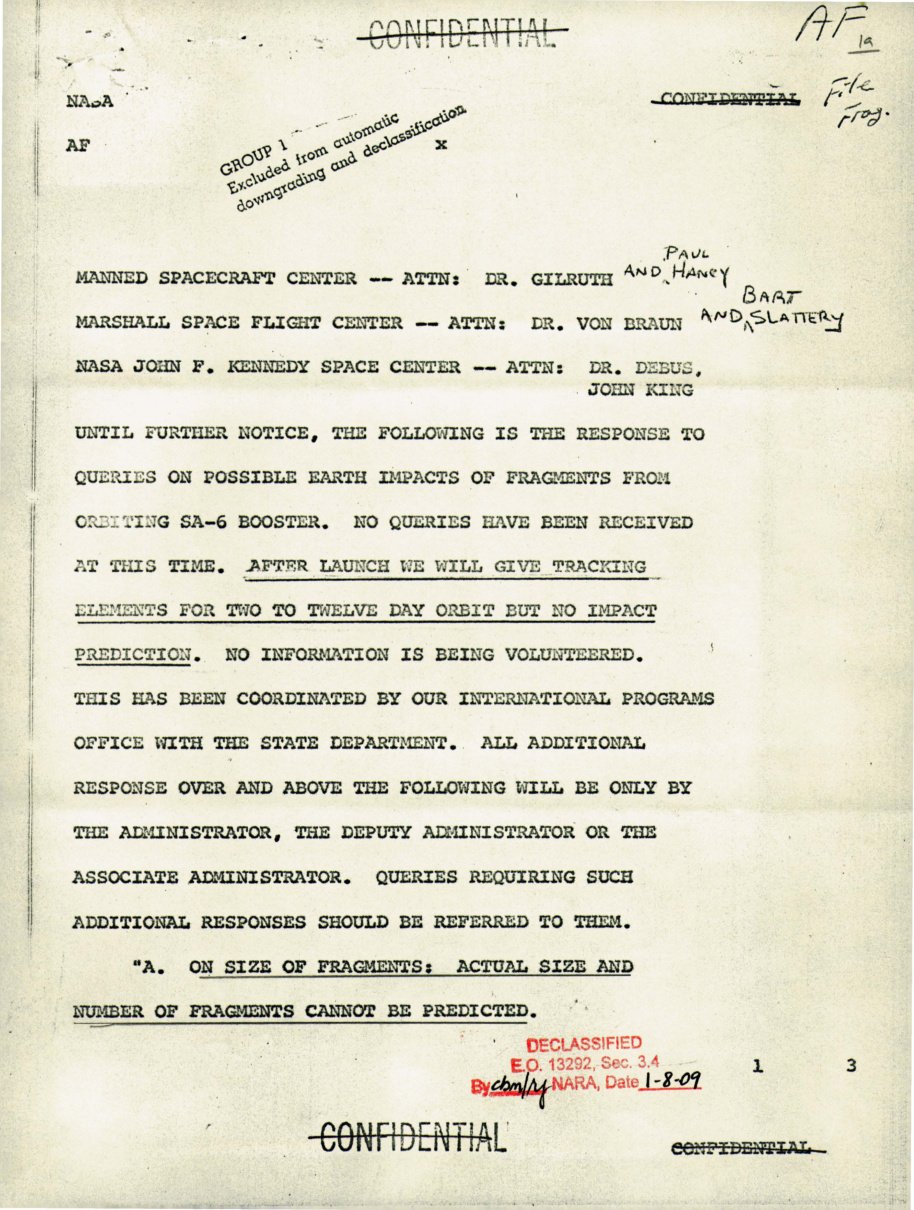
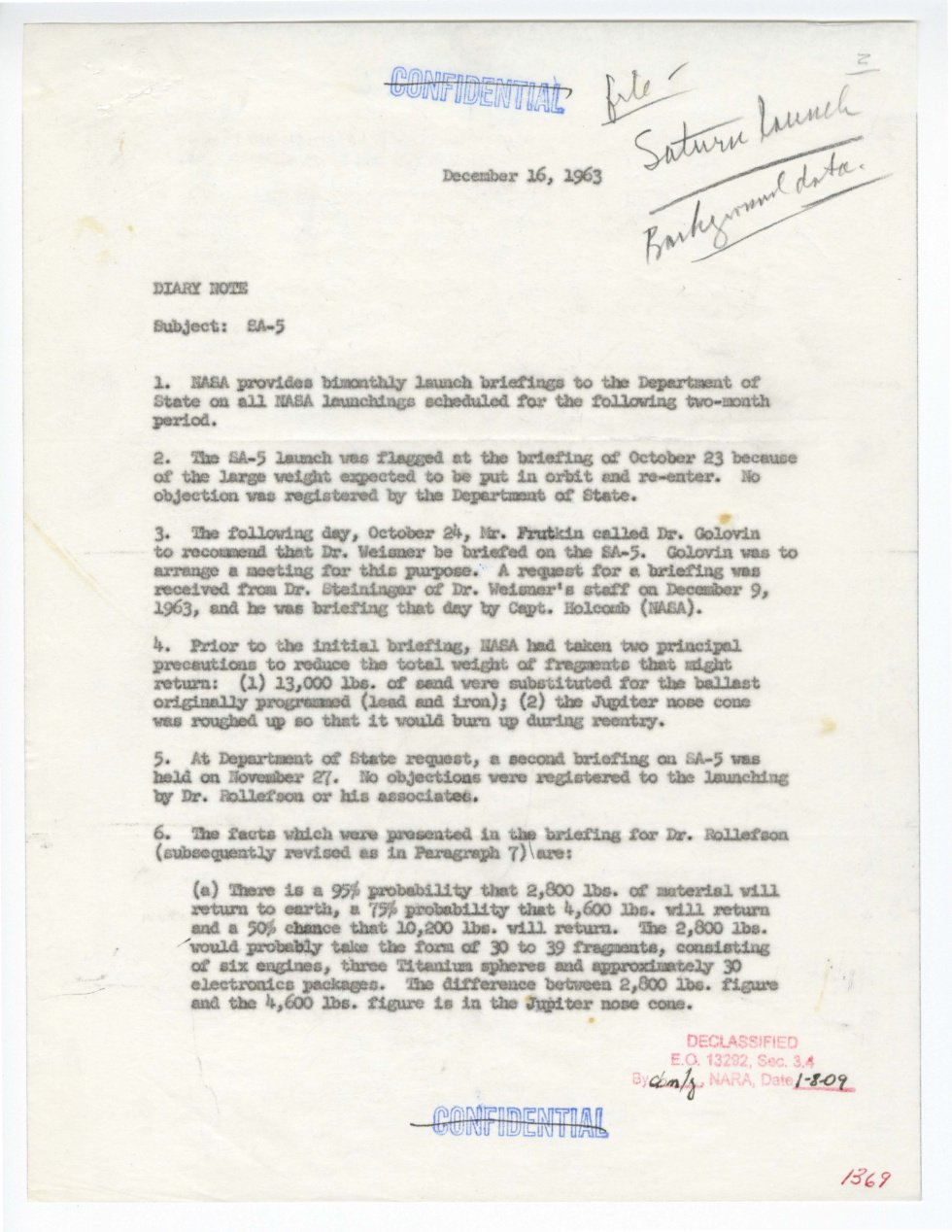
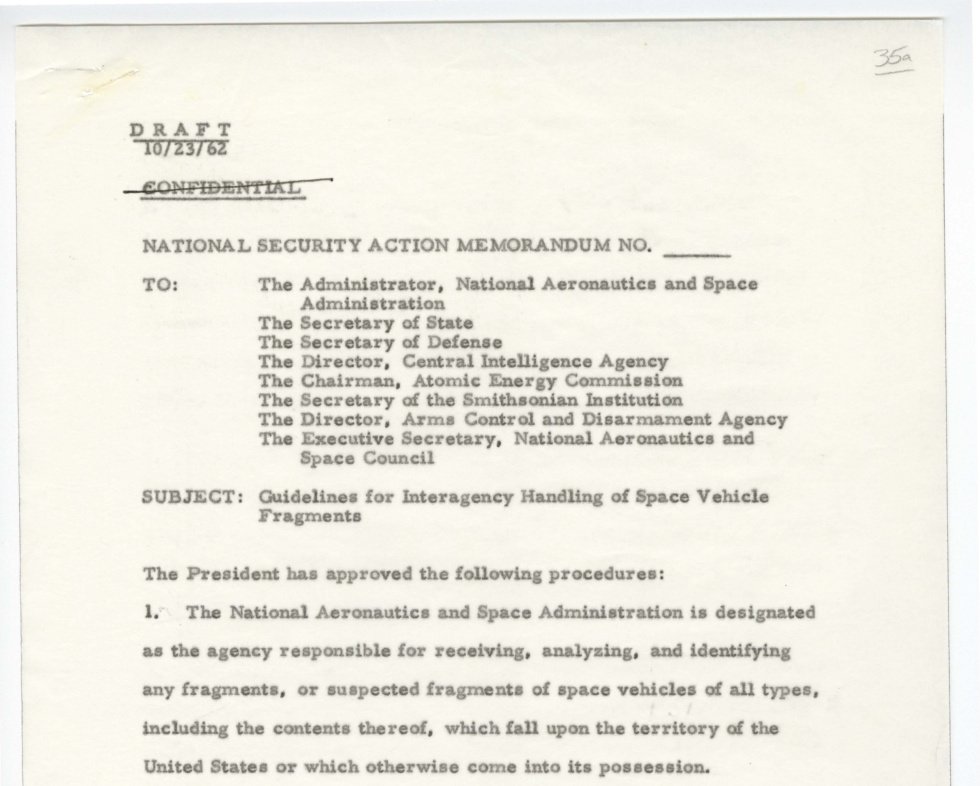
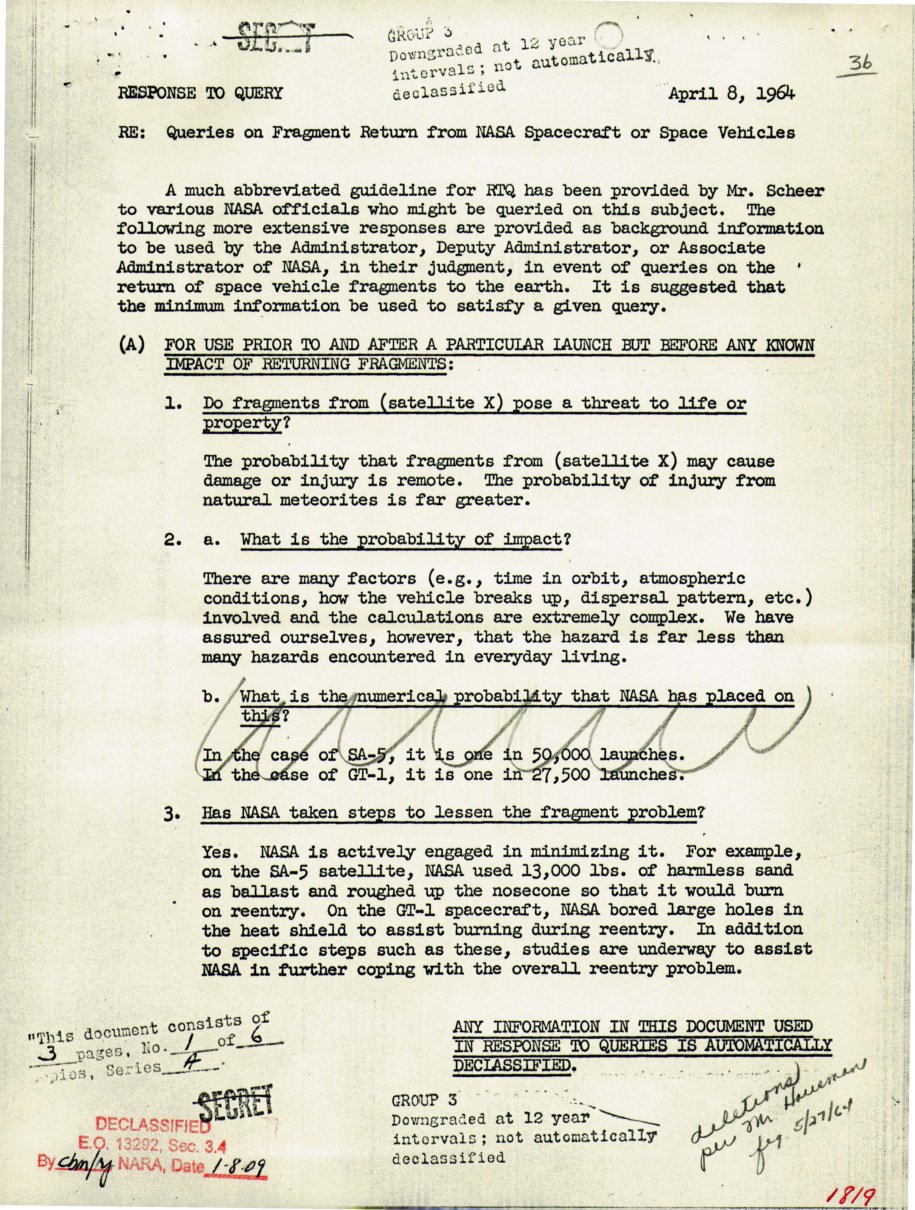
A secret NASA document of April 8, 1964 lists questions the public might ask about spacecraft fragments and the answers the agency's top leadership should give. The text mentions the GT-1 spacecraft and the SA-5 satellite, and some figures were struck out by hand before use.
- Event date
- 08/04/1964
- Location
- Cape Kennedy, Florida, USA (launch site; the pages do not name the place)
- Topic
- History of the investigation
- Source agencies
- USG
- Documents
- 1 document · 72 pages
- Reading time
- 7 min
 Official document (facsimile)Physical page 12
DOCUMENTARY SOURCES · USG
What the records tell
Date: April 8, 1964. Location: not reported in the pages; the Gemini-Titan 1 (GT-1), an uncrewed test flight, lifted off from Cape Kennedy, Florida, on that same day, according to public NASA records. The document, titled answers to questions, was sent by William F. Hausman, of NASA headquarters, to Charles Johnson, of the National Security Council, with copies to Webb, Dryden, Seamans and the Department of State, and arrived on May 27. It came with NASA's red cover for secret material.
The text says that Julian Scheer had already given a short guidance to several officials, and that these longer answers were for the administrator and his two deputies, "at their discretion," using the minimum of information. The answers state that the risk is remote and smaller than that of meteorites, that most of the pieces would fall in oceans and that blowing up the spacecraft in orbit would only create more fragments. As an example of caution, they cite the sand used as ballast on the SA-5 and the large holes made in the GT-1 heat shield.
Some passages appear struck out by hand, with the note of cuts made per Hausman on May 27, 1964 (probable reading). The figures struck out were: one casualty in 50.000 launches for the SA-5 and one in 27.500 for the GT-1, as well as about 30 surviving fragments from the SA-5 and 55 from the GT-1. Also struck out was the comparison with 5.628 meteorites of more than 2,2 pounds that would fall per year. The cuts indicate that NASA preferred not to release these figures.
The document ends by saying that the risk would continue and that, in time, it would be possible to ensure return over water, but with much research and payload margin. Regarding the GT-1, the answer is that its reentry problems would be similar to those of the Atlas, without casualties. These are prepared answers, not a record of a fall: the pages do not report whether any piece of the GT-1 was found.
More images from the document
DIRECT READING OF THE FILE
The document, in the original
All pages of this episode were translated in full, one per page, with handwritten notes and crossed-out passages indicated.
EXCERPT 1 · PHYSICAL PAGE 10
Physical page 10, full page
U. S. GoYunment Prmting Otf c1;. 1963 o/9668
FROM
illi
F.
He&./Code ll
-------------------------1
TO
Johnso
11
DATE OF DOCUMENT
1~
CHECK WHETHER
□
ACTION
□
INFO,
COPY
COPY
INFORMATION
COPY TO ~
DATE RECEIVED
ACTION COPY TO
DESTROYED ( DATE AND NO.)
-----------------"""T""-------1 CLASSIFIED
CLASSIFICATION
SUSPENSE DATE POST OFFICE
REGISTRY NO.
MATERIAL~
NO:
AI-15
INUMBER OF COPIES
REFERRED TO
REC'D. BY
DATE
REFERRED TO
REC'D BY
DATE
cret
DESCRIPTION
( MUST BE UNCLASSIFIED)
to
ENCLOSURES
I
Johnson,
rutk:l.n.,
ries
,
amens,
:te
BY
□
NO REPLY
NECESSARY
C&T
NASA MAIL CONTROL
FORM NASA 416A
(JUNE 1959)Editorial note: NASA correspondence control slip recording the dispatch, on 08/04/1964, of the secret document with answers to questions about fragments.
Check the original PDF
U. S. GoYunment Prmting Otf c1;. 1963 o/9668
FROM
illi
F.
He&./Code ll
-------------------------1
TO
Johnso
11
DATE OF DOCUMENT
1~
CHECK WHETHER
□
ACTION
□
INFO,
COPY
COPY
INFORMATION
COPY TO ~
DATE RECEIVED
ACTION COPY TO
DESTROYED ( DATE AND NO.)
-----------------"""T""-------1 CLASSIFIED
CLASSIFICATION
SUSPENSE DATE POST OFFICE
REGISTRY NO.
MATERIAL~
NO:
AI-15
INUMBER OF COPIES
REFERRED TO
REC'D. BY
DATE
REFERRED TO
REC'D BY
DATE
cret
DESCRIPTION
( MUST BE UNCLASSIFIED)
to
ENCLOSURES
I
Johnson,
rutk:l.n.,
ries
,
amens,
:te
BY
□
NO REPLY
NECESSARY
C&T
NASA MAIL CONTROL
FORM NASA 416A
(JUNE 1959)View the document record ↗ · Physical page 10, counting the cover.
EXCERPT 2 · PHYSICAL PAGE 11
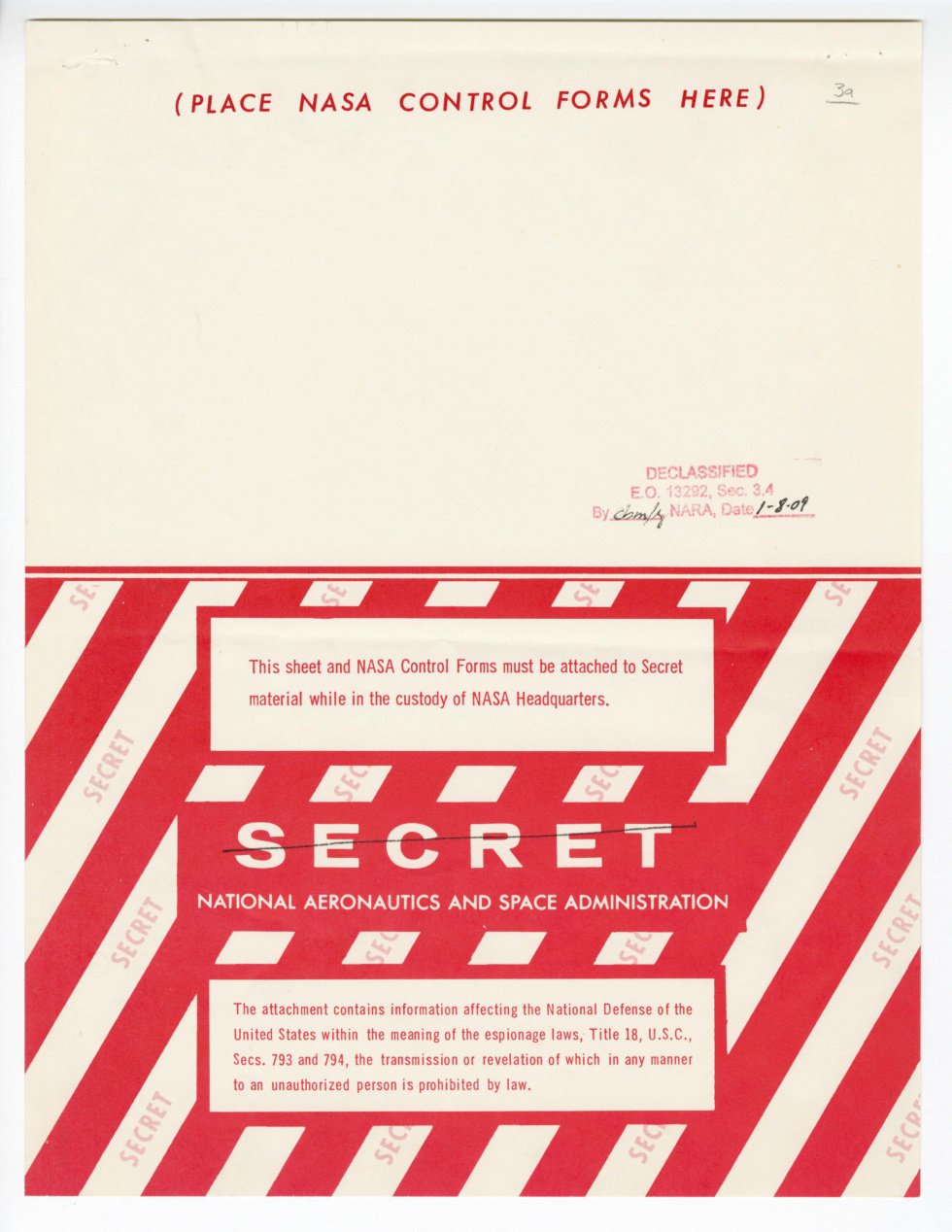
Physical page 11, full page
( PLACE
NASA
CONTROL FORMS
HERE)
This sheet and NASA Control Forms must be attached to Secret
material while in the custody of NASA Headquarters.
The attachment contains information affecting the National Defense of the
United States within the meaning of the espionage laws,· Title 18, U.S.C.,
Secs. 793 and 794, the transmission or revelation of which in any manner
to an unauthorized person is prohibited by law.Editorial note: NASA red cover sheet for secret material, which accompanied the April 1964 document of answers about fragments.
Check the original PDF
( PLACE
NASA
CONTROL FORMS
HERE)
This sheet and NASA Control Forms must be attached to Secret
material while in the custody of NASA Headquarters.
The attachment contains information affecting the National Defense of the
United States within the meaning of the espionage laws,· Title 18, U.S.C.,
Secs. 793 and 794, the transmission or revelation of which in any manner
to an unauthorized person is prohibited by law.View the document record ↗ · Physical page 11, counting the cover.
EXCERPT 3 · PHYSICAL PAGE 12
Physical page 12, full page
---
~ ~1,1
/1,..f .
i .
GH.Vd':-' j
t 1,::., ,roar
.. '
... .
L,. -.J
r n~cd n
~
• 11~
J
DownQ
....
t automatica
.1.,
1~ • no
3b
111t crva .., ,
RESPONSE 'ID QUERY
declassif i d
...•April 8, 1964,
RE:
Queries on Fragment Return from NASA Spacecraft or Space Vehicles
A much abbreviated guideline for RrQ, has been provided by Mr. Scheer
to various NASA officials who might be queried on this subject.
The
following more extensive responses are provided as background information
to be used by the Administrator, Deputy Administrator, or Associate
Administrator of NASA, in their judgment, in event of queries on the
•
return of space vehicle fragments to the earth. It is suggested that
the minimum inf_ormation be used to satisfy a given query.
(A)
FOR USE PRIOR TO AND AFTER A PARTICUIAR IAUNCH BUT BEFORE ANY KNOWN
IMPACT OF RETURNING FRAGMENTS:
l. Do fragments from (satellite X) pose a threat to life or
property?
The probability that fragments from (satellite X) may cause
damage or injury is remote.
The probability of injury from
natural meteorites is far greater.
2. a. What is the probability of impact?
There are many factors (e.g., time in orbit, atmospheric
conditions, how the vehicle breaks up, dispersal pattern, etc.)
involved and the calculations are extremely complex.
We have
assured ourselves, however, that the hazard is far less than
many hazards encountered in everyday living.
3.
Has NASA taken steps to lessen the fragment problem?
Yes.
NASA is actively engaged in minimizing it. For example,
on the SA-5 satellite, NASA used 13,000 lbs. of harmless sand
as ballast and roughed up the nosecone so that it would burn
on reentry.
On the GT-1 spacecraft, NASA bored large holes in
the heat shield to assist burning during reentry. In addition
to specific steps such as these, studies are underway to assist
NASA in further coping with the overall reentry problem.
ANY INFORMATION IN THIS DOCUMENT USED
IN RESPONSE 'ID QUERIES IS AUTOMATICALLY
GROUP ;ECI.ASSIFIED, ·
: d;
..
Dovmgra,~ed at 12 year '-----
.0 ,_
!: .
E.O.
DE
intorvals; not automatically
~ Jl1
declassified
r
-u
8-y~Editorial note: First sheet of the answers prepared by NASA on 08/04/1964 to questions about the return of fragments to Earth, with figures for SA-5 and GT-1.
Check the original PDF
---
~ ~1,1
/1,..f .
i .
GH.Vd':-' j
t 1,::., ,roar
.. '
... .
L,. -.J
r n~cd n
~
• 11~
J
DownQ
....
t automatica
.1.,
1~ • no
3b
111t crva .., ,
RESPONSE 'ID QUERY
declassif i d
...•April 8, 1964,
RE:
Queries on Fragment Return from NASA Spacecraft or Space Vehicles
A much abbreviated guideline for RrQ, has been provided by Mr. Scheer
to various NASA officials who might be queried on this subject.
The
following more extensive responses are provided as background information
to be used by the Administrator, Deputy Administrator, or Associate
Administrator of NASA, in their judgment, in event of queries on the
•
return of space vehicle fragments to the earth. It is suggested that
the minimum inf_ormation be used to satisfy a given query.
(A)
FOR USE PRIOR TO AND AFTER A PARTICUIAR IAUNCH BUT BEFORE ANY KNOWN
IMPACT OF RETURNING FRAGMENTS:
l. Do fragments from (satellite X) pose a threat to life or
property?
The probability that fragments from (satellite X) may cause
damage or injury is remote.
The probability of injury from
natural meteorites is far greater.
2. a. What is the probability of impact?
There are many factors (e.g., time in orbit, atmospheric
conditions, how the vehicle breaks up, dispersal pattern, etc.)
involved and the calculations are extremely complex.
We have
assured ourselves, however, that the hazard is far less than
many hazards encountered in everyday living.
3.
Has NASA taken steps to lessen the fragment problem?
Yes.
NASA is actively engaged in minimizing it. For example,
on the SA-5 satellite, NASA used 13,000 lbs. of harmless sand
as ballast and roughed up the nosecone so that it would burn
on reentry.
On the GT-1 spacecraft, NASA bored large holes in
the heat shield to assist burning during reentry. In addition
to specific steps such as these, studies are underway to assist
NASA in further coping with the overall reentry problem.
ANY INFORMATION IN THIS DOCUMENT USED
IN RESPONSE 'ID QUERIES IS AUTOMATICALLY
GROUP ;ECI.ASSIFIED, ·
: d;
..
Dovmgra,~ed at 12 year '-----
.0 ,_
!: .
E.O.
DE
intorvals; not automatically
~ Jl1
declassified
r
-u
8-y~View the document record ↗ · Physical page 12, counting the cover.
EXCERPT 4 · PHYSICAL PAGE 13
Physical page 13, full page
...
1.l;f • -
•
•
I
'
2
5. If any fragments come down, where are they most likely to impactt
The small number of' fragments surviving f'rom any satellite will
be dispersed over an area of thousands of' square miles, most
of' which are likely to be oceans, seas, or other water surface.
6.
Can the fragment problem be further decreased by exploding the
orbiting element?
Explosion or destruct of' the orbiting element could produce
more fragments and,· hence, increase the possibility of' fragment
impact.
7. If one were to be hit by a fragment, would it be lethal?
In the remote possibility that one were to be struck by a
. :fragment, it might, depending upon area of' body struck, be
l
~iiel~~ t,J;f:J~~~lmo~t r.!l~ai!f.~~~:&rlfflt-i)~~
~
is
;p~~~~~
- - ~~:1:~ -~~~~~~~!>!~~~~l~~~~~~e~o~t..-.from
h the
• ,.
rage .,number of
me.eor tes:'.rover·2. 2 lbs. which impact.. on ,,the· ·earth-eve-ry year
5628.-!· •T-his· is ·znany; many;- time~ · grea:-e-er than
of' ~ra~en~sJ_ ~9.~ ~·-~:SPectea," i:.om (satellite
~ -
-~,.....,,,r
:
• ~~~e -:-'18.l?e no suostantiated rep·orts of' :Lnjuey'
f
~
· e impacts.
e. Meteorites are natural phenomena.
Do you consider NASA
justified in increasing the possibilities of a lethal impact,
no matter how improbable?
Many human activities carry with them a demonstrable probability •
of casualty--flying, automobile driving, golfing; during an
electrical. storm.
But we do not stop driving, f~ or golf
ing.
-
.
.
.
GROUP 3
Downgr aded at 12 year
intorv~l~ ; n?t automaticallY
dec l a s sif io'dEditorial note: Second sheet of NASA's April 1964 answers: how many fragments survive, where they fall, whether they would be lethal and the comparison with meteorites, with passages crossed out by hand.
Check the original PDF
...
1.l;f • -
•
•
I
'
2
5. If any fragments come down, where are they most likely to impactt
The small number of' fragments surviving f'rom any satellite will
be dispersed over an area of thousands of' square miles, most
of' which are likely to be oceans, seas, or other water surface.
6.
Can the fragment problem be further decreased by exploding the
orbiting element?
Explosion or destruct of' the orbiting element could produce
more fragments and,· hence, increase the possibility of' fragment
impact.
7. If one were to be hit by a fragment, would it be lethal?
In the remote possibility that one were to be struck by a
. :fragment, it might, depending upon area of' body struck, be
l
~iiel~~ t,J;f:J~~~lmo~t r.!l~ai!f.~~~:&rlfflt-i)~~
~
is
;p~~~~~
- - ~~:1:~ -~~~~~~~!>!~~~~l~~~~~~e~o~t..-.from
h the
• ,.
rage .,number of
me.eor tes:'.rover·2. 2 lbs. which impact.. on ,,the· ·earth-eve-ry year
5628.-!· •T-his· is ·znany; many;- time~ · grea:-e-er than
of' ~ra~en~sJ_ ~9.~ ~·-~:SPectea," i:.om (satellite
~ -
-~,.....,,,r
:
• ~~~e -:-'18.l?e no suostantiated rep·orts of' :Lnjuey'
f
~
· e impacts.
e. Meteorites are natural phenomena.
Do you consider NASA
justified in increasing the possibilities of a lethal impact,
no matter how improbable?
Many human activities carry with them a demonstrable probability •
of casualty--flying, automobile driving, golfing; during an
electrical. storm.
But we do not stop driving, f~ or golf
ing.
-
.
.
.
GROUP 3
Downgr aded at 12 year
intorv~l~ ; n?t automaticallY
dec l a s sif io'dView the document record ↗ · Physical page 13, counting the cover.
EXCERPT 5 · PHYSICAL PAGE 14
Physical page 14, full page
. .... .... .... ,
_
.• .
.. . .
·
... t
GD·~•i:~~.~-~-e-----d 12:--=-=-::nyear- • ••
)\.,.' 4• ~ -- ... , ~... --.4~
,
0
..,J
'
i~ t erv: ls ; not automat i cally
c ~
.... ·.. ,...,3 ~- ~.Gd
~
.
9. Will this sort of thing be a continuing hazard?
In some degree, yes.
In time, it should become possib1~ to
develop some solutions such as ensured return over water, but
these will take a great deal of research and development as
veil as signif'icant payload margin. It is a matter of constant
attention.
lO.
How do reentry ;problems with GT-1 compare 'With those of other
rockets?
Very roughly, about the same as 'With Atl.as reentries, f'ran
which there have been no casualties.Editorial note: Final sheet of NASA's April 1964 answers: the risk will continue and GT-1 is compared to the Atlas reentries.
Check the original PDF
. .... .... .... ,
_
.• .
.. . .
·
... t
GD·~•i:~~.~-~-e-----d 12:--=-=-::nyear- • ••
)\.,.' 4• ~ -- ... , ~... --.4~
,
0
..,J
'
i~ t erv: ls ; not automat i cally
c ~
.... ·.. ,...,3 ~- ~.Gd
~
.
9. Will this sort of thing be a continuing hazard?
In some degree, yes.
In time, it should become possib1~ to
develop some solutions such as ensured return over water, but
these will take a great deal of research and development as
veil as signif'icant payload margin. It is a matter of constant
attention.
lO.
How do reentry ;problems with GT-1 compare 'With those of other
rockets?
Very roughly, about the same as 'With Atl.as reentries, f'ran
which there have been no casualties.View the document record ↗ · Physical page 14, counting the cover.
Dates and documentary context
- Event
- 08/04/1964 — Date of the document (pp. 10 and 12). The launch of GT-1 on the same day is public NASA information, not cited in the pages.
- Document
- 08/04/1964 — Answers to questions, pp. 12-14; control sheet with receipt on 27/05/1964 (p. 10).
- Publication
- Not established — Release by war.gov, release 07; exact date not given in the PDF.
Origin and release
Lyndon B. Johnson Library (National Security File, Charles E. Johnson files); documents from the National Aeronautics and Space Council, NASA, CIA and National Security Council · USG-UAP-D002-Interagency_Correspondence_Concerning_Space_Fragments-1962_1964.pdf
Folder "Space vehicle fragments: responsibilities and procedures," box 018.
undefined ↗ — undefined
Related accounts and their differences
- Space fragments: the interagency correspondence, 1962-1964
- Saturn SA-5: risk of fragments
- Saturn SA-6: guidance on fragments
Questions to continue the investigation
- Is the short guidance by Julian Scheer cited on p. 12 the message about SA-6 on pp. 4-6, or another text?
- Why were the probability figures cut before use?
GEOGRAPHY OF THE CASE
Cape Kennedy (Cape Canaveral), Florida, USA
Approximate reference to the launch area, placed by the editorial team. It does not indicate a fragment impact site, which the documents do not predict.
DOCUMENTARY TRAIL
Go back to the sources
References use physical pages of the PDF, counting the cover. Summaries are presented in English; the documents keep their original language.
- USG-UAP-D002-Interagency_Correspondence_Concerning_Space_Fragments-1962_1964.pdf
Physical pages 10 to 14: control sheet, secret cover and NASA answers of 08/04/1964 to questions about fragments
USG · 72 pages
Editorial summary based on the collection's research notes. How we read the documents.