Date: 30/07/2009Location: Las Vegas, Nevada, USA
Las Vegas, 2009: BAASS's ten-month report describes the structure set up for the DIA, from an underground vault to its own team of field investigators
The BAASS Ten-Month Report takes stock of the first year of the AAWSAP program contract with the Defense Intelligence Agency: buildings, security clearances, 47 employees, evidence-collection protocols and an agreement with the civilian network MUFON. The first pages also summarize the field deployments carried out through July 2009, among them the Ak-Chin, Buffalo and Marathon cases.
- Event date
- 30/07/2009
- Location
- Las Vegas, Nevada, USA
- Topic
- AAWSAP and advanced technologies
- Source agencies
- DOW
- Documents
- 1 document · 538 pages
- Reading time
- 117 min
 IllustrationPhysical page 3
DOCUMENTARY SOURCES · DOW
What the records tell
The Ten-Month Report, dated July 30, 2009, is the review that Bigelow Aerospace Advanced Space Studies (BAASS) prepared on the first year of contract HHM402-08-C-0072, awarded on September 22, 2008. It is the contract for the program known as AAWSAP, of the Defense Intelligence Agency (DIA). The full document has 538 pages. The first 100 contain the cover, the table of contents, the creation of the organization and the beginning of the summary of investigations. The contract called for research in 12 areas, from lift and propulsion to signature reduction, human effects and weaponry.
According to the report, the BAASS administrator chose a building of its own in Las Vegas to avoid inspections by landlords. The property received about fourteen soundproofed offices, electronic locks, window film and an eight-foot fence. In May 2009 a 5.000-square-foot underground vault was designed in North Las Vegas, justified by the priority of “seeking and acquiring recovered hardware and biological samples,” including in Brazil. Five new buildings were purchased. On January 29, 2009, the Defense Security Service granted the facility a Top Secret security clearance.
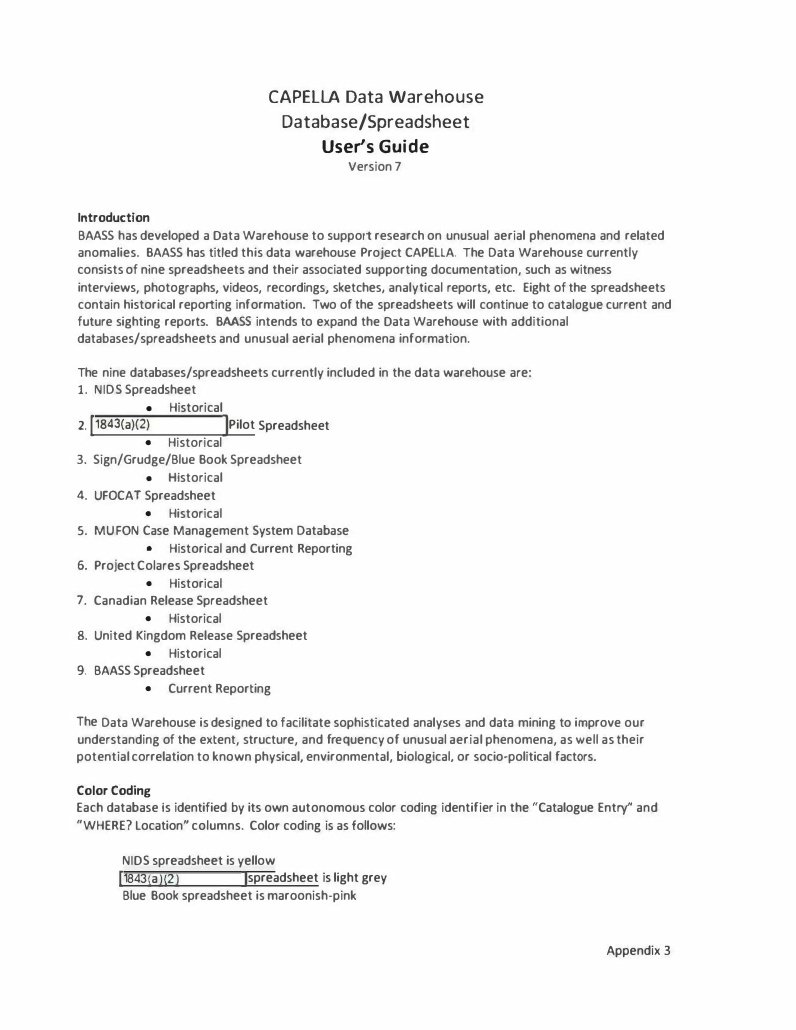
Hiring, begun in September 2008, led to 47 full-time employees, including scientists, engineers, investigators, analysts, translators and security guards; the names are redacted. The report divides the organization into five divisions. The analysis division feeds the Capella database with reports and with UAP files released by the United Kingdom, Canada, France, Denmark, Brazil and other countries. The physics division was to measure magnetic, electrical, optical and acoustic “signatures” of UAP and prepare questionnaires for witnesses. The biology division was to study effects of UAP on soil, plants, animals and people.
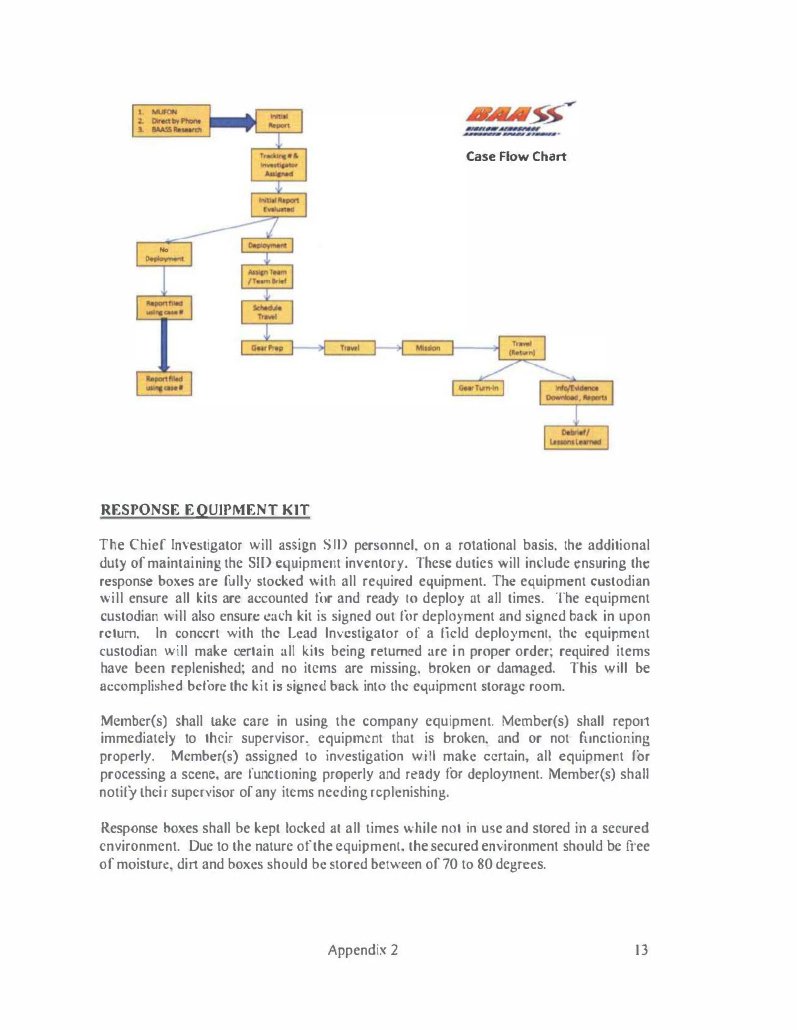
The Special Investigations Division had four senior investigators and twelve field investigators, with police, military or intelligence backgrounds. The text describes a case management system adapted from police software, field kits with low-light cameras, a Geiger counter, an X-ray fluorescence analyzer and a radiation meter, and detailed rules for collecting soil, plants, liquids, metals and fingernail clippings. To estimate radiation doses, it cites analysis of fingernails by electron paramagnetic resonance. A counterintelligence plan presents BAASS as a likely target of foreign espionage.
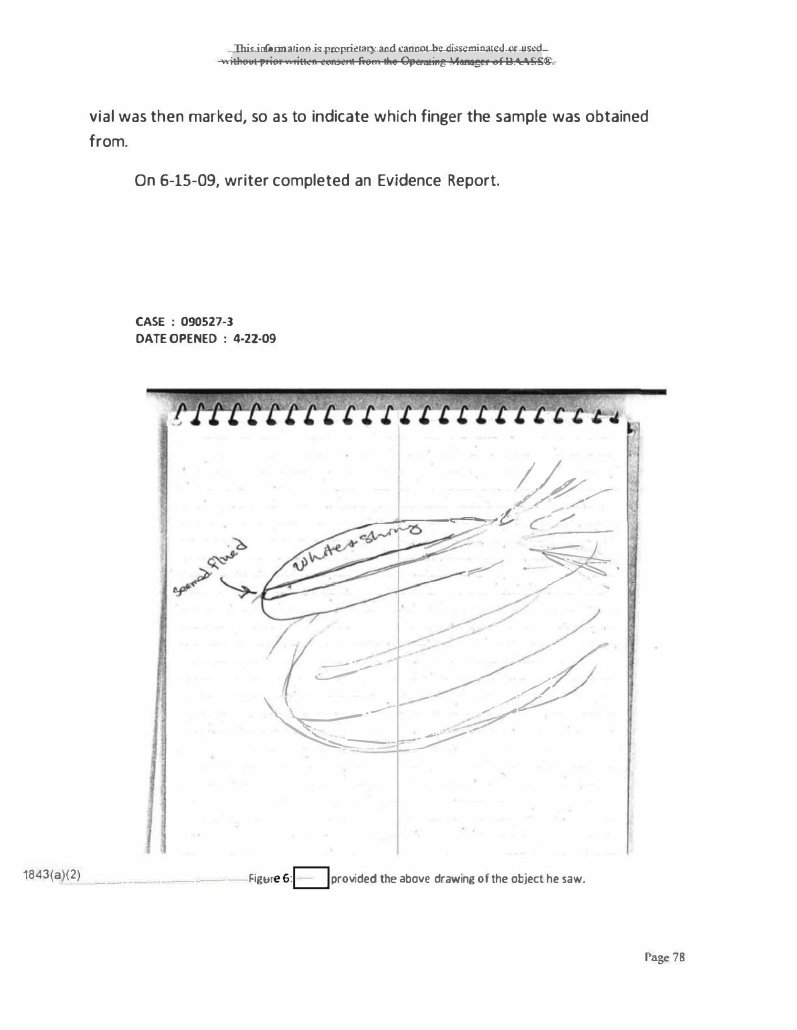
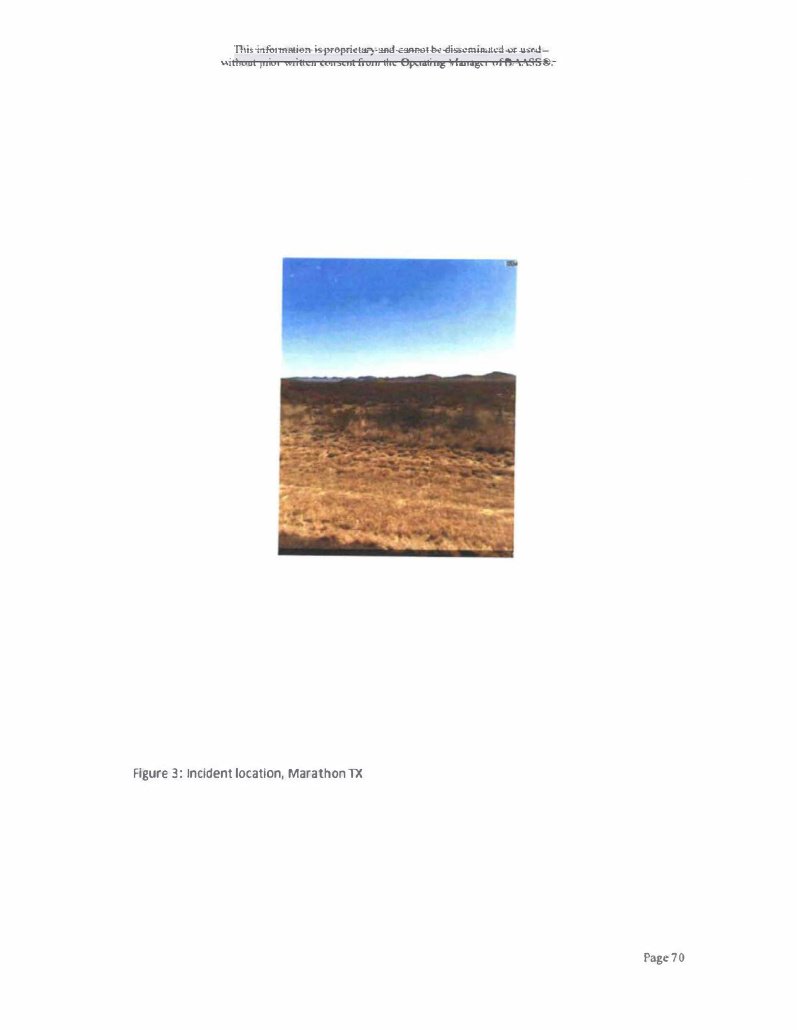
In February 2009, BAASS signed a purchase order with MUFON, a civilian network with about 1.000 volunteers. According to the report, MUFON received some 400 reports per month, sent investigators to about 12, and BAASS had read access to the case system, including the contact details of witnesses who consented. Summaries of the deployments carried out through July 23, 2009 follow. Pages 64 to 84 contain the Ak-Chin, Buffalo and Marathon cases. The Marathon case appears in full because, according to the report, it remained unexplained and the two witnesses were “considered reliable.”
The document shows how the program was organized and what it intended to seek, but, in the pages covered here, it contains no analysis result for any sample. The assessments of witnesses and of the importance of the cases are the report's own. The mention of “exotic material” to be stored describes an intention of BAASS, not the possession of any material. The cases involving military pilots, the “Tic Tac” and Lakenheath, and the other episodes in these pages are in separate dossiers.
More images from the document
DIRECT READING OF THE FILE
The document, in the original
Pages 1 to 100 of the 538-page report are translated in full in the page-by-page blocks. This dossier gathers the administrative and methodology pages (1 to 57) and the summaries of the Ak-Chin, Buffalo and Marathon cases (64-65 and 68-84), which already have their own dossiers on the portal. Health data of the Marathon witnesses were omitted.
EXCERPT 1 · PHYSICAL PAGE 3
Physical page 3, full page
Jlll/1111• 1111/l,AIII
111,11/ll'll l,ICI ITll/111
Ten Month Report
uly 30, 2009Editorial note: Physical page 3 of DOW-UAP-D172-BAASS_Ten_Month_Report_July-2009.pdf.
Check the original PDF
Jlll/1111• 1111/l,AIII
111,11/ll'll l,ICI ITll/111
Ten Month Report
uly 30, 2009View the document record ↗ · Physical page 3, counting the cover.
EXCERPT 2 · PHYSICAL PAGE 5
Physical page 5, full page
Table of Contents
Section 1: Creation of BAASS Organization and
Infrastructure ........................................................................................................ Page 1
Section 2: Project/Research Summary ............................................................ Page SO
2A BAASS Investigations ........................................................................ Page 50
2B BAASS Contract Awarded ................................................................ Page 109
2C Progress on Nine Committed BAASS Projects............................. Page 111
Project Physics ............................................................................ Page 114
Project Engagement ................................................................... Page 158
Project Cooperation ................................................................... Page 185
Project Blue Book Materials ..................................................... Page 190
Project Campus ........................................................................... Page 203
Project Oral History .................................................................... Page 214
Project Database/ Analysis Government Files ........................ Page217
Project Northern Tier ................................................................. Page 308
Project Colares/Brazil ................................................................. Page 391
Progress on BAASS Outreach to South America ..................... Page 453
Section 3: Strategic Plan for 2010 ................................................................... Page 472
Appendix 1 ................................................................. BAASS Org Chart
Appendix 2 ........................................................ BAASS Investigative SOP
Appendix 3 ................................................................ Capella Users Guide
Appendix 4 ..................................................... South American Org ChartEditorial note: Physical page 5 of DOW-UAP-D172-BAASS_Ten_Month_Report_July-2009.pdf.
Check the original PDF
Table of Contents
Section 1: Creation of BAASS Organization and
Infrastructure ........................................................................................................ Page 1
Section 2: Project/Research Summary ............................................................ Page SO
2A BAASS Investigations ........................................................................ Page 50
2B BAASS Contract Awarded ................................................................ Page 109
2C Progress on Nine Committed BAASS Projects............................. Page 111
Project Physics ............................................................................ Page 114
Project Engagement ................................................................... Page 158
Project Cooperation ................................................................... Page 185
Project Blue Book Materials ..................................................... Page 190
Project Campus ........................................................................... Page 203
Project Oral History .................................................................... Page 214
Project Database/ Analysis Government Files ........................ Page217
Project Northern Tier ................................................................. Page 308
Project Colares/Brazil ................................................................. Page 391
Progress on BAASS Outreach to South America ..................... Page 453
Section 3: Strategic Plan for 2010 ................................................................... Page 472
Appendix 1 ................................................................. BAASS Org Chart
Appendix 2 ........................................................ BAASS Investigative SOP
Appendix 3 ................................................................ Capella Users Guide
Appendix 4 ..................................................... South American Org ChartView the document record ↗ · Physical page 5, counting the cover.
EXCERPT 3 · PHYSICAL PAGE 7
Physical page 7, full page
This iofocroatioo is proprie1ary aRd e0A11et be dissemi,oied er u:scd
1
ni1he1:1t pfier Mitten ce11scr.1 frem the Operating Mw,age, of Bl'\ASS®.
SECTION 1: CREATION OF BAASS ORGANIZATION AND
INFRASTRUCTURE
{1}
Creation of BAASS Organization and Infrastructure September
22, 2008- July 31, 2009.
BAASS received notification that contract# HHM402-08-C-0072 was
awarded on September 22, 2008. The contract stipulated that BAASS would
acquire buildings and ensure that they conformed to regulations concerning the
Top Secret security clearances needed to operate AND that the necessary
qualified personnel would be hired that would be capable of researching
advanced aerospace technology under the rubric of the following 12 designated
areas: (1) Lift, (2) Propulsion, (3) colltrol, (4) Power Generation, (S}
Spatial/Temporal Translation, (6) Materials, (7) Configuration/Structure, (8)
Signature Reduction (Optical/lR/RF/Acoustic)i (9)Human Interface, (10) Human
effects, (11) Armament (RF and DEW), and (12} Other areas in support of 1-11.
1843(a)(2)
he BAASS administrator summarized the initial problems
associated with correctly choosing the first BAASS facility in the October 2008
monthly report: "/ personally spent considerable time checking out numerous
possible locations for BAASS, keeping in mind that, certain criteria needed to be
met. In addition to this criteria, there were issues of physical modifications that
were necessary for all locations. Issues including: who would pay for these
changes; the reluctance of landlords to agree (sometimes we could not locate a
spokesperson responsible for the landlord) to these modifications; and the glacial
pace that this entire remodeling process would take. All choices required some
remodeling and the landlords were not very accommodating. Finally, I chose one
of my own buildings. BAASS would not have a landlord standing over it, dictating
every remodeling move or preventing some important change. Also, very
Page IEditorial note: Physical page 7 of DOW-UAP-D172-BAASS_Ten_Month_Report_July-2009.pdf.
Check the original PDF
This iofocroatioo is proprie1ary aRd e0A11et be dissemi,oied er u:scd
1
ni1he1:1t pfier Mitten ce11scr.1 frem the Operating Mw,age, of Bl'\ASS®.
SECTION 1: CREATION OF BAASS ORGANIZATION AND
INFRASTRUCTURE
{1}
Creation of BAASS Organization and Infrastructure September
22, 2008- July 31, 2009.
BAASS received notification that contract# HHM402-08-C-0072 was
awarded on September 22, 2008. The contract stipulated that BAASS would
acquire buildings and ensure that they conformed to regulations concerning the
Top Secret security clearances needed to operate AND that the necessary
qualified personnel would be hired that would be capable of researching
advanced aerospace technology under the rubric of the following 12 designated
areas: (1) Lift, (2) Propulsion, (3) colltrol, (4) Power Generation, (S}
Spatial/Temporal Translation, (6) Materials, (7) Configuration/Structure, (8)
Signature Reduction (Optical/lR/RF/Acoustic)i (9)Human Interface, (10) Human
effects, (11) Armament (RF and DEW), and (12} Other areas in support of 1-11.
1843(a)(2)
he BAASS administrator summarized the initial problems
associated with correctly choosing the first BAASS facility in the October 2008
monthly report: "/ personally spent considerable time checking out numerous
possible locations for BAASS, keeping in mind that, certain criteria needed to be
met. In addition to this criteria, there were issues of physical modifications that
were necessary for all locations. Issues including: who would pay for these
changes; the reluctance of landlords to agree (sometimes we could not locate a
spokesperson responsible for the landlord) to these modifications; and the glacial
pace that this entire remodeling process would take. All choices required some
remodeling and the landlords were not very accommodating. Finally, I chose one
of my own buildings. BAASS would not have a landlord standing over it, dictating
every remodeling move or preventing some important change. Also, very
Page IView the document record ↗ · Physical page 7, counting the cover.
EXCERPT 4 · PHYSICAL PAGE 8
Physical page 8, full page
--""")and senior analystil•JlfIQifl.
'fhi'5•i oli,1111111 iorriޖ·rr6f'rietޗ·w·eftRnat lie disseޘi,ޙuQd-Qf.-ޚ•
,vimouf1TI10T\Hilreirrornrentihmrlht'ޛring·Mamtgt,-ޜBlr7\SS®.
important, was eliminating the possibility of any landlord (surprise) inspections, as
well as, having absolute control over who else might the landlord rent to in any
'Jdjoining offices with a preference for none."
The new BAASS facility was located at 4975, South Polaris Avenue, Las
Vegas 89118 and was judged to be in a location that was secure. The BAASS
building was located in the middle of a complex of buildings owned and operated
by other Bigelow companies, hence counter intelligence measures could easily be
implemented in the area surrounding the BAASS building without alerting
landlords or adjacent buildings.
1843(a)(2)
1843(8)(2)
During this period, BAASS had no employees save the administrator,._[ __,.,,__, I
I
(In Septerobec2008, a BAASS
administrator was hired, but shortly thereafter resigned)ll•lfttE)Itl.
summarized the extensive renovations that were carried out to the BAASS
building at 4975 South Polaris Avenue in order to bring it to the standards
required to operate under the new contract: "From the end of September to the
beginning of November, we added about fourteen offices; all of them have been
soundproofed and have electronic locks and deadbolts. All windows in the
building were tinted and the building and parking lot were surrounded with an
eight foot tall fence. All building names and logos were removed. Alarm systems
and cameras are being installed. An Information Technology Management room
was constructed and considerable office equipment is being provided in addition
to, new computers. Also, furniture throughout was purchased and installed. The
building address and phone numbers will not be listed in the city phone directory."
On November 10, 2008, 1843(a)(2) the BAASS deputy administrator,
began work and over the subsequent eight months approximately 47 full time
BAASS employees were hired (see Table 1 and Appendix 1; employee list and org
chart, respectively). As the number of employees grew, it quickly became
apparent that new facilities for the second year of operations were needed.
Pagc2Editorial note: Physical page 8 of DOW-UAP-D172-BAASS_Ten_Month_Report_July-2009.pdf.
Check the original PDF
--""")and senior analystil•JlfIQifl.
'fhi'5•i oli,1111111 iorriޖ·rr6f'rietޗ·w·eftRnat lie disseޘi,ޙuQd-Qf.-ޚ•
,vimouf1TI10T\Hilreirrornrentihmrlht'ޛring·Mamtgt,-ޜBlr7\SS®.
important, was eliminating the possibility of any landlord (surprise) inspections, as
well as, having absolute control over who else might the landlord rent to in any
'Jdjoining offices with a preference for none."
The new BAASS facility was located at 4975, South Polaris Avenue, Las
Vegas 89118 and was judged to be in a location that was secure. The BAASS
building was located in the middle of a complex of buildings owned and operated
by other Bigelow companies, hence counter intelligence measures could easily be
implemented in the area surrounding the BAASS building without alerting
landlords or adjacent buildings.
1843(a)(2)
1843(8)(2)
During this period, BAASS had no employees save the administrator,._[ __,.,,__, I
I
(In Septerobec2008, a BAASS
administrator was hired, but shortly thereafter resigned)ll•lfttE)Itl.
summarized the extensive renovations that were carried out to the BAASS
building at 4975 South Polaris Avenue in order to bring it to the standards
required to operate under the new contract: "From the end of September to the
beginning of November, we added about fourteen offices; all of them have been
soundproofed and have electronic locks and deadbolts. All windows in the
building were tinted and the building and parking lot were surrounded with an
eight foot tall fence. All building names and logos were removed. Alarm systems
and cameras are being installed. An Information Technology Management room
was constructed and considerable office equipment is being provided in addition
to, new computers. Also, furniture throughout was purchased and installed. The
building address and phone numbers will not be listed in the city phone directory."
On November 10, 2008, 1843(a)(2) the BAASS deputy administrator,
began work and over the subsequent eight months approximately 47 full time
BAASS employees were hired (see Table 1 and Appendix 1; employee list and org
chart, respectively). As the number of employees grew, it quickly became
apparent that new facilities for the second year of operations were needed.
Pagc2View the document record ↗ · Physical page 8, counting the cover.
EXCERPT 5 · PHYSICAL PAGE 9
Physical page 9, full page
Th js jn foonalioo is propric1:vy and 11:ir.n<>t b Ԗ disset1ԗi1rn1ed 01 used
wicbouc plior mim,11 consent fim11 the Opcrn1i11g lvt.umgc, ofBAASS®.
Progress on New BAASS Facilities: May-July 2009
During the month of May 2009 1843(a)(2) the BAASS
administrator, made substantial progress on two major real estate projects in
line with anticipated future BAASS needs (see below).
(1) Underground Vault: The need for a highly secure underground vault
operated by BAASS became apparent in line with a BAASS priority to
pursue and acquire recovered hardware and biological samples from the
corporate world and/or from private individuals and groups located
elsewhere, including Brazil. It was recognized by the BAAS$
administrator that there was no highly secure facility at BAASS to store
exotic material or tissue that the organization could obtain. Accordingly,
the BAAS$ administrator designed an underground facility to be located
in North Las Vegas at the Bigelow Aerospace facility. The chosen
location is exceptionally well protected by perimeter fencing and razor
wire, surveillance cameras and 24 hour armed guards who are retired or
current military. Further, the BAASS administrator during the month of
May designed and created architectural plans for a 5000 sq.ft
underground vault with 3 foot thick walls, ceiling and floor with a
concrete access tunnel leading to multiple security doors, at least one of
which comprises a thick vault steel door. The entire facility will be
located underground at the Bigelow Aerospace facility with over 15-20
feet of earth above the structure. Any surface structures protruding
from the ground will be extensively camouflaged. It is anticipated that
subject to building permits, the new underground facility will be capable
of being occ1Upied by late 2009 or early 2010. More details on this
projectwill be reported in the August 2009 BAASS monthly report.
(2) New Buildings Purchased for BAASS: Because of the extremely rapid
pace of BAASS personnel expansion (see previous section), the
Page3Editorial note: Physical page 9 of DOW-UAP-D172-BAASS_Ten_Month_Report_July-2009.pdf.
Check the original PDF
Th js jn foonalioo is propric1:vy and 11:ir.n<>t b Ԗ disset1ԗi1rn1ed 01 used
wicbouc plior mim,11 consent fim11 the Opcrn1i11g lvt.umgc, ofBAASS®.
Progress on New BAASS Facilities: May-July 2009
During the month of May 2009 1843(a)(2) the BAASS
administrator, made substantial progress on two major real estate projects in
line with anticipated future BAASS needs (see below).
(1) Underground Vault: The need for a highly secure underground vault
operated by BAASS became apparent in line with a BAASS priority to
pursue and acquire recovered hardware and biological samples from the
corporate world and/or from private individuals and groups located
elsewhere, including Brazil. It was recognized by the BAAS$
administrator that there was no highly secure facility at BAASS to store
exotic material or tissue that the organization could obtain. Accordingly,
the BAAS$ administrator designed an underground facility to be located
in North Las Vegas at the Bigelow Aerospace facility. The chosen
location is exceptionally well protected by perimeter fencing and razor
wire, surveillance cameras and 24 hour armed guards who are retired or
current military. Further, the BAASS administrator during the month of
May designed and created architectural plans for a 5000 sq.ft
underground vault with 3 foot thick walls, ceiling and floor with a
concrete access tunnel leading to multiple security doors, at least one of
which comprises a thick vault steel door. The entire facility will be
located underground at the Bigelow Aerospace facility with over 15-20
feet of earth above the structure. Any surface structures protruding
from the ground will be extensively camouflaged. It is anticipated that
subject to building permits, the new underground facility will be capable
of being occ1Upied by late 2009 or early 2010. More details on this
projectwill be reported in the August 2009 BAASS monthly report.
(2) New Buildings Purchased for BAASS: Because of the extremely rapid
pace of BAASS personnel expansion (see previous section), the
Page3View the document record ↗ · Physical page 9, counting the cover.
EXCERPT 6 · PHYSICAL PAGE 10
Physical page 10, full page
·1 his information is p,opiietaiy ru1d ea:imet be aissemiR.&1,ed Gr 1,1s.id
without prim WI itte11 co11se11t fi mu die Opc1ati11g Ma11agc1 of BAASS®.
organization is close to outgrowing the current BAASS facility.
Accordingly, the BAASS administrator began planning for this eventuality
late last year (2008) and in the past several months has personally
visited and inspected close to fifty separate buildings for sale located in
different areas of the Las Vegas Valley with a view to purchasing a new
facility for the rapidly expanding organization. This lengthy, time
consuming process culminated in the purchase of five new office
buildings which will be customized for BAASS personnel use. As of May
31, 2009 these five buildings are now in escrow. It is intended that the
buildings will include a 5000 sq ft laboratory and secure physical
evidence storage facility and a second building will contain a secure
conference room (SCIF) and adjacent office space for multiple
personnel. The architectural designs for each of the five buildings have
gone through multiple iterations and as of July 2009 are complete.
These new buildings should be capable of being occupied by BAAS$
personnel by the end of 2009.
(2) PROGRESS ON HIRING BAASS PERSONNEL
A lengthy process beginning in September 2008 covering ten months,
involving advertising in multiple simultaneous Internet outlets has resulted
in BAAS$ reviewing an average of 500 resumes per month which in turn,
has resulted in over 300 telephone and face-to-face interviews. This has
resulted in the hiring of a dynamic team of 47 BAAS$ full time employees,
including scientists, engineers, investigators (military AND law enforcement
backgrounds), analysts, translators, researchers and security guards.
Page4Editorial note: Physical page 10 of DOW-UAP-D172-BAASS_Ten_Month_Report_July-2009.pdf.
Check the original PDF
·1 his information is p,opiietaiy ru1d ea:imet be aissemiR.&1,ed Gr 1,1s.id
without prim WI itte11 co11se11t fi mu die Opc1ati11g Ma11agc1 of BAASS®.
organization is close to outgrowing the current BAASS facility.
Accordingly, the BAASS administrator began planning for this eventuality
late last year (2008) and in the past several months has personally
visited and inspected close to fifty separate buildings for sale located in
different areas of the Las Vegas Valley with a view to purchasing a new
facility for the rapidly expanding organization. This lengthy, time
consuming process culminated in the purchase of five new office
buildings which will be customized for BAASS personnel use. As of May
31, 2009 these five buildings are now in escrow. It is intended that the
buildings will include a 5000 sq ft laboratory and secure physical
evidence storage facility and a second building will contain a secure
conference room (SCIF) and adjacent office space for multiple
personnel. The architectural designs for each of the five buildings have
gone through multiple iterations and as of July 2009 are complete.
These new buildings should be capable of being occupied by BAAS$
personnel by the end of 2009.
(2) PROGRESS ON HIRING BAASS PERSONNEL
A lengthy process beginning in September 2008 covering ten months,
involving advertising in multiple simultaneous Internet outlets has resulted
in BAAS$ reviewing an average of 500 resumes per month which in turn,
has resulted in over 300 telephone and face-to-face interviews. This has
resulted in the hiring of a dynamic team of 47 BAAS$ full time employees,
including scientists, engineers, investigators (military AND law enforcement
backgrounds), analysts, translators, researchers and security guards.
Page4View the document record ↗ · Physical page 10, counting the cover.
EXCERPT 7 · PHYSICAL PAGE 11
Physical page 11, full page
lllis i11feffflatioR is 13re13rietat)"aaEI eaRnat ee tlisJemiflated or 1:1setl
wil11011tprhirll'ri1en G8ASGRtfrom th.i Op.;i:ating Mae.ig,;r ef BAASSĜ.
it
Table I: BAASS Employees
Fulltime BAASS Employees
Senior Analyst level V
lead Program Manager
Senior Engineer level Ill
Lead Program Manager
Senior Project Manager
Corporate Attorney
Senior Project Manager
Administrator
Deputy Administrator
Significant Part-time
BAASS Employees
Subject Matter Expert IV
Executive Assistant RTB
Accounta nt
Senior Project Manager
Mission Analyst
Mission Analyst
Mission Analyst
Mission Analyst
Lead Scientist level V
Lead Scientist level V
Engineer Specialist
Lead Engineer
Engineer Specialist
lead Engineer
lead Scientist level IV
Subject Matter Expert I
Subject Matter Expert I
Subject Matter Ex ert I
lead Scientist level I
Subject Matter Expert I
Mission Analyst
Mission Analyst
Mission Analyst
Subject Matter Expert I
Mission Analyst
Mission Analyst
Mission Analyst
Mission Analyst
Mission Analyst
Mission Analyst
Pagc5Editorial note: Physical page 11 of DOW-UAP-D172-BAASS_Ten_Month_Report_July-2009.pdf.
Check the original PDF
lllis i11feffflatioR is 13re13rietat)"aaEI eaRnat ee tlisJemiflated or 1:1setl
wil11011tprhirll'ri1en G8ASGRtfrom th.i Op.;i:ating Mae.ig,;r ef BAASSĜ.
it
Table I: BAASS Employees
Fulltime BAASS Employees
Senior Analyst level V
lead Program Manager
Senior Engineer level Ill
Lead Program Manager
Senior Project Manager
Corporate Attorney
Senior Project Manager
Administrator
Deputy Administrator
Significant Part-time
BAASS Employees
Subject Matter Expert IV
Executive Assistant RTB
Accounta nt
Senior Project Manager
Mission Analyst
Mission Analyst
Mission Analyst
Mission Analyst
Lead Scientist level V
Lead Scientist level V
Engineer Specialist
Lead Engineer
Engineer Specialist
lead Engineer
lead Scientist level IV
Subject Matter Expert I
Subject Matter Expert I
Subject Matter Ex ert I
lead Scientist level I
Subject Matter Expert I
Mission Analyst
Mission Analyst
Mission Analyst
Subject Matter Expert I
Mission Analyst
Mission Analyst
Mission Analyst
Mission Analyst
Mission Analyst
Mission Analyst
Pagc5View the document record ↗ · Physical page 11, counting the cover.
EXCERPT 8 · PHYSICAL PAGE 12
Physical page 12, full page
Mission Analyst
1 Mission Analyst
Executive Secretary
Receptionist
Director of security
Security Officer
Security Officer
Security Officer
Security Officer
Security Officer
Security Officer
Security Officer
Security Officers
(3) PROGRESS ON OBTAINING CLEARANCES FOR
BUILDINGS AND STAFF
A. Building Clearances
During October-December 20081 there were multiple communications and
information exchanges between BAASS administrative/legal support staff with
officials from the Defense Security Service (DSS} regarding requirements for
attaining facility Security Clearances. This culminated in BAASS receiving a letter
from DSS on January 29, 2009 saying:" Reference is made to our earlier
correspondence regarding the eligibility of your facility for a Department of
defense security clearance. I am pleased to advise that the necessary processing
has been completed and a security clearance at the TOP SECRET level is hereby
granted your facility''. Further, following a DSS inspection in May 2009, BAASS
received a letter, dated June 3, 2009 from DSS indicating that BAASS was in
compliance with all requirements of the National Industrial Security Program
Operating Manual (NISPOM}.
Page 6Editorial note: Physical page 12 of DOW-UAP-D172-BAASS_Ten_Month_Report_July-2009.pdf.
Check the original PDF
Mission Analyst
1 Mission Analyst
Executive Secretary
Receptionist
Director of security
Security Officer
Security Officer
Security Officer
Security Officer
Security Officer
Security Officer
Security Officer
Security Officers
(3) PROGRESS ON OBTAINING CLEARANCES FOR
BUILDINGS AND STAFF
A. Building Clearances
During October-December 20081 there were multiple communications and
information exchanges between BAASS administrative/legal support staff with
officials from the Defense Security Service (DSS} regarding requirements for
attaining facility Security Clearances. This culminated in BAASS receiving a letter
from DSS on January 29, 2009 saying:" Reference is made to our earlier
correspondence regarding the eligibility of your facility for a Department of
defense security clearance. I am pleased to advise that the necessary processing
has been completed and a security clearance at the TOP SECRET level is hereby
granted your facility''. Further, following a DSS inspection in May 2009, BAASS
received a letter, dated June 3, 2009 from DSS indicating that BAASS was in
compliance with all requirements of the National Industrial Security Program
Operating Manual (NISPOM}.
Page 6View the document record ↗ · Physical page 12, counting the cover.
EXCERPT 9 · PHYSICAL PAGE 13
Physical page 13, full page
111 i:. iAfeAl'Hllie1\ is p1e>p1 ietas; JJ,d ea,,:not be dis,eminatcJ m used
wilhaYl jlriar wri1te11 can:;enl frtim the Operatittg Mw111,;,er ef B/\ASS®.
B. Staff Clearances
Because of the highly sensitive information that BAASS is tasked to procure
and research, the sponsor facilitated the expeditious granting of TS/SCI security
clearances to the individuals listed in Table II.
Table II: Summary of BAASS Security Clearances (July
23, 2009)
Individual
Relationship to BAASS
Clearance Level
Administrator
TS/SCI
Deputy Administrator
TS/SCI
Senior Analyst Level V
TS/SCI
Lead Program Manager
TS/SCI
Lead Program Manager
TS/SCI
Director of Security
TS/SCI
Senior Project Manager
TS/SCI
Executive Assistant
TS/SCI
Director of IT
TS/SCI
Contractor to BAASS
TS/SCI
Contractor to BAASS
TS/SCI
Contractor to BAASS
TS/SCI
*In final stages of processing
In addition, beginning in July 2009, all BAASS employees (see Table I) are currently
being processed for Secret security clearances through DSS.
Page 7Editorial note: Physical page 13 of DOW-UAP-D172-BAASS_Ten_Month_Report_July-2009.pdf.
Check the original PDF
111 i:. iAfeAl'Hllie1\ is p1e>p1 ietas; JJ,d ea,,:not be dis,eminatcJ m used
wilhaYl jlriar wri1te11 can:;enl frtim the Operatittg Mw111,;,er ef B/\ASS®.
B. Staff Clearances
Because of the highly sensitive information that BAASS is tasked to procure
and research, the sponsor facilitated the expeditious granting of TS/SCI security
clearances to the individuals listed in Table II.
Table II: Summary of BAASS Security Clearances (July
23, 2009)
Individual
Relationship to BAASS
Clearance Level
Administrator
TS/SCI
Deputy Administrator
TS/SCI
Senior Analyst Level V
TS/SCI
Lead Program Manager
TS/SCI
Lead Program Manager
TS/SCI
Director of Security
TS/SCI
Senior Project Manager
TS/SCI
Executive Assistant
TS/SCI
Director of IT
TS/SCI
Contractor to BAASS
TS/SCI
Contractor to BAASS
TS/SCI
Contractor to BAASS
TS/SCI
*In final stages of processing
In addition, beginning in July 2009, all BAASS employees (see Table I) are currently
being processed for Secret security clearances through DSS.
Page 7View the document record ↗ · Physical page 13, counting the cover.
EXCERPT 10 · PHYSICAL PAGE 14
Physical page 14, full page
This infermatien is pmprilitary and eairnet be ElissemiAaఆe!I er tisee
without prfor 11Tit:tc» consent from tbe Openuing Mao ager oC BA ASS:f!)
BAASS DIVISIONS AND ORGANIZATIONAL SUMMARY
This aggressive pace of hiring has resulted in a fully staffed organization
capable of researching advanced aerospace technologies in the United States and
in some foreign countries.
BAASS (see organization chart Appendix 1) is organized into several
separate divisions each with its own specific tasking. They are: Analysis Division,
Translation Division, Security Division, Scientific Research Division and Special
Investigative Division (SID).
Analysis Division
it
A project of central importance for BAASS operations is the creation of a
data warehouse eventually involving up to a dozen separate data streams, all of
which have to be closely scrutinized and formatted into the BAASS "Capella"
format (see section 2C7 for a more complete description of the Capella database
structure). The BAASS analysis division has two main assignments: (a) the close
scrutiny of all data that need to be imported into the BAASS database and the
actual accomplishment of that importation, categorization and reformatting task
and (b) to analyze the content of thousands of files concerning the performance
of advanced aerospace vehicles that have been recently made available on the
Internet by the governments of the United Kingdom, Canada, France, Denmark,
Brazil and others. The BAASS analysts carefully analyze and categorize the reports
and then transfer the reports into database "Capella" format. For a full
description of this activity, see section 2C7.
Scientific Research Division
BAASS has PhD scientific talent from both the biological and physics/
engineering disciplines.
Page 8Editorial note: Physical page 14 of DOW-UAP-D172-BAASS_Ten_Month_Report_July-2009.pdf.
Check the original PDF
This infermatien is pmprilitary and eairnet be ElissemiAaఆe!I er tisee
without prfor 11Tit:tc» consent from tbe Openuing Mao ager oC BA ASS:f!)
BAASS DIVISIONS AND ORGANIZATIONAL SUMMARY
This aggressive pace of hiring has resulted in a fully staffed organization
capable of researching advanced aerospace technologies in the United States and
in some foreign countries.
BAASS (see organization chart Appendix 1) is organized into several
separate divisions each with its own specific tasking. They are: Analysis Division,
Translation Division, Security Division, Scientific Research Division and Special
Investigative Division (SID).
Analysis Division
it
A project of central importance for BAASS operations is the creation of a
data warehouse eventually involving up to a dozen separate data streams, all of
which have to be closely scrutinized and formatted into the BAASS "Capella"
format (see section 2C7 for a more complete description of the Capella database
structure). The BAASS analysis division has two main assignments: (a) the close
scrutiny of all data that need to be imported into the BAASS database and the
actual accomplishment of that importation, categorization and reformatting task
and (b) to analyze the content of thousands of files concerning the performance
of advanced aerospace vehicles that have been recently made available on the
Internet by the governments of the United Kingdom, Canada, France, Denmark,
Brazil and others. The BAASS analysts carefully analyze and categorize the reports
and then transfer the reports into database "Capella" format. For a full
description of this activity, see section 2C7.
Scientific Research Division
BAASS has PhD scientific talent from both the biological and physics/
engineering disciplines.
Page 8View the document record ↗ · Physical page 14, counting the cover.
EXCERPT 11 · PHYSICAL PAGE 15
Physical page 15, full page
This infem'!f.tiem is preprieuiry Me eMAet be disseminated m t1.sed
witho11t prior writtcR CGRSf.:Rl .frnrn the 013er&ti1ࡴg Manager efBAASS®.
Physics: A primary requirement for the in house physics division is to query
the BAASS database from the perspective of all 12 technical topics in order to
glean the maximum content regarding performance of advanced aerospace
vehicles in United States airspace and the airspace of other countries.
The BAASS physics division is also tasked with creating the highest quality
research and analytical SOPs for conducting research on advanced aerospace
vehicles. This includes researching and procuring state of the art instrumentation
for measuring the magnetic field, electric field, electromagnetic radiation, ionizing
radiation, optical, acoustic "signatures" of UAP. In addition the BAAS$ physics
division is tasked with bringing all baseline data, standardization protocols and
measurement parameters on these topics inside BAAS$.
Thirdly, the physics division is tasked with studying the twelve technical
areas as closely as possible and constructing a set of information-rich
questionnaires for BAASS investigators so that they may question eyewitnesses in
the field in such a way as to yield the maximum level of productive, technical
information. This information in turn, when databased in the Capella format, will
yield valuable physics and engineering clues regarding the performance of these
exotic aerospace vehicles.
Fourthly, in the event that BAASS acquires exotic hardware, the physics
division will be intimately involved in the design of analytical protocols for novel
materials.
Biology: Since UAP field effects on biological organisms (soil bacteria,
insects, plants, animals and humans) all have widely disparate methods of being
detected, the BAAS$ biological division is tasked with researching the best
available methodologies for gleaning information on the effects of UAP fields on
biological organisms. These research protocols include (a) new ways of analyzing
soil bacteria, (b) instrumentation for quickly delineating the trace element
composition of soil, foliage or animal tissue in the field, (c) new non-invasive ways
of detecting the biological consequences of ionizing and non-ionizing radiation on
a variety of plant, animal and human species.
Page 9Editorial note: Physical page 15 of DOW-UAP-D172-BAASS_Ten_Month_Report_July-2009.pdf.
Check the original PDF
This infem'!f.tiem is preprieuiry Me eMAet be disseminated m t1.sed
witho11t prior writtcR CGRSf.:Rl .frnrn the 013er&ti1ࡴg Manager efBAASS®.
Physics: A primary requirement for the in house physics division is to query
the BAASS database from the perspective of all 12 technical topics in order to
glean the maximum content regarding performance of advanced aerospace
vehicles in United States airspace and the airspace of other countries.
The BAASS physics division is also tasked with creating the highest quality
research and analytical SOPs for conducting research on advanced aerospace
vehicles. This includes researching and procuring state of the art instrumentation
for measuring the magnetic field, electric field, electromagnetic radiation, ionizing
radiation, optical, acoustic "signatures" of UAP. In addition the BAAS$ physics
division is tasked with bringing all baseline data, standardization protocols and
measurement parameters on these topics inside BAAS$.
Thirdly, the physics division is tasked with studying the twelve technical
areas as closely as possible and constructing a set of information-rich
questionnaires for BAASS investigators so that they may question eyewitnesses in
the field in such a way as to yield the maximum level of productive, technical
information. This information in turn, when databased in the Capella format, will
yield valuable physics and engineering clues regarding the performance of these
exotic aerospace vehicles.
Fourthly, in the event that BAASS acquires exotic hardware, the physics
division will be intimately involved in the design of analytical protocols for novel
materials.
Biology: Since UAP field effects on biological organisms (soil bacteria,
insects, plants, animals and humans) all have widely disparate methods of being
detected, the BAAS$ biological division is tasked with researching the best
available methodologies for gleaning information on the effects of UAP fields on
biological organisms. These research protocols include (a) new ways of analyzing
soil bacteria, (b) instrumentation for quickly delineating the trace element
composition of soil, foliage or animal tissue in the field, (c) new non-invasive ways
of detecting the biological consequences of ionizing and non-ionizing radiation on
a variety of plant, animal and human species.
Page 9View the document record ↗ · Physical page 15, counting the cover.
EXCERPT 12 · PHYSICAL PAGE 16
Physical page 16, full page
This iflfermatiet1 is prnpriell'lfy lillfl ellilllet be flissemiflated er ti3ecl
witheYt Jlrier wrilleR eeflseflt H'el'fl the Ope, ating Manage, of BAASS.&.
Further, the biology division is tasked with researching the physiological
and pathological consequences of UAPs on humans, including researching all
documented effects on humans (physiological and pathological) with a view to
learning additional parameters on the technology originally used to cause the
these changes.
Translation Division
As briefly described above, the governments of France and Brazil have
recently released considerable UAP case files onto the Internet. In addition,
BAASS has a strong interest in expanding some nascent relationships with several
South American countries. The BAASS translation division is firstly concerned with
the translation (and sometimes the analysis) of said documents. Secondly, BAAS$
has on occasion been able to deploy investigative teams to other countries. The
translation division is tasked with assisting with these deployments whether as in
situ interpreters, telephone translators or as analysts of cultural and sociological
norms in a target country.
Security Division
On March 16, BAASS hired a full time Director of Security who has the
responsibilities to lead a team of security guards at multiple BAASS facilities and
the corporate headquarters. The BAASS security division is responsible for:
• Develop, implement, and oversee policy for facility, physical, information
systems, and personnel security programs for SCI and collateral facilities in
accordance with company and US Government regulations.
• Developing procedures in compliance with US Government and corporate
policy and regulations for accountability of classified documents and
corporate sensitive documents.
• The subject matter expert regarding Operations Security (OPSEC).
Page 10Editorial note: Physical page 16 of DOW-UAP-D172-BAASS_Ten_Month_Report_July-2009.pdf.
Check the original PDF
This iflfermatiet1 is prnpriell'lfy lillfl ellilllet be flissemiflated er ti3ecl
witheYt Jlrier wrilleR eeflseflt H'el'fl the Ope, ating Manage, of BAASS.&.
Further, the biology division is tasked with researching the physiological
and pathological consequences of UAPs on humans, including researching all
documented effects on humans (physiological and pathological) with a view to
learning additional parameters on the technology originally used to cause the
these changes.
Translation Division
As briefly described above, the governments of France and Brazil have
recently released considerable UAP case files onto the Internet. In addition,
BAASS has a strong interest in expanding some nascent relationships with several
South American countries. The BAASS translation division is firstly concerned with
the translation (and sometimes the analysis) of said documents. Secondly, BAAS$
has on occasion been able to deploy investigative teams to other countries. The
translation division is tasked with assisting with these deployments whether as in
situ interpreters, telephone translators or as analysts of cultural and sociological
norms in a target country.
Security Division
On March 16, BAASS hired a full time Director of Security who has the
responsibilities to lead a team of security guards at multiple BAASS facilities and
the corporate headquarters. The BAASS security division is responsible for:
• Develop, implement, and oversee policy for facility, physical, information
systems, and personnel security programs for SCI and collateral facilities in
accordance with company and US Government regulations.
• Developing procedures in compliance with US Government and corporate
policy and regulations for accountability of classified documents and
corporate sensitive documents.
• The subject matter expert regarding Operations Security (OPSEC).
Page 10View the document record ↗ · Physical page 16, counting the cover.
EXCERPT 13 · PHYSICAL PAGE 17
Physical page 17, full page
This i11fm 111atim1 is pxop, ietruy a11d ca111,ot b"' disse111i11ated m used
witheut flFier written eense11t frem the Operming M1111ager ef BAASS®.
• Develop an OPSEC and security program for BAASS.
• Educate and train staff on security procedures i111 accordance with US
Government policy and regulations.
• Process BAASS personnel for SCI and collateral security clearances.
• Maintain security clearance status for BAASS and corporate personnel.
• Establish and maintai.n BAASS COMSEC accounts with US Government
agency.
• Maintaining director liaison and interact with US Government agencies
ensuring compliance with regulations and ensuring positive relations with
the different agencies.
• Track security clearance investigations and perform administrative support
functions to include Joint Personnel Adjudications System (JPAS} a:nd eQIP
administration.
Investigative Division
SPECIAL INVESTIGATIONS DIVISION
Purpose: The purpose of the investigations division is to conduct field and
in-house investigations targeting technology that is represented by, or associated
it
with, Unidentified Aerial Phenomena (UAP). Clear investigative processes and
techniques, as well as established and validated evidence collection procedures
are used. Scientific and evidentiary rigor is used in a consistent manner to ensure
effective and reliable investigations.
Organization: Currently the lnvestigati,ons Division is organized into Senior
Investigators and Field Investigators, with one Program Manager-Investigations
{Chief Investigator). There are four Senior Investigators and twelve Field
l1nvestigators. The Investigations Division will be reorganized into four teams,
each headed by a Team Leader (Senior Investigator}. This ensures positive span
of-control for supervisors, as well as an effective chain-of-command structure for
all personnel. It is anticipated that this re-organization will facilitate a more
Page l lEditorial note: Physical page 17 of DOW-UAP-D172-BAASS_Ten_Month_Report_July-2009.pdf.
Check the original PDF
This i11fm 111atim1 is pxop, ietruy a11d ca111,ot b"' disse111i11ated m used
witheut flFier written eense11t frem the Operming M1111ager ef BAASS®.
• Develop an OPSEC and security program for BAASS.
• Educate and train staff on security procedures i111 accordance with US
Government policy and regulations.
• Process BAASS personnel for SCI and collateral security clearances.
• Maintain security clearance status for BAASS and corporate personnel.
• Establish and maintai.n BAASS COMSEC accounts with US Government
agency.
• Maintaining director liaison and interact with US Government agencies
ensuring compliance with regulations and ensuring positive relations with
the different agencies.
• Track security clearance investigations and perform administrative support
functions to include Joint Personnel Adjudications System (JPAS} a:nd eQIP
administration.
Investigative Division
SPECIAL INVESTIGATIONS DIVISION
Purpose: The purpose of the investigations division is to conduct field and
in-house investigations targeting technology that is represented by, or associated
it
with, Unidentified Aerial Phenomena (UAP). Clear investigative processes and
techniques, as well as established and validated evidence collection procedures
are used. Scientific and evidentiary rigor is used in a consistent manner to ensure
effective and reliable investigations.
Organization: Currently the lnvestigati,ons Division is organized into Senior
Investigators and Field Investigators, with one Program Manager-Investigations
{Chief Investigator). There are four Senior Investigators and twelve Field
l1nvestigators. The Investigations Division will be reorganized into four teams,
each headed by a Team Leader (Senior Investigator}. This ensures positive span
of-control for supervisors, as well as an effective chain-of-command structure for
all personnel. It is anticipated that this re-organization will facilitate a more
Page l lView the document record ↗ · Physical page 17, counting the cover.
EXCERPT 14 · PHYSICAL PAGE 18
Physical page 18, full page
This informatioA is proprietary and can110t be disseminated or used
"ithouc prior micre11 cousem from the OperaungManager 01 BMSSi8,.
efficient command structure and investigative processes. The BAASS SID
organizational chart is included in Appendix 1.
Field Investigations
Field Investigations are conducted by Senior Investigators and Field
Investigators. Both national and international investigations have been
conducted to date. Investigative personnel all have an investigations background,
derived from civilian law enforcement, U.S. military, the intelligence community,
and in some cases, a combination of these abilities.
Standard Operating Procedures:
BAASS SID (Special Investigations
Division) has established an SOP (Standard Operating Procedure) so that
Investigators will conduct themselves in a consistent manner while conducting
investigations. The SID SOP is not intended to be an all encompassing set of
procedures, simply a basic guideline for the conduct of field investigations for
Bigelow Aerospace Advanced Space Studies (BAASS}.
Assigned investigators
should use this information as a basic starting point in the conduct of a field
investigation. This will be an ever evolving set of procedures/guidelines (ie.
"living document"). Investigators, in concert with other BAASS employees, should
always bring suggestions for changes to the attention of the Special Investigations
Division (SID) Chief, Senior Investigators, and/or senior BAASS management. One
of the most important aspects of the BAASS Investigative mindset must be to
maintain an open minded and, above all, unbiased mindset toward the
investigative process.
Ensuring that all investigative personnel pursue each
investigation in a thorough, unbiased, finder-of-the facts manner is imperative to
the success of the BAASS Mission.
The BAASS SID SOP is included in this document as Appendix 2.
Page 12Editorial note: Physical page 18 of DOW-UAP-D172-BAASS_Ten_Month_Report_July-2009.pdf.
Check the original PDF
This informatioA is proprietary and can110t be disseminated or used
"ithouc prior micre11 cousem from the OperaungManager 01 BMSSi8,.
efficient command structure and investigative processes. The BAASS SID
organizational chart is included in Appendix 1.
Field Investigations
Field Investigations are conducted by Senior Investigators and Field
Investigators. Both national and international investigations have been
conducted to date. Investigative personnel all have an investigations background,
derived from civilian law enforcement, U.S. military, the intelligence community,
and in some cases, a combination of these abilities.
Standard Operating Procedures:
BAASS SID (Special Investigations
Division) has established an SOP (Standard Operating Procedure) so that
Investigators will conduct themselves in a consistent manner while conducting
investigations. The SID SOP is not intended to be an all encompassing set of
procedures, simply a basic guideline for the conduct of field investigations for
Bigelow Aerospace Advanced Space Studies (BAASS}.
Assigned investigators
should use this information as a basic starting point in the conduct of a field
investigation. This will be an ever evolving set of procedures/guidelines (ie.
"living document"). Investigators, in concert with other BAASS employees, should
always bring suggestions for changes to the attention of the Special Investigations
Division (SID) Chief, Senior Investigators, and/or senior BAASS management. One
of the most important aspects of the BAASS Investigative mindset must be to
maintain an open minded and, above all, unbiased mindset toward the
investigative process.
Ensuring that all investigative personnel pursue each
investigation in a thorough, unbiased, finder-of-the facts manner is imperative to
the success of the BAASS Mission.
The BAASS SID SOP is included in this document as Appendix 2.
Page 12View the document record ↗ · Physical page 18, counting the cover.
EXCERPT 15 · PHYSICAL PAGE 19
Physical page 19, full page
TI1is info1111ation is p1 op1 ictat) ru1d cmn1ot be dissc11d11atcd 01 used
u ilh01,1t J:!Fier ·uinen eense11t from the Ope,ati11g Manage, ofBAASS®.
Report Management System (RMS)
In the development phase of the Bigelow Aerospace Advanced Space
Studies (BAASS) Investigations Division, it became apparent that a report
management system would be needed. We researched local Law Enforcement
agencies to determine the types of systems that were currently being used.
Several outside sources were contacted to include Motorola, Crime Star, and Nine
Eleven Software, to name a few.
Due to the nature of our business, the Report Management System (RMS)
needed to operate in a secure environment, and not be accessible to the general
public. The issue with most systems is that they are strictly written or hard coded
for Law Enforcement agencies or other governmental agencies. Since we needed
a system that could be modified to fit our specific needs, Nine Eleven software
was chosen. This package was chosen based upon our desire to modify a typically
hard coded system to accomplish our objective of creating a complete system to
encompass BAASS protocols.
The Report Management System is comprised of a Computer Aided
Dispatch system (CAD), Record Management System (RMS), Electronic Report
Writing, Electronic Evidence, Property Room Management, Case Imaging, Work
flow Management System, Mapping Capabilities, and a Human Resource System.
Introduction: The RMS is an electronic report management system that includes
a report approval process that is also capable of producing statistical reports in
order to manage case investigations. It is installed on an Intranet based web
server that is located in a secure network established for BAASS. This web service
is ONLY accessible from within the secure BAASS network and is not accessible
through the public internet. The system allows BAASS Investigators to create
electronic reports through a secured web interface. The finished report goes
through an approval process before being locked into a finalized report. The
secured intranet web based system gives authorized users the ability to access
the system from any computer with internet access from any location. This is very
critical for efficiency of case reporting for Investigators in the field.
Page 13Editorial note: Physical page 19 of DOW-UAP-D172-BAASS_Ten_Month_Report_July-2009.pdf.
Check the original PDF
TI1is info1111ation is p1 op1 ictat) ru1d cmn1ot be dissc11d11atcd 01 used
u ilh01,1t J:!Fier ·uinen eense11t from the Ope,ati11g Manage, ofBAASS®.
Report Management System (RMS)
In the development phase of the Bigelow Aerospace Advanced Space
Studies (BAASS) Investigations Division, it became apparent that a report
management system would be needed. We researched local Law Enforcement
agencies to determine the types of systems that were currently being used.
Several outside sources were contacted to include Motorola, Crime Star, and Nine
Eleven Software, to name a few.
Due to the nature of our business, the Report Management System (RMS)
needed to operate in a secure environment, and not be accessible to the general
public. The issue with most systems is that they are strictly written or hard coded
for Law Enforcement agencies or other governmental agencies. Since we needed
a system that could be modified to fit our specific needs, Nine Eleven software
was chosen. This package was chosen based upon our desire to modify a typically
hard coded system to accomplish our objective of creating a complete system to
encompass BAASS protocols.
The Report Management System is comprised of a Computer Aided
Dispatch system (CAD), Record Management System (RMS), Electronic Report
Writing, Electronic Evidence, Property Room Management, Case Imaging, Work
flow Management System, Mapping Capabilities, and a Human Resource System.
Introduction: The RMS is an electronic report management system that includes
a report approval process that is also capable of producing statistical reports in
order to manage case investigations. It is installed on an Intranet based web
server that is located in a secure network established for BAASS. This web service
is ONLY accessible from within the secure BAASS network and is not accessible
through the public internet. The system allows BAASS Investigators to create
electronic reports through a secured web interface. The finished report goes
through an approval process before being locked into a finalized report. The
secured intranet web based system gives authorized users the ability to access
the system from any computer with internet access from any location. This is very
critical for efficiency of case reporting for Investigators in the field.
Page 13View the document record ↗ · Physical page 19, counting the cover.
EXCERPT 16 · PHYSICAL PAGE 20
Physical page 20, full page
This information is prnprietary and cannol be Gisscmma«id er HSGd
,,ilhellt f)rier wri1tee ee115eet from the Operat.ieg M&AageT ef BA ASS®.
A. Computer Aided Dispatch (CAD)
1.
The CAD system contains two sets of tables. One set is
dedicated to live calls to insure the smallest dataset possible
for quick data response. The other set contains the historical
closed call information allowing for closed case recall.
2.
It contains an extensive system journaling that records and
saves all modifications to a case or call.
B. Record Management System {RMS)
1.
The records management section contains a master name
index.
2.
The master name system will automatically search for an
existing record when any new (person) information is added.
This allows for a comprehensive data base of witness
information, involved parties, and known associations.
C. Electronic Report Writing
1.
The electronic report gives the capability of remote report
writing in the field. The investigator is able to conduct the field
investigation and complete the report in the field giving the
approving party the opportunity to review and approve in real
time.
2.
The system creates a permanent record of every report and is
viewable through Microsoft Office.
3.
The reports can be set for "RESTRICTED ACCESS" only allowing
authorized viewing.
4.
Incident factors can be customized in order to track items of
specific interests.
Page 14Editorial note: Physical page 20 of DOW-UAP-D172-BAASS_Ten_Month_Report_July-2009.pdf.
Check the original PDF
This information is prnprietary and cannol be Gisscmma«id er HSGd
,,ilhellt f)rier wri1tee ee115eet from the Operat.ieg M&AageT ef BA ASS®.
A. Computer Aided Dispatch (CAD)
1.
The CAD system contains two sets of tables. One set is
dedicated to live calls to insure the smallest dataset possible
for quick data response. The other set contains the historical
closed call information allowing for closed case recall.
2.
It contains an extensive system journaling that records and
saves all modifications to a case or call.
B. Record Management System {RMS)
1.
The records management section contains a master name
index.
2.
The master name system will automatically search for an
existing record when any new (person) information is added.
This allows for a comprehensive data base of witness
information, involved parties, and known associations.
C. Electronic Report Writing
1.
The electronic report gives the capability of remote report
writing in the field. The investigator is able to conduct the field
investigation and complete the report in the field giving the
approving party the opportunity to review and approve in real
time.
2.
The system creates a permanent record of every report and is
viewable through Microsoft Office.
3.
The reports can be set for "RESTRICTED ACCESS" only allowing
authorized viewing.
4.
Incident factors can be customized in order to track items of
specific interests.
Page 14View the document record ↗ · Physical page 20, counting the cover.
EXCERPT 17 · PHYSICAL PAGE 21
Physical page 21, full page
This iRfurmalhm is preprietary aREI eaRHet be Eli5semit101eEI or ttࡵed
wilh911t pri0r writl6H eeAS6Rl freiiɺ !he Oflera1i1ɺg, Manager efBAASS@.
5.
Scanned documents, images, notes and audio/video files can
be uploaded to a case file and viewed in a single source
location.
D. Property Room Management
1.
This gives Investigators the ability to enter evidence/ property
electronically while in the field. This will be accomplished
through an electronic barcode system.
2.
The Property Room Management system keeps track of all the
items that have been entered into the system.
3.
You can see at a glance if an item has been checked out, sent
to a lab, returned to owner, or if it has been viewed and by
who.
4.
Keep track of where an item is located in the property room.
5.
Detailed monthly reports can be generated showing the status
of items in the property room to include BAASS purchased
equipment.
E. Human Resource System
1.
The HR system contains employee information, photos,
emergency contact information and personnel information.
2.
This information can be marked as private and viewed only by
authorized personnel.
Page 15Editorial note: Physical page 21 of DOW-UAP-D172-BAASS_Ten_Month_Report_July-2009.pdf.
Check the original PDF
This iRfurmalhm is preprietary aREI eaRHet be Eli5semit101eEI or ttࡵed
wilh911t pri0r writl6H eeAS6Rl freiiɺ !he Oflera1i1ɺg, Manager efBAASS@.
5.
Scanned documents, images, notes and audio/video files can
be uploaded to a case file and viewed in a single source
location.
D. Property Room Management
1.
This gives Investigators the ability to enter evidence/ property
electronically while in the field. This will be accomplished
through an electronic barcode system.
2.
The Property Room Management system keeps track of all the
items that have been entered into the system.
3.
You can see at a glance if an item has been checked out, sent
to a lab, returned to owner, or if it has been viewed and by
who.
4.
Keep track of where an item is located in the property room.
5.
Detailed monthly reports can be generated showing the status
of items in the property room to include BAASS purchased
equipment.
E. Human Resource System
1.
The HR system contains employee information, photos,
emergency contact information and personnel information.
2.
This information can be marked as private and viewed only by
authorized personnel.
Page 15View the document record ↗ · Physical page 21, counting the cover.
EXCERPT 18 · PHYSICAL PAGE 22
Physical page 22, full page
This infermatieo is pFeprictar,' and caruiet be llisseminated er 1-1scd
ui1he1,1t prier 'l,Tillen eensent frem the Opemtfog Manager ofOAASS®.
CONCLUSION: The purpose of the Records Management System (RMS) is to
manage case files in an efficient and effective manner, which would enable
authorized personnel the ability to track documents, the chain-of-evidence
process, and cases of special interest. Case files will include investigative reports,
witness statements, photos, videos, scanned documents, and forensic/scientific
results of analysis.
The RMS gives us the opportunity to coordinate investigations in real time
with the ability to communicate directly with authorized personnel within the
Chain of Command. BAASS is able to define forms and processes within this
Report Management System, as compared to other hard coded systems that do
not allow modifications. This will allow authorized personnel the ability to query
the system for specific information at any given time.
As an added SECURITY MEASURE, the RMS enables SECURE transmissions
with encrypted data connections with field personnel/laptops. The encrypted
connections SECURITY aspects include over three thousand random access points
to prevent invalid data entry and/or retrieval. In addition, there is an internal
logging system that lets us know whenever anyone accesses the case file, whose
accessing the file, and what they do in the case file.
Research and Acquisitions of BAASS Investigative/Laboratory Equipment
The research into the recently acquired investigative and laboratory
equipment was a time consuming effort on the part of many BAASS employees in
order to obtain the latest technology at the most reasonable cost. BAASS
scientific staff spent hours investigating the latest equipment in their areas of
expertise, and had several on-site demonstrations for the various pieces of
equipment they were looking at. A discussion of the scientific equipment will be
prepared by BAASS scientists. The investigative equipment was researched
mainly BAAS$ investigators.
Page 16Editorial note: Physical page 22 of DOW-UAP-D172-BAASS_Ten_Month_Report_July-2009.pdf.
Check the original PDF
This infermatieo is pFeprictar,' and caruiet be llisseminated er 1-1scd
ui1he1,1t prier 'l,Tillen eensent frem the Opemtfog Manager ofOAASS®.
CONCLUSION: The purpose of the Records Management System (RMS) is to
manage case files in an efficient and effective manner, which would enable
authorized personnel the ability to track documents, the chain-of-evidence
process, and cases of special interest. Case files will include investigative reports,
witness statements, photos, videos, scanned documents, and forensic/scientific
results of analysis.
The RMS gives us the opportunity to coordinate investigations in real time
with the ability to communicate directly with authorized personnel within the
Chain of Command. BAASS is able to define forms and processes within this
Report Management System, as compared to other hard coded systems that do
not allow modifications. This will allow authorized personnel the ability to query
the system for specific information at any given time.
As an added SECURITY MEASURE, the RMS enables SECURE transmissions
with encrypted data connections with field personnel/laptops. The encrypted
connections SECURITY aspects include over three thousand random access points
to prevent invalid data entry and/or retrieval. In addition, there is an internal
logging system that lets us know whenever anyone accesses the case file, whose
accessing the file, and what they do in the case file.
Research and Acquisitions of BAASS Investigative/Laboratory Equipment
The research into the recently acquired investigative and laboratory
equipment was a time consuming effort on the part of many BAASS employees in
order to obtain the latest technology at the most reasonable cost. BAASS
scientific staff spent hours investigating the latest equipment in their areas of
expertise, and had several on-site demonstrations for the various pieces of
equipment they were looking at. A discussion of the scientific equipment will be
prepared by BAASS scientists. The investigative equipment was researched
mainly BAAS$ investigators.
Page 16View the document record ↗ · Physical page 22, counting the cover.
EXCERPT 19 · PHYSICAL PAGE 23
Physical page 23, full page
1'hb informatio11 is p1oprictm5 m,d cannot be disscminttlee e,r 1:1sed
11 ithgut prior 11TitteA co11seAt fFoA11Re 013sFatii1g MaAag@r of B,\ASS®.
The Sony A350 digital camera (with three interchangeable lenses) and the
Sony Handy-Cam are high quality amateur grade cameras. While they are both
fine for daylight photography, the realization of professional grade equipment
with very low light capabilities was underlined after BAASS Investigators
completed their first deployment.
After extensive research utilizing the internet and interviewing local camera
shops, it was learned that the Canon SD Mark II is currently the best technology
for low light still cameras. With a maximum ISO of 26,500, it is possible to take
high quality low light photographs in very low light conditions. As we are able to
use a faster shutter speed, the images of lights at night come out much more
clearly than using the Sony A350 with a long {1 to 2 second) shutter speed. Each
of these cameras is equipped with a 24mm-10Smm zoom lens and an f4L 300mm
image stabilization lens, which routinely give clear images even if used without a
tripod.
While researching the SLR cameras, professional grade video cameras were
also researched. As the Sony HVR AlU/AlN has been used with good results at
the Utah ranch, it was decided to stay with this model in the Investigators kits.
The camera comes with a 20X zoom capability, and more importantly has infra
red capabilities. While a small lR light is built into the camera, it only has a
distance of 15 to 30 feet. This has been supplemented by purchasing 3 two
million candle power IR spotlights, which will send an IR beam a minimum of 225
yards. Two brand new Sony AlU/AlN cameras have been ordered, a third is in
inventory from NIDS, and the small Sony Handy-Cam will remain as a backup.
The process for investigating these cameras was both time consuming and
exhaustive. Numerous internet searches of camera sites, photography sites, and
videographer sites were conducted. These included manufactures sites,
discussion sites, consumer sites, and other to read the pros and cons of all makes,
as well as user reports of people already using the equipment. After an
exhaustive internet investigation, we visited local camera stores for further
information and pricing options.
Page 17Editorial note: Physical page 23 of DOW-UAP-D172-BAASS_Ten_Month_Report_July-2009.pdf.
Check the original PDF
1'hb informatio11 is p1oprictm5 m,d cannot be disscminttlee e,r 1:1sed
11 ithgut prior 11TitteA co11seAt fFoA11Re 013sFatii1g MaAag@r of B,\ASS®.
The Sony A350 digital camera (with three interchangeable lenses) and the
Sony Handy-Cam are high quality amateur grade cameras. While they are both
fine for daylight photography, the realization of professional grade equipment
with very low light capabilities was underlined after BAASS Investigators
completed their first deployment.
After extensive research utilizing the internet and interviewing local camera
shops, it was learned that the Canon SD Mark II is currently the best technology
for low light still cameras. With a maximum ISO of 26,500, it is possible to take
high quality low light photographs in very low light conditions. As we are able to
use a faster shutter speed, the images of lights at night come out much more
clearly than using the Sony A350 with a long {1 to 2 second) shutter speed. Each
of these cameras is equipped with a 24mm-10Smm zoom lens and an f4L 300mm
image stabilization lens, which routinely give clear images even if used without a
tripod.
While researching the SLR cameras, professional grade video cameras were
also researched. As the Sony HVR AlU/AlN has been used with good results at
the Utah ranch, it was decided to stay with this model in the Investigators kits.
The camera comes with a 20X zoom capability, and more importantly has infra
red capabilities. While a small lR light is built into the camera, it only has a
distance of 15 to 30 feet. This has been supplemented by purchasing 3 two
million candle power IR spotlights, which will send an IR beam a minimum of 225
yards. Two brand new Sony AlU/AlN cameras have been ordered, a third is in
inventory from NIDS, and the small Sony Handy-Cam will remain as a backup.
The process for investigating these cameras was both time consuming and
exhaustive. Numerous internet searches of camera sites, photography sites, and
videographer sites were conducted. These included manufactures sites,
discussion sites, consumer sites, and other to read the pros and cons of all makes,
as well as user reports of people already using the equipment. After an
exhaustive internet investigation, we visited local camera stores for further
information and pricing options.
Page 17View the document record ↗ · Physical page 23, counting the cover.
EXCERPT 20 · PHYSICAL PAGE 24
Physical page 24, full page
This iofeffflatien is proprietai y and eamiot be disseminated rn used
\', ithet1l rrier wrillen eensent ft em the Orefflfing MMager ef BAASS®.
Along with our research into cameras, the same effort went into choosing
our laptop computers, GPS unit and other electronics. We currently have 2
Fujitsu T1010 "Lifebook" laptop computers for field use. These are highly durable
units which are capable of being used in the field as well as an office. While our
first choice of a laptop was a Sony Toughbook, we found that the Fujitsu is highly
rated for durability, ease of use, and priced substantially lower than the Sony. We
have had no problems with these units, and are confident in our choice.
BAASS GPS is a Garmin Colorado 400t. This purchase was made not only
after exhaustive internet comparisons, but also on personal knowledge of the
unit. A BAASS senior investigator knows this to be an extremely durable and
reliable unit from using its predecessors in both Iraq and Afghanistan. All
information can be downloaded via USB into our laptops, and it can be used while
on-line. Further, mapping programs are available if the need arises.
The remainder of electronics were chosen both for durability and
portability. Our printer and scanner (Hewlett Packard H470wbt and Visioneer
"Road Warrior") were designed for lightweight reliability. They are easy to pack,
lightweight, and affordable. Along with these items, we have two Toshiba
HDDRS00E03X external hard drives to facilitate additional storage and backup of
data obtained in the field. Three small VEHO VMS-001 Microscope cameras have
also just been added to our field kits. This enables us to gather data at up to 200X
magnification, and save directly to the computer. All equipment is USB
compatible, so priority information can be sent to BAASS in a timely fashion.
BAASS night vision consists of two generation Ill ITT binoculars left over
from NIDS. Also, we currently have one set of daytime binoculars from NIDS, as
well as one Geiger counter from NIDS.
Basic Equipment
The following is a list of basic equipment sent out on a normal deployment.
Page 1 8Editorial note: Physical page 24 of DOW-UAP-D172-BAASS_Ten_Month_Report_July-2009.pdf.
Check the original PDF
This iofeffflatien is proprietai y and eamiot be disseminated rn used
\', ithet1l rrier wrillen eensent ft em the Orefflfing MMager ef BAASS®.
Along with our research into cameras, the same effort went into choosing
our laptop computers, GPS unit and other electronics. We currently have 2
Fujitsu T1010 "Lifebook" laptop computers for field use. These are highly durable
units which are capable of being used in the field as well as an office. While our
first choice of a laptop was a Sony Toughbook, we found that the Fujitsu is highly
rated for durability, ease of use, and priced substantially lower than the Sony. We
have had no problems with these units, and are confident in our choice.
BAASS GPS is a Garmin Colorado 400t. This purchase was made not only
after exhaustive internet comparisons, but also on personal knowledge of the
unit. A BAASS senior investigator knows this to be an extremely durable and
reliable unit from using its predecessors in both Iraq and Afghanistan. All
information can be downloaded via USB into our laptops, and it can be used while
on-line. Further, mapping programs are available if the need arises.
The remainder of electronics were chosen both for durability and
portability. Our printer and scanner (Hewlett Packard H470wbt and Visioneer
"Road Warrior") were designed for lightweight reliability. They are easy to pack,
lightweight, and affordable. Along with these items, we have two Toshiba
HDDRS00E03X external hard drives to facilitate additional storage and backup of
data obtained in the field. Three small VEHO VMS-001 Microscope cameras have
also just been added to our field kits. This enables us to gather data at up to 200X
magnification, and save directly to the computer. All equipment is USB
compatible, so priority information can be sent to BAASS in a timely fashion.
BAASS night vision consists of two generation Ill ITT binoculars left over
from NIDS. Also, we currently have one set of daytime binoculars from NIDS, as
well as one Geiger counter from NIDS.
Basic Equipment
The following is a list of basic equipment sent out on a normal deployment.
Page 1 8View the document record ↗ · Physical page 24, counting the cover.
EXCERPT 21 · PHYSICAL PAGE 25
Physical page 25, full page
Tbis infQmiatien is proprietary and Gannet be disseminatecl er 1-1sed
without p1 ior w1 ittc11 consent f, om the Opetati11g Mauage, of BAASS®.
• ELECTRONICS
o Lap top with reporting software
o Portable printer
o Portable scanner
o Digital camera-Canon SD Mark II w/24mm x 105mm lens
• 300mm lens
• Tripod
o Video camera-Sony HOR AlN/AlU
• Tapes
• Tripod
o Digital Voice Recorder
o Garmin GPS
o Stream Light flashlight (2}
o IR Spotlight
o Extra batteries/charging units
o Night Vision
o Binoculars
o Geiger counter
o Compass
o Posse Box w/forms
o Power supply/converter
• EVIDENCE COLLECTION
o Collection tu bes
• Small (10)
• Large (10)
o Poly jars
• 4 oz. (6)
• 6 oz. (6)
• 16 oz. (3)
o Storage boxes
• 8"x8"x8" (2)
Page 19Editorial note: Physical page 25 of DOW-UAP-D172-BAASS_Ten_Month_Report_July-2009.pdf.
Check the original PDF
Tbis infQmiatien is proprietary and Gannet be disseminatecl er 1-1sed
without p1 ior w1 ittc11 consent f, om the Opetati11g Mauage, of BAASS®.
• ELECTRONICS
o Lap top with reporting software
o Portable printer
o Portable scanner
o Digital camera-Canon SD Mark II w/24mm x 105mm lens
• 300mm lens
• Tripod
o Video camera-Sony HOR AlN/AlU
• Tapes
• Tripod
o Digital Voice Recorder
o Garmin GPS
o Stream Light flashlight (2}
o IR Spotlight
o Extra batteries/charging units
o Night Vision
o Binoculars
o Geiger counter
o Compass
o Posse Box w/forms
o Power supply/converter
• EVIDENCE COLLECTION
o Collection tu bes
• Small (10)
• Large (10)
o Poly jars
• 4 oz. (6)
• 6 oz. (6)
• 16 oz. (3)
o Storage boxes
• 8"x8"x8" (2)
Page 19View the document record ↗ · Physical page 25, counting the cover.
EXCERPT 22 · PHYSICAL PAGE 26
Physical page 26, full page
This iAfurmatiGR is pmprietary and caruiol be dissemilUtcd or used
without pt io1 111 itten wuscm fiom die Operating Manager or BAAss;gi_
■ 12"x12"x12" (2)
■ 13"x8"x4" (2)
o Storage bags (paper)
• 7"x4"x13.5" (25)
• 8"x5.25"xl5.5" (25)
• 12"x7"x17" (5)
o Sure seal (plastic)
• 4"x9" (25)
■ 6"x9" (25)
•
9"x12" (25)
■ 12"x16" (25)
o Glassine envelopes (clear breathable paper}
• 2"x3.5" (25)
■ 2.75"x4.25" (25}
• 5.5"x5.75" (25}
o Sterile cotton swaps
• 6" (25)
■ Swab boxes (evidence-25/control-25)
o Dial thermometer
o Stainless trowel
o Bio-hazard labels (roll of SO)
o Half face respirator (2)
o Respirator filters {4)
o Bio-hazard suits (4)
o Medical grade tweezers set
o Micro flex gloves-powder free (1 box)
o Magnetic rulers
o Mixing bowls
■ 1 pint
■ 1.5 quart
■ 1 gallon
o Casting equipment
Page 20Editorial note: Physical page 26 of DOW-UAP-D172-BAASS_Ten_Month_Report_July-2009.pdf.
Check the original PDF
This iAfurmatiGR is pmprietary and caruiol be dissemilUtcd or used
without pt io1 111 itten wuscm fiom die Operating Manager or BAAss;gi_
■ 12"x12"x12" (2)
■ 13"x8"x4" (2)
o Storage bags (paper)
• 7"x4"x13.5" (25)
• 8"x5.25"xl5.5" (25)
• 12"x7"x17" (5)
o Sure seal (plastic)
• 4"x9" (25)
■ 6"x9" (25)
•
9"x12" (25)
■ 12"x16" (25)
o Glassine envelopes (clear breathable paper}
• 2"x3.5" (25)
■ 2.75"x4.25" (25}
• 5.5"x5.75" (25}
o Sterile cotton swaps
• 6" (25)
■ Swab boxes (evidence-25/control-25)
o Dial thermometer
o Stainless trowel
o Bio-hazard labels (roll of SO)
o Half face respirator (2)
o Respirator filters {4)
o Bio-hazard suits (4)
o Medical grade tweezers set
o Micro flex gloves-powder free (1 box)
o Magnetic rulers
o Mixing bowls
■ 1 pint
■ 1.5 quart
■ 1 gallon
o Casting equipment
Page 20View the document record ↗ · Physical page 26, counting the cover.
EXCERPT 23 · PHYSICAL PAGE 27
Physical page 27, full page
11Ɲ is infomiatieA is preprie!ary aAd eairnet be dissemiAated er t1setl
wiiboƞ11 prior 11TillCA cgnscnl fre,Ɵ tlui OpsratiRg MB.flager ef BA.ASS®.
• Dental stone (10 lbs)
■ Snow wax (when applicable)
• Sifter
o Casting boxes
■ Footprinti- 19"x12" 3" (3)
■ Tire - 23"x13"x3" (3)
o Casting frames
• 7.25"x10"x18" (3)
• 1211x15"x28" (3)
o Evidence marking flags (100)
o Poncho (2)
o 6'x9' plastic tarp (1)
o Medical grade utility shears
o Tape measure (steel-25')
o Tape measure (cloth-100)
o Pens, pencils, sharpies
o Cigarette lighter (sterilization)
o Alcohol wipes
o Sterile wipes
Equipment Review
After using out current equipment on the initial deployment to Oregon, we
found that most of our equipment served well in the field. Below, are some
suggestions as to how certain new equipment or upgrades in current equipment
would benefit BAASS investigators.
Cameras: The current SONY SLR camera is fine for daytime pictures, but
has a low ISO for night time photos. Currently, Sony only makes one S0MM lens
that will enhance low light capabilities and this is a S0MM lens for a price of
$350.00. This lens would give us 4 times the light gathering ability in low light
condition. Bear in mind, however, the Sony has an ISO of only 1600. After
making inquiries at local camera shops, I learned of the Canon SD Mark II camera.
Page 21Editorial note: Physical page 27 of DOW-UAP-D172-BAASS_Ten_Month_Report_July-2009.pdf.
Check the original PDF
11Ɲ is infomiatieA is preprie!ary aAd eairnet be dissemiAated er t1setl
wiiboƞ11 prior 11TillCA cgnscnl fre,Ɵ tlui OpsratiRg MB.flager ef BA.ASS®.
• Dental stone (10 lbs)
■ Snow wax (when applicable)
• Sifter
o Casting boxes
■ Footprinti- 19"x12" 3" (3)
■ Tire - 23"x13"x3" (3)
o Casting frames
• 7.25"x10"x18" (3)
• 1211x15"x28" (3)
o Evidence marking flags (100)
o Poncho (2)
o 6'x9' plastic tarp (1)
o Medical grade utility shears
o Tape measure (steel-25')
o Tape measure (cloth-100)
o Pens, pencils, sharpies
o Cigarette lighter (sterilization)
o Alcohol wipes
o Sterile wipes
Equipment Review
After using out current equipment on the initial deployment to Oregon, we
found that most of our equipment served well in the field. Below, are some
suggestions as to how certain new equipment or upgrades in current equipment
would benefit BAASS investigators.
Cameras: The current SONY SLR camera is fine for daytime pictures, but
has a low ISO for night time photos. Currently, Sony only makes one S0MM lens
that will enhance low light capabilities and this is a S0MM lens for a price of
$350.00. This lens would give us 4 times the light gathering ability in low light
condition. Bear in mind, however, the Sony has an ISO of only 1600. After
making inquiries at local camera shops, I learned of the Canon SD Mark II camera.
Page 21View the document record ↗ · Physical page 27, counting the cover.
EXCERPT 24 · PHYSICAL PAGE 28
Physical page 28, full page
This iofbrmation is p1op1 ici.aJ} and camml be dissdninared or used
,..,lliom prior nlitten cullscnt fiom the Ope,at:i,ig MIIJ',ager ofB.'\ASS®.
The camera has an ISO of 25,600. Basically, using our Sony at night with a long
shutter speed (1.5 seconds) and large aperture opening will give us a fuzzy picture
in dark conditions. Due to the high ISO of the Canon, the shutter speed alone (for
the same aperture setting) would only be 1/16 of a second for a better quality
photo. The Canon camera has a list price of $2800.00. Low light, anti-vibration
lenses of 50MM and 300MM cost $400.00 and $1400.00 respectively. A 500MM
lens is available for $7000.00. As we are trying to set up 3 Investigator kits, I
would suggest buying 2 of the Canon set ups, leaving the Sony as the 3rd.
The video camera is also acceptable for daytime operations, but the low
light capabilities are also limited. After talking to the staff at local camera shops,
they recommended the Sony VX2100 as the best nighttime/low light video
camera available without going to a professional grade camera. While
professional grade models will produce better sound and video quality, several
independent reviews state that the low light capabilities are excellent on the
camera. The cost is $1200.00, and it should be noted that the standard battery
will give almost 12 full hours of shooting time.
Laser Range Finder: This is a necessary piece of equipment not yet in our
inventory. We encountered very steep and rain soaked inclines, making it
impossible to get accurate distance measurements. Range finders in the long
range (1200+yards/meters) start at $400.00 and go up to $2800.00 for a military
grade unit capable of distanced of 2600 yards/meters.
Optics: The optics we currently have are fine. It was suggested that a
telescope or spotting scope be added for the extremely long distances we are
likely to encounter in the field. Additionally, some of these instruments can be
adapted to cameras for extremely long range photos of filming. Prices range from
$120.00 to $1500.00.
Evidence Gathering: The kit we currently have set up is more than
adequate for a general investigation. It is suggested, however, that unless there is
a high probability of gathering large amounts of forensic evidence, a smaller,
briefcase size kit be utilized. The current kit weights over 100 pounds as currently
Page 22Editorial note: Physical page 28 of DOW-UAP-D172-BAASS_Ten_Month_Report_July-2009.pdf.
Check the original PDF
This iofbrmation is p1op1 ici.aJ} and camml be dissdninared or used
,..,lliom prior nlitten cullscnt fiom the Ope,at:i,ig MIIJ',ager ofB.'\ASS®.
The camera has an ISO of 25,600. Basically, using our Sony at night with a long
shutter speed (1.5 seconds) and large aperture opening will give us a fuzzy picture
in dark conditions. Due to the high ISO of the Canon, the shutter speed alone (for
the same aperture setting) would only be 1/16 of a second for a better quality
photo. The Canon camera has a list price of $2800.00. Low light, anti-vibration
lenses of 50MM and 300MM cost $400.00 and $1400.00 respectively. A 500MM
lens is available for $7000.00. As we are trying to set up 3 Investigator kits, I
would suggest buying 2 of the Canon set ups, leaving the Sony as the 3rd.
The video camera is also acceptable for daytime operations, but the low
light capabilities are also limited. After talking to the staff at local camera shops,
they recommended the Sony VX2100 as the best nighttime/low light video
camera available without going to a professional grade camera. While
professional grade models will produce better sound and video quality, several
independent reviews state that the low light capabilities are excellent on the
camera. The cost is $1200.00, and it should be noted that the standard battery
will give almost 12 full hours of shooting time.
Laser Range Finder: This is a necessary piece of equipment not yet in our
inventory. We encountered very steep and rain soaked inclines, making it
impossible to get accurate distance measurements. Range finders in the long
range (1200+yards/meters) start at $400.00 and go up to $2800.00 for a military
grade unit capable of distanced of 2600 yards/meters.
Optics: The optics we currently have are fine. It was suggested that a
telescope or spotting scope be added for the extremely long distances we are
likely to encounter in the field. Additionally, some of these instruments can be
adapted to cameras for extremely long range photos of filming. Prices range from
$120.00 to $1500.00.
Evidence Gathering: The kit we currently have set up is more than
adequate for a general investigation. It is suggested, however, that unless there is
a high probability of gathering large amounts of forensic evidence, a smaller,
briefcase size kit be utilized. The current kit weights over 100 pounds as currently
Page 22View the document record ↗ · Physical page 28, counting the cover.
EXCERPT 25 · PHYSICAL PAGE 29
Physical page 29, full page
Tiiis iflfemilltieB is prnprietary !lfld ewrnel be di,semiAaled er ttsed
11 itl,ottt prior written eo11se11t fion, the Oper111i11g Mruu,ger of BA ASS®.
set up, and we feel will not be needed on most assignments. A smaller unit could
easily be designed, easier to carry, and most likely could be used as a "carry on"
for airline travel.
General Electronics: Two or three small power strips should be added to
each kit. We found it difficult to charge batteries due to limited outlets in the
motel.
Vehicle: A full size SUV is mandatory for future assignments. We used a
mid-size SUV, and had to leave ½ of the rear seat for luggage/equipment. Also,
most full size SUV's have 110 outlets already set up in the vehicle for utilizing/re
charging our equipment while on site of an investigation.
Recent (June 2009} Acquisition of New Analytical Equipment for Field
Deployment and Lab Analysis
1. Veho VMS-001 200X 1.3 Megapixel Digital USB Microscope
This instrument is a very portable (4.4 x 1.3 inches) digital microscope
which expands the capability of the field investigators. The microscope
allows detailed images to be taken at 20X to 200X magnifications. The
device connects directly to a laptop and can take still pictures and also
video. The instrument comes with imaging software included. The 1.3
Megapixel allows for high resolution images to be taken. Illumination is via
4 built in white LED lights.
2. Celestron 44340 3.5" LCD Digital Microsc.ope
This instrument is a bench top digital microscope. The microscope has
magnification capabilities of 40-400X extending up to 1600X with digital
zoom. Images can be uploaded to a PC or laptop via a USB connection. The
instrument comes with a built in digital camera. This would be used in the
laboratory in the new facility and would be a less expensive alternative to
Page 23Editorial note: Physical page 29 of DOW-UAP-D172-BAASS_Ten_Month_Report_July-2009.pdf.
Check the original PDF
Tiiis iflfemilltieB is prnprietary !lfld ewrnel be di,semiAaled er ttsed
11 itl,ottt prior written eo11se11t fion, the Oper111i11g Mruu,ger of BA ASS®.
set up, and we feel will not be needed on most assignments. A smaller unit could
easily be designed, easier to carry, and most likely could be used as a "carry on"
for airline travel.
General Electronics: Two or three small power strips should be added to
each kit. We found it difficult to charge batteries due to limited outlets in the
motel.
Vehicle: A full size SUV is mandatory for future assignments. We used a
mid-size SUV, and had to leave ½ of the rear seat for luggage/equipment. Also,
most full size SUV's have 110 outlets already set up in the vehicle for utilizing/re
charging our equipment while on site of an investigation.
Recent (June 2009} Acquisition of New Analytical Equipment for Field
Deployment and Lab Analysis
1. Veho VMS-001 200X 1.3 Megapixel Digital USB Microscope
This instrument is a very portable (4.4 x 1.3 inches) digital microscope
which expands the capability of the field investigators. The microscope
allows detailed images to be taken at 20X to 200X magnifications. The
device connects directly to a laptop and can take still pictures and also
video. The instrument comes with imaging software included. The 1.3
Megapixel allows for high resolution images to be taken. Illumination is via
4 built in white LED lights.
2. Celestron 44340 3.5" LCD Digital Microsc.ope
This instrument is a bench top digital microscope. The microscope has
magnification capabilities of 40-400X extending up to 1600X with digital
zoom. Images can be uploaded to a PC or laptop via a USB connection. The
instrument comes with a built in digital camera. This would be used in the
laboratory in the new facility and would be a less expensive alternative to
Page 23View the document record ↗ · Physical page 29, counting the cover.
EXCERPT 26 · PHYSICAL PAGE 30
Physical page 30, full page
'111is iRfermatiaR is 13reprietary aHe eam1at be eisscmiRaleEl er 1 se!l
withe11t prier writtefl eenseut f10111 the Opciati11g Mamigc1 of BAASS®.
traditional microscopes. It comes with its own carrying case and could also
be taken into the field if required.
3. Niton XL3t 900S GOLDD Analyzer
This instrument is an X-ray fluorescence (XRF) analyzer. The device analyzes
the emission of characteristic "secondary" (or fluorescent) X-rays from a
material that has been excited by bombarding with high-energy X-rays. XRF
is widely used for elemental analysis and chemical analysis, particularly in
the investigation of metals, glass, ceramics and building materials, and for
research in geochemistry, forensic science and archaeology. The instrument
allows for a rapid (15-30 sec) on site elemental analysis of soils and alloys at
the PPM (mg/Kg) level.
4. Colibri TTC handheld dose rate meter
This instrument package allows for the detection and quantification of
alpha, beta and gamma radiation in the field. The ability to accurately
measure and quantify these three types of radiation adds another critical
level of capability to the BAASS arsenal of analysis. The package come with
the SABG-100 Alpha, Beta, Gamma external probe which connects to the
meter and allows detection of all three types of radiation and CSPS-R Calibri
and probe calibration software.
5. Hand held Spectrum Analyzer Pro Bundle 3 {NF-5030 and HF 60100)
These are instruments designed to detect and measure a broad spectrum
of electromagnetic (EMF) radiation and high frequency radiowaves. The NF
5030 measures 3-D magnetic fields from as low as background up to 20
Page 24Editorial note: Physical page 30 of DOW-UAP-D172-BAASS_Ten_Month_Report_July-2009.pdf.
Check the original PDF
'111is iRfermatiaR is 13reprietary aHe eam1at be eisscmiRaleEl er 1 se!l
withe11t prier writtefl eenseut f10111 the Opciati11g Mamigc1 of BAASS®.
traditional microscopes. It comes with its own carrying case and could also
be taken into the field if required.
3. Niton XL3t 900S GOLDD Analyzer
This instrument is an X-ray fluorescence (XRF) analyzer. The device analyzes
the emission of characteristic "secondary" (or fluorescent) X-rays from a
material that has been excited by bombarding with high-energy X-rays. XRF
is widely used for elemental analysis and chemical analysis, particularly in
the investigation of metals, glass, ceramics and building materials, and for
research in geochemistry, forensic science and archaeology. The instrument
allows for a rapid (15-30 sec) on site elemental analysis of soils and alloys at
the PPM (mg/Kg) level.
4. Colibri TTC handheld dose rate meter
This instrument package allows for the detection and quantification of
alpha, beta and gamma radiation in the field. The ability to accurately
measure and quantify these three types of radiation adds another critical
level of capability to the BAASS arsenal of analysis. The package come with
the SABG-100 Alpha, Beta, Gamma external probe which connects to the
meter and allows detection of all three types of radiation and CSPS-R Calibri
and probe calibration software.
5. Hand held Spectrum Analyzer Pro Bundle 3 {NF-5030 and HF 60100)
These are instruments designed to detect and measure a broad spectrum
of electromagnetic (EMF) radiation and high frequency radiowaves. The NF
5030 measures 3-D magnetic fields from as low as background up to 20
Page 24View the document record ↗ · Physical page 30, counting the cover.
EXCERPT 27 · PHYSICAL PAGE 31
Physical page 31, full page
• Soil
Tllis infennatien is fJF8prietary aJ1d cannot be disఇcminawd or used
without prior written consent from 1be Operating MaA3t!Cr of IlAASS®.
Gauss. Electric fields are measured from 0.1 V/m to 20 kV/m and
frequencies from 1 Hz to 30 MHz. This broad range handheld EMF detector
easily combines 3 or more detection devices into one compact device. This
device is unique in the fact that it combines capabilities of 3 or more
necessary field readings and ranges as compared to separate devices with
inferior capabilities. The HF-60100 measures high frequency
radiofrequencies (RF).
BAASS Evidence Collection Protocols
Types of evidence that might be collected:
• Plant material
• Liquids
• Metallic and/or nonmetallic objects/artifacts
• Swabs of hard :surfaces
• Radiation readings (hand held detector)
• Elemental analysis (XRF instrument)
• Magnetic field readings {EMF detector)
• Microwave field readings (RF detector)
• Noninvasive animal or human tissue samples (i.e. hair, fingernail
clippings, skin surface swabs)
Prior to taking any samples, a thorough documentation of the location
should be done.
Sketch of location (compass headings, structure locations, witness location,
location of object relative to witness, location potential landing traces, location of
readily visible physical evidence, etc). Identify and note the location of anything
Page 25Editorial note: Physical page 31 of DOW-UAP-D172-BAASS_Ten_Month_Report_July-2009.pdf.
Check the original PDF
• Soil
Tllis infennatien is fJF8prietary aJ1d cannot be disఇcminawd or used
without prior written consent from 1be Operating MaA3t!Cr of IlAASS®.
Gauss. Electric fields are measured from 0.1 V/m to 20 kV/m and
frequencies from 1 Hz to 30 MHz. This broad range handheld EMF detector
easily combines 3 or more detection devices into one compact device. This
device is unique in the fact that it combines capabilities of 3 or more
necessary field readings and ranges as compared to separate devices with
inferior capabilities. The HF-60100 measures high frequency
radiofrequencies (RF).
BAASS Evidence Collection Protocols
Types of evidence that might be collected:
• Plant material
• Liquids
• Metallic and/or nonmetallic objects/artifacts
• Swabs of hard :surfaces
• Radiation readings (hand held detector)
• Elemental analysis (XRF instrument)
• Magnetic field readings {EMF detector)
• Microwave field readings (RF detector)
• Noninvasive animal or human tissue samples (i.e. hair, fingernail
clippings, skin surface swabs)
Prior to taking any samples, a thorough documentation of the location
should be done.
Sketch of location (compass headings, structure locations, witness location,
location of object relative to witness, location potential landing traces, location of
readily visible physical evidence, etc). Identify and note the location of anything
Page 25View the document record ↗ · Physical page 31, counting the cover.
EXCERPT 28 · PHYSICAL PAGE 32
Physical page 32, full page
This infermatien is preprietary fl:llcl eaAt1et Ile clissemimrted er used
•.vitheut prier wrillefl ceHseHt lfem !he OpcrotiHg Mttll!lgCf efB:AASS®.
unusual. Examples could be bent or broken vegetation, scorch marks on the
ground or vegetation, unusual depressions in the soil, potential artifacts, etc.
Use of evidence flags to mark the site should be employed to aid in
documentation and as a visual aid in collection of evidence.
The site should be documented by photographs and video. GPS readings
should be employed to mark all relevant features and the locations of evidence
taken. A history of use for the site should be generated provided such information
is available. For example, was the site used as a pasture, were crops grown, if so,
what
types,
was
there
any
disturbances
such
as
plowing
or
earthmoving/backfilling?
Samplings should proceed from the periphery and progress inward to
minimize contamination and dispersal of potential evidence. Control samples of
the same type of material need to be obtained from locations at a minimum
distance of 10-15 feet outside of the periphery. For example, if plant material is
collected inside the periphery, the same type of plant material must be sampled
from outside the periphery.
Prior to any physical samples being taken, nondestructive surveying of the site
should be taken using the instruments indicated below. In the absence of visual
physical evidence (scorch marks, bent or broken vegetation, depressions in the
soil), surveying might be able to define the location and dimensions of the site,
allowing for more efficient sampling and minimizing unnecessary samples.
a. Radiation monitor
b. Electromagnetic field (EMF)
c. Radiofrequency (RF)
d. X-ray Fluorescence (XRF)
Should any elevated readings be obtained with the above instrumentation,
relevant samples should be obtained before proceeding with the survey.
Page 26Editorial note: Physical page 32 of DOW-UAP-D172-BAASS_Ten_Month_Report_July-2009.pdf.
Check the original PDF
This infermatien is preprietary fl:llcl eaAt1et Ile clissemimrted er used
•.vitheut prier wrillefl ceHseHt lfem !he OpcrotiHg Mttll!lgCf efB:AASS®.
unusual. Examples could be bent or broken vegetation, scorch marks on the
ground or vegetation, unusual depressions in the soil, potential artifacts, etc.
Use of evidence flags to mark the site should be employed to aid in
documentation and as a visual aid in collection of evidence.
The site should be documented by photographs and video. GPS readings
should be employed to mark all relevant features and the locations of evidence
taken. A history of use for the site should be generated provided such information
is available. For example, was the site used as a pasture, were crops grown, if so,
what
types,
was
there
any
disturbances
such
as
plowing
or
earthmoving/backfilling?
Samplings should proceed from the periphery and progress inward to
minimize contamination and dispersal of potential evidence. Control samples of
the same type of material need to be obtained from locations at a minimum
distance of 10-15 feet outside of the periphery. For example, if plant material is
collected inside the periphery, the same type of plant material must be sampled
from outside the periphery.
Prior to any physical samples being taken, nondestructive surveying of the site
should be taken using the instruments indicated below. In the absence of visual
physical evidence (scorch marks, bent or broken vegetation, depressions in the
soil), surveying might be able to define the location and dimensions of the site,
allowing for more efficient sampling and minimizing unnecessary samples.
a. Radiation monitor
b. Electromagnetic field (EMF)
c. Radiofrequency (RF)
d. X-ray Fluorescence (XRF)
Should any elevated readings be obtained with the above instrumentation,
relevant samples should be obtained before proceeding with the survey.
Page 26View the document record ↗ · Physical page 32, counting the cover.
EXCERPT 29 · PHYSICAL PAGE 33
Physical page 33, full page
This information jɨ proprietary aod caooo• be dissemiRat@d or 1Jsea
wid,out I" io, 1,·1itle11 eensent ffem tile O1')ef8tiAg Mai1.ag0r ofB/\ASS®.
1. Radiation
The Colibri TTC handheld dose rate meter allows for the detection and
quantification of alpha, beta and gamma radiation. The instrument is
connected to a hand held probe which the user can toggle between three
detection modes: Alpha only, Beta only, and Alpha + Beta + Gamma. The
dose rate meter by itself (no external probe) can measure gamma radiation
only.
2. Electromagnetic Fields
Specific details are in the process of being developed.
3. Radiofrequency
Specific details are in the process of being developed.
4. X-Ray Fluorescence
The XRF instrument allows for the rapid (15-30 sec) elemental analysis of
soils and alloys at the PPM (mg/Kg) level. The device analyses the emission
of characteristic "secondary" (or fluorescent) X-rays from a material that
has been excite·d by bombarding with high-energy X-rays.
Specific details are in the process of bein,g developed.
Sampling Protocols:
1. Soil
All soil samples should be maintained as discrete samples and not
combined (composited). This will allow for more precise determinations of
potential variations at the site. As opposed to the sampling procedures for
non-UAP analyses (i.e. environmental and agricultural), the upper layer (~
Page 27Editorial note: Physical page 33 of DOW-UAP-D172-BAASS_Ten_Month_Report_July-2009.pdf.
Check the original PDF
This information jɨ proprietary aod caooo• be dissemiRat@d or 1Jsea
wid,out I" io, 1,·1itle11 eensent ffem tile O1')ef8tiAg Mai1.ag0r ofB/\ASS®.
1. Radiation
The Colibri TTC handheld dose rate meter allows for the detection and
quantification of alpha, beta and gamma radiation. The instrument is
connected to a hand held probe which the user can toggle between three
detection modes: Alpha only, Beta only, and Alpha + Beta + Gamma. The
dose rate meter by itself (no external probe) can measure gamma radiation
only.
2. Electromagnetic Fields
Specific details are in the process of being developed.
3. Radiofrequency
Specific details are in the process of being developed.
4. X-Ray Fluorescence
The XRF instrument allows for the rapid (15-30 sec) elemental analysis of
soils and alloys at the PPM (mg/Kg) level. The device analyses the emission
of characteristic "secondary" (or fluorescent) X-rays from a material that
has been excite·d by bombarding with high-energy X-rays.
Specific details are in the process of bein,g developed.
Sampling Protocols:
1. Soil
All soil samples should be maintained as discrete samples and not
combined (composited). This will allow for more precise determinations of
potential variations at the site. As opposed to the sampling procedures for
non-UAP analyses (i.e. environmental and agricultural), the upper layer (~
Page 27View the document record ↗ · Physical page 33, counting the cover.
EXCERPT 30 · PHYSICAL PAGE 34
Physical page 34, full page
This infbnna:tion iϥ proprietary llfUI eaf!ttfll be ElisseminateEI er 11s1Js
witboJ!I prior written ccrnėenl from thG OpwϦLing Mf!Aager eflJAASS®.
2-3 inches) of soil is of primary interest. At an absolute minimum, three
discrete samples from outside of the defined physical site and three
discrete samples from within the site need to be taken. More samples can
be taken if the site covers an unusually large area. Care should be taken to
avoid atypical areas such as especially rocky or areas of poor plant growth.
The reason for this is to minimize inherent variation within the site by
obtaining samples which are as similar as possible.
a. Soil compaction:
The use of a device known as a penetrometer can be used to determine
the level of soil compaction as might result from a heavy object making
contact with the soil surface. Note that excessively dry soils will appear
more compacted and wet soils will appear less compacted. If either
condition is present, a note should be made. Depending on the type of
penetrometer employed, readings will be in either tons/square foot or
pounds/square inch. As this is a nondestructive sampling procedure,
multiple measurements should be made both within and external to the
site.
b. Soil cores:
The easiest method to take multiple soil samples is through the use of a
soil corer. This is a hollow tube typically made of stainless steel which is
either pushed or pounded into the soil to the desired depth. Upon
removal, a cylinder shaped soil sample is obtained which is then
transferred to a suitable container. Plastic liners are available which can
be used to ensure the integrity of the soil core. Corers are available in a
range of diameters, typically from around 1 to 3 inches. For most types
of analyses, a small diameter core size {i.e 1 inch) is preferable as these
analyses do not typically require a large sample. Additionally a one inch
diameter core sample will fit perfectly within a disposable 50 ml Falcon
tube, which will also allow a core length of around 3.5 inches, which is
suitable for the majority of laboratory analyses. Using plastic liners also
Page 28Editorial note: Physical page 34 of DOW-UAP-D172-BAASS_Ten_Month_Report_July-2009.pdf.
Check the original PDF
This infbnna:tion iϥ proprietary llfUI eaf!ttfll be ElisseminateEI er 11s1Js
witboJ!I prior written ccrnėenl from thG OpwϦLing Mf!Aager eflJAASS®.
2-3 inches) of soil is of primary interest. At an absolute minimum, three
discrete samples from outside of the defined physical site and three
discrete samples from within the site need to be taken. More samples can
be taken if the site covers an unusually large area. Care should be taken to
avoid atypical areas such as especially rocky or areas of poor plant growth.
The reason for this is to minimize inherent variation within the site by
obtaining samples which are as similar as possible.
a. Soil compaction:
The use of a device known as a penetrometer can be used to determine
the level of soil compaction as might result from a heavy object making
contact with the soil surface. Note that excessively dry soils will appear
more compacted and wet soils will appear less compacted. If either
condition is present, a note should be made. Depending on the type of
penetrometer employed, readings will be in either tons/square foot or
pounds/square inch. As this is a nondestructive sampling procedure,
multiple measurements should be made both within and external to the
site.
b. Soil cores:
The easiest method to take multiple soil samples is through the use of a
soil corer. This is a hollow tube typically made of stainless steel which is
either pushed or pounded into the soil to the desired depth. Upon
removal, a cylinder shaped soil sample is obtained which is then
transferred to a suitable container. Plastic liners are available which can
be used to ensure the integrity of the soil core. Corers are available in a
range of diameters, typically from around 1 to 3 inches. For most types
of analyses, a small diameter core size {i.e 1 inch) is preferable as these
analyses do not typically require a large sample. Additionally a one inch
diameter core sample will fit perfectly within a disposable 50 ml Falcon
tube, which will also allow a core length of around 3.5 inches, which is
suitable for the majority of laboratory analyses. Using plastic liners also
Page 28View the document record ↗ · Physical page 34, counting the cover.
EXCERPT 31 · PHYSICAL PAGE 35
Physical page 35, full page
Thiư informatioR is prnprislary and 1:aRRolbs disseminated er llsed
.,·ithottl prior ,,·rillen eonsent fron, !che OpeFaliflg MB:Aager ofBAASS®.
eliminates the need to clean the inside of the corer between samples,
although the outside and bottom cutting edge should be cleaned
between samples. This would include removal of adhering soil with a
wet paper towel and wiping the su rface with an alcohol pad. Samples
should be kept cool but not frozen. If available, the samples ideally
should be placed in a cooler on ice until shipment to BAASS can be
arranged.
c. Soil surface samples:
In addition to the core cores, surface scrapings should also be collected
for analysis of any residues left behind by the object. These samples can
be obtained by carefully removing the top ¼ to ½ inch layer of soil with a
trowel or spatula. In the case of vegetated areas a lot of dead plant
material may be coating the soil. In this case, the sample will consist of
the plant material and very little of the soil itself. The sample should be
placed into 50 ml Falcon tubes. Samples should be kept cool but not
frozen. If available, the samples ideally should be placed in a cooler on
ice or in a refrigerator until shipment to BAASS can be arranged.
d. Plant roots:
In instances where the site is vegetated, root samples should also be
taken. This would apply primarily to annual plants as these have less
extensive root systems than perennial types of plants. To accomplish
this, the use of larger diameter soil corers (i.e. ~ 3 inch) is one option,
especially in cases where the soil is extremely hard and/or dry. If the
soil is relatively soft, attempts may be made to remove the plant in its
entirety using a digging instrument such as a trowel. The above ground
portion of the plant should be removed and placed into a separate
container, preferably a paper bag. As indicated above, samples should
be kept cool but not frozen. If available, the samples ideally should be
placed in a cooler on ice until shipment to BAASS can be arranged.
Page 29Editorial note: Physical page 35 of DOW-UAP-D172-BAASS_Ten_Month_Report_July-2009.pdf.
Check the original PDF
Thiư informatioR is prnprislary and 1:aRRolbs disseminated er llsed
.,·ithottl prior ,,·rillen eonsent fron, !che OpeFaliflg MB:Aager ofBAASS®.
eliminates the need to clean the inside of the corer between samples,
although the outside and bottom cutting edge should be cleaned
between samples. This would include removal of adhering soil with a
wet paper towel and wiping the su rface with an alcohol pad. Samples
should be kept cool but not frozen. If available, the samples ideally
should be placed in a cooler on ice until shipment to BAASS can be
arranged.
c. Soil surface samples:
In addition to the core cores, surface scrapings should also be collected
for analysis of any residues left behind by the object. These samples can
be obtained by carefully removing the top ¼ to ½ inch layer of soil with a
trowel or spatula. In the case of vegetated areas a lot of dead plant
material may be coating the soil. In this case, the sample will consist of
the plant material and very little of the soil itself. The sample should be
placed into 50 ml Falcon tubes. Samples should be kept cool but not
frozen. If available, the samples ideally should be placed in a cooler on
ice or in a refrigerator until shipment to BAASS can be arranged.
d. Plant roots:
In instances where the site is vegetated, root samples should also be
taken. This would apply primarily to annual plants as these have less
extensive root systems than perennial types of plants. To accomplish
this, the use of larger diameter soil corers (i.e. ~ 3 inch) is one option,
especially in cases where the soil is extremely hard and/or dry. If the
soil is relatively soft, attempts may be made to remove the plant in its
entirety using a digging instrument such as a trowel. The above ground
portion of the plant should be removed and placed into a separate
container, preferably a paper bag. As indicated above, samples should
be kept cool but not frozen. If available, the samples ideally should be
placed in a cooler on ice until shipment to BAASS can be arranged.
Page 29View the document record ↗ · Physical page 35, counting the cover.
EXCERPT 32 · PHYSICAL PAGE 36
Physical page 36, full page
This mlormacion is p1op1 ietruy and ca1111ot be disseminated er \;JSCd
without pcioc wcitleo cooseot from 11:lc OperatiJ:ig Manager gf B ".J'.,SS®.
2. Plant material
Plant samples should be obtained from locations internal and external to
the site. If possible, different plant species should be kept separate from
each other. During the initial visual examination of the site, any plants that
were identified to be damaged or unusual in any manner should be
sampled and the location documented. These include, but are not limited
to:
• Bent or broken stems or branches.
• Burned/scorched foliage
• Chlorotic foliage (no chlorophyll) this is distinct from dead plants
• Unusual clump of dead plants
a. Above ground plant material:
Photo document plants prior to any sampling. Plants should be removed
as close to ground level as possible. A sharp knife may be used, but a set
of pruning shears or scissors are probably more effective. Be sure to
clean the cutting surface with a wet paper towel followed by wiping
with an alcohol pad after use. Disposable gloves should be worn and
changed after each sampling. Try to keep different types of plants
separate. Plant material should be placed in appropriate size paper (not
plastic) bags and secured with evidence tape. Samples should be kept
cool, but under no circumstances frozen.
b. Plant Roots:
Plant roots should be sampled as indicated above.
3. Liquids
Although not anticipated to occur often, collection of liquids is possible.
This could include
• any standing water on the site
• any other liquids/gels
Page 30Editorial note: Physical page 36 of DOW-UAP-D172-BAASS_Ten_Month_Report_July-2009.pdf.
Check the original PDF
This mlormacion is p1op1 ietruy and ca1111ot be disseminated er \;JSCd
without pcioc wcitleo cooseot from 11:lc OperatiJ:ig Manager gf B ".J'.,SS®.
2. Plant material
Plant samples should be obtained from locations internal and external to
the site. If possible, different plant species should be kept separate from
each other. During the initial visual examination of the site, any plants that
were identified to be damaged or unusual in any manner should be
sampled and the location documented. These include, but are not limited
to:
• Bent or broken stems or branches.
• Burned/scorched foliage
• Chlorotic foliage (no chlorophyll) this is distinct from dead plants
• Unusual clump of dead plants
a. Above ground plant material:
Photo document plants prior to any sampling. Plants should be removed
as close to ground level as possible. A sharp knife may be used, but a set
of pruning shears or scissors are probably more effective. Be sure to
clean the cutting surface with a wet paper towel followed by wiping
with an alcohol pad after use. Disposable gloves should be worn and
changed after each sampling. Try to keep different types of plants
separate. Plant material should be placed in appropriate size paper (not
plastic) bags and secured with evidence tape. Samples should be kept
cool, but under no circumstances frozen.
b. Plant Roots:
Plant roots should be sampled as indicated above.
3. Liquids
Although not anticipated to occur often, collection of liquids is possible.
This could include
• any standing water on the site
• any other liquids/gels
Page 30View the document record ↗ · Physical page 36, counting the cover.
EXCERPT 33 · PHYSICAL PAGE 37
Physical page 37, full page
Tlgis i11fermatien is preprietary and eannet be disscminatlld er used
1.-ithout pri01 ,ĉ1 itte11 e011se111 frnm t:he Operltliflg Mlillager orBAASS®.
This would not include any flowing water such as a stream or creek.
Samples of water or liquids may be most easily obtained though the use of
sterile disposable pipets and should be placed into disposable 15 ml Falcon
tubes. In the event that a gel like substance might be encountered, a
spatula may be used to carefully place the material into a 15 ml Falcon
tube. Be sure to wipe the spatula with an alcohol pad prior to taking the
sample. The samples should also be kept cool, preferably on ice or in a
refrigerator, but not frozen until shipment back to BAASS.
4. Metallic/nonmetallic Objects:
Note location of all objects at the site and record their location. In the case
of apparent metal alloys, the XRF device can be used to determine the
precise elemental composition of the object. This can indicate if the object
is comprised of a commonly encountered alloy or is an unusual or unknown
alloy which would necessitate collection. Fresh gloves should be worn when
collecting and analyzing the object. The object can be placed in an
appropriate sized plastic or paper bag and sealed with evidence tape. The
object can be kept at room temperature until delivery to BAASS.
5. Swabs of surfaces:
In the event that there are objects in the immediate vicinity of the event
that have a hard impermeable surface such as an automobile swabs can be
taken from the surface. The vehicle should also be examined for any
physical damage (dents, burn marks) or the presence of any foreign
material. The taking of samples should be dependent on the time since the
event occurred and whether any precipitation occurred that might have
washed surface evidence away.
a. Small area: For small areas to be sampled a cotton swab (i.e. Q-tip)
moistened with water should be used to sample small areas. The swab
Page 31Editorial note: Physical page 37 of DOW-UAP-D172-BAASS_Ten_Month_Report_July-2009.pdf.
Check the original PDF
Tlgis i11fermatien is preprietary and eannet be disscminatlld er used
1.-ithout pri01 ,ĉ1 itte11 e011se111 frnm t:he Operltliflg Mlillager orBAASS®.
This would not include any flowing water such as a stream or creek.
Samples of water or liquids may be most easily obtained though the use of
sterile disposable pipets and should be placed into disposable 15 ml Falcon
tubes. In the event that a gel like substance might be encountered, a
spatula may be used to carefully place the material into a 15 ml Falcon
tube. Be sure to wipe the spatula with an alcohol pad prior to taking the
sample. The samples should also be kept cool, preferably on ice or in a
refrigerator, but not frozen until shipment back to BAASS.
4. Metallic/nonmetallic Objects:
Note location of all objects at the site and record their location. In the case
of apparent metal alloys, the XRF device can be used to determine the
precise elemental composition of the object. This can indicate if the object
is comprised of a commonly encountered alloy or is an unusual or unknown
alloy which would necessitate collection. Fresh gloves should be worn when
collecting and analyzing the object. The object can be placed in an
appropriate sized plastic or paper bag and sealed with evidence tape. The
object can be kept at room temperature until delivery to BAASS.
5. Swabs of surfaces:
In the event that there are objects in the immediate vicinity of the event
that have a hard impermeable surface such as an automobile swabs can be
taken from the surface. The vehicle should also be examined for any
physical damage (dents, burn marks) or the presence of any foreign
material. The taking of samples should be dependent on the time since the
event occurred and whether any precipitation occurred that might have
washed surface evidence away.
a. Small area: For small areas to be sampled a cotton swab (i.e. Q-tip)
moistened with water should be used to sample small areas. The swab
Page 31View the document record ↗ · Physical page 37, counting the cover.
EXCERPT 34 · PHYSICAL PAGE 38
Physical page 38, full page
This informatim1 is proprietary and eaanot be Elissemi:aat.eEI er used
without priac written conse111 from the Opei:atiag Maaager of BA.ASS$.
should then be placed in a 15 ml Flacon tube and can be kept at room
temperature until delivery to BAASS.
b. Large area: For larger areas to be sampled, a gauze pad moistened with
water should be used to wipe a defined area. The pad should then be
placed in a suitable container such as a 30 or 50 ml sample cup and kept
at room temperature until shipment to BAASS. The possibility of using
the XRF to identify unusual elements may be a possibility and should be
evaluated.
6. Noninvasive animal or human tissue samples:
Investigators should inquire as to whether noninvasive tissue samples can
be collected from the witness and/or any animals which have been present.
These would primarily include hair and nail samples from animals, and
fingernail clippings from people. Hair samples should be cut as close to the
skin surface as possible and placed into 15 ml Falcon tubes. Samples can be
stored at room temperature until shipment to BAASS. Nail clippings should
be separated according to what hand/limb they were collected from and
placed into 15 ml Falcon tubes and kept as cold as possible until shipped
back to BAASS.
Identification of Laboratories for Independent Analyses
Chemical Analysis, Materials Characterization
1. UNLV, Las Vegas Nevada:
a. Chemical Analysis, Materials Characterization
b. Mechanical Properties
c. Microscopy
d. Molecular Characterization
e. Microbial Services
Page 32Editorial note: Physical page 38 of DOW-UAP-D172-BAASS_Ten_Month_Report_July-2009.pdf.
Check the original PDF
This informatim1 is proprietary and eaanot be Elissemi:aat.eEI er used
without priac written conse111 from the Opei:atiag Maaager of BA.ASS$.
should then be placed in a 15 ml Flacon tube and can be kept at room
temperature until delivery to BAASS.
b. Large area: For larger areas to be sampled, a gauze pad moistened with
water should be used to wipe a defined area. The pad should then be
placed in a suitable container such as a 30 or 50 ml sample cup and kept
at room temperature until shipment to BAASS. The possibility of using
the XRF to identify unusual elements may be a possibility and should be
evaluated.
6. Noninvasive animal or human tissue samples:
Investigators should inquire as to whether noninvasive tissue samples can
be collected from the witness and/or any animals which have been present.
These would primarily include hair and nail samples from animals, and
fingernail clippings from people. Hair samples should be cut as close to the
skin surface as possible and placed into 15 ml Falcon tubes. Samples can be
stored at room temperature until shipment to BAASS. Nail clippings should
be separated according to what hand/limb they were collected from and
placed into 15 ml Falcon tubes and kept as cold as possible until shipped
back to BAASS.
Identification of Laboratories for Independent Analyses
Chemical Analysis, Materials Characterization
1. UNLV, Las Vegas Nevada:
a. Chemical Analysis, Materials Characterization
b. Mechanical Properties
c. Microscopy
d. Molecular Characterization
e. Microbial Services
Page 32View the document record ↗ · Physical page 38, counting the cover.
EXCERPT 35 · PHYSICAL PAGE 39
Physical page 39, full page
This infermatiefl is preprielttrf and eanflet be disseminated er used
witl1611t prier Wfitte11 eo11se11t f,0111 tire Operati11g Marmgcr of fiAASS®.
2. Metallurgical Technologies, Mooresville, NC
a. Chemical Analysis, Materials Characterization
b. Mechanical Properties
c. Microscopy
3. Evans Analytical, Sunnyvale, CA
a. Chemical Analysis, Materials Characterization
b. Mechanical Properties
c. Microscopy
d. Molecular Characterization
4. Impact Analytical, Midland, Ml
a. Chemical Analysis, Materials Characterization
b. Mechanical Properties
c. Microscopy
d. Separation Science
e. Thermal Analysis
f. Organic Compound Characterization
5. Silver State Analytical, Las Vegas, NV
a. Microbial services
b. Chemical Analysis, Materials Characterization
c. Metal analysis
d. Separation Science
e. Organic Compound Characterization
6. Columbia Analytical Services, Tucson, AZ
a. Microbial services
b. Metal analysis
c. Chemical Analysis, Materials Characterization
Page 33Editorial note: Physical page 39 of DOW-UAP-D172-BAASS_Ten_Month_Report_July-2009.pdf.
Check the original PDF
This infermatiefl is preprielttrf and eanflet be disseminated er used
witl1611t prier Wfitte11 eo11se11t f,0111 tire Operati11g Marmgcr of fiAASS®.
2. Metallurgical Technologies, Mooresville, NC
a. Chemical Analysis, Materials Characterization
b. Mechanical Properties
c. Microscopy
3. Evans Analytical, Sunnyvale, CA
a. Chemical Analysis, Materials Characterization
b. Mechanical Properties
c. Microscopy
d. Molecular Characterization
4. Impact Analytical, Midland, Ml
a. Chemical Analysis, Materials Characterization
b. Mechanical Properties
c. Microscopy
d. Separation Science
e. Thermal Analysis
f. Organic Compound Characterization
5. Silver State Analytical, Las Vegas, NV
a. Microbial services
b. Chemical Analysis, Materials Characterization
c. Metal analysis
d. Separation Science
e. Organic Compound Characterization
6. Columbia Analytical Services, Tucson, AZ
a. Microbial services
b. Metal analysis
c. Chemical Analysis, Materials Characterization
Page 33View the document record ↗ · Physical page 39, counting the cover.
EXCERPT 36 · PHYSICAL PAGE 40
Physical page 40, full page
Tl1is infermati&A is !;)F8flrietary and earrnet be disseminated er used
witbmu prioc w:citteA cgnsent frem lhe Oj;lerating Mruiager of BAASS®.
7. Legend Technical Services, Inc, Phoenix, AZ
a. Microbial services
b. Metal analysis
c. Chemical Analysis, Materials Characterization
d. Separation Science
e. Organic Compound Characterization
8. EMSL Analytical, Inc, Westmont, NJ
a. Microbial services
b. Chemical Analysis, Materials Characterization
c. Separation Science
d. Organic Compound Characterization
e. Molecular Characterization
9. Elemental Analysis, Inc, Lexington, KY
a. Metal analysis
b. Chemical Analysis, Materials Characterization
10. Basic Laboratory, Redding, CA
a. Microbial services
b. Radioanalysis
Microbial analyses
1. Soil Foodweb Oregon, LLC, Corvallis, OR
a. Microbial services
2. BBC Laboratories, Tempe, AZ
a. Microbial services
3. Microbial Insights, Rockford, TN
a. Microbial services
Page 34Editorial note: Physical page 40 of DOW-UAP-D172-BAASS_Ten_Month_Report_July-2009.pdf.
Check the original PDF
Tl1is infermati&A is !;)F8flrietary and earrnet be disseminated er used
witbmu prioc w:citteA cgnsent frem lhe Oj;lerating Mruiager of BAASS®.
7. Legend Technical Services, Inc, Phoenix, AZ
a. Microbial services
b. Metal analysis
c. Chemical Analysis, Materials Characterization
d. Separation Science
e. Organic Compound Characterization
8. EMSL Analytical, Inc, Westmont, NJ
a. Microbial services
b. Chemical Analysis, Materials Characterization
c. Separation Science
d. Organic Compound Characterization
e. Molecular Characterization
9. Elemental Analysis, Inc, Lexington, KY
a. Metal analysis
b. Chemical Analysis, Materials Characterization
10. Basic Laboratory, Redding, CA
a. Microbial services
b. Radioanalysis
Microbial analyses
1. Soil Foodweb Oregon, LLC, Corvallis, OR
a. Microbial services
2. BBC Laboratories, Tempe, AZ
a. Microbial services
3. Microbial Insights, Rockford, TN
a. Microbial services
Page 34View the document record ↗ · Physical page 40, counting the cover.
EXCERPT 37 · PHYSICAL PAGE 41
Physical page 41, full page
This informati0n is pr0pric1ary and ca11n01 be ,ii!;se1fliim1ea 0r 1c.1sea
w.ithi:nil pri0r wri11-0n c0nscnl from the Of)er&ting MiltH!ger t>f BAASS®.
Electron Paramagnetic Resonance Spectroscopy Analysis of Fingernails
This is a technology whereby estimates of a radiation dose (dosimetry)
received by an individual can be determined after an event. This is a noninvasive
type of analysis wh ich requires only fingernail clippings from the exposed
1843e
individual(s). A pioneer in this type of analysis is le
(a)(2)
I
l1843(a)(2)
IA phone call conversation withl1843(a)(2)
I indicated that
this type of analysis was available for BAASS to contract with a private company
startup.
Relevant Information:
1. Optimum time interval for sampling: No longer than 3-4 weeks after the
event.
2. Sample size:e~ 20 mg minimum (approximately one fingernail)
3. Storage conditions: At least -30e° C, (preferably -80e° C). Also keep nails dry.
4. Type of radiation exposure:l1843(a)(2) Ideals primarily with ionizing
radiation, UV could possibly give a signal, butl1843(a)(2) lis uncertain that
radiowaves and microwaves would leave a detectable signal, but it might
be worthwhile anyway.
5. Appropriate control could consist of fingernail clippings after new nail
growth appears.
6. Estimated cost would run a couple hundred dollars, depending on number
of samples to be run.
7. To run analysis, contac͆ 1343(a)(2)
Ito obtain detailed information.
The key for this type of analysis is prompt collection of evidence and storage at
as cold as possible conditions and avoid exposure to moisture and prompt
delivery for analysis.
Page 3Editorial note: Physical page 41 of DOW-UAP-D172-BAASS_Ten_Month_Report_July-2009.pdf.
Check the original PDF
This informati0n is pr0pric1ary and ca11n01 be ,ii!;se1fliim1ea 0r 1c.1sea
w.ithi:nil pri0r wri11-0n c0nscnl from the Of)er&ting MiltH!ger t>f BAASS®.
Electron Paramagnetic Resonance Spectroscopy Analysis of Fingernails
This is a technology whereby estimates of a radiation dose (dosimetry)
received by an individual can be determined after an event. This is a noninvasive
type of analysis wh ich requires only fingernail clippings from the exposed
1843e
individual(s). A pioneer in this type of analysis is le
(a)(2)
I
l1843(a)(2)
IA phone call conversation withl1843(a)(2)
I indicated that
this type of analysis was available for BAASS to contract with a private company
startup.
Relevant Information:
1. Optimum time interval for sampling: No longer than 3-4 weeks after the
event.
2. Sample size:e~ 20 mg minimum (approximately one fingernail)
3. Storage conditions: At least -30e° C, (preferably -80e° C). Also keep nails dry.
4. Type of radiation exposure:l1843(a)(2) Ideals primarily with ionizing
radiation, UV could possibly give a signal, butl1843(a)(2) lis uncertain that
radiowaves and microwaves would leave a detectable signal, but it might
be worthwhile anyway.
5. Appropriate control could consist of fingernail clippings after new nail
growth appears.
6. Estimated cost would run a couple hundred dollars, depending on number
of samples to be run.
7. To run analysis, contac͆ 1343(a)(2)
Ito obtain detailed information.
The key for this type of analysis is prompt collection of evidence and storage at
as cold as possible conditions and avoid exposure to moisture and prompt
delivery for analysis.
Page 3View the document record ↗ · Physical page 41, counting the cover.
EXCERPT 38 · PHYSICAL PAGE 42
Physical page 42, full page
This infermalieR is f)F9f)ri@tary ood caRR8t be clissemiHatecl or 1:1secl
\\ǓH1out prior written eon$e1it li-0111 t:licOpc1ati11g l'vfmmge1 of BAASS®.
1 843(a)(2)
In-House Investigations
Special Investigation Division (SID) Approach To Cases
I NVESTIGATIVE APPROACH : The BAASS Investigations Division uses a triage
approach to developing case information. All available information is compiled
then submitted through va rious filters. These "filters" include multiple databases,
telephone interviews (pre-deployment), as well as investigative ana lysis. By this
triage method we are able to drill down to cases that represent potential valuable
leads, information, or evidence. Solid and verifiable evidence, witnesses, and
statements are sought after to enha nce the possibility of locating technology.
During field deployments SID Investigators utilize and expa nd on
information developed during the pre-deployment process. This incl udes
persona l i nterviews of witnesses, locatio n of additional witnesses, and collection
of physica l evidence (if present).
WEB SITE DEVE LOPMENT: As pa rt of S I Ds investigative process
development we have an ongoing website identification project. Web links were
com piled sta rting on May 2009. The i n itial listing was approximately 14 sites but
due to contin ual rese a rching a nd information located, that list has now grown to
38 UAP specific sites a n d 23 related a nd importa nt sites.
I n J u ne, the we b s ites were reviewed to determine wh ich sites allowed for
U FO re po rti ng information; this was d u e to q u estions that a rose a bout th e va lid'ity
of so me of the i n itia l sites listed . We b l i n ks o n the sites we re ch ecked to lea rn if
Page 36Editorial note: Physical page 42 of DOW-UAP-D172-BAASS_Ten_Month_Report_July-2009.pdf.
Check the original PDF
This infermalieR is f)F9f)ri@tary ood caRR8t be clissemiHatecl or 1:1secl
\\ǓH1out prior written eon$e1it li-0111 t:licOpc1ati11g l'vfmmge1 of BAASS®.
1 843(a)(2)
In-House Investigations
Special Investigation Division (SID) Approach To Cases
I NVESTIGATIVE APPROACH : The BAASS Investigations Division uses a triage
approach to developing case information. All available information is compiled
then submitted through va rious filters. These "filters" include multiple databases,
telephone interviews (pre-deployment), as well as investigative ana lysis. By this
triage method we are able to drill down to cases that represent potential valuable
leads, information, or evidence. Solid and verifiable evidence, witnesses, and
statements are sought after to enha nce the possibility of locating technology.
During field deployments SID Investigators utilize and expa nd on
information developed during the pre-deployment process. This incl udes
persona l i nterviews of witnesses, locatio n of additional witnesses, and collection
of physica l evidence (if present).
WEB SITE DEVE LOPMENT: As pa rt of S I Ds investigative process
development we have an ongoing website identification project. Web links were
com piled sta rting on May 2009. The i n itial listing was approximately 14 sites but
due to contin ual rese a rching a nd information located, that list has now grown to
38 UAP specific sites a n d 23 related a nd importa nt sites.
I n J u ne, the we b s ites were reviewed to determine wh ich sites allowed for
U FO re po rti ng information; this was d u e to q u estions that a rose a bout th e va lid'ity
of so me of the i n itia l sites listed . We b l i n ks o n the sites we re ch ecked to lea rn if
Page 36View the document record ↗ · Physical page 42, counting the cover.
EXCERPT 39 · PHYSICAL PAGE 43
Physical page 43, full page
"lllis i!llermation is JJrOf.)rietary and Garn1ot be disst>mi1latcd or used
w1Lhout pnor written consent n w11 tile Ope1 <1ting Mfillager of BAASS®.
UFO reports could be gathered at whatever site were being examined and if there
was any information as to the witnesses' identity. Some of the reporting sites
would direct the witness to a third site and some would sites would gather
various reports from well-known UFO reporting sites and then put those reports
on their web page.
Various websites are used by Investigators and includes the NOAA web
page, Weather Underground (used for obtaining historical weather data), the FAA
web page, along with sites listing information on UAV's, obituary notices, and
earthquake information. These are all in addition to appropriate UAP websites.
News Media Research Engine
WESTLAW: Westlaw is a good basic media search engine. It was found that
Westlaw did not fully meet the requirements for BAASS to conduct media
research. Issues included not timely information, too broad and incomplete
information.
LOCATEPLUS: Locate plus is more effective for the type of searches the SID
is conducting. Locate plus is available to Law Enforcement, Lawyers and Private
Investigators only. The general public cannot access this information. Westlaw
search database returned a total of 33,664 results for a total of 29 witnesses.
Westlaw's search parameters are much too narrow. Westlaw doesn't allow for
date/year of birth. Locateplus search database returned a total of 61 witnesses
for 23 of the searches. and 11,760 witnesses for the remaining 6. Locateplus
allows one to search by birth range. (e.g. 1935 to 1945) Utilizing this database
would allow the SID to narrow the amount of potential witnesses.
LEXIS-NEXIS: Research was conducted for the best sources to search
newspapers from all over the country and around the world for up to the minute,
published news stories regarding certain topics, specifically "UFOs" or anything
related to the topic.
After contacting several journalists from large newspapers and inquiring
about this topic, it was advised that BAASS contact Lexis-Nexis. They advised
Page 37Editorial note: Physical page 43 of DOW-UAP-D172-BAASS_Ten_Month_Report_July-2009.pdf.
Check the original PDF
"lllis i!llermation is JJrOf.)rietary and Garn1ot be disst>mi1latcd or used
w1Lhout pnor written consent n w11 tile Ope1 <1ting Mfillager of BAASS®.
UFO reports could be gathered at whatever site were being examined and if there
was any information as to the witnesses' identity. Some of the reporting sites
would direct the witness to a third site and some would sites would gather
various reports from well-known UFO reporting sites and then put those reports
on their web page.
Various websites are used by Investigators and includes the NOAA web
page, Weather Underground (used for obtaining historical weather data), the FAA
web page, along with sites listing information on UAV's, obituary notices, and
earthquake information. These are all in addition to appropriate UAP websites.
News Media Research Engine
WESTLAW: Westlaw is a good basic media search engine. It was found that
Westlaw did not fully meet the requirements for BAASS to conduct media
research. Issues included not timely information, too broad and incomplete
information.
LOCATEPLUS: Locate plus is more effective for the type of searches the SID
is conducting. Locate plus is available to Law Enforcement, Lawyers and Private
Investigators only. The general public cannot access this information. Westlaw
search database returned a total of 33,664 results for a total of 29 witnesses.
Westlaw's search parameters are much too narrow. Westlaw doesn't allow for
date/year of birth. Locateplus search database returned a total of 61 witnesses
for 23 of the searches. and 11,760 witnesses for the remaining 6. Locateplus
allows one to search by birth range. (e.g. 1935 to 1945) Utilizing this database
would allow the SID to narrow the amount of potential witnesses.
LEXIS-NEXIS: Research was conducted for the best sources to search
newspapers from all over the country and around the world for up to the minute,
published news stories regarding certain topics, specifically "UFOs" or anything
related to the topic.
After contacting several journalists from large newspapers and inquiring
about this topic, it was advised that BAASS contact Lexis-Nexis. They advised
Page 37View the document record ↗ · Physical page 43, counting the cover.
EXCERPT 40 · PHYSICAL PAGE 44
Physical page 44, full page
·mis infurmatien is l"Wflriettlf)' and eannet be disseminated or used
without pnor wmten con ent from the Op rating Manager of BAASS®.
Lexis-Nexis is a subscriber based system that pays newspapers a roya lty to
distribute their content so most newspapers in the US are available.
BAASS made contact witH1843(a)(2)
l account manager with Lexis-Nexis.
After explaining what was needed, he advised Lexis-Nexis will provide that exact
service. Lexis-Nexis has access to over 20,000 sources from all over the world
including 99% of the newspapers printed in the US, as well as newspapers,
business journals, science publications, and many more from around the world.
l1843(a)(2) Istated an investigator could type in a simple search term such
as "swine flu" and would have access to all articles published that day containing
those search terms. There is also a capability to search historical records on the
subject. An 'ALERT' can be set up by the investigator where he is notified as soon
as articles are published with any parameter.
Lexis-Nexis is a subscriber based system so BAASS would have to enter into
a subscription agreement to access their services. A sample price quote was for
30 users, the cost would be approximately $500.00 per month. I1843(a)(2)
!sent
pricing information as well as a comparison of Lexis-Nexis with Google News via
fax for our review and it is attached to this memorandum.
Regardless of the comparison of Lexis-Nexis with Google News, research
was conducted on the best ways to utilize Google News to get the best results for
our time when this service is used. The help areas and help message boards of
Google were researched, and several helpful tips we could use were discovered,
to make the service more effective.
Google News does have access to a large number of newspaper sites and
articles. According to most responses from BAASS initiated posts on the Google
help forums, a simple search term of "UFO" or "Unidentified Flying Object" should
bring up all items with those words. The terms can actually be used together such
as: "UFO" OR "Unidentified flying object'' with the OR in uppercase letters and
without the quotes. If one uses the quotes, Google will only look for the exact
word.
Page 38Editorial note: Physical page 44 of DOW-UAP-D172-BAASS_Ten_Month_Report_July-2009.pdf.
Check the original PDF
·mis infurmatien is l"Wflriettlf)' and eannet be disseminated or used
without pnor wmten con ent from the Op rating Manager of BAASS®.
Lexis-Nexis is a subscriber based system that pays newspapers a roya lty to
distribute their content so most newspapers in the US are available.
BAASS made contact witH1843(a)(2)
l account manager with Lexis-Nexis.
After explaining what was needed, he advised Lexis-Nexis will provide that exact
service. Lexis-Nexis has access to over 20,000 sources from all over the world
including 99% of the newspapers printed in the US, as well as newspapers,
business journals, science publications, and many more from around the world.
l1843(a)(2) Istated an investigator could type in a simple search term such
as "swine flu" and would have access to all articles published that day containing
those search terms. There is also a capability to search historical records on the
subject. An 'ALERT' can be set up by the investigator where he is notified as soon
as articles are published with any parameter.
Lexis-Nexis is a subscriber based system so BAASS would have to enter into
a subscription agreement to access their services. A sample price quote was for
30 users, the cost would be approximately $500.00 per month. I1843(a)(2)
!sent
pricing information as well as a comparison of Lexis-Nexis with Google News via
fax for our review and it is attached to this memorandum.
Regardless of the comparison of Lexis-Nexis with Google News, research
was conducted on the best ways to utilize Google News to get the best results for
our time when this service is used. The help areas and help message boards of
Google were researched, and several helpful tips we could use were discovered,
to make the service more effective.
Google News does have access to a large number of newspaper sites and
articles. According to most responses from BAASS initiated posts on the Google
help forums, a simple search term of "UFO" or "Unidentified Flying Object" should
bring up all items with those words. The terms can actually be used together such
as: "UFO" OR "Unidentified flying object'' with the OR in uppercase letters and
without the quotes. If one uses the quotes, Google will only look for the exact
word.
Page 38View the document record ↗ · Physical page 44, counting the cover.
EXCERPT 41 · PHYSICAL PAGE 45
Physical page 45, full page
'111 is iRfermati<m is prnprictary and can no• be diėscrnioated or used
withot1t prior 1•n itteu eon sent fio111 the Ope, ati11g Mauagc, of BAASS®.
Another useful feature of Google News is after a search, the investigator
may sort by date or relevance from the right hand column. One may also set up
an alert from the search page to alert you whenever a n item is posted matching
ones criteria. One must create a Google account and sign in to use this feature.
While there are other search engines available, according to many
professional journalists, Lexis-Nexis is the most complete, one solution option for
what BAASS needs to save time and resources in our research.
RESEARCH AND TECHNOLOGY PROTECTION PLAN
Counterintelligence Support Plan (CISP)
The basics of any CISP are to identify those issues or items that are the
most critical components to the company goals. These items are referred to as
Critical Program Information (CPI). CPI can come in a myriad of forms; it can be
technological devices, information, personnel, tlhe basic mission of an
organization, or any combination of these things as well as others. As an
example; An HP desktop computer is not on its own CPI. It is an off the shelf
piece of equipment. However, the method in which it is used, or how it is
connected to another device may make it critical. Simply protecting the method
used to connect it to another device or preventing unauthorized individuals from
discovering it is not being used as a desktop computer would be the CPI.
Once the CPI is identified the threat to that CPI must also be identified. As
referenced in the NaUonal Counterintelligence Executive's (NCIX) Report to
Congress on Industrial Espionage FY07
(http://www.ncix.gov/publications/reports/fecie all/fecie 2007 /FECIE 2007.pdf),
The United States remains the prime target for foreign economic collection and
industrial espionage by virtue of its global technological leadership and
innovation. Collectors from across the globe-private businessmen, scientists,
engineers, students, and foreign military and intelligence officers-engaged in
economic collection activities against the United States in Fiscal Year 2007 (FY
Page 39Editorial note: Physical page 45 of DOW-UAP-D172-BAASS_Ten_Month_Report_July-2009.pdf.
Check the original PDF
'111 is iRfermati<m is prnprictary and can no• be diėscrnioated or used
withot1t prior 1•n itteu eon sent fio111 the Ope, ati11g Mauagc, of BAASS®.
Another useful feature of Google News is after a search, the investigator
may sort by date or relevance from the right hand column. One may also set up
an alert from the search page to alert you whenever a n item is posted matching
ones criteria. One must create a Google account and sign in to use this feature.
While there are other search engines available, according to many
professional journalists, Lexis-Nexis is the most complete, one solution option for
what BAASS needs to save time and resources in our research.
RESEARCH AND TECHNOLOGY PROTECTION PLAN
Counterintelligence Support Plan (CISP)
The basics of any CISP are to identify those issues or items that are the
most critical components to the company goals. These items are referred to as
Critical Program Information (CPI). CPI can come in a myriad of forms; it can be
technological devices, information, personnel, tlhe basic mission of an
organization, or any combination of these things as well as others. As an
example; An HP desktop computer is not on its own CPI. It is an off the shelf
piece of equipment. However, the method in which it is used, or how it is
connected to another device may make it critical. Simply protecting the method
used to connect it to another device or preventing unauthorized individuals from
discovering it is not being used as a desktop computer would be the CPI.
Once the CPI is identified the threat to that CPI must also be identified. As
referenced in the NaUonal Counterintelligence Executive's (NCIX) Report to
Congress on Industrial Espionage FY07
(http://www.ncix.gov/publications/reports/fecie all/fecie 2007 /FECIE 2007.pdf),
The United States remains the prime target for foreign economic collection and
industrial espionage by virtue of its global technological leadership and
innovation. Collectors from across the globe-private businessmen, scientists,
engineers, students, and foreign military and intelligence officers-engaged in
economic collection activities against the United States in Fiscal Year 2007 (FY
Page 39View the document record ↗ · Physical page 45, counting the cover.
EXCERPT 42 · PHYSICAL PAGE 46
Physical page 46, full page
This infermatien isJ'lfeprieta.rf Md eafl11al ee dis.1emi11ated or t1sed
without prier writƱ@R ceos@Rt !rem the Of.)eraling Manager of BAASS®.
2007), according to information amassed by the Counterintelligence (Cl}
Community. While collectors came from a large number of countries, those from
fewer than 10 nations, including both allies and adversaries, accounted for the
bulk of targeting activity.
With the emergence of commercial space interests across the globe, the
success of Bigelow Aerospace (BA), the basic mission of BAASS, as well as the
anonymity of our sponsors, we are a prime target for foreign and competitive
interest, if not direct targeting and collection attempts. Numerous official foreign
entities, both friendly and adversarial, have significant interest in all aspects of
space and propulsion technologies. Combine this with competitive industrial
(private} adversaries and the threat moves higher. Add to the preceding the state
sponsorship of many industrial competitors and the threat rises even higher. The
simple fact that both BAASS and BA have a research mission adds a level of risk.
In order to effectively research and develop new or emerging technologies there
has to be some level of scientific exchange. Additionally, the need for BA to
utilize foreign partners to launch platforms places an additional burden on the
protection of CPI.
While many of these risks cannot be completely avoided the challenge will
be to identify acceptable, effective and efficient (both in cost and impact)
mitigation of these threats. While the capability does not currently exist at BAASS
to explore specific sources of threats (i.e.; specific countries, foreign intelligence
entities, etc.} we do have the ability to identify our CPI and, in a broad manner,
mitigate the threat.
The Threat
Some definitions of significant importance to this plan:
Trade Secrets: All forms and types of financial, business, scientific,
technical, economic, or engineering information, including patterns, plans,
compilations, program devices, formulas, designs, prototypes, methods,
Page 40Editorial note: Physical page 46 of DOW-UAP-D172-BAASS_Ten_Month_Report_July-2009.pdf.
Check the original PDF
This infermatien isJ'lfeprieta.rf Md eafl11al ee dis.1emi11ated or t1sed
without prier writƱ@R ceos@Rt !rem the Of.)eraling Manager of BAASS®.
2007), according to information amassed by the Counterintelligence (Cl}
Community. While collectors came from a large number of countries, those from
fewer than 10 nations, including both allies and adversaries, accounted for the
bulk of targeting activity.
With the emergence of commercial space interests across the globe, the
success of Bigelow Aerospace (BA), the basic mission of BAASS, as well as the
anonymity of our sponsors, we are a prime target for foreign and competitive
interest, if not direct targeting and collection attempts. Numerous official foreign
entities, both friendly and adversarial, have significant interest in all aspects of
space and propulsion technologies. Combine this with competitive industrial
(private} adversaries and the threat moves higher. Add to the preceding the state
sponsorship of many industrial competitors and the threat rises even higher. The
simple fact that both BAASS and BA have a research mission adds a level of risk.
In order to effectively research and develop new or emerging technologies there
has to be some level of scientific exchange. Additionally, the need for BA to
utilize foreign partners to launch platforms places an additional burden on the
protection of CPI.
While many of these risks cannot be completely avoided the challenge will
be to identify acceptable, effective and efficient (both in cost and impact)
mitigation of these threats. While the capability does not currently exist at BAASS
to explore specific sources of threats (i.e.; specific countries, foreign intelligence
entities, etc.} we do have the ability to identify our CPI and, in a broad manner,
mitigate the threat.
The Threat
Some definitions of significant importance to this plan:
Trade Secrets: All forms and types of financial, business, scientific,
technical, economic, or engineering information, including patterns, plans,
compilations, program devices, formulas, designs, prototypes, methods,
Page 40View the document record ↗ · Physical page 46, counting the cover.
EXCERPT 43 · PHYSICAL PAGE 47
Physical page 47, full page
'fois infum:iatien is prnpriGtary and cannet e.i dissGmiiiatGd er 11sGd
witho11t prillr written cgnsent ITem tile Ofl@Faling Manager ef 13AASS®.
techniques, processes, procedures, programs, or codes, whether tangible or
intangible, and whether stored or un-stored, compiled, or memorialized
physically, electronically, graphically, photographically, or in writing if the owner
(i.e., the person or entity in whom or in which rightful legal or equitable title to, or
license in, is reposed) has taken reasonable measures to keep such information
secret and the information derives independent economic value, actual, or
potential from not being generally known to, and not being readily ascertainable
through, proper means by the public.
Economic Espionage: The conscious and willful misappropriation of trade
secrets with the knowledge or intent that the offense will benefit a foreign
government, foreign instrumentality, or foreign agent. Misappropriation includes,
but is not limited to, the following activities: stealing, copying, altering,
destroying, transmitting, sending, receiving, buying, possessing, or conspiring to
misappropriate trade secrets without authorization. Section 101(a) of the
Economic Espionage Act of 1996 (EEA) criminalizes economic espionage.
Industrial Espionage, which is the conscious and willful misappropriation of
trade secrets related to, or included in, a product that is produced for, or placed
in, interstate or foreign commerce to the economic benefit of anyone other than
the owner, with the knowledge or intent that the offense will injure the owner of
that trade secret. Misappropriation includes, but is not limited to, the following
activities: stealing, copying, altering, destroying, transmitting, sending, receiving,
buying, possessing, or conspiring to misappropriate trade secrets without
authorization. Industrial espionage is also criminalized under the EEA.
Export Control Violations
Transfer of dual-use equipment and technology, which includes
unauthorized acquisition of restricted US dual-use items (having both
military and civil applications) by countries or persons that might apply
such items in ways that are inimical to US interests. These items include
goods and technologies that might be related to the proliferation of
weapons of mass destruction and their delivery and those that could
Page 41Editorial note: Physical page 47 of DOW-UAP-D172-BAASS_Ten_Month_Report_July-2009.pdf.
Check the original PDF
'fois infum:iatien is prnpriGtary and cannet e.i dissGmiiiatGd er 11sGd
witho11t prillr written cgnsent ITem tile Ofl@Faling Manager ef 13AASS®.
techniques, processes, procedures, programs, or codes, whether tangible or
intangible, and whether stored or un-stored, compiled, or memorialized
physically, electronically, graphically, photographically, or in writing if the owner
(i.e., the person or entity in whom or in which rightful legal or equitable title to, or
license in, is reposed) has taken reasonable measures to keep such information
secret and the information derives independent economic value, actual, or
potential from not being generally known to, and not being readily ascertainable
through, proper means by the public.
Economic Espionage: The conscious and willful misappropriation of trade
secrets with the knowledge or intent that the offense will benefit a foreign
government, foreign instrumentality, or foreign agent. Misappropriation includes,
but is not limited to, the following activities: stealing, copying, altering,
destroying, transmitting, sending, receiving, buying, possessing, or conspiring to
misappropriate trade secrets without authorization. Section 101(a) of the
Economic Espionage Act of 1996 (EEA) criminalizes economic espionage.
Industrial Espionage, which is the conscious and willful misappropriation of
trade secrets related to, or included in, a product that is produced for, or placed
in, interstate or foreign commerce to the economic benefit of anyone other than
the owner, with the knowledge or intent that the offense will injure the owner of
that trade secret. Misappropriation includes, but is not limited to, the following
activities: stealing, copying, altering, destroying, transmitting, sending, receiving,
buying, possessing, or conspiring to misappropriate trade secrets without
authorization. Industrial espionage is also criminalized under the EEA.
Export Control Violations
Transfer of dual-use equipment and technology, which includes
unauthorized acquisition of restricted US dual-use items (having both
military and civil applications) by countries or persons that might apply
such items in ways that are inimical to US interests. These items include
goods and technologies that might be related to the proliferation of
weapons of mass destruction and their delivery and those that could
Page 41View the document record ↗ · Physical page 47, counting the cover.
EXCERPT 44 · PHYSICAL PAGE 48
Physical page 48, full page
'1 his information is prop, ieta,y mid cmmot be dissc11,i11a1cdmused
\I itho11t prigr v,riltG11 cg11sc11t frorn the Operating Manager of RA ASS®
bolster the military capability and terrorist activity of certain countries. The
Department of Commerce's (DOC) Bureau of Industry and Security is
responsible for the regulation of exports for national security, foreign
policy, and nonproliferation reasons and the enforcement of those
regulations. The Federal Bureau of Investigation (FBI} and US Immigration
and Customs Enforcement (ICE} maintain concurrent jurisdiction to enforce
violations of these rules. According to the Code of Federal Regulations (28
CFR § 0.85(d}}, the FBI is to take charge of the counterintelligence (Cl}
aspects of export cases. These organizations coordinate their investigative
efforts to ensure that all prosecutorial options are maintained.
Transfer of defense items, which include unauthorized export of
defense articles, defense services, and related technical data (collectively
known as the US Munitions List). Munitions List items include arms and
implements of war. The State Department's Directorate of Defense Trade
Controls administers the International Traffic in Arms Regulations (ITAR),
and ICE enforces violations of the Arms Export Control Act and ITAR. The
State Department maintains a policy of denying exports of items on the
Munitions List to proscribed countries. It should be noted that due to a
recent ruling in favor of Bigelow Aerospace, the company is unique among
aerospace companies in the United States as being currently exempt from
several previously onerous ITAR requirements.
Foreign collectors continue to target a wide variety of unclassified and
classified information and technologies in a range of sectors. According to the Cl
Community, which has the most detailed information on foreign collection efforts
against dual-use, export-controlled, and military items, the most heavily targeted
sectors across all agencies include aeronautics, information technologies, lasers,
sensors, optics, and armaments and energetic materials. Targets also include the
unique manufacturing processes and trade secrets used to produce technological
Page 42Editorial note: Physical page 48 of DOW-UAP-D172-BAASS_Ten_Month_Report_July-2009.pdf.
Check the original PDF
'1 his information is prop, ieta,y mid cmmot be dissc11,i11a1cdmused
\I itho11t prigr v,riltG11 cg11sc11t frorn the Operating Manager of RA ASS®
bolster the military capability and terrorist activity of certain countries. The
Department of Commerce's (DOC) Bureau of Industry and Security is
responsible for the regulation of exports for national security, foreign
policy, and nonproliferation reasons and the enforcement of those
regulations. The Federal Bureau of Investigation (FBI} and US Immigration
and Customs Enforcement (ICE} maintain concurrent jurisdiction to enforce
violations of these rules. According to the Code of Federal Regulations (28
CFR § 0.85(d}}, the FBI is to take charge of the counterintelligence (Cl}
aspects of export cases. These organizations coordinate their investigative
efforts to ensure that all prosecutorial options are maintained.
Transfer of defense items, which include unauthorized export of
defense articles, defense services, and related technical data (collectively
known as the US Munitions List). Munitions List items include arms and
implements of war. The State Department's Directorate of Defense Trade
Controls administers the International Traffic in Arms Regulations (ITAR),
and ICE enforces violations of the Arms Export Control Act and ITAR. The
State Department maintains a policy of denying exports of items on the
Munitions List to proscribed countries. It should be noted that due to a
recent ruling in favor of Bigelow Aerospace, the company is unique among
aerospace companies in the United States as being currently exempt from
several previously onerous ITAR requirements.
Foreign collectors continue to target a wide variety of unclassified and
classified information and technologies in a range of sectors. According to the Cl
Community, which has the most detailed information on foreign collection efforts
against dual-use, export-controlled, and military items, the most heavily targeted
sectors across all agencies include aeronautics, information technologies, lasers,
sensors, optics, and armaments and energetic materials. Targets also include the
unique manufacturing processes and trade secrets used to produce technological
Page 42View the document record ↗ · Physical page 48, counting the cover.
EXCERPT 45 · PHYSICAL PAGE 49
Physical page 49, full page
This infomiation iΩ propcicracy aad ,·aunot bi· disseminated or used
without pcioc written conఈent frnm thఉ OperatiRg Ma,mger ofBAASS®.
goods and services. As one can see, BAASS activities cover several of these highly
targeted areas.
The methods employed by collectors remain as diverse as the collectors
themselves. They include direct requests, solicitation and marketing of services,
acquisition of technologies and companies, targeting at conferences or other
open venues, exploitation of joint research and official visits, and targeting of US
travelers overseas.
The United States remains the prime target for foreign economic collection
and industrial espionage as a result of its worldwide technological and business
lo
!eadership. Indeed, strong US international competitiveness underlies the
lo
continuing drive by foreign collectors to target US information and technology.
Analyzing the extent of the threat and tracking it are becoming increasingly
difficult clhallenges. Globalization and the growth of multinational corporations
blur the lines between foreign and domestic companies, encourage outsourcing
of research and development, and lead to the establishment of foreign bases of
operation, all of which present more opportunities for foreign entities to target
US information and technologies and mask their collection activities.
Enduring Methods.
The methods employed by collectors remain as diverse as the collectors.
The methods most frequently reported by the Counterintelligence (Cl)
Community include:
Requests for information.
Solicitation and marketing of services.
Acquisition of technology and companies.
Official foreign visitors.
Page 43Editorial note: Physical page 49 of DOW-UAP-D172-BAASS_Ten_Month_Report_July-2009.pdf.
Check the original PDF
This infomiation iΩ propcicracy aad ,·aunot bi· disseminated or used
without pcioc written conఈent frnm thఉ OperatiRg Ma,mger ofBAASS®.
goods and services. As one can see, BAASS activities cover several of these highly
targeted areas.
The methods employed by collectors remain as diverse as the collectors
themselves. They include direct requests, solicitation and marketing of services,
acquisition of technologies and companies, targeting at conferences or other
open venues, exploitation of joint research and official visits, and targeting of US
travelers overseas.
The United States remains the prime target for foreign economic collection
and industrial espionage as a result of its worldwide technological and business
lo
!eadership. Indeed, strong US international competitiveness underlies the
lo
continuing drive by foreign collectors to target US information and technology.
Analyzing the extent of the threat and tracking it are becoming increasingly
difficult clhallenges. Globalization and the growth of multinational corporations
blur the lines between foreign and domestic companies, encourage outsourcing
of research and development, and lead to the establishment of foreign bases of
operation, all of which present more opportunities for foreign entities to target
US information and technologies and mask their collection activities.
Enduring Methods.
The methods employed by collectors remain as diverse as the collectors.
The methods most frequently reported by the Counterintelligence (Cl)
Community include:
Requests for information.
Solicitation and marketing of services.
Acquisition of technology and companies.
Official foreign visitors.
Page 43View the document record ↗ · Physical page 49, counting the cover.
EXCERPT 46 · PHYSICAL PAGE 50
Physical page 50, full page
This iAfuFfflation is proprierery nnd e111mot be dissemi1,ated or t1scd
wi1clleut prier Y,'fitten eeflseflt hem the Operati11g Mm,agc, of BAASS®.
Exploitation of joint research and contacts.
Conferences, conventions, trade shows.
Cyber attack and exploitation.
Foreign collection against US travelers overseas.
Requests for Information
Direct and indirect requests for information continue to top the list of
methods most often reported by the Cl community. These types of approaches
often include requests for classified, sensitive, or export-controlled information
that are not sought or encouraged by the target. Defense Security Service (DSS),
1 843( 8 )( 1 )( 8)
and Army Counterintelligence
Center (ACIC) all report that this technique is the method of choice for both
government and non-government collectors.
ACIC numbers indicate that over 85 percent of targeting incidents involved
direct requests in person or via e-mail, telephone, or fax.
DSS reporting shows that 26 percent of its targeting incidents fall under this
category.
Solicitation or Marketing of Services
Foreign companies also seek entree to US firms by pursuing business
relationships that enable them to gain access to sensitive or classified
information, technologies, or projects. For example, foreign businessmen submit
unsolicited business proposals offering a variety of services such as product
design, software, or engineering to US military facilities conducting work involving
sensitive technologies.
Page 44Editorial note: Physical page 50 of DOW-UAP-D172-BAASS_Ten_Month_Report_July-2009.pdf.
Check the original PDF
This iAfuFfflation is proprierery nnd e111mot be dissemi1,ated or t1scd
wi1clleut prier Y,'fitten eeflseflt hem the Operati11g Mm,agc, of BAASS®.
Exploitation of joint research and contacts.
Conferences, conventions, trade shows.
Cyber attack and exploitation.
Foreign collection against US travelers overseas.
Requests for Information
Direct and indirect requests for information continue to top the list of
methods most often reported by the Cl community. These types of approaches
often include requests for classified, sensitive, or export-controlled information
that are not sought or encouraged by the target. Defense Security Service (DSS),
1 843( 8 )( 1 )( 8)
and Army Counterintelligence
Center (ACIC) all report that this technique is the method of choice for both
government and non-government collectors.
ACIC numbers indicate that over 85 percent of targeting incidents involved
direct requests in person or via e-mail, telephone, or fax.
DSS reporting shows that 26 percent of its targeting incidents fall under this
category.
Solicitation or Marketing of Services
Foreign companies also seek entree to US firms by pursuing business
relationships that enable them to gain access to sensitive or classified
information, technologies, or projects. For example, foreign businessmen submit
unsolicited business proposals offering a variety of services such as product
design, software, or engineering to US military facilities conducting work involving
sensitive technologies.
Page 44View the document record ↗ · Physical page 50, counting the cover.
EXCERPT 47 · PHYSICAL PAGE 51
Physical page 51, full page
Ibis infom11tiQ11 ir pwఋi:iell.l.f!'ఌ C:IM.>t bs ai<"'emiAawd er 1c1rlld
s\ i&.-Otll prier (.'flUi.cll ('8AS£ffl ffem !fla OpehlliRg Mar:i:1ఊr o( B d _, ssli·
Acquisition of Technology
The direct and indirect acquisition of technology and information via third
countries, the use of front companies, and the direct purchase of US firms or
technologies are proven methods of acquisition that collectors continue to
exploit, according to FY 2007 data. Countries with close ties to the United States
that are subject to few US export restrictions often serve as prime locations for
companies wishing to divert sensitive US technologies. Foreign collectors further
disguise their activity by passing US technologies through fictitious companies,
multiple layers of freight forwarders, multiple countries, or Free Trade Zones.
They also commingle illicit and legal trade to obscure their activity.
Conferences, Conventions, and Trade Shows
These public venues are laden with opportunities for foreign collectors to
interact with US experts and glean information regarding dual-use and sensitive
technologies. DSS notes that collection in these open forums accounted for over
four percent of reported suspicious incidents in FY 2007.
Official Foreign Visitors
Foreign government organizations, including intelligence and security
services, also frequently target and collect information through official contacts
and visits to the United States. These include visits to US military posts,
armament-producing centers, and national laboratories.
One example of a local threat to the Greater Las Vegas area is the presence
of the Department of Energy (DOE). The vast DOE presence here raises the threat
level significantly. Not only is DOE a major target for foreign actors, the vast
foreign visitation to DOE facilities is a significant factor. The following figure
shows the number of foreign visitors to DOE facilities across the U.S. in FY07:
Page 45Editorial note: Physical page 51 of DOW-UAP-D172-BAASS_Ten_Month_Report_July-2009.pdf.
Check the original PDF
Ibis infom11tiQ11 ir pwఋi:iell.l.f!'ఌ C:IM.>t bs ai<"'emiAawd er 1c1rlld
s\ i&.-Otll prier (.'flUi.cll ('8AS£ffl ffem !fla OpehlliRg Mar:i:1ఊr o( B d _, ssli·
Acquisition of Technology
The direct and indirect acquisition of technology and information via third
countries, the use of front companies, and the direct purchase of US firms or
technologies are proven methods of acquisition that collectors continue to
exploit, according to FY 2007 data. Countries with close ties to the United States
that are subject to few US export restrictions often serve as prime locations for
companies wishing to divert sensitive US technologies. Foreign collectors further
disguise their activity by passing US technologies through fictitious companies,
multiple layers of freight forwarders, multiple countries, or Free Trade Zones.
They also commingle illicit and legal trade to obscure their activity.
Conferences, Conventions, and Trade Shows
These public venues are laden with opportunities for foreign collectors to
interact with US experts and glean information regarding dual-use and sensitive
technologies. DSS notes that collection in these open forums accounted for over
four percent of reported suspicious incidents in FY 2007.
Official Foreign Visitors
Foreign government organizations, including intelligence and security
services, also frequently target and collect information through official contacts
and visits to the United States. These include visits to US military posts,
armament-producing centers, and national laboratories.
One example of a local threat to the Greater Las Vegas area is the presence
of the Department of Energy (DOE). The vast DOE presence here raises the threat
level significantly. Not only is DOE a major target for foreign actors, the vast
foreign visitation to DOE facilities is a significant factor. The following figure
shows the number of foreign visitors to DOE facilities across the U.S. in FY07:
Page 45View the document record ↗ · Physical page 51, counting the cover.
EXCERPT 48 · PHYSICAL PAGE 52
Physical page 52, full page
nus mfunrnn:ion b µropi itllll) ru,d cam rot Ix disscmim1tcd « ttsed
v.id,out p1irn 111inen cousem 00111 cl,c OpcnningZ\lw1agc:r ofBAASS3.
5000
4500
4000
3500
3000
2500
2000
1500
1000
500
0
China
France
India
Iran
Israel
Japan
Russia South Korea Taiwan
Ukraine
Figure 1: Number of Foreign Visitors to DOE Facilities across the US in FY07
Exploitation of Joint Research
Increasingly, frontier research and development is the product of
cooperative efforts between US and foreign experts. As noted in a recently
released Department of Commerce-sponsored study, "Individual United States
firms, along with their international competitors, are building global research
enterprises. American universities are establishing campuses abroad, creating
joint educational programs with foreign institutions, and partnering with foreign
faculty in the conduct of cutting-edge research". DOE reports that scientific
exchange is integral, to research across the complex of its component
laboratories. Although most government organizations and private- sector firms
employ mitigation strategies to protect against illegal technology transfers and
loss of trade secrets, the volume of joint research underway presents a prime
targeting opportunity, either through human-to-human contact or via technica I
means.
Page 46Editorial note: Physical page 52 of DOW-UAP-D172-BAASS_Ten_Month_Report_July-2009.pdf.
Check the original PDF
nus mfunrnn:ion b µropi itllll) ru,d cam rot Ix disscmim1tcd « ttsed
v.id,out p1irn 111inen cousem 00111 cl,c OpcnningZ\lw1agc:r ofBAASS3.
5000
4500
4000
3500
3000
2500
2000
1500
1000
500
0
China
France
India
Iran
Israel
Japan
Russia South Korea Taiwan
Ukraine
Figure 1: Number of Foreign Visitors to DOE Facilities across the US in FY07
Exploitation of Joint Research
Increasingly, frontier research and development is the product of
cooperative efforts between US and foreign experts. As noted in a recently
released Department of Commerce-sponsored study, "Individual United States
firms, along with their international competitors, are building global research
enterprises. American universities are establishing campuses abroad, creating
joint educational programs with foreign institutions, and partnering with foreign
faculty in the conduct of cutting-edge research". DOE reports that scientific
exchange is integral, to research across the complex of its component
laboratories. Although most government organizations and private- sector firms
employ mitigation strategies to protect against illegal technology transfers and
loss of trade secrets, the volume of joint research underway presents a prime
targeting opportunity, either through human-to-human contact or via technica I
means.
Page 46View the document record ↗ · Physical page 52, counting the cover.
EXCERPT 49 · PHYSICAL PAGE 53
Physical page 53, full page
l hii' in1ormau n is propr1ctaJ} and cam,m be di53cmiflfllefl er l:15ed
\\ilrwUI p, io, \H itkn u_lll$Cut f.:011 i tl,cOpe. ati,'lg ),lmകer efBlo\SS:i±.
Targeted Information and Sectors
Foreign collectors continue to seek a wide range of unclassified and
classified information and technologies.
DSS found in FY 2007 that foreign
collectors attempted to obtain information and technologies from each of the 20
categories on the Developing Sciences and Technologies List. The DSTL is a
compendium of scientific and technological capabilities being developed
worldwide that have the potential to significantly enhance or degrade US military
capabilities in the future. Of particular interest were information systems,
aeronautics, sensors, and lasers and optics, according to information amassed by
the DSS. {See Figure 2 below)
In the same year, ACIC found that aeronautics systems, sensor technology,
manufacturing and fabrication technology, and energy and power systems
technology were the most frequently targeted by foreign entities. {see Figure 2
below)
1 843(a)( 1 )(a)
The most heavily targeted sectors across all agencies include aeronautics,
information technologies, lasers, sensors, and armaments and energetic
materials.
Page 47Editorial note: Physical page 53 of DOW-UAP-D172-BAASS_Ten_Month_Report_July-2009.pdf.
Check the original PDF
l hii' in1ormau n is propr1ctaJ} and cam,m be di53cmiflfllefl er l:15ed
\\ilrwUI p, io, \H itkn u_lll$Cut f.:011 i tl,cOpe. ati,'lg ),lmകer efBlo\SS:i±.
Targeted Information and Sectors
Foreign collectors continue to seek a wide range of unclassified and
classified information and technologies.
DSS found in FY 2007 that foreign
collectors attempted to obtain information and technologies from each of the 20
categories on the Developing Sciences and Technologies List. The DSTL is a
compendium of scientific and technological capabilities being developed
worldwide that have the potential to significantly enhance or degrade US military
capabilities in the future. Of particular interest were information systems,
aeronautics, sensors, and lasers and optics, according to information amassed by
the DSS. {See Figure 2 below)
In the same year, ACIC found that aeronautics systems, sensor technology,
manufacturing and fabrication technology, and energy and power systems
technology were the most frequently targeted by foreign entities. {see Figure 2
below)
1 843(a)( 1 )(a)
The most heavily targeted sectors across all agencies include aeronautics,
information technologies, lasers, sensors, and armaments and energetic
materials.
Page 47View the document record ↗ · Physical page 53, counting the cover.
EXCERPT 50 · PHYSICAL PAGE 54
Physical page 54, full page
ThL rnfai=m;aiea is pmpfiě,;i!'? :mil (allĜĝl be 1UsswiM•r:d or 'l'-ed
,ˠ il:hellt i,rier "FiHen collS<:111 f.011, the Opei.,ti11g Mrumgc, ofB/v\SS....
:i
140
120
100
80
50
40
20
0 ¥,--...;...,..__;;:=-..---=::..,..--==-,,--=-r--==--.----==-,---= =--r-__;;:=-.----=::..,..--=(
Figure 2: Heavily targeted Sectors Across all Agencies
BAASS Critical Program Information
Identifying CPI for BAASS, while challenging will not be impossible. One key
element of this OSP will be to integrate Operational Security (OPSEC) and
Communications Security (COMSEC) together with the identification of our CPI.
The BAASS mission being to identify and exploit technology discovered
through the investigation of Unexplained Aerial Phenomenon (UAP) is directly
impacted by the intelligence threat. Many of the technological areas illustrated in
the above table have direct a1pplicability to BAASS. These technological areas are
heavily targeted by both State sponsored intelligence agencies as well as private
enterprise.
Page 48Editorial note: Physical page 54 of DOW-UAP-D172-BAASS_Ten_Month_Report_July-2009.pdf.
Check the original PDF
ThL rnfai=m;aiea is pmpfiě,;i!'? :mil (allĜĝl be 1UsswiM•r:d or 'l'-ed
,ˠ il:hellt i,rier "FiHen collS<:111 f.011, the Opei.,ti11g Mrumgc, ofB/v\SS....
:i
140
120
100
80
50
40
20
0 ¥,--...;...,..__;;:=-..---=::..,..--==-,,--=-r--==--.----==-,---= =--r-__;;:=-.----=::..,..--=(
Figure 2: Heavily targeted Sectors Across all Agencies
BAASS Critical Program Information
Identifying CPI for BAASS, while challenging will not be impossible. One key
element of this OSP will be to integrate Operational Security (OPSEC) and
Communications Security (COMSEC) together with the identification of our CPI.
The BAASS mission being to identify and exploit technology discovered
through the investigation of Unexplained Aerial Phenomenon (UAP) is directly
impacted by the intelligence threat. Many of the technological areas illustrated in
the above table have direct a1pplicability to BAASS. These technological areas are
heavily targeted by both State sponsored intelligence agencies as well as private
enterprise.
Page 48View the document record ↗ · Physical page 54, counting the cover.
EXCERPT 51 · PHYSICAL PAGE 55
Physical page 55, full page
This information is pmpcictacy and cannot be disseminated or used
without pri01 ,.-rittcn conse11t fron, the Opcrnting Ma11ngc1 of B/o',SSlli.
Additional Investigative Issues
Technical Training
BAASS conducts weekly technical training for investigators, researchers,
and analysts. The training is designed to educate employees in specific areas of
interest and train them on technical information associated with UAP activity.
Technical training topics include: Aerodynamics, Conventional Aircraft
Operations, Physiological and Pathological Effects, UAP Environmental Impacts,
BAASS Data Warehouse, Radiation Physics, Radar Theory and Systems, Radar and
UAP Investigations, Environmental Measurements, and Technologies and Physics
of UAP. BAASS will continue to conduct training to enhance the professional
development for all employees. Additionally, BAASS will continue to host select
individuals who are subject matter experts or who have extensive experience on
the topic. A highlight of this year occurred in April when !1B43(a)(2)
_,
... _________
presented an eight hour lecture and discussion focused on his previous work
investigating and studying various phenomena.
Reference Library
A reference library has been established and is continuously growing. The
original NIDS library was reorganized to accommodate the new BAASS reference
library. All the original NIDS books, periodicals, and references have been
retained for future potential reference, while providing a space for growth of the
new BAASS library. The new BAASS library includes reports previously not
retained, updated technical references, new books on the UAP issue, and
aerospace periodicals for research and investigative use. In addition, provision for
the retention of BAASS physical files has been put in place. This will serve as a
repository for physical files when it is not possible to be put into a digital format,
and for back up to the digital case files in the Report Management System (RMS).
As the RMS comes on-line the physical files will grow in accordance with the
digitals files.
PageP49Editorial note: Physical page 55 of DOW-UAP-D172-BAASS_Ten_Month_Report_July-2009.pdf.
Check the original PDF
This information is pmpcictacy and cannot be disseminated or used
without pri01 ,.-rittcn conse11t fron, the Opcrnting Ma11ngc1 of B/o',SSlli.
Additional Investigative Issues
Technical Training
BAASS conducts weekly technical training for investigators, researchers,
and analysts. The training is designed to educate employees in specific areas of
interest and train them on technical information associated with UAP activity.
Technical training topics include: Aerodynamics, Conventional Aircraft
Operations, Physiological and Pathological Effects, UAP Environmental Impacts,
BAASS Data Warehouse, Radiation Physics, Radar Theory and Systems, Radar and
UAP Investigations, Environmental Measurements, and Technologies and Physics
of UAP. BAASS will continue to conduct training to enhance the professional
development for all employees. Additionally, BAASS will continue to host select
individuals who are subject matter experts or who have extensive experience on
the topic. A highlight of this year occurred in April when !1B43(a)(2)
_,
... _________
presented an eight hour lecture and discussion focused on his previous work
investigating and studying various phenomena.
Reference Library
A reference library has been established and is continuously growing. The
original NIDS library was reorganized to accommodate the new BAASS reference
library. All the original NIDS books, periodicals, and references have been
retained for future potential reference, while providing a space for growth of the
new BAASS library. The new BAASS library includes reports previously not
retained, updated technical references, new books on the UAP issue, and
aerospace periodicals for research and investigative use. In addition, provision for
the retention of BAASS physical files has been put in place. This will serve as a
repository for physical files when it is not possible to be put into a digital format,
and for back up to the digital case files in the Report Management System (RMS).
As the RMS comes on-line the physical files will grow in accordance with the
digitals files.
PageP49View the document record ↗ · Physical page 55, counting the cover.
EXCERPT 52 · PHYSICAL PAGE 56
Physical page 56, full page
Tl11S mformatio11 b pruprietmy aud ca.11,ot be disseu,i11ated or 1:1sed
witba11I prior written cooseo1 from tbc Opcratiog Manager a[BA ASS®
SECTION 2: BAASS PROJECT/RESEARCH SUMMARY
2A BAASS INVESTIGATIONS
Establishment of Purchase Agreement with MUFON
In order for BAASS to best serve the sponsor it needs to become one of the
central information sources on UAPs in the United States and around the world.
Because BAASS has no publicity and deliberately maintains a low profile, it is
essential to receive information from an external source on current UAPs that are
occurring in real time in the United States until BAASS has sufficient internal
capabilities to attract large numbers of case reports. One way for BAASS to
achieve this goal is to contract with an organization that has hundreds of
investigators already in place around the United States. The Mutual UFO Network
(MUFON) is such an organization. MU FON has been in existence for four decades
and currently has approximately 1000 volunteers who can investigate reports of
UAP sightings in all 50 states.
In February 2009, BAASS executed a Purchase order with MUFON that
entitles BAASS to: (a) receive notification of significant reports on UAP sightings
from anywhere in the United States within hours, (b) receive timely reports from
MUFON investigators regarding investigations of these incidents (c) receive
physical evidence (including photographs, digital recordings, samples of soil,
insects, plants, and animals) for scientific analysis. BAASS has multiple
laboratories that are ready to conduct forensic, photographic, metallurgic,
chemical, isotopic, biological and chemical analysis of any specimens that BAASS
receives from MUFON.
As a result of the purchase agreement, MU FON enhanced their Star Impact
Project (SIP) team comprised of over a dozen seasoned investigators. Members of
Page 50Editorial note: Physical page 56 of DOW-UAP-D172-BAASS_Ten_Month_Report_July-2009.pdf.
Check the original PDF
Tl11S mformatio11 b pruprietmy aud ca.11,ot be disseu,i11ated or 1:1sed
witba11I prior written cooseo1 from tbc Opcratiog Manager a[BA ASS®
SECTION 2: BAASS PROJECT/RESEARCH SUMMARY
2A BAASS INVESTIGATIONS
Establishment of Purchase Agreement with MUFON
In order for BAASS to best serve the sponsor it needs to become one of the
central information sources on UAPs in the United States and around the world.
Because BAASS has no publicity and deliberately maintains a low profile, it is
essential to receive information from an external source on current UAPs that are
occurring in real time in the United States until BAASS has sufficient internal
capabilities to attract large numbers of case reports. One way for BAASS to
achieve this goal is to contract with an organization that has hundreds of
investigators already in place around the United States. The Mutual UFO Network
(MUFON) is such an organization. MU FON has been in existence for four decades
and currently has approximately 1000 volunteers who can investigate reports of
UAP sightings in all 50 states.
In February 2009, BAASS executed a Purchase order with MUFON that
entitles BAASS to: (a) receive notification of significant reports on UAP sightings
from anywhere in the United States within hours, (b) receive timely reports from
MUFON investigators regarding investigations of these incidents (c) receive
physical evidence (including photographs, digital recordings, samples of soil,
insects, plants, and animals) for scientific analysis. BAASS has multiple
laboratories that are ready to conduct forensic, photographic, metallurgic,
chemical, isotopic, biological and chemical analysis of any specimens that BAASS
receives from MUFON.
As a result of the purchase agreement, MU FON enhanced their Star Impact
Project (SIP) team comprised of over a dozen seasoned investigators. Members of
Page 50View the document record ↗ · Physical page 56, counting the cover.
EXCERPT 53 · PHYSICAL PAGE 57
Physical page 57, full page
This inAirma!ieR is ̺ rar,11ieiaF)· anel eannat Ile disseFRiRa̻̼ .d or 1c1sed
,,itl,out p,io, «1ittt11 c-011scnt faom the Opc,ating Manage;, oFBAI\SS®.
the SIP team are capable of being deployed to investigate cases anywhere in the
United States. As a result of BAASS monthly stipends, MUFON enhanced their
team of dispatchers, reorganized their chain of command for investigative cases
and assigned Chief investigator
as the chief point of contact for
BAASS. On average, MUFON receives, through its Internet Case Management
System (CMS), about 400 reports of UAP activity per month, of which
approximately 12 are deemed of sufficient interest to deploy their SIP
investigators to. Through the terms of the Purchase agreement, BAASS has "Read
Only" access to MUFON's CMS system, including, for those witnesses who agree,
access to witness contact details. Beginning in March 2009, and throughout the
purchase agreement period, BAASS and MUFON senior personnel have conducted
weekly teleconferences during which logistical issues and problems are discussed
and resolved.
In addition to, and separate from, the BAASS-MUFON relationship, BAASS
has already hired a small team of sixteen high quality top investigators with
extensive intelligence and law enforcement investigative experience. These
investigators are currently located in las Vegas and are trained to deploy as
"special forces" rapid reaction investigative teams that are deployable anywhere
in the United States if BAASS determines that high value UAP cases warrant
additional investigations. However this investigative group is still too small to
cover the geographic area needed in both the United States and overseas. This
team will need to be significantly enhanced during the second year of operations.
Page 5 1Editorial note: Physical page 57 of DOW-UAP-D172-BAASS_Ten_Month_Report_July-2009.pdf.
Check the original PDF
This inAirma!ieR is ̺ rar,11ieiaF)· anel eannat Ile disseFRiRa̻̼ .d or 1c1sed
,,itl,out p,io, «1ittt11 c-011scnt faom the Opc,ating Manage;, oFBAI\SS®.
the SIP team are capable of being deployed to investigate cases anywhere in the
United States. As a result of BAASS monthly stipends, MUFON enhanced their
team of dispatchers, reorganized their chain of command for investigative cases
and assigned Chief investigator
as the chief point of contact for
BAASS. On average, MUFON receives, through its Internet Case Management
System (CMS), about 400 reports of UAP activity per month, of which
approximately 12 are deemed of sufficient interest to deploy their SIP
investigators to. Through the terms of the Purchase agreement, BAASS has "Read
Only" access to MUFON's CMS system, including, for those witnesses who agree,
access to witness contact details. Beginning in March 2009, and throughout the
purchase agreement period, BAASS and MUFON senior personnel have conducted
weekly teleconferences during which logistical issues and problems are discussed
and resolved.
In addition to, and separate from, the BAASS-MUFON relationship, BAASS
has already hired a small team of sixteen high quality top investigators with
extensive intelligence and law enforcement investigative experience. These
investigators are currently located in las Vegas and are trained to deploy as
"special forces" rapid reaction investigative teams that are deployable anywhere
in the United States if BAASS determines that high value UAP cases warrant
additional investigations. However this investigative group is still too small to
cover the geographic area needed in both the United States and overseas. This
team will need to be significantly enhanced during the second year of operations.
Page 5 1View the document record ↗ · Physical page 57, counting the cover.
EXCERPT 54 · PHYSICAL PAGE 64
Physical page 64, full page
This infu1matio11 is prnpdetaJ) and cannOI be diss,:mmm:ctl or used
\ 1thout pnor wntten onsem from the Operatmg Manager of BAASS
2A2c.
Case:
090428-1
Date:
April 28, 2009
Incident Type:
CEl (with possible landing)
Location:
Maricopa AZ (Ak-Chin Indian Reservation)
Witnesses:
l. 11843(a)(2)
2."1843(a)(2)
1"
11843(a)(2)
3_
Additional flight training information gained from: l1843(a)(2)
I (Marine
Corps Air Station Community Planning & Liaison) by telephone contact.
On May 05, 2009, BAASS Investigators drove to Phoenix AZ to meet with
witnesses in reference to strange lights and a possible landing of a craft near the
Ak-Chin Indian Reservation. Witnesses state that on April 28, 2009, they saw
strange amber colored lights over Estrella Mountain, which is just south of
Phoenix. One witness stated that he saw the lights go over his house, and
possibly land or get very close to the ground on reservation.
1843"a
The first witness contacted wasj1843(a)(2)
抳 l
(")(2) 抴tates that
as she was walking home from the grocery store (in G lendale AZ), she noticed 3
amber colored lights over Estrella Mountain. The mountain is several miles south
of Glendale, but easily visible and a landmark for local residents. She stated that
the lights were stationary for several minutes, but then went behind the
mountain. As she is familiar with the area, she said she believes she lost sight of
them when they were near the Ak-Chin Reservation.
Page 58Editorial note: Physical page 64 of DOW-UAP-D172-BAASS_Ten_Month_Report_July-2009.pdf.
Check the original PDF
This infu1matio11 is prnpdetaJ) and cannOI be diss,:mmm:ctl or used
\ 1thout pnor wntten onsem from the Operatmg Manager of BAASS
2A2c.
Case:
090428-1
Date:
April 28, 2009
Incident Type:
CEl (with possible landing)
Location:
Maricopa AZ (Ak-Chin Indian Reservation)
Witnesses:
l. 11843(a)(2)
2."1843(a)(2)
1"
11843(a)(2)
3_
Additional flight training information gained from: l1843(a)(2)
I (Marine
Corps Air Station Community Planning & Liaison) by telephone contact.
On May 05, 2009, BAASS Investigators drove to Phoenix AZ to meet with
witnesses in reference to strange lights and a possible landing of a craft near the
Ak-Chin Indian Reservation. Witnesses state that on April 28, 2009, they saw
strange amber colored lights over Estrella Mountain, which is just south of
Phoenix. One witness stated that he saw the lights go over his house, and
possibly land or get very close to the ground on reservation.
1843"a
The first witness contacted wasj1843(a)(2)
抳 l
(")(2) 抴tates that
as she was walking home from the grocery store (in G lendale AZ), she noticed 3
amber colored lights over Estrella Mountain. The mountain is several miles south
of Glendale, but easily visible and a landmark for local residents. She stated that
the lights were stationary for several minutes, but then went behind the
mountain. As she is familiar with the area, she said she believes she lost sight of
them when they were near the Ak-Chin Reservation.
Page 58View the document record ↗ · Physical page 64, counting the cover.
EXCERPT 55 · PHYSICAL PAGE 65
Physical page 65, full page
This it1fermatieR is pFepri&· aRd eat111el be dissemiAaled er YS@d
wi1bo111 prior wriuen conse1n lrom me Operating i\1:&attఎc1 ofBAASS®.
4e a
The second witness, ....18__
!3(__
H_
2)____L noticed the lights at approximately
the same tiime. He stated that the lights would vary in intensity, and that he
originally saw them at an angle of 25 to 30 degrees above the horizon. After a
few minutes, the lights lowered to an angle of 5 to 10 degrees, and he decided to
drive around in his truck to see if he could get a better view. He saw the lights in
what he believed to be a large field about 1 mile behind the Ak-Chin Indian
Casino, on reservation land. l1843(a)(2) ͠ escribes the lights as being at ground level,
about 100 yards apart, and the flashing as if lights from an emergency vehicle.
was unable to go onto Reservation land, and simply went home at this
1;)
43(a) I
point.
Investigators did make contact with the Ak-Chin Tribal Police De,partment,
andl1843(a)(2)
I was interviewed. He stat,ed that no reports of any lights
were reported to his department. He further stated that if we could get a more
exact location of where the lights were witnessed there was a possibility of being
escorted to the area.
Page 59Editorial note: Physical page 65 of DOW-UAP-D172-BAASS_Ten_Month_Report_July-2009.pdf.
Check the original PDF
This it1fermatieR is pFepri&· aRd eat111el be dissemiAaled er YS@d
wi1bo111 prior wriuen conse1n lrom me Operating i\1:&attఎc1 ofBAASS®.
4e a
The second witness, ....18__
!3(__
H_
2)____L noticed the lights at approximately
the same tiime. He stated that the lights would vary in intensity, and that he
originally saw them at an angle of 25 to 30 degrees above the horizon. After a
few minutes, the lights lowered to an angle of 5 to 10 degrees, and he decided to
drive around in his truck to see if he could get a better view. He saw the lights in
what he believed to be a large field about 1 mile behind the Ak-Chin Indian
Casino, on reservation land. l1843(a)(2) ͠ escribes the lights as being at ground level,
about 100 yards apart, and the flashing as if lights from an emergency vehicle.
was unable to go onto Reservation land, and simply went home at this
1;)
43(a) I
point.
Investigators did make contact with the Ak-Chin Tribal Police De,partment,
andl1843(a)(2)
I was interviewed. He stat,ed that no reports of any lights
were reported to his department. He further stated that if we could get a more
exact location of where the lights were witnessed there was a possibility of being
escorted to the area.
Page 59View the document record ↗ · Physical page 65, counting the cover.
EXCERPT 56 · PHYSICAL PAGE 68
Physical page 68, full page
The witness,l1843(a)(2)
I h1 mlormall n 1s proprit.:U:lf} and cmmot be dissemiuat,cJ 01 used
witlǦettt prier writleA eensent Fram the Opemting Mooager ef BAA,SS*
2A2e.
Case:
090518-1
Date:
May 18, 2009
Incident Type:
Location:
Buffalo, AZ
On Tuesday, June 09, 2009, BAASS Investigators responded to Buffalo
Oklahoma to investigate the possible landing or low hovering of an unknown
object. Initial report information was provided to BAASS by MUFON, and is their
case #17125.
0030 on May 18, 2009, when she noticed severa'
L stated that she was feeding her horses at
l strange lights in the sky. Upon
stopping her work and watching the lights, she noticed that a white light floated
to the ground, and either landed or was hovering just above the ground on the far
side of the corral. She stated that the light was very bright, made no noise, a nd
she was unable to see if there was any sort of structure associated with the light.
After watching the light for several seconds, the witness became afra id and left
the area in her truck. Of note, said corral is not located close to the Witnesses
place of residence.
U pon looking at the a rea where this event occu rred, we determined that
the light was approximately 100 feet north of where the witness was standing. As
l1 843(a)(2)
I showed us the exa ct spot, she sa id that when she ca me to the s pot
a nd looked in the daylight, she thought at fi rst the a reas of flattened grass looked
like deer beds. Sa m ples of the grass a nd dirt of both the s u pposed la nd ing site
a nd surrounding a rea as control sa mples were ta ken by BAASS Investigators.
During the time spe nt withl1 843(a)(2)
ᶂ she seemed since re a bout th is
sighting, a nd her sto ry never va ried. When asked a bout the eve nt in d iffere nt
contexts, the a n swers were a lways the sa me . The witness cred ibility fo r th is
eve nt is good . Du ri ng the cou rse of ou r investigation, we lea rned that at one
Page 62Editorial note: Physical page 68 of DOW-UAP-D172-BAASS_Ten_Month_Report_July-2009.pdf.
Check the original PDF
The witness,l1843(a)(2)
I h1 mlormall n 1s proprit.:U:lf} and cmmot be dissemiuat,cJ 01 used
witlǦettt prier writleA eensent Fram the Opemting Mooager ef BAA,SS*
2A2e.
Case:
090518-1
Date:
May 18, 2009
Incident Type:
Location:
Buffalo, AZ
On Tuesday, June 09, 2009, BAASS Investigators responded to Buffalo
Oklahoma to investigate the possible landing or low hovering of an unknown
object. Initial report information was provided to BAASS by MUFON, and is their
case #17125.
0030 on May 18, 2009, when she noticed severa'
L stated that she was feeding her horses at
l strange lights in the sky. Upon
stopping her work and watching the lights, she noticed that a white light floated
to the ground, and either landed or was hovering just above the ground on the far
side of the corral. She stated that the light was very bright, made no noise, a nd
she was unable to see if there was any sort of structure associated with the light.
After watching the light for several seconds, the witness became afra id and left
the area in her truck. Of note, said corral is not located close to the Witnesses
place of residence.
U pon looking at the a rea where this event occu rred, we determined that
the light was approximately 100 feet north of where the witness was standing. As
l1 843(a)(2)
I showed us the exa ct spot, she sa id that when she ca me to the s pot
a nd looked in the daylight, she thought at fi rst the a reas of flattened grass looked
like deer beds. Sa m ples of the grass a nd dirt of both the s u pposed la nd ing site
a nd surrounding a rea as control sa mples were ta ken by BAASS Investigators.
During the time spe nt withl1 843(a)(2)
ᶂ she seemed since re a bout th is
sighting, a nd her sto ry never va ried. When asked a bout the eve nt in d iffere nt
contexts, the a n swers were a lways the sa me . The witness cred ibility fo r th is
eve nt is good . Du ri ng the cou rse of ou r investigation, we lea rned that at one
Page 62View the document record ↗ · Physical page 68, counting the cover.
EXCERPT 57 · PHYSICAL PAGE 69
Physical page 69, full page
___________________
This i:nfu, 111atio11 is pmprictru,1 and c11tt1101 be diJsemiftt!l:oo er used
'l!ilR81ll flR8r written eensent from the Opern1i11g t<tanagu of BAASSiB,.
l1843(a)(2)
time, she wasi
and that she was
._
I
....
a good employee and never showed signs of being other than a normal,
functioning adult.
Local residences were interviewed in an attempt to corroborate witness
story, unfortunately no other persons witnessed the event. The evidence that
was collected will be analyzed by BAASS scientists in the near term .as analysis
equipment arrives.
Page 63Editorial note: Physical page 69 of DOW-UAP-D172-BAASS_Ten_Month_Report_July-2009.pdf.
Check the original PDF
___________________
This i:nfu, 111atio11 is pmprictru,1 and c11tt1101 be diJsemiftt!l:oo er used
'l!ilR81ll flR8r written eensent from the Opern1i11g t<tanagu of BAASSiB,.
l1843(a)(2)
time, she wasi
and that she was
._
I
....
a good employee and never showed signs of being other than a normal,
functioning adult.
Local residences were interviewed in an attempt to corroborate witness
story, unfortunately no other persons witnessed the event. The evidence that
was collected will be analyzed by BAASS scientists in the near term .as analysis
equipment arrives.
Page 63View the document record ↗ · Physical page 69, counting the cover.
EXCERPT 58 · PHYSICAL PAGE 70
Physical page 70, full page
Thi iafonua1ioa is pmprietacy aad cannol be dimങminated or us-10
v.-i!Jieut prier writllm cansent Item the Operating M3flogeref Bi'\ASSച.
2A2f.
Case:
090527-3
Date:
June 9, 2009
Incident Type:
CE3
Location:
Marathon, TX
FINAL REPORT (with follow-on Supplement)
NOTE: SINCE THIS MULTIPLE WITNESS DAYLIGHT CASE REMAINED WITHOUT
EXPLANATION AFTER THE INVESTIGATION AND BOTH WITNESSES WERE
DEEMED RELIABLE, THE ENTIRE REPORT IS BEING INCLUDED.
REPORTING PARTIES/WITNESSES
1843(a)(2)
WITNESS STATEMENT
On Tuesday, June 09, 2009 at approx. 9:30 p.m. BAASS investigators
conducted an interview wit抵1843(a)(2)
I, one of the reporting parties in this
1843
case. Investigators conducted an interview withl"
(a)(2)
I, the other witness
involved in this case.
Both interviews were conducted at the same time at the IHOP restaurant in
Houston, TX. In reference to this case ;t43(a)
stated essentially the following:
My friend,ll抶t
3(a) l and I were driving up to Big Bend State Park and we
were near Marathon, TX when this thing happened. I was driving and we had the
radio on and a/c was running. As I was driving along on hwy. 385 southbound, I
Page 64Editorial note: Physical page 70 of DOW-UAP-D172-BAASS_Ten_Month_Report_July-2009.pdf.
Check the original PDF
Thi iafonua1ioa is pmprietacy aad cannol be dimങminated or us-10
v.-i!Jieut prier writllm cansent Item the Operating M3flogeref Bi'\ASSച.
2A2f.
Case:
090527-3
Date:
June 9, 2009
Incident Type:
CE3
Location:
Marathon, TX
FINAL REPORT (with follow-on Supplement)
NOTE: SINCE THIS MULTIPLE WITNESS DAYLIGHT CASE REMAINED WITHOUT
EXPLANATION AFTER THE INVESTIGATION AND BOTH WITNESSES WERE
DEEMED RELIABLE, THE ENTIRE REPORT IS BEING INCLUDED.
REPORTING PARTIES/WITNESSES
1843(a)(2)
WITNESS STATEMENT
On Tuesday, June 09, 2009 at approx. 9:30 p.m. BAASS investigators
conducted an interview wit抵1843(a)(2)
I, one of the reporting parties in this
1843
case. Investigators conducted an interview withl"
(a)(2)
I, the other witness
involved in this case.
Both interviews were conducted at the same time at the IHOP restaurant in
Houston, TX. In reference to this case ;t43(a)
stated essentially the following:
My friend,ll抶t
3(a) l and I were driving up to Big Bend State Park and we
were near Marathon, TX when this thing happened. I was driving and we had the
radio on and a/c was running. As I was driving along on hwy. 385 southbound, I
Page 64View the document record ↗ · Physical page 70, counting the cover.
EXCERPT 59 · PHYSICAL PAGE 71
Physical page 71, full page
TI1i:s i:i1fom,atien is prnprie1ary and eam:,ot b.: diఏ.:miA:ncd or :uΪed
,,,tliout prlonHinen consem fiom die Opaatiug 1,fa11ag,.;1 ofBAi\SS®.
saw a shadow fly over the hood of the car. I thought it was just a bird flying over
the car. Almost immediately after the shadow flew over, I saw something out of
my peripheral vision to my right. It looked like a huge extremely bright white light.
We were in the desert and it was around 12 noon, not a cloud in the sky, and this
thing was really bright. It was coming straight toward the car on the passenger
side. It first put me in mind of a train with a large headlight or maybe a
motorcycle with an extremely large headlight. There are no train tracks out there
and this wasn't a motorcycle though.
Anyway, this thing came at us and right before it hit the car, I could see
something that looked like arms waving. I don't think they were arms waving,
that's just what it looked like. There was no sound and I couldn't make out a
distinct shape. It hit the car and came inside for I don't really know how long. We
had the windows up but this thing came inside and then you couldn't hear
anything, not the radio, not the a/c or anything. I couldn't see anything either. It
was like you held a piece of white paper up to you (sic) face and covered you (sic)
eyes with it. Everything was just white. I couldn't see Ӈ2)
4 (a)
either and I was
looking in the direction of the passenger window. A er w a seemed like a few
seconds, and I can't be sure how long it was, the light left the car out the driver's
side. I noticed the cross I had hung on the rearview mirror was swinging back and
forth so I reached up and grabbed it to stop it. I said tq1843(a)(2)j'Why are we
doing this?" I looked to the left but didn't see anythingp843(a)(2) jsaid "What the
hell just happened?"
The car certainly was impacted by something and I was looking around and
in my mirrors to see what we hit. I couldn't see anything anywhere that would
have hit us. I just kept driving because I didn't want to stop. I felt threatened by it
and then mad because I felt like someone or something was doing this to us.
While this thing was in the car I couldn't move and felt like I was being held, not
physically, I just couldn't move on my own. I couldn't tell what this thing was, I
couldn't see a distinct shape, couldn't tell how it was moving or how fast it was
going.
Page 65Editorial note: Physical page 71 of DOW-UAP-D172-BAASS_Ten_Month_Report_July-2009.pdf.
Check the original PDF
TI1i:s i:i1fom,atien is prnprie1ary and eam:,ot b.: diఏ.:miA:ncd or :uΪed
,,,tliout prlonHinen consem fiom die Opaatiug 1,fa11ag,.;1 ofBAi\SS®.
saw a shadow fly over the hood of the car. I thought it was just a bird flying over
the car. Almost immediately after the shadow flew over, I saw something out of
my peripheral vision to my right. It looked like a huge extremely bright white light.
We were in the desert and it was around 12 noon, not a cloud in the sky, and this
thing was really bright. It was coming straight toward the car on the passenger
side. It first put me in mind of a train with a large headlight or maybe a
motorcycle with an extremely large headlight. There are no train tracks out there
and this wasn't a motorcycle though.
Anyway, this thing came at us and right before it hit the car, I could see
something that looked like arms waving. I don't think they were arms waving,
that's just what it looked like. There was no sound and I couldn't make out a
distinct shape. It hit the car and came inside for I don't really know how long. We
had the windows up but this thing came inside and then you couldn't hear
anything, not the radio, not the a/c or anything. I couldn't see anything either. It
was like you held a piece of white paper up to you (sic) face and covered you (sic)
eyes with it. Everything was just white. I couldn't see Ӈ2)
4 (a)
either and I was
looking in the direction of the passenger window. A er w a seemed like a few
seconds, and I can't be sure how long it was, the light left the car out the driver's
side. I noticed the cross I had hung on the rearview mirror was swinging back and
forth so I reached up and grabbed it to stop it. I said tq1843(a)(2)j'Why are we
doing this?" I looked to the left but didn't see anythingp843(a)(2) jsaid "What the
hell just happened?"
The car certainly was impacted by something and I was looking around and
in my mirrors to see what we hit. I couldn't see anything anywhere that would
have hit us. I just kept driving because I didn't want to stop. I felt threatened by it
and then mad because I felt like someone or something was doing this to us.
While this thing was in the car I couldn't move and felt like I was being held, not
physically, I just couldn't move on my own. I couldn't tell what this thing was, I
couldn't see a distinct shape, couldn't tell how it was moving or how fast it was
going.
Page 65View the document record ↗ · Physical page 71, counting the cover.
EXCERPT 60 · PHYSICAL PAGE 72
Physical page 72, full page
This iufumuliion is proprietttt_r Md ea1cnot be disseminated or used
without p, ior "ritte11 COll3Cllt fuim the Operating Mallag-i:r gf QA ASS®
There was no damage to the car and we had no injuries from this thing. It
was weird though that the light was so bright and I didn't have vision spotting like
you would have when you look at a very bright light.
I had been driving around three to four hours and wasn't really tired. I
wasn't on medication and we weren't drinking or on drugs. This was a long and
empty road and we didn't see any other traffic. There were a couple of weird
things about this day. About half hour before this happened; I stopped to take
pictures of some prairie dogs along the side of the road. When I was out of the car
starting to take the pictures, for some reason, I started feeling very weird and
uneasy so I got back in the car without taking any pictures of the dogs. I can't
explain why I decided not to take the pictures even though I was out on the road,
no one else around with camera in hand. I just felt threatened from something
other than the prairie dogs.
Then, when we got to the campground after this happened, we saw a guy
in a heavy motorcycle type jumpsuit, riding a newer BMX type motorcycle and he
was talking on a black and yellow cell phone. The thing is there was absolutely no
cell phone coverage in the area. We don't know how he was talking on that cell
phone. He had a really small tent and was alone. We thought it was strange he
would come all the way up here alone. The next morning when we got up he was
gone. We didn't hear him leave.
Afterl;ɥt3(a) Irecounted the incident, a series of questions were asked
regarding physiological effects the parties may have experienced regarding the
event, before, during, or after.Ig>43(a) !reported only that during the event, he felt
cool and not free to get up or move on his own. He felt no effects before or after
the eventJ1843<aH2!advised the vehicle he was driving was rented from Hertz car
rental at Hobby airport.
1843(a)(2)
_GfNERALHEAL-r#-Gft= !: pa43(a)(2)!stated that he has been in great
physical condition lately has been more tired than usual but he attributes this to
Page 66Editorial note: Physical page 72 of DOW-UAP-D172-BAASS_Ten_Month_Report_July-2009.pdf.
Check the original PDF
This iufumuliion is proprietttt_r Md ea1cnot be disseminated or used
without p, ior "ritte11 COll3Cllt fuim the Operating Mallag-i:r gf QA ASS®
There was no damage to the car and we had no injuries from this thing. It
was weird though that the light was so bright and I didn't have vision spotting like
you would have when you look at a very bright light.
I had been driving around three to four hours and wasn't really tired. I
wasn't on medication and we weren't drinking or on drugs. This was a long and
empty road and we didn't see any other traffic. There were a couple of weird
things about this day. About half hour before this happened; I stopped to take
pictures of some prairie dogs along the side of the road. When I was out of the car
starting to take the pictures, for some reason, I started feeling very weird and
uneasy so I got back in the car without taking any pictures of the dogs. I can't
explain why I decided not to take the pictures even though I was out on the road,
no one else around with camera in hand. I just felt threatened from something
other than the prairie dogs.
Then, when we got to the campground after this happened, we saw a guy
in a heavy motorcycle type jumpsuit, riding a newer BMX type motorcycle and he
was talking on a black and yellow cell phone. The thing is there was absolutely no
cell phone coverage in the area. We don't know how he was talking on that cell
phone. He had a really small tent and was alone. We thought it was strange he
would come all the way up here alone. The next morning when we got up he was
gone. We didn't hear him leave.
Afterl;ɥt3(a) Irecounted the incident, a series of questions were asked
regarding physiological effects the parties may have experienced regarding the
event, before, during, or after.Ig>43(a) !reported only that during the event, he felt
cool and not free to get up or move on his own. He felt no effects before or after
the eventJ1843<aH2!advised the vehicle he was driving was rented from Hertz car
rental at Hobby airport.
1843(a)(2)
_GfNERALHEAL-r#-Gft= !: pa43(a)(2)!stated that he has been in great
physical condition lately has been more tired than usual but he attributes this to
Page 66View the document record ↗ · Physical page 72, counting the cover.
EXCERPT 61 · PHYSICAL PAGE 73
Physical page 73, full page
--
tli1s mfo1111aciu1I isprop,ieGil}and CdJJ110,be disseminated viused
wi1bo11r prior written consent from •be Oper:ning Manager ofB4 ASSID
working longer hours and not necessarily from the event. ll्
(a) Istated that the
night before the incident, he had a good night's sleep and felt well rested and in
good physical condition.
1843(a)(2))_ . . ..... ••a·a -
....
1 _
_
· · __.!advised he did not drink any alcohol on the day before or the day
of the incident. He further denies the use of any illegal narcotics, and is not taking
any prescription medication.
PHYSICAL AND BODILY EFFECTS ON 1843(a)
The following questions were
(2)
asked ofॎ.
1. Think carefully and please describe any physical or bodily effects in the 15
30 minutes prior to the event.
l1843(a)(2}!stated he recalls nothing unusual prior to the incident except the
uneasy feeling he got when he got out to take pictures of the prairie dogs.
2. Think carefully and please describe any physical or bodily effects during the
event, including when the light was in the car.
ps43(a)(2)Ireported only that during the event, he felt cool and not free to get
up or move on his own. He remembers not being able to see anything other
than a very bright white light, nor hear anything including the radio or a/c.
3. Think carefully and please describe any physical or bodily effects in the 30
minutes after the event.
When the light left the vehicle,lॏॐt3(a) !stated he felt threatened by it and
then mad because "I felt like someone or something was doing this to us.'
1
4. Describe any physical symptoms in the hours and days after the event.
Page 67Editorial note: Physical page 73 of DOW-UAP-D172-BAASS_Ten_Month_Report_July-2009.pdf.
Check the original PDF
--
tli1s mfo1111aciu1I isprop,ieGil}and CdJJ110,be disseminated viused
wi1bo11r prior written consent from •be Oper:ning Manager ofB4 ASSID
working longer hours and not necessarily from the event. ll्
(a) Istated that the
night before the incident, he had a good night's sleep and felt well rested and in
good physical condition.
1843(a)(2))_ . . ..... ••a·a -
....
1 _
_
· · __.!advised he did not drink any alcohol on the day before or the day
of the incident. He further denies the use of any illegal narcotics, and is not taking
any prescription medication.
PHYSICAL AND BODILY EFFECTS ON 1843(a)
The following questions were
(2)
asked ofॎ.
1. Think carefully and please describe any physical or bodily effects in the 15
30 minutes prior to the event.
l1843(a)(2}!stated he recalls nothing unusual prior to the incident except the
uneasy feeling he got when he got out to take pictures of the prairie dogs.
2. Think carefully and please describe any physical or bodily effects during the
event, including when the light was in the car.
ps43(a)(2)Ireported only that during the event, he felt cool and not free to get
up or move on his own. He remembers not being able to see anything other
than a very bright white light, nor hear anything including the radio or a/c.
3. Think carefully and please describe any physical or bodily effects in the 30
minutes after the event.
When the light left the vehicle,lॏॐt3(a) !stated he felt threatened by it and
then mad because "I felt like someone or something was doing this to us.'
1
4. Describe any physical symptoms in the hours and days after the event.
Page 67View the document record ↗ · Physical page 73, counting the cover.
EXCERPT 62 · PHYSICAL PAGE 74
Physical page 74, full page
This infnrmaJiao is proprietary aad caono• be dissernioakd or 11ഛ,J
wi11'1euI pFierwriH-e.fl EtJRseet. ffeFB the OpeFaliAg MaRager efBAASS®'.
;l43(a)
stated he has been more tired lately but thinks it has more to do
)
wr
Is job than the event.
VEHICLE INVOLVED: 1843(a)
stated they were driving a 2008 Nissan Rogue,
(2)
black, 4 dr., which they ha ren e
rom Hertz. No identifying information was
available for the rental car.
DESCRIPTION OF OBJECT/LIGHT: I;l43(a) rdvised he could not provide a
)
good description of the light other than extremely bright and white. It had what
could be described as arms waving as it approached the vehicle.
EVIDENCE: On Tuesday, June 9, 2009 at approx 11:00p.m, at the IHOP
restaurant located at 2515 Southwest Fwy. Houston, TX,l1 843(a)(2)
lwas
asked to provide samples of his fingernails. !1 843(a)(2) !provided investigators with
samples of all his fingernails.
These fingernail samples were collected into vials bvl1 _
s4_3(_a_
)(2_) ___......land
....
marked as evidence.
Also provided byl;l}"
43(a) !were photos from Google Earth showing the
approximate location of the occurrence and copies of receipts which shows a
timeline of when they were in the area. These last two items will be included in
this case file.
ID Data:
1 843(a)(2)
Additional information:
Page 68Editorial note: Physical page 74 of DOW-UAP-D172-BAASS_Ten_Month_Report_July-2009.pdf.
Check the original PDF
This infnrmaJiao is proprietary aad caono• be dissernioakd or 11ഛ,J
wi11'1euI pFierwriH-e.fl EtJRseet. ffeFB the OpeFaliAg MaRager efBAASS®'.
;l43(a)
stated he has been more tired lately but thinks it has more to do
)
wr
Is job than the event.
VEHICLE INVOLVED: 1843(a)
stated they were driving a 2008 Nissan Rogue,
(2)
black, 4 dr., which they ha ren e
rom Hertz. No identifying information was
available for the rental car.
DESCRIPTION OF OBJECT/LIGHT: I;l43(a) rdvised he could not provide a
)
good description of the light other than extremely bright and white. It had what
could be described as arms waving as it approached the vehicle.
EVIDENCE: On Tuesday, June 9, 2009 at approx 11:00p.m, at the IHOP
restaurant located at 2515 Southwest Fwy. Houston, TX,l1 843(a)(2)
lwas
asked to provide samples of his fingernails. !1 843(a)(2) !provided investigators with
samples of all his fingernails.
These fingernail samples were collected into vials bvl1 _
s4_3(_a_
)(2_) ___......land
....
marked as evidence.
Also provided byl;l}"
43(a) !were photos from Google Earth showing the
approximate location of the occurrence and copies of receipts which shows a
timeline of when they were in the area. These last two items will be included in
this case file.
ID Data:
1 843(a)(2)
Additional information:
Page 68View the document record ↗ · Physical page 74, counting the cover.
EXCERPT 63 · PHYSICAL PAGE 75
Physical page 75, full page
This iofoDUatinn is propcietill3 w:id c:umot be dǔsewiMled oc u<;e,;I
"i1heu1 pFier 'M'illc?fl cOfo.:lil f.am ti, .. o.,..,, .. ing \la11age1 ofBAASs
The parties provided photos of the general area where they believed this
incident occurred, however they were not able to pinpoint the exact location. The
best they could do is say they were traveling on Hwy. 385 southbound a pprox. 50
miles south of Marathon, TX. If that is correct, according to Google earth, the
roadway in that is between 2700 and 2900 feet in elevation. It should be noted
that this area does have low level military training routes and is close to Marfa,
TX. When questioned about these items,j1843(a)(2)
!insisted these were not
involved in this incident as he is familiar with military aircraft and this was not
what this was. Also the Marfa lights only appear at night and this was around
noon on a clear day.
43
The 3 (Figures 3-5) photographs on the following pages are provided bylcᶃ)' (a)
and are of the approximate location of the occurrence.
Pag 6Editorial note: Physical page 75 of DOW-UAP-D172-BAASS_Ten_Month_Report_July-2009.pdf.
Check the original PDF
This iofoDUatinn is propcietill3 w:id c:umot be dǔsewiMled oc u<;e,;I
"i1heu1 pFier 'M'illc?fl cOfo.:lil f.am ti, .. o.,..,, .. ing \la11age1 ofBAASs
The parties provided photos of the general area where they believed this
incident occurred, however they were not able to pinpoint the exact location. The
best they could do is say they were traveling on Hwy. 385 southbound a pprox. 50
miles south of Marathon, TX. If that is correct, according to Google earth, the
roadway in that is between 2700 and 2900 feet in elevation. It should be noted
that this area does have low level military training routes and is close to Marfa,
TX. When questioned about these items,j1843(a)(2)
!insisted these were not
involved in this incident as he is familiar with military aircraft and this was not
what this was. Also the Marfa lights only appear at night and this was around
noon on a clear day.
43
The 3 (Figures 3-5) photographs on the following pages are provided bylcᶃ)' (a)
and are of the approximate location of the occurrence.
Pag 6View the document record ↗ · Physical page 75, counting the cover.
EXCERPT 64 · PHYSICAL PAGE 76
Physical page 76, full page
11,iɊ iufo1 rnatiea is 1nepFi<'lflf) oAEI e.\lH,81 Ile di&.Ql-l'liR:!lɋ-d or llft•d
,,itnuut 111.io, written cou:scnt 6010 the Opt,ati:ug "-fa:11ag\,11 ofO.-\,\SSɌ.
Figure 3: Incident location, Marathon TX
Page 70Editorial note: Physical page 76 of DOW-UAP-D172-BAASS_Ten_Month_Report_July-2009.pdf.
Check the original PDF
11,iɊ iufo1 rnatiea is 1nepFi<'lflf) oAEI e.\lH,81 Ile di&.Ql-l'liR:!lɋ-d or llft•d
,,itnuut 111.io, written cou:scnt 6010 the Opt,ati:ug "-fa:11ag\,11 ofO.-\,\SSɌ.
Figure 3: Incident location, Marathon TX
Page 70View the document record ↗ · Physical page 76, counting the cover.
EXCERPT 65 · PHYSICAL PAGE 77
Physical page 77, full page
Ih•Ք info1ma11011 b p1up; ictwy am! eat1,,01 be tli'i'ii!ffiiAatՕ Pr 11,y,;!
\\ ithout prior <\l'ilten con:se ..
t ff6tft 1h.;: Opefflling' la11agcr ef8,\,\S£1i.
Figure 4: Incident location, Marathon, TX
Page 71Editorial note: Physical page 77 of DOW-UAP-D172-BAASS_Ten_Month_Report_July-2009.pdf.
Check the original PDF
Ih•Ք info1ma11011 b p1up; ictwy am! eat1,,01 be tli'i'ii!ffiiAatՕ Pr 11,y,;!
\\ ithout prior <\l'ilten con:se ..
t ff6tft 1h.;: Opefflling' la11agcr ef8,\,\S£1i.
Figure 4: Incident location, Marathon, TX
Page 71View the document record ↗ · Physical page 77, counting the cover.
EXCERPT 66 · PHYSICAL PAGE 78
Physical page 78, full page
This iefemiatioe is flF8f.1Ae!afj aad ear.net he Eli:ssemi11ateEI or ll5cd
..itheu1 prioT ,-,rit1:e11 een.sei'lt mm the Op.:l"dting 1"1aiutger efB;VnS-1!>.
Figure 5: Incident location, Marathon, 1X
Page 72Editorial note: Physical page 78 of DOW-UAP-D172-BAASS_Ten_Month_Report_July-2009.pdf.
Check the original PDF
This iefemiatioe is flF8f.1Ae!afj aad ear.net he Eli:ssemi11ateEI or ll5cd
..itheu1 prioT ,-,rit1:e11 een.sei'lt mm the Op.:l"dting 1"1aiutger efB;VnS-1!>.
Figure 5: Incident location, Marathon, 1X
Page 72View the document record ↗ · Physical page 78, counting the cover.
EXCERPT 67 · PHYSICAL PAGE 79
Physical page 79, full page
nlis infurmot:ioo is preprielflf) Ofld canRet be di!-l':emiR.1l<'d or used
"i1hout prisr 11, ritten eensem A-em l:fle Oper.uing Mwmgc, ofBAASSķ.
CASE": 090527-3 (Marathon, TX)
Supplemental Report
WITNESS
11843(a)(2)
WITNESS STATEMENT
1843(a)(2)
."
·•·••' ..... ........ .
On 6-9-09, 2100 hrs., writer interviewed!
- tat an !HOP restaurant
located at 2515 Southwest Fwy., Houston, TX- 1"抷3(a) (declined to have his
r"
statement recorded, but agreed to a verbal sta emen
抸related that on 4-22-09, prior to 1239 hrs. (CST), he was the
passenger in a vehicle that was being driven by his friend ps43(a)(2)
They
I·
were travelling southbound on Hwy. 385 in the area of Marathon, TX. They were
headed to Big Bend State Park to do some camping.
About 15 minutes prior to the incident, they had observed a prairie dog
sticking out of a hole in the middle of the road. l :,43(a) I is into photography and
they decided to pull off the road to take pictures. As they watched the prairie
dogs on the side of the road, (
1
284
) 3(a)
prepared to take some pictures. l1843(a)(2) I
decided not to take pictures,
him to get back into the car so they could
leave. I
:)
) I thought that this was unusual forl抹抺t3(a) Inot to take pictures, but
got back into the car and they continued on.
a) stated that he was looking at the scenery to his right, when in his
l(
t
3
(" I
peripheral he saw what appeared to be a bright light, with some sort of mass
under it. This light was about 300 yds. away from them, and coming at about a 45
Page 73Editorial note: Physical page 79 of DOW-UAP-D172-BAASS_Ten_Month_Report_July-2009.pdf.
Check the original PDF
nlis infurmot:ioo is preprielflf) Ofld canRet be di!-l':emiR.1l<'d or used
"i1hout prisr 11, ritten eensem A-em l:fle Oper.uing Mwmgc, ofBAASSķ.
CASE": 090527-3 (Marathon, TX)
Supplemental Report
WITNESS
11843(a)(2)
WITNESS STATEMENT
1843(a)(2)
."
·•·••' ..... ........ .
On 6-9-09, 2100 hrs., writer interviewed!
- tat an !HOP restaurant
located at 2515 Southwest Fwy., Houston, TX- 1"抷3(a) (declined to have his
r"
statement recorded, but agreed to a verbal sta emen
抸related that on 4-22-09, prior to 1239 hrs. (CST), he was the
passenger in a vehicle that was being driven by his friend ps43(a)(2)
They
I·
were travelling southbound on Hwy. 385 in the area of Marathon, TX. They were
headed to Big Bend State Park to do some camping.
About 15 minutes prior to the incident, they had observed a prairie dog
sticking out of a hole in the middle of the road. l :,43(a) I is into photography and
they decided to pull off the road to take pictures. As they watched the prairie
dogs on the side of the road, (
1
284
) 3(a)
prepared to take some pictures. l1843(a)(2) I
decided not to take pictures,
him to get back into the car so they could
leave. I
:)
) I thought that this was unusual forl抹抺t3(a) Inot to take pictures, but
got back into the car and they continued on.
a) stated that he was looking at the scenery to his right, when in his
l(
t
3
(" I
peripheral he saw what appeared to be a bright light, with some sort of mass
under it. This light was about 300 yds. away from them, and coming at about a 45
Page 73View the document record ↗ · Physical page 79, counting the cover.
EXCERPT 68 · PHYSICAL PAGE 80
Physical page 80, full page
This iflfennatieR ii; pmpriclacy a11d caAr::11.11 br diĢsrmfoatcd or used
wi1,hcn11 prier writ:ica c0Ase1n frem the OfH!filting Mll:ftager of BAASS®.
degree angle to the vehicle. Because this light had an appearance of a bicyclist
type helmet, his first thought was 'what is a bicyclist doing way out here'.
He watched the object and at about 150 yds., it appeared to 'condense'
itself, similar to a bicyclist 'crouching down' to gain speed, the light also got
brighter. Within seconds, the light hit the vehicle in the area of the right front
fender/wheel area, and though there was no sound to the impact, he felt the car
"rock back and forth".
The interior of the vehicle became very bright, like a solid white color. He
has no idea how long the light was within the vehicle, but remembers that he
could not hear anything. He also could not see anything in or out of the vehicle.
1843(a,),(νL He,could not even seel
l he just saw white. The light then disappeared
from the vehicle, and he looked over to 1 4 a · 1
Ilooked very pale and 1ξοπ,(ρ)(2)
had small beads of sweat about his forehead. 1 4 (a)
asked "Why are we doing
2
this?", and he responded by saying "What the e Just happened7".s1ς143(a)jalso
)
stated thatσ had a cross hanging from the interior vehicle mirror, and this
cross was now moving in a circular-like motion.
As they drove on,licτ> I related that he looked out of the window to try
and see if there was any amage to the vehicle, and he observed none. When
they finally decided to pull over at a gas station, he again checked the vehicle and
saw no damages.
ll,
43(a) remembers that right after the incident, he noted the time on the
I
car clock as 12:39 p.m. When they stopped at the gas station, he noted that the
time on the receipt showed 3:14 p.m. He can't explain exactly why he feels this,
but he thinks he may have lost about 1 hour of time. He feels that from the
location of the incident, to where the gas station was, should only have been
about 1 ½shr.sdrive. But, he can't be sure.
ll}
43(a) !said that after reaching their destination, Chisos Basin Campground,
they set up their camp. Later, a male on a motorcycle came up to them and
Page 74Editorial note: Physical page 80 of DOW-UAP-D172-BAASS_Ten_Month_Report_July-2009.pdf.
Check the original PDF
This iflfennatieR ii; pmpriclacy a11d caAr::11.11 br diĢsrmfoatcd or used
wi1,hcn11 prier writ:ica c0Ase1n frem the OfH!filting Mll:ftager of BAASS®.
degree angle to the vehicle. Because this light had an appearance of a bicyclist
type helmet, his first thought was 'what is a bicyclist doing way out here'.
He watched the object and at about 150 yds., it appeared to 'condense'
itself, similar to a bicyclist 'crouching down' to gain speed, the light also got
brighter. Within seconds, the light hit the vehicle in the area of the right front
fender/wheel area, and though there was no sound to the impact, he felt the car
"rock back and forth".
The interior of the vehicle became very bright, like a solid white color. He
has no idea how long the light was within the vehicle, but remembers that he
could not hear anything. He also could not see anything in or out of the vehicle.
1843(a,),(νL He,could not even seel
l he just saw white. The light then disappeared
from the vehicle, and he looked over to 1 4 a · 1
Ilooked very pale and 1ξοπ,(ρ)(2)
had small beads of sweat about his forehead. 1 4 (a)
asked "Why are we doing
2
this?", and he responded by saying "What the e Just happened7".s1ς143(a)jalso
)
stated thatσ had a cross hanging from the interior vehicle mirror, and this
cross was now moving in a circular-like motion.
As they drove on,licτ> I related that he looked out of the window to try
and see if there was any amage to the vehicle, and he observed none. When
they finally decided to pull over at a gas station, he again checked the vehicle and
saw no damages.
ll,
43(a) remembers that right after the incident, he noted the time on the
I
car clock as 12:39 p.m. When they stopped at the gas station, he noted that the
time on the receipt showed 3:14 p.m. He can't explain exactly why he feels this,
but he thinks he may have lost about 1 hour of time. He feels that from the
location of the incident, to where the gas station was, should only have been
about 1 ½shr.sdrive. But, he can't be sure.
ll}
43(a) !said that after reaching their destination, Chisos Basin Campground,
they set up their camp. Later, a male on a motorcycle came up to them and
Page 74View the document record ↗ · Physical page 80, counting the cover.
EXCERPT 69 · PHYSICAL PAGE 81
Physical page 81, full page
fl1is i11fo1111atio .. is p,opdctttl') and eartfl81 be El.iSS<lmimued or used
11id1om prior "riccen con •m from 111.: Op\.'rating ;..tanager of BAAsS &:.
1843(a)(2)
-
starfe-ttta1ktng·:-j--
!thought this was 'odd', and it seemed that the male was
almost 'forcing' a conversation with them, asking things like who they were, and
where they came from. This ma le later set up a small tent not far from them.
a" stated that he later saw the male talking on what he believed to be a cell
(
l
,
43(")I
-- 抻-押抽3"a)(2)
·
phone. He could hear the male talking, but does not know what 抾g_s._ be--ing·sa1d.
He again felt this was strange, as earlier, both!
- !clncf 2)
43 a)- --had tried to
check their cell phones, but had no signal. The next morning,
ey noticed the
motorcycle rider was gone, though they did not hear the motorcycle leave. 1843(a)(2)
1843(a抿(2)
.. G.ENERALHEALTH QF! - I: I -
lstated that ne"nas oeenweari拀g
.. ." ...."
contact lenses for a stigmatism. He has been wearing them for the last four years.
At the time of the incident, he was not wearing his contacts.
拁tated that he feels that he is a little hard of hearing. Though he has
not g拂 doctor for evaluaUon, he often finds himself asking people to repeat
themselves. Note: During the interview, 1843
never asked writer to repeat
(a)(2)
himself or to speak louder .
1843(a)_(?). .
.___,! said that the night before the incident, he had a good night's sleep
and felt well rested and in good physical condition.
He denies the usage of any alcohol on the day before or the day of the
incident. He further denies the use of any illegal narcotics, and is not taking any
prescription medication.
PHYSICAL AND BODILY EFFECTS ON l1843(a)(2)
pa43(a)(2) lwas asked to think carefully and please describe any physical or
bodily effects in the 15-30 minutes prior to the event. I -拃-stated-he. ....... _1843(拄)(2)
recalls nothing unusual prior to the incident.
Page 7Editorial note: Physical page 81 of DOW-UAP-D172-BAASS_Ten_Month_Report_July-2009.pdf.
Check the original PDF
fl1is i11fo1111atio .. is p,opdctttl') and eartfl81 be El.iSS<lmimued or used
11id1om prior "riccen con •m from 111.: Op\.'rating ;..tanager of BAAsS &:.
1843(a)(2)
-
starfe-ttta1ktng·:-j--
!thought this was 'odd', and it seemed that the male was
almost 'forcing' a conversation with them, asking things like who they were, and
where they came from. This ma le later set up a small tent not far from them.
a" stated that he later saw the male talking on what he believed to be a cell
(
l
,
43(")I
-- 抻-押抽3"a)(2)
·
phone. He could hear the male talking, but does not know what 抾g_s._ be--ing·sa1d.
He again felt this was strange, as earlier, both!
- !clncf 2)
43 a)- --had tried to
check their cell phones, but had no signal. The next morning,
ey noticed the
motorcycle rider was gone, though they did not hear the motorcycle leave. 1843(a)(2)
1843(a抿(2)
.. G.ENERALHEALTH QF! - I: I -
lstated that ne"nas oeenweari拀g
.. ." ...."
contact lenses for a stigmatism. He has been wearing them for the last four years.
At the time of the incident, he was not wearing his contacts.
拁tated that he feels that he is a little hard of hearing. Though he has
not g拂 doctor for evaluaUon, he often finds himself asking people to repeat
themselves. Note: During the interview, 1843
never asked writer to repeat
(a)(2)
himself or to speak louder .
1843(a)_(?). .
.___,! said that the night before the incident, he had a good night's sleep
and felt well rested and in good physical condition.
He denies the usage of any alcohol on the day before or the day of the
incident. He further denies the use of any illegal narcotics, and is not taking any
prescription medication.
PHYSICAL AND BODILY EFFECTS ON l1843(a)(2)
pa43(a)(2) lwas asked to think carefully and please describe any physical or
bodily effects in the 15-30 minutes prior to the event. I -拃-stated-he. ....... _1843(拄)(2)
recalls nothing unusual prior to the incident.
Page 7View the document record ↗ · Physical page 81, counting the cover.
EXCERPT 70 · PHYSICAL PAGE 82
Physical page 82, full page
ÁÂ)
This informaciol-l is proprietary and ca1met b.i disoominatജd or usGd
witboiu prior writ1e11 coഝent lwm th.: Opernting Mafiaga of0A".SS1>'.
1 843(a)(2)
l-·
!was asked to think carefully and please describe any physical or
bodily effects during the event, including when the light was in the car.
Literally, just seconds before the light impacted the vehicle.!
+stated J 843(a)(2)
he became fearful, as he knew the light was going to collide with them.
While the light was in the car, he recalls having no emotions, and the loss of
hearing. He remembers not being able to see anything other than a very
bright white light.
1 843(a)(2)
.--Ll was asked to think carefully and please describe any physical or
bodily effects in the 30 minutes after the event. When the light left the
1 843(a)(?L
_vehide,f- ----
担tated that he could feel his heart was 'racing' and that he
felt clammy. He also had 'goose bumps'. He felt extremely relieved,
knowing that whatever the light was, it was now gone. He also felt it
unusual that the light being so bright, there were no 'spots before his eyes',
after the incident.
1 843(a)(2)
+- - - ·
jwas asked to describe any physical symptoms in the hours a nd days
after the event.
1 843(a)(2) . ----
1--
!stated that after the incident, up until about one week after 4-27-09,
every time they would talk about the incident, he would have a lot of anxiety. He
can't explain all the feelings, but stated that he would get real 'worked up' about
1 843(a)(?) the .whoJeinddent.-F--- -
!stated that the best way he could describe the feeling
was that he felt he 'needed to just stop talking about it'.
43(a) also said the he was a little more 'moody' during that time also.
1 843(a)(2)
_ _ _ j/£HLCLE.IN\/O-b-VEIF.-I -
Irelated that at the time of the incident, he was
-
in a 2008 Nissan Rogue, black, 4 dr., which they had rented from Hertz. 拆拇43(a)
)
does not recall the license plate number of the vehicle.
Page 76Editorial note: Physical page 82 of DOW-UAP-D172-BAASS_Ten_Month_Report_July-2009.pdf.
Check the original PDF
ÁÂ)
This informaciol-l is proprietary and ca1met b.i disoominatജd or usGd
witboiu prior writ1e11 coഝent lwm th.: Opernting Mafiaga of0A".SS1>'.
1 843(a)(2)
l-·
!was asked to think carefully and please describe any physical or
bodily effects during the event, including when the light was in the car.
Literally, just seconds before the light impacted the vehicle.!
+stated J 843(a)(2)
he became fearful, as he knew the light was going to collide with them.
While the light was in the car, he recalls having no emotions, and the loss of
hearing. He remembers not being able to see anything other than a very
bright white light.
1 843(a)(2)
.--Ll was asked to think carefully and please describe any physical or
bodily effects in the 30 minutes after the event. When the light left the
1 843(a)(?L
_vehide,f- ----
担tated that he could feel his heart was 'racing' and that he
felt clammy. He also had 'goose bumps'. He felt extremely relieved,
knowing that whatever the light was, it was now gone. He also felt it
unusual that the light being so bright, there were no 'spots before his eyes',
after the incident.
1 843(a)(2)
+- - - ·
jwas asked to describe any physical symptoms in the hours a nd days
after the event.
1 843(a)(2) . ----
1--
!stated that after the incident, up until about one week after 4-27-09,
every time they would talk about the incident, he would have a lot of anxiety. He
can't explain all the feelings, but stated that he would get real 'worked up' about
1 843(a)(?) the .whoJeinddent.-F--- -
!stated that the best way he could describe the feeling
was that he felt he 'needed to just stop talking about it'.
43(a) also said the he was a little more 'moody' during that time also.
1 843(a)(2)
_ _ _ j/£HLCLE.IN\/O-b-VEIF.-I -
Irelated that at the time of the incident, he was
-
in a 2008 Nissan Rogue, black, 4 dr., which they had rented from Hertz. 拆拇43(a)
)
does not recall the license plate number of the vehicle.
Page 76View the document record ↗ · Physical page 82, counting the cover.
EXCERPT 71 · PHYSICAL PAGE 83
Physical page 83, full page
- -- -
11,is iuforn,11tion is prnprietf!f?,'a.Ad eaiUHll b1e1 disscmi1:111ted or used
witJrn111 prior writ:lѰR GOllSlelRt fram t:h1e1 Op.irating Manager of HAASS®.
1843(a)(?L • ·
E]further stated that at the time of the incident, the windows were up
and the A/C was on. He also said that the car radio was on, and that they were
listening to a David Bowie song through his lpod, hooked up to the car radio. The
music was not real loud, but louder then 'normal'.
1843(a)(2)
... QESCRlPIION OFOBJECT/UGHT:i .._!i _.....!described the object as white and
shiny. He said it resembled a bicyclist-type helmet, or the shape of a motorcycle
gas tank, and its size similar. It was like flat on the bottom with a rounded top.
Through the middle of the object (front to back), he recalls seeing a silver 'line'
1843(a)(2)
•
1843(a)(ѱ)aJmosti Jikeimercury. Writerask€dl·
Iwhat he meant, andI
· ·fstatedfhaiiit •
••
seemed 'fluid' like how mercury is.
The back of the object, appeared to have 'like streams of lights' coming
from it, and under it, was just very bright white light. The white light seemed to
have extended all the way to the ground.
1843(a)(?t . - I
I said that he heard no noise coming from the object. He further
related that as the object neared the vehicle, it 'condensed'. Writer asked1
r----,!JS.4Ѳ(ƭ)(2)
1843(a)(?Lt.oieJaborateionthat,andl
!said it was like how a bicyclist would 'hunch
down' to gain momentum or speed.
1843(a)(?L
. EVIDENCE: EJ was asked if he would voluntarily give writer samples of 18ѳѴ(_a)(2)
1843(a)(?) b.isJingernails, andl·
I replied that he would 'if he had any'. I
tafed that
he has always been a 'nail biter'. This was visually confirmed by writer, that
I .- Ihad no length to his fingernails.
On 6-9-09, 2300 hrs., at the IHOP restaurant located at 2515 Southwest
Fwy.,!1843(a)(2)
!was asked by this writer, if he would agree to give samples
of his fingernails. p843(a)(2)I responded that he would give samples, and this was
witnessed an Investigator.
lt
3
(
a) lthen clipped each of his fingernails one at a time, catching same
onto a white piece of paper. Vials were provided to1;ѵ)
43(a) Ѷ who then placed
each sample into an individual vial, which was then sealed by this writer. Each
Page 77Editorial note: Physical page 83 of DOW-UAP-D172-BAASS_Ten_Month_Report_July-2009.pdf.
Check the original PDF
- -- -
11,is iuforn,11tion is prnprietf!f?,'a.Ad eaiUHll b1e1 disscmi1:111ted or used
witJrn111 prior writ:lѰR GOllSlelRt fram t:h1e1 Op.irating Manager of HAASS®.
1843(a)(?L • ·
E]further stated that at the time of the incident, the windows were up
and the A/C was on. He also said that the car radio was on, and that they were
listening to a David Bowie song through his lpod, hooked up to the car radio. The
music was not real loud, but louder then 'normal'.
1843(a)(2)
... QESCRlPIION OFOBJECT/UGHT:i .._!i _.....!described the object as white and
shiny. He said it resembled a bicyclist-type helmet, or the shape of a motorcycle
gas tank, and its size similar. It was like flat on the bottom with a rounded top.
Through the middle of the object (front to back), he recalls seeing a silver 'line'
1843(a)(2)
•
1843(a)(ѱ)aJmosti Jikeimercury. Writerask€dl·
Iwhat he meant, andI
· ·fstatedfhaiiit •
••
seemed 'fluid' like how mercury is.
The back of the object, appeared to have 'like streams of lights' coming
from it, and under it, was just very bright white light. The white light seemed to
have extended all the way to the ground.
1843(a)(?t . - I
I said that he heard no noise coming from the object. He further
related that as the object neared the vehicle, it 'condensed'. Writer asked1
r----,!JS.4Ѳ(ƭ)(2)
1843(a)(?Lt.oieJaborateionthat,andl
!said it was like how a bicyclist would 'hunch
down' to gain momentum or speed.
1843(a)(?L
. EVIDENCE: EJ was asked if he would voluntarily give writer samples of 18ѳѴ(_a)(2)
1843(a)(?) b.isJingernails, andl·
I replied that he would 'if he had any'. I
tafed that
he has always been a 'nail biter'. This was visually confirmed by writer, that
I .- Ihad no length to his fingernails.
On 6-9-09, 2300 hrs., at the IHOP restaurant located at 2515 Southwest
Fwy.,!1843(a)(2)
!was asked by this writer, if he would agree to give samples
of his fingernails. p843(a)(2)I responded that he would give samples, and this was
witnessed an Investigator.
lt
3
(
a) lthen clipped each of his fingernails one at a time, catching same
onto a white piece of paper. Vials were provided to1;ѵ)
43(a) Ѷ who then placed
each sample into an individual vial, which was then sealed by this writer. Each
Page 77View the document record ↗ · Physical page 83, counting the cover.
EXCERPT 72 · PHYSICAL PAGE 84
Physical page 84, full page
----
Q . R- .
n-
--
č
--
;:-Ċ
This iofhanation is pmprietary and caooQt_be disċcminoted gr 11Čed
,,it:hellt prier ,.-ri11e11 ecm:,er11 lfent 1he Operatiag Manager ef BAASS®:.
vial was then marked, so as to indicate which finger the sample was obtained
from.
On 6-15-09, writer completed an Evidence Report.
CASE : 090527-3
DATE OPENED : 4-22·09
1/
✓ˡ
,,,,----
-----=-=
? C' ,,./
/
/,
\.\ '-----
✓
1843(a)(2) __ · --- - - - ···· - · - - - - -- - - - --
.f.lgurʸprovided the above drawing of the object he saw.
Page 78Editorial note: Physical page 84 of DOW-UAP-D172-BAASS_Ten_Month_Report_July-2009.pdf.
Check the original PDF
----
Q . R- .
n-
--
č
--
;:-Ċ
This iofhanation is pmprietary and caooQt_be disċcminoted gr 11Čed
,,it:hellt prier ,.-ri11e11 ecm:,er11 lfent 1he Operatiag Manager ef BAASS®:.
vial was then marked, so as to indicate which finger the sample was obtained
from.
On 6-15-09, writer completed an Evidence Report.
CASE : 090527-3
DATE OPENED : 4-22·09
1/
✓ˡ
,,,,----
-----=-=
? C' ,,./
/
/,
\.\ '-----
✓
1843(a)(2) __ · --- - - - ···· - · - - - - -- - - - --
.f.lgurʸprovided the above drawing of the object he saw.
Page 78View the document record ↗ · Physical page 84, counting the cover.
EXCERPT 73 · PHYSICAL PAGE 201
Physical page 201, full page
lh1s mlonna11on 1s proprietary and cannot bi:: disseminated 01 used
wirhnut prior written ఛQRS€1ll fFElflజ lhe Operating Ma11agc, ofఝAASS®.
78
12271-12328; March-April- 4/21/67; Additional Sightings, Kettering, OH
79
12329-12381-E; 4/23/67-July 1967; San Bernardino, CAt- Dayton, OH
80
12381-F-12452 ½; July 1967-7/15/68; Dayton, OH -Yellow Springs, OH
81
12452 ½-12545; 7 /15/68-10/26/68; Yellow Spring, OH - Manchester, NH
82
12546-12628; 10/26/68-2/10/69; Boone, NC- St. Louis, Ml
83
12629-12733; 2/10/69-8/24/69; Pine Bluff, ARt- Dayton, OH
84
12712-1275; 8/26/69-December 1969; Dayton, OH - Round Lake, IL
85
Project (Administrative) Files
Administrative Files: Box 1
Technical Report, "Unidentified Aerial Objects, Project SIGN, "Feb. 1949:
74pp.
Technical Report, "Unidentified Flying Objects, Project GRUDGE," Aug.
1949: 408 pp.
Final Report, Project TWINKLE, 27 No. 1951: 25 pp.
Status Reports and Special Reports, GRUDGE
Report 1: 33 pp.
Report 2: 29 pp.
Report 3: 11 pp.
Report 4: 19 pp.
Report 5: 17 pp.
Report 6: 20 pp.
Report 7: 28 pp.
BLUE BOOK
Page 195Editorial note: Physical page 201 of DOW-UAP-D172-BAASS_Ten_Month_Report_July-2009.pdf.
Check the original PDF
lh1s mlonna11on 1s proprietary and cannot bi:: disseminated 01 used
wirhnut prior written ఛQRS€1ll fFElflజ lhe Operating Ma11agc, ofఝAASS®.
78
12271-12328; March-April- 4/21/67; Additional Sightings, Kettering, OH
79
12329-12381-E; 4/23/67-July 1967; San Bernardino, CAt- Dayton, OH
80
12381-F-12452 ½; July 1967-7/15/68; Dayton, OH -Yellow Springs, OH
81
12452 ½-12545; 7 /15/68-10/26/68; Yellow Spring, OH - Manchester, NH
82
12546-12628; 10/26/68-2/10/69; Boone, NC- St. Louis, Ml
83
12629-12733; 2/10/69-8/24/69; Pine Bluff, ARt- Dayton, OH
84
12712-1275; 8/26/69-December 1969; Dayton, OH - Round Lake, IL
85
Project (Administrative) Files
Administrative Files: Box 1
Technical Report, "Unidentified Aerial Objects, Project SIGN, "Feb. 1949:
74pp.
Technical Report, "Unidentified Flying Objects, Project GRUDGE," Aug.
1949: 408 pp.
Final Report, Project TWINKLE, 27 No. 1951: 25 pp.
Status Reports and Special Reports, GRUDGE
Report 1: 33 pp.
Report 2: 29 pp.
Report 3: 11 pp.
Report 4: 19 pp.
Report 5: 17 pp.
Report 6: 20 pp.
Report 7: 28 pp.
BLUE BOOK
Page 195View the document record ↗ · Physical page 201, counting the cover.
EXCERPT 74 · PHYSICAL PAGE 202
Physical page 202, full page
Staff Study - 1952 11843(a)(2)
t 49 pp.
I fits mfbrmauou b prnp, i tw)' w,d cmmot be diǧemiflated or used
without prior written consent from tbe OperatiRg Mai:iagH er BAASS®.
Report 8: 40 pp.
Report 9: 46 pp.
Report 10: 81 pp.
Report 11: 34 pp.
Report 12: 35 pp.
86 Administrative Files: Box 2
AISS folder (Miscellaneous dates); 58 pp.
AFCIN Plan on UFO's (May 1957 - Feb. 1958): 11 pp.
Staff Study, Dec. 1958: 36 pp.
FTD UFO Panel (1959-1960):25 pp.
Review of Motion Picture "Unidentified Flying Objects" {1960): 17 pp. plus
newspaper clippings
Staff Study, 28 Sept. 1959: 58 pp.
Proposed Transfer to SAFOI {Dec. 1959 - April 1960): 20 pp.
Proposed Transfer to ARDC (Feb. 1960 - April 1962): 15 pp.
Deputy Director File, Jan. 1961: 39 pp.
Untitled folder containing copies of Air Force Regulation 80 -17 with
Revisions
(1966-1968): 11 pp.
Summary to Project BLUE BOOK {Jan. 1956}: 3 pp.
Page 196Editorial note: Physical page 202 of DOW-UAP-D172-BAASS_Ten_Month_Report_July-2009.pdf.
Check the original PDF
Staff Study - 1952 11843(a)(2)
t 49 pp.
I fits mfbrmauou b prnp, i tw)' w,d cmmot be diǧemiflated or used
without prior written consent from tbe OperatiRg Mai:iagH er BAASS®.
Report 8: 40 pp.
Report 9: 46 pp.
Report 10: 81 pp.
Report 11: 34 pp.
Report 12: 35 pp.
86 Administrative Files: Box 2
AISS folder (Miscellaneous dates); 58 pp.
AFCIN Plan on UFO's (May 1957 - Feb. 1958): 11 pp.
Staff Study, Dec. 1958: 36 pp.
FTD UFO Panel (1959-1960):25 pp.
Review of Motion Picture "Unidentified Flying Objects" {1960): 17 pp. plus
newspaper clippings
Staff Study, 28 Sept. 1959: 58 pp.
Proposed Transfer to SAFOI {Dec. 1959 - April 1960): 20 pp.
Proposed Transfer to ARDC (Feb. 1960 - April 1962): 15 pp.
Deputy Director File, Jan. 1961: 39 pp.
Untitled folder containing copies of Air Force Regulation 80 -17 with
Revisions
(1966-1968): 11 pp.
Summary to Project BLUE BOOK {Jan. 1956}: 3 pp.
Page 196View the document record ↗ · Physical page 202, counting the cover.
EXCERPT 75 · PHYSICAL PAGE 203
Physical page 203, full page
_
a
2
1 43 _)<_
a
)
(
ADC Briefing 24 Jan. 1953: 29 pp.
1
I
_ ____.
_
This miormat1on 1s pr pnctary and unnoc be diss..:mi11uii::d 01 used
wldmuc prior wrim:n cu11sc11t fi 0111 du.; Opcrnl ing Ma11agc1 of BAASS®.
First Status R,eport: Project STORK (Preliminary Work for Special Report
#14)
April 25, 1953: 102 pp.
Special Report No. 14 (May 5, 1955): 315 pp.
Correspondence and miscellaneous file relating to Special Report No. 14: 54
pp. Administrative Files: Box 3
l1843(a)(2) I Reports (April 1949): 17 pp.
USAFE "Aids to Identification of Flying Object" (1957): 57 pp.
Untitled folder of photogra phs, containing about 50-60 photos, mostly of
USAF personnel, with many duplicates
Advisory Panel on the Scientific Use of Balloons Meeting, 15 No. 1965: 78
pp.Sub-Committee Hearing, March 1966 (USAF SAT): 40 pp.
SAT and Recommendations, 1966: 31 pp.
USAF Test Group: UFO Material, 19 Sept. 19
Foreign Technology Division: "Soviet Effort to Contact Extraterrestrial Life,"
3 Feb. 1967: 67 pp.
87
Project BLUE BOOK (USAF SAT, 3 Feb. 1966): 137 pp.
Administrative Files: Box 4
ANTIC UFO Briefing 1 April 1952: 44 pp.
Press Conference -l1843(a)(2) I 1952: 42 pp.
....
Standard BLUE BOOK Briefing 9 Feb. 1953: 18 pp.
Page 1 97Editorial note: Physical page 203 of DOW-UAP-D172-BAASS_Ten_Month_Report_July-2009.pdf.
Check the original PDF
_
a
2
1 43 _)<_
a
)
(
ADC Briefing 24 Jan. 1953: 29 pp.
1
I
_ ____.
_
This miormat1on 1s pr pnctary and unnoc be diss..:mi11uii::d 01 used
wldmuc prior wrim:n cu11sc11t fi 0111 du.; Opcrnl ing Ma11agc1 of BAASS®.
First Status R,eport: Project STORK (Preliminary Work for Special Report
#14)
April 25, 1953: 102 pp.
Special Report No. 14 (May 5, 1955): 315 pp.
Correspondence and miscellaneous file relating to Special Report No. 14: 54
pp. Administrative Files: Box 3
l1843(a)(2) I Reports (April 1949): 17 pp.
USAFE "Aids to Identification of Flying Object" (1957): 57 pp.
Untitled folder of photogra phs, containing about 50-60 photos, mostly of
USAF personnel, with many duplicates
Advisory Panel on the Scientific Use of Balloons Meeting, 15 No. 1965: 78
pp.Sub-Committee Hearing, March 1966 (USAF SAT): 40 pp.
SAT and Recommendations, 1966: 31 pp.
USAF Test Group: UFO Material, 19 Sept. 19
Foreign Technology Division: "Soviet Effort to Contact Extraterrestrial Life,"
3 Feb. 1967: 67 pp.
87
Project BLUE BOOK (USAF SAT, 3 Feb. 1966): 137 pp.
Administrative Files: Box 4
ANTIC UFO Briefing 1 April 1952: 44 pp.
Press Conference -l1843(a)(2) I 1952: 42 pp.
....
Standard BLUE BOOK Briefing 9 Feb. 1953: 18 pp.
Page 1 97View the document record ↗ · Physical page 203, counting the cover.
EXCERPT 76 · PHYSICAL PAGE 204
Physical page 204, full page
I:
1B_4_3
2_
20 June 1958 Briefing, _l
16 pp.
(_a)( ) ______
_
Briefing 7 July 1967 tol1843(a)(2)
This iafermaliefl is preprielaf:,' am! cannot be dissemiuatcd 01 used
without prim "' ittcn consent frnm the Op-1r:atiag M1m1;1gccof BA ASS®.
Indoctrination D/T Representatives, 18-19 Feb. 1957: 2 pp.
11843(a)(2) !Sub-Committee Hearings, Feb.-Mar. 1958: 4 pp.
1843
8 Aug. 1958l"
(a)(2) ISub-Committee Briefing: 30 pp.
1843
Proposed Hearing 1961 {lncludin拕"
(a)(2)
!Visit): 17 pp.
11-15 July 1960: Congressional Briefingsl1843(a)(2)
t 21 pp.
Eglin AFB Briefing by l1843(a)(2) I (27 April 1960): 39 pp.
Briefing AFIT byl1843(a)(2)
!, 9 Feb. 1961: 6 pp.
UFO Briefing - Troy, OH, 14 March 1961: 6 pp.
UFO Briefing, 29 Oct. 1962"- 30 Jan. 1963: 40 pp.
FTD Correspondence Folder, 10 July - 1 Aug. 1962: 27 pp.
The UFO Program to the American Society of Newspaper Editors, 22 April
1967: 21 pp.
1: 24 pp.
August 1952 Air Intelligence Digest Article 1843(a)(2) : 34 pp.
AVRO Car Folder: 8 pp.
UFO Policy Meeting, Feb. 1959: 27 pp. (Note: All materials this folder
marked "For Official Use Only").
ATI School Training Lecture, "The UFO Program" {1957): 54 pp.
Armstrong Circle Theater, "UFO: Enigma of the Skies." Broadcast of 22 Jan.
1958: 78 pp.
Page 1 98Editorial note: Physical page 204 of DOW-UAP-D172-BAASS_Ten_Month_Report_July-2009.pdf.
Check the original PDF
I:
1B_4_3
2_
20 June 1958 Briefing, _l
16 pp.
(_a)( ) ______
_
Briefing 7 July 1967 tol1843(a)(2)
This iafermaliefl is preprielaf:,' am! cannot be dissemiuatcd 01 used
without prim "' ittcn consent frnm the Op-1r:atiag M1m1;1gccof BA ASS®.
Indoctrination D/T Representatives, 18-19 Feb. 1957: 2 pp.
11843(a)(2) !Sub-Committee Hearings, Feb.-Mar. 1958: 4 pp.
1843
8 Aug. 1958l"
(a)(2) ISub-Committee Briefing: 30 pp.
1843
Proposed Hearing 1961 {lncludin拕"
(a)(2)
!Visit): 17 pp.
11-15 July 1960: Congressional Briefingsl1843(a)(2)
t 21 pp.
Eglin AFB Briefing by l1843(a)(2) I (27 April 1960): 39 pp.
Briefing AFIT byl1843(a)(2)
!, 9 Feb. 1961: 6 pp.
UFO Briefing - Troy, OH, 14 March 1961: 6 pp.
UFO Briefing, 29 Oct. 1962"- 30 Jan. 1963: 40 pp.
FTD Correspondence Folder, 10 July - 1 Aug. 1962: 27 pp.
The UFO Program to the American Society of Newspaper Editors, 22 April
1967: 21 pp.
1: 24 pp.
August 1952 Air Intelligence Digest Article 1843(a)(2) : 34 pp.
AVRO Car Folder: 8 pp.
UFO Policy Meeting, Feb. 1959: 27 pp. (Note: All materials this folder
marked "For Official Use Only").
ATI School Training Lecture, "The UFO Program" {1957): 54 pp.
Armstrong Circle Theater, "UFO: Enigma of the Skies." Broadcast of 22 Jan.
1958: 78 pp.
Page 1 98View the document record ↗ · Physical page 204, counting the cover.
EXCERPT 77 · PHYSICAL PAGE 205
Physical page 205, full page
This information is proprietary Md CMRQl l:w disÆcminat•'d or used
witho,u prior wriucn co,1i&ÇRt frem the Opefllling Ma.11age1 of BAASS®.
l1843(a)(2)
!Radio Interview, Dec. 1960, on "Washington Viewpoint": 13 pp.
Committee on Science and Astronautics (1961): 150 pp. publications @ 2
pp.per reproduction; 6 pp. other material
Library of Congress Legislative Reference Service: "Facts About UFO's" 5
May 1966: 48 pp.
D.O.D. News Release and F,act Sheet (1952-1966): 185 pp.
88
Inspector General, USAF Office of SpeciaӉ Investigations (OSI)
Chronological Files, 9/9/48-8/31/49
89
Chronological Files, 9/14/49-10/5/62
District Files, 1949-67
District 1 - Westover AFB, MA
District 2 - New York, NY
District 3 - Harrisburg, PA
90
District Files, 1949-67
District 3 - Harrisburg, PA
District 4 - Bolling AFB, DC
District 5 - Wright - Patterson AFB, Dayton, OH
District 6 - Robins AFB, Robins Field, GA
District 7 - MacDill AFB, Tampa, FL
District 8- Maxwell AFB, AL
District 9 - Barksdale AFB, LA
District 10 - Kelly AFB, Kelly Field, TX
Page 199Editorial note: Physical page 205 of DOW-UAP-D172-BAASS_Ten_Month_Report_July-2009.pdf.
Check the original PDF
This information is proprietary Md CMRQl l:w disÆcminat•'d or used
witho,u prior wriucn co,1i&ÇRt frem the Opefllling Ma.11age1 of BAASS®.
l1843(a)(2)
!Radio Interview, Dec. 1960, on "Washington Viewpoint": 13 pp.
Committee on Science and Astronautics (1961): 150 pp. publications @ 2
pp.per reproduction; 6 pp. other material
Library of Congress Legislative Reference Service: "Facts About UFO's" 5
May 1966: 48 pp.
D.O.D. News Release and F,act Sheet (1952-1966): 185 pp.
88
Inspector General, USAF Office of SpeciaӉ Investigations (OSI)
Chronological Files, 9/9/48-8/31/49
89
Chronological Files, 9/14/49-10/5/62
District Files, 1949-67
District 1 - Westover AFB, MA
District 2 - New York, NY
District 3 - Harrisburg, PA
90
District Files, 1949-67
District 3 - Harrisburg, PA
District 4 - Bolling AFB, DC
District 5 - Wright - Patterson AFB, Dayton, OH
District 6 - Robins AFB, Robins Field, GA
District 7 - MacDill AFB, Tampa, FL
District 8- Maxwell AFB, AL
District 9 - Barksdale AFB, LA
District 10 - Kelly AFB, Kelly Field, TX
Page 199View the document record ↗ · Physical page 205, counting the cover.
EXCERPT 78 · PHYSICAL PAGE 206
Physical page 206, full page
This iafermatieR is prepFielary and eanMtbe disseminated 01 uStd
without p1io1 w1itten eonseHt frem ilie OpeFatiRg HanagGr efB A ASS®.
District 11-Tinker AFB, Oklahoma City, OK
District 12 - Scott AFB, IL
District 13 - Offutt AFB, Omaha, NE
91
District 14 - Lowry AFB, Omaha, NE
District 15 - Great Falls AFB, MT
District 16 - Hill AFB, Hill Field, UT
District 17t- Kirtland AFB, NM
District 18 - USAG Specialized Depot, Maywood, CA
District 19t- Fairfield-Suisun AFB, Ca
District 20t- McChord AFB, WA
92
District 21t- Langley AFB, Langley Field, VA
District 22 - Griffiss AFB, Rome NY
District 23 - Carswell AFB, Ft. Worth, TX
District 24t- Chicago, IL
District 25 - Selfridge AFB, Ml
District 26 - No Records
District 27 - Ramey AFB, PR
Overseas Commands, 1949-68
Alaskan Air Command
Caribbean Command
Far East Air Forces
Page 200Editorial note: Physical page 206 of DOW-UAP-D172-BAASS_Ten_Month_Report_July-2009.pdf.
Check the original PDF
This iafermatieR is prepFielary and eanMtbe disseminated 01 uStd
without p1io1 w1itten eonseHt frem ilie OpeFatiRg HanagGr efB A ASS®.
District 11-Tinker AFB, Oklahoma City, OK
District 12 - Scott AFB, IL
District 13 - Offutt AFB, Omaha, NE
91
District 14 - Lowry AFB, Omaha, NE
District 15 - Great Falls AFB, MT
District 16 - Hill AFB, Hill Field, UT
District 17t- Kirtland AFB, NM
District 18 - USAG Specialized Depot, Maywood, CA
District 19t- Fairfield-Suisun AFB, Ca
District 20t- McChord AFB, WA
92
District 21t- Langley AFB, Langley Field, VA
District 22 - Griffiss AFB, Rome NY
District 23 - Carswell AFB, Ft. Worth, TX
District 24t- Chicago, IL
District 25 - Selfridge AFB, Ml
District 26 - No Records
District 27 - Ramey AFB, PR
Overseas Commands, 1949-68
Alaskan Air Command
Caribbean Command
Far East Air Forces
Page 200View the document record ↗ · Physical page 206, counting the cover.
EXCERPT 79 · PHYSICAL PAGE 115
Physical page 115, full page
lbis: infonnntion is proprictnry and cannot he disseminated oc 11scd
\itichout prior \ tiucn \.OU:,4;;11t fio111 the Ope1ati11g k:fw1age1 of A/u\SSԜ.
SECTION 28 BAASS CONTRACTS AWARDED
MUFON
Two contracts have been awarded to MUFON:
• 081006-1: To prepare four papers each focusing on the following four
technical areas: 1. Lift, 2. Propulsion, 3. Control and 4. Human Effects.
• Purchase Agreement Feb 20, 2009. Information purchase on MUFON cases,
investigations, eyewitness contact details, data, database information.
DOCUMATICA
Two contracts have been awarded to Documatica:
• 081110-1: To prepare a plan of action that shall describe technical
approaches to the classification, codification, and retrieval of civilian and
military sightings possibly representing breakthrough technologies along
the lines of "Project cane Ila" submitted by I
=}oo--se.ptember:.8,.200f1843(a)(2)
,n
• 090109-1: To deliver 668 case NIDS database with case classifications to
BAASS, to spend 8 days at BAASS training BAASS personnel on Project
Capella, to deliver the full case summaries of the I1a43(a)(2)
...._________
database, to initiate contact with CNE-GEIPAN with a view to gaining access
to their UAP database.
EARTHTECH INTERNATIONAL
Four contracts/purchase agreements have been awarded to Earthtech:
• 080930-1: To provide 12 overview papers on the 12 BAASS technical areas.
• Letter of Engagement withl1843(a)(2) 1- Work on directed projects as
specified by BAASS administrator. Effective Jan 5, 2009.
• 090105-1: Purchase Agreement for 24-30 position papers that will be based
on the 12 BAASS technical areas.
Page 109Editorial note: Physical page 115 of DOW-UAP-D172-BAASS_Ten_Month_Report_July-2009.pdf.
Check the original PDF
lbis: infonnntion is proprictnry and cannot he disseminated oc 11scd
\itichout prior \ tiucn \.OU:,4;;11t fio111 the Ope1ati11g k:fw1age1 of A/u\SSԜ.
SECTION 28 BAASS CONTRACTS AWARDED
MUFON
Two contracts have been awarded to MUFON:
• 081006-1: To prepare four papers each focusing on the following four
technical areas: 1. Lift, 2. Propulsion, 3. Control and 4. Human Effects.
• Purchase Agreement Feb 20, 2009. Information purchase on MUFON cases,
investigations, eyewitness contact details, data, database information.
DOCUMATICA
Two contracts have been awarded to Documatica:
• 081110-1: To prepare a plan of action that shall describe technical
approaches to the classification, codification, and retrieval of civilian and
military sightings possibly representing breakthrough technologies along
the lines of "Project cane Ila" submitted by I
=}oo--se.ptember:.8,.200f1843(a)(2)
,n
• 090109-1: To deliver 668 case NIDS database with case classifications to
BAASS, to spend 8 days at BAASS training BAASS personnel on Project
Capella, to deliver the full case summaries of the I1a43(a)(2)
...._________
database, to initiate contact with CNE-GEIPAN with a view to gaining access
to their UAP database.
EARTHTECH INTERNATIONAL
Four contracts/purchase agreements have been awarded to Earthtech:
• 080930-1: To provide 12 overview papers on the 12 BAASS technical areas.
• Letter of Engagement withl1843(a)(2) 1- Work on directed projects as
specified by BAASS administrator. Effective Jan 5, 2009.
• 090105-1: Purchase Agreement for 24-30 position papers that will be based
on the 12 BAASS technical areas.
Page 109View the document record ↗ · Physical page 115, counting the cover.
EXCERPT 80 · PHYSICAL PAGE 116
Physical page 116, full page
TI.is i11fo1111atio11 is p1oprieta:1y aml eamഞel be clissemimllea or used
v.it:hout prior "' itten eonscnt lio111 tlie Operatiug Ma11agc1 of BAASS®.
• 090615-1: Pu rchase Agreement to independently review 10 of the
submitted 26 papers pertaining to the BAASS 12 technical areas.
TRANSLATOR CONTRACTS
• 090115-1: Purchase Agreement with l1843(a)(2)
I to accurately translate
200 pages of documents and graphs from Portuguese into English.
• 090302-1: Purchase Agreement with !1843(a)(2) I to accurately translate 329
pages of reports from Danish into English.
Page 1 1 0Editorial note: Physical page 116 of DOW-UAP-D172-BAASS_Ten_Month_Report_July-2009.pdf.
Check the original PDF
TI.is i11fo1111atio11 is p1oprieta:1y aml eamഞel be clissemimllea or used
v.it:hout prior "' itten eonscnt lio111 tlie Operatiug Ma11agc1 of BAASS®.
• 090615-1: Pu rchase Agreement to independently review 10 of the
submitted 26 papers pertaining to the BAASS 12 technical areas.
TRANSLATOR CONTRACTS
• 090115-1: Purchase Agreement with l1843(a)(2)
I to accurately translate
200 pages of documents and graphs from Portuguese into English.
• 090302-1: Purchase Agreement with !1843(a)(2) I to accurately translate 329
pages of reports from Danish into English.
Page 1 1 0View the document record ↗ · Physical page 116, counting the cover.
EXCERPT 81 · PHYSICAL PAGE 117
Physical page 117, full page
Thi<: iofnanatioo is proprielW) and car.not be disscmi-Rale4 er ttSetl
withoutprigr writteR co11se11t frem lhe Operatif!g Manager ef B.iV,SS®.
SECTION 2C: PROGRESS ON NINE COMMITTED BAASS
RESEARCH PROJECTS
Introduction
In November 2008, BAASS Management submitted a Project Management
Report (PMR) comprising nine overview projects that were focused on and
included the scope of the final report (due in September 2009) for the twelve
following areas outlined in contracts# HHM402-08-C-0072: (1) Lift, (2) Propulsion,
(3) control, (4) Power Generation, (S) Spatial/Temporal Translation, (6) Materials,
(7) Configuration/Structure, (8) Signature Reduction (Optical/lR/RF/Acoustic),
(9)Human Interface, {10) Human effects, (11) Armament (RF and DEW), and (12)
Other areas in support of 1-11.
Short summaries of the nine projects and their road maps as originally
described in the November 2008 BAASS PMR are as follows.
Proiect Physics was mandated to study and report on the current state of
the art research in North America and elsewhere on all twelve technical areas
(see paragraph above). A Purchase Agreement Contract was signed between
BAASS and Earthtech whereby Earthtech would solicit 26 scientific leaders from
around North America, Europe and elsewhere who constituted world authorities
on aspects of the 12 technical areas of interest to BAASS. Earthtech then signed
and executed a series of subcontracts with these leading technical experts for the
delivery of 26 high quality summary papers that encompassed different technical
sub-specialties with the 12 technical areas. The subcontract stipulated that these
high quality technical papers would be delivered to BAASS on or before July 31,
2009.
Page 1 1 1Editorial note: Physical page 117 of DOW-UAP-D172-BAASS_Ten_Month_Report_July-2009.pdf.
Check the original PDF
Thi<: iofnanatioo is proprielW) and car.not be disscmi-Rale4 er ttSetl
withoutprigr writteR co11se11t frem lhe Operatif!g Manager ef B.iV,SS®.
SECTION 2C: PROGRESS ON NINE COMMITTED BAASS
RESEARCH PROJECTS
Introduction
In November 2008, BAASS Management submitted a Project Management
Report (PMR) comprising nine overview projects that were focused on and
included the scope of the final report (due in September 2009) for the twelve
following areas outlined in contracts# HHM402-08-C-0072: (1) Lift, (2) Propulsion,
(3) control, (4) Power Generation, (S) Spatial/Temporal Translation, (6) Materials,
(7) Configuration/Structure, (8) Signature Reduction (Optical/lR/RF/Acoustic),
(9)Human Interface, {10) Human effects, (11) Armament (RF and DEW), and (12)
Other areas in support of 1-11.
Short summaries of the nine projects and their road maps as originally
described in the November 2008 BAASS PMR are as follows.
Proiect Physics was mandated to study and report on the current state of
the art research in North America and elsewhere on all twelve technical areas
(see paragraph above). A Purchase Agreement Contract was signed between
BAASS and Earthtech whereby Earthtech would solicit 26 scientific leaders from
around North America, Europe and elsewhere who constituted world authorities
on aspects of the 12 technical areas of interest to BAASS. Earthtech then signed
and executed a series of subcontracts with these leading technical experts for the
delivery of 26 high quality summary papers that encompassed different technical
sub-specialties with the 12 technical areas. The subcontract stipulated that these
high quality technical papers would be delivered to BAASS on or before July 31,
2009.
Page 1 1 1View the document record ↗ · Physical page 117, counting the cover.
EXCERPT 82 · PHYSICAL PAGE 118
Physical page 118, full page
'fhis i11fon11acio11 is proprid:iuy and cam,ot be disseminated 01 used
wilheul prier wriHen eenselll frem l:hs OpemtiAg Manager ef BAASS®.
Project Engagement was to locate and secure small geographic areas that
experience very frequent displays of advanced aerospace vehicles. The purpose is
to directly observe and engage with advanced aerospace vehicles and their pilots.
A ranch in Utah was chosen as the primary location for these preliminary studies.
Project Cooperation required the full cooperation between the DIA
sponsors and BAASS and lays out the expected frameworks and specifics of this
cooperation. This necessitated the help and cooperation from the DIA in assisting
BAASS to obtain the high value film, hardware, relevant materials and information
that are essential to the successful completion of this project.
Project Campus sought to stimulate, motivate and encourage the senior
levels of the academic community in the United States to seriously study
advanced aerospace vehicles and their performances. Secondly, the intent of this
project was to engage the academic community in seriously studying the political,
national defense and sociological consequences of interaction between human
societies (and their attendant belief systems) with advanced aerospace
technology.
Project Database sought to bring together existing data from multiple
separate databases on advanced aerospace vehicle performances in the United
States, and ultimately in other countries for the past 60 years into a newly
designed data warehouse, located at BAASS headquarters in Las Vegas, Nevada.
The intent was that this new data warehouse would be searchable by keywords
that address all twelve technical areas.
Project Oral History was to contact and record interviews with dozens of
highly placed individuals from industry and the military who have had direct
knowledge of film evidence, physical material evidence, hardware itself, biological
tissue and other material as they pertain to advanced aerial technology in the
United States over the past several decades.
Project Blue Book Materials intended to obtain the case files and
associated trace materials with the help of DIA of multiple high value cases
Page 1 12Editorial note: Physical page 118 of DOW-UAP-D172-BAASS_Ten_Month_Report_July-2009.pdf.
Check the original PDF
'fhis i11fon11acio11 is proprid:iuy and cam,ot be disseminated 01 used
wilheul prier wriHen eenselll frem l:hs OpemtiAg Manager ef BAASS®.
Project Engagement was to locate and secure small geographic areas that
experience very frequent displays of advanced aerospace vehicles. The purpose is
to directly observe and engage with advanced aerospace vehicles and their pilots.
A ranch in Utah was chosen as the primary location for these preliminary studies.
Project Cooperation required the full cooperation between the DIA
sponsors and BAASS and lays out the expected frameworks and specifics of this
cooperation. This necessitated the help and cooperation from the DIA in assisting
BAASS to obtain the high value film, hardware, relevant materials and information
that are essential to the successful completion of this project.
Project Campus sought to stimulate, motivate and encourage the senior
levels of the academic community in the United States to seriously study
advanced aerospace vehicles and their performances. Secondly, the intent of this
project was to engage the academic community in seriously studying the political,
national defense and sociological consequences of interaction between human
societies (and their attendant belief systems) with advanced aerospace
technology.
Project Database sought to bring together existing data from multiple
separate databases on advanced aerospace vehicle performances in the United
States, and ultimately in other countries for the past 60 years into a newly
designed data warehouse, located at BAASS headquarters in Las Vegas, Nevada.
The intent was that this new data warehouse would be searchable by keywords
that address all twelve technical areas.
Project Oral History was to contact and record interviews with dozens of
highly placed individuals from industry and the military who have had direct
knowledge of film evidence, physical material evidence, hardware itself, biological
tissue and other material as they pertain to advanced aerial technology in the
United States over the past several decades.
Project Blue Book Materials intended to obtain the case files and
associated trace materials with the help of DIA of multiple high value cases
Page 1 12View the document record ↗ · Physical page 118, counting the cover.
EXCERPT 83 · PHYSICAL PAGE 119
Physical page 119, full page
This i11furmatio11 is prnprieury lllld CllllllOl be disscmimucd or u;;ed
,, 1mout prior\\ rinc11 co11sc11t r. 0111 the Opetating !Via.Hager of BAA SS:tl;.
involving advanced aerospace vehicles that were never included in Project Blue
Book presumably because they were deemed too sensitive. In addition, the full
Project Bluebook archived cases was to be acquired by BAASS.
Project Northern Tier committed to obtaining information and case files
pertaining to dozens of cases in which advanced aerospace vehicles flew over
restricted air force bases containing nuclear weapons, hovered over weapon
storage depots and interfered with functional integrity of ICBM missile systems
during the 1960s and 1970s. All of these cases potentially provide evidence of a
threat to the national security of the United States.
Project Colares outlined a plan to obtain materials and case files, with help
from the DIA, from an extensive series of advanced aerospace incidents, many of
which caused death and injury to indigenous inhabitants, occurring on Colares
Island in the Northern area of Brazil in 1977. The Brazilian Air Force conducted an
investigation and obtained multiple photographs, instrumented detection and
eyewitness testimony, much of which pointed to potentially hostile activity by the
advanced aerospace vehicles. The intent was also to expand beyond the Colares
area and to study the impact of advanced aerospace technologies on the entire
country of Brazil.
In the following sections, which constitute the main body of this report,
BAASS will report individually on the progress, as of July 23, on each of the nine
separate projects briefly summarized above.
Page 1 13Editorial note: Physical page 119 of DOW-UAP-D172-BAASS_Ten_Month_Report_July-2009.pdf.
Check the original PDF
This i11furmatio11 is prnprieury lllld CllllllOl be disscmimucd or u;;ed
,, 1mout prior\\ rinc11 co11sc11t r. 0111 the Opetating !Via.Hager of BAA SS:tl;.
involving advanced aerospace vehicles that were never included in Project Blue
Book presumably because they were deemed too sensitive. In addition, the full
Project Bluebook archived cases was to be acquired by BAASS.
Project Northern Tier committed to obtaining information and case files
pertaining to dozens of cases in which advanced aerospace vehicles flew over
restricted air force bases containing nuclear weapons, hovered over weapon
storage depots and interfered with functional integrity of ICBM missile systems
during the 1960s and 1970s. All of these cases potentially provide evidence of a
threat to the national security of the United States.
Project Colares outlined a plan to obtain materials and case files, with help
from the DIA, from an extensive series of advanced aerospace incidents, many of
which caused death and injury to indigenous inhabitants, occurring on Colares
Island in the Northern area of Brazil in 1977. The Brazilian Air Force conducted an
investigation and obtained multiple photographs, instrumented detection and
eyewitness testimony, much of which pointed to potentially hostile activity by the
advanced aerospace vehicles. The intent was also to expand beyond the Colares
area and to study the impact of advanced aerospace technologies on the entire
country of Brazil.
In the following sections, which constitute the main body of this report,
BAASS will report individually on the progress, as of July 23, on each of the nine
separate projects briefly summarized above.
Page 1 13View the document record ↗ · Physical page 119, counting the cover.
Dates and documentary context
- Event
- Not established — Administrative document; covers the period from 22/09/2008 to 31/07/2009.
- Document
- 30/07/2009 — Cover date of the Ten-Month Report.
- Publication
- Not established — Published by the U.S. Department of War on war.gov, release 08 of UAP files (2026).
Origin and release
Bigelow Aerospace Advanced Space Studies (BAASS), contractor of the Defense Intelligence Agency (DIA) in the AAWSAP program · DOW-UAP-D172-BAASS_Ten_Month_Report_July-2009.pdf
Physical pages 1 to 57, 64 to 65 and 68 to 84 of 538.
undefined ↗ — undefined
Related accounts and their differences
- Ak-Chin Reservation, 2009: amber UFOs near the casino
- Buffalo, Oklahoma, 2009: UFOs over the corral
- Marathon, Texas, 2009: luminous UFO passes through the car
- BAASS management plan for AAWSAP, 2008
- BAASS monthly report, June 2009
- The VMFA-232 commander's account of the “Tic Tac”
- Lakenheath, 2007: F-15C and the black UAP
- Lincoln City and Portland, 2009
- Trout Lake, 2009
- Lake Havasu City, 2009
- Liberty County, 2009
Questions to continue the investigation
- Was the underground vault designed in North Las Vegas ever built, and did it receive any material?
- What were the results of the analyses of the Buffalo soil samples and the fingernails collected in Marathon?
- What exact terms did the purchase order between BAASS and MUFON have regarding the witnesses' personal data?
GEOGRAPHY OF THE CASE
Las Vegas, Nevada
Approximate reference point placed by the editorial team; it does not indicate the exact location.
DOCUMENTARY TRAIL
Go back to the sources
References use physical pages of the PDF, counting the cover. Summaries are presented in English; the documents keep their original language.
- DOW-UAP-D172-BAASS_Ten_Month_Report_July-2009.pdf
Physical pages 1 to 84
DOW · 538 pages
Editorial summary based on the collection's research notes. How we read the documents.