Date: 14/11/2004 (intercept); radar detections between about 10 and 16/11/2004Location: Pacific Ocean, off the coast of Baja California, Mexico, operating area of the Nimitz Carrier Strike Group
Pacific, off Baja California, 2004: the Nimitz group's “Tic Tac,” according to the DIA summary used by BAASS
In November 2004, the cruiser USS Princeton repeatedly detected UAP descending from high altitude and stopping near the sea; on November 14, F/A-18 fighters from the carrier Nimitz were sent out, and crew members described a smooth white UAP, shaped like a “Tic Tac” candy, about 46 feet long. The account comes from a DIA investigation summary reproduced by BAASS in 2010, which uses the case for calculations and simulations.
- Event date
- 14/11/2004 (intercept); radar detections between about 10 and 16/11/2004
- Location
- Pacific Ocean, off the coast of Baja California, Mexico, operating area of the Nimitz Carrier Strike Group
- Topic
- AAWSAP and advanced technologies
- Source agencies
- DOW
- Documents
- 2 documents · 679 pages
- Reading time
- 56 min
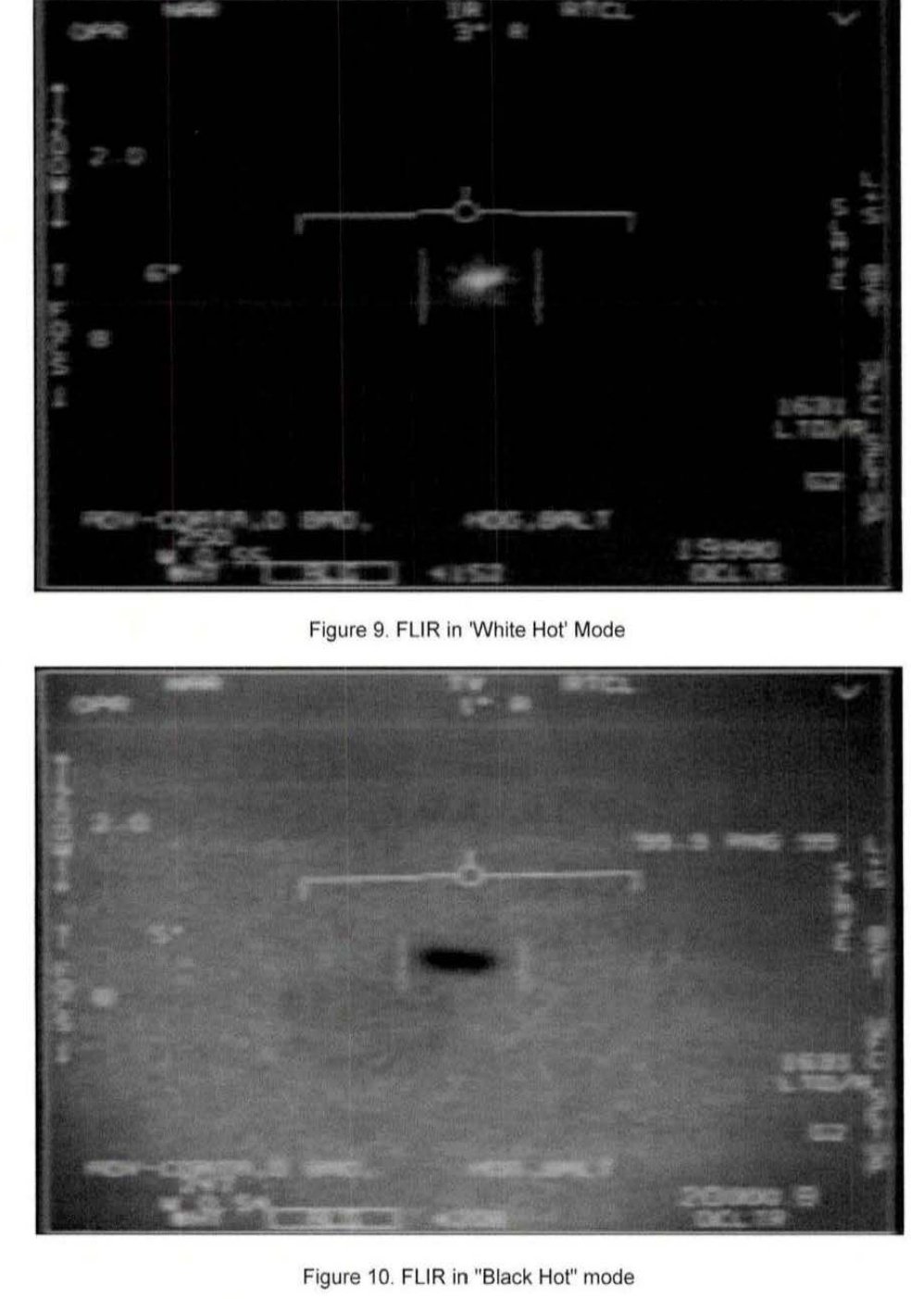 Infrared sensor (FLIR) imagePhysical page 31
DOCUMENTARY SOURCES · DOW
What the records tell
Date: November 14, 2004, with radar detections between about November 10 and 16. Location: Pacific Ocean, off Baja California, Mexico; the report's map marks the point west of the coastline, south of Tijuana. The source is the November 23, 2010 report by BAASS, a Defense Intelligence Agency (DIA) contractor, which says it reproduces the summary of an investigation carried out by personnel assigned to the DIA. These personnel used the term Anomalous Aerial Vehicle (AAV). The names of all military personnel are redacted in the release.
According to the summary, the Nimitz Carrier Strike Group was preparing to go to the Arabian Sea when the cruiser USS Princeton detected, on three occasions during the week, objects that descended “very rapidly” from about 60.000 feet to about 50 feet in seconds, stopped and departed at high speed. An operator with 17 years of experience on Aegis cruisers said the returns resembled those of ballistic missiles and that the radar, tuned for conventional aircraft, discarded them as noise. On November 14, the Princeton guided two F/A-18Fs returning from training to the contact.
The crew of the first F/A-18F section, from squadron VFA-41, first reported a disturbance in the water, “almost as if it were boiling,” beneath the object. Then they saw the object: white, smooth, with no wings or pylons, shaped like an elongated egg or a “Tic Tac,” about 46 feet (about 14 m) long, which seemed to have “a white candy-coated shell.” When the pilot descended to pass close by, the object reportedly aligned itself with the aircraft, the disturbance in the water stopped, and it climbed rapidly; shortly afterward, according to the controller, it appeared at the flight's patrol point, at about 24.000 feet. One of the crew members estimated its movement at 500 knots at low altitude, which differs from another account.
The pilot of an F/A-18C on a check flight, sent to the same point, said he saw only an area of white foam 50 to 100 meters across, nearly round, with no object or vessel. At 15h, a second F/A-18F section tried to achieve a radar lock-on to a return about 30 to 40 miles to the south, without success, and tracked on infrared (FLIR) an object that seemed stationary and then left the field of view. The crew member said he could not state that it was the same object. Tapes were copied and handed over to intelligence. According to a former crew member of the submarine USS Louisville, there were no unidentified sonar contacts.
The assessments attributed to the DIA report say that the object did not match any known U.S. or foreign aircraft, that it had low observability in several radar bands, that it showed no control surfaces or visible means of lift, and that it “possibly” became invisible or operated underwater without being detected. These are assessments recorded in the document, not demonstrated facts. BAASS added its own calculations: assuming the descent of 60.000 feet in 5 seconds, it arrives at about Mach 10,7 and a deceleration of 75 g; with 0,5 second, the values exceed 7.000 g. The numbers depend entirely on the assumed duration.
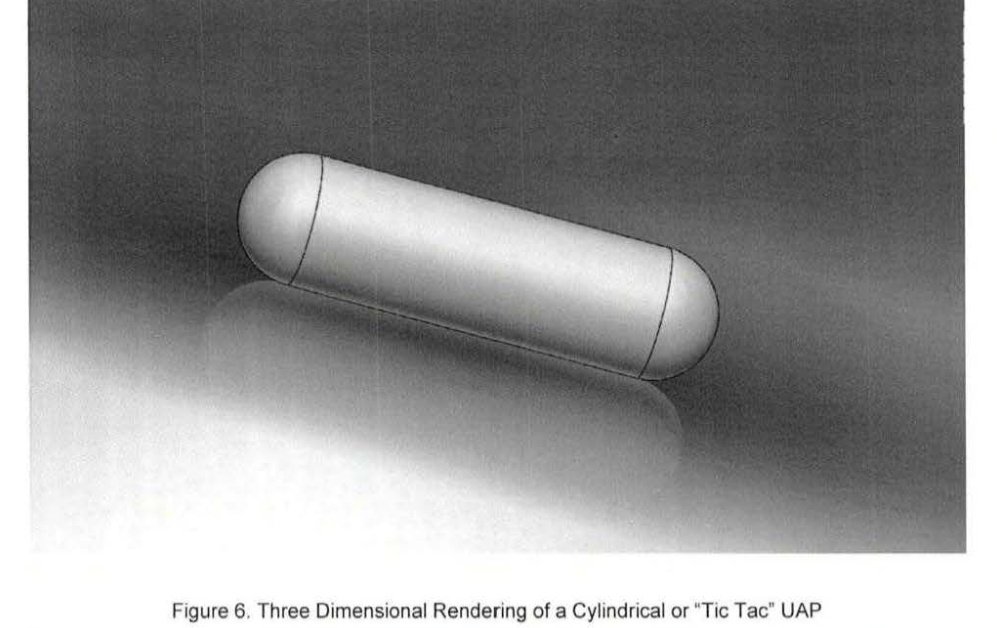
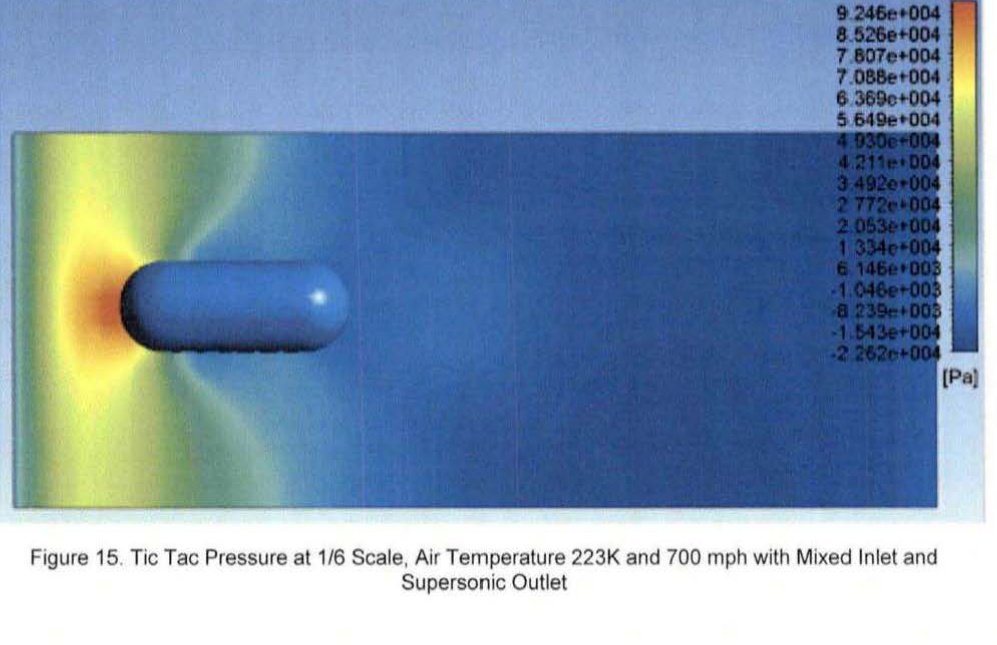
The company also simulated in the ANSYS software the airflow around a body with the reported shape and around a flat-faced cylinder, from 100 to 1.500 mph, and concluded that neither shape would have an aerodynamic advantage over the other and that, at high speeds, there would be shock waves capable of producing a sonic boom. The FLIR images reproduced in the report show a bright spot (“white hot” mode) and a dark elongated shape (“black hot” mode) under the reticle; there is no scale or identification of the object. The three-dimensional rendering of the “Tic Tac” that accompanies the report is a computer-generated drawing, not a photograph.
More images from the document
DIRECT READING OF THE FILE
The document, in the original
Translated in full: physical pages 26 to 48 of the report, which deal with the case: the summary of the DIA investigation, the map, the FLIR images, the speed and acceleration calculations, the table, the graphs and the flow simulations. Page 12 (executive summary) and Annex II (pp. 117-128, additional graphs of the “Tic Tac” shape) are translated in blocks linked to the document's dossier. Names suppressed in the release appear as [suppressed].
EXCERPT 1 · PHYSICAL PAGE 26
Physical page 26, full page
4.
ANALYTICAL AND NUMERICAL SOLUTIONS FOR UAP INVESTIGATIONS
4.1
"TIC TAC" INCIDENT
The following summary is excerpted from the report of an investigation conducted by personnel
assigned to DIA of an observation by elements of the Nimitz Carrier Strike Group of UAP off
the coast of Mexico in November 2004. Note: The DIA personnel who wrote the report utilized
the term Anomalous Aerial Vehicle (AAV) rather than the more common Unidentified Aerial
Phenomenon (UAP) or Unidentified Flying Object (UFO). All three terms, AAV, UAP, and
UFO are used at different times in this section and should be considered interchangeable.
During the period of approximately I 0-16 November 2004, the Nimitz Carrier Strike Group
(CSG) was operating off the western coast of the United States in preparation for their
deployment to the Arabian Sea. The USS Princeton on several occasions detected multiple
Anomalous Aerial Vehicles (AAVs) operating in and around the vicinity of the CSG. The AAVs
would descend "very rapidly" from approximately 60,000 feet down to approximately 50 feet in
a matter of seconds. They would then hover or stay stationary on the radar for a short time and
depart at high velocities and tum rates. On 14 November after again detecting the AAV, the
USS Princeton took the opportunity of having a flight oftwo FlA-18Fs returning from a training
mission to further investigate the AAV. The USS Princeton took over control of the F/A-l 8s
from the E-2C Airborne Early Warning aircraft and vectored in the f/A- l 8s for intercept leading
to visual contact approximately one mile away from the AAV, which was reported to be "an
elongated egg or a 'Tic Tac' shape with a discernable midline horizontal axis." It was "solid
white, smooth, with no edges. It was "uniformly colored with no nacelles, pylons, or wings." It
was approximately 46 feet in length. The F/A-18Fs radar could not obtain a 'lock' on the AAV;
however it could be tracked while stationary and at slower speeds with the Forward Looking
Infrared (FLIR). The AAV did take evasive actions upon intercept by the F/A-18 demonstrating
an advanced acceleration (g), aerodynamic, and propulsion capability. The AAV did not take
any offensive action against the CSG; however, given its ability to operate unchallenged in close
vicinity to the CSG it demonstrated the potential to conduct undetected reconnaissance leaving
the CSG with a limited ability to detect, track, and/or engage the/\/\V.
According to l1843(a)(2)
Ithe AAVs would descend from a very high altitude into the
scan volume of the AN/SPY-1 at a high velocity. The top of the scan volume would put the
AAVs at higher than 60,000 feet. The AAVs would descend "very rapidly" from approximately
60,000 feet down to approximately 50 feet in a matter of seconds. They would then hover for a
short time and depart at high velocities and at tum rates demonstrating an advanced acceleration
(g) capability. p843(a)(2)
7 added that based on his experience, which is 17 years as a Fire
Control on Aegis cruisers, Che AA V exhibited ballistic missile Characteristics in reference to its
appearance, velocity, and indications on the radar. Since the radar was in the mode to handle /\ir
Intercept of conventional aircraft it never obtained an accurate track of the AAVs and was
quickly "dropped" by the radar meaning it was eliminated by the computer to reduce the amount
ofclutter on the radar, as any other false target is handled. If the radar were set up in a mode for
Ballistic Missile tracking they likely would have had the capability to track the AAV. They were
detected three separate times during the week operating off the western coast of the United States
and Mexico. The Tactical Air Officer onboard the Princeton could not identify the radar contact
Summary Report on B/\ASS UAP Analysis Capabilities
Page 25
November 23, 2010Editorial note: Start of the section on the "Tic Tac" incident, summarized by BAASS from a DIA investigation report: detections by the USS Princeton between November 10 and 16, 2004 and the intercept of November 14.
Check the original PDF
4.
ANALYTICAL AND NUMERICAL SOLUTIONS FOR UAP INVESTIGATIONS
4.1
"TIC TAC" INCIDENT
The following summary is excerpted from the report of an investigation conducted by personnel
assigned to DIA of an observation by elements of the Nimitz Carrier Strike Group of UAP off
the coast of Mexico in November 2004. Note: The DIA personnel who wrote the report utilized
the term Anomalous Aerial Vehicle (AAV) rather than the more common Unidentified Aerial
Phenomenon (UAP) or Unidentified Flying Object (UFO). All three terms, AAV, UAP, and
UFO are used at different times in this section and should be considered interchangeable.
During the period of approximately I 0-16 November 2004, the Nimitz Carrier Strike Group
(CSG) was operating off the western coast of the United States in preparation for their
deployment to the Arabian Sea. The USS Princeton on several occasions detected multiple
Anomalous Aerial Vehicles (AAVs) operating in and around the vicinity of the CSG. The AAVs
would descend "very rapidly" from approximately 60,000 feet down to approximately 50 feet in
a matter of seconds. They would then hover or stay stationary on the radar for a short time and
depart at high velocities and tum rates. On 14 November after again detecting the AAV, the
USS Princeton took the opportunity of having a flight oftwo FlA-18Fs returning from a training
mission to further investigate the AAV. The USS Princeton took over control of the F/A-l 8s
from the E-2C Airborne Early Warning aircraft and vectored in the f/A- l 8s for intercept leading
to visual contact approximately one mile away from the AAV, which was reported to be "an
elongated egg or a 'Tic Tac' shape with a discernable midline horizontal axis." It was "solid
white, smooth, with no edges. It was "uniformly colored with no nacelles, pylons, or wings." It
was approximately 46 feet in length. The F/A-18Fs radar could not obtain a 'lock' on the AAV;
however it could be tracked while stationary and at slower speeds with the Forward Looking
Infrared (FLIR). The AAV did take evasive actions upon intercept by the F/A-18 demonstrating
an advanced acceleration (g), aerodynamic, and propulsion capability. The AAV did not take
any offensive action against the CSG; however, given its ability to operate unchallenged in close
vicinity to the CSG it demonstrated the potential to conduct undetected reconnaissance leaving
the CSG with a limited ability to detect, track, and/or engage the/\/\V.
According to l1843(a)(2)
Ithe AAVs would descend from a very high altitude into the
scan volume of the AN/SPY-1 at a high velocity. The top of the scan volume would put the
AAVs at higher than 60,000 feet. The AAVs would descend "very rapidly" from approximately
60,000 feet down to approximately 50 feet in a matter of seconds. They would then hover for a
short time and depart at high velocities and at tum rates demonstrating an advanced acceleration
(g) capability. p843(a)(2)
7 added that based on his experience, which is 17 years as a Fire
Control on Aegis cruisers, Che AA V exhibited ballistic missile Characteristics in reference to its
appearance, velocity, and indications on the radar. Since the radar was in the mode to handle /\ir
Intercept of conventional aircraft it never obtained an accurate track of the AAVs and was
quickly "dropped" by the radar meaning it was eliminated by the computer to reduce the amount
ofclutter on the radar, as any other false target is handled. If the radar were set up in a mode for
Ballistic Missile tracking they likely would have had the capability to track the AAV. They were
detected three separate times during the week operating off the western coast of the United States
and Mexico. The Tactical Air Officer onboard the Princeton could not identify the radar contact
Summary Report on B/\ASS UAP Analysis Capabilities
Page 25
November 23, 2010View the document record ↗ · Physical page 26, counting the cover.
EXCERPT 2 · PHYSICAL PAGE 27
Physical page 27, full page
and given the high speed and altitude was perplexed. On 14 November 2004, after again
detecting an AA V took the opportunity of two F/A-18s airborne in the vicinity to task them for
airborne reconnaissance ofthe AA V.
Figure 8. Location of the AAV during the F/A18 Intercept
!AAP Person 9
bwas flying a single seat
F/A-18C that launched from the USS Nimitz at approximately 1030L to conduct a Functional
Check Flight of an aircraft that had recently completed significant maintenance. He noted the
weather that day was blue skies. no clouds, and unlimited visibility. After 30 minutes into his
flight he received a radio call from his air controller asking him to investigate an unidentified
airborne contact. This was not a standard request. Additionally the controller asked if he had
ordnance onboard, which was odd since no controller had ever asked that question during a
SummaJ)' Report on BA.A~S LAP Analysis Capabilities
Page 26
November 23. 2010Editorial note: Map from the report with the position attributed to the UAP off Baja California and start of the account of the pilot of an F/A-18C on a check flight on November 14, 2004.
Check the original PDF
and given the high speed and altitude was perplexed. On 14 November 2004, after again
detecting an AA V took the opportunity of two F/A-18s airborne in the vicinity to task them for
airborne reconnaissance ofthe AA V.
Figure 8. Location of the AAV during the F/A18 Intercept
!AAP Person 9
bwas flying a single seat
F/A-18C that launched from the USS Nimitz at approximately 1030L to conduct a Functional
Check Flight of an aircraft that had recently completed significant maintenance. He noted the
weather that day was blue skies. no clouds, and unlimited visibility. After 30 minutes into his
flight he received a radio call from his air controller asking him to investigate an unidentified
airborne contact. This was not a standard request. Additionally the controller asked if he had
ordnance onboard, which was odd since no controller had ever asked that question during a
SummaJ)' Report on BA.A~S LAP Analysis Capabilities
Page 26
November 23. 2010View the document record ↗ · Physical page 27, counting the cover.
EXCERPT 3 · PHYSICAL PAGE 28
Physical page 28, full page
situation of identifying an unknown contact over U.S. or International territory. He responded
that he had no ordnance onboard. The controller provided vectors to the vicinity of Figure 8.
The object was reported to be at "slow speed and low altitude."
While en route at approximately 250 knots indicated/400 knots groundspeed at mediwn altitude
(15-25,000 feet), he gained radar contact of what he believed to be two F/A-18Fs that were
approaching the AA V from the west at low altitude (500- 5,000 feet). There was no other traffic
on the radar. The controller informed him to remain above I 0,000 feet, as there was other fighter
traffic at low altitude investigating the AAV. As he approached approximately 15nm from the
AA V descending through approximately 15,000 feet, he could see a water disturbance in the
ocean surface. He recalled that the sea state was low (calm). At approximately 5-10 nm away
from the AAV, the controller told him to "skip it'' and return to his operating area. Since he was
close he elected to fly over the water disturbance to try and see what was causing it.
The disturbance appeared to be 50 to I 00 meters in diameter and close to round. It was the only
area and type ofwhitewater activity that could be seen and reminded him ofimages of something
rapidly submerging from the surface like a submarine or ship sinking. It also looked like a
possible area of shoal water where the swell was breaking over a barely submerged reef or
island. He overflew the disturbance and turned back to the northwest. As he was flying away he
could see the disturbance clearing and could no longer identify the place where it occurred. He
did not see any object or vessel associated with the disturbance either above the surface, on the
surface, or below the surface. He also never made visual contact with the other fighter aircraft
that were vectored to the location or the AA V. It is possible that the disturbance was being
caused by an AA V but that the AA V was 'cloaked' or invisible to the human eye.
!MP Person 9 !recovered aboard the Nimitz at approximately 1200L. H~~........,.......,....,..........,'"'14'
Intelligence Center (CVIC) and was asked by hi
•
Officer
saw the "supersonic Tic Tac"? We questioned now-:,-----;-,---r- o dete
~:--:T~-c-::-::i-=::-:-:,~....
information but based on his position in CVIC a
was not involved in any further
discussions concerning the AAV.
1843(a)(2)
He and
1843(a)(2)
ere in the lead aircraft of the first F/A-18F section airborne
a ay om
-
, 1843(a)(2)
The flight walked, started and launched with no
issue. They completed their departure from the USS Nimitz and flew to the working area to
conduct the training portion of the flight. After they completed their training the E-2C controller
handed them off to the USS Princeton!1843(a)(2)
f1here they received vectors via Bearing
Range Altitude Aspect (BRAA) to an unknown contact flyin into the w~king ar a from the
1843(a)(2) . south. -1··--·
!asked what ordnance they had on board. 1843(a)(2)
tol
-··-- controLthaL1~A3(a)(2)
they had two captive training AJM-9Ms {CATM-9) and no o er or nance. The flight descended
to between 20-24,000 feet and proceeded to the contact. !1B43(a)(2) Idid not recall any
indications via on-board sensor of the object. Their aircraft was not carrying a Forward Looking
Infrared (FLIR) pod onboard. As l1843(a)(2) Iremembers it, the radar Attack Display was clean
(no targets).
Summary Report on BAJ\SS UAP Analysis Capabilities
Page 27
November 23, 201 0Editorial note: Continuation of the account: the disturbance in the water seen by the F/A-18C pilot and the beginning of the account by the lead crew of the first section of F/A-18Fs of squadron VFA-41.
Check the original PDF
situation of identifying an unknown contact over U.S. or International territory. He responded
that he had no ordnance onboard. The controller provided vectors to the vicinity of Figure 8.
The object was reported to be at "slow speed and low altitude."
While en route at approximately 250 knots indicated/400 knots groundspeed at mediwn altitude
(15-25,000 feet), he gained radar contact of what he believed to be two F/A-18Fs that were
approaching the AA V from the west at low altitude (500- 5,000 feet). There was no other traffic
on the radar. The controller informed him to remain above I 0,000 feet, as there was other fighter
traffic at low altitude investigating the AAV. As he approached approximately 15nm from the
AA V descending through approximately 15,000 feet, he could see a water disturbance in the
ocean surface. He recalled that the sea state was low (calm). At approximately 5-10 nm away
from the AAV, the controller told him to "skip it'' and return to his operating area. Since he was
close he elected to fly over the water disturbance to try and see what was causing it.
The disturbance appeared to be 50 to I 00 meters in diameter and close to round. It was the only
area and type ofwhitewater activity that could be seen and reminded him ofimages of something
rapidly submerging from the surface like a submarine or ship sinking. It also looked like a
possible area of shoal water where the swell was breaking over a barely submerged reef or
island. He overflew the disturbance and turned back to the northwest. As he was flying away he
could see the disturbance clearing and could no longer identify the place where it occurred. He
did not see any object or vessel associated with the disturbance either above the surface, on the
surface, or below the surface. He also never made visual contact with the other fighter aircraft
that were vectored to the location or the AA V. It is possible that the disturbance was being
caused by an AA V but that the AA V was 'cloaked' or invisible to the human eye.
!MP Person 9 !recovered aboard the Nimitz at approximately 1200L. H~~........,.......,....,..........,'"'14'
Intelligence Center (CVIC) and was asked by hi
•
Officer
saw the "supersonic Tic Tac"? We questioned now-:,-----;-,---r- o dete
~:--:T~-c-::-::i-=::-:-:,~....
information but based on his position in CVIC a
was not involved in any further
discussions concerning the AAV.
1843(a)(2)
He and
1843(a)(2)
ere in the lead aircraft of the first F/A-18F section airborne
a ay om
-
, 1843(a)(2)
The flight walked, started and launched with no
issue. They completed their departure from the USS Nimitz and flew to the working area to
conduct the training portion of the flight. After they completed their training the E-2C controller
handed them off to the USS Princeton!1843(a)(2)
f1here they received vectors via Bearing
Range Altitude Aspect (BRAA) to an unknown contact flyin into the w~king ar a from the
1843(a)(2) . south. -1··--·
!asked what ordnance they had on board. 1843(a)(2)
tol
-··-- controLthaL1~A3(a)(2)
they had two captive training AJM-9Ms {CATM-9) and no o er or nance. The flight descended
to between 20-24,000 feet and proceeded to the contact. !1B43(a)(2) Idid not recall any
indications via on-board sensor of the object. Their aircraft was not carrying a Forward Looking
Infrared (FLIR) pod onboard. As l1843(a)(2) Iremembers it, the radar Attack Display was clean
(no targets).
Summary Report on BAJ\SS UAP Analysis Capabilities
Page 27
November 23, 201 0View the document record ↗ · Physical page 28, counting the cover.
EXCERPT 4 · PHYSICAL PAGE 29
Physical page 29, full page
•
1843
2
1843
2
L ___(a_)_( _)_,...-=-=.=i.....,..__(a_)(__l _ .....were attem ting acquire the object visually as they heard "merge
1843(a)(2) plo.e .from- - - --
According to 1843(a)(2)
the first indication he had of the unknown contact
was a visua o a isturbance on the water below the AAV. As he scanned the area he gained a
visual on the object. It is important to note that when asked to describe the disturbance on the
water he stated that it was localized underneath the object, did not appear as a trail or wake, and
looked like frothy waves and foam almost as ifthe water was boiling.
At this oint 1843(a)(Z)
detached !1843(a)(2)
!which held at approximately 20,000 feet,
escended to between 12-16,000 feet. 1843(a)(2)
attempted a "helmet
at was unsuccessful. It is important to note that 1843(a)(2)
as using the Joint Helmet
Mounted Cuing System which will cue the aircraft sensors sue as
e radar to 'lock on' to what
the pilot is looking at and it also has a recording capability. It may have been useful in this
situation but typically because of the large amount of head movement it is not practical. c::]J §4.~(~)(2)
1843(a)(2L i:=-lstated that the helmet' s recording capability was rarely used therefore he did not think to
~
atday.
1843(a)(2)
communicated what they were seeing with !
=3eontrol-ana-said-thathe .hada 1843(a)(2)
runnmg ia ogue on the interflight radio withj1 843(a)(2)
!stated that the object
was "holding like a Harrier." (Referring to the AV-8B jet aircraft, which is capable of hovering
and Vertical/Short Takeoff and Landing (V/STOL) via thrust vectoring.) According to r-::1.~43(a)(2)
1843(a~_(?Ll
!the object's shape was like an elongated egg or a 'Tic Tac' and had a discemable m~
•
horizontal axis. However, the object was uniformly white across the entire body.
It was
approximately 46 feet in length. 1843(a)(2)
escribed it as "solid white, smooth, with no
edges. It was uniformly colored wi
no nace es, pylons, or wings." When asked to describe
the appearance, if it glowed or reflected sunlight he said, "neither, it looked like it had a white
candy-coated shell, almost like a white board." His report differs from !1843(a)(2) Iin that he
reported the object traveling level at approximately 500-1000 feet at approximately 500 knots.
The object was pointed in a north/south orientation and was moving both north & south and east
& west, while maintainin a consistent altitude. These displacements, according to !1843(a)(2)
were minor. 1843(a)(2)
stated he then began a descent with the intention to take a close aboard
pass with the object in an attempt lo visually identify it. They began the decent as the rolled in
from about 10,000 ft and approximately 350 knots to take the object close aboard. 1843(a)(2)
pulled nose on and then pulled trail (aft) of the object. As they were maneuvering, the object 1843( )(2)
appeared, according toj1843(a)(2)
l"to recognize us." He assessed this from the fact th4ohject (
~
"pointed" (realigned its axis) in the direction of their aircraft. At this time, according t
•.,'
1843(a)(2) .[:=] the disturbance on the water ceased.
As they completed this maneuver, the ob·eel ascended quickly and pulled lift vector on and aft of
them at a supersonic speed. 1843(a)(2)
commanded the radar through the Short Range radar
set and asked for a picture from 1843(a)(2)
initially reported that the "picture was clean" (no
contact) but then stated "you' re not gomg to elieve this, it's at your CAP" meaning that the
AAV had flown to their training CAP, which was located in the southern end of the training area
and had climbed to approximately 24,000 feet. 1843(a)(2)
stated that the flight attempted to
locate both the object and the disturbance with no success. 1843(a)(2)
stated that nothing was
seen on the surface or subsurface and that there were no indications ofthe previous disturbance.
Summary Report on BAASS UAP Analysis Capabilities
Page 28
November 23, 2010Editorial note: Account of the crew of the first F/A-18F section: the disturbance in the water, the description of the white UAP of about 46 feet, the attempted approach, and the high-speed departure; names withheld in the release.
Check the original PDF
•
1843
2
1843
2
L ___(a_)_( _)_,...-=-=.=i.....,..__(a_)(__l _ .....were attem ting acquire the object visually as they heard "merge
1843(a)(2) plo.e .from- - - --
According to 1843(a)(2)
the first indication he had of the unknown contact
was a visua o a isturbance on the water below the AAV. As he scanned the area he gained a
visual on the object. It is important to note that when asked to describe the disturbance on the
water he stated that it was localized underneath the object, did not appear as a trail or wake, and
looked like frothy waves and foam almost as ifthe water was boiling.
At this oint 1843(a)(Z)
detached !1843(a)(2)
!which held at approximately 20,000 feet,
escended to between 12-16,000 feet. 1843(a)(2)
attempted a "helmet
at was unsuccessful. It is important to note that 1843(a)(2)
as using the Joint Helmet
Mounted Cuing System which will cue the aircraft sensors sue as
e radar to 'lock on' to what
the pilot is looking at and it also has a recording capability. It may have been useful in this
situation but typically because of the large amount of head movement it is not practical. c::]J §4.~(~)(2)
1843(a)(2L i:=-lstated that the helmet' s recording capability was rarely used therefore he did not think to
~
atday.
1843(a)(2)
communicated what they were seeing with !
=3eontrol-ana-said-thathe .hada 1843(a)(2)
runnmg ia ogue on the interflight radio withj1 843(a)(2)
!stated that the object
was "holding like a Harrier." (Referring to the AV-8B jet aircraft, which is capable of hovering
and Vertical/Short Takeoff and Landing (V/STOL) via thrust vectoring.) According to r-::1.~43(a)(2)
1843(a~_(?Ll
!the object's shape was like an elongated egg or a 'Tic Tac' and had a discemable m~
•
horizontal axis. However, the object was uniformly white across the entire body.
It was
approximately 46 feet in length. 1843(a)(2)
escribed it as "solid white, smooth, with no
edges. It was uniformly colored wi
no nace es, pylons, or wings." When asked to describe
the appearance, if it glowed or reflected sunlight he said, "neither, it looked like it had a white
candy-coated shell, almost like a white board." His report differs from !1843(a)(2) Iin that he
reported the object traveling level at approximately 500-1000 feet at approximately 500 knots.
The object was pointed in a north/south orientation and was moving both north & south and east
& west, while maintainin a consistent altitude. These displacements, according to !1843(a)(2)
were minor. 1843(a)(2)
stated he then began a descent with the intention to take a close aboard
pass with the object in an attempt lo visually identify it. They began the decent as the rolled in
from about 10,000 ft and approximately 350 knots to take the object close aboard. 1843(a)(2)
pulled nose on and then pulled trail (aft) of the object. As they were maneuvering, the object 1843( )(2)
appeared, according toj1843(a)(2)
l"to recognize us." He assessed this from the fact th4ohject (
~
"pointed" (realigned its axis) in the direction of their aircraft. At this time, according t
•.,'
1843(a)(2) .[:=] the disturbance on the water ceased.
As they completed this maneuver, the ob·eel ascended quickly and pulled lift vector on and aft of
them at a supersonic speed. 1843(a)(2)
commanded the radar through the Short Range radar
set and asked for a picture from 1843(a)(2)
initially reported that the "picture was clean" (no
contact) but then stated "you' re not gomg to elieve this, it's at your CAP" meaning that the
AAV had flown to their training CAP, which was located in the southern end of the training area
and had climbed to approximately 24,000 feet. 1843(a)(2)
stated that the flight attempted to
locate both the object and the disturbance with no success. 1843(a)(2)
stated that nothing was
seen on the surface or subsurface and that there were no indications ofthe previous disturbance.
Summary Report on BAASS UAP Analysis Capabilities
Page 28
November 23, 2010View the document record ↗ · Physical page 29, counting the cover.
EXCERPT 5 · PHYSICAL PAGE 30
Physical page 30, full page
••
Following the engagement, the flight rejoined and returned to the USS Nimjtz_ When asked how
the jets functioned and if there was any indications of a system malfunction, he stated that, "the
jets were brand new, less than 1
hr
n h m.
They were working perfectly." 1843(a)(2)
when asked, said that all aircraft systems were
functional. That there were no ID1Ss1on computer issues or avionics issues and that there was no
radio or communication interference and that they had entry into the Link-16 network. When
asked, 1843(a)(2)
couldn't confirm any physiological or psychological feelings that were out
ofthe or mary.
1843
2
1843(a)(2)
was a member ofVFA-41 and was the l.____<a_H__) _______,
1843(a}J?L .... .
flying wi 1843(a)(2)
They were a part of the second F/A- l 8F section airborne
at ay from VFA-41. Their flight launched following the !1 843(a)(2)
!flight. The crews
spoke with each other in the paraloft, discussed the object and that the flights were scheduled for
the same working area. !1843(a)(2)
!flight toldl1843(a)(2)
Iflight what they saw and to
try to see and record what they could.
There were no clouds and there was a discernable horizon. The time was approximately 1500L.
All on board systems were functiorung normally. The radar was in a standard search mode
(RWS/ 80NM/ 4bar/ intr) and the FLIR was in L+S slave (the FLIR would point in direction of
an L+S track). There was no radio or commurucation interference and they had entry into the
Link-16 network. Initial awareness of an object came via the radar. Accordjng to the radar 1843(a)(2)
dis la , the injtial tracks were at approximately 30-40 nm to the south of the aircraft. r7
1843(a)(2)
was controlling the radar and FLIR and attempted multiple times to transition tFie
ra ar to mgle Target Track (SIT) mode on the object. The radar could not take a lock, the
b-sweep would raster around the hit, build an initial aspect vector (which never stabilized) and
then would drop and continue normal RWS b-sweep. When asked, !1843(a)(2)
!stated that
there were no jamming cues (strobe, champagne bubbles, "any normal EA indications"). It "just
appeared as if the radar couldn't hack it." The radar couldn't receive enough information to
create a single target track file. The FLIR, in L+S slave, pointed in the direction of the initial
track flies as the radar attempted lock. The FUR showed an object at 0 ATA and approximately
-5 deg elevation (Figure 9). According tq 1843(a)(2)
t'the target was best guess co-altitude
or a few thousand feet below," estimating the object to be between 15-20 thousand feet. The
object, according to the FLIR, appeared stationary (Figure l 0). There was no discemable
movement from the object with the only closure being a result of the aircraft' s movement. As
1843(a)(2)
watched the object it began to move out of FLIR field of view to the left. O
tS4~(a)(2)
1843(a)(2)
made no attempt to slew the FLIR and subsequently lost situational awareness to the
••• •
object. The Flight continued with training mission with no further contact with object.
Summa1y Report on BAASS UAP Analysis Capabilities
Page 29
November 23, 2010Editorial note: End of the first section's account and account of the second F/A-18F section, at around 15h00, in which the radar was unable to achieve lock-on and the UAP was tracked by infrared (FLIR).
Check the original PDF
••
Following the engagement, the flight rejoined and returned to the USS Nimjtz_ When asked how
the jets functioned and if there was any indications of a system malfunction, he stated that, "the
jets were brand new, less than 1
hr
n h m.
They were working perfectly." 1843(a)(2)
when asked, said that all aircraft systems were
functional. That there were no ID1Ss1on computer issues or avionics issues and that there was no
radio or communication interference and that they had entry into the Link-16 network. When
asked, 1843(a)(2)
couldn't confirm any physiological or psychological feelings that were out
ofthe or mary.
1843
2
1843(a)(2)
was a member ofVFA-41 and was the l.____<a_H__) _______,
1843(a}J?L .... .
flying wi 1843(a)(2)
They were a part of the second F/A- l 8F section airborne
at ay from VFA-41. Their flight launched following the !1 843(a)(2)
!flight. The crews
spoke with each other in the paraloft, discussed the object and that the flights were scheduled for
the same working area. !1843(a)(2)
!flight toldl1843(a)(2)
Iflight what they saw and to
try to see and record what they could.
There were no clouds and there was a discernable horizon. The time was approximately 1500L.
All on board systems were functiorung normally. The radar was in a standard search mode
(RWS/ 80NM/ 4bar/ intr) and the FLIR was in L+S slave (the FLIR would point in direction of
an L+S track). There was no radio or commurucation interference and they had entry into the
Link-16 network. Initial awareness of an object came via the radar. Accordjng to the radar 1843(a)(2)
dis la , the injtial tracks were at approximately 30-40 nm to the south of the aircraft. r7
1843(a)(2)
was controlling the radar and FLIR and attempted multiple times to transition tFie
ra ar to mgle Target Track (SIT) mode on the object. The radar could not take a lock, the
b-sweep would raster around the hit, build an initial aspect vector (which never stabilized) and
then would drop and continue normal RWS b-sweep. When asked, !1843(a)(2)
!stated that
there were no jamming cues (strobe, champagne bubbles, "any normal EA indications"). It "just
appeared as if the radar couldn't hack it." The radar couldn't receive enough information to
create a single target track file. The FLIR, in L+S slave, pointed in the direction of the initial
track flies as the radar attempted lock. The FUR showed an object at 0 ATA and approximately
-5 deg elevation (Figure 9). According tq 1843(a)(2)
t'the target was best guess co-altitude
or a few thousand feet below," estimating the object to be between 15-20 thousand feet. The
object, according to the FLIR, appeared stationary (Figure l 0). There was no discemable
movement from the object with the only closure being a result of the aircraft' s movement. As
1843(a)(2)
watched the object it began to move out of FLIR field of view to the left. O
tS4~(a)(2)
1843(a)(2)
made no attempt to slew the FLIR and subsequently lost situational awareness to the
••• •
object. The Flight continued with training mission with no further contact with object.
Summa1y Report on BAASS UAP Analysis Capabilities
Page 29
November 23, 2010View the document record ↗ · Physical page 30, counting the cover.
EXCERPT 6 · PHYSICAL PAGE 31
Physical page 31, full page
Figure 9. FUR in 'White Hot' Mode
Figure 10. FUR in "Black Hot" mode
Summary Report on 13/\J\SS l JJ\P /\nalysi" Capnhilitics
Pngc 10
November 23. 20 10Editorial note: Two images of the infrared (FLIR) display reproduced in the report as a record of the UAP of November 14, 2004, in "white hot" and "black hot" modes.
Check the original PDF
Figure 9. FUR in 'White Hot' Mode
Figure 10. FUR in "Black Hot" mode
Summary Report on 13/\J\SS l JJ\P /\nalysi" Capnhilitics
Pngc 10
November 23. 20 10View the document record ↗ · Physical page 31, counting the cover.
EXCERPT 7 · PHYSICAL PAGE 32
Physical page 32, full page
----------------
1843(a)(2)
was clear in that he couldn't confirm that it was the same object as described by
1843 a 2
flight. He never had visual, only seeing the object via the FLIR. He reaffirmed
that all systems were functional. Following completion of the training portion, the section
returned to the shi. for a normal approach, landing and shutdown. The crew met in CVlC and
debriefed. 1843(a)(2)
said that the CJVC section attempted to collect his tapes but he
refused.
They proceeded to their ready room where they debriefed withl1843(a)(2)
land his fl~
•
the tapes were made with a set being turned into the intelligence section. l...=jJ~.4~.(~)(2)
1843(a)(2)
was not asked to sign any non-disclosure agreement and he is uncertain how far up
the chain the reporting went past his commanding officer. When askedJ1843(a)(2)
I couldn't
confirm any physiological or psychological. feelings that were out of the ordinary. He only
expressed a feeling ofconfusion during the event.
According to former!1843(a){2)
Inow a civilian working rorl1843(a)(2) Iwho was a
!1843(a)(2)
I onboard the Louisville in November 2004 during the AAV activity
there were no unidentified sonar contacts in the vicinit of the aerial si htin ,s or an time durin ,
the o erations off the coast of California. The forme 1843(a)(2)
1843 (a) ( 2)
confirmed that there was no anomalous undersea activity during this period. There
was a 1ve ire exercise conducted by the USS Louisville during the period of and in the vicinity
of the AAV sightings; however, the weapon in use did not match the flight profile or visible
characteristics of the AAV. Additionally any live fire would have been coordinated throughout
the CSG and all air traffic would have been well aware of the launch and operati.on of the
weapon system. Aircraft would not have been vectored for the intercept of a US Weapon in
Oight. Based on the lack of detection of any unidentified sonar contacts it is highly unlikely that
an AAV operated below the surface of the ocean; it is possible that the AAV demonstrated the
ability to be cloaked or invisible to the human eye based on ilot re orting of the water
disturbance with no visible craft. Based on the assessment of 1843(a)(2)
if the AAV did
operate underwater undetected it would represent a highly a vance
capability given the
advanced capability of our sensors.
Key Assessments According to DIA Report
• The Anomalous Aerial Vehicle (AAV) was no known aircraft or air vehicle currently in
the inventory of the United States or any foreign nation.
• The AAV exhibited advanced low observable characteristics al multiple radar bands
rendering US radar based engagement capabilities ineffective.
•
The M V exhibited advanced aerodynamic performance with no visible control surfaces
and no visible means to generate lift.
•
The AAV exhibited advanced propulsion capability by demonstrating the ability to
remain stationary with little to no variation in altitude transitioning to horizontal and/or
vertical velocities far greater than any known aerial vehicle with Uttle to no visible
signature.
•
The AAV possibly demonstrated the ability to 'cloak' or become invisible to the human
eye or human observation.
Summary Report on BAASS UAP Analysis Capabilities
Page 31
November 23,2010Editorial note: End of the aviators' accounts, information from the submarine USS Louisville on the absence of sonar contacts, and the main assessments of the UAP attributed to the DIA report.
Check the original PDF
----------------
1843(a)(2)
was clear in that he couldn't confirm that it was the same object as described by
1843 a 2
flight. He never had visual, only seeing the object via the FLIR. He reaffirmed
that all systems were functional. Following completion of the training portion, the section
returned to the shi. for a normal approach, landing and shutdown. The crew met in CVlC and
debriefed. 1843(a)(2)
said that the CJVC section attempted to collect his tapes but he
refused.
They proceeded to their ready room where they debriefed withl1843(a)(2)
land his fl~
•
the tapes were made with a set being turned into the intelligence section. l...=jJ~.4~.(~)(2)
1843(a)(2)
was not asked to sign any non-disclosure agreement and he is uncertain how far up
the chain the reporting went past his commanding officer. When askedJ1843(a)(2)
I couldn't
confirm any physiological or psychological. feelings that were out of the ordinary. He only
expressed a feeling ofconfusion during the event.
According to former!1843(a){2)
Inow a civilian working rorl1843(a)(2) Iwho was a
!1843(a)(2)
I onboard the Louisville in November 2004 during the AAV activity
there were no unidentified sonar contacts in the vicinit of the aerial si htin ,s or an time durin ,
the o erations off the coast of California. The forme 1843(a)(2)
1843 (a) ( 2)
confirmed that there was no anomalous undersea activity during this period. There
was a 1ve ire exercise conducted by the USS Louisville during the period of and in the vicinity
of the AAV sightings; however, the weapon in use did not match the flight profile or visible
characteristics of the AAV. Additionally any live fire would have been coordinated throughout
the CSG and all air traffic would have been well aware of the launch and operati.on of the
weapon system. Aircraft would not have been vectored for the intercept of a US Weapon in
Oight. Based on the lack of detection of any unidentified sonar contacts it is highly unlikely that
an AAV operated below the surface of the ocean; it is possible that the AAV demonstrated the
ability to be cloaked or invisible to the human eye based on ilot re orting of the water
disturbance with no visible craft. Based on the assessment of 1843(a)(2)
if the AAV did
operate underwater undetected it would represent a highly a vance
capability given the
advanced capability of our sensors.
Key Assessments According to DIA Report
• The Anomalous Aerial Vehicle (AAV) was no known aircraft or air vehicle currently in
the inventory of the United States or any foreign nation.
• The AAV exhibited advanced low observable characteristics al multiple radar bands
rendering US radar based engagement capabilities ineffective.
•
The M V exhibited advanced aerodynamic performance with no visible control surfaces
and no visible means to generate lift.
•
The AAV exhibited advanced propulsion capability by demonstrating the ability to
remain stationary with little to no variation in altitude transitioning to horizontal and/or
vertical velocities far greater than any known aerial vehicle with Uttle to no visible
signature.
•
The AAV possibly demonstrated the ability to 'cloak' or become invisible to the human
eye or human observation.
Summary Report on BAASS UAP Analysis Capabilities
Page 31
November 23,2010View the document record ↗ · Physical page 32, counting the cover.
EXCERPT 8 · PHYSICAL PAGE 33
Physical page 33, full page
The AA V possibly demonstrated a highly advanced capability to operate undersea completely
undetectable by our most advanced sensors. The so called "Tic Tac" incident has many physics
and engineering aspects that may be studied with regards to understanding the performance
capabilities and propulsion mechanisms of the craft. Since there was lit1le hard data, most
analyses of the incident had to be made using either parametric studies or assumptions based on
eye witness testimony.
4.1.1 Analytical Solutions of Velocities and Accelerations Associated with "Tic Tac"
Performance
An initial starting point consisted ofusing basic physics formulas for the calculation ofvelocities
and accelerations based on the distance s the object traveled and the duration time I of the
incident. Since no exact duration was known, as the radar operator noted that it occurred in a
matter of "seconds," a parametric range from 0.5 seconds to 10 seconds was studied (assuming
instantaneous velocities and accelerations).
ds
v=
dt
dv
a=
dt
Flight is classified in six categories as shown in the table below.
Table 1. Mach Regimes
Regime
Subsonic
Transonic
Sonic
Supersonic
Hypersonic
High- hypersonic
Re-entry
Speeds
Mach
Number
< 1.0
0.8 1.2
1.0
1.0 - 5.0
5.0 - 10.0
10.0 25.0
> 25.0
Due to the lack of data, only the instantaneous velocity of the craft v and the instantaneous
acceleration a, were computable. For the velocity and deceleration witnessed, a negative sign is
implied to represent the direction component ofthe vector.
Assumptions:
1. Elevation of 60,000 ft to Sea Level - It was reported by radar observation the object
descended from approximately 60,000 ft to sea level in a matter ofseconds.
2. Matter of Seconds - A range of 0.5 seconds to 10 seconds was used for a parametric
study.
4.1.2
Summary of Analytical Velocity and Acceleration Solutions
Table 2 provides the computed values of instantaneous velocities and decelerations in ft/s and
mph and ft/sec2 and g respectively for each chosen .6t. Figure 11 through Figure 14 show
Summary Report on BAASS UAP Analysis Capabilities
Page 32
November 23, 2010Editorial note: Start of BAASS's calculations on the "Tic Tac": the velocity and acceleration formulas, the table of Mach regimes, and the assumptions of a 60.000-foot descent in 0,5 to 10 seconds.
Check the original PDF
The AA V possibly demonstrated a highly advanced capability to operate undersea completely
undetectable by our most advanced sensors. The so called "Tic Tac" incident has many physics
and engineering aspects that may be studied with regards to understanding the performance
capabilities and propulsion mechanisms of the craft. Since there was lit1le hard data, most
analyses of the incident had to be made using either parametric studies or assumptions based on
eye witness testimony.
4.1.1 Analytical Solutions of Velocities and Accelerations Associated with "Tic Tac"
Performance
An initial starting point consisted ofusing basic physics formulas for the calculation ofvelocities
and accelerations based on the distance s the object traveled and the duration time I of the
incident. Since no exact duration was known, as the radar operator noted that it occurred in a
matter of "seconds," a parametric range from 0.5 seconds to 10 seconds was studied (assuming
instantaneous velocities and accelerations).
ds
v=
dt
dv
a=
dt
Flight is classified in six categories as shown in the table below.
Table 1. Mach Regimes
Regime
Subsonic
Transonic
Sonic
Supersonic
Hypersonic
High- hypersonic
Re-entry
Speeds
Mach
Number
< 1.0
0.8 1.2
1.0
1.0 - 5.0
5.0 - 10.0
10.0 25.0
> 25.0
Due to the lack of data, only the instantaneous velocity of the craft v and the instantaneous
acceleration a, were computable. For the velocity and deceleration witnessed, a negative sign is
implied to represent the direction component ofthe vector.
Assumptions:
1. Elevation of 60,000 ft to Sea Level - It was reported by radar observation the object
descended from approximately 60,000 ft to sea level in a matter ofseconds.
2. Matter of Seconds - A range of 0.5 seconds to 10 seconds was used for a parametric
study.
4.1.2
Summary of Analytical Velocity and Acceleration Solutions
Table 2 provides the computed values of instantaneous velocities and decelerations in ft/s and
mph and ft/sec2 and g respectively for each chosen .6t. Figure 11 through Figure 14 show
Summary Report on BAASS UAP Analysis Capabilities
Page 32
November 23, 2010View the document record ↗ · Physical page 33, counting the cover.
EXCERPT 9 · PHYSICAL PAGE 34
Physical page 34, full page
non-continuous plots for velocity and acceleration in each unit for a specific 6t event duration.
As one may observe from the table and graphs, extremely small and small duration times
specifically between 0.5 and 5 seconds provide high velocities and accelerations. Most of the
values in the table represent extraordinary velocities and all fall between lhypersonic and re-entry
speed Mach regimes. Acceleration values also show a very high number ofg.
An examination of Table 2 at a 6t of5.0 sec reveals the average velocity of the craft was 12,000
ft/sec (8,182 mph or Mach 10. 7). A very high deceleration value is also witnessed at 2400 ft/sec2
or 75 g. These are extraordinarily high values and would require some form of acceleration
manipulation to limit what a human pilot would experience and be able to survive.
Summary Report on BAASS UAP Analysis Capabilities
Page 33
November 23, 2010Editorial note: BAASS's conclusion on the calculations: with a 5-second descent, the UAP would have reached about Mach 10,7 and 75 g of deceleration.
Check the original PDF
non-continuous plots for velocity and acceleration in each unit for a specific 6t event duration.
As one may observe from the table and graphs, extremely small and small duration times
specifically between 0.5 and 5 seconds provide high velocities and accelerations. Most of the
values in the table represent extraordinary velocities and all fall between lhypersonic and re-entry
speed Mach regimes. Acceleration values also show a very high number ofg.
An examination of Table 2 at a 6t of5.0 sec reveals the average velocity of the craft was 12,000
ft/sec (8,182 mph or Mach 10. 7). A very high deceleration value is also witnessed at 2400 ft/sec2
or 75 g. These are extraordinarily high values and would require some form of acceleration
manipulation to limit what a human pilot would experience and be able to survive.
Summary Report on BAASS UAP Analysis Capabilities
Page 33
November 23, 2010View the document record ↗ · Physical page 34, counting the cover.
EXCERPT 10 · PHYSICAL PAGE 35
Physical page 35, full page
Table 2. Velocities and Accelerations of Tic Tac for Parametric Time Durations of Event
!1s
60000 feet
!1s
11.36364 miles
l'1t (sec)
V (ft/s)
v (mph)
Mach
Number J a (ft/s2)
a (g)
0.0
0
0
0.0
32.2 2
12
0.5
120,000
81,818
107.5
240,000
7,453
1.0
60,000
40,909
53.7
60,000
1,863
1.5
40,000
27,273
35.8
26,667
828
2.0
30,000
20,455
26.9
15,000
466
2.5
24,000
16,364
21.5
9,600
298
3.0
20,000
13,636
17.9
6,667
207
3.5
17,143
11,688
15.4
4,898
152
4.0
15,000
10,227
13.4
3,750
116
4.5
13,333
9,091
11.9
2,963
92
5.0
12,000
8,182
10.7
2,400
75
5.5
10,909
7,438
9.8
1,983
62
6.0
10,000
6,818
9.0
1,667
52
6.5
9,231
6,294
8.3
1,420
44
7.0
8,571
5,844
7.7
1,224
38
7.5
8,000
5,455
7.2
1,067
33
8.0
7,500
5,114
6.7
938
29
8.5
7,059
4,813
6.3
830
26
9.0
6,667
4,545
6.0
741
23
9.5
6,316
4,306
5.7
665
21
10.0
6,000
4,091
5.4
600
19
1 Computed using the speed ofsound at sea level under standard conditions
2 Standard acceleration due to g avity
Summary Report on BAASS UAP Analysis Capabilities
Page 34
November 23, 2010Editorial note: Table with the velocities and accelerations calculated by BAASS for the "Tic Tac" for each assumed descent duration, from 0,5 to 10 seconds.
Check the original PDF
Table 2. Velocities and Accelerations of Tic Tac for Parametric Time Durations of Event
!1s
60000 feet
!1s
11.36364 miles
l'1t (sec)
V (ft/s)
v (mph)
Mach
Number J a (ft/s2)
a (g)
0.0
0
0
0.0
32.2 2
12
0.5
120,000
81,818
107.5
240,000
7,453
1.0
60,000
40,909
53.7
60,000
1,863
1.5
40,000
27,273
35.8
26,667
828
2.0
30,000
20,455
26.9
15,000
466
2.5
24,000
16,364
21.5
9,600
298
3.0
20,000
13,636
17.9
6,667
207
3.5
17,143
11,688
15.4
4,898
152
4.0
15,000
10,227
13.4
3,750
116
4.5
13,333
9,091
11.9
2,963
92
5.0
12,000
8,182
10.7
2,400
75
5.5
10,909
7,438
9.8
1,983
62
6.0
10,000
6,818
9.0
1,667
52
6.5
9,231
6,294
8.3
1,420
44
7.0
8,571
5,844
7.7
1,224
38
7.5
8,000
5,455
7.2
1,067
33
8.0
7,500
5,114
6.7
938
29
8.5
7,059
4,813
6.3
830
26
9.0
6,667
4,545
6.0
741
23
9.5
6,316
4,306
5.7
665
21
10.0
6,000
4,091
5.4
600
19
1 Computed using the speed ofsound at sea level under standard conditions
2 Standard acceleration due to g avity
Summary Report on BAASS UAP Analysis Capabilities
Page 34
November 23, 2010View the document record ↗ · Physical page 35, counting the cover.
EXCERPT 11 · PHYSICAL PAGE 36
Physical page 36, full page
--
Tic Tac Parametric Velocities for Selected Times of Event Duration
(Points are Not Continuous)
140000
120000
100000
'o
C
80000
8
.,,"'
~
>'a
.l:!
60000
>"'
40000
20000
0
0.0
9.0
10.0
I
I
~
I
I
-
I
I
'
I
I
I
I
l
I
!
I
I
I
I
I
I
~
I
I
I
I
l
◄►
I
I
♦
◄►
◄►
♦
◄►
◄►
◄►
♦
◄
♦
1.0
2.0
3.0
4.0
5.0
6.0
7.0
8.0
Time (seconds)
!
' l
◄►
♦ ..
Figure 11. Tic Tac Parametric Velocities for Selected nmes of Event Duration in ft/sec
Summary Report on BAASS UAP Analysis Capabilities
Page 35
November 23. 2010Editorial note: Plot of the velocities calculated for the "Tic Tac", in feet per second, according to the assumed descent duration.
Check the original PDF
--
Tic Tac Parametric Velocities for Selected Times of Event Duration
(Points are Not Continuous)
140000
120000
100000
'o
C
80000
8
.,,"'
~
>'a
.l:!
60000
>"'
40000
20000
0
0.0
9.0
10.0
I
I
~
I
I
-
I
I
'
I
I
I
I
l
I
!
I
I
I
I
I
I
~
I
I
I
I
l
◄►
I
I
♦
◄►
◄►
♦
◄►
◄►
◄►
♦
◄
♦
1.0
2.0
3.0
4.0
5.0
6.0
7.0
8.0
Time (seconds)
!
' l
◄►
♦ ..
Figure 11. Tic Tac Parametric Velocities for Selected nmes of Event Duration in ft/sec
Summary Report on BAASS UAP Analysis Capabilities
Page 35
November 23. 2010View the document record ↗ · Physical page 36, counting the cover.
EXCERPT 12 · PHYSICAL PAGE 37
Physical page 37, full page
Tic Tac Parametric Velocities for Selected Times of Event Duration
(Points are Not Continuous)
90000
80000
I
♦
I
I
I
I
I
I
70000
I
I
I
I
I
I
I
I
I
'.[
!.
?:
0 \I
cii
>
60000
50000
40000
30000
20000
10000
0
I
I
I
I
I
I
a
0
I
I
I
I
I
I
t
I
◄►
I
I
♦
I
◄►
◄►
I
I
I
I
I t
◄ ►
I
I
I
'
◄►
◄►
I
I
I
I
I
I
I i
◄►
,
i
♦
◄►
I
I
.
I
I
j
I
►
◄►
0.0
1.0
2.0
3.0
4.0
5.0
6.0
7.0
8.0
9.0
10.0
Time (seconds)
Figure 12. Tic Tac Parametric Velocities for Selected Times of Event Duration in mph
Summary Report on BAASS UAP Analysis Capabilities
Page 36
November 23, 201 0Editorial note: Plot of the velocities calculated for the "Tic Tac", in miles per hour, according to the assumed descent duration.
Check the original PDF
Tic Tac Parametric Velocities for Selected Times of Event Duration
(Points are Not Continuous)
90000
80000
I
♦
I
I
I
I
I
I
70000
I
I
I
I
I
I
I
I
I
'.[
!.
?:
0 \I
cii
>
60000
50000
40000
30000
20000
10000
0
I
I
I
I
I
I
a
0
I
I
I
I
I
I
t
I
◄►
I
I
♦
I
◄►
◄►
I
I
I
I
I t
◄ ►
I
I
I
'
◄►
◄►
I
I
I
I
I
I
I i
◄►
,
i
♦
◄►
I
I
.
I
I
j
I
►
◄►
0.0
1.0
2.0
3.0
4.0
5.0
6.0
7.0
8.0
9.0
10.0
Time (seconds)
Figure 12. Tic Tac Parametric Velocities for Selected Times of Event Duration in mph
Summary Report on BAASS UAP Analysis Capabilities
Page 36
November 23, 201 0View the document record ↗ · Physical page 37, counting the cover.
EXCERPT 13 · PHYSICAL PAGE 38
Physical page 38, full page
Tic Tac Parametric Accelerations for Selected Times of Event Duration
(Points are Not Continuous)
1000000
•I
I
100000
0
I
I
T
4t
I
I
~
10000
I
-
..
!
,:,
C
0 •
I ..
8
0 •
5:
•
I
4I •
I
I
...
• I
-
:!:.
C
1000
0 •
I
•
I
4t
..
0
:!.,
.;
I
~
c(
'
I
I
100
I
0
I
I
I
10
'
I
I
I
1
0.0
1.0
2.0
3.0
4.0
5.0
6.0
7.0
8.0
9.0
10.0
Tlme (seconds)
Figure 13. Tic Tac Parametric Accelerations for Selected Times of Event Duration in ft/sec 2
Summary Report on BAASS UAP Analysis Capabilities
Page 37
November 23. 2010Editorial note: Plot of the accelerations calculated for the "Tic Tac", in feet per second squared.
Check the original PDF
Tic Tac Parametric Accelerations for Selected Times of Event Duration
(Points are Not Continuous)
1000000
•I
I
100000
0
I
I
T
4t
I
I
~
10000
I
-
..
!
,:,
C
0 •
I ..
8
0 •
5:
•
I
4I •
I
I
...
• I
-
:!:.
C
1000
0 •
I
•
I
4t
..
0
:!.,
.;
I
~
c(
'
I
I
100
I
0
I
I
I
10
'
I
I
I
1
0.0
1.0
2.0
3.0
4.0
5.0
6.0
7.0
8.0
9.0
10.0
Tlme (seconds)
Figure 13. Tic Tac Parametric Accelerations for Selected Times of Event Duration in ft/sec 2
Summary Report on BAASS UAP Analysis Capabilities
Page 37
November 23. 2010View the document record ↗ · Physical page 38, counting the cover.
EXCERPT 14 · PHYSICAL PAGE 39
Physical page 39, full page
••
Tic Tac ParametricAccelerations for Selected Times of Event Duration
(Points are Not Continuous)
10,000 ~-.-~--i-----~---~--~---~------~-- ----
I .,
I
1,000 +-------.----,---+----+----------------+----+-------I
•
0 •
1
1
100 +--------,..--,---+------
,1 ---1•---.
-
.-~--
. ---+----~----+----+-----;
0
•
0 •
4►
•
0
•
i
1
10 _________--+-----------+--------+--
I
_---+------1•
I
I
1 ---'IL---...+~---+----'---
1 -----+----'---+--~
' -------+-~--+---'----+----'-----------4-------'--
' ----+-___..__
I
--I
0.0
1.0
2.0
3.0
4.0
5.0
6.0
7.0
8.0
9.0
10.0
lime (seconds)
Figure 14. Tic Tac Parametric Accelerations for Selected Times of Event Duration in g
Summary Report on BAASS UAP Analysis Capabilities
Page 38
November 23. 2010Editorial note: Plot of the accelerations calculated for the "Tic Tac", in multiples of gravity (g).
Check the original PDF
••
Tic Tac ParametricAccelerations for Selected Times of Event Duration
(Points are Not Continuous)
10,000 ~-.-~--i-----~---~--~---~------~-- ----
I .,
I
1,000 +-------.----,---+----+----------------+----+-------I
•
0 •
1
1
100 +--------,..--,---+------
,1 ---1•---.
-
.-~--
. ---+----~----+----+-----;
0
•
0 •
4►
•
0
•
i
1
10 _________--+-----------+--------+--
I
_---+------1•
I
I
1 ---'IL---...+~---+----'---
1 -----+----'---+--~
' -------+-~--+---'----+----'-----------4-------'--
' ----+-___..__
I
--I
0.0
1.0
2.0
3.0
4.0
5.0
6.0
7.0
8.0
9.0
10.0
lime (seconds)
Figure 14. Tic Tac Parametric Accelerations for Selected Times of Event Duration in g
Summary Report on BAASS UAP Analysis Capabilities
Page 38
November 23. 2010View the document record ↗ · Physical page 39, counting the cover.
EXCERPT 15 · PHYSICAL PAGE 40
Physical page 40, full page
4.1.3 Numerical Analysis ofCompressible Flow
Compressible fluid flow analyses were performed to visualize the steady state pressure,
temperature and Mach number contours around two craft shapes ("Tic Tac" and right circular
cylinder). The use of compressible fluid flow and modeling of air as an ideal gas assumed the
aerodynamics over the craft were not being controlled or modified through other means.
Steady state solutions for pressure, temperature and Mach number contours around both a
"Tic Tac" shape and .a right circular cylinder were obtained under subsonic, supersonic and
mixed conditions. The CFX module was capable of solving the three dimensional unsteady
Navier- Stokes equations in their conservation form as shown below in Cartesian coordinates in
the x, y and z directions numerically. For the steady state solutions, the transient terms were
unchanging and fall out ofthe equations below.
Momentum:
f)w
8w
8w
8w)
fJp
( fflw
fflw
fflw)
p ( 8t, + u {)x + v f)y + w f}z
f}z + µ
lJx2 + l)y2 + 8z2 + P9: .
Continuity:
Energy:
where:
A - Area (m2)
g - gravitational acceleration (9.8 m/s2)
gx - x directional component ofgravitational acceleration
gy - y directional component ofgravitational acceleration
gz - z directional component of gravitational acceleration
e - specific internal energy (J/kg)
p - density of the fluid (kg/m3)
µ - dynamic viscosity of the fluid (Pa ·s)
p - pressure (Pa)
t - time (sec)
Summary Report on BAASS UAP Analysis Capabilities
Page 39
November 23, 2010Editorial note: Start of the numerical analysis of compressible flow around the "Tic Tac" shape and a cylinder, with the Navier-Stokes, continuity, and energy equations used by BAASS.
Check the original PDF
4.1.3 Numerical Analysis ofCompressible Flow
Compressible fluid flow analyses were performed to visualize the steady state pressure,
temperature and Mach number contours around two craft shapes ("Tic Tac" and right circular
cylinder). The use of compressible fluid flow and modeling of air as an ideal gas assumed the
aerodynamics over the craft were not being controlled or modified through other means.
Steady state solutions for pressure, temperature and Mach number contours around both a
"Tic Tac" shape and .a right circular cylinder were obtained under subsonic, supersonic and
mixed conditions. The CFX module was capable of solving the three dimensional unsteady
Navier- Stokes equations in their conservation form as shown below in Cartesian coordinates in
the x, y and z directions numerically. For the steady state solutions, the transient terms were
unchanging and fall out ofthe equations below.
Momentum:
f)w
8w
8w
8w)
fJp
( fflw
fflw
fflw)
p ( 8t, + u {)x + v f)y + w f}z
f}z + µ
lJx2 + l)y2 + 8z2 + P9: .
Continuity:
Energy:
where:
A - Area (m2)
g - gravitational acceleration (9.8 m/s2)
gx - x directional component ofgravitational acceleration
gy - y directional component ofgravitational acceleration
gz - z directional component of gravitational acceleration
e - specific internal energy (J/kg)
p - density of the fluid (kg/m3)
µ - dynamic viscosity of the fluid (Pa ·s)
p - pressure (Pa)
t - time (sec)
Summary Report on BAASS UAP Analysis Capabilities
Page 39
November 23, 2010View the document record ↗ · Physical page 40, counting the cover.
EXCERPT 16 · PHYSICAL PAGE 41
Physical page 41, full page
u - x velocity (m/s)
v - y velocity (mis)
w - z velocity (mis)
x - x coordinate
y - y coordinate
z - z coordinate
The following sections provide steady state pressure, temperature and Mach number contours
over the "Tic Tac" and right circular cylinder for velocities of 700 mph and 1500 mph with an
environmental air temperature of 223 K (-58°F). Attachment II and Attachment ill show
contours for subsonic speeds below 700 mph and supersonic increments between 700 mph and
1500 mph for the "Tic Tac" and a right circular cylinder respectively. A comparison of the
profiles of the "Tic Tac" geometry and that of a right circular cylinder was performed due to
other numerous reports of craft with similar capabilities but lacking curvature at the ends ofthe
craft. A flat 90° surface moving through the air would be expected to cause greater resistance
during flight.
Assumptions:
1. Elevation of 30,000 ft - It was reported by radar observation the object descended from
approximately 60,000 ft to sea level in a matter ofseconds. An average 6s is computed by:
S2 -
S1
60,000ft - Oft
6s =
=
=30,000ft
2
2
2. Ambient Air Temperature of 223 K (-58F) -
An approximate ambient environmental
temperature of 223 K was chosen in accordance with an average elevation in the range of
30,000 ft (which varies with weather conditions) as a starting point for computational
investigations.
3. Air Modeled as an Ideal Gas - Air Temperature, pressure and density are all interdependent
and are given by the relationship ofthe ideal gas law:
pRuT
p = -
M
where:
1
Ru- Gas Constant (8.3 14472 m3-Pa ·K-1-mor )
M - Molar Mass (g/mol)
T - Temperature (K)
Since the temperature and density of air decreases with altitude, so does the speed of sound,
hence a given true velocity results in a higher Mach number at higher altitudes. The slice used
for the contours was taken axially for each geometric configuration. Reports from aircrew on
sight indicate the object flew in a horizontal position. A 0° angle of attack was used in all cases
to try to replicate observed flight conditions.
Summary Report on BAASS UAP Analysis Capabilities
Page 40
November 23, 2010Editorial note: Assumptions of the aerodynamic simulation: average altitude of 30.000 feet, air at 223 K treated as an ideal gas, and the UAP in level flight.
Check the original PDF
u - x velocity (m/s)
v - y velocity (mis)
w - z velocity (mis)
x - x coordinate
y - y coordinate
z - z coordinate
The following sections provide steady state pressure, temperature and Mach number contours
over the "Tic Tac" and right circular cylinder for velocities of 700 mph and 1500 mph with an
environmental air temperature of 223 K (-58°F). Attachment II and Attachment ill show
contours for subsonic speeds below 700 mph and supersonic increments between 700 mph and
1500 mph for the "Tic Tac" and a right circular cylinder respectively. A comparison of the
profiles of the "Tic Tac" geometry and that of a right circular cylinder was performed due to
other numerous reports of craft with similar capabilities but lacking curvature at the ends ofthe
craft. A flat 90° surface moving through the air would be expected to cause greater resistance
during flight.
Assumptions:
1. Elevation of 30,000 ft - It was reported by radar observation the object descended from
approximately 60,000 ft to sea level in a matter ofseconds. An average 6s is computed by:
S2 -
S1
60,000ft - Oft
6s =
=
=30,000ft
2
2
2. Ambient Air Temperature of 223 K (-58F) -
An approximate ambient environmental
temperature of 223 K was chosen in accordance with an average elevation in the range of
30,000 ft (which varies with weather conditions) as a starting point for computational
investigations.
3. Air Modeled as an Ideal Gas - Air Temperature, pressure and density are all interdependent
and are given by the relationship ofthe ideal gas law:
pRuT
p = -
M
where:
1
Ru- Gas Constant (8.3 14472 m3-Pa ·K-1-mor )
M - Molar Mass (g/mol)
T - Temperature (K)
Since the temperature and density of air decreases with altitude, so does the speed of sound,
hence a given true velocity results in a higher Mach number at higher altitudes. The slice used
for the contours was taken axially for each geometric configuration. Reports from aircrew on
sight indicate the object flew in a horizontal position. A 0° angle of attack was used in all cases
to try to replicate observed flight conditions.
Summary Report on BAASS UAP Analysis Capabilities
Page 40
November 23, 2010View the document record ↗ · Physical page 41, counting the cover.
EXCERPT 17 · PHYSICAL PAGE 42
Physical page 42, full page
1.807et004
1 .......
1311e+004
Figure 15. Tic Tac Pressure at 1/6 Scale, Air Temperature 223K and 700 mph with Mixed Inlet and
Supersonic Outlet
1
UIJ'etODI
2118e+002
2.174e+002
2532et002
Figure 16. Tic Tac Temperature at 1/6 Scale, Air Temperature 223K and 700 mph with Mixed Inlet and
Supersonic Outlet
Summm) Report 011 BJ\ASS l lJ\P J\nah sis Capabilities
Page 41
November 23. 20 10Editorial note: Simulation plots of air pressure and temperature around the "Tic Tac" shape at 700 mph; these are computer results, not images of the UAP.
Check the original PDF
1.807et004
1 .......
1311e+004
Figure 15. Tic Tac Pressure at 1/6 Scale, Air Temperature 223K and 700 mph with Mixed Inlet and
Supersonic Outlet
1
UIJ'etODI
2118e+002
2.174e+002
2532et002
Figure 16. Tic Tac Temperature at 1/6 Scale, Air Temperature 223K and 700 mph with Mixed Inlet and
Supersonic Outlet
Summm) Report 011 BJ\ASS l lJ\P J\nah sis Capabilities
Page 41
November 23. 20 10View the document record ↗ · Physical page 42, counting the cover.
EXCERPT 18 · PHYSICAL PAGE 43
Physical page 43, full page
1
1••··
1 tlDltOGO
1101..000
1cme+oDO
tA40e-001
l .154e-001
Figure 17. Tic Tac Mach Number at 1/6 Scale, Air Temperature 223K and 700 mph with Mixed Inlet and
Supersonic Outlet
. ..,...
SANe+OOe
3-2449+005
2....t-005
27439+005
24938.005
Figure 18. Tic Tac Pressure at 1/6 Scale, Air Temperature 223K and 1500 mph with Supersonic Inlet and
Supersonic Outlet
Sumrna 1 Report on B/\/\SS l!/\P Anal) si-; C'apahilitics
Page 42
November 23, 20 10Editorial note: Simulation plots of the Mach number at 700 mph and of the pressure at 1.500 mph around the "Tic Tac" shape, the latter with a shock wave ahead of the shape.
Check the original PDF
1
1••··
1 tlDltOGO
1101..000
1cme+oDO
tA40e-001
l .154e-001
Figure 17. Tic Tac Mach Number at 1/6 Scale, Air Temperature 223K and 700 mph with Mixed Inlet and
Supersonic Outlet
. ..,...
SANe+OOe
3-2449+005
2....t-005
27439+005
24938.005
Figure 18. Tic Tac Pressure at 1/6 Scale, Air Temperature 223K and 1500 mph with Supersonic Inlet and
Supersonic Outlet
Sumrna 1 Report on B/\/\SS l!/\P Anal) si-; C'apahilitics
Page 42
November 23, 20 10View the document record ↗ · Physical page 43, counting the cover.
EXCERPT 19 · PHYSICAL PAGE 44
Physical page 44, full page
28;~~
2 677e•002
2 534e+002
2 390e•002
2..247e•D02
2 104c•002
[Kl
•-.t002
• .253etOQ2
◄. 110e+002
s-.t002
3823o+002
3610et002
Figure 19. Tic Tac Temperature at 1/6 Scale, Air Temperature 223K and 1500 mph with Supersonic Inlet
and Supersonic Outlet
Figure 20. Tic Tac Mach Number at 1/6 Scale, Air Temperature 223K and 1500 mph with Supersonic Inlet
and Supersonic Outlet
Summai) Report on BAJ\SS llJ\P J\nulysi-. Capabilities
Pagr 43
November 23. 20I 0Editorial note: Simulation plots of temperature and Mach number around the "Tic Tac" shape at 1.500 mph.
Check the original PDF
28;~~
2 677e•002
2 534e+002
2 390e•002
2..247e•D02
2 104c•002
[Kl
•-.t002
• .253etOQ2
◄. 110e+002
s-.t002
3823o+002
3610et002
Figure 19. Tic Tac Temperature at 1/6 Scale, Air Temperature 223K and 1500 mph with Supersonic Inlet
and Supersonic Outlet
Figure 20. Tic Tac Mach Number at 1/6 Scale, Air Temperature 223K and 1500 mph with Supersonic Inlet
and Supersonic Outlet
Summai) Report on BAJ\SS llJ\P J\nulysi-. Capabilities
Pagr 43
November 23. 20I 0View the document record ↗ · Physical page 44, counting the cover.
EXCERPT 20 · PHYSICAL PAGE 45
Physical page 45, full page
2.,....
2.tM■ •
2.ezee.ooz
2.113e+002
2.551e+002
2.S23e+002
Figure 21. Cylinder Temperature at 1/6 Scale, Air Temperature 223K and 700 mph with Mixed Inlet and
Supersonic Outlet
Figure 22. Cylinder Mach Number at 1/6 Scale, Air Temperature 223K and 700 mph with Mixed Inlet and
Supersonic Outlet
Surnma1) R1:port on BAA~S l/AP Analy~i, Capithilitics
November 23. 20 I 0Editorial note: Simulation plots of temperature and Mach number around a flat-faced cylinder at 700 mph, used for comparison with the "Tic Tac" shape.
Check the original PDF
2.,....
2.tM■ •
2.ezee.ooz
2.113e+002
2.551e+002
2.S23e+002
Figure 21. Cylinder Temperature at 1/6 Scale, Air Temperature 223K and 700 mph with Mixed Inlet and
Supersonic Outlet
Figure 22. Cylinder Mach Number at 1/6 Scale, Air Temperature 223K and 700 mph with Mixed Inlet and
Supersonic Outlet
Surnma1) R1:port on BAA~S l/AP Analy~i, Capithilitics
November 23. 20 I 0View the document record ↗ · Physical page 45, counting the cover.
EXCERPT 21 · PHYSICAL PAGE 46
Physical page 46, full page
Figure 23. Cylinder Pressure at 1/6 Scale, Air Temperature 223K and 1500 mph with Supersonic Inlet
and Supersonic Outlet
2Jtaee••
2.217..aDI
~
1.1231t+005
17S1e+OOt5
151De.ao5
1
-3
1 Dallll~IID!§
a1m..aM
7,,..MCIIM
5MII..OD4
-1 WIA+j!IM
(Pal
Figure 24. Cylinder Temperature at 1/6 Scale, Air Temperature 223K and 1500 mph with Supersonic Inlet
and Supersonic Outlet
Summary Report on HAASS UAP Analysi<. Capabilities
Page 45
November 23, 2010Editorial note: Simulation plots around the cylinder at 1.500 mph; the figure captioned as temperature repeats, due to an error in the original, the pressure plot.
Check the original PDF
Figure 23. Cylinder Pressure at 1/6 Scale, Air Temperature 223K and 1500 mph with Supersonic Inlet
and Supersonic Outlet
2Jtaee••
2.217..aDI
~
1.1231t+005
17S1e+OOt5
151De.ao5
1
-3
1 Dallll~IID!§
a1m..aM
7,,..MCIIM
5MII..OD4
-1 WIA+j!IM
(Pal
Figure 24. Cylinder Temperature at 1/6 Scale, Air Temperature 223K and 1500 mph with Supersonic Inlet
and Supersonic Outlet
Summary Report on HAASS UAP Analysi<. Capabilities
Page 45
November 23, 2010View the document record ↗ · Physical page 46, counting the cover.
EXCERPT 22 · PHYSICAL PAGE 47
Physical page 47, full page
2.1~
2..CMOetOOO
1~
1.718et000
1e32e+OOO
1496et000
Figure 25. Cylinder Mach Number at 1/6 Scale, Air Temperature 223K and 1500 mph with Supersonic
Inlet and Supersonic Outlet
4.1.4 Summary and Conclusions of Compressible umerical Analyses
ln the field of UAP studies, it is believed this preliminary analysis of the "Tic Tac" incident is
the first of its kind to utilize a multi-industry standard FEA code to perform computational
studies. The cases used are provided as a basic demonstration of the CFX fluid flow module and
illustrate some ofits capabilities, as well as a sample of some visualization tools.
4.1.4.1
"Tic Tac" Geometry
For the contour plots of pressure, temperature from I 00 mph up to 500 mph, gradual increases in
values are observed. with the most significant value change at the front of the object. The Mach
number values increase at the front sides of the object. Disturbance of air flow is witnessed in
the pressure and Mach contour profiles around the body.
Nearing the speed of sound al 700 mph, contours for pressure and Mach number started to show
a more pronounced shock as would be expected. Temperature values also showed a higher
increase at the front nose due to higher flow and air resistance over the body. Velocities higher
than 700 mph showed a drastic difference in values compared to those at JOO mph with pressure
differences in orders of magnitude. Al I, 100 mph. the temperature rises not only at the attack
nose, but started to even increase on the sides and in the wakes of air now. Detached shock
waves were witnessed in the pressure and Mach contours starting al 700 mph all the way up to
1.500 mph.
Summary Report on BAJ\SS UJ\P J\nal) sis Capabilities
Page 46
November 23. 20 I 0Editorial note: Last cylinder plot and start of BAASS's conclusions on the aerodynamic simulation of the "Tic Tac" shape.
Check the original PDF
2.1~
2..CMOetOOO
1~
1.718et000
1e32e+OOO
1496et000
Figure 25. Cylinder Mach Number at 1/6 Scale, Air Temperature 223K and 1500 mph with Supersonic
Inlet and Supersonic Outlet
4.1.4 Summary and Conclusions of Compressible umerical Analyses
ln the field of UAP studies, it is believed this preliminary analysis of the "Tic Tac" incident is
the first of its kind to utilize a multi-industry standard FEA code to perform computational
studies. The cases used are provided as a basic demonstration of the CFX fluid flow module and
illustrate some ofits capabilities, as well as a sample of some visualization tools.
[omitido]
"Tic Tac" Geometry
For the contour plots of pressure, temperature from I 00 mph up to 500 mph, gradual increases in
values are observed. with the most significant value change at the front of the object. The Mach
number values increase at the front sides of the object. Disturbance of air flow is witnessed in
the pressure and Mach contour profiles around the body.
Nearing the speed of sound al 700 mph, contours for pressure and Mach number started to show
a more pronounced shock as would be expected. Temperature values also showed a higher
increase at the front nose due to higher flow and air resistance over the body. Velocities higher
than 700 mph showed a drastic difference in values compared to those at JOO mph with pressure
differences in orders of magnitude. Al I, 100 mph. the temperature rises not only at the attack
nose, but started to even increase on the sides and in the wakes of air now. Detached shock
waves were witnessed in the pressure and Mach contours starting al 700 mph all the way up to
1.500 mph.
Summary Report on BAJ\SS UJ\P J\nal) sis Capabilities
Page 46
November 23. 20 I 0View the document record ↗ · Physical page 47, counting the cover.
EXCERPT 23 · PHYSICAL PAGE 48
Physical page 48, full page
4.1.4.2 Circular Cylinder Geometry
It would seem counter intuitive to have a craft with a flat face pushing through the air due to a
major increase in air resistance. However, there have been many reports of objects ofjust the
sort seen maneuvering in the skies. A comparison of the detrimental aerodynamic effects was
sought in relation to the smoother edged body.
At lower speeds, no large differences in values of pressures, temperatures or Mach numbers were
observed. There were, however, slight differences in the location and profiles of the values of
the "Tic Tac" geometry compared to the cylinder. None of these differences would indicate a
drastic difference in conventional lift performance between the two geometries. The same
appeared to hold true for higher speed scenarios, indicating no significantly different
aerodynamic lift advantages between the two geometries.
4.1.4.3
Outcome
Success was achieved in implementing the ANSYS Multiphysics and SolidWorks Solid
modeling program to create and run input cases for compressible fluid flow over both the
"Tic Tac" geometry and that of a right circular cylinder to illustrate pressure, temperature and
Mach contour profiles over both shapes.
Separated shockwaves were witnessed in higher
velocity cases indicating that the possibility of a sonic boom or vibration may have been
perturbated into the environment. The actual propagation distance of these was not ofinterest in
this study and may be looked at in the future. It is doubtful the aircrew would have felt a shock
wave in the cockpit unless extremely close to the object while traveling at high rates of speed,
which the fighter jets were not. These basic geometries and assumptions helped provide an
excellent starting point to create more complex transient cases that possibly incorporate heat
generation, electromagnetic effects, and acoustics. This is demonstrated in a basic model that
FEA algorithms describing multiphysics can provide to be an invaluable tool in gaining insight
into UAP flight characteristics and even possibly rule out improbable scenarios.
4.1.5 Numerical Analysis of Incompressible Flow of a UAP Entering Water
The problem studied was that of a solid disc shaped object descending through the air into a
body ofliquid. The model created, details the descent ofa solid disc shaped UAP into water. It
is assumed normal ambient conditions with a solid steel disc moving at a speed of 5 mis in the
negative y (downward) direction. The water surface is approximately 10 feet below the bottom
of the UAP. Water and air te~eratures are held at constant at 25°C and the gravitational
acceleration constant at 9.81 mis . Ambient pressure was a constant 1 atm, buoyancy effects
within the water were accounted for and the UAP was taken to be isothermal (no heat transfer
between the system and the surroundings). Three distinct phases were created; a gaseous phase
(air), the solid phase (UAP) and the liquid phase (water).
Figure 26 displays the three
dimensional geometry depicting the distinct regions and boundaries.
The geometry was completed, and the necessary mesh was created in order to carry out the FEA
analysis. Meshing is the discretization ofa continuous domain into a set ofdiscrete sub-domains
called elements and is shown Figure 27. The governing equations were then solved for all
Summary Report on BAASS UAP Analysis Capabilities
Page 47
November 23, 20 I 0Editorial note: BAASS conclusions on the comparison between the "Tic Tac" shape and the cylinder, and start of the simulation of a steel disk falling into water.
Check the original PDF
[omitido] Circular Cylinder Geometry
It would seem counter intuitive to have a craft with a flat face pushing through the air due to a
major increase in air resistance. However, there have been many reports of objects ofjust the
sort seen maneuvering in the skies. A comparison of the detrimental aerodynamic effects was
sought in relation to the smoother edged body.
At lower speeds, no large differences in values of pressures, temperatures or Mach numbers were
observed. There were, however, slight differences in the location and profiles of the values of
the "Tic Tac" geometry compared to the cylinder. None of these differences would indicate a
drastic difference in conventional lift performance between the two geometries. The same
appeared to hold true for higher speed scenarios, indicating no significantly different
aerodynamic lift advantages between the two geometries.
[omitido]
Outcome
Success was achieved in implementing the ANSYS Multiphysics and SolidWorks Solid
modeling program to create and run input cases for compressible fluid flow over both the
"Tic Tac" geometry and that of a right circular cylinder to illustrate pressure, temperature and
Mach contour profiles over both shapes.
Separated shockwaves were witnessed in higher
velocity cases indicating that the possibility of a sonic boom or vibration may have been
perturbated into the environment. The actual propagation distance of these was not ofinterest in
this study and may be looked at in the future. It is doubtful the aircrew would have felt a shock
wave in the cockpit unless extremely close to the object while traveling at high rates of speed,
which the fighter jets were not. These basic geometries and assumptions helped provide an
excellent starting point to create more complex transient cases that possibly incorporate heat
generation, electromagnetic effects, and acoustics. This is demonstrated in a basic model that
FEA algorithms describing multiphysics can provide to be an invaluable tool in gaining insight
into UAP flight characteristics and even possibly rule out improbable scenarios.
4.1.5 Numerical Analysis of Incompressible Flow of a UAP Entering Water
The problem studied was that of a solid disc shaped object descending through the air into a
body ofliquid. The model created, details the descent ofa solid disc shaped UAP into water. It
is assumed normal ambient conditions with a solid steel disc moving at a speed of 5 mis in the
negative y (downward) direction. The water surface is approximately 10 feet below the bottom
of the UAP. Water and air te~eratures are held at constant at 25°C and the gravitational
acceleration constant at 9.81 mis . Ambient pressure was a constant 1 atm, buoyancy effects
within the water were accounted for and the UAP was taken to be isothermal (no heat transfer
between the system and the surroundings). Three distinct phases were created; a gaseous phase
(air), the solid phase (UAP) and the liquid phase (water).
Figure 26 displays the three
dimensional geometry depicting the distinct regions and boundaries.
The geometry was completed, and the necessary mesh was created in order to carry out the FEA
analysis. Meshing is the discretization ofa continuous domain into a set ofdiscrete sub-domains
called elements and is shown Figure 27. The governing equations were then solved for all
Summary Report on BAASS UAP Analysis Capabilities
Page 47
November 23, 20 I 0View the document record ↗ · Physical page 48, counting the cover.
EXCERPT 24 · PHYSICAL PAGE 117
Physical page 117, full page
ATTACHMENT II - "TIC TAC" CFD CONTOUR PLOTS FOR PRESSURE,
TEMPERATURE AND MACH NUMBER
11-..00S
1.0Dlw1003
U7let002
.,.8IOe+002
144eet002
5.231et002
Figure 65. Tic Tac Pressure at 1/6 Scale, Air Temperature 223K and 100 mph with Subsonic Inlet and
Subsonic Outlet
U40et002
UlletOD2
2.Dlee1J02
2..231..00Z
2.231e+002
2..236et-002
Figure 66. Tic Tac Temperature at 1/6 Scale, Air Temperature 223K and 100 mph with Subsonic Inlet and
Subsonic Outlet
Summary Report on BAASS lJAP Analysis Capabilities
Page 116
November 23, 2010Editorial note: Beginning of Annex II: simulation plots of airflow around a 1/6-scale "Tic Tac"-shaped model (pressure at 100 mph; temperature at 100 mph).
Check the original PDF
ATTACHMENT II - "TIC TAC" CFD CONTOUR PLOTS FOR PRESSURE,
TEMPERATURE AND MACH NUMBER
11-..00S
1.0Dlw1003
U7let002
.,.8IOe+002
144eet002
5.231et002
Figure 65. Tic Tac Pressure at 1/6 Scale, Air Temperature 223K and 100 mph with Subsonic Inlet and
Subsonic Outlet
U40et002
UlletOD2
2.Dlee1J02
2..231..00Z
2.231e+002
2..236et-002
Figure 66. Tic Tac Temperature at 1/6 Scale, Air Temperature 223K and 100 mph with Subsonic Inlet and
Subsonic Outlet
Summary Report on BAASS lJAP Analysis Capabilities
Page 116
November 23, 2010View the document record ↗ · Physical page 117, counting the cover.
EXCERPT 25 · PHYSICAL PAGE 118
Physical page 118, full page
' ',....,...,
1.Mle001
12Ue001
1.1.eoe-oo1
6.22
51868
4.150e-OO
3.1149-00
%078e
1.041e-00
4928e-00
Figure 67. Tic Tac Mach Number at 1/6 Scale, Air Temperature 223K and 100 mph with Subsonic Inlet
and Subsonic Outlet
4.717..ooa
.......
3.1'84e•003
3~
2.732e+003
2.215et003
Figure 68. Tic Tac Pressure at 1/6 Scale, Air Temperature 223K and 200 mph with Subsonic Inlet and
Subsonic Outlet
Summary Report on BA.ASS UAP Analysis Capabilities
Page I17
November 23,2010Editorial note: Simulation plots of airflow around a 1/6-scale "Tic Tac"-shaped model (Mach number at 100 mph; pressure at 200 mph).
Check the original PDF
' ',....,...,
1.Mle001
12Ue001
1.1.eoe-oo1
6.22
51868
4.150e-OO
3.1149-00
%078e
1.041e-00
4928e-00
Figure 67. Tic Tac Mach Number at 1/6 Scale, Air Temperature 223K and 100 mph with Subsonic Inlet
and Subsonic Outlet
4.717..ooa
.......
3.1'84e•003
3~
2.732e+003
2.215et003
Figure 68. Tic Tac Pressure at 1/6 Scale, Air Temperature 223K and 200 mph with Subsonic Inlet and
Subsonic Outlet
Summary Report on BA.ASS UAP Analysis Capabilities
Page I17
November 23,2010View the document record ↗ · Physical page 118, counting the cover.
EXCERPT 26 · PHYSICAL PAGE 119
Physical page 119, full page
Ulla
t.211511
2.282ot002
2.25la+002
22559+002
2.252e.ao2
Figure 69. Tic Tac Temperature at 1/6 Scale, Air Temperature 223K and 200 mph with Subsonic Inlet and
Subsonic Outlet
3.3141001
11Me-lD1
2.944o-001
2.TMe-401
2 5238-001
2.313HN>1
1"'31-00
t.R3~111
1.472•-00
1.262e-OO
1.052e-001
8A17a-002
6.3159-002
4 213e 002
2.111~2
9 187c-005
Figure 70. Tic Tac Mach Number at 1/6 Scale, Air Temperature 223K and 200 mph with Subsonic Inlet
and Subsonic Outlet
Summary Report on BA/\SS UAP Analysis Capabilities
Page 118
November 23. 2010Editorial note: Simulation plots of airflow around a 1/6-scale "Tic Tac"-shaped model (temperature at 200 mph; Mach number at 200 mph).
Check the original PDF
Ulla
t.211511
2.282ot002
2.25la+002
22559+002
2.252e.ao2
Figure 69. Tic Tac Temperature at 1/6 Scale, Air Temperature 223K and 200 mph with Subsonic Inlet and
Subsonic Outlet
3.3141001
11Me-lD1
2.944o-001
2.TMe-401
2 5238-001
2.313HN>1
1"'31-00
t.R3~111
1.472•-00
1.262e-OO
1.052e-001
8A17a-002
6.3159-002
4 213e 002
2.111~2
9 187c-005
Figure 70. Tic Tac Mach Number at 1/6 Scale, Air Temperature 223K and 200 mph with Subsonic Inlet
and Subsonic Outlet
Summary Report on BA/\SS UAP Analysis Capabilities
Page 118
November 23. 2010View the document record ↗ · Physical page 119, counting the cover.
EXCERPT 27 · PHYSICAL PAGE 120
Physical page 120, full page
11••·
1.o'llatGCM
U1,e.cm
7.tnet003
1Ane+oo3
S.252et003
Figure 71. Tic Tac Pressure at 1/6 Scale, Air Temperature 223K and 300 mph with Subsonic Inlet and
Subsonic Outlet
Figure 72. Tic Tac Temperature at 1/6 Scale, Air Temperature 223K and 300 mph with Subsonic Inlet and
Subsonic Outlet
Summar) Report on BAA<.;<.; llAP Anal~ si, Capahilitics
Page I 19
November 21. 20 I 0Editorial note: Simulation plots of airflow around a 1/6-scale "Tic Tac"-shaped model (pressure at 300 mph; temperature at 300 mph).
Check the original PDF
11••·
1.o'llatGCM
U1,e.cm
7.tnet003
1Ane+oo3
S.252et003
Figure 71. Tic Tac Pressure at 1/6 Scale, Air Temperature 223K and 300 mph with Subsonic Inlet and
Subsonic Outlet
Figure 72. Tic Tac Temperature at 1/6 Scale, Air Temperature 223K and 300 mph with Subsonic Inlet and
Subsonic Outlet
Summar) Report on BAA<.;<.; llAP Anal~ si, Capahilitics
Page I 19
November 21. 20 I 0View the document record ↗ · Physical page 120, counting the cover.
EXCERPT 28 · PHYSICAL PAGE 121
Physical page 121, full page
l.171.oo1
t.1411001
.. .,oo,
4.201.-1
3.171e-001
3.~1
2-.00
2.511100
2293e00
1.94Oe-0O
1 617e-001
1.29'e-001
t .70le-002
e,11e.ooi
3.246e-002
1 557o-oo.4
J
Figure 73. Tic Tac Mach Number at 1/6 Scale, Air Temperature 223K and 300 mph with Subsonic Inlet
and Subsonic Outlet
Figure 74. Tic Tac Pressure at 1/6 Scale, Air Temperature 223K and 400 mph with Mixed Inlet and
Subsonic Outlet
Summary Report on BA \SS llJ\P Anal) sis Capabilities
Page 120
No,·cmbcr 23, 20 I 0Editorial note: Simulation plots of airflow around a 1/6-scale "Tic Tac"-shaped model (Mach number at 300 mph; pressure at 400 mph).
Check the original PDF
l.171.oo1
t.1411001
.. .,oo,
4.201.-1
3.171e-001
3.~1
2-.00
2.511100
2293e00
1.94Oe-0O
1 617e-001
1.29'e-001
t .70le-002
e,11e.ooi
3.246e-002
1 557o-oo.4
J
Figure 73. Tic Tac Mach Number at 1/6 Scale, Air Temperature 223K and 300 mph with Subsonic Inlet
and Subsonic Outlet
Figure 74. Tic Tac Pressure at 1/6 Scale, Air Temperature 223K and 400 mph with Mixed Inlet and
Subsonic Outlet
Summary Report on BA \SS llJ\P Anal) sis Capabilities
Page 120
No,·cmbcr 23, 20 I 0View the document record ↗ · Physical page 121, counting the cover.
EXCERPT 29 · PHYSICAL PAGE 122
Physical page 122, full page
2.~
2330e+002
2.317et002
Figure 75. Tic Tac Temperature at 1/6 Scale, Air Temperature 223K and 400 mph with Mixed Inlet and
Subsonic Outlet
U37e-001
IAOle001
l ,tae,,001
5.~1
5.12le-001
4.701..«11
3Mle-OO
3411e-OO
2 992• 00
2.565e-001
2 138e-001'ii
1.213e-00
•
4.2th-OO
2 020c.004
Figure 76. Tic Tac Mach Number al 1/6 Scale, Air Temperature 223K and 400 mph with Mixed Inlet and
Subsonic Outlet
Summary Report on I1AI\SS l lAP Anal) si-; Capabilitic~
Page 121
November 23. 20 10Editorial note: Simulation plots of airflow around a 1/6-scale "Tic Tac"-shaped model (temperature at 400 mph; Mach number at 400 mph).
Check the original PDF
2.~
2330e+002
2.317et002
Figure 75. Tic Tac Temperature at 1/6 Scale, Air Temperature 223K and 400 mph with Mixed Inlet and
Subsonic Outlet
U37e-001
IAOle001
l ,tae,,001
5.~1
5.12le-001
4.701..«11
3Mle-OO
3411e-OO
2 992• 00
2.565e-001
2 138e-001'ii
1.213e-00
•
4.2th-OO
2 020c.004
Figure 76. Tic Tac Mach Number al 1/6 Scale, Air Temperature 223K and 400 mph with Mixed Inlet and
Subsonic Outlet
Summary Report on I1AI\SS l lAP Anal) si-; Capabilitic~
Page 121
November 23. 20 10View the document record ↗ · Physical page 122, counting the cover.
EXCERPT 30 · PHYSICAL PAGE 123
Physical page 123, full page
ai149,,004
s.oDa·OCM
2.71...ocM
2.354et004
1•1•004
1125et004
Figure 77. Tic Tac Pressure at 1/6 Scale, Air Temperature 223K and 500 mph with Mixed Inlet and
Subsonic Outlet
[Kl
Figure 78. Tic Tac Temperature at 1/6 Scale, Air Temperature 223K and 500 mph with Mixed Inlet and
Subsonic Outlet
Summary Report on B/\/\SS t 1•\P Anal) si, ('apahilities
Page 12?
November 23, 2010Editorial note: Simulation plots of airflow around a 1/6-scale "Tic Tac"-shaped model (pressure at 500 mph; temperature at 500 mph).
Check the original PDF
ai149,,004
s.oDa·OCM
2.71...ocM
2.354et004
1•1•004
1125et004
Figure 77. Tic Tac Pressure at 1/6 Scale, Air Temperature 223K and 500 mph with Mixed Inlet and
Subsonic Outlet
[Kl
Figure 78. Tic Tac Temperature at 1/6 Scale, Air Temperature 223K and 500 mph with Mixed Inlet and
Subsonic Outlet
Summary Report on B/\/\SS t 1•\P Anal) si, ('apahilities
Page 12?
November 23, 2010View the document record ↗ · Physical page 123, counting the cover.
EXCERPT 31 · PHYSICAL PAGE 124
Physical page 124, full page
........
U111-tD1
1.1111001
1.2lle-001
l .734e-001
l .173e-001
-----s~l
~ -
5.051e00
....90e-OO
3929c 00
3.368e-001
2807e.001
~03h-004 -
Figure 79. Tic Tac Mach Number at 1/6 Scale, Air Temperature 223K and 500 mph with Mixed Inlet and
Subsonic Outlet
Figure 80. Tic Tac Pressure at 1/6 Scale, Air Temperature 223K and 900 mph with Supersonic Inlet and
Supersonic Outlet
Summary Report on BAASS l AP l\nal)sis Capabilities
Page 1:n
November 23. 2010Editorial note: Simulation plots of airflow around a 1/6-scale "Tic Tac"-shaped model (Mach number at 500 mph; pressure at 900 mph).
Check the original PDF
........
U111-tD1
1.1111001
1.2lle-001
l .734e-001
l .173e-001
-----s~l
~ -
5.051e00
....90e-OO
3929c 00
3.368e-001
2807e.001
~03h-004 -
Figure 79. Tic Tac Mach Number at 1/6 Scale, Air Temperature 223K and 500 mph with Mixed Inlet and
Subsonic Outlet
Figure 80. Tic Tac Pressure at 1/6 Scale, Air Temperature 223K and 900 mph with Supersonic Inlet and
Supersonic Outlet
Summary Report on BAASS l AP l\nal)sis Capabilities
Page 1:n
November 23. 2010View the document record ↗ · Physical page 124, counting the cover.
EXCERPT 32 · PHYSICAL PAGE 125
Physical page 125, full page
Figure 81. Tic Tac Temperature at 1/6 Scale, Air Temperature 223K and 900 mph with Supersonic Inlet
and Supersonic Outlet
1I01UODO
t.222etGDO
11-.000
1.Glle+OOO
t .77Se-001
l .182e-«l1
,------,-----------------------~-
Figure 82. Tic Tac Mach Number at 1/6 Scale, Air Temperature 223K and 900 mph with Supersonic Inlet
and Supersonic Outlet
Summary Report on DA/\SS UAP t\nalysis Capahilitics
Page 124
November 23. 20 I 0Editorial note: Simulation plots of airflow around a 1/6-scale "Tic Tac"-shaped model (temperature at 900 mph; Mach number at 900 mph).
Check the original PDF
Figure 81. Tic Tac Temperature at 1/6 Scale, Air Temperature 223K and 900 mph with Supersonic Inlet
and Supersonic Outlet
1I01UODO
t.222etGDO
11-.000
1.Glle+OOO
t .77Se-001
l .182e-«l1
,------,-----------------------~-
Figure 82. Tic Tac Mach Number at 1/6 Scale, Air Temperature 223K and 900 mph with Supersonic Inlet
and Supersonic Outlet
Summary Report on DA/\SS UAP t\nalysis Capahilitics
Page 124
November 23. 20 I 0View the document record ↗ · Physical page 125, counting the cover.
EXCERPT 33 · PHYSICAL PAGE 126
Physical page 126, full page
Figure 83. Tic Tac Pressure at 1/6 Scale, Air Temperature 223K and 1100 mph with Supersonic Inlet and
Supersonic Outlet
U10etOII
am,·om
3.211..00Z
3.1811t002
3111..00Z
3037e.oo2
Figure 84. Tic Tac Temperature at 1/6 Scale, Air Temperature 223K and 1100 mph with Supersonic Inlet
and Supersonic Outlet
Summary Report on BAA<;S U,\P Anal) 5is Capabilities
Page 125
No,cmhcr 21. 2010Editorial note: Simulation plots of airflow around a 1/6-scale "Tic Tac"-shaped model (pressure at 1100 mph; temperature at 1100 mph).
Check the original PDF
Figure 83. Tic Tac Pressure at 1/6 Scale, Air Temperature 223K and 1100 mph with Supersonic Inlet and
Supersonic Outlet
U10etOII
am,·om
3.211..00Z
3.1811t002
3111..00Z
3037e.oo2
Figure 84. Tic Tac Temperature at 1/6 Scale, Air Temperature 223K and 1100 mph with Supersonic Inlet
and Supersonic Outlet
Summary Report on BAA<;S U,\P Anal) 5is Capabilities
Page 125
No,cmhcr 21. 2010View the document record ↗ · Physical page 126, counting the cover.
EXCERPT 34 · PHYSICAL PAGE 127
Physical page 127, full page
1•1
1--.
1AOII.OOO
1 305e•OOO
1.205e+000
Figure 85. Tic Tac Mach Number at 1/6 Scale, Air Temperature 223K and 1100 rmph with Supersonic Inlet
and Supersonic Outlet
UOOetGOI
2.30let005
2.1138+005
1..l20et005
Figure 86. Tic Tac Pressure at 1/6 Scale, Air Temperature 223K and 1300 mph with Supersonic Inlet and
Supersonic Outlet
$um mm) Report on f3AJ\SS UAP Anal) sis Capabilities
Page 126
No, cmbcr 23, 2010Editorial note: Simulation plots of airflow around a 1/6-scale "Tic Tac"-shaped model (Mach number at 1100 mph; pressure at 1300 mph).
Check the original PDF
1•1
1--.
1AOII.OOO
1 305e•OOO
1.205e+000
Figure 85. Tic Tac Mach Number at 1/6 Scale, Air Temperature 223K and 1100 rmph with Supersonic Inlet
and Supersonic Outlet
UOOetGOI
2.30let005
2.1138+005
1..l20et005
Figure 86. Tic Tac Pressure at 1/6 Scale, Air Temperature 223K and 1300 mph with Supersonic Inlet and
Supersonic Outlet
$um mm) Report on f3AJ\SS UAP Anal) sis Capabilities
Page 126
No, cmbcr 23, 2010View the document record ↗ · Physical page 127, counting the cover.
EXCERPT 35 · PHYSICAL PAGE 128
Physical page 128, full page
Figure 87. Tic Tac Temperature at 1/6 Scale, Air Temperature 223K and 1300 mph with Supersonic Inlet
and Supersonic Outlet
1.I01eta
1.111111000
1.......,
tMle..a
142'o+OOO
130let000
Figure 88. Tic Tac Mach Number at 1/6 Scale, Air Temperature 223K and 1300 mph with Supersonic Inlet
and Supersonic Outlet
Summai) Report on BJ\J\SS l AP Analysis Capabilities
Page 127
November 23. 20 I 0Editorial note: Simulation plots of airflow around a 1/6-scale "Tic Tac"-shaped model (temperature at 1300 mph; Mach number at 1300 mph).
Check the original PDF
Figure 87. Tic Tac Temperature at 1/6 Scale, Air Temperature 223K and 1300 mph with Supersonic Inlet
and Supersonic Outlet
1.I01eta
1.111111000
1.......,
tMle..a
142'o+OOO
130let000
Figure 88. Tic Tac Mach Number at 1/6 Scale, Air Temperature 223K and 1300 mph with Supersonic Inlet
and Supersonic Outlet
Summai) Report on BJ\J\SS l AP Analysis Capabilities
Page 127
November 23. 20 I 0View the document record ↗ · Physical page 128, counting the cover.
EXCERPT 36 · PHYSICAL PAGE 87
Physical page 87, full page
11,is i11fonniltion is J'IOf)rictmf a:nd eannet be dis:;emiF1aޝ.d or tlsed
"i1!:ieut pFiar .;ritlcll eeo,et1t frefl1 .he Op.:,"S.ti11ޞ MMIޟ, of BAASS,g;.
BAASS Investigations of Two Cases Involving US Military
The following two cases, labeled "Tic tac" and "Lakenheath", in addition to
the descriptions of the BAASS deployments cited above, are examples of cases
involving the interactions between United States military pilots and advanced
aerospace vehicles. When initially investigated, both cases were deemed of
potential national security interest.
BAASS Investigation Tic-Tac
The following preliminary report of unusual incidents in late 2004 is
summarized by BAASS Lead Program Manager
who was
Commanding Officer of VMFA-232 at the time of the incident. This incident is
considered a sentinel case for BAASS in that it directly intersects national security
issues; the case is being exhaustively and aggressively investigated by a team of
BAASS collaborators, located on the East Coast. A furn report on this investigation
will be forthcoming.
Report on Events Occurring in SOCAL Operating Area, November-December
2004
This report summarizes unknown aerial phenomenon i ncidents that
occurred in the SOCAL Operating Area southwest of San Diego, CA during
November and/or December 2004. Exact dates are unknown. The details in this
report are from my recollection and from a telephonic discussion with the pilot of
the lead aircraft,j1843(a)(2)
!who visually observed the
unidentified aerial object.
I was Commanding Officer of VMFA-232 - the Red Devils. VMFA-232 was
an F/A-18C squadron and the only U.S. Marine Corps squadron assigned to Carrier
Air Wing 11 (CVW-11). The other squadrons assigned to CVW-11 were VFA-14
(F/A-18E), VFA-41 (F/A-18F), VFA-94 (F/A-18C), VAQ-135 (EA-68), VAW-117 (E-2C),
Page 81Editorial note: Physical page 87 of DOW-UAP-D172-BAASS_Ten_Month_Report_July-2009.pdf.
Check the original PDF
11,is i11fonniltion is J'IOf)rictmf a:nd eannet be dis:;emiF1aޝ.d or tlsed
"i1!:ieut pFiar .;ritlcll eeo,et1t frefl1 .he Op.:,"S.ti11ޞ MMIޟ, of BAASS,g;.
BAASS Investigations of Two Cases Involving US Military
The following two cases, labeled "Tic tac" and "Lakenheath", in addition to
the descriptions of the BAASS deployments cited above, are examples of cases
involving the interactions between United States military pilots and advanced
aerospace vehicles. When initially investigated, both cases were deemed of
potential national security interest.
BAASS Investigation Tic-Tac
The following preliminary report of unusual incidents in late 2004 is
summarized by BAASS Lead Program Manager
who was
Commanding Officer of VMFA-232 at the time of the incident. This incident is
considered a sentinel case for BAASS in that it directly intersects national security
issues; the case is being exhaustively and aggressively investigated by a team of
BAASS collaborators, located on the East Coast. A furn report on this investigation
will be forthcoming.
Report on Events Occurring in SOCAL Operating Area, November-December
2004
This report summarizes unknown aerial phenomenon i ncidents that
occurred in the SOCAL Operating Area southwest of San Diego, CA during
November and/or December 2004. Exact dates are unknown. The details in this
report are from my recollection and from a telephonic discussion with the pilot of
the lead aircraft,j1843(a)(2)
!who visually observed the
unidentified aerial object.
I was Commanding Officer of VMFA-232 - the Red Devils. VMFA-232 was
an F/A-18C squadron and the only U.S. Marine Corps squadron assigned to Carrier
Air Wing 11 (CVW-11). The other squadrons assigned to CVW-11 were VFA-14
(F/A-18E), VFA-41 (F/A-18F), VFA-94 (F/A-18C), VAQ-135 (EA-68), VAW-117 (E-2C),
Page 81View the document record ↗ · Physical page 87, counting the cover.
EXCERPT 37 · PHYSICAL PAGE 88
Physical page 88, full page
1 his information is prop, iecmy and cannot be disseminated 01 wed
\1 ithoui p, io, 111 iuw 1.onscm from the Operating Mirnagei of BAASS®.
HS-6 (H-60), and VRC-30 Det 3 (C-2A). CVW-11 was assigned to Carrier Strike
Group 11 (CSG-11) -the USS Nimitz Strike Group. The ships that were part of
CSG-11 were the USS Nimitz (CVN-68, nuclear aircraft carrier), USS Princeton (CG
59, Guided Missile Cruiser), USS Chafee (DDG-90, Destroyer), USS Higgins (DDG
76, Destroyer), and USS Louisville (SSN-724, Los Angeles-class nuclear submarine).
I am not sure if all of the ships listed above participated in the at-sea training
period in which the events below transpired. I know the Nimitz and Princeton
participated, and believe the Chaffee was also at sea.
During the last few months of 2004 and the first months of 2005, CVW-11
and the Nimitz Strike Group were preparing for an upcoming deployment to the
Arabian Sea. The Strike Group trained in the military operating area off the coast
of Southern California on multiple occasions. The events of interest took place in
November and/or December 2004. According to my flight log book, and my
memory of the type mission I was flying, I believe the events occurred on
November 12, November 14, or December 8, 2004. pa43(a)(2)
!believes that the
visual sighting occurred in December 2004.
I was flying a single-seat F/A-18C that launched from the USS Nimitz around
10:30 a.m. local time (daylight). I was flying without any wingmen as the purpose
was to execute several checks of the aircraft after it had undergone some
significant maintenance. The day was a beautiful day for flying- no clouds and
unlimited visibility. After about 30 minutes airborne, I received a radio call from
my controller (no other aircraft operating on my frequency) asking me if I could
investigate an unidentified airborne contact. [Note: It was not abnormal to
receive requests or direction to investigate either unidentified airborne or surface
contacts.] I informed them that I could after the completion of my current check.
The controller subsequently gave me a vector to the southeast for approximately
30-40 miles. [The reference point for the incident was approximately North 31
degrees 20 minutes, West 117 degrees 10 minutes with an error radius 30
nautical miles to the west or 10 nautical miles to the east. The reference point is
about 70nm south of the U.S.-Mexico border, and 30nm off the Baja (Mexico)
coast. I could see the coastline as I was being vectored southeast.] I proceeded
Page 82Editorial note: Physical page 88 of DOW-UAP-D172-BAASS_Ten_Month_Report_July-2009.pdf.
Check the original PDF
1 his information is prop, iecmy and cannot be disseminated 01 wed
\1 ithoui p, io, 111 iuw 1.onscm from the Operating Mirnagei of BAASS®.
HS-6 (H-60), and VRC-30 Det 3 (C-2A). CVW-11 was assigned to Carrier Strike
Group 11 (CSG-11) -the USS Nimitz Strike Group. The ships that were part of
CSG-11 were the USS Nimitz (CVN-68, nuclear aircraft carrier), USS Princeton (CG
59, Guided Missile Cruiser), USS Chafee (DDG-90, Destroyer), USS Higgins (DDG
76, Destroyer), and USS Louisville (SSN-724, Los Angeles-class nuclear submarine).
I am not sure if all of the ships listed above participated in the at-sea training
period in which the events below transpired. I know the Nimitz and Princeton
participated, and believe the Chaffee was also at sea.
During the last few months of 2004 and the first months of 2005, CVW-11
and the Nimitz Strike Group were preparing for an upcoming deployment to the
Arabian Sea. The Strike Group trained in the military operating area off the coast
of Southern California on multiple occasions. The events of interest took place in
November and/or December 2004. According to my flight log book, and my
memory of the type mission I was flying, I believe the events occurred on
November 12, November 14, or December 8, 2004. pa43(a)(2)
!believes that the
visual sighting occurred in December 2004.
I was flying a single-seat F/A-18C that launched from the USS Nimitz around
10:30 a.m. local time (daylight). I was flying without any wingmen as the purpose
was to execute several checks of the aircraft after it had undergone some
significant maintenance. The day was a beautiful day for flying- no clouds and
unlimited visibility. After about 30 minutes airborne, I received a radio call from
my controller (no other aircraft operating on my frequency) asking me if I could
investigate an unidentified airborne contact. [Note: It was not abnormal to
receive requests or direction to investigate either unidentified airborne or surface
contacts.] I informed them that I could after the completion of my current check.
The controller subsequently gave me a vector to the southeast for approximately
30-40 miles. [The reference point for the incident was approximately North 31
degrees 20 minutes, West 117 degrees 10 minutes with an error radius 30
nautical miles to the west or 10 nautical miles to the east. The reference point is
about 70nm south of the U.S.-Mexico border, and 30nm off the Baja (Mexico)
coast. I could see the coastline as I was being vectored southeast.] I proceeded
Page 82View the document record ↗ · Physical page 88, counting the cover.
EXCERPT 38 · PHYSICAL PAGE 89
Physical page 89, full page
This iR fermatieR is propric111ry irnd c,u:rngt be dissemir;ia1ed or us,Ưd
witba!IJ prior llTitlcA CORSưRt frnm the OfleFatiAg MM11ger ef BAASS®.
southeast at maximum conserve speed (250 Kts indicated or approximately 400
Kts ground speed) at medium altitude (15,000-25,000 ft). The controller asked
me if I had any ordnance onboard, and I replied that I did not. I thought this was
very odd since no controller had ever asked me this during a situation of
identifying an unknown contact in U.S. or international territory. The controller
informed me that the unidentified contact was at slow speed and low altitude
near the surface. About 25 miles away from the reference point, I gained radar
contact of what I believe to be two F/A-18Fs that were approaching the reference
point from the west at low altitude (500-5,000 ft). I did not observe any other
traffic on radar. The controller informed me to remain above 10,000 ft as there
was other fighter traffic at low altitude investigating the unidentified contact. As I
approached approximately 15 nm from the reference point, descending through
approximately 15,000 ft, I could see a rather large disturbance in the ocean
surface. I remember the seas surprisingly calm that day with rolling swells, but no
surface waves. At first I did not associate the disturbance with the unidentified
contact, but subsequently correlated the position of the ocean disturbance with
the location of the two radar contacts that were maneuvering at the same
location. When I was about 5-10 nm away from the reference point, my
controller told me to "skip it" and return to my operating area. ["Skip it" is a
communications brevity term to cease executing the assigned mission.] Since I
was close, I elected to fly over the disturbance· and see what was causing it. The
ocean disturbance appeared to be between 50-100 meters in diameter and close
to round. It was the only area that any type of whitewater activity could be seen
and it reminded me of images of something rapidly submerging from the surface.
Like a submarine or a ship sinking. It also look,ed like a possible area of shoal
water- where the swell was breaking over a barely submerged reef/island. I
overflew the disturbance and then turned back to the northwest. As I was flying
away, I could see the disturbance clearing and I could no longer identify the place
where it occurred. I did not see any object or vessel associated with the
disturbance - above the surface, on the surface, or below the surface. I also
never made visual contact with the other fighter aircraft that were vectored to
Page 83Editorial note: Physical page 89 of DOW-UAP-D172-BAASS_Ten_Month_Report_July-2009.pdf.
Check the original PDF
This iR fermatieR is propric111ry irnd c,u:rngt be dissemir;ia1ed or us,Ưd
witba!IJ prior llTitlcA CORSưRt frnm the OfleFatiAg MM11ger ef BAASS®.
southeast at maximum conserve speed (250 Kts indicated or approximately 400
Kts ground speed) at medium altitude (15,000-25,000 ft). The controller asked
me if I had any ordnance onboard, and I replied that I did not. I thought this was
very odd since no controller had ever asked me this during a situation of
identifying an unknown contact in U.S. or international territory. The controller
informed me that the unidentified contact was at slow speed and low altitude
near the surface. About 25 miles away from the reference point, I gained radar
contact of what I believe to be two F/A-18Fs that were approaching the reference
point from the west at low altitude (500-5,000 ft). I did not observe any other
traffic on radar. The controller informed me to remain above 10,000 ft as there
was other fighter traffic at low altitude investigating the unidentified contact. As I
approached approximately 15 nm from the reference point, descending through
approximately 15,000 ft, I could see a rather large disturbance in the ocean
surface. I remember the seas surprisingly calm that day with rolling swells, but no
surface waves. At first I did not associate the disturbance with the unidentified
contact, but subsequently correlated the position of the ocean disturbance with
the location of the two radar contacts that were maneuvering at the same
location. When I was about 5-10 nm away from the reference point, my
controller told me to "skip it" and return to my operating area. ["Skip it" is a
communications brevity term to cease executing the assigned mission.] Since I
was close, I elected to fly over the disturbance· and see what was causing it. The
ocean disturbance appeared to be between 50-100 meters in diameter and close
to round. It was the only area that any type of whitewater activity could be seen
and it reminded me of images of something rapidly submerging from the surface.
Like a submarine or a ship sinking. It also look,ed like a possible area of shoal
water- where the swell was breaking over a barely submerged reef/island. I
overflew the disturbance and then turned back to the northwest. As I was flying
away, I could see the disturbance clearing and I could no longer identify the place
where it occurred. I did not see any object or vessel associated with the
disturbance - above the surface, on the surface, or below the surface. I also
never made visual contact with the other fighter aircraft that were vectored to
Page 83View the document record ↗ · Physical page 89, counting the cover.
EXCERPT 39 · PHYSICAL PAGE 90
Physical page 90, full page
This infGl:mation is proprieiary and cannot be disseminated or used
without plim IIIitteu co,,sent fiom tl,e Operntiug Mm,agei of BAASS®.
the location or the unidentified contact. I returned to my operating area and
loitered until recovering back aboard the USS Nimitz around noon local.
Note: I believe my controller was physically operating from the USS Nimitz,
but may have been on any of the ships. I am not sure, but assume the controller
saw the unidentified contact on his radar screen. I never spoke to any controller
again regarding this event.
After landing, I removed my flight gear and reported to CVIC (the carrier
intelligence center). [This was standard operating procedure even during routine
training during carrier operations. Aircrew would provide intelligence personnel
with reports of what they did during their mission to allow the intelligence
personnel to train on taking pilot reports and subsequently writing reports.) As
soon as I arrived in CVIC, my Intelligence Officer,!1843(a)(2)
I(assigned to
CVIC while deployed at sea) asked me if I saw "the supersonic Tic Tac?" As I told
him I didn't know what he was talking about, he then took my post-mission
report. I told him about the vector to the unidentified contact, the disturbance in
the water, and other unrelated events during the flight. He then told me that two
F/A-18Fs (two-seat Super Hornets) from VFA-41 observed the unidentified
contact and reported it as a "supersonic Tic Tac- lookinga" object. He said that the
other ships' radars (USS Princeton and possibly others} had been observing an
unidentified radar contact in approximately the same location at the same time
for several days. But since we had been conducting afternoon and night flying the
previous week, they did not have any aircraft to investigate the unidentified
contact.
At that time l...1_
84a a_
_<
_3a H_
2)_____.L Commanding Officer of VFA-41 came into
the area of CVIC that my Intel Officer and I were in. I asked him who was out
there that saw the object. He told me that it was him leading a two-ship and he
proceeded to tell me the following story. [The following details are supplemented
by information provided byl1843(a)(2)
ɦuring a phone conversation on January 6,
2009.) He said they were airborne conducting 2v2 intercepts when he received
vectors for an unidentified airborne contact and was told to investigate. As the
Page 84Editorial note: Physical page 90 of DOW-UAP-D172-BAASS_Ten_Month_Report_July-2009.pdf.
Check the original PDF
This infGl:mation is proprieiary and cannot be disseminated or used
without plim IIIitteu co,,sent fiom tl,e Operntiug Mm,agei of BAASS®.
the location or the unidentified contact. I returned to my operating area and
loitered until recovering back aboard the USS Nimitz around noon local.
Note: I believe my controller was physically operating from the USS Nimitz,
but may have been on any of the ships. I am not sure, but assume the controller
saw the unidentified contact on his radar screen. I never spoke to any controller
again regarding this event.
After landing, I removed my flight gear and reported to CVIC (the carrier
intelligence center). [This was standard operating procedure even during routine
training during carrier operations. Aircrew would provide intelligence personnel
with reports of what they did during their mission to allow the intelligence
personnel to train on taking pilot reports and subsequently writing reports.) As
soon as I arrived in CVIC, my Intelligence Officer,!1843(a)(2)
I(assigned to
CVIC while deployed at sea) asked me if I saw "the supersonic Tic Tac?" As I told
him I didn't know what he was talking about, he then took my post-mission
report. I told him about the vector to the unidentified contact, the disturbance in
the water, and other unrelated events during the flight. He then told me that two
F/A-18Fs (two-seat Super Hornets) from VFA-41 observed the unidentified
contact and reported it as a "supersonic Tic Tac- lookinga" object. He said that the
other ships' radars (USS Princeton and possibly others} had been observing an
unidentified radar contact in approximately the same location at the same time
for several days. But since we had been conducting afternoon and night flying the
previous week, they did not have any aircraft to investigate the unidentified
contact.
At that time l...1_
84a a_
_<
_3a H_
2)_____.L Commanding Officer of VFA-41 came into
the area of CVIC that my Intel Officer and I were in. I asked him who was out
there that saw the object. He told me that it was him leading a two-ship and he
proceeded to tell me the following story. [The following details are supplemented
by information provided byl1843(a)(2)
ɦuring a phone conversation on January 6,
2009.) He said they were airborne conducting 2v2 intercepts when he received
vectors for an unidentified airborne contact and was told to investigate. As the
Page 84View the document record ↗ · Physical page 90, counting the cover.
EXCERPT 40 · PHYSICAL PAGE 91
Physical page 91, full page
I ight's na
1 84
2
3
l
nt to
f
vigation poi
(a)( )
l
I hi mlom1utiu11 i propriciw) a11d cm111vt be dissenii1m1ed er 1:1sed
\\ ilhettt prio1 ", incn cu11se:11l fiom d!I! Opi:ralmg Manager ol BAASSJt .
two-ship of F/A-18Fs proceeded toward the contactJ1843(a)(2)
pbserved a
disturbance in the water around the location they were being vectored to. As his
flight descended to low altitude (5,000 ft to 500 ft.) and approached the
disturbance, he visually observed an object unlike any airborne object he had
seen before. He asked his Weapon Sensor Officer if he saw the object, and the
response was yes. He detached his wingman (2nd F/A-18 in the formation) to a
high cover/trail position. Subsequent radio communication confirmed that both
aircrew in the wing aircraft visually observed the object also. The object was
described as the shape of a ''Tic Tac" breath mint candy. The object appeared to
be about the same size as an AV-88 aircraft - 46 ft. in length - and proportional
like a "Tic Tac." The object did not appear to have any aerodynamic su rfaces - it
looked smooth. The object was observed at ranges from approximately one to
three nautical miles. P843(a)(2)
I two-ship did not gain a radar or sensor track on
the object, nor did they attempt to once they saw the object visually.
Additionally,l1843(a)(2)
!and the other aircrew were not recording their "Helmet
Targeting System" when the object was observed.
As they first saw it, the object was either on the surface of the ocean or
just above the su rface. As he approached the object, he started a turn to orbit
the a rea . He said as he got closer, the object appeared to hover just above the
su rface of the ocean. Then it climbed to co-altitude with them as they started
their turn . It appea red to tu rn with them a nd mainta in exa ctly opposite their
"turn circle" for approximate ly 180 degrees of turn. Then the object accele rated,
clim bed a nd depa rted away from them at acceleration rates that he cou ld not
conceive. He stated the o bject was doing at least 600 knots shortly after it sta rted
climbing away from them. His impression was that the object was defi nitely
reacting to their ownship ma neuvers. Within seconds, a ll fou r aircrew lost visual
conta ct with the o bject.
As!1843(a)(2)
lwas reporti ng what they observed over the rad io to their
contro l e r (their controller was a n Ai rborne I nte rce pt Co ntroller i n a n a i rborne E
2C Hawkeye), the controller reported "You a ren't go ing to be lieve this ... the
o bject is at you r CAP." [The CAP was
Page 8Editorial note: Physical page 91 of DOW-UAP-D172-BAASS_Ten_Month_Report_July-2009.pdf.
Check the original PDF
I ight's na
1 84
2
3
l
nt to
f
vigation poi
(a)( )
l
I hi mlom1utiu11 i propriciw) a11d cm111vt be dissenii1m1ed er 1:1sed
\\ ilhettt prio1 ", incn cu11se:11l fiom d!I! Opi:ralmg Manager ol BAASSJt .
two-ship of F/A-18Fs proceeded toward the contactJ1843(a)(2)
pbserved a
disturbance in the water around the location they were being vectored to. As his
flight descended to low altitude (5,000 ft to 500 ft.) and approached the
disturbance, he visually observed an object unlike any airborne object he had
seen before. He asked his Weapon Sensor Officer if he saw the object, and the
response was yes. He detached his wingman (2nd F/A-18 in the formation) to a
high cover/trail position. Subsequent radio communication confirmed that both
aircrew in the wing aircraft visually observed the object also. The object was
described as the shape of a ''Tic Tac" breath mint candy. The object appeared to
be about the same size as an AV-88 aircraft - 46 ft. in length - and proportional
like a "Tic Tac." The object did not appear to have any aerodynamic su rfaces - it
looked smooth. The object was observed at ranges from approximately one to
three nautical miles. P843(a)(2)
I two-ship did not gain a radar or sensor track on
the object, nor did they attempt to once they saw the object visually.
Additionally,l1843(a)(2)
!and the other aircrew were not recording their "Helmet
Targeting System" when the object was observed.
As they first saw it, the object was either on the surface of the ocean or
just above the su rface. As he approached the object, he started a turn to orbit
the a rea . He said as he got closer, the object appeared to hover just above the
su rface of the ocean. Then it climbed to co-altitude with them as they started
their turn . It appea red to tu rn with them a nd mainta in exa ctly opposite their
"turn circle" for approximate ly 180 degrees of turn. Then the object accele rated,
clim bed a nd depa rted away from them at acceleration rates that he cou ld not
conceive. He stated the o bject was doing at least 600 knots shortly after it sta rted
climbing away from them. His impression was that the object was defi nitely
reacting to their ownship ma neuvers. Within seconds, a ll fou r aircrew lost visual
conta ct with the o bject.
As!1843(a)(2)
lwas reporti ng what they observed over the rad io to their
contro l e r (their controller was a n Ai rborne I nte rce pt Co ntroller i n a n a i rborne E
2C Hawkeye), the controller reported "You a ren't go ing to be lieve this ... the
o bject is at you r CAP." [The CAP was
Page 8View the document record ↗ · Physical page 91, counting the cover.
EXCERPT 41 · PHYSICAL PAGE 92
Physical page 92, full page
This iflfermatien is praprietar,· and eaimot be disseminated or l!S@d
wn11ouc prior \\ rim:11 co11seem fi om the Operating Mamiger of BA.ASS®.
originate their intercept training.] Apparently, the E-2C was able to track the
object with their on board surveillance radar.
At that time, another two-ship of F/A-18Fs was vectored to investigate the
unidentified object since they were now geographically closer than l1843(a)(2)
flight. l1843(a)(2)
I was one of the aircrew in the F/A-18Fs that were
vectored toward the object. I am not aware whethed1843(a)(2)
!flight was
being controlled from a shipboard controller or an airborne controller. [3 . ..__J84ѷ(ƭ)(2)
pa43(a)(2)
!was able to gain a radar contact of the unidentified object with his
APG-73 in search (range is unknown by me orp843(a)(2) !). According to G Jɮ43(a)(2)
1843(a)(?1il- - L oncel1843(a)(2)
Icommanded the radar to single target track the
object, the radar displayed jamming indications and was unable to maintain track.
[Jamming indications observed are above the classification of this document.]
However,!1843(a)(2)
I was able to gain a track of the object with the Advanced
Targeting Forward Looking Infrared (ATFLIR) sensor. As they flew toward the
obj e ct,!1843( a)(2)
Ѹircraft maintained ATFLIR track of the object for 2-3
minutes and recorded the ATFLIR display. Prior to visually observing the object,
the ATFLIR broke track, and the object was not observed by any additional aircraft
sensors.
According to !1843(a)(2) l the ships' radars observed the object for several
days prior to the visual observation, and continued to observe it randomly over
the next few days.l1843(a)(2)
Istates that he was never officially asked about the
incident from anyone other than the people he reported it to on the USS Nimitz.
Additionally, he was never told not to discuss the incident. l1843(a)(2) lvFA-41
Executive Officer, believes that Commander, CSG-11,l1843(a)(2) Imade phone
calls to commands ashore regarding the incident. However, none of us know if
there was an official report of the events released by CSG-11, USS Nimitz, or any
other commands.
Word of the incident spread through the USS Nimitz rather quickly. When I
entered CVIC later that afternoon, I saw several of the intel personnel wearing
aluminum foil hats with antenna on the top. Everyone seemed to be enjoying the
Page 86Editorial note: Physical page 92 of DOW-UAP-D172-BAASS_Ten_Month_Report_July-2009.pdf.
Check the original PDF
This iflfermatien is praprietar,· and eaimot be disseminated or l!S@d
wn11ouc prior \\ rim:11 co11seem fi om the Operating Mamiger of BA.ASS®.
originate their intercept training.] Apparently, the E-2C was able to track the
object with their on board surveillance radar.
At that time, another two-ship of F/A-18Fs was vectored to investigate the
unidentified object since they were now geographically closer than l1843(a)(2)
flight. l1843(a)(2)
I was one of the aircrew in the F/A-18Fs that were
vectored toward the object. I am not aware whethed1843(a)(2)
!flight was
being controlled from a shipboard controller or an airborne controller. [3 . ..__J84ѷ(ƭ)(2)
pa43(a)(2)
!was able to gain a radar contact of the unidentified object with his
APG-73 in search (range is unknown by me orp843(a)(2) !). According to G Jɮ43(a)(2)
1843(a)(?1il- - L oncel1843(a)(2)
Icommanded the radar to single target track the
object, the radar displayed jamming indications and was unable to maintain track.
[Jamming indications observed are above the classification of this document.]
However,!1843(a)(2)
I was able to gain a track of the object with the Advanced
Targeting Forward Looking Infrared (ATFLIR) sensor. As they flew toward the
obj e ct,!1843( a)(2)
Ѹircraft maintained ATFLIR track of the object for 2-3
minutes and recorded the ATFLIR display. Prior to visually observing the object,
the ATFLIR broke track, and the object was not observed by any additional aircraft
sensors.
According to !1843(a)(2) l the ships' radars observed the object for several
days prior to the visual observation, and continued to observe it randomly over
the next few days.l1843(a)(2)
Istates that he was never officially asked about the
incident from anyone other than the people he reported it to on the USS Nimitz.
Additionally, he was never told not to discuss the incident. l1843(a)(2) lvFA-41
Executive Officer, believes that Commander, CSG-11,l1843(a)(2) Imade phone
calls to commands ashore regarding the incident. However, none of us know if
there was an official report of the events released by CSG-11, USS Nimitz, or any
other commands.
Word of the incident spread through the USS Nimitz rather quickly. When I
entered CVIC later that afternoon, I saw several of the intel personnel wearing
aluminum foil hats with antenna on the top. Everyone seemed to be enjoying the
Page 86View the document record ↗ · Physical page 92, counting the cover.
EXCERPT 42 · PHYSICAL PAGE 93
Physical page 93, full page
11,iఐ infornialien is prnf)rieH1fy and eannel be dissemiRah!d er Hsee
n:ilheut p, io, M ittcn consent f,0111 the Opci ating Manage, of BAASS®.
story. For the next several days the ship's crew played stereotypical UFO movies
on the closed circuit television. The incident was significant enough that I believe
everyone in CVIC or in a leadership position in CVW-11 or CSG-11 will remember
its occurrence for the rest of their lives.
Page 87Editorial note: Physical page 93 of DOW-UAP-D172-BAASS_Ten_Month_Report_July-2009.pdf.
Check the original PDF
11,iఐ infornialien is prnf)rieH1fy and eannel be dissemiRah!d er Hsee
n:ilheut p, io, M ittcn consent f,0111 the Opci ating Manage, of BAASS®.
story. For the next several days the ship's crew played stereotypical UFO movies
on the closed circuit television. The incident was significant enough that I believe
everyone in CVIC or in a leadership position in CVW-11 or CSG-11 will remember
its occurrence for the rest of their lives.
Page 87View the document record ↗ · Physical page 93, counting the cover.
Dates and documentary context
- Event
- 14/11/2004 — Date of the interception by the F/A-18s; the radar detections occurred between about November 10 and 16, 2004.
- Document
- 23/11/2010 — BAASS summary report that reproduces the DIA summary.
- Publication
- Not established — Released by the U.S. Department of War in the DOW-UAP series (D175).
Origin and release
Bigelow Aerospace Advanced Space Studies (BAASS), contractor of the Defense Intelligence Agency (DIA); summary attributed to personnel assigned to the DIA · DOW-UAP-D175-BAASS_Self-Assessment_of_UAP_Analysis_Capabilities_November_2010.pdf
Related accounts and their differences
Questions to continue the investigation
- Were the original DIA investigation report and the FLIR tapes handed over to Nimitz intelligence released?
- What was the actual duration of the descent recorded by the USS Princeton radar, on which all of BAASS's calculations depend?
- To which moment of the second section's flight, at around 15h, do the report's FLIR images correspond?
GEOGRAPHY OF THE CASE
Pacific Ocean, off Baja California, Mexico
Approximate reference point placed by the editorial team based on the map marker in Figure 8 of the report. It does not indicate the exact position of the object or of the ships.
DOCUMENTARY TRAIL
Go back to the sources
References use physical pages of the PDF, counting the cover. Summaries are presented in English; the documents keep their original language.
- DOW-UAP-D175-BAASS_Self-Assessment_of_UAP_Analysis_Capabilities_November_2010.pdf
Physical pages 12 and 26 to 48: case summary prepared by BAASS from a DIA investigation report, map, FLIR images, calculations, and simulations (report of 23/11/2010)
DOW · 141 pages - DOW-UAP-D172-BAASS_Ten_Month_Report_July-2009.pdf
Physical pages 87 to 93
DOW · 538 pages
Editorial summary based on the collection's research notes. How we read the documents.