Date: 12/01/2007, in the afternoonLocation: East Anglia military airspace, just north of RAF Lakenheath, England, United Kingdom
Lakenheath, England, 2007: F-15C pilots get a radar lock-on on a black UAP “between a softball and a watermelon,” and the lead later speaks of a balloon
Ham radio operators recorded the conversation of two U.S. Air Force (USAF) F-15Cs that were tracking on radar and seeing a small black UAP at about 17.700 feet. Interviewed by BAASS in 2009, the lead pilot confirmed the episode and said he believed it was, most likely, a weather balloon.
- Event date
- 12/01/2007, in the afternoon
- Location
- East Anglia military airspace, just north of RAF Lakenheath, England, United Kingdom
- Topic
- AAWSAP and advanced technologies
- Source agencies
- DOW
- Documents
- 1 document · 538 pages
- Reading time
- 34 min
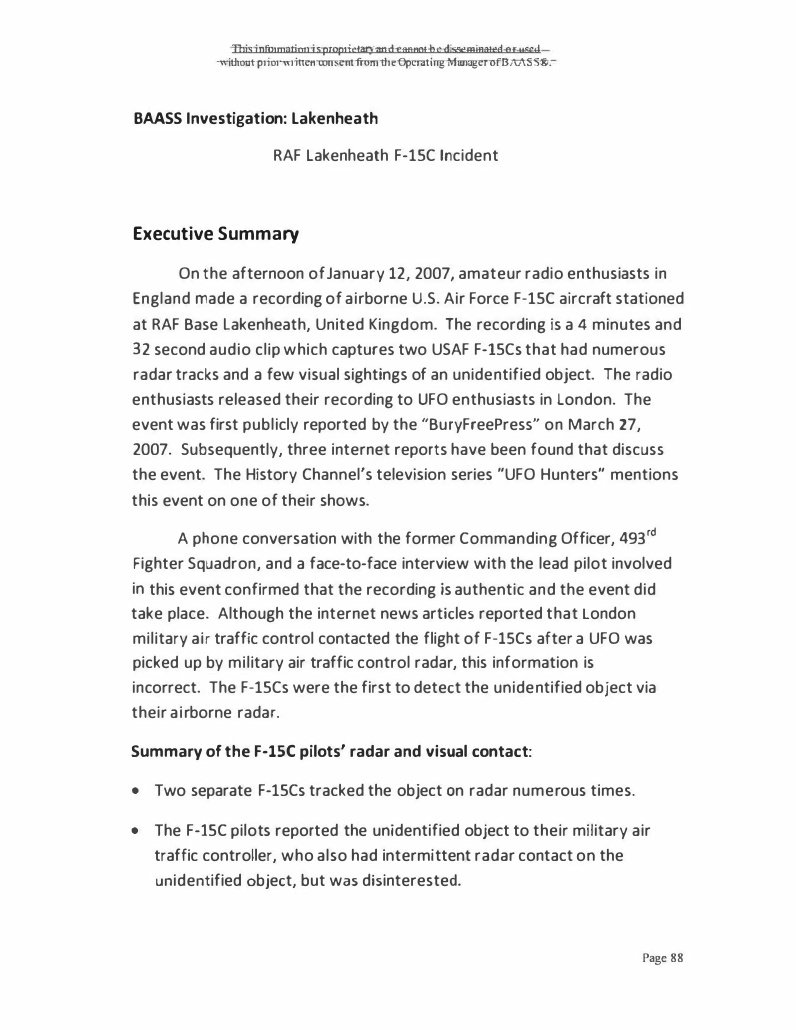 Facsimile of the documentPhysical page 94
DOCUMENTARY SOURCES · DOW
What the records tell
The second military case in the report is that of Lakenheath. On the afternoon of January 12, 2007, ham radio operators in England recorded 4 minutes and 32 seconds of conversation between two U.S. Air Force (USAF) F-15C fighters, based at RAF Lakenheath, that were tracking a UAP on radar. The audio reached ufologists in London and was reported by the local newspaper Bury Free Press on March 27, 2007. According to BAASS, a former commander of the 493rd Fighter Squadron and the lead pilot confirmed that the recording is authentic.
On April 18, 2009, two BAASS investigators interviewed the lead pilot, who declared himself a disbeliever in UFOs. He said he was leading a routine training flight in the East Anglia military airspace, north of the base. While separating the two airplanes, he got a radar lock-on on something at 15 nautical miles, at less than 60 knots, and thought it was a false return. He redid the lock-on, the radar indicated 17.700 feet, and he maneuvered until he saw the UAP about 500 feet away.
He described a black UAP, “between a softball and a watermelon” in size, with non-symmetrical edges, perhaps with a red spot, not very reflective, resembling “a meteor rock” and that “was not falling.” The pair made at least four passes. The lead saw it again on two of them, the wingman on one, and both airplanes got a radar lock-on on it several times, always between 17.000 and 18.000 feet. The pilot did not think it reacted to the maneuvers. According to him, London military control had intermittent contacts but appeared uninterested.
The cockpit recordings were lost: the pilot recorded over the tapes on the next mission. He thinks the version of the audio on the internet was edited. Neither of the two reported the case officially and, when the press reported it, his squadron colleagues ridiculed him. He said he did not know of any military procedure for reporting UFOs. Today he believes it was “most likely” a weather balloon, because of its size and because it seemed to move with the wind, although during the flight he did not think of that.
BAASS considers it possible that it was a balloon and suggests searching for records of British launches and for the information request made to the UK government. It assesses that, even without identification, it is unlikely that any technological information can be drawn from the case. The report also notes that part of the pilot's current recollection does not match what is heard in the audio, but records the opinion that he “appeared credible.” The interview continues after page 100, in another section of the document.
Date: January 12, 2007, according to the press; the interviewed pilot spoke of January or February 2007. Location: East Anglia military training airspace, in eastern England. Two F-15s from a fighter squadron at RAF Lakenheath were conducting routine interception exercises. According to the BAASS interview report of April 17, 2009, the leader was flying with three external tanks at about 17.000 feet, with clear skies and a west-to-east jet stream of about 60 knots. The pilot's name is redacted throughout the document.
The pilot said that his jet's radar, in automatic gun lock-on mode, detected an unknown contact and lost the lock-on right afterward. On the second lock-on, he went to look for the cause and saw a black UAP about 500 feet above the airplane. He compared it to a “meteor-type rock,” sized between a softball and a watermelon, perhaps with a red marking. The report's synopsis says that the UAP had no discernible shape; the narrative says it had a defined shape. According to him, the UAP was following the jet stream, on a steady trajectory.
More images from the document
DIRECT READING OF THE FILE
The document, in the original
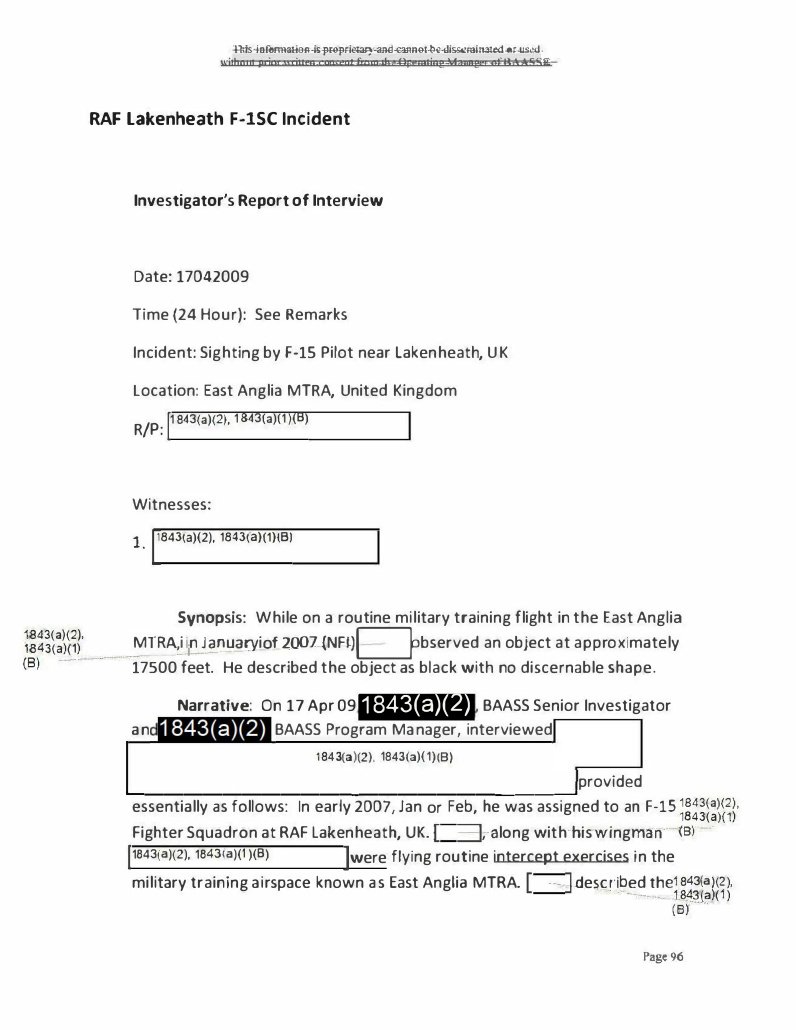
Pages 94 to 100 of the account about Lakenheath are translated in full in the page-by-page blocks; the text continues on page 101, covered in another section. The names of the pilots and of the former commander are redacted in the original.
EXCERPT 1 · PHYSICAL PAGE 94
Physical page 94, full page
11:iis i11fu1 matim, is ptup, ietary andeMnelbe dissemiAated er 11St1d
1vitltout p, io, hi iuen co11se11t fiom d,e Opcrnti11g MWJager ofBAA:SS®.
BAASS Investigation: Lakenheath
RAF Lakenheath F-lSC Incident
Executive Summary
On the afternoon of January 12, 2007, amateur radio enthusiasts in
England made a recording of airborne U.S. Air Force F-lSC aircraft stationed
at RAF Base Lakenheath, United Kingdom. The recording is a 4 minutes and
32 second audio clip which captures two USAF F-lSCs that had numerous
radar tracks and a few visual sightings of an unidentified object. The radio
enthusiasts released their recording to UFO enthusiasts in London. The
event was first publicly reported by the "BuryFreePress" on March 27,
2007. Subsequently, three internet reports have been found that discuss
the event. The History Channel's television series "UFO Hunters" mentions
this event on one of their shows.
A phone conversation with the former Commanding Officer, 493rd
Fighter Squadron, and a face-to-face interview with the lead pilot involved
in this event confirmed that the recording is authentic and the event did
take place. Although the internet news articles reported that London
military air traffic control contacted the flight of F-15Cs after a UFO was
picked up by military air traffic control radar, this information is
incorrect. The F-lSCs were the first to detect the unidentified object via
their airborne radar.
Summary of the F-lSC pilots' radar and visual contact:
• Two separate F-lSCs tracked the object on radar numerous times.
• The F-lSC pilots reported the unidentified object to their military air
traffic controller, who also had intermittent radar contact on the
unidentified object, but was disinterested.
Page 88Editorial note: Physical page 94 of DOW-UAP-D172-BAASS_Ten_Month_Report_July-2009.pdf.
Check the original PDF
11:iis i11fu1 matim, is ptup, ietary andeMnelbe dissemiAated er 11St1d
1vitltout p, io, hi iuen co11se11t fiom d,e Opcrnti11g MWJager ofBAA:SS®.
BAASS Investigation: Lakenheath
RAF Lakenheath F-lSC Incident
Executive Summary
On the afternoon of January 12, 2007, amateur radio enthusiasts in
England made a recording of airborne U.S. Air Force F-lSC aircraft stationed
at RAF Base Lakenheath, United Kingdom. The recording is a 4 minutes and
32 second audio clip which captures two USAF F-lSCs that had numerous
radar tracks and a few visual sightings of an unidentified object. The radio
enthusiasts released their recording to UFO enthusiasts in London. The
event was first publicly reported by the "BuryFreePress" on March 27,
2007. Subsequently, three internet reports have been found that discuss
the event. The History Channel's television series "UFO Hunters" mentions
this event on one of their shows.
A phone conversation with the former Commanding Officer, 493rd
Fighter Squadron, and a face-to-face interview with the lead pilot involved
in this event confirmed that the recording is authentic and the event did
take place. Although the internet news articles reported that London
military air traffic control contacted the flight of F-15Cs after a UFO was
picked up by military air traffic control radar, this information is
incorrect. The F-lSCs were the first to detect the unidentified object via
their airborne radar.
Summary of the F-lSC pilots' radar and visual contact:
• Two separate F-lSCs tracked the object on radar numerous times.
• The F-lSC pilots reported the unidentified object to their military air
traffic controller, who also had intermittent radar contact on the
unidentified object, but was disinterested.
Page 88View the document record ↗ · Physical page 94, counting the cover.
EXCERPT 2 · PHYSICAL PAGE 95
Physical page 95, full page
Tub tnlbm,:ttion is p1opfietary Wld eMnot be dissemiRated er 11sed
"itbaut prior u:ritteo consent from tbe Opennioe Maoag,'r of BA A$$1i)
• Two separate pilots visually acquired the object.
• The object was seen or tracked between 17,000 and 18,000 feet mean
sea level, and apparently "not falling." In retrospect, the lead pilot
believes the object was traveling with the prevailing winds (west to east)
at slow speed (less than 60 knots).
• The object was described as looking like a "rock11 and 11a very small black
object" which "did not look like a bird."
• The object was "softball to watermelon" sized.
• The object was bla,ck and "did not appear to be uniform" (smooth or
symmetrical) and "may have had a red dot or discoloration."
• The flight made (at least) four passes by the object to try and identify it.
• The squadron or pilots did not officially report the incident to any U.S. or
DoD agencies, except their air traffic controller.
• A British UFO enthusiast made a request for information through the UK
government. The llead pilot was aware of this, but did not recall if he
spoke with anyone about the request for information.
• The lead pilot, in retrospect, believes the object may have been some
type of a balloon because it had a velocity closely associated with
normal wind speed. During the event, he did not think that the object
was a balloon.
The object the pilots observed may have been some type of balloon.
Potential for further investigation includes trying to obtain records of
weather balloon flights from British sources, and attempts at obtaining
information about the request for information to the UK government. Even
if information is received from both of these sources and the object
Page 89Editorial note: Physical page 95 of DOW-UAP-D172-BAASS_Ten_Month_Report_July-2009.pdf.
Check the original PDF
Tub tnlbm,:ttion is p1opfietary Wld eMnot be dissemiRated er 11sed
"itbaut prior u:ritteo consent from tbe Opennioe Maoag,'r of BA A$$1i)
• Two separate pilots visually acquired the object.
• The object was seen or tracked between 17,000 and 18,000 feet mean
sea level, and apparently "not falling." In retrospect, the lead pilot
believes the object was traveling with the prevailing winds (west to east)
at slow speed (less than 60 knots).
• The object was described as looking like a "rock11 and 11a very small black
object" which "did not look like a bird."
• The object was "softball to watermelon" sized.
• The object was bla,ck and "did not appear to be uniform" (smooth or
symmetrical) and "may have had a red dot or discoloration."
• The flight made (at least) four passes by the object to try and identify it.
• The squadron or pilots did not officially report the incident to any U.S. or
DoD agencies, except their air traffic controller.
• A British UFO enthusiast made a request for information through the UK
government. The llead pilot was aware of this, but did not recall if he
spoke with anyone about the request for information.
• The lead pilot, in retrospect, believes the object may have been some
type of a balloon because it had a velocity closely associated with
normal wind speed. During the event, he did not think that the object
was a balloon.
The object the pilots observed may have been some type of balloon.
Potential for further investigation includes trying to obtain records of
weather balloon flights from British sources, and attempts at obtaining
information about the request for information to the UK government. Even
if information is received from both of these sources and the object
Page 89View the document record ↗ · Physical page 95, counting the cover.
EXCERPT 3 · PHYSICAL PAGE 96
Physical page 96, full page
This i11fermsti011 is prnprictary and cannot be disseminated or used
,,ithout p1io, ,nitteu eo11:se11t freffl tbe Operel:ir,g Mwiager ofB,'\ASS®.
remains unidentified, it is unlikely that any additional technological
information will be acquired regarding the observed object.
Page 90Editorial note: Physical page 96 of DOW-UAP-D172-BAASS_Ten_Month_Report_July-2009.pdf.
Check the original PDF
This i11fermsti011 is prnprictary and cannot be disseminated or used
,,ithout p1io, ,nitteu eo11:se11t freffl tbe Operel:ir,g Mwiager ofB,'\ASS®.
remains unidentified, it is unlikely that any additional technological
information will be acquired regarding the observed object.
Page 90View the document record ↗ · Physical page 96, counting the cover.
EXCERPT 4 · PHYSICAL PAGE 97
Physical page 97, full page
Ihismtonnauon h propnict,uy .md ca1111ot be dissc..ai1uttecl er 1:1:Sea
,
w11h0ut prior wrmen coiisem lh,111 the Ope, ating M8:11ager ef QA "SS'li\
RAF Lakenheath F-lSC Incident
Primary Points of Contact
1
• Lead Pilot: 11843(a)(2), 1 843(a)(1)(B)
I
843(a)(2), 1843(a)(1)(B)
O ro
I
843(a)(2}, 1 843(a)(1)(B)
• Wingman Pilot: 11o
I
18
a) 2 , 1843(a)
• Former Commanding Officer, 493rd Fighter Squadron: (1) B)
1843(a) 2), 1843(a)(1)(B)
843(a)(2), 1843(a)( 1)(6I
O
ro
RAF Lakenheath F-15C Incident
Detailed Report of Interview with Lead F-15 Pilot
1843(a)(2)
of BAASS
regarding the events that transpired
on or about the afternoon of January 12, 2007 near RAF Lakenheath, UK.
The folilowing details the events that occurred according to 1843(a)(2), 1843(a)
li
(1 )(8)
\84ੀ(a)(2), 1843(a) was stationed at RAF Lakenheath, UK and assigned to
the 493rd Fighter Squadron in January 2007. \
1843(a)(2), 1843(a)(1)(B)
.___________!openly stated that he does not believe in UFOs .
1843(a)(2), 1843
1(a)(1)(B)
I believes the sighting event occurred in January or
February 2007. [The audio recording of their radio transmissions was
1843(a)(2), 1843
reportedly made on the afternoon of January 12, 2007.] a 1 s
was
Page 91Editorial note: Physical page 97 of DOW-UAP-D172-BAASS_Ten_Month_Report_July-2009.pdf.
Check the original PDF
Ihismtonnauon h propnict,uy .md ca1111ot be dissc..ai1uttecl er 1:1:Sea
,
w11h0ut prior wrmen coiisem lh,111 the Ope, ating M8:11ager ef QA "SS'li\
RAF Lakenheath F-lSC Incident
Primary Points of Contact
1
• Lead Pilot: 11843(a)(2), 1 843(a)(1)(B)
I
843(a)(2), 1843(a)(1)(B)
O ro
I
843(a)(2}, 1 843(a)(1)(B)
• Wingman Pilot: 11o
I
18
a) 2 , 1843(a)
• Former Commanding Officer, 493rd Fighter Squadron: (1) B)
1843(a) 2), 1843(a)(1)(B)
843(a)(2), 1843(a)( 1)(6I
O
ro
RAF Lakenheath F-15C Incident
Detailed Report of Interview with Lead F-15 Pilot
1843(a)(2)
of BAASS
regarding the events that transpired
on or about the afternoon of January 12, 2007 near RAF Lakenheath, UK.
The folilowing details the events that occurred according to 1843(a)(2), 1843(a)
li
(1 )(8)
\84ੀ(a)(2), 1843(a) was stationed at RAF Lakenheath, UK and assigned to
the 493rd Fighter Squadron in January 2007. \
1843(a)(2), 1843(a)(1)(B)
.___________!openly stated that he does not believe in UFOs .
1843(a)(2), 1843
1(a)(1)(B)
I believes the sighting event occurred in January or
February 2007. [The audio recording of their radio transmissions was
1843(a)(2), 1843
reportedly made on the afternoon of January 12, 2007.] a 1 s
was
Page 91View the document record ↗ · Physical page 97, counting the cover.
EXCERPT 5 · PHYSICAL PAGE 98
Physical page 98, full page
--
l1ࠫ
3(a)(2), 1843 !separated the
Tb.is infomia:tion is pf6JlfiClftl) 1tt1fl earc.-0t Ile disseiaiftaleEI or YlG
wilheut pr=ier .,.Fit1s11 sen,c;.int frem I.Rt\ Opeffltit1g Mtlflagar ef BAASS®.
leadin a formation of two F-lSC aircraft on a routine training flight.
.
1 843(a)(2), 1 843(a)
.
.-1
.
1 s
wingman (number two aircraft) for this event was ___ ...o
.,.......
The flight was conducted in the East Anglian MTRA (Military-'1"8A3(a)(2),
_
1 843(a)(1)
.
.
emporary eserved Airspace)-over land and Just north of RAF
(B)
Lakenheath. The flight used RAF Lakenheath as their "bullseye" reference
point. The flight was monitoring "London Mil" - an air traffic control
agencyi- on thefr primary radio; and was operating on a discreet frequency
assigned by London Mil on their auxiliary ("aux") radio. The F-lSCs had
APG-63vl Suite 4 - a modern, mechanically scanned pulse-doppler radar.
Once the flight arrived in the airspace ' (aj_(1)(B)
.
two aircraft with him going west and his wingman going east. While they
were separating 1843 a)(2 ,1843
ained a radar lock of unreported traffic
' a 1 B
approximately 1 naut,ca mI es in front of him. Because the velocity of the
track was very s.low (less than 60 knots), he thought it was a spurious lock
with no valid target similar to chaff. ੁ
81ੂ :>/8 stated this was not unusua
for the radar to falsely display contacts or tracks that are not valid. I
I
1843(a)(2),
....-- l··
!executed a bump acquisition (break lock and attempt re-lock) to
'•o1a4_3(a)(2),
1843(a.)p)..--· •••••
1843'(a)(1)
(B)
validate the target. The radar reacquired the track indicating something at (B)
17 700 feet mean sea level (MSL) and low speed 1843(a)( ), 1 4
'
• a 1 B
_........""'-.......__.
maneuvered his aircraft to fly near and attempt to visua y i entify the
track. 1:)n,Jf!· 1843 lflew an intercept profile and visually acquired an
object w,cੇ fie estimates he maintained approximately 500 feet of
separation with. This is when the recording of the radio transmissions on
their auxiliary radio begins (a discreet frequency that only the two aircraft
1843(a)(2), 1843
are operating on)
stated the object appeared to be a single
• (a) 1)(B)
object with one main body and no discernible attachments. The object's
size was between that of a softball and a watermelon. The shape did not
appear to be uniform - not necessarily jagged, but the edges did not
appear to be smooth or symmetrical. The object was black and may have
had a red dot or some reddish discoloration. The object did not appear to
be highly reflective. The object looked like a '"meteor rock."
Page 92Editorial note: Physical page 98 of DOW-UAP-D172-BAASS_Ten_Month_Report_July-2009.pdf.
Check the original PDF
--
l1ࠫ
3(a)(2), 1843 !separated the
Tb.is infomia:tion is pf6JlfiClftl) 1tt1fl earc.-0t Ile disseiaiftaleEI or YlG
wilheut pr=ier .,.Fit1s11 sen,c;.int frem I.Rt\ Opeffltit1g Mtlflagar ef BAASS®.
leadin a formation of two F-lSC aircraft on a routine training flight.
.
1 843(a)(2), 1 843(a)
.
.-1
.
1 s
wingman (number two aircraft) for this event was ___ ...o
.,.......
The flight was conducted in the East Anglian MTRA (Military-'1"8A3(a)(2),
_
1 843(a)(1)
.
.
emporary eserved Airspace)-over land and Just north of RAF
(B)
Lakenheath. The flight used RAF Lakenheath as their "bullseye" reference
point. The flight was monitoring "London Mil" - an air traffic control
agencyi- on thefr primary radio; and was operating on a discreet frequency
assigned by London Mil on their auxiliary ("aux") radio. The F-lSCs had
APG-63vl Suite 4 - a modern, mechanically scanned pulse-doppler radar.
Once the flight arrived in the airspace ' (aj_(1)(B)
.
two aircraft with him going west and his wingman going east. While they
were separating 1843 a)(2 ,1843
ained a radar lock of unreported traffic
' a 1 B
approximately 1 naut,ca mI es in front of him. Because the velocity of the
track was very s.low (less than 60 knots), he thought it was a spurious lock
with no valid target similar to chaff. ੁ
81ੂ :>/8 stated this was not unusua
for the radar to falsely display contacts or tracks that are not valid. I
I
1843(a)(2),
....-- l··
!executed a bump acquisition (break lock and attempt re-lock) to
'•o1a4_3(a)(2),
1843(a.)p)..--· •••••
1843'(a)(1)
(B)
validate the target. The radar reacquired the track indicating something at (B)
17 700 feet mean sea level (MSL) and low speed 1843(a)( ), 1 4
'
• a 1 B
_........""'-.......__.
maneuvered his aircraft to fly near and attempt to visua y i entify the
track. 1:)n,Jf!· 1843 lflew an intercept profile and visually acquired an
object w,cੇ fie estimates he maintained approximately 500 feet of
separation with. This is when the recording of the radio transmissions on
their auxiliary radio begins (a discreet frequency that only the two aircraft
1843(a)(2), 1843
are operating on)
stated the object appeared to be a single
• (a) 1)(B)
object with one main body and no discernible attachments. The object's
size was between that of a softball and a watermelon. The shape did not
appear to be uniform - not necessarily jagged, but the edges did not
appear to be smooth or symmetrical. The object was black and may have
had a red dot or some reddish discoloration. The object did not appear to
be highly reflective. The object looked like a '"meteor rock."
Page 92View the document record ↗ · Physical page 98, counting the cover.
EXCERPT 6 · PHYSICAL PAGE 99
Physical page 99, full page
fll:is infeFHta·t1e11 is prepFietflry Md ear.tt6t be di53ell:lifflttet! or 11sea
"uitom prior "riui'fi Cbi6cm from die Opc,ating 1'.fauage, of BAASS:!i>.
1 843(a)(2), 1843 and his wingman subsequently made at least three
a 1 B
additiona! passes by the object. On two of those passes, li:lூici;2)n1843 I was
ln
,
able to visually acquire the object. The wingman visually acquired the
object on one pass. The object was tracked on radar by both aircraft
multiple times using "auto guns" mode to achieve the lock - a medium
pulse repetition frequency (medium PRF) mode. The radar tracks appeared
stable, with no real swings of the vector stick and no memory cues. On
1843
each visual sighting 1843 a (2),
believed the object appeared to look
(a)(1}(8)
like a small black roe
I
t at was not falling. The object was always seen and
tracked between 17,000 and 18,000 feet MSL. 1=1ࠬi࠭
a
)
(o)
.
1843(a) !recollection
2o
is that the object was moving east-north-easterly at less than 60 knots.
[Prevailing winds are typically east-south-easterly in that location with
1843(a)(2),
1843(a)(2),
velocities of 15-45 knots, but excursions exist to 100+ knots.] I-___I
•
• •·· 1843{a)(1 )
•
.. .
ʹ::3(a)(.t)... ·-···· I· ·· Idid not believe the object reacted to their aircraft maneuvers.
(B)
reported the sighting of the unidentifiied object to
London
I on eir primary radio. This transmission is not on the
recording since it is on a different frequency. However, these transmissions
were most likely also overheard leading to the media reporting that "F-lSs
were scrambled to intercept a UFO." 1;:) (J
2), 1843 I stated that the London
Mil controller had intermittently observed the object on their radar, but the
controller seemed disinterested. No further discussion occurred with the
London Mil controller.
1843 Iwas recording his cockpit displays and radio
l !i
i(J
2
),
transmissions during this flight, but recorded over them using the same
tapes on his next mission. No authentic cockpit media exists today.
1 843(a)(2), 1 843 listened to the copy of the recording that is available
a 1 B
on the internet. He elieves that version has been edited because it does
not conta1n all of the transmissions he believes were made. However,
11843(a)(2), 1843 !does not recall any transmissions he might have made that
_(a){1)(B)
.
Page 93Editorial note: Physical page 99 of DOW-UAP-D172-BAASS_Ten_Month_Report_July-2009.pdf.
Check the original PDF
fll:is infeFHta·t1e11 is prepFietflry Md ear.tt6t be di53ell:lifflttet! or 11sea
"uitom prior "riui'fi Cbi6cm from die Opc,ating 1'.fauage, of BAASS:!i>.
1 843(a)(2), 1843 and his wingman subsequently made at least three
a 1 B
additiona! passes by the object. On two of those passes, li:lூici;2)n1843 I was
ln
,
able to visually acquire the object. The wingman visually acquired the
object on one pass. The object was tracked on radar by both aircraft
multiple times using "auto guns" mode to achieve the lock - a medium
pulse repetition frequency (medium PRF) mode. The radar tracks appeared
stable, with no real swings of the vector stick and no memory cues. On
1843
each visual sighting 1843 a (2),
believed the object appeared to look
(a)(1}(8)
like a small black roe
I
t at was not falling. The object was always seen and
tracked between 17,000 and 18,000 feet MSL. 1=1ࠬi࠭
a
)
(o)
.
1843(a) !recollection
2o
is that the object was moving east-north-easterly at less than 60 knots.
[Prevailing winds are typically east-south-easterly in that location with
1843(a)(2),
1843(a)(2),
velocities of 15-45 knots, but excursions exist to 100+ knots.] I-___I
•
• •·· 1843{a)(1 )
•
.. .
ʹ::3(a)(.t)... ·-···· I· ·· Idid not believe the object reacted to their aircraft maneuvers.
(B)
reported the sighting of the unidentifiied object to
London
I on eir primary radio. This transmission is not on the
recording since it is on a different frequency. However, these transmissions
were most likely also overheard leading to the media reporting that "F-lSs
were scrambled to intercept a UFO." 1;:) (J
2), 1843 I stated that the London
Mil controller had intermittently observed the object on their radar, but the
controller seemed disinterested. No further discussion occurred with the
London Mil controller.
1843 Iwas recording his cockpit displays and radio
l !i
i(J
2
),
transmissions during this flight, but recorded over them using the same
tapes on his next mission. No authentic cockpit media exists today.
1 843(a)(2), 1 843 listened to the copy of the recording that is available
a 1 B
on the internet. He elieves that version has been edited because it does
not conta1n all of the transmissions he believes were made. However,
11843(a)(2), 1843 !does not recall any transmissions he might have made that
_(a){1)(B)
.
Page 93View the document record ↗ · Physical page 99, counting the cover.
EXCERPT 7 · PHYSICAL PAGE 100
Physical page 100, full page
__
Tos iofon:natioA i5 pmpriernry ,rnd c:mnGt be disssmina1sg er ussr!
i
11r.ithe1,1t prioruq:ilt.-in G9Rssrit A=om 1hG Opraling Ma,nagsr gf QA.ASS®.
are not on the recording. Indicative of probable editing, there does not
appear to be time available during the recording when 1843(a)(2)n1843 was
(a)(1 )(B) ,
talking to London Mil on the primary radio.
After the flight returned to base neither 1843(a)(Z). 1843 nor his
....,)(...,1)__(B__
...,.,
wingman reported the sighting to anyone. A couple o months after the
1
)
a
....,
(
event, the local media reported the intercepted radio transmissions. At
which time 1843(a) 2), 1843 reported that they were his radio transmissions
' a 1 B
to his squadron-mates. The predominant discussion among squadron
personnel was of "ridicule" and "teasing" o 1843(a)(2), 1843 regarding his
a 1 B
request for in ormatron a out the event to the UK government. However,
2, 1843
1:4f a8
was not sure if he spoke with anyone about this request for
in ormatron. He believes he might have been interviewed regarding this,
but is not sure. He does not know if it was government or military
personnel, or UK or US personnel that were handling the request for
information.
, 1843 now believes that the object he observed was most
1;!1r}rJ
2)n I
likely a weather balloon. His belief is based on his understanding of the size
of weather balloons and that the object appeared to be traveling with the
wind, and no other logical explanation exists for the sighting.
1843(a)<JJn- .... . .....----·
•••
CB)
processes for reporting UFOs. When he was informed that procedures did
exist in the Flight Information Handbook, he was not surprised that he was
not aware of the procedures.
Some ofJiைொோa)(:),1843(a) furrent recollection does not appear to
correlate w,t-:; e information transmitted during the recording. However,
1843(a)(2), 1843 did appear credible and openly willing to discuss all details
a 1 B
Page 94
proce ures were in place to report UFO sightings via the military. I
--- _ ! 1B43(a)(2},
1843(a)(2),
.1 -·· Ireplied that he was not aware of any military procedures or
••1sெCே)(1)
--
•
(B)Editorial note: Physical page 100 of DOW-UAP-D172-BAASS_Ten_Month_Report_July-2009.pdf.
Check the original PDF
__
Tos iofon:natioA i5 pmpriernry ,rnd c:mnGt be disssmina1sg er ussr!
i
11r.ithe1,1t prioruq:ilt.-in G9Rssrit A=om 1hG Opraling Ma,nagsr gf QA.ASS®.
are not on the recording. Indicative of probable editing, there does not
appear to be time available during the recording when 1843(a)(2)n1843 was
(a)(1 )(B) ,
talking to London Mil on the primary radio.
After the flight returned to base neither 1843(a)(Z). 1843 nor his
....,)(...,1)__(B__
...,.,
wingman reported the sighting to anyone. A couple o months after the
1
)
a
....,
(
event, the local media reported the intercepted radio transmissions. At
which time 1843(a) 2), 1843 reported that they were his radio transmissions
' a 1 B
to his squadron-mates. The predominant discussion among squadron
personnel was of "ridicule" and "teasing" o 1843(a)(2), 1843 regarding his
a 1 B
request for in ormatron a out the event to the UK government. However,
2, 1843
1:4f a8
was not sure if he spoke with anyone about this request for
in ormatron. He believes he might have been interviewed regarding this,
but is not sure. He does not know if it was government or military
personnel, or UK or US personnel that were handling the request for
information.
, 1843 now believes that the object he observed was most
1;!1r}rJ
2)n I
likely a weather balloon. His belief is based on his understanding of the size
of weather balloons and that the object appeared to be traveling with the
wind, and no other logical explanation exists for the sighting.
1843(a)<JJn- .... . .....----·
•••
CB)
processes for reporting UFOs. When he was informed that procedures did
exist in the Flight Information Handbook, he was not surprised that he was
not aware of the procedures.
Some ofJiைொோa)(:),1843(a) furrent recollection does not appear to
correlate w,t-:; e information transmitted during the recording. However,
1843(a)(2), 1843 did appear credible and openly willing to discuss all details
a 1 B
Page 94
proce ures were in place to report UFO sightings via the military. I
--- _ ! 1B43(a)(2},
1843(a)(2),
.1 -·· Ireplied that he was not aware of any military procedures or
••1sெCே)(1)
--
•
(B)View the document record ↗ · Physical page 100, counting the cover.
EXCERPT 8 · PHYSICAL PAGE 101
Physical page 101, full page
拍-- -
This u-:Iormatiefl is proprietary and eannel be disseminated or used
without f)rier written eensent !'rem the Oi:,emt.ing Manager efBA,\SS®.
associated with the sighting. Items that a re contradictory between his
current statements a nd the radio transmissions recording include:
• The recording indicates that all radar contact by the aircraft was not
a radar track - that the object was also picked up in search mode.
• The recording indicates that the radar tracks were not always stable
tracks - that the vector stick was sometimes erratic. This is not
abnormal or unusual for very slow speed targets (less than 100
knots).
• The recording indicates that the radar did break lock without him
commanding bump acquisition. Again, this would not be abnormal
for very slow speed targets and does not necessarily indicate any
unusual conditions, such as jamming.
• The recording states the radar depicted the object traveling at 80
1 843(a)(2),
1 843( a)(l).
knots·attimes, andl··· --
!recollection was that the object
(B)
never exceeded 60 knots.
D拎ring t拏e interview,f
I stated he did not recollect
speaking with anyone after the request for information to the UK
government. In a previous phone conversation,!
. . . _ j拐拑atect, 843(a)(2),
he was interviewed by someone, but didn't recall who that person ···t:拒拓.(拔)(1 )
was or what agency they worked for.
Page 95Editorial note: Physical page 101 of DOW-UAP-D172-BAASS_Ten_Month_Report_July-2009.pdf.
Check the original PDF
拍-- -
This u-:Iormatiefl is proprietary and eannel be disseminated or used
without f)rier written eensent !'rem the Oi:,emt.ing Manager efBA,\SS®.
associated with the sighting. Items that a re contradictory between his
current statements a nd the radio transmissions recording include:
• The recording indicates that all radar contact by the aircraft was not
a radar track - that the object was also picked up in search mode.
• The recording indicates that the radar tracks were not always stable
tracks - that the vector stick was sometimes erratic. This is not
abnormal or unusual for very slow speed targets (less than 100
knots).
• The recording indicates that the radar did break lock without him
commanding bump acquisition. Again, this would not be abnormal
for very slow speed targets and does not necessarily indicate any
unusual conditions, such as jamming.
• The recording states the radar depicted the object traveling at 80
1 843(a)(2),
1 843( a)(l).
knots·attimes, andl··· --
!recollection was that the object
(B)
never exceeded 60 knots.
D拎ring t拏e interview,f
I stated he did not recollect
speaking with anyone after the request for information to the UK
government. In a previous phone conversation,!
. . . _ j拐拑atect, 843(a)(2),
he was interviewed by someone, but didn't recall who that person ···t:拒拓.(拔)(1 )
was or what agency they worked for.
Page 95View the document record ↗ · Physical page 101, counting the cover.
EXCERPT 9 · PHYSICAL PAGE 102
Physical page 102, full page
This iafeR'lnl¼ios is prnpri·aml GmnGt c di&Sllmi1:uued or llS«>d
wirborn prior 11xinen comeAt fmm mil Oi;,;;m!ing Mar<ager ef BAASS®.
RAF Lakenheath F-lSC Incident
Investigator's Report of Interview
Date: 17042009
Time {24 Hour): See Remarks
Incident: Sighting by F-15 Pilot near Lakenheath, UK
Location: East Anglia MTRA, United Kingdom
R/P: 11 843(a)(2), 1 843(a)(1 )(B)
Witnesses:
843(a)(2), 1843(a)(1)(B)
1 . r
Synopsis: While on a routine military training flight in the East Anglia
1843(a)(2),
Mr.Rੈ,iin -!:1.ੋੌ
iQf_lO_CIL(NFl.)Erbserved an object at approximately
1843(a)(1)·········•····••
.
.i
(8)
17500 feet. He described the object as black with no discernable shape.
Narrative: On 17 Apr 09 1 843(a)(2) BAASS Senior Investigator
an
BAASS Program Manager, interviewed
1843(a)(2), 1843(a)(1)(8)
--------------------------lprovided
essentially as follows: In early 2007, Jan or Feb, he was assigned to an F-1S 1843(a)(2),
1843(a)(1)
Fighter Squadron at RAF Lakenheath, UK. ! -------t,-a-long-with-htswrngman· ,sr •
I1843(a)(2), 1843(a)(1 )(B)
!were flying routine intercept exercises in the
military training airspace known as East Anglia MTRA. ! ---µiesC..ri_੍d the1 843(a)(2),
• , . ,....... l 8.4ã(a)(1 )
. ...
(B)
Page 96Editorial note: Physical page 102 of DOW-UAP-D172-BAASS_Ten_Month_Report_July-2009.pdf.
Check the original PDF
This iafeR'lnl¼ios is prnpri·aml GmnGt c di&Sllmi1:uued or llS«>d
wirborn prior 11xinen comeAt fmm mil Oi;,;;m!ing Mar<ager ef BAASS®.
RAF Lakenheath F-lSC Incident
Investigator's Report of Interview
Date: 17042009
Time {24 Hour): See Remarks
Incident: Sighting by F-15 Pilot near Lakenheath, UK
Location: East Anglia MTRA, United Kingdom
R/P: 11 843(a)(2), 1 843(a)(1 )(B)
Witnesses:
843(a)(2), 1843(a)(1)(B)
1 . r
Synopsis: While on a routine military training flight in the East Anglia
1843(a)(2),
Mr.Rੈ,iin -!:1.ੋੌ
iQf_lO_CIL(NFl.)Erbserved an object at approximately
1843(a)(1)·········•····••
.
.i
(8)
17500 feet. He described the object as black with no discernable shape.
Narrative: On 17 Apr 09 1 843(a)(2) BAASS Senior Investigator
an
BAASS Program Manager, interviewed
1843(a)(2), 1843(a)(1)(8)
--------------------------lprovided
essentially as follows: In early 2007, Jan or Feb, he was assigned to an F-1S 1843(a)(2),
1843(a)(1)
Fighter Squadron at RAF Lakenheath, UK. ! -------t,-a-long-with-htswrngman· ,sr •
I1843(a)(2), 1843(a)(1 )(B)
!were flying routine intercept exercises in the
military training airspace known as East Anglia MTRA. ! ---µiesC..ri_੍d the1 843(a)(2),
• , . ,....... l 8.4ã(a)(1 )
. ...
(B)
Page 96View the document record ↗ · Physical page 102, counting the cover.
EXCERPT 10 · PHYSICAL PAGE 103
Physical page 103, full page
- -
---
----
--
---
howeverh he d
got a visual sightinjk!
e}(fg
1d:3(
d not know fl
--i
i
i
lm= nop=ql-·- -
_
--
-
-- _
-
-
-
.
-
-
-
I his mlonnauon 1s proprkrary and cannot b
... disseminated er liSeG
,,ithout p1 im "1 ittcn cunscal froa, the Operating M1mage1 of BAASS®.
weather conditions as clear with a West to East jet stream at approximatelyɧ::;á:âm·
-
60 knots. Along with the intercept training,! ----:7was-ftying·anaf::rs-wa
rtff ·(B)
three external fuel tanks checking the feed of fuel from the tanks. At one
point in the flight the two jets separated from each other. !
-
lind.icated 1843(a)(2),
- --
----- - --- .JJl4.3(a)( 1)
•
the Auto Gun radar on his jet signaled a lock on an unknown target;
(B)
1843(a)(2),
however, the lock was quickly lost. Based on the short duration of the lock
1843(a)(1)
(B)
-
I ignored it. As he continued to fly he received a second lock from the
-+ -
Auto Gun radar. At this point he decided to check the area in an effort to
1843(a)(2),
identify what may have_caus.e.c Ut. J-
!stated he was flying at
_
1843( a•_)(•1)___ _____ ____ __ _ .. -- -- ------·- ·:··- --- ---- -
· -
(B)
approximately 17K feet. He then observed an object; he estimated was
approximately 500 feet above his jet. He described the object as black in
1843(a)(2),
color with __ _ ɨf!nitivɩ2hap.e.-l
d _a
!stated there may have been a red mark
1843(a)(1)
.
.
-
(B)
- - ------ - ------ (N- FI) on the object; however, based on his speed he was not sure. He
likened the object to that of a "meteor type rock." He estimated the size as
ħ::;á:âm·
between that of a softball and a watermelon. Due to the configuration of
(B)
·-- --hisjet;aEJwas only able to slow to a speed of 300 knots. He stated after
1843(a)(2),
the initial sightingɪa_Q.,.Q:tifyingɫ-
lof the object, he made a series of
ɬ::3(a)(1L
- -turns- in"an-elfort to further identify it. He related it appeared to be
following the jet stream and was traveling at about the wind speed at the
1843(a)(2),
t
1843(a)(1)
1843(a)(2),
altitude. At one point during the sighting I -!did-eo-nta-tthetondon
·(sy··--·---
-
1843(a)(1)
(B)
-
Military Air Traffic Radar controllers and advised them he
11had a lock" and
·askɭ_d if they had seen it. The response from the controllers was that they ħ::;á:âm·
1843(a)(2),
had "i.nle-r-mlt!ɮnt hits on an object in your area." I --lemp-hasizedthat·a·rsr
1843(a)(1)
(B)
was the only contaGty11ith the controllers he can recall during the sighting.
r:::::--,said his wingmaɯɰ r---,
l,_J
EJ said the F-15 he was flying that day used an APG 63 Vl, Suite 4,
ɱ also got an Auto Guns lock on the object;
-
1843(a)(2),
(
-
(B): =
m·
radar. During the ɲ!gbting[- -
ldid not switch modes on his radar, nor did
1843(a)(2),
1843(a)(1)
_.. -heth-inl(ofactiv;ing the video capability in his helmet. The Heads Up
-
(B)
---··
Display tapes of the flight were recorded over on a subsequent mission.
1843(a)(2),
_ 1--- ·
ɳlso described the flight path of the object as stable, definitely not
1843(a)(1)___ , -·
-
(B)
erratic. He stated in his opinion the object was likely a weather balloon.
Page 97Editorial note: Physical page 103 of DOW-UAP-D172-BAASS_Ten_Month_Report_July-2009.pdf.
Check the original PDF
- -
---
----
--
---
howeverh he d
got a visual sightinjk!
e}(fg
1d:3(
d not know fl
--i
i
i
lm= nop=ql-·- -
_
--
-
-- _
-
-
-
.
-
-
-
I his mlonnauon 1s proprkrary and cannot b
... disseminated er liSeG
,,ithout p1 im "1 ittcn cunscal froa, the Operating M1mage1 of BAASS®.
weather conditions as clear with a West to East jet stream at approximatelyɧ::;á:âm·
-
60 knots. Along with the intercept training,! ----:7was-ftying·anaf::rs-wa
rtff ·(B)
three external fuel tanks checking the feed of fuel from the tanks. At one
point in the flight the two jets separated from each other. !
-
lind.icated 1843(a)(2),
- --
----- - --- .JJl4.3(a)( 1)
•
the Auto Gun radar on his jet signaled a lock on an unknown target;
(B)
1843(a)(2),
however, the lock was quickly lost. Based on the short duration of the lock
1843(a)(1)
(B)
-
I ignored it. As he continued to fly he received a second lock from the
-+ -
Auto Gun radar. At this point he decided to check the area in an effort to
1843(a)(2),
identify what may have_caus.e.c Ut. J-
!stated he was flying at
_
1843( a•_)(•1)___ _____ ____ __ _ .. -- -- ------·- ·:··- --- ---- -
· -
(B)
approximately 17K feet. He then observed an object; he estimated was
approximately 500 feet above his jet. He described the object as black in
1843(a)(2),
color with __ _ ɨf!nitivɩ2hap.e.-l
d _a
!stated there may have been a red mark
1843(a)(1)
.
.
-
(B)
- - ------ - ------ (N- FI) on the object; however, based on his speed he was not sure. He
likened the object to that of a "meteor type rock." He estimated the size as
ħ::;á:âm·
between that of a softball and a watermelon. Due to the configuration of
(B)
·-- --hisjet;aEJwas only able to slow to a speed of 300 knots. He stated after
1843(a)(2),
the initial sightingɪa_Q.,.Q:tifyingɫ-
lof the object, he made a series of
ɬ::3(a)(1L
- -turns- in"an-elfort to further identify it. He related it appeared to be
following the jet stream and was traveling at about the wind speed at the
1843(a)(2),
t
1843(a)(1)
1843(a)(2),
altitude. At one point during the sighting I -!did-eo-nta-tthetondon
·(sy··--·---
-
1843(a)(1)
(B)
-
Military Air Traffic Radar controllers and advised them he
11had a lock" and
·askɭ_d if they had seen it. The response from the controllers was that they ħ::;á:âm·
1843(a)(2),
had "i.nle-r-mlt!ɮnt hits on an object in your area." I --lemp-hasizedthat·a·rsr
1843(a)(1)
(B)
was the only contaGty11ith the controllers he can recall during the sighting.
r:::::--,said his wingmaɯɰ r---,
l,_J
EJ said the F-15 he was flying that day used an APG 63 Vl, Suite 4,
ɱ also got an Auto Guns lock on the object;
-
1843(a)(2),
(
-
(B): =
m·
radar. During the ɲ!gbting[- -
ldid not switch modes on his radar, nor did
1843(a)(2),
1843(a)(1)
_.. -heth-inl(ofactiv;ing the video capability in his helmet. The Heads Up
-
(B)
---··
Display tapes of the flight were recorded over on a subsequent mission.
1843(a)(2),
_ 1--- ·
ɳlso described the flight path of the object as stable, definitely not
1843(a)(1)___ , -·
-
(B)
erratic. He stated in his opinion the object was likely a weather balloon.
Page 97View the document record ↗ · Physical page 103, counting the cover.
EXCERPT 11 · PHYSICAL PAGE 104
Physical page 104, full page
_-----
--
This i11formatie11 is preprietary aAd ean11etbe dissemineted erttsed
without prior wrilt{:R cg115;mt Cram t:he Operati:J,gManage, ofB!v\SS®.
1843(a)(2),
1843(a)(1) _ ,
-
(B)
1843(a)(2),
1843(a)(1)
(B)
!indicated the main reason for tracking and following the object was
l-
to ensure it exited the airspace so he and his wingman could continue their
training. At no time did he observe the object make any erratic movements
or alter its path. During the sighting there was no Electromagnetic Effects,
he did not detect any type of jamming of his aircraft systems, and there
were no Ň!ňʼn-Ŋ!s qn him.+
! indicated there was no official inquiry into
lhe,incident, or any official reporting. I
-l was .nQt_a\/\,/rrs of any official 1843(a)(2),
· ·•----------------------------·-------·--···· _
1843(a)(1)
-
requirement to report this type of incident within the USAF.
• TB)
Page 98Editorial note: Physical page 104 of DOW-UAP-D172-BAASS_Ten_Month_Report_July-2009.pdf.
Check the original PDF
_-----
--
This i11formatie11 is preprietary aAd ean11etbe dissemineted erttsed
without prior wrilt{:R cg115;mt Cram t:he Operati:J,gManage, ofB!v\SS®.
1843(a)(2),
1843(a)(1) _ ,
-
(B)
1843(a)(2),
1843(a)(1)
(B)
!indicated the main reason for tracking and following the object was
l-
to ensure it exited the airspace so he and his wingman could continue their
training. At no time did he observe the object make any erratic movements
or alter its path. During the sighting there was no Electromagnetic Effects,
he did not detect any type of jamming of his aircraft systems, and there
were no Ň!ňʼn-Ŋ!s qn him.+
! indicated there was no official inquiry into
lhe,incident, or any official reporting. I
-l was .nQt_a\/\,/rrs of any official 1843(a)(2),
· ·•----------------------------·-------·--···· _
1843(a)(1)
-
requirement to report this type of incident within the USAF.
• TB)
Page 98View the document record ↗ · Physical page 104, counting the cover.
EXCERPT 12 · PHYSICAL PAGE 105
Physical page 105, full page
(8)
(8)
RAF Lakenheath F-lSC Incident
Radio Communications Transcript
This 4 minute and 32 seconds recording is widely available on the
World Wide Web. This transcript was made from the recording published
on a web site titled "I nternet Arch ive." The audio file is a 642 kb Wave file
titled "F15sAN DUFO(2)", available at the following link:
http://www.archive.org/details/UsafF-lSUfolnterceptionOverNorthSea
Statements made in brackets [ ] are not part of the radio
transmissions. Information within brackets is intended to give a general
interpretation for people not familiar with military aircraft
communications. Elli sis ( ... ) are used to indicate inaudible portions of
1 843(a)(2),
1 843(a)(1 )
radio transmissions. -
the flight lead is iindicated as "Pilot A."
The wingman,
is indicated as "Pilot B." The radio
1 843(a)(2),
tr9_nsmisslons on the recording state:
1 843(a)(1 T
Pilot A: " ... Dude, no kidding, I just flew over on bullseye zero zero
eight for twenty. I had a radar hit, and it wa s swinging, it looked like thi rty
knots. And there was something there. It looked like a, uh, it did n't look
like a bird . It looked like no kidding a rock to me. I, ... negative. I have no
idea what it was, but basica lly, just heads up. Try a nd stay away from
seventeen thousand. Keep your nu gget on a swivel, I have no idea what it
was. I want to use my radar to see if I ca n pick this object up aga i n . I
picked it u p twice. The fi rst time I picked it u p my radar broke lock, so I
thought it was just, u h, some kind of bad loc k, or ... chaff. I' m goi ng to tu rn
back north for a little bit." ["Bu l seye 008 fo r 20" refers to a pos ition from a
com mon a irbo rne reference point ca lled "bu llseye." During th is fl ight, RA F
La ke n heath's location is used as the bu llseye refere nce poi nt. From the
bu llseye referen ce point, the o bject bea red 008 degrees fo r 20 na utica l
Page 99Editorial note: Physical page 105 of DOW-UAP-D172-BAASS_Ten_Month_Report_July-2009.pdf.
Check the original PDF
(8)
(8)
RAF Lakenheath F-lSC Incident
Radio Communications Transcript
This 4 minute and 32 seconds recording is widely available on the
World Wide Web. This transcript was made from the recording published
on a web site titled "I nternet Arch ive." The audio file is a 642 kb Wave file
titled "F15sAN DUFO(2)", available at the following link:
http://www.archive.org/details/UsafF-lSUfolnterceptionOverNorthSea
Statements made in brackets [ ] are not part of the radio
transmissions. Information within brackets is intended to give a general
interpretation for people not familiar with military aircraft
communications. Elli sis ( ... ) are used to indicate inaudible portions of
1 843(a)(2),
1 843(a)(1 )
radio transmissions. -
the flight lead is iindicated as "Pilot A."
The wingman,
is indicated as "Pilot B." The radio
1 843(a)(2),
tr9_nsmisslons on the recording state:
1 843(a)(1 T
Pilot A: " ... Dude, no kidding, I just flew over on bullseye zero zero
eight for twenty. I had a radar hit, and it wa s swinging, it looked like thi rty
knots. And there was something there. It looked like a, uh, it did n't look
like a bird . It looked like no kidding a rock to me. I, ... negative. I have no
idea what it was, but basica lly, just heads up. Try a nd stay away from
seventeen thousand. Keep your nu gget on a swivel, I have no idea what it
was. I want to use my radar to see if I ca n pick this object up aga i n . I
picked it u p twice. The fi rst time I picked it u p my radar broke lock, so I
thought it was just, u h, some kind of bad loc k, or ... chaff. I' m goi ng to tu rn
back north for a little bit." ["Bu l seye 008 fo r 20" refers to a pos ition from a
com mon a irbo rne reference point ca lled "bu llseye." During th is fl ight, RA F
La ke n heath's location is used as the bu llseye refere nce poi nt. From the
bu llseye referen ce point, the o bject bea red 008 degrees fo r 20 na utica l
Page 99View the document record ↗ · Physical page 105, counting the cover.
EXCERPT 13 · PHYSICAL PAGE 106
Physical page 106, full page
__
Tiiis iaformation is prnpfie1ary am! eaiu1gt bG dissemina•ed or used
"ithout prior «ritten conse11l fre11X lhe Opemtieg Manager ef BAASS®.
miles. A radar "hit'' means a radar contact from a search mode - not a
radar track.]
Pilot B: "Two will pick up trail." [Wingman will assume a trail
formation position.]
Pilot A: " ... , I'm gonna go, uh, start turning back towards the west ... I
think it was zero zero four for about twenty. I've got it again. Its seventeen
seven. Three miles off my nose at, yea, seventeen seven. I'm flying that
way now. I'm gonna slow down. I'm not gonna get below three hundred
knots, but, uh.
Back towards you, dude I can't tell, something small, very small black
object. I had it at seventeen seven. He just flew, it just flew right over me."
["Seventeen seven" means 17,700 feet MSL.]
Pilot B: "Confirm the object appears stationary?"
Pilot A: "Well it, I couldn't tell 'cause it was ... small, I think it was
moving about thirty knots."
. Ȇil.9t B: 1--
Ieighty knots." I -lis tbe gersonal callsign of the 1843(a)(2),
--·
....,_
---
-
•·· .
. .
1843(a)(1)
1843(a)(2),
1843(a)(1)
(B)
..
...
....-• lead pilot- Pilot A. Pilot 8 is reporting the object's speed as 80 knots.]e·· ··· (Br
...e..e ..e
· ··e
Pilot A: "Yea, my radar was showing between thirty and sixty, so I
have no idea what it, actually doing .e... it went from seventeen the first
time I saw it to seventeen seven, so it's not falling. I don't think it was a
bird."
P·11 ot B : "... radar Iock ore... h·t1 7"
s.
Pilot A: "What was that?"
Pilot 8: "Were you taking a manual lock or was it an auto guns lock?"
Page 100Editorial note: Physical page 106 of DOW-UAP-D172-BAASS_Ten_Month_Report_July-2009.pdf.
Check the original PDF
__
Tiiis iaformation is prnpfie1ary am! eaiu1gt bG dissemina•ed or used
"ithout prior «ritten conse11l fre11X lhe Opemtieg Manager ef BAASS®.
miles. A radar "hit'' means a radar contact from a search mode - not a
radar track.]
Pilot B: "Two will pick up trail." [Wingman will assume a trail
formation position.]
Pilot A: " ... , I'm gonna go, uh, start turning back towards the west ... I
think it was zero zero four for about twenty. I've got it again. Its seventeen
seven. Three miles off my nose at, yea, seventeen seven. I'm flying that
way now. I'm gonna slow down. I'm not gonna get below three hundred
knots, but, uh.
Back towards you, dude I can't tell, something small, very small black
object. I had it at seventeen seven. He just flew, it just flew right over me."
["Seventeen seven" means 17,700 feet MSL.]
Pilot B: "Confirm the object appears stationary?"
Pilot A: "Well it, I couldn't tell 'cause it was ... small, I think it was
moving about thirty knots."
. Ȇil.9t B: 1--
Ieighty knots." I -lis tbe gersonal callsign of the 1843(a)(2),
--·
....,_
---
-
•·· .
. .
1843(a)(1)
1843(a)(2),
1843(a)(1)
(B)
..
...
....-• lead pilot- Pilot A. Pilot 8 is reporting the object's speed as 80 knots.]e·· ··· (Br
...e..e ..e
· ··e
Pilot A: "Yea, my radar was showing between thirty and sixty, so I
have no idea what it, actually doing .e... it went from seventeen the first
time I saw it to seventeen seven, so it's not falling. I don't think it was a
bird."
P·11 ot B : "... radar Iock ore... h·t1 7"
s.
Pilot A: "What was that?"
Pilot 8: "Were you taking a manual lock or was it an auto guns lock?"
Page 100View the document record ↗ · Physical page 106, counting the cover.
EXCERPT 14 · PHYSICAL PAGE 107
Physical page 107, full page
1 his informacio11b p10plii;tar5 and cillmOlbe disseminated mused
withettl prier uf'ilten eon:.ent fron. the Opc.ati11g Mill,agCJ ofBAASS®.
Pilot A: "No I've been getting it with auto guns every time .
... bullseye zero zero nine for fifteen. Showing, yea, basically no airspeed on
it."
Pilot B: "Two is clean." [Wingman has no radar contact.]
Pilot A: "Say again."
Pilot B: "Two is clean. Two is locked, bullseye zero one two, fifteen,
eighteen thousand."
Pilot A: "Alright, I'm going to, uh, climb up slightly here. I want to try
and look at it, then you, follow in behind me, if you can.
(Both pilots transmitting at same time - inaudible.)
Pilot A: "Dude, I have no idea what that is. But it just passed over
me. I've got it at, uh, seventeen thousand feet, eight miles off my nose,
bullseye zero four nine, for twenty1 seventeen thousand. I'm gonna get
down to sixteen five. It's, uh, two point five miles off my nose right now,
seventeen thousand feet. Yea, I'm not going to be able to slow down as
much as you are. Maybe you can slow down just a little bit more and get a
better look."
(Both pilots transmitting at same time - inaudible.)
Pilot A: " ... two hundred and twenty knots, non-maneuvering."
Pilot 8: "Copy, confirm you've merged with it?"
Pilot A: "I am about to merge right now, I'm seeing him, ... nowo, and
I'm gonna get my airspeed back before I maneuver. Are you locked or
clean?"
Pilot 8: "I'm no joy. Approaching line abreast with you, two
thousand feet high, eighteen five."
Page IOIEditorial note: Physical page 107 of DOW-UAP-D172-BAASS_Ten_Month_Report_July-2009.pdf.
Check the original PDF
1 his informacio11b p10plii;tar5 and cillmOlbe disseminated mused
withettl prier uf'ilten eon:.ent fron. the Opc.ati11g Mill,agCJ ofBAASS®.
Pilot A: "No I've been getting it with auto guns every time .
... bullseye zero zero nine for fifteen. Showing, yea, basically no airspeed on
it."
Pilot B: "Two is clean." [Wingman has no radar contact.]
Pilot A: "Say again."
Pilot B: "Two is clean. Two is locked, bullseye zero one two, fifteen,
eighteen thousand."
Pilot A: "Alright, I'm going to, uh, climb up slightly here. I want to try
and look at it, then you, follow in behind me, if you can.
(Both pilots transmitting at same time - inaudible.)
Pilot A: "Dude, I have no idea what that is. But it just passed over
me. I've got it at, uh, seventeen thousand feet, eight miles off my nose,
bullseye zero four nine, for twenty1 seventeen thousand. I'm gonna get
down to sixteen five. It's, uh, two point five miles off my nose right now,
seventeen thousand feet. Yea, I'm not going to be able to slow down as
much as you are. Maybe you can slow down just a little bit more and get a
better look."
(Both pilots transmitting at same time - inaudible.)
Pilot A: " ... two hundred and twenty knots, non-maneuvering."
Pilot 8: "Copy, confirm you've merged with it?"
Pilot A: "I am about to merge right now, I'm seeing him, ... nowo, and
I'm gonna get my airspeed back before I maneuver. Are you locked or
clean?"
Pilot 8: "I'm no joy. Approaching line abreast with you, two
thousand feet high, eighteen five."
Page IOIView the document record ↗ · Physical page 107, counting the cover.
EXCERPT 15 · PHYSICAL PAGE 108
Physical page 108, full page
Tais iHfermatieH is j'lrnprietruy ru1d eai,M! be disseminated or used
'Nilheut prier drittert eeHse11t &e1l! the Opemti11g Mai111ger of BAASS®.
Pilot A: "Copy that, I'm coming in an easy right hand turn. You said
you' re at eighteen?"
Pilot B: "Yea, I climbed back up to nineteen five now. You're six
o'clock for about ten miles."
Pilot A: "Copy that."
Pilot B: "If we are well clear, I will descend at this time. Aux, are we
clear? Um, posit?" ["Aux" indicates he is transmitting on the auxiliary
radio.]
Pilot A: "I, uh, I'm not sure. Again, it stayed between seventeen and
eighteen. So, I believe I'm in the vicinity of it. I'm not, uh, a hundred
percent positive. One's blind. I am visual now. I am gonna fly underneath
you." ["One's blind" means lead has lost sight of his wingman. "Visual"
means he has regained sight of his wingman.]
Pilot B: "Copy. I saw it that time. I could not make out what it was."
Pilot A: "You did see it?"
Pilot B: "Affirm."
Pilot A: "Alright, I'm gonna circle back around. Don't know if we'll be
able to see it through the HUD?"
Pilot B: "We have somebody out here with us." [Indicating that
other aircraft are now operating in the same airspace.]
Pilot A: liYea, I see him. Two, did you see anything?
Pilot B: "Negative."
Page 102Editorial note: Physical page 108 of DOW-UAP-D172-BAASS_Ten_Month_Report_July-2009.pdf.
Check the original PDF
Tais iHfermatieH is j'lrnprietruy ru1d eai,M! be disseminated or used
'Nilheut prier drittert eeHse11t &e1l! the Opemti11g Mai111ger of BAASS®.
Pilot A: "Copy that, I'm coming in an easy right hand turn. You said
you' re at eighteen?"
Pilot B: "Yea, I climbed back up to nineteen five now. You're six
o'clock for about ten miles."
Pilot A: "Copy that."
Pilot B: "If we are well clear, I will descend at this time. Aux, are we
clear? Um, posit?" ["Aux" indicates he is transmitting on the auxiliary
radio.]
Pilot A: "I, uh, I'm not sure. Again, it stayed between seventeen and
eighteen. So, I believe I'm in the vicinity of it. I'm not, uh, a hundred
percent positive. One's blind. I am visual now. I am gonna fly underneath
you." ["One's blind" means lead has lost sight of his wingman. "Visual"
means he has regained sight of his wingman.]
Pilot B: "Copy. I saw it that time. I could not make out what it was."
Pilot A: "You did see it?"
Pilot B: "Affirm."
Pilot A: "Alright, I'm gonna circle back around. Don't know if we'll be
able to see it through the HUD?"
Pilot B: "We have somebody out here with us." [Indicating that
other aircraft are now operating in the same airspace.]
Pilot A: liYea, I see him. Two, did you see anything?
Pilot B: "Negative."
Page 102View the document record ↗ · Physical page 108, counting the cover.
EXCERPT 16 · PHYSICAL PAGE 109
Physical page 109, full page
This i11ferma-titm is 1Jf61JFielillJ Md ettaHot be di:3scmiflttted or tt31:d
"ithou, p,im ,.,ictcu co11sc111 60111 th-,Ope,atiug Mm.age, ofBAAS3j;)_
RAF Lakenheath F-lSC Incident
Media Reporting
From: http://www.buryfreepress.co.uk/mildenhall/UFO-mystery-at
RAF-Lakenheath.2145459.jp
UFO mystery at RAF Lakenheath
Published Date: 27 March 2007
Mystery surrounds claims that jets from RAF lakenheath were called
to intercept a UFO.
UFO experts claim to have a recording which they have posted on the
internet ars proof that London Military Air Traffic Control contacted a flight
of US Air Force F-15s from the base, after a UFO was picked up on their
radar on January 12.
But air traffic control denies making the call - and RAF La ken heath
will not comment without having more detail over the alleged incident.
l1843(a)(2)
I features writer for UFO Data Magazine, said: "We are still
looking into it and we have made a Freedom of Information request to the
Ministry of Defence and have also contacted RAF Lakenheath - but they
haven't got back to us yet.
11
The magazine and UFO Monitors East Kent are analysing an audio file
picked up by radio enthusiasts purporting to be a call made by London
Military Air Traffic Control to a crew of F-lSs flying out of RAF lakenheath.
They claim it tells the American airmen to intercept an unknown
target at 3,000 to 4,000ft.
The F-lSs get a radar lock on the target and make a 'pass' at 17,000ft
and then again at 17, 700ft.
Page 103Editorial note: Physical page 109 of DOW-UAP-D172-BAASS_Ten_Month_Report_July-2009.pdf.
Check the original PDF
This i11ferma-titm is 1Jf61JFielillJ Md ettaHot be di:3scmiflttted or tt31:d
"ithou, p,im ,.,ictcu co11sc111 60111 th-,Ope,atiug Mm.age, ofBAAS3j;)_
RAF Lakenheath F-lSC Incident
Media Reporting
From: http://www.buryfreepress.co.uk/mildenhall/UFO-mystery-at
RAF-Lakenheath.2145459.jp
UFO mystery at RAF Lakenheath
Published Date: 27 March 2007
Mystery surrounds claims that jets from RAF lakenheath were called
to intercept a UFO.
UFO experts claim to have a recording which they have posted on the
internet ars proof that London Military Air Traffic Control contacted a flight
of US Air Force F-15s from the base, after a UFO was picked up on their
radar on January 12.
But air traffic control denies making the call - and RAF La ken heath
will not comment without having more detail over the alleged incident.
l1843(a)(2)
I features writer for UFO Data Magazine, said: "We are still
looking into it and we have made a Freedom of Information request to the
Ministry of Defence and have also contacted RAF Lakenheath - but they
haven't got back to us yet.
11
The magazine and UFO Monitors East Kent are analysing an audio file
picked up by radio enthusiasts purporting to be a call made by London
Military Air Traffic Control to a crew of F-lSs flying out of RAF lakenheath.
They claim it tells the American airmen to intercept an unknown
target at 3,000 to 4,000ft.
The F-lSs get a radar lock on the target and make a 'pass' at 17,000ft
and then again at 17, 700ft.
Page 103View the document record ↗ · Physical page 109, counting the cover.
EXCERPT 17 · PHYSICAL PAGE 110
Physical page 110, full page
This mfermatfo11 is pmpri1:l:u:y 3lld cannm be disscwiaa1ed nr used
,,1ihou1 prior ,,nnen consent fiom the Ope,ating Manager efB.'.ASS®.
Pilots described the black rock like object as unlike any aircraft they
have ever seen.
"One pilot was heard to say to another: 'Did you see that?' And the
other replied: 'Yes, but I don't want to talk about it," said !1843(a)(2) L of
UFO Monitors East Kent.
It is also claimed that the object occasionally appeared to come to a
complete halt.
UFO monitors are unable to give a location or a time for the incident,
saying only that it happened in the afternoon.
The base itself said it was unable to look into the incident without these
details.
A spokesman for London Military Air Traffic Control said: "I've spoken
with both the civil and military supervisors at London Control. Neither has
any record of an intercept request on or around January 12 - and intercept
requests are recorded - so I cannot verify this account."
You can hear the audio file for yourself at www.ufodata.co.uke- click
on F-lSs UFO incident.
Page 104Editorial note: Physical page 110 of DOW-UAP-D172-BAASS_Ten_Month_Report_July-2009.pdf.
Check the original PDF
This mfermatfo11 is pmpri1:l:u:y 3lld cannm be disscwiaa1ed nr used
,,1ihou1 prior ,,nnen consent fiom the Ope,ating Manager efB.'.ASS®.
Pilots described the black rock like object as unlike any aircraft they
have ever seen.
"One pilot was heard to say to another: 'Did you see that?' And the
other replied: 'Yes, but I don't want to talk about it," said !1843(a)(2) L of
UFO Monitors East Kent.
It is also claimed that the object occasionally appeared to come to a
complete halt.
UFO monitors are unable to give a location or a time for the incident,
saying only that it happened in the afternoon.
The base itself said it was unable to look into the incident without these
details.
A spokesman for London Military Air Traffic Control said: "I've spoken
with both the civil and military supervisors at London Control. Neither has
any record of an intercept request on or around January 12 - and intercept
requests are recorded - so I cannot verify this account."
You can hear the audio file for yourself at www.ufodata.co.uke- click
on F-lSs UFO incident.
Page 104View the document record ↗ · Physical page 110, counting the cover.
EXCERPT 18 · PHYSICAL PAGE 111
Physical page 111, full page
TI1is i11fu1, .. 1ttiet1 i:. pffiPFie1,,r; a1HJ ԙ11At he di•.sGwil'.l •tcd oc .,,.Ԛd
.. ithmrt priu, n'fillen ee115e11t fhnn ih< Opemtinԛ ',1111111i;1er ef D.\:\SS1 ' .
From: http://www.ufocasebook.com/raflakenheath. html
NMSO@k$
1843(a)(2),
' {?,(){1 )
1847(a)(2)
From: http://secret-teachings.blogspot.com/2008/0l/raf-lakenheath-ufo.html
Wednesday, January 16, 2008
RAF Lakenheath - UFO
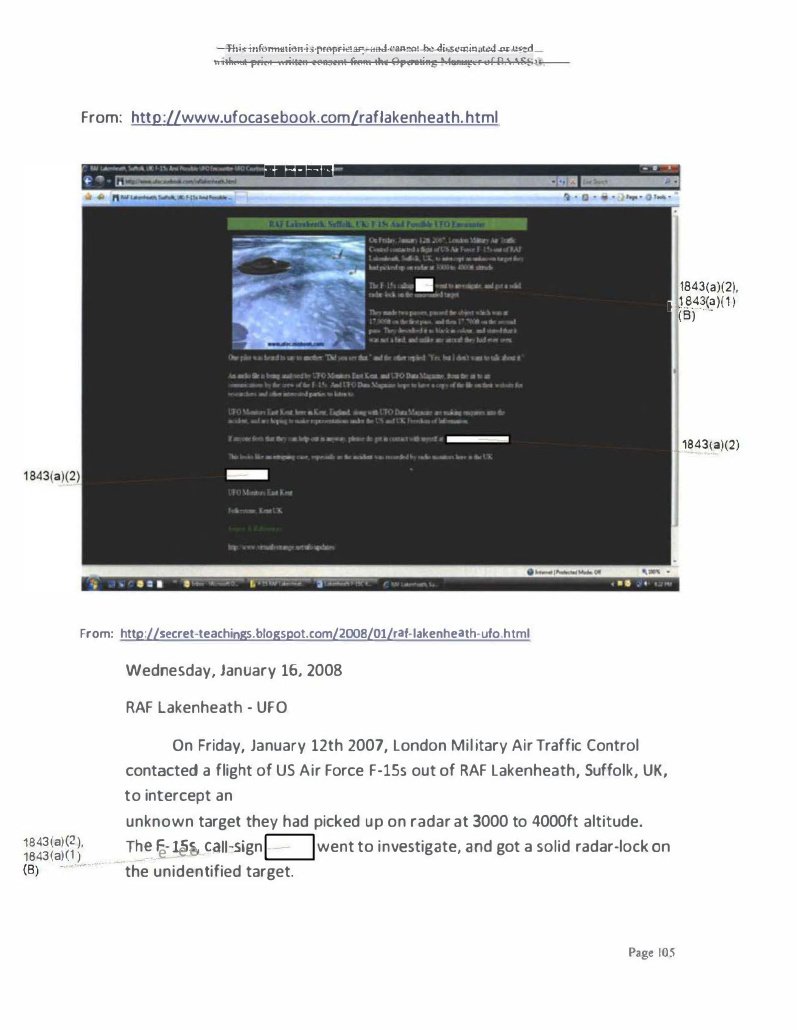
On Friday, January 12th 2007, London Military Air Traffic Control
:i=j
·
-·--····--·
(B)
•
contacted a flight of US Air Force F-15s out of RAF Lakenheath, Suffolk, UK,
to intercept an
unknown target they had picked up on radar at 3000 to 4000ft altitude.
all5ignEJwent to investigate, and got a solid radar-lock on
!hͽ
1-
_e;:.Ϳ?._e
- _e
the unidentified target.
Page l05Editorial note: Physical page 111 of DOW-UAP-D172-BAASS_Ten_Month_Report_July-2009.pdf.
Check the original PDF
TI1is i11fu1, .. 1ttiet1 i:. pffiPFie1,,r; a1HJ ԙ11At he di•.sGwil'.l •tcd oc .,,.Ԛd
.. ithmrt priu, n'fillen ee115e11t fhnn ih< Opemtinԛ ',1111111i;1er ef D.\:\SS1 ' .
From: http://www.ufocasebook.com/raflakenheath. html
NMSO@k$
1843(a)(2),
' {?,(){1 )
1847(a)(2)
From: http://secret-teachings.blogspot.com/2008/0l/raf-lakenheath-ufo.html
Wednesday, January 16, 2008
RAF Lakenheath - UFO
On Friday, January 12th 2007, London Military Air Traffic Control
:i=j
·
-·--····--·
(B)
•
contacted a flight of US Air Force F-15s out of RAF Lakenheath, Suffolk, UK,
to intercept an
unknown target they had picked up on radar at 3000 to 4000ft altitude.
all5ignEJwent to investigate, and got a solid radar-lock on
!hͽ
1-
_e;:.Ϳ?._e
- _e
the unidentified target.
Page l05View the document record ↗ · Physical page 111, counting the cover.
EXCERPT 19 · PHYSICAL PAGE 112
Physical page 112, full page
This iufo1 matio11 is prtlprie!ltty and e:mnet be diS!>emiHaled or used
\\ithout prior \\nn,m consent from tbe Op,•ca•ins Man3ger ofJ3.4.P,Sl:i:F·.
They made two passes and passed the object, which was at 17,000ft
on the first pass and then 17,700ft on the second pass. They described it as
black in colour and stated that it was not a bird and unlike any aircraft they
had ever seen.
One pilot was heard to say to another: "Did you see that?" And the
other replied: "Yes, but I don"t want to talk about it."
An audio file is being analysed by UFO Monitors East Kent, and UFO
Data Magazine, from the air-to-air communications by the crews of the F
15s. UFO Monitors East Kent, here in Kent, England, along with UFO Data
Magazine are making enquiries into the incident and are hoping to make
representations under the US and UK Freedom of Information Acts.
This looks like an intriguing case, especially as the incident was recorded by
radio monitors here in the UK.
11843(a)(2)
ӈ features writer for UFO Data Magazine, said: "We
are still looking into it and we have made a Freedom of Information request
to the Ministry of Defence and have also contacted RAF Lakenheath - but
they haven't got back to us yet."
It always good to have the audio but as yet this is officially
unconfirmed.
There's as much chance (if not more) of UFO's being terrestrially
made rather than coming from another galaxy.
Page 106Editorial note: Physical page 112 of DOW-UAP-D172-BAASS_Ten_Month_Report_July-2009.pdf.
Check the original PDF
This iufo1 matio11 is prtlprie!ltty and e:mnet be diS!>emiHaled or used
\\ithout prior \\nn,m consent from tbe Op,•ca•ins Man3ger ofJ3.4.P,Sl:i:F·.
They made two passes and passed the object, which was at 17,000ft
on the first pass and then 17,700ft on the second pass. They described it as
black in colour and stated that it was not a bird and unlike any aircraft they
had ever seen.
One pilot was heard to say to another: "Did you see that?" And the
other replied: "Yes, but I don"t want to talk about it."
An audio file is being analysed by UFO Monitors East Kent, and UFO
Data Magazine, from the air-to-air communications by the crews of the F
15s. UFO Monitors East Kent, here in Kent, England, along with UFO Data
Magazine are making enquiries into the incident and are hoping to make
representations under the US and UK Freedom of Information Acts.
This looks like an intriguing case, especially as the incident was recorded by
radio monitors here in the UK.
11843(a)(2)
ӈ features writer for UFO Data Magazine, said: "We
are still looking into it and we have made a Freedom of Information request
to the Ministry of Defence and have also contacted RAF Lakenheath - but
they haven't got back to us yet."
It always good to have the audio but as yet this is officially
unconfirmed.
There's as much chance (if not more) of UFO's being terrestrially
made rather than coming from another galaxy.
Page 106View the document record ↗ · Physical page 112, counting the cover.
EXCERPT 20 · PHYSICAL PAGE 113
Physical page 113, full page
This i11fofflltttiott is prnprietffl3 Md cm,net be dissemin:ttcd er aՖd
wilheu! riar v,tilleA eeAJGRI H'Elm lhe OflCFating 4af!Bgt'F ef BA IS\;!'•.
From: http://www.unexplained- mysteries.com/forum/index.php7showtopic=92107
UFO mystery at RAF Lakenheath
Latest Mildenhall news
27th March 2007
Mystery surrounds claims that jets from RAF Lakenheath were called to
intercept a UFO.
UFO experts claim to have a recording which they have posted on the internet
as proof that London Military Air Traffic Control contacted a flight of US Air
Force F-15s from the base, after a UFO was picked up on their radar on January
12.
But air traffic control denies making the call - and RAF la ken heath will not
comment without having more detail over the alleged incident.
!1843(a)(2)
l features writer for UFO Data Magazine, said: "We are still
looking into it and we have made a Freedom of Information request to the
Page 107Editorial note: Physical page 113 of DOW-UAP-D172-BAASS_Ten_Month_Report_July-2009.pdf.
Check the original PDF
This i11fofflltttiott is prnprietffl3 Md cm,net be dissemin:ttcd er aՖd
wilheu! riar v,tilleA eeAJGRI H'Elm lhe OflCFating 4af!Bgt'F ef BA IS\;!'•.
From: http://www.unexplained- mysteries.com/forum/index.php7showtopic=92107
UFO mystery at RAF Lakenheath
Latest Mildenhall news
27th March 2007
Mystery surrounds claims that jets from RAF Lakenheath were called to
intercept a UFO.
UFO experts claim to have a recording which they have posted on the internet
as proof that London Military Air Traffic Control contacted a flight of US Air
Force F-15s from the base, after a UFO was picked up on their radar on January
12.
But air traffic control denies making the call - and RAF la ken heath will not
comment without having more detail over the alleged incident.
!1843(a)(2)
l features writer for UFO Data Magazine, said: "We are still
looking into it and we have made a Freedom of Information request to the
Page 107View the document record ↗ · Physical page 113, counting the cover.
EXCERPT 21 · PHYSICAL PAGE 114
Physical page 114, full page
This tnfonm1tion is preprielllf)· at1d ellrule! be di55eminat.-,d gr 11.sed
11id1ouc p,io1 mitteu cuusent fmm the Operntiug Mauago ofB,\ASSҳ.
Ministry of Defence and have also contacted RAF lakenheatho- but they haven't
got back to us yet."
The magazine and UFO Monitors East Kent are analysing an audio file picked up
by radio enthusiasts purporting to be a call made by London Military Air Traffic
Control to a crew of F-15s flying out of RAF Lakenheath.
They claim it tells the American airmen to intercept an unknown target at 3,000
to 4,000ft.
The F-15s get a radar lock on the target and make a 'pass' at 17,000ft and then
again at 17,700ft.
Pilots described the black rock like object as unlike any aircraft they have ever
seen.
"One pilot was heard to say to another: 'Did you see that?' And the other
replied: 'Yes, but I don't want to talk about it," saidj1843(a)(2) ͡
of UFO Monitors
East Kent.
It is also claimed that the object occasionally appeared to come to a complete
halt.
UFO monitors are unable to give a location or a time for the incident, saying
only that it happened in the afternoon.
The base itself said it was unable to look into the incident without these details.
A spokesman for London Military Air Traffic Control said: "I've spoken with both
the civil and military supervisors at London Control. Neither has any record of
an intercept request on or around January 12 - and intercept requests are
recorded - so I cannot verify this account."
Page 108Editorial note: Physical page 114 of DOW-UAP-D172-BAASS_Ten_Month_Report_July-2009.pdf.
Check the original PDF
This tnfonm1tion is preprielllf)· at1d ellrule! be di55eminat.-,d gr 11.sed
11id1ouc p,io1 mitteu cuusent fmm the Operntiug Mauago ofB,\ASSҳ.
Ministry of Defence and have also contacted RAF lakenheatho- but they haven't
got back to us yet."
The magazine and UFO Monitors East Kent are analysing an audio file picked up
by radio enthusiasts purporting to be a call made by London Military Air Traffic
Control to a crew of F-15s flying out of RAF Lakenheath.
They claim it tells the American airmen to intercept an unknown target at 3,000
to 4,000ft.
The F-15s get a radar lock on the target and make a 'pass' at 17,000ft and then
again at 17,700ft.
Pilots described the black rock like object as unlike any aircraft they have ever
seen.
"One pilot was heard to say to another: 'Did you see that?' And the other
replied: 'Yes, but I don't want to talk about it," saidj1843(a)(2) ͡
of UFO Monitors
East Kent.
It is also claimed that the object occasionally appeared to come to a complete
halt.
UFO monitors are unable to give a location or a time for the incident, saying
only that it happened in the afternoon.
The base itself said it was unable to look into the incident without these details.
A spokesman for London Military Air Traffic Control said: "I've spoken with both
the civil and military supervisors at London Control. Neither has any record of
an intercept request on or around January 12 - and intercept requests are
recorded - so I cannot verify this account."
Page 108View the document record ↗ · Physical page 114, counting the cover.
Dates and documentary context
- Event
- 12/01/2007 — Date of the radio recording; the pilot recalls the episode as January or February 2007.
- Document
- 30/07/2009 — Date of the Ten-Month Report; interview with the lead pilot on 18/04/2009.
- Publication
- Not established — Published by the U.S. Department of War on war.gov, release 08 of UAP files (2026).
Origin and release
Bigelow Aerospace Advanced Space Studies (BAASS); interview with the lead pilot of the U.S. Air Force (USAF) 493rd Fighter Squadron · DOW-UAP-D172-BAASS_Ten_Month_Report_July-2009.pdf
Physical pages 94 to 100 (pages 88 to 94 of the internal numbering); the account continues after page 100.
undefined ↗ — undefined
Related accounts and their differences
Questions to continue the investigation
- Was there a weather balloon launch in the United Kingdom consistent with the position and time of 12/01/2007?
- What was the UK government's response to the information request cited by the pilot?
GEOGRAPHY OF THE CASE
RAF Lakenheath, Suffolk, England
Approximate reference point placed by the editorial team; it does not indicate the exact location.
DOCUMENTARY TRAIL
Go back to the sources
References use physical pages of the PDF, counting the cover. Summaries are presented in English; the documents keep their original language.
- DOW-UAP-D172-BAASS_Ten_Month_Report_July-2009.pdf
Physical pages 94 to 100
DOW · 538 pages
Editorial summary based on the collection's research notes. How we read the documents.