Date: 02/12/2008Location: Bigelow Aerospace Advanced Space Studies, Las Vegas, Nevada, USA (place of writing not indicated on the page)
Las Vegas, 2008: the BAASS plan for AAWSAP asks the DIA for films, Los Alamos files, Colares data and access to “biological material”
Three months after being contracted by the DIA, BAASS delivered a 49-page management plan that divides the AAWSAP program into nine projects. The text starts from the premise, recorded as the company's own position, that very advanced aerospace craft have been operating for six decades, and asks the DIA for access to films, military files, data from Brazil and biological samples.
- Event date
- 02/12/2008
- Location
- Bigelow Aerospace Advanced Space Studies, Las Vegas, Nevada, USA (place of writing not indicated on the page)
- Topic
- AAWSAP and advanced technologies
- Source agencies
- DOW
- Documents
- 1 document · 49 pages
- Reading time
- 47 min
 Document coverPhysical page 1
DOCUMENTARY SOURCES · DOW
What the records tell
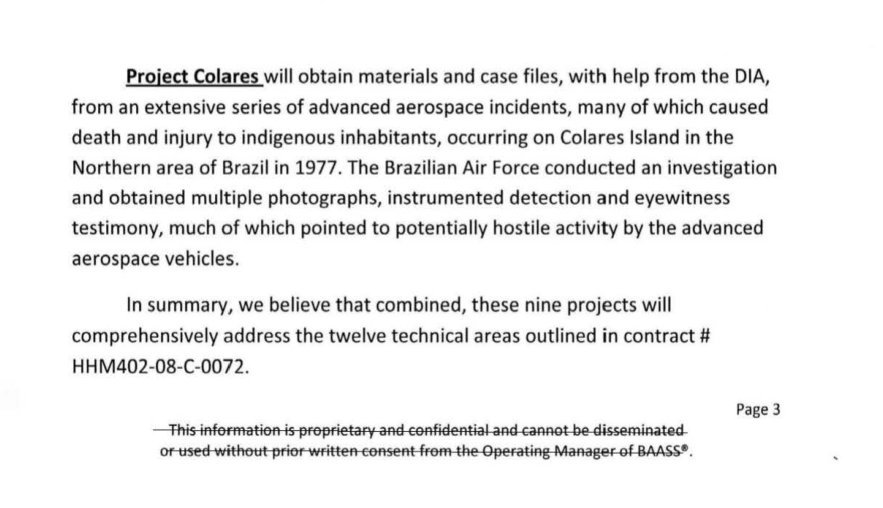
Date: December 2, 2008. Location: not given on the page; the contractor was headquartered in Las Vegas, Nevada. The document is the “Project Management Plan (Overview Document)” that Bigelow Aerospace Advanced Space Studies (BAASS) delivered to the Defense Intelligence Agency (DIA) as part of contract HHM402-08-C-0072, the same one as the Advanced Aerospace Weapon System Applications Program (AAWSAP). The names of the team and consultants were replaced by codes such as “AAP Person 4” in the release, and passages were redacted with the reference 1843(a)(2). The company's confidentiality footer appears struck through on every page.
Unlike the contract, which speaks only of future aerospace technologies, the plan assumes from the preface that “advanced aerospace craft” have been seen, photographed and pursued for more than six decades and that some could threaten the United States, including its nuclear facilities. This is the position recorded by BAASS, not a conclusion of a government agency. The text also says the company chose to study “craft that already exhibit unprecedented behavior” rather than the state of the art of university research, with the exception of the Physics Project, which the DIA itself ordered included.
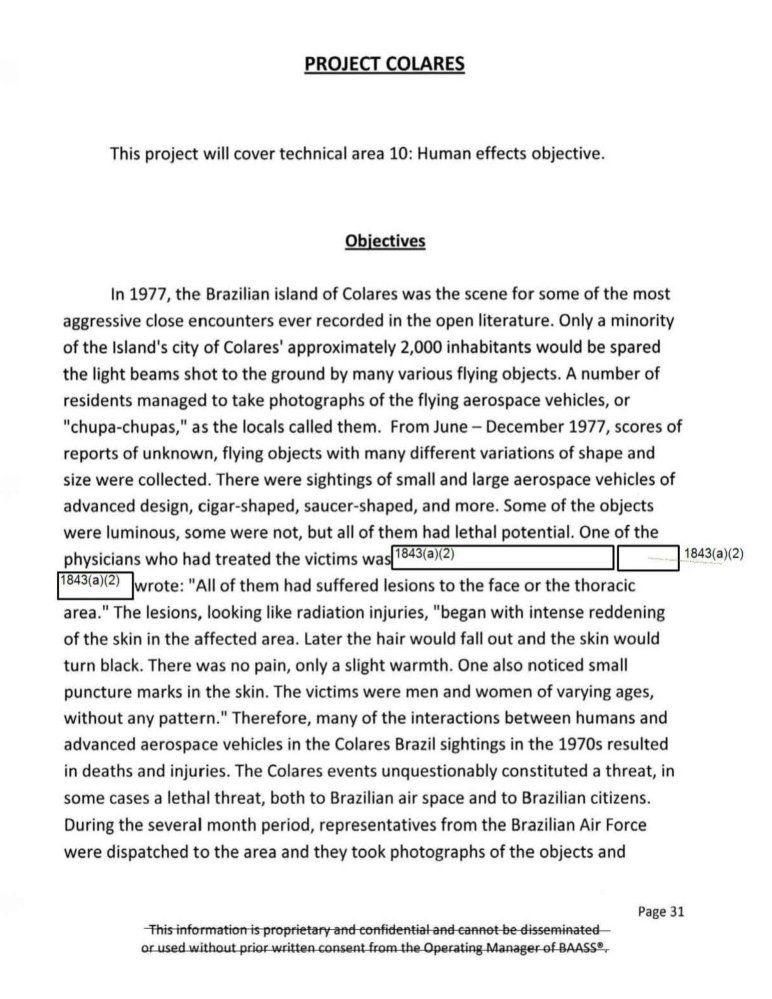
The nine projects are: Physics (about 24 technical papers from Earthtech by July 31, 2009), Engagement (finding areas where the craft would appear frequently, observing them and even seeking “communication or contact”), Cooperation (the DIA would help obtain films, equipment and information from the government), Campus (grants for universities), Database (gathering more than twenty databases of reports), Oral History (interviewing high-level retirees), Blue Book Materials (files that were said to be at Los Alamos National Laboratory), Northern Tier (incursions over nuclear bases in the 1960s and 1970s) and Colares (the 1977 wave in Pará).
The ten main recommendations ask for things that depended on the government: security clearances for the team by January 2009, gun camera films from aircraft and from satellites, the “excluded” files of Project Blue Book, the Brazilian Air Force files and medical records on Colares by 1º February 2009, NORAD data on uncorrelated targets by February 15 and, “proceeding from the premise” that biological material of possibly non-human origin was recovered, access to medical samples in military laboratories. BAASS also states that there are testimonies about craft “crashes” outside the U.S.
In the Engagement Project, BAASS says that earlier observation efforts, with multiple witnesses, intensified in 2007 and 2008 and produced hundreds of photographs with “anomalous characteristics”, and that the team was generally “caught by surprise”. The location is not named on this page; the March 2009 report lists security officers at a “ranch in Utah”. The closing remarks advocate obtaining physical access to craft hardware, purchasing hardware said to be in foreign hands and carrying out reverse engineering. None of this is demonstrated in the document: these are the contractor's plans and claims.
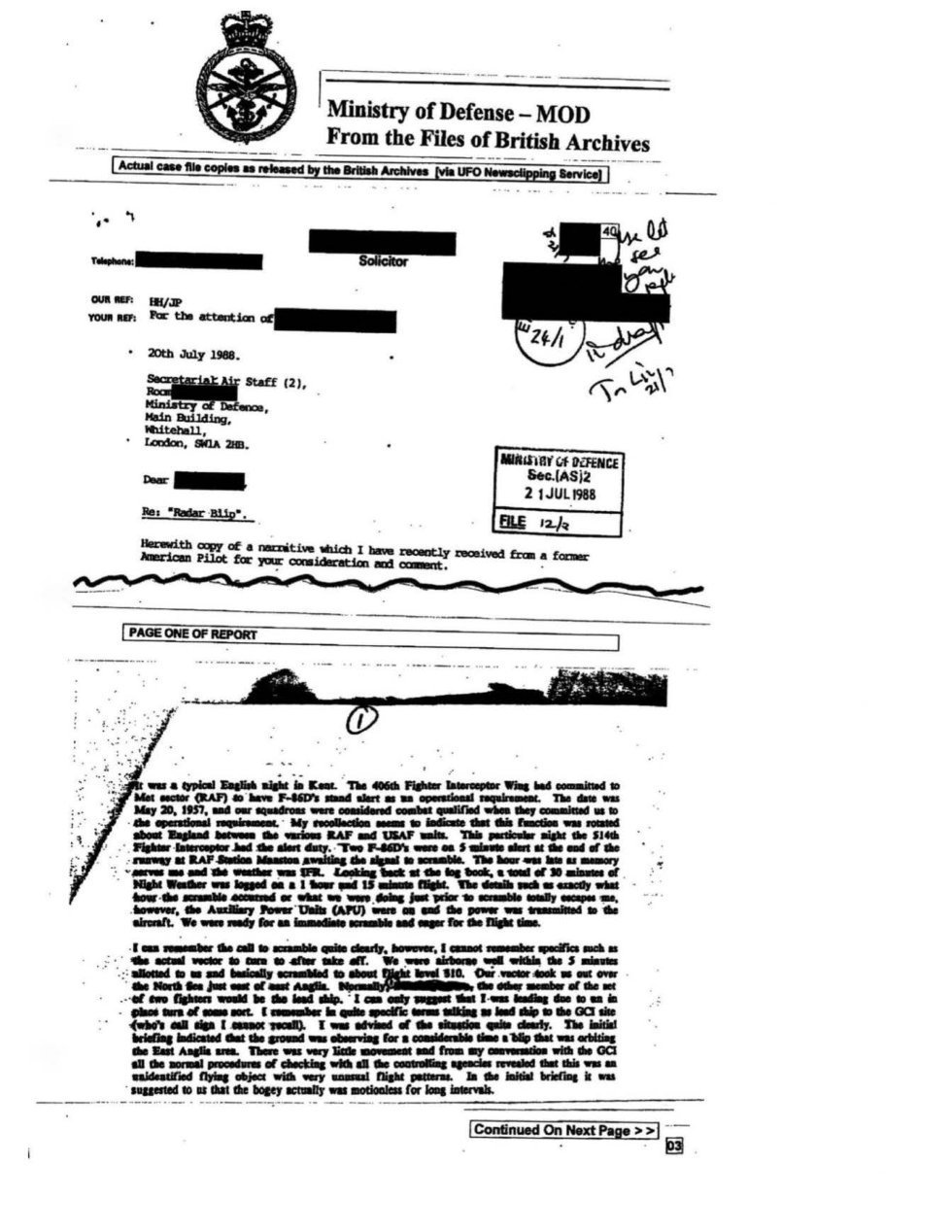
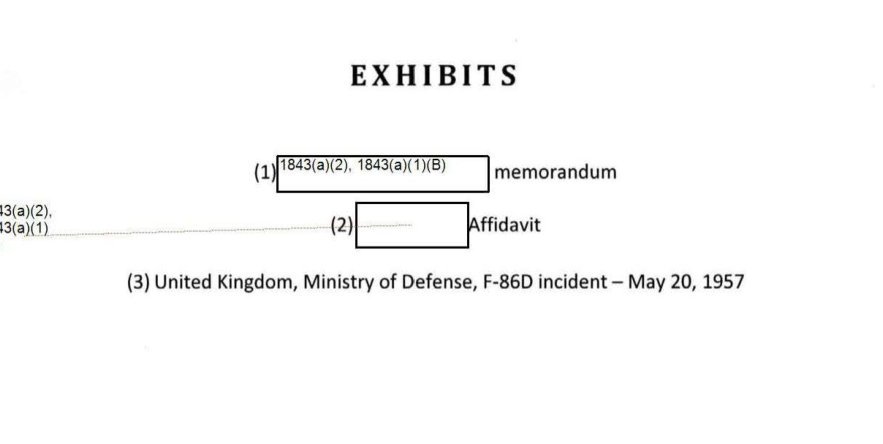
The annexes reproduce three texts: a copy of the Air Materiel Command opinion of September 23, 1947 on “flying discs”, with the stamp “research material of” a consultant; a 2002 sworn statement attributed to the public information officer of the Roswell base in 1947, with the name suppressed; and the account of a former American pilot about an interception from Manston, England, on May 20, 1957, taken from British Ministry of Defence files. Each has its own dossier on the site.
More images from the document
DIRECT READING OF THE FILE
The document, in the original
All 49 physical pages were translated in full, one per block, including the cover, table of contents, staff lists and footers. The three annexes (pp. 43-49) are in the twining, roswell-1947 and manston-f86d-ordem-de-disparar-contra-alvo-de-radar-1957 dossiers; the Roswell statement and the pilot's account, texts by private individuals, appear in a complete summary. Names replaced by codes and passages redacted in the release appear as [AAP Person N] and [suppressed].
EXCERPT 1 · PHYSICAL PAGE 1
Physical page 1, full page
IIIIIIW11111,1111
111,11111111,1111ITIIIIII ®
Contract HHM402-08-C-0072
ct Management Plan
iew Paper)
mber 2, 2008Editorial note: Cover of the project management plan delivered by BAASS to the DIA on December 2, 2008, illustrated with a triangle with lights at the corners.
Check the original PDF
IIIIIIW11111,1111
111,11111111,1111ITIIIIII ®
Contract HHM402-08-C-0072
ct Management Plan
iew Paper)
mber 2, 2008View the document record ↗ · Physical page 1, counting the cover.
EXCERPT 2 · PHYSICAL PAGE 10
Physical page 10, full page
KEY RECOMMENDATIONS
1)
In order for BAASS to provide the optimum result, it is essential that
various BAASS staff acquire the necessary clearances as soon as possible. It is
our understanding that vital information that is germane to all of the
contractor recommendations already resides in government hands. Without
these clearances, BAASS will not be able to access this vital information
relevant to very advanced spacecraft. Without access to this quality
information, BAASS would be handicapped to more of a parochial study of the
twelve technical areas. We would like to see at least the clearances approved
for the BAASS Administrator by the end of January, if at all possible. We would
hope that other clearances for which the names have already been submitted
would be forthcoming relatively soon thereafter.
2)
One example of acquiring quality information through Agency help is from
access to high quality film as soon as possible. Whether the film is from gun
cameras, ground base sources or satellites, all of our scientists and analytical
sources agree, this information has significant inherent value. We believe this
single type of resource can influence data gathering on technical areas
1,2,3,4,5, 7,8, and 11 as will be explained later.
3)
Other "low hanging fruit" in which the Agency can play a central role could
include the obtaining of the best Blue Book files that were kept separate due
to their "high sensitivity" from the more routine incident reports that were
investigated. Project Blue Book (active in the 1960's) was a US Airforce/US
government program assessing among other things the performance of very
advanced spacecraft. What wasn't publically known was that a significant
Page 4
This information is proprietary and confidential and cannot be disseminated
or used without prior written consent from the Operating Manager of BAASS•.Editorial note: BAASS recommendations 1 to 3 to the DIA: security clearances, access to films and to the Blue Book files kept separately.
Check the original PDF
KEY RECOMMENDATIONS
1)
In order for BAASS to provide the optimum result, it is essential that
various BAASS staff acquire the necessary clearances as soon as possible. It is
our understanding that vital information that is germane to all of the
contractor recommendations already resides in government hands. Without
these clearances, BAASS will not be able to access this vital information
relevant to very advanced spacecraft. Without access to this quality
information, BAASS would be handicapped to more of a parochial study of the
twelve technical areas. We would like to see at least the clearances approved
for the BAASS Administrator by the end of January, if at all possible. We would
hope that other clearances for which the names have already been submitted
would be forthcoming relatively soon thereafter.
2)
One example of acquiring quality information through Agency help is from
access to high quality film as soon as possible. Whether the film is from gun
cameras, ground base sources or satellites, all of our scientists and analytical
sources agree, this information has significant inherent value. We believe this
single type of resource can influence data gathering on technical areas
1,2,3,4,5, 7,8, and 11 as will be explained later.
3)
Other "low hanging fruit" in which the Agency can play a central role could
include the obtaining of the best Blue Book files that were kept separate due
to their "high sensitivity" from the more routine incident reports that were
investigated. Project Blue Book (active in the 1960's) was a US Airforce/US
government program assessing among other things the performance of very
advanced spacecraft. What wasn't publically known was that a significant
Page 4
This information is proprietary and confidential and cannot be disseminated
or used without prior written consent from the Operating Manager of BAASS•.View the document record ↗ · Physical page 10, counting the cover.
EXCERPT 3 · PHYSICAL PAGE 11
Physical page 11, full page
amount of information and trace material never reached the small "official"
investigation office. We believe we may know exactly where some of that
information currently resides. For DIA, the acquisition of the data files known
to be excluded from Project Bluebook, on advanced aerospace technology that
presently resides at LANL (BAASS affiliated personnel have the precise files
numbers and locations of these files at LANL) will be of great importance in
meeting the timelines for about 8/12 of the technical tasks.
4)
Another example involving data already in government hands, which the
Agency can help us retrieve, concerns the effects upon humans (#10) who
were in close proximity to the functioning of very advanced spacecraft in the
Colares Island, Brazil incidents. In line with project Colares: it is recommended
that the DIA contact the Brazilian Air Force by February 1, 2009 in order to
secure an entire set of files, including medical records, pertaining to the three
month "invasion" by advanced aerospace vehicles in 1977 off the North coast
of Brazil. These files include photographs and instrumented recordings made
by the Brazilian air force.
5)
Other important data for Agency acquisition pertain to effects upon
nuclear facilities where anomalous spacecraft were in close proximity: such as
those incidences at RAF Bentwaters, England, Malmstrom AFB in Montana and
several others over the years. These would apply to #11, Armaments, #8,
Signature Reduction, and #10, Human Effects.
6)
Additional possibilities of benefit from accessing government sources
through Agency help pertain to the matter of #3, Control, as in the operators
of these very advanced spacecraft and possibly the source or sources of these
craft.
Page 5
This information is proprietary and confidential and cannot be disseminated
or 1:Jsed withel:lt prior written eonseAt freffi the OperatiAg Manager of DAA558 .Editorial note: Recommendations 4 to 6: Colares files (1977), incidents at nuclear facilities such as Bentwaters and Malmstrom, and the operators of the craft.
Check the original PDF
amount of information and trace material never reached the small "official"
investigation office. We believe we may know exactly where some of that
information currently resides. For DIA, the acquisition of the data files known
to be excluded from Project Bluebook, on advanced aerospace technology that
presently resides at LANL (BAASS affiliated personnel have the precise files
numbers and locations of these files at LANL) will be of great importance in
meeting the timelines for about 8/12 of the technical tasks.
4)
Another example involving data already in government hands, which the
Agency can help us retrieve, concerns the effects upon humans (#10) who
were in close proximity to the functioning of very advanced spacecraft in the
Colares Island, Brazil incidents. In line with project Colares: it is recommended
that the DIA contact the Brazilian Air Force by February 1, 2009 in order to
secure an entire set of files, including medical records, pertaining to the three
month "invasion" by advanced aerospace vehicles in 1977 off the North coast
of Brazil. These files include photographs and instrumented recordings made
by the Brazilian air force.
5)
Other important data for Agency acquisition pertain to effects upon
nuclear facilities where anomalous spacecraft were in close proximity: such as
those incidences at RAF Bentwaters, England, Malmstrom AFB in Montana and
several others over the years. These would apply to #11, Armaments, #8,
Signature Reduction, and #10, Human Effects.
6)
Additional possibilities of benefit from accessing government sources
through Agency help pertain to the matter of #3, Control, as in the operators
of these very advanced spacecraft and possibly the source or sources of these
craft.
Page 5
This information is proprietary and confidential and cannot be disseminated
or 1:Jsed withel:lt prior written eonseAt freffi the OperatiAg Manager of DAA558 .View the document record ↗ · Physical page 11, counting the cover.
EXCERPT 4 · PHYSICAL PAGE 12
Physical page 12, full page
7)
Agency officials should make efforts to be officially available to accompany
BAASS senior management during the process of interviewing key participants.
The oral history program will be the extraction of information from people
about exotic spacecraft who were highly placed within government. In order
for many of these people to talk, it is necessary for them to know they won't
get into trouble and it is officially okay for them to speak up regarding novel
spacecraft that were not "black" government programs. We are speaking here
of government employees. These oral histories would relate to probably all
twelve technical areas. Since many of these people are in advanced age, time
is of the essence. BAASS affiliated personnel have a list of about ten
individuals who have worked in various parts or have been affiliated with the
programs involving retrieval of advanced aerospace hardware or of associated
biological material. It will be of great importance for DIA to contact these
individuals and to obtain the maximum information from them. BAASS can
supply the names and contact information for each person.
8)
Agency should assist BAASS wherever, whenever possible in the long term
program of outreaching and collaboration with select foreign sources including
governments. Various foreign contact relationships already exist among
several BAASS senior personnel and other outside associates. It is
substantiated with testimony that several "crashes" of novel spacecraft have
occurred outside of the United States. Our concern addresses the level to
which other countries have already succeeded in understanding the technical
aspects of these craft. Even more impressive, would be any successes
concerning back-engineering of various components.
In so far as this "crash" information is decades old, we have no idea what
progress has been accomplished to date. However, we do know that various
heads of state in other countries have a different view toward this subject of
novel spacecraft than do American heads of state. While "official" American
Page 6
This information is proprietary and confidential and cannot be disseminated
or used without prior wr itte11 co11se11t fr on, the Operating Mar,ager ef BAAss•.Editorial note: Recommendations 7 and 8: oral history interviews with former employees and collaboration with foreign sources on alleged craft crashes.
Check the original PDF
7)
Agency officials should make efforts to be officially available to accompany
BAASS senior management during the process of interviewing key participants.
The oral history program will be the extraction of information from people
about exotic spacecraft who were highly placed within government. In order
for many of these people to talk, it is necessary for them to know they won't
get into trouble and it is officially okay for them to speak up regarding novel
spacecraft that were not "black" government programs. We are speaking here
of government employees. These oral histories would relate to probably all
twelve technical areas. Since many of these people are in advanced age, time
is of the essence. BAASS affiliated personnel have a list of about ten
individuals who have worked in various parts or have been affiliated with the
programs involving retrieval of advanced aerospace hardware or of associated
biological material. It will be of great importance for DIA to contact these
individuals and to obtain the maximum information from them. BAASS can
supply the names and contact information for each person.
8)
Agency should assist BAASS wherever, whenever possible in the long term
program of outreaching and collaboration with select foreign sources including
governments. Various foreign contact relationships already exist among
several BAASS senior personnel and other outside associates. It is
substantiated with testimony that several "crashes" of novel spacecraft have
occurred outside of the United States. Our concern addresses the level to
which other countries have already succeeded in understanding the technical
aspects of these craft. Even more impressive, would be any successes
concerning back-engineering of various components.
In so far as this "crash" information is decades old, we have no idea what
progress has been accomplished to date. However, we do know that various
heads of state in other countries have a different view toward this subject of
novel spacecraft than do American heads of state. While "official" American
Page 6
This information is proprietary and confidential and cannot be disseminated
or used without prior wr itte11 co11se11t fr on, the Operating Mar,ager ef BAAss•.View the document record ↗ · Physical page 12, counting the cover.
EXCERPT 5 · PHYSICAL PAGE 13
Physical page 13, full page
behavior has taken the "head in the sand" approach, we krnow that has not
been the universal reaction in other countries. Our military future could be
seriously influenced.
9)
Under the premise that biological material of potentially non-human origin
has been recov,ered, at the earliest available opportunity DIA will lobby via
interagency connections for access to medical samples for evaluation by
BAASS affiliated forensic personnel with such laboratories as the Armed Forces
Institute of Pathology (AFIP); the various commands housed at Fort Detrick,
e.g., U.S. Army Medical Research and Materiel Command {USAMRMC) with its
Bio-defense Agency, and the U.S. Army Medical Research Institute of
Infectious Diseases (USAMRIID); Dugway Proving Ground's U.S. Army Test and
Evaluation Command (ATEC).
10)
Via DIA contact with NORAD by February 15, 2009, with data on
trajectory and speed from uncorrelated targets having been made available to
BAASS analysts, we will conduct a detailed evaluation on said data to mine it
for information pertaining to Lift, Propulsion, Control, Power Generation,
Spatial Temporal Translation, Materials, Configuration/Structure, Signature
reduction, or Armaments.
Page 7
Tl.is i11fo1111ation is proprietary and confidential and cannot be disseminated
or used without prior written eonsent froni the Operating Ma11age1 of BAASS".Editorial note: Recommendations 9 and 10: access to alleged biological samples of non-human origin and to NORAD data on uncorrelated targets.
Check the original PDF
behavior has taken the "head in the sand" approach, we krnow that has not
been the universal reaction in other countries. Our military future could be
seriously influenced.
9)
Under the premise that biological material of potentially non-human origin
has been recov,ered, at the earliest available opportunity DIA will lobby via
interagency connections for access to medical samples for evaluation by
BAASS affiliated forensic personnel with such laboratories as the Armed Forces
Institute of Pathology (AFIP); the various commands housed at Fort Detrick,
e.g., U.S. Army Medical Research and Materiel Command {USAMRMC) with its
Bio-defense Agency, and the U.S. Army Medical Research Institute of
Infectious Diseases (USAMRIID); Dugway Proving Ground's U.S. Army Test and
Evaluation Command (ATEC).
10)
Via DIA contact with NORAD by February 15, 2009, with data on
trajectory and speed from uncorrelated targets having been made available to
BAASS analysts, we will conduct a detailed evaluation on said data to mine it
for information pertaining to Lift, Propulsion, Control, Power Generation,
Spatial Temporal Translation, Materials, Configuration/Structure, Signature
reduction, or Armaments.
Page 7
Tl.is i11fo1111ation is proprietary and confidential and cannot be disseminated
or used without prior written eonsent froni the Operating Ma11age1 of BAASS".View the document record ↗ · Physical page 13, counting the cover.
EXCERPT 6 · PHYSICAL PAGE 14
Physical page 14, full page
INTRODUCTION
Scope of Final Report Incorporating each Technical Area
This Program Manager Report (PMR) accomplishes the requirement to
submit a report as part of the Advanced Aerospace Weapon System Application
contract HHM402-08-C-0072. This report comprises overview papers identifying
the scope of the final report (due in September 2009) for each of the 12 following
areas: (1) Lift, (2) Propulsion, (3) Control, (4) Power Generation, (5) Spatial
Temporal Translation, (6) Materials, (7) Configuration/Structure, (8) Signature
Reduction (Optical/lR/RF/Acoustic), (9) Human Interface, (10) Human Effects, (11)
Armament (RF and DEW) and (12) Other areas in Support of 1-11. Secondly this
PMR addresses a Plan of Action and Milestones that encompasses the 12 areas.
Finally, the PMR addresses the intended composition of the BAASS analytical
teams that will work on these areas.
The objective of the overall program is to understand the physics and
engineering of advanced aerospace weapon system applications as they apply to
potential foreign threats out to the far term, e.g., from now through the year
2050.
Underlining the gravitas of the anomalous aerospace vehicle subject,
according to Earthtech Report #7, page 2: "With regard to yet more exotic
possibilities for craft configurations and flight performance, it would be remiss to
overlook observations of apparently advanced unconventional craft reported by
credible observers (e.g. military and civilian pilots) for several decades (9,10). The
so-called UFO phenomenon. Despite the overreaction and sernsationalism of the
public which led to the CIA initiated policy via th~1843(a)(2)
Ito debunk the
subject as a safeguard against clogging of communication channels [11), the
subject has been treated seriously in a congressional hearing-1968!1843(a)(2) I
l1843(a)(2)
I[12]- and in a document prepared for
Page 8
This information is proprietary and confidential and cannot be disseminated
or used without prior wr itte11 co11se11t from the Operating Manager ef BAAss•.Editorial note: Introduction: scope of the final report, the program's objective through 2050, and a quotation from an Earthtech report on the so-called UFO phenomenon.
Check the original PDF
INTRODUCTION
Scope of Final Report Incorporating each Technical Area
This Program Manager Report (PMR) accomplishes the requirement to
submit a report as part of the Advanced Aerospace Weapon System Application
contract HHM402-08-C-0072. This report comprises overview papers identifying
the scope of the final report (due in September 2009) for each of the 12 following
areas: (1) Lift, (2) Propulsion, (3) Control, (4) Power Generation, (5) Spatial
Temporal Translation, (6) Materials, (7) Configuration/Structure, (8) Signature
Reduction (Optical/lR/RF/Acoustic), (9) Human Interface, (10) Human Effects, (11)
Armament (RF and DEW) and (12) Other areas in Support of 1-11. Secondly this
PMR addresses a Plan of Action and Milestones that encompasses the 12 areas.
Finally, the PMR addresses the intended composition of the BAASS analytical
teams that will work on these areas.
The objective of the overall program is to understand the physics and
engineering of advanced aerospace weapon system applications as they apply to
potential foreign threats out to the far term, e.g., from now through the year
2050.
Underlining the gravitas of the anomalous aerospace vehicle subject,
according to Earthtech Report #7, page 2: "With regard to yet more exotic
possibilities for craft configurations and flight performance, it would be remiss to
overlook observations of apparently advanced unconventional craft reported by
credible observers (e.g. military and civilian pilots) for several decades (9,10). The
so-called UFO phenomenon. Despite the overreaction and sernsationalism of the
public which led to the CIA initiated policy via th~1843(a)(2)
Ito debunk the
subject as a safeguard against clogging of communication channels [11), the
subject has been treated seriously in a congressional hearing-1968!1843(a)(2) I
l1843(a)(2)
I[12]- and in a document prepared for
Page 8
This information is proprietary and confidential and cannot be disseminated
or used without prior wr itte11 co11se11t from the Operating Manager ef BAAss•.View the document record ↗ · Physical page 14, counting the cover.
EXCERPT 7 · PHYSICAL PAGE 15
Physical page 15, full page
congressional briefings by the Congressional Research Service (13)." Note:
numbers inside parentheses refer to references in the Earthtech report #7.
In order to meaningfully tackle the subject areas outlined in the above 12
technical topics, BAASS has been compelled to focus on those projects that are
feasible given the current timelines and budget allocations for this contract. The
three sets of papers that have been submitted to the agency by MUFON,
Earthtech and bylAAP Person 8
Icovered an enormous number of possible
directions as they sought to address the above 12 technical areas. BAASS
personnel judged it impossible logistically to embrace fill of the recommendations
in these technical papers as reasonable achievables. Many of the projects could
take greater than several decades to accomplish and possibly billions of dollars.
Accordingly, BAASS has chosen eight specific projects to focus on during the
first and second years of this contract. We consider that the probability of success
of these nine projects within a 12 or 24 month time frame and within the
allocated budgets is maximized. Therefore, the objectives, methodologies,
milestones and team compositions for each of the nine projects are laid out in
detail in the next section of this Project management Report. Very recently, DIA
has mandated the creation of a ninth project, that we call Project Physics (see
page 11), in which the current research in universities and research institutes on
all twelve technical areas will be studied.
It should be stated at the outset that we deliberately adopted the stance
that the most productive way to learn the maximum about the twelve technical
areas was to study craft that are already displaying novel behavior in the twelve
technical areas. Hence, with the exception of the DIA mandated Project Physics
(see page 11) BAASS's resources will not be devoted to studying the current
"state of the art" of technology in our university system and research institutes.
This latter approach could prove fruitless and waste significant time and money.
Page 9
Tnis information is proprietary and confidential and cannot be disseminated
er 1:1sed witl'le1:1t prier written consent frem tl'le Operating Manager ef BAASS*.Editorial note: Introduction, continued: why BAASS chose to focus on craft that would already display unprecedented behavior, with the exception of the Physics Project.
Check the original PDF
congressional briefings by the Congressional Research Service (13)." Note:
numbers inside parentheses refer to references in the Earthtech report #7.
In order to meaningfully tackle the subject areas outlined in the above 12
technical topics, BAASS has been compelled to focus on those projects that are
feasible given the current timelines and budget allocations for this contract. The
three sets of papers that have been submitted to the agency by MUFON,
Earthtech and bylAAP Person 8
Icovered an enormous number of possible
directions as they sought to address the above 12 technical areas. BAASS
personnel judged it impossible logistically to embrace fill of the recommendations
in these technical papers as reasonable achievables. Many of the projects could
take greater than several decades to accomplish and possibly billions of dollars.
Accordingly, BAASS has chosen eight specific projects to focus on during the
first and second years of this contract. We consider that the probability of success
of these nine projects within a 12 or 24 month time frame and within the
allocated budgets is maximized. Therefore, the objectives, methodologies,
milestones and team compositions for each of the nine projects are laid out in
detail in the next section of this Project management Report. Very recently, DIA
has mandated the creation of a ninth project, that we call Project Physics (see
page 11), in which the current research in universities and research institutes on
all twelve technical areas will be studied.
It should be stated at the outset that we deliberately adopted the stance
that the most productive way to learn the maximum about the twelve technical
areas was to study craft that are already displaying novel behavior in the twelve
technical areas. Hence, with the exception of the DIA mandated Project Physics
(see page 11) BAASS's resources will not be devoted to studying the current
"state of the art" of technology in our university system and research institutes.
This latter approach could prove fruitless and waste significant time and money.
Page 9
Tnis information is proprietary and confidential and cannot be disseminated
er 1:1sed witl'le1:1t prier written consent frem tl'le Operating Manager ef BAASS*.View the document record ↗ · Physical page 15, counting the cover.
EXCERPT 8 · PHYSICAL PAGE 16
Physical page 16, full page
PLANS OF ACTION WITH MILESTONES
AND TEAM COMPOSITIONS
PROJECT PHYSICS
This project will cover all twelve technical areas.
Objectives
In November 2008, Earthtech delivered 12 Technical Studies that
recommended a wide ranging array of approaches to address the physics and
engineering feasibility of advanced aerospace weapons system application as they
apply to the potential future capabilities of foreign threat systems out to the far
term i.e. from now through 2050. The 12 Technical Studies addressed: Lift,
Propulsion, Control, Power Generation, Spatial/Temporal Translation, Materials,
Configuration/Structure, Signature Reduction, Human Interface, Human Effects,
Armament and Other Areas. Many of the approaches recommended in the 12
Earthtech Technical Studies are highly theoretical. Even with virtually unlimited
buckets of time and money it is impossible to predict which, if any, of these
approaches might yield a physical demonstration that parallels the behavior of
novel spacecraft already known to exist.
However, through recent consultations between the DIA and BAASS, it has
been decided that a new series of position papers shall focus on an in-depth
treatment of subsets of each of the twelve technical areas. For the sake of
thoroughness, the Agency and BAASS have decided that on the remote chance a
six month exploratory effort may reveal significant progress in one or more of the
twelve technical areas, BAASS shall proceed wit h Project Physics. Perhaps this
Page 10
I his information is prop1 ieta, y a11d coRfidential and cannot be dissernioatec:l
er used witAeut 13rier written eensent frern tAe Operating Manager of BAAss•.Editorial note: Start of the Physics Project: new Earthtech technical papers on the twelve areas, commissioned by joint decision of the DIA and BAASS.
Check the original PDF
PLANS OF ACTION WITH MILESTONES
AND TEAM COMPOSITIONS
PROJECT PHYSICS
This project will cover all twelve technical areas.
Objectives
In November 2008, Earthtech delivered 12 Technical Studies that
recommended a wide ranging array of approaches to address the physics and
engineering feasibility of advanced aerospace weapons system application as they
apply to the potential future capabilities of foreign threat systems out to the far
term i.e. from now through 2050. The 12 Technical Studies addressed: Lift,
Propulsion, Control, Power Generation, Spatial/Temporal Translation, Materials,
Configuration/Structure, Signature Reduction, Human Interface, Human Effects,
Armament and Other Areas. Many of the approaches recommended in the 12
Earthtech Technical Studies are highly theoretical. Even with virtually unlimited
buckets of time and money it is impossible to predict which, if any, of these
approaches might yield a physical demonstration that parallels the behavior of
novel spacecraft already known to exist.
However, through recent consultations between the DIA and BAASS, it has
been decided that a new series of position papers shall focus on an in-depth
treatment of subsets of each of the twelve technical areas. For the sake of
thoroughness, the Agency and BAASS have decided that on the remote chance a
six month exploratory effort may reveal significant progress in one or more of the
twelve technical areas, BAASS shall proceed wit h Project Physics. Perhaps this
Page 10
I his information is prop1 ieta, y a11d coRfidential and cannot be dissernioatec:l
er used witAeut 13rier written eensent frern tAe Operating Manager of BAAss•.View the document record ↗ · Physical page 16, counting the cover.
EXCERPT 9 · PHYSICAL PAGE 17
Physical page 17, full page
research could explain some aspect of behavior over the last six decades of very
advanced spacecraft already known to exist. BAASS is contracting with Earthtech
for an in-depth six month study to locate through any sources at Earthtech's
disposal any information on these more prosaic approaches that have been
kicked about for some period of years.
Accordingly, the objective of Project Physics is for Earthtech and its
subcontractors to produce approximately 24 position papers that are
comprehensive treatments of more than one approach for each of the 12
technical areas.
Methodology
Earthtech will choose the precise nature and scope of the approximately 24
position papers that will encompass the 12 technical areas {Lift, Propulsion,
Control, Power Generation, Spatial/Temporal Translation, Materials,
Configuration/Structure, Signature Reduction, Human Interface, Human Effects,
Armament and Other Areas).
Either through in-house physicists or external physics/engineering
contractors, Earthtech will deliver the approximately 24 position papers that will
be based on expanding and focusing on strategically important sub-projects from
the 12 position papers that Earthtech already has delivered.
Milestones
Earthtech will deliver approximately 24 position papers to BAASS on or
before July 31, 2009.
Page 11
This i11formatio11 is proprietai y and confidential and cannot be disseminated
or used without prior written consent from tile Operating Manager of BAASS5 .Editorial note: Physics Project: objective, methodology and delivery deadline for the approximately 24 Earthtech technical papers.
Check the original PDF
research could explain some aspect of behavior over the last six decades of very
advanced spacecraft already known to exist. BAASS is contracting with Earthtech
for an in-depth six month study to locate through any sources at Earthtech's
disposal any information on these more prosaic approaches that have been
kicked about for some period of years.
Accordingly, the objective of Project Physics is for Earthtech and its
subcontractors to produce approximately 24 position papers that are
comprehensive treatments of more than one approach for each of the 12
technical areas.
Methodology
Earthtech will choose the precise nature and scope of the approximately 24
position papers that will encompass the 12 technical areas {Lift, Propulsion,
Control, Power Generation, Spatial/Temporal Translation, Materials,
Configuration/Structure, Signature Reduction, Human Interface, Human Effects,
Armament and Other Areas).
Either through in-house physicists or external physics/engineering
contractors, Earthtech will deliver the approximately 24 position papers that will
be based on expanding and focusing on strategically important sub-projects from
the 12 position papers that Earthtech already has delivered.
Milestones
Earthtech will deliver approximately 24 position papers to BAASS on or
before July 31, 2009.
Page 11
This i11formatio11 is proprietai y and confidential and cannot be disseminated
or used without prior written consent from tile Operating Manager of BAASS5 .View the document record ↗ · Physical page 17, counting the cover.
EXCERPT 10 · PHYSICAL PAGE 18
Physical page 18, full page
Team Composition
r
p Person 57
r
p Person 58
Select Earthtech Subcontractors
Page 12
Ttlis information is proprietar,• and confidential and cannot b@ disseminated
oc,•sed without prior written consent from tRe Operating Manager of BAA55e.Editorial note: Makeup of the Physics Project team; the names were replaced with codes in the release.
Check the original PDF
Team Composition
r
p Person 57
r
p Person 58
Select Earthtech Subcontractors
Page 12
Ttlis information is proprietar,• and confidential and cannot b@ disseminated
oc,•sed without prior written consent from tRe Operating Manager of BAA55e.View the document record ↗ · Physical page 18, counting the cover.
EXCERPT 11 · PHYSICAL PAGE 19
Physical page 19, full page
PROJECT ENGAGEMENT
This program shall endeavor to locate possible small geographical areas
where novel spacecraft seem to frequent. This program would specifically relate
to technical area #9 with possible collateral involvement of other technical areas.
Objectives
In spite of having confirmation that a significant menu of very novel
spacecraft have existed for over 60 years and travel anywhere, anytime, there is
no officially reliable data as to who pilot these craft, how they are made, where is
their place of origin and why they are here. Until actual materials are obtained,
we must rely on more indirect means. However, on the slim chance that some
geographic areas could be found where "regular" flights of these craft were
occurring, it might be possible to implement a pro-active program, actually
seeking some form of engagement. Members of BAASS have some previous
experience in this regard. This will be a very unpredictable program. It also could
be risky for the participants. And it could be financially expensive.
However, the potential gain could be unlimited and that is why we are
offering this plan.
The first objective would be to locate, choose and secure possible sites.
Concurrent with this activity would be the engagement of BAASS staff and outside
contractors to properly strategize various approach scenarios. As new site
opportunities were recognized by BAASS staff, possibly due to the immediate
nature of the spacecraft performances, expansion of this program would occur
domestically and to foreign locations over time.
The second objective is to gather as much data as possible through
observation of the craft. This is not as easy as it sounds. The authors of this
Page 13
i his information is proprietary a11d co11fidential and cannot be disseminated
or used without prior writteri coriserit fror:n the Op,m 1tirig Mrrnager of BA.A.SS•.Editorial note: Engagement Project: proposal to locate areas where unprecedented craft would frequently appear in order to observe and measure them.
Check the original PDF
PROJECT ENGAGEMENT
This program shall endeavor to locate possible small geographical areas
where novel spacecraft seem to frequent. This program would specifically relate
to technical area #9 with possible collateral involvement of other technical areas.
Objectives
In spite of having confirmation that a significant menu of very novel
spacecraft have existed for over 60 years and travel anywhere, anytime, there is
no officially reliable data as to who pilot these craft, how they are made, where is
their place of origin and why they are here. Until actual materials are obtained,
we must rely on more indirect means. However, on the slim chance that some
geographic areas could be found where "regular" flights of these craft were
occurring, it might be possible to implement a pro-active program, actually
seeking some form of engagement. Members of BAASS have some previous
experience in this regard. This will be a very unpredictable program. It also could
be risky for the participants. And it could be financially expensive.
However, the potential gain could be unlimited and that is why we are
offering this plan.
The first objective would be to locate, choose and secure possible sites.
Concurrent with this activity would be the engagement of BAASS staff and outside
contractors to properly strategize various approach scenarios. As new site
opportunities were recognized by BAASS staff, possibly due to the immediate
nature of the spacecraft performances, expansion of this program would occur
domestically and to foreign locations over time.
The second objective is to gather as much data as possible through
observation of the craft. This is not as easy as it sounds. The authors of this
Page 13
i his information is proprietary a11d co11fidential and cannot be disseminated
or used without prior writteri coriserit fror:n the Op,m 1tirig Mrrnager of BA.A.SS•.View the document record ↗ · Physical page 19, counting the cover.
EXCERPT 12 · PHYSICAL PAGE 2
Physical page 2, full page
Bigelow Aerospace
Advanced Space Studies
Contract HHM402-08-C-0072
Project Management Plan
(Overview Paper)
December 2, 2008
This information 1s proprletaiy and confidential and cannot be disseminated
or 11sed witboot prior written consent from the Operating Manager ef BAAss•.Editorial note: Title page of the BAASS project management plan.
Check the original PDF
Bigelow Aerospace
Advanced Space Studies
Contract HHM402-08-C-0072
Project Management Plan
(Overview Paper)
December 2, 2008
This information 1s proprletaiy and confidential and cannot be disseminated
or 11sed witboot prior written consent from the Operating Manager ef BAAss•.View the document record ↗ · Physical page 2, counting the cover.
EXCERPT 13 · PHYSICAL PAGE 20
Physical page 20, full page
overview paper can ratify this point. To successfully gather useful data from
observations requires cooperation from the spacecraft. Performances must
necessarily be continued. The acquisition and implementation of very
sophisticated equipment is a challenge. Having the right people and enough
human resources in vital. The entire effort requires flexibility, inventiveness and
patience. But the rewards lead to the possibility of a successful third objective.
The third objective would be Communication and or Contact. (This is not,
by the way, a novel idea. It is our understanding that select communications and
contact between the operators of these spacecraft and interested parties within
this country started many years ago.) The authors of this paper would suggest
approaches that would encompass diverse methods.
Methodology
Some previous efforts produced effects that could be interpreted as
marginal but with positive results. Multiple human witnesses were involved in
many dozens of successful efforts. These intensified in 2007 and 2008. Hundreds
of photographs, indoors and outdoors using multiple digital cameras, were taken
showing anomalistic features. With most of this activity, we were not the
initiators of these contacts. Our function was more catalytic in nature. In the vast
majority of contacts, we were acted upon. That is to say, having placed ourselves
in residency at the location for a substantial period of time, we began to
"participate" in what we considered games and demonstrations, but, usually we
were caught by surprise.
The methods of communication or contact could encompass a wide variety
of approaches. From the use of various hardware to engaging people as cognitive
interactive subjects. We have previouslly tried both.
Page 14
This Information is proprietary arrd corrfiderrtial aud cannot be disseminated
or used without prior writteA coAseAt froFA the OperatiAg MaAager of BAASS5 .Editorial note: Engagement Project, continued: BAASS says that earlier efforts, intensified in 2007 and 2008, produced hundreds of photos with anomalous characteristics.
Check the original PDF
overview paper can ratify this point. To successfully gather useful data from
observations requires cooperation from the spacecraft. Performances must
necessarily be continued. The acquisition and implementation of very
sophisticated equipment is a challenge. Having the right people and enough
human resources in vital. The entire effort requires flexibility, inventiveness and
patience. But the rewards lead to the possibility of a successful third objective.
The third objective would be Communication and or Contact. (This is not,
by the way, a novel idea. It is our understanding that select communications and
contact between the operators of these spacecraft and interested parties within
this country started many years ago.) The authors of this paper would suggest
approaches that would encompass diverse methods.
Methodology
Some previous efforts produced effects that could be interpreted as
marginal but with positive results. Multiple human witnesses were involved in
many dozens of successful efforts. These intensified in 2007 and 2008. Hundreds
of photographs, indoors and outdoors using multiple digital cameras, were taken
showing anomalistic features. With most of this activity, we were not the
initiators of these contacts. Our function was more catalytic in nature. In the vast
majority of contacts, we were acted upon. That is to say, having placed ourselves
in residency at the location for a substantial period of time, we began to
"participate" in what we considered games and demonstrations, but, usually we
were caught by surprise.
The methods of communication or contact could encompass a wide variety
of approaches. From the use of various hardware to engaging people as cognitive
interactive subjects. We have previouslly tried both.
Page 14
This Information is proprietary arrd corrfiderrtial aud cannot be disseminated
or used without prior writteA coAseAt froFA the OperatiAg MaAager of BAASS5 .View the document record ↗ · Physical page 20, counting the cover.
EXCERPT 14 · PHYSICAL PAGE 21
Physical page 21, full page
Milestones
We shall initiate the process of identifying possible geographic locations of
current or recent past activity during the first quarter of 2009. Also at that time,
we shall convene one of several workshops as an ongoing process to plan and
strategize approaches and program structure. Of necessity, it is anticipated that
project engagement will require multiple years of focused resources and funding,
potentially extending into and beyond 2011.
Also, we shall engage outside contractors during this time to conduct
specific tasks.
Team Composition
Finding and fitting the appropriate type of people to this assignment will be
most difficult for many reasons. Fortunately, BAASS's sister company Bigelow
Aerospace (in addition to BAASS) currently has in its employ a few people that
already have some experience and can help initiate the program. However,
numerous other people will be needed to augment BA's and BAASS's small force
in addition to the BAASS Administrator and Deputy Administrator. Supplemental
to eventually having several in house teams, contracting for outside assistance
will be necessary. The BAASS Administrator and Deputy Administrator have had
previous experience in contracting for this type of observation activity. This type
of field work, while very awkward for the Agency to say the least, is something
well suited for BAASS.
Page 15
This information 1s proprietary and co11fide11tial and carrnot be disseminated
01 used without p1 ior written consent from the Operating Manager of BAASS".Editorial note: Engagement Project: milestones starting in the first quarter of 2009 and team makeup.
Check the original PDF
Milestones
We shall initiate the process of identifying possible geographic locations of
current or recent past activity during the first quarter of 2009. Also at that time,
we shall convene one of several workshops as an ongoing process to plan and
strategize approaches and program structure. Of necessity, it is anticipated that
project engagement will require multiple years of focused resources and funding,
potentially extending into and beyond 2011.
Also, we shall engage outside contractors during this time to conduct
specific tasks.
Team Composition
Finding and fitting the appropriate type of people to this assignment will be
most difficult for many reasons. Fortunately, BAASS's sister company Bigelow
Aerospace (in addition to BAASS) currently has in its employ a few people that
already have some experience and can help initiate the program. However,
numerous other people will be needed to augment BA's and BAASS's small force
in addition to the BAASS Administrator and Deputy Administrator. Supplemental
to eventually having several in house teams, contracting for outside assistance
will be necessary. The BAASS Administrator and Deputy Administrator have had
previous experience in contracting for this type of observation activity. This type
of field work, while very awkward for the Agency to say the least, is something
well suited for BAASS.
Page 15
This information 1s proprietary and co11fide11tial and carrnot be disseminated
01 used without p1 ior written consent from the Operating Manager of BAASS".View the document record ↗ · Physical page 21, counting the cover.
EXCERPT 15 · PHYSICAL PAGE 22
Physical page 22, full page
PROJECT COOPERATION
Project Cooperation is the program that could be the most important of all
Plans of Action. As previously listed under Key Recommendations, in order to not
waste time, in order to not waste mone,y, in order to make this overall program
the most productive for which the RFP was constructed and paid for by the
Sponsors, the Agency needs to be successful in its ability to assist BAASS in the
acquisition of film, hardware, relevant materials and information currently under
Government and Agency influence and control. This should include other
relationships the Agency has with other organizations. We acknowledge that we
have been told several times this effort will be forthcoming with our help and look
to this with great expectation.
Objectives
Since proper clearance activity has been initiated for the BAASS
Administrator and others, the first step is something the Agency can take now.
According to the schedule BAASS has been given, there is no time to waste.
Concurrent with the clearance approval process, the Agency can begin to make
inquiries within itself as the Agency has already said is the first logical place to
begin.
By the time the Agency has dug down to discover its own the quality
sources, clearance should be approved at least for the BAAS$ Administrator. The
second step would be for a meeting between the Agency and the Administrator
for discussion and creation of strategy purposes.
The third objective is for BAASS to marshal human and financial resources
into this Cooperation Program.
Page 16
This information is proprietary and confidential and cannot be disseminated
or used without prior w, itte11 consent fr 0111 tire Ope, ati11g Manager of BAAss•.Editorial note: Project Cooperation: BAASS asks the DIA to help it obtain films, equipment and information under government control.
Check the original PDF
PROJECT COOPERATION
Project Cooperation is the program that could be the most important of all
Plans of Action. As previously listed under Key Recommendations, in order to not
waste time, in order to not waste mone,y, in order to make this overall program
the most productive for which the RFP was constructed and paid for by the
Sponsors, the Agency needs to be successful in its ability to assist BAASS in the
acquisition of film, hardware, relevant materials and information currently under
Government and Agency influence and control. This should include other
relationships the Agency has with other organizations. We acknowledge that we
have been told several times this effort will be forthcoming with our help and look
to this with great expectation.
Objectives
Since proper clearance activity has been initiated for the BAASS
Administrator and others, the first step is something the Agency can take now.
According to the schedule BAASS has been given, there is no time to waste.
Concurrent with the clearance approval process, the Agency can begin to make
inquiries within itself as the Agency has already said is the first logical place to
begin.
By the time the Agency has dug down to discover its own the quality
sources, clearance should be approved at least for the BAAS$ Administrator. The
second step would be for a meeting between the Agency and the Administrator
for discussion and creation of strategy purposes.
The third objective is for BAASS to marshal human and financial resources
into this Cooperation Program.
Page 16
This information is proprietary and confidential and cannot be disseminated
or used without prior w, itte11 consent fr 0111 tire Ope, ati11g Manager of BAAss•.View the document record ↗ · Physical page 22, counting the cover.
EXCERPT 16 · PHYSICAL PAGE 23
Physical page 23, full page
Methodology
Project Cooperation will initiate with the receipt of clearances by the BAASS
Administrator. However, while the clearance process is underway, the agency will
be focused on uncovering the many sources of information and leads on the topic
of anomalous aerospace vehicle performance that reside within its own data
archives. This internal agency dataset could provide a very rich source of
pertinent information.
Next, the agency, the BAASS Administrator and other appropriately cleared
BAAS$ personnel will cooperate in (a) seeking out and securing the materials that
avoided Project Bluebook, (b) the high value people with valuable information for
interviews, (c) the location and content of the files pertaining to the Northern
Tier-missile AFB sightings, (d) the ground-based, satellite based and gun camera
film/ imagery residing at multiple locations and (e) the files from the Brazilian
Colares Island incidents involving multiple injuries/deaths from anomalous
aerospace vehicles in 1977. All of these directions are discussed in more detail in
the subsequent sections of this report.
Milestones
The first milestone is identified as the joint efforts of the Administrator
acquiring needed clearance, hopefully by January 2009 and the Agency obtaining
relevant substantive information etc. to share that requires SCI or Top Secret
Clearance.
The second milestone would encompass the meeting previously
mentioned. This meeting needs to occur as soon as possible after the first
milestone is accomplished. Prior to this meeting there will be the necessity to
develop a satisfactory procedure/process for the delivery of materials,
information etc. to BAASS.
Page 17
This information is proprietary and confidential and cannot be disseminated
or used without p, io1 w, itte11 co11se11t f10111 the Operating Manager of BAASS11.Editorial note: Project Cooperation: methodology and milestones, with the list of what BAASS expected to obtain, including the Colares files (1977).
Check the original PDF
Methodology
Project Cooperation will initiate with the receipt of clearances by the BAASS
Administrator. However, while the clearance process is underway, the agency will
be focused on uncovering the many sources of information and leads on the topic
of anomalous aerospace vehicle performance that reside within its own data
archives. This internal agency dataset could provide a very rich source of
pertinent information.
Next, the agency, the BAASS Administrator and other appropriately cleared
BAAS$ personnel will cooperate in (a) seeking out and securing the materials that
avoided Project Bluebook, (b) the high value people with valuable information for
interviews, (c) the location and content of the files pertaining to the Northern
Tier-missile AFB sightings, (d) the ground-based, satellite based and gun camera
film/ imagery residing at multiple locations and (e) the files from the Brazilian
Colares Island incidents involving multiple injuries/deaths from anomalous
aerospace vehicles in 1977. All of these directions are discussed in more detail in
the subsequent sections of this report.
Milestones
The first milestone is identified as the joint efforts of the Administrator
acquiring needed clearance, hopefully by January 2009 and the Agency obtaining
relevant substantive information etc. to share that requires SCI or Top Secret
Clearance.
The second milestone would encompass the meeting previously
mentioned. This meeting needs to occur as soon as possible after the first
milestone is accomplished. Prior to this meeting there will be the necessity to
develop a satisfactory procedure/process for the delivery of materials,
information etc. to BAASS.
Page 17
This information is proprietary and confidential and cannot be disseminated
or used without p, io1 w, itte11 co11se11t f10111 the Operating Manager of BAASS11.View the document record ↗ · Physical page 23, counting the cover.
EXCERPT 17 · PHYSICAL PAGE 24
Physical page 24, full page
This program phase called Project Cooperation cannot be over emphasized
in its importance. A thorough data-mining of potential information location
needs to begin immediately.
If successful this project would substantially contribute ito all twelve
technical areas.
Depending on the speed of cooperation between DIA and BAASS, it is
anticipated that this project will extend beyond 2009 and into 2010 and 2011.
Team Composition
The lead for this project shall be the BAASS Administrator as this may
represent the most important Plan of Action. Supporting the Administrator in the
beginning will be key individuals such as:
Deputy BAASS Administrator
IAAP Person 57
IAAP Person 58
E P Person 5
Select BAASS Staff
Page 18
This information is proprietal"')' and confidential and cannot be disseminated
o, used without prior written consent from the Operating Manager of BAASS".Editorial note: Project Cooperation: planned duration and team composition, headed by the BAASS administrator.
Check the original PDF
This program phase called Project Cooperation cannot be over emphasized
in its importance. A thorough data-mining of potential information location
needs to begin immediately.
If successful this project would substantially contribute ito all twelve
technical areas.
Depending on the speed of cooperation between DIA and BAASS, it is
anticipated that this project will extend beyond 2009 and into 2010 and 2011.
Team Composition
The lead for this project shall be the BAASS Administrator as this may
represent the most important Plan of Action. Supporting the Administrator in the
beginning will be key individuals such as:
Deputy BAASS Administrator
IAAP Person 57
IAAP Person 58
E P Person 5
Select BAASS Staff
Page 18
This information is proprietal"')' and confidential and cannot be disseminated
o, used without prior written consent from the Operating Manager of BAASS".View the document record ↗ · Physical page 24, counting the cover.
EXCERPT 18 · PHYSICAL PAGE 25
Physical page 25, full page
PROJECT CAMPUS
This program will seek to involve all twelve technical areas (Lift, Propulsion,
Control, Power generation, Spatial/Temporal Translation, Materials,
Configuration/Structure, Signature Reduction (Optical/lR/RF/Acoustic), Human
Interface, Human Effects, Armament (RF and DEW), Other Areas.
Objectives
The first objective is to stimulate, motivate and encourage the senior levels
of the academic community within the United States to involve themselves in
study and research of very advanced aerial spacecraft that is presently considered
phenomenological.
In this effort, it is this program's intention to lay the seeds for serious
exploration of this topic within the national academic community at its highest
levels. After six decades of overt, blatant conspicuous and obtrusive global
performance by very advanced anomalously behaving spacecraft, the academic
community is still successful in maintaining the posture that these spacecraft
either don't exist or are not worthy of serious research and study. Foundationally,
there still remains a giggle factor which has been instrumental in squashing
serious consideration and thought.
The second objective is to extract from this large untapped body of
resource information not previously obtained.
The third objective is to stay ahead, or worse, catch up ito the similar efforts
that may already be underway in foreign countries. It is our opinion that such
research efforts conducted on a significant scale in foreign countries could/would
Page 19
This information is proprietary and confidential and cannot be disseminated
er l-.lsed witROl-.lt prier written consent from tl:le Operating Manager of B.A.A.ss•.Editorial note: Project Campus: proposal to get U.S. universities to study the advanced craft, despite what BAASS calls the “giggle factor.”
Check the original PDF
PROJECT CAMPUS
This program will seek to involve all twelve technical areas (Lift, Propulsion,
Control, Power generation, Spatial/Temporal Translation, Materials,
Configuration/Structure, Signature Reduction (Optical/lR/RF/Acoustic), Human
Interface, Human Effects, Armament (RF and DEW), Other Areas.
Objectives
The first objective is to stimulate, motivate and encourage the senior levels
of the academic community within the United States to involve themselves in
study and research of very advanced aerial spacecraft that is presently considered
phenomenological.
In this effort, it is this program's intention to lay the seeds for serious
exploration of this topic within the national academic community at its highest
levels. After six decades of overt, blatant conspicuous and obtrusive global
performance by very advanced anomalously behaving spacecraft, the academic
community is still successful in maintaining the posture that these spacecraft
either don't exist or are not worthy of serious research and study. Foundationally,
there still remains a giggle factor which has been instrumental in squashing
serious consideration and thought.
The second objective is to extract from this large untapped body of
resource information not previously obtained.
The third objective is to stay ahead, or worse, catch up ito the similar efforts
that may already be underway in foreign countries. It is our opinion that such
research efforts conducted on a significant scale in foreign countries could/would
Page 19
This information is proprietary and confidential and cannot be disseminated
er l-.lsed witROl-.lt prier written consent from tl:le Operating Manager of B.A.A.ss•.View the document record ↗ · Physical page 25, counting the cover.
EXCERPT 19 · PHYSICAL PAGE 26
Physical page 26, full page
eventually pose a threat to US national security. Such a significant program
would/could provide a serious positive stimulus to academic research in science
and math thus furthering the military capabilities of those countries.
Our concern is that the top universities/technical institutes in some foreign
countries MAY take this subject more seriously than we do in the United States
and hence MAY already have devoted significant resources to their study. Project
Campus will seek to help ameliorate this putative technological gap.
Methodology
The first priority is for BAASS to create a sophisticated program of grants
that is designed to stimulate the academic community to take the subject of
advanced aerospace vehicles seriously. BAASS will engineer a series of RFPs that
are directed at universities in the United States. The RFPs will unambiguously
emphasize the urgent need to study unconventional advanced aircraft with
respect to aerospace engineering, theoretical and applied physics, advanced
materials science etc. All prospective applicants will file a statement of intent that
will comprise a brief overview of what they intend to do. In this way, research
that is proposed that is judged by BAASS to be insufficiently ground breaking,
advanced or breakthrough will be quickly terminated without the need to waste
precious resources in grant allocation.
BAASS will appoint a grant monitors who will work with the Pl to ensure
that the submitted proposal is of the highest quality and importantly is on target
to address one of the twelve criteria.
Milestones
The first milestone, approximate delivery date February 28, 2009, will be
fodAAP Person 100 IAAP
and team to formulate and present to the BAASS
'I._.____...., Person 99
Page 20
Tliis i11forrnatio11 is p,oprietary and confidential and cannot be disseminated
or used without prior written consent from the Operating Manager of BAASS•.Editorial note: Project Campus: grant program and requests for proposals for universities, with a first milestone in February 2009.
Check the original PDF
eventually pose a threat to US national security. Such a significant program
would/could provide a serious positive stimulus to academic research in science
and math thus furthering the military capabilities of those countries.
Our concern is that the top universities/technical institutes in some foreign
countries MAY take this subject more seriously than we do in the United States
and hence MAY already have devoted significant resources to their study. Project
Campus will seek to help ameliorate this putative technological gap.
Methodology
The first priority is for BAASS to create a sophisticated program of grants
that is designed to stimulate the academic community to take the subject of
advanced aerospace vehicles seriously. BAASS will engineer a series of RFPs that
are directed at universities in the United States. The RFPs will unambiguously
emphasize the urgent need to study unconventional advanced aircraft with
respect to aerospace engineering, theoretical and applied physics, advanced
materials science etc. All prospective applicants will file a statement of intent that
will comprise a brief overview of what they intend to do. In this way, research
that is proposed that is judged by BAASS to be insufficiently ground breaking,
advanced or breakthrough will be quickly terminated without the need to waste
precious resources in grant allocation.
BAASS will appoint a grant monitors who will work with the Pl to ensure
that the submitted proposal is of the highest quality and importantly is on target
to address one of the twelve criteria.
Milestones
The first milestone, approximate delivery date February 28, 2009, will be
fodAAP Person 100 IAAP
and team to formulate and present to the BAASS
'I._.____...., Person 99
Page 20
Tliis i11forrnatio11 is p,oprietary and confidential and cannot be disseminated
or used without prior written consent from the Operating Manager of BAASS•.View the document record ↗ · Physical page 26, counting the cover.
EXCERPT 20 · PHYSICAL PAGE 27
Physical page 27, full page
Administrator, the comprehensive detailed strategy for reaching out to the
academic community in the United States. This will take the form of design of
RFPs and design of Letter of Intent (LOI) solicitations.
A realistic projection from BAASS is that the milestones in the project
should encompass at least three years of effort. Academic turnaround is
demonstrably slow.
Team Composition
r
p Person 99
IAAP Pe,son 100
Select BAASS Staff
Timeline
Long Term
Page 21
This info11nation is prop, ietar y and confidential and cannot be disserninated
or used without prior written consent fro111 tire Ope1ati11g Ma11age1 of BAAss•.Editorial note: Project Campus: timeframe of at least three years and team composition.
Check the original PDF
Administrator, the comprehensive detailed strategy for reaching out to the
academic community in the United States. This will take the form of design of
RFPs and design of Letter of Intent (LOI) solicitations.
A realistic projection from BAASS is that the milestones in the project
should encompass at least three years of effort. Academic turnaround is
demonstrably slow.
Team Composition
r
p Person 99
IAAP Pe,son 100
Select BAASS Staff
Timeline
Long Term
Page 21
This info11nation is prop, ietar y and confidential and cannot be disserninated
or used without prior written consent fro111 tire Ope1ati11g Ma11age1 of BAAss•.View the document record ↗ · Physical page 27, counting the cover.
EXCERPT 21 · PHYSICAL PAGE 28
Physical page 28, full page
PROJECT DATABASE
This program will address all twelve technical areas.
Objectives
For six decades there have been displays of advanced aerospace vehicles in
the skies of North America and around the world that have been witnessed by
thousands of people, including military pilots and ground crews, civil aviation
pilots, law enforcement officers and members of the public. Because these
displays have not been taken seriously, few significant resources have been
allocated to gathering the data into a single place from all of these sightings.
Instead, data is scattered through over twenty smaller databases in the United
States and over a dozen more internationally. Because of a lack of resources (a)
these data have never been brought into a single storage site and (b)
consequently have never been analyzed using sophisticated search parameters.
This BAASS project seeks to eliminate this shortcoming. The objective is to create
the world's first comprehensive high quality searchable database of advanced
aerial technology maneuvers.
Methodology
For BAASS, the establishment of a "meta-database" of advanced aerospace
technology interactions with humans, comprising a subset from over twenty
known datasets from the public domain will be in place in the first year of
operations. The BAASS database will include the highest quality, calibrated, close
encounter datasets already merged and searchable by keywords from a subset of
publicly available databases. It is anticipated that the end result of the worldwide
database collection will results in thousands of different high quality aerospace
Page 22
This information is proprietary and confidential and cannot be disseminated
o, used witl,out prior written consent frnm the Operatiflg Manager ef BM.SS• .Editorial note: Project Database: plan to gather more than twenty report databases into a searchable meta-database.
Check the original PDF
PROJECT DATABASE
This program will address all twelve technical areas.
Objectives
For six decades there have been displays of advanced aerospace vehicles in
the skies of North America and around the world that have been witnessed by
thousands of people, including military pilots and ground crews, civil aviation
pilots, law enforcement officers and members of the public. Because these
displays have not been taken seriously, few significant resources have been
allocated to gathering the data into a single place from all of these sightings.
Instead, data is scattered through over twenty smaller databases in the United
States and over a dozen more internationally. Because of a lack of resources (a)
these data have never been brought into a single storage site and (b)
consequently have never been analyzed using sophisticated search parameters.
This BAASS project seeks to eliminate this shortcoming. The objective is to create
the world's first comprehensive high quality searchable database of advanced
aerial technology maneuvers.
Methodology
For BAASS, the establishment of a "meta-database" of advanced aerospace
technology interactions with humans, comprising a subset from over twenty
known datasets from the public domain will be in place in the first year of
operations. The BAASS database will include the highest quality, calibrated, close
encounter datasets already merged and searchable by keywords from a subset of
publicly available databases. It is anticipated that the end result of the worldwide
database collection will results in thousands of different high quality aerospace
Page 22
This information is proprietary and confidential and cannot be disseminated
o, used witl,out prior written consent frnm the Operatiflg Manager ef BM.SS• .View the document record ↗ · Physical page 28, counting the cover.
EXCERPT 22 · PHYSICAL PAGE 29
Physical page 29, full page
technology cases. The BAASS database will be searchable with keywords
specifically designed to interrogate for: Lift, Propulsion, Control, Power
Generation, Spatial temporal translation, Materials, Configuration/Structure,
Signature Reduction (Optical/lR/RF/Acoustic), Human Interface, Human Effects,
Armament, Other areas.
Extending into 2010, BAASS will create a series of liaisons to obtain the
highest quality cases of advanced aerospace vehicle activity from the Ministry of
Defense (MoD) in the UK (release of some files into the public domain was
initiated by the UK MoD in 2008), from high level officials in France, from military
liaisons in Belgium. Secondly, we will establish contacts with high level
individuals/ in the Brazilian, Peruvian, Chilean and Argentine air forces, all four of
which have had multiple reports of activity in their air spaces, some of which have
leaked into the public domain. Thirdly, BAASS will purchase, download, or
otherwise acquire databases pertaining to advanced aerospace activity from
Australia, Scandinavia, Germany and other countries.
Milestones
By June 30 2009, BAASS will purchase, download or initiate negotiations to
acquire a subset of the approximately 20 databases, including those created by
NIDS, MUFON, UFOCAT, GEIPAN and NARCAP. Initially, these databases will be
purged of all cases that do not conform to BAASS requirements. The objective is
to use only the close encounter cases with multiple witnesses as starting points
for database analysis. The milestones as a part of the international outreach in
this project will likely extend into 2010 and 2011.
Page 23
Ihis mformat1on 1s proprietary and confldentlal and cannot be disse111i11ated
or used without prior written consent from the Opefatiflg MaRager ef BAAss•.Editorial note: Project Database: planned contacts with the United Kingdom, France, Belgium and South American air forces, and purchase of databases such as NIDS, MUFON, UFOCAT, GEIPAN and NARCAP.
Check the original PDF
technology cases. The BAASS database will be searchable with keywords
specifically designed to interrogate for: Lift, Propulsion, Control, Power
Generation, Spatial temporal translation, Materials, Configuration/Structure,
Signature Reduction (Optical/lR/RF/Acoustic), Human Interface, Human Effects,
Armament, Other areas.
Extending into 2010, BAASS will create a series of liaisons to obtain the
highest quality cases of advanced aerospace vehicle activity from the Ministry of
Defense (MoD) in the UK (release of some files into the public domain was
initiated by the UK MoD in 2008), from high level officials in France, from military
liaisons in Belgium. Secondly, we will establish contacts with high level
individuals/ in the Brazilian, Peruvian, Chilean and Argentine air forces, all four of
which have had multiple reports of activity in their air spaces, some of which have
leaked into the public domain. Thirdly, BAASS will purchase, download, or
otherwise acquire databases pertaining to advanced aerospace activity from
Australia, Scandinavia, Germany and other countries.
Milestones
By June 30 2009, BAASS will purchase, download or initiate negotiations to
acquire a subset of the approximately 20 databases, including those created by
NIDS, MUFON, UFOCAT, GEIPAN and NARCAP. Initially, these databases will be
purged of all cases that do not conform to BAASS requirements. The objective is
to use only the close encounter cases with multiple witnesses as starting points
for database analysis. The milestones as a part of the international outreach in
this project will likely extend into 2010 and 2011.
Page 23
Ihis mformat1on 1s proprietary and confldentlal and cannot be disse111i11ated
or used without prior written consent from the Opefatiflg MaRager ef BAAss•.View the document record ↗ · Physical page 29, counting the cover.
EXCERPT 23 · PHYSICAL PAGE 3
Physical page 3, full page
BIGELOW AEROSPACE ADVANCED
SPACE STUDIES
Staff
AAP Person 4
Administrator
AAP Person 7
Deputy Administrator
Advisors
L P Person 57
r
p Person 8
Page i
This information is proprietary and confidential and cannot be disseminated
or used without prior written consent fr 0111 tire Operating Ma11ager of BMss•.Editorial note: List of the BAASS leadership team and consultants; the names were replaced by codes in the release.
Check the original PDF
BIGELOW AEROSPACE ADVANCED
SPACE STUDIES
Staff
AAP Person 4
Administrator
AAP Person 7
Deputy Administrator
Advisors
L P Person 57
r
p Person 8
Page i
This information is proprietary and confidential and cannot be disseminated
or used without prior written consent fr 0111 tire Operating Ma11ager of BMss•.View the document record ↗ · Physical page 3, counting the cover.
EXCERPT 24 · PHYSICAL PAGE 30
Physical page 30, full page
Team Composition
BAASS Deputy Administrator
IAAP Person 5
L P Person 8
IAAP Person 56
Select BAASS Staff
Page 24
This information is proprietary and confidential and cannot be disseminated
or used wjtho11t pciac written consent from the Op&rating Manager of BAASS1 .Editorial note: Composition of the Project Database team.
Check the original PDF
Team Composition
BAASS Deputy Administrator
IAAP Person 5
L P Person 8
IAAP Person 56
Select BAASS Staff
Page 24
This information is proprietary and confidential and cannot be disseminated
or used wjtho11t pciac written consent from the Op&rating Manager of BAASS1 .View the document record ↗ · Physical page 30, counting the cover.
EXCERPT 25 · PHYSICAL PAGE 31
Physical page 31, full page
ORAL HISTORY PROJECT
This program will involve all twelve technical areas.
Objectives
Important information regarding the performance, properties, and even
composition of advanced aerospace technology resides in the minds and
memories of dozens of highly placed retired individuals, many of whom are
known to BAASS affiliated personnel. These individuals because of their work
places and special projects collectively have an in depth specific knowledge of the
properties of adva1nced aerospace technology. Many of these individuals are
currently at an advanced age and under the appropriate circumstances will be
willing to transfer their information to BAASS affiliated personnel as a part of the
oral history project.
Methodology
A rigorous protocol for interviewing these high value people will be created
by BAASS staff. The purpose of the protocol is to extract the maximum amount of
relevant information from these individuals. Since these interviewees may be
relatively unwilling to divulge all information in their possession, a great deal of
care will be taken in broaching the subject with these individuals.
Milestones
By the end of the first six months of operations, BAASS staff, BAASS
affiliated staff and DIA personnel will have identified and connected with a cadre
Page 25
This info,rmation is proprietary and confidential and cannot be disseminated
or used w:itl=le1:,1t 13rior wriUeR eeRseRt from the Operati11g Ma11age1 of 8AASS•.Editorial note: Project Oral History: interviews with retirees who, according to BAASS, would have knowledge of the advanced aerospace technology.
Check the original PDF
ORAL HISTORY PROJECT
This program will involve all twelve technical areas.
Objectives
Important information regarding the performance, properties, and even
composition of advanced aerospace technology resides in the minds and
memories of dozens of highly placed retired individuals, many of whom are
known to BAASS affiliated personnel. These individuals because of their work
places and special projects collectively have an in depth specific knowledge of the
properties of adva1nced aerospace technology. Many of these individuals are
currently at an advanced age and under the appropriate circumstances will be
willing to transfer their information to BAASS affiliated personnel as a part of the
oral history project.
Methodology
A rigorous protocol for interviewing these high value people will be created
by BAASS staff. The purpose of the protocol is to extract the maximum amount of
relevant information from these individuals. Since these interviewees may be
relatively unwilling to divulge all information in their possession, a great deal of
care will be taken in broaching the subject with these individuals.
Milestones
By the end of the first six months of operations, BAASS staff, BAASS
affiliated staff and DIA personnel will have identified and connected with a cadre
Page 25
This info,rmation is proprietary and confidential and cannot be disseminated
or used w:itl=le1:,1t 13rior wriUeR eeRseRt from the Operati11g Ma11age1 of 8AASS•.View the document record ↗ · Physical page 31, counting the cover.
EXCERPT 26 · PHYSICAL PAGE 32
Physical page 32, full page
of high value people and will have commenced recorded interviews with these
individuals. As more and more high value individuals are identified, contracted
and interviewed, we view the milestones in this project extending into 2010/
2011 and beyond.
Team Composition
BAASS Administrator
BAASS Deputy Administrator
r p Person 57
Select BAASS Staff
BAASS affiliated personnel will accompany DIA personnel on these interview
assignments. Wherever possible the interviews will be recorded/videotaped.
Page 26
This information is proprietary and eonfidential and cannot be disseminated
or used without pcior wcitteA coAsent from the Operating Manager of BAA55•.Editorial note: Project Oral History: milestones and team; the interviews would be conducted with DIA personnel and recorded.
Check the original PDF
of high value people and will have commenced recorded interviews with these
individuals. As more and more high value individuals are identified, contracted
and interviewed, we view the milestones in this project extending into 2010/
2011 and beyond.
Team Composition
BAASS Administrator
BAASS Deputy Administrator
r p Person 57
Select BAASS Staff
BAASS affiliated personnel will accompany DIA personnel on these interview
assignments. Wherever possible the interviews will be recorded/videotaped.
Page 26
This information is proprietary and eonfidential and cannot be disseminated
or used without pcior wcitteA coAsent from the Operating Manager of BAA55•.View the document record ↗ · Physical page 32, counting the cover.
EXCERPT 27 · PHYSICAL PAGE 33
Physical page 33, full page
PROJECT BLUE BOOK MATERIALS
This project will cover all twelve technical areas.
Objectives
It is known to BAASS personnel that a comprehensive group of files of
advanced aerospace activity, documented by several branches of the United
States military, exists in a secure location at Los Alamos National Labs (LANL).
These files are known to have been excluded from Project Blue Book (the official
Air Force project that studied advanced aerospace vehicles in the 1960s), and
likely represent that subset of cases that directly impacted United States military
personnel, equipment, armaments, and thus these files may constitute evidence
of a threat. Secondly, BAASS sources indicate that there may be physical trace
evidence associated with some of these incidents and that these materials are
also in the same location at LANL. Since some of these files are relevant to all
twelve technical study areas as they pertain to advanced aerospace vehicles, as a
first priority DIA will secure these files in total and transmit them to appropriately
cleared BAASS personnel.
Methodology
DIA personnel will be apprised of (by BAASS staff) the exact file names, file
numbers and precise locations of the documents in question. DIA personnel will
then secure these files.
Page 27
This information is proprietary and confidential and cannot be disseminated
er ttsed withottt prior written eon:!ent fro, 11 the Ope, ati11g Ma11age1 of BAASS"'.Editorial note: Project Blue Book Materials: BAASS states it knows of files excluded from Blue Book kept at Los Alamos.
Check the original PDF
PROJECT BLUE BOOK MATERIALS
This project will cover all twelve technical areas.
Objectives
It is known to BAASS personnel that a comprehensive group of files of
advanced aerospace activity, documented by several branches of the United
States military, exists in a secure location at Los Alamos National Labs (LANL).
These files are known to have been excluded from Project Blue Book (the official
Air Force project that studied advanced aerospace vehicles in the 1960s), and
likely represent that subset of cases that directly impacted United States military
personnel, equipment, armaments, and thus these files may constitute evidence
of a threat. Secondly, BAASS sources indicate that there may be physical trace
evidence associated with some of these incidents and that these materials are
also in the same location at LANL. Since some of these files are relevant to all
twelve technical study areas as they pertain to advanced aerospace vehicles, as a
first priority DIA will secure these files in total and transmit them to appropriately
cleared BAASS personnel.
Methodology
DIA personnel will be apprised of (by BAASS staff) the exact file names, file
numbers and precise locations of the documents in question. DIA personnel will
then secure these files.
Page 27
This information is proprietary and confidential and cannot be disseminated
er ttsed withottt prior written eon:!ent fro, 11 the Ope, ati11g Ma11age1 of BAASS"'.View the document record ↗ · Physical page 33, counting the cover.
EXCERPT 28 · PHYSICAL PAGE 34
Physical page 34, full page
Milestones
By February 1, 2009, DIA staff will have been apprised by BAAS$ affiliated
personnel of the file numbers, exact locations of the advanced aerial phenomena
cases that did not make it into Project Bluebook. It is difficult to estimate the
length of time required for DIA staff to secure these materials and to pass them in
a secure manner to appropriately cleared BAAS$ staff. Since we only know the
precise locations of a portion of these files, it may take significant time, possibly
extending past 2010/2011 to locate and secure the remainder.
Team Composition
BAAS$ Administrator
BAASS Deputy Administrator
DIA Staff
AAP Person 57
A.AP Person 8
Page 28
This information is proprietary and confidential and ca1111ot be disseniinated
er tised witl:le1:1t f!Fior written consent from the Operilting Milnilg@r of BAASS•.Editorial note: Project Blue Book Materials: milestones and team composition.
Check the original PDF
Milestones
By February 1, 2009, DIA staff will have been apprised by BAAS$ affiliated
personnel of the file numbers, exact locations of the advanced aerial phenomena
cases that did not make it into Project Bluebook. It is difficult to estimate the
length of time required for DIA staff to secure these materials and to pass them in
a secure manner to appropriately cleared BAAS$ staff. Since we only know the
precise locations of a portion of these files, it may take significant time, possibly
extending past 2010/2011 to locate and secure the remainder.
Team Composition
BAAS$ Administrator
BAASS Deputy Administrator
DIA Staff
AAP Person 57
A.AP Person 8
Page 28
This information is proprietary and confidential and ca1111ot be disseniinated
er tised witl:le1:1t f!Fior written consent from the Operilting Milnilg@r of BAASS•.View the document record ↗ · Physical page 34, counting the cover.
EXCERPT 29 · PHYSICAL PAGE 35
Physical page 35, full page
PROJECT NORTHERN TIER
This project will cover technical study 11: Armament.
Objectives
Beginning in the 1960s, there were numerous well documented sightings
by multiple AFB personnel and pilots of incursions into the airspace over the
"Northern Tier" air force bases in the United States by advanced aerospace
vehicles of unknown origin. Incursions into restricted air space, hovering over
nuclear armament locations, interference with ICBM functional integrity or some
combination occurred at Malmstrom AFB MT, Loring AFB ME, Wurtsmith AFB Ml,
Minot AFB ND, and Kirtland AFB NM during the 1960's and 1970s. Subsequently, a
well known incursion event occurred at RAF Bentwaters under the jurisdiction of
the USAF in December 1980 in which allegedly trace radioactivity was measured
at the site. All of these incursions by aircraft displaying advanced aerospace
technology could have represented a threat to the United States.
Methodology
With urgent effort, DIA will obtain the full set of Strategic Air Command
(SAC)/other organ1ization records from each of these AFB incursion incidents and
will have transmitted them to appropriately cleared BAAS$ personnel. It should
be noted that some of these incidents of incursions into Air Force bases were
partially reported in Project Blue Book (for example an October 1968 incident
involving a 300 foot long advanced aerospace vehicle at Minot AFB in North
Dakota was reported to Project Blue Book however, by far the most
Page 29
Tliis i11forrnatio11 is p, oprietal') aRd coRfidential and cannot be disseminated
or t:1:sed ·o·ithot:1t !'Fior written eensent fFem tl=te OpeFatins Manaser of BA ASS•.Editorial note: Project Northern Tier: reported incursions over U.S. nuclear bases in the 1960s and 1970s, Bentwaters in 1980 and Minot in October 1968.
Check the original PDF
PROJECT NORTHERN TIER
This project will cover technical study 11: Armament.
Objectives
Beginning in the 1960s, there were numerous well documented sightings
by multiple AFB personnel and pilots of incursions into the airspace over the
"Northern Tier" air force bases in the United States by advanced aerospace
vehicles of unknown origin. Incursions into restricted air space, hovering over
nuclear armament locations, interference with ICBM functional integrity or some
combination occurred at Malmstrom AFB MT, Loring AFB ME, Wurtsmith AFB Ml,
Minot AFB ND, and Kirtland AFB NM during the 1960's and 1970s. Subsequently, a
well known incursion event occurred at RAF Bentwaters under the jurisdiction of
the USAF in December 1980 in which allegedly trace radioactivity was measured
at the site. All of these incursions by aircraft displaying advanced aerospace
technology could have represented a threat to the United States.
Methodology
With urgent effort, DIA will obtain the full set of Strategic Air Command
(SAC)/other organ1ization records from each of these AFB incursion incidents and
will have transmitted them to appropriately cleared BAAS$ personnel. It should
be noted that some of these incidents of incursions into Air Force bases were
partially reported in Project Blue Book (for example an October 1968 incident
involving a 300 foot long advanced aerospace vehicle at Minot AFB in North
Dakota was reported to Project Blue Book however, by far the most
Page 29
Tliis i11forrnatio11 is p, oprietal') aRd coRfidential and cannot be disseminated
or t:1:sed ·o·ithot:1t !'Fior written eensent fFem tl=te OpeFatins Manaser of BA ASS•.View the document record ↗ · Physical page 35, counting the cover.
EXCERPT 30 · PHYSICAL PAGE 36
Physical page 36, full page
salient information regarding national security was absent from Project Blue
Book files of the Minot AFB incident), but significant amounts of the important
details were elided, omitted or obscured.
Milestones
By March 10, 2009 BAASS affiliated personnel in collaboration with DIA
personnel will have located the files that pertain to the Northern Tier sightings.
Since expurgated versions of some of these cases already exist in the Project
Bluebook files, these cases will initially be used to identify the locations and
accession numbers of the full dataset s. BAASS personnel are already aware of
over a dozen potential incidents involving over six AFB's. We anticipate that it will
take over a year, potentially extending into 2010/ 2011 to locate, secure and
transfer all pertinent data.
Team Composition
BAASS Administrator
BAASS Deputy Administrator
DIA Staff
IMP Person 57
r·
Persona
Select BAASS Staff
Page 30
This information is proprietary and confidential and cannot be disseminated
or used without prior written corrse11t f,0111 the Ope, atirrg Marrager of BAAss•.Editorial note: Project Northern Tier: milestones and team; BAASS says it knows of more than a dozen incidents at more than six bases.
Check the original PDF
salient information regarding national security was absent from Project Blue
Book files of the Minot AFB incident), but significant amounts of the important
details were elided, omitted or obscured.
Milestones
By March 10, 2009 BAASS affiliated personnel in collaboration with DIA
personnel will have located the files that pertain to the Northern Tier sightings.
Since expurgated versions of some of these cases already exist in the Project
Bluebook files, these cases will initially be used to identify the locations and
accession numbers of the full dataset s. BAASS personnel are already aware of
over a dozen potential incidents involving over six AFB's. We anticipate that it will
take over a year, potentially extending into 2010/ 2011 to locate, secure and
transfer all pertinent data.
Team Composition
BAASS Administrator
BAASS Deputy Administrator
DIA Staff
IMP Person 57
r·
Persona
Select BAASS Staff
Page 30
This information is proprietary and confidential and cannot be disseminated
or used without prior written corrse11t f,0111 the Ope, atirrg Marrager of BAAss•.View the document record ↗ · Physical page 36, counting the cover.
EXCERPT 31 · PHYSICAL PAGE 4
Physical page 4, full page
PREFACE
Importance of the Work
There has been over six decades of intensive activity of advanced
aerospace craft in the skies over North America and around the world. These have
been witnessed, photographed and chased by military pilots, witnessed by ground
crews, by commercial airline pilots and by thousands of military and civilian
ground based personnel. The importance of this study lies in the possibility that
some of these advanced aerospace craft may represent a threat to the security of
the United States including its airspace and nuclear facilities. It is thus a very high
priority to further our understanding of the physics and engineering feasibility of
advanced aerospace weapon systems applications as they apply to the potential
future capabilities of foreign threat systems out to the far term, i.e. from now out
through the year 2050.
Appreciation
BAASS appreciates the high level of trust that has been bestowed on the
organization by the sponsors/DIA in assigning us with the responsibility of
furthering our understanding of the physics and engineering feasibility of
advanced aerospace weapons system applications. BAASS understands the
sobering importance and the long term implications of this project.
Page ii
This information is proprietaFY a Rel eeAfieleAtial and cannot be disseminated
or used without prior ·,witteR eoRseRt from the OperatiRg MaRager of BAAss•.Editorial note: Preface in which BAASS states that advanced aerospace craft have been seen for six decades and may threaten U.S. security.
Check the original PDF
PREFACE
Importance of the Work
There has been over six decades of intensive activity of advanced
aerospace craft in the skies over North America and around the world. These have
been witnessed, photographed and chased by military pilots, witnessed by ground
crews, by commercial airline pilots and by thousands of military and civilian
ground based personnel. The importance of this study lies in the possibility that
some of these advanced aerospace craft may represent a threat to the security of
the United States including its airspace and nuclear facilities. It is thus a very high
priority to further our understanding of the physics and engineering feasibility of
advanced aerospace weapon systems applications as they apply to the potential
future capabilities of foreign threat systems out to the far term, i.e. from now out
through the year 2050.
Appreciation
BAASS appreciates the high level of trust that has been bestowed on the
organization by the sponsors/DIA in assigning us with the responsibility of
furthering our understanding of the physics and engineering feasibility of
advanced aerospace weapons system applications. BAASS understands the
sobering importance and the long term implications of this project.
Page ii
This information is proprietaFY a Rel eeAfieleAtial and cannot be disseminated
or used without prior ·,witteR eoRseRt from the OperatiRg MaRager of BAAss•.View the document record ↗ · Physical page 4, counting the cover.
EXCERPT 32 · PHYSICAL PAGE 40
Physical page 40, full page
CONCLUDING COMMENTS
Countless numbers of very novel spacecraft of a wide variety of shapes and
sizes have conducted intensive demonstration, exhibitions and interactions across
this planet during the last sixty-five years. Therefore, we do not have to look too
far to imagine what types of capabilities, and characteristics we would wish our
own spacecraft possessed regarding the twelve technical areas: lift, propulsion,
·control, power generation, spatial/temporal translation, materials,
configuration/structure, signature reduction, human interface, human effects,
armament, and other peripheral areas in support that comprise the focus of this
contract.
If we wish to have spacecraft that emulate the performance characteristics of
these unknown spacecraft already moving freely in our public and secure
airspace, then this program must necessarily acquire the ability to have a closer
look.
It is imperative that physical access be obtained to actual hardware of the
anomalous spacecraft that appear to be many decades or centuries beyond
anything we have. Whatever country is able to reproduce first the type of
spacecraft hardware that we see being exhibited in these "paranormal"
spacecraft, shall secure its space explorations and military future.
Our first concern is where on this planet has the most progress already been
made in regard to efforts of reproduction.
We expect to implement in this first year an aggressive start in establishing
this new program through Bigelow Aerospace Advanced Space Studies. As you
have already seen in just this short time, we move very quickly.
Our domestic efforts will rapidly expand this fiscal year and position BAASS for
an aggressive push into foreign countries. We will need the money
Page 34
This information is proprietary and confidential and cannot be disseminated
or used witlroot prior writte11 co11se11t fro111 tire Ope1ati11g Ma11age1 of BAAsse.Editorial note: Closing comments: BAASS advocates obtaining physical access to hardware from anomalous craft and expanding the program abroad.
Check the original PDF
CONCLUDING COMMENTS
Countless numbers of very novel spacecraft of a wide variety of shapes and
sizes have conducted intensive demonstration, exhibitions and interactions across
this planet during the last sixty-five years. Therefore, we do not have to look too
far to imagine what types of capabilities, and characteristics we would wish our
own spacecraft possessed regarding the twelve technical areas: lift, propulsion,
·control, power generation, spatial/temporal translation, materials,
configuration/structure, signature reduction, human interface, human effects,
armament, and other peripheral areas in support that comprise the focus of this
contract.
If we wish to have spacecraft that emulate the performance characteristics of
these unknown spacecraft already moving freely in our public and secure
airspace, then this program must necessarily acquire the ability to have a closer
look.
It is imperative that physical access be obtained to actual hardware of the
anomalous spacecraft that appear to be many decades or centuries beyond
anything we have. Whatever country is able to reproduce first the type of
spacecraft hardware that we see being exhibited in these "paranormal"
spacecraft, shall secure its space explorations and military future.
Our first concern is where on this planet has the most progress already been
made in regard to efforts of reproduction.
We expect to implement in this first year an aggressive start in establishing
this new program through Bigelow Aerospace Advanced Space Studies. As you
have already seen in just this short time, we move very quickly.
Our domestic efforts will rapidly expand this fiscal year and position BAASS for
an aggressive push into foreign countries. We will need the money
Page 34
This information is proprietary and confidential and cannot be disseminated
or used witlroot prior writte11 co11se11t fro111 tire Ope1ati11g Ma11age1 of BAAsse.View the document record ↗ · Physical page 40, counting the cover.
EXCERPT 33 · PHYSICAL PAGE 41
Physical page 41, full page
necessary to make purchases of hardware that we think is in foreign hands and to
position BAASS to have a global reach. Should we make the opportunities happen
where we can obtain physical hardware, we expect to mount a very targeted
effort toward back-engineering these materials and/or devices.
Page 35
This information is proprietary and confidential and caflflot be disseminated
or used wllthout prior written consent from the Operating Manager of BAAss•.Editorial note: End of the closing comments: BAASS says it will need funding to purchase hardware in foreign hands and to perform reverse engineering.
Check the original PDF
necessary to make purchases of hardware that we think is in foreign hands and to
position BAASS to have a global reach. Should we make the opportunities happen
where we can obtain physical hardware, we expect to mount a very targeted
effort toward back-engineering these materials and/or devices.
Page 35
This information is proprietary and confidential and caflflot be disseminated
or used wllthout prior written consent from the Operating Manager of BAAss•.View the document record ↗ · Physical page 41, counting the cover.
EXCERPT 34 · PHYSICAL PAGE 42
Physical page 42, full page
EXHIBITS
(1) 1843(a)(2), 1843(a)(1)(B)
memorandum
1843(a)(2),
1843(al(JL .
fffidavit
(B)
(3) United Kingdom, Ministry of Defense, F-86D incident - May 20, 1957
Page 36
This information is J}roprietary and confidential and cannot be disseminated
or used without prior Written consent from the Operati11g Ma11age1 of BAASS11.Editorial note: List of the plan's three attachments: a memorandum, a sworn statement and the British incident with an F-86D on May 20, 1957.
Check the original PDF
EXHIBITS
(1) 1843(a)(2), 1843(a)(1)(B)
memorandum
1843(a)(2),
1843(al(JL .
fffidavit
(B)
(3) United Kingdom, Ministry of Defense, F-86D incident - May 20, 1957
Page 36
This information is J}roprietary and confidential and cannot be disseminated
or used without prior Written consent from the Operati11g Ma11age1 of BAASS11.View the document record ↗ · Physical page 42, counting the cover.
EXCERPT 35 · PHYSICAL PAGE 5
Physical page 5, full page
ACKNOWLEDGEMENTS
BAAS$ acknowledges the receipt of three sets of documents that were AAP P erson
submitted in fulfillment of contracts 081006-1 to the Mutual UFO Network a_.._/,,,
(MUFON), 080930-1 to Earthtech International and an assignment to LJ
l~P Person Ia BAAS$ employee. These reports that were separately authored by:
(1) MUFON, (2) Earthtech lnternationalAAP Person 57
Iand (3) IAAP Person 8
I
were prepared and delivered to BAASS under serious time constraints.
We
appreciate the service of these people.
Page iii
This inforniation is proprietary and confidential and cannot be disseminated
or used without prior writteri eoriserit froFA tt:1e 013erating Manager of 9AASS®.Editorial note: Acknowledgments for the three sets of preliminary reports delivered by MUFON, Earthtech International and a BAASS employee.
Check the original PDF
ACKNOWLEDGEMENTS
BAAS$ acknowledges the receipt of three sets of documents that were AAP P erson
submitted in fulfillment of contracts 081006-1 to the Mutual UFO Network a_.._/,,,
(MUFON), 080930-1 to Earthtech International and an assignment to LJ
l~P Person Ia BAAS$ employee. These reports that were separately authored by:
(1) MUFON, (2) Earthtech lnternationalAAP Person 57
Iand (3) IAAP Person 8
I
were prepared and delivered to BAASS under serious time constraints.
We
appreciate the service of these people.
Page iii
This inforniation is proprietary and confidential and cannot be disseminated
or used without prior writteri eoriserit froFA tt:1e 013erating Manager of 9AASS®.View the document record ↗ · Physical page 5, counting the cover.
EXCERPT 36 · PHYSICAL PAGE 6
Physical page 6, full page
TABLE OF CONTENTS
BAASS Staff and Advisors ..................................................................................... i
Preface................................................................................................................ ii
Acknowledgements............................................................................................ iii
Table of Contents............................................................................................... iv
Summary ............................................................................................................... 1
Key Recommendations ....................................................................................... 4
Introduction (scope of work)............................................................................... 8
Plans of Action and Milestones ........................................................................ 10
Concluding Comments ..................................................................................... 34
Page iv
Tllis i11for 111ation is proprietary and confidential and cannot be disseminated
or used wi tlrout prior wr itte11 co11se11t f; 011, tire Operati11g Maneger of BAASS•.Editorial note: Table of contents of the project management plan.
Check the original PDF
TABLE OF CONTENTS
BAASS Staff and Advisors ..................................................................................... i
Preface................................................................................................................ ii
Acknowledgements............................................................................................ iii
Table of Contents............................................................................................... iv
Summary ............................................................................................................... 1
Key Recommendations ....................................................................................... 4
Introduction (scope of work)............................................................................... 8
Plans of Action and Milestones ........................................................................ 10
Concluding Comments ..................................................................................... 34
Page iv
Tllis i11for 111ation is proprietary and confidential and cannot be disseminated
or used wi tlrout prior wr itte11 co11se11t f; 011, tire Operati11g Maneger of BAASS•.View the document record ↗ · Physical page 6, counting the cover.
EXCERPT 37 · PHYSICAL PAGE 7
Physical page 7, full page
SUMMARY
This Project Manager Report (PMR) fulfills the requirement to submit a
report as part of the Advanced Aerospace Weapon System Application contract
HHM402-08-C-0072. The report comprises overview projects that are focused on
and include the scope of the final report (due in September 2009) for the twelve
following areas: (1) lift, (2) Propulsion, (3) control, (4) Power Generation, (5)
Spatial/Temporal Translation, (6) Materials, (7) Configuration/Structure, (8)
Signature Reduction (Optical/lR/RF/Acoustic), (9)Human Interface, (10) Human
effects, (11) Armament (RF and DEW), and {12) Other areas in support of 1-11.
The PMR addresses a Plan of Action, Milestones and the composition of BAASS
analytical teams for these twelve technical areas.
In numerous places throughout the Earth Tech report previously mentioned,
,.,.1~"""',,,..,,,..-rson ....
P Pe _ _ land others refer to the need for "examining more exotic possibilities
7
that might account for reports of truly anomalous characteristics of high
performance craft of unknown origin whose mode of operation appears to be
well advanced beyond that presently known."
With that in mind, we present the Plans of Action and Milestones in this
report comprising nine separate major projects which collectively address all
twelve of the technical areas. It should be emphasized that for each of the nine
projects, we envisage extension and expansion into 2010 and 2011. Accordingly,
the milestones for each of the nine projects described herein should include
extensions into 2010, 2011 and beyond.
Page 1
I his information 1s proprietary a11d confidential and cannot be disseminated
or used without prior ·n1ritten eonsent from the Operating Manager ef BAAss• .Editorial note: Plan summary: twelve technical areas of the contract and nine major projects proposed by BAASS.
Check the original PDF
SUMMARY
This Project Manager Report (PMR) fulfills the requirement to submit a
report as part of the Advanced Aerospace Weapon System Application contract
HHM402-08-C-0072. The report comprises overview projects that are focused on
and include the scope of the final report (due in September 2009) for the twelve
following areas: (1) lift, (2) Propulsion, (3) control, (4) Power Generation, (5)
Spatial/Temporal Translation, (6) Materials, (7) Configuration/Structure, (8)
Signature Reduction (Optical/lR/RF/Acoustic), (9)Human Interface, (10) Human
effects, (11) Armament (RF and DEW), and {12) Other areas in support of 1-11.
The PMR addresses a Plan of Action, Milestones and the composition of BAASS
analytical teams for these twelve technical areas.
In numerous places throughout the Earth Tech report previously mentioned,
,.,.1~"""',,,..,,,..-rson ....
P Pe _ _ land others refer to the need for "examining more exotic possibilities
7
that might account for reports of truly anomalous characteristics of high
performance craft of unknown origin whose mode of operation appears to be
well advanced beyond that presently known."
With that in mind, we present the Plans of Action and Milestones in this
report comprising nine separate major projects which collectively address all
twelve of the technical areas. It should be emphasized that for each of the nine
projects, we envisage extension and expansion into 2010 and 2011. Accordingly,
the milestones for each of the nine projects described herein should include
extensions into 2010, 2011 and beyond.
Page 1
I his information 1s proprietary a11d confidential and cannot be disseminated
or used without prior ·n1ritten eonsent from the Operating Manager ef BAAss• .View the document record ↗ · Physical page 7, counting the cover.
EXCERPT 38 · PHYSICAL PAGE 8
Physical page 8, full page
The nine major projects are:
Project Physics was mandated by the DIA to study the current research on
all twelve technical areas. Earthtech and its subcontractors will deliver
approximately 24 in depth position papers targeted to twelve technical areas by
July 31, 2009.
Project Engagement will locate and secure small geographic areas that
experience very frequent displays of advanced aerospace vehicles. The purpose is
to directly observe and measure advanced aerospace vehicle performance.
Project Cooperation requires the full cooperation between the DIA and
BAASS and lays out the expected frameworks and specifics of this cooperation.
This necessitates the help and cooperation from the DIA in assisting BAASS to
obtain the high value film, hardware, relevant materials and information that are
essential to the successful completion of this project.
Project Campus will seek to stimulate, motivate and encourage the senior
levels of the academic community in the United States to seriously study
advanced aerospace vehicles and their performances.
Project Database will bring together all existing data from multiple
separate databases on advanced aerospace vehicle performances in the United
States, and ultimately in other countries for the past 60 years. This new database
will be searchable by keywords that address all twelve technical areas.
Page 2
This inforn ,ation is proprietary and confidential and cannot be disseminated
or used without prior written consent fro,11 tlie Ope, ating Manage, of BAASS'"'.Editorial note: First part of the list of the nine projects proposed by BAASS: Physics, Engagement, Cooperation, Campus and Database.
Check the original PDF
The nine major projects are:
Project Physics was mandated by the DIA to study the current research on
all twelve technical areas. Earthtech and its subcontractors will deliver
approximately 24 in depth position papers targeted to twelve technical areas by
July 31, 2009.
Project Engagement will locate and secure small geographic areas that
experience very frequent displays of advanced aerospace vehicles. The purpose is
to directly observe and measure advanced aerospace vehicle performance.
Project Cooperation requires the full cooperation between the DIA and
BAASS and lays out the expected frameworks and specifics of this cooperation.
This necessitates the help and cooperation from the DIA in assisting BAASS to
obtain the high value film, hardware, relevant materials and information that are
essential to the successful completion of this project.
Project Campus will seek to stimulate, motivate and encourage the senior
levels of the academic community in the United States to seriously study
advanced aerospace vehicles and their performances.
Project Database will bring together all existing data from multiple
separate databases on advanced aerospace vehicle performances in the United
States, and ultimately in other countries for the past 60 years. This new database
will be searchable by keywords that address all twelve technical areas.
Page 2
This inforn ,ation is proprietary and confidential and cannot be disseminated
or used without prior written consent fro,11 tlie Ope, ating Manage, of BAASS'"'.View the document record ↗ · Physical page 8, counting the cover.
EXCERPT 39 · PHYSICAL PAGE 9
Physical page 9, full page
Project Oral History will contact and record interviews with dozens of
highly placed individuals from industry and the military who have had direct
knowledge of film evidence, physical material evidence, hardware itself, biological
tissue and other material as they pertain to advanced aerial technology in the
United States over the past several decades.
Project Blue Book Materials will obtain the case files and associated trace
materials with the help of DIA of multiple high value cases involving advanced
aerospace vehicles that were never included in Project Blue Book presumably
because they were deemed too sensitive.
Project Northern Tier will obtain all the information and case files
pertaining to dozens of cases in which advanced aerospace ve hicles flew over
restricted air force bases containing nuclear weapons, hovered over weapon
storage depots and interfered with functional integrity of ICBM missile systems
during the 1960s and 1970s. All of these cases potentially provide evidence of a
threat to the national security of the United States.
Project Colares will obtain materials and case files, with help from the DIA,
from an extensive series of advanced aerospace incidents, many of which caused
death and injury to indigenous inhabitants, occurring on Cola res Island in the
Northern area of Brazil in 1977. The Brazilian Air Force conducted an investigation
and obtained multiple photographs, instrumented detection and eyewitness
testimony, much of which pointed to potentially hostile activity by the advanced
aerospace vehicles.
In summary, we believe that combined, these nine projects will
comprehensively address the twelve technical areas outlined in contract#
HHM402-08-C-0072.
Page 3
This information is proprietary and confidential and cannot be disseminated
or tJSed ...itRetJt prier written eonsent from tl:ie Operating Manager of B/1./1.SS•.Editorial note: Second part of the list of the nine projects: Oral History, Blue Book Materials, Northern Tier (nuclear bases) and Colares (Brazil, 1977).
Check the original PDF
Project Oral History will contact and record interviews with dozens of
highly placed individuals from industry and the military who have had direct
knowledge of film evidence, physical material evidence, hardware itself, biological
tissue and other material as they pertain to advanced aerial technology in the
United States over the past several decades.
Project Blue Book Materials will obtain the case files and associated trace
materials with the help of DIA of multiple high value cases involving advanced
aerospace vehicles that were never included in Project Blue Book presumably
because they were deemed too sensitive.
Project Northern Tier will obtain all the information and case files
pertaining to dozens of cases in which advanced aerospace ve hicles flew over
restricted air force bases containing nuclear weapons, hovered over weapon
storage depots and interfered with functional integrity of ICBM missile systems
during the 1960s and 1970s. All of these cases potentially provide evidence of a
threat to the national security of the United States.
Project Colares will obtain materials and case files, with help from the DIA,
from an extensive series of advanced aerospace incidents, many of which caused
death and injury to indigenous inhabitants, occurring on Cola res Island in the
Northern area of Brazil in 1977. The Brazilian Air Force conducted an investigation
and obtained multiple photographs, instrumented detection and eyewitness
testimony, much of which pointed to potentially hostile activity by the advanced
aerospace vehicles.
In summary, we believe that combined, these nine projects will
comprehensively address the twelve technical areas outlined in contract#
HHM402-08-C-0072.
Page 3
This information is proprietary and confidential and cannot be disseminated
or tJSed ...itRetJt prier written eonsent from tl:ie Operating Manager of B/1./1.SS•.View the document record ↗ · Physical page 9, counting the cover.
Dates and documentary context
- Event
- 02/12/2008 — Date of the cover and title page.
- Document
- 02/12/2008 — Plan dated December 2, 2008.
- Publication
- Not established — Released in release 07 of the U.S. Department of War; exact date not given in the PDF.
Origin and release
Bigelow Aerospace Advanced Space Studies (BAASS), contractor of the Defense Intelligence Agency (DIA) · DOW-UAP-D168-BAASS_Project_Management_Plan-December_2008.pdf
Pp. 44 and 47-49 are rotated 90 degrees in the file.
Related accounts and their differences
- The DIA hires BAASS (2008)
- BAASS monthly report, March 2009
- Colares, 1977, according to BAASS
- The opinion that called for an investigation (1947)
- Roswell Incident
- Manston, 1957: order to fire on a radar target
- Loring, Malmstrom and other bases, 1975
Questions to continue the investigation
- Did the DIA ever obtain the Brazilian Air Force files on Colares, or the files that BAASS said were at Los Alamos?
- What response did the DIA give to the requests for access to films, NORAD data and biological samples?
GEOGRAPHY OF THE CASE
Las Vegas, Nevada, USA
Approximate reference to the contractor's headquarters, placed by the editorial team. It does not indicate an observation site.
DOCUMENTARY TRAIL
Go back to the sources
References use physical pages of the PDF, counting the cover. Summaries are presented in English; the documents keep their original language.
- DOW-UAP-D168-BAASS_Project_Management_Plan-December_2008.pdf
Physical pages 1 to 49: BAASS project management plan, of December 2, 2008, with three annexes (pp. 43-49)
DOW · 49 pages
Editorial summary based on the collection's research notes. How we read the documents.