Date: 03/10/1962 (flight MA-8); debriefing on 12/03/1963Location: Earth orbit, Mercury-Atlas 8 flight
Sigma 7, 1962: Walter Schirra sees “frost flakes” and links the fireflies to the spacecraft's own environment
In the scientific debriefing of March 1963, Walter Schirra described white particles and other yellowish-green ones around Sigma 7, and a film on the window left by the escape rocket. He himself attributed the “fireflies” to gases and vapor released by the spacecraft.
- Event date
- 03/10/1962 (flight MA-8); debriefing on 12/03/1963
- Location
- Earth orbit, Mercury-Atlas 8 flight
- Topic
- Astronaut accounts
- Source agencies
- NASA · USG
- Documents
- 2 documents · 302 pages
- Reading time
- 50 min
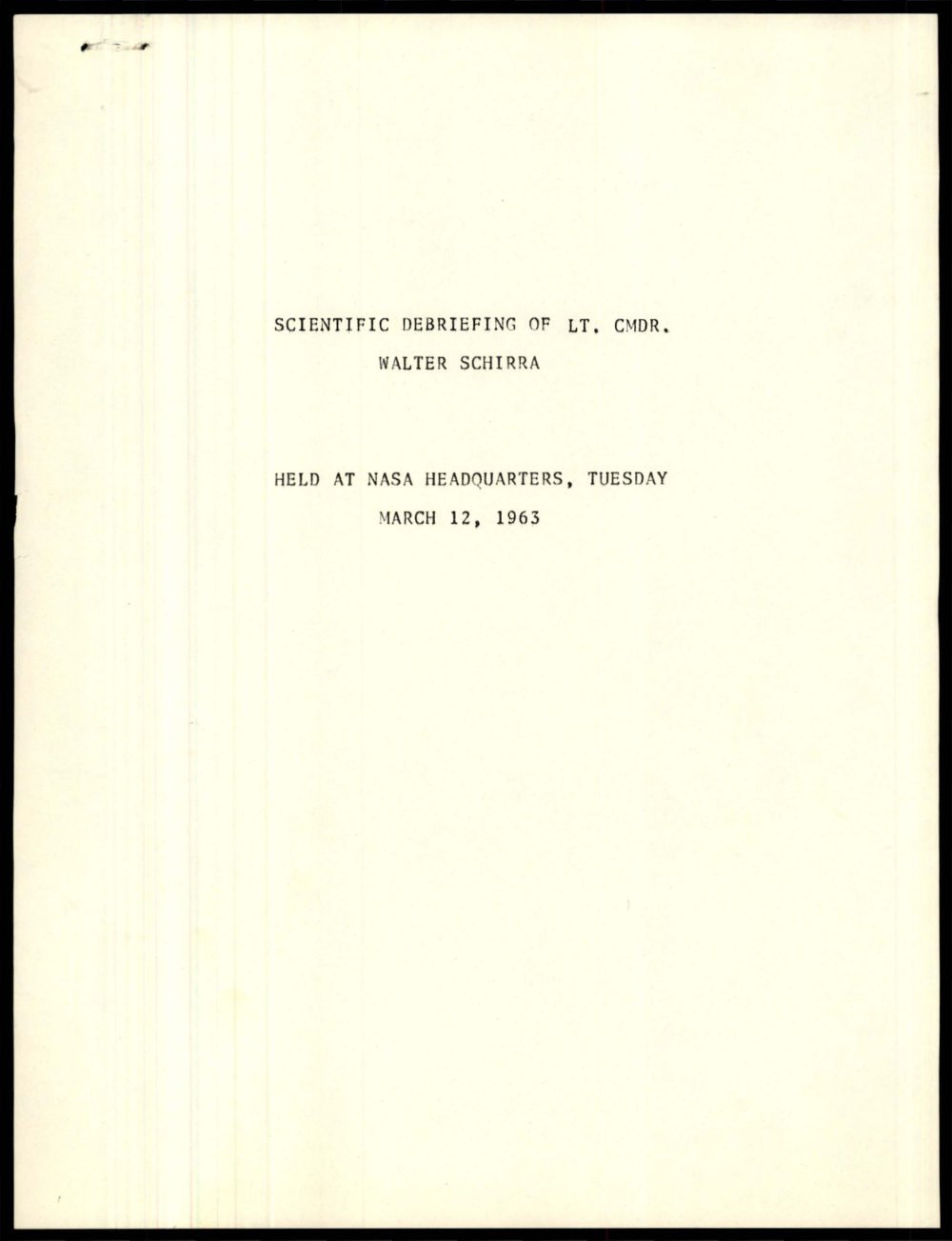 Debriefing title sheetPhysical page 114
DOCUMENTARY SOURCES · NASA / USG
What the records tell
Walter Schirra flew Sigma 7 on October 3, 1962. Five months later, on March 12, 1963, he sat down with scientists from NASA and the Goddard Center for a scientific debriefing chaired by Eugene Shoemaker. A memorandum from November 1963 states that the document is the verbatim transcript of the recording, distributed first only to the participants, who could comment or request cuts before an edited version.
Schirra began with the window. He said the escape rocket firing left marks and a film on the glass, visible when the Sun struck it from the side, like the smoke film that builds up on the inside of a car window. He estimated that it reduced the stars he could see by about one magnitude. He expected the film to evaporate in the vacuum, but noticed no reduction over the course of the flight. One participant recounted that a camera on the TIROS weather satellite stayed fogged for hundreds of orbits from the same kind of problem.
From there he moved on to the particles. For Schirra, the spacecraft lives surrounded by its own environment, because systems such as the water coolers and the hydrogen peroxide keep releasing gases, as happens in vacuum chamber tests. That, he said, is where “our fireflies, the frost particles” came from. He recalled seeing them almost immediately after reaching orbit, when he announced “I see frost flakes,” and that they were the only trace of anything around the spacecraft. He could see them only when the Sun came through the window at a low angle.
Schirra separated two aspects. The white particles had visible edges and resembled frost, which led him to say they could only be water. The yellow-green ones, a color he called chartreuse, looked like patches without outline, like the light of a firefly. In his view, this color came from sunlight passing through a great deal of atmosphere at daybreak: the particles would not have had their own light, but would only have reflected as if they did. John O'Keefe objected that light filtered by the atmosphere would be red, but admitted that the sum of direct light and scattered light could produce the hue described.
The debriefing shows the astronaut taking part in the interpretation, and not only reporting. The explanation involving gases and vapor from the spacecraft itself is his, and it matches the one NASA had been formulating for the “Glenn effect.” NASA also published an audio recording of the flight in which Schirra describes “small white objects” coming off the capsule and a flash at the window that he could not identify (NASA-UAP-D012). This flash is not discussed in the consulted pages of the debriefing.
The debriefing shows that the window issue and the particles issue were treated as a single problem. Schirra explained that the film left by the escape rocket cost him about one magnitude of star visibility and that he saw more stars from an airplane cockpit than in orbit. John Nordberg, of the Goddard Center, said that a camera on a Tiros weather satellite stayed fogged for hundreds of orbits and that the problem went away once they began covering it. For Schirra, Gemini and Apollo needed protected windows. In the same conversation, John O'Keefe suggested a transparent grease that would come off in the vacuum.
On the particles, the debriefing records more than their origin. Maurice Dubin asked whether Schirra had seen any gas around the spacecraft in shadow, and he said he had looked and that the only trace was the particles. O'Keefe and Urner Liddel pointed out the two difficulties with the condensation explanation: the pressure around the spacecraft and the evaporation rate. The discussion also moved on to a third hypothesis, that of physicist Charles Herzfeld, published in the journal Science in July 1962, which linked the green color to nitrogen. Schirra, who thought the nitrogen would come from the spacecraft, was corrected: Herzfeld was talking about nitrogen in the air.
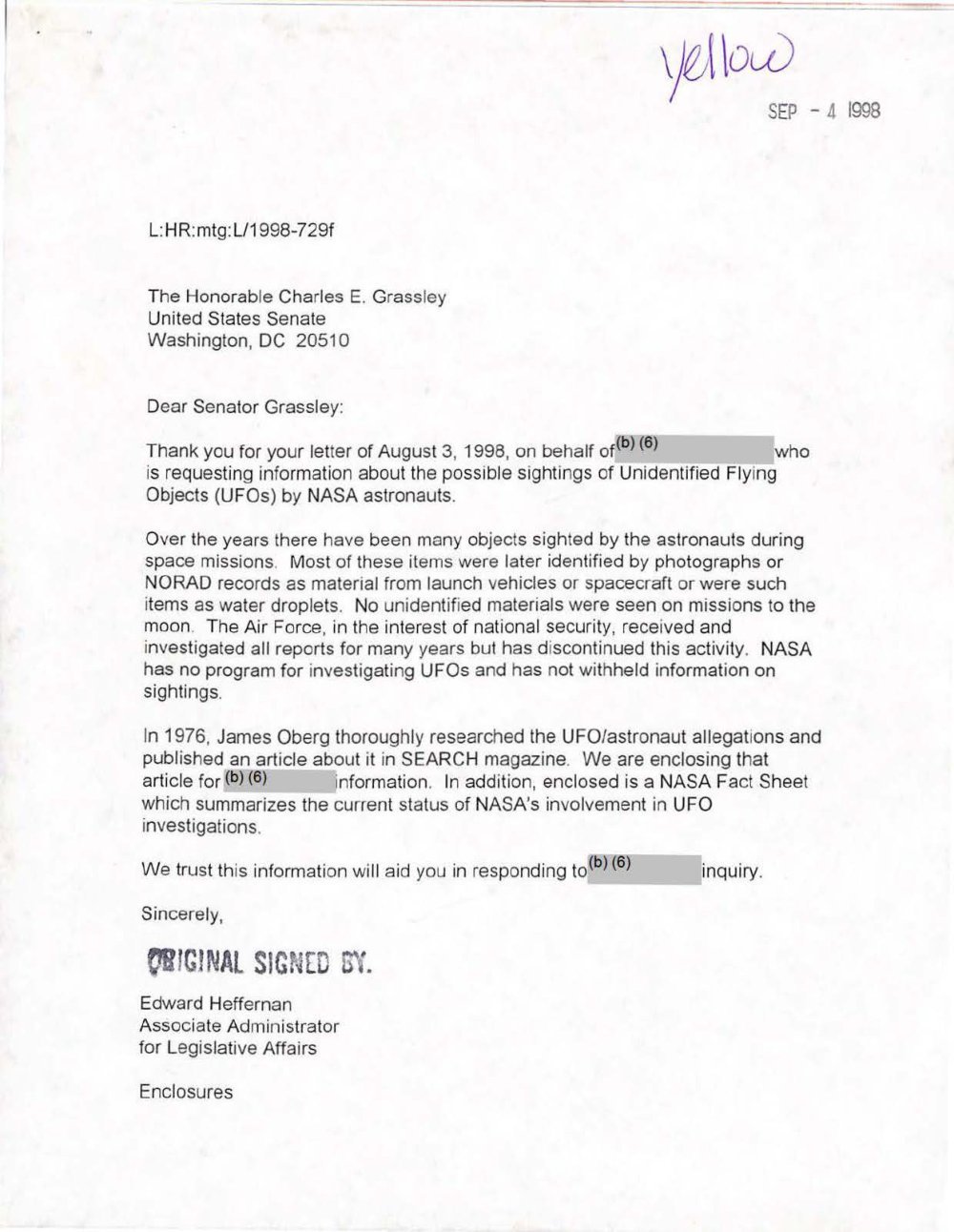
A claim of a different nature appears in the 1998 file. A compilation sent by a constituent to Senator Charles Grassley asserts that Schirra, on Mercury 8, allegedly used “Santa Claus” as a code to report the presence of UFOs, and, right after quotations attributed to Maurice Chatelain, presented as a former chief of NASA communication systems, it reproduces a text in quotation marks, with no author given, making the same assertion. Neither passage gives a date, time or recording of the alleged message. There is no NASA document in the collection, nor any excerpt of the flight audio, containing that expression. NASA replied to the senator by sending a critical essay on astronaut reports.
OFFICIAL MEDIA
Official video for this case
Files published by the United States Government on DVIDS. The title of each one is that of the official publication, translated; the description of what is seen is in the dossier text.
NASA mission audio · 3 min 31 s · the video only loads when you start playback, directly from the official server.
Official record ↗More images from the document
DIRECT READING OF THE FILE
The document, in the original
NASA transcript, a U.S. government work: Schirra's statements translated after checking against the facsimile; the rest of the debriefing (planet Mercury, horizon colors) was not translated.
EXCERPT 1 · PHYSICAL PAGE 114
Physical page 114, full text: title sheet
SCIENTIFIC DEBRIEFING OF LT. CMDR.
WALTER SCHIRRA
HELD AT NASA HEADQUARTERS, TUESDAY
MARCH 12, 1963Editorial note: Title page of the transcript. Schirra was a lieutenant commander in the U.S. Navy.
Check the original PDF
SCIENTIFIC DEBRIEFING OF LT. CMDR.
WALTER SCHIRRA
HELD AT NASA HEADQUARTERS, TUESDAY
MARCH 12, 1963View the document record ↗ · Physical page 114, counting the cover.
EXCERPT 2 · PHYSICAL PAGE 115
Physical page 115, full text: distribution memorandum from Jocelyn R. Gill, 15/11/1963
-
FOR OFFICIAL USE ONLY
15 November 1963
In Reply Refer to:
SM(JRG:neml_
1EMORANDUM FOR: All Participants
FROM : J. R. Gill
SUBJECT: Scientific Debriefing of Lt.
Walter Schirra, held at NASA
Cmdr.
, Headquarters, 1arch 12, 1963
This document is a literal transcription of the
subject de-briefing made from the tape recording.
It is issued to participants only for their
comments · and/or re~ommended deletbn. Deadline
for receipt of this is December 20, 1963. After
that time an edited version may be prepared for
wider distribution.
~ Q:~
gocel~n R. Gi ll
Enclosure
FOR OFFICIAL USE ONLYEditorial note: "For Official Use Only" was an administrative marking for restricted circulation, not a security classification. The transcript was distributed eight months after the session.
Check the original PDF
FOR OFFICIAL USE ONLY
15 November 1963
In Reply Refer to: SM(JRG:nem)
MEMORANDUM FOR: All Participants
FROM: J. R. Gill
SUBJECT: Scientific Debriefing of Lt. Cmdr. Walter Schirra, held at NASA Headquarters, March 12, 1963
This document is a literal transcription of the subject de-briefing made from the tape recording. It is issued to participants only for their comments and/or recommended deletion. Deadline for receipt of this is December 20, 1963. After that time an edited version may be prepared for wider distribution.
[signature] Jocelyn R. Gill
Enclosure
FOR OFFICIAL USE ONLYView the document record ↗ · Physical page 115, counting the cover.
EXCERPT 3 · PHYSICAL PAGE 116
Physical page 116 (pages 1 and 2 of the transcript), full text: participants and first question
p 1 &2
Dro Eugene M. Shoemaker, Chairman~· Manned· Space Science
Working Group served as Chairman, substituting for Dr. John Clark,
Chief Scientisto The following people were present:
Mro Carl Abraham, NASA Headquarters
Mr~ Richard Daniels, NASA Headquarters
Oro Winifred Cameron, Goddard .Space Flight Center
Mr. Maurice Dubin, NASA Headquarters
Mr. Larry Dunkelman, Goddard Space Flight Center
Dr. Jocelyn Ro Gill, NASA Headquarters
Oro Dale Jenkins, NASA Headquarters·
Dr. Urner Liddel, NASA H~adquarters
Mr. Oran Nicks, NASA Headquarters
Oro John Nordberg, Goddard Space Flight Center
Oro John O'Keefe, Goddard Space Flight Center
Cmdr. Walter Schirra, Manned Spacecraft Center
Mr. George Tennyson, Goddard Space Flight Center
Oro Eugene M, Shoemaker, NASA Headquarters
Dr. Shoemaker - I have a series of written questions to start
things off. These have been submitted by some of the _people here
today and we may then ask for some supplementary questions from
the rest of the people this morning. We might start off with
the question on airglowo Will you give us· an account of
Mercury's passage through the airglow layers? How did you identify
the planet Mercury? Did it seem to have color? Were there any
stars nearby?
Cmdr. Schirra - I think Larry Dunkelman and I discussed this atEditorial note: Typed verbatim transcript of the scientific debriefing of 12/03/1963, with the participants' names underlined in the original. The attendance list does not include Nancy Roman, who speaks throughout the transcript ("Dr. Roman"). The answer continues on pp. 117 and 118, about the planet Mercury, outside the episode.
Check the original PDF
Dr. Eugene M. Shoemaker, Chairman, Manned Space Science Working Group served as Chairman, substituting for Dr. John Clark, Chief Scientist. The following people were present:
Mr. Carl Abraham, NASA Headquarters
Mr. Richard Daniels, NASA Headquarters
Dr. Winifred Cameron, Goddard Space Flight Center
Mr. Maurice Dubin, NASA Headquarters
Mr. Larry Dunkelman, Goddard Space Flight Center
Dr. Jocelyn R. Gill, NASA Headquarters
Dr. Dale Jenkins, NASA Headquarters
Dr. Urner Liddel, NASA Headquarters
Mr. Oran Nicks, NASA Headquarters
Dr. John Nordberg, Goddard Space Flight Center
Dr. John O'Keefe, Goddard Space Flight Center
Cmdr. Walter Schirra, Manned Spacecraft Center
Mr. George Tennyson, Goddard Space Flight Center
Dr. Eugene M. Shoemaker, NASA Headquarters
Dr. Shoemaker - I have a series of written questions to start things off. These have been submitted by some of the people here today and we may then ask for some supplementary questions from the rest of the people this morning. We might start off with the question on airglow. Will you give us an account of Mercury's passage through the airglow layers? How did you identify the planet Mercury? Did it seem to have color? Were there any stars nearby?
Cmdr. Schirra - I think Larry Dunkelman and I discussed this atView the document record ↗ · Physical page 116, counting the cover.
EXCERPT 4 · PHYSICAL PAGE 119
Physical page 119 (page 5 of the transcript), full text
•
5
not that much of an artist or poet, but I was trapped with this
set of blues and I did expand on it at greath length, I thought.
These electric blues -
O' Ke efe - (Interrupting) Subtraction is what it sounds like.
Schirra - So it connotes ozone in that sense - electric blue -
is exactly what it looked like, A very, very satisfying color.
Dr . Roman - Coming back to the color of Mercury, do I gather from
your comment that you feel it was distinctly yellow, yellowish
f or example, or was it that you didn't pay a great deal of
attention to?
Schirra - No, Nancy, I would say it is very much like any other
star that · I would see, rather than having a color. I didn't
detect a color.
Dr. Roman - Astronomers think of stars as having color,
Schirra - I have seen different-colored stars from earth-bound
environment and anticipated or, in fact,I was looking for different
colored stars or planets and did not detect any colors.
Roman - This means that your background was just a little too
bright to see colors.
Schirra - That, and the window itself just isn't an optimum plate -
series of plates - to look thro~gh. I insisted that what I really
felt had happeried is that I was seeing no more than about 5th or 6th
magni t ude stars ·that the clouding of the· windows, as a result of
the escaped rocket, reduced my visibility of the stars about one
magnitude. In other words there wasn't gross clouding of the win
dow . That is what I was trying to make clear by using magnitude of
stars as the yardstick in this case. I'll stick with that. ThisEditorial note: Verbatim typed transcript of the scientific debriefing of 12/03/1963, with the participants' names underlined in the original. "Greath" and "escaped rocket" appear this way in the original (for "great" and "escape rocket"). On the magnitude scale, larger numbers indicate fainter stars; losing one magnitude means seeing fewer stars.
Check the original PDF
not that much of an artist or poet, but I was trapped with this set of blues and I did expand on it at greath length, I thought. These electric blues -
O'Keefe - (Interrupting) Subtraction is what it sounds like.
Schirra - So it connotes ozone in that sense - electric blue - is exactly what it looked like. A very, very satisfying color.
Dr. Roman - Coming back to the color of Mercury, do I gather from your comment that you feel it was distinctly yellow, yellowish for example, or was it that you didn't pay a great deal of attention to?
Schirra - No, Nancy, I would say it is very much like any other star that I would see, rather than having a color. I didn't detect a color.
Dr. Roman - Astronomers think of stars as having color.
Schirra - I have seen different-colored stars from earth-bound environment and anticipated or, in fact, I was looking for different colored stars or planets and did not detect any colors.
Roman - This means that your background was just a little too bright to see colors.
Schirra - That, and the window itself just isn't an optimum plate - series of plates - to look through. I insisted that what I really felt had happened is that I was seeing no more than about 5th or 6th magnitude stars that the clouding of the windows, as a result of the escaped rocket, reduced my visibility of the stars about one magnitude. In other words there wasn't gross clouding of the window. That is what I was trying to make clear by using magnitude of stars as the yardstick in this case. I'll stick with that. ThisView the document record ↗ · Physical page 119, counting the cover.
EXCERPT 5 · PHYSICAL PAGE 120
Physical page 120 (page 6 of the transcript), full text
•
6
is about the best way I can describe it. I could see more stars,
as Scott Carpenter described it, when back on th~ surface of the
e arth and many, many more stars in an airplane cockpit than in
or bital flight.
Roman - You could see more in an airplane?
Schi rra - Yes. So in the debriefing of the flight I stated that
this is not a problem for pursuit of Mercury flights. It is a
pr ob lem for pursuit of space observation and with the Gemini
vehic le, we have so1v~d th i s by having the windows properly
covered and also we hope so - well, Gemini doesn't have an escape
r ocket for one, which helps us, Now on Apollo, we are plus or
minus on whether we can afford the weight of having window
cove r s, but if we do, it does have an escape rocket. If we have
covers, then these windows should be protected. And better, becaus e we will need the stars on this particular mission. But to go
back and try to cover the Mercury window at this late date would
be pr ohibitive hardware-wise and schedule -wise.
O' Ke e fe = What would you cover it with?
Schir ra - First of all for Gemini, we have no problem. There is
no tower· rocket . With Apollo they had window shutters the last
time I saw the mock - up which is not at all static. It is quite
dynamic even though it hasn't flown. How this will be done I
don ' t know, but I think this is a requirement. I don ' t even think
it; I know it is a requirement for Apollo.
O'Keefe - You don ' t think there is a possibility of putting a thin -
say, some transparent grease over the window - which would comeEditorial note: Verbatim typed transcript of the scientific debriefing of 12/03/1963, with the participants' names underlined in the original. The escape rocket sat on a tower above the Mercury capsule and was jettisoned shortly after launch.
Check the original PDF
is about the best way I can describe it. I could see more stars, as Scott Carpenter described it, when back on the surface of the earth and many, many more stars in an airplane cockpit than in orbital flight.
Roman - You could see more in an airplane?
Schirra - Yes. So in the debriefing of the flight I stated that this is not a problem for pursuit of Mercury flights. It is a problem for pursuit of space observation and with the Gemini vehicle, we have solved this by having the windows properly covered and also we hope so - well, Gemini doesn't have an escape rocket for one, which helps us. Now on Apollo, we are plus or minus on whether we can afford the weight of having window covers, but if we do, it does have an escape rocket. If we have covers, then these windows should be protected. And better, because we will need the stars on this particular mission. But to go back and try to cover the Mercury window at this late date would be prohibitive hardware-wise and schedule-wise.
O'Keefe - What would you cover it with?
Schirra - First of all - for Gemini, we have no problem. There is no tower rocket. With Apollo they had window shutters the last time I saw the mock-up which is not at all static. It is quite dynamic even though it hasn't flown. How this will be done I don't know, but I think this is a requirement. I don't even think it; I know it is a requirement for Apollo.
O'Keefe - You don't think there is a possibility of putting a thin - say, some transparent grease over the window - which would comeView the document record ↗ · Physical page 120, counting the cover.
EXCERPT 6 · PHYSICAL PAGE 121
Physical page 121 (page 7 of the transcript), full text
•
7
off in the vacuum?
Schirra· - This might be a way of doing it. Having it sublime
away or something of this order.
O'Keefe - That could be done. If that were done ...
Schirra - I definitely feel that th~s should not be a neglected
problem; if we, for example, do remove the window cover from the
Apollo command module. It definitely should have some type of
protection when the star rocket goes. This is going to be a
by-product of its own combustion, it won't leave marks on the
window. I saw marks on mine as weli as a clouded effect and I
feel so strongly about this~- When I had the sun at oblique
angles shallow to the window I could see this film much as you
describe it. Smokers in the gr~up will appreciate this. On the
inside of an· automobile window, you can see the smoke condensation on there which you very rarely get washed off until you wash
the car yourself . You see this when you have light at very
oblique angles across this window. This is about the same type of
intensity - it is not enough to restrict your vision although it
does affect it at night. This is exactly why I make the point.
I think · that is about the easiest analogy I can make for you.
Dr. Nordberg - You say this was on the Mercury window after the
exhaust.
Schirra - Yes sir, this is the result of this exhaust gas bathing
this window as the rocket lit and left almost instantaneously, but
the gas does form over it.Editorial note: Verbatim typed transcript of the scientific debriefing of 12/03/1963, with the participants' names underlined in the original. "Star rocket" appears this way in the original; from the context, it refers to the escape rocket. The sentence "it won't leave marks on the window" is ambiguous in the original; it was translated as a rhetorical question, which is the most likely meaning.
Check the original PDF
off in the vacuum?
Schirra - This might be a way of doing it. Having it sublime away or something of this order.
O'Keefe - That could be done. If that were done ...
Schirra - I definitely feel that this should not be a neglected problem; if we, for example, do remove the window cover from the Apollo command module. It definitely should have some type of protection when the star rocket goes. This is going to be a by-product of its own combustion, it won't leave marks on the window. I saw marks on mine as well as a clouded effect and I feel so strongly about this -- When I had the sun at oblique angles shallow to the window I could see this film much as you describe it. Smokers in the group will appreciate this. On the inside of an automobile window, you can see the smoke condensation on there which you very rarely get washed off until you wash the car yourself. You see this when you have light at very oblique angles across this window. This is about the same type of intensity - it is not enough to restrict your vision although it does affect it at night. This is exactly why I make the point. I think that is about the easiest analogy I can make for you.
Dr. Nordberg - You say this was on the Mercury window after the exhaust.
Schirra - Yes sir, this is the result of this exhaust gas bathing this window as the rocket lit and left almost instantaneously, but the gas does form over it.View the document record ↗ · Physical page 121, counting the cover.
EXCERPT 7 · PHYSICAL PAGE 122
Physical page 122 (page 8 of the transcript), full text
8
Nordberg - Could you, were you able to observe, during the orbital
flight any decrease in the film on the window. It may have evaporated
away , or did it just stay?
Schirra - I was hoping to see that and I did not observe a decrease o
This surprised me too. I would anticipate that that gas would sub -
lime awayo I suspect that the vehicle itself • ,. we are getting
into the fireflies again - but the vehicle itself is surrounded by
an environmento We have the same problem when we try to run a
capsule or· spacecraft in an altitude chamber. It is outgassing
the water cooler systems and other components even in a mancreated vacuum .and as a result we can't maintain this vacuum
because it is creating an environment all the time. I think this
is what we have done in the Mercury spacecraft with the byproduct hydrbgen peroxide gas and the water coolers antl this is
where I feel our firefly, frost particles come from. Oid you
notice ~b~the ·~ay- getting into that, - that the particles were
observed almost immediately after I w·as •in orbit? - I said, "I
see frost flakes."
Mr. Dubin -~You were in sunlight at that time too •. ..
Schirra - That's correct. This is my only definition of the
difference in the way the sunlight itself gets to where I waso
Meaning that at sunrise it goes through a lot of atmosphere,
and as I get into sun above my horizon, I have no atmosphere;
so then its white again.
Nordberg - This deposit is of great interest to us . That isEditorial note: Verbatim typed transcript of the scientific debriefing of 12/03/1963, with the participants' names underlined in the original. Hydrogen peroxide fed the capsule's attitude control thrusters. The passage about the origin of the particles had already been translated on the site; the wording was kept.
Check the original PDF
Nordberg - Could you, were you able to observe, during the orbital flight any decrease in the film on the window. It may have evaporated away, or did it just stay?
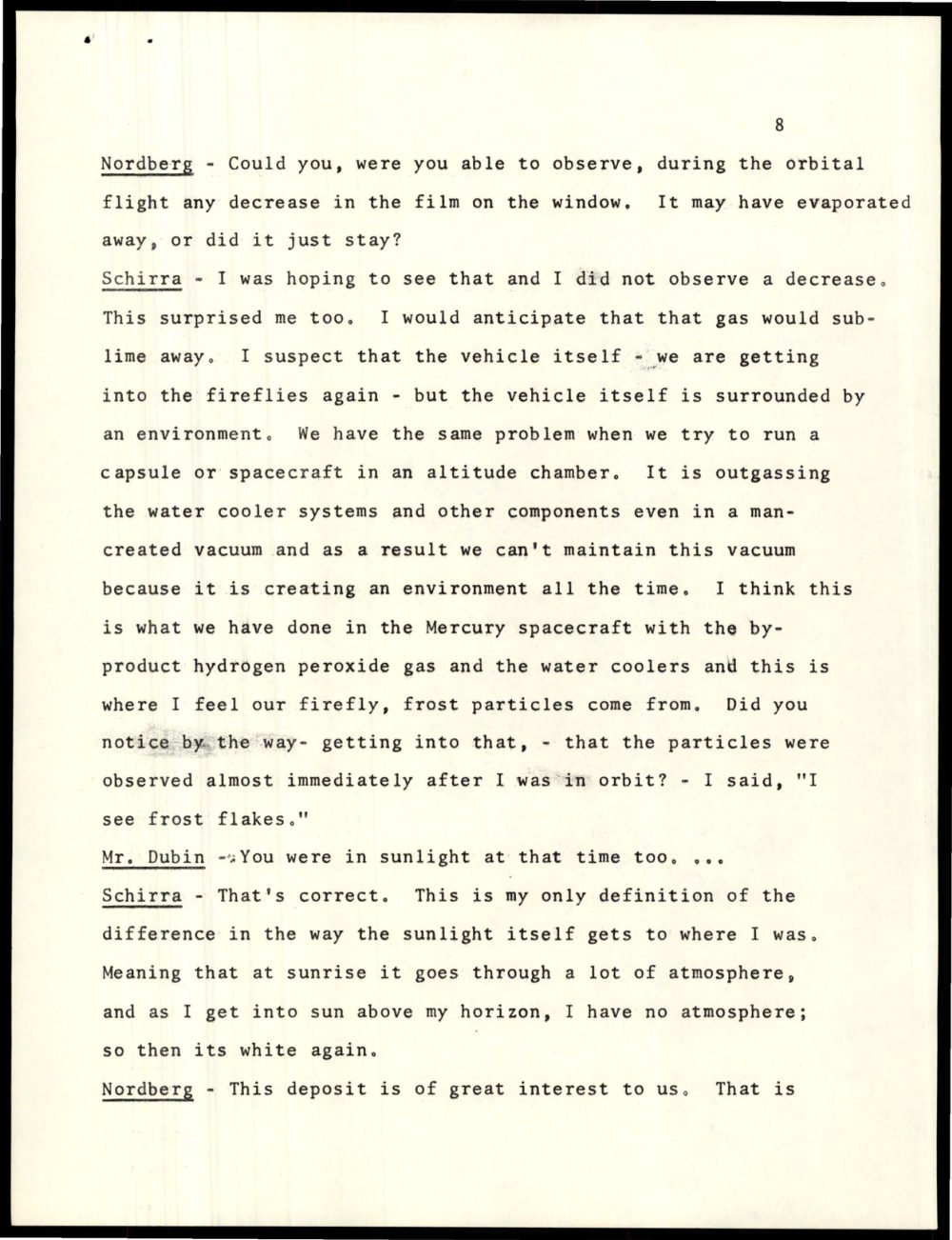
Schirra - I was hoping to see that and I did not observe a decrease. This surprised me too. I would anticipate that that gas would sublime away. I suspect that the vehicle itself - we are getting into the fireflies again - but the vehicle itself is surrounded by an environment. We have the same problem when we try to run a capsule or spacecraft in an altitude chamber. It is outgassing the water cooler systems and other components even in a man-created vacuum and as a result we can't maintain this vacuum because it is creating an environment all the time. I think this is what we have done in the Mercury spacecraft with the by-product hydrogen peroxide gas and the water coolers and this is where I feel our firefly, frost particles come from. Did you notice by the way- getting into that, - that the particles were observed almost immediately after I was in orbit? - I said, "I see frost flakes."
Mr. Dubin - You were in sunlight at that time too. ...
Schirra - That's correct. This is my only definition of the difference in the way the sunlight itself gets to where I was. Meaning that at sunrise it goes through a lot of atmosphere, and as I get into sun above my horizon, I have no atmosphere; so then its white again.
Nordberg - This deposit is of great interest to us. That isView the document record ↗ · Physical page 122, counting the cover.
EXCERPT 8 · PHYSICAL PAGE 123
Physical page 123 (page 9 of the transcript), full text
9
why I asked the question because we observed this on Tiros tooo
One of the two cameras was just completely clouded for a few
hundred· orbits and then gradually after a few hundred orbits it
improved a little bit o
Schirra - I need a little more flight time: I ' m all for ito
Nordberg - We eliminated this by putting a sheet over it in
third stage and since then we have never had any troubleo
Schirra - Sure p that's ito I am sure this is something we
can't let rest o We've got to cover these windows to protect
them from clouding during the transition to where we are now
to space itselL
Dubin - Do you ever detect any gas around the vehicle? In sunlight due to shadowing of the vehicleo
Schirra - No, I looked for thato The only vestige of something .
• around me were these particles as we have described them.
O'Keefe - Well, it is very helpful to know that they were seen
throughout the dayo
Schirra - Yes, I think really what it depended on was how much
sunlight I had coming through the window. If it was really
bright within the vehicle, I didn't see them as wello If I got
an off- angle where the sun was fairly shallow in relation to my
windowp I could then see these particles; of course, up until my
loca l noonp I did not see them anyway.
-O'~Keef·e - About this problem of condensation and the local environment you are speaking of, I think that someone investigated that at
the Manned Spacecraft Center. It is quite true that with an outflowEditorial note: Verbatim typed transcript of the scientific debriefing of 12/03/1963, with the participants' names underlined in the original. Tiros was the U.S. series of weather satellites, begun in 1960.
Check the original PDF
why I asked the question because we observed this on Tiros too. One of the two cameras was just completely clouded for a few hundred orbits and then gradually after a few hundred orbits it improved a little bit.
Schirra - I need a little more flight time! I'm all for it.
Nordberg - We eliminated this by putting a sheet over it in third stage and since then we have never had any trouble.
Schirra - Sure, that's it. I am sure this is something we can't let rest. We've got to cover these windows to protect them from clouding during the transition to where we are now to space itself.
Dubin - Do you ever detect any gas around the vehicle? In sunlight due to shadowing of the vehicle.
Schirra - No, I looked for that. The only vestige of something around me were these particles as we have described them.
O'Keefe - Well, it is very helpful to know that they were seen throughout the day.
Schirra - Yes, I think really what it depended on was how much sunlight I had coming through the window. If it was really bright within the vehicle, I didn't see them as well. If I got an off-angle where the sun was fairly shallow in relation to my window, I could then see these particles; of course, up until my local noon, I did not see them anyway.
O'Keefe - About this problem of condensation and the local environment you are speaking of, I think that someone investigated that at the Manned Spacecraft Center. It is quite true that with an outflowView the document record ↗ · Physical page 123, counting the cover.
EXCERPT 9 · PHYSICAL PAGE 124
Physical page 124 (page 10 of the transcript), full text
10
of gas like that the ambient pressure - the general ambient
pressure - is quite different from the pressure right around
your vehicle o I still wonder whether you can get the pressure
up around the vehicle for the level where condensation takes
place" I have been trying to persuade some people that the
condensation takes place before it leaves these ports of course
as it spreads out in space " The pressure is certainly much higher
around the bottom of the heat shield, but I do not know whether
that is right or not"
Shoemaker - Do we have any more questions on the airglow?
They are very usefulo
Dr o Liddel - We have two problems here o One is the pressure and the
other is the rate of evaporation "
O'Keefe - That's trueo Once formed, they may not sublime out.
Question is how were they formed.
Schirra - I think there is one thing that we might bring into this
before we leave it unless there is a separate question on it o
The green - yellow~ almost a chartreuse, coloring of these particles,
I feel, did not permit you to see the edges of the particles as
well as they appeared when they were in the white band in the
sense of looking like frost particles o So they looked more like
blobs and· this is typical of fireflies themselves " You can ' t defi ne
the size of the blob you see as green- yellow ~ but if you see a snowflake, which is white, you can very e asily see its edges in a sense .
Not that you focus on them but you can visualize that they have
edges . This is a point that I don't think I have made in the past,Editorial note: Verbatim typed transcript of the scientific debriefing of 12/03/1963, with the participants' names underlined in the original. "Chartreuse" is a yellowish green. O'Keefe's sentence about condensation "before going out through the vents" is ambiguously constructed in the original; the translation follows the sense that the condensation would occur before the gas exited.
Check the original PDF
of gas like that the ambient pressure - the general ambient pressure - is quite different from the pressure right around your vehicle. I still wonder whether you can get the pressure up around the vehicle for the level where condensation takes place. I have been trying to persuade some people that the condensation takes place before it leaves these ports of course as it spreads out in space. The pressure is certainly much higher around the bottom of the heat shield, but I do not know whether that is right or not.
Shoemaker - Do we have any more questions on the airglow? They are very useful.
Dr. Liddel - We have two problems here. One is the pressure and the other is the rate of evaporation.
O'Keefe - That's true. Once formed, they may not sublime out. Question is how were they formed.
Schirra - I think there is one thing that we might bring into this before we leave it unless there is a separate question on it. The green-yellow, almost a chartreuse, coloring of these particles, I feel, did not permit you to see the edges of the particles as well as they appeared when they were in the white band in the sense of looking like frost particles. So they looked more like blobs and this is typical of fireflies themselves. You can't define the size of the blob you see as green-yellow, but if you see a snowflake, which is white, you can very easily see its edges in a sense. Not that you focus on them but you can visualize that they have edges. This is a point that I don't think I have made in the past,View the document record ↗ · Physical page 124, counting the cover.
EXCERPT 10 · PHYSICAL PAGE 125
Physical page 125 (page 11 of the transcript), full text
., '
\':
. ·, , 11
but· I think this is basically why we refer to the white particles
as · frost because it does remind us of this. This is what probably
tempts · me • to say that it has to be watero
Cameron - Do you think the chartreuse ones were maybe the ones that
Glenn· thought actually glowed, didnvt he? They were lighted
wrong.
Schirra· - I think - well this gets back · to my opinion and I
saw myself on film yesterday at the press conference talking
about it and said that I guess we need some more opinions but we
ha~three opinions now and basically I put two together and made
my · own, but the green I feel is strictly the case of the sunlight
going through this tremendou~ amount of atmosphere at sunriseo
What is left· as a light spectrum is this green - yellow on these
particles. You can all explain this better than· I can, I am sure ,
but what gets through all this atmosphere would probab1y be this
green- yellow. I think that in a sense they are not self-illuminated· but they reflect as if they were self-illuminated.
O'Keefe - Well, if you pass sunlight through a 1:hick layer of
atmosphere then, of course, what you will get will be a red - a
deep red - however, that doesn't necessarily. prove that you are
wrong in what you are saying because the things would be illuminated
in two ways . They would be illuminated not only by the direct
sunlight~ but also by the scattered· light around the horizon
which · you have photographed at sunrise and the combination of these
two colors might give you a chartreuse as you have said because it
is a double · illumination. However, there is another possibleEditorial note: Verbatim typed transcript of the scientific debriefing of 12/03/1963, with the participants' names underlined in the original. "They were lighted wrong" appears this way in the original; it may be a transcription error. The passage about the color had already been translated on the site; the wording was kept.
Check the original PDF
but I think this is basically why we refer to the white particles as frost because it does remind us of this. This is what probably tempts me to say that it has to be water.
Cameron - Do you think the chartreuse ones were maybe the ones that Glenn thought actually glowed, didn't he? They were lighted wrong.
Schirra - I think - well this gets back to my opinion and I saw myself on film yesterday at the press conference talking about it and said that I guess we need some more opinions but we have three opinions now and basically I put two together and made my own, but the green I feel is strictly the case of the sunlight going through this tremendous amount of atmosphere at sunrise. What is left as a light spectrum is this green-yellow on these particles. You can all explain this better than I can, I am sure, but what gets through all this atmosphere would probably be this green-yellow. I think that in a sense they are not self-illuminated but they reflect as if they were self-illuminated.
O'Keefe - Well, if you pass sunlight through a thick layer of atmosphere then, of course, what you will get will be a red - a deep red - however, that doesn't necessarily prove that you are wrong in what you are saying because the things would be illuminated in two ways. They would be illuminated not only by the direct sunlight, but also by the scattered light around the horizon which you have photographed at sunrise and the combination of these two colors might give you a chartreuse as you have said because it is a double illumination. However, there is another possibleView the document record ↗ · Physical page 125, counting the cover.
EXCERPT 11 · PHYSICAL PAGE 126
Physical page 126 (page 12 of the transcript), full text
12
explanation. If it is really true that this chartreuse color
only turns up only at suprise, we may be with the explanation
that · Herzfeldllput forward for it.
Schirra - This is the nitrogen effect?
O'Keefe - Yes.
Schirra - I would like to stamp that one out. We ~an't afford to
have · nitrogen outgas in the vehicle. (Laughter) The only nitrogen
which we have stored aboard is that which pressurizes the hydrogen
peroxide system. If we lose any of that, this is almost fatal.
O'Keefe - Well, there is plenty of nitrogen in the atmosphere at
that level~ · Still -
Schirra· - You mean in the external atmosphere?
O'Keefe - Yes. Ambient atmosphere.
Schirra - Fair enoug~. Well then, that paper - I was left with
the impression· that the nitrogen came from the vehicle itself.
O'Keefe· - I am sure that it didn't cross Herzfeld's mind.
Dubin - There's also nitrogen ...
Schirra - Well, it read that way to me. I should say that I am
very conscious of what nitrogen does for me within the vehicle!
(Laughter) This is basically my control field.
Dubin - I was going to say there is also nitrogen absorbed in met als ..
Schirra - The gaseous content of the vehicle is very carefully
measured prior to sealing up the vehicle for lift off. It is
purged and we go up to about 97 or 98 percent oxygen. Obviously,
there is not much left in the cabin, you can't get it all out becaus e
!/ Abstract published in Voll 136, #3522, p. 1121, July 29, 1962 of
Science by Charles Herzfe d.Editorial note: Verbatim typed transcript of the scientific debriefing of 12/03/1963, with the participants' names underlined in the original. "Only turns up only" appears this way in the original. The footnote is part of the page.
Check the original PDF
explanation. If it is really true that this chartreuse color only turns up only at sunrise, we may be with the explanation that Herzfeld(1) put forward for it.
Schirra - This is the nitrogen effect?
O'Keefe - Yes.
Schirra - I would like to stamp that one out. We can't afford to have nitrogen outgas in the vehicle. (Laughter) The only nitrogen which we have stored aboard is that which pressurizes the hydrogen peroxide system. If we lose any of that, this is almost fatal.
O'Keefe - Well, there is plenty of nitrogen in the atmosphere at that level. Still -
Schirra - You mean in the external atmosphere?
O'Keefe - Yes. Ambient atmosphere.
Schirra - Fair enough. Well then, that paper - I was left with the impression that the nitrogen came from the vehicle itself.
O'Keefe - I am sure that it didn't cross Herzfeld's mind.
Dubin - There's also nitrogen . . .
Schirra - Well, it read that way to me. I should say that I am very conscious of what nitrogen does for me within the vehicle! (Laughter) This is basically my control field.
Dubin - I was going to say there is also nitrogen absorbed in metals...
Schirra - The gaseous content of the vehicle is very carefully measured prior to sealing up the vehicle for lift off. It is purged and we go up to about 97 or 98 percent oxygen. Obviously, there is not much left in the cabin, you can't get it all out because
(1) Abstract published in Vol. 136, #3522, p. 1121, July 29, 1962 of Science by Charles Herzfeld.View the document record ↗ · Physical page 126, counting the cover.
EXCERPT 12 · PHYSICAL PAGE 127
Physical page 127 (page 13 of the transcript), full text
13
you just can't purge particles in the interior in that these are
angles and trap volume~, but I would suspect that we had a very
low order of nitrogen gas within the vehicle that could come out.
Now it can come out if the vehicle's leak rate - in the vehicle is
excessive - and in this one it was somewhat less than 600 cc.
I think it was about 500 -
Dunkelman - 588.
Roman - I think your suggestion, Larry, was that it would be on
the outside of the vehicle.
Schirra - That I hadn't had a feeling for and I suspect this is
the only way you could get it in contrast to getting it from
within. So I won't argue this point. I am well aw~re of the
fact that it could be adsorbed and then passed off in this
environment.
Roman - John, (to Dr. O'Keefe) is it obvious that sunlight coming
through , in the upper atmosphere would be red if you are above
the dust layer?
QJKeefe - Well, when you look at the sun in th~ photographs
which were taken, it looks red.
Roman -· I see.
Schirra - The sunset is red. Same old sun that we see here.
O'Keefe - Yes, but what you1 d see on either side of it - flanking
it - is Maxfield Parish cloud, at least in the color photographs.
I think this is what Maxfield Parish went in for particularly.
He went in for very powerful colors - subtraction colors. Turquo i s e -
rather than the pastels, rather than colors of the spectrum.Editorial note: Verbatim typed transcript of the scientific debriefing of 12/03/1963, with the participants' names underlined in the original. The leak rate is given without a time unit in the original ("600 cc"). "Parish" appears this way in the original; it refers to the painter Maxfield Parrish. On the next physical page (p. 128), the conversation turns to the colors of the horizon and to the planet Mercury; the mention of the "bright area over Madagascar" is in the dossier on the brown band.
Check the original PDF
you just can't purge particles in the interior in that these are angles and trap volumes, but I would suspect that we had a very low order of nitrogen gas within the vehicle that could come out. Now it can come out if the vehicle's leak rate - in the vehicle is excessive - and in this one it was somewhat less than 600 cc. I think it was about 500 -
Dunkelman - 588.
Roman - I think your suggestion, Larry, was that it would be on the outside of the vehicle.
Schirra - That I hadn't had a feeling for and I suspect this is the only way you could get it in contrast to getting it from within. So I won't argue this point. I am well aware of the fact that it could be adsorbed and then passed off in this environment.
Roman - John, (to Dr. O'Keefe) is it obvious that sunlight coming through in the upper atmosphere would be red if you are above the dust layer?
O'Keefe - Well, when you look at the sun in the photographs which were taken, it looks red.
Roman - I see.
Schirra - The sunset is red. Same old sun that we see here.
O'Keefe - Yes, but what you'd see on either side of it - flanking it - is Maxfield Parish cloud, at least in the color photographs. I think this is what Maxfield Parish went in for particularly. He went in for very powerful colors - subtraction colors. Turquoise - rather than the pastels, rather than colors of the spectrum.View the document record ↗ · Physical page 127, counting the cover.
EXCERPT 13 · PHYSICAL PAGE 36
Excerpt from physical page 36: compilation sent by a constituent to Senator Grassley's office in 1998, claim about Schirra (short quotation)
Ed White & James McDivitt
In June 1965, astronauts Ed White (first American to walk in space) and
James McDivitt were passing over Hawaii in a Gemini spacecraft when they
saw a weird-looking metallic object. The UFO had long arms sticking out
of it. McDivitt took pictures with a cine-camera . Those pictures have
never been released .
James Lovell and Frank Borman
In December 1965, Gemini astronauts James Lovell and Frank Borman also
saw a UFO during their second orbit of their record-breaking 14 day
flight. Borman reported that he saw an unidentified spacecraft .some
distance from their capsule. Gemini Control, at Cape Kennedy told him
that he was seeing the final stage of their own Titan booster rocket.
Borman confirmed that he could see the booster rocket all right, but
that he could also see something completely different .
During James Lovell's flight on Gemini 7:
Borman: ER GEMINI 7, HOUSTON HOW DO YOU READ?
Control: Loud and clear 7 go ahead.
Borman: GOT A BOGEY AT 10 O'CLOCK HIGH.
Control: This is Houston. Say again 7.
Borman: SAID WE HAVE A BOGEY AT 10 O'CLOCK HIGH.
control: Roger
Control: Gemini 7, is that the booster or is that an actual sighting?
Borman: WE HAVE SEVERAL...ACTUAL SIGHTINGS.
Control: . ..Estimated distance or size?
Borman: WE ALSO HAVE THE BOOSTER IN SIGHT...
Further controller cuts in: Gemini control here again, the reference in
that conversation was er bogey. It was er Borman who reported sighting
the bogey. Er this is Gemini control Houston at er 4 hours 24 minutes
into the flight.
Ironically, it was Lovell who made the classic statemen t "Please be
informed that there is a Santa Claus". This was during his Apollo 8
flight on Christmas day in 1968 - some people believe there's a deeper
meaning to these words, although the sceptics believe that this was
little more than American humour. However, Walter Schitta, who was
aboard Mercury 8, reputedly used Santa Clause as a code-name for a UFO
presence, adding some weight to the argument that Lovell was
experiencing another sighting.
Neil Armstrong & Edwin "Buzz" Aldrin
According to the NASA Astronaut Neil Armstrong the Aliens have a base on
the Moon and told us in no uncertain terms to get off and stay off the
Moon .
According to hitherto un-confirmed reports, both Neil Armstrong and
Edwin "Buzz" Aldri n saw UFOs shortly after that historic landing on the
Moon in Apollo 11 on 21 July 1969. I remember hearing one of the
astronauts refer to a "light" in or on a crater during the television
transmission, followed by a request from mission control for further
information. Nothi ng more was heard.Editorial note: Text by a private individual, printed from electronic mail and kept by NASA in the file for the reply to the senator; it is not a NASA record. In the debriefing, McDivitt says he saw the object alone for 30 or 40 seconds and does not mention arms, metallic color, or filming. The rest of the page deals with other astronauts; the passage about Gemini 7 is in the "bogey" dossier.
Check the original PDF
However, Walter Schitta, who was aboard Mercury 8, reputedly used Santa Clause as a code-name for a UFO presence, adding some weight to the argument that Lovell was experiencing another sighting.View the document record ↗ · Physical page 36, counting the cover.
EXCERPT 14 · PHYSICAL PAGE 39
Excerpt from physical page 39 of the same compilation, quoted text under the heading "Pilot Walter Schirra" (short quotation)
"There ARE things out there! There absolutely is!"
NASA Pilot Joseph A. Walker
On May 11, 1962 NASA pilot Joseph Walker said that one of his tasks was
to detect UFOs during his X-15 flights. He had filmed five or six UFOs
during his record breaking fifty-mile- high flight in April, 1962. It was
the second time he had filmed UFOs in flight. During a lecture at the
Second National Conference on the Peaceful Uses of Space Research in
Seattle, Washington he said: ..
"I don't feel like speculating about them. All"I know i:s what appeared
on the film which was developed after the flight." - Joseph Walker
To date none of those films has been released to the public for viewing.
Commander Eugene Cernan
Eugene Cernan was commander of Apollo 17. In a Los Angeles Times article
in 1973 he said, about UFOs:
"· .. I've been asked (about UFOs) and I 've said publicly I thought they
{UFOs) were somebody else, some other civilization."
NASA's Maurice Chatelain
In 1979 Maurice Chatelain, former chief of NASA Communications Systems
confirmed that Armstrong had i ndeed reported seeing two UFOs on the rim
of a crater. Chatelain believes that some UFOs may come from our own
solar system -- specifically Titan.
"The encounter was common knowledge in NASA, but nobody has talked about
it until now. 11
" ...all Apollo and Gemini flights were followed, both at a distance and
sometimes also quite closely, by space vehicles of extraterrestrial
origin - flying saucers, or UFOs, if you want to call them by that name.
Every time it occurred, the astronauts informed Mission Control, who
then ordered absolute silence ."
Pilot Walter Schirra
"I think that Walter Schirra aboard Mercury 8 was the first of the
astronauts to use the code name 'Santa Claus • to indicate the presence
of flying saucers next to space capsules. However, his announcements
were barely noticed by the general public.
James Lovell
It was a little different when James Lovell on board the Apollo 8
command module came out from behind the moon and said for everybody to
hear: ' PLEASE BE INFORMED THAT THERE IS A SANTA CLAUS.' Even though this
happened on Christmas Day 1968, many people sensed a hidden meaning in
those words."
The rumors persist. NASA may well be a civilian agency, but many of its
programs are funded by the
defense budget and most of the astronauts are subject to military
security regulations . Apart from the fact that the National Security
Agency screens all films and probably radio communications as well.We
have the statements by Otto Binder, Dr. Garry Henderson and Maurice
Chatelain that the astronauts were under strict orders not to discuss
their sightings. And Gordon Cooper has testified to a United Nations
committee that one of the astronauts actually witnessed a UFO on the
ground. If there is no secrecy, why has this sighting not been made
public?Editorial note: Quotation in quotation marks in the compilation, under the heading "Pilot Walter Schirra," right after quotations attributed to Maurice Chatelain, presented as a former chief of NASA communications systems; the author and the source work of the passage are not indicated. Short quotation, since it is copyrighted third-party text.
Check the original PDF
I think that Walter Schirra aboard Mercury 8 was the first of the astronauts to use the code name 'Santa Claus' to indicate the presence of flying saucers next to space capsules.View the document record ↗ · Physical page 39, counting the cover.
EXCERPT 15 · PHYSICAL PAGE 117
full page
3
great length and I don't know whether we could be any more
expansive on that subject than we have already. The only
thing that I can think of that we didn't talk about is an
e f fective color of the planet 1ercury. It was as white to
me as any other ·star. It was not blue, red or some other color.
It was definitely "star-appearing" to me. It would have a
definite atmosphere where it would change colors and where it
di dn't have · any ·atmosphere, it didn't change colors. I would
say that from that it had no different appearance than if I could
see it from the earth as a star. 1ercury itself was plotted on my
star chart; which is ·a very valuable tool for these flights. There
is just no doubt where Mercury has to be and we checked on it and,
of course; it was Mercury. I think Larry · called me one day and we
all were · surprised that I saw Mercury longer than I shouid have seen
it and I guess this was explained by its being ·seen ·through the
refraction ·of the · atmosphere. Is this ~orrect?
Dr. O' Keefe · - Yes, that's the answer. Mrs. Cameron is the one who
made the contribution. This is her theory.
Schirra - This ·was a tremendous yardstick - as far as I was concerned .
It was so obvious to ·me that I just had to take the time · to desc r ibe
its passage through the various layers of light and the way I
descri bed · it· in the handouts "Results of -Third U. S. fanned
Orbital ·Space ' Flight; October -3, 1962" that you have is about
as accurate · as I can · describe it now .
Dr . Gill - Could you· make a little drawing on ·the blackboard for us ?Editorial note: Scientific debriefing of Walter Schirra (Sigma 7): he says that Mercury looked white like any star and that the fact that he saw it for longer than predicted was explained by atmospheric refraction.
Check the original PDF
3
great length and I don't know whether we could be any more
expansive on that subject than we have already. The only
thing that I can think of that we didn't talk about is an
e f fective color of the planet 1ercury. It was as white to
me as any other ·star. It was not blue, red or some other color.
It was definitely "star-appearing" to me. It would have a
definite atmosphere where it would change colors and where it
di dn't have · any ·atmosphere, it didn't change colors. I would
say that from that it had no different appearance than if I could
see it from the earth as a star. 1ercury itself was plotted on my
star chart; which is ·a very valuable tool for these flights. There
is just no doubt where Mercury has to be and we checked on it and,
of course; it was Mercury. I think Larry · called me one day and we
all were · surprised that I saw Mercury longer than I shouid have seen
it and I guess this was explained by its being ·seen ·through the
refraction ·of the · atmosphere. Is this ~orrect?
Dr. O' Keefe · - Yes, that's the answer. Mrs. Cameron is the one who
made the contribution. This is her theory.
Schirra - This ·was a tremendous yardstick - as far as I was concerned .
It was so obvious to ·me that I just had to take the time · to desc r ibe
its passage through the various layers of light and the way I
descri bed · it· in the handouts "Results of -Third U. S. fanned
Orbital ·Space ' Flight; October -3, 1962" that you have is about
as accurate · as I can · describe it now .
Dr . Gill - Could you· make a little drawing on ·the blackboard for us ?View the document record ↗ · Physical page 117, counting the cover.
EXCERPT 16 · PHYSICAL PAGE 118
full page
•
4
Schirra - Again, Larry, do you have that? (Referring to drawing
prepared by W. Cameron and L. Dunkelman)
Mr . · Dun-ke Iman - We have.
Schirra - We sat down for about an hour and traced this very
carefully.
Mr . Dunkelman - It happens that the movement of Mercury behind
our atmosphere is really not phenomenally related to airglow as
such . Mercury is simply a pointer - an index finger. It gave us
a chance to see what parts of the upper atmosphere you were looking
at and this has more to do with ozone and atmospheric constituents
than it has to do with airglow. We think the answer here lies in
the fact that the ozone is absorbing the orange, yellow, and green
light and leaves this interesting blue which is an ozone blue
rather than a Rayleigh blue and we think the reason why Astronaut
Schirra saw the several shades of blue is he may have been looking
edge - on at the ozone layer. So it is really not so much related to
airglow as it is to the way of looking at what produces the color.
I think we are interested in finding out what causes the phenomenon,
rather than to attempting to learn anything new about the atmosphere . •
Schirra - I think one of the reasons that· I was so enthused about
tracking Mercury through these colors is that I am a fan of blue
colors . I grew up with a Maxfield Parish painting; if anybody
knows his colors of blues - they are fantastic. Gold blues,
electric blues . As a result, these caught my attention. I amEditorial note: Dunkelman explains that the motion of Mercury behind the atmosphere serves as an indicator of the upper layers and attributes the blue to absorption by ozone, not to airglow; Schirra explains his interest in the shades of blue.
Check the original PDF
•
4
Schirra - Again, Larry, do you have that? (Referring to drawing
prepared by W. Cameron and L. Dunkelman)
Mr . · Dun-ke Iman - We have.
Schirra - We sat down for about an hour and traced this very
carefully.
Mr . Dunkelman - It happens that the movement of Mercury behind
our atmosphere is really not phenomenally related to airglow as
such . Mercury is simply a pointer - an index finger. It gave us
a chance to see what parts of the upper atmosphere you were looking
at and this has more to do with ozone and atmospheric constituents
than it has to do with airglow. We think the answer here lies in
the fact that the ozone is absorbing the orange, yellow, and green
light and leaves this interesting blue which is an ozone blue
rather than a Rayleigh blue and we think the reason why Astronaut
Schirra saw the several shades of blue is he may have been looking
edge - on at the ozone layer. So it is really not so much related to
airglow as it is to the way of looking at what produces the color.
I think we are interested in finding out what causes the phenomenon,
rather than to attempting to learn anything new about the atmosphere . •
Schirra - I think one of the reasons that· I was so enthused about
tracking Mercury through these colors is that I am a fan of blue
colors . I grew up with a Maxfield Parish painting; if anybody
knows his colors of blues - they are fantastic. Gold blues,
electric blues . As a result, these caught my attention. I amView the document record ↗ · Physical page 118, counting the cover.
EXCERPT 17 · PHYSICAL PAGE 129
full page
15
meant that it was off to the left of my yaw angle - I was in
flight path in yaw at this instant of time - which means you
could determine where the vehicle was oriented and then also
get the sun-line in relation to the window.
Cameron - Incidentally, the sun must have been very close to
setting at that time, wasn't it?
Schirra - It was setting, in fact. This is where I went on.
There is a dark line at the surface of the earth, orange at
the clouds. Now there was a cloud horizon, as well, that I
could see. Then a light yellow, a light white, and then a
blue band. This was coming from the surface of the earth
going up. A very light blue and then I got all excited and
said that I had the planet Mercury in sight at this point.
Mercury obviously was in the black. It had not come down
into the Mercury set. If you want to describe it in the sense
of sunset, Mercury set. I think it deserves the term of having
the opportunity to set as well. I was coming up from the surface
of the earth towards the darkness of space and then I detected
Mercury where it belonged, trailing the sun.
Dubin - Well! The sun was off to your left about 40 degrees.
Schirra - As well as Mercury,
Dubin - In the same direction?
Schirra - It was trailing almost a~cive the sun in this sense.
Which is where I had it plotted on the star chart. Then I
wanted to describe the blue band and I said that there is aEditorial note: Schirra describes the sunset seen from orbit and the color bands on the horizon (orange, yellow, white, blue), and how he identified Mercury at the predicted point on the star chart.
Check the original PDF
15
meant that it was off to the left of my yaw angle - I was in
flight path in yaw at this instant of time - which means you
could determine where the vehicle was oriented and then also
get the sun-line in relation to the window.
Cameron - Incidentally, the sun must have been very close to
setting at that time, wasn't it?
Schirra - It was setting, in fact. This is where I went on.
There is a dark line at the surface of the earth, orange at
the clouds. Now there was a cloud horizon, as well, that I
could see. Then a light yellow, a light white, and then a
blue band. This was coming from the surface of the earth
going up. A very light blue and then I got all excited and
said that I had the planet Mercury in sight at this point.
Mercury obviously was in the black. It had not come down
into the Mercury set. If you want to describe it in the sense
of sunset, Mercury set. I think it deserves the term of having
the opportunity to set as well. I was coming up from the surface
of the earth towards the darkness of space and then I detected
Mercury where it belonged, trailing the sun.
Dubin - Well! The sun was off to your left about 40 degrees.
Schirra - As well as Mercury,
Dubin - In the same direction?
Schirra - It was trailing almost a~cive the sun in this sense.
Which is where I had it plotted on the star chart. Then I
wanted to describe the blue band and I said that there is aView the document record ↗ · Physical page 129, counting the cover.
EXCERPT 18 · PHYSICAL PAGE 130
full page
16
relatively dark blue band right at the surface of the earth.
Of course, the orange and light yellow was changing at this
point and I then came into seeing this dark blue bando In
other words, I had lost the orange cloud effect just above the
surface of the clouds. This was the same kind of red-orange
we typically see through the atmosphere on the surface of the
earth which is, of course, the atmosphere. I realize this cuts
out most everything but reds and yellow~orange. But the light
yellow wasn't at all unusual either; I had seen this in many
sunsets. The sun had set. I wanted to describe this blue band.
I realized I had gone through some 34 seconds. When I say
describing the blue band, it is some 30 seconds later. Took me,
say, 4 seconds to say that. Relatively dark blue banq right at
the surface of the earth and a light blue band meaning a next
band above it; another dark blue band, a large white band which
is the airglow o This is the way I felt it should be. I have
not made a careful study prior to the time of the various layers
on the earth or above the eartho Then a deep black one and it
sort of goes from a grayish blue · to a dense black, almost looks
like the underneath surfac~ of a summer cumulo-nimbus effect,
where you have a nice bright earth and then you go into this
black cloud and then there is this roll cloud that precedes a
thunder storm and it's a very, very choppy underneath surface.
It looks very turbulent, to you. This surprised me.
expected to see another sharp line and I did not. This is what
IEditorial note: Schirra continues the description of the horizon bands: dark blue next to the Earth, light blue bands and a wide white band (informally called airglow), followed by an irregular transition to black.
Check the original PDF
16
relatively dark blue band right at the surface of the earth.
Of course, the orange and light yellow was changing at this
point and I then came into seeing this dark blue bando In
other words, I had lost the orange cloud effect just above the
surface of the clouds. This was the same kind of red-orange
we typically see through the atmosphere on the surface of the
earth which is, of course, the atmosphere. I realize this cuts
out most everything but reds and yellow~orange. But the light
yellow wasn't at all unusual either; I had seen this in many
sunsets. The sun had set. I wanted to describe this blue band.
I realized I had gone through some 34 seconds. When I say
describing the blue band, it is some 30 seconds later. Took me,
say, 4 seconds to say that. Relatively dark blue banq right at
the surface of the earth and a light blue band meaning a next
band above it; another dark blue band, a large white band which
is the airglow o This is the way I felt it should be. I have
not made a careful study prior to the time of the various layers
on the earth or above the eartho Then a deep black one and it
sort of goes from a grayish blue · to a dense black, almost looks
like the underneath surfac~ of a summer cumulo-nimbus effect,
where you have a nice bright earth and then you go into this
black cloud and then there is this roll cloud that precedes a
thunder storm and it's a very, very choppy underneath surface.
It looks very turbulent, to you. This surprised me.
expected to see another sharp line and I did not. This is what
IView the document record ↗ · Physical page 130, counting the cover.
EXCERPT 19 · PHYSICAL PAGE 131
full page
17
I was referring to here as the transition from the last blue
band I could see to the total darkness of spaceo I gaess this
is the only way I can describe thato This was a surprise to me
to see thisp really o
0 °Keefe = Well, it is astonishing, isn't it?
Schirra - Yes, it iso I expected to see a nice, sharply delineated arcp and this was not the case by any means.
O' Keefe - Whatever it was, it was turbulence?
Schirra = Yes, this is the way I would describe it. It has
to be or the light in a sense made it look turbulent. I
think you have all seen the base of a thunderstorm as it comes
towards you and the light starts diminishing rapidly as you get
a thunderstorm o Just because it is so thick and almost opaque
in contrast to sunlight that can get througho Then we see this
vortex effect underneath it and this is very much the way I
would describe it myselfo This was the transition from visible
to no light o No sharp lineo I think you probably have it
fairly well sketched right thereo
Dubin = Have you seen the sketches? (Mrso Cameron's sketches
of colored bands around the horizono)
Sch i rra - No, I haven'to
O' Keefe = Why don ut you take them around there, Mrs. Cameron 0 0 0
so we can get additions and corrections (to the drawings).
(Schirra and Cameron looking at the drawings)
Cameron = This is your first description (drawing shown to
Schirra) oo o This is the second descriptiono oooEditorial note: Schirra describes the diffuse transition between the last blue band and the darkness of space, comparing it to the turbulent base of a thunderstorm; the participants turn to examining Cameron's drawings.
Check the original PDF
17
I was referring to here as the transition from the last blue
band I could see to the total darkness of spaceo I gaess this
is the only way I can describe thato This was a surprise to me
to see thisp really o
0 °Keefe = Well, it is astonishing, isn't it?
Schirra - Yes, it iso I expected to see a nice, sharply delineated arcp and this was not the case by any means.
O' Keefe - Whatever it was, it was turbulence?
Schirra = Yes, this is the way I would describe it. It has
to be or the light in a sense made it look turbulent. I
think you have all seen the base of a thunderstorm as it comes
towards you and the light starts diminishing rapidly as you get
a thunderstorm o Just because it is so thick and almost opaque
in contrast to sunlight that can get througho Then we see this
vortex effect underneath it and this is very much the way I
would describe it myselfo This was the transition from visible
to no light o No sharp lineo I think you probably have it
fairly well sketched right thereo
Dubin = Have you seen the sketches? (Mrso Cameron's sketches
of colored bands around the horizono)
Sch i rra - No, I haven'to
O' Keefe = Why don ut you take them around there, Mrs. Cameron 0 0 0
so we can get additions and corrections (to the drawings).
(Schirra and Cameron looking at the drawings)
Cameron = This is your first description (drawing shown to
Schirra) oo o This is the second descriptiono oooView the document record ↗ · Physical page 131, counting the cover.
EXCERPT 20 · PHYSICAL PAGE 132
full page
18
Schirra - Yeso Now as we progressed in time to the second
drawing, the sun has now really set and the reds and yellows
(in the drawing) are fine ooo now just getting the afterlight
ooo that 9 s the ragged effect I saw o ooo
Schirra - This isn 1 t as thick as that grey to black band
as I saw it o We are stuck with a small circle (radius of
curvature used in the drawing) and I had a big circle.
Dub i n - Okayp could you re - draw it on the board the way you
saw it?
Schirra - Al l it is is a straight line with a slight curvature
to it o I had a broad angle of view, but the whole thing is
flattened out o I don 9 t see that much curvature at allo
O' Keefe - (to Mrso Cameron) Put in that remark about this
band is too narrow?
Schirra - This is too wideo (indicating drawing) It would be
the grey to black (band)o
Shoemaker - It faded out more rapidly in proportion to the
white band?
Schirra - It was definitely not something you would like to
make with a compass o
Cameron - Narrower and wider ooo I tried to indicate that, but
as to scalep I didn ' t ooo I was just trying 0 0 0
0 8 Keefe - We made a first try at it ooo
Schirra - (Reading in the Blue Book) "I will bring up the
fingertip light o" Th is will clue you o This will make itEditorial note: Corrections to Cameron's drawings of the horizon bands: Schirra says that the gray-black band was narrower and more irregular than the drawing shows and that the curvature was almost imperceptible.
Check the original PDF
18
Schirra - Yeso Now as we progressed in time to the second
drawing, the sun has now really set and the reds and yellows
(in the drawing) are fine ooo now just getting the afterlight
ooo that 9 s the ragged effect I saw o ooo
Schirra - This isn 1 t as thick as that grey to black band
as I saw it o We are stuck with a small circle (radius of
curvature used in the drawing) and I had a big circle.
Dub i n - Okayp could you re - draw it on the board the way you
saw it?
Schirra - Al l it is is a straight line with a slight curvature
to it o I had a broad angle of view, but the whole thing is
flattened out o I don 9 t see that much curvature at allo
O' Keefe - (to Mrso Cameron) Put in that remark about this
band is too narrow?
Schirra - This is too wideo (indicating drawing) It would be
the grey to black (band)o
Shoemaker - It faded out more rapidly in proportion to the
white band?
Schirra - It was definitely not something you would like to
make with a compass o
Cameron - Narrower and wider ooo I tried to indicate that, but
as to scalep I didn ' t ooo I was just trying 0 0 0
0 8 Keefe - We made a first try at it ooo
Schirra - (Reading in the Blue Book) "I will bring up the
fingertip light o" Th is will clue you o This will make itView the document record ↗ · Physical page 132, counting the cover.
EXCERPT 21 · PHYSICAL PAGE 133
full page
19
clear to you that the internal lighting was off inside the
vehicle. I don't know why I didn't bring that point out.
This reminds me that it was dark and it was 0605 52. I had
to see what time it wasa We had this counter clock as you
know, and to see the numerals I had to bring my fingertip
lights up to see them. It was quite dark within the vehicle
and this is quite an advantage to this observation. Then I
say that Mercury is on the horizon and this meant that it was
just coming down through what I described going up, if you can
follow my directions here. This is where Mercury was as the
pointer or index as it passed through these layers. Now· again,
we proceeded through time so that light patterns will change
and that's why these descriptions do conflict as we progress
on in time. I think this might explain why. As I come back
through with Mercury now setting these same light bands are
not the identical ones that I described previously and I used
the word "airglow" and even the way it came out in the tape
I said see the Mercury going through the - and I was searching
for a term and so I just said "airglow" just so I wouldn't
have to get into a big discussion about what I was going to
report on. Actually, I could have said through the -- I was
searching for a term -- but this "airglow" I was using simply
as a term to describe what I was looking at. I could have said
through the lighted horizon.
O'Keefe - Twilight layer is probably a better way to say it.Editorial note: Schirra explains that the interior of the capsule was dark (he used only the fingertip lights) and that he used "airglow" only as an informal label for the illuminated horizon; O'Keefe suggests "twilight layer" as a better term.
Check the original PDF
19
clear to you that the internal lighting was off inside the
vehicle. I don't know why I didn't bring that point out.
This reminds me that it was dark and it was 0605 52. I had
to see what time it wasa We had this counter clock as you
know, and to see the numerals I had to bring my fingertip
lights up to see them. It was quite dark within the vehicle
and this is quite an advantage to this observation. Then I
say that Mercury is on the horizon and this meant that it was
just coming down through what I described going up, if you can
follow my directions here. This is where Mercury was as the
pointer or index as it passed through these layers. Now· again,
we proceeded through time so that light patterns will change
and that's why these descriptions do conflict as we progress
on in time. I think this might explain why. As I come back
through with Mercury now setting these same light bands are
not the identical ones that I described previously and I used
the word "airglow" and even the way it came out in the tape
I said see the Mercury going through the - and I was searching
for a term and so I just said "airglow" just so I wouldn't
have to get into a big discussion about what I was going to
report on. Actually, I could have said through the -- I was
searching for a term -- but this "airglow" I was using simply
as a term to describe what I was looking at. I could have said
through the lighted horizon.
O'Keefe - Twilight layer is probably a better way to say it.View the document record ↗ · Physical page 133, counting the cover.
EXCERPT 22 · PHYSICAL PAGE 134
full page
20
Schirra - Very good, a better way of saying it.
O'Keefe - "Airglow" is a very complicated term. We don't know
what it is all about. That's what we are after. ...
Schirra - In fact, on occasion I have used airglow through
here just out of ignorance. I think what we all are trying
to do right here is to try and clear up some of this ignorance;
so we need more data, of course. Then,I say (reading from the
Blue Book again) "We'll see if she holds up," meaning, can I
track Mercury through all this? That was interesting in
itself, that I could, I thought.
O'Keefe - This was quite important. This was one of the
questions raised by Glenn on his flight whether some layers
are opaque or not.
Schirra - I could track Mercury through all of these points
or layers.
Nicks - Does it change its apparent size like the sun when it
sets?
Schirra ~ I don't recall having observed this.
Roman - Did you see any additional stars ... the fact that it
has a finite disk (Mercury)?
Schirra - No, again the window cuts out the fun of that, I
think.
O'Keefe - No, you wouldn't see a disk ....
Schirra - It would have been great to have had some magnifying
device at this point to make this observation. No, it just lookedEditorial note: The participants acknowledge that "airglow" is a complex term; Schirra says he followed Mercury through all the layers and that it looked like just a star, with no disk visible through the window.
Check the original PDF
20
Schirra - Very good, a better way of saying it.
O'Keefe - "Airglow" is a very complicated term. We don't know
what it is all about. That's what we are after. ...
Schirra - In fact, on occasion I have used airglow through
here just out of ignorance. I think what we all are trying
to do right here is to try and clear up some of this ignorance;
so we need more data, of course. Then,I say (reading from the
Blue Book again) "We'll see if she holds up," meaning, can I
track Mercury through all this? That was interesting in
itself, that I could, I thought.
O'Keefe - This was quite important. This was one of the
questions raised by Glenn on his flight whether some layers
are opaque or not.
Schirra - I could track Mercury through all of these points
or layers.
Nicks - Does it change its apparent size like the sun when it
sets?
Schirra ~ I don't recall having observed this.
Roman - Did you see any additional stars ... the fact that it
has a finite disk (Mercury)?
Schirra - No, again the window cuts out the fun of that, I
think.
O'Keefe - No, you wouldn't see a disk ....
Schirra - It would have been great to have had some magnifying
device at this point to make this observation. No, it just lookedView the document record ↗ · Physical page 134, counting the cover.
EXCERPT 23 · PHYSICAL PAGE 135
full page
21
like a star.
O'Kcefe - I think when Nicks asked if the sun changed in
size, he really - the sun qoesn't change in size as it setso
He meant change in brightnesso
Schirra ~ Apparent size - not the size, but the illusion at
least . I've got to break off a second here. I don't recall
seeing many moon sets on earth~ Have any of you ever seen a
good moon set?
Roman - Yes.
Sch i rra - You have to be on the West Coast to do it; but, of
course, I saw a moon set on this flight and that is why I
brought it up. To me, it was the first real good moon set
I had seen q (Laughter)
O' Keefe - There is a good solid reason for that. That is
t hat a full moon will set at sunrise. Not many people are
up at that time.
Schirra - I hope you have had a· chance to see the photographs
I took of this moon set.
Gill - . No .
Schirra - There are two black and white sets of these. The
original prints were very good. I understand there is a lot
of halati on around this . I definitely think you all should
get these out and examine them. Now the subsequent prints
were not very good. They were too fuzzy .
Gill - Who would have them?Editorial note: It is clarified that the question was about a change in the Sun's brightness as it set; Schirra talks about the moonset he photographed and recommends examining the original prints, which are better than the later ones.
Check the original PDF
21
like a star.
O'Kcefe - I think when Nicks asked if the sun changed in
size, he really - the sun qoesn't change in size as it setso
He meant change in brightnesso
Schirra ~ Apparent size - not the size, but the illusion at
least . I've got to break off a second here. I don't recall
seeing many moon sets on earth~ Have any of you ever seen a
good moon set?
Roman - Yes.
Sch i rra - You have to be on the West Coast to do it; but, of
course, I saw a moon set on this flight and that is why I
brought it up. To me, it was the first real good moon set
I had seen q (Laughter)
O' Keefe - There is a good solid reason for that. That is
t hat a full moon will set at sunrise. Not many people are
up at that time.
Schirra - I hope you have had a· chance to see the photographs
I took of this moon set.
Gill - . No .
Schirra - There are two black and white sets of these. The
original prints were very good. I understand there is a lot
of halati on around this . I definitely think you all should
get these out and examine them. Now the subsequent prints
were not very good. They were too fuzzy .
Gill - Who would have them?View the document record ↗ · Physical page 135, counting the cover.
EXCERPT 24 · PHYSICAL PAGE 163
full page
49
capsule?
Schirra - We have answered that with the fingertips.
Shoe.maker - Did the light of the "time-correlation clock" shine in
your eyes throughout flight?
Schirra - The answer is no. They put in a switch to turn that off and
I turned it once and it was never turned on again. This was a very
great annoyance. This was my prediction that I would turn i t of f
and never turn it on again.
Gill - You were responsible for having the switch put in, weren't
youT
Schirra - Yes, I went through some very careful studies on the da r kness
of this interior. I ran a special test at the Cape and it is amazing
how much light comes in there. John and Scott were surprised when
I told them this. Scott came back from his flight furious about this
time - correlation clock light . So I put in a switch-in-series and
just clicked it off as soon as I got to the switch.
Gill - Good for you .
Schirra - It was the first time it was dark outside, frankly, and
that was the end of that light . (Laughter) The cabin lights are
tube lights. They leak like mad. Just terribly. So I turned
those off as well when I wanted darkness . Then I had pure darkness .
The only light I could create then were the fingertip lights. When I
blacked out that capsule, it was black dark other than when I ne eded
to see something with the fingertip lights. This is· where our
crutches - as I described the map, the time and the star chartsEditorial note: Schirra recounts that he had a switch installed to turn off the light of the time correlation clock and that he also turned off the cabin's tube lights to obtain darkness, using only the fingertip lights.
Check the original PDF
49
capsule?
Schirra - We have answered that with the fingertips.
Shoe.maker - Did the light of the "time-correlation clock" shine in
your eyes throughout flight?
Schirra - The answer is no. They put in a switch to turn that off and
I turned it once and it was never turned on again. This was a very
great annoyance. This was my prediction that I would turn i t of f
and never turn it on again.
Gill - You were responsible for having the switch put in, weren't
youT
Schirra - Yes, I went through some very careful studies on the da r kness
of this interior. I ran a special test at the Cape and it is amazing
how much light comes in there. John and Scott were surprised when
I told them this. Scott came back from his flight furious about this
time - correlation clock light . So I put in a switch-in-series and
just clicked it off as soon as I got to the switch.
Gill - Good for you .
Schirra - It was the first time it was dark outside, frankly, and
that was the end of that light . (Laughter) The cabin lights are
tube lights. They leak like mad. Just terribly. So I turned
those off as well when I wanted darkness . Then I had pure darkness .
The only light I could create then were the fingertip lights. When I
blacked out that capsule, it was black dark other than when I ne eded
to see something with the fingertip lights. This is· where our
crutches - as I described the map, the time and the star chartsView the document record ↗ · Physical page 163, counting the cover.
EXCERPT 25 · PHYSICAL PAGE 164
full page
(_
.
so
became a liability, because we had then to bring on light again
(I brought on the finger tip lights to do this). Gordon knows how
strongly I feel about the star chart device. This is a valuable tool.
But it required two tools and a slider. Actually, two tools, with
sliders on each to use them. I had to take one tool which gave me
a reference in the time that had elapsed to come back to the star chart
which had a reference for one time - I think it was an hour's worth.
So I had to come over here and compute. For example, say I had S hour J
and 20 minutes, so I'd run down 5 hours and 20 minutes and look across
and this is equivalent to say 53 minutes. So then I would say, Ah,
53 . minutes; so then I would race over here and set the little window
thing on the index of 53 minutes and this thing is floating around
and I would stamp it off and get it out of the way. This is quite
a chore. It really is. So now we have included this on the flight
plan itself, what index of the star chart to use. So we have
simplified this task quite a bit.
Cameron - As far as the star charts are concerned, fluorescence
Roman - Suppose you had an ultra violet lamp · in the capsule -
Schirra - If you kept it up?
Roman - That's what I was going to suggest - - (fluorescent paint on
charts) Not depending on storing it up and letting it go down
afterwards.
Gill - You mean keep it on?
Roman - _Well, depending on which looks more desirable. But
you could set that at a level where it would not blind you andEditorial note: Schirra describes the calculation work needed to use the star chart by time, which forced him to turn on the fingertip lights; the flight plan then began to indicate the index directly. The conversation touches on fluorescent paint.
Check the original PDF
(_
.
so
became a liability, because we had then to bring on light again
(I brought on the finger tip lights to do this). Gordon knows how
strongly I feel about the star chart device. This is a valuable tool.
But it required two tools and a slider. Actually, two tools, with
sliders on each to use them. I had to take one tool which gave me
a reference in the time that had elapsed to come back to the star chart
which had a reference for one time - I think it was an hour's worth.
So I had to come over here and compute. For example, say I had S hour J
and 20 minutes, so I'd run down 5 hours and 20 minutes and look across
and this is equivalent to say 53 minutes. So then I would say, Ah,
53 . minutes; so then I would race over here and set the little window
thing on the index of 53 minutes and this thing is floating around
and I would stamp it off and get it out of the way. This is quite
a chore. It really is. So now we have included this on the flight
plan itself, what index of the star chart to use. So we have
simplified this task quite a bit.
Cameron - As far as the star charts are concerned, fluorescence
Roman - Suppose you had an ultra violet lamp · in the capsule -
Schirra - If you kept it up?
Roman - That's what I was going to suggest - - (fluorescent paint on
charts) Not depending on storing it up and letting it go down
afterwards.
Gill - You mean keep it on?
Roman - _Well, depending on which looks more desirable. But
you could set that at a level where it would not blind you andView the document record ↗ · Physical page 164, counting the cover.
EXCERPT 26 · PHYSICAL PAGE 165
full page
51
and you could see what you needed on the chart.
Schirra - Now this could be practiced in a planetarium.
O'Keefe - There are plenty of fluorescent inks.
Schirra - This star chart thing was a real problem even to get it
to the degree of refinement that I ~ad.
Gill - It has a white background now?
Schirra - We had to take the surface and sand it in a sens e to ge t it
non - reflecting, because that was a problem.
Dunkelmari - I want to caution you on that ultra violet light, though .
It has to be very carefully designed, because if just a wee bit
of 3615 leaks out of it; your eyeballs fluoresce. It must be
carefully done.
Schirra - I've become very interested in this as a problem in that
on the Apollo mission, where you will need to find particular stars,
we should have some kind of star map that you can see without
blinding yourself. Those fingertips to me were awfully bright.
Roman - You can ' t turn it down?
Schirra - No.
Gill - You must have been well dark - adapted?
Schirra - Yes, that's right . I feel very strongly about this
dark - adaptation, by the way. I have felt this way about this ever
since I have been involved with this. As a night carrier-pilot, it
was always a problem as you know. We would sit in the ready room
with red lights on and red goggles on and we · then would go roaring up
to flight deck and there would always be sbmebody there with a white
light to shine right in your face .Editorial note: Discussion of fluorescent paint and ultraviolet light for the star charts, the chart's anti-glare finish, and the importance of dark adaptation, with Schirra recalling his experience as a night naval aviator.
Check the original PDF
51
and you could see what you needed on the chart.
Schirra - Now this could be practiced in a planetarium.
O'Keefe - There are plenty of fluorescent inks.
Schirra - This star chart thing was a real problem even to get it
to the degree of refinement that I ~ad.
Gill - It has a white background now?
Schirra - We had to take the surface and sand it in a sens e to ge t it
non - reflecting, because that was a problem.
Dunkelmari - I want to caution you on that ultra violet light, though .
It has to be very carefully designed, because if just a wee bit
of 3615 leaks out of it; your eyeballs fluoresce. It must be
carefully done.
Schirra - I've become very interested in this as a problem in that
on the Apollo mission, where you will need to find particular stars,
we should have some kind of star map that you can see without
blinding yourself. Those fingertips to me were awfully bright.
Roman - You can ' t turn it down?
Schirra - No.
Gill - You must have been well dark - adapted?
Schirra - Yes, that's right . I feel very strongly about this
dark - adaptation, by the way. I have felt this way about this ever
since I have been involved with this. As a night carrier-pilot, it
was always a problem as you know. We would sit in the ready room
with red lights on and red goggles on and we · then would go roaring up
to flight deck and there would always be sbmebody there with a white
light to shine right in your face .View the document record ↗ · Physical page 165, counting the cover.
EXCERPT 27 · PHYSICAL PAGE 166
full page
52
Dunke i man - The Navy has done this very carefully.
Schirra - It can be destroyed very rapidly. It turns out quite
frequently when you are in a cockpit and you're time - critical,
more so than when you are on a carrier deck fo r a night launch
than when you are on the pad . Things are in a f r an tic tempo .
You make a very rapid checkout of the cockpit and you real l y don' t
care about light adaptation . You just want to be sure that eve rything
is in its proper position. So all of a sudden- - boom- -you are s hot off
into the black and surprisingly you are very well adapted . I feel--
I know Scott has made a test on this--! think you come down to a very
rapid adaptation in seconds and then you pro gress getting be tter
dark - adapted over many, many minutes. I know this has been documented.
It is not worth trying to adapt to this exponential curve that you are
trying to get hold of.
Gill - Five minutes certainly helps a great deal.
Schirra - I have said this in the past, for example, if it were
night outside right now, we could ~tep outside that door. With t hi s
lighting you have in here, you can see outside this door (assuming
you are looking at the celestial night). You can see more th an I
could see out of the window of the capsule with · perfect adaptation.
I have done this. I have been in a lighted room since the fligh t
and have stepped outside. Now we have done this frequently at the
various control stations around the net. I did this at Guaymas
which you well know is a tremendous place to look at stars. I wa lked
out of a room just as lighted as this and got outside and boom, I saw
more than I could see in the capsule.Editorial note: Schirra states that dark adaptation begins within seconds and improves over many minutes, and compares what one sees from the capsule with what one sees on leaving a lighted room, citing the Guaymas station.
Check the original PDF
52
Dunke i man - The Navy has done this very carefully.
Schirra - It can be destroyed very rapidly. It turns out quite
frequently when you are in a cockpit and you're time - critical,
more so than when you are on a carrier deck fo r a night launch
than when you are on the pad . Things are in a f r an tic tempo .
You make a very rapid checkout of the cockpit and you real l y don' t
care about light adaptation . You just want to be sure that eve rything
is in its proper position. So all of a sudden- - boom- -you are s hot off
into the black and surprisingly you are very well adapted . I feel--
I know Scott has made a test on this--! think you come down to a very
rapid adaptation in seconds and then you pro gress getting be tter
dark - adapted over many, many minutes. I know this has been documented.
It is not worth trying to adapt to this exponential curve that you are
trying to get hold of.
Gill - Five minutes certainly helps a great deal.
Schirra - I have said this in the past, for example, if it were
night outside right now, we could ~tep outside that door. With t hi s
lighting you have in here, you can see outside this door (assuming
you are looking at the celestial night). You can see more th an I
could see out of the window of the capsule with · perfect adaptation.
I have done this. I have been in a lighted room since the fligh t
and have stepped outside. Now we have done this frequently at the
various control stations around the net. I did this at Guaymas
which you well know is a tremendous place to look at stars. I wa lked
out of a room just as lighted as this and got outside and boom, I saw
more than I could see in the capsule.View the document record ↗ · Physical page 166, counting the cover.
EXCERPT 28 · PHYSICAL PAGE 167
full page
53
Cameron - I saw the zodiacal light once doing that in Chicagoo
I came out of a lighted building. It was the first time I had
seen it. It was in a part of the sky where I didn't expect to see it.
Schirra - I think that our test, frankly, that have been conducted
to determine dark adaptation are not done well enough. I don't
think we can really justify how fast we adapt b:y the tests we have
run . I have yet to see that quan~itative analysis made that shou ld
be made. Intuitively, I feel that I ad apt faster than the test
has ever proven to me. We had very comp l icated systems , such as that
at Pensacola where you pick up the horizon and objects, trucks and
airplanes and ships, -- I'm sure you r emember this routine -- and I
never was sympathetic to this study. I think there is a bett e r way
of defining it, however, by having you in an opaque room or rathe r
going from a lighted room into an opaque room seeing what can you s ee.
Have these measured light sources there and then identify them as
rapidly as you can . Of course, you've got to keep identifying
because you are adapting all the time.
Tennyson - Is it correct then that this window of ours (Vicor
window) has .never really been nailed down as far as transmissivity
is concerned.
Schirra - It has been carefully nailed down, I understand.
Roman - Yes, but not under quite the · flight conditions.
Schirra - Well, I was carrying this photometer, and did make some
measured readings on some objects, but this comes back to the photo
meter check on Aldebaran. This comes back ·to what I really madeEditorial note: Cameron recounts having seen the zodiacal light on leaving a lighted building; Schirra criticizes the dark adaptation tests, and the discussion moves on to the light transmission of the window and to the photometer used in flight.
Check the original PDF
53
Cameron - I saw the zodiacal light once doing that in Chicagoo
I came out of a lighted building. It was the first time I had
seen it. It was in a part of the sky where I didn't expect to see it.
Schirra - I think that our test, frankly, that have been conducted
to determine dark adaptation are not done well enough. I don't
think we can really justify how fast we adapt b:y the tests we have
run . I have yet to see that quan~itative analysis made that shou ld
be made. Intuitively, I feel that I ad apt faster than the test
has ever proven to me. We had very comp l icated systems , such as that
at Pensacola where you pick up the horizon and objects, trucks and
airplanes and ships, -- I'm sure you r emember this routine -- and I
never was sympathetic to this study. I think there is a bett e r way
of defining it, however, by having you in an opaque room or rathe r
going from a lighted room into an opaque room seeing what can you s ee.
Have these measured light sources there and then identify them as
rapidly as you can . Of course, you've got to keep identifying
because you are adapting all the time.
Tennyson - Is it correct then that this window of ours (Vicor
window) has .never really been nailed down as far as transmissivity
is concerned.
Schirra - It has been carefully nailed down, I understand.
Roman - Yes, but not under quite the · flight conditions.
Schirra - Well, I was carrying this photometer, and did make some
measured readings on some objects, but this comes back to the photo
meter check on Aldebaran. This comes back ·to what I really madeView the document record ↗ · Physical page 167, counting the cover.
EXCERPT 29 · PHYSICAL PAGE 168
full page
54
it on. I think they are trying to trace that through. It wasn't
Aldebaran, that ' s for sure.
• Dubin - You say that you never saw your fluorescent numbers on
your watch?
Schirra - No, I did not. This bothered me .
Dub in - Did you look at it?
Sch i rra - Yes .
Dunke lman - Is this some watch that requ ires exposure to light f or
awhi l e?
Sch i rra - Correct. There is another answer to th i s. The time
function, meaning just running time, has th e fluorescent, but the
elapsed time that I used on this watch i s just black and whi te.
I wanted badly to get at least the hands coated and this i s a r eal
chore . Very few people do this for you. I would have liked very
much to have had this done, but couldn't ·get it.
DUnke Jman - I would sure like to see the CIC lighting people
have a chance to put their two cents into this who l e thing about
the lights, for Apollo or something like that.
Schirra - I have gone on record saying that Gemini will -not f l y
until I personally run a lighting mockup on that vehicle as we l l
as on Apollo . There are many people who know how strongly I f e el
on t his subject.
Gill _- Very good . Very good.
Sch i rra - What I ' m getting at is, if you can get the light out
of the vehicle, you don't need to spend a lot of time adapting.
Gill - Right.Editorial note: Schirra says that the clock had fluorescent numbers that he was never able to see and argues that Gemini and Apollo should be tested with a lighting mockup to remove light from the spacecraft interior.
Check the original PDF
54
it on. I think they are trying to trace that through. It wasn't
Aldebaran, that ' s for sure.
• Dubin - You say that you never saw your fluorescent numbers on
your watch?
Schirra - No, I did not. This bothered me .
Dub in - Did you look at it?
Sch i rra - Yes .
Dunke lman - Is this some watch that requ ires exposure to light f or
awhi l e?
Sch i rra - Correct. There is another answer to th i s. The time
function, meaning just running time, has th e fluorescent, but the
elapsed time that I used on this watch i s just black and whi te.
I wanted badly to get at least the hands coated and this i s a r eal
chore . Very few people do this for you. I would have liked very
much to have had this done, but couldn't ·get it.
DUnke Jman - I would sure like to see the CIC lighting people
have a chance to put their two cents into this who l e thing about
the lights, for Apollo or something like that.
Schirra - I have gone on record saying that Gemini will -not f l y
until I personally run a lighting mockup on that vehicle as we l l
as on Apollo . There are many people who know how strongly I f e el
on t his subject.
Gill _- Very good . Very good.
Sch i rra - What I ' m getting at is, if you can get the light out
of the vehicle, you don't need to spend a lot of time adapting.
Gill - Right.View the document record ↗ · Physical page 168, counting the cover.
Dates and documentary context
- Event
- 03/10/1962 — Flight date cited in the title of the report mentioned by Schirra on p. 117 (“Results of Third U. S. Manned Orbital Space Flight, October 3, 1962”).
- Document
- 12/03/1963 — Debriefing date on the title sheet (p. 114); distribution memorandum of 15/11/1963 (p. 115).
- Publication
- Not established — Published by NASA in the UAP batch (release 3).
Origin and release
NASA, headquarters in Washington; transcript distributed by Jocelyn R. Gill · NASA-UAP-D015_Astronaut-Scientific-Debriefings_1962-1963.pdf
undefined ↗ — undefined
Related accounts and their differences
- Sigma 7, 1962: the brown “smog layer” that Schirra saw on the horizon after crossing Africa
- Aurora 7, 1962: Scott Carpenter taps the capsule wall and releases a cloud of particles
- Friendship 7, 1962: John Glenn describes “fireflies” around the capsule at each sunrise
Questions to continue the investigation
- Does the flash at the window described in the audio NASA-UAP-D012 appear in another part of this debriefing or in another flight report?
GEOGRAPHY OF THE CASE
Earth orbit (Sigma 7)
The particles were seen at various moments of the flight; there is no associated geographic position.
DOCUMENTARY TRAIL
Go back to the sources
References use physical pages of the PDF, counting the cover. Summaries are presented in English; the documents keep their original language.
- NASA-UAP-D015_Astronaut-Scientific-Debriefings_1962-1963.pdf
Physical pages 114 to 125: scientific debriefing of Walter Schirra at NASA headquarters, 12/03/1963
NASA · 216 pages - USG-UAP-D001_Congress-WhiteHouse-UFO-Correspondence_1998.pdf
Physical pages 36 and 39: compilation sent by a constituent to Senator Grassley's office in 1998, with the claim that Schirra used "Santa Claus" as a code for UFOs (short quotations)
USG · 86 pages
Editorial summary based on the collection's research notes. How we read the documents.