Date: 20/02/1962 (flight MA-6); scientific interview on 27/02/1962Location: Earth orbit, during the three sunrises of the Mercury-Atlas 6 flight
Friendship 7, 1962: John Glenn describes “fireflies” around the capsule at every sunrise
One week after the first American orbital flight, John Glenn described to NASA scientists thousands of yellowish-green UFOs that appeared around the capsule at every sunrise. An internal draft from March 1962 concluded that they were particles associated with the spacecraft or the rocket, not coming from space.
- Event date
- 20/02/1962 (flight MA-6); scientific interview on 27/02/1962
- Location
- Earth orbit, during the three sunrises of the Mercury-Atlas 6 flight
- Topic
- Astronaut accounts
- Source agencies
- NASA
- Documents
- 1 document · 216 pages
- Reading time
- 64 min
 Newspaper clippingPhysical page 201
DOCUMENTARY SOURCES · NASA
What the records tell
File NASA-UAP-D015 gathers transcripts and working papers from the scientific debriefings of the Mercury program. The first conversation is that of John Glenn, pilot of Friendship 7, with scientists from NASA Headquarters. A memorandum by Maurice Dubin, dated February 21, 1962, had already asked that Glenn detail two observations reported in the press: the large number of luminous particles that seemed to travel with the spacecraft at sunrise, and the apparent height of the edge of the atmosphere. The transcript has many passages marked as inaudible and handwritten corrections.
Glenn said he observed the particles “as carefully as possible” for three to five minutes on three occasions. They were not faint lights, like reflections: they were as bright as the brightest fireflies on a dark summer night, with steady light, not blinking, and yellowish-green in color. He estimated an average spacing of 6 to 10 feet between them and a size ranging from very small up to about half an inch. Those that passed into the capsule's shadow appeared white, like small snowflakes or wisps of cotton.
On their origin, the account wavers. Glenn said he first thought of the stray needles from an Air Force experiment and then of frozen water coming from the capsule, but that the particles did not seem to come from it. He even turned the spacecraft to face the Sun: he saw fewer specks, but they were still coming toward him. On another page, however, he says the phenomenon seemed to have “some connection with the capsule” rather than something coming from space, with a relative velocity of 3 to 5 miles per hour.
The particles appeared with the first rays of sunlight and gradually disappeared as the Sun rose. Glenn looked for them at sunset and did not see them. The first time, he looked out the window and thought the spacecraft had gone out of attitude, because the dark region of the Earth looked like a field of stars; he checked the instruments and periscope and there was no drift. A colleague suggested a band of particles around the equator, a hypothesis Glenn said he had not verified. The photo prints were scratched and did not allow the specks to be identified.
A draft memorandum to the director of the Office of Space Sciences, dated March 13, 1962, and full of corrections, analyzed the description. Because all the particles moved at the same speed and in the same direction, except those very close by, and the pattern repeated on all three orbits, the text concluded that they were not particles coming from outside the Earth, but rather associated with the spacecraft or the rocket. It also suggested fluorescence under sunlight and electrical repulsion near the capsule. It is a draft assessment, not a final report.
The earliest record in the file is from February 21, 1962, one day after the flight. That Wednesday, John O'Keefe called from Cape Canaveral to Jocelyn Gill, a scientist at NASA Headquarters, who wrote a memorandum for the files. According to this secondhand account, Glenn had seen small luminous particles, golden like fireflies, at about 5 or 6 km/h, no more than 30 meters from the capsule, more behind than ahead, and only at sunrise. The final sentence is categorical: they “decidedly had nothing to do with the capsule or its motion.”
On the same day, Maurice Dubin, head of the Aeronomy Program, asked in writing that Glenn be interviewed “as soon as possible.” The memorandum lists the questions: on what basis Glenn said the particles traveled with the spacecraft, whether this repeated on subsequent orbits, how bright they were compared with the stars, and how they were distributed relative to the window. Dubin allows that they might be of terrestrial origin and suspended in the atmosphere, and links the question to the dust of the zodiacal light and the gegenschein. The routing slip shows the paper passing across five desks at Headquarters before returning to him.
The full transcript of the February 27 interview adds details not found in the summary. The first time, Glenn thought the spacecraft had turned over, because the dark Earth seemed covered with stars. He said the particles were white in the capsule's shadow and luminous in the sunlight, and on one page he states he saw 8 of them pass from light into shadow and back, although earlier he had said he did not remember any specific instance. He looked for them at sunset without success. About the photos, he said the prints he saw at Grand Turk were too scratched. And he summed up: “I have no idea what it is.”
The transcript also shows that not every sentence in the dialogue is Glenn's. The statement that the phenomenon seemed to have a “connection with the capsule” and not to come from space appears in a statement by another participant, whose name was typed over. Glenn's reply follows and deals only with the speed, 5 to 8 km/h. In the same conversation, someone suggests electrostatic potential differences, and the physician Bill Douglass, according to Glenn, had raised the idea of a band of particles around the equator. Glenn maintained that, even with the spacecraft turned toward the Sun, the particles kept coming from outside.
The March 13 draft, signed by Dubin, draws the opposite conclusion from the phone call and goes beyond the question of origin. It attributes the yellowish-green color to fluorescence under sunlight and the particles' change of direction near the spacecraft to electrical repulsion, and records having heard that O'Keefe suspected the water dumped by the life support system. From this it draws proposals: that Glenn publish his observations in a scientific journal, under his name; that the capsule be given instruments and means of dark adaptation; and that Headquarters create a scientific committee and a support team for the “astronaut-scientists.”
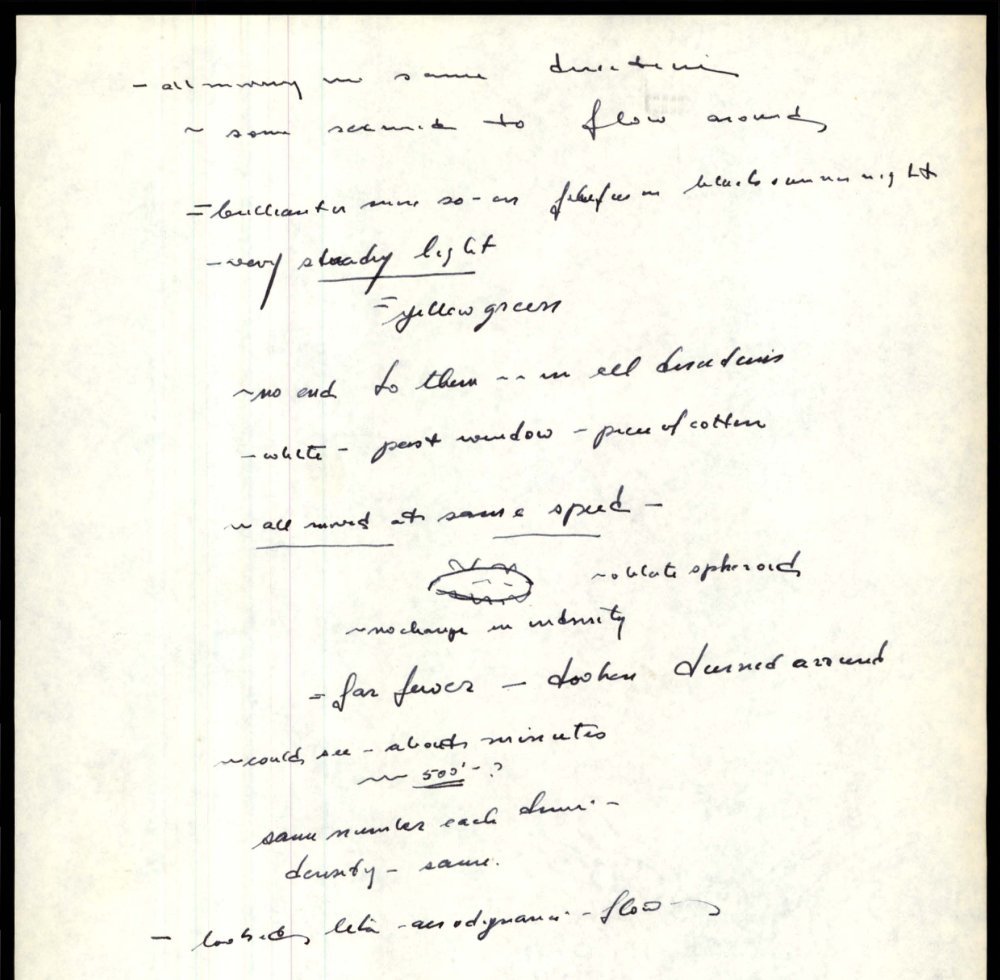
Attached to the draft are undated handwritten sheets in the same handwriting. One looks like the interview outline: it lists the size of the particles, from pinhead to 1 centimeter, the duration of 3,5 to 4 minutes, the spacing of 2 to 3 meters, and three lines of inquiry, namely origin in the spacecraft, natural environment, and a “comet theory.” Another summarizes Glenn's answers and contains a small sketch of an “oblate spheroid” and the figure 500 feet, with a question mark, which do not appear in the typed transcript. A third deals with chemical payloads for rockets between 50 and 150 kilometers.
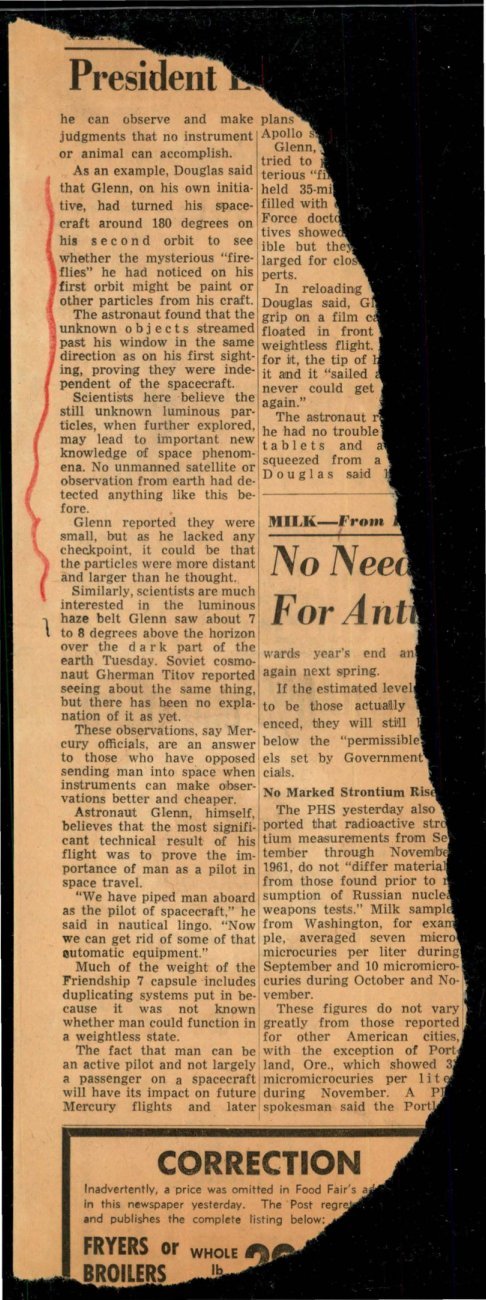
The file also holds a torn newspaper clipping, identified only by a correction notice signed “The Post.” The article reports that, according to Douglas, Glenn turned the spacecraft 180 degrees on the second orbit to test whether the “fireflies” were paint or particles from the capsule itself, and that they passed in the same direction, “proving they were independent of the spacecraft.” It also says scientists saw in it the chance for “important new knowledge.” This was the public version of the first days, which the internal March papers went on to dispute.
OFFICIAL MEDIA
Official video for this case
Files published by the United States Government on DVIDS. The title of each one is that of the official publication, translated; the description of what is seen is in the dossier text.
NASA mission audio · 3 min 01 s · the video only loads when you start playback, directly from the official server.
Official record ↗More images from the document
DIRECT READING OF THE FILE
The document, in the original
NASA transcript and memoranda, a U.S. government work: excerpts translated after checking against the facsimile. Passages marked as inaudible were not reconstructed.
EXCERPT 1 · PHYSICAL PAGE 20
Physical page 20 (page 19 of the transcript), last remark: return to the subject of the particles
19
I could see no difference in flying in an sirplane at 50,000 feet and locking
down end seeing colors on the ground then there is from the capsule.
abies ten cbc’ Satta: Did you have en opportunity to try
closing your eyes and seeing the Sorenkoff Radiation fieshes?
Seeing what?
Radiation flashes from energetic particles fastened to your eyeballs.
Is that another » Wiret time I heard of it.
What do you call this again now?
Sorenkoff Radiation by = good Russien frie&d of that name.
Golly, the missed that one on briefing.
(statement, x inedible)
When a cosmic ray passes through a material in which the--its velocity
exceeds the velocity of light in the medium you have this radiation given out-
Sorenkeff Radiation and John Winckler of Mimesota thought that you might be
sble to observe this if you shut your eyes when the heavies came through.
(statement, ineudible)......
Ave these suppose to be yery visible, very bright or just--
No one knows because they never get down to the earth's surface. They
would have been in the gw blue light.
We didn't ride around for any peried of time with the eyes closed. There
was sh enough going on that--this eye patch, we hed that. That was intentionally
done, not to two eyes, just to one so that you'd still monitor everything that
4] f 4 a
was going on. So T aid not ide around with the epee Lu any priced of C700
Alright, Lets get to the luminous particles. Back to page 1.Editorial note: The rest of the page deals with another subject (the Cherenkov radiation flashes, which Glenn did not try to observe) and is not part of the episode. The sentence opens the part of the interview devoted to the particles, which runs to physical page 33.
Check the original PDF
Alright. Lets get to the luminous particles. Back to page 1.View the document record ↗ · Physical page 20, counting the cover.
EXCERPT 2 · PHYSICAL PAGE 21
Physical page 21 (page 20 of the transcript), full text
Thats a good one. That sure is.
Yes. They all just appeared to be um sitting out here floating and
they particular didn't have any interaction with each other. They were-~-
sone went rumaing this way end some that way. They all appeared just to be
static in their field. I was moving am them. The only ones that appeared
to move were the ones that seemed to have a little flow
jee ne and this wes surprising too because Le gt Weak
CO POL
Te- around the edge of the capsule and it would drift off like this
as sti deck pla d TORE woes sik dasa Fest is + If this
had been gs just & flash, rn ee it would
have been--I don't know what I would have on one like that.
observed
observe
I sat there and xheemi this thing just as cnrefully as I could zim it for
some 3 to 5 minutes at three different periods. The lights were not very
dim Little Lights as though reflections from something. They vere every bit
si elated hr eanie ‘0: San SI AA nk ula Vaile ono a
And you've seen fireflies out in the meadow or when they just stand out
like very, very bright stars. ‘They were as least as bright as the brightest
fireflies you've ever seen in @ situation like that and the light was very
steady and they were about the seme color as fireflies. ‘This was a luminous
yellow-green or green-yellow color. I'd say it was almost an identical to
e@ firefly anda they were just as far at that particularmiem time. I would
look out the window this 2 way and there just seemed to be no end to then
out here, no end back this way, no end on this side, up or dow in particular .
(Question, ineudible)......
Yes.Editorial note: The words "through", "there would be one that would come fluttering up", "less", "back here", "thought", "observed", "observe" and "fireflies" (the latter over a crossed-out word) were added by hand. The transcript does not identify who is speaking; the questions are from the NASA scientists and the answers from John Glenn. The underlined blank spaces in the original, which mark passages not understood in the recording, appear as [gap].
Check the original PDF
Thats a good one. That sure is.
Were they all traveling in the same direction and the same velocity?
Yes. They all just appeared to be sitting out here floating and they particular didn't have any interaction with each other. They were-- some went running this way and some that way. They all appeared just to be static in their field. I was moving through them. The only ones that appeared to move were the ones that seemed to have a little flow characteristic around the capsule, and this was surprising too because there would be one that would come fluttering up around the edge of the capsule and it would drift off like this and it would just more or less take its place back here. If this had been just a flash, just a momentarily thing, I don't know, it would have been--I don't know what I would have thought on one like that. I sat there and observed this thing just as carefully as I could observe it for some 3 to 5 minutes at three different periods. The lights were not very dim little lights as though reflections from something. They were every bit as brilliant or more so than fireflies out on a real black summer night. And you've seen fireflies out in the meadow or when they just stand out like very, very bright stars. They were as least as bright as the brightest fireflies you've ever seen in a situation like that and the light was very steady and they were about the same color as fireflies. This was a luminous yellow-green or green-yellow color. I'd say it was almost an identical to a firefly and they were just as far at that particular time. I would look out the window this way and there just seemed to be no end to them out here, no end back this way, no end on this side, up or down in particular.
(Question, inaudible)......
Yes.View the document record ↗ · Physical page 21, counting the cover.
EXCERPT 3 · PHYSICAL PAGE 22
Physical page 22 (also numbered 20 in the transcript), full text
20
The density looking perpendicular to your path is about equal to that
I had 2 things came in mind. One was, I thought we founds the lost
35% Air Force needles, that wat was the first thing. But they weren't--
wasn't like that et all. ‘he other thing, I thought perhaps we were getting
freezing of the water coming cut of the capsule and we were having snow,
something like that. In fact, later an they called me from the ground and
asked if I thought thet that is what it was. But it wasn't thet type thing
et all. It didn't appear to be eminating from the capsule. The particles
were not closer together--closer to the capsule than they appeared to be
further avay. The average distance of the particles apart was probebiy--
i estimated I think some 6 to 10 feet, in that neighborhood. Gccasionally
one would be right in the shadow of the capmule and would drift up pass the
window and it looked rather white Like a wee tiny little piece of cotton
or & little--it looked like a little enow flake. Gone little piece of thing
like that. These white sak ones that I saw come up by like that I assume
were the same things es the others out here becmise I never saw anything else
outside of the window.
Did you ever see the saue one go into the shadow and come back out?
Well, I was asked that before and I-«nwy initial answer to it was yes
and then I couldn't recall any real specific instence where I watched one go
from luminousity to white end back to luminous again. So I can't say
posivively I did on that. I think they aid but I don't went to make 6
positive mimtumtex statement.Editorial note: The "Air Force's lost needles" refer to the copper needles of the military communications experiment known as Project West Ford, launched in 1961, whose first batch did not disperse as planned; the identification of the experiment is public context and is not on the page. 6 to 10 feet is about 1,8 to 3 meters. Spellings "eminating", "pass" and "luminousity" kept as in the original. The transcript does not identify who is speaking; the questions are from the NASA scientists and the answers from John Glenn. The underlined blank spaces in the original, which mark passages not understood in the recording, appear as [gap].
Check the original PDF
The density looking perpendicular to your path is about equal to that _____.
I had 2 things came in mind. One was, I thought we found the lost Air Force needles, that was the first thing. But they weren't-- wasn't like that at all. The other thing, I thought perhaps we were getting freezing of the water coming out of the capsule and we were having snow, something like that. In fact, later on they called me from the ground and asked if I thought that that is what it was. But it wasn't that type thing at all. It didn't appear to be eminating from the capsule. The particles were not closer together--closer to the capsule than they appeared to be further away. The average distance of the particles apart was probably-- I estimated I think some 6 to 10 feet, in that neighborhood. Occasionally one would be right in the shadow of the capsule and would drift up pass the window and it looked rather white like a wee tiny little piece of cotton or a little--it looked like a little snow flake. Some little piece of thing like that. These white ones that I saw come up by like that I assume were the same things as the others out here because I never saw anything else outside of the window.
Did you ever see the same one go into the shadow and come back out?
Well, I was asked that before and I--my initial answer to it was yes and then I couldn't recall any real specific instance where I watched one go from luminousity to white and back to luminous again. So I can't say positively I did on that. I think they did but I don't want to make a positive statement.View the document record ↗ · Physical page 22, counting the cover.
EXCERPT 4 · PHYSICAL PAGE 23
Physical page 23 (page 21 of the transcript), full text
2
they were simply white like snow?
Thats right, thats right. They were very Liminous. When the first rays
of the sun would come--when the first rays of the sun came by the capsule is
when I'8 éee the first ones and this persisted then some--oh, 5 minutes.
(Lengthy question, inaudible)......?
Tt could be. I won't sgit was. I won't say it wasn"t.
T don't know how you could have much depth perception but do you have eny
iéea about how fer away the fartherest ones were?
No. T couldn't estimate how far away they were but you had a very definite
feeling of depth perception through them, mainly, I think by looking out to the
side out here. Ana if you hed & lot or particles hanging out here and you move
through them see = the ones move as you move them them and the near ones nove
right within. Ones far out move very slowly sd this gives you a sense of depth.
4nd. I think that the way I perceived most of that.
w= You say they're all moving in the seme direction?
Thats right. peter
Did any move faster than others?
They didn't appear to. They all appear to be hanging mupe except for the
ones that seemed to come up around the capsule in this flow condition.
(Question, partially inaudible) Did that flow look anything like
Yes. Thats what we talked about. It did. The few particles that came by
was just like a almost.
?
nce tneEditorial note: Spelling "farthest" written in the original as "fartherest". The transcript does not identify who is speaking; the questions are from the NASA scientists and the answers from John Glenn. The underlined blank spaces in the original, which mark passages not understood in the recording, appear as [gap].
Check the original PDF
(Question, partially inaudible)............. in the shadow of the capsule they were simply white like snow?
Thats right, thats right. They were very luminous. When the first rays of the sun would come--when the first rays of the sun came by the capsule is when I'd see the first ones and this persisted then some--oh, 5 minutes.
(Lengthy question, inaudible)......?
It could be. I won't say it was. I won't say it wasn't.
I don't know how you could have much depth perception but do you have any idea about how far away the farthest ones were?
No. I couldn't estimate how far away they were but you had a very definite feeling of depth perception through them, mainly, I think by looking out to the side out here. And if you had a lot of particles hanging out here and you move through them see the ones move as you move them and the near ones move right within. Ones far out move very slowly so this gives you a sense of depth. And I think that the way I perceived most of that.
You say they're all moving in the same direction?
Thats right.
Did any move faster than others?
They didn't appear to. They all appear to be hanging except for the ones that seemed to come up around the capsule in this flow condition.
(Question, partially inaudible) Did that flow look anything like _____?
Yes. Thats what we talked about. It did. The few particles that came by was just like a _____ almost.View the document record ↗ · Physical page 23, counting the cover.
EXCERPT 5 · PHYSICAL PAGE 24
Physical page 24 (page 21a of the transcript), full text
2le
SERNAME (Statement, partially inaudible)
advancing @ new theory that this might very well be some full
luminescence of areas around the capsule
we talked ebout this A night and dey
change » Whether theres anything of this kind
recombination beck in the shadow
of the capsule + Five wiles an hour
motions area of
capsule speed and so on. I+ certainly seem--it seem to be mumm connection
with the capsule in some way and not with something coming from outer space.
I estimated 3 to 5 miles an hour differential speed and I--it wasn't
over five miles en hour., thats definitely on the high side if we get up to
that. They were just very slowly drifting by. ‘hey gradually start disappearing
as the sun came up and we got up at more of an angle they gradually start
Gisappeering. And I couldn't gee anything.
Did you see them before the sun rose?
No.
Did you look for them before that?
Yes. The second time arount I was watching for these things.
But you 414 see them as soon as the sun rose?
The very first light of the sun--the very first rays of the sun than
up, you could see the first ones appear just Like that when the sun came up.
(Question, inaudible.....?
Yes.
Do you have an impression of the shape, the structure of the individual
particles.Editorial note: The page begins with a participant's name struck out by typewriter, followed by "(Statement, partially inaudible)". The first paragraph, including the sentence about the "connection with the capsule", belongs to that statement, not to an answer by Glenn; Glenn's answer begins at "I estimated a velocity difference". 3 to 5 miles per hour is about 5 to 8 km/h. The word before "connection" is struck out. The transcript does not identify who is speaking; the questions are from the NASA scientists and the answers from John Glenn. The underlined blank spaces in the original, which mark passages not understood in the recording, appear as [gap].
Check the original PDF
[name struck out] (Statement, partially inaudible) _____ _____ advancing a new theory that this might very well be some full luminescence of areas _____ around the capsule _____ we talked about this night and day change _____. Whether theres anything of this kind _____ recombination back in the shadow of the capsule _____. Five miles an hour _____ motions _____ area of capsule speed and so on. It certainly seem--it seem to be connection with the capsule in some way and not with something coming from outer space.
I estimated 3 to 5 miles an hour differential speed and I--it wasn't over five miles an hour., thats definitely on the high side if we get up to that. They were just very slowly drifting by. They gradually start disappearing as the sun came up and we got up at more of an angle they gradually start disappearing. And I couldn't see anything.
Did you see them before the sun rose?
No.
Did you look for them before that?
Yes. The second time around I was watching for these things.
But you did see them as soon as the sun rose?
The very first light of the sun--the very first rays of the sun than came up, you could see the first ones appear just like that when the sun came up.
(Question, inaudible.....?
Yes.
Do you have an impression of the shape, the structure of the individual particles.View the document record ↗ · Physical page 24, counting the cover.
EXCERPT 6 · PHYSICAL PAGE 25
Physical page 25 (page 22 of the transcript), full text
22
No. These one that would come fairly clost to the capsule I could see.
Thats where I estimated they were just a very tiny size up to maybe 3/8 of
en inch or half an inch.
Would you characterize them as sort of irregular Like cornflakes, like
crystal, like snowflekes?
They didn't appear to have any oblong pattern to them or any particular
cireuler pattern. So real semetry at all.
Were they flat like snow flakes?
These little white things which I = think were the seme items were right
up close to the window in the shade looked @ lot like Little snow flekes.
Would you say they were speherical or 2
i think more like sort of a sphere.
any distance at all and thentex
they were luminous and the sun wes on them and there was no shugamim shepe to--
Just like looking at o firefly light. That's the nearest thing I can come--t
keep coming back to because that's just what they looked like.
(Question, Inaudible).....?
No. No. There was no on and off again type thing at all. ‘This was encther
thing thet going back to the stars it was noticable too as we had expected
there wans't any of the--I didn't notice any particular amount of twinkling of
the stars, not like they do down here,
Die
HB you see any of these particles move ?
Ho. tts just like you have a big static field like you have gone out
here with strings end placed them in this room and if you cane back and
through that deor and back to way across the room that just what they looked
like going by. It just wasn't--Editorial note: 3/8 of an inch or half an inch is about 1 to 1,3 centimeters. Spellings "clost" (close) and "semetry" (symmetry) in the original normalized in the transcript above. The transcript does not identify who is speaking; the questions are from the NASA scientists and the answers from John Glenn. The underlined blank spaces in the original, which mark passages not understood in the recording, appear as [gap].
Check the original PDF
No. These one that would come fairly close to the capsule I could see. Thats where I estimated they were just a very tiny size up to maybe 3/8 of an inch or half an inch.
Would you characterize them as sort of irregular like cornflakes, like crystal, like snowflakes?
They didn't appear to have any oblong pattern to them or any particular circular pattern. No real symmetry at all.
Were they flat like snow flakes?
These little white things which I think were the same items were right up close to the window in the shade looked a lot like little snow flakes.
Would you say they were spherical or _____?
I think more like sort of a _____ sphere.
_____ any distance at all and they were luminous and the sun was on them and there was no shape to-- just like looking at a firefly light. That's the nearest thing I can come--I keep coming back to because that's just what they looked like.
(Question, Inaudible).....?
No. No. There was no on and off again type thing at all. This was another thing that going back to the stars it was noticable too as we had expected there wasn't any of the--I didn't notice any particular amount of twinkling of the stars, not like they do down here.
Did you see any of these particles move _____?
No. Its just like you have a big static field like you have gone out here with strings and placed them in this room and if you came back and through that door and back to way across the room that just what they looked like going by. It just wasn't--View the document record ↗ · Physical page 25, counting the cover.
EXCERPT 7 · PHYSICAL PAGE 26
Physical page 26 (page 23 of the transcript), full text
23
They a1) went by in the direction of
That's right. Wow, I turned around once so I could see if they
were coming toward me. I got around facing tovard the mumghighg sunlight.
As I com around and the sunlight was off to my right I could see far
fewer of then at that time than I could see when I was & facing backwards.
This would be on the side avay from the sun is & where I could see most
of them. But they--the ones out here were still coming towards me. Sow
this is--I want to check and see if these were emineting from the capsule.
They were not. They were still coming toward me frou out there go they
couldn't heve been eminating from the capsule.
From the @Lreetion toward mgt which you were moving.
That's right.Editorial note: A word before "sunlight" is struck out by typewriter. Spelling "eminating" kept as in the original. The page ends midway down the sheet. The transcript does not identify who is speaking; the questions are from the NASA scientists and the answers from John Glenn. The underlined blank spaces in the original, which mark passages not understood in the recording, appear as [gap].
Check the original PDF
They all went by in the direction of _____?
That's right. Now, I turned around once so I could see if they were coming toward me. I got around facing toward the sunlight. As I came around and the sunlight was off to my right I could see far fewer of them at that time than I could see when I was facing backwards. This would be on the side away from the sun is where I could see most of them. But they--the ones out here were still coming towards me. Now this is--I want to check and see if these were eminating from the capsule. They were not. They were still coming toward me from out there so they couldn't have been eminating from the capsule.
From the direction toward which you were moving.
That's right.View the document record ↗ · Physical page 26, counting the cover.
EXCERPT 8 · PHYSICAL PAGE 27
Physical page 27 (page with no printed number), full text
How close
Six to ten feet apart.
(Question, partiallyinaudibie) .......you said you say it 3 times, Did you?
This was approximately the Satd..csssscccceessssccssert
Well, this was right at each sunrise. Now this wasmother thing we talked
about. Bill Douglass, I think, ex felt that there might be some possibility
if the earth does have its own band around the equator, just as some of the
Planets do, that perhaps were were at the edge of @ little band like that
that wes appearing each time we came up past the equator on the dark side
at that
and it just happened to coincide with the sunrise mmmk time. We entered at
sunrise each time. We don't have the data--I haven't checked beck here to
get the data on that yet as to whether this was always right at the equatorial
region that we ran into.
(Question, ingudible)....7
Right at the first light of sumrise there was a-«no other time. I
epecifically looked for them at sunset. As the Last light of the sun went
ewny I thought we might see them there. I didn't. ‘This was always at sunrise.
Now, this difference may be that I was more night adapted
at sunrise. Maybe they were there ali the way around.
(Question, ineudible).....?
We're running short of time here. Let me get through a couple of these
right quickly.
Whats the longest time you require watching any individual particle?
Gh, I can't answer that as to the length of time I specifially wetched
one particular particle but they were not blinking on and off or anything
like that.Editorial note: "Bill Douglass" appears this way in the original; this is probably the physician William Douglas, of the Mercury astronauts' team, quoted in the newspaper clipping on physical page 201. The words "at that" were typed in above the text. The transcript does not identify who is speaking; the questions are from the NASA scientists and the answers from John Glenn. The underlined blank spaces in the original, which mark passages not understood in the recording, appear as [gap].
Check the original PDF
How close _____?
Six to ten feet apart.
(Question, partially inaudible) .......you said you saw it 3 times. Did you? This was approximately the same.......................?
Well, this was right at each sunrise. Now this was another thing we talked about. Bill Douglass, I think, felt that there might be some possibility if the earth does have its own band around the equator, just as some of the planets do, that perhaps were were at the edge of a little band like that that was appearing each time we came up past the equator on the dark side and it just happened to coincide with the sunrise at that time. We entered at sunrise each time. We don't have the data--I haven't checked back here to get the data on that yet as to whether this was always right at the equatorial region that we ran into.
(Question, inaudible)....?
Right at the first light of sunrise there was a--no other time. I specifically looked for them at sunset. As the last light of the sun went away I thought we might see them there. I didn't. This was always at sunrise. Now, this difference may be that I was more night adapted _____ at sunrise. Maybe they were there all the way around.
(Question, inaudible).....?
We're running short of time here. Let me get through a couple of these right quickly.
Whats the longest time you require watching any individual particle?
Oh, I can't answer that as to the length of time I specifically watched one particular particle but they were not blinking on and off or anything like that.View the document record ↗ · Physical page 27, counting the cover.
EXCERPT 9 · PHYSICAL PAGE 28
Physical page 28 (page 25 of the transcript), full text
25
Did you have the impression they would be there if you ?
they were about 6 to 7 feet apart. ‘The window is only a
certain size_- .
(Statement, inaudibie)
Well, I haa the impression I could have sat--I could have been sitting
there and watch one particle for some distance as it went on back maybe for
& minute or so.
When they were in the shadows of the spacecraft, @i@ they appear to vary
eny in brightness 7%
No. ‘They weren"t luminous when they were in the shedows. I can't
Specifically sey. I watened 5 particles from a luminous condition to
in the shadows non-luminous end back to. mm a luminous condition.
(8% Question, inendible)...?
Oh, yes. I think this is very probable. I could have seen it farther
then thet. They were bright. If you were night edepted and you can see a
very bright firefly from a considerable distence and this was a--
When you sew this the second end third time around 4i@ you have the feeling
thet there were any more of less than there was the first time?
Ho, We talked ebout that too and I think it was the same type. I don't
think the density of it was any Gifferent. Completely snowed. The first
time I sew these I looked down injo the--I checked sone systems--had been
looking outeide the the cockpit and made a check « check as
I was @oing all the time end had had my head im the cockpit for some Little
period of tine and glanced back up at the window. I had been doing this justEditorial note: The number of particles is typed as "8". The statement that he observed 8 particles pass from light into shadow and back contrasts with the answer on physical page 22, in which Glenn says he does not remember any specific instance; the document does not resolve the discrepancy. 6 to 7 feet is about 2 meters. The sentence continues on the next page. The transcript does not identify who is speaking; the questions are from the NASA scientists and the answers from John Glenn. The underlined blank spaces in the original, which mark passages not understood in the recording, appear as [gap].
Check the original PDF
Did you have the impression they would be there if you _____?
_____ they were about 6 to 7 feet apart. The window is only a certain size _____.
(Statement, inaudible)
Well, I had the impression I could have sat--I could have been sitting there and watch one particle for some distance as it went on back maybe for a minute or so.
When they were in the shadows of the spacecraft, did they appear to vary any in brightness?
No. They weren't luminous when they were in the shadows. I can't specifically say. I watched 8 particles from a luminous condition to in the shadows non-luminous and back to a luminous condition.
(Question, inaudible)...?
Oh, yes. I think this is very probable. I could have seen it farther than that. They were bright. If you were night adapted and you can see a very bright firefly from a considerable distance and this was a--
When you saw this the second and third time around did you have the feeling that there were any more or less than there was the first time?
No. We talked about that too and I think it was the same type. I don't think the density of it was any different. Completely snowed. The first time I saw these I looked down into the--I checked some systems--had been looking outside the _____ the cockpit and made a check a _____ check as I was doing all the time and had had my head in the cockpit for some little period of time and glanced back up at the window. I had been doing this justView the document record ↗ · Physical page 28, counting the cover.
EXCERPT 10 · PHYSICAL PAGE 29
Physical page 29 (page 26 of the transcript), full text
26
as I could start to begin to see some faint light down below end I glanced
back up ut the window and my first impression was, mmk well we've gotten
way out of attitude and probably come to the because here
it was just like looking-cut on a complete star field, there was no other
reference at all and locking béckward tovard this Gerk ates what baa happened,
instead of the even horiton back here that|I haa hed with the stars up shove
and the derker area down below. Wow in this dark area down below too were
all these other lights pinpointed in. They just looked, at first glance,
like « continuation of the whole star field down into that ares. I thought
we had drifted up and here I om looking at nothing but @ starfield and how
aid I ever get into this crazy attitude. I checked instruments egein and
checked the periscope agaih and I hadn't drifted. I was still in the sane
attitude I was in except this.big darker area here that had been the earth
back behind it that I had been locking at was wow filled up with el) these
dots as the first light of the sum surfaced.
How long after the sunrise did you observe soue of these in the shadows
of the spacecraft? Was it almost immediately or towards the end of thm this
period?
Oh, I don't think there any difference on that as fer as when they
woulé érift up inte thet. This could well have been occurring just as well
when I first came into them as they could at the end of the time. I didn't
have any Dupression that there was more mrkimk drift by the capsule at one
time then mother or more flow around the capsule that pulled them in past the
window at one time or another.Editorial note: "Attitude" is the orientation of the spacecraft in space. The transcript does not identify who is speaking; the questions are from the NASA scientists and the answers from John Glenn. The underlined blank spaces in the original, which mark passages not understood in the recording, appear as [gap].
Check the original PDF
as I could start to begin to see some faint light down below and I glanced back up at the window and my first impression was, well we've gotten way out of attitude and probably come to the _____ because here it was just like looking out on a complete star field, there was no other reference at all and looking backward toward this dark area what had happened, instead of the even horizon back here that I had had with the stars up above and the darker area down below. Now in this dark area down below too were all these other lights pinpointed in. They just looked, at first glance, like a continuation of the whole star field down into that area. I thought we had drifted up and here I am looking at nothing but a starfield and how did I ever get into this crazy attitude. I checked instruments again and checked the periscope again and I hadn't drifted. I was still in the same attitude I was in except this big darker area here that had been the earth back behind it that I had been looking at was now filled up with all these dots as the first light of the sun surfaced.
How long after the sunrise did you observe some of these in the shadows of the spacecraft? Was it almost immediately or towards the end of this _____ period?
Oh, I don't think there any difference on that as far as when they would drift up into that. This could well have been occurring just as well when I first came into them as they could at the end of the time. I didn't have any impression that there was more drift by the capsule at one time than another or more flow around the capsule that pulled them in past the window at one time or another.View the document record ↗ · Physical page 29, counting the cover.
EXCERPT 11 · PHYSICAL PAGE 30
Physical page 30 (page 27 of the transcript), full text
You cen’t see them on the film?
No. ‘The ones we had out there at Grand Turk I couldn't very--we had
to many seratches end spots on those pictures that I couldn't really
pinpoint then. But when we get hold of the original pictures and can
projeet those, I hope that we can see more, I damfe don't know. Those
reproductions we had out there were not very satisfactory. I hope the
originals are better then thet. Did you see the originals? Ave they clear?
I say prints which I think Started to develop. They seen
fairly clear.
Did you see any of these spots on them? Did you have the film? Did
you look at the flin? ;
i 41a not look at the film directly. Bat it not the sort of picture
you bad in Grand Turk. You hed a really guml clear
print thet @eme day.
Thats right. And the way they looked they were pretty :
They weren't the best job I ever caw. I'm afraid I don’t know waht
to tell you except that. i wish I could be more helpful. All I can easy is
we observed it ané it was very clear and distinct. It wasn’t a reflection
from anything. It was very positive. We observed it @ long period of time
on three different orbits at exnetly the seme spot. Beyond thet, I have not
ha caine: thet, es th be.
We they all the cane color?
Yes. 2X Very even colored exeept that some of then vould look o little
larger than others, a little brighter than others. ‘The color wae iientivet
identical.Editorial note: Grand Turk, in the British Bahamas (today the Turks and Caicos Islands), was where Glenn went through the first debriefing after recovery. The word "foggiest" was added over a crossed-out word. "We they" appears this way in the original (probably "Were they"). The transcript does not identify who is speaking; the questions are from the NASA scientists and the answers from John Glenn. The underlined blank spaces in the original, which mark passages not understood in the recording, appear as [gap].
Check the original PDF
You can't see them on the film?
No. The ones we had out there at Grand Turk I couldn't very--we had to many scratches and spots on those pictures that I couldn't really pinpoint them. But when we get hold of the original pictures and can project those, I hope that we can see more, I don't know. Those reproductions we had out there were not very satisfactory. I hope the originals are better than that. Did you see the originals? Are they clear?
I saw prints which I think _____ started to develop. They seem fairly clear.
Did you see any of these spots on them? Did you have the film? Did you look at the film?
I did not look at the film directly. But it not the sort of picture _____ you had in Grand Turk. You had a really clear print that day.
Thats right. And the way they looked they were pretty _____. They weren't the best job I ever saw. I'm afraid I don't know what to tell you except that. I wish I could be more helpful. All I can say is we observed it and it was very clear and distinct. It wasn't a reflection from anything. It was very positive. We observed it a long period of time on three different orbits at exactly the same spot. Beyond that, I have not the foggiest idea what it is.
We they all the same color?
Yes. Very even colored except that some of them would look a little larger than others, a little brighter than others. The color was identical.View the document record ↗ · Physical page 30, counting the cover.
EXCERPT 12 · PHYSICAL PAGE 31
Physical page 31 (page 28 of the transcript), full text
ude’
Were there eny changes/looking out the side cross your and back?
Bo. I don't recali any. We talked about thet too and I couldn't recall
that they looked any different in one direction than they did in another.
(Question, inadible)....?
No.
(Statement, ineudible)...
It might well have something to do with differences in electrostatic
potential. .
(Question, tnaudidie)...?
The drift would be like--well if you were looking out--weli if a snow
fleke come drifting by the window is something gocs 2 very rapidly, of
course. As I was locking out the window, there Little particles just
come just come up across the window and maybe
around end then drift mmy ené @s 1t got out there o a8 Little
bit it just seemed to assume its position out here.
(Statement, ineudible)...
a
Oh,.no, It was not a thing where the thing just came around on/very
smooth trajectory and rum off like this. It would a@@ift up aroun here
like that and then it would Gift off on it ow. It looked very mch--it
just Looked like snow. Sa sisi Litssanek pan toe auth sas tes matin
tunnel only with a Gingle particle.
Do you have any om your capsule?
I'm sure there is, I don't know what it is but I'm sure there met be
sone.Editorial note: The words "in brightness", "maybe", "a" and "blow like" were added over the typewritten text. It is not known who said the sentence about the electrostatic potential: it comes right after an inaudible statement and has no identification. The transcript does not identify the speakers; the questions are from the NASA scientists and the answers from John Glenn. The underlined blank spaces in the original, which mark passages not understood in the recording, appear as [gap].
Check the original PDF
Were there any changes in brightness looking out the side cross your _____ and back?
No. I don't recall any. We talked about that too and I couldn't recall that they looked any different in one direction than they did in another.
(Question, inaudible)....?
No.
(Statement, inaudible)...
It might well have something to do with differences in electrostatic potential _____.
(Question, inaudible)...?
The drift would be like--well if you were looking out--well if a snow flake come drifting by the window is something goes very rapidly, of course. As I was looking out the window, there maybe be little particles just come _____ just come up across the window and maybe _____ around and then drift away and as it got out there a little bit it just seemed to assume its position out here.
(Statement, inaudible)...
Oh, no. It was not a thing where the thing just came around on a very smooth trajectory and run off like this. It would drift up around here like that and then it would drift off on it own. It looked very much--it just looked like snow. It looked like blow like you would see in a wind tunnel only with a single particle.
Do you have any _____ on your capsule?
I'm sure there is. I don't know what it is but I'm sure there must be some.View the document record ↗ · Physical page 31, counting the cover.
EXCERPT 13 · PHYSICAL PAGE 32
Physical page 32 (page 29 of the transcript), full text
There would not only be an electric charge, there would be a differential
charge between the window and the outside of the capsule which could
explain *
(Statement, ingudible).....
(Question, inaudibie)....?
Well, thats @ pretty te tough ome. I don't know. That would be like--
I hate to be too positive because it might lead you astray but I keep coming
back to the fireflies gua again. Very, very similer to locking out at this--
@ big firefly or little firefly. looking out on ® real dark night in a pasture
this might be @ email firefly up close and a big firefly farther away. As
you érift through these things they go by, they all lock reasonably wiforn.
The ones that are up close and some of the luminous ones were up mm very close.
Definitely, did that make sense?
As they would be up close ond then drift away they didn't appear to
diminish their light very rapidly. Just like seeing a firefly again.
Welj. John you kept your dste with us promptly. I think we should let
you go promptly.
I hate to break this up too because I went to find out what these
things are. I don't know that to tell you. Im afraid I'm about ary on
new inforustion,
I won't ask you what dia they say John
T may have to go back end check them. I'm ready.
(Statement, inaudthie)....Editorial note: It is not known who speaks in the first sentence, about the charge difference. The transcript does not identify the speakers; the questions are from the NASA scientists and the answers from John Glenn. The underlined blank spaces in the original, which mark passages not understood in the recording, appear as [gap].
Check the original PDF
There would not only be an electric charge, there would be a differential charge between the window and the outside of the capsule which could explain _____.
(Statement, inaudible).....
(Question, inaudible)....?
Well, thats a pretty tough one. I don't know. That would be like-- I hate to be too positive because it might lead you astray but I keep coming back to the fireflies again. Very, very similar to looking out at this-- a big firefly or little firefly. Looking out on a real dark night in a pasture this might be a small firefly up close and a big firefly farther away. As you drift through these things they go by, they all look reasonably uniform. The ones that are up close and some of the luminous ones were up very close.
Definitely, did that make sense?
As they would be up close and then drift away they didn't appear to diminish their light very rapidly. Just like seeing a firefly again.
Well John you kept your date with us promptly. I think we should let you go promptly.
I hate to break this up too because I want to find out what these things are. I don't know what to tell you. I'm afraid I'm about dry on new information.
I won't ask you what did they say John _____.
I may have to go back and check them. I'm ready.
(Statement, inaudible)....View the document record ↗ · Physical page 32, counting the cover.
EXCERPT 14 · PHYSICAL PAGE 33
Physical page 33 (page 30 of the transcript), full text: close of the interview
Be
I'd like to get together again because this was the first real honest
te goodness business like this ve've conducted since I got back here and
this is whet I went to get back to next woek. I'm going back to the Cape
Monday night. I'm going to be down there all next week on touring plan
end then probably beck down se the following week again until we get a lot
of this. I want to go through the Stuke fllas ani and
get back to work and finigh thie type thing this week.
(Statenent, inaudible)...
T don't think there's any great urgency from our point of view mainly
it was to get the firet impression there is always debriefing.
Any time you would Like to get even with us
(Conversation, several, people, inaudible)
Thenk you Glenn.
Therk you.Editorial note: "The Cape" is Cape Canaveral, in Florida. "Touring plan" is as in the original. The transcript does not identify the speakers; the questions are from the NASA scientists and the answers from John Glenn. The underlined blank spaces in the original, which mark passages not understood in the recording, appear as [gap].
Check the original PDF
I'd like to get together again because this was the first real honest to goodness business like this we've conducted since I got back here and this is what I want to get back to next week. I'm going back to the Cape Monday night. I'm going to be down there all next week on touring plan and then probably back down the following week again until we get a lot of this. I want to go through the films and _____ and get back to work and finish _____ this type thing this week.
(Statement, inaudible)...
I don't think there's any great urgency from our point of view mainly it was to get the first impression there is always debriefing.
Any time you would like to get even with us _____.
(Conversation, several people, inaudible)
Thank you Glenn.
Thank you.View the document record ↗ · Physical page 33, counting the cover.
EXCERPT 15 · PHYSICAL PAGE 34
Physical page 34, full text: draft memorandum of 13/03/1962 to the director of the Office of Space Sciences (page 1)
ROUGH DRAFI': l/13/62
CODE SCG: MD:dd
MEMORANDUM to Director, Office of Space Sciences
Subject: Considerations and (tecommendations of'Mtwmed
0
'},pace~lorationYollowing the~tJ rview ( February 27) ~
with Lt. Col. John H. Glenn, q7coi{"i(i_erm presented a
~ detailed and factual description of his observations
during the MA' 6 flight. He answered rather well the many
and varied questions presented to him during the limited
interview.ftespite the fact that he was ~ 1 it~ e v e1 , 'n ~
\ ~·t"· l.., properly Q~"- o. a number of his observations remain of
~ ~.~ JV? interest aad ~ further explorationJ"1further~re,
it is evident that the astronaut can perform various scien-
~ tific experiments,~has the aeiil~y capability of doing
com act
so despite the many limitations imposed.by the. Mercury capsule.
Some commezits* on f£01. Glenn's observations are presented
\) u LL ... IA.~ t N.,c~~- clc--+'""""'""! below ~• •~ •-,- r· "\
kun.inous ~ rticles : In response to~ a series
of questions, Col. Glenn described the velocity field of
ii.- QM~
the luminous particles, their brightness 8'1./i. outside the
in
shadow of the spacecvaft, the coloring aBa sunlight and
their shape. For the velocity field, the particles !all.
in
moved at preeise)y the same speed and !!.ll,.moved a~ precisely
the same direction except for particles coming very close
_,_ .... ~"'~•"<- f .-L
to the spacecraft. This occurred similarl:i, :i,Q, all three
, . ..~d'f¥t.....~ orbits. From t.l¼e~-eie Vconsiderations alone, it may
be stated that the luminous Jparticles observed by Col. Glenn
were not extra~errestial particles but were particles associated with the spacecraft or ~fte la~@Mftg e~ the booster.Editorial note: Typewritten draft with many handwritten corrections. The translation follows the final text, with the handwritten words incorporated and the crossed-out ones omitted, unless otherwise indicated. Before "never" there are crossed-out words ("seldom if ever"); before "the booster", "the launching or" is crossed out; "dynamic" was handwritten over a crossed-out "velocity etc.", with a handwritten word of uncertain reading. "Extraterrestrial" here means coming from outside the Earth. The initials "MD" correspond to Maurice Dubin, who signs physical page 38.
Check the original PDF
[handwritten, top right:] Del. Mar 13
ROUGH DRAFT: 3/13/62
CODE SCG: MD:dd
MEMORANDUM to Director, Office of Space Sciences
Subject: Considerations and Recommendations of Manned Space Exploration Following the Interview (February 27) [handwritten: 1962] with Lt. Col. John H. Glenn, Jr.
Col. Glenn presented a detailed and factual description of his observations during the MA-6 flight. He answered rather well the many and varied questions presented to him during the limited interview. Despite the fact that he was never properly dark adapted, a number of his observations remain of interest for further exploration. Furthermore, it is evident that the astronaut can perform various scientific experiments. He has the capability of doing so despite the many limitations imposed by the compact Mercury capsule. Some comments on Col. Glenn's observations are presented below followed by a number of recommendations.
Luminous Particles: In response to a series of questions, Col. Glenn described the velocity field of the luminous particles, their brightness in and outside the shadow of the spacecraft, the coloring in sunlight and their shape. For the velocity field, the particles all moved at precisely the same speed and all moved in precisely the same direction except for particles coming very close to the spacecraft. This occurred in a similar fashion for all three orbits. From the [field?] dynamic considerations alone, it may be stated that the luminous particles observed by Col. Glenn were not extraterrestrial particles but were particles associated with the spacecraft or the booster.View the document record ↗ · Physical page 34, counting the cover.
EXCERPT 16 · PHYSICAL PAGE 35
Physical page 35, full text: draft of 13/03/1962 (page 2)
-2-
The consistency in the observations on the three separate
orbits would require that the particles were associated
with the spacecraft itself ( I have heard that O'Keefe
....~ ~~~ 6\ANI&~~ -..,..laA, ,,_ -,
has i;c;r,r9~9d the life support system which ~
~ ....~ ~ ~ \'""~\~) \wM. ~ \: wat9z: i;a:t;e apaee) Col. Glenn iJjf described the
~ .,., particlei and the luminosity. The fact that the coloring
a,~aPen~ ~~~,~
was a yellow-green and the eiiee~ive observational pi,ebecame fluorescent in sunlight.~e particles observed
in shadow were observed in the scattered light from the
spacecraft and were probably illuminated only by visible
~- ~~f the spectrum.
- ;lThe change of angles of the ~particles approaching
e.""'1ft,-
close th the~ spacecraft~ be attributed to the
since
repJesive charge HD the polarities of the particles
and spacecraft were the same. The ability of Col. Glenn
to observe the particles under improper dark adaptation
~ indicate'that an astronaut would be in a position
to carry through a series of experi'1nents to investigate
C.o~.L" the physics of Q.QmROMS in the solar environment. P.1wpe1 ry
~d°\he various gases and dust particles ejected
~ while
from the spacecraft during~! c~.~nd ~tH'l,BS,!
.o-\,,..U\..c.l, ~ ~~~ ~ >
the spacheaft is in sunlight could be ~ by the
a.\~........ c\M,\t.~~'
~
astronaut-scientist ~ 1&.,"U!S...lt'emld!.r.sr--~~~09...~~~ed
Observati~ns of.~low ana:-/iaze: Limited by poor
dark adaptation, Col. Glenn was not able to descibe anyEditorial note: Typewritten draft with many handwritten corrections. The translation follows the final text, with the handwritten words incorporated and the crossed-out ones omitted, unless otherwise indicated. Among the crossed-out passages are "would water into space" (replaced by "dumped water may have been the source of the particles") and "Properly dark adapted" (moved to the end of the sentence). "Comets" was handwritten over a crossed-out "comments". The sentence continues on physical page 36, which deals with the haze layer and is translated in the dossier on the high layer.
Check the original PDF
The consistency in the observations on the three separate orbits would require that the particles were associated with the spacecraft itself (I have heard that O'Keefe has suggested that the life support system which dumped water may have been the source of the particles). Col. Glenn described the shape of the particles and the luminosity. The fact that the coloring was a yellow-green and the apparent observational description would indicate that the particles became fluorescent in sunlight. The particles observed in shadow were observed in the scattered light from the spacecraft and were probably illuminated only by visible portion of the spectrum.
The change of angles of the particles approaching close to the spacecraft can be attributed to the repulsive charge since the polarities of the particles and spacecraft were the same. The ability of Col. Glenn to observe the particles under improper dark adaptation indicates that an astronaut would be in a position to carry through a series of experiments to investigate the physics of comets in the solar environment. The various gases and dust particles ejected from the spacecraft during twilight conditions and while the spacecraft is in sunlight could be observed with instruments and by the astronaut-scientist if he is properly dark adapted.
Observations of Air Glow and Haze: Limited by poor dark adaptation, Col. Glenn was not able to describe anyView the document record ↗ · Physical page 35, counting the cover.
EXCERPT 17 · PHYSICAL PAGE 37
Physical page 37, full text: draft of 13/03/1962 (page 4), recommendations
-4=
~~ kehwc..4Ack~
recommendations ~paeP te ~a eperen+, following the very
successful flight of the Mercury capsule.
fi. The astqrnaut-scientist r.a,;rryi ng g,.i,;t "iB:e ob-
.."'-<;\-,. C,~V\·~ bt
s-e,~:rt..lreD.~~:im...,a....~ac.~~~le should publish~der his • :\.a.. " ~1~~-'"" A...~
name {with an associat~)ai111s0Heral M~ie--lc in a widely
?'"', •!) • bre eMSars• Utt- , these firstdistributed scientific journal•. In this manner, '4;a.e obd
hand
servations would have wide distribution, be properly
~ ...C2.A.-._
cridited to the observer, and pePtioala¥ly be edited
for correctness .
. . Additional support to the astronaut in carrying
out scientific observations is warranted particularly
in consideration of Col. Glenn's attiftude and interest in
carrying out such observations. Several instruments may
be added to the spacecraft, within engineering limitations~
eJ.,
to assist in obtaining further detail~data.
Q., -~""'-
Col. Glenn suggested that t.ae follo discussioms
would be to his interest. Such follow-on discussion is
strongely recommended for further questions and exchanges) ~
inform the astronaut aihalysis
to ova~~ate-~eP-tao-astPeRa~t of the results of the~
and study of his observations.
C . It is of se.e:~ a:t-importanli" that proper dark
adaptation methods be incorporated into the spacecraft system
so that the astronaut may optimize his visual observations.
c o"'tl'le\.s
Investigations of the physics of OQB!!fteft~s and the
feasibility of the ~l " th-tificial ~omet "experiment
may be carried out directly by the astronaut in a relatively
strai-ghtforward way. ~ These experiments should be
'"t.- ~---\; .,;.. -o.\.u.~~ ~ ~'(W\-~•
carried out ae eB Bi@eM ~~ the feasibility of this ~ .Editorial note: Typewritten draft with many handwritten corrections. The translation follows the final text, with the handwritten words incorporated and the crossed-out ones omitted, unless otherwise indicated. The numbering of the items was redone by hand; crossed-out passages include "carrying out the observations from a space vehicle", "a general article", "following a successful flight" and "as an adjunct to". The word before "evident" at the top of the page was redone by hand ("have become evident" over "appear to be apparent").
Check the original PDF
recommendations have become evident following the very successful flight of the Mercury capsule.
1. The astronaut-scientist should publish describing his observations by name (with an associate if desirable) a paper in a widely distributed scientific journal. In this manner, these first-hand observations would have wide distribution, be properly credited to the observer, and would be edited for correctness.
2. Additional support to the astronaut in carrying out scientific observations is warranted particularly in consideration of Col. Glenn's attitude and interest in carrying out such observations. Several instruments may be added to the spacecraft, within engineering limitations, to assist in obtaining further detailed data.
3. Col. Glenn suggested that a follow-on discussions would be to his interest. Such follow-on discussion is strongely recommended for further questions and exchanges, and inform the astronaut of the results of the analysis and study of his observations.
4. It is very important that proper dark adaptation methods be incorporated into the spacecraft system so that the astronaut may optimize his visual observations.
5. Investigations of the physics of comets and the feasibility of the "Artificial Comet" experiment may be carried out directly by the astronaut in a relatively straightforward way. These experiments should be carried out to assist in evaluating the feasibility of this experiment.View the document record ↗ · Physical page 37, counting the cover.
EXCERPT 18 · PHYSICAL PAGE 38
Physical page 38, full text: draft of 13/03/1962 (page 5), final recommendations and signature
-5-
1 ~~ ~ ~~ ~&Ao..~ ~ ~ -,14-.~0-tlM Q..
. . ForVai:r ~low aea. optieal etttd:ies, .the photo-
.,,.... A..~,:...... >MC,--. p .,..c,,h ...~ o...
multi lier :Be! "b systeml ~ series of filters r:-
4,-~J "'-> --~c.~... ~-- .t..~--~ ~ u.v. ~\_,..,, - ...~ (including~a J;,Oii~e flaorceeent ~lain fi]:l;er to stuely
½ ~t-..Av,.u.,,,-.o:..c.. )
tac ultra viole:!T) should be incorporated into the
spacecraft.
~iUJ£e -a :au.ml:lal' ef eeicntifie exper i:tJ.c:nto appear
reasanabl.e--f'o-l:leri~ncces£ of :ehe Me1cwy or'eito~,
:] I'
~J1~h~~ consideration of the preseno/~lanned
manned-space-flight-program, some reeommendatiGns are .,..__ ~,.....,,_.\..,. lo.\u. ~,c:r-\N·~ '"'Q ,_.f"•'ltC..~ ,..,Q.U.. .oc.~41•,u&..
apparent ts" take advantage of,tae im~eYement& ;L;e tac ~•~~.
~gj ent1 f1 c expJ oration af tbe saJ ar £ystem and in
~'-h;;:t_~ ~ In. ¼..~ ;~\ S(, a'.., ,'
astJ?efl:Ofl\Y• At headquarters, ;U; i.r. recomme:ee,e,4 that •
_ ~ ~~\ £)• A.\t,rogram (ahief and supporting staff i;e ~ae
~reporting to the G.irector of ~pace
~ciences for scientific exploration ei in the !Manned
~pace°Tliiht ~ rogram as:111.,
~o ~-~'YI. ~-~t a committee or sub-conmdttee QQ forwed
oa.e.~ indluding such people as RGefte, ~Utt, Minnaert, Towsey,
tn.
Sekera, asg £0 forta- to the scientific community
aB.e. i;a.e ~Yand,
• ')/ c ..,..... rl. .:that a branch or dividion at one of the centers
-::,-, "',_""~o..,. <Y,l ~ '-' -r7 • 1 #tDf\~ 8 \. ,Q.suc el .&»4(.WEOK4Aas a scientific team fo¥ aireefllsupport of the
.>,>-UV\....~ --t-A:,-~i.; _,£.,,.r~-..,...,s.
astronaut-scientists "ao oei-e into sys-sola1Y spa~e.
V\A.. Y),,J.~
\~ u L t),, "" 7 '2.-; .,.,_,_Editorial note: Typewritten draft with many handwritten corrections. The translation follows the final text, with the handwritten words incorporated and the crossed-out ones omitted, unless otherwise indicated. Crossed out are the opening paragraph "Because a number of scientific experiments appear reasonable following the success of the Mercury orbital flight", as well as "for direct", "who venture into" and an illegible name in the committee list. The handwritten title under the signature matches the one Dubin uses in the memorandum of 21/02/1962 (physical page 56). The first of the three names in the lower left corner is of uncertain reading.
Check the original PDF
6. For the study of airglow and twilight scattering and similar phenomena, a photo-multiplier detection system incorporating a series of filters (including if available, a screen for observing the U.V. airglows visually by fluorescence) should be incorporated into the spacecraft.
[handwritten in margin: U.V.]
In consideration of the present and planned manned-space-flight-program, we should take advantage of this activity to improve the space science program. At headquarters consideration may be given to:
(1) The assignment of a Program Chief and supporting staff reporting to the Director of Space Sciences for scientific exploration in the Manned Space Flight Program,
(2) The formation of a committee or sub-committee including such people as Roach, Minnaert, Tousey, Sekera, etc. to bring in the scientific community and,
(3) The formation of a branch or division at one of the centers as a scientific team in support of the astronaut-scientists in carrying out scientific experiments in sys-solar space.
[handwritten signature:] M. Dubin
[handwritten:] Head Aeronomy Program
[handwritten, lower left:] Cunningham(?) Fellows ClarkView the document record ↗ · Physical page 38, counting the cover.
EXCERPT 19 · PHYSICAL PAGE 39
Physical page 39, full text: memorandum for the record of 23/02/1962, telephone conversation with John O'Keefe
B 2 3 196?
0 U.\h <!.°""""U)4.. '2'"3ol!I- '3oco0 ~ -~ Vje0/2 w~Jo...:,
caJ v-nf c~-4Editorial note: Typewritten document, with no corrections in the main text. The conversation is from 21/02/1962, one day after the flight; the stamp is from 23/02/1962. "Binocular vision" means vision with both eyes, not the use of binoculars. 100 feet is about 30 meters; three or four miles per hour, about 5 to 6 km/h. Vycor is a type of high-silica glass. The memorandum reports what O'Keefe heard from Glenn and passed on by telephone; it is not text by the astronaut himself.
Check the original PDF
[handwritten, top right:] Mr. Dubin
In reply refer to: SGA(JRG:sml)
[stamp:] FEB 23 1962
MEMORANDUM for the Files
Subject: Telephone conversation with Dr. John O'Keefe from Cape Canaveral
The following information was gathered from a conversation with Dr. O'Keefe on Wednesday, Feb. 21, 1962:
Astronaut Glenn reported having seen small luminous particles during his flight. They appeared to be moving at a speed of about three or four miles per hour. They were apparently not more than 100 feet away from the capsule, and were visible by binocular vision. Their color was golden like fireflies, and they seemed to be more to the rear of the capsule than ahead of it, though they were visible for great distances all around. These particles were visible only at sunrise (not at sunset), and the capsule seemed to be immersed in them. They very definitely had nothing to do with the capsule or its movement.
Glenn also reported that very clear pictures of the stars, including Orion, had been taken with the UV camera, although the capsule motion had caused a "wiggly" view.
Jocelyn R. Gill
Staff Scientist
Astronomy & Solar Physics
[handwritten:] U.V. camera - 2800-3000 Å - thru Vycor window of Mercury capsuleView the document record ↗ · Physical page 39, counting the cover.
EXCERPT 20 · PHYSICAL PAGE 53
Physical page 53, full text: transmittal cover
HAND-CARBX
NATIONAL AERONAUTICS AND
SPACE ADMINISTRATION
WASlijNGTON. O.C.
SPECIAL
GPO 16-76611- 1Editorial note: Yellow NASA internal routing cover, with no other text; it accompanies Maurice Dubin's memorandum of 21/02/1962 (physical pages 55 and 56).
Check the original PDF
HAND-CARRY
NATIONAL AERONAUTICS AND SPACE ADMINISTRATION
WASHINGTON, D.C.
SPECIAL
GPO 16—75511-1View the document record ↗ · Physical page 53, counting the cover.
EXCERPT 21 · PHYSICAL PAGE 54
Physical page 54, full text: NASA headquarters routing slip
\ NASA HEADQUARTERS ROUTING" SLIP
ACTION ~
CODE NAME (if necmary) APPROVAL
1-n ~ ~ CONCURRENCE
1. ~ - I J.. -- -•• r FILE
-- 11h-l .-"" "" Rec'd INFORMATION
l;._ OU IR·~/C. 1
\,fC INVESTIGATE AND ADVISE
,,,_ II NOTE AND FORWARD
3. V I I '/ I / II I
, ~ JA ~ .il/f.l - NOTE AND RETURN
- 1'Jif1 PER REQUEST
4. - / r A ~ RECOMMENDATION
, .... - - SEE ME
5. .5(] ~ 011~ SIGNAT.t.JRE
- REPLY FOR SIGNATURE OF,
6.
7.
REMARKS:
oJ~
:;, ,~fa
~
ODE,
FROM: GC I
NAME,
Dubin l~?h/62
NASA form 26 (Rev. July 19~9) • U. S. GOVERNMENT PRINTING OFFICE : 1959 Ol'-51302.1Editorial note: No routing option appears checked. The sheet shows Dubin's memorandum passing through Fellows and Clark, who initial physical page 56, and through two other crossed-out recipients, before returning to Dubin. On the forms, the names are surnames; the full identification is not on the page.
Check the original PDF
NASA HEADQUARTERS ROUTING SLIP
CODE / NAME (if necessary):
1. SGC Fellows [struck out]
2. SG Clark [struck out] [stamp: FEB 21 Rec'd]
3. SD Cortright [handwritten, struck out]
4. S [name struck out, illegible] [handwritten]
5. SG Dubin [handwritten]
[Boxes: ACTION / APPROVAL / CONCURRENCE / FILE / INFORMATION / INVESTIGATE AND ADVISE / NOTE AND FORWARD / NOTE AND RETURN / PER REQUEST / RECOMMENDATION / SEE ME / SIGNATURE / REPLY FOR SIGNATURE OF:]
REMARKS: [pencil:] Dubin
FROM: CODE: SGC NAME: Dubin DATE: 2/21/62 [handwritten: 21 Feb]
NASA Form 26 (Rev. July 1959)View the document record ↗ · Physical page 54, counting the cover.
EXCERPT 22 · PHYSICAL PAGE 55
Physical page 55, full text: memorandum from Maurice Dubin, 21/02/1962 (page 1)
In reply refer to: SGC:ML:ml
21 February 1962
MEMORANDUM
Subject: Possible Scientific Visual Information
Obtained by J. H. Glenn
1. Two (2) interesting observations were reported in the Press,
as described by Colonel Glenn during the MA-6 flight. It is of
vital interest to obtain a more detailed description of these observations in order that the accuracy and the details of what was observed
may be properly recorded for scientific evaluation. The two observations were:
(a) The report of the great number of luminous particles
apparently travelling with the spacecraft at Friendship-7 sunrise;
and
(b) The altitudes or angular view of the upper limb
of the atmosphere.
2. The thousands of luminous particles were described as
travelling with the spacecraft. It is important that Glenn describe
in detail precisely the observational characteristics under 'Which he
saw the particles in order to obtain an estimate of the brightness
of these particles. The questions that we would like answered are
what was the basis of Glenn's determination~ that the particles
were actua.lly travelling with the spacecraft and 'Whether this condition persisted on subsequent orbits. In addition, the geometry of
the observations should be further described in order to derive the
geometric distribution of the particles relative to the spacecraft's
window. (The precise observational time and the position of sunlight luminosity can readily be determined from the orbit of the
spacecraft itself). These particles may be geocentric in origin
and may be suspended in the atmosphere. There are at least two
hypothesis for explaining particles travelling with the spacecraft.
The intensity compared to starlight should be determined also as
this information is of importance in determining further information
about the absolute number and cross-sections of the particles and may
relate to the dust content of zodiacal light as well as the gegenschein.Editorial note: Typewritten original. The memorandum does not say what the "at least two hypotheses" are. Gegenschein, or counterglow, is a faint glow in the night sky, at the point opposite the Sun, attributed to interplanetary dust. Physical pages 51 and 52 are a copy of the same memorandum, with the same text.
Check the original PDF
In reply refer to: SGC:ML:ml
21 February 1962
MEMORANDUM
Subject: Possible Scientific Visual Information Obtained by J. H. Glenn
1. Two (2) interesting observations were reported in the Press, as described by Colonel Glenn during the MA-6 flight. It is of vital interest to obtain a more detailed description of these observations in order that the accuracy and the details of what was observed may be properly recorded for scientific evaluation. The two observations were:
(a) The report of the great number of luminous particles apparently travelling with the spacecraft at Friendship-7 sunrise; and
(b) The altitudes or angular view of the upper limb of the atmosphere.
2. The thousands of luminous particles were described as travelling with the spacecraft. It is important that Glenn describe in detail precisely the observational characteristics under which he saw the particles in order to obtain an estimate of the brightness of these particles. The questions that we would like answered are what was the basis of Glenn's determination that the particles were actually travelling with the spacecraft and whether this condition persisted on subsequent orbits. In addition, the geometry of the observations should be further described in order to derive the geometric distribution of the particles relative to the spacecraft's window. (The precise observational time and the position of sunlight luminosity can readily be determined from the orbit of the spacecraft itself). These particles may be geocentric in origin and may be suspended in the atmosphere. There are at least two hypothesis for explaining particles travelling with the spacecraft. The intensity compared to starlight should be determined also as this information is of importance in determining further information about the absolute number and cross-sections of the particles and may relate to the dust content of zodiacal light as well as the gegenschein.View the document record ↗ · Physical page 55, counting the cover.
EXCERPT 23 · PHYSICAL PAGE 56
Physical page 56, full text: memorandum from Maurice Dubin, 21/02/1962 (page 2)
,
- 2 -
In a similar manner, the observations of the horizon and the
extent of the atmosphere are of great interest in determining the
distribution of various atmospheric characteristics. The precise
lighting conditions regarding the position of the sun and the
intensity of the outer edge of the horizon as observed by Colonel
Glenn may be used in the consideration of what Glenn actually saw.
For example, he may have seen the limit of the atmosphere (based
on the 8 degree limb described in the press, the atmosphere
apparently extended to over l50 Km) by Rayleigh scattering; he
may have seen the airglow; or he may have seen the MIE scattering
from dust in the atmosphere. The true limiting angle of his
observations and a graph of the itltensity drop-off with angle from
the earth should be obtained in addition to the lighting conditions.
It is recommended that this information be obtained from
Colonel Glenn as soon as possible.
Maurice Dubin
Head, Aeronomy Program
Geophysics & Astronomy Programs
Office of Space Sciences
SG_........fl ___FL______ FellowsEditorial note: Signed original; the copy on physical page 52 has the same text, without signatures. Rayleigh scattering is the scattering of light by air molecules; Mie scattering is the scattering by larger particles, such as dust. The reading of Fellows's initials and Clark's signature is approximate.
Check the original PDF
- 2 -
In a similar manner, the observations of the horizon and the extent of the atmosphere are of great interest in determining the distribution of various atmospheric characteristics. The precise lighting conditions regarding the position of the sun and the intensity of the outer edge of the horizon as observed by Colonel Glenn may be used in the consideration of what Glenn actually saw. For example, he may have seen the limit of the atmosphere (based on the 8 degree limb described in the press, the atmosphere apparently extended to over 150 Km) by Rayleigh scattering; he may have seen the airglow; or he may have seen the MIE scattering from dust in the atmosphere. The true limiting angle of his observations and a graph of the intensity drop-off with angle from the earth should be obtained in addition to the lighting conditions.
It is recommended that this information be obtained from Colonel Glenn as soon as possible.
[signature] Maurice Dubin
Head, Aeronomy Program
Geophysics & Astronomy Programs
Office of Space Sciences
SG [initials: RFF] Fellows SG [signature: J. F. Clark] ClarkView the document record ↗ · Physical page 56, counting the cover.
EXCERPT 24 · PHYSICAL PAGE 202
Physical page 202, full text: handwritten draft of the memorandum of 13/03/1962
Qf 1-t( J(A,Jr.,w,,
'-..: fl.,J..l.,~ .2....: r.......t.• ~ e"'-'~~
.At1LW-'1'_,-.J. Jo ,-.,;:;..~~ .,
-~.4,.
~~9'M-k~ ~ &c.,,,., ...,d_
,,,._,,..,_-' ~ ,/,,tJ.;. ~L
~ It. t:.cf...pk~ "" ~f4.. "4~4
~~u#U&t,~{dj
(}&..,,I. J-J4,, ~ ,,J k ~P"- - ~ -..- 4" ~~
~IJ,.J..:C-~
-o,.,,J~/~·~-1--P'd,,ct-- ~~1~~~ ·
= ~(Jiu _. - r.fa-J~"~~4
s_,- ~Jl4-Editorial note: Handwritten pen notes, undated and unsigned, kept at the end of the file together with the newspaper clipping; the handwriting and content match the draft memorandum of 13/03/1962. Uncertain readings are marked with (?). This is the outline of the recommendations that appear typed on physical pages 37 and 38.
Check the original PDF
Director Space Sciences
[struck: Some] Considerations and recommendations of Manned Space Exploration Following the Interview (Feb. 27) with Lt. Col. John H. Glenn Jr.
Recommendations
1. Publication Sci Journal - Astronaut Observations
Additional support to astronauts - instruments -
Follow-on discussion with Glenn and report on evaluation of his observations
Dark adaptation - further experiments
Artificial comets feasibility
Photo electric photometers and two dimension filters - with near length(?) fluorescence screens(?)
NASA Administration
Committee of potential experimenters(?)
= Direct support of astronauts - scientific team - branch or division
= Committee or subcommittee - Roach, Minnaert, Tousey, Sekera
Hq - Program chief -View the document record ↗ · Physical page 202, counting the cover.
EXCERPT 25 · PHYSICAL PAGE 203
Physical page 203, full text: handwritten notes titled "Memo Glenn"
{V)~o C~
S'0 "n'le µ,n#/vi£~ ..f~L<f qc"w./, Iv S~ 1c.. ~
t.u.~ It~,--= ,,_vtt~ c/4 ~~ X; 1
-!..~;;;J -1.,.,, ~ e,_4- - ~~cl-..:,
~ r--..4..-~ \JJ..~~ k
---~
l' ~ c:::::,,,L 'I H i~.~ ~'-' ;>
/-.J "
(<~ ~ ~-/o,1.4~ •••-'6&-
- .c~-- ..J..~- ~~c.--~
~~- ~.,Y>1~~J 1 ~ '.) C--..c.._ -
-=- ~ ~~~~ ~ -··\"' ~
~~Editorial note: Handwritten pen notes, undated and unsigned, kept at the end of the file together with the newspaper clipping; the handwriting and content match the draft memorandum of 13/03/1962. Uncertain readings are marked with (?). The note "horizon band - not the window" records the conclusion, repeated in the draft, that the band seen by Glenn would not be an effect of the window.
Check the original PDF
Memo Glenn
Some considerations of Manned Scientific Space Exploration Following the Interview with Col. John H. Glenn Jr.
→ Glenn scientific paper ←
→ [illegible] ... Orion - nebula(?)
- discovery - horizon belt - not window
Luminous particles - Velocity Δ
→ Dust(?)
"Artificial comets"
Recommendations - Support of astronauts
= Committee - Subcommittee - Roach, Minnaert, Tousey, Sekera -
= Correspondent responsible group(?) - headquarters - → Instrumentation →
= Paper - by Glenn - Follow-on meeting
= Artificial comets feasibility - example - experimentsView the document record ↗ · Physical page 203, counting the cover.
EXCERPT 26 · PHYSICAL PAGE 204
Physical page 204, full text: handwritten notes on the particles and the analysis plan (sheet written upside down)
•f/,,,,,.,,IJ'V _rlJJ" ~ ~·- ,,.
c,,,..y..,."'" 1- ...
i _,-wM 1A'1,,,,,- "''II""'..:/.
~ --·~C)--r ~ ~~ - .,..,,,, .,,f_,,, -
., 'I' .,.-~,.,/~ - " .,,,.,,J - ........,.,,14(. -
-~-'Jf ~ .. ~~~ ©
~..,.,.I ...v ~...,, !_YIY -
.-•J"""'" 0 - - ?4)'71Uf ~ -
==- ~ _., ~ , ">\II,- , 1~J,> c-- ~"""\"'9 - -~.......,-~w, t'~"\'f @
ro/..,.,. __,,_. r '!"'lf'·•..-r .,~•"'1:1)
..,,,.o•~ r~ ,.;,- ,,.lo, f ,. ~·-;;-~
- ,,,,,,.,,.,. ,,. .,. ,..,J ©
~~'1'1""'\-~~ ~-,q\~t\ - • q,e,.? - ?, ..,,...,.c,r 5_.,.; 'tt ©
~~ ~"-~ '5- ."",, ... ,.,,,~, r'·".!!1-l'WA/"'O (!)
~ ,,....!/..'f }11,J- ~'1-.....,r() (i)
..\--
~
'(> ,-..-~'Y"'\a ..... -~flI r~,,,./"1'7) --t ,.,,f.,,, 111 ~ m MJ.9--., +<'1AI ~
~~ I ·-,/"I,...,..c 'Tl •I/ •-t '»I ""'J1' t.._...,," • __,,_ ~ 0? -
1' -.w./#'fl" (/SAJ__,,,_,,. C .., l -:
..... ~. ~ _..,....,\ "'·,~ _.,..._... ~ ~.,:
f,,,,, •f.:, ~~' f? -=
,,.,,. "i? .. , ? 0 I'1) r ,.,.2
s,.•~-..o (t,') ....~ \'\'._ ""-Cl f' Ms 1\'° ~
!"",.__~ .,. "&/, l. -vf ".._"'\" a
·._v fr 1r,''> ~ "-'j -1 ..
-- ~:,, ~ ,-- 'T'-·,"';" " :
.,. -~"'x:Ar c,tt..••t·r ..•:,, -Editorial note: Handwritten pen notes, undated and unsigned, kept at the end of the file together with the newspaper clipping; the handwriting and content match the draft memorandum of 13/03/1962. Uncertain readings are marked with (?). The sheet was written upside down relative to the others. It appears to be the outline prepared for the interview of 27/02/1962 ("debriefing plan"). "Hydrogen jets" may refer to the capsule's hydrogen peroxide thrusters; the reading is uncertain.
Check the original PDF
- Conditions described
= pin head - to 1 cm --
= observed for 3 1/2 to 4 min - from first light of sun.
= [struck] on all three (3) orbits
= very luminous - yellow green color (gold; bright bluish green(?) ≡ white close in)
= 2 to 3 meters separation
= velocity thru the field - 3 to 5 miles/hr. !
= not water ice phase or crystal from hydrogen jets(?) - couldn't see any cloud plasma - or photochemical(?) → Tape(?)
(1) Observation conditions
(2) Geometrical distribution → shape - structure
(3) Velocity estimate - basis - velocity distribution
(1) Spacecraft source - Examination of space craft and booster (Repeated observations of successive orbits)
(2) Natural environment - - orbit → eccentric-circular intersection(?)
- cometary(?) - airglow - satellite measurements
(3) Comet theory - mechanism - gravity - electrostatic - implications - plan of debriefing
Further experiments - observations - controlled release.View the document record ↗ · Physical page 204, counting the cover.
EXCERPT 27 · PHYSICAL PAGE 207
Physical page 207, full text: handwritten notes on rocket experiments
IW colar eeak A?
5 a
Yo Re pow Bo Tite Balak s ems Gy Pee 307%, Panu pata
Caren toe)
~ festa. 627 nok
oe ———
ie Par NE
PPPALD LL
Sux. w\yrond & - Nok 2°" Teiek 2a
fs Wap lerEditorial note: Handwritten pen notes, undated and unsigned, kept at the end of the file together with the newspaper clipping; the handwriting and content match the draft memorandum of 13/03/1962. Uncertain readings are marked with (?). The notes deal with chemical and explosive payloads (H6, RDX, composition A, TNT, aluminum, potassium perchlorate, barium nitrate) for rockets between 50 and 150 km altitude, the type of "artificial comet" or chemical cloud experiment recommended in the draft. They do not speak directly of Glenn's observations; they were translated because they are in the same set of notes.
Check the original PDF
[sketch of a structure, labeled:] Nordberg(?)
H6 - RDX and composition A. and TNT - and Al
- NO O
40 Al powder 30% Potassium perchlorate 30% Barium nitrate
[boxed:] 50 km to 150 km
[struck] 6 or 7 rockets
~ Ed Dyer Dyer Dubin 13-
~ Wexler(?) - Lundtly(?) NASA →
Editorial ~ board - meet ~ June 1
~ WexlerView the document record ↗ · Physical page 207, counting the cover.
EXCERPT 28 · PHYSICAL PAGE 208
Physical page 208, full text: handwritten notes with a sketch of the particles
\ ....,....._. a.\.\. ----~
-=-h,<-,<-lu,... t..~ ,-.~ ,.,,, - ....,, /..{.,_(= _ ,fa-'•, t. , ....,. -- ~, I L,I..
- , ,, t.-7 .£,; c.f
~lu-wJt?f!-.tfi,f
~-- ...,,L lo ,d,,.,. -- ~ .,IL(./£_,, ., ✓~
,,.,--AoW J.v...v.r- __.. VV'-~'7 -I~ ~Ul .,- J,.,,.,, k..., clUA ,. ✓ o.<~ _,.j
...-,;CAJ .... (d., _,A..c.£ - A,(.,-~ ->-IA~ &4- t:i:o _...__ 1,-tl :>, - ., _,..-- _.::-::::= •
~
/) ~·- /"1.-,..,.l«A ,.e c&..<...
cl~11 - ,-4,~·
O
,,t.,.... 4 ,d----, ,,e._1.::._ - -- • .1r-- ~ • -fo -Editorial note: Handwritten pen notes, undated and unsigned, kept at the end of the file together with the newspaper clipping; the handwriting and content match the draft memorandum of 13/03/1962. Uncertain readings are marked with (?). The notes summarize Glenn's answers in the interview (physical pages 21 to 32). The sketch of a flattened spheroid and the figure of 500 feet (about 150 meters), with a question mark, do not appear in the typed transcript; they may come from inaudible passages in the recording or from another conversation.
Check the original PDF
- all moving in same direction
~ some seemed to flow around
= brilliant or more so - as fireflies on black summer night
- very steady light
= yellow green
~ no end to them -- in all directions
- white - past window - piece of cotton
~ all moved at same speed -
[sketch] ~ oblate spheroid
~ no change in intensity
= far fewer - looking toward(?) turned around
~ could see - about 5 minutes
~~ 500' - ?
same number each time -
density - same.
- looked like - aerodynamic - flow →View the document record ↗ · Physical page 208, counting the cover.
EXCERPT 29 · PHYSICAL PAGE 51
full page
In ~ly refer to: SGC:Mt:llll.
21 Feb~ 1962
MQl)BANDt){
Subject: Poeaible 1eritit1c Viaual IIitoruat1on
Obtained 1>f J. H. Gl.enn
1. Two (2) 1ntentl'ting obaervationa re~ in the Pree ,
as ddcribed by Colonel GJ.enn ~ the NA-6 flight. It 11 ot
Vit4U. 1ntereat to obtain a more 4ataUttd deacl'iption at tbfte ob e~
t1ona in order that the &ccur&cy Md the detail• ot 'What,.. obseried
may~ Pl'Ol*.rly Neoi"decl for ,oientitic eriJ.:uat1on. The two obaervatioDB wre:
()The~ ot the ~t m.Jl!lbW or lUIJliriowl particles
ap~tl.y travelling Vith t 1Pt,Cecratt at 1'r1endlhip-7 euifri1t ;
and
(b) Th altitudel or angular view o~ the -upper limb
ot the tmo•ph&re.
2. The thouunda ot 1Ulll1n0ul parttcl.• • <!ascribed u
travelling with tM apaoeoratt. It la in;IOrtant that Glenn describe
1n a.eta:11 preci~ th• obaervationil characteristic■ under 'Which he
aaw the piirt,1,.cl.. 1n or4ir to obtain an ..timate of the b~tne•e
ot th•e ~lcl•. 'fhe quat1cma that ww.d like anawerad
What-. the bMi1 ot 01mn'• 4eterminat1on wt that the particles
vere tuall.y t:s'Yell.1.ng ¥1th tho •pacecn:'aft and. vh4tther thia condi•
t1on peraiated on aubuquent c>i'bit . In .a.dition, the ge<JDetey- or
the obaMrrYatiana ehow.d be turther deacribed in order to ~rive th
geanetric 41itrtbut10n at the parbicles relative to the e&pacecratt•a
v:l.iuknr. (~ preoue obeervat1onal tw and th4I poe1t1on of sun1.ight lum1noa1ty can NllkJ:U:y be a.t4tj,ni;ned trom the orbit of the
pacecratt itaelt). 'l'hee• particl• ~ be pocentr1c 1n origin
and may' be ••pended in the -~- '1'bera ~ .t leUt tw
hypot 1• tor a;pla1n1ng pantclAa tr&vellbJg v1th the apacecn,tt.
'l'he intensity c~to atarl~t aboul.4 lMt 4-termlned 8.1.ao
tbia 1.nformat1on ia ot ~• 1n 4-~turther ~ormation
about the a olute JIUlabex- and cros1•aectiona ot the 1)$'t1cl• may
rel.ate to tbe dujt content or zodiaciil 11~ u WU u the gegenechein.Editorial note: NASA memorandum of 21/02/1962 asking Glenn for more details about the thousands of luminous particles he saw at sunrise and about the limb of the atmosphere (page 1 of 2; copy of another sheet from the same file).
Check the original PDF
In ~ly refer to: SGC:Mt:llll.
21 Feb~ 1962
MQl)BANDt){
Subject: Poeaible 1eritit1c Viaual IIitoruat1on
Obtained 1>f J. H. Gl.enn
1. Two (2) 1ntentl'ting obaervationa re~ in the Pree ,
as ddcribed by Colonel GJ.enn ~ the NA-6 flight. It 11 ot
Vit4U. 1ntereat to obtain a more 4ataUttd deacl'iption at tbfte ob e~
t1ona in order that the &ccur&cy Md the detail• ot 'What,.. obseried
may~ Pl'Ol*.rly Neoi"decl for ,oientitic eriJ.:uat1on. The two obaervatioDB wre:
()The~ ot the ~t m.Jl!lbW or lUIJliriowl particles
ap~tl.y travelling Vith t 1Pt,Cecratt at 1'r1endlhip-7 euifri1t ;
and
(b) Th altitudel or angular view o~ the -upper limb
ot the tmo•ph&re.
2. The thouunda ot 1Ulll1n0ul parttcl.• • <!ascribed u
travelling with tM apaoeoratt. It la in;IOrtant that Glenn describe
1n a.eta:11 preci~ th• obaervationil characteristic■ under 'Which he
aaw the piirt,1,.cl.. 1n or4ir to obtain an ..timate of the b~tne•e
ot th•e ~lcl•. 'fhe quat1cma that ww.d like anawerad
What-. the bMi1 ot 01mn'• 4eterminat1on wt that the particles
vere tuall.y t:s'Yell.1.ng ¥1th tho •pacecn:'aft and. vh4tther thia condi•
t1on peraiated on aubuquent c>i'bit . In .a.dition, the ge<JDetey- or
the obaMrrYatiana ehow.d be turther deacribed in order to ~rive th
geanetric 41itrtbut10n at the parbicles relative to the e&pacecratt•a
v:l.iuknr. (~ preoue obeervat1onal tw and th4I poe1t1on of sun1.ight lum1noa1ty can NllkJ:U:y be a.t4tj,ni;ned trom the orbit of the
pacecratt itaelt). 'l'hee• particl• ~ be pocentr1c 1n origin
and may' be ••pended in the -~- '1'bera ~ .t leUt tw
hypot 1• tor a;pla1n1ng pantclAa tr&vellbJg v1th the apacecn,tt.
'l'he intensity c~to atarl~t aboul.4 lMt 4-termlned 8.1.ao
tbia 1.nformat1on ia ot ~• 1n 4-~turther ~ormation
about the a olute JIUlabex- and cros1•aectiona ot the 1)$'t1cl• may
rel.ate to tbe dujt content or zodiaciil 11~ u WU u the gegenechein.View the document record ↗ · Physical page 51, counting the cover.
EXCERPT 30 · PHYSICAL PAGE 52
full page
§
It is recommented that this information be obtained from
Colonel. Glenn as soon as possible.Editorial note: Memorandum of 21/02/1962, page 2 of 2, signed by Maurice Dubin (NASA): asks Glenn for data on the horizon and the atmosphere and recommends collecting this information as early as possible.
Check the original PDF
§
It is recommented that this information be obtained from
Colonel. Glenn as soon as possible.View the document record ↗ · Physical page 52, counting the cover.
EXCERPT 31 · PHYSICAL PAGE 201
full page
President
he can observe and make plans
judgments that no instrument Apollo s
or animal can accomplish.
As an example, Douglas said
that Glenn, on his own initiative, had turned his space·
craft around 180 degrees on
his s e c on d orbit to see
Glenn,
tried to
terious "f'
held 35-mi
filled with
Force doct
tives showe
ible but the
whether the mysterious "fire- larged for clo
flies" he had noticed on his perts. first orbit might be paint or In reloading
other particles from his craft. Douglas said, G
The astronaut found that the grip on a film o unknown o b j e ct s streamed floated in front
past his window in the same weightless flight.
direction as on his first sight- for H the tip of
ing, proving they were inde- it and it "sailed
pendent of the spacecraft. never could get
_Scientists here b~lieve the again."
s~1ll unknown luminous par- The astronaut r ticles, when fu~ther explored, he had no trouble
may lead to rmportant new ta b 1e ts and a knowledge of space ph~nom- s ueezed from a ena. No unmanned satelhte or Dq g 1a 'd 0 observation from earth had de- u s sai
tected anything like this be- ----------, fore.
Glenn reported they were small, but as he lacked any
checkpoint, it could be that
the particles were more distant
and larger than he th()lllght.
Similarly, scientists are much
interested in the luminous
haze belt Glenn saw about 7
11ILK-Frou1,
For An·t
1
\ to 8 degrees above the horizon I over the dark pa_rt of the wards year•~ end an earth Tuesday. Soviet cosmo- . . naut Gherman Titov reported again next pring.
seeing about the same thing, If the estimated level
but there has been no expla- to be those actuall.ly
nation of it as yet. d the will sti'll
These observations, say Mer- ence • Y" . . cury officials, are an answer below the perm1ss1ble
to those who have opposed els set by Government
sending man into space when ciails.
in~ruments can make obser- N M k d Strontiu Ris vations better and cheaper. 0 ar e m
Astronaut Glenn himself The PHS yesterday also
believes that the m~st signifi'. I ported that radioactive str
cant technical result of his tium measurements from Se
flight was to prove the im- tember through NovemlJ
portance of man as a pilot in 1961, do not "differ materia
space travel. from those found prior to
"We have piped man aboard ! sumption of Russian nucle
as_ th~ pilot ~f spacecraft," he weapons te~ts." Milk sampl
said in nautical lingo. "Now from Washington, for exa we can get rid of some of that ple, averaged seven micro
automatic equipment." microcuries per liter during
Much of the weight of the September and 10 micromioroFriendship 7 capsule includes curies during October and No-I
duplicating systems put in be• vember. cause it was not known These figures do not vary
whether man could function in Igreatly from those reported a weightless state. for other American cities, The fact that man can be with the exception of Port an active pilot and not largely land, Ore., which showed 3 a passenger on a spacecraft micromicrocuries per 1i t
will have its impact on future during November. A P
Mercury flights and later spokesman said the Port
CORRECTION
Inadvertently, a price was omitted in Food Fair's a
in this newspaper yesterday. The Post regre
and publishes the complete listing below:
FRYERS or
BROILERSEditorial note: Newspaper clipping, torn on the right, pasted into the file of Glenn's interview. It quotes a Mercury official identified as Douglas: on the second orbit Glenn turned the capsule 180 degrees to check whether the "fireflies" seen on the first orbit were paint or particles from the spacecraft, and saw the objects pass the window in the same direction, which, according to the text, showed that they were independent of the spacecraft. It also records the band of luminous haze 7 to 8 degrees above the horizon, which, according to the newspaper, Titov had also reported, still unexplained. The red line in the margin was made by whoever kept the clipping. The rest of the page is another story (radioactive strontium in milk) and a supermarket notice, both cut off.
Check the original PDF
President
he can observe and make plans
judgments that no instrument Apollo s
or animal can accomplish.
As an example, Douglas said
that Glenn, on his own initiative, had turned his space·
craft around 180 degrees on
his s e c on d orbit to see
Glenn,
tried to
terious "f'
held 35-mi
filled with
Force doct
tives showe
ible but the
whether the mysterious "fire- larged for clo
flies" he had noticed on his perts. first orbit might be paint or In reloading
other particles from his craft. Douglas said, G
The astronaut found that the grip on a film o unknown o b j e ct s streamed floated in front
past his window in the same weightless flight.
direction as on his first sight- for H the tip of
ing, proving they were inde- it and it "sailed
pendent of the spacecraft. never could get
_Scientists here b~lieve the again."
s~1ll unknown luminous par- The astronaut r ticles, when fu~ther explored, he had no trouble
may lead to rmportant new ta b 1e ts and a knowledge of space ph~nom- s ueezed from a ena. No unmanned satelhte or Dq g 1a 'd 0 observation from earth had de- u s sai
tected anything like this be- ----------, fore.
Glenn reported they were small, but as he lacked any
checkpoint, it could be that
the particles were more distant
and larger than he th()lllght.
Similarly, scientists are much
interested in the luminous
haze belt Glenn saw about 7
11ILK-Frou1,
For An·t
1
\ to 8 degrees above the horizon I over the dark pa_rt of the wards year•~ end an earth Tuesday. Soviet cosmo- . . naut Gherman Titov reported again next pring.
seeing about the same thing, If the estimated level
but there has been no expla- to be those actuall.ly
nation of it as yet. d the will sti'll
These observations, say Mer- ence • Y" . . cury officials, are an answer below the perm1ss1ble
to those who have opposed els set by Government
sending man into space when ciails.
in~ruments can make obser- N M k d Strontiu Ris vations better and cheaper. 0 ar e m
Astronaut Glenn himself The PHS yesterday also
believes that the m~st signifi'. I ported that radioactive str
cant technical result of his tium measurements from Se
flight was to prove the im- tember through NovemlJ
portance of man as a pilot in 1961, do not "differ materia
space travel. from those found prior to
"We have piped man aboard ! sumption of Russian nucle
as_ th~ pilot ~f spacecraft," he weapons te~ts." Milk sampl
said in nautical lingo. "Now from Washington, for exa we can get rid of some of that ple, averaged seven micro
automatic equipment." microcuries per liter during
Much of the weight of the September and 10 micromioroFriendship 7 capsule includes curies during October and No-I
duplicating systems put in be• vember. cause it was not known These figures do not vary
whether man could function in Igreatly from those reported a weightless state. for other American cities, The fact that man can be with the exception of Port an active pilot and not largely land, Ore., which showed 3 a passenger on a spacecraft micromicrocuries per 1i t
will have its impact on future during November. A P
Mercury flights and later spokesman said the Port
CORRECTION
Inadvertently, a price was omitted in Food Fair's a
in this newspaper yesterday. The Post regre
and publishes the complete listing below:
FRYERS or
BROILERSView the document record ↗ · Physical page 201, counting the cover.
EXCERPT 32 · PHYSICAL PAGE 209
full page
"Meteors" (A Symposium on Meteor Physics): Special Supplement (Vol. 2) toJ. Atmosph. T err. Phys. (1955)
Meteor Ionization in the E-region
MAURICE DUBIN
Air Force Cambridge Research Center, U.S.A. ABSTRACT
The theories of meteoric interaction with the atmosphere have been reviewed to determine the total
contribution by meteors to the ionization content of the E-region. From Herlofson's theoretical
treatment of this interaction, and Watson's distribution of the size and numbers of meteoric particles
entering the atmosphere per day, the number of electrons produced at various altitudes in the E-region
was computed. These computations indicated that most of the ionization at higher altitudes resulted
from meteors oflarge visual magnitude. Since, as Whipple has shown, the ablation process would probably
not occur in the case of micrometeorites because of heat loss by radiation, the collision processes for
ionization were reviewed; it seems that the ionization process is mainly a function of the relative energy
of the co11·'ion, and therefore ablation prior to ionization would not be required for small particles.
Using the Jue (of GREENHOW and H AWKINS, 1952) for t he efficiency of t he ionization process and the recently re ised value for the amount of meteoric material entering the atmosphere per day, the rate of
production f electrons was found to be 20 electrons/cc sec. From this value and the recombination
coefficients ·n the E-region, t he equilibrium electron density in the E-region was found to be between
2 x 10⁴ and 7 x 10⁴ electrons/cc. It is therefore proposed that the night-time value for the electron
density in the E -region results from meteoric bombardment, and that sporadic Eis caused by the same
process on the assumption t hat the distribution of meteoric particles in space is non-isotropic and
contains centres of high density. P erhaps, also, the interaction of charged micrometeorites with the
earth's magnetic field, may be considered as a mechanism for the production of magnetic storms.
1. INTRODUCTION
METEORS, as commonly known, are extra-terrestrial particles of only a few milligrams, which enter the earth's atmosphere at relatively high velocities. In their
interaction with the air, they are vaporized by the heat generated and ~re responsible for the emission of light and. production of ions along the meteor trail. The
major portion of the kinetic energy of the meteoric particles is absorbed in the
altitude region between 80 and 120 km. It is attempted below to consider whether
the integrated effects of this meteoric interaction might contribute to the structure
of the E-region.
2. THEORY
HERLOFSON (1948) has constructed a model for the interaction of meteoric particles
with the atmosphere. It is assumed that in the region of meteoric flash, the mean
free path of the molecule is much greater than the radius of the meteor. Under
such conditions, the front surface of the meteor is bombarded by single air molecules and the major portion of them is trapped in the metal surface. The kinetic
energy relative to the meteor which is given up to the meteor suffices to bring the
temperature to that of ev:aporation. The meteor atoms evaporate off the meteor
(ablation) with velocities appropriate to the temperature and the relative velocity
of the meteor with respect to the air.
From consideration of the physical interaction.of the meteor with the air mass,
using the differential form ofthe conservation of energy andmomentum, HERLOFSON
determined the equation for the rate of evaporation at any point along th!;) trail.
r
n = ¾nmax(P/Pmax) [l - ¼(P/Pmax)]2 (1)
wher.e nmax = 7 X 10²³ r 00
3 = the maximum rate of evaporation.
p = the pressure at any point along the trail.
Pmax = 4 X 10- 2 r 00 = pressure along the trail where nmax occurs.
00 = the initial radius of the meteoric particle.
111Editorial note: First page of an article by Maurice Dubin, from 1955, attached to the file of the astronauts' scientific interviews. The text, published in a scientific journal, proposes as a theoretical hypothesis, based on calculations, that micrometeorites would contribute to the nighttime ionization of the E region of the upper atmosphere. The conclusions are the author's.
Check the original PDF
"Meteors" (A Symposium on Meteor Physics): Special Supplement (Vol. 2) toJ. Atmosph. T err. Phys. (1955)
Meteor Ionization in the E-region
MAURICE DUBIN
Air Force Cambridge Research Center, U.S.A. ABSTRACT
The theories of meteoric interaction with the atmosphere have been reviewed to determine the total
contribution by meteors to the ionization content of the E-region. From Herlofson's theoretical
treatment of this interaction, and Watson's distribution of the size and numbers of meteoric particles
entering the atmosphere per day, the number of electrons produced at various altitudes in the E-region
was computed. These computations indicated that most of the ionization at higher altitudes resulted
from meteors oflarge visual magnitude. Since, as Whipple has shown, the ablation process would probably
not occur in the case of micrometeorites because of heat loss by radiation, the collision processes for
ionization were reviewed; it seems that the ionization process is mainly a function of the relative energy
of the co11·'ion, and therefore ablation prior to ionization would not be required for small particles.
Using the Jue (of GREENHOW and H AWKINS, 1952) for t he efficiency of t he ionization process and the recently re ised value for the amount of meteoric material entering the atmosphere per day, the rate of
production f electrons was found to be 20 electrons/cc sec. From this value and the recombination
coefficients ·n the E-region, t he equilibrium electron density in the E-region was found to be between
2 x 10⁴ and 7 x 10⁴ electrons/cc. It is therefore proposed that the night-time value for the electron
density in the E -region results from meteoric bombardment, and that sporadic Eis caused by the same
process on the assumption t hat the distribution of meteoric particles in space is non-isotropic and
contains centres of high density. P erhaps, also, the interaction of charged micrometeorites with the
earth's magnetic field, may be considered as a mechanism for the production of magnetic storms.
1. INTRODUCTION
METEORS, as commonly known, are extra-terrestrial particles of only a few milligrams, which enter the earth's atmosphere at relatively high velocities. In their
interaction with the air, they are vaporized by the heat generated and ~re responsible for the emission of light and. production of ions along the meteor trail. The
major portion of the kinetic energy of the meteoric particles is absorbed in the
altitude region between 80 and 120 km. It is attempted below to consider whether
the integrated effects of this meteoric interaction might contribute to the structure
of the E-region.
2. THEORY
HERLOFSON (1948) has constructed a model for the interaction of meteoric particles
with the atmosphere. It is assumed that in the region of meteoric flash, the mean
free path of the molecule is much greater than the radius of the meteor. Under
such conditions, the front surface of the meteor is bombarded by single air molecules and the major portion of them is trapped in the metal surface. The kinetic
energy relative to the meteor which is given up to the meteor suffices to bring the
temperature to that of ev:aporation. The meteor atoms evaporate off the meteor
(ablation) with velocities appropriate to the temperature and the relative velocity
of the meteor with respect to the air.
From consideration of the physical interaction.of the meteor with the air mass,
using the differential form ofthe conservation of energy andmomentum, HERLOFSON
determined the equation for the rate of evaporation at any point along th!;) trail.
r
n = ¾nmax(P/Pmax) [l - ¼(P/Pmax)]2 (1)
wher.e nmax = 7 X 10²³ r 00
3 = the maximum rate of evaporation.
p = the pressure at any point along the trail.
Pmax = 4 X 10- 2 r 00 = pressure along the trail where nmax occurs.
00 = the initial radius of the meteoric particle.
111View the document record ↗ · Physical page 209, counting the cover.
EXCERPT 33 · PHYSICAL PAGE 210
full page
112 MAURICE DUBIN
Since the velocity distribution of meteors is over the range from 10 to 70
km/sec, for the purpose of computation an average velocity of 40 km/sec was used.
Pmax and nm.a.--.. were determined accordingly.
From equation (1) and WATSON'S (1941) estimate for the number and size
distribution of meteors entering the earth's atmosphere Table I was computed.
The computation has been made for three altitudes, 85 km, 100 km, and 115 km,
using the following rocket pressures:
Altitude (km) I Pressure (mm.of Hg) Number density of
air molecules (cm- •)
85 4 X l0- 3 1014
100 4 X l0- • 10l3
115 4 X 10- 5 1012
Thus equation (1) becomes
7 X 10²³ 9 ( 1 p )2
n = 4 X 4 X 10- 2pra} 1 3 4 X 10- 2r 00
2
= 1.6 x l021 2 ( 1 - l ) n • 115 r 00 3 X 10³ 00 r
The number of electrons per cm of path becomes, from HERLOFSO (1948),
n X 10- 2 n X 10- s
n. cm-1 = --- - v 4
From Table I it is evident that the number of electrons for a shell of 1 cm
thickness over the surface of the earth, resulting from meteors, is 1020 electrons
per day at 85 km produced mainly from meteors of visual magnitudes 1 to 4,
about 1020 electrons per day at 100 km with the major contribution for visual
magnitudes 6 to 15, and again about 1020 electrons per day at 115 km from mag.
7 to 20. The number of electrons produced per cm of path per cm2 per sec at these
three altitudes is thus 1020/ ( 4 . 4 x 10²³ ) = 2 x 10- 4 electrons per cm3 per
second.
Now according to HERLOFSON, the kinetic energy of a typical meteor is divided
in the ratio 104 : 102 : 1 for the production of heat, light, and ionization, respectively. These values were used in the computation of Table I. However, fromEditorial note: Second page of Maurice Dubin's article (1955) on ionization by meteors: average velocity adopted, Herlofson's equations for altitudes of 85, 100 and 115 km, and estimate of the number of electrons produced. Technical text, with formulas.
Check the original PDF
112 MAURICE DUBIN
Since the velocity distribution of meteors is over the range from 10 to 70
km/sec, for the purpose of computation an average velocity of 40 km/sec was used.
Pmax and nm.a.--.. were determined accordingly.
From equation (1) and WATSON'S (1941) estimate for the number and size
distribution of meteors entering the earth's atmosphere Table I was computed.
The computation has been made for three altitudes, 85 km, 100 km, and 115 km,
using the following rocket pressures:
Altitude (km) I Pressure (mm.of Hg) Number density of
air molecules (cm- •)
85 4 X l0- 3 1014
100 4 X l0- • 10l3
115 4 X 10- 5 1012
Thus equation (1) becomes
7 X 10²³ 9 ( 1 p )2
n = 4 X 4 X 10- 2pra} 1 3 4 X 10- 2r 00
2
= 1.6 x l021 2 ( 1 - l ) n • 115 r 00 3 X 10³ 00 r
The number of electrons per cm of path becomes, from HERLOFSO (1948),
n X 10- 2 n X 10- s
n. cm-1 = --- - v 4
From Table I it is evident that the number of electrons for a shell of 1 cm
thickness over the surface of the earth, resulting from meteors, is 1020 electrons
per day at 85 km produced mainly from meteors of visual magnitudes 1 to 4,
about 1020 electrons per day at 100 km with the major contribution for visual
magnitudes 6 to 15, and again about 1020 electrons per day at 115 km from mag.
7 to 20. The number of electrons produced per cm of path per cm2 per sec at these
three altitudes is thus 1020/ ( 4 . 4 x 10²³ ) = 2 x 10- 4 electrons per cm3 per
second.
Now according to HERLOFSON, the kinetic energy of a typical meteor is divided
in the ratio 104 : 102 : 1 for the production of heat, light, and ionization, respectively. These values were used in the computation of Table I. However, fromView the document record ↗ · Physical page 210, counting the cover.
EXCERPT 34 · PHYSICAL PAGE 211
full page
I Height = 85 km Height = 100 km Height = 115 km
No. of Observed No. of Total No. of :ro. of No. of Visual True Radius atoms Total Total No. of Mass, g electrons electrons atoms n e cm-1 atoms n, cm-1
magnitude No. CID evap. n, cm-1 n, cm-1 cm- n cm 1 - 1 n e cm- meteors 1
cm- 1 0 per cm
l ·68 6-5-1 6-022 1·514 4-218 6-721 12 l ·68 2-8+4 13 -3 2-8+• 4 4·717 6-720 4·716
~2 7-lH 7-lH 1·6 4·83- 1 3.022 7.51a 5·3218 3.721 9.2512 6·5617 3.720 9·211 6-616
1-8+5 1-8+5 6·3- 1 3.54- 1 l ·7222 4.31s 7.7318 5.2512 5·3 2· 121 2 11 ·!20 9·5 -1 9·4517 16
4.5+s 4.5+s 2-5- 1 2·60-1 8·321 2· l13 9.518 2·7512 l ·2518 2·811 l·!20 l ·25 0 l • 121 17
1·45 1·!+6 l·l+s 1-0- 1 1-92- 1 4.021 1-013 5-620 1.412 11 1 l ·l1 9 l ·5418 5-819 1·6017
2 2-8+6 2·8 4-0- 2 1-41- 1 l ·8621 4·6512 l ·3O19 3.po 3·219 8·010 6 7·7511 2·1718 2·2417
8·020 2-012 4·0 1-620 11 3 6-4+6 7· 16 l-6- 2 1·04-1 1·719 4.310 3·0 l ·4219 2·8418 17 I 8·5 2.920 19 l ·3O19 l ·87 6-3- 3 7-6- 4 9-0+6 2 7 ·2511 3·8418 9.21s 2.310 4·1 2·1311 17
3-6+6 2-5- 3 5·6-2 8·019 2·Oll 9-018 4.410 5-018 5·6 5 4·5' 4·9518 17 l • 111 l ·310
2·3 6 l·l" l·O- 3 4-12- 2 9·1718 2-4310 2-718 19 5·7510 6·3218 2-718 6·89 7·417 I
l ·46 2·88 4-o- • 3·03- 2 18 2·8810 ·0518 1·4618 l ·O2 7 3·65 9 1·0218 l • 1519 3·79 18
1·6- • 2·24- 2 7· 18 5·7518 7·817 l ·441 8 !' 1·0219 1·969 l ·3918
218 l ·27 6-3- 5 l ·65-2 19 9 1·89 2· 7·19 4·217 1·069 1·91'8
2-5- 5 1-21- 2 l ·2O18 l ·3519 2· 16 10 4·59 3-o• 17 5·48 2-418
4·511 2-5- 7 2·6- 3 2·7 7 8-215 2·05 15 (1·08 7 9-218 16) 1·2119
20 4.513 2-5- 9 6-o-• l · 1614 2·95 l ·3O19
4.515 2-5- 1-21- • 11 25 . 4·517 2-5- 13 2-6-5 30
Table I. Calculation of the number of electrons produced per cm of path per meteor and per l!wenty-four lwwrn;ura function of visual magnitude.
(number in upper right is power of 10)
....
....
to>Editorial note: Table I of Maurice Dubin's article (1955): estimate of the number of electrons produced by meteors according to visual magnitude, at three altitudes of the atmosphere. The numerical values are in the image of the page.
Check the original PDF
I Height = 85 km Height = 100 km Height = 115 km
No. of Observed No. of Total No. of :ro. of No. of Visual True Radius atoms Total Total No. of Mass, g electrons electrons atoms n e cm-1 atoms n, cm-1
magnitude No. CID evap. n, cm-1 n, cm-1 cm- n cm 1 - 1 n e cm- meteors 1
cm- 1 0 per cm
l ·68 6-5-1 6-022 1·514 4-218 6-721 12 l ·68 2-8+4 13 -3 2-8+• 4 4·717 6-720 4·716
~2 7-lH 7-lH 1·6 4·83- 1 3.022 7.51a 5·3218 3.721 9.2512 6·5617 3.720 9·211 6-616
1-8+5 1-8+5 6·3- 1 3.54- 1 l ·7222 4.31s 7.7318 5.2512 5·3 2· 121 2 11 ·!20 9·5 -1 9·4517 16
4.5+s 4.5+s 2-5- 1 2·60-1 8·321 2· l13 9.518 2·7512 l ·2518 2·811 l·!20 l ·25 0 l • 121 17
1·45 1·!+6 l·l+s 1-0- 1 1-92- 1 4.021 1-013 5-620 1.412 11 1 l ·l1 9 l ·5418 5-819 1·6017
2 2-8+6 2·8 4-0- 2 1-41- 1 l ·8621 4·6512 l ·3O19 3.po 3·219 8·010 6 7·7511 2·1718 2·2417
8·020 2-012 4·0 1-620 11 3 6-4+6 7· 16 l-6- 2 1·04-1 1·719 4.310 3·0 l ·4219 2·8418 17 I 8·5 2.920 19 l ·3O19 l ·87 6-3- 3 7-6- 4 9-0+6 2 7 ·2511 3·8418 9.21s 2.310 4·1 2·1311 17
3-6+6 2-5- 3 5·6-2 8·019 2·Oll 9-018 4.410 5-018 5·6 5 4·5' 4·9518 17 l • 111 l ·310
2·3 6 l·l" l·O- 3 4-12- 2 9·1718 2-4310 2-718 19 5·7510 6·3218 2-718 6·89 7·417 I
l ·46 2·88 4-o- • 3·03- 2 18 2·8810 ·0518 1·4618 l ·O2 7 3·65 9 1·0218 l • 1519 3·79 18
1·6- • 2·24- 2 7· 18 5·7518 7·817 l ·441 8 !' 1·0219 1·969 l ·3918
218 l ·27 6-3- 5 l ·65-2 19 9 1·89 2· 7·19 4·217 1·069 1·91'8
2-5- 5 1-21- 2 l ·2O18 l ·3519 2· 16 10 4·59 3-o• 17 5·48 2-418
4·511 2-5- 7 2·6- 3 2·7 7 8-215 2·05 15 (1·08 7 9-218 16) 1·2119
20 4.513 2-5- 9 6-o-• l · 1614 2·95 l ·3O19
4.515 2-5- 1-21- • 11 25 . 4·517 2-5- 13 2-6-5 30
Table I. Calculation of the number of electrons produced per cm of path per meteor and per l!wenty-four lwwrn;ura function of visual magnitude.
(number in upper right is power of 10)
....
....
to>View the document record ↗ · Physical page 211, counting the cover.
EXCERPT 35 · PHYSICAL PAGE 212
full page
Il4 MAURICE DUDIN
consideration oflong-duration meteor echoe it ha been suggested that the electron
density in the trail is greater than the critical density for the radio wavelengths
employed in probing meteors, and has led to a revision of the Herlofson ratios for
the production of heat, light, and ionization. GREENHOW and HAWKINS (1952)
thereby found that a mete.or of visual magnitude +6 would produce approximately 1012 electrons per centimetre of path. This is one hundred times greater
than HERLOFSON's estimates, and leads to a discrepancy of roughly five stellar
magnitudes between his theoretical estimate and the experimental determination
of electron-line density in meteor trail . GREENHOW and HAWKINS conclude that
meteors produce more· ionization than was originally estimated. Instead of the
kinetic energy of the meteor being divided between heat, light, and ionization in
the ratio 104 : 102 : 1, the ratios are probably 104 : 102 : 10 for bright meteors, and
104 : 10 : 10 for faint meteors. These revised estimates imply that the visual
magnitudes corresponding to ap echo of given characteristics is about five magnitudes fainter than given by HEBLOFSON. This means that the majority of echoes
of short duration must arise from meteors which are below the limits of naked-eye
visibility, and conversely, that all visible meteors must produce radio echoes of
long duration-a well-known ob ervational fact.
A further consideration in the model of HEBLOFSON is the fact that unmelted
meteorites hav been found on the smface of the earth. WHIPPLE (1950, 1951)
has shown that the micrometeorite, if below a certain size, can dissipate the
energy gained sufficiently rapidly to permit the ·e particles to be stopped by the
atmosphere without melting. Recalling that the Herlofson model required that
ablation of the meteorite was the initial step in the production of light and
ionization, thi point warrants some discussion. GREE HOW and HAWKINS
(1952) have indicated that for radio meteors the amount of light produced is
correspondingly reduced for small meteoric particles but the relative ionization is
not reduced, but ratheris generally larger than indicated by HERLOFSON's treatment.
It seems worthwhile to review briefly the physical process involved in the
interaction of a micrometeorite with the atmosphere. Since it is not believed that
ablation results for these very small particle , one might question whether or not
the ionization efficiency would become correspondingly poorer. The physical
problem is one of considering a collision of the micrometeorite with a molecule or
atom of air, with the relative energy of collision in the range from 10 to 800 eV.
The mean free path of the air is much ·greater than the diameter of tho micrometeorite, and thus the problem may be treated by kinetic theory rather than
fluid dynamics. •
There are everal proces es which might occur: (1) An elastic collision of a
molecule of air with the micrometeorite would yield a molecule with a velocity
capable of ionizing. (2) An inelastic collision of a molecule of air with the Inicrometeorites such that the air molecule enter the surface of the micrometeorite, and
thereby heats the Inicrometeorite and al o forms a "monolayer" on the surface;
such molecules if not chemically bonded to the surface might very ,easily evaporate
off the surface with the velocity high enough for ionization. (3) Secondary ionization from collisions with a surface. (4) Attachment to oxygen by the collision and
the eventual addition of a free electron to the atmosphere; and (5) sputtering ofEditorial note: Third page of Maurice Dubin's article (1955). It discusses experimental estimates of ionization in meteor trails, revisits the idea that ablation would be necessary, and lists five collision processes that could ionize the air around micrometeorites. Technical text, with the author's hypothesis.
Check the original PDF
Il4 MAURICE DUDIN
consideration oflong-duration meteor echoe it ha been suggested that the electron
density in the trail is greater than the critical density for the radio wavelengths
employed in probing meteors, and has led to a revision of the Herlofson ratios for
the production of heat, light, and ionization. GREENHOW and HAWKINS (1952)
thereby found that a mete.or of visual magnitude +6 would produce approximately 1012 electrons per centimetre of path. This is one hundred times greater
than HERLOFSON's estimates, and leads to a discrepancy of roughly five stellar
magnitudes between his theoretical estimate and the experimental determination
of electron-line density in meteor trail . GREENHOW and HAWKINS conclude that
meteors produce more· ionization than was originally estimated. Instead of the
kinetic energy of the meteor being divided between heat, light, and ionization in
the ratio 104 : 102 : 1, the ratios are probably 104 : 102 : 10 for bright meteors, and
104 : 10 : 10 for faint meteors. These revised estimates imply that the visual
magnitudes corresponding to ap echo of given characteristics is about five magnitudes fainter than given by HEBLOFSON. This means that the majority of echoes
of short duration must arise from meteors which are below the limits of naked-eye
visibility, and conversely, that all visible meteors must produce radio echoes of
long duration-a well-known ob ervational fact.
A further consideration in the model of HEBLOFSON is the fact that unmelted
meteorites hav been found on the smface of the earth. WHIPPLE (1950, 1951)
has shown that the micrometeorite, if below a certain size, can dissipate the
energy gained sufficiently rapidly to permit the ·e particles to be stopped by the
atmosphere without melting. Recalling that the Herlofson model required that
ablation of the meteorite was the initial step in the production of light and
ionization, thi point warrants some discussion. GREE HOW and HAWKINS
(1952) have indicated that for radio meteors the amount of light produced is
correspondingly reduced for small meteoric particles but the relative ionization is
not reduced, but ratheris generally larger than indicated by HERLOFSON's treatment.
It seems worthwhile to review briefly the physical process involved in the
interaction of a micrometeorite with the atmosphere. Since it is not believed that
ablation results for these very small particle , one might question whether or not
the ionization efficiency would become correspondingly poorer. The physical
problem is one of considering a collision of the micrometeorite with a molecule or
atom of air, with the relative energy of collision in the range from 10 to 800 eV.
The mean free path of the air is much ·greater than the diameter of tho micrometeorite, and thus the problem may be treated by kinetic theory rather than
fluid dynamics. •
There are everal proces es which might occur: (1) An elastic collision of a
molecule of air with the micrometeorite would yield a molecule with a velocity
capable of ionizing. (2) An inelastic collision of a molecule of air with the Inicrometeorites such that the air molecule enter the surface of the micrometeorite, and
thereby heats the Inicrometeorite and al o forms a "monolayer" on the surface;
such molecules if not chemically bonded to the surface might very ,easily evaporate
off the surface with the velocity high enough for ionization. (3) Secondary ionization from collisions with a surface. (4) Attachment to oxygen by the collision and
the eventual addition of a free electron to the atmosphere; and (5) sputtering ofView the document record ↗ · Physical page 212, counting the cover.
EXCERPT 36 · PHYSICAL PAGE 213
full page
Meteor ionization in the E-region 115
the micrometeorite and the subsequent ionization by the freed particle_ Experimental information on collisions of neutral particles and the resulting excitation
and ionization is very limited. Much of the available information is contained in
MASSEY and BURHOP (1952).
Although the ionization efficiency is much greater for electrons than for heavy
ions, as long as the ion energy is greater than the threshold value for ionization,
the possibility of ionization exists. For example. a recent technique for obtaining
velocities for neutral particles near the range of meteor velocities is the shock-tube
method of RESLER et al. (1952). It was found that the extent of ionization as a .
function of Mach number was rather large. In the case of argon at Mach 18,
argon at 1 cm of g pressu,re was 50 per cent ionized. Mach 18 corresponds to a
linear velocity of 18 X 0·350 = 6 km/sec, somewhat less than meteor velocities.
For this low velo ·ty there also was a highly luminous region associated with the
shock fronts in b h argon and air.
BERRY et al. (1942) investigated the ionization of gases by collisions of their
own accelerated olecules. They found that the onset energies observed for such
ionization were roughly only three times the ionization potentials of the atoms.
They also concluded that in the range of speeds for argon between 48 e V to 1,000 e V,
relatively little change had occurred in the kinetic energy delivered to the newly
formed argon ion, and therefore it seemed unlikely that the mechanism of ionization
was one involving a transfer of kinetic energy. Also at energies of about 2,000 eV
the cross-section for ionization of argon was greater than for N2 by only a factor
of 2. In fact the arrangement of the cross-sections for ionization in decreasing
order was found to be A, N2 , H 2 , and He.
An estimate of the order of magnitude may be determined (for a few of the
reactions) from MASSEY and BuRHOP. Although most experiments have been
made with positive ions, it seems that the cross-section for ionization in the case
of neutral atoms is at least the same order, but usually somewhat higher.
The secondary emission coefficient for surfaces, y, is the :q.umber of ejected
electrons per incident positive ion. Some ob ervers have found a higher value of
y for surfaces which oxidize readily, implying that higher values arise from the
oxide layer. PAE'.1.'0W and WALCHER {1938) reason tha.t since the electron emission
cannot depend much on the work function of the adsorbed atoms, in th case of ·a
monolayer of ox~gen on caesium, it would follow that the extra electron emission
came from the bsorbed layer itself. The value of y for the low-energy range in
the case of mi rometeorites and based on positive ion bombardment would
probably be in e range from 0·02 to 0·5. Allowing for an energy absorption of
10 e V for a secondary electron, these coefficients are in themselves sufficient to
give a ratio of kinetic energy absorbed in ionization for 200 eV of better than 103 : 1.
Negative ions have been found to result from the impact of positive ions on
surfaces. ARNOT and MILLIGAN (1936) have estimated that for incident Hg+ ions
of about 200 e V energy, about 10- 3 Hg- ions were formed per incident ion. For
neutral oxygen atoms and molecules which also form negative ions, this ratio
could very well be higher. Positive ions incident; on surfaces may be reflected
without neutralization, although it is generally felt that an ion on striking a wall
become, neutralized. For rare gas ions incident on nickel, the reflection coefficientEditorial note: Fourth page of Maurice Dubin's article (1955). It continues the discussion of collisions and ionization, citing shock tube experiments and secondary emission from surfaces; the author acknowledges that the available experimental evidence was very limited.
Check the original PDF
Meteor ionization in the E-region 115
the micrometeorite and the subsequent ionization by the freed particle_ Experimental information on collisions of neutral particles and the resulting excitation
and ionization is very limited. Much of the available information is contained in
MASSEY and BURHOP (1952).
Although the ionization efficiency is much greater for electrons than for heavy
ions, as long as the ion energy is greater than the threshold value for ionization,
the possibility of ionization exists. For example. a recent technique for obtaining
velocities for neutral particles near the range of meteor velocities is the shock-tube
method of RESLER et al. (1952). It was found that the extent of ionization as a .
function of Mach number was rather large. In the case of argon at Mach 18,
argon at 1 cm of g pressu,re was 50 per cent ionized. Mach 18 corresponds to a
linear velocity of 18 X 0·350 = 6 km/sec, somewhat less than meteor velocities.
For this low velo ·ty there also was a highly luminous region associated with the
shock fronts in b h argon and air.
BERRY et al. (1942) investigated the ionization of gases by collisions of their
own accelerated olecules. They found that the onset energies observed for such
ionization were roughly only three times the ionization potentials of the atoms.
They also concluded that in the range of speeds for argon between 48 e V to 1,000 e V,
relatively little change had occurred in the kinetic energy delivered to the newly
formed argon ion, and therefore it seemed unlikely that the mechanism of ionization
was one involving a transfer of kinetic energy. Also at energies of about 2,000 eV
the cross-section for ionization of argon was greater than for N2 by only a factor
of 2. In fact the arrangement of the cross-sections for ionization in decreasing
order was found to be A, N2 , H 2 , and He.
An estimate of the order of magnitude may be determined (for a few of the
reactions) from MASSEY and BuRHOP. Although most experiments have been
made with positive ions, it seems that the cross-section for ionization in the case
of neutral atoms is at least the same order, but usually somewhat higher.
The secondary emission coefficient for surfaces, y, is the :q.umber of ejected
electrons per incident positive ion. Some ob ervers have found a higher value of
y for surfaces which oxidize readily, implying that higher values arise from the
oxide layer. PAE'.1.'0W and WALCHER {1938) reason tha.t since the electron emission
cannot depend much on the work function of the adsorbed atoms, in th case of ·a
monolayer of ox~gen on caesium, it would follow that the extra electron emission
came from the bsorbed layer itself. The value of y for the low-energy range in
the case of mi rometeorites and based on positive ion bombardment would
probably be in e range from 0·02 to 0·5. Allowing for an energy absorption of
10 e V for a secondary electron, these coefficients are in themselves sufficient to
give a ratio of kinetic energy absorbed in ionization for 200 eV of better than 103 : 1.
Negative ions have been found to result from the impact of positive ions on
surfaces. ARNOT and MILLIGAN (1936) have estimated that for incident Hg+ ions
of about 200 e V energy, about 10- 3 Hg- ions were formed per incident ion. For
neutral oxygen atoms and molecules which also form negative ions, this ratio
could very well be higher. Positive ions incident; on surfaces may be reflected
without neutralization, although it is generally felt that an ion on striking a wall
become, neutralized. For rare gas ions incident on nickel, the reflection coefficientView the document record ↗ · Physical page 213, counting the cover.
EXCERPT 37 · PHYSICAL PAGE 214
full page
116 MAURICE DUBIN
found by HEALEA and HouTERMANS (1940) wa in the range from 0·2 to 0·05 for
ions of He, Ne, and A at about 400 eV.
The impact ofions on a solid surface re ults also in a process known as sputtering,
wherein atoms or clusters of atoms are ejected from the surface as a result of
impact. The threshold for sputtering is of the order of 40 eV, and most values
given {or rate of sputtering lie between 1 and 10 gm/amp hour. For incident ions
at 200 e V the sputtering rate would probably fall to one-third this range of values.
For a surface containing atoms of mass number 60, one gram per ampere hour is
equivalent to approximll,tely 0·5 sputtered atoms per incident ion. Thus the
sputtering rate for metallic meteorites might be of the order of one atom per
incident air particle and possibly higher for stony meteorites.
Basicall , for all these proces ·es the important parameter for ionization is the
relative vel city. The relative amount of energy absorbed by ionization should
not be diffe ent, whe~her or not ablation of the meteoric particle occurs. Because
of the long- ean-face path of air compared to the size of the meteoric particle, the
air particles must act independently of each other. Effectively the cross-section
for ionizatio might increase during evaporation, but this is equivalent to increasing the air density to allow for a larger number of collisions. Indeed, one may, as
a gross estimate, expect that on the average a fixed percentage of the kinetic
energy absorbed by the air is transmitted into ionization with an efficiency given
by GREENHOW and HAWKINS' correction of HERLOFSON's treatment.
Recently WHIPPLE (1952) has investigated the amount of meteoric material
entering the earth's atmosphere. From experiments of BURNIGHT, and BOHN and
NADIG, using rockets; CROZIER and SEELY on air pollution; VAN DE HuLST and
ALLEN by observations of zodiacal light and eclip e , and PET'l'ERSSON and ROTS HI
from observation of deep-sea sediments containing nickel: WHIPPLE noted that
data from these methods generally agree as to order of magnitude of the amount
of material falling into the earth's atmosphere. From this, the frequency of small
meteoric bodies encountering the earth's atmosphere should exceed the older
estimates 'based on meteors and meteorites (WATSON'S) by a factor of possibly
104 . The result is perhaps 103 tons or more per day on the entire earth.
Earlier the value for the number of electrons formed per cc/sec was found to
be 2 X 10- 4 erctrons per cc/sec, based on WATSO ' 'S estimates and HERLOFSON'S
theory. Sine GREE ' HOW has indicated that HERLOFSON's value should be
increa ed by factor between 102 and 10, and the number of micrometeorites
should be inc ased by a factor of 104 to 103 , th rate of production of electrons
should be multiplied by a factor of about 105, giving an average production rate
of electrons of twenty electrons per cc.
Having determined roughly the rate of production of electrons, the rate of
disappearance of electrons must be considered in order to calculate the equilibrium
electron density. The rate of loss of electrons along the meteor trail is given by
on
- = D \j 2n - ('J.,n 2 - ynn 0 at
Where D is the diffusion coefficient, <J. the recombination coefficient, y is the
coefficient of attachment,. n 0 is the neutral atomic or molecular density, and n isEditorial note: Fifth page of Maurice Dubin's article (1955). It deals with sputtering of surfaces by impact, summarizes estimates of the amount of meteoric material reaching the atmosphere (Whipple and others), and sets up the electron loss equation. The author's calculations and hypotheses.
Check the original PDF
116 MAURICE DUBIN
found by HEALEA and HouTERMANS (1940) wa in the range from 0·2 to 0·05 for
ions of He, Ne, and A at about 400 eV.
The impact ofions on a solid surface re ults also in a process known as sputtering,
wherein atoms or clusters of atoms are ejected from the surface as a result of
impact. The threshold for sputtering is of the order of 40 eV, and most values
given {or rate of sputtering lie between 1 and 10 gm/amp hour. For incident ions
at 200 e V the sputtering rate would probably fall to one-third this range of values.
For a surface containing atoms of mass number 60, one gram per ampere hour is
equivalent to approximll,tely 0·5 sputtered atoms per incident ion. Thus the
sputtering rate for metallic meteorites might be of the order of one atom per
incident air particle and possibly higher for stony meteorites.
Basicall , for all these proces ·es the important parameter for ionization is the
relative vel city. The relative amount of energy absorbed by ionization should
not be diffe ent, whe~her or not ablation of the meteoric particle occurs. Because
of the long- ean-face path of air compared to the size of the meteoric particle, the
air particles must act independently of each other. Effectively the cross-section
for ionizatio might increase during evaporation, but this is equivalent to increasing the air density to allow for a larger number of collisions. Indeed, one may, as
a gross estimate, expect that on the average a fixed percentage of the kinetic
energy absorbed by the air is transmitted into ionization with an efficiency given
by GREENHOW and HAWKINS' correction of HERLOFSON's treatment.
Recently WHIPPLE (1952) has investigated the amount of meteoric material
entering the earth's atmosphere. From experiments of BURNIGHT, and BOHN and
NADIG, using rockets; CROZIER and SEELY on air pollution; VAN DE HuLST and
ALLEN by observations of zodiacal light and eclip e , and PET'l'ERSSON and ROTS HI
from observation of deep-sea sediments containing nickel: WHIPPLE noted that
data from these methods generally agree as to order of magnitude of the amount
of material falling into the earth's atmosphere. From this, the frequency of small
meteoric bodies encountering the earth's atmosphere should exceed the older
estimates 'based on meteors and meteorites (WATSON'S) by a factor of possibly
104 . The result is perhaps 103 tons or more per day on the entire earth.
Earlier the value for the number of electrons formed per cc/sec was found to
be 2 X 10- 4 erctrons per cc/sec, based on WATSO ' 'S estimates and HERLOFSON'S
theory. Sine GREE ' HOW has indicated that HERLOFSON's value should be
increa ed by factor between 102 and 10, and the number of micrometeorites
should be inc ased by a factor of 104 to 103 , th rate of production of electrons
should be multiplied by a factor of about 105, giving an average production rate
of electrons of twenty electrons per cc.
Having determined roughly the rate of production of electrons, the rate of
disappearance of electrons must be considered in order to calculate the equilibrium
electron density. The rate of loss of electrons along the meteor trail is given by
on
- = D \j 2n - ('J.,n 2 - ynn 0 at
Where D is the diffusion coefficient, <J. the recombination coefficient, y is the
coefficient of attachment,. n 0 is the neutral atomic or molecular density, and n isView the document record ↗ · Physical page 214, counting the cover.
EXCERPT 38 · PHYSICAL PAGE 215
full page
Meteor ionization in the E-region 117
now the electron density. For small particles, where the number of electrons
formed per centimetre of path is small, the diffusion term is predominant, and the
train quickly decreases to the equilibrium electron density, which is thus given by
°'n2 = rate of production of electrons.
The effective recombination coefficient for the E-region is e<(O2 ) '.::::'. 5. 10- s
cm3 sec-1 , when 0 2 is present, and e<(O) '.::::'. 4 X 10- 9 cm3 sec- 1 if oxygen has been
dissociated. Thus n is approximately equal to 7 . 104 and 2 . 104 in the upper and
lower E-region, respectively.
3. Co cLusrn s
The above is app ·cable to three effects in the E-layers. First, the diurnal variation
of the E-layer is found to agree fairly well with the (cos x)t law for the variation
of the simple Ch pman region (xis -the zenith angle of the sun). The variation is
found to be alm~st symmetrical with reference to the maximum at noon (MITRA,
1952). However, with the accepted value of the recombination coefficient, the
E-layer ionization at night should fall to a very low value. The residual ionization
density as observed is much greater than it hould be. It is therefore suggested
that this night-time value results from the bombardment of micrometeorites.
Secondly, measurements of effective electron density obtained by rockets
(LIEN et al. , 1953) indicated that a bifurcation, or two maxima, in electron density
were present in the B-region. It is suggested that one maximum results from solar
radiation, the other from micrometeoric bombardment.
And finally, it is proposed that the sporadic E-clouds of ionization result from
micrometeorites. Although some correlation with meteor showers is found, the
major portion of the ionization results from micrometeorites with a fine structure
undetectable by radio probing. The cloud-like structure of the E-layer very
possibly re ults from clouds of micrometeorites. The amount of micrometeorites,
the penetration depth, the ionization efficiency, and the distribution of the micrometeorites are all con. istent with the conditions required for such an explanation.
Granted the laboratory evidence for the ionization process is not adequate, but
the general physical reasoning based on ionization density measurements by radio
methods of lower visual magnitude meteorites leads to an order of magnitude that•
seems very promising.
In conclusion, it may be possible also to relate the meteoric bombardment of
the upper atmosphere to the high-latitude magnetic storms and aurorae. For this
process it is necessary that sufficient photoelectric effect from solar ultraviolet
radiation be ,Present to charge the micrometeorites and thereby allow some control
by the earth's magnetic field. This investigation will be described elsewhere.
REFERENCES
ARNOT, F. L., a nd I ILLIGA , J. C. (1936) Proc. Roy. S oc. A 156, 538
BERRY, H. W. (1942) Phys. Rev. 62, 378
BERRY, H. W. , VARNEY, R.H., and NEWBERRY, S. (1942) Phys. Rev. 61, 63
GREENHOW, J. S., and HAWKINS, G . S. (1952) Nature, Lond. 170, 355
HEALEA, M. and HoUTERMANS , C. (1940) Phys. Rev. 58, 608 liERLOFSON, N. (1948) Phys. oc. Rep. Prog. Phys. 11, 444
LIEN, J . R. , MARCOU, R. J., ULWICK, J. C., McMORROW, D. R., BLUNDFORD, L., and HAYCO K, 0. C.
(1953) Phys. Rev. 92, 508Editorial note: Sixth page of Maurice Dubin's article (1955): electron density equilibrium and conclusions. The author proposes, as a hypothesis, that micrometeorites explain the residual nighttime ionization of the E region, the two maxima measured by rockets, and sporadic clouds, and admits that the laboratory evidence is insufficient. It includes the beginning of the list of references.
Check the original PDF
Meteor ionization in the E-region 117
now the electron density. For small particles, where the number of electrons
formed per centimetre of path is small, the diffusion term is predominant, and the
train quickly decreases to the equilibrium electron density, which is thus given by
°'n2 = rate of production of electrons.
The effective recombination coefficient for the E-region is e<(O2 ) '.::::'. 5. 10- s
cm3 sec-1 , when 0 2 is present, and e<(O) '.::::'. 4 X 10- 9 cm3 sec- 1 if oxygen has been
dissociated. Thus n is approximately equal to 7 . 104 and 2 . 104 in the upper and
lower E-region, respectively.
3. Co cLusrn s
The above is app ·cable to three effects in the E-layers. First, the diurnal variation
of the E-layer is found to agree fairly well with the (cos x)t law for the variation
of the simple Ch pman region (xis -the zenith angle of the sun). The variation is
found to be alm~st symmetrical with reference to the maximum at noon (MITRA,
1952). However, with the accepted value of the recombination coefficient, the
E-layer ionization at night should fall to a very low value. The residual ionization
density as observed is much greater than it hould be. It is therefore suggested
that this night-time value results from the bombardment of micrometeorites.
Secondly, measurements of effective electron density obtained by rockets
(LIEN et al. , 1953) indicated that a bifurcation, or two maxima, in electron density
were present in the B-region. It is suggested that one maximum results from solar
radiation, the other from micrometeoric bombardment.
And finally, it is proposed that the sporadic E-clouds of ionization result from
micrometeorites. Although some correlation with meteor showers is found, the
major portion of the ionization results from micrometeorites with a fine structure
undetectable by radio probing. The cloud-like structure of the E-layer very
possibly re ults from clouds of micrometeorites. The amount of micrometeorites,
the penetration depth, the ionization efficiency, and the distribution of the micrometeorites are all con. istent with the conditions required for such an explanation.
Granted the laboratory evidence for the ionization process is not adequate, but
the general physical reasoning based on ionization density measurements by radio
methods of lower visual magnitude meteorites leads to an order of magnitude that•
seems very promising.
In conclusion, it may be possible also to relate the meteoric bombardment of
the upper atmosphere to the high-latitude magnetic storms and aurorae. For this
process it is necessary that sufficient photoelectric effect from solar ultraviolet
radiation be ,Present to charge the micrometeorites and thereby allow some control
by the earth's magnetic field. This investigation will be described elsewhere.
REFERENCES
ARNOT, F. L., a nd I ILLIGA , J. C. (1936) Proc. Roy. S oc. A 156, 538
BERRY, H. W. (1942) Phys. Rev. 62, 378
BERRY, H. W. , VARNEY, R.H., and NEWBERRY, S. (1942) Phys. Rev. 61, 63
GREENHOW, J. S., and HAWKINS, G . S. (1952) Nature, Lond. 170, 355
HEALEA, M. and HoUTERMANS , C. (1940) Phys. Rev. 58, 608 liERLOFSON, N. (1948) Phys. oc. Rep. Prog. Phys. 11, 444
LIEN, J . R. , MARCOU, R. J., ULWICK, J. C., McMORROW, D. R., BLUNDFORD, L., and HAYCO K, 0. C.
(1953) Phys. Rev. 92, 508View the document record ↗ · Physical page 215, counting the cover.
EXCERPT 39 · PHYSICAL PAGE 216
full page
MAURICE Dunrn
MASSEY, H . S. W., and BmtHor, E. H. S. (1952) Electronic and Ionic I mpact Phenomena (Oxford,
(Clarendon Press)
MITRA, S. K. (1952) The Upper Atmosphere (The Asiatic Soc., Calcutta)
PAETOW, H. and WALCHER, W. (1938) Zeits.j. Phys. 110, 69
RESLER, E. L., SHoo-Cm LIN, and KANTROWITZ, A. (1952) J. Appl. Phys. 23, 1390
WATSON, F. (1941) Between the Planets, pp. 140- 177 (Blakiston)
WmrrLE, F. L. (1950) Proc. Nat. Acad. S ci. (U.S.A.) 36, 6 7; (1951) Proc. Nat. A.cad. Sci. (U.S.A. ) 37,
19; (1952) Bull. Amer. M et. Soc. 33, 13
•Editorial note: Last page of Maurice Dubin's article (1955): only the continuation of the bibliographic reference list, with no new results.
Check the original PDF
MAURICE Dunrn
MASSEY, H . S. W., and BmtHor, E. H. S. (1952) Electronic and Ionic I mpact Phenomena (Oxford,
(Clarendon Press)
MITRA, S. K. (1952) The Upper Atmosphere (The Asiatic Soc., Calcutta)
PAETOW, H. and WALCHER, W. (1938) Zeits.j. Phys. 110, 69
RESLER, E. L., SHoo-Cm LIN, and KANTROWITZ, A. (1952) J. Appl. Phys. 23, 1390
WATSON, F. (1941) Between the Planets, pp. 140- 177 (Blakiston)
WmrrLE, F. L. (1950) Proc. Nat. Acad. S ci. (U.S.A.) 36, 6 7; (1951) Proc. Nat. A.cad. Sci. (U.S.A. ) 37,
19; (1952) Bull. Amer. M et. Soc. 33, 13
•View the document record ↗ · Physical page 216, counting the cover.
Dates and documentary context
- Event
- 20/02/1962 — Mercury-Atlas 6 flight. The flight date is not printed on the pages used; the memorandum of 21/02/1962 (p. 55) deals with the recently completed flight.
- Document
- 27/02/1962 — Interview date according to the draft memorandum (p. 34: “Interview (February 27)”). The transcript itself bears no date.
- Publication
- Not established — Published by NASA in the UAP batch (release 3); exact date not verified.
Origin and release
NASA, Office of Space Sciences; transcript of an interview with John Glenn and internal drafts with no identified author · NASA-UAP-D015_Astronaut-Scientific-Debriefings_1962-1963.pdf
undefined ↗ — undefined
Related accounts and their differences
- Aurora 7, 1962: Scott Carpenter taps the capsule wall and releases a cloud of particles
- Faith 7, 1963: Gordon Cooper, a beacon that looked like a missile and “fireflies” coming out of the thrusters
Questions to continue the investigation
- Do the original Friendship 7 photographs show the particles that the Grand Turk copies did not make visible?
- Why did Glenn see the particles only at sunrise, and not at sunset, if they came from the spacecraft itself?
GEOGRAPHY OF THE CASE
Earth orbit (Friendship 7)
The observations occurred during three sunrises in orbit; the transcript does not establish a geographic position.
DOCUMENTARY TRAIL
Go back to the sources
References use physical pages of the PDF, counting the cover. Summaries are presented in English; the documents keep their original language.
- NASA-UAP-D015_Astronaut-Scientific-Debriefings_1962-1963.pdf
Physical pages 21 to 32: scientific interview with John Glenn about the luminous particles; pages 34 and 35: draft NASA memorandum of 13/03/1962; pages 55 and 56: memorandum by Maurice Dubin of 21/02/1962
NASA · 216 pages
Editorial summary based on the collection's research notes. How we read the documents.