Date: 24/05/1962 (Aurora 7 flight)Location: Earth orbit
Aurora 7, 1962: Scott Carpenter's deflated balloon that became a “disc with a dome” and later a “Skylab photo”
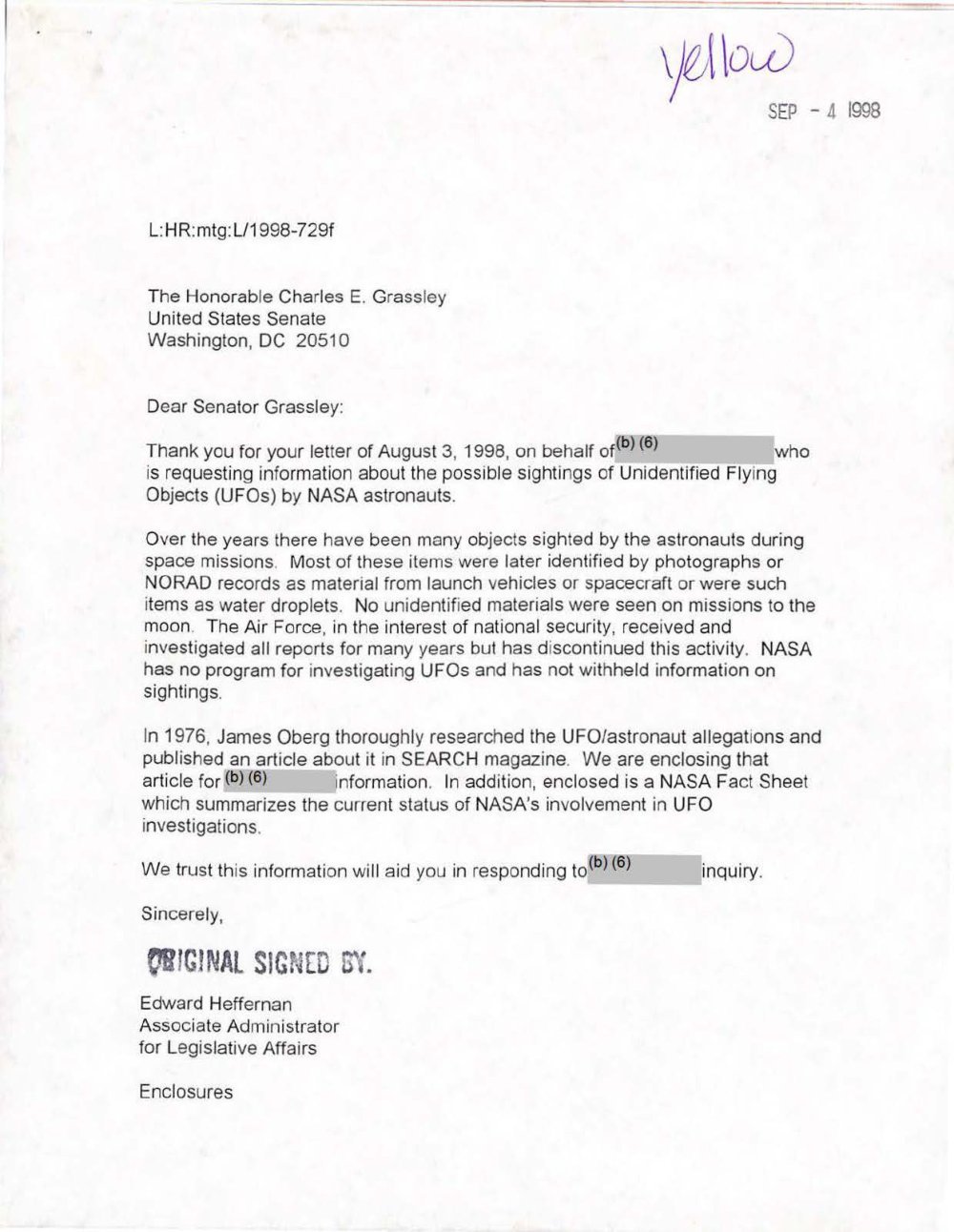
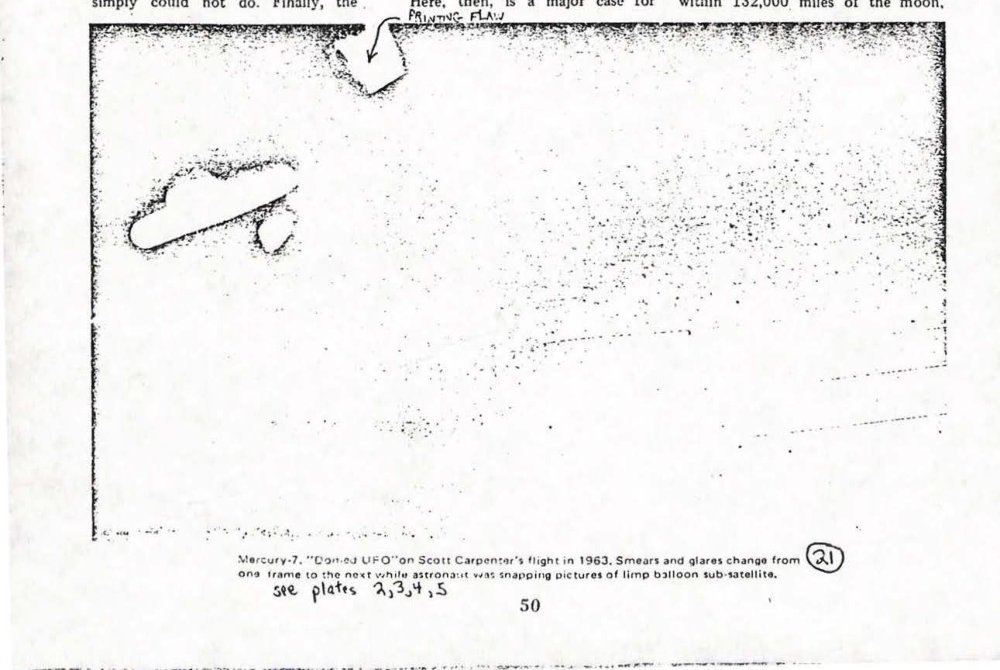
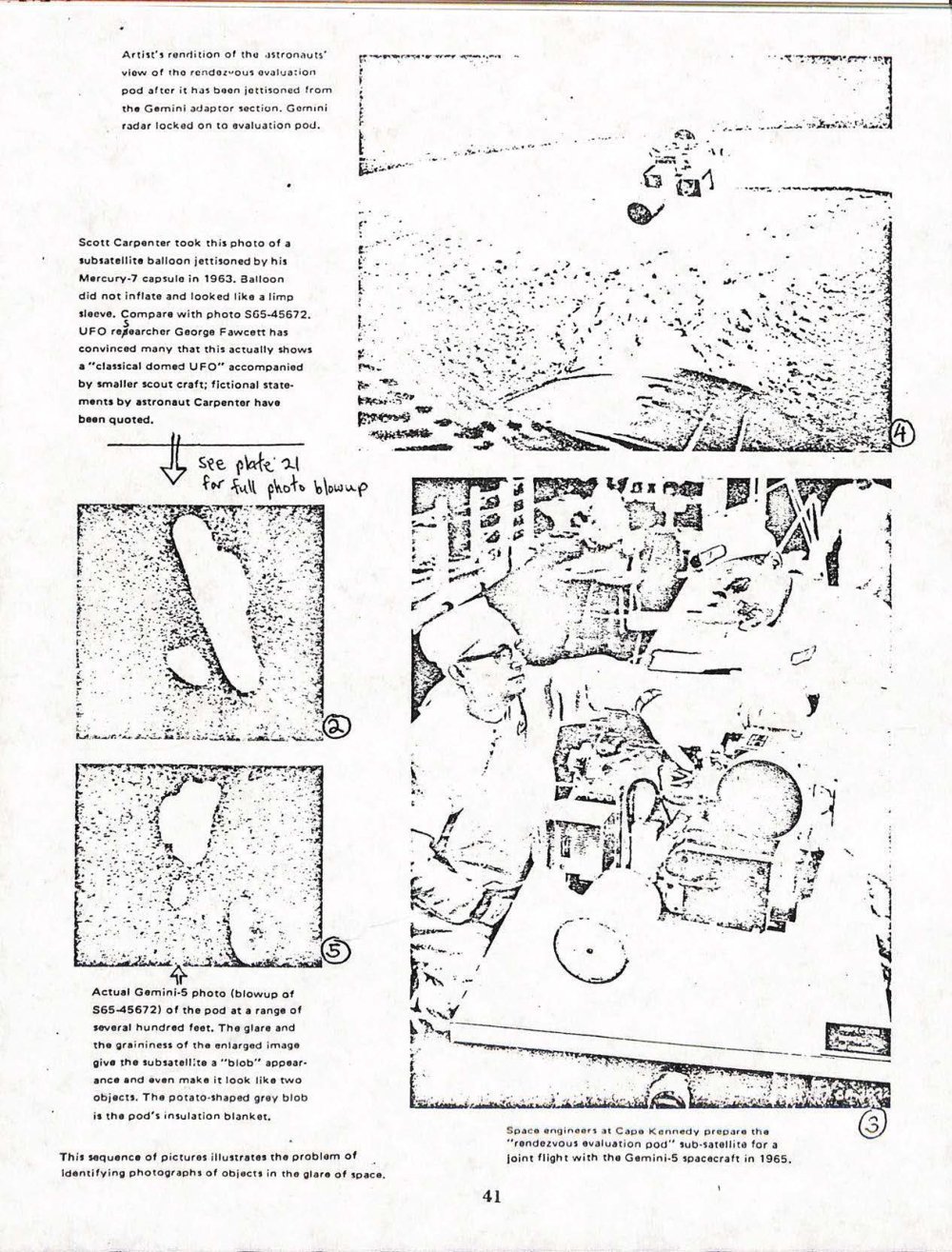
Scott Carpenter photographed a balloon that he himself released from the capsule and that did not inflate properly. James Oberg showed in 1976 that these photos came to circulate as a “classic domed disc” and even as an image taken by Skylab in 1973.
- Event date
- 24/05/1962 (Aurora 7 flight)
- Location
- Earth orbit
- Topic
- Astronaut accounts
- Source agencies
- USG · NASA
- Documents
- 2 documents · 302 pages
- Reading time
- 10 min
 Magazine clippingPhysical page 18
DOCUMENTARY SOURCES · USG / NASA
What the records tell
On Mercury-Atlas 7, Aurora 7, Scott Carpenter released from the capsule a balloon attached by a tether, used as a visual tracking practice target. The balloon did not inflate as planned and spun like an oblong, deflated bag. Carpenter photographed it. This is what the 1976 essay by James E. Oberg says, attached by NASA to a 1998 reply to the Senate, based on the flight plan and the voice transmissions.
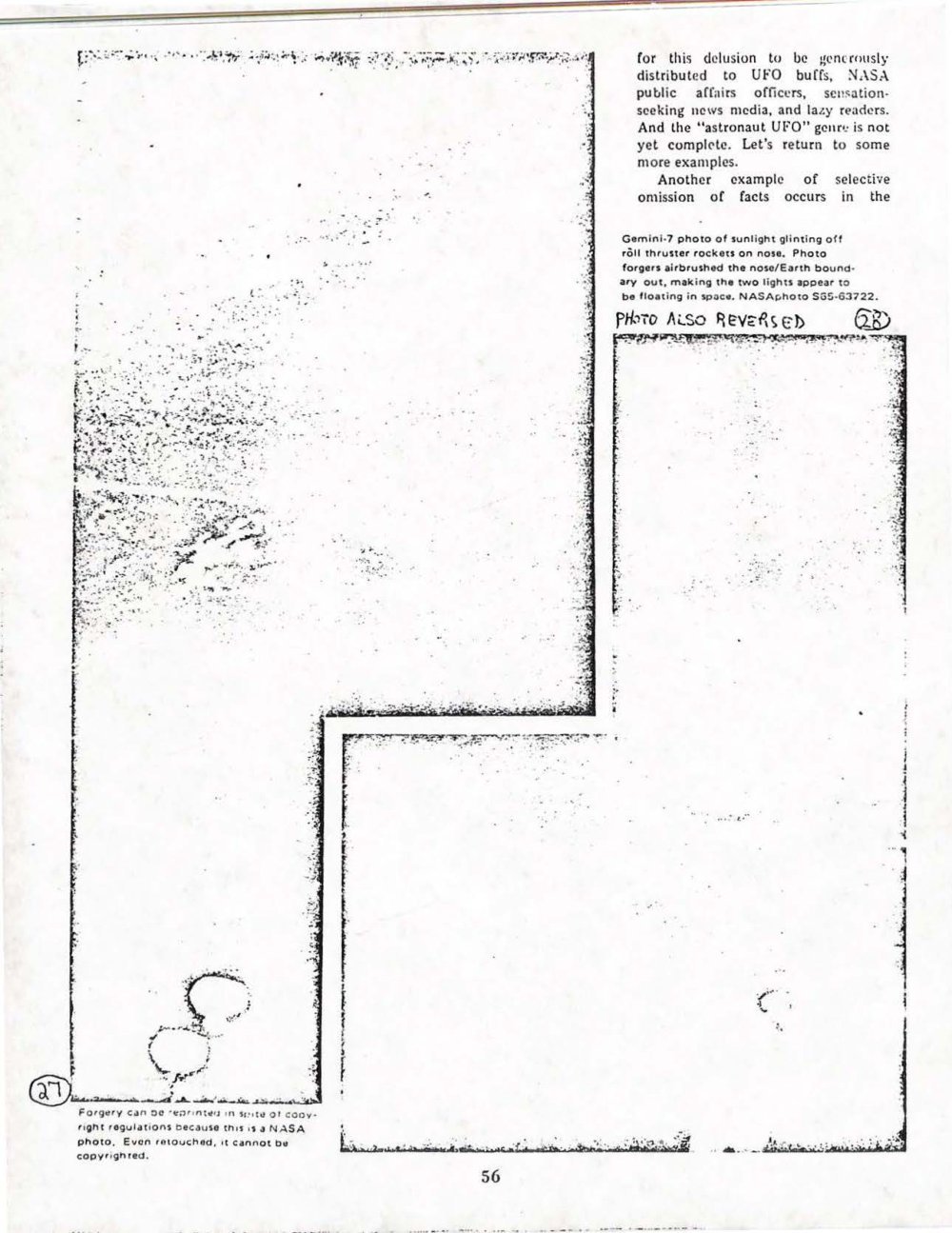
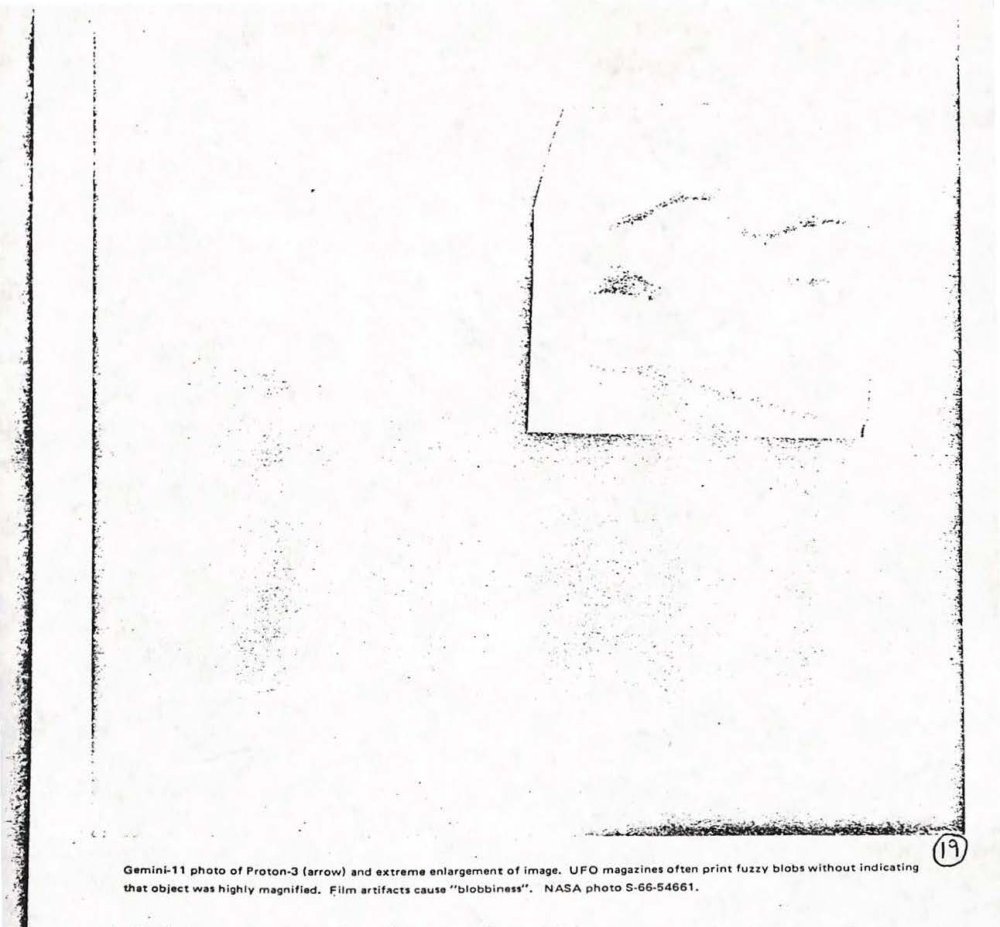
According to Oberg, researcher George Fawcett turned the episode into a sighting: Carpenter supposedly reported “what appeared to be a good photo of a disc” and photographed “a classic disc-shaped UFO, with a dome, that was following the capsule.” Oberg replies that the photos show only the balloon, and reproduces a sequence in which the glare and the smudges on the window change from frame to frame while the astronaut was photographing the deflated balloon.
The same kind of image gained new life in 1973. After the Mansfield, Ohio, sighting on October 18 of that year, Captain Lawrence Coyne said he had heard that Skylab astronauts had supposedly photographed the same UFO. Army Reserve magazine then published a photo received from NASA with the label “NASA: Skylab.” Oberg points out that there was no one aboard Skylab on that date and that the back of the photo identified it as taken by Carpenter on Mercury 7, more than ten years earlier.
The essay also reproduces a Gemini 5 photo for comparison: a radar evaluation pod released in space, whose insulation blanket, enlarged, turned into a potato-shaped gray blur and looked like two objects. Oberg uses the images to show the difficulty of identifying photos taken against the glare of space. The page also includes an artist's drawing of the released pod, identified as such in the magazine caption.
The magazine captions date Carpenter's flight to 1963; Aurora 7 flew on May 24, 1962. The photos in the file are low-quality photocopies. The conclusions about Fawcett and about Army Reserve are the author's, who does not reproduce the military magazine's article or the back of the photo. What the file allows us to state is that NASA, in 1998, sent this essay as a reply to questions about astronaut UFOs.
A NASA document of its own, written after the flight, confirms that the balloon existed and was attached by a tether to Aurora 7. It is the draft technical note on Carpenter's scientific observations, kept in the Mercury program debriefing files. In discussing the origin of the white particles seen around the capsule, the text records that no frost formed “either on the window or on the balloon tether.” The note does not describe the shape of the balloon or the photos Carpenter took of it; the information that it did not inflate properly still comes from James Oberg's 1976 essay.
More images from the document
DIRECT READING OF THE FILE
The document, in the original
Oberg's essay is a copyrighted magazine article: it gets a summary and at most one or two short quotations, and its pages are included as a magazine clipping. Excerpts from NASA documents quoted by the author (flight transcripts, debriefing reports, official letters) were translated because they are of government origin; the case pages do not contain any government document reproduced in full. The reproduced photos are high-contrast copies of NASA photos, heavily degraded by photocopying. The conclusions are the author's, not NASA's nor this editorial team's.
EXCERPT 1 · PHYSICAL PAGE 25
Sentence from the essay about Carpenter's photos, physical page 25 (short quotation)
.. ~
t S(t'if. J . ,_,.... 1 f7..~~T-. ... I ··"'""11':",~'t.jv"·.--·.'" ~,,...~,-7 ! 'l
1 '
I
~
-~ j !
\
I
I
-; ..,,
'~
.
<~';;~:~=~::.::~~~=~:
.;'(
..
and below) as published with erroneous captions.
"Fawc:dt list" of astronaut sightings.
Geori;e t·awcett is a respected and
level-headed UFO researcher in
Maiden, North Carolina. But an
example of his work gives a different
impression:
"Gemini-XII: Jim Lovell and Edwin
Aldrin saw four UFOs linked in a row.
Both spacemen said the objects were
not stars" (quoted from The Edge of
Reality, Hynek & Vallee, 1975, page
64).
From the GT-12 Astronaut
Debriefing, page K/3.4, Lovell relates:
"During the last EVA we discarded, in
addition to the ELSE (life support
system), three bags. About 2, maybe
3 or possibly 4, orbits later at sunrise
condition, we looked out again and
saw 4 objects lined up in a ro,v and
they weren't stars I know. They must
have been these same things we tossed
overboard."
The original distortion of this
entirely ordinary event, according to
the Condon Report, is the
responsibility of UFO wnter, John
Keel, Fawcett took it and embellished
it.
Another of Fawcett's favorites is
M~rcury-7: "Scott Carpenter reported
th<1t he had what looked like a good
shot of a saucer." E!sPwhere he
claimed that Carp,rnter "look a
photograph of a classical saucer-shaped
UFO with dome tha t followed his
capsule." ~(._ pla.t,;:, J,l
In fact, the photographs s!iow an
entirr.ly ordinary object: a space
balloon ejected from the capsule for
tracking practice. The balloon did not
inflate but spun in a limp oblong sack.
The flight schedule and the voice
transmissions confirm this unexciting
explanation-and confirm Fawcett's
fantasizing.
An example of the difficulty of
" disproving" an "astronaut UFO
sighting" is the Mercury-9 case in
1963. Well established in the UFO
lore, the story claims that on the 15th
orbit, over Muchea, Australia, the
astronaut (Gordon Cooper) saw a
green object. More than one hundred
people at the tracking station saw the
bogie on a radar screen (this wasn't
Shot during Sky Lab Ill second manned Sky Lab
Flighl 263 day of 1973-1645 Zulu Time.
NASA Photo =sLJ-118-2140 (4 shots taken)
Listed as unrden1,r.ed ob1ect or satellite by NASA
Pho to E,·aluat,on Lab
;(f.!C,;ii!P.l!'f!';H!¥,""" , - ••
~ -, . :.
• : ·
r · , "•
i!\":i;-':. ~ -. ,.. '-' - ,. • < • · :.,. • • r,, ~ . ·.
t
.
I
t lI
.
t -~L
liio.t.'.1io-t.~ ....:..-~ .;...~-:::....~0 .:s.::·, : :...ii .,....,._...~~~....~
@
57
.
- ·••
3A
. · •-Check the original PDF
In fact, the photographs show an entirely ordinary object: a space balloon ejected from the capsule for tracking practice.View the document record ↗ · Physical page 25, counting the cover.
EXCERPT 2 · PHYSICAL PAGE 27
full page
' sen~Jlinnal l'll••'l~h for fii:tillnal "far.t"
writ,•r Fi ·1n;_ !~d·: ;wl;: hr. had two
hundrrri p<?oplt• ar.tually ree the
ohjt-ct.).
The sou rec c,f the ~tory seems to
have bren an NBC newsman in
J\t15tralia. But th,:, problem ,;eems to b.:
that Cooper h:is nc•:er hc-ard of it. Hr.
has b<:>cn out of ti1e spat•e program for
SP.Ven yrars. and t;ilks freely about
Ur us lo reporters, to the Columbia
"UFO recording''., to ~.·Jike Douglas,
to friends and associates. Somehow he
knows nothing about, "his" space
UFO-and he has no reason to be
silent. His space UFO never existed.
Confronted by this evidence,
Fawcett (letter of May 10, 1976)
insists that " I sincerP.ly believe some of
the ashonaut sightings are bonafide,
based on some of my sources of
information." John Keel, too, recalls
(letter of .March 26, 1976) that "exNASA engineers have told me all kinds
of fascinating UFO tales.. . " Always
these writers fall back on "secret
reports" and "private information"
when their published reports and open
articles disintegrate in the face of the
truth.
On October 18, 1973, the famous
Mansfie!d, Ohio UFO sighting
occurred, for which Captain Lawrence
Coyne and his helicopter crew later
were to receive the 'Best UFO Case of
the Year" award (and check) from a
weekly tabloid's 'blue-ribbon panel' of
UFO experts. A few months later,
Coyne said he was told by the pa11el
chairman, J. Allen Hynek, (the
respected head of the Center for UFO
Studies) that Skylab astronauts had
photographed the same UFO from
space. (Hynek ultimately denied this.)
A reputable ma~azine, "Army
ReserYe" published the story with an
intriguing photograph it had received
from NASA and which it labeled
"NASA: Skylab", clt>arly indic;1ting
that this was the astronaut photograph
which had b1Jzzed Coy ne.
It would ha\'e been a neat trick for
the Skylab astronauts to have photo•
graphed anything on OC'tobcr 18th,
since they weren't even on board the
space station. The prerious crew had
returned to E:irth a 111011th bl'fore and
their relie f crP.w was not schl'ouled to
blast o ff for ano!hl•r thrre weeks. The photogr:iph prin!t·d in the magazine
w<1s clt>arly labl'll·rl 1m its backsidl• as
t<1hn hy S-:<itt <:.::iq.>ent<•r on ~lt>rcury7 morl' than tPn years before. It t-pl,{q_
r.ji•rlt•d fC'.lrn hi, spac·1·cr:ifl in a11
.1ttc111pt to g1·1 \·isual tr.ic:kin~! pr:1c:tic1?
(!Lis photo is o ften referred to ;is the
"cl.issical domed UFO" sht>lJ. UFO
researchers anri ma::azine edilors had
dearly not made e\·en a minimum of
effort to verify thew transparrn t
errors and mistakes. but instead 1nssed
011 the false data to the public.
Thou~ands more were decei\·rd.
La te i11 197'.l, a str;in~e objr,;t did
aµpt'ar in Skrlab sµ,11:t' photograph~ .
Takl'n on Conrad's Skylab flight i11
June, lhe object was not 11oliced b\·
UFO researchr1s but by go\'ernm.:n·t
photo :111alysts. pl,t._ '33
Rather than ·•swi?ep the lJFO under
the rug", the officials look the other
t.ick: it might be a mysterious So,·iet
Satellite and could lie of great value to
... :. . . ... . . ,• • ' •: ...: '
... •·.
l
r
t
-.- ..•·
.,.
i.
·.,.
,.,
··., ·:--.· .• .. ;'-..:. ~:... ..-_,;_,,: _, ;.._' • .,•.,,., :::.,~ ..,;~;.,_,,_/ ~ ~...;i~._~;,,..;.r, ..+.,_;.~~@-..:·-~- 33
..UFO.. 1ee,n fro,n Skvlot,.:?. The '!tongatcd ou,"ct i1 actually an a ,rstrio
.
'" the 8r~:il,a" 1ur,91.i,. ElllMgomo"t of NASA photo SL2-16-109.
.. ! ..
show,•d a limp balloon Ca rp<'nter had ')..\ "'a'';" !
58Editorial note: Page of Oberg's essay (SEARCH magazine, 1976) on the story that Skylab astronauts had supposedly photographed the Mansfield, Ohio, UFO, and on the Skylab 2 photo with the "landing strip"; summary only, since it is a private publication.
Check the original PDF
[p. 27: texto da revista não reproduzido; ver a síntese]View the document record ↗ · Physical page 27, counting the cover.
EXCERPT 3 · PHYSICAL PAGE 9
full page
Arti1t', ronrlition o t thu ,ntron,,u1s· t> --.,.-~r..-~•r·~ ~ .-:---•' ...
l • •• •"t'"':•~·r-n- . . . ·'"-] . vlow o f 1ho rondo.r 0 0 u <J ovatv a:ion
pod after it hai boon jotti1oncd from
the Gemini adaptor ioct iun. Gorn,ni
r;,dar locked o n to evaluation pod.
Scott Carpenter took this photo of a
subsatellit e balloon jettisoned by h is
( . ' ' .
i . . , • • .. -· .. .., . . cJ . • : ., .....--..:- _,..Js...:'11, . :.l• • ' ...-"...
t·
--.,-..
. ', '
·,· ... ., .- £' . .
ance and even make it look like two
objects. The potato-shaped grey b lob
is the pod's insulation blanket.
T h i• sequence of p ictures illustrate• the problem o f
Identifying photographs of objects in tho glare o f space.
41Editorial note: Photo page from Oberg's essay (SEARCH magazine, 1976) on Carpenter's subsatellite balloon and the Gemini 5 rendezvous evaluation pod; only a summary of the captions, since this is a private publication.
Check the original PDF
[p. 9: texto da revista não reproduzido; ver a síntese]View the document record ↗ · Physical page 9, counting the cover.
Dates and documentary context
- Event
- 24/05/1962 — Date of the Aurora 7 flight (public mission data). The magazine's captions (pp. 9 and 18) say 1963, by mistake. The attribution to Skylab is later than 18/10/1973.
- Document
- Not established — SEARCH magazine, Winter 1976 (issue 129, according to a handwritten note on p. 6); NASA attached the article to its letter of 04/09/1998 to Senator Grassley.
- Publication
- 1976 — Year of the magazine, confirmed by NASA's letter (p. 4).
Origin and release
James E. Oberg, SEARCH magazine (1976); filed and sent by NASA, Office of Legislative Affairs, in 1998 · USG-UAP-D001_Congress-WhiteHouse-UFO-Correspondence_1998.pdf
86-physical-page PDF from release batch 3 (USG-UAP-D001). Essay on physical pages 6 to 31 (magazine pages 38 to 62).
Related accounts and their differences
- Senate, 1998: why NASA sent this essay
- Aurora 7, 1962: Carpenter and the flakes
- Skylab 2, 1973: the lead in Brazil
Questions to continue the investigation
- In which issue Army Reserve magazine published the photo with the label "NASA: Skylab".
GEOGRAPHY OF THE CASE
Earth orbit
Observation during spaceflight; the essay does not establish a geographic position.
DOCUMENTARY TRAIL
Go back to the sources
References use physical pages of the PDF, counting the cover. Summaries are presented in English; the documents keep their original language.
- USG-UAP-D001_Congress-WhiteHouse-UFO-Correspondence_1998.pdf
Physical pages 9, 18, 25, 26 and 27: essay by James E. Oberg (SEARCH, 1976) on the Aurora 7 balloon photos
USG · 86 pages - NASA-UAP-D015_Astronaut-Scientific-Debriefings_1962-1963.pdf
Physical page 62: draft NASA note on the scientific observations of the MA-7 flight, with the mention of the balloon tether (full translation in the dossier aurora-7-carpenter-flocos-1962)
NASA · 216 pages
Editorial summary based on the collection's research notes. How we read the documents.