Date: 24/05/1962Location: Earth orbit, Mercury-Atlas 7 flight
Aurora 7, 1962: Scott Carpenter knocks on the capsule wall and releases a cloud of particles
A draft NASA note records that Scott Carpenter saw and photographed white, snowflake-like particles on all three orbits and, shortly before reentry, struck the capsule wall with his hand, releasing many of them. The text concludes that they were most likely flakes formed from the vapor of the life support system.
- Event date
- 24/05/1962
- Location
- Earth orbit, Mercury-Atlas 7 flight
- Topic
- Astronaut accounts
- Source agencies
- NASA
- Documents
- 1 document · 216 pages
- Reading time
- 19 min
 Draft scientific notePhysical page 57
DOCUMENTARY SOURCES · NASA
What the records tell
In the same file of Mercury program debriefings there is a “draft note on the scientific observations” of the Mercury-Atlas 7 flight, made by Scott Carpenter in the Aurora 7 capsule on May 24, 1962. The text is unsigned and is not a transcript of the astronaut's words: it is an analysis summarizing what he reported and photographed. The first part deals with a luminous band on the horizon that Carpenter observed through a special filter and that the text identifies as the airglow of the upper atmosphere.
According to the note, Carpenter also saw and photographed what the team was already calling the “Glenn effect”: white, snowflake-like objects seen at sunrise on all three orbits. But he also saw them 7 and 43 minutes after the first sunrise and at six moments after the second, up to 45 minutes. For the author, this shows that the particles did not depend on sunrise, which would simply be the moment when they were most visible. Carpenter described them as ranging in size from 1 millimeter to 1 centimeter.
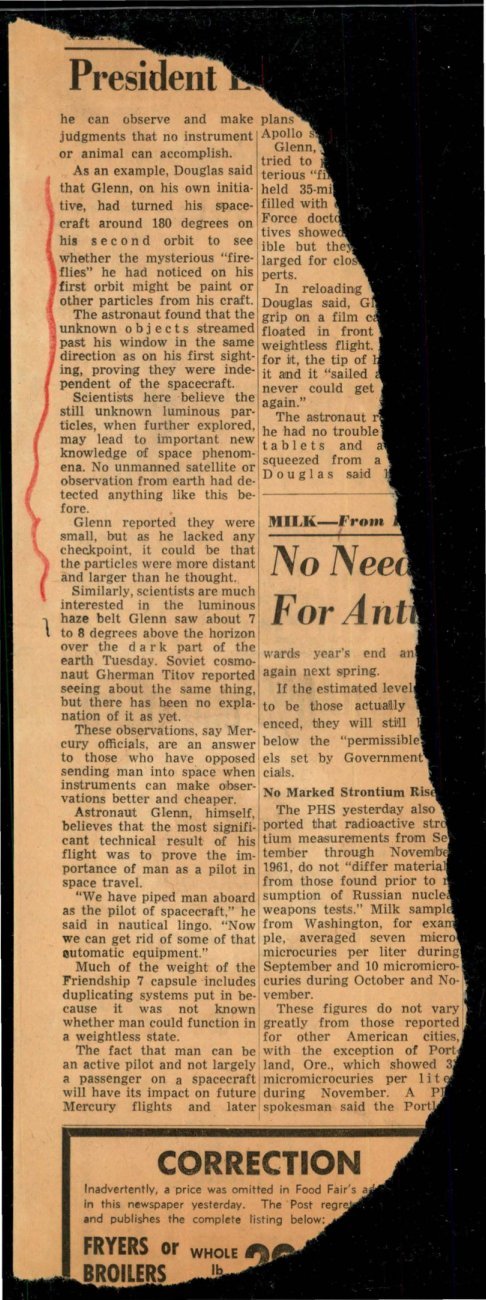
The central point is what the note calls the “decisive experiment.” Shortly before reentry, at sunrise, Carpenter struck the capsule walls with his hand, and the knocks immediately released a large quantity of particles. From the direction in which they crossed the window, he was certain they came from a point near where he had knocked. The text concludes that at least the particles on that flight came from the capsule itself.
The note examines other possible sources. A NASA inspector tested the dye marker and the shark repellent, both green and exposed to vacuum, and neither escaped from its packaging. Insulation fibers would be carried away quickly. A corkscrew-shaped piece seen by Carpenter was probably a shaving or a strand of insulation. Two origins remained: snow formed by condensation of vapor from the life support system, and dust, debris and loose bits of material inside the spacecraft.
The author favors snow for most of the material: water is what the capsule dumps the most, the particles looked like flakes to both Glenn and Carpenter, and the frequency of sightings tracked the external temperature measured on the capsule, which dropped to about 35 degrees below zero before sunrise. The final hypothesis is that the flakes formed inside the capsule, between the cabin bulkhead and the heat shield, and were pushed out by the vapor. NASA also released audio from the flight in which Carpenter describes the particles (NASA-UAP-D013).
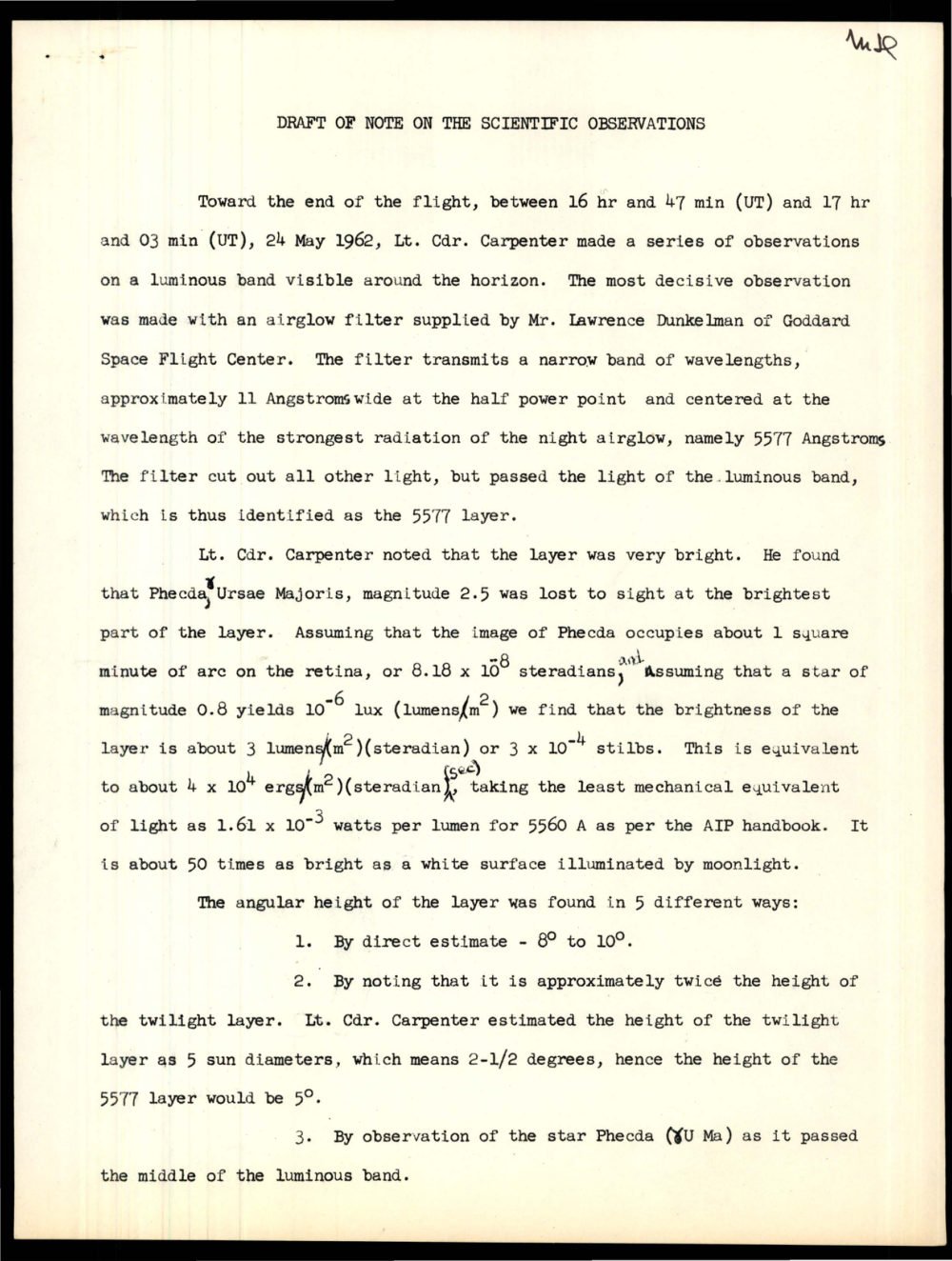
The full note begins with another observation by Carpenter, made in the last 16 minutes of the flight. With a filter that passed only the green light of oxygen, at 5577 angstroms, he saw a luminous band on the horizon and identified it as the airglow of the upper atmosphere. The author estimated the band was about 50 times brighter than a white surface in moonlight and, from the passage of the star Phecda, in Ursa Major, placed its densest part at 89 kilometers altitude, in agreement with rocket measurements. Carpenter also judged it by eye at 8 to 10 degrees; the timed measurements gave 2 to 3.
On the particles, the note gives figures the dossier did not yet have. Carpenter managed to photograph some of them, and the author estimated they were 10 to 100 times brighter than the Moon at first quarter, a brightness consistent with one-centimeter snowflakes. The note relates the frequency of sightings to the skin temperatures, from -35 °C before dawn to 10 °C afterward, and calculates that the snow could not form on the outside, because the vapor pressure there would be too low. It therefore places the condensation between the cabin bulkhead and the heat shield, from where the flakes would exit through the capsule's 18 openings.
The note also records that no frost formed on the window or on the tether of the training balloon Carpenter released from the capsule, the same deflated balloon whose photos would later be presented as a “domed disc.” And it mentions that, at 2 hours, 52 minutes and 47 seconds into the flight, Carpenter saw a particle moving faster than the spacecraft, probably to the east of him, since he was facing forward awaiting sunrise. Most, however, fell behind, which reinforced the idea that they were pushed out by the vapor before following their trajectory.
The seven-page note bears no date or signature. It contains a handwritten correction from “MA-6” to “MA-7” in the passage on the decisive experiment and leaves crossed out a paragraph on the limits of the luminous layer, considered uncertain. It ends with another observation from the flight: two photos of the Sun just above the horizon, flattened into a sausage shape by atmospheric refraction, as Glenn had already photographed. In a handwritten insertion, Carpenter says that what he saw was as the photos show, except for some reflection in the corners.
OFFICIAL MEDIA
Official video for this case
Files published by the United States Government on DVIDS. The title of each one is that of the official publication, translated; the description of what is seen is in the dossier text.
NASA mission audio · 1 min 49 s · the video only loads when you start playback, directly from the official server.
Official record ↗More images from the document
DIRECT READING OF THE FILE
The document, in the original
Draft NASA note, a U.S. government work: excerpts about the particles translated after checking against the facsimile; the part about the 5577 Å band was only summarized.
EXCERPT 1 · PHYSICAL PAGE 57
Physical page 57, full text: draft note on the scientific observations of the MA-7 flight (page 1)
DRAFT OF NOTE ON THE SCIENTIFIC OBSERVATIONS
Towa rd the end of the flight, between 16 hr and 47 min (UT) and 17 hr
and 03 min (UT), 24 May 1962, Lt. Cdr. Carpenter made a series of observati ons
on a l uminous band visible around the hori zon. The most de cisi ve observat i on
wa s made wi th an air glow f i lter suppli ed by Mr. Iawrence Dunkelman of Goddard
Space Fli ght Center. The f i lter transmits a narrow band of wavelengths,
approx i.mately 11 Angstroms wi de at the ha lf power poi nt and centered at t he
wa, ve length of the strongest radiation of the ni ght a i rglow, namely 5577 Angstroms
The f i lter cut out a ll other Ught, but passed the light of the , luminous band,
which is thus i denti f i ed a s the 5577 l aye r .
Lt. Cdr. Carpenter noted tha t the layer was very bri ght. He f ound
t hat Phecda:Ursae Majori s, magn itude 2.5 was lost to si ght a t the brighte st
part of the layer. Assuming that the image of Phecda occupi es about 1 SY.Uare
-8 o_,)J- mi nute of' arc on the retina, or 8.18 x 10 steradi ans, O.ssuming that a star of
6 2
magnitude o.8 yi elds 10- lux (1umensJm ) we f i nd that the brightness of t he
l aye r i s about 3 lumen1m2 )(steradian) or 3 x 10⁻⁴ sti lbs. Thi s i s e~ui va l ent
~t (S"-~) t o about 4 x 10⁴ erg;,m2 )(sterad:i. anh_, taking the least mechani cal e y_ui va lent
of light as 1. 6-1 x 10⁻³ watts per lumen f or 556o A as per the AIP handbook . It
is about 50 t imes as bright as a white surface i lluminated by moonlight.
The angular he i ght of the layer was found i n 5 di fferent ways:
1. By dire ct esti mate - 8° to 10°.
2. By noti ng that it is approximately twice the height of
t he twilight layer. Lt. Cdr. Carpenter estimated the he i ght of the twi light
l ayer a,s 5 sun diameters, whi ch means 2-1/2 degrees, hence the he i ght of the
5577 layer would be 5°.
3. By observation of the star Phecda (ju Ma) a s it pa ssed
t he middle of the luminous band.Editorial note: Typewritten draft, undated and unsigned, with few handwritten corrections; the translation incorporates the corrections. The Greek letter gamma (γ) and the word "and" were added by hand. The note deals first with the luminous band and, from physical page 60 on, with the particles. "UT" is universal time. The AIP is the American Institute of Physics. Carpenter was a lieutenant commander in the U.S. Navy.
Check the original PDF
[handwritten, top right: initials, illegible]
DRAFT OF NOTE ON THE SCIENTIFIC OBSERVATIONS
Toward the end of the flight, between 16 hr and 47 min (UT) and 17 hr and 03 min (UT), 24 May 1962, Lt. Cdr. Carpenter made a series of observations on a luminous band visible around the horizon. The most decisive observation was made with an airglow filter supplied by Mr. Lawrence Dunkelman of Goddard Space Flight Center. The filter transmits a narrow band of wavelengths, approximately 11 Angstroms wide at the half power point and centered at the wavelength of the strongest radiation of the night airglow, namely 5577 Angstroms. The filter cut out all other light, but passed the light of the luminous band, which is thus identified as the 5577 layer.
Lt. Cdr. Carpenter noted that the layer was very bright. He found that Phecda, γ Ursae Majoris, magnitude 2.5 was lost to sight at the brightest part of the layer. Assuming that the image of Phecda occupies about 1 square minute of arc on the retina, or 8.18 x 10^-8 steradians, and assuming that a star of magnitude 0.8 yields 10^-6 lux (lumens/m^2) we find that the brightness of the layer is about 3 lumens/(m^2)(steradian) or 3 x 10^-4 stilbs. This is equivalent to about 4 x 10^4 ergs/(m^2)(steradian)(sec), taking the least mechanical equivalent of light as 1.61 x 10^-3 watts per lumen for 5560 A as per the AIP handbook. It is about 50 times as bright as a white surface illuminated by moonlight.
The angular height of the layer was found in 5 different ways:
1. By direct estimate - 8° to 10°.
2. By noting that it is approximately twice the height of the twilight layer. Lt. Cdr. Carpenter estimated the height of the twilight layer as 5 sun diameters, which means 2-1/2 degrees, hence the height of the 5577 layer would be 5°.
3. By observation of the star Phecda (γ U Ma) as it passed the middle of the luminous band.View the document record ↗ · Physical page 57, counting the cover.
EXCERPT 2 · PHYSICAL PAGE 58
Physical page 58, full text: draft note on the MA-7 flight (page 2)
t
4. By noting the time when Phecda was halfway f rom the
luminous oand to the horizon.
5. By noting the fact that when the cross of the reti cle
,th(.. 'A1,( ·1 r.~ i) ~ /).\ \>.-.( !
is set diagonally,~ just covers the distance from the band to the hori zon.
By method 3, we make use of the time of passage through the middle
J
of the layer. This point is marked by a re f erence to a mark on the telemeteri ng.
enl:y: ee found on ~he gr ottae. etatiea ta:r;,e s, .:i. ~ '-"'' .;i.--,c.:h •" .,.;.~1 ).."f' cn\:!r . L\ tr f e ,, 4er
v a:'.. efl 1:,Pe Mt yet svail:a:til.e, ~ l,y careful timing of the capsule t ape'/\it ,,.
appear s to have been very close to a 4h "1,m j.9s, capsule elapsed time, i.e.,
16h5cPl/5s. UT. For this instant the capsule coordinates as i nterpola ted from
the Woomera tra cking data, were - longi tude - 127° 40:0
latitude = -18° 49:8
he i ght = 226 kilometers
At thi s moment, the l i ne of sight to ( Ursae Majoris was t angent to
t he l ayer of maxi mum thi ckness of 5577. The angular zeni th distance oft U Ma
a t t hi s time was found to be 101°42 1 • A line of this zeni th distance i s t angent
t o a spherical shell of the proper radius whi ch i s 137 ki lometers below the
capsule or 89 ki lometers above sea level. Ac cordingly, thi s observat i on should
be i nterpreted a s i ndicating that the densest part of the 5577 l aye r i s at a
he ight of 89 ki lometers, which is in good agreement with rocket mea sures.
The lower limit of the visible light appeared to be near 78 ki lometers;
rt / ht 5/derrmtat1f. i3/no. t pnie1d aysif1fi,/ bt,j~i n1 a 1/1111io/u~ / hell
/1 s /ex-p/c~ to/dim/nisVgragla11r d~wara i/a6arentlbri~~e9i , e4en} r /4 is . ,
faf~8}1/ _v}r/ ¢1/1• .
#J.JJiJlliJJJlfl:!J°Y:!iJJJ,~v.~ir
The f i lter observati on on the airglow was made at 17h 0~ 6s, UT.Editorial note: Typewritten draft, undated and unsigned, with few handwritten corrections; the translation incorporates the corrections. "The horizontal bar" and "and conversation with Lt. Cdr. Carpenter" were added by hand. The digits of the minutes and seconds of elapsed time and of the UT time were retouched by hand and are of somewhat uncertain reading. The negative latitude indicates the southern hemisphere; the point lies northwest of Australia, in the area covered by the Woomera tracking station.
Check the original PDF
4. By noting the time when Phecda was halfway from the luminous band to the horizon.
5. By noting the fact that when the cross of the reticle is set diagonally, the horizontal bar just covers the distance from the band to the horizon.
By method 3, we make use of the time of passage through the middle of the layer. This point is marked by a reference to a mark on the telemetering. [struck: It is understood that this mark can only be found on the ground station tapes, which are not yet available, but] By careful timing of the capsule tape and conversation with Lt. Cdr. Carpenter, it appears to have been very close to a 4h 5m 29s, capsule elapsed time, i.e., 16h50m45s UT. For this instant the capsule coordinates as interpolated from the Woomera tracking data, were - longitude = 127° 40:0
latitude = -18° 49:8
height = 226 kilometers
At this moment, the line of sight to γ Ursae Majoris was tangent to the layer of maximum thickness of 5577. The angular zenith distance of γ U Ma at this time was found to be 101°42'. A line of this zenith distance is tangent to a spherical shell of the proper radius which is 137 kilometers below the capsule or 89 kilometers above sea level. Accordingly, this observation should be interpreted as indicating that the densest part of the 5577 layer is at a height of 89 kilometers, which is in good agreement with rocket measures.
The lower limit of the visible light appeared to be near 78 kilometers; [struck through by hand: but this determination is not considered as significant, since a luminous shell is expected to diminish gradually downward in apparent brightness, even if it is actually very thin. The upper limit of the layer is at about 105 kilometers, so far as can be judged from the voice tape; this result is quite uncertain.]
The filter observation on the airglow was made at 17h 02m 6s, UT.View the document record ↗ · Physical page 58, counting the cover.
EXCERPT 3 · PHYSICAL PAGE 59
Physical page 59, full text: draft note on the MA-7 flight (page 3)
Sunrlse was observed at about 1m later, while the observation was going on.
It follows that the airglow is visible even when the twilight band is very
strong. An attempt to observe i t in the day is certainly indicated. In this
connection, it should be noted that Capt. V. I. Grissom reported a grayish band
at the top of the blue sky layer. (Pesults of the Second U. S. Manned Subqrbita l
Space Flight, NASA, GPO (1961). le remembers this layer as narrow and grayish
i n color, representing an actual i ncrease in intensity. He poi nted out the
approximate position of the layer on one of Lt. Cdr. Carpenter's photographs
at the height of 1.7 degrees above the horizon. Grissom may have observed the
daytime airglow.
Carpenter did not note any structures, either vertical or horizontal,
in this layer. He did not observe it completely around the horizon but believes ·1 l
to be continuous all the way. It does not appear possible that this layer can
a ctually absorb starl:ight. Any layer at this level capable of absorbing a
noticeable fraction of the light (25i or more) would also scatter light strongly;
i t would therefore be a very prominent object on the daylight side. In fact, it
is not definitely visible on the photographs of the day side. Thl s i s entirely
i. n agreement with Lt. Cdr. Carpenter's impression, namely that the decreased
visibility of stars passing through the layer was a contrast effect.
A remarkable feature of this observatton is the discrepancy between
the eye estimates of 8',.10° for the alti tudes above the hori zon, on the one
hand, and the results of timed observations on the other. The latter i ndi cates
altitudes of 2° to 36 . The latter are clearly correct; f or example, Carpenter
noted that when one ann of his reti cle was at an angle of 45°, it covered the
space between the horizon and the bright band. The crossann is 1.21 centi meters
i n length and it is a distance of 26.2 centimeters from the astronaut's eye.
At an angle of 45°, i t subtends a vertical angle of about 2°.6.Editorial note: Typewritten draft, undated and unsigned, with few handwritten corrections; the translation incorporates the corrections. Virgil I. Grissom flew the program's second suborbital flight, in July 1961. The final "I" of "believes it" was added by hand.
Check the original PDF
Sunrise was observed at about 1m later, while the observation was going on. It follows that the airglow is visible even when the twilight band is very strong. An attempt to observe it in the day is certainly indicated. In this connection, it should be noted that Capt. V. I. Grissom reported a grayish band at the top of the blue sky layer. (Results of the Second U. S. Manned Suborbital Space Flight, NASA, GPO (1961). He remembers this layer as narrow and grayish in color, representing an actual increase in intensity. He pointed out the approximate position of the layer on one of Lt. Cdr. Carpenter's photographs at the height of 1.7 degrees above the horizon. Grissom may have observed the daytime airglow.
Carpenter did not note any structures, either vertical or horizontal, in this layer. He did not observe it completely around the horizon but believes it to be continuous all the way. It does not appear possible that this layer can actually absorb starlight. Any layer at this level capable of absorbing a noticeable fraction of the light (25% or more) would also scatter light strongly; it would therefore be a very prominent object on the daylight side. In fact, it is not definitely visible on the photographs of the day side. This is entirely in agreement with Lt. Cdr. Carpenter's impression, namely that the decreased visibility of stars passing through the layer was a contrast effect.
A remarkable feature of this observation is the discrepancy between the eye estimates of 8° to 10° for the altitudes above the horizon, on the one hand, and the results of timed observations on the other. The latter indicates altitudes of 2° to 3°. The latter are clearly correct; for example, Carpenter noted that when one arm of his reticle was at an angle of 45°, it covered the space between the horizon and the bright band. The crossarm is 1.21 centimeters in length and it is a distance of 26.2 centimeters from the astronaut's eye. At an angle of 45°, it subtends a vertical angle of about 2°.6.View the document record ↗ · Physical page 59, counting the cover.
EXCERPT 4 · PHYSICAL PAGE 60
Physical page 60, full text: draft note on the MA-7 flight (page 4)
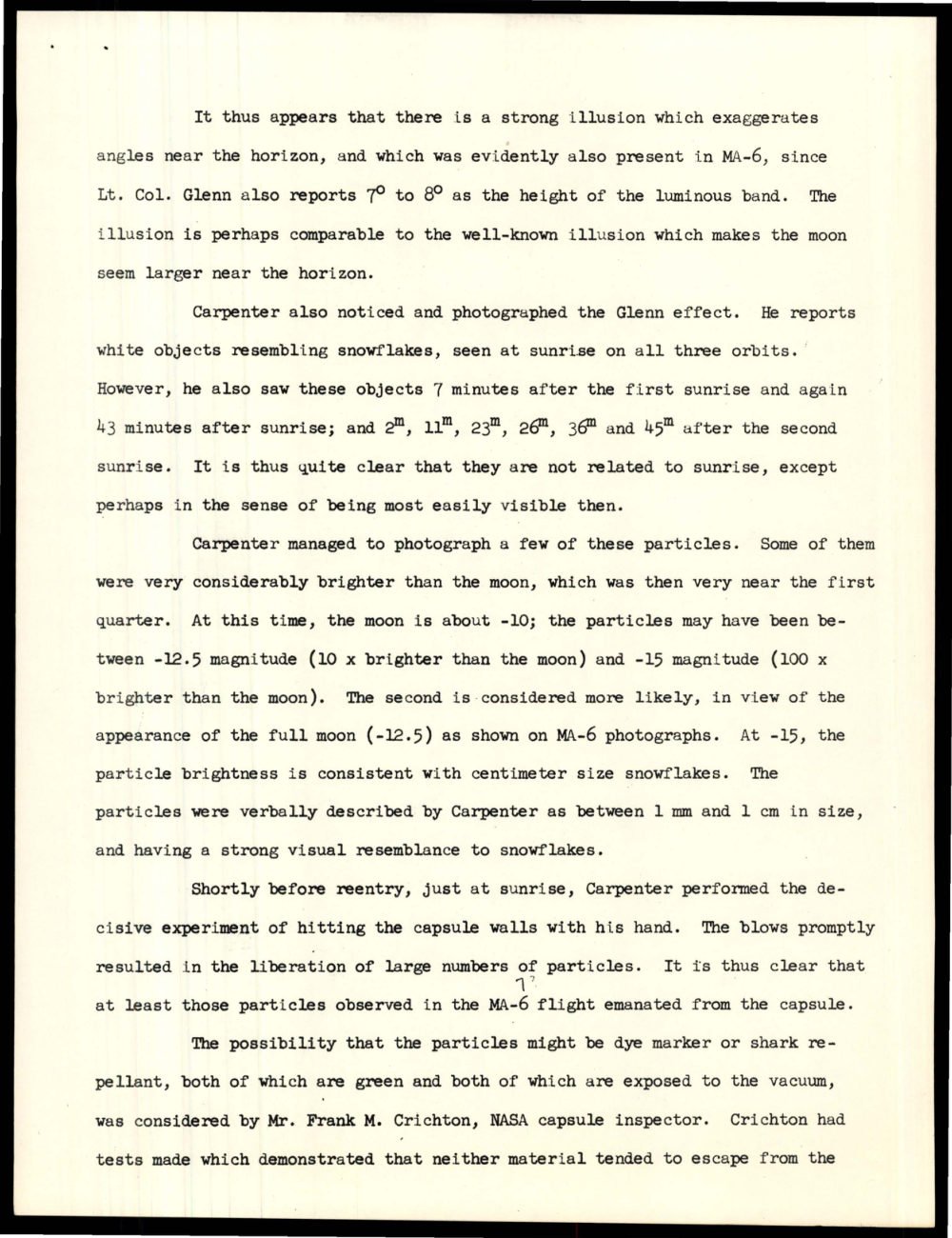
It thus appears that there i s a strong i llusion whi ch exaggerates
angl es near the horizon, and whi ch was evi dently also present i n MA-6, si nce
Lt . Col. Glenn a lso reports 7° to 8° as the height of the luminous band. The
i llusion is perhaps comparable to the well-known illusion which makes the moon
seem larger near the hori zon.
Carpenter also noti ced and photographed the Glenn ef fect. He reports
white objects resembling snowflakes, seen at sunri.se on all three orbits. '
However, he also saw these objects 7 minutes after the f i rst sunrise and agai n
43 minutes after sunrise; and zll, llm, 23m, 26ffl, 3(1!! and 45m after the second
sunri se. It i s thus quite clear that they are not related to sunri se, except
pe rhaps i n the sense of being most easily visible then.
Carpenter managed to photograph a few of these particles. Some of them
we re very considerably brighter than the moon, which was then very near the f i rst
quarter. At this t ime, the moon i s about -10; the particles may have been bet ween -12,5 magni tude (10 x bri ghter than the moon) and -15 magni tude (100 x
bri ghter than the moon). The second i s -considered more l i kely, in vi ew of the
appearance of the full moon (-12,5) as shown on MA-6 photographs. At -15 , the
particle brightness i s consistent with centimeter size snowflakes. The
particles were verbally described by Carpenter as between l mm and 1 cm i n size ,
and having a strong visual resemblance to snowflakes.
Shortly before reentry, just at sunri se, Carpenter performed the deci si ve experi ment of hitting the capsule walls with hi s hand. The blows promptly
resulted i n the liberation of large numbers of particles. It i s thus clear that
1 7
at least those parti cles observed in the MA-6 flight emanated from the capsule .
The possibility that the particles might be dye marker or shark repe l lant , both of which are green and both of which are exposed to the vacuum,
was considered by Mr. Frank M. Crichton, NASA capsule inspector. Crichton had
test s made which demonstrated that ne i ther materi al tended to escape f rom theEditorial note: Typewritten draft, undated and unsigned, with few handwritten corrections; the translation incorporates the corrections. The typescript says "MA-6" in the sentence about the decisive experiment, corrected by hand to "7"; the translation follows the correction. The two passages already published on the site (angle illusion and the experiment of knocking on the wall) were kept with the same wording. "Magnitude" is the astronomical brightness scale, in which smaller (and negative) numbers indicate brighter objects.
Check the original PDF
It thus appears that there is a strong illusion which exaggerates angles near the horizon, and which was evidently also present in MA-6, since Lt. Col. Glenn also reports 7° to 8° as the height of the luminous band. The illusion is perhaps comparable to the well-known illusion which makes the moon seem larger near the horizon.
Carpenter also noticed and photographed the Glenn effect. He reports white objects resembling snowflakes, seen at sunrise on all three orbits. However, he also saw these objects 7 minutes after the first sunrise and again 43 minutes after sunrise; and 2m, 11m, 23m, 26m, 36m and 45m after the second sunrise. It is thus quite clear that they are not related to sunrise, except perhaps in the sense of being most easily visible then.
Carpenter managed to photograph a few of these particles. Some of them were very considerably brighter than the moon, which was then very near the first quarter. At this time, the moon is about -10; the particles may have been between -12.5 magnitude (10 x brighter than the moon) and -15 magnitude (100 x brighter than the moon). The second is considered more likely, in view of the appearance of the full moon (-12.5) as shown on MA-6 photographs. At -15, the particle brightness is consistent with centimeter size snowflakes. The particles were verbally described by Carpenter as between 1 mm and 1 cm in size, and having a strong visual resemblance to snowflakes.
Shortly before reentry, just at sunrise, Carpenter performed the decisive experiment of hitting the capsule walls with his hand. The blows promptly resulted in the liberation of large numbers of particles. It is thus clear that at least those particles observed in the MA-7 flight emanated from the capsule.
The possibility that the particles might be dye marker or shark repellant, both of which are green and both of which are exposed to the vacuum, was considered by Mr. Frank M. Crichton, NASA capsule inspector. Crichton had tests made which demonstrated that neither material tended to escape from theView the document record ↗ · Physical page 60, counting the cover.
EXCERPT 5 · PHYSICAL PAGE 61
Physical page 61, full text: draft note on the MA-7 flight (page 5)
package i n a vacuum. The possibility that it might represent small partic les
from the fiberglass i nsulator was also considered; in view of the smallness of
the fibers, it appears l :lkely that they would have been blown away at once,
l Lke the Mylar confetti. The dynamic pressure of 1 dyne m2 is sufficient to
L\I'" \\,••''\ 2 remove at once~weighing less than about 10 to 100 milligrams cm ; which
corresponds to a thickness of the order of 0. 3 to 1 mi llimeter for most
ordinary substances.
As menti oned in the MA-6 report, there are two plausible sources
withi n the capsule for these particles.
(1) Snow formed by condensation of steam
from the life-support system.
(2) Small particles of dust, waste, bits
of i nsulation and other sweepings.
The latter are very conspi cuous in a zero g environment, when there
l s nothing to keep them down; it is found to be extraordinarily difficult to
free the i nterior of the capsule of such material. Undoubtedly, the exteri or
parts of the capsule which are exposed to the environment will contain these
things, and they undoubtedly play a part i n the Glenn effect. In pa rticular,
a corkscrew shaped piece observed by Carpenter was probably a t urning or
perhaps a raveled piece of insulation.
On the other hand, there is considerable evidence which points to
snow as the source of the majority of the material. In the first place, water
is dumped out of the capsule i n far larger quantities t han any other substance.
In the second place, the material looked like snowflakes both t o Glenn and to
Carpenter. In the third place, the fre ~uency with whi ch the Glenn effe ct i s
reported by Carpenter appears to be correlated with the tempera ture of the
exterior of the capsule as recorded by thermocouples in the shi ngles. The
temperature was always lowest at night, falling to temperatures of -35°C justEditorial note: Typewritten draft, undated and unsigned, with few handwritten corrections; the translation incorporates the corrections. "Anything" was added by hand. The units "1 dyne m^2" and "10 to 100 milligrams cm^2" are as in the original (the meaning is per square meter and per square centimeter). The "MA-6 report" cited is not in the file.
Check the original PDF
package in a vacuum. The possibility that it might represent small particles from the fiberglass insulator was also considered; in view of the smallness of the fibers, it appears likely that they would have been blown away at once, like the Mylar confetti. The dynamic pressure of 1 dyne m^2 is sufficient to remove at once anything weighing less than about 10 to 100 milligrams cm^2; which corresponds to a thickness of the order of 0.3 to 1 millimeter for most ordinary substances.
As mentioned in the MA-6 report, there are two plausible sources within the capsule for these particles.
(1) Snow formed by condensation of steam from the life-support system.
(2) Small particles of dust, waste, bits of insulation and other sweepings.
The latter are very conspicuous in a zero g environment, when there is nothing to keep them down; it is found to be extraordinarily difficult to free the interior of the capsule of such material. Undoubtedly, the exterior parts of the capsule which are exposed to the environment will contain these things, and they undoubtedly play a part in the Glenn effect. In particular, a corkscrew shaped piece observed by Carpenter was probably a turning or perhaps a raveled piece of insulation.
On the other hand, there is considerable evidence which points to snow as the source of the majority of the material. In the first place, water is dumped out of the capsule in far larger quantities than any other substance. In the second place, the material looked like snowflakes both to Glenn and to Carpenter. In the third place, the frequency with which the Glenn effect is reported by Carpenter appears to be correlated with the temperature of the exterior of the capsule as recorded by thermocouples in the shingles. The temperature was always lowest at night, falling to temperatures of -35°C justView the document record ↗ · Physical page 61, counting the cover.
EXCERPT 6 · PHYSICAL PAGE 62
Physical page 62, full text: draft note on the MA-7 flight (page 6)
be f ore sunrise, and rising to plus 10°c just a fter sunr"i se. DJ.ri ng the se cond
day , the temperatures were lower, reachi ng about -25°c during portions of the da y .
From about 3h 3dn, CET, on the second period of sunlight, the temperatures were
h i.gher, ·,. nd, bnly one partl cle is ment i oned .
If' the effect i.s indeed due to condensation of moisture, t hen t he
broad end oi' t he capsule is a more likely source than the narrow end, be cause
t he temperatures were 200c or more higher at the n;:i.rrow end.
The condensation probably took place ·Lnside the capsule, r a ther than
outside, because even at the lowest recorded sh i.ngle ·i..<::l.ilJ;)r.::-:.l·ture , a round -50°c,
the vapor pressure o ver ice amounts to about 0.039 milliba rs. Although this
pressure is very low, i. t greatly exceeds the ambtent pressure at the lowest
capsule altitudes. Accordingly, it is not possible that snowf lakes should f orm
under these circumstances, even though it is true that the capsule mu st be
surrounded by an expanding atmosphere of water vapor.
If the water-vapor expands freely, ;_ t is clear tha t the pressure at a
dist ance of 1 meter f rom a hole 1 cm in di ameter wi.11 be of the orde r o i'
1/10,000 of the pressure at the hole. Hence i t i.s f airly clear t hat t he pressure
i nside the capsule will be far higher than the outside pressure, i n sp i. te of the
presence of 18 one-centimeter apertures. Hence condensation within the capsule
ls more likely than condensation outside. It is noteworthy tha t no f ormati on
of rime was noti ced either on the window or on the balloon stri ng . It i s cons idered most likely that tne particles of the Glenn effect are snowflakes f ormed
-L n the capsule, between the cabin bulkhead and the heat shi eld by the steam
exhaust from the li.fe-support system. It is suggested that they es cape i nto
space through the porte, being driven outward. by the expanding vapor. Note
t hat at 02 52 47, Carpenter noted a particle moving faster than he. At 02 50 00 ,
he planned to observe sunrise and was facing forward. This particle was thereby
probably seen east of him. Most of the particles are seen behind him and f alli ngEditorial note: Typewritten draft, undated and unsigned, with few handwritten corrections; the translation incorporates the corrections. "CET" is probably the abbreviation for capsule elapsed time; the times 02 52 47 and 02 50 00 are in hours, minutes and seconds of flight. "Porte" is as in the original ("ports", openings). The "balloon tether" is that of the tracking training balloon Carpenter released from the capsule. The final passage already published on the site (conclusion about the origin) was kept with the same wording.
Check the original PDF
before sunrise, and rising to plus 10°C just after sunrise. During the second day, the temperatures were lower, reaching about -25°C during portions of the day. From about 3h 30m, CET, on the second period of sunlight, the temperatures were higher, and only one particle is mentioned.
If the effect is indeed due to condensation of moisture, then the broad end of the capsule is a more likely source than the narrow end, because the temperatures were 20°C or more higher at the narrow end.
The condensation probably took place inside the capsule, rather than outside, because even at the lowest recorded shingle temperature, around -50°C, the vapor pressure over ice amounts to about 0.039 millibars. Although this pressure is very low, it greatly exceeds the ambient pressure at the lowest capsule altitudes. Accordingly, it is not possible that snowflakes should form under these circumstances, even though it is true that the capsule must be surrounded by an expanding atmosphere of water vapor.
If the water-vapor expands freely, it is clear that the pressure at a distance of 1 meter from a hole 1 cm in diameter will be of the order of 1/10,000 of the pressure at the hole. Hence it is fairly clear that the pressure inside the capsule will be far higher than the outside pressure, in spite of the presence of 18 one-centimeter apertures. Hence condensation within the capsule is more likely than condensation outside. It is noteworthy that no formation of rime was noticed either on the window or on the balloon string. It is considered most likely that the particles of the Glenn effect are snowflakes formed in the capsule, between the cabin bulkhead and the heat shield by the steam exhaust from the life-support system. It is suggested that they escape into space through the porte, being driven outward by the expanding vapor. Note that at 02 52 47, Carpenter noted a particle moving faster than he. At 02 50 00, he planned to observe sunrise and was facing forward. This particle was thereby probably seen east of him. Most of the particles are seen behind him and fallingView the document record ↗ · Physical page 62, counting the cover.
EXCERPT 7 · PHYSICAL PAGE 63
Physical page 63, full text: draft note on the MA-7 flight (page 7)
• • J ...
back. This supports the idea that the partlcles probably are pushed outward by
t he expanding steam from the capsule, before they begin to stream backward. It
l s probable that many of the particles lodge on the outside of the capsule,
since Carpenter i s quite sure, from the direction of streami ng a cross the
wi ndow, that the particles came from a point near where the knocking was done.
Carpenter obtained two excellent photographs of the sun when just
abov~ the horizon. These photog.ra:phs plainly sh~w. the flatte~ed,, sa\.lsage- . .. ·kc.h""' ,,+ ~\:~ Ct, fft.,;~c. ( n~'(':, thh \- v:,h .. 1" \\(. ';,(..\.v .,.,_,, \ , \(~ \-h<v ~h-'- y--r,'> •,,11 0,v I>' • ~"',\,( ei,., tr,-, , ,1 ·t )c ,. , .., ,rr l " '"~'>
shaped f onn photographed earlier by Glenn.,'\ Calculations of this theoretical
shape are being made at this ,time for compar.ison with the astronaut observations .
The flattened shape is due to the fact that the lower porti on of the sun's d i sk
is seen through layers whtch refract the l.ight much more strongly than those
through which the upper part is seen. As a conse~uence, the whole d Lsk appea rs
flattened. A similar, but much smaller flatten ing has long been known to be
observable f rom the ground. A part of the i nterest of tht s phenomenon comes
from the fact that at great distances, as at the moon, the e ffect of this refract i on is to make the sun appear as a red ring of light around the earth.Editorial note: Typewritten draft, undated and unsigned, with few handwritten corrections; the translation incorporates the corrections. The handwritten insertion, in small writing, was written between the lines; the reading "corners" is probable. This page ends the draft.
Check the original PDF
back. This supports the idea that the particles probably are pushed outward by the expanding steam from the capsule, before they begin to stream backward. It is probable that many of the particles lodge on the outside of the capsule, since Carpenter is quite sure, from the direction of streaming across the window, that the particles came from a point near where the knocking was done.
Carpenter obtained two excellent photographs of the sun when just above the horizon. These photographs plainly show the flattened, sausage-shaped form photographed earlier by Glenn. [handwritten insertion: Carpenter notes that what he saw was like the photographs show with the exception of some reflection at the corners.] Calculations of this theoretical shape are being made at this time for comparison with the astronaut observations. The flattened shape is due to the fact that the lower portion of the sun's disk is seen through layers which refract the light much more strongly than those through which the upper part is seen. As a consequence, the whole disk appears flattened. A similar, but much smaller flattening has long been known to be observable from the ground. A part of the interest of this phenomenon comes from the fact that at great distances, as at the moon, the effect of this refraction is to make the sun appear as a red ring of light around the earth.View the document record ↗ · Physical page 63, counting the cover.
Dates and documentary context
- Event
- 24/05/1962 — Date printed on p. 57 for the final observations of the flight (between 16h47 and 17h03 UT on May 24, 1962).
- Document
- Not established — Draft with no date or author; it mentions photographs and records from the flight, so it postdates 24/05/1962.
- Publication
- Not established — Published by NASA in the UAP batch (release 3).
Origin and release
NASA; draft technical note with no identified author · NASA-UAP-D015_Astronaut-Scientific-Debriefings_1962-1963.pdf
undefined ↗ — undefined
Related accounts and their differences
- Friendship 7, 1962: John Glenn describes “fireflies” around the capsule at each sunrise
- Sigma 7, 1962: Walter Schirra sees “frost flakes” and links the fireflies to the spacecraft's own environment
Questions to continue the investigation
- Were Carpenter's photographs cited in the note, with particles brighter than the Moon, ever published?
- Who wrote the note? The text cites J. A. O'Keefe in another letter in the same file as a correspondent on Glenn's and Carpenter's observations, but it bears no signature.
GEOGRAPHY OF THE CASE
Earth orbit (Aurora 7)
The note gives the capsule's coordinates only for the observation of the luminous band, not for the particles.
DOCUMENTARY TRAIL
Go back to the sources
References use physical pages of the PDF, counting the cover. Summaries are presented in English; the documents keep their original language.
- NASA-UAP-D015_Astronaut-Scientific-Debriefings_1962-1963.pdf
Physical pages 57 to 63: draft note on the scientific observations of flight MA-7 (Scott Carpenter, 24/05/1962)
NASA · 216 pages
Editorial summary based on the collection's research notes. How we read the documents.