Date: 03/10/1962, about 5 h 20 min into the flight according to the cited recordLocation: Over the Indian Ocean, after passing over southern Africa, according to Schirra's reconstruction
Sigma 7, 1962: the brown “smog band” Schirra saw on the horizon after crossing Africa
Schirra called his biggest surprise a brownish-gray layer, “smog-colored,” that spanned the entire horizon and dimmed the stars seen through it. The scientists estimated that it would be hundreds of times brighter than ordinary night airglow, and the question was left unanswered in the document.
- Event date
- 03/10/1962, about 5 h 20 min into the flight according to the cited record
- Location
- Over the Indian Ocean, after passing over southern Africa, according to Schirra's reconstruction
- Topic
- Astronaut accounts
- Source agencies
- NASA
- Documents
- 1 document · 216 pages
- Reading time
- 92 min
 Debriefing transcriptPhysical page 139
DOCUMENTARY SOURCES · NASA
What the records tell
In the same March 1963 debriefing, the chairman of the session asked Schirra to talk about the “peculiar thing” seen over Africa. He said it was his biggest surprise, something he had no prior knowledge of, and that during the flight he called it airglow for lack of a better name. The episode would be in the record at around 5 hours and 20 minutes into the flight, and the scientists said they had to find it in the recorded account the astronaut himself made afterward.
The description is of a layer covering the entire visible horizon, not of a patch. It was about a quarter of the width of the window, denser in the middle, and brownish-gray in color, “smog-colored,” like Los Angeles pollution seen from above while descending in an airplane. Schirra avoided calling it a dust cloud, because that would suggest something solid: it was a haze effect, with no visible particles. He said he saw it only once and that it was different from the soft white band of ordinary night airglow, which he also observed.
Reconstructing the scene, he said he had passed over the southeast coast of Africa, with the cabin dark and the spacecraft drifting, with no defined attitude. He thought he had seen city lights below the layer, but realized they were constellations: stars below the band. Above it there were more stars, and through it the stars appeared, but greatly dimmed. Because the spacecraft was rotating freely, he could not identify the stars or confirm the direction; he thought he was looking north.
The scientists tried to locate the phenomenon. Winifred Cameron calculated the spacecraft at about 280 kilometers altitude and the layer at about 66, with the caveat that it was not known whether it was in front of or behind the orbital plane. John O'Keefe said that David Stern, of the Goddard Center, had predicted before the flight that Schirra would see something very unusual because of a strong magnetic anomaly in the region, and placed the observation over the South Atlantic. Schirra's reconstruction speaks of the Indian Ocean, and the transcript inserts “Madagascar” in parentheses. The location was not resolved.
Lawrence Dunkelman estimated that, if the stars appeared dimmed through the band, it would have about 3 ergs per square centimeter per second, some three hundred times brighter than ordinary night airglow seen edge-on, and that perceiving color would already require 50 to 100 times more. Schirra replied that he wanted to “settle this once and for all” because the matter had been bothering him for a long time. The team agreed to listen to the original recording in April. The consulted pages do not give the result.
The full transcript corrects the chronology of the conversation. The figures of 280 and 66 kilometers, which the dossier attributed to the brown band, were given before the coffee break and refer to another observation: the colored horizon layers Schirra saw while following the setting of the planet Mercury. Nordberg asked about the altitude of the “turbulent top” of those layers, and Cameron answered with the altitude of the spacecraft and that of the layers. Dunkelman's caveat, that the phenomenon could be in front of or behind the orbital plane, also applies to those layers. The brown band only enters the conversation after the break.
On the band, the transcript records that not even Schirra himself could easily find it in the flight recording. The scientists had to “dig it out” of the recorded account he made afterward. Schirra said that, while still in flight, Glenn had asked him over the radio, as he was passing over California, whether he had seen what the “airglow” was, and that he had replied he was surprised at how high it was. He also admitted that he called the band airglow “just as a way out,” for lack of a better name, and that he had requested a correction, never made, regarding Venus being swapped for Mercury in his account.
When asked which stars appeared below the band, Schirra recalled having mentioned the Pleiades and Aldebaran. The scientists concluded, together with him, that this was impossible: Orion, the Pleiades and Aldebaran were on the sunlit side of the Earth at that moment. Nancy Roman suggested that Arcturus or Antares might have been mistaken for Aldebaran, and Schirra mentioned Antares or Alphecca. He said the band and the stars seemed fixed together, as in the Milky Way, but denied that it was the Milky Way. The view lasted “one, two or three minutes” and ended more because of the spacecraft's drift than because of its progress along the orbit.
To settle the identification, the group agreed to reconstruct the sky of that moment at the Morehead Planetarium, in Chapel Hill, with director Tony Jenzano, in early April 1963. Jocelyn Gill was put in charge of organizing the session and of drafting a conclusion with Schirra. The astronaut regretted having taken the periscope instead of an ultraviolet spectrograph, with which he would have photographed the band. Winifred Cameron even showed a drawing of the star chart with the window positioned at 5 hours and 20 minutes into the flight. Neither the drawing, nor the conclusion, nor the result of the planetarium session is in the file.
More images from the document
DIRECT READING OF THE FILE
The document, in the original
NASA transcript, a U.S. government work: description and comments translated after checking against the facsimile. Height and brightness values are estimates made during the session, not in-flight measurements.
EXCERPT 1 · PHYSICAL PAGE 128
Physical page 128 (page 14 of the transcript), first four statements: mention of the "bright area" over Madagascar
14
Shoemaker - Any other items on airglow we should take up?
Schirra - We will bring up this other thing I $aw - I guess?
Shoemaker - The cloud (bright area) you saw over Madagascar?
Schirra - Yes.
Dubin - I was wondering on these various effects on the horizon.
. . You ' make some statements about the blue horizon~-the different
colors.
Schirra - What time is this?
Dubin - This is at 06 44 GMT (See blue book, p. 104). (Now
Report · of, Third U. S, Manned Orbital Flight.)
Schirra ~ This was the beiinning to what Mrs. Cameron has a sketch
of, I believe. ..,
Cameron - Actually you give two· descriptions here. I believe
they conflict , I assume that one is an expansion of a part of
the other.
Schirra - It is, and as you can see_, it's a time span here where
it obviously is changing as the sun is setting as well. Not
much in time, but my time was pretty fast in relation to sun
sets, I guess.
Dubin - Question is what the heck did you really see?
Schirra - Maybe if I just read it back myself, I can expand
on i t. I'll read it out loud. How's that? I guess we can
pick up right at 0604 33 and I say there is a nice interesting
hori zon, which rne~nt that I was captured by it. The sun was
off to the left and I would say about 40 degrees. This justEditorial note: This is the first mention of the episode in the debriefing; the conversation, however, moves on to the colors of the horizon at the setting of Mercury (pp. 128 to 135, outside the case) and only returns to the band on physical page 143. Verbatim typed transcript of the scientific debriefing of 12/03/1963, with the participants' names underlined in the original. Participants named on this page: Eugene Shoemaker (session chairman), John O'Keefe, Winifred Cameron, Larry Dunkelman, John Nordberg and George Tennyson, of the Goddard Center; Maurice Dubin, Jocelyn Gill, Nancy Roman and Oran Nicks, of NASA Headquarters.
Check the original PDF
Shoemaker - Any other items on airglow we should take up?
Schirra - We will bring up this other thing I saw - I guess?
Shoemaker - The cloud (bright area) you saw over Madagascar?
Schirra - Yes.View the document record ↗ · Physical page 128, counting the cover.
EXCERPT 2 · PHYSICAL PAGE 139
Physical page 139 (page 25 of the transcript), in full
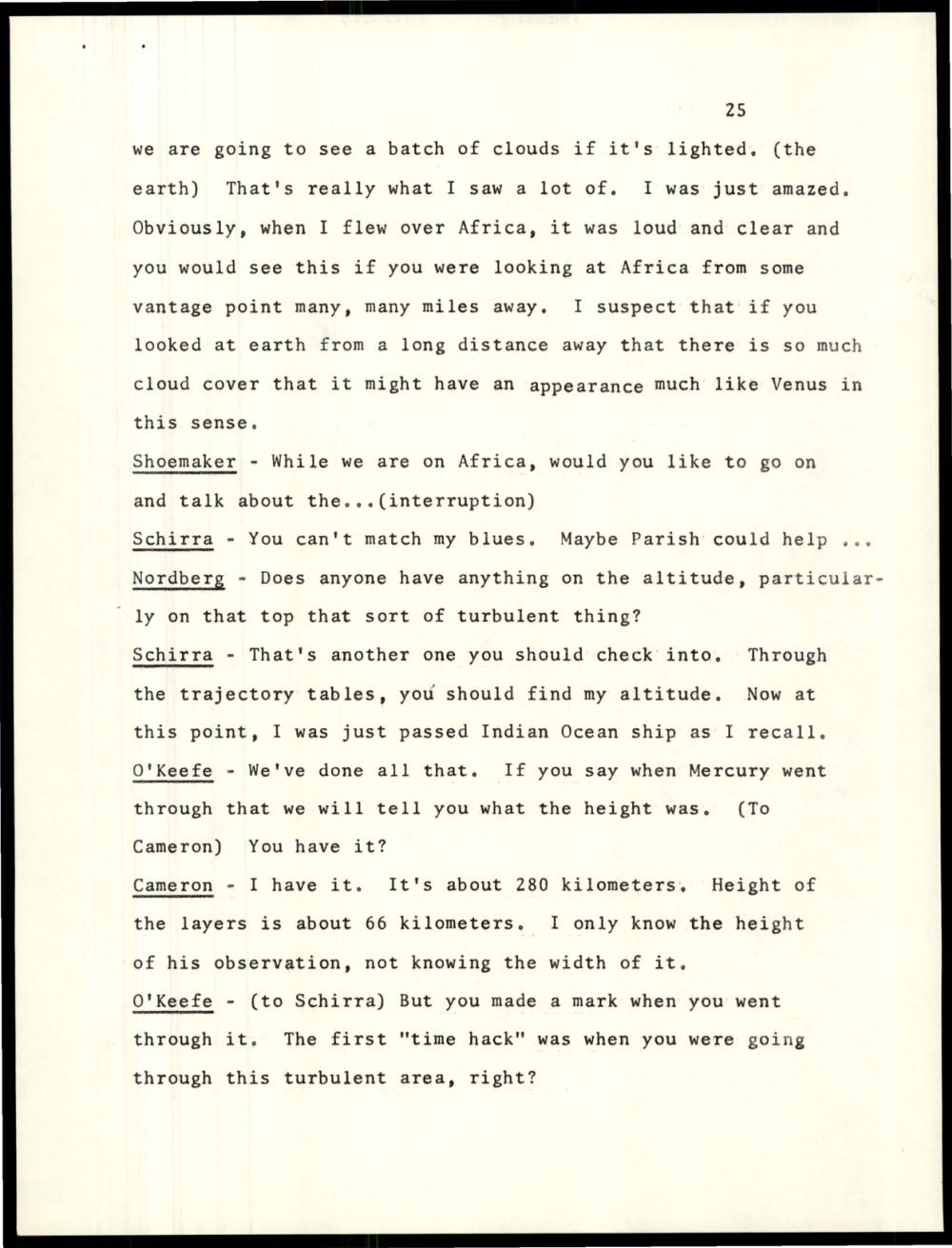
25
we are going to see a batch of clouds if it's lighted. (the
earth) That's really what I saw a lot of. I was just amazed.
Obviously, when I flew over Africa, it was loud and· clear and
you would see this if you were looking at Africa from some
vantage point many, many miles away. I suspect that if you
looked at earth from a long distance away that there is so much
cloud cover that it might have an appearance much like Venus in
this sense.
Shoemaker - While we are on Africa, would you like to go on
and talk about the ... (interruption)
Schirra - You can't match my blues. Maybe Parish · could help ..•
Nordberg - Does anyone have anything on the altitude, parti cularly on that top that sort of turbulent thing?
Schirra - That's another one you should check into. Through
the trajectory tables, you should find my altitude. Now at
this point, I was just passed Indian Ocean ship as I recall.
O'Keefe - We've done all that. If you say when Mercury went
through that we will tell you what the height was. (To
Cameron) You have it?
Cameron - I have it. It's about 280 kilometers ~ Height of
the layers is about 66 kilometers. I only know the height
of his observation, not knowing the width of it,
O'Keefe - (to Schirra) But you made a mark when you went
through it, The first "time hack" was when you weTe going
through this turbulent area, right?Editorial note: The "somewhat turbulent top" and the 66 km "layers" refer to the colored bands of the horizon at the setting of the planet Mercury, described by Schirra on pp. 128 to 135, and not to the brown band, which the group only begins to discuss on physical page 143. "Parish" is the painter Maxfield Parrish, mentioned earlier in connection with the shades of blue. The "Indian Ocean ship" was the shipborne tracking station of the Mercury program. Verbatim typed transcript of the scientific debriefing of 12/03/1963, with the participants' names underlined in the original. Participants named on this page: Eugene Shoemaker (session chairman), John O'Keefe, Winifred Cameron, Larry Dunkelman, John Nordberg and George Tennyson, of the Goddard Center; Maurice Dubin, Jocelyn Gill, Nancy Roman and Oran Nicks, of NASA Headquarters.
Check the original PDF
we are going to see a batch of clouds if it's lighted. (the earth) That's really what I saw a lot of. I was just amazed. Obviously, when I flew over Africa, it was loud and clear and you would see this if you were looking at Africa from some vantage point many, many miles away. I suspect that if you looked at earth from a long distance away that there is so much cloud cover that it might have an appearance much like Venus in this sense.
Shoemaker - While we are on Africa, would you like to go on and talk about the...(interruption)
Schirra - You can't match my blues. Maybe Parish could help...
Nordberg - Does anyone have anything on the altitude, particularly on that top that sort of turbulent thing?
Schirra - That's another one you should check into. Through the trajectory tables, you should find my altitude. Now at this point, I was just passed Indian Ocean ship as I recall.
O'Keefe - We've done all that. If you say when Mercury went through that we will tell you what the height was. (To Cameron) You have it?
Cameron - I have it. It's about 280 kilometers. Height of the layers is about 66 kilometers. I only know the height of his observation, not knowing the width of it.
O'Keefe - (to Schirra) But you made a mark when you went through it. The first "time hack" was when you were going through this turbulent area, right?View the document record ↗ · Physical page 139, counting the cover.
EXCERPT 3 · PHYSICAL PAGE 140
Physical page 140 (page 26 of the transcript), in full
26
Schirra - Correct, that's when I came into it.
O'Keefe - What was the height of the layers at this time -
66 kilometers, is that right?
Schirra - Right, that's what I was saying. I hope we can
hold Mercury meaning that I'd like to see it· go through this
and I did not know that I could, but obviously I proved that
I could; I did. This was quite a surprise. Didn~t you say,
Jocelyn, that there aren't many people that have seen Mercury
sets?
Gill - Very true . Mercury, (the planet) · period . Very f ew
people know that it exists.
O'Keefe - Can I point out that you used the word· airglow just
in general terms, a faint, glowing light seen· from the · atmosphere
without your - What you called the airglow is not what is
technically know as the airglow.
Schirra - Yes, any time we use airglow I don't use it as we
professionally talk about airglow. I was using it merely as
an escape clause.
Dunkelman - There is one other point there. One isn't sure
just in what plane these phenomena took place . They may have
been ahead or behind this plane (of the spacecraft). We have
to think of this ... The 66 kilometers might indeed be reflected
as something that had been before this point, you see.
Nordberg - (Comment inaudible).
Schirra ~ My local vertical would be this hand as I show it
and, of course, 40 degrees to the left where the sun andEditorial note: The conversation continues about the layers at the setting of the planet Mercury, not about the brown band. "Know" appears this way in the original (for "known"). Verbatim typed transcript of the scientific debriefing of 12/03/1963, with the participants' names underlined in the original. Participants named on this page: Eugene Shoemaker (session chairman), John O'Keefe, Winifred Cameron, Larry Dunkelman, John Nordberg and George Tennyson, of the Goddard Center; Maurice Dubin, Jocelyn Gill, Nancy Roman and Oran Nicks, of NASA Headquarters.
Check the original PDF
Schirra - Correct, that's when I came into it.
O'Keefe - What was the height of the layers at this time - 66 kilometers, is that right?
Schirra - Right, that's what I was saying. I hope we can hold Mercury meaning that I'd like to see it go through this and I did not know that I could, but obviously I proved that I could; I did. This was quite a surprise. Didn't you say, Jocelyn, that there aren't many people that have seen Mercury sets?
Gill - Very true. Mercury, (the planet) period. Very few people know that it exists.
O'Keefe - Can I point out that you used the word airglow just in general terms, a faint, glowing light seen from the atmosphere without your - What you called the airglow is not what is technically know as the airglow.
Schirra - Yes, any time we use airglow I don't use it as we professionally talk about airglow. I was using it merely as an escape clause.
Dunkelman - There is one other point there. One isn't sure just in what plane these phenomena took place. They may have been ahead or behind this plane (of the spacecraft). We have to think of this... The 66 kilometers might indeed be reflected as something that had been before this point, you see.
Nordberg - (Comment inaudible).
Schirra - My local vertical would be this hand as I show it and, of course, 40 degrees to the left where the sun andView the document record ↗ · Physical page 140, counting the cover.
EXCERPT 4 · PHYSICAL PAGE 141
Physical page 141 (page 27 of the transcript), in full
• • •
27
Mercury were traversing was in a plane something· like · thiso
This is your point I think, Larry, Isn't it?
Dunkelman - That's one
Schirra - So they come down this way which mathematically isn't
hard to solve, but you should consider this.
Dubin - This plane may vary a certain amount and it is very
difficult to know which way.
Schirra - The spacecraft at this point was under attitude
control and was fairly tight in a sense.
Roman - I think Larry's point is that though we · don•t· real l y
know if we are ... if we are actually taking a traverse str aight
through the atmosphere, it may be something in front, a tangen t . line, or behind it.
Dunkelman - The first thought _is to put a line right· through
there, and at this point this may be on the plane but· it may
not be that. Some may be ahead or behind, or both ....
Schirra - In other words, these layers in this sense could
be all staggered out and this one stacked like a bunch of
steps in a sense.
Dubin - And they could be higher in altitude than a simple r i ght
angle projection.
O'Keefe - It's quite safe.
Schirra - I was looking at two dimensions in a sense.
Cameron - The right angles of proj~ction and this· is the
twilight zone of the spectrum.Editorial note: Still about the layers at the setting of the planet Mercury. Verbatim typed transcript of the scientific debriefing of 12/03/1963, with the participants' names underlined in the original. Participants named on this page: Eugene Shoemaker (session chairman), John O'Keefe, Winifred Cameron, Larry Dunkelman, John Nordberg and George Tennyson, of the Goddard Center; Maurice Dubin, Jocelyn Gill, Nancy Roman and Oran Nicks, of NASA Headquarters.
Check the original PDF
Mercury were traversing was in a plane something like this. This is your point I think, Larry, Isn't it?
Dunkelman - That's one ...
Schirra - So they come down this way which mathematically isn't hard to solve, but you should consider this.
Dubin - This plane may vary a certain amount and it is very difficult to know which way.
Schirra - The spacecraft at this point was under attitude control and was fairly tight in a sense.
Roman - I think Larry's point is that though we don't really know if we are ... if we are actually taking a traverse straight through the atmosphere, it may be something in front, a tangent line, or behind it.
Dunkelman - The first thought is to put a line right through there, and at this point this may be on the plane but it may not be that. Some may be ahead or behind, or both. ...
Schirra - In other words, these layers in this sense could be all staggered out and this one stacked like a bunch of steps in a sense.
Dubin - And they could be higher in altitude than a simple right angle projection.
O'Keefe - It's quite safe.
Schirra - I was looking at two dimensions in a sense.
Cameron - The right angles of projection and this is the twilight zone of the spectrum.View the document record ↗ · Physical page 141, counting the cover.
EXCERPT 5 · PHYSICAL PAGE 142
Physical page 142 (page 28 of the transcript), in full
28
Schirra - If there is another one of those coffees~ I'll
trad~ this one in. I don't mind it cool.
Break (General conversation)Editorial note: The page has only these two lines; it marks the break before the part about the brown band. Verbatim typed transcript of the scientific debriefing of 12/03/1963, with the participants' names underlined in the original. Participants named on this page: Eugene Shoemaker (session chairman), John O'Keefe, Winifred Cameron, Larry Dunkelman, John Nordberg and George Tennyson, of the Goddard Center; Maurice Dubin, Jocelyn Gill, Nancy Roman and Oran Nicks, of NASA Headquarters.
Check the original PDF
Schirra - If there is another one of those coffees, I'll trade this one in. I don't mind it cool.
Break (General conversation)View the document record ↗ · Physical page 142, counting the cover.
EXCERPT 6 · PHYSICAL PAGE 143
Physical page 143 (page 29 of the transcript), in full
29
Schirra - And the rare occasions that I've had the timing for this.
O'Keefe - There is a nice Delta Flight from Washington down to
Houston. The thing goes exactly toward the sun - you can't miss it,
Cameron - You'll have to go to the cockpit.
Schirra - Hmm - You have to make the Delta Flight, in this par t i cular case, from Dallas to Los Angeles. I passed Albuquerque.
Shoemaker - This peculiar thing you saw over Afri ca - maybe you could
tell us about it.
Sch i rra - That , as I have said, was my biggest surprise. I
talked to most of you at great length about things we woul d hope
to see or expect to see. This I had no prior knowledge of and I
bas i cally can say that I was "sucked" in and originally called this
airglow, if you recall. I guess it is best to refer back to the record
again . This was S hours and 20 minutes.
Cameron - That's the time I got from you. The only thing I
notice from the script was that you said Glenn was asking you when
you were passing over California if you had seen what the airglow
was . Then you said something about you were surprised at how high
it was .
Schirra - This was the same phenomena. I had come back from there,
think, isn't that correct? Let's see .
Dubin - The Indian Ocean.
O' Keefe - David Stern at Goddard predicted that you would see
something very unusual in this flight before you went up . • 0 •
Schirra - Really?
IEditorial note: The first four remarks, right after the break, resume the conversation about the zodiacal light seen from an airplane (physical pages 136 to 138); the passage is also translated in the dossier on the rocket glow seen from the airplane. "5 hours and 20 minutes" is elapsed flight time, not time of day. "Script" is the flight transcript. Verbatim typed transcript of the scientific debriefing of 12/03/1963, with the participants' names underlined in the original. Participants named on this page: Eugene Shoemaker (session chairman), John O'Keefe, Winifred Cameron, Larry Dunkelman, John Nordberg and George Tennyson, of the Goddard Center; Maurice Dubin, Jocelyn Gill, Nancy Roman and Oran Nicks, of NASA Headquarters.
Check the original PDF
Schirra - And the rare occasions that I've had the timing for this.
O'Keefe - There is a nice Delta Flight from Washington down to Houston. The thing goes exactly toward the sun - you can't miss it.
Cameron - You'll have to go to the cockpit.
Schirra - Hmm - You have to make the Delta Flight, in this particular case, from Dallas to Los Angeles. I passed Albuquerque.
Shoemaker - This peculiar thing you saw over Africa - maybe you could tell us about it.
Schirra - That, as I have said, was my biggest surprise. I talked to most of you at great length about things we would hope to see or expect to see. This I had no prior knowledge of and I basically can say that I was "sucked" in and originally called this airglow, if you recall. I guess it is best to refer back to the record again. This was 5 hours and 20 minutes.
Cameron - That's the time I got from you. The only thing I notice from the script was that you said Glenn was asking you when you were passing over California if you had seen what the airglow was. Then you said something about you were surprised at how high it was.
Schirra - This was the same phenomena. I had come back from there, I think, isn't that correct? Let's see.
Dubin - The Indian Ocean.
O'Keefe - David Stern at Goddard predicted that you would see something very unusual in this flight before you went up. ...
Schirra - Really?View the document record ↗ · Physical page 143, counting the cover.
EXCERPT 7 · PHYSICAL PAGE 144
Physical page 144 (page 30 of the transcript), in full
30
O' Keefe - _Yes, he gave me a note. I was supposed to pass that
note down to the Manned Spacecraft Center; I don't think I did.
I think it's my fault. (Ed. copies were forwarded to MSC~)
Roman - What is this you are referring to?
O'Keefe - There is a very strong magnetic anomaly in this region,
and this is where ...
Dunkelman - I think the fact that Schirra had not heard of this makes
the observation even better scientifically.
Schirra - Hmm.
O'Keefe Quite exciting about this thing, but exactly ·what region
is Cdr . Schirra talking about? ...He's talking about the South · Atl anti c
- and the South Atlantic was in sunlight. This is probably as clos e
to it as we could get to be in darkness.
Schirra - I think what happened is I looked out as I was drifting
and this happened to be in the right attitude to see this, which
probably meant that I was looking toward the North although I can ' t
confirm this .
Cameron - You said something about you would judge that the width
was about a fourth of your window.
Schirra - Yes.
Cameron - Can you say how far - anything about how high it was
from the horizon?
Schirra - I was surprised when I saw what I thought were city lights
and they turned out to be stars below this thing. As a result, I
was confused in the sense that I wasn't then looking for yardsticks.Editorial note: The "Ed." note was added by whoever edited the transcript. The Manned Spacecraft Center (MSC) was in Houston. The magnetic anomaly of the region is now known as the South Atlantic Magnetic Anomaly; the page does not use that name. O'Keefe's sentence about the South Atlantic being in sunlight is ambiguous in the original. Verbatim typed transcript of the scientific debriefing of 12/03/1963, with the participants' names underlined in the original. Participants named on this page: Eugene Shoemaker (session chairman), John O'Keefe, Winifred Cameron, Larry Dunkelman, John Nordberg and George Tennyson, of the Goddard Center; Maurice Dubin, Jocelyn Gill, Nancy Roman and Oran Nicks, of NASA Headquarters.
Check the original PDF
O'Keefe - Yes, he gave me a note. I was supposed to pass that note down to the Manned Spacecraft Center; I don't think I did. I think it's my fault. (Ed. copies were forwarded to MSC.)
Roman - What is this you are referring to?
O'Keefe - There is a very strong magnetic anomaly in this region, and this is where ...
Dunkelman - I think the fact that Schirra had not heard of this makes the observation even better scientifically.
Schirra - Hmm.
O'Keefe - Quite exciting about this thing, but exactly what region is Cdr. Schirra talking about? ...He's talking about the South Atlantic - and the South Atlantic was in sunlight. This is probably as close to it as we could get to be in darkness.
Schirra - I think what happened is I looked out as I was drifting and this happened to be in the right attitude to see this, which probably meant that I was looking toward the North although I can't confirm this.
Cameron - You said something about you would judge that the width was about a fourth of your window.
Schirra - Yes.
Cameron - Can you say how far - anything about how high it was from the horizon?
Schirra - I was surprised when I saw what I thought were city lights and they turned out to be stars below this thing. As a result, I was confused in the sense that I wasn't then looking for yardsticks.View the document record ↗ · Physical page 144, counting the cover.
EXCERPT 8 · PHYSICAL PAGE 145
Physical page 145 (page 31 of the transcript), in full
31
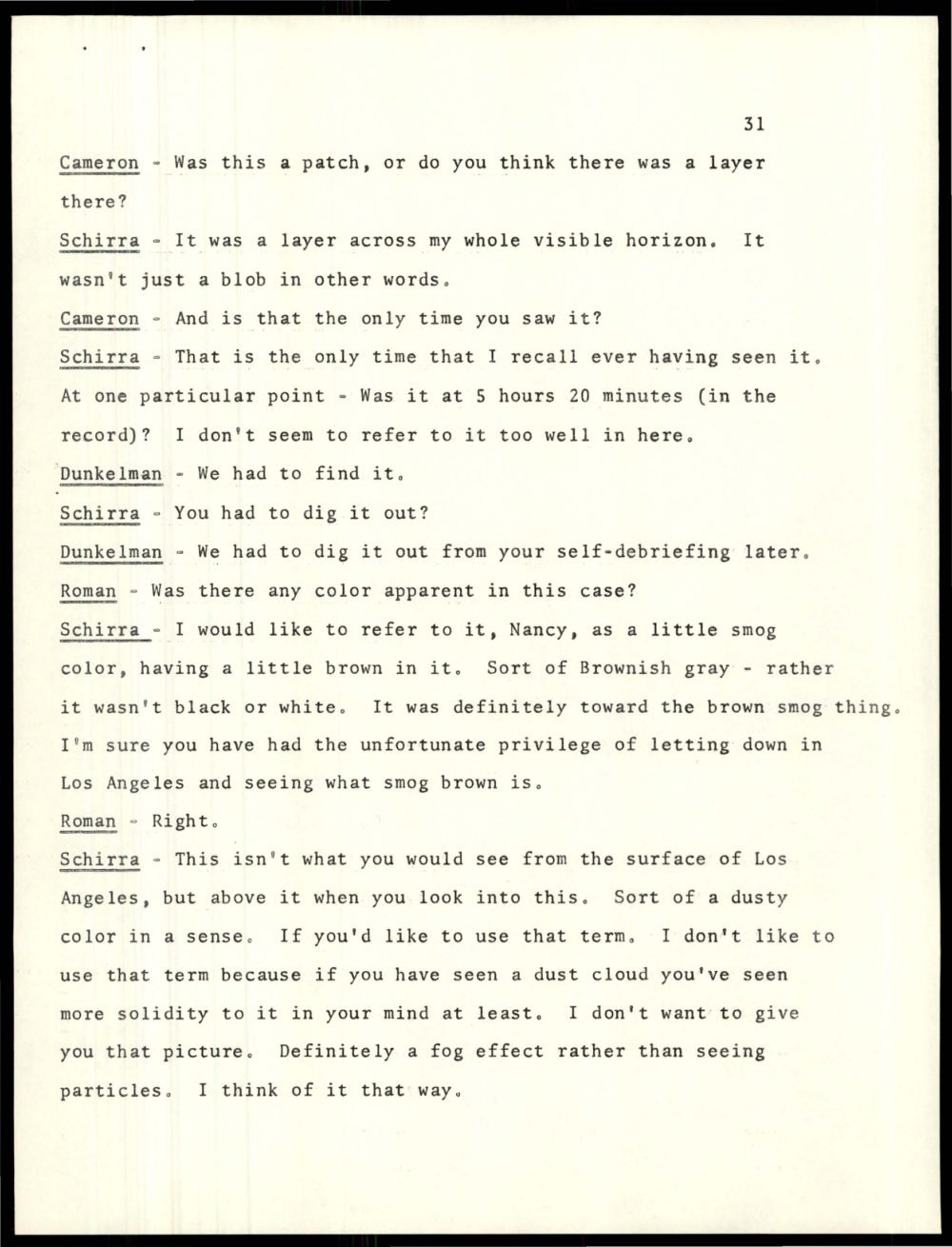
Cameron - Was this a patch, or do you think there was a layer
there?
Schirra - It was a layer across my whole visible horizon. It
wasn 9 t just a blob in other words .
Cameron = And is that the only time you saw it?
Sch i rra - That is the only time that I recall ever ha~ing seen it .
At one particular point - Was it at 5 hours 20 minutes (in the
record)? I don 9 t seem to refer to it too well in here.
Dunkelrnan - We had to find it.
Schirra = You had to dig it out?
Dunkelman = We had to dig it out from your self-debriefing later.
Roman = Was there any color apparent in this case?
Schirra - I would like to refer to it, Nancy, as a little smog
color , having a little brown in it. Sort of Brownish gray - rathe r
it wasn ' t black or white. It was definitely toward the brown smog t hing.
I 9m sure you have had the unfortunate privilege of letting down in
Los Angeles and seeing what smog brown is.
Roman = Right .
Sch i r r a - This isn 9 t what you would see from the surface of Lo s
Angeles, but above it when you look into this. Sort of a dusty
color i n a sense . If you'd like to use that term . I don't like t o
use that term because if you have seen a dust cloud you've seen
more s olidity to it in your mind at least. I don't want· to give
you that picture. Definitely a fog effect rather than seeing
particles . I think of it that way.Editorial note: "Smog" is the haze of urban pollution. The passage about the description of the layer had already been translated on the site; the wording was kept. The "self-debriefing" is the account recorded by the astronaut himself after the flight. Verbatim typed transcript of the scientific debriefing of 12/03/1963, with the participants' names underlined in the original. Participants named on this page: Eugene Shoemaker (session chairman), John O'Keefe, Winifred Cameron, Larry Dunkelman, John Nordberg and George Tennyson, of the Goddard Center; Maurice Dubin, Jocelyn Gill, Nancy Roman and Oran Nicks, of NASA Headquarters.
Check the original PDF
Cameron - Was this a patch, or do you think there was a layer there?
Schirra - It was a layer across my whole visible horizon. It wasn't just a blob in other words.
Cameron - And is that the only time you saw it?
Schirra - That is the only time that I recall ever having seen it. At one particular point - Was it at 5 hours 20 minutes (in the record)? I don't seem to refer to it too well in here.
Dunkelman - We had to find it.
Schirra - You had to dig it out?
Dunkelman - We had to dig it out from your self-debriefing later.
Roman - Was there any color apparent in this case?
Schirra - I would like to refer to it, Nancy, as a little smog color, having a little brown in it. Sort of Brownish gray - rather it wasn't black or white. It was definitely toward the brown smog thing. I'm sure you have had the unfortunate privilege of letting down in Los Angeles and seeing what smog brown is.
Roman - Right.
Schirra - This isn't what you would see from the surface of Los Angeles, but above it when you look into this. Sort of a dusty color in a sense. If you'd like to use that term. I don't like to use that term because if you have seen a dust cloud you've seen more solidity to it in your mind at least. I don't want to give you that picture. Definitely a fog effect rather than seeing particles. I think of it that way.View the document record ↗ · Physical page 145, counting the cover.
EXCERPT 9 · PHYSICAL PAGE 146
Physical page 146 (page 32 of the transcript), in full
32
Dunkelman - We are here to hear yours and I think we should· figure out
s ome mo r e of this . I don't want to inject my thought into this, but
I was trying to quote you in saying that it is brownish smog layers
and wasn 9 t sure how to define it.
Schi rra - Yes. This is dirty brown, not a pleasant brown, not one
you would like to see. Sort of like a tattle tale brown instead of a
t attle tale gray.
Cameron - Venus was just off the edge of it. I have the report · of i t~
Schirr a - Let ' s see , where are we there?
Cameron - J don't think you are saying anything about that. I was
wonde r ing if you noticed Venus at that time?
Sch i r r a = There was some point in here where I miscalled Venus or
Mercury, I forget which, but this is wrong. I told them to correct
it and they never did . But anyway this is what I did say. I think
you could disprove me very easily, because it just couldn't be t he r e .
I for got which one it was I referred to. Venus and the moon· were
always together is the whole point» and they were t o me in a hori zont al
l ine which gave me a good reference.
0 °Keefe - Cdr. Schirra, there are some important points here. Firs t
of all, of course, both Glenn and Carpenter saw stars underneat h the
ordinary airglow layer.
Schirra - Yes, I remember.
O' Keefe - So it clearly can ' t be seen and one would expect th a t anyway.
Schirra - I would say that this is substantiated by my report of
seeing Mercury as it passed through these layers as Mercury set whichEditorial note: "Tattle tale gray" was an expression from laundry detergent advertising for dingy white clothes; Schirra makes a pun with "brown". The sentence "So it clearly can't be seen" appears this way in the original; the meaning seems to be that the ordinary layer does not prevent seeing the stars. Verbatim typed transcript of the scientific debriefing of 12/03/1963, with the participants' names underlined in the original. Participants named on this page: Eugene Shoemaker (session chairman), John O'Keefe, Winifred Cameron, Larry Dunkelman, John Nordberg and George Tennyson, of the Goddard Center; Maurice Dubin, Jocelyn Gill, Nancy Roman and Oran Nicks, of NASA Headquarters.
Check the original PDF
Dunkelman - We are here to hear yours and I think we should figure out some more of this. I don't want to inject my thought into this, but I was trying to quote you in saying that it is brownish smog layers and wasn't sure how to define it.
Schirra - Yes. This is dirty brown, not a pleasant brown, not one you would like to see. Sort of like a tattle tale brown instead of a tattle tale gray.
Cameron - Venus was just off the edge of it. I have the report of it.
Schirra - Let's see, where are we there?
Cameron - I don't think you are saying anything about that. I was wondering if you noticed Venus at that time?
Schirra - There was some point in here where I miscalled Venus or Mercury, I forget which, but this is wrong. I told them to correct it and they never did. But anyway this is what I did say. I think you could disprove me very easily, because it just couldn't be there. I forgot which one it was I referred to. Venus and the moon were always together is the whole point, and they were to me in a horizontal line which gave me a good reference.
O'Keefe - Cdr. Schirra, there are some important points here. First of all, of course, both Glenn and Carpenter saw stars underneath the ordinary airglow layer.
Schirra - Yes, I remember.
O'Keefe - So it clearly can't be seen and one would expect that anyway.
Schirra - I would say that this is substantiated by my report of seeing Mercury as it passed through these layers as Mercury set whichView the document record ↗ · Physical page 146, counting the cover.
EXCERPT 10 · PHYSICAL PAGE 147
Physical page 147 (page 33 of the transcript), in full
33
would prove that the stars well could be seen going through the
sam ,, traverse. This thing I saw - let's just call it the smog · belt - "Ii '
on this southern pass, to go back and recap the sensation that
brought this to mind which is not brought out here other than the ·"'
fact that I can identify what I saw. I was coming over a land area.
(I think I better take a second and break out my orbital map which
I have here.)
O'Keefe - If you have the tape, we might replay that.
Schirra This would be better because some of the nine hours
there, I have not identified carefully enough, .and I should- have,
by going back over the tape and these areas of interest - I think we
should listen to the original tape again. Let's get down to·where
we were.
Cameron - Larry (Dunkelrnan) has listened to it at the Cape, I think.
Dunkelman - Did you see wh~t I call normal airglow at night?
That is the soft white band.
Schirra - Yes, I did.
Dunkelman - All right, yes, that's important because I think ' late r it
will help.
Cameron - Was that the thing you saw?
Schirra - This is distinctly different and this, I think, we identified
in our earlier discussion (speaking of the use of the term airglow).
Dunkelman - Fine.
Schirra - I had moonlight as well, but I could definitely see this faint
white effect.Editorial note: The "nine hours" are the approximate duration of the Sigma 7 flight. Verbatim typed transcript of the scientific debriefing of 12/03/1963, with the participants' names underlined in the original. Participants named on this page: Eugene Shoemaker (session chairman), John O'Keefe, Winifred Cameron, Larry Dunkelman, John Nordberg and George Tennyson, of the Goddard Center; Maurice Dubin, Jocelyn Gill, Nancy Roman and Oran Nicks, of NASA Headquarters.
Check the original PDF
would prove that the stars well could be seen going through the same traverse. This thing I saw - let's just call it the smog belt - on this southern pass, to go back and recap the sensation that brought this to mind which is not brought out here other than the fact that I can identify what I saw. I was coming over a land area. (I think I better take a second and break out my orbital map which I have here.)
O'Keefe - If you have the tape, we might replay that.
Schirra - This would be better because some of the nine hours there, I have not identified carefully enough, and I should have, by going back over the tape and these areas of interest - I think we should listen to the original tape again. Let's get down to where we were.
Cameron - Larry (Dunkelman) has listened to it at the Cape, I think.
Dunkelman - Did you see what I call normal airglow at night? That is the soft white band.
Schirra - Yes, I did.
Dunkelman - All right, yes, that's important because I think later it will help.
Cameron - Was that the thing you saw?
Schirra - This is distinctly different and this, I think, we identified in our earlier discussion (speaking of the use of the term airglow).
Dunkelman - Fine.
Schirra - I had moonlight as well, but I could definitely see this faint white effect.View the document record ↗ · Physical page 147, counting the cover.
EXCERPT 11 · PHYSICAL PAGE 148
Physical page 148 (page 34 of the transcript), in full
34
Dubin - W.as there any color whatever in it?
Schirra - In the .airglow that I saw? No, other than during sunset
times where you would have sunlight itself.
Dubin - No color whatever?
Schirra - I think of white as being all colors and you can see
I've been trapped with painting~ few times. This patch was denser
as you came into the middle of this belt. It definitely had tb· have
a light stimulus to it or I wouldn't have seen it. I was well
aware of this and thought this as I saw it. The initial impression
that brought to my attention is, first off, and this is the liability
we have; we're wanting to see something that needs to be seen· with
the naked eye when the inside of the vehicle is dark.
Cameron - In the patch did you notice any variation in color eithe r
horizontal or vertical? - Or was it all one?
. Schirra - The airglow now we are ~iscussing?
Cameron - The patth over (Madagascar).
Schirra - Oh~ this patch, it seemed ... You can't keep t~ack of whethe r
you a-re over. land or water continually and time is progressing fai rly
rapidly; for example, on this particular period where we are talking
in terms of 5 hours and 20 minutes, going back just a few minutes ,
am over Africa because I had left the southeast coast of Africa, in
other words, Durban and this is the place I had one time in my mind
wanted to see a flare and I did see cities and I know I saw Capetown
which was in the clear. I talked to the Ambassador from that· section
of Africa when we were at Goddard for the 5th year celebration of
satellites, and he saiq, "Oh, I wish we had known that, because
IEditorial note: "Madagascar" appears in parentheses in the original, as an addition by whoever edited the transcript. The celebration of the "5 years of satellites" at Goddard is mentioned without a date. Verbatim typed transcript of the scientific debriefing of 12/03/1963, with the participants' names underlined in the original. Participants named on this page: Eugene Shoemaker (session chairman), John O'Keefe, Winifred Cameron, Larry Dunkelman, John Nordberg and George Tennyson, of the Goddard Center; Maurice Dubin, Jocelyn Gill, Nancy Roman and Oran Nicks, of NASA Headquarters.
Check the original PDF
Dubin - Was there any color whatever in it?
Schirra - In the airglow that I saw? No, other than during sunset times where you would have sunlight itself.
Dubin - No color whatever?
Schirra - I think of white as being all colors and you can see I've been trapped with painting a few times. This patch was denser as you came into the middle of this belt. It definitely had to have a light stimulus to it or I wouldn't have seen it. I was well aware of this and thought this as I saw it. The initial impression that brought to my attention is, first off, and this is the liability we have; we're wanting to see something that needs to be seen with the naked eye when the inside of the vehicle is dark.
Cameron - In the patch did you notice any variation in color either horizontal or vertical? - Or was it all one?
Schirra - The airglow now we are discussing?
Cameron - The patch over (Madagascar).
Schirra - Oh, this patch, it seemed ... You can't keep track of whether you are over land or water continually and time is progressing fairly rapidly; for example, on this particular period where we are talking in terms of 5 hours and 20 minutes, going back just a few minutes, I am over Africa because I had left the southeast coast of Africa, in other words, Durban and this is the place I had one time in my mind wanted to see a flare and I did see cities and I know I saw Capetown which was in the clear. I talked to the Ambassador from that section of Africa when we were at Goddard for the 5th year celebration of satellites, and he said, "Oh, I wish we had known that, becauseView the document record ↗ · Physical page 148, counting the cover.
EXCERPT 12 · PHYSICAL PAGE 149
Physical page 149 (page 35 of the transcript), in full
35
everybody thinks that all you see is Perth! (laughter) Well,
we see a lot of other places as well." To go back, I was · trying
to re - establish this phenomenon in my mind so I had passed over
Africa and I was darkened within the vehicle. I was drifting.
As I was drifting - we like to say that we can see a city because
the people of the city get quite excited about it as we know Perth
did - and I was proceeding across the Indian Ocean drifting, so my
attitudes cannot be defined, I wanted to say to myself, oh ·, · I see
some more cities below me. Now I wasn't convinced in my mind that
I was over the Indian Ocean, yet with the attitudes· not carefully
defined, I might well have seen cities , These I said, ah, those cit ies
are quite constellation setups. They looked like constellations.
Then I said, my gosh! they are constellations. They are stars
and this was below what I then, in my mind at least, had planted
as airglowo Again, a lump term, meaning a lighted horizon, and I
looked above this brown smog effect and saw more stars again. Then
I could see through this brown effect, stars, but they were · dimmed
considerably by it. Now, I did not have the opportunity in that
the attitudes were dynamic to trace an individual star or planet
through this particular areao I wasn't at this point too interested
in knowing what constellations I was looking at. In drifting fli ght,
you don't really have a requirement to navigate, that is, to know
where you are in relation to a star field or surface.
Roman - So you don't know what you were looking at?
Schirra - So any particular star or constellation, I could not
identi fy at this timeo If I needed to, I would then have to destroyEditorial note: Perth, in Australia, turned on the city lights for Glenn in February 1962; Schirra alludes to this. The passage about the city lights that were stars had already been translated on the site; the wording was kept. Verbatim typed transcript of the scientific debriefing of 12/03/1963, with the participants' names underlined in the original. Participants named on this page: Eugene Shoemaker (session chairman), John O'Keefe, Winifred Cameron, Larry Dunkelman, John Nordberg and George Tennyson, of the Goddard Center; Maurice Dubin, Jocelyn Gill, Nancy Roman and Oran Nicks, of NASA Headquarters.
Check the original PDF
everybody thinks that all you see is Perth! (laughter) Well, we see a lot of other places as well." To go back, I was trying to re-establish this phenomenon in my mind so I had passed over Africa and I was darkened within the vehicle. I was drifting. As I was drifting - we like to say that we can see a city because the people of the city get quite excited about it as we know Perth did - and I was proceeding across the Indian Ocean drifting, so my attitudes cannot be defined, I wanted to say to myself, oh, I see some more cities below me. Now I wasn't convinced in my mind that I was over the Indian Ocean, yet with the attitudes not carefully defined, I might well have seen cities. These I said, ah, those cities are quite constellation setups. They looked like constellations. Then I said, my gosh! they are constellations. They are stars and this was below what I then, in my mind at least, had planted as airglow. Again, a lump term, meaning a lighted horizon, and I looked above this brown smog effect and saw more stars again. Then I could see through this brown effect, stars, but they were dimmed considerably by it. Now, I did not have the opportunity in that the attitudes were dynamic to trace an individual star or planet through this particular area. I wasn't at this point too interested in knowing what constellations I was looking at. In drifting flight, you don't really have a requirement to navigate, that is, to know where you are in relation to a star field or surface.
Roman - So you don't know what you were looking at?
Schirra - So any particular star or constellation, I could not identify at this time. If I needed to, I would then have to destroyView the document record ↗ · Physical page 149, counting the cover.
EXCERPT 13 · PHYSICAL PAGE 150
Physical page 150 (page 36 of the transcript), in full
36
my dark adaptation and light up my star chart and then identify
these things. This is the problem we have.
O'Keefe - One of the classic problems in astronomy - one of the
solutions for it is to illuminate with a red light, because you
don't destroy the dark adaptation so quickly.
Schirra - This is why we went to these fingerti.P lights which are red .
I started out, and this might interest you, I went to the planetarium
in Chapel Hill and took both gloves with me. One had white lights
and one had the red lights. This was my test of these lights. We
used them while working in the planetarium. We lit up the white
lights and the whole dome was just brilliant white. These are tiny
little peanut bulbs, really minute. This was the last time I used
those white lights. That very day - they were painted red as a result
of this . You need very, very low orders of light to -
Dunkelman - I had the impression the first time we talked about this
that you had not seen any stars through the patch, this brownish
patch, but you feel that you had seen -
Schirra - Yes sir, this is what I am trying to do; recreate the scene .
That is why I went back to coming off Africa. Having looked for the
lights, and having seen Capetown, I then felt that I was seeing more
city lights and then I was so surprised to realize that these were
stars. Now this only means that I was not pitched down enough to
really see the earth itself. So this means that it was quite high.
Roman - Do you feel that you were looking at the airglow laye rs a t
sunset or might you have been looking down at this sort of tangentially
as you are at some angle?Editorial note: The Chapel Hill planetarium is the Morehead Planetarium of the University of North Carolina, where the Mercury astronauts trained in star recognition. Verbatim typed transcript of the scientific debriefing of 12/03/1963, with the participants' names underlined in the original. Participants named on this page: Eugene Shoemaker (session chairman), John O'Keefe, Winifred Cameron, Larry Dunkelman, John Nordberg and George Tennyson, of the Goddard Center; Maurice Dubin, Jocelyn Gill, Nancy Roman and Oran Nicks, of NASA Headquarters.
Check the original PDF
my dark adaptation and light up my star chart and then identify these things. This is the problem we have.
O'Keefe - One of the classic problems in astronomy - one of the solutions for it is to illuminate with a red light, because you don't destroy the dark adaptation so quickly.
Schirra - This is why we went to these fingertip lights which are red. I started out, and this might interest you, I went to the planetarium in Chapel Hill and took both gloves with me. One had white lights and one had the red lights. This was my test of these lights. We used them while working in the planetarium. We lit up the white lights and the whole dome was just brilliant white. These are tiny little peanut bulbs, really minute. This was the last time I used those white lights. That very day - they were painted red as a result of this. You need very, very low orders of light to -
Dunkelman - I had the impression the first time we talked about this that you had not seen any stars through the patch, this brownish patch, but you feel that you had seen -
Schirra - Yes sir, this is what I am trying to do; recreate the scene. That is why I went back to coming off Africa. Having looked for the lights, and having seen Capetown, I then felt that I was seeing more city lights and then I was so surprised to realize that these were stars. Now this only means that I was not pitched down enough to really see the earth itself. So this means that it was quite high.
Roman - Do you feel that you were looking at the airglow layers at sunset or might you have been looking down at this sort of tangentially as you are at some angle?View the document record ↗ · Physical page 150, counting the cover.
EXCERPT 14 · PHYSICAL PAGE 151
Physical page 151 (page 37 of the transcript), in full
37
Schirra - I feel that I was looking up at it now in relation to my
local horizon.
Roman - You were actually looking up at it? Have you any idea how high
it was above the apparent horizon at that time?
Schirra - That is where I am in trouble, Nancy, because there · is no
direct repeated knowledge of what this attitude is.
Roman - Well, the other question is ...
Sch irra - But I saw a good batch of stars below it which meant that my
axis had to be fairly well above the horizon.
Roman - Any _structure either turbulent or wave-like?
Schirra - No, this was a very soft - we best describe this in clouds
as being a cirrus layer rather than a cumulus layer; a stratus would be
a better term, I think.
Nordberg _- Sort of diffuse?
Roman - I am still not quite sure I have the answer to my question then .
I ' m not a meteorologist.
Schirra - If I were to do it, I'd take a chalk eraser and just' make a
streak across the blackboard, it would be more intense in the cente r
of the eraser and then diffused as I got -
Roman - But no other structure?
Schirra = No other structure.
Roman - The reason I am asking this is that it sounds as if it might
be related to some other equatorial red airglow which has been · observed
from the ground. This has a distinct wave structure.
Schirra - I see. No, I did not see the permanent wave effect or theEditorial note: Verbatim typed transcript of the scientific debriefing of 12/03/1963, with the participants' names underlined in the original. Participants named on this page: Eugene Shoemaker (session chairman), John O'Keefe, Winifred Cameron, Larry Dunkelman, John Nordberg and George Tennyson, of the Goddard Center; Maurice Dubin, Jocelyn Gill, Nancy Roman and Oran Nicks, of NASA Headquarters.
Check the original PDF
Schirra - I feel that I was looking up at it now in relation to my local horizon.
Roman - You were actually looking up at it? Have you any idea how high it was above the apparent horizon at that time?
Schirra - That is where I am in trouble, Nancy, because there is no direct repeated knowledge of what this attitude is.
Roman - Well, the other question is ...
Schirra - But I saw a good batch of stars below it which meant that my axis had to be fairly well above the horizon.
Roman - Any structure either turbulent or wave-like?
Schirra - No, this was a very soft - we best describe this in clouds as being a cirrus layer rather than a cumulus layer; a stratus would be a better term, I think.
Nordberg - Sort of diffuse?
Roman - I am still not quite sure I have the answer to my question then. I'm not a meteorologist.
Schirra - If I were to do it, I'd take a chalk eraser and just make a streak across the blackboard, it would be more intense in the center of the eraser and then diffused as I got -
Roman - But no other structure?
Schirra - No other structure.
Roman - The reason I am asking this is that it sounds as if it might be related to some other equatorial red airglow which has been observed from the ground. This has a distinct wave structure.
Schirra - I see. No, I did not see the permanent wave effect or theView the document record ↗ · Physical page 151, counting the cover.
EXCERPT 15 · PHYSICAL PAGE 152
Physical page 152 (page 38 of the transcript), in full
38
mackerel effect that you see in clouds. This is very much a -
well, I would say if you · really wanted to do it - well, do · it in
water colors rather than chalk.
Nordberg - Did it cover your entire field of view?
Schirra - It covered my whole field of view, yes. That's where I
"suckered- in" thinking that I was looking at "airglow- " what we
have used now - I think you understand how I have used airglow and
that there were cities below it and stars above it. Then, these
cities were defined rapidly as stars and then I -
Dubin - You actually saw no horizon then? And you saw none of the
regular airglow?
Schirra - No, _I could not see any vestige of the surface of the earth,
meaning the true airglow in this sense.
Dubin - What you saw then were some of the bands with stars above an d
below - you remember how high up you were looking?
Schirra - No. If I had not had the fetish of conserving fuel in this
drifting period - was most important - not only conserving fuel, but
to see what effects the vehicle would get while it drifted over a period
of time; in other words, what this minute atmosphere might do to the
vehicle, whether it would spin it up or slow it down or what have you.
I could have picked up my attitude just by pitching down and pick i ng
up the surface of the earth. But then I would have destroyed the
period of time that we had been drifting to see if the vehicle
attitude had been affected by the orbital period.
Roman - For something like that, would it be desirable to carry a
small mirror, something like a woman's pocketbook mirror, which youEditorial note: "Mackerel effect" refers to the "scaly" sky of cirrocumulus clouds, which resembles the pattern of a mackerel. Verbatim typed transcript of the scientific debriefing of 12/03/1963, with the participants' names underlined in the original. Participants named on this page: Eugene Shoemaker (session chairman), John O'Keefe, Winifred Cameron, Larry Dunkelman, John Nordberg and George Tennyson, of the Goddard Center; Maurice Dubin, Jocelyn Gill, Nancy Roman and Oran Nicks, of NASA Headquarters.
Check the original PDF
mackerel effect that you see in clouds. This is very much a - well, I would say if you really wanted to do it - well, do it in water colors rather than chalk.
Nordberg - Did it cover your entire field of view?
Schirra - It covered my whole field of view, yes. That's where I "suckered-in" thinking that I was looking at "airglow-" what we have used now - I think you understand how I have used airglow and that there were cities below it and stars above it. Then, these cities were defined rapidly as stars and then I -
Dubin - You actually saw no horizon then? And you saw none of the regular airglow?
Schirra - No, I could not see any vestige of the surface of the earth, meaning the true airglow in this sense.
Dubin - What you saw then were some of the bands with stars above and below - you remember how high up you were looking?
Schirra - No. If I had not had the fetish of conserving fuel in this drifting period - was most important - not only conserving fuel, but to see what effects the vehicle would get while it drifted over a period of time; in other words, what this minute atmosphere might do to the vehicle, whether it would spin it up or slow it down or what have you. I could have picked up my attitude just by pitching down and picking up the surface of the earth. But then I would have destroyed the period of time that we had been drifting to see if the vehicle attitude had been affected by the orbital period.
Roman - For something like that, would it be desirable to carry a small mirror, something like a woman's pocketbook mirror, which youView the document record ↗ · Physical page 152, counting the cover.
EXCERPT 16 · PHYSICAL PAGE 153
Physical page 153 (page 39 of the transcript), in full
39
could look down at the different angles.
Schirra - We had a mirror on there. This permitted me basically to
look toward the heat shield. Something like a rear view mirror,
except it was a front view mirror in Mercury. But in any case,
you almost need - we need something like a dental mirror to move
around . I think again you get in trouble with a mirror; I considered this. In fact, I had a mirror on my hand which was a flat
plate much like the woman's cosmetic mirror. It was about the same
size, and when you use a mirror you lose so much just by the fact
that you change distances. Your image has been ranged differently.
So I found that I didn't have any luck at all.
Tennyson - It was just your disorientation.
Schirra - That itself was another problem. (Cameron showing Schirra
a drawing)
Cameron - I have a drawing here of what I think you saw out your
window at S hours 20 minutes.
Schirra - Oh, really, I'd like to see that, yes ... .
Cameron - It's just the star chart. I tried .... I think this is whe r e
you we~e, well, I made a tracing of the thing and slid it (the plastic
slide which represents the capsule window) up (on the star chart)
here - here's the horizon and· I tried to guess where you might have
been, and I put the width about ... (showing Schirra) you· thought it
was -
Schirra - Very good. But the thing is you see I could be tilted as
well in roll and it would move this field--see what I mean?Editorial note: Cameron's drawing, on the star chart, is not in the archive. Verbatim typed transcript of the scientific debriefing of 12/03/1963, with the participants' names underlined in the original. Participants named on this page: Eugene Shoemaker (session chairman), John O'Keefe, Winifred Cameron, Larry Dunkelman, John Nordberg and George Tennyson, of the Goddard Center; Maurice Dubin, Jocelyn Gill, Nancy Roman and Oran Nicks, of NASA Headquarters.
Check the original PDF
could look down at the different angles.
Schirra - We had a mirror on there. This permitted me basically to look toward the heat shield. Something like a rear view mirror, except it was a front view mirror in Mercury. But in any case, you almost need - we need something like a dental mirror to move around. I think again you get in trouble with a mirror; I considered this. In fact, I had a mirror on my hand which was a flat plate much like the woman's cosmetic mirror. It was about the same size, and when you use a mirror you lose so much just by the fact that you change distances. Your image has been ranged differently. So I found that I didn't have any luck at all.
Tennyson - It was just your disorientation.
Schirra - That itself was another problem. (Cameron showing Schirra a drawing)
Cameron - I have a drawing here of what I think you saw out your window at 5 hours 20 minutes.
Schirra - Oh, really, I'd like to see that, yes. ...
Cameron - It's just the star chart. I tried. ... I think this is where you were, well, I made a tracing of the thing and slid it (the plastic slide which represents the capsule window) up (on the star chart) here - here's the horizon and I tried to guess where you might have been, and I put the width about ... (showing Schirra) you thought it was -
Schirra - Very good. But the thing is you see I could be tilted as well in roll and it would move this field--see what I mean?View the document record ↗ · Physical page 153, counting the cover.
EXCERPT 17 · PHYSICAL PAGE 154
Physical page 154 (page 40 of the transcript), in full
40
Cameron - I was wondering if you recognized this pattern here that
you saw below it?
Schirra - What really flipped· me --this is where I got in trouble--
I said somethin$ about the Pleiades and I know I could not see · those.
Cameron - You see according to this the Moon was up at the top (of
the window) and Venus was off to the left. Did you see them?
Schirra - I did not see them during this period, no.
O°Keefe Where is Delphinus? Delphinus is somewhere.
Roman - I was just thinking about that . . ..
Cameron - Well, he's in Ophiuchus and Hercules and
(General discussion which is inaudible)
Schirra - Delphinus does look something like the Pleiades in a sense ,
yes .
Roman - It's a little larger, but I'm sure that ...
Schirra - At one time I tried to trace this down and see what· I really
was looking at and I frankly have not done it. This is typical of
everything we do, we always rushed into something else.
O°Keefe = (to Cameron) Can you find Delphinus? It's right next to
the (Northern) Cross.
Cameron - I don't see it. I don't think it's on here ....
Schirra - D~d I identify - when I said Aldebaran, I may well have been
talking about . . .
Cameron - There's a Norton (Star Atlas) in my bag - maybe I'm - if
you ' d hand it to me - maybe I've got the wrong page--I don't know -
I don ' t know why - he ' s got it there very clearly.
O' Keefe - You have Ophiuchus, Hercules?Editorial note: Delphinus, Ophiuchus, Hercules and the Northern Cross (Cygnus) are constellations; Aldebaran is the brightest star of Taurus, near the Pleiades. Norton is Norton's Star Atlas. Verbatim typed transcript of the scientific debriefing of 12/03/1963, with the participants' names underlined in the original. Participants named on this page: Eugene Shoemaker (session chairman), John O'Keefe, Winifred Cameron, Larry Dunkelman, John Nordberg and George Tennyson, of the Goddard Center; Maurice Dubin, Jocelyn Gill, Nancy Roman and Oran Nicks, of NASA Headquarters.
Check the original PDF
Cameron - I was wondering if you recognized this pattern here that you saw below it?
Schirra - What really flipped me--this is where I got in trouble-- I said something about the Pleiades and I know I could not see those.
Cameron - You see according to this the Moon was up at the top (of the window) and Venus was off to the left. Did you see them?
Schirra - I did not see them during this period, no.
O'Keefe - Where is Delphinus? Delphinus is somewhere.
Roman - I was just thinking about that. ...
Cameron - Well, he's in Ophiuchus and Hercules and --
(General discussion which is inaudible)
Schirra - Delphinus does look something like the Pleiades in a sense, yes.
Roman - It's a little larger, but I'm sure that...
Schirra - At one time I tried to trace this down and see what I really was looking at and I frankly have not done it. This is typical of everything we do, we always rushed into something else.
O'Keefe - (to Cameron) Can you find Delphinus? It's right next to the (Northern) Cross.
Cameron - I don't see it. I don't think it's on here. ...
Schirra - Did I identify - when I said Aldebaran, I may well have been talking about...
Cameron - There's a Norton (Star Atlas) in my bag - maybe I'm - if you'd hand it to me - maybe I've got the wrong page--I don't know - I don't know why - he's got it there very clearly.
O'Keefe - You have Ophiuchus, Hercules?View the document record ↗ · Physical page 154, counting the cover.
EXCERPT 18 · PHYSICAL PAGE 155
Physical page 155 (page 41 of the transcript), in full
41
(Conversation inaudible)
Schir~a - I used to carry my little star chart slide rule thing
around with me .
Roman - Alternatively, there are some (star) clusters - we l l, if
it ' s the Pleiades, it would be well enough defined and you wouldn't
confuse it - there are some clusters in a star field which · at· first
glance give you the same haziness that you get from a cluster like
the Pl eiades .
Cameron - It ' s the wrong di rection, of course.
Roman - Well, but he is down in the Scorpio region if you think of it .
Schirra - One of those things I do recall very vividly was that I
.talke d about Aldebaran and it just couldn't have been there at t he
time I ....
Gill = O, well maybe you didn ' t have the Pleiades then.
Schirra - I know it wasn't . It wasn't the Pleiades .
Gill - Because you ' ve got Orion here. Orion, the Pleiades and
Aldebaran go nicely together.
Schirra - They sure do, _but they shouldn't be there.
fill!. - But those were the wrong ones . (Laughter) They can't be there .
Dunkelman - I think Voas corrected that at that one time. You see
Aldebaran wasn ' t there .
Schirra - Yes, this is the liability you get into if you don't really
know your attitude; with this star chart you can sweep out a whole
new segment of the sky .
O' Keefe = Why can't you have seen Aldebaran and these other things?
Were they above the horizon?Editorial note: Robert Voas was the psychologist in charge of training the Mercury astronauts; the page gives only the surname. "O" at the start of Gill's remark appears this way in the original ("Oh"). Verbatim typed transcript of the scientific debriefing of 12/03/1963, with the participants' names underlined in the original. Participants named on this page: Eugene Shoemaker (session chairman), John O'Keefe, Winifred Cameron, Larry Dunkelman, John Nordberg and George Tennyson, of the Goddard Center; Maurice Dubin, Jocelyn Gill, Nancy Roman and Oran Nicks, of NASA Headquarters.
Check the original PDF
(Conversation inaudible)
Schirra - I used to carry my little star chart slide rule thing around with me.
Roman - Alternatively, there are some (star) clusters - well, if it's the Pleiades, it would be well enough defined and you wouldn't confuse it - there are some clusters in a star field which at first glance give you the same haziness that you get from a cluster like the Pleiades.
Cameron - It's the wrong direction, of course.
Roman - Well, but he is down in the Scorpio region if you think of it.
Schirra - One of those things I do recall very vividly was that I talked about Aldebaran and it just couldn't have been there at the time I. ...
Gill - O, well maybe you didn't have the Pleiades then.
Schirra - I know it wasn't. It wasn't the Pleiades.
Gill - Because you've got Orion here. Orion, the Pleiades and Aldebaran go nicely together.
Schirra - They sure do, but they shouldn't be there.
Gill - But those were the wrong ones. (Laughter) They can't be there.
Dunkelman - I think Voas corrected that at that one time. You see Aldebaran wasn't there.
Schirra - Yes, this is the liability you get into if you don't really know your attitude; with this star chart you can sweep out a whole new segment of the sky.
O'Keefe - Why can't you have seen Aldebaran and these other things? Were they above the horizon?View the document record ↗ · Physical page 155, counting the cover.
EXCERPT 19 · PHYSICAL PAGE 156
Physical page 156 (page 42 of the transcript), in full
42
Schirra - I don't think they are in this area. We have to expand
this star chart . Now if I were yawed around 90 degrees, this star
chart is absolutely worthless because this only goes a plus or
minus 60 degrees .
O' Keefe = I know, I know .. .
Sch i rra = Maybe I could have 0 0 0
o °Keefe = But, your flight path did go over Aldebaran, Orion -
the plane of the orbit.
Schirra - As I recall , and my memory of course, is suffering
from the time span (which has elapsed since the flight on October ~ .5-,.
1962 . ) As I recall, Orion was on the daylight si de, you see it's . ..
Roman = As I say, I was going to say that Orion was actually very
late = just before dawn - if it were up at all.
Schirra = Physically it was impossible to see - here is the constellation Orion way down here ~ in time, this is on my daylight side .
Roman = I would think that Aldebaran would be much the same problem.
Cameron = Just the same thing .
Schirra = It is right in this same family, of course.
Roman = What time of night was this? Can you give me any idea
of the distance between sunlight and sunset?
Schirra = That vs why I am perfectly convinced that I could not
possibly see anything associated with the constellation Orion or
Aldebaran . With this star chart, Nancy, what we do is have a
time margin . (Looking at the chart .) Now Orion down here is
actually in my local daylight . It just was impossible for me to
see it at this point way back here . It was occluded frank ly by theEditorial note: The day in the flight date, in parentheses, was retouched by hand on the copy; the flight was on October 3, 1962. Verbatim typed transcript of the scientific debriefing of 12/03/1963, with the participants' names underlined in the original. Participants named on this page: Eugene Shoemaker (session chairman), John O'Keefe, Winifred Cameron, Larry Dunkelman, John Nordberg and George Tennyson, of the Goddard Center; Maurice Dubin, Jocelyn Gill, Nancy Roman and Oran Nicks, of NASA Headquarters.
Check the original PDF
Schirra - I don't think they are in this area. We have to expand this star chart. Now if I were yawed around 90 degrees, this star chart is absolutely worthless because this only goes a plus or minus 60 degrees.
O'Keefe - I know, I know ...
Schirra - Maybe I could have ...
O'Keefe - But, your flight path did go over Aldebaran, Orion - the plane of the orbit.
Schirra - As I recall, and my memory of course, is suffering from the time span (which has elapsed since the flight on October 3, 1962.) As I recall, Orion was on the daylight side, you see it's...
Roman - As I say, I was going to say that Orion was actually very late - just before dawn - if it were up at all.
Schirra - Physically it was impossible to see - here is the constellation Orion way down here - in time, this is on my daylight side.
Roman - I would think that Aldebaran would be much the same problem.
Cameron - Just the same thing.
Schirra - It is right in this same family, of course.
Roman - What time of night was this? Can you give me any idea of the distance between sunlight and sunset?
Schirra - That's why I am perfectly convinced that I could not possibly see anything associated with the constellation Orion or Aldebaran. With this star chart, Nancy, what we do is have a time margin. (Looking at the chart.) Now Orion down here is actually in my local daylight. It just was impossible for me to see it at this point way back here. It was occluded frankly by theView the document record ↗ · Physical page 156, counting the cover.
EXCERPT 20 · PHYSICAL PAGE 157
Physical page 157 (page 43 of the transcript), in full
43
surface of the earth; physically, I just couldn't see ito
Roman - That ' s what I meant when I said at best you- d see those · just
before sunrise -- if at all at this time of year.
Schirra - Right. It was just impossible for _me to see it at thi~
point way back here, so it was occluded by the surface of the earth,
frankly, I just couldn ' t - physically I couldn't see it. What
really would be fun, by gosh, would be to go back up and have Tony
Jenzano (Director, Morehead Planetarium) lay this out in the planetari·,
filJl = Yes, yes, you ought to be able to solve that.
Schirra = I would be able to tell exactly what I saw. I'll do it -
That 0 s the way to solve this because then I can get the whole star
field, the complete celestial heaven at this time and space ·. And
then we can make some points. I think one of you should .go there
with me so we can have this pinned down. I think we should lay
this out . He (Jenzano) can lay out the whole ~light plan.
Gill = To get it pinned down .
Roman - I would say here that Arcturus or Antares could have been con
fused for Aldebaran here.
Gill - Absolutely . Those would be good candidates.
0 °Keefe - Let ' s not let this point go. Who should go?
Shoemaker - I think we should plan to do this.
Schirra - I think this is the way to answer this rather than trying
to beat it to death . I'll bet I'll be able to give you a whole bunch
of information in there (at the planetarium)o
0 °Keefe - Should it be you, or Jocelyn?
Gill - It depends on when it comes off - what time it comes off.Editorial note: Verbatim typed transcript of the scientific debriefing of 12/03/1963, with the participants' names underlined in the original. Participants named on this page: Eugene Shoemaker (session chairman), John O'Keefe, Winifred Cameron, Larry Dunkelman, John Nordberg and George Tennyson, of the Goddard Center; Maurice Dubin, Jocelyn Gill, Nancy Roman and Oran Nicks, of NASA Headquarters.
Check the original PDF
surface of the earth; physically, I just couldn't see it.
Roman - That's what I meant when I said at best you'd see those just before sunrise--if at all at this time of year.
Schirra - Right. It was just impossible for me to see it at this point way back here, so it was occluded by the surface of the earth, frankly, I just couldn't - physically I couldn't see it. What really would be fun, by gosh, would be to go back up and have Tony Jenzano (Director, Morehead Planetarium) lay this out in the planetarium.
Gill - Yes, yes, you ought to be able to solve that.
Schirra - I would be able to tell exactly what I saw. I'll do it - That's the way to solve this because then I can get the whole star field, the complete celestial heaven at this time and space. And then we can make some points. I think one of you should go there with me so we can have this pinned down. I think we should lay this out. He (Jenzano) can lay out the whole flight plan.
Gill - To get it pinned down.
Roman - I would say here that Arcturus or Antares could have been confused for Aldebaran here.
Gill - Absolutely. Those would be good candidates.
O'Keefe - Let's not let this point go. Who should go?
Shoemaker - I think we should plan to do this.
Schirra - I think this is the way to answer this rather than trying to beat it to death. I'll bet I'll be able to give you a whole bunch of information in there (at the planetarium).
O'Keefe - Should it be you, or Jocelyn?
Gill - It depends on when it comes off - what time it comes off.View the document record ↗ · Physical page 157, counting the cover.
EXCERPT 21 · PHYSICAL PAGE 158
Physical page 158 (page 44 of the transcript), in full
44
Shoemaker - --~hy don't we say we'll ~lan on this and then· we can ·make
the arrangements --
Schirra - I am afraid that I can't do it rapidly, but I'd say the
first part of April would be okay.
Shoemak er_~ Jocelyn, would you like to take this on to set it· up and
follow it through?
Gill - Certainly o
Sch i rra - I would like to nail this one downo I~ has been· botheri ng
me f or a long time and I just don't seem to be getting any· answers
that I would like to have as well.
Gill - It is possible to have hindsight here. I n other words, we can
reconstruct the crime and it is worth doing, I think.
Dunke lrn-an - I am glad you mentioned that you. could see some • stars
dimme d through this patch because-if you don't see -any,-1:he patch
turns out to be extremely bright .
Dunkelman - It's about 300 times higher than what the normal airglow
(seen) edge - on is .
Schirr-a - Well, it wasn't dim by any means.
Dunkelman - It wasn ' t dim - the answer I get _is that it is about
3 ergs/cm2/sec which is extremely bright and its structure is extremely
high . It is about three hundred times brighter than the normal ai r
glow o I think we can "home - in" on this brightness rather nicely
because, if you saw color, you know it is a dirty brown, but if it
was color, that does require at least SO to 100 times more t han the
normal night airglow.
Schir~a - That's why you were asking me earlier was there a colorEditorial note: "Its structure is extremely high" appears this way in the original. Dunkelman's passage about the brightness and Schirra's request had already been translated on the site; the wording was kept. Verbatim typed transcript of the scientific debriefing of 12/03/1963, with the participants' names underlined in the original. Participants named on this page: Eugene Shoemaker (session chairman), John O'Keefe, Winifred Cameron, Larry Dunkelman, John Nordberg and George Tennyson, of the Goddard Center; Maurice Dubin, Jocelyn Gill, Nancy Roman and Oran Nicks, of NASA Headquarters.
Check the original PDF
Shoemaker - Why don't we say we'll plan on this and then we can make the arrangements --
Schirra - I am afraid that I can't do it rapidly, but I'd say the first part of April would be okay.
Shoemaker - Jocelyn, would you like to take this on to set it up and follow it through?
Gill - Certainly.
Schirra - I would like to nail this one down. It has been bothering me for a long time and I just don't seem to be getting any answers that I would like to have as well.
Gill - It is possible to have hindsight here. In other words, we can reconstruct the crime and it is worth doing, I think.
Dunkelman - I am glad you mentioned that you could see some stars dimmed through this patch because if you don't see any, the patch turns out to be extremely bright.
Dunkelman - It's about 300 times higher than what the normal airglow (seen) edge-on is.
Schirra - Well, it wasn't dim by any means.
Dunkelman - It wasn't dim - the answer I get is that it is about 3 ergs/cm2/sec which is extremely bright and its structure is extremely high. It is about three hundred times brighter than the normal airglow. I think we can "home-in" on this brightness rather nicely because, if you saw color, you know it is a dirty brown, but if it was color, that does require at least 50 to 100 times more than the normal night airglow.
Schirra - That's why you were asking me earlier was there a colorView the document record ↗ · Physical page 158, counting the cover.
EXCERPT 22 · PHYSICAL PAGE 159
Physical page 159 (page 45 of the transcript), in full
45
in the airglow and I did not see it?
Dunkelman - We are trying not t~ ~ (influence your reply).
Schirra - ~laying one (response) against the other is indeed.. a good
way of doing it.
Dunkelman - Another think is that this was indeed brighter.
Schirra - Bu~,_ well below ... .
Dunke l man - It is _possible that the normal ai rg low was theire
but you didn't see it?
Schirra - It was well below my field of view though.
Dunkelman - But are we sure? I assumed that it was well below, too,
but . . .
Schirra - Yes. I saw what amounted to a clear starfield below this . . .
Dunkelman - About how many degrees worth though?
Schirra - I was just trying to think - Well, the window itself -
I'm just trying to think what I can see degrees-wise-this is -
Cameron - Thirty degrees .
Schirra - It was roughly thirty _degrees.
O' Keefe - But there is a trap here because that window shapes out
at such a steep angle - that if you attempt to· estimate height by
estimating portions of the window--
Schirra - Oh, no, I wasn't doing that. All I am trying to say is
that i n the window - included in the window - let~s forget this smog
band, it were stars only, it was below the window which would be the
earth . There was no horizon and even if I could have been inverted,
we could just say that the window would be this · way. There was still
no earth vision, nothing of earth I could see, including airglow orEditorial note: "Another think" appears this way in the original (for "another thing"). Verbatim typed transcript of the scientific debriefing of 12/03/1963, with the participants' names underlined in the original. Participants named on this page: Eugene Shoemaker (session chairman), John O'Keefe, Winifred Cameron, Larry Dunkelman, John Nordberg and George Tennyson, of the Goddard Center; Maurice Dubin, Jocelyn Gill, Nancy Roman and Oran Nicks, of NASA Headquarters.
Check the original PDF
in the airglow and I did not see it?
Dunkelman - We are trying not to - (influence your reply).
Schirra - Playing one (response) against the other is indeed a good way of doing it.
Dunkelman - Another think is that this was indeed brighter.
Schirra - But, well below. ...
Dunkelman - It is possible that the normal airglow was there - but you didn't see it?
Schirra - It was well below my field of view though.
Dunkelman - But are we sure? I assumed that it was well below, too, but...
Schirra - Yes. I saw what amounted to a clear starfield below this...
Dunkelman - About how many degrees worth though?
Schirra - I was just trying to think - Well, the window itself - I'm just trying to think what I can see degrees-wise-this is -
Cameron - Thirty degrees.
Schirra - It was roughly thirty degrees.
O'Keefe - But there is a trap here because that window shapes out at such a steep angle - that if you attempt to estimate height by estimating portions of the window--
Schirra - Oh, no, I wasn't doing that. All I am trying to say is that in the window - included in the window - let's forget this smog band, it were stars only, it was below the window which would be the earth. There was no horizon and even if I could have been inverted, we could just say that the window would be this way. There was still no earth vision, nothing of earth I could see, including airglow orView the document record ↗ · Physical page 159, counting the cover.
EXCERPT 23 · PHYSICAL PAGE 160
Physical page 160 (page 46 of the transcript), in full
46
anything else . So I was strictly looking, if you could almost
say, I could even be looking straight up, which I know I wasn't.
The stars were equally bright and equally in number almost on
either side of this band.
Dubin - It was about through the middle of the window?
Schirra - That is correct . I went even as far as to say that it
wasn ' t a third of the window and then I modified this down · to a
fourth, but ~twas more than a fourth and less than a third. This
means, in any case, that it's approximately ten degrees thick and
this is a very rough estimate.
O'Keefe - It wasn't the Milky Way?
Schirra - No. No, ~ like to look at the Milky Way so I've seen
it enough to say ".no."
O'Keefe - Because you were facing according to your picture to - well -
no - Sculptor, Fornax - no -
Roman - The Milky Way in that part of the sky, should have a very
distinct rift down the middle, it wouldn't be brightest to the center
and shading off.
Schi rra - Yes, in fact, if I recall from the way we ran the planetarium,
the Milky Way was almost on my horizon.
~Dubin - How long can you see this by the way?
Schirra - We can do this too, John. They have the Milky Way · projected
on this chart. It is a very fine tool, I might add~ particularly when
you want to reconstruct the crime.
Gill - Might be very good practice afterwards for thq \
pilot to goEditorial note: There is a handwritten "x" in the left margin, next to Dubin's question. In the answer, Schirra calls Dubin "John" (Maurice Dubin); it appears this way in the original. Sculptor and Fornax are constellations of the southern hemisphere. Verbatim typed transcript of the scientific debriefing of 12/03/1963, with the participants' names underlined in the original. Participants named on this page: Eugene Shoemaker (session chairman), John O'Keefe, Winifred Cameron, Larry Dunkelman, John Nordberg and George Tennyson, of the Goddard Center; Maurice Dubin, Jocelyn Gill, Nancy Roman and Oran Nicks, of NASA Headquarters.
Check the original PDF
anything else. So I was strictly looking, if you could almost say, I could even be looking straight up, which I know I wasn't. The stars were equally bright and equally in number almost on either side of this band.
Dubin - It was about through the middle of the window?
Schirra - That is correct. I went even as far as to say that it wasn't a third of the window and then I modified this down to a fourth, but it was more than a fourth and less than a third. This means, in any case, that it's approximately ten degrees thick and this is a very rough estimate.
O'Keefe - It wasn't the Milky Way?
Schirra - No. No, I like to look at the Milky Way so I've seen it enough to say "no."
O'Keefe - Because you were facing according to your picture to - well - no - Sculptor, Fornax - no -
Roman - The Milky Way in that part of the sky, should have a very distinct rift down the middle, it wouldn't be brightest to the center and shading off.
Schirra - Yes, in fact, if I recall from the way we ran the planetarium, the Milky Way was almost on my horizon.
Dubin - How long can you see this by the way?
Schirra - We can do this too, John. They have the Milky Way projected on this chart. It is a very fine tool, I might add, particularly when you want to reconstruct the crime.
Gill - Might be very good practice afterwards for the pilot to goView the document record ↗ · Physical page 160, counting the cover.
EXCERPT 24 · PHYSICAL PAGE 161
Physical page 161 (page 47 of the transcript), in full
I
47
back to the planetarium (to reconstruct his flight path.) •..
Schirra - I sure wish I had thought of this a long time ago when
was fresher on this.
Gill - It would fix things in your mind too - you'd be able to see them
again right away to pin them down.
Dubin - How long did you see this?
Schirra - I would not say seconds, I would say minutes,
Nordberg - Did this go away simply because of your progression in
orbit or because of your drifting?
Schirra - I think more because of the drifting, perhaps.
Dubjn - Did you see the stars through it?
Schirra - There again, I didn't have time to track stars through it.
When I say minutes, I don't mean a whole bunch of minutes, I mean
one or two or three minutes.
Dubin - Yes, but do you know whether you saw stars moving relative to
the band?
Schirra - No, they weren't . It wasn't relative to the band.
That ' s a good question, now that you bring it up.
Dubin - In other words, the stars seemed to stand still.
Schirra - The band and the stars were planted together, much the same
way as you would see the Milky Way in a sense. That's a very good
point.
O'Keefe - You saw a bunch of things there. It might have been Aldeba r an
or it might have been Antares.
Schirra - I suspect that is what I did see at Antares or Alpheca,
and I think that is in that same spectrum there . I think ratherEditorial note: "Alpheca" (Alphecca, of Corona Borealis) appears this way in the original. "Spectrum" was translated by its sense (region of the sky). Verbatim typed transcript of the scientific debriefing of 12/03/1963, with the participants' names underlined in the original. Participants named on this page: Eugene Shoemaker (session chairman), John O'Keefe, Winifred Cameron, Larry Dunkelman, John Nordberg and George Tennyson, of the Goddard Center; Maurice Dubin, Jocelyn Gill, Nancy Roman and Oran Nicks, of NASA Headquarters.
Check the original PDF
back to the planetarium (to reconstruct his flight path.)...
Schirra - I sure wish I had thought of this a long time ago when I was fresher on this.
Gill - It would fix things in your mind too - you'd be able to see them again right away to pin them down.
Dubin - How long did you see this?
Schirra - I would not say seconds, I would say minutes.
Nordberg - Did this go away simply because of your progression in orbit or because of your drifting?
Schirra - I think more because of the drifting, perhaps.
Dubin - Did you see the stars through it?
Schirra - There again, I didn't have time to track stars through it. When I say minutes, I don't mean a whole bunch of minutes, I mean one or two or three minutes.
Dubin - Yes, but do you know whether you saw stars moving relative to the band?
Schirra - No, they weren't. It wasn't relative to the band. That's a good question, now that you bring it up.
Dubin - In other words, the stars seemed to stand still.
Schirra - The band and the stars were planted together, much the same way as you would see the Milky Way in a sense. That's a very good point.
O'Keefe - You saw a bunch of things there. It might have been Aldebaran or it might have been Antares.
Schirra - I suspect that is what I did see at Antares or Alpheca, and I think that is in that same spectrum there. I think ratherView the document record ↗ · Physical page 161, counting the cover.
EXCERPT 25 · PHYSICAL PAGE 162
Physical page 162 (page 48 of the transcript), passage about the band (up to the change of subject to dark adaptation)
48
than beat this any further, it's circumbent on us to go to the
planetarium and really nail this down. All I have to do is just
take this window box we have and just move it around and - ah ha -
there it is.
• ·ounkeiman - Something we would like to know is the dimming eff ect .
Schirra - Uh huh.
Dunkelman - You say that this patch was quite bright, that's one t hi ng>
and then was it quite bright because it appeared bright or because
there are many, many fewer stars. This is the question we have to
answer .
Schirra - Right. You know what went through my mind when · I f inally
realized what I was looking at? I was livid about the fact th at I
had the periscope. Absolutely livid, because · I would have shot up a
whole roll of film right on that (using uv spectrograph). (Laughter)
I was fighting for that thing and that's why you can look · through and
I make perisocpe sound like a dirty word. All through here the wo r d
periscope is shortened to four letters practically. (Laughter)
Shoemaker - Why don't we go on. Jocelyn, why don't you get together
with Cdr . Schirra and write a conclusion on this.
Schirra ~ We'll set up a rendezvous here.
Shoemaker - I think we have covered quite a few of the remainder· of the
questions partly in discussion. I would like to go back to ' dark
adaptation here which is the next question. You have talked about i t
and let's see whether there are any points that we havenJt • covered . The
question is would you tell us when you think you were best dark-adapted?
Was there any time during flight when you employed only red light in theEditorial note: The rest of the page moves on to dark adaptation, outside the episode. "Circumbent" and "perisocpe" appear this way in the original (for "incumbent" and "periscope"). The "four letters" joke alludes to four-letter swear words in English. The conclusion that Shoemaker asks of Gill and Schirra is not in the archive. Verbatim typed transcript of the scientific debriefing of 12/03/1963, with the participants' names underlined in the original. Participants named on this page: Eugene Shoemaker (session chairman), John O'Keefe, Winifred Cameron, Larry Dunkelman, John Nordberg and George Tennyson, of the Goddard Center; Maurice Dubin, Jocelyn Gill, Nancy Roman and Oran Nicks, of NASA Headquarters.
Check the original PDF
than beat this any further, it's circumbent on us to go to the planetarium and really nail this down. All I have to do is just take this window box we have and just move it around and - ah ha - there it is.
Dunkelman - Something we would like to know is the dimming effect.
Schirra - Uh huh.
Dunkelman - You say that this patch was quite bright, that's one thing, and then was it quite bright because it appeared bright or because there are many, many fewer stars. This is the question we have to answer.
Schirra - Right. You know what went through my mind when I finally realized what I was looking at? I was livid about the fact that I had the periscope. Absolutely livid, because I would have shot up a whole roll of film right on that (using uv spectrograph). (Laughter) I was fighting for that thing and that's why you can look through and I make perisocpe sound like a dirty word. All through here the word periscope is shortened to four letters practically. (Laughter)
Shoemaker - Why don't we go on. Jocelyn, why don't you get together with Cdr. Schirra and write a conclusion on this.
Schirra - We'll set up a rendezvous here.View the document record ↗ · Physical page 162, counting the cover.
EXCERPT 26 · PHYSICAL PAGE 169
Physical page 169 (page 55 of the transcript), in full
55
Nordberg - I am curious if you ha<l a chance to observe variations
of brightness around the horizon; around as far as possible
(during) both in day and nighto
Schirra - Again, the field of view isn't that big o I know just
what you are asking faro I didn ' t take the liberty of making
these, what would amount toi large yaw changes. I did no t have
the opportunity to observe that transition. The field of view I
had did not show these various changes .
O'Keefe - You see, this is like 30 degrees, that's half a radius. I don't
t hink he could see much more than you could see overhe ad at ni ght.
Schirra - Yes.
ovKeefe - It means that if he doesn't see patterns in the airglow
from a single place at night, unless he has the freedom to yaw al l
around, he doesn't have the opportunity of tracing out the rather
large patterns which must be in the airglow. They are of the orde r of
a thousand miles in diameter .
Nordberg - I was also curious about daytime, because of the
forward scattering and backscattering and 90° to the sun and
actually, in daytime if your turnaround maneuvers arep s ay , t hey
don 9 t go around in a plane tangential to the surface of the earth ?
They go around in a radial plane, don 9 t they?
Schirra - Well, this is the awful thing about our vehicle. All
the thrusters are not aligned through the body axis, thereforep
you get two and three axes when you ask for one. If you were
trying to track the horizon, using the yaw input, say the horizon
being like an arc here, you go like this. Then you ' ve got to roll pEditorial note: Continuation of the scientific debriefing of Walter Schirra (Sigma 7, October 1962): variations of brightness on the horizon and the difficulty of turning the capsule to follow it. Participants named in this session: Eugene Shoemaker (chairman), John O'Keefe, Winifred Cameron, Larry Dunkelman, John Nordberg and George Tennyson, of the Goddard Center; Maurice Dubin, Jocelyn Gill and Nancy Roman, of NASA Headquarters.
Check the original PDF
55
Nordberg - I am curious if you ha<l a chance to observe variations
of brightness around the horizon; around as far as possible
(during) both in day and nighto
Schirra - Again, the field of view isn't that big o I know just
what you are asking faro I didn ' t take the liberty of making
these, what would amount toi large yaw changes. I did no t have
the opportunity to observe that transition. The field of view I
had did not show these various changes .
O'Keefe - You see, this is like 30 degrees, that's half a radius. I don't
t hink he could see much more than you could see overhe ad at ni ght.
Schirra - Yes.
ovKeefe - It means that if he doesn't see patterns in the airglow
from a single place at night, unless he has the freedom to yaw al l
around, he doesn't have the opportunity of tracing out the rather
large patterns which must be in the airglow. They are of the orde r of
a thousand miles in diameter .
Nordberg - I was also curious about daytime, because of the
forward scattering and backscattering and 90° to the sun and
actually, in daytime if your turnaround maneuvers arep s ay , t hey
don 9 t go around in a plane tangential to the surface of the earth ?
They go around in a radial plane, don 9 t they?
Schirra - Well, this is the awful thing about our vehicle. All
the thrusters are not aligned through the body axis, thereforep
you get two and three axes when you ask for one. If you were
trying to track the horizon, using the yaw input, say the horizon
being like an arc here, you go like this. Then you ' ve got to roll pView the document record ↗ · Physical page 169, counting the cover.
EXCERPT 27 · PHYSICAL PAGE 170
Physical page 170 (page 56 of the transcript), in full
56
pitchJ like this, rollj pitch o In other words ~ you step your way
around o It is not a smooth maneuver as you would anticipate
in an airplane where you just roll and come around and cut a
swathe without changing attitudeo
Nordberg - In daytime, it should be really a striking thing,
the horizon looking toward the sun and, on either side of the
sun , and also looking straight away from the sun it could be
extremely bright ooo and at 90° 0
Schirra = You know where we are going to have the most fun?
It 0 s with the lunar module - the LEM or the Bug in earth orbito
By gosh, that's going to be great , because you practical ly have
an observatory on your hands o A lot of open panel area that doesn't
have to be protected for re - entry or exito That will give us our
first real opportunity to look in almost any direction at any timeo
You should see the fight we had 9 to keep a 5th window in the
Apollo command module o They were about to rip it up and save
16 lbso It was in the right seat where you spend 90% of the time
on a trans - lunar tripo (gasp) Negative o (Laughter) We said no
so we had a seancej that 0 s what we call ito This is when we get ·a
majority of the astro~auts together and we agree o If there are any
dissenters it is just too bad o If they are in the minority~ wel l,
we come out with a united opinion. This is how we got our window in
Mercuryo It was the result of a seance == it cost $500;000 and I think
you know its worth it o It was for observation not only getting
attitudes oEditorial note: Schirra advocates the lunar module in orbit as an observatory and recounts the dispute over windows in the Mercury and Apollo capsules.
Check the original PDF
56
pitchJ like this, rollj pitch o In other words ~ you step your way
around o It is not a smooth maneuver as you would anticipate
in an airplane where you just roll and come around and cut a
swathe without changing attitudeo
Nordberg - In daytime, it should be really a striking thing,
the horizon looking toward the sun and, on either side of the
sun , and also looking straight away from the sun it could be
extremely bright ooo and at 90° 0
Schirra = You know where we are going to have the most fun?
It 0 s with the lunar module - the LEM or the Bug in earth orbito
By gosh, that's going to be great , because you practical ly have
an observatory on your hands o A lot of open panel area that doesn't
have to be protected for re - entry or exito That will give us our
first real opportunity to look in almost any direction at any timeo
You should see the fight we had 9 to keep a 5th window in the
Apollo command module o They were about to rip it up and save
16 lbso It was in the right seat where you spend 90% of the time
on a trans - lunar tripo (gasp) Negative o (Laughter) We said no
so we had a seancej that 0 s what we call ito This is when we get ·a
majority of the astro~auts together and we agree o If there are any
dissenters it is just too bad o If they are in the minority~ wel l,
we come out with a united opinion. This is how we got our window in
Mercuryo It was the result of a seance == it cost $500;000 and I think
you know its worth it o It was for observation not only getting
attitudes oView the document record ↗ · Physical page 170, counting the cover.
EXCERPT 28 · PHYSICAL PAGE 171
Physical page 171 (page 57 of the transcript), in full
57
Schirra - These things you canvt define by numbers. In spite of
what my philosophy was for this flight you can't resist making
scientific observations . That's taped? I think it's legal.
Gill = That ' s what I. thought--You wouldn't be human if you didn't .
Norqberg = I would like to get away from the horizon now for a
moment. This is going to clouds . There have bee n reports by
aJ:.1 .f:i ve of you on seeing cloud patterns and the like; is there
any good indication when you look down of on de pth cloud?
Schj.. r f~ - Very much so . You can get Paul Backer (try Charles
Coler, MSC, better) to give you the Weat her Bureau photos I too~ .
It 's fantastic what you can see . It is the meteorologist's dream ,~t;,
to see this depth, cumulus effect , high cumulus, etc. As an
example, I SqW the Sierras, I could very definitely see the rising
terrain . I was very much pleased. I can best say this by s~ying,
if you ' ve flown at 30 thousand or 40 thousand feetp which you must
have , in a jet transport, you see this of course . Now, if the
horizon itself is not visible to you when you are looking more
towards the surface of the earth, if the curvature of the earth is
not visible , you feel that you are at about 50 thousand feet .
Nordberg - And is this because of some sort of stereoscopic view
that you can still see shadows and brightness?
Schirra = I think you take every cue that you 've got and you
d~fferentiate colors by grays, blacks, whites, but there is
no doubt in your mind tha~ you see depth and there is one striking
picture, this Weather Bureau picture~ that shows ten different types
of cloud structure . One is a big towering cumulus, almost a cumulus
·•·Editorial note: Depth perception in clouds and terrain seen from orbit, with reference to the Weather Bureau photos.
Check the original PDF
57
Schirra - These things you canvt define by numbers. In spite of
what my philosophy was for this flight you can't resist making
scientific observations . That's taped? I think it's legal.
Gill = That ' s what I. thought--You wouldn't be human if you didn't .
Norqberg = I would like to get away from the horizon now for a
moment. This is going to clouds . There have bee n reports by
aJ:.1 .f:i ve of you on seeing cloud patterns and the like; is there
any good indication when you look down of on de pth cloud?
Schj.. r f~ - Very much so . You can get Paul Backer (try Charles
Coler, MSC, better) to give you the Weat her Bureau photos I too~ .
It 's fantastic what you can see . It is the meteorologist's dream ,~t;,
to see this depth, cumulus effect , high cumulus, etc. As an
example, I SqW the Sierras, I could very definitely see the rising
terrain . I was very much pleased. I can best say this by s~ying,
if you ' ve flown at 30 thousand or 40 thousand feetp which you must
have , in a jet transport, you see this of course . Now, if the
horizon itself is not visible to you when you are looking more
towards the surface of the earth, if the curvature of the earth is
not visible , you feel that you are at about 50 thousand feet .
Nordberg - And is this because of some sort of stereoscopic view
that you can still see shadows and brightness?
Schirra = I think you take every cue that you 've got and you
d~fferentiate colors by grays, blacks, whites, but there is
no doubt in your mind tha~ you see depth and there is one striking
picture, this Weather Bureau picture~ that shows ten different types
of cloud structure . One is a big towering cumulus, almost a cumulus
·•·View the document record ↗ · Physical page 171, counting the cover.
EXCERPT 29 · PHYSICAL PAGE 172
Physical page 172 (page 58 of the transcript), in full
58
nimbus that stands out like a ruler in relation to tpe vertical
plane. I think it might be here (in the record).
Nordberg - I have seen some of the films. I don't know if they
were your flight or previous ones. I am just curious whether the
eye sees something better than what shows up on the color film .
Schirra - Yes, they do . You use every cue availabl1.
• ·o•Keefe = He doesn't have the stereoscopic effect i p the ordinary
I
sense, but you remember that he is in motion when He sees that the
peak of the clous moves at a different rate so he gets a sort of
pseudo -stereoscopic effect like you get when you are dri ving a lon g
in a car-- by the fact that they are moving relative to t he caps ule .
Schirra - Take page nine here, and put a sheet of paper on the top
of it to cut off the curvature of the earth and you've seen this
from an airplane. Haven't you?
_Nordberg - Yes .
Schirra - That is why I've used it in this example that I am trying
to get across . You can see cloud structures in this yellow band
here that are just terrific.
Nordberg - Well, how about at night? Have you been able to see
any clouds in real darkness at all?
Schirra - Yes, I did and they were lighted by lightning. In fa ct
I gave Woomera a report on the first orbit saying I would not
possibly see their flare because I was seeing lightning and they
hadn ' t stepped outside their room . I said that you are about t o have
some real brutal thunder storms and the second orbit they agreed with
me~ because they were there then . This was during the night side.Editorial note: How the eye distinguishes clouds better than film; lightning illuminating clouds at night over Australia (Woomera). The flashes are storm discharges, not objects.
Check the original PDF
58
nimbus that stands out like a ruler in relation to tpe vertical
plane. I think it might be here (in the record).
Nordberg - I have seen some of the films. I don't know if they
were your flight or previous ones. I am just curious whether the
eye sees something better than what shows up on the color film .
Schirra - Yes, they do . You use every cue availabl1.
• ·o•Keefe = He doesn't have the stereoscopic effect i p the ordinary
I
sense, but you remember that he is in motion when He sees that the
peak of the clous moves at a different rate so he gets a sort of
pseudo -stereoscopic effect like you get when you are dri ving a lon g
in a car-- by the fact that they are moving relative to t he caps ule .
Schirra - Take page nine here, and put a sheet of paper on the top
of it to cut off the curvature of the earth and you've seen this
from an airplane. Haven't you?
_Nordberg - Yes .
Schirra - That is why I've used it in this example that I am trying
to get across . You can see cloud structures in this yellow band
here that are just terrific.
Nordberg - Well, how about at night? Have you been able to see
any clouds in real darkness at all?
Schirra - Yes, I did and they were lighted by lightning. In fa ct
I gave Woomera a report on the first orbit saying I would not
possibly see their flare because I was seeing lightning and they
hadn ' t stepped outside their room . I said that you are about t o have
some real brutal thunder storms and the second orbit they agreed with
me~ because they were there then . This was during the night side.View the document record ↗ · Physical page 172, counting the cover.
EXCERPT 30 · PHYSICAL PAGE 173
Physical page 173 (page 59 of the transcript), in full
59
This was sort of interesting because I described the thunderstorm
flashes of discharges as blobs of lightning.Editorial note: Last exchange on page 59 of the transcript: the storm flashes described as patches of lightning.
Check the original PDF
59
This was sort of interesting because I described the thunderstorm
flashes of discharges as blobs of lightning.View the document record ↗ · Physical page 173, counting the cover.
EXCERPT 31 · PHYSICAL PAGE 174
Physical page 174 (page 60 of the transcript), in full
I
60
BEGINNING OF THIRD TAPE
Schirra - I could not pick up cloud structure because I was
looking down and at this pointp you don't have time, and
don 't think your cues are good enough to separate elevations .
Nordberg ~ You don't recall seeing any clouds when there was
no lightning?
Schirra - No. I don 9 t recall this. I don't think I did really.
I was really frantically trying to see this typhoon, and we cal led
it a typhoon where Pacific Command Ship was. It was down south of
it, and I could not see it. It was still too dark, and I think
the other reason for it was that the periscope - here we go - was
annoying to me, that picked up the sunrise before I had my
sunrise, because it was looking in that direction, and it ruined
my adaptati on . That was when I threw the filter over it, and that
was the end of the periscope forever. I forgot to remove that
filter = not that I even intended to. On descent on the parachute,
and in a way I would like to have had the prerogative of looking
at the periscope and seeing the recovery forces deployed around
there . It took me a long time to realize why I couldn't see the
recovery forces . (Laughter) . And it finally came out that I
threw this filter over it just prior to retrofire . And that was
the end of the periscope (laughter) which also showed that
didn 1 t need it, obviously .
Nordberg - This question of frequency of lightning is a real
importan t one . Would you say that you saw lightning through each
night time orbit?
IEditorial note: Start of the third tape: clouds at night, the typhoon he could not see, and the periscope filter forgotten until descent. The lightning mentioned is a known meteorological phenomenon.
Check the original PDF
I
60
BEGINNING OF THIRD TAPE
Schirra - I could not pick up cloud structure because I was
looking down and at this pointp you don't have time, and
don 't think your cues are good enough to separate elevations .
Nordberg ~ You don't recall seeing any clouds when there was
no lightning?
Schirra - No. I don 9 t recall this. I don't think I did really.
I was really frantically trying to see this typhoon, and we cal led
it a typhoon where Pacific Command Ship was. It was down south of
it, and I could not see it. It was still too dark, and I think
the other reason for it was that the periscope - here we go - was
annoying to me, that picked up the sunrise before I had my
sunrise, because it was looking in that direction, and it ruined
my adaptati on . That was when I threw the filter over it, and that
was the end of the periscope forever. I forgot to remove that
filter = not that I even intended to. On descent on the parachute,
and in a way I would like to have had the prerogative of looking
at the periscope and seeing the recovery forces deployed around
there . It took me a long time to realize why I couldn't see the
recovery forces . (Laughter) . And it finally came out that I
threw this filter over it just prior to retrofire . And that was
the end of the periscope (laughter) which also showed that
didn 1 t need it, obviously .
Nordberg - This question of frequency of lightning is a real
importan t one . Would you say that you saw lightning through each
night time orbit?
IView the document record ↗ · Physical page 174, counting the cover.
EXCERPT 32 · PHYSICAL PAGE 175
Physical page 175 (page 61 of the transcript), in full
61
Schirra - No, that was only during this area. This could best
be described as the eastern half of Australia.
Dubin - Did you notice any lightning while looking down - you
couldn't see the flashes away from the capsule?
Schirra - No, oh no, no, I didn't get any light fed into the capsu le.
It was just my eyes that captured this light.
Dubin - In the daytime did you also see lightning the same way? Di d
your ...
Schirra - I don't recall having seen lightning in the daytime. I t 1 s
a good question, though, and I don't recall it. I'm sure I woul d have
noted it if I had seen it.
Nordberg - One question, that I am sure you can't answer because of
the orbit of your vehicle, but it's of tremendous importance to the
geological satellite people, and this is, the distinction of clouds
and ice and snow. I know, you probably never went over snow or ice.
Schirra - I looked up at the Sierras when I was on the second or
third orbit - we can pin this down - and I was talking to John Glenn
about somebody water skiiing on the Salton Sea, and at this time,
it was amazing how much I could see, because this area is practica l ly
crisp, clear air in . the desert, and I lived there for a number of
years, so I know that. I could look all at the Sierras and I could
see snow- capped mountains up there.
Nordberg - But no clouds of course.
Schirra - Not, not - well - on the other side of the Sierras,
westward there was this terrible fog belt, and I do recall saying
sometime I may fly over the Pacific and see the Pacific. I haveEditorial note: Where the lightning occurred (eastern half of Australia) and the observation of snow-covered mountains in the Sierras, with the discussion about separating snow from clouds.
Check the original PDF
61
Schirra - No, that was only during this area. This could best
be described as the eastern half of Australia.
Dubin - Did you notice any lightning while looking down - you
couldn't see the flashes away from the capsule?
Schirra - No, oh no, no, I didn't get any light fed into the capsu le.
It was just my eyes that captured this light.
Dubin - In the daytime did you also see lightning the same way? Di d
your ...
Schirra - I don't recall having seen lightning in the daytime. I t 1 s
a good question, though, and I don't recall it. I'm sure I woul d have
noted it if I had seen it.
Nordberg - One question, that I am sure you can't answer because of
the orbit of your vehicle, but it's of tremendous importance to the
geological satellite people, and this is, the distinction of clouds
and ice and snow. I know, you probably never went over snow or ice.
Schirra - I looked up at the Sierras when I was on the second or
third orbit - we can pin this down - and I was talking to John Glenn
about somebody water skiiing on the Salton Sea, and at this time,
it was amazing how much I could see, because this area is practica l ly
crisp, clear air in . the desert, and I lived there for a number of
years, so I know that. I could look all at the Sierras and I could
see snow- capped mountains up there.
Nordberg - But no clouds of course.
Schirra - Not, not - well - on the other side of the Sierras,
westward there was this terrible fog belt, and I do recall saying
sometime I may fly over the Pacific and see the Pacific. I haveView the document record ↗ · Physical page 175, counting the cover.
EXCERPT 33 · PHYSICAL PAGE 176
Physical page 176 (page 62 of the transcript), in full
62
yet to do this - in aircraft - in all the times I've been out
there - see all of the Pacific. I have never had that opportunity,
and I don't know that anybody ever will.
Tennyson - I think what he was getting at is when in the TIROS
satellite ~ the cottonpicker goes over and takes a picture perhaps
of stratus deck which to a continual extent runs right up against
the mountains that we know are snow-covered - wh e re one stops
and the other begins, the snow and the stratus. It is difficu lt
or impossible to tell.
Schirra - No - well, my daytime was, of course, northern latitude,
and this was basically summer. I was in the snow-capped Sierras .
Nordberg - This question was really sort of just to make a po int,
that if ever an astronaut goes into a polar orbit.~.
Schirra - Yes.
Nordberg - ... or has the opportunity to fly over the ice caps
to look for this distinction, because this is something we find
we are going to live with.
Schirra - I have flown beyond a cloud deck in aircraft at 40,000
feet and had snow on the surface, and usually trees will come up out
of the snow and then make you realize that you are no longer looki ng
at a cloud surface.
Tennyson - Well, our definition of a TIROS Satellite - because of
the width of the TV raster - which is just not good enough to pick
up trees with the wide angle and the mediocre lenses we use.
Schirra - Well, yes. When you are low enough, you get these terrain
changes which helps you too, I think.Editorial note: Snow, stratus and trees as clues for distinguishing what the TIROS satellites photograph.
Check the original PDF
62
yet to do this - in aircraft - in all the times I've been out
there - see all of the Pacific. I have never had that opportunity,
and I don't know that anybody ever will.
Tennyson - I think what he was getting at is when in the TIROS
satellite ~ the cottonpicker goes over and takes a picture perhaps
of stratus deck which to a continual extent runs right up against
the mountains that we know are snow-covered - wh e re one stops
and the other begins, the snow and the stratus. It is difficu lt
or impossible to tell.
Schirra - No - well, my daytime was, of course, northern latitude,
and this was basically summer. I was in the snow-capped Sierras .
Nordberg - This question was really sort of just to make a po int,
that if ever an astronaut goes into a polar orbit.~.
Schirra - Yes.
Nordberg - ... or has the opportunity to fly over the ice caps
to look for this distinction, because this is something we find
we are going to live with.
Schirra - I have flown beyond a cloud deck in aircraft at 40,000
feet and had snow on the surface, and usually trees will come up out
of the snow and then make you realize that you are no longer looki ng
at a cloud surface.
Tennyson - Well, our definition of a TIROS Satellite - because of
the width of the TV raster - which is just not good enough to pick
up trees with the wide angle and the mediocre lenses we use.
Schirra - Well, yes. When you are low enough, you get these terrain
changes which helps you too, I think.View the document record ↗ · Physical page 176, counting the cover.
EXCERPT 34 · PHYSICAL PAGE 177
Physical page 177 (page 63 of the transcript), in full
63
Nordberg - There are some thoughts that by polarization and so,
one can distinguish it over a uniform surface; of course, the
eye doesn't have this, but I'm just looking for a clue that the
eye might have which we hadn't thought of in an instrument such
as depth, because it's interesting when you say you can see all
this depth in the clouds themselves.
Schirra - Yes.
Nordbe.!.,& - ...whether one could see because of depth difference and
shadows, or something, this distinction between clouds and snow. On
the first TI ROS (satellite), TI ROS I , . ~
Schirra - This thing is stalled out (referring to tape recorder). 1
Is that o.k. Is it finished? - No, no that's going.)
Nordberg - The first TIROS was just sort of an observation when we
still were at this "Ge Whiz" stage on satellites. Boy, we see
something
Schirra - Sure, now you want more? (Laughter) - So do I.
Nordberg - People said look at those beautiful orgraphic clouds
over northern India, and there is this huge band, until somebody
saw valleys in these clouds and all there was - was snow~covered
areas and with the valleys being clear.
Schirra - Very good. . ..
Tennyson - John O'Keefe has come up with a statement that I, at least ,
would like to think about some more and that is the relative motion
involved here. TIROS and Nimbus, etc. are still picture - type items.
think his (Schirra's) statement there that watching the tops and
bases and of the earth moving at different relative speeds may be,
at least, as important to height determination as anything we can
IEditorial note: Depth, shadows and relative motion as clues for separating snow from clouds; the case of the images from the first TIROS over India.
Check the original PDF
63
Nordberg - There are some thoughts that by polarization and so,
one can distinguish it over a uniform surface; of course, the
eye doesn't have this, but I'm just looking for a clue that the
eye might have which we hadn't thought of in an instrument such
as depth, because it's interesting when you say you can see all
this depth in the clouds themselves.
Schirra - Yes.
Nordbe.!.,& - ...whether one could see because of depth difference and
shadows, or something, this distinction between clouds and snow. On
the first TI ROS (satellite), TI ROS I , . ~
Schirra - This thing is stalled out (referring to tape recorder). 1
Is that o.k. Is it finished? - No, no that's going.)
Nordberg - The first TIROS was just sort of an observation when we
still were at this "Ge Whiz" stage on satellites. Boy, we see
something
Schirra - Sure, now you want more? (Laughter) - So do I.
Nordberg - People said look at those beautiful orgraphic clouds
over northern India, and there is this huge band, until somebody
saw valleys in these clouds and all there was - was snow~covered
areas and with the valleys being clear.
Schirra - Very good. . ..
Tennyson - John O'Keefe has come up with a statement that I, at least ,
would like to think about some more and that is the relative motion
involved here. TIROS and Nimbus, etc. are still picture - type items.
think his (Schirra's) statement there that watching the tops and
bases and of the earth moving at different relative speeds may be,
at least, as important to height determination as anything we can
IView the document record ↗ · Physical page 177, counting the cover.
EXCERPT 35 · PHYSICAL PAGE 178
Physical page 178 (page 64 of the transcript), in full
64
do with spare part items or items like that.
Nordberg - It's again the depth.
Schirra - Well, we are working a movie camera where TIROS is taking
stills, is what you are saying.
Tennyson - Exactly, and you imply a height which the eye in itself
in a still picture mode can't see, but as it goes you say, ah, ha
- this moves at a different speed, and therefore, it had to be
higher.
Schirra - I would accept that, except ~or the photograph I have
here which shows this depth. Or is it reminding me of it? I do
not know. Do you see the depth I talk about in that photograph on
page 9?
Tennyson - To some degree (perhaps), b~t, no, not as directly.
I found that picture interesting, but as indecisive as a good many
of these prints are.
Schirra - Well now, do you have all of the~e Weather Bureau
photographs?
Nordberg - I have not seen all of them - well, we may not have them -
I find that sometimes it is very peculiar that as a NASA outfit -
NASA Center - we often have less immediate access to some of these
• films than the Weather Bureau has - (Laughter).
Schirra - Well, let's -- I find this disturbs me very much in
that when I yielded to taking a camera·, I actually did want to take
one, but I wanted to make people fight to give me the best piece of
equipment they could get rather than fust take a camera. I wanted
it very clear that those people who could use this data would getEditorial note: Still TIROS images versus motion film; the difficulty of accessing the flight's weather photographs.
Check the original PDF
64
do with spare part items or items like that.
Nordberg - It's again the depth.
Schirra - Well, we are working a movie camera where TIROS is taking
stills, is what you are saying.
Tennyson - Exactly, and you imply a height which the eye in itself
in a still picture mode can't see, but as it goes you say, ah, ha
- this moves at a different speed, and therefore, it had to be
higher.
Schirra - I would accept that, except ~or the photograph I have
here which shows this depth. Or is it reminding me of it? I do
not know. Do you see the depth I talk about in that photograph on
page 9?
Tennyson - To some degree (perhaps), b~t, no, not as directly.
I found that picture interesting, but as indecisive as a good many
of these prints are.
Schirra - Well now, do you have all of the~e Weather Bureau
photographs?
Nordberg - I have not seen all of them - well, we may not have them -
I find that sometimes it is very peculiar that as a NASA outfit -
NASA Center - we often have less immediate access to some of these
• films than the Weather Bureau has - (Laughter).
Schirra - Well, let's -- I find this disturbs me very much in
that when I yielded to taking a camera·, I actually did want to take
one, but I wanted to make people fight to give me the best piece of
equipment they could get rather than fust take a camera. I wanted
it very clear that those people who could use this data would getView the document record ↗ · Physical page 178, counting the cover.
EXCERPT 36 · PHYSICAL PAGE 179
Physical page 179 (page 65 of the transcript), in full
65
the best print available, and I definitely have this group on
that list. For one, I am disappointed that this occasion where
I pu~led this Weather Bureau filter out of the back to take
these two pictures of the moon, I have heard and I have yet
to have seen the graphic results of those two black and whites
on the moon, which are quite interesting to a lot of people.
I have heard this. Now where they've gone, I don't know.
Although I know they can be obtained again, I thought this was
a shame.
Tennyson - I don't think that I have ever seen these prints.
And, we are in the office that supposedly collects the requ i rements for meteorological satellites and I have not seen the
direct prints of this. The only thing I have seen come out
Schirra - Well, I have heard that if you take - and I haven't
had the prerogative either - if you take the motion and project
it on a very good s~reen, it is really something to see -- at least
of these two lunar pictures. And that ' s why I took the Hasselblad .
To take this big piece of emulsion - the 70 mm film rather than
a 16 or 35 mm . - and this I do know about photography that the
larger the strip of film, the more you will get out of it. That's
why we went first class with a Hasselblad (camera) and why I am
not at all in favor of taking a 16 mm. c amera along which is wh at
we are using.
Nordberg - We had, in the early days, right after MA-6, we had
written to Kleinknecht and had gotten periscope film, which, you
know what the quality is, and we got always the answer that theyEditorial note: Schirra complains that he did not receive copies of the photos of the Moon and defends the Hasselblad's 70 mm film.
Check the original PDF
65
the best print available, and I definitely have this group on
that list. For one, I am disappointed that this occasion where
I pu~led this Weather Bureau filter out of the back to take
these two pictures of the moon, I have heard and I have yet
to have seen the graphic results of those two black and whites
on the moon, which are quite interesting to a lot of people.
I have heard this. Now where they've gone, I don't know.
Although I know they can be obtained again, I thought this was
a shame.
Tennyson - I don't think that I have ever seen these prints.
And, we are in the office that supposedly collects the requ i rements for meteorological satellites and I have not seen the
direct prints of this. The only thing I have seen come out
Schirra - Well, I have heard that if you take - and I haven't
had the prerogative either - if you take the motion and project
it on a very good s~reen, it is really something to see -- at least
of these two lunar pictures. And that ' s why I took the Hasselblad .
To take this big piece of emulsion - the 70 mm film rather than
a 16 or 35 mm . - and this I do know about photography that the
larger the strip of film, the more you will get out of it. That's
why we went first class with a Hasselblad (camera) and why I am
not at all in favor of taking a 16 mm. c amera along which is wh at
we are using.
Nordberg - We had, in the early days, right after MA-6, we had
written to Kleinknecht and had gotten periscope film, which, you
know what the quality is, and we got always the answer that theyView the document record ↗ · Physical page 179, counting the cover.
EXCERPT 37 · PHYSICAL PAGE 180
Physical page 180 (page 66 of the transcript), in full
66
don't have the 70 mm. yet, but as soon as they become available,
they'd send them to us, but actually we haven't really received
anything from them since and the only time that I have seen
some of these photographs that you are talking about .•.
Schirra - Well, Kleinknecht doesn't have control of this, MSC
doesn't have control of these pictures I took, obviously, . or
actually I would have been able to se e them.
Gill - Who does?
Tennyson - The person involved with this (at least in the past)
is Stanley Soules.
Schirra - Yes, when you think of the small number of pictures I
did take, and the expense that was involved in taking these
pictures, it is just ama zin g that first class reproductions
haven't been disseminated widely.
Shoemaker - I think, Jocelyn, this is something that you and I
an d John O'Keefe should take up with our joint committee.
Gill - rv 11 look into it.
Schirra - They should be all over the place ... is really
what I am really getting at .
Shoemaker - This is something we can do something about.
Schirra - Sure . I know Kleinknecht can't help you with this
because he has no control over this.
Shoemaker - I think we can straighten this out.
Cameron - Did you ever think you could see highways?
Schirra - I saw roads in areas such as Mexico where they disturb
the terrain by being in a straight line. I never did have theEditorial note: Who controls the flight photographs and the possibility of seeing roads from orbit.
Check the original PDF
66
don't have the 70 mm. yet, but as soon as they become available,
they'd send them to us, but actually we haven't really received
anything from them since and the only time that I have seen
some of these photographs that you are talking about .•.
Schirra - Well, Kleinknecht doesn't have control of this, MSC
doesn't have control of these pictures I took, obviously, . or
actually I would have been able to se e them.
Gill - Who does?
Tennyson - The person involved with this (at least in the past)
is Stanley Soules.
Schirra - Yes, when you think of the small number of pictures I
did take, and the expense that was involved in taking these
pictures, it is just ama zin g that first class reproductions
haven't been disseminated widely.
Shoemaker - I think, Jocelyn, this is something that you and I
an d John O'Keefe should take up with our joint committee.
Gill - rv 11 look into it.
Schirra - They should be all over the place ... is really
what I am really getting at .
Shoemaker - This is something we can do something about.
Schirra - Sure . I know Kleinknecht can't help you with this
because he has no control over this.
Shoemaker - I think we can straighten this out.
Cameron - Did you ever think you could see highways?
Schirra - I saw roads in areas such as Mexico where they disturb
the terrain by being in a straight line. I never did have theView the document record ↗ · Physical page 180, counting the cover.
EXCERPT 38 · PHYSICAL PAGE 181
Physical page 181 (page 67 of the transcript), in full
67
opportunity to see a highway, for example, and trace it,
because I wasn't over those populated areas such as the Southern
United States long enough or had the clear weather to just
sit there and observe them. In contrast, I think what you
would do if you saw something and wanted to look at it, I
think what you would do is that you would pitch down more - to
look almost straight down and see it which Scott had the capability
of doing and he could really take a careful look at it.
O'Keefe - One curious fact that I haven't seen anybody take
advantage of is this. It is quite common in triangulation -
that two stations which are a couple of hundred miles apart, or
a hundred miles apart, and that therefore as far apart as you are
from the ground and along a light path which is much inferior -
it's nearly parallel to the earth. In order for one of those
stations to see the other one - to measure on it - they provide
one of them with a 6-inch heliotrope, that's enough. That means
that somebody on the ground with a six-inch heliotrope who knew
how to point could point a light that you could see even in the
daytime if they had a dark background; and conversely, if you had
a heliotrope, you could also be seen from the ground. I have never
seen this possibility discussed. Of course it also goes with the
fact that instead of these tremendous flares, if they knew how to
point, they could make a much stronger light where you are with a
search light.
Schirra - Sure . . ..
O' Keefe - The army 5- foot searchlight gives 800 million candlesEditorial note: Roads seen in Mexico and O'Keefe's idea of signaling astronauts with heliotropes and searchlights aimed from the ground.
Check the original PDF
67
opportunity to see a highway, for example, and trace it,
because I wasn't over those populated areas such as the Southern
United States long enough or had the clear weather to just
sit there and observe them. In contrast, I think what you
would do if you saw something and wanted to look at it, I
think what you would do is that you would pitch down more - to
look almost straight down and see it which Scott had the capability
of doing and he could really take a careful look at it.
O'Keefe - One curious fact that I haven't seen anybody take
advantage of is this. It is quite common in triangulation -
that two stations which are a couple of hundred miles apart, or
a hundred miles apart, and that therefore as far apart as you are
from the ground and along a light path which is much inferior -
it's nearly parallel to the earth. In order for one of those
stations to see the other one - to measure on it - they provide
one of them with a 6-inch heliotrope, that's enough. That means
that somebody on the ground with a six-inch heliotrope who knew
how to point could point a light that you could see even in the
daytime if they had a dark background; and conversely, if you had
a heliotrope, you could also be seen from the ground. I have never
seen this possibility discussed. Of course it also goes with the
fact that instead of these tremendous flares, if they knew how to
point, they could make a much stronger light where you are with a
search light.
Schirra - Sure . . ..
O' Keefe - The army 5- foot searchlight gives 800 million candlesView the document record ↗ · Physical page 181, counting the cover.
EXCERPT 39 · PHYSICAL PAGE 182
Physical page 182 (page 68 of the transcript), in full
68
on the axis which is easily the equivalent of 800 million candle
poweroo osingle flare on the ground ooo
Schirra - uh - huh --
O'Keefe - Well, I think 2 or 3 million is the biggest thing they
ever tried to use o So the directed beam has quite a big advantage
over the undirected beam, if people ' s orbital work is good enough .
Schirra - Agreedo Our problem of course, is unless we have the win d0w ,
meaning, of course, attitude, fairly vertical in relation to the
surface of the earth, you can ' t take advantage of this. This i s j ust
the confined attitude that we 0 ve been flying ino ••o
Shoemaker - I think this bears on another question that was
submitted. I might read it and find out what else we can add to it.
The ph otographs of terrain were not successful. Some of the trouble
was obviously due to cloud cover, and some of the film was overexposed . Can you comment further on this, and do you have any
suggestions for successful terrain ph6tography on future flights?
Schirra - Yes, I do o I used a BIWI automatic light meter which is
still ideal for the job 9 and again we were not briefed carefully
enough on the BIWI automatic, and if I' had this to do again, I
would get the manufacturer from BIWI to come down. In fact, many
things I 've talked about for equipment, I would not ever -- I said
this years before this flight, but while on the programo.oif I needed
some information on the capsule, I would not feel adverse to calling
Mr. McD onell (McDonnell Aircraft) down, as an exampleo I f I had a
BIWI exposure meter, I would like to have Mr. BIWI or whoe ver isEditorial note: Comparison between searchlights and flares, and the reasons for the overexposure of the terrain photos, linked to the BIWI light meter.
Check the original PDF
68
on the axis which is easily the equivalent of 800 million candle
poweroo osingle flare on the ground ooo
Schirra - uh - huh --
O'Keefe - Well, I think 2 or 3 million is the biggest thing they
ever tried to use o So the directed beam has quite a big advantage
over the undirected beam, if people ' s orbital work is good enough .
Schirra - Agreedo Our problem of course, is unless we have the win d0w ,
meaning, of course, attitude, fairly vertical in relation to the
surface of the earth, you can ' t take advantage of this. This i s j ust
the confined attitude that we 0 ve been flying ino ••o
Shoemaker - I think this bears on another question that was
submitted. I might read it and find out what else we can add to it.
The ph otographs of terrain were not successful. Some of the trouble
was obviously due to cloud cover, and some of the film was overexposed . Can you comment further on this, and do you have any
suggestions for successful terrain ph6tography on future flights?
Schirra - Yes, I do o I used a BIWI automatic light meter which is
still ideal for the job 9 and again we were not briefed carefully
enough on the BIWI automatic, and if I' had this to do again, I
would get the manufacturer from BIWI to come down. In fact, many
things I 've talked about for equipment, I would not ever -- I said
this years before this flight, but while on the programo.oif I needed
some information on the capsule, I would not feel adverse to calling
Mr. McD onell (McDonnell Aircraft) down, as an exampleo I f I had a
BIWI exposure meter, I would like to have Mr. BIWI or whoe ver isView the document record ↗ · Physical page 182, counting the cover.
EXCERPT 40 · PHYSICAL PAGE 183
Physical page 183 (page 69 of the transcript), in full
69
the man to brief me on it, and I since have read up a little bit further
on this exposure meter and there is a little soft, white cap
that goes over the eye of the exposure meter which takes diffused
light o It doesn ' t change the light meter reading, but it basically
~hen takes an average of all the light it sees o Now when I was
~
using it, I didn °t have this cap on there and I then got the
brightest light of some area and that ' s why we overexposed the film
Nordberg ~ Yes, yes oo o it's very simple ooo
Schirra - It 0 s as basic as that , and that ' s why I over - exposed
these light values that I came back with and which were recorded
are really of no great value because of this, I think. I t's a
small focus - the exposure meter is just about that size cubed
(demonstrating) it 0 s a beautiful little piece of equipment and
quite accurate o We had a calibrator, but it should have been
(capped) ooo Gordon Cooper knows this and will have a cap on his ,
I might add o
Nordberg - Have all pictures been overexposed?
Schirra = No, I looked out on occasion where I would be looking at
an almost uniformly lighted area such as the surface of the earth o
When I had the horizon in the picture, we usually overexposed
because I had two different light levelso
Dunkelman - Well, the pity of it all is, since you do need an
exposure meter to get a good picture, and exposure meters give you
a number, it's too bad the numbers isn ' t available.
Schirra - I did record these .
Dunkelman - Sooner or later these numbers are going to give you aEditorial note: The diffuser cap that was missing from the light meter and the effect on the exposure of the photos.
Check the original PDF
69
the man to brief me on it, and I since have read up a little bit further
on this exposure meter and there is a little soft, white cap
that goes over the eye of the exposure meter which takes diffused
light o It doesn ' t change the light meter reading, but it basically
~hen takes an average of all the light it sees o Now when I was
~
using it, I didn °t have this cap on there and I then got the
brightest light of some area and that ' s why we overexposed the film
Nordberg ~ Yes, yes oo o it's very simple ooo
Schirra - It 0 s as basic as that , and that ' s why I over - exposed
these light values that I came back with and which were recorded
are really of no great value because of this, I think. I t's a
small focus - the exposure meter is just about that size cubed
(demonstrating) it 0 s a beautiful little piece of equipment and
quite accurate o We had a calibrator, but it should have been
(capped) ooo Gordon Cooper knows this and will have a cap on his ,
I might add o
Nordberg - Have all pictures been overexposed?
Schirra = No, I looked out on occasion where I would be looking at
an almost uniformly lighted area such as the surface of the earth o
When I had the horizon in the picture, we usually overexposed
because I had two different light levelso
Dunkelman - Well, the pity of it all is, since you do need an
exposure meter to get a good picture, and exposure meters give you
a number, it's too bad the numbers isn ' t available.
Schirra - I did record these .
Dunkelman - Sooner or later these numbers are going to give you aView the document record ↗ · Physical page 183, counting the cover.
EXCERPT 41 · PHYSICAL PAGE 184
Physical page 184 (page 70 of the transcript), in full
70
lot of information about these flights.
Schirra = That was my intent in taking the exposure meter and the
Hasselblad because you took light values rather than F-stops
and shutter speeds and this means nothing ... those numbers. The
light values connote exactly what you want to know.
Dunkelman - And a few of those and you've got it all made and
you know all the circumstances.
Schirra - Cooper will have this very same type of light meter.
Nordberg - You know why I asked this question, Larry, because
we are measuring visible radiation in one channel of the TIROS
satellite which is essentially the same thing as an incident
light meter measuring in one direction and when we compute the
reflected energy from the earth, it always comes out too little
which is the same thing as overexposed pictures .
Schirra = Sure, Sure. It just depends on how much it sees. I f it
sees the horizon, it's going to have some black in there relative
to the bright surface of the earth, so it averages it out.
Shoemaker = I ' d like to add some questions of my own to this.
You were over Africa during daylight on part of your flight,
were you not?
Schirra - Oh yes .
Shoemaker - And how about Australia? Were you over there during
daytime at all?
Schirra - No, never having daylight over Australia.
Shoemaker - I am curious as to how much detail you could see on theEditorial note: Light values as scientific data, compared with the radiation measured by TIROS; Schirra did not fly over Australia in daytime.
Check the original PDF
70
lot of information about these flights.
Schirra = That was my intent in taking the exposure meter and the
Hasselblad because you took light values rather than F-stops
and shutter speeds and this means nothing ... those numbers. The
light values connote exactly what you want to know.
Dunkelman - And a few of those and you've got it all made and
you know all the circumstances.
Schirra - Cooper will have this very same type of light meter.
Nordberg - You know why I asked this question, Larry, because
we are measuring visible radiation in one channel of the TIROS
satellite which is essentially the same thing as an incident
light meter measuring in one direction and when we compute the
reflected energy from the earth, it always comes out too little
which is the same thing as overexposed pictures .
Schirra = Sure, Sure. It just depends on how much it sees. I f it
sees the horizon, it's going to have some black in there relative
to the bright surface of the earth, so it averages it out.
Shoemaker = I ' d like to add some questions of my own to this.
You were over Africa during daylight on part of your flight,
were you not?
Schirra - Oh yes .
Shoemaker - And how about Australia? Were you over there during
daytime at all?
Schirra - No, never having daylight over Australia.
Shoemaker - I am curious as to how much detail you could see on theView the document record ↗ · Physical page 184, counting the cover.
EXCERPT 42 · PHYSICAL PAGE 185
Physical page 185 (page 71 of the transcript), in full
71
ground as to structure. Could you infer anything about it?
Schirra - Amazingly enough I felt I saw every bit of what I see
here. The terrain changes, the rivers - one of the best shots -
this is of course, South America, that's the one I'd like to use
in fact = when I came across South America, here we are, on the
sixth orbit, in this area it was all clouded, and I finally broke
into the clear - in this sense - just before I got to Rio de Janeiro ,
and I could see, I think it was the Corono River, I am not sure.
This is about where it started clear again. I could trace that
river out very easily. Just follow it all the way through there .
Roman - To the ocean?
Schirra - No, I could not do that. I thought I could, but at t his
point, it's sort of a local sunrise, so you don't have good vertical
lighting on it at this point. Now in Africa, I had vertical
lighting almost. This was almost its local noon when I crossed i t .
I would like to have seen this large lake right here almost in the
center of the mass of Africa , and I don't recall seeing it.
0 9 Keefe - Chad, Chad .
Schirra - Yes, I think this is probably when I was conversing with
Conno and we had quite a bit of discourse about the suit circuit .
O'Keefe - Chad is a very tricky lake anyway. Lots of the reeds in
it, and it is very shallow; I think sometimes it just isn't there,
s O • •
Schirra - I think you just simply get a light reflection off it
possib ly . It looked so pronounced here that I wanted to see this
as a check point and had it in mind, and I've forgotten ...
0Editorial note: Rivers and terrain seen in South America and Africa, and Lake Chad, which Schirra does not remember seeing. "Corono" and "Conno" appear this way in the original.
Check the original PDF
71
ground as to structure. Could you infer anything about it?
Schirra - Amazingly enough I felt I saw every bit of what I see
here. The terrain changes, the rivers - one of the best shots -
this is of course, South America, that's the one I'd like to use
in fact = when I came across South America, here we are, on the
sixth orbit, in this area it was all clouded, and I finally broke
into the clear - in this sense - just before I got to Rio de Janeiro ,
and I could see, I think it was the Corono River, I am not sure.
This is about where it started clear again. I could trace that
river out very easily. Just follow it all the way through there .
Roman - To the ocean?
Schirra - No, I could not do that. I thought I could, but at t his
point, it's sort of a local sunrise, so you don't have good vertical
lighting on it at this point. Now in Africa, I had vertical
lighting almost. This was almost its local noon when I crossed i t .
I would like to have seen this large lake right here almost in the
center of the mass of Africa , and I don't recall seeing it.
0 9 Keefe - Chad, Chad .
Schirra - Yes, I think this is probably when I was conversing with
Conno and we had quite a bit of discourse about the suit circuit .
O'Keefe - Chad is a very tricky lake anyway. Lots of the reeds in
it, and it is very shallow; I think sometimes it just isn't there,
s O • •
Schirra - I think you just simply get a light reflection off it
possib ly . It looked so pronounced here that I wanted to see this
as a check point and had it in mind, and I've forgotten ...
0View the document record ↗ · Physical page 185, counting the cover.
EXCERPT 43 · PHYSICAL PAGE 186
Physical page 186 (page 72 of the transcript), in full
72
O'Keefe - I think this is swamp and it's very shallow.
Gill - You never would see it then.
Shoemaker - In photographs I've seen from previous flights, both
Glenn's and Carpenter's flfghts, I think we got some pictures on
Africa, and I was quite interested in these because they begin to
show up the structurep the bedding, etc.
Schirra ~ Yes, I was looking for this particularly over Africa and
South America because this was supposed to be real prime in transi
tion on the northwest part of South America which was really a
beauty when you visualize how you hit that with the 6th orbit, and
I didn't have that prerogative either. Yes, when you come down to
it, this was all primed for geologic study, I thought ... Even
Cuba was hard to see. (Laughter)
Cameron - Did you see anything -on the order of craters?
Schirra - No, this is not the map I flew with by the way - sort of
blocked out for specific attention. I frankly was very disappointed
about the cloud cover. I think you've detected that anyway.
That doesn't go too far No rth and South you are in this tropical
zone which is the cloudiest part of the earth. >
Schirra - Yes.
O'Keefe - It is most systematically cloudy. If you can go just a
little further north and south, the chance of get ting this weather
will be better, although this would probably always be true, just
as you've said, that most of the earth at any one time will be
cloudy. This belt goes from about 35 degrees North to 35 degrees
south. You didn't quite get an inclination of about 33 degrees.Editorial note: Cloud cover in the tropical belt and Schirra's disappointment with the opportunities for geological study.
Check the original PDF
72
O'Keefe - I think this is swamp and it's very shallow.
Gill - You never would see it then.
Shoemaker - In photographs I've seen from previous flights, both
Glenn's and Carpenter's flfghts, I think we got some pictures on
Africa, and I was quite interested in these because they begin to
show up the structurep the bedding, etc.
Schirra ~ Yes, I was looking for this particularly over Africa and
South America because this was supposed to be real prime in transi
tion on the northwest part of South America which was really a
beauty when you visualize how you hit that with the 6th orbit, and
I didn't have that prerogative either. Yes, when you come down to
it, this was all primed for geologic study, I thought ... Even
Cuba was hard to see. (Laughter)
Cameron - Did you see anything -on the order of craters?
Schirra - No, this is not the map I flew with by the way - sort of
blocked out for specific attention. I frankly was very disappointed
about the cloud cover. I think you've detected that anyway.
That doesn't go too far No rth and South you are in this tropical
zone which is the cloudiest part of the earth. >
Schirra - Yes.
O'Keefe - It is most systematically cloudy. If you can go just a
little further north and south, the chance of get ting this weather
will be better, although this would probably always be true, just
as you've said, that most of the earth at any one time will be
cloudy. This belt goes from about 35 degrees North to 35 degrees
south. You didn't quite get an inclination of about 33 degrees.View the document record ↗ · Physical page 186, counting the cover.
EXCERPT 44 · PHYSICAL PAGE 187
Physical page 187 (page 73 of the transcript), in full
73
Schirra - As an example, I was hoping that I could look up at
Japan after retrofire, and I couldn't see it at all. It was
clouded in too.
Tennyson - Japan, this time of year, looks like it would be cloudy.
Nordberg - Particularly at this time of year - this was October, so
that was already in the Northern Hemisphere and should be out of
the tropical convergence zone.
Tennyson - But still Japan by nature is .... (cloudy)
Schirra - There was quite a bit of weather in the Pacific at that t i~~.
O'Keefe Still, if he goes 28 degrees N to 28 degrees S, he was in
the tropical convergence zone most of the time. So thin gs aren't
qui te as bad as they would appear from this flight.
Shoemaker - The point is that this also is in the area which is
mostly extensive deserts; these are the precise areas where you
would see the geology best.
Schirra - Yes .
O'Keefe This is 30 North and 30 South -- the deserts are 35
degrees.
Shoemaker - Well, actually the extensive deserts nearly all lie in
(interrup ted) ...
Schirra - Something I ' m curious about is, I would like to have some
body - well there are two ways of doing this - I bet I probably had
water underneath me about 90% of the time.
Cameron - About how much cloud coverage would you estima te ? Wo uld
you estimate the amount of the earth that was covered by clouds?
Schirra - I guess I could check this more carefully. I wouldEditorial note: Clouds over Japan, the tropical convergence zone and the extent of the orbit over water.
Check the original PDF
73
Schirra - As an example, I was hoping that I could look up at
Japan after retrofire, and I couldn't see it at all. It was
clouded in too.
Tennyson - Japan, this time of year, looks like it would be cloudy.
Nordberg - Particularly at this time of year - this was October, so
that was already in the Northern Hemisphere and should be out of
the tropical convergence zone.
Tennyson - But still Japan by nature is .... (cloudy)
Schirra - There was quite a bit of weather in the Pacific at that t i~~.
O'Keefe Still, if he goes 28 degrees N to 28 degrees S, he was in
the tropical convergence zone most of the time. So thin gs aren't
qui te as bad as they would appear from this flight.
Shoemaker - The point is that this also is in the area which is
mostly extensive deserts; these are the precise areas where you
would see the geology best.
Schirra - Yes .
O'Keefe This is 30 North and 30 South -- the deserts are 35
degrees.
Shoemaker - Well, actually the extensive deserts nearly all lie in
(interrup ted) ...
Schirra - Something I ' m curious about is, I would like to have some
body - well there are two ways of doing this - I bet I probably had
water underneath me about 90% of the time.
Cameron - About how much cloud coverage would you estima te ? Wo uld
you estimate the amount of the earth that was covered by clouds?
Schirra - I guess I could check this more carefully. I wouldView the document record ↗ · Physical page 187, counting the cover.
EXCERPT 45 · PHYSICAL PAGE 188
Physical page 188 (page 74 of the transcript), in full
74
estimate it to be about 80 to 90%. When I went over - the United
States was clear east of the Sierra's, but it "sacked in"
(clouded over) again by the time I got to the Gulf of Mexico,
so I just had a small band when you look at this part of the
United States . This is not very much percentage-wise. South
America, I didn't get to until the 5th and 6th orbits, so I was
over water all the other time. The northsic portion of the continen t
was cloudy and finally I got into the clear on the 5th and 6 orb its
by the time I'd just left South America. Aus t ralia, of course, was
ni ght, so it turned out that there wasn't much I could s ay about it .
·other than the fact that it was clouded over too . I saw l ightn ing
as I got to the eastern half of Australia.
ill - You never saw any large view of water then? In other words,
you didn't see any part of an ocean?
Schirra - No, I expected to have some fun looking at shorelines .
This is what I really wanted to look at, to see if I could see
color contrast and even the Pacific Islands. I had hoped to se e the
Hawaiian Islands which would have been a real e asy one to pi ck up,
an d I think I had one little limpse; about as much as i f you 'd fly
9/10 cumulus structure and you pop one through there. That's about
as much as I had and I couldn't even identify which Island I was
looking at.
O'Keefe ~ Probably Haleala or else ...
Schirra - ight have even been Hawaii itself, I am not sure , wh ich
is probably the highest of the bunch, and it mi ght have popped up
through it.Editorial note: Estimate of 80 to 90% cloud cover and a brief glimpse of a Hawaiian island. "Haleala" appears this way in the original, probably for Haleakala.
Check the original PDF
74
estimate it to be about 80 to 90%. When I went over - the United
States was clear east of the Sierra's, but it "sacked in"
(clouded over) again by the time I got to the Gulf of Mexico,
so I just had a small band when you look at this part of the
United States . This is not very much percentage-wise. South
America, I didn't get to until the 5th and 6th orbits, so I was
over water all the other time. The northsic portion of the continen t
was cloudy and finally I got into the clear on the 5th and 6 orb its
by the time I'd just left South America. Aus t ralia, of course, was
ni ght, so it turned out that there wasn't much I could s ay about it .
·other than the fact that it was clouded over too . I saw l ightn ing
as I got to the eastern half of Australia.
ill - You never saw any large view of water then? In other words,
you didn't see any part of an ocean?
Schirra - No, I expected to have some fun looking at shorelines .
This is what I really wanted to look at, to see if I could see
color contrast and even the Pacific Islands. I had hoped to se e the
Hawaiian Islands which would have been a real e asy one to pi ck up,
an d I think I had one little limpse; about as much as i f you 'd fly
9/10 cumulus structure and you pop one through there. That's about
as much as I had and I couldn't even identify which Island I was
looking at.
O'Keefe ~ Probably Haleala or else ...
Schirra - ight have even been Hawaii itself, I am not sure , wh ich
is probably the highest of the bunch, and it mi ght have popped up
through it.View the document record ↗ · Physical page 188, counting the cover.
EXCERPT 46 · PHYSICAL PAGE 189
Physical page 189 (page 75 of the transcript), in full
75
0 1 Keefe - There's a 10,000 foot peak (Haleaki) or Maui.
Dubin - How were you overall set for time? You were up to the
sixth orbit and you had some trouble with your suit, so we found
out. Did you have time to basically do more scientific work
than you had the privilege of doing?
Schirra - I think as we - and this is the trouble with Mercury
because this is just about phasing out - as you get your confiden ce
in the systems to where you don't need to monitor them as of ten, yo ,
could take time for observation. But you continually, at this st age
of the game, cannot rely on the systems running themselves and so
you keep carefully monitoring these things. This draws your
attention away from, say a five minute observation. The only t ime
that you could make a lengthy observation would be when you are
under this automatic control when the capsule is maintaining its
attitude for you rather than you trying to maintain it. This is
very hard to do; to maintain a capsule attitude. In that it ' s a
three - axis motion everytime you make one motion because each one
is influenced by another axis thrusting. So as a result, it gets
quite expensive fuel -wise to point your field of view at an obj ect.
You have to sit there and just steam around like mad to do th is.
Gill= Would you say that you ever had as much as five minutes at
a time to look out of the window?
Schirra - Oh, yes. I think I took a fairly long amount of time
for example; observing this particular sunset that's repres ent ati ve
of about three or four minutes. Even then, you keep checking thin gs
to see if what you see is really what you are seeing. For example,Editorial note: Lack of time for scientific observation because of systems monitoring and attitude control. "Haleaki" appears this way in the original, probably for Haleakala.
Check the original PDF
75
0 1 Keefe - There's a 10,000 foot peak (Haleaki) or Maui.
Dubin - How were you overall set for time? You were up to the
sixth orbit and you had some trouble with your suit, so we found
out. Did you have time to basically do more scientific work
than you had the privilege of doing?
Schirra - I think as we - and this is the trouble with Mercury
because this is just about phasing out - as you get your confiden ce
in the systems to where you don't need to monitor them as of ten, yo ,
could take time for observation. But you continually, at this st age
of the game, cannot rely on the systems running themselves and so
you keep carefully monitoring these things. This draws your
attention away from, say a five minute observation. The only t ime
that you could make a lengthy observation would be when you are
under this automatic control when the capsule is maintaining its
attitude for you rather than you trying to maintain it. This is
very hard to do; to maintain a capsule attitude. In that it ' s a
three - axis motion everytime you make one motion because each one
is influenced by another axis thrusting. So as a result, it gets
quite expensive fuel -wise to point your field of view at an obj ect.
You have to sit there and just steam around like mad to do th is.
Gill= Would you say that you ever had as much as five minutes at
a time to look out of the window?
Schirra - Oh, yes. I think I took a fairly long amount of time
for example; observing this particular sunset that's repres ent ati ve
of about three or four minutes. Even then, you keep checking thin gs
to see if what you see is really what you are seeing. For example,View the document record ↗ · Physical page 189, counting the cover.
EXCERPT 47 · PHYSICAL PAGE 190
Physical page 190 (page 76 of the transcript), in full
76
was that really Mercury? Well, I knew it was Mercury just by having
had the opportunity to have Mercury projected on approximate launch
day, so I knew it had to trail the sun, and everytime we ran the
~lanetarium, we had Mercury projected tracking the sun, on the
s an. e path , of co u rs e .
Gill - So it is a great help to kn ow what things are there and where
they are before you take off.
Schirra - Yes . You've got to have most of this stuff in your mind
rather than have to refer to something to remind you of it again.
This is why you can get confused as I was, when I was drifting, as
what star or constellations I was looking at.
Shoemaker - We have one more question. I think this is rathe r a
trivial one. I don't think we need to dwell on it. Did the moon
interfere with your view at anytime, or did you make use of it in
anyway?
Schirra - I used it liberally, of course, for attitude reference. On e
best example, on the third orbit, I was drifting and then restore d my
attitude during the night rather than during the daytime. We were
trying to determine whether we could get the attitude back both
daylight and night. Out of the unknown attitude, I first picked up
the horizon which was on the night side, very easily, which then
gave me roll and pitch and then I had no idea which way to go for
yaw. We had no compass ... whether it would work or not is something
else. I started looking around at this starfield which was not on my
flight path, by far, and finally, Cassiopeia became quite obviousEditorial note: How Schirra recognized Mercury at sunset and used the Moon and stars to regain his orientation.
Check the original PDF
76
was that really Mercury? Well, I knew it was Mercury just by having
had the opportunity to have Mercury projected on approximate launch
day, so I knew it had to trail the sun, and everytime we ran the
~lanetarium, we had Mercury projected tracking the sun, on the
s an. e path , of co u rs e .
Gill - So it is a great help to kn ow what things are there and where
they are before you take off.
Schirra - Yes . You've got to have most of this stuff in your mind
rather than have to refer to something to remind you of it again.
This is why you can get confused as I was, when I was drifting, as
what star or constellations I was looking at.
Shoemaker - We have one more question. I think this is rathe r a
trivial one. I don't think we need to dwell on it. Did the moon
interfere with your view at anytime, or did you make use of it in
anyway?
Schirra - I used it liberally, of course, for attitude reference. On e
best example, on the third orbit, I was drifting and then restore d my
attitude during the night rather than during the daytime. We were
trying to determine whether we could get the attitude back both
daylight and night. Out of the unknown attitude, I first picked up
the horizon which was on the night side, very easily, which then
gave me roll and pitch and then I had no idea which way to go for
yaw. We had no compass ... whether it would work or not is something
else. I started looking around at this starfield which was not on my
flight path, by far, and finally, Cassiopeia became quite obviousView the document record ↗ · Physical page 190, counting the cover.
EXCERPT 48 · PHYSICAL PAGE 191
Physical page 191 (page 77 of the transcript), in full
77
to me. I said, "Well I, that means I must go left," and as
I came left, I started picking up other stars which became known
to me through the starfield that I had rehearsed. Then the moon
and Venus showed up and that was here.
O'Keefe - It must be very difficult to pick up constellations when
you have a starfield to look at that is as small as through your
window .
Gill - It isn't ....
Schirra - No, Orion, for example, was not included in t he window, so
you might see the belt and that's about i~, or maybe one or two others
in the constellation. That's about all. When you see something
like Aldebaran, and the "v" (Hyades in the Constellation Taurus) -
if you just saw that alone, you might very well get trapped,
thinking it was the Pleiades , particularly, if you don't have an
attitude. You know how well, I know you got trapped (turning
to Dr. Gill) when we went into the Planetarium for the first t ime -
things were inverted for you?
Gill - Oh yes - yes, indeed.
Schirra - When you have an unknown attitude , the star picture is bent
out of shape . You can get into trouble fast.
Nordberg - I .had a heck of a time the first time I was in Austr alia;
it was difficult to recognize anything.
Schirra - Isn't it! Yes and when we aren 't changing attitude and
even when we know the starfield, it's not changing once youv 1 e
seen it on the first orbit. So I was sitting there with the starEditorial note: Difficulty recognizing constellations through a small window and with an unknown attitude.
Check the original PDF
77
to me. I said, "Well I, that means I must go left," and as
I came left, I started picking up other stars which became known
to me through the starfield that I had rehearsed. Then the moon
and Venus showed up and that was here.
O'Keefe - It must be very difficult to pick up constellations when
you have a starfield to look at that is as small as through your
window .
Gill - It isn't ....
Schirra - No, Orion, for example, was not included in t he window, so
you might see the belt and that's about i~, or maybe one or two others
in the constellation. That's about all. When you see something
like Aldebaran, and the "v" (Hyades in the Constellation Taurus) -
if you just saw that alone, you might very well get trapped,
thinking it was the Pleiades , particularly, if you don't have an
attitude. You know how well, I know you got trapped (turning
to Dr. Gill) when we went into the Planetarium for the first t ime -
things were inverted for you?
Gill - Oh yes - yes, indeed.
Schirra - When you have an unknown attitude , the star picture is bent
out of shape . You can get into trouble fast.
Nordberg - I .had a heck of a time the first time I was in Austr alia;
it was difficult to recognize anything.
Schirra - Isn't it! Yes and when we aren 't changing attitude and
even when we know the starfield, it's not changing once youv 1 e
seen it on the first orbit. So I was sitting there with the starView the document record ↗ · Physical page 191, counting the cover.
EXCERPT 49 · PHYSICAL PAGE 192
Physical page 192 (page 78 of the transcript), in full
78
chart, bending it around. (Laughter)
Gill - It's very hard to get oriented.
Dubin - Did you or Glenn or Carpenter see any meteors?
Schirra - No, and we were naturally anxious to see them. I
understand some little Japanese boy picked up one recently
(Comet Ikey~). Isn't that right? That was a comet and we were
looking for mbteors and comets and we never saw any.
Dubin - And so you never saw any?
Schirra - So I suspect that you have to see the meteors from t he
surface of the earth.
Dunkelman - No, again the field of view is too limited.
Schirra - Again the odds are pretty grim. You take this little
window and you project it through 180 degrees, and it's pretty
hard to see anything. That's why I say this lab (lunar module)
is going to be fabulous. It really will ... That's practically a
bird cage.
Nordberg - How about the brightness of the sky looking as straight
out as possible in the <laytime?
Schirra - I have asked Gordon to go ahead and do this again and
concentrate on it. I did not, but in my recollection, I did not
see anything in the heavens on the daylight side. I think what
did this was the reflections off the window with this smoked over
effect which made it even less visible. This film - back to the
windshield thing - where the smoke is condensed on there - under
the right lighting conditions you can barely see through one of
these things. That's basically what happened there.Editorial note: Schirra says he saw no meteors or comets, nor objects in the daytime sky, and attributes this to the narrow field of view and the reflections on the window.
Check the original PDF
78
chart, bending it around. (Laughter)
Gill - It's very hard to get oriented.
Dubin - Did you or Glenn or Carpenter see any meteors?
Schirra - No, and we were naturally anxious to see them. I
understand some little Japanese boy picked up one recently
(Comet Ikey~). Isn't that right? That was a comet and we were
looking for mbteors and comets and we never saw any.
Dubin - And so you never saw any?
Schirra - So I suspect that you have to see the meteors from t he
surface of the earth.
Dunkelman - No, again the field of view is too limited.
Schirra - Again the odds are pretty grim. You take this little
window and you project it through 180 degrees, and it's pretty
hard to see anything. That's why I say this lab (lunar module)
is going to be fabulous. It really will ... That's practically a
bird cage.
Nordberg - How about the brightness of the sky looking as straight
out as possible in the <laytime?
Schirra - I have asked Gordon to go ahead and do this again and
concentrate on it. I did not, but in my recollection, I did not
see anything in the heavens on the daylight side. I think what
did this was the reflections off the window with this smoked over
effect which made it even less visible. This film - back to the
windshield thing - where the smoke is condensed on there - under
the right lighting conditions you can barely see through one of
these things. That's basically what happened there.View the document record ↗ · Physical page 192, counting the cover.
EXCERPT 50 · PHYSICAL PAGE 193
Physical page 193 (page 79 of the transcript), in full
79
Nordberg - How about color? Was it very dark blue?
Schirra - Oh it went from blue to black. Not an appealing
blue by any means.
Dunkelman - Well, really to be fair to an astronaut, one ought to
take a replica of the window and go in the dark room and illuminate
it side-wise with a xenon arc or a solar simulator or somethi ng
that will come near it and then look out and see what you can 'see,
and I am afraid that it is going to be pretty miserable.
Nordberg - It worked well in an experiment.
Dunkelman - I think it should be done ...it's the sort of thing yo u
should do.
Schirra - We continually do this in airplanes at 50,000 feet in
daylight and the sky is quite dark. It's very dark to you. It
turns out that all this incident light that's re f lecting around
this panel - just b~cause its plastic, it feeds light through it
much like a fibre optics system and becomes a glowing panel that
you are looking through here .
O'Keefe - The full moon which is as "black" as ... yet we all ·
know that the full moon just about blasts the sky. That means
that if when you are looking out of that window, you see any
object which is illuminated by the sun, and which is as big as
one-inch ten feet away, you've got the equivalent of illumination
by the full moon in terms of you know, disturbing your adaptation.
Schirra - Oh yes.
O'Keefe - Even if it's painted black and of course, you are not
likely to be that lucky ... you are likely to have some nice, brightEditorial note: Color of the sky seen from the capsule (from blue to black) and the light scattered by the window panel.
Check the original PDF
79
Nordberg - How about color? Was it very dark blue?
Schirra - Oh it went from blue to black. Not an appealing
blue by any means.
Dunkelman - Well, really to be fair to an astronaut, one ought to
take a replica of the window and go in the dark room and illuminate
it side-wise with a xenon arc or a solar simulator or somethi ng
that will come near it and then look out and see what you can 'see,
and I am afraid that it is going to be pretty miserable.
Nordberg - It worked well in an experiment.
Dunkelman - I think it should be done ...it's the sort of thing yo u
should do.
Schirra - We continually do this in airplanes at 50,000 feet in
daylight and the sky is quite dark. It's very dark to you. It
turns out that all this incident light that's re f lecting around
this panel - just b~cause its plastic, it feeds light through it
much like a fibre optics system and becomes a glowing panel that
you are looking through here .
O'Keefe - The full moon which is as "black" as ... yet we all ·
know that the full moon just about blasts the sky. That means
that if when you are looking out of that window, you see any
object which is illuminated by the sun, and which is as big as
one-inch ten feet away, you've got the equivalent of illumination
by the full moon in terms of you know, disturbing your adaptation.
Schirra - Oh yes.
O'Keefe - Even if it's painted black and of course, you are not
likely to be that lucky ... you are likely to have some nice, brightView the document record ↗ · Physical page 193, counting the cover.
EXCERPT 51 · PHYSICAL PAGE 194
Physical page 194 (page 80 of the transcript), in full
80
gleaming thing.
Schirra - The only opportunities I had for looking vertically were
during boost and re-entry and a lucky chance while drifting.
O'Keefe - If you are going to observe during the daytime, the whole
window has to be turned so that the window doesn't look at the sun
and so that it doesn't look at anything that looks at the sun and
so that it doesn't look at anything that looks at something that lookJ
at the sun.
Schirra - Right.
Tennyson - Otherwise, this would imply that to know with r e ason able
exactitude what is being photographed through the window in terms of
spectra or anything like that, you'd not only have to know the transmissivity of the window spectrum range by running it value by value
across it, but you would have to know what was on the window and
what the angle, the incident, sunlight and everything else were
because some of this is going to wind up inside on the camera.
Schirra - Right.
Gill - So, you didn't go through the periscope hole, you say?
Schirra - Basically, you were ...
Tennyson - I was talking about these weather bureau pictures .. .
Gill - Oh you were ... those weather bureau pictures, oh well . . .
Schirra - Where we are trapped really is that we can't duplicate
what amounts to being in the bottom of a well.
Tennyson - Well, I understand.
Schirra - That's the whole thing.
Tennyson - This isn't a criticism ... it's just a comment really.Editorial note: Vertical viewing only during ascent and reentry, and precautions so that the window does not face the Sun.
Check the original PDF
80
gleaming thing.
Schirra - The only opportunities I had for looking vertically were
during boost and re-entry and a lucky chance while drifting.
O'Keefe - If you are going to observe during the daytime, the whole
window has to be turned so that the window doesn't look at the sun
and so that it doesn't look at anything that looks at the sun and
so that it doesn't look at anything that looks at something that lookJ
at the sun.
Schirra - Right.
Tennyson - Otherwise, this would imply that to know with r e ason able
exactitude what is being photographed through the window in terms of
spectra or anything like that, you'd not only have to know the transmissivity of the window spectrum range by running it value by value
across it, but you would have to know what was on the window and
what the angle, the incident, sunlight and everything else were
because some of this is going to wind up inside on the camera.
Schirra - Right.
Gill - So, you didn't go through the periscope hole, you say?
Schirra - Basically, you were ...
Tennyson - I was talking about these weather bureau pictures .. .
Gill - Oh you were ... those weather bureau pictures, oh well . . .
Schirra - Where we are trapped really is that we can't duplicate
what amounts to being in the bottom of a well.
Tennyson - Well, I understand.
Schirra - That's the whole thing.
Tennyson - This isn't a criticism ... it's just a comment really.View the document record ↗ · Physical page 194, counting the cover.
EXCERPT 52 · PHYSICAL PAGE 195
Physical page 195 (page 81 of the transcript), in full
81
Schirra - That's our liability with the window being on an external
surface, You are that close to the top of the well, so you get
incident light all over the place.
O' Keefe - We don't want to create artificial problems here. That
smoke scum on the window would not re a lly disturb a s~el la s pec trum because the absorption would be broad hand and would not be confuse d
with the stellar lines.
Dunkelman - That's right.
Tennyson - I was thinking about the I QSY photographs .
Schirra - Yes, yes.
Tennyson - We are going with the problem of, oh, the ultr a vi o le t
and what is going to fog our nimbus pictures so to spe ak thro ugh th ese
photographs, well, the same still unknown film on this thin (c ap sule
window) being reflected in sunlight at an unknown altitude through
this window ...when you get through, what I'm saying is it would
be very hard for us to tell from these weather bureau pictures, et c.
(inaudible)
Nordberg - Well, of course, but it's really more an intensity
problem-just brightness rather .than spectral-I think spectral i s no t
too much of a problem , but the fact that it just dims things un der
certain angles makes me ... things that much clearer. But th is
experiment you suggested there is a real excellent one (refe rring
to Dunkelman's.
Schirra - Oh yeah.
Dunkelman - Well, I mean it modifies it even more, makes it better
because you can do the same thing outside at night in clear air -Editorial note: Effect of the window's smoke film on the photographs and the spectrum.
Check the original PDF
81
Schirra - That's our liability with the window being on an external
surface, You are that close to the top of the well, so you get
incident light all over the place.
O' Keefe - We don't want to create artificial problems here. That
smoke scum on the window would not re a lly disturb a s~el la s pec trum because the absorption would be broad hand and would not be confuse d
with the stellar lines.
Dunkelman - That's right.
Tennyson - I was thinking about the I QSY photographs .
Schirra - Yes, yes.
Tennyson - We are going with the problem of, oh, the ultr a vi o le t
and what is going to fog our nimbus pictures so to spe ak thro ugh th ese
photographs, well, the same still unknown film on this thin (c ap sule
window) being reflected in sunlight at an unknown altitude through
this window ...when you get through, what I'm saying is it would
be very hard for us to tell from these weather bureau pictures, et c.
(inaudible)
Nordberg - Well, of course, but it's really more an intensity
problem-just brightness rather .than spectral-I think spectral i s no t
too much of a problem , but the fact that it just dims things un der
certain angles makes me ... things that much clearer. But th is
experiment you suggested there is a real excellent one (refe rring
to Dunkelman's.
Schirra - Oh yeah.
Dunkelman - Well, I mean it modifies it even more, makes it better
because you can do the same thing outside at night in clear air -View the document record ↗ · Physical page 195, counting the cover.
EXCERPT 53 · PHYSICAL PAGE 196
Physical page 196 (page 82 of the transcript), in full
82
just look at the night sky and then again, having a low level
source coming up and even if the window is absolutely clean what
happens with these eight reflections .
Schirra = Sure .
Dunkelman - You see, the problem of not letti ng anything look at
the sun or letting that look at the sun look at t his i s ve ry important
even with automatic satellites .
Schirra - Well, I 9 d be very glad to see it (except capsule window) .. .
Nordberg = Okay, can we get a window?
Schirra = I think we have got enough us e d capsul es aroun d. I think
mine is on its way to South America though (laughter) . In fac t, its
to be there in three days .
Shoemaker = I wonder if we have one last question . If not, we should
adjourn . Any further questions you ' d like to pose to Commande r
Schirra?
Dubin = Yes, Commander Schirra, one question, what suggestions do
you have for improving the operation over and above what you have
already mentioned so far? That's not a very nice question .
Schirra = No, you mean, as far as pursuing investigation scientifically
is concerned?
Dubin = Yes .
Schirra = I feel at this point, for example, in Cooper 0 s flight , what
we are really trying to do is to get at least man in space for one
day . We don 9 t dare compromise that because we need to know how
man can hold up for this and we design the capability in the systems .Editorial note: Proposed test with a used capsule window and the operational goal of keeping a man in orbit for one day (Cooper's flight).
Check the original PDF
82
just look at the night sky and then again, having a low level
source coming up and even if the window is absolutely clean what
happens with these eight reflections .
Schirra = Sure .
Dunkelman - You see, the problem of not letti ng anything look at
the sun or letting that look at the sun look at t his i s ve ry important
even with automatic satellites .
Schirra - Well, I 9 d be very glad to see it (except capsule window) .. .
Nordberg = Okay, can we get a window?
Schirra = I think we have got enough us e d capsul es aroun d. I think
mine is on its way to South America though (laughter) . In fac t, its
to be there in three days .
Shoemaker = I wonder if we have one last question . If not, we should
adjourn . Any further questions you ' d like to pose to Commande r
Schirra?
Dubin = Yes, Commander Schirra, one question, what suggestions do
you have for improving the operation over and above what you have
already mentioned so far? That's not a very nice question .
Schirra = No, you mean, as far as pursuing investigation scientifically
is concerned?
Dubin = Yes .
Schirra = I feel at this point, for example, in Cooper 0 s flight , what
we are really trying to do is to get at least man in space for one
day . We don 9 t dare compromise that because we need to know how
man can hold up for this and we design the capability in the systems .View the document record ↗ · Physical page 196, counting the cover.
EXCERPT 54 · PHYSICAL PAGE 197
Physical page 197 (page 83 of the transcript), in full
83
I admit this is my old pitch, but still he will have a lot of time
to do things. So he has a number of experiments on his flight and
he definitely will perform these . Now , in my case once I solved the
suit circuit problem, I really didn 9 t have many problems. Frankly,
none to speak of. But, again to conserve the energy to stay in
orbit meaning the control fuel and the electrical powerp I had to
throw away control attitudes. Once you try to get a control attitud
back again, you 0 ve got to bring all electrical power back on the line.
You have to use a sizeable chunk of the control fuel. This cost us
dearly with this weight - limited system. The way to get around
this, of course, is to have a larger field of view, since you don't
need to move the vehicle as much, and this is, I can already see,
the first salvation on this and this is the lunar module in earth
orbit . The Gemini has even less field of view than Mer cury.
Apollo has possibly as much per man . To get a large field of view
in space the first time, we can do it with the vehicle that
isn °t going to re - enter (lunar module) - basically that 0 s what it
amounts to .
ordberg = I think it 0 s really fantastic that you fellows have
seen what you have seen with such limitations. I think it re ally
probably is one of the reasons that people like ourselves are used
t o just l ooking at one dial and we stand in the laboratory and
r ead one meter. These fellows are really looking fo r everything.
Schirra - Wellp I think that this is part of what fell out of the
criteria that we were selected from, and that is the inquisitive mind.Editorial note: Limitations of the field of view of Mercury and Gemini and the anticipation of the lunar module in Earth orbit.
Check the original PDF
83
I admit this is my old pitch, but still he will have a lot of time
to do things. So he has a number of experiments on his flight and
he definitely will perform these . Now , in my case once I solved the
suit circuit problem, I really didn 9 t have many problems. Frankly,
none to speak of. But, again to conserve the energy to stay in
orbit meaning the control fuel and the electrical powerp I had to
throw away control attitudes. Once you try to get a control attitud
back again, you 0 ve got to bring all electrical power back on the line.
You have to use a sizeable chunk of the control fuel. This cost us
dearly with this weight - limited system. The way to get around
this, of course, is to have a larger field of view, since you don't
need to move the vehicle as much, and this is, I can already see,
the first salvation on this and this is the lunar module in earth
orbit . The Gemini has even less field of view than Mer cury.
Apollo has possibly as much per man . To get a large field of view
in space the first time, we can do it with the vehicle that
isn °t going to re - enter (lunar module) - basically that 0 s what it
amounts to .
ordberg = I think it 0 s really fantastic that you fellows have
seen what you have seen with such limitations. I think it re ally
probably is one of the reasons that people like ourselves are used
t o just l ooking at one dial and we stand in the laboratory and
r ead one meter. These fellows are really looking fo r everything.
Schirra - Wellp I think that this is part of what fell out of the
criteria that we were selected from, and that is the inquisitive mind.View the document record ↗ · Physical page 197, counting the cover.
EXCERPT 55 · PHYSICAL PAGE 198
Physical page 198 (page 84 of the transcript), in full
....
84
We don't like to let things go on without knowing at what they are;
and you explore them pretty thoroughly, maybe with limited knowledge, but at least you try to get it down. I have been fighting
like mad to get this continuous tape recording . This was invaluable
to get answers just like Larry and I and 1rs . Cameron went back and
tra ced out some of this like the smog layer. I would have
remembered this, but I probably couldn ' t have tol d you when I s aw
it without referring back to this continuous tape . This is some
thing we are not getting .
O' Keefe - It es quite a fascinating thing to l i sten to t he se tape
recordings; undergoing this is a tremendous experience . You c an
hear what the person is - I think that is a debt to humanity
that it ought to be done.
Schirra - I ' ve been fighting for it all along . At least, we ought
to be able tp store £or a period of time and then dump it in fast
time and then retape .
Dunkelman - And with your flight we actually see the be ginning of
an interesting turn of events . In the past, people on the ground -
I think we had ...
S ch i r r a - Sure .
Dunkelman - Would tell the astronaut what to look for - now in your
case, when you saw this brownish smog thing - here ' s a case where
you could have said to the ground, "now, you lo.ok" now, it seem~-d
bright enough, so if there were any people on the ground -
Schirra - Unfortunately, I ' d left my last point of contact which wasEditorial note: Schirra argues for continuous recording and Dunkelman comments on the brownish layer of pollution (smog) seen during the flight. The final remark is cut off at the end of the page.
Check the original PDF
....
84
We don't like to let things go on without knowing at what they are;
and you explore them pretty thoroughly, maybe with limited knowledge, but at least you try to get it down. I have been fighting
like mad to get this continuous tape recording . This was invaluable
to get answers just like Larry and I and 1rs . Cameron went back and
tra ced out some of this like the smog layer. I would have
remembered this, but I probably couldn ' t have tol d you when I s aw
it without referring back to this continuous tape . This is some
thing we are not getting .
O' Keefe - It es quite a fascinating thing to l i sten to t he se tape
recordings; undergoing this is a tremendous experience . You c an
hear what the person is - I think that is a debt to humanity
that it ought to be done.
Schirra - I ' ve been fighting for it all along . At least, we ought
to be able tp store £or a period of time and then dump it in fast
time and then retape .
Dunkelman - And with your flight we actually see the be ginning of
an interesting turn of events . In the past, people on the ground -
I think we had ...
S ch i r r a - Sure .
Dunkelman - Would tell the astronaut what to look for - now in your
case, when you saw this brownish smog thing - here ' s a case where
you could have said to the ground, "now, you lo.ok" now, it seem~-d
bright enough, so if there were any people on the ground -
Schirra - Unfortunately, I ' d left my last point of contact which wasView the document record ↗ · Physical page 198, counting the cover.
Dates and documentary context
- Event
- 03/10/1962 — Date of the MA-8 flight; the time is given only as approximate flight time (5 h 20 min), according to the record cited on p. 143.
- Document
- 12/03/1963 — Debriefing date (p. 114).
- Publication
- Not established — Published by NASA in the UAP batch (release 3).
Origin and release
NASA, headquarters in Washington; transcript distributed by Jocelyn R. Gill · NASA-UAP-D015_Astronaut-Scientific-Debriefings_1962-1963.pdf
undefined ↗ — undefined
Related accounts and their differences
Questions to continue the investigation
- Did the re-listening of the recording planned for April 1963 ever locate the band and measure its brightness?
- Was David Stern's prediction about the magnetic anomaly recorded in writing in any other document?
GEOGRAPHY OF THE CASE
Indian Ocean or South Atlantic (unresolved)
Schirra places the observation over the Indian Ocean, after southeastern Africa; O'Keefe speaks of the South Atlantic, and the transcript inserts “Madagascar”. No reliable point.
DOCUMENTARY TRAIL
Go back to the sources
References use physical pages of the PDF, counting the cover. Summaries are presented in English; the documents keep their original language.
- NASA-UAP-D015_Astronaut-Scientific-Debriefings_1962-1963.pdf
Physical pages 139 to 149 and 158: scientific debriefing of Walter Schirra, 12/03/1963, excerpt on the brown band seen after Africa
NASA · 216 pages
Editorial summary based on the collection's research notes. How we read the documents.