Date: 15 and 16/05/1963 (MA-9 flight); debriefing on 01/06/1963Location: Earth orbit, Mercury-Atlas 9 flight
Faith 7, 1963: Gordon Cooper, a beacon that looked like a missile and “fireflies” coming from the thrusters
In the June 1963 debriefing, Gordon Cooper said that the flashing beacon he himself released in orbit first appeared as a steady light rising out of the darkness, resembling a missile. He also described jets of luminous particles coming from the thrusters.
- Event date
- 15 and 16/05/1963 (MA-9 flight); debriefing on 01/06/1963
- Location
- Earth orbit, Mercury-Atlas 9 flight
- Topic
- Astronaut accounts
- Source agencies
- NASA · USG
- Documents
- 2 documents · 302 pages
- Reading time
- 87 min
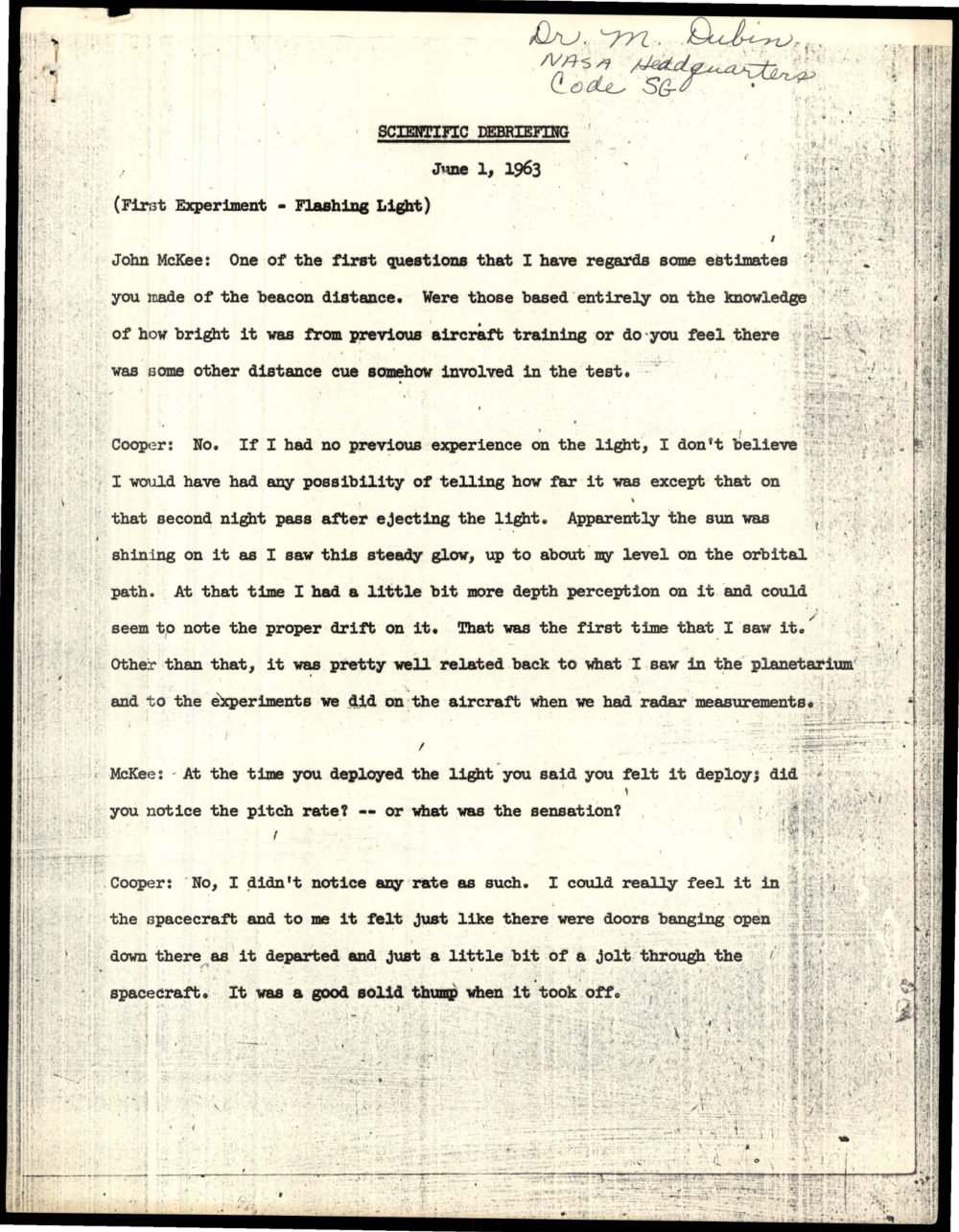 Debriefing transcriptPhysical page 64
DOCUMENTARY SOURCES · NASA / USG
What the records tell
The last flight of the Mercury program took Gordon Cooper into orbit aboard Faith 7, in May 1963. One of the experiments was a beacon with a flashing light, ejected from the spacecraft to test whether an astronaut could find a small object in space, as in a future orbital rendezvous. The scientific debriefing of 1º June 1963 begins with it. The case is useful precisely because the object was known: it shows how something artificial and expected can look strange when seen from orbit.
On the first night after ejection, Cooper did not see the beacon. He checked the alignment against the star charts, swept the sky by changing attitude and mentioned many thunderstorms with lightning below, but said he had no explanation for not having seen it. On the second night, the light appeared coming from below, very slowly, rising against the dark background of the Earth. It was a steady and very bright light, and his first impression was of a missile launched at night from Cape Canaveral, seen from an airplane at high altitude.
An engineer pointed out that the beacon could not give a continuous light, because it flashed by discharging a capacitor. Cooper concluded that the steady light was the Sun illuminating the equipment from behind, since both were above the Earth's shadow. Only when the light had risen some 15 degrees did he see it flash. In the notes recorded on board, he described it as reddish-brown, at a considerable height above the ground, some 10 to 12 miles away and with the brightness of a second-magnitude star. On the third night it was very faint, and only the flashing made it possible to find it.
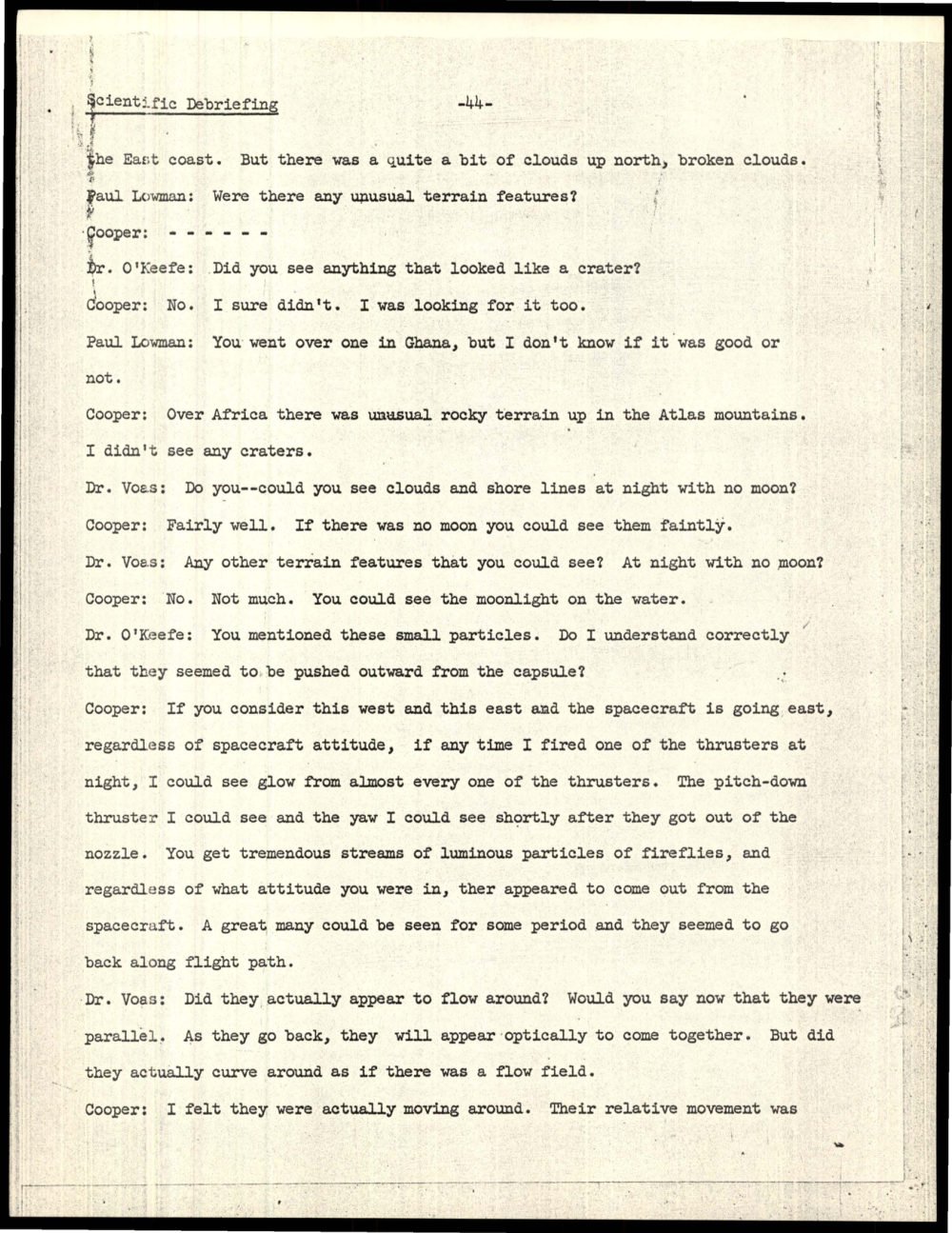
Later on, John O'Keefe asked about the small particles. Cooper replied that, whenever he fired a thruster at night, he saw a glow in almost all of them and “enormous jets of luminous firefly particles,” which seemed to come from the spacecraft, whatever the attitude, and to trail behind along the flight path. Some remained visible for 30 to 40 seconds. Inside the cabin, dust, water droplets and sandwich crumbs drifted slowly toward the window.
NASA published two audio recordings from the same flight. In one, about 1 hour and 41 minutes after launch, Cooper says he sees “John's fireflies,” in reference to Glenn; in the official description, NASA attributes the phenomenon to frozen condensation breaking off the spacecraft (NASA-UAP-D010). In the other, he describes white particles moving away from the capsule after releasing beacons with strobe lights (NASA-UAP-D011). The estimates of the beacon's distance and brightness are the astronaut's own impressions.
Six months before the flight, in November 1962, journalist Walter Cronkite interviewed Cooper, and NASA published an excerpt of that interview on video (NASA-UAP-D023). According to the official record, Cronkite asks about unidentified flying objects, a subject in which Cooper had already shown interest. He answers that "a great number of exceptionally qualified people have seen objects" with no "logical explanation" and speculates about other planets with a "habitable atmosphere," where there might be "some type of human life." This is the astronaut's personal opinion, given before Faith 7 and unrelated to the beacon or to the "fireflies" described in the debriefing.
The full transcript shows that the beacon was treated as an engineering test for the orbital rendezvous of the Gemini program, and not as a mystery. Bill Armstrong, of the mission team, said that the ejection left a clear signal in the attitude records, and that, according to the calculations, on the first night the beacon would have been very low, below the horizon, which would partly explain why Cooper did not see it. The team verified that it worked at the recorded temperatures and that, if it had failed at the start, it would not have resumed flashing later; Armstrong himself called the episode a “real puzzle.” The measured frequency was 62 flashes per minute.
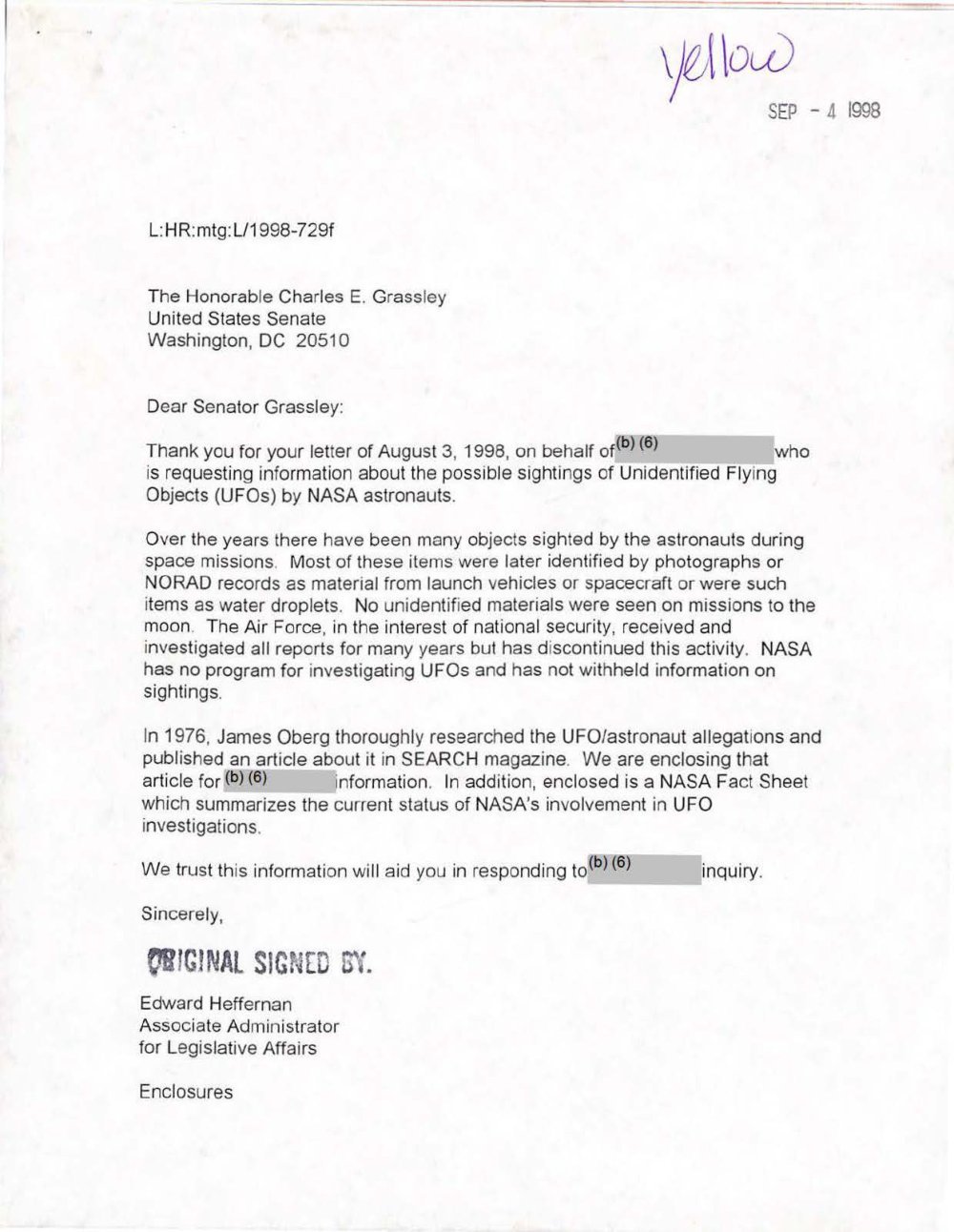
In the “general observations” of the debriefing, John O'Keefe asked about two rumors from the flight. Cooper said the rumor, spread in the cafeteria, that he had seen a meteor was false, and that the “frost” he reported on the window turned out to be oil. There is no mention in the pages of any green object or radar contact. That story appears in the file only in 1998, in an e-mail from a constituent to Senator Charles Grassley, which asserts that on the last orbit Cooper alerted the Muchea station, in Australia, to a greenish object approaching, which radar had allegedly picked up. The e-mail gives no source.
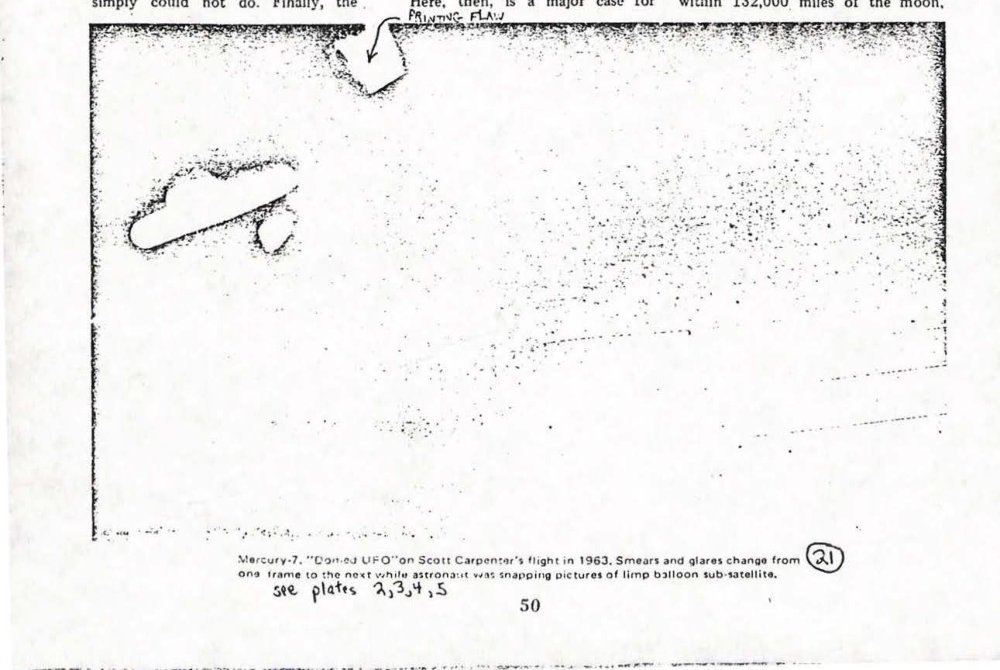
NASA replied to the senator by sending an essay by James Oberg, published in 1976 in SEARCH magazine. Oberg treats the Muchea story as an example of how hard it is to “debunk” an astronaut sighting: he attributes its origin to an NBC journalist in Australia and asserts that Cooper himself, who spoke openly about UFOs, had never heard of the case. This is the conclusion of the essay's author, not of an official document. The collection does not contain the full transcript of Faith 7's communications with Muchea, which would make it possible to verify the claim.
OFFICIAL MEDIA
Official videos for this case
Files published by the United States Government on DVIDS. The title of each one is that of the official publication, translated; the description of what is seen is in the dossier text.
NASA mission audio · 3 min 01 s · the video only loads when you start playback, directly from the official server.
Official record ↗
NASA mission audio · 8 min 14 s · the video only loads when you start playback, directly from the official server.
Official record ↗
Video interview · 2 min 04 s · the video only loads when you start playback, directly from the official server.
Official record ↗More images from the document
DIRECT READING OF THE FILE
The document, in the original
NASA transcript, a U.S. government work: Cooper's statements translated after checking against the facsimile; excerpts on photography and meteorology not translated.
EXCERPT 1 · PHYSICAL PAGE 64
Physical page 64 (page 1 of the transcript), in full
r
SCIEN'.rinc DEBRIEFING , ..
. .
•' Ji.me 1, 1963
(First Experiment • Flashing Light)
John McKee: One of the first questions that I have regards some estimates
you made of the beacon distance. Were those based ·entirely on the knowle
of how bright it was tram p~vious aircraft training ·or do ·you feel there
was some other distance cue somehow involved in the ·test.
J
Cooper: No. If I had no prev;ous experience on the light·, I don Vt believe
I would have had any possibility of telling how far it was except· that on
that second night pass after ejecting the light. Apparent'.cy the sun was
shining on it as I saw this steady glow, up to about·my level on the orbital
path. At that time I bad a little bit more depth perception on it ·and could
') .
seem tp note the proper drift on it. That was the first time that I • saw it.
and t o the experiments we _q;f,d on :the aircraft When we had radar measurement •
I
you notice the pitch rate.? -- or what was the sensation?
.Cooper: ·No, I ~idn't notice any 'rate as such. I cou1d really feel
the spacecraft and to me it felt Jµst like there were doors banging ·open
down there,.,as it departed and Just a li~tle bit .of a Jolt: through_~he : t' h .·
• • \ I • ' ~. A~ ~ ... . ' .
spacecraft. It was a good so~d thump when it'took·oft. • ·' • • •• '. , '' ,r~·:/; ._, : ri-~Editorial note: Typewritten transcript of Gordon Cooper's scientific debriefing, 01/06/1963, copy annotated for M. Dubin. Participants mentioned on the translated pages: John McKee, Bill Armstrong, Shepard, Bill Carmines, John Boynton, Mercer, Day, John O'Keefe, Robert Voas and Paul Lowman, among others; when the page gives only the surname, it is kept. The beacon was a sphere with a xenon strobe light, ejected from the spacecraft to test visual acquisition of a target, in preparation for the orbital rendezvous of the Gemini program.
Check the original PDF
[handwritten, top right:] Dr. M. Dubin, NASA Headquarters, Code SG
SCIENTIFIC DEBRIEFING
June 1, 1963
(First Experiment - Flashing Light)
John McKee: One of the first questions that I have regards some estimates you made of the beacon distance. Were those based entirely on the knowledge of how bright it was from previous aircraft training or do you feel there was some other distance cue somehow involved in the test.
Cooper: No. If I had no previous experience on the light, I don't believe I would have had any possibility of telling how far it was except that on that second night pass after ejecting the light. Apparently the sun was shining on it as I saw this steady glow, up to about my level on the orbital path. At that time I had a little bit more depth perception on it and could seem to note the proper drift on it. That was the first time that I saw it. Other than that, it was pretty well related back to what I saw in the planetarium and to the experiments we did on the aircraft when we had radar measurements.
McKee: At the time you deployed the light you said you felt it deploy; did you notice the pitch rate? -- or what was the sensation?
Cooper: No, I didn't notice any rate as such. I could really feel it in the spacecraft and to me it felt just like there were doors banging open down there as it departed and just a little bit of a jolt through the spacecraft. It was a good solid thump when it took off.View the document record ↗ · Physical page 64, counting the cover.
EXCERPT 2 · PHYSICAL PAGE 65
Physical page 65 (page 2 of the transcript), in full
Scientific Debriefing
Bill .Armstrong: Act~ Gordo, it turned out, it gave you about a half of •
a degree per second in the opposite direction. This was very apparent on th
postfiight record. You can see your ·thruster·acti~ when you start to pitch
' '
up El.lld then as you come right to the bottom of the curve you can see this
little blip on your rate; and then the attitude started back' the other we;yo
.It was real definite. Something on the order of a half of e. gegree per ·secon
or e. little moreo It was real definite where it occurred. Well what it does
is start your pitch back the other ·~•
·' a:riy thruster action to go ,back 1n the other _direction, to pitch back down .afte~
' I
you deployed. You. went to cage - to retroattitude and the attitudes just
and start back .over. It was real ·clear on the records where it went 1
out..
/
Shepard: Say, in regard to the first question, do you think because you . '
had th~ earth as background you could Judge d~stan~e, . because you ha~ e ,
as background'l
Cooper: I think possibly so~ Of course it's like an airplane when it·•s '
a considerable distance out. It is almost impossible to judge the distan
awe;y. You can talk yourself into believing it -is almost any distance fro
I
you, ,. And when it gets .
on 1n closer you really have a bit
. m?re perspective
on ito I did feel that I had almost Judged the distance on that first t
In fact I didn't even "!:>elieve that was it when .I first saw ito t cou1tln't
• I I•
, . ." think of anything ·else that it could be but it was just solid lighto ~d -~ {_ 1
-, ' . . •·,. • . . ., i .. • . ;r. ~ t ..._.., ··~~ ,[!,'"'
it turns-' out looking back now 6n it,· I -am .sure this was because_the s~.'. :~- ::· -~~ .~ ' . .... . ,,Editorial note: Typewritten transcript of Gordon Cooper's scientific debriefing, 01/06/1963, copy annotated for M. Dubin. Participants mentioned on the translated pages: John McKee, Bill Armstrong, Shepard, Bill Carmines, John Boynton, Mercer, Day, John O'Keefe, Robert Voas and Paul Lowman, among others; when the page gives only the surname, it is kept. "Gordo" was Cooper's nickname. "Shepard" is probably the astronaut Alan Shepard; the page gives only the surname.
Check the original PDF
Bill Armstrong: Actually Gordo, it turned out, it gave you about a half of a degree per second in the opposite direction. This was very apparent on the postflight record. You can see your thruster action when you start to pitch up and then as you come right to the bottom of the curve you can see this little blip on your rate; and then the attitude started back the other way. It was real definite. Something on the order of a half of a degree per second, or a little more. It was real definite where it occurred. Well what it does is start your pitch back the other way. If you remember, you never did use any thruster action to go back in the other direction, to pitch back down after you deployed. You went to cage - to retroattitude and the attitudes just go and start back over. It was real clear on the records where it went out.
Shepard: Say, in regard to the first question, do you think because you had the earth as background you could judge distance, because you had earth as background?
Cooper: I think possibly so. Of course it's like an airplane when it's a considerable distance out. It is almost impossible to judge the distance away. You can talk yourself into believing it is almost any distance from you. And when it gets on in closer you really have a bit more perspective on it. I did feel that I had almost judged the distance on that first try. In fact I didn't even believe that was it when I first saw it. I couldn't think of anything else that it could be but it was just solid light. And as it turns out looking back now on it, I am sure this was because the sunView the document record ↗ · Physical page 65, counting the cover.
EXCERPT 3 · PHYSICAL PAGE 66
Physical page 66 (page 3 of the transcript), in full
Sci~ntific Debriefing -3-
had not completely set; !')11-sure 1'113' ·retro pack .area was in the eunligh~•-,. , .
I'm sure that is what I saw glowing,--was the sun reflecting ·off
'
of it. . '
. AJ.though I had, not seen it tram·previous viewing OD tbe day side or the
night _si~eo
McKee: When you didn't see it OD the first night side, did ~ou have any
personal feeling that the light' wasn't ~hing? Did you correct your
1; 1.· attitude when you didn't see .it or· did you have any feeling what the problem .··:. F,.. ~ ... ,, ., , - • I • l •, • 'I- - • •~ -, • '
, was? ,. • -,-~ ;' _·•: ...
.
,~ '-.. ..
- Cooper:. I Just don't have any idea. I kept doubting Jey"Sel~~ • This was
the first time of course that I had ever tried aligning to small end forward, . • . . .
·,.'.,
a180° yaw -as weJ.call it and of course aligning on the night sideo I begaxi , I
. . /
'to doubt that I was aligned properly, I went to the star charts and rechecked
, • • ., " r
!' r and found 1n fact that I was not quite aligned correctly at· first . . ·But then ..• :•..:, 1
,,
, ¥ ,, ~
I did double check 'and found that I was --- I'm sure several times thru the ' .·,· >.'.--~ i
..: • ~ - • " • t
• , l't J ') • f •"''" night I was aligned exactly · on and in using the horizon .line J~t about 1n : ,,: • • , ,1• ~.
•. I , . .
.the middle of the window even moving up and down almost ,.
invariably• .. --- •
don't have any idea why I didn't see it.
Bill .Armstrong: You .did change your ·attitudes? ·That was one of·the th
. . I wanted to Knowo • I?o you remember at the beginning of t~e night phase,
. you first start looking : low and then toward th~.'·eni· • • ~ o/ -did·. • '
' .
ust sort of scan the area or vb&: /Editorial note: Typewritten transcript of Gordon Cooper's scientific debriefing, 01/06/1963, copy annotated for M. Dubin. Participants mentioned on the translated pages: John McKee, Bill Armstrong, Shepard, Bill Carmines, John Boynton, Mercer, Day, John O'Keefe, Robert Voas and Paul Lowman, among others; when the page gives only the surname, it is kept. The "retropack" was the set of braking rockets attached to the heat shield; the beacon had been ejected from that area.
Check the original PDF
had not completely set; I'm sure my retro pack area was in the sunlight. I'm sure that is what I saw glowing,--was the sun reflecting off of it. Although I had not seen it from previous viewing on the day side or the night side.
McKee: When you didn't see it on the first night side, did you have any personal feeling that the light wasn't flashing? Did you correct your attitude when you didn't see it or did you have any feeling what the problem was?
Cooper: I just don't have any idea. I kept doubting myself. This was the first time of course that I had ever tried aligning to small end forward, a 180° yaw as we call it and of course aligning on the night side. I began to doubt that I was aligned properly. I went to the star charts and rechecked and found in fact that I was not quite aligned correctly at first. But then I did double check and found that I was --- I'm sure several times thru the night I was aligned exactly on and in using the horizon line just about in the middle of the window even moving up and down almost invariably. I just don't have any idea why I didn't see it.
Bill Armstrong: You did change your attitudes? That was one of the things I wanted to know. Do you remember at the beginning of the night phase, did you first start looking low and then toward the end look high or did you just sort of scan the area or what?View the document record ↗ · Physical page 66, counting the cover.
EXCERPT 4 · PHYSICAL PAGE 67
Physical page 67 (page 4 of the transcript), in full
Scientific Debriefing -4-
Coo:per: Well first I started trying to get Tfl¥. 180° yaw point. This is
not the easiest thing in the world to get on the night side, and particular~ ... , ,_ ......
when you have to go into your tar charts 50 ~ute1 ahead ot Where :,ou had •
norn:ia.;uy been used to using them. ir:.finally did find star patterns that gave
'
me the proper orientation. ,I was wiing, around 15 to 120 degrees pitched downi ·,.' ,·. - \ .,, ' ,. :•
I .was just keeping the horizon ~ th~ sort of bottom p~ of the Window ~d~•:-1·!_·, :./·:~'l~·~ ;{ \ ')" \ •'
I • t .., ,fI got_around. ·this area, I then tried varying ·the· attitude ~P and down to- '· • , •• ·,
look for the light~
. ..
I 1
She:pard: You mentioned' in your repOrt that,--you talked about approx
25 minutes a:f'ter you caged your gyros, that you saw' a ·lot of li'ghtning
par'tfcularly in that area. .: •'.o:.
Cooper: · Well, · this is .,one possibility· that there was a slight compromise
to the .light. 1 Particularly on the first night side there was co~iderabl
large lightning down ther_e. I found concentrations of large thundersto
•right up .in there and saw quite a lot iof -light flashing through fairly I
large areas. I still don't believe that even on the other night
spite of these I still could\see the light even with -:this as a ba.ckgroun .• .. ... . . : , ~ ·•· ·- .
It is r~ally not an excuse for ·not seeing it ,and I really honest]¥ _ C ••
I ', . . ~-- ; .- ~ ...... - ----··· - ••
say why I didn•t.. I had 'b~gun ~o doUbt th~t ,1~ was re .. flash ~ .., ~ • • • I • I •Editorial note: Typewritten transcript of Gordon Cooper's scientific debriefing, 01/06/1963, copy annotated for M. Dubin. Participants mentioned on the translated pages: John McKee, Bill Armstrong, Shepard, Bill Carmines, John Boynton, Mercer, Day, John O'Keefe, Robert Voas and Paul Lowman, among others; when the page gives only the surname, it is kept.
Check the original PDF
Cooper: Well first I started trying to get my 180° yaw point. This is not the easiest thing in the world to get on the night side, and particularly when you have to go into your star charts 50 minutes ahead of where you had normally been used to using them. I finally did find star patterns that gave me the proper orientation. I was using, around 15 to 20 degrees pitched down, I was just keeping the horizon in the sort of bottom part of the window and I got around this area, I then tried varying the attitude up and down to look for the light.
Shepard: You mentioned in your report that,--you talked about approximately 25 minutes after you caged your gyros, that you saw a lot of lightning particularly in that area.
Cooper: Well, this is one possibility that there was a slight compromise to the light. Particularly on the first night side there was considerable large lightning down there. I found concentrations of large thunderstorms right up in there and saw quite a lot of light flashing through fairly large areas. I still don't believe that even on the other night side, in spite of these I still could see the light even with this as a background. It is really not an excuse for not seeing it and I really honestly can't say why I didn't. I had begun to doubt that it was really flashing.
McKee: Was the moon ever a problem?View the document record ↗ · Physical page 67, counting the cover.
EXCERPT 5 · PHYSICAL PAGE 68
Physical page 68 (page 5 of the transcript), in full
Scientific Debriefing -5-
Cooper: The moon was probably 14-al. It was down to about a third moon.
It was a ver:, distinctive moon vb~ you ·could see it but it' wasn.'t causing
the great amount of light tbat a. twU moon would have caused. , , I could see I
the glow on the ground, on. the· clouds :~d on the land, from the moono ., It ' .
up just at t1:ie .last part c,f the ~n1Jtrt. ·It-was never ·close to 1 th~ moo:Q.
deylighto
. Bill ,Armstrong:
' i. in-the retro pack area; they ·ran•.cooler, this flight.
Bill Carmines said th$t they- b-4: ~;ualJ~· flashed the light at thi~ lo~r '
temperatures without .any probla. Re talked to Langley people and he says
'
.that i~ the light had fail~ 1;0. work the first time it would have never
. . : , ·warmed enough later in the n:1~t to start flashing. It is hard to visuali~T .. ~: ; . ' - , .'· •• ,1 ~ tip'. • • ;.
it no~ having been ·working t-he f:Lrst time Bll;d then ·worked the second t:1.me.,,.·, •
Do ·you think your _att,itude. ,..~~ •-eauld you tell any difference •in your
attitude, the second night vl,Am -~ $.alf the ·llgbt. In yaw as C?JDPared
·: st • do you think 70\1. . • : • • ~ed d~~b~ter the .. ·, (Editorial note: Typewritten transcript of Gordon Cooper's scientific debriefing, 01/06/1963, copy annotated for M. Dubin. Participants mentioned on the translated pages: John McKee, Bill Armstrong, Shepard, Bill Carmines, John Boynton, Mercer, Day, John O'Keefe, Robert Voas and Paul Lowman, among others; when the page gives only the surname, it is kept. The temperatures of "60 or 62 degrees" do not give the scale; probably degrees Fahrenheit (about 16 °C). Langley is NASA's research center in Virginia.
Check the original PDF
Cooper: The moon was probably ideal. It was down to about a third moon. It was a very distinctive moon when you could see it but it wasn't causing the great amount of light that a full moon would have caused. I could see the glow on the ground, on the clouds and on the land, from the moon. It was not enough to obliterate all the stars, or when the light was sort of in the direction of the moon. It didn't matter. Q. Was the light ever close to the moon? A. No, the light was never close to the moon. The moon came up just at the last part of the night. It was never close to the moon because the moon was just coming,-- the moon came up just at the last part of the night. It had not been up very long before, before I began to get daylight.
Bill Armstrong: This is a real puzzler. We looked at the temperature traces in the retro pack area; they ran cooler, this flight. Around 60 or 62 degrees. Bill Carmines said that they had actually flashed the light at this lower temperatures without any problem. He talked to Langley people and he says that if the light had failed to work the first time it would have never warmed enough later in the flight to start flashing. It is hard to visualize it not having been working the first time and then worked the second time. Do you think your attitude ---- could you tell any difference in your attitude the second night when you saw the light. In yaw as compared with the first do you think you had your yaw pinned down better then?View the document record ↗ · Physical page 68, counting the cover.
EXCERPT 6 · PHYSICAL PAGE 69
Physical page 69 (page 6 of the transcript), in full
I'
.'
Scientific Debriefing -6-
Cooper: Well, not realq. As I went into both night sides I cc;>u.ld pretty
well estimate 18o0
yaw. The first' night side I was not complete:cy around,
, ,·~
I started :,awing around &114 ni,gbt wu audde~ upon me and I wasn°t quite in ' ' • / I
0 0 ' the :t'ull 180 positi~, so I did have to hunt ,for 'the 180 posi~ion a little' •
'
bit• . On the second n:i..ght -side af'ter -I ejected the -light, I was alre&q¥ in_' I • I
' · m:, 180~ position before ·going -into the night side.
..... ~+~•
Merce;: H6w·liigb above or ·below horizon line or -~dow did you look ·for light! ./; :; , • • • I I , . I , . ' ,
•
In other words how .far down"or :how; high did you go with your ·pitch .attitude?
/ ¾:,'
. •
•
')}
I
::.;,.. Cooper: On the first night s.ide I .allowed it to drift very, very slow:cy and •·~ • _• .. , : , .,. . ... ' "'J. :, , \t. , .. , .. t
' changed them as I needed to, 'very very· slight:cy to keep m:, yaw on 180° and· // '., Y· ... \ t,
it varied back and forth very ·sl.igbt:cy. But X went '&1.1 tlle ~ down to ~;~ ·,~ . •' ;~ ,,,. ) ' I t\ '• ' ,
where the horizon ·1
would fill the ·whole window and up to where. I Just ba.re:cy , ..,- ¼·.J., ·; \ • •, · •.. • . . • ., • ~... , __ i .1,.·.t- \,. r • r ~ • \,. • • • ' • • ;"' ,' "..' •' :'i # ~
h¢ the horizon in sight. / "7 '
. ,· . . '
Bill ,.Armstrong: ·Did you see it cane right a'WIQ" ·when · you·:iooked .on
I nigb.t'l
'I
/ ,,. ; '
/In oth · ·- :rd8°you :picked it up. • • JEditorial note: Typewritten transcript of Gordon Cooper's scientific debriefing, 01/06/1963, copy annotated for M. Dubin. Participants mentioned on the translated pages: John McKee, Bill Armstrong, Shepard, Bill Carmines, John Boynton, Mercer, Day, John O'Keefe, Robert Voas and Paul Lowman, among others; when the page gives only the surname, it is kept.
Check the original PDF
Cooper: Well, not really. As I went into both night sides I could pretty well estimate 180° yaw. The first night side I was not completely around. I started yawing around and night was suddenly upon me and I wasn't quite in the full 180° position, so I did have to hunt for the 180° position a little bit. On the second night side after I ejected the light, I was already in my 180° position before going into the night side.
Mercer: How high above or below horizon line or window did you look for light? In other words how far down or how high did you go with your pitch attitude?
Cooper: On the first night side I allowed it to drift very, very slowly and changed them as I needed to, very very slightly to keep my yaw on 180° and it varied back and forth very slightly. But I went all the way down to where the horizon would fill the whole window and up to where I just barely had the horizon in sight.
Bill Armstrong: Did you see it come right away when you looked on the second night?
Cooper: I just barely got into the night.
Bill Armstrong: In other words you picked it up right away?View the document record ↗ · Physical page 69, counting the cover.
EXCERPT 7 · PHYSICAL PAGE 70
Physical page 70 (page 7 of the transcript), in full
Scientific Debriefing -1-
Cooper: .Almost. Almost as it began to get dark. Of course it gets dark
Just like that. Zam it gets dark~ I had Just,--it was dark earth background
and as I say 'lI13 first teeling on at,eing it was definitely coming :f'rom below_
j
very very slowly. As I watched it was getting higher in 'lI13 line of sight to the I
·earth. In other words as I ·was holding -the earth on .a fixed place1ton the
window this was coming u~. It was · coming up in relation to me, and was
finally ·up to 'lI13 level. And ·.as I saw it coming up it was solid light. My
first though. on it was -that it looked Just like th·e missiles that I have seen . I , ' • • • • I • ' ~
launched at night :f'rom Cape C~veral; when rou 're t:cying at night at a·high·•
altitude. and see them launched. It didn't have the same glow but it· was ....., • ' • • ' .. ' • ' ':,I ••
• • ·1 I' -
very·very bright, and solid and <seemed to becoming up. ,, •'
Bill Armstrong:_ That is something else we checked into• . It would have be~--;~
impossible for this light to have been steady_for -you. It is neceSS_!ll'Y to
, / '
fully charge the condenser and then get a quick discharge. •,· •
Cooper: That's why I think .it mat have been the suns~ine on it
Because of t~e altitude we were both at, the sun ·would be shining on it at
that point. I had Just gone • into :the night side.~ Even though i~ was dark • I ' .. • . I
if I had yawed around to zero _yaw it ·would have been in·.the bright sun., . ~ f • • •
' I IEditorial note: Typewritten transcript of Gordon Cooper's scientific debriefing, 01/06/1963, copy annotated for M. Dubin. Participants mentioned on the translated pages: John McKee, Bill Armstrong, Shepard, Bill Carmines, John Boynton, Mercer, Day, John O'Keefe, Robert Voas and Paul Lowman, among others; when the page gives only the surname, it is kept. "First though" and "becoming up" are as in the original (for "thought" and "be coming up"). The passage about the first impression had already been translated on the site; its wording was kept.
Check the original PDF
Cooper: Almost. Almost as it began to get dark. Of course it gets dark just like that. Zam it gets dark. I had just,--it was dark earth background and as I say my first feeling on seeing it was definitely coming from below very very slowly. As I watched it was getting higher in my line of sight to the earth. In other words as I was holding the earth on a fixed place on the window this was coming up. It was coming up in relation to me, and was finally up to my level. And as I saw it coming up it was solid light. My first though on it was that it looked just like the missiles that I have seen launched at night from Cape Canaveral; when you're flying at night at a high altitude and see them launched. It didn't have the same glow but it was very very bright, and solid and seemed to becoming up.
Bill Armstrong: That is something else we checked into. It would have been impossible for this light to have been steady for you. It is necessary to fully charge the condenser and then get a quick discharge.
Cooper: That's why I think it must have been the sunshine on it from behind. Because of the altitude we were both at, the sun would be shining on it at that point. I had just gone into the night side. Even though it was dark if I had yawed around to zero yaw it would have been in the bright sun.
Bill Armstrong: Was it above the horizon when you saw it flashing or was it still in the haze layer, or what?View the document record ↗ · Physical page 70, counting the cover.
EXCERPT 8 · PHYSICAL PAGE 71
Physical page 71 (page 8 of the transcript), in full
.
Scientific Debriefing -8-
of t he window when I first picked it up. By the time it got up to where
• • : '
was may'be 15 degrees higher (1n relation_to me and m:, l.ine •of sight) 1
.• I
suddeacy saw it flashing.
. I \
Bill Armstrong: ~at'a ,.1ust where it would have been. If woul.d have· -.
just coming to the horizon. '. '
John Boynton: ·Was this predominantly ~bove the horizon?
Bill Armstrong: In the first orbit, no. On the first orbit it is' very-1low~
That is why' he •might not have seen it the initial part of the orbito
I
about 20 or 30 minutes thru the1night s~de, it passes through the horizon
and then it goes about 25 or 30 degrees high. It goes· through a fai,rly
large angle change. at first, and the further out it gets of course the
smal.ler 1 the angle .change is. 'l'he second night a:f'tier depl.oyment •Just ·about ., ,_
. . at sunset 1t start·s up through the .horizon and 'then all the time .during the ' • '
second night phase it is .above th~ horizon. · Then the third C)ne is· above the
hor.:Lzon all of the·'time.Editorial note: Typewritten transcript of Gordon Cooper's scientific debriefing, 01/06/1963, copy annotated for M. Dubin. Participants mentioned on the translated pages: John McKee, Bill Armstrong, Shepard, Bill Carmines, John Boynton, Mercer, Day, John O'Keefe, Robert Voas and Paul Lowman, among others; when the page gives only the surname, it is kept. "If would have been" is as in the original. The "John" of the last question may be John McKee or John Boynton; the page does not say.
Check the original PDF
Cooper: It was just still slightly below the horizon. It had come up almost to the horizon. It had been a fair amount below it when I first saw it. In fact I was pitched down to about -34° and I saw it towards the bottom part of the window when I first picked it up. By the time it got up to where it was maybe 15 degrees higher (in relation to me and my line of sight), I suddenly saw it flashing.
Bill Armstrong: That's just where it would have been. If would have been just coming to the horizon.
John Boynton: Was this predominantly above the horizon?
Bill Armstrong: In the first orbit, no. On the first orbit it is very low. That is why he might not have seen it the initial part of the orbit. Somewhere about 20 or 30 minutes thru the night side, it passes through the horizon and then it goes about 25 or 30 degrees high. It goes through a fairly large angle change at first, and the further out it gets of course the smaller the angle change is. The second night after deployment just about at sunset it starts up through the horizon and then all the time during the second night phase it is above the horizon. Then the third one is above the horizon all of the time.
John: If he is at zero roll what is the maximum visual angle of sight through the window?View the document record ↗ · Physical page 71, counting the cover.
EXCERPT 9 · PHYSICAL PAGE 72
Physical page 72 (page 9 of the transcript), in full
, .
Scientific Debriefing -9-
Bill Armstrong: You get a 30 degree angle view througb'._the window.
the top of the window to the bottom,
variation of ·.30 degrees.
'·'
John: How far ·would he have to pitcp down'l
Bill Armstrong: He would probably have to be below retroattitudeG
to almost have all earth· in the window. Probably about 30 degrees G
Cooper: I had a~-:few comments that I made ·on the onboard tape about the
. . . "1· .
"I am at 4st daylight going ixlto dark" I had been ·looking ,for that flashing · 1
. . . ~
·beacon. "This light in sight is below me. It is quite a brownish
b;rown and considerable ~titude above the ground." In other words I was
convinced it was not a light down on_the ground but _it had ·movemento I
t
mentioned several other items here such as this light being ·visibl_e _among
the starso "The ligJ;it is f.1lashing, now. It is· the lighto It is quite I I
bright and quite discernible. It appears to be about -10 to l2 miles awayo
I'm keeping it exactli in the windpw. About the order ·of a second magnitude .. • ' \.
star now." and that time was 05:ll:34. ".The light is sM.µ in sight in .the ··. • • -· . . ;' ~ .; '
' center of the window. 11 •
l •
Bill Armstrong: Did you,--acc?rding to -the voice tape it.
xruq, have yawed away a _little bit then ·. and then c;:ame .-back..
Did you yaw away and -t?hen •come right back to ~t'l ,Editorial note: Typewritten transcript of Gordon Cooper's scientific debriefing, 01/06/1963, copy annotated for M. Dubin. Participants mentioned on the translated pages: John McKee, Bill Armstrong, Shepard, Bill Carmines, John Boynton, Mercer, Day, John O'Keefe, Robert Voas and Paul Lowman, among others; when the page gives only the surname, it is kept. 05:11:34 is flight elapsed time (hours, minutes and seconds). 10 to 12 miles is about 16 to 19 km. The passage from the recorded notes had already been translated on the site; its wording was kept.
Check the original PDF
Bill Armstrong: You get a 30 degree angle view through the window. From the top of the window to the bottom, 30½°. You can see over an elevation variation of 30 degrees.
John: How far would he have to pitch down?
Bill Armstrong: He would probably have to be below retroattitude. He had to almost have all earth in the window. Probably about 30 degrees.
Cooper: I had a few comments that I made on the onboard tape about the light: "I am at last daylight going into dark" I had been looking for that flashing beacon. "This light in sight is below me. It is quite a brownish reddish brown and considerable altitude above the ground." In other words I was convinced it was not a light down on the ground but it had movement. I mentioned several other items here such as this light being visible among the stars. "The light is flashing, now. It is the light. It is quite bright and quite discernible. It appears to be about 10 to 12 miles away. I'm keeping it exactly in the window. About the order of a second magnitude star now." and that time was 05:11:34. "The light is still in sight in the center of the window."
Bill Armstrong: Did you,--according to the voice tape it indicates that you may have yawed away a little bit then and then came back. Is that right? Did you yaw away and then come right back to it?View the document record ↗ · Physical page 72, counting the cover.
EXCERPT 10 · PHYSICAL PAGE 73
Physical page 73 (page 10 of the transcript), in full
Scientific Debriefing
Cooper: Just once.
Bill Armstrong: Did you do it twice or Just once?
·' .1,
Cooper: No, , I kept it 1n s,ight for quite awhile ·ap.d then yawed away from ·it
and then came right back.
Cooper: At 05:13:40 I made some coments on the Mi1q Way and varioW;J
things and at 05:16:35 the light was still in sight. Thunderstorms were
in under it at the moment but it was still quite distinctive.. And this
at 05:18:05.
Bill Armstrong: What brightness do you think you need if you ·.are .going to
try to acquire some target in space.
Cooper: It was very distinctive both t1I!1-es. At this brightness where i~
was on the second .night side af'ter the ejection, both times it was very
' distinctive more than ·the brightness of course, it was the flashingo , On
the third night side it was extreme~ faint but the ·flashing allowed me,to
' pick it up.· I wouldn't have been .able to see it .the third night but
fl.ashing.
Bill .Armstrong: Do you think that either at the initial acquisition -of the . >
.thing ·or ·e,ven toward. the end of the second night phase the 1?rightnessl would "_ - . ... .. :
b~ sufficient if you wOUld be • t7:Ying to l~cate a re~de~vous target'l :·Editorial note: Typewritten transcript of Gordon Cooper's scientific debriefing, 01/06/1963, copy annotated for M. Dubin. Participants mentioned on the translated pages: John McKee, Bill Armstrong, Shepard, Bill Carmines, John Boynton, Mercer, Day, John O'Keefe, Robert Voas and Paul Lowman, among others; when the page gives only the surname, it is kept.
Check the original PDF
Cooper: Just once.
Bill Armstrong: Did you do it twice or just once?
Cooper: No, I kept it in sight for quite awhile and then yawed away from it and then came right back.
Cooper: At 05:13:40 I made some comments on the Milky Way and various things and at 05:16:35 the light was still in sight. Thunderstorms were in under it at the moment but it was still quite distinctive. And this is at 05:18:05.
Bill Armstrong: What brightness do you think you need if you are going to try to acquire some target in space.
Cooper: It was very distinctive both times. At this brightness where it was on the second night side after the ejection, both times it was very distinctive more than the brightness of course, it was the flashing. On the third night side it was extremely faint but the flashing allowed me to pick it up. I wouldn't have been able to see it the third night but for the flashing.
Bill Armstrong: Do you think that either at the initial acquisition of the thing or even toward the end of the second night phase the brightness would be sufficient if you would be trying to locate a rendezvous target?View the document record ↗ · Physical page 73, counting the cover.
EXCERPT 11 · PHYSICAL PAGE 74
Physical page 74 (page 11 of the transcript), in full
,. • I
Scientific Debriefing • -llCooper: I think so. I think with that brightness~ if you know approximately
'.
where to look for the thing and with _it flashing, you certa~ ought to be
(
able to find it pretty· readily.
Day: , Do you think similar experiments should be carried on ·or is this
sµfficient'l
Cooper: I think this prob~bly shows us 'What we:- really want to seeo I think
ther e is going to be problem like there is in .aircraft a As YO:U move
to it you are going to have to have something that gives a little bit more
capability to obtain distance f'rom it at the time; su~ as perhapa,-two lights ,
that you cou.l~ raµge on; like naVigation lights on aircra:t'to
I
QuestiQn: Were internal lights .on in the night observations?
,.. .
' Cooper: On most night aides I had all the lights down complet.ely and used ' I I
just the glove lights to read,critical items.
Bill Armstrong: On ·t;he third night phase you say you had to do a good bit ,,
of' searching. ; Were you searching the entire third night, and when did you
fir-st see it'l ·, 1
I
·cooper: Slightly past the middle of the night. I think that on the third
~ight side the· brightness was such that it was sheer accident that I found
\.
If_)rou Just happen to pass it' in t~e scan pattern you might _see it flashing, , I (
:tt would, however,· be very easy to miss. .. • , / IEditorial note: Typewritten transcript of Gordon Cooper's scientific debriefing, 01/06/1963, copy annotated for M. Dubin. Participants mentioned on the translated pages: John McKee, Bill Armstrong, Shepard, Bill Carmines, John Boynton, Mercer, Day, John O'Keefe, Robert Voas and Paul Lowman, among others; when the page gives only the surname, it is kept. There is a pencil check mark in the margin, next to the answer about the interior lights.
Check the original PDF
Cooper: I think so. I think with that brightness, if you know approximately where to look for the thing and with it flashing, you certainly ought to be able to find it pretty readily.
Day: Do you think similar experiments should be carried on or is this sufficient?
Cooper: I think this probably shows us what we really want to see. I think there is going to be problem like there is in aircraft. As you move in closer to it you are going to have to have something that gives a little bit more capability to obtain distance from it at the time; such as perhaps two lights that you could range on; like navigation lights on aircraft.
Question: Were internal lights on in the night observations?
Cooper: On most night sides I had all the lights down completely and used just the glove lights to read critical items.
Bill Armstrong: On the third night phase you say you had to do a good bit of searching. Were you searching the entire third night, and when did you first see it?
Cooper: Slightly past the middle of the night. I think that on the third night side the brightness was such that it was sheer accident that I found it. If you just happen to pass it in the scan pattern you might see it flashing. It would, however, be very easy to miss.View the document record ↗ · Physical page 74, counting the cover.
EXCERPT 12 · PHYSICAL PAGE 75
Physical page 75 (page 12 of the transcript), in full
·,scientific Debriefing •l2-
Bill Armstrong: You feel brightness suitable f'or a rende~vous
be something on the order. of second or third magnitude. I • l • .' • . ~ l • • . •. • -
' '
Cooper: Yeso
Bill: That 1s one of t he main things we wanted to ·rind out.. Does
of the secon~ night l ook about right? Was the third night too d:l.m'l
. '
., Cooper: Yes, the third one is .getting ·a little too d:l.mo I •
Bill: Do you think you have got to have good sighting information .to pick • I • . ,.
these up ev:en 'W'ith bright light7 J'
I C~o:per: Well, it is a pretty big sky at night .up there and there are a lot
of bright starso I t hink ·you're going to have to have some -sight~g,..date.
to get within a ~easonable ~one area to hunt .for ito
McKee: What about the flash ·:rrequency r ate'l
• Cooper: I think the flash rate could be cut downo I think you could maybe
I
haJ.ye the flash rateo • I woul.d rather.-see it twice as bright and see it fl.ash
·\ . , . , half as of'teno , A flash , rate, even -one every two seconds is stii;t distinctive. ·: . . ,.
. . I
May1>e not quite as distinctive as ·the one per second, but it •Still wbuld . '
attract your ~ttention.
_Bill: • How about the· deploy marks?Editorial note: Typewritten transcript of Gordon Cooper's scientific debriefing, 01/06/1963, copy annotated for M. Dubin. Participants mentioned on the translated pages: John McKee, Bill Armstrong, Shepard, Bill Carmines, John Boynton, Mercer, Day, John O'Keefe, Robert Voas and Paul Lowman, among others; when the page gives only the surname, it is kept.
Check the original PDF
Bill Armstrong: You feel brightness suitable for a rendezvous target would be something on the order of second or third magnitude.
Cooper: Yes.
Bill: That's one of the main things we wanted to find out. Does the brightness of the second night look about right? Was the third night too dim?
Cooper: Yes, the third one is getting a little too dim.
Bill: Do you think you have got to have good sighting information to pick these up even with bright light?
Cooper: Well, it is a pretty big sky at night up there and there are a lot of bright stars. I think you're going to have to have some sighting data to get within a reasonable cone area to hunt for it.
McKee: What about the flash frequency rate?
Cooper: I think the flash rate could be cut down. I think you could maybe halve the flash rate. I would rather see it twice as bright and see it flash half as often. A flash rate, even one every two seconds is still distinctive. Maybe not quite as distinctive as the one per second, but it still would attract your attention.
Bill: How about the deploy marks?View the document record ↗ · Physical page 75, counting the cover.
EXCERPT 13 · PHYSICAL PAGE 76
Physical page 76 (page 13 of the transcript), in full
.
Scientific Debriefing -13-
Cooper: Those deploy marks worked real well. They were excellent for getting
in 1·etroattitude also. They -position your head ·to a real positive position, ' , I "
I
Bill: We have read the attitude ·records pretty carefull:yo You were between '
20 a.nd 22 degrees, so you were right in .there. Do you think the window
I smudges, the discoloration of the window, might have had significant effect?
Do you think it produced enough attenuation to cause any trouble?
, . Act~ I tried and tried to note how much attenuation you get at
.night. It's just a few seconds until the time you get dark-adapted; I thought , .
you became dark .adapted very rapidly, and I didn't see or note any real attenuationo •
• I am sure there was some as there was definitezy smudge layers there.. .- But·,,.
it didn't seem to be.... The bright stars sure seemed bright.
' . ,,,. (,
Bill Armstrong: • J)id you act~ see the light against the ground'l • , • . \ .
Cooper: Yes. I made this comment ·here that I even saw it against the
thunderstorm.
I · o
John Boynton: Go:;t.;do, you talked about the flash rate. The flash rate in
, your debriefing ·might have been ·. slightzy below a flash per ·second.
, Cooper: I did it on the tape • . I counted off here on the. tape so. you could
get it of~ the t~pe. I counted 1,2,3,4,5,6,7; It seemed to me that
slightzy s+ower ·than ·one flash .per. second..Editorial note: Typewritten transcript of Gordon Cooper's scientific debriefing, 01/06/1963, copy annotated for M. Dubin. Participants mentioned on the translated pages: John McKee, Bill Armstrong, Shepard, Bill Carmines, John Boynton, Mercer, Day, John O'Keefe, Robert Voas and Paul Lowman, among others; when the page gives only the surname, it is kept. The "release marks" were reference marks on the window for positioning the spacecraft.
Check the original PDF
Cooper: Those deploy marks worked real well. They were excellent for getting in retroattitude also. They position your head to a real positive position.
Bill: We have read the attitude records pretty carefully. You were between 20 and 22 degrees, so you were right in there. Do you think the window smudges, the discoloration of the window, might have had significant effect? Do you think it produced enough attenuation to cause any trouble?
Cooper: Actually I tried and tried to note how much attenuation you get at night. It's just a few seconds until the time you get dark-adapted; I thought you became dark adapted very rapidly, and I didn't see or note any real attenuation. I am sure there was some as there was definitely smudge layers there. But it didn't seem to be.... The bright stars sure seemed bright.
Bill Armstrong: Did you actually see the light against the ground?
Cooper: Yes. I made this comment here that I even saw it against the thunderstorm.
John Boynton: Gordo, you talked about the flash rate. The flash rate in your debriefing might have been slightly below a flash per second.
Cooper: I did it on the tape. I counted off here on the tape so you could get it off the tape. I counted 1,2,3,4,5,6,7. It seemed to me that it was slightly slower than one flash per second.View the document record ↗ · Physical page 76, counting the cover.
EXCERPT 14 · PHYSICAL PAGE 77
Physical page 77 (page 14 of the transcript), in full
..
I
Scientific Debriefing
Question: . What did it check out'l
i
-ii'
•
.
1
j ~
Carmines: ·.62 (flashes per minute).
l \
Bill: Did you make attempts to see it· on the day side'l
Cooper: I sure did. I never saw it then•
. Armstrong: It should ·have been closer on the dey side than in the night
portiono It came 1in c;l.oser, arid started out away some time during ·the f:t,rst . ,
day. pass) Before you picked it up it had started out again. It should
have been in to about two miles sometime during the first day sideo
didn't find it, but e·efore I got to the next night side,- I brought yaw back ,' •
Cooper: At first I was on 180 degrees .yaw, and allowed it to dri:f't offo ·,
' ' ' _ . • ~ ,,,.,)II'~ • • ••;
to 180 degreeso· There was a possib_ility I .missed•it thereo .
, ,
McKee: Did the flash seem very consistant'l
Cooper: Yes, it seemed to be very consistant.
~ . Carmines: Did you see it tumble'l
Cooper:
Carmines:Editorial note: Typewritten transcript of Gordon Cooper's scientific debriefing, 01/06/1963, copy annotated for M. Dubin. Participants mentioned on the translated pages: John McKee, Bill Armstrong, Shepard, Bill Carmines, John Boynton, Mercer, Day, John O'Keefe, Robert Voas and Paul Lowman, among others; when the page gives only the surname, it is kept. "Consistant" is as in the original. Two miles is about 3 km.
Check the original PDF
Question: What did it check out?
Carmines: 62 (flashes per minute).
Bill: Did you make attempts to see it on the day side?
Cooper: I sure did. I never saw it then.
Armstrong: It should have been closer on the day side than in the night portion. It came in closer and started out away some time during the first day pass. Before you picked it up it had started out again. It should have been in to about two miles sometime during the first day side.
Cooper: At first I was on 180 degrees yaw, and allowed it to drift off. I didn't find it, but before I got to the next night side, I brought yaw back to 180 degrees. There was a possibility I missed it there.
McKee: Did the flash seem very consistant? Did the brightness vary?
Cooper: Yes, it seemed to be very consistant.
Carmines: Did you see it tumble?
Cooper: I couldn't tell any tumbling.
Carmines: I'm sure it was tumbling.View the document record ↗ · Physical page 77, counting the cover.
EXCERPT 15 · PHYSICAL PAGE 78
Physical page 78 (page 15 of the transcript), in full
Scientific Debriefing -15-
Bill: The spread of light isn't too great.
J ',
Coope~: It is pretty hard to Judge the; light
Mercer: Did .you see the ·stars during this• ~'l
, I
Cooper: Not this particular··orbit. No I didn't.
I I
(Second Experiment • Balloon J?.ra,g)
Dey: Mr. Carmines will you give. us a quick run-down on ·.the -balloon ·expe
failure?
Carmines: I tal.ked with Instrumentation people and everyone agreed that
we really don't know what happened. We had one relay actuateo There are ·
several possibil.ities• . To me the most l.ikely place of trouble is the final •
plug. The pins are on the pigtail and in putting this together you can bend
' \ I '
these pins and get a misalignment. W~ checked the plug :and.in this case the
:pin is near ·the case ~d if it ~ent it could ground..
I . •
Bill: The squibs were in parallel and a number ·of ·tests showed' eithe:x: • one '.- ·•
.. I '
of the squib would fire the latch. The most probable cause, is in ·the circ,uitry., I
'-
I '
(Discussionoon ·G~ound Light _Observation) ,
Bill Armstrong: How hard wa.s it to pick up the light when .you .first
Did you have -trouble picking ·up this ground light at all?
, I , , • - ' ,' '·.. . ..-. , . ---: -, :, • , • • • . . ' I ,
-· l ,Editorial note: Typewritten transcript of Gordon Cooper's scientific debriefing, 01/06/1963, copy annotated for M. Dubin. Participants mentioned on the translated pages: John McKee, Bill Armstrong, Shepard, Bill Carmines, John Boynton, Mercer, Day, John O'Keefe, Robert Voas and Paul Lowman, among others; when the page gives only the surname, it is kept. The page closes the first experiment (beacon) and moves on to the drag balloon, which did not deploy, and to the observation of a light installed on the ground (pp. 79 to 84), both outside the episode. The balloon on this page is the Faith 7 one, not the Aurora 7 one.
Check the original PDF
Bill: The spread of light isn't too great.
Cooper: It is pretty hard to judge the light level.
Mercer: Did you see the stars during this day?
Cooper: Not this particular orbit. No I didn't.
(Second Experiment - Balloon Drag)
Day: Mr. Carmines will you give us a quick run-down on the balloon experiment failure?
Carmines: I talked with Instrumentation people and everyone agreed that we really don't know what happened. We had one relay actuate. There are several possibilities. To me the most likely place of trouble is the final plug. The pins are on the pigtail and in putting this together you can bend these pins and get a misalignment. We checked the plug and in this case the pin is near the case and if it bent it could ground.
Bill: The squibs were in parallel and a number of tests showed either one of the squib would fire the latch. The most probable cause is in the circuitry.
(Discussion on Ground Light Observation)
Bill Armstrong: How hard was it to pick up the light when you first started. Did you have trouble picking up this ground light at all?View the document record ↗ · Physical page 78, counting the cover.
EXCERPT 16 · PHYSICAL PAGE 104
Excerpt from physical page 104 (page 41 of the transcript): beginning of the "General observations"
I
-41- ;Scienti fic Debriefing
(General Observations)
,Pr• O'Keefe: I u.:c.dersta.nd the hissing noise was completely -negative. Can you
i e sure it was not then'l <
Ooo:per: I didn't ever hear it at all. I had good fit~ing ear caps.
Dr. O'Keefe: Were you listening for it at the time'l
Cooper: Yes, except I had my visor closed and with ~he visor closed you can't
hear too much.
I Dr. 0 'Keefe: At one p~_int a rumor circulated· in the public mess that you had ......
seen a meteor.
Cooper: This was a false rumor.
Dr. 0 'Keefe: At one point you said you saw frost on the window. • I
Cooper: This is _the mat_erial that turned out to be oil.
Paul Lewan: Have you seen the terrain photos'? Have yo:u seen number 8, east
coast of Africa'? Does it look this blue'l
Cooper: Not quite"' The film has fairly true'reproduction but in several cases it
might be a little more blue in film, than it actually is.
Paul Lewan: How ·apout the shots over Himalayas'?
Cooper: They look fai~~y true to color.
Paul Lewan: Where you're goo.ng over the ocean, could _you distinguish different
shades of b1ue'l
Cooper: Yes, over GBI, E1euthera and Buba and right down the whole island chain, •·
you could very definitely tell the shallower water areas~ You could see reefs
and green water in some of the lagoons. Not real distinctive green as you might think,
\
and you could se~ sand at about its normal color. If you are looking straight down
If you're looking on things the color is more true than if you're looking at an angle.
... at an angle, there is more of a bluish tint.
i
,.
. . • ·;; '
. ~ .Editorial note: Typed transcript of Gordon Cooper's scientific debriefing, 01/06/1963, copy annotated for M. Dubin. Participants named on the translated pages: John McKee, Bill Armstrong, Shepard, Bill Carmines, John Boynton, Mercer, Day, John O'Keefe, Robert Voas and Paul Lowman, among others; when the page gives only the surname, it is kept as is. The rest of the page deals with the colors of the terrain in the photos, outside the episode. The page does not say what the "hissing noise" being looked for was.
Check the original PDF
(General Observations)
Dr. O'Keefe: I understand the hissing noise was completely negative. Can you be sure it was not then?
Cooper: I didn't ever hear it at all. I had good fitting ear caps.
Dr. O'Keefe: Were you listening for it at the time?
Cooper: Yes, except I had my visor closed and with the visor closed you can't hear too much.
Dr. O'Keefe: At one point a rumor circulated in the public mess that you had seen a meteor.
Cooper: This was a false rumor.
Dr. O'Keefe: At one point you said you saw frost on the window.
Cooper: This is the material that turned out to be oil.View the document record ↗ · Physical page 104, counting the cover.
EXCERPT 17 · PHYSICAL PAGE 107
Excerpt from physical page 107 (page 44 of the transcript): O'Keefe's question about the small particles
I
, ,cientific Debriefing -44- 1 '
:!- ~ . ''.:, J
j he Ear,t coast. But there was a quite a bit of clouds up north, broken clouds.
"' ·t:
faul Low.man: Were there any up.usu.al terrain features?
ti'
-gooper: - - - - -~ k. O'Keefe: .Did you see anything that looked like a crater?
!
I
Cooper: No. I sure didn't. I was looking for it too.
Paul Lowman: You· went over one in Ghana, but I don't know if it ·was good or
not.
Cooper: Over Africa there was unasua.l rocky terrain up in the Atlas mountains.
I didn' t see any craters.
Dr. Voas : Do you--could you see clouds and shore lines at night with no moon?
Cooper: Fairly well. If there was no moon you could see them faintly.
Dr. Voas : Any other terrain features that you could see? At night with no ~oon?
Cooper: •No . Not much. You could see the moonlight on the water.
Dr. O'Keefe: You mentioned these small particles. Do I understand correctly I
that they seemed to,be pushed outward from the capsule?
Cooper: If you consider this west and this east 8.lad the spacecraft is going east,
regardless of spacecraft attitude, if any time I fired one of the thrusters at
night, I could see glow from almost every one of the thrusters. The pitch-down
thruste r I could see and the yaw I could see sh(?rtly after they got out of the
nozzle. You get tremendous streams of luminous particles of fireflies, and
regardless of what attitude you were in, ther appeared to come out from the
spacecraft. A grea1; many could be seen for some period imd they seemed to go
back along flight path.
•Dr. Vo~s : Did they, actually appear to flow around? Would you say now that they were
parallel ~ ~s they go back, they will appear ·optically to come together. But did
they act ually curve around as if there was a flow field.
Cooper: I felt they were actually moving around. Their relative movement was
...
,.
I
I
I :tIr
'l
't
\
l
\
':\-,
~
· tEditorial note: Typed transcript of Gordon Cooper's scientific debriefing, 01/06/1963, copy annotated for M. Dubin. Participants named on the translated pages: John McKee, Bill Armstrong, Shepard, Bill Carmines, John Boynton, Mercer, Day, John O'Keefe, Robert Voas and Paul Lowman, among others; when the page gives only the surname, it is kept as is. "Ther" appears this way in the original (for "they"). Robert Voas was the psychologist for the astronauts' training. The beginning of the page deals with clouds, craters and the night view of the terrain, outside the episode; the excerpt already published on the site has been incorporated.
Check the original PDF
Dr. O'Keefe: You mentioned these small particles. Do I understand correctly that they seemed to be pushed outward from the capsule?
Cooper: If you consider this west and this east and the spacecraft is going east, regardless of spacecraft attitude, if any time I fired one of the thrusters at night, I could see glow from almost every one of the thrusters. The pitch-down thruster I could see and the yaw I could see shortly after they got out of the nozzle. You get tremendous streams of luminous particles of fireflies, and regardless of what attitude you were in, ther appeared to come out from the spacecraft. A great many could be seen for some period and they seemed to go back along flight path.
Dr. Voas: Did they actually appear to flow around? Would you say now that they were parallel. As they go back, they will appear optically to come together. But did they actually curve around as if there was a flow field.
Cooper: I felt they were actually moving around. Their relative movement wasView the document record ↗ · Physical page 107, counting the cover.
EXCERPT 18 · PHYSICAL PAGE 108
Excerpt from physical page 108 (page 45 of the transcript): continuation about the particles
~
$cientific Debriefing -45- ~
i
~
ti 1 i t real rast·. I could see them move right on out. In a matter of 4 or 5 seconds \'O
i
they would be as far away as the other end of the room. Some you
t,
~t>uld see for maybe as long a.s 30 or 40 seconds. '
,;
~estion: Do you mean back from you or back along the :t'light path7
1
C~oper: I mean back the actual flight path. I
Dr. Voas : Were these paths actually curved? You're of course familiar with the
fact that .as things go backward they appear to converge . Did they actually seem
to curve in?
Cooper: If I would be sitting facing this way, the ones out of the left yaw
thruster would move right out and move directly back along the flight path;
the ones out of the .right one would go out in front of me and would turn back.
John Boynton: Did you note any difficulty in identifying lunar features?
Cooper: I couldn't :9-istinguish anything on the moon. It seemed considerably
' ' brighter. And seeme.d to have more light. I couldn't really distinguish anything.
Roach: Would it be practicl.e to have binoculars aboard?
Cooper: I think it would. The moon was much clearer than on the ground.
Huch: Could you see the earth shine on the moon7
Cooper: The moon w~s f'uller when it was settil:lg than at other times during the
night. I never realized that before just now. But it seemed to be almost full
when it was setting.,• But on the night side there was only a thir~ of the moon.
How about that now. , The moon was almost f'ully round when it was setting. I think
the :pict ures will show it.
Roach: That could be earth shine.
Cooper: That's right. It is a pale color, of course, in daylight.
Dr. Voas : Did it appear to you normal in brightness on the day side7
Cooper: Yes, it was just a lightish blue color.
--------------.---- -
•• : IEditorial note: Typed transcript of Gordon Cooper's scientific debriefing, 01/06/1963, copy annotated for M. Dubin. Participants named on the translated pages: John McKee, Bill Armstrong, Shepard, Bill Carmines, John Boynton, Mercer, Day, John O'Keefe, Robert Voas and Paul Lowman, among others; when the page gives only the surname, it is kept as is. 50 feet is about 15 meters. The rest of the page deals with the Moon and the earthlight reflected on it, outside the episode.
Check the original PDF
not real fast. I could see them move right on out. In a matter of 4 or 5 seconds they would be as far away as the other end of the room. (50 feet). Some you could see for maybe as long as 30 or 40 seconds.
Question: Do you mean back from you or back along the flight path?
Cooper: I mean back the actual flight path.
Dr. Voas: Were these paths actually curved? You're of course familiar with the fact that as things go backward they appear to converge. Did they actually seem to curve in?
Cooper: If I would be sitting facing this way, the ones out of the left yaw thruster would move right out and move directly back along the flight path; the ones out of the right one would go out in front of me and would turn back.View the document record ↗ · Physical page 108, counting the cover.
EXCERPT 19 · PHYSICAL PAGE 110
Excerpt from physical page 110 (page 47 of the transcript): particles inside the cabin
I
" tcientific Debriefing -47-
Yes, th~y do overlap. - They are pretty badly tilted/but they do ;. I
;
. /' '
' Janel: Did you have difficulty " in seeing Cirrus clouds? Co~d you estimate how
~\,
wuch of the surface was covered with Cirrus? ~
qooper: Surprising little of surface was covered with Cirrus clouds. I would
guess nbout half. There were some areas where clouds were fairly extensive.
Cirrus were biggest portion, about 75% of all-clouds were Cirrus.
Question: · Did you see any dust storms?
Cooper: At no time· did I note a dust storm. ' I looked fpr them over Africa. One
place I thought I might ·find them was over Arabia, but I saw no dust at all.
John Boynton: You .mentioned that particles of dust or water were attracted to,t
the wiI1dow. Was this rapid or gradual?
Cooper: Very gradual. Numberous little dust particles, a little water and little
crumbs. The larger objects didn't seem to be attracted. They just moved slowly • i
about. There was less motion after we powered down cabin fan. • Various pieces of
dust or crumbs off of sandwiches I had eaten.
John Boynton: · Did you note they might have been attracted .to other areas?
Cooper: I didn't note any particular pattern. I did note the sun was very very hot
through the . window. . The particular pattern of the sun would be hot on my suit. I
would feel heat through m.y glove when I touched the window.
...
.- ..
,.Editorial note: Typed transcript of Gordon Cooper's scientific debriefing, 01/06/1963, copy annotated for M. Dubin. Participants named on the translated pages: John McKee, Bill Armstrong, Shepard, Bill Carmines, John Boynton, Mercer, Day, John O'Keefe, Robert Voas and Paul Lowman, among others; when the page gives only the surname, it is kept as is. "Numberous" appears this way in the original. The beginning of the page deals with clouds and dust storms, outside the episode.
Check the original PDF
John Boynton: You mentioned that particles of dust or water were attracted to the window. Was this rapid or gradual?
Cooper: Very gradual. Numberous little dust particles, a little water and little crumbs. The larger objects didn't seem to be attracted. They just moved slowly about. There was less motion after we powered down cabin fan. Various pieces of dust or crumbs off of sandwiches I had eaten.
John Boynton: Did you note they might have been attracted to other areas?
Cooper: I didn't note any particular pattern. I did note the sun was very very hot through the window. The particular pattern of the sun would be hot on my suit. I would feel heat through my glove when I touched the window.View the document record ↗ · Physical page 110, counting the cover.
EXCERPT 20 · PHYSICAL PAGE 35
Excerpt from physical page 35 of USG-UAP-D001: e-mail from a constituent to Senator Grassley, 06/07/1998, paragraphs about Gordon Cooper and Mercury 9
-------- Author: {~ (6) <(o) (6) at internet
Date: 7/6/98 04 :48 PM
Priority: Normal
TO: chuck grassley at Grassley-DC
Subject : NASA
This is a continuation of an e-mail I just sent you. These are some
alleged conversations and observations made from NASA Astronauts. If
there is ANY truth to this, there is a big sha~e shame, on NASA. If you
could contact NASA on my behalf about t hese incidences ·r would be very
grateful.
(o) (6)
Major Gordon Cooper
One of the original Mercury Astronauts and the last American to fly in
space alone. On May 15, 1963 he shot into space in a Mercury capsule for
a 22 orbit journey around the world. During the fina l orbit, Major
Gordon Cooper told the tracking station at Much (near Perth Australia)
that he could see a glowing, greenish object ahead of him quickly
approaching his capsule. The UFO was real and solid, because i t wa s
picked up by Muchea's tracking radar .
Cooper's sighting was reported by the National Broadcast Company, which
was covering the flight step by step; but when Cooper landed, reporters
were told that they would not be allowed to question him about the UFO
sighting.
Major Cooper was a firm believer in UFOs. Ten years earlier, in 1951 he
had sighted a UFO while piloting an F-86 Sabrejet over Western Germany.
They were metallic, saucer-shaped discs at considerable altitude and
could out-maneuver all American fighter planes.
Major Cooper also testified before the United Nations:
"I believe that these extra-terrestrial vehicles and their crews are
visiting this planet from other planets ... Most astronauts were
reluctant to discuss UFOs."
"I did have occasion in 1951 to have two days of observation of many
flights of them, of different sizes, flying in fighter formation,
generally from east to west over Europe . "
And according to a taped interview by J. L. Ferrando, Major Cooper said:
"For many years I have lived with a secret, in a secrecy imposed on all
specialists in astronautics. I can now reveal that every day, in the
USA, our radar instruments capture objects of form and composition
unknown to us. And there are thousands of witness reports and a quantity
of documents to prove this, but nobody wants to make them public.
Why? Because authority is afraid that people may think of God knows what
kind of horrible invaders. So the password still is: We have t •o avoid
panic by all means."
"I was furthermore a witness to an extraordinary phenomenon, here on
this planet Earth. It happened a few months ago in Florida . There I saw
with my own eyes a defined area of ground being consumed by flames, with
four indentions left by a flying object which had descended in the
middle of a field. Beings had left the craft (there were other traces to
prove this). They seemed to have studied topography, they had collected
soil samples and, eventually, they returned to where they had come from,
disappearing at enormous speed .. . I happen to know that authority did
just about everything to keep this incident from the press and TV, in
fear of a panicky reaction from the public."Editorial note: Text by a private individual, sent by e-mail to the office of Senator Charles Grassley in July 1998 and filed by NASA; it is not a NASA document nor a witness document. "Much" (for Muchea) and "National Broadcast Company" (for National Broadcasting Company, NBC) appear that way in the original. The rest of the page attributes other statements to Cooper, unrelated to Faith 7. The e-mail cites no source for the story.
Check the original PDF
Major Gordon Cooper
One of the original Mercury Astronauts and the last American to fly in space alone. On May 15, 1963 he shot into space in a Mercury capsule for a 22 orbit journey around the world. During the final orbit, Major Gordon Cooper told the tracking station at Much (near Perth Australia) that he could see a glowing, greenish object ahead of him quickly approaching his capsule. The UFO was real and solid, because it was picked up by Muchea's tracking radar.
Cooper's sighting was reported by the National Broadcast Company, which was covering the flight step by step; but when Cooper landed, reporters were told that they would not be allowed to question him about the UFO sighting.View the document record ↗ · Physical page 35, counting the cover.
EXCERPT 21 · PHYSICAL PAGE 79
full page
'
,,
'
; Scientific Debriefing •. -16- . >fl' ' '· ' ,.
Cooper: No. It was just a bit :further to the l.e:f't than I thought
be.
Bill: More toward'. the· center of' the window?
Cooper: Noo More slight]¥ to the le:f't of' the window. I coul.d have been
yawed ·off a l.ittl.e. I thought the pattern of the l.ittl.e town, .it was by
was rea.l.ly more distinctive than the l.ight. , If' I hadn't "imown _the light was
there I 'WOul.dn_'t have sel.ected it in preference to· l.ots of other lights I saw'
on t he ground,--•if' it hadh't been for the l.ittl.e horseshoe-shape towno
,Bill Armstrong: What brightness did you see at thi's attitude?
• I
. . I woul.d sq it, was about between third and fourth magnitude
BaW it.
'7· .
Bill: AB you continued to obse;rve it·did Y9U notice ~t dimming?,,
Cooper: Noo I coul.d see it f'or se:veral. s_econds-. One f'alicy of the ground
lights is ·that you are moying on the ground pretty rapidlyo_ You don't have
mariy seconds to ·observe any ·:f'ixed points op. the groundo It's moving right
on past you and gone fair]¥. rapid]¥. . ·of' course as it gets on .out it gets dimmer ·t ,, ,. ~ : ; ' \
and dimmer •
•,Question:· / Havet yOU .&J;IY idea how~_lo~· you ·~ able -to ob,serve it?Editorial note: Gordon Cooper's scientific debriefing (Faith 7, MA-9), page 16 of the transcript: Cooper describes the ground light he tried to spot from orbit (between 3rd and 4th magnitude) and the small horseshoe-shaped town next to it. It is a known reference light, not an unidentified object.
Check the original PDF
'
,,
'
; Scientific Debriefing •. -16- . >fl' ' '· ' ,.
Cooper: No. It was just a bit :further to the l.e:f't than I thought
be.
Bill: More toward'. the· center of' the window?
Cooper: Noo More slight]¥ to the le:f't of' the window. I coul.d have been
yawed ·off a l.ittl.e. I thought the pattern of the l.ittl.e town, .it was by
was rea.l.ly more distinctive than the l.ight. , If' I hadn't "imown _the light was
there I 'WOul.dn_'t have sel.ected it in preference to· l.ots of other lights I saw'
on t he ground,--•if' it hadh't been for the l.ittl.e horseshoe-shape towno
,Bill Armstrong: What brightness did you see at thi's attitude?
• I
. . I woul.d sq it, was about between third and fourth magnitude
BaW it.
'7· .
Bill: AB you continued to obse;rve it·did Y9U notice ~t dimming?,,
Cooper: Noo I coul.d see it f'or se:veral. s_econds-. One f'alicy of the ground
lights is ·that you are moying on the ground pretty rapidlyo_ You don't have
mariy seconds to ·observe any ·:f'ixed points op. the groundo It's moving right
on past you and gone fair]¥. rapid]¥. . ·of' course as it gets on .out it gets dimmer ·t ,, ,. ~ : ; ' \
and dimmer •
•,Question:· / Havet yOU .&J;IY idea how~_lo~· you ·~ able -to ob,serve it?View the document record ↗ · Physical page 79, counting the cover.
EXCERPT 22 · PHYSICAL PAGE 80
full page
' ,' I
Scientific Debriefing -17-
I
Cooper: Maybe as long as a minute. I doubt if it was that long,
I
30 or 40 seconds. I lost it because it got too weak. It was a long~
:f'rom being. straight out on the horizon but as it got . on up towards that ,,
direction it faded outJ
Bill: In checking the plot, it ·1ooks like it varies from a little over
second magnitude when you forst saw it to about a sixth magnitude when the
light was turned off. ' '
• I
/
McKee : Do you know what angle you pitched down to'l
Cooper: . I believe it was to -40. I was then at ~he angle we were
to pitch to. . I apparently had eased off in ya~. However ·it tracked pretty
well right up the window. So the yaw was fairly ~ell: ·on. But the., · • - i
light was off a li~tle further to the lef'to
" ·, .
Bill:· Did you· ever look away from the light and then .look. back?
able to do this and ·pick it up again? ,
Cooper: .I took ray eyes off of it and had them on the photometer and looked
• • through the hole in it and extincted it. Turned the dial the wrong way in / ',.,1
• the ,dark,,' and I- did extin.ct ·all right.· I thought I'd ge1; a good reading on ·, • • .: ' • ,,, I I ,I ' ll~ , ~ ' • ' I : ~... I •
, , it. I gave that device ·up. It did extinct.
Bill: ;• Did you ever notice any changeEditorial note: Gordon Cooper's debriefing (Faith 7), page 17 of the transcript: duration of the observation of the ground light (30 to 40 seconds), capsule angle and the attempt to measure it with the photometer.
Check the original PDF
' ,' I
Scientific Debriefing -17-
I
Cooper: Maybe as long as a minute. I doubt if it was that long,
I
30 or 40 seconds. I lost it because it got too weak. It was a long~
:f'rom being. straight out on the horizon but as it got . on up towards that ,,
direction it faded outJ
Bill: In checking the plot, it ·1ooks like it varies from a little over
second magnitude when you forst saw it to about a sixth magnitude when the
light was turned off. ' '
• I
/
McKee : Do you know what angle you pitched down to'l
Cooper: . I believe it was to -40. I was then at ~he angle we were
to pitch to. . I apparently had eased off in ya~. However ·it tracked pretty
well right up the window. So the yaw was fairly ~ell: ·on. But the., · • - i
light was off a li~tle further to the lef'to
" ·, .
Bill:· Did you· ever look away from the light and then .look. back?
able to do this and ·pick it up again? ,
Cooper: .I took ray eyes off of it and had them on the photometer and looked
• • through the hole in it and extincted it. Turned the dial the wrong way in / ',.,1
• the ,dark,,' and I- did extin.ct ·all right.· I thought I'd ge1; a good reading on ·, • • .: ' • ,,, I I ,I ' ll~ , ~ ' • ' I : ~... I •
, , it. I gave that device ·up. It did extinct.
Bill: ;• Did you ever notice any changeView the document record ↗ · Physical page 80, counting the cover.
EXCERPT 23 · PHYSICAL PAGE 81
full page
,.
1' ' Scientific Debriefing -J.8-
Cooper: Yes, it got dimmer.
Mercer: Cou1d you see _lights of cities through J.a¥ers of cl~dst
Cooper: 'I saw a lot. of cities underneath the clouds.
yaw ~ignments was over Shangpai. •
..,
i
Mercer: Were light patterns more •distinctive than individual bright lights?
Cooper: Yes. I was ,over the ·east coast of.Australia. · . I saw t~e very:
distinct city l.ight patterns there around the Melbourne area.
. , ' . Paul: When the light dim:Ded .out did ·you lose the-l.ight
Cooper: I l.ost both in ·much the same period of ·time. :
·Jones: Did the ground-li~ _appear sharp as a point .source or·was it
diff'u.sed? ' I
·Cooper: :Ct was more' diff'u.sed. Not a sharp point.
single light but it -was not like the stars.
Smith: You think a: flashing light would be preferable? , . / , '.Editorial note: Gordon Cooper's debriefing (Faith 7), page 18 of the transcript: city lights seen under the clouds (Shanghai, Melbourne) and the diffuse, non-point-like appearance of the ground test light.
Check the original PDF
,.
1' ' Scientific Debriefing -J.8-
Cooper: Yes, it got dimmer.
Mercer: Cou1d you see _lights of cities through J.a¥ers of cl~dst
Cooper: 'I saw a lot. of cities underneath the clouds.
yaw ~ignments was over Shangpai. •
..,
i
Mercer: Were light patterns more •distinctive than individual bright lights?
Cooper: Yes. I was ,over the ·east coast of.Australia. · . I saw t~e very:
distinct city l.ight patterns there around the Melbourne area.
. , ' . Paul: When the light dim:Ded .out did ·you lose the-l.ight
Cooper: I l.ost both in ·much the same period of ·time. :
·Jones: Did the ground-li~ _appear sharp as a point .source or·was it
diff'u.sed? ' I
·Cooper: :Ct was more' diff'u.sed. Not a sharp point.
single light but it -was not like the stars.
Smith: You think a: flashing light would be preferable? , . / , '.View the document record ↗ · Physical page 81, counting the cover.
EXCERPT 24 · PHYSICAL PAGE 82
full page
Scientific Debriefing -19-
Cooper: ~finite~: The ideal would be a series of lights. A better
combination would be a series ot flashing ·lights arranged in .some pattern. ,
~e like a running rabbit strobe pattern. I am sure it wouldn't have to
be synchronized.
Bill: 'You mentioned how fast :fast you were moving. Do you think you had
enough time to make use of some sighting ·device such as -a sextant? .
Cooper: You aren·!t going to be able to take very long. readingso Youvre
going to ~ave ✓ to be set up and ready to go, and you 're going to have to have
some devices .that are •re~ usable. You figure that when you get from the
west coast of the United states to the east coast of the United States, the ,
ground is moving under you fair~ rapi~ in ten minutes. The ground is . ' .
moving t .oo fast. You need to have some devices that are re~ usable and
you need to be se~ up and ready t(? go. I guess you have about 20 to 30
' .
seconds for a reading._
Bill Armstrong: One ·of the•
·,·phas·es· of the Apollo mission .requires a position ··. '
fix ~ile still' in a holding orbit. Before going into ·the translunar ·phase ·· , , I • J
sightings of earth fixed targets for navigation would be ab~ut the same
yqu experienced in the · ground light. Would this .be practicable2Editorial note: Gordon Cooper's debriefing (Faith 7), page 19 of the transcript: Cooper suggests a series of flashing lights on the ground and discusses the time available for navigation sightings in orbit, with a view to the Apollo mission.
Check the original PDF
Scientific Debriefing -19-
Cooper: ~finite~: The ideal would be a series of lights. A better
combination would be a series ot flashing ·lights arranged in .some pattern. ,
~e like a running rabbit strobe pattern. I am sure it wouldn't have to
be synchronized.
Bill: 'You mentioned how fast :fast you were moving. Do you think you had
enough time to make use of some sighting ·device such as -a sextant? .
Cooper: You aren·!t going to be able to take very long. readingso Youvre
going to ~ave ✓ to be set up and ready to go, and you 're going to have to have
some devices .that are •re~ usable. You figure that when you get from the
west coast of the United states to the east coast of the United States, the ,
ground is moving under you fair~ rapi~ in ten minutes. The ground is . ' .
moving t .oo fast. You need to have some devices that are re~ usable and
you need to be se~ up and ready t(? go. I guess you have about 20 to 30
' .
seconds for a reading._
Bill Armstrong: One ·of the•
·,·phas·es· of the Apollo mission .requires a position ··. '
fix ~ile still' in a holding orbit. Before going into ·the translunar ·phase ·· , , I • J
sightings of earth fixed targets for navigation would be ab~ut the same
yqu experienced in the · ground light. Would this .be practicable2View the document record ↗ · Physical page 82, counting the cover.
EXCERPT 25 · PHYSICAL PAGE 83
full page
I
i '
I
Scientific Debriefing -20-
Cooper: You 're going to have to be right on in .attitudes. You 're g~ing
to have to know exact~ what time it's going to occur. I'd guess you have
I
about 20 to 30 seconds to do your ·actual sighting and you have to have a_ good
angle ' off to do it.
• I •
Bill: How about the brightness Gordo? How do you .feel about this part and
leaving .the flas~ part' out of it? · Was it bright enough light to be seen
eaai:cy?
Cooper: Tl;l.ere were a iot brighter ·lights on the groundo
Bill: I'm sure of that but do you think this is sufficient?
Cooper: You can see it. If you look for it and know it is there and if
you're J.ucky. Knowing where to look for it and no cl.ouds there, Y9U can ,
.spot it. (And awe::, :f'rom other ·background lights.) · I still think a pattern.
woul.d be better than going ·to a brighter •light. I !l,on •t think the cha.nge •
in the brightness of the light would be as effective as making .some kind . I
• ./•
of a patterno ~ l
Did the ground lights twinkle?
Cooper: Yes; Just like the stars do looking at them :f'rom the ~01:1-lld,
as the' stars don't1t~e there.
McKee: I would like to ask. You seemed to have seen our ·-lights as we
1
expE:cted • . You .saw some objects on -the ground better than we expectedoEditorial note: Gordon Cooper's debriefing (Faith 7), page 20 of the transcript: sufficient brightness of the ground light, Cooper's preference for a pattern of lights, and twinkling of ground lights seen from orbit.
Check the original PDF
I
i '
I
Scientific Debriefing -20-
Cooper: You 're going to have to be right on in .attitudes. You 're g~ing
to have to know exact~ what time it's going to occur. I'd guess you have
I
about 20 to 30 seconds to do your ·actual sighting and you have to have a_ good
angle ' off to do it.
• I •
Bill: How about the brightness Gordo? How do you .feel about this part and
leaving .the flas~ part' out of it? · Was it bright enough light to be seen
eaai:cy?
Cooper: Tl;l.ere were a iot brighter ·lights on the groundo
Bill: I'm sure of that but do you think this is sufficient?
Cooper: You can see it. If you look for it and know it is there and if
you're J.ucky. Knowing where to look for it and no cl.ouds there, Y9U can ,
.spot it. (And awe::, :f'rom other ·background lights.) · I still think a pattern.
woul.d be better than going ·to a brighter •light. I !l,on •t think the cha.nge •
in the brightness of the light would be as effective as making .some kind . I
• ./•
of a patterno ~ l
Did the ground lights twinkle?
Cooper: Yes; Just like the stars do looking at them :f'rom the ~01:1-lld,
as the' stars don't1t~e there.
McKee: I would like to ask. You seemed to have seen our ·-lights as we
1
expE:cted • . You .saw some objects on -the ground better than we expectedoView the document record ↗ · Physical page 83, counting the cover.
EXCERPT 26 · PHYSICAL PAGE 84
full page
out
see
t Sci entific Debriefing -21- /' I 1, ,,
, i (McKee continued) you say why you saw such small items?
ii,
,\ •
! ~
l
'' Coo;pcr: I was coming :f'rom Houston the other day in a 102 and I not ed I
coulcln 't see nearly as clear around ·40,000 feet, particularly in one area ,..
. that I was in. There was · a lot of haze and it .was quite humid and I couldn 't
I
disti nguish things on the ground very well but yet when I got into the west
coast of Florida and got into an area that was somewhat clearer, at t he same
altitude I could see many things. I think again, that it depends on how much
humidity _you have and how much haze is in an area. I passed right over the
vicinity of Los Angeles and San Diego and never saw them at all. I waoo 't ,
very surprised. I could see where they were but I couldn't see them. I
passed right over Miami and Miami Beach and I could see that there was a
t 'own there . . Ther~ was a lot of build up and civilization. I could see
the streets but the buildings were not very distinct. But yet over areas
of El Centro:·and the Salton Sea and ·the dry lake areas I could see tremendously
greater detail, 8J1.IJ. individual roads. Over the Himalayas, up in Tibet, of
course there you'r~ above a good portion a certain amount of the atmosphere ,
J •
i I suppose, I was really surprised: what I could see. I found some real
detai ls and little, villages with maybe 20 or 30 houses I suppose, stood out i ' • •
very distinctly. You .could estimate the number of houses and if a house was
individually away f'rom ahythirig else I guess against the right color
background, the yard, I could discern individual buildings. I saw a number
of t hem with smoke1 coming out of the chimney. There was snow on this upper
very sandy blowy, dusty; Tibetan are.a. I could see a lot of lakes some partial.ly.y
f'rozen over and some f'rozen solid. The visibility was tremendous. I could
vehicles that ,:;t assumed were trucks. I could see them kicking up ' dust.
...
:.Editorial note: Gordon Cooper's debriefing (Faith 7), page 21 of the transcript: Cooper explains what he was able to see on the ground from orbit (streets of Miami, villages, lakes and vehicles in Tibet) and how haze and humidity affect visibility.
Check the original PDF
out
see
t Sci entific Debriefing -21- /' I 1, ,,
, i (McKee continued) you say why you saw such small items?
ii,
,\ •
! ~
l
'' Coo;pcr: I was coming :f'rom Houston the other day in a 102 and I not ed I
coulcln 't see nearly as clear around ·40,000 feet, particularly in one area ,..
. that I was in. There was · a lot of haze and it .was quite humid and I couldn 't
I
disti nguish things on the ground very well but yet when I got into the west
coast of Florida and got into an area that was somewhat clearer, at t he same
altitude I could see many things. I think again, that it depends on how much
humidity _you have and how much haze is in an area. I passed right over the
vicinity of Los Angeles and San Diego and never saw them at all. I waoo 't ,
very surprised. I could see where they were but I couldn't see them. I
passed right over Miami and Miami Beach and I could see that there was a
t 'own there . . Ther~ was a lot of build up and civilization. I could see
the streets but the buildings were not very distinct. But yet over areas
of El Centro:·and the Salton Sea and ·the dry lake areas I could see tremendously
greater detail, 8J1.IJ. individual roads. Over the Himalayas, up in Tibet, of
course there you'r~ above a good portion a certain amount of the atmosphere ,
J •
i I suppose, I was really surprised: what I could see. I found some real
detai ls and little, villages with maybe 20 or 30 houses I suppose, stood out i ' • •
very distinctly. You .could estimate the number of houses and if a house was
individually away f'rom ahythirig else I guess against the right color
background, the yard, I could discern individual buildings. I saw a number
of t hem with smoke1 coming out of the chimney. There was snow on this upper
very sandy blowy, dusty; Tibetan are.a. I could see a lot of lakes some partial.ly.y
f'rozen over and some f'rozen solid. The visibility was tremendous. I could
vehicles that ,:;t assumed were trucks. I could see them kicking up ' dust.
...
:.View the document record ↗ · Physical page 84, counting the cover.
EXCERPT 27 · PHYSICAL PAGE 85
full page
. ..
Scientific Debriefing -22-
(MIT Horizon)
Dr. Peterson: The purpose of these pictures is that we are teying to
find definite informa.tion."about the earth for Apollo guidance. This is
of a group of four pictures taken in four_different yaw directions, one
the sun. Is this maneuver an expensive and troublesome· thing to do'l
Cooper: It takes control power; ·it takes control fuel, , it takes time.
However, it is not real expensive as far as fuel. You have to stay power
up. We debated back and forth about 'the most accurate wa;y of making sure we· .
get these 90° points. We were a little concerned about accuracy and decided
to stay powered up and utilized .the gyros ~o locate the 90° ·positions. • But
it does take that period of time of power ·to dr;Lve the automatic system;
does take that fuel to move around•
.,,
Dr. Peterson: I noted you mention 25 hours 20 minutes. A1; that ~t
there is a hole in the transcript. 25 hours and 26 minutes. ,
' ·Co0per: I got those at 25 hours and some odd minutes when the moon was set
in the west. It was right where ·we had plann~d to get it the first time.
We rescheduled them later in the flight if we didn't get them at the original· 1
time. But I took them as planned initial.:cy,. Did those come out all right'l
Dr. Peterson: On two of those ~twas possible to locate. the moon. I I
~ not all of them.
Bill .Armstrong: Yes, .these are all of them. (Looking ·at p~ctures)
I•
·•' '
IEditorial note: Gordon Cooper's debriefing (Faith 7), page 22 of the transcript: experiment photographing the Earth's horizon for Apollo guidance, fuel cost of the maneuver and photos of the moon.
Check the original PDF
. ..
Scientific Debriefing -22-
(MIT Horizon)
Dr. Peterson: The purpose of these pictures is that we are teying to
find definite informa.tion."about the earth for Apollo guidance. This is
of a group of four pictures taken in four_different yaw directions, one
the sun. Is this maneuver an expensive and troublesome· thing to do'l
Cooper: It takes control power; ·it takes control fuel, , it takes time.
However, it is not real expensive as far as fuel. You have to stay power
up. We debated back and forth about 'the most accurate wa;y of making sure we· .
get these 90° points. We were a little concerned about accuracy and decided
to stay powered up and utilized .the gyros ~o locate the 90° ·positions. • But
it does take that period of time of power ·to dr;Lve the automatic system;
does take that fuel to move around•
.,,
Dr. Peterson: I noted you mention 25 hours 20 minutes. A1; that ~t
there is a hole in the transcript. 25 hours and 26 minutes. ,
' ·Co0per: I got those at 25 hours and some odd minutes when the moon was set
in the west. It was right where ·we had plann~d to get it the first time.
We rescheduled them later in the flight if we didn't get them at the original· 1
time. But I took them as planned initial.:cy,. Did those come out all right'l
Dr. Peterson: On two of those ~twas possible to locate. the moon. I I
~ not all of them.
Bill .Armstrong: Yes, .these are all of them. (Looking ·at p~ctures)
I•
·•' '
IView the document record ↗ · Physical page 85, counting the cover.
EXCERPT 28 · PHYSICAL PAGE 86
full page
Scientific Debriefing -23-
Dr. Peterson: · There is a smudge in the middle of the window. It could
have been accidently concealed. Since these negatives are on1¥ suitable
microdensit9JI)etry there doesn't need·to be e:a,y discussion Qt the details ot • •
their significance•
. (Inf'ra.red Weather Photographic Experiment)
I
• Mr. D~: I would like to move on to m Weather photography.
\ '
Soules: This experiment went very well ~d we got the. information we ··
1 ' wanted. Thank you very JIDlch. 'Did you· have aey- trouble with ·the
filter holder?
' ' - None at all. It. worked • very well. ' •
And the lens opening of 5.6?
' Cooper: ·It was exactly-on ·what ·was marked on the magazineo
Soules: · There are si; pictures at the end of the series and I can Vt
- them. • Do you· have aey- idea ' where they could have been taken:'l
(There was a lot of table discussion of pictures here) ··
This was a:f'ter, :the. Florida series.Editorial note: Gordon Cooper's debriefing (Faith 7), page 23 of the transcript: negatives from the horizon experiment and start of the discussion of the infrared weather photography experiment.
Check the original PDF
Scientific Debriefing -23-
Dr. Peterson: · There is a smudge in the middle of the window. It could
have been accidently concealed. Since these negatives are on1¥ suitable
microdensit9JI)etry there doesn't need·to be e:a,y discussion Qt the details ot • •
their significance•
. (Inf'ra.red Weather Photographic Experiment)
I
• Mr. D~: I would like to move on to m Weather photography.
\ '
Soules: This experiment went very well ~d we got the. information we ··
1 ' wanted. Thank you very JIDlch. 'Did you· have aey- trouble with ·the
filter holder?
' ' - None at all. It. worked • very well. ' •
And the lens opening of 5.6?
' Cooper: ·It was exactly-on ·what ·was marked on the magazineo
Soules: · There are si; pictures at the end of the series and I can Vt
- them. • Do you· have aey- idea ' where they could have been taken:'l
(There was a lot of table discussion of pictures here) ··
This was a:f'ter, :the. Florida series.View the document record ↗ · Physical page 86, counting the cover.
EXCERPT 29 · PHYSICAL PAGE 87
full page
Scientific Debriefing -24-
Soules: You ma.de the remark that you were coming over A:t'rica.
aey more information? There was none in the tra.ns9ript.
~ Cooper: What base was this oni \
/ I
Bill: Wasn't one of them over the coastline?
Cooper: Yes, I did one right on the .coast of A:t'rica. I got one coming
~ight over the coastline. Another ·one I got almost over ·the other coast;
:toward Johannesburg; it was· ·an inland picture, almost the northern areao
.,'
Soules: The last four are a ~stery. •
Bill Armstrong: It, looks like you had about a quarter inch motion .on
I'm sure. I didn't. · 1
I ' was ·holding the camera just
Soules1
: We might , check the camera.
, -Soules: What was the do~t color of the ·earth over Baja California?
I
Cooper: I :found that the green showed up very little. The only really
• djstinct green that 'I saw which showed up much was in the high Tibetan area.
It. was a \right emerald green, by·some o:f those lakes. It looked like a
,copper sulphate mining area. The browns ·of the. .Arabian Desert Sand show,ed :
up quite distinct. •Th~. Sahara was :not quite so brown although i~ .did' have
IEditorial note: Gordon Cooper's debriefing (Faith 7), page 24 of the transcript: infrared photos over Africa, four unidentified photos and the colors of the Earth seen from orbit (Tibet, Arabia, Sahara).
Check the original PDF
Scientific Debriefing -24-
Soules: You ma.de the remark that you were coming over A:t'rica.
aey more information? There was none in the tra.ns9ript.
~ Cooper: What base was this oni \
/ I
Bill: Wasn't one of them over the coastline?
Cooper: Yes, I did one right on the .coast of A:t'rica. I got one coming
~ight over the coastline. Another ·one I got almost over ·the other coast;
:toward Johannesburg; it was· ·an inland picture, almost the northern areao
.,'
Soules: The last four are a ~stery. •
Bill Armstrong: It, looks like you had about a quarter inch motion .on
I'm sure. I didn't. · 1
I ' was ·holding the camera just
Soules1
: We might , check the camera.
, -Soules: What was the do~t color of the ·earth over Baja California?
I
Cooper: I :found that the green showed up very little. The only really
• djstinct green that 'I saw which showed up much was in the high Tibetan area.
It. was a \right emerald green, by·some o:f those lakes. It looked like a
,copper sulphate mining area. The browns ·of the. .Arabian Desert Sand show,ed :
up quite distinct. •Th~. Sahara was :not quite so brown although i~ .did' have
IView the document record ↗ · Physical page 87, counting the cover.
EXCERPT 30 · PHYSICAL PAGE 88
full page
Scientific Debri efing -25-
( Cooper continued) ·a brown look, Everything predominantly had a. bluish
cast . .All. the :wat er, all the sea water, looked very very bright blue.
Even the Salton Sea looked very blue. And areas -we ,know 'were heavy toreat •
'.
areas looked kind of blue-green. The areas that a.re definitely brown you can
tell they a.re brown~
' I
Soules: I have a. question on the thunderstorms. Could you hear ·sta.tic'l
Cooper: I could hear. it day or night and on both HF and UHF.. It was. almost .
instantaneous. As I woul~-- see the lightning and the clouds light up, I : 1 • ..
would get the static. ~
• ·: Soules: What i s the frequency band on HF'l
Cooper: HF i s 15 megacycles. The. static was louder in:the HF the.µ ·in tbe
UHF. You could r just hear ·it, it wasnlt high magnit ude.
• .
Soules: Was there a difference in loudness between day and night'l
Cooper: I think night side w.as considerably louder. Of course I noted
' thUDdersto~ were louder,on 'night side. There were large _masses of
thunderstorms out to the east of Australia. " 0
' SoV,les: Did the flash come tram below the (?a.psule or • could you look off
/ ~t ~ -. angle 'lEditorial note: Gordon Cooper's debriefing (Faith 7), page 25 of the transcript: colors of the Earth seen from orbit and radio static (HF and UHF) picked up during thunderstorms.
Check the original PDF
Scientific Debri efing -25-
( Cooper continued) ·a brown look, Everything predominantly had a. bluish
cast . .All. the :wat er, all the sea water, looked very very bright blue.
Even the Salton Sea looked very blue. And areas -we ,know 'were heavy toreat •
'.
areas looked kind of blue-green. The areas that a.re definitely brown you can
tell they a.re brown~
' I
Soules: I have a. question on the thunderstorms. Could you hear ·sta.tic'l
Cooper: I could hear. it day or night and on both HF and UHF.. It was. almost .
instantaneous. As I woul~-- see the lightning and the clouds light up, I : 1 • ..
would get the static. ~
• ·: Soules: What i s the frequency band on HF'l
Cooper: HF i s 15 megacycles. The. static was louder in:the HF the.µ ·in tbe
UHF. You could r just hear ·it, it wasnlt high magnit ude.
• .
Soules: Was there a difference in loudness between day and night'l
Cooper: I think night side w.as considerably louder. Of course I noted
' thUDdersto~ were louder,on 'night side. There were large _masses of
thunderstorms out to the east of Australia. " 0
' SoV,les: Did the flash come tram below the (?a.psule or • could you look off
/ ~t ~ -. angle 'lView the document record ↗ · Physical page 88, counting the cover.
EXCERPT 31 · PHYSICAL PAGE 89
full page
Scientific Debriefing
Cooper: I could not see distinct lightning patterns. It ju,st all lit ~•
. I The whole cumulus mass of clouds would light up.
Soules: Did.you notice thunderstorms between Hawaii and Ce.liforniao
Cooper: -Yes, several off the west coast of the United Stateso I don•t
remember just how far. There were several cumul.us buildups.
Soules: Did they look like the usual thunderstorms?
Qooper: They went on down·to a stra'j;us deck on into coast on .down about
Los Angeles. They stood further -off the coast than up north..
\ - • r/
•Soules: Did you see any long white bands of clouds along the east coast in
,,. ' the tropical' areas'l ,,
Cooper: Yes. One was over the Arabiap. desert that was quite distinct..
took a color photograph of that.
Soules: was· it a very sharp line of clouds with bµ.ild-up in it'l
Cooper: Yes. Number 10 picture is over the Arabian desert area..
Soules: Over the oceans did you notewwide bands with perhaps clear ·area
, over it'l .Editorial note: Gordon Cooper's debriefing (Faith 7), page 26 of the transcript: lightning and thunderstorms seen from orbit and cloud bands over the Arabian desert.
Check the original PDF
Scientific Debriefing
Cooper: I could not see distinct lightning patterns. It ju,st all lit ~•
. I The whole cumulus mass of clouds would light up.
Soules: Did.you notice thunderstorms between Hawaii and Ce.liforniao
Cooper: -Yes, several off the west coast of the United Stateso I don•t
remember just how far. There were several cumul.us buildups.
Soules: Did they look like the usual thunderstorms?
Qooper: They went on down·to a stra'j;us deck on into coast on .down about
Los Angeles. They stood further -off the coast than up north..
\ - • r/
•Soules: Did you see any long white bands of clouds along the east coast in
,,. ' the tropical' areas'l ,,
Cooper: Yes. One was over the Arabiap. desert that was quite distinct..
took a color photograph of that.
Soules: was· it a very sharp line of clouds with bµ.ild-up in it'l
Cooper: Yes. Number 10 picture is over the Arabian desert area..
Soules: Over the oceans did you notewwide bands with perhaps clear ·area
, over it'l .View the document record ↗ · Physical page 89, counting the cover.
EXCERPT 32 · PHYSICAL PAGE 90
full page
Scientific Debriefing -27-
Cooper: No. I noticed several large cyclonics. I did not notice any very
I
disti nct sharp bands. However I ~id notice tropical thunder~torms. Near
-the Solomon Island Areas there were a lot of low streets and ridges ot
• I
smaller cumulus clouds. There were little rows of them.
' .
;
/.
I
. IEditorial note: Gordon Cooper (Faith 7) debriefing, page 27 of the transcript: short answer about cyclones and rows of cumulus clouds near the Solomon Islands (the rest of the page is blank).
Check the original PDF
Scientific Debriefing -27-
Cooper: No. I noticed several large cyclonics. I did not notice any very
I
disti nct sharp bands. However I ~id notice tropical thunder~torms. Near
-the Solomon Island Areas there were a lot of low streets and ridges ot
• I
smaller cumulus clouds. There were little rows of them.
' .
;
/.
I
. IView the document record ↗ · Physical page 90, counting the cover.
EXCERPT 33 · PHYSICAL PAGE 91
full page
•
...
it
scenes..
real distinct
if it
fairly
_it
' ;
f'~.
\ . fcient~.f'ic Debriefing -28-
' ·i
SoU::.es : Was the horizon always ·a sharp line?
Cooper: Yes, day and 'night the hqrizon was sharp. In the day you have this bright
I I
blue 'bund around it.
Soules: Some photos show the horizon seemed fuzzy.
Cooper: In the Himalayas on a couple of occasions where the horizon was rough
due to the mountains, the horizon was ·still very distinct.
Squles: Did you se-e the moon at the time of occultation?
' •
Cooper: Yes, several times. I was sorry I d.i;d not get picture·s.
Soules.: ' Did you see a halo around the moon?
Cooper: I saw no sign of a halo. It was quite sharp.
I
Soules: Did you ever see a slight flash? Did the moon's color chang~ at all as
went through the atmosphere?
1 Cooper: No. I was looking for this too. I was disappointed in the moon
·r didn't see anything di'stinctive at all.
Soules: I made a sketch of haze layer. Would you take a look· at 'it and tell me
what you think?
Voas: Gordo, would .you draw it on the board?
(Period demonstrating on blackboard of horizon, haze, etc.)
Cooper: This is the earth with a sharp horizon on the earth. The lower haze
level was always under me separated from the horizon. This was not a
line. It was a little more distinct and it appeared to be the same color as
were a cloud and as the stars would pass down through it y:ou could track a
• high order of magnitude of star and you could track it ,down thro~gh haze and
would appear real bright as it came down through it.
Soules: :About what magnitur could you see?
,,.' I I I
\Editorial note: Gordon Cooper (Faith 7) debriefing, page 28 of the transcript: sharpness of the horizon, the moon, and the haze layer seen from orbit. Cooper saw no halo or glow around the moon and draws the haze layer on the board.
Check the original PDF
•
...
it
scenes..
real distinct
if it
fairly
_it
' ;
f'~.
\ . fcient~.f'ic Debriefing -28-
' ·i
SoU::.es : Was the horizon always ·a sharp line?
Cooper: Yes, day and 'night the hqrizon was sharp. In the day you have this bright
I I
blue 'bund around it.
Soules: Some photos show the horizon seemed fuzzy.
Cooper: In the Himalayas on a couple of occasions where the horizon was rough
due to the mountains, the horizon was ·still very distinct.
Squles: Did you se-e the moon at the time of occultation?
' •
Cooper: Yes, several times. I was sorry I d.i;d not get picture·s.
Soules.: ' Did you see a halo around the moon?
Cooper: I saw no sign of a halo. It was quite sharp.
I
Soules: Did you ever see a slight flash? Did the moon's color chang~ at all as
went through the atmosphere?
1 Cooper: No. I was looking for this too. I was disappointed in the moon
·r didn't see anything di'stinctive at all.
Soules: I made a sketch of haze layer. Would you take a look· at 'it and tell me
what you think?
Voas: Gordo, would .you draw it on the board?
(Period demonstrating on blackboard of horizon, haze, etc.)
Cooper: This is the earth with a sharp horizon on the earth. The lower haze
level was always under me separated from the horizon. This was not a
line. It was a little more distinct and it appeared to be the same color as
were a cloud and as the stars would pass down through it y:ou could track a
• high order of magnitude of star and you could track it ,down thro~gh haze and
would appear real bright as it came down through it.
Soules: :About what magnitur could you see?
,,.' I I I
\View the document record ↗ · Physical page 91, counting the cover.
EXCERPT 34 · PHYSICAL PAGE 92
full page
I
[
~
1cientific Debriefing -29-
l .,
I\
i~ I
1
ooper: The stars in the Big Dipper could just be seen. I noted the Big Dipper ·~
'!1th the bo.ttom star sinking down into it. If, l~
1; t1
Soules: The top of the layer would be bow ;:nany degrees above the horizon? i . • 11
,. ' )
Ooo:per: I figured it was about six or seven degrees. ,, r l
l
(Long period of sketching.) .. I
Peterson: Would you estimate any appraisal in terms of stellar magnitude? You
explai:c.ed that the fifth magnitudes could be seen, did the weaker =-stars go out
in that area? • I
'
(Still illustrating.)
Note: During this period when ,900:per wa..s talking and sketching on the board,
the recorded comments are meaningless.
Cooper: I can't recall a single ti.me at night but what I saw the haze leyer.
Dr. Voa.s: I described the earth as. being d.a.I:k. Which is darker, the earth
or the 11ttl.e band of sky?
Cooper: When there was no moon the earth was darker. In general. there was more
light from the sky. It is a difference in two different blacks. The sky·is a
,· shinier black. The earth is a du.11 black.
Dr. Voa.s: The horizon is very wel~ defined?
Cooper: It is actually a different black. There is a · distinct line of horizon
and the earth is darker. This is in complete night.
Dr. Voa.s: When the moon comes up the earth becomes lighter as the moon shines on it?
Cooper: It shows up distinctly,' especially when there are c;:1.ouds.
Soules: Here is a picture that Wally took. Does that look like a haze band on the •.
horizon? ..
O'Keefe: When was that picture taken?
. Soules: Is that too high?
. . -
•Editorial note: Gordon Cooper (Faith 7) debriefing, page 29 of the transcript: height of the haze layer above the horizon (6 to 7 degrees), contrast between the black of the sky and that of the Earth at night, and Schirra's photograph.
Check the original PDF
I
[
~
1cientific Debriefing -29-
l .,
I\
i~ I
1
ooper: The stars in the Big Dipper could just be seen. I noted the Big Dipper ·~
'!1th the bo.ttom star sinking down into it. If, l~
1; t1
Soules: The top of the layer would be bow ;:nany degrees above the horizon? i . • 11
,. ' )
Ooo:per: I figured it was about six or seven degrees. ,, r l
l
(Long period of sketching.) .. I
Peterson: Would you estimate any appraisal in terms of stellar magnitude? You
explai:c.ed that the fifth magnitudes could be seen, did the weaker =-stars go out
in that area? • I
'
(Still illustrating.)
Note: During this period when ,900:per wa..s talking and sketching on the board,
the recorded comments are meaningless.
Cooper: I can't recall a single ti.me at night but what I saw the haze leyer.
Dr. Voa.s: I described the earth as. being d.a.I:k. Which is darker, the earth
or the 11ttl.e band of sky?
Cooper: When there was no moon the earth was darker. In general. there was more
light from the sky. It is a difference in two different blacks. The sky·is a
,· shinier black. The earth is a du.11 black.
Dr. Voa.s: The horizon is very wel~ defined?
Cooper: It is actually a different black. There is a · distinct line of horizon
and the earth is darker. This is in complete night.
Dr. Voa.s: When the moon comes up the earth becomes lighter as the moon shines on it?
Cooper: It shows up distinctly,' especially when there are c;:1.ouds.
Soules: Here is a picture that Wally took. Does that look like a haze band on the •.
horizon? ..
O'Keefe: When was that picture taken?
. Soules: Is that too high?
. . -
•View the document record ↗ · Physical page 92, counting the cover.
EXCERPT 35 · PHYSICAL PAGE 93
full page
Scientific Debriefing -30- l ~---------
I '
'i f
( oules: You saw something over South America?
,! l I
fooper: Yes, there is this other higher level I saw over South America.
ptanley Soules: Did you see different cloud layers at night?
'
~ooper: Only i:t there was moonlight and if there were towns or cities below
them. On several occasions I could see reflected light particularly through
stratus type clouds.
Soules: You could distinguish clouds. Does the earth appear as blue to your eye , ,
as it does in the photos?
Cooper: Yes. The overall color is pretty blue.
Soules: What is the color of the· twilight zone?
Cooper: I It is a baby blue~ It is a pure~ pure blue, very, very_ bright. I
Soules: Did you see any meteor trails? , I
Cooper: No~
,, Soules: Did you see ·a lot of sun?
I T.TCIIY'l't to tell you I did'. C<:> Oper : I Sure did• "....... ., '
Soules: Was there any evidence of a corona?
Cooper: No. In fact, the sun appeared to be like the moon 'does i'rom the earth.
Very bri ght. You know down here there are all those rays around it. But up there
it is just a glob and it is very very whitish bri_gb.t. It doesn't look the same
color. It is a very arc-like color, bluish white. ' ' ' -
Question: What about the looks of the ds.y slcy?
Cooper:
! The ds.y slcy just is not as dark as the nie,:it slcy. It is black and dark
but not as dark as the night sky. You can see the brighter .stars on the day side
when you are away from the sun and neither it nor the earth shine are coming in the
window. Give yourself a few seconds to get dark adapted and you can see the brighter· '
On·the order of '3rd magnitl.lde. stars. They };lave to be fairly ~right to see them. IEditorial note: Gordon Cooper (Faith 7) debriefing, page 30 of the transcript: clouds at night, color of the Earth and of the twilight zone, appearance of the sun and of the daytime sky. Cooper saw no meteor trails or solar corona.
Check the original PDF
Scientific Debriefing -30- l ~---------
I '
'i f
( oules: You saw something over South America?
,! l I
fooper: Yes, there is this other higher level I saw over South America.
ptanley Soules: Did you see different cloud layers at night?
'
~ooper: Only i:t there was moonlight and if there were towns or cities below
them. On several occasions I could see reflected light particularly through
stratus type clouds.
Soules: You could distinguish clouds. Does the earth appear as blue to your eye , ,
as it does in the photos?
Cooper: Yes. The overall color is pretty blue.
Soules: What is the color of the· twilight zone?
Cooper: I It is a baby blue~ It is a pure~ pure blue, very, very_ bright. I
Soules: Did you see any meteor trails? , I
Cooper: No~
,, Soules: Did you see ·a lot of sun?
I T.TCIIY'l't to tell you I did'. C<:> Oper : I Sure did• "....... ., '
Soules: Was there any evidence of a corona?
Cooper: No. In fact, the sun appeared to be like the moon 'does i'rom the earth.
Very bri ght. You know down here there are all those rays around it. But up there
it is just a glob and it is very very whitish bri_gb.t. It doesn't look the same
color. It is a very arc-like color, bluish white. ' ' ' -
Question: What about the looks of the ds.y slcy?
Cooper:
! The ds.y slcy just is not as dark as the nie,:it slcy. It is black and dark
but not as dark as the night sky. You can see the brighter .stars on the day side
when you are away from the sun and neither it nor the earth shine are coming in the
window. Give yourself a few seconds to get dark adapted and you can see the brighter· '
On·the order of '3rd magnitl.lde. stars. They };lave to be fairly ~right to see them. IView the document record ↗ · Physical page 93, counting the cover.
EXCERPT 36 · PHYSICAL PAGE 94
full page
;-, pcientj f ie Debriefing -31-
1~ l
.pr. Voe.s : The day sides get a lot lighter, at night they are about the same ,,
i
fia.rkness as the inside of the spacecra.f't.
Cooper: The night sky and the day sky is about the same as the difference between
I .
~ jet black and a dark gray. . (It is about the same difference b_etween the night
\ , . . '
sky and the day sky.) It is a sorter kind of dark during the day. Not nearly as
dark as the night sky.
Dr. Voe.a: Is it a smooth overall gray on the window? Do you see any chance at a.l.l
that the grayness you noted could be minute amounts of scattered light from fog onthe window?
Cooper: I don't believe . so, Bob, because immediately when ·you got a faint amount
of obli que llght on the window it immediately looked like it was iced-over. All
you had to do was get just a faint amount on it and it appeared to be just like a I
canopy frozen over.
O'Keefe : Was this scattered light 1n the window or not? I hoped you could see,,
some kind of a pattern.
Cooper: That• s what I •m saying. When you have any kind of scattered light on the
window, when the window was in any kind of an attitude (demonstrated) say this is
• the window and out here is. the sun, any time the window was moved around where . . •
there was any kind' of light shining on the window - just a faint amount of it
. would completely obliterate the vision through the window. I just went completely
IFR. There was just no looking through the window. Of course, the earth gives off
an awful lot of light, and you can't see anything as long as the earth i s shining
in the window. Any time the sun was back here fmd I was faced away from the earth,
regardless of attitude, the sky appeared to be a smooth gray.
O'Keef e : You could see the griton\the window?
• Cooper: You could see the light actually impinging on 'the Wind.ow. You could see
•the scum all over the inside of"the outside ~e. I·Editorial note: Gordon Cooper (Faith 7) debriefing, page 31 of the transcript: gray of the daytime sky, scattered light, and film on the capsule window, which blocked the view when light struck the glass.
Check the original PDF
;-, pcientj f ie Debriefing -31-
1~ l
.pr. Voe.s : The day sides get a lot lighter, at night they are about the same ,,
i
fia.rkness as the inside of the spacecra.f't.
Cooper: The night sky and the day sky is about the same as the difference between
I .
~ jet black and a dark gray. . (It is about the same difference b_etween the night
\ , . . '
sky and the day sky.) It is a sorter kind of dark during the day. Not nearly as
dark as the night sky.
Dr. Voe.a: Is it a smooth overall gray on the window? Do you see any chance at a.l.l
that the grayness you noted could be minute amounts of scattered light from fog onthe window?
Cooper: I don't believe . so, Bob, because immediately when ·you got a faint amount
of obli que llght on the window it immediately looked like it was iced-over. All
you had to do was get just a faint amount on it and it appeared to be just like a I
canopy frozen over.
O'Keefe : Was this scattered light 1n the window or not? I hoped you could see,,
some kind of a pattern.
Cooper: That• s what I •m saying. When you have any kind of scattered light on the
window, when the window was in any kind of an attitude (demonstrated) say this is
• the window and out here is. the sun, any time the window was moved around where . . •
there was any kind' of light shining on the window - just a faint amount of it
. would completely obliterate the vision through the window. I just went completely
IFR. There was just no looking through the window. Of course, the earth gives off
an awful lot of light, and you can't see anything as long as the earth i s shining
in the window. Any time the sun was back here fmd I was faced away from the earth,
regardless of attitude, the sky appeared to be a smooth gray.
O'Keef e : You could see the griton\the window?
• Cooper: You could see the light actually impinging on 'the Wind.ow. You could see
•the scum all over the inside of"the outside ~e. I·View the document record ↗ · Physical page 94, counting the cover.
EXCERPT 37 · PHYSICAL PAGE 100
full page
Scienti -37- fic Debriefing .J
."i '
·,qooper: I would guess it was on the order of 20 to 30 second.s 1af'ter sunset, that is
/ ,
jµst a guess. And this is all the counting I was doing to give ·you the timing and
:I
•. ~
~ere ~as interference from the ground stations. i I 1 1, .~ ,-llch: Did you observe capsule sta.bility - did you :f'eel it ~s holding sufficient'.cy I
·f_
~till for time exposures?
cboper: Of course, we knew it would be moving. Did better than I thought i t would.
Huch: For the most part they came out quite clear.
Bill Armstrong: You get pitch up at the rate of 4° per minute.
Cooper: Actual:cy, you had more than that.
Shepard: During the Zodiacal light sequence, you had over .5 degrees :per minute.
Question: What are your attitude tolerances •in ASCS?
Cooper: I would say within about 5 l/2 degrees. This will be a very slow variance.
Question: How fast is this per minute? The period is 2 to 3 minutes per oscillation.
John Ve:n Beckel: It is about .05 degrees per second. ,,
Shepard: The limits could be as much as 11 degrees.
John Van Beckel: It is pretty close to plus or minus 10 degrees.
Cooper: Did you ge~ anything :from·,.the latter portion of the picture? The airg.l.ow
pictures?
Mercer: Yes.
Cooper: I worried that the angle of the camera was down too much.
Huch: was there anything unusual that happened through the night?
Cooper: There was a lot of lightning.
Huch: Was there an accumulatio·n of moisture on the window?
Coop-er: No. To me it didn't seem to cut down too much.
Huch: You reported a lot \
of lightning.
- Cooper: Right when I was taking dim light pictures there were several thunder-
. storms and a lot of lightning.Editorial note: Cooper estimates the interval between sunset and the start of the zodiacal light sequence, and the team discusses the capsule's stability during the photographic exposures; he reports a lot of lightning during the night.
Check the original PDF
Scienti -37- fic Debriefing .J
."i '
·,qooper: I would guess it was on the order of 20 to 30 second.s 1af'ter sunset, that is
/ ,
jµst a guess. And this is all the counting I was doing to give ·you the timing and
:I
•. ~
~ere ~as interference from the ground stations. i I 1 1, .~ ,-llch: Did you observe capsule sta.bility - did you :f'eel it ~s holding sufficient'.cy I
·f_
~till for time exposures?
cboper: Of course, we knew it would be moving. Did better than I thought i t would.
Huch: For the most part they came out quite clear.
Bill Armstrong: You get pitch up at the rate of 4° per minute.
Cooper: Actual:cy, you had more than that.
Shepard: During the Zodiacal light sequence, you had over .5 degrees :per minute.
Question: What are your attitude tolerances •in ASCS?
Cooper: I would say within about 5 l/2 degrees. This will be a very slow variance.
Question: How fast is this per minute? The period is 2 to 3 minutes per oscillation.
John Ve:n Beckel: It is about .05 degrees per second. ,,
Shepard: The limits could be as much as 11 degrees.
John Van Beckel: It is pretty close to plus or minus 10 degrees.
Cooper: Did you ge~ anything :from·,.the latter portion of the picture? The airg.l.ow
pictures?
Mercer: Yes.
Cooper: I worried that the angle of the camera was down too much.
Huch: was there anything unusual that happened through the night?
Cooper: There was a lot of lightning.
Huch: Was there an accumulatio·n of moisture on the window?
Coop-er: No. To me it didn't seem to cut down too much.
Huch: You reported a lot \
of lightning.
- Cooper: Right when I was taking dim light pictures there were several thunder-
. storms and a lot of lightning.View the document record ↗ · Physical page 100, counting the cover.
EXCERPT 38 · PHYSICAL PAGE 101
full page
'I
.,.
~cientific Debriefing • . f
\ t Did you get any readout on attitudes? ~epard:
~ercer: We got good attitudes.
On the pictures, ce.n you relate the airg,low band to what you drew on the board?
'!
.,,
~id you take e:ny exposures into the sunlit sky?
(
Cpoper: No, I didn't. I was going to try and snap one of this planet but couldn't
get the camera out in time. After I once got it out of the equipment locker, the
planet was gone.
Huch: was the camera easy to use'l
Cooper: Yes, after I once got it out of the locker it was easy to use.
Huch: Would it be possible to take a picture of the Milky Way?
I
Cooper: Yes. The last picture that I made was this haze layer when it was so
bright. It should be somewhere right near. It was near the vertical coming through
the window.
Huch: The range of light intensity was very extreme.
Cooper: The last exposure I made was of this glow and I think I used a 20 or
a 15 second exposure time.
Note: A general discussion was carried on at this point concerning the number
of exposures and general observations. It is not possible to decipher these
comments into usable form.
(Radiation Experiments.)
Warren: We have some preliminary results I will give to you later. Did you take
the chamber out of the dit.ty bag and fasten it on the hatch?
Cooper: I took it out of the storage container and fastened it to the hatch on
the first orbit.
Warren: Could you give me a time estimate?
Cooper: I would say within an hour •~fter liftoff•
..., __.. __ -----i-- --- . ... . I
,. .,
. 'Editorial note: End of the dim-light section of Cooper's debriefing (photos of the airglow and of a planet that disappeared before it could be photographed) and start of the questions about the radiation experiment.
Check the original PDF
'I
.,.
~cientific Debriefing • . f
\ t Did you get any readout on attitudes? ~epard:
~ercer: We got good attitudes.
On the pictures, ce.n you relate the airg,low band to what you drew on the board?
'!
.,,
~id you take e:ny exposures into the sunlit sky?
(
Cpoper: No, I didn't. I was going to try and snap one of this planet but couldn't
get the camera out in time. After I once got it out of the equipment locker, the
planet was gone.
Huch: was the camera easy to use'l
Cooper: Yes, after I once got it out of the locker it was easy to use.
Huch: Would it be possible to take a picture of the Milky Way?
I
Cooper: Yes. The last picture that I made was this haze layer when it was so
bright. It should be somewhere right near. It was near the vertical coming through
the window.
Huch: The range of light intensity was very extreme.
Cooper: The last exposure I made was of this glow and I think I used a 20 or
a 15 second exposure time.
Note: A general discussion was carried on at this point concerning the number
of exposures and general observations. It is not possible to decipher these
comments into usable form.
(Radiation Experiments.)
Warren: We have some preliminary results I will give to you later. Did you take
the chamber out of the dit.ty bag and fasten it on the hatch?
Cooper: I took it out of the storage container and fastened it to the hatch on
the first orbit.
Warren: Could you give me a time estimate?
Cooper: I would say within an hour •~fter liftoff•
..., __.. __ -----i-- --- . ... . I
,. .,
. 'View the document record ↗ · Physical page 101, counting the cover.
EXCERPT 39 · PHYSICAL PAGE 102
full page
• ;,scientif ic Debriefing -39- ,. f
: }bu,ren: Did you take it off prior to retro?
I,,
' ►
Qooper: Yes. I took it off just prior to retro. I stowed it :lfl the glove compartment~
( ~rren: Did you take a reading of it at any time? I•
I
~ I I
'· I croper: No, I didn t.
W~rren: Di"d you place it vertically? Where did you place it?
Cooper: I placed it vertically.
Warren. We got from that .and also from film badger you carried on under
I
clothing - - - We got an estimate of 15-20 milliroentgens. I think you would get
more in an X-ray than you had here. It was. about what expected.
Warren: Is there any particular reason that the 7th and 9th orbits were left out •
or were you just too busy? '
Cooper: I don't remember which orbit I missed. I believe one of them I was q~te
busy trying to get this condensate water situation straightened out and debated .. turning it on later, but decid,ed I had better not. I
Warren: It wouldn't have served much use later.
r
Cooper: That was the 5th orbit.
Warren: The 6th and 7th were the ones missed.
Cooper: The 6th one was where I was having the condensate difficulty. I don't
know why I missed the other one on the 9th orbit. . We weren't schedule to run one
on the 9tht
Bill: He had one at 9 hours and 4o minutes OX} the 7th orbit; then he had another
one on t he 8th, 11:15 to ·ll:25. ' And then you go into rest period after that.
Warren: We got that.
Bill: ~e went into rest period a:f'ter that.
Warren: Late in the night, you turned the tape on continuous and it steyed on
' the rest of the flight. Was there any particular reason you could not have le:f't
·the switch on?
I
Cooper: You mean the radiation? We hadn't planned to do this because of power ' ~Editorial note: Cooper explains when he stowed the radiation chamber and why some orbits went without measurement; the team estimates the recorded dose.
Check the original PDF
• ;,scientif ic Debriefing -39- ,. f
: }bu,ren: Did you take it off prior to retro?
I,,
' ►
Qooper: Yes. I took it off just prior to retro. I stowed it :lfl the glove compartment~
( ~rren: Did you take a reading of it at any time? I•
I
~ I I
'· I croper: No, I didn t.
W~rren: Di"d you place it vertically? Where did you place it?
Cooper: I placed it vertically.
Warren. We got from that .and also from film badger you carried on under
I
clothing - - - We got an estimate of 15-20 milliroentgens. I think you would get
more in an X-ray than you had here. It was. about what expected.
Warren: Is there any particular reason that the 7th and 9th orbits were left out •
or were you just too busy? '
Cooper: I don't remember which orbit I missed. I believe one of them I was q~te
busy trying to get this condensate water situation straightened out and debated .. turning it on later, but decid,ed I had better not. I
Warren: It wouldn't have served much use later.
r
Cooper: That was the 5th orbit.
Warren: The 6th and 7th were the ones missed.
Cooper: The 6th one was where I was having the condensate difficulty. I don't
know why I missed the other one on the 9th orbit. . We weren't schedule to run one
on the 9tht
Bill: He had one at 9 hours and 4o minutes OX} the 7th orbit; then he had another
one on t he 8th, 11:15 to ·ll:25. ' And then you go into rest period after that.
Warren: We got that.
Bill: ~e went into rest period a:f'ter that.
Warren: Late in the night, you turned the tape on continuous and it steyed on
' the rest of the flight. Was there any particular reason you could not have le:f't
·the switch on?
I
Cooper: You mean the radiation? We hadn't planned to do this because of power ' ~View the document record ↗ · Physical page 102, counting the cover.
EXCERPT 40 · PHYSICAL PAGE 103
full page
' ' - , $cientj_fic Debriefing ·-40- I •j
I
'
!! ;,d
! d • I· ·,~ fonserva.tion. It does ta.ke a certain amount of power. !{
I. ,I I ~cKann: That decision was ·ma.de not to turn that on continuous: pecause it bad I•
I
·r
s
ever . been checked out for continuous operation because of somp difficul.ties that
piight arise because of this.
\ ? I
~heps.rd: That seems to be a reasonable decision. l I.- ' / I I
Warren: That is all I had. '
Cooper: Did you get anything at all?
Warren: Particul.a.rly on the 7th orbit we got some
good b:Lt of background. Thank you.
)
I 1
date, that gave us quite a
/
/
-
I .
• ' 'Editorial note: Close of the section on the radiation experiment: the team explains why the recorder was not left on the whole time and reports that the seventh orbit yielded good background data.
Check the original PDF
' ' - , $cientj_fic Debriefing ·-40- I •j
I
'
!! ;,d
! d • I· ·,~ fonserva.tion. It does ta.ke a certain amount of power. !{
I. ,I I ~cKann: That decision was ·ma.de not to turn that on continuous: pecause it bad I•
I
·r
s
ever . been checked out for continuous operation because of somp difficul.ties that
piight arise because of this.
\ ? I
~heps.rd: That seems to be a reasonable decision. l I.- ' / I I
Warren: That is all I had. '
Cooper: Did you get anything at all?
Warren: Particul.a.rly on the 7th orbit we got some
good b:Lt of background. Thank you.
)
I 1
date, that gave us quite a
/
/
-
I .
• ' 'View the document record ↗ · Physical page 103, counting the cover.
EXCERPT 41 · PHYSICAL PAGE 105
full page
I
/I
Scienttfic Debriefing -42- ~ 'Ii!
;J
I' ;1 l?aul Lowman: When you were over the daep ocean could you see FY evidence of currents'
o.t the coast of Africa or the coast of South America. Did you/ see different colors?
i4 j
gooper: There was some slight difference in color. ~ ' I couldn't determine a pattern
;;
~d couldn't determine what it was.· I thought it might be'wave patterns. '\
Paul Lowman: Were there different colors going over fores~ areas, over Africa?
Were t here different shades of green?
Cooper: Not too many. They looked to be a blue-green instead of a pure green.
Greens didn't come through too well. They were somewhat diffused with this blue
color.
Paul Lowman: Over the Himalayas, shot number 12, was the green true?
Cooper: Yes, fairly true.
Shepard : I think w~ should get weather records and corrilate the color with the
moisture content . /
Cooper: Did you get the list where I identified the pictures?
Paul Lowman: Comparing with these rocket photographs over in El·•,Paso· area, do
you recall looking there or to we~t over Arizona?
Cooper: I didn't. I noted I was over this area. It looked familar. I had the
feeling in looking out I was right over the Mexican Border. I don't recall just
what gave me this f~eling.
Soules: There is quite a bit of detail in IR photos.
Cooper: Just before that I noted the town of El Centro and the air base. I I
noted one little dry lake area east of there. I kept trying· to see Muroc Dry Lake
and Rosemond up north but neve:c :did see those, but saq several dry lakes. I saw
one very clear. It was not a large one. It was about due east of Salton Sea
area.
(.
~. -. Paul Lowman: Could you:,see Biggs Air Force Base.
Cooper: I didn't notice Biggs at all, in fact, I couldn't see the main part of ...
,.Editorial note: Questions from Paul Lowman and others about what Cooper saw of the surface (ocean currents, vegetation colors, dry lakes and landmarks in the southwestern U.S.) in the photographs taken from orbit.
Check the original PDF
I
/I
Scienttfic Debriefing -42- ~ 'Ii!
;J
I' ;1 l?aul Lowman: When you were over the daep ocean could you see FY evidence of currents'
o.t the coast of Africa or the coast of South America. Did you/ see different colors?
i4 j
gooper: There was some slight difference in color. ~ ' I couldn't determine a pattern
;;
~d couldn't determine what it was.· I thought it might be'wave patterns. '\
Paul Lowman: Were there different colors going over fores~ areas, over Africa?
Were t here different shades of green?
Cooper: Not too many. They looked to be a blue-green instead of a pure green.
Greens didn't come through too well. They were somewhat diffused with this blue
color.
Paul Lowman: Over the Himalayas, shot number 12, was the green true?
Cooper: Yes, fairly true.
Shepard : I think w~ should get weather records and corrilate the color with the
moisture content . /
Cooper: Did you get the list where I identified the pictures?
Paul Lowman: Comparing with these rocket photographs over in El·•,Paso· area, do
you recall looking there or to we~t over Arizona?
Cooper: I didn't. I noted I was over this area. It looked familar. I had the
feeling in looking out I was right over the Mexican Border. I don't recall just
what gave me this f~eling.
Soules: There is quite a bit of detail in IR photos.
Cooper: Just before that I noted the town of El Centro and the air base. I I
noted one little dry lake area east of there. I kept trying· to see Muroc Dry Lake
and Rosemond up north but neve:c :did see those, but saq several dry lakes. I saw
one very clear. It was not a large one. It was about due east of Salton Sea
area.
(.
~. -. Paul Lowman: Could you:,see Biggs Air Force Base.
Cooper: I didn't notice Biggs at all, in fact, I couldn't see the main part of ...
,.View the document record ↗ · Physical page 105, counting the cover.
EXCERPT 42 · PHYSICAL PAGE 106
full page
I
fcient ific Debriefing -43-
h
1
~ '\i
~f he city: of El Pase,. I could see some little isolated civilized areas.
'..,
pever did see the main part of city. ,
tfi:
;Paul Lowman: Did you see any distinct shadows from the terrai!n? Mountains?
l
t . Cooper: • Yes. You could see shadows of the m_ountains quite clearly. Even more
/, \ I blearly than the mountains in the twilight were the shadows from clouds on ground.
Paul Lowman: How did the camera o_perate while taking pictures? Do you recall
shaking the camera at any time?
Cooper: No: I don't recall shaking the camera at all:
Paul Lowman: They all look pretty good; I just wanted to make sure. Is there
any vibration in the capsule when you are taking pictures?
Cooper: No. Very little. It is pretty smooth.
Paul Lowman: Do yqu think if you had a cha.nee to sit down with those photographs,
you could give us an idea of the inclination to the vertical or horizontal? You
said over the West you couldn't see Los Angeles or San Diego, do you remember
how far north you could see'l along the coast'l
Cooper: I could see three or four hundred miles on up north. There was a lot
of cloud cover-a lot of stratus. You could see patterns where the ground caused
difference in cloud formation.
Paul Lowman: How about on the east coast? I Could you identify anything there'l
Cooper: I could see the Cape clearly on one pass e.nd ;the St. Johns river and
could see where it ,ca.me in the inlet at Jacksonville. Right to a.bout Savannah,
Georgia and clouds became broken and I could see banks of clouds lined on up
to what I believe was the bulge of the Hatteras area and prehaps 150 _miles on
•further. But clouds wer~ obscuring. I felt I could see quite clearly on up north
to Hatteras and perhaps on up to the Washington area. My sight of this was when
I made my turnaround. It looked just like a map. It was a great wide expanse of
...Editorial note: Cooper answers about the shadows of mountains and clouds, the absence of vibration when photographing, and what he saw of the U.S. West and East Coasts during the pass.
Check the original PDF
I
fcient ific Debriefing -43-
h
1
~ '\i
~f he city: of El Pase,. I could see some little isolated civilized areas.
'..,
pever did see the main part of city. ,
tfi:
;Paul Lowman: Did you see any distinct shadows from the terrai!n? Mountains?
l
t . Cooper: • Yes. You could see shadows of the m_ountains quite clearly. Even more
/, \ I blearly than the mountains in the twilight were the shadows from clouds on ground.
Paul Lowman: How did the camera o_perate while taking pictures? Do you recall
shaking the camera at any time?
Cooper: No: I don't recall shaking the camera at all:
Paul Lowman: They all look pretty good; I just wanted to make sure. Is there
any vibration in the capsule when you are taking pictures?
Cooper: No. Very little. It is pretty smooth.
Paul Lowman: Do yqu think if you had a cha.nee to sit down with those photographs,
you could give us an idea of the inclination to the vertical or horizontal? You
said over the West you couldn't see Los Angeles or San Diego, do you remember
how far north you could see'l along the coast'l
Cooper: I could see three or four hundred miles on up north. There was a lot
of cloud cover-a lot of stratus. You could see patterns where the ground caused
difference in cloud formation.
Paul Lowman: How about on the east coast? I Could you identify anything there'l
Cooper: I could see the Cape clearly on one pass e.nd ;the St. Johns river and
could see where it ,ca.me in the inlet at Jacksonville. Right to a.bout Savannah,
Georgia and clouds became broken and I could see banks of clouds lined on up
to what I believe was the bulge of the Hatteras area and prehaps 150 _miles on
•further. But clouds wer~ obscuring. I felt I could see quite clearly on up north
to Hatteras and perhaps on up to the Washington area. My sight of this was when
I made my turnaround. It looked just like a map. It was a great wide expanse of
...View the document record ↗ · Physical page 106, counting the cover.
EXCERPT 43 · PHYSICAL PAGE 109
full page
I
\
inversi on.
Hanel:
Cooper:
Hanel:
.;:lheparcl:
the smoke?
Cooper:
was bl~
Hanel:
Hanel:
in polar
Cooper:
an airplane.
·clouds
Hanel:
pictures?
Cooper:
the
\
fcient:lfic Debriefing -46-
• f
1 ( . • I ~
, ·.;.
•Aiuestion: Could you determine wind direction and velocity by SillOke? l ~
,. ·~ f I'
,,
,.
Cooper: I could tell direction - over the Tibet·area the wind 1was from the south. I,
,i I
,I! 1;, '" I• '!J.,. ·~uestion: Did you see industrial smoke?
'i
l,_
~coper: I remember one fairly large area there was considerable haze and factory
1
~ype smoke winding up, but don't remember where it was. It seemed to be;1 like an
You did not see the motion of the clouds?
No I could not determine the motion ~f the clouds. Oh, you mean velocity
by the way the smoke was moving.
I mean the clouds were moving .
Your first question was could he tellwind velocity and direction from
I don't know whether I could judge velocity or not. I could tell the wind
ving fairly strongly, because the smoke appeared to c9me out of the smoke
stacks flatly, it didn't drift up. But looking at the clouds, I could not tell
which direction the wind was blowing.
Did you have difficulty in seeing Cirrus clouds?
Another question. We may have some trouble distinguishing snow from clouds
regions. You had no difficulty in distinguishing snow from clouds?
No. I thought the snow was very very distinct. It is just like flying
Sometimes when the snow is very smooth and even, it is difficult
to tellclouds from snow. You can determine the cloud height if you have a good
perspective of the cloud height. You can tell vhether the clouds are low or medium
or very high clouds.
You never took two pictures of the same a~ea? That is, two overlapping
'·.
Yes, I think I ~id over the Himalayas. I have two pictures of almost
same area of .the Tibetan High Lake area. - ----.--- . ~rI
.· . . . ···. •.Editorial note: Questions about estimating the wind from chimney smoke, distinguishing snow from clouds, and the overlapping photos of the Himalayas and Tibet; Cooper answers based on what he saw from orbit.
Check the original PDF
I
\
inversi on.
Hanel:
Cooper:
Hanel:
.;:lheparcl:
the smoke?
Cooper:
was bl~
Hanel:
Hanel:
in polar
Cooper:
an airplane.
·clouds
Hanel:
pictures?
Cooper:
the
\
fcient:lfic Debriefing -46-
• f
1 ( . • I ~
, ·.;.
•Aiuestion: Could you determine wind direction and velocity by SillOke? l ~
,. ·~ f I'
,,
,.
Cooper: I could tell direction - over the Tibet·area the wind 1was from the south. I,
,i I
,I! 1;, '" I• '!J.,. ·~uestion: Did you see industrial smoke?
'i
l,_
~coper: I remember one fairly large area there was considerable haze and factory
1
~ype smoke winding up, but don't remember where it was. It seemed to be;1 like an
You did not see the motion of the clouds?
No I could not determine the motion ~f the clouds. Oh, you mean velocity
by the way the smoke was moving.
I mean the clouds were moving .
Your first question was could he tellwind velocity and direction from
I don't know whether I could judge velocity or not. I could tell the wind
ving fairly strongly, because the smoke appeared to c9me out of the smoke
stacks flatly, it didn't drift up. But looking at the clouds, I could not tell
which direction the wind was blowing.
Did you have difficulty in seeing Cirrus clouds?
Another question. We may have some trouble distinguishing snow from clouds
regions. You had no difficulty in distinguishing snow from clouds?
No. I thought the snow was very very distinct. It is just like flying
Sometimes when the snow is very smooth and even, it is difficult
to tellclouds from snow. You can determine the cloud height if you have a good
perspective of the cloud height. You can tell vhether the clouds are low or medium
or very high clouds.
You never took two pictures of the same a~ea? That is, two overlapping
'·.
Yes, I think I ~id over the Himalayas. I have two pictures of almost
same area of .the Tibetan High Lake area. - ----.--- . ~rI
.· . . . ···. •.View the document record ↗ · Physical page 109, counting the cover.
EXCERPT 44 · PHYSICAL PAGE 111
full page
J
'•
' • srientific Debriefing -48- 1 1 ··Pf. Voao: • You seemed to have the general impression that you w~re stationary
.~
8:fld everything else is moving.
~
Cpoper: That's right. You sort of become the center of everytijing, and you think
t
hpw you can move the earth around, 'When you want it, rather than move yourself.
Dr. I Voao: Now, as you sat there with this moving picture in front of you, did you
\
have the general feeling you were sitting upright or flying on your back?
Cooper: I did very distinctly feel I was sitting upright. A couple of times
on account of the way you fee_l in the straps like hanging upside down. Every
ti.me I dropped something, I grabbed at it below. I never had trouble handling
pencil. I never had any trouble putting it where I wanted or getting it. One
ti.me I made a wild grab for the · camera as I thought it was going to fall, but of
course it didn't.
Dr. Voas: On periods af'ter you awakened, did you__ have· ·reeling you had gone to
sleep sitting upright?
Cooper: Yes. Definitely.
Dr. Voao: You mentioned sometimes you had the feeling of being upside down. Was
this correlated with the spacecraf't being inverted? Visually, I mean. I
Cooper: No. I think this was purely a feeling of the straps. You're floating
in the straps rather than being firm; like inverted flight in an aircraf't.
Voas: Did you have ~,general feeling of being stationary? This general feeling
of being stationary was not changed by any control action?
Cooper: I tried to give them some pretty good rates, but bad no feel for rates at all.
Cooper: Vision-wise, you would see things changing ou then pretty fast, but it
wasn't bothersome at all.
Dr. Voas: When you say "pretty good rates," this is 2 to 3 degrees per second?
Cooper: Three, four or five degrees.
' ' . . ·.
... ..... ...Editorial note: Cooper tells Dr. Voas how he sensed orientation and motion in the capsule: seated upright, as the still center of a moving exterior, and what he felt in the straps and when moving the controls.
Check the original PDF
J
'•
' • srientific Debriefing -48- 1 1 ··Pf. Voao: • You seemed to have the general impression that you w~re stationary
.~
8:fld everything else is moving.
~
Cpoper: That's right. You sort of become the center of everytijing, and you think
t
hpw you can move the earth around, 'When you want it, rather than move yourself.
Dr. I Voao: Now, as you sat there with this moving picture in front of you, did you
\
have the general feeling you were sitting upright or flying on your back?
Cooper: I did very distinctly feel I was sitting upright. A couple of times
on account of the way you fee_l in the straps like hanging upside down. Every
ti.me I dropped something, I grabbed at it below. I never had trouble handling
pencil. I never had any trouble putting it where I wanted or getting it. One
ti.me I made a wild grab for the · camera as I thought it was going to fall, but of
course it didn't.
Dr. Voas: On periods af'ter you awakened, did you__ have· ·reeling you had gone to
sleep sitting upright?
Cooper: Yes. Definitely.
Dr. Voao: You mentioned sometimes you had the feeling of being upside down. Was
this correlated with the spacecraf't being inverted? Visually, I mean. I
Cooper: No. I think this was purely a feeling of the straps. You're floating
in the straps rather than being firm; like inverted flight in an aircraf't.
Voas: Did you have ~,general feeling of being stationary? This general feeling
of being stationary was not changed by any control action?
Cooper: I tried to give them some pretty good rates, but bad no feel for rates at all.
Cooper: Vision-wise, you would see things changing ou then pretty fast, but it
wasn't bothersome at all.
Dr. Voas: When you say "pretty good rates," this is 2 to 3 degrees per second?
Cooper: Three, four or five degrees.
' ' . . ·.
... ..... ...View the document record ↗ · Physical page 111, counting the cover.
EXCERPT 45 · PHYSICAL PAGE 112
full page
Scienti fic Debriefing -49- (
i
hr. Voi~s: At retro fire, did you note feelings of lateral motion? 11 r
, pooper: On the third one, it gave me pretty good little boot in yaw.
t I F
' il)r. Vons: This is distinguished from what you could see lookiig out? As I ., I
:understand it, you felt the retro rockets but they didn't change your imprilssion
that you were sitting stationary?
Cooper: All I did was feel them and I still had the feeling I was moving right along.
Dr. Vons: Did you feel you were moving backwards?
Cooper : I ~ moving backWards in retro attitude, then you get quite a motion as
I stated over the earth.
Question: Did you have any sensations of change in attitude _between perigee and
apogee, perhaps as a result of the amount of curvature you could see in the earth's
surface?
Cooper: No, I couldn't see any noticeable change in that. What was more distinct
was whether you had haze or were in a clear area.
Lou Fir.her: We identified one of your pictures taken vertical off Calcutta.
Cooper: Did you note the one before that over the Rangoon area, with the little
things out over the river; they look like warehouses or something?
Fisher: Did you see ,Calcutta? I
Cooper: No.
Fisher: Did you see any airports?
Cooper: Ye~, I saw numerous airports. The runway patterns show up very distinctly.
....
' I ------~--...---------:..,.----~-'
.',. '
',q
... ..... ..,. -Editorial note: Cooper describes what he felt when the retrorockets fired and that he identified airports and other ground details in the photos; Dr. Voas and Lou Fisher ask the questions.
Check the original PDF
Scienti fic Debriefing -49- (
i
hr. Voi~s: At retro fire, did you note feelings of lateral motion? 11 r
, pooper: On the third one, it gave me pretty good little boot in yaw.
t I F
' il)r. Vons: This is distinguished from what you could see lookiig out? As I ., I
:understand it, you felt the retro rockets but they didn't change your imprilssion
that you were sitting stationary?
Cooper: All I did was feel them and I still had the feeling I was moving right along.
Dr. Vons: Did you feel you were moving backwards?
Cooper : I ~ moving backWards in retro attitude, then you get quite a motion as
I stated over the earth.
Question: Did you have any sensations of change in attitude _between perigee and
apogee, perhaps as a result of the amount of curvature you could see in the earth's
surface?
Cooper: No, I couldn't see any noticeable change in that. What was more distinct
was whether you had haze or were in a clear area.
Lou Fir.her: We identified one of your pictures taken vertical off Calcutta.
Cooper: Did you note the one before that over the Rangoon area, with the little
things out over the river; they look like warehouses or something?
Fisher: Did you see ,Calcutta? I
Cooper: No.
Fisher: Did you see any airports?
Cooper: Ye~, I saw numerous airports. The runway patterns show up very distinctly.
....
' I ------~--...---------:..,.----~-'
.',. '
',q
... ..... ..,. -View the document record ↗ · Physical page 112, counting the cover.
EXCERPT 46 · PHYSICAL PAGE 113
full page
•
I ·iscienti fic Debriefing -50-
·~
i_i
,Boynton: Did you find that later in the flight audio inputs became more startling
' •/
ior more distinct'Z Did they seem to be more profound'Z ..,~:. ,;
:Cooper: Later in flight, I began to' notice the relay panel wiping.back and forth
..
/whereas I hadn't noticed it before. The music sounded pretty good. If I'd had
\a radio on board, I could have used it.
John Boynton: Did you find you might look forward to hearing collllllunications, say
more so than in the· first of the fligbt'Z
Cooper: No. Not that I noted.
John B.: Could you hear better?
Cooper : No. \
Dr. voas: Did you at any time hear an unusual noise?
I
Cooper: No.
Roach: Was there any change of radio static in electrical storms'Z In connection
with t he ·problem of radio ' static, there is a phenomenon of static going to and
fro between the hemis:pheres, wen it returns it comes back as a ,wistle • D~d you
ever hear a wistle'Z
Cooper: No, I didn't.
Note: Some questio~s were then raised concerning the appearance of the horizon • I
at sunrise and sunset. Cooper stated that the horizon near the sun was a golden .
color at sunset, spreading away from the sun. He stated: "The real dom_inant thing ,
is that it is gold as it •is setting and it is real blue as it s~arts to come up. 11
1
He stated again tha~ he saw the Zodiacal light both night and morning. It was· a .
very low order magn,itude light, about the s~e at sunrise and at sunset. He '
estimated its elongation to be ~bout 15 degrees.
.... , I
-------. _____,__ .. _
'•Editorial note: Close of Cooper's debriefing: questions about sounds and radio static, and a final note about the golden horizon at sunset, the blue at sunrise and the faint zodiacal light in the morning and at night.
Check the original PDF
•
I ·iscienti fic Debriefing -50-
·~
i_i
,Boynton: Did you find that later in the flight audio inputs became more startling
' •/
ior more distinct'Z Did they seem to be more profound'Z ..,~:. ,;
:Cooper: Later in flight, I began to' notice the relay panel wiping.back and forth
..
/whereas I hadn't noticed it before. The music sounded pretty good. If I'd had
\a radio on board, I could have used it.
John Boynton: Did you find you might look forward to hearing collllllunications, say
more so than in the· first of the fligbt'Z
Cooper: No. Not that I noted.
John B.: Could you hear better?
Cooper : No. \
Dr. voas: Did you at any time hear an unusual noise?
I
Cooper: No.
Roach: Was there any change of radio static in electrical storms'Z In connection
with t he ·problem of radio ' static, there is a phenomenon of static going to and
fro between the hemis:pheres, wen it returns it comes back as a ,wistle • D~d you
ever hear a wistle'Z
Cooper: No, I didn't.
Note: Some questio~s were then raised concerning the appearance of the horizon • I
at sunrise and sunset. Cooper stated that the horizon near the sun was a golden .
color at sunset, spreading away from the sun. He stated: "The real dom_inant thing ,
is that it is gold as it •is setting and it is real blue as it s~arts to come up. 11
1
He stated again tha~ he saw the Zodiacal light both night and morning. It was· a .
very low order magn,itude light, about the s~e at sunrise and at sunset. He '
estimated its elongation to be ~bout 15 degrees.
.... , I
-------. _____,__ .. _
'•View the document record ↗ · Physical page 113, counting the cover.
EXCERPT 47 · PHYSICAL PAGE 95
full page
(
. -32- fcientific Debriefing
' I
I
~'Keefe : Somevlhat of a pattern? I •
•i¢,ooper: That's right. A pattern over the outside of th~ window as well as the
scum on the inside;
(
l
· ()'Keefe: It this had 'been scattered light you would have had this pattern?
•.
Cooper: That's right• .
(Dim Light _photograpbs.) .
Presentation of Dim Light Phenomena.: Day: 1 Roach, 0'Keefe, Huell.
Roach: You had above this haze layer another layer. •Would you sketch that'l
(Illustration.) •
I am almost certain this was .about 24 hours Cooper: This one time I did have it. I
and 30 minutes over South America. , I was facing to the east and was on dri:f't, I
think. I was_looking to the east, northeast area. I was in ful1 dri:f't.
0'Keefe: Reference was on page 26.
Cooper: That was the luminous activity on page 37. "Righi? now I can .make ou1;
a lot of luminous activities in an easterly direction." This was at 05 11 34 and
on a 05 13 40. The Milky Way was quite distinct. This particular time (over South
' America) I couldn't make out on this layer. I wouldn't say it was mu~ like a. layer.
' / ' •
It wasn't distinct and it didn't last long; but it was higher than I was. It wasn't
/
in the vicinity of the horizon and was not well defined.
Roach: More like a patch?
Cooper: Smoother. It was a good sized area. •
Roach: You didn't feel this bad' a discrete shape?
It was a faint glow with a reddish brown Cooper: It was very indistinct 1n·shape. ;
. cast.
· Roa.ch: Because of your altitude or what'l .
: I
. ,---.-~--~--~-~---___;·.......1-1.--Editorial note: Excerpt from the scientific debriefing of Gordon Cooper (Faith 7): he describes an area of faint, reddish-brown glow seen over South America; diffuse light, with no definite shape and no relation to the horizon.
Check the original PDF
(
. -32- fcientific Debriefing
' I
I
~'Keefe : Somevlhat of a pattern? I •
•i¢,ooper: That's right. A pattern over the outside of th~ window as well as the
scum on the inside;
(
l
· ()'Keefe: It this had 'been scattered light you would have had this pattern?
•.
Cooper: That's right• .
(Dim Light _photograpbs.) .
Presentation of Dim Light Phenomena.: Day: 1 Roach, 0'Keefe, Huell.
Roach: You had above this haze layer another layer. •Would you sketch that'l
(Illustration.) •
I am almost certain this was .about 24 hours Cooper: This one time I did have it. I
and 30 minutes over South America. , I was facing to the east and was on dri:f't, I
think. I was_looking to the east, northeast area. I was in ful1 dri:f't.
0'Keefe: Reference was on page 26.
Cooper: That was the luminous activity on page 37. "Righi? now I can .make ou1;
a lot of luminous activities in an easterly direction." This was at 05 11 34 and
on a 05 13 40. The Milky Way was quite distinct. This particular time (over South
' America) I couldn't make out on this layer. I wouldn't say it was mu~ like a. layer.
' / ' •
It wasn't distinct and it didn't last long; but it was higher than I was. It wasn't
/
in the vicinity of the horizon and was not well defined.
Roach: More like a patch?
Cooper: Smoother. It was a good sized area. •
Roach: You didn't feel this bad' a discrete shape?
It was a faint glow with a reddish brown Cooper: It was very indistinct 1n·shape. ;
. cast.
· Roa.ch: Because of your altitude or what'l .
: I
. ,---.-~--~--~-~---___;·.......1-1.--View the document record ↗ · Physical page 95, counting the cover.
EXCERPT 48 · PHYSICAL PAGE 96
full page
Scientific Debriefing -33- l
l ' . ' Cooper: It wasn't so distinctive as to move back on to it. It was very faint
1, ' l • '4,nd definitely lighter than the sky. It was picking up some light of.•some type,
" '" -'j t was light in contrast to the sky •
•
'ick Day : Could you see this better out ot the corner of your eye?
C\
'poper: Yes. Sort of that type of thing. I'm almost certain· that this was
over South America, just coming up on ·to the northeastern part of South America.
It was around 50 degrees West and about zero degrees of latitude.
Roach: This reminds me of what Mr. Schirra saw off Madagascar.
Cooper: He saw .it off North Africa. It seemed to be ·quite extensive but not .well
defined. I-twas rather diffused but not covering the whole earth.
Roach: Could you tell us what happens when you pass from day into night, around
twilight? . We are interested in horizon effect after sunset•
. ' \
(Cooper draws some more pict~es.)
Cooper: You never tire of looking at the sunsets. As the sun begins to get down I
towards the horizon it is very well defined and not diffused as it is 'when looking
It is quite white through the atmosphere, and it is quite difficult to look at.
and as i t gets on down to where the sun begins to impinge on the horizon line it
does give ·a spreading effect. The sky is getting quite dark here and you get the 1 I .
impression of blackness up here. (Illustrating.) The layer is bright orange·
color and light spreading out in this direption•••
As the sun begins to go down it is replaced by this' bright gold orange. It extends
out ·for some way. It defines the horizon line fairly well at this ·time. The sun
' does begin to get this flattened effect.
Roach: What was it'·s maximum flattening? . \
Cooper: I never got too much. It appears to get down part way below the horizon
/' nEditorial note: Cooper continues his account of the faint glow over South America and describes the sunset seen from orbit: an orange-gold band on the horizon and flattening of the solar disk.
Check the original PDF
Scientific Debriefing -33- l
l ' . ' Cooper: It wasn't so distinctive as to move back on to it. It was very faint
1, ' l • '4,nd definitely lighter than the sky. It was picking up some light of.•some type,
" '" -'j t was light in contrast to the sky •
•
'ick Day : Could you see this better out ot the corner of your eye?
C\
'poper: Yes. Sort of that type of thing. I'm almost certain· that this was
over South America, just coming up on ·to the northeastern part of South America.
It was around 50 degrees West and about zero degrees of latitude.
Roach: This reminds me of what Mr. Schirra saw off Madagascar.
Cooper: He saw .it off North Africa. It seemed to be ·quite extensive but not .well
defined. I-twas rather diffused but not covering the whole earth.
Roach: Could you tell us what happens when you pass from day into night, around
twilight? . We are interested in horizon effect after sunset•
. ' \
(Cooper draws some more pict~es.)
Cooper: You never tire of looking at the sunsets. As the sun begins to get down I
towards the horizon it is very well defined and not diffused as it is 'when looking
It is quite white through the atmosphere, and it is quite difficult to look at.
and as i t gets on down to where the sun begins to impinge on the horizon line it
does give ·a spreading effect. The sky is getting quite dark here and you get the 1 I .
impression of blackness up here. (Illustrating.) The layer is bright orange·
color and light spreading out in this direption•••
As the sun begins to go down it is replaced by this' bright gold orange. It extends
out ·for some way. It defines the horizon line fairly well at this ·time. The sun
' does begin to get this flattened effect.
Roach: What was it'·s maximum flattening? . \
Cooper: I never got too much. It appears to get down part way below the horizon
/' nView the document record ↗ · Physical page 96, counting the cover.
EXCERPT 49 · PHYSICAL PAGE 97
full page
-------
f j _. . Scientific Debriefing -34- !
I
;._ ~d _spread. It doesn't take long. As it goes on down you still have this orange
I• • •
fight on the horizon and this area is all considerably ligliter althou~ black is .,,
goming on down. You do · ge~· glow up off it. You could actu~ sWing away and tell
l
light w ere tlle sun ll&d set a number of seconds after. It is not ray-like. It
:,?
/,
is hard to describe. ~e sky area: is lighter but there are not any rays. , \
Note: At this time there was a general discussion of the night sky ,immediately
af'ter sunset. The transcript is too incomplete in this region to give a recorded •
account of this discussion. It appears that after describing the sunset and the
airglow layer someone Ast. Cooper an additional glow extending vertical above the
i
position on the horizon 'Where sunset occurred. Obviously reference was being I
made to observation of the Zodiacal light.
Cooper: That' s right. After this effect disappears ( glow of sunset) and you •
think you're on complete darkness, I would guess on the order a minute after I
sunset, you get this other. I gue.ss two different times I saw faint glow but not
.,
very far along. It lfS.S more on the order of 3 to 4 degrees farther on
•and a fainter order. . ,
Roach : Did you 'notice this was cone shaped?
Cooper: A little bit cone shaped.
J
Roach : Did you happen to sweep across it that way?
' '
Cooper: It was a minute or so prior to sunrise and I moved back across and about
the time I got back the sun was there.
Roach: Did it seem to be confined in your Window'l
Cooper : Yes. The bright 0
blue -band grew wider as you moved away.
Roach: Was this jus~ before sunrise?
Cooper: The sun is. getting ready to come up and at' this particular time I got
this glow prior to getting a blue band and in a few seconds the blue widens and ' I
. widens. ,
...
' .Editorial note: Cooper describes the orange glow that remains on the horizon after sunset and a second faint, cone-shaped glow that the transcript annotator associates with zodiacal light; passage with faint light sighted above the sunset point.
Check the original PDF
-------
f j _. . Scientific Debriefing -34- !
I
;._ ~d _spread. It doesn't take long. As it goes on down you still have this orange
I• • •
fight on the horizon and this area is all considerably ligliter althou~ black is .,,
goming on down. You do · ge~· glow up off it. You could actu~ sWing away and tell
l
light w ere tlle sun ll&d set a number of seconds after. It is not ray-like. It
:,?
/,
is hard to describe. ~e sky area: is lighter but there are not any rays. , \
Note: At this time there was a general discussion of the night sky ,immediately
af'ter sunset. The transcript is too incomplete in this region to give a recorded •
account of this discussion. It appears that after describing the sunset and the
airglow layer someone Ast. Cooper an additional glow extending vertical above the
i
position on the horizon 'Where sunset occurred. Obviously reference was being I
made to observation of the Zodiacal light.
Cooper: That' s right. After this effect disappears ( glow of sunset) and you •
think you're on complete darkness, I would guess on the order a minute after I
sunset, you get this other. I gue.ss two different times I saw faint glow but not
.,
very far along. It lfS.S more on the order of 3 to 4 degrees farther on
•and a fainter order. . ,
Roach : Did you 'notice this was cone shaped?
Cooper: A little bit cone shaped.
J
Roach : Did you happen to sweep across it that way?
' '
Cooper: It was a minute or so prior to sunrise and I moved back across and about
the time I got back the sun was there.
Roach: Did it seem to be confined in your Window'l
Cooper : Yes. The bright 0
blue -band grew wider as you moved away.
Roach: Was this jus~ before sunrise?
Cooper: The sun is. getting ready to come up and at' this particular time I got
this glow prior to getting a blue band and in a few seconds the blue widens and ' I
. widens. ,
...
' .View the document record ↗ · Physical page 97, counting the cover.
EXCERPT 50 · PHYSICAL PAGE 98
full page
l
§~ientific Debriefing . -35-
Rpach: Is 'this :phenomenon very close to the sun'?
Cpoper: I had the feeling that this was just a glow off the su.µ._ It was not 1: ' • ·'i
7,1.',
~P bri©J.t as the Millcy Way. :1
~ :
Mercer: Was it tipped to the right or le:f't of sunriseZ
C~oper: I was sitting tipped myself and don't rememb~r vb.ich way it was. I have
the imp.ression it was not vertical.
Dr. Voas : It appears the red and gold you• described at sunset does not occur
at dawn .
. I
Cooper: Sunset is more of a golden orange.
Dr. Voas: Did you notice any of the flattening as the sun rose?
Cooper: Not as much) but you do get a little bit. ,(
Roach: Going back to the time just preceding retro, were you constantly on stellar
observat ion before the dawn? Were you able to follow any stars'? . ...
Cooper: Yes. With the sun to my back, the first thing I got -was the moon glow..
and through the cloud below I got Shanghai. The first •indication·you get of the
sun going up behind you is the lightening of the clouds underneath and you note
the clouds getting iighter and lighter and you can still see the stars. As you
\ reach a certain point., your window gets enough light - your window appears 'completely
frosted over.
Roach : What star were you using? ,
Cooper: I was using Betelgeuse and tracking on.~ up from that to Sirius and Procyo~
and then I had a bS-l7ren area. Then I believe Castor and Pollux and Corvus was
the last . I couldn't pick up Antares. By this time I -was getting good light on
clouds.. The stars don't give ·you much yaw determination. You can si there for
a long t ime and if'you hold rates very close to zero you can get a fairly good . ' . .
indicati on, but it is a lengthy process when you are determining yaw by seeing the
'
·-- ·movement ' of stars.
·-~...,.. --- - . -.
·---' --~-~
f .Editorial note: Cooper answers about the faint glow before dawn, the difference between sunset and sunrise, and the stars he used for orientation before retrofire.
Check the original PDF
l
§~ientific Debriefing . -35-
Rpach: Is 'this :phenomenon very close to the sun'?
Cpoper: I had the feeling that this was just a glow off the su.µ._ It was not 1: ' • ·'i
7,1.',
~P bri©J.t as the Millcy Way. :1
~ :
Mercer: Was it tipped to the right or le:f't of sunriseZ
C~oper: I was sitting tipped myself and don't rememb~r vb.ich way it was. I have
the imp.ression it was not vertical.
Dr. Voas : It appears the red and gold you• described at sunset does not occur
at dawn .
. I
Cooper: Sunset is more of a golden orange.
Dr. Voas: Did you notice any of the flattening as the sun rose?
Cooper: Not as much) but you do get a little bit. ,(
Roach: Going back to the time just preceding retro, were you constantly on stellar
observat ion before the dawn? Were you able to follow any stars'? . ...
Cooper: Yes. With the sun to my back, the first thing I got -was the moon glow..
and through the cloud below I got Shanghai. The first •indication·you get of the
sun going up behind you is the lightening of the clouds underneath and you note
the clouds getting iighter and lighter and you can still see the stars. As you
\ reach a certain point., your window gets enough light - your window appears 'completely
frosted over.
Roach : What star were you using? ,
Cooper: I was using Betelgeuse and tracking on.~ up from that to Sirius and Procyo~
and then I had a bS-l7ren area. Then I believe Castor and Pollux and Corvus was
the last . I couldn't pick up Antares. By this time I -was getting good light on
clouds.. The stars don't give ·you much yaw determination. You can si there for
a long t ime and if'you hold rates very close to zero you can get a fairly good . ' . .
indicati on, but it is a lengthy process when you are determining yaw by seeing the
'
·-- ·movement ' of stars.
·-~...,.. --- - . -.
·---' --~-~
f .View the document record ↗ · Physical page 98, counting the cover.
EXCERPT 51 · PHYSICAL PAGE 99
full page
I moved
, (Again
1'1
~
' i I
I
.S~ientific Debriefing -36- l \ ;
~ .
~iach:' From that standpoint, is it better to retro in the da.yl~ft?
cqpper: . You could probably do .it at night, but it is preferabl~;- to do it in the day.
, '
Njte: ~'he next few comments are not interpretable, but 1t appe,-.rs eom one raised
~ . a ~question about the blue horizon band visible during daylight,
Co'pper: This is ·predominantly blue· and if you have land masses or things that . ' , '
you know are not blue - - - but this is about a two degrees thick band. It isn't
quite as thick as the band underneath - - - the last layer at night is thicker ' l
I . .
1 than this blue band and it is a brilliant blue.
Roach: Then, is there some structure above the blue layer?
Cooper: I never could see pattern structure above that. It is really not black.
This is any time you have earth shine. This is not a real sharply defined - - -
There is a little blue gray going thru this area here. The overall band is real'
bright pale bluw and just faintly diffuse on this side. (Explanation is made using
a sketch at the blackboard.)
Question: Is it diffuse on the upper side?
Cooper: It is not just a real sharp line or two different distinct colors. It does
diffuse very slightly,.
Question: .How wide is that band in angle?
,, Cooper: It is about 11iwo degrees. .,.
Huch: I understand it gave a little problem in roll and yaw. You said just as the
sun was sinking. _
Cooper:. That's right•. Tb.is is where I could tell where the sun had been.
back to t hat and I
put the gyros to free and went into the automatic mode.
using sketch.)
Huch: , Wi th reference .to the sunset, do you estimate the time when the Zodiacal light'
sequence was started?
' -:----....,..•• p ,--• ..-:-T"'7- ;---Editorial note: Cooper describes the blue band of the horizon seen during the day (about two degrees thick, with no structure above it) and how he used the sunset for orientation; the question about the start of the zodiacal light sequence is carried over to the next page.
Check the original PDF
I moved
, (Again
1'1
~
' i I
I
.S~ientific Debriefing -36- l \ ;
~ .
~iach:' From that standpoint, is it better to retro in the da.yl~ft?
cqpper: . You could probably do .it at night, but it is preferabl~;- to do it in the day.
, '
Njte: ~'he next few comments are not interpretable, but 1t appe,-.rs eom one raised
~ . a ~question about the blue horizon band visible during daylight,
Co'pper: This is ·predominantly blue· and if you have land masses or things that . ' , '
you know are not blue - - - but this is about a two degrees thick band. It isn't
quite as thick as the band underneath - - - the last layer at night is thicker ' l
I . .
1 than this blue band and it is a brilliant blue.
Roach: Then, is there some structure above the blue layer?
Cooper: I never could see pattern structure above that. It is really not black.
This is any time you have earth shine. This is not a real sharply defined - - -
There is a little blue gray going thru this area here. The overall band is real'
bright pale bluw and just faintly diffuse on this side. (Explanation is made using
a sketch at the blackboard.)
Question: Is it diffuse on the upper side?
Cooper: It is not just a real sharp line or two different distinct colors. It does
diffuse very slightly,.
Question: .How wide is that band in angle?
,, Cooper: It is about 11iwo degrees. .,.
Huch: I understand it gave a little problem in roll and yaw. You said just as the
sun was sinking. _
Cooper:. That's right•. Tb.is is where I could tell where the sun had been.
back to t hat and I
put the gyros to free and went into the automatic mode.
using sketch.)
Huch: , Wi th reference .to the sunset, do you estimate the time when the Zodiacal light'
sequence was started?
' -:----....,..•• p ,--• ..-:-T"'7- ;---View the document record ↗ · Physical page 99, counting the cover.
Dates and documentary context
- Event
- 15/05/1963 — MA-9 flight (15 and 16/05/1963), date cited in the official description of the audio NASA-UAP-D010. The beacon observations appear with flight time (05:11:34 to 05:18:05); the calendar date of each observation is an editorial inference.
- Document
- 01/06/1963 — Date printed on p. 64.
- Publication
- Not established — Published by NASA in the UAP batch (release 3).
Origin and release
NASA; transcript of a scientific debriefing with Gordon Cooper, with an annotated copy for M. Dubin · NASA-UAP-D015_Astronaut-Scientific-Debriefings_1962-1963.pdf
undefined ↗ — undefined
Related accounts and their differences
- Friendship 7, 1962: John Glenn describes “fireflies” around the capsule at each sunrise
- Aurora 7, 1962: Scott Carpenter taps the capsule wall and releases a cloud of particles
Questions to continue the investigation
- Why was the beacon not seen on the first night, if it worked at low temperature according to the tests cited on p. 68?
GEOGRAPHY OF THE CASE
Earth orbit (Faith 7)
The transcript does not associate the beacon observations with a geographic point.
DOCUMENTARY TRAIL
Go back to the sources
References use physical pages of the PDF, counting the cover. Summaries are presented in English; the documents keep their original language.
- NASA-UAP-D015_Astronaut-Scientific-Debriefings_1962-1963.pdf
Physical pages 64 to 73: scientific debriefing of Gordon Cooper, 01/06/1963, flashing beacon experiment; pages 107, 108 and 110: thruster particles
NASA · 216 pages - USG-UAP-D001_Congress-WhiteHouse-UFO-Correspondence_1998.pdf
Physical page 35: e-mail from a constituent to Senator Grassley, 06/07/1998, with the claim of a green object seen by Cooper over Muchea; physical pages 25 and 26: essay by James E. Oberg (SEARCH, 1976) on that claim (summary)
USG · 86 pages
Editorial summary based on the collection's research notes. How we read the documents.