Date: 07/12/1972, about 3 hours and 34 minutes after launchLocation: Space, right after leaving Earth orbit bound for the Moon
Apollo 17, 1972: bright fragments around the spacecraft at third-stage separation
Shortly after leaving Earth orbit, the Apollo 17 crew described to Houston “very bright” particles, angular fragments that were tumbling and sparkling near the spacecraft. Ronald Evans ventured ice or paint coming off the third stage, and control recalled having seen paint peeling on the rocket.
- Event date
- 07/12/1972, about 3 hours and 34 minutes after launch
- Location
- Space, right after leaving Earth orbit bound for the Moon
- Topic
- Astronaut accounts
- Source agencies
- NASA
- Documents
- 1 document · 16 pages
- Reading time
- 10 min
 Communication transcriptPhysical page 1
DOCUMENTARY SOURCES · NASA
What the records tell
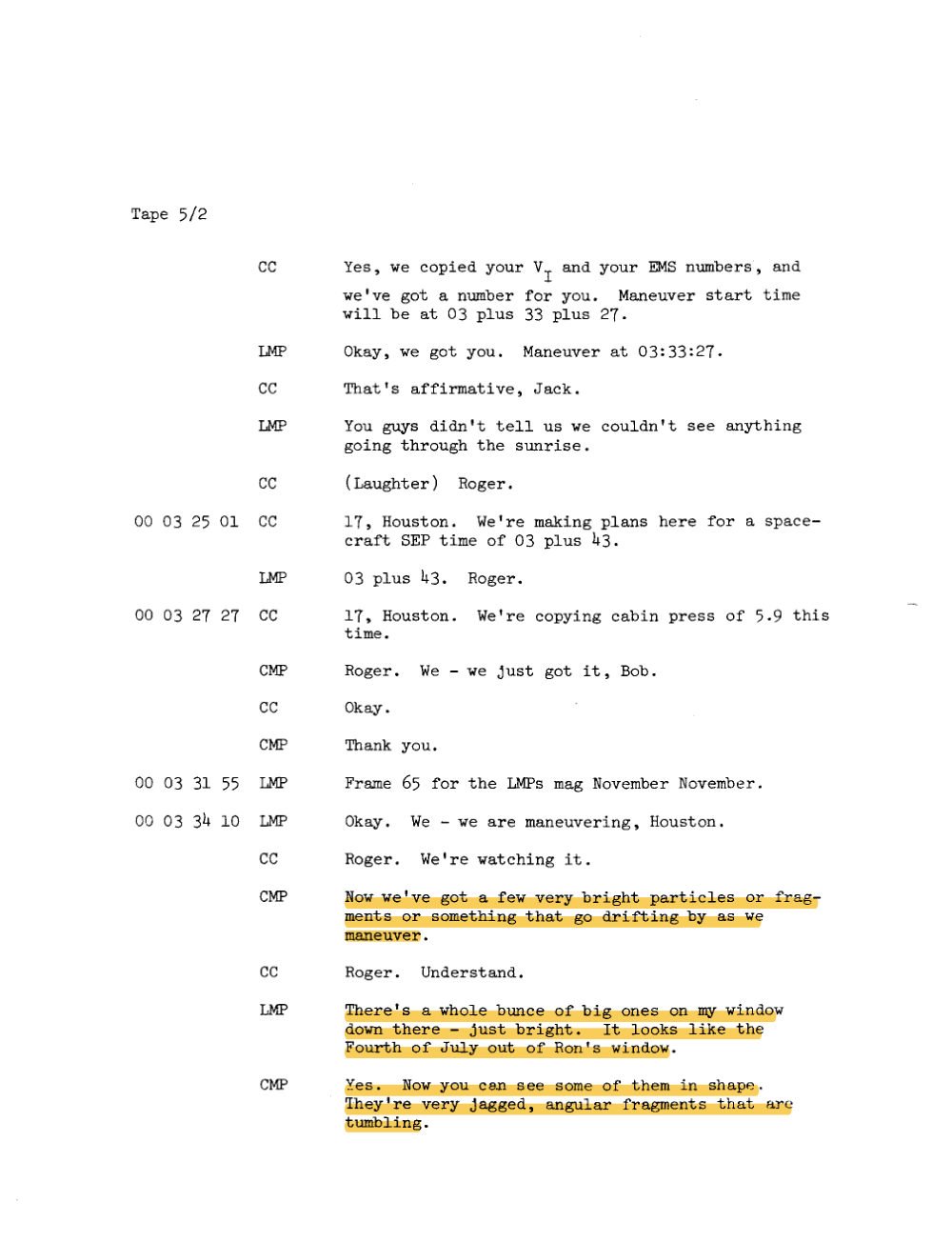
The Apollo 17 air-to-ground transcript begins three and a half hours after the launch of December 7, 1972, when the spacecraft, still attached to the S-IVB, the third stage of the Saturn V, was preparing for separation and docking with the lunar module. With the maneuver under way, Ronald Evans, the command module pilot, reports: “we have some very bright particles, or fragments, going by as we maneuver.” Harrison Schmitt says there are “a bunch of big ones” in his window and that, through Evans's window, it looks like “the 4th of July,” the date of fireworks in the U.S.
Evans describes the shape: “very irregular, angular fragments that are spinning.” Houston asks whether they look like liquid; he replies that they do not, that they look like pieces of something. He says he took a few photos at different settings to at least show the pattern. When the control asks what they might be, he admits he does not know and raises possibilities: they seemed somewhat curved, as if they came from the side of the S-IVB, pieces of ice or paint coming off. Evans himself calls this a “guess.”
The capcom in Houston adds an observation from the ground: on a ride up the tower elevator the week before, near one of the flags painted on the rocket, he saw paint that seemed to be peeling, on the S-II or the S-IVB. “Maybe that's what you've got there,” he says. Once the maneuver is over, Evans reports that the field of fragments became practically stationary, with a very slight spin of each piece, and that every now and then a much faster fragment crossed the window, which was very rare.
Gene Cernan, the commander, gives his impression: flat particles, like flakes, some perhaps 6 inches, about 15 centimeters; no relative motion among them, most of them twinkling and, in general, moving away from the spacecraft. Evans photographs again, frame 70. Minutes later, at the moment of separation, he exclaims: “Boy, look at the junk!”, and continues with the procedure. The transcript offers no conclusion other than the hypotheses of the crew and the capcom.
The official recording NASA-UAP-D009, from the same day, contains the audio of a segment in which the crew describes these particles and supposes they are chips of paint or ice. The photographs mentioned by Evans, from the frames cited in the conversation, are not part of the PDF. The published facsimile has yellow highlighting marks over the dialogue, made by an unidentified reader; they are not part of the transcribed text.
The first lines of tape 5/2 show a crew busy with the routine of leaving Earth orbit. The capcom, Bob, reads the time of the maneuver, 03:33:27, and the scheduled time for spacecraft separation, 03:43. Schmitt jokes that nobody told them you could not see anything when passing through sunrise; the ground confirms the cabin pressure; Schmitt notes frame 65 of the lunar module pilot's film magazine. At 03:34:10 the maneuver begins, and only then does Evans mention the particles. The astronauts photographed regularly, and the report emerges in the middle of these records.
The sequence of times helps place the phenomenon. The particles appear during the attitude maneuver performed by the third stage itself, with the spacecraft still attached to it. At 03:37:45 the capcom reports that the S-IVB maneuver is complete, and Evans says the field of fragments became practically stationary. At 03:40:13 Houston gives the go for transposition and docking, the maneuver in which the command module detaches, turns around, and docks with the lunar module. At 03:42:29 Cernan announces separation, and Evans, as he starts the movement, exclaims on seeing "the junk." The report therefore begins before separation and continues after it.
What the crew describes is visual observation, without measurement. Houston asks whether the particles look like liquid; Evans replies that they look like pieces of something, very bright, slowly spinning, with no relative motion among them, with a much faster fragment every now and then. Cernan speaks of flat flakes up to 6 inches, about 15 centimeters, that twinkle and move away. This measurement is an eyeball estimate, with no known distance, and has the same limitation pointed out by Armstrong on Apollo 11: without knowing the distance, the size cannot be known. The ice and paint hypotheses are the crew's and the capcom's.
Evans says he photographed the fragments twice: "a few photos" at different settings and then two photos about one minute apart, on frame 70. These images are not in the published PDF, and the file does not state which magazine they belong to. The official recording NASA-UAP-D009, from December 7, 1972, about four and a half minutes long, contains the audio of a segment of this conversation. According to the official description, the crew members describe "irregular" and "angular" particles near the spacecraft and the separated S-IVB, suppose they are chips of paint or ice, and note that they twinkle and move away from the stage. The description places the phenomenon next to the already separated stage; the transcript shows that it began before separation.
OFFICIAL MEDIA
Official video for this case
Files published by the United States Government on DVIDS. The title of each one is that of the official publication, translated; the description of what is seen is in the dossier text.
NASA mission audio · 4 min 36 s · the video only loads when you start playback, directly from the official server.
Official record ↗More images from the document
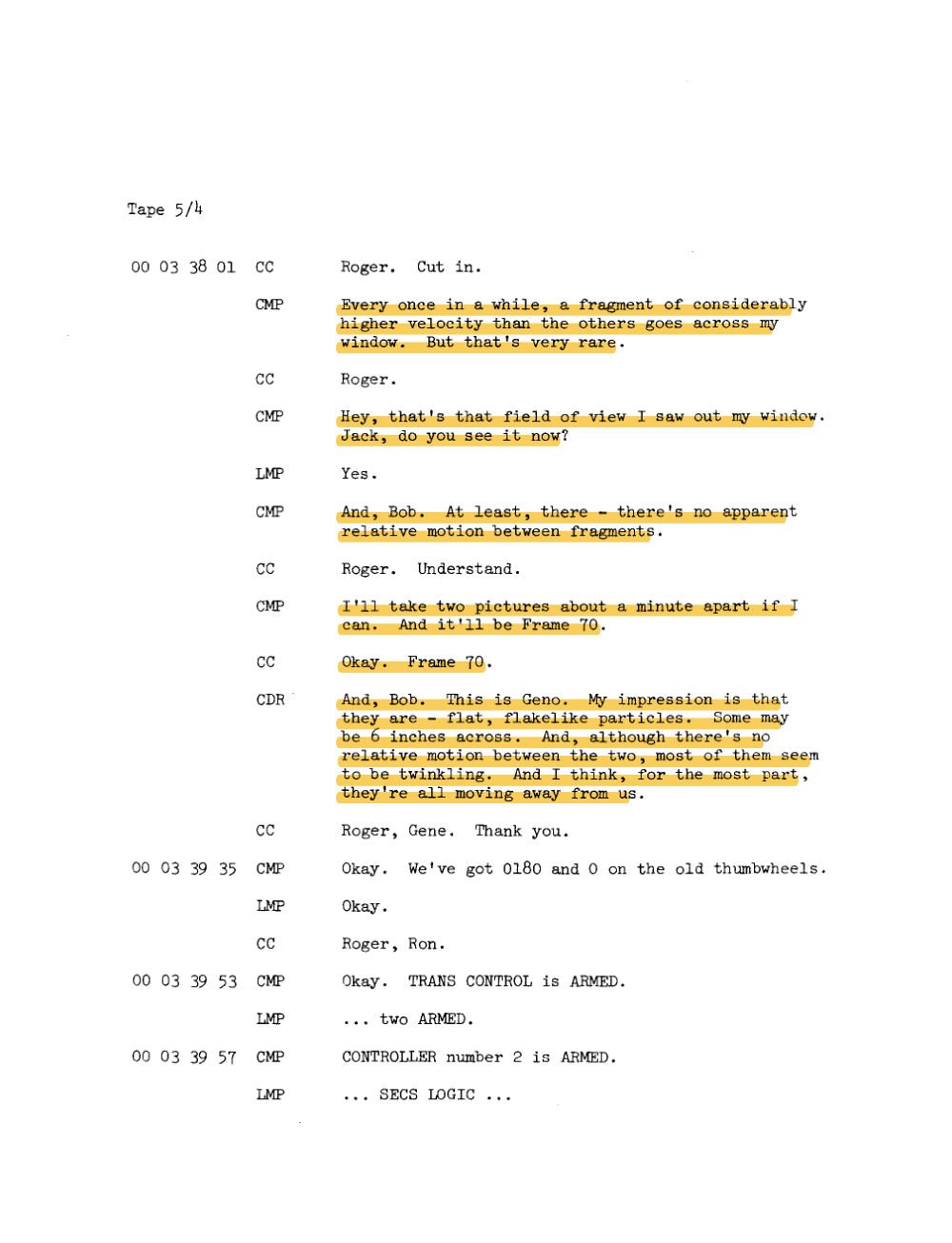
DIRECT READING OF THE FILE
The document, in the original
NASA transcript, a U.S. government work: exchanges about the fragments translated after checking against the facsimile; the list of separation commands was summarized.
EXCERPT 1 · PHYSICAL PAGE 1
Physical page 1 (tape 5/2), excerpts that were missing to complete the page
Tape 5/2
CC Yes, we copied your VI and your EMS numbers, and
we've got a number for you. Maneuver start time
will be at 03 plus 33 plus 27.
LMP Okay, we got you. Maneuver at 03:33:27.
cc That's affirmative, Jack.
LMP You guys didn't tell us we
going through the sunrise.
couldn't see anything
cc (Laughter) Roger.
00 03 25 01 cc 17, Houston. We're making plans here
craft SEP time of 03 plus 43.
for a spaceLMP 03 plus 43. Roger.
00 03 27 27 cc 17, Houston.
time.
We're copying cabin press of 5.9 this
CMP Roger. We - we just got it, Bob.
cc Okay.
CMP Thank you.
00 03 31 55 LMP Frame 65 for the LMPs mag November November.
00 03 34 10 LMP Okay. We - we are maneuvering, Houston.
cc Roger. We're watching it.
CMP Now we've got a few very bright particles
ments or something that go drifting by as
maneuver.
or
we
fragCC Roger. Understand.
LMP There's a whole bunce of big ones on my window
down there - just bright. It looks like the
Fourth of July out of Ron's window.
CMP Yes. Now you can see some of them in shape.
'They're very jagged, angular fragments that are
tumbling.Editorial note: With the block already published (the three remarks about the particles, by Evans, Schmitt and Evans), the page is now translated in full. VI is inertial velocity; EMS, the entry monitoring system, whose numbers serve as a reference; SEP, separation; 5,9 is the cabin pressure in pounds per square inch. "November November" is the identification of the film magazine in the phonetic alphabet.
Check the original PDF
CC: Yes, we copied your VI and your EMS numbers, and we've got a number for you. Maneuver start time will be at 03 plus 33 plus 27. | LMP: Okay, we got you. Maneuver at 03:33:27. | CC: That's affirmative, Jack. | LMP: You guys didn't tell us we couldn't see anything going through the sunrise. | CC: (Laughter) Roger. | 00 03 25 01 CC: 17, Houston. We're making plans here for a spacecraft SEP time of 03 plus 43. | LMP: 03 plus 43. Roger. | 00 03 27 27 CC: 17, Houston. We're copying cabin press of 5.9 this time. | CMP: Roger. We - we just got it, Bob. | CC: Okay. | CMP: Thank you. | 00 03 31 55 LMP: Frame 65 for the LMPs mag November November. | 00 03 34 10 LMP: Okay. We - we are maneuvering, Houston. | CC: Roger. We're watching it. | [CMP: ...] | CC: Roger. Understand. | [LMP: ... | CMP: ...]View the document record ↗ · Physical page 1, counting the cover.
EXCERPT 2 · PHYSICAL PAGE 2
Physical page 2 (tape 5/3), excerpts that were missing to complete the page
Tape 5/3
CC Roger. They look like fluid of some sort?
CMP Not to me. They look like pieces of something.
CC Roger.
CMP They're very bright.
CC Jack, we'd like OMNI Charlie.
CMP Bob, for the most part, these fragments are not -
or are tumbling at a very slow rate. I tried a
couple of pictures of them - different settings.
You may get an idea of what, at least, the patterns
look like.
CC Roger. I've got you. We're all ears on these fragments. Do you think you can figure out what they
might be?
CMP Well, you know I - I don't know. There are a number of possibilities. If you had some kind of a -
I got the impression maybe they were curved a little
bit, as if they might be - off the side of the
S-IVB. And that's a wild guess
CDR Okay. RCS LOGIC is ... - -
CMP - - ice chunks, possibly. Or maybe there's paint
coming off of it.
00 03 37 34 cc Roger. I noticed on one trip up the elevator last
weak near one of the flags. I thought it was on
the S-II, but it might have been on the S-IVB.
Looked like it was peeling. Maybe that's what
you've got.
00 03 37 45 cc And the S-IVB maneuver is complete.
00 03 37 46 LMP in 1 minute.
CDR Okay. We'll set the old clock.
CMP Okay. And the - with the maneuver complete, the
fragment field is essentially static, except for
very slight tumbling within the fragments.Editorial note: With the block already published (Evans's hypotheses and the capcom's reply at 00 03 37 34), the page is now translated in full. OMNI Charlie is one of the omnidirectional antennas; RCS LOGIC, a switch of the attitude control system.
Check the original PDF
CC: Roger. They look like fluid of some sort? | CMP: Not to me. They look like pieces of something. | CC: Roger. | CMP: They're very bright. | CC: Jack, we'd like OMNI Charlie. | CMP: Bob, for the most part, these fragments are not - or are tumbling at a very slow rate. I tried a couple of pictures of them - different settings. You may get an idea of what, at least, the patterns look like. | CC: Roger. I've got you. We're all ears on these fragments. Do you think you can figure out what they might be? | CMP: Well, you know I - I don't know. There are a number of possibilities. If you had some kind of a - [...] | CDR: Okay. RCS LOGIC is ... - - | [CMP: ... | 00 03 37 34 CC: ...] | 00 03 37 45 CC: And the S-IVB maneuver is complete. | 00 03 37 46 LMP: ... in 1 minute. | CDR: Okay. We'll set the old clock. | CMP: Okay. And the - with the maneuver complete, the fragment field is essentially static, except for very slight tumbling within the fragments.View the document record ↗ · Physical page 2, counting the cover.
EXCERPT 3 · PHYSICAL PAGE 3
Physical page 3 (tape 5/4), excerpts that were missing to complete the page
Tape 5/4
00 03 38 01 cc
CMP
CC
CMP
LMP
CMP
CC
CMP
CC
CDR
00 03
00 03
00 03
39
39
39
35
53
57
cc
CMP
LMP
cc
CMP
LMP
CMP
LMP
Roger. Cut in.
Every once in a while, a fragment of considerably
higher velocity than the others goes across my
window. But that's very rare.
Roger.
Hey, that's that field of view I saw out my window.
Jack, do you see it now?
Yes.
And, Bob. At least, there - there's no apparent
relative motion between fragments.
Roger. Understand.
I'll take two pictures about a minute apart if I
can. And it'll be Frame 70.
Okay. Frame 70.
And, Bob. This is Geno. My impression is that
they are - flat, flakelike particles. Some may
be 6 inches across. And, although there's no
relative motion between the two, most of them seem
to be twinkling. And I think, for the most part,
they're all moving away from us.
Roger, Gene. Thank you.
Okay. We've got 0180 and 0 on the old thumbwheels.
Okay.
Roger, Ron.
Okay. TRANS CONTROL is ARMED .
. . . two ARMED.
CONTROLLER number 2 is ARMED .
... SECS LOGIC ...Editorial note: With the block already published (the description by Cernan, CDR), the page is now translated in full. The "thumbwheels" are angle selectors; SECS is the sequential events control system that commands the pyrotechnic devices for separation. The ellipses are in the original.
Check the original PDF
00 03 38 01 CC: Roger. Cut in. | CMP: Every once in a while, a fragment of considerably higher velocity than the others goes across my window. But that's very rare. | CC: Roger. | CMP: Hey, that's that field of view I saw out my window. Jack, do you see it now? | LMP: Yes. | CMP: And, Bob. At least, there - there's no apparent relative motion between fragments. | CC: Roger. Understand. | CMP: I'll take two pictures about a minute apart if I can. And it'll be Frame 70. | CC: Okay. Frame 70. | [CDR: ...] | CC: Roger, Gene. Thank you. | 00 03 39 35 CMP: Okay. We've got 0180 and 0 on the old thumbwheels. | LMP: Okay. | CC: Roger, Ron. | 00 03 39 53 CMP: Okay. TRANS CONTROL is ARMED. | LMP: ... two ARMED. | 00 03 39 57 CMP: CONTROLLER number 2 is ARMED. | LMP: ... SECS LOGIC ...View the document record ↗ · Physical page 3, counting the cover.
EXCERPT 4 · PHYSICAL PAGE 4
Physical page 4 (tape 5/5), excerpts that were missing to complete the page
Tape 5/5
00 03 40 01 CMP Okay.
LOGIC
SECS LOGIC is
POWER is ON.
CLOSED; SECS ARM are CLOSED;
LMP Okay.
00 03 40 13 cc 17, Houston. You have a GO for T&D.
CDR Okay. A GO for T&D.
00 03 40 38 CMP Okay.
ALIGN.
We'll ARM the PYROs. And we'll hit the GDC
00 03 41 00 CMP And maneuver's complete.
GDC? No. It's just ...
And 0180 and O? On the
It's kind of diddling.
00 03 41 19 CMP Okay. DELTA-Vin NORMAL.
00 03 41 42 CMP S-IVB, okay. Okay, switches are all set.
LMP Okay; 59 : 30 .
00 03 41 55 CMP Okay. Let's start the DET.
00 03 41 59 CDR Tickity-tick-tickity, Houston.
at 59: 30.
We're running
cc Roger.
CMP Okay.
00 03 42 12 CMP Okay. That's LAUNCH VEHICLE SEP, push button.
LMP Okay.
00 03 42 19 CMP MC in AUTO.
CMP Next?
00 03 42 29 CDR SEPARATION, Houston.
CMP Okay, check the
other ones off.
covers. Okay. And check the
LMP They're all ...
CMP Okay, I'm going to start the - My gr.,sh, look at
the junk! Okay; there's 15 seconds. Pitch her
up. Okay, we'll PROCEED on the - -Editorial note: With the block already published ("Wow, look at the junk!"), the page is now translated in full. T&D is transposition and docking; GDC, the attitude reference gyroscope; DET, the digital event timer; MC, master control; "59:30" is the timer count.
Check the original PDF
00 03 40 01 CMP: Okay. SECS LOGIC is CLOSED; SECS ARM are CLOSED; LOGIC POWER is ON. | LMP: Okay. | 00 03 40 13 CC: 17, Houston. You have a GO for T&D. | CDR: Okay. A GO for T&D. | 00 03 40 38 CMP: Okay. We'll ARM the PYROs. And we'll hit the GDC ALIGN. | 00 03 41 00 CMP: And maneuver's complete. And 0180 and 0? On the GDC? No. It's just ... It's kind of diddling. | 00 03 41 19 CMP: Okay. DELTA-V in NORMAL. | 00 03 41 42 CMP: S-IVB, okay. Okay, switches are all set. | LMP: Okay; 59:30. | 00 03 41 55 CMP: Okay. Let's start the DET. | 00 03 41 59 CDR: Tickity-tick-tickity, Houston. We're running at 59:30. | CC: Roger. | CMP: Okay. | 00 03 42 12 CMP: Okay. That's LAUNCH VEHICLE SEP, push button. | LMP: Okay. | 00 03 42 19 CMP: MC in AUTO. | CMP: Next? | 00 03 42 29 CDR: SEPARATION, Houston. | CMP: Okay, check the covers. Okay. And check the other ones off. | LMP: They're all ... | CMP: [...] Okay; there's 15 seconds. Pitch her up. Okay, we'll PROCEED on the - -View the document record ↗ · Physical page 4, counting the cover.
Dates and documentary context
- Event
- 07/12/1972 — Mission time 00 days 03:34 to 03:42. Based on the public launch time (07/12/1972, 05h33 UTC), about 09h07 UTC on the same day; editors' calculation.
- Document
- Not established — The published pages give no preparation date for the transcript.
- Publication
- Not established — Published by NASA in release 1 of the UAP files.
Origin and release
NASA, official transcript of the Apollo 17 air-to-ground communications · NASA-UAP-D2-Apollo-17-Transcript-1972.pdf
The PDF has yellow highlight markings of unidentified authorship.
undefined ↗ — undefined
Related accounts and their differences
- Apollo 12, 1969: particles of light seen from the surface of the Moon
- Friendship 7, 1962: John Glenn's “fireflies”
Questions to continue the investigation
- Are the photographs taken by Evans during the maneuver cataloged in the Apollo 17 image archive?
- Does the audio NASA-UAP-D009 correspond exactly to this excerpt of the transcript or to another moment on the same day?
GEOGRAPHY OF THE CASE
Space, beginning of the Earth-Moon trajectory
Observation made from the spacecraft shortly after leaving Earth orbit; there is no geographic point to place.
DOCUMENTARY TRAIL
Go back to the sources
References use physical pages of the PDF, counting the cover. Summaries are presented in English; the documents keep their original language.
- NASA-UAP-D2-Apollo-17-Transcript-1972.pdf
Physical pages 1 to 4 (tapes 5/2 to 5/5 of the transcript): bright fragments seen during the maneuver and separation of the third stage
NASA · 16 pages
Editorial summary based on the collection's research notes. How we read the documents.