Date: 20/11/1969, a few hours before the lunar module liftoff (mission elapsed time 139:27:25)Location: Surface of the Moon, inside the lunar module Intrepid, in the Ocean of Storms
Apollo 12, 1969: Alan Bean sees from the surface of the Moon “particles of light” that seem to be escaping from the Moon
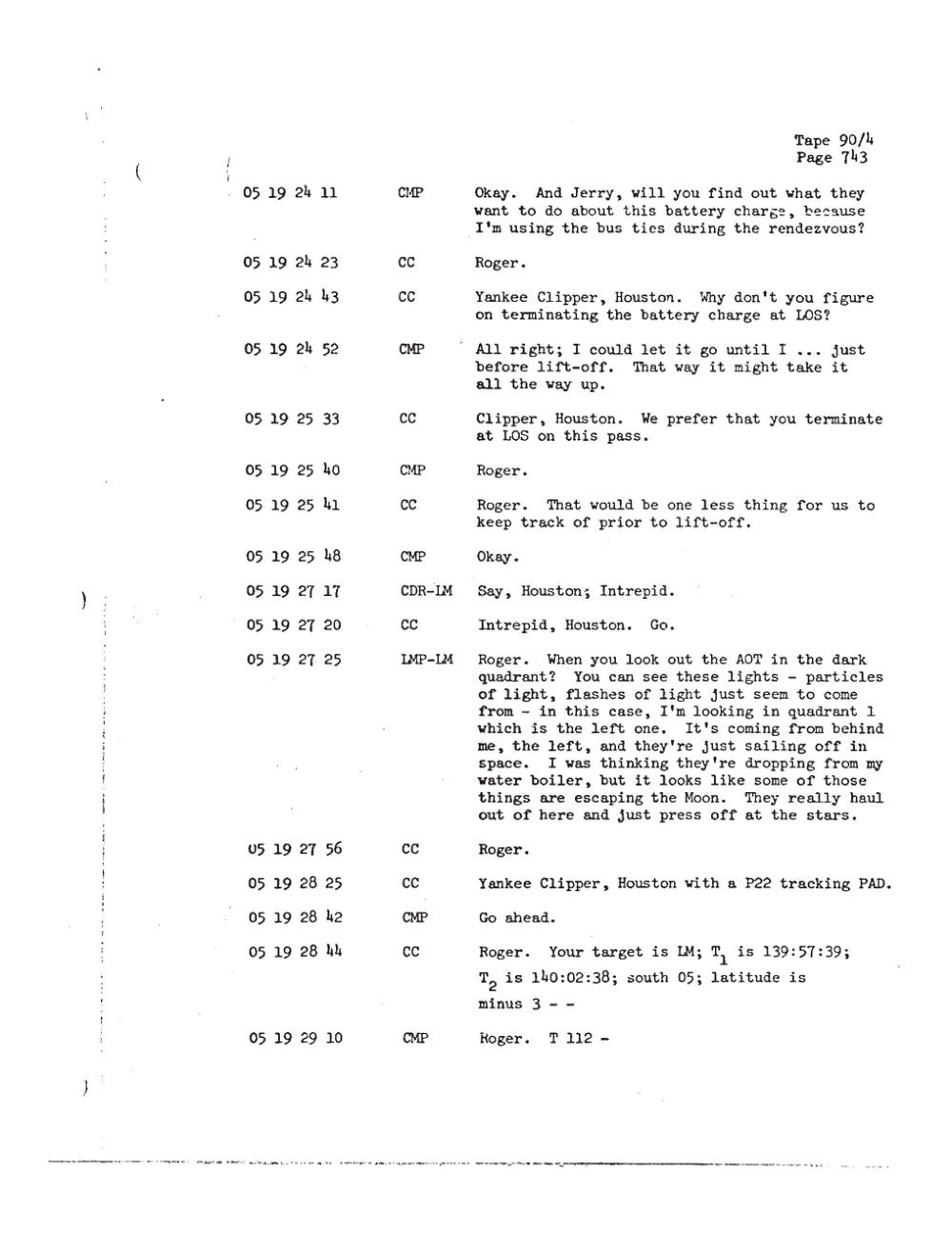
In the Apollo 12 air-to-ground transcript, Alan Bean tells Houston that, looking through the lunar module's alignment telescope, he saw particles and flashes of light going by and heading off into space; he thought of the vehicle's own cooling system, but said some seemed to be “escaping from the Moon”. Houston merely acknowledges receipt.
- Event date
- 20/11/1969, a few hours before the lunar module liftoff (mission elapsed time 139:27:25)
- Location
- Surface of the Moon, inside the lunar module Intrepid, in the Ocean of Storms
- Topic
- Astronaut accounts
- Source agencies
- NASA
- Documents
- 1 document · 4 pages
- Reading time
- 13 min
 Communication transcriptPhysical page 2
DOCUMENTARY SOURCES · NASA
What the records tell
The document brings together four pages of the official transcript of communications between Apollo 12 and control in Houston, in November 1969. In them, the lunar module Intrepid, with Pete Conrad and Alan Bean, has landed on the Moon, and the command module Yankee Clipper, with Dick Gordon, is in orbit. Liftoff from the Moon was scheduled for 142:03:47 mission elapsed time. About two and a half hours earlier, the commander calls Houston, and then Bean, the lunar module pilot, gives the account.
Bean says that, looking through the AOT, the alignment optical telescope, in the dark quadrant, he saw lights, particles of light, flashes that seemed to come from behind him, from the left, and went “sailing” off into space. He says he was thinking they were falling off the module's own water evaporator, the system that cools the equipment by venting vapor, but that some seemed to be escaping from the Moon: “they really come out of here and head straight for the stars”. Houston answers only “Roger” and moves on to another subject.
The statement about particles escaping from the Moon is an impression of the astronaut, said as an observation, and the transcript records no subsequent analysis. His own remark includes the competing hypothesis, the module's evaporator, which releases material outside the spacecraft. The page does not give the size, number or duration of the particles, nor whether they were photographed.
One page later, 41 minutes afterward, Bean reports another luminous phenomenon, this one inside the spacecraft: all the “8” digits were flashing once per second, at about one fifth of normal brightness, on the backup computer's registers. Houston replies that he and a colleague had already seen the effect in tests of almost every vehicle at the Bethpage plant and that it was probably electromagnetic interference. Here the explanation comes from control, based on earlier tests.
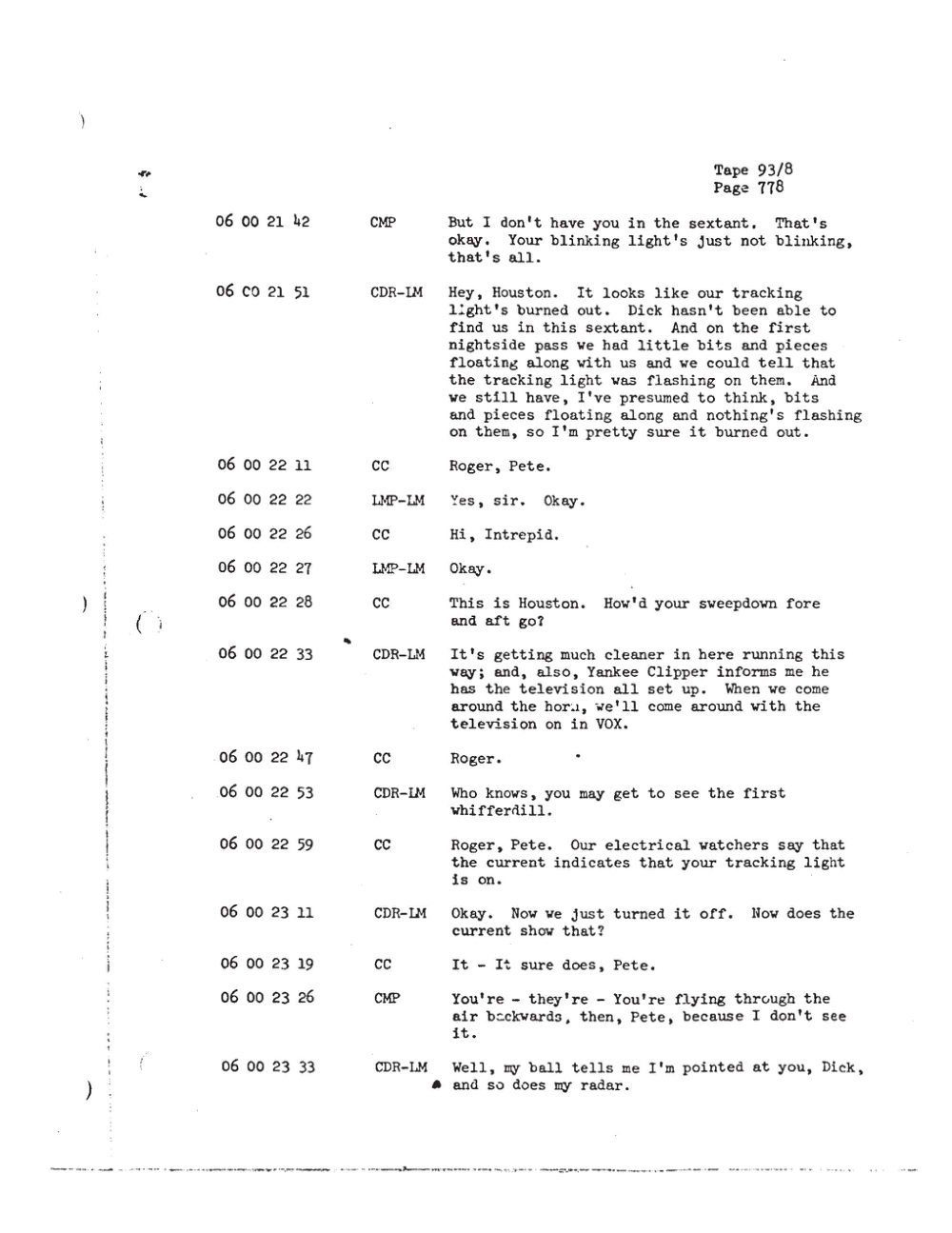
The last page is already from the orbital rendezvous, after liftoff. Conrad says the module's tracking light seemed to be burned out, because on the first pass over the night side they saw little pieces floating next to the spacecraft lit up by the flashers, and now they did not. Houston reports that the electrical current indicated the light was on, and Gordon, in the command module, jokes that Conrad must be flying backward, because he could not see it. The transcript contains no photographs.
The same May 2026 release includes five photos of the lunar surface from Apollo 12, NASA-UAP-VM1 to VM5, with yellow boxes highlighting points and spots in the sky above the horizon, covered in a separate dossier. They do not illustrate Bean's account. According to public catalogs of the Apollo archive, they are from film magazine 46, from the first moonwalk, on November 19, 1969, and the account of the particles was made the following day, from inside the lunar module, looking through the alignment telescope. The official records of the photos do not mention Bean, and the transcript does not mention photographs.
The first page of the file, page 742 of the transcript, shows the setting minutes before the account. Houston and the lunar module exchange computer commands to update the spacecraft's position, and Dick Gordon, alone in orbit in the Yankee Clipper, greets control with a "hello, stranger". The capcom asks whether he has tidied up the house yet and warns that "two coal miners" are coming up to see him, a joke that appears to allude to his colleagues' lunar dust. Conrad asks for the liftoff time and is given 142:03:47 mission elapsed time. The tone is routine, and Bean's account comes up in the middle of it.
Right after Bean speaks about the particles, Houston only answers "Roger" and goes on to read Gordon the data for program P22, used to track the lunar module with the sextant from orbit, with times of 139:57:39 and 140:02:38. There is no follow-up question, request for a photo or note of an anomaly. On the same sheet, Gordon arranges with control to end the battery charge at loss of signal behind the Moon. The transcript shows that, for control, the observation did not call for immediate action; it does not say whether anyone analyzed it later.
As an editorial hypothesis, not examined in the documents, the explanation Bean himself raised is the simplest: the lunar module's cooling system gets rid of heat by venting water into the vacuum, where it turns to ice, and crystals lit by the Sun against the dark sky appear as points of light moving away. The impression that some particles were "escaping from the Moon" may come from the narrow perspective of the alignment telescope, which does not allow distance to be judged. The document contains no data to confirm or rule out this reading.
Official recording NASA-UAP-D008, of the same crew's medical debriefing, deals with something else and serves as a contrast. In it, according to the official description, Conrad, Gordon and Bean say they saw flashes and streaks of light in the dark when trying to sleep, and NASA later concluded that these phenomena were internal to the astronauts' vision, and not external light sources. Bean's account in the transcript is different: made with his eyes open, through an optical instrument, it describes particles moving in one direction. The only link between the two episodes is the mission and the crew.
The next two pages record luminous phenomena with a technical explanation from the ground itself. On page 748, the DEDA, the keyboard and display of the lunar module's abort guidance system, flashes all the "8" digits once per second; the capcom says he has seen this in tests at the Grumman plant in Bethpage, where the modules were assembled, and speaks of electromagnetic interference, adding that TRW, the system's manufacturer, was studying the problem. On page 778, back in orbit, Conrad concludes that the tracking light burned out because the debris around the spacecraft no longer reflects the flashers, and control answers that the current indicates the light is on.
OFFICIAL MEDIA
Official video for this case
Files published by the United States Government on DVIDS. The title of each one is that of the official publication, translated; the description of what is seen is in the dossier text.
NASA debriefing recording · 7 min 50 s · the video only loads when you start playback, directly from the official server.
Official record ↗More images from the document
DIRECT READING OF THE FILE
The document, in the original
NASA transcript, a U.S. government work: Bean's remark and the central excerpts of pp. 3 and 4 were translated after checking against the facsimile; the coordination of computers and batteries was summarized.
EXCERPT 1 · PHYSICAL PAGE 1
Physical page 1 (tape 90/3, transcript page 742), full text
05 19 14 58
05 19 16 31
05 19 16 35
05 19 16 37
05 19 16 45
05 19 20 05
05 19 20 09
05 19 20 14
05 19 20 22
05 19 20 27
05 19 20 31
05 19 20 36
05 19 20 53
05 19 20 59
05 19 21 10
05 19 21 20
05 19 23 14
05 19 23 20
05 19 23 39
05 19 23 52
05 19 23 57
05 19 24 05
)
cc
cc
CDR-I.M
cc
CDR-l.M
CMP
cc
CMP
cc
CMP
cc
CMP
cc
CMP
cc
CMP
CDR-IM
cc
cc
CDR-LM
c~
cc
Tape 90/3
Page 742
That's affirmntive. We're ready for the E-M0D.
Intrepid, Houston.
Go.
If you will give us P0O and ACCEFT, we'll give
you a CSM state vector and RLS update.
You have POD and ACCEPT.
Hello, Houston; Yankee Clipper.
Yankee Clipper, Houston. Loud and clear.
Well, hello there, stranger. How are you?
Morning, Dick. We are fine. How are you?
Well, pretty good. I hope you would like to have
some company for a change.
Roger. Got the house clean?
As a matter of fact, I just finished that. I
sure do; got everything in order; ready to go
towards the LM and bring back . . . That's quite
a chore; keeping this thing clean.
Roger. You got a couple of coal miners coming
up to see you.
That's oka,y. I'll be glad to see them.
Intrepid, Houston. The computer is yours.
Break. Yankee Clipper, if you will go POO and
ACCEPT, we have an uplink.
All yours.
Houston, you got the lift-off time for me?
Stand by.
Intrepid, Houston. Your lift-off time is
142:03:47.
I copy 142:03:47.00,
Affirma.ti ve.
Clipper, Houston. Computer's yours.Editorial note: The numbers on the left are the mission elapsed time in days, hours, minutes and seconds (05 19 14 58 = 5 days, 19 h 14 min 58 s). CC is the capcom in Houston; CDR-LM, commander Pete Conrad in the lunar module Intrepid; CMP, Dick Gordon in the command module Yankee Clipper. P00 is the computer's idle program; ACCEPT, the position that allows receiving data from the ground; RLS, the landing site position.
Check the original PDF
05 19 14 58 CC: That's affirmative. We're ready for the E-MOD. | 05 19 16 31 CC: Intrepid, Houston. | 05 19 16 35 CDR-LM: Go. | 05 19 16 37 CC: If you will give us POO and ACCEPT, we'll give you a CSM state vector and RLS update. | 05 19 16 45 CDR-LM: You have POO and ACCEPT. | 05 19 20 05 CMP: Hello, Houston; Yankee Clipper. | 05 19 20 09 CC: Yankee Clipper, Houston. Loud and clear. | 05 19 20 14 CMP: Well, hello there, stranger. How are you? | 05 19 20 22 CC: Morning, Dick. We are fine. How are you? | 05 19 20 27 CMP: Well, pretty good. I hope you would like to have some company for a change. | 05 19 20 31 CC: Roger. Got the house clean? | 05 19 20 36 CMP: As a matter of fact, I just finished that. I sure do; got everything in order; ready to go towards the LM and bring back ... That's quite a chore; keeping this thing clean. | 05 19 20 53 CC: Roger. You got a couple of coal miners coming up to see you. | 05 19 20 59 CMP: That's okay. I'll be glad to see them. | 05 19 21 10 CC: Intrepid, Houston. The computer is yours. Break. Yankee Clipper, if you will go POO and ACCEPT, we have an uplink. | 05 19 21 20 CMP: All yours. | 05 19 23 14 CDR-LM: Houston, you got the lift-off time for me? | 05 19 23 20 CC: Stand by. | 05 19 23 39 CC: Intrepid, Houston. Your lift-off time is 142:03:47. | 05 19 23 52 CDR-LM: I copy 142:03:47.00. | 05 19 23 57 CC: Affirmative. | 05 19 24 05 CC: Clipper, Houston. Computer's yours.View the document record ↗ · Physical page 1, counting the cover.
EXCERPT 2 · PHYSICAL PAGE 2
Physical page 2 (tape 90/4, page 743), excerpts that were missing to complete the page
05 19 24 11
05 19 24 23
05 19 24 43
05 19 24 52
05 19 25 33
05 19 25 40
05 19 25 41
05 19 25 48
05 19 27 17
05 19 27 20
05 19 27 25
05 19 27 56
05 19 28 25
05 19 28 42
05 19 28 44
05 19 29 10
CMP
cc
cc
CMP
cc
CMP
cc
CMP
CDR-IM
cc
IMP-LM
cc
cc
CMP
cc
CMP
Tape 90/4
Page 743
Okay. And Jerry, will you find out what they
want to do about this battery charge, be~~use
. I'm using the bus tics during the rendezvous?
Roger.
Yankee Clipper, Houston. Why don't you figure
on terminating the battery charge at LOS?
All right; I could let it go until I just
before lift-off. That way it might take it
all the way up.
Clipper, Houston. We prefer that you terminate
at LOS on this pass.
Roger.
Roger. That would be one less thing for us to
keep track of prior to lift-off.
Okey.
Say, Houston, Intrepid.
Intrepid, Houston. Go.
Roger. When you look out the AOT in the dark
quadrant? You can see these lights - particles
of light. flash~s of light just seem to come
from - in this case, I'm looking in quadrant 1
which is the left one. It's coming :from behind
me, the left, and they're just sailing off in
space. I was thinking they're dropping from my
water boiler. but it looks like some of those
things are escaping the Moon. They really haul
out of here and just press off at the stars.
Roger.
Yankee Clipper~ Houston with a P22 tracking PAD.
Go ahead.
Roger. Your target is LM; T
1 is 139: 57:39;
T2 is 140:02:38; ~outh 05; latitude is
minus 3
Hoger. T 112 -Editorial note: With the block already published (Bean's line, LMP-LM, at 05 19 27 25), page 743 is translated in full. Jerry is the capcom on duty, probably Gerald Carr, who according to Oberg's essay also handled the crew on 15/11; the transcript does not give the surname. LOS is the loss of signal when the spacecraft passes behind the Moon; PAD, the data sheet read up by the ground; P22, the sextant tracking program. The last line is cut off in the original.
Check the original PDF
05 19 24 11 CMP: Okay. And Jerry, will you find out what they want to do about this battery charge, because I'm using the bus ties during the rendezvous? | 05 19 24 23 CC: Roger. | 05 19 24 43 CC: Yankee Clipper, Houston. Why don't you figure on terminating the battery charge at LOS? | 05 19 24 52 CMP: All right; I could let it go until I ... just before lift-off. That way it might take it all the way up. | 05 19 25 33 CC: Clipper, Houston. We prefer that you terminate at LOS on this pass. | 05 19 25 40 CMP: Roger. | 05 19 25 41 CC: Roger. That would be one less thing for us to keep track of prior to lift-off. | 05 19 25 48 CMP: Okay. | 05 19 27 17 CDR-LM: Say, Houston; Intrepid. | 05 19 27 20 CC: Intrepid, Houston. Go. | [05 19 27 25 LMP-LM: ...] | 05 19 27 56 CC: Roger. | 05 19 28 25 CC: Yankee Clipper, Houston with a P22 tracking PAD. | 05 19 28 42 CMP: Go ahead. | 05 19 28 44 CC: Roger. Your target is LM; T1 is 139:57:39; T2 is 140:02:38; south 05; latitude is minus 3 - - | 05 19 29 10 CMP: Roger. T 1 12 -View the document record ↗ · Physical page 2, counting the cover.
EXCERPT 3 · PHYSICAL PAGE 3
Physical page 3 (tape 90/9, page 748), excerpts that were missing to complete the page
-
05 20 08 23
05 20 09 25
05 20 09 30
05 20 09 34
05 20 10 00
05 20 10 06
05 20 10 52
05 20 10 59 )
05 20 11 03
05 20 11 32
05 20 11 37
05 20 11 39
05 20 11 56
05 20 11 59
05 20 12 01
05 20 12 08
05 20 12 11
05 20 12 14
)
cc
LMP-IM
cc
IMP-1..M
CC
LMP-IM
LMP-LM
CC
CDR-LM
CC
LMP-LM
cc
CDR-LM
IMP-IM
cc
CDR-IM
CDR-IM
cc
Tape 90/9
Page 748
_) Clipper, Houston. We'll give that data a good
evaluation before we do anything with it.
Houston, Intrepid.
Intrepid, Houston. GO.
Got sort of an interesting thing going on AGS
right now. I didn't notice earlier, but it may
just be because the lights i:,.re brighter now.
I'm getting an all 81 s flash on both the address
and the information registers at about onefifth the brilliance of the normal numbers. And
a - It's pulsing every second.
Roger, Al.
If I turn dmm the illumination level just a
little bit, it's not noticeable.
Hello, Houston; Intrepid. You ready for my RCS
hot fire?
Intrepid, Houston. Roger. Fire aw~.
Okay.
Intrepid, Houston.
Go.
Roger, Al. Fredo is here. He and I have both
seen that phenomena on your DEDA during t estin:',
of most a.11 the spacecrafts up at Bethpage, and
it's probably an EMI.
That's what ve' ve been talking about, but we
thought we'd just tcucb in on it.
When you go to your roll rate, roll lef't, pitch
up - -
Roger. I think TRW's got a v0rkup on this
problem.
Okay?
Here yo~ go, Houston, with roll, pitch, and
yav.
Roger, Pete.
-~---·-··•···•-·-------- ---- ---.--·- -- -···------·- -··---·-Editorial note: With the block already published (the rest of Bean's line at 05 20 09 34 and the capcom's reply at 05 20 11 39), page 748 is translated in full. AGS is the lunar module's abort guidance system; DEDA, its keyboard and display; RCS, the attitude control thrusters.
Check the original PDF
05 20 08 23 CC: Clipper, Houston. We'll give that data a good evaluation before we do anything with it. | 05 20 09 25 LMP-LM: Houston, Intrepid. | 05 20 09 30 CC: Intrepid, Houston. GO. | 05 20 09 34 LMP-LM: Got sort of an interesting thing going on AGS right now. I didn't notice earlier, but it may just be because the lights are brighter now. [...] | 05 20 10 00 CC: Roger, Al. | 05 20 10 06 LMP-LM: If I turn down the illumination level just a little bit, it's not noticeable. | 05 20 10 52 LMP-LM: Hello, Houston; Intrepid. You ready for my RCS hot fire? | 05 20 10 59 CC: Intrepid, Houston. Roger. Fire away. | 05 20 11 03 CDR-LM: Okay. | 05 20 11 32 CC: Intrepid, Houston. | 05 20 11 37 LMP-LM: Go. | [05 20 11 39 CC: ...] | 05 20 11 56 CDR-LM: That's what we've been talking about, but we thought we'd just touch in on it. | 05 20 11 59 LMP-LM: When you go to your roll rate, roll left, pitch up - - | 05 20 12 01 CC: Roger. I think TRW's got a workup on this problem. | 05 20 12 08 CDR-LM: Okay? | 05 20 12 11 CDR-LM: Here you go, Houston, with roll, pitch, and yaw. | 05 20 12 14 CC: Roger, Pete.View the document record ↗ · Physical page 3, counting the cover.
EXCERPT 4 · PHYSICAL PAGE 4
Physical page 4 (tape 93/8, page 778), excerpts that were missing to complete the page
.. 06 00 21 42
06 co 21 51
06 00 22 11
06 00 22 22
06 00 22 26
06 00 22 27
06 00 22 28
(
06 00 22 33
06 00 22 47
. 06 00 22 53
06 00 22 59
06 00 23 11
06 00 23 19
06 00 23 26
06 00 23 33
)
CMP
CDR-IM
CC
LMP-LM
CC
LMP-LM
cc
CDR-LM
CC
CDR-IM
CC
CDR-IM
cc
CMP
CDR-LM
•
Tape 93/8
Page 778
But I don't have you in the sextant, That's
okay. Your blinking light's Just not blinking,
that's all.
Hey, Houston. It looks like our tracking
llght's burned out. Dick hasn't been able to
find us in this sextant. And on the first
nightside pass we had little bits and pieces
floating along vith us and we could tell that
the tracking light va.; flashing on them. And
we still have, I've presumed to think, bits
and pieces floating along and nothing's flashing
on them, so I'm pretty sure it burned out.
Roger, Pete.
Yes, sir. Okay.
Hi, Intrepid.
Okay.
This is Houston. How'd your sweepdown fore
and aft go?
It's getting much cleaner in here running this
way; and, also, Yankee Clipper informs me he
bas the television all set up. When we come
around the hor~1, ·we' 11 come around with the
television on in VOX.
Roger .
Who knows, you may get to see the first
wbiffer<l.ill.
Roger, Pete. Our electrical watchers say that
the current indicates that your tracking light
is on.
Okay. Now ve just turned it off. How does the
current show that?
It - It sure does, Pete.
You're - they're - You're flying thr0ugh the
air b~ckward3, then, Pete, because I don't see
it.
Well, my ball tells me I'm pointed at you, Dick,
and so does my radar.Editorial note: With the block already published (the rest of Conrad's line at 06 00 21 51), page 778 is translated in full. VOX is voice-activated transmission; the "ball" is the attitude indicator; "whifferdill" is pilot slang for an aerobatic maneuver, kept as in the original. The word "horn", in "around the horn", is partially faded in the facsimile.
Check the original PDF
06 00 21 42 CMP: But I don't have you in the sextant. That's okay. Your blinking light's just not blinking, that's all. | 06 00 21 51 CDR-LM: Hey, Houston. It looks like our tracking light's burned out. Dick hasn't been able to find us in this sextant. [...] | 06 00 22 11 CC: Roger, Pete. | 06 00 22 22 LMP-LM: Yes, sir. Okay. | 06 00 22 26 CC: Hi, Intrepid. | 06 00 22 27 LMP-LM: Okay. | 06 00 22 28 CC: This is Houston. How'd your sweepdown fore and aft go? | 06 00 22 33 CDR-LM: It's getting much cleaner in here running this way; and, also, Yankee Clipper informs me he has the television all set up. When we come around the horn, we'll come around with the television on in VOX. | 06 00 22 47 CC: Roger. | 06 00 22 53 CDR-LM: Who knows, you may get to see the first whifferdill. | 06 00 22 59 CC: Roger, Pete. Our electrical watchers say that the current indicates that your tracking light is on. | 06 00 23 11 CDR-LM: Okay. Now we just turned it off. Now does the current show that? | 06 00 23 19 CC: It - It sure does, Pete. | 06 00 23 26 CMP: You're - they're - You're flying through the air backwards, then, Pete, because I don't see it. | 06 00 23 33 CDR-LM: Well, my ball tells me I'm pointed at you, Dick, and so does my radar.View the document record ↗ · Physical page 4, counting the cover.
Dates and documentary context
- Event
- 20/11/1969 — Mission time 05 days 19:27:25 (139:27:25). Based on the public launch time of Apollo 12 (14/11/1969, 16h22 UTC), this corresponds to about 11h49 UTC on 20/11/1969; editors' calculation.
- Document
- Not established — The transcript gives no preparation date on the published pages.
- Publication
- Not established — Published by NASA in release 1 of the UAP files.
Origin and release
NASA, official transcript of the Apollo 12 air-to-ground communications · NASA-UAP-D1-Apollo-12-Transcript-1969.pdf
undefined ↗ — undefined
Related accounts and their differences
- Apollo 17, 1972: bright fragments at rocket separation
- Apollo 11, 1969: the “L”-shaped object seen on the way to the Moon
- Friendship 7, 1962: John Glenn's “fireflies”
Questions to continue the investigation
- Is there an audio recording of this Apollo 12 excerpt that would allow one to hear the tone of Bean's observation?
- Was the lunar module's water evaporator operating at the time, as Bean himself supposed?
GEOGRAPHY OF THE CASE
Surface of the Moon, Ocean of Storms
Observation made from inside the lunar module landed on the Moon; there is no terrestrial point to place.
DOCUMENTARY TRAIL
Go back to the sources
References use physical pages of the PDF, counting the cover. Summaries are presented in English; the documents keep their original language.
- NASA-UAP-D1-Apollo-12-Transcript-1969.pdf
Physical page 2 (tape 90/4, p. 743 of the transcript): Bean describes particles of light seen through the alignment telescope; p. 3 (tape 90/9): numbers flashing on the backup computer; p. 4 (tape 93/8): tracking light and fragments
NASA · 4 pages
Editorial summary based on the collection's research notes. How we read the documents.