Date: 10/12/1972, upon arrival at the Moon (mission elapsed time 87:38:09)Location: Lunar surface north of Grimaldi crater, observed from the spacecraft
Apollo 17, 1972: Harrison Schmitt sees a flash on the Moon's surface north of Grimaldi crater
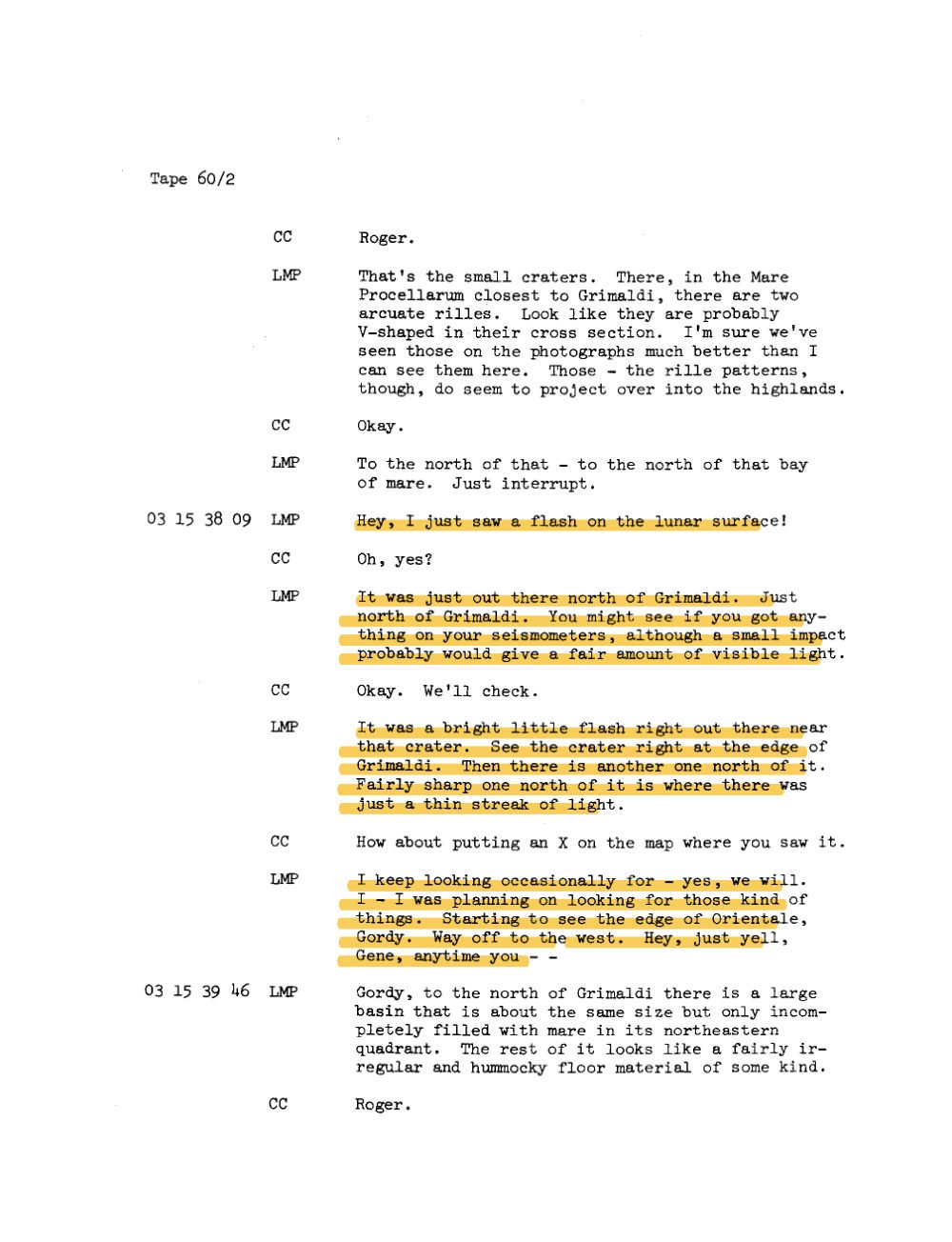
While describing the Moon lit by earthlight, geologist Harrison Schmitt interrupted his narration to say he had just seen a flash on the surface, north of Grimaldi, and suggested checking the seismometers because a small impact would produce light. In the technical debriefing, he says only that he had a flash “that he thought was” on the lunar surface.
- Event date
- 10/12/1972, upon arrival at the Moon (mission elapsed time 87:38:09)
- Location
- Lunar surface north of Grimaldi crater, observed from the spacecraft
- Topic
- Astronaut accounts
- Source agencies
- NASA
- Documents
- 2 documents · 18 pages
- Reading time
- 12 min
 Communication transcriptPhysical page 16
DOCUMENTARY SOURCES · NASA
What the records tell
Harrison Schmitt, lunar module pilot and the only geologist to go to the Moon, spent much of the approach narrating to Houston what he saw on the earthlit face: the Ocean of Storms, the dark patch of Grimaldi, arcuate rilles, and the rim of the Orientale basin. It is a technical description, a geologist's, and the flash appears in the middle of it. “Hey, I just saw a flash on the lunar surface!”, he says, interrupting his own sentence.
Schmitt locates the spot “just north of Grimaldi” and immediately offers a possible physical explanation, cautiously: Houston could check whether the seismometers left on the Moon by earlier missions recorded anything, “although a small impact would probably give quite a bit of visible light.” He describes a small bright flash near a crater on the rim of Grimaldi and, farther north, a “thin streak of light.” The capcom asks him to mark an X on the map; Schmitt agrees and says he was already planning to look for this kind of thing.
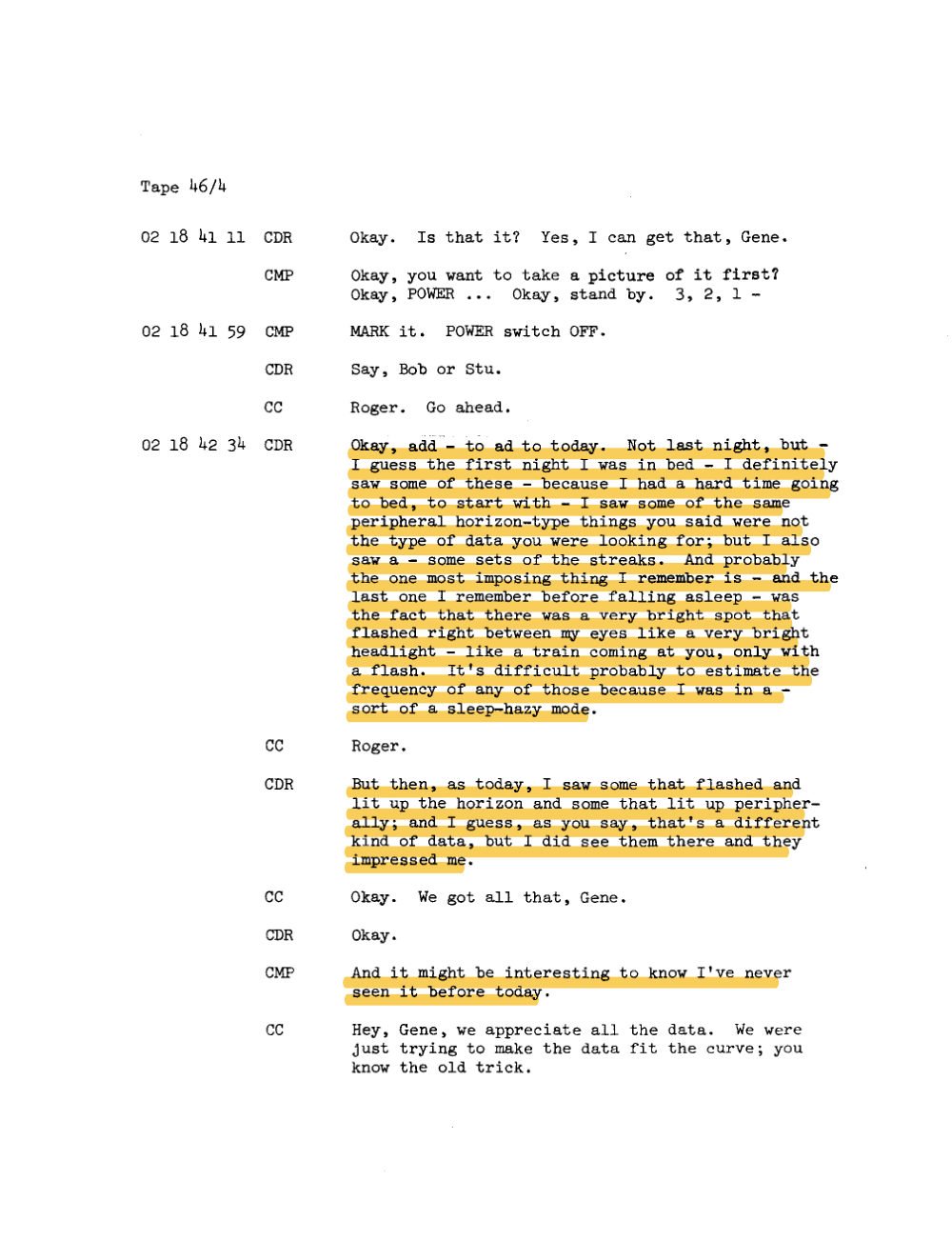
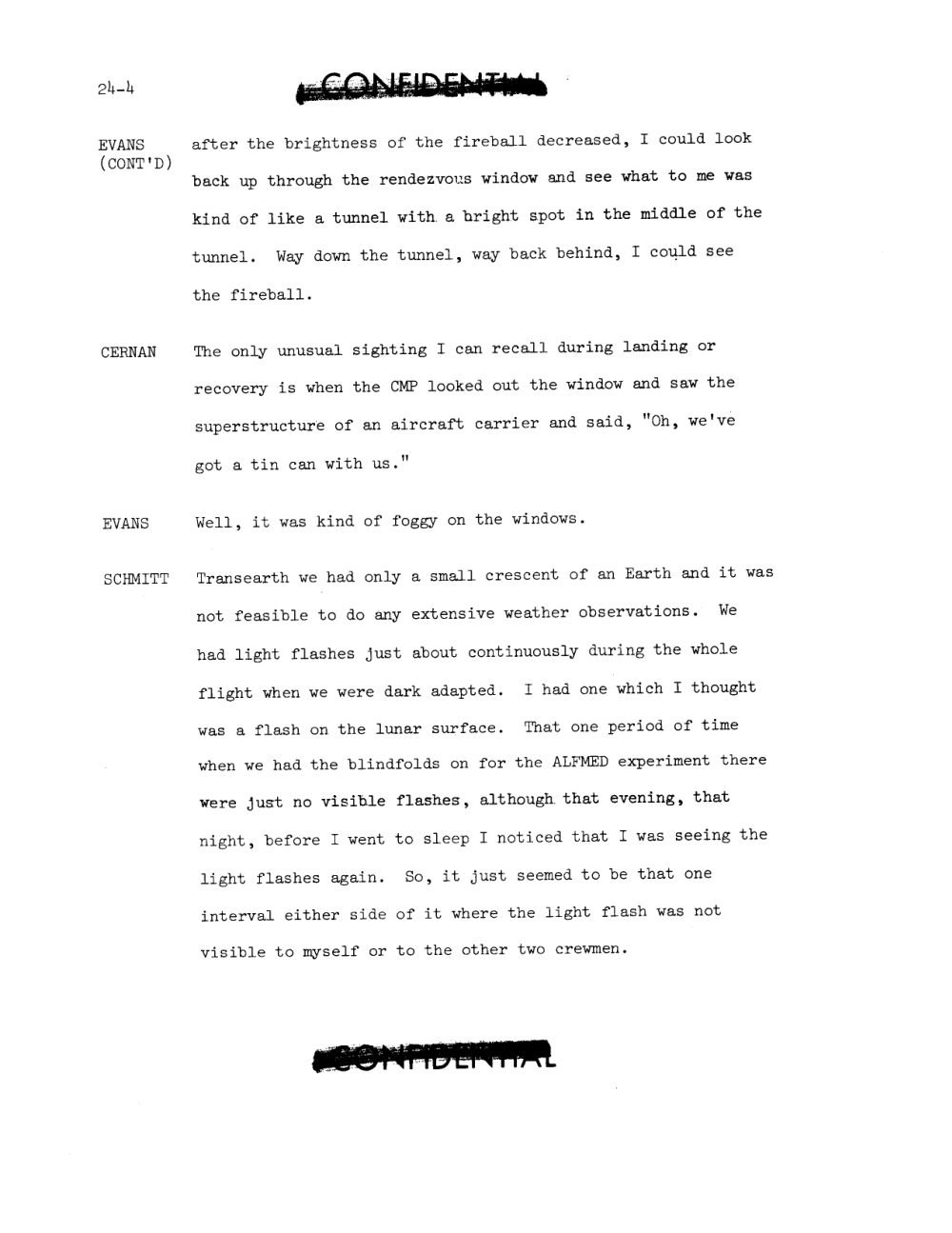
The transcript does not include the result of the seismometer check or the mark on the map. In the mission's technical debriefing, dated January 4, 1973, Schmitt returns to the subject in a short sentence, within a comment on the flashes seen with eyes closed: “I had one that I thought was a flash on the lunar surface.” The wording is more cautious than the exclamation in flight and leaves open whether the flash was actually on the Moon.
Two readings appear in the documents themselves. One is Schmitt's own in flight: a small meteoroid impact, which would produce visible light. The other follows from the context of the debriefing: the crew members saw flashes inside their eyes almost continuously when dark-adapted, a phenomenon attributed to cosmic rays, and one of them may have coincided with the Moon being in the field of view. The documents do not allow a choice between the two.
The recorded mission elapsed time is 87 hours, 38 minutes and 9 seconds. According to the public Apollo 17 timeline, lunar orbit insertion occurred a little more than an hour later, which places the observation on arrival at the Moon, with the Earth-facing side lit by earthlight. The closed-eye flashes and the flashing object from the same mission have their own dossiers.
The two pages preceding the flash show Schmitt's state of attention. Through window 3, to the northwest, Grimaldi was beginning to appear as a very dark area within the highlands, "one of the darkest mare regions" they had seen, comparable in photographs to that of Tsiolkovsky, on the far side. He notes that the dark maria are the youngest basalt flows, but that "young" there means 3 billion years or more. He then comments on the brightness of the highlands west of the Ocean of Storms, the contrast of the recent craters, and the swirl-shaped bright patches that Ron Evans could study in the following days.
The observation was made under earthlight. The face of the Moon turned toward the spacecraft was in lunar night, lit only by Earth's glow, and Schmitt speaks several times of "earthlight" and of the zero-phase point relative to Earth. Against this dark background, a brief flash would stand out easily. Minutes earlier, the transcript records that the spacecraft was about to pass a little south of Grimaldi and that Schmitt was beginning to see shadows in the craters. In the middle of the dialogue, Cernan reports to the capcom a deviation of about 7% in a pressure gauge after the last engine burn, a technical matter unrelated to the flash.
The account has the elements of a direct observation, but none of measurement. Schmitt gives the place (just north of Grimaldi, near a crater on the rim), the shape (a small bright flash and, farther north, a thin streak of light), and the exact moment, recorded by mission elapsed time, 87:38:09. There is no duration, comparative brightness, photo, or second observer. Cernan does not say whether he saw anything. The capcom promises to check the seismometers and asks for an X on the map; Schmitt says he had been looking for "this kind of thing" from time to time. Right after, he returns to geology, describing the rim of the Orientale basin and a large basin north of Grimaldi.
The page of the technical debriefing on which Schmitt returns to the subject, 24-4, gathers unusual sightings from the whole mission, and the context helps weigh the sentence. Evans describes the reentry fireball seen as "a tunnel with a bright spot in the middle"; Cernan jokes that the only unusual sighting at splashdown was the aircraft carrier's superstructure seen through the fogged window. Schmitt says that on the return Earth was only a crescent and that they had flashes of light almost constantly when dark-adapted, and then mentions the flash "that he thought was" on the lunar surface. The cover states that the document would be declassified 90 days after the date; the visible declassification stamp is from May 2026.
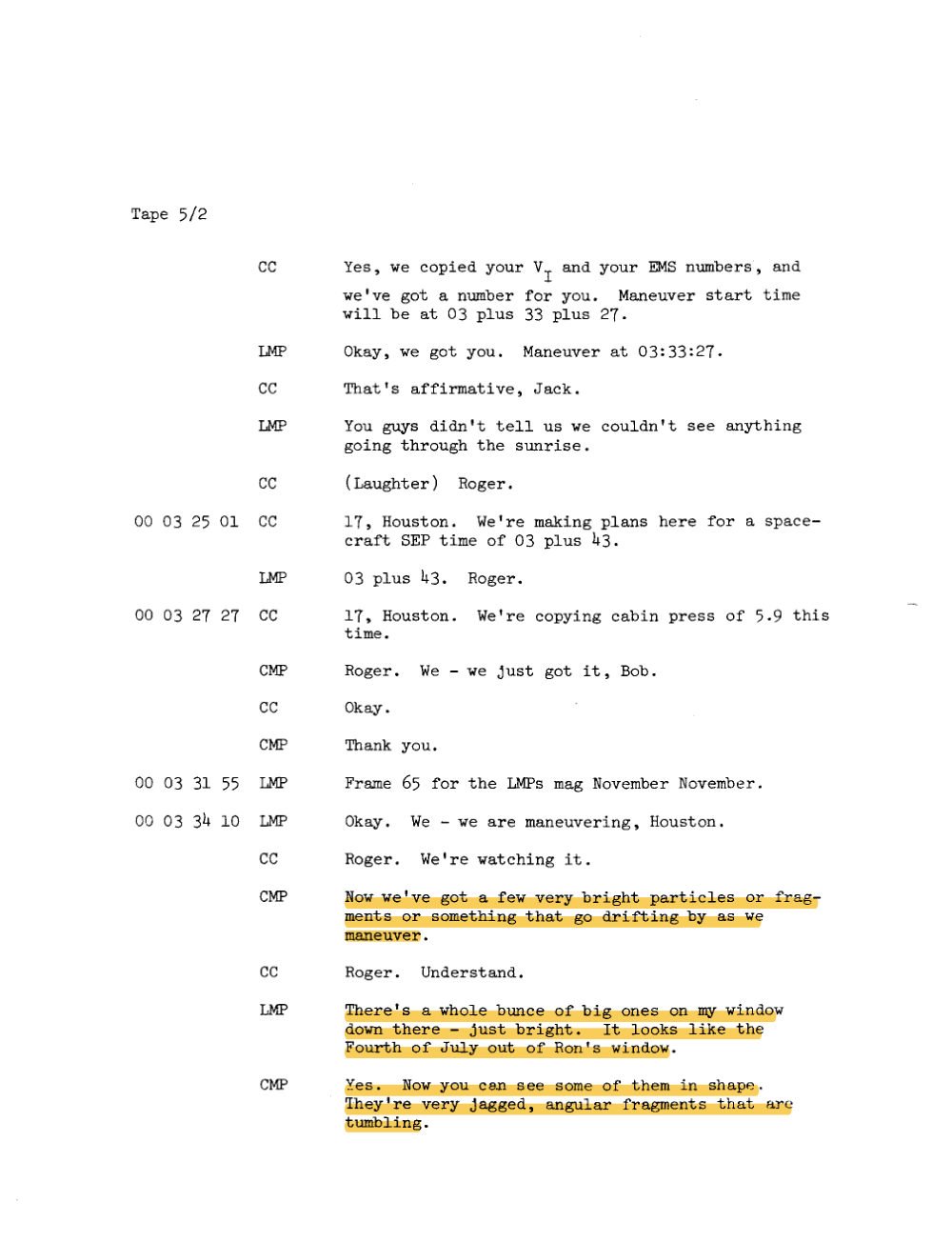
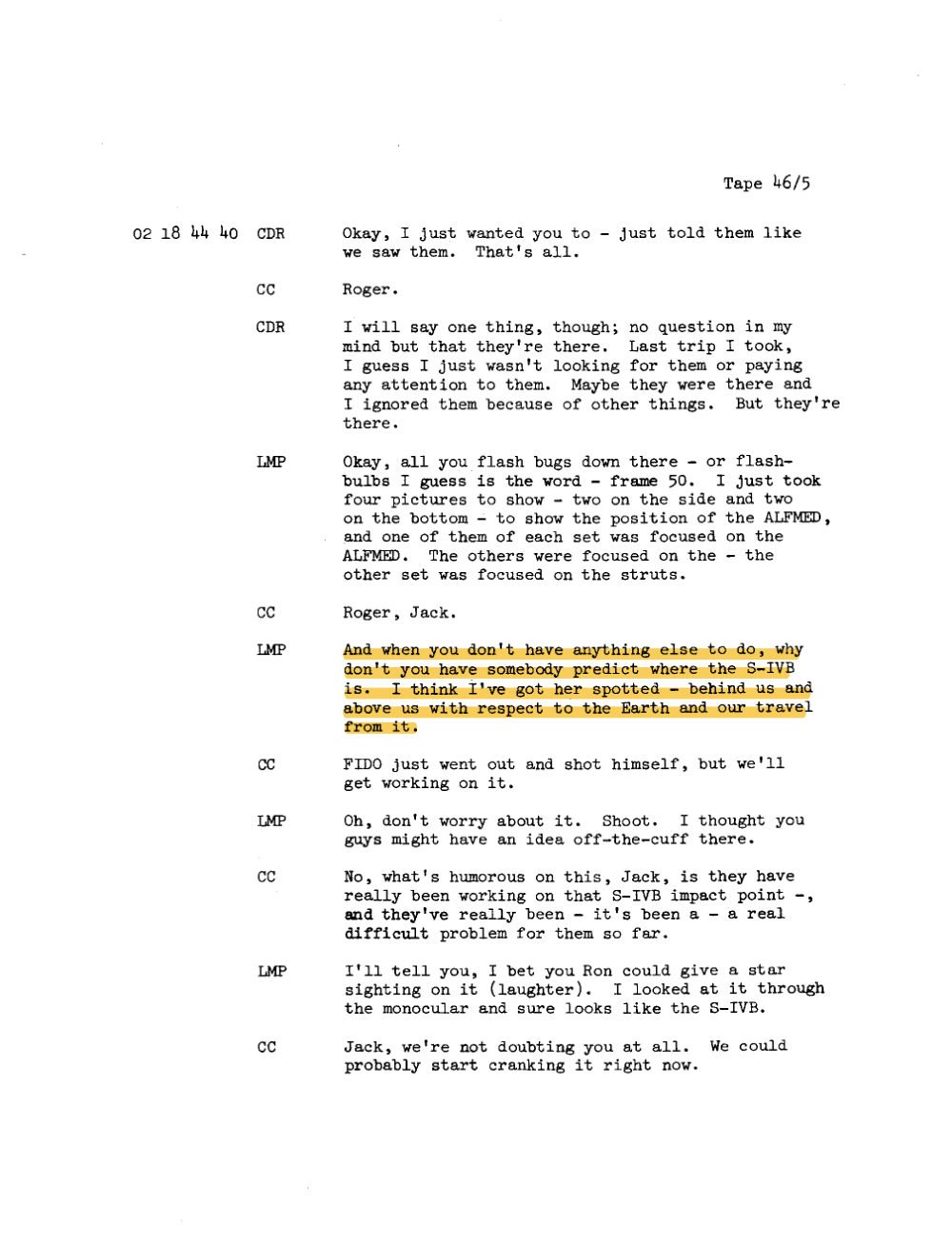
The official recordings NASA-UAP-D028 and D029, from the Apollo 17 medical debriefing, deal with the flashes seen by the astronauts, which the official records describe as an effect of cosmic rays on the retina, reported even in lunar orbit and on the surface of the Moon. They are linked here because they support the second possible reading of the episode: a flash internal to the eye that coincided with the Moon being in the field of view. The records do not mention the Grimaldi flash, and the full content of the recordings, in English, has not been transcribed. The first reading, a meteoroid impact, was proposed by Schmitt himself and depends on seismic data that the archive does not include.
OFFICIAL MEDIA
Official videos for this case
Files published by the United States Government on DVIDS. The title of each one is that of the official publication, translated; the description of what is seen is in the dossier text.
NASA debriefing recording · 53 min 10 s · the video only loads when you start playback, directly from the official server.
Official record ↗
NASA debriefing recording · 50 min 47 s · the video only loads when you start playback, directly from the official server.
Official record ↗More images from the document
DIRECT READING OF THE FILE
The document, in the original
NASA documents, a U.S. government work: the account of the flash and the debriefing sentence were translated after checking against the facsimile; the geological description was summarized.
EXCERPT 1 · PHYSICAL PAGE 14
Physical page 14 (tape 59/19), full text
cc
03 15 33 25 I.MP
Tape 59/19
mare. Still looking at Oceanus Procellarum. And
now, out window 3, up to the northwest, Grimaldi
is starting to show up - a very obvious dark area
within the highlands of that part of the Moon -
and one of the darkest mare regions that we have
seen on the - on the Moon. It I s comparable, at
least in the photographs, to that of Tsiolkovsky.
Roger.
Normally, of course, we think of the dark mare as
being the younger basalt flows that - on the Moon,
but in our case, of course, young means something
on the order of 3 billion years or older.
END OF TAPEEditorial note: The page begins in the middle of a remark by Schmitt (LMP) started on a page not in the file. Oceanus Procellarum is the Ocean of Storms; Tsiolkovsky, a crater on the far side of the Moon with a dark floor.
Check the original PDF
[LMP:] mare. Still looking at Oceanus Procellarum. And now, out window 3, up to the northwest, Grimaldi is starting to show up - a very obvious dark area within the highlands of that part of the Moon - and one of the darkest mare regions that we have seen on the - on the Moon. It's comparable, at least in the photographs, to that of Tsiolkovsky. | CC: Roger. | 03 15 33 25 LMP: Normally, of course, we think of the dark mare as being the younger basalt flows that - on the Moon, but in our case, of course, young means something on the order of 3 billion years or older. | END OF TAPEView the document record ↗ · Physical page 14, counting the cover.
EXCERPT 2 · PHYSICAL PAGE 15
Physical page 15 (tape 60/1), full text
Tape 60/1
APOLLO 17 AIR-TO-GROUND VOICE TRANSCRIPrION
03 15 33 44 cc Roger.
LMP For our interp - If we can extrapolate from the
samples returned by other missions.
LMP Amazing how far over - now the highlands to the
west of Procellarum are - still are bright, and the
contrast between fresh craters and the normal highland are very - are very obvious still in earthlight,
particularly along the zero phase point with respect
to the Earth. Rima Gamma now is - is coming a little bit closer to our oval track in the horseshoe
in the - larger and more western end of it; the
dark horseshoe is quite clear in this light. It's
a west - or northwest-pointing horseshoe, as is the
complete trend of that strange feature. I think
Ron is going to have an excellent chance to study
these light-colored swirls within the mare and
other parts of the Moon. We had some good views
of them and Mare Marginis and to the east of
Crisium - Mare Crisium, and he should - if there
is anything to be seen, he should be able to see
it for - during the next few days.
CC Okeydoke.
03 15 35 50 CDR Say, Gordo, something I just noticed here in working with the GDC what-have-you. I - looked at the
Pc gage, and in the Pz - Pc position, there is a
continuous bias on it now of about, oh, 7 percent,
and if I switch to ALPHA, it goes to zero. We never
saw that bias before this last burn.
CC Roger, Gene.
03 15 36 35 LMP Hey, Gordy, I'm looking right up the western edge
of the Procellarum mare where it contacts the -
the - the high - western highlands of the Moon, and
we're just about to fly a little bit south of
Grimaldi. That edge is very irregular. There is
no obvious indications that it - there are large
basins that have been flooded by mare that have
formed that edge, but, again, the topographic distinction's possible in this lighter small. Now I'm
starting to see that there are shadows in the craters.Editorial note: "Rima Gamma" is as in the transcript; the description of light-colored swirls suggests the formation known as Reiner Gamma, but the original spelling has been kept. "Lighter small" is as in the original, probably for "light at small [phase]" or a transcription error; translated according to the probable meaning and flagged here. GDC is the gyro display coupler (attitude reference gyroscope); Pc, the engine chamber pressure. Gordo and Gordy refer to the capcom on duty.
Check the original PDF
APOLLO 17 AIR-TO-GROUND VOICE TRANSCRIPTION | 03 15 33 44 CC: Roger. | LMP: For our interp - If we can extrapolate from the samples returned by other missions. | LMP: Amazing how far over - now the highlands to the west of Procellarum are - still are bright, and the contrast between fresh craters and the normal highland are very - are very obvious still in earthlight, particularly along the zero phase point with respect to the Earth. Rima Gamma now is - is coming a little bit closer to our oval track in the horseshoe in the - larger and more western end of it; the dark horseshoe is quite clear in this light. It's a west - or northwest-pointing horseshoe, as is the complete trend of that strange feature. I think Ron is going to have an excellent chance to study these light-colored swirls within the mare and other parts of the Moon. We had some good views of them and Mare Marginis and to the east of Crisium - Mare Crisium, and he should - if there is anything to be seen, he should be able to see it for - during the next few days. | CC: Okeydoke. | 03 15 35 50 CDR: Say, Gordo, something I just noticed here in working with the GDC what-have-you. I - looked at the Pc gage, and in the Pz - Pc position, there is a continuous bias on it now of about, oh, 7 percent, and if I switch to ALPHA, it goes to zero. We never saw that bias before this last burn. | CC: Roger, Gene. | 03 15 36 35 LMP: Hey, Gordy, I'm looking right up the western edge of the Procellarum mare where it contacts the - the - the high - western highlands of the Moon, and we're just about to fly a little bit south of Grimaldi. That edge is very irregular. There is no obvious indications that it - there are large basins that have been flooded by mare that have formed that edge, but, again, the topographic distinction's possible in this lighter small. Now I'm starting to see that there are shadows in the craters.View the document record ↗ · Physical page 15, counting the cover.
EXCERPT 3 · PHYSICAL PAGE 16
Physical page 16 (tape 60/2), excerpts that were missing to complete the page
Tape 60/2
CC Roger.
LMP That's the small craters. There, in the Mare
Procellarum closest to Grimaldi, there are two
arcuate rilles. Look like they are probably
V-shaped in their cross section. I'm sure we've
seen those on the photographs much better than I
can see them here. Those - the rille patterns,
though, do seem to project over into the highlands.
CC Okay.
LMP To the north of that - to the north of that bay
of mare. Just interrupt.
03 15 38 09 LMP Hey, I just saw a flash on the lunar surface!
CC Oh, yes?
LMP It was just out there north of Grimaldi. Just
north of Grimaldi. You might see if you got anything on your seismometers, although a small impact
probably would give a fair amount of visible light.
CC Okay. We'll check.
LMP It was a bright little flash right out there near
that crater. See the crater right at the edge of
Grimaldi. Then there is another one north of it.
Fairly sharp one north of it is where there was
just a thin streak of light.
CC How about putting an X on the map where you saw it.
LMP I keep looking occasionally for - yes, we will.
I - I was planning on looking for those kind of
things. Starting to see the edge of Orientale,
Gordy. Way off to the west. Hey, just yell,
Gene, anytime you - -
03 15 39 46 LMP Gordy, to the north of Grimaldi there is a large
basin that is about the same size but only incompletely filled with mare in its northeastern
quadrant. The rest of it looks like a fairly irregular and hummocky floor material of some kind.
CC Roger,Editorial note: With the block already published (Schmitt's three remarks about the flash and the capcom's "Oh, yes?"), the page is now translated in full; the brackets mark where those remarks go. The yellow highlighting over the text was made by an unidentified reader and is not part of the transcript.
Check the original PDF
CC: Roger. | LMP: That's the small craters. There, in the Mare Procellarum closest to Grimaldi, there are two arcuate rilles. Look like they are probably V-shaped in their cross section. I'm sure we've seen those on the photographs much better than I can see them here. Those - the rille patterns, though, do seem to project over into the highlands. | CC: Okay. | LMP: To the north of that - to the north of that bay of mare. Just interrupt. | [03 15 38 09 LMP: ... | CC: Oh, yes? | LMP: ...] | CC: Okay. We'll check. | [LMP: ...] | CC: How about putting an X on the map where you saw it. | LMP: I keep looking occasionally for - yes, we will. I - I was planning on looking for those kind of things. Starting to see the edge of Orientale, Gordy. Way off to the west. Hey, just yell, Gene, anytime you - - | 03 15 39 46 LMP: Gordy, to the north of Grimaldi there is a large basin that is about the same size but only incompletely filled with mare in its northeastern quadrant. The rest of it looks like a fairly irregular and hummocky floor material of some kind. | CC: Roger.View the document record ↗ · Physical page 16, counting the cover.
EXCERPT 4 · PHYSICAL PAGE 1
Physical page 1, full text: cover of the Apollo 17 technical debriefing, MSC-07631, 04/01/1973
PEPER L
MSC.-07631
NATIONAL AERONAUTICS AND SPACE ADMINISTRATION
APOLLO 17
TECHNICAL
CREW DEBRIEFING
(U)
JANUARY 4, 1973
PREPARED BY
TRAINING OFFICE
CREW TRAINING AND SIMULATION DIVISION
This document will automatically become declassified
90 days from the published date.
NOTICE: This document may be exempt from
public disclosure under the Freedom of Infor-
mation Act (5 U.S.C. 552). Requests for its
release to persons outside the U.S. Govern-
ment should be handled under the provisions
of NASA Policy Directive 1382.2.
iN MANNED SPACECRAFT CENTER
; HOUSTON.TEXAS
—_— te
DECLASSIFIED
E.0. 13526, Sec 3.3(a)
NASA Declassification Guide
Date of Guide: (M)05_(¥)2026
[Reviewer 0Editorial note: The word "CONFIDENTIAL," at the top and bottom, is covered by a black redaction bar, but the ending "AL" and the shape allow it to be read. The red declassification stamp is from May 2026, tied to the release of the files; the date 5/6/2026 is in American format (May 6, 2026). The handwritten indexing data are very faded.
Check the original PDF
264 pp. [à mão] | CONFIDENTIAL [tarjado] | MSC-07631 | NATIONAL AERONAUTICS AND SPACE ADMINISTRATION | APOLLO 17 TECHNICAL CREW DEBRIEFING (U) | JANUARY 4, 1973 | PREPARED BY TRAINING OFFICE, CREW TRAINING AND SIMULATION DIVISION | This document will automatically become declassified 90 days from the published date. | NOTICE: This document may be exempt from public disclosure under the Freedom of Information Act (5 U.S.C. 552). Requests for its release to persons outside the U.S. Government should be handled under the provisions of NASA Policy Directive 1382.2. | MANNED SPACECRAFT CENTER, HOUSTON, TEXAS | INDEXING DATA: DATE [01-04-73, apagado] | OPR MSC [apagado] | # MSC-07631 | T R | PGM [ilegível] | SUBJECT (title) [apagado] | SIGNATOR [ilegível] | LOC [em branco] | CONFIDENTIAL [tarjado] | [carimbo:] DECLASSIFIED E.O. 13526, Sec 3.3(a) NASA Declassification Guide Date of Guide: (M) 05 (Y) 2026 Reviewer: [iniciais] Date 5/6/2026View the document record ↗ · Physical page 1, counting the cover.
EXCERPT 5 · PHYSICAL PAGE 2
Physical page 2 of D6 (24-4), excerpts that were missing to complete the page
24-k
EVANS
(CONT'D)
CERNAN
EVANS
SCHMITT
after the brightness of the fireball decreased, I could look
back up through the rendezvous window and see what to me was
kind of like a tunnel with a bright spot in the middle of the
tunnel. Way down the tunnel, way back behind, I could see
the fireball.
The only unusual sighting I can recall during landing or
recovery is when the CMP looked out the window and saw the
superstructure of an aircraft carrier and said, "Oh, we've
got a tin can with us."
Well, it was kind of foggy on the windows.
Transearth we had only a small crescent of an Earth and it was
not feasible to do any extensive weather observations. We
had light flashes just about continuously during the whole
flight when we were dark adapted. I had one which I thought
was a flash on the lunar surface. That one period of time
when we had the blindfolds on for the ALFMED experiment there
were just no visible flashes, although that evening, that
night, before I went to sleep I noticed that I was seeing the
light flashes again. So, it just seemed to be that one
interval either side of it where the light flash was not
visible to myself or to the other two crewmen.Editorial note: With the block already published (Schmitt's summary of the flashes and the blindfolded period), page 24-4 is now translated in full; the [...] mark the sentences already published.
Check the original PDF
EVANS (CONT'D): after the brightness of the fireball decreased, I could look back up through the rendezvous window and see what to me was kind of like a tunnel with a bright spot in the middle of the tunnel. Way down the tunnel, way back behind, I could see the fireball. CERNAN: The only unusual sighting I can recall during landing or recovery is when the CMP looked out the window and saw the superstructure of an aircraft carrier and said, "Oh, we've got a tin can with us." EVANS: Well, it was kind of foggy on the windows. SCHMITT: Transearth we had only a small crescent of an Earth and it was not feasible to do any extensive weather observations. We had light flashes just about continuously during the whole flight when we were dark adapted. [...] That one period of time when we had the blindfolds on for the ALFMED experiment there were just no visible flashes, although that evening, that night, before I went to sleep I noticed that I was seeing the light flashes again. So, it just seemed to be that one interval either side of it where the light flash was not visible to myself or to the other two crewmen.View the document record ↗ · Physical page 2, counting the cover.
Dates and documentary context
- Event
- 10/12/1972 — Mission time 03 days 15:38:09 (87:38:09). Based on the public launch time (07/12/1972, 05h33 UTC), about 21h11 UTC on 10/12/1972; editors' calculation.
- Document
- 04/01/1973 — Date on the cover of the Apollo 17 technical debriefing (D6, p. 1); the air-to-ground transcript gives no preparation date.
- Publication
- Not established — Published by NASA in release 1 of the UAP files.
Origin and release
NASA: official Apollo 17 air-to-ground transcript; technical debriefing prepared by the Training Office, Crew Training and Simulation Division, classified and later declassified · NASA-UAP-D2-Apollo-17-Transcript-1972.pdf; NASA-UAP-D6-Apollo-17-Technical-Crew-Debriefing-1973.pdf
undefined ↗ — undefined
Related accounts and their differences
- Apollo 17, 1972: the flashes seen by the crew in the dark
- Apollo 17, 1972: the blinking object “way out there”
Questions to continue the investigation
- Did the seismometers of the lunar stations record any impact at the time of the flash?
- Was the map on which Schmitt was supposed to mark the X preserved?
GEOGRAPHY OF THE CASE
Moon, north of Grimaldi crater
The point is on the surface of the Moon, observed from the spacecraft; the portal's map has no reference for lunar positions.
DOCUMENTARY TRAIL
Go back to the sources
References use physical pages of the PDF, counting the cover. Summaries are presented in English; the documents keep their original language.
- NASA-UAP-D2-Apollo-17-Transcript-1972.pdf
Physical page 16 (tape 60/2): “I just saw a flash on the lunar surface”; p. 14 and 15: description of Grimaldi and the Ocean of Storms
NASA · 16 pages - NASA-UAP-D6-Apollo-17-Technical-Crew-Debriefing-1973.pdf
Physical page 1: cover of the technical debriefing of 04/01/1973; p. 2 (internal numbering 24-4): Schmitt mentions the flash again
NASA · 2 pages
Editorial summary based on the collection's research notes. How we read the documents.