Date: 09/12/1972 (Houston time), on the third day of the journey to the MoonLocation: Space, on the trajectory between the Earth and the Moon
Apollo 17, 1972: “there's something out there,” the flashing UFO Cernan asked to have located
Gene Cernan reported to Houston a bright, distant UFO that rotated and flashed at a regular rhythm, “something physical out there,” and marked its passage so that the control could calculate its position. Schmitt, who had already been observing it, thought it was the rocket's third stage, and hours later Cernan spoke of two flashing UFOs that might be panels of the spacecraft adapter.
- Event date
- 09/12/1972 (Houston time), on the third day of the journey to the Moon
- Location
- Space, on the trajectory between the Earth and the Moon
- Topic
- Astronaut accounts
- Source agencies
- NASA
- Documents
- 1 document · 16 pages
- Reading time
- 18 min
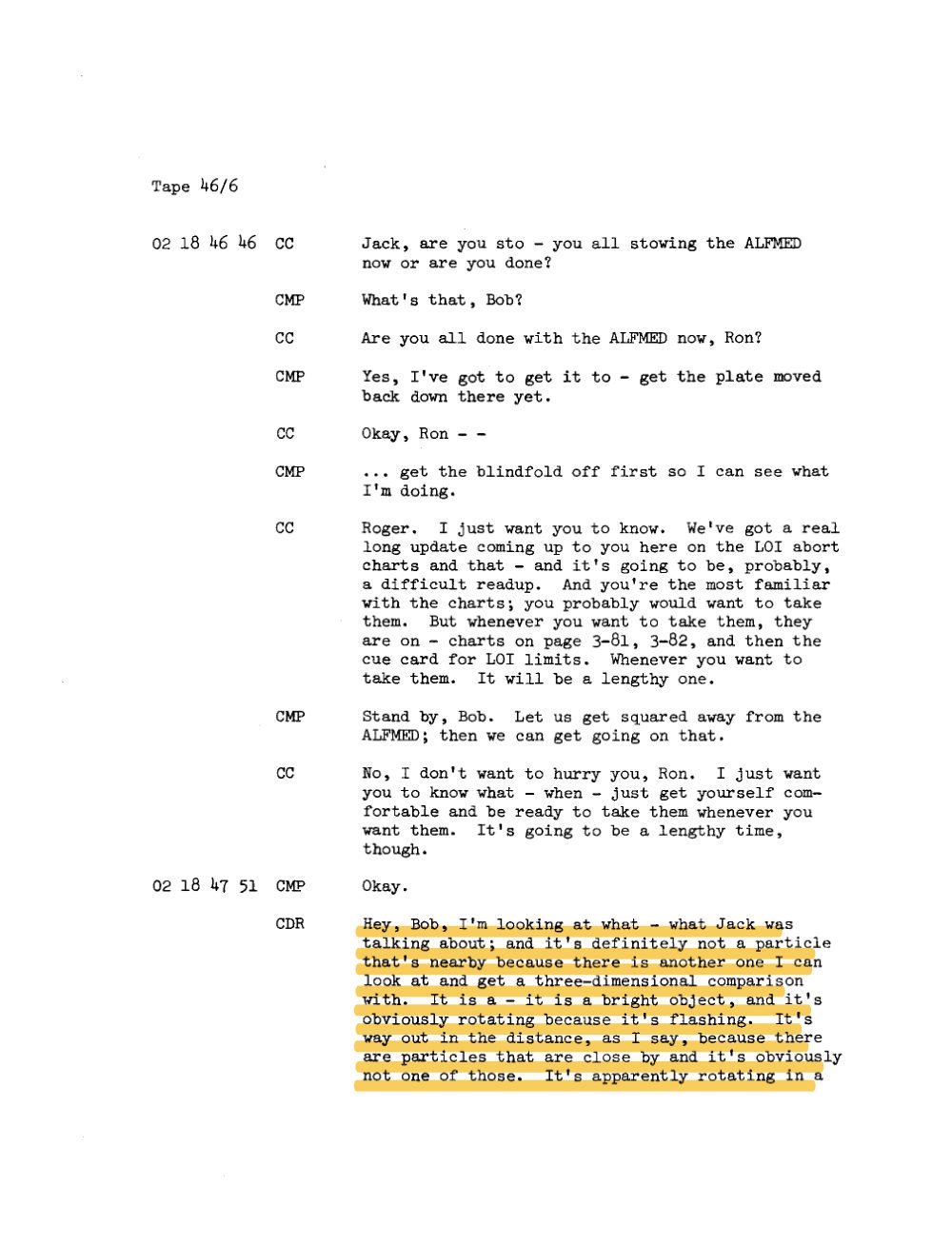
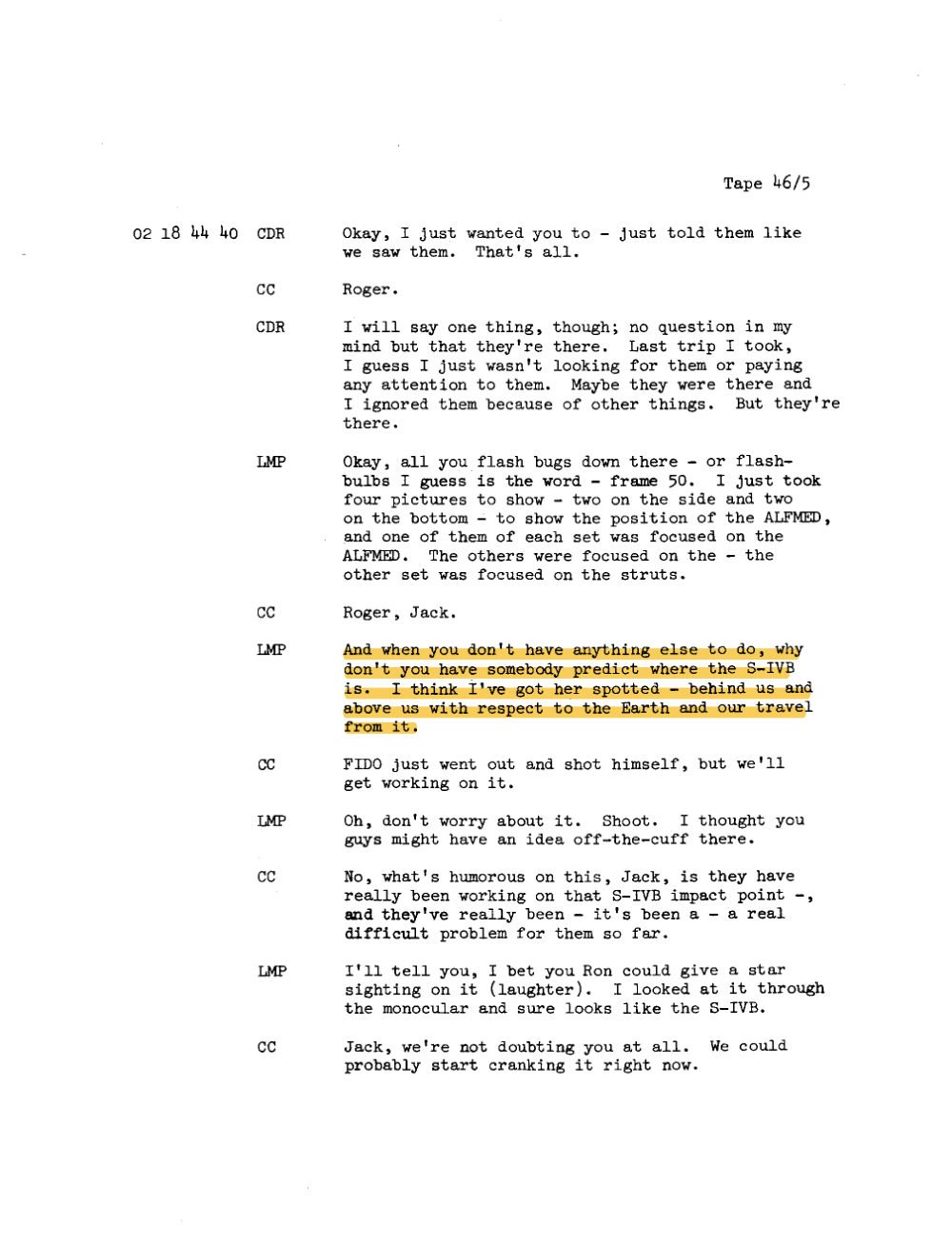 Communication transcriptPhysical page 6
DOCUMENTARY SOURCES · NASA
What the records tell
The episode occurs at the end of the ALFMED experiment, on the flashes seen while blindfolded. Harrison Schmitt asks the control for someone to calculate where the S-IVB is, the rocket's discarded third stage, because he thinks he has located it behind and above the spacecraft. Through the monocular, he says, “it really looks like the S-IVB.” The capcom jokes that the person in charge of the trajectory “went out and killed himself,” because calculating the stage's impact point on the Moon had been a difficult problem.
Minutes later, Cernan looks at the same spot and insists: “it's definitely not a close particle,” because there is another particle nearby that allows a comparison in three dimensions. It is a bright object, rotating, because it flashes at an almost exact rhythm, and it is very far away; looking back toward Earth, it is at the 11 o'clock position, perhaps 10 or 12 Earth diameters away, an angular estimate of his. “There's something out there,” he sums up. Houston replies that it does not doubt it and proposes calculating the position using the spacecraft's angles.
Cernan describes the object through the center window, about 45 degrees up, and gives the mark when it crosses the spacecraft's axis. He notes a peculiarity: two flashes per revolution, one very bright and the other faint, repeated rhythmically. Schmitt replies that these would be the side of the S-IVB and the engine bell; Cernan jokes that he would not see the engine bell “even with ten monoculars.” Schmitt adds that, revolutions earlier, the object was brighter, seen from the side, and that he had been noticing it for about 24 hours without having associated it with the stage.
Two hours later, Cernan returns to the subject: “we have two of these flashers out there. They may be SLA panels. I don't know.” The SLA is the adapter that enclosed the lunar module and whose four panels come off at separation. The two had similar intensity, alternated strong and weak flashes at a regular rhythm, and were well separated; one was at the position of the first observation and the other far to the left. Houston only acknowledges receipt.
The transcript ends without a confirmed identification. The hypotheses recorded are the crew's own: the S-IVB, argued for by Schmitt, and the adapter panels, raised by Cernan with doubt. The distance of “10 or 12 Earth diameters” is a reference to position in the sky, not a measurement of the object's distance. The published pages do not include the result of the calculation Houston offered to make.
The episode begins at the end of the ALFMED session, on the second full day of the journey. While Evans stows the equipment and removes the blindfold, the capcom announces that a long update of the lunar orbit insertion abort charts is coming, the maneuver that would put the spacecraft around the Moon. Schmitt, however, had already seen the bright spot and asked for the position of the third stage, and Cernan interrupts the routine to describe it. By adding the mission elapsed time to the launch time, the conversation took place on December 9, 1972, Houston time.
Houston takes the report seriously and proposes a method. The capcom says it does not doubt it and that they could calculate gimbal angles to view the object through the optical instruments. It then asks Cernan for a NOUN 20, the computer readout of the spacecraft's attitude, and a mark of the instant the object crosses a reference axis of the spacecraft. Cernan says he sees it through the center window, the hatch window, about 45 degrees up; Schmitt corrects an estimate of 30 degrees and the two agree on 45. The mark is given at 66:51:32 mission time. The result of the calculation does not appear in the published pages.
The brightness observations are the most precise in the episode. Cernan describes a regular rhythm of two flashes per revolution, one very bright and the other faint. Schmitt adds that, "a few revolutions back," he had a much brighter view, which he believes was from the side, and that now the object seemed to flash more or less end-on, less bright, although it brightened again. This variation of brightness with orientation is consistent with an elongated body slowly rotating, as Schmitt suggested, but the transcript measures nothing: these are descriptions with the naked eye and through the monocular, without the time of each revolution.
Two hours later, on tape 47/14, the context shows that the search was continuing. Schmitt says that Evans "was looking for the rocket" and called him to see Earth; the capcom comments that, from the spacecraft's pointing, they thought they were looking at the star Regulus. There is weather, news from Evans's family, and a joke about how to wake him, until Cernan reports the "two flashers." The pages show a crew that saw several bright objects around them, tried to identify them with what it knew about the mission, and treated the matter without alarm. The final identification is not in the documents.
The distinction between account, estimate and hypothesis appears clearly. The account is of one or two bright, distant spots that flash rhythmically. The estimate of "10 or 12 Earth diameters" is an angular position in the sky, measured by Earth as seen from the spacecraft, not a distance. The hypotheses, the S-IVB and the SLA panels, are the crew's: Schmitt supports the first, Cernan raises the second with doubt. The control confirms neither of them in the published pages. There is no official recording of this segment in the list of NASA audio and video files released.
More images from the document
DIRECT READING OF THE FILE
The document, in the original
NASA transcript, a U.S. government work: exchanges about the object translated after checking against the facsimile; the reading of abort charts and the conversation about football were omitted.
EXCERPT 1 · PHYSICAL PAGE 6
Physical page 6 (tape 46/5), excerpts that were missing to complete the page
Tape 46/5
02 l8 44 40 CDR Okay, I just wanted you to
we saw them. That's all.
- just told them like
CC Roger.
CDR I will say one thing, though; no question in my
mind but that they're there. Last trip I took,
I guess I just wasn't looking for them or paying
any attention to them. Maybe they were there and
I ignored them because of other things. But they're
there.
LMP Okay, all you flash bugs down there - or flashbulbs I guess is the word - frame 50. I just took
four pictures to show - two on the side and two
on the bottom - to show the position of the ALFMED,
and one of them of each set was focused on the
ALFMED. The others were focused on the - the
other set was focused on the struts.
CC Roger, Jack.
LMP And when you don't have anything else to do, why
don't you have somebody predict where the S-IVB
is. I think I've got her spotted - behind us and
above us with respect to the Earth and our travel
from it.
CC FIDO just went
get working on
out
it.
and shot himself, but we'll
LMP Oh, don't worry about it. Shoot. I thought you
guys might have an idea off-the-cuff there.
CC No, what's humorous on this, Jack, is they have
really been working on that S-IVB impact point -
and they've really been - it's been a - a real
difficult problem for them so far.
LMP I'll tell you, I bet you Ron could give a star
sighting on it (laughter). I looked at it through
the monocular and sure looks like the S-IVB.
CC Jack, we're not doubting you at all.
probably start cranking it right now.
We couldEditorial note: With the block already published (Cernan's remark "I have no doubt that they exist"), the page is translated in full. "Flash bugs" is a joke by Schmitt (LMP) about the researchers studying the flashes. FIDO is the flight dynamics officer, responsible for the trajectory; the capcom's line is a joke. The second half of the page begins the episode of the flashing object, which has its own dossier.
Check the original PDF
02 18 44 40 CDR: Okay, I just wanted you to - just told them like we saw them. That's all. | CC: Roger. | CDR: I will say one thing, though; no question in my mind but that they're there. Last trip I took, I guess I just wasn't looking for them or paying any attention to them. Maybe they were there and I ignored them because of other things. But they're there. | LMP: Okay, all you flash bugs down there - or flashbulbs I guess is the word - frame 50. I just took four pictures to show - two on the side and two on the bottom - to show the position of the ALFMED, and one of them of each set was focused on the ALFMED. The others were focused on the - the other set was focused on the struts. | CC: Roger, Jack. | [LMP: ...] | CC: FIDO just went out and shot himself, but we'll get working on it. | LMP: Oh, don't worry about it. Shoot. I thought you guys might have an idea off-the-cuff there. | CC: No, what's humorous on this, Jack, is they have really been working on that S-IVB impact point -, and they've really been - it's been a - a real difficult problem for them so far. | LMP: I'll tell you, I bet you Ron could give a star sighting on it (laughter). I looked at it through the monocular and sure looks like the S-IVB. | CC: Jack, we're not doubting you at all. We could probably start cranking it right now.View the document record ↗ · Physical page 6, counting the cover.
EXCERPT 2 · PHYSICAL PAGE 7
Physical page 7 (tape 46/6), excerpts that were missing to complete the page
Tape 46/6
02 18 46 46 cc
CMP
CC
CMP
CC
CMP
CC
CMP
CC
02 18 47 51 CMP
CDR
Jack, are you sto - you all stowing the ALFMED
now or are you done?
What's that, Bob?
Are you all done with the ALFMED now, Ron?
Yes, I've got to get it to - get the plate moved
back down there yet.
Okay, Ron -
get the blindfold off first so I can see what
I'm doing.
Roger. I just want you to know. We've got a real
long update coming up to you here on the LOI abort
charts and that - and it's going to be, probably,
a difficult readup. And you're the most familiar
with the charts; you probably would want to take
them. But whenever you want to take them, they
are on - charts on page 3-81, 3-82, and then the
cue card for LOI limits. Whenever you want to
take them. It will be a lengthy one.
Stand by, Bob. Let us get squared away from the
ALFMED; then we can get going on that.
No, I don't want to hurry you, Ron. I just want
you to know what - when - just get yourself comfortable and be ready to take them whenever you
want them. It's going to be a lengthy time,
though.
Okay.
Hey, Bob, I'm looking at what - what Jack was
talking about; and it's definitely not a particle
that's nearby because there is another one I can
look at and get a three-dimensional comparison
with. It is a - it is a bright object, and it's
obviously rotating because it's flashing. It's
way out in the distance, as I say, because there
are particles that are close by and it's obviously
not one of those. It's apparently rotating in aEditorial note: With the block already published (the beginning of Cernan's description), the page is translated in full; the final sentence continues on the next page. LOI is lunar orbit insertion; the "abort charts" are the procedure tables in case the maneuver had to be interrupted.
Check the original PDF
02 18 46 46 CC: Jack, are you sto - you all stowing the ALFMED now or are you done? | CMP: What's that, Bob? | CC: Are you all done with the ALFMED now, Ron? | CMP: Yes, I've got to get it to - get the plate moved back down there yet. | CC: Okay, Ron - - | CMP: ... get the blindfold off first so I can see what I'm doing. | CC: Roger. I just want you to know. We've got a real long update coming up to you here on the LOI abort charts and that - and it's going to be, probably, a difficult readup. And you're the most familiar with the charts; you probably would want to take them. But whenever you want to take them, they are on - charts on page 3-81, 3-82, and then the cue card for LOI limits. Whenever you want to take them. It will be a lengthy one. | CMP: Stand by, Bob. Let us get squared away from the ALFMED; then we can get going on that. | CC: No, I don't want to hurry you, Ron. I just want you to know what - when - just get yourself comfortable and be ready to take them whenever you want them. It's going to be a lengthy time, though. | 02 18 47 51 CMP: Okay. | CDR: [...] It's way out in the distance, as I say, because there are particles that are close by and it's obviously not one of those. It's apparently rotating in aView the document record ↗ · Physical page 7, counting the cover.
EXCERPT 3 · PHYSICAL PAGE 8
Physical page 8 (tape 46/7), excerpts that were missing to complete the page
Tape 46/7
CC
02 18 49 02 CDR
02 18 50 13
SC
CMP
CC
02 18 50 58 CDR
CC
CDR
LMP
CDR
CDR
very rhythmic fashion because the flashes come
around almost - almost on time. And it's as we
look back at the Earth, it's up at about 11:00
about - oh, maybe 10 or 12 Earth diameters. I
don't know whether that does you any good, but
there is something out there.
Roger. We don't doubt it, Gene. And we might
work out a set of gimbal angles or something here;
maybe we can get a look at it through the optics.
Okay. And I - I I just want to emphasize that
it's definitely not - not one of these particles
that tends to look like a star out there. It's
something physical in the distance. (Laughter)
Oh, yes.
thing off.
Yes, guess I am.
Okay, Gene. If you can call up a NOUN 20 so we
know the spacecraft attitude, and if you can
reference the object you're looking at out of your
window, with - with respect to body axis and let
us look at your - your - give us a mark, somehow,
and give us your NOUN 20s, we can try and get a
tie-in and start locating - locating this object
down for you.
Okay, I'm looking it out - looking at it out the
center window - the hatch window - and I'll give
you a hack when it crosses the XX axis at the
center window; and I guess it's up maybe 45 degrees.
Okay, give us a hack and we're copying your
NOUN 20s right now.
Okay, Jack says pitched up about 30 degrees but - -
No. 45, because -
Yes, he agrees. It's 45 degrees pitched up, and
I'll give you a hack when it crosses the XX axis.
Okay -Editorial note: With the block already published (the "11 o'clock" position, the "10 or 12 Earth diameters" and "it's something physical, at a distance"), the page is translated in full. SC indicates speech picked up from the spacecraft without identification of the crew member. NOUN 20 is the onboard computer code that displays the attitude angles; "hack" is the time-marking signal.
Check the original PDF
[CDR:] very rhythmic fashion because the flashes come around almost - almost on time. [...] | CC: Roger. We don't doubt it, Gene. And we might work out a set of gimbal angles or something here; maybe we can get a look at it through the optics. | 02 18 49 02 CDR: Okay. And I - I - I just want to emphasize that it's definitely not - not one of these particles that tends to look like a star out there. [...] (Laughter) Oh, yes. | SC: ... thing off. | 02 18 50 13 CMP: Yes, guess I am. | CC: Okay, Gene. If you can call up a NOUN 20 so we know the spacecraft attitude, and if you can reference the object you're looking at out of your window, with - with respect to body axis and let us look at your - your - give us a mark, somehow, and give us your NOUN 20s, we can try and get a tie-in and start locating - locating this object down for you. | 02 18 50 58 CDR: Okay, I'm looking it out - looking at it out the center window - the hatch window - and I'll give you a hack when it crosses the XX axis at the center window; and I guess it's up maybe 45 degrees. | CC: Okay, give us a hack and we're copying your NOUN 20s right now. | CDR: Okay, Jack says pitched up about 30 degrees but - - | LMP: No. 45, because - | CDR: Yes, he agrees. It's 45 degrees pitched up, and I'll give you a hack when it crosses the XX axis. | CDR: Okay -View the document record ↗ · Physical page 8, counting the cover.
EXCERPT 4 · PHYSICAL PAGE 9
Physical page 9 (tape 46/8), excerpts that were missing to complete the page
Tape 46/8
02 18 51 32 CDR
CC
CDR
02 18 52 18
02 18 53 10
02 18 55 24
LMP
LMP
cc
CDR
CMP
cc
CMP
LMP
CC
LMP
02 18 56 27 cc
CDR
MARK it. It just crossed through the - -
Mark. We got it.
let's call it the XZ plane of the spacecraft.
One unique thing about it, Bob, is that it's got
two flashes. As it comes around in - in rhythmic
fashion, you get a very bright flash; and then
you get a dull flash. And then it'll come around
with a bright flash, and then a dull flash.
That's the side and - of the S-IVB - and then the
engine bell, Gene.
The commander doesn't think that I can see the
engine bell on that thing.
Roger, Ja.ck. Is that with the monocular you're
looking at it?
He couldn't see the engine bell if he had 10 monoculars.
Okay. I've got the cable restowed now.
Say again, Ron.
And, Gene, where's your blindfold? ...
Bob, couple of revolutions ago when I was looking
at it, I had a much brighter view and I believe
I was looking at it broadside. It looks to me like
it may be flashing more or less end-on now. It's
much, not - not as bright, although it's getting
brighter. But it's not as bright now as it was
awhile ago.
Roger, Jack.
... we've been noticing that, I think, for about
24 hours or so. I just - hadn't put it together
as maybe being the S-IVB. I thought it was just
some other particle out there.
Roger, Jack.
Hey, Robert, what's the final Cowboy score?Editorial note: With the block already published (the two flashes, Schmitt's answer about the S-IVB and the "24 hours"), the page is translated in full. The "engine bell" is the nozzle of the third-stage engine. The final question is about the Dallas Cowboys football team; the answer is on physical page 10.
Check the original PDF
02 18 51 32 CDR: MARK it. It just crossed through the - - | CC: Mark. We got it. | CDR: - - let's call it the XZ plane of the spacecraft. [...] | [02 18 52 18 LMP: ...] | LMP: The commander doesn't think that I can see the engine bell on that thing. | CC: Roger, Jack. Is that with the monocular you're looking at it? | CDR: He couldn't see the engine bell if he had 10 monoculars. | CMP: Okay. I've got the cable restowed now. | CC: Say again, Ron. | 02 18 53 10 CMP: And, Gene, where's your blindfold? ... | 02 18 55 24 LMP: Bob, couple of revolutions ago when I was looking at it, I had a much brighter view and I believe I was looking at it broadside. It looks to me like it may be flashing more or less end-on now. It's much, not - not as bright, although it's getting brighter. But it's not as bright now as it was awhile ago. | CC: Roger, Jack. | [LMP: ...] | 02 18 56 27 CC: Roger, Jack. | CDR: Hey, Robert, what's the final Cowboy score?View the document record ↗ · Physical page 9, counting the cover.
EXCERPT 5 · PHYSICAL PAGE 10
Physical page 10 (tape 46/9), full text: continuation of the conversation, no mention of the object
Tape 46/9
CC Okay; I was just going to update that. The Cowboys
won it 34 to 24. And by winning it, they wrap up
the wild-card slot in the NFC; and so both Washington and Dallas will be in the playoffs.
02 18 56 53 CDR Sounds good.
LMP Bob, that line of clouds I called a fir-tree pattern that swings up towards Hawaii: Hawaii, if
you will - has - also has a mushroom pattern on
the top. It has the appearance as if tvo major
air masses - one going from west to east and the
other form east to west - have converged along
that line, and the joint movement of air at the
interface being south to north. And up in the
area of Hawaii, I think, it tends to mushroom so
that the pattern then goes back to flow from west
to east on the east side and from east to west on
the west side.
CC Roger.
02 18 58 27 LMP In a little while, we'll probably get a pretty
good look at a - what looks like a very concentrated intense storm that, I think, is just - east -
CMP *** And then we' 11 put them. once we get updated a
little bit. Yes, I'll get out of VOX in a minute.
LMP I was looking for the Flight Plan and stuff. And
the little books.
LMP Say, Bob.
CC Go ahead.
LMP Houston, 17. How do you read?
CC Go ahead, Jack. Read you loud and clear.
CDR Okay, Bob, you want to update the LOI card and
Flight Plan 3-82 and 3-81; is that right?
CC That's affirmative.
CDR Which one do you want to start on?Editorial note: Page from the same published excerpt, with no mention of the object; translated so that the sequence is complete and because it answers the question about the score asked on page 9. "***" and "form" (for "from") are as in the original. NFC is the National Football Conference.
Check the original PDF
CC: Okay; I was just going to update that. The Cowboys won it 34 to 24. And by winning it, they wrap up the wild-card slot in the NFC; and so both Washington and Dallas will be in the playoffs. | 02 18 56 53 CDR: Sounds good. | LMP: Bob, that line of clouds I called a fir-tree pattern that swings up towards Hawaii - Hawaii, if you will - has - also has a mushroom pattern on the top. It has the appearance as if two major air masses - one going from west to east and the other form east to west - have converged along that line, and the joint movement of air at the interface being south to north. And up in the area of Hawaii, I think, it tends to mushroom so that the pattern then goes back to flow from west to east on the east side and from east to west on the west side. | CC: Roger. | 02 18 58 27 LMP: In a little while, we'll probably get a pretty good look at a - what looks like a very concentrated intense storm that, I think, is just - east - | CMP: *** And then we'll put them. once we get updated a little bit. Yes, I'll get out of VOX in a minute. | LMP: I was looking for the Flight Plan and stuff. And the little books. | LMP: Say, Bob. | CC: Go ahead. | LMP: Houston, 17. How do you read? | CC: Go ahead, Jack. Read you loud and clear. | CDR: Okay, Bob, you want to update the LOI card and Flight Plan 3-82 and 3-81; is that right? | CC: That's affirmative. | CDR: Which one do you want to start on?View the document record ↗ · Physical page 10, counting the cover.
EXCERPT 6 · PHYSICAL PAGE 11
Physical page 11 (tape 47/14), excerpts that were missing to complete the page
Tape 47/14
And I'll just confirm that the - that disturbance
over the So - Solomon Islands is an awfully tightly
wound little storm system. And right now, I finally
have see New Zealand for the first time in a couple
of days, for sure. And the South Island's got some,
probably high cirrus over it. North Island looks
pretty clear. That's the end that I can get right
now.
CC Roger. We saw you looking at Regulus there; we
didn't realize you were looking at the Earth
instead.
LMP Ron's been looking for the booster. And he
me down and asked me to look at the Earth.
been holding out on me.
called
He's
CC Roger.
LMP Pass the torch of weather forecasting to Ron.
02 20 55 22 cc Hey, Jack. I also have some words for you and
Gene. Got some advice from the home front. The
thing to do with Ron in the future is to hook up
a Baby Ben and a metal dishpan. It works every
time, if you want to wake him up.
CMP No. I think that's not a good way.
CC Ron, everybody I s fine over at El Lago.
doing great. Listening to every word.
They are
CMP Very good, Bob. Thank you very much.
CDR Hey, Bob. We got two of those flashers out there.
They could be SLA panels. I don't know. They're
alike in intensity and pretty regular in the - in
the intensity, bright and dim flashes they come
out with, and they're widely separated. One is
about the position we called at the first time;
the other one is - oh, as I'm looking at the Earth,
far to the left. Closer to the center window now.
02 20 56 52 cc Roger.
02 21 01 07 LMP Houston, 17,Editorial note: With the block already published (Cernan's "two flashers"), the page is now translated in full. The page begins in the middle of a remark by Schmitt started on a page not in the file. "I finally have see" is as in the original. Regulus is a star in the constellation Leo; Baby Ben, a brand of alarm clock; El Lago, the town near Houston where Evans's family lived.
Check the original PDF
[LMP:] And I'll just confirm that the - that disturbance over the So - Solomon Islands is an awfully tightly wound little storm system. And right now, I finally have see New Zealand for the first time in a couple of days, for sure. And the South Island's got some, probably high cirrus over it. North Island looks pretty clear. That's the end that I can get right now. | CC: Roger. We saw you looking at Regulus there; we didn't realize you were looking at the Earth instead. | LMP: Ron's been looking for the booster. And he called me down and asked me to look at the Earth. He's been holding out on me. | CC: Roger. | LMP: Pass the torch of weather forecasting to Ron. | 02 20 55 22 CC: Hey, Jack. I also have some words for you and Gene. Got some advice from the home front. The thing to do with Ron in the future is to hook up a Baby Ben and a metal dishpan. It works every time, if you want to wake him up. | CMP: No. I think that's not a good way. | CC: Ron, everybody's fine over at El Lago. They are doing great. Listening to every word. | CMP: Very good, Bob. Thank you very much. | [CDR: ...] | 02 20 56 52 CC: Roger. | 02 21 01 07 LMP: Houston, 17.View the document record ↗ · Physical page 11, counting the cover.
EXCERPT 7 · PHYSICAL PAGE 12
Physical page 12 (tape 47/15), full text: weather, no mention of the object
CC Go ahead.
LMP Yes, Bob, what is your -
have it - surface tenns
Hawaii today?
CC Stand by on that.
CC Jack, according to the -
Tape 47/15
analysis chart, if you
analysis chart show for
-
LMP The reason I
Go ahead.
ask is that for using your term -
CC No, go ahead on that, Jack.
LMP I was going to say, using your terminator time as
a partial - mark for where Hawaii ought to be,
Hawaii ought to be, it looks like that cyclonic
circulation at the north end of the cloud bank I
described, approaching that area, would be Just
about on the Hawa - Hawaiian Islands. I'm curious
if they're getting some weather down there now.
CC Stand by right now; I've got my weathennan right
beside me here.
LMP Also, that major front we talked about last night
as being east and south of Japan has progressed
even farther and is, oh, maybe 20 degrees longitude - about 20 degrees longitude from the Hawaiian
Islands. And I'm making some guesses on exactly
where Hawaii is.
CC Roger, Jack. We've got nothing adverse in the
Hawaiian area at all. Just a lot of winds , high
winds and surface winds and surface roughness,
but we don't have any bad cloud area in the
Hawaiian area. I'll get the Hickam sequence report here shortly, Jack.
LMP Okay, ... a little bit. The - our zero-phase
point is now centered just a little south of the
disturbance near the Solomon Islands. And I see
no distinct change in the intensity of that zerophase point over what I had talked about a couple
hours ago.Editorial note: Page from the same published excerpt, with no mention of the object; translated so that the sequence is complete. The "zero phase point" is the reflection of the Sun on Earth as seen from the spacecraft. Hickam is the air base in Hawaii.
Check the original PDF
CC: Go ahead. | LMP: Yes, Bob, what is your - analysis chart, if you have it - surface terms analysis chart show for Hawaii today? | CC: Stand by on that. | CC: Jack, according to the - - | LMP: The reason I ask is that for using your term - Go ahead. | CC: No, go ahead on that, Jack. | LMP: I was going to say, using your terminator time as a partial - mark for where Hawaii ought to be, Hawaii ought to be, it looks like that cyclonic circulation at the north end of the cloud bank I described, approaching that area, would be just about on the Hawa - Hawaiian Islands. I'm curious if they're getting some weather down there now. | CC: Stand by right now; I've got my weatherman right beside me here. | LMP: Also, that major front we talked about last night as being east and south of Japan has progressed even farther and is, oh, maybe 20 degrees longitude - about 20 degrees longitude from the Hawaiian Islands. And I'm making some guesses on exactly where Hawaii is. | CC: Roger, Jack. We've got nothing adverse in the Hawaiian area at all. Just a lot of winds, high winds and surface winds and surface roughness, but we don't have any bad cloud area in the Hawaiian area. I'll get the Hickam sequence report here shortly, Jack. | LMP: Okay, ... a little bit. The - our zero-phase point is now centered just a little south of the disturbance near the Solomon Islands. And I see no distinct change in the intensity of that zero-phase point over what I had talked about a couple hours ago.View the document record ↗ · Physical page 12, counting the cover.
EXCERPT 8 · PHYSICAL PAGE 13
Physical page 13 (tape 47/16), full text: weather, no mention of the object
Tape 47/16
02 21 04 23 cc Roger, Jack. The Solomon Islands disturbance
and everything is confirmed on this chart that
I've got. It's very definitely confirmed in there.
LMP Okey. Well , it's a lot more obvious todey than
it was yesterday; but even then it was showing
pretty strong circulation. It is starting to
wrap up, look very much like Therese did yesterday.
CC Roger. I'm sure of that. The one right off of
Vietnam is also pretty tight, isn't it still?
LMP Well, we can't see that one yet.
CC Okay.
LMP Australia in general is still very clear except
in the northeastern portions where it looks like
they have got scattered clouds; but it looks like
a pretty night - over Australia.
CC Roger. Looks that way from the satellite photo
from the last couple deys. Looks pretty nice
down there.
02 21 05 34 LMP Right.
02 21 07 05 cc Jack, in looking at the sequence reports for
Hickam and Hilo and that area, it looks like they
just got their standard 3500 scattered, 4500 broken
clouds , maybe a rain shower or two. But just
their standard tropical fluffy clouds.
END OF TAPEEditorial note: Page from the same published excerpt, with no mention of the object; translated so that the sequence is complete. Therese is the name of a tropical cyclone mentioned by the crew.
Check the original PDF
02 21 04 23 CC: Roger, Jack. The Solomon Islands disturbance and everything is confirmed on this chart that I've got. It's very definitely confirmed in there. | LMP: Okay. Well, it's a lot more obvious today than it was yesterday; but even then it was showing pretty strong circulation. It is starting to wrap up, look very much like Therese did yesterday. | CC: Roger. I'm sure of that. The one right off of Vietnam is also pretty tight, isn't it still? | LMP: Well, we can't see that one yet. | CC: Okay. | LMP: Australia in general is still very clear except in the northeastern portions where it looks like they have got scattered clouds; but it looks like a pretty night - over Australia. | CC: Roger. Looks that way from the satellite photo from the last couple days. Looks pretty nice down there. | 02 21 05 34 LMP: Right. | 02 21 07 05 CC: Jack, in looking at the sequence reports for Hickam and Hilo and that area, it looks like they just got their standard 3500 scattered, 4500 broken clouds, maybe a rain shower or two. But just their standard tropical fluffy clouds. | END OF TAPEView the document record ↗ · Physical page 13, counting the cover.
Dates and documentary context
- Event
- 09/12/1972 — Mission time 02 days 18:44 to 20:56. Based on the public launch time (07/12/1972, 05h33 UTC), the main account falls around 00h20 UTC on 09/12/1972, the night of 8 December in Houston; editors' calculation.
- Document
- Not established — The published pages give no preparation date for the transcript.
- Publication
- Not established — Published by NASA in release 1 of the UAP files.
Origin and release
NASA, official transcript of the Apollo 17 air-to-ground communications · NASA-UAP-D2-Apollo-17-Transcript-1972.pdf
undefined ↗ — undefined
Related accounts and their differences
Questions to continue the investigation
- Was the calculation of the S-IVB position using the angles reported by Cernan performed and recorded elsewhere in the transcript?
- Were the adapter (SLA) panels following a trajectory close to the spacecraft two days after separation?
GEOGRAPHY OF THE CASE
Space, Earth-Moon trajectory
Observation made from the spacecraft in flight to the Moon; there is no geographic point to place.
DOCUMENTARY TRAIL
Go back to the sources
References use physical pages of the PDF, counting the cover. Summaries are presented in English; the documents keep their original language.
- NASA-UAP-D2-Apollo-17-Transcript-1972.pdf
Physical pages 6 to 9 (tapes 46/5 to 46/8): bright flashing object, probably the S-IVB; p. 11 (tape 47/14): “two of these flashers”
NASA · 16 pages
Editorial summary based on the collection's research notes. How we read the documents.