Date: December 1972; in-flight account of 09/12/1972 (Houston time) and debriefing of 04/01/1973Location: Inside the spacecraft, between Earth and the Moon
Apollo 17, 1972: the flashes the crew saw in the dark, “like a train's headlight”
On Apollo 17, which carried an experiment to study the flashes seen by astronauts, Gene Cernan told Houston that, while almost asleep, he saw a very bright spot flash “right between the eyes, like the headlight of a train coming toward you.” In the debriefing, Schmitt said they saw flashes almost continuously, except during the blindfold experiment.
- Event date
- December 1972; in-flight account of 09/12/1972 (Houston time) and debriefing of 04/01/1973
- Location
- Inside the spacecraft, between Earth and the Moon
- Topic
- Astronaut accounts
- Source agencies
- NASA
- Documents
- 2 documents · 18 pages
- Reading time
- 10 min
 Communication transcriptPhysical page 5
DOCUMENTARY SOURCES · NASA
What the records tell
Since Apollo 11, astronauts had reported flashes and streaks of light seen in the dark. On Apollo 17, NASA carried ALFMED, an experiment in which a crew member wore a helmet with detectors and was blindfolded to record the flashes and the particles striking him. It is at the end of a session of this experiment, on the second day of the journey, that Gene Cernan asks to speak to add what he had seen.
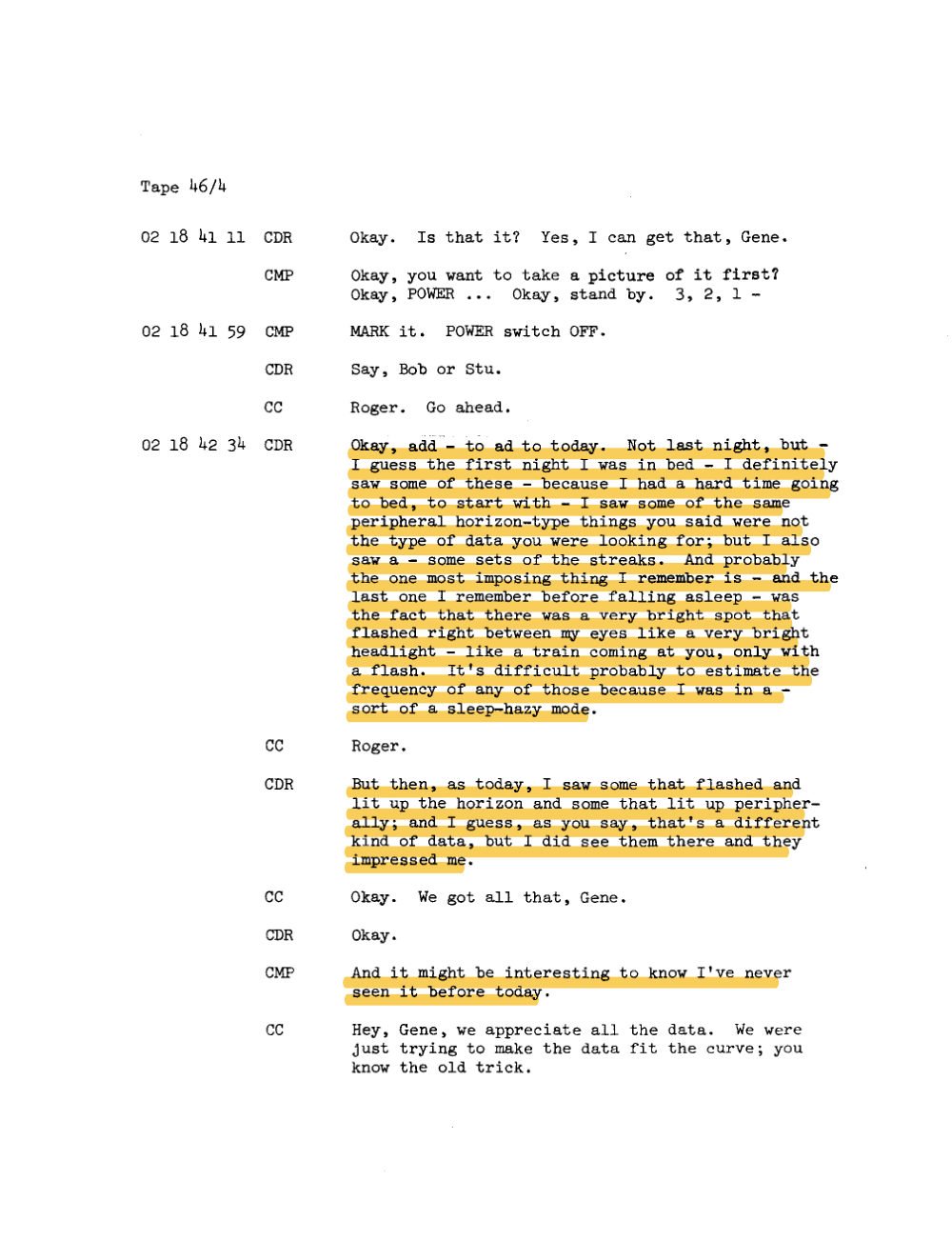
Cernan says that, on the first night in bed, having trouble sleeping, he saw “peripheral, horizon-type” flashes, which the researchers had said were not the kind of data being sought, and also some sets of streaks. The most striking image was the last one before he fell asleep: “a very bright spot that flashed right between my eyes, like a very strong headlight, like a train coming toward you, only with a flash.” He admits it is hard to estimate the frequency, because he was drowsy.
Ronald Evans adds that he had never seen the phenomenon before that day. Cernan says he has no doubt the flashes exist; on his previous trip, Apollo 10, he perhaps was not paying attention. The capcom thanks him and jokes that they were just trying to make the data fit the curve. Schmitt records photos of the equipment's position and calls the ground team “flash bugs.”
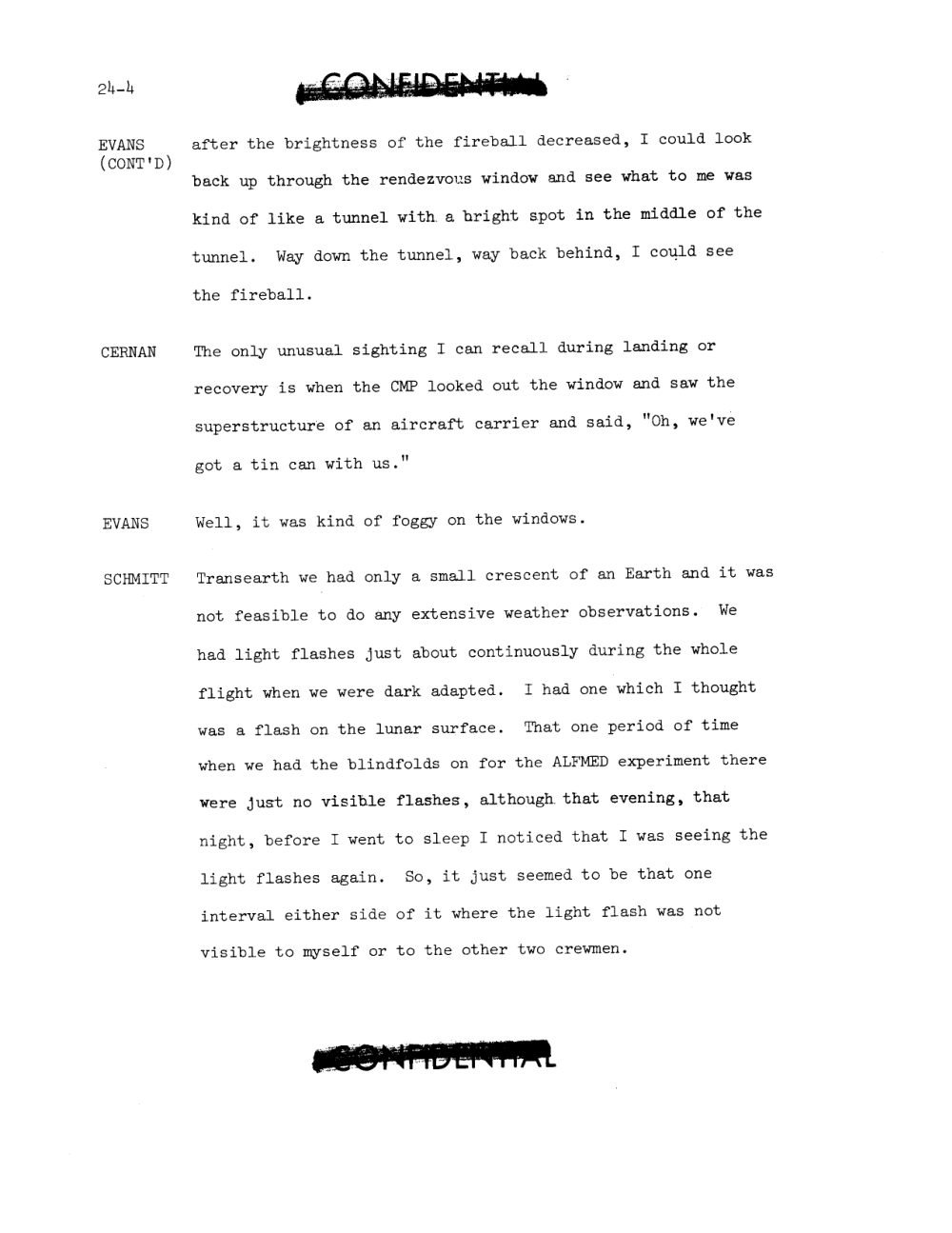
In the technical debriefing, of January 4, 1973, Schmitt sums up: they had flashes “almost continuously throughout the flight” when they were dark-adapted. During the ALFMED blindfold period, however, they saw none, neither he nor the other two, although the flashes returned that same night before sleep. This is an observation by the crew members themselves, with no explanation in the document.
The official descriptions of the recordings NASA-UAP-D028 and D029, the Apollo 17 medical debriefing, present the flashes as a biological effect now well documented: high-energy cosmic rays pass through the eye and strike the retina, producing the perception of streaks or flashes. According to these descriptions, two of the three crew members reported the flashes, even in lunar orbit and on the surface of the Moon.
Tape 46/4 begins with the end of an ALFMED session. The commands are routine: someone asks whether to take a photo of the equipment first, there is a countdown, "3, 2, 1," and the power switch is turned off. Only then does Cernan call "Bob or Stu," the two contacts in Houston, and ask to add an observation. The account of the flashes, therefore, was not spontaneous in the middle of the flight: it came as a complement to an experiment designed to record them, and the ground team had already explained to the astronauts what kind of data it was looking for.
This point appears in Cernan's own words. He says he saw "peripheral, horizon-type" flashes, which the researchers "said were not the kind of data" they were looking for, and then adds that, that day, he saw some that flashed and lit up the horizon and others that lit up the periphery of his vision, "a different kind of data," but which impressed him. The capcom replies with a joke: they were "just trying to make the data fit the curve." The dialogue shows the gap between what the crew perceived and what the experiment was prepared to measure.
Schmitt closes the session by calling the ground team "flash bugs," something like "flash fanatics," and corrects it to "flashbulbs," in a pun. He then reports that he took four photos, on frame 50, two from the side and two from below, to record the position of the ALFMED helmet: in each pair, one photo focused on the equipment and the other on the struts. These are documentation photos of the experiment, not of flashes, and they are not part of the archive. On the same page, he changes the subject and asks for the position of the rocket's third stage, the beginning of the flashing object episode.
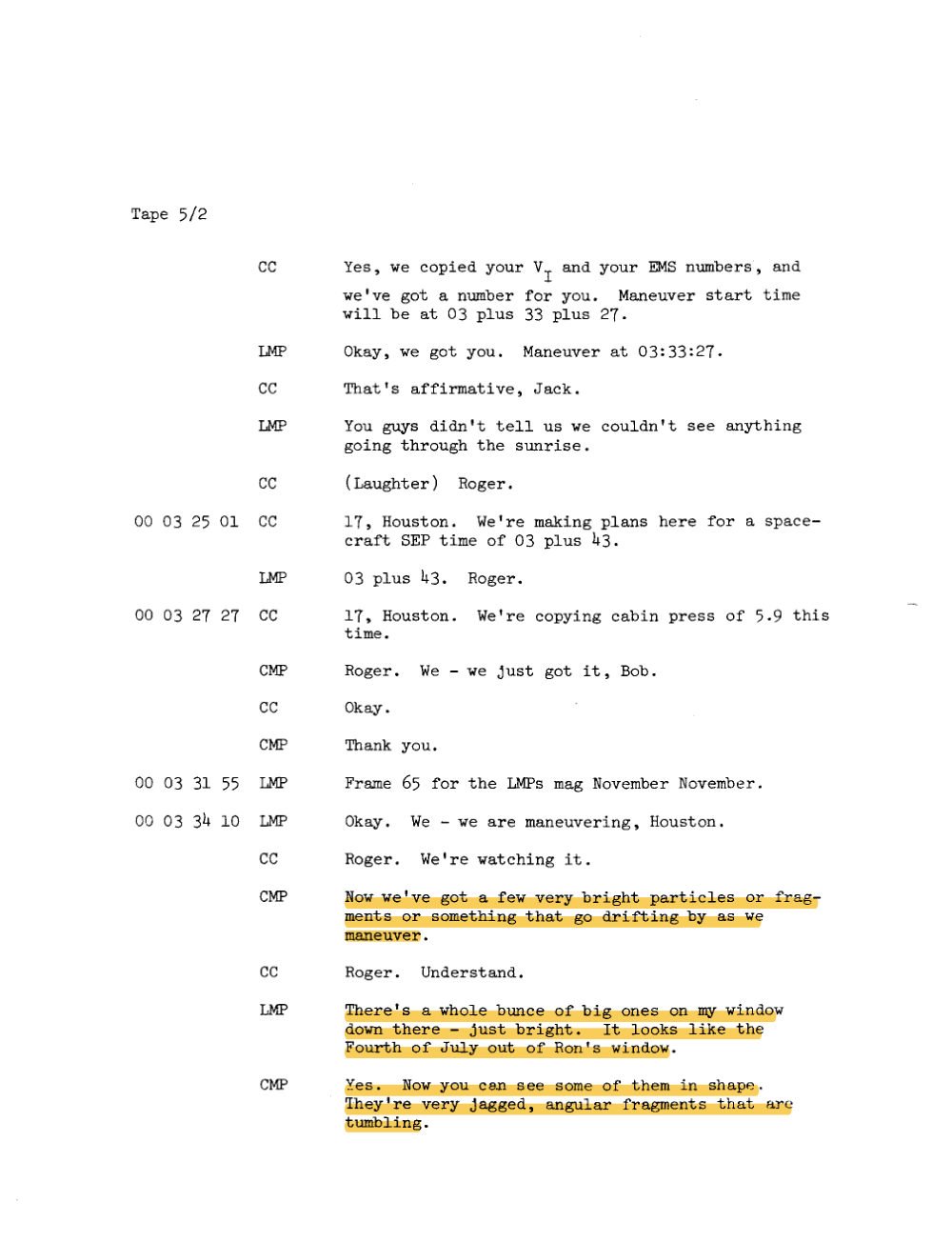
The technical debriefing records an observation the experiment did not anticipate. During the ALFMED blindfold period, none of the three saw flashes; that same night, before sleep, Schmitt saw them again. It is the only information on frequency in the document, and it is negative: the interval without flashes coincided with the blindfold. The documents do not explain why. The page also includes, from other crew members, the reentry fireball seen by Evans as a tunnel with a bright spot and Cernan's joke about the aircraft carrier, which shows that the section gathered all kinds of unusual visual observations.
OFFICIAL MEDIA
Official videos for this case
Files published by the United States Government on DVIDS. The title of each one is that of the official publication, translated; the description of what is seen is in the dossier text.

NASA debriefing recording · 53 min 10 s · the video only loads when you start playback, directly from the official server.
Official record ↗
NASA debriefing recording · 50 min 47 s · the video only loads when you start playback, directly from the official server.
Official record ↗More images from the document
DIRECT READING OF THE FILE
The document, in the original
NASA documents, a work of the U.S. government: accounts by Cernan, Evans and Schmitt translated after checking against the facsimile.
EXCERPT 1 · PHYSICAL PAGE 5
Physical page 5 (tape 46/4), excerpts that were missing to complete the page
Tape 46/4
02 18 4111 CDR
CMP
02 18 41 59 CMP
CDR
cc
02 18 42 34 CDR
CC
CDR
CC
CDR
CMP
CC
Okay. Is that it? Yes, I can get that, Gene.
Okay, you want to take a picture of it first?
Okay, POWER ... Okay, stand by. 3, 2, 1 -
MARK it. POWER switch OFF.
Say, Bob or Stu.
Roger. Go ahead.
Okay, add - to ad to today. Not last night, but -
I guess the first night I was in bed - I definitely
saw some of these - because I had a hard time going
to bed, to start with - I saw some of the same
peripheral horizon-type things you said were not
the type of data you were looking for; but I also
saw a - some sets of the streaks. And probably
the one most imposing thing I remember is - and the
last one I remember before falling asleep - was
the fact that there was a very bright spot that
flashed right between my eyes like a very bright
headlight - like a train coming at you, only with
a flash. It's difficult probably to estimate the
frequency of any of those because I was in a -
sort of a sleep-hazy mode.
Roger.
But then, as today, I saw some that flashed and
lit up the horizon and some that lit up peripherally; and I guess, as you say, that's a different
kind of data, but I did see them there and they
impressed me.
Okay. We got all that, Gene.
Okay.
And it might be interesting to know I've never
seen it before today.
Hey, Gene, we appreciate all the data. We were
just trying to make the data fit the curve; you
know the old trick.Editorial note: With the blocks already published (the description of the "train beacon" and the remark by Evans, CMP), the page is translated in full. The CDR speaker label on the first line, which addresses "Gene" (Cernan himself), is as in the original. "Add - to ad" is as in the original. The yellow highlighting is by an unidentified reader.
Check the original PDF
02 18 41 11 CDR: Okay. Is that it? Yes, I can get that, Gene. | CMP: Okay, you want to take a picture of it first? Okay, POWER ... Okay, stand by. 3, 2, 1 - | 02 18 41 59 CMP: MARK it. POWER switch OFF. | CDR: Say, Bob or Stu. | CC: Roger. Go ahead. | 02 18 42 34 CDR: Okay, add - to ad to today. Not last night, but - I guess the first night I was in bed - I definitely saw some of these - because I had a hard time going to bed, to start with - [...] | CC: Roger. | CDR: But then, as today, I saw some that flashed and lit up the horizon and some that lit up peripherally; and I guess, as you say, that's a different kind of data, but I did see them there and they impressed me. | CC: Okay. We got all that, Gene. | CDR: Okay. | [CMP: ...] | CC: Hey, Gene, we appreciate all the data. We were just trying to make the data fit the curve; you know the old trick.View the document record ↗ · Physical page 5, counting the cover.
EXCERPT 2 · PHYSICAL PAGE 6
Physical page 6 (tape 46/5), excerpts that were missing to complete the page
Tape 46/5
02 l8 44 40 CDR Okay, I just wanted you to
we saw them. That's all.
- just told them like
CC Roger.
CDR I will say one thing, though; no question in my
mind but that they're there. Last trip I took,
I guess I just wasn't looking for them or paying
any attention to them. Maybe they were there and
I ignored them because of other things. But they're
there.
LMP Okay, all you flash bugs down there - or flashbulbs I guess is the word - frame 50. I just took
four pictures to show - two on the side and two
on the bottom - to show the position of the ALFMED,
and one of them of each set was focused on the
ALFMED. The others were focused on the - the
other set was focused on the struts.
CC Roger, Jack.
LMP And when you don't have anything else to do, why
don't you have somebody predict where the S-IVB
is. I think I've got her spotted - behind us and
above us with respect to the Earth and our travel
from it.
CC FIDO just went
get working on
out
it.
and shot himself, but we'll
LMP Oh, don't worry about it. Shoot. I thought you
guys might have an idea off-the-cuff there.
CC No, what's humorous on this, Jack, is they have
really been working on that S-IVB impact point -
and they've really been - it's been a - a real
difficult problem for them so far.
LMP I'll tell you, I bet you Ron could give a star
sighting on it (laughter). I looked at it through
the monocular and sure looks like the S-IVB.
CC Jack, we're not doubting you at all.
probably start cranking it right now.
We couldEditorial note: With the block already published (Cernan's remark "I have no doubt that they exist"), the page is translated in full. "Flash bugs" is a joke by Schmitt (LMP) about the researchers studying the flashes. FIDO is the flight dynamics officer, responsible for the trajectory; the capcom's line is a joke. The second half of the page begins the episode of the flashing object, which has its own dossier.
Check the original PDF
02 18 44 40 CDR: Okay, I just wanted you to - just told them like we saw them. That's all. | CC: Roger. | [CDR: ...] | LMP: Okay, all you flash bugs down there - or flashbulbs I guess is the word - frame 50. I just took four pictures to show - two on the side and two on the bottom - to show the position of the ALFMED, and one of them of each set was focused on the ALFMED. The others were focused on the - the other set was focused on the struts. | CC: Roger, Jack. | LMP: And when you don't have anything else to do, why don't you have somebody predict where the S-IVB is. I think I've got her spotted - behind us and above us with respect to the Earth and our travel from it. | CC: FIDO just went out and shot himself, but we'll get working on it. | LMP: Oh, don't worry about it. Shoot. I thought you guys might have an idea off-the-cuff there. | CC: No, what's humorous on this, Jack, is they have really been working on that S-IVB impact point -, and they've really been - it's been a - a real difficult problem for them so far. | LMP: I'll tell you, I bet you Ron could give a star sighting on it (laughter). I looked at it through the monocular and sure looks like the S-IVB. | CC: Jack, we're not doubting you at all. We could probably start cranking it right now.View the document record ↗ · Physical page 6, counting the cover.
EXCERPT 3 · PHYSICAL PAGE 1
Physical page 1, full text: cover of the Apollo 17 technical debriefing, MSC-07631, 04/01/1973
PEPER L
MSC.-07631
NATIONAL AERONAUTICS AND SPACE ADMINISTRATION
APOLLO 17
TECHNICAL
CREW DEBRIEFING
(U)
JANUARY 4, 1973
PREPARED BY
TRAINING OFFICE
CREW TRAINING AND SIMULATION DIVISION
This document will automatically become declassified
90 days from the published date.
NOTICE: This document may be exempt from
public disclosure under the Freedom of Infor-
mation Act (5 U.S.C. 552). Requests for its
release to persons outside the U.S. Govern-
ment should be handled under the provisions
of NASA Policy Directive 1382.2.
iN MANNED SPACECRAFT CENTER
; HOUSTON.TEXAS
—_— te
DECLASSIFIED
E.0. 13526, Sec 3.3(a)
NASA Declassification Guide
Date of Guide: (M)05_(¥)2026
[Reviewer 0Editorial note: The word "CONFIDENTIAL," at the top and bottom, is covered by a black redaction bar, but the ending "AL" and the shape allow it to be read. The red declassification stamp is from May 2026, tied to the release of the files; the date 5/6/2026 is in American format (May 6, 2026). The handwritten indexing data are very faded.
Check the original PDF
264 pp. [à mão] | CONFIDENTIAL [tarjado] | MSC-07631 | NATIONAL AERONAUTICS AND SPACE ADMINISTRATION | APOLLO 17 TECHNICAL CREW DEBRIEFING (U) | JANUARY 4, 1973 | PREPARED BY TRAINING OFFICE, CREW TRAINING AND SIMULATION DIVISION | This document will automatically become declassified 90 days from the published date. | NOTICE: This document may be exempt from public disclosure under the Freedom of Information Act (5 U.S.C. 552). Requests for its release to persons outside the U.S. Government should be handled under the provisions of NASA Policy Directive 1382.2. | MANNED SPACECRAFT CENTER, HOUSTON, TEXAS | INDEXING DATA: DATE [01-04-73, apagado] | OPR MSC [apagado] | # MSC-07631 | T R | PGM [ilegível] | SUBJECT (title) [apagado] | SIGNATOR [ilegível] | LOC [em branco] | CONFIDENTIAL [tarjado] | [carimbo:] DECLASSIFIED E.O. 13526, Sec 3.3(a) NASA Declassification Guide Date of Guide: (M) 05 (Y) 2026 Reviewer: [iniciais] Date 5/6/2026View the document record ↗ · Physical page 1, counting the cover.
EXCERPT 4 · PHYSICAL PAGE 2
Physical page 2 of D6 (24-4), excerpts that were missing to complete the page
24-k
EVANS
(CONT'D)
CERNAN
EVANS
SCHMITT
after the brightness of the fireball decreased, I could look
back up through the rendezvous window and see what to me was
kind of like a tunnel with a bright spot in the middle of the
tunnel. Way down the tunnel, way back behind, I could see
the fireball.
The only unusual sighting I can recall during landing or
recovery is when the CMP looked out the window and saw the
superstructure of an aircraft carrier and said, "Oh, we've
got a tin can with us."
Well, it was kind of foggy on the windows.
Transearth we had only a small crescent of an Earth and it was
not feasible to do any extensive weather observations. We
had light flashes just about continuously during the whole
flight when we were dark adapted. I had one which I thought
was a flash on the lunar surface. That one period of time
when we had the blindfolds on for the ALFMED experiment there
were just no visible flashes, although that evening, that
night, before I went to sleep I noticed that I was seeing the
light flashes again. So, it just seemed to be that one
interval either side of it where the light flash was not
visible to myself or to the other two crewmen.Editorial note: With the block already published (Schmitt's summary of the flashes and the blindfolded period), page 24-4 is now translated in full; the [...] mark the sentences already published.
Check the original PDF
EVANS (CONT'D): after the brightness of the fireball decreased, I could look back up through the rendezvous window and see what to me was kind of like a tunnel with a bright spot in the middle of the tunnel. Way down the tunnel, way back behind, I could see the fireball. CERNAN: The only unusual sighting I can recall during landing or recovery is when the CMP looked out the window and saw the superstructure of an aircraft carrier and said, "Oh, we've got a tin can with us." EVANS: Well, it was kind of foggy on the windows. SCHMITT: Transearth we had only a small crescent of an Earth and it was not feasible to do any extensive weather observations. [...] I had one which I thought was a flash on the lunar surface. [...] So, it just seemed to be that one interval either side of it where the light flash was not visible to myself or to the other two crewmen.View the document record ↗ · Physical page 2, counting the cover.
Dates and documentary context
- Event
- 12/1972 — Flashes throughout the entire flight (7 to 19/12/1972, public chronology). Cernan's account in the transcript is at 02 days 18:42 mission time, around 00h15 UTC on 09/12/1972 (editorial calculation).
- Document
- 04/01/1973 — Date on the cover of the technical debriefing (D6, p. 1).
- Publication
- Not established — Published by NASA in release 1 of the UAP files.
Origin and release
NASA: official Apollo 17 air-to-ground transcript; technical debriefing prepared by the Training Office, Crew Training and Simulation Division · NASA-UAP-D2-Apollo-17-Transcript-1972.pdf; NASA-UAP-D6-Apollo-17-Technical-Crew-Debriefing-1973.pdf
undefined ↗ — undefined
Related accounts and their differences
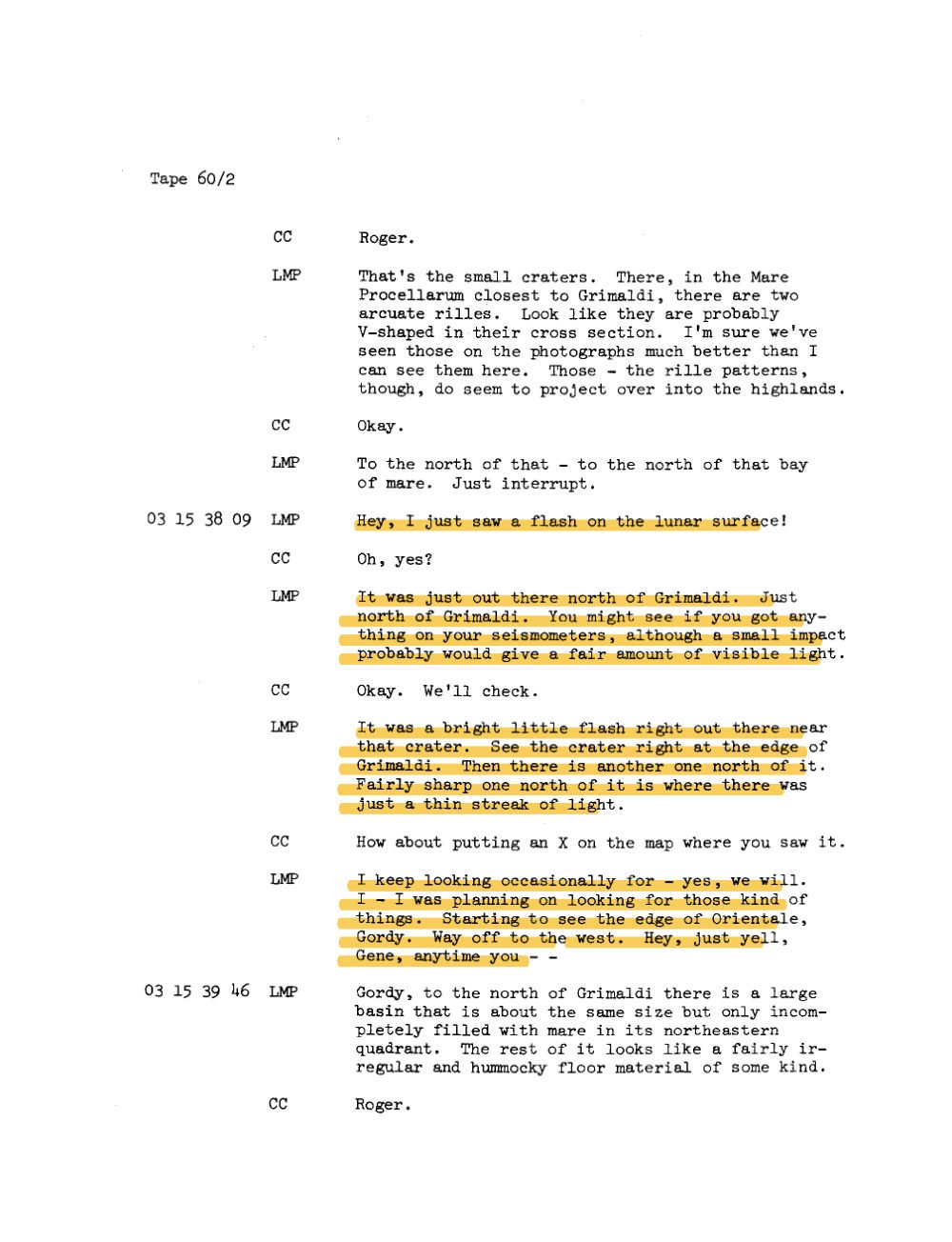
- Apollo 17, 1972: a flash on the Moon near Grimaldi
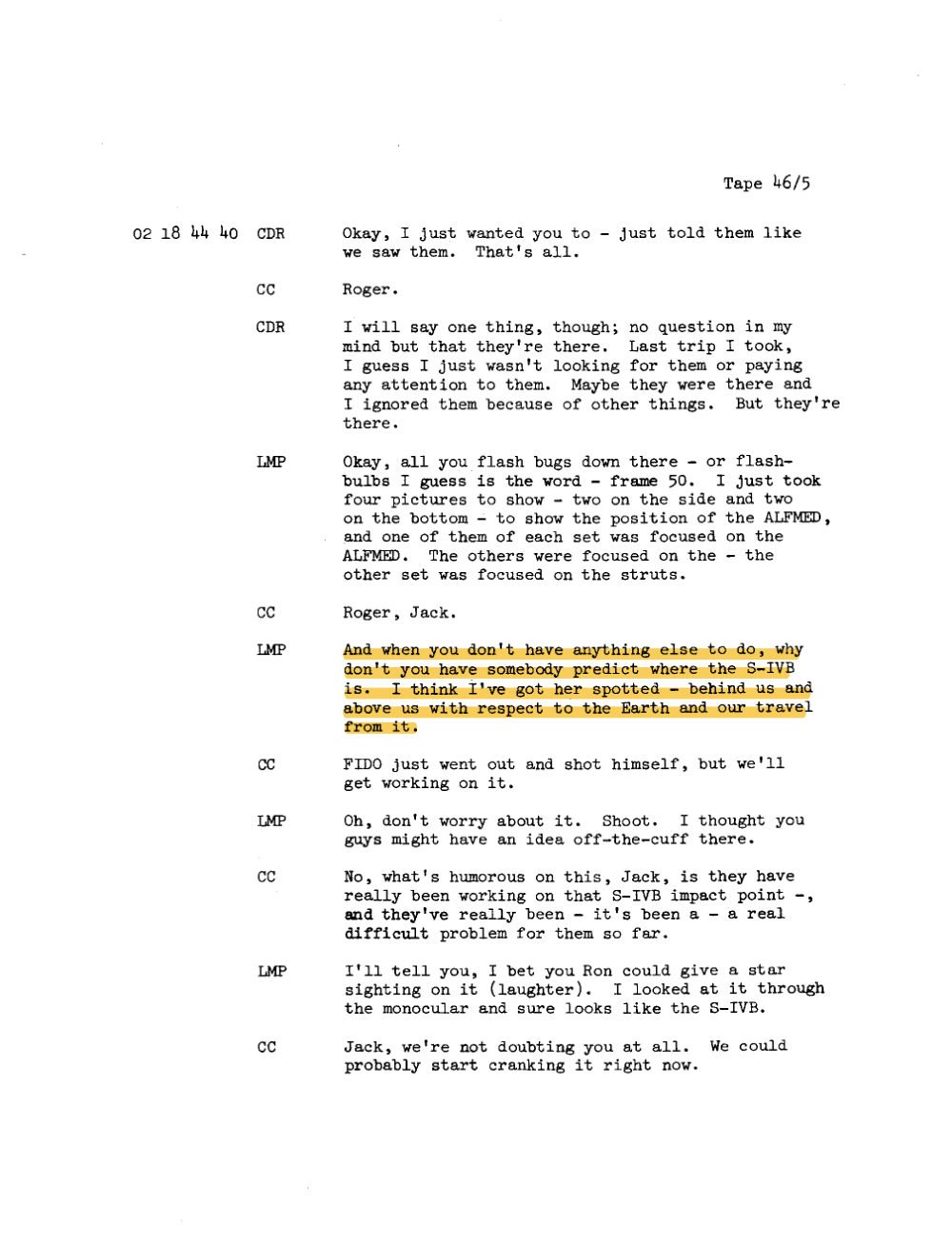
- Apollo 17, 1972: the blinking object “way out there”
Questions to continue the investigation
- Did the ALFMED data confirm the absence of flashes during the blindfolded period reported by Schmitt?
- Were the "peripheral, horizon-type" flashes described by Cernan treated differently by the researchers?
GEOGRAPHY OF THE CASE
Inside the spacecraft, Earth-Moon trajectory and lunar orbit
Phenomenon perceived inside the spacecraft; there is no geographic point to place.
DOCUMENTARY TRAIL
Go back to the sources
References use physical pages of the PDF, counting the cover. Summaries are presented in English; the documents keep their original language.
- NASA-UAP-D2-Apollo-17-Transcript-1972.pdf
Physical pages 5 and 6 (tapes 46/4 and 46/5): Cernan and Evans describe the flashes and the ALFMED experiment
NASA · 16 pages - NASA-UAP-D6-Apollo-17-Technical-Crew-Debriefing-1973.pdf
Physical page 2 (24-4): Schmitt summarizes the flashes seen throughout the flight
NASA · 2 pages
Editorial summary based on the collection's research notes. How we read the documents.