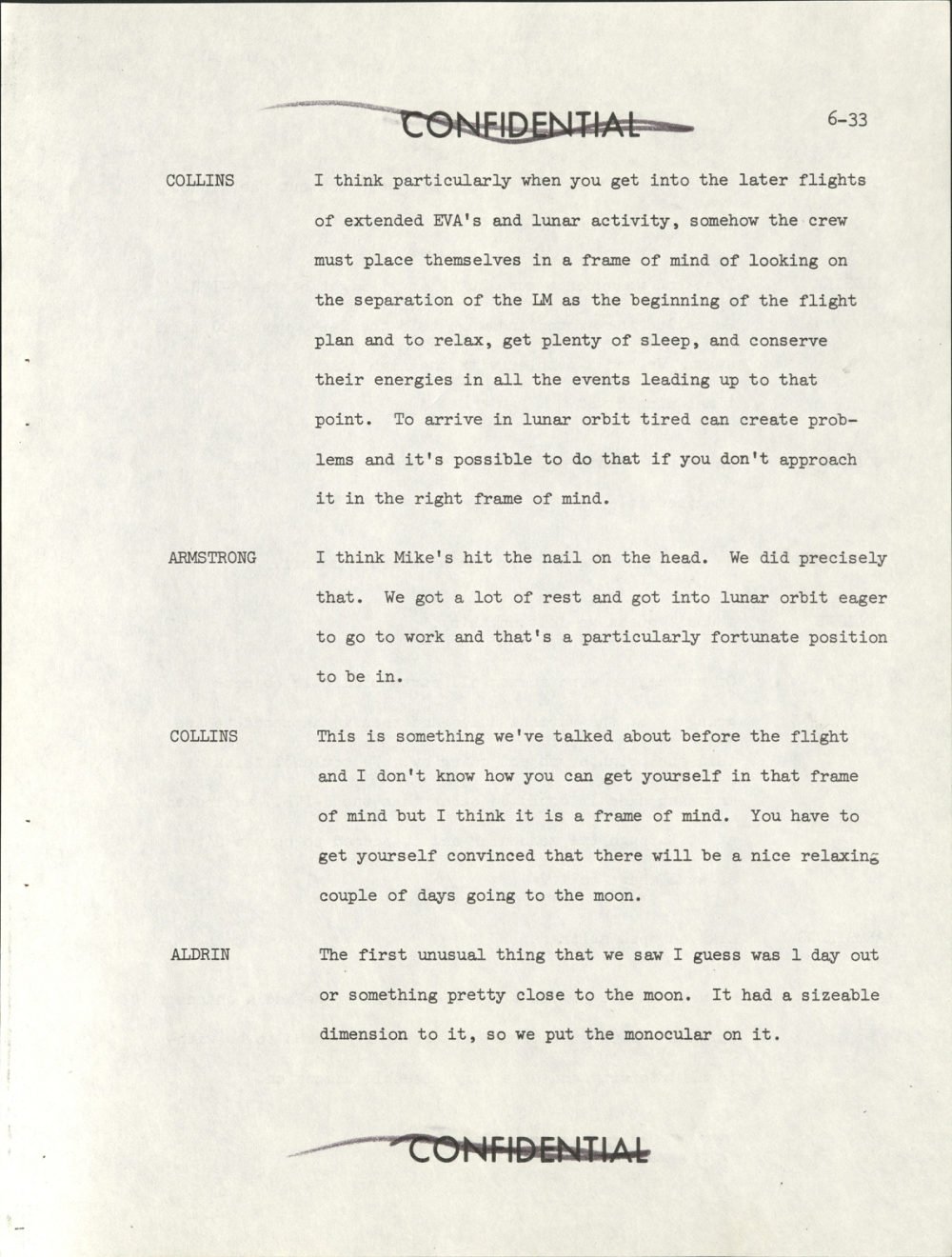
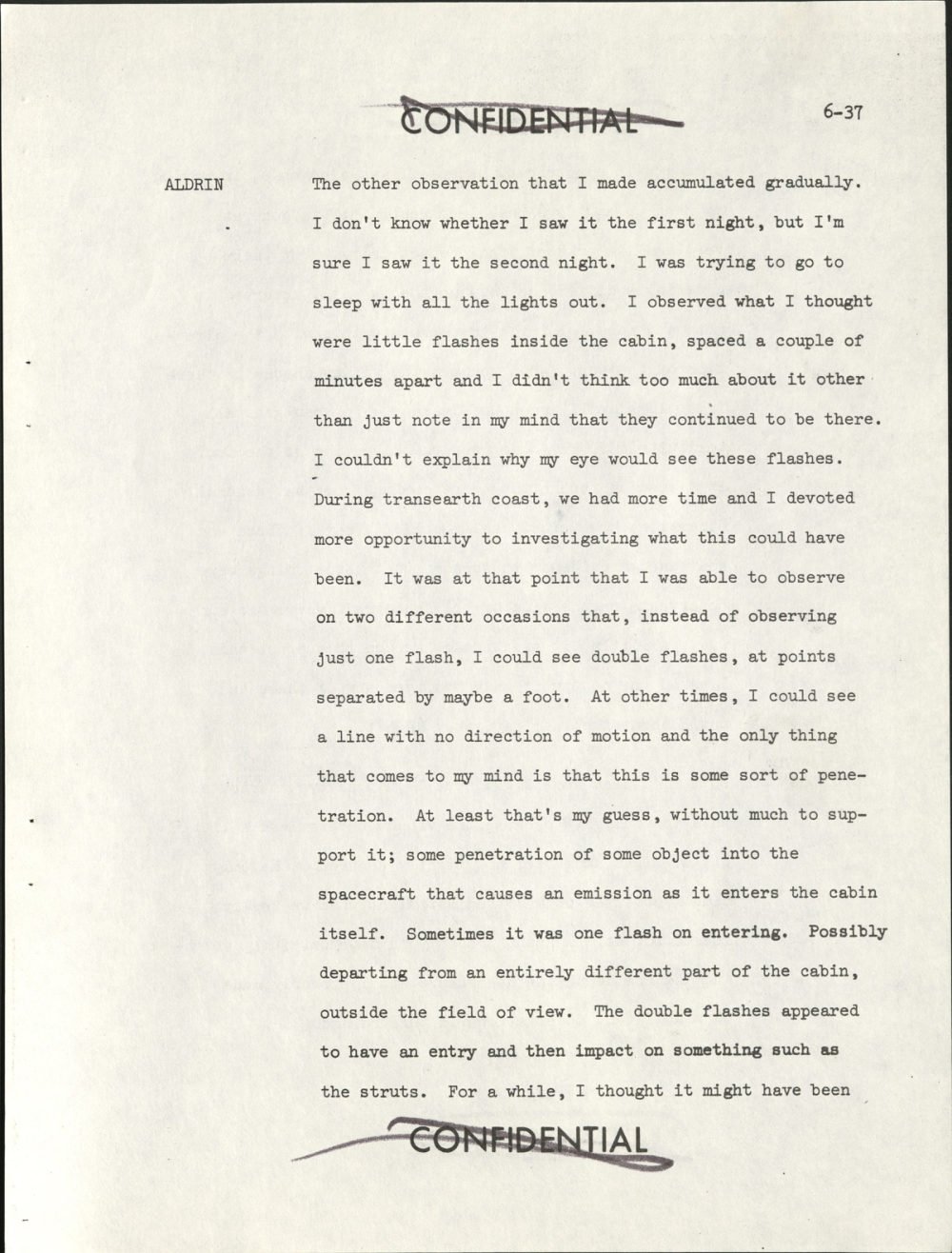
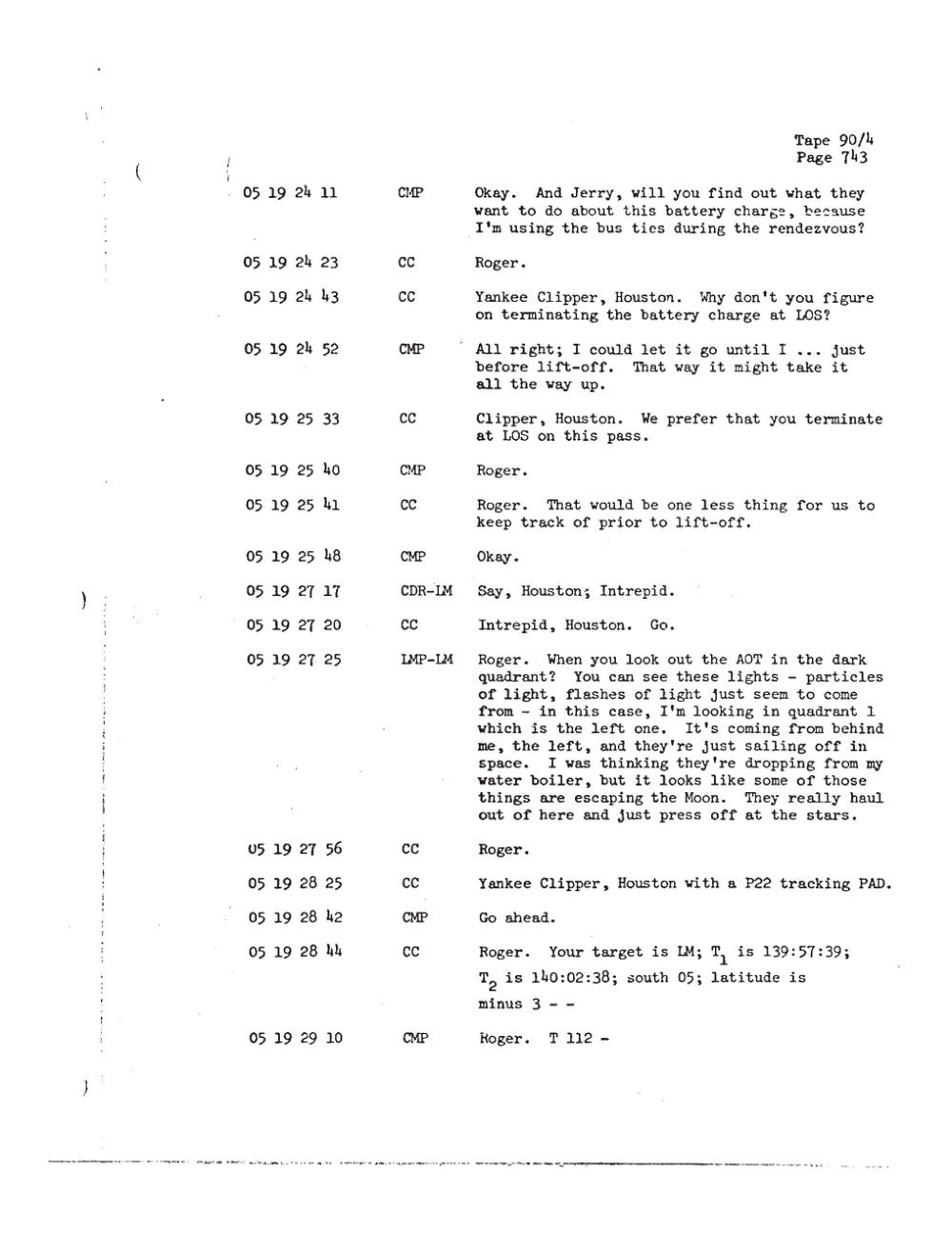
Date: July 1969, in lunar orbit after the lunar module ascent; debriefing of 31/07/1969Location: Lunar orbit, looking at the Earth above the Moon's horizon
Apollo 11, 1969: the bright light seen on Earth, first attributed to a laser and later to a lake
In the sightings section of the Apollo 11 technical debriefing, Aldrin says that, in lunar orbit, he saw a fairly bright light source on Earth and tentatively attributed it to a laser. On the way back, upon seeing something similar through the monocular, the crew revised the conclusion to the Sun's reflection on a lake, although Aldrin still found the brightness unusual.
- Event date
- July 1969, in lunar orbit after the lunar module ascent; debriefing of 31/07/1969
- Location
- Lunar orbit, looking at the Earth above the Moon's horizon
- Topic
- Astronaut accounts
- Source agencies
- NASA
- Documents
- 1 document · 11 pages
- Reading time
- 8 min
 Technical debriefing pagePhysical page 10
DOCUMENTARY SOURCES · NASA
What the records tell
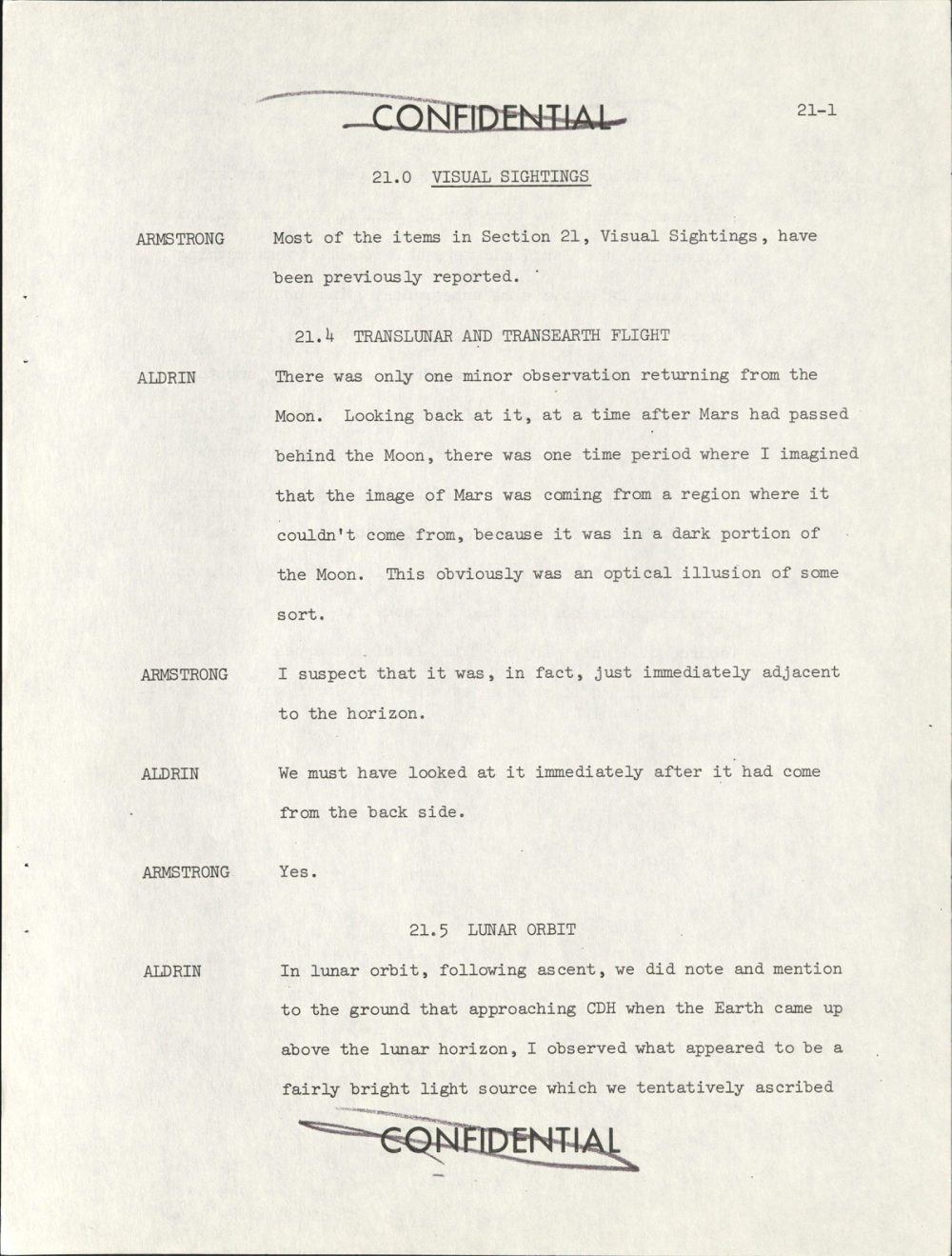
Volume II of the Apollo 11 technical debriefing, also dated July 31, 1969 and also confidential, has a section called “Visual sightings”. Armstrong opens it noting that most of the items had already been reported earlier. In the part about the outbound and return trip, Aldrin recounts a single minor observation: after Mars went behind the Moon, he had the impression that the planet's image was coming from a dark region of the Moon, where it could not come from. He himself says it was “obviously an optical illusion”.
Armstrong suggests that Mars was actually right next to the lunar horizon, and Aldrin agrees that they must have looked at the instant the planet reappeared from behind the Moon. The episode is short, but it shows the crew classifying a visual effect as a mistake on their own, before moving on to the next item. There is no record of the time or of any photograph of that moment, and the transcript does not indicate that ground control was consulted about it.
In the section on lunar orbit, after the lunar module ascent, Aldrin reports that, when approaching the rendezvous maneuver called CDH, as the Earth rose above the Moon's horizon, he saw what looked like a fairly bright light source on Earth. The crew tentatively attributed it to a possible laser, which seemed the best explanation at the time, and mentioned it to ground control.
The explanation changed on the way back. Already in the command module, approaching the Earth, they observed something similar in appearance and, with the monocular, it looked to them like the Sun's reflection on a relatively smooth water surface, such as a lake. Aldrin says they revised their initial conclusion: if no one claimed to have fired a laser toward the Moon at that moment, the most likely explanation was the reflection on a lake. Even so, he adds that he still found it unusual to see such a bright source at that distance.
Photography did not help. According to Aldrin, on film the light did not look like it was going to show up, because the Earth was too bright. The page does not give the time, the region of the Earth where the light was, or the record of the conversation with the ground. The lake hypothesis is the crew's own conclusion, presented as the most likely, and not an independent verification.
Section 21, "Visual sightings", takes up only two pages in volume II of the debriefing, which had 216 pages, according to a handwritten note on the cover. Armstrong opens it saying that "most of the items" had already been reported earlier, which indicates that these observations had already come up at other times, including in communications with the ground, as Aldrin himself recalls when speaking about the light. The numbering jumps from 21.0 to 21.4 and 21.5: the intermediate subsections do not appear in this part of the file, and the PDF does not make it possible to know whether they were empty or were left out.
The light was seen at a specific moment of the mission, although the page does not give the time: after the lunar module ascent and when approaching CDH, one of the maneuvers of the orbital rendezvous with the command module. Aldrin was therefore in the lunar module, together with Armstrong. According to the public Apollo 11 timeline, the liftoff from the Moon and the rendezvous took place on July 21, 1969. The second observation, the one that led the crew to change their minds, was made in the command module, days later, on the approach to Earth, with the monocular.
There are three distinct layers in this account. The observation is a "fairly bright" light source on Earth, seen with the Earth above the lunar horizon. The first interpretation, a laser, was provisional and was told to the ground at the time. The second, the Sun's reflection on a smooth water surface such as a lake, arose from the comparison with something similar in appearance seen on the way back and is the crew's final conclusion, which is conditional: it would hold "if no one claims" to have fired a laser at the Moon at that moment. Aldrin keeps a reservation, finding such strong brightness unusual at that distance.
The laser hypothesis made sense at the time. Apollo 11 carried and left on the surface a set of retroreflectors intended for measurements of the Earth-Moon distance with lasers fired from ground-based observatories. The transcript, however, does not say whether any laser was pointed at the Moon at that moment, and the file contains no answer from the ground. There is also no measurement: Aldrin says that, on film, the light did not look like it was going to show up, because the Earth was too bright. What exists is an account from memory, made one week after landing, with the explanation proposed by the astronauts themselves.
More images from the document
DIRECT READING OF THE FILE
The document, in the original
NASA transcript, a U.S. government work: the two pages of section 21 were translated in excerpts after checking against the facsimile.
EXCERPT 1 · PHYSICAL PAGE 11
Light on Earth, physical pages 10 and 11 (21-1 and 21-2)
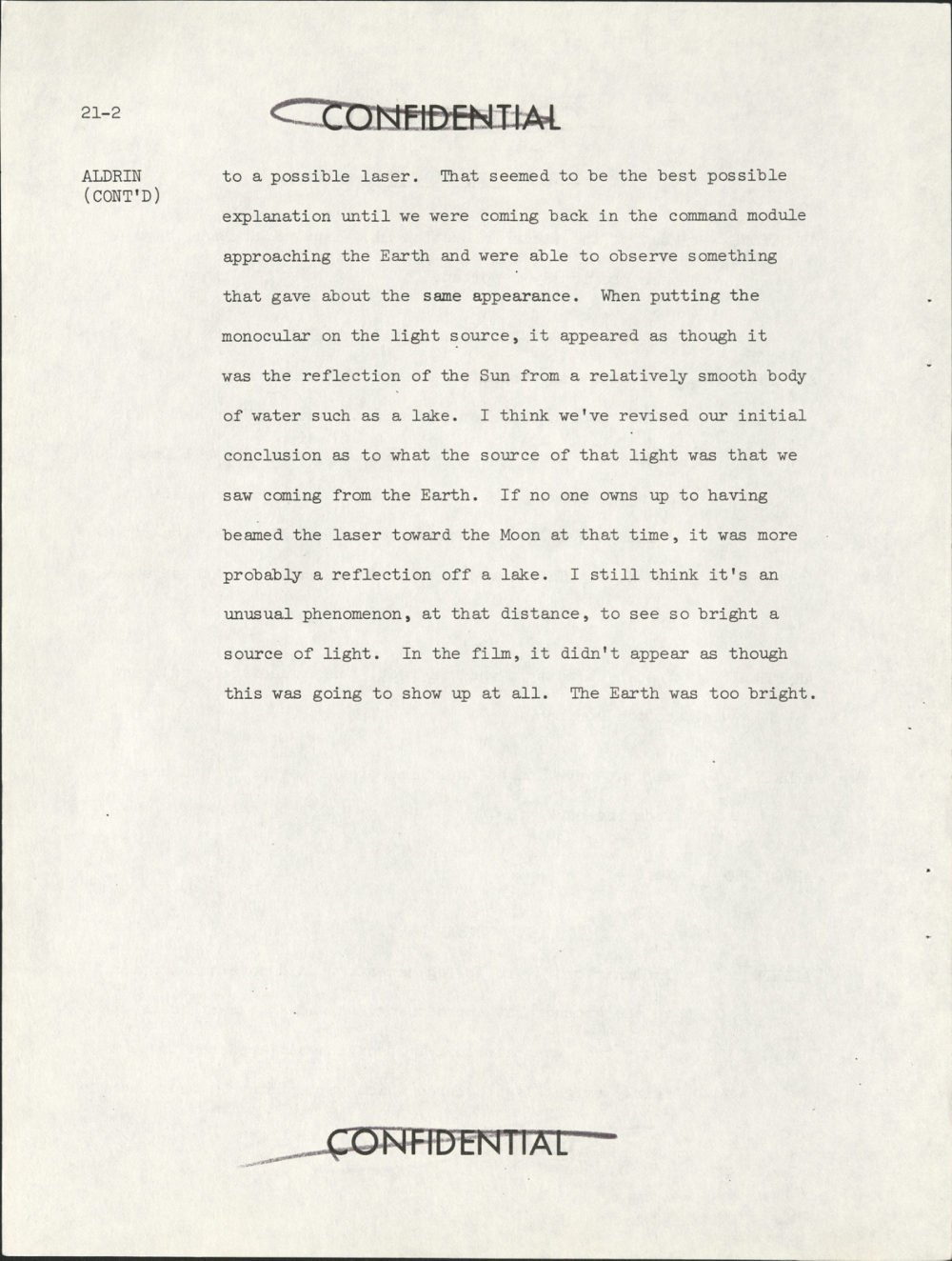
ALDRIN to a possible laser. That seemed to be the best possible
(CONT'D)
explanation until we were coming back in the command module
approaching the Earth and were able to observe something
that gave about the same appearance. When putting the
monocular on the light source, it appeared as though it
was the reflection of the Sun from a relatively smooth body
of water such as a lake. I think we've revised our initial
conclusion as to what the source of that light was that we
saw coming from the Earth. If no one owns up to having
beamed the laser toward the Moon at that time, it was more
probably a reflection off a lake. I still think it's an
unusual phenomenon, at that distance, to see so bright a
source of light. In the film, it didn't appear as though
this was going to show up at all. The Earth was too bright.Editorial note: In the original, “following ascent”.
Check the original PDF
In lunar orbit, following ascent, we did note and mention to the ground that approaching CDH when the Earth came up above the lunar horizon, I observed what appeared to be a fairly bright light source which we tentatively ascribed to a possible laser. [...] When putting the monocular on the light source, it appeared as though it was the reflection of the Sun from a relatively smooth body of water such as a lake. [...] If no one owns up to having beamed the laser toward the Moon at that time, it was more probably a reflection off a lake. I still think it's an unusual phenomenon, at that distance, to see so bright a source of light.View the document record ↗ · Physical page 11, counting the cover.
EXCERPT 2 · PHYSICAL PAGE 9
Physical page 9, full text: cover of volume II of the Apollo 11 technical debriefing, 31/07/1969
Bete wey
“AIG PSP
— “=CONEIDENHAL ‘ 94
NATIONAL AERONAUTICS AND SPACE ADMINISTRATION
“APOLLO 11
TECHNICAL
CREW DEBRIEFING
y p” (U)
JULY 31, 1969 ;
PREPARED BY:
MISSION OPERATIONS BRANCH
FLIGHT CREW SUPPORT DIVISION
VOL. II
GROUP 4
Downgraded at 3-year
intervals; declassified
after 12 years
rae material < NOTICE: This document may be exempt from ov 100 tee
transmission or public disclosure under the Freedom of Infor- ‘erson is
Prohibited by 1a mation Act (5 U.S.C. 552). Requests for its re-
2 2 lease to persons outside the U.S. Government
should be hancled under the provisions of
a NASA Policy Directive 1382.2,
CENTER
ee
IAL
INDEXING DATA
DATE GER t T PGM SUBJEC
A
oe. ey Le)
.Editorial note: The stamp date was read as 3/11/76 (in American format, March 11, 1976); the reading of the last digit is probable, not certain. The espionage-laws notice is partially covered by the label and was not completed. "216 pgs" indicates the length of the complete volume II.
Check the original PDF
216 pgs [à mão] | 94 [à mão] | CONFIDENTIAL [riscado] | NATIONAL AERONAUTICS AND SPACE ADMINISTRATION | APOLLO 11 TECHNICAL CREW DEBRIEFING (U) | JULY 31, 1969 | PREPARED BY: MISSION OPERATIONS BRANCH, FLIGHT CREW SUPPORT DIVISION | VOL. II | GROUP 4 Downgraded at 3-year intervals; declassified after 12 years | [carimbo, preenchido à mão:] CLASSIFICATION CHANGED TO U BY AUTHORITY OF E.O. 11652 6/1/72 DATE 3/11/76 [assinatura] | This material c[...] within the mean[ing ...] transmission or [...] prohibited by la[w ...] United States [...] and 794, the [...] person is [restante encoberto por etiqueta] | [etiqueta colada:] NOTICE: This document may be exempt from public disclosure under the Freedom of Information Act (5 U.S.C. 552). Requests for its release to persons outside the U.S. Government should be handled under the provisions of NASA Policy Directive 1382.2. | [...] CENTER | CONFIDENTIAL [riscado] | INDEXING DATA: DATE 07-31-69 | OPR MSC | # [em branco] | T R | PGM APO | SUBJECT (title) | DUP? [à mão] | SIGNATOR MSC | LOC 078-62View the document record ↗ · Physical page 9, counting the cover.
EXCERPT 3 · PHYSICAL PAGE 10
Physical page 10 (21-1), excerpts that were missing to complete the page: section 21 headings and Armstrong's and Aldrin's remarks about Mars
ARMSTRONG
ALDRIN
ARMSTRONG
ALDRIN
ARMSTRONG
ALDRIN
LECCE area
21.0 VISUAL SIGHTINGS
Most of the items in Section 21, Visual Sightings, have
been previously reported.
21.4 TRANSLUNAR AND TRANSEARTH FLIGHT
There was only one minor observation returning from the
Moon. Looking back at it, at a time after Mars had passed
behind the Moon, there was one time period where I imagined
that the image of Mars was coming from a region where it
couldn't come from, because it was in a dark portion of
the Moon. This obviously was an optical illusion of some
sort.
I suspect that it was, in fact, just immediately adjacent
to the horizon.
We must have looked at it immediately after it had come
from the back side.
Yess
21.5 LUNAR ORBIT
In lunar orbit, following wiceas, we did note and mention
to the ground that approaching CDH when the Earth came up
above the lunar horizon, I observed what appeared to be a
fairly bright light source which we tentatively ascribed
“nnn ain
6 ONEIDENHALEditorial note: Together with the blocks already published (Aldrin's remark about Mars and the beginning of the account of the light), page 21-1 is now translated in full. "Translunar" is the outbound trip to the Moon; "transearth", the return to Earth.
Check the original PDF
21.0 VISUAL SIGHTINGS | ARMSTRONG: Most of the items in Section 21, Visual Sightings, have been previously reported. | 21.4 TRANSLUNAR AND TRANSEARTH FLIGHT | ALDRIN: There was only one minor observation returning from the Moon. [...] ARMSTRONG: I suspect that it was, in fact, just immediately adjacent to the horizon. ALDRIN: We must have looked at it immediately after it had come from the back side. ARMSTRONG: Yes. | 21.5 LUNAR ORBIT | [...]View the document record ↗ · Physical page 10, counting the cover.
Dates and documentary context
- Event
- 21/07/1969 — The page places the observation in lunar orbit, after the ascent of the lunar module and before the CDH maneuver. The date comes from the mission's public timeline (liftoff from the Moon on 21/07/1969), not from the page.
- Document
- 31/07/1969 — Date on the cover of volume II (p. 9).
- Publication
- Not established — Published by NASA in release 1 of the UAP files.
Origin and release
NASA, Mission Operations Branch, Flight Crew Support Division; transcript classified as confidential (Group 4), later declassified · NASA-UAP-D4-Apollo-11-Technical-Crew-Debriefing-1969.pdf
undefined ↗ — undefined
Related accounts and their differences
- Apollo 11, 1969: the “L”-shaped object seen on the way to the Moon
- Apollo 11, 1969: the flashes Aldrin saw with his eyes closed
Questions to continue the investigation
- Does the Apollo 11 air-to-ground transcript record the mention of the light and the region of the Earth where it was?
- Was any observatory firing a laser at the Moon at that moment, like those aimed at the reflectors left by the mission?
GEOGRAPHY OF THE CASE
Lunar orbit
Observation made from lunar orbit toward the Earth; the source does not say over which region of the Earth the light was.
DOCUMENTARY TRAIL
Go back to the sources
References use physical pages of the PDF, counting the cover. Summaries are presented in English; the documents keep their original language.
- NASA-UAP-D4-Apollo-11-Technical-Crew-Debriefing-1969.pdf
Physical page 9: cover of volume II, dated 31/07/1969; pp. 10 and 11 (internal numbering 21-1 and 21-2): section 21, visual sightings
NASA · 11 pages
Editorial summary based on the collection's research notes. How we read the documents.