Date: July 1969, on the outbound trip to the Moon; technical debriefing of 31/07/1969Location: Space, on the trajectory between the Earth and the Moon
Apollo 11, 1969: the "L"-shaped UFO the crew saw on the way to the Moon
In the Apollo 11 technical debriefing, Aldrin, Armstrong and Collins say they saw through the window a bright UFO that looked like an "L", an open suitcase or a hollow cylinder, depending on the instrument's focus. They thought of the rocket's third stage, but ground control reported that it was about 6.000 miles away, and the crew ended the conversation without a conclusion, suspecting something that had come loose from the spacecraft itself.
- Event date
- July 1969, on the outbound trip to the Moon; technical debriefing of 31/07/1969
- Location
- Space, on the trajectory between the Earth and the Moon
- Topic
- Astronaut accounts
- Source agencies
- NASA
- Documents
- 1 document · 11 pages
- Reading time
- 11 min
 Technical debriefing pagePhysical page 2
DOCUMENTARY SOURCES · NASA
What the records tell
The Apollo 11 technical debriefing was transcribed by the crew support division on July 31, 1969, one week after the return, and classified as confidential, with declassification scheduled after 12 years. In the passage about the trip, Aldrin says that the first unusual thing they saw was about one day out, or already near the Moon; he himself was not sure of the moment. The UFO had an apparent size large enough that they pointed the monocular at it.
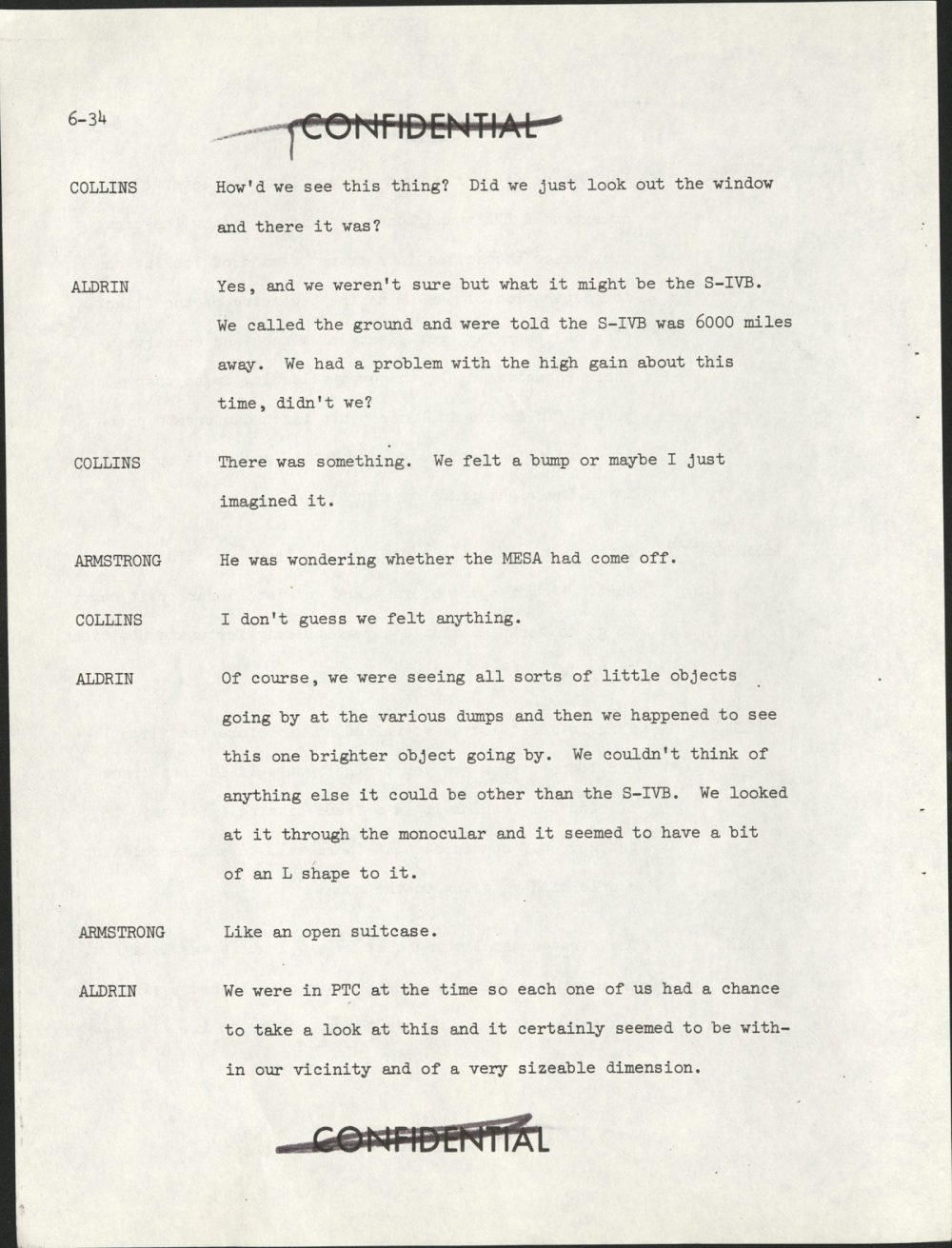
Collins asks how they saw it, and Aldrin answers that they simply looked out the window and there it was. The first suspicion was the S-IVB, the third stage of the Saturn V rocket, which continues traveling near the spacecraft after separation. They called control in Houston and were told that the S-IVB was 6.000 miles away. Aldrin recalls that they saw “all sorts of small objects” go by during the water and urine dumps, but that this one was brighter. Through the monocular, it seemed to have somewhat the shape of an “L”; Armstrong adds: “like an open suitcase”.
Armstrong makes the caveat that weighs on the reading: the UFO was at the limit of the eye's resolution, and there was no way to know the size without knowing the distance, nor the distance without knowing the size. Aldrin went to the lower compartment and looked for the UFO in the sextant. Out of focus, the image looked like a cylinder. Armstrong says it was two connected rings; Collins disagrees and says it was a hollow cylinder that was rotating and, when seen end-on, let you see the inside. When the focus was changed, the shape went back to that of an open book. “It was really weird”, says Collins.
The recorded conclusion is modest. Collins states that they do not know what it was, how big it was or how far away it was, and that they are “pretty sure” it was not part of the urine dump. Aldrin closes by saying that all one can state is that it was not a cylinder. They then raise hypotheses linked to the mission itself: a piece of Mylar loose from the lunar module, a panel, which Aldrin rules out because of the shape, or a part of the high-gain antenna, because the episode coincided with problems with that antenna. Collins says he suspects the origin was the spacecraft.
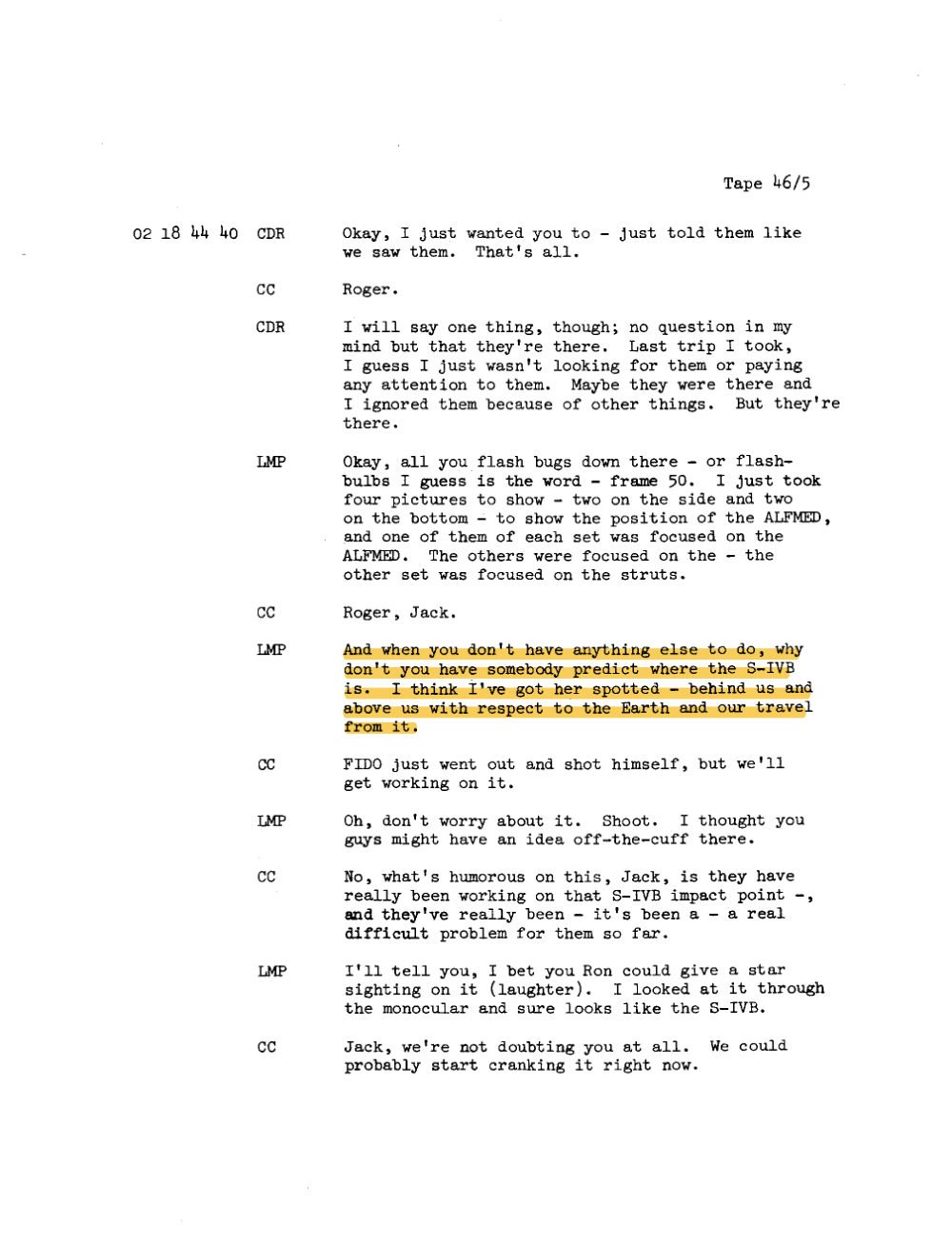
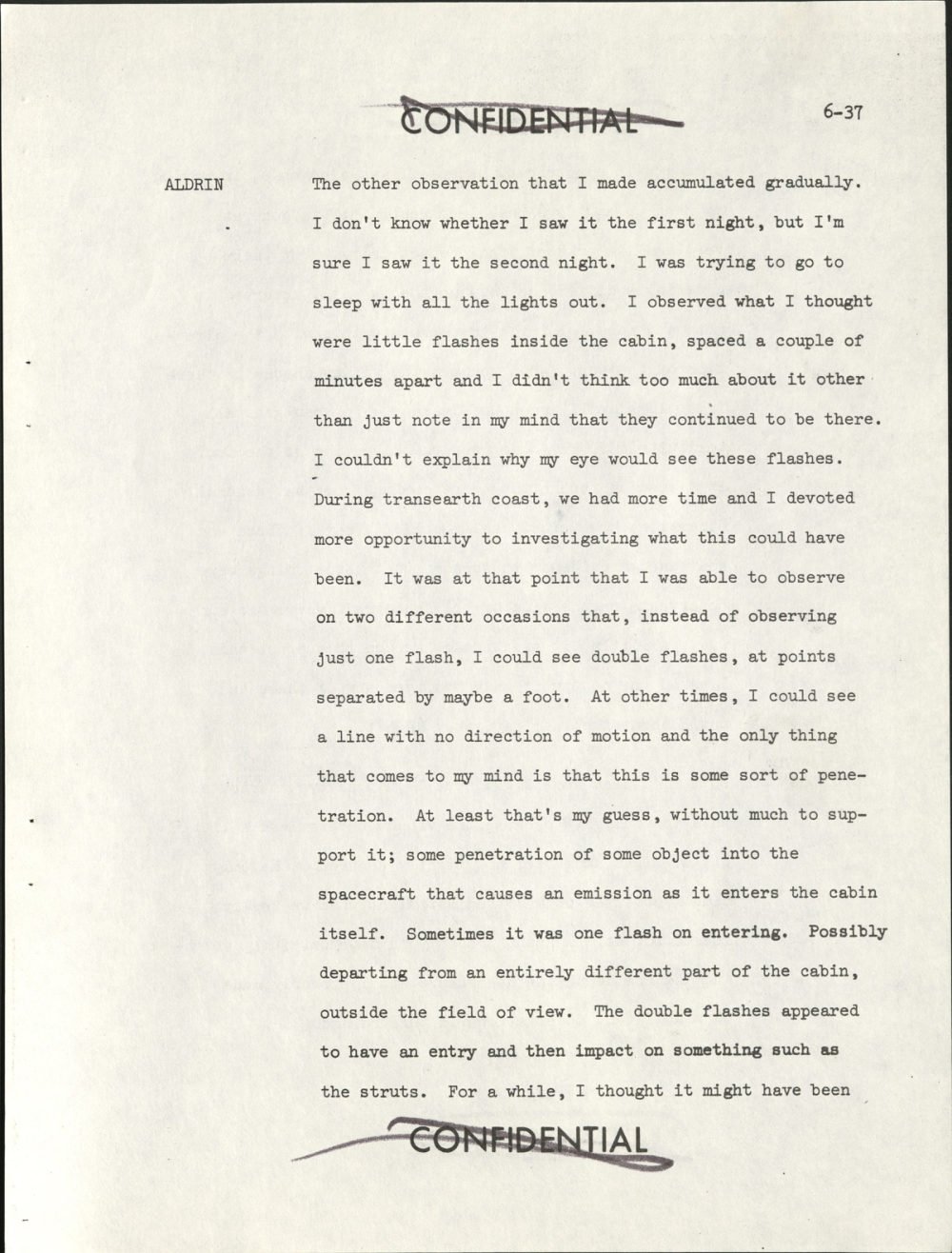
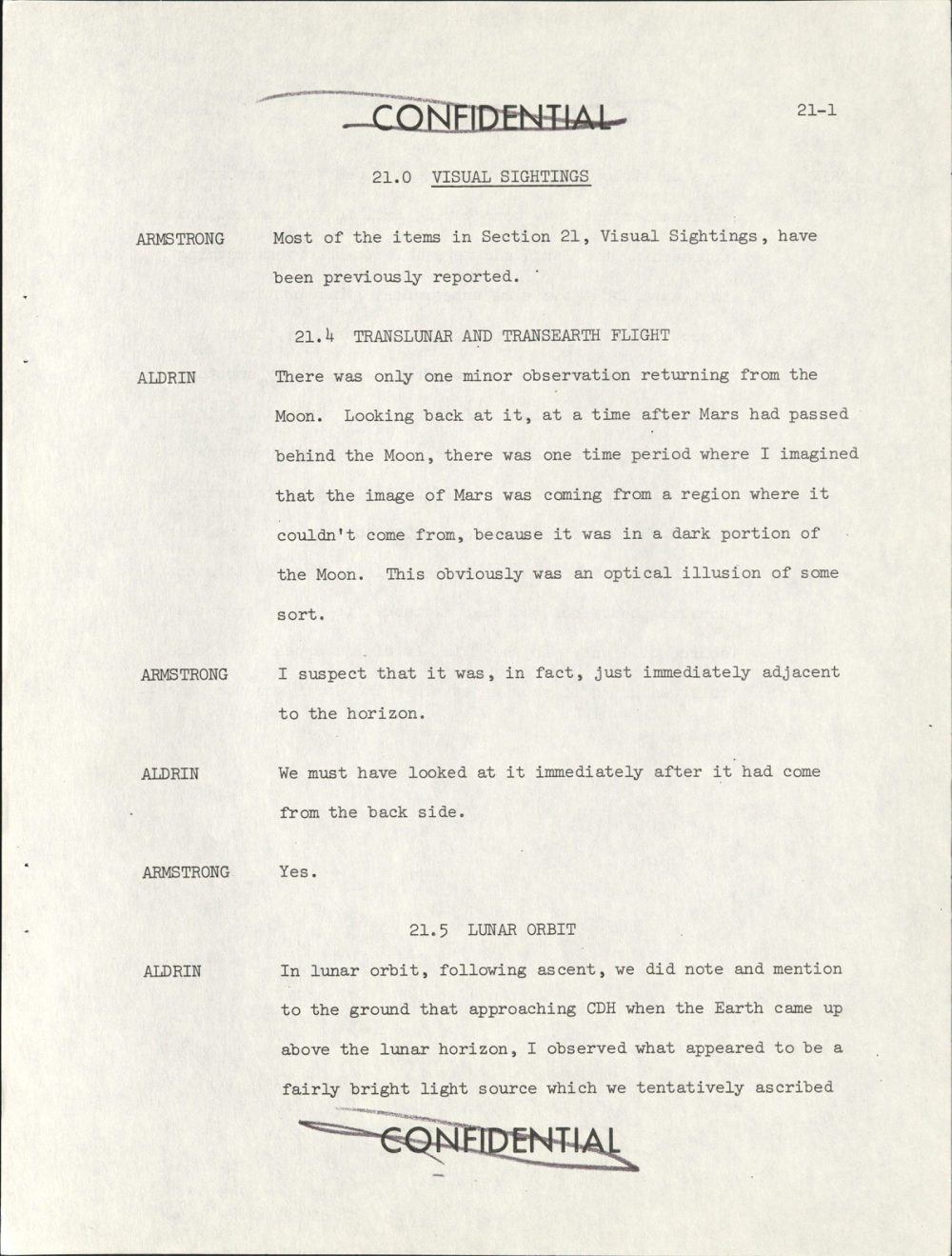
The document contains no photo or drawing of the UFO, and the page does not give the date, time or mission elapsed time of the observation. The distance of 6.000 miles is the information received from control, not a measurement made by the crew. In the same transcript, Aldrin reports the flashes he saw inside the cabin while trying to sleep and, in another section, a bright light seen on Earth; these episodes have their own dossiers.
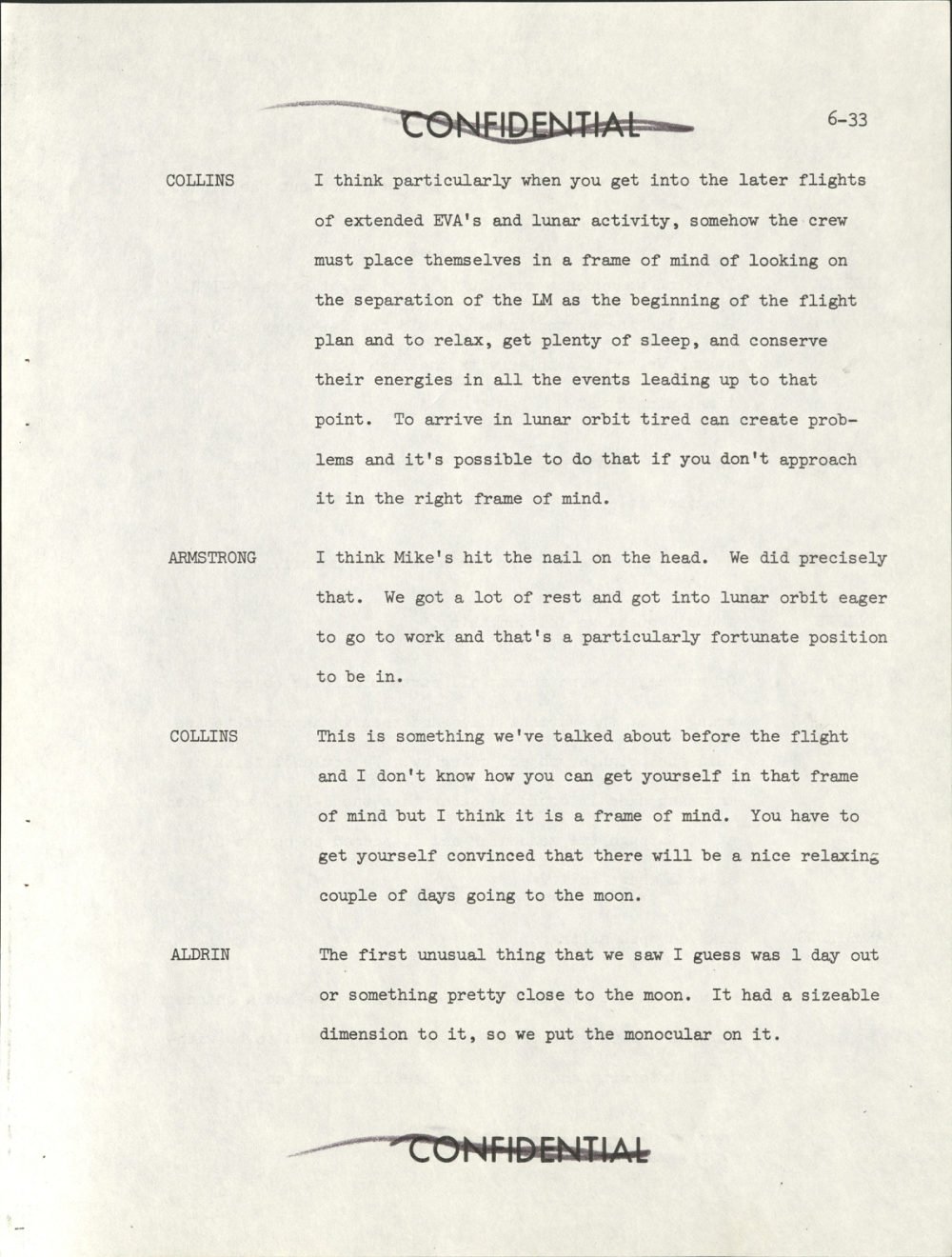
The UFO enters the conversation almost by chance. On page 6-33, Collins talks about crew rest: on subsequent flights, with longer lunar walks, the astronauts should view lunar module separation as the start of the flight plan and arrive in lunar orbit rested. Armstrong agrees and says that is what they did. Collins adds that one has to convince oneself that there will be "a couple of quiet days" of travel. Only then does Aldrin change the subject and recall "the first unusual thing" they saw. The account is therefore part of the evaluation of the outbound trip, and not in a section dedicated to sightings.
The transcript shows the crew looking, within the spacecraft itself, for a cause for the episode. Aldrin asks whether they had not had a problem with the high-gain antenna "about that time". Collins says he felt a jolt, or perhaps imagined it, and Armstrong explains that Aldrin was wondering whether the MESA, the equipment compartment attached to the lunar module, had come loose. Collins concludes that they did not feel anything. The spacecraft was rotating slowly in passive thermal control, the PTC, and for that reason, Aldrin says, each of them had a chance to look; the UFO "certainly seemed" to be in the vicinity and to be of "pretty sizable dimension".
This impression of proximity coexists, in the same conversation, with Armstrong's caveat that the UFO was at the limit of the eye's resolution and that size and distance could not be separated. Aldrin went down to the lower compartment, the LEB, where the optical instruments are, and says they were "grossly misled" by the out-of-focus sextant. Armstrong and Collins disagree even about what they saw: two connected rings, for one; a hollow cylinder that rotated and showed its inside when it was end-on, for the other. The disagreement among three trained observers, looking at the same point through the same instrument, is part of the record.
On the last page, Collins jumps to the end of the mission: when the crew jettisoned the lunar module, they fired an explosive charge to release the docking rings, and pieces came off the module. He suggests the UFO could have been some Mylar, the reflective film covering the module, that had somehow come loose. Aldrin recalls that they thought of a panel, but the shape did not match, and Collins returns to the high-gain antenna. These are the crew's hypotheses, stated without verification. The transcript contains no time, photo or calculation from control to confirm any of them.
The same Senate file that collects correspondence from 1998 contains James Oberg's 1976 essay, which deals with other alleged Apollo 11 "UFO photos": a fragment passing by the window right after the rocket separation, which the author identifies as spacecraft insulation, and luminous points that he attributes to reflections on the lunar module window. None of these cases is the "L"-shaped UFO from the debriefing, and the essay does not cite this conversation. A citizen's compilation, in the same file, attributes to Armstrong statements about craft on the rim of a crater, with no verifiable source; it also does not deal with this episode.
More images from the document
DIRECT READING OF THE FILE
The document, in the original
NASA transcript, a U.S. government work: the decisive exchanges were translated after checking against the facsimile; the conversation about crew rest (p. 2) was summarized.
EXCERPT 1 · PHYSICAL PAGE 1
Physical page 1, full text: cover of volume I of the Apollo 11 technical debriefing, 31/07/1969
Cieriowseny
meer weer
“CONF DENTE D4
; i asl Pgs
NATIONAL AERONAUTICS AND SPACE ADMINISTRATION
APOLLO 1]
TECHNICAL
CREW DEBRIEFING
JULY 31, 1969
f PREPARED BY:
¢ MISSION OPERATIONS BRANCH
FLIGHT CREW SUPPORT DIVISION”
VOL. |
GROUP 4
Downgraded at 3-year
intervals; declassified
after 12 years
This material : United States
within the i
| ; 3 and 794, th
tranabilesioad NOTICE: This document may be exempt from eiaon is :
Prohibited by public disclosure under the Freedom of Infor-
ee mation Act (5 U.S.C. 552). Requests for its re-
‘ tok lease to persons outside the U.S. Government
oe should be handled under the provisions of
fae NASA Policy Directive 1382.2. \
ee CENTER
. tis af
SIGNATOR LOCEditorial note: The notice printed beneath the label is the standard espionage-laws notice (Title 18, sections 793 and 794); only the ends of the lines are visible and they were not completed. In the stamp, the authorization date (6/1/72, that is, June 1, 1972, the effective date of Executive Order 11652) is legible; the date of the change is blurred. The annotation "251 pgs" indicates the length of the complete volume, of which the PDF reproduces only a few pages. The NASA logo and the Manned Spacecraft Center seal appear printed.
Check the original PDF
CONFIDENTIAL [riscado] | 94 [à mão] | 251 pgs [à mão] | NATIONAL AERONAUTICS AND SPACE ADMINISTRATION | APOLLO 11 TECHNICAL CREW DEBRIEFING (U) | JULY 31, 1969 | PREPARED BY: MISSION OPERATIONS BRANCH, FLIGHT CREW SUPPORT DIVISION | VOL. I | GROUP 4 Downgraded at 3-year intervals; declassified after 12 years | [carimbo, preenchido à mão:] CLASSIFICATION CHANGED TO U BY AUTHORITY OF E.O. 11652 6/1/72 DATE [parcialmente legível] [assinatura] | This material [...] within the mea[ning ...] transmission [...] prohibited by [...] United States [...] and 794, the [...] person is [restante encoberto por etiqueta] | [etiqueta colada:] NOTICE: This document may be exempt from public disclosure under the Freedom of Information Act (5 U.S.C. 552). Requests for its release to persons outside the U.S. Government should be handled under the provisions of NASA Policy Directive 1382.2. | [...] CENTER | CONFIDENTIAL [riscado] | INDEXING DATA: DATE 07-31-69 | OPR MSC | # [em branco] | T R | PGM APO | SUBJECT (title) | SIGNATOR MSC | LOC [ilegível]View the document record ↗ · Physical page 1, counting the cover.
EXCERPT 2 · PHYSICAL PAGE 2
Physical page 2 (6-33), excerpt that was missing to complete the page: conversation about the crew's rest
COLLINS
ARMSTRONG
COLLINS
ALDRIN
sane ie
I think particularly when you get into the later flights
of extended EVA's and lunar activity, somehow the crew
must place themselves in a frame of mind of looking on
the separation of the LM as the beginning of the flight
plan and to relax, get plenty of sleep, and conserve
their energies in all the events leading up to that
point. To arrive in lunar orbit tired can create prob-
lems and it's possible to do that if you don't approach
it in the right frame of mind.
I think Mike's hit the nail on the head. We did precisely
that. We got a lot of rest and got into lunar orbit eager
to go to work and that's a particularly fortunate position
to be in.
This is something we've talked about before the flight
and I don't know how you can get yourself in that frame
of mind but I think it is a frame of mind. You have to
get yourself convinced that there will be a nice relaxing
couple of days going to the moon.
The first unusual thing that we saw I guess was 1 day out
or something pretty close to the moon. It had a sizeable
dimension to it, so we put the monocular on it.Editorial note: Together with the block already published (Aldrin's remark at the end of the page), page 6-33 is now translated in full. LM is the lunar module; EVA, extravehicular activity.
Check the original PDF
COLLINS: I think particularly when you get into the later flights of extended EVA's and lunar activity, somehow the crew must place themselves in a frame of mind of looking on the separation of the LM as the beginning of the flight plan and to relax, get plenty of sleep, and conserve their energies in all the events leading up to that point. To arrive in lunar orbit tired can create problems and it's possible to do that if you don't approach it in the right frame of mind. ARMSTRONG: I think Mike's hit the nail on the head. We did precisely that. We got a lot of rest and got into lunar orbit eager to go to work and that's a particularly fortunate position to be in. COLLINS: This is something we've talked about before the flight and I don't know how you can get yourself in that frame of mind but I think it is a frame of mind. You have to get yourself convinced that there will be a nice relaxing couple of days going to the moon. [...]View the document record ↗ · Physical page 2, counting the cover.
EXCERPT 3 · PHYSICAL PAGE 3
Physical page 3 (6-34), excerpts that were missing to complete the page
6-34
COLLINS
ALDRIN
COLLINS
ARMSTRONG
COLLINS
ALDRIN
ARMSTRONG
ALDRIN
How'd we see this thing? Did we just look out the window
and there it was?
Yes, and we weren't sure but what it might be the S-IVB.
We called the ground and were told the S-IVB was 6000 miles
away. We had a problem with the high gain about this
time, didn't we?
There was something. We felt a bump or maybe I just
imagined it.
He was wondering whether the MESA had come off.
I don't guess we felt anything.
Of course, we were seeing all sorts of little objects
going by at the various dumps and then we happened to see
this one brighter object going by. We couldn't think of
anything else it could be other than the S-IVB. We looked
at it through the monocular and it seemed to have a bit
of an L shape to it.
Like an open suitcase.
We were in PTC at the time so each one of us had a chance
to take a look at this and it certainly seemed to be with-
in our vicinity and of a very sizeable dimension.
—OHBERTIALEditorial note: Together with the block already published (Aldrin's answer about the S-IVB and the L shape, and Armstrong's remark), page 6-34 is now translated in full. MESA is the modularized equipment stowage assembly, attached to the descent stage of the lunar module; PTC, passive thermal control, in which the spacecraft rotates slowly.
Check the original PDF
COLLINS: How'd we see this thing? Did we just look out the window and there it was? ALDRIN: [...] We had a problem with the high gain about this time, didn't we? COLLINS: There was something. We felt a bump or maybe I just imagined it. ARMSTRONG: He was wondering whether the MESA had come off. COLLINS: I don't guess we felt anything. [...] ALDRIN: We were in PTC at the time so each one of us had a chance to take a look at this and it certainly seemed to be within our vicinity and of a very sizeable dimension.View the document record ↗ · Physical page 3, counting the cover.
EXCERPT 4 · PHYSICAL PAGE 4
Physical page 4 (6-35), excerpts that were missing to complete the page
ARMSTRONG
ALDRIN
ARMSTRONG
ALDRIN
ARMSTRONG
COLLINS
ALDRIN
— CORADENHAT- =<
We should say that it was right at the limit of the reso-
lution of the eye. It was very difficult to tell just
what shape it was. And there was no way to tell the size
without knowing the range or the range without knowing
the size.
So then I got down in the LEB and started looking for it
in the optics. We were grossly mislead because with the
sextant off focus what we saw appeared to be a cylinder.
Or really two rings.
Yes.
Two rings. Two connected rings.
No, it looked like a hollow cylinder to me. It didn't
look like two connected rings. You could see this thing
tumbling and, when it came around end-on, you could look
right down in its guts. It was a hollow cylinder. But
then you could change the focus on the sextant and it
would be replaced by this open-book shape. It was really
weird.
I guess there's not too much more to say about it other
than it wasn't a cylinder.
TGNEDENTIALEditorial note: Together with the block already published, page 6-35 is now translated in full. "Mislead" appears this way in the original, for "misled". LEB is the lower equipment bay of the command module, where the sextant and the telescope are located.
Check the original PDF
ALDRIN: So then I got down in the LEB and started looking for it in the optics. We were grossly mislead because with the sextant off focus what we saw appeared to be a cylinder. ARMSTRONG: Or really two rings. ALDRIN: Yes. ARMSTRONG: Two rings. Two connected rings. COLLINS: [...] It didn't look like two connected rings. You could see this thing tumbling and, when it came around end-on, you could look right down in its guts. It was a hollow cylinder. [...] ALDRIN: I guess there's not too much more to say about it other than it wasn't a cylinder.View the document record ↗ · Physical page 4, counting the cover.
EXCERPT 5 · PHYSICAL PAGE 5
Physical page 5 (6-36), excerpts that were missing to complete the page
6-36
COLLINS
ALDRIN
COLLINS
It was during the period when we thought it was a cylinder
that we inquired about the S-IVB and we'd almost convinced
ourselves that's what it had to be. But we don't have
any more conclusions than that really. The fact that we
didn't see it much past this one time period — we really
don't have a conclusion as to what it might have been,
how big it was, or how far away it was. It was something
that wasn't part of the urine dump, we're pretty sure of
that.
Skipping ahead a bit, when we jettisoned the LM, you know
we fired an explosive charge and got rid of the docking
rings and the LM went boom. Pieces came off the IM. It
could have been some Mylar or something that had somehow
come loose from the IM.
We thought it could have been a panel, but it didn't
appear to have that shape at all.
That's right, and for some reason, we thought it might
have been a part of the high gain antenna. It might have
been about the time we had high gain antenna problems.
In the back of my mind, I have some reason to suspect that
its origin was from the spacecraft.Editorial note: Together with the block already published, page 6-36 is now translated in full; the sentence interrupted at "this one time period" continues in the passage already published ("we really don't have a conclusion..."). Mylar is the metallized film used in the thermal insulation of the lunar module.
Check the original PDF
COLLINS: It was during the period when we thought it was a cylinder that we inquired about the S-IVB and we'd almost convinced ourselves that's what it had to be. [...] The fact that we didn't see it much past this one time period [...]. Skipping ahead a bit, when we jettisoned the LM, you know we fired an explosive charge and got rid of the docking rings and the LM went boom. Pieces came off the LM. It could have been some Mylar or something that had somehow come loose from the LM. ALDRIN: We thought it could have been a panel, but it didn't appear to have that shape at all. COLLINS: That's right, and for some reason, we thought it might have been a part of the high gain antenna. It might have been about the time we had high gain antenna problems. [...]View the document record ↗ · Physical page 5, counting the cover.
Dates and documentary context
- Event
- 07/1969 — Apollo 11 outbound trip, July 1969. Aldrin places the episode at “a day out or something pretty close to the Moon”; the page gives neither the day nor the mission time.
- Document
- 31/07/1969 — Date on the cover of the technical debriefing, volume I (p. 1).
- Publication
- Not established — Published by NASA in release 1 of the UAP files.
Origin and release
NASA, Mission Operations Branch, Flight Crew Support Division; transcript classified as confidential (Group 4), later declassified · NASA-UAP-D4-Apollo-11-Technical-Crew-Debriefing-1969.pdf
undefined ↗ — undefined
Related accounts and their differences
- Apollo 11, 1969: the flashes Aldrin saw with his eyes closed
- Apollo 11, 1969: the bright light on Earth, “laser” or lake
Questions to continue the investigation
- Do the Apollo 11 onboard recordings or the air-to-ground transcript record the inquiry about the S-IVB and allow the observation to be dated?
- Do the “problems with the high-gain antenna” mentioned by Collins actually coincide with the moment of the sighting?
GEOGRAPHY OF THE CASE
Space, Earth-Moon trajectory
Observation made from the spacecraft in flight between the Earth and the Moon; there is no geographic point to place.
DOCUMENTARY TRAIL
Go back to the sources
References use physical pages of the PDF, counting the cover. Summaries are presented in English; the documents keep their original language.
- NASA-UAP-D4-Apollo-11-Technical-Crew-Debriefing-1969.pdf
Physical page 1: cover of the Apollo 11 technical debriefing, volume I, dated 31/07/1969; pp. 2 to 5 (internal numbering 6-33 to 6-36): conversation about the UFO seen on the way to the Moon
NASA · 11 pages
Editorial summary based on the collection's research notes. How we read the documents.