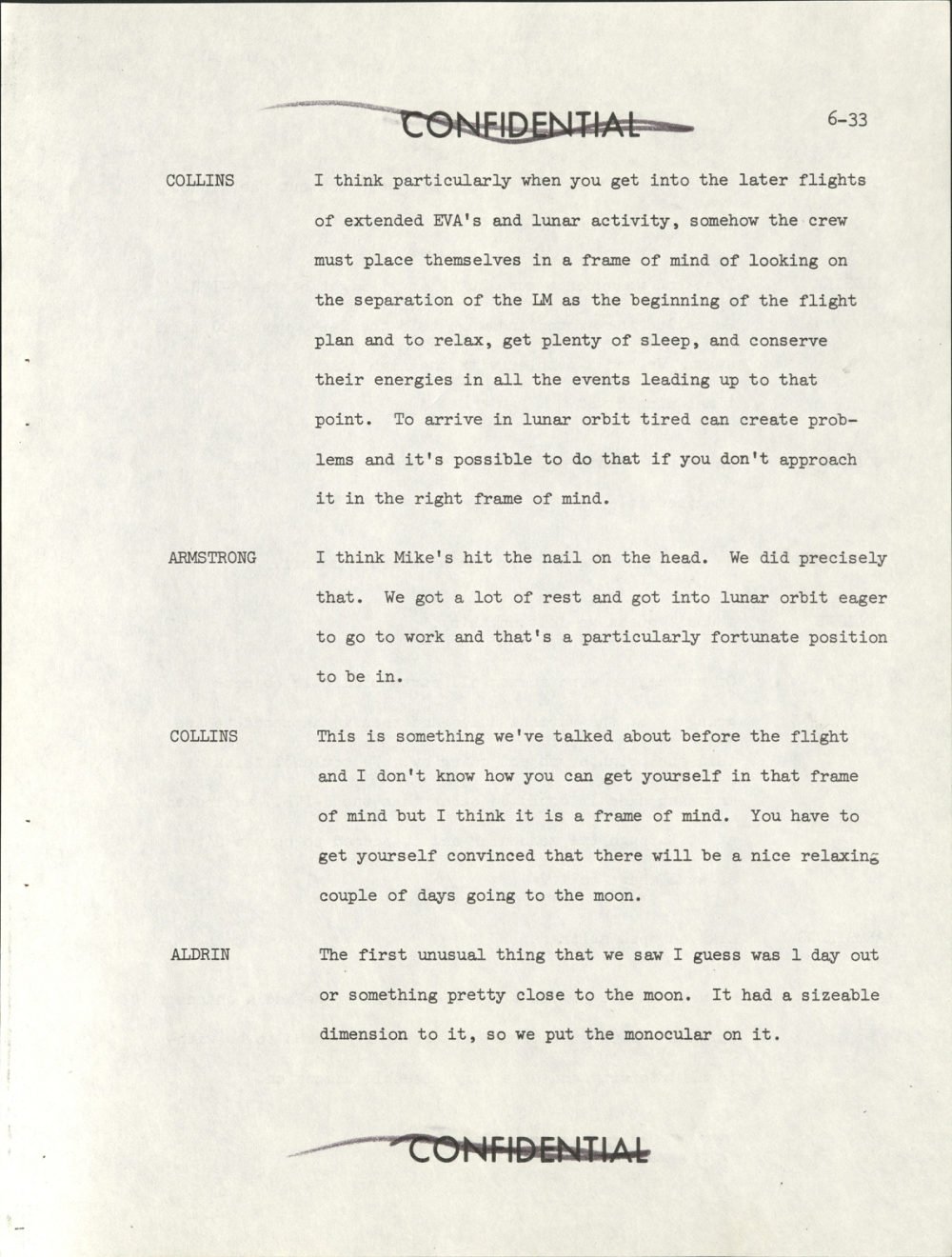
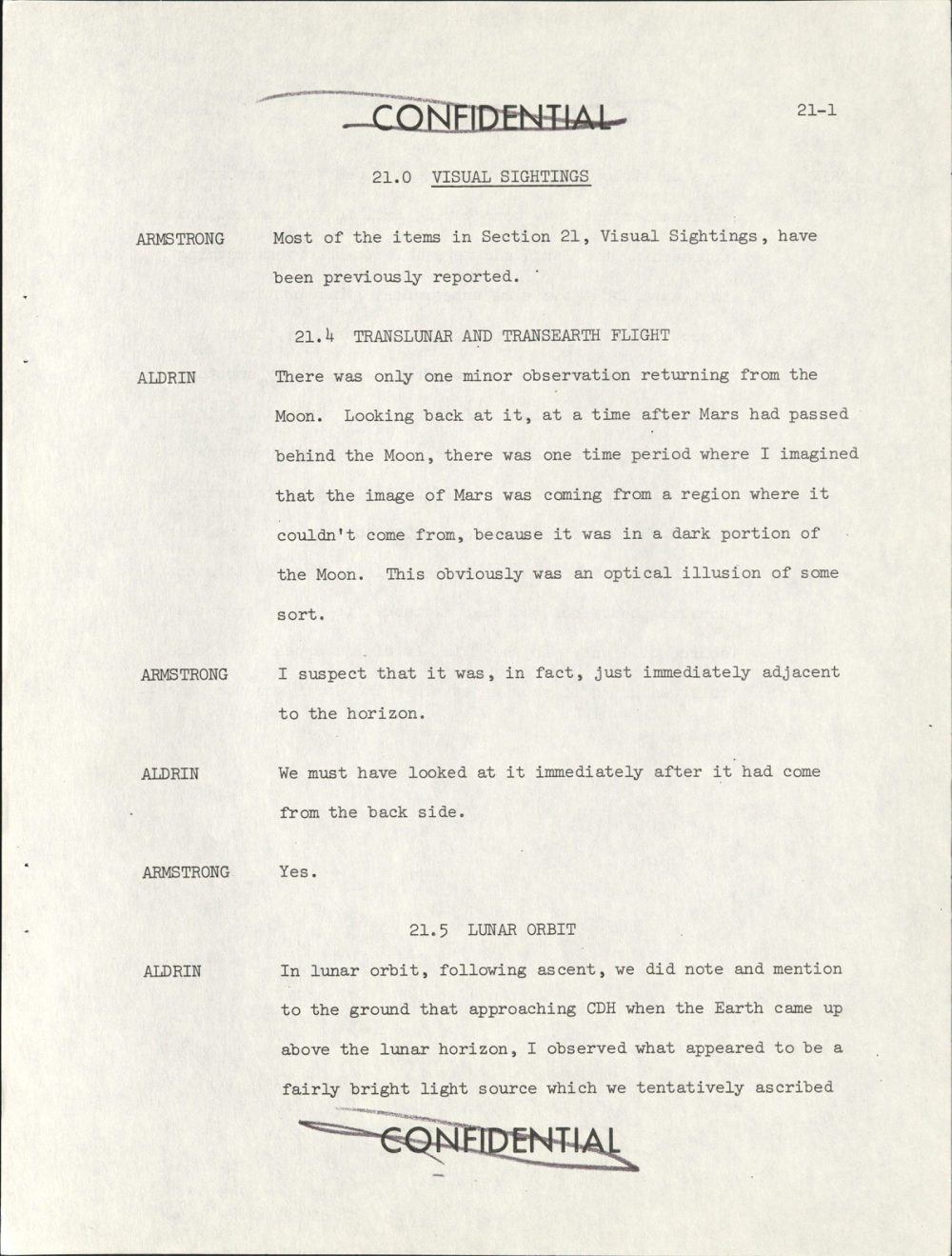
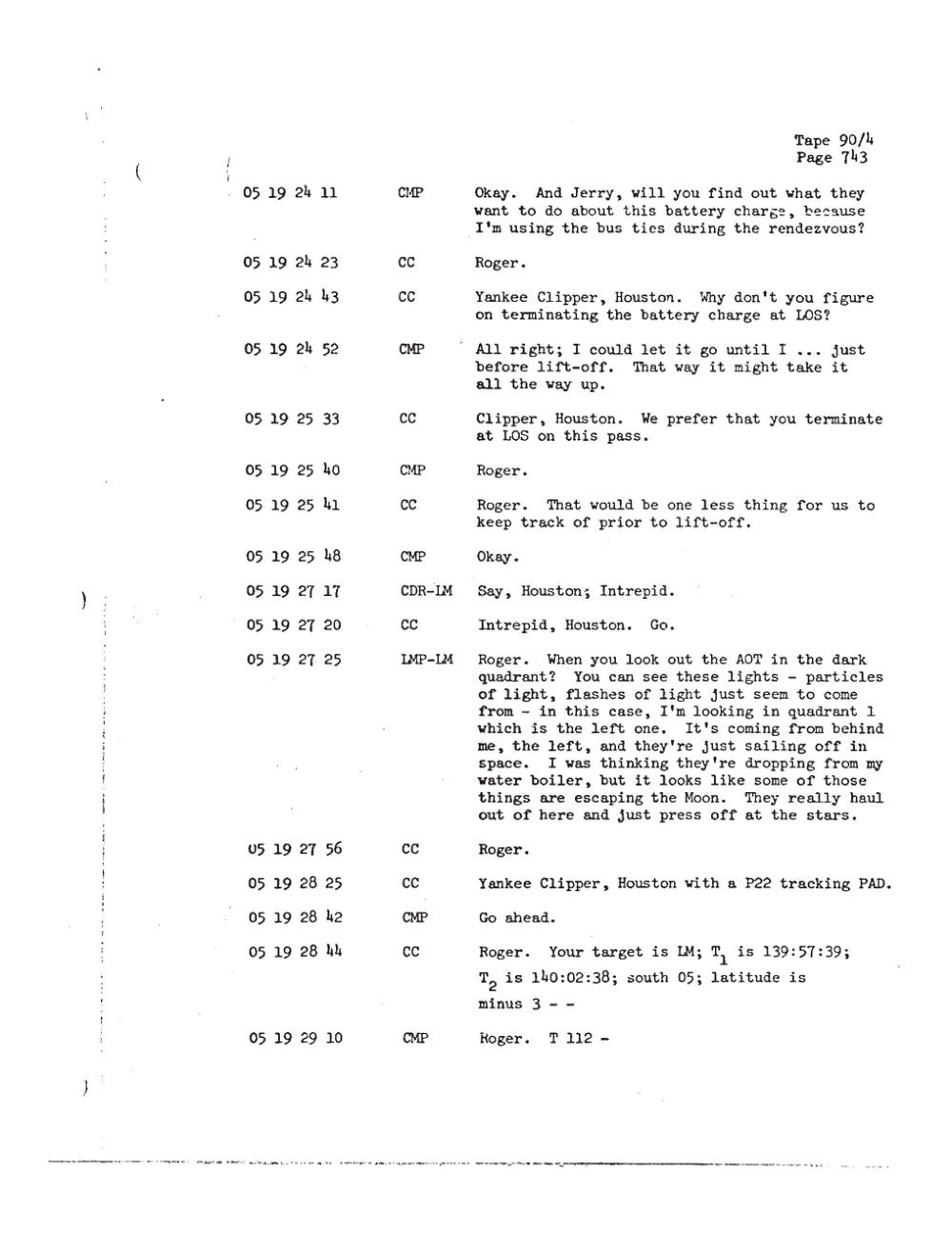
Date: July 1969, from the second night of flight onward and especially on the return from the Moon; debriefing of 31/07/1969Location: Interior of the command module, between the Earth and the Moon
Apollo 11, 1969: the flashes Aldrin saw inside the cabin while trying to sleep
Buzz Aldrin said in the technical debriefing that, with the lights off, he saw small flashes inside the cabin, sometimes double or line-shaped, and ventured that something was penetrating the spacecraft. Armstrong, who only looked for the phenomenon on the last night, said he made about 50 observations in one hour.
- Event date
- July 1969, from the second night of flight onward and especially on the return from the Moon; debriefing of 31/07/1969
- Location
- Interior of the command module, between the Earth and the Moon
- Topic
- Astronaut accounts
- Source agencies
- NASA
- Documents
- 1 document · 11 pages
- Reading time
- 10 min
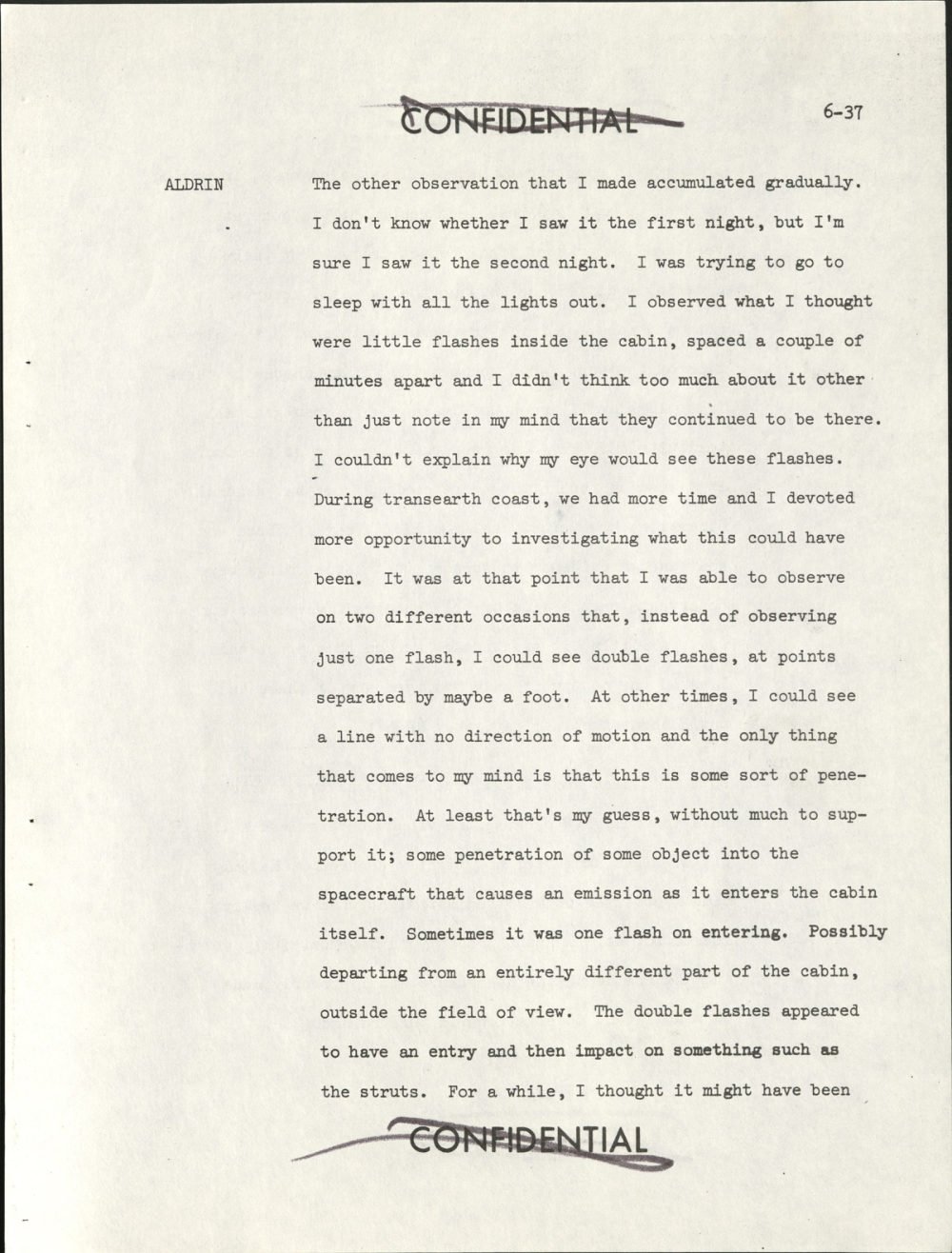 Technical debriefing pagePhysical page 6
DOCUMENTARY SOURCES · NASA
What the records tell
The account is in the same confidential transcript of the Apollo 11 technical debriefing, dated July 31, 1969. Aldrin says the observation “built up gradually”: he does not know whether he saw it on the first night, but he is certain he saw it on the second. Trying to sleep with all the lights off, he noticed what he thought were small flashes inside the cabin, a few minutes apart. He did not pay much attention at first, but noticed that they continued and that he could not explain why his eye was seeing them.
On the return trip, with more free time, he began to observe carefully. On two occasions he saw double flashes, at points about one foot, some 30 centimeters, apart. At other times, he saw a line with no direction of motion. The interpretation he offers is his own and comes with a caveat: “at least that's my guess, without much to back it up”, some kind of penetration of an object into the spacecraft, which would emit light upon entering the cabin. The double flashes looked like an entry followed by an impact on something like the structural struts.
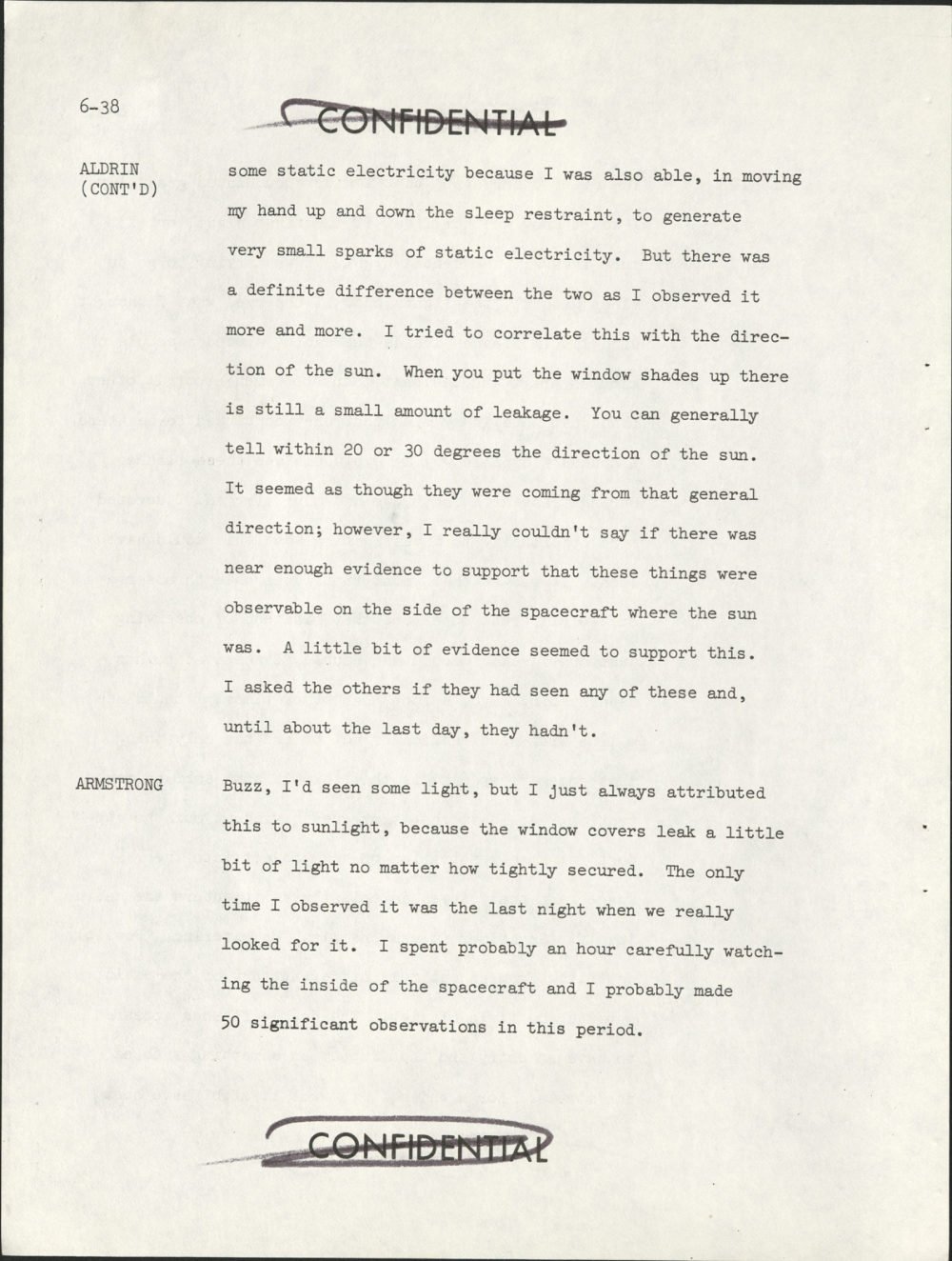
Aldrin also tested a homespun explanation. By rubbing his hand on the sleeping bag, he could produce small sparks of static electricity, but he says there was a clear difference between the two things. He tried to relate the flashes to the direction of the Sun, which could be guessed from the light leaking through the window covers, and found a slight indication that they came from that side, without sufficient evidence. His colleagues, according to him, only saw something similar near the last day.
Armstrong says he had seen some light, but attributed it to the Sun leaking through the covers. On the last night, they looked on purpose: he spent about an hour observing the inside of the spacecraft and says he probably made 50 significant observations. Aldrin adds that sometimes they went a minute or two with nothing and then two flashes came within ten seconds; on average, “just as a guess”, one per minute, enough to convince him it was not an optical illusion. Armstrong suggests it could be a neutron or some other visible atomic particle.
The transcript contains no measurement and no institutional conclusion. According to the official description of recording NASA-UAP-D008, NASA's medical team, upon hearing similar accounts from the Apollo 12 crew, considered whether the phenomena described by Aldrin could be caused by cosmic rays striking the retina; the agency later concluded that the Apollo 12 flashes were internal to the astronauts' vision. Subsequent missions studied the effect with specific experiments, such as the ALFMED on Apollo 17.
In July 2026, NASA also published the recording of the Apollo 14 postmission debriefing, from 1971, divided into two parts, NASA-UAP-D026 and D027, nearly two hours in total. According to the official records, crew members and interviewers discuss the "light flash phenomenon" at the Manned Spacecraft Center in Houston, and the interviewers try to distinguish the characteristics of what was observed. The records describe the effect as biological, new at the time and now well documented: high-energy cosmic rays pass through the eye and strike the retina, producing the perception of streaks or flashes.
With this, the phenomenon Aldrin described in 1969 appears documented in four successive missions in the same collection: on Apollo 11, through the transcript; on Apollo 12, through the audio of the medical debriefing (D008); on Apollo 14, through these two recordings; and on Apollo 17, through the transcript and the medical debriefing (D028 and D029). Skylab 2, in 1973, also recorded the flashes, with descriptions of streaks that "went in and out" of the eye. The recordings are in English, and the content summarized here follows the official records, not a full transcript.
The account of the flashes occupies pages 6-37 to 6-39 of volume I of the technical debriefing, right after the conversation about the "L"-shaped UFO. Aldrin opens the subject as "the other observation" he made and that "built up gradually". The complete volume had 251 pages, according to a handwritten note on the cover; the published file reproduces only the cover and the seven pages dealing with the two episodes. The cover bears the marking "Confidential", Group 4, and a later stamp changing the classification to "U", unclassified, on the basis of Executive Order 11652.
All the numbers in the transcript are the astronauts' own estimates, without instruments. Aldrin speaks of flashes spaced "a few minutes" apart on the second night, of double flashes about one foot, some 30 centimeters, apart, and of an average, "just as a guess", of one per minute, sometimes two within ten seconds. Armstrong says he spent "probably an hour" observing the inside of the spacecraft on the last night and made "probably 50" significant observations. These are numbers from memory, stated one week after landing, and serve as an order of magnitude.
Before proposing any explanation, Aldrin ruled out two. The first was static electricity: by rubbing his hand on the sleeping bag, he produced small sparks, but he says that, on further observation, there was "a clear difference" between the two things. The second was sunlight leaking through the window covers, which makes it possible to tell the direction of the Sun within 20 or 30 degrees. The flashes seemed to come more or less from that side, but he himself says the evidence was slight. Armstrong says he had seen some light and had always attributed it to that leak, until he looked for the phenomenon on purpose.
The two physical hypotheses in the document are the astronauts', and both come with caveats. Aldrin imagined "some sort of penetration": something would enter the spacecraft and emit light as it crossed the cabin, and in the double flashes there would be an entry and then an impact against the structural struts. Armstrong suggested "a neutron or some sort of atomic particle" that showed up in the visible spectrum. Neither is an institutional conclusion. Aldrin sums up the feeling in one sentence: it gave "a rather eerie sensation" to think that something was passing through the cabin with nothing that could be done about it.
OFFICIAL MEDIA
Official videos for this case
Files published by the United States Government on DVIDS. The title of each one is that of the official publication, translated; the description of what is seen is in the dossier text.
NASA debriefing recording · 7 min 50 s · the video only loads when you start playback, directly from the official server.
Official record ↗
NASA debriefing recording · 1 h 36 min · the video only loads when you start playback, directly from the official server.
Official record ↗
NASA debriefing recording · 32 min 06 s · the video only loads when you start playback, directly from the official server.
Official record ↗More images from the document
DIRECT READING OF THE FILE
The document, in the original
NASA transcript, a U.S. government work: Aldrin's account and Armstrong's comments translated after checking against the facsimile.
EXCERPT 1 · PHYSICAL PAGE 8
Frequency and particle, physical page 8 (6-39)
ALDRIN
ARMSTRONG
~ COREIDENTIAT~ =
Sometimes a minute or two would go by and then you'd see
the two within the space of 10 seconds. On an average,
I'd say just as a guess it was maybe something like one
a minute. Certainly more than enough to convince you
that it wasn't an optical illusion. It did give you a
rather funny feeling to contemplate that something was
zapping through the cabin. There wasn't anything you
could do about it.
It could be something like Buzz suggested. Mainly a
neutron or some kind of an atomic particle that would
be in the visible spectrum.Editorial note: The first remark is Aldrin's and the second is Armstrong's.
Check the original PDF
On an average, I'd say just as a guess it was maybe something like one a minute. Certainly more than enough to convince you that it wasn't an optical illusion. [...] / It could be something like Buzz suggested. Mainly a neutron or some kind of an atomic particle that would be in the visible spectrum.View the document record ↗ · Physical page 8, counting the cover.
EXCERPT 2 · PHYSICAL PAGE 1
Physical page 1, full text: cover of volume I of the Apollo 11 technical debriefing, 31/07/1969
Cieriowseny
meer weer
“CONF DENTE D4
; i asl Pgs
NATIONAL AERONAUTICS AND SPACE ADMINISTRATION
APOLLO 1]
TECHNICAL
CREW DEBRIEFING
JULY 31, 1969
f PREPARED BY:
¢ MISSION OPERATIONS BRANCH
FLIGHT CREW SUPPORT DIVISION”
VOL. |
GROUP 4
Downgraded at 3-year
intervals; declassified
after 12 years
This material : United States
within the i
| ; 3 and 794, th
tranabilesioad NOTICE: This document may be exempt from eiaon is :
Prohibited by public disclosure under the Freedom of Infor-
ee mation Act (5 U.S.C. 552). Requests for its re-
‘ tok lease to persons outside the U.S. Government
oe should be handled under the provisions of
fae NASA Policy Directive 1382.2. \
ee CENTER
. tis af
SIGNATOR LOCEditorial note: The notice printed beneath the label is the standard espionage-laws notice (Title 18, sections 793 and 794); only the ends of the lines are visible and they were not completed. In the stamp, the authorization date (6/1/72, that is, June 1, 1972, the effective date of Executive Order 11652) is legible; the date of the change is blurred. The annotation "251 pgs" indicates the length of the complete volume, of which the PDF reproduces only a few pages. The NASA logo and the Manned Spacecraft Center seal appear printed.
Check the original PDF
CONFIDENTIAL [riscado] | 94 [à mão] | 251 pgs [à mão] | NATIONAL AERONAUTICS AND SPACE ADMINISTRATION | APOLLO 11 TECHNICAL CREW DEBRIEFING (U) | JULY 31, 1969 | PREPARED BY: MISSION OPERATIONS BRANCH, FLIGHT CREW SUPPORT DIVISION | VOL. I | GROUP 4 Downgraded at 3-year intervals; declassified after 12 years | [carimbo, preenchido à mão:] CLASSIFICATION CHANGED TO U BY AUTHORITY OF E.O. 11652 6/1/72 DATE [parcialmente legível] [assinatura] | This material [...] within the mea[ning ...] transmission [...] prohibited by [...] United States [...] and 794, the [...] person is [restante encoberto por etiqueta] | [etiqueta colada:] NOTICE: This document may be exempt from public disclosure under the Freedom of Information Act (5 U.S.C. 552). Requests for its release to persons outside the U.S. Government should be handled under the provisions of NASA Policy Directive 1382.2. | [...] CENTER | CONFIDENTIAL [riscado] | INDEXING DATA: DATE 07-31-69 | OPR MSC | # [em branco] | T R | PGM APO | SUBJECT (title) | SIGNATOR MSC | LOC [ilegível]View the document record ↗ · Physical page 1, counting the cover.
EXCERPT 3 · PHYSICAL PAGE 6
Physical page 6 (6-37), excerpts that were missing to complete the page: start of the account, return trip and the struts hypothesis
“CONEDENT At a4
The other observation that I made accumulated gradually.
I don't know whether I saw it the first night, but I'm
sure I saw it the second night. I was trying to go to
sleep with all the lights out. I observed what I thought
were little flashes inside the cabin, spaced a couple of
minutes apart and I didn't think too much about it other
than just note in my mind that they continued to be there.
I couldn't explain why my eye would see these flashes.
Dae transearth coast, we had more time and I devoted
more opportunity to investigating what this could have
been. It was at that point that I was able to observe
on two different occasions that, instead of observing
just one flash, I could see double flashes, at points
separated by maybe a foot. At other times, I could see
a line with no direction of motion and the only thing
that comes to my mind is that this is some sort of pene-
« tration. At least that's my guess, without much to sup-
port it; some penetration of some object into the
spacecraft that causes an emission as it enters the cabin
itself. Sometimes it was one flash on entering. Possibly
departing from an entirely different part of the cabin,
outside the field of view. The double flashes appeared
to have an entry and then impact on something such as |
the struts. For a while, I thought it might have been
_— “EG NABENTIALEditorial note: Together with the two blocks already published for this page, page 6-37 is now translated in full; the [...] mark the passages already translated. The sentence ends on the following page.
Check the original PDF
ALDRIN: The other observation that I made accumulated gradually. I don't know whether I saw it the first night, but I'm sure I saw it the second night. [...] and I didn't think too much about it other than just note in my mind that they continued to be there. [...] During transearth coast, we had more time and I devoted more opportunity to investigating what this could have been. It was at that point that I was able to observe on two different occasions that, instead of observing just one flash, I could see double flashes, at points separated by maybe a foot. [...] Sometimes it was one flash on entering. Possibly departing from an entirely different part of the cabin, outside the field of view. The double flashes appeared to have an entry and then impact on something such as the struts. For a while, I thought it might have beenView the document record ↗ · Physical page 6, counting the cover.
EXCERPT 4 · PHYSICAL PAGE 7
Physical page 7 (6-38), excerpts that were missing to complete the page: static, direction of the Sun and start of Armstrong's remarks
6-38
ALDRIN
(CONT'D)
ARMSTRONG
some static electricity because I was also able, in moving
my hand up and down the sleep restraint, to generate
very small sparks of static electricity. But there was
a definite difference between the two as I observed it
more and more. I tried to correlate this with the direc-
tion of the sun. When you put the window shades up there
is still a small amount of leakage. You can generally
tell within 20 or 30 degrees the direction of the sun.
It seemed as though they were coming from that general
direction; however, I really couldn't say if there was
near enough evidence to support that these things were
observable on the side of the spacecraft where the sun
was. A little bit of evidence seemed to support this.
I asked the others if they had seen any of these and,
until about the last day, they hadn't.
Buzz, I'd seen some light, but I just always attributed
this to sunlight, because the window covers leak a little
bit of light no matter how tightly secured. The only
time I observed it was the last night when we really
looked for it. I spent probably an hour carefully watch-
ing the inside of the spacecraft and I probably made
90 significant observations in this period.Editorial note: Together with the block already published (Armstrong's last two sentences), page 6-38 is now translated in full. The image reads "50 significant observations"; the translation already published, with 50, is correct.
Check the original PDF
ALDRIN (CONT'D): some static electricity because I was also able, in moving my hand up and down the sleep restraint, to generate very small sparks of static electricity. But there was a definite difference between the two as I observed it more and more. I tried to correlate this with the direction of the sun. When you put the window shades up there is still a small amount of leakage. You can generally tell within 20 or 30 degrees the direction of the sun. It seemed as though they were coming from that general direction; however, I really couldn't say if there was near enough evidence to support that these things were observable on the side of the spacecraft where the sun was. A little bit of evidence seemed to support this. I asked the others if they had seen any of these and, until about the last day, they hadn't. ARMSTRONG: Buzz, I'd seen some light, but I just always attributed this to sunlight, because the window covers leak a little bit of light no matter how tightly secured. [...]View the document record ↗ · Physical page 7, counting the cover.
Dates and documentary context
- Event
- 07/1969 — From the second night of flight until the eve of the return, July 1969; the transcript gives no exact dates.
- Document
- 31/07/1969 — Date on the cover of the technical debriefing, volume I (p. 1).
- Publication
- Not established — Published by NASA in release 1 of the UAP files.
Origin and release
NASA, Mission Operations Branch, Flight Crew Support Division; transcript classified as confidential (Group 4), later declassified · NASA-UAP-D4-Apollo-11-Technical-Crew-Debriefing-1969.pdf
undefined ↗ — undefined
Related accounts and their differences
- Apollo 11, 1969: the “L”-shaped object seen on the way to the Moon
- Friendship 7, 1962: John Glenn's “fireflies”
Questions to continue the investigation
- Do the Apollo 11 medical reports record the phenomenon before it was discussed with the Apollo 12 crew?
- Is there an official recording of the Apollo 11 debriefing containing this excerpt in the published collection?
GEOGRAPHY OF THE CASE
Inside the spacecraft, Earth-Moon trajectory
Phenomenon perceived inside the cabin, in flight; there is no geographic point to place.
DOCUMENTARY TRAIL
Go back to the sources
References use physical pages of the PDF, counting the cover. Summaries are presented in English; the documents keep their original language.
- NASA-UAP-D4-Apollo-11-Technical-Crew-Debriefing-1969.pdf
Physical pages 6 to 8 (internal numbering 6-37 to 6-39): Aldrin and Armstrong describe flashes inside the cabin; p. 1: cover dated 31/07/1969
NASA · 11 pages
Editorial summary based on the collection's research notes. How we read the documents.