Date: September 1973, about a week before the end of the mission; debriefing of 04/10/1973Location: Earth orbit, seen from the window of the Skylab station
Skylab 3, 1973: the red, rotating UFO that accompanied the station for ten minutes
In the debriefing of the second Skylab crew, Owen Garriott, Jack Lousma and Alan Bean describe a reddish UFO, brighter than Jupiter, that varied in brightness every 10 seconds and followed the station for about ten minutes. To them it was a satellite in a very similar orbit, but no one told them which one, and Garriott asked for the identification.
- Event date
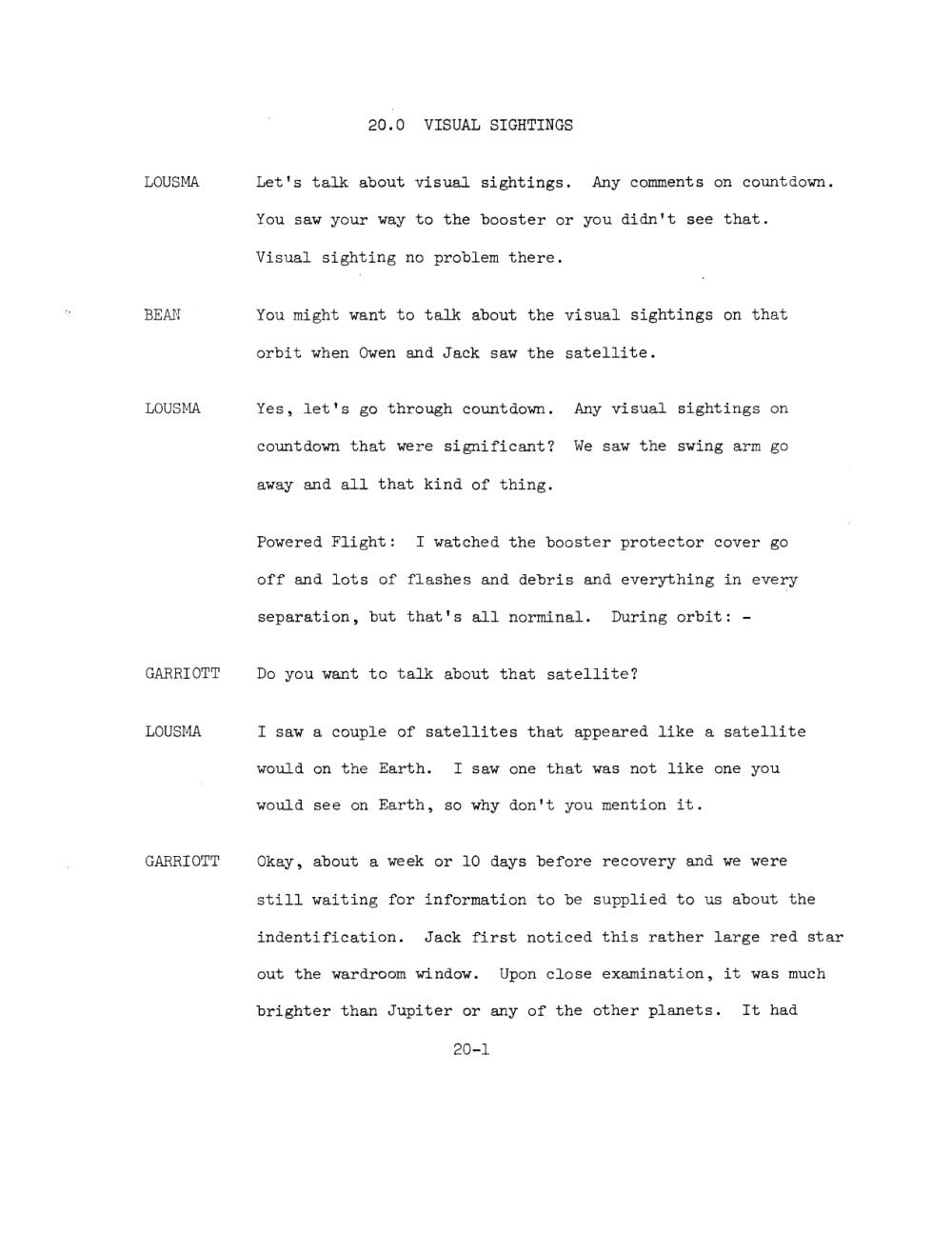
- September 1973, about a week before the end of the mission; debriefing of 04/10/1973
- Location
- Earth orbit, seen from the window of the Skylab station
- Topic
- Astronaut accounts
- Source agencies
- NASA · USG
- Documents
- 2 documents · 97 pages
- Reading time
- 10 min
 Technical debriefing pagePhysical page 5
DOCUMENTARY SOURCES · NASA / USG
What the records tell
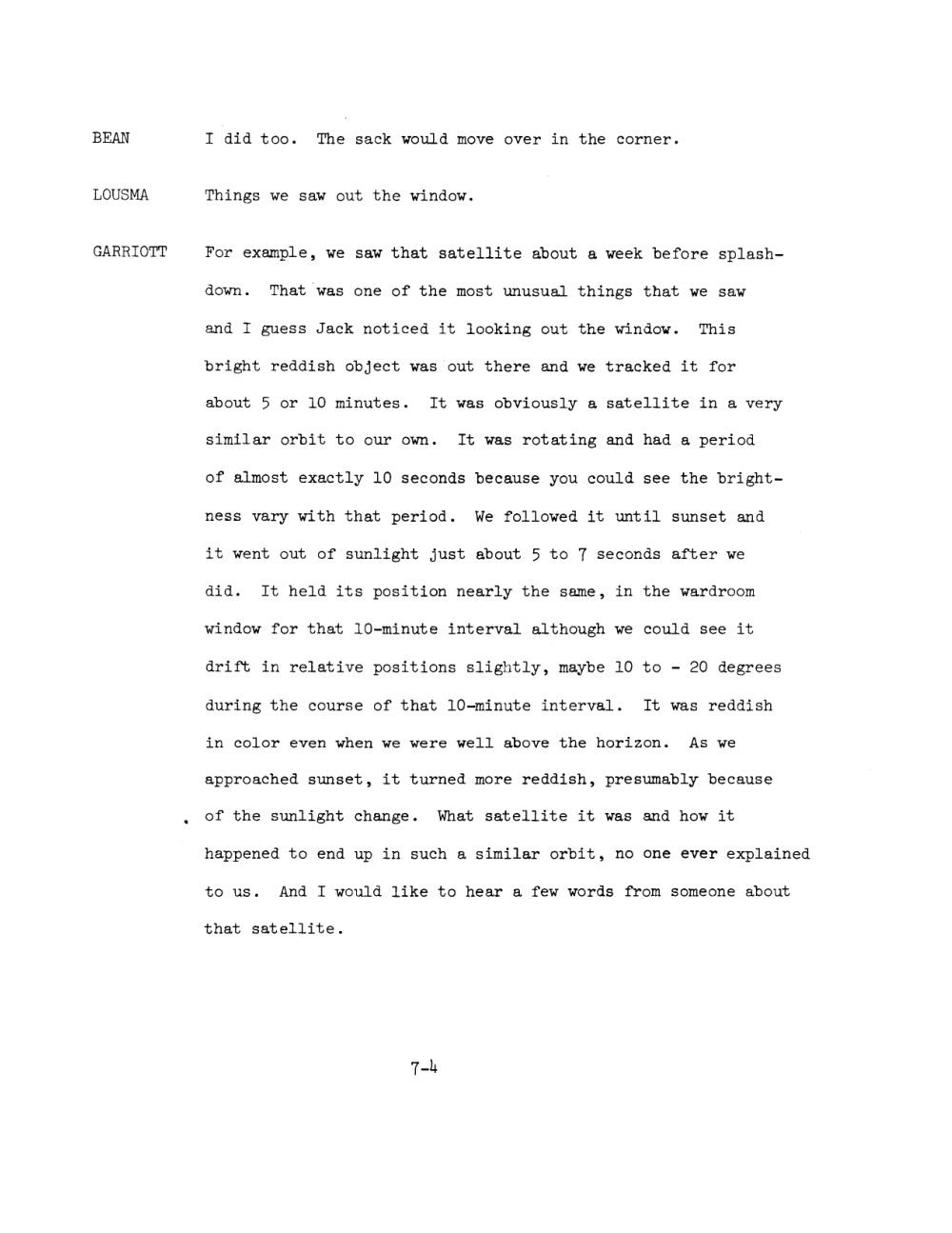
The second Skylab crew, with Alan Bean, Owen Garriott and Jack Lousma, spent July to September 1973 on the American space station. The technical debriefing, dated October 4, 1973, deals with the object in two places: in a conversation about what they saw through the window and in the formal section on visual sightings. Garriott calls it “one of the most unusual things we saw.” It was Lousma who noticed it through the wardroom window, about a week before splashdown.
Garriott describes a reddish, bright object, followed for five to ten minutes. In the sightings section, he details: it looked like a very large red star, much brighter than Jupiter or any planet, and reddish even well above the horizon, when sunlight was not grazing the edge of the Earth. The brightness varied with a period of almost exactly 10 seconds, which he interpreted as rotation. It became redder near sunset.
The data point Garriott uses to estimate the distance is the moment the light went out. The station entered the Earth's shadow and the object went dark about five seconds later. From this delay of 5 to 10 seconds, the crew deduced that it was no more than 30 to 50 nautical miles away, about 55 to 90 kilometers. During the ten minutes of observation, it moved only 10 to 20 degrees in the window, which indicated an orbit very close to theirs.
Lousma adds that the object never took shape; it was always a point of light, brighter than any star or planet. Bean says they tried the monitors and “everything else,” without being able to make it into anything more than a bright light, and that they never saw it again. Lousma says he saw other satellites during an experiment, but as points just like stars; that one, according to him, “was not like one you see from the Earth.”
The crew did not doubt that it was a satellite. The question was which one: “what satellite it was and how it got into such a similar orbit, nobody ever explained to us,” says Garriott, who asks for the identification and states that the time and location are on the onboard recordings. The document contains no answer. In the same section, Lousma recalls that a glow of “thousands and thousands of stars” at sunrise or sunset led them to discover a leak in the spacecraft's control system.
The formal sightings section contains a detail that the earlier conversation did not have. Garriott says the object appeared "a week or 10 days before recovery," when the crew "was still waiting" to be given information on the identification. The sentence indicates that the astronauts had already taken the question to the ground during the mission itself. As of the debriefing date, October 4, 1973, the answer had still not arrived, and Garriott repeats the request, noting that the time and position were recorded on onboard channel A.
Garriott's two descriptions agree on the essentials: reddish color even far from the horizon, brightness greater than Jupiter's, brightness variation every 10 seconds, about 10 minutes of observation and movement of 10 to 20 degrees in the window. They differ on one number. In the conversation, the object leaves the sunlight "about 5 to 7 seconds" after the station; in the formal section, "about 5 seconds" after, and the distance calculation uses a delay "of 5 to 10 seconds." The distance of 30 to 50 nautical miles is a deduction by the crew from this delay, not a measurement.
The episode appears twice because the debriefing followed a script organized by topic. In section 7, the object comes up in a loose conversation about life on board: it enters right after a comment about the sleeping bag that kept ending up in the corner and leaves when Bean moves on to the onboard alarms and recommends to the next crew, Gerald Carr's, not to rush to the panel at every alarm. In section 20, devoted to visual sightings, it is Bean himself who reminds his colleagues to talk about the satellite seen by Garriott and Lousma, even before the launch is discussed.
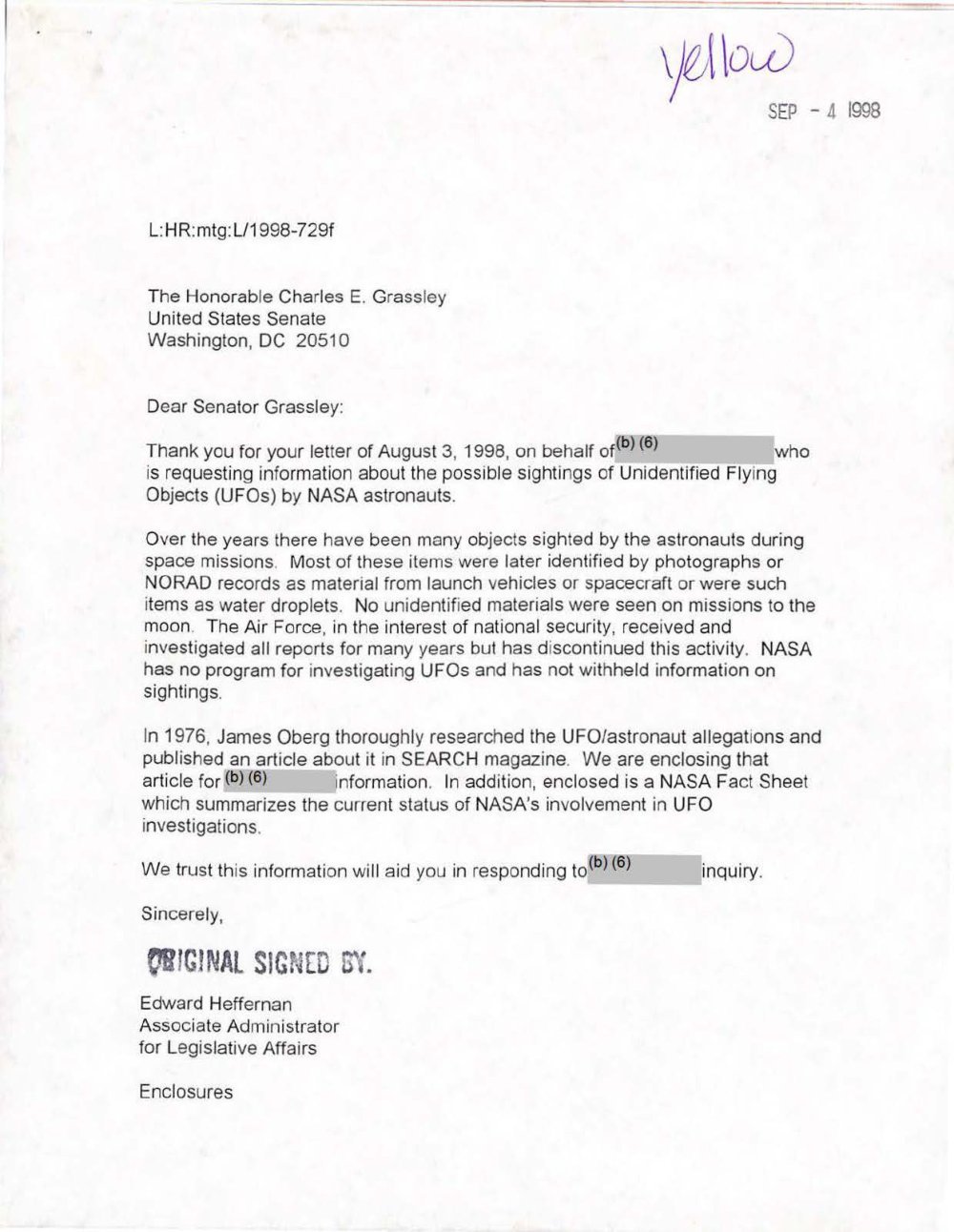
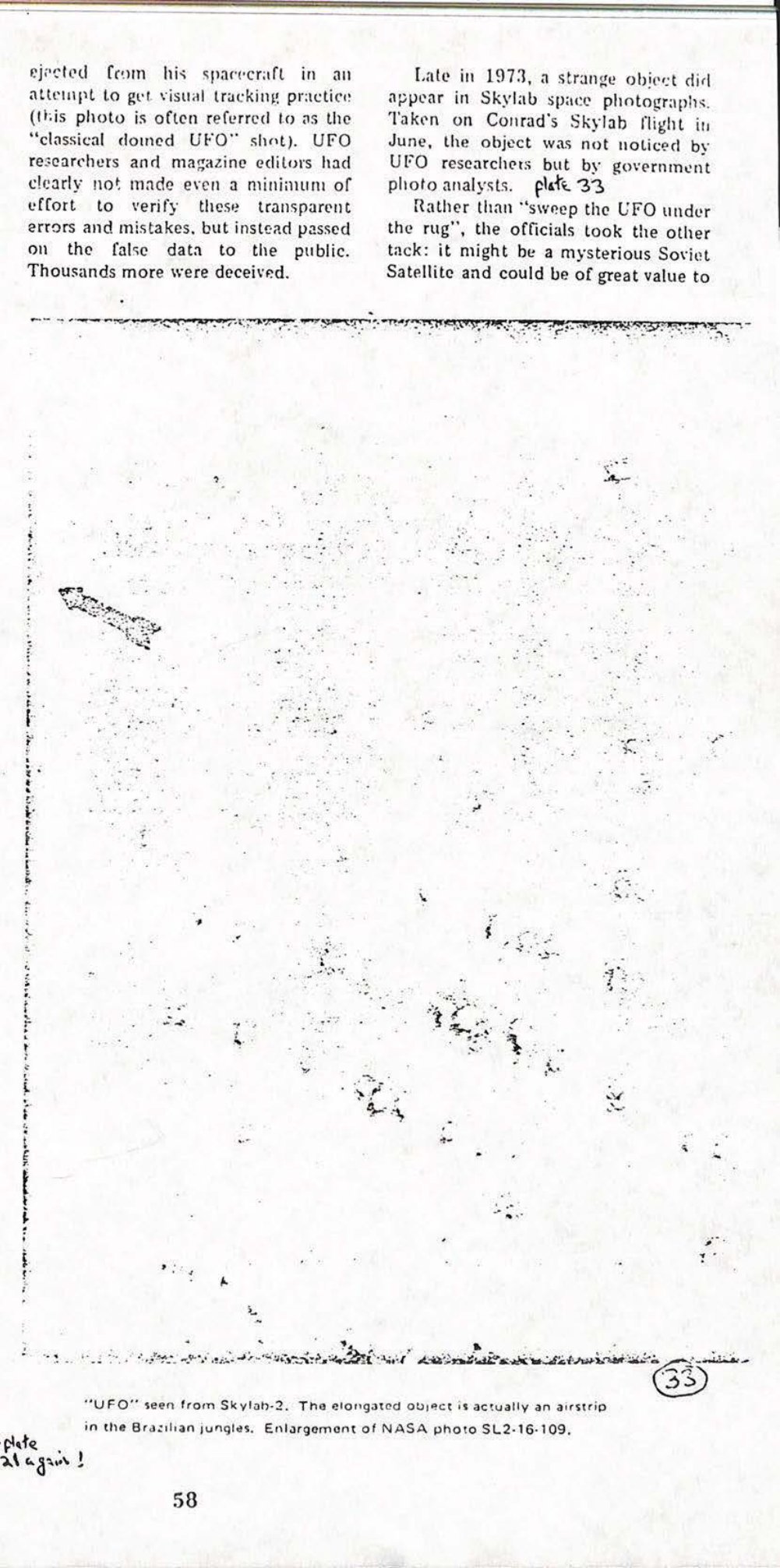
In the same section, the crew shows how it sorted out what it saw. The launch had flashes and debris at each rocket separation, considered normal. The sight of "thousands and thousands of stars" drifting past the window, at a sunrise or sunset, on the other hand, led the astronauts to discover a leak in the command module thrusters, and something similar had been seen right after reaching orbit. In a 1976 essay, James Oberg states that a rescue spacecraft was nearly sent to Skylab 3 because of the fuel droplets observed by the crew.
More images from the document
DIRECT READING OF THE FILE
The document, in the original
NASA transcript, a work of the U.S. government: Garriott's two descriptions and the comments by Bean and Lousma were translated after checking against the facsimile; the passages about alarms were omitted.
EXCERPT 1 · PHYSICAL PAGE 4
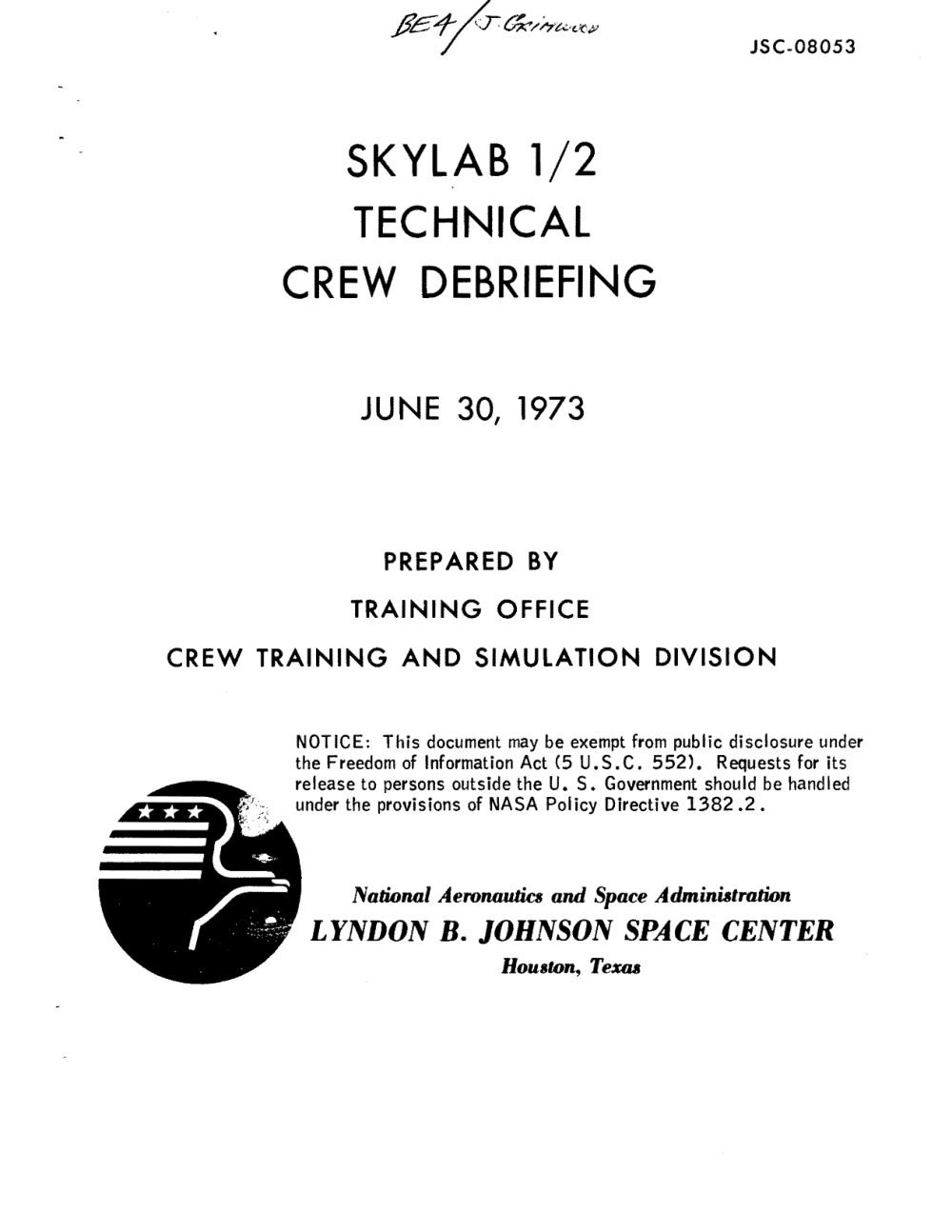
Cover of the Skylab 1/3 technical debriefing, physical page 4, full text
JSC-08478
SKYLAB 1/3
TECHNICAL
CREW DEBRIEFING
PREPARED BY
TRAINING OFFICE
CREW TRAINING AND SIMULATION DIVISION
NOTICE: This document may be exempt from public disclosure
under the Freedom of Information Act (5 U. S .C. 552). Requests
for its release to persons outside the U.S. Government shou Id be
handled under the provisions of NASA Policy Directive 1382 .2.
National Aeronautics and Space Administration
LYNDON B. JOHNSON SPACE CENTER
Houston, Texa,s
OCTOBER 4, 1973Editorial note: "Skylab 1/3" designates the second crew (Skylab 3 mission) on the station launched as Skylab 1. The cover bears the NASA emblem.
Check the original PDF
JSC-08478
SKYLAB 1/3
TECHNICAL CREW DEBRIEFING
PREPARED BY
TRAINING OFFICE
CREW TRAINING AND SIMULATION DIVISION
NOTICE: This document may be exempt from public disclosure under the Freedom of Information Act (5 U.S.C. 552). Requests for its release to persons outside the U.S. Government should be handled under the provisions of NASA Policy Directive 1382.2.
National Aeronautics and Space Administration
LYNDON B. JOHNSON SPACE CENTER
Houston, Texas
OCTOBER 4, 1973View the document record ↗ · Physical page 4, counting the cover.
EXCERPT 2 · PHYSICAL PAGE 5
Physical page 5 (internal numbering 7-4), full text
BEAN
LOUSMA
GARRIOTT
I did too. The sack would move over in the corner.
Things we saw out the window.
For example, we saw that satellite about a week before splash
down. That was one of the most unusual things that we saw
and I guess Jack noticed it looking out the window. This
bright reddish object was out there and we tracked it for
about 5 or 10 minutes. It was obviously a satellite in a very
similar orbit to our own. It was rotating and had a period
of almost exactly 10 seconds because you could see the bright
ness vary with that period. We followed it until sunset and
it went out of sunlight just about 5 to 7 seconds after we
did. It held its position nearly the same, in the wardroom
window for that 10-minute interval although we could see it
drift in relative positions slightly, maybe 10 to - 20 degrees
during the course of that 10-minute interval. It was reddish
in color even when we were well above the horizon. As we
approached sunset, it turned more reddish, presumably because
. of the sunlight change. What satellite it was and how it
happened to end up in such a similar orbit, no one ever explained
to us. And I would like to hear a few words from someone about
that satellite.
7-4Editorial note: Bean's first statement closes an earlier subject, about sleeping, that is not in the PDF; "sack" is slang for the sleeping bag. "Wardroom" is the station's dining room. "Jack" is Jack Lousma. The original has "10 to - 20 degrees". This translation of the full page includes the already published excerpt of Garriott's statement.
Check the original PDF
BEAN: I did too. The sack would move over in the corner.
LOUSMA: Things we saw out the window.
GARRIOTT: For example, we saw that satellite about a week before splashdown. That was one of the most unusual things that we saw and I guess Jack noticed it looking out the window. This bright reddish object was out there and we tracked it for about 5 or 10 minutes. It was obviously a satellite in a very similar orbit to our own. It was rotating and had a period of almost exactly 10 seconds because you could see the brightness vary with that period. We followed it until sunset and it went out of sunlight just about 5 to 7 seconds after we did. It held its position nearly the same, in the wardroom window for that 10-minute interval although we could see it drift in relative positions slightly, maybe 10 to - 20 degrees during the course of that 10-minute interval. It was reddish in color even when we were well above the horizon. As we approached sunset, it turned more reddish, presumably because of the sunlight change. What satellite it was and how it happened to end up in such a similar orbit, no one ever explained to us. And I would like to hear a few words from someone about that satellite.
7-4View the document record ↗ · Physical page 5, counting the cover.
EXCERPT 3 · PHYSICAL PAGE 6
Physical page 6 (internal numbering 7-5), full text
BEAN You bet. We never saw it again. You'd think we would have
seen it the next night or it would cycle by another time.
Maybe it did and we weren't looking out the window.
LOUSMA You might point out that it never did take the shape of an
object but it was always brighter than any other star or
planet in the night sky. It was much brighter.
BEAN We tried monitors and everything
make it into anything other than
on it but we could never
a bright light.
LOUSMA In doing T002, I had on other occasions, at least once
twice, seen other satellites although they appeared as
points of light.
or
star
BEAN Let's talk about caution/warnings at night and in the daytime.
I noticed at first when we did have caution/warnings in the
daytime we all whistled up there real quick to see what was
happening. Then as the mission wore on, we tended to just let
whoever was closest take a look. Without the TACS on, there
isn't a lot that can go on exc~pt rapid DELTA-P which sounds
different than any of the other caution/warnings, particularly
just a caution. I recommend to Jerry and his crew, and I'm
sure that this recommendation will be hard to live by, that
caution/warnings don't appear to be anything you have to hurry
and resolve or stop doing your tasks to race up to the panel
7-5Editorial note: T002 is the code of an onboard experiment mentioned by Lousma. TACS is the thruster attitude control system; DELTA-P indicates a rapid pressure change. "Jerry" is Gerald Carr, commander of the following crew. The page ends mid-sentence. This translation of the full page includes the already published statements by Lousma and Bean.
Check the original PDF
BEAN: You bet. We never saw it again. You'd think we would have seen it the next night or it would cycle by another time. Maybe it did and we weren't looking out the window.
LOUSMA: You might point out that it never did take the shape of an object but it was always brighter than any other star or planet in the night sky. It was much brighter.
BEAN: We tried monitors and everything on it but we could never make it into anything other than a bright light.
LOUSMA: In doing T002, I had on other occasions, at least once or twice, seen other satellites although they appeared as star points of light.
BEAN: Let's talk about caution/warnings at night and in the daytime. I noticed at first when we did have caution/warnings in the daytime we all whistled up there real quick to see what was happening. Then as the mission wore on, we tended to just let whoever was closest take a look. Without the TACS on, there isn't a lot that can go on except rapid DELTA-P which sounds different than any of the other caution/warnings, particularly just a caution. I recommend to Jerry and his crew, and I'm sure that this recommendation will be hard to live by, that caution/warnings don't appear to be anything you have to hurry and resolve or stop doing your tasks to race up to the panel
7-5View the document record ↗ · Physical page 6, counting the cover.
EXCERPT 4 · PHYSICAL PAGE 7
Physical page 7 (internal numbering 20-1), start of section 20, full text
20.0 VISUAL SIGHTINGS
LOUSMA Let's talk about visual sightings.
You saw your way to the booster or
Visual sighting no problem there.
Any comments on countdown.
you didn't see that.
BEAN You might want to talk about
orbit when Owen and Jack saw
the visual sightings
the satellite.
on that
LOUSMA Yes, let's go through countdown.
countdown that were significant?
away and all that kind of thing.
Any visual sightings
We saw the swing arm
on
go
Powered Flight: I watched the booster protector cover go
off and lots of flashes and debris and everything in every
separation, but that's all norminal. During orbit: -
GARRIOTT Do you want to talk about that satellite?
LOUSMA I saw
would
would
a couple of satellites that appeared like a satellite
on the Earth. I saw one that was not like one you
see on Earth, so why don't you mention it.
GARRIOTT Okay, about a week or 10 days before recovery and we were
still waiting for information to be supplied to us about the
indentification. Jack first noticed this rather large red star
out the wardroom window. Upon close examination, it was much
brighter than Jupiter or any of the other planets. It had
20-1Editorial note: "Norminal" and "indentification" appear as such in the original (nominal and identification). The sentence "You saw your way to the booster or you didn't see that" also appears as such, disconnected, in the original. "Swing arm" is the launch tower arm that provides access to the spacecraft. "Recovery" is the retrieval of the capsule after splashdown. "Owen" is Owen Garriott. The sentence continues on the next page.
Check the original PDF
20.0 VISUAL SIGHTINGS
LOUSMA: Let's talk about visual sightings. Any comments on countdown. You saw your way to the booster or you didn't see that. Visual sighting no problem there.
BEAN: You might want to talk about the visual sightings on that orbit when Owen and Jack saw the satellite.
LOUSMA: Yes, let's go through countdown. Any visual sightings on countdown that were significant? We saw the swing arm go away and all that kind of thing.
Powered Flight: I watched the booster protector cover go off and lots of flashes and debris and everything in every separation, but that's all norminal. During orbit: -
GARRIOTT: Do you want to talk about that satellite?
LOUSMA: I saw a couple of satellites that appeared like a satellite would on the Earth. I saw one that was not like one you would see on Earth, so why don't you mention it.
GARRIOTT: Okay, about a week or 10 days before recovery and we were still waiting for information to be supplied to us about the indentification. Jack first noticed this rather large red star out the wardroom window. Upon close examination, it was much brighter than Jupiter or any of the other planets. It had
20-1View the document record ↗ · Physical page 7, counting the cover.
EXCERPT 5 · PHYSICAL PAGE 8
Physical page 8 (internal numbering 20-2), full text
GARRIOTT a reddish hue to it, even though it was well above the
(CONT'D)
horizon. The light from the Sun was not passing close to
the Earth's limb at the time. We observed it for about
10 minutes prior to sunset. It was slowly rotating because
it had a variation in brightness with a 10-second period.
As I was saying, we observed it for about 10 minutes, until
we went into darkness, and it also followed us into darkness
about 5-seconds later. From the 5- to 10-second delay in
it's disappearance we surmised that it was not more than 30
to 50 nautical miles from our location. From it's original
position in the wardroom window, it did not move more than
10 or 20 degrees over the 10 minutes or so that we watched it.
It's orbit was very close to that of our own. We never saw
it on any - earlier or succeeding orbits and we'd be quite
interested in having its identification established. It's
all debriefed in terms of time on channel A, so the percise
timing and location can be picked up from there.
LOUSMA Okay, other visual sightings was the one out the wardroom
window. That sunrise or sunset which finally led us to the
RCS leak in the command module. It disappeared like
thousands and thousands of stars out there; all of them
different sizes and drifting along the X-axis. The one that
we already mentioned. The one right after insertion where
we saw the leak in the same manner of the RCS streaming towards
20-2Editorial note: "It's" (for its) and "percise" appear as such in the original. Channel A is an onboard recording channel. RCS is the reaction control system, the small thrusters of the command module that carried the crew. The sentence "It disappeared like thousands and thousands of stars" appears as such in the original; from context, it describes the droplets from the leak, which looked like thousands of stars. The page ends mid-sentence. This translation of the full page includes the already published excerpt of the distance estimate.
Check the original PDF
GARRIOTT (CONT'D): a reddish hue to it, even though it was well above the horizon. The light from the Sun was not passing close to the Earth's limb at the time. We observed it for about 10 minutes prior to sunset. It was slowly rotating because it had a variation in brightness with a 10-second period. As I was saying, we observed it for about 10 minutes, until we went into darkness, and it also followed us into darkness about 5-seconds later. From the 5- to 10-second delay in it's disappearance we surmised that it was not more than 30 to 50 nautical miles from our location. From it's original position in the wardroom window, it did not move more than 10 or 20 degrees over the 10 minutes or so that we watched it. It's orbit was very close to that of our own. We never saw it on any - earlier or succeeding orbits and we'd be quite interested in having its identification established. It's all debriefed in terms of time on channel A, so the percise timing and location can be picked up from there.
LOUSMA: Okay, other visual sightings was the one out the wardroom window. That sunrise or sunset which finally led us to the RCS leak in the command module. It disappeared like thousands and thousands of stars out there; all of them different sizes and drifting along the X-axis. The one that we already mentioned. The one right after insertion where we saw the leak in the same manner of the RCS streaming towards
20-2View the document record ↗ · Physical page 8, counting the cover.
Dates and documentary context
- Event
- 09/1973 — Garriott places the episode "about a week before splashdown" (p. 5) and "a week or 10 days before recovery" (p. 7). The mission ended on 25/09/1973, according to the public chronology.
- Document
- 04/10/1973 — Date on the cover of the Skylab 1/3 technical debriefing (p. 4).
- Publication
- Not established — Published by NASA in release 1 of the UAP files.
Origin and release
NASA, Lyndon B. Johnson Space Center; Training Office, Crew Training and Simulation Division · NASA-UAP-D7-Skylab-Technical-Crew-Debriefing-1973.pdf
The PDF brings together excerpts from three Skylab debriefings.
undefined ↗ — undefined
Related accounts and their differences
- Skylab 4, 1973-1974: blinking lights outside
- Gemini IV, 1965: the “satellite” McDivitt lost sight of near Hawaii
- Apollo 17, 1972: the blinking object “way out there”
Questions to continue the investigation
- Do the channel A recordings cited by Garriott make it possible to determine the time and position of the observation?
- Did any agency later respond to the request to identify the satellite?
GEOGRAPHY OF THE CASE
Earth orbit
Observation made from the station in orbit; the document does not state over which region of the Earth the station was passing.
DOCUMENTARY TRAIL
Go back to the sources
References use physical pages of the PDF, counting the cover. Summaries are presented in English; the documents keep their original language.
- NASA-UAP-D7-Skylab-Technical-Crew-Debriefing-1973.pdf
Physical page 4: cover of the Skylab 1/3 technical debriefing, of 04/10/1973; pp. 5 to 8 (internal numbering 7-4, 7-5, 20-1 and 20-2): the reddish object
NASA · 11 pages - USG-UAP-D001_Congress-WhiteHouse-UFO-Correspondence_1998.pdf
Physical page 7 (page 39 of SEARCH magazine, 1976): essay by James E. Oberg, mention of the rescue spacecraft nearly sent to Skylab 3 because of the leak
USG · 86 pages
Editorial summary based on the collection's research notes. How we read the documents.