Date: June 1965 (Gemini IV mission); preliminary debriefing of 16/06/1965Location: Earth orbit, in the region of Hawaii
Gemini IV, 1965: the "satellite" McDivitt lost sight of near Hawaii
In the Gemini IV preliminary debriefing, James McDivitt says he saw a UFO that he called a satellite near Hawaii, at an uncertain distance, and that he lost it when the Sun hit the window. In the same transcript, he and Edward White admit that several UFOs they took for the rocket were a planet.
- Event date
- June 1965 (Gemini IV mission); preliminary debriefing of 16/06/1965
- Location
- Earth orbit, in the region of Hawaii
- Topic
- Astronaut accounts
- Source agencies
- NASA · USG
- Documents
- 4 documents · 940 pages
- Reading time
- 429 min
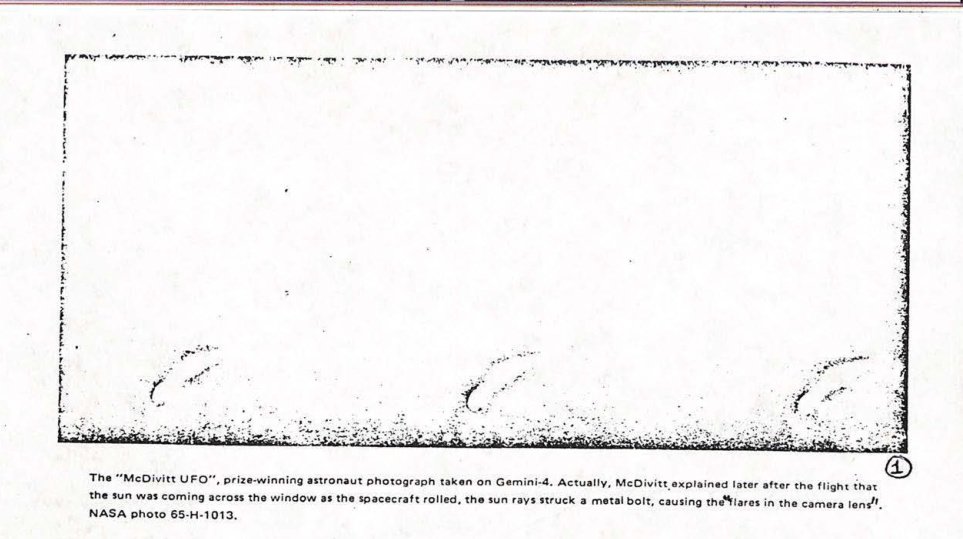 Magazine clippingPhysical page 8
DOCUMENTARY SOURCES · NASA / USG
What the records tell
The preliminary transcript of the Gemini IV debriefing was prepared by the crew support division on June 16, 1965, and classified as confidential, with later declassification. In it, astronauts James McDivitt and Edward White go over the June 1965 mission, which included White's spacewalk. The passage about the satellite comes up in the middle of a technical complaint: with the Sun hitting the window, nothing could be seen beyond the spacecraft's nose, which made a visually guided orbital rendezvous unfeasible.
McDivitt says he saw a satellite "around Hawaii" and that the spacecraft was closing on it, to the point that he checked whether he had maneuvering capability. He jokes that they might have made a better rendezvous with that object than with the rocket itself. Then the Sun came into the window and he lost it. He did not know the distance: it could have been 5 miles away, it could have been 50. During the 30 or 40 seconds he saw it, however, he had the impression it was quite close, because he could make out its shape.
The page does not describe that shape. In the second part of the debriefing, McDivitt says he observed three satellites and that they had already been covered in detail earlier. In the two parts published in this batch, however, the only passage found about satellites is the Hawaii one. The identification as a satellite is the astronaut's own; the document does not say which one it would be, or whether anyone tried to confirm it.
Another passage shows how the crew corrected themselves. During the first sunsets, the two announced several times that they had seen the flashing lights of the rocket they had left behind, until they realized it was a planet, which they thought was Venus. McDivitt spent an entire sunset watching: the planet twinkled as it passed through the atmosphere near the horizon and was steady above it. White maintained that once or twice he really did see the rocket. They disagreed about the direction they were looking in and concluded it was better to listen to the recordings.
Early in the mission, White saw through the window a sky that looked starry, but "artificial," while McDivitt had daylight on his side. These were the "fireflies" already reported by other astronauts, in much greater numbers, which he attributed to vaporized fuel from the rocket and to debris from the spacecraft. The pages consulted contain no photograph of the Hawaii satellite. The luminous curtain seen on the same mission has its own dossier.
The transcript of the passage about the fireflies shows who said what. It was White who, looking down in the dark, thought he was seeing an "artificial" starry sky, while McDivitt had daylight in his window and complained that they were pointed at the ground. White attributed the specks to vaporized fuel from the rocket, with a small contribution from the spacecraft itself, and McDivitt pointed out that they had also been firing the thrusters. White added that, with each urine dump at sunrise or sunset, the particles acted like little magnifying lenses and formed very bright points.
The discussion about the planet goes beyond self-correction. White insisted that the first one or two sightings were not of the planet and said he kept seeing the flashing after the stars came out. McDivitt argued from geometry: the rocket was below and should be moving ahead of the spacecraft, while they were looking toward the sunset, behind. He admitted that, on a later pass, he had announced the rocket "up high, at 9 o'clock," and did not believe that was it either. The two wrapped up by saying the question was "kind of academic" and that what mattered was the brightness of the planets seen from up there.
Notes prepared from the transcript, in the experiments debriefing file, return to the subject: the pilots said that "every sunset had the planet," and color photo S-65-34771 would show Venus among the horizon bands, about 15 degrees east of the Sun. The photo is not in the archive. On the page about the Hawaii satellite, White completes the complaint about visibility: the windows had a white film on the outside that, with the Sun hitting the particles, made it very hard to see.
The case has another, better-known version, which the debriefing does not mention. According to the essay that journalist James E. Oberg published in SEARCH magazine in 1976, and which NASA sent to the Senate in 1998, about 30 hours after launch, with White asleep, McDivitt reported seeing near the spacecraft an apparently cylindrical object, with "an arm sticking out," possibly on a collision course. NASA asked NORAD for the list of nearby satellites, received about a dozen objects, and announced that it was Pegasus 2, a large satellite with panels. Oberg notes that Pegasus was more than a thousand miles away.
In Oberg's view, the list was incomplete: the query to NORAD compared Gemini 4 against previously launched satellites and left out the second stage of the Titan rocket itself, a cylinder of about 30 feet that the crew had chased on the first day. He states that, according to the complete transcripts, the object appeared at the same point in the orbit where the rocket had been seen before, and that McDivitt's eyes were irritated. He cites a NASA letter of July 1, 1965, not preserved in the archive, that attributed the object to a spent rocket tank or stage, and a 1976 NORAD letter that found the reasoning "logical." All of this is the author's reconstruction, ten years later.
The two versions agree on important points. In the debriefing, McDivitt also speaks of an object seen for 30 or 40 seconds, which he called a satellite, whose shape he was able to make out and which he lost when the Sun came into the window; Oberg says the same about the 30 seconds and the glare. But the debriefing gives no time and does not describe the shape, and the essay does not mention Hawaii. A compilation of accounts sent by a constituent to Senator Charles Grassley in 1998 combines the two: the object was supposedly seen over Hawaii, was metallic, with long arms, and McDivitt supposedly filmed it. No NASA source in the archive confirms these details.
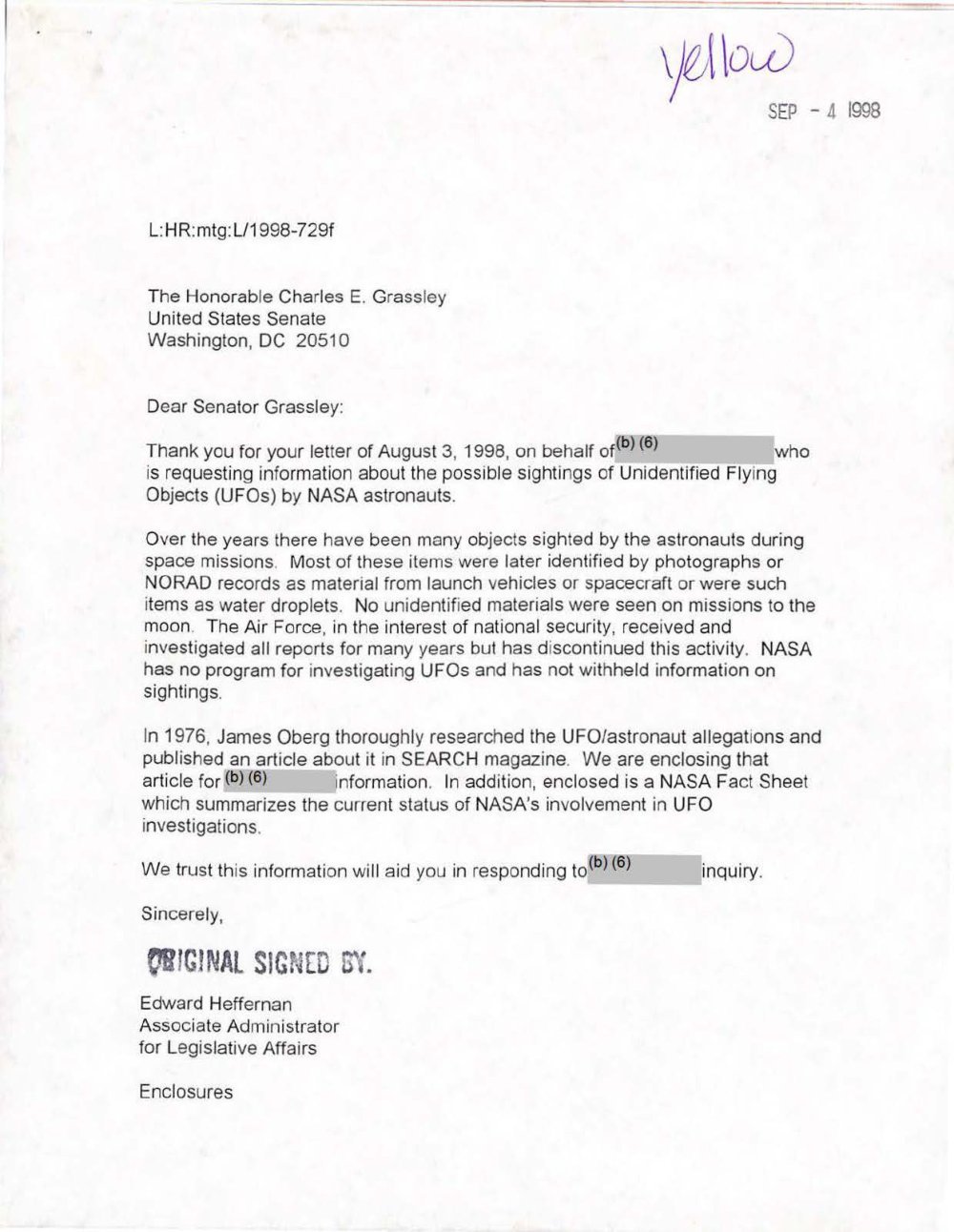
The photograph that became known as "McDivitt's UFO," NASA photo 65-H-1013, shows, in the essay's reproduction, three small curved shapes side by side. Oberg says McDivitt reviewed the flight films and found nothing resembling the object he saw, and the essay's caption attributes the spots, according to the astronaut's own explanation, to reflections of the Sun on a metal bolt on the spacecraft. In the same article, another Gemini 4 photo, S-65-35452, would show the Titan rocket in orbit, blurred by enlargement. Both images reached the archive as high-contrast photocopies, which do not allow these readings to be checked.
Pegasus does in fact appear in the debriefing, but at another point. At around 80 hours into the flight, with McDivitt asleep, the ground gave White a time to see the satellite pass directly overhead, at 268 nautical miles. An urgent request for a tape data dump forced him to change the spacecraft's attitude; when he came back, five minutes before, the Sun was reflecting off the particles on the windshield, and he could not see anything. The passage shows that Pegasus was a planned observation target and reinforces the complaint about the dirty windows, but it does not say which object McDivitt saw earlier.
Separating the layers: the account is McDivitt's, who called the object a satellite and could not tell the distance, between 5 and 50 miles. The identification as Pegasus 2 was a NASA announcement in 1965, which Oberg says was corrected by a letter from the agency itself. The Titan second-stage hypothesis is Oberg's, supported by the 1965 letter he cites and by NORAD in 1976. The details about Hawaii, the arms and the filming come from popularly circulated material. Oberg also recalls another McDivitt sighting, cited in the Condon report: a point of light crossing the sky, which the astronaut took for a satellite. The archive does not contain the air-to-ground transcript of these moments.
More images from the document
DIRECT READING OF THE FILE
The document, in the original
NASA transcript, a U.S. government work: excerpts translated after checking against the facsimile; the rest of the debriefing (pursuit of the rocket, extravehicular activity) was not translated.
EXCERPT 1 · PHYSICAL PAGE 83
Satellite near Hawaii, physical page 83
•
H)EN=ttAL 75
line of -sight w:ith . On the other hand I found
that if the sun was on the window you couldn't see
beyond the nose of the spacecraft. This satellite
that I saw over around Ha¼~ii--I saw the thing
and we were closing on it. We might have had a
better rendezvous with it than with our own booster.
We were closing on it and I was concerned enough
that I checked to see where the a . c. Fower Switch
was to see if I had maneuver capability at the
time : The • sun came across the window and I
lost it just like that. It might have been 5·
miles out. I don't knov•. It might have been then.
It might have been 50 miles out, but I had the impression in the 30 or 40 s econds I saw it that it
was quite close because I could make out the shape
of it. Shoot! The sun came across the window and
that was the last thing I saw out the window. I
never saw another thing out the window until we
were gone and until the sun finally came off the
window. So, if you are doing an optical r endezvous and you've got the sun on the window, I don't
know what you'd do.
White And if you have as dirty windows as we had-- our
windows had a white film of material on the
GeNFIDENTIAt....Editorial note: The typed word is “then”; from context, probably a transcription error for “ten”, which was not corrected in the source text.
Check the original PDF
This satellite that I saw over around Hawaii--I saw the thing and we were closing on it. We might have had a better rendezvous with it than with our own booster. We were closing on it and I was concerned enough that I checked to see where the a.c. Power Switch was to see if I had maneuver capability at the time. The sun came across the window and I lost it just like that. It might have been 5 miles out. I don't know. It might have been then. It might have been 50 miles out, but I had the impression in the 30 or 40 seconds I saw it that it was quite close because I could make out the shape of it.View the document record ↗ · Physical page 83, counting the cover.
EXCERPT 2 · PHYSICAL PAGE 240
Three satellites, physical page 240 of part 2
232 COt'iiflDE~~flAL
front end of the spacecraft; I tried to tense my
legs and tense my stomach and arms , and I tried
to exercise in this condition. I probably did
that a lot more than I did anything with the
exerciser.
11 . 8 Inflight Phonocardiogram (M-4)
McDivitt To the best of my knowledge we didn't have any
equipment problems. About the end of the second
day my sensors started itching a little. I don't
know if it was my phonoca rdiogram or my other sensors.
11 . 9 Extravehicular Activity
McDivitt Extravehicular activities have been covered
in great detail earlier in the debriefing, I
don't think we have to go over that again.
11, 1OMiscellaneous
McDivitt In the external observations I did observe three
satellites, but I think that these were covered
in detail earlier, and I don't believe we need
to go over that again here.
White I think that we'll comment again (we've commented
on this point before) that the tape recorder is
the most important piece of equipment that we
have onboard the spacecraft to record our obCOf',FIDeNTIALCheck the original PDF
In the external observations I did observe three satellites, but I think that these were covered in detail earlier, and I don't believe we need to go over that again here.View the document record ↗ · Physical page 240, counting the cover.
EXCERPT 3 · PHYSICAL PAGE 66
End of physical page 65 and physical page 66 (pages 57 and 58 of the transcript), full excerpt
58
McDivitt
White
~Ptt>fNT-l;4h
sparkles everywhere . And it looked like almost
a starlit sky, but it just didn't quite look
right to me ; it looked like an artificial starlit sky . It looked like some of these star displays they have created for us . And I looked
over at Jim and asked him if he was seeing this
and about the same time I noticed that he had
nothing but dayl ight out his window. This was
the first time that I had the daylight- dark
experience of one guy looking into pitch black
night and the other guy looking into a complete
daylight window over there. Jim remarked rather
disgustedly to me, "We are pointed straight at the
ground!" About the same time I realized I was
looking out at the fire flies everybody had s een,
but probably in a much more profuse quantity than
had ever been seen before , because we were getting
a ll this fuel that was vaporizing into many, many
particles from the booster and a little bit of a
contribution from the spacecraft also.
And we were thrusting, too . I 'm sure we had all
that junk on it from our launch.
That ' s right . And the whole area out in front of
my view was just entirely taken up with these
CONFIOENft-ALEditorial note: The speech is White's from page 65 onward; the automatic note on page 66, which attributes the propellant explanation to McDivitt, is wrong.
Check the original PDF
White: I want to comment on something that was quite an experience for me. When I called out to you, I was looking down at what I thought, since it was pitch black, was the sky. I could see little [p. 66] sparkles everywhere. And it looked like almost a starlit sky, but it just didn't quite look right to me; it looked like an artificial starlit sky. It looked like some of these star displays they have created for us. And I looked over at Jim and asked him if he was seeing this and about the same time I noticed that he had nothing but daylight out his window. This was the first time that I had the daylight-dark experience of one guy looking into pitch black night and the other guy looking into a complete daylight window over there. Jim remarked rather disgustedly to me, "We are pointed straight at the ground!" About the same time I realized I was looking out at the fire flies everybody had seen, but probably in a much more profuse quantity than had ever been seen before, because we were getting all this fuel that was vaporizing into many, many particles from the booster and a little bit of a contribution from the spacecraft also.
McDivitt: And we were thrusting, too. I'm sure we had all that junk on it from our launch.
White: That's right. And the whole area out in front of my view was just entirely taken up with theseView the document record ↗ · Physical page 66, counting the cover.
EXCERPT 4 · PHYSICAL PAGE 67
Physical page 67 (page 59 of the transcript), in full
McDivitt
White
McDivitt
little par t icles, and this was at sunset . As the
flight progressed, each time we had a particle or
a group of particles such as a urine dump r ight
at sunset or sunrise, the sun would pick these
particles up and they would act just like littl e
magnifying glasses and make very bright spots.
This is exactly what happened . Did you ever s ee
that then? I think you were more in the daylight
side .
No . I was on the daylight side . I didn't see
what you were talking about.
It was really something. The whole sky within my
view was covered with these little particles-
thousands of them. There was obviously a great
deal of that stuff in the air all around .
As soon as we got turned around I could see trat t he
lights were flashing on the booster, and Ed saw
them , too. It was pretty apparent . I call ed out
ri ght away to the gruund that the lights were
working. I don't know if they understood what I
was talking about or not. I also called out
shortly after we came off the booster and we saw
it,that it didn't look like we were going to be
able to touch it.. because of the high rotationalEditorial note: The last sentence continues on the next page.
Check the original PDF
[White] little particles, and this was at sunset. As the flight progressed, each time we had a particle or a group of particles such as a urine dump right at sunset or sunrise, the sun would pick these particles up and they would act just like little magnifying glasses and make very bright spots. This is exactly what happened. Did you ever see that then? I think you were more in the daylight side.
McDivitt: No. I was on the daylight side. I didn't see what you were talking about.
White: It was really something. The whole sky within my view was covered with these little particles--thousands of them. There was obviously a great deal of that stuff in the air all around.
McDivitt: As soon as we got turned around I could see that the lights were flashing on the booster, and Ed saw them, too. It was pretty apparent. I called out right away to the ground that the lights were working. I don't know if they understood what I was talking about or not. I also called out shortly after we came off the booster and we saw it, that it didn't look like we were going to be able to touch it because of the high rotationalView the document record ↗ · Physical page 67, counting the cover.
EXCERPT 5 · PHYSICAL PAGE 84
Beginning of physical page 84 (page 76 of the transcript): end of White's remarks about the windows
76 COt#iDENTl,c\ I,,..
McDivitt
outside , which made it very difficult to see out
when the sun's rays reflected on these particles
that were on the outside of the windshield .
To just summarize this thing, I think that we
came off the booster with a fully unknown relative
velocity which was much greater than what we
anticipated, and it didn't seem to be an inplane
relative velocity. It didn ' t seem to be an inplane
local horizontal relative velocity. It was out-ofplane and it looked like the booster headed down ,
with respect to us because i t started separating
from us so rapidly, I t a l so had less total velocity. I think that this was the first surprise . It started tumbling and immediately the
rates built up in just a· very few minutes to
something very high-- 40 to 50 degrees/second--
but it never got any higher, at least the best we
could tell. When we last saw it over Mexico or
over southern United Sta tes it was still tumbling
at about the same rate , I guess around 40 or 50
degrees/second. I felt tret I got down to it all
right and I was in reasonably good shape prior to
Carnarvon, and from that time on until we came out
of the darkness I lost it , And I think I lost itEditorial note: The speech begins at the end of page 83, right after the account of the Hawaii satellite; the rest of page 84 deals with the rocket chase.
Check the original PDF
White: And if you have as dirty windows as we had--our windows had a white film of material on the [p. 84] outside, which made it very difficult to see out when the sun's rays reflected on these particles that were on the outside of the windshield.View the document record ↗ · Physical page 84, counting the cover.
EXCERPT 6 · PHYSICAL PAGE 196
Physical page 196 (page 188 of the transcript), in full
188
McDivitt
Wnite
McDivitt
€01\IFIDENfl~ lEVA we went into free drifting flight . We
powered down the platf orm and the computer, shut
off the attitude indicator lights--we went through
a complete power- down procedure . We were really
trying to save bettery power, 0AMS fuel , and
everything else we had . We went on a complete
power-down, down the checklist, and we just
didn ' t have anything on .
And we stayed in this free drifting mode for about
two days . That right , Ed?
Closer to 2 1/2 days .
Mostly for the first 2 1/2 days we were in a free
dri fting mode . We didn ' t do the platform alinement and the translation at around 8: 10--8: 20 in
the flight plan. We did not obtain any boosterstar measurements . As a matter of fact, I'd
like to comment on the booster-star sightings, or
just the booster sightings . We saw the l ights of
the booster definitely on the first pass as we
were tracking it. The second pas~ RS Ed sai~
he saw them, and he said he was sure he saw
them because they were flashing . I was pretty
sure i: saw what he was talking about. However, this
occurred just at sundown . Every other time at
COtfftOE~TI~Editorial note: The first statement continues from the previous page, with no name in the margin of this page. OAMS is the spacecraft's orbit attitude and maneuvering system.
Check the original PDF
[continuação de fala anterior] EVA we went into free drifting flight. We powered down the platform and the computer, shut off the attitude indicator lights--we went through a complete power-down procedure. We were really trying to save battery power, OAMS fuel, and everything else we had. We went on a complete power-down, down the checklist, and we just didn't have anything on.
McDivitt: And we stayed in this free drifting mode for about two days. That right, Ed?
White: Closer to 2 1/2 days.
McDivitt: Mostly for the first 2 1/2 days we were in a free drifting mode. We didn't do the platform alinement and the translation at around 8:10--8:20 in the flight plan. We did not obtain any booster-star measurements. As a matter of fact, I'd like to comment on the booster-star sightings, or just the booster sightings. We saw the lights of the booster definitely on the first pass as we were tracking it. The second pass, as Ed said, he saw them, and he said he was sure he saw them because they were flashing. I was pretty sure I saw what he was talking about. However, this occurred just at sundown. Every other time atView the document record ↗ · Physical page 196, counting the cover.
EXCERPT 7 · PHYSICAL PAGE 197
Remainder of physical page 197 (page 189 of the transcript), after the sentence already translated in the dossier
189
White
McDivitt
White
McDivitt
White
McDivitt
White
McDivitt
sundown we'd call out the booster a couple of
more times before we finally figured out that
this was not the booster, but a planet .
One or two times I'm fairly confident I saw the
booster.
You're pretty sure you saw it?
Yes. That was the booster.
Well, I was pretty confident that I saw it
flashing , too . But later on I watched th2,t star,
that particular planet, come up. I sat right
there and watched i t, and it flickered as it came
up t hrough the atmosphere .
Yes, I agree with you .
So, it could have been that we were just really
looking for the booster and at that particular
time we looked out and saw this thing and it
flickered. I spent one whole sunset doing
nothing but keeping my eye out for that planet.
Sure enough it popped up and I saw it.
But, you know never flickered .
It flickered . I watched it as it flickered.
It flickered all the way up I watched the t hing
as it set, and it flickered all the way down-
the last at 10 degrees or so. This is exactly
~Fif)ENTIAtEditorial note: “But, you know never flickered” appears this way in the typescript.
Check the original PDF
White: One or two times I'm fairly confident I saw the booster.
McDivitt: You're pretty sure you saw it?
White: Yes. That was the booster.
McDivitt: Well, I was pretty confident that I saw it flashing, too. But later on I watched that star, that particular planet, come up. I sat right there and watched it, and it flickered as it came up through the atmosphere.
White: Yes, I agree with you.
McDivitt: So, it could have been that we were just really looking for the booster and at that particular time we looked out and saw this thing and it flickered. I spent one whole sunset doing nothing but keeping my eye out for that planet. Sure enough it popped up and I saw it.
White: But, you know never flickered.
McDivitt: It flickered. I watched it as it flickered. It flickered all the way up. I watched the thing as it set, and it flickered all the way down--the last at 10 degrees or so. This is exactlyView the document record ↗ · Physical page 197, counting the cover.
EXCERPT 8 · PHYSICAL PAGE 198
Physical page 198 (page 190 of the transcript), in full
190
White
McDivitt
White
McDi vitt
White
McDi vitt
White
McDivitt
eorqFIDENf~L
wher e we thought we were seeing the booster ,
right where it was low on the horizon , as you
would expect to see a booster. That old thing
was flickering away like mad .
I think that was Venus , too .
It was t he planet that was trai ling the sun by
just a very slight amount . I made it a point
to check during the remainder of the flight ,
two or three times to see if that thing flickered
as it came up . It r eall y did . So , the more I
saw it flicker the more I began to doubt that
we had really seen the booster on that second
pass. Maybe we did , and maybe we didn' t .
Well, it's not r eall y too impor tant .
No , it' s not . But the fact is, that little planet was flickering away like mad .
Let me ask you one more question about the flicker. Did you see it coming up through the air
glow? Was that where you felt it flickered?
Yes .
Everytime it was above the air glow it was loud
and clear to me .
Yes , except that you couldn' t see t he air glow
as the sun was setting.
-COMFID'ENT~Check the original PDF
[McDivitt] where we thought we were seeing the booster, right where it was low on the horizon, as you would expect to see a booster. That old thing was flickering away like mad.
White: I think that was Venus, too.
McDivitt: It was the planet that was trailing the sun by just a very slight amount. I made it a point to check during the remainder of the flight, two or three times to see if that thing flickered as it came up. It really did. So, the more I saw it flicker the more I began to doubt that we had really seen the booster on that second pass. Maybe we did, and maybe we didn't.
White: Well, it's not really too important.
McDivitt: No, it's not. But the fact is, that little planet was flickering away like mad.
White: Let me ask you one more question about the flicker. Did you see it coming up through the air glow? Was that where you felt it flickered?
McDivitt: Yes.
White: Everytime it was above the air glow it was loud and clear to me.
McDivitt: Yes, except that you couldn't see the air glow as the sun was setting.View the document record ↗ · Physical page 198, counting the cover.
EXCERPT 9 · PHYSICAL PAGE 199
Physical page 199 (page 191 of the transcript), in full
191
White
McDivitt
White
McDivitt
White
McDivitt
White
McDivitt
That's right .
Initially you saw the sun out there and you saw
this t hing looking like it was flashing. Once
it got above the air glow , the planet did not
flicker anymore. It was perfectly bright .
Very hright .
When we saw that thing that looked like the
booster, it was very low on the horizon. It
always popped out . Remember how that bright
light used to pop out? You'd have t he light
sky and all of a sudden t here 'd be a bright
light there .
\Te saw that planet come up so many t imes during
the flight, I feel quite convinced that the
first sighting or two weren't of the planet.
Well, maybe it wasn't.
Actually, I continued to see the blinking on it
after the stars were out .
Wait , let ' s take a look and see which way the
booster would be . The booster was bel ow us so
it should be going out in front of us l ike mad .
You're looking into the sunset which was behind
us . The booster shouldn ' t have been there . The
booster should have been out to the fr ont of us .
CO~ftl}ENTIAbCheck the original PDF
White: That's right.
McDivitt: Initially you saw the sun out there and you saw this thing looking like it was flashing. Once it got above the air glow, the planet did not flicker anymore. It was perfectly bright.
White: Very bright.
McDivitt: When we saw that thing that looked like the booster, it was very low on the horizon. It always popped out. Remember how that bright light used to pop out? You'd have the light sky and all of a sudden there'd be a bright light there.
White: We saw that planet come up so many times during the flight, I feel quite convinced that the first sighting or two weren't of the planet.
McDivitt: Well, maybe it wasn't.
White: Actually, I continued to see the blinking on it after the stars were out.
McDivitt: Wait, let's take a look and see which way the booster would be. The booster was below us so it should be going out in front of us like mad. You're looking into the sunset which was behind us. The booster shouldn't have been there. The booster should have been out to the front of us.View the document record ↗ · Physical page 199, counting the cover.
EXCERPT 10 · PHYSICAL PAGE 200
Physical page 200 (page 192 of the transcript), in full
192
White
McDivitt
White
McDivitt
White
McDivitt
White
McDivitt
€9-NF~DENTIAt.-
It should have been in the opposite direction.
I ' m : ot convinced which way we were looking .
We had to be looking to the rear. The sun
sets to the rear. We had to be BEF to see the
sun when it set . You see , ;,,·ou ' re BEF to watch it
set .
Were we BEF for the full time or were we in free
drift?
We were in free drift but this was near the sun
when this thing came out .
No , they always come out loud and clear when
you 're away fr om the sun , when you' re looking
away from the sun .
Yes . I lmow it, but at that one time when you
sai d, "There ' s the booster." , you were looking
at the sun . Remember , I had turned around?
They told us that they wanted us to be BEF and
heads down when we opened up the hatch . That ' s
where we were . I turned around to be BEF . We
were BEF when we saw that thing.
We'd better l ook at the tapes . I think we can
probably get better information on this when we
check .
I think we were even looking in the wrong direeNFIBENflAfEditorial note: BEF (blunt end forward) is the attitude with the base of the capsule facing the direction of motion. The first line, with no name in the margin, concludes McDivitt's statement from the previous page. In “I'm not convinced” a letter is missing in the typescript.
Check the original PDF
[McDivitt] It should have been in the opposite direction.
White: I'm not convinced which way we were looking.
McDivitt: We had to be looking to the rear. The sun sets to the rear. We had to be BEF to see the sun when it set. You see, you're BEF to watch it set.
White: Were we BEF for the full time or were we in free drift?
McDivitt: We were in free drift but this was near the sun when this thing came out.
White: No, they always come out loud and clear when you're away from the sun, when you're looking away from the sun.
McDivitt: Yes. I know it, but at that one time when you said, "There's the booster.", you were looking at the sun. Remember, I had turned around? They told us that they wanted us to be BEF and heads down when we opened up the hatch. That's where we were. I turned around to be BEF. We were BEF when we saw that thing.
White: We'd better look at the tapes. I think we can probably get better information on this when we check.
McDivitt: I think we were even looking in the wrong dir-View the document record ↗ · Physical page 200, counting the cover.
EXCERPT 11 · PHYSICAL PAGE 201
Physical page 201 (page 193 of the transcript), in full
193
White
McDivitt
White
McDivitt
White
McDivitt
Whit e
McDivitt
Whit e
McDivitt
~ ONFl(:)ENl~Alection . The next pass around I called out and
said, 11 1 see the booster on top at 9 o ' clock ,
perpendicular to our flight path." I don ' t
think that ,.ias the booster either.
It's kind of academic .
Yes .
The reason that I broughtthe thing back up
again is I wanted to be sure it' s brought out
that the planets are so clear and so bright,
even far more brighter than they are looking at
them from the ground . Looking at them up there,
it really is striking the first time you see
them. If we took a l ot of pictures of anything,
i t was a pictl:re of that planet .
Sunrise and sunset . The sunsets all had the
planet in it.
That ' s right. That planet has always been there .
Very pretty.
It certainly was .
Okay, I got a call after Ed went t o sleep that
we were going to pass by myr.hnl"r. :.:. u.:-o which
would be north of track, at 7:56.
I wasn't sleeping. I heard it.
Did you? Okay . Well , I didn't have any fuel to
e-0NFl0ENf lAL--Editorial note: The typhoon's name is faded in the copy and was rendered as [illegible].
Check the original PDF
[McDivitt] ection. The next pass around I called out and said, "I see the booster on top at 9 o'clock, perpendicular to our flight path." I don't think that was the booster either.
White: It's kind of academic.
McDivitt: Yes.
White: The reason that I brought the thing back up again is I wanted to be sure it's brought out that the planets are so clear and so bright, even far more brighter than they are looking at them from the ground. Looking at them up there, it really is striking the first time you see them. If we took a lot of pictures of anything, it was a picture of that planet.
McDivitt: Sunrise and sunset. The sunsets all had the planet in it.
White: That's right. That planet has always been there.
McDivitt: Very pretty.
White: It certainly was.
McDivitt: Okay, I got a call after Ed went to sleep that we were going to pass by Typhoon [illegible] which would be north of track, at 7:56.
White: I wasn't sleeping. I heard it.
McDivitt: Did you? Okay. Well, I didn't have any fuel toView the document record ↗ · Physical page 201, counting the cover.
EXCERPT 12 · PHYSICAL PAGE 120
Physical page 120 of the experiments debriefing, “Planets” section: notes taken from the transcript
"' Notes from the De-Briefing transcript
eteors:
Both cDivitt and hite 1 tioned seeing a number of rn teors bel w
them: e sa quite a fe f all end burn up bolo our cltitude. 1hey wore bout
on half to on third as high as re were hen they ere conswn d. . e /n er
aaw one bove us. 11 { short d s if.,'()
As the acco p',nyin..~ plots of numb rs of meteor a ainst the onths of thef
r sho s the oun of meteor activity in e rly June is at a r ther lo
p206 *Fig. l(Ro chta plot of Olivier data from S ithsoni n Contrib. t o Astrophys.N
level, b1,.:gdnn to rioe very hortly alter that to rds ll peak in u ust . on th average from to altitude
Re rdless of their bri htness/meteors ap or 40 and 60 miles/in the earth's
sphere. Bri"ht rn toors ares en to reach about 40 miles, rhereas wct8kkx
lar e fireb· lls may still e seen as lo I as 20 miles or so .
Th ver· , hei'.;ht th ou11.hout the ath is r ter for f aint r eteo nd
for thos of h h v.locitie . Actually the hr' ht objects r lar er and hence
tr vol further tofore they re conn d1 often tr veling fo r sev ral hundr d
iles b for they r consum d.
Planets
The pilot re rked that"the pl ets or o clear nd br' ht, 11 nd later
th t 11 a11 the sun"ets h d the plan t in it•" Th y have in f ct r corded Venus
in the oriion bands on one of their sunset pictures . t thot date V nus Qllbc
as still clos to the sun being (angul r dist;nce·t)Sup. conj .A r.11) bout 15de •
cast of the sun (eve. star). On the color print S-65-34771 them ge of Venus
can be distictly seen amid the horizon bands .Editorial note: In the transcript, the two quotations correspond to statements by White and by McDivitt (physical page 201 of part 1). Photo S-65-34771 is not in the collection. “Distictly” appears this way in the original; a word struck out by typewriter was omitted. The “Meteors” section of the same page is translated in the luminous curtain dossier.
Check the original PDF
Planets
The pilot remarked that "the planets are so clear and bright," and later that "all the sunsets had the planet in it." They have in fact recorded Venus in the horizon bands on one of their sunset pictures. At that date Venus was still close to the sun being (angular distance?) (Sup. conj. Apr. 11) about 15 deg. east of the sun (eve. star). On the color print S-65-34771 the image of Venus can be distictly seen amid the horizon bands.View the document record ↗ · Physical page 120, counting the cover.
EXCERPT 13 · PHYSICAL PAGE 249
End of physical page 249 and physical page 250 up to the attempt to see Pegasus (pages 241 and 242 of the transcript)
McDivitt
241 -cet"'4FIE>Ei'JTIAL
I elected'to make a similar pass through on the
following orbit, watching the stars and making
sure that I had a good small-end-forward. I
found out that the first pass through was pretty
good until the tail end, where I thought the
stars were in the wrong position. It turned out
that this is just the way they came up, and I was
good for both of them except for the tail end of
the first run through, I logged in two small
end passes through the South Atlantic Anomaly.
I also ran the D-9 Experiment and I found that
by using the fuel and having the H0rizon Scan to
hold when you wanted it to hold, the use of the
sextant and horizon in making measurements was
considerably easier. I made what I feel was a
good Apollo D-9 run. I ran the D-8 Experiment.
I had two times to run the D-8 Experiment. I
ran it at the Greenwich Mean Time of 01:30, I
was to look for Pegasus at O2:28,straight up at
268 nautical miles, and I was all hot to watch
Pegasus go over and was just approaching my
straight up attitude when--
The sun shined on the window.Editorial note: The speaker is White, who was conducting the experiments while McDivitt slept, at around 80 hours of flight (page 248). Pegasus was a micrometeoroid detection satellite, with large panels, which the ground designated as an observation target. The beginning of page 249 deals with the passes through the South Atlantic Anomaly and experiment D-9; the rest of page 250, with the onboard computer.
Check the original PDF
White: [...] I ran the D-8 Experiment. I had two times to run the D-8 Experiment. I ran it at the Greenwich Mean Time of 01:30. I was to look for Pegasus at 02:28, straight up at 268 nautical miles, and I was all hot to watch Pegasus go over and was just approaching my straight up attitude when--
McDivitt: The sun shined on the window.
White: No, I was called and they said, "Say we got a critical tape dump. We want you in a level attitude for it." And I said, "Well, you just gave me instructions to watch Pegasus." And they said, "No, we want the critical tape dump." So I went right down to that attitude, and we got the dump off in time for me to go back up to the attitude prior to 02:28. I got up there about 5 minutes prior to that time, but the sun, as Jim said, was up and was reflecting off the particles on the windshield, and I really couldn't see very much. I tried to see Pegasus, but I couldn't see it. I turned MSC-2 and 3 off at the appropriate times.View the document record ↗ · Physical page 249, counting the cover.
EXCERPT 14 · PHYSICAL PAGE 36
Excerpt from physical page 36: compilation sent by a constituent to Senator Grassley's office in 1998, part about White and McDivitt
Ed White & James McDivitt
In June 1965, astronauts Ed White (first American to walk in space) and
James McDivitt were passing over Hawaii in a Gemini spacecraft when they
saw a weird-looking metallic object. The UFO had long arms sticking out
of it. McDivitt took pictures with a cine-camera . Those pictures have
never been released .
James Lovell and Frank Borman
In December 1965, Gemini astronauts James Lovell and Frank Borman also
saw a UFO during their second orbit of their record-breaking 14 day
flight. Borman reported that he saw an unidentified spacecraft .some
distance from their capsule. Gemini Control, at Cape Kennedy told him
that he was seeing the final stage of their own Titan booster rocket.
Borman confirmed that he could see the booster rocket all right, but
that he could also see something completely different .
During James Lovell's flight on Gemini 7:
Borman: ER GEMINI 7, HOUSTON HOW DO YOU READ?
Control: Loud and clear 7 go ahead.
Borman: GOT A BOGEY AT 10 O'CLOCK HIGH.
Control: This is Houston. Say again 7.
Borman: SAID WE HAVE A BOGEY AT 10 O'CLOCK HIGH.
control: Roger
Control: Gemini 7, is that the booster or is that an actual sighting?
Borman: WE HAVE SEVERAL...ACTUAL SIGHTINGS.
Control: . ..Estimated distance or size?
Borman: WE ALSO HAVE THE BOOSTER IN SIGHT...
Further controller cuts in: Gemini control here again, the reference in
that conversation was er bogey. It was er Borman who reported sighting
the bogey. Er this is Gemini control Houston at er 4 hours 24 minutes
into the flight.
Ironically, it was Lovell who made the classic statemen t "Please be
informed that there is a Santa Claus". This was during his Apollo 8
flight on Christmas day in 1968 - some people believe there's a deeper
meaning to these words, although the sceptics believe that this was
little more than American humour. However, Walter Schitta, who was
aboard Mercury 8, reputedly used Santa Clause as a code-name for a UFO
presence, adding some weight to the argument that Lovell was
experiencing another sighting.
Neil Armstrong & Edwin "Buzz" Aldrin
According to the NASA Astronaut Neil Armstrong the Aliens have a base on
the Moon and told us in no uncertain terms to get off and stay off the
Moon .
According to hitherto un-confirmed reports, both Neil Armstrong and
Edwin "Buzz" Aldri n saw UFOs shortly after that historic landing on the
Moon in Apollo 11 on 21 July 1969. I remember hearing one of the
astronauts refer to a "light" in or on a crater during the television
transmission, followed by a request from mission control for further
information. Nothi ng more was heard.Editorial note: Text by a private individual, printed from electronic mail and kept by NASA in the file for the reply to the senator; it is not a NASA record. In the debriefing, McDivitt says he saw the object alone for 30 or 40 seconds and does not mention arms, metallic color, or filming. The rest of the page deals with other astronauts; the passage about Gemini 7 is in the "bogey" dossier.
Check the original PDF
Ed White & James McDivitt
In June 1965, astronauts Ed White (first American to walk in space) and James McDivitt were passing over Hawaii in a Gemini spacecraft when they saw a weird-looking metallic object. The UFO had long arms sticking out of it. McDivitt took pictures with a cine-camera. Those pictures have never been released.View the document record ↗ · Physical page 36, counting the cover.
EXCERPT 15 · PHYSICAL PAGE 8
Caption of the photo on physical page 8 of James E. Oberg's essay (SEARCH, 1976): short quotation
,,..~ 1.~~-·••·---.'",....:"-r-•':·""'" ,.
f '
I
i
!
t1-~f ' . ~ • ~ .....: • ~'{~,;t't( "~•'·-:..,........,:-.,:- ::,"?\~-."':,~~""t".:~..-~~,.-,r-•r·,r•..,-~~•·,~-•l"""'-..,.,,
.: ;,_<..-:::~~-' . ~
The "McOivitt UFO", prize-winning astronaut photograph taken on Gemini-4. Actually, McOivitt_axplained later after tho flight that
the sun was coming across the window as the_ spacecraft rolled, the sun rays struck a metal bolt, causing the'Cilares in the camera lens''.
NASA photo 65-H-1013.
years of manned spaceflight uncovered
any evidence at all which even
remotely suggests that Earth is being
visited and observed by advanced
spacesliips from another world? Let's
look at the evidence.
On June 3, 1965, rookie astronauts
Jim McDivitt and Ed White blasted
of( from Cape Kennedy (now again
Cape Canaveral), squeezed into their
Gemini-4 capsule. The two youngest•
ever. American spacemen were to
spend four days in orbit, tripling the
previous US record. They would be
the first American space crewmen to
have time to sightsee in space, once
major experiments like a booster
rendezvous and a walk in space were
completed.
Approximately thirty hours into
the flight ( while White was asleep) ,
McDivitt reported that he had seen an
object in space near his space capsule.
It appeared to be cylindrical with ·'an
arm sticking out", possibly on a
collision course. Interested N AS.-\
officials in Houston asked NORAD
which other space satellites were near
Cemini--1 at the time of the sigh ting,
and NORAD came up with a list of
about a dozen objects. All of them
were pieces of tiny debris or small
scicntit"ic satellites except one: the
giant, " winged" meteor satC'llitc,
Pegasus-2. It seemed to iit the description radioed down by McDivitt, so
NASA announced that the object had
been identified.
But Pegasus had been more than a
thousand miles away, and McDivitt
clearly saw an object much closer,
much more detailed, and in an orbit
very close to his own ("Collision
course" to a pilot means that the
relative angle of sight is unchanging,
which would not be the case for any
satellite crossing McDivitt's orbit). The
object became a UFO when nobody
could identify it. It has remained a
UFO up until today, but not any
longer.
McDivitt's hasty attempt to take a
photograph of the object thrqugh his
smeared window was apparently fruit•
less, since the object's motion
combined with the slow stabilization
spin of the spaceship carried it into the
glare of the sun after about 30 seconds.
The astronaut later recounted how he
went through all the films of the flight
(every roll of film is accounted for on
a flight manifest, so they do not
disappear) and found many overexposed or blank. This mission had
been the first night in which space
photography was a major experiment,
and the glaring sunlight of space had
invalidated many pre-flight exposure
settings. :\lcDivitt did not find any-
• thing which looked like ""his UFO".
What was it he ,aw? Why has it
become such a prominl•nt UFO case?
And if the pictures did not turn out,
where did NICAP get its "top four"
photograph (which shows, not a
winged cylinder, but a smeared blob)?
We can answer these questions at last.
The first hint as to the true identity
of this space UFO can be found in
McDivitt's own words, given at a press
conference a week after the flight
when his memory was fresh: "It
looked a lot like an upper staie of a
booster". Gemini does have a booster
just like it, and McDivitt had been
carrying out maneuvers near it early in
the flight. Why didn't the -list from
NORAD include the Gemini-4 boost er
rocket?
NORAD had been tracking the
objects, but NASA had not asked
about Gemini-4 and its own associated
debris- it had asked about Gemini--!
and any other earlier satellites.
Anyone familiar with computerized
information systems (one of my
professional specialities) can guess
what happened: the computer was
given a "query" which told it to
compare Gemini--t with the other
satellites. The computer never knew
where the Gemini booster was relati\•e
to the spacecraft, since it had not been
asked. :\lcDivitt had been visually
tracking the thirty foot long cylind1r
at a range of only 75 miles a few hours
earlier, but this large satellite never
made the "NORAD list" because
40Editorial note: Magazine text: short quotation. The caption goes on to say that, according to McDivitt after the flight, the Sun entered the window during the spacecraft's roll and struck a metal bolt, causing the reflections on the camera lens; this explanation is attributed to the astronaut by the author of the essay.
Check the original PDF
The "McDivitt UFO", prize-winning astronaut photograph taken on Gemini-4. [...] NASA photo 65-H-1013.View the document record ↗ · Physical page 8, counting the cover.
EXCERPT 16 · PHYSICAL PAGE 11
Sentence from a NASA letter of 01/07/1965 quoted on physical page 11 of Oberg's essay (short quotation)
.
·--:a:.::-.;
On a recent "UFO rncorcli:ig''
rrll-asrd by Columbia, calt.:d "UFOs:
The Credibility Factor", :VlcDi\·itt
clrarly shows how his mcmorirs have
ch:u1ged or bc,m cl1a11g(•d to enhance
the mystery ot' hi3 C'Xpcricnce: "They
(NAS.-\) chcck,'d :'iOR..\D...to sec
what they had up on radar ancf there
w:isn 't anything within very close
range of us." Readers can measure the
credibility of this statcm~nt against .
the facts.
If McOivitt was fooled by his own
booster ten years ago, is it too much
to expect him to admit it now? What
would that do to all of his public
assertions of mystery? There is an
easier way out, and i'vlcOivitt took it
when I sent him an advance copy of
my manuscript. After keeping it two
months, he wrote back, "[ was not
able to read it very thoroughly and I
cannot offer any ext~nsive comments.
I do not foresee the opportunity for
me to provide any further re~w."
There weren't any errors in my
analysis, he implied, but it woulc! be
better kept quiet.
NASA never had any real doubts.
"We believe it to be a rocket tank or
spent second stage of a rocket," wrote
a high space official on July 1, 1965.
NORAD officials, confronted with my
scenario, endorsed it: "Your
comments on the NORAD role related
to the case appear to pe logical,"
wrote NORAD Public Information
Officer D.W. Kindschi on Feo. 23,
1976.
So the "~lcDivitt case" is closed.
The best space UFO case has now been
identified. Do not expect to see any
change in the UFO press, however.
Such results are simply ignored.
Photographs made in space show
negative effects, such as the "McDivitt
UFO" aura, often. Spacecraft ·and
astronauts may be engulfed in a
strange aura caused by overexposure
to sunlight brighter than ever seen on
Earth. Blowups of photographs of
known space objects show them
appearing as "blobs" due to the
enlargement process and to the·
courseness of the grain. Ordinary space
pictures are full of clouds of debris,
constellations of man-made starlike
points fluttering through space.
The Condon report was fascinated
with the ~lcOi\·itt cas<', and fe\\· UFO
enthusiasts have not heard of it. But
n,:itlwr the Condon r£>st)archers nor the
average reader had ever had all the
facts. Now people can m:ike up their
own minds. I havl' ''" d ,iub~ th;,t
~lcl)i\"itl w:i~ ~<! l'i:1g his ow11 Til.::n
tJCJostrr stage.
Or. Roach wa~ also fasd n:•l•~cl wi t!t
another :,.1coi,itt si~foiti'.1 1}, that uf a
point of light ::rc:,i:::·::; the ; k·: . The
object soundr. ,j j•.1.,l Iii-:<> th•!
appearance of an artifici.!l earth
satellite, and that is e~:actly wh:it
\kDivitt thought it \•:.:s. There is no
information to suggest it w.:_s anything
else.
Another Condon favorite is a
Gemini-7 case. The report of sightings
of a cloud of debris right at the
moment of boostt•r separation (these
particles included frozen fuel droplets,
the booster itself. assorted insulation
and structural fragments from where
the explosive bolts were fired, and
other smaller objects never identified
and never cared about) is not very
impressive. The crew, on their first
space mission, saw a few pieces they
had nol expected (the pilot guessedwrongly-that they "were in polar
orbit"). Only a partisan digging for
evidence, and desperate to find such
evidence, would make much of this
common event.
But a sign of desperation is indeed
. ....·. .·.;~~.: ~~
.\1":,:;:
'f~~v·~•.~~-...,:.. ~·. - ·• ·• ,): :.: ···-. . ... ... ... . - .....-. ... .
/V i , •• • • ••••• g ,Cla:: t ,an ,.. ,,,
round in 1'1)1111:•ction l'.'isli Lill! t,;~mi!!i·
I GFO ca~t'. It is not th~ clc::1wra•.i1a ~
0f gtn·criun•_•nl oflici, I:; t~yi11!{ to c:ur••r
up t.he truth ahoul GfU:;. R;,hrr, it :s
thr dl'spernlion of some outsider
tryi:1~ t rJ m:t~:;f:-,.-:- tu:c1 couni .~rf,.i,
"astrnnaut L:FO" <?videnc~. Jn acli·. ;r.\·
which should not be nc>ce:s;a,y if th~
" rt'al" L: FO evidence w~rC' as
persuasive as many thint.
It involves :i photograph showing
two very strange glowing ocjects. Each
is he:,agonal in shape, ~·:ew!c'd at an
angle, ~nd supported by ;;. dazzling
"force field" below it. A cloudcovered earth is se.?n in the
background. s~~ p\cd~ ~1 ~ :l.8
This photograph has appeared in
books, magazines, newspapers, and
pamphlets. It is part of the travellina
slide show of UFO lectur~rs from th;
Mutual UFO Network (i\!VFON) and
elsewhere. I have heard it described
as •\showing a typical UFO force field
propulsion system", and "similar to
other UFO photograph taken on
Earth the same year".
The photograph is a forgery. It is a
hoax. What the anonymous counterfeiter did (I have reason to suspect a
43Editorial note: The statement is Oberg's. On the same page, handwritten, next to the photo description: "see plates 27 & 28". Magazine text (SEARCH, 1976) attached by NASA to its 1998 response to Senator Grassley: short quotation, in accordance with the portal's copyright rule.
Check the original PDF
"We believe it to be a rocket tank or spent second stage of a rocket," wrote a high space official on July 1, 1965.View the document record ↗ · Physical page 11, counting the cover.
EXCERPT 17 · PHYSICAL PAGE 10
Caption of the photo on physical page 10 of Oberg's essay (short quotation)
~--' ·-·. -•-,,-- • C ~ - ~=- ,.....,--.,•·-•~----.··.•-c-,,.--~··o,•:·,1
.... .. .. .-J
--.1 . -~1
. ! I
•' ;.· ;
~1•
' . . .,- + '
•.. ..,., ~
. . .;,
1
· 1
......-
~:· 1•;) .i. .
...'-I .,.
t r
t··
nobody thought to ask about it! The
list was incomplete!
What we do know from the
complete Gemini-4 transcripts
(including the on-board tape recorder
as well as space-to-ground links), is
that the UFO appeared at the same
point in the Gemini orbit where the
booster had been rept-3tedly spotted
earlier in the flight. '.\fcDi\•itt had once
described seeing his booster with
straps h~nglng from it. Furthermore,
on at least one occasion on the first
day, McDivitt had at first been unable
to recognize the booster when he ·saw
il because it was close to the glare of·
the sun! Thi5 had been :it a range of
less than ten miles.
Yet another iniport:int factor
unknown to t!1e Cr1nciL•11 report w:i,
that '.\leDivin •.•::t.; C\J1:1p!:iini:1i;: ro thl-'·
ni~ht surgt:on abou 1. his t'Yl'$ight
duri1\g this pho~c of th:) tli~ht. Hi:; eyes
were red and teary due to a reaction
with the cabin atmosphere and an
accidental massive urine spill. "I didn't
think I was going to be able t~ hack
it", McDivitt later had radioed to
Earth.
This famous UFO case now
becomes that of a pilot with watering
eves catching sight of an object in
p~rallel orbft, an object which he had
already misidentified a few hours
earlier. As to the photograph, an inves•
tigator must go through all the film of
the night to realize how common such
. blobs- of light (o\·ere.'<posures,
r~tlccti0m. glare. etc. ) ll'erc. Both
NAS.-l. and ;\lc:Di\·itt han• agrel.'d that
tl-ie sc,qucnCI.' ot' mo\·ie irames are a
,iew out t!u: winc.uw. showit\~ sunlii::ht
r~tl ~·cti11~ off a br\t. a~ain:;~ the dirty
window ~la~s. '.~ !C..\F' thinks
dii'forently b,:c:tu~e <)t t!ll' b:!tk of its
cop,· of th<! ph,Ho is a handwritten
-. . ,. ·... ..
note (nobody known by whom)
stating that McDivitt {nobody• knows
when) had communicated .{nobody
knows how) the fact that the picture
showed "his UFO". (This was made
clear by a telephone conversation
between the author and Jack Acuff of
NICAP on March 5, 1976).
Why has this case achie\'ed such
notoriety'? It probably resulted from
the enthusiasm of UFO believers. the
naive openness of NASA public
relations officials, and the publicityseeking opportunism of some of the
principals.
\lcDivitt himself did little to clear
the case up. instead using it as a ticket
onto natil•nal TV talk shows and news
interviews (especially after his
rr.tirement in 19~. To add to the
mystPry. th~ former spaceman assl'rts.
"I have never bcrn ablt- to it.:entify it,
and I don't think anyone ever will."
42Editorial note: Magazine text: short quotation. The caption continues with the author's thesis: McDivitt allegedly saw the rocket again without recognizing it. The reproduction is a high-contrast photocopy in which the rocket cannot be made out.
Check the original PDF
Gemini-4 photo of 30-foot long Titan booster rocket nearby in orbit; Fuzziness (a familiar space photo effect) is due to magnification. [...] NASA S-65-35452.View the document record ↗ · Physical page 10, counting the cover.
EXCERPT 18 · PHYSICAL PAGE 1
full page
I /00
Authority:
DECLASSIFIED
NW 91526
f Group 4:
82
CLASSIF!CAT:ON CHANGE
o____
3 8 By authority of--~4,...L.11.1-...___.~~L--L-....t.-e=---1
hanged by U~1:i:.~1 LDate 1973 42,
/ /4-
PRELIMINARY
GT- 4 FLIGHT CREW DEBRIEFING TRANSCRIPI'
PART I
Prepared By
Spacecraft Operat ions Branch
Flight Crew Support Division
June 16 , 1965
This material contains information affecting the
national defense of the United States within the
meaning of the Espionage Laws , Title 18. U. S. C
Section 793 and 794 , the transmission or revel ation of which in any manner to an unaut horized
person is prohi bi ted by law.
Downgr ade at 3 year intervals
Declassified after 12 years
NOTICE: This document may be exempt from
public disclosure under the Freedom of lnfor•
rnation Act (5 U.S.C. 552). Requests for Its ra•
lec1~e to persons outside the U. S. Government
should be handled under the provisions of
NASA Polley Cir-ecti11e 1382.2,
IEditorial note: Cover of the preliminary transcript of the Gemini 4 crew debriefing (McDivitt and White), prepared on June 16, 1965 and declassified in 1973.
Check the original PDF
I /00
Authority:
DECLASSIFIED
NW 91526
f Group 4:
82
CLASSIF!CAT:ON CHANGE
o____
3 8 By authority of--~4,...L.11.1-...___.~~L--L-....t.-e=---1
hanged by U~1:i:.~1 LDate 1973 42,
/ /4-
PRELIMINARY
GT- 4 FLIGHT CREW DEBRIEFING TRANSCRIPI'
PART I
Prepared By
Spacecraft Operat ions Branch
Flight Crew Support Division
June 16 , 1965
This material contains information affecting the
national defense of the United States within the
meaning of the Espionage Laws , Title 18. U. S. C
Section 793 and 794 , the transmission or revel ation of which in any manner to an unaut horized
person is prohi bi ted by law.
Downgr ade at 3 year intervals
Declassified after 12 years
NOTICE: This document may be exempt from
public disclosure under the Freedom of lnfor•
rnation Act (5 U.S.C. 552). Requests for Its ra•
lec1~e to persons outside the U. S. Government
should be handled under the provisions of
NASA Polley Cir-ecti11e 1382.2,
IView the document record ↗ · Physical page 1, counting the cover.
EXCERPT 19 · PHYSICAL PAGE 10
full page
2
McDivitt
White
McDivitt
White
1. 2 Communications
White
McDivitt
White
McDivitt
But everything worked out okay on this one .
Yes.
The timing was excellent , I thought . I didn't
think we had any probl em at all.
No. I don ' t believe they missed a stroke on the
insertion.
I think the communications were pretty well
worked out, Jim?
Right . One thing, the last three minutes or four
minutes, we got a little confused about who was
talking to who . I was getting the Spacecraft
Test CJnductor, the Booster Test CJnductor and
the CAP COM at the same time .
We got a split count , too, on lif't--off.
The f irst three or four minutes I was hearing the
B)oster Tast C?nductor. I heard what was going
on on his loop , and I was listening to him get
checks in f r om all of the guys . I really wasn ' t
getting a clue a s to what was going on . I was
supposed to be getting the booster clues from the
test conductor. I was supposed to find out when
the engines were going to gimbal and when they
-€9·NFl9E~TIA;tEditorial note: The two crew members consider the timing good, but say that, in the last minutes, they were hearing three voices at the same time (test conductors and CAP COM) and became confused.
Check the original PDF
2
McDivitt
White
McDivitt
White
1. 2 Communications
White
McDivitt
White
McDivitt
But everything worked out okay on this one .
Yes.
The timing was excellent , I thought . I didn't
think we had any probl em at all.
No. I don ' t believe they missed a stroke on the
insertion.
I think the communications were pretty well
worked out, Jim?
Right . One thing, the last three minutes or four
minutes, we got a little confused about who was
talking to who . I was getting the Spacecraft
Test CJnductor, the Booster Test CJnductor and
the CAP COM at the same time .
We got a split count , too, on lif't--off.
The f irst three or four minutes I was hearing the
B)oster Tast C?nductor. I heard what was going
on on his loop , and I was listening to him get
checks in f r om all of the guys . I really wasn ' t
getting a clue a s to what was going on . I was
supposed to be getting the booster clues from the
test conductor. I was supposed to find out when
the engines were going to gimbal and when they
-€9·NFl9E~TIA;tView the document record ↗ · Physical page 10, counting the cover.
EXCERPT 20 · PHYSICAL PAGE 11
full page
White
McDivitt
COl>J~IDENIIA~ 3
were going to open the prevalves and stuff. I
wasn't getting it from him. We were getting a
lot of other information that made a lot of sense
to the Booster Test C:>nductor, but not an awful
lot to us . There were cal l - outs l ikeVSequence
05003 complete." Well, this just didn' t mean anything to us . On top of this we had the Spacecraft
~est Conductor calling out the times , and superimposed on all of this was Al Shephard , the Cape
CAP COM, calling out events that he was reading
off that went on at certain specified times . He
called out','Stage 1 prevalvesVand we could hear the
fuel gushing downstairs and the whole booster
rumbling. He called out','Stage 2 prevalves','and
you could hear the same thing all over again. I
thought t hat was a lot more meaningful than the
test conductor comments.
I think that was wrong, the way they were doing it.
I think we weren't supposed to be on any loop
except CAP COM at that time .
Well, I think what happened was that we got this
thing over-coordinated. Al was going to give us
all this information, but then as a result of
GT-3, (Gus and Jolm said they didn ' t get enough
-t:ON FI0 Er\JTl~LEditorial note: McDivitt recounts that the test conductors' technical calls made no sense to the crew, and that hearing the noise of fueling in Al Shephard's announcements was more useful.
Check the original PDF
White
McDivitt
COl>J~IDENIIA~ 3
were going to open the prevalves and stuff. I
wasn't getting it from him. We were getting a
lot of other information that made a lot of sense
to the Booster Test C:>nductor, but not an awful
lot to us . There were cal l - outs l ikeVSequence
05003 complete." Well, this just didn' t mean anything to us . On top of this we had the Spacecraft
~est Conductor calling out the times , and superimposed on all of this was Al Shephard , the Cape
CAP COM, calling out events that he was reading
off that went on at certain specified times . He
called out','Stage 1 prevalvesVand we could hear the
fuel gushing downstairs and the whole booster
rumbling. He called out','Stage 2 prevalves','and
you could hear the same thing all over again. I
thought t hat was a lot more meaningful than the
test conductor comments.
I think that was wrong, the way they were doing it.
I think we weren't supposed to be on any loop
except CAP COM at that time .
Well, I think what happened was that we got this
thing over-coordinated. Al was going to give us
all this information, but then as a result of
GT-3, (Gus and Jolm said they didn ' t get enough
-t:ON FI0 Er\JTl~LView the document record ↗ · Physical page 11, counting the cover.
EXCERPT 21 · PHYSICAL PAGE 12
full page
4
White
McDivitt
r<3 eI<i FltEt>I TIRt
information about the boosters) they put this information on the test conductor' s loop too . We
ha.d too many guys talking. I think if just CAP
COM talked from thr ee minutes on down we would
be all right .
This is the way I thought it was going to happen,
and then from three minutes on down it really got
busy with the yak , yak, yak of everybody talking.
I don't lmow whether we got off the Booster ~st
C)nductor's loop or not, but at final countdown ,
Al gave me 2 minutes, 1 1/2, 1, 30 , 20 , 10 , 9,
8, 7, 6, 5, 4, 3, 2, 1. I got a similar count
from the Spacecraft Test C~nductor but it turned
01 ·.t that they were a second out of sequence on
the countdown and Al was giving me 10 and our
Spacecraft Test Conductor was giving me 9. So it
went ten-nine , nine - eight, eight-seven . They
were at the same t ime . All I knew was that we
were getting close to engine ignition and then it
started . So , we got a little over-communicated
there . I think t hey kept us adequately informed
on the hold . As a matter of fact , I ' d say we got
over-informed there at the end . We had too many
guys keeping us informed and I think the pendulum
<Ol<:JFIDel'4TIAlEditorial note: The crew members say that many voices were speaking together during the final count and that two countdowns were out of sync by one second.
Check the original PDF
4
White
McDivitt
r<3 eI<i FltEt>I TIRt
information about the boosters) they put this information on the test conductor' s loop too . We
ha.d too many guys talking. I think if just CAP
COM talked from thr ee minutes on down we would
be all right .
This is the way I thought it was going to happen,
and then from three minutes on down it really got
busy with the yak , yak, yak of everybody talking.
I don't lmow whether we got off the Booster ~st
C)nductor's loop or not, but at final countdown ,
Al gave me 2 minutes, 1 1/2, 1, 30 , 20 , 10 , 9,
8, 7, 6, 5, 4, 3, 2, 1. I got a similar count
from the Spacecraft Test C~nductor but it turned
01 ·.t that they were a second out of sequence on
the countdown and Al was giving me 10 and our
Spacecraft Test Conductor was giving me 9. So it
went ten-nine , nine - eight, eight-seven . They
were at the same t ime . All I knew was that we
were getting close to engine ignition and then it
started . So , we got a little over-communicated
there . I think t hey kept us adequately informed
on the hold . As a matter of fact , I ' d say we got
over-informed there at the end . We had too many
guys keeping us informed and I think the pendulum
<Ol<:JFIDel'4TIAlView the document record ↗ · Physical page 12, counting the cover.
EXCERPT 22 · PHYSICAL PAGE 13
full page
5
White
McDivitt
White
McDivitt
swung from the GT-3 flight where nobody got informed of anything over to our flight where we
got i nformed by three different people about the
same event.
On our flight, too, we were really more
aware of t he problem than those people were. We
could sit right here and see the gantry come
down and stop, that was r eally the only problem
they had in the whole count .
I don't think radio discipline is a problem, Each
guy was disciplined on his own channel . They were
conducting their tests on their own channel . But
we were lis tening to three different communicators at the same time. We should have had only
one . I think probably what we will need to do is
to get to about T-3, and then just cut in the
CAP COM.
That was the way it wa.s planned to be, I thought .
That's the way Al planned it.
That's correct. I think, because there had been
some lack of information on GT-3, that it somehow had been written into the SEDR so that we
were also on the Booster Test Conductor's MOPS,
so that we were also getting his countdown. I
COrq--pf0f:Nfl1ttEditorial note: McDivitt and White conclude that the crew should hear only the CAP COM from about three minutes before liftoff, instead of three communicators at the same time.
Check the original PDF
5
White
McDivitt
White
McDivitt
swung from the GT-3 flight where nobody got informed of anything over to our flight where we
got i nformed by three different people about the
same event.
On our flight, too, we were really more
aware of t he problem than those people were. We
could sit right here and see the gantry come
down and stop, that was r eally the only problem
they had in the whole count .
I don't think radio discipline is a problem, Each
guy was disciplined on his own channel . They were
conducting their tests on their own channel . But
we were lis tening to three different communicators at the same time. We should have had only
one . I think probably what we will need to do is
to get to about T-3, and then just cut in the
CAP COM.
That was the way it wa.s planned to be, I thought .
That's the way Al planned it.
That's correct. I think, because there had been
some lack of information on GT-3, that it somehow had been written into the SEDR so that we
were also on the Booster Test Conductor's MOPS,
so that we were also getting his countdown. I
COrq--pf0f:Nfl1ttView the document record ↗ · Physical page 13, counting the cover.
EXCERPT 23 · PHYSICAL PAGE 14
full page
6
White
McDi vitt
think CAP COM, 'alone, would have been sufficient .
One further comment , I had to turn my ·11HF volume
all the way up to hear anybody. I was at max.
There we were sitting right on the pad , talking
to a gu:y two miles away, and there I was with the
volume full up . It didn ' t give me much confidence as to reception I was going to get when I
was 200 miles away , or three or four or five
hundred miles away . I thought that the volume
control on the radio was inadequate.
We were wondering what we were going to have when
we got up a hundred miles.
That's right. At max volume we didn't have enough
and at minimum volume it didn't shut it off. We
will cover this later.
1.3 Crew Participation and Countdown
McDivitt I think it was just about right . I don' t think
we were over worked and I think we had enough to
do to keep us busy.
White Actually, all we really made was a check of
switches. There wasn ' t really too much else .
Having the back-up crew run that midcount was the
the right solution. I wouldn't have wanted to
participate in anymore of t he countdown than I
-COt<JFtDEt'4flJ<lEditorial note: McDivitt complains that the UHF radio volume control was inadequate, even a few miles from the pad; the section on the crew's participation in the count begins.
Check the original PDF
6
White
McDi vitt
think CAP COM, 'alone, would have been sufficient .
One further comment , I had to turn my ·11HF volume
all the way up to hear anybody. I was at max.
There we were sitting right on the pad , talking
to a gu:y two miles away, and there I was with the
volume full up . It didn ' t give me much confidence as to reception I was going to get when I
was 200 miles away , or three or four or five
hundred miles away . I thought that the volume
control on the radio was inadequate.
We were wondering what we were going to have when
we got up a hundred miles.
That's right. At max volume we didn't have enough
and at minimum volume it didn't shut it off. We
will cover this later.
1.3 Crew Participation and Countdown
McDivitt I think it was just about right . I don' t think
we were over worked and I think we had enough to
do to keep us busy.
White Actually, all we really made was a check of
switches. There wasn ' t really too much else .
Having the back-up crew run that midcount was the
the right solution. I wouldn't have wanted to
participate in anymore of t he countdown than I
-COt<JFtDEt'4flJ<lView the document record ↗ · Physical page 14, counting the cover.
EXCERPT 24 · PHYSICAL PAGE 15
full page
7
McDivitt
1.4 Comfor t
White
€O 4FIDE ~TI/>,~
did.
That's an excellent point. The flight crew's
participation should be the final count, not the
midcount and precount. It doesn't tire the prime
crew out doing a lot of chores that they don't
really have to do. I think this is a good procedure.
Initially, the first 20 or 30 minutes, I was
squirming around and I felt a little uncomfortable. But after I had been in for 30 or 40
minutes I didn't feel there was a real restriction on staying for several more hours. I would
have been very disappointed if they had said,
"Well you have been in there long enough and we
will work on this gantry and try it again tomorrow." I would have been happy to stay there
several more hours while they fixed the gantry
instead of pulling me out.
After an hour and 40 minutes,which is the end of
the normal countdown,I didn't feel uncomfortable.
We sat in the simulator and were a lot more uncomfortable than this. I didn't feel uncomfortable. I had a chance to take a couple of little
CO 4FIDE~~TIA~Editorial note: McDivitt and White prefer that the crew take part only in the final count; White says that comfort in the capsule, lying down for more than an hour and a half, was acceptable.
Check the original PDF
7
McDivitt
1.4 Comfor t
White
€O 4FIDE ~TI/>,~
did.
That's an excellent point. The flight crew's
participation should be the final count, not the
midcount and precount. It doesn't tire the prime
crew out doing a lot of chores that they don't
really have to do. I think this is a good procedure.
Initially, the first 20 or 30 minutes, I was
squirming around and I felt a little uncomfortable. But after I had been in for 30 or 40
minutes I didn't feel there was a real restriction on staying for several more hours. I would
have been very disappointed if they had said,
"Well you have been in there long enough and we
will work on this gantry and try it again tomorrow." I would have been happy to stay there
several more hours while they fixed the gantry
instead of pulling me out.
After an hour and 40 minutes,which is the end of
the normal countdown,I didn't feel uncomfortable.
We sat in the simulator and were a lot more uncomfortable than this. I didn't feel uncomfortable. I had a chance to take a couple of little
CO 4FIDE~~TIA~View the document record ↗ · Physical page 15, counting the cover.
EXCERPT 25 · PHYSICAL PAGE 16
full page
8
McDivitt
White
McDivitt
White
COl'IFIDE~4TIAt
naps. I noticed Jim was napping too.
Yes. I concur with F.d, although I don't want
to get carried overboard. We shouldn't scrub
due to crew fatigue .
I think it is up to the crew. If the crew is uncomfortable they should come down. But I don't
think he should say, "Okay, two hours and 30
minutes. You cut this off. ", because it is an
operational procedure.
When I first got assigned to the crew I always
fel t one of the toughest things to do would be
laying back for an hour and 40 minutes or so
prior to launch . The time we spent in the simulator laying on our back, I thought to be a very
uncomfortable position. As we went through all
the training and testing at McDonald , and again
at the Cape , ;ny back got more callouses on it.
I got used to laying with my feet over my head .
At launch time I wasn't a bit tired from laying
on my back .
This is brought out in one of our last simulations ,
where we ran the whole four hour simulation and
we forgot to have them tilt us up to 30 degrees.
We just got used to running that way,
COl"I P"te E~~Tl,\lEditorial note: The pair argues that the flight should not be cut short because of crew fatigue; McDivitt says he got used to lying on his back in training. The typescript spells "McDonald"; it is probably McDonnell, the capsule manufacturer.
Check the original PDF
8
McDivitt
White
McDivitt
White
COl'IFIDE~4TIAt
naps. I noticed Jim was napping too.
Yes. I concur with F.d, although I don't want
to get carried overboard. We shouldn't scrub
due to crew fatigue .
I think it is up to the crew. If the crew is uncomfortable they should come down. But I don't
think he should say, "Okay, two hours and 30
minutes. You cut this off. ", because it is an
operational procedure.
When I first got assigned to the crew I always
fel t one of the toughest things to do would be
laying back for an hour and 40 minutes or so
prior to launch . The time we spent in the simulator laying on our back, I thought to be a very
uncomfortable position. As we went through all
the training and testing at McDonald , and again
at the Cape , ;ny back got more callouses on it.
I got used to laying with my feet over my head .
At launch time I wasn't a bit tired from laying
on my back .
This is brought out in one of our last simulations ,
where we ran the whole four hour simulation and
we forgot to have them tilt us up to 30 degrees.
We just got used to running that way,
COl"I P"te E~~Tl,\lView the document record ↗ · Physical page 16, counting the cover.
EXCERPT 26 · PHYSICAL PAGE 17
full page
€Otr4FIDEttftAl 9
McDivitt That 's right, I just don't think we should
scrub the flight because of fatigue.I don ' t think we
should do that. We weren ' t approaching this point.
White We had a long way to go.
1. 5 Environmental Control System
McDivitt I think we ought to get this water management
panel squared away and everybody figure out what
we are supposed to do with those switches. I
don ' t think we should be arguing about where the
switches are supposed to be on the launch pad. If
I hadn't asked somebody where the waste management switches should be we would have probably
launched with it in · EVAPORATOR. I knew that
i t wasn't supposed to be in the evaporator. At
one of the ten thousand briefings we got on it, we
were told it shouldn't be there . We ought to get·
this kind of stuff squared away before launch day.
Thirty minutes before lift-off we were arguing
about where that switch was supposed to be.
White I wasn't confident that they knew where they
wanted that switch to be.
McDivitt Well, I didn ' t think we should have it in the evaporator. So, I think that water panel could have
cost as much as a wee~s slip on our launch because
coNFIDENTIAt-Editorial note: McDivitt criticizes the lack of a decision, half an hour before liftoff, on the position of the switches on the water management panel; White says he did not know which configuration was the desired one.
Check the original PDF
€Otr4FIDEttftAl 9
McDivitt That 's right, I just don't think we should
scrub the flight because of fatigue.I don ' t think we
should do that. We weren ' t approaching this point.
White We had a long way to go.
1. 5 Environmental Control System
McDivitt I think we ought to get this water management
panel squared away and everybody figure out what
we are supposed to do with those switches. I
don ' t think we should be arguing about where the
switches are supposed to be on the launch pad. If
I hadn't asked somebody where the waste management switches should be we would have probably
launched with it in · EVAPORATOR. I knew that
i t wasn't supposed to be in the evaporator. At
one of the ten thousand briefings we got on it, we
were told it shouldn't be there . We ought to get·
this kind of stuff squared away before launch day.
Thirty minutes before lift-off we were arguing
about where that switch was supposed to be.
White I wasn't confident that they knew where they
wanted that switch to be.
McDivitt Well, I didn ' t think we should have it in the evaporator. So, I think that water panel could have
cost as much as a wee~s slip on our launch because
coNFIDENTIAt-View the document record ↗ · Physical page 17, counting the cover.
EXCERPT 27 · PHYSICAL PAGE 18
full page
10 €01'1FIE>Et<ITtAt
White
McDivitt
they didn't know where to put those valves and
it's only got three valves on it. It ought to be
made much simpli er than it is . I think they
should get that squared away before the next
flight. F,d and I knew where we wanted it. We
wanted it off and the other two switches in
NORMAL and leave it alone . That's what we flew
with . That's the way it ough t to be fixed .
We can get canned , though, for not flying with it
in the right position by the checklist. It
didn't say that on the checklist Every check
list we got was different .
That ' s right! Fach one was different . Fi nally
we decided we were going to do it as w.e did and
left it thr ough out the whol e flight . Evel;'ything worked fine . We had ECS briefings by a
mul titude of peoples from MAC including the
guys who designed it. Everyone of them disagreed , It probably started out to be one of the
simplest things in the whole spacecraft. By the
time they got t hrough confusing us with it, I
got the feeling nobody knew what was s_i,,.pposed to
happen to it. I consider this the most dangerous of all.
'€0 l<I F' IE> Et-q ftAtEditorial note: The crew says they flew with the water panel in the configuration they chose on their own, because each checklist and each briefing said something different; McDivitt calls the confusion the most dangerous of all.
Check the original PDF
10 €01'1FIE>Et<ITtAt
White
McDivitt
they didn't know where to put those valves and
it's only got three valves on it. It ought to be
made much simpli er than it is . I think they
should get that squared away before the next
flight. F,d and I knew where we wanted it. We
wanted it off and the other two switches in
NORMAL and leave it alone . That's what we flew
with . That's the way it ough t to be fixed .
We can get canned , though, for not flying with it
in the right position by the checklist. It
didn't say that on the checklist Every check
list we got was different .
That ' s right! Fach one was different . Fi nally
we decided we were going to do it as w.e did and
left it thr ough out the whol e flight . Evel;'ything worked fine . We had ECS briefings by a
mul titude of peoples from MAC including the
guys who designed it. Everyone of them disagreed , It probably started out to be one of the
simplest things in the whole spacecraft. By the
time they got t hrough confusing us with it, I
got the feeling nobody knew what was s_i,,.pposed to
happen to it. I consider this the most dangerous of all.
'€0 l<I F' IE> Et-q ftAtView the document record ↗ · Physical page 18, counting the cover.
EXCERPT 28 · PHYSICAL PAGE 19
full page
White
McDivitt
McDivitt
1.6 Sounds
McDivitt
11
I was convinced of that, too, after the mix-up
in putting all the water in the lithium hydroxide
tan.ks.
There would have been about a 30 minute four-day
mission.
The people that built the thing don't know how
it is supposed to go . They had better decide
this and let us know. I felt that George Roe at
the Cape knew what was going on except the Cape
personnel got the valves in the wrong position and
almost lost the lithium hydroxide canister full
of water with no water in the tanks. I ' m not
pointing a finger at George Roe • I think he'·s
pret.ty knowledgeable about the system.. Maybe
somebody just wasn't following directions. But
somebody ought to find out about the water
management system and make it clear to everybody
how it is supposed to be operated.
You can hear the prevalve~ both first and second
s tages. The prevalves and the fluid gushing are
very loud noises comparable to the engine gim--
baling. I wasn't really aware that they were ~
going to be that loud.
C-0t~FIDf~qflAbEditorial note: The conversation returns to the error with the water system and the lithium hydroxide canister (which removes carbon dioxide from the cabin); then McDivitt describes the loud noise of the prevalves during the countdown.
Check the original PDF
White
McDivitt
McDivitt
1.6 Sounds
McDivitt
11
I was convinced of that, too, after the mix-up
in putting all the water in the lithium hydroxide
tan.ks.
There would have been about a 30 minute four-day
mission.
The people that built the thing don't know how
it is supposed to go . They had better decide
this and let us know. I felt that George Roe at
the Cape knew what was going on except the Cape
personnel got the valves in the wrong position and
almost lost the lithium hydroxide canister full
of water with no water in the tanks. I ' m not
pointing a finger at George Roe • I think he'·s
pret.ty knowledgeable about the system.. Maybe
somebody just wasn't following directions. But
somebody ought to find out about the water
management system and make it clear to everybody
how it is supposed to be operated.
You can hear the prevalve~ both first and second
s tages. The prevalves and the fluid gushing are
very loud noises comparable to the engine gim--
baling. I wasn't really aware that they were ~
going to be that loud.
C-0t~FIDf~qflAbView the document record ↗ · Physical page 19, counting the cover.
EXCERPT 29 · PHYSICAL PAGE 20
full page
12 'COI\IFIDE~ llAl
White
McDivitt
White
McDivitt
White
McDivitt
I got that feeling when I read Gus and John ' s
debriefing.
Did you? I didn't. I got the impression that it
was going to be a much quieter noise .
Well, the whole noise level of the engine girnbaling was louder than I thought it was going to
be. It surprised me .
Yes. Engine gimbaling was much louder than I
heard before . We heard this during Wet Mock and
during precount and at midcount. You can hear
those engines gimbal around; they really shake t he
spacecraft. But, I really wasn't prepared for
the big noise that the prevalves make, and such
a long noise as that fuel gushed down to the
bottom. I guess that was what it was.
I didn't like t he sounds and vibrations we got
when they raised and lowered the gantry.
It shook the whole spacecraft.
It shook the whole spacecraft--did you notice how
it never came up straight? The spacecraft was
supposed to line up kind of like this and then
wham! I had visions of them knocking us off and
laying us flat on the ground before we were
launched ,
co~,Fl0Et'4TIAI:Editorial note: The two say that the noise of the engines and valves, and the vibration of the service tower as it was moved, were stronger than they expected; McDivitt feared the capsule would be knocked over.
Check the original PDF
12 'COI\IFIDE~ llAl
White
McDivitt
White
McDivitt
White
McDivitt
I got that feeling when I read Gus and John ' s
debriefing.
Did you? I didn't. I got the impression that it
was going to be a much quieter noise .
Well, the whole noise level of the engine girnbaling was louder than I thought it was going to
be. It surprised me .
Yes. Engine gimbaling was much louder than I
heard before . We heard this during Wet Mock and
during precount and at midcount. You can hear
those engines gimbal around; they really shake t he
spacecraft. But, I really wasn't prepared for
the big noise that the prevalves make, and such
a long noise as that fuel gushed down to the
bottom. I guess that was what it was.
I didn't like t he sounds and vibrations we got
when they raised and lowered the gantry.
It shook the whole spacecraft.
It shook the whole spacecraft--did you notice how
it never came up straight? The spacecraft was
supposed to line up kind of like this and then
wham! I had visions of them knocking us off and
laying us flat on the ground before we were
launched ,
co~,Fl0Et'4TIAI:View the document record ↗ · Physical page 20, counting the cover.
EXCERPT 30 · PHYSICAL PAGE 21
full page
13
1, 7 Vibrations
White
McDivitt
White
1,8 Visual
White
McDivitt
White
McDivitt
cor:,-~FIDEl'~TIA I
Those are closely associated with the sounds.
Yes. I think that the engine gimbaling makes a
tremendous vibration in the spacecraft and prevalves on opening and make a tremendous vibration.
The gantry going back and forth vibrated the
spacecraft. I don ' t think there is anything else ,
do you?
No.
Well, you can sure see the gantry lower and the
white room disappear. That is about all you can
see besides the sky.
That's pretty impressive. That's when I sort of
got excited,when the gantry went down. That 's a
new realm.
I thought they were going to launch me.
You're sitting there by yourself then, instead
of all those people milling around.
I do want to make one other comment on this visual
thing. We did Wet Mock about one or two o'clock
in the afternoon. The sun was shining right in
the window, almost straight down, such that the
sun came across my visor from about just at the
GOt~FIDEMTIMEditorial note: Sections on vibrations and vision before liftoff: the crew associates the tremors with the engines, the valves and the service tower, and describes the tower lowering and the white room disappearing.
Check the original PDF
13
1, 7 Vibrations
White
McDivitt
White
1,8 Visual
White
McDivitt
White
McDivitt
cor:,-~FIDEl'~TIA I
Those are closely associated with the sounds.
Yes. I think that the engine gimbaling makes a
tremendous vibration in the spacecraft and prevalves on opening and make a tremendous vibration.
The gantry going back and forth vibrated the
spacecraft. I don ' t think there is anything else ,
do you?
No.
Well, you can sure see the gantry lower and the
white room disappear. That is about all you can
see besides the sky.
That's pretty impressive. That's when I sort of
got excited,when the gantry went down. That 's a
new realm.
I thought they were going to launch me.
You're sitting there by yourself then, instead
of all those people milling around.
I do want to make one other comment on this visual
thing. We did Wet Mock about one or two o'clock
in the afternoon. The sun was shining right in
the window, almost straight down, such that the
sun came across my visor from about just at the
GOt~FIDEMTIMView the document record ↗ · Physical page 21, counting the cover.
EXCERPT 31 · PHYSICAL PAGE 22
full page
14
White
McDivitt
White
McDivitt
White
McDivitt
White
McDivitt
t:Ol-<IFIDEt'4T IAt
bridge of my nose on down. I had a tremendous
amount of reflection inside the helmet, and I had
a great amount of difficulty seeing the instru-
ment panel. As a matter of fact, I'm not sure I
could have seen the instrument panel at all.
~ose first few seconds there are extremely critical on launch. You have to be able to see those
tank pressure sages. We ought to keep this in
mind for those late afternoon launches .
That is a problem, but the g loads are so small
at this time you could a lmost forget ab1ut looking up .
Did I fly like this for awhile during l aunch?
I don't think so but you could have, The g load is
so small.
I'm not sure whether I did or not.
"'his is what we had to do during Wet Mock. We
had to put our hand up and cover the window to
look down at our instruments to see them,
I 'm not sure I didn ' t launch that way .
I wouldn't be surprised if you did .
I don't think I launched that way, but as we
tilted over and we got in the sun, I think I put
my hand up for awhile .
COMftDEl'1 IIAI.Editorial note: McDivitt describes the intense reflection of the sun on the visor during the Wet Mock, which made it difficult to read the instruments, and the pair discusses how to protect their eyes during launch.
Check the original PDF
14
White
McDivitt
White
McDivitt
White
McDivitt
White
McDivitt
t:Ol-<IFIDEt'4T IAt
bridge of my nose on down. I had a tremendous
amount of reflection inside the helmet, and I had
a great amount of difficulty seeing the instru-
ment panel. As a matter of fact, I'm not sure I
could have seen the instrument panel at all.
~ose first few seconds there are extremely critical on launch. You have to be able to see those
tank pressure sages. We ought to keep this in
mind for those late afternoon launches .
That is a problem, but the g loads are so small
at this time you could a lmost forget ab1ut looking up .
Did I fly like this for awhile during l aunch?
I don't think so but you could have, The g load is
so small.
I'm not sure whether I did or not.
"'his is what we had to do during Wet Mock. We
had to put our hand up and cover the window to
look down at our instruments to see them,
I 'm not sure I didn ' t launch that way .
I wouldn't be surprised if you did .
I don't think I launched that way, but as we
tilted over and we got in the sun, I think I put
my hand up for awhile .
COMftDEl'1 IIAI.View the document record ↗ · Physical page 22, counting the cover.
EXCERPT 32 · PHYSICAL PAGE 23
full page
15
White
McDivitt
White
Well, if the g's are so low that--
When sun gets in your face you can't see the instrument panels because they are just too dark.
The sun gets in your eyes. The point that Jim
was making is towards a late-in-the-day launch,
which we might have later in the program, there
might be a bit of a problem of seeing the instruments during launch. Unless they put something
up, which I really don't think you want to d~ You
are just going to have to put your arms up and
shield the sun out and concent~ate on your instruments or you won't see them. They are just
gone.
There is probably a point even in an early morning trajectory as you start to pitch over where
the sun will come right in your window and you
won't be able to see your instruments unless you
shield your eyes.
1,9 Crew Station Controls and Display
White
McDivitt
I found the switches all where they were supposed
to be and the cockpit all set up.
So did I, except the comment I made on the water
management system. They didn't have the control
where it was supposed to be. At least, they hadEditorial note: The astronauts explain that the sun in the face can hide the instruments in late-day launches; the section on cabin controls begins.
Check the original PDF
15
White
McDivitt
White
Well, if the g's are so low that--
When sun gets in your face you can't see the instrument panels because they are just too dark.
The sun gets in your eyes. The point that Jim
was making is towards a late-in-the-day launch,
which we might have later in the program, there
might be a bit of a problem of seeing the instruments during launch. Unless they put something
up, which I really don't think you want to d~ You
are just going to have to put your arms up and
shield the sun out and concent~ate on your instruments or you won't see them. They are just
gone.
There is probably a point even in an early morning trajectory as you start to pitch over where
the sun will come right in your window and you
won't be able to see your instruments unless you
shield your eyes.
1,9 Crew Station Controls and Display
White
McDivitt
I found the switches all where they were supposed
to be and the cockpit all set up.
So did I, except the comment I made on the water
management system. They didn't have the control
where it was supposed to be. At least, they hadView the document record ↗ · Physical page 23, counting the cover.
EXCERPT 33 · PHYSICAL PAGE 24
full page
16
White
~CNFIOEt~TIAt
it in the place where everybody was arguing about
whether or not it should be ,
I certainly appreciated the work the backup crew
did getting the cockpit all set up for us. Everything was ready to go when we stepped in. That ' s
the way it should be.
COl<:tll10E~4TIALEditorial note: Closes the section on cabin controls: White praises the backup crew, which left everything ready, and McDivitt returns to the position of the water control.
Check the original PDF
16
White
~CNFIOEt~TIAt
it in the place where everybody was arguing about
whether or not it should be ,
I certainly appreciated the work the backup crew
did getting the cockpit all set up for us. Everything was ready to go when we stepped in. That ' s
the way it should be.
COl<:tll10E~4TIALView the document record ↗ · Physical page 24, counting the cover.
EXCERPT 34 · PHYSICAL PAGE 25
full page
17
2.1 Lift-Off Cues
McDivitt
White
McDivitt
White
McDivitt
White
McDivitt
White
McDivitt
€Ot Fl9ENllAl
2.0 POWER FLIGHT
CAP COM gave lift-off, about as good a cue as you
can get.
Wasn 't any question either. Boy, you could feel
the first little motions of the booster as it
went up. It was really great!
I think you could feel the acceleration at release. There wasn't a doubt in my mind that we
were loose.
That 's right. I don't know if I could feel the
bolts or hear them.
As a matter of fact, it seemed to steady out a
little bit. The vibrations seemed to decrease
a little. Pretty impressive!
Not much vibration at lift-off. Very low.
Very low. I got vibrations later on, though,
didn't you?
Yes.
Noise. There wasn't much noise, was there?
No. There was less than I had expected.
Noise wasn't a cue to lift-off. Noise was thereEditorial note: McDivitt and White describe the liftoff: the CAP COM call and the movement of the rocket were the clear cues, with little vibration and little noise.
Check the original PDF
17
2.1 Lift-Off Cues
McDivitt
White
McDivitt
White
McDivitt
White
McDivitt
White
McDivitt
€Ot Fl9ENllAl
2.0 POWER FLIGHT
CAP COM gave lift-off, about as good a cue as you
can get.
Wasn 't any question either. Boy, you could feel
the first little motions of the booster as it
went up. It was really great!
I think you could feel the acceleration at release. There wasn't a doubt in my mind that we
were loose.
That 's right. I don't know if I could feel the
bolts or hear them.
As a matter of fact, it seemed to steady out a
little bit. The vibrations seemed to decrease
a little. Pretty impressive!
Not much vibration at lift-off. Very low.
Very low. I got vibrations later on, though,
didn't you?
Yes.
Noise. There wasn't much noise, was there?
No. There was less than I had expected.
Noise wasn't a cue to lift-off. Noise was thereView the document record ↗ · Physical page 25, counting the cover.
EXCERPT 35 · PHYSICAL PAGE 26
full page
18
White
McDivitt
White
McDivitt
White
McDivitt
White
McDivitt
White
McDivitt
White
McDivitt
if you were bolted down all day long. I don't
think the noise changed a bit at lift- off.
You could see the visual cues out the window.
You were watching your gages, Jim.
Were t here clouds out there?
No, but I could see it in the clear blue sky.
Could you?
Yes. I could see the motion.
Okay. Well, I couldn't.
I was looking out,
I saw a little cloud go by and then I didn ' t see
any more clouds at all,
It was beautiful!
The event timer st arted just like it should, Of
course , that 's the best display inside the spacecraft for lift-off. The event timer starts, and
it did,
We got both clocks started with the t ime hack.
had a watch hack on lift-off and the ... handle
going. I knew when the engine ignited , within
half a second accuracy. Three seconds later I
was waiting for the lift-off and it came right at
three seconds,
We could tell ignition, too . We could hear the
'€0 ~FIDEJ>1TJAL
IEditorial note: The two disagree about seeing clouds and the rocket's movement through the window during ascent, and White describes how he timed ignition and liftoff (three seconds later).
Check the original PDF
18
White
McDivitt
White
McDivitt
White
McDivitt
White
McDivitt
White
McDivitt
White
McDivitt
if you were bolted down all day long. I don't
think the noise changed a bit at lift- off.
You could see the visual cues out the window.
You were watching your gages, Jim.
Were t here clouds out there?
No, but I could see it in the clear blue sky.
Could you?
Yes. I could see the motion.
Okay. Well, I couldn't.
I was looking out,
I saw a little cloud go by and then I didn ' t see
any more clouds at all,
It was beautiful!
The event timer st arted just like it should, Of
course , that 's the best display inside the spacecraft for lift-off. The event timer starts, and
it did,
We got both clocks started with the t ime hack.
had a watch hack on lift-off and the ... handle
going. I knew when the engine ignited , within
half a second accuracy. Three seconds later I
was waiting for the lift-off and it came right at
three seconds,
We could tell ignition, too . We could hear the
'€0 ~FIDEJ>1TJAL
IView the document record ↗ · Physical page 26, counting the cover.
EXCERPT 36 · PHYSICAL PAGE 27
full page
19
2·. 2
White
Ro ll Program
McDivitt
White
McDivitt
White
2. 3
McDivitt
White
Pitch Program
McDivitt
White
things go.
I agree with you. I knew we weren ' t going to hold
it when that lift-off went.
Roll program came in at ten seconds just like it
was supposed to. I t was smooth, and it was just
the way it was planned, on at ten seconds and went
out at twenty seconds. Could you see it roll
out the window?
You can see everything out the window, I think.
You can probably tell by the way the sun rays are
moving, can't you?
Yes, by change in lighting. The right seat has
a better view. You have to watch the guages so
closely.
I didn ' t even look out the window.
I know you didn't.
Pitch program started just like it was supposed
to, at twenty three seconds. Pitched over the
proper amount, the pitch needles looked like
they were hanging in there all the way.
You could see the booster pitch definitely, and
that was mainly due to a change in the lighting.Editorial note: The astronauts confirm that the rocket's roll (at 10 s) and pitch (at 23 s) occurred as planned, and that the change in the light through the window indicated the motion.
Check the original PDF
19
2·. 2
White
Ro ll Program
McDivitt
White
McDivitt
White
2. 3
McDivitt
White
Pitch Program
McDivitt
White
things go.
I agree with you. I knew we weren ' t going to hold
it when that lift-off went.
Roll program came in at ten seconds just like it
was supposed to. I t was smooth, and it was just
the way it was planned, on at ten seconds and went
out at twenty seconds. Could you see it roll
out the window?
You can see everything out the window, I think.
You can probably tell by the way the sun rays are
moving, can't you?
Yes, by change in lighting. The right seat has
a better view. You have to watch the guages so
closely.
I didn ' t even look out the window.
I know you didn't.
Pitch program started just like it was supposed
to, at twenty three seconds. Pitched over the
proper amount, the pitch needles looked like
they were hanging in there all the way.
You could see the booster pitch definitely, and
that was mainly due to a change in the lighting.View the document record ↗ · Physical page 27, counting the cover.
EXCERPT 37 · PHYSICAL PAGE 28
full page
20
2 ,4 Aerodynamics
McDivitt
White
McDivitt
White
McDivitt
White
McDivitt
White
McDivitt
Whi te
co~~FIDE~~TIAt:
We were getting aerodynamic noise, which built up
to max q. We got some pretty good vibrations at
max q.
That's where I had the most vibrations . It was
just shaking like this.
It was vibrating and noisy.
That was the loudest noise we received the whole
flight.
Right after max q it got very qui et .
This is where I had the most vibrations. There
were more than I expected.
Yes, me too. You can ' t simulate this in a simulator. You get more vibrations than you do noise .
The only thing they have in the simulator is
noise, they don't have vibrations. It was pretty
loud and the spacecraft was actually shaking
around a lot. It was really vibrating.
Yes, it was. More than I expected .
The whole thing was really going at it. Almost
like a F-80 or a T-33 at a.bout 0.8 Mach.
Very good analogy.
2. 5 Environmental Control System
White The cabin started venting shortly after lift-off
~O~ FltJEf<tftALEditorial note: At maximum dynamic pressure (max q) the spacecraft vibrated and became noisier than the crew members expected; shortly afterward, the noise dropped quickly. They compared the sensation to that of an F-80 or T-33 jet at 0,8 Mach.
Check the original PDF
20
2 ,4 Aerodynamics
McDivitt
White
McDivitt
White
McDivitt
White
McDivitt
White
McDivitt
Whi te
co~~FIDE~~TIAt:
We were getting aerodynamic noise, which built up
to max q. We got some pretty good vibrations at
max q.
That's where I had the most vibrations . It was
just shaking like this.
It was vibrating and noisy.
That was the loudest noise we received the whole
flight.
Right after max q it got very qui et .
This is where I had the most vibrations. There
were more than I expected.
Yes, me too. You can ' t simulate this in a simulator. You get more vibrations than you do noise .
The only thing they have in the simulator is
noise, they don't have vibrations. It was pretty
loud and the spacecraft was actually shaking
around a lot. It was really vibrating.
Yes, it was. More than I expected .
The whole thing was really going at it. Almost
like a F-80 or a T-33 at a.bout 0.8 Mach.
Very good analogy.
2. 5 Environmental Control System
White The cabin started venting shortly after lift-off
~O~ FltJEf<tftALView the document record ↗ · Physical page 28, counting the cover.
EXCERPT 38 · PHYSICAL PAGE 29
full page
21
McDivitt
White
McDivitt
White
McDivitt
2.6 Maximum q....
McDivitt
White
McDivitt
White
2 . 7 Windehea.r
McDivitt
and continued so until about 40 seconds and stabilized out at 5.5 and I made my call in. I
think I might have called i n on RECORD.
You did.
I switched and made the final call at about 1:10,
I realized I called on REDORD and switched over,
How high did it go? Did it go to 5.5?
5. 5 and it stayed right there . And then I
noticed later on it progressively leaked off until
it got to 4.9 where it st ayed. The suit? There
really isn' t anything to say about the suit.
No, I don' t have anything to say about the suit.
It oi:erated like it was supposed to .
The noise built up gradually until we got to max
q , then it just dropped off.
The deterioration of the noise was almost instantaneous.
Very quick, It wasn ' t instantaneous , but it was
very quick.
In fact, it startled me when we separated.
I didn't notice anything on the rate needles that
had anything to do with the windshea.r I couldn'tEditorial note: White talks about suit pressure (it rose to 5,5 and then leaked down to 4,9) and cabin ventilation; both describe the rapid drop in noise after max q and begin addressing wind shear.
Check the original PDF
21
McDivitt
White
McDivitt
White
McDivitt
2.6 Maximum q....
McDivitt
White
McDivitt
White
2 . 7 Windehea.r
McDivitt
and continued so until about 40 seconds and stabilized out at 5.5 and I made my call in. I
think I might have called i n on RECORD.
You did.
I switched and made the final call at about 1:10,
I realized I called on REDORD and switched over,
How high did it go? Did it go to 5.5?
5. 5 and it stayed right there . And then I
noticed later on it progressively leaked off until
it got to 4.9 where it st ayed. The suit? There
really isn' t anything to say about the suit.
No, I don' t have anything to say about the suit.
It oi:erated like it was supposed to .
The noise built up gradually until we got to max
q , then it just dropped off.
The deterioration of the noise was almost instantaneous.
Very quick, It wasn ' t instantaneous , but it was
very quick.
In fact, it startled me when we separated.
I didn't notice anything on the rate needles that
had anything to do with the windshea.r I couldn'tView the document record ↗ · Physical page 29, counting the cover.
EXCERPT 39 · PHYSICAL PAGE 3
full page
COI\JFIDENTIAt
PREFACE
This preliminary transcript was made from voice tape recordings
of the GT-4 flight crew debriefing conducted aboard the recovery ship,
the USS Wasp, on June 9, 1965 .
Although all the material contained in this transcript has been
edited, the urgent need for the preliminary transcript by mission
analysis personnel precluded a thorough editorial review prior to its
publication. Errors in this transcript will be corrected as soon as
possible and an official transcript will be published at a later date.
This document contains a transcript of the first part of the
debriefing, during which the crew described the mission generally
from an operational viewpoint . A preliminary transcript of the remainder of the debriefing will be published by June 23, 1965. It
will cover systems operations, operational checks, visual sightings,
experiments , pre-mission planning, mission control, and training.Editorial note: Preface: the transcript was made from the recording of the debriefing aboard the USS Wasp on 9 June 1965; this Part I covers the general operational overview, and the visual sightings are left for the following part.
Check the original PDF
COI\JFIDENTIAt
PREFACE
This preliminary transcript was made from voice tape recordings
of the GT-4 flight crew debriefing conducted aboard the recovery ship,
the USS Wasp, on June 9, 1965 .
Although all the material contained in this transcript has been
edited, the urgent need for the preliminary transcript by mission
analysis personnel precluded a thorough editorial review prior to its
publication. Errors in this transcript will be corrected as soon as
possible and an official transcript will be published at a later date.
This document contains a transcript of the first part of the
debriefing, during which the crew described the mission generally
from an operational viewpoint . A preliminary transcript of the remainder of the debriefing will be published by June 23, 1965. It
will cover systems operations, operational checks, visual sightings,
experiments , pre-mission planning, mission control, and training.View the document record ↗ · Physical page 3, counting the cover.
EXCERPT 40 · PHYSICAL PAGE 30
full page
22 eot~FIDE~~"f1At
pick out windshear • on them. How about you , Ed?
White No.
McDivitt Did you see any attitudes?
White No .
McDivitt No big divergences from windshear .
2. 8 DC~ Updates
White We got both of our ros updates right on time-
H'45 a.nd 2: 25,
McDivitt No comment. Ed is in charge of ros updates.
White I 'm the button pusher. I do everything about
pushing the buttons.
McDivitt I can do this with this little stick.
White You can do it unless I have my knee over it.
2. 9 Engin,®. 1 Operation
McDivitt They operated the way they were supposed to as
far as I could tell. The tank pressures stayed
up fi~ on both Engine 1 and Engine 2. There
was never any doubt in my mind that they were
going to stay up there . There weren't any of
those things like we saw in those simulations
where they came on down pretty low on the gages
when they were supposed to be at 18 or 15. There
wasn't anything like that . They just stayed on
up there.
€0t'1Flf7ENf 1AlEditorial note: McDivitt and White noticed no signs of wind shear; they talk about the digital command system (DCS) updates and say that the rocket engine tank pressures remained normal.
Check the original PDF
22 eot~FIDE~~"f1At
pick out windshear • on them. How about you , Ed?
White No.
McDivitt Did you see any attitudes?
White No .
McDivitt No big divergences from windshear .
2. 8 DC~ Updates
White We got both of our ros updates right on time-
H'45 a.nd 2: 25,
McDivitt No comment. Ed is in charge of ros updates.
White I 'm the button pusher. I do everything about
pushing the buttons.
McDivitt I can do this with this little stick.
White You can do it unless I have my knee over it.
2. 9 Engin,®. 1 Operation
McDivitt They operated the way they were supposed to as
far as I could tell. The tank pressures stayed
up fi~ on both Engine 1 and Engine 2. There
was never any doubt in my mind that they were
going to stay up there . There weren't any of
those things like we saw in those simulations
where they came on down pretty low on the gages
when they were supposed to be at 18 or 15. There
wasn't anything like that . They just stayed on
up there.
€0t'1Flf7ENf 1AlView the document record ↗ · Physical page 30, counting the cover.
EXCERPT 41 · PHYSICAL PAGE 5
full page
TABLE OF CONTENTS
Paragraph Page Number
1. 0 COUNTDOWN
1 . 1 Crew Insertion. ... ................... . . . .. . 1
1. 2 Cornmlll1ications . . . . . ............... .. ... . .. .. 2
1. 3 Crew Participation and Countdown.... ..............-..6
1.4 Comfor t . ....................... . .7
1. 5 Environmental Control System ....................' ..... . ,9
1. 6 Sounds ...... . .... 11
1. 7 Vibrations .. . . ... 13
1. 8 Visual .. . ....... .. . . ... 13
1.9 Crew Station Controls and Displays .1 5
2. 0 POWERED FLIGHT
2 . 1 Lift- Off Cues ....................... 17
2. 2 Roll Program
2.3 Pitch Program ... . ..... 19
2. 4 Aerodynamics .... . • • M • • 20
2. 5 Environmental Control System . .... "" ............... 20
2. 6 Maximum g ....... . .......21
2. 7 Windshear ...... . . . ......21
2. 8 DCS Update ........................ • • • • • • • M. • 22
2. 9 Engine 1 Operation ..... . 22
2. 10 Engine 2 Status .. . .23
2.11 Accel eration g's .. . . ........23
2. 12 BECO ........ . ...... . . ........24
2. 13 Staging . . . ...... . .. .................... 25
2. 14 Engine 2 Ignition . .. 25
2. 15 RGS Initiate .... . ... 26
2. 16 GO/NO GO . ............. . ... .............. . .. 28
2.17 Systems Status ........ . ' .... . ..... 28
2 . 18 Acceleration ................... . . .. .. 31
2.19 SECO. ....... . ...................... . .... 31
2. 20 Steering ....................................... . . .. ....32
3.0 INSERTION
3.1 Post- S.EDO •... 34
3.2 SECO + 20 Seconds ................ .. 35
3.3 Insertion Activities . . . . . . . . . . . . . . . . . . . . . . . . . . . . . . . . . . . 38
ORBITAL FLIGHT
4. 1 Station- Keeping ....... ...... ......... . .......... ... 50
4.2 Extravehicular Activities ............ . . ......... - ..87Editorial note: First page of the debriefing table of contents, covering countdown, powered flight, insertion, and orbital flight (the visual sightings are left for Part II).
Check the original PDF
TABLE OF CONTENTS
Paragraph Page Number
1. 0 COUNTDOWN
1 . 1 Crew Insertion. ... ................... . . . .. . 1
1. 2 Cornmlll1ications . . . . . ............... .. ... . .. .. 2
1. 3 Crew Participation and Countdown.... ..............-..6
1.4 Comfor t . ....................... . .7
1. 5 Environmental Control System ....................' ..... . ,9
1. 6 Sounds ...... . .... 11
1. 7 Vibrations .. . . ... 13
1. 8 Visual .. . ....... .. . . ... 13
1.9 Crew Station Controls and Displays .1 5
2. 0 POWERED FLIGHT
2 . 1 Lift- Off Cues ....................... 17
2. 2 Roll Program
2.3 Pitch Program ... . ..... 19
2. 4 Aerodynamics .... . • • M • • 20
2. 5 Environmental Control System . .... "" ............... 20
2. 6 Maximum g ....... . .......21
2. 7 Windshear ...... . . . ......21
2. 8 DCS Update ........................ • • • • • • • M. • 22
2. 9 Engine 1 Operation ..... . 22
2. 10 Engine 2 Status .. . .23
2.11 Accel eration g's .. . . ........23
2. 12 BECO ........ . ...... . . ........24
2. 13 Staging . . . ...... . .. .................... 25
2. 14 Engine 2 Ignition . .. 25
2. 15 RGS Initiate .... . ... 26
2. 16 GO/NO GO . ............. . ... .............. . .. 28
2.17 Systems Status ........ . ' .... . ..... 28
2 . 18 Acceleration ................... . . .. .. 31
2.19 SECO. ....... . ...................... . .... 31
2. 20 Steering ....................................... . . .. ....32
3.0 INSERTION
3.1 Post- S.EDO •... 34
3.2 SECO + 20 Seconds ................ .. 35
3.3 Insertion Activities . . . . . . . . . . . . . . . . . . . . . . . . . . . . . . . . . . . 38
ORBITAL FLIGHT
4. 1 Station- Keeping ....... ...... ......... . .......... ... 50
4.2 Extravehicular Activities ............ . . ......... - ..87View the document record ↗ · Physical page 5, counting the cover.
EXCERPT 42 · PHYSICAL PAGE 6
full page
a)
y
ven A: aa] . ’ =. ~ yu pal ae q by aelyS ©
i ie ¥ : a 7 . aw a Fue at ¥
Pal ake _* - “25 Sire S i want ; oe
[ “4 ye
x a ee » -< ) ”
i . ma oe, FS ak a -s hei masala Fa
1 LA “ Sd ‘1, * i a . pee rae ry ri mk
_ « ot Sa , 1 evel aes
— Co a <Saeeaa * . ae ae
f i wi a cee 3 “gal ala —
-io. ee ee . wabes + = iipeee ry
Pa eae a, o.% e (ante my
i: * 7 “ager Le «— «4 = Mes
;
i
J
| a. ean
ee Le * “ s198 ¥ ACY a
. efel t=") - -— -<ei ee x Leal why wh = falls
ae Seen) ie ’ fe eg ‘coabaage
vs '. -— l a 3
| ‘ { % wel}
Bee =n Fe 7 = bal = gf wages fhe * ‘at
a = ‘n - “ i oe oe ee lr A ee ee
. - i -Editorial note: Sheet with the trace of the back of the table of contents, with no text of its own.
Check the original PDF
[p. 6: folha sem texto legível]View the document record ↗ · Physical page 6, counting the cover.
EXCERPT 43 · PHYSICAL PAGE 7
full page
Ot her Orbital Opera tions ..... ~86
Preretro Preparations ... . ........ ..... 250
5.0
6. 0
1.0
REI'ROFIRE
5.1
5. 2
5. 3
5.4
5.5
5. 6 5. 7
5.8
5. 9
T - 36 Events ... .
~ - 22 Events .. .
:5:i- 13 Events
:5:i- 12 Events ... . !R-5 Events .. . ........ .
~R: 1 ~eennttss • ••• • • • • • • • • • • • • • • • • •
iir.: 0 .c, v ••••••••••••••••••••
Ret r opack Jettison ........... . Communicat i ons ... . ........... .
REENTRY
6. 1 Reentry Parameter Update
6. 2 400 K .................. .
6. 3 0. 4 g .................
6.4 Accelera tion Profile
6. 5 Spacecraft Contr ol ........ . 6. 6 100 000 Feet . . . . . . . . . . . . . . . ....... .
6. 7 50 000 Feet ............. . 6. 8 Main Chute Deployment . .
6. 9 CommUJ1ications . . . . . . . . . . . . . ..
6.10 Singl e-Point Rel ease .... 6. 11 Postmain Checkli st Items
LANDI NG AND REDOVERY
7.1
7. 2
7.3
7.4
7. 5
7.6
7. 7
7.8
7.9
7. 10
7. 11
Impact ...... . Checklists
Communi ca tions ...
. . ............ 259 . ... 260 ... 260 .. 261 . ... 265 .... 270 .... 273 . ... 280
.••• 281
.•••• 282
. .... 282
. . .. 284
..... 290
.... 296 ...... 296 .. •.. 299
. ...... 302
. .... 303 . ........... . .... 305 .........·•....... 306
... 310
.. 313 ... 314
Systems Configuration ..................... 316
Spacecraft Sta tus ...... . .... . . ............ 320
Post-Landing Activiti es ..... . . ............... 325
C·omfort ............... . . .. . .. .... ... 325
Recovery For ce Personnel .. 326
Egress ......... . .. . . . 327
Survival Gear ..... . ...• 328
Crew Pi ckup ......... . . ....... 328Editorial note: Table of contents, continued: other orbital operations, retrofire, reentry, landing and recovery, with the transcript reference pages.
Check the original PDF
Ot her Orbital Opera tions ..... ~86
Preretro Preparations ... . ........ ..... 250
5.0
6. 0
1.0
REI'ROFIRE
5.1
5. 2
5. 3
5.4
5.5
5. 6 5. 7
5.8
5. 9
T - 36 Events ... .
~ - 22 Events .. .
:5:i- 13 Events
:5:i- 12 Events ... . !R-5 Events .. . ........ .
~R: 1 ~eennttss • ••• • • • • • • • • • • • • • • • • •
iir.: 0 .c, v ••••••••••••••••••••
Ret r opack Jettison ........... . Communicat i ons ... . ........... .
REENTRY
6. 1 Reentry Parameter Update
6. 2 400 K .................. .
6. 3 0. 4 g .................
6.4 Accelera tion Profile
6. 5 Spacecraft Contr ol ........ . 6. 6 100 000 Feet . . . . . . . . . . . . . . . ....... .
6. 7 50 000 Feet ............. . 6. 8 Main Chute Deployment . .
6. 9 CommUJ1ications . . . . . . . . . . . . . ..
6.10 Singl e-Point Rel ease .... 6. 11 Postmain Checkli st Items
LANDI NG AND REDOVERY
7.1
7. 2
7.3
7.4
7. 5
7.6
7. 7
7.8
7.9
7. 10
7. 11
Impact ...... . Checklists
Communi ca tions ...
. . ............ 259 . ... 260 ... 260 .. 261 . ... 265 .... 270 .... 273 . ... 280
.••• 281
.•••• 282
. .... 282
. . .. 284
..... 290
.... 296 ...... 296 .. •.. 299
. ...... 302
. .... 303 . ........... . .... 305 .........·•....... 306
... 310
.. 313 ... 314
Systems Configuration ..................... 316
Spacecraft Sta tus ...... . .... . . ............ 320
Post-Landing Activiti es ..... . . ............... 325
C·omfort ............... . . .. . .. .... ... 325
Recovery For ce Personnel .. 326
Egress ......... . .. . . . 327
Survival Gear ..... . ...• 328
Crew Pi ckup ......... . . ....... 328View the document record ↗ · Physical page 7, counting the cover.
EXCERPT 44 · PHYSICAL PAGE 9
full page
1.1 Crew Insertion
White
McDivitt
White
CO ~FIDE ~TIAb.
1.0 COUNTDOWN
The only problem during insertion was that I
fogged up again in my suit before we got the fans
on. I think I'm just going to always fog up in
that suit of mine. We turned the fans on quick,
but with the visors closed it doesn't go out.
We did have a problem with crew insertion on the
Wet Mock and I think we had that probably pretty
well taken care of. They put us on the suit
loops and didn't turn the fans on. Normally you
wait for a clearance from the 1:t>acecraft Test
Conductor before you throw any switches. Well,
after we almost "died" of carbon dioxide poisoning during this +,est~ we got this matter
clarified. As soon as we got in the spacecraft
and one of us was on the suit loop, we would go
ahead and cut the switches on to put us on two
fans. We did this during insertion in the Wet
Mock. It really went well.
We really went for a long time in Wet Mock.
was beginning to wonder if I was going to have to
open my visor. I was really uncomfortable.
COt74 FIDEt~TIAsbIEditorial note: Start of the debriefing: White and McDivitt talk about ingress into the capsule and the suit ventilation problem, which nearly poisoned them with carbon dioxide in the Wet Mock test (countdown test with the spacecraft fueled).
Check the original PDF
1.1 Crew Insertion
White
McDivitt
White
CO ~FIDE ~TIAb.
1.0 COUNTDOWN
The only problem during insertion was that I
fogged up again in my suit before we got the fans
on. I think I'm just going to always fog up in
that suit of mine. We turned the fans on quick,
but with the visors closed it doesn't go out.
We did have a problem with crew insertion on the
Wet Mock and I think we had that probably pretty
well taken care of. They put us on the suit
loops and didn't turn the fans on. Normally you
wait for a clearance from the 1:t>acecraft Test
Conductor before you throw any switches. Well,
after we almost "died" of carbon dioxide poisoning during this +,est~ we got this matter
clarified. As soon as we got in the spacecraft
and one of us was on the suit loop, we would go
ahead and cut the switches on to put us on two
fans. We did this during insertion in the Wet
Mock. It really went well.
We really went for a long time in Wet Mock.
was beginning to wonder if I was going to have to
open my visor. I was really uncomfortable.
COt74 FIDEt~TIAsbIView the document record ↗ · Physical page 9, counting the cover.
EXCERPT 45 · PHYSICAL PAGE 31
full page
23
White Just where they were supposed to be.
McDivitt Yes. I followed them a couple of times and said
they were staying up fine. They were way up.
There wasn't any problem there,
2.10 Engine 2 Status
McDivitt Second stage pressure stayed right on up there
very high. Just the way they were supposed to.
There wasn't any problem there, They didn't
decay all during the first stage.
2.11 Acceleration g's
McDivitt They weren't bad and I don't know where they went
to on the g meter.
White Just like riding in an old saddle.
McDivitt That's right. It's very comfortable . Steady onset.
White Not very long. Gee, we were below--
McDivitt Wait a second. This might be a good place to
cover the pogo. I felt the pogo just prior to
staging, from about 2:15 on to 2:30 . I could
feel pogo.
White How much were you getting?
McDivitt Very little, I could just feel it pull like this.
Did you feel it at all?Editorial note: Physical page 31 (page 23 of the transcript): McDivitt and White comment on the second-stage pressures, the acceleration during ascent, and the slight pogo-type vibration shortly before stage separation.
Check the original PDF
23
White Just where they were supposed to be.
McDivitt Yes. I followed them a couple of times and said
they were staying up fine. They were way up.
There wasn't any problem there,
2.10 Engine 2 Status
McDivitt Second stage pressure stayed right on up there
very high. Just the way they were supposed to.
There wasn't any problem there, They didn't
decay all during the first stage.
2.11 Acceleration g's
McDivitt They weren't bad and I don't know where they went
to on the g meter.
White Just like riding in an old saddle.
McDivitt That's right. It's very comfortable . Steady onset.
White Not very long. Gee, we were below--
McDivitt Wait a second. This might be a good place to
cover the pogo. I felt the pogo just prior to
staging, from about 2:15 on to 2:30 . I could
feel pogo.
White How much were you getting?
McDivitt Very little, I could just feel it pull like this.
Did you feel it at all?View the document record ↗ · Physical page 31, counting the cover.
EXCERPT 46 · PHYSICAL PAGE 32
full page
24
White
McDivitt
White
McDivitt
White
McDivitt
2.12 BEX;O
McDivitt
- COt~FIDEt TIM
No .
I could feel it. It wasn't uncomfortable enough
where I had to l ift my head or anything. I
wasn't thinking about a pogo at all. It wasn't
like I was trying to sit there and think about it.
But as we were going along I could feel this vibration. And then it just crossed my mind, well
t here is pogo, and then we went on to staging.
But it wasn ' t bad at all. The amplitude must
have been--
You were paying more attention to your clocks
while I was watching the system ,gages and I
wasn't really aware of the times that were going
on. I had my eyes- -
It came around 2: 15 or so and lasted to about 2:30.
Maybe it was 2: 10 or 2:05 , but it wasn't bad .
We had one area that I will get into later that I
haven't told you about and that I didn't like.
Oh . So , I think we hit the pogo and the g ,. s .
Engine shut down properly. The lights came on.
Engine~- 2 light went out and the Engine 1 lights
went out. Just the way it was supposed to at
B~O and staging. Two Stage 1 lights ON , Stage 2
EOt<I flf)Et Tl1'c bEditorial note: Physical page 32 (transcript page 24): White did not notice the pogo; McDivitt describes the slight vibration and the normal first-stage cutoff (BECO).
Check the original PDF
24
White
McDivitt
White
McDivitt
White
McDivitt
2.12 BEX;O
McDivitt
- COt~FIDEt TIM
No .
I could feel it. It wasn't uncomfortable enough
where I had to l ift my head or anything. I
wasn't thinking about a pogo at all. It wasn't
like I was trying to sit there and think about it.
But as we were going along I could feel this vibration. And then it just crossed my mind, well
t here is pogo, and then we went on to staging.
But it wasn ' t bad at all. The amplitude must
have been--
You were paying more attention to your clocks
while I was watching the system ,gages and I
wasn't really aware of the times that were going
on. I had my eyes- -
It came around 2: 15 or so and lasted to about 2:30.
Maybe it was 2: 10 or 2:05 , but it wasn't bad .
We had one area that I will get into later that I
haven't told you about and that I didn't like.
Oh . So , I think we hit the pogo and the g ,. s .
Engine shut down properly. The lights came on.
Engine~- 2 light went out and the Engine 1 lights
went out. Just the way it was supposed to at
B~O and staging. Two Stage 1 lights ON , Stage 2
EOt<I flf)Et Tl1'c bView the document record ↗ · Physical page 32, counting the cover.
EXCERPT 47 · PHYSICAL PAGE 33
full page
COt FIB~1'1llAl 25
White
McDivitt
2. 13 Staging
McDivitt
2. 14 Engine 2 I gnition
McDivitt
White
McDivitt
White
light OFF, Stage 1 lights OFF.
At that time I realized that we were going to
feel the pyros and stuf'f--feel the separation. It
was a very distinct feeling when we sepa r ated. Of
course, we immediately dropped in the thrust .
There wasn't any question,we had a good separation,
in my mind . This is just the way it was for all
of our separations. Ev-erytime we separated, it
was very clear that was what had happened.
Oh, yes, there wasn't a:ny doubt about it when
that first stage shut off--Voom!
Staging was just as it should have been.
Engine 2 started right on up. Like I mentioned
earlier~the light went out and the tank pressure
went down just a tad, but it stayed way up there,
about two or three times as high as was necessary
for staging. It never really did decrease. It
stayed up around 45 or 50 psi, and we need 20 for
staging, so--
I couldn ' t hear anything.
Didn't you hear the engine?
No. I was listening but it still was quiet.
€Ot~FIDENllAL --Editorial note: Physical page 33 (transcript page 25): the crew describes the stage separation as crisp and the ignition of the second-stage engine, which White did not hear.
Check the original PDF
COt FIB~1'1llAl 25
White
McDivitt
2. 13 Staging
McDivitt
2. 14 Engine 2 I gnition
McDivitt
White
McDivitt
White
light OFF, Stage 1 lights OFF.
At that time I realized that we were going to
feel the pyros and stuf'f--feel the separation. It
was a very distinct feeling when we sepa r ated. Of
course, we immediately dropped in the thrust .
There wasn't any question,we had a good separation,
in my mind . This is just the way it was for all
of our separations. Ev-erytime we separated, it
was very clear that was what had happened.
Oh, yes, there wasn't a:ny doubt about it when
that first stage shut off--Voom!
Staging was just as it should have been.
Engine 2 started right on up. Like I mentioned
earlier~the light went out and the tank pressure
went down just a tad, but it stayed way up there,
about two or three times as high as was necessary
for staging. It never really did decrease. It
stayed up around 45 or 50 psi, and we need 20 for
staging, so--
I couldn ' t hear anything.
Didn't you hear the engine?
No. I was listening but it still was quiet.
€Ot~FIDENllAL --View the document record ↗ · Physical page 33, counting the cover.
EXCERPT 48 · PHYSICAL PAGE 34
full page
26
McDivitt
Whit e
McDivitt
White
McDivi tt
2 . 15 RGS Initiate
McDivitt
'COl'4FIDEl'ffIA-t
I didn't really get much of a cue out of it at all,
except the lights went out and I could feel a
lit tle bit of acceleration.
The acceleration decreased. Another thing I
didn't get--I got absolutely no pitch-up associ-·
ated with the--the way the centrifuge does you at
the end of an acceleration. I think that is
associated with the cab on--
Yes . I think that's the way they rotate t hose
gimbals when you come on down. If they rotate
them a certain way you can get that pitching-up-
A very safe forward-type deceleration.
I think that pitching up on the centrifuge is not
a malfunction. It' s just the programing that's
hooked into the gimbals during the stop program.
You've got to get them all going the same way so
that you keep the vectors through you. During
l aunch the vector is right t hrough you. It's not
varying around , but in the shut-down on the centrifuge those darn gimbals aren't a lways synchronized together. They get shifted back there
and it gives you that peculiar sensation.
Well, I was really watching closely but my rateEditorial note: Physical page 34 (transcript page 26): conversation about the deceleration at the end of the burn, compared to the training centrifuge, and start of the account of the radio guidance (RGS).
Check the original PDF
26
McDivitt
Whit e
McDivitt
White
McDivi tt
2 . 15 RGS Initiate
McDivitt
'COl'4FIDEl'ffIA-t
I didn't really get much of a cue out of it at all,
except the lights went out and I could feel a
lit tle bit of acceleration.
The acceleration decreased. Another thing I
didn't get--I got absolutely no pitch-up associ-·
ated with the--the way the centrifuge does you at
the end of an acceleration. I think that is
associated with the cab on--
Yes . I think that's the way they rotate t hose
gimbals when you come on down. If they rotate
them a certain way you can get that pitching-up-
A very safe forward-type deceleration.
I think that pitching up on the centrifuge is not
a malfunction. It' s just the programing that's
hooked into the gimbals during the stop program.
You've got to get them all going the same way so
that you keep the vectors through you. During
l aunch the vector is right t hrough you. It's not
varying around , but in the shut-down on the centrifuge those darn gimbals aren't a lways synchronized together. They get shifted back there
and it gives you that peculiar sensation.
Well, I was really watching closely but my rateView the document record ↗ · Physical page 34, counting the cover.
EXCERPT 49 · PHYSICAL PAGE 35
full page
White
McDivit t
White
McDivitt
White
McDivitt
White
McDivitt
White
McDivitt
White
McDivitt
needles just barely changed . We mus t not have
had any errors at a l l .
Yes , I got a full error.
Did you have a full error?
Yes, my pitch err or went all the way down , and
then it just steered slowly right back up . Remember you--
You did call and tell me you had a saturated-
Di d you call saturated , or did you say we had a
bi g one?
I called it saturated, I believe .
That ' s right.
I called a saturated error and then I called you
that it was steering back to zer o.
Yes . I remember that you did ca ll that.
That 's the way they showed this on the plot, t ha t
i t would saturate there , am very quickly it
s eemed to gradually steer right back up.
The steering rates that went in were on the order
of less than half a degree/second .
They were very low.
Very, very low because I was on high scale .
The needle just barely deviated at all at RGS
GO~JFIDEN"flAlEditorial note: Physical page 35 (transcript page 27): McDivitt and White compare what they saw on the pitch error indicators, which saturated at the start of guidance and came back slowly.
Check the original PDF
White
McDivit t
White
McDivitt
White
McDivitt
White
McDivitt
White
McDivitt
White
McDivitt
needles just barely changed . We mus t not have
had any errors at a l l .
Yes , I got a full error.
Did you have a full error?
Yes, my pitch err or went all the way down , and
then it just steered slowly right back up . Remember you--
You did call and tell me you had a saturated-
Di d you call saturated , or did you say we had a
bi g one?
I called it saturated, I believe .
That ' s right.
I called a saturated error and then I called you
that it was steering back to zer o.
Yes . I remember that you did ca ll that.
That 's the way they showed this on the plot, t ha t
i t would saturate there , am very quickly it
s eemed to gradually steer right back up.
The steering rates that went in were on the order
of less than half a degree/second .
They were very low.
Very, very low because I was on high scale .
The needle just barely deviated at all at RGS
GO~JFIDEN"flAlView the document record ↗ · Physical page 35, counting the cover.
EXCERPT 50 · PHYSICAL PAGE 36
full page
28
White
McDivitt
White
McDivitt
White
McDivitt
White
2. 16 GO/ NO GO
McDivitt
2, 17 Systems Sta tus
White
initiate.
It was beautiful steering.
Nominal, nominal, nominal, except like that
saturation on the error needle, but we have been
briefed on that.
That ' s right. That ' s something to be expecterui
When did it saturate?
Right at staging. No, right at guidance initiate.
Oh, okay. It saturated right there.
Right there at guidance initiate, which is what
you ' d except.
They said they were GO and I said we were GO .
There wasn't much problem. Ed and I had been
checking back and forth on the systems. I knew
they were all right.
The systems were all pretty good . There was only
one I didn ' t like and that was the stack readings
on the main ammeters. One was reading about 28
and the other was reading about 14, But I felt
that this was associated with bringing the batteries on. I went through and checked everything.
Everything was readi ng properly. The control busEditorial note: Physical page 36 (transcript page 28): the crew considers the steering nominal, confirms the GO for orbit, and notes a difference between the two main ammeters.
Check the original PDF
28
White
McDivitt
White
McDivitt
White
McDivitt
White
2. 16 GO/ NO GO
McDivitt
2, 17 Systems Sta tus
White
initiate.
It was beautiful steering.
Nominal, nominal, nominal, except like that
saturation on the error needle, but we have been
briefed on that.
That ' s right. That ' s something to be expecterui
When did it saturate?
Right at staging. No, right at guidance initiate.
Oh, okay. It saturated right there.
Right there at guidance initiate, which is what
you ' d except.
They said they were GO and I said we were GO .
There wasn't much problem. Ed and I had been
checking back and forth on the systems. I knew
they were all right.
The systems were all pretty good . There was only
one I didn ' t like and that was the stack readings
on the main ammeters. One was reading about 28
and the other was reading about 14, But I felt
that this was associated with bringing the batteries on. I went through and checked everything.
Everything was readi ng properly. The control busView the document record ↗ · Physical page 36, counting the cover.
EXCERPT 51 · PHYSICAL PAGE 37
full page
McDivitt
White
McDivitt
White
McDivitt
White
McDivitt
White
and main bus were all reading all right. I felt
it was just a misbalance of loading. I talked to
somebody previous to this time and it was
explained to me that this could happen this way.
I felt perhaps it was in the adapter batteries-
would feed through on one of the stacks causing
one of them to take more than the other.
Yes. You could have gotten into the knee of an
adapter--
This is what I had figured-- that a couple of my
adapter aatteries were unbalanced, causing this
to occur. I also had seen this on the simulator
quite a few times.
When did the unbalance start? When we got in
they were-• As soon as we were on internal
power?
Right. And I didn't feel this was the time to
talk about it. It was still under 30 amps, which
was my point. So I didn't bring it up.
You didn't want to worry me?
I didn't want to worry you and I didn't want anybody on the ground to start hollering about it.
You should have written me a note.
I did feel that this was exactly what it was--
~Q~~ftE)EN:rJAL-Editorial note: Physical page 37 (transcript page 29): conversation about the imbalance in the ammeter readings, which White attributed to the adapter batteries, and why he did not report it during the ascent.
Check the original PDF
McDivitt
White
McDivitt
White
McDivitt
White
McDivitt
White
and main bus were all reading all right. I felt
it was just a misbalance of loading. I talked to
somebody previous to this time and it was
explained to me that this could happen this way.
I felt perhaps it was in the adapter batteries-
would feed through on one of the stacks causing
one of them to take more than the other.
Yes. You could have gotten into the knee of an
adapter--
This is what I had figured-- that a couple of my
adapter aatteries were unbalanced, causing this
to occur. I also had seen this on the simulator
quite a few times.
When did the unbalance start? When we got in
they were-• As soon as we were on internal
power?
Right. And I didn't feel this was the time to
talk about it. It was still under 30 amps, which
was my point. So I didn't bring it up.
You didn't want to worry me?
I didn't want to worry you and I didn't want anybody on the ground to start hollering about it.
You should have written me a note.
I did feel that this was exactly what it was--
~Q~~ftE)EN:rJAL-View the document record ↗ · Physical page 37, counting the cover.
EXCERPT 52 · PHYSICAL PAGE 38
full page
30
McDivitt
White
McDivitt
that it was adapter batteries. That was the only
abnormal type of indication we had in the systems.
They were all real good .
Well, we had good communications with the ground
during powered flight.
We had pretty good communications. I called the
"Roll Program", and nobody answered me . I said,
"Well, to heck with it, maybe they just aren't
ge t;ti.ng through." Then I was just starting to
call Roll Program complete when Gus called and
said,"Did you get the Roll Program?" Now that was
the only transmission I made that wasn't acknowledged.
Yes, I heard you calling, too.
So , if they lost communications it must have been
right at the 10-seconds t i me , and it should have
been for l ess than 10 seconds. It couldn't have
been for more than 20 seconds. I heard the countdown to lift-off and I heard Gus call and ask me
if I had the Roll Program started . This was a
little bit less t han 20 seconds-- around 18 or 19
seconds. That is the only period of time I
didn' t hear anybody I should have heard. So , if
we lost communications, that was where it was.Editorial note: Physical page 38 (transcript page 30): end of the comment about the batteries and account of a Roll Program call that went unanswered during powered flight.
Check the original PDF
30
McDivitt
White
McDivitt
that it was adapter batteries. That was the only
abnormal type of indication we had in the systems.
They were all real good .
Well, we had good communications with the ground
during powered flight.
We had pretty good communications. I called the
"Roll Program", and nobody answered me . I said,
"Well, to heck with it, maybe they just aren't
ge t;ti.ng through." Then I was just starting to
call Roll Program complete when Gus called and
said,"Did you get the Roll Program?" Now that was
the only transmission I made that wasn't acknowledged.
Yes, I heard you calling, too.
So , if they lost communications it must have been
right at the 10-seconds t i me , and it should have
been for l ess than 10 seconds. It couldn't have
been for more than 20 seconds. I heard the countdown to lift-off and I heard Gus call and ask me
if I had the Roll Program started . This was a
little bit less t han 20 seconds-- around 18 or 19
seconds. That is the only period of time I
didn' t hear anybody I should have heard. So , if
we lost communications, that was where it was.View the document record ↗ · Physical page 38, counting the cover.
EXCERPT 53 · PHYSICAL PAGE 39
full page
31
2.18 Acceleration
McDivitt
White
McDivitt
White
2 . 19 SECO
McDivitt
White
McDivitt
Well we got up to 7 1/2 g 's. The acceleration
wasn ' t bad at all. I guess when you are really
interested in what you are doing like on the boost
or reentry, those g 's don't mean anything. I
don't like to ride the centrifuge . 7 1/2 g 's is
7 1/2 g 's on the centrifuge, but on the booster-
My vision was crystal clear.
Me, too . I wasn't even breathing hard . I wasn ' t
huffing or :pui'fing or anything. I was just laying
<there relaxed .
Particularly on this one, The acceleration burn
during powered flight and insertion was very light .
SECO occurred as it should have on my clock. Ed
thought it ~s about--what did you say it was?
I thought it was a second or so early and it
concerned me because that meant we were going to
have to burn. So I was quite expecting to hear
a big 6V come up from the ground. There is no
question on that SECO either. It shuts off and
you get that linear straight deceleration.
The thing that surprised me was that we weren ' t
talking about it at all. We were just going as
, CONFID·EN"TtAtEditorial note: Physical page 39 (transcript page 31): McDivitt and White talk about the 7 1/2 g acceleration during ascent, which they considered tolerable, and about the moment of engine cutoff (SECO).
Check the original PDF
31
2.18 Acceleration
McDivitt
White
McDivitt
White
2 . 19 SECO
McDivitt
White
McDivitt
Well we got up to 7 1/2 g 's. The acceleration
wasn ' t bad at all. I guess when you are really
interested in what you are doing like on the boost
or reentry, those g 's don't mean anything. I
don't like to ride the centrifuge . 7 1/2 g 's is
7 1/2 g 's on the centrifuge, but on the booster-
My vision was crystal clear.
Me, too . I wasn't even breathing hard . I wasn ' t
huffing or :pui'fing or anything. I was just laying
<there relaxed .
Particularly on this one, The acceleration burn
during powered flight and insertion was very light .
SECO occurred as it should have on my clock. Ed
thought it ~s about--what did you say it was?
I thought it was a second or so early and it
concerned me because that meant we were going to
have to burn. So I was quite expecting to hear
a big 6V come up from the ground. There is no
question on that SECO either. It shuts off and
you get that linear straight deceleration.
The thing that surprised me was that we weren ' t
talking about it at all. We were just going as
, CONFID·EN"TtAtView the document record ↗ · Physical page 39, counting the cover.
EXCERPT 54 · PHYSICAL PAGE 40
full page
32
White
2. 20 Steering
McDivitt
White
McDivitt
Whi te
straight as an arrow when that thing shut off.
There weren't any oscillations or roll.
I was getting a sinusoidal oscill ation on my rate
needles , and I don ' t know now whether it was
pitch and yaw. I cal l ed it out a t the time , to
you a:nyway, Eli .
Right . And my attitude arrows were- -
Your a ttitude arrows were right on? Okay. But I
was getting an oscillation, very small, about
plus or minus a quarter degree in rates . Not so
that the needle was ac tuall y moving back and forth
across the dots. It was pretty obvious that it
was. Now, I sort of felt that I coul d feel that
movement a littl e bit, like this, but not annoyingly and certainly the stabilization was holding
i t close enough. But it wasn ' t that the rate
needles were just constantly oscillating back and
forth. It seems to me it was in pitch but I'm not
really sure . A booster pitch,
The attitude error needles were the only deviation we
had at any time . Yaw was just about nominal all
the time. We had the pitch deviation at guidance
initiate. It went to full scale and steered right
• COt~Ft0ENflALEditorial note: Physical page 40 (transcript page 32): White and McDivitt describe a small oscillation on the rate indicators and the pitch deviation at the start of guidance.
Check the original PDF
32
White
2. 20 Steering
McDivitt
White
McDivitt
Whi te
straight as an arrow when that thing shut off.
There weren't any oscillations or roll.
I was getting a sinusoidal oscill ation on my rate
needles , and I don ' t know now whether it was
pitch and yaw. I cal l ed it out a t the time , to
you a:nyway, Eli .
Right . And my attitude arrows were- -
Your a ttitude arrows were right on? Okay. But I
was getting an oscillation, very small, about
plus or minus a quarter degree in rates . Not so
that the needle was ac tuall y moving back and forth
across the dots. It was pretty obvious that it
was. Now, I sort of felt that I coul d feel that
movement a littl e bit, like this, but not annoyingly and certainly the stabilization was holding
i t close enough. But it wasn ' t that the rate
needles were just constantly oscillating back and
forth. It seems to me it was in pitch but I'm not
really sure . A booster pitch,
The attitude error needles were the only deviation we
had at any time . Yaw was just about nominal all
the time. We had the pitch deviation at guidance
initiate. It went to full scale and steered right
• COt~Ft0ENflALView the document record ↗ · Physical page 40, counting the cover.
EXCERPT 55 · PHYSICAL PAGE 41
full page
33
McDivitt
White
McDivitt
White
McDivitt
back in, and also right at the end we had, in
pitch, a little bit of a pitch-down needle indication which increased to no more than about a
degree at booster shutdown.
You got about a degree,then,on shut down?
Just about a degree.
Yes. I kept glancing over to see how you were
doing, They were always right near the center for
me.
Yeah. Right near the end they trailed do,.m just
a little bit. I 'd be interested to see what the
ground thought on t his.
Yes. You'll have to go over and look. I'm sure
they have them.
€6Nft[:)ENTI.ALEditorial note: Physical page 41 (transcript page 33): close of the conversation about the pitch deviation of about one degree at booster cutoff.
Check the original PDF
33
McDivitt
White
McDivitt
White
McDivitt
back in, and also right at the end we had, in
pitch, a little bit of a pitch-down needle indication which increased to no more than about a
degree at booster shutdown.
You got about a degree,then,on shut down?
Just about a degree.
Yes. I kept glancing over to see how you were
doing, They were always right near the center for
me.
Yeah. Right near the end they trailed do,.m just
a little bit. I 'd be interested to see what the
ground thought on t his.
Yes. You'll have to go over and look. I'm sure
they have them.
€6Nft[:)ENTI.ALView the document record ↗ · Physical page 41, counting the cover.
EXCERPT 56 · PHYSICAL PAGE 42
full page
34
3,1 Post- SECO
McDivitt
White
3.0 INSERTION
Yes. There was a Post-SECO. In the period between SEX:!O and SECO + 20 seconds, I unstowed the
maneuver controller. I don ' t know where our
attitudes were. They were the same as they were
a t SEX::O , and it was about 20 degrees pitch-down,
wasn ' t it? The rates during this period were on
the order of less than a half a degree/s econd.
We really had a period of from SECO to SECO + 30 .
So, duri ng this time I actually fired the translations thrusters at least two times in one axis
to kill off the rate in t hat axis, and I think it
was probably the booster yaw or spacecraft pitch
where I act ually fired the U,rusters once or
twice to bring the rates back . It might have
been the other way around. But, we didn't jettison the fairings then. I did unstow the maneuver
controller and the attitude was the booster burnout attitude and the rates were very low, less
than a half a degr ee/second .
I think we mentioned prior to this
time the feeling that we came off a little half-
(Q~~IQFNTIALEditorial note: Physical page 42 (transcript page 34): start of the section on orbital insertion; McDivitt describes what he did right after SECO with the maneuver controller and the thrusters.
Check the original PDF
34
3,1 Post- SECO
McDivitt
White
3.0 INSERTION
Yes. There was a Post-SECO. In the period between SEX:!O and SECO + 20 seconds, I unstowed the
maneuver controller. I don ' t know where our
attitudes were. They were the same as they were
a t SEX::O , and it was about 20 degrees pitch-down,
wasn ' t it? The rates during this period were on
the order of less than a half a degree/s econd.
We really had a period of from SECO to SECO + 30 .
So, duri ng this time I actually fired the translations thrusters at least two times in one axis
to kill off the rate in t hat axis, and I think it
was probably the booster yaw or spacecraft pitch
where I act ually fired the U,rusters once or
twice to bring the rates back . It might have
been the other way around. But, we didn't jettison the fairings then. I did unstow the maneuver
controller and the attitude was the booster burnout attitude and the rates were very low, less
than a half a degr ee/second .
I think we mentioned prior to this
time the feeling that we came off a little half-
(Q~~IQFNTIALView the document record ↗ · Physical page 42, counting the cover.
EXCERPT 57 · PHYSICAL PAGE 43
full page
35
3. 2 SECO + 20 Seconds
McDivitt
White
McDi vitt
White
McDivitt
cocked off the second stage.
We were going to $ay on the booster until SECO +
30 instead of SECO + 20 . At 20 seconds the IVI ' s
started displaying and I read them off as 20 forward, 11 right, and 5 down.
Right ,
This was when we were still in the 90 degree bank
position. Is that correct? Or was it after I
had rolled right-side-up?
It was after you had rolled right-side- up.
Okay. Well, then the IVI's displayed when we were
still on our side. It seems to me they were
about 25 feet/second forward , and some other
numbers, but anyway they were low enough where I
felt we were certainly in orbit. At least the
IGS was telling us we were in orbit. During this
time, as I said earlier, I tried to damp the
spacecraft rates, the spacecraft booster rates
which were quite low. I checked to see that the
OAMS Power Switch was in ATTITUDE and MANEUVER ,
and to see that Eli had switched over to DIRECT.
I told him I was going to do some thrusting but
I wasn't going to separate yet, so that when he
€ 0 ~~ FfDENT.I.AlEditorial note: Physical page 43 (transcript page 35): McDivitt reports the velocity indicator (IVI) readings 20 seconds after SECO and the preparations to separate the spacecraft from the second stage.
Check the original PDF
35
3. 2 SECO + 20 Seconds
McDivitt
White
McDi vitt
White
McDivitt
cocked off the second stage.
We were going to $ay on the booster until SECO +
30 instead of SECO + 20 . At 20 seconds the IVI ' s
started displaying and I read them off as 20 forward, 11 right, and 5 down.
Right ,
This was when we were still in the 90 degree bank
position. Is that correct? Or was it after I
had rolled right-side-up?
It was after you had rolled right-side- up.
Okay. Well, then the IVI's displayed when we were
still on our side. It seems to me they were
about 25 feet/second forward , and some other
numbers, but anyway they were low enough where I
felt we were certainly in orbit. At least the
IGS was telling us we were in orbit. During this
time, as I said earlier, I tried to damp the
spacecraft rates, the spacecraft booster rates
which were quite low. I checked to see that the
OAMS Power Switch was in ATTITUDE and MANEUVER ,
and to see that Eli had switched over to DIRECT.
I told him I was going to do some thrusting but
I wasn't going to separate yet, so that when he
€ 0 ~~ FfDENT.I.AlView the document record ↗ · Physical page 43, counting the cover.
EXCERPT 58 · PHYSICAL PAGE 44
full page
White
McDivitt
White
McDivitt
White
McDivitt
White
~EIDENJl»,t
heard the thrusters go off he wouldn't push the
SPACECRAFT SEP. Then we did separate the spacecraft with the ·exact routine we practiced in the
simulator. I said, "Thrusting, separate", and you
punched the SEPARATE button and I guess you went
to Rate Command. I thrusted straight ahead for
about five seconds. This is where I think we
came off crooked. This is the part Ed was mentioning before. We didn't seem to come off
straight ahead. We seemed to be getting some
sort of an oscillation that got us going in a different direction than what we had going on the
booster.
It seemed,, like one side of the separation plane
came off with more force than the other.
Yes. That's what it seemed like to me.
It separated at a bit of an angle.
That's right. We didn't separate fore and aft;
we separated with a lot of rotation to this side.
Yes.
Air-ground communications were all right. We were
talking to them and they were talking to us. I
never had any problem there .
Shortly thereafter they called up and told us we
i C&MFfEiEM IIALEditorial note: Physical page 44 (transcript page 36): the crew describes the separation of the spacecraft from the second stage, which seemed crooked and with rotation to them, and the good communication with the ground.
Check the original PDF
White
McDivitt
White
McDivitt
White
McDivitt
White
~EIDENJl»,t
heard the thrusters go off he wouldn't push the
SPACECRAFT SEP. Then we did separate the spacecraft with the ·exact routine we practiced in the
simulator. I said, "Thrusting, separate", and you
punched the SEPARATE button and I guess you went
to Rate Command. I thrusted straight ahead for
about five seconds. This is where I think we
came off crooked. This is the part Ed was mentioning before. We didn't seem to come off
straight ahead. We seemed to be getting some
sort of an oscillation that got us going in a different direction than what we had going on the
booster.
It seemed,, like one side of the separation plane
came off with more force than the other.
Yes. That's what it seemed like to me.
It separated at a bit of an angle.
That's right. We didn't separate fore and aft;
we separated with a lot of rotation to this side.
Yes.
Air-ground communications were all right. We were
talking to them and they were talking to us. I
never had any problem there .
Shortly thereafter they called up and told us we
i C&MFfEiEM IIALView the document record ↗ · Physical page 44, counting the cover.
EXCERPT 59 · PHYSICAL PAGE 45
full page
37
McDivitt
White
McDivitt
White
CO~ FIDEt><tTIAL
had a 153 by 57 orbit. So, they were talking to
us. I don't think I ought to read off this stuff
now, but they gave us the 2-1 data and all the
nominal data we were supposed to get. It came out
fine.
Say again what the IVI's were while we rolled
right-side-up.
Right . At the position we decided on taking our
IVI readings, which was heads up in a zero-zero
attitude, you read off the IVI's to me as 20 forward, 11 right, and 5 down.
Okay. Then I didn't bother nulling the pitch -·
needle because we were reall y pressed for time to
get around.
No velocity correction was called up to us and
since we had no velocity correction, and we were
fairly busy at this time, I didn't even read out
the 52 or 70. I wasn't particularly interested
in them. It' s a funny thing though--52 was
punched in and had: been read out and it showed 30.
It had been punched in so it read out, you see, as
soon as something came in the quantity. So,
did have a readout. I read out 30. I remember
looking at that.
IEditorial note: Physical page 45 (transcript page 37): the ground reports the initial orbit (153 by 57); the crew goes over the IVI readings and explains why they did not read out the velocity correction values.
Check the original PDF
37
McDivitt
White
McDivitt
White
CO~ FIDEt><tTIAL
had a 153 by 57 orbit. So, they were talking to
us. I don't think I ought to read off this stuff
now, but they gave us the 2-1 data and all the
nominal data we were supposed to get. It came out
fine.
Say again what the IVI's were while we rolled
right-side-up.
Right . At the position we decided on taking our
IVI readings, which was heads up in a zero-zero
attitude, you read off the IVI's to me as 20 forward, 11 right, and 5 down.
Okay. Then I didn't bother nulling the pitch -·
needle because we were reall y pressed for time to
get around.
No velocity correction was called up to us and
since we had no velocity correction, and we were
fairly busy at this time, I didn't even read out
the 52 or 70. I wasn't particularly interested
in them. It' s a funny thing though--52 was
punched in and had: been read out and it showed 30.
It had been punched in so it read out, you see, as
soon as something came in the quantity. So,
did have a readout. I read out 30. I remember
looking at that.
IView the document record ↗ · Physical page 45, counting the cover.
EXCERPT 60 · PHYSICAL PAGE 46
full page
38 ~O ~flDENTI~
3. 3 Insertion Activities
McDivitt
White
McDivitt
White
I
I
I thrusted and got off the booster. Then I went
ahead for just a short time, and then I started
to turn around right away. During the turn-around,
I j ettisoned the fairings. They went off with a
bang. I could see the fairing over the horizon
scanner go, but I never did see the fairing off
the nose go . I just assumed that it went. We
were already in just a mass of debris up there,
because when we se:p3,rated from the booster there
was stuff all over.
All over. It really flew by to the side of the
spacecraft.
Yes. It was all over the place. As we . were
turning around it looked like we were going
through a snow storm. There was stuff all over.
Finally we got turned around, in about a minute
and a half, and we could see the booster there.
There ' s one thing I would certainly like to see
somebody do--I'd have give my right arm to have
had a camera when I turned around and saw tbe
booster. I ' d like to see somebody carry a camera
in a semi-•stowed position so he could immediately
get it out and come around and take pictures of
•CO ~FIDE~~TIALEditorial note: Physical page 46 (transcript page 38): McDivitt describes the jettisoning of the fairings and the cloud of debris they saw around the spacecraft after the separation of the launch stage, and White regrets not having a camera at hand. The debris and the rocket stage are identified in the account itself; there is no unidentified object.
Check the original PDF
38 ~O ~flDENTI~
3. 3 Insertion Activities
McDivitt
White
McDivitt
White
I
I
I thrusted and got off the booster. Then I went
ahead for just a short time, and then I started
to turn around right away. During the turn-around,
I j ettisoned the fairings. They went off with a
bang. I could see the fairing over the horizon
scanner go, but I never did see the fairing off
the nose go . I just assumed that it went. We
were already in just a mass of debris up there,
because when we se:p3,rated from the booster there
was stuff all over.
All over. It really flew by to the side of the
spacecraft.
Yes. It was all over the place. As we . were
turning around it looked like we were going
through a snow storm. There was stuff all over.
Finally we got turned around, in about a minute
and a half, and we could see the booster there.
There ' s one thing I would certainly like to see
somebody do--I'd have give my right arm to have
had a camera when I turned around and saw tbe
booster. I ' d like to see somebody carry a camera
in a semi-•stowed position so he could immediately
get it out and come around and take pictures of
•CO ~FIDE~~TIALView the document record ↗ · Physical page 46, counting the cover.
EXCERPT 61 · PHYSICAL PAGE 47
full page
39
McDivitt
the booster. Either the camera, or better yet a
16 mm camera with a normal lens on it. Just tuck
it to the side of your leg. If I had thought
about it I think this is what I would have done-
just connected the camera, tucked it by my leg,
and taken pictures of the booster at this time .
I think, Ed, this is probably one of those philosophical things. On the first orbit you've got to
save to prepare to come back in case you have a
bad spacecraft. You 've got to be ready to reenter during the first orbit . Tuis is the kind of
bind we found ourselves in up there. During the
first orbit we really had a lot to get ready for
halfway through the second orbit, but on the other
hand we had to be in good enough shape so we could
reenter it at 2-1. Now, we didn't have anything
to go wrong so there wasn't any problem, but I
think when you first get into orbit you're in a
problem. This kind of a thing, I think, is a
problem you may have later on. You've got to be
ready to eject at lift-off plus one second, and
you don't want to be sitting there holding a
camera or something like that. Both your hands
are busy. But like you said we could stow it
~ONFtDf1'tliAtEditorial note: Physical page 47 (transcript page 39): White proposes keeping a camera at hand to photograph the rocket stage; McDivitt explains why, on the first orbit, the priority was to be ready for an emergency return.
Check the original PDF
39
McDivitt
the booster. Either the camera, or better yet a
16 mm camera with a normal lens on it. Just tuck
it to the side of your leg. If I had thought
about it I think this is what I would have done-
just connected the camera, tucked it by my leg,
and taken pictures of the booster at this time .
I think, Ed, this is probably one of those philosophical things. On the first orbit you've got to
save to prepare to come back in case you have a
bad spacecraft. You 've got to be ready to reenter during the first orbit . Tuis is the kind of
bind we found ourselves in up there. During the
first orbit we really had a lot to get ready for
halfway through the second orbit, but on the other
hand we had to be in good enough shape so we could
reenter it at 2-1. Now, we didn't have anything
to go wrong so there wasn't any problem, but I
think when you first get into orbit you're in a
problem. This kind of a thing, I think, is a
problem you may have later on. You've got to be
ready to eject at lift-off plus one second, and
you don't want to be sitting there holding a
camera or something like that. Both your hands
are busy. But like you said we could stow it
~ONFtDf1'tliAtView the document record ↗ · Physical page 47, counting the cover.
EXCERPT 62 · PHYSICAL PAGE 48
full page
40
White
McDivitt
White
McDivitt
White
McDivitt
White
3omewhere.
I think you could . You could stow it beside you
in the seat . I think we over- emphasize the necessity, particularly for ejection, of having to have
everything stowed when you are only ejecting up to
12 000 feet and at very slow speeds. We certainly
have a heck of a lot more working against us in
our airplanes we ' re flying around .
That's right . I agree with you . I ' m just saying
this philosophy of being completely prepared to
reenter during that first orbit is in conflict
with doing this kind of stuff in the first orbit,
too.
We ought to get some of this, though. I think we
are missing things. I would have really--
Yes, I think so. We could have really had some
beautiful pictures of that booster when we were
close to it.
I also want to comment a little bit on the booster
itsel f . I looked as closely as I could at the
nozzle skirt and the aft end of the booster, and
I saw no damage whatsoever.
No, neither did I from our vantage point .
As far as I could see the nozzle skirt was com-
,COI>~11;) El>fftALEditorial note: Physical page 48 (transcript page 40): debate about stowing the camera and readiness for ejection; the two say they saw no damage at all to the nozzle of the rocket stage.
Check the original PDF
40
White
McDivitt
White
McDivitt
White
McDivitt
White
3omewhere.
I think you could . You could stow it beside you
in the seat . I think we over- emphasize the necessity, particularly for ejection, of having to have
everything stowed when you are only ejecting up to
12 000 feet and at very slow speeds. We certainly
have a heck of a lot more working against us in
our airplanes we ' re flying around .
That's right . I agree with you . I ' m just saying
this philosophy of being completely prepared to
reenter during that first orbit is in conflict
with doing this kind of stuff in the first orbit,
too.
We ought to get some of this, though. I think we
are missing things. I would have really--
Yes, I think so. We could have really had some
beautiful pictures of that booster when we were
close to it.
I also want to comment a little bit on the booster
itsel f . I looked as closely as I could at the
nozzle skirt and the aft end of the booster, and
I saw no damage whatsoever.
No, neither did I from our vantage point .
As far as I could see the nozzle skirt was com-
,COI>~11;) El>fftALView the document record ↗ · Physical page 48, counting the cover.
EXCERPT 63 · PHYSICAL PAGE 49
full page
41
McDivitt
White
McDivitt
pletely intact. There was nothing wrong.
Okay. Let ' s try to follow this insertion activities list here . I jettisoned the fairings , as I
said, as soon as I started turning around. Then
Ed went through the checklist for us. After I
fired the fairings I turned off the BIA Switch and
the retro rockets when he called. I was probably
doing this before Ed called, wasn ' t I?
We did things just like we had been doing them on
the simulator. We don't just take a checklist
and run down it item for item because there ' re
things you have to be doing , and it just doesn ' t
go in a sequence like that . I realized this was
the way it was going to go, and I actually took a
pencil and checked items off. If you did an item
I checked it off, and if you didn't I left it unchecked and we got it later. You just can' t expect to run down the checklist item for item because
you 're not ready to unstow your life vest or to
get up out of your seat belt. You don 't do that
for some time . I think the logic on the checklist we have here is a very good sequence--.
We reviewed that checklist 50 times. That's
00tq ftf)ENftA-t-Editorial note: Physical page 49 (transcript page 41): the crew explains how they went through the insertion activity list, checking off the items as they did them, and the jettisoning of the fairings.
Check the original PDF
41
McDivitt
White
McDivitt
pletely intact. There was nothing wrong.
Okay. Let ' s try to follow this insertion activities list here . I jettisoned the fairings , as I
said, as soon as I started turning around. Then
Ed went through the checklist for us. After I
fired the fairings I turned off the BIA Switch and
the retro rockets when he called. I was probably
doing this before Ed called, wasn ' t I?
We did things just like we had been doing them on
the simulator. We don't just take a checklist
and run down it item for item because there ' re
things you have to be doing , and it just doesn ' t
go in a sequence like that . I realized this was
the way it was going to go, and I actually took a
pencil and checked items off. If you did an item
I checked it off, and if you didn't I left it unchecked and we got it later. You just can' t expect to run down the checklist item for item because
you 're not ready to unstow your life vest or to
get up out of your seat belt. You don 't do that
for some time . I think the logic on the checklist we have here is a very good sequence--.
We reviewed that checklist 50 times. That's
00tq ftf)ENftA-t-View the document record ↗ · Physical page 49, counting the cover.
EXCERPT 64 · PHYSICAL PAGE 50
full page
42
White
McDivitt
White
McDivitt
cor<tFIDENTIAt
probably the fiftieth checklist we ' ve got there ,
and I don ' t think i t could have been arranged any
better for the two of us .
I knew Jim wasn't going to undo his seat belt harness and I knew I was going to have to because I
had to do certain things that he didn ' t have to .
The point that I ' m making is that the checklist
doesn ' t have to be accomplished item for item,
completely done in numerical sequence .
Okay . I thi nk we ' ll revert back to the exact
subject of 3,3 now. Safetying the switches. I
saftied the swi t ches--the BIA Squib Switch and
the four Retro Rocket Squibs Switches. I tested
the sequential l i ghts, but at a later time because
I was involved in turning the spacecraft around.
But X did test them. As far as stowage , I stowed
my left arm restraint and my D- ring, but I did
not put my saf ety pin in.
I went through and put my arm rest down , put my
safety pin in. That was one of the first things
I did .
I might comment that I never did put my safety pin
in. I never put the safety pin in the D- ring. I
felt the D- ring cover was adequate , and it was .
co ~fiilQ lil)l:rlsA<JLEditorial note: Physical page 50 (transcript page 42): end of the checklist discussion and account of who did, or did not, put in the D-ring safety pin and safe the switches.
Check the original PDF
42
White
McDivitt
White
McDivitt
cor<tFIDENTIAt
probably the fiftieth checklist we ' ve got there ,
and I don ' t think i t could have been arranged any
better for the two of us .
I knew Jim wasn't going to undo his seat belt harness and I knew I was going to have to because I
had to do certain things that he didn ' t have to .
The point that I ' m making is that the checklist
doesn ' t have to be accomplished item for item,
completely done in numerical sequence .
Okay . I thi nk we ' ll revert back to the exact
subject of 3,3 now. Safetying the switches. I
saftied the swi t ches--the BIA Squib Switch and
the four Retro Rocket Squibs Switches. I tested
the sequential l i ghts, but at a later time because
I was involved in turning the spacecraft around.
But X did test them. As far as stowage , I stowed
my left arm restraint and my D- ring, but I did
not put my saf ety pin in.
I went through and put my arm rest down , put my
safety pin in. That was one of the first things
I did .
I might comment that I never did put my safety pin
in. I never put the safety pin in the D- ring. I
felt the D- ring cover was adequate , and it was .
co ~fiilQ lil)l:rlsA<JLView the document record ↗ · Physical page 50, counting the cover.
EXCERPT 65 · PHYSICAL PAGE 51
full page
43
White I know, you never have been particularl y too hot
on that.
McDi vitt Noo
White Then I went ahead and disconnected myself. I had
a lot of things I had to squirm around and do. I
left my life vest on as we had planned to do , then
take them off leisurely at a different time. I did
not find any reason to put the drogue pins in. I
don't think they are satisfactory in any way . I
don ' t think the pin itself is sati sfactory, and I
don ' t think the location or type of holes are
satisfactory. I will elaborate on them a little
further. We have had aircraft around for a long
time and we have learned a lot about saf ety pins.
We have come up with some pretty good designs on
safety pins. We have a design on our drogue pin
right now which is no more than the very first
type of safety pin that I saw on an aircraft. I
think that we are past the point where we should
be starting right out at the beginning. We ought
to put a properly designed safety pin in there
that you can insert a little easier into the holes.
I ' m not going to try to design the pin but I think
that it should have some type of shaft on it that
r€0NFll}ENftl(L -Editorial note: Physical page 51 (transcript page 43): White criticizes the seat drogue parachute safety pins, which he considers poorly designed, and suggests a better design.
Check the original PDF
43
White I know, you never have been particularl y too hot
on that.
McDi vitt Noo
White Then I went ahead and disconnected myself. I had
a lot of things I had to squirm around and do. I
left my life vest on as we had planned to do , then
take them off leisurely at a different time. I did
not find any reason to put the drogue pins in. I
don't think they are satisfactory in any way . I
don ' t think the pin itself is sati sfactory, and I
don ' t think the location or type of holes are
satisfactory. I will elaborate on them a little
further. We have had aircraft around for a long
time and we have learned a lot about saf ety pins.
We have come up with some pretty good designs on
safety pins. We have a design on our drogue pin
right now which is no more than the very first
type of safety pin that I saw on an aircraft. I
think that we are past the point where we should
be starting right out at the beginning. We ought
to put a properly designed safety pin in there
that you can insert a little easier into the holes.
I ' m not going to try to design the pin but I think
that it should have some type of shaft on it that
r€0NFll}ENftl(L -View the document record ↗ · Physical page 51, counting the cover.
EXCERPT 66 · PHYSICAL PAGE 52
full page
44
McDivitt
-E OI'~FI DE~ITIAL
you can use to stabilize the pin when you insert
it. And when I s ay the holes through which you
insert t he pins are unsatisfactory, I 'm referring
to holes through a cylindr i cal shaft that is
hollow inside so t hat you not only have t o find
the hole to put it in on one side , but you have
to work it around and find the hole that it goes
t hrough on the other side. I don ' t believe that's
satisfactory. I don't think the opening into the
hole is supposed to be beveled and they weren ' t
beveled on my seat and they weren't beveled on
Jim' s seat , either. I t hink a beveled hole is a
hole that is bigger on the outside than it is on
the inside. I don' t believe there is much difference between the outside and the inside of the
holes for the drogue pins. I had a difficult
time putting my own in. I put Jim's pins in. It
took me awhile, but I put them in. I never did
get one of mine in satisfactorily at this time ,
so I think we should do something better with
the drogue pins. In addition I couldn ' t even see
the hole.
You had an easier time putting my pin in t han you
had putt ing your own pin in.
GO~~FIDEl>ITIALEditorial note: Physical page 52 (transcript page 44): White details the problems with the drogue pin holes and says he had difficulty putting in his own pins.
Check the original PDF
44
McDivitt
-E OI'~FI DE~ITIAL
you can use to stabilize the pin when you insert
it. And when I s ay the holes through which you
insert t he pins are unsatisfactory, I 'm referring
to holes through a cylindr i cal shaft that is
hollow inside so t hat you not only have t o find
the hole to put it in on one side , but you have
to work it around and find the hole that it goes
t hrough on the other side. I don ' t believe that's
satisfactory. I don't think the opening into the
hole is supposed to be beveled and they weren ' t
beveled on my seat and they weren't beveled on
Jim' s seat , either. I t hink a beveled hole is a
hole that is bigger on the outside than it is on
the inside. I don' t believe there is much difference between the outside and the inside of the
holes for the drogue pins. I had a difficult
time putting my own in. I put Jim's pins in. It
took me awhile, but I put them in. I never did
get one of mine in satisfactorily at this time ,
so I think we should do something better with
the drogue pins. In addition I couldn ' t even see
the hole.
You had an easier time putting my pin in t han you
had putt ing your own pin in.
GO~~FIDEl>ITIALView the document record ↗ · Physical page 52, counting the cover.
EXCERPT 67 · PHYSICAL PAGE 53
full page
45
White
McDivitt
White
McDivitt
White
.-CQ~qfl9tNTIAL
That's correct. I could put yours in fairly easy.
That's right . I think that when you turn towards
the center of the spacecraft , you end up with more
room than if you turned to the outside . You can ' t
see a thing if you are turning toward the outside .
This is probably covered later, but my hose lengths
were not long enough to permit me to turn all the
way around , I knew this when we went through
We ight and Balance . I knew my hoses were not
long enough but it was too late , as far as I was
concerned, t o change them at that ti~ . But, I
couldn't see the holes on my side to insert the
drogue pin. I couldn ' t see the holes for your
drogue pin either, but I could get a better view
of them over there so I knew approximately where
t o put the pin , I think in all respects the drogue
pins are not satisfactory. You just can't see
them; the pins are incorrect, the holes are incorrect, and I think we can certainly do better
with them.
I think what Ed is saying is that it 's lousy.
That's right. In two letter words, it stinks!
This is the way the batteries were reading out
when I checked them at insertion. And this is what
CO 4FIDE~~rft"AI:Editorial note: Physical page 53 (transcript page 45): the two conclude that the drogue pins are inadequate because they cannot be seen; the account of the battery readings at insertion begins.
Check the original PDF
45
White
McDivitt
White
McDivitt
White
.-CQ~qfl9tNTIAL
That's correct. I could put yours in fairly easy.
That's right . I think that when you turn towards
the center of the spacecraft , you end up with more
room than if you turned to the outside . You can ' t
see a thing if you are turning toward the outside .
This is probably covered later, but my hose lengths
were not long enough to permit me to turn all the
way around , I knew this when we went through
We ight and Balance . I knew my hoses were not
long enough but it was too late , as far as I was
concerned, t o change them at that ti~ . But, I
couldn't see the holes on my side to insert the
drogue pin. I couldn ' t see the holes for your
drogue pin either, but I could get a better view
of them over there so I knew approximately where
t o put the pin , I think in all respects the drogue
pins are not satisfactory. You just can't see
them; the pins are incorrect, the holes are incorrect, and I think we can certainly do better
with them.
I think what Ed is saying is that it 's lousy.
That's right. In two letter words, it stinks!
This is the way the batteries were reading out
when I checked them at insertion. And this is what
CO 4FIDE~~rft"AI:View the document record ↗ · Physical page 53, counting the cover.
EXCERPT 68 · PHYSICAL PAGE 54
full page
€O ~FIDEt4Tl~L
I had suspected they were doing when we launched-
why we had unbal anced stack readings. 1-A read
6 amps, 1-B read 10 , 1-C read 11. This accounts
for your high reading on Stack 1. 2-A was 6,
2-B was 6, , and 2-C was 6. . Ttis was the way
they were reading. I ran through a check on them
when we were actually in the booster phase. So
that is why I felt the reading wasn ' t bad. They
were both reading about 23 1/2 or 24 volts . They
looked pretty good.
I got my 2-1 update. I got the t:N of 167, 6T of
3+35, and GMT to retro command of 14 48 34. I have
the other times too. The time to 400 000 was 2+18,
as read up to me and the time to reverse bank
angle was 8+47. This is what we wrote down .
This is one time I remember now when I was a little
irritated, because they gave times to us in a
manner in which I hadn 't wanted them toe They
were supposed to give elapsed time but they gave
it to us in GMT time for our retro. We had asked
them to give it to us in elapsed, They came right
back up and gave it to us both ways. I remember
writing it down twice, on the elapsed time of
01 32 35. I can see why they did it because itEditorial note: Physical page 54 (transcript page 46): battery readings at insertion and retrofire update data for the second orbit, received from the ground.
Check the original PDF
€O ~FIDEt4Tl~L
I had suspected they were doing when we launched-
why we had unbal anced stack readings. 1-A read
6 amps, 1-B read 10 , 1-C read 11. This accounts
for your high reading on Stack 1. 2-A was 6,
2-B was 6, , and 2-C was 6. . Ttis was the way
they were reading. I ran through a check on them
when we were actually in the booster phase. So
that is why I felt the reading wasn ' t bad. They
were both reading about 23 1/2 or 24 volts . They
looked pretty good.
I got my 2-1 update. I got the t:N of 167, 6T of
3+35, and GMT to retro command of 14 48 34. I have
the other times too. The time to 400 000 was 2+18,
as read up to me and the time to reverse bank
angle was 8+47. This is what we wrote down .
This is one time I remember now when I was a little
irritated, because they gave times to us in a
manner in which I hadn 't wanted them toe They
were supposed to give elapsed time but they gave
it to us in GMT time for our retro. We had asked
them to give it to us in elapsed, They came right
back up and gave it to us both ways. I remember
writing it down twice, on the elapsed time of
01 32 35. I can see why they did it because itView the document record ↗ · Physical page 54, counting the cover.
EXCERPT 69 · PHYSICAL PAGE 55
full page
47
McDivitt
White
CONFtf>E~ftAi.
was two minutes past one hour 30 minutes, and I
guess they weren't sure exactly what we wanted.
So they gave it to us in GMT and elapsed time
also . But that is the information we received,
as far as our 2-1 area was concerned.
I think Ed had better cover unstowage. I didn't
unstow anything. I was just trying to stick with
the booster at that time.
The first thing I got into was my right-hand
stowage compartment and I unstowed the blood
pressure bulb. Then I started into the center
section to get at the camera . The first thing I
wanted to get out was the Hasselblad and the 16 mm.
I was dying to get a picture of that booster. So ,
I unstowed the Hasselblad and got a good back on
it and the 16 mm camera. I didn't unstow the
urine nozzle as the flight plan had called. We
both had decided we were going to use our launchday urine bags as long as we could, and we had
hoped to use them right through the ENA. As it
turned out, we did. That was about all I unstowed
at this time. I unstowed the cameras, the blood
pressure bulb and also got out the film cartridges
and the tape cartridges. I put them on the side
CONFIDENTIAbEditorial note: Physical page 55 (transcript page 47): White describes what he unstowed in the initial orbit (cameras and cartridges), and McDivitt says he was focused on the rocket stage.
Check the original PDF
47
McDivitt
White
CONFtf>E~ftAi.
was two minutes past one hour 30 minutes, and I
guess they weren't sure exactly what we wanted.
So they gave it to us in GMT and elapsed time
also . But that is the information we received,
as far as our 2-1 area was concerned.
I think Ed had better cover unstowage. I didn't
unstow anything. I was just trying to stick with
the booster at that time.
The first thing I got into was my right-hand
stowage compartment and I unstowed the blood
pressure bulb. Then I started into the center
section to get at the camera . The first thing I
wanted to get out was the Hasselblad and the 16 mm.
I was dying to get a picture of that booster. So ,
I unstowed the Hasselblad and got a good back on
it and the 16 mm camera. I didn't unstow the
urine nozzle as the flight plan had called. We
both had decided we were going to use our launchday urine bags as long as we could, and we had
hoped to use them right through the ENA. As it
turned out, we did. That was about all I unstowed
at this time. I unstowed the cameras, the blood
pressure bulb and also got out the film cartridges
and the tape cartridges. I put them on the side
CONFIDENTIAbView the document record ↗ · Physical page 55, counting the cover.
EXCERPT 70 · PHYSICAL PAGE 56
full page
48 COt'4FI0EN-l+M.
of the foot well , where I planned to keep them,
so that we could keep a good tape cartridge
available.Editorial note: Physical page 56 (transcript page 48): last sentence of White's account of stowing the tape cartridges.
Check the original PDF
48 COt'4FI0EN-l+M.
of the foot well , where I planned to keep them,
so that we could keep a good tape cartridge
available.View the document record ↗ · Physical page 56, counting the cover.
EXCERPT 71 · PHYSICAL PAGE 57
full page
49
McDivitt
---G0NF-40 ENTIAL_,
4.0 ORBITAL FLIGHT
I think that the orbital flight should be broken
down into some very distinct sequences . I think
there are really three of these . The first one
is about the first three or four orbi ts where we
were trying to stay with the booster, where we di d
the FNA and where we finally got back in. The
time that we finally got the spacecraft depressurized ends one phase of the mission. The next
phase or sequence of the things that come along
is really the second phase . This is the middle
50 orbits or so , where we did the experiments and
where we did the flight plan in a highly modified
manner. We did the flight plan we started out to
do . And the last phase or series of sequences
wa s the ~et ro- preparation , r etrofire and the
reentry. The retro- preparation was actually
another distinct phase of the mission. I think
that we ought to divide it up into those three
phases-- the station-keeping and FNA as Stage 1,
general orbit as Stage 2, and retro-preparation
and reentry as Stage 3. So I think we should
CONFID ~~:rtAlEditorial note: Physical page 57 (transcript page 49): start of the section on orbital flight; McDivitt proposes dividing the mission into three phases (station-keeping with the booster, general orbit, and retrofire preparation with reentry).
Check the original PDF
49
McDivitt
---G0NF-40 ENTIAL_,
4.0 ORBITAL FLIGHT
I think that the orbital flight should be broken
down into some very distinct sequences . I think
there are really three of these . The first one
is about the first three or four orbi ts where we
were trying to stay with the booster, where we di d
the FNA and where we finally got back in. The
time that we finally got the spacecraft depressurized ends one phase of the mission. The next
phase or sequence of the things that come along
is really the second phase . This is the middle
50 orbits or so , where we did the experiments and
where we did the flight plan in a highly modified
manner. We did the flight plan we started out to
do . And the last phase or series of sequences
wa s the ~et ro- preparation , r etrofire and the
reentry. The retro- preparation was actually
another distinct phase of the mission. I think
that we ought to divide it up into those three
phases-- the station-keeping and FNA as Stage 1,
general orbit as Stage 2, and retro-preparation
and reentry as Stage 3. So I think we should
CONFID ~~:rtAlView the document record ↗ · Physical page 57, counting the cover.
EXCERPT 72 · PHYSICAL PAGE 58
full page
50
4. 1 Station-Keeping
McDivitt
~-IE>ENTIALstart in the orbital flight with the stationkeeping on the booster. I think that we should
just pluck that thing out and follow it through in
its entirety, and then come back and pick up these
things like the thrusters , Control :fode Checks ,
Com Checks , and those things.
The station-keeping with the booster--Well, as I
said earlier on the insertion phase , I started
turning around as soon as I completed the forward
thrusting. I jettisoned the nose fairings after
about 30 or 40 degrees of yaw. I rolled rightside-up and then I started yawing around to the
left. We saw all kinds of debris floating around
and we finally saw the booster back behind us. It
was already in a peculiar attitude. As Ed mentioned , when we separated from the booster, it
didn·• t really feel like we came off straight ahead .
It seemed like we got knocked off to the side of
the thing. The spacecraft-booster combination
sort of bent in half at the separation plane . We
yawed on around and saw the booster, and I thought
it was around 400 feet back. Eli thought it was
a little closer.
-€0·NFIDE~LEditorial note: Physical page 58 (transcript page 50): McDivitt describes the turnaround maneuver after separation, the debris, and the booster, seen behind the spacecraft in a peculiar attitude. The booster is the rocket's own stage, identified; there is no unidentified object.
Check the original PDF
50
4. 1 Station-Keeping
McDivitt
~-IE>ENTIALstart in the orbital flight with the stationkeeping on the booster. I think that we should
just pluck that thing out and follow it through in
its entirety, and then come back and pick up these
things like the thrusters , Control :fode Checks ,
Com Checks , and those things.
The station-keeping with the booster--Well, as I
said earlier on the insertion phase , I started
turning around as soon as I completed the forward
thrusting. I jettisoned the nose fairings after
about 30 or 40 degrees of yaw. I rolled rightside-up and then I started yawing around to the
left. We saw all kinds of debris floating around
and we finally saw the booster back behind us. It
was already in a peculiar attitude. As Ed mentioned , when we separated from the booster, it
didn·• t really feel like we came off straight ahead .
It seemed like we got knocked off to the side of
the thing. The spacecraft-booster combination
sort of bent in half at the separation plane . We
yawed on around and saw the booster, and I thought
it was around 400 feet back. Eli thought it was
a little closer.
-€0·NFIDE~LView the document record ↗ · Physical page 58, counting the cover.
EXCERPT 73 · PHYSICAL PAGE 59
full page
51
White
McDivitt
£.ONfll)ENTIAf
I would estimate it at between 200 and 250 feet.
Okay. We were in pretty good shape right then
and I applied about five or six seconds of
thrusting that should have come out around 5~
feet/second . I was in a hurry trying to get our
separation velocity stopped, so I was thrusting.
I had it in Rate Command . I pointed the spacecraft at the booster and started thrusting, and
by the time I got the computer in the Catch- Up
Mode and the Start Comp button on, I had already
thrusted ' 2 or 3 -~ feet/second out and I
counted up another · 3 feet/second on the IVI's.
It looked like we were probably stopped, although
I couldn't tell tlBt quickly. I knew I had as
much f::.V in there as I had at separation, and
possibly a little more, because I tried to hold
the separation f::.V down to no more than •5
feet/second. We watched it for just a short time
and then it was obvious that we hadn't stopped our
separation velocity--our relative velocity--so we
were still separating. So , I applied about another •• 3 or • 4 feet/second, which should have
more than overcome the :4 or · 5 feet/second
I put in initially. It looked like we had stopped
.CO NFlD-E-~IlALEditorial note: Physical page 59 (transcript page 51): estimates of the distance to the booster (200 to 250 feet according to White) and the thrusts McDivitt applied to null out the relative separation velocity.
Check the original PDF
51
White
McDivitt
£.ONfll)ENTIAf
I would estimate it at between 200 and 250 feet.
Okay. We were in pretty good shape right then
and I applied about five or six seconds of
thrusting that should have come out around 5~
feet/second . I was in a hurry trying to get our
separation velocity stopped, so I was thrusting.
I had it in Rate Command . I pointed the spacecraft at the booster and started thrusting, and
by the time I got the computer in the Catch- Up
Mode and the Start Comp button on, I had already
thrusted ' 2 or 3 -~ feet/second out and I
counted up another · 3 feet/second on the IVI's.
It looked like we were probably stopped, although
I couldn't tell tlBt quickly. I knew I had as
much f::.V in there as I had at separation, and
possibly a little more, because I tried to hold
the separation f::.V down to no more than •5
feet/second. We watched it for just a short time
and then it was obvious that we hadn't stopped our
separation velocity--our relative velocity--so we
were still separating. So , I applied about another •• 3 or • 4 feet/second, which should have
more than overcome the :4 or · 5 feet/second
I put in initially. It looked like we had stopped
.CO NFlD-E-~IlALView the document record ↗ · Physical page 59, counting the cover.
EXCERPT 74 · PHYSICAL PAGE 60
full page
52
White
McDivi tt
White
McDivitt
then . Our relative velocity looked like it went
to zero . Here, I thought, we were out around
500 or 600 feet. F.d thought we were: probably in
closer than that.
Yes. I thought we were in a little closer.
I put in a total of around· 9 feet/second in
the first minute and a half after we turned
around .
I think we commented together on the speed with
which the booster was going away ~om us . Right
off the bat it looked like it wa.s- -it surprised
me that it actually looked like it separated ·rrom
us as fast as it really--
It looked like it had a lot more velocity than
the 4 or 5 J feet/second I added at t he
separation. It looked to me , as an off- the- top- of:.
my- head-guess , that something in the spacecra ft
separation thing had really built up a lot of
relative velocity between the booster and the
spacecraft. I don't know why or how. Al so , it
looked like we weren ' t inplane anymore . It was
actuall y out-of- plane so that we had an out- ofplane rela tive velocity that I took out . I
pointed at the booster because , obviously , if
--EONffOfNTt~t.Editorial note: Physical page 60 (transcript page 52): McDivitt and White comment on the speed at which the booster seemed to move away, greater than expected, and the suspicion that the separation gave the spacecraft an out-of-plane relative velocity. McDivitt's remarks continue on the next page.
Check the original PDF
52
White
McDivi tt
White
McDivitt
then . Our relative velocity looked like it went
to zero . Here, I thought, we were out around
500 or 600 feet. F.d thought we were: probably in
closer than that.
Yes. I thought we were in a little closer.
I put in a total of around· 9 feet/second in
the first minute and a half after we turned
around .
I think we commented together on the speed with
which the booster was going away ~om us . Right
off the bat it looked like it wa.s- -it surprised
me that it actually looked like it separated ·rrom
us as fast as it really--
It looked like it had a lot more velocity than
the 4 or 5 J feet/second I added at t he
separation. It looked to me , as an off- the- top- of:.
my- head-guess , that something in the spacecra ft
separation thing had really built up a lot of
relative velocity between the booster and the
spacecraft. I don't know why or how. Al so , it
looked like we weren ' t inplane anymore . It was
actuall y out-of- plane so that we had an out- ofplane rela tive velocity that I took out . I
pointed at the booster because , obviously , if
--EONffOfNTt~t.View the document record ↗ · Physical page 60, counting the cover.
EXCERPT 75 · PHYSICAL PAGE 100
full page
92
I
McDivitt
White
McDivitt
White
McDivitt
cor FIE>f~IAL
everything out without m~ch problem at all.
think it took •ls longer actually to p1lt it
all together. .
That ' s right . It d id . We started going
through the checklist here and putting the
things on and W'3 started getting more and more
rushed . We were supposed to star.t the E[,rress
Preparation Checklist at abo:it 1:44 . We
probsbly sta::-ted it at about 1: 35 or so . We
started it about 10 minutes early, roughly ,
maybe five to 10 min1tes early. We were
supposed to be ready to start the depressu r.a7,ation at 2: 30 over Carnarvvn .
I think I could h.3,ve gone through ari:i l1ook2d
ev8.rything all up , but I felt that we should
go -:hc:-ough fairly close to the p~ocedure w1; had
set up on the checklist.
That I
s r igh t .
I think this slowed us down .
Well , we set tht, procedure up so tha~ when we
finished wlth it, it would be right. I think
this helter- sk8lter thing that we were being
forced into was for the birds. So an Ne g0t
farther al:mg, it beca;n,~ .:i.ppar,mt to nt, that
eot~Ftl:>ENll-ALEditorial note: Page 92 of the transcript: the astronauts remark that preparation for the egress began about ten minutes earlier than planned, but became rushed, and that depressurization was scheduled for 2:30 over Carnarvon.
Check the original PDF
92
I
McDivitt
White
McDivitt
White
McDivitt
cor FIE>f~IAL
everything out without m~ch problem at all.
think it took •ls longer actually to p1lt it
all together. .
That ' s right . It d id . We started going
through the checklist here and putting the
things on and W'3 started getting more and more
rushed . We were supposed to star.t the E[,rress
Preparation Checklist at abo:it 1:44 . We
probsbly sta::-ted it at about 1: 35 or so . We
started it about 10 minutes early, roughly ,
maybe five to 10 min1tes early. We were
supposed to be ready to start the depressu r.a7,ation at 2: 30 over Carnarvvn .
I think I could h.3,ve gone through ari:i l1ook2d
ev8.rything all up , but I felt that we should
go -:hc:-ough fairly close to the p~ocedure w1; had
set up on the checklist.
That I
s r igh t .
I think this slowed us down .
Well , we set tht, procedure up so tha~ when we
finished wlth it, it would be right. I think
this helter- sk8lter thing that we were being
forced into was for the birds. So an Ne g0t
farther al:mg, it beca;n,~ .:i.ppar,mt to nt, that
eot~Ftl:>ENll-ALView the document record ↗ · Physical page 100, counting the cover.
EXCERPT 76 · PHYSICAL PAGE 101
full page
~IDEN 93 f ~kl111
White
McDivltt
White
McDivlH
the thing to do wo~ld be to stop.
Right .
Go aht-,acl with the assembly of the stuff. Why
d-:m1 t you cor.1:nP.n~ on that?
I I ve co;::rnt'.!nted in my Self Debr: ~efing aboc1t th,?
equipment and the assembly of it. I thought
thec-e was no d-i.fficulty at all in conrn-,cti 1g
the "y" connectord, the hoses, anj the chest
pack . I thought the connection of th•e chest
pack to 11\Y harness was a good o~e . With the
velcro I could m•,we it in and -:)Ut wheneve.c I
waa~ed to s:) th at I could mak~ '!\}' connec tiorrn
on the i,il,?t side of the ECS hoses. It w.mt
along pretty smoothl y , as a matter of fact .
think as we progressed along in it though , we
felt tha~; we hA.Cl r3ve.cythi'.'.lg d,me . I didn I t
rea.11.y feel that; w: hail 13verything done 1,n a
thorough manner. And I think yo'J. had that sarnr~
feeli.ng.
That ' s right . Wnen W8 got to Kan:) or Tana1.,;1.r·Lve
- ~I th::nk it was TananR:-'l. ve --I cal'led whoever
I was talking to and sai<l that we were :rLl.Ilfl.i.ng
late and I thought that we would probably not
do the EVA on thi.s particular .cev. I krtew thn,t
• CONFIDENl~At
IEditorial note: Page 93 of the transcript: White comments on hooking up the suit connections, and McDivitt recounts that, on reaching Kano or Tananarive, he advised that the delay would probably prevent the extravehicular activity on that pass.
Check the original PDF
~IDEN 93 f ~kl111
White
McDivltt
White
McDivlH
the thing to do wo~ld be to stop.
Right .
Go aht-,acl with the assembly of the stuff. Why
d-:m1 t you cor.1:nP.n~ on that?
I I ve co;::rnt'.!nted in my Self Debr: ~efing aboc1t th,?
equipment and the assembly of it. I thought
thec-e was no d-i.fficulty at all in conrn-,cti 1g
the "y" connectord, the hoses, anj the chest
pack . I thought the connection of th•e chest
pack to 11\Y harness was a good o~e . With the
velcro I could m•,we it in and -:)Ut wheneve.c I
waa~ed to s:) th at I could mak~ '!\}' connec tiorrn
on the i,il,?t side of the ECS hoses. It w.mt
along pretty smoothl y , as a matter of fact .
think as we progressed along in it though , we
felt tha~; we hA.Cl r3ve.cythi'.'.lg d,me . I didn I t
rea.11.y feel that; w: hail 13verything done 1,n a
thorough manner. And I think yo'J. had that sarnr~
feeli.ng.
That ' s right . Wnen W8 got to Kan:) or Tana1.,;1.r·Lve
- ~I th::nk it was TananR:-'l. ve --I cal'led whoever
I was talking to and sai<l that we were :rLl.Ilfl.i.ng
late and I thought that we would probably not
do the EVA on thi.s particular .cev. I krtew thn,t
• CONFIDENl~At
IView the document record ↗ · Physical page 101, counting the cover.
EXCERPT 77 · PHYSICAL PAGE 102
full page
94
Wh::.t':l
McDivitt
Wh ite
l:,okl~d to 1:1,? l i.kc~ we had ,il 1. the stuff hookr.d
up , but Wf; hl3.dn I t really had a chance to check
it. I also noticed , Ed , that you W':re gr~tting
this whol ~ thing off. So I tol d them over
Tananar.ive- -I believe it was Tan~n~rive- -that
dP.pressurize at the ne xt station . We went on
ahead and it looked to me like yo~ were all
hooked up and 9.bo11 t ready to g';) except for. <me
thing.
W,~ for.got tht1 thi~rm.-.11 glOV':~ . I d i.i not have
my ther.,n.-tl. gloves on.
You did not have the the::-m.,l gloves oa , which
is aor t of insigaif icant, but we hadn ' t really
sure that l t wa.~ l.n t"le ri.gh":; sp-:,t .
w,~l l , we talked a~d yo:.1 said , "~9.t d,:, you
think?" We talked it over:- and I had the same
feeling. I though":: it sur.e wo~lld oe sm,1.rt if we
had abo11t W rni'lntes to just; sit her~ al still
€eNft0EN=J:l-ALEditorial note: Page 94 of the transcript: McDivitt recounts that he saw White sweating heavily and told Tananarive they would continue; the two recall that they forgot the thermal gloves.
Check the original PDF
[transcrição omitida: dados de saúde]View the document record ↗ · Physical page 102, counting the cover.
EXCERPT 78 · PHYSICAL PAGE 103
full page
CONFIDE~il~l 95 -
McDivitt
White
McDivitt
Whit9
McDivitt
befoce we go out .
I think w~ w·are in a situation w~ere it would
probably hava gone all right . We hr-ui cor:ipl,3ted
hai rlo:w as far as the check.i.'lg w~nt , and I
juat di:in 1 t feel th'3.t we were i11 the right
shape . Ed didn't think we were , and besides ,
could see Bd. He coul,ln I t see himself. ~d
look'.-!d a.wf0
.1lly hot , s.rvl h;? l:iokt~d like he wa:1
getting a little pooped out from playl ng c1..-:-01md
with that big suit . I tho~ght that the best
thing for his sake , e.nd I kn~w h~~ ·t1oul<'l.n ' t
ad.mi-'.; i. t , wa~, to l13t him r~st up for anot'1er
o.cb i. t .
I agree that was the best judgment.
So , when w~ go-t to ~arnarvon--I g,1ess it was
Carnarvon--I called them A. 'ld sa.:i.n r,m wc-Jra not
goi:1g !;o co □c out on tha:': or':>:.t .
It wa,, Carr1arv0n. It was just before we
So , we postponed it until the next orbit. As a
matter of fact , after that w~ j1rnt sat ther::!.
We d idri I t dn a thi-ig for abor.1: 10 mi.nutes . I
let Ed cool off a li.ttle bit. We were on twoEON~l(;)ENTIAL
IEditorial note: Page 95 of the transcript: McDivitt explains why they decided to postpone leaving the capsule until the next orbit, upon reaching Carnarvon.
Check the original PDF
[transcrição omitida: dados de saúde]View the document record ↗ · Physical page 103, counting the cover.
EXCERPT 79 · PHYSICAL PAGE 104
full page
96
fa'1 o;>eration ,q,-: the time. We j·.1st sat there
and we were cooled o.!'f. We went ~o,x1.d for
White Okey. The.n as w~ wr:n'; back around , I asked yo,J.
to go thro:;.gh the checklist ag-'3.in , a"'.ln. ·,m wen';
through item by item this time .
McDivltt
WhL te
McDivitt
Wo.ite
bi.11-:k to the beg-Lrming checkli.st , the EgL·ess
Prepa':.'ati:>n Checklist . We started at the
top 0111; , and we dU. every step on it again .
We verified eve ry s tep to make s1u·e ,rn hr-tdn ' t
left an;rthi--ig out .
We actually went in ~d check8d t his time .
Another thi ng ,m ha<ii'i' t r eally positively
check9d was the positio11 of all the locks on all
of the hose i.n~e ts and o•J. t.l,~ts. This time ·,,e
ac tually chi,ck~d .<J.11 those lock~d . Al 1 of them
W<:'t'e locked in, but it was a good t hing to do,
I believe .
You want to rnakA sure . We di:i do ou:r Suit
h-tegi.'ity Check hefor,~ we started all this stuff.
That ' s rigbt. We started before we actually went
to the unstowing of the stuff from the righthand a f t food bo:x. We went to the S:1it
GOr~Fl0EN-ltALEditorial note: Page 96 of the transcript: McDivitt and White recount that, on the extra orbit, they went through the egress preparation checklist item by item and checked the hose locks.
Check the original PDF
96
fa'1 o;>eration ,q,-: the time. We j·.1st sat there
and we were cooled o.!'f. We went ~o,x1.d for
White Okey. The.n as w~ wr:n'; back around , I asked yo,J.
to go thro:;.gh the checklist ag-'3.in , a"'.ln. ·,m wen';
through item by item this time .
McDivltt
WhL te
McDivitt
Wo.ite
bi.11-:k to the beg-Lrming checkli.st , the EgL·ess
Prepa':.'ati:>n Checklist . We started at the
top 0111; , and we dU. every step on it again .
We verified eve ry s tep to make s1u·e ,rn hr-tdn ' t
left an;rthi--ig out .
We actually went in ~d check8d t his time .
Another thi ng ,m ha<ii'i' t r eally positively
check9d was the positio11 of all the locks on all
of the hose i.n~e ts and o•J. t.l,~ts. This time ·,,e
ac tually chi,ck~d .<J.11 those lock~d . Al 1 of them
W<:'t'e locked in, but it was a good t hing to do,
I believe .
You want to rnakA sure . We di:i do ou:r Suit
h-tegi.'ity Check hefor,~ we started all this stuff.
That ' s rigbt. We started before we actually went
to the unstowing of the stuff from the righthand a f t food bo:x. We went to the S:1it
GOr~Fl0EN-ltALView the document record ↗ · Physical page 104, counting the cover.
EXCERPT 80 · PHYSICAL PAGE 105
full page
eo~+F-10 97 -EN.TJAL
McD:ivitt
McDivitt
White
McDivitt
White
McDi vitt
White
It1 ~2gt'-i. ty Check.
Well , I don ' t know 'tihere it is, but we did it
when we were s 111)posed to d·::> it .
We did the .&lit I ntegrity heck befo:ce we
started the .Egt•e ss Pr~paration 0he.-;klist .
That ' s when ·,.e did it , over the States.
I think we d-Ld thA.t just about the t .ime you
decided to give up on the booster. We di1 the
Suit In~egTi.t;y Check. Both suits checkHd ::>ut
all right. I t went up to 8.5 and it leaked
do~ to about 8 . 3 Qr som,,thing l i.kH that .
Same thing with mine. It went up to 8.5 and
laak1--?d down ju:1t a little bit. Not enough
to ~e concerned about .
No. Oh, one thing that we d id do on that extra
orbit that w~ went around -- I discon_~ected the
.0epress 0ystem 1ind we Wf.:mt back nn the--
Oh , yes. We never e ·.ren got on the .;·_e press
system, di.d we?
Yes, I believe w•~ were , but then we turned it
off. We w~re already to depressurize and then
wcj wimt back on the spacecraft ECS system, full,
and ~ent through and reverified the whole
checklist again . The onl y thi 1gs that I would
(;6)N.f-lDENTIM
•Editorial note: Page 97 of the transcript: the two recall the suit integrity check, with the suits at around 8,3 to 8,5 psi, and the rechecking of the checklist on the extra orbit.
Check the original PDF
eo~+F-10 97 -EN.TJAL
McD:ivitt
McDivitt
White
McDivitt
White
McDi vitt
White
It1 ~2gt'-i. ty Check.
Well , I don ' t know 'tihere it is, but we did it
when we were s 111)posed to d·::> it .
We did the .&lit I ntegrity heck befo:ce we
started the .Egt•e ss Pr~paration 0he.-;klist .
That ' s when ·,.e did it , over the States.
I think we d-Ld thA.t just about the t .ime you
decided to give up on the booster. We di1 the
Suit In~egTi.t;y Check. Both suits checkHd ::>ut
all right. I t went up to 8.5 and it leaked
do~ to about 8 . 3 Qr som,,thing l i.kH that .
Same thing with mine. It went up to 8.5 and
laak1--?d down ju:1t a little bit. Not enough
to ~e concerned about .
No. Oh, one thing that we d id do on that extra
orbit that w~ went around -- I discon_~ected the
.0epress 0ystem 1ind we Wf.:mt back nn the--
Oh , yes. We never e ·.ren got on the .;·_e press
system, di.d we?
Yes, I believe w•~ were , but then we turned it
off. We w~re already to depressurize and then
wcj wimt back on the spacecraft ECS system, full,
and ~ent through and reverified the whole
checklist again . The onl y thi 1gs that I would
(;6)N.f-lDENTIM
•View the document record ↗ · Physical page 105, counting the cover.
EXCERPT 81 · PHYSICAL PAGE 106
full page
.
98
McDivitt
White
say we h~dn I t done to ffi3" sati.sfacti.,_.,n t"le fi.r;;t
time ,1as t:J check the inlet an<l 011tlet positions
of the locks, and I didn ' t have my tho?rmal
gloves on . It turnAd out I didn ' t need them .
Also , d 1r.i11g this pe.clod of timr-i 1 R..l i.ned. tht,
pL1tfor1n, ;.rh.i.ch war. ~onpl ~tely in .i.s:i1 i.nP.d . It
w:.:1s probably alined within a c-:iuple d,=1g1.-ees ,
but as we went a-r.ou:'1d in Orbit Rate it g0t
farthP.C' anrt farther 0;1-'; of tol?r-:in.~e . So , I
m:uvv~d ·to a 1
.i.1e the pl-:i.tfo.rra. Here agllin , I
m.i..ght com,1.mt on the fan t that ou:::- ini ti,9.l
flight plan was so optimistic that it was
almoat unbelievable . The both o~ ua wurk~d full
time :>n doing r10 tn; 'lg ex•)ept pc,~par.ine for EVA,
aJ1.11 we dldn ' t quite gHt thA job done . I ca11 ' t
believe that we could ·'lA.ve possibly flown
f o:-mation w:i. th the booster and taken pictures
of it and all the other thi'lgs t:i.at we had
and even comH close to compl-?ting it.
Well , the way we wo11ld h'3.ve had to do it, would
have been witho11t a checklist. I would h~va had
to just go ahead :.md ~1:>ok c~verything •..p . I
think tl'J could 111-w-3 do,w it satisfact)rily l-i
C~~ftDEN-l+ALEditorial note: Page 98 of the transcript: McDivitt and White conclude that the initial flight plan was too optimistic to carry out, at the same time, the formation flight with the booster and the preparation for the extravehicular activity.
Check the original PDF
.
98
McDivitt
White
say we h~dn I t done to ffi3" sati.sfacti.,_.,n t"le fi.r;;t
time ,1as t:J check the inlet an<l 011tlet positions
of the locks, and I didn ' t have my tho?rmal
gloves on . It turnAd out I didn ' t need them .
Also , d 1r.i11g this pe.clod of timr-i 1 R..l i.ned. tht,
pL1tfor1n, ;.rh.i.ch war. ~onpl ~tely in .i.s:i1 i.nP.d . It
w:.:1s probably alined within a c-:iuple d,=1g1.-ees ,
but as we went a-r.ou:'1d in Orbit Rate it g0t
farthP.C' anrt farther 0;1-'; of tol?r-:in.~e . So , I
m:uvv~d ·to a 1
.i.1e the pl-:i.tfo.rra. Here agllin , I
m.i..ght com,1.mt on the fan t that ou:::- ini ti,9.l
flight plan was so optimistic that it was
almoat unbelievable . The both o~ ua wurk~d full
time :>n doing r10 tn; 'lg ex•)ept pc,~par.ine for EVA,
aJ1.11 we dldn ' t quite gHt thA job done . I ca11 ' t
believe that we could ·'lA.ve possibly flown
f o:-mation w:i. th the booster and taken pictures
of it and all the other thi'lgs t:i.at we had
and even comH close to compl-?ting it.
Well , the way we wo11ld h'3.ve had to do it, would
have been witho11t a checklist. I would h~va had
to just go ahead :.md ~1:>ok c~verything •..p . I
think tl'J could 111-w-3 do,w it satisfact)rily l-i
C~~ftDEN-l+ALView the document record ↗ · Physical page 106, counting the cover.
EXCERPT 82 · PHYSICAL PAGE 107
full page
EONfl0ENTIAL 99
McDivitt
White
McDivitt
this manner, but it wouldn ' t have been the way
we would have wanted it.
Yes, that ' s right . I don't think that ' s the
way it should be done . It was just too bad
that we had a time limit on it, but when we did
get rid of the booster, or the booster no
longer became a part of the flight plan , then the
time limit vanished. We found out that we
really needed that extra orbit, or probably could
have used another 20 minutes.
Yes. We went back. And I remember as we came
over Carnarvon, we had about a 15 minute chat
back and forth- kind of a rest period . We
were all hooked up at that time , and that ' s the
time we went on the ~epress flow, ready for the
depressurization . I think they gave us a GO
then for our EVA.
That ' s right . We depressurized the cabin and
got down to 2 psi to check our blood pressure .
We tried to put our blood pressure plugs in
the blood pressure plug port and found out that
we didn't have any blood pressure plugs on
either- suits. This was quite a surpri se . An
unpleasant one , I might add . Well , we dec i dedEditorial note: Page 99 of the transcript: the astronauts say the time pressure disappeared when the booster was dropped from the flight plan, and recount that, at 2 psi, they noticed the suits did not have the blood pressure cuff plugs.
Check the original PDF
EONfl0ENTIAL 99
McDivitt
White
McDivitt
this manner, but it wouldn ' t have been the way
we would have wanted it.
Yes, that ' s right . I don't think that ' s the
way it should be done . It was just too bad
that we had a time limit on it, but when we did
get rid of the booster, or the booster no
longer became a part of the flight plan , then the
time limit vanished. We found out that we
really needed that extra orbit, or probably could
have used another 20 minutes.
Yes. We went back. And I remember as we came
over Carnarvon, we had about a 15 minute chat
back and forth- kind of a rest period . We
were all hooked up at that time , and that ' s the
time we went on the ~epress flow, ready for the
depressurization . I think they gave us a GO
then for our EVA.
That ' s right . We depressurized the cabin and
got down to 2 psi to check our blood pressure .
We tried to put our blood pressure plugs in
the blood pressure plug port and found out that
we didn't have any blood pressure plugs on
either- suits. This was quite a surpri se . An
unpleasant one , I might add . Well , we dec i dedView the document record ↗ · Physical page 107, counting the cover.
EXCERPT 83 · PHYSICAL PAGE 108
full page
100
White
McDivitt
White
McDivitt
White
McDivitt
that from our past experience and our
knowledge of the suit that even if we did
spring a leak in the blood pressure cuff the
size hole that we had in the suit would not be
catastrophic , and we decided to go ahead with
the EVA.
It was within the·capability of the syst em we
were using.
At Carnarvon we not onl y got the go- ahead to
start t he depressurazation , we also got the goahead to open up the hatch , the go- ahead that
we weren ' t supposed to get until Hawaii. So ,
we went ahead and did that . --._____ _
Yes. I ' m kind of curious of the whole time . We
were out nearly an orbit , I think. We didn ' t
get it closed back again till we got back around
to Carnarvon .
We were in a whole orbit depressurized .
Yes, I don ' t think people quite realize that .
We ' ll remind them. As we got to the hatch
opening t hi ng , we had our first difficulties
with the hatch . The gain gear, I guess you want
to call it--actually I call it the ratchetdidn ' t want to engage into the UNLOCK position.Editorial note: Page 100 of the transcript: the crew decides to go ahead with the extravehicular activity and recounts spending an entire orbit with the cabin depressurized; opening the hatch begins to cause problems.
Check the original PDF
100
White
McDivitt
White
McDivitt
White
McDivitt
that from our past experience and our
knowledge of the suit that even if we did
spring a leak in the blood pressure cuff the
size hole that we had in the suit would not be
catastrophic , and we decided to go ahead with
the EVA.
It was within the·capability of the syst em we
were using.
At Carnarvon we not onl y got the go- ahead to
start t he depressurazation , we also got the goahead to open up the hatch , the go- ahead that
we weren ' t supposed to get until Hawaii. So ,
we went ahead and did that . --._____ _
Yes. I ' m kind of curious of the whole time . We
were out nearly an orbit , I think. We didn ' t
get it closed back again till we got back around
to Carnarvon .
We were in a whole orbit depressurized .
Yes, I don ' t think people quite realize that .
We ' ll remind them. As we got to the hatch
opening t hi ng , we had our first difficulties
with the hatch . The gain gear, I guess you want
to call it--actually I call it the ratchetdidn ' t want to engage into the UNLOCK position.View the document record ↗ · Physical page 108, counting the cover.
EXCERPT 84 · PHYSICAL PAGE 109
full page
101
We fooled with it a f ew times a~d it f inally
engaged in t he UID.iOCK position, and Ed was
able to go ahead and start.
White The first indication of trouble was when I
unstowed the handle to open the hatch . The
handle freely moved up and dovm with no tension
on it at all. I knew right away where the
trouble was . It was up in that little spring
on the gain pawl . So , I went up and manipulated
it back and forth in hopes that I could break
the lubrication loose in the spring to get it
to work. We must have spent several minutes
with t he hatch. I thought perhaps it might
have been stuck in the manner that the hatch got
stuck in t he Wet M Ock, where it just was stuck.
You could ratchet it open , but the hatch itself
wouldn ' t open. It was pretty apparent the trouble
was in the gain pawl . I jimmied it back and
fort h, and then I decided to go ahead and try
the technique of actuating it in sequence
with the hatch handle . If you actually replaced
the operation of the spring with mechanically
moving the gain pawl up and down, you can do
the same work that the spring does.
EONFtDENTIA~Editorial note: Page 101 of the transcript: White describes the failure of the hatch locking mechanism (ratchet) and how he unlocked it by manually actuating the part in place of the spring.
Check the original PDF
101
We fooled with it a f ew times a~d it f inally
engaged in t he UID.iOCK position, and Ed was
able to go ahead and start.
White The first indication of trouble was when I
unstowed the handle to open the hatch . The
handle freely moved up and dovm with no tension
on it at all. I knew right away where the
trouble was . It was up in that little spring
on the gain pawl . So , I went up and manipulated
it back and forth in hopes that I could break
the lubrication loose in the spring to get it
to work. We must have spent several minutes
with t he hatch. I thought perhaps it might
have been stuck in the manner that the hatch got
stuck in t he Wet M Ock, where it just was stuck.
You could ratchet it open , but the hatch itself
wouldn ' t open. It was pretty apparent the trouble
was in the gain pawl . I jimmied it back and
fort h, and then I decided to go ahead and try
the technique of actuating it in sequence
with the hatch handle . If you actually replaced
the operation of the spring with mechanically
moving the gain pawl up and down, you can do
the same work that the spring does.
EONFtDENTIA~View the document record ↗ · Physical page 109, counting the cover.
EXCERPT 85 · PHYSICAL PAGE 110
full page
102
McDivitt
White
McDivitt
Your fingers sort of take the place of the
spring and drive this l ittle pawl home .
This is the first time we actually tried this
in a suit. It requires you to press up with
your left arm to get at the gain pawl, and at
the same time hold yourself down . And I think
l ater on t his was a source of some of our
problems whi ch I brought out now so that we can
find out later on. I f el t it start to engage ,
and start to ratche t the lugs out. Jim also
verified that they were coming open. I backed
them off , and I remember Jim saying "Ooop ! Not
so fast !", and at that time it popped . The
hatch actually popped open, jumped open about
3 or 4 inches.
I was expecting the hatch t o come open with a
bang. Although we had the cabin to vent and it
had bled on down to where there was nothing
indicated on the Cabin Pressure Gage , we still
really had the repress valve on. He was
bleeding right into the spacecraft . We never
got down to a vacuum and even though we had a
cabin pressure of only a tenth of a psi , we
spread it over t he entire area of that hatch,
OONFl0E~TV\LEditorial note: Page 102 of the transcript: White and McDivitt recount that the hatch suddenly opened about 3 or 4 inches when it unlocked; McDivitt explains the force caused by the small residual pressure in the cabin.
Check the original PDF
102
McDivitt
White
McDivitt
Your fingers sort of take the place of the
spring and drive this l ittle pawl home .
This is the first time we actually tried this
in a suit. It requires you to press up with
your left arm to get at the gain pawl, and at
the same time hold yourself down . And I think
l ater on t his was a source of some of our
problems whi ch I brought out now so that we can
find out later on. I f el t it start to engage ,
and start to ratche t the lugs out. Jim also
verified that they were coming open. I backed
them off , and I remember Jim saying "Ooop ! Not
so fast !", and at that time it popped . The
hatch actually popped open, jumped open about
3 or 4 inches.
I was expecting the hatch t o come open with a
bang. Although we had the cabin to vent and it
had bled on down to where there was nothing
indicated on the Cabin Pressure Gage , we still
really had the repress valve on. He was
bleeding right into the spacecraft . We never
got down to a vacuum and even though we had a
cabin pressure of only a tenth of a psi , we
spread it over t he entire area of that hatch,
OONFl0E~TV\LView the document record ↗ · Physical page 110, counting the cover.
EXCERPT 86 · PHYSICAL PAGE 111
full page
103
White
McDivitt
White
McDivitt
and that puts a pretty good size force on it.
I had a real tight hold on the hatch closing
device , and when it popped open I was able to
snub it.
It didn ' t really open with much force , did it?
Well, it did. It opened with a fair amount . It
popped and I couldn ' t stop it the first inch
or so . Then , of course , as soon as it opened
that much pressure bled off. I just sort of
snubbed the thing to keep it from flying all
the way open. Now if I hadn ' t been holding onto
it, I don ' t think it would have gone open more
than two or three feet .
This is another point too . There ' s more force
on the hatch actuator than I thought . I didn ' t
just flip the door open with my hand . I had to
actually forcibly push it open , similar to the
force with which I opened the hatch laying on
ti II my back under one g . That ' s about the force
that I had to put on the hatch to open it.
This extra force that we are talking about is
due to the 0-rings they put in the pyres that
are used for jettisoning the hatch . This is
something that they put in just before the
Ee-NFt0ENTIM.Editorial note: Page 103 of the transcript: McDivitt and White compare the force with which the hatch opened and explain that the extra force is due to sealing rings placed in the pyrotechnic ejection devices.
Check the original PDF
103
White
McDivitt
White
McDivitt
and that puts a pretty good size force on it.
I had a real tight hold on the hatch closing
device , and when it popped open I was able to
snub it.
It didn ' t really open with much force , did it?
Well, it did. It opened with a fair amount . It
popped and I couldn ' t stop it the first inch
or so . Then , of course , as soon as it opened
that much pressure bled off. I just sort of
snubbed the thing to keep it from flying all
the way open. Now if I hadn ' t been holding onto
it, I don ' t think it would have gone open more
than two or three feet .
This is another point too . There ' s more force
on the hatch actuator than I thought . I didn ' t
just flip the door open with my hand . I had to
actually forcibly push it open , similar to the
force with which I opened the hatch laying on
ti II my back under one g . That ' s about the force
that I had to put on the hatch to open it.
This extra force that we are talking about is
due to the 0-rings they put in the pyres that
are used for jettisoning the hatch . This is
something that they put in just before the
Ee-NFt0ENTIM.View the document record ↗ · Physical page 111, counting the cover.
EXCERPT 87 · PHYSICAL PAGE 112
full page
104
White
OO~~FK:>fN--TIAL
flight . Something that we 'd gone out to the
spacecraft t o feel . We knew just about wh at t he
force was, but it was pretty high.
Okay. At this time I had certain things that I
had to accomplish . I had to mount the camera
on the back of the adapter, and mount t he
umbilical guard on the edge of t he door . I
elected, as I had pl anned , to go ahead and mount
the camera f irst and then the umbilical guard .
I mounted the camera and it went on without too
much difficulty. The t hree little lugs on the
bottom are a good mounting scheme . I think I
would make a littl e easier engaging device for
working out in a hard suit. I had familiarity
with it, and it did lock up there all right .
The umbilical guard for the umbilical on the
side of the door took me a little longer to
mount . Back to opening the hatch--I had the
thermal gloves on when we were opening t he
hatch , and because of the fine work I had to do
with the little gain and the drive lugs up
there , I had to remove the thermal gloves so
thtt I could actually actuate those small
l evers. I couldn ' t do them with any precision
EOl'JFIDEN+JALEditorial note: Page 104 of the transcript: White describes mounting the external camera and the umbilical cable guard on the hatch before leaving the capsule.
Check the original PDF
104
White
OO~~FK:>fN--TIAL
flight . Something that we 'd gone out to the
spacecraft t o feel . We knew just about wh at t he
force was, but it was pretty high.
Okay. At this time I had certain things that I
had to accomplish . I had to mount the camera
on the back of the adapter, and mount t he
umbilical guard on the edge of t he door . I
elected, as I had pl anned , to go ahead and mount
the camera f irst and then the umbilical guard .
I mounted the camera and it went on without too
much difficulty. The t hree little lugs on the
bottom are a good mounting scheme . I think I
would make a littl e easier engaging device for
working out in a hard suit. I had familiarity
with it, and it did lock up there all right .
The umbilical guard for the umbilical on the
side of the door took me a little longer to
mount . Back to opening the hatch--I had the
thermal gloves on when we were opening t he
hatch , and because of the fine work I had to do
with the little gain and the drive lugs up
there , I had to remove the thermal gloves so
thtt I could actually actuate those small
l evers. I couldn ' t do them with any precision
EOl'JFIDEN+JALView the document record ↗ · Physical page 112, counting the cover.
EXCERPT 88 · PHYSICAL PAGE 113
full page
G()NFIE>ENTIAt 105
with my gloved hand . So, I took the thermal
gloves off at this time and I handed them to
Jim. When I got back out I didn't notice
any temperature extremes. I felt quite confident
that there wouldn I t be any heat since we just
came out of the dark side , so I decided to do
the actual work in putting this equipment on
with my plain pressure suit gloves . I had much
more feel with them. Let me get back now to the
umbilical guard on the door. I t went on pretty
well. It took me a little longer and it took
me four or five trys to get the little pin into
the hole that actually snubbed the guard down
on the door. I did something then that I
hadn ' t planned to do . The bag had floated up
and out of the spacecraft and now it was above
the point where the hose was going through the
umbilical guard . I had planned to keep it down
inside . I left it there for two reasons: (1)
I figured it was there already and I would have
had to take the umbilical cord off again and
scooted it back down , and (2) I also felt that
Jim might have had a better view if it wasn't
sitting right in front of him on the hose coming
CONflDENTIA~Editorial note: Page 105 of the transcript: White recounts that he worked with the suit's regular gloves, attached the umbilical guard to the door, and left the equipment bag floating above the hose.
Check the original PDF
G()NFIE>ENTIAt 105
with my gloved hand . So, I took the thermal
gloves off at this time and I handed them to
Jim. When I got back out I didn't notice
any temperature extremes. I felt quite confident
that there wouldn I t be any heat since we just
came out of the dark side , so I decided to do
the actual work in putting this equipment on
with my plain pressure suit gloves . I had much
more feel with them. Let me get back now to the
umbilical guard on the door. I t went on pretty
well. It took me a little longer and it took
me four or five trys to get the little pin into
the hole that actually snubbed the guard down
on the door. I did something then that I
hadn ' t planned to do . The bag had floated up
and out of the spacecraft and now it was above
the point where the hose was going through the
umbilical guard . I had planned to keep it down
inside . I left it there for two reasons: (1)
I figured it was there already and I would have
had to take the umbilical cord off again and
scooted it back down , and (2) I also felt that
Jim might have had a better view if it wasn't
sitting right in front of him on the hose coming
CONflDENTIA~View the document record ↗ · Physical page 113, counting the cover.
EXCERPT 89 · PHYSICAL PAGE 114
full page
106
McDivitt
up from th1~ r ~press v ,1.lve . I elect ed to go ahead
and leave the bag there . I t hen reported to
Jim that I had everything all mounted and was
ready to go . I had planned to take a short
series of pictures. Since we had gotten out
early, I had a little extra time at this time ,
so I went ahead and turned the outside EVA
camera on . I took a short sequence of pictures
that actually gives the egress up out of the
seat. I kind of went back down and came out
again so they would get an actual picture
of it, and then I turned the camera off again.
I mounted the camera and I turned it on while it
was on the mount . I took a short sequence when
I asked Jim to hand me my l eft thermal glove ,
which he did . I put the thermal glove on while
the camera was running. I t urned back around .
I wanted to be sure the camera was off, so I
took it off the mount and I turned the camera
off and actually visually took a look to see if
the switch was off.
Did you lmock it off one time? I thought you
said the camera f ell off.
GO MF tf}ENftA LEditorial note: Page 106 of the transcript: White recounts that he took a short sequence of photos of his own egress and checked that the camera was turned off; McDivitt asks whether the camera ever came loose.
Check the original PDF
106
McDivitt
up from th1~ r ~press v ,1.lve . I elect ed to go ahead
and leave the bag there . I t hen reported to
Jim that I had everything all mounted and was
ready to go . I had planned to take a short
series of pictures. Since we had gotten out
early, I had a little extra time at this time ,
so I went ahead and turned the outside EVA
camera on . I took a short sequence of pictures
that actually gives the egress up out of the
seat. I kind of went back down and came out
again so they would get an actual picture
of it, and then I turned the camera off again.
I mounted the camera and I turned it on while it
was on the mount . I took a short sequence when
I asked Jim to hand me my l eft thermal glove ,
which he did . I put the thermal glove on while
the camera was running. I t urned back around .
I wanted to be sure the camera was off, so I
took it off the mount and I turned the camera
off and actually visually took a look to see if
the switch was off.
Did you lmock it off one time? I thought you
said the camera f ell off.
GO MF tf}ENftA LView the document record ↗ · Physical page 114, counting the cover.
EXCERPT 90 · PHYSICAL PAGE 115
full page
White
McDivitt
White
McDivitt
€0tt<tFIDENTIA-6- 107
By golly , I did . So I must of mounted it four
times. That ' s right , I knocked it off one time
during this time when I was out there . I got
the picture of the egress, and then I asked you
t o hand me the gun . At this t ime the camera
wasn ' t running. I had the glove on my l eft
hand , and I went ahead and t ook t he gun and made
sure that it was ready to go. I had the
camer a on at that time and the val ve was on . I
checked the valve to be sure it was on and I
was essent iall y ready to go . I don ' t know how
l ong this took, but it took me longer than I
thought . We had had early egress and it wasn ' t
too much bef ore I got the GO t hat I was ready to
leave the spacecraft .
I ' m not sur e whether we got that GO from
Hawaii or Guaymas. I sort of suspect that we
got that GO f r om Hawaii, not Guaymas as we had
originally planned .
Well , it sure seemed short from the time I was
mounting all t hat stuff out there to the time
you told me go.
That ' s right. I ' m sure we were talking to
Hawaii , and they said you' re clear to proceed
-ee·NFI0EN1=·1Ab.Editorial note: Page 107 of the transcript: White describes the final preparations before going out, with the maneuvering gun, and the go-ahead to go out, which both think came from the Hawaii station.
Check the original PDF
White
McDivitt
White
McDivitt
€0tt<tFIDENTIA-6- 107
By golly , I did . So I must of mounted it four
times. That ' s right , I knocked it off one time
during this time when I was out there . I got
the picture of the egress, and then I asked you
t o hand me the gun . At this t ime the camera
wasn ' t running. I had the glove on my l eft
hand , and I went ahead and t ook t he gun and made
sure that it was ready to go. I had the
camer a on at that time and the val ve was on . I
checked the valve to be sure it was on and I
was essent iall y ready to go . I don ' t know how
l ong this took, but it took me longer than I
thought . We had had early egress and it wasn ' t
too much bef ore I got the GO t hat I was ready to
leave the spacecraft .
I ' m not sur e whether we got that GO from
Hawaii or Guaymas. I sort of suspect that we
got that GO f r om Hawaii, not Guaymas as we had
originally planned .
Well , it sure seemed short from the time I was
mounting all t hat stuff out there to the time
you told me go.
That ' s right. I ' m sure we were talking to
Hawaii , and they said you' re clear to proceed
-ee·NFI0EN1=·1Ab.View the document record ↗ · Physical page 115, counting the cover.
EXCERPT 91 · PHYSICAL PAGE 116
full page
108
White
McDivitt
White
with EVA.
And that ' s when I went . I bet we went out at
Hawaii.
I think we went out at Hawaii.
I delayed from the time you gave just a minute ,
long enough to actuate the camera on the
outside . This was kind of interesting. When I
actuated that camera, I had D\Y gun tied to my
arm with the tether. It floated freely to my
right . I turned back around and turned the switch
ON on the camera, and listened and made sure
the thing was running. I knew it was running,
and put it down. I think you 'll see t his on
the film. I wanted to be sure it was running
when I mounted it back there . I actually took
it off and turned it on, and I remember it
jiggling up and down when I was trying to stick
it on there . It ought to be a funny looking
film. And it might even show the gun floating
beside me as I was mounting it. That ' s when
you said, "Slow down. You' re getting awfully
hot . " I was working pretty hard to get that
on. I mounted the camera again and this is
where I tried to actually maneuver right outEditorial note: Page 108 of the transcript: White recounts what he did with the external camera just before going out, with the maneuvering gun floating, attached to his arm by the cord.
Check the original PDF
[transcrição omitida: dados de saúde]View the document record ↗ · Physical page 116, counting the cover.
EXCERPT 92 · PHYSICAL PAGE 117
full page
109
of the spacecraft. I knew right away as soon as
I got u~I felt even before - - that the technique
of holding on to the bar in the spacecraft and
sticking a finger in the RCS thruster wasn ' t
going to wor k. I mentioned that to Jim before -
that I didn ' t think I would be able to do it.
McDivitt I think that you and I both knew how you were
going to do, and ever-sbody else was planning for
us how we were going to do it, but without any
real experience in it. People. who didn I t know
a lot about it were planning this sequence a~d
it wasn ' t the way it should have been .
White I couldn ' t have done that . I didn ' t have three
hands. I couldn ' t hold the gun and put a
finger in the RCS nozzle , and hold the handle
at the same t.ime . I thought it would be more
d~sira.bl:'; anyhow to actually depart the spacecraft with no ·.relocity, other than that imparted
by the gun. This is exactly what I did . I
thought t hat I was free of the spacecraft , and
I fired the gun. I real'i.zed that my legs were
still dragging a little bit on the side of the
seat, so I pulled myself out until I could
see that my feet 1vere actuall'•' on!; 0f theEditorial note: Page 109 of the transcript: White explains that the planned technique of going out holding a bar and putting a finger on the thruster would not work, and that he left the spacecraft using only the gun's thrust.
Check the original PDF
109
of the spacecraft. I knew right away as soon as
I got u~I felt even before - - that the technique
of holding on to the bar in the spacecraft and
sticking a finger in the RCS thruster wasn ' t
going to wor k. I mentioned that to Jim before -
that I didn ' t think I would be able to do it.
McDivitt I think that you and I both knew how you were
going to do, and ever-sbody else was planning for
us how we were going to do it, but without any
real experience in it. People. who didn I t know
a lot about it were planning this sequence a~d
it wasn ' t the way it should have been .
White I couldn ' t have done that . I didn ' t have three
hands. I couldn ' t hold the gun and put a
finger in the RCS nozzle , and hold the handle
at the same t.ime . I thought it would be more
d~sira.bl:'; anyhow to actually depart the spacecraft with no ·.relocity, other than that imparted
by the gun. This is exactly what I did . I
thought t hat I was free of the spacecraft , and
I fired the gun. I real'i.zed that my legs were
still dragging a little bit on the side of the
seat, so I pulled myself out until I could
see that my feet 1vere actuall'•' on!; 0f theView the document record ↗ · Physical page 117, counting the cover.
EXCERPT 93 · PHYSICAL PAGE 118
full page
110
McDivitt
White
McDivit t
White
McDivitt
White
CSl>,lflQEDlllA I
spacecraft. I think you called me and said I
was out of the spacecraft.
I called and told you that you wer e cl,3n.r.
That ' s right.
And that ' s when I started firing the gw:i a"ld
act~ally pr~pelled myself under the influence
of the gun . I don ' t believe I gave any input
into the spacecraf"t whm1 t 1,3ft that t Lne ,
did I?
No , you left as clea,1 as a whistle .
Later on , I gave you some pretty big ones.
You were re~lly boun0ing arou~d then .
Now at the tjme, J l ef t entirely under the
influence of the gun avid it 0arried me right
straight oat, a little higher tha"l I wanted
to go . I wanted to ma:.~euver over to your side ,
but I maneuv•;r~d out of the spacecraft and
forward ru1d pBrhaps a little higher· than I
wanted to be. When I got out; to whst I estimate •
as p~obablyone- half or two-thirds the way out on the
tether, I was out past the nose of ·t'ne
spacec:::-clft . I started a yaw to the left with
the gun and that ' s when I reported th~t the
I
gun r 8al1J worked quite well. I believe that IEditorial note: Page 110 of the transcript: White recounts how he left the spacecraft using only the maneuvering gun and what the first movement outward, along the tether, was like.
Check the original PDF
110
McDivitt
White
McDivit t
White
McDivitt
White
CSl>,lflQEDlllA I
spacecraft. I think you called me and said I
was out of the spacecraft.
I called and told you that you wer e cl,3n.r.
That ' s right.
And that ' s when I started firing the gw:i a"ld
act~ally pr~pelled myself under the influence
of the gun . I don ' t believe I gave any input
into the spacecraf"t whm1 t 1,3ft that t Lne ,
did I?
No , you left as clea,1 as a whistle .
Later on , I gave you some pretty big ones.
You were re~lly boun0ing arou~d then .
Now at the tjme, J l ef t entirely under the
influence of the gun avid it 0arried me right
straight oat, a little higher tha"l I wanted
to go . I wanted to ma:.~euver over to your side ,
but I maneuv•;r~d out of the spacecraft and
forward ru1d pBrhaps a little higher· than I
wanted to be. When I got out; to whst I estimate •
as p~obablyone- half or two-thirds the way out on the
tether, I was out past the nose of ·t'ne
spacec:::-clft . I started a yaw to the left with
the gun and that ' s when I reported th~t the
I
gun r 8al1J worked quite well. I believe that IView the document record ↗ · Physical page 118, counting the cover.
EXCERPT 94 · PHYSICAL PAGE 119
full page
~ONFl01:~TtAT 111
stopped that yaw, and I started t .1.·a.nsla:b.• 1-"'
back toward the spacecraft . It was either on
this translation or t~'1P. one following this that
I got into a bit of a combination of a pi·tcl-i
roll and the yaw together. I felt that I could
have corrected it, but I knew tha.t i.t ww.~d h av0
ta.-<e.'1 mor,-: f...i.el than I had wanted to expend with
the gun , so I gave a little tug Jn the tether
and came back in. This is the first experience
I had with tether dynamics and it brought me
right back to where I did not want to be . It
brought me right ba~k on the top of the sp~cecraft, by the adapter section. Jim was
calling me and said that I was out of his sight.
I told him that I was all right , that I was up
above the spacecraft , I looked down and I could
see attitude thrusters firing, littl-~ white
puffs out o~ each o~e . I wasn I t very close .
They looked just like what Chamberlain ' s report
told us. It looked just like about a foot and
a half or maybe 2 feet of plume from the spacecraft and certainly didnI t look omin-.11H.~ to me
at all. In fact it looked kind of like the
spacecraft was r eally alive and working down
<;.eN·FtDENTfA-t,.Editorial note: Page 111 of the transcript: White describes coming back alongside the spacecraft by the tether and recounts that he saw the attitude thrusters firing, small white puffs, as Chamberlain's report described.
Check the original PDF
~ONFl01:~TtAT 111
stopped that yaw, and I started t .1.·a.nsla:b.• 1-"'
back toward the spacecraft . It was either on
this translation or t~'1P. one following this that
I got into a bit of a combination of a pi·tcl-i
roll and the yaw together. I felt that I could
have corrected it, but I knew tha.t i.t ww.~d h av0
ta.-<e.'1 mor,-: f...i.el than I had wanted to expend with
the gun , so I gave a little tug Jn the tether
and came back in. This is the first experience
I had with tether dynamics and it brought me
right back to where I did not want to be . It
brought me right ba~k on the top of the sp~cecraft, by the adapter section. Jim was
calling me and said that I was out of his sight.
I told him that I was all right , that I was up
above the spacecraft , I looked down and I could
see attitude thrusters firing, littl-~ white
puffs out o~ each o~e . I wasn I t very close .
They looked just like what Chamberlain ' s report
told us. It looked just like about a foot and
a half or maybe 2 feet of plume from the spacecraft and certainly didnI t look omin-.11H.~ to me
at all. In fact it looked kind of like the
spacecraft was r eally alive and working down
<;.eN·FtDENTfA-t,.View the document record ↗ · Physical page 119, counting the cover.
EXCERPT 95 · PHYSICAL PAGE 120
full page
112
McDivitt
CDr FIDiNIIAJ..
there . I knew Jim was doing his job holding
attitude for me .
Let me comment on the attitude- holding right
now. Initially we started out in blunt-endforward. banked to the left about 30 degrees or
so . This happened to be the attitude we were
in. We wanted to be bl u:~t- end- forward for the
sun . and they told me it didn' t make any
difference what attitude that we were in when
we opened up the hatch . We had originally
planned on opening the hatch toward the ground.
I was CRlled by some station that said it didn't
make any difference what attitude I was in when
I opened the hatch . We opened the hatch . We
opened it in that particular attitude, and I
held the attLtude for the f irst portion of the
time that Ed was out . When you had th" gun you
managed to stay reasonably well out in front .
I held the sp~cecraft essentially stationary
with respect to the local horizontal. After
yvJ. ran out of f uel in the gun yo'J. were on top
of the spacecraft all of the tim~ . I felt that
unless you really had to have the thing
stablized, to maintain your S•?nse of balance or
EO~~FIBf~TiALEditorial note: Page 112 of the transcript: McDivitt explains how he maintained the spacecraft's attitude during White's extravehicular activity, with the hatch open.
Check the original PDF
112
McDivitt
CDr FIDiNIIAJ..
there . I knew Jim was doing his job holding
attitude for me .
Let me comment on the attitude- holding right
now. Initially we started out in blunt-endforward. banked to the left about 30 degrees or
so . This happened to be the attitude we were
in. We wanted to be bl u:~t- end- forward for the
sun . and they told me it didn' t make any
difference what attitude that we were in when
we opened up the hatch . We had originally
planned on opening the hatch toward the ground.
I was CRlled by some station that said it didn't
make any difference what attitude I was in when
I opened the hatch . We opened the hatch . We
opened it in that particular attitude, and I
held the attLtude for the f irst portion of the
time that Ed was out . When you had th" gun you
managed to stay reasonably well out in front .
I held the sp~cecraft essentially stationary
with respect to the local horizontal. After
yvJ. ran out of f uel in the gun yo'J. were on top
of the spacecraft all of the tim~ . I felt that
unless you really had to have the thing
stablized, to maintain your S•?nse of balance or
EO~~FIBf~TiALView the document record ↗ · Physical page 120, counting the cover.
EXCERPT 96 · PHYSICAL PAGE 121
full page
113
White
McDivitt
CO~ FH:> EN'fl7'L
whatever you want to 8all it, I wouldn't fire
the thrusters.
You asked that already wnen I was out.
Yes. I asked you if you needed it and you said
no . So , then I felt it would be better not
to fire the thrusters, because you were drifting
back up over the co~kpit. I could see that you
were going up over us. I couldn ' t see back
behind me , but I could see by the motions that
you had when you went by me that yuu were going
to continue on . I felt th~t it would be a lot
safer if we just let the spacecraft drift
unless it got into very high rates. I fired the
jets a couple of times just to bo~k ,:,.ft the
rates. I let it start drifting when y0u got
on the tether so tha~ you wouldn 1 t get back
there on top of one of those thrusters when I
fired them. From abou-: the time? you ran out of
fuel until you got back in I didn 1
t do mu-:::h
attitude controlling. I did some . Everytime
the rates got up pretty high, I 1
d knock them
off. You were able to ma...~euver around the
spacecraft when the spacecraft itself had rates
of say plus or minus • 2 degrees/second in a
<;9·M'FID ENTIAlEditorial note: Page 113 of the transcript: McDivitt explains why he let the spacecraft drift during the extravehicular activity instead of firing the attitude thrusters, so as not to hit White near the nozzles.
Check the original PDF
113
White
McDivitt
CO~ FH:> EN'fl7'L
whatever you want to 8all it, I wouldn't fire
the thrusters.
You asked that already wnen I was out.
Yes. I asked you if you needed it and you said
no . So , then I felt it would be better not
to fire the thrusters, because you were drifting
back up over the co~kpit. I could see that you
were going up over us. I couldn ' t see back
behind me , but I could see by the motions that
you had when you went by me that yuu were going
to continue on . I felt th~t it would be a lot
safer if we just let the spacecraft drift
unless it got into very high rates. I fired the
jets a couple of times just to bo~k ,:,.ft the
rates. I let it start drifting when y0u got
on the tether so tha~ you wouldn 1 t get back
there on top of one of those thrusters when I
fired them. From abou-: the time? you ran out of
fuel until you got back in I didn 1
t do mu-:::h
attitude controlling. I did some . Everytime
the rates got up pretty high, I 1
d knock them
off. You were able to ma...~euver around the
spacecraft when the spacecraft itself had rates
of say plus or minus • 2 degrees/second in a
<;9·M'FID ENTIAlView the document record ↗ · Physical page 121, counting the cover.
EXCERPT 97 · PHYSICAL PAGE 122
full page
114
White
couple of the axes at the same time . Here again
before the flight we discussed the axis system.
Ed selected the spacecraft as his axis system.
It didn ' t a:;:>pear that he was having a bit of
trouble with i t . He was maneuvaring with
respect to it, regar,lless of what the earth,
sun , moon , a~d stars were doing. It was
pretty ob\·i,..,us to me th:l.t was exactly what he
was doing.
Well , when I came back the first tims to ·~he
spacecraft with the gu-:r-- I had used the tether
to bring me back--I did go back up on the
adapter area. This is the first time it had
happened . I said , "All right . I 'm ~omL'1g
back out again." This is one of the most
impressive uses of the gun that I had . I
started back out with that gun, and I decided
that I would fire a pretty good burst too . I
started back out with that g.m , a.~d I literally •
f lew with the gun right down along the edge of
the spacecraft , right out to the front o~ the
nose , a..'1d out past the end of the nose . I then
actually stopped myself with the gun . That was
easier than I thought . I must have been fairly
tD~LEditorial note: Page 114 of the transcript: White describes how he returned to the adapter by the tether and went out again with the gun, flying along the edge of the spacecraft to beyond the nose.
Check the original PDF
114
White
couple of the axes at the same time . Here again
before the flight we discussed the axis system.
Ed selected the spacecraft as his axis system.
It didn ' t a:;:>pear that he was having a bit of
trouble with i t . He was maneuvaring with
respect to it, regar,lless of what the earth,
sun , moon , a~d stars were doing. It was
pretty ob\·i,..,us to me th:l.t was exactly what he
was doing.
Well , when I came back the first tims to ·~he
spacecraft with the gu-:r-- I had used the tether
to bring me back--I did go back up on the
adapter area. This is the first time it had
happened . I said , "All right . I 'm ~omL'1g
back out again." This is one of the most
impressive uses of the gun that I had . I
started back out with that gun, and I decided
that I would fire a pretty good burst too . I
started back out with that g.m , a.~d I literally •
f lew with the gun right down along the edge of
the spacecraft , right out to the front o~ the
nose , a..'1d out past the end of the nose . I then
actually stopped myself with the gun . That was
easier than I thought . I must have been fairly
tD~LView the document record ↗ · Physical page 122, counting the cover.
EXCERPT 98 · PHYSICAL PAGE 123
full page
115
fortunate , because I must have f ired it right
thro..igh my CG. I stopped out there and , if my
memory serves me right , this is where I tried
a couple of yaw maneuvers . I tried a couple
of yaw and a co:..1.ple of pitch maneuvers, and then
I started firing the gun to come back in. I
think this was the time that the gun r an out.
And I waa actually able to stop myself with it
out there that second -';:irne too . The longest
firing time that I put on the gun was the one
that I used to start over the door s up by the
adi=tpter section. I started back out then. I
probably fired it for a one second burst or
something like that . I used small burst all the
time . You could put a little burst in and the
response was t r emendous. You could start a
slow yaw or a slow pitch. It seemed to be a
rather efficient way to operate . I would have
liked to have had a thre~ foot bottle out there-
the bigger the better. It w~s quite easy to
control . I f eel that with the gun there would
be no dif ficul ty in maneuvering back to t he a.ft
end of the spacecr:eif+, and r.h;.s was exactly
what I did later oi-1 , just on the tether. I got
CO~ff)EN"FIA~Editorial note: Page 115 of the transcript: White recounts the yaw and pitch maneuvers with the maneuvering gun until it ran out of gas, and how he found it easy to control with small bursts.
Check the original PDF
115
fortunate , because I must have f ired it right
thro..igh my CG. I stopped out there and , if my
memory serves me right , this is where I tried
a couple of yaw maneuvers . I tried a couple
of yaw and a co:..1.ple of pitch maneuvers, and then
I started firing the gun to come back in. I
think this was the time that the gun r an out.
And I waa actually able to stop myself with it
out there that second -';:irne too . The longest
firing time that I put on the gun was the one
that I used to start over the door s up by the
adi=tpter section. I started back out then. I
probably fired it for a one second burst or
something like that . I used small burst all the
time . You could put a little burst in and the
response was t r emendous. You could start a
slow yaw or a slow pitch. It seemed to be a
rather efficient way to operate . I would have
liked to have had a thre~ foot bottle out there-
the bigger the better. It w~s quite easy to
control . I f eel that with the gun there would
be no dif ficul ty in maneuvering back to t he a.ft
end of the spacecr:eif+, and r.h;.s was exactly
what I did later oi-1 , just on the tether. I got
CO~ff)EN"FIA~View the document record ↗ · Physical page 123, counting the cover.
EXCERPT 99 · PHYSICAL PAGE 124
full page
116 CONEJDtNIl~-
McDivitt
all the way back. So , I ran ou~ of air with
the g~n ani I reported this to Jim. I didn ' t
attempt to take al}Y p-Lotures while I was
aotually maneuvering with the gun. The
techniq·.1e th;,.t I used with the gun W3.S tne
te:.!h.aiq 1e ~hat we developed on the air- bearing
platform. I kept my left hand out to the side,
and the gun as close to my cente::- of grcrrity
as I could . I think l;hat the training I had ,)n
the air- bearing tables was very representative ,
especially in yaw and pitch. I felt quite
confident with the g.m in yaw a:u pitch , but I
f elt a little l ess confident in roll . I f elt
that I would have to use too mich of my fuel .
I f elt that it wo~ld be a little more difficult
to control and. I didn ' t ,,,ant to use my fuel
to take out my roll combination with the yaw .
We divided our plan so tha.t I would havd a part
of it on the ma.YJ.euver and a part of it on the
tether. I don't know how far along we were
whP.n the gun ran out .
Right on schedule when the gun ran out . We
planned f ollr minutes for the gun port ion of it.
We were just abQut on schedule .
GeNFID ENTIA-lEditorial note: Page 116 of the transcript: White explains the technique he used with the gun, trained on the air-bearing tables, and McDivitt confirms that the planned time of four minutes with the gun was met.
Check the original PDF
116 CONEJDtNIl~-
McDivitt
all the way back. So , I ran ou~ of air with
the g~n ani I reported this to Jim. I didn ' t
attempt to take al}Y p-Lotures while I was
aotually maneuvering with the gun. The
techniq·.1e th;,.t I used with the gun W3.S tne
te:.!h.aiq 1e ~hat we developed on the air- bearing
platform. I kept my left hand out to the side,
and the gun as close to my cente::- of grcrrity
as I could . I think l;hat the training I had ,)n
the air- bearing tables was very representative ,
especially in yaw and pitch. I felt quite
confident with the g.m in yaw a:u pitch , but I
f elt a little l ess confident in roll . I f elt
that I would have to use too mich of my fuel .
I f elt that it wo~ld be a little more difficult
to control and. I didn ' t ,,,ant to use my fuel
to take out my roll combination with the yaw .
We divided our plan so tha.t I would havd a part
of it on the ma.YJ.euver and a part of it on the
tether. I don't know how far along we were
whP.n the gun ran out .
Right on schedule when the gun ran out . We
planned f ollr minutes for the gun port ion of it.
We were just abQut on schedule .
GeNFID ENTIA-lView the document record ↗ · Physical page 124, counting the cover.
EXCERPT 100 · PHYSICAL PAGE 125
full page
117
White
McDivitt
White
..CE>-NFIDENTl~ l:-
I bet we used a little more than four , because
I think we came out earlier th'll1 we thought .
No , I sta~ted the event timer to time it.
Well, this is where m:r control difficulty
began . As soon as my gun ran out I wasn I t
able to control myself the way I co-..1ld with
the gun . With that gun , I coi.lld decide to go
to a part of a spacecraft and very confidently
go . I think right no·,. that .1. wish that I ha:i
given Jim t he gun ,u1d taken t he camera off ,
Nov, I was working on taking some pict.1res
and "lorking on the tethe:r dynamics. I immediately
realized what was wrong. I realized that our
tether was mounted on a pl ane ohlique .to the
angle in which I wanted to translate . I
remem·i:cL' i'.c-•.1::n our air-bea:::-ing work that every·-
time you got at an angle from the perpendicula-:7
where yom.· tether wafl r:iounted , it gave yo.1 a
nice a::-cing trajectory back in t he opposite
direction. You I
re actuall y like a weight on
the end of a str ing. If you push out in one
direc;tion , and you ' re at 911 angle fron ~he
perpendicular, when you reach the end of a
tether, it neatly sends you in a long ar.c ba:k
e6NFIDENrlAc--Editorial note: Page 117 of the transcript: White recounts that, when the gun ran out, the control difficulties began, because the tether was mounted in an oblique plane and threw him in arcs back to the adapter.
Check the original PDF
117
White
McDivitt
White
..CE>-NFIDENTl~ l:-
I bet we used a little more than four , because
I think we came out earlier th'll1 we thought .
No , I sta~ted the event timer to time it.
Well, this is where m:r control difficulty
began . As soon as my gun ran out I wasn I t
able to control myself the way I co-..1ld with
the gun . With that gun , I coi.lld decide to go
to a part of a spacecraft and very confidently
go . I think right no·,. that .1. wish that I ha:i
given Jim t he gun ,u1d taken t he camera off ,
Nov, I was working on taking some pict.1res
and "lorking on the tethe:r dynamics. I immediately
realized what was wrong. I realized that our
tether was mounted on a pl ane ohlique .to the
angle in which I wanted to translate . I
remem·i:cL' i'.c-•.1::n our air-bea:::-ing work that every·-
time you got at an angle from the perpendicula-:7
where yom.· tether wafl r:iounted , it gave yo.1 a
nice a::-cing trajectory back in t he opposite
direction. You I
re actuall y like a weight on
the end of a str ing. If you push out in one
direc;tion , and you ' re at 911 angle fron ~he
perpendicular, when you reach the end of a
tether, it neatly sends you in a long ar.c ba:k
e6NFIDENrlAc--View the document record ↗ · Physical page 125, counting the cover.
EXCERPT 101 · PHYSICAL PAGE 126
full page
118
in ~he opposite dir ection. Each time this arc
carried me right back to the top of the
ad.9,ptec-, to th~ i;np ,.:;(' 1,;he s_pa~e(;raft , in fact
toward the adapter section. One time I w11s so
close to the t hrusters back there that I called
J:i.;n • . I • s,:u. ,
d "D on I t f ire . a.nymor:; . ti , beca.use
I was right on the thrusters. I was even
closer than that f oot and a hal f wh.ich I had
noted to be tne leng!;1:1 of the thz-uster plumes ,
and I didn ' t want to sit on a firing thruster.
°CONFIDENT'IALEditorial note: Page 118 of the transcript: White recounts that the tether always threw him back over the adapter, so close to the aft thrusters that he asked McDivitt not to fire them anymore.
Check the original PDF
118
in ~he opposite dir ection. Each time this arc
carried me right back to the top of the
ad.9,ptec-, to th~ i;np ,.:;(' 1,;he s_pa~e(;raft , in fact
toward the adapter section. One time I w11s so
close to the t hrusters back there that I called
J:i.;n • . I • s,:u. ,
d "D on I t f ire . a.nymor:; . ti , beca.use
I was right on the thrusters. I was even
closer than that f oot and a hal f wh.ich I had
noted to be tne leng!;1:1 of the thz-uster plumes ,
and I didn ' t want to sit on a firing thruster.
°CONFIDENT'IALView the document record ↗ · Physical page 126, counting the cover.
EXCERPT 102 · PHYSICAL PAGE 127
full page
1
119
White
McDivitt
White
McDivi tt
We were discussing the EVA and I was si:1.ying that
I spent approximately 70 percent of my time , it
seemed , trying to get out of the area back a:1ove
the spacecraft in the adapter area .
Yes , you intended to go toward the position that
was directly over the cockpit . You always arced
passed it beca. 1,•11~ y ::n W1'lce coming from the front .
This was exa~ tly rig'•rl. because that ' s exac Uy
wher e my tether was connected . Chris had been
very emphatic that he wanted me to stay out of
this area , and I had agreed to stay out of there .
I tell you , I was doing my level best to keep
out but the tether dynamics just put me back
there all the time .
Let me inter ject something here. When we were
talking about the control modes and how we were
going to control the spacecraft , we decided on
the Pulse Mode rather than the Horizon Scan
Mode , or anything like th..,t . The Horizon Scan
Mode would leave me free to use both hands to
take pictures of you and that way I wouldn ' t
have had to control the spacecraft . But since it
CONFl0EN-'flAL~Editorial note: Page 119 of the transcript: White and McDivitt explain why the tether always took him to the adapter area and why they chose Pulse Mode instead of Horizon Scan Mode to control the spacecraft.
Check the original PDF
1
119
White
McDivitt
White
McDivi tt
We were discussing the EVA and I was si:1.ying that
I spent approximately 70 percent of my time , it
seemed , trying to get out of the area back a:1ove
the spacecraft in the adapter area .
Yes , you intended to go toward the position that
was directly over the cockpit . You always arced
passed it beca. 1,•11~ y ::n W1'lce coming from the front .
This was exa~ tly rig'•rl. because that ' s exac Uy
wher e my tether was connected . Chris had been
very emphatic that he wanted me to stay out of
this area , and I had agreed to stay out of there .
I tell you , I was doing my level best to keep
out but the tether dynamics just put me back
there all the time .
Let me inter ject something here. When we were
talking about the control modes and how we were
going to control the spacecraft , we decided on
the Pulse Mode rather than the Horizon Scan
Mode , or anything like th..,t . The Horizon Scan
Mode would leave me free to use both hands to
take pictures of you and that way I wouldn ' t
have had to control the spacecraft . But since it
CONFl0EN-'flAL~View the document record ↗ · Physical page 127, counting the cover.
EXCERPT 103 · PHYSICAL PAGE 128
full page
120
White
McDivitt
White
McDivitt
McDivitt
White
McDivitt
was an automatic mode and it fired whenever it
felt like firing. It didn't give us any flexibility, and . this is why I felt that the best mode
to be in was Pulse , in case you did get back
there .
That ' s exactly what happened .
I didn't have to worry about the thruster going
off in your face . I didn't want the thrust ers
to fire and they didn't fire because I didn't
touch t hem . It was a wise choice .
I think this was good . When you look at it
fr om a picture-taking viewpoint , it gave a
wider spectrum of pictures. You got different
views of the earth and the horizon . I ' m glad
we weren 't held to a specific mode .
I think that the picture we did take or the
attitude that we started out , which is shown i n
the newspaper , is just about right .
I guess we banked over to the right, I don ' t know.
That must have been just as I came out .
I don't remember, but it had enough of the
ground in the background so that it was certainly
CO~FTDENT~LEditorial note: Page 120 of the transcript: McDivitt and White agree that Pulse Mode was the right choice and comment on the spacecraft's attitude in the photo of the egress published in the newspapers.
Check the original PDF
120
White
McDivitt
White
McDivitt
McDivitt
White
McDivitt
was an automatic mode and it fired whenever it
felt like firing. It didn't give us any flexibility, and . this is why I felt that the best mode
to be in was Pulse , in case you did get back
there .
That ' s exactly what happened .
I didn't have to worry about the thruster going
off in your face . I didn't want the thrust ers
to fire and they didn't fire because I didn't
touch t hem . It was a wise choice .
I think this was good . When you look at it
fr om a picture-taking viewpoint , it gave a
wider spectrum of pictures. You got different
views of the earth and the horizon . I ' m glad
we weren 't held to a specific mode .
I think that the picture we did take or the
attitude that we started out , which is shown i n
the newspaper , is just about right .
I guess we banked over to the right, I don ' t know.
That must have been just as I came out .
I don't remember, but it had enough of the
ground in the background so that it was certainly
CO~FTDENT~LView the document record ↗ · Physical page 128, counting the cover.
EXCERPT 104 · PHYSICAL PAGE 129
full page
121
White
McDivitt
White
White
McDivitt
White
ce,~F~f>ENsrlAL
worthwhile.
On one of my passes back to the adapter area I
got so far back that I was about 3 or 4 feet from
the adapter separation plane, perpendicular to
it. It was rather jagged . There did appear
to be some sharp edges but it really didn't
look very imposing to me . I took a picture of it .
That's one picture that I believe was good and
should come out.
The trouble is it was probably set on infinity
and you were up about 5 feet .
No , I set the camera to about 15 feet or so . It
might be a little fuzzy because it was too close.
No, I didn ' t see the far side of the adapter. It
didn't go all the way around . I think I could
have pushed off and gotten back that far.
No . Better to st ay away from it.
Well, I felt that if I got going I could h~ve
swung all the way around and had my umbilical
right on the edge, without anything to hold on to
or any gun to control myself. This didn't seem
like it was at all safe and I had told Chris that
I wouldn ' t go behind the craft. So I didn ' t go
back there .
-e(:)'Nfro ENrttrtEditorial note: Page 121 of the transcript: White recounts that he got to within 3 or 4 feet of the adapter separation joint and took photos, but did not go behind the spacecraft, for safety.
Check the original PDF
121
White
McDivitt
White
White
McDivitt
White
ce,~F~f>ENsrlAL
worthwhile.
On one of my passes back to the adapter area I
got so far back that I was about 3 or 4 feet from
the adapter separation plane, perpendicular to
it. It was rather jagged . There did appear
to be some sharp edges but it really didn't
look very imposing to me . I took a picture of it .
That's one picture that I believe was good and
should come out.
The trouble is it was probably set on infinity
and you were up about 5 feet .
No , I set the camera to about 15 feet or so . It
might be a little fuzzy because it was too close.
No, I didn ' t see the far side of the adapter. It
didn't go all the way around . I think I could
have pushed off and gotten back that far.
No . Better to st ay away from it.
Well, I felt that if I got going I could h~ve
swung all the way around and had my umbilical
right on the edge, without anything to hold on to
or any gun to control myself. This didn't seem
like it was at all safe and I had told Chris that
I wouldn ' t go behind the craft. So I didn ' t go
back there .
-e(:)'Nfro ENrttrtView the document record ↗ · Physical page 129, counting the cover.
EXCERPT 105 · PHYSICAL PAGE 130
full page
122
McDivitt
White
That must have bee~ just about the time I told
you to come back in.
No, I would estimate this was about two-thirds of
the way and about this time I was after pictures.
I knew this was a part of the flight plan that I
had, in my mind , fulfilled satisfactorilly. So
I tried to get some pictures and this is where I
really impar ted some velocities, trying to get
away from the spacecraft into a position so I
could take a picture. I went out to the end of
my tether cord quite a few times doing this .
I seemed like every time I would be completely
180 degrees to the spacecraft . I'd have
beautiful views of the ground but I couldn ' t
see the spacecraft. It was a definite mistake
to mount the camera on the gun . That made it
very difficult to use the camera . I had to
point not only the camera but the gun with the
long thrusters mounted out on the little arms.
I 'd want to take a picture of an object like t he
spacecraft, • and there were too many loos~ items
to get tangled up in and block the camera . I
know my tie-down strap was floating loose . I
had left that out intentionally so that I couldEditorial note: Page 122 of the transcript: White explains the difficulties of taking photos of the spacecraft during the extravehicular activity, with the camera mounted on the gun and the tether getting in the way.
Check the original PDF
122
McDivitt
White
That must have bee~ just about the time I told
you to come back in.
No, I would estimate this was about two-thirds of
the way and about this time I was after pictures.
I knew this was a part of the flight plan that I
had, in my mind , fulfilled satisfactorilly. So
I tried to get some pictures and this is where I
really impar ted some velocities, trying to get
away from the spacecraft into a position so I
could take a picture. I went out to the end of
my tether cord quite a few times doing this .
I seemed like every time I would be completely
180 degrees to the spacecraft . I'd have
beautiful views of the ground but I couldn ' t
see the spacecraft. It was a definite mistake
to mount the camera on the gun . That made it
very difficult to use the camera . I had to
point not only the camera but the gun with the
long thrusters mounted out on the little arms.
I 'd want to take a picture of an object like t he
spacecraft, • and there were too many loos~ items
to get tangled up in and block the camera . I
know my tie-down strap was floating loose . I
had left that out intentionally so that I couldView the document record ↗ · Physical page 130, counting the cover.
EXCERPT 106 · PHYSICAL PAGE 131
full page
123 -CONFIBENf-1-M
get it later on anytime I had to pull my helmet
down . Occasionally when I got in close to the
spacecraft, the bag and strings associated ..,,-; th
the bag were tangling up around the vicinity of
the gun and the camera . And it seemed like
the umbilical was right in front of the camera
all the time . So , I think the pictures will
verify that I was flicking my right arm quite
a bit in the l atter part of the flight , trying
to clear things out from in front of it to get
a picture . Whenever I was in a position to get a
picture it seemed like I was facing away from the
spacecraft . I took a couple of shots in desperation and I think I might have gotten a piece of
the spacecr aft . But I never got the picture that
I was after. I wanted to get a picture of Jim
sitting in that spacecr aft, through the open
hatch , with the whole spacecraft . I know that I
didn ' t get that . In fact, as time went on I
realized that I wasn ' t going to get much of a
picture . I was trying everything I knew to get
out there and get stabilized so that I could turn
around and get a good picture . I just couldn't
do this . This was at the time when I was looking
~F-tDEN+IALEditorial note: Page 123 of the transcript: White recounts that he did not get the photo he wanted, of McDivitt seated in the spacecraft with the hatch open, because the umbilical and the bag were in front of the camera.
Check the original PDF
123 -CONFIBENf-1-M
get it later on anytime I had to pull my helmet
down . Occasionally when I got in close to the
spacecraft, the bag and strings associated ..,,-; th
the bag were tangling up around the vicinity of
the gun and the camera . And it seemed like
the umbilical was right in front of the camera
all the time . So , I think the pictures will
verify that I was flicking my right arm quite
a bit in the l atter part of the flight , trying
to clear things out from in front of it to get
a picture . Whenever I was in a position to get a
picture it seemed like I was facing away from the
spacecraft . I took a couple of shots in desperation and I think I might have gotten a piece of
the spacecr aft . But I never got the picture that
I was after. I wanted to get a picture of Jim
sitting in that spacecr aft, through the open
hatch , with the whole spacecraft . I know that I
didn ' t get that . In fact, as time went on I
realized that I wasn ' t going to get much of a
picture . I was trying everything I knew to get
out there and get stabilized so that I could turn
around and get a good picture . I just couldn't
do this . This was at the time when I was looking
~F-tDEN+IALView the document record ↗ · Physical page 131, counting the cover.
EXCERPT 107 · PHYSICAL PAGE 132
full page
124
McDivitt
White
a little into the tether dy,1amics , and I actually
kicked off from the spacecraft pretty hard . I
remember Jim saying, "Hey, you're imparting 2
degrees/second rotational velocity to the spacecraft when you depart . " I was pushing the spacecraft quite vigorously . I wanted to push off at
an angle of about 30 to 40 degrees to the surface
of the spacecraft , And anytime I pushed off from
the surface of the spacecraft , my main velocity
was perpendicular to the surface . It shot me
straight out perpendicular to where the tether
was attached . Again , this wasn' t in the position
that Jim could take a picture of me, and it wasn't
too good a position for myself . I usually ended
up facing away from the spacecraft .
Let me interject something here . In desperation
I took the Hasselblad camera and stuck it over
out through :Ed's open hatch , and asked him if he
could see the camera and if he could tell me
which way to point it. He couldn ' t see the
camera so he never really did tell me which way
to point it .
No . This was the time that ~rou said , "Hey, get
in front of my windo;,.· ." It just so happened that
co~~FtDENTl:ALEditorial note: Page 124 of the transcript: White recounts that, unable to get photos, he pushed the spacecraft when propelling himself; McDivitt adds that he held the Hasselblad camera out through the open hatch, without being able to aim it.
Check the original PDF
124
McDivitt
White
a little into the tether dy,1amics , and I actually
kicked off from the spacecraft pretty hard . I
remember Jim saying, "Hey, you're imparting 2
degrees/second rotational velocity to the spacecraft when you depart . " I was pushing the spacecraft quite vigorously . I wanted to push off at
an angle of about 30 to 40 degrees to the surface
of the spacecraft , And anytime I pushed off from
the surface of the spacecraft , my main velocity
was perpendicular to the surface . It shot me
straight out perpendicular to where the tether
was attached . Again , this wasn' t in the position
that Jim could take a picture of me, and it wasn't
too good a position for myself . I usually ended
up facing away from the spacecraft .
Let me interject something here . In desperation
I took the Hasselblad camera and stuck it over
out through :Ed's open hatch , and asked him if he
could see the camera and if he could tell me
which way to point it. He couldn ' t see the
camera so he never really did tell me which way
to point it .
No . This was the time that ~rou said , "Hey, get
in front of my windo;,.· ." It just so happened that
co~~FtDENTl:ALView the document record ↗ · Physical page 132, counting the cover.
EXCERPT 108 · PHYSICAL PAGE 133
full page
125
McDivitt
White
McDivitt
White
McDivitt
I was right up close to the spacecraft and that's
when I came over. Do you remember me coming
over and actually looking about a foot from your
window, Jim?
Yes .
Looking right at you.
Yes, I think that was the time the movie camera
wasn't going and I was fooling around with it ,
trying to make sure that it was running.
Oh, that woul d have been a very interesting
picture.
I'm not sure it was going, Ed , ~ecause, as you
know, we had so much trouble making the left
hand one run. We had that t rouble throughout
the remainder of the flight. You pushed a
switch over and it seemed to run so:netimes, but
sometimes it wouldn't. I kept worrying about
whether or not it was running so, I would grab
a hold of it to see if I could feel it clicking
over. I switched the ON-OFF switch on a couple
of times to make sure I could tell the change in
the feel of it. I'm afraid this time is one of
the times that I didn't have the camera going,
because I was trying to make sure that it was
!eeNFl0ENTIAb--Editorial note: Page 125 of the transcript: White recalls passing about one foot from McDivitt's window, and McDivitt says that perhaps the internal movie camera was not running, due to the problems with the left camera.
Check the original PDF
125
McDivitt
White
McDivitt
White
McDivitt
I was right up close to the spacecraft and that's
when I came over. Do you remember me coming
over and actually looking about a foot from your
window, Jim?
Yes .
Looking right at you.
Yes, I think that was the time the movie camera
wasn't going and I was fooling around with it ,
trying to make sure that it was running.
Oh, that woul d have been a very interesting
picture.
I'm not sure it was going, Ed , ~ecause, as you
know, we had so much trouble making the left
hand one run. We had that t rouble throughout
the remainder of the flight. You pushed a
switch over and it seemed to run so:netimes, but
sometimes it wouldn't. I kept worrying about
whether or not it was running so, I would grab
a hold of it to see if I could feel it clicking
over. I switched the ON-OFF switch on a couple
of times to make sure I could tell the change in
the feel of it. I'm afraid this time is one of
the times that I didn't have the camera going,
because I was trying to make sure that it was
!eeNFl0ENTIAb--View the document record ↗ · Physical page 133, counting the cover.
EXCERPT 109 · PHYSICAL PAGE 134
full page
126 c»Ot\JFID l:t'4TIAL
White
McDivitt
White
McDivitt
White
McDivitt
going. I ' m not positive . I hope I got :,he
picture but I ' m not sure about it.
That was the time that I came right in , and I
couldn ' t have been more than a foot from your
window , looking in . I could actually see you
sitting there .
That 's pr;.,bably :,..-hen you put a mark on my window .
I think the way I did that--I could actually see
you in there and I pushed away with :ny hands a
little bit. I think this was t he time t hat eHher
my arm or my shoulder contacted the upper part of
your window and you called me a "dirty dog"
because I had messed your window up. You know ,
as you look back in retrospect , I wish you ' d
handed me a kleenex and I wish I'd cleaned up
the outside of those two windows. I think we
could have done it.
Yes. We'd have never gotten to the kleenex at
t hat time , but I think we might have done something about it .
I think I might have but we might have smeared
them so irrepairably that it might have--.
That ' s r ieht . When you looked a t that wi ndow
of mine from the inside while the sun was shining
CO~~f1f}fI~TrALEditorial note: Page 126 of the transcript: McDivitt and White recall that White touched the capsule window during the extravehicular activity and left a mark, and they begin discussing what it looked like.
Check the original PDF
126 c»Ot\JFID l:t'4TIAL
White
McDivitt
White
McDivitt
White
McDivitt
going. I ' m not positive . I hope I got :,he
picture but I ' m not sure about it.
That was the time that I came right in , and I
couldn ' t have been more than a foot from your
window , looking in . I could actually see you
sitting there .
That 's pr;.,bably :,..-hen you put a mark on my window .
I think the way I did that--I could actually see
you in there and I pushed away with :ny hands a
little bit. I think this was t he time t hat eHher
my arm or my shoulder contacted the upper part of
your window and you called me a "dirty dog"
because I had messed your window up. You know ,
as you look back in retrospect , I wish you ' d
handed me a kleenex and I wish I'd cleaned up
the outside of those two windows. I think we
could have done it.
Yes. We'd have never gotten to the kleenex at
t hat time , but I think we might have done something about it .
I think I might have but we might have smeared
them so irrepairably that it might have--.
That ' s r ieht . When you looked a t that wi ndow
of mine from the inside while the sun was shining
CO~~f1f}fI~TrALView the document record ↗ · Physical page 134, counting the cover.
EXCERPT 110 · PHYSICAL PAGE 135
full page
127
White
McDivitt
White
McDivitt
White
McDivitt
C-O ~FIDENll .
it looked like it was a black paint smear, such
as if youI d take a piece of v:hite linoleum
and a black rubber soled shoe and made a mark
on the linoleum. It had that kind of consistency.
It was absolutely opaque . Just as black as it
could be .
Yes, I could tell . When i hit it I could see
from the outside that it turned white .
It tu~ned black from the inside.
From the outside it was white.
From the inside it was black. When I got the
thing turned aro--.md a different way with the
sun on it , it was perfectly clear as if you
had taken the coating off, and what I ;.•as
seeing was through a perfectly clear surface. So ,
I don ' t know really whether the thing was black,
that you placed something on the window that
would make it blac~ or whether you ' d taken
something off that was very white , very thin .
I smeared the film that was on your window. I 'm
quite confident that is what happened.
I looked at our spacecraft windows after they
got it onboard, and I could still see that
little hunk of window. It looks to me like wh•1tEditorial note: Page 127 of the transcript: McDivitt and White discuss the appearance of the smudge on the window, black from the inside and white from the outside, and conclude that White scraped off or smeared a film on the window.
Check the original PDF
127
White
McDivitt
White
McDivitt
White
McDivitt
C-O ~FIDENll .
it looked like it was a black paint smear, such
as if youI d take a piece of v:hite linoleum
and a black rubber soled shoe and made a mark
on the linoleum. It had that kind of consistency.
It was absolutely opaque . Just as black as it
could be .
Yes, I could tell . When i hit it I could see
from the outside that it turned white .
It tu~ned black from the inside.
From the outside it was white.
From the inside it was black. When I got the
thing turned aro--.md a different way with the
sun on it , it was perfectly clear as if you
had taken the coating off, and what I ;.•as
seeing was through a perfectly clear surface. So ,
I don ' t know really whether the thing was black,
that you placed something on the window that
would make it blac~ or whether you ' d taken
something off that was very white , very thin .
I smeared the film that was on your window. I 'm
quite confident that is what happened.
I looked at our spacecraft windows after they
got it onboard, and I could still see that
little hunk of window. It looks to me like wh•1tView the document record ↗ · Physical page 135, counting the cover.
EXCERPT 111 · PHYSICAL PAGE 136
full page
128
White
McDivitt
Whi te
COt'4FIDE~l·l1ttyou did was remove a layer off the window, rat her
than put something on it. You took something off
it. Except I can't possibly imagine why it was
so black and opaque with the sun shining on it
at certain angles .
I'd like to comment on the ease of operation
outside on a tether . If you've ever tried to
hang on the outside of a water tower, or about
an 8- foot diameter tree , you can visualize the
problem I had out there . The decision to leave
the hatch open was probably one of the very best
~:1at we made . I had nothing outside the spacecraft to stabilize myself on. There just isn ' t
anything to hold onto . I think Jim will
remember one time when I tr ied to hook my
fingers in the RCS thrusters . I think Jim could
see because- - .
I could see .
I was right out in front of JimI s windo•,.r . This
gave me really not hing particularly to hold ,):nto.
I t didn't stabilize me at all . I had nothing
really to hold onto, and so if you have ever
tried to grasp an 8- foot diameter tree and shinny
up it , you know the kind of feeling that I had
-'ZO~<J FtDEf'<lflAtEditorial note: Page 128 of the transcript: McDivitt concludes that White removed a layer from the window; White comments on how hard it was to stabilize himself with nothing to hold on to outside the spacecraft.
Check the original PDF
128
White
McDivitt
Whi te
COt'4FIDE~l·l1ttyou did was remove a layer off the window, rat her
than put something on it. You took something off
it. Except I can't possibly imagine why it was
so black and opaque with the sun shining on it
at certain angles .
I'd like to comment on the ease of operation
outside on a tether . If you've ever tried to
hang on the outside of a water tower, or about
an 8- foot diameter tree , you can visualize the
problem I had out there . The decision to leave
the hatch open was probably one of the very best
~:1at we made . I had nothing outside the spacecraft to stabilize myself on. There just isn ' t
anything to hold onto . I think Jim will
remember one time when I tr ied to hook my
fingers in the RCS thrusters . I think Jim could
see because- - .
I could see .
I was right out in front of JimI s windo•,.r . This
gave me really not hing particularly to hold ,):nto.
I t didn't stabilize me at all . I had nothing
really to hold onto, and so if you have ever
tried to grasp an 8- foot diameter tree and shinny
up it , you know the kind of feeling that I had
-'ZO~<J FtDEf'<lflAtView the document record ↗ · Physical page 136, counting the cover.
EXCERPT 112 · PHYSICAL PAGE 137
full page
129
- ~ONFIDEN+IAl.-
McDivitt
White
outside there. There just ,rasn' t anything for me
to hold onto. One thing though that I ' ll say
very emphatically- - there wasn't any tendency
to recontact the spacecraft in anything but very
gentle contacts. I made some q·,.ite interesting
conta~ts. I made one that I recall on the
bottomside of the right door in which I had kind
of rolled around. I actually c8ntacted the bottom
of the spacecraft with my back and the back of my
head . I wa.1 f aced away fror., the r..ipacecraft and I
just drifted right up against it and just very
lightly contacted it. I rebounded off. As long
as the pushoffs are slow there just isn' t any
tendency to get in an uncontrol lable attitude .
It seemed Fd did hit it pretty hard at one time.
I think that was after he pushed off violently;
he went out and it seemed he came back and bashed
it pretty hard . I remember a pretty solid thump.
It seemed it was over the right hand hatch or just
right behind--.
I know a couple of times I kicked off with my
feet , and I think I k~ow the time you are talking
about. I came in with my foot . It wasn' t so much
the contact with myself--.
CONFIDENTIAl-Editorial note: Page 129 of the transcript: White and McDivitt describe White's gentle contacts with the spacecraft's hull during the extravehicular activity and a harder impact, which McDivitt heard as a thump.
Check the original PDF
129
- ~ONFIDEN+IAl.-
McDivitt
White
outside there. There just ,rasn' t anything for me
to hold onto. One thing though that I ' ll say
very emphatically- - there wasn't any tendency
to recontact the spacecraft in anything but very
gentle contacts. I made some q·,.ite interesting
conta~ts. I made one that I recall on the
bottomside of the right door in which I had kind
of rolled around. I actually c8ntacted the bottom
of the spacecraft with my back and the back of my
head . I wa.1 f aced away fror., the r..ipacecraft and I
just drifted right up against it and just very
lightly contacted it. I rebounded off. As long
as the pushoffs are slow there just isn' t any
tendency to get in an uncontrol lable attitude .
It seemed Fd did hit it pretty hard at one time.
I think that was after he pushed off violently;
he went out and it seemed he came back and bashed
it pretty hard . I remember a pretty solid thump.
It seemed it was over the right hand hatch or just
right behind--.
I know a couple of times I kicked off with my
feet , and I think I k~ow the time you are talking
about. I came in with my foot . It wasn' t so much
the contact with myself--.
CONFIDENTIAl-View the document record ↗ · Physical page 137, counting the cover.
EXCERPT 113 · PHYSICAL PAGE 138
full page
130
McDivitt
White
McDivitt
White
McDivitt
White
What did you do? Contact and pushoff?
I contacted and pushed with my foot .
I heard a big thump and I think I call ed you at
this time t o take it easy.
I believe that was on the fro~t end of the R & R
Section on my side where yo'.l couldn't see me .
It was a position that I couldn't see.
One of the pictures that I saw last night in the
movies , I think , was made at t hat time . I was
coming in fair ly rapidly and I wanted to get back
out, so I kicked off again with my foot fairly
hard . It was a vary good kick. I felt th:3,,t I.
certainly could have controlled myself without
the gun out there if I had just some type of
very insignificant hand-holds or someth.i.ng
that I could have held on to . I believe that I
could have gone on back to the adapters with a
minimum of several hand-holds to go back ;he re,
going from one to the other. I was actua,.1:r
looking for some type of himd-holdi: out th0re .
I remember that the only one that I saw was the
stub antenna on the nose of the spacecraft .
could see the ceramic covering ()Ver it, I believe
it was ceramic , or some kind of covering o,ar it.
IEditorial note: Page 130 of the transcript: White and McDivitt talk about the impact McDivitt heard, and White says that, with simple handholds, he could have controlled himself without the maneuvering gun.
Check the original PDF
130
McDivitt
White
McDivitt
White
McDivitt
White
What did you do? Contact and pushoff?
I contacted and pushed with my foot .
I heard a big thump and I think I call ed you at
this time t o take it easy.
I believe that was on the fro~t end of the R & R
Section on my side where yo'.l couldn't see me .
It was a position that I couldn't see.
One of the pictures that I saw last night in the
movies , I think , was made at t hat time . I was
coming in fair ly rapidly and I wanted to get back
out, so I kicked off again with my foot fairly
hard . It was a vary good kick. I felt th:3,,t I.
certainly could have controlled myself without
the gun out there if I had just some type of
very insignificant hand-holds or someth.i.ng
that I could have held on to . I believe that I
could have gone on back to the adapters with a
minimum of several hand-holds to go back ;he re,
going from one to the other. I was actua,.1:r
looking for some type of himd-holdi: out th0re .
I remember that the only one that I saw was the
stub antenna on the nose of the spacecraft .
could see the ceramic covering ()Ver it, I believe
it was ceramic , or some kind of covering o,ar it.
IView the document record ↗ · Physical page 138, counting the cover.
EXCERPT 114 · PHYSICAL PAGE 139
full page
131
McDivitt
White
McDivitt
White
McDivitt
White
McDivitt
White
,,CQ.N-FIE>fNllM. '
Yes, it' s white.
I felt that this wasn ' t quite the thing to grab
onto , this was at the ti~e when I want ed to get
out at about 10 or 12 feet directly in front of
the spacecraft. I certainly had the urge to hang
onto the antenna and push myself out. But I
didn't and ther e really wasn't anything to hold
onto . You really need somethine to stabilize
yourself. I worked around the open hatch .
Let me ask you a question? How about putting
the hand-hold inside of the nose cone? A fairing
is up there for launch , just the fairing.We could
mount a hand-hold right inside.
I think we could have rea'lly made som,~ money if
we had had an attachment for the tether out there
right on the nose o.f the spacecraft.
Strong the tether out there and then attached
there?
Right . Rave a seoond attach point and put it
right out there. It would give you something
to hold onto out there.
Yes .
There wasn't anything to hold onto o~ the R & R
Section.
..-::eeNFIDENTIAI:-Editorial note: Page 131 of the transcript: McDivitt and White suggest handholds and a second tether attachment point on the spacecraft's nose for future extravehicular activities.
Check the original PDF
131
McDivitt
White
McDivitt
White
McDivitt
White
McDivitt
White
,,CQ.N-FIE>fNllM. '
Yes, it' s white.
I felt that this wasn ' t quite the thing to grab
onto , this was at the ti~e when I want ed to get
out at about 10 or 12 feet directly in front of
the spacecraft. I certainly had the urge to hang
onto the antenna and push myself out. But I
didn't and ther e really wasn't anything to hold
onto . You really need somethine to stabilize
yourself. I worked around the open hatch .
Let me ask you a question? How about putting
the hand-hold inside of the nose cone? A fairing
is up there for launch , just the fairing.We could
mount a hand-hold right inside.
I think we could have rea'lly made som,~ money if
we had had an attachment for the tether out there
right on the nose o.f the spacecraft.
Strong the tether out there and then attached
there?
Right . Rave a seoond attach point and put it
right out there. It would give you something
to hold onto out there.
Yes .
There wasn't anything to hold onto o~ the R & R
Section.
..-::eeNFIDENTIAI:-View the document record ↗ · Physical page 139, counting the cover.
EXCERPT 115 · PHYSICAL PAGE 140
full page
132
McDivitt
White
McDivitt
White
McDivitt
W'nite
McDivitt
COt>~ ~IDENTt,AcL,
I know it.
It had smooth corners and the only thing I could
have grabbed was the a 1ten1a , a:id I didn ' t want
to grasp that . we tho·.1ght one ti:..e of holding
oa out there and th:usting, but--.
There isn' t anything to hold onto . I think you
pt'obc>.bly co'.lld have gotten a hold on the antenn'3.
and held onto it witho~t hQrting it. I examined
it pretty closely before the 1-3.'mch , and i t looked pce~ty sturdy .
I thought this was somet hing we needed and I
didn 't want to fool with it .
As it turned out we really needed that antenna
be~ause that was the antenna thu.t we used the
whJle flight- -that stub antenna in the nose .
Yes .
When we opened up the spa~ecraft the hatch came
open with a bang. The air that wa had inside
was obviously of greater pressure tha':1 that o:1tsitle , and we had a great outflow of t hings including a piece of foam that we had used to pack our
tnA.neuvering gun in it' s box . It was the first
thing t hat we put in o=bit . But then throughout
the time thit Ed was out, he wanted the doJr wide
CO ~FIE>ENTIALEditorial note: Page 132 of the transcript: McDivitt and White remark that the short nose antenna was the only thing to hold on to, and McDivitt describes the flow of air and loose objects from the cabin to the outside when the hatch opened.
Check the original PDF
132
McDivitt
White
McDivitt
White
McDivitt
W'nite
McDivitt
COt>~ ~IDENTt,AcL,
I know it.
It had smooth corners and the only thing I could
have grabbed was the a 1ten1a , a:id I didn ' t want
to grasp that . we tho·.1ght one ti:..e of holding
oa out there and th:usting, but--.
There isn' t anything to hold onto . I think you
pt'obc>.bly co'.lld have gotten a hold on the antenn'3.
and held onto it witho~t hQrting it. I examined
it pretty closely before the 1-3.'mch , and i t looked pce~ty sturdy .
I thought this was somet hing we needed and I
didn 't want to fool with it .
As it turned out we really needed that antenna
be~ause that was the antenna thu.t we used the
whJle flight- -that stub antenna in the nose .
Yes .
When we opened up the spa~ecraft the hatch came
open with a bang. The air that wa had inside
was obviously of greater pressure tha':1 that o:1tsitle , and we had a great outflow of t hings including a piece of foam that we had used to pack our
tnA.neuvering gun in it' s box . It was the first
thing t hat we put in o=bit . But then throughout
the time thit Ed was out, he wanted the doJr wide
CO ~FIE>ENTIALView the document record ↗ · Physical page 140, counting the cover.
EXCERPT 116 · PHYSICAL PAGE 141
full page
133
White
McDivitt
White
McDivitt
open. It was pretty obvious that the flow was
from the spacecraft to the outside because partway through his maneuvers his glove floated out
and floated away from the spacecraft with areasonably good relative velocity. The entire time
he was out , even after we h.'.l.d the hatch open fo~
20 to 25 minutes, we were still getting particles
floating out thxough the hatch . It was the flow.
The streamlines were very obvious. It was from
inside the spacecraft to the outside. I guess
the spacecraft was out-gassing at a sufficient
rate to cause a reasonably large pressu.re differential from inside to outside , and it was certainly relieving itself. I noticed this even as
we were trying to get the hatch ~losed . There
was still a flow from inside to outside.
Okay. I think that pretty well covers most of
the things that we actually did while I was
out there.
Now , as for getting back in--.
Yes, let's go all the way back thxough and come
back in . The time r eally did go faet! I had
watches with :ne, but I dii:a ' t look at them.
I was watching the time. I noticed my watch
1'f)N·FIDENTIA~Editorial note: Page 133 of the transcript: McDivitt describes the continuous flow of particles and of a glove from inside the cabin to the outside; the two begin talking about White's return to the capsule and the time that had passed.
Check the original PDF
133
White
McDivitt
White
McDivitt
open. It was pretty obvious that the flow was
from the spacecraft to the outside because partway through his maneuvers his glove floated out
and floated away from the spacecraft with areasonably good relative velocity. The entire time
he was out , even after we h.'.l.d the hatch open fo~
20 to 25 minutes, we were still getting particles
floating out thxough the hatch . It was the flow.
The streamlines were very obvious. It was from
inside the spacecraft to the outside. I guess
the spacecraft was out-gassing at a sufficient
rate to cause a reasonably large pressu.re differential from inside to outside , and it was certainly relieving itself. I noticed this even as
we were trying to get the hatch ~losed . There
was still a flow from inside to outside.
Okay. I think that pretty well covers most of
the things that we actually did while I was
out there.
Now , as for getting back in--.
Yes, let's go all the way back thxough and come
back in . The time r eally did go faet! I had
watches with :ne, but I dii:a ' t look at them.
I was watching the time. I noticed my watch
1'f)N·FIDENTIA~View the document record ↗ · Physical page 141, counting the cover.
EXCERPT 117 · PHYSICAL PAGE 142
full page
134
White
McDivitt
Whi te
McDivitt
White
McDivitt
White
around 4 minutes and 6 mi.nutes and 8 minutes .
And t' .en you got involved in floating 1:3,ro'.l.Yld
as we were t rying to get that last pict,\u'e .
The tim,a really flew!
You kept getting behi.nd me all the t ime and I
became distracted from ;he t ime we were on VOX,
co'llpletely blocking out the g rou.'ld . Our VOX must
have been triggered constantly, be::::ause whenever
we were on it they coul::l:o ' t tra.'lsmi t to us.
That ' s where the time got away from me .
That ' s right , and it was 15 minutes and 40 seconds when I looked at my clock. So , I th::>'.lght
that I had better g::> to the ground. I said to
the ground , "Do you ha-.re any ,rn,ssage for us? 11
because I knew it was time to get back in. And
th-9y just sai:i, "Yes . Get back in! "
Right . I remember hea ring Gus say,"Yes, get
him back in! "
This is what all the fuss was about . They
might have been transmitting to us to get back
in hut we ware on VOX a.-id couldn' t hear a t hing.
I did a few things after this time that I wasn ' t
d·::>ing to deliberately stay out . Bc1t I was
deliberately t r ying to do one last thing. I wasEditorial note: Page 134 of the transcript: McDivitt and White recount how time slipped away during the extravehicular activity, with the voice channel blocked, until the order from the ground (Gus) for White to return to the capsule.
Check the original PDF
134
White
McDivitt
Whi te
McDivitt
White
McDivitt
White
around 4 minutes and 6 mi.nutes and 8 minutes .
And t' .en you got involved in floating 1:3,ro'.l.Yld
as we were t rying to get that last pict,\u'e .
The tim,a really flew!
You kept getting behi.nd me all the t ime and I
became distracted from ;he t ime we were on VOX,
co'llpletely blocking out the g rou.'ld . Our VOX must
have been triggered constantly, be::::ause whenever
we were on it they coul::l:o ' t tra.'lsmi t to us.
That ' s where the time got away from me .
That ' s right , and it was 15 minutes and 40 seconds when I looked at my clock. So , I th::>'.lght
that I had better g::> to the ground. I said to
the ground , "Do you ha-.re any ,rn,ssage for us? 11
because I knew it was time to get back in. And
th-9y just sai:i, "Yes . Get back in! "
Right . I remember hea ring Gus say,"Yes, get
him back in! "
This is what all the fuss was about . They
might have been transmitting to us to get back
in hut we ware on VOX a.-id couldn' t hear a t hing.
I did a few things after this time that I wasn ' t
d·::>ing to deliberately stay out . Bc1t I was
deliberately t r ying to do one last thing. I wasView the document record ↗ · Physical page 142, counting the cover.
EXCERPT 118 · PHYSICAL PAGE 143
full page
1
McDivitt
White
McDivitt
135 C-oNflDfz.NllAL
t rying to get that last pi cture . And this was
one of a couple of times that I kicked off the
spacecraft really har.d, to get out to the cmd ·':l'!:
the tether. And [ wasn1 t successful in g~tting
t he positi on so t hat I couli get a picture. I
fel t this was the one part of the mission that I
had:1 1 t completed. Everything else was successful
and I wanted very badly to get that picture from
outside . I spent a moment or so doing this.
This was also the period of ti~e in which I
called down to Jim a~d said, "I ' m actually walking o~ top of the spacecra.ft. 11 I took the tether
heU onto it, and ui:ied it as a device to pull me
down to the spacecraft. I walked from about
where the angle starts to break be+ ·"l the nose
section and the ca~in secti':ln. I walked from there
~robably about two-thirds of the way up the cabin,
avid it was really quite strenuo'.ls, Could you see
me walking along, Jim?
No , I couldn't see but I could feel the thumping
on the O'.ltside .
That ' s when 1 got to la 1ghing so hard. This was
when Jim \•tas sa,ying to com,, in.
Yes , I think this is when T got a little ster nEditorial note: Page 135 of the transcript: White recounts that he was trying for one last photo from outside and that he walked over the top of the spacecraft pulling himself by the tether, while McDivitt called him to come in.
Check the original PDF
1
McDivitt
White
McDivitt
135 C-oNflDfz.NllAL
t rying to get that last pi cture . And this was
one of a couple of times that I kicked off the
spacecraft really har.d, to get out to the cmd ·':l'!:
the tether. And [ wasn1 t successful in g~tting
t he positi on so t hat I couli get a picture. I
fel t this was the one part of the mission that I
had:1 1 t completed. Everything else was successful
and I wanted very badly to get that picture from
outside . I spent a moment or so doing this.
This was also the period of ti~e in which I
called down to Jim a~d said, "I ' m actually walking o~ top of the spacecra.ft. 11 I took the tether
heU onto it, and ui:ied it as a device to pull me
down to the spacecraft. I walked from about
where the angle starts to break be+ ·"l the nose
section and the ca~in secti':ln. I walked from there
~robably about two-thirds of the way up the cabin,
avid it was really quite strenuo'.ls, Could you see
me walking along, Jim?
No , I couldn't see but I could feel the thumping
on the O'.ltside .
That ' s when 1 got to la 1ghing so hard. This was
when Jim \•tas sa,ying to com,, in.
Yes , I think this is when T got a little ster nView the document record ↗ · Physical page 143, counting the cover.
EXCERPT 119 · PHYSICAL PAGE 144
full page
136
White
McDivitt
W':lite
McDivitt
White
and said, "Get in here! "
When I w,3,s •t1':ilking on the •:,op and w,3,3 .l:3.1.,5·!1ing ,
Jim pr:.>bably did·:1 1 t think I th:mgh t he wa.s
s erious. But i t was a very funny sensation. Now
as far as delayi:ig, there were ce::::-tain things
that I ha1 to do befo~e I came in. And there
wasn ' t anything in the world that was going to
hurPy me up in do:l.ng the;n . We had just agr eed
that we'd do things in a slow manner and this is
the way we ' d do it.
Let me talk about the tine here. It is implied
in the ~apers that Ed didn ' t really wa"lt to come
ba.ck in , and didn ' t . I think one of the things
is that we didn't hear . We didn ' t have any
t ransmissions from the ground after he step~ed
outside until I went off VOX at 15:4). They
said , "Come back in . ", an:l I told him to come
back in . I think that he pt•obably del q,yed .~'::>out
a minute or t w? minutes .
I thi nk so , trying to get the pictures.
And at that t imn I got a little i t-ritated a.."ld
hollered at Ed , too . Th,~n he started back in.
But whe~ I came baJk 1 had things to do .
McDivitt Yes. I k-1ow it . That 's what I ' m t rying to sayEditorial note: Page 136 of the transcript: White and McDivitt discuss White's one- or two-minute delay in returning to the capsule and McDivitt's reasons for calling him in.
Check the original PDF
136
White
McDivitt
W':lite
McDivitt
White
and said, "Get in here! "
When I w,3,s •t1':ilking on the •:,op and w,3,3 .l:3.1.,5·!1ing ,
Jim pr:.>bably did·:1 1 t think I th:mgh t he wa.s
s erious. But i t was a very funny sensation. Now
as far as delayi:ig, there were ce::::-tain things
that I ha1 to do befo~e I came in. And there
wasn ' t anything in the world that was going to
hurPy me up in do:l.ng the;n . We had just agr eed
that we'd do things in a slow manner and this is
the way we ' d do it.
Let me talk about the tine here. It is implied
in the ~apers that Ed didn ' t really wa"lt to come
ba.ck in , and didn ' t . I think one of the things
is that we didn't hear . We didn ' t have any
t ransmissions from the ground after he step~ed
outside until I went off VOX at 15:4). They
said , "Come back in . ", an:l I told him to come
back in . I think that he pt•obably del q,yed .~'::>out
a minute or t w? minutes .
I thi nk so , trying to get the pictures.
And at that t imn I got a little i t-ritated a.."ld
hollered at Ed , too . Th,~n he started back in.
But whe~ I came baJk 1 had things to do .
McDivitt Yes. I k-1ow it . That 's what I ' m t rying to sayView the document record ↗ · Physical page 144, counting the cover.
EXCERPT 120 · PHYSICAL PAGE 61
full page
€0NftDEM11:At~ 53
you're separating away from something, whichever
way you ' re going, if you point at the thing and
if you t hrust in that direction you are to take
out your relative velocity in all planes . So , it
looked like the thing was off to the left or to the
south of our orbital track by a couple hundred
feet and it was going down rapidly . Losing
altitude. After I thrusted this second time, I
knew I had more than enough velocity, much more
than I needed to kill off the 5 feet/second
we'd added . I watched it and it looked like it
wasn ' t going away from us anymore. It looked like
our relative velocities had stopped. I wanted to ··
get the platform alined somewhat in case we did
have
---
to come down in the 2~1. We really hadn't
had much chance to check over the spacecraft yet.
So I quickly went to as close to zero-zero- zero
as I could get . I used the zero yaw and the zero
roll off the ball and I went to a pitch att i tude
that looked like it was about zero and tried to
get the ball to aline to zero-zero- zero . At that
time the booster was mostly behind us--mostly
back toward the Cape from us--back behind us with
respect to our velocity back there . It iwas in theEditorial note: Transcript page 53: McDivitt recounts the thruster maneuvers to stop drifting away from the rocket stage and how he tried to align the navigation platform.
Check the original PDF
€0NftDEM11:At~ 53
you're separating away from something, whichever
way you ' re going, if you point at the thing and
if you t hrust in that direction you are to take
out your relative velocity in all planes . So , it
looked like the thing was off to the left or to the
south of our orbital track by a couple hundred
feet and it was going down rapidly . Losing
altitude. After I thrusted this second time, I
knew I had more than enough velocity, much more
than I needed to kill off the 5 feet/second
we'd added . I watched it and it looked like it
wasn ' t going away from us anymore. It looked like
our relative velocities had stopped. I wanted to ··
get the platform alined somewhat in case we did
have
---
to come down in the 2~1. We really hadn't
had much chance to check over the spacecraft yet.
So I quickly went to as close to zero-zero- zero
as I could get . I used the zero yaw and the zero
roll off the ball and I went to a pitch att i tude
that looked like it was about zero and tried to
get the ball to aline to zero-zero- zero . At that
time the booster was mostly behind us--mostly
back toward the Cape from us--back behind us with
respect to our velocity back there . It iwas in theView the document record ↗ · Physical page 61, counting the cover.
EXCERPT 121 · PHYSICAL PAGE 62
full page
--
54
White
McDivitt
<coNFU)1:l'tllA.bwindow and I could see it. Well, I started
alining the platform and left it there for a
couple of minutes . The booster started falling
again, descending below us. It actually went
out of my view in the window. At the time
though our relative velocities were quite small,
so I felt I could let it go for another 30 seconds
or a minute and not have it ge~~r away__!rom ......= ------- me . It looked like it was coming toward me again ,
but going below. So , I allowed myself about
another minute and I pi tched down and looked for
it. It appeared that during that minute it had
gone a lot farther down than I had expected it to
go .
Yes , I was surprised. Remember that it looked like
the orbit was sure something different than we
predicted.
Yes. It looked to me like the booster and the
spacecraft weren't in anything that even resembled the same orbit, at the rate it was descending.
I don ' t know what the range rate was at that time.
It looked like it was a lot more than a foot/
second , though. I don ' t know what it was. I
quickly pitched back up to zero-zero-zero and
C.ONF~DE~:r.lALEditorial note: Transcript page 54: while McDivitt aligns the platform, the rocket stage leaves the window and the crew realizes that the orbit and the separation rate differ greatly from what was predicted.
Check the original PDF
--
54
White
McDivitt
<coNFU)1:l'tllA.bwindow and I could see it. Well, I started
alining the platform and left it there for a
couple of minutes . The booster started falling
again, descending below us. It actually went
out of my view in the window. At the time
though our relative velocities were quite small,
so I felt I could let it go for another 30 seconds
or a minute and not have it ge~~r away__!rom ......= ------- me . It looked like it was coming toward me again ,
but going below. So , I allowed myself about
another minute and I pi tched down and looked for
it. It appeared that during that minute it had
gone a lot farther down than I had expected it to
go .
Yes , I was surprised. Remember that it looked like
the orbit was sure something different than we
predicted.
Yes. It looked to me like the booster and the
spacecraft weren't in anything that even resembled the same orbit, at the rate it was descending.
I don ' t know what the range rate was at that time.
It looked like it was a lot more than a foot/
second , though. I don ' t know what it was. I
quickly pitched back up to zero-zero-zero and
C.ONF~DE~:r.lALView the document record ↗ · Physical page 62, counting the cover.
EXCERPT 122 · PHYSICAL PAGE 63
full page
55
White
McDivitt
s t ayed there for about another ten or fifteen
seconds and went to Orbit Rate, I knew I didn ' t
have a good alinement on the platform but I knew
I couldn ' t stay there any longer and have the
booster anywhere nea r us . So , I flipped around
and pitched right straight down and here 's where
the problems st arted, To get down to the booster
in a long rendezvous type maneuver, what I should
have done was to just stay horizontal and fire
retrograde and t ake some total velocity out of the
spacecraft. But , when you do this the booster
continues to pull away from you for a whil e , and
then eventually you are going to drop down below
it. Then you are going to be in a l ower-altitude
orbit and you are going to pick up and catchup
with the booster. Well, with the station- keeping
we had to do and the fact that the darkness was
only a matter of another few minutes--
Boy it was fast !
It wasn ' t any time a t all. I didn ' t have time to
play a rendezvous game with it, I had to overcome this relative velocity we had with sort of
brute force , so I thrusted right at the booster
again. I got going down and I used about 5
"CO t'-' FIO~NT+Al.Editorial note: Transcript page 55: with darkness approaching, McDivitt abandons a gradual orbital approach and starts firing the thrusters directly toward the rocket stage.
Check the original PDF
55
White
McDivitt
s t ayed there for about another ten or fifteen
seconds and went to Orbit Rate, I knew I didn ' t
have a good alinement on the platform but I knew
I couldn ' t stay there any longer and have the
booster anywhere nea r us . So , I flipped around
and pitched right straight down and here 's where
the problems st arted, To get down to the booster
in a long rendezvous type maneuver, what I should
have done was to just stay horizontal and fire
retrograde and t ake some total velocity out of the
spacecraft. But , when you do this the booster
continues to pull away from you for a whil e , and
then eventually you are going to drop down below
it. Then you are going to be in a l ower-altitude
orbit and you are going to pick up and catchup
with the booster. Well, with the station- keeping
we had to do and the fact that the darkness was
only a matter of another few minutes--
Boy it was fast !
It wasn ' t any time a t all. I didn ' t have time to
play a rendezvous game with it, I had to overcome this relative velocity we had with sort of
brute force , so I thrusted right at the booster
again. I got going down and I used about 5
"CO t'-' FIO~NT+Al.View the document record ↗ · Physical page 63, counting the cover.
EXCERPT 123 · PHYSICAL PAGE 64
full page
56
White
McDivitt
White
\ McDivitt
I
feet/second there . Here ' s where the numbers ge t
a little vague . I thrusted down at it and I
watched it go for awhile . I thought sure we 'd
start closing on it again. We weren't closing,
so I thrusted down on it again . I must have done
this probably three or four times. I can't say
exactl y.
I don ' t remember, precisely, how many times you
thri1sted . I was keeping my eyes on the booster.
And i t was a lot t ougher to see when it was down
with the ground as a background, I t hought, than
with the sky as a background . During this period
of t i me its rotational velocity picked up considerably, and during this time Fd checked it and
got eight seconds for a complete revolution.
A complete revolution. Yes. This was an estimate .
This meant that in the first three minutes after
we were in orbit the thing had gone up to a rotational rate of 40 to 50 degrees/second . It seemed
to stabilize at that rate . Its rotational rates
stabilized but I don ' t believe its rotational
mode ever stabilized. It didn't rotate in a plane
as I thought a loµg body like that would rotate .
It seemed to oscillate in just a random tumbling
-CE7~1DENTIALEditorial note: Transcript page 56: McDivitt recounts several burns without managing to close the distance, and White estimates that the rocket stage was rotating one revolution every eight seconds.
Check the original PDF
56
White
McDivitt
White
\ McDivitt
I
feet/second there . Here ' s where the numbers ge t
a little vague . I thrusted down at it and I
watched it go for awhile . I thought sure we 'd
start closing on it again. We weren't closing,
so I thrusted down on it again . I must have done
this probably three or four times. I can't say
exactl y.
I don ' t remember, precisely, how many times you
thri1sted . I was keeping my eyes on the booster.
And i t was a lot t ougher to see when it was down
with the ground as a background, I t hought, than
with the sky as a background . During this period
of t i me its rotational velocity picked up considerably, and during this time Fd checked it and
got eight seconds for a complete revolution.
A complete revolution. Yes. This was an estimate .
This meant that in the first three minutes after
we were in orbit the thing had gone up to a rotational rate of 40 to 50 degrees/second . It seemed
to stabilize at that rate . Its rotational rates
stabilized but I don ' t believe its rotational
mode ever stabilized. It didn't rotate in a plane
as I thought a loµg body like that would rotate .
It seemed to oscillate in just a random tumbling
-CE7~1DENTIALView the document record ↗ · Physical page 64, counting the cover.
EXCERPT 124 · PHYSICAL PAGE 65
full page
57
fashion . It was all over. It looked to me like i t
was rotating in three axes in a completely unprograrnmed manner. It might have been that the roll
nozzle was flopping around and the fuel was turning it around in different directions. And as a
matter of fact, at this time we should go back and
draw a picture of what the fuel looked like and
what was coming out of the nozzle. The booster
was tumbling and you could see the fuel squirting
out of the roll nozzle in a big fan like this. I
had the impression that if the booster were perfectly stationary, the fuel would have been comi ng
out of the nozzle in a great big cone the way you
would expect it to, but because the booster was
tumbling so rapidly it was coming out in a long,
twisted- - l ike a horn of plenty. It was very obvious; you could see it, and ther e wssn ' t any doubt
about the fact that there was a lot of fuel coming
out . Whether this was contributing some thrust to
it or not I don't know.
White I want to comment on something that was quite an
experience for me. When I called out to you, I
was looking down at what I thought , since it was
pitch black, was the sky. I could see little
cet-4PIDfNT~ALEditorial note: Transcript page 57: McDivitt describes the rocket stage tumbling in three axes, with propellant spewing from the nozzle; White begins to comment on what he saw when he called McDivitt.
Check the original PDF
57
fashion . It was all over. It looked to me like i t
was rotating in three axes in a completely unprograrnmed manner. It might have been that the roll
nozzle was flopping around and the fuel was turning it around in different directions. And as a
matter of fact, at this time we should go back and
draw a picture of what the fuel looked like and
what was coming out of the nozzle. The booster
was tumbling and you could see the fuel squirting
out of the roll nozzle in a big fan like this. I
had the impression that if the booster were perfectly stationary, the fuel would have been comi ng
out of the nozzle in a great big cone the way you
would expect it to, but because the booster was
tumbling so rapidly it was coming out in a long,
twisted- - l ike a horn of plenty. It was very obvious; you could see it, and ther e wssn ' t any doubt
about the fact that there was a lot of fuel coming
out . Whether this was contributing some thrust to
it or not I don't know.
White I want to comment on something that was quite an
experience for me. When I called out to you, I
was looking down at what I thought , since it was
pitch black, was the sky. I could see little
cet-4PIDfNT~ALView the document record ↗ · Physical page 65, counting the cover.
EXCERPT 125 · PHYSICAL PAGE 68
full page
60 CO·N·F~DENTIM
White
McDivitt
rates that we already had . We were into darkness
by the time that we got turned around, and I had
thrusted just two or three times at the booster.
We were still quite far above it--I would guess
now on the order of 2000 feet or more and it was
still dropping away from us rapidly; I had already
used about 25 or 30 feet/second to get toward the
booster. I knew I had to catch it during the
night time because when we came out of the darkness on the next pass, we had to be next to it,
because we were supposed to take some photos of it
around that time . So I thrusted some more right
at the booster trying to just overcome orbital
mechanics with brute force . It was too l ate to
start playing fancy games with the orbital mechanics. Finally, I got us down to what I considered
a good position, and this was prior to Carnarvon,
I believe . Remember when we finally got it on
the horizon?
It looked like it had finally stopped .
The relative velocity had finally stopped. And
let me now make a general comment about what I
thought of the lights on it. We had two lights on
the booster that flashed and they were diametrically
CO~Fl0E~TtALEditorial note: Transcript page 60: McDivitt recounts that he entered darkness chasing the rocket stage at about 2.000 feet and talks about its two flashing lights.
Check the original PDF
60 CO·N·F~DENTIM
White
McDivitt
rates that we already had . We were into darkness
by the time that we got turned around, and I had
thrusted just two or three times at the booster.
We were still quite far above it--I would guess
now on the order of 2000 feet or more and it was
still dropping away from us rapidly; I had already
used about 25 or 30 feet/second to get toward the
booster. I knew I had to catch it during the
night time because when we came out of the darkness on the next pass, we had to be next to it,
because we were supposed to take some photos of it
around that time . So I thrusted some more right
at the booster trying to just overcome orbital
mechanics with brute force . It was too l ate to
start playing fancy games with the orbital mechanics. Finally, I got us down to what I considered
a good position, and this was prior to Carnarvon,
I believe . Remember when we finally got it on
the horizon?
It looked like it had finally stopped .
The relative velocity had finally stopped. And
let me now make a general comment about what I
thought of the lights on it. We had two lights on
the booster that flashed and they were diametrically
CO~Fl0E~TtALView the document record ↗ · Physical page 68, counting the cover.
EXCERPT 126 · PHYSICAL PAGE 69
full page
61
White
McDivitt
White
McDivitt
White
McDivitt
€01~FtDcNfJA~
opposed on the center of the booster . And when
the booster was in such a manner that I could see
both of the lights, I could tell relative rates
and I had an idea of how far away I was. Did you
find this to be true too, Ed , or not?
Well , I can' t honestly say I was looking at it
with that feeling.
Okay. Well , what I am saying is that it was
difficult--
I want to hear what you are going to say. I 'm
not sure what you ' re saying yet,
It was difficult to tell how far I was away from
it, at best , but when I had the booster in such a
position that I could see both lights at the same
time , I could tell by the distance between the
lights whether I was close or far.
Okay . I agree with that.
And when I could see these lights flashing over a
period of time , I could tell whether the distance
between them was getting larger or smaller so that
I knew i f I was closing or not . Unfortunately ,
becaus e the booster was tumbling in this scre,ry
manner, I couldn't maneuver around ~he booster
because it was tumbling so fast ; I was just trying
CONFtDENftt\LEditorial note: Transcript page 61: McDivitt explains how he used the two flashing lights of the rocket stage to judge distance and whether he was closing in or drifting away.
Check the original PDF
61
White
McDivitt
White
McDivitt
White
McDivitt
€01~FtDcNfJA~
opposed on the center of the booster . And when
the booster was in such a manner that I could see
both of the lights, I could tell relative rates
and I had an idea of how far away I was. Did you
find this to be true too, Ed , or not?
Well , I can' t honestly say I was looking at it
with that feeling.
Okay. Well , what I am saying is that it was
difficult--
I want to hear what you are going to say. I 'm
not sure what you ' re saying yet,
It was difficult to tell how far I was away from
it, at best , but when I had the booster in such a
position that I could see both lights at the same
time , I could tell by the distance between the
lights whether I was close or far.
Okay . I agree with that.
And when I could see these lights flashing over a
period of time , I could tell whether the distance
between them was getting larger or smaller so that
I knew i f I was closing or not . Unfortunately ,
becaus e the booster was tumbling in this scre,ry
manner, I couldn't maneuver around ~he booster
because it was tumbling so fast ; I was just trying
CONFtDENftt\LView the document record ↗ · Physical page 69, counting the cover.
EXCERPT 127 · PHYSICAL PAGE 70
full page
62
to get close to it and not even maneuver--not to
pick specific positions. All I wanted to do was
just get close enough so I wouldn ' t lose it. When
I could see these two lights, I had a pretty good
impression of whether I was closing or opening;
for a long part of the early part of the mission
in the night time it looked like we were holding
our own, and then we finally started closing with
it. I finally worked it down where we were at
the same level , All this time I had been above
the booster. I worked dovm until I was at the same
altitude with it; at least it was on the horizon.
I felt that by then I had gotten the thing under
control and we stood a pretty good chance of still
coming out on the daylight side with the booster.
I can't tell you what the range was. It looked
to me like I had worked the range back dovm (it
had been opening up as· we went into darkness)--
to 2000 or 3000 feet again--probably around 2000
feet . It might even have been as low as 1000 feet .
It could have been lower than that . At one time I
got the impression that we were quite close to it.
White Yes. You were wondering whether you should retrograde away from it.
6ONFt01:M"flALEditorial note: Transcript page 62: McDivitt estimates the distance to the rocket stage before dawn at between 1.000 and 3.000 feet.
Check the original PDF
62
to get close to it and not even maneuver--not to
pick specific positions. All I wanted to do was
just get close enough so I wouldn ' t lose it. When
I could see these two lights, I had a pretty good
impression of whether I was closing or opening;
for a long part of the early part of the mission
in the night time it looked like we were holding
our own, and then we finally started closing with
it. I finally worked it down where we were at
the same level , All this time I had been above
the booster. I worked dovm until I was at the same
altitude with it; at least it was on the horizon.
I felt that by then I had gotten the thing under
control and we stood a pretty good chance of still
coming out on the daylight side with the booster.
I can't tell you what the range was. It looked
to me like I had worked the range back dovm (it
had been opening up as· we went into darkness)--
to 2000 or 3000 feet again--probably around 2000
feet . It might even have been as low as 1000 feet .
It could have been lower than that . At one time I
got the impression that we were quite close to it.
White Yes. You were wondering whether you should retrograde away from it.
6ONFt01:M"flALView the document record ↗ · Physical page 70, counting the cover.
EXCERPT 128 · PHYSICAL PAGE 71
full page
McDivitt
White
McDivitt
White
McDivitt
It looked to me like we could have gotten as close
as 200 feet . It was extremely difficult to tell
how close we were. What's your guees , Ed? Just
pick a number.
I wouldn't say that close . I 'd say you ' re more in
the ball park in the neighborhood of 700 to 1000
feet.
Okay.
You could be magnitudes off.
Before we got to Carnarvon, I remember, we were in
reasonably good shape , because I had finally
gotten down to the booster. I felt if I could
just keep it down near the booster we would be all
right . Then it looked to me l ike we were closing
rather rapidly. So I thought we were going to get
next to it and then we were going to be all right.
'I'he reason I felt this was because I could see the
two lights. It must have been rotating in such a
manner that I could see the two lights. Almost
every fifth or tenth time they blinked I could see
them. I could see two of them. So I knew by the
distance that we were in quite close and everything
looked pretty good then. And then for a long,
long, long period of time after that I neverEditorial note: Transcript page 63: McDivitt and White compare their estimates of the distance to the rocket stage, and McDivitt recounts that he saw both lights roughly every five or ten flashes.
Check the original PDF
McDivitt
White
McDivitt
White
McDivitt
It looked to me like we could have gotten as close
as 200 feet . It was extremely difficult to tell
how close we were. What's your guees , Ed? Just
pick a number.
I wouldn't say that close . I 'd say you ' re more in
the ball park in the neighborhood of 700 to 1000
feet.
Okay.
You could be magnitudes off.
Before we got to Carnarvon, I remember, we were in
reasonably good shape , because I had finally
gotten down to the booster. I felt if I could
just keep it down near the booster we would be all
right . Then it looked to me l ike we were closing
rather rapidly. So I thought we were going to get
next to it and then we were going to be all right.
'I'he reason I felt this was because I could see the
two lights. It must have been rotating in such a
manner that I could see the two lights. Almost
every fifth or tenth time they blinked I could see
them. I could see two of them. So I knew by the
distance that we were in quite close and everything
looked pretty good then. And then for a long,
long, long period of time after that I neverView the document record ↗ · Physical page 71, counting the cover.
EXCERPT 129 · PHYSICAL PAGE 72
full page
White
McDivitt
saw two lights again . I don ' t lmow if you did or
not . I kept looking and there was a single light
and a single light and a single light, and I
didn't lmow where I was with respect to the booster. And then I started getting the impression
without really seeing the double lights , I guess,
that it was going away very rapidly . Maybe I did
see two lights and I just don ' t remember it now.
My impression was that the light was getting
fainter.
I think that must have been it. I think that
must have been it. But all of a sudden I got the
impression that it was leaving me at a rapid rate .
I It wasn't that easy to see . During the few times
that the booster was up against the sky back- I ground it was easy to see , but when it was down
against a ground background, it was very difficult
to see . I think it was just before we got to Carnarvon that I felt we were in good shape . And then
as we passed Carna rvon , I remember calling I could
see the lights of the city. Well, during this
period of time all of a sudden I thought it was
starting to pull away again. So I started
thrusting at it again. And I never really got the
~itALEditorial note: Transcript page 64: McDivitt and White describe the period when they saw only one light of the rocket stage and the impression that it was moving away rapidly as they passed over Carnarvon.
Check the original PDF
White
McDivitt
saw two lights again . I don ' t lmow if you did or
not . I kept looking and there was a single light
and a single light and a single light, and I
didn't lmow where I was with respect to the booster. And then I started getting the impression
without really seeing the double lights , I guess,
that it was going away very rapidly . Maybe I did
see two lights and I just don ' t remember it now.
My impression was that the light was getting
fainter.
I think that must have been it. I think that
must have been it. But all of a sudden I got the
impression that it was leaving me at a rapid rate .
I It wasn't that easy to see . During the few times
that the booster was up against the sky back- I ground it was easy to see , but when it was down
against a ground background, it was very difficult
to see . I think it was just before we got to Carnarvon that I felt we were in good shape . And then
as we passed Carna rvon , I remember calling I could
see the lights of the city. Well, during this
period of time all of a sudden I thought it was
starting to pull away again. So I started
thrusting at it again. And I never really got the
~itALView the document record ↗ · Physical page 72, counting the cover.
EXCERPT 130 · PHYSICAL PAGE 73
full page
65
White
McEivitt
White
McDivitt
White
McDivitt
White
McDivitt
White
McDivitt
EONftE>ENllAL..
double blink of the lights for a l ong, long, long
time. And finally I thought I could see them
blinking again, and they were a lmost a single
light this time since they were so far away. And
this occurred over a very short period of time .
TRn minutes? Five minutes?
Yes .
Is that right? Whatever you think, Ed .
Yes . I fully agree wit} you.
So then I said to Ed, "I ~hink we are losing it."
So I started thrusting at it again. All of a
sudden it was apparent that the thing wasn't as
close as it had been. So we started thrusting
at it.
In fact, that was one time you said we had lost it,
didn't you?
I said I think we have lost it. I had it in
sight. I didn't saj that I had lost sight of it.
I thought you meant you had lost sight of it.
No. I still had it all the time.
But it wasn't getting any bigger.
I didn't have e:n:y idea in the world where we were .
And I still couldn't really tell. Finally, we
could see the sky starting to get a little gray
~NflDENTb\LEditorial note: Transcript page 65: McDivitt and White discuss how long they lost sight of the double flashing of the rocket stage's lights and whether they actually lost it.
Check the original PDF
65
White
McEivitt
White
McDivitt
White
McDivitt
White
McDivitt
White
McDivitt
EONftE>ENllAL..
double blink of the lights for a l ong, long, long
time. And finally I thought I could see them
blinking again, and they were a lmost a single
light this time since they were so far away. And
this occurred over a very short period of time .
TRn minutes? Five minutes?
Yes .
Is that right? Whatever you think, Ed .
Yes . I fully agree wit} you.
So then I said to Ed, "I ~hink we are losing it."
So I started thrusting at it again. All of a
sudden it was apparent that the thing wasn't as
close as it had been. So we started thrusting
at it.
In fact, that was one time you said we had lost it,
didn't you?
I said I think we have lost it. I had it in
sight. I didn't saj that I had lost sight of it.
I thought you meant you had lost sight of it.
No. I still had it all the time.
But it wasn't getting any bigger.
I didn't have e:n:y idea in the world where we were .
And I still couldn't really tell. Finally, we
could see the sky starting to get a little gray
~NflDENTb\LView the document record ↗ · Physical page 73, counting the cover.
EXCERPT 131 · PHYSICAL PAGE 74
full page
66 GOt\fPID Etft+AL
White
McDivitt
White
McDivitt
and I thought at least we were going to get to see
where t he t hing was. And all of a sudden the
booster came out just like that, and you could
see it. The lights disappeared and there was the
booster. It was ·2 or 3 miles away, I'll bet .
You asked me there and I estimated 1 1/2 miles.
So , it had gotten that far away in such a short
time, and it was down . I think what really gave
me the clue that we were losing it again was that
I had it on the horizon and it had sta~ted going
down below us.
Right . It looked like it was about 30 degrees
below --
It started going down again. And I could see it
was coming down below the horizon, so I knew that
I wasn't right with it. But I wasn't really sure
how far away I was so I did thrust a couple of
times--a foot/second or so--to make sure I always
had a closing velocity with it. And finally I
got the thing down. It was down so that when it
came out it wasn't directly below me ; it was out
in front of me and down again. And like Eli said,
I guess it was down about 30 degrees.
White That's what I ' d estimate .Editorial note: Transcript page 66: at dawn the rocket stage reappears at about 1,5 to 3 miles and 30 degrees below the local horizon; the flashing lights disappear.
Check the original PDF
66 GOt\fPID Etft+AL
White
McDivitt
White
McDivitt
and I thought at least we were going to get to see
where t he t hing was. And all of a sudden the
booster came out just like that, and you could
see it. The lights disappeared and there was the
booster. It was ·2 or 3 miles away, I'll bet .
You asked me there and I estimated 1 1/2 miles.
So , it had gotten that far away in such a short
time, and it was down . I think what really gave
me the clue that we were losing it again was that
I had it on the horizon and it had sta~ted going
down below us.
Right . It looked like it was about 30 degrees
below --
It started going down again. And I could see it
was coming down below the horizon, so I knew that
I wasn't right with it. But I wasn't really sure
how far away I was so I did thrust a couple of
times--a foot/second or so--to make sure I always
had a closing velocity with it. And finally I
got the thing down. It was down so that when it
came out it wasn't directly below me ; it was out
in front of me and down again. And like Eli said,
I guess it was down about 30 degrees.
White That's what I ' d estimate .View the document record ↗ · Physical page 74, counting the cover.
EXCERPT 132 · PHYSICAL PAGE 75
full page
67
McDivitt
White
McDivitt
White
McDivitt
C-Ol<fFJ0ENT1Ai.
When it came out of the night and we saw it out ('"
there in the daylight- -
Right . I 'd estimate 30 degrees down.
It was above the horizon, just barel y . Or was it
above the horizon?
No, it was below the horizon .
I ' d say it wasn't more than ten or twelve degrees
below the earth horizon , but below our local horizon . It was in the neighborhood of 30 degrees .
If you looked out level to what you would call
level--but you lmow the horizon tilts away from
you , so- - .
So here again we were faced witr. the same kind of
problem- -to cater. up with the booster. _What I
should have done was to retrofire right then to
drop down , get a lower orbit, and come back up .
But we had to get to the booster right then or we
weren ' t going to get to it, becauae we had the
mission to take p~otographs of it across the
States . So I thought if I could close with it at
10 or 15 feet/second we could at least overcome
our problem. So I aimed behind it, so to speak,
and down , and I thrusted that way trying to get
enough closing velocity down and another one that
-E9NFJDE~llA~Editorial note: Transcript page 67: McDivitt and White disagree about the rocket stage's position relative to the horizon, and McDivitt explains the decision to fire the thrusters to catch up with it.
Check the original PDF
67
McDivitt
White
McDivitt
White
McDivitt
C-Ol<fFJ0ENT1Ai.
When it came out of the night and we saw it out ('"
there in the daylight- -
Right . I 'd estimate 30 degrees down.
It was above the horizon, just barel y . Or was it
above the horizon?
No, it was below the horizon .
I ' d say it wasn't more than ten or twelve degrees
below the earth horizon , but below our local horizon . It was in the neighborhood of 30 degrees .
If you looked out level to what you would call
level--but you lmow the horizon tilts away from
you , so- - .
So here again we were faced witr. the same kind of
problem- -to cater. up with the booster. _What I
should have done was to retrofire right then to
drop down , get a lower orbit, and come back up .
But we had to get to the booster right then or we
weren ' t going to get to it, becauae we had the
mission to take p~otographs of it across the
States . So I thought if I could close with it at
10 or 15 feet/second we could at least overcome
our problem. So I aimed behind it, so to speak,
and down , and I thrusted that way trying to get
enough closing velocity down and another one that
-E9NFJDE~llA~View the document record ↗ · Physical page 75, counting the cover.
EXCERPT 133 · PHYSICAL PAGE 76
full page
68
White
McDivitt
White
McDivitt
eo~~FtOENllAL
would bring us up to it at the same time; but most
of the thrusting I did was down . Then we just
didn't gain on it. I started thrusting retrograde with my top thruster, but I was thrusting
more back and downward. I just absolutely could
not get down to the booster. It kept pulling
away and pulling away until by the time we got
to Hawaii .
You were putting a lot of 6V i n there and we just
weren't doing anything. We just weren't making
any headway.
It continued to pull away from us and it was
falling farther and farther below us until
finally--
You put in about 40 feet/second to do something
with it and it hadn ' t changed a speck .
By the time we got to Hawaii I told them I thought
we were having difficulty doing it. k:J.yway, I
had decided by that time that if we were going to
do the mission at all, the only thing we could do
would be to leave the booster. The fuel was
down to around 75 per cent on my 'gage and the
gage kept going up and down, so it wasn't a
heck of a lot of help . I had burned around 85 or
eor<IFIDE~~Tl:t\LEditorial note: Transcript page 68: McDivitt and White describe how the rocket stage kept moving away despite about 40 feet per second of velocity spent on maneuvers, up to the vicinity of Hawaii.
Check the original PDF
68
White
McDivitt
White
McDivitt
eo~~FtOENllAL
would bring us up to it at the same time; but most
of the thrusting I did was down . Then we just
didn't gain on it. I started thrusting retrograde with my top thruster, but I was thrusting
more back and downward. I just absolutely could
not get down to the booster. It kept pulling
away and pulling away until by the time we got
to Hawaii .
You were putting a lot of 6V i n there and we just
weren't doing anything. We just weren't making
any headway.
It continued to pull away from us and it was
falling farther and farther below us until
finally--
You put in about 40 feet/second to do something
with it and it hadn ' t changed a speck .
By the time we got to Hawaii I told them I thought
we were having difficulty doing it. k:J.yway, I
had decided by that time that if we were going to
do the mission at all, the only thing we could do
would be to leave the booster. The fuel was
down to around 75 per cent on my 'gage and the
gage kept going up and down, so it wasn't a
heck of a lot of help . I had burned around 85 or
eor<IFIDE~~Tl:t\LView the document record ↗ · Physical page 76, counting the cover.
EXCERPT 134 · PHYSICAL PAGE 77
full page
90 feet/second . I had numbers in all three of the
windows, and of course since I was changing attitudes and thrusting in different directions those
numbers were going all over the place . So I made
up my mind then that i t looked like a hopeless task
and that we had better stop this stuff or we were
going to lose all the fuel for the whole mission.
We probably wouldn't be able to catch it, and we
wouldn't be able to do what we were going to do .
I think the only thing we could have done to save
the whole thing would nave been for us just to go
forward on t he local horizontal and retrograde a
large amount on the order of 20 to 30 feet/second,
fall down below the thing and catch it.an orbit
or so later and actually perform rendezvous with
it. But because the flight plan was such that we
had to get all the EVA done in the first three
orbits , and because Chris and I had talked this
over and decided the EVA was the more important
of the two things , I felt t hat the best thing to
do woul d be to abandon trying to catch up with
the booster.
White Let me interject something else , too . See if you
had the same feeling. I had the feeling that the
~QNFIDENT.IALEditorial note: Transcript page 69: McDivitt explains why he gave up the rendezvous with the rocket stage to conserve propellant and the extravehicular activity; White adds a concern about orbital lifetime.
Check the original PDF
90 feet/second . I had numbers in all three of the
windows, and of course since I was changing attitudes and thrusting in different directions those
numbers were going all over the place . So I made
up my mind then that i t looked like a hopeless task
and that we had better stop this stuff or we were
going to lose all the fuel for the whole mission.
We probably wouldn't be able to catch it, and we
wouldn't be able to do what we were going to do .
I think the only thing we could have done to save
the whole thing would nave been for us just to go
forward on t he local horizontal and retrograde a
large amount on the order of 20 to 30 feet/second,
fall down below the thing and catch it.an orbit
or so later and actually perform rendezvous with
it. But because the flight plan was such that we
had to get all the EVA done in the first three
orbits , and because Chris and I had talked this
over and decided the EVA was the more important
of the two things , I felt t hat the best thing to
do woul d be to abandon trying to catch up with
the booster.
White Let me interject something else , too . See if you
had the same feeling. I had the feeling that the
~QNFIDENT.IALView the document record ↗ · Physical page 77, counting the cover.
EXCERPT 135 · PHYSICAL PAGE 78
full page
70
McDivitt
White
McDivitt
booster orbit had changed so much with respect to
our orbit that if we really went down after it, it
might jeopardize our lifetime .
Honestly, I was concerned about that too , because,
remember, I called and asked what the heck our
orbit was right then . The booster looked like it
was going down at such a rapid rate . By the time
we got to the States I would guess it was 5
miles below us at least.
My impression was even more . I thought maybe it
wasn't more a t the time but it was going more .
felt that if we really got back with tbe booster we
might have a pretty good orbit , but we would be
down in the neighborhood of 130 and this wasn ' t
the altitude we wanted to be, . ,for. the six- day
lifetime that we wanted.
The other thing that bothered me was that we were
going toward perigee where we should have been
coming back together. And we weren't. We were
pulling away so fast that it wasn't even funny .
Frankly , I just couldn't figure out what kind of
orbit the booster was in. It looked to me like ,
if we were having trouble , the place where we
should have been the farthest from it was at CarC.O f)J FID E~ttIAL
IEditorial note: Transcript page 70: McDivitt and White fear that the rocket stage's orbit had changed so much that going after it would compromise the spacecraft's orbital lifetime; they calculate that it was at least 5 miles below.
Check the original PDF
70
McDivitt
White
McDivitt
booster orbit had changed so much with respect to
our orbit that if we really went down after it, it
might jeopardize our lifetime .
Honestly, I was concerned about that too , because,
remember, I called and asked what the heck our
orbit was right then . The booster looked like it
was going down at such a rapid rate . By the time
we got to the States I would guess it was 5
miles below us at least.
My impression was even more . I thought maybe it
wasn't more a t the time but it was going more .
felt that if we really got back with tbe booster we
might have a pretty good orbit , but we would be
down in the neighborhood of 130 and this wasn ' t
the altitude we wanted to be, . ,for. the six- day
lifetime that we wanted.
The other thing that bothered me was that we were
going toward perigee where we should have been
coming back together. And we weren't. We were
pulling away so fast that it wasn't even funny .
Frankly , I just couldn't figure out what kind of
orbit the booster was in. It looked to me like ,
if we were having trouble , the place where we
should have been the farthest from it was at CarC.O f)J FID E~ttIAL
IView the document record ↗ · Physical page 78, counting the cover.
EXCERPT 136 · PHYSICAL PAGE 79
full page
eo,~FtDENTIA'l 71
narvon . Apogee should have been fart hest apart .
Our perigee should have been closest together.
It was almost opposite . We were with it at
Carnarvon , but we wer e way far away from it and
getting f arther away from it as we crossed the
United States , or Mexico, or wherever we came. I
wasn' t looking out at the scenery; I was looking
at the booster. It.was extremely difficul t to
t rack across the water and as we got to t he land
it was almost an impossibility to track it, Here
the distance i s extremely difficult to judge . It
It could have been anywhere from 5 to 15 miles
directly below us at this time . If I had a range
rate I could have told where I was all the time
and with range rate I would have been able to
rendezvous with it from a mile . I could have
done the things I lmew had to be done , rather than
try to do it.forcefully. I sort of feel the big
problem was that we were so optimistic for those
first three orbits that it is almost unbelievable .
It became apparent when we tried to do the EVA
that we couldn ' t do it in the t ime allotted. But
anyway,I had dec ided by the time we had gone by
Hawaii, or wherever it was a fter we had been in the
C-eNFIDE-NTIAlEditorial note: Transcript page 71: McDivitt concludes that the rocket stage's orbit was not behaving as predicted, that the distance over the continent was 5 to 15 miles, and that the flight plan was too optimistic.
Check the original PDF
eo,~FtDENTIA'l 71
narvon . Apogee should have been fart hest apart .
Our perigee should have been closest together.
It was almost opposite . We were with it at
Carnarvon , but we wer e way far away from it and
getting f arther away from it as we crossed the
United States , or Mexico, or wherever we came. I
wasn' t looking out at the scenery; I was looking
at the booster. It.was extremely difficul t to
t rack across the water and as we got to t he land
it was almost an impossibility to track it, Here
the distance i s extremely difficult to judge . It
It could have been anywhere from 5 to 15 miles
directly below us at this time . If I had a range
rate I could have told where I was all the time
and with range rate I would have been able to
rendezvous with it from a mile . I could have
done the things I lmew had to be done , rather than
try to do it.forcefully. I sort of feel the big
problem was that we were so optimistic for those
first three orbits that it is almost unbelievable .
It became apparent when we tried to do the EVA
that we couldn ' t do it in the t ime allotted. But
anyway,I had dec ided by the time we had gone by
Hawaii, or wherever it was a fter we had been in the
C-eNFIDE-NTIAlView the document record ↗ · Physical page 79, counting the cover.
EXCERPT 137 · PHYSICAL PAGE 80
full page
72
White
McDivitt
daylight for ten minutes or so, that i t was hopeless, and I told that t o F.d . I told him I
thought we had lost the booster for good . I
don ' t mean I didn ' t s ee i t but t hat we weren ' t
goi ng to get back down to it. He agreed with me .
Yes.
I think I could have gotten to the booster i n a
dignified , normal , slow, easy manner if we di dn ' t
have the constraint on us of being next to the
booster in the first daylight pass over the States,
and taking pictures , prepare for the EVA , and be r eady
to emerge from the spacecraft an hour after we
came out of t he daylight on our first pass, which
was about two hours i nto the flight . I just felt
that if I had had more time, I could have gone
ahead and done some of this without using brute
force to overcome the difference between the
booster and myself. I could have gone into a
l ower orbit and chased it t hat way. I could have
just gone horizontal and r etrofired and f allen
away from the thing initially and caught back up
with it l a ter on, but it was getting so far away
from us to start with that to purposely put yourself fart her away from it so that you could catch
eor'4FIDEMT+ALEditorial note: Transcript page 72: McDivitt says he concluded he had lost the rocket stage for good and explains that he could have caught up with it calmly had there not been the pressure to photograph it and prepare the extravehicular activity.
Check the original PDF
72
White
McDivitt
daylight for ten minutes or so, that i t was hopeless, and I told that t o F.d . I told him I
thought we had lost the booster for good . I
don ' t mean I didn ' t s ee i t but t hat we weren ' t
goi ng to get back down to it. He agreed with me .
Yes.
I think I could have gotten to the booster i n a
dignified , normal , slow, easy manner if we di dn ' t
have the constraint on us of being next to the
booster in the first daylight pass over the States,
and taking pictures , prepare for the EVA , and be r eady
to emerge from the spacecraft an hour after we
came out of t he daylight on our first pass, which
was about two hours i nto the flight . I just felt
that if I had had more time, I could have gone
ahead and done some of this without using brute
force to overcome the difference between the
booster and myself. I could have gone into a
l ower orbit and chased it t hat way. I could have
just gone horizontal and r etrofired and f allen
away from the thing initially and caught back up
with it l a ter on, but it was getting so far away
from us to start with that to purposely put yourself fart her away from it so that you could catch
eor'4FIDEMT+ALView the document record ↗ · Physical page 80, counting the cover.
EXCERPT 138 · PHYSICAL PAGE 81
full page
White
McDivitt
White
McDivitt
JeG~-1DENT-IA~ 13
up l a ter on was not the thing to do. We had to be
all done at a certain time. We had to be with the
booster when we came back into daylight. That was
it; that was the thing. We had to be with the
boost er, because we had to take those pictures.
Then we had to be with the booster again an hour
and a half after that so that we could do the EVA
right next to it. And with those kinds of time
constraints you don ' t have time to perform a rendezvous. You've got to get with it right then, but
we just couldn't get with it right then .
\
You know another thing too ; I'm darned glad we
didn ' t use any 10 feet/second initially to separate with. I think we could have used something
in the terms of 1 or ·2, feet/second and that
would have been fine. Don"-' t you?
I cut it short . I only burned about 5 seconds,
and I stopped.
You have been doing that in all your simulations
so I knew you were going to do that. You can even
cut it less. It was amazing to me the separ ation
you get i mmediatel y.
I t almost seemed like we had a posigrade rocket
on the spacecraft and a retrograde rocket on the
GQ;NFt0ENllA~
\Editorial note: Transcript page 73: McDivitt and White explain the flight plan's time constraints and comment on the initial separation of the rocket stage.
Check the original PDF
White
McDivitt
White
McDivitt
JeG~-1DENT-IA~ 13
up l a ter on was not the thing to do. We had to be
all done at a certain time. We had to be with the
booster when we came back into daylight. That was
it; that was the thing. We had to be with the
boost er, because we had to take those pictures.
Then we had to be with the booster again an hour
and a half after that so that we could do the EVA
right next to it. And with those kinds of time
constraints you don ' t have time to perform a rendezvous. You've got to get with it right then, but
we just couldn't get with it right then .
\
You know another thing too ; I'm darned glad we
didn ' t use any 10 feet/second initially to separate with. I think we could have used something
in the terms of 1 or ·2, feet/second and that
would have been fine. Don"-' t you?
I cut it short . I only burned about 5 seconds,
and I stopped.
You have been doing that in all your simulations
so I knew you were going to do that. You can even
cut it less. It was amazing to me the separ ation
you get i mmediatel y.
I t almost seemed like we had a posigrade rocket
on the spacecraft and a retrograde rocket on the
GQ;NFt0ENllA~
\View the document record ↗ · Physical page 81, counting the cover.
EXCERPT 139 · PHYSICAL PAGE 82
full page
74 C.Qt~FIDEtfflAt'
booster, the way we separated . Well, anyway , we
told Guaymas that we had to get resolution i mmediately if they wanted us to continue to chase the
booster because we had used a lot of fuel and we
weren ' t getting any closer and it was still
pulling away from us . If they wanted to go for i t
they had to make up their minds and we would
really go after it. But I didn ' t think it was
wise . They confimed this and said,'Knock it off!'
For cloeing rates at rendezvous, I t hink you could
handle 20 , 30 , 40 feet/second if you are coming
at it, not if you are gomg away from it. You
see we never got a chance to do a rendezvous . We
never rendezvoused with it. The best thing we
ever did was to get close enough to it where I
could at least say I was at the same al titude with·
it for a change . It was the first t ime I had
gotten back to tee same altitude since we left it
at insertion. Yoo just can't equate it. You
don't do an optical rendezvous with the booster
below you . You try to put it above you so you
have the stars and the sky background. It was
below us . You couldn't do any line· of· sight
nulling because there wasn't anything to null theEditorial note: Transcript page 74: McDivitt recounts that he told the Guaymas station they needed a decision on continuing the chase and that the station told them to give up; he explains why an optical rendezvous with the stage below them was not possible.
Check the original PDF
74 C.Qt~FIDEtfflAt'
booster, the way we separated . Well, anyway , we
told Guaymas that we had to get resolution i mmediately if they wanted us to continue to chase the
booster because we had used a lot of fuel and we
weren ' t getting any closer and it was still
pulling away from us . If they wanted to go for i t
they had to make up their minds and we would
really go after it. But I didn ' t think it was
wise . They confimed this and said,'Knock it off!'
For cloeing rates at rendezvous, I t hink you could
handle 20 , 30 , 40 feet/second if you are coming
at it, not if you are gomg away from it. You
see we never got a chance to do a rendezvous . We
never rendezvoused with it. The best thing we
ever did was to get close enough to it where I
could at least say I was at the same al titude with·
it for a change . It was the first t ime I had
gotten back to tee same altitude since we left it
at insertion. Yoo just can't equate it. You
don't do an optical rendezvous with the booster
below you . You try to put it above you so you
have the stars and the sky background. It was
below us . You couldn't do any line· of· sight
nulling because there wasn't anything to null theView the document record ↗ · Physical page 82, counting the cover.
EXCERPT 140 · PHYSICAL PAGE 85
full page
77
White
McDivitt
£0N·~ll;)ENTIAlbecause looking at a single light at night doesn't
give you any depth perception at all. You just
don't know where the booster is. I think that
summarizes it. Ed, you want to add anything? You
weren't watching it as much as I was , but you saw
enough of it to know exactly what was going on.
Well, you see I wasn't able to put the pieces
quite together because I was either looking out,
and I couldn't see when you were thrusting, or I
was looking in and watching you when you were
thrusting and listening and not looking out. I
tried to interJect my thoughts as we went along
and I agree with what you said. I don't believe
I want to add anything else.
Now that we've covered the tracking and the losing
of the booster, I think we ought to go back to the
very beginning a t insertion and we will go through
the checks that we went through as we proceeded
along and the things t hat F,d and I were both doing
aside from tracking the booster, the things that we
were either doing to prepare to come back in at
area 2-1 or t o stay in orbit and proceed with
the FNA as we had planned, In looking over the
fli ght plan that we had and the briefing guide on
1tONf'IDENTIAtEditorial note: Transcript page 77: McDivitt wraps up the discussion of the rocket stage chase and returns to the beginning of the orbit to review the onboard checks.
Check the original PDF
77
White
McDivitt
£0N·~ll;)ENTIAlbecause looking at a single light at night doesn't
give you any depth perception at all. You just
don't know where the booster is. I think that
summarizes it. Ed, you want to add anything? You
weren't watching it as much as I was , but you saw
enough of it to know exactly what was going on.
Well, you see I wasn't able to put the pieces
quite together because I was either looking out,
and I couldn't see when you were thrusting, or I
was looking in and watching you when you were
thrusting and listening and not looking out. I
tried to interJect my thoughts as we went along
and I agree with what you said. I don't believe
I want to add anything else.
Now that we've covered the tracking and the losing
of the booster, I think we ought to go back to the
very beginning a t insertion and we will go through
the checks that we went through as we proceeded
along and the things t hat F,d and I were both doing
aside from tracking the booster, the things that we
were either doing to prepare to come back in at
area 2-1 or t o stay in orbit and proceed with
the FNA as we had planned, In looking over the
fli ght plan that we had and the briefing guide on
1tONf'IDENTIAtView the document record ↗ · Physical page 85, counting the cover.
EXCERPT 141 · PHYSICAL PAGE 86
full page
78
\ White
I
~ r:IcDivitt
page six,I have already covered the things on
platform alinement. I did not have time to aline
the platform. I tried to get it to somewhere near
the local horizontal so that in case we had to do
a retrofire I ' d be able to do the Etrofire . I
brought the spacecraft up to a pitch attitude that
I hoped was zero,but I never got the spacecraft
alined to see that it was zero. So we really went
into this thing without my ever having seen a zero
pitch a ttitude on the spacecraft . Obviously
I didn ' t get a chance to see the 30 degree pitch
down on the retrofire attitude. I didn't really
have time to look out the window and do a single
thing that would have prepared us to reenter at
2- 1 because we were so busy keeping track of--
You know another thing I ' d say also is that we
were eternally optimistic. We felt we were going
to aline the platform and watch the booster at the
same time.
As a matter of fact, while I was trying to get the
alinement it became apparent to me that I could not
aline it. I even thrusted vertically--Editorial note: Transcript page 78: McDivitt explains that he had no time to align the navigation platform during the rocket stage chase and that the crew was too optimistic.
Check the original PDF
78
\ White
I
~ r:IcDivitt
page six,I have already covered the things on
platform alinement. I did not have time to aline
the platform. I tried to get it to somewhere near
the local horizontal so that in case we had to do
a retrofire I ' d be able to do the Etrofire . I
brought the spacecraft up to a pitch attitude that
I hoped was zero,but I never got the spacecraft
alined to see that it was zero. So we really went
into this thing without my ever having seen a zero
pitch a ttitude on the spacecraft . Obviously
I didn ' t get a chance to see the 30 degree pitch
down on the retrofire attitude. I didn't really
have time to look out the window and do a single
thing that would have prepared us to reenter at
2- 1 because we were so busy keeping track of--
You know another thing I ' d say also is that we
were eternally optimistic. We felt we were going
to aline the platform and watch the booster at the
same time.
As a matter of fact, while I was trying to get the
alinement it became apparent to me that I could not
aline it. I even thrusted vertically--View the document record ↗ · Physical page 86, counting the cover.
EXCERPT 142 · PHYSICAL PAGE 87
full page
79
McDivitt
White
McDivitt
White
I was in a horizontal position and I thrusted
down using my top thrusters, so that I would
try to keep the booster in my view. Thrusting,
chasing the booster, and alining the platform
all at the same time--those are the kinds of
things you have to do . So, I never did get the
platform alined . I did not have time . I got
it somewhere near local horizontal . If I was
within pl us or minus 5 degrees in the axis, I
think I did a reasonably gooi job, The
Thruster Control Mode Checks that took place at
15 minutes I didn't do as such . I would just
thr ow it into a different mode and thrust. I
just did it with a catch~as~atch-can. I did
check out the different modes.
Everything seemed to be working. You weren ' t
getting My thrusters that weren ' t f iring, and
your modes all seemed to me to be working
pr operly.
It looked pretty good.
I had one comment on the Co~munications System
Check . Remember we lost good communications
with No . 1 UHF and we switched to No . 2 and
seemed to have good communications with itEditorial note: Transcript page 79: McDivitt and White review the thruster control mode checks and begin talking about the communication system and UHF radio No. 1.
Check the original PDF
79
McDivitt
White
McDivitt
White
I was in a horizontal position and I thrusted
down using my top thrusters, so that I would
try to keep the booster in my view. Thrusting,
chasing the booster, and alining the platform
all at the same time--those are the kinds of
things you have to do . So, I never did get the
platform alined . I did not have time . I got
it somewhere near local horizontal . If I was
within pl us or minus 5 degrees in the axis, I
think I did a reasonably gooi job, The
Thruster Control Mode Checks that took place at
15 minutes I didn't do as such . I would just
thr ow it into a different mode and thrust. I
just did it with a catch~as~atch-can. I did
check out the different modes.
Everything seemed to be working. You weren ' t
getting My thrusters that weren ' t f iring, and
your modes all seemed to me to be working
pr operly.
It looked pretty good.
I had one comment on the Co~munications System
Check . Remember we lost good communications
with No . 1 UHF and we switched to No . 2 and
seemed to have good communications with itView the document record ↗ · Physical page 87, counting the cover.
EXCERPT 143 · PHYSICAL PAGE 88
full page
80
McDivltt
White
McDivitt
Wh ite
McDtvitt
from th~~1 on? Now this wasn ' t representative
that we lost UHF No . 1 beca1lse w0 used bo:h of
the sets at different tiJWS throughout the
mj_ssion later 0:1 . But at this particula:-:- time ,
UHP 1 didn' t give us good reception 13:1d we
swit<~hed .
I thought comm t"li:-:at.i::ms through the fi1•-it :liv
of the flight wi;re atrocious . They were
terrible . Finally we switcht~d to th•) .-~~en~ry
St ub Antenna and that seemed to fix L!w p:>oblern.
I Didn t you thL1k so? But you know we went back
to reentry a n tenna, over Carna:::-vo:i one tine.
WH got just as good r~cept i ::>:1 o.ff of it that
ti.me as we di.d any other ti-:ne .
I remember when you were rnak i.ne- yo·.1r
Cornmuni catio:J.s Check. That wa.1 ·.-.r1hm I was
ai:;leep. You were ,;hecki :,1g the two and you
end<id up with the r eentry antenna.
Yes , later on in the flight , as I said, at the
end o.f the fi r. st d9-Y or :30.
We seemed t o get better communications .
fact , I W'.:iS a little concerned that the
comm..micati.ons w1;re so lousy th~t W'; might h1we
ce~~FIDEl~T~LEditorial note: Transcript page 80: the crew comments on the communication failures on the first day of flight, with UHF No. 1 and the reentry antenna.
Check the original PDF
80
McDivltt
White
McDivitt
Wh ite
McDtvitt
from th~~1 on? Now this wasn ' t representative
that we lost UHF No . 1 beca1lse w0 used bo:h of
the sets at different tiJWS throughout the
mj_ssion later 0:1 . But at this particula:-:- time ,
UHP 1 didn' t give us good reception 13:1d we
swit<~hed .
I thought comm t"li:-:at.i::ms through the fi1•-it :liv
of the flight wi;re atrocious . They were
terrible . Finally we switcht~d to th•) .-~~en~ry
St ub Antenna and that seemed to fix L!w p:>oblern.
I Didn t you thL1k so? But you know we went back
to reentry a n tenna, over Carna:::-vo:i one tine.
WH got just as good r~cept i ::>:1 o.ff of it that
ti.me as we di.d any other ti-:ne .
I remember when you were rnak i.ne- yo·.1r
Cornmuni catio:J.s Check. That wa.1 ·.-.r1hm I was
ai:;leep. You were ,;hecki :,1g the two and you
end<id up with the r eentry antenna.
Yes , later on in the flight , as I said, at the
end o.f the fi r. st d9-Y or :30.
We seemed t o get better communications .
fact , I W'.:iS a little concerned that the
comm..micati.ons w1;re so lousy th~t W'; might h1we
ce~~FIDEl~T~LView the document record ↗ · Physical page 88, counting the cover.
EXCERPT 144 · PHYSICAL PAGE 89
full page
81
White
McDivitt
White
McDivitt
Wh ite
McDivitt
White
McDivitt
White
McDivitt
to come back in, because we were really losing
communic ~tions. We were trying HF and all kinds
of things. Information just wasn't getting
up to us.
That was after EVA.
Right. Communications just weren ' t getting 11p
to us.
I figured we didn't have any communications
with the ground during EVA.
No, we didn ' t . Our VOX blocked t hem out.
I know it.
But the Communications Systems Check that was
supposed to be performed at 15 minutes--
we sort of already accomplished the thing,
because we 'd used UHF No. 1 and No . 2.
I made the check with them.
Did you make the check? -- that ' s right you made
the check but we didn ' t use the HF because we
weren't going to put the antenna out until after
EVA. We didn ' t do anything with the urine
bags except keep them right where they were .
At this time we didn't pressure check both
suits, because we did this later.
We didn ' t aline the platform, as I mentioned.
C:0NFt0ENlt~ LEditorial note: Transcript page 81: McDivitt and White compare the communications check with the equipment that was or was not used in the first minutes of the flight.
Check the original PDF
81
White
McDivitt
White
McDivitt
Wh ite
McDivitt
White
McDivitt
White
McDivitt
to come back in, because we were really losing
communic ~tions. We were trying HF and all kinds
of things. Information just wasn't getting
up to us.
That was after EVA.
Right. Communications just weren ' t getting 11p
to us.
I figured we didn't have any communications
with the ground during EVA.
No, we didn ' t . Our VOX blocked t hem out.
I know it.
But the Communications Systems Check that was
supposed to be performed at 15 minutes--
we sort of already accomplished the thing,
because we 'd used UHF No. 1 and No . 2.
I made the check with them.
Did you make the check? -- that ' s right you made
the check but we didn ' t use the HF because we
weren't going to put the antenna out until after
EVA. We didn ' t do anything with the urine
bags except keep them right where they were .
At this time we didn't pressure check both
suits, because we did this later.
We didn ' t aline the platform, as I mentioned.
C:0NFt0ENlt~ LView the document record ↗ · Physical page 89, counting the cover.
EXCERPT 145 · PHYSICAL PAGE 90
full page
82 GQ~<IFIDEl>JT IA.L
White
McDivitt
White
McDivitt
McDivitt
The Control Mode Check was a catch- as- catchcan . You did unstow, the equip~ent that we
were supposed to unstow. The bl ood pressure
bulb, the Hasselblad camera and its packs, a11d
a 16 mm camera. During this time when I was
chasing the booster, I did manage to get to
reach back behind my seat and pull out the
bracket for the 16 mm camera. You tracked the
booster while I smoothed the thi.ng out .
That I
s right .
We didn ' t get out the urine nozz l e . How about
the utility cord? Did you get out that fancy
utility 0ord , the three- axis utility cord?
Yes, I knew where i t was. I didn't give it to
you beca~se you didn ' t need it.
No , I didn ' t need it. That ' s right. As Ed
said, we did not pressure check our suits at 30
minutes like we were supposed to .
There ' s this little thing here that says meas11re
all LV~ . All I did was put the co~puter in
Catch- Up, hit the Start Comp button, and just
l et the numbers fall where t hey would. At the
time that we stopped chasing the booster around ,
I had about 60 f eet/ second in one window,
C-O~ Ftf}EMTIALEditorial note: Transcript page 82: McDivitt and White go over what was or was not unstowed and checked in the first 30 minutes of flight, during the rocket stage chase.
Check the original PDF
82 GQ~<IFIDEl>JT IA.L
White
McDivitt
White
McDivitt
McDivitt
The Control Mode Check was a catch- as- catchcan . You did unstow, the equip~ent that we
were supposed to unstow. The bl ood pressure
bulb, the Hasselblad camera and its packs, a11d
a 16 mm camera. During this time when I was
chasing the booster, I did manage to get to
reach back behind my seat and pull out the
bracket for the 16 mm camera. You tracked the
booster while I smoothed the thi.ng out .
That I
s right .
We didn ' t get out the urine nozz l e . How about
the utility cord? Did you get out that fancy
utility 0ord , the three- axis utility cord?
Yes, I knew where i t was. I didn't give it to
you beca~se you didn ' t need it.
No , I didn ' t need it. That ' s right. As Ed
said, we did not pressure check our suits at 30
minutes like we were supposed to .
There ' s this little thing here that says meas11re
all LV~ . All I did was put the co~puter in
Catch- Up, hit the Start Comp button, and just
l et the numbers fall where t hey would. At the
time that we stopped chasing the booster around ,
I had about 60 f eet/ second in one window,
C-O~ Ftf}EMTIALView the document record ↗ · Physical page 90, counting the cover.
EXCERPT 146 · PHYSICAL PAGE 91
full page
McDivitt
White
McDivitt
-€0Nf-U)ENT1Al 03
30 in another, and 30 in another. I never really
ea..11e to a positio:1. to try to ni1ll all these
things out to see what the total 6V was. I
was putting in the thrust with mostly the aft
thrusters and the down-firing top thruster.
I don't think I used the left and right thruster,
at all. I don
1 t think I used the bottom
thurster at all. There was no difficulty
controlling a~y of them. I used the forwardfiring thrusters once or twice to try to slow
dow:i, to take out total velocity.
Then there was the Accelero~eter Bias Check l which was another one of those things. I don't
know hon I let it get into the flight plan.
We both joked about that one , huh, Mac? We
were really going to get an Accelerometer
Check when we were trying to track the booster.
I was putting 1 6V ' s on the IVI 1
s at a rate of a
foot per minute at least. We ended up with over
a foot per minute, I think, over that period
of time. We couldn I t have checked anybody 1
s
accelerometer bias, so I just didn't even fool
around with it. We were supposed- to take a
blood pressure. Did you take that blood
~F.10ENTIALEditorial note: Transcript page 83: McDivitt recounts which thrusters he used in the chase and the amount of delta-V accumulated; the two comment on the accelerometer bias check.
Check the original PDF
McDivitt
White
McDivitt
-€0Nf-U)ENT1Al 03
30 in another, and 30 in another. I never really
ea..11e to a positio:1. to try to ni1ll all these
things out to see what the total 6V was. I
was putting in the thrust with mostly the aft
thrusters and the down-firing top thruster.
I don't think I used the left and right thruster,
at all. I don
1 t think I used the bottom
thurster at all. There was no difficulty
controlling a~y of them. I used the forwardfiring thrusters once or twice to try to slow
dow:i, to take out total velocity.
Then there was the Accelero~eter Bias Check l which was another one of those things. I don't
know hon I let it get into the flight plan.
We both joked about that one , huh, Mac? We
were really going to get an Accelerometer
Check when we were trying to track the booster.
I was putting 1 6V ' s on the IVI 1
s at a rate of a
foot per minute at least. We ended up with over
a foot per minute, I think, over that period
of time. We couldn I t have checked anybody 1
s
accelerometer bias, so I just didn't even fool
around with it. We were supposed- to take a
blood pressure. Did you take that blood
~F.10ENTIALView the document record ↗ · Physical page 91, counting the cover.
EXCERPT 147 · PHYSICAL PAGE 92
full page
84
White
McDivitt
White
McDivitt
White
McDivitt
White
McD.ivitt
McDivitt
White
McDivitt
OONFIDEN II.A:L
pressure , Ed?
Yes.
You did ta!<e the blood pressure .
I think I did. I had it out . I don ' t know
whether they asked for it or not .
Okay.
I don 1
t remember on that .
Okey . We got the ~antity Read off. I guess
we got a t.ime hack so:newhere in there .
They called up I believe. I remember them calling
the Quantity Read- Off, and I t urned it 0?~'.
That's right.
Then it says at one hour we were supposed to
W1stow and assemble the maneuvering unit in its
16 m:n mount. I don ' t think we had that stuff
out by then, did we?
No.
You see , this whole flight plan was based on me
being able to track the booster witho~t using
any thrust , a~d essentially having the spacecraft stationary near the booster, without
any maneuvering at all, where the stationkeeping was a matter of just looking out at the
thing and co:1.trolling your attitude with pulse .Editorial note: Transcript page 84: McDivitt and White check what was done and what remained to be done in the first hour of the flight plan, which depended on the rocket staying stationary beside the spacecraft.
Check the original PDF
84
White
McDivitt
White
McDivitt
White
McDivitt
White
McD.ivitt
McDivitt
White
McDivitt
OONFIDEN II.A:L
pressure , Ed?
Yes.
You did ta!<e the blood pressure .
I think I did. I had it out . I don ' t know
whether they asked for it or not .
Okay.
I don 1
t remember on that .
Okey . We got the ~antity Read off. I guess
we got a t.ime hack so:newhere in there .
They called up I believe. I remember them calling
the Quantity Read- Off, and I t urned it 0?~'.
That's right.
Then it says at one hour we were supposed to
W1stow and assemble the maneuvering unit in its
16 m:n mount. I don ' t think we had that stuff
out by then, did we?
No.
You see , this whole flight plan was based on me
being able to track the booster witho~t using
any thrust , a~d essentially having the spacecraft stationary near the booster, without
any maneuvering at all, where the stationkeeping was a matter of just looking out at the
thing and co:1.trolling your attitude with pulse .View the document record ↗ · Physical page 92, counting the cover.
EXCERPT 148 · PHYSICAL PAGE 93
full page
85
White
McDivitt
White
McDivitt
White
We thought that if the booster was stationar~
we could get in close to it. We could
essentially fly a formation by it with mo~e
a:titude co:1trol than translation control ,
which l eft me then free to help F.d assemble all
this stuff for the EV~. Well, it turned out that
I didn ' t dare take my eyes off the booster for
half a second . So all tne things that we were
supposed to do together up until the t ime we
f inally said goodby to the booster, Ed had to
accomplish himB11lf. I was completely unable to
help him. The only thing I ma.~aged to do was
to unstow the 16 lllDl camera bracket and put the
16 mm camera on.
I ~ouldn ' t quite get at that one .
No . I could nardly get to it. So we w~re
probably behind at t he hour mark. Right?
Yes .
Not by an awful lo~.
I knew we had a probl em with the booster, and I
was more concerned with our problem with the
booster t han getting the gun and stuff o:it
then . I f elt that they w~re both tied together
and once w~ l ost t he booster we didn ' t have a
EONFIDEN:f.lAt"Editorial note: Transcript page 85: McDivitt and White explain that the rocket stage chase prevented McDivitt from helping White prepare the extravehicular activity.
Check the original PDF
85
White
McDivitt
White
McDivitt
White
We thought that if the booster was stationar~
we could get in close to it. We could
essentially fly a formation by it with mo~e
a:titude co:1trol than translation control ,
which l eft me then free to help F.d assemble all
this stuff for the EV~. Well, it turned out that
I didn ' t dare take my eyes off the booster for
half a second . So all tne things that we were
supposed to do together up until the t ime we
f inally said goodby to the booster, Ed had to
accomplish himB11lf. I was completely unable to
help him. The only thing I ma.~aged to do was
to unstow the 16 lllDl camera bracket and put the
16 mm camera on.
I ~ouldn ' t quite get at that one .
No . I could nardly get to it. So we w~re
probably behind at t he hour mark. Right?
Yes .
Not by an awful lo~.
I knew we had a probl em with the booster, and I
was more concerned with our problem with the
booster t han getting the gun and stuff o:it
then . I f elt that they w~re both tied together
and once w~ l ost t he booster we didn ' t have a
EONFIDEN:f.lAt"View the document record ↗ · Physical page 93, counting the cover.
EXCERPT 149 · PHYSICAL PAGE 94
full page
.
86
McDivHt
W"nite
McDivi t t
W!1ite
McDivitt
McDivitt
sweat time-wise on making o:1r EVA. So , I was
trying to be of what assistance I could to Jim
on watching the booster during these first ..
critical periods.
Yes. It wasn ' t unappreciated because this
booster was becoming a speck on the horizon , and
if you blinked your eyes you co:1ld very well lose
thn dar.r1 thi"lg.
When wa were out that seconi day, I think you
said one tiine you did. lose it for a minute.
Tha~' s right.
I was lucky enough to still be seeing it, un~il
yo0
.i started picking it up again.
That ' s r.·I.ght . So, I'm saying it really took
t ~o pairs of eyes constantly looking at that
booster to keep it in sight. It's juAt one of
those thingH that just took so much time thkt
we hadn ' t planned on. It was almost unbelievable .
In o:.ir flight plan from an ho:.ir to at1 hour and
twenty minutes we don't really show a'.1.ything.
Although, here again , we were busy with the
booster. So, when we got l:l.1'.'0und to closing with
the boost~r, there wasn't any closing. We
finally got clearance over the United States to stop
LEditorial note: Transcript page 86: the astronauts say that tracking the rocket stage, by then a speck on the horizon, required two pairs of eyes at all times, and that the flight plan did not provide for this.
Check the original PDF
.
86
McDivHt
W"nite
McDivi t t
W!1ite
McDivitt
McDivitt
sweat time-wise on making o:1r EVA. So , I was
trying to be of what assistance I could to Jim
on watching the booster during these first ..
critical periods.
Yes. It wasn ' t unappreciated because this
booster was becoming a speck on the horizon , and
if you blinked your eyes you co:1ld very well lose
thn dar.r1 thi"lg.
When wa were out that seconi day, I think you
said one tiine you did. lose it for a minute.
Tha~' s right.
I was lucky enough to still be seeing it, un~il
yo0
.i started picking it up again.
That ' s r.·I.ght . So, I'm saying it really took
t ~o pairs of eyes constantly looking at that
booster to keep it in sight. It's juAt one of
those thingH that just took so much time thkt
we hadn ' t planned on. It was almost unbelievable .
In o:.ir flight plan from an ho:.ir to at1 hour and
twenty minutes we don't really show a'.1.ything.
Although, here again , we were busy with the
booster. So, when we got l:l.1'.'0und to closing with
the boost~r, there wasn't any closing. We
finally got clearance over the United States to stop
LView the document record ↗ · Physical page 94, counting the cover.
EXCERPT 150 · PHYSICAL PAGE 95
full page
McDivltt
~Ot~R0ENrtAf~ s1
fooling with the booster. I think this was ·.t.n
extremely wise dP.cisioo .
I got to Guaymas and I said the booster was
pull ing aw,zy from us. We ' d already used abo~t
100 6.V to stay with it, and I r ecommended
that w~ just give up on it. We had to get a
dee ision imm,0idiatel y because I couldn ' t stay
with it and 11ot use f\1el at the same t Lme . They
came back from Texas. I talked to Guaymas and
got their confirmation from Texas, which was
only a "Tlatter o.f a couple of m'i.nutes, saying
leave the booster. Th9.t was about the only
thing tney could 3ay .
Wnite
McDivitt
And this was the time I went after the gun .
Okay . At th9.t time we reve.rted fror:i stationkeeping, which we were both attempting to do
to EVA preparation, which we both had to do .
I
Thats when Ed went after the gun, and we
st8J'.'ted our ...,c,.;pa::at.i.0.11 . We wc-::-do ' t .rea1 ly
far bt-~h..:.nd llt this time . All WH had to do was
get the gun out and get the m!'l.neuvering unit.
The cameras we·c(: already out. You had the
Zeiss too , didn ' t yo~?
-E0NFIDENTJALEditorial note: Transcript page 87: McDivitt recounts that, from Guaymas on, he recommended giving up on the rocket stage and, with confirmation from Texas, the crew moved on to preparing the extravehicular activity (section 4.2).
Check the original PDF
McDivltt
~Ot~R0ENrtAf~ s1
fooling with the booster. I think this was ·.t.n
extremely wise dP.cisioo .
I got to Guaymas and I said the booster was
pull ing aw,zy from us. We ' d already used abo~t
100 6.V to stay with it, and I r ecommended
that w~ just give up on it. We had to get a
dee ision imm,0idiatel y because I couldn ' t stay
with it and 11ot use f\1el at the same t Lme . They
came back from Texas. I talked to Guaymas and
got their confirmation from Texas, which was
only a "Tlatter o.f a couple of m'i.nutes, saying
leave the booster. Th9.t was about the only
thing tney could 3ay .
Wnite
McDivitt
And this was the time I went after the gun .
Okay . At th9.t time we reve.rted fror:i stationkeeping, which we were both attempting to do
to EVA preparation, which we both had to do .
I
Thats when Ed went after the gun, and we
st8J'.'ted our ...,c,.;pa::at.i.0.11 . We wc-::-do ' t .rea1 ly
far bt-~h..:.nd llt this time . All WH had to do was
get the gun out and get the m!'l.neuvering unit.
The cameras we·c(: already out. You had the
Zeiss too , didn ' t yo~?
-E0NFIDENTJALView the document record ↗ · Physical page 95, counting the cover.
EXCERPT 151 · PHYSICAL PAGE 96
full page
88
White
McDiv"a t t
White
McD:ivitt
White
McDivitt
White
McDivltt
White
McDivitt
Yes. The Zeiss came out with the Hasselblq,d ,
from that S3Jlle package as the movie ca:nera.
And the storagf~ certainly wan :i l ::>t easier.
What do you think?
Tbat ' s right .
Particularly getti~g it out that center thing.
You can just zip :hem o:.it of there with no
probl 1Jra ;lt all.
So, a~ about 1: 30 we started to assHmble the
gun . If you look at the checklist, yo:.i see
that we probably gcit the gun assembled :Ln
nothbg na.t.
It 1 s no problt:im to assemble the gun .
We started our eg:-ess preparations essentially
on time . As a mattHr df fact , I think we evtm
got star ted a little earlier.
Then, we weren ' t worrying abo-;.1t anythi11g else .
Then, we w:ren I t worrying abo·J."!; staying with
the booster. We probably started it abo~t 1:35
or 1: 40 . Over the States we started our ~gress
preparat io~. We went to our .Jther checklist.
You were o,•er Ascension , calling off the checklist.
I sta::ted reading the checklist off to Ed and
COl>IFJBEN+iN.Editorial note: Transcript page 88: McDivitt and White describe assembling the maneuvering gun and the start of preparations to exit the capsule, over the United States and Ascension.
Check the original PDF
88
White
McDiv"a t t
White
McD:ivitt
White
McDivitt
White
McDivltt
White
McDivitt
Yes. The Zeiss came out with the Hasselblq,d ,
from that S3Jlle package as the movie ca:nera.
And the storagf~ certainly wan :i l ::>t easier.
What do you think?
Tbat ' s right .
Particularly getti~g it out that center thing.
You can just zip :hem o:.it of there with no
probl 1Jra ;lt all.
So, a~ about 1: 30 we started to assHmble the
gun . If you look at the checklist, yo:.i see
that we probably gcit the gun assembled :Ln
nothbg na.t.
It 1 s no problt:im to assemble the gun .
We started our eg:-ess preparations essentially
on time . As a mattHr df fact , I think we evtm
got star ted a little earlier.
Then, we weren ' t worrying abo-;.1t anythi11g else .
Then, we w:ren I t worrying abo·J."!; staying with
the booster. We probably started it abo~t 1:35
or 1: 40 . Over the States we started our ~gress
preparat io~. We went to our .Jther checklist.
You were o,•er Ascension , calling off the checklist.
I sta::ted reading the checklist off to Ed and
COl>IFJBEN+iN.View the document record ↗ · Physical page 96, counting the cover.
EXCERPT 152 · PHYSICAL PAGE 97
full page
EO 89 ·MFIDENTIA't:-
White
McDivitt
White
McDiv.i.tt
we w1:nt through it. He unntowed evet'ything.
Why don ' t you tell them what you did there, Ed?
I just read the checklist off to you, and you
went a.head and riid i.t.
Okey. I had to get bar.k .i.11":o the r"ight -h.md
box, and I un:=i tow0d the item:, there . The
first time I went back in there , I took the
firs t items out, and I did :1ot unstow the full
box. I rem,~mher I told you, II It I
s all comi.r1g
out, Jim. I ' m gol11g to bring them all out on
the 19.11yard. " Remember?
Right .
We'd tak~ them o~f piece by piece if we n eed it.
At that tim,1 I pill lfld the wh0l,'! lanyard out and
the cockpit was full of little bags. I was qu.ite
happy that they had prevailed upon me to put
a lanyard on all this equipment. I had thought
at one time that it woulri be mvt'd desiri-:l,bl~ not
to p,1t a lanya.rcl on . We 'd been wo:::-k.ing a lot
in our sim11lations without the lanyard and it
seemed pretty easy. But looking at it now, I
highly recom..n~nd that eve r-ybody k,-lep that stuff
on a l anyard .
We would have r eally had a mess if we ' d had all
-€0NFl0ENflAt· --Editorial note: Transcript page 89: White describes how he unstowed the extravehicular activity equipment attached to a tether and recommends that everything be secured that way.
Check the original PDF
EO 89 ·MFIDENTIA't:-
White
McDivitt
White
McDiv.i.tt
we w1:nt through it. He unntowed evet'ything.
Why don ' t you tell them what you did there, Ed?
I just read the checklist off to you, and you
went a.head and riid i.t.
Okey. I had to get bar.k .i.11":o the r"ight -h.md
box, and I un:=i tow0d the item:, there . The
first time I went back in there , I took the
firs t items out, and I did :1ot unstow the full
box. I rem,~mher I told you, II It I
s all comi.r1g
out, Jim. I ' m gol11g to bring them all out on
the 19.11yard. " Remember?
Right .
We'd tak~ them o~f piece by piece if we n eed it.
At that tim,1 I pill lfld the wh0l,'! lanyard out and
the cockpit was full of little bags. I was qu.ite
happy that they had prevailed upon me to put
a lanyard on all this equipment. I had thought
at one time that it woulri be mvt'd desiri-:l,bl~ not
to p,1t a lanya.rcl on . We 'd been wo:::-k.ing a lot
in our sim11lations without the lanyard and it
seemed pretty easy. But looking at it now, I
highly recom..n~nd that eve r-ybody k,-lep that stuff
on a l anyard .
We would have r eally had a mess if we ' d had all
-€0NFl0ENflAt· --View the document record ↗ · Physical page 97, counting the cover.
EXCERPT 153 · PHYSICAL PAGE 98
full page
90
Wnito
McDivltt
Whi t e
McDivitt
those thitJ.gs floating ar.ound. It was bad
eno~gh as it was.
Yes, eight or ten of those little bags, and I
was glad they were all tied Jn to Jne string.
I could con trol them in t hat manner. They were
quite simple to U'lsn3.p . I thought the snap
attachmP-nt made it p:::-etty easy to UtJ.stow, and
selectively pick o~t the items that I wa~ ted .
I unstowed the pouches that I needed, and then
we g,)t ready to tak~ the long um'J ilical out .
h'ld a little difficulty. It toJk m~ about
three trys to get it out . It ' s f airly big
package to come through a small hole . It was a
good thing th~t we had tak~n the Velcro off of
the batch , beoause t here was no tendency for
any th i. ng to hang up as w,~ remewed it. On the
third try I got it out .
I thought yo~ did an extremely good jJb getting
the bag ou~. You got it out a l ot quicker than
TC'ai.nec in Houston or in the simlll ator at the
Cape .
You didn ' t know it. It took m.1 th:::-ee tr.rs.
Wall, maybe it did , but it sure l:,okH1i like it
CQtqffDfNTtAtl
IEditorial note: Transcript page 90: White recounts that he needed three attempts to get the umbilical out of the compartment, and McDivitt praises how quickly he did it.
Check the original PDF
90
Wnito
McDivltt
Whi t e
McDivitt
those thitJ.gs floating ar.ound. It was bad
eno~gh as it was.
Yes, eight or ten of those little bags, and I
was glad they were all tied Jn to Jne string.
I could con trol them in t hat manner. They were
quite simple to U'lsn3.p . I thought the snap
attachmP-nt made it p:::-etty easy to UtJ.stow, and
selectively pick o~t the items that I wa~ ted .
I unstowed the pouches that I needed, and then
we g,)t ready to tak~ the long um'J ilical out .
h'ld a little difficulty. It toJk m~ about
three trys to get it out . It ' s f airly big
package to come through a small hole . It was a
good thing th~t we had tak~n the Velcro off of
the batch , beoause t here was no tendency for
any th i. ng to hang up as w,~ remewed it. On the
third try I got it out .
I thought yo~ did an extremely good jJb getting
the bag ou~. You got it out a l ot quicker than
TC'ai.nec in Houston or in the simlll ator at the
Cape .
You didn ' t know it. It took m.1 th:::-ee tr.rs.
Wall, maybe it did , but it sure l:,okH1i like it
CQtqffDfNTtAtl
IView the document record ↗ · Physical page 98, counting the cover.
EXCERPT 154 · PHYSICAL PAGE 99
full page
91
White
McDivltt
White
McDivitt
Waite
C~Ptl)E~TIAL
camP. out a lot eaf-Jier. I thought you got it out
in a big hurry. I didn ' t notice that it took
yo:J. three trys. I saw you stat't, and then jllst
a f-Jhort t.i.m,1 la7-er, it was out .
Well , it d:id come out pretty easy, and I think
the storage was .satisfactory, bllt I 'd
certainly reco1nm,1ricl thA.t noth.i "lg b ~) on ';ht1
outside to k~ep it from coming vllt. It's a
real tough--
Yes, we need the velcro off of there. We 're
pretty wd1 sure of tha-~ .
The reGt of the ::iquipm•:111';- the "y" con:1ectors,
the bag thA.t contained the "y" connectors, and
the attachments for the chest pack , I handed
to yot1. I thi'lk you wi;c~ k: ep.L 1g tra,)k of most
of those things 1mtil the time I needed them.
Yes, I was.
The storage of the ventilation module froc:i the
fioor came off pr~tty easily. That ' s when 1
started goi!'lg ahead ;md putting it all on . You
read the checklist off to me. I had gone
ahead. and done a few things anyhow. As you
read them off I checkP.d them off to be sllre
that I had done them all. I think we h-':l.d
4€0NflDENTIAbEditorial note: Transcript page 91: White and McDivitt review how the extravehicular activity equipment was removed and stowed and the assembly of the ventilation module.
Check the original PDF
91
White
McDivltt
White
McDivitt
Waite
C~Ptl)E~TIAL
camP. out a lot eaf-Jier. I thought you got it out
in a big hurry. I didn ' t notice that it took
yo:J. three trys. I saw you stat't, and then jllst
a f-Jhort t.i.m,1 la7-er, it was out .
Well , it d:id come out pretty easy, and I think
the storage was .satisfactory, bllt I 'd
certainly reco1nm,1ricl thA.t noth.i "lg b ~) on ';ht1
outside to k~ep it from coming vllt. It's a
real tough--
Yes, we need the velcro off of there. We 're
pretty wd1 sure of tha-~ .
The reGt of the ::iquipm•:111';- the "y" con:1ectors,
the bag thA.t contained the "y" connectors, and
the attachments for the chest pack , I handed
to yot1. I thi'lk you wi;c~ k: ep.L 1g tra,)k of most
of those things 1mtil the time I needed them.
Yes, I was.
The storage of the ventilation module froc:i the
fioor came off pr~tty easily. That ' s when 1
started goi!'lg ahead ;md putting it all on . You
read the checklist off to me. I had gone
ahead. and done a few things anyhow. As you
read them off I checkP.d them off to be sllre
that I had done them all. I think we h-':l.d
4€0NflDENTIAbView the document record ↗ · Physical page 99, counting the cover.
EXCERPT 155 · PHYSICAL PAGE 145
full page
COt<tFIDE~+~Al 137
White
McDivitt
White
McDivitt
White
to get tfuis t hing in its proper perspective.
Yes.
We were 3 minutes 40 seconds late getting started
back in because we just lost track of the tine.
I couldn't see Ed any longer. I was trying to
keep t rack of what he was doing without being
able to see, and I lost track of time . Then I
think he delayed p·:obably a _ni:mte o.!' a :nbnte
and a half before he started back in.
That ' s right.
So , those are the two delays.
We 'd agreed on that he'd start back in after 12
min:1tes. Fro!ll then on all the time was spent
J.ist trying to g,~t back in.
I had certain things to d-., . I hail to disassemble
the camera that was on the spacecraft . I did
this very slowly. I had to dis,::011J1eot the electrical connection to it and hand the camera back
in to Jim. Then 1 had to go out and disconnect
the umbilical, and this really went pretty well.
The little tether that I had them put on the ring,
a pull ring, to disco:n:.~ect the pii worked pretty
well. I disconnected the umbilical and discarded
the umbilical cord.Editorial note: White and McDivitt explain the delays in returning to the cabin after the spacewalk and how White dismounted the camera and disconnected the umbilical.
Check the original PDF
COt<tFIDE~+~Al 137
White
McDivitt
White
McDivitt
White
to get tfuis t hing in its proper perspective.
Yes.
We were 3 minutes 40 seconds late getting started
back in because we just lost track of the tine.
I couldn't see Ed any longer. I was trying to
keep t rack of what he was doing without being
able to see, and I lost track of time . Then I
think he delayed p·:obably a _ni:mte o.!' a :nbnte
and a half before he started back in.
That ' s right.
So , those are the two delays.
We 'd agreed on that he'd start back in after 12
min:1tes. Fro!ll then on all the time was spent
J.ist trying to g,~t back in.
I had certain things to d-., . I hail to disassemble
the camera that was on the spacecraft . I did
this very slowly. I had to dis,::011J1eot the electrical connection to it and hand the camera back
in to Jim. Then 1 had to go out and disconnect
the umbilical, and this really went pretty well.
The little tether that I had them put on the ring,
a pull ring, to disco:n:.~ect the pii worked pretty
well. I disconnected the umbilical and discarded
the umbilical cord.View the document record ↗ · Physical page 145, counting the cover.
EXCERPT 156 · PHYSICAL PAGE 146
full page
138 EO~~FIDENl~l>.L ..
McDivitt
White
McD.ivitt
McD:ivitt
White
McD:ivit t
That was the last th.ing Ed put into orbit .
Right . I put that L:1 o~bit. Earlier, it was
r eally quite a sensation to see the glove floating off. I asked Jim a few .nin.ltes before about 1
thf~ glova , ".>r Jim had asked me, "ne:v , do you want
this other glove?" About a minute 1-9.t er, I saw
it gQ floating o'.lt of the hatch .
All I can say, Fil , war,, about a half hou.'..' 13.ter I
was sure t hankful that we had g')tte!1 r id of so:ne
thing. We had s·:i much other junk that we didn ' t
want .
I saw t he glove come fioating r)at of the righ>
hand hatch , and it was a perfectly clear picture
of t~ glo·,e as it floated out . It floated ::mt
over my right shouLler arnl t1ut- -it l:ioked 1ike
i t waG on a defL'li te trajecto:r-y going somewhere .
I don't know where it was going. It floated very
smartly out of -i:he :Jpa:~ecraft and ,:mt i.n-~o
s pace .
I thi n~-< this ha:l. a lot to do ·11ith that C'lt- gassing. There was a definite stream--.
Yes . It was following the s tream:..ine ri~ht :m~
of i:he sp~1i::ecraft .
It went oat perpendicular to thP spacecraft ,
'~01\tffl,·l:NTt;~rEditorial note: The two recall the thermal glove that floated out of the hatch, following the flow of gas leaving the spacecraft. The passage describes the trajectory of an object that the astronauts themselves let loose.
Check the original PDF
138 EO~~FIDENl~l>.L ..
McDivitt
White
McD.ivitt
McD:ivitt
White
McD:ivit t
That was the last th.ing Ed put into orbit .
Right . I put that L:1 o~bit. Earlier, it was
r eally quite a sensation to see the glove floating off. I asked Jim a few .nin.ltes before about 1
thf~ glova , ".>r Jim had asked me, "ne:v , do you want
this other glove?" About a minute 1-9.t er, I saw
it gQ floating o'.lt of the hatch .
All I can say, Fil , war,, about a half hou.'..' 13.ter I
was sure t hankful that we had g')tte!1 r id of so:ne
thing. We had s·:i much other junk that we didn ' t
want .
I saw t he glove come fioating r)at of the righ>
hand hatch , and it was a perfectly clear picture
of t~ glo·,e as it floated out . It floated ::mt
over my right shouLler arnl t1ut- -it l:ioked 1ike
i t waG on a defL'li te trajecto:r-y going somewhere .
I don't know where it was going. It floated very
smartly out of -i:he :Jpa:~ecraft and ,:mt i.n-~o
s pace .
I thi n~-< this ha:l. a lot to do ·11ith that C'lt- gassing. There was a definite stream--.
Yes . It was following the s tream:..ine ri~ht :m~
of i:he sp~1i::ecraft .
It went oat perpendicular to thP spacecraft ,
'~01\tffl,·l:NTt;~rView the document record ↗ · Physical page 146, counting the cover.
EXCERPT 157 · PHYSICAL PAGE 147
full page
139
White
McDivitt
White
McDivitt
White
whichever direction that is.
Back to getti'lg bade L°l the 3pacecraft--I hc:l,d the
one thermal glove o~ the on~:aand , my left hand .
I always wanted my right hand to be free to operate that g,m a--id the camera . The way the camera was mow1ted on there, I had to use both h9.nds -
one hand to actually stabilize it with the glll1
and the other ha.;1d to cea.ch over. Again, I think
dynamics pl~yed a little bit of a role there .
Everytime I brought my hand in from a position
ou~ on my left, it tended to tur.n me a. little
bit, which is exactly what we found happened on
the air-bearing tables. I think that the camera
should have been velcroed to my body somewhere
and used independently of the gun.
Yes . I g1)t that same impression . I got the
impression that what you reall y should have d•:me
was--.
Dropped the gun.
Unhooked the camera out there floating around
and j.1st throW!'l the g,m away. I don't think you
ever should have tried to bring it back.
Well , what I should have done was fold the g~n
and handed it to y◊u,
C~l'JFlDENTI.ALEditorial note: White explains why the maneuvering gun and the camera, used at the same time, hampered the spacewalk, and the pair discusses what would have been better to do with the equipment.
Check the original PDF
139
White
McDivitt
White
McDivitt
White
whichever direction that is.
Back to getti'lg bade L°l the 3pacecraft--I hc:l,d the
one thermal glove o~ the on~:aand , my left hand .
I always wanted my right hand to be free to operate that g,m a--id the camera . The way the camera was mow1ted on there, I had to use both h9.nds -
one hand to actually stabilize it with the glll1
and the other ha.;1d to cea.ch over. Again, I think
dynamics pl~yed a little bit of a role there .
Everytime I brought my hand in from a position
ou~ on my left, it tended to tur.n me a. little
bit, which is exactly what we found happened on
the air-bearing tables. I think that the camera
should have been velcroed to my body somewhere
and used independently of the gun.
Yes . I g1)t that same impression . I got the
impression that what you reall y should have d•:me
was--.
Dropped the gun.
Unhooked the camera out there floating around
and j.1st throW!'l the g,m away. I don't think you
ever should have tried to bring it back.
Well , what I should have done was fold the g~n
and handed it to y◊u,
C~l'JFlDENTI.ALView the document record ↗ · Physical page 147, counting the cover.
EXCERPT 158 · PHYSICAL PAGE 148
full page
140 CO i'<I FIf)EMlt:itt
McD:ivitt
White
White
McDj_vitt
White
That would ·:iave ·j'.lSt taken longer. It wo'.l.ld
have taken precious seco::ids out of the very
few thA.t we had anyway . I th i.nk y0u sho'..lld ha•re
j 1st unhook.~d it and throW!'t the g'1fl ::;,w:~y .
This was probably the thing that I was most
irritated with not completing. I dii.1 ' t .feel the
pictu.ces were satisfactory with the can,~ra outside. But I think the reason was that my camera
was not in a position so 1 could use it adeqciately. But coming back in was the last thing. As
a matter-of-fact , before I dismounted the movie
camera A-nd dismounted the urnb ~lic:,,1, I folded th,,
gi.ln .
I took the l::;,nyard off with the camera on it, and
handed Jim the gun and the camera .
A.11d I stuck it d:,wn between my legs .
Tha t was thfi first thing that I handed in . Then
I handed in the 16 mm -~am•=ra , and then I threvt
away the umbilical . Thls wa8 where the fun
s l;,,u· ~..::.1. I f1)11nd it wa.r:i ::;, 1 )t mo:-::-e difficult
coming b.3.ck in tha.::i I had :remembered in the zerog training. It seemed like I was contacting both
sides of the hatch at the same time , much firmer
than I had in the zero--g ai cplane .
co~~FIOENflAlEditorial note: The astronauts talk about what they did with the gun and the camera before going in, and White recounts that getting back in through the hatch was harder than in zero-gravity training.
Check the original PDF
140 CO i'<I FIf)EMlt:itt
McD:ivitt
White
White
McDj_vitt
White
That would ·:iave ·j'.lSt taken longer. It wo'.l.ld
have taken precious seco::ids out of the very
few thA.t we had anyway . I th i.nk y0u sho'..lld ha•re
j 1st unhook.~d it and throW!'t the g'1fl ::;,w:~y .
This was probably the thing that I was most
irritated with not completing. I dii.1 ' t .feel the
pictu.ces were satisfactory with the can,~ra outside. But I think the reason was that my camera
was not in a position so 1 could use it adeqciately. But coming back in was the last thing. As
a matter-of-fact , before I dismounted the movie
camera A-nd dismounted the urnb ~lic:,,1, I folded th,,
gi.ln .
I took the l::;,nyard off with the camera on it, and
handed Jim the gun and the camera .
A.11d I stuck it d:,wn between my legs .
Tha t was thfi first thing that I handed in . Then
I handed in the 16 mm -~am•=ra , and then I threvt
away the umbilical . Thls wa8 where the fun
s l;,,u· ~..::.1. I f1)11nd it wa.r:i ::;, 1 )t mo:-::-e difficult
coming b.3.ck in tha.::i I had :remembered in the zerog training. It seemed like I was contacting both
sides of the hatch at the same time , much firmer
than I had in the zero--g ai cplane .
co~~FIOENflAlView the document record ↗ · Physical page 148, counting the cover.
EXCERPT 159 · PHYSICAL PAGE 149
full page
141
McD.ivi tt
White
McDivitt
McDivitt
White
McDivitt
White
You mean you were hitting the hatch o~ one side
and the hatch opening on the other side.
Coming back in, I was conta~ting the side of the
spacecraft o~ both sides .
Yes, that 's right.
Yo•.l weren't really hitting the hatch on both
sid,=.is, you were htt ting the hatch opening on both
sides.
Yes. I was coming down through there. I felt a
much fit'mer attachment wedging in there than
I 'd remembered from the zero-g training. I think
this might be associated with the extr a 7/10 or
8/10 pound of pressurization on thf.l suit. I
just mi6ht have been a little fatter. I did
notice that the suit was a little harder. I felt
this type of suit before during my pre-work, so
this wasn't a su£p=ise to me at all . But I did
feel like I was a little fatter getting in and
wedged a little tighter.
I really don't think Ed was ari:y fatter. I think
that link in the suit holds the suit to whatever
volume it's going to go to. And I don ' t th'ink
a couple psi are going--.
Well, I felt like I was hitting a little more as
-Editorial note: The two discuss whether the suit's pressure and stiffness made passing through the hatch tighter on the way back in. The last remark is cut off and continues on the next page.
Check the original PDF
141
McD.ivi tt
White
McDivitt
McDivitt
White
McDivitt
White
You mean you were hitting the hatch o~ one side
and the hatch opening on the other side.
Coming back in, I was conta~ting the side of the
spacecraft o~ both sides .
Yes, that 's right.
Yo•.l weren't really hitting the hatch on both
sid,=.is, you were htt ting the hatch opening on both
sides.
Yes. I was coming down through there. I felt a
much fit'mer attachment wedging in there than
I 'd remembered from the zero-g training. I think
this might be associated with the extr a 7/10 or
8/10 pound of pressurization on thf.l suit. I
just mi6ht have been a little fatter. I did
notice that the suit was a little harder. I felt
this type of suit before during my pre-work, so
this wasn't a su£p=ise to me at all . But I did
feel like I was a little fatter getting in and
wedged a little tighter.
I really don't think Ed was ari:y fatter. I think
that link in the suit holds the suit to whatever
volume it's going to go to. And I don ' t th'ink
a couple psi are going--.
Well, I felt like I was hitting a little more as
-View the document record ↗ · Physical page 149, counting the cover.
EXCERPT 160 · PHYSICAL PAGE 150
full page
142
McDivitt
White
McDivitt
White
Mc:Divitt
White
McDivitt
Wnite
McDivitt
tOfqfl0Et TIAL
I came in.
Yes. I think what happe:.e::1 ·,ms he was stiffer,
and he wa.sn' t bending his legs and his arms ai:1y .
You mean with the harder suit I was stiffer?
Harder. And your. arms were stiffe:::- a nd yo'J.weren't
bending them around as much . It looked a lot
more rigid.
This mig~ ~ hav,3 been .
Not semi-rigi.:i--Ei w:3.s rigid .
All r ight . This might have been .
And that looked to me like it might have been tht,
prob l3m.
ThL, might have been part of the recontact 0::1 the
side of t;'.,e spacecraft that I noticed . But
as I came back in, I noti-:::ed that I had to work
a little harder, and I hoped the tape was running·
because I think we had a very good commentary.
We were both talk ing very clearly bal)k a'ld forth
to ea-:::h ot~~er during this time and I w~s telling
Jim that I was go:'..ng''to com-3 in slow because it
waf-1 a little tought;r than t ha.:i tho 1ght . We ·-'•=re
talking back and forth ab.::mt being slow and tak-·
ing it easy .
I actually helped pu:,h ~ down in there . I d,,n ' t
€01'4FIDE~~TIMEditorial note: White and McDivitt continue comparing the suit's stiffness and the difficulty of getting back in, and McDivitt says he pushed White into the spacecraft.
Check the original PDF
142
McDivitt
White
McDivitt
White
Mc:Divitt
White
McDivitt
Wnite
McDivitt
tOfqfl0Et TIAL
I came in.
Yes. I think what happe:.e::1 ·,ms he was stiffer,
and he wa.sn' t bending his legs and his arms ai:1y .
You mean with the harder suit I was stiffer?
Harder. And your. arms were stiffe:::- a nd yo'J.weren't
bending them around as much . It looked a lot
more rigid.
This mig~ ~ hav,3 been .
Not semi-rigi.:i--Ei w:3.s rigid .
All r ight . This might have been .
And that looked to me like it might have been tht,
prob l3m.
ThL, might have been part of the recontact 0::1 the
side of t;'.,e spacecraft that I noticed . But
as I came back in, I noti-:::ed that I had to work
a little harder, and I hoped the tape was running·
because I think we had a very good commentary.
We were both talk ing very clearly bal)k a'ld forth
to ea-:::h ot~~er during this time and I w~s telling
Jim that I was go:'..ng''to com-3 in slow because it
waf-1 a little tought;r than t ha.:i tho 1ght . We ·-'•=re
talking back and forth ab.::mt being slow and tak-·
ing it easy .
I actually helped pu:,h ~ down in there . I d,,n ' t
€01'4FIDE~~TIMView the document record ↗ · Physical page 150, counting the cover.
EXCERPT 161 · PHYSICAL PAGE 151
full page
143
Whi t e
McDivltt
White
McDivitt
White
McDivitt
White
McD:i.vitt
know whether he felt it or not in that suit .
No , I couldn't.
I reached over and I steered his leg::i do,m in,
and I sort o f got hi.n settled b the seat a
l ittle better than what he was getting himself.
Yes. Right. I was kind of free wheeli~g my feet
up there.
Yes . It looked to me like Ed was holding o~ to
the top of the open part of the hatch and j~st
swiveling around that pa-rt. It looked like he
didn ' t have enough mobility and strength in his
arms to actually t wist his body down against the
f orce of the suit into the seat.
After awh.Lle, I reached my left arm u.nderaeath,
the same techniq~e we had used in the zero-g
training, and actually I had my hands all over the •
ci rc1xi t breakers.
Yes. Ed was a real hazard to the switches.
Yes, and I pulled myself do·..m in and that ' s when
I really started coming .Ln--when 1 gut hold. of the
underneath stde of that circuit breaker panel
and p~lled myself in. That's when my first real
progress was made toward actually getting d:>wn in.
Because, while I co1.1ld steer Ekl from where I was
--CONFIDE~Editorial note: White and McDivitt reconstruct how White settled back into his seat after the spacewalk, with the stiff suit and the risk of hitting the circuit breakers.
Check the original PDF
143
Whi t e
McDivltt
White
McDivitt
White
McDivitt
White
McD:i.vitt
know whether he felt it or not in that suit .
No , I couldn't.
I reached over and I steered his leg::i do,m in,
and I sort o f got hi.n settled b the seat a
l ittle better than what he was getting himself.
Yes. Right. I was kind of free wheeli~g my feet
up there.
Yes . It looked to me like Ed was holding o~ to
the top of the open part of the hatch and j~st
swiveling around that pa-rt. It looked like he
didn ' t have enough mobility and strength in his
arms to actually t wist his body down against the
f orce of the suit into the seat.
After awh.Lle, I reached my left arm u.nderaeath,
the same techniq~e we had used in the zero-g
training, and actually I had my hands all over the •
ci rc1xi t breakers.
Yes. Ed was a real hazard to the switches.
Yes, and I pulled myself do·..m in and that ' s when
I really started coming .Ln--when 1 gut hold. of the
underneath stde of that circuit breaker panel
and p~lled myself in. That's when my first real
progress was made toward actually getting d:>wn in.
Because, while I co1.1ld steer Ekl from where I was
--CONFIDE~View the document record ↗ · Physical page 151, counting the cover.
EXCERPT 162 · PHYSICAL PAGE 152
full page
144
McDivitt
White
McDivitt
White
McDivitt
White
(:O~FlDENTl~L
I really didn ' t have the strength to pull him in .
It was ';)0 degreea to the ·,my that he t:'ea.l.ly
wanted to be pulling . I co'.lld steer. I did do
a lj .,tle bit of pushing, but n::>t a heck of a lot .
I w:as>1 1 t really contributing rn,wh to the effort
t her.e ex-~ept-- .
You were guiding me down into t he fcotwells .
Yes . That was aoout it.
B'J.t once I got my hand,, 11p 11:1dernP-ath the irrntcument panel , I was back pre tty well in familiar
groun:is--the work that we ' d done five dnen times
in the zero-g air.pla,He , and I kJ1ew the tecMi.que
pretty well.
10 0::)0 tim,~s ! White does check pretty ...,ell .
I really did it a lot;. Maybe the suit wa,3
stiffer, or maybe I was .fatter, b:.it I wasn ' t
going in quite as easy as I had b efore--getting
into the initial positio:1 to pull myself dow~1
in~o the seat . So it took ma a 1ittle longe.t:' .
I f you recall , I had to go back o'.lt again one
t ime . I got back do•,1a and started to wedge myself d::>wn anrl I got t wo fat cr-:1inps at the bottoms of my thi.gha in both legs , whe re the
muscles star ted to ball up a little .
cer<lFrDENT11'LEditorial note: McDivitt says he had little strength to pull White and could only guide him; White says the stiffer suit made positioning difficult and that he had cramps in his legs.
Check the original PDF
144
McDivitt
White
McDivitt
White
McDivitt
White
(:O~FlDENTl~L
I really didn ' t have the strength to pull him in .
It was ';)0 degreea to the ·,my that he t:'ea.l.ly
wanted to be pulling . I co'.lld steer. I did do
a lj .,tle bit of pushing, but n::>t a heck of a lot .
I w:as>1 1 t really contributing rn,wh to the effort
t her.e ex-~ept-- .
You were guiding me down into t he fcotwells .
Yes . That was aoout it.
B'J.t once I got my hand,, 11p 11:1dernP-ath the irrntcument panel , I was back pre tty well in familiar
groun:is--the work that we ' d done five dnen times
in the zero-g air.pla,He , and I kJ1ew the tecMi.que
pretty well.
10 0::)0 tim,~s ! White does check pretty ...,ell .
I really did it a lot;. Maybe the suit wa,3
stiffer, or maybe I was .fatter, b:.it I wasn ' t
going in quite as easy as I had b efore--getting
into the initial positio:1 to pull myself dow~1
in~o the seat . So it took ma a 1ittle longe.t:' .
I f you recall , I had to go back o'.lt again one
t ime . I got back do•,1a and started to wedge myself d::>wn anrl I got t wo fat cr-:1inps at the bottoms of my thi.gha in both legs , whe re the
muscles star ted to ball up a little .
cer<lFrDENT11'LView the document record ↗ · Physical page 152, counting the cover.
EXCERPT 163 · PHYSICAL PAGE 153
full page
145
McDivltt
Whi.te
McD:i.vitt
White
McDivitt
White
Oh? Did you. get it in your. thighs o:':.' calves?
Bo-th of thP. muscles in the back of my thighs
balled up in a ball and I thought , "Well, I have
to go back out and l et them straighten up ."
So, I straightened my legs out .
We had that problem before in the zero•-g airplane.
This is the time Jim said, "Hey while you' re
up, why don't you throw the vlsor out?" I
hesitated a minute because I thought, "Well,
you son-of-a-buck, you might have problems here.
You might have to be spending an orbit or so
trylng to get in."
No , as a matter of fa~t , I don ' t think th~t is
when you did th.row it out . I think you threw
it out when you ca.me back dow~ and you started
to close the hatch. You were having trouble,
It wouldn't close, and you said, "I'm going to
have to take this visor off so that I can see
these things." And I said, "Listen, if we get
this thing closed we're not going to open it
again . Throw the visor away."
That ' s right. That was when I got the cramps ,
went back up again and then I came back down
CQ N fff)ENTtA LEditorial note: White and McDivitt disagree about the moment White's visor was thrown away during the return to the cabin; White reports cramps in his thighs that forced him to partially exit the hatch.
Check the original PDF
145
McDivltt
Whi.te
McD:i.vitt
White
McDivitt
White
Oh? Did you. get it in your. thighs o:':.' calves?
Bo-th of thP. muscles in the back of my thighs
balled up in a ball and I thought , "Well, I have
to go back out and l et them straighten up ."
So, I straightened my legs out .
We had that problem before in the zero•-g airplane.
This is the time Jim said, "Hey while you' re
up, why don't you throw the vlsor out?" I
hesitated a minute because I thought, "Well,
you son-of-a-buck, you might have problems here.
You might have to be spending an orbit or so
trylng to get in."
No , as a matter of fa~t , I don ' t think th~t is
when you did th.row it out . I think you threw
it out when you ca.me back dow~ and you started
to close the hatch. You were having trouble,
It wouldn't close, and you said, "I'm going to
have to take this visor off so that I can see
these things." And I said, "Listen, if we get
this thing closed we're not going to open it
again . Throw the visor away."
That ' s right. That was when I got the cramps ,
went back up again and then I came back down
CQ N fff)ENTtA LView the document record ↗ · Physical page 153, counting the cover.
EXCERPT 164 · PHYSICAL PAGE 154
full page
146
McD:ivitt
White
McD:i.vltt
Whit e
McDivitt
White
McDivitt
White
M0Divitt
White
McD:ivitt
Whi.te
again , and said , "Hey, I can' t see them. I ' m
going t.o have to take the v•; .~or off."
No , J t was a little bit 19.ter than that . ¥0'.l
ha:l all ready started to try to close it and you
were having difficulty 0losing .it.
Okay. Let I s get thP. sequr-mce out . We came dowi1
in. I got up to st~aighten my legs a little
bi. t , went back up , then I came back riown-- .
- -with all yot1r. equipment on--.
I hadn't hel d the handle yet, had I?
No . You ha:ln ' t done a thing with it.
So I got back d '.)wn into positi'.)n- -.
~-with all yo~~ eq'.lipment o~ 9.rld pulled the
hatch down.
The hatch was dO\v.'1 far enough to close at th i.s
time .
I thought i.t was.
I did. , too . I felt it was d::r,m far e:1:>'.lgh .
can tell by looking right straight d:>1,m at the
edge--.
Yes . I can tell by looki'lg ,111 llndernP.ath the
r ight- ha.':1d side to see where the dogs are.
Okay. So I tho'.lght the hatch Has doW!l far
enough to close at that time . I reached up and
CQ~lfif)·l:NflAL
IEditorial note: The crew reconstructs, in order, the sequence of the return and of the attempt to close the hatch, and discusses whether it was lowered far enough to lock.
Check the original PDF
146
McD:ivitt
White
McD:i.vltt
Whit e
McDivitt
White
McDivitt
White
M0Divitt
White
McD:ivitt
Whi.te
again , and said , "Hey, I can' t see them. I ' m
going t.o have to take the v•; .~or off."
No , J t was a little bit 19.ter than that . ¥0'.l
ha:l all ready started to try to close it and you
were having difficulty 0losing .it.
Okay. Let I s get thP. sequr-mce out . We came dowi1
in. I got up to st~aighten my legs a little
bi. t , went back up , then I came back riown-- .
- -with all yot1r. equipment on--.
I hadn't hel d the handle yet, had I?
No . You ha:ln ' t done a thing with it.
So I got back d '.)wn into positi'.)n- -.
~-with all yo~~ eq'.lipment o~ 9.rld pulled the
hatch down.
The hatch was dO\v.'1 far enough to close at th i.s
time .
I thought i.t was.
I did. , too . I felt it was d::r,m far e:1:>'.lgh .
can tell by looking right straight d:>1,m at the
edge--.
Yes . I can tell by looki'lg ,111 llndernP.ath the
r ight- ha.':1d side to see where the dogs are.
Okay. So I tho'.lght the hatch Has doW!l far
enough to close at that time . I reached up and
CQ~lfif)·l:NflAL
IView the document record ↗ · Physical page 154, counting the cover.
EXCERPT 165 · PHYSICAL PAGE 155
full page
147
McDivltt
White
McDivltt
White
McDivltt
got the handle , but I don'-c k11ow what I said
to you .
You didn't say anything . I do~ ' t know whether
you said anything to me or not , bu"':. you didn ' t
have to sa~ anything to me . I saw you move
that ha.."'ldle and I saw how easy it was going and
I saw that the dogs were~ ' t moving.
I thLnk I said somethL'lg. I don ' t re1nember w:hat
I said . But I said something anrl you knew
right away what had happened .
You didn't say a word. I waB watchi.'.l.g the dogs
and that lever a"'ld I krle•,1 what the trouble was .
Right . So I guess that ' s when I sai d , "I ' m
going to ha·,re to take the visor off because I
can't see." And then we went back up and Ji m
said, "Well, we're not going to open the hatch
again . Why don ' t you thro·,1 the visor out ." I
hesitated for a mir'l.ute to throw it out because
I thought that we might have a pt'oblem.
Actually , we had a little more difficulty than
we had explained . We fooled around for a minu~e or two or m~wbe even th:=ee or four with the
handle. It was pretty apparent to us that we
weren ' t going to get the hatch closed with noreQtqFtDfNTIAbEditorial note: White and McDivitt recall the moment they realized the hatch latches were not moving and that normal closing would not work; the episode lasted a few minutes.
Check the original PDF
147
McDivltt
White
McDivltt
White
McDivltt
got the handle , but I don'-c k11ow what I said
to you .
You didn't say anything . I do~ ' t know whether
you said anything to me or not , bu"':. you didn ' t
have to sa~ anything to me . I saw you move
that ha.."'ldle and I saw how easy it was going and
I saw that the dogs were~ ' t moving.
I thLnk I said somethL'lg. I don ' t re1nember w:hat
I said . But I said something anrl you knew
right away what had happened .
You didn't say a word. I waB watchi.'.l.g the dogs
and that lever a"'ld I krle•,1 what the trouble was .
Right . So I guess that ' s when I sai d , "I ' m
going to ha·,re to take the visor off because I
can't see." And then we went back up and Ji m
said, "Well, we're not going to open the hatch
again . Why don ' t you thro·,1 the visor out ." I
hesitated for a mir'l.ute to throw it out because
I thought that we might have a pt'oblem.
Actually , we had a little more difficulty than
we had explained . We fooled around for a minu~e or two or m~wbe even th:=ee or four with the
handle. It was pretty apparent to us that we
weren ' t going to get the hatch closed with noreQtqFtDfNTIAbView the document record ↗ · Physical page 155, counting the cover.
EXCERPT 166 · PHYSICAL PAGE 156
full page
148
White
McD:iv.itt
COl<IFIE)Et TIAl
mal st-rai.gh~- forward techniques, and tha~ 1ve were
.. g0ing to have to s t art going to ot'·er t hings .
Whi.le we say that we came d::>wn and mo·,ed the
handle once or t wice , it was oYer about a three
or four rnin11te period , at l east .
The ~orinal meth::>d of closing the hatch is for me
to co~e d::>wi.1 and edg➔ ~yself down , hold onto
the llttle canvas handle up t~ere , a."1d ,c1.ctL1ally
aJply a <iownward fo::-ce on t he hatch to he lp close
i t . Then with my right hand I use the hatch
handl e to retche t the hatch down . This is no:"..'-
mal ly .:>ur techniq·.1e we wollld alway::; use , and
!:ever i n t he past , has Jim had to help mo: with
t he hatch closing device . Thi.;, ·11as'.l.' t the c>:3.se
this tl!lle . As so-::>n as I ha:i go-l;ten np ~here to
operate the ga in lever, I co~ldn ' t ope~ate the
canvas handle anymore . I co~li n 't apply any
torque O'."..' pull there beca,1se--.
N-::>t only that, b:.it you were actually pushi.ng
yourself u p off the seat . And I 'm not sure
that even the first ti.ne that WE; had the hatch
closed far enough . It looked li.ke it was closed
far eno•..igh . As a ms.tter of fac t , later on when
we got it down to that posit:ion it looked li.ke itEditorial note: White explains the normal method of closing the hatch and why, with the gain lever, he could not use the canvas strap or apply downward force.
Check the original PDF
148
White
McD:iv.itt
COl<IFIE)Et TIAl
mal st-rai.gh~- forward techniques, and tha~ 1ve were
.. g0ing to have to s t art going to ot'·er t hings .
Whi.le we say that we came d::>wn and mo·,ed the
handle once or t wice , it was oYer about a three
or four rnin11te period , at l east .
The ~orinal meth::>d of closing the hatch is for me
to co~e d::>wi.1 and edg➔ ~yself down , hold onto
the llttle canvas handle up t~ere , a."1d ,c1.ctL1ally
aJply a <iownward fo::-ce on t he hatch to he lp close
i t . Then with my right hand I use the hatch
handl e to retche t the hatch down . This is no:"..'-
mal ly .:>ur techniq·.1e we wollld alway::; use , and
!:ever i n t he past , has Jim had to help mo: with
t he hatch closing device . Thi.;, ·11as'.l.' t the c>:3.se
this tl!lle . As so-::>n as I ha:i go-l;ten np ~here to
operate the ga in lever, I co~ldn ' t ope~ate the
canvas handle anymore . I co~li n 't apply any
torque O'."..' pull there beca,1se--.
N-::>t only that, b:.it you were actually pushi.ng
yourself u p off the seat . And I 'm not sure
that even the first ti.ne that WE; had the hatch
closed far enough . It looked li.ke it was closed
far eno•..igh . As a ms.tter of fac t , later on when
we got it down to that posit:ion it looked li.ke itView the document record ↗ · Physical page 156, counting the cover.
EXCERPT 167 · PHYSICAL PAGE 157
full page
149
Whit e
McDivitt
White
McDi vitt
White
was closed fine. It really wasn ' t closed far
enough because you never did get those dogs out
until we - - .
No, the dogs came out, Jim, the first time 1 got
torque o~ it. Those dogs started out, then it
closed.
Did they? Okay.
Yes. I think we had it down f~r enough.
It looked t :J me like we did, and I couldn't
unde~stand why they weren't coming out . I knew
that the :oo.tchet wasn't engaged, but I got the
impressiJn that i t was from watching your hand
when you came down one time. You had the ·ratchet
engaged and the littletit pin that sticks in the
doer that doesn't allow things to come closed
wasn ' t there.
No, the. ratchet wasn't engaged. There was nothing
on the handle at all. It was free, completely
free. The s:ituation hadn't changed at all.
Another thing I'd like to point o·.lt now, too , was
the chest pack was in the way of bringing the
handle down to a full-crank position. And I
wanted definit ely to do this because you can
interrupt the sequence of the dogs if you don ' tEditorial note: The two discuss whether the hatch latches actually retracted and whether the ratchet was engaged; White says the suit's chest pack prevented the full travel of the handle.
Check the original PDF
149
Whit e
McDivitt
White
McDi vitt
White
was closed fine. It really wasn ' t closed far
enough because you never did get those dogs out
until we - - .
No, the dogs came out, Jim, the first time 1 got
torque o~ it. Those dogs started out, then it
closed.
Did they? Okay.
Yes. I think we had it down f~r enough.
It looked t :J me like we did, and I couldn't
unde~stand why they weren't coming out . I knew
that the :oo.tchet wasn't engaged, but I got the
impressiJn that i t was from watching your hand
when you came down one time. You had the ·ratchet
engaged and the littletit pin that sticks in the
doer that doesn't allow things to come closed
wasn ' t there.
No, the. ratchet wasn't engaged. There was nothing
on the handle at all. It was free, completely
free. The s:ituation hadn't changed at all.
Another thing I'd like to point o·.lt now, too , was
the chest pack was in the way of bringing the
handle down to a full-crank position. And I
wanted definit ely to do this because you can
interrupt the sequence of the dogs if you don ' tView the document record ↗ · Physical page 157, counting the cover.
EXCERPT 168 · PHYSICAL PAGE 158
full page
150
White
McDivitt
White
fully stroke the ha"'l.dle each ti.maL
\Je went back up so that I could "ictually see a"ld
observe the levers . This was the time Jim sa..id
to th.row the visor o·.1t because w,~ pr:)ba.bly wouldn ' t o_pe'!1 th1, hatch aga.i.n , onca w,3 g8t it closed .
And this see~ed like very goo1 so:md advice to
me . The o:':1.ly thing I was a little q·.1esti::m1ible
abou ~ 1,
1
a::; that 'it this ti.mt, I ha.ii the inkling
in my mind that we ~ight spend quite a bit of
time g':tti ng this hatch closed , and I mi.gh·~
want t he visor when 1 was back out ~i1 j·1. . B'..lt
I thoilght the judgmfmt to t hro·11 the v ls'.:>r out
was best and I threw it 0'.1t--opaned the door
abo'..lt a foot and a half and thr.ew the vlsor out .
The next t ime we canlf? back dow:1, I was s t ill
having the l i ttle bit of p:oblem with the cramps,
but not ~-9arly the pr~obl:=:m 1 wa'9 having with the
gain lever .
One superseded the o LheT.
That ' s right . 0~1e p.::-oblem became of much higher
m:agnitude tha!l the other . So this was the t ime
that we started ·Norking . I k."lew what I hai. to d-J .
I knew I had to work the gai n lever in sequP.nce
with the han1le again , juAt like ~e had w~en we
~ONFTDENf1ALEditorial note: White says he threw the visor away to see better and to avoid reopening the hatch, and that the problem with the gain lever came to weigh more than the cramps.
Check the original PDF
150
White
McDivitt
White
fully stroke the ha"'l.dle each ti.maL
\Je went back up so that I could "ictually see a"ld
observe the levers . This was the time Jim sa..id
to th.row the visor o·.1t because w,~ pr:)ba.bly wouldn ' t o_pe'!1 th1, hatch aga.i.n , onca w,3 g8t it closed .
And this see~ed like very goo1 so:md advice to
me . The o:':1.ly thing I was a little q·.1esti::m1ible
abou ~ 1,
1
a::; that 'it this ti.mt, I ha.ii the inkling
in my mind that we ~ight spend quite a bit of
time g':tti ng this hatch closed , and I mi.gh·~
want t he visor when 1 was back out ~i1 j·1. . B'..lt
I thoilght the judgmfmt to t hro·11 the v ls'.:>r out
was best and I threw it 0'.1t--opaned the door
abo'..lt a foot and a half and thr.ew the vlsor out .
The next t ime we canlf? back dow:1, I was s t ill
having the l i ttle bit of p:oblem with the cramps,
but not ~-9arly the pr~obl:=:m 1 wa'9 having with the
gain lever .
One superseded the o LheT.
That ' s right . 0~1e p.::-oblem became of much higher
m:agnitude tha!l the other . So this was the t ime
that we started ·Norking . I k."lew what I hai. to d-J .
I knew I had to work the gai n lever in sequP.nce
with the han1le again , juAt like ~e had w~en we
~ONFTDENf1ALView the document record ↗ · Physical page 158, counting the cover.
EXCERPT 169 · PHYSICAL PAGE 159
full page
151
McDivitt
White
McDivitt
White
opened it . We both had a.."l inklirig that this was
going to happen when we opened it the first time .
But this posed the problem of when I reached up
with my left arm to work the gain lever. It
takes a great deal :>f force . This isn' tthe directio:2 that the suit is designed to reach in. And
it tak~s a great deal of force to lift your arms
up in the vicinity of your helmet to operate
something there. In so doing it pulled me back
up :)Ut of the seat . An1 I think this is the time
that Jim noticed that I was up higher than I had
ever been before, and he actual ly felt that my
helmet was up against the hatch. I tend to agree
that I was up in that posit ·ion.
Yes . I actually pulled Ed 1own in the seat by
pulling on the--.
I think so.
I did it in steps. I'd pull down and 3d woul-i
cooe down. Then I'd pull some more , he'd ~ome
down some more.
I was actually pushing up with my left hand and
IJl.Y helmet was wedged right up against the hA.tch.
I had a little bit of area in which they actually
see t he dogs that I was working with up there .Editorial note: White and McDivitt describe the effort to close the hatch: White's helmet pressed against it and McDivitt pulling him down, little by little, into the seat.
Check the original PDF
151
McDivitt
White
McDivitt
White
opened it . We both had a.."l inklirig that this was
going to happen when we opened it the first time .
But this posed the problem of when I reached up
with my left arm to work the gain lever. It
takes a great deal :>f force . This isn' tthe directio:2 that the suit is designed to reach in. And
it tak~s a great deal of force to lift your arms
up in the vicinity of your helmet to operate
something there. In so doing it pulled me back
up :)Ut of the seat . An1 I think this is the time
that Jim noticed that I was up higher than I had
ever been before, and he actual ly felt that my
helmet was up against the hatch. I tend to agree
that I was up in that posit ·ion.
Yes . I actually pulled Ed 1own in the seat by
pulling on the--.
I think so.
I did it in steps. I'd pull down and 3d woul-i
cooe down. Then I'd pull some more , he'd ~ome
down some more.
I was actually pushing up with my left hand and
IJl.Y helmet was wedged right up against the hA.tch.
I had a little bit of area in which they actually
see t he dogs that I was working with up there .View the document record ↗ · Physical page 159, counting the cover.
EXCERPT 170 · PHYSICAL PAGE 160
full page
152
McDivitt
White
McDivltt
White
McD.ivitt
-co~~FID[i'~rt,\L
You could see them though?
Yes, I could see them . At least I coul:1 3ee what
positions they were in . I could see the little .,.
lever operating unde-r the spring:..._where I was
actually operating the spring on the g~in leve-r.
This is where I think we grJt some very good teamw~rk, because it was necessary that Jim pull
do·tJn in conjunctio-:-i with the time that I pulled
down on the c,1osing handle and Jperated the
ga:i.n l ~ver . I just hope that the tape worked
because I can rem~mber I was in there . Jim was
talking to me , and. then when it came to ~he point
when we really had to make the big pull I felt a
little torque on the handle . I knew that we had
it at that time if we co:.ild only get the hatch
down ,;lose enough so that the dogs W')uld engage .
And I ca..~ remember giving the old--I think I was
yelling HEAVE! HE.LIVE! Is th13.t what I was yelling.'
I think so .
.And tt was in perfect ti~1d.,1ig, because I could see
Jim or I could see the hatch come do~n each time
that I was yelling IE.AVE ! I think it was
probably the mast--.
The most int eresting mome!'lt of the flight.
0 '~~'F--{;)ENA-ittbEditorial note: White and McDivitt describe the coordinated effort, with the shout of "heave," to get the hatch latches to engage.
Check the original PDF
152
McDivitt
White
McDivltt
White
McD.ivitt
-co~~FID[i'~rt,\L
You could see them though?
Yes, I could see them . At least I coul:1 3ee what
positions they were in . I could see the little .,.
lever operating unde-r the spring:..._where I was
actually operating the spring on the g~in leve-r.
This is where I think we grJt some very good teamw~rk, because it was necessary that Jim pull
do·tJn in conjunctio-:-i with the time that I pulled
down on the c,1osing handle and Jperated the
ga:i.n l ~ver . I just hope that the tape worked
because I can rem~mber I was in there . Jim was
talking to me , and. then when it came to ~he point
when we really had to make the big pull I felt a
little torque on the handle . I knew that we had
it at that time if we co:.ild only get the hatch
down ,;lose enough so that the dogs W')uld engage .
And I ca..~ remember giving the old--I think I was
yelling HEAVE! HE.LIVE! Is th13.t what I was yelling.'
I think so .
.And tt was in perfect ti~1d.,1ig, because I could see
Jim or I could see the hatch come do~n each time
that I was yelling IE.AVE ! I think it was
probably the mast--.
The most int eresting mome!'lt of the flight.
0 '~~'F--{;)ENA-ittbView the document record ↗ · Physical page 160, counting the cover.
EXCERPT 171 · PHYSICAL PAGE 161
full page
153
White
McDivitt
White
McDivitt
Whi i;P
Yes . It was the most interesting moment of the
flight , but I think i.t was probably the m::.H,t, if
you wan~ to say, draimitic. I don 1 t know the
right word . But it was probably the most
dramatjc moment of my life. About those 30
seco:i.ds we spent t'ight there . The dogs started
l~tching. I co~ld feel them going in, and then
I could feel them co~e over dead-center. Jim
called out that the dogs were in.
I knew that once we got them moving we'd be all
right .
Yes , once they started coming in. As long as
we got those dogs to engage , with the little
lever that permitted them to come out and l~ck,
I knew that we hn.d it hacked .
Yes . So did I. Even i f e "ould 'tave had to
reenter with the hatch in that position, we 1d
have been all right. I don 1 t thi.nk that the
heat leaks were that tremendous.
I knew we could continue and dog it on in all the
way. It seems like whenever you know you're
right on something, you want to be darn sure
that they fix it. This was going through my
mind then. And I remembered that I felt I wasEditorial note: White and McDivitt call the hatch closing the most dramatic moment of the flight and say that, even with the hatch in that position, they believed they could reenter.
Check the original PDF
153
White
McDivitt
White
McDivitt
Whi i;P
Yes . It was the most interesting moment of the
flight , but I think i.t was probably the m::.H,t, if
you wan~ to say, draimitic. I don 1 t know the
right word . But it was probably the most
dramatjc moment of my life. About those 30
seco:i.ds we spent t'ight there . The dogs started
l~tching. I co~ld feel them going in, and then
I could feel them co~e over dead-center. Jim
called out that the dogs were in.
I knew that once we got them moving we'd be all
right .
Yes , once they started coming in. As long as
we got those dogs to engage , with the little
lever that permitted them to come out and l~ck,
I knew that we hn.d it hacked .
Yes . So did I. Even i f e "ould 'tave had to
reenter with the hatch in that position, we 1d
have been all right. I don 1 t thi.nk that the
heat leaks were that tremendous.
I knew we could continue and dog it on in all the
way. It seems like whenever you know you're
right on something, you want to be darn sure
that they fix it. This was going through my
mind then. And I remembered that I felt I wasView the document record ↗ · Physical page 161, counting the cover.
EXCERPT 172 · PHYSICAL PAGE 162
full page
154
McDivitt
White
McDivitt
right in that the bar and the attachment on that
bar and lanyard were not strong enough . I remembered that and I knew how hard you were pulling on that thing. I t hink , if nothing else,
they ought to :Je sure . How many times did we
break that attachment at the bar?
We br oke the attachm~:mt abod; three or four t imes
on the zero-g airplane. Everytime they kept
telling us it wasn't made out of the right kind
of stuff and the st~ff we were going to have in
the spacecraft would be the right material. ~•'ell ,
it didn't break in the spacecraft . Just coincidently, or maybe because we both had doubts
about the strength of that particular piece .
The same thing crossed through my mind . I was
thinking t hat the success or failure of this
hatch closure depends on whether this hatch
closing device st ays hooked onto t hat spacecraft and doesn ' t break offo
We would have been flat out of luck!
We would have been in deep trouble ! I 'm not sure
we woul dn ' t have been able to get the hatch
closed, because we had put that canvas strap
on t here and I might have been able to pull you
~rbENIIAtEditorial note: White and McDivitt say they feared that the bar and the attachment of the hatch closing device would break, as had already happened in zero-gravity training, and they ask for the part to be reinforced.
Check the original PDF
154
McDivitt
White
McDivitt
right in that the bar and the attachment on that
bar and lanyard were not strong enough . I remembered that and I knew how hard you were pulling on that thing. I t hink , if nothing else,
they ought to :Je sure . How many times did we
break that attachment at the bar?
We br oke the attachm~:mt abod; three or four t imes
on the zero-g airplane. Everytime they kept
telling us it wasn't made out of the right kind
of stuff and the st~ff we were going to have in
the spacecraft would be the right material. ~•'ell ,
it didn't break in the spacecraft . Just coincidently, or maybe because we both had doubts
about the strength of that particular piece .
The same thing crossed through my mind . I was
thinking t hat the success or failure of this
hatch closure depends on whether this hatch
closing device st ays hooked onto t hat spacecraft and doesn ' t break offo
We would have been flat out of luck!
We would have been in deep trouble ! I 'm not sure
we woul dn ' t have been able to get the hatch
closed, because we had put that canvas strap
on t here and I might have been able to pull you
~rbENIIAtView the document record ↗ · Physical page 162, counting the cover.
EXCERPT 173 · PHYSICAL PAGE 163
full page
155
White
McDivitt
White
McDivitt
White
McDivitt
White
McDivitt
down that way. But I had about all the pull I
had in me on that last--
I know you did .
--on that last thing and I had a lot of mechanical
advantage over it. When we went to that canvas
strap we would have had to go with no mechanical
advantage. As a matter of fact, a mechanical
disadvantage.
This is one thing that didn't fail, but I
recommend that it be made stronger.
Stronger anywny!
I think so .
For nothing else than a psychological purpose .
Right. I'd like to take the spacecraft now and
see if I could break it, because I had the
feeling that I never had been confident that that •
attachment nor the bar nor the lanyard were
strong enough.
When I say I was really pulling as strong as I
could, I really had some pull left in me, but
I guess what I should have said is that I was
pulling about as hard as I dared pull at the time.
I guess I could have pulled another few pounds,
but I hated to apply more than was needed onEditorial note: The astronauts say the device's bar did not fail, but recommend making it stronger; the force applied was limited by the lack of confidence in the part.
Check the original PDF
155
White
McDivitt
White
McDivitt
White
McDivitt
White
McDivitt
down that way. But I had about all the pull I
had in me on that last--
I know you did .
--on that last thing and I had a lot of mechanical
advantage over it. When we went to that canvas
strap we would have had to go with no mechanical
advantage. As a matter of fact, a mechanical
disadvantage.
This is one thing that didn't fail, but I
recommend that it be made stronger.
Stronger anywny!
I think so .
For nothing else than a psychological purpose .
Right. I'd like to take the spacecraft now and
see if I could break it, because I had the
feeling that I never had been confident that that •
attachment nor the bar nor the lanyard were
strong enough.
When I say I was really pulling as strong as I
could, I really had some pull left in me, but
I guess what I should have said is that I was
pulling about as hard as I dared pull at the time.
I guess I could have pulled another few pounds,
but I hated to apply more than was needed onView the document record ↗ · Physical page 163, counting the cover.
EXCERPT 174 · PHYSICAL PAGE 164
full page
White
McDivitt
White
White
~CYEFTTTAT
there because of the lack of confidence in the
strength of it.
Everything I had was in it over there . I was
pulling down with my legs as hard as I could and
operating. I was pulling on the handle . I
remember one< time you said , "Hey don ' t pull on
that handle so hard ! You're going to break it! "
I was cautioning you to take it easy, which you
don't usually have to do.
This was when we were yelling HEAVE! I was
heaving on the handle as I was pulling it down
each time . It felt like to me that the handle
was giving . But I didn't give a darn! If it
broke, it was going to break. So o:".e of the
points we learned out of this was we'd like to
see the bar and lanyard strengthened.
Let me say one thing about the decision to go
ahead and open up the latch. I f we hadn ' t done so
much work together with this hatch and run t hrough
just about every problem that we could possibl y
have had , I would have decided to leave the hatch
closed and skip the EVA when we first started
having trouble with it. We had encountered j , .st
every conceivable pr oblem that we could possibly
CONffDENl~Editorial note: The crew repeats the recommendation to reinforce the bar and the lanyard, and one of the astronauts explains that he only decided to go ahead with the extravehicular activity because of the joint training with the hatch.
Check the original PDF
White
McDivitt
White
White
~CYEFTTTAT
there because of the lack of confidence in the
strength of it.
Everything I had was in it over there . I was
pulling down with my legs as hard as I could and
operating. I was pulling on the handle . I
remember one< time you said , "Hey don ' t pull on
that handle so hard ! You're going to break it! "
I was cautioning you to take it easy, which you
don't usually have to do.
This was when we were yelling HEAVE! I was
heaving on the handle as I was pulling it down
each time . It felt like to me that the handle
was giving . But I didn't give a darn! If it
broke, it was going to break. So o:".e of the
points we learned out of this was we'd like to
see the bar and lanyard strengthened.
Let me say one thing about the decision to go
ahead and open up the latch. I f we hadn ' t done so
much work together with this hatch and run t hrough
just about every problem that we could possibl y
have had , I would have decided to leave the hatch
closed and skip the EVA when we first started
having trouble with it. We had encountered j , .st
every conceivable pr oblem that we could possibly
CONffDENl~View the document record ↗ · Physical page 164, counting the cover.
EXCERPT 175 · PHYSICAL PAGE 165
full page
157
McDivitt
White
McDivitt
Whit e
have with that hatch. If it failed we'd know
exactly what it was.
That ' s right. I personally had disassembled
this cylinder and piston and spring combination
up at McDonald prior to the altitude chamber, so
I knew exactly what it was made of. I am sure
the problem was t hat the dry lubrication coagulated, or whatever a dry lube does, and was
causing the piston to stick. I knew how we could
do this thing . Carl Stone and I had dismantled
it and put it back together, cleaned it out, put
it back together, relubricated it, put it back
toget her, and i t operated fine. I figured out
how to make the t hing work with it not working
properly by using your finger as the spring.
That ' s the exact technique we had used.
I f we hadn't had the training together that we
had , and had not encountered all these problems
before, I know darn well I would have decided
not to open the hatch.
Maybe we wound overdramatic about the effort we
made getting me back i n, and I 'll honest ly say
it 's one of the biggest efforts I ever made in
my life, but I don't think we were all done then .
CONFIE>ENTIALEditorial note: McDivitt explains that the hatch lock probably jammed because of dried, congealed lubrication and that, without the prior training with the mechanism, he would have decided not to open it.
Check the original PDF
157
McDivitt
White
McDivitt
Whit e
have with that hatch. If it failed we'd know
exactly what it was.
That ' s right. I personally had disassembled
this cylinder and piston and spring combination
up at McDonald prior to the altitude chamber, so
I knew exactly what it was made of. I am sure
the problem was t hat the dry lubrication coagulated, or whatever a dry lube does, and was
causing the piston to stick. I knew how we could
do this thing . Carl Stone and I had dismantled
it and put it back together, cleaned it out, put
it back together, relubricated it, put it back
toget her, and i t operated fine. I figured out
how to make the t hing work with it not working
properly by using your finger as the spring.
That ' s the exact technique we had used.
I f we hadn't had the training together that we
had , and had not encountered all these problems
before, I know darn well I would have decided
not to open the hatch.
Maybe we wound overdramatic about the effort we
made getting me back i n, and I 'll honest ly say
it 's one of the biggest efforts I ever made in
my life, but I don't think we were all done then .
CONFIE>ENTIALView the document record ↗ · Physical page 165, counting the cover.
EXCERPT 176 · PHYSICAL PAGE 166
full page
158
McDivitt
Whit e
McDivitt
White
McDivitt
There were a lot of things we could do.
We could have gone around several orbits working
on cl osing the hatch. That wasn ' t the last time
we were going to get a chance to close it. So ,
there were things left if we understood , and
ot her procedures we could have used to go ahead
and close it. When we got it cl osed back in, I
was completely soaked wasn ' t I?
Yes . You were really bushed .
Swea t was just pouri ng down . In fact , I could
hardl y see . It was in my eyes .
So I told you, "Just sit ther e and I ' ll ge t a
r epr ess . Don' t even move for 30 minutes."
I just left the r epress valve wher e it was . I
closed the vent valve and we had a lot of in••
structions from the ground to close the water
seal and e. A1ole bunch of other things that didn't
make any sense to me . I knew that the spacecraft
was repressurizing. I watched . There wasn ' t
anyt hing else ttat we had to do right then , and
we were both bushed , especia lly Fd . He was
perspir'.ng so that I could hardly see him inside
the fact plate . So , I just said ,"You sit there
and I ' ll sit here and we'll just coast around .
COl<IFIDEt•cFFi:A"l.Editorial note: McDivitt and White recall that there were still alternatives for closing the hatch and that, once it was closed, White was exhausted and soaked with sweat; McDivitt handled the repressurization.
Check the original PDF
158
McDivitt
Whit e
McDivitt
White
McDivitt
There were a lot of things we could do.
We could have gone around several orbits working
on cl osing the hatch. That wasn ' t the last time
we were going to get a chance to close it. So ,
there were things left if we understood , and
ot her procedures we could have used to go ahead
and close it. When we got it cl osed back in, I
was completely soaked wasn ' t I?
Yes . You were really bushed .
Swea t was just pouri ng down . In fact , I could
hardl y see . It was in my eyes .
So I told you, "Just sit ther e and I ' ll ge t a
r epr ess . Don' t even move for 30 minutes."
I just left the r epress valve wher e it was . I
closed the vent valve and we had a lot of in••
structions from the ground to close the water
seal and e. A1ole bunch of other things that didn't
make any sense to me . I knew that the spacecraft
was repressurizing. I watched . There wasn ' t
anyt hing else ttat we had to do right then , and
we were both bushed , especia lly Fd . He was
perspir'.ng so that I could hardly see him inside
the fact plate . So , I just said ,"You sit there
and I ' ll sit here and we'll just coast around .
COl<IFIDEt•cFFi:A"l.View the document record ↗ · Physical page 166, counting the cover.
EXCERPT 177 · PHYSICAL PAGE 167
full page
159
White
McDivitt
White
~Ot~ftf)·ENT* L
When we get the thing repr essurized , we'll start
doing something." That was exactly what we
did. I did finally extend the HF antenna and t ry
to call somebody on HF and let them lmow that we
were back in safely and that the t hing was repressurizing. I didn ' t get any response until we
got to CE:.r ".arvo·1 , which was about three minutes
l ater. I called and told them that we were repressurizi ng and had the hatch closed.
You lmow , that was some pretty good gage reading
that we saw when we got the first 1/2 psi.
The first 1/2 psi. Ha! Ha !
That was really a big one. Since we ' ve described
the whole operation we 'd like to go back now
and specifically point out the pieces of equipment that we used and our opinions of them, a few ·
features that came out loud and clear to us i n
operation, general conclusions on EVA as an
operation, and what we have to 10 to make it an
operational procedure. So the first thing I ' ll
do is go down through the equipment. As an
overall comment on the equipment, I would say I
felt very confident the equipment i,:ould do the
job. And without question the equipment performedEditorial note: After closing the hatch and repressurizing the spacecraft, White tried HF radio contact and informed the ground. Next, the astronauts begin evaluating, piece by piece, the equipment used in the spacewalk.
Check the original PDF
159
White
McDivitt
White
~Ot~ftf)·ENT* L
When we get the thing repr essurized , we'll start
doing something." That was exactly what we
did. I did finally extend the HF antenna and t ry
to call somebody on HF and let them lmow that we
were back in safely and that the t hing was repressurizing. I didn ' t get any response until we
got to CE:.r ".arvo·1 , which was about three minutes
l ater. I called and told them that we were repressurizi ng and had the hatch closed.
You lmow , that was some pretty good gage reading
that we saw when we got the first 1/2 psi.
The first 1/2 psi. Ha! Ha !
That was really a big one. Since we ' ve described
the whole operation we 'd like to go back now
and specifically point out the pieces of equipment that we used and our opinions of them, a few ·
features that came out loud and clear to us i n
operation, general conclusions on EVA as an
operation, and what we have to 10 to make it an
operational procedure. So the first thing I ' ll
do is go down through the equipment. As an
overall comment on the equipment, I would say I
felt very confident the equipment i,:ould do the
job. And without question the equipment performedView the document record ↗ · Physical page 167, counting the cover.
EXCERPT 178 · PHYSICAL PAGE 168
full page
160 ieeJI\JFID~NitAt
11.s it was <dvertised . It performed just exactly
as it hsd been designed . There wasn ' t one thing
on t hem as f ar as the VCM , the umbil ical, t he
gloves , the gun , and the visor that didn ' t
perform just exactly as it had been designed .
·1. 1 11 take them all one piece at a time , and discuss them a little . I ' ll start right with the
visor . The visor was a rather controver sial
piece of equipment from the beginning . And I,
for one , doubted a little bit t he necessity for
quite the pr otection t hat we were providi ng,
although I had helped right from the beginning
in the design wi th some of our ideas on the viso~
It turned out though , and I commented on this
during the t i me that I was out , that I was very
happy to have the visor, I was able to look
directly into the suniight . 1 did so in instal••
ling the camer a on t he back of the adapter . I
felt that the vision out of the visor , was about
as it would be on a normal sunn;,r day . This is
because it is so br ight up there in space . I
fel t 2:>.s if my vision was what I would consider
normal . I was looking at the different parts
of the spacecraft and down at the ground , and
ctJtffibEM I IAtEditorial note: White begins evaluating the spacewalk equipment: he says everything worked as designed and that the visor allowed him to look directly at sunlight.
Check the original PDF
160 ieeJI\JFID~NitAt
11.s it was <dvertised . It performed just exactly
as it hsd been designed . There wasn ' t one thing
on t hem as f ar as the VCM , the umbil ical, t he
gloves , the gun , and the visor that didn ' t
perform just exactly as it had been designed .
·1. 1 11 take them all one piece at a time , and discuss them a little . I ' ll start right with the
visor . The visor was a rather controver sial
piece of equipment from the beginning . And I,
for one , doubted a little bit t he necessity for
quite the pr otection t hat we were providi ng,
although I had helped right from the beginning
in the design wi th some of our ideas on the viso~
It turned out though , and I commented on this
during the t i me that I was out , that I was very
happy to have the visor, I was able to look
directly into the suniight . 1 did so in instal••
ling the camer a on t he back of the adapter . I
felt that the vision out of the visor , was about
as it would be on a normal sunn;,r day . This is
because it is so br ight up there in space . I
fel t 2:>.s if my vision was what I would consider
normal . I was looking at the different parts
of the spacecraft and down at the ground , and
ctJtffibEM I IAtView the document record ↗ · Physical page 168, counting the cover.
EXCERPT 179 · PHYSICAL PAGE 169
full page
-
161
McDivitt
6€01>-JFIO.ENTl.4 L
the view that I received at this time vas what I
would expect on a normal sunny day. I was certainly glad to have the visor and I left it down
throughout EVA . I think on a later flight we
might recommend going ahead and lifting the
visor and observing any changes we might see in
visual acuity when looking down at the ground .
the ground vision through the visor really
didn't seem to me to be degraded at all. Evidently just the intensity, and not what I was seeing,
was cut down.
Let me comment a little bit on that visor . I
didn ' t have a visor and the bright sunlight that
was in the cockpit didn't seem to bother me.
imagine that the visor turned out just like a
pair of sunglasses. You go outside on a normal
d~y and wear a pair of sunglasses . If you
don' t have them, you 're squinting. But if
you start out without them you tend to get
accustomed to it. I think I was accustomed to
what light there was coming through the spacecraft , admittedly much less than that outside.
F,d was accustomed to the sun visor and it turned
out just like two people with and without
,O~fi&EN+IAlIEditorial note: White says the visor reduced the light intensity without degrading his view of the ground, and McDivitt compares the visor to sunglasses and says the light in the cabin did not bother him without a visor.
Check the original PDF
-
161
McDivitt
6€01>-JFIO.ENTl.4 L
the view that I received at this time vas what I
would expect on a normal sunny day. I was certainly glad to have the visor and I left it down
throughout EVA . I think on a later flight we
might recommend going ahead and lifting the
visor and observing any changes we might see in
visual acuity when looking down at the ground .
the ground vision through the visor really
didn't seem to me to be degraded at all. Evidently just the intensity, and not what I was seeing,
was cut down.
Let me comment a little bit on that visor . I
didn ' t have a visor and the bright sunlight that
was in the cockpit didn't seem to bother me.
imagine that the visor turned out just like a
pair of sunglasses. You go outside on a normal
d~y and wear a pair of sunglasses . If you
don' t have them, you 're squinting. But if
you start out without them you tend to get
accustomed to it. I think I was accustomed to
what light there was coming through the spacecraft , admittedly much less than that outside.
F,d was accustomed to the sun visor and it turned
out just like two people with and without
,O~fi&EN+IAlIView the document record ↗ · Physical page 169, counting the cover.
EXCERPT 180 · PHYSICAL PAGE 170
full page
162 C~l'IFIOeNllAL
White
McDivitt
White
sunglasses. They both could have adapted. I
didn't look into the bright sun straight ahead.
Well, the first time I looked into the bright sun,
the first thought I had was, "Boy! Am I glad
I 've got this vis::>r on!"
I know you mentioned it on the radio.
--because I was looking right atraig-ht into the
sun. I had to look into it t o attach the camera
onto the a:iapter section. I d-:m' t normally
wear sunglasses. As you know, Jim, I have never
worn sunglasses very much , and I didn't n::>tice
it from then on, through·~ the t Lme I was out.
I hail n::> impulse whatever to lift my visor. My
vision was a.s clear as I co·..i.ld have expected it
to be without the visor. There are a few design
points in the visor that we could make better and·
I'll briefly go into them right now. When you
are seated in the spacecraft one visor slips up
underneath the other a~d back along the back of
your helmet, so th~t instead of resting on your
helmet on the headrest you're resting the visor
o~ the headrest. You certainly aon't want to do
that. The visor should be restrained in some
manner from slipping up along the back of theEditorial note: White recalls that he looked directly at the Sun while installing the camera and was grateful for the visor, and points out a design flaw: the visor slid backward and rested on the headrest.
Check the original PDF
162 C~l'IFIOeNllAL
White
McDivitt
White
sunglasses. They both could have adapted. I
didn't look into the bright sun straight ahead.
Well, the first time I looked into the bright sun,
the first thought I had was, "Boy! Am I glad
I 've got this vis::>r on!"
I know you mentioned it on the radio.
--because I was looking right atraig-ht into the
sun. I had to look into it t o attach the camera
onto the a:iapter section. I d-:m' t normally
wear sunglasses. As you know, Jim, I have never
worn sunglasses very much , and I didn't n::>tice
it from then on, through·~ the t Lme I was out.
I hail n::> impulse whatever to lift my visor. My
vision was a.s clear as I co·..i.ld have expected it
to be without the visor. There are a few design
points in the visor that we could make better and·
I'll briefly go into them right now. When you
are seated in the spacecraft one visor slips up
underneath the other a~d back along the back of
your helmet, so th~t instead of resting on your
helmet on the headrest you're resting the visor
o~ the headrest. You certainly aon't want to do
that. The visor should be restrained in some
manner from slipping up along the back of theView the document record ↗ · Physical page 170, counting the cover.
EXCERPT 181 · PHYSICAL PAGE 171
full page
163
McDivitt
White
McDivitt
White
helmet. Also, my visor was quite difficult for
me to raise and lower. Once it was dowr it fit
quite snugly, for which I was happy. But it was
difficult for me to raise and lower. It was
actually a two-handed operation, which is one of
the reasons why I didn't raise it outside;
although, I had no impulse to raise it when I was
outside. I think that we might be able to design
them to be raised up and down more easily.
Let me make a comment on that visor. I never
did see any need for the little lexion visor.
That's exactly the point I was going to get to
next. I think that one single visor made as
close to the helmet liner as possible, p~oviding
the maximum amount of headroom and a minimum
amount of interference, is what we actually need.
I don ' t believe we need that lexion outer visor.
As they pointed out to us, it doesn't really
protect, because it bows in a.~d it doesn't
really give you the protection th~t it should
be affording. I would recommend one visor, one
sun visor only. It'll be simpler to operate .
I think so, too.
Okay. The ·v;ntillation Control Module, I can say
CO ~f JE>EN+IA..LEditorial note: The two recommend simplifying the helmet, with a single internal sun visor that is easier to operate, in place of the external Lexan visor.
Check the original PDF
163
McDivitt
White
McDivitt
White
helmet. Also, my visor was quite difficult for
me to raise and lower. Once it was dowr it fit
quite snugly, for which I was happy. But it was
difficult for me to raise and lower. It was
actually a two-handed operation, which is one of
the reasons why I didn't raise it outside;
although, I had no impulse to raise it when I was
outside. I think that we might be able to design
them to be raised up and down more easily.
Let me make a comment on that visor. I never
did see any need for the little lexion visor.
That's exactly the point I was going to get to
next. I think that one single visor made as
close to the helmet liner as possible, p~oviding
the maximum amount of headroom and a minimum
amount of interference, is what we actually need.
I don ' t believe we need that lexion outer visor.
As they pointed out to us, it doesn't really
protect, because it bows in a.~d it doesn't
really give you the protection th~t it should
be affording. I would recommend one visor, one
sun visor only. It'll be simpler to operate .
I think so, too.
Okay. The ·v;ntillation Control Module, I can say
CO ~f JE>EN+IA..LView the document record ↗ · Physical page 171, counting the cover.
EXCERPT 182 · PHYSICAL PAGE 172
full page
164
White
White
CQtqflOr:NTl"L
without qualification, worked exactly as it was
planned to work. There was not one complaint
that I had with it. It provided me with the
proper flow. The flow was lass than with the
no.:-mal ECS suit system, but it was adequate to
keep me cool and ventilated, except for two times
during the flight. Those times were when I
atta~hed the camera right before departing the
spacecraft and reent erdngthe spacecraft. But
I think it performed without fault.
The umbilical was another item that I thought
performed its part of the flight quite well.
had no complaints about it. I did tend to get it
tangled up with the bag and the strings that were
attached to the bag during EVA.
I am very thankful that we decided to design the
gloves in the manner in which we did, the twopiece glove that was easily donned or doffed
under pressurized conditions. As it turned out,
I took them on and off twice while pressurized.
I was quite happy that we had them designed in
this manner. As it turned out, the heat on t he
side of the spacecraft, or the cold on the side
of the spacecraft when we ca.:ne out of the dark
IEditorial note: White considers the ventilation module adequate, although with lower flow than the normal system, talks about the umbilical that got tangled in the bag, and praises the two-piece gloves.
Check the original PDF
164
White
White
CQtqflOr:NTl"L
without qualification, worked exactly as it was
planned to work. There was not one complaint
that I had with it. It provided me with the
proper flow. The flow was lass than with the
no.:-mal ECS suit system, but it was adequate to
keep me cool and ventilated, except for two times
during the flight. Those times were when I
atta~hed the camera right before departing the
spacecraft and reent erdngthe spacecraft. But
I think it performed without fault.
The umbilical was another item that I thought
performed its part of the flight quite well.
had no complaints about it. I did tend to get it
tangled up with the bag and the strings that were
attached to the bag during EVA.
I am very thankful that we decided to design the
gloves in the manner in which we did, the twopiece glove that was easily donned or doffed
under pressurized conditions. As it turned out,
I took them on and off twice while pressurized.
I was quite happy that we had them designed in
this manner. As it turned out, the heat on t he
side of the spacecraft, or the cold on the side
of the spacecraft when we ca.:ne out of the dark
IView the document record ↗ · Physical page 172, counting the cover.
EXCERPT 183 · PHYSICAL PAGE 173
full page
COl<tFtOf:M'f lA'i. 165
side , were not noticeable to the touch at all . I
didn't use a right hru1d thermal glove at any time
during the flight . I took it off w~en I was
opening the l'.e.tch and, as I pointed out earlier,
it floated off during the EVA operation. I didn ' t
have opportunity to use it again if I had wanted
to. Coming back i n we had difficulty closing the
h~tch, and I , at this time , removed my left hand
glove and used the plain pressure s-.1it gloves
for this operation . The press'.lre suit gloves
were comfortable . In fact , there were no sensations of either hot or cold through my gloves .
White Th: gcU1 , I think , was an outstanding point in
the flight, a highlight of the flight . It
worked just as we had felt it would work and it
was , I felt , simple to operate . The training
t hat I had. on the air-bearing platform provided
me adequate orientation in the use of the
space gun . I think that now that we have a little
more t ime to prepare ourselves for the next time
we use this gun , t raining with it on zero-g
flights would be appropriate . I don ' t believe
we will have any t rouble using it in the zero-g
aircraft .
• COt«lf tf)[NTIAl ¥Editorial note: White says he felt neither heat nor cold through the gloves, recalls that he lost the right thermal glove during the spacewalk, and considers the maneuvering gun one of the high points of the flight.
Check the original PDF
COl<tFtOf:M'f lA'i. 165
side , were not noticeable to the touch at all . I
didn't use a right hru1d thermal glove at any time
during the flight . I took it off w~en I was
opening the l'.e.tch and, as I pointed out earlier,
it floated off during the EVA operation. I didn ' t
have opportunity to use it again if I had wanted
to. Coming back i n we had difficulty closing the
h~tch, and I , at this time , removed my left hand
glove and used the plain pressure s-.1it gloves
for this operation . The press'.lre suit gloves
were comfortable . In fact , there were no sensations of either hot or cold through my gloves .
White Th: gcU1 , I think , was an outstanding point in
the flight, a highlight of the flight . It
worked just as we had felt it would work and it
was , I felt , simple to operate . The training
t hat I had. on the air-bearing platform provided
me adequate orientation in the use of the
space gun . I think that now that we have a little
more t ime to prepare ourselves for the next time
we use this gun , t raining with it on zero-g
flights would be appropriate . I don ' t believe
we will have any t rouble using it in the zero-g
aircraft .
• COt«lf tf)[NTIAl ¥View the document record ↗ · Physical page 173, counting the cover.
EXCERPT 184 · PHYSICAL PAGE 174
full page
166
, CONflDE~ff~AtWhite One mistake lhat we made o~ our E'fA equip~ent
was the rno·.mting of the Co, tarex camercl. . This
camera s):-iould h,•,ve been attached by velcro to Ill:) ,
s o that I could use it independently of the gun .
It W'.)Uld have been easier for m,3 to us9 and I
would have had a nnlch higher probability of
getting satisfactory pictures with it . It was a
case of lumping too mu~h together--vJtting tha
g-~n and the camera together .
White The attachinAnt of the VCM to the h~rness was
a good type of attachment . It was easy to disco~nec' Lhe two velcro attachments anti move
the che~t pack in and out . I hai to do this
both when I opened the sp:1.cecraft hatch, so it
would clear the hatch handle , a,d I had to ~)ve
it out of the way when I c l osed the spacecraft
and p~mp~d the hatch handle .
White Now we can get into some concl usions . While I
was out , I decided to put a piece of velcro strip
on the side of the adapter to see if later on we
might use this as a method for attaching i tern:, on
tha outside of the spacecraft , if the velcro was
still there and if it was in good shape . I think
the velcro could be madeintoc.. very useful item for
co~~Fi0£N-l1Al-Editorial note: White says the Contarex camera should have been attached to the suit with Velcro, not to the gun, and praises the attachment of the ventilation module to the harness; then he talks about the Velcro that was stuck on the side of the spacecraft as a test.
Check the original PDF
166
, CONflDE~ff~AtWhite One mistake lhat we made o~ our E'fA equip~ent
was the rno·.mting of the Co, tarex camercl. . This
camera s):-iould h,•,ve been attached by velcro to Ill:) ,
s o that I could use it independently of the gun .
It W'.)Uld have been easier for m,3 to us9 and I
would have had a nnlch higher probability of
getting satisfactory pictures with it . It was a
case of lumping too mu~h together--vJtting tha
g-~n and the camera together .
White The attachinAnt of the VCM to the h~rness was
a good type of attachment . It was easy to disco~nec' Lhe two velcro attachments anti move
the che~t pack in and out . I hai to do this
both when I opened the sp:1.cecraft hatch, so it
would clear the hatch handle , a,d I had to ~)ve
it out of the way when I c l osed the spacecraft
and p~mp~d the hatch handle .
White Now we can get into some concl usions . While I
was out , I decided to put a piece of velcro strip
on the side of the adapter to see if later on we
might use this as a method for attaching i tern:, on
tha outside of the spacecraft , if the velcro was
still there and if it was in good shape . I think
the velcro could be madeintoc.. very useful item for
co~~Fi0£N-l1Al-View the document record ↗ · Physical page 174, counting the cover.
EXCERPT 185 · PHYSICAL PAGE 175
full page
167
a type of tether. I think you m.i ght even be able
to do something alo~g the line of just having
some fenale velcro on the gloves and pieces of
the male velcro at points along th~ adapter.
This might provide us at least some attach:nents
so th~t we could maneuver o'.lrselves back to the
adapter sect.i.oP. . This wo'.lli be about the sim•
plest kind of handle that we could use . I do
believe that we need some type of handles on the
outside of the spacecraft . Jim suggested one o~
the nose and in the cover on the R & R section
up there . I thi nk this is an area that we certainly have a possibility of using. I certainly
would have found it useful. I woul d still be a
little h~sitant, though , o.f breaking the antenna . You wo'..lld want to be sure that this
wouldn't be hroken during EVA . I think the
feeling I had o'..lt there, again, was like
holding onto an 8-foot tree . There wasn't anything to hold onto. You definitely need some
kind of hand- holds . The decision to leave the
hatch open was one of the best decisions that
we made . It provided me with a center of operations for my work. I was able to stabilize my-
€Ot FIDEN--lJAIEditorial note: White suggests Velcro and external straps as handholds on future spacewalks and considers leaving the hatch open one of the best decisions.
Check the original PDF
167
a type of tether. I think you m.i ght even be able
to do something alo~g the line of just having
some fenale velcro on the gloves and pieces of
the male velcro at points along th~ adapter.
This might provide us at least some attach:nents
so th~t we could maneuver o'.lrselves back to the
adapter sect.i.oP. . This wo'.lli be about the sim•
plest kind of handle that we could use . I do
believe that we need some type of handles on the
outside of the spacecraft . Jim suggested one o~
the nose and in the cover on the R & R section
up there . I thi nk this is an area that we certainly have a possibility of using. I certainly
would have found it useful. I woul d still be a
little h~sitant, though , o.f breaking the antenna . You wo'..lld want to be sure that this
wouldn't be hroken during EVA . I think the
feeling I had o'..lt there, again, was like
holding onto an 8-foot tree . There wasn't anything to hold onto. You definitely need some
kind of hand- holds . The decision to leave the
hatch open was one of the best decisions that
we made . It provided me with a center of operations for my work. I was able to stabilize my-
€Ot FIDEN--lJAIView the document record ↗ · Physical page 175, counting the cover.
EXCERPT 186 · PHYSICAL PAGE 176
full page
168
McDivitt
self by holding onto the hat ch. It was also
surprising to me how much force it took to open
the h.:i,tch the first time against the p·!'eload and
the actuaters , due to the seals. One other very
good decision was to have me wear the heavy suit
and Jim the light suit. I think thi~ was one
of the thine-s that made our opera.tio;1. easier. It
certainly m~de my getting back in the spacecraft
a::1d Jim's assista.1ce in closing the h;~tch much
easier for him , Hlso , I was handing him things
in a"'.ld out . He was performing quite a bit
of coordination in the operation with pieces
of equ.ipt1ent thA-t were going in 'ind o·.1t of the
spacecraft , and I l:>elieve t hat by being in
that 1ight s:.ii t he ·11as able to do this tni.1,::h
easier than if he had been in a heavy suit .
I might make a comment on that suit, too. When
we opened up t he hatch we were in~ vacuum.
n::iticed that the temperature of thA suit dropped
slightly so thci.t the suit was a little bit
cooler inside . I was w)ndering if I was going
to get too cold through the suit, but the rest of
the time we were out the the temperature never
changed . I don ' t remember looking ~t the suit
IEditorial note: White sees as good decisions having worn the heavy suit while McDivitt wore the light one; McDivitt remarks that the suit temperature dropped a little when the hatch was opened in the vacuum.
Check the original PDF
168
McDivitt
self by holding onto the hat ch. It was also
surprising to me how much force it took to open
the h.:i,tch the first time against the p·!'eload and
the actuaters , due to the seals. One other very
good decision was to have me wear the heavy suit
and Jim the light suit. I think thi~ was one
of the thine-s that made our opera.tio;1. easier. It
certainly m~de my getting back in the spacecraft
a::1d Jim's assista.1ce in closing the h;~tch much
easier for him , Hlso , I was handing him things
in a"'.ld out . He was performing quite a bit
of coordination in the operation with pieces
of equ.ipt1ent thA-t were going in 'ind o·.1t of the
spacecraft , and I l:>elieve t hat by being in
that 1ight s:.ii t he ·11as able to do this tni.1,::h
easier than if he had been in a heavy suit .
I might make a comment on that suit, too. When
we opened up t he hatch we were in~ vacuum.
n::iticed that the temperature of thA suit dropped
slightly so thci.t the suit was a little bit
cooler inside . I was w)ndering if I was going
to get too cold through the suit, but the rest of
the time we were out the the temperature never
changed . I don ' t remember looking ~t the suit
IView the document record ↗ · Physical page 176, counting the cover.
EXCERPT 187 · PHYSICAL PAGE 177
full page
169
White
McDivitt
White
McDivitt
White
White
inlet temperature, but the suit itself stayed
reasonably warm. I had sun in the cockpit and I
had the cockpit open w:i.thout the s1.m iii it for a
rel.:1.tively long period of time, four or five
minutes at a time. This didn't seem to affect
my temperature inside the suit.
I think you felt the temperature more than I did.
I felt the temperature go down, rather than up .
I felt that also while outside. I would say
H was lery co::nfortable figu.re. I figure that I
was probably at 68 degrees temperature out
there inside the suit , which was cooler than I
had been anytime during the flight . It wasn't
a cold feeling, just a very natural comfortable
temperatnre .
~uit inlet temperature was running about 55
degrees during most of the flight . It got d•:>wn
around 52, s0 it probably might have even been
cooler than yo'ir 68 .
Wel l, it was cooler insi1e the suit when I was
outsi:ie the spacecraft thn.n at any other time
during the flight . It wasn't uncomfortably cool
there at all.
I t hink that we can go on with some co::1clusions .Editorial note: The two compare the sensation of temperature inside the suit during the spacewalk: White describes it as very comfortable, around 68 degrees.
Check the original PDF
169
White
McDivitt
White
McDivitt
White
White
inlet temperature, but the suit itself stayed
reasonably warm. I had sun in the cockpit and I
had the cockpit open w:i.thout the s1.m iii it for a
rel.:1.tively long period of time, four or five
minutes at a time. This didn't seem to affect
my temperature inside the suit.
I think you felt the temperature more than I did.
I felt the temperature go down, rather than up .
I felt that also while outside. I would say
H was lery co::nfortable figu.re. I figure that I
was probably at 68 degrees temperature out
there inside the suit , which was cooler than I
had been anytime during the flight . It wasn't
a cold feeling, just a very natural comfortable
temperatnre .
~uit inlet temperature was running about 55
degrees during most of the flight . It got d•:>wn
around 52, s0 it probably might have even been
cooler than yo'ir 68 .
Wel l, it was cooler insi1e the suit when I was
outsi:ie the spacecraft thn.n at any other time
during the flight . It wasn't uncomfortably cool
there at all.
I t hink that we can go on with some co::1clusions .View the document record ↗ · Physical page 177, counting the cover.
EXCERPT 188 · PHYSICAL PAGE 178
full page
170
McDivitt
White
McDivitt
Some conclusions that I had were:
1. I didn ' t notice any extremely hot temperatures
on the outside of the spacecraft . I al so
didn' t co~tact surfaces for any period of
time to tra~sfer much in the way of a hea~
load to any part of my suit including the
gloYes .
2. There Is a de.fi·-iite req-.ii rement for som(3 type
of hand holds outside the spacecraft .
3. We should think a little more o~ where we want
to operate during EVA and where to attach
the tether . The tether was not attached at
a po.int that wo·.1ld provide me the capability
to operate in the area that I wanted to .
You coul dn't get to the nose. It p.i:-ovided great
operatio~ for directly above.
Straight above.
I just don ' t know how you would get the thing
out there . You would have to run it along the
spacecraft , then attach it somewhere at thfi
"
front .
It would preclude operations in other areas. You
would either have to accept ,,,here we a.re going
to operate or--.Editorial note: White lists conclusions about the spacewalk: he did not feel extreme temperatures outside, there are not enough handholds, and the tether did not allow reaching all the work areas.
Check the original PDF
170
McDivitt
White
McDivitt
Some conclusions that I had were:
1. I didn ' t notice any extremely hot temperatures
on the outside of the spacecraft . I al so
didn' t co~tact surfaces for any period of
time to tra~sfer much in the way of a hea~
load to any part of my suit including the
gloYes .
2. There Is a de.fi·-iite req-.ii rement for som(3 type
of hand holds outside the spacecraft .
3. We should think a little more o~ where we want
to operate during EVA and where to attach
the tether . The tether was not attached at
a po.int that wo·.1ld provide me the capability
to operate in the area that I wanted to .
You coul dn't get to the nose. It p.i:-ovided great
operatio~ for directly above.
Straight above.
I just don ' t know how you would get the thing
out there . You would have to run it along the
spacecraft , then attach it somewhere at thfi
"
front .
It would preclude operations in other areas. You
would either have to accept ,,,here we a.re going
to operate or--.View the document record ↗ · Physical page 178, counting the cover.
EXCERPT 189 · PHYSICAL PAGE 179
full page
€0~4F 171 IOENT+AL
M.oDiv:itt
White
McDivitt
White
McDivitt
·::·ou conld have n::..lt iple attachment points around
the spacecraft .
Of course , now , if you have a g-..m with a good air
sour0e, I wouldn't particularl y care where it
was attached . I thi.nk you could go ahead a..'ld,
maneuver to a:ny point you want if you have a gun .
Again, when you're p~shing off of surfaces, you
tend to go perpendicular to the surface from
which you push off. I found when I p·.lshed as
hard as I wanted to I'd still tend to go straight
up above that hatch instead of ou t toward the
fron ·~. I think this is a fairly obvious conclusion, but it proved out . Everytime I pushed
off I went straight up instead of at an angle
to the surface where I wanted to go .
So!lle thi.ag that you should bear in mind is that
yo•.1 were pushing off fro!ll the front wh i.ch
tended to make the front go down as you went
out .
Yes. Everything was working against getting
where I wanted to go. Everything I did tended
to put me up.
When you started you went in a straight li.ne
forward and tended to p~sh the spacecraft down.Editorial note: The astronauts discuss attachment points for the tether and why White, when pushing off from the spacecraft's surfaces, tended to rise straight up instead of moving forward.
Check the original PDF
€0~4F 171 IOENT+AL
M.oDiv:itt
White
McDivitt
White
McDivitt
·::·ou conld have n::..lt iple attachment points around
the spacecraft .
Of course , now , if you have a g-..m with a good air
sour0e, I wouldn't particularl y care where it
was attached . I thi.nk you could go ahead a..'ld,
maneuver to a:ny point you want if you have a gun .
Again, when you're p~shing off of surfaces, you
tend to go perpendicular to the surface from
which you push off. I found when I p·.lshed as
hard as I wanted to I'd still tend to go straight
up above that hatch instead of ou t toward the
fron ·~. I think this is a fairly obvious conclusion, but it proved out . Everytime I pushed
off I went straight up instead of at an angle
to the surface where I wanted to go .
So!lle thi.ag that you should bear in mind is that
yo•.1 were pushing off fro!ll the front wh i.ch
tended to make the front go down as you went
out .
Yes. Everything was working against getting
where I wanted to go. Everything I did tended
to put me up.
When you started you went in a straight li.ne
forward and tended to p~sh the spacecraft down.View the document record ↗ · Physical page 179, counting the cover.
EXCERPT 190 · PHYSICAL PAGE 180
full page
172
White
McDivitt
White
McDivitt
White
McDivitt
White
CO J Flf)fNf1M
I think , initially, where I was holding the
attitude, yo'J. didn't have that much trouble . Of
course, you weren ' t pushing 13.S hard ei·~her, because you had the gun .
No , I wasn't .
Later on , when we started free drifting, you
w,~re ba~k behind m~J where I couldn ' t see.
Did you feel me stomping around back on the
adapter and hitting the adapter.
Weil, I felt you hitting things back behind me
and once you went behind the line thEit was directly over'.,.ead the spacecraft. l cottldn ' t see
you t hrough your open hatch.
I never reaEy had a good co.!ltact with the
adapter back there .
Just as -:,.r,21 l . We W':r:.ildn ' t want to disturb those •
radiator tubes too much .
No, Well, now that we 're back, we'll have some
conclusions on the adapter area . I made it a
point right from the beginning -~o take
a look at the thermal lines, the thermal p~int
on the adapter. It looked like it was in good
shape . It was all there. There was discoloration arou.~d the attitude thrusters , particularly,
GONFIDEt>ilTIA!Editorial note: McDivitt and White talk about White's contacts with the spacecraft adapter during the drift, and then White moves on to conclusions about the condition of the adapter, with discoloration around the thrusters.
Check the original PDF
172
White
McDivitt
White
McDivitt
White
McDivitt
White
CO J Flf)fNf1M
I think , initially, where I was holding the
attitude, yo'J. didn't have that much trouble . Of
course, you weren ' t pushing 13.S hard ei·~her, because you had the gun .
No , I wasn't .
Later on , when we started free drifting, you
w,~re ba~k behind m~J where I couldn ' t see.
Did you feel me stomping around back on the
adapter and hitting the adapter.
Weil, I felt you hitting things back behind me
and once you went behind the line thEit was directly over'.,.ead the spacecraft. l cottldn ' t see
you t hrough your open hatch.
I never reaEy had a good co.!ltact with the
adapter back there .
Just as -:,.r,21 l . We W':r:.ildn ' t want to disturb those •
radiator tubes too much .
No, Well, now that we 're back, we'll have some
conclusions on the adapter area . I made it a
point right from the beginning -~o take
a look at the thermal lines, the thermal p~int
on the adapter. It looked like it was in good
shape . It was all there. There was discoloration arou.~d the attitude thrusters , particularly,
GONFIDEt>ilTIA!View the document record ↗ · Physical page 180, counting the cover.
EXCERPT 191 · PHYSICAL PAGE 181
full page
173
McDivitt
White
from the thrusting. The color of the thrusting
is just like the RCS thruating--nice and clear
plume. It looked lik~ from o~tside, thu".lgh, that
I could see a lot more of the plume than I could
when I w~s sitting inside the spacecraft looking
out at the RCS thrusters firing. Again, the
cam,era was not attached in a.n opportune ma.n'ler
to operate.
Which camera? The camera on the spacecraft?
I'm really after that camera on the gun. That
one wasn't attached gooa.
The cam-era on the spacecraft was okay. It was a
little difficult to attach because of the
attach'Dent on the bottom of it. You can't have
it at any angle to make it engage. It has to
be perfectly flat with the mounting plate on the
bottom. A big co:!1.clusion that I came to-- and
I' 11 see how you feel ab.:mt this one, Jim --I
feel that storage in the back of the adapter
section wa:s certainly a very high priority for
l ater missio:!1.s . I feel that we can adequately
store eq·.1ipment in the adapter area , particularly
larger pieces of equipment that we don't have
room for in the crew station or pieces we don'tEditorial note: White describes the bright thruster plumes seen from outside, criticizes the attachment of the gun camera, and advocates using the rear part of the adapter to store equipment on future missions.
Check the original PDF
173
McDivitt
White
from the thrusting. The color of the thrusting
is just like the RCS thruating--nice and clear
plume. It looked lik~ from o~tside, thu".lgh, that
I could see a lot more of the plume than I could
when I w~s sitting inside the spacecraft looking
out at the RCS thrusters firing. Again, the
cam,era was not attached in a.n opportune ma.n'ler
to operate.
Which camera? The camera on the spacecraft?
I'm really after that camera on the gun. That
one wasn't attached gooa.
The cam-era on the spacecraft was okay. It was a
little difficult to attach because of the
attach'Dent on the bottom of it. You can't have
it at any angle to make it engage. It has to
be perfectly flat with the mounting plate on the
bottom. A big co:!1.clusion that I came to-- and
I' 11 see how you feel ab.:mt this one, Jim --I
feel that storage in the back of the adapter
section wa:s certainly a very high priority for
l ater missio:!1.s . I feel that we can adequately
store eq·.1ipment in the adapter area , particularly
larger pieces of equipment that we don't have
room for in the crew station or pieces we don'tView the document record ↗ · Physical page 181, counting the cover.
EXCERPT 192 · PHYSICAL PAGE 182
full page
174 co~~FIDENllAb-..
McDivitt
White
have particular use for in the early part of the
flight . If we ca~ lick the p~oblems in opening
and closing of the hatch, we can store equipment
in the back of the adapter section as a routine
operation .
That ' s right . I think the extravehicul ar activities have proved to other people what we all
ready knew a long time ago--that 'FNA is quite
simple . I think the thing we ' ve got to iron out
is the hatch opening and closing. This is
really our. problem. I don ' t think you or I will
ever have any doubt about the extravehicular
activity. That was , I thought , going to be
pretty stra ightforward . It looked like to me it
was pretty straightforward.
I felt that I could operate equipment 01.1t there .
I co,1ld assemble equipment . I could put pins
in, pull pins o~t, and screw thLngs in. I did
all these things during the flight. I tu.rn~d th.a
gun ::m , a::i.d I put i n the pin to operate the umbilical guide . I attachad the camera . I don ' t
think yo~ could do these operations very effectively with big heavy gloves on . Alth:>Ugh my
gloves oper ated satisfactorily, I think that for
CONFl0-Et+T-tAl-Editorial note: McDivitt and White conclude that extravehicular activity itself is simple and that the problem to be solved is opening and closing the hatch; White says he was able to assemble equipment and handle pins with the gloves.
Check the original PDF
174 co~~FIDENllAb-..
McDivitt
White
have particular use for in the early part of the
flight . If we ca~ lick the p~oblems in opening
and closing of the hatch, we can store equipment
in the back of the adapter section as a routine
operation .
That ' s right . I think the extravehicul ar activities have proved to other people what we all
ready knew a long time ago--that 'FNA is quite
simple . I think the thing we ' ve got to iron out
is the hatch opening and closing. This is
really our. problem. I don ' t think you or I will
ever have any doubt about the extravehicular
activity. That was , I thought , going to be
pretty stra ightforward . It looked like to me it
was pretty straightforward.
I felt that I could operate equipment 01.1t there .
I co,1ld assemble equipment . I could put pins
in, pull pins o~t, and screw thLngs in. I did
all these things during the flight. I tu.rn~d th.a
gun ::m , a::i.d I put i n the pin to operate the umbilical guide . I attachad the camera . I don ' t
think yo~ could do these operations very effectively with big heavy gloves on . Alth:>Ugh my
gloves oper ated satisfactorily, I think that for
CONFl0-Et+T-tAl-View the document record ↗ · Physical page 182, counting the cover.
EXCERPT 193 · PHYSICAL PAGE 183
full page
175
McDivitt
White
assembly of i terns you wa.---it to have ....--you ought to
look into the glove area a little more thoro'.lg'hly
anii try to get a piece of a glo-re ·,1ith so:ne
type of a surface that will give us some heat
protection and gives us a high sensitivlty of
feel through it. The big conclusions , the final
co~~lusions , that I ' d like to draw are that EVA
can be made a normal routine operation if the
following modificatio~s are made to the spacecraft :
1. The highest priority is that the spring back
there on the gain lug has convicted itself
and I don't believe that that's a good design.
There should be s:>me way ths.t either the l ubricatio:?1 is :nA.de foolproof or the spring mH.de
stronger.
I think what we really want to say here is that
the locking mechanism is inadequate as it is ,
compl etely inadequate . Until i t is fixed , I
think we should take it easy.
Th11.t 1 s right . I think we almost had a bad experim:,e with ths.t gain thing. We knew about it ahead
of ti.me . We thought we had it fixed, but it' s
not fixed . I think it convicted itself and it's
,oMftOf:NllALEditorial note: White begins listing his final conclusions: the top priority is to fix the spring of the hatch locking mechanism, and McDivitt considers it completely inadequate until it is fixed.
Check the original PDF
175
McDivitt
White
assembly of i terns you wa.---it to have ....--you ought to
look into the glove area a little more thoro'.lg'hly
anii try to get a piece of a glo-re ·,1ith so:ne
type of a surface that will give us some heat
protection and gives us a high sensitivlty of
feel through it. The big conclusions , the final
co~~lusions , that I ' d like to draw are that EVA
can be made a normal routine operation if the
following modificatio~s are made to the spacecraft :
1. The highest priority is that the spring back
there on the gain lug has convicted itself
and I don't believe that that's a good design.
There should be s:>me way ths.t either the l ubricatio:?1 is :nA.de foolproof or the spring mH.de
stronger.
I think what we really want to say here is that
the locking mechanism is inadequate as it is ,
compl etely inadequate . Until i t is fixed , I
think we should take it easy.
Th11.t 1 s right . I think we almost had a bad experim:,e with ths.t gain thing. We knew about it ahead
of ti.me . We thought we had it fixed, but it' s
not fixed . I think it convicted itself and it's
,oMftOf:NllALView the document record ↗ · Physical page 183, counting the cover.
EXCERPT 194 · PHYSICAL PAGE 184
full page
176
McDivitt
White
White
guilty and it has -Lo be fixed.
2. I recommend that at least the egress kit on
the right of the crew compartment be remo·red
to provide more room in the spacecraft .
see no reason for it being in t here. I think
it wo•.1ld be worth the effort a~d the ajdition--
al money to p.rovlde the extra room .in the
spacecraft. So , my second recommendation ,::m
EVA is to remove the egress k.Lt, at least
from the right -hand side, to provide more
head room.
Yes, that ' s good . I might add that it' s a good
thi.ng that we had that egress kit modified- to
the m:i.nimu.11 height, because without that we would
have been in deep trouble.
That's right.
Yes . You and I had been telling each other t hat
that was the biggest thing we did on our whole
nine months prior to the f l ight- -to get that
thing cut rlown . I ·t 1.1ink it sure paid for itself
on ou:r. flight .
3. My third item is to make the bar and lanyard
completely foolproof in strength. That was a
device that provided us with the added force
Get:Jf:IDENJ]A-1:-
IEditorial note: White recommends removing the egress kit from the right side of the cabin to provide more room, and the two recall that the reduction in that kit's height was decisive; he begins the third item, about the bar and the lanyard.
Check the original PDF
176
McDivitt
White
White
guilty and it has -Lo be fixed.
2. I recommend that at least the egress kit on
the right of the crew compartment be remo·red
to provide more room in the spacecraft .
see no reason for it being in t here. I think
it wo•.1ld be worth the effort a~d the ajdition--
al money to p.rovlde the extra room .in the
spacecraft. So , my second recommendation ,::m
EVA is to remove the egress k.Lt, at least
from the right -hand side, to provide more
head room.
Yes, that ' s good . I might add that it' s a good
thi.ng that we had that egress kit modified- to
the m:i.nimu.11 height, because without that we would
have been in deep trouble.
That's right.
Yes . You and I had been telling each other t hat
that was the biggest thing we did on our whole
nine months prior to the f l ight- -to get that
thing cut rlown . I ·t 1.1ink it sure paid for itself
on ou:r. flight .
3. My third item is to make the bar and lanyard
completely foolproof in strength. That was a
device that provided us with the added force
Get:Jf:IDENJ]A-1:-
IView the document record ↗ · Physical page 184, counting the cover.
EXCERPT 195 · PHYSICAL PAGE 185
full page
177 07COt~ft0ENftAL
McDivitt
White
McDivitt
White
McDivitt
we !leeded to close the hatch , just as we sat
there and said we might need during the SAR
of thfl spacecraft in St . Louis. I think the
attachrnl'9nts of the bat' and the cable to the
spacecraft sho~ld probably be at least doubled
in strength, so there just isn 't any question
in the pilots' minds or the engineers' minds .
I guess the eng:ineers were co::winced that
you didn ' t have Jim and I co!'lvinced that those
tw~ attachme!lt points--.
We've seen it break too many times, I think .
We've broken the bar and we've broken that
atta::)hn:ent point. I ha::!. actually physically
twisted the attachmen t right off the spacecraft
up in the zero-g airplane. I certainly wouldn't
have put my full strength into it if I knew
my life depended on that attachment. It should
be ma.de absolutely foolproof.
Well , that was t l,'.e point I was trying to make
earlier when I said I was pulling as hard as
I could . Then I said that I really wasn't
pulling as hard as I was capable of.
You did::1 1 t have confidence in that attachment.
I didn't really think that I shouln p~ll O!l itEditorial note: The astronauts ask that the attachments of the hatch closing bar and cable have at least twice the strength, because they had already seen these parts break in training and did not trust them.
Check the original PDF
177 07COt~ft0ENftAL
McDivitt
White
McDivitt
White
McDivitt
we !leeded to close the hatch , just as we sat
there and said we might need during the SAR
of thfl spacecraft in St . Louis. I think the
attachrnl'9nts of the bat' and the cable to the
spacecraft sho~ld probably be at least doubled
in strength, so there just isn 't any question
in the pilots' minds or the engineers' minds .
I guess the eng:ineers were co::winced that
you didn ' t have Jim and I co!'lvinced that those
tw~ attachme!lt points--.
We've seen it break too many times, I think .
We've broken the bar and we've broken that
atta::)hn:ent point. I ha::!. actually physically
twisted the attachmen t right off the spacecraft
up in the zero-g airplane. I certainly wouldn't
have put my full strength into it if I knew
my life depended on that attachment. It should
be ma.de absolutely foolproof.
Well , that was t l,'.e point I was trying to make
earlier when I said I was pulling as hard as
I could . Then I said that I really wasn't
pulling as hard as I was capable of.
You did::1 1 t have confidence in that attachment.
I didn't really think that I shouln p~ll O!l itView the document record ↗ · Physical page 185, counting the cover.
EXCERPT 196 · PHYSICAL PAGE 186
full page
178 €0NflDENitM
White
McDivitt
White
McDivitt
any harder .
No . I think that shouli be t he third recommendation and it should be corrected .
I think we could spare a couple of extra po1.1.-.ida
of weight there , just for the pilots' peace of
mind .
That 's right . Take the time it takes to put a
new attachment on there . They told us they
d.idn ' t want to do it beca~lse they ' d have to rerig it. I ·~hink t hey ' d better re-rig it and take
the tim~ to put a good attachment o~ there.
4. The final thing really doesn ' t fit in with
the first three recommendations , but I would
sure like to have the opportllnity to use that
gun 9gain with about a 10-times supply of
oxy~n in a great big canister. I think
that maybe this is one of the items wa could
carry in the back of the aiapter. We could
use a small supply to provide t ~e means to
go back there to get a great big canister.
Then we ' d have a :mit that we co'.lld actually
do s ome maneuveri ng with .
That ' s r ight . I think that , in essence , we
proved the usef ulness of a self-stabilized or a
~OENflAlEditorial note: White and McDivitt ask for stronger attachments, even at the cost of a few pounds of weight, and White proposes a maneuvering gun with an oxygen supply about ten times larger, stored in the adapter.
Check the original PDF
178 €0NflDENitM
White
McDivitt
White
McDivitt
any harder .
No . I think that shouli be t he third recommendation and it should be corrected .
I think we could spare a couple of extra po1.1.-.ida
of weight there , just for the pilots' peace of
mind .
That 's right . Take the time it takes to put a
new attachment on there . They told us they
d.idn ' t want to do it beca~lse they ' d have to rerig it. I ·~hink t hey ' d better re-rig it and take
the tim~ to put a good attachment o~ there.
4. The final thing really doesn ' t fit in with
the first three recommendations , but I would
sure like to have the opportllnity to use that
gun 9gain with about a 10-times supply of
oxy~n in a great big canister. I think
that maybe this is one of the items wa could
carry in the back of the aiapter. We could
use a small supply to provide t ~e means to
go back there to get a great big canister.
Then we ' d have a :mit that we co'.lld actually
do s ome maneuveri ng with .
That ' s r ight . I think that , in essence , we
proved the usef ulness of a self-stabilized or a
~OENflAlView the document record ↗ · Physical page 186, counting the cover.
EXCERPT 197 · PHYSICAL PAGE 187
full page
179
White
McDivitt
Whi.te
White
McDivitt
White
McDivitt
eQN=F19-ENTIAL
man-stabilized maneuvering unit-
Yes .
- -rather than o.na that is gyro-stabilized with
automatic stability features. I think that altho'.lgh you did·'.11 t burn up a lot of fuel , you
certainly p~oved the feasibility of this type
of ma.neuveri ng unit .
We had a1 awfully small amcr.1i.'1t . We j..lst had the
6 feet/second--
We p~oved , in my mind, that I had the capability
to go .fr om Point A t::> Poi nt B with that mr1.neuvering U."lit .
Let me ask you thi8 question , a.."ld be ho::1est about
it . Would yo'.l detach yo'..lr tether and _go without
i.t? Don ' t be too optimistic , because other
people ' s lives may depe::1d on it.
I think that we probably have not done enough
investigati on to do that at this time , but I
feel we are p:.:-ogr essing toward the point . We
made the f irst , say 50 percent, of th~ step
toward being able to detach the tether and go.
I don ' t believe that I wouli deta:::h the tether
aJld 5o ·,.ii.th that 6 feet/seco::1d-- .
Oh , no . I didn' t mea."l t hat . I mean with that
-,Qt\lFtDENflAbEditorial note: The two discuss whether the maneuvering gun proved the feasibility of a unit stabilized by the astronaut himself and whether White would release the tether, with the small reserve of 6 feet per second he had.
Check the original PDF
179
White
McDivitt
Whi.te
White
McDivitt
White
McDivitt
eQN=F19-ENTIAL
man-stabilized maneuvering unit-
Yes .
- -rather than o.na that is gyro-stabilized with
automatic stability features. I think that altho'.lgh you did·'.11 t burn up a lot of fuel , you
certainly p~oved the feasibility of this type
of ma.neuveri ng unit .
We had a1 awfully small amcr.1i.'1t . We j..lst had the
6 feet/second--
We p~oved , in my mind, that I had the capability
to go .fr om Point A t::> Poi nt B with that mr1.neuvering U."lit .
Let me ask you thi8 question , a.."ld be ho::1est about
it . Would yo'.l detach yo'..lr tether and _go without
i.t? Don ' t be too optimistic , because other
people ' s lives may depe::1d on it.
I think that we probably have not done enough
investigati on to do that at this time , but I
feel we are p:.:-ogr essing toward the point . We
made the f irst , say 50 percent, of th~ step
toward being able to detach the tether and go.
I don ' t believe that I wouli deta:::h the tether
aJld 5o ·,.ii.th that 6 feet/seco::1d-- .
Oh , no . I didn' t mea."l t hat . I mean with that
-,Qt\lFtDENflAbView the document record ↗ · Physical page 187, counting the cover.
EXCERPT 198 · PHYSICAL PAGE 188
full page
180
White
White
McDi vitt
White
McDivi tt
White
type of a unit .
If T had some more !:::,,V in a U:'lit like that I
think that I would be ,.:illi ng t o detach myself
on the next fli.gh t , right n::>w , fr,Jm the spacecraft and go . That 's com'bined with tw-) things,
you see . You h<1:ve two th.ings working f or you .
You have the capability to maneuver yourself,
and if you should get out of control the spacecraft still has the capability to come over a~d
get close en::>'.lgh so that you could get yo".1.c-self
baGk .Ln control and get in the spacecraft .
I think that 40 or 50 feet/second would be a
minim'.l.,n. I hnd 6 and I ' d like to see , pcobably,
a capability of about 10 times that . _That may
be a little--.
It ' s diffi~ult. I wo~ld think it would be
difficult to fix a number on it until you fixed
the jo'b .
Yes .
If you want;ed to go to som.-1thing that was 1::> feet
g;way and come back, you ' d probably get by with
20 feet/second .
If I wa-:1ted to get out of the spacecraft and g•>
along to the back of the a:lapter and get in the
~ONftD ENTIAtEditorial note: White says that, with more velocity change capability in the unit, he would be willing to detach from the spacecraft on the next flight; the two discuss how many feet per second would be needed depending on the task.
Check the original PDF
180
White
White
McDi vitt
White
McDivi tt
White
type of a unit .
If T had some more !:::,,V in a U:'lit like that I
think that I would be ,.:illi ng t o detach myself
on the next fli.gh t , right n::>w , fr,Jm the spacecraft and go . That 's com'bined with tw-) things,
you see . You h<1:ve two th.ings working f or you .
You have the capability to maneuver yourself,
and if you should get out of control the spacecraft still has the capability to come over a~d
get close en::>'.lgh so that you could get yo".1.c-self
baGk .Ln control and get in the spacecraft .
I think that 40 or 50 feet/second would be a
minim'.l.,n. I hnd 6 and I ' d like to see , pcobably,
a capability of about 10 times that . _That may
be a little--.
It ' s diffi~ult. I wo~ld think it would be
difficult to fix a number on it until you fixed
the jo'b .
Yes .
If you want;ed to go to som.-1thing that was 1::> feet
g;way and come back, you ' d probably get by with
20 feet/second .
If I wa-:1ted to get out of the spacecraft and g•>
along to the back of the a:lapter and get in the
~ONftD ENTIAtView the document record ↗ · Physical page 188, counting the cover.
EXCERPT 199 · PHYSICAL PAGE 189
full page
181
McDivitt
Whi.te
cor~FIDENTI QJ.,.
adapter without being attached to the spacecraft, I ' d only need two or thr-ee time the
a'.'llount . I'd be happy co go with that.
There are some problems in th,~ capability to
alin9 on,3 1 s self onto an object . I think chasing
the booster around points this o~t. You say you'd
be willing to go away becaur-Je the spacecraft
can oome and g~t you . Admittedly it can, but
kseping in mind the difficulty wa had with th9
booster. I don' t really an~i~Lpate us ever getting into the situat Lon like that beca~1se ;rou I d
never get so far away that you're in different
orbits, like we were with the booster--.
What I vis·,.1al i.ze is a 25 to 50 foot operation
where you' re goL'lg ou.t to investigate ei-l:her
a.."lot~1er spacecraft or another satellite up there,
or making a trans.fer similar to the type of transfer that we visualize as a backup mode for Apollo.
I think with the gun I had , if tbc LEM and the Command Module were there , I'd be satisfi ed, .i,0 d9part
the Command Module aJ.l.d maneuver over to the
LEM situated 10 t0 20 feet away from the Comma·'ld
Module. I feel I coul::l io that at the present
time. I d:m' t think it would be a very smart
-=cot~FH)ENT+Ab-Editorial note: McDivitt and White discuss the limits of using the maneuvering gun: operations at 25 or 50 feet, such as a transfer between modules, and the difficulty experienced when trying to approach the rocket (booster stage) on the same mission.
Check the original PDF
181
McDivitt
Whi.te
cor~FIDENTI QJ.,.
adapter without being attached to the spacecraft, I ' d only need two or thr-ee time the
a'.'llount . I'd be happy co go with that.
There are some problems in th,~ capability to
alin9 on,3 1 s self onto an object . I think chasing
the booster around points this o~t. You say you'd
be willing to go away becaur-Je the spacecraft
can oome and g~t you . Admittedly it can, but
kseping in mind the difficulty wa had with th9
booster. I don' t really an~i~Lpate us ever getting into the situat Lon like that beca~1se ;rou I d
never get so far away that you're in different
orbits, like we were with the booster--.
What I vis·,.1al i.ze is a 25 to 50 foot operation
where you' re goL'lg ou.t to investigate ei-l:her
a.."lot~1er spacecraft or another satellite up there,
or making a trans.fer similar to the type of transfer that we visualize as a backup mode for Apollo.
I think with the gun I had , if tbc LEM and the Command Module were there , I'd be satisfi ed, .i,0 d9part
the Command Module aJ.l.d maneuver over to the
LEM situated 10 t0 20 feet away from the Comma·'ld
Module. I feel I coul::l io that at the present
time. I d:m' t think it would be a very smart
-=cot~FH)ENT+Ab-View the document record ↗ · Physical page 189, counting the cover.
EXCERPT 200 · PHYSICAL PAGE 190
full page
182
McDivitt
White
McDivitt
White
McDivitt
White
McDivitt
White
thing at the pcesent time to go m~neuvering off
200 to 300 feet away from the spacecraft with
this type of device. I , think this device is
designed and has its greatest usefulness in close
operation around the spacecraft .
That ' s right. There is no need to maneuver off
about 4-00 or 50-0 feet away because if you want
to go that far, use the spacecraft. This gun
is for a close working job .
I think it's a valuable tool in this manner.
Okay . That's the same conclusion I came to .
We'd be willing to do it at close range .
I ' d be willing to do it right now . I might not
go tell somebody else to god~ it, but I 'd
be willing, with the training that I had with
it, to transfer 15 or 20 feet without a te'Lher.
But , I think we sho~ld spend mome more time ·..nth
the gu..-i .
I think so , too .
I also think it would be of value to go in the
zero-g airplane with it .
Yes , I think so, too .
I think the work that we might do in the z.aro--g
airplane doesn't necessarily have to be done in
CONFI0El'<JTl~tEditorial note: The two astronauts agree that the maneuvering gun is suited for short-distance work around the spacecraft, and ask for more training with it on zero-gravity flights.
Check the original PDF
182
McDivitt
White
McDivitt
White
McDivitt
White
McDivitt
White
thing at the pcesent time to go m~neuvering off
200 to 300 feet away from the spacecraft with
this type of device. I , think this device is
designed and has its greatest usefulness in close
operation around the spacecraft .
That ' s right. There is no need to maneuver off
about 4-00 or 50-0 feet away because if you want
to go that far, use the spacecraft. This gun
is for a close working job .
I think it's a valuable tool in this manner.
Okay . That's the same conclusion I came to .
We'd be willing to do it at close range .
I ' d be willing to do it right now . I might not
go tell somebody else to god~ it, but I 'd
be willing, with the training that I had with
it, to transfer 15 or 20 feet without a te'Lher.
But , I think we sho~ld spend mome more time ·..nth
the gu..-i .
I think so , too .
I also think it would be of value to go in the
zero-g airplane with it .
Yes , I think so, too .
I think the work that we might do in the z.aro--g
airplane doesn't necessarily have to be done in
CONFI0El'<JTl~tView the document record ↗ · Physical page 190, counting the cover.
EXCERPT 201 · PHYSICAL PAGE 191
full page
183
full regalia, with all the pressut'e s·.lits i n a.
pressurized ~onditio:n. I think we can go up
there and learn a lot abo"..lt the gun wit ],.out
pr essure suits on, in a plain flying suit type
operation. Perhaps polish the training off with
a 1i t tle ·,1or k in press'.l:rized S0
.lits. If yo"..l work
in the zero--g airplane with ':I. p:.-essurized su.Lt
it' s pretty awkward .
White In pitch and yaw I felt I could maintain effectiv~ly zero rates. I don ' t k:no·.., how it looked to
you Jim, but it looked like I could establ ish
a rate and take the rate out without too much
trou'ol~. The yaw is the lowest moment o.f them all,
Pitch was very easy, j''..lst to pitch the. th.ing ,1p
and down . I ' m still a little suspicious of roll.
That's the area that I wo"..lld like to look into a
little more . I think that yo"..l could get yo"..lrself
into a kind of balled up situation with pitch,
roll, and yaw all coupled up. It might take a
little bit of fuel to get yourself straightened
back out again. But just in translating from
Point A to Point B, you could care less if you
roll ed , as long as you kept pitch and yaw
straight . And that ' s why I say I think you canEditorial note: White says that, with the maneuvering gun, he controlled pitch and yaw well but was doubtful about roll control, and the two suggest training in a zero-gravity aircraft, first without pressurized suits.
Check the original PDF
183
full regalia, with all the pressut'e s·.lits i n a.
pressurized ~onditio:n. I think we can go up
there and learn a lot abo"..lt the gun wit ],.out
pr essure suits on, in a plain flying suit type
operation. Perhaps polish the training off with
a 1i t tle ·,1or k in press'.l:rized S0
.lits. If yo"..l work
in the zero--g airplane with ':I. p:.-essurized su.Lt
it' s pretty awkward .
White In pitch and yaw I felt I could maintain effectiv~ly zero rates. I don ' t k:no·.., how it looked to
you Jim, but it looked like I could establ ish
a rate and take the rate out without too much
trou'ol~. The yaw is the lowest moment o.f them all,
Pitch was very easy, j''..lst to pitch the. th.ing ,1p
and down . I ' m still a little suspicious of roll.
That's the area that I wo"..lld like to look into a
little more . I think that yo"..l could get yo"..lrself
into a kind of balled up situation with pitch,
roll, and yaw all coupled up. It might take a
little bit of fuel to get yourself straightened
back out again. But just in translating from
Point A to Point B, you could care less if you
roll ed , as long as you kept pitch and yaw
straight . And that ' s why I say I think you canView the document record ↗ · Physical page 191, counting the cover.
EXCERPT 202 · PHYSICAL PAGE 192
full page
184
White
McDivitt
translate and correct pitch a.'1d yaw -,rery succes.sfully and effectively forget about roll, just as
we do .in our reentries or our retros.
The questio~ is: Was there any problem with the
g-..m of maintaining a fairly well stabilized attitude and sti11 get my tra~sla.tion inP'.it? I
did this actually three different times and this
was what I had done when I was coming back to
the spacecraft the last time . I had to put in
both pitch and yaw and had ta..~en them out and
I was coming back . I was going to fire my last
thrust to·,mrd the spacecraft. I got a little
burst. I could feel a little bt'..rat and than
it petered out . B-:it you can put a tra.-isl.~tion
in. I was also s~rp~ised that I was able to stop
at the time I tried to stop it out there about one
half or two-thirds of the way out on the end of the
lanyard . It seemed to stop pretty well. It was
either the gun or the lanyard dampening me . It
didn ' t dampen me in roll, so I think it was the
gun that actually did it.
I think that this previous bunch of words just
spoken covers a lot of de tail, of the first
three or four orbits of our f l ight, and it covers
'5~FIDEN-l~LEditorial note: White describes how he controlled his movement with the maneuvering gun, including stopping near the end of the lanyard; McDivitt declares the review of the first orbits concluded.
Check the original PDF
184
White
McDivitt
translate and correct pitch a.'1d yaw -,rery succes.sfully and effectively forget about roll, just as
we do .in our reentries or our retros.
The questio~ is: Was there any problem with the
g-..m of maintaining a fairly well stabilized attitude and sti11 get my tra~sla.tion inP'.it? I
did this actually three different times and this
was what I had done when I was coming back to
the spacecraft the last time . I had to put in
both pitch and yaw and had ta..~en them out and
I was coming back . I was going to fire my last
thrust to·,mrd the spacecraft. I got a little
burst. I could feel a little bt'..rat and than
it petered out . B-:it you can put a tra.-isl.~tion
in. I was also s~rp~ised that I was able to stop
at the time I tried to stop it out there about one
half or two-thirds of the way out on the end of the
lanyard . It seemed to stop pretty well. It was
either the gun or the lanyard dampening me . It
didn ' t dampen me in roll, so I think it was the
gun that actually did it.
I think that this previous bunch of words just
spoken covers a lot of de tail, of the first
three or four orbits of our f l ight, and it covers
'5~FIDEN-l~LView the document record ↗ · Physical page 192, counting the cover.
EXCERPT 203 · PHYSICAL PAGE 193
full page
185
McDivitt
that first phase of mission sequen~es that I
first mentioned . I think the next thing we
should do :;s go through the interim o~bits, about
50 or 55 , or ho~ever many there were, where we set
abo~.1t to save up enough fuel to do soJ1ething constructive, to check on our orbit to see what it
was, to see how we were d,3caying, what our lifetime expecta':lcy would be , and perform the experiments that we'd initial ly set out to do on ~ur
flight plan. Although, it's not going to be of
much use to go through it in a chronological
ord.er, I suppose that is probably the best way.
As I just finished saying, we're not going to
get a.'1 awful lot 0 1
.1t of going thro·.1gh the flight
plan sequentially, but we'll do it quickly and
then we ' ll co:ne back and discuss each experiment
o~ operation, check as entity in itself, a"ld
we'll dis8uss the systems as an entity, too .
We ' ll do this, generally, in elapsed time .
Going back to the EJVA for J.1st one moment . I'd
like to say that the use of the ma'111al heaters on
ECS o bottle was abo'.lt two f ive-min1te periods 2
separated by about 10 min:.ites. We really
did~1. ' t need an awful lot of ma.ni.lal heater when waEditorial note: McDivitt proposes going quickly through the intermediate orbits in order of elapsed time and, before that, notes that the manual heaters were little used during the extravehicular activity.
Check the original PDF
185
McDivitt
that first phase of mission sequen~es that I
first mentioned . I think the next thing we
should do :;s go through the interim o~bits, about
50 or 55 , or ho~ever many there were, where we set
abo~.1t to save up enough fuel to do soJ1ething constructive, to check on our orbit to see what it
was, to see how we were d,3caying, what our lifetime expecta':lcy would be , and perform the experiments that we'd initial ly set out to do on ~ur
flight plan. Although, it's not going to be of
much use to go through it in a chronological
ord.er, I suppose that is probably the best way.
As I just finished saying, we're not going to
get a.'1 awful lot 0 1
.1t of going thro·.1gh the flight
plan sequentially, but we'll do it quickly and
then we ' ll co:ne back and discuss each experiment
o~ operation, check as entity in itself, a"ld
we'll dis8uss the systems as an entity, too .
We ' ll do this, generally, in elapsed time .
Going back to the EJVA for J.1st one moment . I'd
like to say that the use of the ma'111al heaters on
ECS o bottle was abo'.lt two f ive-min1te periods 2
separated by about 10 min:.ites. We really
did~1. ' t need an awful lot of ma.ni.lal heater when waView the document record ↗ · Physical page 193, counting the cover.
EXCERPT 204 · PHYSICAL PAGE 194
full page
186 eONF·roeNfl'At.'
were doing the extravehicular activity.
4.3 Other Orbital Operations
McDivitt
White
McDivitt
McDivitt
McDivitt
Let's see . One thing that we did was to turn off
the ES Sensor at 6:35. You have notes along here?
I got all the Rensor stuff down, I think , pretty
well.
Okay , I have the ES Sensor and the Bio-Med
Recorder No. 1 going off at 6:35,
At about 7 hours elapsed time, I checked the OAMS
fuel remaining. We had about 62 percent indicated, 2100 psi, and 88 degrees t emperature . We
kept getting our GO and NO GO checks as per
flight plan. At about 7:30 Ed went to sleep.
We didn't do any lifetime adjust maneuvers. I
turned the spectrometer-magnetometer on . This
was while Ed was asleep . Extended the boom,
got the ES Sensor on, and we left the spectrometer-
magnetometer on for three passes through the
~outh Atlantic Anamoly. I couldn' t really see any
increase in the ammeter when we extended the
thing. We went through a number of extension
cycles throughout the flight to make sure that
we got the thing out. At no time during the
flight did we ever see a rise in the ammeter whenEditorial note: Section 4.3 begins, on other in-orbit operations: McDivitt reports turning off sensors, checking the OAMS fuel, and using the spectrometer-magnetometer on passes through the South Atlantic Anomaly.
Check the original PDF
186 eONF·roeNfl'At.'
were doing the extravehicular activity.
4.3 Other Orbital Operations
McDivitt
White
McDivitt
McDivitt
McDivitt
Let's see . One thing that we did was to turn off
the ES Sensor at 6:35. You have notes along here?
I got all the Rensor stuff down, I think , pretty
well.
Okay , I have the ES Sensor and the Bio-Med
Recorder No. 1 going off at 6:35,
At about 7 hours elapsed time, I checked the OAMS
fuel remaining. We had about 62 percent indicated, 2100 psi, and 88 degrees t emperature . We
kept getting our GO and NO GO checks as per
flight plan. At about 7:30 Ed went to sleep.
We didn't do any lifetime adjust maneuvers. I
turned the spectrometer-magnetometer on . This
was while Ed was asleep . Extended the boom,
got the ES Sensor on, and we left the spectrometer-
magnetometer on for three passes through the
~outh Atlantic Anamoly. I couldn' t really see any
increase in the ammeter when we extended the
thing. We went through a number of extension
cycles throughout the flight to make sure that
we got the thing out. At no time during the
flight did we ever see a rise in the ammeter whenView the document record ↗ · Physical page 194, counting the cover.
EXCERPT 205 · PHYSICAL PAGE 195
full page
187
White
McDivitt
we extended it . The way it operates is, it has
three positions: EXTEND, OFF, and REI'RACT. I t
was in the OFF position and I put it to the EXTEND position . Then I put it back to the OFF
position. Periodically, throughout 7-he flight
we put it to the EXTEND position and back to OFF
to make sure that if it got screwed up the first
time that it would go on out. The first extension
was supposed to be with the spectrometer-magnetometer on . So , I checked to see the circuit
breakers were on , and they were on . I turned
the spectrometer-magnetometer on and then I ext ended the boom. And in this way the experimenters hope to get some indication from the lines
of force that they were picking up if the thing
actually extended at that time . I hope t hey got
it.
Incidentally, you got a pretty good operation on
the swizzle stick, I was asleep and Jim was
doing that on my side .
That's right . I did it with the swizzle stick
way over on Ed ' s side. I didn't aline the
platform or anything. We were in free drifting
flight at this time . As soon as we finished theEditorial note: McDivitt explains how he extended and tested the boom of the magnetometer experiment, and White notes that this was done on his side of the cabin while he was sleeping.
Check the original PDF
187
White
McDivitt
we extended it . The way it operates is, it has
three positions: EXTEND, OFF, and REI'RACT. I t
was in the OFF position and I put it to the EXTEND position . Then I put it back to the OFF
position. Periodically, throughout 7-he flight
we put it to the EXTEND position and back to OFF
to make sure that if it got screwed up the first
time that it would go on out. The first extension
was supposed to be with the spectrometer-magnetometer on . So , I checked to see the circuit
breakers were on , and they were on . I turned
the spectrometer-magnetometer on and then I ext ended the boom. And in this way the experimenters hope to get some indication from the lines
of force that they were picking up if the thing
actually extended at that time . I hope t hey got
it.
Incidentally, you got a pretty good operation on
the swizzle stick, I was asleep and Jim was
doing that on my side .
That's right . I did it with the swizzle stick
way over on Ed ' s side. I didn't aline the
platform or anything. We were in free drifting
flight at this time . As soon as we finished theView the document record ↗ · Physical page 195, counting the cover.
EXCERPT 206 · PHYSICAL PAGE 202
full page
194 GOt'4FIDENll:A:l
point the spacecraft at Typhoon Babe so that was
that . I f I had drifted around so I could see it,
I was going to take a picture of it but I never
drifted around so I could see it. I just
passed on by . A little bit later on , I was
call ed up and told that at 23 :55 GMT my
ascending node would be at 83 degrees East an
my 6th Rev . This was just a map update . I
was tol d I should eat at some particular time .
I t hink it was 00 : 15 t o 01:00 . It was
already past that time, so, I ate \-1hen I felt
like it. The pilot was supposed to do a No .
1 Aero-Med Pass at 02 17 43. This was the first
instance of us running into a case where a man
was supposed to do an aero-med pass when he
was asleep . This continued on intermittently
throughout the flight .
White It seems like I was always asleep when I was
supposed to be doing an aero-med pass.
McDivitt This continued on intermi ttently during the
flight . As the flight progressed, the doctors
got more coordiarted on the ground and we got
more coordinated with them to tell them who
was sleeping and how long we were going to be
' Ctm:&¥«1'41'LEditorial note: McDivitt says he did not maneuver to photograph Typhoon Babe and reports the first calls from the ground for aeromedical passes, when one of the two was sleeping.
Check the original PDF
194 GOt'4FIDENll:A:l
point the spacecraft at Typhoon Babe so that was
that . I f I had drifted around so I could see it,
I was going to take a picture of it but I never
drifted around so I could see it. I just
passed on by . A little bit later on , I was
call ed up and told that at 23 :55 GMT my
ascending node would be at 83 degrees East an
my 6th Rev . This was just a map update . I
was tol d I should eat at some particular time .
I t hink it was 00 : 15 t o 01:00 . It was
already past that time, so, I ate \-1hen I felt
like it. The pilot was supposed to do a No .
1 Aero-Med Pass at 02 17 43. This was the first
instance of us running into a case where a man
was supposed to do an aero-med pass when he
was asleep . This continued on intermittently
throughout the flight .
White It seems like I was always asleep when I was
supposed to be doing an aero-med pass.
McDivitt This continued on intermi ttently during the
flight . As the flight progressed, the doctors
got more coordiarted on the ground and we got
more coordinated with them to tell them who
was sleeping and how long we were going to be
' Ctm:&¥«1'41'LView the document record ↗ · Physical page 202, counting the cover.
EXCERPT 207 · PHYSICAL PAGE 203
full page
195 ..Ee~FlD'ENTIAl:.-
White
McDivitt
White
McDivitt
sleeping. We had less requests for aero-med
passes of guys that were sleeping. We, in
general, refused to wake the other person up to
do an aero-med pass . We were told by the
doctors and the flight planners on the ground,
that at 02 30 59 we were supposed to turn on
D-8 . Now, I don ' t know why we had to have this
to the nearest second. I was also supposed to
go to sleep at this time, to t he nearest
second . It seemed a little academic to me.
So I w., !<e Ed up at 02:30 Greenwich Time. He
turned on the D-8 Experim~rut and I didn 't
go to sleep until I did something else. I
think I had something to eat but I'm not real
sure . But I didn ' t get off to sleep right
away . Then I told Ed he was supposed to turn
that MSC 2 and 3 off at 03 :00. I awoke at
06:15 . But what happened in between that
elapsed tim~ Fil.? Shoot, that's not right
06 : 15?
I must have awaken --
About four hours is what you rad.
Right. Looking through my notes here I see
that I wrote down "Awake at 06 : 15," and IEditorial note: McDivitt and White reconstruct the sleep times, the activation of experiment D-8, and the shutdown of the MSC recorders, which the ground requested at times exact to the second.
Check the original PDF
195 ..Ee~FlD'ENTIAl:.-
White
McDivitt
White
McDivitt
sleeping. We had less requests for aero-med
passes of guys that were sleeping. We, in
general, refused to wake the other person up to
do an aero-med pass . We were told by the
doctors and the flight planners on the ground,
that at 02 30 59 we were supposed to turn on
D-8 . Now, I don ' t know why we had to have this
to the nearest second. I was also supposed to
go to sleep at this time, to t he nearest
second . It seemed a little academic to me.
So I w., !<e Ed up at 02:30 Greenwich Time. He
turned on the D-8 Experim~rut and I didn 't
go to sleep until I did something else. I
think I had something to eat but I'm not real
sure . But I didn ' t get off to sleep right
away . Then I told Ed he was supposed to turn
that MSC 2 and 3 off at 03 :00. I awoke at
06:15 . But what happened in between that
elapsed tim~ Fil.? Shoot, that's not right
06 : 15?
I must have awaken --
About four hours is what you rad.
Right. Looking through my notes here I see
that I wrote down "Awake at 06 : 15," and IView the document record ↗ · Physical page 203, counting the cover.
EXCERPT 208 · PHYSICAL PAGE 204
full page
196
White I
McDivitt
White
didn ' t get to sleep at 2: 30 and Ed didn't
wake me up at 6:1 5 . So I guess we were down
from anywhere from 3: 30 and 4:30 .
Right . You slept approximately four hours .
let you go about 30 or 45 minutes after that
time of 6:15 , as far as getting you up . While
y~1 were asleep, the things that I did : I
believe that I had a meal which you had gotten
out. I believe we had one before this, though .
Di dn ' t we have one after EVA before I went to
sleep? Or, did I just drink a lot of water and
go to sleep?
No , I think we had a meal before you went to
sl eep .
That was my second meal that I had shortly
after I got up . I believe ihey called and
asked me to give them an aero-med pass, which
I don ' t have the time logged on . I imagine
the medics will have that. I ran through a
D-8 Experiment at 02 30 59. The MSC 2 and 3
recorders were supposed to come off at 3
o'clock, but I didn ' t turn them off til 04 19 40 .
It didn ' t seem like that was particularly
important a:.-..yhow to get them off. I guess that'sEditorial note: White and McDivitt try to sort out the times of sleep, meals, and shutdown of the MSC recorders, which White turned off later than planned.
Check the original PDF
196
White I
McDivitt
White
didn ' t get to sleep at 2: 30 and Ed didn't
wake me up at 6:1 5 . So I guess we were down
from anywhere from 3: 30 and 4:30 .
Right . You slept approximately four hours .
let you go about 30 or 45 minutes after that
time of 6:15 , as far as getting you up . While
y~1 were asleep, the things that I did : I
believe that I had a meal which you had gotten
out. I believe we had one before this, though .
Di dn ' t we have one after EVA before I went to
sleep? Or, did I just drink a lot of water and
go to sleep?
No , I think we had a meal before you went to
sl eep .
That was my second meal that I had shortly
after I got up . I believe ihey called and
asked me to give them an aero-med pass, which
I don ' t have the time logged on . I imagine
the medics will have that. I ran through a
D-8 Experiment at 02 30 59. The MSC 2 and 3
recorders were supposed to come off at 3
o'clock, but I didn ' t turn them off til 04 19 40 .
It didn ' t seem like that was particularly
important a:.-..yhow to get them off. I guess that'sView the document record ↗ · Physical page 204, counting the cover.
EXCERPT 209 · PHYSICAL PAGE 205
full page
1 C6~+Fl,0EN:r+A-b 91
McDivitt
White
McDivitt
White
why I didn.' t t:iL:k about it. I got
instruct ions from the ground to maintain the
oxygen pressure at between 930 and 960 with the
o2 High Rate . This is the time I told them
that the Command Pilot was asleep and I ' d
prefer to do it at a later time . I think they
called me back a few times on it; finallJ, when
it got up to about 960 I went ahead and dumped
it .
It scared me to death!
The o2 High Rate started filling the cabin up ,
pressurizing it up around 5.4. At 5,4 on the
button the vent val ve relieved and Jim about
came through the top of the hatch .
I was there half asleep with my gl oves off, my
visor down , and a cover over . Trie cabin vented
and the cabin pressur e dropped about 3/10
of a pound . I knew that I didn ' t have my gloves
on and I figure , "Boy, I am going to have
to get those gloves on in the next half a
second or I'm going to be--"
He didn ' t get his gloves on but he sure was
thrashing around for a littl e while til I got
him the word . I didn ' t want to wake him up .Editorial note: White and McDivitt recount McDivitt's scare, woken when the relief valve vented the cabin, after White dumped oxygen following orders from the ground.
Check the original PDF
1 C6~+Fl,0EN:r+A-b 91
McDivitt
White
McDivitt
White
why I didn.' t t:iL:k about it. I got
instruct ions from the ground to maintain the
oxygen pressure at between 930 and 960 with the
o2 High Rate . This is the time I told them
that the Command Pilot was asleep and I ' d
prefer to do it at a later time . I think they
called me back a few times on it; finallJ, when
it got up to about 960 I went ahead and dumped
it .
It scared me to death!
The o2 High Rate started filling the cabin up ,
pressurizing it up around 5.4. At 5,4 on the
button the vent val ve relieved and Jim about
came through the top of the hatch .
I was there half asleep with my gl oves off, my
visor down , and a cover over . Trie cabin vented
and the cabin pressur e dropped about 3/10
of a pound . I knew that I didn ' t have my gloves
on and I figure , "Boy, I am going to have
to get those gloves on in the next half a
second or I'm going to be--"
He didn ' t get his gloves on but he sure was
thrashing around for a littl e while til I got
him the word . I didn ' t want to wake him up .View the document record ↗ · Physical page 205, counting the cover.
EXCERPT 210 · PHYSICAL PAGE 206
full page
198
McDivitt
White
McDivitt
White
McDivitt
White
McDivitt
White
COt'-f FIDEl>Jl.lAL
I didn't want to wake him up . I was hoping it
would go through without waking him, but it sure
didn't .
Man! It liked to have scared me so bad I don't
think I went back to sleep.
No, you went back. You slept better at the end of
your sleep cycle than at the beginning.
So you were trying to get to my end earlier.
I think I did the other. I always slept best at
the beginning of my sleep.
No, I al..ra.ys slept best at the beginning.
You did too?
There was a period where I had to get to sleep,
then there was a period of solid sleep, sometimes
15 minutes, sometimes an hour. But after I went
by that first bunch, then I was in a state of semiwakeness .
Kind of like dopey, fitfull sleep. That's the same
type of sleep I had , at least until the last time .
Okay. There really wasn' t anything else that went
on except a few tape dumps and an update for the
orbital plotboard. I found this to be very useful. I used the plotboard to keep track of my
orbits , where I was during the first part of the
~Otv4FIDEt'~TJALEditorial note: The astronauts compare how they slept in the spacecraft and move on to the orbital plotting board, used by White to track their position.
Check the original PDF
198
McDivitt
White
McDivitt
White
McDivitt
White
McDivitt
White
COt'-f FIDEl>Jl.lAL
I didn't want to wake him up . I was hoping it
would go through without waking him, but it sure
didn't .
Man! It liked to have scared me so bad I don't
think I went back to sleep.
No, you went back. You slept better at the end of
your sleep cycle than at the beginning.
So you were trying to get to my end earlier.
I think I did the other. I always slept best at
the beginning of my sleep.
No, I al..ra.ys slept best at the beginning.
You did too?
There was a period where I had to get to sleep,
then there was a period of solid sleep, sometimes
15 minutes, sometimes an hour. But after I went
by that first bunch, then I was in a state of semiwakeness .
Kind of like dopey, fitfull sleep. That's the same
type of sleep I had , at least until the last time .
Okay. There really wasn' t anything else that went
on except a few tape dumps and an update for the
orbital plotboard. I found this to be very useful. I used the plotboard to keep track of my
orbits , where I was during the first part of the
~Otv4FIDEt'~TJALView the document record ↗ · Physical page 206, counting the cover.
EXCERPT 211 · PHYSICAL PAGE 207
full page
199
McDivitt
White
McDivitt
CUNFIDl:~L
mission , exclusively. It was very accurate . You
could check the times in the plotboard as against
what you saw on the ground and you could locate
yourself quite adequately . How about you?
While I 'm thinking about it, I thought the plotboard information early in the flight was excellent.
But I thought t hat the plotboard i nformation at t he
end of the flight was not correct . As a matter of
fact , I started ~o call them a couple of times , but
I never did . By the time I would get the stuff
plotted , and get the map put where I wanted it , we
would be someplace else . I 'm sure that that informati on they were sending up to me wasn't right ;
I ' d be off an orbit or two .
After about the last day and a half, I used the
nominal orbit plot maps exclusively. I could see
the time and the location. I could spot it
right with the ground . And I think I figured it
was seven minutes behind near the l a tter part of
the mission . This didn't bother me . I could tell
how far it was behind, and then update my position
on the map quite easil y . I thought those pre- plots
were real good .
So did I . I t hought they were , too . But I was a
OONFIBENTIAL,Editorial note: McDivitt and White compare the accuracy of the orbital plotting board: good early in the flight, worse at the end; White used the nominal orbit maps, with an estimated delay of seven minutes.
Check the original PDF
199
McDivitt
White
McDivitt
CUNFIDl:~L
mission , exclusively. It was very accurate . You
could check the times in the plotboard as against
what you saw on the ground and you could locate
yourself quite adequately . How about you?
While I 'm thinking about it, I thought the plotboard information early in the flight was excellent.
But I thought t hat the plotboard i nformation at t he
end of the flight was not correct . As a matter of
fact , I started ~o call them a couple of times , but
I never did . By the time I would get the stuff
plotted , and get the map put where I wanted it , we
would be someplace else . I 'm sure that that informati on they were sending up to me wasn't right ;
I ' d be off an orbit or two .
After about the last day and a half, I used the
nominal orbit plot maps exclusively. I could see
the time and the location. I could spot it
right with the ground . And I think I figured it
was seven minutes behind near the l a tter part of
the mission . This didn't bother me . I could tell
how far it was behind, and then update my position
on the map quite easil y . I thought those pre- plots
were real good .
So did I . I t hought they were , too . But I was a
OONFIBENTIAL,View the document record ↗ · Physical page 207, counting the cover.
EXCERPT 212 · PHYSICAL PAGE 208
full page
200
White
McDivitt
White
little disappointed with the map information at the
end of the flight . I don ' t know exactly what was
hap~ening. But I ' m convinced that it wasn ' t right .
As a matter of fact, a couple of times I was even
on the wrong orbit . They' d give me a time and a
l ongi tude and I'd plot it. I wasn' t even over that
part of the world . I'd be over a whole orbit from
that.
Jim, I made this mistake once , too . I was using my
plotboard. I ' d plot evecything out a.nd I came
down in a place in Mexico at night, Tampico , Mexico .
So I told them something about seeing t his spot in
Mexico . T:!ey didn't pick up my mistake . I was back
checking over and I got to looking at my map and
said, "What the heck are we doing here at night?"
I was actually on the other side. I was clear
around in Australia.
Had you plotted east instead of west?
No, I don't think I did. I think I plotted it
correctly. I went back and checked it and I never
did get the plot . I went on to do something else
and I didn ' t get the plotboard squared away on that .
But I rea lized that instead of passing over Tampico,
Mexico , what I was really seeing on the ground wasEditorial note: McDivitt and White report position errors in the orbital plotting; White says he confused a pass over Australia (Sydney) with one over Tampico, Mexico.
Check the original PDF
200
White
McDivitt
White
little disappointed with the map information at the
end of the flight . I don ' t know exactly what was
hap~ening. But I ' m convinced that it wasn ' t right .
As a matter of fact, a couple of times I was even
on the wrong orbit . They' d give me a time and a
l ongi tude and I'd plot it. I wasn' t even over that
part of the world . I'd be over a whole orbit from
that.
Jim, I made this mistake once , too . I was using my
plotboard. I ' d plot evecything out a.nd I came
down in a place in Mexico at night, Tampico , Mexico .
So I told them something about seeing t his spot in
Mexico . T:!ey didn't pick up my mistake . I was back
checking over and I got to looking at my map and
said, "What the heck are we doing here at night?"
I was actually on the other side. I was clear
around in Australia.
Had you plotted east instead of west?
No, I don't think I did. I think I plotted it
correctly. I went back and checked it and I never
did get the plot . I went on to do something else
and I didn ' t get the plotboard squared away on that .
But I rea lized that instead of passing over Tampico,
Mexico , what I was really seeing on the ground wasView the document record ↗ · Physical page 208, counting the cover.
EXCERPT 213 · PHYSICAL PAGE 209
full page
201
McDivitt
White
McDivitt
White
McDivitt
White
McDivitt
White
McDivitt
White
Sidney.
You only missed it by half the world .
Tha t 's right. It was exactly on the other side .
But not exactly. It was about 120 degrees off.
Mine was something like this. One that I remember
specifically--they gave me a map update and they
wanted me to do a check over El Paso and El Centro .
Looking at this I could see that if I was at the
right time, I would have come up from the south;
whereas, my pass was down l ike this, and I
was an orbit or two off.
Well then , we're not talking about the same thing.
I think I had probably slipped it somehow on here .
You might have plotted 60 Fast instead of 60 West,
or something like that.
Yes.
But I was off by a time fact or.
It w~sn ' t too hard to realize that Mexico wasn ' t at
night.
I have a net! here that says , "RKV tape dump and a
No. 1 Medical Pass on the Command Pilot at 07:02
GMT ."
That 's right. And I got you up a few minutes
before 07:00, if you recall . In fact , just beforeEditorial note: The astronauts compare position errors in the orbital plotting, including a requested check over El Paso and El Centro, and review the notes on the time of a medical pass.
Check the original PDF
201
McDivitt
White
McDivitt
White
McDivitt
White
McDivitt
White
McDivitt
White
Sidney.
You only missed it by half the world .
Tha t 's right. It was exactly on the other side .
But not exactly. It was about 120 degrees off.
Mine was something like this. One that I remember
specifically--they gave me a map update and they
wanted me to do a check over El Paso and El Centro .
Looking at this I could see that if I was at the
right time, I would have come up from the south;
whereas, my pass was down l ike this, and I
was an orbit or two off.
Well then , we're not talking about the same thing.
I think I had probably slipped it somehow on here .
You might have plotted 60 Fast instead of 60 West,
or something like that.
Yes.
But I was off by a time fact or.
It w~sn ' t too hard to realize that Mexico wasn ' t at
night.
I have a net! here that says , "RKV tape dump and a
No. 1 Medical Pass on the Command Pilot at 07:02
GMT ."
That 's right. And I got you up a few minutes
before 07:00, if you recall . In fact , just beforeView the document record ↗ · Physical page 209, counting the cover.
EXCERPT 214 · PHYSICAL PAGE 210
full page
202 ~QNElDENll~
McDivitt
White
McDivitt
Whit e
McDivitt
Whi te
McDivitt
White
McDivi tt
White
you had to make your Medical Pa ss I woke you up ,
So I'd est imate t hat Jim got up around 6:55, just
enough time t o transfer the equipment to him and
let him make his Medical Pass .
At 7: 15 Greenwich Time I was supposed to eat.
Right . At 11:15 Greenwi ch Time I was supposed to
go back to sleep .
Is that when you did? I don't even s ee that on
here .
Where it says "Pilot sl eep".
Is that a penci led- in note?
Ther e was just a seri es of instructions that we
got from them.
Okay. Good, becaus e I don ' t have that .
It doesn ' t really mean that ' s when we went to sleep
becaus e you know we did t hings somewhat out of
sequence .
At 8: 55 over the RKV we got a list of PLA's and
CLA ' s .
Was this one of' our first big batches of them?
You know, initially, we di dn ' t ge t too many of them,
and then we started getting them on a very regular
basis throughout the flight . I thought that communications of those was quite good , once we started .Editorial note: The two reconstruct the times for waking, eating and sleeping, and recall the data lists (PLAs and CLAs) received through the RKV, whose communication White considers very good.
Check the original PDF
202 ~QNElDENll~
McDivitt
White
McDivitt
Whit e
McDivitt
Whi te
McDivitt
White
McDivi tt
White
you had to make your Medical Pa ss I woke you up ,
So I'd est imate t hat Jim got up around 6:55, just
enough time t o transfer the equipment to him and
let him make his Medical Pass .
At 7: 15 Greenwich Time I was supposed to eat.
Right . At 11:15 Greenwi ch Time I was supposed to
go back to sleep .
Is that when you did? I don't even s ee that on
here .
Where it says "Pilot sl eep".
Is that a penci led- in note?
Ther e was just a seri es of instructions that we
got from them.
Okay. Good, becaus e I don ' t have that .
It doesn ' t really mean that ' s when we went to sleep
becaus e you know we did t hings somewhat out of
sequence .
At 8: 55 over the RKV we got a list of PLA's and
CLA ' s .
Was this one of' our first big batches of them?
You know, initially, we di dn ' t ge t too many of them,
and then we started getting them on a very regular
basis throughout the flight . I thought that communications of those was quite good , once we started .View the document record ↗ · Physical page 210, counting the cover.
EXCERPT 215 · PHYSICAL PAGE 211
full page
203
McDivitt
White
I have a list of notes here that say: Rev 12
was over the RKV where we were supposed to get
the CLA 's and PLA 1 s. We did. Rev 13 was over
Canary where we were supposed to have a C-Band
track. I think that meant C-Band went to
CONTINUOUS , but I'm not really sure . •
This is the time at about 17 or 18 hours that
I called down and asked them how the tape dumps
were coming out, because we weren't holding
any attitude for them. We were holding nothing
more than a drifting attitude and I know that
over some stations we were blunt-end-down and
rolled upside down . We were t alking, I know,
upside do~m to the stations and getting good
transmissions through. They came back andEditorial note: McDivitt and White comment on the passes over tracking stations: even while drifting and upside down, the spacecraft was able to transmit the tape dumps well.
Check the original PDF
203
McDivitt
White
I have a list of notes here that say: Rev 12
was over the RKV where we were supposed to get
the CLA 's and PLA 1 s. We did. Rev 13 was over
Canary where we were supposed to have a C-Band
track. I think that meant C-Band went to
CONTINUOUS , but I'm not really sure . •
This is the time at about 17 or 18 hours that
I called down and asked them how the tape dumps
were coming out, because we weren't holding
any attitude for them. We were holding nothing
more than a drifting attitude and I know that
over some stations we were blunt-end-down and
rolled upside down . We were t alking, I know,
upside do~m to the stations and getting good
transmissions through. They came back andView the document record ↗ · Physical page 211, counting the cover.
EXCERPT 216 · PHYSICAL PAGE 212
full page
204
McDivitt
said all of the tape dumps to this time had
been exce11en t .
At a GMT of 12 16 00 I got a comment : "No fuel ,
but do a Flight Track Orientation. " This is
like saying, drive from here t o ~he drug store,
but don ' t use any gasoline--a.~d don't take the
car.
So as I flopped over near around 12:16 , I
looked down to the ground . We could do a Flight
Track Orientation pretty well, considering that
we had this movable orbita l map and we had a
pretty good idea of where we were going to be
to start with so we could pick out where we
were. Got a map update at 10 17 49, ·73 degrees
West. A tape dump at Canaries on Rev 13 and at
Carnarvon at Rev 14, Around 19 hours , I checked
on our orbit and it was 155 .7 by 88.
At 11 52 43, turned the C-Band Adapter Switch
to CONTINUOUS . At 11 59 23 we turned it back
to COMMAND . This is Greenwich time . All the
stuff in the flight plan such as the Orbit
Navigational Checks and the Apollo Landmark
Invest igation were not done . We were doing tape
-EQNFIDENTtALEditorial note: McDivitt reports the order received from the ground to do a visual orientation of the flight path without using fuel, the activation of the C-band adapter and the flight plan navigation tasks that were not done.
Check the original PDF
204
McDivitt
said all of the tape dumps to this time had
been exce11en t .
At a GMT of 12 16 00 I got a comment : "No fuel ,
but do a Flight Track Orientation. " This is
like saying, drive from here t o ~he drug store,
but don ' t use any gasoline--a.~d don't take the
car.
So as I flopped over near around 12:16 , I
looked down to the ground . We could do a Flight
Track Orientation pretty well, considering that
we had this movable orbita l map and we had a
pretty good idea of where we were going to be
to start with so we could pick out where we
were. Got a map update at 10 17 49, ·73 degrees
West. A tape dump at Canaries on Rev 13 and at
Carnarvon at Rev 14, Around 19 hours , I checked
on our orbit and it was 155 .7 by 88.
At 11 52 43, turned the C-Band Adapter Switch
to CONTINUOUS . At 11 59 23 we turned it back
to COMMAND . This is Greenwich time . All the
stuff in the flight plan such as the Orbit
Navigational Checks and the Apollo Landmark
Invest igation were not done . We were doing tape
-EQNFIDENTtALView the document record ↗ · Physical page 212, counting the cover.
EXCERPT 217 · PHYSICAL PAGE 213
full page
EOt~FIDENf~L 205
White
McDivitt
McDivitt
White
McD:i vit t
White
McDivitt
Whit e
McDivitt
Whi te
McDivitt
dumps , medical data passes and that was a bout it.
The next M- 3 Experiments wer e all par t of medical
data passes. I don't even lrnow why they 're in the
flight plan .
I couldn ' t figur e that o:1t either.
We did an HF Check. Check began at 16 58 30 GMT ,
and ran on t hrough 19 07 00 GMT ; this included
the sunrise , sunset , day , night--all the HF checks
and we' ll cover those in the experiment part of
our d ebrief ing.
During this period of 16 58 30 GMT to 19 07 00
GMT , we did the HF Checks .
Oh, here it is! Command Pilot asleep .
Where?
At 11 :45 Zulu. Pilot awake at 11 : 30 , I do~'t
know when I went to sleep here .
Okay . Let's check that some other time .
Okay .
I t'll take a long t i me to sort that out and I
don ' t think he needs that right away .
All right. I got Command Pilot asleep at 11 :45 ,
Okay. I don't have me up or asl eep or anything.
What I ' ve got here in my notes is, Ed to bed atEditorial note: McDivitt and White compare their notes on sleep times and on the HF checks, which do not match each other; they leave the reconciliation for another time.
Check the original PDF
EOt~FIDENf~L 205
White
McDivitt
McDivitt
White
McD:i vit t
White
McDivitt
Whit e
McDivitt
Whi te
McDivitt
dumps , medical data passes and that was a bout it.
The next M- 3 Experiments wer e all par t of medical
data passes. I don't even lrnow why they 're in the
flight plan .
I couldn ' t figur e that o:1t either.
We did an HF Check. Check began at 16 58 30 GMT ,
and ran on t hrough 19 07 00 GMT ; this included
the sunrise , sunset , day , night--all the HF checks
and we' ll cover those in the experiment part of
our d ebrief ing.
During this period of 16 58 30 GMT to 19 07 00
GMT , we did the HF Checks .
Oh, here it is! Command Pilot asleep .
Where?
At 11 :45 Zulu. Pilot awake at 11 : 30 , I do~'t
know when I went to sleep here .
Okay . Let's check that some other time .
Okay .
I t'll take a long t i me to sort that out and I
don ' t think he needs that right away .
All right. I got Command Pilot asleep at 11 :45 ,
Okay. I don't have me up or asl eep or anything.
What I ' ve got here in my notes is, Ed to bed atView the document record ↗ · Physical page 213, counting the cover.
EXCERPT 218 · PHYSICAL PAGE 214
full page
206
White
McDivitt
White
McDi.vitt
White
20 :15, up at 22 : 15 , back at 23:15 , These are
Zebra times , I ' m sure . So I don ' t know exactly
what happened in there .
Well , you 're clear over on 24 now . Okay , you ' ve
skipped the time when you were asleep .
That ' s r i ght . I don ' t have anythi ng on that .
Okay , I have you going to sleep. I logged myself
awake at 11 : 30 , Command Pilot asleep at 11 :45 ,
These are Greenwich times . If you add 8:45 onto
that , it comes out 20 hours and 30 minutes ,
elapsed time . You gave me the instructions for
the C-Band adapter times . I did tur n those on
at 11 52 43 to continuous C-Band ori the adapter ,
and at 11 59 23 to COMMAND . Also during that
peri od of time , I had been told to go ahead and
run Apollo L~ndrnark Investigation without any
fuel . But luckily, the spacecraft rotated right
around as we came up to it and I was looking right
down at the junction of, I believe , the ... and
the White Nile .
That ' s right . That was the first task we had of
finding something on the ground .
Yes , it r eally worked .Editorial note: The astronauts reconstruct the times of sleep and of switching on the C-band adapter and recall that, without spending fuel, the spacecraft rotated so as to let White look at the junction with the White Nile, in the Apollo Landmark Investigation.
Check the original PDF
206
White
McDivitt
White
McDi.vitt
White
20 :15, up at 22 : 15 , back at 23:15 , These are
Zebra times , I ' m sure . So I don ' t know exactly
what happened in there .
Well , you 're clear over on 24 now . Okay , you ' ve
skipped the time when you were asleep .
That ' s r i ght . I don ' t have anythi ng on that .
Okay , I have you going to sleep. I logged myself
awake at 11 : 30 , Command Pilot asleep at 11 :45 ,
These are Greenwich times . If you add 8:45 onto
that , it comes out 20 hours and 30 minutes ,
elapsed time . You gave me the instructions for
the C-Band adapter times . I did tur n those on
at 11 52 43 to continuous C-Band ori the adapter ,
and at 11 59 23 to COMMAND . Also during that
peri od of time , I had been told to go ahead and
run Apollo L~ndrnark Investigation without any
fuel . But luckily, the spacecraft rotated right
around as we came up to it and I was looking right
down at the junction of, I believe , the ... and
the White Nile .
That ' s right . That was the first task we had of
finding something on the ground .
Yes , it r eally worked .View the document record ↗ · Physical page 214, counting the cover.
EXCERPT 219 · PHYSICAL PAGE 215
full page
207
McDivitt
White
McDivitt
White
I t was no trouble .
It -really worked . That was the one that I was
probably most famili ar with. It's such an obvious
one . It's out in t he middle of t he desert and
it' s t he intersection of the big Nile , where it
junctions into two other sections, a little island
and a northern tip of the island . I was able t o
pick the island up from the t i p quite clearly.
I did take a couple pictures, I believe , of it,
but we were just passing and I wasn ' t tracking.
I did r eport that it was a good landmark and
qui te easy to see .
We did get an instruction at this time to go to
the normal flight plan at 22 hours. This was
something that was kind of hard to do . I don't
t hink we really ever got back on much of a normal
flight plan for the whol e flight , but we did ge t
instructions at 22 hours elapsed time to r eturn
t o our normal flight plan . At this time Jim was
still asleep. We got the update th9.t the Hawks
won 3 to 2 .
Ha ha ha ha h9..
I r elayed t hat information to Jim when he woke up.
"€76MflDEMTtAi:--Editorial note: White describes the Nile landmark, an island at the river junction, easily identified and photographed, and the instruction received from the ground to return to the normal flight plan.
Check the original PDF
207
McDivitt
White
McDivitt
White
I t was no trouble .
It -really worked . That was the one that I was
probably most famili ar with. It's such an obvious
one . It's out in t he middle of t he desert and
it' s t he intersection of the big Nile , where it
junctions into two other sections, a little island
and a northern tip of the island . I was able t o
pick the island up from the t i p quite clearly.
I did take a couple pictures, I believe , of it,
but we were just passing and I wasn ' t tracking.
I did r eport that it was a good landmark and
qui te easy to see .
We did get an instruction at this time to go to
the normal flight plan at 22 hours. This was
something that was kind of hard to do . I don't
t hink we really ever got back on much of a normal
flight plan for the whol e flight , but we did ge t
instructions at 22 hours elapsed time to r eturn
t o our normal flight plan . At this time Jim was
still asleep. We got the update th9.t the Hawks
won 3 to 2 .
Ha ha ha ha h9..
I r elayed t hat information to Jim when he woke up.
"€76MflDEMTtAi:--View the document record ↗ · Physical page 215, counting the cover.
EXCERPT 220 · PHYSICAL PAGE 216
full page
208
McDivitt
White
McDivitt
White
McDivitt
White
McDivitt
White
That ' s right. Okay , I think we've already
covered our HF Checks , which were part of the
regular flight plan .
Yes , we did that .
I said they were between 16 58 30 GMT and
19 07 00 GMT .
Right .
We scrubbed the Apollo Landmark Investigation at
28 :40 and again at 29 : 10 . We were allowed to do
the D-9 at about 29 :30 in irifting flight o~ly.
Doing the D-9 in drifting flight means that you
look outside w:ith the sextant and you pick out
whatever two s~aTs are there and you measure an
angle betw8en them. It was a qU1:1.litative rather
than a quantitative type investigation for the
experiment. I ' m telling you , with D- 9 it was
mostly qualitative throughout the whole missi on.
We did a few quantitative things , but the number
of quantitative things that w~ ·quld do were very
limited .
The HF Test took us one and a half orbits .
Yes . It took t wo hours and 15 minutes at least .
I t hink around 28 : 30 , we had a call up for D-9 .Editorial note: The two review the cancellation of the landmark investigation and how experiment D-9, the measurement of angles between stars with the sextant, could only be done qualitatively in drifting flight.
Check the original PDF
208
McDivitt
White
McDivitt
White
McDivitt
White
McDivitt
White
That ' s right. Okay , I think we've already
covered our HF Checks , which were part of the
regular flight plan .
Yes , we did that .
I said they were between 16 58 30 GMT and
19 07 00 GMT .
Right .
We scrubbed the Apollo Landmark Investigation at
28 :40 and again at 29 : 10 . We were allowed to do
the D-9 at about 29 :30 in irifting flight o~ly.
Doing the D-9 in drifting flight means that you
look outside w:ith the sextant and you pick out
whatever two s~aTs are there and you measure an
angle betw8en them. It was a qU1:1.litative rather
than a quantitative type investigation for the
experiment. I ' m telling you , with D- 9 it was
mostly qualitative throughout the whole missi on.
We did a few quantitative things , but the number
of quantitative things that w~ ·quld do were very
limited .
The HF Test took us one and a half orbits .
Yes . It took t wo hours and 15 minutes at least .
I t hink around 28 : 30 , we had a call up for D-9 .View the document record ↗ · Physical page 216, counting the cover.
EXCERPT 221 · PHYSICAL PAGE 217
full page
209
McDivitt
White
McDivitt
White
McDivitt
White
McDivitt
White
McDivitt
Yes . This is where we did D-9 i n drifting flight
only .
Yes , and again t ha t was like taki ng the car out
of the garage without gasoline .
All it amou:~ted to was looking t hrough the window
and picking out two stars that you can see and
t aking a sighting between them. Just a qualitative
check t o see what the sextant woul d do . We di d
t hat . D- 9 turned out to be a qualitative , rather
than a quantitative experiment , except in a very
isolated instance . We weran ' t even stabilized.
You were t rying to talk me through some of the
thines , but I had the helmet off and on--
This was when we first discoverad that. the light
bulb in t he readout P'Jrtion :,f the sextant was
burned out or something was wrong.
Right .
We couldn ' t read out t he angle .
We called down, but we nevar got a call up on
t hat or any instructions.
Well, there weren't any. Ha ha ha. Okay , then I
have in my notes here , as I mentioned earlier:
" 'Ed went t o bed at 20 :15 , got up at 22 : 15 and went
GONA0ENllAI..Editorial note: McDivitt and White explain that D-9 was done without stabilization and that the sextant's reading lamp was burned out, which prevented reading the measured angle; then they return to the notes on sleep times.
Check the original PDF
209
McDivitt
White
McDivitt
White
McDivitt
White
McDivitt
White
McDivitt
Yes . This is where we did D-9 i n drifting flight
only .
Yes , and again t ha t was like taki ng the car out
of the garage without gasoline .
All it amou:~ted to was looking t hrough the window
and picking out two stars that you can see and
t aking a sighting between them. Just a qualitative
check t o see what the sextant woul d do . We di d
t hat . D- 9 turned out to be a qualitative , rather
than a quantitative experiment , except in a very
isolated instance . We weran ' t even stabilized.
You were t rying to talk me through some of the
thines , but I had the helmet off and on--
This was when we first discoverad that. the light
bulb in t he readout P'Jrtion :,f the sextant was
burned out or something was wrong.
Right .
We couldn ' t read out t he angle .
We called down, but we nevar got a call up on
t hat or any instructions.
Well, there weren't any. Ha ha ha. Okay , then I
have in my notes here , as I mentioned earlier:
" 'Ed went t o bed at 20 :15 , got up at 22 : 15 and went
GONA0ENllAI..View the document record ↗ · Physical page 217, counting the cover.
EXCERPT 222 · PHYSICAL PAGE 218
full page
210
White
McDivitt
White
McDivitt
White
McDivitt
White
McDi v.itt
back to bed at 23 : 15 , " That ' s all Zulu time , but
I don ' t see when he finally got up for the last
time .
Maybe I 've got it in here .
We had another map update in there but it's really
not important . We scratchsd the Apollo Lanirnark
Investigation--
What time did yo~ have me asleep? 23 : 15 , Jim?
Okay, well I obviously was up shortly t her eafter
because I got on the horn and you were asleep
when t hey called us up and told us we ' d. passed
the U.S. space record--
That's rig},t .
At a little past 32 hours,which is 23 :15 . That ' s
32 hours . The s pace r ecord was 32 h~ur s .
We cancelled the Apollo La1dma:rk Investigation ,
Run 3, a t 30 hours and 10 minutes. Got t hat , Ed?
Yes .
We didn ' t switch to bio-med r ecorders. I made a
note here early i n the flight plan on the biomed r ecorders, "Ed slept f irst and turned No . 1
off." When I slept , we forgot to turn it back Ofl ,
so we had No . l off, and No . 2 on for a long t ime ,Editorial note: McDivitt and White settle sleep times and recall the moment when the ground announced that the spacecraft had surpassed the U.S. space record of 32 hours; they also discuss the cancellation of one round of the landmark investigation.
Check the original PDF
210
White
McDivitt
White
McDivitt
White
McDivitt
White
McDi v.itt
back to bed at 23 : 15 , " That ' s all Zulu time , but
I don ' t see when he finally got up for the last
time .
Maybe I 've got it in here .
We had another map update in there but it's really
not important . We scratchsd the Apollo Lanirnark
Investigation--
What time did yo~ have me asleep? 23 : 15 , Jim?
Okay, well I obviously was up shortly t her eafter
because I got on the horn and you were asleep
when t hey called us up and told us we ' d. passed
the U.S. space record--
That's rig},t .
At a little past 32 hours,which is 23 :15 . That ' s
32 hours . The s pace r ecord was 32 h~ur s .
We cancelled the Apollo La1dma:rk Investigation ,
Run 3, a t 30 hours and 10 minutes. Got t hat , Ed?
Yes .
We didn ' t switch to bio-med r ecorders. I made a
note here early i n the flight plan on the biomed r ecorders, "Ed slept f irst and turned No . 1
off." When I slept , we forgot to turn it back Ofl ,
so we had No . l off, and No . 2 on for a long t ime ,View the document record ↗ · Physical page 218, counting the cover.
EXCERPT 223 · PHYSICAL PAGE 219
full page
CO~lf.ll:lE~TlAL 211 -.
Whi t e
McDi vitt
White
McDivitt
for a peri od of about eight or Len hours. Then
when 1 went to sleep t he second Lime , we tur ned
N). 1 on and No . 2 of f , whi ch is the way i t s hould
have bPen . Bu'.; as soon as I wok8 up, we t uraed
No . ? on agai n and No . 1 off, because you wer e
g 0i r,g t o go to bed . Now you •iidn' t go right
back to sleep again so I have a note here, "We
h'l ve t o t ur r. or. No . 1 as soon as he .,_,akes up . fl
We did . Ran No. 1 r o' awhile with No . 2 off.
We t u.med them bot h back on, and 1 eft them r ur1-
ning f or the r emainder of the flight . Wha t we
di d i s t h9,t we pi ck'=d up a cushi on of about eight
hour s on each -recorder and .let them r.un th,? r est
of the flight . The D- 8 Experiment a t 2300 ho'..lrs-
Ed w1.s asl eep then . I t ol d t hem t hat Ed was
sl eeping and coul dn' t make it.
Ri ght. I t hink I probably di d t hat later on .
Tha t 's right . Remember we discussed t h~t you
would turn o~ thP- experiment later on when you
went through the Sout h Atlant ic Anomaly?
Right .
You plotted it out on the map and turned it on
your self. The port ion of the flight plan at 31Editorial note: McDivitt explains the alternation of the biomedical recorders during the two men's sleep periods and recalls that experiment D-8 was postponed until White passed through the South Atlantic Anomaly.
Check the original PDF
CO~lf.ll:lE~TlAL 211 -.
Whi t e
McDi vitt
White
McDivitt
for a peri od of about eight or Len hours. Then
when 1 went to sleep t he second Lime , we tur ned
N). 1 on and No . 2 of f , whi ch is the way i t s hould
have bPen . Bu'.; as soon as I wok8 up, we t uraed
No . ? on agai n and No . 1 off, because you wer e
g 0i r,g t o go to bed . Now you •iidn' t go right
back to sleep again so I have a note here, "We
h'l ve t o t ur r. or. No . 1 as soon as he .,_,akes up . fl
We did . Ran No. 1 r o' awhile with No . 2 off.
We t u.med them bot h back on, and 1 eft them r ur1-
ning f or the r emainder of the flight . Wha t we
di d i s t h9,t we pi ck'=d up a cushi on of about eight
hour s on each -recorder and .let them r.un th,? r est
of the flight . The D- 8 Experiment a t 2300 ho'..lrs-
Ed w1.s asl eep then . I t ol d t hem t hat Ed was
sl eeping and coul dn' t make it.
Ri ght. I t hink I probably di d t hat later on .
Tha t 's right . Remember we discussed t h~t you
would turn o~ thP- experiment later on when you
went through the Sout h Atlant ic Anomaly?
Right .
You plotted it out on the map and turned it on
your self. The port ion of the flight plan at 31View the document record ↗ · Physical page 219, counting the cover.
EXCERPT 224 · PHYSICAL PAGE 220
full page
212
White
McDivitt
White
Mc"Divitt
White
McDivitt
White
bout's elapsed time says , "Prepare for S-6
Experiment , update D-8 , MSC 2 and 3 on . " Now- I
turned MSC 2 and 3 on again , about then . We di d
not do an Orbit Nav Check, Run 3, b,:.cause we dldn ' t
want to use any fuel . We scrubbed Experiment D-8
and w2 ware going to turn i t on at 23 : 00 or do
it at 2300 . But, I guess Ed ·v1as still asleep , so
we didn ' t do it then . At this t .i.me we were both
in pretty bad shape as far as rest went , s•:> I
felt it much better to get some sleep th~n to
fool with the experiments. Then goi ng through-
Okay , this is the period of time whea you were
asleep .
Yes , because I don ' t have any notes there . Go
ahead.
Right . I had a very busy time shortly after I
got up. I had a requirement to , ~t 00: 15 ,
Oh , yes . They called the update to me and I
passed it on to you and then I went to sleep.
That ' s right . I turned on the MSC 2 and 3, and
then I went D-8 at 02 :15 .
00 :15 Greenwich time , you were supposed to take
some pictures of cellular clouds. No fuel all otted.
I think I took some pictures of clouds.
CQbJ.-f.lDEN·l+AlEditorial note: McDivitt and White confirm that, to save fuel and rest, they skipped orbital checks and postponed experiment D-8; White recalls the cellular cloud photographs requested for 00:15 GMT.
Check the original PDF
212
White
McDivitt
White
Mc"Divitt
White
McDivitt
White
bout's elapsed time says , "Prepare for S-6
Experiment , update D-8 , MSC 2 and 3 on . " Now- I
turned MSC 2 and 3 on again , about then . We di d
not do an Orbit Nav Check, Run 3, b,:.cause we dldn ' t
want to use any fuel . We scrubbed Experiment D-8
and w2 ware going to turn i t on at 23 : 00 or do
it at 2300 . But, I guess Ed ·v1as still asleep , so
we didn ' t do it then . At this t .i.me we were both
in pretty bad shape as far as rest went , s•:> I
felt it much better to get some sleep th~n to
fool with the experiments. Then goi ng through-
Okay , this is the period of time whea you were
asleep .
Yes , because I don ' t have any notes there . Go
ahead.
Right . I had a very busy time shortly after I
got up. I had a requirement to , ~t 00: 15 ,
Oh , yes . They called the update to me and I
passed it on to you and then I went to sleep.
That ' s right . I turned on the MSC 2 and 3, and
then I went D-8 at 02 :15 .
00 :15 Greenwich time , you were supposed to take
some pictures of cellular clouds. No fuel all otted.
I think I took some pictures of clouds.
CQbJ.-f.lDEN·l+AlView the document record ↗ · Physical page 220, counting the cover.
EXCERPT 225 · PHYSICAL PAGE 221
full page
213
McDivitt
White
McDivitt
White
McDivitt
White
McDivitt
White
McDivitt
~ot;R-E>ENT-IA.J.
MSC 2 and 3 wera supposed t o go on at a GMT of
00: 30 , and yo~ were supposed to control the
spacecraft to BEF for that pass.
That ' s right, and we went with BEF for that pass ,
for MSC- 2 and 3 Experiments . At 02:15 I was
supposed to do D- 8 .
That's right.
I did D- 8 at 02 : 18, as a matter of fact, and it' s
logged in the D-8 card.
Then at 22: 35 GMT, w,~ were supposed to do S- 6--
I see that I ' ve got a scratch through it. I think
that you weren't up. I was up and I tried to do
it, but there weren ' t any clouds around. I wasn't
pointed in the right direction , so I just scratched
it out .
Yes , this is where I went back to sleep and you
got up. We had a very important tape dump at
03:03 . I think I relayed that to you before I
went to sleep.
Yes.
1 must have really snoozed here. I was gone for
four hours.
I'm on 36 right now. We had a tape playback. We
11..
'- C0Mft0fNTiMEditorial note: McDivitt and White check the flight plan notes: experiments MSC 2 and 3, D-8 done at 02:18, and S-6, crossed out due to a lack of clouds and suitable orientation.
Check the original PDF
213
McDivitt
White
McDivitt
White
McDivitt
White
McDivitt
White
McDivitt
~ot;R-E>ENT-IA.J.
MSC 2 and 3 wera supposed t o go on at a GMT of
00: 30 , and yo~ were supposed to control the
spacecraft to BEF for that pass.
That ' s right, and we went with BEF for that pass ,
for MSC- 2 and 3 Experiments . At 02:15 I was
supposed to do D- 8 .
That's right.
I did D- 8 at 02 : 18, as a matter of fact, and it' s
logged in the D-8 card.
Then at 22: 35 GMT, w,~ were supposed to do S- 6--
I see that I ' ve got a scratch through it. I think
that you weren't up. I was up and I tried to do
it, but there weren ' t any clouds around. I wasn't
pointed in the right direction , so I just scratched
it out .
Yes , this is where I went back to sleep and you
got up. We had a very important tape dump at
03:03 . I think I relayed that to you before I
went to sleep.
Yes.
1 must have really snoozed here. I was gone for
four hours.
I'm on 36 right now. We had a tape playback. We
11..
'- C0Mft0fNTiMView the document record ↗ · Physical page 221, counting the cover.
EXCERPT 226 · PHYSICAL PAGE 222
full page
214 ~OHFtDENTIAC
White
McDivitt
White
McDivitt
White
McDivitt
White
were eating along in here and I can ' t tell you
where we ate because we ate whenever we felt
like it.
We always ate when we woke up and usually before
we went to sleep.
That 's right . That I s when we were eating and
that's when we had originally planned on it.
That' s the way it went in the original flight
plan . At this time of the mission I guess we
weren' t doing much except staying alive . My
impression of what we were doing was eating,
sleeping, and dumping tapes.
and looking at the ground as it went by.
As a matter of fact, w1~ were still pretty well
pooped out from that long per iod right there--
Your eyes were just getting better. Your
eye looked l ousy at that time, the first
24-hour point. Your left eye was as red as
can be.
At about 36 hours it was still pretty bad, but from
there on it improved continuously.
I noticed that whenever I slept, I got much
hotter when I had my faceplate closed and my
EONF+E>ENf-lMEditorial note: The two summarize the routine of this phase of the flight (eating, sleeping, dumping tapes and looking at the ground) and comment on the discomfort of sleeping with the visor closed.
Check the original PDF
214 ~OHFtDENTIAC
White
McDivitt
White
McDivitt
White
McDivitt
White
were eating along in here and I can ' t tell you
where we ate because we ate whenever we felt
like it.
We always ate when we woke up and usually before
we went to sleep.
That 's right . That I s when we were eating and
that's when we had originally planned on it.
That' s the way it went in the original flight
plan . At this time of the mission I guess we
weren' t doing much except staying alive . My
impression of what we were doing was eating,
sleeping, and dumping tapes.
and looking at the ground as it went by.
As a matter of fact, w1~ were still pretty well
pooped out from that long per iod right there--
Your eyes were just getting better. Your
eye looked l ousy at that time, the first
24-hour point. Your left eye was as red as
can be.
At about 36 hours it was still pretty bad, but from
there on it improved continuously.
I noticed that whenever I slept, I got much
hotter when I had my faceplate closed and my
EONF+E>ENf-lMView the document record ↗ · Physical page 222, counting the cover.
EXCERPT 227 · PHYSICAL PAGE 223
full page
McDivitt
White
McDivitt
White
McD:ivitt
€0t4FIDEN'.flAL 2 15
gloves on. Remember? I kept turning on the
double fans.
Even when you didn't sleep in that configuration,
you got hotter when you slept than when you were
awake, which is the reverse of what I figured it
would be . I figured that when you slept , we 'd
want to go to one fan all the time.
Well , I slept good when I had my visor open .
Did you? The last day or so, though, we had two
fans on every time you slept.
The last day we did. Of course, I slept the best
then too as a matter of fact. After the first
day, I had my faceplate open more often than I
had my faceplate closed.
I wasn't . I had a problem that whe.v1 Pd put my
visor up, I was really crunched down in the seat,
because I'm quite a bit taller than you. It was more
,Jomfortable for me to keep my visor down than
it wau t,c, keep it up. We had an RKV tape dump ,
around 36 hours , and I have an Orbit Nav Check ,
Run 4, here. I don't believe we did thA.t , did
we, F.d , at 36 hours and 50 minutes?
White I was asleep and I can't tell you .Editorial note: The astronauts compare how they slept with the visor open or closed and how many fans they used; then they check whether an Orbital Navigation Check was done at 36 hours and 50 minutes.
Check the original PDF
McDivitt
White
McDivitt
White
McD:ivitt
€0t4FIDEN'.flAL 2 15
gloves on. Remember? I kept turning on the
double fans.
Even when you didn't sleep in that configuration,
you got hotter when you slept than when you were
awake, which is the reverse of what I figured it
would be . I figured that when you slept , we 'd
want to go to one fan all the time.
Well , I slept good when I had my visor open .
Did you? The last day or so, though, we had two
fans on every time you slept.
The last day we did. Of course, I slept the best
then too as a matter of fact. After the first
day, I had my faceplate open more often than I
had my faceplate closed.
I wasn't . I had a problem that whe.v1 Pd put my
visor up, I was really crunched down in the seat,
because I'm quite a bit taller than you. It was more
,Jomfortable for me to keep my visor down than
it wau t,c, keep it up. We had an RKV tape dump ,
around 36 hours , and I have an Orbit Nav Check ,
Run 4, here. I don't believe we did thA.t , did
we, F.d , at 36 hours and 50 minutes?
White I was asleep and I can't tell you .View the document record ↗ · Physical page 223, counting the cover.
EXCERPT 228 · PHYSICAL PAGE 224
full page
216
McDivitt
White
McDivitt
White
GO f-tB ENTIlttWe didn't do any of the Orbit Nav Checks with fuel
so it was just a matter if you could see the
ground you did one. They called up some more
S-6 information for me, but I wasn ' t to use any
fuel on it. They said I was to pass Typhoon
Babe at 06 :06, point of closest approach , and
there was a new storm brewing. I ' d have rny
closest approach to it at 06 : 13. Oh, yes. I also
have a period that Ed slept here .
Which time was that?
Well, you got up at 08 : 15, Zebra time . That 's
about 40 hours and 30 minutes elapsed time . I
drifted around to where I could see Typhoon Babe,
but there wasn ' t anything to take a picture of,
There was just a mass of clouds down below; smooth
tops and nothing worth even a frame . I got another
update that said: "Over Cairo on the 26th Rev I ' d
have rny closest approach at 07 13 37. It would
be 90 miles slant range on the closest approach.
Don ' t use any fuel . We were just supposed to look
at it. We did pick up Cairo and Alexandria both .
I think you were awake at that time, weren't you?
It was the tail end of my sleep cycle .Editorial note: McDivitt reports that the navigation checks were done without fuel, that there was nothing to photograph in Typhoon Babe and that the crew identified Cairo and Alexandria on one pass.
Check the original PDF
216
McDivitt
White
McDivitt
White
GO f-tB ENTIlttWe didn't do any of the Orbit Nav Checks with fuel
so it was just a matter if you could see the
ground you did one. They called up some more
S-6 information for me, but I wasn ' t to use any
fuel on it. They said I was to pass Typhoon
Babe at 06 :06, point of closest approach , and
there was a new storm brewing. I ' d have rny
closest approach to it at 06 : 13. Oh, yes. I also
have a period that Ed slept here .
Which time was that?
Well, you got up at 08 : 15, Zebra time . That 's
about 40 hours and 30 minutes elapsed time . I
drifted around to where I could see Typhoon Babe,
but there wasn ' t anything to take a picture of,
There was just a mass of clouds down below; smooth
tops and nothing worth even a frame . I got another
update that said: "Over Cairo on the 26th Rev I ' d
have rny closest approach at 07 13 37. It would
be 90 miles slant range on the closest approach.
Don ' t use any fuel . We were just supposed to look
at it. We did pick up Cairo and Alexandria both .
I think you were awake at that time, weren't you?
It was the tail end of my sleep cycle .View the document record ↗ · Physical page 224, counting the cover.
EXCERPT 229 · PHYSICAL PAGE 225
full page
~ENt 217 tAtMcDivitt
White
McDivitt
White
McDivitt
White
McDivitt
Well , you weren't awake then.
What time wa.s it, Jim?
It says 07 18 37. You should have been asleep
then . I have in my notes that you slept to 08 : 15,
Well, I was like you were. I wasn ' t sleeping
very good the last--quite often, I had my cover
up watching out the window. You could a l ways
hear everything that was going on the radio, so
you knew pretty well what was going on.
Well, anyway, Cairo and Alexandria were both
clear, but this was the first time we'd seen
them and it took a long time to find the targets-
the particular target that we were looking for.
We could find the Red Sea and we could .find the
Mediterranean, obviously. You could see the
Suez Canal . You could see the river. I had
difficulty finding the town of Cairo . How about
you, Fil., with Alexandria? You were looking for
Alexandria .
I found that one .
You found the town all right, but finding the
airfield that we were supposed to take a picture
of was pretty difficult the first time. Later on
eet<mDENTl,t(l.Editorial note: The two describe how they found the Red Sea, the Mediterranean, the Suez Canal and the river, with difficulty finding Cairo and the Alexandria airport they were supposed to photograph.
Check the original PDF
~ENt 217 tAtMcDivitt
White
McDivitt
White
McDivitt
White
McDivitt
Well , you weren't awake then.
What time wa.s it, Jim?
It says 07 18 37. You should have been asleep
then . I have in my notes that you slept to 08 : 15,
Well, I was like you were. I wasn ' t sleeping
very good the last--quite often, I had my cover
up watching out the window. You could a l ways
hear everything that was going on the radio, so
you knew pretty well what was going on.
Well, anyway, Cairo and Alexandria were both
clear, but this was the first time we'd seen
them and it took a long time to find the targets-
the particular target that we were looking for.
We could find the Red Sea and we could .find the
Mediterranean, obviously. You could see the
Suez Canal . You could see the river. I had
difficulty finding the town of Cairo . How about
you, Fil., with Alexandria? You were looking for
Alexandria .
I found that one .
You found the town all right, but finding the
airfield that we were supposed to take a picture
of was pretty difficult the first time. Later on
eet<mDENTl,t(l.View the document record ↗ · Physical page 225, counting the cover.
EXCERPT 230 · PHYSICAL PAGE 226
full page
218
White
McDivitt
White
McDivitt
White
McDivitt
White
when we'll discuss the experiments, we'll comment
on tha t . It looks like I was asleep here for
awhile because I don't have any notes .
Okay. I have a set here. I was given the first
time to take a look at some of the D-6 targets .
I had No. 1, No . 12, and No. 13, and I had all the
times for them. I think No . 1 is Tripoli . We ' ll
go over these in a little more detail when we go
to the experiments . Tripoli was covered by clouds .
Alexandria was pretty good , and I was able to
follow it pretty well.
Did you take any pictures of it?
Yes. I took s ome pictures. Actually, I think
we should go back and look at these. I got several
passes. This was the D-6 Experiment. No. 12 was
Tripoli and it was covered with clouds. No . 13
was Alexandria , and I took manual pictures with
the 20 mm Contarex. I didn't actually see--
The 50 mm Contarex?
No, the 200 mm Contarex.
The 200 mm. Hand-held?
No, I had it mounted. I didn't actually see the
airport but I had seen it before. I wasEditorial note: White reports on the photographs of the experiment D-6 targets: Tripoli was covered by clouds, and Alexandria was photographed with a mounted Contarex camera, without his seeing the airport during the exposure.
Check the original PDF
218
White
McDivitt
White
McDivitt
White
McDivitt
White
when we'll discuss the experiments, we'll comment
on tha t . It looks like I was asleep here for
awhile because I don't have any notes .
Okay. I have a set here. I was given the first
time to take a look at some of the D-6 targets .
I had No. 1, No . 12, and No. 13, and I had all the
times for them. I think No . 1 is Tripoli . We ' ll
go over these in a little more detail when we go
to the experiments . Tripoli was covered by clouds .
Alexandria was pretty good , and I was able to
follow it pretty well.
Did you take any pictures of it?
Yes. I took s ome pictures. Actually, I think
we should go back and look at these. I got several
passes. This was the D-6 Experiment. No. 12 was
Tripoli and it was covered with clouds. No . 13
was Alexandria , and I took manual pictures with
the 20 mm Contarex. I didn't actually see--
The 50 mm Contarex?
No, the 200 mm Contarex.
The 200 mm. Hand-held?
No, I had it mounted. I didn't actually see the
airport but I had seen it before. I wasView the document record ↗ · Physical page 226, counting the cover.
EXCERPT 231 · PHYSICAL PAGE 227
full page
219
McDivitt
White
McDivitt
White
McDi vitt
White
McDivitt
White
McDivitt
Whi te
actually looking at the camera when I was firing
it, so I- -
Did you see anything in the ground glass?
Not very much.
Were you trying to track that way or were you
just looking out the window.
No . Just looking out the window. The point that
I brought out is that they gave me four targets.
The t argets should be far enough apart so that
you can actually get set for each one. I had
four targets here but I could only use- -
Oh, that was when you zapped from Tripoli to
Alexandria to Tel-Aviv to --
Tel- Aviv and a whole bunch of them a ll in a row.
You could have a thousand miles between targets
to evaluate. You finish one and you're starting
to take pictures of the other ones.
I had them at 10 61 51, 10 21 50 , 10 25 30 and
10 30 15. Well, that was a beautiful row of
t argets in there but--
A pair though or every other one would have been
enough.
And we were still being very parsimonious on fuel
if10-ENTI-AlEditorial note: The astronauts say that the D-6 ground targets were clustered and came one after another too quickly, and that fuel economy limited maneuvers.
Check the original PDF
219
McDivitt
White
McDivitt
White
McDi vitt
White
McDivitt
White
McDivitt
Whi te
actually looking at the camera when I was firing
it, so I- -
Did you see anything in the ground glass?
Not very much.
Were you trying to track that way or were you
just looking out the window.
No . Just looking out the window. The point that
I brought out is that they gave me four targets.
The t argets should be far enough apart so that
you can actually get set for each one. I had
four targets here but I could only use- -
Oh, that was when you zapped from Tripoli to
Alexandria to Tel-Aviv to --
Tel- Aviv and a whole bunch of them a ll in a row.
You could have a thousand miles between targets
to evaluate. You finish one and you're starting
to take pictures of the other ones.
I had them at 10 61 51, 10 21 50 , 10 25 30 and
10 30 15. Well, that was a beautiful row of
t argets in there but--
A pair though or every other one would have been
enough.
And we were still being very parsimonious on fuel
if10-ENTI-AlView the document record ↗ · Physical page 227, counting the cover.
EXCERPT 232 · PHYSICAL PAGE 228
full page
220
McDivitt
White
McDivitt
White
McDivitt
White
McDivitt
White
McDivitt
White
and I didn't feel like zapping the spacecraft all
around. We had some more updates , tape, and a
medical data pass for myself at 45 :45 . We got the
word to delete Translations 2-A. At that time
they put in D- 9--the first D-9 with fuel .
We also scrubbed the Horizon Scan Moonset Check
at 46 : 33 , or whenever that is.
Right . It was schedul ed with the platform up
and we didn ' t have it up .
Also I ' ve got the Scanner Thruster Plum Checks
scrubbed at 47 :40 ,
Also a deletion of the ES Sensor - ON because
we weren' t going to translate . So at 14:14 we
had our first D- 9 Experiment with OAMS .
We were both up.
Right .
This was the first one with fuel and the first
big disappointment of the experiments .
Right . It was certainly very difficult to use .
This is where we tried to do the dayside pass
when we had stars, and we couldn' t see past the
nose of the spacecraft.
We didn ' t get any stars so actually the run wasEditorial note: The two report the flight plan cancellations and the first D-9 with fuel, which was disappointing: on the day side, they could not see stars.
Check the original PDF
220
McDivitt
White
McDivitt
White
McDivitt
White
McDivitt
White
McDivitt
White
and I didn't feel like zapping the spacecraft all
around. We had some more updates , tape, and a
medical data pass for myself at 45 :45 . We got the
word to delete Translations 2-A. At that time
they put in D- 9--the first D-9 with fuel .
We also scrubbed the Horizon Scan Moonset Check
at 46 : 33 , or whenever that is.
Right . It was schedul ed with the platform up
and we didn ' t have it up .
Also I ' ve got the Scanner Thruster Plum Checks
scrubbed at 47 :40 ,
Also a deletion of the ES Sensor - ON because
we weren' t going to translate . So at 14:14 we
had our first D- 9 Experiment with OAMS .
We were both up.
Right .
This was the first one with fuel and the first
big disappointment of the experiments .
Right . It was certainly very difficult to use .
This is where we tried to do the dayside pass
when we had stars, and we couldn' t see past the
nose of the spacecraft.
We didn ' t get any stars so actually the run wasView the document record ↗ · Physical page 228, counting the cover.
EXCERPT 233 · PHYSICAL PAGE 229
full page
221
McDivi tt
White
McDivitt
White
McDivitt
White
McDivitt
White
CONf-IDENTtA-L
quite short. We were not able t o see any stars so
we weren ' t able to do much on that run at all .
This is the t ime we !mocked off any more day star
sightings.
We were supposed t o turn on MSC 1 and acq a id off
for five minutes between Tananarive and Carnarvon,
I guess.
Oh ! This is where I missed a sleep period . This
is where we missed a sleep period. We got busy and
ran the D- 9 right through the sleep period. Then
I got back to sleep at 54: 55 to 60 :65 elaps ed time .
Oh , yes. You got about one hour's worth of sleep
between 49:40 elapsed and 50: 20 elapsed , or something like that.
Right before D-9, I got a little sleep.
That 's right. I 've got a little note in here t hat
says, "Ed got about one hour of sleep."
That I s right .
We were supposed to do S-5 over t he States on Rev
32. Start at 17:40. We were supposed t o do Apollo
Landmark No . 4 starting at 15:00 Zebra on Rev 33 .
That was El Paso.
That's right . We were both up for that .
t::OMFIDENTtMEditorial note: McDivitt and White reconstruct the times of D-9 and of the lost sleep periods, and the S-5 experiments and the El Paso landmark (Apollo Landmark No. 4) scheduled for revolutions 32 and 33.
Check the original PDF
221
McDivi tt
White
McDivitt
White
McDivitt
White
McDivitt
White
CONf-IDENTtA-L
quite short. We were not able t o see any stars so
we weren ' t able to do much on that run at all .
This is the t ime we !mocked off any more day star
sightings.
We were supposed t o turn on MSC 1 and acq a id off
for five minutes between Tananarive and Carnarvon,
I guess.
Oh ! This is where I missed a sleep period . This
is where we missed a sleep period. We got busy and
ran the D- 9 right through the sleep period. Then
I got back to sleep at 54: 55 to 60 :65 elaps ed time .
Oh , yes. You got about one hour's worth of sleep
between 49:40 elapsed and 50: 20 elapsed , or something like that.
Right before D-9, I got a little sleep.
That 's right. I 've got a little note in here t hat
says, "Ed got about one hour of sleep."
That I s right .
We were supposed to do S-5 over t he States on Rev
32. Start at 17:40. We were supposed t o do Apollo
Landmark No . 4 starting at 15:00 Zebra on Rev 33 .
That was El Paso.
That's right . We were both up for that .
t::OMFIDENTtMView the document record ↗ · Physical page 229, counting the cover.
EXCERPT 234 · PHYSICAL PAGE 230
full page
222
McDivitt
White
McDivitt
White
McDivitt
White
McDivitt
White
McDivitt
We did the S-5 Experiment together and that was
the best series of pictures we got on the whole
flight. It was really fabulous . We got good
pictures both for the S-5 and S-6 on this one .
They should really come out good .
I did the Apollo Landmark Area No . 4. I did the
tracking task with it at 19 16 42 on El Paso,
and it turned out pretty well. We tried to make
a tracking pass on El Paso International Airport,
and we never even saw El Paso.
This was a very big surprise to both of us because
we though we ' d nail that one cold.
That's right. We've been in and out of there so
often, you lmow, it's just like another home base.
Which leads to one of your conclusions, which is-
You can ' t have targets out in the middle of a
land mass . They've got to be near a body of water.
You need something to identify the landmark.
There are some beautiful topographical features
near El Paso . There ' s a range of mountains just
to the west that show up and the white sands are
out there to the west--Shoot! We never saw anything. I think I saw El Paso when we were right
COt'4·Fl0EN1°1ALEditorial note: The astronauts say that the S-5 and S-6 photographs were the best of the flight, but that they could not locate El Paso, and they suggest choosing targets near water or clear topographic references.
Check the original PDF
222
McDivitt
White
McDivitt
White
McDivitt
White
McDivitt
White
McDivitt
We did the S-5 Experiment together and that was
the best series of pictures we got on the whole
flight. It was really fabulous . We got good
pictures both for the S-5 and S-6 on this one .
They should really come out good .
I did the Apollo Landmark Area No . 4. I did the
tracking task with it at 19 16 42 on El Paso,
and it turned out pretty well. We tried to make
a tracking pass on El Paso International Airport,
and we never even saw El Paso.
This was a very big surprise to both of us because
we though we ' d nail that one cold.
That's right. We've been in and out of there so
often, you lmow, it's just like another home base.
Which leads to one of your conclusions, which is-
You can ' t have targets out in the middle of a
land mass . They've got to be near a body of water.
You need something to identify the landmark.
There are some beautiful topographical features
near El Paso . There ' s a range of mountains just
to the west that show up and the white sands are
out there to the west--Shoot! We never saw anything. I think I saw El Paso when we were right
COt'4·Fl0EN1°1ALView the document record ↗ · Physical page 230, counting the cover.
EXCERPT 235 · PHYSICAL PAGE 231
full page
FtDENflAL 223
White
McDivitt
White
McDivitt
White
McDivitt
White
over it. I said, " I think there goes El Paso.
I think we missed it."
The next thing we said was, "Yes, it is. There ' s
Texas." We could see Corpus Christi coming up on
us. That 's where you took it.
That ' s right . So then I went to a tracking task
on a pair of sand pits, with a channel between
them, right on the coast--around Corpus somewhere.
So, we did a tracking pass on it because we were
all set up and we 'd already used the fuel to get
stabilized. We were all set to do something so
we went ahead and did something. We took some
200 mm pictures of this.
I took about 10 pictures,
We'll just see how the target stayed in sight.
This was our first real tracking pass, wasn't it?
I had one good one on Tel- Aviv.
Did you use the fuel required to do it and all that
s tuff or did you try to chintz on it?
I tried to chintz on it, but I think it was good
tracking. I actually tracked the airport at Haifa
instead of Tel- Aviv. I realized it at the last
minute that I didn ' t have Tel- Aviv, I had Haifa, but
CO'Mfl0ENTIMEditorial note: Physical page 231 (transcript page 223): McDivitt and White recall the pass over Texas and the task of tracking sandbars near Corpus Christi.
Check the original PDF
FtDENflAL 223
White
McDivitt
White
McDivitt
White
McDivitt
White
over it. I said, " I think there goes El Paso.
I think we missed it."
The next thing we said was, "Yes, it is. There ' s
Texas." We could see Corpus Christi coming up on
us. That 's where you took it.
That ' s right . So then I went to a tracking task
on a pair of sand pits, with a channel between
them, right on the coast--around Corpus somewhere.
So, we did a tracking pass on it because we were
all set up and we 'd already used the fuel to get
stabilized. We were all set to do something so
we went ahead and did something. We took some
200 mm pictures of this.
I took about 10 pictures,
We'll just see how the target stayed in sight.
This was our first real tracking pass, wasn't it?
I had one good one on Tel- Aviv.
Did you use the fuel required to do it and all that
s tuff or did you try to chintz on it?
I tried to chintz on it, but I think it was good
tracking. I actually tracked the airport at Haifa
instead of Tel- Aviv. I realized it at the last
minute that I didn ' t have Tel- Aviv, I had Haifa, but
CO'Mfl0ENTIMView the document record ↗ · Physical page 231, counting the cover.
EXCERPT 236 · PHYSICAL PAGE 232
full page
224 COf~ftf)'EMTt,ttMcDivitt
White
McDivitt
White
McDivitt
White
McDivitt
White
I had an airfield and I had a town so I-
You took some fixed-molll'lted 200 mm pictures.
Yes . I took about two pictures of it. I couldn't
take a series. I--
That ' s right. You didn ' t have the gunsight to
t r ack with either.
No . I just put it in the middle of the window.
At this time our orbit was 88. 1 by 148. 7, so we
had come down about 7 or 8 miles. D-9 and Apollo
4, were around 51 hours. I don't know exactly
how that fit into this schedule that we were doing.
We were switching back and forth from elapsed time
to Greenwich Mean Time so we got a little confused
on these . We got updates of the PLA ' s and CLA ' s.
This plan says, "Prepare for D-6 ." Well, we didn't
have a D- 6 Experiment anymore . Ed went to sleep
again at 54 hours .
Yes. At 54: 30 I' ve got myself asleep.
Ed asl eep at 54, and I have him waking up at 59:15.
That was when we started trying to nake you sleep
a little longer, Ed.
Half our notes here are elapsed time and half of
them are in Greenwich Mean Time . I think this is
COl'fF1D1:Ml+ALEditorial note: Physical page 232 (transcript page 224): The two describe the photos of Haifa taken with the fixed camera, the decaying orbit and the confusion between Greenwich time and mission elapsed time.
Check the original PDF
224 COf~ftf)'EMTt,ttMcDivitt
White
McDivitt
White
McDivitt
White
McDivitt
White
I had an airfield and I had a town so I-
You took some fixed-molll'lted 200 mm pictures.
Yes . I took about two pictures of it. I couldn't
take a series. I--
That ' s right. You didn ' t have the gunsight to
t r ack with either.
No . I just put it in the middle of the window.
At this time our orbit was 88. 1 by 148. 7, so we
had come down about 7 or 8 miles. D-9 and Apollo
4, were around 51 hours. I don't know exactly
how that fit into this schedule that we were doing.
We were switching back and forth from elapsed time
to Greenwich Mean Time so we got a little confused
on these . We got updates of the PLA ' s and CLA ' s.
This plan says, "Prepare for D-6 ." Well, we didn't
have a D- 6 Experiment anymore . Ed went to sleep
again at 54 hours .
Yes. At 54: 30 I' ve got myself asleep.
Ed asl eep at 54, and I have him waking up at 59:15.
That was when we started trying to nake you sleep
a little longer, Ed.
Half our notes here are elapsed time and half of
them are in Greenwich Mean Time . I think this is
COl'fF1D1:Ml+ALView the document record ↗ · Physical page 232, counting the cover.
EXCERPT 237 · PHYSICAL PAGE 233
full page
225
McDivitt
probably one of the weakest points in our flight
pl anning-- trying to get times correlated .
This correlation between one time and the other
time is hard to handle . We were getting start
times in GMT. We sai d that we wanted these start
times in GMT because this i s the only officia l
time that we had. The elapsed times were just for
planning. We only kept them to the nearest two
or three minutes . I started my Omega watch on
elapsed time at take- off, and I just let it run
through the whole flight. I never set it. I
never checked elapsed time or anything. It could
have been off two or three minutes , but I was
doing the flight plan to the nearest iO minutes
off the book here. When we got retrofire times
and when we got start t imes for things, we got
them in GMT . It made it awfully confusing in the
flight plan by switching back and forth,
Fortunately, we got off at 15: 15 which is better
than getting off at 12:36 or something like that.
On the Apollo mission we 've got a better set of
clocks . We're going to have Mission Time and
Phase Time , so whenever you start a new phase
CONFtDENlJ.MEditorial note: Physical page 233 (transcript page 225): McDivitt criticizes the correlation between flight plan times and says his personal watch went unadjusted throughout the mission.
Check the original PDF
225
McDivitt
probably one of the weakest points in our flight
pl anning-- trying to get times correlated .
This correlation between one time and the other
time is hard to handle . We were getting start
times in GMT. We sai d that we wanted these start
times in GMT because this i s the only officia l
time that we had. The elapsed times were just for
planning. We only kept them to the nearest two
or three minutes . I started my Omega watch on
elapsed time at take- off, and I just let it run
through the whole flight. I never set it. I
never checked elapsed time or anything. It could
have been off two or three minutes , but I was
doing the flight plan to the nearest iO minutes
off the book here. When we got retrofire times
and when we got start t imes for things, we got
them in GMT . It made it awfully confusing in the
flight plan by switching back and forth,
Fortunately, we got off at 15: 15 which is better
than getting off at 12:36 or something like that.
On the Apollo mission we 've got a better set of
clocks . We're going to have Mission Time and
Phase Time , so whenever you start a new phase
CONFtDENlJ.MView the document record ↗ · Physical page 233, counting the cover.
EXCERPT 238 · PHYSICAL PAGE 234
full page
226
White
McDivit t
White
McDivitt
White
McDivitt
White
McDivitt
White
McDivitt
you go back and start all over again.
Wel l, I 'm not convinced that we couldn ' t have
even handled this one on elapsed time .
We did .
Well, I mean let everything go elapsed time.
Forget about your Greenwich Mean Time.
No .
I don't know what we would have lost .
The retrofire times.
Put the retrofire time on elapsed time . Like
you say , it was much clearer to you using that
one watch on 12- ho11r increments , and it was to
me too . That 's the one I used . I used this one
watch right here on elapsed time ,
Well , let ' s get into that as a separate thing
at the end . We had the MSC Experiment 2 and 3
off at 02 : 25 , We turned it on at 22 : 14, These
are Zebra times now. I have a note here ,
"Perform D-8 Experiment, Radiation Experiment,
at 55:30 elapsed time , " and I 've got , "No . Pilot
asleep . " Did you do that experiment later on, Ed?
Which one was that, Jim?
D-8 Experiment .
CONFIDENTl~ LEditorial note: Physical page 234 (transcript page 226): White proposes using only elapsed time instead of GMT; then the two review the times of the D-8 experiments and of the recorders.
Check the original PDF
226
White
McDivit t
White
McDivitt
White
McDivitt
White
McDivitt
White
McDivitt
you go back and start all over again.
Wel l, I 'm not convinced that we couldn ' t have
even handled this one on elapsed time .
We did .
Well, I mean let everything go elapsed time.
Forget about your Greenwich Mean Time.
No .
I don't know what we would have lost .
The retrofire times.
Put the retrofire time on elapsed time . Like
you say , it was much clearer to you using that
one watch on 12- ho11r increments , and it was to
me too . That 's the one I used . I used this one
watch right here on elapsed time ,
Well , let ' s get into that as a separate thing
at the end . We had the MSC Experiment 2 and 3
off at 02 : 25 , We turned it on at 22 : 14, These
are Zebra times now. I have a note here ,
"Perform D-8 Experiment, Radiation Experiment,
at 55:30 elapsed time , " and I 've got , "No . Pilot
asleep . " Did you do that experiment later on, Ed?
Which one was that, Jim?
D-8 Experiment .
CONFIDENTl~ LView the document record ↗ · Physical page 234, counting the cover.
EXCERPT 239 · PHYSICAL PAGE 235
full page
227
White
McDivitt
White
McDivitt
White
McDivitt
White
McDivitt
White
McDivitt
White
At what time?
At 55 : 30 elapsed.
I 've got them in Greenwich Mean Time here again.
That's around 22 or 23:00 . Something like that.
Yes. I 've got one . I did it at 23 : 58 GMT.
How did you do that? You were supposed to be
asleep then. Maybe you woke up and did it and
went back to sleep.
You know, this was the time when you went to
sleep, I 've got you asleep on the fourth day
at 03:30 Greenwich Mean Time .
We 're not on the fourth day. We're still on the
third day. I 'm between 54 and 59 elapsed .
All right. That's the period of time I'm asleep.
I've got the D- 9 Experiment was run between
22 :43 and 23:22 . I must have done that. Okay.
We got Ed up at about 59 hours elapsed time, and
did a Medical Data No. 2 Pass on m~ except by then
I think they were Medical Data No. 1 Passes.
went to sleep at about 60 : 15 elapsed , and I got
up about 65 : 30 elapsed . I had about five hours
there when I was supposed to sleep.
Shortly after you went to sleep we started having
IEditorial note: Physical page 235 (transcript page 227): McDivitt and White try to place in the timeline the performance of experiments D-8 and D-9 relative to the sleep periods.
Check the original PDF
227
White
McDivitt
White
McDivitt
White
McDivitt
White
McDivitt
White
McDivitt
White
At what time?
At 55 : 30 elapsed.
I 've got them in Greenwich Mean Time here again.
That's around 22 or 23:00 . Something like that.
Yes. I 've got one . I did it at 23 : 58 GMT.
How did you do that? You were supposed to be
asleep then. Maybe you woke up and did it and
went back to sleep.
You know, this was the time when you went to
sleep, I 've got you asleep on the fourth day
at 03:30 Greenwich Mean Time .
We 're not on the fourth day. We're still on the
third day. I 'm between 54 and 59 elapsed .
All right. That's the period of time I'm asleep.
I've got the D- 9 Experiment was run between
22 :43 and 23:22 . I must have done that. Okay.
We got Ed up at about 59 hours elapsed time, and
did a Medical Data No. 2 Pass on m~ except by then
I think they were Medical Data No. 1 Passes.
went to sleep at about 60 : 15 elapsed , and I got
up about 65 : 30 elapsed . I had about five hours
there when I was supposed to sleep.
Shortly after you went to sleep we started having
IView the document record ↗ · Physical page 235, counting the cover.
EXCERPT 240 · PHYSICAL PAGE 236
full page
228
McDivitt
White
the RCS heater troubles and we had them coming on
for the next three to four hours. We had them
cycled on and I called the times down. I don ' t
believe we want to go over them all right now. I
had them cycled on and off at intervals of about
15 minutes, for a total of eight different times.
They started coming on exactly at 06 :47 and the
last one I had was on at 08:23. That was the
last time we had any RCS heaters. It was rather
peculiar because they alternated. First the
A-Ring would come on and the B-Ring would come on
and the A-Ring would come on, and so on.
Is that right?
They came on at approximately 15-minute intervals
and it took approximately five minutes to bring
the temperature down to within limits. I reported
those down and they seemed to be interested in
getting exact on/off times of our heaters to plot
our electrical profile curve. I ran an Apollo
Landmark Run Noo 6 with yaw 15 and pitch 30 . I
think the results of that are in the other logbook. I reported down at this time that ~im had
a successful bowel movement . I already had one .
to'&flDENTIA-t!tEditorial note: Physical page 236 (transcript page 228): White reports the intermittent cycles of the RCS thruster heaters, alternating rings A and B, and the times reported to the ground; he mentions an Apollo program landmark pass.
Check the original PDF
[transcrição omitida: dados de saúde]View the document record ↗ · Physical page 236, counting the cover.
EXCERPT 241 · PHYSICAL PAGE 237
full page
229
McDivitt
White
McDivitt
White
McDivitt
White
COt~F·IOENllAl
I had an HF Check at Ascension at 05 :09 , which
didn't work out--
How could I have a successful BM if I was asleep?
You had already had it. I reported it at that
time . I wasn ' t able to read Ascension on this
HF Check. I got the okay for an Apollo D-9 Run
No . 2 for 06 01 44. I called down to get
clarification on it and they said I could use
stars of opportunity. This is what I did . I
ran the D-9 with the stars of opportunity. Why
we did this will be brought out in the D- 9 debriefing.
This was a no-fuel D-9?
No. This was with fuel . But, remember, the stars
were placed so it was hard to get much.
Yes.
We scrubbed the Apollo Landmark Investigation No . l .
We didn't do that. We gave a Medical Data Pass.
Ran the D-9 Experiment , I believe, and got fairly
good information back on that. As a matter of
f act, I did do the Apollo Landmark Run No . 6 and
that information is in the flight log. I got Jim
up, it says, at 08:31 . This doesn't sound right
to me .Editorial note: Physical page 237 (transcript page 229): White reports an unsuccessful HF radio check at Ascension and the performance of experiment D-9 with stars of opportunity, after asking the ground for clarification.
Check the original PDF
[transcrição omitida: dados de saúde]View the document record ↗ · Physical page 237, counting the cover.
EXCERPT 242 · PHYSICAL PAGE 238
full page
230 CGNFIDENTIAt
McDivitt
White
McDivitt
White
McDivitt
I got myself up around 65 :40 something elapsed time .
I just drew a mark there.
That's exactly where I've got you up--at about
I got a comment here. This is something that
went on throughout the flight . I went to sleep
and I looked at the OAMS Quantity Gage and it was
reading 60 percent. When I woke up it read 56
percent. This meant a 4 percent drop and it
was somewhat alarming since we were saving fuel
so much.
He accused me of having to use all the fuel up
while he was asleep. Ha, ha.
No . I'd noticed that the gage went up and down
before, but it never had gone up and down so much
in such a short time . It would move up and down
by 2 percent quite frequently over a period of
15 minutes to an hour. It would change by 2
percent. It did this between 60 and 70 percent
for a long , long, long t ime . We were going pretty
easy on the fuel . It did move up and down like
this quite a bit. This is just a comment that
throughout the flight the OAMS Quantity Gage did
fluctuate quite a bit. We had the uncertainty
~fl01:Nt lA!Editorial note: Physical page 238 (transcript page 230): McDivitt notes that the OAMS propellant quantity gauge dropped while he was sleeping and that the indicator fluctuated throughout the flight, even though the crew was conserving fuel.
Check the original PDF
230 CGNFIDENTIAt
McDivitt
White
McDivitt
White
McDivitt
I got myself up around 65 :40 something elapsed time .
I just drew a mark there.
That's exactly where I've got you up--at about
I got a comment here. This is something that
went on throughout the flight . I went to sleep
and I looked at the OAMS Quantity Gage and it was
reading 60 percent. When I woke up it read 56
percent. This meant a 4 percent drop and it
was somewhat alarming since we were saving fuel
so much.
He accused me of having to use all the fuel up
while he was asleep. Ha, ha.
No . I'd noticed that the gage went up and down
before, but it never had gone up and down so much
in such a short time . It would move up and down
by 2 percent quite frequently over a period of
15 minutes to an hour. It would change by 2
percent. It did this between 60 and 70 percent
for a long , long, long t ime . We were going pretty
easy on the fuel . It did move up and down like
this quite a bit. This is just a comment that
throughout the flight the OAMS Quantity Gage did
fluctuate quite a bit. We had the uncertainty
~fl01:Nt lA!View the document record ↗ · Physical page 238, counting the cover.
EXCERPT 243 · PHYSICAL PAGE 239
full page
White
McDivitt
White
231 .eOMrtf>·eNTtA L
in the system and this 2 per cent was, in general,
about 7 pounds . That was really quite a bit of
fuel. 4 percent was between 12 and 15 pounds,
depending where you were on the scale. This was
and awful lot of fuel to have suddenly disappear.
I just wanted to comment on that . It was an
interesting thing. . We'd been dumping our ECS o2
pressure. We'd gone to High Rate or cabin repress
and dumping the stuff overboard--overpressurizing the
cabin and having the cabin vent to keep the pressure down. Finally around this 66 hours, we'd dumped
the thing down to 880 psi on the gage. This was why
we didn't have to dump it so often. We'd been
dumping it before around 960 psi--dump it there
and bring it back to around 930 psi and let it build
up, and then repeat the cycle again.
That was about every 4 hours.
Yes. We had to dump at least every 4 hours.
We brought it dovm to 880 psi and this gave us a
period of around 12 hours.
You know, I thought this was a very clever method
of holding the cabin at a higher pressure than
normal by McDonnell--putting the vent down so low
that it vented in a normal mode. You
~itw:rb\lEditorial note: Physical page 239 (transcript page 231): McDivitt estimates the gauge fluctuations in pounds of propellant and describes the oxygen pressure relief cycles of the environmental control system, with the cabin overpressurized and vented.
Check the original PDF
White
McDivitt
White
231 .eOMrtf>·eNTtA L
in the system and this 2 per cent was, in general,
about 7 pounds . That was really quite a bit of
fuel. 4 percent was between 12 and 15 pounds,
depending where you were on the scale. This was
and awful lot of fuel to have suddenly disappear.
I just wanted to comment on that . It was an
interesting thing. . We'd been dumping our ECS o2
pressure. We'd gone to High Rate or cabin repress
and dumping the stuff overboard--overpressurizing the
cabin and having the cabin vent to keep the pressure down. Finally around this 66 hours, we'd dumped
the thing down to 880 psi on the gage. This was why
we didn't have to dump it so often. We'd been
dumping it before around 960 psi--dump it there
and bring it back to around 930 psi and let it build
up, and then repeat the cycle again.
That was about every 4 hours.
Yes. We had to dump at least every 4 hours.
We brought it dovm to 880 psi and this gave us a
period of around 12 hours.
You know, I thought this was a very clever method
of holding the cabin at a higher pressure than
normal by McDonnell--putting the vent down so low
that it vented in a normal mode. You
~itw:rb\lView the document record ↗ · Physical page 239, counting the cover.
EXCERPT 244 · PHYSICAL PAGE 240
full page
232
McDivitt
White
McDivitt
White
McDivitt
White
McDivitt
White
McDivitt
certainly could tell on the gage when it was
going to vent . It vented right down there at
about 960 .
Yes . I thought we ' d really hack that apart when
we got to the systems .
Yes . All r ight . I wanted to be sure that we
didn ' t forget it.
I guess we were both awake at this time . We did
MSC-10 some place . Here 's where we got into a
bunch of bad flight planning. Someone on the
ground screwed up.
They ran our Horizon Scanner and MSC- 10 Checks
right together.
We started out our MSC-10 Check and at the same
time we were supposed to start powering up the
platform and alining it.
What time did you have MSC-10 Experiment?
We were supposed to power up the platform at 10:15 ,
Let ' s see if I got the start times here for MSC-10 .
We'd have it in the book.
Well, we didn't get a start time because MSC-10
starts when the horizon comes into view, when we
could see the first light . We started the MSC-10
EONflDENTIAJ.Editorial note: Physical page 240 (transcript page 232): The two close the subject of oxygen venting and criticize the flight plan, which overlapped the MSC-10 check with platform preparation and alignment.
Check the original PDF
232
McDivitt
White
McDivitt
White
McDivitt
White
McDivitt
White
McDivitt
certainly could tell on the gage when it was
going to vent . It vented right down there at
about 960 .
Yes . I thought we ' d really hack that apart when
we got to the systems .
Yes . All r ight . I wanted to be sure that we
didn ' t forget it.
I guess we were both awake at this time . We did
MSC-10 some place . Here 's where we got into a
bunch of bad flight planning. Someone on the
ground screwed up.
They ran our Horizon Scanner and MSC- 10 Checks
right together.
We started out our MSC-10 Check and at the same
time we were supposed to start powering up the
platform and alining it.
What time did you have MSC-10 Experiment?
We were supposed to power up the platform at 10:15 ,
Let ' s see if I got the start times here for MSC-10 .
We'd have it in the book.
Well, we didn't get a start time because MSC-10
starts when the horizon comes into view, when we
could see the first light . We started the MSC-10
EONflDENTIAJ.View the document record ↗ · Physical page 240, counting the cover.
EXCERPT 245 · PHYSICAL PAGE 241
full page
233
White
McDivitt
White
McDivitt
as a sequence of pictures every five minutes.
The sequence is three pictures every five minutes,
for as many passes as you can get . So you have to
start this thing at sunup, or as soon as the horizon becomes light. We took our first three pictures . We went on through and we were supposed
to start our Horizon $canner Check--.
Jim, the time we started you ' ve logged in here as
11:04 .
Okay, at 11 :04 we started our MSC- 10 Experiment .
We were given instructions to start the Horizon
Scanner Sunset Check at 11:54. It just so turned
out that we were going along and we weren ' t out
of frames of film yet for MSC- 10 .
It was still daylight.
Yes, it was st.ill daylight, that's right, and we
could still get some more good pictures, I thought.
Here we had instructions to start our Horizon
Scanner Sunset Check, and in looking through this
thing, it looked to me like that was the only
place we were going to get it; so I don't understand exactly why we had to run MSC-10 and the
Horizon Scanner Check simultaneously. They
<iONfJ{)ENl~ALEditorial note: Physical page 241 (transcript page 233): McDivitt describes MSC-10 as a sequence of photos every five minutes starting at sunrise and criticizes the scheduling conflict with the horizon sensor check at sunset.
Check the original PDF
233
White
McDivitt
White
McDivitt
as a sequence of pictures every five minutes.
The sequence is three pictures every five minutes,
for as many passes as you can get . So you have to
start this thing at sunup, or as soon as the horizon becomes light. We took our first three pictures . We went on through and we were supposed
to start our Horizon $canner Check--.
Jim, the time we started you ' ve logged in here as
11:04 .
Okay, at 11 :04 we started our MSC- 10 Experiment .
We were given instructions to start the Horizon
Scanner Sunset Check at 11:54. It just so turned
out that we were going along and we weren ' t out
of frames of film yet for MSC- 10 .
It was still daylight.
Yes, it was st.ill daylight, that's right, and we
could still get some more good pictures, I thought.
Here we had instructions to start our Horizon
Scanner Sunset Check, and in looking through this
thing, it looked to me like that was the only
place we were going to get it; so I don't understand exactly why we had to run MSC-10 and the
Horizon Scanner Check simultaneously. They
<iONfJ{)ENl~ALView the document record ↗ · Physical page 241, counting the cover.
EXCERPT 246 · PHYSICAL PAGE 242
full page
234 C01'4Flf>ENTIAl
White
McDivitt
couldn ' t be run simultaneously! It looked like
somebody with a little foresight on the ground
could have seen this .
That was really the only bad screwup , I think,
in our flight planning. It was right there .
I think so , too . So we terminated MSC- 10, although we had enough pictures , I'm sure , to have
completed the experiment . It would have been
nice to use up all the film . There 's no sense
in carrying it and not using it. At 11 :54 we
did the Horizon Scanner Sunset Check--the platform up and alined . At 12: 15 we did the Horizon
Scanner Moonset Check. At 12: 22 we did the
Apollo Yaw Orientation. At 12: 58 we did the
Horizon Scanner Thruster Check. At 12: 59 we
did the Horizon Scanner Track Check. At 13 : 14 we
did the Attitude Thruster Check. At 13: 20 we
were supposed to power down and at 13: 20 were
supposed to turn off the MSC No . 1 Experiment .
What happened as we went through here--we got
a little behind because it took a little longer
to do some of these things , especially this
Horizon Scanner Track Check. It was
taktng so long that
~hlFIDENTl~lEditorial note: Physical page 242 (transcript page 234): McDivitt lists the times of the horizon sensor and attitude thruster checks and explains why the last steps of one of them were cut.
Check the original PDF
234 C01'4Flf>ENTIAl
White
McDivitt
couldn ' t be run simultaneously! It looked like
somebody with a little foresight on the ground
could have seen this .
That was really the only bad screwup , I think,
in our flight planning. It was right there .
I think so , too . So we terminated MSC- 10, although we had enough pictures , I'm sure , to have
completed the experiment . It would have been
nice to use up all the film . There 's no sense
in carrying it and not using it. At 11 :54 we
did the Horizon Scanner Sunset Check--the platform up and alined . At 12: 15 we did the Horizon
Scanner Moonset Check. At 12: 22 we did the
Apollo Yaw Orientation. At 12: 58 we did the
Horizon Scanner Thruster Check. At 12: 59 we
did the Horizon Scanner Track Check. At 13 : 14 we
did the Attitude Thruster Check. At 13: 20 we
were supposed to power down and at 13: 20 were
supposed to turn off the MSC No . 1 Experiment .
What happened as we went through here--we got
a little behind because it took a little longer
to do some of these things , especially this
Horizon Scanner Track Check. It was
taktng so long that
~hlFIDENTl~lView the document record ↗ · Physical page 242, counting the cover.
EXCERPT 247 · PHYSICAL PAGE 243
full page
White
McDivitt
White
McDivitt
White
McDivitt
White
we eliminated the last two steps in it. We did
the zero bank angle and the pitch up and down.
We did the zero pitch angle and the roll left and
right . We did the bank to one side and the pitch
up and down ,and we did the pitch up and the bank
on both sides . We didn ' t do the pitch down and
the bank on both sides ,and we didn't do the roll
left and the pitch up and down. We were running
late and at that time I didn ' t know how we were
doing on electrical' power and everything,so I
elected not to do t he last two portions of the
check.
We had it pretty well ironed out , anyhow .
Yes .
Surprisingly broad bands , too.
The scanners seemed to be working perfectly. The
attitude thruster check was just as it should have
been . We powered down the platform and turned off
the MSC Experiment No . 1 about two minutes late.
We powered down at 13:27.
Okay , seven minutes late. We never did take any
16 mm photos of the plumes.
Before you went to sleep on t his one .
<iONFIDENTIA~Editorial note: Physical page 243 (transcript page 235): McDivitt explains that the last steps of the horizon sensor check were dropped because of delay and doubt about electrical power; he reports that the sensor worked well and that they did not take 16 mm photos of the thruster jets.
Check the original PDF
White
McDivitt
White
McDivitt
White
McDivitt
White
we eliminated the last two steps in it. We did
the zero bank angle and the pitch up and down.
We did the zero pitch angle and the roll left and
right . We did the bank to one side and the pitch
up and down ,and we did the pitch up and the bank
on both sides . We didn ' t do the pitch down and
the bank on both sides ,and we didn't do the roll
left and the pitch up and down. We were running
late and at that time I didn ' t know how we were
doing on electrical' power and everything,so I
elected not to do t he last two portions of the
check.
We had it pretty well ironed out , anyhow .
Yes .
Surprisingly broad bands , too.
The scanners seemed to be working perfectly. The
attitude thruster check was just as it should have
been . We powered down the platform and turned off
the MSC Experiment No . 1 about two minutes late.
We powered down at 13:27.
Okay , seven minutes late. We never did take any
16 mm photos of the plumes.
Before you went to sleep on t his one .
<iONFIDENTIA~View the document record ↗ · Physical page 243, counting the cover.
EXCERPT 248 · PHYSICAL PAGE 244
full page
236 C6~4flDENl~AL
McDivitt
White
McDivitt
White
McDivitt
White
McDivitt
Wh ite
McDivitt
White
McDivit t
White
McDivitt
White
McDivitt
I hadn ' t gone to sleep on that one .
Before I went to sleep.
Before you went t o sleep , yes. Okay D- 9 -
Wr-: were really busy at this period of time .
Yes, a D- 9 at 20: 51 Zulu.·
I have a feel i ng I was asleep here , Jim.
I think you were , Ed. You went to sleep at 71 : 15.
71 : 15?
Right. I did the D- 9 Experiment at 20: 15.
At what time, Jim?
At 20 : 15,
So you di d the D- 9 while I was asleep.
I have a note here that we ' re going to be over
Guaymas at 15 44 55 . They wanted a No . 1 Medical
Pass f r om me . They wanted me to turn the TM switch
to REAL TIME and ACQUISITION for three minutes
over Guaymas. Guaymas must have lost it' s
command function or something -- not for the
whole time though .
Yes, t his is where I was asleep, Jim. I remember
t hat now.
Okay, now I have a comment here . I turned on our
horizon scanner at 16:03 with about a 25 degreeEditorial note: Physical page 244 (transcript page 236): The two reconstruct the time of experiment D-9 and the period when White was sleeping; McDivitt mentions the pass over Guaymas and turns on the horizon sensor.
Check the original PDF
236 C6~4flDENl~AL
McDivitt
White
McDivitt
White
McDivitt
White
McDivitt
Wh ite
McDivitt
White
McDivit t
White
McDivitt
White
McDivitt
I hadn ' t gone to sleep on that one .
Before I went to sleep.
Before you went t o sleep , yes. Okay D- 9 -
Wr-: were really busy at this period of time .
Yes, a D- 9 at 20: 51 Zulu.·
I have a feel i ng I was asleep here , Jim.
I think you were , Ed. You went to sleep at 71 : 15.
71 : 15?
Right. I did the D- 9 Experiment at 20: 15.
At what time, Jim?
At 20 : 15,
So you di d the D- 9 while I was asleep.
I have a note here that we ' re going to be over
Guaymas at 15 44 55 . They wanted a No . 1 Medical
Pass f r om me . They wanted me to turn the TM switch
to REAL TIME and ACQUISITION for three minutes
over Guaymas. Guaymas must have lost it' s
command function or something -- not for the
whole time though .
Yes, t his is where I was asleep, Jim. I remember
t hat now.
Okay, now I have a comment here . I turned on our
horizon scanner at 16:03 with about a 25 degreeView the document record ↗ · Physical page 244, counting the cover.
EXCERPT 249 · PHYSICAL PAGE 245
full page
237
White
McDivitt
White
McDivitt
nose down attitude, with a pitch up rate of about
two degrees/second , in the Horizon Scanner Mode .
The thing caught and held the spacecraft within
the deadhand and finally damped it down , and
we stayed in the Horizon Scanner Mode. I think
that this is about the time that we went to
Horizon Scanner, isn ' t it?
You were in Horizon Scanner while I was asleep.
Yes . I don ' t have that in my notes, but we went
in the Horizon Scan Mode around 72 hours , I think.
I think it was at 16: 03 GMT that I mentioned it.
I didn ' t do an O .rbi t Nav Check at the 72 hours
and 50 minutes as shown in the flight plan . Oh ,
here ' s where you were up again , Ed . Because you
were up when the computer screwed up , wer en ' t you?
Yes. I saw the light.
Okay. During the course of our passes over the
States, here , around 75 hours, I was told to do
Orbital Nav Check N:l.9 at about 75 : 30 , and I was
to do Or bital Nav Check NolO at about 75 : 50 , Okay.
I completed the Orbit al Nav Check, Run No . 9, and
then you must have waked up , I think. I think
you wer e asleep when I did that.Editorial note: Physical page 245 (transcript page 237): McDivitt describes the horizon sensor stabilizing the spacecraft, the entry into horizon scan mode at around 72 hours and the onboard computer locking up, with the malfunction light on.
Check the original PDF
237
White
McDivitt
White
McDivitt
nose down attitude, with a pitch up rate of about
two degrees/second , in the Horizon Scanner Mode .
The thing caught and held the spacecraft within
the deadhand and finally damped it down , and
we stayed in the Horizon Scanner Mode. I think
that this is about the time that we went to
Horizon Scanner, isn ' t it?
You were in Horizon Scanner while I was asleep.
Yes . I don ' t have that in my notes, but we went
in the Horizon Scan Mode around 72 hours , I think.
I think it was at 16: 03 GMT that I mentioned it.
I didn ' t do an O .rbi t Nav Check at the 72 hours
and 50 minutes as shown in the flight plan . Oh ,
here ' s where you were up again , Ed . Because you
were up when the computer screwed up , wer en ' t you?
Yes. I saw the light.
Okay. During the course of our passes over the
States, here , around 75 hours, I was told to do
Orbital Nav Check N:l.9 at about 75 : 30 , and I was
to do Or bital Nav Check NolO at about 75 : 50 , Okay.
I completed the Orbit al Nav Check, Run No . 9, and
then you must have waked up , I think. I think
you wer e asleep when I did that.View the document record ↗ · Physical page 245, counting the cover.
EXCERPT 250 · PHYSICAL PAGE 246
full page
White
McDivitt
White
McDivitt
White
McDivitt
White
McDivitt
White
McDivitt
What time do you have me waking up? I know about
what time I woke up.
You woke up around 75 :30 or so . I was going to
do an Orbit Nav Check No . 10, and we were over
the States. They wanted us to turn on the
computer to send us a load, so I did . That 's
probably what woke you up , when I was trying to
turn on the computer with the swizzle stick.
Yes.
But this time the computer stuck in the on
position.
When you tried to turn it off.
And it wouldn ' t go off.
I remember watching. I saw the mal light go on.
So it stayed on, and that ' s when we had all of our
computer trouble , which you 'll check and cover in
systems. Oh, the time the malfunction light
came on was right when we were about to turn it
off.
I 'd say around 75:15 or something. In that area?
75 :50 CS~- Hawaii . I think it was about 75 :50 or
thereabouts. They sure do have some peculiar
times here. It only takes, according to flight
FlOENf lAbEditorial note: Physical page 246 (transcript page 238): McDivitt and White place the time when the computer became stuck on and the malfunction light came on, and comment on the flight plan orbit times.
Check the original PDF
White
McDivitt
White
McDivitt
White
McDivitt
White
McDivitt
White
McDivitt
What time do you have me waking up? I know about
what time I woke up.
You woke up around 75 :30 or so . I was going to
do an Orbit Nav Check No . 10, and we were over
the States. They wanted us to turn on the
computer to send us a load, so I did . That 's
probably what woke you up , when I was trying to
turn on the computer with the swizzle stick.
Yes.
But this time the computer stuck in the on
position.
When you tried to turn it off.
And it wouldn ' t go off.
I remember watching. I saw the mal light go on.
So it stayed on, and that ' s when we had all of our
computer trouble , which you 'll check and cover in
systems. Oh, the time the malfunction light
came on was right when we were about to turn it
off.
I 'd say around 75:15 or something. In that area?
75 :50 CS~- Hawaii . I think it was about 75 :50 or
thereabouts. They sure do have some peculiar
times here. It only takes, according to flight
FlOENf lAbView the document record ↗ · Physical page 246, counting the cover.
EXCERPT 251 · PHYSICAL PAGE 247
full page
White
McDivitt
White
McDivitt
White
McDivitt
White
McDivitt
White
~K)ENTIM. 239
plan , 30 minutes to go from Guaymas back to
Guaymas. That's a high speed orbit .
That ' s right. It does have that, doesn't it? Looks
like a goof, doesn ' t it?
It only takes 40 minutes to go from Hawaii to
Hawaii. We were really traveling! I don't know
what time the computer stopped .
I think they've got it on the ground . They can
read the ma.l light.
We were talking to them on the ground . It should
be on the air to ground tape . Then we were
cleared to do Apollo D-9 in the orbit that
covered the night time around 77 1/2 hours or
so .
That was my D-9 at night, wasn't it?
That's right. Ed did this.
Before you went to sleep, though, we had one other
thing. We had the zodiacal light photographs
that we took, and we had a special procedure
called up where we pointed straight down.
Oh, yes . That's right.
Pulsed it, with the shutter speed of the Hasselblad open . You operated the Hasselblad and I
operated the spacecraft . We pitched down and
EO~F1D·EN11ALEditorial note: Physical page 247 (transcript page 239): The two comment on a flight plan timing error, the computer failure recorded on the ground and the performance of the nighttime D-9 and the zodiacal light photos.
Check the original PDF
White
McDivitt
White
McDivitt
White
McDivitt
White
McDivitt
White
~K)ENTIM. 239
plan , 30 minutes to go from Guaymas back to
Guaymas. That's a high speed orbit .
That ' s right. It does have that, doesn't it? Looks
like a goof, doesn ' t it?
It only takes 40 minutes to go from Hawaii to
Hawaii. We were really traveling! I don't know
what time the computer stopped .
I think they've got it on the ground . They can
read the ma.l light.
We were talking to them on the ground . It should
be on the air to ground tape . Then we were
cleared to do Apollo D-9 in the orbit that
covered the night time around 77 1/2 hours or
so .
That was my D-9 at night, wasn't it?
That's right. Ed did this.
Before you went to sleep, though, we had one other
thing. We had the zodiacal light photographs
that we took, and we had a special procedure
called up where we pointed straight down.
Oh, yes . That's right.
Pulsed it, with the shutter speed of the Hasselblad open . You operated the Hasselblad and I
operated the spacecraft . We pitched down and
EO~F1D·EN11ALView the document record ↗ · Physical page 247, counting the cover.
EXCERPT 252 · PHYSICAL PAGE 248
full page
240 C@t Fi0EN-llAk=
McDivitt
White
McDivitt
White
McDivitt
White
McDi vitt
White
ran through this test and pitched up and ran
through --.
The Contarex.
You used the Contar ex. T hat ' s right.
We did this at about 78 : 30 , and I went to sleep
at 79--
No , we didn ' t . We did this at 76 : 30 , Jim.
76 : 30? I have 78 : 30.
I just took on Rev 51. You 're correct . That Rev
51 they called up wasn ' t right . Okay , we did it
at 21 :40 , which I have as equivalent to 78 : 25 .
Then at 80 hours I went to sleep.
You went to sleep about 80 hours elapsed time.
That ' s right . Okay , while you were asleep , I
ran a D-8 . In fact , I had quite a bit to do
while you were asleep this time . I ran a D-8
at 23 : 57 , These are all Zulu times. I turned
on the MSC- 2 and 3 at 23: 57 , This is where I had
the requirement to attitude hold , small-endforward , thr ough the anomaly. On the first pass
through at 23 : 57 to 01 : 30 , I didn ' t feel that I
had a good atti tude . From 23 :57 to 01 : 15 I di dn ' t
feel my attitude smal l-end-f or ward was satisfactory.
G20t<iFIDENTIAtEditorial note: Physical page 248 (transcript page 240): The two settle the times of the zodiacal light photos with the Contarex and of experiment D-8 done by White while McDivitt was sleeping.
Check the original PDF
240 C@t Fi0EN-llAk=
McDivitt
White
McDivitt
White
McDivitt
White
McDi vitt
White
ran through this test and pitched up and ran
through --.
The Contarex.
You used the Contar ex. T hat ' s right.
We did this at about 78 : 30 , and I went to sleep
at 79--
No , we didn ' t . We did this at 76 : 30 , Jim.
76 : 30? I have 78 : 30.
I just took on Rev 51. You 're correct . That Rev
51 they called up wasn ' t right . Okay , we did it
at 21 :40 , which I have as equivalent to 78 : 25 .
Then at 80 hours I went to sleep.
You went to sleep about 80 hours elapsed time.
That ' s right . Okay , while you were asleep , I
ran a D-8 . In fact , I had quite a bit to do
while you were asleep this time . I ran a D-8
at 23 : 57 , These are all Zulu times. I turned
on the MSC- 2 and 3 at 23: 57 , This is where I had
the requirement to attitude hold , small-endforward , thr ough the anomaly. On the first pass
through at 23 : 57 to 01 : 30 , I didn ' t feel that I
had a good atti tude . From 23 :57 to 01 : 15 I di dn ' t
feel my attitude smal l-end-f or ward was satisfactory.
G20t<iFIDENTIAtView the document record ↗ · Physical page 248, counting the cover.
EXCERPT 253 · PHYSICAL PAGE 250
full page
242
White No , I was called and t hey said, "Say we got a
critical tape dump. We want you in a level
attitude for it." And I said, "Well, you just
gave me instructions to watch Pegasus. " And
they said, "No, we want the critical tape dump. "
So I went right down to that attitude , and we
got the dump off in time for me to go back up to
the attitude prior to 02:28. I got up there
about . 5 minutes prior to that time, but the
sun , as Jim said , was up and was reflecting off
the particles on the windshield, and I really
couldn't see very much. I tried to see Pegasus,
but I couldn 't see it. I turned MSC- 2 and ~ off
at the appropriate times . We got instructions
from Houston CAP COM to t ry a few things with the
computer. We were to turn the computer off, the
IGS on, the computer on at 20 minute intervals
to try to r ecycle the mal l ight off. They thought
that it might have been cold .
€0Nft0·cNll~Editorial note: Physical page 250 (transcript page 242): White says the ground requested a critical tape dump in level attitude, that the Sun reflecting off particles on the window prevented them from seeing the Pegasus satellite and that they tried to recycle the computer every 20 minutes.
Check the original PDF
242
White No , I was called and t hey said, "Say we got a
critical tape dump. We want you in a level
attitude for it." And I said, "Well, you just
gave me instructions to watch Pegasus. " And
they said, "No, we want the critical tape dump. "
So I went right down to that attitude , and we
got the dump off in time for me to go back up to
the attitude prior to 02:28. I got up there
about . 5 minutes prior to that time, but the
sun , as Jim said , was up and was reflecting off
the particles on the windshield, and I really
couldn't see very much. I tried to see Pegasus,
but I couldn 't see it. I turned MSC- 2 and ~ off
at the appropriate times . We got instructions
from Houston CAP COM to t ry a few things with the
computer. We were to turn the computer off, the
IGS on, the computer on at 20 minute intervals
to try to r ecycle the mal l ight off. They thought
that it might have been cold .
€0Nft0·cNll~View the document record ↗ · Physical page 250, counting the cover.
EXCERPT 254 · PHYSICAL PAGE 251
full page
243 -CONfteiENTl~L
McDivitt
White
McDivitt
Let me step back a little bit to this
computer problem. The computer stuck c.wer
the States at around 75 1/2 hours or so . The
computer was stuck on . If you've got to have
something stick, you're better off to have it
stick on, I guess, than off. Especially if
you ever want it to work again . As we went
out of earshot of the ground UHF radio range in
the States, I asked them if that they had any
instructions. They said, "Stand by. " I sort
of felt that the thing that we ought to do was
just leave it on for a while. We got a call
from Tananarive and they said to place the
computer switch to the ON position and a . a .
Power Switch to the ACME. I said that' s
certainly a peculiar place to put the switch
and they said these are the instructtons from
Houston .
I think we had a good computer at that time .
I know darn well we had a good computer at
that time . I think this is like getting your
landing gear stuck up and you fool around with
C-ONFIDENTD\t-~Editorial note: Physical page 251 (transcript page 243): McDivitt goes back to comment on the computer problem, which locked up on over the United States at around 75 and a half hours, and the contradictory instructions received from Tananarive and Houston.
Check the original PDF
243 -CONfteiENTl~L
McDivitt
White
McDivitt
Let me step back a little bit to this
computer problem. The computer stuck c.wer
the States at around 75 1/2 hours or so . The
computer was stuck on . If you've got to have
something stick, you're better off to have it
stick on, I guess, than off. Especially if
you ever want it to work again . As we went
out of earshot of the ground UHF radio range in
the States, I asked them if that they had any
instructions. They said, "Stand by. " I sort
of felt that the thing that we ought to do was
just leave it on for a while. We got a call
from Tananarive and they said to place the
computer switch to the ON position and a . a .
Power Switch to the ACME. I said that' s
certainly a peculiar place to put the switch
and they said these are the instructtons from
Houston .
I think we had a good computer at that time .
I know darn well we had a good computer at
that time . I think this is like getting your
landing gear stuck up and you fool around with
C-ONFIDENTD\t-~View the document record ↗ · Physical page 251, counting the cover.
EXCERPT 255 · PHYSICAL PAGE 252
full page
244
it and it comes down and then just for the
hell of it you pull it up again to see if it's
going to come up . I don't think we should
have ever turned off the computer. Unfortunately, I didn' t have all the infonnation at my
fingertips that I needed to really make a decision on it. When we got to the next station,
which was Hawaii , I asked them how we were
doing on electrical power. They sai d that we
were 160 amp- hours ahead of the curve . We had
a 200 amp- hour cushion, so that meant that we
had a 360 amp-hour pad on our flight pl an. In
the meantime , I had checked to see what the
computer- ON , IGS Power Supply-ON took. It
took 5. 6 amp-hours to power this thing. We
were at 76 hours on a 96- hour mission and we
had about 20 hours to go . Twenty times 5. 6 is
a little over 100. So, if we had used up these
100 amp-hours , we'd still finish up with a
better electrical pad than we started out with ,
or than we expected when we started out. So,
I sort of feel that we needlessly threw the
computer down the drain. After we got theEditorial note: Physical page 252 (transcript page 244): McDivitt considers that turning off the computer was a mistake, calculates the electrical power reserve in ampere-hours and says they gave up the computer unnecessarily.
Check the original PDF
244
it and it comes down and then just for the
hell of it you pull it up again to see if it's
going to come up . I don't think we should
have ever turned off the computer. Unfortunately, I didn' t have all the infonnation at my
fingertips that I needed to really make a decision on it. When we got to the next station,
which was Hawaii , I asked them how we were
doing on electrical power. They sai d that we
were 160 amp- hours ahead of the curve . We had
a 200 amp- hour cushion, so that meant that we
had a 360 amp-hour pad on our flight pl an. In
the meantime , I had checked to see what the
computer- ON , IGS Power Supply-ON took. It
took 5. 6 amp-hours to power this thing. We
were at 76 hours on a 96- hour mission and we
had about 20 hours to go . Twenty times 5. 6 is
a little over 100. So, if we had used up these
100 amp-hours , we'd still finish up with a
better electrical pad than we started out with ,
or than we expected when we started out. So,
I sort of feel that we needlessly threw the
computer down the drain. After we got theView the document record ↗ · Physical page 252, counting the cover.
EXCERPT 256 · PHYSICAL PAGE 253
full page
245
McDivitt
White
GNFIDENTIAt
thing turned off and ruined, we went ahead and
turned the IGS Power Supply on, the computer on ,
and left it on the rest of the flight anyway .
So , whoever sent those instructions accomplished
it. I guess what he wanted to do was turn off
the computer. He sure accomplished that. It
seemed to me like it would have been more
worthwhile to leave the thing on till we got a
little more data out of the thing, instead of
rushing to get it tur ned of f t he way they d.L<.l,
I don't understand it. I don't feel that it
was a wise decision . Unfortunately, I didn ' t
have the electrical power consumption at my
fingertips right then, or I never would have
turned the thing off.
Okay, I guess we're over about 86 hours. I got
up at 86 hours. That ' s one of the longest rest
periods that I ' ve had . At 05 48 45 Zulu we were
supposed to perform a D-9 Experiment , and I guess
we did. Then I have in my notes that Ed went
to sleep at 87 hours elapsed time .
And this was my five hours of very good sleep.
~ONFIDENT~A4,Editorial note: Physical page 253 (transcript page 245): McDivitt criticizes the instructions that led to the computer being turned off; then the conversation moves on to the rest period at around 86 to 87 hours of mission time.
Check the original PDF
245
McDivitt
White
GNFIDENTIAt
thing turned off and ruined, we went ahead and
turned the IGS Power Supply on, the computer on ,
and left it on the rest of the flight anyway .
So , whoever sent those instructions accomplished
it. I guess what he wanted to do was turn off
the computer. He sure accomplished that. It
seemed to me like it would have been more
worthwhile to leave the thing on till we got a
little more data out of the thing, instead of
rushing to get it tur ned of f t he way they d.L<.l,
I don't understand it. I don't feel that it
was a wise decision . Unfortunately, I didn ' t
have the electrical power consumption at my
fingertips right then, or I never would have
turned the thing off.
Okay, I guess we're over about 86 hours. I got
up at 86 hours. That ' s one of the longest rest
periods that I ' ve had . At 05 48 45 Zulu we were
supposed to perform a D-9 Experiment , and I guess
we did. Then I have in my notes that Ed went
to sleep at 87 hours elapsed time .
And this was my five hours of very good sleep.
~ONFIDENT~A4,View the document record ↗ · Physical page 253, counting the cover.
EXCERPT 257 · PHYSICAL PAGE 254
full page
McDivitt
White
McDivitt
White
McDivitt
White
McDivitt
Whit e
McDivitt
co,~Fl0EN·l+AL
It's my best and last . You must have let me
sleep till when?
I don't even have when I got you up, but it
was about five or six hours. I think it was
around six hours.
No , it wasn't that long, was i t ? Because that
would have run us a little short . You had
about an hour 45 minutes or two --
I had an hour and a half nap . I got up at
three hours before retrofire . Retrofired at
97 : 45 , I went to sleep at 93 hours.
Okay. So, I got up --
Ed got about six hours nap .
I got up about 95 :05 that time. You went to
sleep about --
No , you went to sleep at 87 hours and got up
at about 92 -- a little past 92 .
This is what I 1
d estimate , Jim.
A little past 92 . So , you had about a good
5 hours. I lmow that you were still sleeping
at 92, because that ' s when the urine system
stopped up, and you were asleep then . So,
think you got up -- I ' d guess, around 92:30,
OO~~FIE>ENTIAL...
IEditorial note: Physical page 254 (transcript page 246): The two reconstruct the length of each one's rest periods near the end of the flight, with retrofire at 97:45.
Check the original PDF
McDivitt
White
McDivitt
White
McDivitt
White
McDivitt
Whit e
McDivitt
co,~Fl0EN·l+AL
It's my best and last . You must have let me
sleep till when?
I don't even have when I got you up, but it
was about five or six hours. I think it was
around six hours.
No , it wasn't that long, was i t ? Because that
would have run us a little short . You had
about an hour 45 minutes or two --
I had an hour and a half nap . I got up at
three hours before retrofire . Retrofired at
97 : 45 , I went to sleep at 93 hours.
Okay. So, I got up --
Ed got about six hours nap .
I got up about 95 :05 that time. You went to
sleep about --
No , you went to sleep at 87 hours and got up
at about 92 -- a little past 92 .
This is what I 1
d estimate , Jim.
A little past 92 . So , you had about a good
5 hours. I lmow that you were still sleeping
at 92, because that ' s when the urine system
stopped up, and you were asleep then . So,
think you got up -- I ' d guess, around 92:30,
OO~~FIE>ENTIAL...
IView the document record ↗ · Physical page 254, counting the cover.
EXCERPT 258 · PHYSICAL PAGE 255
full page
White
McDivitt
White
I lmow I went to sleep at 93. I went to sleep in
pm GMT and 15 after the hour, whatever the hour
was , and I woke up again . During the time that
Ed was asleep , I did two Apollo Landmark runs
using Area No. 16 for the first one . This was
on Basrah. It was a good run. We'll go into
this a lot more in detail later on. I did
the second one on Cairo . This was a good run.
I went through some more computer mode checks.
Every ten seconds, I changed the computer
modes and turned the switches on and off,
pushed the malfunction lights, hit the Start
C-omp button, turned the switches on and off,
ran the IVI's and a whole bunch of other
things. The computer was dead and ±twas
pretty obvious that it was. At 92 hours, the
urine flush system stopped up . Just prior
to that Ed had urinated and we had a big
bellows full. As it started going overboard,
it always went overboard in squirts.
Did you have it at 92 or 95?
92.
Okay, that was when I was asleep.
CON·FIBENTIA~Editorial note: Physical page 255 (transcript page 247): McDivitt describes the Apollo passes over Basra and Cairo, checks of the already inoperative computer and the blockage of the urine dump system at around 92 hours.
Check the original PDF
White
McDivitt
White
I lmow I went to sleep at 93. I went to sleep in
pm GMT and 15 after the hour, whatever the hour
was , and I woke up again . During the time that
Ed was asleep , I did two Apollo Landmark runs
using Area No. 16 for the first one . This was
on Basrah. It was a good run. We'll go into
this a lot more in detail later on. I did
the second one on Cairo . This was a good run.
I went through some more computer mode checks.
Every ten seconds, I changed the computer
modes and turned the switches on and off,
pushed the malfunction lights, hit the Start
C-omp button, turned the switches on and off,
ran the IVI's and a whole bunch of other
things. The computer was dead and ±twas
pretty obvious that it was. At 92 hours, the
urine flush system stopped up . Just prior
to that Ed had urinated and we had a big
bellows full. As it started going overboard,
it always went overboard in squirts.
Did you have it at 92 or 95?
92.
Okay, that was when I was asleep.
CON·FIBENTIA~View the document record ↗ · Physical page 255, counting the cover.
EXCERPT 259 · PHYSICAL PAGE 256
full page
248 'CONFtDt:t+l~Al:--
McDivitt You were still asleep, and I think you got up
around 92 : 3(), I would guess . Sometime around
in there. I know that I got up three hours
before retrofire and I slept about an hour and
a half. You can go back and say that you got
up about 92: 30 or 93 elapsed. Ed had urinated
in the bladder and the bell ows was full . As it
got towards the end, i t started going out very
slowly, but it did all go out . So , I turned
the thing off normally. I l eft preheat on for
a short time, two or three minutes , and then
turned it off. After my urine dump, I had
about half air and half urine in the bladder,
and the bellows filled out. It just.stopped.
It was pretty obvious that it wasn't going to
go any farther . I turned off the OVERBOARD
position and went to PREHEA:T on the other
switch. I then went over to the evaporator
and dumped through the evaporator and it
dumped right overboard . We used the evaporator
dump system one other time during the flight .
We played back the tapes and the things we
were supposed to do unt il about 93 hours, I
CONF-10EN"FIAl...Editorial note: Physical page 256 (transcript page 248): McDivitt describes the failure of the urine dump system and the use of dumping through the evaporator, and begins to go over the tasks planned for after 93 hours.
Check the original PDF
248 'CONFtDt:t+l~Al:--
McDivitt You were still asleep, and I think you got up
around 92 : 3(), I would guess . Sometime around
in there. I know that I got up three hours
before retrofire and I slept about an hour and
a half. You can go back and say that you got
up about 92: 30 or 93 elapsed. Ed had urinated
in the bladder and the bell ows was full . As it
got towards the end, i t started going out very
slowly, but it did all go out . So , I turned
the thing off normally. I l eft preheat on for
a short time, two or three minutes , and then
turned it off. After my urine dump, I had
about half air and half urine in the bladder,
and the bellows filled out. It just.stopped.
It was pretty obvious that it wasn't going to
go any farther . I turned off the OVERBOARD
position and went to PREHEA:T on the other
switch. I then went over to the evaporator
and dumped through the evaporator and it
dumped right overboard . We used the evaporator
dump system one other time during the flight .
We played back the tapes and the things we
were supposed to do unt il about 93 hours, I
CONF-10EN"FIAl...View the document record ↗ · Physical page 256, counting the cover.
EXCERPT 260 · PHYSICAL PAGE 257
full page
-----ceNFl0EN·;pJAL 249
believe , and that ' s when I went to sleep. I
woke Ed up and I went to sleep at this time .
White Actually we got our update while you were
asleep the time before . We got the update for
how to perform the retro. We figured that with
the procedure they gave ue, if we followed it,
we would get a three-sigma miss distance of
70 nautical miles. We were to use an 0AMS
r etor with a manual retro. At this time , we
were going to push the manuel button . They
didn ' t know at this time that the TRS was
working all right . They later came in and
told us to use the automatic mode of time . We
were to use zero- lift rolling. We were to
start the terminal maneuver at the 400 000 foot
marker. They told us to expect to encounter
about 8 g's during the reentry. We were told
the recovery area had three to four foot waves,
18 knot winds, and good weather. I 1 ll cover
this more later.
White There wasn ' t much more . We got an update . I
took a few more pictures, and I di d a medi cal
pass. During that hour and 40 minutes there,·wasn ' t
CONFl0ENTIALEditorial note: Physical page 257 (transcript page 249): The astronauts summarize the reentry plan received from the ground: manual retrofire, zero-lift roll and an expected load of about 8 g.
Check the original PDF
-----ceNFl0EN·;pJAL 249
believe , and that ' s when I went to sleep. I
woke Ed up and I went to sleep at this time .
White Actually we got our update while you were
asleep the time before . We got the update for
how to perform the retro. We figured that with
the procedure they gave ue, if we followed it,
we would get a three-sigma miss distance of
70 nautical miles. We were to use an 0AMS
r etor with a manual retro. At this time , we
were going to push the manuel button . They
didn ' t know at this time that the TRS was
working all right . They later came in and
told us to use the automatic mode of time . We
were to use zero- lift rolling. We were to
start the terminal maneuver at the 400 000 foot
marker. They told us to expect to encounter
about 8 g's during the reentry. We were told
the recovery area had three to four foot waves,
18 knot winds, and good weather. I 1 ll cover
this more later.
White There wasn ' t much more . We got an update . I
took a few more pictures, and I di d a medi cal
pass. During that hour and 40 minutes there,·wasn ' t
CONFl0ENTIALView the document record ↗ · Physical page 257, counting the cover.
EXCERPT 261 · PHYSICAL PAGE 258
full page
250
McDivitt
White
White
McDivitt
.u1.ything else . Nothing else was scheduled.
We wer e down through what we felt was all the
fuel we wanted to use , so about all I did was
a couple of tracking tasks.
Going back for a moment, - at 17:19 I did an
Apollo D- 6 on Yuma. Okay, I t hink that bri ngs
us t o the preretro portion of the mission.
Right , Ed?
Yes, sir. I think you 'll find there are ~uite
a few errors and omissions in what we've put
on the tape right now. I t hink you have to compare them both--the two tapes together--to get
anyt hing.
That's like air to ground tape , also .·
That ' s right. It has to all be put together .
This is just a piece right here.
White We really started our preretro preparation
about three hours prior to preretro . At this
time we started stowing equipment and preparing the spacecraft and ourselves for the
retrofire. I think we worked for probably
30 ±o 45 minutes without making a very bi g
CQ~~F-IDENTI--AbEditorial note: Physical page 258 (transcript page 250): End of the account of the period before retrofire and opening of item 4.4, pre-retrofire preparation, with the stowing of equipment beginning three hours earlier.
Check the original PDF
250
McDivitt
White
White
McDivitt
.u1.ything else . Nothing else was scheduled.
We wer e down through what we felt was all the
fuel we wanted to use , so about all I did was
a couple of tracking tasks.
Going back for a moment, - at 17:19 I did an
Apollo D- 6 on Yuma. Okay, I t hink that bri ngs
us t o the preretro portion of the mission.
Right , Ed?
Yes, sir. I think you 'll find there are ~uite
a few errors and omissions in what we've put
on the tape right now. I t hink you have to compare them both--the two tapes together--to get
anyt hing.
That's like air to ground tape , also .·
That ' s right. It has to all be put together .
This is just a piece right here.
White We really started our preretro preparation
about three hours prior to preretro . At this
time we started stowing equipment and preparing the spacecraft and ourselves for the
retrofire. I think we worked for probably
30 ±o 45 minutes without making a very bi g
CQ~~F-IDENTI--AbView the document record ↗ · Physical page 258, counting the cover.
EXCERPT 262 · PHYSICAL PAGE 259
full page
251
White
McDivitt
-eOl'<tflDENTl~L
dent in the pile of junk that we had in the
spacecraft. IL.was apparent to1,me at ·I.hat
time that we were going to have to go a lot
faster than we were going or we'd still be up
there stowing stuff away at retrofire time .
So , Ed and I then went into high gear and we
really started stuffing stuff away. We put
the film in the middle food box, and we put
the caJDeras and some of the refuse, including
three defecation bags, exerciser, and some
other things, in the left-hand aft food b·ox.
I took a lot 1,nger to stow the equipment than
we had planned. Do you have any comments on
that?
Yes , I thought this also . We had just everything out prior to this time. We hadn ' t
really been able to stow anything. We used
every piece of our equipment right up to the
time we started our stowage . In fact, I think
you were getting a little uneasy there for a
little while that we weren ' t going to get it
all in,
That's right. At the rate we were going, we
c,;J ~~FI f:}E·NT·IAL-..Editorial note: Physical page 259 (transcript page 251): McDivitt and White describe the rush to stow equipment before retrofire, which took longer than planned.
Check the original PDF
251
White
McDivitt
-eOl'<tflDENTl~L
dent in the pile of junk that we had in the
spacecraft. IL.was apparent to1,me at ·I.hat
time that we were going to have to go a lot
faster than we were going or we'd still be up
there stowing stuff away at retrofire time .
So , Ed and I then went into high gear and we
really started stuffing stuff away. We put
the film in the middle food box, and we put
the caJDeras and some of the refuse, including
three defecation bags, exerciser, and some
other things, in the left-hand aft food b·ox.
I took a lot 1,nger to stow the equipment than
we had planned. Do you have any comments on
that?
Yes , I thought this also . We had just everything out prior to this time. We hadn ' t
really been able to stow anything. We used
every piece of our equipment right up to the
time we started our stowage . In fact, I think
you were getting a little uneasy there for a
little while that we weren ' t going to get it
all in,
That's right. At the rate we were going, we
c,;J ~~FI f:}E·NT·IAL-..View the document record ↗ · Physical page 259, counting the cover.
EXCERPT 263 · PHYSICAL PAGE 260
full page
252
White
McDivitt
White
McDivitt
White
COl<IFIDEt\fltAL
wouldn ' t have.
That ' s right. We had to accelerate our pace a
l ittle bit and perhaps get a little faster and
not quite as thorough in o~r stowage as we
would liked to have been . I think everything
was put away. Everything was put away except
for the umbilical . We knew we weren't going
to stow the urine hose, so we put that in the
umbilical bag. The two meals that we had left
we put in the umbilical bag aleo .
We had some other things. We had the extravehicular sleeves off your sujt, the blanket
that went over my leg, the launch- day urine
bags , and a couple of other things were down
underneath my legs. They were between my l egs
and the seat.
Right . I put my launch-day urine bng in the
bag also , so that things wouldn ' t ric.oohet·.
around.
I think we had all your stuff in the bag and
I had all my stuff wedged between my legs and
the seat.
We both also had a trash bag on either side .
€0~<1FIDENTIALEditorial note: Physical page 260 (transcript page 252): The two describe how everything was stowed except the umbilical cord, and where the loose items were placed before retrofire.
Check the original PDF
252
White
McDivitt
White
McDivitt
White
COl<IFIDEt\fltAL
wouldn ' t have.
That ' s right. We had to accelerate our pace a
l ittle bit and perhaps get a little faster and
not quite as thorough in o~r stowage as we
would liked to have been . I think everything
was put away. Everything was put away except
for the umbilical . We knew we weren't going
to stow the urine hose, so we put that in the
umbilical bag. The two meals that we had left
we put in the umbilical bag aleo .
We had some other things. We had the extravehicular sleeves off your sujt, the blanket
that went over my leg, the launch- day urine
bags , and a couple of other things were down
underneath my legs. They were between my l egs
and the seat.
Right . I put my launch-day urine bng in the
bag also , so that things wouldn ' t ric.oohet·.
around.
I think we had all your stuff in the bag and
I had all my stuff wedged between my legs and
the seat.
We both also had a trash bag on either side .
€0~<1FIDENTIALView the document record ↗ · Physical page 260, counting the cover.
EXCERPT 264 · PHYSICAL PAGE 261
full page
253
McDivitt
White
McDivitt
Wh ite
McDivitt
White
McDivitt
White
McDivitt
We had that on the l aunch also .
The trash bag was full .
Did yours stick on the side?
It stuck.
So di d mine . I put mi ne further up --
It didn ' t have anything heavy in it. It was
light weight.
It was all trash .
Dry trash .
It all stayed there pretty well. We di d get
the stowage done in time . I think we had about
10 or 15 minutes in which to collect our wits
f or the --
That's right. I was trying to make an -effort
such that at the time we arrived over Carnarvon
the greatest part of the stowage would be
down. However, we didn ' t quite make this. I
had a time powering up the spacecraft, and I
had the IGS power on . I had already turned
the IMlJ on. I was beginning to warm it up,
and had it in the Cage Mode .
When we got to Carnarvon we were still stowing
things away. I t hink by that time I had alt0NF1Dc1'ff~LEditorial note: Physical page 261 (transcript page 253): End of the stowing of trash and equipment; McDivitt explains that he turned on the inertial platform before reaching the Carnarvon station.
Check the original PDF
253
McDivitt
White
McDivitt
Wh ite
McDivitt
White
McDivitt
White
McDivitt
We had that on the l aunch also .
The trash bag was full .
Did yours stick on the side?
It stuck.
So di d mine . I put mi ne further up --
It didn ' t have anything heavy in it. It was
light weight.
It was all trash .
Dry trash .
It all stayed there pretty well. We di d get
the stowage done in time . I think we had about
10 or 15 minutes in which to collect our wits
f or the --
That's right. I was trying to make an -effort
such that at the time we arrived over Carnarvon
the greatest part of the stowage would be
down. However, we didn ' t quite make this. I
had a time powering up the spacecraft, and I
had the IGS power on . I had already turned
the IMlJ on. I was beginning to warm it up,
and had it in the Cage Mode .
When we got to Carnarvon we were still stowing
things away. I t hink by that time I had alt0NF1Dc1'ff~LView the document record ↗ · Physical page 261, counting the cover.
EXCERPT 265 · PHYSICAL PAGE 262
full page
254
I
GOt\J FIDE~I-A=l
White
McDivitt
Whit e
ready strapped myself into the spacecraft.
had my survival gear hooked up, my shoulder
harness hooked up and my lap belt on loosely.
We did the things that I could do by myself,
such as stow·ing the ventilation module and
stowing the cabl e . You were doing other things.
That's what I said. We were coming up to
Carnarvon . I was shooting to have all this
stuff put away by then. We didn't have it all
put away but we had most of it done, where I
could actual ly get around to flying the spacecraft again. We checked in with Carnarvon , and
confirmed our retrofire time . We weren't
really supposed to pick up our retrofire dat a
until we passed over the States. From Carnarvon on up to the States, we ~ontinued to
stow away little bits of pieces that we had .
I think you were still eating. We finally decided that you ' d better stop eating or we
weren't going to be ready for reentry.
With a little prethought I had taken one meal ,
prepared it and set it aside so I could eat
it just before reentry. This is what I wasEditorial note: Physical page 262 (page 254 of the transcript): The astronauts describe the preparation for reentry on the approach to Carnarvon: strapping themselves into the spacecraft, finishing stowing the equipment, and deciding that White should stop eating.
Check the original PDF
254
I
GOt\J FIDE~I-A=l
White
McDivitt
Whit e
ready strapped myself into the spacecraft.
had my survival gear hooked up, my shoulder
harness hooked up and my lap belt on loosely.
We did the things that I could do by myself,
such as stow·ing the ventilation module and
stowing the cabl e . You were doing other things.
That's what I said. We were coming up to
Carnarvon . I was shooting to have all this
stuff put away by then. We didn't have it all
put away but we had most of it done, where I
could actual ly get around to flying the spacecraft again. We checked in with Carnarvon , and
confirmed our retrofire time . We weren't
really supposed to pick up our retrofire dat a
until we passed over the States. From Carnarvon on up to the States, we ~ontinued to
stow away little bits of pieces that we had .
I think you were still eating. We finally decided that you ' d better stop eating or we
weren't going to be ready for reentry.
With a little prethought I had taken one meal ,
prepared it and set it aside so I could eat
it just before reentry. This is what I wasView the document record ↗ · Physical page 262, counting the cover.
EXCERPT 266 · PHYSICAL PAGE 263
full page
255
McDivitt
White
McDivitt
White
doing.
As we came up on Carnarvon , I thought that we
were in excellent shape . We had a lot of spare
time . We could get ready for retrofire . We
came up to the United States and ran a pass
across the United States. We got the updat e
times and we got all the reentry quantities
~hat we needed, both with and without OAMS .
They told us that they had a valid load in the
TRS . At this time , I assumed that they
checked the TRS, but when we got our early
retrofire , I wondered if anyone really had
checked the time .
I know it was off at least a second. · I'd
estimate it was off a little more than a
second.
A second and a half, probably. No more than
two seconds because we didn't arm it until
three seconds• But it sure fired shor tly after
that.
Yes. One thing that we got was different. All
our quantities checked out except for one.
They called up a landing time which, the firstEditorial note: Physical page 263 (page 255 of the transcript): McDivitt recounts the pass over the United States, the reentry updates, and the retrofire fired about one second early; White mentions a discrepancy in the reported landing time.
Check the original PDF
255
McDivitt
White
McDivitt
White
doing.
As we came up on Carnarvon , I thought that we
were in excellent shape . We had a lot of spare
time . We could get ready for retrofire . We
came up to the United States and ran a pass
across the United States. We got the updat e
times and we got all the reentry quantities
~hat we needed, both with and without OAMS .
They told us that they had a valid load in the
TRS . At this time , I assumed that they
checked the TRS, but when we got our early
retrofire , I wondered if anyone really had
checked the time .
I know it was off at least a second. · I'd
estimate it was off a little more than a
second.
A second and a half, probably. No more than
two seconds because we didn't arm it until
three seconds• But it sure fired shor tly after
that.
Yes. One thing that we got was different. All
our quantities checked out except for one.
They called up a landing time which, the firstView the document record ↗ · Physical page 263, counting the cover.
EXCERPT 267 · PHYSICAL PAGE 264
full page
256
McDivitt
C.QNFIDENT~AI.
time , I copied it as 15: 55 , and t he sec.;ond
time I copied it as 17:10 . This was prior to
firing anything, so I think they corrected one
time only. I thought the rest of it was very
well h8J1dled. We had the times called up and
verified several times .
As we started our pass across t he States , I
started alining the :EDJ.atform.. We had the best
alined platform although we didn ' t really need
an alined platform since we didn't have a
closed loop guidance system. But we sure had
the best alined platform at retrofire that the
space business will probably ever see . I
alined the platform across the United States,
and then I went to Orbit Rate . I had about
a 20-minute alinement on it and went to Orbit
Rate. We left it in Orbit Rate . I did this
alinement small-end-forward because I wanted
to see where I was going for a change . We
went into the dark side , and we really got
into our checklist then. We performed the P~er etro Checklist well in advance of when it was
supposed to be done . It shows it in the flightEditorial note: Physical page 264 (page 256 of the transcript): White and McDivitt describe checking the landing times and the platform alignment over the United States, done with the small end forward, and the pre-retrofire checklist completed with time to spare.
Check the original PDF
256
McDivitt
C.QNFIDENT~AI.
time , I copied it as 15: 55 , and t he sec.;ond
time I copied it as 17:10 . This was prior to
firing anything, so I think they corrected one
time only. I thought the rest of it was very
well h8J1dled. We had the times called up and
verified several times .
As we started our pass across t he States , I
started alining the :EDJ.atform.. We had the best
alined platform although we didn ' t really need
an alined platform since we didn't have a
closed loop guidance system. But we sure had
the best alined platform at retrofire that the
space business will probably ever see . I
alined the platform across the United States,
and then I went to Orbit Rate . I had about
a 20-minute alinement on it and went to Orbit
Rate. We left it in Orbit Rate . I did this
alinement small-end-forward because I wanted
to see where I was going for a change . We
went into the dark side , and we really got
into our checklist then. We performed the P~er etro Checklist well in advance of when it was
supposed to be done . It shows it in the flightView the document record ↗ · Physical page 264, counting the cover.
EXCERPT 268 · PHYSICAL PAGE 265
full page
257 ,.CO~ F ID"EMltAt
plan at about 96:40 with the retrofire at
about 97 :45. I think we did the Re,tro Checklist right after we completed our pass across
the States. We did it right at about 1+30.
Then I did it at one hour. At TA-1 hour we
went through the checklist again, and got· all
those things that we skipped. Some of them we
didn't want to do as early as an hour and a
half. We went through it again in an hour,
and we did the Preretro Checklist step by
step. I think at that time we had everything
stowed away. We took a couple last drinks of
water, and put the water gun away, and then
proceeded on down.
White I had one comment on that checklist. I still
think our HF procedures are not too well defined--when we do and when we don' t put the !::IF
out. Not out, but when we put No . 2 on HF.
It popped up in the checklist again and we
questioned this prior to the flight. Why put
No . 2 audio on HF during this time? I do not
feel we want to be on HF. We had the HF on.
We could hear them calling us, if they did callEditorial note: Physical page 265 (page 257 of the transcript): McDivitt describes the retrofire checklist carried out in stages; White comments on shortcomings in how the HF radio procedures were defined.
Check the original PDF
257 ,.CO~ F ID"EMltAt
plan at about 96:40 with the retrofire at
about 97 :45. I think we did the Re,tro Checklist right after we completed our pass across
the States. We did it right at about 1+30.
Then I did it at one hour. At TA-1 hour we
went through the checklist again, and got· all
those things that we skipped. Some of them we
didn't want to do as early as an hour and a
half. We went through it again in an hour,
and we did the Preretro Checklist step by
step. I think at that time we had everything
stowed away. We took a couple last drinks of
water, and put the water gun away, and then
proceeded on down.
White I had one comment on that checklist. I still
think our HF procedures are not too well defined--when we do and when we don' t put the !::IF
out. Not out, but when we put No . 2 on HF.
It popped up in the checklist again and we
questioned this prior to the flight. Why put
No . 2 audio on HF during this time? I do not
feel we want to be on HF. We had the HF on.
We could hear them calling us, if they did callView the document record ↗ · Physical page 265, counting the cover.
EXCERPT 269 · PHYSICAL PAGE 266
full page
McDivi tt
White
McDivitt
us on it. We could switch over t o it quite
quickly . This wasn't on the checklist , but
we put my switch on RECORD and recorded the
whole sequence of events.
That ' s right. I t hink that was sort of a
needless position. You could l isten on HF
without having the transmitter on .
That was the only discrepancy t hat I fow1d in
our checklist. Everything else we went through .
One other t hing. They had , "Insert a new
voice tape , " and we both felt we wanted the
full reentry on one tape . If we put a new
voice tape at this time we wouldn ' t have
gotten it. So , I inserted a new voice tape at
the Minus 36 Checklist and I think this is a
good time to do it on future flights.
Yes, the TR-36 Checklist was to be done over
Carnarvon. We decided that we would check the
maneuver thrusters prior to Carnarvon since
we had a lot of time . There was no sense in
waiting until t he checklist time ca.me around .
Since we had a lot of time , which was the
thing I was striving for , I went ahead and
COl\lftD·EN--T~LEditorial note: Physical page 266 (page 258 of the transcript): White and McDivitt discuss the use of HF and the reentry voice tape; McDivitt explains that he checked the maneuvering thrusters before Carnarvon.
Check the original PDF
McDivi tt
White
McDivitt
us on it. We could switch over t o it quite
quickly . This wasn't on the checklist , but
we put my switch on RECORD and recorded the
whole sequence of events.
That ' s right. I t hink that was sort of a
needless position. You could l isten on HF
without having the transmitter on .
That was the only discrepancy t hat I fow1d in
our checklist. Everything else we went through .
One other t hing. They had , "Insert a new
voice tape , " and we both felt we wanted the
full reentry on one tape . If we put a new
voice tape at this time we wouldn ' t have
gotten it. So , I inserted a new voice tape at
the Minus 36 Checklist and I think this is a
good time to do it on future flights.
Yes, the TR-36 Checklist was to be done over
Carnarvon. We decided that we would check the
maneuver thrusters prior to Carnarvon since
we had a lot of time . There was no sense in
waiting until t he checklist time ca.me around .
Since we had a lot of time , which was the
thing I was striving for , I went ahead and
COl\lftD·EN--T~LView the document record ↗ · Physical page 266, counting the cover.
EXCERPT 270 · PHYSICAL PAGE 267
full page
259
5, 1 Zt-36 Events
McDivitt
CONFteENTlAL
checked the aft- firing thrusters No . 9 and 10
as we had in the TR- 36 Checklist, except we
did it between TR-45 and 40 . Got them all
checked out, so that by the time we came over
Carnarvon we just went ahead and started up our
event timer on their mark. We confirmed with
Carnarvon that we had indeed checked on maneuver
thrusters and that they were all right. We got
this checklist completed well in advance too .
We went through it a couple of t imes, a lthough
there really wasn ' t much to it after the Maneuver Thruster Check , I guess we could probably follow the retrofire itself here .
5,0 Retrofire
I juet covered most of this. I set the event
timer up well in advance of Carnarvon. At
Carnarvon, I got the TR-36 hack. I got the
event timer started right on the money. We
got a hack on it later and it was indeed with
the ground times . I checked the aft-firing
thrusters prior to reaching Carnarvon, and I
told Carnarvon that I had indeed checked them
-CONFt0ENflAL-Editorial note: Physical page 267 (page 259 of the transcript): McDivitt says he checked aft thrusters No. 9 and 10 and did the checklist ahead of time; item 5.0, retrofire, begins with the TR-36 events.
Check the original PDF
259
5, 1 Zt-36 Events
McDivitt
CONFteENTlAL
checked the aft- firing thrusters No . 9 and 10
as we had in the TR- 36 Checklist, except we
did it between TR-45 and 40 . Got them all
checked out, so that by the time we came over
Carnarvon we just went ahead and started up our
event timer on their mark. We confirmed with
Carnarvon that we had indeed checked on maneuver
thrusters and that they were all right. We got
this checklist completed well in advance too .
We went through it a couple of t imes, a lthough
there really wasn ' t much to it after the Maneuver Thruster Check , I guess we could probably follow the retrofire itself here .
5,0 Retrofire
I juet covered most of this. I set the event
timer up well in advance of Carnarvon. At
Carnarvon, I got the TR-36 hack. I got the
event timer started right on the money. We
got a hack on it later and it was indeed with
the ground times . I checked the aft-firing
thrusters prior to reaching Carnarvon, and I
told Carnarvon that I had indeed checked them
-CONFt0ENflAL-View the document record ↗ · Physical page 267, counting the cover.
EXCERPT 271 · PHYSICAL PAGE 268
full page
260 COt~FIOf:m1"AL
5. 2 TR- 22 Events
McDivitt
5.3 Tlt-13 Events
McDivitt
and they were operating properly.
At TR-22 I was alining the platform. I
started alining the platform over the States,
and I put it in Orbit Rate for a while . Final ly
we got over to the dark side and there wasn ' t
anything else to do , so I alined it some more .
I alined that platform for an hour and a
half. We had the best alined platform at
retrofire in the world . We were in pretty good
shape by the t ime we got to the T - 22 checklist, R
which is really nothing at all. It's just
another platform alinement. We checked our
ground updates, and again Carnarvon told us
that we had a good load in the TRS .
At TR-13 minutes we started the computer. We
started our TR- 13 minute checklist at about
TR-1 4 to make sure we didn ' t run into any
problems. We got into Orbit Rate, and I got
all the things out just like the T - 12 checklist
R
says. We had an OAMS burn of 2 minutes and 40
seconds. They called it up and IEditorial note: Physical page 268 (page 260 of the transcript): McDivitt describes the TR-22 and TR-13 events before retrofire: platform alignment, Orbit Rate mode, and computer start.
Check the original PDF
260 COt~FIOf:m1"AL
5. 2 TR- 22 Events
McDivitt
5.3 Tlt-13 Events
McDivitt
and they were operating properly.
At TR-22 I was alining the platform. I
started alining the platform over the States,
and I put it in Orbit Rate for a while . Final ly
we got over to the dark side and there wasn ' t
anything else to do , so I alined it some more .
I alined that platform for an hour and a
half. We had the best alined platform at
retrofire in the world . We were in pretty good
shape by the t ime we got to the T - 22 checklist, R
which is really nothing at all. It's just
another platform alinement. We checked our
ground updates, and again Carnarvon told us
that we had a good load in the TRS .
At TR-13 minutes we started the computer. We
started our TR- 13 minute checklist at about
TR-1 4 to make sure we didn ' t run into any
problems. We got into Orbit Rate, and I got
all the things out just like the T - 12 checklist
R
says. We had an OAMS burn of 2 minutes and 40
seconds. They called it up and IView the document record ↗ · Physical page 268, counting the cover.
EXCERPT 272 · PHYSICAL PAGE 269
full page
261
5.4 !R-12 Events
McDivitt
.CONFIDENTlAt'
checked it. I was exactly right. They were
obviously flying it off the same card that we
were , because I checked it and it was exactly
2 minutes and 40 seconds.
Hawaii said they would give me a countdown to
TR-12 , and they gaye me the 3, 2, 1 Mark. I
started thrusting at that time . Ed had planned
to give me a check at one minute elapsed time ,
two minutes elapsed t ime, and at 30 seconds to
g o, 20 seconds to go , 10 seconds to go , 5, 4,
3, 2, 1, and off. That's exactly what we did.
He called me at one minute , and again at two
minutes. We went right on down, and he gave me
the mark. I was checking t he t i me as he gave
me the counts. It was agreeing exactly with
my event timer. At Ed' s mark, I released the
attitude controller :end we were within tenths
of seconds of exactly 2 minutes and 40 seconds
of burn time . During this period of time , I
think I held the attitudP-s probably within plus
or minus a degree. It was very easy to control .
The t hing that I noticed most about it was theEditorial note: Physical page 269 (page 261 of the transcript): McDivitt describes the OAMS burn at TR-13 and the TR-12 countdown given by White and by Hawaii, with attitude held to within about one degree.
Check the original PDF
261
5.4 !R-12 Events
McDivitt
.CONFIDENTlAt'
checked it. I was exactly right. They were
obviously flying it off the same card that we
were , because I checked it and it was exactly
2 minutes and 40 seconds.
Hawaii said they would give me a countdown to
TR-12 , and they gaye me the 3, 2, 1 Mark. I
started thrusting at that time . Ed had planned
to give me a check at one minute elapsed time ,
two minutes elapsed t ime, and at 30 seconds to
g o, 20 seconds to go , 10 seconds to go , 5, 4,
3, 2, 1, and off. That's exactly what we did.
He called me at one minute , and again at two
minutes. We went right on down, and he gave me
the mark. I was checking t he t i me as he gave
me the counts. It was agreeing exactly with
my event timer. At Ed' s mark, I released the
attitude controller :end we were within tenths
of seconds of exactly 2 minutes and 40 seconds
of burn time . During this period of time , I
think I held the attitudP-s probably within plus
or minus a degree. It was very easy to control .
The t hing that I noticed most about it was theView the document record ↗ · Physical page 269, counting the cover.
EXCERPT 273 · PHYSICAL PAGE 270
full page
262
White
McDivitt
White
McDivitt
Whi te
McDivitt
White
McDivitt
White
McDivitt
absence of noise from the aft-firing thrusters .
I could hear the RCS firing, but I could not
hear the aft- firing thrusters .
I could hear them.
You know how the "x" is like this? My ears were
plugged up throughout the flight , so maybe you
could hear t hem.
I could hear them.
That was in Rate Command .
And stopping?
Yes, I heard Rate Command. I knew what I was
doing with the stick. Maybe what you were
hearing was Rate Command.
I was going to comment that the way that I was
l istening to t hem':!: thought they were just
cutting out.
You were hearing the attitude thrusters , Ed .
Here ' s what would happen . I would be thrusting
along and the thing would st art deviating. It
has a tendency to deviate more in yaw.
I s i t continual? Did you hear it all the time?
Yes, almost all the time except for pauses
t hat were frightening, as the attitude would
~Nlf~Editorial note: Physical page 270 (page 262 of the transcript): McDivitt and White discuss whether the noise of the aft thrusters could be heard during the burn and how Rate Command behaved.
Check the original PDF
262
White
McDivitt
White
McDivitt
Whi te
McDivitt
White
McDivitt
White
McDivitt
absence of noise from the aft-firing thrusters .
I could hear the RCS firing, but I could not
hear the aft- firing thrusters .
I could hear them.
You know how the "x" is like this? My ears were
plugged up throughout the flight , so maybe you
could hear t hem.
I could hear them.
That was in Rate Command .
And stopping?
Yes, I heard Rate Command. I knew what I was
doing with the stick. Maybe what you were
hearing was Rate Command.
I was going to comment that the way that I was
l istening to t hem':!: thought they were just
cutting out.
You were hearing the attitude thrusters , Ed .
Here ' s what would happen . I would be thrusting
along and the thing would st art deviating. It
has a tendency to deviate more in yaw.
I s i t continual? Did you hear it all the time?
Yes, almost all the time except for pauses
t hat were frightening, as the attitude would
~Nlf~View the document record ↗ · Physical page 270, counting the cover.
EXCERPT 274 · PHYSICAL PAGE 271
full page
263
White
McDivitt
White
~ IDENTIAt
drift off just a slight amount, around a degree .
It wasn't deviating a lot so I was making small
corrections. It would deviate in yaw so I would
control it back. It tended to deviate slightly
to the left all the time. I controll ed it over
to the right and I would bring the ball back
underneath the dot . Then I would even go back
to zero . Then I would release it. I would
bring the stick ·back to neutral, and for a shor t
time , the rates would bui ld up and the silence
would be deafening. There would be no noise
whatsoever. I would think , "God bless it.
Have the aft- firing thrusters stopped firing?"
Then the thrusters tended to yaw the spacecraft
some more . As it came around , it got past
2/10 1 s of a degree/second deadband and the
Rate Command started firing Main.
Okay, that ' s what I heard . That ' s right.
That was Rate Command . When I yawed back around,
it was really going. I'd come back to neutral
and it would stop.
All right. Then I couldn't hear them. I didn't
hear them when we took the check on them.
ceNFIE>ENTIALEditorial note: Physical page 271 (page 263 of the transcript): McDivitt describes the deafening silence between thruster firings during the retrorocket burn and the yaw drift to the left.
Check the original PDF
263
White
McDivitt
White
~ IDENTIAt
drift off just a slight amount, around a degree .
It wasn't deviating a lot so I was making small
corrections. It would deviate in yaw so I would
control it back. It tended to deviate slightly
to the left all the time. I controll ed it over
to the right and I would bring the ball back
underneath the dot . Then I would even go back
to zero . Then I would release it. I would
bring the stick ·back to neutral, and for a shor t
time , the rates would bui ld up and the silence
would be deafening. There would be no noise
whatsoever. I would think , "God bless it.
Have the aft- firing thrusters stopped firing?"
Then the thrusters tended to yaw the spacecraft
some more . As it came around , it got past
2/10 1 s of a degree/second deadband and the
Rate Command started firing Main.
Okay, that ' s what I heard . That ' s right.
That was Rate Command . When I yawed back around,
it was really going. I'd come back to neutral
and it would stop.
All right. Then I couldn't hear them. I didn't
hear them when we took the check on them.
ceNFIE>ENTIALView the document record ↗ · Physical page 271, counting the cover.
EXCERPT 275 · PHYSICAL PAGE 272
full page
264
McDivitt
White
McDivitt
White
McDivitt
White
Neither did I . I didn ' t hear a thing. I agree
100 per cent with Gus that you absolutely
can ' t hear those aft-firing thrusters.
My ear muffs are loose . They are always loose
on my ears. So if you could hear it outside ,
I would have heard it. I didn ' t hear it. I
heard Rate Command.
Those attitude thrusters really make a noise.
They make a big noise . It sounded to me like
I could hear the thrusters firing and I was also
detecting these pauses evecy so often. Several
times I thought, "Oh , heck, it's stopped! "
That ' s right, Especially, when we started
getting down towards the bottom. The old fuel
gages were going down toward zero and the ti me
was running around. It looked like it was
going to be a dead heat between which went .out
first. There was one··particularly J.ong pause
,. at about 2 minutes and 30 seconds, I thought ,
"There it goes," a.nd we made a quick correction.
.And when I stopped , I couldn ' t hear a thing.
Nothing changed. That ' s all it was.
Okay. I retract my statement.
COMF fDEN-slUa. LEditorial note: Physical page 272 (page 264 of the transcript): McDivitt and White agree that the aft thrusters cannot be heard and that the attitude thrusters make a lot of noise; McDivitt recalls a long pause at around 2 minutes and 30 seconds into the burn.
Check the original PDF
264
McDivitt
White
McDivitt
White
McDivitt
White
Neither did I . I didn ' t hear a thing. I agree
100 per cent with Gus that you absolutely
can ' t hear those aft-firing thrusters.
My ear muffs are loose . They are always loose
on my ears. So if you could hear it outside ,
I would have heard it. I didn ' t hear it. I
heard Rate Command.
Those attitude thrusters really make a noise.
They make a big noise . It sounded to me like
I could hear the thrusters firing and I was also
detecting these pauses evecy so often. Several
times I thought, "Oh , heck, it's stopped! "
That ' s right, Especially, when we started
getting down towards the bottom. The old fuel
gages were going down toward zero and the ti me
was running around. It looked like it was
going to be a dead heat between which went .out
first. There was one··particularly J.ong pause
,. at about 2 minutes and 30 seconds, I thought ,
"There it goes," a.nd we made a quick correction.
.And when I stopped , I couldn ' t hear a thing.
Nothing changed. That ' s all it was.
Okay. I retract my statement.
COMF fDEN-slUa. LView the document record ↗ · Physical page 272, counting the cover.
EXCERPT 276 · PHYSICAL PAGE 273
full page
265
McDivitt
White
McDivitt
White
McDivitt
5. 5 TR- 5 Events
McDivitt
Well , not knowing exactly what I was doi ng with
the hand controller, you--I was making small
corrections.
That ' s the first time I'd heard that kind of a
sound.
We were getting it when we wer e chasing that
thing around, too--when we were chasing the
booster around .
You were thrusting again. I thought this was
the other one .
Yes, that' s right. So we got through the TR-13
and TR-12 Checklist s.
~e TR-13 and the TR- 12 Checklists really should
be grouped together--the preparat ion and the
OAMS retrofire.
Once more we started doing our checklist a little
early. Since we had the t i me there was no since
in wasting it and then rushing at the end. So
we went through what we could in advance of
T -5. The things we couldn't do or that didn't
R
need to be done in advance we waited for until
exactly TR-5 . I guess this is where Ed got theEditorial note: Physical page 273 (page 265 of the transcript): They close the discussion of thruster noise and move on to the TR-5 events, in which the crew begins the checklist ahead of time.
Check the original PDF
265
McDivitt
White
McDivitt
White
McDivitt
5. 5 TR- 5 Events
McDivitt
Well , not knowing exactly what I was doi ng with
the hand controller, you--I was making small
corrections.
That ' s the first time I'd heard that kind of a
sound.
We were getting it when we wer e chasing that
thing around, too--when we were chasing the
booster around .
You were thrusting again. I thought this was
the other one .
Yes, that' s right. So we got through the TR-13
and TR-12 Checklist s.
~e TR-13 and the TR- 12 Checklists really should
be grouped together--the preparat ion and the
OAMS retrofire.
Once more we started doing our checklist a little
early. Since we had the t i me there was no since
in wasting it and then rushing at the end. So
we went through what we could in advance of
T -5. The things we couldn't do or that didn't
R
need to be done in advance we waited for until
exactly TR-5 . I guess this is where Ed got theView the document record ↗ · Physical page 273, counting the cover.
EXCERPT 277 · PHYSICAL PAGE 274
full page
266
White
McDivitt
first clue that the TRS was ahead of the ground
time .
This is an area where I particularly watch the
time. This is an a.:-ea where I 'm making a time
check to start the elapsed timer going in order
to get our time after retrofire . I was watching it pretty close . The indication on my
watch was that the TRS vi.as about a second or so
early. I felt we had a good Green·..n.ch Mean
Time hack. We checked it several times and I
thought we had a good one. With my time reference it was approximately a second to a little
better early. At this time I had about half
of the checklist completed before we got to
the time for it. I verified it several times.
It's not a hurried time at all, from 36 down,
I don't believe . There ' s no time in there when
you're really rushed unless it--
Yes. It is not hurried, provided you have
everything else completed and you' re not doing
anything else but preparing for the retrofire-
you have nothing going wrong during this period.
At TR-5 the sequence lights came on a little
CONFIO-EN:f~ALEditorial note: Physical page 274 (page 266 of the transcript): White explains how he noticed that the time reference system (TRS) was about one second ahead of ground time; McDivitt confirms that the sequence lights came on a little early.
Check the original PDF
266
White
McDivitt
first clue that the TRS was ahead of the ground
time .
This is an area where I particularly watch the
time. This is an a.:-ea where I 'm making a time
check to start the elapsed timer going in order
to get our time after retrofire . I was watching it pretty close . The indication on my
watch was that the TRS vi.as about a second or so
early. I felt we had a good Green·..n.ch Mean
Time hack. We checked it several times and I
thought we had a good one. With my time reference it was approximately a second to a little
better early. At this time I had about half
of the checklist completed before we got to
the time for it. I verified it several times.
It's not a hurried time at all, from 36 down,
I don't believe . There ' s no time in there when
you're really rushed unless it--
Yes. It is not hurried, provided you have
everything else completed and you' re not doing
anything else but preparing for the retrofire-
you have nothing going wrong during this period.
At TR-5 the sequence lights came on a little
CONFIO-EN:f~ALView the document record ↗ · Physical page 274, counting the cover.
EXCERPT 278 · PHYSICAL PAGE 275
full page
267
White
McDivitt
bit early and that's where Ed got his first
clue tr·at the TRS was ahead of the other thing.
I didn' t notice it because I wasn ' t watching my
event timer that closely. Ed got his GMT sto¥
watch started. Why don I t you go ahead with the
electrical , Ed?
I turned the main batteries on, verified them
on, and verified t hey were taking the load .
They were in good shape .
This is where we turned the OAMS off and the
RCS on. Let me talk about the checkout on the
RCS now. We had armed the RCS prior to the
TR- 36 Checklist, and checked out each ring.
When I was checking the rings out, I felt that
I might have a thruster out. That was because
when I pitched up or down, my top left yaw
thruster was firing in one ring. I felt that
I might be generating a rolling moment by
having one of my pitch jets out and the yaw
jets were having to take out this rolling moment .
I checked it in one ripg. I don't remember
whi ch ring it was. I went to Direct 8lld did
it again. It didn ' t seem to do it, but on theEditorial note: Physical page 275 (page 267 of the transcript): McDivitt and White recount switching on the main batteries and checking the RCS before retrofire, with a suspected inoperative pitch thruster.
Check the original PDF
267
White
McDivitt
bit early and that's where Ed got his first
clue tr·at the TRS was ahead of the other thing.
I didn' t notice it because I wasn ' t watching my
event timer that closely. Ed got his GMT sto¥
watch started. Why don I t you go ahead with the
electrical , Ed?
I turned the main batteries on, verified them
on, and verified t hey were taking the load .
They were in good shape .
This is where we turned the OAMS off and the
RCS on. Let me talk about the checkout on the
RCS now. We had armed the RCS prior to the
TR- 36 Checklist, and checked out each ring.
When I was checking the rings out, I felt that
I might have a thruster out. That was because
when I pitched up or down, my top left yaw
thruster was firing in one ring. I felt that
I might be generating a rolling moment by
having one of my pitch jets out and the yaw
jets were having to take out this rolling moment .
I checked it in one ripg. I don't remember
whi ch ring it was. I went to Direct 8lld did
it again. It didn ' t seem to do it, but on theView the document record ↗ · Physical page 275, counting the cover.
EXCERPT 279 · PHYSICAL PAGE 276
full page
268
other hand , it didn't seem to make the spacecraft roll either. Then I turned that ring off
and went over and ddd it on the other ring.
Identically the same thing happened . I thought
I might have trouble with the roll -gyro . I
turmid the roll gyro to SECONDARY . That didn 't
seem to make any difference . We went back to
PRIMARY . I remember commenting at that time
that the RCS was a lot looser in control than
the OAMS. It seemed to me that the OAMS held
the spacecraft attitude better. It seemed like
it controlled to a rate deadband that was
smaller than the RCS deadband . I don't know
why you're using the same gyros and the same
electronics. The only thing that could be
different would be the attitude drivers on the
RCS might be activiating slower than they are
in the OAMS. It seemed like the rates were
such a--seems like there must be a lag in the
whole system. It seemed like the deadband in
the RCS was twice what it was in the OAMS . It
operated properly. There's so much difference
between looking at that ball on firing retros
~N-FIE>ENl~LEditorial note: Physical page 276 (page 268 of the transcript): McDivitt compares RCS control with OAMS control, notes that the RCS has a larger deadband, and mentions a lag in the attitude control system.
Check the original PDF
268
other hand , it didn't seem to make the spacecraft roll either. Then I turned that ring off
and went over and ddd it on the other ring.
Identically the same thing happened . I thought
I might have trouble with the roll -gyro . I
turmid the roll gyro to SECONDARY . That didn 't
seem to make any difference . We went back to
PRIMARY . I remember commenting at that time
that the RCS was a lot looser in control than
the OAMS. It seemed to me that the OAMS held
the spacecraft attitude better. It seemed like
it controlled to a rate deadband that was
smaller than the RCS deadband . I don't know
why you're using the same gyros and the same
electronics. The only thing that could be
different would be the attitude drivers on the
RCS might be activiating slower than they are
in the OAMS. It seemed like the rates were
such a--seems like there must be a lag in the
whole system. It seemed like the deadband in
the RCS was twice what it was in the OAMS . It
operated properly. There's so much difference
between looking at that ball on firing retros
~N-FIE>ENl~LView the document record ↗ · Physical page 276, counting the cover.
EXCERPT 280 · PHYSICAL PAGE 277
full page
269
White
McDivitt
White
McDivitt
White
McDivitt
and looking out and actually seeing the nose
of t he spacecraft moving around out there .
There's no comparison with t he simulator. You
just can't simul ate t his. When I looked down
at the ball and did t he retrofire, i t was just
l ike the simulator. When I was l ooking outside
and actually seeing what the spacecraft was doing as I cont rol led i t , it seemed like it was
a lot sloppier with the RCS than it was wi th
the OAMS .
We must have fired over New Mexico or Texas.
Our retrofire?
Yes. I could see the old brown sandy earth
down right under us.
Yes, Guaymas gave us our countdown , so we were
over northern Mexico .
That ' s the area that I thought we were over.
Actually, it may even look almost a littl e like
west Texas.
It could have been. Then I did TR-5 . I went
to our retro attitude. We reported our TR- 5
Checklist complete . I don ' t know exactly when
Guaymas came on the radio .
-€0-NFf'DEN·f~lEditorial note: Physical page 277 (page 269 of the transcript): McDivitt compares the simulator's fidelity with actual RCS and OAMS control; the two place the retrofire over northern Mexico or Texas.
Check the original PDF
269
White
McDivitt
White
McDivitt
White
McDivitt
and looking out and actually seeing the nose
of t he spacecraft moving around out there .
There's no comparison with t he simulator. You
just can't simul ate t his. When I looked down
at the ball and did t he retrofire, i t was just
l ike the simulator. When I was l ooking outside
and actually seeing what the spacecraft was doing as I cont rol led i t , it seemed like it was
a lot sloppier with the RCS than it was wi th
the OAMS .
We must have fired over New Mexico or Texas.
Our retrofire?
Yes. I could see the old brown sandy earth
down right under us.
Yes, Guaymas gave us our countdown , so we were
over northern Mexico .
That ' s the area that I thought we were over.
Actually, it may even look almost a littl e like
west Texas.
It could have been. Then I did TR-5 . I went
to our retro attitude. We reported our TR- 5
Checklist complete . I don ' t know exactly when
Guaymas came on the radio .
-€0-NFf'DEN·f~lView the document record ↗ · Physical page 277, counting the cover.
EXCERPT 281 · PHYSICAL PAGE 278
full page
270
5, 6 TR- 1 Events
McDivitt
White
McDivitt
White
McDivitt
White
COt\JFtE>l:N!TtAI'
Yes. At TR-1 there wasn't really much that we
could do in advance , but whatever we could do ,
we di d . There werenI t many steps.
We just waited for minus 1 minute .
All you have to do is really just prepare yourself mentally, but at T - 1 I told Ed , "We ' re
R
at a minute . " , and I guess F,d already knew we
were at a minute.
Yes.
F,d did it just exactly as we'd briefed it many
times. You punched the SEP OAMS. We heard the
bang. He followed wit h a SEP ELECTRIC, rather
quickly afterward as we had planned. We heard
the bang. Then we waited a short t ime as we
had planned , and fired the SEP ADAPrER . Then
t here was a great big bang. The tendancy is
to punch those buttons 1, 2, 3. We decided
that we didn ' t want to go 1, 2, 3. We wanted
t o go 1, 2, (pause) 3. That was exactly what
we did , and there wasn I t any doubt whether
the equipment adapter separated.
I had no incl ination to look around . I knew it
Ee·N-FiDENTIAbEditorial note: Physical page 278 (page 270 of the transcript): Item 5.6, TR-1 events: the two describe the separation of the OAMS and electrical modules and that of the equipment adapter.
Check the original PDF
270
5, 6 TR- 1 Events
McDivitt
White
McDivitt
White
McDivitt
White
COt\JFtE>l:N!TtAI'
Yes. At TR-1 there wasn't really much that we
could do in advance , but whatever we could do ,
we di d . There werenI t many steps.
We just waited for minus 1 minute .
All you have to do is really just prepare yourself mentally, but at T - 1 I told Ed , "We ' re
R
at a minute . " , and I guess F,d already knew we
were at a minute.
Yes.
F,d did it just exactly as we'd briefed it many
times. You punched the SEP OAMS. We heard the
bang. He followed wit h a SEP ELECTRIC, rather
quickly afterward as we had planned. We heard
the bang. Then we waited a short t ime as we
had planned , and fired the SEP ADAPrER . Then
t here was a great big bang. The tendancy is
to punch those buttons 1, 2, 3. We decided
that we didn ' t want to go 1, 2, 3. We wanted
t o go 1, 2, (pause) 3. That was exactly what
we did , and there wasn I t any doubt whether
the equipment adapter separated.
I had no incl ination to look around . I knew it
Ee·N-FiDENTIAbView the document record ↗ · Physical page 278, counting the cover.
EXCERPT 282 · PHYSICAL PAGE 279
full page
271
McDivitt
White
McDivitt
White
McDivitt
Whi t e
McDivitt
was gone .
That ' s when Ed hollered , "'l'here go the pump
packages! I see two pump packages out there .
Just exactly what John Young said!"
They separate right off to the left side . Jim
couldn ' t see them because of the position of
his head . I could see them .
That 's right. I never saw them at all .
I could clearly see the t wo pumps together on
the mounting and mounted together. They were
right together. And I'll back John up to hilt
on that one. I saw t hem too .
We got the ad~pter separated with all the attendent flying pump packages.
Quite a flourish, isn' t it?
Right . I t sure is. It was a big bang. There ' s
no doubt about it. At TR- 30 , the TR- 30
Sequence Light s ceme on , and at that t:Lme Ed
said, "The s aquence 1 ights came on about a
second or a second and a half in advance. "
So , I armed retro squibs , and we discussed
whether or not to punch off the Auto- retr o
Button or not. If the TRS was fast, I didn'tEditorial note: Physical page 279 (page 271 of the transcript): White sees the two bomb packages separated from the spacecraft, as predicted by John Young (discarded objects identified by the crew); McDivitt arms the retrorocket squibs and decides on the automatic retrofire button.
Check the original PDF
271
McDivitt
White
McDivitt
White
McDivitt
Whi t e
McDivitt
was gone .
That ' s when Ed hollered , "'l'here go the pump
packages! I see two pump packages out there .
Just exactly what John Young said!"
They separate right off to the left side . Jim
couldn ' t see them because of the position of
his head . I could see them .
That 's right. I never saw them at all .
I could clearly see the t wo pumps together on
the mounting and mounted together. They were
right together. And I'll back John up to hilt
on that one. I saw t hem too .
We got the ad~pter separated with all the attendent flying pump packages.
Quite a flourish, isn' t it?
Right . I t sure is. It was a big bang. There ' s
no doubt about it. At TR- 30 , the TR- 30
Sequence Light s ceme on , and at that t:Lme Ed
said, "The s aquence 1 ights came on about a
second or a second and a half in advance. "
So , I armed retro squibs , and we discussed
whether or not to punch off the Auto- retr o
Button or not. If the TRS was fast, I didn'tView the document record ↗ · Physical page 279, counting the cover.
EXCERPT 283 · PHYSICAL PAGE 280
full page
272
White
McDivitt
want to p,mch it off ahead and have t he retrorockets go off early, but I figured t hat it·
wasn't in a hurry that much. But if it c8Jlle
on much earlier than that, i t was really going
to make us short. So, I finally decided that
we'd go ahead and ann the Auto-retro Button at
about three seconds so that we weren' t going
to be any more than 15 or 20 miles short as a
result of the retrorockets going off early.
We'd still get the auto- retrofire, signal
through, so that if something went ·,:rong with
the manual retrofire signal we'd still get the
retrorockets fired . I felt t hat three seconds
early would be better than a possible 15 or 20
second one in case we had to go through some
non-nominal method of firing the retros in case
the manual button didn't make it work. I told
Ed to arm the auto-retrofire , a.nd he did this
at about three seconds and i t fired automatically at between two and one seconds, I think,
in the count.
Yes.
I felt that we got a one-plus second early
eo·~Ft0E~TIA1Editorial note: Physical page 280 (page 272 of the transcript): McDivitt explains the decision to arm the automatic retrofire button at about three seconds, which caused the retrorocket to fire about one second early.
Check the original PDF
272
White
McDivitt
want to p,mch it off ahead and have t he retrorockets go off early, but I figured t hat it·
wasn't in a hurry that much. But if it c8Jlle
on much earlier than that, i t was really going
to make us short. So, I finally decided that
we'd go ahead and ann the Auto-retro Button at
about three seconds so that we weren' t going
to be any more than 15 or 20 miles short as a
result of the retrorockets going off early.
We'd still get the auto- retrofire, signal
through, so that if something went ·,:rong with
the manual retrofire signal we'd still get the
retrorockets fired . I felt t hat three seconds
early would be better than a possible 15 or 20
second one in case we had to go through some
non-nominal method of firing the retros in case
the manual button didn't make it work. I told
Ed to arm the auto-retrofire , a.nd he did this
at about three seconds and i t fired automatically at between two and one seconds, I think,
in the count.
Yes.
I felt that we got a one-plus second early
eo·~Ft0E~TIA1View the document record ↗ · Physical page 280, counting the cover.
EXCERPT 284 · PHYSICAL PAGE 281
full page
273
\ohite
McDivitt
5.7 TR- 0 Events
McDivitt
auto-retrofire.
Ri ght. I did too . We went through the little
discussion there from minus 30 down, and I knew
what Jim's point was. I think I distrusted the
system a tad more than Jim did, but I thought
his logic was good. We had two systems working to fire the rockets. i was in full agreement.
We went through and saved fuel for four days
so we could do an OAMS retrofire. I felt if
we're going to adopt that sort of philosophy
and go through that long of a lean fuel period,
then we could afford another few miles of inaccuracy thrown in by an early retrofire if we
got the redundancy that you would get from a
double-firing. So , I elected to go ahead and
have Ed push it. Al though it probably contributed on the order of 8 to 10 miles to our
miss distance, I don ' t think it really hurt us
that bad.
I had the spacecraft in the retrofire attitude,
and when t he retrorockets f ired, I--
'Ee·NFl0 ENTtft:t:-'Editorial note: Physical page 281 (page 273 of the transcript): McDivitt justifies the automatic retrofire decision as a way to have redundancy, and White agrees; item 5.7, the TR-0 events, begins.
Check the original PDF
273
\ohite
McDivitt
5.7 TR- 0 Events
McDivitt
auto-retrofire.
Ri ght. I did too . We went through the little
discussion there from minus 30 down, and I knew
what Jim's point was. I think I distrusted the
system a tad more than Jim did, but I thought
his logic was good. We had two systems working to fire the rockets. i was in full agreement.
We went through and saved fuel for four days
so we could do an OAMS retrofire. I felt if
we're going to adopt that sort of philosophy
and go through that long of a lean fuel period,
then we could afford another few miles of inaccuracy thrown in by an early retrofire if we
got the redundancy that you would get from a
double-firing. So , I elected to go ahead and
have Ed push it. Al though it probably contributed on the order of 8 to 10 miles to our
miss distance, I don ' t think it really hurt us
that bad.
I had the spacecraft in the retrofire attitude,
and when t he retrorockets f ired, I--
'Ee·NFl0 ENTtft:t:-'View the document record ↗ · Physical page 281, counting the cover.
EXCERPT 285 · PHYSICAL PAGE 282
full page
274
White I had also pushed the man1lal b'uttG::·. on time .
•
McDivitt
Whit e
McDivitt
White
So , it was about a second after they actually
fired.
Excellent. The spacecraft was in the proper
retro-attitude and we got a real good push from
the retrorockets. There are four distinct
pushes, and I never felt a pause between any
one of them. Did you?
Yes, a little pause between each one. I
think my cues wei:e tuned llp in a different
manner than yours. Yours were working on the
controls. Did you feel that you could actually see the acceleration? You weren' t looking
out the window.
I was a little bit. It looked like we were
actually turned around and started back the
other way. ila, ha!
I really could feel the g ' s . Nothing that was
uncomfortable, but I felt each one of them and
I al so felt looking out that I could see the
spacecraft sl owing down. I know i t was such a
pityingly amount compared to our velocity, but
I was looking down on the ground when they fired .Editorial note: Physical page 282 (page 274 of the transcript): The astronauts describe the four distinct acceleration jolts of the retrorockets and what they felt and saw during the firing.
Check the original PDF
274
White I had also pushed the man1lal b'uttG::·. on time .
•
McDivitt
Whit e
McDivitt
White
So , it was about a second after they actually
fired.
Excellent. The spacecraft was in the proper
retro-attitude and we got a real good push from
the retrorockets. There are four distinct
pushes, and I never felt a pause between any
one of them. Did you?
Yes, a little pause between each one. I
think my cues wei:e tuned llp in a different
manner than yours. Yours were working on the
controls. Did you feel that you could actually see the acceleration? You weren' t looking
out the window.
I was a little bit. It looked like we were
actually turned around and started back the
other way. ila, ha!
I really could feel the g ' s . Nothing that was
uncomfortable, but I felt each one of them and
I al so felt looking out that I could see the
spacecraft sl owing down. I know i t was such a
pityingly amount compared to our velocity, but
I was looking down on the ground when they fired .View the document record ↗ · Physical page 282, counting the cover.
EXCERPT 286 · PHYSICAL PAGE 283
full page
roNE,IQENTIA::~ 275 -
McDivitt
White
McDivi";~
White
McDivitt
Mcnivi";•
Your view of the ground is considerable at
minus 30 degrees, a~i it did seem like I could
see the spacecraft actually slow down.
I don't know what the magnitude of the g's was
during retrofire. We were super-sensitive , I'll
tell you that. We'll get to that later. As
a matter of fact, later on when I was debating
about whether or not the g meter worked, I
stopped and hit the reset button, and it did
·:1 come down . It came down f:r, ~ic. something less
than oL-s· to zero .
I 'd say bet;.reen 2/10 of a g and 1/2 g dtiring"
retrofire .
'I 'd guess something about that order too . It
sure seems a lot.
Your cues a=e really up,,fo r the g's.
You've been at zero e for so long, anything
feels like it' s a lot.
I was at zero rates ani in the proper attitud~.
I was in Rate Command when the retrorocket s
fired . I maintained the attitude very well.
It was very ea$y. There ·were no deviations at
all . Ed was standing by on the roll rate gyro
--COl>al~IDENl lALEditorial note: Physical page 283 (page 275 of the transcript): McDivitt and White estimate the intensity of the retrofire deceleration (between 0,2 and 0,5 g), and McDivitt describes attitude control in Rate Command.
Check the original PDF
roNE,IQENTIA::~ 275 -
McDivitt
White
McDivi";~
White
McDivitt
Mcnivi";•
Your view of the ground is considerable at
minus 30 degrees, a~i it did seem like I could
see the spacecraft actually slow down.
I don't know what the magnitude of the g's was
during retrofire. We were super-sensitive , I'll
tell you that. We'll get to that later. As
a matter of fact, later on when I was debating
about whether or not the g meter worked, I
stopped and hit the reset button, and it did
·:1 come down . It came down f:r, ~ic. something less
than oL-s· to zero .
I 'd say bet;.reen 2/10 of a g and 1/2 g dtiring"
retrofire .
'I 'd guess something about that order too . It
sure seems a lot.
Your cues a=e really up,,fo r the g's.
You've been at zero e for so long, anything
feels like it' s a lot.
I was at zero rates ani in the proper attitud~.
I was in Rate Command when the retrorocket s
fired . I maintained the attitude very well.
It was very ea$y. There ·were no deviations at
all . Ed was standing by on the roll rate gyro
--COl>al~IDENl lALView the document record ↗ · Physical page 283, counting the cover.
EXCERPT 287 · PHYSICAL PAGE 284
full page
276 CO lFIDEN f~At •
White
McDi vitt
White
in case it looked like I was loosing control
in yaw. He could turn off the roll rate gyro
and get all the authority that I needed in yaw.
As far as I could see, it never deviated more
than a degree from where I was supposed to be .
I don ' t think it ever got off that center bar
in yaw, :ind it never got a dot- that little
dot- -away from the 30 degree mark as far as I
could tell. Could you see any, Ed?
I was sitting there watching it and enjoying
it at that t~me tecause the attitude was staying right on.
Yes. It was right on . We got the 6V in the
right direction. N,:-w, the IVI' s didn't read
out, because we didn ' t have the computer on,
so we really couldn't tell.
It was as steady as a rock. You could see the
decelerations and looking out the window, I couldn ' t
detect any movement in attitude . I was
looking right down on the ground several times
during several of the retros, and I think you
could detect motion fairly well . I didn't see
any.
C.Qt> jJ; I9-ENlLA.L.Editorial note: Physical page 284 (page 276 of the transcript): McDivitt and White confirm that attitude held steady during retrofire, with no visible drift; the computer's velocity indicators did not work because the computer was turned off.
Check the original PDF
276 CO lFIDEN f~At •
White
McDi vitt
White
in case it looked like I was loosing control
in yaw. He could turn off the roll rate gyro
and get all the authority that I needed in yaw.
As far as I could see, it never deviated more
than a degree from where I was supposed to be .
I don ' t think it ever got off that center bar
in yaw, :ind it never got a dot- that little
dot- -away from the 30 degree mark as far as I
could tell. Could you see any, Ed?
I was sitting there watching it and enjoying
it at that t~me tecause the attitude was staying right on.
Yes. It was right on . We got the 6V in the
right direction. N,:-w, the IVI' s didn't read
out, because we didn ' t have the computer on,
so we really couldn't tell.
It was as steady as a rock. You could see the
decelerations and looking out the window, I couldn ' t
detect any movement in attitude . I was
looking right down on the ground several times
during several of the retros, and I think you
could detect motion fairly well . I didn't see
any.
C.Qt> jJ; I9-ENlLA.L.View the document record ↗ · Physical page 284, counting the cover.
EXCERPT 288 · PHYSICAL PAGE 285
full page
cer~f 277 tDENT~Ai.
McDivitt
White
McDivitt
White
I'll tell you. I was really happy after that
OAMS retrofire and the retrorocket retrofire .
I figured that we had exactly what we were
supposed to , and I was positive we were going
to come down on that cotton-picking carrier.
I was really quite happy after that , because
I don't think 3ven i :c.. t:'1"" simulator we ever had
on0 t~.d-~· easy.
Shall we make 01lr admission on OAMS retro at this
time , Jim?
Yes. As a matter of fact it might be appropriate. I'm probably one of the biggest antagonists to the OAMS retrofire that there
possibly is at the Manned Spacecraft ·center,
because I think it's a fuel wasting ma~euver
and a lot .-:,f other things. I still think it is.
I ' ll still say one thing--after I fired the
OAMS retrofire and I knew I was going to come
down, I was a l •::>t more relaxed than I had been
before I got there. I ' m going to have to tell
Dr. Gilruth that , but I still think we can get
by without it.
It was nice to see tt work. It was nice .
CONRDENTJALEditorial note: Physical page 285 (page 277 of the transcript): McDivitt, a critic of retrofire with the OAMS, admits that the maneuver was smooth and that he felt more relaxed after performing it.
Check the original PDF
cer~f 277 tDENT~Ai.
McDivitt
White
McDivitt
White
I'll tell you. I was really happy after that
OAMS retrofire and the retrorocket retrofire .
I figured that we had exactly what we were
supposed to , and I was positive we were going
to come down on that cotton-picking carrier.
I was really quite happy after that , because
I don't think 3ven i :c.. t:'1"" simulator we ever had
on0 t~.d-~· easy.
Shall we make 01lr admission on OAMS retro at this
time , Jim?
Yes. As a matter of fact it might be appropriate. I'm probably one of the biggest antagonists to the OAMS retrofire that there
possibly is at the Manned Spacecraft ·center,
because I think it's a fuel wasting ma~euver
and a lot .-:,f other things. I still think it is.
I ' ll still say one thing--after I fired the
OAMS retrofire and I knew I was going to come
down, I was a l •::>t more relaxed than I had been
before I got there. I ' m going to have to tell
Dr. Gilruth that , but I still think we can get
by without it.
It was nice to see tt work. It was nice .
CONRDENTJALView the document record ↗ · Physical page 285, counting the cover.
EXCERPT 289 · PHYSICAL PAGE 286
full page
278
McDivitt
Whi te
McDivitt
White
McDivitt
White
It was , and I was real sorry we d:idn '·t havG
a computer because after those two thingn , which
I thought were done certainly as good as I
could possibly do them. I felt sure that ~e
could have landed right on the cotton-pickin~
car rier' s deck if we just had a computer to tell
us wher e t o go . I would have liked to have tried
the guidance . I worked hard eno,.1g'.l on that
reentry guidance and I didn't get to use it.
Jim, I think there is one thing that we left
out - -the reading of the percentage of 0AMS fuel
left. I think we called out --3 or 4
per cent.
That ' s right. I had 3 or . 4 pe·rcen t
remaining on the gage . We called it out and
it will be on the tape .
I wrote it down ~t 3 percent. Here it is.
3 percent of the fuel left after 0AMS.
Yes , an1 it wa~ a little hard to rea1 down
there and parallax was pretty bad . I estimated that it was 3 per cent.
I read off the g_uantity on the gage and it was
a little over 1100.Editorial note: Physical page 286 (page 278 of the transcript): McDivitt regrets not having had a computer to guide the reentry to the aircraft carrier; the two record the fuel remaining in the OAMS after retrofire.
Check the original PDF
278
McDivitt
Whi te
McDivitt
White
McDivitt
White
It was , and I was real sorry we d:idn '·t havG
a computer because after those two thingn , which
I thought were done certainly as good as I
could possibly do them. I felt sure that ~e
could have landed right on the cotton-pickin~
car rier' s deck if we just had a computer to tell
us wher e t o go . I would have liked to have tried
the guidance . I worked hard eno,.1g'.l on that
reentry guidance and I didn't get to use it.
Jim, I think there is one thing that we left
out - -the reading of the percentage of 0AMS fuel
left. I think we called out --3 or 4
per cent.
That ' s right. I had 3 or . 4 pe·rcen t
remaining on the gage . We called it out and
it will be on the tape .
I wrote it down ~t 3 percent. Here it is.
3 percent of the fuel left after 0AMS.
Yes , an1 it wa~ a little hard to rea1 down
there and parallax was pretty bad . I estimated that it was 3 per cent.
I read off the g_uantity on the gage and it was
a little over 1100.View the document record ↗ · Physical page 286, counting the cover.
EXCERPT 290 · PHYSICAL PAGE 287
full page
279
fl McDivitt
Wh1te
McDivitt
White
McDivitt
White
McDivitt
White
McDivitt
1100 psi?
Yes.
I'll tell you one thing about the out-thewindow view at 30 degrees pitch-down attitude .
You're really pitched down at 30 degrees .
That's another thing that I noticed. I was
looking out the window, and I s~rely wasn ' t
obse~ving much in the way of a horizon . I was
looking at the ground .
The top · 2 inches of the window has the horizon in it. So , if you really had a bad r etro
and you get scr ewed up a l i ttle bi t , you coul d
lose your horizon.
You could lose your horizon , but I think you've
got a good enough view of the motion of the
ground az1d an object on the ground. I thl.nk
you could do a ver y effective job.
If I really hai to do a..~ out-the-window retro
I ' m 11.)t even sure that I ' d look out and use the
hori zon. I think I ' d pick a spot on the ground .
That ' s the point I was maki ng. You' d put a
grease pencil on your window.
You'd have to use both .
@9NFll:)ENtL~LEditorial note: Physical page 287 (page 279 of the transcript): They discuss the view through the window with the spacecraft pitched 30 degrees down and the possibility of performing retrofire by looking outside, using a point on the ground.
Check the original PDF
279
fl McDivitt
Wh1te
McDivitt
White
McDivitt
White
McDivitt
White
McDivitt
1100 psi?
Yes.
I'll tell you one thing about the out-thewindow view at 30 degrees pitch-down attitude .
You're really pitched down at 30 degrees .
That's another thing that I noticed. I was
looking out the window, and I s~rely wasn ' t
obse~ving much in the way of a horizon . I was
looking at the ground .
The top · 2 inches of the window has the horizon in it. So , if you really had a bad r etro
and you get scr ewed up a l i ttle bi t , you coul d
lose your horizon.
You could lose your horizon , but I think you've
got a good enough view of the motion of the
ground az1d an object on the ground. I thl.nk
you could do a ver y effective job.
If I really hai to do a..~ out-the-window retro
I ' m 11.)t even sure that I ' d look out and use the
hori zon. I think I ' d pick a spot on the ground .
That ' s the point I was maki ng. You' d put a
grease pencil on your window.
You'd have to use both .
@9NFll:)ENtL~LView the document record ↗ · Physical page 287, counting the cover.
EXCERPT 291 · PHYSICAL PAGE 288
full page
280
Whi.te I LM.nk you'd find a spot on the ground , and.
hold it.
McDivitt Because the spot on the ground is going to move.
Whi.te Yes, it's going to move during the fir~ . That's
exactly what you do on an attitude ball. you
know . You have a horizm1 and you have a spot
and then you fly tha":; :~pot. So, it sounds kind
of l ike the thing I think you can do.
McDivitt The retrorockets fired, as I said, in the order
1, 2, 3, 4. We got the manual fit'e out--
button punched. Ed got that. We had said that
because we're getting a countdown we were going
to fire the Manual. Retrofire Button ex1L-,tly
when we got to zero . We weren' t going to wait
aro,md a second af ter that so that we got t he
computer and all that jazz on the line . We
didn ' t have .any ,;01:iputer to get on the line .
We weren't going to read out anyth:i.ng on the IVI' s
or anything else. All we were concerned with
was firing the retrorockets .
5, 8 Retropack Jettison
McDivitt I waited 45 seconds. I started rolling over at
this time. When 45 seconds crune , I had t~e
CONf~DfENTIAb.Editorial note: Physical page 288 (page 280 of the transcript): McDivitt confirms the order of the four retrorocket firings and the manual button; item 5.8, jettison of the retrorocket package, begins.
Check the original PDF
280
Whi.te I LM.nk you'd find a spot on the ground , and.
hold it.
McDivitt Because the spot on the ground is going to move.
Whi.te Yes, it's going to move during the fir~ . That's
exactly what you do on an attitude ball. you
know . You have a horizm1 and you have a spot
and then you fly tha":; :~pot. So, it sounds kind
of l ike the thing I think you can do.
McDivitt The retrorockets fired, as I said, in the order
1, 2, 3, 4. We got the manual fit'e out--
button punched. Ed got that. We had said that
because we're getting a countdown we were going
to fire the Manual. Retrofire Button ex1L-,tly
when we got to zero . We weren' t going to wait
aro,md a second af ter that so that we got t he
computer and all that jazz on the line . We
didn ' t have .any ,;01:iputer to get on the line .
We weren't going to read out anyth:i.ng on the IVI' s
or anything else. All we were concerned with
was firing the retrorockets .
5, 8 Retropack Jettison
McDivitt I waited 45 seconds. I started rolling over at
this time. When 45 seconds crune , I had t~e
CONf~DfENTIAb.View the document record ↗ · Physical page 288, counting the cover.
EXCERPT 292 · PHYSICAL PAGE 289
full page
281
White
McDivitt
McDi vitt
5.9 Communications
McDivitt
White
McDivitt
5. 10 Update
/4ONFl0-ENflAtretro-;;ett squib on, and I punched off tho retro- -
The light came on And you punched it.
That 's right. The light came on at 45 seconds
and I punched it. There was a real solid bang,
and I knew we separated from the retropack. No
doubt there either. As we went on down , we
finally sa•,r the retropack com,::- on around behind
us .
Do you have anything else on the retropack
jettison? I guess not. That' s pretty simple .
We got the com from t:~e ground .
I thought we had good communicat.tons wit h the
ground.
No problems with the communications. I was a
little concerned with the communications
earlier in the flight , because we wer en ' t get-•
ting anything. We weren't getting retrofire
times or any other i nformation . But to~ards
the end of the f light coouwmica.tio:is wer,1 8iCcellent.
-EONFIDENTI-Al!-Editorial note: Physical page 289 (page 281 of the transcript): Jettison of the retrorocket package at 45 seconds, view of the package passing behind the spacecraft (identified object), and items 5.9 and 5.10 on communications and updating.
Check the original PDF
281
White
McDivitt
McDi vitt
5.9 Communications
McDivitt
White
McDivitt
5. 10 Update
/4ONFl0-ENflAtretro-;;ett squib on, and I punched off tho retro- -
The light came on And you punched it.
That 's right. The light came on at 45 seconds
and I punched it. There was a real solid bang,
and I knew we separated from the retropack. No
doubt there either. As we went on down , we
finally sa•,r the retropack com,::- on around behind
us .
Do you have anything else on the retropack
jettison? I guess not. That' s pretty simple .
We got the com from t:~e ground .
I thought we had good communicat.tons wit h the
ground.
No problems with the communications. I was a
little concerned with the communications
earlier in the flight , because we wer en ' t get-•
ting anything. We weren't getting retrofire
times or any other i nformation . But to~ards
the end of the f light coouwmica.tio:is wer,1 8iCcellent.
-EONFIDENTI-Al!-View the document record ↗ · Physical page 289, counting the cover.
EXCERPT 293 · PHYSICAL PAGE 290
full page
282
McDi vitt The update was awful , I think. As I mentioned
earlier, they updated our TRS but the TRS was
obviously not running with the ground .
6.0 REENTRY
6.1 Reent:cy Par ameters Update
Mc:Divitt We really didn't have a reentrs parameters updl:l.te post-retro . We went intn black-out pretty
quick. There wasn ' t anything to update. We
were going to st art rolling at 400 000 . Regardless of anything else , we had a pre•
program_~ed reentry. 6.2 400K
White We were at 400K before you got your 3 -
Minute Update .
McDivitt That's right. At two minutes a~d 38 secondA
we were through 400 000 feet. We got there in
a hurry. I roll ed upside down, and I flew do,m
to 400 000 feet , which was to be at 2:38 , However, I thought that we ' d retrofired a little
early, so I wasn ' t in any great rush to start
my rolling reentry . I dela¥ed about :another
30 or 40 secondA. The only reason I delayed
was because I knew there wasn't any rush to get
eeMfteENl-lAJ_Editorial note: Physical page 290 (page 282 of the transcript): McDivitt criticizes the TRS update and item 6.0, reentry, begins, describing the absence of a parameter update and the passage through 400 000 feet at 2 minutes and 38 seconds.
Check the original PDF
282
McDi vitt The update was awful , I think. As I mentioned
earlier, they updated our TRS but the TRS was
obviously not running with the ground .
6.0 REENTRY
6.1 Reent:cy Par ameters Update
Mc:Divitt We really didn't have a reentrs parameters updl:l.te post-retro . We went intn black-out pretty
quick. There wasn ' t anything to update. We
were going to st art rolling at 400 000 . Regardless of anything else , we had a pre•
program_~ed reentry. 6.2 400K
White We were at 400K before you got your 3 -
Minute Update .
McDivitt That's right. At two minutes a~d 38 secondA
we were through 400 000 feet. We got there in
a hurry. I roll ed upside down, and I flew do,m
to 400 000 feet , which was to be at 2:38 , However, I thought that we ' d retrofired a little
early, so I wasn ' t in any great rush to start
my rolling reentry . I dela¥ed about :another
30 or 40 secondA. The only reason I delayed
was because I knew there wasn't any rush to get
eeMfteENl-lAJ_View the document record ↗ · Physical page 290, counting the cover.
EXCERPT 294 · PHYSICAL PAGE 291
full page
283 C6 ~Fl0ENTIA "
White
McDivitt
White
McDivitt
over, because if we were going to be nnypl a~e ,
we were going to be short. I j".1st wanted to
get over a.nd get in a good attitude . So , I
r olled the thing upside down, got the--
One thing---on the Post- retro Checklist, we
dedded this time to use Reentry Rate Command
rather than Direct.
That' s r ight.
That ' s a deviation on our checklist.
When I got the thi ng upside dow:n, I was still
in Rate Co!llllla.nd. I held the lift vec t or up,
heads down, until I got down to· about 3
minutes and 15 seconds . I got my 3 minute
time hack from the ground. I got my clock
counting up a 3 minutes . At about 3 minutes
and 15 seconds I started th0 roll. What I did
was, I put in aoout 15 degrees/second , and then
we turned off the roll gyro . I just left the ·
thing rolling. I controlled the pitch and yaw
inside the rate deadba.nd, which was plus or
minus 4 degrees , just a3 you would in Direct.
still had the rate deadba.nd t o take care of
any wild pertubations t hat we got into .
-€0NFl0ENllAL
IEditorial note: Physical page 291 (page 283 of the transcript): McDivitt describes the reentry roll, using Reentry Rate Command instead of Direct, and the roll started at around 3 minutes and 15 seconds.
Check the original PDF
283 C6 ~Fl0ENTIA "
White
McDivitt
White
McDivitt
over, because if we were going to be nnypl a~e ,
we were going to be short. I j".1st wanted to
get over a.nd get in a good attitude . So , I
r olled the thing upside down, got the--
One thing---on the Post- retro Checklist, we
dedded this time to use Reentry Rate Command
rather than Direct.
That' s r ight.
That ' s a deviation on our checklist.
When I got the thi ng upside dow:n, I was still
in Rate Co!llllla.nd. I held the lift vec t or up,
heads down, until I got down to· about 3
minutes and 15 seconds . I got my 3 minute
time hack from the ground. I got my clock
counting up a 3 minutes . At about 3 minutes
and 15 seconds I started th0 roll. What I did
was, I put in aoout 15 degrees/second , and then
we turned off the roll gyro . I just left the ·
thing rolling. I controlled the pitch and yaw
inside the rate deadba.nd, which was plus or
minus 4 degrees , just a3 you would in Direct.
still had the rate deadba.nd t o take care of
any wild pertubations t hat we got into .
-€0NFl0ENllAL
IView the document record ↗ · Physical page 291, counting the cover.
EXCERPT 295 · PHYSICAL PAGE 292
full page
6. 3 .04 g
White
McDivitt
White
McDivitt
White
McDivitt
White
McDivitt
We didn ' t even have a time for . 04 g's did we?
No . We d.id:a ' t h:we ::1.ny-thing like that. We
started rolling reentcy at 400 000 feet, except
that I didn ' t start it until ah-.ut 45 seconds
after that to make sure that I had good atti bd9.
I started the thing around the way I wanted it.
Just .<.i,lxmt this tim,~, we saw the retro adapter
start floating back past us. I figured the
other day that thing was small-end- forward
rather than blunt-end-forward.
I'd sa:y it was front-end- forward too .
We saw the spherical end of the retrorockets.
Remember?
Yes. All four of them.
All fo·..1r of them. We didn ' t see the nozzle .
It had done a 180-degree turn small-endforward and it was as stable a8 a rock. We
could see the whip antennas sticking out to the
side .
Exactly the position it should go to . That's
the heaviest end, I would presume.
It would tend to trim that way too. Except that
EONi;,IDENTIALEditorial note: Physical page 292 (page 284 of the transcript): Item 6.3, 0,04 g: the two describe the reentry roll and the retrorocket adapter floating behind the spacecraft, turned with the small end forward (discarded object identified).
Check the original PDF
6. 3 .04 g
White
McDivitt
White
McDivitt
White
McDivitt
White
McDivitt
We didn ' t even have a time for . 04 g's did we?
No . We d.id:a ' t h:we ::1.ny-thing like that. We
started rolling reentcy at 400 000 feet, except
that I didn ' t start it until ah-.ut 45 seconds
after that to make sure that I had good atti bd9.
I started the thing around the way I wanted it.
Just .<.i,lxmt this tim,~, we saw the retro adapter
start floating back past us. I figured the
other day that thing was small-end- forward
rather than blunt-end-forward.
I'd sa:y it was front-end- forward too .
We saw the spherical end of the retrorockets.
Remember?
Yes. All four of them.
All fo·..1r of them. We didn ' t see the nozzle .
It had done a 180-degree turn small-endforward and it was as stable a8 a rock. We
could see the whip antennas sticking out to the
side .
Exactly the position it should go to . That's
the heaviest end, I would presume.
It would tend to trim that way too. Except that
EONi;,IDENTIALView the document record ↗ · Physical page 292, counting the cover.
EXCERPT 296 · PHYSICAL PAGE 293
full page
CONFtDENTl 285 ;tttI didn ' t think there would be any aerodynamics
at 400 000 feet . But it was turned around 180
degrees and was perfectly stable with the whip
antenna sticking out, which at that iime was up
to the right.
White Yes.
McDivitt We were upside down. It sure was a funny look~
ing sight.
White It sure was. It was really pretty.
McDivitt And it was as stable as a rock and very slowly
d:t'ifting behind us . As a matter of fact, for
a while I thought that our opening velocities
were too slow, and I thought it would just
come back and hit us. But, it just stayed out
there, and we started our rolling reentry there .
We were coming on down and we were rolling
around and before I got any noticeable g ' s at
all--Isn' t that right--before we got any noticeable g ' s it s t arted burning?
White Okay. We saw the reddish pink layer come around the spacecraft--
McDivitt Well, didn ' t we see the retropack start burning
before the- - ?
-CONFtDENllMEditorial note: Physical page 293 (page 285 of the transcript): The astronauts describe the retrorocket package (discarded object, identified) as stable and the reddish-pink layer that enveloped the spacecraft at the start of reentry.
Check the original PDF
CONFtDENTl 285 ;tttI didn ' t think there would be any aerodynamics
at 400 000 feet . But it was turned around 180
degrees and was perfectly stable with the whip
antenna sticking out, which at that iime was up
to the right.
White Yes.
McDivitt We were upside down. It sure was a funny look~
ing sight.
White It sure was. It was really pretty.
McDivitt And it was as stable as a rock and very slowly
d:t'ifting behind us . As a matter of fact, for
a while I thought that our opening velocities
were too slow, and I thought it would just
come back and hit us. But, it just stayed out
there, and we started our rolling reentry there .
We were coming on down and we were rolling
around and before I got any noticeable g ' s at
all--Isn' t that right--before we got any noticeable g ' s it s t arted burning?
White Okay. We saw the reddish pink layer come around the spacecraft--
McDivitt Well, didn ' t we see the retropack start burning
before the- - ?
-CONFtDENllMView the document record ↗ · Physical page 293, counting the cover.
EXCERPT 297 · PHYSICAL PAGE 294
full page
286
White
McDivitt
McDivitt
White
McDivitt
White
McDivitt
White
~ 0 t>J FI l;)fNTIAi.
Whichever way we saw it, it's on the tapes,
because we discussed it pretty thoroughly.
That ' s right , as we were doing it. But I sort
of vaguely recall that watching the retros
after us as we s]!lllrl around , it started glowing
a little bit and then you could see t his big
spray come off the front--shock or something.
It looked like it was just melting and corning
away. It just looked like a great big orange
mushroom back there, and that's when it really
started falling behind us.
We hadn ' t felt any g ' s at all. Had you felt any
I gs?
Not that time .
I ' m sure that I hadn ' t felt any g ' s .
I was wondering why we were so light . We were
looking down at Florida. We had watched Florida
go by and commented on it.
Shoot , we real ly made a low altitude pass across
the States. We should have probably filed a DD175 to get clearance .
We had to come through the control zone , you
know, at Eglin. They're kind of sensitive aboutEditorial note: Physical page 294 (page 286 of the transcript): McDivitt recalls the retrorocket package glowing, spewing orange material like a large mushroom, and falling behind; the two comment on the low altitude of the pass over Florida.
Check the original PDF
286
White
McDivitt
McDivitt
White
McDivitt
White
McDivitt
White
~ 0 t>J FI l;)fNTIAi.
Whichever way we saw it, it's on the tapes,
because we discussed it pretty thoroughly.
That ' s right , as we were doing it. But I sort
of vaguely recall that watching the retros
after us as we s]!lllrl around , it started glowing
a little bit and then you could see t his big
spray come off the front--shock or something.
It looked like it was just melting and corning
away. It just looked like a great big orange
mushroom back there, and that's when it really
started falling behind us.
We hadn ' t felt any g ' s at all. Had you felt any
I gs?
Not that time .
I ' m sure that I hadn ' t felt any g ' s .
I was wondering why we were so light . We were
looking down at Florida. We had watched Florida
go by and commented on it.
Shoot , we real ly made a low altitude pass across
the States. We should have probably filed a DD175 to get clearance .
We had to come through the control zone , you
know, at Eglin. They're kind of sensitive aboutView the document record ↗ · Physical page 294, counting the cover.
EXCERPT 298 · PHYSICAL PAGE 295
full page
287
McDivitt
White
McDivitt
White
McDivitt
White
McDivitt
White
McDivitt
White
McDivitt
CONf-H~ENl-lAL--
lower altitudes.
... started glowing and burning and it was as
stable as a rock as long as I could see it.
Did you ever see it tumbl e?
No , never did .
Okay. It was behind us and it looked like it
just ate the front tight off, and I guess when
we first saw it, it was on the order of 200
feet , maybe?
Yes.
And the last time I saw it, it looked like it
was about 3/4 .. ..
That was about the position that I saw the
booster for the first time .
I think you ' re right. I guess we could see the
dome on it and all that stuff. As a matter of
fact , it was a pretty good reentry shape . It
looked stable as a rock.
I t stabilized right out .
So , we finally saw it drop behind us and burn
up . As it finally started drawing behind us.
We started to get
The first thing I saw was the orange flame- - the
- CONFl0ENTl~t-Editorial note: Physical page 295 (page 287 of the transcript): McDivitt and White describe the retrorocket package (identified object) burning and falling behind; McDivitt begins to describe the orange and pinkish flames around the spacecraft.
Check the original PDF
287
McDivitt
White
McDivitt
White
McDivitt
White
McDivitt
White
McDivitt
White
McDivitt
CONf-H~ENl-lAL--
lower altitudes.
... started glowing and burning and it was as
stable as a rock as long as I could see it.
Did you ever see it tumbl e?
No , never did .
Okay. It was behind us and it looked like it
just ate the front tight off, and I guess when
we first saw it, it was on the order of 200
feet , maybe?
Yes.
And the last time I saw it, it looked like it
was about 3/4 .. ..
That was about the position that I saw the
booster for the first time .
I think you ' re right. I guess we could see the
dome on it and all that stuff. As a matter of
fact , it was a pretty good reentry shape . It
looked stable as a rock.
I t stabilized right out .
So , we finally saw it drop behind us and burn
up . As it finally started drawing behind us.
We started to get
The first thing I saw was the orange flame- - the
- CONFl0ENTl~t-View the document record ↗ · Physical page 295, counting the cover.
EXCERPT 299 · PHYSICAL PAGE 296
full page
288
White
McDivitt
White
McDivitt
orange or pinkish flames coming out. It looked
like the flame was coming up around my side of
the spacecraft like this . Was it doing that on
your side , too?
Yes . It looked like it was almost coming from
three points .
Okay. Probably what it was doing was corning
around both sides because of the angle of attack
and going out this way. But I definitely could
see the orange fire come up around the l efthand side of the spacecraft and out in front of
the window, and pretty soon I saw some green
fire--
Coming out of the top --
Oh, is that where you saw it? I didn't. I saw
the green fire down close to the left- hand side
coming up over the nose inside of the red fire ,
and then it was all swirling around there . Then
while we were coming down, we were coming down
in a r oll, but with our relatively high L/D, we
were in a great big roll with a big wallow.
guess this is really indicative of how much lift
we had.
~FfDl:NrtA~
IEditorial note: Physical page 296 (page 288 of the transcript): During reentry, McDivitt and White describe orange and pinkish flames and then green fire around the spacecraft (lights observed by the crew during the descent), and the roll with high lift.
Check the original PDF
288
White
McDivitt
White
McDivitt
orange or pinkish flames coming out. It looked
like the flame was coming up around my side of
the spacecraft like this . Was it doing that on
your side , too?
Yes . It looked like it was almost coming from
three points .
Okay. Probably what it was doing was corning
around both sides because of the angle of attack
and going out this way. But I definitely could
see the orange fire come up around the l efthand side of the spacecraft and out in front of
the window, and pretty soon I saw some green
fire--
Coming out of the top --
Oh, is that where you saw it? I didn't. I saw
the green fire down close to the left- hand side
coming up over the nose inside of the red fire ,
and then it was all swirling around there . Then
while we were coming down, we were coming down
in a r oll, but with our relatively high L/D, we
were in a great big roll with a big wallow.
guess this is really indicative of how much lift
we had.
~FfDl:NrtA~
IView the document record ↗ · Physical page 296, counting the cover.
EXCERPT 300 · PHYSICAL PAGE 297
full page
289
White
McDivitt
White
McDivitt
White
It looked to me l ike we were getting a lot of
lift out of it.
It looked to me we were getting an awful lot of
lift out of it.
It was really whipping around there .
And we were going around at a pretty good rate .
The needle was off to the left. That ' s right .
It moved out sl owly , slowly and got out t o
about 2 degrees and it just held there . The
spacecraft was as stable as a rock. I damped
the thing a couple of times in pitch and yaw and
it just stablized right on down there . I
don ' t think I even t ouched the pitch again . I
think I maybe touched the pitch four times all
the way down and the yaw maybe six or seven
times. What I was looking at was just a huge
portion of the sky. I could see the ground,
then I could see the sky, and I really saw a
lot of the country as we came rolling by.
What surprised me is how much it was. I knew
why it was doing it but I thought it was
eeNFtofNllAL..Editorial note: Physical page 297 (page 289 of the transcript): McDivitt and White describe the high lift obtained during reentry, the capsule's stable roll, and the view of the sky and the ground rotating through the window.
Check the original PDF
289
White
McDivitt
White
McDivitt
White
It looked to me l ike we were getting a lot of
lift out of it.
It looked to me we were getting an awful lot of
lift out of it.
It was really whipping around there .
And we were going around at a pretty good rate .
The needle was off to the left. That ' s right .
It moved out sl owly , slowly and got out t o
about 2 degrees and it just held there . The
spacecraft was as stable as a rock. I damped
the thing a couple of times in pitch and yaw and
it just stablized right on down there . I
don ' t think I even t ouched the pitch again . I
think I maybe touched the pitch four times all
the way down and the yaw maybe six or seven
times. What I was looking at was just a huge
portion of the sky. I could see the ground,
then I could see the sky, and I really saw a
lot of the country as we came rolling by.
What surprised me is how much it was. I knew
why it was doing it but I thought it was
eeNFtofNllAL..View the document record ↗ · Physical page 297, counting the cover.
EXCERPT 301 · PHYSICAL PAGE 298
full page
290
arc was that this thing cut out. That thing
was a real lifting body. You ' re really getting
a lot of lift initiall y, and if you roll around
there, you 'd kill it all off; and your aerodynamics is such that you really can't tell,
because the stability is so loose right there .
White You know you're going to get some lift if you
have an offset CG, but you couldn't tell
where it was going,
McDivitt You ' re in the area where you're getting a lot of
lift so i f you do a roll , you've lost that
range right off the bat . We came down on this
great big spiral, and here I think we ought to
get into
6.4 Acceleration Profile
McDivitt - - the acceleration at retrofire. I called
down on the ground and told them that we had
four retros. We got automatic. We got autoretro. We got all four in sequence . We got
auto- retro. Auto- retrofire appeared to be about
a second and a half early. In the acceleration
profile I said, "Well, here come the g 's, Ed . "
and I felt the g ' s going up. He said yes.Editorial note: Physical page 298 (page 290 of the transcript): They discuss the capsule's lift during reentry, and item 6.4, the acceleration profile, begins with the g-meter reading.
Check the original PDF
290
arc was that this thing cut out. That thing
was a real lifting body. You ' re really getting
a lot of lift initiall y, and if you roll around
there, you 'd kill it all off; and your aerodynamics is such that you really can't tell,
because the stability is so loose right there .
White You know you're going to get some lift if you
have an offset CG, but you couldn't tell
where it was going,
McDivitt You ' re in the area where you're getting a lot of
lift so i f you do a roll , you've lost that
range right off the bat . We came down on this
great big spiral, and here I think we ought to
get into
6.4 Acceleration Profile
McDivitt - - the acceleration at retrofire. I called
down on the ground and told them that we had
four retros. We got automatic. We got autoretro. We got all four in sequence . We got
auto- retro. Auto- retrofire appeared to be about
a second and a half early. In the acceleration
profile I said, "Well, here come the g 's, Ed . "
and I felt the g ' s going up. He said yes.View the document record ↗ · Physical page 298, counting the cover.
EXCERPT 302 · PHYSICAL PAGE 299
full page
291
White
McDivitt
White
McDivitt
White
McDivitt
White
McDivitt
White
I said, "Yes . There are two of them, aren't
there?"
Yes, and then we waited a while longer and--
I said, "Gee, there ' s nothing on the g- meter. "
I said, "The g-meter must be broken " ,so that' s
why I reached up and reset it. It actually
went down a little bit. So we went a little
while longer, and I said, "Ed, I feel a lot of
g 's ", and he said , "So do I ." Then he said1
:We
must be up between three and four. "
If felt like that.
And I said, "Yes, I think we're up about that
high too ." And the g-meter was still reading
zero for all pratical purposes. Pretty soon it
started building up slowly . It went up to
2, 3, 4, and I called out at 2, and I called
out at 4, and I called out at 6, and I think I
called out at 7.
About the time you called out the 2, I knew we
had been had.
Yes. It's just that we were super-sensitive to
g's and the load pulling us into the seat was
on .the order of a tenth of a g.
It's true .
CONFIDENTIAt-'Editorial note: Physical page 299 (page 291 of the transcript): McDivitt and White describe the g-meter reading, which at first showed almost zero, and how the g's rose to about seven.
Check the original PDF
291
White
McDivitt
White
McDivitt
White
McDivitt
White
McDivitt
White
I said, "Yes . There are two of them, aren't
there?"
Yes, and then we waited a while longer and--
I said, "Gee, there ' s nothing on the g- meter. "
I said, "The g-meter must be broken " ,so that' s
why I reached up and reset it. It actually
went down a little bit. So we went a little
while longer, and I said, "Ed, I feel a lot of
g 's ", and he said , "So do I ." Then he said1
:We
must be up between three and four. "
If felt like that.
And I said, "Yes, I think we're up about that
high too ." And the g-meter was still reading
zero for all pratical purposes. Pretty soon it
started building up slowly . It went up to
2, 3, 4, and I called out at 2, and I called
out at 4, and I called out at 6, and I think I
called out at 7.
About the time you called out the 2, I knew we
had been had.
Yes. It's just that we were super-sensitive to
g's and the load pulling us into the seat was
on .the order of a tenth of a g.
It's true .
CONFIDENTIAt-'View the document record ↗ · Physical page 299, counting the cover.
EXCERPT 303 · PHYSICAL PAGE 300
full page
292
McDivitt
White
cor~FtOENr~~
So , we had 1/10 g and we thought· we had 3 . .And
we both felt this way . The g 's went up to about 7 1/2 . They told us we would probably get
8 g ' s coming down . When we got the instrument
positions back from the spacecraft , the post
landing switch positions, they had the g- meter
marked at 7 1/2 g 's , and I suspect that' s
probably about as high as it went . Now , I ' m
telling you this was really a piece of cake .
I thought that maybe 7 1/2 g ' s aft~r being out
there for so long would be tough , but I di.dn ' t
even have to breathe hard to get any air, I
just lay there and relaxed and enjoyed the whole
thing, and I really got a big kick out of that
reentry.
We chatted back and forth . We talked through
the whole g-load, and I was watching outside
and inside . I was looking out quite a bit of
the time when things were going so smoothly,
particularly the g- load . When you get to the
high g's , you might as well look out, because
you ' re not going to do anything about it, and
I noticed no dimming in vision . Everything was
as clear as a bell . Not a speck. I could see
-CONfJDENTIJXtEditorial note: Physical page 300 (page 292 of the transcript): McDivitt records that the g's reached about 7,5, and White describes what he saw inside and outside the cabin during the deceleration.
Check the original PDF
292
McDivitt
White
cor~FtOENr~~
So , we had 1/10 g and we thought· we had 3 . .And
we both felt this way . The g 's went up to about 7 1/2 . They told us we would probably get
8 g ' s coming down . When we got the instrument
positions back from the spacecraft , the post
landing switch positions, they had the g- meter
marked at 7 1/2 g 's , and I suspect that' s
probably about as high as it went . Now , I ' m
telling you this was really a piece of cake .
I thought that maybe 7 1/2 g ' s aft~r being out
there for so long would be tough , but I di.dn ' t
even have to breathe hard to get any air, I
just lay there and relaxed and enjoyed the whole
thing, and I really got a big kick out of that
reentry.
We chatted back and forth . We talked through
the whole g-load, and I was watching outside
and inside . I was looking out quite a bit of
the time when things were going so smoothly,
particularly the g- load . When you get to the
high g's , you might as well look out, because
you ' re not going to do anything about it, and
I noticed no dimming in vision . Everything was
as clear as a bell . Not a speck. I could see
-CONfJDENTIJXtView the document record ↗ · Physical page 300, counting the cover.
EXCERPT 304 · PHYSICAL PAGE 301
full page
_c:GNFIDENJIAL 293
McDivitt
White
McDivitt
White
White
everything on the instrument panel , and I could
see things very clearly outside .
Things were going so smoothly on the inside that
I looked out too . I enjoyed the scenery on the
way down .
Once you get in that position and you get the
high g ' s you ' re not going to do anything inside .
In the amplitude of the oscillations, --all the
simulations show that they tend to decrease as
you get to high g 's and the fr equency picks up .
So the only thing you could do is hurt things if
you start screwing around with it , except we
didn ' t have any oscillations anyway . It was just
as stable as a rock.
I think at this point I ' d like to put something
in. I ' d like to find out when they analyze the
data whether the upper right-firing thrusters
on my side were firing a whole magnitude more
than the right-hand upward-fir ing thrusters . In
fact, they very early in the pr ofile became a
cherry red and just stayed red hot , even a little
bit white hot all the way down .
There was no frequency to it at all . It appeared
to me they were firing continually and I think
L'ONFIDEN:J:IAlEditorial note: Physical page 301 (page 293 of the transcript): White and McDivitt describe the view inside and outside during the high g's, and White observes that the yaw thrusters next to him glowed red-hot during the descent.
Check the original PDF
_c:GNFIDENJIAL 293
McDivitt
White
McDivitt
White
White
everything on the instrument panel , and I could
see things very clearly outside .
Things were going so smoothly on the inside that
I looked out too . I enjoyed the scenery on the
way down .
Once you get in that position and you get the
high g ' s you ' re not going to do anything inside .
In the amplitude of the oscillations, --all the
simulations show that they tend to decrease as
you get to high g 's and the fr equency picks up .
So the only thing you could do is hurt things if
you start screwing around with it , except we
didn ' t have any oscillations anyway . It was just
as stable as a rock.
I think at this point I ' d like to put something
in. I ' d like to find out when they analyze the
data whether the upper right-firing thrusters
on my side were firing a whole magnitude more
than the right-hand upward-fir ing thrusters . In
fact, they very early in the pr ofile became a
cherry red and just stayed red hot , even a little
bit white hot all the way down .
There was no frequency to it at all . It appeared
to me they were firing continually and I think
L'ONFIDEN:J:IAlView the document record ↗ · Physical page 301, counting the cover.
EXCERPT 305 · PHYSICAL PAGE 302
full page
294
McDivitt
maybe this might associate itself in some wa;y
with something in the system prior.
I think it was prior, because we were in Reentry
Rate Command and we started the roll. Then the
yaw needle drifted on out and it looked to me
like it never got over about 3 degrees/second.
I was trying to read the 0.1 degree/second seal~
It might have gone on to 4 degrees/second with
the roll rate we had in there , and the jets just
kept right on firing constantly.
What I had done when we started was to leave the
roll gyro on, and I rolled the thing over till
I got almost full deflection on the needle . Then
I put the roll gyro off so I'd have 15 degrees
and we wouldn't tend to overrate the thing so
t hat the Reentry Rate Command was firing all
the time . What I think happened was that as
we went on down, the yaw rate needle tended to
drift on out . I don't know if you noticed it or
not , but it tended to drift out . It started at
around 2 degrees/second, and it drifted on out
slowly until it got to about 4 degrees. I
thought it never got out to more than 3 degrees/
second . Later on , when we started oscillating
CO~ ftOENf~ALEditorial note: Physical page 302 (page 294 of the transcript): McDivitt explains the yaw rate during reentry and the rate command disturbances, which kept the jets firing constantly.
Check the original PDF
294
McDivitt
maybe this might associate itself in some wa;y
with something in the system prior.
I think it was prior, because we were in Reentry
Rate Command and we started the roll. Then the
yaw needle drifted on out and it looked to me
like it never got over about 3 degrees/second.
I was trying to read the 0.1 degree/second seal~
It might have gone on to 4 degrees/second with
the roll rate we had in there , and the jets just
kept right on firing constantly.
What I had done when we started was to leave the
roll gyro on, and I rolled the thing over till
I got almost full deflection on the needle . Then
I put the roll gyro off so I'd have 15 degrees
and we wouldn't tend to overrate the thing so
t hat the Reentry Rate Command was firing all
the time . What I think happened was that as
we went on down, the yaw rate needle tended to
drift on out . I don't know if you noticed it or
not , but it tended to drift out . It started at
around 2 degrees/second, and it drifted on out
slowly until it got to about 4 degrees. I
thought it never got out to more than 3 degrees/
second . Later on , when we started oscillating
CO~ ftOENf~ALView the document record ↗ · Physical page 302, counting the cover.
EXCERPT 306 · PHYSICAL PAGE 303
full page
CONFt-DENTiA-1. 295
White
McDivitt
McDivitt
White
McDivitt
around like we did, if the thing were out at 3
degrees and started banging back and forth at
all , the yaw thrusters would be on constantly;
and also that ' s the side that they'd be on . It
would have been on the right-hand side. Are you
sure that it was red that high up, or did it get
red when we started getting down where we got
all those oscillations? Because there I ' m sure
it was firing all the time.
It was red for a long time , Jim,
Was it?
I was actually watching it, waiting for one of
them to bust loose, because it was really firing
a lot more than I thought it was out there. Jim
asked me about the frequency of it, and I couldn't tell whether it was on or off . It was r ed
all the time. The other one was hardly heated
up at all.
Shoot . There wasn't any need for any kind of
firing then.
It would be interesting to see if the other yaw
thrusters were.
Well, it ' ll be interesting when they cut these
things apart to see what kind of life cycle --
(!IQl'IFIDENJIAL.Editorial note: Physical page 303 (page 295 of the transcript): McDivitt and White compare the behavior of the yaw thrusters, which White saw red-hot the whole time, and discuss the expected wear when they are disassembled.
Check the original PDF
CONFt-DENTiA-1. 295
White
McDivitt
McDivitt
White
McDivitt
around like we did, if the thing were out at 3
degrees and started banging back and forth at
all , the yaw thrusters would be on constantly;
and also that ' s the side that they'd be on . It
would have been on the right-hand side. Are you
sure that it was red that high up, or did it get
red when we started getting down where we got
all those oscillations? Because there I ' m sure
it was firing all the time.
It was red for a long time , Jim,
Was it?
I was actually watching it, waiting for one of
them to bust loose, because it was really firing
a lot more than I thought it was out there. Jim
asked me about the frequency of it, and I couldn't tell whether it was on or off . It was r ed
all the time. The other one was hardly heated
up at all.
Shoot . There wasn't any need for any kind of
firing then.
It would be interesting to see if the other yaw
thrusters were.
Well, it ' ll be interesting when they cut these
things apart to see what kind of life cycle --
(!IQl'IFIDENJIAL.View the document record ↗ · Physical page 303, counting the cover.
EXCERPT 307 · PHYSICAL PAGE 304
full page
296
White I t really had a good workout.
6.5 Spacecraft control
McDivitt
McDivitt
White
6.6 100 000 feet
McDivitt
Spacecraft control was like a dream. A good
engineering description. There weren't any
oscillations. It was as stable as a rock. I
don't think we need to say much more about that .
It wasn' t like any failure simulation we've
seen . It was the easiest thing to control, easier
than any simulation I 've seen. Shoot! A baby
could have done it.
We started getting oscillations around then and
the Reentry Rate Command fired a few times and I
d~mped it in pitch and yaw. There really wasn't
any control problem to it at all, I didn ' t feel.
Did you think there was?
No . I would have been watching closer if I had
thought there was .
The altimeter was at 96 700 feet throughout
the entire flight. It started on down,and we
were still at about 5 or 6 g 's when that thing
started on down. It went on down to about
92 000 feet, and then the g's started off, and
the altimeter started back up again.Editorial note: Physical page 304 (page 296 of the transcript): Items 6.5 and 6.6: McDivitt considers control of the spacecraft during reentry very easy and describes the altimeter reading at about 96 700 feet and the descent to 92 000 feet.
Check the original PDF
296
White I t really had a good workout.
6.5 Spacecraft control
McDivitt
McDivitt
White
6.6 100 000 feet
McDivitt
Spacecraft control was like a dream. A good
engineering description. There weren't any
oscillations. It was as stable as a rock. I
don't think we need to say much more about that .
It wasn' t like any failure simulation we've
seen . It was the easiest thing to control, easier
than any simulation I 've seen. Shoot! A baby
could have done it.
We started getting oscillations around then and
the Reentry Rate Command fired a few times and I
d~mped it in pitch and yaw. There really wasn't
any control problem to it at all, I didn ' t feel.
Did you think there was?
No . I would have been watching closer if I had
thought there was .
The altimeter was at 96 700 feet throughout
the entire flight. It started on down,and we
were still at about 5 or 6 g 's when that thing
started on down. It went on down to about
92 000 feet, and then the g's started off, and
the altimeter started back up again.View the document record ↗ · Physical page 304, counting the cover.
EXCERPT 308 · PHYSICAL PAGE 305
full page
297
McDivitt
6.7 50 000 feet
McDivitt
It went all the way back to about 96 000 feet
again, and then it started down again. The
second time it started down, it really started
down in a hurry, and I was sure that we were
still at 100 000 feet.
So , I waited until the g level got about 3, which
is around 80 or 90 thousand feet. I started slowing the roll rate there. I wanted to get the
thing to a zero roll rate by the time we got to
40 or 50 thousand feet, certainly by the time we
got to 40. We started gyrating around some more,
but I didn't think it was exceptional. The
Reentry Rate Command started firing. As a matter
of fact, I said!'H?re comes the Reentry Rate
Command, " and then I was firing on top of .it so
that we really weren't oscillating too much.
Then we got to 40 000 feet and I put the drogue
chute out, and that's where things really got
exciting.
I put the drogue out at 40 000 feet. We were nice
and stable as we went down. We were a heck of a
lot more stable than we were when we put the
drogue chute out.Editorial note: Physical page 305 (page 297 of the transcript): McDivitt describes the reduction in roll rate during the descent and the deployment of the drogue parachute at 40 000 feet (item 6.7).
Check the original PDF
297
McDivitt
6.7 50 000 feet
McDivitt
It went all the way back to about 96 000 feet
again, and then it started down again. The
second time it started down, it really started
down in a hurry, and I was sure that we were
still at 100 000 feet.
So , I waited until the g level got about 3, which
is around 80 or 90 thousand feet. I started slowing the roll rate there. I wanted to get the
thing to a zero roll rate by the time we got to
40 or 50 thousand feet, certainly by the time we
got to 40. We started gyrating around some more,
but I didn't think it was exceptional. The
Reentry Rate Command started firing. As a matter
of fact, I said!'H?re comes the Reentry Rate
Command, " and then I was firing on top of .it so
that we really weren't oscillating too much.
Then we got to 40 000 feet and I put the drogue
chute out, and that's where things really got
exciting.
I put the drogue out at 40 000 feet. We were nice
and stable as we went down. We were a heck of a
lot more stable than we were when we put the
drogue chute out.View the document record ↗ · Physical page 305, counting the cover.
EXCERPT 309 · PHYSICAL PAGE 306
full page
298
White
McDivitt
White
McDivitt
White
That ' s right by several orders of magnitude.
When we put t he drogue chute out, we were
concerned about the thing destabilizing rather
than stabilizing. So I intended to put the
drogue out and leave the control at Reentry Rate
Command . This I did, and we oscillated all over
the sky . We estimat ed pl us or minus 40 degrees ,
and I t hink we were at least every bit of that .
We were, and when the drogue chute came out , I
was right in the sun so I couldn ' t see i t , and
I didn't know whether we had one or not, You
called it out , and about t he t ime you cal led
it out , I coul d see it up there gyrating
wildly around .
I never could tell whether the thing dereefed or
not. I had a lot of goop on my window and the sun
was out , and all I could see was the shape of the
dr ogue up there , and it really was fluttering
around . We wer e plus or minus 40 degrees to it
without any doubt , and I wouldn' t be a bit surprised if we wer en ' t plus or minus 60 degrees to
it. We wer e r eal ly getting tossed around .
It was just jer king al l around .
It was fast , but I don ' t t hink it was that big a
GOMftB·Et'4TIAtEditorial note: Physical page 306 (page 298 of the transcript): They describe the oscillations of plus or minus 40 degrees after the drogue parachute deployed, which White only saw when it was already swinging violently.
Check the original PDF
298
White
McDivitt
White
McDivitt
White
That ' s right by several orders of magnitude.
When we put t he drogue chute out, we were
concerned about the thing destabilizing rather
than stabilizing. So I intended to put the
drogue out and leave the control at Reentry Rate
Command . This I did, and we oscillated all over
the sky . We estimat ed pl us or minus 40 degrees ,
and I t hink we were at least every bit of that .
We were, and when the drogue chute came out , I
was right in the sun so I couldn ' t see i t , and
I didn't know whether we had one or not, You
called it out , and about t he t ime you cal led
it out , I coul d see it up there gyrating
wildly around .
I never could tell whether the thing dereefed or
not. I had a lot of goop on my window and the sun
was out , and all I could see was the shape of the
dr ogue up there , and it really was fluttering
around . We wer e plus or minus 40 degrees to it
without any doubt , and I wouldn' t be a bit surprised if we wer en ' t plus or minus 60 degrees to
it. We wer e r eal ly getting tossed around .
It was just jer king al l around .
It was fast , but I don ' t t hink it was that big a
GOMftB·Et'4TIAtView the document record ↗ · Physical page 306, counting the cover.
EXCERPT 310 · PHYSICAL PAGE 307
full page
299
McDivitt
White
McDivitt
White
White
McDivitt
White
White
McDivitt
'EON·Fl0ENTIM
magnitude. (McDivitt is making a noise to describe it.)
About like that.
I was really surprised the thing held on there,
to tell you the truth.
So was I. I was expecting the drogue chute to
fall off any minute.
I was, too.
It worked all right.
It held us together.
If I went through it again, I'd be perfectly
happy sitting there riding through it, to tell
you the truth.
The way I looked at it, it was rather interesting.
I hadn't quite expected that.
Neither did I. I know that Gus said that he had
a pretty wild ride and he thought the thing was
destabilizing him. He had a scheme where he just
turned off the propellent valves to stop the
propellent flow. That meant that he had to wait
about 10 or 15 seconds to get the propellent
valves back open again to get the jets firing.
Well, I wasn't going to do that. I thought
the thing to do was to turn off the electronics
COMF10cNTIAt-Editorial note: Physical page 307 (page 299 of the transcript): The two say they were surprised the drogue parachute held, and McDivitt compares his own actions with those of Gus Grissom, who closed the propellant valves.
Check the original PDF
299
McDivitt
White
McDivitt
White
White
McDivitt
White
White
McDivitt
'EON·Fl0ENTIM
magnitude. (McDivitt is making a noise to describe it.)
About like that.
I was really surprised the thing held on there,
to tell you the truth.
So was I. I was expecting the drogue chute to
fall off any minute.
I was, too.
It worked all right.
It held us together.
If I went through it again, I'd be perfectly
happy sitting there riding through it, to tell
you the truth.
The way I looked at it, it was rather interesting.
I hadn't quite expected that.
Neither did I. I know that Gus said that he had
a pretty wild ride and he thought the thing was
destabilizing him. He had a scheme where he just
turned off the propellent valves to stop the
propellent flow. That meant that he had to wait
about 10 or 15 seconds to get the propellent
valves back open again to get the jets firing.
Well, I wasn't going to do that. I thought
the thing to do was to turn off the electronics
COMF10cNTIAt-View the document record ↗ · Physical page 307, counting the cover.
EXCERPT 311 · PHYSICAL PAGE 308
full page
300
White
McDivitt
White
McDivitt
White
OOt FIDE~rtAL
and see if the thing was going to become unstabl~
This is what I did . I turned off the RCS electronics . The thing was that they didn't get
any worse . It didn ' t ge t any worse . I watched it.
I could see enough of it to tell that we weren't
becomi ng wistable.
It was unstable to a point and then it stabilized
out in this oscillation .
That ' s right . It was really gyrating around .
By that time we were down to 20 000 feet and I
called, " 20 thousand feet. Pull down the handles" ,
or something to that effect .
You called out 28 .
Is that what I s aid? And then, I pulled the
propellant valves, as I had planned to do, and
turned the oontrol node to Rate Command rather
that. Reentry , because I wanted to burn up
all the fuel that I could out of those manif olds.
As a matter of fact, I was interested in burning
up all the fuel I could bef ore I got to the
ground .
I have a question . I thought you put it in
Rate Command before you turned off the valves,
and it pretty well damped itself out on the
€QtqftDENffMEditorial note: Physical page 308 (page 300 of the transcript): McDivitt describes turning off the RCS electronics, the 20 000-foot call, and closing the propellant valves, in order to burn off the remaining fuel before landing.
Check the original PDF
300
White
McDivitt
White
McDivitt
White
OOt FIDE~rtAL
and see if the thing was going to become unstabl~
This is what I did . I turned off the RCS electronics . The thing was that they didn't get
any worse . It didn ' t ge t any worse . I watched it.
I could see enough of it to tell that we weren't
becomi ng wistable.
It was unstable to a point and then it stabilized
out in this oscillation .
That ' s right . It was really gyrating around .
By that time we were down to 20 000 feet and I
called, " 20 thousand feet. Pull down the handles" ,
or something to that effect .
You called out 28 .
Is that what I s aid? And then, I pulled the
propellant valves, as I had planned to do, and
turned the oontrol node to Rate Command rather
that. Reentry , because I wanted to burn up
all the fuel that I could out of those manif olds.
As a matter of fact, I was interested in burning
up all the fuel I could bef ore I got to the
ground .
I have a question . I thought you put it in
Rate Command before you turned off the valves,
and it pretty well damped itself out on the
€QtqftDENffMView the document record ↗ · Physical page 308, counting the cover.
EXCERPT 312 · PHYSICAL PAGE 309
full page
301
McDivitt
White
McDivitt
White
McDivitt
White
McDivitt
drogue.
No, I don't think I did.
Okay.
I don' t think I did. I think I left it i n
Reentry Rate Command until I turned it off
and then turned off the power. I went from
ACME to OFF on both rings . It didn ' t get
any worse. I think what I might have done is
I might have gone from OFF to ACME to Rate
Command , to turn the propellant valves off rather
than going from
We ll, I know it damped out there in the end
considerably. I think it was when the Rate
Command, or whatever it was, was firing,
Well, Reentry Rate command was going all the
time. We were going at a heck of a lot
faster rate than 4 degrees/second.
Well, we cut down our oscillations considerably
after you did something over there . I thought
you had put it in Rate Command .
I did put it in Rate Command , but I didn 't
leave the propellant on. This was why I
wanted to get r id of all the propellant onboard
t he spacecraft if I could. But I didn't want
€0NFJDEN+1Al-Editorial note: Physical page 309 (page 301 of the transcript): McDivitt and White reconstruct the sequence of the RCS switches and the reason McDivitt burned off the remaining propellant while the drogue parachute was deployed.
Check the original PDF
301
McDivitt
White
McDivitt
White
McDivitt
White
McDivitt
drogue.
No, I don't think I did.
Okay.
I don' t think I did. I think I left it i n
Reentry Rate Command until I turned it off
and then turned off the power. I went from
ACME to OFF on both rings . It didn ' t get
any worse. I think what I might have done is
I might have gone from OFF to ACME to Rate
Command , to turn the propellant valves off rather
than going from
We ll, I know it damped out there in the end
considerably. I think it was when the Rate
Command, or whatever it was, was firing,
Well, Reentry Rate command was going all the
time. We were going at a heck of a lot
faster rate than 4 degrees/second.
Well, we cut down our oscillations considerably
after you did something over there . I thought
you had put it in Rate Command .
I did put it in Rate Command , but I didn 't
leave the propellant on. This was why I
wanted to get r id of all the propellant onboard
t he spacecraft if I could. But I didn't want
€0NFJDEN+1Al-View the document record ↗ · Physical page 309, counting the cover.
EXCERPT 313 · PHYSICAL PAGE 310
full page
302
to let those things fire for a long time and
maybe eat up t he drogue chute, and find oursel ves
without propellant and without drogue chute , too .
So , once we got the drogue chute out, I let
the things fire for a while and turned the
electronics off. Maybe I turned it back on and
went to Rate Command , and off with the propellant valves . I 'm not really sure .
White I think you had it in Rate Command for a little
while - --i)robably while you were firing out the
fuel.
McDivitt Yes, that ' s what I did . I went to Rate Command
and let all the fuel fire out, just as we had
planned . So that I was sure that the rates were
high enough t hat we were going to fire out the
fuel without disturbing the thing on the drogue.
So we fell on down . Ed got the snorkel on the
vent valve about 28 to 27 thousand feet . We
came on down . I watched the altimeter go through
11 ooo. . 6. 8 Main Chute Deployment
McDivitt At 10 600 I punched out the main chute . I saw
it go out with a lot of crap and corruption flying
off the nose . It went out and came out in a
reefed conditi on, and I saw and I said we had a
good reefed chute . I don ' t guess you
-@!ONftiJEN 1IALEditorial note: Physical page 310 (page 302 of the transcript): McDivitt explains the propellant dump and the vent valve snorkel, and item 6.8, the main parachute deployment at 10 600 feet, begins.
Check the original PDF
302
to let those things fire for a long time and
maybe eat up t he drogue chute, and find oursel ves
without propellant and without drogue chute , too .
So , once we got the drogue chute out, I let
the things fire for a while and turned the
electronics off. Maybe I turned it back on and
went to Rate Command , and off with the propellant valves . I 'm not really sure .
White I think you had it in Rate Command for a little
while - --i)robably while you were firing out the
fuel.
McDivitt Yes, that ' s what I did . I went to Rate Command
and let all the fuel fire out, just as we had
planned . So that I was sure that the rates were
high enough t hat we were going to fire out the
fuel without disturbing the thing on the drogue.
So we fell on down . Ed got the snorkel on the
vent valve about 28 to 27 thousand feet . We
came on down . I watched the altimeter go through
11 ooo. . 6. 8 Main Chute Deployment
McDivitt At 10 600 I punched out the main chute . I saw
it go out with a lot of crap and corruption flying
off the nose . It went out and came out in a
reefed conditi on, and I saw and I said we had a
good reefed chute . I don ' t guess you
-@!ONftiJEN 1IALView the document record ↗ · Physical page 310, counting the cover.
EXCERPT 314 · PHYSICAL PAGE 311
full page
303
White
McDivitt
6.9 Conununications
McDivitt
White
McDivitt
White
McDivitt
could see that too well, could you?
No, I couldn't see the chute out. I saw it
finally when it deployed.
I saw the thing hanging up there just the way it
was supposed to, and then the thing dereefed,
came billowing out just the way it should, and
:'said, "We ' ve got a good chute". One edge of it
collapsed and came back in and collapsed about
a third of the chute. We've seen a lot of movies
of these chutes corning out, so I wasn't really
worried about the thing collapsing. It went
in and came back out.
There weren't any communications that I could
tell were there? Maybe we received some transmissions on the drogue, but I'm not really sure.
As soon as we •deployed the main chute the antenna
came off. So we couldn't talk to anybody after
that .
I don't think we got anythi ng on t he drogue.
I ' m not really sure that we did.
I don't think we did.
Shoot! We were getting thrown around so that
we couldn't have heard anything anyway.
C8t--.J·F ID-ENTIAI:
IEditorial note: Physical page 311 (page 303 of the transcript): The astronauts describe the main parachute deployment, one side that collapsed and reinflated, and the end of communications after the loss of the antenna (item 6.9).
Check the original PDF
303
White
McDivitt
6.9 Conununications
McDivitt
White
McDivitt
White
McDivitt
could see that too well, could you?
No, I couldn't see the chute out. I saw it
finally when it deployed.
I saw the thing hanging up there just the way it
was supposed to, and then the thing dereefed,
came billowing out just the way it should, and
:'said, "We ' ve got a good chute". One edge of it
collapsed and came back in and collapsed about
a third of the chute. We've seen a lot of movies
of these chutes corning out, so I wasn't really
worried about the thing collapsing. It went
in and came back out.
There weren't any communications that I could
tell were there? Maybe we received some transmissions on the drogue, but I'm not really sure.
As soon as we •deployed the main chute the antenna
came off. So we couldn't talk to anybody after
that .
I don't think we got anythi ng on t he drogue.
I ' m not really sure that we did.
I don't think we did.
Shoot! We were getting thrown around so that
we couldn't have heard anything anyway.
C8t--.J·F ID-ENTIAI:
IView the document record ↗ · Physical page 311, counting the cover.
EXCERPT 315 · PHYSICAL PAGE 312
full page
White
McDivi tt
-cot FIE>Et~TIAl
They tried to communicate with us a couple of
times after we came out of the blackout and before
we put the drogue out . I didn't hear exactly
what he was saying. He wasn't hearing anything
I was saying either as far as I could tell . He
wasn ' t acting like he heard what I was saying .
He gave us our blackout times of 5+23 and 9+21,
and there really wasn't too much we could do to
check these out .
After we got the main chute deployed , I told Ed ,
"Quick! Take your blood pressure ." The chute
came out around 7500 feet or so , and when we
finally got the thing dereefed we were floating
down nice and gently. F.d started taking t he
blood pressure, and it seemed like it took an
eternally long time . By the time we got down
around 5300 feet or so , I said, "F.d , get the
blood pressure done because at 5000 feet we're
going to go to a two-point attitude." He
fooled around and fooled around and fooled
around . Finally we got down to 5000 feet and
I said, "Ed, you' ve got about three or four more
seconds, and we 're going to two- point attitude . "
White It was a l ittle sl ow. I don ' t know why.Editorial note: Excerpt from the Gemini 4 crew debriefing on the descent under the main parachute, still with no account of an unidentified object.
Check the original PDF
White
McDivi tt
-cot FIE>Et~TIAl
They tried to communicate with us a couple of
times after we came out of the blackout and before
we put the drogue out . I didn't hear exactly
what he was saying. He wasn't hearing anything
I was saying either as far as I could tell . He
wasn ' t acting like he heard what I was saying .
He gave us our blackout times of 5+23 and 9+21,
and there really wasn't too much we could do to
check these out .
After we got the main chute deployed , I told Ed ,
"Quick! Take your blood pressure ." The chute
came out around 7500 feet or so , and when we
finally got the thing dereefed we were floating
down nice and gently. F.d started taking t he
blood pressure, and it seemed like it took an
eternally long time . By the time we got down
around 5300 feet or so , I said, "F.d , get the
blood pressure done because at 5000 feet we're
going to go to a two-point attitude." He
fooled around and fooled around and fooled
around . Finally we got down to 5000 feet and
I said, "Ed, you' ve got about three or four more
seconds, and we 're going to two- point attitude . "
White It was a l ittle sl ow. I don ' t know why.View the document record ↗ · Physical page 312, counting the cover.
EXCERPT 316 · PHYSICAL PAGE 313
full page
McDivitt
Whit e
McDivitt
6. 10 Single-Point
White
McDivitt
White
McDivitt
White
McDivitt
305
I didn't want to trust that altimeter . Ed
kept fooling around with that blood pressure
without getting any air out of it, and finally
I said, "Okay, Ed , we're going to go to twopoint." I guess by then he had the blood
pressure completed,
I think we got a good blood pressure .
So , just like we ' d always practiced, I said,
"3, 2, 1 , MARK ",and punched the single-point release .
R~lease
We both had our heads braced up on our arms.
We had our arms up on the windshield and my head
wasn't exactly on my arm. Was yours?
My head was on the arm and pressed over to the
side of the spacecraft. I was well wedged in ,
I felt.
So was I. My head went forward a little bi t,
back a little bit, then back up forward again ,
and it didn ' t hit anypl ace. Did yours?
No. I had my head pressed on my arm the whole
time. I don't believe it left the arm very much ,
because I actually had it wedged from behind , too.
So , I thought going to two-point was a lot
less violent than the ~ide oniihe d:t'ogue.
•CO1\1 FI i;> E~~TIAt:Editorial note: The two astronauts comment on the parachute's change to two-point suspension and on resting their heads on their arms during the descent.
Check the original PDF
McDivitt
Whit e
McDivitt
6. 10 Single-Point
White
McDivitt
White
McDivitt
White
McDivitt
305
I didn't want to trust that altimeter . Ed
kept fooling around with that blood pressure
without getting any air out of it, and finally
I said, "Okay, Ed , we're going to go to twopoint." I guess by then he had the blood
pressure completed,
I think we got a good blood pressure .
So , just like we ' d always practiced, I said,
"3, 2, 1 , MARK ",and punched the single-point release .
R~lease
We both had our heads braced up on our arms.
We had our arms up on the windshield and my head
wasn't exactly on my arm. Was yours?
My head was on the arm and pressed over to the
side of the spacecraft. I was well wedged in ,
I felt.
So was I. My head went forward a little bi t,
back a little bit, then back up forward again ,
and it didn ' t hit anypl ace. Did yours?
No. I had my head pressed on my arm the whole
time. I don't believe it left the arm very much ,
because I actually had it wedged from behind , too.
So , I thought going to two-point was a lot
less violent than the ~ide oniihe d:t'ogue.
•CO1\1 FI i;> E~~TIAt:View the document record ↗ · Physical page 313, counting the cover.
EXCERPT 317 · PHYSICAL PAGE 314
full page
306
Whi te I agree with you . I think we 've got a good
operational procedure of bracing your head on
your arm up against the window--a satisfactory
procedure for this .
6.11 Postmain Checklist Items
White
McDivitt
White
McDivitt
White
We took the blood pressure on the main chute , too.
I went through what I call the reinforcement
items on the checklist t hat I wanted to get off
right away , and t hen I sat back and pumped off
another blood pr essure . About this time you were
making your calls to the recovery force.
Right . I started calling the recovery forces
as F,d was taking his blood pressure. We got
some response from Omnibus right away .·
Good old Omnibus .
Yes. And we went right on down. We stowed
the D-ring covers . We stowed the D-ring
cover s between deploying the main chute and
going to two-point, just as we had planned . We
didn ' t want the D-ring to flop around there, and
once you go to two- point it's too late to
eject anyway .
I call ed Jim to unstow his D-ring at 35 000 feet
and he took his out at that time. I pulled his
€Ot<IFIBEt<ITIAtEditorial note: The astronauts describe the preparation for the final descent, including the calls to the recovery teams and the handling of the ejection D-rings.
Check the original PDF
306
Whi te I agree with you . I think we 've got a good
operational procedure of bracing your head on
your arm up against the window--a satisfactory
procedure for this .
6.11 Postmain Checklist Items
White
McDivitt
White
McDivitt
White
We took the blood pressure on the main chute , too.
I went through what I call the reinforcement
items on the checklist t hat I wanted to get off
right away , and t hen I sat back and pumped off
another blood pr essure . About this time you were
making your calls to the recovery force.
Right . I started calling the recovery forces
as F,d was taking his blood pressure. We got
some response from Omnibus right away .·
Good old Omnibus .
Yes. And we went right on down. We stowed
the D-ring covers . We stowed the D-ring
cover s between deploying the main chute and
going to two-point, just as we had planned . We
didn ' t want the D-ring to flop around there, and
once you go to two- point it's too late to
eject anyway .
I call ed Jim to unstow his D-ring at 35 000 feet
and he took his out at that time. I pulled his
€Ot<IFIBEt<ITIAtView the document record ↗ · Physical page 314, counting the cover.
EXCERPT 318 · PHYSICAL PAGE 315
full page
307
McDivitt
White
McDivitt
White
McDivitt
.CO~~FID[tqffAL
right arm lift up and I saw him pull his left one
up.
No, I didn't get my left one up. I made three
passes and I said to heck with it.
I thought you got it. I struggled with mine end
finally got it up. I had both of mine up, and
you went on and completed the checklist .
I knew Ed wanted me to get my D-ring out because
I was the guy that was going to have to bail us
out.
Again I'd come down with this big bag of stuff
resting on my legs up against the bottom of
the seat, and as we approached 35 000 feet, I
pulled this up in my lap, and just held it. We
had agreed that Jim would do the ejection if we
had to, and I would just take the ride. I
didn't W1stow my D-ring. I just sat there.
That 's why I made pretty sure that Jim got his
out.
After we got on the main, we went through and
turned off all the switches, just as we were
planning on doing it. I turned off all the
switches on the middle circuit breaker panel
except the ones on the last couple of rows. IEditorial note: Continuation of the account of the descent: the crew agreed on who would carry out the ejection in an emergency and shut down the systems after the main parachute opened.
Check the original PDF
307
McDivitt
White
McDivitt
White
McDivitt
.CO~~FID[tqffAL
right arm lift up and I saw him pull his left one
up.
No, I didn't get my left one up. I made three
passes and I said to heck with it.
I thought you got it. I struggled with mine end
finally got it up. I had both of mine up, and
you went on and completed the checklist .
I knew Ed wanted me to get my D-ring out because
I was the guy that was going to have to bail us
out.
Again I'd come down with this big bag of stuff
resting on my legs up against the bottom of
the seat, and as we approached 35 000 feet, I
pulled this up in my lap, and just held it. We
had agreed that Jim would do the ejection if we
had to, and I would just take the ride. I
didn't W1stow my D-ring. I just sat there.
That 's why I made pretty sure that Jim got his
out.
After we got on the main, we went through and
turned off all the switches, just as we were
planning on doing it. I turned off all the
switches on the middle circuit breaker panel
except the ones on the last couple of rows. IView the document record ↗ · Physical page 315, counting the cover.
EXCERPT 319 · PHYSICAL PAGE 316
full page
308
White
McDivitt
White
McDivitt
White
McDivitt
White
€0141 IDEP:~TIAL
turned off the IMU, the rate gyros, the horizon
scanner, and those switches on the cent er pedas-·
tal. I di dn't turn off any over on the left
hand side except the Landing Attitude Circuit
Breaker.
May I ask you a question? Did you think it was
a shorter time from 7500 feet down to the
ground than i t was in the simulat or?
Yes, as a matter of fact I did.
I thought it was a considerably shorter period
of time .
Yes , we went from 5000 feet to the ground in
nothing flat.
You're not kidding--nothing like we go down in
that simulator. I would be curious if we
have any data that tells us what our descent
indicator was telling us on our descent?
It was jumping around . It was between 30 and
40 feet/second like it does in the simula tor.
It seemed like we went down awfully fast . I
would already finished turnfog off everything
in the simulator with quite a bit of margin ,
but , of course , I did take the two blood
pressures in here. I got all the essentialEditorial note: The crew compares the speed of the actual descent with that of the simulator and reports how they shut down the systems before impact.
Check the original PDF
308
White
McDivitt
White
McDivitt
White
McDivitt
White
€0141 IDEP:~TIAL
turned off the IMU, the rate gyros, the horizon
scanner, and those switches on the cent er pedas-·
tal. I di dn't turn off any over on the left
hand side except the Landing Attitude Circuit
Breaker.
May I ask you a question? Did you think it was
a shorter time from 7500 feet down to the
ground than i t was in the simulat or?
Yes, as a matter of fact I did.
I thought it was a considerably shorter period
of time .
Yes , we went from 5000 feet to the ground in
nothing flat.
You're not kidding--nothing like we go down in
that simulator. I would be curious if we
have any data that tells us what our descent
indicator was telling us on our descent?
It was jumping around . It was between 30 and
40 feet/second like it does in the simula tor.
It seemed like we went down awfully fast . I
would already finished turnfog off everything
in the simulator with quite a bit of margin ,
but , of course , I did take the two blood
pressures in here. I got all the essentialView the document record ↗ · Physical page 316, counting the cover.
EXCERPT 320 · PHYSICAL PAGE 317
full page
309
McDivitt
White
McDivitt
White
McDivitt
White
McDivitt
White
--CO~~FiDE~4TIA-L
switches off and started turning off nonessential
ones when you called out a thousand feet.
At a thousand feet I said to get ready to pull
out the water seal.
That ' s right.
You got the water seal out at about 700 feet?
I pulled it about 500 feet .
We pulled it lower than we usually do because
usually we're sitting there waiting to go through
a thousand feet .
Right.
We got down to about 300 feet, and I said
let's prepare for landing.
Right.
·€0-t~FIDft~fl.UEditorial note: Procedural dialogue about the altitude callouts and the removal of the water seal on the approach to the sea.
Check the original PDF
309
McDivitt
White
McDivitt
White
McDivitt
White
McDivitt
White
--CO~~FiDE~4TIA-L
switches off and started turning off nonessential
ones when you called out a thousand feet.
At a thousand feet I said to get ready to pull
out the water seal.
That ' s right.
You got the water seal out at about 700 feet?
I pulled it about 500 feet .
We pulled it lower than we usually do because
usually we're sitting there waiting to go through
a thousand feet .
Right.
We got down to about 300 feet, and I said
let's prepare for landing.
Right.
·€0-t~FIDft~fl.UView the document record ↗ · Physical page 317, counting the cover.
EXCERPT 321 · PHYSICAL PAGE 318
full page
310 CO t'4 Fie, Et~Tl,1 l
7. 1 Impact
McDivitt
White
McDivitt
vfuite
McDivitt
Whit e
7, 0 LANDING AND RECOVERY
We got down to about 300 feet, and I said, "I
guess we ought to get ready for landing." But as
John Young says , "How will you get ready for landing
this thing? " So as he did, we just sat there,
and we went through zero feet, I believe, on the
altimeter.
We hit very close to the water with zero on the
altimeter.
I think we hit at about minus 100 feet or so . Anyway, we really plunked down in the water. We hit
ten times harder than I expected to hit . The
altimeter was set at the lift-off setting. I
didn ' t fool around with setting it.
That 's an interesting point . They ought to give
you an altimeter setting for the landing area.
I don ' t think that would do any good . I wouldn ' t
trust that altimeter within a thousand feet .
No, but I ' d rather have my reading on it that much
more accurate . You've got a ship sitting out there
that could give you the exact a ltime+.er setting.
Here we had an altimeter that we hadn't set for
GO~~ FJOPiTI 7'tEditorial note: Start of the landing and recovery section of the debriefing: the astronauts describe the water impact and discuss the altimeter setting.
Check the original PDF
310 CO t'4 Fie, Et~Tl,1 l
7. 1 Impact
McDivitt
White
McDivitt
vfuite
McDivitt
Whit e
7, 0 LANDING AND RECOVERY
We got down to about 300 feet, and I said, "I
guess we ought to get ready for landing." But as
John Young says , "How will you get ready for landing
this thing? " So as he did, we just sat there,
and we went through zero feet, I believe, on the
altimeter.
We hit very close to the water with zero on the
altimeter.
I think we hit at about minus 100 feet or so . Anyway, we really plunked down in the water. We hit
ten times harder than I expected to hit . The
altimeter was set at the lift-off setting. I
didn ' t fool around with setting it.
That 's an interesting point . They ought to give
you an altimeter setting for the landing area.
I don ' t think that would do any good . I wouldn ' t
trust that altimeter within a thousand feet .
No, but I ' d rather have my reading on it that much
more accurate . You've got a ship sitting out there
that could give you the exact a ltime+.er setting.
Here we had an altimeter that we hadn't set for
GO~~ FJOPiTI 7'tView the document record ↗ · Physical page 318, counting the cover.
EXCERPT 322 · PHYSICAL PAGE 319
full page
McDivitt
Whit e
McDivitt
White
McDivitt
Whi te
McDivitt
White
McDivitt
, CONFID-E-WllAL 311
four days. I hadn't thought about this .
The l a st time that altimeter does me any good is
when I go through 10 600 . Well , I guess I use it
down to about five or six thousand when I 'm t rying
to get the two- point suspension. It' s useful there ,
too .
It was a good indication that we were coming up to
1000 feet and to get ready for landing, Jim.
Yes. Like I said earlier, how do you get ready for
l anding? All we did was sit there .
We 've got to stop throwing switches.
Yes, I guess so.
I think it would be a good procedure to go ahead
and get an altimeter setting.
I suppose it would. It only takes you a second to
crank the thing in.
Yes. It 's there . We ought to use it,
Well, we hit the water with a real wallop. Then I
sort of felt that we went into about a 150-degree
roll to the left and were dragged backward . We
were almost upside-down going through the water
backwards , Now, the CAG here saw us hit. He saw
us from about 100 feet on down, He said it looked
like to him that we came down and hit the water
COt<lflC,Et'<ITIALEditorial note: The astronauts conclude the discussion about the altimeter and begin to describe the sensation of rolling and dragging after the water impact.
Check the original PDF
McDivitt
Whit e
McDivitt
White
McDivitt
Whi te
McDivitt
White
McDivitt
, CONFID-E-WllAL 311
four days. I hadn't thought about this .
The l a st time that altimeter does me any good is
when I go through 10 600 . Well , I guess I use it
down to about five or six thousand when I 'm t rying
to get the two- point suspension. It' s useful there ,
too .
It was a good indication that we were coming up to
1000 feet and to get ready for landing, Jim.
Yes. Like I said earlier, how do you get ready for
l anding? All we did was sit there .
We 've got to stop throwing switches.
Yes, I guess so.
I think it would be a good procedure to go ahead
and get an altimeter setting.
I suppose it would. It only takes you a second to
crank the thing in.
Yes. It 's there . We ought to use it,
Well, we hit the water with a real wallop. Then I
sort of felt that we went into about a 150-degree
roll to the left and were dragged backward . We
were almost upside-down going through the water
backwards , Now, the CAG here saw us hit. He saw
us from about 100 feet on down, He said it looked
like to him that we came down and hit the water
COt<lflC,Et'<ITIALView the document record ↗ · Physical page 319, counting the cover.
EXCERPT 323 · PHYSICAL PAGE 320
full page
312
White
McDivitt
White
McDivitt
.COl>JFJE>ENflAL
and tilted the thing up over the top . He said we
were going blunt-end- forward, but we were actually
tilted over the top. We then did a p~tch_down
maneuver about 180 degrees in the water. I was
surprised that we were being dragged backwards,
but I got the sensation that I was going backwards
and almost upside-down.
I had t he kind of feeling that we went in and touched
over a little bit, and that's about all the feeling
that I got. I don't believe we got dragged very
much.
No, but I just felt that was the way that I was
going. I was being pressed back in my seat like I
would be if I were being dragged, and I was thrown
over to the left like I would have if we had rolled
over this way .
I got the left roll and I also think that I had
less water in my window than you did. I had a lot
of spray and stuff. Did you have solid water in
your window?
I really didn't look that closely. I didn't look
at the window to see what I saw there. I saw
nothing but water sloshing all over the thing. We
really seemed to hit hard, harder than I thought
EO~ Flt,Et~TI.A"LEditorial note: The two disagree about how much the capsule was dragged and tilted after the water impact.
Check the original PDF
312
White
McDivitt
White
McDivitt
.COl>JFJE>ENflAL
and tilted the thing up over the top . He said we
were going blunt-end- forward, but we were actually
tilted over the top. We then did a p~tch_down
maneuver about 180 degrees in the water. I was
surprised that we were being dragged backwards,
but I got the sensation that I was going backwards
and almost upside-down.
I had t he kind of feeling that we went in and touched
over a little bit, and that's about all the feeling
that I got. I don't believe we got dragged very
much.
No, but I just felt that was the way that I was
going. I was being pressed back in my seat like I
would be if I were being dragged, and I was thrown
over to the left like I would have if we had rolled
over this way .
I got the left roll and I also think that I had
less water in my window than you did. I had a lot
of spray and stuff. Did you have solid water in
your window?
I really didn't look that closely. I didn't look
at the window to see what I saw there. I saw
nothing but water sloshing all over the thing. We
really seemed to hit hard, harder than I thought
EO~ Flt,Et~TI.A"LView the document record ↗ · Physical page 320, counting the cover.
EXCERPT 324 · PHYSICAL PAGE 321
full page
313
White
7.2 Checklists
McDivitt
White
McDivitt
we would, but it really wasn't too hard.
To put everything in a comparison, the ride on the
retro was more than I expected , the drop to a twopoint suspension was less than I expected, and the
impact was not as much as I had experienced on the
drogue, but more than I had expected. In other
words, the biggest surprises I had in order of
~agnitude were the ride on the drogue, the impact,
and I didn't think that I had much surprise at all
in the two-point. I was expecting a big jolt and
got not as much as I had expected .
We'd gone over the normal Water Egress Checklist
in flight before we came down. We did this in
that three-hour period while we were preparing
for retrofire. I read it over to E:l while he was
stowing things, and we went over it in detail
again as to what we would do. Also we went over
the emergency egress in case we had to do that.
So we had it fresh in our minds.
We turned everything off that wasn 1 t needed after
landing.
Ed had the Post-Landing Checklist and he read it
out to me--the things that I had to do. The onlyEditorial note: The astronauts compare the impact with their expectations and report how they went over the water egress checklists before the recovery.
Check the original PDF
313
White
7.2 Checklists
McDivitt
White
McDivitt
we would, but it really wasn't too hard.
To put everything in a comparison, the ride on the
retro was more than I expected , the drop to a twopoint suspension was less than I expected, and the
impact was not as much as I had experienced on the
drogue, but more than I had expected. In other
words, the biggest surprises I had in order of
~agnitude were the ride on the drogue, the impact,
and I didn't think that I had much surprise at all
in the two-point. I was expecting a big jolt and
got not as much as I had expected .
We'd gone over the normal Water Egress Checklist
in flight before we came down. We did this in
that three-hour period while we were preparing
for retrofire. I read it over to E:l while he was
stowing things, and we went over it in detail
again as to what we would do. Also we went over
the emergency egress in case we had to do that.
So we had it fresh in our minds.
We turned everything off that wasn 1 t needed after
landing.
Ed had the Post-Landing Checklist and he read it
out to me--the things that I had to do. The onlyView the document record ↗ · Physical page 321, counting the cover.
EXCERPT 325 · PHYSICAL PAGE 322
full page
314
I
White
McDivitt
White
7. 3 Communications
McDi vitt
thing that I didn ' t do was to take my helmet off
and stow it. I did get my arm restraints down.
didn ' t put my drogue mortar pins in until I was
getting out , and I never did put my seat pin in.
It doesn ' t say on the checklist to put it in.
I put your seat pin in.
:lli put my seat pin in for me . Now , we'd got all
the switches in the right positions, I think ,
except one . I forgot to put my FDI to the OFF
position.
I think all other switches were all right. All
our pyrotechnics were safed.
I talked on UHF. I talked with Omnibus; and I
finally was talking to Inkspot 64 , the helicopter.
I talked to him and I heard him, and we established
excellent UHF communications. I heard Gus coming
through the auto cap two times, I think--very weak,
almost unintelligible . I think he was asking how
we were , or if they had us yet . I kept making
transmissions in the blind to him. I don ' t think
he was ever getting any of them. Ed operated the
HF , and what do you have to say about that?
White Okay. I put the antenna out and turned the HF on,Editorial note: Section on post-landing communications: UHF contact with the ship and the recovery helicopter, and hearing Gus Grissom very faintly.
Check the original PDF
314
I
White
McDivitt
White
7. 3 Communications
McDi vitt
thing that I didn ' t do was to take my helmet off
and stow it. I did get my arm restraints down.
didn ' t put my drogue mortar pins in until I was
getting out , and I never did put my seat pin in.
It doesn ' t say on the checklist to put it in.
I put your seat pin in.
:lli put my seat pin in for me . Now , we'd got all
the switches in the right positions, I think ,
except one . I forgot to put my FDI to the OFF
position.
I think all other switches were all right. All
our pyrotechnics were safed.
I talked on UHF. I talked with Omnibus; and I
finally was talking to Inkspot 64 , the helicopter.
I talked to him and I heard him, and we established
excellent UHF communications. I heard Gus coming
through the auto cap two times, I think--very weak,
almost unintelligible . I think he was asking how
we were , or if they had us yet . I kept making
transmissions in the blind to him. I don ' t think
he was ever getting any of them. Ed operated the
HF , and what do you have to say about that?
White Okay. I put the antenna out and turned the HF on,View the document record ↗ · Physical page 322, counting the cover.
EXCERPT 326 · PHYSICAL PAGE 323
full page
315
McDivitt
White
McDivitt
I went through one call, a.nd then I went through a
short count on the HF. I heard nothing and received
nothing from anybody else . This was about 5
minutes or so after we had been on the water that
we ac tually made the HF check. Maybe it wasn't
even that long. As soon as I got all the switches
where I wanted them, I went ahead andI saw you put the antennas up, and you went ahead
and put in a transmission pretty quick.
Right, I didn't make another check on the HF.
I hadn't been too impressed with the operation of
the HF up to this time, and things were getting
pretty busy. Five or 10 minutes later we had the
recovery people on• I guess we're going to get
to that. I heard them say we had a helicopter
almost overhead,
They called just after we retrofired, I think, and
before we got to blackout--called and said that
they should have a helicopter over us in 5
minutes. We didn't get any onboard data . The
ground information that I got was, as I said, from
Gus. Then right after we hit, Omnibus said, "I
got them in sight. I'm 48 miles out on TACAN
radial..: ",something or otl-1.er. So, I figured weEditorial note: The crew reports the attempt at HF radio contact right after landing and the calls from the ship Omnibus reporting the distance.
Check the original PDF
315
McDivitt
White
McDivitt
I went through one call, a.nd then I went through a
short count on the HF. I heard nothing and received
nothing from anybody else . This was about 5
minutes or so after we had been on the water that
we ac tually made the HF check. Maybe it wasn't
even that long. As soon as I got all the switches
where I wanted them, I went ahead andI saw you put the antennas up, and you went ahead
and put in a transmission pretty quick.
Right, I didn't make another check on the HF.
I hadn't been too impressed with the operation of
the HF up to this time, and things were getting
pretty busy. Five or 10 minutes later we had the
recovery people on• I guess we're going to get
to that. I heard them say we had a helicopter
almost overhead,
They called just after we retrofired, I think, and
before we got to blackout--called and said that
they should have a helicopter over us in 5
minutes. We didn't get any onboard data . The
ground information that I got was, as I said, from
Gus. Then right after we hit, Omnibus said, "I
got them in sight. I'm 48 miles out on TACAN
radial..: ",something or otl-1.er. So, I figured weView the document record ↗ · Physical page 323, counting the cover.
EXCERPT 327 · PHYSICAL PAGE 324
full page
316 -COt FIDE ffl A,b
were 48 miles from the ship. Well, anyway, I was
pretty sure we were 48 miles from the ship. Then
I heard them calling back and forth saying the
helicopters were only 15 or 20 miles away, and they
were there in just a.bout nothing flat . We had a
good status report on where everybody was. They
were on our frequency, and I could hear them
dumping their swimmers into the water and standing
by and t hrowing smoke bombs out and seeing the
dye markers ; and we ha.d more activity than the
fourth of July.
7. 4 Systems Configuration
McDivitt Okay , as we hit the water, Ed closed the inlet
snorket to make sure we didn ' t get any £umes in as
I punched the farachute .Jettison. Shortly after
that when we decided for sure that we wouldn't see
any fumes-~ve sort of talked about it a little bit
and I peeked out and I guess you peeked out. Didn't
see anything but steam coming out of the thrusters
and then saw the dye marker out there-- I reached
up and re-opened the inlet snorkel.
White That's right.
McDivitt I put the recirc valve at 45 degrees.
White Actually, shortly after we got on the water, IEditorial note: The astronauts describe the arrival of the helicopters and the configuration of the capsule systems right after landing, including closing the air inlet tube.
Check the original PDF
316 -COt FIDE ffl A,b
were 48 miles from the ship. Well, anyway, I was
pretty sure we were 48 miles from the ship. Then
I heard them calling back and forth saying the
helicopters were only 15 or 20 miles away, and they
were there in just a.bout nothing flat . We had a
good status report on where everybody was. They
were on our frequency, and I could hear them
dumping their swimmers into the water and standing
by and t hrowing smoke bombs out and seeing the
dye markers ; and we ha.d more activity than the
fourth of July.
7. 4 Systems Configuration
McDivitt Okay , as we hit the water, Ed closed the inlet
snorket to make sure we didn ' t get any £umes in as
I punched the farachute .Jettison. Shortly after
that when we decided for sure that we wouldn't see
any fumes-~ve sort of talked about it a little bit
and I peeked out and I guess you peeked out. Didn't
see anything but steam coming out of the thrusters
and then saw the dye marker out there-- I reached
up and re-opened the inlet snorkel.
White That's right.
McDivitt I put the recirc valve at 45 degrees.
White Actually, shortly after we got on the water, IView the document record ↗ · Physical page 324, counting the cover.
EXCERPT 328 · PHYSICAL PAGE 325
full page
McDivitt
White
McDivitt
White
McDivitt
GO~~FID9-~llA~L- 317
noticed the acrid smell that we were to have for
the rest of the time we were out in the water.
On the ECS system I could actually feel the relief
that the pumps and the snorke1-open position were
giving us . It did provide some flow. I really
didn ' t think tmt the heat was oppressively hot,
to tell the truth.
No, neither did I.
It vJS.S uncomfortably warm--I'll put it that way-
and very stuffy, but I wouldn't say it was overbearingly hot. It wasn't as hot as I thought it
was going to be in the spacecraft.
I thought the worst thing about the whole thing was
the smell. Whatever was burning later was the
heat shield, I guess, because I went out and
smelled the spacecraft later on when I was onboard·
the carrier, and it smelled the same way. This
terribly nauseating acrid smell was still all over
the spacecraft, and it seemed to be worse at the
heat shield. So I assume that's what we were
smelling inside,
How was the control, Jim?
Spacecraft control in the water is lousy! I couldn't
take out the motions. The rates were terribl e
•co1qflf)fN·l~A-L-Editorial note: The two describe the heat and the acrid smell inside the capsule after landing and comment on the poor control of the spacecraft in the water.
Check the original PDF
McDivitt
White
McDivitt
White
McDivitt
GO~~FID9-~llA~L- 317
noticed the acrid smell that we were to have for
the rest of the time we were out in the water.
On the ECS system I could actually feel the relief
that the pumps and the snorke1-open position were
giving us . It did provide some flow. I really
didn ' t think tmt the heat was oppressively hot,
to tell the truth.
No, neither did I.
It vJS.S uncomfortably warm--I'll put it that way-
and very stuffy, but I wouldn't say it was overbearingly hot. It wasn't as hot as I thought it
was going to be in the spacecraft.
I thought the worst thing about the whole thing was
the smell. Whatever was burning later was the
heat shield, I guess, because I went out and
smelled the spacecraft later on when I was onboard·
the carrier, and it smelled the same way. This
terribly nauseating acrid smell was still all over
the spacecraft, and it seemed to be worse at the
heat shield. So I assume that's what we were
smelling inside,
How was the control, Jim?
Spacecraft control in the water is lousy! I couldn't
take out the motions. The rates were terribl e
•co1qflf)fN·l~A-L-View the document record ↗ · Physical page 325, counting the cover.
EXCERPT 329 · PHYSICAL PAGE 326
full page
318 •COl<IFI0Et TIAt
White
McDivitt
White
uncontrollable! Why don ' t you discuss the electrical . It was over on your side there, Fd .
Well , there wasn ' t really much to discuss about
it. I turned off the No . 1 and 2 squib batteries
and left No . 3 on and the main batteries on , and
everything performed as designed, We also had
carried along two adapters and about the time
Jim said, "Hey, where ' s my adapter?", I realized
where it was . It was stowed underneath a whole
pile of trash on the right-hand side. So we went
to Plan Bravo , which was our original plan before
Chuck Berry sneaked on the extra adapter on the
last day before the flight, which is a rather
sneaky thing because we'd agreed at breakf~et trat
morning that if the adapter were on the spacecraft,
we wouldn ' t kick about it. But Chuck conversely
agreed that if the adapter wasn ' t on, he wouldn't
kick about it either. We later found OUL that
he ran to Chuck Matthews and--
No , as a matter of fact , he didn ' t run to him, Chuck
Matthews said tra.t he decided that on his own .
Chuck Berry neverAll right. I 1 11 have to apologize to him because
I have been falsely accusing him ever since .
-EOt\lFI0~l'1tl>tlEditorial note: The astronauts talk about the batteries and an extra adapter included in the capsule, and White corrects an accusation made against a colleague on the support team.
Check the original PDF
318 •COl<IFI0Et TIAt
White
McDivitt
White
uncontrollable! Why don ' t you discuss the electrical . It was over on your side there, Fd .
Well , there wasn ' t really much to discuss about
it. I turned off the No . 1 and 2 squib batteries
and left No . 3 on and the main batteries on , and
everything performed as designed, We also had
carried along two adapters and about the time
Jim said, "Hey, where ' s my adapter?", I realized
where it was . It was stowed underneath a whole
pile of trash on the right-hand side. So we went
to Plan Bravo , which was our original plan before
Chuck Berry sneaked on the extra adapter on the
last day before the flight, which is a rather
sneaky thing because we'd agreed at breakf~et trat
morning that if the adapter were on the spacecraft,
we wouldn ' t kick about it. But Chuck conversely
agreed that if the adapter wasn ' t on, he wouldn't
kick about it either. We later found OUL that
he ran to Chuck Matthews and--
No , as a matter of fact , he didn ' t run to him, Chuck
Matthews said tra.t he decided that on his own .
Chuck Berry neverAll right. I 1 11 have to apologize to him because
I have been falsely accusing him ever since .
-EOt\lFI0~l'1tl>tlView the document record ↗ · Physical page 326, counting the cover.
EXCERPT 330 · PHYSICAL PAGE 327
full page
319
McDivitt
White
McDivitt
White
McDivitt
White
Anyhow, we had an extra one on, and it was stowed
very neatly under a great deal of trash on the:
right- hand outside stowage box; and I felt that
we could more readily use the time of switching
back and forth. So we switched the a eromedical
adapter back and forth, and with the microdot connector it was a pretty easy operational procedure.
I don't think we missed any radio calls, and I
think we got probably more blood pressures there
than one every 15 minutes.
Yes, we would probably get one every 5 or 6
minutes.
We were back on the carrier in 45 minutes, and I'm
sure we had two or three blood pressures there on
the water.
You even got the lightweight head-set on.
That 's right. I very dutifully put the lightweight
headset on with my helmet off. I felt better with
my helmet off, and I think you felt better with
your helmet off.
I felt a lot better with my helmet on and my visor
closed, because I didn't like the smell of that
stench there.
I was so hot over there . I felt better with it off.
J3OMf10ENllALEditorial note: The astronauts report the use of the aeromedical equipment in the water and disagree about whether or not to wear the helmet because of the heat and the smell.
Check the original PDF
319
McDivitt
White
McDivitt
White
McDivitt
White
Anyhow, we had an extra one on, and it was stowed
very neatly under a great deal of trash on the:
right- hand outside stowage box; and I felt that
we could more readily use the time of switching
back and forth. So we switched the a eromedical
adapter back and forth, and with the microdot connector it was a pretty easy operational procedure.
I don't think we missed any radio calls, and I
think we got probably more blood pressures there
than one every 15 minutes.
Yes, we would probably get one every 5 or 6
minutes.
We were back on the carrier in 45 minutes, and I'm
sure we had two or three blood pressures there on
the water.
You even got the lightweight head-set on.
That 's right. I very dutifully put the lightweight
headset on with my helmet off. I felt better with
my helmet off, and I think you felt better with
your helmet off.
I felt a lot better with my helmet on and my visor
closed, because I didn't like the smell of that
stench there.
I was so hot over there . I felt better with it off.
J3OMf10ENllALView the document record ↗ · Physical page 327, counting the cover.
EXCERPT 331 · PHYSICAL PAGE 328
full page
320 (O~~FIDEt TIAL
McDivitt
White
7,5 Spacecraft Status
McDivitt
White
McDivitt
We did a lot of work when we first landed. We
were fiddling all over and getting things out of
boxes and stuff like that. We probably did more
concentrated manual labor in those first 5
minutes after we got on the water than we had done
at any other time during the flight except trying
to get the hatch closed.
I think at this time I was completely drenched with
sweat . I said it wasn't hot earlier, but with t he
combination of the suits and the fairly warm
climate that we were in, I was sweating pretty
heavy. I looked over at Jim, and he was pr~tty
sweaty ·too , I think.
We didn't have any RCS fumes . We didn't see any
RCS colored smoke , which is supposed to be red and
purple or yellow or something like that . We didn't
see any fumes at all. I saw a little steam.
I saw steam.
I saw a little steam coming out of the RCS thrusters ,
and I was sure that there wasn't any RCS propellant
in those manifolds, because at the rate we were
gyrating around with that tight deadband on Rate
Command , if we hadn't burned all that fuel up by
COt'4FIDEt~TIALEditorial note: The astronauts describe the intense work and the sweating right after landing and confirm that there were no fumes from the RCS thrusters.
Check the original PDF
320 (O~~FIDEt TIAL
McDivitt
White
7,5 Spacecraft Status
McDivitt
White
McDivitt
We did a lot of work when we first landed. We
were fiddling all over and getting things out of
boxes and stuff like that. We probably did more
concentrated manual labor in those first 5
minutes after we got on the water than we had done
at any other time during the flight except trying
to get the hatch closed.
I think at this time I was completely drenched with
sweat . I said it wasn't hot earlier, but with t he
combination of the suits and the fairly warm
climate that we were in, I was sweating pretty
heavy. I looked over at Jim, and he was pr~tty
sweaty ·too , I think.
We didn't have any RCS fumes . We didn't see any
RCS colored smoke , which is supposed to be red and
purple or yellow or something like that . We didn't
see any fumes at all. I saw a little steam.
I saw steam.
I saw a little steam coming out of the RCS thrusters ,
and I was sure that there wasn't any RCS propellant
in those manifolds, because at the rate we were
gyrating around with that tight deadband on Rate
Command , if we hadn't burned all that fuel up by
COt'4FIDEt~TIALView the document record ↗ · Physical page 328, counting the cover.
EXCERPT 332 · PHYSICAL PAGE 329
full page
White
McDivitt
White
McDivitt
White
McDivitt
White
<IFIOEmr~r 321
then, we never would have gotcen it out.
But we turned the RCS thrusters off at about three
or four thousand feet. So they definitely weren't
on.
That ' s right. And we turned all the circuit
breakers off on the RCS thrusters , so they shouldn ' t
have been firing from shorts. The prop valves had
been off at about 25 000 feet. So we had everything
the way it was supposed to be, and we didn ' t see
anything leaking. I'll comment on this window.
I saw the main chute floating right to the left of
us. I think my window might have been a little
clearer than yours.
I just was going to comment on the windows. :rt,
window was terrible! I couldn ' t see at all.
Remember the helicopter was hovering around in
front of us about 200 feet away and I never even
saw it. You said, "Look at the helicopter!"
He was a lot closer than 200 feet. He was right
smack-dab in front of us.
I never saw the helicopter. I couldn't see
through the window.
I'd estimate he was not farther out than 50 feet
from us .Editorial note: The two confirm that the RCS thrusters were off and compare the visibility through the windows, with the rescue helicopter very close by.
Check the original PDF
White
McDivitt
White
McDivitt
White
McDivitt
White
<IFIOEmr~r 321
then, we never would have gotcen it out.
But we turned the RCS thrusters off at about three
or four thousand feet. So they definitely weren't
on.
That ' s right. And we turned all the circuit
breakers off on the RCS thrusters , so they shouldn ' t
have been firing from shorts. The prop valves had
been off at about 25 000 feet. So we had everything
the way it was supposed to be, and we didn ' t see
anything leaking. I'll comment on this window.
I saw the main chute floating right to the left of
us. I think my window might have been a little
clearer than yours.
I just was going to comment on the windows. :rt,
window was terrible! I couldn ' t see at all.
Remember the helicopter was hovering around in
front of us about 200 feet away and I never even
saw it. You said, "Look at the helicopter!"
He was a lot closer than 200 feet. He was right
smack-dab in front of us.
I never saw the helicopter. I couldn't see
through the window.
I'd estimate he was not farther out than 50 feet
from us .View the document record ↗ · Physical page 329, counting the cover.
EXCERPT 333 · PHYSICAL PAGE 330
full page
322
McDivitt
White
McDivitt
White
McDivitt
White
I had a couple of little holes right down at the
bottom where I could see swimmers down there , and
I could s e e the nose , but I couldn ' t see up at all.
We were talking about the main chute there . I saw
the drogue chute floating down right next to it-
drogue chute and the pilot chute with the R & R
can floating down right next to it. They were
coming down through about- -1et 1s see . We were on
our backs then , weren't we? We still hadn't gone
to two- point?
I don't remember.
I don ' t remember either.
I was so busy taking blood pressures.
W~ had the drogue chute and the pilot chute floating
down with us for a long time just off to one side
going do'Wl'l about the same rate . I thought that
they were supposed to go down slower, but I guess
it doesn ' t . I guess what probably happened was
we saw them at single- point , but when we went to
two-point , we lost sight of them. Okay . We didn't
have any leaks that I could tell. We had electrical
power. I didn ' t check to see what the secondary
o2 pressure was . Did you , F,d?
No . I didn ' t .Editorial note: The crew reports what they saw through the windows: swimmers, drogue parachute, pilot parachute, and container coming down beside the capsule.
Check the original PDF
322
McDivitt
White
McDivitt
White
McDivitt
White
I had a couple of little holes right down at the
bottom where I could see swimmers down there , and
I could s e e the nose , but I couldn ' t see up at all.
We were talking about the main chute there . I saw
the drogue chute floating down right next to it-
drogue chute and the pilot chute with the R & R
can floating down right next to it. They were
coming down through about- -1et 1s see . We were on
our backs then , weren't we? We still hadn't gone
to two- point?
I don't remember.
I don ' t remember either.
I was so busy taking blood pressures.
W~ had the drogue chute and the pilot chute floating
down with us for a long time just off to one side
going do'Wl'l about the same rate . I thought that
they were supposed to go down slower, but I guess
it doesn ' t . I guess what probably happened was
we saw them at single- point , but when we went to
two-point , we lost sight of them. Okay . We didn't
have any leaks that I could tell. We had electrical
power. I didn ' t check to see what the secondary
o2 pressure was . Did you , F,d?
No . I didn ' t .View the document record ↗ · Physical page 330, counting the cover.
EXCERPT 334 · PHYSICAL PAGE 331
full page
323
McDivitt
White
We turned off all our electrical equipment and
couldn ' t read the gages . We left the hatches
closed. We were in moderate seas, but I wasn't
about to open those hatches up and take the
chance of any water getting in that spacecraft.
So we elected to stay in the spacecraft until they
got the collar on, and kept all the hatches battened
down ,
Okay, we both discussed this together and decided
that the way we 'd like to leave the spacecraft
was in our suits, and we felt that rescue was
coming pretty quick. We decided to go ahead and
stay in our suits. I think this was a reasonable
decision.Editorial note: The astronauts explain why they kept the hatches closed and stayed suited until the flotation collar was installed.
Check the original PDF
323
McDivitt
White
We turned off all our electrical equipment and
couldn ' t read the gages . We left the hatches
closed. We were in moderate seas, but I wasn't
about to open those hatches up and take the
chance of any water getting in that spacecraft.
So we elected to stay in the spacecraft until they
got the collar on, and kept all the hatches battened
down ,
Okay, we both discussed this together and decided
that the way we 'd like to leave the spacecraft
was in our suits, and we felt that rescue was
coming pretty quick. We decided to go ahead and
stay in our suits. I think this was a reasonable
decision.View the document record ↗ · Physical page 331, counting the cover.
EXCERPT 335 · PHYSICAL PAGE 332
full page
324 et>r<4FIDEN I(Al
McDivi tt
White
.•
We both t ook our gloves off to get the t hings
out of the spacecraft that we wanted . I left
my he lme t on and Ed left his helmet off. When
we got ready to leave , we dec ided that we would
put our gloves back on , take our helmets off,
put our neck dams on, inflate our May We sts, and
t hen get out . That ' s what we did . The sea
condit ion was just like they sa id it was- - t hree
to four feet . Three t o four feet in that thing
is like 2000 foot waves to an aircra f t car rier.
We were bobbi ng around but we had a lot of
experience bobbing around before, so it wasn ' t
t hat bad . I might add that the egress training
in the Gulf of Mexico really made me feel real
confident when I was out there in that water
all by myself.
When we get to that training, I ' m really going
to give some gold stars out .
-COt\JFIDE~ilALEditorial note: The astronauts describe the preparation for exiting the capsule in three-to-four-foot seas and praise the egress training in the Gulf of Mexico.
Check the original PDF
324 et>r<4FIDEN I(Al
McDivi tt
White
.•
We both t ook our gloves off to get the t hings
out of the spacecraft that we wanted . I left
my he lme t on and Ed left his helmet off. When
we got ready to leave , we dec ided that we would
put our gloves back on , take our helmets off,
put our neck dams on, inflate our May We sts, and
t hen get out . That ' s what we did . The sea
condit ion was just like they sa id it was- - t hree
to four feet . Three t o four feet in that thing
is like 2000 foot waves to an aircra f t car rier.
We were bobbi ng around but we had a lot of
experience bobbing around before, so it wasn ' t
t hat bad . I might add that the egress training
in the Gulf of Mexico really made me feel real
confident when I was out there in that water
all by myself.
When we get to that training, I ' m really going
to give some gold stars out .
-COt\JFIDE~ilALView the document record ↗ · Physical page 332, counting the cover.
EXCERPT 336 · PHYSICAL PAGE 333
full page
eeNFIDEt~'fl·At- 325
McDivitt Yes .
7.6 Post-Landing Act ivities
• McDivitt
White
7,7 Comfort
McDivitt
White
McDivitt
White
As I mentioned, we stirred around the cockpit
and got out a bunch of l.i ttle bitty things that
we needed. We did a lot of work but we were
doing all right. We got awfully hot. I guess
we really can't say much about the post-landing
activities. It went long as we expected it to ,
just the way we want it to. Ed , do you have
anything?
I think we've covered it.
I was hot. I think Ed was hot. We were both
perspiring a lot. I think we could have lived
in it for a lot longer than we did. Don ' t you?
Yes. Did we cover the point where they called
and asked what kind of rescue we wanted?
No, I didn't. Why don't you? I was just
plugging in the b,io-med connector and I heard
them call you.
We could either have a heliocopter pickup in
about 20 minutes or we could have a pickup by
the carrier in the spacecraft in about an hour
EO~FIDENfht\b.Editorial note: The astronauts summarize the post-landing activities and the comfort in the capsule, and begin to recount the choice of the type of recovery.
Check the original PDF
eeNFIDEt~'fl·At- 325
McDivitt Yes .
7.6 Post-Landing Act ivities
• McDivitt
White
7,7 Comfort
McDivitt
White
McDivitt
White
As I mentioned, we stirred around the cockpit
and got out a bunch of l.i ttle bitty things that
we needed. We did a lot of work but we were
doing all right. We got awfully hot. I guess
we really can't say much about the post-landing
activities. It went long as we expected it to ,
just the way we want it to. Ed , do you have
anything?
I think we've covered it.
I was hot. I think Ed was hot. We were both
perspiring a lot. I think we could have lived
in it for a lot longer than we did. Don ' t you?
Yes. Did we cover the point where they called
and asked what kind of rescue we wanted?
No, I didn't. Why don't you? I was just
plugging in the b,io-med connector and I heard
them call you.
We could either have a heliocopter pickup in
about 20 minutes or we could have a pickup by
the carrier in the spacecraft in about an hour
EO~FIDENfht\b.View the document record ↗ · Physical page 333, counting the cover.
EXCERPT 337 · PHYSICAL PAGE 334
full page
326 ~O1\1 FIDEl~TIM
and 40 minutes. To me it was very clear.
McDivitt It took Ed a long time to decide-- about two or
three milliseconds.
White That ' s right . I felt that I knew my buddy well
enough and made the decision that we ' d take the
heliocopter pickup . I saw that he was actually
on the radio at the time and he rogered the
decision. So we waited for the heliocopter
pickup .
7 , 8 Recovery Force Personnel
McDivitt
White
McDivitt
We had good communications with the recovery
forces. They were on our frequency . We heard
all the transmissions that were going back and
forth . Shoot , we probabl y knew more about the
recovery than anybody else around . They got the
flotation collar in the water in a hurry and
came over and put it right on . I saw this thing
around the spacecraft and I saw it start
inflating. I was really elated when I saw that ,-
t hing pumping up .
I had the f i rst contact with the real live man.
That ' s right. He looked in Ed ' s window to see
if we were alive , I guess .
C0~4FIDEt\JTIAtEditorial note: White explains that he chose helicopter recovery, and the two praise the communication with the teams and how quickly the flotation collar was installed.
Check the original PDF
326 ~O1\1 FIDEl~TIM
and 40 minutes. To me it was very clear.
McDivitt It took Ed a long time to decide-- about two or
three milliseconds.
White That ' s right . I felt that I knew my buddy well
enough and made the decision that we ' d take the
heliocopter pickup . I saw that he was actually
on the radio at the time and he rogered the
decision. So we waited for the heliocopter
pickup .
7 , 8 Recovery Force Personnel
McDivitt
White
McDivitt
We had good communications with the recovery
forces. They were on our frequency . We heard
all the transmissions that were going back and
forth . Shoot , we probabl y knew more about the
recovery than anybody else around . They got the
flotation collar in the water in a hurry and
came over and put it right on . I saw this thing
around the spacecraft and I saw it start
inflating. I was really elated when I saw that ,-
t hing pumping up .
I had the f i rst contact with the real live man.
That ' s right. He looked in Ed ' s window to see
if we were alive , I guess .
C0~4FIDEt\JTIAtView the document record ↗ · Physical page 334, counting the cover.
EXCERPT 338 · PHYSICAL PAGE 335
full page
327
White Very good sight. The best sight , boy , was
seeing that yellow thing around the spacecraft.
•
I guess I knew we were going to be able to file
out pretty quick .
7.9 Egress
McDivitt As I menti oned ear lier, we had decided to go
out with our gloves back on and our neck dams on.
I stood up in rny seat , disconnected our survival
landing gear (rny other hoses were disconnected
so that I could stand up), inflated both of the
May Wests, snapped them together in the front ,
and I just jumped right over into the life raft.
I landed right on my can, just like I had planned
it. It was so good to get out of there . F,d
got out. He jumped in too.
White When I got out I actually leaped in before I
inflated rny May West and I think either you or--
McDivitt I told you. As a matter of fact, when we
talked it over in the spacecraft about getting
out , F,d said, "Aren't you going to inflate your
May West?" And I sa~d, "Okay', and then he got
out without inflating his.
White I was so happy to see that raft I jumped right
-CONFID.WIJAL.Editorial note: McDivitt and White describe exiting the capsule into the life raft and their joy at leaving the spacecraft.
Check the original PDF
327
White Very good sight. The best sight , boy , was
seeing that yellow thing around the spacecraft.
•
I guess I knew we were going to be able to file
out pretty quick .
7.9 Egress
McDivitt As I menti oned ear lier, we had decided to go
out with our gloves back on and our neck dams on.
I stood up in rny seat , disconnected our survival
landing gear (rny other hoses were disconnected
so that I could stand up), inflated both of the
May Wests, snapped them together in the front ,
and I just jumped right over into the life raft.
I landed right on my can, just like I had planned
it. It was so good to get out of there . F,d
got out. He jumped in too.
White When I got out I actually leaped in before I
inflated rny May West and I think either you or--
McDivitt I told you. As a matter of fact, when we
talked it over in the spacecraft about getting
out , F,d said, "Aren't you going to inflate your
May West?" And I sa~d, "Okay', and then he got
out without inflating his.
White I was so happy to see that raft I jumped right
-CONFID.WIJAL.View the document record ↗ · Physical page 335, counting the cover.
EXCERPT 339 · PHYSICAL PAGE 336
full page
328 €0t4PIDcl~T1Al
7 , 10 Survival Gear
McDivitt
7 ,11 Crew Pickup
McDivitt
Whit e
McDivitt
Whi te
over the side .
• We didn' t use any of our survival gear. We
di dn ' t pull it out . We just left i t exactly
where it was. I disconnected the l anyard so
we wouldn' t inadvertly pull it out .
As soon a s F.d got into the life raft a heliocopt er
come over toward us and I mo t ioned for Ed to
get i nto t he sling and go on up . He didn' t want
to . He wanted to be the last man up and I
wasn' t going to leave my sinking ship .
He wasn ' t getting up with t he captain going
first so he went up last.
No . Ed got int o the sling and got a nice pickup .
I got a Gulf of Mexico pickup . He dragged me
out of t he water, bumped me up against t he
heat shiel d and t he spacecraft, but it was a
good pickup t hough . Shoot , I was so happy to
be out there in that nice cold salt water
blowing in my face , I was dipping my hands in
it and slinging it over my head .
Di d you notice the stability of that heliocopter?
COt~FIBEP.~+JALEditorial note: Final sections on the unused survival equipment and the recovery of the astronauts by helicopter.
Check the original PDF
328 €0t4PIDcl~T1Al
7 , 10 Survival Gear
McDivitt
7 ,11 Crew Pickup
McDivitt
Whit e
McDivitt
Whi te
over the side .
• We didn' t use any of our survival gear. We
di dn ' t pull it out . We just left i t exactly
where it was. I disconnected the l anyard so
we wouldn' t inadvertly pull it out .
As soon a s F.d got into the life raft a heliocopt er
come over toward us and I mo t ioned for Ed to
get i nto t he sling and go on up . He didn' t want
to . He wanted to be the last man up and I
wasn' t going to leave my sinking ship .
He wasn ' t getting up with t he captain going
first so he went up last.
No . Ed got int o the sling and got a nice pickup .
I got a Gulf of Mexico pickup . He dragged me
out of t he water, bumped me up against t he
heat shiel d and t he spacecraft, but it was a
good pickup t hough . Shoot , I was so happy to
be out there in that nice cold salt water
blowing in my face , I was dipping my hands in
it and slinging it over my head .
Di d you notice the stability of that heliocopter?
COt~FIBEP.~+JALView the document record ↗ · Physical page 336, counting the cover.
EXCERPT 340 · PHYSICAL PAGE 337
full page
329
I never knew they were so stable .
McDivitt Yes . He must have had a good stabilization
•
system. They got us picked up safe and sound,Editorial note: Last page with text of the debriefing: the astronauts comment on the stability of the helicopter that rescued them.
Check the original PDF
329
I never knew they were so stable .
McDivitt Yes . He must have had a good stabilization
•
system. They got us picked up safe and sound,View the document record ↗ · Physical page 337, counting the cover.
EXCERPT 341 · PHYSICAL PAGE 338
full page
•
•Editorial note: Sheet with no legible text at the end of the debriefing.
Check the original PDF
[p. 338: folha sem narrativa legível, só marcas desbotadas de classificação]View the document record ↗ · Physical page 338, counting the cover.
EXCERPT 342 · PHYSICAL PAGE 339
full page
...
•Editorial note: Blank sheet at the end of the debriefing.
Check the original PDF
[p. 339: folha quase em branco, só marcas de perfuração e pontos de digitalização]View the document record ↗ · Physical page 339, counting the cover.
EXCERPT 343 · PHYSICAL PAGE 340
full page
...
J
t
I
'Editorial note: Closing sheet of the document, with the CONFIDENTIAL marking and a blank center.
Check the original PDF
[p. 340: folha com a palavra CONFIDENCIAL no alto e na base, centro em branco]View the document record ↗ · Physical page 340, counting the cover.
Dates and documentary context
- Event
- 06/1965 — Gemini IV mission, June 1965; the transcript does not state on which day or orbit the satellite was seen.
- Document
- 16/06/1965 — Date on the cover of the preliminary transcript, part I (p. 1).
- Publication
- Not established — Published by NASA in the UAP batch (release 3).
Origin and release
NASA, Flight Crew Support Division, Spacecraft Operations Section; preliminary transcript, classified, later declassified · NASA-UAP-D016_Preliminary-Gemini-4-Crew-Debriefing_Part1_1965.pdf; NASA-UAP-D017_Preliminary-Gemini-4-Crew-Debriefing_Part2_1965.pdf
D016. D017. A text search for “satellite” in both parts and in D018 found only the quoted passages and mentions of mission plans.
undefined ↗ — undefined
Related accounts and their differences
- Gemini IV: the curtain of light described by McDivitt and White
- Gemini V, 1965: a green “aurora-like” light, a possible satellite and an object reentering behind the spacecraft
Questions to continue the investigation
- In which part of the debriefing would McDivitt have described “in detail” the three satellites he mentions in part 2?
- Do the onboard recordings make it possible to determine in which orbit and at what time the object near Hawaii was seen?
GEOGRAPHY OF THE CASE
Hawaii region
Approximate reference for the region cited by the astronaut (“over around Hawaii”), placed by the editors. It does not indicate the point in the orbit or the position of the object.
DOCUMENTARY TRAIL
Go back to the sources
References use physical pages of the PDF, counting the cover. Summaries are presented in English; the documents keep their original language.
- NASA-UAP-D016_Preliminary-Gemini-4-Crew-Debriefing_Part1_1965.pdf
Physical page 1: cover dated 16/06/1965; 66 and 67: particles at sunset; 83: "satellite" seen near Hawaii; 196 to 201: light taken for the rocket that was a planet
NASA · 340 pages - NASA-UAP-D017_Preliminary-Gemini-4-Crew-Debriefing_Part2_1965.pdf
Physical page 240: McDivitt mentions having observed three satellites
NASA · 290 pages - NASA-UAP-D018_Gemini-4_Experiment-Debriefing_1967.pdf
Physical page 120: transcript notes on the planets and photo S-65-34771
NASA · 224 pages - USG-UAP-D001_Congress-WhiteHouse-UFO-Correspondence_1998.pdf
Physical pages 6, 8, 10 and 11: essay by James E. Oberg (SEARCH, 1976) on "McDivitt's UFO"; physical page 36: compilation sent by a constituent to Senator Grassley in 1998
USG · 86 pages
Editorial summary based on the collection's research notes. How we read the documents.