Date: May and June 1973 (Skylab 2 mission); debriefing of 30/06/1973Location: Skylab space station, in Earth orbit
Skylab 2, 1973: the flashes Conrad, Kerwin and Weitz saw with their eyes closed, "not hallucinations"
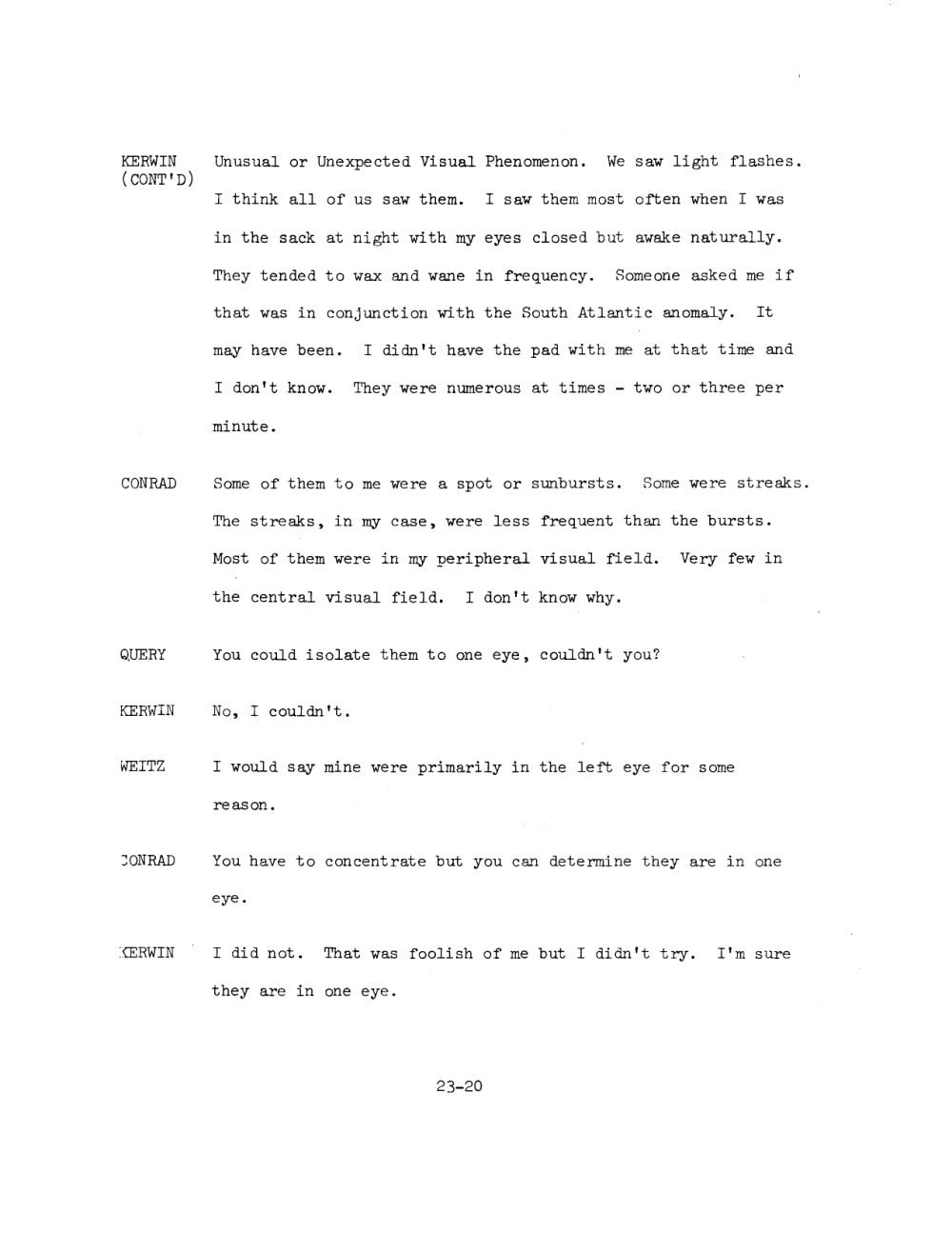
In the technical debriefing of the first Skylab crew, physician-astronaut Joseph Kerwin opens the item "unusual or unexpected visual phenomenon" by saying that everyone saw flashes of light, sometimes two or three per minute, especially with their eyes closed. Weitz and Conrad describe "in and out" streaks that they attributed to cosmic particles.
- Event date
- May and June 1973 (Skylab 2 mission); debriefing of 30/06/1973
- Location
- Skylab space station, in Earth orbit
- Topic
- Astronaut accounts
- Source agencies
- NASA
- Documents
- 1 document · 11 pages
- Reading time
- 7 min
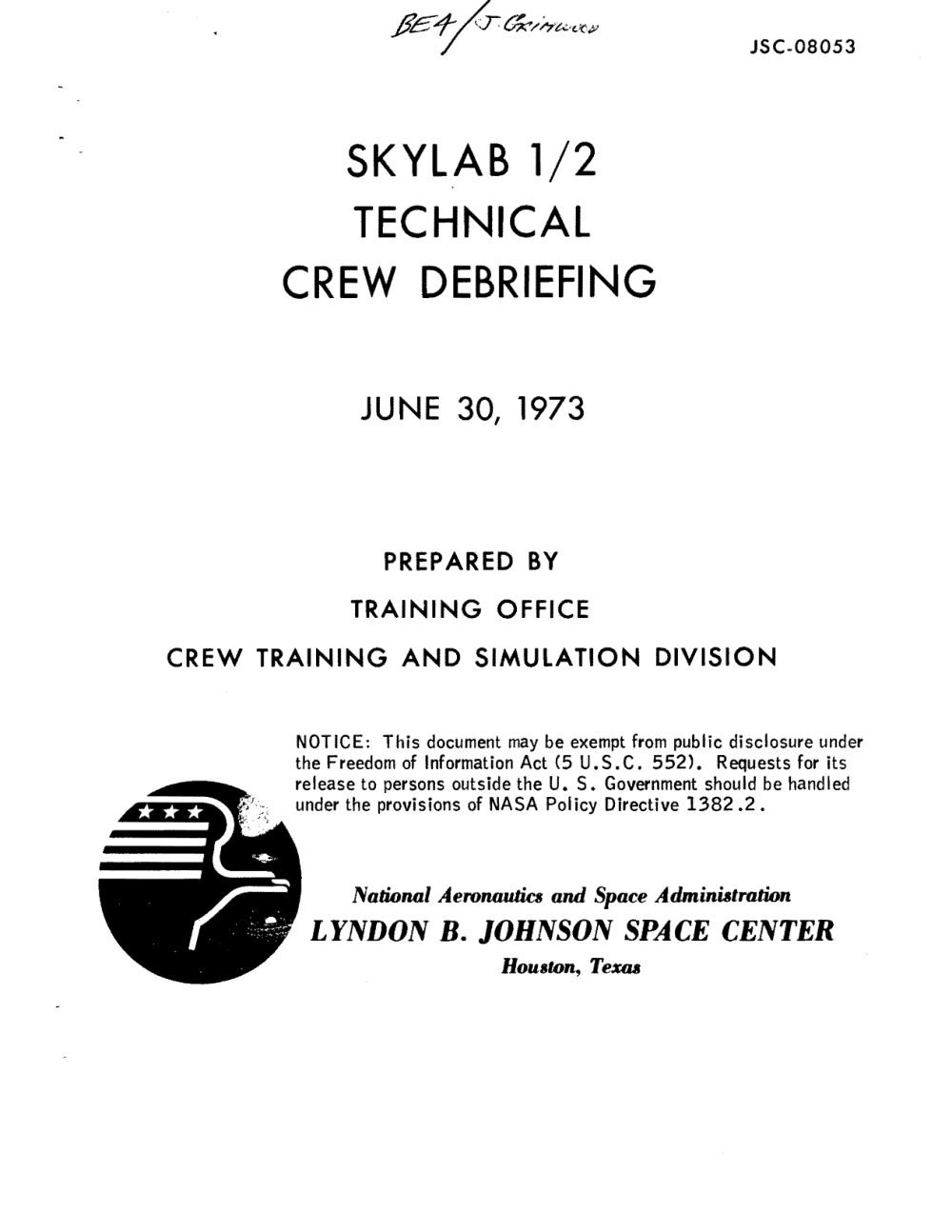 Cover of the crew technical debriefingPhysical page 1
DOCUMENTARY SOURCES · NASA
What the records tell
The first crew to live aboard Skylab, Pete Conrad, Joseph Kerwin and Paul Weitz, spent 28 days in orbit, between May and June 1973. The technical debriefing, dated June 30 and prepared by the training branch of the Johnson Space Center, bears on its cover a notice that the document might be exempt from public disclosure. The published file contains only two pages of that debriefing, numbered 23-20 and 23-21, with the item that Kerwin, the crew physician, calls "unusual or unexpected visual phenomenon."
"We saw light flashes. I think we all did," says Kerwin. He saw them most when he was in his sleeping bag at night, with his eyes closed and awake. The frequency increased and decreased; at certain moments there were two or three per minute. Someone asked him whether this coincided with the South Atlantic Anomaly, the region where Earth's radiation belt comes closest to the surface. "It might have been," he replied, but he did not have his notes at that moment and did not know.
Conrad describes some as a point or a burst of light, and others as streaks, which were less frequent. Almost all appeared in peripheral vision, and he did not know why. Asked whether they could tell in which eye they appeared, Kerwin says he could not, Weitz says his were mostly in the left eye, and Conrad states that, with concentration, one can tell. Kerwin admits it was foolish not to have tried and says he is certain they appear in one eye only.
Conrad recounts that sometimes, lying with his eyes half-closed, he would see a station fire sensor blinking. Kerwin warns that care was needed not to confuse the two things and concludes: "They're not hallucinations." Weitz says he saw some that he thought were cosmic particles, with "a streak in and a streak out," as if they crossed from one side of the eye to the other, and Conrad agrees. Kerwin adds that the crew did not think it operationally necessary for anyone to know about this at the time.
The account comes from the crew, with no measurement or institutional conclusion in the excerpt. The explanation accepted today, described by NASA in the records for the audio of the Apollo 14 and Apollo 17 debriefings, is that high-energy cosmic rays pass through the eye and strike the retina, producing the perception of flashes and streaks. The descriptions by Weitz and Conrad, with entry and exit paths, already pointed in that direction. The same phenomenon appears in the accounts of Aldrin, on Apollo 11, and of Cernan, on Apollo 17.
The two pages belong to section 23 of the debriefing, in which Kerwin, the crew physician, presents items in sequence. Right after the flashes, he moves on to the medical kits and the onboard medical supply system and estimates that the crew used about 0,01% of the available medications. The phenomenon was therefore handled in a block on health and medical equipment, and not as a sighting of something outside the station. The published file contains no other pages of this first debriefing, so it is not known whether the subject came up again in another section.
The excerpt makes it possible to separate what was described from what was interpreted. The description: points, bursts of light and streaks, almost all in peripheral vision, with variable frequency that sometimes reached two or three per minute, seen mostly with eyes closed in the sleeping bag. The astronauts' own interpretation: Weitz and Conrad linked the in-and-out streaks to cosmic particles, and Kerwin stated that they were not hallucinations. The link to the South Atlantic Anomaly remained a question from an unidentified interlocutor. There is no instrument count.
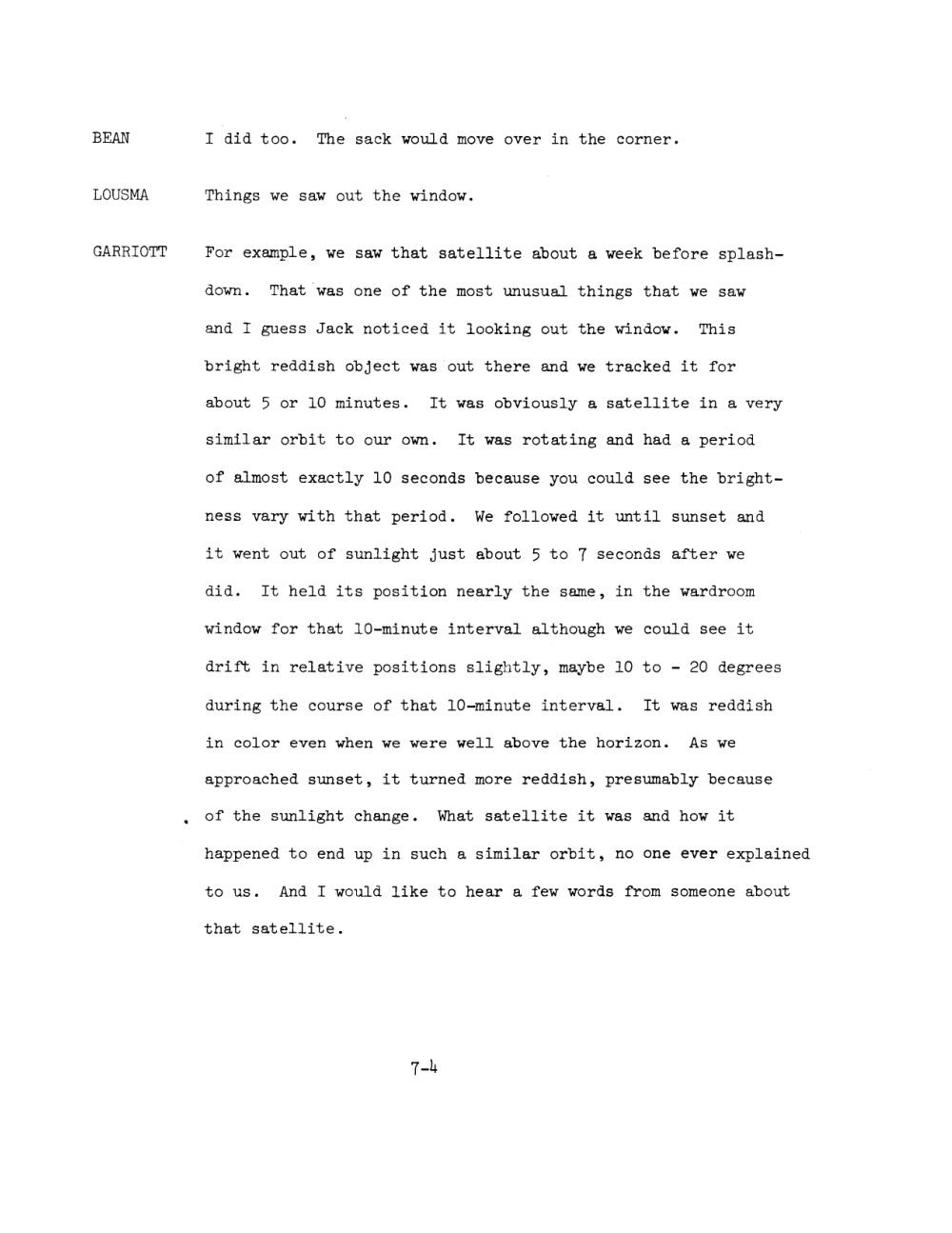
The same compilation contains excerpts from the debriefings of the next two Skylab crews, and none of them returns to flashes inside the eye. In the published pages, the second crew discusses a red object seen through the window, and the third, lights blinking outside the station. Lousma does mention many flashes at launch, but he is referring to the rocket separations, seen from outside, and says they were normal. This does not indicate that the later crews did not see the flashes; it only shows that the selection made by NASA did not gather those passages.
More images from the document
DIRECT READING OF THE FILE
The document, in the original
Full translation of the cover (p. 1) and of the two pages of the Skylab 2 debriefing (p. 2 and 3). Pages 4 to 11 of the same PDF are from the Skylab 3 and 4 debriefings and are already translated in the dossiers skylab-3-ponto-vermelho-em-orbita-1973 and skylab-4-luzes-piscando-fora-da-estacao-1973-1974 (p. 5, 6, 8 and 10); p. 4, 7, 9 and 11 are left for the expansion of those dossiers.
EXCERPT 1 · PHYSICAL PAGE 1
Cover, physical page 1, full
JSC-08053
SKYLAB 1/2
TECHNICAL
CREW DEBRIEFING
JUNE 30, 1973
PREPARED BY
TRAINING OFFICE
CREW TRAINING AND SIMULATION DIVISION
NOTICE: This document may be exempt from public disclosure under
the Freedom of Information Act (5 U.S. C. 552). Requests for its
release to persons outside the U. S. Government should be handled
under the provisions of NASA Policy Directive 1382 .2.
Natwnal Aeronautics and Space Administration
LYNDON B. JOHNSON SPACE CENTER
Houston, TexasEditorial note: "Skylab 1/2" designates the first crew (Skylab 2) on the station launched as Skylab 1.
Check the original PDF
JSC-08053. SKYLAB 1/2 TECHNICAL CREW DEBRIEFING. JUNE 30, 1973. PREPARED BY TRAINING OFFICE, CREW TRAINING AND SIMULATION DIVISION. NOTICE: This document may be exempt from public disclosure under the Freedom of Information Act (5 U.S.C. 552). Requests for its release to persons outside the U.S. Government should be handled under the provisions of NASA Policy Directive 1382.2. National Aeronautics and Space Administration, LYNDON B. JOHNSON SPACE CENTER, Houston, Texas.View the document record ↗ · Physical page 1, counting the cover.
EXCERPT 2 · PHYSICAL PAGE 2
Physical page 2 (23-20), full
KERWIN
(CONT'D)
CONRAD
Q,UERY
KERWIN
WEITZ
:::oNRAD
:IBRWIN
Unusual or Unexpected Visual Phenomenon. We saw light flashes.
I think all of us saw them. I saw them most often when I was
in the sack at night with my eyes closed but awake naturally.
They tended to wax and wane in frequency. Someone asked me if
that was in conjunction with the South Atlantic anomaly. It
may have been. I didn't have the pad with me at that time and
I don't know. They were numerous at times - two or three per
minute.
Some of them to me were a spot or sunbursts. Some were streaks.
The streaks, in my case, were less frequent than the bursts.
Most of them were in my peripheral visual field. Very few in
the central visual fieJ.d. I don't know why.
You could isolate them to one eye, couldn't you?
No, I couldn't.
I would say mine were primarily in the left eye for some
reason.
You have to concentrate but you can determine they are in one
eye.
I did not. That was foolish of me but I didn't try. I'm sure
they are in one eye.
23-20Check the original PDF
KERWIN (CONT'D): Unusual or Unexpected Visual Phenomenon. We saw light flashes. I think all of us saw them. I saw them most often when I was in the sack at night with my eyes closed but awake naturally. They tended to wax and wane in frequency. Someone asked me if that was in conjunction with the South Atlantic anomaly. It may have been. I didn't have the pad with me at that time and I don't know. They were numerous at times - two or three per minute. CONRAD: Some of them to me were a spot or sunbursts. Some were streaks. The streaks, in my case, were less frequent than the bursts. Most of them were in my peripheral visual field. Very few in the central visual field. I don't know why. QUERY: You could isolate them to one eye, couldn't you? KERWIN: No, I couldn't. WEITZ: I would say mine were primarily in the left eye for some reason. CONRAD: You have to concentrate but you can determine they are in one eye. KERWIN: I did not. That was foolish of me but I didn't try. I'm sure they are in one eye. 23-20View the document record ↗ · Physical page 2, counting the cover.
EXCERPT 3 · PHYSICAL PAGE 3
Physical page 3 (23-21), full
CONRAD Sometimes I'd be lying there with my eyes half closed, and I'd
see a fire sensor wink.
KERWIN And you'd have to be careful that you weren't confusing that
with the fire flash. Once you've seen a few of each, there is
question of which is which. They're not an hallucination.
KERWIN We didn't feel it was operationally necessary for anybody to
know about it right now.
WEITZ I had a couple that I thought were cosmic particles.
an entrance streak and an exit streak.
I saw
CONRAD Yes, I did too.
WEITZ Where, bing-bing, it seemed like it was
and then the other side.
one side of the eyeball,
CONRAD One night I remember that there was a long shot then it was
blank then there was a long shot in rapid succession, of
course, but very definitely in and out - or across the eye.
KERWIN Medical Kits and IMSS. As far as adequate quantity of medica
tion and supplies, I would guess we used about 0.01 percent
of the available medication. I think this is something for
me to sit down with the doctors and talk about. There is
plenty of medicine up there for the Skylab missons. There is
23-21Editorial note: "fire flash" translated as "the flash" (the visual flash, as opposed to the blinking of the fire sensor), a reading based on context. "missons" appears as such in the original. IMSS is the onboard medical supplies system. The page ends mid-sentence, already on another subject.
Check the original PDF
CONRAD: Sometimes I'd be lying there with my eyes half closed, and I'd see a fire sensor wink. KERWIN: And you'd have to be careful that you weren't confusing that with the fire flash. Once you've seen a few of each, there is question of which is which. They're not an hallucination. KERWIN: We didn't feel it was operationally necessary for anybody to know about it right now. WEITZ: I had a couple that I thought were cosmic particles. I saw an entrance streak and an exit streak. CONRAD: Yes, I did too. WEITZ: Where, bing-bing, it seemed like it was one side of the eyeball, and then the other side. CONRAD: One night I remember that there was a long shot then it was blank then there was a long shot in rapid succession, of course, but very definitely in and out - or across the eye. KERWIN: Medical Kits and IMSS. As far as adequate quantity of medication and supplies, I would guess we used about 0.01 percent of the available medication. I think this is something for me to sit down with the doctors and talk about. There is plenty of medicine up there for the Skylab missons. There is 23-21View the document record ↗ · Physical page 3, counting the cover.
Dates and documentary context
- Event
- 05/1973 — The Skylab 2 mission ran from 25/05 to 22/06/1973; the excerpt gives no dates for the observations.
- Document
- 30/06/1973 — Cover of technical debriefing JSC-08053.
- Publication
- 05/2026 — Release 1 of the UAP files collection, May 2026.
Origin and release
NASA, Johnson Space Center, training section; remarks by Conrad, Kerwin and Weitz · NASA-UAP-D7-Skylab-Technical-Crew-Debriefing-1973.pdf
undefined ↗ — undefined
Related accounts and their differences
Questions to continue the investigation
- Did the flashes become more frequent when the station crossed the South Atlantic Anomaly, as Kerwin was asked?
- Why did the crew think it was not operationally necessary to report the phenomenon during the mission?
GEOGRAPHY OF THE CASE
Earth orbit, Skylab station
Observations inside the station, in orbit; no geographic point.
DOCUMENTARY TRAIL
Go back to the sources
References use physical pages of the PDF, counting the cover. Summaries are presented in English; the documents keep their original language.
- NASA-UAP-D7-Skylab-Technical-Crew-Debriefing-1973.pdf
Physical page 1: cover of the Skylab 1/2 crew technical debriefing, JSC-08053, of 30/06/1973; pages 2 and 3 (internal numbering 23-20 and 23-21): light flashes
NASA · 11 pages
Editorial summary based on the collection's research notes. How we read the documents.