Date: Between November 1973 and February 1974 (third Skylab crew), no exact date; debriefing of 22/02/1974Location: Earth orbit, seen from the Skylab station
Skylab 4, 1973-1974: UFOs flashing outside the station, with their own motion
In the debriefing of the last Skylab crew, commander Gerald Carr says that, two or three times, they saw UFOs flashing outside, with clear motion relative to the station. They assumed they were pieces of Skylab itself or other satellites, and attributed the “tumbling” appearance to the oscillation of the flashes.
- Event date
- Between November 1973 and February 1974 (third Skylab crew), no exact date; debriefing of 22/02/1974
- Location
- Earth orbit, seen from the Skylab station
- Topic
- Astronaut accounts
- Source agencies
- NASA
- Documents
- 1 document · 11 pages
- Reading time
- 7 min
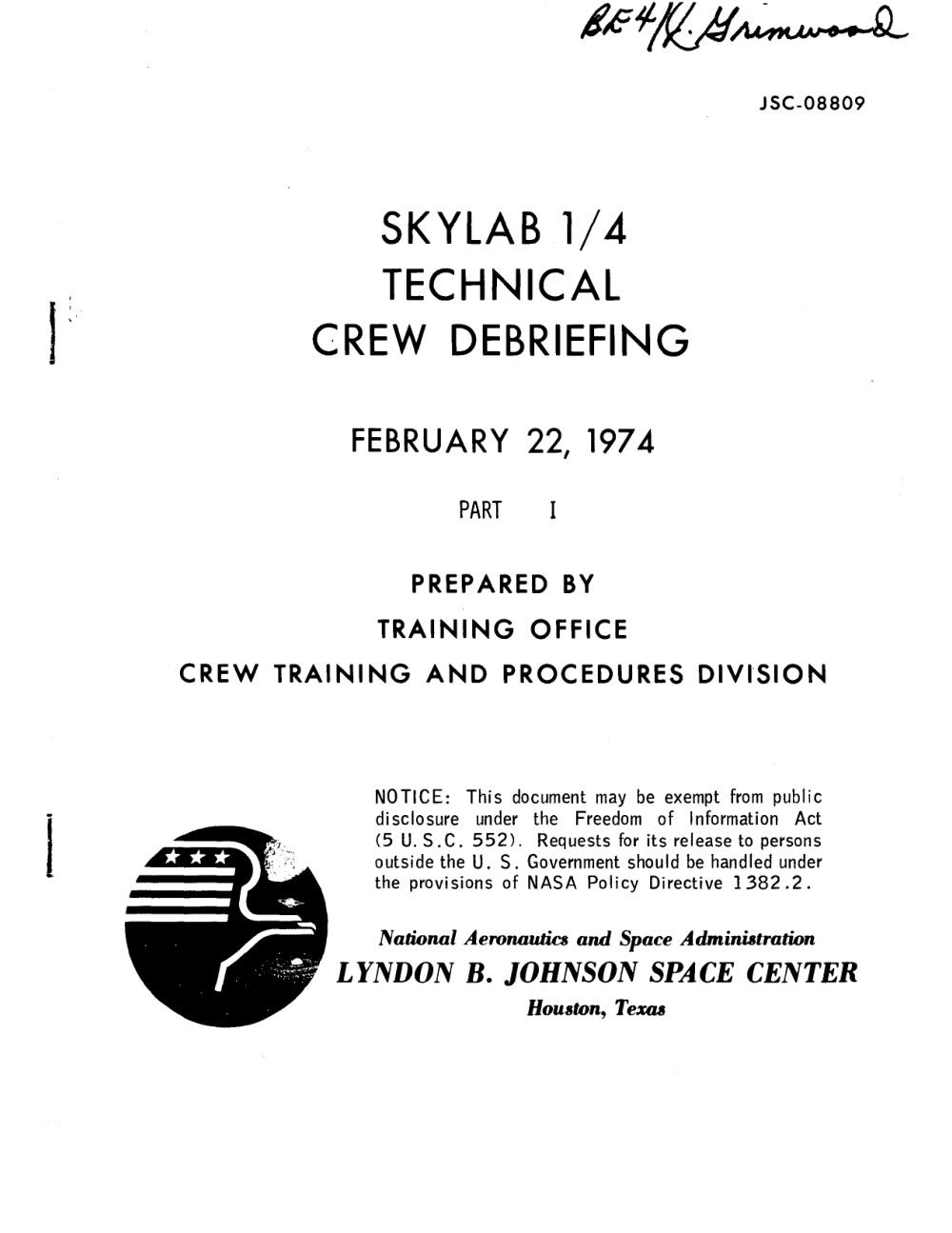 Technical debriefing coverPhysical page 9
DOCUMENTARY SOURCES · NASA
What the records tell
The third and last Skylab crew, with Gerald Carr, Edward Gibson and William Pogue, stayed on the station from November 1973 to February 1974. The technical debriefing, part I, is dated February 22, 1974. The passage about the lights appears in a list of “unusual events,” right after an account of an ammonia smell in the bathroom, and before a complaint about the lack of filters on the heat exchangers. The tone is that of one technical item among others.
Carr says that, now and then, they saw some lights flashing outside, “with very definite motion relative to ours.” The crew assumed they were other pieces of Skylab or, possibly, other satellites. According to him, the two or three observations of this kind were reported on the onboard tapes as soon as they occurred. “We have no special comments on them,” he says, adding that they found it very interesting to be able to see other objects up there with them.
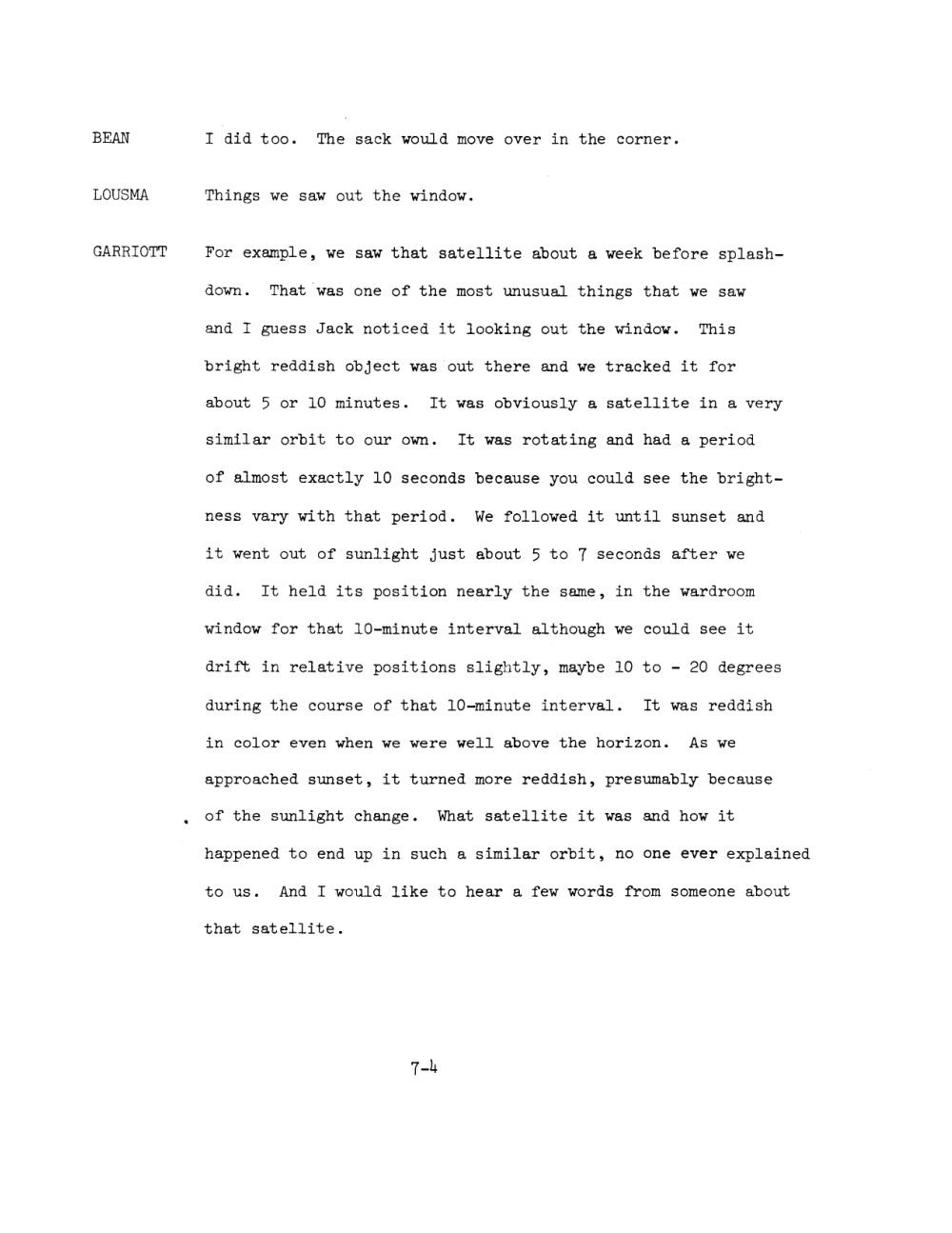
The only descriptive detail concerns the motion: one or two of the objects seemed to be tumbling, rotating on themselves, and Carr attributes this to the oscillation of the flashes of light they received from them. It is the same reading other crews made of objects that flash rhythmically, such as the red point from the previous Skylab mission, interpreted as a spinning satellite.
The document does not give dates, times, colors, brightness or how many lights there were on each occasion, and does not say whether anyone tried to identify the objects. The onboard tapes cited by Carr are not part of the PDF. The identification as pieces of the station or satellites is the crew's assumption, presented without apparent doubt, but also without recorded verification. There is also no photograph or drawing of the lights in the published pages.
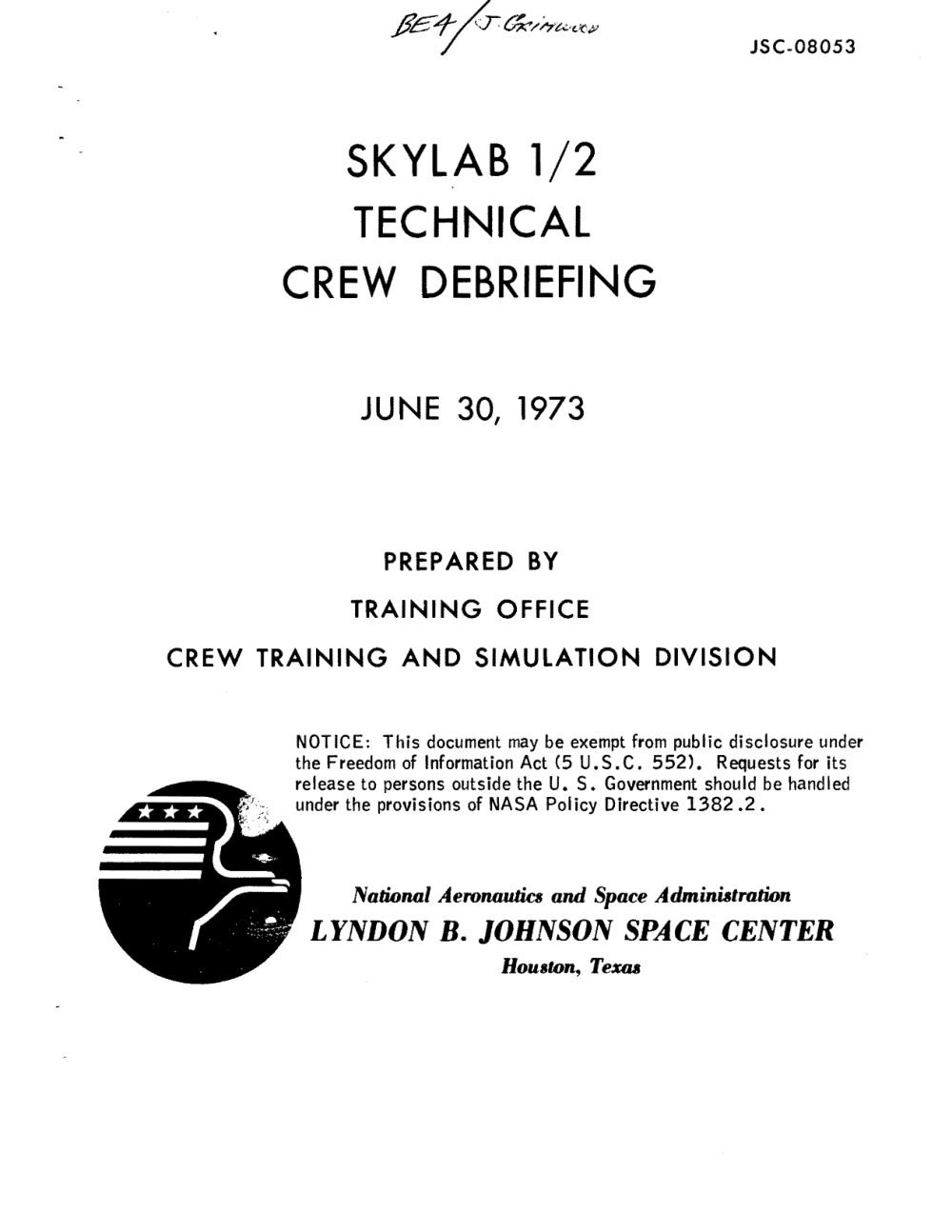
The cover of part I of the third crew's debriefing bears the code JSC-08809, the date February 22, 1974 and the same notice as the earlier covers: the document could be exempt from disclosure under the Freedom of Information Act, and requests from people outside the government followed an internal NASA directive. The training office now appears under the Crew Training and Procedures Division, and no longer under the Training and Simulation Division. Of the debriefing, the published file contains only internal pages 7-8 and 7-9.
The list of problems in which Carr places the lights is entirely about onboard matters. Before them, Gibson comments on a material that remained on the windows and could be useful for contamination studies, and Carr explains how the crew tracked down the ammonia smell: it came from the fan itself, not from the charcoal cartridge, and was considered tolerable. Afterward, Pogue points out the lack of filters on the orbital workshop's heat exchangers, covered in lint, and he and Gibson move on to water leaks during spacewalks and a possible failure in the suit connector.
The NASA file brings together three moments of Skylab. The first crew discussed flashes seen inside the eye, which it linked to cosmic particles. The second described a single red object, which rotated and accompanied the station for about ten minutes, and asked for its identification. The third reported two or three flashing lights with their own motion, treated them as pieces of Skylab or satellites and said it had no special comments. In all cases, the classification comes from the astronauts themselves; the file contains no analysis by any agency of these observations.
More images from the document
DIRECT READING OF THE FILE
The document, in the original
NASA transcript, a work of the U.S. government: Carr's remarks about the lights were translated in full after checking against the facsimile; the items about ammonia, heat exchangers and extravehicular activity were only mentioned.
EXCERPT 1 · PHYSICAL PAGE 9
Cover of the Skylab 1/4 technical debriefing, part I, physical page 9, full text
I
JSC-08809
SKYLAB 1/4
TECHNICAL
CREW DEBRIEFING
FEBRUARY 22, 1974
PART I
PREPARED BY
TRAINING OFFICE
CREW TRAINING AND PROCEDURES DIVISION
NOTICE: This document may be exempt from public
disclosure under the Freedom of Information Act
(5 U.S. C. 552). Requests for its release to persons
outside the U. S. Government should be handled under
the provisions of NASA Policy Directive 1382 .2.
National Aeronautics and Space Adminutration
LYNDON B. JOHNSON SPACE CENTER
Houston, Texa,sEditorial note: "Skylab 1/4" designates the third crew (Skylab 4 mission) on the station launched as Skylab 1. The reading of the handwritten note is probable, not certain. The cover bears the NASA emblem.
Check the original PDF
[Handwritten at top: BE4/J. Grimwood]
JSC-08809
SKYLAB 1/4
TECHNICAL CREW DEBRIEFING
FEBRUARY 22, 1974
PART I
PREPARED BY
TRAINING OFFICE
CREW TRAINING AND PROCEDURES DIVISION
NOTICE: This document may be exempt from public disclosure under the Freedom of Information Act (5 U.S.C. 552). Requests for its release to persons outside the U.S. Government should be handled under the provisions of NASA Policy Directive 1382.2.
National Aeronautics and Space Administration
LYNDON B. JOHNSON SPACE CENTER
Houston, TexasView the document record ↗ · Physical page 9, counting the cover.
EXCERPT 2 · PHYSICAL PAGE 10
Physical page 10 (internal numbering 7-8), full text
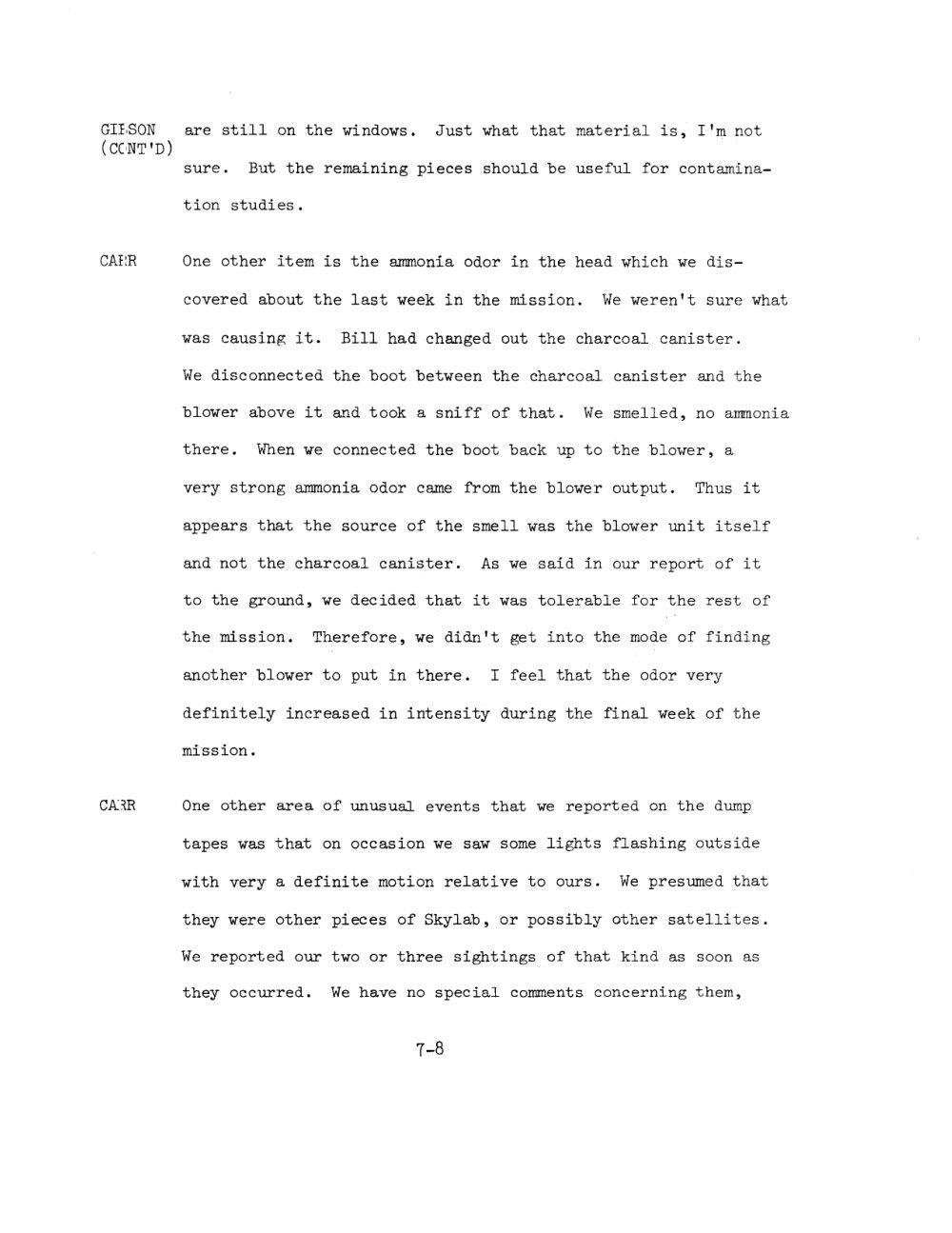
GI:E,SON are still on the windows. Just what that material is, I'm not
(C(,NT 'D)
sure. But the remaining pieces should be useful for contamina-
tion studies.
CA:E:R One other item is the ammonia odor in the head which we dis-
covered about the last week in the mission. We weren't sure what
was causing it. Bill had changed out the charcoal canister.
We disconnected the boot between the charcoal canister and the
blower above it and took a sniff of that. We smelled, no ammonia
there. When we connected the boot back up to the blower, a
very strong ammonia odor came from the blower output. Thus it
appears that the source of the smell was the blower unit itself
and not the charcoal canister. As we said in our report of it
to the ground, we decided that it was tolerable for the rest of
the mission. Therefore, we didn't get into the mode of finding
another blower to put in there. I feel that the odor very
definitely increased in intensity during the final week of the
mission.
CA1R One other area of unusual events that we reported on the dump
tapes was that on occasion we saw some lights flashing outside
with very a definite motion relative to ours. We presumed that
they were other pieces of Skylab, or possibly other satellites.
We reported our two or three sightings of that kind as soon as
they occurred. We have no special comments concerning them,
7-8Editorial note: The page begins in the middle of a statement by Gibson about material on the windows, the beginning of which is not in the PDF. "Head" is the station's toilet; "Bill" is William Pogue. "Dump tapes" are the onboard recorder tapes, later transmitted to the ground. The original has "with very a definite motion", a word-order inversion from the transcription of the time. This translation of the full page includes the already published excerpt of Carr's statement about the lights.
Check the original PDF
GIBSON (CONT'D): are still on the windows. Just what that material is, I'm not sure. But the remaining pieces should be useful for contamination studies.
CARR: One other item is the ammonia odor in the head which we discovered about the last week in the mission. We weren't sure what was causing it. Bill had changed out the charcoal canister. We disconnected the boot between the charcoal canister and the blower above it and took a sniff of that. We smelled, no ammonia there. When we connected the boot back up to the blower, a very strong ammonia odor came from the blower output. Thus it appears that the source of the smell was the blower unit itself and not the charcoal canister. As we said in our report of it to the ground, we decided that it was tolerable for the rest of the mission. Therefore, we didn't get into the mode of finding another blower to put in there. I feel that the odor very definitely increased in intensity during the final week of the mission.
CARR: One other area of unusual events that we reported on the dump tapes was that on occasion we saw some lights flashing outside with very a definite motion relative to ours. We presumed that they were other pieces of Skylab, or possibly other satellites. We reported our two or three sightings of that kind as soon as they occurred. We have no special comments concerning them,
7-8View the document record ↗ · Physical page 10, counting the cover.
EXCERPT 3 · PHYSICAL PAGE 11
Physical page 11 (internal numbering 7-9), full text
CARR but we did find it very interesting to be able to see other
(CONT'D)
objects up there with us. The fact that one or two of them
appeared to be tumbling was apparently due to the oscillation
of the light flashes that we were getting from them.
POGUE The OWS Heat Exchangers: There's a major design flaw there in
that filters were not installed upstream of the OWS heat exchanger
vanes. When we first arrived, the vanes were so uniformly coated
with lint that I thought there was some kind of anodized surface
on them. I was never fully convinced that I had done the
vacumming job properly; therefore, I fabricated a special tool
that fit flush against those surface vanes so that I could
exert a good vacuum. Though they are not supposed to be con
densive heat exchangers, I sucked quite a bit of condensate water
out of them. I tried the best I could to keep those things
clean, yet I never did get all that lint pulled out of there.
That is why I think we needed a filter in the system.
GIBSON EVA anomalies might also be mentioned here. For example, you
had the water leak outside, and I also got a water leak.
POGUE One thing that was not mentioned on air-to-ground as a possible
cause of the problem was the single-point failure that exists
in the mechanical way that the PCU composite connector is
hooked to the PCU. I was able during EVA, maneuvering through
the clothesline ropes, not only to open the lock but also to
extend the arm which pulls the PCU composite connector off.
7-9Editorial note: OWS (Orbital Workshop) is the orbital workshop, the main body of Skylab. EVA is extravehicular activity, the spacewalk. PCU is the suit's pressure control unit. "Clothesline" refers to ropes used outside the station during spacewalks. "Vacumming" appears as such in the original. This translation of the full page includes the already published end of Carr's statement.
Check the original PDF
CARR (CONT'D): but we did find it very interesting to be able to see other objects up there with us. The fact that one or two of them appeared to be tumbling was apparently due to the oscillation of the light flashes that we were getting from them.
POGUE: The OWS Heat Exchangers: There's a major design flaw there in that filters were not installed upstream of the OWS heat exchanger vanes. When we first arrived, the vanes were so uniformly coated with lint that I thought there was some kind of anodized surface on them. I was never fully convinced that I had done the vacumming job properly; therefore, I fabricated a special tool that fit flush against those surface vanes so that I could exert a good vacuum. Though they are not supposed to be condensive heat exchangers, I sucked quite a bit of condensate water out of them. I tried the best I could to keep those things clean, yet I never did get all that lint pulled out of there. That is why I think we needed a filter in the system.
GIBSON: EVA anomalies might also be mentioned here. For example, you had the water leak outside, and I also got a water leak.
POGUE: One thing that was not mentioned on air-to-ground as a possible cause of the problem was the single-point failure that exists in the mechanical way that the PCU composite connector is hooked to the PCU. I was able during EVA, maneuvering through the clothesline ropes, not only to open the lock but also to extend the arm which pulls the PCU composite connector off.
7-9View the document record ↗ · Physical page 11, counting the cover.
Dates and documentary context
- Event
- Not established — During the mission of the third Skylab crew (16/11/1973 to 08/02/1974, public chronology); the document does not date the observations.
- Document
- 22/02/1974 — Date on the cover of the Skylab 1/4 technical debriefing, part I (p. 9).
- Publication
- Not established — Published by NASA in release 1 of the UAP files.
Origin and release
NASA, Lyndon B. Johnson Space Center; Training Office, Crew Training and Procedures Division · NASA-UAP-D7-Skylab-Technical-Crew-Debriefing-1973.pdf
undefined ↗ — undefined
Related accounts and their differences
- Skylab 3, 1973: the red dot that followed the station
- Apollo 17, 1972: the blinking object “way out there”
Questions to continue the investigation
- Do the recording tapes cited by Carr include the date, time and description of each observation?
- Were there loose pieces of Skylab in nearby orbit at that time?
GEOGRAPHY OF THE CASE
Earth orbit
Observations made from the station in orbit, with no date or position given.
DOCUMENTARY TRAIL
Go back to the sources
References use physical pages of the PDF, counting the cover. Summaries are presented in English; the documents keep their original language.
- NASA-UAP-D7-Skylab-Technical-Crew-Debriefing-1973.pdf
Physical page 9: cover of the Skylab 1/4 technical debriefing, part I, of 22/02/1974; pp. 10 and 11 (internal numbering 7-8 and 7-9): lights flashing outside the station
NASA · 11 pages
Editorial summary based on the collection's research notes. How we read the documents.