Date: December 1965 · civil date not reconciledLocation: In orbital flight during the Gemini 7 mission; precise orbital position not given
“Bogey” and particles reported during the Gemini 7 mission
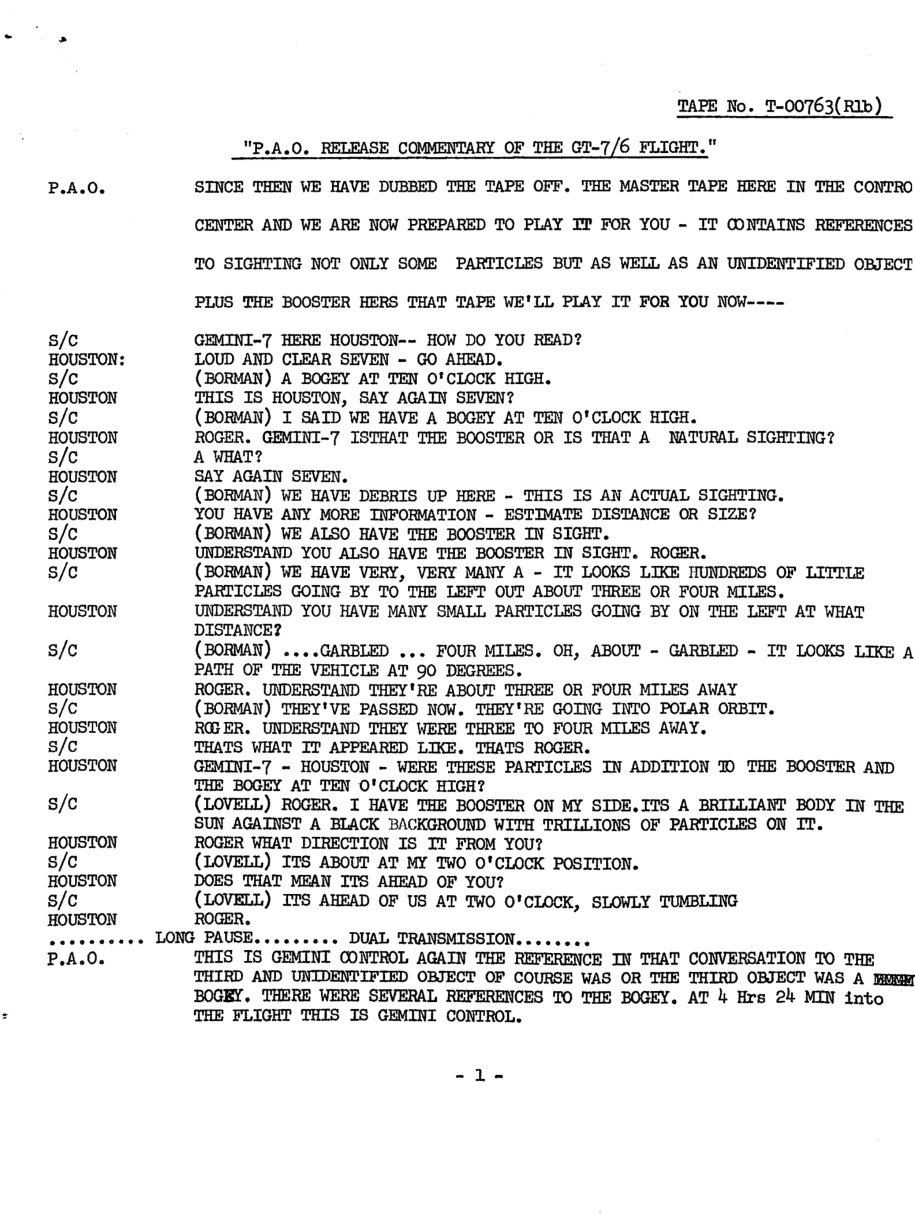
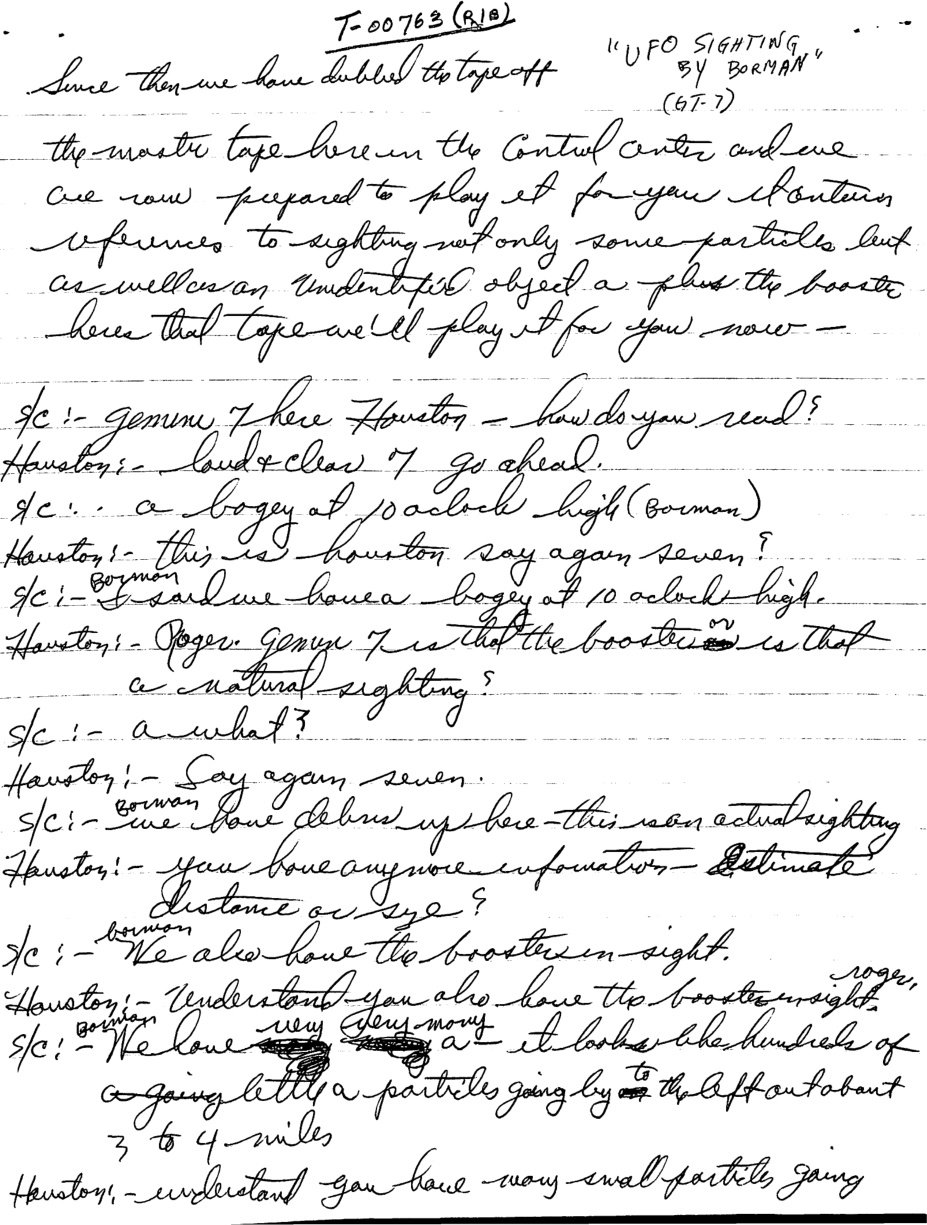
In the transcript, Houston asks whether the UFO sighted by Borman was the booster or a natural observation. Borman replies that there is “debris” and calls the occurrence an actual sighting; he reports that he also sees the booster and describes hundreds of small particles passing on the left, visually estimated at about three or four miles. The remark qualifies the distance as apparent and contains a passage marked as garbled.
- Event date
- December 1965 · civil date not reconciled
- Location
- In orbital flight during the Gemini 7 mission; precise orbital position not given
- Topic
- Lights and encounters
- Source agencies
- Arquivo histórico · NASA · USG
- Documents
- 3 documents · 312 pages
- Reading time
- 283 min
 Official transcriptPhysical page 1
DOCUMENTARY SOURCES · Arquivo histórico / NASA / USG
What the records tell
In the transcript, Houston asks whether the object sighted by Borman was the booster or a natural observation. Borman replies that there is “debris” and calls the occurrence an actual sighting; he reports that he also sees the booster and describes hundreds of small particles passing on the left, visually estimated at about three or four miles. The remark qualifies the distance as apparent and contains a passage marked as garbled.
Lovell describes the booster as a bright body in the sun, against a black background, “with trillions of particles on it”, ahead and at the two o'clock position, tumbling slowly. “Hundreds” and “trillions” are the speakers' expressions, not instrumental counts. The identified booster and the particles provide context of objects associated with the mission; the transcript does not identify the nature of the “bogey”.
The PAO's commentary explicitly associates the third unidentified object with the “bogey”. The word is legible on the line following a strikeout on page 1 and in the handwritten version of page 3; the continuation on page 4 distinguishes the “bogey” from the particles and from the booster described by Lovell. The reference to 4 hours and 24 minutes refers to the time of the commentary relative to the flight, not necessarily to the moment of the reproduced sighting. The separate notation “Time: 05 min: 34 sec” is not a civil time and its function has not been established.
NASA records the launch of Gemini VII on December 4, 1965 at 19h30min03s UT. Given the indication of commentary at 4h24 into the flight, the December 4 date for the reproduced conversation is inferred, not printed in this PDF. The exact time of the observation and the orbital position have not been determined.
The DVIDS release of the related audio presents conflicting dates: the title and description indicate December 5, 1965, while the Date Taken field indicates December 4. The inference of December 4 in this PDF derives from the commentary about 4h24 into the flight. The civil date of the episode remains unreconciled. The correspondence between the audio track and this transcript has not yet been checked; therefore, the audio is not presented here as a confirmed recording of the same conversation.
The Gemini VII technical debriefing, recorded December 19 to 21, 1965 at Cape Kennedy and with a cover dated December 23, does not use the word “bogey”. In the sightings section, Borman says the artificial objects seen were the rocket, whose flashing lights they followed during the first three orbits; Gemini 6, at the rendezvous; the reentry of a Minuteman missile, “at the exact time and place”, which looked like a meteor and broke up; and two satellites in polar orbit, one below and one above the spacecraft, photographed and tracked on the infrared sensor. “They were just points of light,” Lovell summarized.
Other passages deal with particles and debris near the rocket. Lovell saw debris at separation and between the spacecraft and the rocket when they turned around; Borman did not. During the perigee adjustment maneuver, again performed near the rocket, Borman recounts that the propellant leak from the rocket “suddenly lit up” and it looked as though they were passing through many strange objects or debris. Afraid of hitting something, he asked Lovell to stop the thrust; then a loose initiator cord came out in front and struck the hatch. In another passage, Borman mentions a satellite seen at the 16:40 mark, well below them, “just a reflection”.
The debriefing does not say whether any of these scenes corresponds to the “bogey” conversation transcribed by NASA at 4 hours and 24 minutes into the flight, and this dossier does not make that connection. The similarity between the particles that “seemed to be going in polar orbit”, in the PAO commentary, and the polar-orbit satellites in the debriefing is merely verbal. The same document also records a bright aurora australis over Australia, with sketches reserved for the scientific debriefing, which are not in the PDF, and 206 lightning flashes counted by Borman on a single night pass.
The official recording published by DVIDS in 2026, titled NASA Audio 12/5/1965 Low Earth Orbit, is the same tape transcribed in the PDF. Houston's questions and the spacecraft's answers follow the same order as on paper, from the sentence about the tape copy to the PAO's closing at 4 hours and 24 minutes into the flight. The audio, however, starts earlier. The Gemini Control commentator recalls that, at the start of the second revolution around the Earth, the crew had spoken of several objects, in the Antigua area, and that this segment had not been played earlier because of a failure in the line linking control to the press center.
This opening changes how the chronology reads. The time of 4 hours and 24 minutes is not the moment of the sighting: it is when the PAO played for the press a conversation recorded hours earlier, at the start of the second revolution. With launch at 19h30 UT on December 4 and a revolution of about an hour and a half, the conversation would have taken place at around 21h UT on December 4, still on the first day of flight. This is an estimate made from the two sources, which do not give the exact time of the dialogue. The December 5 date, in the title and description of the audio, finds no support in these records.
The audio also clarifies the note "Time: 05 min 34 sec" at the foot of the handwritten draft. The transcribed segment begins about 31 seconds after the start of the recording and ends at around 6 minutes and 6 seconds, with the PAO's closing remark: close to 5 minutes and 35 seconds. The match suggests that the number measures the duration of the transcribed segment, but the paper does not say so. In the recording, the voices from the spacecraft are not very clear, with hiss and dropouts, and there is about a minute and a half of broken-up calls after Lovell's last line, which correspond to the "long pause" and the "double transmission" noted in the transcript.
There is a difference of one word. In the typed transcript and in the handwritten draft, Houston asks whether the object is "the booster or a natural sighting". In the audio, the question seems to be "the booster or an actual sighting", the same form that appears in a version of the dialogue that circulated in the 1990s. Borman's next line is not very clear in the recording; for that reason the dossier follows the typed text, "we have debris up here; this is an actual sighting". Nothing in the audio identifies the "bogey" or changes the sequence described on paper.
The PDF holds two versions of the same transcript. The first page is typed; the following three are the pencil draft, on lined paper, from which it was produced. The draft has a title that the final version does not carry, "UFO sighting by Borman (GT-7)", and the astronauts' names were added by hand above the lines. It also preserves the PAO's last sentence, cut from the typed version: the "bogey" is the unidentified object, in addition to the particles that appeared to be heading into a polar orbit, and it was Borman who reported it. The title comes from whoever transcribed the tape, not from the crew or from an official analysis.
In the technical debriefing, the debris appears right at the start of the flight. At fairing jettison, Lovell says he saw debris and heard a pyrotechnic charge fire; Borman, watching the horizon, neither saw nor heard anything. Asked whether he could identify the material, Lovell answered: "No, they were pieces." In another passage, Borman says the spacecraft switched to direct control mode only once, to be able to follow the reentry of the Minuteman missile, which was moving very fast. In the assessment of the radiometry experiment, he also says the crew measured all the planned missiles and included "one extra satellite", without identifying it.
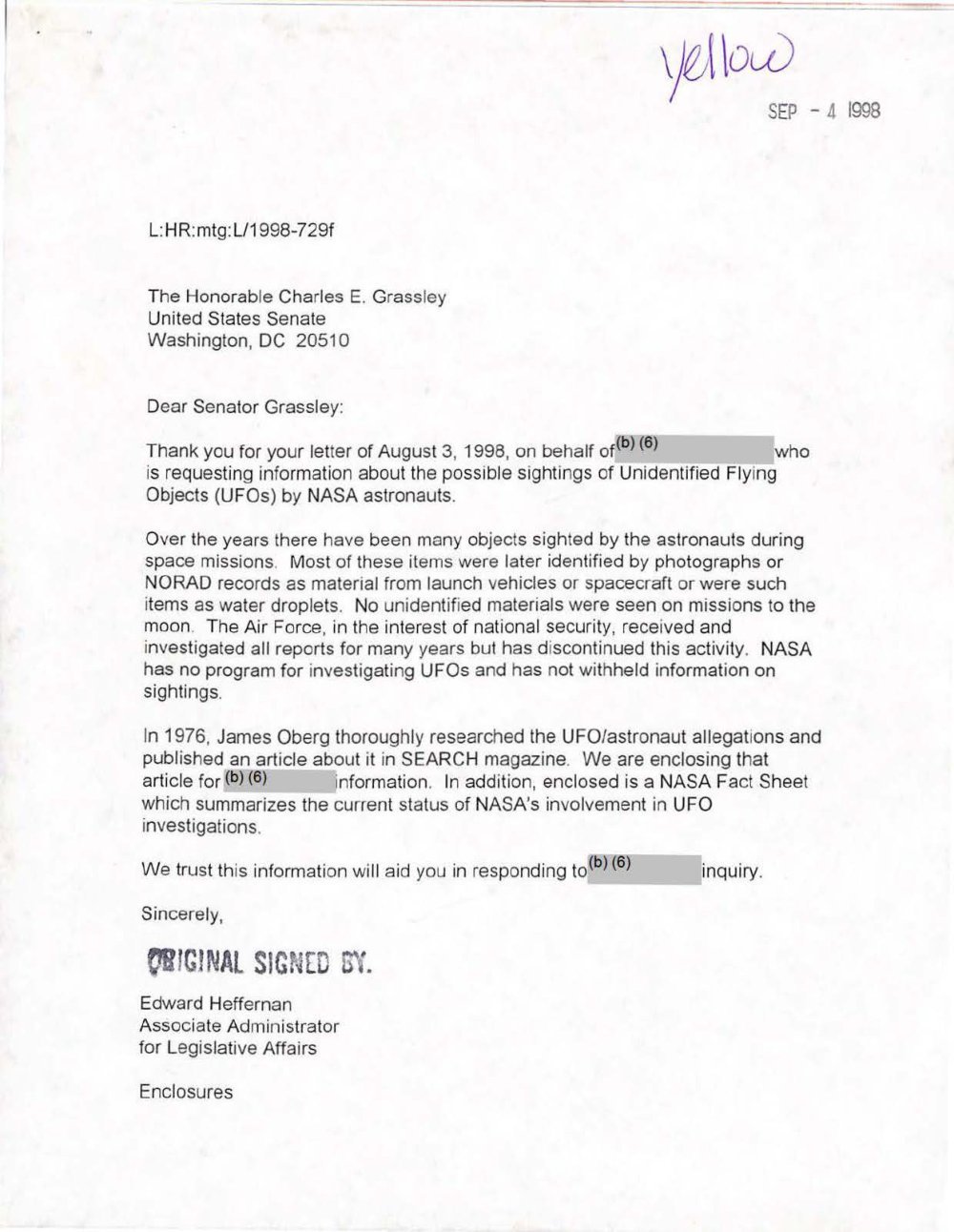
In July 1998, a constituent sent Senator Charles Grassley's office a compilation of astronaut accounts, which the office forwarded to NASA. It contains a version of the dialogue and places the episode on the "second orbit", which agrees with the opening of the audio. But it adds something that neither the transcript nor the recording contains: that Gemini Control had allegedly told Borman he was seeing the last stage of his own Titan, and that Borman had allegedly replied that he also saw "something completely different". In the NASA sources, it is Houston that asks whether it is the booster, and Borman answers that he also sees the booster. NASA replied to the senator without addressing the case, attaching the essay by James Oberg, which considers the debris cloud from separation a common event.
OFFICIAL MEDIA
Official video for this case
Files published by the United States Government on DVIDS. The title of each one is that of the official publication, translated; the description of what is seen is in the dossier text.

NASA mission audio · 6 min 12 s · the video only loads when you start playback, directly from the official server.
Official record ↗More images from the document
DIRECT READING OF THE FILE
The document, in the original
Translation of the selected excerpts checked against the image, with omissions indicated. This is not a full translation of the PDF. Summaries and evaluations are kept separate from the transcription.
EXCERPT 1 · PHYSICAL PAGE 4
Handwritten continuation of the PAO commentary, before the separate note on duration; spelling and punctuation normalized, struck-out word omitted
. .,,,Editorial note: Passage actually present on physical page 4. Punctuation was normalized for readability, and the word describe struck through before discussing was not restored. The comment distinguishes verbal references; it does not provide independent physical identification.
Check the original PDF
There were several references to the bogey. This is the unidentified object in addition to particles which appeared to be headed in a polar orbit, you heard Frank Borman say, plus Jim Lovell discussing the booster. It was Borman who reported sighting the bogey. This is Gemini Control in Houston at 4 hrs 24 min into the flight.View the document record ↗ · Physical page 4, counting the cover.
EXCERPT 2 · PHYSICAL PAGE 1
Physical page 1: cover
I
Authority:
NW 91526
\
GEMINI VII
TECHNICAL DEBRIEFING
December 23, 1965
NOTICE: This document may be exempt from
public disclosure under the Freedom of lnfor•
mation Act (5 U.S.C. 552). Requests for its release to persons outside the U. S. Government
should be handled under the provisions of
NASA Policy Directive 1382.2.Editorial note: Handwritten portions of the stamp and the rest of the standard notice omitted ([...]). There is also the struck-through “Confidential” marking and a later declassification stamp “NW 91526”.
Check the original PDF
GEMINI VII TECHNICAL DEBRIEFING. December 23, 1965. [carimbo:] CLASSIFICATION CHANGE To UNCLASSIFIED By authority of EO 11652 [...] Date NOV 9 1973. [...] NOTICE: This document may be exempt from public disclosure under the Freedom of Information Act (5 U.S.C. 552). [...]View the document record ↗ · Physical page 1, counting the cover.
EXCERPT 3 · PHYSICAL PAGE 3
Physical page 3: foreword, full text
PREFACE
This preliminary transcript was made from voice
tape recordings of the Gemini 7 flight crew debriefing
conducted December 19 through December 21 , 1965 at the
Crew Quarters, Cape Kennedy, Florida.
Although all the material contained in this transcript
has been rough edited, the urgent need for the preliminary
t ranscript by mission analysis personnel precluded a final
edit prior to its publication.Check the original PDF
PREFACE
This preliminary transcript was made from voice tape recordings of the Gemini 7 flight crew debriefing conducted December 19 through December 21, 1965 at the Crew Quarters, Cape Kennedy, Florida.
Although all the material contained in this transcript has been rough edited, the urgent need for the preliminary transcript by mission analysis personnel precluded a final edit prior to its publication.View the document record ↗ · Physical page 3, counting the cover.
EXCERPT 4 · PHYSICAL PAGE 24
End of physical page 24 (transcript page 14): debris
14
a velocity correction.
Lovell As a matter of fact, right now would be a good time to mention that address 72 read --
Borman Nominal was 25 804 and address 72 read 25 804.
Lovell Can you imagine that? Right t o th~ · foot! 25 804. I could
not believe it when I punched it up.
Borman The orbit quantities were given to us, I think,by Bermuda..
0£ course, at this time we really were not interested in
them, although they were sort of nice in.formation. We had
a GO/NO GO.
Lovell It was 87-178 the initial forward quantity that was
called up to ue.
Borman Tha l'!1JU readouts : Jim read 72 and when he saw it was 25, 804,
we had a GO/NO GO from the ground. I do not believe you
even rea4 the rest of them out, did you?
Lovell No, I did not bother reading out the rest of the addresses
94, 97, 52, or 73, because I saw the 72 nominal. I saw the
IVI's were right in there so we did not bother reading out
anything else.
Borman Debris • I did not notice a:ny debris.
Lovell I noti-od debris. I was looking out at Spacecraft SEP and
Jet Fairing, and noticed debris. I also noticed debris bet ween the spacecraft and booster when we first turned around.Editorial note: The rest of the page deals with computer readings.
Check the original PDF
Borman: Debris. I did not notice any debris.
Lovell: I noticed debris. I was looking out at Spacecraft SEP and Jet Fairing, and noticed debris. I also noticed debris between the spacecraft and booster when we first turned around.View the document record ↗ · Physical page 24, counting the cover.
EXCERPT 5 · PHYSICAL PAGE 32
Physical page 32 (transcript page 22), full text
22
:Sor:ma.n Re did a very good job. We knew just what to do. W& had
all the equip,nent with us and everything went very smoothly.
MS0--2 ana,..3 turned out to be not :much of a problem because
at about the seventh dq we turned it on and left it on for
the rest of the flight. The Berigee Adjust :tv1.aneuver 0 Jim
ma.de the ~erigee Aijust Manuever. We did it on stars without a platform. I was timing for Jim and I think I fouled
up. We planned to use a perigee to 102 miles, and I think
we wotmd up with about 15 feet per second too much. It
seemed like about 117 miles. One of the reasons that was
causing this was we had come back into the vicinity of the
booster, and just about midwny through the burn the booster
venting that was still occurring suddenly lit up, became
lit up. It looked like we were flying through a lot of
foreign objects or debris. I was afraid that we were going
to hit so.mething. At the same time this trailing wire came
forward and slapped the spacecraft.
Lovell That is where I stopped.
:Sor.man Yes. After we had stopped and it nit us, I looked down
and got confused and said,"No, we haven't burned enough",.
·&> we burned for about five seconds :more. We had a trailing primer cord that would flop around and we didn 't know
what it was at the time, but it came forward when Jim
stopped burning and flopped on the spacecraft. It ,nade aEditorial note: “Foreign objects” was translated as "objetos estranhos" in the sense of loose bodies, not unidentified at the time. MSC-2 and MSC-3 are onboard experiments. The page does not state the time of the maneuver.
Check the original PDF
Borman: He did a very good job. We knew just what to do. We had all the equipment with us and everything went very smoothly. MSC-2 and -3 turned out to be not much of a problem because at about the seventh day we turned it on and left it on for the rest of the flight. The Perigee Adjust Maneuver. Jim made the Perigee Adjust Manuever. We did it on stars without a platform. I was timing for Jim and I think I fouled up. We planned to use a perigee to 102 miles, and I think we wound up with about 15 feet per second too much. It seemed like about 117 miles. One of the reasons that was causing this was we had come back into the vicinity of the booster, and just about midway through the burn the booster venting that was still occurring suddenly lit up, became lit up. It looked like we were flying through a lot of foreign objects or debris. I was afraid that we were going to hit something. At the same time this trailing wire came forward and slapped the spacecraft.
Lovell: That is where I stopped.
Borman: Yes. After we had stopped and it hit us, I looked down and got confused and said, "No, we haven't burned enough". So we burned for about five seconds more. We had a trailing primer cord that would flop around and we didn't know what it was at the time, but it came forward when Jim stopped burning and flopped on the spacecraft. It made aView the document record ↗ · Physical page 32, counting the cover.
EXCERPT 6 · PHYSICAL PAGE 36
End of physical page 36 (transcript page 26): satellite
26
or 150 pai at launch. I called up Houston and said I
would like to leave the gauge in the FC02 position
rather than the ECS o2 positlon. Chris said, "No, unless
we really felt strongly about it, they would rather have it
in the ECS o position". So we left it there and after we 2
were inserted and we were still with the booster, they
came in with a recommendation that we open the cross feed.
When we did, this immediately raised the pressure to 250
psi. The thing that was bad was that we had over 100%
o:xygen and we were down to about 100 lbs. on the FC02•
We agreed that we would fly at least 50 lbs. above the do.me,
So, I really didn't see the need for opening that valve
although it didn't cause a:n:y problems.
Lovell They wanted to pump up and make sure.
Borman It worked fine and we got right back up to 250 lbs.
Lovell That is one syste.m that did work fine.
Borman The first 7 hours was pretty no.minal. All throughout the
flight plan we have notes that the Delta Plight went out
and came back on and so on.
Bor:man At 16,40 we sighted a satellite .much lower and
on a slightly higher inclination path than we were. It
passed underneath us. It was so fe:r awa::, it looked like
a sighting from the earth. It was just a refiection. We
were very religious about the exercise periods. We s-otEditorial note: From the context (“the first 7 hours”), this is a flight elapsed-time mark, not clock time, but the document does not say so explicitly.
Check the original PDF
Borman: The first 7 hours was pretty nominal. All throughout the flight plan we have notes that the Delta P light went out and came back on and so on.
Borman: At 16:40 we sighted a satellite much lower and on a slightly higher inclination path than we were. It passed underneath us. It was so far away it looked like a sighting from the earth. It was just a reflection. We were very religious about the exercise periods. We gotView the document record ↗ · Physical page 36, counting the cover.
EXCERPT 7 · PHYSICAL PAGE 82
Physical page 82 (transcript page 72): Borman's remarks on the perigee adjustment
72
Lovell No. I did not hear the thrust ers. One reason why we didn't
hea.r the thrusters in t h.at particular case, whereas we did
later on, was the fact t ha.t we ha.d our hoods on and the air
was blowing in and making a lot of noise. It Wl!.S strictly
by feel and by sight. No sound.
Borman Right. Peri gee Adjuat Translati on. Accel erometer bias was
what they thought it was prelaunch, and it remained that way
throughout the f light. This was a. no platform Perigee
Adjust, so, really that doesn' t have any meaning there. The
timing on the first Peri get Adjust Maneuver was off, thanks
to me. Jim ma.de the maneuver. We did it without a platform
on a. star. And, as I mentioned earlier, about this time we
were in cl ose proximity to the booster, and we started flying through some particles, but I wa.s not sure exactly what
it was, so I told him to stop thrusting as we approached
this. Then, when we got in there, when we stopped th.rusting,
this wire came forward, hi t the hatch, and I lost the timing
again. We thrusted, I guess , a little too l ong. I a.m not
sure exactly how l ong i t was. I think we were aiming for a.
perigee of about 102, and ended up with about 120. M.&¥be
they changed their minds and went for a perigee of 120.
don't know.
Lovell Well, that time which they gave us was not consistent with
IEditorial note: The first statement on the page, by Lovell, concerns the noise that prevented hearing the thrusters; the last, also by Lovell, continues on the next page.
Check the original PDF
Borman: Right. Perigee Adjust Translation. Accelerometer bias was what they thought it was prelaunch, and it remained that way throughout the flight. This was a no platform Perigee Adjust, so, really that doesn't have any meaning there. The timing on the first Perigee Adjust Maneuver was off, thanks to me. Jim made the maneuver. We did it without a platform on a star. And, as I mentioned earlier, about this time we were in close proximity to the booster, and we started flying through some particles, but I was not sure exactly what it was, so I told him to stop thrusting as we approached this. Then, when we got in there, when we stopped thrusting, this wire came forward, hit the hatch, and I lost the timing again. We thrusted, I guess, a little too long. I am not sure exactly how long it was. I think we were aiming for a perigee of about 102, and ended up with about 120. Maybe they changed their minds and went for a perigee of 120. I don't know.View the document record ↗ · Physical page 82, counting the cover.
EXCERPT 8 · PHYSICAL PAGE 141
Physical page 141 (transcript page 131): beginning of section 10.0
131
Borman The reception on HF during the fli ght was very poor.
Lovell Right.
10.0 VISUAL SIGHTINGS
10.1 Countdown
Borman We did not have any visual si ghtings. No wasps, bees, bugs,
or anyth:iJlg in the spacecraft.
10.2 Powered flight
Borman I did not look out at l i ft- off.
Lovell I think we went throu,gh clouds , didn't we? We went through
an overcast.
FCSD rep It looked like Frank steered i t right through a hol e in the
overcast.
Lovell Could anyone see us after we went through the overcast? Or
was that the end of i t?
FCSD rep No, the hole was big enough so that you were in sight.
Lovell Could you see staging?
FCSD rep No, you dis&ppeared from sight before staging.
Borman At BECO the spa.cecra.ft was enveloped. in a yellow flame. BECO
&nd sta.ging &re so cl ose that you cannot tell the difference.
Engine 2 ignition was very smooth, no noise, no bang.1.ng.
The horizon ca.me into view just like the simulator. Ve-ry,
very adequate presentation. At SECO I did not notice a
thing, just & stop and a oessa.tion of noise. I did not seeEditorial note: The first two remarks on the page, about HF radio reception, were omitted. The mention of wasps responds to the Gemini IV report.
Check the original PDF
10.0 VISUAL SIGHTINGS
10.1 Countdown
Borman: We did not have any visual sightings. No wasps, bees, bugs, or anything in the spacecraft.
10.2 Powered flight
Borman: I did not look out at lift-off.
Lovell: I think we went through clouds, didn't we? We went through an overcast.
FCSD rep: It looked like Frank steered it right through a hole in the overcast.
Lovell: Could anyone see us after we went through the overcast? Or was that the end of it?
FCSD rep: No, the hole was big enough so that you were in sight.
Lovell: Could you see staging?
FCSD rep: No, you disappeared from sight before staging.
Borman: At BECO the spacecraft was enveloped in a yellow flame. BECO and staging are so close that you cannot tell the difference. Engine 2 ignition was very smooth, no noise, no banging. The horizon came into view just like the simulator. Very, very adequate presentation. At SECO I did not notice a thing, just a stop and a cessation of noise. I did not seeView the document record ↗ · Physical page 141, counting the cover.
EXCERPT 9 · PHYSICAL PAGE 142
Physical page 142 (transcript page 132), full text
132
any flames, debris or anything. Although you did at
Fairing Jettison and Spacecraft Separation.
Lovell On Fairing Jettison, I saw debris fly, especially during
the turnaround.
l0.3 Orbital Flight
Borman As for .man-made objects sighted, we took sightings of the
booster. We had no difficulty in sighting the booster at
turnaround and in station keeping with it. We maintained
the flashing light in sight throughout the first orbit, we
saw them on the second orbit, and the third orbit during
the night phase.
Lovell But you could not tell distance by the flashing lights.
Borman No. As a matter of fact, I think it would be impossible
to tell distance at night unless you have some sort of
illutnination.
Lovell Yes, if the lights are illuminating the vehicle, by spreading it over the vehicle, maybe you could tell. You cannot
tell the way they are now. We picked up Spacecraft 6 on
the final rendezvous phase, I guess at about five miles.
Is that right?
Borms.n Right. Again, this is entirely dependent upon where the
sun is. Spacecraft 6 was able to see us a long time before
we could see them, because we were in a position where the sunCheck the original PDF
[Borman] any flames, debris or anything. Although you did at Fairing Jettison and Spacecraft Separation.
Lovell: On Fairing Jettison, I saw debris fly, especially during the turnaround.
10.3 Orbital Flight
Borman: As for man-made objects sighted, we took sightings of the booster. We had no difficulty in sighting the booster at turnaround and in station keeping with it. We maintained the flashing light in sight throughout the first orbit, we saw them on the second orbit, and the third orbit during the night phase.
Lovell: But you could not tell distance by the flashing lights.
Borman: No. As a matter of fact, I think it would be impossible to tell distance at night unless you have some sort of illumination.
Lovell: Yes, if the lights are illuminating the vehicle, by spreading it over the vehicle, maybe you could tell. You cannot tell the way they are now. We picked up Spacecraft 6 on the final rendezvous phase, I guess at about five miles. Is that right?
Borman: Right. Again, this is entirely dependent upon where the sun is. Spacecraft 6 was able to see us a long time before we could see them, because we were in a position where the sunView the document record ↗ · Physical page 142, counting the cover.
EXCERPT 10 · PHYSICAL PAGE 143
Physical page 143 (transcript page 133), full text
133
was reflecting off our adapter, and they were in a position
so that the sun was not reflecting off their adapter. It
is a strange phenomenon, but it is entirely dependent upon
the sun. Once we acquired Spacecraft 6, it certainly was
no problem of maintaining a visual on it. It was no
different than it is on the ground in the daytime.
Lovell I agree.
Borman We sighted two satellites. We saw the Minuteman reentry
at exactly the right time and exactly the right place.
It looked l i ke a meteorite.
Lovell Very brilliant. It broke up toward the end.
Borman Very brilli ant, it broke up toward the end, and there were
several different pieces flying around. I was surprised at
the speed at which it went in. I was also surprised at the
control authority required to track it. We did get on it
though before it broke up and went out. I hope they got
good data on it.
Lovell We saw, what we think, were two satellites moving.
Borman Yes, we took IR readings on one of them. It was a de£inite
satellite in a polar orbit. We took photographs of two
satellites in the polar orbits. One of them was below us,
crossing from left to right, and the other one wa.s above
us, crossing left to right. We picked them up first in the
handle of theEditorial note: Minuteman is a U.S. ballistic missile; the observed reentry was scheduled. “Strange phenomenon” refers to the Sun's reflection on the spacecraft adapters.
Check the original PDF
[Borman] was reflecting off our adapter, and they were in a position so that the sun was not reflecting off their adapter. It is a strange phenomenon, but it is entirely dependent upon the sun. Once we acquired Spacecraft 6, it certainly was no problem of maintaining a visual on it. It was no different than it is on the ground in the daytime.
Lovell: I agree.
Borman: We sighted two satellites. We saw the Minuteman reentry at exactly the right time and exactly the right place. It looked like a meteorite.
Lovell: Very brilliant. It broke up toward the end.
Borman: Very brilliant, it broke up toward the end, and there were several different pieces flying around. I was surprised at the speed at which it went in. I was also surprised at the control authority required to track it. We did get on it though before it broke up and went out. I hope they got good data on it.
Lovell: We saw, what we think, were two satellites moving.
Borman: Yes, we took IR readings on one of them. It was a definite satellite in a polar orbit. We took photographs of two satellites in the polar orbits. One of them was below us, crossing from left to right, and the other one was above us, crossing left to right. We picked them up first in the handle of theView the document record ↗ · Physical page 143, counting the cover.
EXCERPT 11 · PHYSICAL PAGE 144
Physical page 144 (transcript page 134), full text
134
Big Dipper. It was definitely a satellite, and ~e tracked it
on the IR and we used the recorder. It will be interesting
to see if they got any data of it. We were never close
enough to see any satellites and to pick them out as far as
definite features.
Lovell They were just points of light.
Borman Just light points. There certainly was not any problem
viewing the ground. As we have already mentioned over the
radio, we were able to see the Astrodome. The horizontal
markings, or the east west markings, on the S-8/D-1, pattern
stood out loud and clear when we acquired it. It is very
akin to flying an ai rpl ane at high altitude. Roads stood
out well, rivers stood out well, and beaches particularly
well. Towns were a little more difficult to determine, but
when you had them you could easily see the l ayout and apparent size. Also, the atmosphere made a vast difference. If
there was any sort of haze or cloud, it definitely cut down
your vision. When we finally got over the Himalayas in
daylight, it was easy to see why it was so clear.
lovell Haze does affect sightings from space as well as it does from
airplanes. It is very similar. If the area is pretty hazy,
it is goi ng to decrease tr:e contrast of the ground, and
makes viewing ground objects very difficult. Where you haveEditorial note: “Handle of the Big Dipper” (end of the previous page) is the handle of Ursa Major.
Check the original PDF
[Borman] Big Dipper. It was definitely a satellite, and we tracked it on the IR and we used the recorder. It will be interesting to see if they got any data of it. We were never close enough to see any satellites and to pick them out as far as definite features.
Lovell: They were just points of light.
Borman: Just light points. There certainly was not any problem viewing the ground. As we have already mentioned over the radio, we were able to see the Astrodome. The horizontal markings, or the east west markings, on the S-8/D-13 pattern stood out loud and clear when we acquired it. It is very akin to flying an airplane at high altitude. Roads stood out well, rivers stood out well, and beaches particularly well. Towns were a little more difficult to determine, but when you had them you could easily see the layout and apparent size. Also, the atmosphere made a vast difference. If there was any sort of haze or cloud, it definitely cut down your vision. When we finally got over the Himalayas in daylight, it was easy to see why it was so clear.
Lovell: Haze does affect sightings from space as well as it does from airplanes. It is very similar. If the area is pretty hazy, it is going to decrease the contrast of the ground, and makes viewing ground objects very difficult. Where you haveView the document record ↗ · Physical page 144, counting the cover.
EXCERPT 12 · PHYSICAL PAGE 147
Physical page 147 (transcript page 137): thrusters seen at night
137
zon. And with no Moon, the best sextant sighting spot to
use was the upper air glow, because it was the sharpest of
the two. The area between the upper air glow area and the
earth's horizon was too milky during a no Moon to get a good
sharp contrast (you could see stars through it), but you
couldn't find out exactly where the horizon was. So it
varied between full Moon and no Moon.
Borman Very drastically too. Also, your ability to pick out the
earth, and determine yaw from earth's passage wi t h no Moon,
wa.s zilch. With the full Moon it wa.s just as good as it was
in the daylight.
Lovell The fuon is very bright up there, very bright.
:Borman Both atti tude a.nd translation thrusters firing were apparent.
The a.ft firing thrusters were not apparent. But the- forward .
thrusters were apparent &t night and so were the translational, up, down, sideways. The attitude t hrusters were
also apparent with puffs, sort of like subdued flashbulbs
appearing out to the side of the window. They wer e just
little flashes of light in the ba ckground, and we couldn' t
determine &nything from them.
wvell We couldnJt determine a.nything.
l3orma.n But you could on Spacecra.ft 6.
wvell On Spa cecraft 6 t he thruster firings looked as though theyEditorial note: The first half of the page, about the horizon, airglow, and the Moon for sextant use, was omitted because it does not deal with observed objects or lights.
Check the original PDF
Borman: Both attitude and translation thrusters firing were apparent. The aft firing thrusters were not apparent. But the forward thrusters were apparent at night and so were the translational, up, down, sideways. The attitude thrusters were also apparent with puffs, sort of like subdued flashbulbs appearing out to the side of the window. They were just little flashes of light in the background, and we couldn't determine anything from them.
Lovell: We couldn't determine anything.
Borman: But you could on Spacecraft 6.
Lovell: On Spacecraft 6 the thruster firings looked as though theyView the document record ↗ · Physical page 147, counting the cover.
EXCERPT 13 · PHYSICAL PAGE 148
Physical page 148 (transcript page 138), full text
138
went out about forty feet against a dark background. You
could see this light haze going out about forty feet. It
wasn't a bell shaped pattern, as we thought it was going
to be, but it was like a garden hose, straight out. At
a distance we could not see the bright flash of ignition
in the chamber itself. All we could see was the haze
going out. But as we got in closer, we could start
picking up the bright flash, ma.inly because of attitude I
suspect, as we were getting closer to see it. It had no
effect on our spacecraft at all. They actually fired
about twenty feet away with their forward firing thrusters
to us, and departed.
l3or:man They got in back behind us in the adapter and fired their
forward firing thrusters and .made the curtain jiggle. 1
don I t know how far away they were when they did this. 1
hope they can tell us, and give you some idea of the effect
that these thrusters :might have on the EVA Mission. It's
just like firing a rocket at night. I guess that's the way
we expected it to look. That is exactly what you are doing,
firing a rocket at night.
10.4 Reentry
Borman We retrofired in the darkest, .most dis.m.al part of the night
slcy-, and we didn't see anything. We didn 't see Adapter
Separation. We didn't see My of the retros fire. We d.idn'tEditorial note: “Curtain” refers to a part of Gemini 7 itself, unrelated to the luminous curtain of Gemini IV.
Check the original PDF
[Lovell] went out about forty feet against a dark background. You could see this light haze going out about forty feet. It wasn't a bell shaped pattern, as we thought it was going to be, but it was like a garden hose, straight out. At a distance we could not see the bright flash of ignition in the chamber itself. All we could see was the haze going out. But as we got in closer, we could start picking up the bright flash, mainly because of attitude I suspect, as we were getting closer to see it. It had no effect on our spacecraft at all. They actually fired about twenty feet away with their forward firing thrusters to us, and departed.
Borman: They got in back behind us in the adapter and fired their forward firing thrusters and made the curtain jiggle. I don't know how far away they were when they did this. I hope they can tell us, and give you some idea of the effect that these thrusters might have on the EVA Mission. It's just like firing a rocket at night. I guess that's the way we expected it to look. That is exactly what you are doing, firing a rocket at night.
10.4 Reentry
Borman: We retrofired in the darkest, most dismal part of the night sky, and we didn't see anything. We didn't see Adapter Separation. We didn't see any of the retros fire. We didn'tView the document record ↗ · Physical page 148, counting the cover.
EXCERPT 14 · PHYSICAL PAGE 182
End of physical page 182 (transcript page 172): section 11.13
172
Rather tightl y packed in. We really had to work to get
it out.
Borman But again, thi s is one of those things we were operating
right up to the maximum capabi l i ty of the spacecraft, and
I guess we had to expect that, e.ven though we did get it
out. So I would not say it was unacceptable.
11.13 Miscellaneous
Borman Celesti al and t erresti al observati ons, and significant
observati ons or a.nomoiies affecti ng other opera.tio.naJ
or experimental da.t a..
Lovell Well , we got to see Mars just nea.r the sun by looking a.t
it just at sunset .
Borman Mercury you mean. Mercury. We saw Mercury. And we made
some other observations here for the sci entists.
Lovell Zodiacal light came in loud and clear after we found out
how to look f or it.
Borman Right.
Lovell We could not s ee the Gegenshein though, we knew exactl y
where t o l ook .
Borman Okay. We also made several night passes counti ng meteor s .
One at 215 hours plus 23 minutes, 25 seconds, I 'llade
one night pass counting meteors for the entire 30 some
minutes . And I saw.l meteor under Taurus and Pleia.des
and it was below us, and it was short and white. TheEditorial note: “Terrestial”, “anomolies” and “Gegenshein” appear this way in the original. 215 hours is flight time.
Check the original PDF
11.13 Miscellaneous
Borman: Celestial and terrestial observations, and significant observations or anomolies affecting other operational or experimental data.
Lovell: Well, we got to see Mars just near the sun by looking at it just at sunset.
Borman: Mercury you mean. Mercury. We saw Mercury. And we made some other observations here for the scientists.
Lovell: Zodiacal light came in loud and clear after we found out how to look for it.
Borman: Right.
Lovell: We could not see the Gegenshein though, we knew exactly where to look.
Borman: Okay. We also made several night passes counting meteors. One at 215 hours plus 23 minutes, 25 seconds, I made one night pass counting meteors for the entire 30 some minutes. And I saw 1 meteor under Taurus and Pleiades and it was below us, and it was short and white. TheView the document record ↗ · Physical page 182, counting the cover.
EXCERPT 15 · PHYSICAL PAGE 183
Physical page 183 (transcript page 173), full text
173
Lovell
Borman
Lovell
Borman
Lovell
Borman
Lovell
Borman
next night pass, ending at 217 : 17 I counted discrete
flashes of lightening for the entire pass. I collnted
206 discrete occurrances o:" lightning. This was with
the spacecraft level in HORIZON SCAN mode, looking out
one window with no yaw control. Now, we also saw
individual meteors at different times in flight that are
recorded on the tape recorder. But unfortunately we did
not see this great shower that was supposed to come out
of Gemini.
I saw two in a period of about 10 minutes out of Gemini.
They headed below us, of course.
Alright, the meteors. Another significant observation
that we made was a brilliant display of the Aurora. The
Southern Aurora over Australia . And we have some pictures
here.
Sketches.
Sketches of what it looked like, and we will cover this
in the scientific debriefing.
And we measured the time it took for stars to occult to
the air glow layer, and for Venus to go through.
I think this would be best to discuss when we talk to the
scientists.
I think so.
Do you have anything else that was significant? As farEditorial note: “Gemini” here is the constellation Gemini, the radiant of the December Geminid meteor shower. The sketches of the aurora are not in the PDF. “Lightening” and “occurrances” appear this way in the original.
Check the original PDF
[Borman] next night pass, ending at 217:17 I counted discrete flashes of lightening for the entire pass. I counted 206 discrete occurrances of lightning. This was with the spacecraft level in HORIZON SCAN mode, looking out one window with no yaw control. Now, we also saw individual meteors at different times in flight that are recorded on the tape recorder. But unfortunately we did not see this great shower that was supposed to come out of Gemini.
Lovell: I saw two in a period of about 10 minutes out of Gemini. They headed below us, of course.
Borman: Alright, the meteors. Another significant observation that we made was a brilliant display of the Aurora. The Southern Aurora over Australia. And we have some pictures here.
Lovell: Sketches.
Borman: Sketches of what it looked like, and we will cover this in the scientific debriefing.
Lovell: And we measured the time it took for stars to occult to the air glow layer, and for Venus to go through.
Borman: I think this would be best to discuss when we talk to the scientists.
Lovell: I think so.
Borman: Do you have anything else that was significant? As farView the document record ↗ · Physical page 183, counting the cover.
EXCERPT 16 · PHYSICAL PAGE 1
Physical page 1, full text: typed transcript of tape T-00763 (R1b), PAO commentary and air-to-ground dialogue
..
TAPE No. T-00763(Rlb)
"P.A.O. RELEASE COMMENTARY OF THE GT-7/6 FLIGHT."
P.A.O. SINCE THEN WE HAVE DUBBED THE TAPE OFF. THE MASTER TAPE HERE IN THE CONTRO
CENTER AND WE ARE NOW PREPARED TO PLAY IT FOR YOU - IT CDNTAINS REFERENCES
TO SIGHTING NOT ONLY SOME PARTICLES BUT AS WELt AS AN UNIDENTIFIED OBJECT
PLUS THE BOOSTER HERS THAT TAPE WE'LL PLA.Y IT FOB YOU NOW----
s/c GEMINI-7 HERE HOUSTON-- HOW DO YOU READ?
HOUSTON: LOUD AND CLEAR SEVEN - GO AHEAD.
s/c (BORMAN) A BOGEY AT TEN 01 CLOCK HIGH.
HOUSTON THIS IS HOUSTON, SAY AGAIN SEVEN?
s/c (BORMAN) I SAID WE HAVE A BOGEY AT TEN O'CLOCK HIGH.
HOUSTON ROGER. GEMINI-7 ISTHAT THE BOOSTER OR IS THAT A NATURAL SIGHTING?
s/c A WHAT?
HOUSTON SAY AGAIN SEVEN.
s/c (BORMAN) WE HAVE DEBRIS UP HERE - THIS IS AN ACTUAL SIGHTING.
HOUSTON YOU HAVE ANY MORE INFORMATION - ESTlMATE DISTANCE OR SIZE?
s/c (:BORMAN) WE ALSO HAVE THE BOOSTER IN SIGHT.
HOUSTON UNDERSTAND YOU ALSO HAVE THE BOOSTER IN SIGHT.. ROGER.
s/c (BORMAN) WE HAVE VERY, VERY MANY A - IT LOOKS LllCE HUNDREDS OF LITI'LE
PARTICLES GOING BY TO THE LEFT OUT ABOUT THREE OR FOUR MILES.
HOUSTON UNDERSTAND YOU HAVE MANY SMALL PARTICLES GOING BY ON THE LEFT AT WHAT
DISTANCE?
s/c (BORMAN) •••. GARBLED ... FOUR MILES. OH, ABOUT - GARBLED - IT LOOKS LIKE A
PATH OF THE VEHICLE AT 90 DEGREES.
HOUSTON ROGER. UNDERSTAND THEY'RE ABOUT THREE OR FOUR MILES AWAY
s/c (BORMAN) THEY'VE PASSED NOW. THEY'RE GOING INTO POIAR ORBIT.
HOUSTON ROlER. UNDERSTAND THEY WERE TimEE TO FOUR MILES AWAY.
s/c THATS WHAT IT APPEARED LIKE. THATS ROGER.
HOUSTON GEMINI-7 - HOUSTON - WERE THESE PARTICLES IN ADDITION 'ID THE BOOSTER AND
THE BOGEY AT TEN -O'CLOCK HIGH?
s/c (LOVELL) ROGER. I HAVE THE BOOSTER ON MY SIDE.ITS A BRILLIANT BODY IN THE
SUN AGAINST A BLACK BACKGROUND WITH TRILLIONS OF PARTICLES ON IT.
HOUSTON ROGER WHAT DIRECTION IS IT FROM YOU?
s/c (LOVELL) ITS ABOUT AT MY TWO O'CLOCK POSITION.
HOUSTON DOES THAT MEAN ITS AHEAD OF YOU?
s/c (LOVELL) ITS AHEAD OF US AT TWO O'CLOCK, SLOWLY TUMBLING
HOUSTON ROGER.
•••••••••• LONG PAUSE ••••••••• DUAL TRANSMISSION•....•••
P.A.O. THIS IS GEMINI OONTROL AGAIN THE REFERENCE IN THAT CONVERSATION TO THE
THIRD AND UNIDENTIFIED OBJECT OF COURSE WAS OR THE THIRD OBJECT WAS A JBiB1r
BOGEY. THERE WERE SEVERAL REFERENCES TO THE BOGEY. AT 4 Hrs 24 MIN into
~ THE FLIGHT THIS IS GEMINI CONTROL.
- l -Editorial note: "HERS" is typed this way (probably "HERE'S"). The typed text records "natural sighting"; in the official audio, Houston's question seems to be "actual sighting". "Bogey" is aviation slang for an unidentified contact or object and was kept. The positions "ten o'clock" and "two o'clock" follow the clock face, with the front of the spacecraft at twelve. "High" indicates above the line of sight. The distances are visual estimates.
Check the original PDF
TAPE No. T-00763(R1b). "P.A.O. RELEASE COMMENTARY OF THE GT-7/6 FLIGHT."
P.A.O.: SINCE THEN WE HAVE DUBBED THE TAPE OFF. THE MASTER TAPE HERE IN THE CONTRO[L] CENTER AND WE ARE NOW PREPARED TO PLAY IT FOR YOU - IT CONTAINS REFERENCES TO SIGHTING NOT ONLY SOME PARTICLES BUT AS WELL AS AN UNIDENTIFIED OBJECT PLUS THE BOOSTER HERS [sic] THAT TAPE WE'LL PLAY IT FOR YOU NOW----
S/C: GEMINI-7 HERE HOUSTON-- HOW DO YOU READ?
HOUSTON: LOUD AND CLEAR SEVEN - GO AHEAD.
S/C: (BORMAN) A BOGEY AT TEN O'CLOCK HIGH.
HOUSTON: THIS IS HOUSTON, SAY AGAIN SEVEN?
S/C: (BORMAN) I SAID WE HAVE A BOGEY AT TEN O'CLOCK HIGH.
HOUSTON: ROGER. GEMINI-7 IS THAT THE BOOSTER OR IS THAT A NATURAL SIGHTING?
S/C: A WHAT?
HOUSTON: SAY AGAIN SEVEN.
S/C: (BORMAN) WE HAVE DEBRIS UP HERE - THIS IS AN ACTUAL SIGHTING.
HOUSTON: YOU HAVE ANY MORE INFORMATION - ESTIMATE DISTANCE OR SIZE?
S/C: (BORMAN) WE ALSO HAVE THE BOOSTER IN SIGHT.
HOUSTON: UNDERSTAND YOU ALSO HAVE THE BOOSTER IN SIGHT. ROGER.
S/C: (BORMAN) WE HAVE VERY, VERY MANY A - IT LOOKS LIKE HUNDREDS OF LITTLE PARTICLES GOING BY TO THE LEFT OUT ABOUT THREE OR FOUR MILES.
HOUSTON: UNDERSTAND YOU HAVE MANY SMALL PARTICLES GOING BY ON THE LEFT AT WHAT DISTANCE?
S/C: (BORMAN) ....GARBLED ... FOUR MILES. OH, ABOUT - GARBLED - IT LOOKS LIKE A PATH OF THE VEHICLE AT 90 DEGREES.
HOUSTON: ROGER. UNDERSTAND THEY'RE ABOUT THREE OR FOUR MILES AWAY
S/C: (BORMAN) THEY'VE PASSED NOW. THEY'RE GOING INTO POLAR ORBIT.
HOUSTON: ROGER. UNDERSTAND THEY WERE THREE TO FOUR MILES AWAY.
S/C: THATS WHAT IT APPEARED LIKE. THATS ROGER.
HOUSTON: GEMINI-7 - HOUSTON - WERE THESE PARTICLES IN ADDITION TO THE BOOSTER AND THE BOGEY AT TEN O'CLOCK HIGH?
S/C: (LOVELL) ROGER. I HAVE THE BOOSTER ON MY SIDE. ITS A BRILLIANT BODY IN THE SUN AGAINST A BLACK BACKGROUND WITH TRILLIONS OF PARTICLES ON IT.
HOUSTON: ROGER WHAT DIRECTION IS IT FROM YOU?
S/C: (LOVELL) ITS ABOUT AT MY TWO O'CLOCK POSITION.
HOUSTON: DOES THAT MEAN ITS AHEAD OF YOU?
S/C: (LOVELL) ITS AHEAD OF US AT TWO O'CLOCK, SLOWLY TUMBLING
HOUSTON: ROGER.
.......... LONG PAUSE ......... DUAL TRANSMISSION........
P.A.O.: THIS IS GEMINI CONTROL AGAIN THE REFERENCE IN THAT CONVERSATION TO THE THIRD AND UNIDENTIFIED OBJECT OF COURSE WAS OR THE THIRD OBJECT WAS A [palavra riscada] BOGEY. THERE WERE SEVERAL REFERENCES TO THE BOGEY. AT 4 Hrs 24 MIN into THE FLIGHT THIS IS GEMINI CONTROL.
- 1 -View the document record ↗ · Physical page 1, counting the cover.
EXCERPT 17 · PHYSICAL PAGE 2
Physical page 2, full text: first sheet of the handwritten draft of the same transcript, with the title "UFO sighting by Borman (GT-7)"
. Foote ocr
ae tn ee Eid pte ‘YPe 6) aa G
An’
6F VY
tC
ct soba sorbet ners teapot egEditorial note: Handwritten in pencil on lined paper. The "Borman" names were added by hand over the lines of dialogue. The title "UFO sighting by Borman (GT-7)" exists only in this handwritten version; the typed page does not have it. The content matches page 1; the differences are in punctuation, strike-throughs and numbers written as numerals.
Check the original PDF
T-00763 (R1B). "UFO SIGHTING BY BORMAN" (GT-7).
Since then we have dubbed the tape off the master tape here in the Control Center and we are now prepared to play it for you. [It] contains references to sighting not only some particles but as well as an unidentified object, plus the booster. Here's that tape, we'll play it for you now —
S/C: Gemini 7 here Houston — how do you read?
Houston: Loud & clear 7, go ahead.
S/C: A bogey at 10 o'clock high (Borman)
Houston: This is Houston, say again seven?
S/C (Borman): I said we have a bogey at 10 o'clock high.
Houston: Roger. Gemini 7, is that the booster or is that a natural sighting?
S/C: A what?
Houston: Say again seven.
S/C (Borman): We have debris up here — this is an actual sighting.
Houston: You have any more information — [riscado: Estimate] distance or size?
S/C (Borman): We also have the booster in sight.
Houston: Understand you also have the booster in sight. Roger.
S/C (Borman): We have [rasuras] very very many a — it looks like hundreds of [riscado: a going] little a particles going by to the left out about 3 to 4 miles
Houston: Understand you have many small particles goingView the document record ↗ · Physical page 2, counting the cover.
EXCERPT 18 · PHYSICAL PAGE 20
Physical page 20 (transcript page 10), item 2.21, fairing jettison
10
:::action 2 delta Plight did not go out a.nd it was •••
Lovell No, J:ection 1 went on and out again during the £light. It
went out at, I think it went out at SECO.
Borman That is right.
Lovell But 'Section 2 came on and we saw that one £or the next 14
days.
2.20 Acceleration
Borman Acceleration during stage 2 was right on the money, right on
the program. I read of£, I think i t was about six a.nd a
I half g a maximum. We read this off after SECO.
2.21 Fairing Jettison
Borman Fairing Jettison, I did not even hear it. I was concentrating on the horizon , trying to get set for turning around.
Jim j ettisoned the fairing and punched the Spacecraft SEP.
I did not see a.nything or hear a.nything.
Lovell I saw debris and heard it and had a definite knowledge that
a squib had gone off. There had been an explosion.
3.0 INSERTION
3.1 Post SECO
Borman Maneuver controller was easy to reach. I had it out, and
there was no problem. It came out and was ready to go.
Attitudes and rates, there were none. The thing was as
solid a.a a rock as far as I could determine. I was watchingEditorial note: This is the first record, in the debriefing, of the debris seen by Lovell early in the flight; the rest of the page deals with panel lights and second-stage acceleration.
Check the original PDF
2.21 Fairing Jettison
Borman: Fairing Jettison, I did not even hear it. I was concentrating on the horizon, trying to get set for turning around. Jim jettisoned the fairing and punched the Spacecraft SEP. I did not see anything or hear anything.
Lovell: I saw debris and heard it and had a definite knowledge that a squib had gone off. There had been an explosion.View the document record ↗ · Physical page 20, counting the cover.
EXCERPT 19 · PHYSICAL PAGE 25
Beginning of physical page 25 (transcript page 15): continuation of the conversation about debris
15
Borman Could you identify any type of the debris?
Lovell No, pieces.That is all I could tell.
3.3 Insertion activities
Lovell We followed the regular procedure.
Borman We did not have s;ny problem with safing our switches.
No problem. I did not even stow my D-ring at insertion. I
was too busy trying to stay on the booster, and I did not
get it stowed for the first orbit,I guess,or half an orbit.
Lovell What we planned on doing was getting pictures of the D-ring.
I got the br&cket up at staging, and I actually had a minute
after guidance initiate to reach back there and get the
bracket and stick it up. It worked out very nicely before
the g's started building up again on second stage. The
bracket was up and in place s;nd no problem at all. Then at
SECO, I went around to pick up the camera, because we had
the camera. stowed where the Agena control bq..x ie l ~oated.,
I managed to get the camera up, and it was already plugged
into the electric&l wire. ill I had to do was turn the
auxiliary switch on, put it on the bracket, and push the
button, and it started taking pictures. Just about that
time, Frank mentioned be was going to start thrusting pretty
soon so I had to go back and punch off the spacecraft. Then
I read up address 72. So , I hope the pictures come out.Editorial note: Continues the dialogue from the end of page 24, already translated in the dossier. The rest of the page deals with activities after orbital insertion and the D-ring camera, unrelated to the case.
Check the original PDF
Borman: Could you identify any type of the debris?
Lovell: No, pieces. That is all I could tell.View the document record ↗ · Physical page 25, counting the cover.
EXCERPT 20 · PHYSICAL PAGE 33
Beginning of physical page 33 (transcript page 23): continuation of the account of the perigee adjustment
23
noise and I thought we had hit some of the stuff t~t was
spewing out of the booster. I wasn't sure that it was just
fuel.
Lovell I think the ground people thought that this wire came forward because it had gotten in the way of the thruster fire.
It definitely came forward after I stopped burning,because
I stopped burning and this wire came slapping forward. It
still had the momentum, you know. It slapped right in
front of the window. I think the people got the impression
that the thing had hit a. thruster. It hit in front of us,
then we stopped bu.ming. But we stopped' mm -taen-·ths:t thing
hit a.nd we added some more because we were still at ~ ogee.
Borman The first a:f many powerdowns was no problem1o We went right by
the check list. Some of these switch functions in the space
craft, particularly toward the latter pa.rt of the flight,
toward the 12th or 13th da.y--we were getting, I won't say
la.r in making the.m,but it see.med more of a chore to make
these things right to the minute. Things like the ~!OJ.VIED
recorder and so on--we lost interest in having them turned
off on the second. We knew what they needed to be turned
on and off for. We didn't do as good a job from about the
10th day on as we did the first pa.rt as far as making those
right to the minute.Editorial note: Completes the sentence that ends page 32, already translated in full in the dossier. In the last sentence, the words "stopped and then that" are typed over (struck out) but legible; the sentence was left truncated in the original. The rest of the page deals with power-downs, unrelated to the case.
Check the original PDF
[It made a] noise and I thought we had hit some of the stuff that was spewing out of the booster. I wasn't sure that it was just fuel.
Lovell: I think the ground people thought that this wire came forward because it had gotten in the way of the thruster fire. It definitely came forward after I stopped burning, because I stopped burning and this wire came slapping forward. It still had the momentum, you know. It slapped right in front of the window. I think the people got the impression that the thing had hit a thruster. It hit in front of us, then we stopped burning. But we [riscado: stopped and then that] thing hit and we added some more because we were still at apogee.View the document record ↗ · Physical page 33, counting the cover.
EXCERPT 21 · PHYSICAL PAGE 80
Excerpt from physical page 80 (transcript page 70): tracking of the Minuteman on reentry
70
ate and after I started f lying the needles.
Lovell Because you were overshooting with DIRECT?
:Borman Right. I was not able to get the fine control I wanted.
It would not stay in there. It seemed like the spacecraf't
was picking up a torque in roll also, and I was having to
watch it too close.
Lovell And this was different th&n what we had in the simulation.
:Borma.n Yes. REENTRY RATE COMMAND we never used. DIREC'l! we used
once for tracking the Reentry Minuteman in order to catch
it. It was moving so swiftly. We al so used it in the initial phases of reentry, and it worked fine. The PULSB mode,
of course, was the one we lived with most throughout the 14
days. I thought it was an excellent mode.
Lovell It is a gas saver and even when you do have a platform the
PULSE mode is adequate for most of the work you can do-- for
any attitude control, ground terrain observations-except
for rapid rotations where you need a faster authority.
:Borman Right. All ground tracking, PULSi was adequate. We did
not have any problem at al l. We were able to track the
Polaris using PULSE. Everything except the reentry~ we
could use PULSE mode. The IlORIZON SCAN mode was fine. The
only thing I noticed there was at sunrise and sunset sometimes, we were driven to a 30 or 40• nosedown pitch attitudeEditorial note: Confirms that the crew changed the spacecraft's control mode to follow the reentry of the Minuteman missile mentioned in section 10.0 (page 143). The rest of the page deals with control modes, unrelated to the case.
Check the original PDF
Borman: Yes. REENTRY RATE COMMAND we never used. DIRECT we used once for tracking the Reentry Minuteman in order to catch it. It was moving so swiftly. We also used it in the initial phases of reentry, and it worked fine.View the document record ↗ · Physical page 80, counting the cover.
EXCERPT 22 · PHYSICAL PAGE 155
End of physical page 155 and excerpt from physical page 156 (transcript pages 145 and 146): missile and satellite measurements in the radiometry experiment
145
Lovell Listen, that was do.ne twice?
Borman Yea.
Lovell Was this the NADIR t o 35 degrees West?
:Borman Yes.
Lovell Of course we never saw Ascension so I di d not ...
:Borman Yeah, we never saw Ascension but i t was the location of
t he area where we wanted t o find.
Lovell I think we di d that once , or di d we do 19 once?
:Borma.n Yes, i t i s t he same thing. Cumul us clouds. We got some
cloud measurements. Star measurements, the onl y the thi ng
we got there was the l ightning. Cel estial measurement.
We got that. The stars, we did not get the Zodiacal l ight.
We got the stars, the mil kyway, the void. 23 Moon measurements. We got the Moon. We got a ll the missil e measurements. I do not think it is necessary for us to record i t off
our log book.
Lovell We missed the Titan l aunch.
Borman Yes, we di d not get the l iftoff because of clouds. But
we picked t hem up when we picked up their contrail s.
Lovell Yes.
:Borman We also thr ew i n an extra satellite. It wil l be i nteresting
t o see if they got any data out of that. TheEditorial note: This is part of the evaluation of the celestial, space and terrestrial radiometry experiment (section 11.1): missiles and satellites were planned measurement targets. The "extra satellite" is not identified. The ellipsis in brackets marks the part of page 156 about measurements of the Sun, of a fire in North Africa and of the recorder, unrelated to the case.
Check the original PDF
Borman: ... We got all the missile measurements. I do not think it is necessary for us to record it off our log book.
Lovell: We missed the Titan launch.
Borman: Yes, we did not get the liftoff because of clouds. But we picked them up when we picked up their contrails.
Lovell: Yes.
Borman: We also threw in an extra satellite. It will be interesting to see if they got any data out of that. The Sun measurement was done. [...]
Borman: [...] Flight control procedure: the only time we had to do anything at all different was to go to DIRECT to pickup that reentry vehicle. The rest of the time it was a very well organized, well briefed, well trained, and I thought a well-run experiment.View the document record ↗ · Physical page 155, counting the cover.
EXCERPT 23 · PHYSICAL PAGE 36
Excerpt from physical page 36: compilation sent by a constituent to Senator Grassley's office in 1998, section on Lovell and Borman
Ed White & James McDivitt
In June 1965, astronauts Ed White (first American to walk in space) and
James McDivitt were passing over Hawaii in a Gemini spacecraft when they
saw a weird-looking metallic object. The UFO had long arms sticking out
of it. McDivitt took pictures with a cine-camera . Those pictures have
never been released .
James Lovell and Frank Borman
In December 1965, Gemini astronauts James Lovell and Frank Borman also
saw a UFO during their second orbit of their record-breaking 14 day
flight. Borman reported that he saw an unidentified spacecraft .some
distance from their capsule. Gemini Control, at Cape Kennedy told him
that he was seeing the final stage of their own Titan booster rocket.
Borman confirmed that he could see the booster rocket all right, but
that he could also see something completely different .
During James Lovell's flight on Gemini 7:
Borman: ER GEMINI 7, HOUSTON HOW DO YOU READ?
Control: Loud and clear 7 go ahead.
Borman: GOT A BOGEY AT 10 O'CLOCK HIGH.
Control: This is Houston. Say again 7.
Borman: SAID WE HAVE A BOGEY AT 10 O'CLOCK HIGH.
control: Roger
Control: Gemini 7, is that the booster or is that an actual sighting?
Borman: WE HAVE SEVERAL...ACTUAL SIGHTINGS.
Control: . ..Estimated distance or size?
Borman: WE ALSO HAVE THE BOOSTER IN SIGHT...
Further controller cuts in: Gemini control here again, the reference in
that conversation was er bogey. It was er Borman who reported sighting
the bogey. Er this is Gemini control Houston at er 4 hours 24 minutes
into the flight.
Ironically, it was Lovell who made the classic statemen t "Please be
informed that there is a Santa Claus". This was during his Apollo 8
flight on Christmas day in 1968 - some people believe there's a deeper
meaning to these words, although the sceptics believe that this was
little more than American humour. However, Walter Schitta, who was
aboard Mercury 8, reputedly used Santa Clause as a code-name for a UFO
presence, adding some weight to the argument that Lovell was
experiencing another sighting.
Neil Armstrong & Edwin "Buzz" Aldrin
According to the NASA Astronaut Neil Armstrong the Aliens have a base on
the Moon and told us in no uncertain terms to get off and stay off the
Moon .
According to hitherto un-confirmed reports, both Neil Armstrong and
Edwin "Buzz" Aldri n saw UFOs shortly after that historic landing on the
Moon in Apollo 11 on 21 July 1969. I remember hearing one of the
astronauts refer to a "light" in or on a crater during the television
transmission, followed by a request from mission control for further
information. Nothi ng more was heard.Editorial note: Text by a private individual, printed from electronic mail and kept by NASA in the file for the reply to the senator; it is not a NASA record. In the debriefing, McDivitt says he saw the object alone for 30 or 40 seconds and does not mention arms, metallic color, or filming. The rest of the page deals with other astronauts; the passage about Gemini 7 is in the "bogey" dossier.
Check the original PDF
James Lovell and Frank Borman
In December 1965, Gemini astronauts James Lovell and Frank Borman also saw a UFO during their second orbit of their record-breaking 14 day flight. Borman reported that he saw an unidentified spacecraft some distance from their capsule. Gemini Control, at Cape Kennedy told him that he was seeing the final stage of their own Titan booster rocket. Borman confirmed that he could see the booster rocket all right, but that he could also see something completely different.
During James Lovell's flight on Gemini 7:
Borman: ER GEMINI 7, HOUSTON HOW DO YOU READ?
Control: Loud and clear 7 go ahead.
Borman: GOT A BOGEY AT 10 O'CLOCK HIGH.
Control: This is Houston. Say again 7.
Borman: SAID WE HAVE A BOGEY AT 10 O'CLOCK HIGH.
Control: Roger
Control: Gemini 7, is that the booster or is that an actual sighting?
Borman: WE HAVE SEVERAL...ACTUAL SIGHTINGS.
Control: ...Estimated distance or size?
Borman: WE ALSO HAVE THE BOOSTER IN SIGHT...
Further controller cuts in: Gemini control here again, the reference in that conversation was er bogey. It was er Borman who reported sighting the bogey. Er this is Gemini control Houston at er 4 hours 24 minutes into the flight.View the document record ↗ · Physical page 36, counting the cover.
EXCERPT 24 · PHYSICAL PAGE 10
full page
f ..Editorial note: Blank sheet, with only struck-through classification stamp bands at the top and bottom.
Check the original PDF
[p. 10: folha em branco, sem texto]View the document record ↗ · Physical page 10, counting the cover.
EXCERPT 25 · PHYSICAL PAGE 11
full page
....
1.0 COUNTDOWN
1.1 Crew Insertion
Borman I have no comment. I thought it went ve~y well.
Lovell Likewise, no comment on crew insertion. I think we got
quite a. bit done. It was very orderly.
Borman Timing was good and it was done properly.
1.2 Communications
Borman Communications were good. I had no troubl e at all.
Lovell I had no trouble with communications in the cockpit or the
spacecraft, but the communications in the va.n from the
suiting area t o the other area a.re rather poor. Maybe we
should try to get that improved sometime.
1.3 Crew Participation in Countdown
Borman Again, I think they have been used on 4 or 5 l aunches, and
I thought they were fine.
Lovell Right. Countdown procedure and crew participation is just
what you expect now.
1.4 Comfort
Borma.n Comfort was fine. No problems?
Lovell No problems for comfort , but I was surprised when I got in
the cockPi t, because there was a lot more there than there
was when I got in it for the stowage review. But, it a ll
turned out for t he best. No problems.Editorial note: Start of the Gemini 7 technical debriefing: Borman and Lovell rate cabin ingress, communications, and comfort during the countdown as satisfactory.
Check the original PDF
....
1.0 COUNTDOWN
1.1 Crew Insertion
Borman I have no comment. I thought it went ve~y well.
Lovell Likewise, no comment on crew insertion. I think we got
quite a. bit done. It was very orderly.
Borman Timing was good and it was done properly.
1.2 Communications
Borman Communications were good. I had no troubl e at all.
Lovell I had no trouble with communications in the cockpit or the
spacecraft, but the communications in the va.n from the
suiting area t o the other area a.re rather poor. Maybe we
should try to get that improved sometime.
1.3 Crew Participation in Countdown
Borman Again, I think they have been used on 4 or 5 l aunches, and
I thought they were fine.
Lovell Right. Countdown procedure and crew participation is just
what you expect now.
1.4 Comfort
Borma.n Comfort was fine. No problems?
Lovell No problems for comfort , but I was surprised when I got in
the cockPi t, because there was a lot more there than there
was when I got in it for the stowage review. But, it a ll
turned out for t he best. No problems.View the document record ↗ · Physical page 11, counting the cover.
EXCERPT 26 · PHYSICAL PAGE 12
full page
2
1.5 ECS
Borman ECS worked fine. We had no trouble with ECS at all during
prelaunch or launch.
Lovell That is true. The purge was a lot slower and it was just
perfect for the final countdown. It was too fast for the
SIM Flight, which we went through, a.nd I got an ee.:r blockage. For the countdown, it was ju.st r ight. Very slow.
1.6 Sounds
Borman We had been well briefed on a ll the soundsz the gimbaling,
pre- valve, a.nd erector. As a matter of fact, when the erector started down there was no sound. We had been told that
probably there might be a clanking or something. I hes.rd
nothing.
Lovell All I saw was the sky.
1.7 Vibrations
Borm8ll Vibrations. No comment. I had no problems.
Lovell Is this liftoff vibrations?
Borman No, this is countdown. Vibrations of the spacecraft during
countdown.
Lovell No, nothing we had not heard before.
1.8 Visual
Lovell The windows were perfeot. We had no fogging.
Borman No fogging.Editorial note: Borman and Lovell say the environmental control system worked well, that the sounds and vibrations of the countdown were already expected, and that the windows did not fog up.
Check the original PDF
[transcrição omitida: dados de saúde]View the document record ↗ · Physical page 12, counting the cover.
EXCERPT 27 · PHYSICAL PAGE 13
full page
---
.. 3
Lovell The windows were heated previousl y as a result of 51 s probl ems, and our windows, I t hought , were perfectly clean.
Didn 1 t you?
Borm8J'l Right.
1.9 Crew Stati on Control s a.nd Displays
Lovel l No comment . Exactly how we had pl anned it for months.
Borma.n Exactl y t he way that we had seen it, and no probl ems.
2.0 POWERED FLIGHT
2.1 Liftoff Cues
Borman Stoney came in loud e.nd cl ea.r, counting the countdown.
Lovell Cs.me in loud and cl ear.
:Borman We lmew exactly when i t was, and I for one had absolutely
no question in my mind when we lifted off. It felt like I
had been t ied back, a.nd someone cut the string a.nd there
was a slow but definite acceleration at lift-off.
Lovell I thought you could just about put 01P COMM, V1bration, and
noise together, because the motion, vibration , and noise all
contributed to a definite knowledge that you were going
somepl ace.
Borman In other words, what you are saying is that you had no problems determining lift-off.
Lovell No, it went.
Borma.n Okay vibration wa.s nominal during l ift-off. Again, perhapsEditorial note: The two crew members describe clean windows and unmistakable liftoff cues: noise, vibration, and motion made the start of the ascent clear.
Check the original PDF
---
.. 3
Lovell The windows were heated previousl y as a result of 51 s probl ems, and our windows, I t hought , were perfectly clean.
Didn 1 t you?
Borm8J'l Right.
1.9 Crew Stati on Control s a.nd Displays
Lovel l No comment . Exactly how we had pl anned it for months.
Borma.n Exactl y t he way that we had seen it, and no probl ems.
2.0 POWERED FLIGHT
2.1 Liftoff Cues
Borman Stoney came in loud e.nd cl ea.r, counting the countdown.
Lovell Cs.me in loud and cl ear.
:Borman We lmew exactly when i t was, and I for one had absolutely
no question in my mind when we lifted off. It felt like I
had been t ied back, a.nd someone cut the string a.nd there
was a slow but definite acceleration at lift-off.
Lovell I thought you could just about put 01P COMM, V1bration, and
noise together, because the motion, vibration , and noise all
contributed to a definite knowledge that you were going
somepl ace.
Borman In other words, what you are saying is that you had no problems determining lift-off.
Lovell No, it went.
Borma.n Okay vibration wa.s nominal during l ift-off. Again, perhapsView the document record ↗ · Physical page 13, counting the cover.
EXCERPT 28 · PHYSICAL PAGE 14
full page
4
it is because we were so well briefed on the simulations
we have run, but I had no problems.
Lovell There was a little more noise than I expected, but a little
less vibration.
Borman Jim said there was a little more noise than he expected.
Even so,, it was not oppressive, or a problem at all. Visual.
I did not have any visual cues. I was watching the instruments. 1What about you, Jim. Did you pick up any?
Lovell I had the clouds, end there was a visual cue. Just normal
cloud cues .
Borman Cockpit displays were good. The fuel pressure and oxidizer
pressure were nominal the whole flight. Just perfect.
2.2 Roll Program
Borman The roll program, was so short it was almost like a spike•
We hardly even noticed the roll program. Did you Jim?
Lovell I did not notice it at all. I heard you call it out, but I
did not notice it.
Borman I called it out, but we only rolled,I think,about 2 or 3°.
2.3 Pitch Program
Borman The pitch program started just as in the simulator, which
is very accurate on this. It looked exactly the same on the
ball, and there wae no problem.
Lovell The pitch program for the RGS followed exactly what the IGS
-~ ' ..... -- -... , .Editorial note: Lovell cites clouds as a common visual reference during ascent; the crew considers the displays and the fuel and oxidizer pressures normal and describes the program roll as very short.
Check the original PDF
4
it is because we were so well briefed on the simulations
we have run, but I had no problems.
Lovell There was a little more noise than I expected, but a little
less vibration.
Borman Jim said there was a little more noise than he expected.
Even so,, it was not oppressive, or a problem at all. Visual.
I did not have any visual cues. I was watching the instruments. 1What about you, Jim. Did you pick up any?
Lovell I had the clouds, end there was a visual cue. Just normal
cloud cues .
Borman Cockpit displays were good. The fuel pressure and oxidizer
pressure were nominal the whole flight. Just perfect.
2.2 Roll Program
Borman The roll program, was so short it was almost like a spike•
We hardly even noticed the roll program. Did you Jim?
Lovell I did not notice it at all. I heard you call it out, but I
did not notice it.
Borman I called it out, but we only rolled,I think,about 2 or 3°.
2.3 Pitch Program
Borman The pitch program started just as in the simulator, which
is very accurate on this. It looked exactly the same on the
ball, and there wae no problem.
Lovell The pitch program for the RGS followed exactly what the IGS
-~ ' ..... -- -... , .View the document record ↗ · Physical page 14, counting the cover.
EXCERPT 29 · PHYSICAL PAGE 15
full page
5
was giving for the entire l aunch. The needles were just
matched perfectly--nulled. I did not see any unusual
attitudes that some of the other people commented on.
2.4 Aerodynamic
Borman Age.in, we had had this described to us ma.ny times, and it
seemed to follow right along. In the maximum q region we
got some vibration and noise, but after we got through
maximum q it was just like going supersonic in a fighter.
You just slip through, and from then on it was just l ike
riding on a train.
Lovell I don't think it was bad either.
2.5 :ms
Lovell Pressure went up to 5.5 in the initial stoppage, and it
slowly leaked down to 5.1, and stayed there.
Borman I was cool during lift-off.
Lovell I was too. Comfortable.
Borman Comfortable. I mean cool in the sense that it means comfortable. Of course we can not very well comment on the cabin
atmosphere because we were sealed.
2. 6 Maximum q
Borman We ha.ve already discussed this. There was some noise build
up and some vibration, but nothing to worry at all about or
even discuss .Editorial note: The crew says the aerodynamic phase followed what had been described in training: there was vibration and noise at maximum dynamic pressure, without concern, and the attitude needles remained at zero.
Check the original PDF
5
was giving for the entire l aunch. The needles were just
matched perfectly--nulled. I did not see any unusual
attitudes that some of the other people commented on.
2.4 Aerodynamic
Borman Age.in, we had had this described to us ma.ny times, and it
seemed to follow right along. In the maximum q region we
got some vibration and noise, but after we got through
maximum q it was just like going supersonic in a fighter.
You just slip through, and from then on it was just l ike
riding on a train.
Lovell I don't think it was bad either.
2.5 :ms
Lovell Pressure went up to 5.5 in the initial stoppage, and it
slowly leaked down to 5.1, and stayed there.
Borman I was cool during lift-off.
Lovell I was too. Comfortable.
Borman Comfortable. I mean cool in the sense that it means comfortable. Of course we can not very well comment on the cabin
atmosphere because we were sealed.
2. 6 Maximum q
Borman We ha.ve already discussed this. There was some noise build
up and some vibration, but nothing to worry at all about or
even discuss .View the document record ↗ · Physical page 15, counting the cover.
EXCERPT 30 · PHYSICAL PAGE 16
full page
6
2.7 Wind shear
Borman Wind shear. I did not notice any.
Lovell I did not notice a:ny wind shear either.
Borman You could not see any on you attitude gauges either, could
you?
Lovell No, that is what I mean.
Borman The a tti tude gauges stayed pegged. Right?
Lovell They stayed nulled throughout the entire flight. I was
a.ma.zed a t the accuracy with which the RGS was following the
IGS program.
2.8 DCS Updates
Lovell Ca.me through on schedule .
Borman No problem?
Lovell No trouble.
Borman Have any trouble punching the light ?
Lovell After the second upda.te, about 2:23 ,the g1 s are too ~igh
to let you punch off the l ight. So , you have to wait for
staging, and t hen punch the l ight.
2.9 Engine 1 Operation
Borman Engine 1 operation, I thought, was norma.l. But I did noti ce
a sl ight hint of a POGO a.round a.bout, I would esti mate, two
minutes. The slightest, faintest hint. I do not think J im
even noticed it.Editorial note: Borman and Lovell did not notice wind shear; Borman perceives a very slight hint of POGO at around two minutes, while the indicators remained nominal.
Check the original PDF
6
2.7 Wind shear
Borman Wind shear. I did not notice any.
Lovell I did not notice a:ny wind shear either.
Borman You could not see any on you attitude gauges either, could
you?
Lovell No, that is what I mean.
Borman The a tti tude gauges stayed pegged. Right?
Lovell They stayed nulled throughout the entire flight. I was
a.ma.zed a t the accuracy with which the RGS was following the
IGS program.
2.8 DCS Updates
Lovell Ca.me through on schedule .
Borman No problem?
Lovell No trouble.
Borman Have any trouble punching the light ?
Lovell After the second upda.te, about 2:23 ,the g1 s are too ~igh
to let you punch off the l ight. So , you have to wait for
staging, and t hen punch the l ight.
2.9 Engine 1 Operation
Borman Engine 1 operation, I thought, was norma.l. But I did noti ce
a sl ight hint of a POGO a.round a.bout, I would esti mate, two
minutes. The slightest, faintest hint. I do not think J im
even noticed it.View the document record ↗ · Physical page 16, counting the cover.
EXCERPT 31 · PHYSICAL PAGE 17
full page
7
Lovell
Borman
Borman
Lovell
Borma.n
Borman
Lovell
I did not notice any POGO.
2,10 Engine 2 Status
It seemed to me that from about 3 minutes and 30 seconds to
a.round 4 minutes, the noise and the feel was a little bit
different than it was a.fter that, as if it was vibrating &
little bit more. But this was sort of, a.gain, a sensing
type thing, The inatrwnents were all nominal, a.nd it may
have just been me, I certainly ca.n not complain about the
operation,
2.11 Acceleration g's
J.ny- problems, Jim?
No problems. They were pretty nominal, werenI t they? I
could not see the g meter.
They were right on the money. And, of course, the g's we
ha.ve are all experienced in the centri.fuge , and so on. One
thing, when the g's dropped a t staging and at SECO I had
no sensation of tumbling and no sensation of disorientation.
Nothing at all.
2.12 POGO
I 've mentioned that I detected a slight hint of one tha.t was
so small we cannot even really discuss it.
2.13 Guidance Initiation
We had a guidance initiation. It was in the form of boosterEditorial note: Lovell did not notice POGO; Borman describes a slight difference in noise and sensation between 3:30 and 4 minutes of flight, with no anomaly in the instruments, and says there was no disorientation when the g-forces ceased.
Check the original PDF
7
Lovell
Borman
Borman
Lovell
Borma.n
Borman
Lovell
I did not notice any POGO.
2,10 Engine 2 Status
It seemed to me that from about 3 minutes and 30 seconds to
a.round 4 minutes, the noise and the feel was a little bit
different than it was a.fter that, as if it was vibrating &
little bit more. But this was sort of, a.gain, a sensing
type thing, The inatrwnents were all nominal, a.nd it may
have just been me, I certainly ca.n not complain about the
operation,
2.11 Acceleration g's
J.ny- problems, Jim?
No problems. They were pretty nominal, werenI t they? I
could not see the g meter.
They were right on the money. And, of course, the g's we
ha.ve are all experienced in the centri.fuge , and so on. One
thing, when the g's dropped a t staging and at SECO I had
no sensation of tumbling and no sensation of disorientation.
Nothing at all.
2.12 POGO
I 've mentioned that I detected a slight hint of one tha.t was
so small we cannot even really discuss it.
2.13 Guidance Initiation
We had a guidance initiation. It was in the form of boosterView the document record ↗ · Physical page 17, counting the cover.
EXCERPT 32 · PHYSICAL PAGE 18
full page
8
yaw deflecting downward, more so than booster pitch deflecting. Booster pitch deflected sli ght ly t o the right, indicating, at guidance initiation, a booster-high trajectory.
But, they both came right back to null just after guidance
initiation, and that was it.
Borman We did not have the feeling that we were lofted, and then
a sudden pitch down.
Lovell No , th9re was no change of booster performance at all. It
was just t hat the needles deflected at guidance initiation
to say that we had gui dance initiation, and after that they
nulled and stayed that W83' from there on.
2.14 BECO
Borman At BECO, the whole spacecraft was engulfed in a red flame .
I noticed that out of the corner of my eyes. Jim, you
probably had a better view than I did.
Lovell Yes. Flames came up thP. side there to the window.
Borman There was a definite, very brief instant of it, probably
in the order of milliseconds, but it did envelope the spacecraft and I, in my own mind, wonder if this is not the place
where we are picking up some of the smudge on t he window.
2.15 StaginsLovell Well, I did not notice any smudge at the time of staging.
Slayton You did not notice any?
Lovell I did not notice any. Of course, things were going pretty
fast. I did notice it after we got into o=bit, but not atEditorial note: At guidance initiation the rocket's needles deviated briefly and returned to zero. Borman reports that, at BECO, a red flame enveloped the spacecraft for a very brief instant, and he supposes this explains part of the smear on the window.
Check the original PDF
8
yaw deflecting downward, more so than booster pitch deflecting. Booster pitch deflected sli ght ly t o the right, indicating, at guidance initiation, a booster-high trajectory.
But, they both came right back to null just after guidance
initiation, and that was it.
Borman We did not have the feeling that we were lofted, and then
a sudden pitch down.
Lovell No , th9re was no change of booster performance at all. It
was just t hat the needles deflected at guidance initiation
to say that we had gui dance initiation, and after that they
nulled and stayed that W83' from there on.
2.14 BECO
Borman At BECO, the whole spacecraft was engulfed in a red flame .
I noticed that out of the corner of my eyes. Jim, you
probably had a better view than I did.
Lovell Yes. Flames came up thP. side there to the window.
Borman There was a definite, very brief instant of it, probably
in the order of milliseconds, but it did envelope the spacecraft and I, in my own mind, wonder if this is not the place
where we are picking up some of the smudge on t he window.
2.15 StaginsLovell Well, I did not notice any smudge at the time of staging.
Slayton You did not notice any?
Lovell I did not notice any. Of course, things were going pretty
fast. I did notice it after we got into o=bit, but not atView the document record ↗ · Physical page 18, counting the cover.
EXCERPT 33 · PHYSICAL PAGE 19
full page
9
Eorma.n
Lovell
:Borman
:Borman
Lovell
:Borman
Borman
Lovell
:Borman
that particul ar time.
2.16 Engine 2 Ignition
Again, it is so well simulated that-
It is very smooth.
It is ve:ry smooth, a.nd away you go.
2.17 RGS Initiate
We l l, we have talked about that.
Yes, that is what I was talking about back p.!'eviously.
2.18 GO/NO GO
GO/NO GO. Houston, on the ground, came through great. We
got a GO/NO GO before the 30 seconds we were waiting £or
spacecraft separate. So, we knew we were in good shape
before we ever had the possibility we would have to burn.
Of course, we also had the IVI's onboa.rd and they are very
good also.
2.19 Systems Status
The systems were all great. No problem, during powered
flight. We got two delt a Plights.
Oh, yes, that is right.
We are talking about spacecraft systems. We got delta P
light on BECO in the first stage that went off at staging,
then came back on during second stage flight, and then theEditorial note: The second engine ignition was described as very smooth; the crew received the GO/NO GO from Houston before separation and reports the systems without problems in powered flight, with differential pressure lights that came on and went off.
Check the original PDF
9
Eorma.n
Lovell
:Borman
:Borman
Lovell
:Borman
Borman
Lovell
:Borman
that particul ar time.
2.16 Engine 2 Ignition
Again, it is so well simulated that-
It is very smooth.
It is ve:ry smooth, a.nd away you go.
2.17 RGS Initiate
We l l, we have talked about that.
Yes, that is what I was talking about back p.!'eviously.
2.18 GO/NO GO
GO/NO GO. Houston, on the ground, came through great. We
got a GO/NO GO before the 30 seconds we were waiting £or
spacecraft separate. So, we knew we were in good shape
before we ever had the possibility we would have to burn.
Of course, we also had the IVI's onboa.rd and they are very
good also.
2.19 Systems Status
The systems were all great. No problem, during powered
flight. We got two delt a Plights.
Oh, yes, that is right.
We are talking about spacecraft systems. We got delta P
light on BECO in the first stage that went off at staging,
then came back on during second stage flight, and then theView the document record ↗ · Physical page 19, counting the cover.
EXCERPT 34 · PHYSICAL PAGE 21
full page
11
the horizon, and the attitude remained constant a.nd the
rates were so minimal you could not even pick them up. I
noticed no transients, we experienced no·•·•••••~•• as
far as I know that was discernible.
Lovell Did you try to damp out the ..
Borman There was nothing to damp out.
Lovell Okay.
:Borman In fact, I did not use the thrusters at all for that. I t
just sat there.
3.2 SECO pl us 30 seconds
Lovell I have the IVI readings on a. ca.rd. Do you have those- cards
that we took off?
:Borman Yes.
Lovell I am sorry. We did not get forward-aft, left-right, u.p or
down because they were so quick, and I was trying to get the
camera. But it was 17 1n the fore and a.ft wmdow, 13 in the
left-right, and up and down was 20.
Borman What do you mean. you did not get them? They a.re there.
Lovell No, I did not know a.ft or forwa.rd, or left or right, or up
or down.
:Borman Oh, I see.
Lovell I just saw th&t they were so small tha.t I just wrote down
the numbers as a ...Editorial note: Borman did not notice transients after SECO; Lovell reports the IVI readings (17, 13 and 20), which were very small. The conversation concerns instruments, not visual observation.
Check the original PDF
11
the horizon, and the attitude remained constant a.nd the
rates were so minimal you could not even pick them up. I
noticed no transients, we experienced no·•·•••••~•• as
far as I know that was discernible.
Lovell Did you try to damp out the ..
Borman There was nothing to damp out.
Lovell Okay.
:Borman In fact, I did not use the thrusters at all for that. I t
just sat there.
3.2 SECO pl us 30 seconds
Lovell I have the IVI readings on a. ca.rd. Do you have those- cards
that we took off?
:Borman Yes.
Lovell I am sorry. We did not get forward-aft, left-right, u.p or
down because they were so quick, and I was trying to get the
camera. But it was 17 1n the fore and a.ft wmdow, 13 in the
left-right, and up and down was 20.
Borman What do you mean. you did not get them? They a.re there.
Lovell No, I did not know a.ft or forwa.rd, or left or right, or up
or down.
:Borman Oh, I see.
Lovell I just saw th&t they were so small tha.t I just wrote down
the numbers as a ...View the document record ↗ · Physical page 21, counting the cover.
EXCERPT 35 · PHYSICAL PAGE 22
full page
12
Borman 17, 30, and 20. There might have been a 13, 17, a.nd 20...
Lovell About what the numbers ca.me up with.
Borman Spacecraft separation. We separated with minimum delay between thrusting and Spacecraft SEP. Jim actuated the spacecraft separation. I did not hear the thrusters firing. I
could not hear them; and I did not even helU' spacecraft
separation, but --
Lovell I heard Spacecraft SEP, but I o·ould not hear the thrusters
firing. But you told me you were firing the thrusters--
Borman I ea.id th.rusting a.nd SEIP Spacecraft a.nd we did it and away
we went. I thrusted for about 2 seconds. Almost immediately, as soon as we had £inished thrusting, I started a
yaw right 180°, and the rates were right around, I think
a.round --Of course, you should be able to pick this up off
telemetry, but I would estimate they were 3° to 4° per
second turning around. As soon as I ha.d the booster in
sight, I thrueted be.ck 5 seconds. This is the way we tried
in silllulations, The simulations in St. Louis were excellent.
Lovell Turned out that was the best technique to use, 2 seconds
for the 2 seconds forward a.nd a 5 second return.
Borman We turned around a.nd there it was, bigger than the devil!
Lovell At that distance there was no problem staying in there.
Borman Now, I did have some problem because the booster was bendingEditorial note: The crew members describe the separation of the spacecraft from the rocket, the 180-degree turn to look at the stage and the maneuver back; Borman says the rocket appeared large and easy to track at that distance.
Check the original PDF
12
Borman 17, 30, and 20. There might have been a 13, 17, a.nd 20...
Lovell About what the numbers ca.me up with.
Borman Spacecraft separation. We separated with minimum delay between thrusting and Spacecraft SEP. Jim actuated the spacecraft separation. I did not hear the thrusters firing. I
could not hear them; and I did not even helU' spacecraft
separation, but --
Lovell I heard Spacecraft SEP, but I o·ould not hear the thrusters
firing. But you told me you were firing the thrusters--
Borman I ea.id th.rusting a.nd SEIP Spacecraft a.nd we did it and away
we went. I thrusted for about 2 seconds. Almost immediately, as soon as we had £inished thrusting, I started a
yaw right 180°, and the rates were right around, I think
a.round --Of course, you should be able to pick this up off
telemetry, but I would estimate they were 3° to 4° per
second turning around. As soon as I ha.d the booster in
sight, I thrueted be.ck 5 seconds. This is the way we tried
in silllulations, The simulations in St. Louis were excellent.
Lovell Turned out that was the best technique to use, 2 seconds
for the 2 seconds forward a.nd a 5 second return.
Borman We turned around a.nd there it was, bigger than the devil!
Lovell At that distance there was no problem staying in there.
Borman Now, I did have some problem because the booster was bendingView the document record ↗ · Physical page 22, counting the cover.
EXCERPT 36 · PHYSICAL PAGE 23
full page
13
so rapidl y. It wa.s tremendous. It looked like one of the
autogenous lines ha.d been cut. I guess it was cut with a
pyro, a.nd it was really bending and this was causing it to
translate as well as rotate. And in order to stay with it,
I was having to use quite a bit of fuel; although it was
certainly a nominal task. I also went through several control modes switchings. I sta:rted out in PULSE and I could
not get around fast enough, so I went to DIRECT a.nd then
slowed it up in RA.TE COMMAND. Slowed up the direct rate I
was using with RATE COMMAND, a.nd left it in RATE COMMAND
without using the h&nd controller for a while. Finally
went to l'LATFOBM. When I went to PLA.'f.E'OHM~ we had been off
to one side of the booster. ~ . L went to PLATFORM,· it
yawed me back around, and I lost sight of the booster . .SO
we went out of PLATFORM· and flew t he rest of it in PULSE
Mo~e using the reticle on the horizon for stabilization and
using the maneuver controller for thrust. This is all on
onboard tape,incidentally. The air to ground communications,
throughout the f light were superior.
Lovell I was really a.mazed a.t the communications, especially the
primary station. The UHF was outstanding.
Borman We have already discussed GO/NO GO. They came through loud
and clear before we ever SEP spacecraft. We had no need forEditorial note: Borman describes the rocket stage bending and drifting while venting propellant, which required several control mode changes; he also says that air-to-ground communications were excellent throughout the flight.
Check the original PDF
13
so rapidl y. It wa.s tremendous. It looked like one of the
autogenous lines ha.d been cut. I guess it was cut with a
pyro, a.nd it was really bending and this was causing it to
translate as well as rotate. And in order to stay with it,
I was having to use quite a bit of fuel; although it was
certainly a nominal task. I also went through several control modes switchings. I sta:rted out in PULSE and I could
not get around fast enough, so I went to DIRECT a.nd then
slowed it up in RA.TE COMMAND. Slowed up the direct rate I
was using with RATE COMMAND, a.nd left it in RATE COMMAND
without using the h&nd controller for a while. Finally
went to l'LATFOBM. When I went to PLA.'f.E'OHM~ we had been off
to one side of the booster. ~ . L went to PLATFORM,· it
yawed me back around, and I lost sight of the booster . .SO
we went out of PLATFORM· and flew t he rest of it in PULSE
Mo~e using the reticle on the horizon for stabilization and
using the maneuver controller for thrust. This is all on
onboard tape,incidentally. The air to ground communications,
throughout the f light were superior.
Lovell I was really a.mazed a.t the communications, especially the
primary station. The UHF was outstanding.
Borman We have already discussed GO/NO GO. They came through loud
and clear before we ever SEP spacecraft. We had no need forView the document record ↗ · Physical page 23, counting the cover.
EXCERPT 37 · PHYSICAL PAGE 26
full page
16
:Borman We were looking right into the sun; I hope they do too. The
drogu.e pins were no problem. Jim got them, but again, not
until well into the first orbit. As a matter of fact, I
pulled my own yesterd.a.y morning there. The problem is
solved; I think they a.re easy to get to.
Lovell Yes. They a.re easy to pull out.
Borman I think that we have covered station keeping wi th stage II
booater,partially. I will mention that the booster, being
without attitude control, translating also with this impul se it was picking up from the venting, is definitely an
order of magnitude more difficult than station keeping with
a stabl e vehicle like Spacecraft 6.
First of a ll, you do not have. anyone control ling the thing;
you do not exactly know where it is going to go, and it
might translate because it is venting and ha.a a slight
thrust.
Borma.n I know a couple of times we got in a little too close and
I backed out, because you just do not da.re get as close as
you do the way this thing is spewing. We got a real good
picture, a good l ook at the nozzle. I thought that it
looked like the nozzle was bent in on two places on the
booster engine. It l ooked like the nozzle, the ablative
skirt had been bent in. But then, it may have been just aEditorial note: Borman explains that stage II of the rocket had no attitude control and drifted from the venting thrust, which made the tracking maneuver much more difficult; he suspected the nozzle was bent.
Check the original PDF
16
:Borman We were looking right into the sun; I hope they do too. The
drogu.e pins were no problem. Jim got them, but again, not
until well into the first orbit. As a matter of fact, I
pulled my own yesterd.a.y morning there. The problem is
solved; I think they a.re easy to get to.
Lovell Yes. They a.re easy to pull out.
Borman I think that we have covered station keeping wi th stage II
booater,partially. I will mention that the booster, being
without attitude control, translating also with this impul se it was picking up from the venting, is definitely an
order of magnitude more difficult than station keeping with
a stabl e vehicle like Spacecraft 6.
First of a ll, you do not have. anyone control ling the thing;
you do not exactly know where it is going to go, and it
might translate because it is venting and ha.a a slight
thrust.
Borma.n I know a couple of times we got in a little too close and
I backed out, because you just do not da.re get as close as
you do the way this thing is spewing. We got a real good
picture, a good l ook at the nozzle. I thought that it
looked like the nozzle was bent in on two places on the
booster engine. It l ooked like the nozzle, the ablative
skirt had been bent in. But then, it may have been just aView the document record ↗ · Physical page 26, counting the cover.
EXCERPT 38 · PHYSICAL PAGE 27
full page
17
shadow, because the next time I looked at it, it looked just
like a new engine. The booster itself had no apparent damage. The only thing we could see was this big spewing
where the venting was coming from. I did not see any vent~
ing from the roll nozzle at all. Did you?
Lovell No, the venting ca.me from some line right along the bottom
edge, near the engine section of the booster.
Borman That is right.
Lovell It was a line of some sort that was open, and fuel was
spewing out of it.
Borman I hope they got the data they wanted on the D-4 and D-7
Experiments. It wa.s,again,a very uncomplicated maneuver, one
that we practiced many times, and it worked just lik~ it
does in simulation. Had no difficulty at all. Toe lights
on the booster worked fine.
3.4 Post station-keeping
Borman We did not do anything with stowage on the first orbit at
all . D-ring, pins I have already mentioned, we did not
get those in at all.
Lovell Arm restraints went down at 55 seconds. Belts- We did not
even loosen them until after we had done D-4, D-7. The life
vests we left right on the harness for the entire flight,
but the ha.mess did not stay on us for the entire flight.Editorial note: Borman reconsiders the appearance of the nozzle as a possible shadow effect; the two describe propellant spurting from an open line near the engine. The D-4/D-7 experiments and the rocket's lights worked without difficulty.
Check the original PDF
17
shadow, because the next time I looked at it, it looked just
like a new engine. The booster itself had no apparent damage. The only thing we could see was this big spewing
where the venting was coming from. I did not see any vent~
ing from the roll nozzle at all. Did you?
Lovell No, the venting ca.me from some line right along the bottom
edge, near the engine section of the booster.
Borman That is right.
Lovell It was a line of some sort that was open, and fuel was
spewing out of it.
Borman I hope they got the data they wanted on the D-4 and D-7
Experiments. It wa.s,again,a very uncomplicated maneuver, one
that we practiced many times, and it worked just lik~ it
does in simulation. Had no difficulty at all. Toe lights
on the booster worked fine.
3.4 Post station-keeping
Borman We did not do anything with stowage on the first orbit at
all . D-ring, pins I have already mentioned, we did not
get those in at all.
Lovell Arm restraints went down at 55 seconds. Belts- We did not
even loosen them until after we had done D-4, D-7. The life
vests we left right on the harness for the entire flight,
but the ha.mess did not stay on us for the entire flight.View the document record ↗ · Physical page 27, counting the cover.
EXCERPT 39 · PHYSICAL PAGE 28
full page
18
The sequence light test. This was done after the first orbit.
We really had this insertion checklist in two phases, one
at insertion and then one after D-4, D-7.
4.0 ORBITAL FLIGHT
Borma.n We have already disou.ased the station-keeping. That is no
problem. I think the situation that we used,going off with
about 2 seconds--2 to 3 seconds--a.nd thrusting back with 5
seconds while you a.re still on your side getting back to the
booster as quickly as "POssible ,solves the problem and takes
a lot of the orbital mechanics out of the situation. I
hope the film comes out. The one thing that did make it &
little difficult on this one is when we looked back, we
were looking back into the sun, and the booster was right in
line with the sun. It was ju.at like flying formation when
the leader makes a. turn, a.nd you are down,..sun. It is difficult to see, and I tried to move off to one side and
swing around and look a little bit more to the north. I
think it was north. I guess I was trying to look to the
south where I could get the sun out of my line of sight.
also had a cut-off on the booster at station-keeping at 88%
fuel, so that at 88% fuel we were already in darkness, although we had not reached the time for the D-4, D-7 separation which we.a to ooour a.too, 25.I think it was about '00: 23 or
IEditorial note: The crew describes the technique for station-keeping on the rocket and the difficulty of seeing it when it was aligned with the Sun; it mentions the termination of the maneuver due to the fuel limit, already in darkness.
Check the original PDF
18
The sequence light test. This was done after the first orbit.
We really had this insertion checklist in two phases, one
at insertion and then one after D-4, D-7.
4.0 ORBITAL FLIGHT
Borma.n We have already disou.ased the station-keeping. That is no
problem. I think the situation that we used,going off with
about 2 seconds--2 to 3 seconds--a.nd thrusting back with 5
seconds while you a.re still on your side getting back to the
booster as quickly as "POssible ,solves the problem and takes
a lot of the orbital mechanics out of the situation. I
hope the film comes out. The one thing that did make it &
little difficult on this one is when we looked back, we
were looking back into the sun, and the booster was right in
line with the sun. It was ju.at like flying formation when
the leader makes a. turn, a.nd you are down,..sun. It is difficult to see, and I tried to move off to one side and
swing around and look a little bit more to the north. I
think it was north. I guess I was trying to look to the
south where I could get the sun out of my line of sight.
also had a cut-off on the booster at station-keeping at 88%
fuel, so that at 88% fuel we were already in darkness, although we had not reached the time for the D-4, D-7 separation which we.a to ooour a.too, 25.I think it was about '00: 23 or
IView the document record ↗ · Physical page 28, counting the cover.
EXCERPT 40 · PHYSICAL PAGE 29
full page
19
00,21. So when we reached this limit and we were in darkness,
I ~~nt ahead and separated, thrustil:lg dawn.
Lovell We actually separated earlier than 00: 25. We actv.ally separated at 00:-21.
:Borman That is right. So we separated because we were in da.rlmess
and because we had reached the limit on fuel. We had been
in darlmess for awhile. One thing I di d notice was that the
docking light was not particularly helpful on that stage of
the business. I guess it is because we were not close
enough to the booster.
Lovell We tried but the docking light just did not work.
:Borman I suppose because,a.gain,we were looking at a lighted horizon
with the docking light, and it did not work as well as it
did l ater on with Spacecraft b, The booster measurements
went off. We got indications on the needle ,on the measurement needle ..
Lovell The recorder did not get on until 27 minutes. That is a
guess. I am not too sure, but as I understand it, they had
live transmissi ons up until th.at time, to Bermuda, 8Jld Ant i gua., wherever it is, so we were okay there.
Borman The booster measurements were normal. Again, the simulator
was perfect for that. The lights. Jim McDivitt had made
some comment about not being able to judge distance becauseEditorial note: The astronauts say they moved away from the rocket already in the dark, upon reaching the fuel limit; the docking light did not help at that distance and the instrument recording only began afterward.
Check the original PDF
19
00,21. So when we reached this limit and we were in darkness,
I ~~nt ahead and separated, thrustil:lg dawn.
Lovell We actually separated earlier than 00: 25. We actv.ally separated at 00:-21.
:Borman That is right. So we separated because we were in da.rlmess
and because we had reached the limit on fuel. We had been
in darlmess for awhile. One thing I di d notice was that the
docking light was not particularly helpful on that stage of
the business. I guess it is because we were not close
enough to the booster.
Lovell We tried but the docking light just did not work.
:Borman I suppose because,a.gain,we were looking at a lighted horizon
with the docking light, and it did not work as well as it
did l ater on with Spacecraft b, The booster measurements
went off. We got indications on the needle ,on the measurement needle ..
Lovell The recorder did not get on until 27 minutes. That is a
guess. I am not too sure, but as I understand it, they had
live transmissi ons up until th.at time, to Bermuda, 8Jld Ant i gua., wherever it is, so we were okay there.
Borman The booster measurements were normal. Again, the simulator
was perfect for that. The lights. Jim McDivitt had made
some comment about not being able to judge distance becauseView the document record ↗ · Physical page 29, counting the cover.
EXCERPT 41 · PHYSICAL PAGE 30
full page
20
they only had two l ights on there. We had four lights
on and I will be darned if I will try to judge distance
by four lights or fifty lights. You have got to have
illumination or you have to have a stable vehicle.
Lovell You have to have something that illuminates the vehicle,
not a light that flashes because you cannot tell from a
flashing light.
Borman Especially on vehicles rotating. I do not think that i t is
possible to control them. You have to have a controlled
vehicle before you can judge distance from it, as far
as I am concerned. The GO/NO GO, 17-1 TR were no
problem. We ran through the platform-off post stationkeeping checklist just the way it is listed.
Lovell Yes, that is where we caught most of the things.
Borman That is where we caught most of the things like putting
the D-ring away and the drogue pins and so on. Only one
time in flight did we require attitude control fuel to
change attitude for critical delay time playback. There
was no problem. Communications, as always, were superior.
The D-4/D-7 Void Measurement was again no problem;
just lined up on the black and ran for t wo minutes.
Purging of the fuel cells. This is the first of a long--Editorial note: Borman and Lovell say that flashing lights do not allow estimating the distance of a vehicle that is rotating, without illumination or stability; they review the station-keeping checklist and the D-4/D-7 measurement.
Check the original PDF
20
they only had two l ights on there. We had four lights
on and I will be darned if I will try to judge distance
by four lights or fifty lights. You have got to have
illumination or you have to have a stable vehicle.
Lovell You have to have something that illuminates the vehicle,
not a light that flashes because you cannot tell from a
flashing light.
Borman Especially on vehicles rotating. I do not think that i t is
possible to control them. You have to have a controlled
vehicle before you can judge distance from it, as far
as I am concerned. The GO/NO GO, 17-1 TR were no
problem. We ran through the platform-off post stationkeeping checklist just the way it is listed.
Lovell Yes, that is where we caught most of the things.
Borman That is where we caught most of the things like putting
the D-ring away and the drogue pins and so on. Only one
time in flight did we require attitude control fuel to
change attitude for critical delay time playback. There
was no problem. Communications, as always, were superior.
The D-4/D-7 Void Measurement was again no problem;
just lined up on the black and ran for t wo minutes.
Purging of the fuel cells. This is the first of a long--View the document record ↗ · Physical page 30, counting the cover.
EXCERPT 42 · PHYSICAL PAGE 31
full page
21
Lovell Yes , but we did not do it then,did we? Did not we wait
until we powered down and then waited two hours?
:Borman That is right. This is one of the things t h&t they
had in the f light plan that we asked them to change
because
Lovell Yes, we did not purge the f'uel cells then.
:Borman Originally, this came right after power down e.nd all
of the f'uel cell people recommended that you purge
before power down, or wait until two hours after power
down. So we did not do it at this t i me in the flight.
This was changed. D-4, D-7 star measurements. There
was no probl em. The eta.rs were well selected, and we
were right on them. Right Jim? Jim copied down, on
the procedures book, a check where we got the maximum
return on the needle.
Lovell D-4 , D- 7 was a well organized experiment as far as
:Brentnall keeping us hopping about what to do . I will
have to admit th.at .Editorial note: The astronauts explain that the fuel cell purge was postponed on the specialists' recommendation, and that the star measurements of the D-4/D-7 experiment went well.
Check the original PDF
21
Lovell Yes , but we did not do it then,did we? Did not we wait
until we powered down and then waited two hours?
:Borman That is right. This is one of the things t h&t they
had in the f light plan that we asked them to change
because
Lovell Yes, we did not purge the f'uel cells then.
:Borman Originally, this came right after power down e.nd all
of the f'uel cell people recommended that you purge
before power down, or wait until two hours after power
down. So we did not do it at this t i me in the flight.
This was changed. D-4, D-7 star measurements. There
was no probl em. The eta.rs were well selected, and we
were right on them. Right Jim? Jim copied down, on
the procedures book, a check where we got the maximum
return on the needle.
Lovell D-4 , D- 7 was a well organized experiment as far as
:Brentnall keeping us hopping about what to do . I will
have to admit th.at .View the document record ↗ · Physical page 31, counting the cover.
EXCERPT 43 · PHYSICAL PAGE 34
full page
24
Lovell As a .matter of fact, why don't we get out the flight plan.
I think we might have a lot of comments on it.
Borman Let's start from the beginning.
Lovell The recorder was on at 27 .minutes. D-4/D-7 measure.ments.
The GET of .measurement that the COLD IR was outside the
two degree field of view of the booster was at 30 ,13.
Borman At 40s58 we had 84 %fuel left. We were right on the flight
pla.n there.
Lovell There was another GET of measure.ment where the spacecraft
was lined outside the field of view or the booster at 38:00.
Borman We saw the booster for 2 or 3 revolutions after tl:at. The
lights were still working. We called it out and t~ ground
got readings on this.
Lovell The moon and booster were in view at 43:00. The booster
and .moon were in view and we might get an erroneous read:tn.g
because we were almost on the .moon.
Borman Here we have a note that at 2z32 the fuel cell Delta P
l i ght blinked off at 2 ftours and 30 minutes and then came
back on. That is t he section 2 dalta Plight.
Lovell Okay, then as far as stowage goes, the ·M-1 cuff was t urned on
at 3z03,
:Borman We put the bypass hoses on at this time also-- the ECS
bypass hoses, Incidentally, they turned out to be not too
.m.uch of a problem, They were very handy for the type orEditorial note: The crew reviews, with the flight plan at hand, the chronology of the measurements, the visibility of the rocket and the fuel and light indications during the first hours of flight.
Check the original PDF
24
Lovell As a .matter of fact, why don't we get out the flight plan.
I think we might have a lot of comments on it.
Borman Let's start from the beginning.
Lovell The recorder was on at 27 .minutes. D-4/D-7 measure.ments.
The GET of .measurement that the COLD IR was outside the
two degree field of view of the booster was at 30 ,13.
Borman At 40s58 we had 84 %fuel left. We were right on the flight
pla.n there.
Lovell There was another GET of measure.ment where the spacecraft
was lined outside the field of view or the booster at 38:00.
Borman We saw the booster for 2 or 3 revolutions after tl:at. The
lights were still working. We called it out and t~ ground
got readings on this.
Lovell The moon and booster were in view at 43:00. The booster
and .moon were in view and we might get an erroneous read:tn.g
because we were almost on the .moon.
Borman Here we have a note that at 2z32 the fuel cell Delta P
l i ght blinked off at 2 ftours and 30 minutes and then came
back on. That is t he section 2 dalta Plight.
Lovell Okay, then as far as stowage goes, the ·M-1 cuff was t urned on
at 3z03,
:Borman We put the bypass hoses on at this time also-- the ECS
bypass hoses, Incidentally, they turned out to be not too
.m.uch of a problem, They were very handy for the type orView the document record ↗ · Physical page 34, counting the cover.
EXCERPT 44 · PHYSICAL PAGE 35
full page
25
work we did without suits on.
Lovell Right. We took the s/c out of the horizon at 2:08 to get
some measurements,as requested fro.m DOD,after we measured
the stars. This is after we powered down the equipment.
We connected the bypass hoses at 2:32. This was 2 hours
plus 32 minutes.
Lovell Crew status reports. We bad 3 or 4 a day.
Borman 5:20,we started unpacking the meals. This is one thing
that we had trouble with• lbth left and right food boxes
were jam packed. Fortunately ,we changed the lanyards. v,e
changed this during our stowage review , <hough it was
difficult we got them out. Several of the meals had lost
vacuum.
Lovell Which .made them more difficult to get out.
Borman Really you can't co.mplain about this. The people did the
best they could. We had an awful lot of food to store
and we were able to get them out.
Lovell We had several blinkinge of the Delta Plight during this
period. It went out at 6 hours, a littleleas t han 6 hours,
then came back on again at 6:27.
Borman One thing that I wanted to find out a.bout,and I still don't
understand,is why we turned on the crossfeed valve right
after l&:w\oh. The FC o2 pressure was just on the minit11.UmEditorial note: The astronauts talk about the ECS bypass hoses, the overfilled food boxes and the blinking of the delta P light during the first hours of flight.
Check the original PDF
25
work we did without suits on.
Lovell Right. We took the s/c out of the horizon at 2:08 to get
some measurements,as requested fro.m DOD,after we measured
the stars. This is after we powered down the equipment.
We connected the bypass hoses at 2:32. This was 2 hours
plus 32 minutes.
Lovell Crew status reports. We bad 3 or 4 a day.
Borman 5:20,we started unpacking the meals. This is one thing
that we had trouble with• lbth left and right food boxes
were jam packed. Fortunately ,we changed the lanyards. v,e
changed this during our stowage review , <hough it was
difficult we got them out. Several of the meals had lost
vacuum.
Lovell Which .made them more difficult to get out.
Borman Really you can't co.mplain about this. The people did the
best they could. We had an awful lot of food to store
and we were able to get them out.
Lovell We had several blinkinge of the Delta Plight during this
period. It went out at 6 hours, a littleleas t han 6 hours,
then came back on again at 6:27.
Borman One thing that I wanted to find out a.bout,and I still don't
understand,is why we turned on the crossfeed valve right
after l&:w\oh. The FC o2 pressure was just on the minit11.UmView the document record ↗ · Physical page 35, counting the cover.
EXCERPT 45 · PHYSICAL PAGE 37
full page
27
those t hree times a day wi th the excepti on of the last day
and one other day when we got only two. I think this is a
very good idea . I t is difficult and requir es discipline
because the last thing in your mind i s the desire to exercise. You get lazy very easily. We di d a very extensi ve
operation with t he bungee and also i sometrics three times
a day.
Borman They were programmed 10 minutes. I think a more realistic
one would be about five .minutes , three times a day. I did
60 pulls on t he bungee cord with both hands, 20 wi t h each
leg, and then ended up with 10 with each ar.m on the bungee
cord in addition to the few f or the crew status reports.
Lovell I did 60 pulls on the arms and 60 on each leg and it didn't
.make any differ ence. I could have done 20 on each leg and
would have probably been better off.
Borman At 45 hours Jim started taking off his suit. During that
first 45 hours our noses were clogged end stuffy, our eyes
were i rritated, t he cabin was hot ; it was miserable. As
s oon as Jim started taking off his suit, the cabin even
though he was out of the suit and I was in, got better than
it was with both of us in our suits.
Lovell I didn't real i ze it was that long. We were almost up there
two full days befor e I started taking the suit off.Editorial note: Borman and Lovell describe the exercises done three times a day during the flight and say the cabin became better after Lovell took off his suit, at around 45 hours.
Check the original PDF
[transcrição omitida: dados de saúde]View the document record ↗ · Physical page 37, counting the cover.
EXCERPT 46 · PHYSICAL PAGE 38
full page
28
Borman At 49t53 we got a picture of Houston with the 250 .mm l ens.
I hope it comes out. Okay at 69t40 we did a Perigee Adjust
Maneuver, Delta V 12.4, 16.5 seconds, and came right on the
money, using the stars, no platform. I don't think that
there is any problem at all with the proper stars in .making
a gross adjustment.
Lovell I think it was an excellent idea to do it without a platform,
it takes two people. One person times and the other person
burns on the star fro.m attitude. Both people check the
attitudes by looking at the star charts and getting the
updates. Then ma.king sure that the s/c is alined right
and the reticle is up to get the accuracy pretty good. After
that, once you get it s et in your mind what you are aiming
at, one guy is in the cockpit with the watch or event
timer and clocks it. The other guy bas to look out the
window because you can't go back and forth. If you look
in the cockpit at the watch, you can't adjust to look out
f or the stars. So it takes two people for that. I think
you can do a good job without a platform.
Bor:ma.n I do too .
Bor:ma.n There is one thing that was a pain in the neck, and I hope
they get some good out of them, were UHF and the RF tests.
That was an hour and a half transmitting every five minutesEditorial note: Borman reports a perigee adjustment made using the stars, without the platform, and Lovell explains how the two divided tasks between looking outside and timing inside the cabin.
Check the original PDF
28
Borman At 49t53 we got a picture of Houston with the 250 .mm l ens.
I hope it comes out. Okay at 69t40 we did a Perigee Adjust
Maneuver, Delta V 12.4, 16.5 seconds, and came right on the
money, using the stars, no platform. I don't think that
there is any problem at all with the proper stars in .making
a gross adjustment.
Lovell I think it was an excellent idea to do it without a platform,
it takes two people. One person times and the other person
burns on the star fro.m attitude. Both people check the
attitudes by looking at the star charts and getting the
updates. Then ma.king sure that the s/c is alined right
and the reticle is up to get the accuracy pretty good. After
that, once you get it s et in your mind what you are aiming
at, one guy is in the cockpit with the watch or event
timer and clocks it. The other guy bas to look out the
window because you can't go back and forth. If you look
in the cockpit at the watch, you can't adjust to look out
f or the stars. So it takes two people for that. I think
you can do a good job without a platform.
Bor:ma.n I do too .
Bor:ma.n There is one thing that was a pain in the neck, and I hope
they get some good out of them, were UHF and the RF tests.
That was an hour and a half transmitting every five minutesView the document record ↗ · Physical page 38, counting the cover.
EXCERPT 47 · PHYSICAL PAGE 4
full page
-
-
- -----------
- ---
-Editorial note: Very faint sheet, with diffuse marks along the edges and no legible text.
Check the original PDF
[p. 4: folha praticamente em branco, sem texto]View the document record ↗ · Physical page 4, counting the cover.
EXCERPT 48 · PHYSICAL PAGE 5
full page
Paragraph
1.0
2.0
e
TABLE OF CONTENTS
Page Number
COUNTDOWN
1.1 Crew Insertion. ...................... .............. 1
1.2 Comm:un.ications . .......•.•.........•...........•..•. 1
l.3 Crew Participation in Countdown ....................l
l.4 Comfort . .........................................•.1
l.5 Environmental Control System...............•..•....2
l.6 Sounds . ..•...•••.••..•.••••••..••••••••••••••••••••2
l.7 Vibrations........................ .................2
1.8 Visual . ............................................2
l.9 Crew Station Controls and Displays.................3
POWERED FLIGHT
2.1 Lift-Off cues·••·••••••••••••••••••••••••••••••••••3
2.2 Roll Program . .................. ....................4
2.3 Pitch Program. . .........•...........................4
2.4 Aerod.y"namics • ••••••••••••.•.• •••••••••••••• •••• ••••5
2.5 Environmental Control System....... .•...........••.5
2.6 Maximum q . .........................................5
2.7 W indsheaz-......•......•.....••......••....•...••.••6
2.8 DCS Upd.ates • •••.•.••..•......••..••.•••.•••••••. • ••6
2.9 :Engine 1 Operation. . . ..............................6
2.10 :Engine 2 Status. ........................... ........7
2.11 Acceleration g's••••••••••••••• ••••••••••••••••••••7
2.12POG0 .......•........•...•..•.....•...••.•...•.•..•.7
2.13 Guidance Initiation............. ..... ..............7
2 .14 BECO • •.•.•••..••...•..•...........•...••..•.•...••.8
2 .15 Stagi.ng' . ..... . ........... ,. ... o ••• ••••••••••••••••••8
2 . 16 E]ngin.e 2 Ignition. .................................9
2.17 RGS Initiate.•••••••••••••••••• ••••••••• •••••• •••• •9
2.18 GO/NO GO e1 • •• • • •• •• • • •• • •••••••••••• • • ••••••••••••••9
2.19 Systems Status•••••••••••••••• •••••••••••••••••••••9
2.20 Acceleration o• •••••••••••••••••••••• ••••••••••••••lO
2.21 Fairing Jettison•••• ••• • ~••••·••••••••••••••• •• ·••10
INSERTION
3.1 Post-SEC0 ...............•.... .....................10
3.2 SECO plus 30 seconds....•..•..••.................•11Editorial note: First page of the table of contents of the Gemini 7 technical report: countdown, powered flight and start of orbital insertion.
Check the original PDF
Paragraph
1.0
2.0
e
TABLE OF CONTENTS
Page Number
COUNTDOWN
1.1 Crew Insertion. ...................... .............. 1
1.2 Comm:un.ications . .......•.•.........•...........•..•. 1
l.3 Crew Participation in Countdown ....................l
l.4 Comfort . .........................................•.1
l.5 Environmental Control System...............•..•....2
l.6 Sounds . ..•...•••.••..•.••••••..••••••••••••••••••••2
l.7 Vibrations........................ .................2
1.8 Visual . ............................................2
l.9 Crew Station Controls and Displays.................3
POWERED FLIGHT
2.1 Lift-Off cues·••·••••••••••••••••••••••••••••••••••3
2.2 Roll Program . .................. ....................4
2.3 Pitch Program. . .........•...........................4
2.4 Aerod.y"namics • ••••••••••••.•.• •••••••••••••• •••• ••••5
2.5 Environmental Control System....... .•...........••.5
2.6 Maximum q . .........................................5
2.7 W indsheaz-......•......•.....••......••....•...••.••6
2.8 DCS Upd.ates • •••.•.••..•......••..••.•••.•••••••. • ••6
2.9 :Engine 1 Operation. . . ..............................6
2.10 :Engine 2 Status. ........................... ........7
2.11 Acceleration g's••••••••••••••• ••••••••••••••••••••7
2.12POG0 .......•........•...•..•.....•...••.•...•.•..•.7
2.13 Guidance Initiation............. ..... ..............7
2 .14 BECO • •.•.•••..••...•..•...........•...••..•.•...••.8
2 .15 Stagi.ng' . ..... . ........... ,. ... o ••• ••••••••••••••••••8
2 . 16 E]ngin.e 2 Ignition. .................................9
2.17 RGS Initiate.•••••••••••••••••• ••••••••• •••••• •••• •9
2.18 GO/NO GO e1 • •• • • •• •• • • •• • •••••••••••• • • ••••••••••••••9
2.19 Systems Status•••••••••••••••• •••••••••••••••••••••9
2.20 Acceleration o• •••••••••••••••••••••• ••••••••••••••lO
2.21 Fairing Jettison•••• ••• • ~••••·••••••••••••••• •• ·••10
INSERTION
3.1 Post-SEC0 ...............•.... .....................10
3.2 SECO plus 30 seconds....•..•..••.................•11View the document record ↗ · Physical page 5, counting the cover.
EXCERPT 49 · PHYSICAL PAGE 6
full page
14.0 TRAINI NG
14.1 Gemini Missi on Simulator...........•••••••185
14.2 DCPS (Launch abort simulat or) ....•.•••••••191
14. 3 MAC Engineering Simulator........••.••.•••191
14.4 Translation and Docking Tr ainer...•.••••••192
14 . 5 Planet ari um. . ........................••••• •193
14.6 Systems Brief inga ...............•.••••••••194
14 . 7 Flight Experiments.............••.••••••••198
14.8 Spacecra f t syst ems tests.......••.••••••••202
14.9 Egress t r aining....................••.•••• 204
14.10 Parachute Tr a ining..•.........•...•.•••••• 205
14.11 Launch simulationa .................•••••••206
14.12 Reentry simulations..........•........•••.206
14.13 Simul ated network simulations...•..••••••• 206
14.14 Ne twork simula tions.............•..••••••• 206
14.15 Fl ight Plan t r a i ning...............••.••.• 207
15.0 CONCLUDING COMMENTS ...•....••........•...........208Editorial note: Last page of the table of contents of the Gemini 7 report: training, simulators and concluding comments.
Check the original PDF
14.0 TRAINI NG
14.1 Gemini Missi on Simulator...........•••••••185
14.2 DCPS (Launch abort simulat or) ....•.•••••••191
14. 3 MAC Engineering Simulator........••.••.•••191
14.4 Translation and Docking Tr ainer...•.••••••192
14 . 5 Planet ari um. . ........................••••• •193
14.6 Systems Brief inga ...............•.••••••••194
14 . 7 Flight Experiments.............••.••••••••198
14.8 Spacecra f t syst ems tests.......••.••••••••202
14.9 Egress t r aining....................••.•••• 204
14.10 Parachute Tr a ining..•.........•...•.•••••• 205
14.11 Launch simulationa .................•••••••206
14.12 Reentry simulations..........•........•••.206
14.13 Simul ated network simulations...•..••••••• 206
14.14 Ne twork simula tions.............•..••••••• 206
14.15 Fl ight Plan t r a i ning...............••.••.• 207
15.0 CONCLUDING COMMENTS ...•....••........•...........208View the document record ↗ · Physical page 6, counting the cover.
EXCERPT 50 · PHYSICAL PAGE 7
full page
- -
LANDING AND RECOVERY
7.1 Impact . ........... ... . ...••.•. •. •.•••••• • • • • • • • • • 54
7.2 Checklists. ..............................• • • • • • • • 55
7.3 Communicatione ..••......•••••••••.••.•.••••.•.•••55
7.4 Systems Configuration.•••••··••••••••••••••••••••58
7.5 Spacecraft Status.••••••••••••••••••• ••••••••••••59
7.6 Postlanding Activity..............•..............62
7.7 Comi•ort . ...•............•..••••••.•.••.••••...•••63
7.e Recovery Force Personnel..•.....•...•..•..........63
7.9 F.g"ress • .••.•. • •••••••••• •••••••••••••••••••••••••63
7.10 S1.lrVival Gear . ..•............•................•..63
7.11 Crew Pick UP••••••••••••••••••• ••••••••••••••••••64
8.0 SYSTEMS OPERATION
8.1 Plat form ...... . •....... ..........................64
8.2 O.AMS • .• ••••••••••••••••••••••••••••••••••••••••••65
0.3 RCS . ••••••••••••••••••••••••••••••• • • ••• • • • • ••• • • 73
e.4 ECS . ..........•.••..•.......•................• ...75
0.5 Commun.ications . ..................................91
8.6 Electrical . ...................................... 95
0.7 Onboard Computer..•.........•••••••.....•••...•.•99
0.0 Crew Station...•.............•..•.. ..•..........101
0.9 Biomedical....•••••••...•.••.••.••.••.••.•....•.115
OPERATIONAL CHECKS
9.1 Apollo Landmark Investigation•••.•..•.•.....•...122
9.2 Cabin Lighting Survey.••• •••• •••••••••••••••••••130
9.3 HF' Test .•• •••• ••.••.•••• •• •••·••••••••.•••••• •..130
1O.O VISUAL SIGHTINGS
10.1 Cou.ntdo"Wll • •••• •••••••••••••••••••••••••••••••• •131
10 .2 Powered Flight••••• ••••••••••••••••••••••••••••l31
10.3 Orbital Flight.••• •••••••••••••••••••••••••••••132
10.4 Reentry. ...•••.•.•..•..•••...•..•..•.......... .138Editorial note: Part of the table of contents of the Gemini 7 report: landing and recovery, systems operation, operational checks and the visual observations section (10.0).
Check the original PDF
- -
LANDING AND RECOVERY
7.1 Impact . ........... ... . ...••.•. •. •.•••••• • • • • • • • • • 54
7.2 Checklists. ..............................• • • • • • • • 55
7.3 Communicatione ..••......•••••••••.••.•.••••.•.•••55
7.4 Systems Configuration.•••••··••••••••••••••••••••58
7.5 Spacecraft Status.••••••••••••••••••• ••••••••••••59
7.6 Postlanding Activity..............•..............62
7.7 Comi•ort . ...•............•..••••••.•.••.••••...•••63
7.e Recovery Force Personnel..•.....•...•..•..........63
7.9 F.g"ress • .••.•. • •••••••••• •••••••••••••••••••••••••63
7.10 S1.lrVival Gear . ..•............•................•..63
7.11 Crew Pick UP••••••••••••••••••• ••••••••••••••••••64
8.0 SYSTEMS OPERATION
8.1 Plat form ...... . •....... ..........................64
8.2 O.AMS • .• ••••••••••••••••••••••••••••••••••••••••••65
0.3 RCS . ••••••••••••••••••••••••••••••• • • ••• • • • • ••• • • 73
e.4 ECS . ..........•.••..•.......•................• ...75
0.5 Commun.ications . ..................................91
8.6 Electrical . ...................................... 95
0.7 Onboard Computer..•.........•••••••.....•••...•.•99
0.0 Crew Station...•.............•..•.. ..•..........101
0.9 Biomedical....•••••••...•.••.••.••.••.••.•....•.115
OPERATIONAL CHECKS
9.1 Apollo Landmark Investigation•••.•..•.•.....•...122
9.2 Cabin Lighting Survey.••• •••• •••••••••••••••••••130
9.3 HF' Test .•• •••• ••.••.•••• •• •••·••••••••.•••••• •..130
1O.O VISUAL SIGHTINGS
10.1 Cou.ntdo"Wll • •••• •••••••••••••••••••••••••••••••• •131
10 .2 Powered Flight••••• ••••••••••••••••••••••••••••l31
10.3 Orbital Flight.••• •••••••••••••••••••••••••••••132
10.4 Reentry. ...•••.•.•..•..•••...•..•..•.......... .138View the document record ↗ · Physical page 7, counting the cover.
EXCERPT 51 · PHYSICAL PAGE 8
full page
Insertion Act ivities............................15
Post Station Keeping...........•................17
ORBITAL FLIGHT . ..............••.•................... . 18
5.0 RETROFIRE
5.1 TR-2: 00 Power Up and Alignment Checklists.......32
5. 2 TR-26 Events ............•.....•..••..•.......•..33
5.3 TR-5 GMT Stop Clock.........•...................34
5.4 TR- 256 ....................• • • • •. • • •. ••. •.. •. • • • .34
5. 5 TR- 1 . •• • • • • • • • • • • • • • • • • • • • • • • • • • • • • • • • • • • • • • •• • .34
5. 6 TR-0. • • ••• • • •. • • •• •. • • •• • • • • •• •. • • •••• • • • • • •• • • •35
5. 7 Retropack Jettison..............................40
5.8 Commwiicatione ..................................41
5.9 Updating........................................41
5.10 Post Retro Jettison Checklist ...................42
6.0 REENTRY
6.1 Reentry Parameters Update .......................42
6.2 400 K . ••••••.•••.•••••••••••• • • • • • • • • • • •••••••• •43
6.3 Acceleration Profile...•..•...•.................47
6.4 Spacecraft Control .••.....•.....................47
6.5 100 K . ....••.•.•....•..•............•... ~ .......48
6.6 50 K . ...••..............••...•••................48
6.7 35 K Checklist.••.•..•..•..•.•..••..•.•.........49
6.8 Comm'W'l.icationa ••.•.•••••.••..••••••••••...•.•...49
6.9 26 K Checklist•• •••••·••••••••••••••••••••••••••49
6.10 10.6 K Barostat.................•.....•.........50
6.11 Main Check Deployment •...............•..........51
6.12 Post Main Checklist.............................51
6.13 Single Point Release•...•••.••.•..•...••••......51
6.14 2 K Checklist.•........•........................52
6 .15 LBlldiilg . ..........•...•.........................52
6.16 Postlanding Checklist..•..•....••....•....•..•.• 52
6.17 Blood Pressure Measurement..•.•...•..•........••53Editorial note: Continuation of the table of contents of the Gemini 7 report: end of insertion, orbit, retrofire and reentry.
Check the original PDF
Insertion Act ivities............................15
Post Station Keeping...........•................17
ORBITAL FLIGHT . ..............••.•................... . 18
5.0 RETROFIRE
5.1 TR-2: 00 Power Up and Alignment Checklists.......32
5. 2 TR-26 Events ............•.....•..••..•.......•..33
5.3 TR-5 GMT Stop Clock.........•...................34
5.4 TR- 256 ....................• • • • •. • • •. ••. •.. •. • • • .34
5. 5 TR- 1 . •• • • • • • • • • • • • • • • • • • • • • • • • • • • • • • • • • • • • • • •• • .34
5. 6 TR-0. • • ••• • • •. • • •• •. • • •• • • • • •• •. • • •••• • • • • • •• • • •35
5. 7 Retropack Jettison..............................40
5.8 Commwiicatione ..................................41
5.9 Updating........................................41
5.10 Post Retro Jettison Checklist ...................42
6.0 REENTRY
6.1 Reentry Parameters Update .......................42
6.2 400 K . ••••••.•••.•••••••••••• • • • • • • • • • • •••••••• •43
6.3 Acceleration Profile...•..•...•.................47
6.4 Spacecraft Control .••.....•.....................47
6.5 100 K . ....••.•.•....•..•............•... ~ .......48
6.6 50 K . ...••..............••...•••................48
6.7 35 K Checklist.••.•..•..•..•.•..••..•.•.........49
6.8 Comm'W'l.icationa ••.•.•••••.••..••••••••••...•.•...49
6.9 26 K Checklist•• •••••·••••••••••••••••••••••••••49
6.10 10.6 K Barostat.................•.....•.........50
6.11 Main Check Deployment •...............•..........51
6.12 Post Main Checklist.............................51
6.13 Single Point Release•...•••.••.•..•...••••......51
6.14 2 K Checklist.•........•........................52
6 .15 LBlldiilg . ..........•...•.........................52
6.16 Postlanding Checklist..•..•....••....•....•..•.• 52
6.17 Blood Pressure Measurement..•.•...•..•........••53View the document record ↗ · Physical page 8, counting the cover.
EXCERPT 52 · PHYSICAL PAGE 9
full page
11.0 EXPERIMENTS
11.1 Celestial, Space, and Terrestrial Radiometry
(D-4/D-7)•••••••••••••••••••••••••••••••••••140
11.2 Star Occulation Measurement (D-5) •...•.....•146
11.3 Simple Navigation (D-9) .....................148
11.4 Visual Acuity and Astronaut Visibility
and Vision Test (M-9) .......................154
11.5 Synoptic terrain (S-5) and weather (s-6)
photograph.y••••..••.••.•••....••••.•••••••••158
11.6 Proton Electron Spectrometer and Tri-Axis
Flux-Gate Magnetometer (MSC-2 and MSC-3) ...•160
11.7 Optical communications (MSC-4) ..............161
11.8 Landmark Contrast..•....•........•..........165
11.9 Cardiovascular reflex conditioning (M-1) ....166
11.10 In-flight exercises (M-3) ...................167
11.11 In-flight phonocardiogram (M-4) and
In-flight sleep analysis (M-8) ..............167
11.12 Bioassay body fluids (M-5) and
calcium balance study (M-7) .................168
11.13 Miscellaneous......•.......................•172
12.0 PREMISSION PLANNING
12.l Mission Plan (trajectory) ...........•.......175
12.2 Flight Plan.••••••••••••••••••••••••••••••••175
12.3 Spacecraft Changes •..•......................176
12.4 Mission Rules............. .. ......•.........177
12,5 Experiments••.•..•••••.•...•......•...•....•177
13.0 MISSION CONTROL
13.1 GO/NO GO' s ••••••••.••.••.•••••.•••....••...•179
13,2 PLA and CLA updat es•••••••••••••••••••••••••l79 13. 3 Consuma.bles.............•.•...•..........••.180
13.4 Flight Plan changes.••••••••••••••••••••••••181
13.5 Systems . ....................•............... 182
13.6 Experiments real-time updatea ...•......••.••184Editorial note: Continuation of the table of contents of the Gemini 7 report: scientific experiments, mission planning and mission control.
Check the original PDF
11.0 EXPERIMENTS
11.1 Celestial, Space, and Terrestrial Radiometry
(D-4/D-7)•••••••••••••••••••••••••••••••••••140
11.2 Star Occulation Measurement (D-5) •...•.....•146
11.3 Simple Navigation (D-9) .....................148
11.4 Visual Acuity and Astronaut Visibility
and Vision Test (M-9) .......................154
11.5 Synoptic terrain (S-5) and weather (s-6)
photograph.y••••..••.••.•••....••••.•••••••••158
11.6 Proton Electron Spectrometer and Tri-Axis
Flux-Gate Magnetometer (MSC-2 and MSC-3) ...•160
11.7 Optical communications (MSC-4) ..............161
11.8 Landmark Contrast..•....•........•..........165
11.9 Cardiovascular reflex conditioning (M-1) ....166
11.10 In-flight exercises (M-3) ...................167
11.11 In-flight phonocardiogram (M-4) and
In-flight sleep analysis (M-8) ..............167
11.12 Bioassay body fluids (M-5) and
calcium balance study (M-7) .................168
11.13 Miscellaneous......•.......................•172
12.0 PREMISSION PLANNING
12.l Mission Plan (trajectory) ...........•.......175
12.2 Flight Plan.••••••••••••••••••••••••••••••••175
12.3 Spacecraft Changes •..•......................176
12.4 Mission Rules............. .. ......•.........177
12,5 Experiments••.•..•••••.•...•......•...•....•177
13.0 MISSION CONTROL
13.1 GO/NO GO' s ••••••••.••.••.•••••.•••....••...•179
13,2 PLA and CLA updat es•••••••••••••••••••••••••l79 13. 3 Consuma.bles.............•.•...•..........••.180
13.4 Flight Plan changes.••••••••••••••••••••••••181
13.5 Systems . ....................•............... 182
13.6 Experiments real-time updatea ...•......••.••184View the document record ↗ · Physical page 9, counting the cover.
EXCERPT 53 · PHYSICAL PAGE 39
full page
29
and having the HF/DF on. I'.m not sure what kind of data
they got but I hope they got so.mething. The first one we
had to do on the lKJRIZ.AN SC.AN; it took so.me fuel and I
wonder really if it was worth it.
Borman At about 166,40 we noted our drift rate picking up and we
finally determined this was from the water boiler venting.
It resulted in a left yaw rate and this continued periodically throughout the mission. It certainly would not be
objectiona.l if we had fuel to counteract it. During a
night period, in which we didn't do any attitude control
at all, I timed the rates during the 13th day, and when we
woke up they were about 7 degrees per second. I timed
them around the horizon and came up with 7 degrees per
second. About the only thing you can say about it is that
it requires fuel to stop it.
It occurs primarily in left yaw and left roll.
Lovell There are two things in the s/c that causes the yaw left
for so.me reason. Gus first noticed it and I think it is
characteristic of the s/c. One is the water boiler and the
other is,every tie you turn off the power it fires two
thrusters that give it a left yaw. The same two all the
time.
Borman We tried to beat that ever way we could. Every time weEditorial note: Borman and Lovell describe the drift and the left yaw attributed to the water boiler venting and to the firing of two thrusters when powering down.
Check the original PDF
29
and having the HF/DF on. I'.m not sure what kind of data
they got but I hope they got so.mething. The first one we
had to do on the lKJRIZ.AN SC.AN; it took so.me fuel and I
wonder really if it was worth it.
Borman At about 166,40 we noted our drift rate picking up and we
finally determined this was from the water boiler venting.
It resulted in a left yaw rate and this continued periodically throughout the mission. It certainly would not be
objectiona.l if we had fuel to counteract it. During a
night period, in which we didn't do any attitude control
at all, I timed the rates during the 13th day, and when we
woke up they were about 7 degrees per second. I timed
them around the horizon and came up with 7 degrees per
second. About the only thing you can say about it is that
it requires fuel to stop it.
It occurs primarily in left yaw and left roll.
Lovell There are two things in the s/c that causes the yaw left
for so.me reason. Gus first noticed it and I think it is
characteristic of the s/c. One is the water boiler and the
other is,every tie you turn off the power it fires two
thrusters that give it a left yaw. The same two all the
time.
Borman We tried to beat that ever way we could. Every time weView the document record ↗ · Physical page 39, counting the cover.
EXCERPT 54 · PHYSICAL PAGE 40
full page
30
shut down 1 we put it in a different control mode and it
still fired t he same t wo thrusters.
Every time you turn off ACME bias power it would go"boop, "
11 boop~ just like that. Every time we were without attitude
control for extended periods we ended up with a left yaw
and a left roll.
Finally a.t 191>48 we got both crewmen suitless. That was
the best decision in the whole flight. The perfor:m.e.nce of
the Cryo bottles was fantastic.
Lovell That was one thing we were worried about. The eyd.rogen
bottle I thought was never going to last. Forty per cent
of the eyd.rogen bottle was still left at the end of 14 days.
One thing I wanted to try was to blow the squib. Remember
they said t1Did you blow the squi b?" I forgot about it. Just
prior to retro, I wanted to go over there and blow that squib
that opened up into a vacuum.
:Borman It would have taken several hours for it to do a:n:y good.
Lovell Yes, I know, I just thought :maybe we could hear it or
so.mething.
:Borman One thing that cropped up more and more as the mission
progressed, it seemed to get worse as it went along was the
fa.ct that things were cm celled because of weather. We
picked up large areas of clouds over the U. S •·and over s.Editorial note: The two crew members comment on the left yaw when powering down, the removal of the suits, the performance of the cryogenic tanks and the cancellation of experiments due to clouds.
Check the original PDF
30
shut down 1 we put it in a different control mode and it
still fired t he same t wo thrusters.
Every time you turn off ACME bias power it would go"boop, "
11 boop~ just like that. Every time we were without attitude
control for extended periods we ended up with a left yaw
and a left roll.
Finally a.t 191>48 we got both crewmen suitless. That was
the best decision in the whole flight. The perfor:m.e.nce of
the Cryo bottles was fantastic.
Lovell That was one thing we were worried about. The eyd.rogen
bottle I thought was never going to last. Forty per cent
of the eyd.rogen bottle was still left at the end of 14 days.
One thing I wanted to try was to blow the squib. Remember
they said t1Did you blow the squi b?" I forgot about it. Just
prior to retro, I wanted to go over there and blow that squib
that opened up into a vacuum.
:Borman It would have taken several hours for it to do a:n:y good.
Lovell Yes, I know, I just thought :maybe we could hear it or
so.mething.
:Borman One thing that cropped up more and more as the mission
progressed, it seemed to get worse as it went along was the
fa.ct that things were cm celled because of weather. We
picked up large areas of clouds over the U. S •·and over s.View the document record ↗ · Physical page 40, counting the cover.
EXCERPT 55 · PHYSICAL PAGE 41
full page
31
Ameri ca. About the only area that stayed clear was Northwest Africa. A lot of the experiments a.nd a lot of the
Apollo landmarks were shot because of clouds.
Borman On the 6 l auncht the second ti.met we were abl e t o track
it. We were not able to pick up lift-off because of c l ouds
again, but whe.n i t got t o the con l evel t above the cl ouds,
we were able to pick i t up a.nd we tracked it using IR until
we coul dn't see anymore. Even above the con l evel I
think we were tracking the exhaust from the stage two engines using PULSE mode. I hope we got some good data on
that.
Borman At 2661 16 we really got col d; the sui t i nl et t emperature
dropped below 40 degrees a.nd we started squirting.water
out of t he sui t inlet hoses. We informed Houston about thi s
a.nd they determined that the water boi l er had frozen up
a.nd they recommended a procedure t o cl ear it. We did thi s
with Gemini 6 watching; esse.ntially i t involved putting the
radi ator t o BYPASS and changing some switches.
Lovell Evaporator heat on.
Borman Put the evaporator heat on and setting up t o 10 degree per
second r ol l rate.
Lovel l That's the picture you saw i n the movies.
Borman It actually threw a lot of fuel out a.nd a lot of water out.
It l eft a glob of ice on the side of the S/ C, about 10Editorial note: Borman reports the infrared tracking of a Gemini 6 launch above the clouds and the freezing of the water boiler, which expelled ice and water.
Check the original PDF
31
Ameri ca. About the only area that stayed clear was Northwest Africa. A lot of the experiments a.nd a lot of the
Apollo landmarks were shot because of clouds.
Borman On the 6 l auncht the second ti.met we were abl e t o track
it. We were not able to pick up lift-off because of c l ouds
again, but whe.n i t got t o the con l evel t above the cl ouds,
we were able to pick i t up a.nd we tracked it using IR until
we coul dn't see anymore. Even above the con l evel I
think we were tracking the exhaust from the stage two engines using PULSE mode. I hope we got some good data on
that.
Borman At 2661 16 we really got col d; the sui t i nl et t emperature
dropped below 40 degrees a.nd we started squirting.water
out of t he sui t inlet hoses. We informed Houston about thi s
a.nd they determined that the water boi l er had frozen up
a.nd they recommended a procedure t o cl ear it. We did thi s
with Gemini 6 watching; esse.ntially i t involved putting the
radi ator t o BYPASS and changing some switches.
Lovell Evaporator heat on.
Borman Put the evaporator heat on and setting up t o 10 degree per
second r ol l rate.
Lovel l That's the picture you saw i n the movies.
Borman It actually threw a lot of fuel out a.nd a lot of water out.
It l eft a glob of ice on the side of the S/ C, about 10View the document record ↗ · Physical page 41, counting the cover.
EXCERPT 56 · PHYSICAL PAGE 42
full page
32
inches in diameter at the exit from the water boiler vent.
Lovell There were only two problems that we really had. There
were the Fuel Cella and the two thrusters. We also had a
cold Spacecraft.
Borman Yes, that is when we had that water boiler problem.
Lovell Before that; the first time we woke up, it was 20 degrees
oolder inside.
Borma.n Oh yes, I'm sure what had happened du.ri ng the night was
that we vented the water boiler, used the water boiler.
This is the day when we woke up and had such high rates
o.n the S/C. We have all that in the cabin temperature
survey. The wall temperature was 20 degrees lower.
Lovell It was just freezing in there.
5.0 REIBOFIRE
5.1 TR-2:00 Power Up and Alignment Checklist
Borman We had a slightl y different procedure as far as retrofire
goes. Powering up for i t took two hours. The power up
and alignment checklist was called up from the ground
since we had open circuited two stacks. We turned our
ma.in batteries on and the squib batteries back on at TR
minus two hours.
Lovell During the flight they had powered us down on the squib
batteries and put in the bus ties about the l ast week of theEditorial note: End of the passage on the cold in the cabin and start of the section on retrofire, with the power-up and alignment procedure called up from the ground.
Check the original PDF
32
inches in diameter at the exit from the water boiler vent.
Lovell There were only two problems that we really had. There
were the Fuel Cella and the two thrusters. We also had a
cold Spacecraft.
Borman Yes, that is when we had that water boiler problem.
Lovell Before that; the first time we woke up, it was 20 degrees
oolder inside.
Borma.n Oh yes, I'm sure what had happened du.ri ng the night was
that we vented the water boiler, used the water boiler.
This is the day when we woke up and had such high rates
o.n the S/C. We have all that in the cabin temperature
survey. The wall temperature was 20 degrees lower.
Lovell It was just freezing in there.
5.0 REIBOFIRE
5.1 TR-2:00 Power Up and Alignment Checklist
Borman We had a slightl y different procedure as far as retrofire
goes. Powering up for i t took two hours. The power up
and alignment checklist was called up from the ground
since we had open circuited two stacks. We turned our
ma.in batteries on and the squib batteries back on at TR
minus two hours.
Lovell During the flight they had powered us down on the squib
batteries and put in the bus ties about the l ast week of theView the document record ↗ · Physical page 42, counting the cover.
EXCERPT 57 · PHYSICAL PAGE 43
full page
33
fli ght.
Borman We were flying with bus ties and tu.el cells and no squib
batteries.
Lovell To conserve the squib batteries for the r etrofire period.
Borman Right.
Lovell Because of that configuration, and because of the f act that
we lost two stacks, we had to modify our power up procedure.
Borman Right. Incidentally because of the f a.ct that we bad two
degraded thrusters, 3 and 4, we didn't use the~
mode at all for this alisnment. We aliened it all manually.
The thrusters were degraded, but there was still enough in
them to allow you to get i'ine maneuvers, fine control. I
used less control by turning off the circuit breaker for
thruster No . 12 and used 11, giving back t hrust and this
would give you right yaw•
.5.2 TR-26 events
Borman At T- 26 the event timer was set, we didn't read anybody
because of our orbit , and we weren't able to start our
event timer counting down until T-20.
Lovell T-20
Bor.ma.n Read ou.t fro.m Carna.rvon.Editorial note: The crew members describe the electrical configuration for retrofire, the loss of two fuel cell stacks and the manual alignment due to the degraded thrusters 3 and 4.
Check the original PDF
33
fli ght.
Borman We were flying with bus ties and tu.el cells and no squib
batteries.
Lovell To conserve the squib batteries for the r etrofire period.
Borman Right.
Lovell Because of that configuration, and because of the f act that
we lost two stacks, we had to modify our power up procedure.
Borman Right. Incidentally because of the f a.ct that we bad two
degraded thrusters, 3 and 4, we didn't use the~
mode at all for this alisnment. We aliened it all manually.
The thrusters were degraded, but there was still enough in
them to allow you to get i'ine maneuvers, fine control. I
used less control by turning off the circuit breaker for
thruster No . 12 and used 11, giving back t hrust and this
would give you right yaw•
.5.2 TR-26 events
Borman At T- 26 the event timer was set, we didn't read anybody
because of our orbit , and we weren't able to start our
event timer counting down until T-20.
Lovell T-20
Bor.ma.n Read ou.t fro.m Carna.rvon.View the document record ↗ · Physical page 43, counting the cover.
EXCERPT 58 · PHYSICAL PAGE 44
full page
. 34
:Borman
Lovell
:Borman
Lovell
:Sorms..n
Lovel l
:Borm&n
:Sorman
Lovell
:Sorman
Lovell
5.3 TR-5 GMT Stop Cl ock
At TR-5 Jim got the bug on the ei ght minutes, no probl em.
Yes, I got that okay.
5,4 TR-256
TR-256 Sequence light came on exa.ctl y on schedul e.
;;,
The digital clock never lost a second during the entire
fli ght.
We didn't touch it.
We di dn't touch that digital cl ock one time during the
enti re f l ight. That i s the best instrument in the whol e
s/c, especial ly f or this type of f l i ght when you have a
lot of updates a.nd everything.
Electri ca l was no problem. Control system, the RCS worked
perfectly. It just worked beautifull y.
5.5 .Tii::1.
Retro a ttitude minus 20 degrees pi tch. The ball had been
a l igned for two revolutions and it was perfect. I f we
had not had the bal l , I would have been happier if we
had retro fired in the dayli ght. SEP OAMS, as advertised.
You hear i t.
Yes!
You feel it sli ghtl y.
That is right, a.nd you even f eel SEP ELECT.Editorial note: Sequence of the final retrofire events: clock, sequence lights, RCS operation and sensations when separating components.
Check the original PDF
. 34
:Borman
Lovell
:Borman
Lovell
:Sorms..n
Lovel l
:Borm&n
:Sorman
Lovell
:Sorman
Lovell
5.3 TR-5 GMT Stop Cl ock
At TR-5 Jim got the bug on the ei ght minutes, no probl em.
Yes, I got that okay.
5,4 TR-256
TR-256 Sequence light came on exa.ctl y on schedul e.
;;,
The digital clock never lost a second during the entire
fli ght.
We didn't touch it.
We di dn't touch that digital cl ock one time during the
enti re f l ight. That i s the best instrument in the whol e
s/c, especial ly f or this type of f l i ght when you have a
lot of updates a.nd everything.
Electri ca l was no problem. Control system, the RCS worked
perfectly. It just worked beautifull y.
5.5 .Tii::1.
Retro a ttitude minus 20 degrees pi tch. The ball had been
a l igned for two revolutions and it was perfect. I f we
had not had the bal l , I would have been happier if we
had retro fired in the dayli ght. SEP OAMS, as advertised.
You hear i t.
Yes!
You feel it sli ghtl y.
That is right, a.nd you even f eel SEP ELECT.View the document record ↗ · Physical page 44, counting the cover.
EXCERPT 59 · PHYSICAL PAGE 45
full page
35
Borman Yes, and you really fee l SEP ADAP'l'. It felt like I had put
in f orward thrust at t hat time.
Lovell Yes.
Borman It was really a good thud when we separated the adapter.
Retrorocket squibs were armed a t TR-30. Arm AUTO-RS1
I1RO was
actually done at about TR- 10.
Lovell We did that a littl e bit early.
Borman The event timer was perfect. MDU, Jim got all the readouts
and they were exactly what had been called up.
Lovell Yes. There was one or two that the last digit was one nu..nber off, but that is nominal. We didn't bother that.
5.6 TR-0
Borman From the time we got the countdown at Carnarvon we really
didn 1 t talk to a..~ybody a t all until we heard Houston at
TR- 10 seconds come in with a count through Canton.
Lovell We didn' t think that they were going to come in, as a.
matter of fact .
Borman No, we were wondering...
Lovell That is a very poor place to retrofire. Canton had poor
communications co~pared with the rest of it.
Borman But they ca.me through t hat time.
LoYell Yes, they ca.me through.
Borman We really didn1 t need them because we had every indicationEditorial note: Borman and Lovell report the communication sequence during the retrofire countdown, including Houston's late entry via Canton.
Check the original PDF
35
Borman Yes, and you really fee l SEP ADAP'l'. It felt like I had put
in f orward thrust at t hat time.
Lovell Yes.
Borman It was really a good thud when we separated the adapter.
Retrorocket squibs were armed a t TR-30. Arm AUTO-RS1
I1RO was
actually done at about TR- 10.
Lovell We did that a littl e bit early.
Borman The event timer was perfect. MDU, Jim got all the readouts
and they were exactly what had been called up.
Lovell Yes. There was one or two that the last digit was one nu..nber off, but that is nominal. We didn't bother that.
5.6 TR-0
Borman From the time we got the countdown at Carnarvon we really
didn 1 t talk to a..~ybody a t all until we heard Houston at
TR- 10 seconds come in with a count through Canton.
Lovell We didn' t think that they were going to come in, as a.
matter of fact .
Borman No, we were wondering...
Lovell That is a very poor place to retrofire. Canton had poor
communications co~pared with the rest of it.
Borman But they ca.me through t hat time.
LoYell Yes, they ca.me through.
Borman We really didn1 t need them because we had every indicationView the document record ↗ · Physical page 45, counting the cover.
EXCERPT 60 · PHYSICAL PAGE 46
full page
that our timing was good on-board. They did come through
but not until TR-10 seconds. At TR equals zero the s/c
attitude was 20 degrees down. s/c rates were easy to control, but I thought that the thrust fro.m those retro-rockets
was high. I really had a sensation of being accelerated.
Didn't you Jim?
Lovell Well, it was different from what I had expected because we
were so used to zero g fli ght.
Borman The only thing I could do was fly instruments, the needles
and the ball. Trying to hold it right on the ball.
I was vecy glad that I was in RATE COMMAND. I had to control it in RATE COMMAND a. little bit,particularly on the
fourth retro rocket. The first three went bing, bing, bing.
Then there was a pause of about ½ a second and the fourth
one went. The fourth one seemed like it was a little misaligned, I think it was left yaw. I had to bring it back.
I would like to emphasize this. I thought those retros were
really powerful, and that you were holding on to something
that if you really didn't have good control it could get
away from you pretty easily.
Lovell But, I was sure happy to hear them go.Editorial note: Borman describes the strong sensation of acceleration when the retrorockets fired and the apparent misalignment of the fourth one, which required a yaw correction.
Check the original PDF
that our timing was good on-board. They did come through
but not until TR-10 seconds. At TR equals zero the s/c
attitude was 20 degrees down. s/c rates were easy to control, but I thought that the thrust fro.m those retro-rockets
was high. I really had a sensation of being accelerated.
Didn't you Jim?
Lovell Well, it was different from what I had expected because we
were so used to zero g fli ght.
Borman The only thing I could do was fly instruments, the needles
and the ball. Trying to hold it right on the ball.
I was vecy glad that I was in RATE COMMAND. I had to control it in RATE COMMAND a. little bit,particularly on the
fourth retro rocket. The first three went bing, bing, bing.
Then there was a pause of about ½ a second and the fourth
one went. The fourth one seemed like it was a little misaligned, I think it was left yaw. I had to bring it back.
I would like to emphasize this. I thought those retros were
really powerful, and that you were holding on to something
that if you really didn't have good control it could get
away from you pretty easily.
Lovell But, I was sure happy to hear them go.View the document record ↗ · Physical page 46, counting the cover.
EXCERPT 61 · PHYSICAL PAGE 47
full page
37
Borman
•
Lovell
BormA.n
Lovell
Borman
Lovell
'Borman
Lovel1
Borman
Sheparn.
Lovell
l3omP.n
Lovell
'Boman
Lovell
Donnan
Control mode was RRte Command , ano the IVI readouts•theredid you write those down?
I have them here.
Fe cal led them off and we h?ve them.
This is whr,t I've been usins-. It was 29P, and. 112.
And '.i 1ef t .
Yes, an:i ) l eft.
1
·.'hat were the nomil:.a.J s'? Let ' s .iust r.iake a not e of what the
nominals were.
This is usua.llJ about....
They called up the nominP l s .
':'he~' were 113 and 296 .
Yes . ~At was 2 off from nominal , I recPll that....298
actual , and 112 actuA.l , 298 aft and 112 down as the a.ctua1s·.
And 3 right.
An<i 3 right .
So we got in 01 ose t o the nominril , A.nd when you figure this
out on our onboard che.rt s you come up with a bank angl e
of 50 decrees .
That ' s why I cou1. dn ' t unrlerstand the ~ 5--we11 , maybe I ' m
wrong but let's take a look at this thing again. Le t ' s
go through it.
All right .Editorial note: The crew members and Shepard compare the actual velocity indicator readings after retrofire with the nominal values provided by the ground.
Check the original PDF
37
Borman
•
Lovell
BormA.n
Lovell
Borman
Lovell
'Borman
Lovel1
Borman
Sheparn.
Lovell
l3omP.n
Lovell
'Boman
Lovell
Donnan
Control mode was RRte Command , ano the IVI readouts•theredid you write those down?
I have them here.
Fe cal led them off and we h?ve them.
This is whr,t I've been usins-. It was 29P, and. 112.
And '.i 1ef t .
Yes, an:i ) l eft.
1
·.'hat were the nomil:.a.J s'? Let ' s .iust r.iake a not e of what the
nominals were.
This is usua.llJ about....
They called up the nominP l s .
':'he~' were 113 and 296 .
Yes . ~At was 2 off from nominal , I recPll that....298
actual , and 112 actuA.l , 298 aft and 112 down as the a.ctua1s·.
And 3 right.
An<i 3 right .
So we got in 01 ose t o the nominril , A.nd when you figure this
out on our onboard che.rt s you come up with a bank angl e
of 50 decrees .
That ' s why I cou1. dn ' t unrlerstand the ~ 5--we11 , maybe I ' m
wrong but let's take a look at this thing again. Le t ' s
go through it.
All right .View the document record ↗ · Physical page 47, counting the cover.
EXCERPT 62 · PHYSICAL PAGE 48
full page
Lovell
Bonnan
Lovell
Bom"'n
J,ove) 1
Borman
Lovell
"'Borman
T,ovell
That ' s a minus 1 error here, right? And a pJus 2 error
there, right?
Right.
Okay, so I went in here and got to a plus 2 error here,
right ?
fl ight.
Wp..nt up here to a minus , here ' s the zero mark right her e,
to a minus one error; where this thing crossed this thing
right np to here , plus 2, and by eosh, it came right out to
50 degrees or s3 degrees.
They gave ue 55 degrees roll l eft, which is what the nominal l evel was. ..
I ' ve got i t right here . Fi fty degrees and 60 deGrees is
what they gave us. Bank l eft 50 degrees and bank right
60 deerees.
Yes .
n~ so I looked up the ch~rt and it said 50 QeP,rees as t~e
b~ck uu angles--everything was working just l ike a charm
anrt then I went back here to the bank contonr line to get
out our down range defl ection , and it was 1 or 2 miles, I ·
think it was, no , 5 mil es overshoot; which w~s just ahout
as cl ose as you can hack it. And I t hought oh boy, this
■ realJy , talk about nominRl reentry, this is the oneEditorial note: Lovell reconstructs, on the onboard charts, the calculation of the bank angle and the reentry range deviation, comparing them with the nominal values.
Check the original PDF
Lovell
Bonnan
Lovell
Bom"'n
J,ove) 1
Borman
Lovell
"'Borman
T,ovell
That ' s a minus 1 error here, right? And a pJus 2 error
there, right?
Right.
Okay, so I went in here and got to a plus 2 error here,
right ?
fl ight.
Wp..nt up here to a minus , here ' s the zero mark right her e,
to a minus one error; where this thing crossed this thing
right np to here , plus 2, and by eosh, it came right out to
50 degrees or s3 degrees.
They gave ue 55 degrees roll l eft, which is what the nominal l evel was. ..
I ' ve got i t right here . Fi fty degrees and 60 deGrees is
what they gave us. Bank l eft 50 degrees and bank right
60 deerees.
Yes .
n~ so I looked up the ch~rt and it said 50 QeP,rees as t~e
b~ck uu angles--everything was working just l ike a charm
anrt then I went back here to the bank contonr line to get
out our down range defl ection , and it was 1 or 2 miles, I ·
think it was, no , 5 mil es overshoot; which w~s just ahout
as cl ose as you can hack it. And I t hought oh boy, this
■ realJy , talk about nominRl reentry, this is the oneView the document record ↗ · Physical page 48, counting the cover.
EXCERPT 63 · PHYSICAL PAGE 49
full page
that's eoinc to be it, and then the? came up with 35
degrees , 45 deerees, and I rnisinter~reted it; I was
a rgui ng with Prank e.fter r e trofire ann he says no , that ' s
30 degrees--50 deerees.
:3orr.ian 50 degrees.
Lovell 53 decrees is what he ' s sayin[j. !-re ,iust wan t s to ge t it
down to a l ittle finer line . J\nd then Prank called bnck
again An•i SR.id , "!'To , it wr-ts -i5 de£7ee s , " so I non ' t know
what t he s tor;y w?. s there.
Borman 'P.;e :-'DI as .fA.r as the r e trofire r,-oes , i t was r.o rrohlem.
. . It worked out t:'ine , ano I jus t l ike to have I t h:ink . 1 ' '
If you ren.1ly were forced into it you cot> ld <io i t on rate
neerll.es , but you' d have to have a lot of confiiience in
your ability to hold i t . T wouldn ' t. want t o do it without r:ate Command; and again, I did it in ;:ate r.omrnRnd .
T' m not even sure how nuch the t hr usters wer e flrjnc -ivrincret rofire . DU you riotice? I was watchinc the b,·ll , f'.rrl
I dUn ' t notice .
Di d it light up the horizon pretty hadl~r?
Lovell H WfW real ly r.ot too b~d . But ac t ua lly; yeo, it ,iir1 , it
lit i t up ouite a bit .
;i'CSD !leo Okay.
Lovell There was a point in the flight plan that they wanted theEditorial note: Borman and Lovell discuss the bank angles communicated after retrofire and assess the use of the flight director indicator; an FCSD representative asks whether the retrofire lit up the horizon.
Check the original PDF
that's eoinc to be it, and then the? came up with 35
degrees , 45 deerees, and I rnisinter~reted it; I was
a rgui ng with Prank e.fter r e trofire ann he says no , that ' s
30 degrees--50 deerees.
:3orr.ian 50 degrees.
Lovell 53 decrees is what he ' s sayin[j. !-re ,iust wan t s to ge t it
down to a l ittle finer line . J\nd then Prank called bnck
again An•i SR.id , "!'To , it wr-ts -i5 de£7ee s , " so I non ' t know
what t he s tor;y w?. s there.
Borman 'P.;e :-'DI as .fA.r as the r e trofire r,-oes , i t was r.o rrohlem.
. . It worked out t:'ine , ano I jus t l ike to have I t h:ink . 1 ' '
If you ren.1ly were forced into it you cot> ld <io i t on rate
neerll.es , but you' d have to have a lot of confiiience in
your ability to hold i t . T wouldn ' t. want t o do it without r:ate Command; and again, I did it in ;:ate r.omrnRnd .
T' m not even sure how nuch the t hr usters wer e flrjnc -ivrincret rofire . DU you riotice? I was watchinc the b,·ll , f'.rrl
I dUn ' t notice .
Di d it light up the horizon pretty hadl~r?
Lovell H WfW real ly r.ot too b~d . But ac t ua lly; yeo, it ,iir1 , it
lit i t up ouite a bit .
;i'CSD !leo Okay.
Lovell There was a point in the flight plan that they wanted theView the document record ↗ · Physical page 49, counting the cover.
EXCERPT 64 · PHYSICAL PAGE 50
full page
40
Pilot to evaluate the horizon for a night, no pl atform,
retro. And the thing is this: you can turn out all the
lights, you can get lined up for BEF retrofire, without a
plat£orm if you get the stars and everything. But once you
start firing, you &re going to have to use the ra.te needles,
if' they are working, to hold position, because you can't see
the horizon 8J1Y longer, because the thrusters do blank out
8J1Y sight outside. And also, if you've got the lights
turned up in the cockpit, so that you can see thingeJ that
means that you can't see outside. So, you have to go either
outside to get cues, or you have to turn the lights out in
the cockpit. And if you're going to use stu£f inside, then
you have the lights on. I would be hesitant to make a night
retrofire without platform too. I think I would probably
wait £or a. da.y one.
5.7 Retro Pack Jettison
::Bonnan The retro pack jettison - Jim fired•••the one thing here on
manual f ire , Jim fired the manual retros the wa;y we alwqs
have. We fired in the wa;y we a.lwa;ys h&ve, one second a..fter
TR equals zero, but we got an auto retrofire .
Lovell Yeah, because the first one fired before I pushed the
button.Editorial note: Lovell explains why a nighttime retrofire without the platform would be difficult: the thrusters wash out the horizon and the interior lighting prevents seeing outside.
Check the original PDF
40
Pilot to evaluate the horizon for a night, no pl atform,
retro. And the thing is this: you can turn out all the
lights, you can get lined up for BEF retrofire, without a
plat£orm if you get the stars and everything. But once you
start firing, you &re going to have to use the ra.te needles,
if' they are working, to hold position, because you can't see
the horizon 8J1Y longer, because the thrusters do blank out
8J1Y sight outside. And also, if you've got the lights
turned up in the cockpit, so that you can see thingeJ that
means that you can't see outside. So, you have to go either
outside to get cues, or you have to turn the lights out in
the cockpit. And if you're going to use stu£f inside, then
you have the lights on. I would be hesitant to make a night
retrofire without platform too. I think I would probably
wait £or a. da.y one.
5.7 Retro Pack Jettison
::Bonnan The retro pack jettison - Jim fired•••the one thing here on
manual f ire , Jim fired the manual retros the wa;y we alwqs
have. We fired in the wa;y we a.lwa;ys h&ve, one second a..fter
TR equals zero, but we got an auto retrofire .
Lovell Yeah, because the first one fired before I pushed the
button.View the document record ↗ · Physical page 50, counting the cover.
EXCERPT 65 · PHYSICAL PAGE 51
full page
41
Borman That was right on the money. The retro pack jettison was
accomplished 45 seconds after, when the amber light came
on, and you could feel and hear this one going; of course,
it was pitch black so we couldn't see a thing. This was
one of the things that we didn 't see, the REI'RO ADAPrER ,
the ADAPI'ER , or the RETROPACK.
Lovell No , I didn't see any of that stuff go at all.
Bor:ma.n Total darkness.
Lovell Besides that, the thrusters blank out anything you could
possibly see.
5.a Communications and 5.9 updat ing
Bor:ma.n Com.unmications were rather sketchy there. I was very glad
though, that we were able to get through to Houston. I
think it was over Guaym.as when they came up and told us to
change in retro angle, and bank angle; I don 't know who did
that but that was good work on the ground following up that
computing, and getting us real time updates, I guess they
must have done it after tracking.
Lovell Yes, That 's probably what it was.
Borman That's probably how they did it. And that was darn good.
Lovell Yes.
Borman Because the 35 degrees, I was flying right between 35 degrees and O degrees most of the time , and if we'd have
followed the 50 degrees, we'd have ended up way short.Editorial note: Borman did not see the retro package being jettisoned in the darkness and praises the update of the retrofire angles made by the ground.
Check the original PDF
41
Borman That was right on the money. The retro pack jettison was
accomplished 45 seconds after, when the amber light came
on, and you could feel and hear this one going; of course,
it was pitch black so we couldn't see a thing. This was
one of the things that we didn 't see, the REI'RO ADAPrER ,
the ADAPI'ER , or the RETROPACK.
Lovell No , I didn't see any of that stuff go at all.
Bor:ma.n Total darkness.
Lovell Besides that, the thrusters blank out anything you could
possibly see.
5.a Communications and 5.9 updat ing
Bor:ma.n Com.unmications were rather sketchy there. I was very glad
though, that we were able to get through to Houston. I
think it was over Guaym.as when they came up and told us to
change in retro angle, and bank angle; I don 't know who did
that but that was good work on the ground following up that
computing, and getting us real time updates, I guess they
must have done it after tracking.
Lovell Yes, That 's probably what it was.
Borman That's probably how they did it. And that was darn good.
Lovell Yes.
Borman Because the 35 degrees, I was flying right between 35 degrees and O degrees most of the time , and if we'd have
followed the 50 degrees, we'd have ended up way short.View the document record ↗ · Physical page 51, counting the cover.
EXCERPT 66 · PHYSICAL PAGE 52
full page
42
So that was very good work on the gro-.md ' s part.
Lovell It looks like the initial computation of retrofire time
was off, and they already had a good o~bit on us.
Borman I don't kno~ what it was, but they corrected it when we
came in.
5.10 Post Retro Jettison Checklist
Borman The post retro jettison checklist was accomplished with no
problem. Oh, I'm thinking; we did have some discussion about
as far as the retro goes. With the--we ' ll cover this more
fully under su.i.ts. The question was whether to leave those
hoods on or off for retrofire. We found th,'3-t the noise and
the--I don't know why ~e didn't notice this at launch, but we
did during reentry, the noise from the air blowing in the G5C
suits was an impediment to crew discussion.
Lovell It would go on the mikes and make a lot of noise on th;
mikes. The mikes picked up a lot of whistle.
Borman. Plus the fact that the vision out of that thing certainly
needs to be imporved. So, we didn't kno,1 what to do--·,.;e
finally decided to leave them on for retro.fire.
6.0 REENTRY
6.1 Reen-gz Parameters '[:edate
Borman Reentry. 400,000 feet, we had that time updated; and at
400,000 feet I rolled left 55 degrees, because this...or
fifty degrees, the value of the backup angles at tha t time.Editorial note: End of the passage on retrofire, with the use of hoods on the suits and the air noise, and start of the section on reentry.
Check the original PDF
42
So that was very good work on the gro-.md ' s part.
Lovell It looks like the initial computation of retrofire time
was off, and they already had a good o~bit on us.
Borman I don't kno~ what it was, but they corrected it when we
came in.
5.10 Post Retro Jettison Checklist
Borman The post retro jettison checklist was accomplished with no
problem. Oh, I'm thinking; we did have some discussion about
as far as the retro goes. With the--we ' ll cover this more
fully under su.i.ts. The question was whether to leave those
hoods on or off for retrofire. We found th,'3-t the noise and
the--I don't know why ~e didn't notice this at launch, but we
did during reentry, the noise from the air blowing in the G5C
suits was an impediment to crew discussion.
Lovell It would go on the mikes and make a lot of noise on th;
mikes. The mikes picked up a lot of whistle.
Borman. Plus the fact that the vision out of that thing certainly
needs to be imporved. So, we didn't kno,1 what to do--·,.;e
finally decided to leave them on for retro.fire.
6.0 REENTRY
6.1 Reen-gz Parameters '[:edate
Borman Reentry. 400,000 feet, we had that time updated; and at
400,000 feet I rolled left 55 degrees, because this...or
fifty degrees, the value of the backup angles at tha t time.View the document record ↗ · Physical page 52, counting the cover.
EXCERPT 67 · PHYSICAL PAGE 53
full page
43
6.2 400K
Borma.n Spacecraft attitude a.t 400,000 feet wa.s difficult to determine. We di dn't h.a.ve & horizon until we were below 350,000
feet, a.nd I was having & lot of trouble trying to find it.
Jim, you got the horizon first on your side.
Lovell Yes, the horizon ca.me up first on my side. Well, we did not
have it right at 350 ,000 feet, but we coul d look out between RCS firings and see the air glow, if you'd stuck your
face right up there and l ook out. But when you're doing the
reentry on the instruments you have the lights up so, one
guy ca.n't do it, you have to have two guys; one to look out
and find out where the horizon is and--
Borman That was a heck of a thing. I'd like to be a.ble to cross
check between the balls and the horizon once in a while t o
make sure that I knew exactly where we were. As it tu.med
out this was a completely instrument reentry. We fina.lly
found the horizon &nd Jim would tell me yes, it's about in
t he right pl&ce. But I just watched the ball. And I think
that it would be vecy difficult t o back up a reentry by
watching out the window. One person could provide backup
guidance for you, and tellEditorial note: The astronauts report the difficulty of determining attitude and the horizon during reentry, which ended up being flown entirely on instruments.
Check the original PDF
43
6.2 400K
Borma.n Spacecraft attitude a.t 400,000 feet wa.s difficult to determine. We di dn't h.a.ve & horizon until we were below 350,000
feet, a.nd I was having & lot of trouble trying to find it.
Jim, you got the horizon first on your side.
Lovell Yes, the horizon ca.me up first on my side. Well, we did not
have it right at 350 ,000 feet, but we coul d look out between RCS firings and see the air glow, if you'd stuck your
face right up there and l ook out. But when you're doing the
reentry on the instruments you have the lights up so, one
guy ca.n't do it, you have to have two guys; one to look out
and find out where the horizon is and--
Borman That was a heck of a thing. I'd like to be a.ble to cross
check between the balls and the horizon once in a while t o
make sure that I knew exactly where we were. As it tu.med
out this was a completely instrument reentry. We fina.lly
found the horizon &nd Jim would tell me yes, it's about in
t he right pl&ce. But I just watched the ball. And I think
that it would be vecy difficult t o back up a reentry by
watching out the window. One person could provide backup
guidance for you, and tellView the document record ↗ · Physical page 53, counting the cover.
EXCERPT 68 · PHYSICAL PAGE 54
full page
44
you where you a.re and what the ba.nk angle looks like with
the horizon. But, I don't think tha.t a person that i s flying the reentry ca.n. cross check between the ball a.nd the
horizon. I think you have to ma.ke your choice and l ive with
it. Okay, roll commands were just like the simula.torJ t ime
correlation was good. The guidance initiate came right on
the money, and the needles jumped indicating an undershoot,
a slight undershoot. From then on we just flew it the way
we 'd flown them a hundred times in St. Louie and in the simulator. I think we were ve-ry well prepared for t his. I
tried to fly it so that we took i t down.range, and we got a
slight overshoot indication on downrange of about 1 needle
width, 1 dot. Then as we got down to a.round 2 g's or 2½- g's,
I tri ed to start zeroing it out, so then when 3 g's oameJ
the downra.nge was pegged right on the money. And we were
indicating zero on the cross range. And at 3 g's I switched
to flying the roll bug, and. just zeroing the roll bug; and
a.s we came on down further and further the do'Nnrange stayed
zero, but the cross range started going off full scale.
Well, this really doesn' t mean anything because all the
cross ra.nge is indicating isEditorial note: Borman describes how he flew the reentry compared with the simulator, with small downrange and crossrange corrections during manual control.
Check the original PDF
44
you where you a.re and what the ba.nk angle looks like with
the horizon. But, I don't think tha.t a person that i s flying the reentry ca.n. cross check between the ball a.nd the
horizon. I think you have to ma.ke your choice and l ive with
it. Okay, roll commands were just like the simula.torJ t ime
correlation was good. The guidance initiate came right on
the money, and the needles jumped indicating an undershoot,
a slight undershoot. From then on we just flew it the way
we 'd flown them a hundred times in St. Louie and in the simulator. I think we were ve-ry well prepared for t his. I
tried to fly it so that we took i t down.range, and we got a
slight overshoot indication on downrange of about 1 needle
width, 1 dot. Then as we got down to a.round 2 g's or 2½- g's,
I tri ed to start zeroing it out, so then when 3 g's oameJ
the downra.nge was pegged right on the money. And we were
indicating zero on the cross range. And at 3 g's I switched
to flying the roll bug, and. just zeroing the roll bug; and
a.s we came on down further and further the do'Nnrange stayed
zero, but the cross range started going off full scale.
Well, this really doesn' t mean anything because all the
cross ra.nge is indicating isView the document record ↗ · Physical page 54, counting the cover.
EXCERPT 69 · PHYSICAL PAGE 55
full page
45
your per cent or miss verses per cent of capa.bility. And
down on that range what it was really doing was, we were
coming in a little bit sho~t, and it was sacrificing the
cross range in order to get the down range cleared up, because the cross ra.nge wu vecy sm.e.11 ~•
Lovell There -was a bias in the dow ra.nge needles between his ball
and m:y ball, a.nd I think, th.&t fortunately,~ ball -wa.s the
one that was out. Because when he was right on.
:Borman You said we were overshooting &11 the time.
Lovell Yes. Re was right on - I said you were overshooting, it wa.s
about a needle and a half width bias.
:Borman Okay. The initial indication of g's, I remember Jim called
over and sa.id, "how ma.ny g's a.re we on now." I said l ess
than one" and you said "get serious." I think you coul dn't
believe it. The first onset you feel like you ha.ve about a
ton on you, but then as it builds up it never seems to get
mu.oh worse. It's almost u if it were a. step function. As
soon as you get the g you rea.lly notice it, and then you
don't notice it much more. And the ma.rlmum g's th.at we
pulled during the reentry were 3.9.
Lovell Yes, that a.ma.zed me. I actu&lly thought we did pull more
g's.
:Borman 3.9 g's. So, it was a long extended time.Editorial note: The crew comments on the discrepancy between the two pilots' attitude balls, the subjective sensation of acceleration and the 3,9 g peak during reentry.
Check the original PDF
45
your per cent or miss verses per cent of capa.bility. And
down on that range what it was really doing was, we were
coming in a little bit sho~t, and it was sacrificing the
cross range in order to get the down range cleared up, because the cross ra.nge wu vecy sm.e.11 ~•
Lovell There -was a bias in the dow ra.nge needles between his ball
and m:y ball, a.nd I think, th.&t fortunately,~ ball -wa.s the
one that was out. Because when he was right on.
:Borman You said we were overshooting &11 the time.
Lovell Yes. Re was right on - I said you were overshooting, it wa.s
about a needle and a half width bias.
:Borman Okay. The initial indication of g's, I remember Jim called
over and sa.id, "how ma.ny g's a.re we on now." I said l ess
than one" and you said "get serious." I think you coul dn't
believe it. The first onset you feel like you ha.ve about a
ton on you, but then as it builds up it never seems to get
mu.oh worse. It's almost u if it were a. step function. As
soon as you get the g you rea.lly notice it, and then you
don't notice it much more. And the ma.rlmum g's th.at we
pulled during the reentry were 3.9.
Lovell Yes, that a.ma.zed me. I actu&lly thought we did pull more
g's.
:Borman 3.9 g's. So, it was a long extended time.View the document record ↗ · Physical page 55, counting the cover.
EXCERPT 70 · PHYSICAL PAGE 56
full page
Lovell Yes.
Borman During the later part of it I started out in PULSE Mode and
:rolled over the 55 degrees in PULSE Mode, and. then when we
eot Guidance Initiate I went to DIRECT. I was finding that
in order to keep the cros11 range zeroed, and we had been
told that Wally had trouble with his cross range, I was
banking back and forth quite frequently maneuvering the
spacecraft around the full lift point, from one side to the
other and I was overshooting a little bit in DIRECT. I was
also starting to pick up some pitch and yaw oscillations, so
then I went to single ring RATE COMMAND. And boy, this was
really a great control mode, it "'8.S steady as a :rock. You
could put it right where you wanted and it st~ed there.
But pretty soon we eot dow a:round, I guess it was when the
g's were coming off, after 3.9 g•s. I started losing it in
single ring RATE COMMAND so I threw two rings on and it held
it like a rock. :But they were sure firing.
Lovell Oh, yes.
Borman Boh, those thrusters were really firing. And we started
getting abla.tion off the heat shield. It was coming back inand hitting the nose of the spacecraft, and that was prettyEditorial note: Borman reports the change of control modes and the use of both RCS rings; ablative material from the heat shield came back and struck the nose of the spacecraft.
Check the original PDF
Lovell Yes.
Borman During the later part of it I started out in PULSE Mode and
:rolled over the 55 degrees in PULSE Mode, and. then when we
eot Guidance Initiate I went to DIRECT. I was finding that
in order to keep the cros11 range zeroed, and we had been
told that Wally had trouble with his cross range, I was
banking back and forth quite frequently maneuvering the
spacecraft around the full lift point, from one side to the
other and I was overshooting a little bit in DIRECT. I was
also starting to pick up some pitch and yaw oscillations, so
then I went to single ring RATE COMMAND. And boy, this was
really a great control mode, it "'8.S steady as a :rock. You
could put it right where you wanted and it st~ed there.
But pretty soon we eot dow a:round, I guess it was when the
g's were coming off, after 3.9 g•s. I started losing it in
single ring RATE COMMAND so I threw two rings on and it held
it like a rock. :But they were sure firing.
Lovell Oh, yes.
Borman Boh, those thrusters were really firing. And we started
getting abla.tion off the heat shield. It was coming back inand hitting the nose of the spacecraft, and that was prettyView the document record ↗ · Physical page 56, counting the cover.
EXCERPT 71 · PHYSICAL PAGE 57
full page
47
sensational. Jim was giving vivid descriptions on what was
happening, a.nd I was watching the ba.11.
Lovell That's one thing that no one had ever told us before. I was
a.ma.zed. Maybe it was peculiar to the spacec.raft.
Borman No, Tom and Wally h.a.d mentioned it.
Lovell Oh, is that ri ght? That ablative material went back and hit
the forward end near the recovery section, rather the RCS
secti on; and I thought well, I never heard of this before,
and I was a little worri ed that maybe we were too fa:r off,
a.nd the stuff was going to start getting into recovery
sections. But it tiirned out to be okay.
Borman Another thing was that the windows really got scrounged up
on that ree.ntry; that's something else. I could hardly see
out of my window. Stu.ff was coming over from the heat
shield and hitting it. It was really gunky.
6. 3 Aceelera.tio!!,_Pro.file
Borman Okay. The acceleration profile was very smallo It was a
very high 11.ft reentry, and of course, this results in a
low g and long duration build up. No problem at all.
604 Spacecr&ft Control
Borman Spacecra.ft control was excellent until we g'Ot down to
100,000 .feet or even below 100,000 .feet. We turned onEditorial note: Lovell and Borman say that ablative particles from the heat shield struck the forward section and soiled the windows; they assess the acceleration as low.
Check the original PDF
47
sensational. Jim was giving vivid descriptions on what was
happening, a.nd I was watching the ba.11.
Lovell That's one thing that no one had ever told us before. I was
a.ma.zed. Maybe it was peculiar to the spacec.raft.
Borman No, Tom and Wally h.a.d mentioned it.
Lovell Oh, is that ri ght? That ablative material went back and hit
the forward end near the recovery section, rather the RCS
secti on; and I thought well, I never heard of this before,
and I was a little worri ed that maybe we were too fa:r off,
a.nd the stuff was going to start getting into recovery
sections. But it tiirned out to be okay.
Borman Another thing was that the windows really got scrounged up
on that ree.ntry; that's something else. I could hardly see
out of my window. Stu.ff was coming over from the heat
shield and hitting it. It was really gunky.
6. 3 Aceelera.tio!!,_Pro.file
Borman Okay. The acceleration profile was very smallo It was a
very high 11.ft reentry, and of course, this results in a
low g and long duration build up. No problem at all.
604 Spacecr&ft Control
Borman Spacecra.ft control was excellent until we g'Ot down to
100,000 .feet or even below 100,000 .feet. We turned onView the document record ↗ · Physical page 57, counting the cover.
EXCERPT 72 · PHYSICAL PAGE 58
full page
48
the LANDING SQUI:B a.t 100,000 feet and sat th.ere and watched.
it.
6.5 lOOK Feet
Borman I started losing it; I think we may have run out of RCS fuel
between 100,000 feet a.nd 50,000 feetJ at lea.st I thought we
had.
6.6 50K Feet
Lovel l Wel l, didn't you turn off the RCS?
Borm8Jl I didn't turn th&t off until a.fter we got on the drogue. We
were starting to build up the yaw and pitch rates. Then at
50,000 feet, I was anxiously a.wa.it :lng the drogue, because
these rates were building up a little. They weren't very
bad yet, though. I pushed t he drogue expecting it to decrease, and all it did wa..s a.m.plify th.em. And we got a. .real
ride on the drogue for a. whil e, sounded like the one Jim and
Ed discussed. It was r e&ll y going pretty bad.
Lovel l Our angles were what? About 70 degrees. We pitched up?
Borman Oh no, I estima.te we were oscillating back and forth maybe
20 degrees.
Lo<rell From the drogue here pitching up we were rolling back a.:nd
forth more than 20 de.grees on that initial pa.rt.Editorial note: Borman reports the loss of control at low altitude and the increase in pitch and yaw rates, which the drogue parachute initially amplified.
Check the original PDF
48
the LANDING SQUI:B a.t 100,000 feet and sat th.ere and watched.
it.
6.5 lOOK Feet
Borman I started losing it; I think we may have run out of RCS fuel
between 100,000 feet a.nd 50,000 feetJ at lea.st I thought we
had.
6.6 50K Feet
Lovel l Wel l, didn't you turn off the RCS?
Borm8Jl I didn't turn th&t off until a.fter we got on the drogue. We
were starting to build up the yaw and pitch rates. Then at
50,000 feet, I was anxiously a.wa.it :lng the drogue, because
these rates were building up a little. They weren't very
bad yet, though. I pushed t he drogue expecting it to decrease, and all it did wa..s a.m.plify th.em. And we got a. .real
ride on the drogue for a. whil e, sounded like the one Jim and
Ed discussed. It was r e&ll y going pretty bad.
Lovel l Our angles were what? About 70 degrees. We pitched up?
Borman Oh no, I estima.te we were oscillating back and forth maybe
20 degrees.
Lo<rell From the drogue here pitching up we were rolling back a.:nd
forth more than 20 de.grees on that initial pa.rt.View the document record ↗ · Physical page 58, counting the cover.
EXCERPT 73 · PHYSICAL PAGE 59
full page
49
Borman We'll have to see. We don't have readings on that .
Lovell Okay, because I'm sure we did more than 20 degrees.
:Borman Then I t hrew the motor valves back open age.in on the thrusters, and that seemed to stop it. So I left them open a
while and finally turned them on again and it stopped, and
it settled out, and it was pretty smooth on the drogue. As
a matter of fact, when we got dow to ma.in chute, it we.a
steady as a rock on the drogue.
Lovell Yes.
6.7 35K Checklist
Borman I turned off the RCS motor valves a.nd blipped t he thrusters
to clear the lines between 30,000 feet to 26,000 feet. And
Jim then opened--The 40K ba.rostat worked fine.
6.8 Communicatiol_!!!
Borman And we gave the reentry status report. I 'm not sure th&t
Houston heard it, but we told them the drogue was all risht
and okay.
6.9 26K Checklist
Borman Jim, at 26,000 feet you opened the vent air snorkelEditorial note: The crew members disagree about the amplitude of the oscillations on the drogue, with no instrument readings; reopening the thruster valves seemed to stabilize it.
Check the original PDF
49
Borman We'll have to see. We don't have readings on that .
Lovell Okay, because I'm sure we did more than 20 degrees.
:Borman Then I t hrew the motor valves back open age.in on the thrusters, and that seemed to stop it. So I left them open a
while and finally turned them on again and it stopped, and
it settled out, and it was pretty smooth on the drogue. As
a matter of fact, when we got dow to ma.in chute, it we.a
steady as a rock on the drogue.
Lovell Yes.
6.7 35K Checklist
Borman I turned off the RCS motor valves a.nd blipped t he thrusters
to clear the lines between 30,000 feet to 26,000 feet. And
Jim then opened--The 40K ba.rostat worked fine.
6.8 Communicatiol_!!!
Borman And we gave the reentry status report. I 'm not sure th&t
Houston heard it, but we told them the drogue was all risht
and okay.
6.9 26K Checklist
Borman Jim, at 26,000 feet you opened the vent air snorkelView the document record ↗ · Physical page 59, counting the cover.
EXCERPT 74 · PHYSICAL PAGE 60
full page
50
and we got a cabin full of I don't know what it was.
Lovel1 You had your hood off. Why?
Borman I took my hood off to try to find the horizon, so I made
the reentry with the hood off .
Lovell Okay, I had my hood on, and I think when we opened up the
snorkl e; the way that works, the snorkl e draws air through
t he suit compressor, and then into the suit circuit•
I had my hood on ; and the flow comes out of an opening
back here in the hood, and flows down . I got an eye
ful l of something that was an acid.
Borman Acid, eh?
Lovell Yes. Really burned my eyes. My eyes were watering when I
finP,lly got the hood off.
Borman We11 , we accomplished all t he checklists, and we had no
problems; as a matter of f act, i t went pretty smooth in
the time between the drogue deploy and the 10.6 barostat.
6.10 10. 6 K Barostat
Borman It was just like the si mul a t or. One thi ng I did notice,
initially, when we were on the drogue, t he altimeter was
completely inaccurate. You couldn't even read it. We
were oscillating so badl y that it was jumping in thousands
of f eet per second· , oh maybe not thousands, but the needles
were going a l l over the place; and I remember thinking boy ,Editorial note: Lovell reports eye irritation when opening the respirator during descent; Borman flew the reentry with his hood open to look for the horizon and describes the unstable altimeter.
Check the original PDF
50
and we got a cabin full of I don't know what it was.
Lovel1 You had your hood off. Why?
Borman I took my hood off to try to find the horizon, so I made
the reentry with the hood off .
Lovell Okay, I had my hood on, and I think when we opened up the
snorkl e; the way that works, the snorkl e draws air through
t he suit compressor, and then into the suit circuit•
I had my hood on ; and the flow comes out of an opening
back here in the hood, and flows down . I got an eye
ful l of something that was an acid.
Borman Acid, eh?
Lovell Yes. Really burned my eyes. My eyes were watering when I
finP,lly got the hood off.
Borman We11 , we accomplished all t he checklists, and we had no
problems; as a matter of f act, i t went pretty smooth in
the time between the drogue deploy and the 10.6 barostat.
6.10 10. 6 K Barostat
Borman It was just like the si mul a t or. One thi ng I did notice,
initially, when we were on the drogue, t he altimeter was
completely inaccurate. You couldn't even read it. We
were oscillating so badl y that it was jumping in thousands
of f eet per second· , oh maybe not thousands, but the needles
were going a l l over the place; and I remember thinking boy ,View the document record ↗ · Physical page 60, counting the cover.
EXCERPT 75 · PHYSICAL PAGE 61
full page
51
if this oscillation doesn' t s top, I' ll have to punch the
main chute on the amber l ight, rather than the altimeter.
But the oscil l~tions did stop.
6. 11 Hain Chute Deployment
Boman I punched the main chute at 10 , 600 f eet as indicated on
the altimeter , and just a millisecond. aft er that, the
yellow l i ght came on the 10.6 barostat l ight . The
thing deployed immediat ely into a reefed condit ion , and we
examined it in the reefed condition and it l ooked very good_
LoveJl Frank thought it was in the reef ed con<lition for 3 months.
Borman It seemed like it stayed reefed for a long time , then it
unreefe<l , and I couldn ' t find one gore or one panel that
was ripped or frayed or anything.
Love ll It was a good chl1te .
Borman Perf ect chute.
6. 12 Post Main Checklist
Rorman We accompl ished the post main checklist, anrl then we
braced oursel ves very well and wen t to the single point. of
attitune .
6.13 Single Point Rel ease
Bormim When we went to the single point attitude it was exactly
the same as we had had it at St . Louie--where they' d
rigged--they had a test after John and Gus ' s fl ight . They
put a test capsul e suspension at St . Louis, and this wasEditorial note: The crew deploys the main parachute based on the altimeter reading; they describe the reefed opening and the full opening without damage, and the subsequent checklist without problems.
Check the original PDF
51
if this oscillation doesn' t s top, I' ll have to punch the
main chute on the amber l ight, rather than the altimeter.
But the oscil l~tions did stop.
6. 11 Hain Chute Deployment
Boman I punched the main chute at 10 , 600 f eet as indicated on
the altimeter , and just a millisecond. aft er that, the
yellow l i ght came on the 10.6 barostat l ight . The
thing deployed immediat ely into a reefed condit ion , and we
examined it in the reefed condition and it l ooked very good_
LoveJl Frank thought it was in the reef ed con<lition for 3 months.
Borman It seemed like it stayed reefed for a long time , then it
unreefe<l , and I couldn ' t find one gore or one panel that
was ripped or frayed or anything.
Love ll It was a good chl1te .
Borman Perf ect chute.
6. 12 Post Main Checklist
Rorman We accompl ished the post main checklist, anrl then we
braced oursel ves very well and wen t to the single point. of
attitune .
6.13 Single Point Rel ease
Bormim When we went to the single point attitude it was exactly
the same as we had had it at St . Louie--where they' d
rigged--they had a test after John and Gus ' s fl ight . They
put a test capsul e suspension at St . Louis, and this wasView the document record ↗ · Physical page 61, counting the cover.
EXCERPT 76 · PHYSICAL PAGE 62
full page
52
e:x:actly the same. You get a. good whack and then you sit
there and vibra.te ba.ck a.nd forth for a little bit.
6.14 2X Checklist
Borman 2,000 foot checklist we accomplished with no problem. About
this time, at 2,000 feet, I heard Air Boss calling and we
started communicating with Air Boss. I saw him flying around
while we were still on the chute. Houston came throU8h
a.bout this time and wanted to lmow if we had a. main chute.
I'd ca.lled a.11 these things off, but I guess th.at the comxmmica.tions-maybe the Auto Cats weren't working or something.
Lovell Air Boss should have called back a.nd said•••
Borman But I called back and confirmed main chute.
6.15 Landing
Borman We hit the water with a. pretty good thud, and your window
went under water, didn't it? Jim's window went under watero
We hit in a drift. We were drifting to the right rear, and
there was a 14 knot wind, and when we hit the sp&eecra.ft
rolled to the right, and your window went under the W&ter,
and mine eticy-ed up. Nothing serious tho'U8h,.
Lo-vell Nothi.ng serious.
6.16 Postlanding Checklist
Borman We extended the .RF antenna. to get e. test for them &nd went
on HF-DF; I hope that somebody heard it. But they hadEditorial note: The low-altitude checklist and the contact with the Air Boss went without problems; at splashdown, the spacecraft rolled to the right and a window was briefly submerged.
Check the original PDF
52
e:x:actly the same. You get a. good whack and then you sit
there and vibra.te ba.ck a.nd forth for a little bit.
6.14 2X Checklist
Borman 2,000 foot checklist we accomplished with no problem. About
this time, at 2,000 feet, I heard Air Boss calling and we
started communicating with Air Boss. I saw him flying around
while we were still on the chute. Houston came throU8h
a.bout this time and wanted to lmow if we had a. main chute.
I'd ca.lled a.11 these things off, but I guess th.at the comxmmica.tions-maybe the Auto Cats weren't working or something.
Lovell Air Boss should have called back a.nd said•••
Borman But I called back and confirmed main chute.
6.15 Landing
Borman We hit the water with a. pretty good thud, and your window
went under water, didn't it? Jim's window went under watero
We hit in a drift. We were drifting to the right rear, and
there was a 14 knot wind, and when we hit the sp&eecra.ft
rolled to the right, and your window went under the W&ter,
and mine eticy-ed up. Nothing serious tho'U8h,.
Lo-vell Nothi.ng serious.
6.16 Postlanding Checklist
Borman We extended the .RF antenna. to get e. test for them &nd went
on HF-DF; I hope that somebody heard it. But they hadView the document record ↗ · Physical page 62, counting the cover.
EXCERPT 77 · PHYSICAL PAGE 63
full page
53
swimmers there in a.bout 4 minutes, and so I put the HF
antenna back down to keep it from getting da.maged. And we
conducted the electrical check. I musts~ that I'm gl ad
that the electrical check was simple, because it was hot in
there, and we were tired. I was worried about this before
and I would never have been able to sit there Blld go t hrough
this complicated, long check.
Lovell We had both pl8l'llled, that what we were going to do was take
off our suits in the spacecraft, and wear our orbital flight
suits. And I think that we probably would never have gotten
out of the suits, because we were just too hot and too beat .
:Borman It was even hot in the spacecraft, so Jim came through with
the idea of opening the :repress valve, and this wa.s great.
We bad a.11 that oxygen and you weren't going to use it. It
blew all that cool oxygen out and we had o2 HI RATE and the
snorkel on. So we stqed pretty cool when you get right
down to it. So it was a. good idea. I don't know if you got
the blood pressure measurements or not, did you?
6.17 Blood pressure measurement
Lovell I took them, I don't know whether they came out or not. I
put the reprogre.mmer on in the water and started ta.king bloodEditorial note: After splashdown the HF antenna was retracted to avoid damage; the crew opened the repressurization valve to cool the cabin and Lovell began measuring blood pressure.
Check the original PDF
53
swimmers there in a.bout 4 minutes, and so I put the HF
antenna back down to keep it from getting da.maged. And we
conducted the electrical check. I musts~ that I'm gl ad
that the electrical check was simple, because it was hot in
there, and we were tired. I was worried about this before
and I would never have been able to sit there Blld go t hrough
this complicated, long check.
Lovell We had both pl8l'llled, that what we were going to do was take
off our suits in the spacecraft, and wear our orbital flight
suits. And I think that we probably would never have gotten
out of the suits, because we were just too hot and too beat .
:Borman It was even hot in the spacecraft, so Jim came through with
the idea of opening the :repress valve, and this wa.s great.
We bad a.11 that oxygen and you weren't going to use it. It
blew all that cool oxygen out and we had o2 HI RATE and the
snorkel on. So we stqed pretty cool when you get right
down to it. So it was a. good idea. I don't know if you got
the blood pressure measurements or not, did you?
6.17 Blood pressure measurement
Lovell I took them, I don't know whether they came out or not. I
put the reprogre.mmer on in the water and started ta.king bloodView the document record ↗ · Physical page 63, counting the cover.
EXCERPT 78 · PHYSICAL PAGE 64
full page
54
pressure measurements a.nd--but that' s harrl to do. I
ought to comment on that. Because to take a blood
pressure measurement you had to pump up the thing and
leave your handsstill, and leave your arms still until
it bleerts down; we ll it takes a little while for it to
bleed down. Meanwhile, Frank ' s got the checklist out and
the guys out there are putting on the collar, and we're
trying t o throw switches and take this and t hat; I ,just.
thought I might as well start doing it with my other ~a.r.n.
Ilorman Same way with the blood pressure they requested over
Guayrnas during reentry, I make a comp1ete testimonial here ;
I think once the reentry starts that everything e lse cets
l eft aside, and you <lon ' t nP-ss around with blood pressures,
or experiments or anything else. From then on it' s sort
of a case of surviving the darri thing. I didn't wan t rim
messing a.round looking for a bl ood pressure ; so we diiln 1 t
do it. About thA.t time we couldn ' t find the horizon anyway.
Lovell We got called up from the MCC
Borman But, anyway, we didn ' t do it. So it didn ' t bother us .
Lovel] That ' s the first I 'd heard of it when they cal l up.
7.0 .LANDING AN]) RECOVERY
7.1 Impact
Borman We were drifting backwards, blunt end forwar d, rather, asEditorial note: Lovell describes the difficulty of measuring blood pressure during recovery; Borman says he did not measure it during reentry, prioritizing piloting.
Check the original PDF
54
pressure measurements a.nd--but that' s harrl to do. I
ought to comment on that. Because to take a blood
pressure measurement you had to pump up the thing and
leave your handsstill, and leave your arms still until
it bleerts down; we ll it takes a little while for it to
bleed down. Meanwhile, Frank ' s got the checklist out and
the guys out there are putting on the collar, and we're
trying t o throw switches and take this and t hat; I ,just.
thought I might as well start doing it with my other ~a.r.n.
Ilorman Same way with the blood pressure they requested over
Guayrnas during reentry, I make a comp1ete testimonial here ;
I think once the reentry starts that everything e lse cets
l eft aside, and you <lon ' t nP-ss around with blood pressures,
or experiments or anything else. From then on it' s sort
of a case of surviving the darri thing. I didn't wan t rim
messing a.round looking for a bl ood pressure ; so we diiln 1 t
do it. About thA.t time we couldn ' t find the horizon anyway.
Lovell We got called up from the MCC
Borman But, anyway, we didn ' t do it. So it didn ' t bother us .
Lovel] That ' s the first I 'd heard of it when they cal l up.
7.0 .LANDING AN]) RECOVERY
7.1 Impact
Borman We were drifting backwards, blunt end forwar d, rather, asView the document record ↗ · Physical page 64, counting the cover.
EXCERPT 79 · PHYSICAL PAGE 65
full page
55
Lovell
Borman
Lovell
Borman
Lovell
BoI'J'llan
Love11
Borman
Lovell
Borman
Lovell
we hit the water, Although it was a good jolt, I wouldn't
say it WR.S anything outstanding. We hit, and Jim, your
window went under water, right?
The snacecraft rolled to the right, I believe .
Yes. We hit, rolled to the right, and you went uncier water
and bobbed right up.
Right
I released the parachute and it fl oated in front of us for
several minutes.
I saw part of it on the left hand side there, or rather on
the right hand side as i t fl oated by my window,
It stayed there for several minutes . It' s just the way
it's been described before.
There was an awful lot of fog on the window, though. I
noticed tha t the humidity was such that you could hardly
see out. Very foggy .
I'm not sure that was humidity or that was from reentry.
Might have been from reentry, I don ' t know.
I did see the S2F on the chute. We saw it while we were
stiJl on the chute coming down,
7.2 Checklists
The onl y thing I had about the checklists; during the
recovery phase, I had a hard t ime doing the checkl ist, in
fact, I had to give it to you, because I couldn't move myEditorial note: Description of the splashdown: soft impact, roll to the right with Lovell's window submerging, fog on the windows and the parachute floating alongside.
Check the original PDF
55
Lovell
Borman
Lovell
Borman
Lovell
BoI'J'llan
Love11
Borman
Lovell
Borman
Lovell
we hit the water, Although it was a good jolt, I wouldn't
say it WR.S anything outstanding. We hit, and Jim, your
window went under water, right?
The snacecraft rolled to the right, I believe .
Yes. We hit, rolled to the right, and you went uncier water
and bobbed right up.
Right
I released the parachute and it fl oated in front of us for
several minutes.
I saw part of it on the left hand side there, or rather on
the right hand side as i t fl oated by my window,
It stayed there for several minutes . It' s just the way
it's been described before.
There was an awful lot of fog on the window, though. I
noticed tha t the humidity was such that you could hardly
see out. Very foggy .
I'm not sure that was humidity or that was from reentry.
Might have been from reentry, I don ' t know.
I did see the S2F on the chute. We saw it while we were
stiJl on the chute coming down,
7.2 Checklists
The onl y thing I had about the checklists; during the
recovery phase, I had a hard t ime doing the checkl ist, in
fact, I had to give it to you, because I couldn't move myView the document record ↗ · Physical page 65, counting the cover.
EXCERPT 80 · PHYSICAL PAGE 66
full page
56
ann doing the blood pressure work. And that compl icates
the recovery phase of it quite a bit.
Bonnan Yes .
Lovel l I think it also compromised the blood pressures that way
too.
Borman We didn't feel like running foot races when we finally hit
the water. We had planned to get out of our pressure
suits into that orbital flight suit, but the effort was
just too great. So,we just opened t he repress valve to get
some more cooling in there and sat.
Love l 1 That ' s right. We opened up t he repress valve; di d we have
the cabin fan on?
Borman No, we didn ' t have t he cabin f an on . He had the snorkle
val ve with the suit fans and t he o2 HI HATE and the repress valve open.
Borman The checklists were all right then as far as you 're concerned?
Lovell Yes. I thought the recovery phase was very good. I t hink
I missed one or two. I know I didn' t turn all the s tack
switches off, but the power and control switches were off
during the reentry phase; so, there was no problem there .
7, 3 Communications
Boman UHF. We had communicat ions with Air Boss whil e we were
still on the chute, and we had very good communicationsEditorial note: Lovell says the blood pressure measurement interfered with the recovery; the crew kept their suits on and opened the repressurization valve to cool the cabin.
Check the original PDF
56
ann doing the blood pressure work. And that compl icates
the recovery phase of it quite a bit.
Bonnan Yes .
Lovel l I think it also compromised the blood pressures that way
too.
Borman We didn't feel like running foot races when we finally hit
the water. We had planned to get out of our pressure
suits into that orbital flight suit, but the effort was
just too great. So,we just opened t he repress valve to get
some more cooling in there and sat.
Love l 1 That ' s right. We opened up t he repress valve; di d we have
the cabin fan on?
Borman No, we didn ' t have t he cabin f an on . He had the snorkle
val ve with the suit fans and t he o2 HI HATE and the repress valve open.
Borman The checklists were all right then as far as you 're concerned?
Lovell Yes. I thought the recovery phase was very good. I t hink
I missed one or two. I know I didn' t turn all the s tack
switches off, but the power and control switches were off
during the reentry phase; so, there was no problem there .
7, 3 Communications
Boman UHF. We had communicat ions with Air Boss whil e we were
still on the chute, and we had very good communicationsView the document record ↗ · Physical page 66, counting the cover.
EXCERPT 81 · PHYSICAL PAGE 67
full page
57
with them in the water. The communications with Houston
via UHF were poor. Once we were on the drogue they kept
calling us asking us to confirm main chute. I'm not sure
they ever heard us conf irm main chute.
Lovell I've often wondered about t ha t . Watching the other apacecraft come in, why they don't call; and I found out that
they do call but they ca..~•t get through. Must be the
rel ay pl anet troubl e or something.
Borman Communi cations wit h recovery forces on UHF was excel lent.
HF: we ext en<ied t he HT<' ant enna, put out HF- DF t one for
awhil e. Again I am not sure if anyone picked it up or not .
We retracted it af ter i t had been up only 8 minutes , because of the f act that we did not want to get the HF
antenna broken of f during the recovery operation.
Lovell There was no need for HF communications since we vere so
close to the recovery group.
Bonnan The chopper was over us about 5 or 6 minutes after landi ng.
We had much better UHF communications, so, we di d not use
HF.
On point of impact, onboard data. Within t he l i mits
of the readability of that scal e, it was excellent . Down
range and cross range needles were fine. We actually
ended up about 8 or 9 miles from the carrier. You just
can't get much finer infomation out of the down range andEditorial note: UHF communication with the recovery teams was good and with Houston weak; the HF antenna stayed up for a few minutes, and the spacecraft landed 8 or 9 miles from the aircraft carrier.
Check the original PDF
57
with them in the water. The communications with Houston
via UHF were poor. Once we were on the drogue they kept
calling us asking us to confirm main chute. I'm not sure
they ever heard us conf irm main chute.
Lovell I've often wondered about t ha t . Watching the other apacecraft come in, why they don't call; and I found out that
they do call but they ca..~•t get through. Must be the
rel ay pl anet troubl e or something.
Borman Communi cations wit h recovery forces on UHF was excel lent.
HF: we ext en<ied t he HT<' ant enna, put out HF- DF t one for
awhil e. Again I am not sure if anyone picked it up or not .
We retracted it af ter i t had been up only 8 minutes , because of the f act that we did not want to get the HF
antenna broken of f during the recovery operation.
Lovell There was no need for HF communications since we vere so
close to the recovery group.
Bonnan The chopper was over us about 5 or 6 minutes after landi ng.
We had much better UHF communications, so, we di d not use
HF.
On point of impact, onboard data. Within t he l i mits
of the readability of that scal e, it was excellent . Down
range and cross range needles were fine. We actually
ended up about 8 or 9 miles from the carrier. You just
can't get much finer infomation out of the down range andView the document record ↗ · Physical page 67, counting the cover.
EXCERPT 82 · PHYSICAL PAGE 68
full page
58
Lovell
Boman
J.ovel l
Boman
LoveJl
Boman
Lovell
Borman
cross range .
Did you have any kind of a mal function in the accelerometer?
No, but Spacecraft 6 did . I don 't remember that being
a condition of the bet.
I didn ' t either.
Ground Information . The ground gave us excellent inforl!lation, as f ar as everything we needed to know, incl uding
recomputing the guidance angles after retro. The ground
did an excellent job. Tracking data, I don ' t remember
receiving that. When Spacecra ft 6 was ent ering, they
kept telling them that they were fine, a.nrl they wer e goi.ng
right down the sl ot anti everything. J do not remember
ever hP.aring from the ground on anything Jike that on ours,
do you? Perhaps we did and we were so engrossed in flyi ng
it, t hRt we did not notice it.
Well, we had good communications pri or to bl ackout over
GuayrnRs . After we started guiding, going into the atmosphere, communications went t o pot.
Status of recovery. I <lo not think recovery cou1d have
been any better.
Very smooth .
7. 4 Systems Configuration
The ECS, as we said before, we had o2 HI RATF. with bothEditorial note: The crew members praise the guidance provided from the ground and the recovery, although they do not remember receiving comments on the trajectory of their own reentry.
Check the original PDF
58
Lovell
Boman
J.ovel l
Boman
LoveJl
Boman
Lovell
Borman
cross range .
Did you have any kind of a mal function in the accelerometer?
No, but Spacecraft 6 did . I don 't remember that being
a condition of the bet.
I didn ' t either.
Ground Information . The ground gave us excellent inforl!lation, as f ar as everything we needed to know, incl uding
recomputing the guidance angles after retro. The ground
did an excellent job. Tracking data, I don ' t remember
receiving that. When Spacecra ft 6 was ent ering, they
kept telling them that they were fine, a.nrl they wer e goi.ng
right down the sl ot anti everything. J do not remember
ever hP.aring from the ground on anything Jike that on ours,
do you? Perhaps we did and we were so engrossed in flyi ng
it, t hRt we did not notice it.
Well, we had good communications pri or to bl ackout over
GuayrnRs . After we started guiding, going into the atmosphere, communications went t o pot.
Status of recovery. I <lo not think recovery cou1d have
been any better.
Very smooth .
7. 4 Systems Configuration
The ECS, as we said before, we had o2 HI RATF. with bothView the document record ↗ · Physical page 68, counting the cover.
EXCERPT 83 · PHYSICAL PAGE 100
full page
90
" orma.n Yes ..here it is here•••it was 158 hours a.nd 27 minutes when
we got up, a.nd we had a. wall temperature of 64 degrees and
a. pilot ha.tch temperature of 66 degrees. Comparing this
with 144 hours and 5~ minutes, the hatch temperature had
been 84 degrees, so there was a. 20 degrees drop du.ring this
one evening. ~ I attributed this, plus the fact th.at we noticed la.:rge drift rates when we woke up, to the fact that
the water boiler must have been opera.ting during the night.
It was the only time during the flight that we noticed these
large drops in tempera.ture.•. the very cold wall tempera.tures.
We were on double loop, B pumps most of the time. Finally,
went to A pump twice in the flight when people were in the
suits in order to at~ cool. We went to double A pumps, of
course, when we were powered up.
Lovell We bad one time when we bad one A pump on.
:Borman Twice we had it on.
Lovell Twice, but just one primary pump. We did not go to two A
pumps.
l3orma.n No. A pump in the primary loop was on twice to keep cool.
Lovell Right. The second.a.ry loop A pump was not on.
Borman Never on except during periods when the platform we.a running.
Lovell Right.
Borman Now, as I mentioned before, when we were running both BEditorial note: Gemini 7 evaluation: Borman links the 20-degree drop in cabin temperature and the large spacecraft drift one night to the possible operation of the water boiler, and the two discuss how many times they used pump A of the primary loop.
Check the original PDF
90
" orma.n Yes ..here it is here•••it was 158 hours a.nd 27 minutes when
we got up, a.nd we had a. wall temperature of 64 degrees and
a. pilot ha.tch temperature of 66 degrees. Comparing this
with 144 hours and 5~ minutes, the hatch temperature had
been 84 degrees, so there was a. 20 degrees drop du.ring this
one evening. ~ I attributed this, plus the fact th.at we noticed la.:rge drift rates when we woke up, to the fact that
the water boiler must have been opera.ting during the night.
It was the only time during the flight that we noticed these
large drops in tempera.ture.•. the very cold wall tempera.tures.
We were on double loop, B pumps most of the time. Finally,
went to A pump twice in the flight when people were in the
suits in order to at~ cool. We went to double A pumps, of
course, when we were powered up.
Lovell We bad one time when we bad one A pump on.
:Borman Twice we had it on.
Lovell Twice, but just one primary pump. We did not go to two A
pumps.
l3orma.n No. A pump in the primary loop was on twice to keep cool.
Lovell Right. The second.a.ry loop A pump was not on.
Borman Never on except during periods when the platform we.a running.
Lovell Right.
Borman Now, as I mentioned before, when we were running both BView the document record ↗ · Physical page 100, counting the cover.
EXCERPT 84 · PHYSICAL PAGE 69
full page
59
suit fans, snorkel valve open, and the vent valve open .
We a]so opened the repress valve. Electrical: We performed a simple electrical check. We turned off 3 and 4J
l eft 1 anrl 2 on, and watched for the variation in voltage
on the main buses. The bus that is fed by land 2 batteries varied with wave action.
Lovell That is right. But 3 and 4 dirl not move from zero.
Borman And then you turned off squib batteries land 2 also didn't
you?
Lovell I left squib battery 3 on.
Borman Squib battery 3 was the only one that was on.
Lovell Control: We turned off the platform, the computer,
the circuit hreakers to the thrusters, and the RCS
thrusters.
Borman He l eft the comput er in PRELAUNCH for 48 seconds or more,
before we turned it off. Aeromedical, no comment. Except
blood pressure being a nuisance, anrl perhaps even a
hindrance when we were trying to go around the cockpit
with the switches and you had to ho 1d one arm stil1.
7.5 Spacecraft Status
Boman RCS fumes: When you open the snorkel at around 26,000
feet you get a good load of them.
Lovell I am not sure what kind of fumes they were. They were not
familiar to me. I have smelled the results of fuel in theEditorial note: Transcript of the Gemini 7 technical debriefing, section 7.4 to 7.5: Borman and Lovell summarize what they did with electrical power and controls after landing and begin talking about an odor they noticed when opening the snorkel during descent. The excerpt ends in the middle of a statement by Lovell, which continues on the next page.
Check the original PDF
59
suit fans, snorkel valve open, and the vent valve open .
We a]so opened the repress valve. Electrical: We performed a simple electrical check. We turned off 3 and 4J
l eft 1 anrl 2 on, and watched for the variation in voltage
on the main buses. The bus that is fed by land 2 batteries varied with wave action.
Lovell That is right. But 3 and 4 dirl not move from zero.
Borman And then you turned off squib batteries land 2 also didn't
you?
Lovell I left squib battery 3 on.
Borman Squib battery 3 was the only one that was on.
Lovell Control: We turned off the platform, the computer,
the circuit hreakers to the thrusters, and the RCS
thrusters.
Borman He l eft the comput er in PRELAUNCH for 48 seconds or more,
before we turned it off. Aeromedical, no comment. Except
blood pressure being a nuisance, anrl perhaps even a
hindrance when we were trying to go around the cockpit
with the switches and you had to ho 1d one arm stil1.
7.5 Spacecraft Status
Boman RCS fumes: When you open the snorkel at around 26,000
feet you get a good load of them.
Lovell I am not sure what kind of fumes they were. They were not
familiar to me. I have smelled the results of fuel in theView the document record ↗ · Physical page 69, counting the cover.
EXCERPT 85 · PHYSICAL PAGE 70
full page
60
RCS system,and I know what that smells l i ke i t . It did not
smel l that way . I got a burning sensation in my eyes ,
which was different . Now, I might have got a mor e concentrated one . I still had my helmet on , and zipped up ,
You had your helmet off . I be1ieve, t hat witr. the snorke l
open , the compressor ~u1Jed the ambient air through the
snorkel through the compressors and into the suit circuit.
That i s why I got a concentrated rlose of whatever was on
the outside, which causert my eyes to wat er ann to burn .
Whether it was the ablative material , the shing1 es , or
the RCS f umes , I do not know.
Borman The main chute was perf ect.
Lovell Looked beaut iful .
Borr.tan I coul d not see a rip or a t ear or any fraying or anything; i t wa.s just perfect . The windows were fo(!gy in
flight . I thought they fogged over and the visibi lity
out of them during the hot part of the reentry , was very
poor a l so .
Love11 They started to burn a little bit. Started to peel off
on the outside. I do not know what i t was.
Rorman When we eot on the water t hey were fog~ed over with humidity and salt spray . I guess you have to expec t that ,
Leaks: There were none , that I know of. Conldn ' t seeEditorial note: Continuation of the section on the condition of the spacecraft after the Gemini 7 landing: Lovell says he does not know whether the stinging in his eyes came from the ablative material, the coating or the thruster gases, and Borman describes the parachute and the fogged windows.
Check the original PDF
60
RCS system,and I know what that smells l i ke i t . It did not
smel l that way . I got a burning sensation in my eyes ,
which was different . Now, I might have got a mor e concentrated one . I still had my helmet on , and zipped up ,
You had your helmet off . I be1ieve, t hat witr. the snorke l
open , the compressor ~u1Jed the ambient air through the
snorkel through the compressors and into the suit circuit.
That i s why I got a concentrated rlose of whatever was on
the outside, which causert my eyes to wat er ann to burn .
Whether it was the ablative material , the shing1 es , or
the RCS f umes , I do not know.
Borman The main chute was perf ect.
Lovell Looked beaut iful .
Borr.tan I coul d not see a rip or a t ear or any fraying or anything; i t wa.s just perfect . The windows were fo(!gy in
flight . I thought they fogged over and the visibi lity
out of them during the hot part of the reentry , was very
poor a l so .
Love11 They started to burn a little bit. Started to peel off
on the outside. I do not know what i t was.
Rorman When we eot on the water t hey were fog~ed over with humidity and salt spray . I guess you have to expec t that ,
Leaks: There were none , that I know of. Conldn ' t seeView the document record ↗ · Physical page 70, counting the cover.
EXCERPT 86 · PHYSICAL PAGE 71
full page
61
any or hear any.
Lovell I did not see a:ny leaks.
Borman Electrical Power: We mentioned we had 1 and 2 main
batteries on, and when we evacuated the spacecraft, we
turned all four of them on per the checkl ist. Turned off
everything but the rescue beacon. F.lectrical power was
ampl e, very good. We were running both suit fans.
Lovell Oxygen: Went to repress valve open.
Borman We went through that swiftly, as a matter of fact , to
keep cool.
Lovell 'vie noticed before we got out that both the bottle pressures
were down to zero.
Borman Hatches: After one of the swimmers said we were clear to
open the hatches, I unlocked mine. It operated very
freely and easily. I could budge it about 2 i nches, but
I could not lift it. I probably could have if I had
exerted a l ot of effort, and gotten my Jegs up under me.
However, the swimmer was right outside, and I asked him
to hel p. Ile helped and it came right open, worked very
well . We had the suit on and left them on.
Lovell We were warm, undoubtedly. Getting out of the spacecraft
as quickly as we did helped us.
Borman That was the smart thing to do.Editorial note: End of the assessment of the spacecraft's condition after the Gemini 7 landing: Borman and Lovell report sufficient electrical power, oxygen bottle pressure at zero and the opening of the hatch with the help of a rescue swimmer.
Check the original PDF
61
any or hear any.
Lovell I did not see a:ny leaks.
Borman Electrical Power: We mentioned we had 1 and 2 main
batteries on, and when we evacuated the spacecraft, we
turned all four of them on per the checkl ist. Turned off
everything but the rescue beacon. F.lectrical power was
ampl e, very good. We were running both suit fans.
Lovell Oxygen: Went to repress valve open.
Borman We went through that swiftly, as a matter of fact , to
keep cool.
Lovell 'vie noticed before we got out that both the bottle pressures
were down to zero.
Borman Hatches: After one of the swimmers said we were clear to
open the hatches, I unlocked mine. It operated very
freely and easily. I could budge it about 2 i nches, but
I could not lift it. I probably could have if I had
exerted a l ot of effort, and gotten my Jegs up under me.
However, the swimmer was right outside, and I asked him
to hel p. Ile helped and it came right open, worked very
well . We had the suit on and left them on.
Lovell We were warm, undoubtedly. Getting out of the spacecraft
as quickly as we did helped us.
Borman That was the smart thing to do.View the document record ↗ · Physical page 71, counting the cover.
EXCERPT 87 · PHYSICAL PAGE 72
full page
62
Lovel l I wouldn 't want to sit in there with our suits on.
13onnan Plus , I thought the visibility of that suit during reentry left a l ot to be desired. That is why I had to
pu1 1 my hood back to find out where we were end what
position we were in. I think the suit is an exceJ.lent one ,
but i t is going t o have to be improved. We better grab it
and start working, modifying it; to make it acceptabl e for
Apollo. The sea condition was very goon ; 2 to ,1. foot
waves . We bobbed around, although I got a 1ittl e queasy,
I did not get nauseated, Jim didn't either.
Lovell The sea condition was outstanding for landing.
7.6 Postlanding Activity
Borman Postlanding act ivity was well organized. We were a lit t l e
busy. We did not get t hru until about 10 o'clock that
night. Is that right?
Lovell Yes, that is right.
Borman He harl a little misunderstanding about riding a bicycl e.
We understood we were not supposed to rirle until 18 hours
after impact. They wanted us to ride it thA.t night after
we had been through a full day of medical exams, and
finally had a good supper. So , we told them they would
have to hold off until 18 hours after impact.
FCSD Rep You are still in the spacecraft for this part.Editorial note: Gemini 7 debriefing: the crew criticizes visibility from the suit during reentry, praises the sea conditions at landing and comments on the post-landing schedule, including the exercise on the stationary bicycle.
Check the original PDF
62
Lovel l I wouldn 't want to sit in there with our suits on.
13onnan Plus , I thought the visibility of that suit during reentry left a l ot to be desired. That is why I had to
pu1 1 my hood back to find out where we were end what
position we were in. I think the suit is an exceJ.lent one ,
but i t is going t o have to be improved. We better grab it
and start working, modifying it; to make it acceptabl e for
Apollo. The sea condition was very goon ; 2 to ,1. foot
waves . We bobbed around, although I got a 1ittl e queasy,
I did not get nauseated, Jim didn't either.
Lovell The sea condition was outstanding for landing.
7.6 Postlanding Activity
Borman Postlanding act ivity was well organized. We were a lit t l e
busy. We did not get t hru until about 10 o'clock that
night. Is that right?
Lovell Yes, that is right.
Borman He harl a little misunderstanding about riding a bicycl e.
We understood we were not supposed to rirle until 18 hours
after impact. They wanted us to ride it thA.t night after
we had been through a full day of medical exams, and
finally had a good supper. So , we told them they would
have to hold off until 18 hours after impact.
FCSD Rep You are still in the spacecraft for this part.View the document record ↗ · Physical page 72, counting the cover.
EXCERPT 88 · PHYSICAL PAGE 73
full page
Borman Okay. On :postland.1nc we just sat there .
Lovell Wel l, we went through the check-off list. That took al1
the time . I saw the swimmers, checked the electrical
system, that they wanted us to do for postl anding. By
that time the swimmer had the collar up. I couJrl see the
collar going up, and then he got the jacket on .
Borman We ha.d good commun i cation with t he swir:uner through thA.t
jack.
Lovell Excellent communicati ons with the swimmer.
7. 7 Comfort
Borman It gets pretty wa rm in that sp~cecraft. I would hate tn
spend any great deal of time in there without any F.C:i .
Lovell I can speak as an authority on that.
7.8 Recovery Poree Personnel
Borman We covered communications, it was excellent. Flotation
co1Ja.r was fine, wor ked good.
7,9 F.gress
Borman Egress was normal, just as we practiced in Galveston Day
several times. These helicopters did a fine ~oh. I
think someone said it was about 23 minutes after we landed
that we were on our way back.
7.10 Survival Gear
Bom an Even the underarm life pr eservers inflated this time .
Wonder of wonders. No prob1em .Editorial note: Gemini 7 debriefing, sections 7.6 to 7.10: Borman and Lovell describe the post-landing period, comfort in the cabin, egress from the capsule and the helicopter pickup about 23 minutes after landing.
Check the original PDF
Borman Okay. On :postland.1nc we just sat there .
Lovell Wel l, we went through the check-off list. That took al1
the time . I saw the swimmers, checked the electrical
system, that they wanted us to do for postl anding. By
that time the swimmer had the collar up. I couJrl see the
collar going up, and then he got the jacket on .
Borman We ha.d good commun i cation with t he swir:uner through thA.t
jack.
Lovell Excellent communicati ons with the swimmer.
7. 7 Comfort
Borman It gets pretty wa rm in that sp~cecraft. I would hate tn
spend any great deal of time in there without any F.C:i .
Lovell I can speak as an authority on that.
7.8 Recovery Poree Personnel
Borman We covered communications, it was excellent. Flotation
co1Ja.r was fine, wor ked good.
7,9 F.gress
Borman Egress was normal, just as we practiced in Galveston Day
several times. These helicopters did a fine ~oh. I
think someone said it was about 23 minutes after we landed
that we were on our way back.
7.10 Survival Gear
Bom an Even the underarm life pr eservers inflated this time .
Wonder of wonders. No prob1em .View the document record ↗ · Physical page 73, counting the cover.
EXCERPT 89 · PHYSICAL PAGE 74
full page
64
7.11 Crew Pick Up
Boman The crew pick up was nominal.
Lovell Nothing else. Everything was fine .
8.0 SYSTEMS OPERATION
8 . 1 Ple.tfom
Borman We aligned the platform 3 t imes. W:ach time it worked
just as advertised. Daytime alignrnent,of course,was no
prob] em. We got very ample yaw reference out the window.
Lovell Caging, for fast heat dropout took approximately 23
minutes.
Boman Night time, the initial alignment is a litt1e difficult i f
you do not have a full moon. With a fu 1 1 moon it is almost as easy at night as it is in the daytime. It rea1.ly
lit the terrain up.
Lovell To get your initial spacecraft attitude, the full moon
is very nice .
Borman Right, without a full moon, I think it woul d take you a
little while to align to get your Spacecraft BEF, so that
you would not have to torque the platfom too far for
alignment.
Lovell You get to know the stars.
"!3 orman Yes, you have to use the stars. It would be difficult
to pick up the ground and track it. Platform Morl es: CAGE.
Jim ~aid that took 23 minutes for a fast heat drop out.Editorial note: Gemini 7 debriefing, start of chapter 8 (systems operation): the two astronauts describe the alignment of the inertial platform, which worked well in daytime and, at night, became easier with a full Moon or using the stars.
Check the original PDF
64
7.11 Crew Pick Up
Boman The crew pick up was nominal.
Lovell Nothing else. Everything was fine .
8.0 SYSTEMS OPERATION
8 . 1 Ple.tfom
Borman We aligned the platform 3 t imes. W:ach time it worked
just as advertised. Daytime alignrnent,of course,was no
prob] em. We got very ample yaw reference out the window.
Lovell Caging, for fast heat dropout took approximately 23
minutes.
Boman Night time, the initial alignment is a litt1e difficult i f
you do not have a full moon. With a fu 1 1 moon it is almost as easy at night as it is in the daytime. It rea1.ly
lit the terrain up.
Lovell To get your initial spacecraft attitude, the full moon
is very nice .
Borman Right, without a full moon, I think it woul d take you a
little while to align to get your Spacecraft BEF, so that
you would not have to torque the platfom too far for
alignment.
Lovell You get to know the stars.
"!3 orman Yes, you have to use the stars. It would be difficult
to pick up the ground and track it. Platform Morl es: CAGE.
Jim ~aid that took 23 minutes for a fast heat drop out.View the document record ↗ · Physical page 74, counting the cover.
EXCERPT 90 · PHYSICAL PAGE 75
full page
65
SF.F worked perfectly. BEF worked perfectly. ORB RATE
s eemed to be fine , We used it preparing for the rendezvous
with Spacecraft 6. After running OP.BRATS for
approximately an hour, and then going back to align SP.P,
we did not notice a great amount of misalignment. ?he
only time it was on F'RF:E was during reentry, I cuess the
FREF. worked fine .
Lovell No probl em about displays , were there?
Boman lfo , not at all ,
Lovell Been using- them for a couple of years now.
'Borman No probl em about control s . ~'h~ PLATFORM mode worked
well , During our last alienment, we had degraried opera....ion
in thrusters~ and 4; so we aliened it manually for 2
orbits . It was very easy to no , ann it worked fine .
We had eJ l the confidP-nce in the worl ri as far A. S attitude
reference is concerned,
8 . 2 OAJIS
'Rorinan OAMS operational check, Pad: I tr.ink we went arnunn
the horn about~ times before they were satisfieri.
Lovel 1 It took three circuits to s et them,
Borman Ri grt , Inflight O~J~S : The on ly ooerati0nal er.eek we harl
is when we lost the complete authority in yaw richt,
thrusters 3 and 4, We noticed this first 1n PULSE mode;
•Editorial note: Gemini 7 debriefing, sections 8.1 and 8.2: the platform worked well, including when aligned manually for two orbits, and Borman begins describing the loss of right yaw authority in the orbital attitude and maneuvering system (OAMS).
Check the original PDF
65
SF.F worked perfectly. BEF worked perfectly. ORB RATE
s eemed to be fine , We used it preparing for the rendezvous
with Spacecraft 6. After running OP.BRATS for
approximately an hour, and then going back to align SP.P,
we did not notice a great amount of misalignment. ?he
only time it was on F'RF:E was during reentry, I cuess the
FREF. worked fine .
Lovell No probl em about displays , were there?
Boman lfo , not at all ,
Lovell Been using- them for a couple of years now.
'Borman No probl em about control s . ~'h~ PLATFORM mode worked
well , During our last alienment, we had degraried opera....ion
in thrusters~ and 4; so we aliened it manually for 2
orbits . It was very easy to no , ann it worked fine .
We had eJ l the confidP-nce in the worl ri as far A. S attitude
reference is concerned,
8 . 2 OAJIS
'Rorinan OAMS operational check, Pad: I tr.ink we went arnunn
the horn about~ times before they were satisfieri.
Lovel 1 It took three circuits to s et them,
Borman Ri grt , Inflight O~J~S : The on ly ooerati0nal er.eek we harl
is when we lost the complete authority in yaw richt,
thrusters 3 and 4, We noticed this first 1n PULSE mode;
•View the document record ↗ · Physical page 75, counting the cover.
EXCERPT 91 · PHYSICAL PAGE 76
full page
66
we switched to DIRECT and in DIRECT we did not e;et. a.ny
ignition at all as far as I could tell . In t he OAHS PULSE
yaw righ c, we were getting slight little pops . It seemed
we had about { control authority that we had before we
experience~ the probl em. We went to DIRECT, to see what
effect DIREC11 ha<l on it and we got some thrust, but i t was
a. '1•hishing. We weren't getting any sound of the
thrusters. It was a whishing sound . T think we were only
getting an impulse either from the oxi<lizer or the fuel
escaping.
Lovell We couJd hear a cJicking of the solenoids or the operation
of the va l ves, whatever they were back there . They were
working all r ight, but we were not eetting any resuJtant
thrust.
Borman Right. Systems Monitoring: Source pressure was fine .
Went right down the predicted sche<lule .
Lovell As a mRtter of fact, the source pressure dropped, just a r
pre<licted , when we ran out of initial 0.Al18 fuel before we
went to the reserve tank. Tt came back in at;air. when we
actuated the squib.
Ilorman ?To , that wasn't the source pressure, that was the regul ated
pressure.
Lovell I mean the regulated pressure, I'm sorry.
Borman The source temper ature worked fine throughout the flight.Editorial note: Gemini 7 debriefing: Borman and Lovell describe the malfunction in the OAMS right yaw thrusters (3 and 4), in which the valves clicked but there was no useful thrust, and move on to pressure and temperature monitoring.
Check the original PDF
66
we switched to DIRECT and in DIRECT we did not e;et. a.ny
ignition at all as far as I could tell . In t he OAHS PULSE
yaw righ c, we were getting slight little pops . It seemed
we had about { control authority that we had before we
experience~ the probl em. We went to DIRECT, to see what
effect DIREC11 ha<l on it and we got some thrust, but i t was
a. '1•hishing. We weren't getting any sound of the
thrusters. It was a whishing sound . T think we were only
getting an impulse either from the oxi<lizer or the fuel
escaping.
Lovell We couJd hear a cJicking of the solenoids or the operation
of the va l ves, whatever they were back there . They were
working all r ight, but we were not eetting any resuJtant
thrust.
Borman Right. Systems Monitoring: Source pressure was fine .
Went right down the predicted sche<lule .
Lovell As a mRtter of fact, the source pressure dropped, just a r
pre<licted , when we ran out of initial 0.Al18 fuel before we
went to the reserve tank. Tt came back in at;air. when we
actuated the squib.
Ilorman ?To , that wasn't the source pressure, that was the regul ated
pressure.
Lovell I mean the regulated pressure, I'm sorry.
Borman The source temper ature worked fine throughout the flight.View the document record ↗ · Physical page 76, counting the cover.
EXCERPT 92 · PHYSICAL PAGE 77
full page
67
The regul at ed pressure stayed at 300 , right on the money,
throughout the ent ire flight until the auxiliary tank was
actuated. We ot:>erated the auxiliary tank when the nressure
dr opped about 30 psi .
Lovel l Yes . It went down to about 260 or 270 .
IlonnAn Right . It crune right back up , and the system worked just
exactly as advertised. The prope1.1ant ouantity gauge
worked fine. Por most of the flight it was right in
ae-reement with the ground comt:>utations.
Love] J 1
:/hat wa.s the final pro"9elJ ant quantity reading?
Borman About 2 percent to 3 percent.
Lovell And we still had 300 psi r egulated pressure .
Borman Source pressure remained about 1,000 psi. Monitoring of
OAMS propellant remaining: On board infomat ion I thought .
was good. The OAMS propellant quantity gauge, wor ked fine .
Lovell At least it was on the si de favoring us .
:Sorman Yes. The ground in.formation was excellent. At the end of
every da,y they gave us ground r undown of how much O.AMS fuel
we had remaining. It worked out fine. We were short on
O.&MS fuel. Any time we di dn't have a s~ecific assi gnment,
we were in drif t ing f l ight. That's one thing we want mentioned. Every time we powered down we' d turn off the ACME
bias power and the ACME inverter, and invariably t hi s wouldEditorial note: Gemini 7 debriefing: Borman and Lovell review the OAMS pressures and propellant quantity (2 to 3 percent remaining at the end) and explain that they stayed in drifting flight to save fuel.
Check the original PDF
67
The regul at ed pressure stayed at 300 , right on the money,
throughout the ent ire flight until the auxiliary tank was
actuated. We ot:>erated the auxiliary tank when the nressure
dr opped about 30 psi .
Lovel l Yes . It went down to about 260 or 270 .
IlonnAn Right . It crune right back up , and the system worked just
exactly as advertised. The prope1.1ant ouantity gauge
worked fine. Por most of the flight it was right in
ae-reement with the ground comt:>utations.
Love] J 1
:/hat wa.s the final pro"9elJ ant quantity reading?
Borman About 2 percent to 3 percent.
Lovell And we still had 300 psi r egulated pressure .
Borman Source pressure remained about 1,000 psi. Monitoring of
OAMS propellant remaining: On board infomat ion I thought .
was good. The OAMS propellant quantity gauge, wor ked fine .
Lovell At least it was on the si de favoring us .
:Sorman Yes. The ground in.formation was excellent. At the end of
every da,y they gave us ground r undown of how much O.AMS fuel
we had remaining. It worked out fine. We were short on
O.&MS fuel. Any time we di dn't have a s~ecific assi gnment,
we were in drif t ing f l ight. That's one thing we want mentioned. Every time we powered down we' d turn off the ACME
bias power and the ACME inverter, and invariably t hi s wouldView the document record ↗ · Physical page 77, counting the cover.
EXCERPT 93 · PHYSICAL PAGE 78
full page
68
end up • f in two pulses o tibump, II "b ump, ti th a t wou ld ten d to
yaw left and roll left. And the natural tendency of
the spacecraft to yaw left due to water boiler venting,
I guess, and perhaps ECS venting, was aggravated by this
added impulse of two blips when we shut down the ACME.
How about the selector controls and switches i n the
cockpit?
Lovell No comments t here.
Borman I don't have any either. The attitude controller, I thought,
was fine. No problems. Maneuver controllers were fine.
Lovell The right hand maneuver controller was a very nice operating
controller and it was very handy. Very easy to operate.
Borman As far as inflight malfunctions or irregularities, we lost
aut hority on thrusters 3 and 4. We got some of our yaw
righ t capability back by turning off the circuit breaker for
Thruster 12 and then thrusting backwards with the maneuver
controller in order to give us yaw right. This wor~ed very
well and enabled us to check yaw right drift rates and
enabled us to make yaw right maneuvers. The only thing-
you couldn't get very small control inputs with this mode.
Lovell And you used a lot of gas.
Borman And you used a lot of gas. I was very happy when we finallyEditorial note: Gemini 7 debriefing: Borman and Lovell recount how they recovered part of the right yaw control after losing thrusters 3 and 4, at the cost of a lot of propellant, and how shutting off the ACME caused unwanted pulses to the left.
Check the original PDF
68
end up • f in two pulses o tibump, II "b ump, ti th a t wou ld ten d to
yaw left and roll left. And the natural tendency of
the spacecraft to yaw left due to water boiler venting,
I guess, and perhaps ECS venting, was aggravated by this
added impulse of two blips when we shut down the ACME.
How about the selector controls and switches i n the
cockpit?
Lovell No comments t here.
Borman I don't have any either. The attitude controller, I thought,
was fine. No problems. Maneuver controllers were fine.
Lovell The right hand maneuver controller was a very nice operating
controller and it was very handy. Very easy to operate.
Borman As far as inflight malfunctions or irregularities, we lost
aut hority on thrusters 3 and 4. We got some of our yaw
righ t capability back by turning off the circuit breaker for
Thruster 12 and then thrusting backwards with the maneuver
controller in order to give us yaw right. This wor~ed very
well and enabled us to check yaw right drift rates and
enabled us to make yaw right maneuvers. The only thing-
you couldn't get very small control inputs with this mode.
Lovell And you used a lot of gas.
Borman And you used a lot of gas. I was very happy when we finallyView the document record ↗ · Physical page 78, counting the cover.
EXCERPT 94 · PHYSICAL PAGE 79
full page
69 ··-◄ ..-... 'ii
.;J,, ... ,:·- - L. :-... .. •-t ._~
aligned the platform for reentry that we were able to get
enough control out of 3 and 4 to align the platform. 'When
we did this, of course, in order to get yaw control we went
to roll jets - pitch, and that worked fine. I don't have
anything to add to that malfunction. We heard the solenoids
working. When we went to DIRECT we could feel we did get an
impulse, but we did not seem to get ignition. It sounded
more like a swishing noise. The ground ana.lyzed it and
seemed to think it we.s a problem with the valve seats. I ' m
not certain what it wa.s. I do know that we also tri ed s econdary drivers and that didn't help. I coul d tell that wasn't
the problem when we fi rst heard it.
Lovell We tried different modes--PULSE, DIRECT, a.nd RATE COMMAND ,
but tb.a.t didn't help. I think it was mechanica l problem.
Borman RATE COMMAND is a very tight control mode. I'm very glad i t
was there. I think it is very important to have that for
retrofire. We also used it for reentry. I think it is a
very good mode. Of course, it is expensive in .f'uel . We
used it also for all our thrusting when we were making orbi t
adjust maneuvers.
Lovell Let me ask a question. When did you go to RATE COMMAND
during the reentry?
Borman I went to RATE COMMAND during reentry Lfte:r guidance initi-Editorial note: Gemini 7 debriefing: the discussion of the malfunction in thrusters 3 and 4 continues (hissing without ignition, attributed by the ground to the valve seats), along with the advantage of RATE COMMAND mode, firm but costly in fuel.
Check the original PDF
69 ··-◄ ..-... 'ii
.;J,, ... ,:·- - L. :-... .. •-t ._~
aligned the platform for reentry that we were able to get
enough control out of 3 and 4 to align the platform. 'When
we did this, of course, in order to get yaw control we went
to roll jets - pitch, and that worked fine. I don't have
anything to add to that malfunction. We heard the solenoids
working. When we went to DIRECT we could feel we did get an
impulse, but we did not seem to get ignition. It sounded
more like a swishing noise. The ground ana.lyzed it and
seemed to think it we.s a problem with the valve seats. I ' m
not certain what it wa.s. I do know that we also tri ed s econdary drivers and that didn't help. I coul d tell that wasn't
the problem when we fi rst heard it.
Lovell We tried different modes--PULSE, DIRECT, a.nd RATE COMMAND ,
but tb.a.t didn't help. I think it was mechanica l problem.
Borman RATE COMMAND is a very tight control mode. I'm very glad i t
was there. I think it is very important to have that for
retrofire. We also used it for reentry. I think it is a
very good mode. Of course, it is expensive in .f'uel . We
used it also for all our thrusting when we were making orbi t
adjust maneuvers.
Lovell Let me ask a question. When did you go to RATE COMMAND
during the reentry?
Borman I went to RATE COMMAND during reentry Lfte:r guidance initi-View the document record ↗ · Physical page 79, counting the cover.
EXCERPT 95 · PHYSICAL PAGE 81
full page
71
by the thrusters. The scanners worked great except at sunrise and sunset.
Lovell They woul d l ose lock•••
Borman Sometimes they wouldn't lose lock but, remember, they drove
the spacecraft nose down. About 40° pitch down.
Lovell The one big thing, which wa.s the question in all our minds,
actually b•PP4D•d, Another spacecraft nearby will interrupt
the HORIZON SCAN mode.
Borman Right.
Lovell It does effect the scanner operation, so it i s something you
have to take in consideration.
Borman That ' s right. When 6 got between us a.nd tha aun, the scanners were inoperative and lost lock. PLA'Tlt'ORM mode worked
excellently when we had it, and we 'll.lled it to align the
first two tim ■ we had the platform. I think that you can
do a finer job, and, you can a lign the platform more closely
manually. Thie is becau se the deadband on the PLA.TFOlffl mode
i a l arger than you can control manually. But it certainly
i a a worthwhile mode and for station keepin&' it is a superior type of operation. Tra.nal&tion maneuver• at apacecr&ft
aepa.ra.tion at SECO + 30--I did not hear the thrusters. I
jwst thrwsted. Jim hit the SEP spacecraft. Did you hear
the thru.aters?Editorial note: Gemini 7 debriefing: the horizon scanners worked well, except at sunrise and sunset and when the other rendezvous capsule (Gemini 6) passed between Gemini 7 and the Sun, which interrupted the horizon scan mode; Borman compares the platform alignment modes.
Check the original PDF
71
by the thrusters. The scanners worked great except at sunrise and sunset.
Lovell They woul d l ose lock•••
Borman Sometimes they wouldn't lose lock but, remember, they drove
the spacecraft nose down. About 40° pitch down.
Lovell The one big thing, which wa.s the question in all our minds,
actually b•PP4D•d, Another spacecraft nearby will interrupt
the HORIZON SCAN mode.
Borman Right.
Lovell It does effect the scanner operation, so it i s something you
have to take in consideration.
Borman That ' s right. When 6 got between us a.nd tha aun, the scanners were inoperative and lost lock. PLA'Tlt'ORM mode worked
excellently when we had it, and we 'll.lled it to align the
first two tim ■ we had the platform. I think that you can
do a finer job, and, you can a lign the platform more closely
manually. Thie is becau se the deadband on the PLA.TFOlffl mode
i a l arger than you can control manually. But it certainly
i a a worthwhile mode and for station keepin&' it is a superior type of operation. Tra.nal&tion maneuver• at apacecr&ft
aepa.ra.tion at SECO + 30--I did not hear the thrusters. I
jwst thrwsted. Jim hit the SEP spacecraft. Did you hear
the thru.aters?View the document record ↗ · Physical page 81, counting the cover.
EXCERPT 96 · PHYSICAL PAGE 83
full page
73
the flight plan. They e;a.ve us one minute and 16 or 17 seconds, &nd the flight plan called for 46, I think.
Borman Well, we may get that cleared up when we talk to the ground.
But, it was greater than I thought we had planned to do.
Updating throughout the flight was excellent. Checklist
wa.s fine and, of course, we did not use the computer.
Lovell We might mention here that both Frank and I think making
adjust maneuvers without a platform is very feasible. You
can use the reticle for alignment and use the stars a.s a
reference. Since you a.re usu.a.lly using the aft thrusters,
you do not have thruster light to worry about. You can
turn down the lights. It takes two people thoughf one person to burn, hold attitude on the star, and watch the star
reference and the other person to time. It required two
people, but it is & very feasible method of doing it. I
think you get some very good accuraciea with it, because we
found out from the second burn.
8.3 RCS
Borman RCS operational checks were nominal. We had no problems at
all with the RCS. System monitoring was perfect and it did
not drop one bit during the 14 da.ys. After we actuated it,
it vent from 3,000 to about 2,600 to 2,500 psi on the source
pressure. No problems. Control mode-s, RATE COMMAND. .AJJ IEditorial note: Gemini 7 debriefing: closes the discussion of the perigee adjustment (the crew says the burn lasted longer than the flight plan called for and that maneuvering without a platform, using the reticle and the stars, is feasible) and begins section 8.3 on the reaction control system (RCS).
Check the original PDF
73
the flight plan. They e;a.ve us one minute and 16 or 17 seconds, &nd the flight plan called for 46, I think.
Borman Well, we may get that cleared up when we talk to the ground.
But, it was greater than I thought we had planned to do.
Updating throughout the flight was excellent. Checklist
wa.s fine and, of course, we did not use the computer.
Lovell We might mention here that both Frank and I think making
adjust maneuvers without a platform is very feasible. You
can use the reticle for alignment and use the stars a.s a
reference. Since you a.re usu.a.lly using the aft thrusters,
you do not have thruster light to worry about. You can
turn down the lights. It takes two people thoughf one person to burn, hold attitude on the star, and watch the star
reference and the other person to time. It required two
people, but it is & very feasible method of doing it. I
think you get some very good accuraciea with it, because we
found out from the second burn.
8.3 RCS
Borman RCS operational checks were nominal. We had no problems at
all with the RCS. System monitoring was perfect and it did
not drop one bit during the 14 da.ys. After we actuated it,
it vent from 3,000 to about 2,600 to 2,500 psi on the source
pressure. No problems. Control mode-s, RATE COMMAND. .AJJ IView the document record ↗ · Physical page 83, counting the cover.
EXCERPT 97 · PHYSICAL PAGE 84
full page
74
have said, it is a very tight and fine mode. We used it
during most of the reentry. REENTRY RATE COMMAND we did
not use. DIREC~ I used for the first part of the reentry,
and it seemed that we were picking up rolling torques , and
I was also starting to pick up pitch and yaw oscillations
as the gs were coming on. They were slight ones but I
really wanted to get the spacecraft steady, end I was really
trying to lock it in on the attitude indicator, so we went
to RAT~ COMMAND. I didn't see any reason to bring back a
lot of RCS fuel anyway. REENTRY RATE COMMAND we did not use.
The PUISE mode wa.s used in the reentry prior to guidance
initiate, and it worked fine. Retrofire attitude control
was excellent and I'm gl ad we bad RATE COMMAND there because
we had no outside reference at all. Retrofire was done on
the ball with the rate needles, and I thought the rockets
were outstanding. Yes.h, outstanding, I thought they were a
little more powerful than I had anticipated.
Lovell Q;uite all right.
Borman Reentry attitude control deadbands and rate damping was
fine. The only thing, I guess, that was wrong with RATE
COMMAND was the fact that it uses an awful lot of fuel.
But, it certainly holds that spacecraft steady as a rock.
The heater lights - we solved that problem very easily. WeEditorial note: Gemini 7 debriefing: Borman describes the use of the DIRECT, PULSE and RATE COMMAND modes during reentry and retrofire, praises the retrofire rockets and points out the high fuel consumption of RATE COMMAND.
Check the original PDF
74
have said, it is a very tight and fine mode. We used it
during most of the reentry. REENTRY RATE COMMAND we did
not use. DIREC~ I used for the first part of the reentry,
and it seemed that we were picking up rolling torques , and
I was also starting to pick up pitch and yaw oscillations
as the gs were coming on. They were slight ones but I
really wanted to get the spacecraft steady, end I was really
trying to lock it in on the attitude indicator, so we went
to RAT~ COMMAND. I didn't see any reason to bring back a
lot of RCS fuel anyway. REENTRY RATE COMMAND we did not use.
The PUISE mode wa.s used in the reentry prior to guidance
initiate, and it worked fine. Retrofire attitude control
was excellent and I'm gl ad we bad RATE COMMAND there because
we had no outside reference at all. Retrofire was done on
the ball with the rate needles, and I thought the rockets
were outstanding. Yes.h, outstanding, I thought they were a
little more powerful than I had anticipated.
Lovell Q;uite all right.
Borman Reentry attitude control deadbands and rate damping was
fine. The only thing, I guess, that was wrong with RATE
COMMAND was the fact that it uses an awful lot of fuel.
But, it certainly holds that spacecraft steady as a rock.
The heater lights - we solved that problem very easily. WeView the document record ↗ · Physical page 84, counting the cover.
EXCERPT 98 · PHYSICAL PAGE 85
full page
75
Lovell
Borman
Lovell
Borman
Lovell
turned on the RCS Heaters on the second dtcy and left them
on through the entire £light. They sequenced and went on
and of£, I am sure, but we did not know about it. We never
saw the light, and we did not have to worry about it.
The temperatures kept right around 80° a ll the time.
No comments on thruster firing, worked fine. We shut the
RCS system down initially around 35,000 feet, shut off the
motor valves and then the oscillation on the drogue built
up even greater than it was. So we turned them back on
again, and I'm not sure if it is my imagination or not but
it seemed like this had some effect on damping the oscillations. It may have been just the position in the reentry,
though. I had the feeling that perhaps we had run out of
RCS fuel prior to drogue depl oy. I am not certain, but if
we di dn't then the RCS didn't have the authority, because
we were oscillating before drogue deploy. I didn't notice
any RCS fumes after impact. Did you, Jim?
After impact? No. I think that our system of turning the
Repress on and getting the ..•
8.4 ECS
Why don't you comment on suit mobility?
This was a flight that actually did some
suit. We had the new light weight suit.
evaluation on the
Mobility is betterEditorial note: Gemini 7 debriefing: Borman reports the use of the RCS heaters, the oscillation of the drogue parachute during reentry and the uncertainty about whether the RCS fuel had run out; section 8.4 on the environmental control system begins, with the mobility of the lightweight suit.
Check the original PDF
75
Lovell
Borman
Lovell
Borman
Lovell
turned on the RCS Heaters on the second dtcy and left them
on through the entire £light. They sequenced and went on
and of£, I am sure, but we did not know about it. We never
saw the light, and we did not have to worry about it.
The temperatures kept right around 80° a ll the time.
No comments on thruster firing, worked fine. We shut the
RCS system down initially around 35,000 feet, shut off the
motor valves and then the oscillation on the drogue built
up even greater than it was. So we turned them back on
again, and I'm not sure if it is my imagination or not but
it seemed like this had some effect on damping the oscillations. It may have been just the position in the reentry,
though. I had the feeling that perhaps we had run out of
RCS fuel prior to drogue depl oy. I am not certain, but if
we di dn't then the RCS didn't have the authority, because
we were oscillating before drogue deploy. I didn't notice
any RCS fumes after impact. Did you, Jim?
After impact? No. I think that our system of turning the
Repress on and getting the ..•
8.4 ECS
Why don't you comment on suit mobility?
This was a flight that actually did some
suit. We had the new light weight suit.
evaluation on the
Mobility is betterView the document record ↗ · Physical page 85, counting the cover.
EXCERPT 99 · PHYSICAL PAGE 86
full page
than the 4-C suit, but mobility in the Gemini cockpit with
the 5-C suit still restricts the person such that it degrades his performance for long duration missions. It is
still quite inunobile in the 5-C suit. We still have a lot
of trouble with it. The suits checked out all right prior
to the flight. We did not do any integrity checks with the
light weight suits during the flight. The air flow
through the suit was adequate where the flow got to the
body. However, there were many pockets where the &ir became
stagna.nt, especially in the crotch area.. It would heat up
in local areas of the body and would not provide adequate
cooling. Humidity goes right a.long with temperature. The
areas where the air flow did not go across the body, was
very humid. We also noticed that it gave you sort of a wet
clammy feeling when the cool air went in there. It gave you
sort of a. cold, clammy feeling where the flow went th.rough.
Places where the air did not res.ch were hot and clammy.
:Sorman Also, the humidity in the ca.bin was very, very low when we
were in the suits. The ca.bin was dry and hot. Very, very
poor.
Lovell The humidity dew point was between 52 and 58 most of the
time. We have some accurate figures on that. I don't recall
any instance of even seeing the CO2 gauge move other thanEditorial note: Gemini 7 debriefing: Lovell and Borman assess the 5-C lightweight suit, which still restricted mobility and left pockets of stagnant, hot and humid air, and say the cabin was dry and hot with the suits on.
Check the original PDF
than the 4-C suit, but mobility in the Gemini cockpit with
the 5-C suit still restricts the person such that it degrades his performance for long duration missions. It is
still quite inunobile in the 5-C suit. We still have a lot
of trouble with it. The suits checked out all right prior
to the flight. We did not do any integrity checks with the
light weight suits during the flight. The air flow
through the suit was adequate where the flow got to the
body. However, there were many pockets where the &ir became
stagna.nt, especially in the crotch area.. It would heat up
in local areas of the body and would not provide adequate
cooling. Humidity goes right a.long with temperature. The
areas where the air flow did not go across the body, was
very humid. We also noticed that it gave you sort of a wet
clammy feeling when the cool air went in there. It gave you
sort of a. cold, clammy feeling where the flow went th.rough.
Places where the air did not res.ch were hot and clammy.
:Sorman Also, the humidity in the ca.bin was very, very low when we
were in the suits. The ca.bin was dry and hot. Very, very
poor.
Lovell The humidity dew point was between 52 and 58 most of the
time. We have some accurate figures on that. I don't recall
any instance of even seeing the CO2 gauge move other thanView the document record ↗ · Physical page 86, counting the cover.
EXCERPT 100 · PHYSICAL PAGE 87
full page
77
during tape dumps. We h&d no evidence of co2• Com.fort in
~ pressure suit is compromised. It restricts mobility
and the Gemini cockpit is just not th.at big for long duration flights where you can live with the suit. Suit controls were very a.dequate. no problems there. We bad absolutely no problems with the o2 demand regulator. The electrical umbilical is unga.inly a.nd heavy. The connection
right angle sticks out in the cockpit. It could be better
designed. We did not have fingertip lights. Our mode of
operation. with the suit on, was pr:1.ma.rily with the hood
off, the cover visor on, and the gloves off. Maey' times we
also unzipped the big zipper through the crotch and up the
back, and left that zipper open. We found that the big
opening in the neck, with the crotch zipper closed, most of .
the air would go out through the neck and would not adequately vent the lower stoma.ch area. We had planned in our flighl;
plan to try going suitless. As per plan, about the second
cl&y, I got out of my suit and found after settling down to
the environment that the skin became drier. There were no
wet spots or dampness in the underwear area. I put my suit
inlet hose along side of me on the center stowage area with
the opening facing aft blowing air do-wn alongside the seat
blowing &ft. The exhaust hose was put back into its stowageEditorial note: Gemini 7 debriefing: Lovell describes the limitations of the pressure suit and how the crew began flying without suits from the second day on, repositioning the cabin ventilation hoses.
Check the original PDF
77
during tape dumps. We h&d no evidence of co2• Com.fort in
~ pressure suit is compromised. It restricts mobility
and the Gemini cockpit is just not th.at big for long duration flights where you can live with the suit. Suit controls were very a.dequate. no problems there. We bad absolutely no problems with the o2 demand regulator. The electrical umbilical is unga.inly a.nd heavy. The connection
right angle sticks out in the cockpit. It could be better
designed. We did not have fingertip lights. Our mode of
operation. with the suit on, was pr:1.ma.rily with the hood
off, the cover visor on, and the gloves off. Maey' times we
also unzipped the big zipper through the crotch and up the
back, and left that zipper open. We found that the big
opening in the neck, with the crotch zipper closed, most of .
the air would go out through the neck and would not adequately vent the lower stoma.ch area. We had planned in our flighl;
plan to try going suitless. As per plan, about the second
cl&y, I got out of my suit and found after settling down to
the environment that the skin became drier. There were no
wet spots or dampness in the underwear area. I put my suit
inlet hose along side of me on the center stowage area with
the opening facing aft blowing air do-wn alongside the seat
blowing &ft. The exhaust hose was put back into its stowageView the document record ↗ · Physical page 87, counting the cover.
EXCERPT 101 · PHYSICAL PAGE 88
full page
78
position, with the screen on, a long the lower right hand
footwell e.rea. This provided adequate ventilation du.ring
most of the time. When we exercised we found out we built
up quite a bit of extra heat. I would then move the inlet
hose to a position along side of me, along my left leg,
and tie it down along the side pedestal with the opening
facing upward. This would provide more cooling into the
basic cockpit area and woul d actually keep me a lot cooler
then I had been before. We found out that without suits on,
the cockpit actually became bigger. There was more opportunity to move a.round. You could move the body, there was
lees hesitancy to exercise, less resistance to exercise,
you could get to things easier. You actually had more control and more comfort without the suit on. We stowed the
suit on the seat, putting the visor a.long the outer part of
the top of the seat rest a.nd doubling the legs back against
the back of the seat. We stowed the harness in the juncture
of the back and the seat of the ejection seat. During zero
g we were floating up and we never touched the back pa.rt of
the seat.
Borman I have some flight notes tha.t I will just read out for the
record. Ventilation without suits, The bypass hoses on the
Gemini provide excellent return ducts for the suit compres-Editorial note: Gemini 7 debriefing: Lovell finishes describing the ventilation and stowage of the suits during the suitless flight, and Borman begins reading his flight notes about the ventilation hoses.
Check the original PDF
78
position, with the screen on, a long the lower right hand
footwell e.rea. This provided adequate ventilation du.ring
most of the time. When we exercised we found out we built
up quite a bit of extra heat. I would then move the inlet
hose to a position along side of me, along my left leg,
and tie it down along the side pedestal with the opening
facing upward. This would provide more cooling into the
basic cockpit area and woul d actually keep me a lot cooler
then I had been before. We found out that without suits on,
the cockpit actually became bigger. There was more opportunity to move a.round. You could move the body, there was
lees hesitancy to exercise, less resistance to exercise,
you could get to things easier. You actually had more control and more comfort without the suit on. We stowed the
suit on the seat, putting the visor a.long the outer part of
the top of the seat rest a.nd doubling the legs back against
the back of the seat. We stowed the harness in the juncture
of the back and the seat of the ejection seat. During zero
g we were floating up and we never touched the back pa.rt of
the seat.
Borman I have some flight notes tha.t I will just read out for the
record. Ventilation without suits, The bypass hoses on the
Gemini provide excellent return ducts for the suit compres-View the document record ↗ · Physical page 88, counting the cover.
EXCERPT 102 · PHYSICAL PAGE 89
full page
79
sors. They were mounted with the inlet on the outside wa.11
near the individual crewma.ns outboard knee. The suit inlet
hose wa.s then positioned to secure different !low patterns.
]ecause no provision had been made for special inlet hoses,
only two positions were tried. The one most often used was
the suit inlet hose located near the inboard shoulder pointing forwa.rd. This produced a flow pattern from righ.t to
left down across the body. The body was never really in the
flow but a very comfortable circulation pattern was set up.
The other primary pattern consisted of leaving the suit outlet hose in the same place, but putting the inlet hose nea.r
the outboard lrnee, pointing 90• from the direction of the
outlet hose. This pattern a l so produced a comfortable flow
pattern. In truth, I believe the cabin is so small in
volume compared to the amount of air introduced by the suit
circuit that almost any- arra.ngement would provide enough
&ir to provide efficient cooling. We also have some sketches of how this went.
Lovell We also believe, after spending several dteys without suits
on that the theory that at zero g there would be no con•
vec'Ji.on cooling•••
:Borma.n I am sure that there isn't a:riy, due to oha.nge in the heating
condition.Editorial note: Gemini 7 debriefing: Borman describes the two hose arrangements used to ventilate the cabin without suits, and the two astronauts begin discussing the theory that the absence of convection in zero gravity would prevent cooling.
Check the original PDF
79
sors. They were mounted with the inlet on the outside wa.11
near the individual crewma.ns outboard knee. The suit inlet
hose wa.s then positioned to secure different !low patterns.
]ecause no provision had been made for special inlet hoses,
only two positions were tried. The one most often used was
the suit inlet hose located near the inboard shoulder pointing forwa.rd. This produced a flow pattern from righ.t to
left down across the body. The body was never really in the
flow but a very comfortable circulation pattern was set up.
The other primary pattern consisted of leaving the suit outlet hose in the same place, but putting the inlet hose nea.r
the outboard lrnee, pointing 90• from the direction of the
outlet hose. This pattern a l so produced a comfortable flow
pattern. In truth, I believe the cabin is so small in
volume compared to the amount of air introduced by the suit
circuit that almost any- arra.ngement would provide enough
&ir to provide efficient cooling. We also have some sketches of how this went.
Lovell We also believe, after spending several dteys without suits
on that the theory that at zero g there would be no con•
vec'Ji.on cooling•••
:Borma.n I am sure that there isn't a:riy, due to oha.nge in the heating
condition.View the document record ↗ · Physical page 89, counting the cover.
EXCERPT 103 · PHYSICAL PAGE 90
full page
80 ..
Lovell The mass of the air being pushed out by the compressors is
enough to give adequate flow throughout the entire Gemini
cockl)it. We had no problems with air flow.
:Borman It would have been a very, very difficult task to stay in
those suits for 14 days, i f not impossible . We cer t ainly woul d have been in much worse shape when we got down.
Lovell I believe so. We were requested from Houston to try the
hose position evaluation where by the inlet and outlet hoses
we.re together.
:Borman Yes.
Lovell We tried it and to be perfectly honest, with the small cockpit and the 8.lllount of flow out of the inlet hose, we did not
find much difference, it was adequate, but it was awkward
to use it that way. We di d find out that if my exhaust hose
was put on Frank 's side t hat we would get stagnant spots on
my side of the cockpit where although I wasn't uncomfortable...
:Borman •..that is with yo~ inl et hose being turned off. So all
these flows were introduced on my side and both the return
hoses were on my side.
Lovell That is right, they were on your side. I found stagnant
areas, I wasn't uncomfortable, but I did find stagnant area.a
where there was no flow going on on my side. You have toEditorial note: Gemini 7 debriefing: Lovell and Borman conclude that the air volume from the compressors was enough to ventilate the cabin and report the test, requested by Houston, with the inlet and outlet hoses together, which left areas of stagnant air.
Check the original PDF
80 ..
Lovell The mass of the air being pushed out by the compressors is
enough to give adequate flow throughout the entire Gemini
cockl)it. We had no problems with air flow.
:Borman It would have been a very, very difficult task to stay in
those suits for 14 days, i f not impossible . We cer t ainly woul d have been in much worse shape when we got down.
Lovell I believe so. We were requested from Houston to try the
hose position evaluation where by the inlet and outlet hoses
we.re together.
:Borman Yes.
Lovell We tried it and to be perfectly honest, with the small cockpit and the 8.lllount of flow out of the inlet hose, we did not
find much difference, it was adequate, but it was awkward
to use it that way. We di d find out that if my exhaust hose
was put on Frank 's side t hat we would get stagnant spots on
my side of the cockpit where although I wasn't uncomfortable...
:Borman •..that is with yo~ inl et hose being turned off. So all
these flows were introduced on my side and both the return
hoses were on my side.
Lovell That is right, they were on your side. I found stagnant
areas, I wasn't uncomfortable, but I did find stagnant area.a
where there was no flow going on on my side. You have toView the document record ↗ · Physical page 90, counting the cover.
EXCERPT 104 · PHYSICAL PAGE 91
full page
81
have adequate positioning of the exhaust and inlet hoses.
Borman I think really to solve the whole problem, if you want to
design efficient cooling for suits off operation in spacecraft, design it the same as you would on the ground.
Lovell Right, I think you are right.
Borman You would have no problem. For instance, in J110st 0£ the
airplanes now that are pressure cooled the flow is so great
across them that you have a continuous flow patte:r.n 1n there,
coming out usually .f.'.rom one inlet located up around you:r
right shoulder a.nd a couple 1n around your feet. I don't
think you have to worr:, about the bll88,boo of no convection
in zero g because it is overshadowed by the large kinetic
energy input through the l arge amount of air.
Lovell Cabin pressure was 5.5 on lift-off, came dow.n to 5.1 and
st!cy-ed there exactly 5.1 for 14 dqs. It did not move when
we jettisoned the ad&pter and went on the bottles, it stqed
exactly 5.1. The only time I saw it move was on the water
when we used all the o:zyge. up and it went to ze:ro.
Borman Well, i t was below 5.1 when we opened the :Inlet Snorkle.
Lovell Inlet Snorkle.. yes, that is right.
Borman You were talking about the inlet bottle pressure.
Lovell Yea, tb&t•s right, the bottle pressure.Editorial note: Gemini 7 debriefing: Borman argues that suitless ventilation should be designed like that of pressurized airplanes, and Lovell reports that cabin pressure remained stable at 5,1 during the 14 days, until the use of the snorkel and oxygen in the water.
Check the original PDF
81
have adequate positioning of the exhaust and inlet hoses.
Borman I think really to solve the whole problem, if you want to
design efficient cooling for suits off operation in spacecraft, design it the same as you would on the ground.
Lovell Right, I think you are right.
Borman You would have no problem. For instance, in J110st 0£ the
airplanes now that are pressure cooled the flow is so great
across them that you have a continuous flow patte:r.n 1n there,
coming out usually .f.'.rom one inlet located up around you:r
right shoulder a.nd a couple 1n around your feet. I don't
think you have to worr:, about the bll88,boo of no convection
in zero g because it is overshadowed by the large kinetic
energy input through the l arge amount of air.
Lovell Cabin pressure was 5.5 on lift-off, came dow.n to 5.1 and
st!cy-ed there exactly 5.1 for 14 dqs. It did not move when
we jettisoned the ad&pter and went on the bottles, it stqed
exactly 5.1. The only time I saw it move was on the water
when we used all the o:zyge. up and it went to ze:ro.
Borman Well, i t was below 5.1 when we opened the :Inlet Snorkle.
Lovell Inlet Snorkle.. yes, that is right.
Borman You were talking about the inlet bottle pressure.
Lovell Yea, tb&t•s right, the bottle pressure.View the document record ↗ · Physical page 91, counting the cover.
EXCERPT 105 · PHYSICAL PAGE 92
full page
82
:Borman The temperature va.ried with the suits on and the suits off
operation. I have gone through my notes here, and I note
that it says when we both had suits on and we were just
barely cool enough with both suits on and the :B pumps running. On the other hand, when we were both out of the suits,
the :B pumps only running, we were very comfortable. When
we were up working and opera.ting, we noticed that the temperature level in the cockpit was just right. We were running most of the time with the suits full cold, the heat
exchanger full cold, and maximum air flow on both controls.
Then for several days when we went to bed, we left the controls that way, a.nd we would wake up very cool.
Lovell Well, there a.re several factors. I think the size of the
Gemini cockpit and the fact of & completely closed loop
system is very dependent on 2 factors. One was the heat
output of the people and two was the amount of heat you get
in through the windows due to the sun. At night our heat
output decreased, we put up shields on the windows, including some aluminiz~d foil to reflect the sun, and I think
the combination of both these things with the systems we had
during the day time really dropped the heat in the cockpit.
Then, during the day when we were active and had the windows
open a.gs.in, the temperature increa.aed inside the cockpit soEditorial note: Gemini 7 debriefing: Borman and Lovell explain why the cabin cooled at night: lower heat output from the crew and protection of the windows from the Sun, including with aluminum foil.
Check the original PDF
82
:Borman The temperature va.ried with the suits on and the suits off
operation. I have gone through my notes here, and I note
that it says when we both had suits on and we were just
barely cool enough with both suits on and the :B pumps running. On the other hand, when we were both out of the suits,
the :B pumps only running, we were very comfortable. When
we were up working and opera.ting, we noticed that the temperature level in the cockpit was just right. We were running most of the time with the suits full cold, the heat
exchanger full cold, and maximum air flow on both controls.
Then for several days when we went to bed, we left the controls that way, a.nd we would wake up very cool.
Lovell Well, there a.re several factors. I think the size of the
Gemini cockpit and the fact of & completely closed loop
system is very dependent on 2 factors. One was the heat
output of the people and two was the amount of heat you get
in through the windows due to the sun. At night our heat
output decreased, we put up shields on the windows, including some aluminiz~d foil to reflect the sun, and I think
the combination of both these things with the systems we had
during the day time really dropped the heat in the cockpit.
Then, during the day when we were active and had the windows
open a.gs.in, the temperature increa.aed inside the cockpit soView the document record ↗ · Physical page 92, counting the cover.
EXCERPT 106 · PHYSICAL PAGE 93
full page
it was very com.fortable.
Borman That is right but the last couple of dqs we turned dollll the
suit flow at night and it helped out.
Lovell To compensate for this thing we turned down the suit flow.
Borman There's a lot of inertia in the cooling system and it takes
& long time from the time you make a move on the oontrols
before you can feel it.
Lovell Just to regress here one minute. When I was out of the suit
and Frank was in it, we put my suit flow to .i'ull decrease
&nd his to full increase to give him ma.rlmum cooling in the
suit. I was not uncomfortable with the full decrease flow
in the cockpit.
Borman The humidity in the ca.bin was higher with the suits off.
It W&s a much more comfortable cabin. Your skin di dn't get
dry, and the nose problems we ha.d the first 3 or 4 cla3"s went
awa::,. I am not sure that we ca.n contribute this solely to
beina' out of the suits or whether it was the fact we were
becoming more acclimated to the 100 per cent o:r:ygen.
Lovell We have some accurate figures. I believe thou&h, that with
suits on the humidity-temperature ra.nge w&s &bout 20 degrees
difference. With the suite off they went a.round 10 degrees,
I suapect.
:Bo:rman We have them &11 there. The onl y time the CO jumped at &11 2Editorial note: Gemini 7 debriefing: Borman and Lovell compare cabin temperature and humidity with and without suits, note the inertia of the cooling system and do not know whether the improvement in comfort was due to being without suits or to getting used to pure oxygen.
Check the original PDF
it was very com.fortable.
Borman That is right but the last couple of dqs we turned dollll the
suit flow at night and it helped out.
Lovell To compensate for this thing we turned down the suit flow.
Borman There's a lot of inertia in the cooling system and it takes
& long time from the time you make a move on the oontrols
before you can feel it.
Lovell Just to regress here one minute. When I was out of the suit
and Frank was in it, we put my suit flow to .i'ull decrease
&nd his to full increase to give him ma.rlmum cooling in the
suit. I was not uncomfortable with the full decrease flow
in the cockpit.
Borman The humidity in the ca.bin was higher with the suits off.
It W&s a much more comfortable cabin. Your skin di dn't get
dry, and the nose problems we ha.d the first 3 or 4 cla3"s went
awa::,. I am not sure that we ca.n contribute this solely to
beina' out of the suits or whether it was the fact we were
becoming more acclimated to the 100 per cent o:r:ygen.
Lovell We have some accurate figures. I believe thou&h, that with
suits on the humidity-temperature ra.nge w&s &bout 20 degrees
difference. With the suite off they went a.round 10 degrees,
I suapect.
:Bo:rman We have them &11 there. The onl y time the CO jumped at &11 2View the document record ↗ · Physical page 93, counting the cover.
EXCERPT 107 · PHYSICAL PAGE 94
full page
84
was dlll."ing t ape dumps, it would go up a.nd then come b&ok
down but we lrnew this before flight though. Comfort dq
a.nd night, with and without suits .. .There is just no comparison.. I have the notes that I wrote down while we were
still up there. There is no comparison between suit on and
suit off operation. The suit off is 1,000 per cent better.
I think I may have been conservative. It wa.s ma.ybe a lot
better than tha.t. Comfort without the suits was by and
large very good. We used the cabin fan only once in the
entire mission during one of the checks with the suit off.
This was when we had Jim's uit inlet hose blocked off &nd
my inl et hose operating in my side &nd the two suit outlet
hoses in my side of the spacecraft. As we already mentioned
here, Jim noticed some stagnant areas in the ap&oecra.ft, and •
we turned on the cabin fan to see if this aleviated the problem, and it did help. There was a definite circulation
with the cabin fan on. The only problem is the cabin £an
draws a considerable electrical load, and we did not have
the power to run it continually. The cabin pressure r egulator worked perfectly, it never worked at all.
Lovell That is right, never heard it, thank goodness.
:Borman That's the pressure relief valve. Right, never hea.rd it.
It never actuated. The cabin pressure regulator was aeEditorial note: Gemini 7 debriefing: Borman states that flying without a suit was incomparably more comfortable, describes the only use of the cabin fan, which improved circulation but consumed a lot of power, and says the pressure regulator never actuated.
Check the original PDF
84
was dlll."ing t ape dumps, it would go up a.nd then come b&ok
down but we lrnew this before flight though. Comfort dq
a.nd night, with and without suits .. .There is just no comparison.. I have the notes that I wrote down while we were
still up there. There is no comparison between suit on and
suit off operation. The suit off is 1,000 per cent better.
I think I may have been conservative. It wa.s ma.ybe a lot
better than tha.t. Comfort without the suits was by and
large very good. We used the cabin fan only once in the
entire mission during one of the checks with the suit off.
This was when we had Jim's uit inlet hose blocked off &nd
my inl et hose operating in my side &nd the two suit outlet
hoses in my side of the spacecraft. As we already mentioned
here, Jim noticed some stagnant areas in the ap&oecra.ft, and •
we turned on the cabin fan to see if this aleviated the problem, and it did help. There was a definite circulation
with the cabin fan on. The only problem is the cabin £an
draws a considerable electrical load, and we did not have
the power to run it continually. The cabin pressure r egulator worked perfectly, it never worked at all.
Lovell That is right, never heard it, thank goodness.
:Borman That's the pressure relief valve. Right, never hea.rd it.
It never actuated. The cabin pressure regulator was aeView the document record ↗ · Physical page 94, counting the cover.
EXCERPT 108 · PHYSICAL PAGE 95
full page
85
Lovell
~SD :rep
Lovell
Borman
Lovell
Borman
Lovell
:Borman
steady as a rock. AB Jim ha.a already mentioned it st~ed
5.1 the whole flight, a.nd•I never saw it budge at a.11, until
you opened the snorkel.
Right.
Cabin vent va.lve.
We had a double vent valve with the tip bent up to protect
t he stop. We never used tha.t until we got down to the
checkl ist during the reentry portion of the flight.
The Cabin Repress V~lve was on the entire flight because we
had the M-1 Experiment hooked to it. Then, of course, we
actuated it aga.in when we got on the wa.ter just to get some
cooling oxygen into the spa.oeora.ft. I have no oomments on
i t, we bad no problem with it, the friction had bean increa.sed on it so tha.t it worked quite well. It st!cy"ed in
the open posi t i on for the entire flight.
l et Valve, we used•.•
Just during the reentry phase•.
Right. Just during the reentry phase.
•.•with the snorkel valve, th&t is when I
whiff of that stuff through there.
The Ca.bin Air Inthink I got a
All the time with the suits off, we were running with the
Cabin Air Reci.rcula.tion Valve closed. The r est of the time
when there was one person in the suit and one person out ofEditorial note: Gemini 7 debriefing: the crew summarizes the use of the cabin vent, repressurization, air inlet and recirculation valves; Lovell associates the whiff of odor with the snorkel valve during reentry.
Check the original PDF
85
Lovell
~SD :rep
Lovell
Borman
Lovell
Borman
Lovell
:Borman
steady as a rock. AB Jim ha.a already mentioned it st~ed
5.1 the whole flight, a.nd•I never saw it budge at a.11, until
you opened the snorkel.
Right.
Cabin vent va.lve.
We had a double vent valve with the tip bent up to protect
t he stop. We never used tha.t until we got down to the
checkl ist during the reentry portion of the flight.
The Cabin Repress V~lve was on the entire flight because we
had the M-1 Experiment hooked to it. Then, of course, we
actuated it aga.in when we got on the wa.ter just to get some
cooling oxygen into the spa.oeora.ft. I have no oomments on
i t, we bad no problem with it, the friction had bean increa.sed on it so tha.t it worked quite well. It st!cy"ed in
the open posi t i on for the entire flight.
l et Valve, we used•.•
Just during the reentry phase•.
Right. Just during the reentry phase.
•.•with the snorkel valve, th&t is when I
whiff of that stuff through there.
The Ca.bin Air Inthink I got a
All the time with the suits off, we were running with the
Cabin Air Reci.rcula.tion Valve closed. The r est of the time
when there was one person in the suit and one person out ofView the document record ↗ · Physical page 95, counting the cover.
EXCERPT 109 · PHYSICAL PAGE 96
full page
86
the suit we r&n. with it in a 45 degree position. When both
people were m the suits, we ran it in the 45 degree position.
Lovell I'd like to make one comment· on the C&bin Inlet Valve, I
think a. future procedure woul d be to either open the visor
or unzip the hood prior to using the snorkel va.lve, so you
do not get this concentrated ambient flow into the suit in
a small concentrated area. Okay. Primary o2 System
Monitoring.
Borme.n Prima:ry o System Monitoring was no problem. The cryogen 2
ics bottle for ECS o2 orygen did vent•.. I think i t was
a.bout the 8th d~ it started venting. Performance of the
cryogenics bottles have been outstanding. The first one,
ECS o2, started venting tod~. And we were still adding
heat to the other two bottl es. Let's see, this was Sunday
morning so that woul d have been the 8th day that i t started
ventmg. The quantity measuring system worked fine. The
flow rates were adequ&te . I just ca;nnot emphasize enough
the desirabil ity of going without suits. The pressure a.nd
temperature remained just nominal. We had dome plots &boa.rd
the spacecraft, and we checked them out. We had to use the
auto heater on the ~S o2 bottle perhaps, the first two days
or so and then we were able to turn the heater off complete-Editorial note: Gemini 7 debriefing: Lovell recommends opening the visor or hood before using the snorkel on future flights, and Borman begins describing the primary oxygen system, whose cryogenic tank began venting on the eighth day.
Check the original PDF
86
the suit we r&n. with it in a 45 degree position. When both
people were m the suits, we ran it in the 45 degree position.
Lovell I'd like to make one comment· on the C&bin Inlet Valve, I
think a. future procedure woul d be to either open the visor
or unzip the hood prior to using the snorkel va.lve, so you
do not get this concentrated ambient flow into the suit in
a small concentrated area. Okay. Primary o2 System
Monitoring.
Borme.n Prima:ry o System Monitoring was no problem. The cryogen 2
ics bottle for ECS o2 orygen did vent•.. I think i t was
a.bout the 8th d~ it started venting. Performance of the
cryogenics bottles have been outstanding. The first one,
ECS o2, started venting tod~. And we were still adding
heat to the other two bottl es. Let's see, this was Sunday
morning so that woul d have been the 8th day that i t started
ventmg. The quantity measuring system worked fine. The
flow rates were adequ&te . I just ca;nnot emphasize enough
the desirabil ity of going without suits. The pressure a.nd
temperature remained just nominal. We had dome plots &boa.rd
the spacecraft, and we checked them out. We had to use the
auto heater on the ~S o2 bottle perhaps, the first two days
or so and then we were able to turn the heater off complete-View the document record ↗ · Physical page 96, counting the cover.
EXCERPT 110 · PHYSICAL PAGE 97
full page
87
ly. That bottle had a big enough heat leak so that it maintained pressure itself. As I said, it started venting on
the 8th day. We never used the manual heater on the E'.JS
o bottle. 2
Lovell As a matter of fact, the prilna.ry o2 helped, rather we utilized the primary o
2 to pump up the pressure on the ro o2
sometime in the early pa.rt of the portion of the flight.
Borman Yes, we used the crossover valve. When you hit the squib
or when you hit the switch to open the solenoids, even
though we had been led to believe that i t takes some time
for that pressure to build up, it looked to me that it went
to about 250 in the FC o bottle almost immediately. It 2
went from 100 to 250 almost immediately. I imagine it will
come down when we talk about the FC o2 problem.
Borman Secondacy o System Monitoring was nothing, we checked it••• 2
all the time, but GO/NO GO decision once a~. It stS3"ed
exactly the same throughout the entire flight--5400 and
5300.
Lovell It did not budge at all.
Borman Quanti ty meaauring.•we do not measure except for pressure,
and as we said that stayed constant. Flow rates, pressures,
end controls were nominal in the secondary o2• You could
not tell when we had gone off the primary onto the seconda.ryEditorial note: Gemini 7 debriefing: the crew describes the primary oxygen system (which made the manual heater unnecessary) and the secondary one, whose pressure remained exactly constant throughout the flight, and mentions the pressure transfer to the fuel cell oxygen.
Check the original PDF
87
ly. That bottle had a big enough heat leak so that it maintained pressure itself. As I said, it started venting on
the 8th day. We never used the manual heater on the E'.JS
o bottle. 2
Lovell As a matter of fact, the prilna.ry o2 helped, rather we utilized the primary o
2 to pump up the pressure on the ro o2
sometime in the early pa.rt of the portion of the flight.
Borman Yes, we used the crossover valve. When you hit the squib
or when you hit the switch to open the solenoids, even
though we had been led to believe that i t takes some time
for that pressure to build up, it looked to me that it went
to about 250 in the FC o bottle almost immediately. It 2
went from 100 to 250 almost immediately. I imagine it will
come down when we talk about the FC o2 problem.
Borman Secondacy o System Monitoring was nothing, we checked it••• 2
all the time, but GO/NO GO decision once a~. It stS3"ed
exactly the same throughout the entire flight--5400 and
5300.
Lovell It did not budge at all.
Borman Quanti ty meaauring.•we do not measure except for pressure,
and as we said that stayed constant. Flow rates, pressures,
end controls were nominal in the secondary o2• You could
not tell when we had gone off the primary onto the seconda.ryView the document record ↗ · Physical page 97, counting the cover.
EXCERPT 111 · PHYSICAL PAGE 98
full page
88
o
2
. We have already talked about the co2 partial pressure.
It was below zero the entire flight except during tape dumps
when it jumped up due to a glitch that the tape dump puts in
the TM system. Radiator operation and configuration•••We
ran radiator on all the time except for two checks that were
made. Actually when we opened circuited the fuel cells before we brought them back on the line, we went to RADIATOR
BYPASS twice. Then we went to ·RADIA'IDR BYPASS once when we
wanted to get the water out of the ECS System. One time
during the flight we were picking up water. This might be
a good place to cover that. We were picking up water coming
out of our suit inlet hose, in quite large quantities. We
called the ground, and they suggested that perhaps the vater
boiler was not venting. They called up the procedure that
included putting on evaporator heat, turning off the radiator and going to bypass on the radiators and rota.ting the
spa cecraft at 10 degrees per second. This threw out large
amount of water and things got back to normal. Later on in
the flight we noticed the same thing, but we were busy aligning the platform and other things and we did not want to
setup roll-rates. All we did was put the suit coolant to
warm and put both suit fans on and blew the water out of
t he system, and that worked also. We did notice that duringEditorial note: Gemini 7 debriefing: Borman reports the use of the radiator and the radiator bypass and two episodes of water coming out of the suit inlet hose, resolved with a procedure relayed from the ground and, later, by heating the coolant and using fans.
Check the original PDF
88
o
2
. We have already talked about the co2 partial pressure.
It was below zero the entire flight except during tape dumps
when it jumped up due to a glitch that the tape dump puts in
the TM system. Radiator operation and configuration•••We
ran radiator on all the time except for two checks that were
made. Actually when we opened circuited the fuel cells before we brought them back on the line, we went to RADIATOR
BYPASS twice. Then we went to ·RADIA'IDR BYPASS once when we
wanted to get the water out of the ECS System. One time
during the flight we were picking up water. This might be
a good place to cover that. We were picking up water coming
out of our suit inlet hose, in quite large quantities. We
called the ground, and they suggested that perhaps the vater
boiler was not venting. They called up the procedure that
included putting on evaporator heat, turning off the radiator and going to bypass on the radiators and rota.ting the
spa cecraft at 10 degrees per second. This threw out large
amount of water and things got back to normal. Later on in
the flight we noticed the same thing, but we were busy aligning the platform and other things and we did not want to
setup roll-rates. All we did was put the suit coolant to
warm and put both suit fans on and blew the water out of
t he system, and that worked also. We did notice that duringView the document record ↗ · Physical page 98, counting the cover.
EXCERPT 112 · PHYSICAL PAGE 99
full page
89
the flight, down in the vicinity of my right foot in the
center pedestal lower area there, around the cabin heat
exchanger, we got a lot of condensation. It was very wet
on the walls a.nd the blotter paper was sopping wet, a radius
of about 12 inches on the lower right pedestal, on my side.
I do not know how it was on your side.
Lovell It started getting wet on my side, the inboard.
Borman Yes, inboard side. That is the only place in the spacecraft
that I noticed any condensation. As far as I know the evaporator only operated during l aunch and the first orbit. We
also had one other day when we woke up and were tumbling
quite badly and the wall temperatures were 16 degrees to 20
degrees lower th.an we ever recorded tb1;!m before. I suspect
that the evaporator might have worked that night. We mentioned this to the ground and••.let's see, I have some notes
on that.
Lovell It probably got filled up from the moisture going into the
system.
Borman This was noted in the data for the cabin temperature surveys
also. I don't remember exactly what day it was, where we
noticed this big change in temperature.
Lovell It was &bout 5 or 6 days after the mission started, wasn't
it?Editorial note: Gemini 7 debriefing: Borman describes condensation near the cabin heat exchanger and one night when the walls became 16 to 20 degrees colder, which he suspects was caused by the evaporator operating.
Check the original PDF
89
the flight, down in the vicinity of my right foot in the
center pedestal lower area there, around the cabin heat
exchanger, we got a lot of condensation. It was very wet
on the walls a.nd the blotter paper was sopping wet, a radius
of about 12 inches on the lower right pedestal, on my side.
I do not know how it was on your side.
Lovell It started getting wet on my side, the inboard.
Borman Yes, inboard side. That is the only place in the spacecraft
that I noticed any condensation. As far as I know the evaporator only operated during l aunch and the first orbit. We
also had one other day when we woke up and were tumbling
quite badly and the wall temperatures were 16 degrees to 20
degrees lower th.an we ever recorded tb1;!m before. I suspect
that the evaporator might have worked that night. We mentioned this to the ground and••.let's see, I have some notes
on that.
Lovell It probably got filled up from the moisture going into the
system.
Borman This was noted in the data for the cabin temperature surveys
also. I don't remember exactly what day it was, where we
noticed this big change in temperature.
Lovell It was &bout 5 or 6 days after the mission started, wasn't
it?View the document record ↗ · Physical page 99, counting the cover.
EXCERPT 113 · PHYSICAL PAGE 101
full page
91
Lovell
Borman
Lovell
Borman
Lovell
Borman
Lovell
Borman
Lovell
pumps with the suits off, it was comfortable. When we got
the suits on, &nd both B pumps going, it was not enough to
handle the load.
It was .marginal.
That is right. Normal mode was all we used on water management.
Never touched the---
Never touch the condensator.
The drink gun worked as advertised.
One thing I would mention is the fact that this logging
every ounce you drink was an operational nightmare.
I think the gun is adequate for flights if all you want to
do is to know the total quantity of water that is going out
for balliet purposes or CG purposes. I do not think there
is a requirement to know just how much each crewman is drinking as long as it is adequate. There is no need to log, all
you have to do is report counter readings once a da,y for the
guidance people and .fuel cell people to know just how much
water is being consumed.
Right. It says flush mode. We never used the Flush mode or
Evaporator Fill mode.
8.5 Communications
The interphone Operation and Quality was okay, without theEditorial note: Lovell and Borman wrap up the discussion on water management, consider it laborious to log every sip, and begin talking about communications.
Check the original PDF
91
Lovell
Borman
Lovell
Borman
Lovell
Borman
Lovell
Borman
Lovell
pumps with the suits off, it was comfortable. When we got
the suits on, &nd both B pumps going, it was not enough to
handle the load.
It was .marginal.
That is right. Normal mode was all we used on water management.
Never touched the---
Never touch the condensator.
The drink gun worked as advertised.
One thing I would mention is the fact that this logging
every ounce you drink was an operational nightmare.
I think the gun is adequate for flights if all you want to
do is to know the total quantity of water that is going out
for balliet purposes or CG purposes. I do not think there
is a requirement to know just how much each crewman is drinking as long as it is adequate. There is no need to log, all
you have to do is report counter readings once a da,y for the
guidance people and .fuel cell people to know just how much
water is being consumed.
Right. It says flush mode. We never used the Flush mode or
Evaporator Fill mode.
8.5 Communications
The interphone Operation and Quality was okay, without theView the document record ↗ · Physical page 101, counting the cover.
EXCERPT 114 · PHYSICAL PAGE 102
full page
92
hood on. The G5C suit ma.de communications poor, because of
the flow of the air to the hood. Other than that I thought
the interphone was pretty good.
Borman Yes, we should mention the fact th.at the G5C suit with the
hood zipped did introduce a lot of noise.
Lovell Yes, a feed back into those two mikes and there was a lot of
noise.
Borman The quality of the interPhone was excellent. With the suits
off we didn't use them most of the time, just like t alking
in a room, so we didn't need it. My UHF was a little fuzzy
during countdown.
Lovell Mine was good.
:Sorman Yes, yours was good and mine was a little fuzzy. I could
hear people all right but they claimed that I was a little
weak. In orbit, I just can't say enough nice things about
the UHF.
Lovell UHF was excellent in orbit for the entire 14 da;ys. v~~~
little static. High quality reproduction.
Borman With the squelch on zero.
Lovell Right, the s~uelch on zero.
Borman The UHF performance during recovery wa.s excellent. No peoblems with that at all.
Lovell We did have trouble getting back to Houston.Editorial note: The crew members say the intercom worked well without the hood, but the G5C suit with the hood closed made noise, and they praise UHF communication in orbit.
Check the original PDF
92
hood on. The G5C suit ma.de communications poor, because of
the flow of the air to the hood. Other than that I thought
the interphone was pretty good.
Borman Yes, we should mention the fact th.at the G5C suit with the
hood zipped did introduce a lot of noise.
Lovell Yes, a feed back into those two mikes and there was a lot of
noise.
Borman The quality of the interPhone was excellent. With the suits
off we didn't use them most of the time, just like t alking
in a room, so we didn't need it. My UHF was a little fuzzy
during countdown.
Lovell Mine was good.
:Sorman Yes, yours was good and mine was a little fuzzy. I could
hear people all right but they claimed that I was a little
weak. In orbit, I just can't say enough nice things about
the UHF.
Lovell UHF was excellent in orbit for the entire 14 da;ys. v~~~
little static. High quality reproduction.
Borman With the squelch on zero.
Lovell Right, the s~uelch on zero.
Borman The UHF performance during recovery wa.s excellent. No peoblems with that at all.
Lovell We did have trouble getting back to Houston.View the document record ↗ · Physical page 102, counting the cover.
EXCERPT 115 · PHYSICAL PAGE 103
full page
93
:Borman I was very pleased with the entire Voice procedure operation
a.round the world. I thought they did 8J1 excellent job. We
didn1 t have a:ny problems at all. They were quiet when they
were requested to be during our sleep period.
Lovell They were outstanding.
:Borman They were outst&nding, yes.
Lovell The voice tape recorder operation was fine. There were
no hitches as far as operating the voice recorder. It was
easy to, well, that's three feet of change. We used mostly
the CONTINUOUS mode rather than the MOMEN111A.RYa I used
MOMENTA.RY when we just wa.nted to m&ke a comment. As a. matter of fact, I think the MOMENTARY position does save a lot
of voice tape, because you dontt have it on and forget it.
However, we had a procedure with the voice tape that was
going to record the quantity of urine that was dumped. And
this led us to leave the voice tape on quite a long time
when we weren't doing anything or saying anythin~-and using
quite a bit or tape. I think that i t would be helpful if
we had some sort or a little light of some sort to let you
know that t he tapes on. When we have a flow meter which was
being eval uated for future flights and might be a standard
piece of equi pment then it would certainly be nice to haveEditorial note: The crew rates the worldwide voice procedures as good and comments on the use of the voice recorder and tape consumption.
Check the original PDF
93
:Borman I was very pleased with the entire Voice procedure operation
a.round the world. I thought they did 8J1 excellent job. We
didn1 t have a:ny problems at all. They were quiet when they
were requested to be during our sleep period.
Lovell They were outstanding.
:Borman They were outst&nding, yes.
Lovell The voice tape recorder operation was fine. There were
no hitches as far as operating the voice recorder. It was
easy to, well, that's three feet of change. We used mostly
the CONTINUOUS mode rather than the MOMEN111A.RYa I used
MOMENTA.RY when we just wa.nted to m&ke a comment. As a. matter of fact, I think the MOMENTARY position does save a lot
of voice tape, because you dontt have it on and forget it.
However, we had a procedure with the voice tape that was
going to record the quantity of urine that was dumped. And
this led us to leave the voice tape on quite a long time
when we weren't doing anything or saying anythin~-and using
quite a bit or tape. I think that i t would be helpful if
we had some sort or a little light of some sort to let you
know that t he tapes on. When we have a flow meter which was
being eval uated for future flights and might be a standard
piece of equi pment then it would certainly be nice to haveView the document record ↗ · Physical page 103, counting the cover.
EXCERPT 116 · PHYSICAL PAGE 104
full page
94
some indication if the tape is on. On long flights you
can't ha.ve the tape on all the time like the short flights-
you ha.veto conserve tape. Cartridge change was no problem.
The controls were adequate. Data Recording? We tried to
record as much data as we could.
:Borman We didn't indulge in a l uxury many times of recording both
in the log book and on the tape. We only had 20 tapes for
a 14 day mission. If we got a good representation of it in
the log book-we didnJt put it on the tape. Now, we find
out we probably brought back some unused tapes, too.
Lovell We did. It was hard for a 14 day mission to adequately
budget the tape. We would try to budget it so th.at we could
get the in:f'orm&tion on there 'Without leaving long periods of
inactivity on the tape. However, we didn't budget it well
enough, and we left about 1 or 2 tapes without any recordings.
:Borman Digital Command System updates were good, no problem--everything worked fine. Real-time transmitter, and delay-time
transmitter were no problem. As a matter of fact, tb.at
whole system I thought was excellent. The only problem we
had in the area of Digital Command System or the telemetry
was th.at we lost the tape recorder and••• goofed up the de1,cy-ed time. The procedure that we worked up for operatingEditorial note: Borman and Lovell describe how they saved tape by recording data in the onboard logbooks, left some tapes unused, and praised the telemetry system.
Check the original PDF
94
some indication if the tape is on. On long flights you
can't ha.ve the tape on all the time like the short flights-
you ha.veto conserve tape. Cartridge change was no problem.
The controls were adequate. Data Recording? We tried to
record as much data as we could.
:Borman We didn't indulge in a l uxury many times of recording both
in the log book and on the tape. We only had 20 tapes for
a 14 day mission. If we got a good representation of it in
the log book-we didnJt put it on the tape. Now, we find
out we probably brought back some unused tapes, too.
Lovell We did. It was hard for a 14 day mission to adequately
budget the tape. We would try to budget it so th.at we could
get the in:f'orm&tion on there 'Without leaving long periods of
inactivity on the tape. However, we didn't budget it well
enough, and we left about 1 or 2 tapes without any recordings.
:Borman Digital Command System updates were good, no problem--everything worked fine. Real-time transmitter, and delay-time
transmitter were no problem. As a matter of fact, tb.at
whole system I thought was excellent. The only problem we
had in the area of Digital Command System or the telemetry
was th.at we lost the tape recorder and••• goofed up the de1,cy-ed time. The procedure that we worked up for operatingView the document record ↗ · Physical page 104, counting the cover.
EXCERPT 117 · PHYSICAL PAGE 105
full page
95
with Spacecraft 6 in the air, I thought went very well. It
posed no problems. Communications Controls &nd SwitchesVoice Control Center, Audio modes, Keying and Antenna Selection, were all nominal. We might mention in Sleep Configuration--we never used the Sleep switches bees.use we had the
situation where we pretended it was night and went to sleep
every evening and the ground never call ed us. I don't think
they ever violated that for the 14 days. They never called
us during the sleep period.
Lovell So that worked very well.
Borman Beacon Control was no problem. We didn't use the Reentry
C-band Beacon until reentry. The TM controls, tr8Jlsmitter,
and antenna again were no problem. It was operated just a.a
advertised due to all instructions from the ground.
8.6 Electrical
Borman Now we have some interesting things to talk about.
Lovell Well, we monitored the electrical system pretty closely.
Borma.n Yea.h, I guess we did.
Lovell The only thing we can say here is reiterate what we have
probably said before. On lift-off we had delta Plights
come on for fuel cells--both sections. 1 blinked on and
off several times and went off. 2 blinked on and off
several times and stayed on through insertion and stayed onEditorial note: The crew praises communications and controls, says it never used the sleep switches because the ground respected the rest period, and begins the topic of the electrical system.
Check the original PDF
95
with Spacecraft 6 in the air, I thought went very well. It
posed no problems. Communications Controls &nd SwitchesVoice Control Center, Audio modes, Keying and Antenna Selection, were all nominal. We might mention in Sleep Configuration--we never used the Sleep switches bees.use we had the
situation where we pretended it was night and went to sleep
every evening and the ground never call ed us. I don't think
they ever violated that for the 14 days. They never called
us during the sleep period.
Lovell So that worked very well.
Borman Beacon Control was no problem. We didn't use the Reentry
C-band Beacon until reentry. The TM controls, tr8Jlsmitter,
and antenna again were no problem. It was operated just a.a
advertised due to all instructions from the ground.
8.6 Electrical
Borman Now we have some interesting things to talk about.
Lovell Well, we monitored the electrical system pretty closely.
Borma.n Yea.h, I guess we did.
Lovell The only thing we can say here is reiterate what we have
probably said before. On lift-off we had delta Plights
come on for fuel cells--both sections. 1 blinked on and
off several times and went off. 2 blinked on and off
several times and stayed on through insertion and stayed onView the document record ↗ · Physical page 105, counting the cover.
EXCERPT 118 · PHYSICAL PAGE 106
full page
96
most of the t ime during the 14 days. We have recorded in
the flight book of the flight pla.n--those times th.at it went
off and on to the best of our lmowledge. I'm au.re we missed
several of them.
Borman When we were sleeping particularly.
Lovell When we were sleeping we missed them, but it appears to me
that there are two things now that these fuel cells have &
lot more latitude than we really first realized: 1) We can
oper&te with the fuel cells with delta Plights on more than
we thought we could. .As a matter of fact , we were doing
normal purges with the .t'uel cell delta Plights on whioh the
systems book said flatly not to do. But we had some excellent guidance a.nd assistance from the ground in keeping the
sections running.
Borman I think so, too.
Lovell I think that's what kept Stacks 2C and 2A going as l ong as
they did go . The gauge is a little inaccurate to monitor
the system. If we are going to have troubles with fuel cells
as we did on this flight, and if the ground is going to keep
requesting accurate stack a.mp readouts. The gauging system
is poor because it is ha.rd to read accurately the amps when
they are down in the low 1 and 2 amps. Each indicator is
canted a different way-alternately throughout the 6 stackEditorial note: Lovell says the fuel cell delta P lights came on repeatedly and that the crew operated and purged the cells with the light on, with guidance from the ground.
Check the original PDF
96
most of the t ime during the 14 days. We have recorded in
the flight book of the flight pla.n--those times th.at it went
off and on to the best of our lmowledge. I'm au.re we missed
several of them.
Borman When we were sleeping particularly.
Lovell When we were sleeping we missed them, but it appears to me
that there are two things now that these fuel cells have &
lot more latitude than we really first realized: 1) We can
oper&te with the fuel cells with delta Plights on more than
we thought we could. .As a matter of fact , we were doing
normal purges with the .t'uel cell delta Plights on whioh the
systems book said flatly not to do. But we had some excellent guidance a.nd assistance from the ground in keeping the
sections running.
Borman I think so, too.
Lovell I think that's what kept Stacks 2C and 2A going as l ong as
they did go . The gauge is a little inaccurate to monitor
the system. If we are going to have troubles with fuel cells
as we did on this flight, and if the ground is going to keep
requesting accurate stack a.mp readouts. The gauging system
is poor because it is ha.rd to read accurately the amps when
they are down in the low 1 and 2 amps. Each indicator is
canted a different way-alternately throughout the 6 stackView the document record ↗ · Physical page 106, counting the cover.
EXCERPT 119 · PHYSICAL PAGE 107
full page
97
readouts. The ones that are canted inward away from
you are hard to read.
Bor:ma.n The fuel cell, as Jim said, was an interesting thing.
We finally lost stacks 2A and 20 about the 11th or 12th
day. stack 2B re.mained on and I'm sure there is a
whole history written on the ground of the things they
did and tests they ran at McDonnell when we were in the
air to see just what they could do and how far they could
go with these fuel cells. I thought they did a.n excellent
job,and we ended up being able to run them the whole time.
As a matter of fact, we turned on our Squib batteries about
the 10th day-used the Bua Tie switches and were running
entirely on the f'uel cells the latter part of the flight.Editorial note: Borman and Lovell say they lost two fuel cell stacks around the 11th or 12th day, but operated the other one until the end, and they praise the ground support.
Check the original PDF
97
readouts. The ones that are canted inward away from
you are hard to read.
Bor:ma.n The fuel cell, as Jim said, was an interesting thing.
We finally lost stacks 2A and 20 about the 11th or 12th
day. stack 2B re.mained on and I'm sure there is a
whole history written on the ground of the things they
did and tests they ran at McDonnell when we were in the
air to see just what they could do and how far they could
go with these fuel cells. I thought they did a.n excellent
job,and we ended up being able to run them the whole time.
As a matter of fact, we turned on our Squib batteries about
the 10th day-used the Bua Tie switches and were running
entirely on the f'uel cells the latter part of the flight.View the document record ↗ · Physical page 107, counting the cover.
EXCERPT 120 · PHYSICAL PAGE 108
full page
98
Borman The onboard cues for monitoring the el ectrical system are
adequate. We found out one thing in this f light , t hat is
the Delt a Plight s really don't mean a lot. We had been
told before the flight never to purge if you had a Delta P
light. We ended up violating every si ngle one of t he ca.r-
dinal rules that we had.
I think the t hing to note about the entire electrical
syst em was the f ine work done on the ground. They came up
with solutions. They evidently were running similar t ype
cel ls at MAC, St. Louis, and they kept them working
f or l onger than they should have.
Fuel cel l operation, as far as I was concerned , Section 1
was i deal. Section 1 maintained its share of the load the
whole flight. Section 2, we lost stacks 2-A and 2-C
event ual l y, I believe on about the 12th day. I was a
little concerned on the 13th day with the stat us of Secti on 1
because we had had a delta Plight on Section 1 f or t he
first time and we had been running almost 24 hours.
But, t he ground came through and read us up a technical
report from St. Louis that explained the whol e thing. It
made me feel a lot easier when they did that. Rather than
having t he ground comment blindly on it, "the fuel cells
are going to be good for 24 hours," I would like t o get aEditorial note: Borman says the delta P lights meant little, that the crew broke all the cardinal purge rules, and praises the ground's work with the fuel cells.
Check the original PDF
98
Borman The onboard cues for monitoring the el ectrical system are
adequate. We found out one thing in this f light , t hat is
the Delt a Plight s really don't mean a lot. We had been
told before the flight never to purge if you had a Delta P
light. We ended up violating every si ngle one of t he ca.r-
dinal rules that we had.
I think the t hing to note about the entire electrical
syst em was the f ine work done on the ground. They came up
with solutions. They evidently were running similar t ype
cel ls at MAC, St. Louis, and they kept them working
f or l onger than they should have.
Fuel cel l operation, as far as I was concerned , Section 1
was i deal. Section 1 maintained its share of the load the
whole flight. Section 2, we lost stacks 2-A and 2-C
event ual l y, I believe on about the 12th day. I was a
little concerned on the 13th day with the stat us of Secti on 1
because we had had a delta Plight on Section 1 f or t he
first time and we had been running almost 24 hours.
But, t he ground came through and read us up a technical
report from St. Louis that explained the whol e thing. It
made me feel a lot easier when they did that. Rather than
having t he ground comment blindly on it, "the fuel cells
are going to be good for 24 hours," I would like t o get aView the document record ↗ · Physical page 108, counting the cover.
EXCERPT 121 · PHYSICAL PAGE 109
full page
99
Borman
little background information on it. How else could we
know it was going to be good for 24 hours, and what had
they done to prove it would be good for 24 hours? They
read it to us over CS~, it eased my mind a lot because I
wasn ' t anxious to miss the WASP. On the 13th day, I
wanted to be able to go the full 24 hours rather than have
to land in the Pacific. So the whole story of the electrical monitoring, as far as I a.m concerned, was great work by
the ground.
The main batteries held constant between 22.5 and 22.7 amps
for the entire mission, and we checked them once a day at
the GO/NO GO stations. When we turned them on ·2 hours
before retrofire they carried their share of the load and
were operating fine when we were i n the water. We turned
off the squib batteries about the 10th day and used the bus
tie switches. We ran entirely on fuel cell power for the
last five days. When t he squibs came back on, the voltage
was 25.5 after they had been turned off for five days.
They operated properly for the last 2 hours of the flight.
s.7 Onboard computer
During t he l aunch it was absolutely a nominal case. The
pitch status, yaw status, and roll status, were zeroed
except for a brief period at guidance initiate when they went
out about 2 to 3 degrees, and then zeroed. We had no violentEditorial note: Borman describes the performance of the batteries and the onboard computer, with nominal readings at launch.
Check the original PDF
99
Borman
little background information on it. How else could we
know it was going to be good for 24 hours, and what had
they done to prove it would be good for 24 hours? They
read it to us over CS~, it eased my mind a lot because I
wasn ' t anxious to miss the WASP. On the 13th day, I
wanted to be able to go the full 24 hours rather than have
to land in the Pacific. So the whole story of the electrical monitoring, as far as I a.m concerned, was great work by
the ground.
The main batteries held constant between 22.5 and 22.7 amps
for the entire mission, and we checked them once a day at
the GO/NO GO stations. When we turned them on ·2 hours
before retrofire they carried their share of the load and
were operating fine when we were i n the water. We turned
off the squib batteries about the 10th day and used the bus
tie switches. We ran entirely on fuel cell power for the
last five days. When t he squibs came back on, the voltage
was 25.5 after they had been turned off for five days.
They operated properly for the last 2 hours of the flight.
s.7 Onboard computer
During t he l aunch it was absolutely a nominal case. The
pitch status, yaw status, and roll status, were zeroed
except for a brief period at guidance initiate when they went
out about 2 to 3 degrees, and then zeroed. We had no violentView the document record ↗ · Physical page 109, counting the cover.
EXCERPT 122 · PHYSICAL PAGE 110
full page
1JO
pitch down at guidance initiate. Attitude indications were
nominal all the way through. At insertion , the nomi nal
velocity on address 72 was 25,804 and when we read it up, i t
read 25,804. The orbit maneuvers using the computer and
the platform were right on the money. The accelerome ter
bias did not vary, and we burned them off on the IVI 1
a by
inserti ng them through the MDIU, and it came out very well .
I did not burn on time , we burned on t he IVI's.
Borman The updates were all made in the PRELAUNCH mode as agreed on
before fli ght . There was no problem, no mi sunderstanding,
I think F0D did very well i n this regard. I know t hat in
Gemini 5 t here was a little mix-up, but we had none of that.
Borman Retrofire occurred automatically at the exact second. All
four Retros f ired and the IRS was right on the money. Reentry
guidance was nominal. It was very simi lar to the simulations
that we had f l o.m. There was one little anomaly in the guidance, i n t hat we were gi ven back-up reentry angles of
50 degrees. We computed wi th our onboard charts a reentry
angle of 50 degrees, back-up angle of 50 degrees. But t hen
after tracking, the ground called up a 35 degrees which proved
to be closer to what we actually f l ew. I am still not aware
of the reason for change; why it changed from 50 degrees t o
35 degrees. The important t hing i s t hat it did change and the
ground was able to update us in real time, and it agreed very
well with the aEditorial note: Borman continues with the computer and guidance: nominal readings, precise maneuvers, and a backup reentry angle that the ground updated in real time.
Check the original PDF
1JO
pitch down at guidance initiate. Attitude indications were
nominal all the way through. At insertion , the nomi nal
velocity on address 72 was 25,804 and when we read it up, i t
read 25,804. The orbit maneuvers using the computer and
the platform were right on the money. The accelerome ter
bias did not vary, and we burned them off on the IVI 1
a by
inserti ng them through the MDIU, and it came out very well .
I did not burn on time , we burned on t he IVI's.
Borman The updates were all made in the PRELAUNCH mode as agreed on
before fli ght . There was no problem, no mi sunderstanding,
I think F0D did very well i n this regard. I know t hat in
Gemini 5 t here was a little mix-up, but we had none of that.
Borman Retrofire occurred automatically at the exact second. All
four Retros f ired and the IRS was right on the money. Reentry
guidance was nominal. It was very simi lar to the simulations
that we had f l o.m. There was one little anomaly in the guidance, i n t hat we were gi ven back-up reentry angles of
50 degrees. We computed wi th our onboard charts a reentry
angle of 50 degrees, back-up angle of 50 degrees. But t hen
after tracking, the ground called up a 35 degrees which proved
to be closer to what we actually f l ew. I am still not aware
of the reason for change; why it changed from 50 degrees t o
35 degrees. The important t hing i s t hat it did change and the
ground was able to update us in real time, and it agreed very
well with the aView the document record ↗ · Physical page 110, counting the cover.
EXCERPT 123 · PHYSICAL PAGE 111
full page
101
Borman
Borman
The MDU worked perfectly the entire flight. Computer modes,
PRELADNCH, ASCENT, CATCH-UP, RENDEZVOUS , REENTRY, were all
perfect, no anomalies in any of those,
8.8 Crew Station
Controls and di splays, The sequenti al tel elights o~erated
exactly as programmed. At minus 2:56, t hey came on to the
second. They a l l turned green when they were punched, no
probl ems there. The event timer was used only intermittantly
throughout the f light for timing, and for the last 20
minutes. It worked f i ne. The IVI's also worked exactly as
planned. The Flight Di rector Indicator was again, a nominal case. One sli ght difference between the simulator and
the Flight Director Indicator i n the spacecraft, was the
little outer roll gimbal i ndi cator in the simulator always
came up to the top. I'd grown used to flying the reentries
by using that as a lift vect or. In the spacecraft when we
got all set up for reentry, low and behold, the outer roll
gimbal was down at the bottom, so I had to fly the reciprocal of it. But it was just a minor change and I ended
up acclimating to it with no problem. I think it is just a
function of how you happen t o go through zero. If you go
through zero just a little bit to one side, the gimbal goes
to the top, and if you go through the other side, it goes
to the bottom.Editorial note: The crew considers the computer and controls nominal; Borman reports that the external roll indicator differed from the simulator, which required a simple adaptation.
Check the original PDF
101
Borman
Borman
The MDU worked perfectly the entire flight. Computer modes,
PRELADNCH, ASCENT, CATCH-UP, RENDEZVOUS , REENTRY, were all
perfect, no anomalies in any of those,
8.8 Crew Station
Controls and di splays, The sequenti al tel elights o~erated
exactly as programmed. At minus 2:56, t hey came on to the
second. They a l l turned green when they were punched, no
probl ems there. The event timer was used only intermittantly
throughout the f light for timing, and for the last 20
minutes. It worked f i ne. The IVI's also worked exactly as
planned. The Flight Di rector Indicator was again, a nominal case. One sli ght difference between the simulator and
the Flight Director Indicator i n the spacecraft, was the
little outer roll gimbal i ndi cator in the simulator always
came up to the top. I'd grown used to flying the reentries
by using that as a lift vect or. In the spacecraft when we
got all set up for reentry, low and behold, the outer roll
gimbal was down at the bottom, so I had to fly the reciprocal of it. But it was just a minor change and I ended
up acclimating to it with no problem. I think it is just a
function of how you happen t o go through zero. If you go
through zero just a little bit to one side, the gimbal goes
to the top, and if you go through the other side, it goes
to the bottom.View the document record ↗ · Physical page 111, counting the cover.
EXCERPT 124 · PHYSICAL PAGE 112
full page
102
Borman GLV fuel and oxidi zer pressure gauges were nominal. The
concept of sticking the decals on the outside of the gauge
is poor at the best. But, we all know this has been done,
and they're not going to change the gauges, and it worked
fine. I would suggest never going this way again. I think
we ought to change the meters in the future.
Borman The altimeter worked fine. The only problems we had with
the altimeter was when we were oscillating violently on the
drogue , it was not indicati ng descent. As soon as the
drogue oscillations st eadied out, the alti meter came down
very well. Rate of descent indicator was likewise. As a
matter of fact, I can't tell you what the r ate of descent ·
was after we opened the main chute. The main chute was so
good when we looked at it. We didn't see any gores or
frays. And when we went to si ngle point release, I didn't
even look at the rate of dascent indicator. Did you?
Lovell I couldn't see it.
Borman Did you even think about it?
Lovell No, you mean to tell me you didn't look at the rate of
I
descent indicator?
Borman We could tell from the altimeter we were going down very
slow. The acceler ometer seemed to give us slightly lower
values thttn the recorded. I think on the reentry the highest
value we got was 3.9 g's. During launch the highest thatEditorial note: Borman criticizes the decals stuck on the outside of the gauges and describes the altimeter and the rate-of-descent indicator during the drogue oscillations and with the main parachute deployed.
Check the original PDF
102
Borman GLV fuel and oxidi zer pressure gauges were nominal. The
concept of sticking the decals on the outside of the gauge
is poor at the best. But, we all know this has been done,
and they're not going to change the gauges, and it worked
fine. I would suggest never going this way again. I think
we ought to change the meters in the future.
Borman The altimeter worked fine. The only problems we had with
the altimeter was when we were oscillating violently on the
drogue , it was not indicati ng descent. As soon as the
drogue oscillations st eadied out, the alti meter came down
very well. Rate of descent indicator was likewise. As a
matter of fact, I can't tell you what the r ate of descent ·
was after we opened the main chute. The main chute was so
good when we looked at it. We didn't see any gores or
frays. And when we went to si ngle point release, I didn't
even look at the rate of dascent indicator. Did you?
Lovell I couldn't see it.
Borman Did you even think about it?
Lovell No, you mean to tell me you didn't look at the rate of
I
descent indicator?
Borman We could tell from the altimeter we were going down very
slow. The acceler ometer seemed to give us slightly lower
values thttn the recorded. I think on the reentry the highest
value we got was 3.9 g's. During launch the highest thatView the document record ↗ · Physical page 112, counting the cover.
EXCERPT 125 · PHYSICAL PAGE 113
full page
103
was recorded on the a~celerometer was about 6.75 g's. I
understand that the actual value was over 7. On the nominal
profile, it i s.
Lovell Was the reentry a little higher than 3.9?
Borman I don' t know, I doubt if it was, it was so near full lift.
Switches and circuit breaker panels. We had a coupl e of
cases knocking of f circuit breakers. We did have one fuel
cell control ci rcuit breaker pop on us twice .
Lovell I am not real sure i t popped. I don' t know whether I hit
it ina.dvertantly twice.
Borman No, you didn't. The second time I watched it pop.
Other than that, I thought the switches and circuit panel s
were well located. I think it i s very important that we
have those guards on there, particularly with changing suits.
Lovell The fuel cel l switches, the power and control switches,
should be LIFT to move switches. They should be over center
locks that you have to lift to move them up. There was a
guard over i t, but still it was so easy to reach up there
and hit those things. I was al ways worried about throwi ng
the control switch of f, which would have really foul ed up
the fuel cells.
Borman You mean like the squib switches? ...
Lovell Yes, like the squib switches. I think that is the way they
ought to be ~ecause you never touch them unless deliberately.Editorial note: Borman and Lovell discuss the acceleration values and a fuel cell circuit breaker that tripped twice; Lovell recommends switches with guards against accidental actuation.
Check the original PDF
103
was recorded on the a~celerometer was about 6.75 g's. I
understand that the actual value was over 7. On the nominal
profile, it i s.
Lovell Was the reentry a little higher than 3.9?
Borman I don' t know, I doubt if it was, it was so near full lift.
Switches and circuit breaker panels. We had a coupl e of
cases knocking of f circuit breakers. We did have one fuel
cell control ci rcuit breaker pop on us twice .
Lovell I am not real sure i t popped. I don' t know whether I hit
it ina.dvertantly twice.
Borman No, you didn't. The second time I watched it pop.
Other than that, I thought the switches and circuit panel s
were well located. I think it i s very important that we
have those guards on there, particularly with changing suits.
Lovell The fuel cel l switches, the power and control switches,
should be LIFT to move switches. They should be over center
locks that you have to lift to move them up. There was a
guard over i t, but still it was so easy to reach up there
and hit those things. I was al ways worried about throwi ng
the control switch of f, which would have really foul ed up
the fuel cells.
Borman You mean like the squib switches? ...
Lovell Yes, like the squib switches. I think that is the way they
ought to be ~ecause you never touch them unless deliberately.View the document record ↗ · Physical page 113, counting the cover.
EXCERPT 126 · PHYSICAL PAGE 114
full page
104
Bo·-m.a.n Yes, that is a switch that is never moved unless there is
a failure in the fuel cells.
Lovell They should be a little better type of switch than they are.
Borman Mirrors. Operating without suits on, I found that I seldom
needed the mirror. I don't believe I used it more than
2 or 3 times except to check and see how far m;r beard had
grown. Row about you, did you?
Lovell Well, they were good for things like looking way back in
the corner, and shining a light back there.
Borman I was mobile enough that without a suit on I could turn
around very easily and see all around. There is no question
you need the mirrors. I am not suggesting even remotely
that you take them out. With the suit off it cuts down the
need for them. The swizzle stick we used once to pry up
the center line stowage bracket. When we opened the center
line stowage after launch, the bottom bracket sprung down
about ~/4 inches, and we bad great difficulty to close it.
We only closed it twice during the flight after that. We
just kept it velcroed partially shut.
Lovell I think the boost acceleration sprung it out of position.
Borman Either that, or when they put that fix on there to beef
it up, it resulted in an out-of-tolerance eitua.tion. I hope·
that the people did not fo~ce it shut and then let us take
off that w~. That was a pain in the neck to get it shut.Editorial note: Borman and Lovell discuss the mirrors, barely used without the suits, and a centerline stowage bracket that deformed after launch.
Check the original PDF
104
Bo·-m.a.n Yes, that is a switch that is never moved unless there is
a failure in the fuel cells.
Lovell They should be a little better type of switch than they are.
Borman Mirrors. Operating without suits on, I found that I seldom
needed the mirror. I don't believe I used it more than
2 or 3 times except to check and see how far m;r beard had
grown. Row about you, did you?
Lovell Well, they were good for things like looking way back in
the corner, and shining a light back there.
Borman I was mobile enough that without a suit on I could turn
around very easily and see all around. There is no question
you need the mirrors. I am not suggesting even remotely
that you take them out. With the suit off it cuts down the
need for them. The swizzle stick we used once to pry up
the center line stowage bracket. When we opened the center
line stowage after launch, the bottom bracket sprung down
about ~/4 inches, and we bad great difficulty to close it.
We only closed it twice during the flight after that. We
just kept it velcroed partially shut.
Lovell I think the boost acceleration sprung it out of position.
Borman Either that, or when they put that fix on there to beef
it up, it resulted in an out-of-tolerance eitua.tion. I hope·
that the people did not fo~ce it shut and then let us take
off that w~. That was a pain in the neck to get it shut.View the document record ↗ · Physical page 114, counting the cover.
EXCERPT 127 · PHYSICAL PAGE 115
full page
105
Lovell We had to use the levers of the swizzle stick to get the
thing back together again. This was bad. We also used the
swizzle stick to keep the manual heater switch down on the
FC H which is a real big pa.in. It is a very a.mall swit ch 2
and you have to hold it for a long tiine. That gets to be
a lot of trouble.
Borman Lighting, indicators and instruments. There is one
instrument in the spacecraft that should be lit that i s
not. Tba.t is the digital timer. That is the most
valuable instrument onboard. We used it continually, it
never varied one second in 339 hours. We never had to
reset that once. It was exactly on the money. We checked
it periodically and it never gained or lost a second.
Lovell But it had to be lit.
Bor.man It should be lit because it is right on the center panel,
and there is no lighting on it except for the bright l i ght
from the back. Ma.ny times at night and when you are trying
to :maintain dark adaptation you end up having to use the
flashlight on it.
Lovell It should be a red light for night work. In the day time
you don't need it because the cockpit is lit up anyway.
It really ruined night vision to turn on that flashlight
to find out what time it was.
Bor:ma.n The left panel was fine when it was lit up with the display ~Editorial note: Lovell and Borman talk about the unlit digital timer, which proved very accurate, and the white light of the flashlight, which impaired night vision.
Check the original PDF
105
Lovell We had to use the levers of the swizzle stick to get the
thing back together again. This was bad. We also used the
swizzle stick to keep the manual heater switch down on the
FC H which is a real big pa.in. It is a very a.mall swit ch 2
and you have to hold it for a long tiine. That gets to be
a lot of trouble.
Borman Lighting, indicators and instruments. There is one
instrument in the spacecraft that should be lit that i s
not. Tba.t is the digital timer. That is the most
valuable instrument onboard. We used it continually, it
never varied one second in 339 hours. We never had to
reset that once. It was exactly on the money. We checked
it periodically and it never gained or lost a second.
Lovell But it had to be lit.
Bor.man It should be lit because it is right on the center panel,
and there is no lighting on it except for the bright l i ght
from the back. Ma.ny times at night and when you are trying
to :maintain dark adaptation you end up having to use the
flashlight on it.
Lovell It should be a red light for night work. In the day time
you don't need it because the cockpit is lit up anyway.
It really ruined night vision to turn on that flashlight
to find out what time it was.
Bor:ma.n The left panel was fine when it was lit up with the display ~View the document record ↗ · Physical page 115, counting the cover.
EXCERPT 128 · PHYSICAL PAGE 116
full page
106
light. The center panel and the right panel were all right.
There is no question that the lighting system on the LEM is
superior.
Lovell We used the red lighting more than I thought we would ever
use it. We never used it in simulations. The red lighting
turned out ve-ry nicely when we started looking out the
window, using the stars, getting oriented and things of this
nature.
Borman The pedestal, console and circuit breaker areas just aren't
lit. Same way with the water management panel, when you
wanted to check that,the only thing you could do was use
your flashlight. It was not a big problem. The little
flashlight that CSD developed, and put in, was one of the
most valuable pieces of gear we had. We used it continually
throughout the flight, it is much more valuable than fingertip lights. I see no reason for fingertip lights because
you're not going to fly with gloves on most of the time.
If we would have had them, they would have been stowed.
This little flashlight turned out to be a little jewel. The
utility light I did not use once in the whole flight.
Lovel l I turned mine on once to see if it worked.
Borman The flashlight was much easier to get to. We velcroed it
right in front of us, and it was very handy. And at the
end of 14 days it seemed as bright as it was before. OneEditorial note: Lovell praises the red lighting for nighttime star orientation; Borman highlights the small flashlight and the lack of lighting on the panels and in the stowage area.
Check the original PDF
106
light. The center panel and the right panel were all right.
There is no question that the lighting system on the LEM is
superior.
Lovell We used the red lighting more than I thought we would ever
use it. We never used it in simulations. The red lighting
turned out ve-ry nicely when we started looking out the
window, using the stars, getting oriented and things of this
nature.
Borman The pedestal, console and circuit breaker areas just aren't
lit. Same way with the water management panel, when you
wanted to check that,the only thing you could do was use
your flashlight. It was not a big problem. The little
flashlight that CSD developed, and put in, was one of the
most valuable pieces of gear we had. We used it continually
throughout the flight, it is much more valuable than fingertip lights. I see no reason for fingertip lights because
you're not going to fly with gloves on most of the time.
If we would have had them, they would have been stowed.
This little flashlight turned out to be a little jewel. The
utility light I did not use once in the whole flight.
Lovel l I turned mine on once to see if it worked.
Borman The flashlight was much easier to get to. We velcroed it
right in front of us, and it was very handy. And at the
end of 14 days it seemed as bright as it was before. OneView the document record ↗ · Physical page 116, counting the cover.
EXCERPT 129 · PHYSICAL PAGE 117
full page
107
of the serious deficiencies in the flight was the dirty
window.
Lovell I just talked to John Erinkman about the film. He said a
lot of it was good, but a lot of it they could tell the
window was dirty.
Eorman What about the booster film?
Lovell They haven't processed two rolls of film yet and they don't
have the Polaris launch yet. The Houston one turned out
sort of hazy and I thought it was a clear day. He told me
there was haze on the ground.
Borman Did they see Houston all right?
Lovell They could make out the International Airport.
:Borman You took that with the 250 mm. lens.
Lovell The high speed film. They don 't want to process it until
they tal k to us to find out what kind of ex:posures we used.
We had all kinds of ex:posures. I think the picture that was
in the paper was from the 16 mm. camera.
The window was very dirty. And I have a ... a picture was
taken of it. Shows the ...
Borman Jim drew a sketch of the window in the S-8/D-13 log.
Lovell There was a greenish, greasy film over the whole thing right
in the center. Outside of that was a sort of a haze or fog
effect. Right along the outer edge, it was clear. If I
focused on the nose of the spacecraft it would be blurry.Editorial note: The astronauts attribute the poor quality of some photos to the dirty window; Lovell describes a greenish, oily film in the center, with haze around it.
Check the original PDF
107
of the serious deficiencies in the flight was the dirty
window.
Lovell I just talked to John Erinkman about the film. He said a
lot of it was good, but a lot of it they could tell the
window was dirty.
Eorman What about the booster film?
Lovell They haven't processed two rolls of film yet and they don't
have the Polaris launch yet. The Houston one turned out
sort of hazy and I thought it was a clear day. He told me
there was haze on the ground.
Borman Did they see Houston all right?
Lovell They could make out the International Airport.
:Borman You took that with the 250 mm. lens.
Lovell The high speed film. They don 't want to process it until
they tal k to us to find out what kind of ex:posures we used.
We had all kinds of ex:posures. I think the picture that was
in the paper was from the 16 mm. camera.
The window was very dirty. And I have a ... a picture was
taken of it. Shows the ...
Borman Jim drew a sketch of the window in the S-8/D-13 log.
Lovell There was a greenish, greasy film over the whole thing right
in the center. Outside of that was a sort of a haze or fog
effect. Right along the outer edge, it was clear. If I
focused on the nose of the spacecraft it would be blurry.View the document record ↗ · Physical page 117, counting the cover.
EXCERPT 130 · PHYSICAL PAGE 118
full page
108
Just off the nose it woul d blurr out. There are two theories,
one group of peopl e sey it's the nose cover that is ablating
on launch, others sey it is staging.
We saw quite a bit of flame at staging and it looked like
there were several streaks there caused by staging. There
is also a general deposit like a stagnation point right there
that might have been built up during the entire launch, which
might be the nose cover. So, it might be the combination or
both.
Borman It might have accumulated due to the urine dumps throughout
flight.seve~al times we saw urine crystals come·back e.nd hit
the nose cone. We never saw them actually hit the window.
I am not sure that some of it, that was practically invisible,
might have hit the window. It did seem to get worse with
flight. l-zy- window was not nearly as bad as Jim's.
Lovell Frank's was better than mine. Whenever I could I would
give him the cameras to take a picture. He did a lot of
the Apollo landmark and S-5 and S-6 pictures while I was
controlling the spacecraft.
We have to improve the windows somehow. We've got to have
some sort of cover or get some certain ty:pe of material.
The windows were perfect when we got in the cockpit. The
problem they had on GT-5, where they had fog and humidity
because of the difference in temperature when the WhiteEditorial note: Lovell and Borman discuss the origin of the deposit on the window (nose fairing, stage separation, or urine crystals) and the need to improve the windows; the causes remain hypotheses.
Check the original PDF
108
Just off the nose it woul d blurr out. There are two theories,
one group of peopl e sey it's the nose cover that is ablating
on launch, others sey it is staging.
We saw quite a bit of flame at staging and it looked like
there were several streaks there caused by staging. There
is also a general deposit like a stagnation point right there
that might have been built up during the entire launch, which
might be the nose cover. So, it might be the combination or
both.
Borman It might have accumulated due to the urine dumps throughout
flight.seve~al times we saw urine crystals come·back e.nd hit
the nose cone. We never saw them actually hit the window.
I am not sure that some of it, that was practically invisible,
might have hit the window. It did seem to get worse with
flight. l-zy- window was not nearly as bad as Jim's.
Lovell Frank's was better than mine. Whenever I could I would
give him the cameras to take a picture. He did a lot of
the Apollo landmark and S-5 and S-6 pictures while I was
controlling the spacecraft.
We have to improve the windows somehow. We've got to have
some sort of cover or get some certain ty:pe of material.
The windows were perfect when we got in the cockpit. The
problem they had on GT-5, where they had fog and humidity
because of the difference in temperature when the WhiteView the document record ↗ · Physical page 118, counting the cover.
EXCERPT 131 · PHYSICAL PAGE 119
full page
109
Room was dismantled, was not there this time.
Intensity control was good, no problem. We had two white
lights in the center cockpit, this was our request a long
time ago, and after using it I think we ma.de a mistake. We
never did use the thunderstorm light that we stuck in place
of the red light. Right now Frank and I think we could
have used the red light again because we both did use red
lights a lot more than we thought we were going to, for
night work. It gets your eyes accustomed to the night, and
you can see the airglow and stars a lot better. If you have
bright lights on in the cockpit , at night, with glare off the
window and your eyes adjusted to the white lights, you could
never see out. It' s just black.
Onboard data: checklist cards preparation, excellent. I
think the people who made them up , Chuck Stough, has to take
a personal bow because I think that he did an outstanding
job of making up all the onboard data books and cards. They
are very, very good. What we did was, tear off the lift-off
cards prior to reentry and just had the reentry section, so
we wouldn't get mixed up. There are several minor things
which we could change to make it a little bit more compatible ,
like getting one card with all the data on it so we didn't
have to flip the cards back and forth when MCC gave it to us.
As a matter of fact that i s exactly what I ended up doing,Editorial note: The crew reconsiders red lighting for nighttime work, says the white interior light prevents seeing stars and airglow, and praises the checklist cards.
Check the original PDF
109
Room was dismantled, was not there this time.
Intensity control was good, no problem. We had two white
lights in the center cockpit, this was our request a long
time ago, and after using it I think we ma.de a mistake. We
never did use the thunderstorm light that we stuck in place
of the red light. Right now Frank and I think we could
have used the red light again because we both did use red
lights a lot more than we thought we were going to, for
night work. It gets your eyes accustomed to the night, and
you can see the airglow and stars a lot better. If you have
bright lights on in the cockpit , at night, with glare off the
window and your eyes adjusted to the white lights, you could
never see out. It' s just black.
Onboard data: checklist cards preparation, excellent. I
think the people who made them up , Chuck Stough, has to take
a personal bow because I think that he did an outstanding
job of making up all the onboard data books and cards. They
are very, very good. What we did was, tear off the lift-off
cards prior to reentry and just had the reentry section, so
we wouldn't get mixed up. There are several minor things
which we could change to make it a little bit more compatible ,
like getting one card with all the data on it so we didn't
have to flip the cards back and forth when MCC gave it to us.
As a matter of fact that i s exactly what I ended up doing,View the document record ↗ · Physical page 119, counting the cover.
EXCERPT 132 · PHYSICAL PAGE 120
full page
110
I took the core card, and after I read the various cores for
the reentry parameters, I got the nominal IVI's, also the
bank angle updates and things of this nature, all on one
card·. Then I went back to the other section and transposed
them in there .
:Borman One of t he most import ant things about the checklist on
this flight was t he fact that we had them about a month
before the flight. We used them in training, and the peopl e
responsi ble for that di d a great job, Chuck Stough and Ted
Guillory.
Lovell That is important. On GT-4, because of the newness of the
system, we were still rearranging cards and books just prior
to the f light. Learning from that flight, on GT-7 we really
gained a lot by having the cards and books early in the
game so we could train with them.
Checklist cards useful ness was outstanding.
:Borman The maps and overlays were fine. We carried the larger
orbital display m.e.p. I'm not really sure we needed it. It
was a little cumbersome i n the coclq)it. It was all right,
but general areas would have been just as readily available
on a small map. When we were doing the Apollo landmarks,
particularly those with coastal features, I thought Apollo
landmark • maps were entirely adequate. I did not see anyreason for photographs. If you really want photographs, theEditorial note: Borman and Lovell value the cards and data books received a month in advance and comment on the orbital maps and the references for the Apollo landmarks.
Check the original PDF
110
I took the core card, and after I read the various cores for
the reentry parameters, I got the nominal IVI's, also the
bank angle updates and things of this nature, all on one
card·. Then I went back to the other section and transposed
them in there .
:Borman One of t he most import ant things about the checklist on
this flight was t he fact that we had them about a month
before the flight. We used them in training, and the peopl e
responsi ble for that di d a great job, Chuck Stough and Ted
Guillory.
Lovell That is important. On GT-4, because of the newness of the
system, we were still rearranging cards and books just prior
to the f light. Learning from that flight, on GT-7 we really
gained a lot by having the cards and books early in the
game so we could train with them.
Checklist cards useful ness was outstanding.
:Borman The maps and overlays were fine. We carried the larger
orbital display m.e.p. I'm not really sure we needed it. It
was a little cumbersome i n the coclq)it. It was all right,
but general areas would have been just as readily available
on a small map. When we were doing the Apollo landmarks,
particularly those with coastal features, I thought Apollo
landmark • maps were entirely adequate. I did not see anyreason for photographs. If you really want photographs, theView the document record ↗ · Physical page 120, counting the cover.
EXCERPT 133 · PHYSICAL PAGE 121
full page
111
Lovell
Borman
Lovell
Borman
Lovell
Borman
Lovell
Borman
Lovell
Borman
best way to do it would be to fly over them with an airplane
and then change the scale to whatever you wanted it.
The photographs were important , but I don ' t think you have
to spend valuable fuel and time to get them. An airplane
can do the same job getting photographs that we need for
Apollo landmarks.
That's right. No questi on about that.
I found it difficult to move the map overlay.
It got better as the flight went on.
Yes, because we wore it in. The overlay we have , with
periods, orbits, and the map underneath, I think that can
be improved. We needed a very simple device with two rollers
on the end, or some system a little bit more elaborate, but
a lot easier to handle.
I don't know, it worked all right toward the end, Jim. If
you get it too elaborate, or too easy to roll , then it is
going to change on you.
It has to have a system where it can' t change .
It was valuable. You knew where you were all the time.
We used it more than we used the star charts. Mainly, we -
used the star charts for the no platform burns, for retrofire positi on, and for SEF and BEF positions.
By and large the maps and overlays were well prepared. They
were available early to us. We knew how to use them and i tEditorial note: The crew finds maps and overlays useful for knowing their position, but wants an easier and firmer scrolling mechanism, and says it used star charts for burns without a platform.
Check the original PDF
111
Lovell
Borman
Lovell
Borman
Lovell
Borman
Lovell
Borman
Lovell
Borman
best way to do it would be to fly over them with an airplane
and then change the scale to whatever you wanted it.
The photographs were important , but I don ' t think you have
to spend valuable fuel and time to get them. An airplane
can do the same job getting photographs that we need for
Apollo landmarks.
That's right. No questi on about that.
I found it difficult to move the map overlay.
It got better as the flight went on.
Yes, because we wore it in. The overlay we have , with
periods, orbits, and the map underneath, I think that can
be improved. We needed a very simple device with two rollers
on the end, or some system a little bit more elaborate, but
a lot easier to handle.
I don't know, it worked all right toward the end, Jim. If
you get it too elaborate, or too easy to roll , then it is
going to change on you.
It has to have a system where it can' t change .
It was valuable. You knew where you were all the time.
We used it more than we used the star charts. Mainly, we -
used the star charts for the no platform burns, for retrofire positi on, and for SEF and BEF positions.
By and large the maps and overlays were well prepared. They
were available early to us. We knew how to use them and i tView the document record ↗ · Physical page 121, counting the cover.
EXCERPT 134 · PHYSICAL PAGE 122
full page
112
was a very, very fine job by FCSD people responsible for
them.
Borman Data books: We were using a system that was started in GT-4 ,
furthered in GT-5 and I think it is working out very well.
If there is any derogatory remarks on it at all, it is the
r equired amount of logging you have to do. It is really a
double entry system. But, hopefully this will cut down the
postflight activities and give people a better idea of
what they are looking for. I would not suggest even for a
moment that we change it. We did delete some of the redundancy to endeavor to save voice tape. We tried to log
everything in the book, but many of the things we did not
put on voice tape that were already in the book because we
wanted to save the tape. We only had 20 tapes for 14 days.
Everything that was done is in the books. Most of the
critical things that were time significant are on the tape .
Borman Star cha.rte, Polar and Mercator. We used the Mercator almost
exclusively.
Lovell I'm not saying the Polar was not any good, but the Mercator
was very adequate and we knew how to use it. I enjoy that
particular ty:pe of chart a little bit bett er.
Borman It was preference more than anything else. We did check the
Polar out during flight and it was apparently accurate. I
didn' t see any reason to change those star charts either,Editorial note: Borman praises the data books, despite the duplicate logging, and the two prefer the Mercator star charts, although the polar one seemed accurate.
Check the original PDF
112
was a very, very fine job by FCSD people responsible for
them.
Borman Data books: We were using a system that was started in GT-4 ,
furthered in GT-5 and I think it is working out very well.
If there is any derogatory remarks on it at all, it is the
r equired amount of logging you have to do. It is really a
double entry system. But, hopefully this will cut down the
postflight activities and give people a better idea of
what they are looking for. I would not suggest even for a
moment that we change it. We did delete some of the redundancy to endeavor to save voice tape. We tried to log
everything in the book, but many of the things we did not
put on voice tape that were already in the book because we
wanted to save the tape. We only had 20 tapes for 14 days.
Everything that was done is in the books. Most of the
critical things that were time significant are on the tape .
Borman Star cha.rte, Polar and Mercator. We used the Mercator almost
exclusively.
Lovell I'm not saying the Polar was not any good, but the Mercator
was very adequate and we knew how to use it. I enjoy that
particular ty:pe of chart a little bit bett er.
Borman It was preference more than anything else. We did check the
Polar out during flight and it was apparently accurate. I
didn' t see any reason to change those star charts either,View the document record ↗ · Physical page 122, counting the cover.
EXCERPT 135 · PHYSICAL PAGE 123
full page
113
did you?
Lovell No, I think we have enough stars on there. I think they're
adequate.
Borman Stowage at l aunch was a l i ttle gruesome. When we got in we
found all the stuff stuffed on the floor over our feet.
Once we got into orbit and started going through our prearranged procedure there was absolutely no problem. We used
the food bags to put the refuge from each meal in. We usually
stored three meals in the front until we were ready to
dispose of them, and then we would put them behind the seat.
We filled the debris guard areas we had behind the seats in
about eight days. A.fter that we stowed the used ones in the
bags we had. For reentry, we placed them over the seats as
we had done before. It worked fine.
Lovel l When we first started training for the flight , there always
seemed to be a de-emphasis on exactly how much we were going
to stow. For instance , the size of the food bags was a lot
smaller than i t turned out. The size of the tissue we used
was a lot smaller. I think that we ought to look at it
realistically early and make sure that we get the right
si zes. We were led down the path there on that first
stowage revi ew in St. Louis.
Borman Yes. We caught up with it on the third one though. We
doubled the si ze of everything.Editorial note: Borman describes the stowage and disposal of packaging and waste; Lovell criticizes the initial estimates, which were too small, of bag and material sizes.
Check the original PDF
113
did you?
Lovell No, I think we have enough stars on there. I think they're
adequate.
Borman Stowage at l aunch was a l i ttle gruesome. When we got in we
found all the stuff stuffed on the floor over our feet.
Once we got into orbit and started going through our prearranged procedure there was absolutely no problem. We used
the food bags to put the refuge from each meal in. We usually
stored three meals in the front until we were ready to
dispose of them, and then we would put them behind the seat.
We filled the debris guard areas we had behind the seats in
about eight days. A.fter that we stowed the used ones in the
bags we had. For reentry, we placed them over the seats as
we had done before. It worked fine.
Lovel l When we first started training for the flight , there always
seemed to be a de-emphasis on exactly how much we were going
to stow. For instance , the size of the food bags was a lot
smaller than i t turned out. The size of the tissue we used
was a lot smaller. I think that we ought to look at it
realistically early and make sure that we get the right
si zes. We were led down the path there on that first
stowage revi ew in St. Louis.
Borman Yes. We caught up with it on the third one though. We
doubled the si ze of everything.View the document record ↗ · Physical page 123, counting the cover.
EXCERPT 136 · PHYSICAL PAGE 124
full page
114
Lovell That i s right.
:Sorman We took an actual meal and ate i t and got the refuse .
Lovell It was very fortunate that we did this. It caused us to l ook
for new places to s tow t hi ngs.
:Sorman As it was it worked out real f i ne. The cockpit was cleaner
when we reeentered t han when we left. Another i t em that
was very helpful from the cockpit cleanliness standpoint
were these by-pass hoses with the screens on them. They
acted as vacumn cleaners on the whole flight. All the garbage and refuse would get collected on them. We could clean
them off and put them in the bag and it worked great.
Lovell We never had any l arge amounts of dandruff or anything
floating around.
Borman The harness we took off. All you can say about the harness
i s it is a necessary evil. Once you get it off, it is tough
to stow. Ji m, you sat on yours, didn't you?
Lovell I stowed mine between the seat and the back of the ejection
seat because it was a dead space for me .
:Sorman I stowed mine on the outboard si de of t he seat. We never
took the life vests off the harness.
:Sorman Waste disposal and stowage. We used the aft food boxes for
the defecation gloves and the urine sample bags. Ji m filled
up his first and then I started filling up mine. We ended
up putti ng one day of food and some other refuse in the
tEditorial note: Crew members say the cockpit was cleaner at reentry than at liftoff, thanks to screened hoses, and describe where they stowed harnesses and waste.
Check the original PDF
114
Lovell That i s right.
:Sorman We took an actual meal and ate i t and got the refuse .
Lovell It was very fortunate that we did this. It caused us to l ook
for new places to s tow t hi ngs.
:Sorman As it was it worked out real f i ne. The cockpit was cleaner
when we reeentered t han when we left. Another i t em that
was very helpful from the cockpit cleanliness standpoint
were these by-pass hoses with the screens on them. They
acted as vacumn cleaners on the whole flight. All the garbage and refuse would get collected on them. We could clean
them off and put them in the bag and it worked great.
Lovell We never had any l arge amounts of dandruff or anything
floating around.
Borman The harness we took off. All you can say about the harness
i s it is a necessary evil. Once you get it off, it is tough
to stow. Ji m, you sat on yours, didn't you?
Lovell I stowed mine between the seat and the back of the ejection
seat because it was a dead space for me .
:Sorman I stowed mine on the outboard si de of t he seat. We never
took the life vests off the harness.
:Sorman Waste disposal and stowage. We used the aft food boxes for
the defecation gloves and the urine sample bags. Ji m filled
up his first and then I started filling up mine. We ended
up putti ng one day of food and some other refuse in the
tView the document record ↗ · Physical page 124, counting the cover.
EXCERPT 137 · PHYSICAL PAGE 125
full page
115
left- hand food box in addition to the defecation gloves and
the urine sample bags. One thing we :might note is the
horrible odor every time we opened those boxes to put something away.
Lovell It was a necessary evil, Frank.
Borman We were a little concerned when we opened the vents on the
boxes for the reentry that the smell might be with us for a
couple of hours, because we had to open them early before we
put our suits on. But evidently the vent is just fine. It
is large enough that it equalized the pressure, but it is
not large enough that it lets the odors escape into the
cockpit.
e.9 Biomedical
Oral temperature measurements and thermo.meter, no p:roblem.
Although, it seems strange to .me that we have to have a TM
temperature. That thing got in the way.
Lovell Yes, the tube got in the way and floated around, and you
almost poked your eye a couple of times with the thing. I t
is a thin probe. It is very awkward because there are two
of them. One is in the lightweight headset, and i f you do
not have the suit on, you have to stick it down through
here. If you have the helmet on, it is supposed to be
sticking out here, and it gets in the way. If they want
inflight te.mperature , we should take along a regularEditorial note: The crew reports a bad smell in the waste boxes and begins discussing the biomedical equipment; Lovell says the temperature probe floated around and nearly hit his eye.
Check the original PDF
115
left- hand food box in addition to the defecation gloves and
the urine sample bags. One thing we :might note is the
horrible odor every time we opened those boxes to put something away.
Lovell It was a necessary evil, Frank.
Borman We were a little concerned when we opened the vents on the
boxes for the reentry that the smell might be with us for a
couple of hours, because we had to open them early before we
put our suits on. But evidently the vent is just fine. It
is large enough that it equalized the pressure, but it is
not large enough that it lets the odors escape into the
cockpit.
e.9 Biomedical
Oral temperature measurements and thermo.meter, no p:roblem.
Although, it seems strange to .me that we have to have a TM
temperature. That thing got in the way.
Lovell Yes, the tube got in the way and floated around, and you
almost poked your eye a couple of times with the thing. I t
is a thin probe. It is very awkward because there are two
of them. One is in the lightweight headset, and i f you do
not have the suit on, you have to stick it down through
here. If you have the helmet on, it is supposed to be
sticking out here, and it gets in the way. If they want
inflight te.mperature , we should take along a regularView the document record ↗ · Physical page 125, counting the cover.
EXCERPT 138 · PHYSICAL PAGE 126
full page
116
thermometer. We had a lot of glass in the cockpit. I do
not see why we cannot carry some sort of a plastic thermometer. It seems ridiculous to me to have to TM a temperature,
Borman I must admit I did not even know I had a blood pressure cuff
on except when I filled it up. It did not cause any skin
problems or anything. It is probably as good a way as we
can go.
Lovell It seemed like I pumped up nzy- cuff a lot more inflight than
I had to on the ground for the same measurement. Sometimes
we would not get the comment that, your "cuff is full" from
the ground until after your arm was quite puffed up. Sometimes your arm really got to be sore. I do not know what
you can do about it.
Borman We used the M-3 equipment not only for the medical or the
crew status passes, but we used it regularly three times a
day. It is a very valuable piece of equipment. It ca.me in
very handy and it certainly was useful for this reason.
guess there is some reason for it for medical data. I did
not understand why we could not stow it the last day. We
had already checked and they said, "All right, go ahead and
stow it, you do not need it." Later they said, "You have to
unstow it. We want to get one more pass on you the last
morning of the flight." After 14 days of flight I did not
understand why we needed it, but we did it. Jim left it out,
IEditorial note: Lovell and Borman comment on the blood pressure cuff and the regular use of the M-3 equipment for measurements, and Borman questions the request for one last measurement after 14 days.
Check the original PDF
116
thermometer. We had a lot of glass in the cockpit. I do
not see why we cannot carry some sort of a plastic thermometer. It seems ridiculous to me to have to TM a temperature,
Borman I must admit I did not even know I had a blood pressure cuff
on except when I filled it up. It did not cause any skin
problems or anything. It is probably as good a way as we
can go.
Lovell It seemed like I pumped up nzy- cuff a lot more inflight than
I had to on the ground for the same measurement. Sometimes
we would not get the comment that, your "cuff is full" from
the ground until after your arm was quite puffed up. Sometimes your arm really got to be sore. I do not know what
you can do about it.
Borman We used the M-3 equipment not only for the medical or the
crew status passes, but we used it regularly three times a
day. It is a very valuable piece of equipment. It ca.me in
very handy and it certainly was useful for this reason.
guess there is some reason for it for medical data. I did
not understand why we could not stow it the last day. We
had already checked and they said, "All right, go ahead and
stow it, you do not need it." Later they said, "You have to
unstow it. We want to get one more pass on you the last
morning of the flight." After 14 days of flight I did not
understand why we needed it, but we did it. Jim left it out,
IView the document record ↗ · Physical page 126, counting the cover.
EXCERPT 139 · PHYSICAL PAGE 127
full page
117
actually. You left it right over the circuit breaker panel,
didn't you? Did it come out during reentry?
Lovell No. There was no problem.
Borman There is no water problem.
Lovell There might have been a little air in it because we got air
in the food all the time. I do not know how it got in
because the food packages were evacuated. We would put the
gun in and pump it up with water, and yet there was air in
the food 1every time you opened it up. There was probably
some air in the water, but it did not bother us too much.
Borman No. I thought it was a minimum amount , too. The water
tasted good. It was cool• The gun, as we have already
commented, was very adequate. I think it is inconceivable
that we continue to have to log drinks the way we did. I
think if people want to know how much water you drink, you
can read them off the counter on the gun, and that is it.
We went crazy logging these things by numbers and counter
numbers and everything else. It is operationally unacceptable.
Lovell For flights that are not primarily medical all they have to
have is a counter reading once or twice a day for the systems
p~opls, They could just divide it by the number of crew and
come out very close to what the actual consumption per man
i s .
Borman The food , I thought , was by and large very good. OneEditorial note: Crew members say the water and the drinking gun worked well, consider it impractical to log every intake, and advocate periodic readings of the counter; Borman begins commenting on the food.
Check the original PDF
117
actually. You left it right over the circuit breaker panel,
didn't you? Did it come out during reentry?
Lovell No. There was no problem.
Borman There is no water problem.
Lovell There might have been a little air in it because we got air
in the food all the time. I do not know how it got in
because the food packages were evacuated. We would put the
gun in and pump it up with water, and yet there was air in
the food 1every time you opened it up. There was probably
some air in the water, but it did not bother us too much.
Borman No. I thought it was a minimum amount , too. The water
tasted good. It was cool• The gun, as we have already
commented, was very adequate. I think it is inconceivable
that we continue to have to log drinks the way we did. I
think if people want to know how much water you drink, you
can read them off the counter on the gun, and that is it.
We went crazy logging these things by numbers and counter
numbers and everything else. It is operationally unacceptable.
Lovell For flights that are not primarily medical all they have to
have is a counter reading once or twice a day for the systems
p~opls, They could just divide it by the number of crew and
come out very close to what the actual consumption per man
i s .
Borman The food , I thought , was by and large very good. OneView the document record ↗ · Physical page 127, counting the cover.
EXCERPT 140 · PHYSICAL PAGE 128
full page
118
Lovell
suggestion on the food is that they try to reconfigure the
meals so that Meal A is more like you would think of as a
breakfast, with :maybe SQme toast, cereal bars, and sausage
pattiess rather than fish, potato soup, and clam chowder
for breakfast. The idea of .making our day like a regular
Houston day was a very, very valuable one. I t would also
be rather nice to have the meals correspond to the type of
meal you would eat on the Earth. We ought to have a breakfast that is brea.kfasts a.nd so on with lunch and dinner.
One breakfast we bad shrimp, sauce, peas, and I think
potato soup. This is all right, but it would be more
desirable to have had something like cereal cubes and sausage patties and things like that, so.mething you are more
used to.
The disinfectant pill crumbles. They would crumble
when we got them out. The pieces would flbat about, and if
they got in your eye they burned because i t i s a chlorine
base pill of some sort. It happened to me once early in the
flight, and it happened to Frank towards the end of the
flight. We had to use the exhaust hoses to vacuum down the
spacecraft to get rid of these things so we wuld not get
the'!D. in our eyes. I think tha.t we can probably go to eo.mething better in the future. There is a lot of roo.m for
improvement in food. It was good. It was adequate. WeEditorial note: Borman suggests adjusting meals to usual times; Lovell reports that the disinfectant tablets crumbled and floated, and the crew used the hoses to clean the cabin.
Check the original PDF
118
Lovell
suggestion on the food is that they try to reconfigure the
meals so that Meal A is more like you would think of as a
breakfast, with :maybe SQme toast, cereal bars, and sausage
pattiess rather than fish, potato soup, and clam chowder
for breakfast. The idea of .making our day like a regular
Houston day was a very, very valuable one. I t would also
be rather nice to have the meals correspond to the type of
meal you would eat on the Earth. We ought to have a breakfast that is brea.kfasts a.nd so on with lunch and dinner.
One breakfast we bad shrimp, sauce, peas, and I think
potato soup. This is all right, but it would be more
desirable to have had something like cereal cubes and sausage patties and things like that, so.mething you are more
used to.
The disinfectant pill crumbles. They would crumble
when we got them out. The pieces would flbat about, and if
they got in your eye they burned because i t i s a chlorine
base pill of some sort. It happened to me once early in the
flight, and it happened to Frank towards the end of the
flight. We had to use the exhaust hoses to vacuum down the
spacecraft to get rid of these things so we wuld not get
the'!D. in our eyes. I think tha.t we can probably go to eo.mething better in the future. There is a lot of roo.m for
improvement in food. It was good. It was adequate. WeView the document record ↗ · Physical page 128, counting the cover.
EXCERPT 141 · PHYSICAL PAGE 129
full page
119
lasted 14 days. We could have lasted a lot longer on the
food. But that does not mean there is not room for improvement.
Borman The concept, as far as packaging and everything goes, is
good. What is lacking now is really an adequate quality
control for uniformity. If everyone of the food bags had
been as good as the good ones, there would have been no
problem. Some of them did not have velcro on the.m, some
of them burst, and that sort of thing.
Lovell You could get the soups out of the spout very easily, but
trying to get tuna salad and shrimp and sauce out of there
was a real job. We should change the size of the spout
according to the type of food we have. We noticed at the
beginning of the flight that dry solids were especially bad.
Borman Yes. Beef bites and bacon and egg bites are horrible and
should be deleted from the menu.
Lovell GT-5 reported that the beef bites were crumbly. Every
single package of beef bites that I got out was crumbs.
They would float all over the place, and you had to get out
your exhaust hose and gather them all up again and throw
the.m away. If we did not ba.ve that technique, did not have
the screens on the exhaust hoses, they would either go into
the ECS syste.m or float around. I could see where GT-5
got an awful lot of crumbs floating around.Editorial note: Borman and Lovell evaluate the food: good overall, but with quality control failures and dry foods that crumbled and floated, collected by the screened hoses.
Check the original PDF
119
lasted 14 days. We could have lasted a lot longer on the
food. But that does not mean there is not room for improvement.
Borman The concept, as far as packaging and everything goes, is
good. What is lacking now is really an adequate quality
control for uniformity. If everyone of the food bags had
been as good as the good ones, there would have been no
problem. Some of them did not have velcro on the.m, some
of them burst, and that sort of thing.
Lovell You could get the soups out of the spout very easily, but
trying to get tuna salad and shrimp and sauce out of there
was a real job. We should change the size of the spout
according to the type of food we have. We noticed at the
beginning of the flight that dry solids were especially bad.
Borman Yes. Beef bites and bacon and egg bites are horrible and
should be deleted from the menu.
Lovell GT-5 reported that the beef bites were crumbly. Every
single package of beef bites that I got out was crumbs.
They would float all over the place, and you had to get out
your exhaust hose and gather them all up again and throw
the.m away. If we did not ba.ve that technique, did not have
the screens on the exhaust hoses, they would either go into
the ECS syste.m or float around. I could see where GT-5
got an awful lot of crumbs floating around.View the document record ↗ · Physical page 129, counting the cover.
EXCERPT 142 · PHYSICAL PAGE 130
full page
120
Borman Sleep periods. This is one of the areas where we really
made a wise decision. We decided that we would sleep simultaneously on the regular Houston schedule. We did slide it
back every day to correspond with the precession of the
orbit . When we were scheduled for house-keeping and sleep,
we would close up the windows. We found that the polaroid
filters were not adequate t so , we cut up an aluminized food
bag and placed it between the window and the polaroid shield.
Then , it was really dark inside, it cut out the heat, and
this left us with a real simulated night. As far as we were
concerned, it was night time. We would get up the next day ,
go to work, and it kept us regular. It kept ue relatively
on a constant type of schedule. I thought it was very,
very good.
Lovell We are going to have to go to that for any of the long
flights, any of the lunar missions. For any of the long
flights we are going to need to use a regular Houston or
Cape day and not change the routine.
Borman On Apollo , with three men, you probably will have to stand
a watch.
Lovell True. But still, you are going to have to keep from getting
too irregular. I thought sleeping in zero- g was very comfortable . I slept like a log that first week.
Borman Yes, I had troubles sleeping. The M-1 was the culprit. ItEditorial note: Borman praises the decision to sleep on a regular Houston schedule, with the windows blocked by aluminized packaging to simulate night; Lovell says he slept well in zero gravity.
Check the original PDF
120
Borman Sleep periods. This is one of the areas where we really
made a wise decision. We decided that we would sleep simultaneously on the regular Houston schedule. We did slide it
back every day to correspond with the precession of the
orbit . When we were scheduled for house-keeping and sleep,
we would close up the windows. We found that the polaroid
filters were not adequate t so , we cut up an aluminized food
bag and placed it between the window and the polaroid shield.
Then , it was really dark inside, it cut out the heat, and
this left us with a real simulated night. As far as we were
concerned, it was night time. We would get up the next day ,
go to work, and it kept us regular. It kept ue relatively
on a constant type of schedule. I thought it was very,
very good.
Lovell We are going to have to go to that for any of the long
flights, any of the lunar missions. For any of the long
flights we are going to need to use a regular Houston or
Cape day and not change the routine.
Borman On Apollo , with three men, you probably will have to stand
a watch.
Lovell True. But still, you are going to have to keep from getting
too irregular. I thought sleeping in zero- g was very comfortable . I slept like a log that first week.
Borman Yes, I had troubles sleeping. The M-1 was the culprit. ItView the document record ↗ · Physical page 130, counting the cover.
EXCERPT 143 · PHYSICAL PAGE 131
full page
121
was a pain in the neck. We decided to leave it on though
on the theory that if we turned it off the first thing the
experimenter would say was, ''Well you turned it off'. It
was not a valid test." Then some crew in the future would
have to fly with the thing. So, we left it on for two
weeks and listened to it "clank". As far as I know it
didn ' t do any good. Maybe that ' s the end of the M-1.
Invariably, in a state of semi- consciousness it would rouse
me again. I did not like that.
Lovell Sleep configuration was very easy. You just clasp your
. hands t ogether and hold them there. When you wake up your
bands are still clasped together. There are no pressure
points. You can have a book up there , go to sleep holding
the book, and wake up the next morning and the book is still
right there, still at the same page . It was outstanding.
If mattress companies ever find out how to make a zero-g
mattress they would really have a fortune .
Borman Sleep period mission briefing. It followed the way we were
briefed. Very good.
Lovell Flight controll ers were very outstanding. Keeping quiet
during the sleep period. As a matter of fact, they even
called up Wally one time and told him to be quiet. Yes,
they told him to be quiet . It was our sleep period.
Borman Everything went fine.Editorial note: Borman says the noise of the M-1 experiment disturbed his sleep, but they kept it on; Lovell describes the relaxed posture for sleeping in zero gravity and praises the quiet from control.
Check the original PDF
121
was a pain in the neck. We decided to leave it on though
on the theory that if we turned it off the first thing the
experimenter would say was, ''Well you turned it off'. It
was not a valid test." Then some crew in the future would
have to fly with the thing. So, we left it on for two
weeks and listened to it "clank". As far as I know it
didn ' t do any good. Maybe that ' s the end of the M-1.
Invariably, in a state of semi- consciousness it would rouse
me again. I did not like that.
Lovell Sleep configuration was very easy. You just clasp your
. hands t ogether and hold them there. When you wake up your
bands are still clasped together. There are no pressure
points. You can have a book up there , go to sleep holding
the book, and wake up the next morning and the book is still
right there, still at the same page . It was outstanding.
If mattress companies ever find out how to make a zero-g
mattress they would really have a fortune .
Borman Sleep period mission briefing. It followed the way we were
briefed. Very good.
Lovell Flight controll ers were very outstanding. Keeping quiet
during the sleep period. As a matter of fact, they even
called up Wally one time and told him to be quiet. Yes,
they told him to be quiet . It was our sleep period.
Borman Everything went fine.View the document record ↗ · Physical page 131, counting the cover.
EXCERPT 144 · PHYSICAL PAGE 132
full page
122
9. 0 OPERATIONAL CHECKS
9.1 Apollo Land.mark Investigation
Borman We should first mention the weather because this casts some
reflection on the whole i dea of Apollo l andmarks as a navigational aid. The weather was the big bugaboo i n this
flight as far as achieving any Apollo land.mark photography .
I do not know whether it was the particular t argets we were
trying to get or what. Invariably, there were clouds.
Lovell As can be seen from the map , anything south of 15 degrees
north l atitude in Africa is no good for Apollo landmarks
because it is i nvariably cloudy. South of 15 degrees north
l ati t ude is invari abl y too cloudy for Apollo land.marks.
Borman Right.
Lovell All of South America is out . As a matter of fact everything.
south of 15 degrees north latitude all the way across the
m~p is no good. We found out that North Africa and Southwest United States and parts of Mexico , as previous crews
stated a long time ago, (that includes Saudi Arabia, Paki stan
Valley) have predominantly clear weather in the morning, but
not in the afternoon .
Borman The Red Sea area was one of the clear areas all the t i me .
Even the South-west U.S. and Mexico were clobbered most of
the time on our flight .Editorial note: Start of the operational checks: Borman and Lovell attribute the failures in photographing the Apollo landmarks to clouds and describe the regions with more favorable weather.
Check the original PDF
122
9. 0 OPERATIONAL CHECKS
9.1 Apollo Land.mark Investigation
Borman We should first mention the weather because this casts some
reflection on the whole i dea of Apollo l andmarks as a navigational aid. The weather was the big bugaboo i n this
flight as far as achieving any Apollo land.mark photography .
I do not know whether it was the particular t argets we were
trying to get or what. Invariably, there were clouds.
Lovell As can be seen from the map , anything south of 15 degrees
north l atitude in Africa is no good for Apollo landmarks
because it is i nvariably cloudy. South of 15 degrees north
l ati t ude is invari abl y too cloudy for Apollo land.marks.
Borman Right.
Lovell All of South America is out . As a matter of fact everything.
south of 15 degrees north latitude all the way across the
m~p is no good. We found out that North Africa and Southwest United States and parts of Mexico , as previous crews
stated a long time ago, (that includes Saudi Arabia, Paki stan
Valley) have predominantly clear weather in the morning, but
not in the afternoon .
Borman The Red Sea area was one of the clear areas all the t i me .
Even the South-west U.S. and Mexico were clobbered most of
the time on our flight .View the document record ↗ · Physical page 132, counting the cover.
EXCERPT 145 · PHYSICAL PAGE 133
full page
123
Lovell Right. Weather is the big bugaboo on Apollo landmarks, or
using earth land.marks for Apollo.
Borman The acquisition data was good. The pointing data was good
on all the experiment updates, except for one. They missed
the time on an S-5. We caught it, and did it ourselves because we knew where the a.rea was supposed to be. The pointing data given was great throughout the flight. The updating wa.s fine. We bad no problem.a at all. Pointing instruct ions were good.
Borman Concerning taking acquisiti on photographs for the Apollo
l andmarks, it was pretty dam hard to determine anyt hing
when we pitched 30 degrees down to pick up the landmarks.
We could not pick out the air f i elds or anything. We would
point the camera and take a picture, but we did not lmow
what we were taking pictures of. We could not see it with
the naked eye. I am thinking of the airfield in Brazil.
We took this acquisition picture without any idea of what
we were taking a picture of until we finally got to the
nadir. Then, we looked down and could see the runw~. I
think it was in Belam Province in Brazil . The weather was
a very definite f actor in photographing the Apollo l a.ndma.rks, and of course, it wuld be a very definite factor in
using the Apollo landmarks o
Lovell We had to use the sun angl e that we had at the time we gotEditorial note: Borman and Lovell praise the pointing data, but say the targets were hard to recognize when looking 30 degrees downward; an airport in Brazil was only identified near nadir.
Check the original PDF
123
Lovell Right. Weather is the big bugaboo on Apollo landmarks, or
using earth land.marks for Apollo.
Borman The acquisition data was good. The pointing data was good
on all the experiment updates, except for one. They missed
the time on an S-5. We caught it, and did it ourselves because we knew where the a.rea was supposed to be. The pointing data given was great throughout the flight. The updating wa.s fine. We bad no problem.a at all. Pointing instruct ions were good.
Borman Concerning taking acquisiti on photographs for the Apollo
l andmarks, it was pretty dam hard to determine anyt hing
when we pitched 30 degrees down to pick up the landmarks.
We could not pick out the air f i elds or anything. We would
point the camera and take a picture, but we did not lmow
what we were taking pictures of. We could not see it with
the naked eye. I am thinking of the airfield in Brazil.
We took this acquisition picture without any idea of what
we were taking a picture of until we finally got to the
nadir. Then, we looked down and could see the runw~. I
think it was in Belam Province in Brazil . The weather was
a very definite f actor in photographing the Apollo l a.ndma.rks, and of course, it wuld be a very definite factor in
using the Apollo landmarks o
Lovell We had to use the sun angl e that we had at the time we gotView the document record ↗ · Physical page 133, counting the cover.
EXCERPT 146 · PHYSICAL PAGE 134
full page
124
over the target.
Borma.n Evidently the people who called them up were taking this into
consideration, because the sun angles for a ll the Apollo
l andmark attempts were good as far as photography goes.
Sightings were tough on a lot of them, primarily because
of clouds.
Lovell Apollo l andmarks of i nterior Afri ca, whi ch they gave us
several times, (like islands, lakes, Leopoldville in the
middle of the Congo) , were very difficult because there is
nothing down there but jungle and little streams and things.
Borman By far the best l andmarks a re interfaces of beaches and
water.
Lovell That i s right . Sandy beaches with blue water. There is
no doubt about that.
Borman There i s good contrast, and with a good map you do not need
the photographs . I do not understand the value of the photographs, I do not see why they do not engage the Army Ma.p
Service to aeri a l photograph these areas and print the
pictures accordi.ng t o the see.le they want. It would be a
rel ati vely easy j ob to do and certainly would be much less
expensive than taking the fuel to do it on an operational
mtssion.
Borman The designated targets were clouded over more often than
not. We did take some alternate targets and pointed outEditorial note: Lovell describes the points in the interior of Africa as hard to recognize, while Borman considers beaches and water the highest-contrast landmarks and questions the need for the photos.
Check the original PDF
124
over the target.
Borma.n Evidently the people who called them up were taking this into
consideration, because the sun angles for a ll the Apollo
l andmark attempts were good as far as photography goes.
Sightings were tough on a lot of them, primarily because
of clouds.
Lovell Apollo l andmarks of i nterior Afri ca, whi ch they gave us
several times, (like islands, lakes, Leopoldville in the
middle of the Congo) , were very difficult because there is
nothing down there but jungle and little streams and things.
Borman By far the best l andmarks a re interfaces of beaches and
water.
Lovell That i s right . Sandy beaches with blue water. There is
no doubt about that.
Borman There i s good contrast, and with a good map you do not need
the photographs . I do not understand the value of the photographs, I do not see why they do not engage the Army Ma.p
Service to aeri a l photograph these areas and print the
pictures accordi.ng t o the see.le they want. It would be a
rel ati vely easy j ob to do and certainly would be much less
expensive than taking the fuel to do it on an operational
mtssion.
Borman The designated targets were clouded over more often than
not. We did take some alternate targets and pointed outView the document record ↗ · Physical page 134, counting the cover.
EXCERPT 147 · PHYSICAL PAGE 135
full page
125
some prominent featu:res along coastlines in Africa. We
have them logged and we will be able to go over them with
t he Apollo landmark people. Even an area like Dakar, which
you would think would be a r elatively clear area, we tried
three times to photograph and each time it was cloudy.
Lovell Mostly in the afternoon.
Borman The maps and Apollo landmark data package was all right.
One of the problems with the maps was it is difficult to
orient the map segments on the page, so that several of the
targets were anywhere near the middle of the map. You might
end up with a map with an Apollo landmark right on the edge
of it. It is then difficult to associate the surrounding
terrain with it. The big map that we had in the front of
the book solved a lot of this problem. We could get the big
picture from the big map and then go to the detailed one for
the detailed pictures.
Borman Photographs, 350 and 352, the Cairo area, you don't need a
photograph of the Nil e River running into the Mediterranean.
That was one of the most prominent features we had. The
Suez Canal , the Red Sea, and the coast of Arabia were loud
and clear the whole flight. The junction of the two rivers,
the white Nile and the blue Nile, were also very prominent.
Again, you did not need a photograph toEditorial note: The astronauts report cloud-covered targets and map orientation problems, and say that well-defined rivers and coastlines could be recognized without photography.
Check the original PDF
125
some prominent featu:res along coastlines in Africa. We
have them logged and we will be able to go over them with
t he Apollo landmark people. Even an area like Dakar, which
you would think would be a r elatively clear area, we tried
three times to photograph and each time it was cloudy.
Lovell Mostly in the afternoon.
Borman The maps and Apollo landmark data package was all right.
One of the problems with the maps was it is difficult to
orient the map segments on the page, so that several of the
targets were anywhere near the middle of the map. You might
end up with a map with an Apollo landmark right on the edge
of it. It is then difficult to associate the surrounding
terrain with it. The big map that we had in the front of
the book solved a lot of this problem. We could get the big
picture from the big map and then go to the detailed one for
the detailed pictures.
Borman Photographs, 350 and 352, the Cairo area, you don't need a
photograph of the Nil e River running into the Mediterranean.
That was one of the most prominent features we had. The
Suez Canal , the Red Sea, and the coast of Arabia were loud
and clear the whole flight. The junction of the two rivers,
the white Nile and the blue Nile, were also very prominent.
Again, you did not need a photograph toView the document record ↗ · Physical page 135, counting the cover.
EXCERPT 148 · PHYSICAL PAGE 136
full page
126
determine those.
Lovell The Red Sea and the Gul f of Eden as it goes into the
Arabian Sea were very prominent.
Borman Yes.
Lovell The 90 degree bend was very, very prominent .
Borman We have a difference of opinion here , but I thought the maps
were entirely adequate. Mountains were, as far as we could
tell, adequately portrayed, al though, we did not have any
landmarks that were in the mountainous area. Most of ours
for some reason were in the tropical areas and they were
cloudy all the time. The cities that we saw were by and
large over the United States.
Lovell We did not really see much in the way of cities. We saw the
Australian cities at night, we could see the lights from
them.
Borman We saw small towns along the coast of Mexico.
Lovell Also South America. I wonder what the difference in altitude does to visibility of landmarks? I am sure that your
visibility is going t o really go down. I think that is
what happened.
Borman Maybe , although when we were in an orbit of 120 by 178 , I
could not tell the difference. One difference of course ,
is we were in the darkness at 178. When we were r eally
looki ng we were around 120 to 140. I never got the feelingEditorial note: Borman and Lovell compare the use of maps and the visibility of cities and landmarks; Borman says he did not notice any difference in orbital altitude, but that darkness limited the observations.
Check the original PDF
126
determine those.
Lovell The Red Sea and the Gul f of Eden as it goes into the
Arabian Sea were very prominent.
Borman Yes.
Lovell The 90 degree bend was very, very prominent .
Borman We have a difference of opinion here , but I thought the maps
were entirely adequate. Mountains were, as far as we could
tell, adequately portrayed, al though, we did not have any
landmarks that were in the mountainous area. Most of ours
for some reason were in the tropical areas and they were
cloudy all the time. The cities that we saw were by and
large over the United States.
Lovell We did not really see much in the way of cities. We saw the
Australian cities at night, we could see the lights from
them.
Borman We saw small towns along the coast of Mexico.
Lovell Also South America. I wonder what the difference in altitude does to visibility of landmarks? I am sure that your
visibility is going t o really go down. I think that is
what happened.
Borman Maybe , although when we were in an orbit of 120 by 178 , I
could not tell the difference. One difference of course ,
is we were in the darkness at 178. When we were r eally
looki ng we were around 120 to 140. I never got the feelingView the document record ↗ · Physical page 136, counting the cover.
EXCERPT 149 · PHYSICAL PAGE 137
full page
127
that I was going up hill or going down hill in the elliptical
orbit.
Lovell We saw one good airport. I thought it was Ellington, and it
turned out to be Houston International.
Borma.n We also saw that one in South America very well. I t stood
out loud and clear, that white runway on the Apollo landmark.
When we finally got over it there was a break in the clouds
and at the last minute we got a picture of it.
Lovell Airports in general would stand out.
BOl!l!liBl1 Coastlines are the answer. They are by far the beet landmarks you have. I do not think islands a.re too good for
landmarks unless they are relatively large; small islands
are tough to pick up.
Lovell And they are usually covered by clouds.
Borman Color contrast between land and water was very good, particularly along sandy beaches. We had onboard some photographs
that were taken on GT-5 with the actual scene we were
viewing. We were able to compare the color of these photographs. We found it then to be very, very close. One
strange phenomena is that greens don't come through. The
very green jungles of Brazil and Africa appeared almost a
brownish-mustard color. The predominant color is blue,
even at night time with a full moon.
Lovell I thought the jungle even iooked blue, bluish-brown.Editorial note: The astronauts cite airports and coastlines as good visual references and compare the colors seen from orbit with those in the photographs, including jungles that looked bluish-brown.
Check the original PDF
127
that I was going up hill or going down hill in the elliptical
orbit.
Lovell We saw one good airport. I thought it was Ellington, and it
turned out to be Houston International.
Borma.n We also saw that one in South America very well. I t stood
out loud and clear, that white runway on the Apollo landmark.
When we finally got over it there was a break in the clouds
and at the last minute we got a picture of it.
Lovell Airports in general would stand out.
BOl!l!liBl1 Coastlines are the answer. They are by far the beet landmarks you have. I do not think islands a.re too good for
landmarks unless they are relatively large; small islands
are tough to pick up.
Lovell And they are usually covered by clouds.
Borman Color contrast between land and water was very good, particularly along sandy beaches. We had onboard some photographs
that were taken on GT-5 with the actual scene we were
viewing. We were able to compare the color of these photographs. We found it then to be very, very close. One
strange phenomena is that greens don't come through. The
very green jungles of Brazil and Africa appeared almost a
brownish-mustard color. The predominant color is blue,
even at night time with a full moon.
Lovell I thought the jungle even iooked blue, bluish-brown.View the document record ↗ · Physical page 137, counting the cover.
EXCERPT 150 · PHYSICAL PAGE 138
full page
128
Borman Perhaps, the colors were a little deeper i n the photographs
than were the landmarks but photographs are very adequate
presentati on of colors . I think probably any variance in
the photographs i s due to vari~nce i n sun angle .
Lovell We understood the targets well enough, I don ' t see any
problem there at all. We didn't use the maps with gloves
on. You can hardly use anything with gloves on.
Borman The best t hi ng you can do with gloves i s t ake t hem off
and stow t hem as soon as possi ble.
Lovell The Apollo Landmark Book size was adequate. Any smaller
size in maps gets to be too thick or too small , and you
really can't read them in detail. I did like the big map of
the world broken up in four sections, because that gave us a
good approach to the targets. We could use that much better
than we could the orbital plotboard.
Borman Probably all you need is that big map cut up in four sections
and then a small scale map of the specifi c area. We don' t
need the darn phot ographs.
Lovell It's the thickest thing we had to stow.
Borman Spacecraft control. As far as tracking ground targets, you
could always achieve the rates in PULSE mode. Fuel was nominal,
PULSE was no diff iculty. We tried to take everything at a
90 degree angle. We had no problems wi th spacecraft control
to acquire and take pictures of the Apollo landmarks.Editorial note: The crew comments on the use of maps and gloves and on controlling the spacecraft while photographing landmarks, and considers the target book and charts adequate.
Check the original PDF
128
Borman Perhaps, the colors were a little deeper i n the photographs
than were the landmarks but photographs are very adequate
presentati on of colors . I think probably any variance in
the photographs i s due to vari~nce i n sun angle .
Lovell We understood the targets well enough, I don ' t see any
problem there at all. We didn't use the maps with gloves
on. You can hardly use anything with gloves on.
Borman The best t hi ng you can do with gloves i s t ake t hem off
and stow t hem as soon as possi ble.
Lovell The Apollo Landmark Book size was adequate. Any smaller
size in maps gets to be too thick or too small , and you
really can't read them in detail. I did like the big map of
the world broken up in four sections, because that gave us a
good approach to the targets. We could use that much better
than we could the orbital plotboard.
Borman Probably all you need is that big map cut up in four sections
and then a small scale map of the specifi c area. We don' t
need the darn phot ographs.
Lovell It's the thickest thing we had to stow.
Borman Spacecraft control. As far as tracking ground targets, you
could always achieve the rates in PULSE mode. Fuel was nominal,
PULSE was no diff iculty. We tried to take everything at a
90 degree angle. We had no problems wi th spacecraft control
to acquire and take pictures of the Apollo landmarks.View the document record ↗ · Physical page 138, counting the cover.
EXCERPT 151 · PHYSICAL PAGE 139
full page
129
Borman Certainly this factor of weather l eads me to believe that
the whole idea of na:vigating Apollo by a landmark needs t o
be reevaluated. It seems to me that a much more desirable
feature woul d be a series of radar beacons placed throughout
the world, similar to the ones that are used by SAC, or some
type of electronic gadget not dependent upon cl ear weather.
You cannot choose the weather you want, and in our f ourtee.n
day mission, for about el even days we had lousy weather.
The number of primary targ~ts photographed. How many did
you photograph?
Lovell We have nine Apollo l andmarks logged in the Apollo land.mark
section:
Sequence 85 - clouds at nadir.
Sequence 137 - no luck, clouds overhead.
Sequence 94 - unable, because of c~0uds. Took a point of
land nearby.
Sequence 58 - Cloudy.
Sequence 70 - Okay.
Sequence 85 - Just weather is the remark.
Sequence 108 - Clouds, resulting in poor picture .
Sequence 130 - Weather.
Sequence 97 - Weather.
Most of the l andmarks they gave us, that were down below
the 15 degrees north l atitude ended up with weather.Editorial note: Borman recommends reassessing landmark navigation in light of bad weather and suggests radar beacons; Lovell lists the unsuccessful attempts, generally due to clouds.
Check the original PDF
129
Borman Certainly this factor of weather l eads me to believe that
the whole idea of na:vigating Apollo by a landmark needs t o
be reevaluated. It seems to me that a much more desirable
feature woul d be a series of radar beacons placed throughout
the world, similar to the ones that are used by SAC, or some
type of electronic gadget not dependent upon cl ear weather.
You cannot choose the weather you want, and in our f ourtee.n
day mission, for about el even days we had lousy weather.
The number of primary targ~ts photographed. How many did
you photograph?
Lovell We have nine Apollo l andmarks logged in the Apollo land.mark
section:
Sequence 85 - clouds at nadir.
Sequence 137 - no luck, clouds overhead.
Sequence 94 - unable, because of c~0uds. Took a point of
land nearby.
Sequence 58 - Cloudy.
Sequence 70 - Okay.
Sequence 85 - Just weather is the remark.
Sequence 108 - Clouds, resulting in poor picture .
Sequence 130 - Weather.
Sequence 97 - Weather.
Most of the l andmarks they gave us, that were down below
the 15 degrees north l atitude ended up with weather.View the document record ↗ · Physical page 139, counting the cover.
EXCERPT 152 · PHYSICAL PAGE 140
full page
130
Borman The number of primary targets photographed was 1. Evaluation of sequence 350B and 35IB, I maintain that the maps
are entirely adequate. We evaluated them looking at the
Cairo area and the Dead Sea, and I see no reason for the
photographs. Jim ha.a a different feeling about that.
9.2 Cabin Lighting Survey
Borman We did not have. We have already talked about the lighting,
glare, the dirty windows, and so forth.
I felt that this was a pain in the neck, and I would like to
make sure that somebody got some useful data out of that.
We went around the earth in the HORIZON SCAN mode once with
the HF transmitter on, and I wonder i f there i s anything at
all going to be learned from it.
Lovell I am beginning to wonder whether the HF system is worth the
cost to put it into orbit.
Borman You might be better off with another UHF set.
Lovell That is right. Go to something that is compatible, like
single side band.
Borman HF was adequate when UHF was adequate . .As far as any overthe-horizon transmission with HF, there was not any.
Lovell It was very, very poor.Editorial note: Borman states that only one primary target was photographed and considers the maps sufficient; the conversation moves on to the cabin light and the HF radio, which Borman and Lovell rate as of little use.
Check the original PDF
130
Borman The number of primary targets photographed was 1. Evaluation of sequence 350B and 35IB, I maintain that the maps
are entirely adequate. We evaluated them looking at the
Cairo area and the Dead Sea, and I see no reason for the
photographs. Jim ha.a a different feeling about that.
9.2 Cabin Lighting Survey
Borman We did not have. We have already talked about the lighting,
glare, the dirty windows, and so forth.
I felt that this was a pain in the neck, and I would like to
make sure that somebody got some useful data out of that.
We went around the earth in the HORIZON SCAN mode once with
the HF transmitter on, and I wonder i f there i s anything at
all going to be learned from it.
Lovell I am beginning to wonder whether the HF system is worth the
cost to put it into orbit.
Borman You might be better off with another UHF set.
Lovell That is right. Go to something that is compatible, like
single side band.
Borman HF was adequate when UHF was adequate . .As far as any overthe-horizon transmission with HF, there was not any.
Lovell It was very, very poor.View the document record ↗ · Physical page 140, counting the cover.
EXCERPT 153 · PHYSICAL PAGE 145
full page
135
excellent viewing is where the ai:r is clear. It is the
same way with airplanes. But, I think you ha.ve a better
chance to look below than you do in an airplane. There is
a better chance of seeing something, but you still have the
haze problem.
Borman When we first got up a.nd had a f'ull Moon, we did not see
lDA1'cy' more stars than you see on an ordin&ry flight at thirty
or forty thousand feet. However, during the latter pa.rt of
the flight with a quarter Moon, we found that there were
more stars visible. We have a d:rawing here of the number of
stars we could see in the Pleiad.es, which b.&e been recorded.
Lovell The big thing to remember here is the fact that the Moon has
a big effect on the number of stars you see and which ones
you can use for celestial navigation.
Borman Right.
Lovell If the M::>on is full, it is the predominant feature in the
sky, and s:n:y stars near the M?on at the time are washed out;
and they are very hard to use for sextant sightings.
Borman Right. Same way with the Milky Way. It is not very apparent when the M:>on is full.
Lovell In reverse though, when the Moon is full the Earth is a very
good reference.
Borman That's right. It's a blue reference with white clouds, veryEditorial note: Borman and Lovell say the full Moon reduced the visible stars and Milky Way, while with a quarter Moon more stars could be seen; the Earth served as a good reference with a full Moon.
Check the original PDF
135
excellent viewing is where the ai:r is clear. It is the
same way with airplanes. But, I think you ha.ve a better
chance to look below than you do in an airplane. There is
a better chance of seeing something, but you still have the
haze problem.
Borman When we first got up a.nd had a f'ull Moon, we did not see
lDA1'cy' more stars than you see on an ordin&ry flight at thirty
or forty thousand feet. However, during the latter pa.rt of
the flight with a quarter Moon, we found that there were
more stars visible. We have a d:rawing here of the number of
stars we could see in the Pleiad.es, which b.&e been recorded.
Lovell The big thing to remember here is the fact that the Moon has
a big effect on the number of stars you see and which ones
you can use for celestial navigation.
Borman Right.
Lovell If the M::>on is full, it is the predominant feature in the
sky, and s:n:y stars near the M?on at the time are washed out;
and they are very hard to use for sextant sightings.
Borman Right. Same way with the Milky Way. It is not very apparent when the M:>on is full.
Lovell In reverse though, when the Moon is full the Earth is a very
good reference.
Borman That's right. It's a blue reference with white clouds, veryView the document record ↗ · Physical page 145, counting the cover.
EXCERPT 154 · PHYSICAL PAGE 146
full page
visible. Cloud coverage, there was a lot of it. The first
three days were relatively clear and from then on there
were lots and lots of clouds. About the only area that was
consistently clear was the Sahara and the Red Sea a.rea.
The States were cloudy, as was Mexico, South America,
Southern Africa, and a great deal of t he ocean was cl oudy.
Lovell The entire area of the Paci fic Ocean was cloudy.
Borman Again we ca.n reiterate that i t would be pretty tough to
count on being able to observe specific landmarks at ari::t"
given time. The horizons were interesting. In the daytime
I never noticed much of a difference between the horizon.
We've drawn pictures of them with little notes beside them
that have been carried back, and which will be published.
We noticed the difference in the horizon end the air glow
l ayer between a f'ull Moon and a no Moon. When we had a f'ull
Moon there was a definite Earth l~er, then almost a normal
blaclmess, and then a definite band of air glow. When we
had no Moon or a quarter Moon, the area between the Earth
and the outer air glow wa.s more milky.
Lovell That's right. For sextant sightings the best thing to use,
during a full Moon, was the bottom part of the air glow or
the Earth's horizon, which was probably the upper air hori-Editorial note: Borman and Lovell describe the cloud cover during the flight and the difference in the airglow layer and the horizon between a full Moon and no Moon.
Check the original PDF
visible. Cloud coverage, there was a lot of it. The first
three days were relatively clear and from then on there
were lots and lots of clouds. About the only area that was
consistently clear was the Sahara and the Red Sea a.rea.
The States were cloudy, as was Mexico, South America,
Southern Africa, and a great deal of t he ocean was cl oudy.
Lovell The entire area of the Paci fic Ocean was cloudy.
Borman Again we ca.n reiterate that i t would be pretty tough to
count on being able to observe specific landmarks at ari::t"
given time. The horizons were interesting. In the daytime
I never noticed much of a difference between the horizon.
We've drawn pictures of them with little notes beside them
that have been carried back, and which will be published.
We noticed the difference in the horizon end the air glow
l ayer between a f'ull Moon and a no Moon. When we had a f'ull
Moon there was a definite Earth l~er, then almost a normal
blaclmess, and then a definite band of air glow. When we
had no Moon or a quarter Moon, the area between the Earth
and the outer air glow wa.s more milky.
Lovell That's right. For sextant sightings the best thing to use,
during a full Moon, was the bottom part of the air glow or
the Earth's horizon, which was probably the upper air hori-View the document record ↗ · Physical page 146, counting the cover.
EXCERPT 155 · PHYSICAL PAGE 149
full page
s.ee Retro Pack&ge jettison. At reentry we didn't have a
lighted horizon at 400,000 feet. We didn1 t have a lighted
horizon until we were below 400,000 feet. This was not
particularly to my liking; although we picked it up about
330,000 feet. After then, it was all right.
Lovell We saw ionization.
Borman Yes, we did.
Lovell The whole window started to be just a glow outside. Then it
got into the ri?18S of this ionization layer. It started out
to be just glowi?18.
Borman When we went subsonic it looked like there was a bunch of
steam and flame that engulfed the nose eection. I think
this may have been when the spacecraft finally went subsonic,
right before drogue deploy. You could see the spacecraft
oscillations, and you could reference them with the drogue,
which was relatively steady. You could also reference them
with the sky. You didn't have any stars or anything, but
you could just pick out the motions across the sky. At
times it was pretty violent. It would be intereeting to see
the magni~u.d.e of the oscillations and the rates.
Borman The drogue deploy was very evident. We saw the drogue chute.
We saw the Rand R Can come off, and then I saw it following
us down in the parachute, off to one side. Main chuteEditorial note: During reentry, Borman and Lovell report the horizon lit only below 400.000 feet, the ionization glow on the window, and vapor and flame enveloping the nose near the subsonic phase, phenomena of the reentry itself.
Check the original PDF
s.ee Retro Pack&ge jettison. At reentry we didn't have a
lighted horizon at 400,000 feet. We didn1 t have a lighted
horizon until we were below 400,000 feet. This was not
particularly to my liking; although we picked it up about
330,000 feet. After then, it was all right.
Lovell We saw ionization.
Borman Yes, we did.
Lovell The whole window started to be just a glow outside. Then it
got into the ri?18S of this ionization layer. It started out
to be just glowi?18.
Borman When we went subsonic it looked like there was a bunch of
steam and flame that engulfed the nose eection. I think
this may have been when the spacecraft finally went subsonic,
right before drogue deploy. You could see the spacecraft
oscillations, and you could reference them with the drogue,
which was relatively steady. You could also reference them
with the sky. You didn't have any stars or anything, but
you could just pick out the motions across the sky. At
times it was pretty violent. It would be intereeting to see
the magni~u.d.e of the oscillations and the rates.
Borman The drogue deploy was very evident. We saw the drogue chute.
We saw the Rand R Can come off, and then I saw it following
us down in the parachute, off to one side. Main chuteView the document record ↗ · Physical page 149, counting the cover.
EXCERPT 156 · PHYSICAL PAGE 150
full page
140
deploy was very nice.
Lovell Ma.in chute deploy, vecy enjoyable to watch.
Borman During landing and recovecy we had the S2F in sight before
we ever hit the water.
11.0 EXPERIMENTS
11.1 Celestial, Space, and Terrestrial Radiometry (D-4/7)
Borman I think we have more valuable data on D-4/D-7 than all the
others put together.
Lovell Right.
Borman Updating techniques and communications procedures were
excellent. Evecything cal led up on D-4/D-7 was right on
the money, including the time and pointing locations for the
reentcy vehicle.
Lovell They did an outstanding job of giving us the right
information onboard.
Borman We were perfectly trained in equipment setup and usage.
Jim didn't have a question about it. I think there was
no problem at all.
Lovell We got evecything going. I hope that we got some good data.
Borman Cooled Spectrometer checks were nominal.Editorial note: End of the account of the descent and start of the experiments section, with D-4/D-7 (radiometry); the crew members praise the training and the pointing updates and await the evaluation of the data.
Check the original PDF
140
deploy was very nice.
Lovell Ma.in chute deploy, vecy enjoyable to watch.
Borman During landing and recovecy we had the S2F in sight before
we ever hit the water.
11.0 EXPERIMENTS
11.1 Celestial, Space, and Terrestrial Radiometry (D-4/7)
Borman I think we have more valuable data on D-4/D-7 than all the
others put together.
Lovell Right.
Borman Updating techniques and communications procedures were
excellent. Evecything cal led up on D-4/D-7 was right on
the money, including the time and pointing locations for the
reentcy vehicle.
Lovell They did an outstanding job of giving us the right
information onboard.
Borman We were perfectly trained in equipment setup and usage.
Jim didn't have a question about it. I think there was
no problem at all.
Lovell We got evecything going. I hope that we got some good data.
Borman Cooled Spectrometer checks were nominal.View the document record ↗ · Physical page 150, counting the cover.
EXCERPT 157 · PHYSICAL PAGE 151
full page
141
I don't know what else to say, as far as we lmow, everythi ng was perfect, it's all logged, they have the records,
they have the TM.
Lovell We saw the needle go down when we jettisoned the fairing
cover after the fifteen second timer delay, after we did
our separation maneuver. I saw the cover go by when we
jettisoned.
Borman Did you?
Lovell It is r ight above the right hand window.
Borman I did not see that . The booster measurements were no
problem at all. It was ju.st like the wa;y the simulator
worked. It was just fine. Very good. We had no problems
making t he reticle measurements. They were very close
to zero on both the IR and the spectrometer. Powerdown procedures. Did you have any?
Lovell No. Booster background measurements were no problem
at all.
Borman Okay. The Milky Way measurement without the cooled
sensor was performed exactly on t ime. We had no problems
with the equipment. No problems with any of this.Editorial note: Lovell says he saw the fairing cover go by after jettison; Borman did not see this, but considers the booster measurements and the procedure satisfactory.
Check the original PDF
141
I don't know what else to say, as far as we lmow, everythi ng was perfect, it's all logged, they have the records,
they have the TM.
Lovell We saw the needle go down when we jettisoned the fairing
cover after the fifteen second timer delay, after we did
our separation maneuver. I saw the cover go by when we
jettisoned.
Borman Did you?
Lovell It is r ight above the right hand window.
Borman I did not see that . The booster measurements were no
problem at all. It was ju.st like the wa;y the simulator
worked. It was just fine. Very good. We had no problems
making t he reticle measurements. They were very close
to zero on both the IR and the spectrometer. Powerdown procedures. Did you have any?
Lovell No. Booster background measurements were no problem
at all.
Borman Okay. The Milky Way measurement without the cooled
sensor was performed exactly on t ime. We had no problems
with the equipment. No problems with any of this.View the document record ↗ · Physical page 151, counting the cover.
EXCERPT 158 · PHYSICAL PAGE 152
full page
142
The Void was very easy t o pick out a~d to take the
readings. The Zodiacal ligh t test was deleted in real
time. We substituted Sirius for the Zodiacal light.
Borman The star measurements were done with no problem. Night
l and measurements are noted on the tape and in the log
book. We did ~ave some problem with t hese because t he night
land was covered with clouds. So we were trying t o skew the
spacecraft al ong and avoid clouds. I'm afraid that we may
not have always miss ed the clouds. The same situation
existed with t he night water measurem,~nts. We had very
good luck on the Pola.:~is.
We had good luck on the Polaris a~d good luck on the
booster. We should h,ive had pretty good luck on
Gemini 6. We were abl e t o t rack it. We had good
luck on the sled.
Lovell We hope we had good luck on the sled.
Borman They called us up from the ground and said they had
a thousand percent on t hat.Editorial note: The astronauts describe the measurements of the Milky Way and of the void, the switch from the zodiacal light to Sirius in real time, and the clouds that hampered the nighttime land and water measurements.
Check the original PDF
142
The Void was very easy t o pick out a~d to take the
readings. The Zodiacal ligh t test was deleted in real
time. We substituted Sirius for the Zodiacal light.
Borman The star measurements were done with no problem. Night
l and measurements are noted on the tape and in the log
book. We did ~ave some problem with t hese because t he night
land was covered with clouds. So we were trying t o skew the
spacecraft al ong and avoid clouds. I'm afraid that we may
not have always miss ed the clouds. The same situation
existed with t he night water measurem,~nts. We had very
good luck on the Pola.:~is.
We had good luck on the Polaris a~d good luck on the
booster. We should h,ive had pretty good luck on
Gemini 6. We were abl e t o t rack it. We had good
luck on the sled.
Lovell We hope we had good luck on the sled.
Borman They called us up from the ground and said they had
a thousand percent on t hat.View the document record ↗ · Physical page 152, counting the cover.
EXCERPT 159 · PHYSICAL PAGE 153
full page
143
Lovell You could track the Polaris launch in PULSE.
Borman You could track everything in PULSE except the reentry
vehicle. The reentry vehicle was pret ty fast and you
had to go t o DI:-tECT.
Lovell I have to give credit to the personnel, the experimentor ,
Brentnall.
:Borman He hust l ed and he did his work. He made sure that we knew
what we were doing. It was well done.
Lovell This is the first mi ssile t hat was ever l aunched
from a submarine, their ORI, I guess. To launch
at the exact ti.me so that we would be i n the exact
position, I thought was an amazing piece of coordination
among all people involved.
:Borman I just hope t hey got all the data.Editorial note: The astronauts say they tracked the Polaris launch and the booster and highlight the coordination of the missile launch, from a submarine, at an exact time relative to the orbit.
Check the original PDF
143
Lovell You could track the Polaris launch in PULSE.
Borman You could track everything in PULSE except the reentry
vehicle. The reentry vehicle was pret ty fast and you
had to go t o DI:-tECT.
Lovell I have to give credit to the personnel, the experimentor ,
Brentnall.
:Borman He hust l ed and he did his work. He made sure that we knew
what we were doing. It was well done.
Lovell This is the first mi ssile t hat was ever l aunched
from a submarine, their ORI, I guess. To launch
at the exact ti.me so that we would be i n the exact
position, I thought was an amazing piece of coordination
among all people involved.
:Borman I just hope t hey got all the data.View the document record ↗ · Physical page 153, counting the cover.
EXCERPT 160 · PHYSICAL PAGE 154
full page
144
Bormar1 We always had the ACQ off when we were transmitting.
The only possible problems that we could have had with
this expe=lment was when we lost our ~ape recorder. We
could not put some of the data on tape. We had to always
take the data over a receiving station.
Lovell Or use the recorder.
Borman Or use a recorder.
Lovell One problem which we did ha.ve a.nd which I was not briefed
on was the fact that I inadvertently l eft the gear on one
time and it gave a nine second pulse on the main ammeter
system. We could not figure out what this glitch was
coming in on the Main Bus.
Borman This was right after we lost the thrusters. We thought
there might have been something in the ACME bias power
or something in the in,rerter that was breaking down and
putting out a glitch. We called the ground to tell them
we found it and they said t hat i t was exactly what the
ground had thought it was.
Borman Cloud illumination lightning; we got some good
lightning shots for them. Day land measurements, we
got. Ascension Calibration was done twice.Editorial note: Borman and Lovell say that the loss of the recorder made data recording difficult and that an electrical pulse on the main bus appeared after a piece of equipment was left on; Borman reports good images of lightning.
Check the original PDF
144
Bormar1 We always had the ACQ off when we were transmitting.
The only possible problems that we could have had with
this expe=lment was when we lost our ~ape recorder. We
could not put some of the data on tape. We had to always
take the data over a receiving station.
Lovell Or use the recorder.
Borman Or use a recorder.
Lovell One problem which we did ha.ve a.nd which I was not briefed
on was the fact that I inadvertently l eft the gear on one
time and it gave a nine second pulse on the main ammeter
system. We could not figure out what this glitch was
coming in on the Main Bus.
Borman This was right after we lost the thrusters. We thought
there might have been something in the ACME bias power
or something in the in,rerter that was breaking down and
putting out a glitch. We called the ground to tell them
we found it and they said t hat i t was exactly what the
ground had thought it was.
Borman Cloud illumination lightning; we got some good
lightning shots for them. Day land measurements, we
got. Ascension Calibration was done twice.View the document record ↗ · Physical page 154, counting the cover.
EXCERPT 161 · PHYSICAL PAGE 156
full page
146
Sun measurement was done. That was a real interesting
one, because in order to get the Sun, we had to put
up t he polaroid lights, and wear sun glasses, and
then poi nt at it.
Lovell Hot Earth Measurement s: we had that bi g fire in Nort h
Africa that was there all the time. That was a t arget
of opportunity. We got Hot Earth Measurements of
t hi s f i re in Nort;h Africa.
Borman The t ape recorder was used properly. Voice recorder
usage was adequa t;e.
Flight cont rol procedure: the only time we had to do anything
a t; all different was to go to DIRECT t o pickup t hat
reentry vehi cle . The rest of the t ime it was a very
well organized, well bri efed, well t rained, and I
thought a well-run experiment.
Lovell That i s r i ght. I thought i t was quite a bit of data
and work t o do in that experiment.
Borman As a matter of fac t , I t hink the equipment on these
represented about 3½ million dollars. So it was a
pretty hefty piece of equipment .
11. 2 Star Occulation Meaw,_e~e.~-t. _(~})
Borman Now we go from the sublime to the ridiculous. The star
occulation measurement D-5. The equipmentEditorial note: Technical debriefing page of the Gemini 7 crew (Borman and Lovell): end of the discussion of the Hot Earth experiment and start of the discussion of the D-5 star occultation experiment. No unusual sighting on this page.
Check the original PDF
146
Sun measurement was done. That was a real interesting
one, because in order to get the Sun, we had to put
up t he polaroid lights, and wear sun glasses, and
then poi nt at it.
Lovell Hot Earth Measurement s: we had that bi g fire in Nort h
Africa that was there all the time. That was a t arget
of opportunity. We got Hot Earth Measurements of
t hi s f i re in Nort;h Africa.
Borman The t ape recorder was used properly. Voice recorder
usage was adequa t;e.
Flight cont rol procedure: the only time we had to do anything
a t; all different was to go to DIRECT t o pickup t hat
reentry vehi cle . The rest of the t ime it was a very
well organized, well bri efed, well t rained, and I
thought a well-run experiment.
Lovell That i s r i ght. I thought i t was quite a bit of data
and work t o do in that experiment.
Borman As a matter of fac t , I t hink the equipment on these
represented about 3½ million dollars. So it was a
pretty hefty piece of equipment .
11. 2 Star Occulation Meaw,_e~e.~-t. _(~})
Borman Now we go from the sublime to the ridiculous. The star
occulation measurement D-5. The equipmentView the document record ↗ · Physical page 156, counting the cover.
EXCERPT 162 · PHYSICAL PAGE 157
full page
147
never worked and we fooled around with it for hours trying
to ma.lee it work. I a.m sure somebody is going to sit downstairs now and ground check it okay, but, it did not work.
Lovell We did everything and we traded it back and forth to .make
sure that both of us saw the same results.
Borman We had been briefed on this, we used it in the set up
at St. Louis where we had seen how it changed. We had
bad adequate briefings. We had accurate presentations
on it.
Lovell Primarily you could not calibrate the equip.ment, the
reticle would not change fro.m red to green.
Borman We made a couple of measurements where we just used the
calibration lmob at a certain setting and let it alone.
But this equipment was inoperative. I thought it was a
little strange, too, when they called up and said, ''We
have just found out that this equipment is sensitive to RF
interference." "Turn off all your transmitters and see if
this affects it." I think we ought to know before
we go charging into the 3rd or 4th day of flight that
the equipment is sensitive to RF interference. It see.ms
to me tba.t perhaps there was not a very good Qual.
test done on this piece of gear. I haveEditorial note: The astronauts report that the D-5 star occultation equipment did not work and criticize the late warning about its sensitivity to radio interference. No unusual sighting on this page.
Check the original PDF
147
never worked and we fooled around with it for hours trying
to ma.lee it work. I a.m sure somebody is going to sit downstairs now and ground check it okay, but, it did not work.
Lovell We did everything and we traded it back and forth to .make
sure that both of us saw the same results.
Borman We had been briefed on this, we used it in the set up
at St. Louis where we had seen how it changed. We had
bad adequate briefings. We had accurate presentations
on it.
Lovell Primarily you could not calibrate the equip.ment, the
reticle would not change fro.m red to green.
Borman We made a couple of measurements where we just used the
calibration lmob at a certain setting and let it alone.
But this equipment was inoperative. I thought it was a
little strange, too, when they called up and said, ''We
have just found out that this equipment is sensitive to RF
interference." "Turn off all your transmitters and see if
this affects it." I think we ought to know before
we go charging into the 3rd or 4th day of flight that
the equipment is sensitive to RF interference. It see.ms
to me tba.t perhaps there was not a very good Qual.
test done on this piece of gear. I haveView the document record ↗ · Physical page 157, counting the cover.
EXCERPT 163 · PHYSICAL PAGE 158
full page
148
nothing else to say about the D-5 except the equipment
did not work.
Lovell Well , star acquisition and identification, which has
nothing to do with the equipment, was outstanding with the
chart. Actually, I would like to put in a little pitch
here, for the sill!Ulator, because the visual part of the
simulator was a big help. It gave us a good idea of what
we could expect in flight. And the Planetarium's work was
very valuable in conjunction with the simulator. I think
that we did not waste time with any of our star recosnition
stuf'f. They did come in handy. As a :matter of fact, if you
really get to know that celestial sphere, you can really get
around without the earth.
11.3 Simple Navigation D-9
Borman Jim used this test exclusively. He was trained at Ames.
But we actually used the sextant down here before the flight
many times with the experimenters. We used it in the
simu.lator.
Lovell Let me give so.me comments on this sextant. There are a
lot of co.mments on the tape. Number one, the D-9 sextant
alignmentEditorial note: Lovell praises star recognition training with charts, simulator and planetarium; the section on navigation with the D-9 sextant begins. No unusual sighting on this page.
Check the original PDF
148
nothing else to say about the D-5 except the equipment
did not work.
Lovell Well , star acquisition and identification, which has
nothing to do with the equipment, was outstanding with the
chart. Actually, I would like to put in a little pitch
here, for the sill!Ulator, because the visual part of the
simulator was a big help. It gave us a good idea of what
we could expect in flight. And the Planetarium's work was
very valuable in conjunction with the simulator. I think
that we did not waste time with any of our star recosnition
stuf'f. They did come in handy. As a :matter of fact, if you
really get to know that celestial sphere, you can really get
around without the earth.
11.3 Simple Navigation D-9
Borman Jim used this test exclusively. He was trained at Ames.
But we actually used the sextant down here before the flight
many times with the experimenters. We used it in the
simu.lator.
Lovell Let me give so.me comments on this sextant. There are a
lot of co.mments on the tape. Number one, the D-9 sextant
alignmentView the document record ↗ · Physical page 158, counting the cover.
EXCERPT 164 · PHYSICAL PAGE 159
full page
149
was fine , the stop watch was an excellent idea. The
lighting on the sextant angle reading was too bright . It
was a whi te bri ght light. Everytime you read the sextant
out you lost your dark adaptation because we were looking
at this whi te light. And all it had to be,since the
spacecraft is dark anyway if you are l ooking a t stars,
is red, or dimmer l i ght to read the angle out.
The r eticle was f ine during the f irst pa.rt of the flight,
and then f or some reason it became a double i mage . I
found out that I never used the reticle during the full
M.oo.n or eve.n at hal f Moon I could see the dark lines
without having to light up the reticl e. One of t he big
things about the sextant, the mechanical aspects, was t he
fact that the l ight was not split 50- 50 between the upper
prism and the lower telescope. It was a 20-80 split and
therefore one image woul d be bright and the other one dim.
This was fine if you went from the start of the horizon
where you would have a bright star a.nd a dim hori zon.
You had a control , but if you went from, say, two stars
to measure the angle between two stars to check the al i gnment of a sextant, (because the angl es are already known)
one star woul d be bright and the other star real dim
if you got them within a certain angl e of each other. But
as soon as you got that other dim star, then the brightEditorial note: Lovell criticizes the sextant: strong white light that impairs night vision, double image in the reticle and uneven light split (20/80) between the two images. No unusual sighting.
Check the original PDF
149
was fine , the stop watch was an excellent idea. The
lighting on the sextant angle reading was too bright . It
was a whi te bri ght light. Everytime you read the sextant
out you lost your dark adaptation because we were looking
at this whi te light. And all it had to be,since the
spacecraft is dark anyway if you are l ooking a t stars,
is red, or dimmer l i ght to read the angle out.
The r eticle was f ine during the f irst pa.rt of the flight,
and then f or some reason it became a double i mage . I
found out that I never used the reticle during the full
M.oo.n or eve.n at hal f Moon I could see the dark lines
without having to light up the reticl e. One of t he big
things about the sextant, the mechanical aspects, was t he
fact that the l ight was not split 50- 50 between the upper
prism and the lower telescope. It was a 20-80 split and
therefore one image woul d be bright and the other one dim.
This was fine if you went from the start of the horizon
where you would have a bright star a.nd a dim hori zon.
You had a control , but if you went from, say, two stars
to measure the angle between two stars to check the al i gnment of a sextant, (because the angl es are already known)
one star woul d be bright and the other star real dim
if you got them within a certain angl e of each other. But
as soon as you got that other dim star, then the brightView the document record ↗ · Physical page 159, counting the cover.
EXCERPT 165 · PHYSICAL PAGE 160
full page
150
star, you could not tell when they were over l apping.
Lovell You had to have two stars of the same magnitude in lock .
So, I had practi ced and trained in the one with the
50- 50 split which I thought was a lot better than this
20-80 which we f i na l l y ended up with. And this a lso is
true when you t ook star t o Moon limb shots because they
had it arr a~.ged that most of the light ca.me from the Moon.
Eighty percent of the light passage was from the Moon and
they had f ilters t o cut that down. And 20 percent came from
the star . Well, the filters were not dark enough for
the Moo.n, and as soon as you got those stars somewhere near
the limb they just faded out of view. You coul d not see
it so you had a hard time getting star to Moon limb shots.
Lovell We noticed one big thing i n navigation with the sextant.
Wi th a full Moon , you a ~e going t o have a hard time using
the stars under the Moon. It just blanks out the light. I t
is j ust too bri ght, i t dims the stars and rui.ns your dark
adaptation. On no Moo.n nights or quarter Moon nights, most
of the stars come out and the na.vigatio.n i s a lot better.
We found out a l so on full Moon nights as we said before , that
we'd use the bottom Earth's hori zon, whi ch i s probably an
upper air horizon and had the sharpest l i ne of i dentification
f or angles.Editorial note: Continuation of the criticism of the sextant: filters too weak for the brightness of the Moon and difficulty navigating with a full Moon. No unusual sighting.
Check the original PDF
150
star, you could not tell when they were over l apping.
Lovell You had to have two stars of the same magnitude in lock .
So, I had practi ced and trained in the one with the
50- 50 split which I thought was a lot better than this
20-80 which we f i na l l y ended up with. And this a lso is
true when you t ook star t o Moon limb shots because they
had it arr a~.ged that most of the light ca.me from the Moon.
Eighty percent of the light passage was from the Moon and
they had f ilters t o cut that down. And 20 percent came from
the star . Well, the filters were not dark enough for
the Moo.n, and as soon as you got those stars somewhere near
the limb they just faded out of view. You coul d not see
it so you had a hard time getting star to Moon limb shots.
Lovell We noticed one big thing i n navigation with the sextant.
Wi th a full Moon , you a ~e going t o have a hard time using
the stars under the Moon. It just blanks out the light. I t
is j ust too bri ght, i t dims the stars and rui.ns your dark
adaptation. On no Moo.n nights or quarter Moon nights, most
of the stars come out and the na.vigatio.n i s a lot better.
We found out a l so on full Moon nights as we said before , that
we'd use the bottom Earth's hori zon, whi ch i s probably an
upper air horizon and had the sharpest l i ne of i dentification
f or angles.View the document record ↗ · Physical page 160, counting the cover.
EXCERPT 166 · PHYSICAL PAGE 161
full page
151
Lovell
Borman
Lovell
Borman ·
Lovell
On no Moon nights, the whole a i r glow layer seemed to be
of the same consista.ncy. And the sharpest part was t he
upper a ir glow l ayer where we could bring stars down to it.
Did you f ind it difficult at times to get the stars
acquir ed at the angle?
Right. We found out, due to the window design, tllat if
the stars were not lined vertically with one another, if
we were taking star to star shots or star to Moon shots,
i t was hard to get the sextant lined up. The best way to
hold the sextant was t he way it was developed originally,
just up a.nd down. If you had to move it around here to
get a star over here,or horizontal or angle shots,
you had to move the spacecraft around to get the window
in line, to get all the view. Now we ooul d shoot angl es
up to about I think 45 degrees, if we had the right window
alignment and had bright enough stars. But anything above
that and most of the time around 35 to 40 degrees, one of
the two, either the upper prism or t he l ower t elescope
woul d get in the way of t he rim of the window and get
lost to view. Then we couldn't do anything with it.
I remember there were a couple of t imes when you picked
up the wrong star too.
Yes.Editorial note: Lovell and Borman discuss airglow on moonless nights and the sextant's angle limitations because of the window. No unusual sighting.
Check the original PDF
151
Lovell
Borman
Lovell
Borman ·
Lovell
On no Moon nights, the whole a i r glow layer seemed to be
of the same consista.ncy. And the sharpest part was t he
upper a ir glow l ayer where we could bring stars down to it.
Did you f ind it difficult at times to get the stars
acquir ed at the angle?
Right. We found out, due to the window design, tllat if
the stars were not lined vertically with one another, if
we were taking star to star shots or star to Moon shots,
i t was hard to get the sextant lined up. The best way to
hold the sextant was t he way it was developed originally,
just up a.nd down. If you had to move it around here to
get a star over here,or horizontal or angle shots,
you had to move the spacecraft around to get the window
in line, to get all the view. Now we ooul d shoot angl es
up to about I think 45 degrees, if we had the right window
alignment and had bright enough stars. But anything above
that and most of the time around 35 to 40 degrees, one of
the two, either the upper prism or t he l ower t elescope
woul d get in the way of t he rim of the window and get
lost to view. Then we couldn't do anything with it.
I remember there were a couple of t imes when you picked
up the wrong star too.
Yes.View the document record ↗ · Physical page 161, counting the cover.
EXCERPT 167 · PHYSICAL PAGE 162
full page
152
Borman Even though you know the star very wel l , using the system
of estimating the angl e i n ahead of time, you l eave yours elf open to picking the wrong st ars.
Lovell Yes, one of the big things about t he sextant is you have
t o be sure you can identify the star when you are looking
inside t he sextant after you get the thing down because
you might get the wrong star. That is why you should use
stars in sextant navigation that have identifying features
in the fiel d of vi ew of the sextant. For instance Capella
was a very good one because it has the 3 littl e stars
around i t, I guess there were 2 stars, I forget .
Borman Three stars .
Lovell Three stars, but anyway you coul d tel l Capella when you
looked through the sextant!But,a star that was al l out by
itself, even though it was bright,you really could not
tell whether that was a star or not until you went out
and l ooked again,and tha t was sort of difficult .
Borman We did not have any radar but I know darn wel l , if I was
out trying t o ef fect a rendezvous, I woul d much rather
have an operati.ng radar wi th range and range rate than I
would that s extant.
Lovell Wel l the thi.ng i s: there are a l ot of f ac tors that
affect t his thing: window g l a re , the f act that we had to
t urn on white light everytime we got a reading, becauseEditorial note: The astronauts warn of the risk of confusing stars when using the sextant and say they prefer a working radar for orbital rendezvous. No unusual sighting.
Check the original PDF
152
Borman Even though you know the star very wel l , using the system
of estimating the angl e i n ahead of time, you l eave yours elf open to picking the wrong st ars.
Lovell Yes, one of the big things about t he sextant is you have
t o be sure you can identify the star when you are looking
inside t he sextant after you get the thing down because
you might get the wrong star. That is why you should use
stars in sextant navigation that have identifying features
in the fiel d of vi ew of the sextant. For instance Capella
was a very good one because it has the 3 littl e stars
around i t, I guess there were 2 stars, I forget .
Borman Three stars .
Lovell Three stars, but anyway you coul d tel l Capella when you
looked through the sextant!But,a star that was al l out by
itself, even though it was bright,you really could not
tell whether that was a star or not until you went out
and l ooked again,and tha t was sort of difficult .
Borman We did not have any radar but I know darn wel l , if I was
out trying t o ef fect a rendezvous, I woul d much rather
have an operati.ng radar wi th range and range rate than I
would that s extant.
Lovell Wel l the thi.ng i s: there are a l ot of f ac tors that
affect t his thing: window g l a re , the f act that we had to
t urn on white light everytime we got a reading, becauseView the document record ↗ · Physical page 162, counting the cover.
EXCERPT 168 · PHYSICAL PAGE 163
full page
153
we had to read the digital clock to get an exact time
of the reading, the reflection from the Moon, all that
stuff complicates visual sightings.
Borman Row about picking out a proper horizon? You even
had trouble doing that. What horizon were we going to use?
Lovell That is right. We don't know what horizon we are going
to use.
Borman The horizon is dependent upon the Moon.
Lovell So sextant sightings are going to be very difficult.
Borman And the accuracy of this instrument, as advertised,
is phenomenal. But the accuracy to what? If we do not
know what horizon we are measuring to. Did you mention the
fact that the green filter cuts out everything?
Lovell Well that is right. Yes, the green and blue filters, one
of the modes as a matter of fact, was to use the green
filter for the horizon. Unfortunately you stick the green
filter in there and then look for the horizon and it is
gone .
Borman Everything is gone. There is nothing. All you see are
the stars up above, you do not see any horizon.
Lovell So the filter idea was useless as far as the sextant goes.
Borman Also the blue filter, you stayed dark adapted and then
tried the blue filter in daylight as was requested.Editorial note: Discussion about the choice of horizon and about useless green and blue filters on the sextant. No unusual sighting.
Check the original PDF
153
we had to read the digital clock to get an exact time
of the reading, the reflection from the Moon, all that
stuff complicates visual sightings.
Borman Row about picking out a proper horizon? You even
had trouble doing that. What horizon were we going to use?
Lovell That is right. We don't know what horizon we are going
to use.
Borman The horizon is dependent upon the Moon.
Lovell So sextant sightings are going to be very difficult.
Borman And the accuracy of this instrument, as advertised,
is phenomenal. But the accuracy to what? If we do not
know what horizon we are measuring to. Did you mention the
fact that the green filter cuts out everything?
Lovell Well that is right. Yes, the green and blue filters, one
of the modes as a matter of fact, was to use the green
filter for the horizon. Unfortunately you stick the green
filter in there and then look for the horizon and it is
gone .
Borman Everything is gone. There is nothing. All you see are
the stars up above, you do not see any horizon.
Lovell So the filter idea was useless as far as the sextant goes.
Borman Also the blue filter, you stayed dark adapted and then
tried the blue filter in daylight as was requested.View the document record ↗ · Physical page 163, counting the cover.
EXCERPT 169 · PHYSICAL PAGE 164
full page
154
Lovell That was a little scientif ic experiment which we were
asked to do: to see if we could see the blue horizon
line, blue air glow in the daytime by keeping dark adapted
and using the blue filter.
Borman The r esults were negative .
Lovell That is right.
Borman Anything else?
Lovell I think we hit everything on the sextant.
Borman We had no equipment malfunctions with the sextant other
t han t he f act that you got double vision.
Lovell And t he sextant was not as bulky to opera te on t he spacecraft as it i s on l and. It is a pretty bulky piece of
equipment, but it is not bad.
11.4 Visual Acuity and Astronaut Visibility and Vision
Test (M-9)
Borman Updating techniques and communications proceduresi This was an
area that was outstanding. I t s eems redundant to comment about it
everytime, but is is true. Equipment set up and usage for t he
vision test and the M-9 experiment, no problem. We tried t his
in the simulator and we tried it in flight and it was t he same.
Lovell The photometer left a little bit to be desired.
Borman Oh , I think we are talking not just about the tests thatEditorial note: End of the section on the sextant (blue filter with no result) and start of the section on the M-9 visual acuity experiment. No unusual sighting.
Check the original PDF
154
Lovell That was a little scientif ic experiment which we were
asked to do: to see if we could see the blue horizon
line, blue air glow in the daytime by keeping dark adapted
and using the blue filter.
Borman The r esults were negative .
Lovell That is right.
Borman Anything else?
Lovell I think we hit everything on the sextant.
Borman We had no equipment malfunctions with the sextant other
t han t he f act that you got double vision.
Lovell And t he sextant was not as bulky to opera te on t he spacecraft as it i s on l and. It is a pretty bulky piece of
equipment, but it is not bad.
11.4 Visual Acuity and Astronaut Visibility and Vision
Test (M-9)
Borman Updating techniques and communications proceduresi This was an
area that was outstanding. I t s eems redundant to comment about it
everytime, but is is true. Equipment set up and usage for t he
vision test and the M-9 experiment, no problem. We tried t his
in the simulator and we tried it in flight and it was t he same.
Lovell The photometer left a little bit to be desired.
Borman Oh , I think we are talking not just about the tests thatView the document record ↗ · Physical page 164, counting the cover.
EXCERPT 170 · PHYSICAL PAGE 165
full page
155
we did every morning. The vision test and the other one.
'Borman The M-9 vision test also caused no problem. As a matter
of fact we did a little interesting experiment of our own.
We used the brace, the head brace and the bite board
everytime but once, and then we co.m.pared the results,
with and without using the head brace or bite boards, the
last day. We noted this in the log book. There was no
difference in the outco.m.e, so I have begun to wonder if it
is necesary. One of the great points o:f interest, was trying
to observe this ground observation at Laredo a.nd we picked it
up 3 times, I believe. Acquisition is very difficult, because of the poor terrain features. I never did really
see the smoke pots, but we did see the dashes that they had
in the block. We had a real good pass at it a.nd we had
it acquired excellently and I called off 3 numbers and they
are listed in the l og book, I think there was a 3-1-3 or a
1-3-1.
'Borm.a.n I would be interested to know if I was right on a:ny of
these because you could see the:m. I should have been able
to see the.m. on that one. 1-3-3, I gu.ese it was we called
off. No, 3-1-3 ground observation.
Lovell I had one pass where I saw it and by the time I got to
see the squares or the rectangles we were already by itEditorial note: Borman describes the M-9 vision test and the observation of the Laredo target, with geometric markings on the ground (smoke pots not seen). No unusual sighting.
Check the original PDF
155
we did every morning. The vision test and the other one.
'Borman The M-9 vision test also caused no problem. As a matter
of fact we did a little interesting experiment of our own.
We used the brace, the head brace and the bite board
everytime but once, and then we co.m.pared the results,
with and without using the head brace or bite boards, the
last day. We noted this in the log book. There was no
difference in the outco.m.e, so I have begun to wonder if it
is necesary. One of the great points o:f interest, was trying
to observe this ground observation at Laredo a.nd we picked it
up 3 times, I believe. Acquisition is very difficult, because of the poor terrain features. I never did really
see the smoke pots, but we did see the dashes that they had
in the block. We had a real good pass at it a.nd we had
it acquired excellently and I called off 3 numbers and they
are listed in the l og book, I think there was a 3-1-3 or a
1-3-1.
'Borm.a.n I would be interested to know if I was right on a:ny of
these because you could see the:m. I should have been able
to see the.m. on that one. 1-3-3, I gu.ese it was we called
off. No, 3-1-3 ground observation.
Lovell I had one pass where I saw it and by the time I got to
see the squares or the rectangles we were already by itView the document record ↗ · Physical page 165, counting the cover.
EXCERPT 171 · PHYSICAL PAGE 166
full page
156
I guess from what I could see of the thing, I think
it was a 2-3-4, that was all I had of it. Basicall y, we
had a picture from Gr-5.
Borman We had pictures from G'11-5 with us in the cockpit to help
us acquire it.
Lovell We could see the red ground with no strain at all. We
knew where to look and it was just difficult to find.
Borman You might mention that if they had gone to Yuma , if we
had not had to change our l aunch trajectory, it would
have been great. You could pick out the area of the
Salton Sea there even from where we were, 3 or 4 hundred
miles south, it stood out l ike a sore thumb .
Lovell I do think though that for the amount of time that you
are over the target, the amount of squares they were
expecting you to read are too much.
Borman Yes.
Lovell Because you just cannot read that much. You have to
acquire it, examine it, and then by that time you are
going over it.
Borman The window measurements. We did this; it was called to do
it twice, but we did it three times because of the f act
that the tape recorder was shot a.nd they had to get real
time ™• They did not get good TM on o.ne pass, so we did it
again at an opportune time. Unfortunately, the photometerEditorial note: The astronauts report difficulty reading the squares of the Laredo target in the time available and the repetition of the window measurements. No unusual sighting.
Check the original PDF
156
I guess from what I could see of the thing, I think
it was a 2-3-4, that was all I had of it. Basicall y, we
had a picture from Gr-5.
Borman We had pictures from G'11-5 with us in the cockpit to help
us acquire it.
Lovell We could see the red ground with no strain at all. We
knew where to look and it was just difficult to find.
Borman You might mention that if they had gone to Yuma , if we
had not had to change our l aunch trajectory, it would
have been great. You could pick out the area of the
Salton Sea there even from where we were, 3 or 4 hundred
miles south, it stood out l ike a sore thumb .
Lovell I do think though that for the amount of time that you
are over the target, the amount of squares they were
expecting you to read are too much.
Borman Yes.
Lovell Because you just cannot read that much. You have to
acquire it, examine it, and then by that time you are
going over it.
Borman The window measurements. We did this; it was called to do
it twice, but we did it three times because of the f act
that the tape recorder was shot a.nd they had to get real
time ™• They did not get good TM on o.ne pass, so we did it
again at an opportune time. Unfortunately, the photometerView the document record ↗ · Physical page 166, counting the cover.
EXCERPT 172 · PHYSICAL PAGE 167
full page
157
I
had not had a chance to warm up for 10 minutes. We were at
such a low fuel state then that it was either then or never,
so we did it, and I hope they got the data. Now this window
measurement business was always a l ittl e nebulous to me.
am not sure exactly what they were going to get out of it.
:But it seems like they a.re scratching.
Lovell I do not understand the procedures too well. I mean I went
th.rough the procedures, followed them exactly, but the photometer left me out to lunch. We tried to get the dope, but
I do not see what they are going to get out of it.
Borman We did not have mu.ch confidence in that. We did it exactly
the wa;y it was practiced. We did practice it in the simu.la.
tor and it is recorded on voice tape. They came ba.ck though
and said that TM did not make much sense to them, and I
think that is probably right. Voice tape recorder usage,
by and la.rge this wa.s another experiment that was well handled, preflight a.nd during flight. We admit that we spent
a l ot of time on this one 8Jld with all the visu.a.l a.cuity
data they got a.head of time, and were briefed by the principa.l experimenters ma.ny, many times. I thought that it was
handled a.s well as it could be handled. The site in Australia. We were over AustraliaEditorial note: Borman and Lovell express little confidence in the photometer and window measurement experiment; the account of the observation site in Australia begins. No unusual sighting.
Check the original PDF
157
I
had not had a chance to warm up for 10 minutes. We were at
such a low fuel state then that it was either then or never,
so we did it, and I hope they got the data. Now this window
measurement business was always a l ittl e nebulous to me.
am not sure exactly what they were going to get out of it.
:But it seems like they a.re scratching.
Lovell I do not understand the procedures too well. I mean I went
th.rough the procedures, followed them exactly, but the photometer left me out to lunch. We tried to get the dope, but
I do not see what they are going to get out of it.
Borman We did not have mu.ch confidence in that. We did it exactly
the wa;y it was practiced. We did practice it in the simu.la.
tor and it is recorded on voice tape. They came ba.ck though
and said that TM did not make much sense to them, and I
think that is probably right. Voice tape recorder usage,
by and la.rge this wa.s another experiment that was well handled, preflight a.nd during flight. We admit that we spent
a l ot of time on this one 8Jld with all the visu.a.l a.cuity
data they got a.head of time, and were briefed by the principa.l experimenters ma.ny, many times. I thought that it was
handled a.s well as it could be handled. The site in Australia. We were over AustraliaView the document record ↗ · Physical page 167, counting the cover.
EXCERPT 173 · PHYSICAL PAGE 168
full page
158
in the daylight--of course the site was not manned because
of the few pa sses we'd have to have . When we were over
Australia we didn't have attitude control .
Lovell We might menti o.n one thing. I think with the l ong flight
like we had, if we had the fuel we could have become more
skilled in observing the site and probably have gotten
better results .
Borman No , we coul d not have on thi s o.ne , because after the 3rd day
the clouds were the factor the whol e t i me. We had only
3 days to observe that, a.nd everything el s e was cl oudy.
Lovell Okay, it was cloudy, but I suspect that the more pa sses
over the thing, you woul d get better. But we just did
not have the fuel and the weather was bad.
11, 5 Synoptic terrain (S-5 ) and weather (s-6) photogra phy
Borman Synoptic terra i n a.nd weather photography. On unusual
or significant subject matter. Well, it turns out we did
not have any unusual or significant subject matter as f ar
as I know . We t ook the s equences and we took a l ot of
it as genera l photography that was not even called up.
Most of the time, it had t o be done i n drifting flight.
We were sorry about this, but there was not the fuel
availabl e. The two sequences that wer e called up (where
we were allocated the fuel from the ground) we t ook them. I
hope they were well done. We did get someEditorial note: The astronauts explain that clouds and lack of fuel limited the observations over Australia; Borman states that there was no unusual or significant terrestrial subject in the synoptic photography.
Check the original PDF
158
in the daylight--of course the site was not manned because
of the few pa sses we'd have to have . When we were over
Australia we didn't have attitude control .
Lovell We might menti o.n one thing. I think with the l ong flight
like we had, if we had the fuel we could have become more
skilled in observing the site and probably have gotten
better results .
Borman No , we coul d not have on thi s o.ne , because after the 3rd day
the clouds were the factor the whol e t i me. We had only
3 days to observe that, a.nd everything el s e was cl oudy.
Lovell Okay, it was cloudy, but I suspect that the more pa sses
over the thing, you woul d get better. But we just did
not have the fuel and the weather was bad.
11, 5 Synoptic terrain (S-5 ) and weather (s-6) photogra phy
Borman Synoptic terra i n a.nd weather photography. On unusual
or significant subject matter. Well, it turns out we did
not have any unusual or significant subject matter as f ar
as I know . We t ook the s equences and we took a l ot of
it as genera l photography that was not even called up.
Most of the time, it had t o be done i n drifting flight.
We were sorry about this, but there was not the fuel
availabl e. The two sequences that wer e called up (where
we were allocated the fuel from the ground) we t ook them. I
hope they were well done. We did get someView the document record ↗ · Physical page 168, counting the cover.
EXCERPT 174 · PHYSICAL PAGE 169
full page
159
pictures over Brazil that have never been gotten before.
They were not called up. We took them with the IR color
shifted .f i l m. We got some pictures of Mexi co t hat
were not ca lled up.
Lovel l We ·got a good sequence over North Africa.
Borman We got s everal good sequences over North Africa..
Lovell But I am sure tha.t they have been used before.
Borman We a l so took a seque.nce a l ong the southern coast from
New Orleans through Fl ori da using color shifted IR t o
eval uate t he f ilm more than anythi ng el se. I hope this
comes in handy. We got some shots of the isl and chai ns
off Florida, to see if they can determine any effect from
the hurri cane that went through, Betsy.
Lovell As a matter of f act, we got a strip s equence of Cuba too .
Borman Al l these are target s of opportunity done without atti tude
control, but they were a ll targets that were listed before
f l ight. We got the mouth of the Amazon, and I think that
i s the first time t hat has been photographed.
Now on the S-6 the weather photography we tried in
the l ast pa.ss to ta.ke a successive revol ution picture of
weather devel opment. Ve got one good shot over the
Andee. We a l so got some good shots of wave cl ouds over
the Andes during the l atter part of the flight. We
l ooked for hurricane or tropical storm Alice in theEditorial note: Account of the photographs of opportunity (Brazil, Mexico, North Africa, Florida, Cuba, mouth of the Amazon, Andes) and of the attempts at weather photography. No unusual sighting.
Check the original PDF
159
pictures over Brazil that have never been gotten before.
They were not called up. We took them with the IR color
shifted .f i l m. We got some pictures of Mexi co t hat
were not ca lled up.
Lovel l We ·got a good sequence over North Africa.
Borman We got s everal good sequences over North Africa..
Lovell But I am sure tha.t they have been used before.
Borman We a l so took a seque.nce a l ong the southern coast from
New Orleans through Fl ori da using color shifted IR t o
eval uate t he f ilm more than anythi ng el se. I hope this
comes in handy. We got some shots of the isl and chai ns
off Florida, to see if they can determine any effect from
the hurri cane that went through, Betsy.
Lovell As a matter of f act, we got a strip s equence of Cuba too .
Borman Al l these are target s of opportunity done without atti tude
control, but they were a ll targets that were listed before
f l ight. We got the mouth of the Amazon, and I think that
i s the first time t hat has been photographed.
Now on the S-6 the weather photography we tried in
the l ast pa.ss to ta.ke a successive revol ution picture of
weather devel opment. Ve got one good shot over the
Andee. We a l so got some good shots of wave cl ouds over
the Andes during the l atter part of the flight. We
l ooked for hurricane or tropical storm Alice in theView the document record ↗ · Physical page 169, counting the cover.
EXCERPT 175 · PHYSICAL PAGE 170
full page
160
Indian Ocean but we never did see it.
Lovell We had an S- 6 weather to get that too, but we never did
see it.
Borman Air to ground relay of data was good. Voice recorder usage ,
this is one area where we are not r edundant. If we had time
t o record all t he photographs we put in th8 log book and
not on the voice recorder in an effort to save tape.
Everyt hing that was done, though, was logged either S-5,
S- 6, or in general photography. Now, another item that is
going to degrade this was the scum on your window.
Lovell Yes. The window is an area which we are going to have
to work on.
Borman As it got worse and worse, we shifted so that I was
taking t he pictures, but I had scum on my window also. The
major problem t hough, here was just l ack of fuel . We could
not orient t he spacecraft t o cont rol it t he way we wanted t o.
11.6 Protron El ectron Spectrometer, Tri-Axis Flux-Gate
Magnetometer.
Borman We turned the switch on and l eft it on. I t hink we should
have reruns and reains of data, although unfortunately wit h the
t ape r ecorder being shot , I do not know what good it is goi ng
t o do.
Lovell Well, they got real time telemetry over the station.
Borman Right.Editorial note: End of the photography section (storm Alice not seen, dirt on the windows, lack of fuel) and start of the section on the spectrometer and the magnetometer. No unusual sighting.
Check the original PDF
160
Indian Ocean but we never did see it.
Lovell We had an S- 6 weather to get that too, but we never did
see it.
Borman Air to ground relay of data was good. Voice recorder usage ,
this is one area where we are not r edundant. If we had time
t o record all t he photographs we put in th8 log book and
not on the voice recorder in an effort to save tape.
Everyt hing that was done, though, was logged either S-5,
S- 6, or in general photography. Now, another item that is
going to degrade this was the scum on your window.
Lovell Yes. The window is an area which we are going to have
to work on.
Borman As it got worse and worse, we shifted so that I was
taking t he pictures, but I had scum on my window also. The
major problem t hough, here was just l ack of fuel . We could
not orient t he spacecraft t o cont rol it t he way we wanted t o.
11.6 Protron El ectron Spectrometer, Tri-Axis Flux-Gate
Magnetometer.
Borman We turned the switch on and l eft it on. I t hink we should
have reruns and reains of data, although unfortunately wit h the
t ape r ecorder being shot , I do not know what good it is goi ng
t o do.
Lovell Well, they got real time telemetry over the station.
Borman Right.View the document record ↗ · Physical page 170, counting the cover.
EXCERPT 176 · PHYSICAL PAGE 171
full page
161
Lovell After seeing GT-6 1
s film of our back area, the straps
hanging off our spacecraft looked like they were all
intertwining in that boom area. It could probably foul up
that boom somewhat in future flights. I mean in a
future flight if we still had t hat same problem it mi ght
foul up that boom and tear off tha t wire. There is a
wire that goes out to the end of that thing.
Borman All the experiments we talked about so far were well
presented before hand. We knew exac t ly what we were
going to do, and the only reason we weren't able to
uo it was 1) weather, 2) lack of fuel, and 3) in the
case of the D- 5, the equipment broke down. I think
we got a substantial amount of S-5 and S-6 done.
As a matter of fact we got everything done that was
called up and we got a lot more done just in general
pho tography.
11.7 Optical Communications (MSC-4)
Borman Optical communications, MSC-4.
Okay, acquisition of the ground t arget. I have never
been bet ter locked in on White Sands in my l ife thanEditorial note: Lovell comments on loose straps at the rear of the spacecraft seen in the Gemini 6 film; Borman sums up that the experiments failed because of time, fuel or equipment, and the section on optical communications (laser) begins. No unusual sighting.
Check the original PDF
161
Lovell After seeing GT-6 1
s film of our back area, the straps
hanging off our spacecraft looked like they were all
intertwining in that boom area. It could probably foul up
that boom somewhat in future flights. I mean in a
future flight if we still had t hat same problem it mi ght
foul up that boom and tear off tha t wire. There is a
wire that goes out to the end of that thing.
Borman All the experiments we talked about so far were well
presented before hand. We knew exac t ly what we were
going to do, and the only reason we weren't able to
uo it was 1) weather, 2) lack of fuel, and 3) in the
case of the D- 5, the equipment broke down. I think
we got a substantial amount of S-5 and S-6 done.
As a matter of fact we got everything done that was
called up and we got a lot more done just in general
pho tography.
11.7 Optical Communications (MSC-4)
Borman Optical communications, MSC-4.
Okay, acquisition of the ground t arget. I have never
been bet ter locked in on White Sands in my l ife thanView the document record ↗ · Physical page 171, counting the cover.
EXCERPT 177 · PHYSICAL PAGE 172
full page
162
we were, when we went by there, and saw two blinks of the
laser. We had the photograph in front of us marking where
the laser was located. We saw Holoman , we saw White Sands
but we never did see the beam except the short flashes .
Lovell The magnitude of this laser is a lot less than either Frank
or I suspected after our briefings by the experimenters and
by ac t ually looking at one at Houston. Obviously this
laser at Houston was a lot shorter and can be very much
magnified.
Borman Tracking was no problem~
We acquired one over Hawaii; we were able to
t r ack it easily. The pr oblem is acquisition of the light.
Lovell The light beam is a lot smaller point than we suspected.
Borman And then again the big bugaboo in this whole experiment
was weather. Ascension never got up, we never got ground
equipment at Ascension.We never got really good passes
at White Sands because we were a l ways about 300 mil es South .
And Hawaii was available to us on only 2 passes . We
a cquired the laser on both passes, but were not able to
get the handheld laser on the beam on the ground .
Borman Okay, how about the field of view?
Lovell The field of view. Well, let me t alk about the equipment.
Basically the equipment was fine , except for the telescopesEditorial note: In the optical communication experiment, the crew saw two flashes from the test laser at White Sands and tracked the laser over Hawaii. Known and expected light source (experiment), not an unusual sighting.
Check the original PDF
162
we were, when we went by there, and saw two blinks of the
laser. We had the photograph in front of us marking where
the laser was located. We saw Holoman , we saw White Sands
but we never did see the beam except the short flashes .
Lovell The magnitude of this laser is a lot less than either Frank
or I suspected after our briefings by the experimenters and
by ac t ually looking at one at Houston. Obviously this
laser at Houston was a lot shorter and can be very much
magnified.
Borman Tracking was no problem~
We acquired one over Hawaii; we were able to
t r ack it easily. The pr oblem is acquisition of the light.
Lovell The light beam is a lot smaller point than we suspected.
Borman And then again the big bugaboo in this whole experiment
was weather. Ascension never got up, we never got ground
equipment at Ascension.We never got really good passes
at White Sands because we were a l ways about 300 mil es South .
And Hawaii was available to us on only 2 passes . We
a cquired the laser on both passes, but were not able to
get the handheld laser on the beam on the ground .
Borman Okay, how about the field of view?
Lovell The field of view. Well, let me t alk about the equipment.
Basically the equipment was fine , except for the telescopesView the document record ↗ · Physical page 172, counting the cover.
EXCERPT 178 · PHYSICAL PAGE 173
full page
No. 1) i t did not have as much l ight gathering as was
required for thi s particul ar equipment. It should have
a l arger magni f i cati on. 2) It had a green f ilt er over it
whi ch was s upposed to enhance picki ng up the beam, but
al l it di d was f ade out everything. You could not see
terrain features a.nd you needed to see ·terrain features
t o find out where that beam was located .
Borman Yes. to know where the beam was.
Lovel l You coul d l ook out a.nd .. ..we had photographs of the area
where the beam shoul d be coming from. And we coul d acquire
i t by our naked eye by just looki.ng out and seeing i t.
But.as soon as you went to the telescope of the l aser,
everything faded out to this green color. Unl ess you
just happened to pi ck up the beam you're l ost and I never
was abl e to pick up the beam thru the t el escope . The
filter was just too stro.ng. I much prefer to have a c lear
view. So I coul d pick out the terrain features . The
reticle of course ....
Borman Of course. we knew that was shot before we took off.
Lovell We never had a good check of t his thi.ng t hought at night,
and I wish we had had a good night pass over something,
but we never did. Because I feel that we probably coul d
have probabl y picked up the beam a l ot better at night.Editorial note: Lovell says the laser telescope gathered little light and that the green filter blacked out the terrain; with the naked eye it was possible to locate the area, but not the beam through the telescope. Planned experiment, no unusual sighting.
Check the original PDF
No. 1) i t did not have as much l ight gathering as was
required for thi s particul ar equipment. It should have
a l arger magni f i cati on. 2) It had a green f ilt er over it
whi ch was s upposed to enhance picki ng up the beam, but
al l it di d was f ade out everything. You could not see
terrain features a.nd you needed to see ·terrain features
t o find out where that beam was located .
Borman Yes. to know where the beam was.
Lovel l You coul d l ook out a.nd .. ..we had photographs of the area
where the beam shoul d be coming from. And we coul d acquire
i t by our naked eye by just looki.ng out and seeing i t.
But.as soon as you went to the telescope of the l aser,
everything faded out to this green color. Unl ess you
just happened to pi ck up the beam you're l ost and I never
was abl e to pick up the beam thru the t el escope . The
filter was just too stro.ng. I much prefer to have a c lear
view. So I coul d pick out the terrain features . The
reticle of course ....
Borman Of course. we knew that was shot before we took off.
Lovell We never had a good check of t his thi.ng t hought at night,
and I wish we had had a good night pass over something,
but we never did. Because I feel that we probably coul d
have probabl y picked up the beam a l ot better at night.View the document record ↗ · Physical page 173, counting the cover.
EXCERPT 179 · PHYSICAL PAGE 174
full page
164
Protective glasses. To tell you the truth the one time
where I was really trying to get onto the Hawaii pass I
took them off. I did not use them. And they were in the
way, they were cumbersome and together with the telescope,
it was just too hard to find.
Borman I used mine, but I did not put them on until right before
Jim was supposed to transmit .
Lovell Of course, I had them, I had them on and I transmitted
and found out that I could not see anything so I just
pulled them off and started transmitting by going back...
because as I understand it the operator really does not need
them if he i s right next to it .
Borman The big word on this one as far as the reticl e goes , w~
should go back to that is for the day time you do not want
that green in there. At night time you are going to need
a lighted reticle. You cannot see the reticle at ni ght.
Lovell That is right . So you need a better acquisition device
on the laser, a better, bigger telescope with more light
gathering and clarity of the te.rrain of the target. I
would imagine PULSE mode would be great for tracking the
thing.
Borman Yes. I tracked one at Hawaii very easily. No problems.
The tracking is a nominal task, there is nothing to it.Editorial note: Recommendations about the laser: protective goggles get in the way, no green filter during the day, illuminated reticle at night, larger telescope. No unusual sighting.
Check the original PDF
164
Protective glasses. To tell you the truth the one time
where I was really trying to get onto the Hawaii pass I
took them off. I did not use them. And they were in the
way, they were cumbersome and together with the telescope,
it was just too hard to find.
Borman I used mine, but I did not put them on until right before
Jim was supposed to transmit .
Lovell Of course, I had them, I had them on and I transmitted
and found out that I could not see anything so I just
pulled them off and started transmitting by going back...
because as I understand it the operator really does not need
them if he i s right next to it .
Borman The big word on this one as far as the reticl e goes , w~
should go back to that is for the day time you do not want
that green in there. At night time you are going to need
a lighted reticle. You cannot see the reticle at ni ght.
Lovell That is right . So you need a better acquisition device
on the laser, a better, bigger telescope with more light
gathering and clarity of the te.rrain of the target. I
would imagine PULSE mode would be great for tracking the
thing.
Borman Yes. I tracked one at Hawaii very easily. No problems.
The tracking is a nominal task, there is nothing to it.View the document record ↗ · Physical page 174, counting the cover.
EXCERPT 180 · PHYSICAL PAGE 175
full page
165
But the other business of acquiri.ng,is very difficult, .
Particularly with the reticle set.
11.8 Landmark Contrast
Borman We did one of these with the D- 5 photometer. We knew it
was bad, but we put the calibration needle in the full "up"
position, told the experimenter that we were doin8 this
and took the data. Nowt they will have to check it to
see how it worked.
Lovell We did :just one,
Borman We had an equipment malfunction. Right . No sense talking
about it anymore. Spacecraft control was
no problem. We accomplished all the meoha.nios of doing
it, but unfortunately the equipment we knew was mal funotioning before we did it. Right?
Lovell Right you are.Editorial note: The astronauts say they made a single contrast measurement of landmarks with a photometer they already knew was defective. No unusual sighting.
Check the original PDF
165
But the other business of acquiri.ng,is very difficult, .
Particularly with the reticle set.
11.8 Landmark Contrast
Borman We did one of these with the D- 5 photometer. We knew it
was bad, but we put the calibration needle in the full "up"
position, told the experimenter that we were doin8 this
and took the data. Nowt they will have to check it to
see how it worked.
Lovell We did :just one,
Borman We had an equipment malfunction. Right . No sense talking
about it anymore. Spacecraft control was
no problem. We accomplished all the meoha.nios of doing
it, but unfortunately the equipment we knew was mal funotioning before we did it. Right?
Lovell Right you are.View the document record ↗ · Physical page 175, counting the cover.
EXCERPT 181 · PHYSICAL PAGE 176
full page
166 EOt~FIDEt~TIAL
11.9 Cardiovascular reflex conditions (M-1)
Lovell Got that started at, I think it is 3 hours and 8 minutes,
or something like that.
At 2:39, I turned on the M-1 experiment.
Borman Okay. Procedures and operational problems. We had the
hose coming all the way across your whole lap to get
into your right l eg when it should have been put in the
left leg.
Lovell That is right .
Borman Periods of operation. The thing was operating continuously
for 14 days. And I might point out it is a pain in the
neck. Because of the clanking noise. Even though it
seemed you would get used to it; many times just as we
were about to drop off to sleep that thing woul d clank,
and wake you up. The only reason we did not turn it off
at sleep
CO~ FIDE~~TIAL .Editorial note: Passage about the M-1 equipment (cardiovascular reflex): poorly positioned hose and knocking noise during the 14 days of flight. No unusual sighting.
Check the original PDF
166 EOt~FIDEt~TIAL
11.9 Cardiovascular reflex conditions (M-1)
Lovell Got that started at, I think it is 3 hours and 8 minutes,
or something like that.
At 2:39, I turned on the M-1 experiment.
Borman Okay. Procedures and operational problems. We had the
hose coming all the way across your whole lap to get
into your right l eg when it should have been put in the
left leg.
Lovell That is right .
Borman Periods of operation. The thing was operating continuously
for 14 days. And I might point out it is a pain in the
neck. Because of the clanking noise. Even though it
seemed you would get used to it; many times just as we
were about to drop off to sleep that thing woul d clank,
and wake you up. The only reason we did not turn it off
at sleep
CO~ FIDE~~TIAL .View the document record ↗ · Physical page 176, counting the cover.
EXCERPT 182 · PHYSICAL PAGE 177
full page
167
period, was that we did not want to have the people say,
"Well, you did not run it the whole time so the experiment
was not valid." We left it on and put up with it in the
hope that we could get rid of it once and for all.
Lovell Obviously, it did not work.
:Borman So far as we know it did not make any dif£erence. And
it did not seem to make any difference inflight or post
flight.
Lovell It was a waste of time.
11.10 In-flight exerciser (M-3)
:Borman It is a valuable piece of equipment. We used it not only
for the crew status passes, we exercised with it 3 times
a day and I thought i t was vecy worthwhile. It is a
simple piece of gear but it is a good device. Right?
Lovell Although, I imagine we can improve on exercise equipment
in the future spacecraft.
:Borman Perhaps, the biggest deteriorati on that we noted in the
muscles was in our legs, and that exerciser was-I do not
know how you can improve on that much.
11.11 In- f l i ght phonocardiogram (M-4) and In-flight sleep
analysis (M-8)
Borman Well, the equipment problems with M-8 were that the thi ng
is operationally incongruous. You cannot have thoseEditorial note: Lovell considers the M-1 experiment useless; Borman praises the M-3 exerciser and begins to discuss the sleep and heart monitoring equipment. No unusual sighting.
Check the original PDF
167
period, was that we did not want to have the people say,
"Well, you did not run it the whole time so the experiment
was not valid." We left it on and put up with it in the
hope that we could get rid of it once and for all.
Lovell Obviously, it did not work.
:Borman So far as we know it did not make any dif£erence. And
it did not seem to make any difference inflight or post
flight.
Lovell It was a waste of time.
11.10 In-flight exerciser (M-3)
:Borman It is a valuable piece of equipment. We used it not only
for the crew status passes, we exercised with it 3 times
a day and I thought i t was vecy worthwhile. It is a
simple piece of gear but it is a good device. Right?
Lovell Although, I imagine we can improve on exercise equipment
in the future spacecraft.
:Borman Perhaps, the biggest deteriorati on that we noted in the
muscles was in our legs, and that exerciser was-I do not
know how you can improve on that much.
11.11 In- f l i ght phonocardiogram (M-4) and In-flight sleep
analysis (M-8)
Borman Well, the equipment problems with M-8 were that the thi ng
is operationally incongruous. You cannot have thoseView the document record ↗ · Physical page 177, counting the cover.
EXCERPT 183 · PHYSICAL PAGE 178
full page
168
wires on your head and stringing down the back of your neck,
and not expect to catch them on something in a small spacecraft. Now, we found that we couldn't keep the helmet on.
I kept it on for two days, but my head became extremely hot,
and I was uncomfortable. So when I took it off I
ripped all four of the leads off. And I think that the
whole thing is extraneous a:nyway. I felt after 14 days I
was perfectly capable to judge my own condition, and my own
awareness, and my own degree of alertness I did not
need that bunch of wires hanging on my head to tell me or
to tell somebody on the ground how awake or how asleep I
was.
Lovell Inflight phonoca.rdiogram, I have no comments because it was
stuck on me at prelaunch, and it stayed on me during the
entire flight.
Borman Well, did it bother you? Did you get any sensor problems?
Lovell No.
11.12 Bioassay body fluids (M-5) and calcium balance study (M-7)
Borman Urine samplings bags, well, actually the bags were pretty
good. We had one break around the head. Marking was all
right a.nd stowage was fine. I might point out that the
tracer accumulator we changed with no problem. The mixing
bag was all right, but they left out the most important
thing here, the condom device that we used toEditorial note: Borman criticizes the wires and the helmet of the sleep monitor (he pulled the wires out when taking it off); Lovell says the phonocardiogram was not bothersome. The section on fluid collection begins. No unusual sighting.
Check the original PDF
168
wires on your head and stringing down the back of your neck,
and not expect to catch them on something in a small spacecraft. Now, we found that we couldn't keep the helmet on.
I kept it on for two days, but my head became extremely hot,
and I was uncomfortable. So when I took it off I
ripped all four of the leads off. And I think that the
whole thing is extraneous a:nyway. I felt after 14 days I
was perfectly capable to judge my own condition, and my own
awareness, and my own degree of alertness I did not
need that bunch of wires hanging on my head to tell me or
to tell somebody on the ground how awake or how asleep I
was.
Lovell Inflight phonoca.rdiogram, I have no comments because it was
stuck on me at prelaunch, and it stayed on me during the
entire flight.
Borman Well, did it bother you? Did you get any sensor problems?
Lovell No.
11.12 Bioassay body fluids (M-5) and calcium balance study (M-7)
Borman Urine samplings bags, well, actually the bags were pretty
good. We had one break around the head. Marking was all
right a.nd stowage was fine. I might point out that the
tracer accumulator we changed with no problem. The mixing
bag was all right, but they left out the most important
thing here, the condom device that we used toView the document record ↗ · Physical page 178, counting the cover.
EXCERPT 184 · PHYSICAL PAGE 179
full page
urinate into is unsatisfactory. We ended up with urine
all over ourselves everytime we t ried t o use it. I t
was sort of happenstance . If you lucked out, you didn't
get a leak. But based on the experience that we had up
there, I would think that the we.y to go is a simpl e
overboard device where you vent right to the atmosphere,
and urinate into a tube•Esse.ntially the same thi.ng you
do in C-47,
Borman We carried the flow meter a long and the Delta P across
the f low meter and the filter can be i ncorporated with
it. I am sure this is enough to al low you just to urinate
right into a relief tube right overboard. I do not see any
reason to go through this stage where you have urine all
over yourself 4 or 5 times a day. A very unacceptabl e
device . Do you agree?
Lovell Right. I thi nk we can improve on the urine dump system
tremendously.
Borman I think they ought to start looking into just a dump
right overboard. You do not use a rubber condom or
anything.
Lovell Because that things puts back pressure whi ch i s really sort
of dangerous I think, and besides that, it is uncomfortable.
And when you have back pressure . ..
Borman Yeah. When you have a big enough receiver and you urinateEditorial note: The astronauts report leaks in the urine collection device and suggest a simple dump outside the capsule. No unusual sighting.
Check the original PDF
urinate into is unsatisfactory. We ended up with urine
all over ourselves everytime we t ried t o use it. I t
was sort of happenstance . If you lucked out, you didn't
get a leak. But based on the experience that we had up
there, I would think that the we.y to go is a simpl e
overboard device where you vent right to the atmosphere,
and urinate into a tube•Esse.ntially the same thi.ng you
do in C-47,
Borman We carried the flow meter a long and the Delta P across
the f low meter and the filter can be i ncorporated with
it. I am sure this is enough to al low you just to urinate
right into a relief tube right overboard. I do not see any
reason to go through this stage where you have urine all
over yourself 4 or 5 times a day. A very unacceptabl e
device . Do you agree?
Lovell Right. I thi nk we can improve on the urine dump system
tremendously.
Borman I think they ought to start looking into just a dump
right overboard. You do not use a rubber condom or
anything.
Lovell Because that things puts back pressure whi ch i s really sort
of dangerous I think, and besides that, it is uncomfortable.
And when you have back pressure . ..
Borman Yeah. When you have a big enough receiver and you urinateView the document record ↗ · Physical page 179, counting the cover.
EXCERPT 185 · PHYSICAL PAGE 180
full page
170
a stream into a vacuum, it is going to go right on overboard. I do not understand wby•••okay. The defecation
bags were fine. And we really used them this time. The
defecation bags were really put to use in this flight. I
think we used a total of 15 of them.
Lovell Yes.
Borman And they were fine. I have no comments on those. It seems
to be the best solution you can have to the situation.
Lovell For this particular type spacecraft.
Borman For this particular type•••For the Gemini Spacecraft. I
do not know what other approach you could have to them. I
thought their marking was easily done. The finger hole I
never used that at all. One of the big assets, we might as
well put it in here, was the fact that the food that we ate
caused well formed bowels, so we did not have any loose
stools or any of that problem. I never had any occasion to
use that finger device in there at all . Any other comments?
Lovell No.
Borman The water intake, the W&ter counter number. The gun was
satisfactory. The recording that goes with it is completely
unsatisfactory. I think the only way we shouldEditorial note: Borman rates the fecal bags as adequate and criticizes the logging of water intake. No unusual sighting.
Check the original PDF
170
a stream into a vacuum, it is going to go right on overboard. I do not understand wby•••okay. The defecation
bags were fine. And we really used them this time. The
defecation bags were really put to use in this flight. I
think we used a total of 15 of them.
Lovell Yes.
Borman And they were fine. I have no comments on those. It seems
to be the best solution you can have to the situation.
Lovell For this particular type spacecraft.
Borman For this particular type•••For the Gemini Spacecraft. I
do not know what other approach you could have to them. I
thought their marking was easily done. The finger hole I
never used that at all. One of the big assets, we might as
well put it in here, was the fact that the food that we ate
caused well formed bowels, so we did not have any loose
stools or any of that problem. I never had any occasion to
use that finger device in there at all . Any other comments?
Lovell No.
Borman The water intake, the W&ter counter number. The gun was
satisfactory. The recording that goes with it is completely
unsatisfactory. I think the only way we shouldView the document record ↗ · Physical page 180, counting the cover.
EXCERPT 186 · PHYSICAL PAGE 181
full page
171
•
Lovell
Borman
Lovell
:Borman
Lovell
consider using that gun again is to read down a daily
counter number, and let the people use that as a--we
ra.n into a regular nightmare. Recording drinks used and
drinks.•••
It was too much.
I think our water intake was adequate. And again I do
not think this is something we need to be hounded
about from the ground. A person seems to have enough
problems without being reminded that he is drinking enough
water; I do not see any reason at all to have this com~
plica.ted bookeeping system. The food intake was not
a problem. We recorded the food. One thing we might
note, the food was pa.eked out of sequence. So when we
got it out, we did not end up eating Day 1, meal A, B,
C, Meal 2, A, B, C, but we did always eat Meal A first,
Meal B the second meal of the de.y, and Meal C, the third
meal of the day. Although, it might be day 1, meal A,
day 13, meal E, and day 6, meal C.
Also, while we are talki.ng about food, we better talk
about the stowage of the food. It was right up to the
maximum.
That is right.
And in fact it was a little bit overboard for 14 days.Editorial note: The crew considers the water intake adequate, criticizes excessive control from the ground and reports food packed out of sequence and stowage at the limit. No unusual sighting.
Check the original PDF
171
•
Lovell
Borman
Lovell
:Borman
Lovell
consider using that gun again is to read down a daily
counter number, and let the people use that as a--we
ra.n into a regular nightmare. Recording drinks used and
drinks.•••
It was too much.
I think our water intake was adequate. And again I do
not think this is something we need to be hounded
about from the ground. A person seems to have enough
problems without being reminded that he is drinking enough
water; I do not see any reason at all to have this com~
plica.ted bookeeping system. The food intake was not
a problem. We recorded the food. One thing we might
note, the food was pa.eked out of sequence. So when we
got it out, we did not end up eating Day 1, meal A, B,
C, Meal 2, A, B, C, but we did always eat Meal A first,
Meal B the second meal of the de.y, and Meal C, the third
meal of the day. Although, it might be day 1, meal A,
day 13, meal E, and day 6, meal C.
Also, while we are talki.ng about food, we better talk
about the stowage of the food. It was right up to the
maximum.
That is right.
And in fact it was a little bit overboard for 14 days.View the document record ↗ · Physical page 181, counting the cover.
EXCERPT 187 · PHYSICAL PAGE 184
full page
174
as operati onal experimental data?
Lovell No.
Borman We al ready mentioned the fact about the air glow changing
with the Moon. Oh, I tell you one thing that is significant
and we l ooked for it time and time again. This was the complete inability to observe stars in daylight.
Lovell Oh, yes.
Borman I hope we put that one to bed, because we tried and tried
and tried. We strained, we squinted, we l ooked at all
angles.
Lovell Looked at all the angles.
Borman Looked at a l l the angles, and we were never once abl e to
observe a star in daytime. Now you can observe just at
sunrise and just at sunset, but never in the daytime.
Lovell When that sun comes up those stars go.
Borman That is right. And you get a black horizon--I mean a black
sky above a blue horizon. I do not know what the reason for
this is, but I will vouch for the fact that you can't see
it.
Lovell Right.Editorial note: Borman and Lovell state that they were never able to see stars in daylight, only near sunrise and sunset, with a black sky above the blue horizon. Ordinary astronomical observation, no unidentified object.
Check the original PDF
174
as operati onal experimental data?
Lovell No.
Borman We al ready mentioned the fact about the air glow changing
with the Moon. Oh, I tell you one thing that is significant
and we l ooked for it time and time again. This was the complete inability to observe stars in daylight.
Lovell Oh, yes.
Borman I hope we put that one to bed, because we tried and tried
and tried. We strained, we squinted, we l ooked at all
angles.
Lovell Looked at all the angles.
Borman Looked at a l l the angles, and we were never once abl e to
observe a star in daytime. Now you can observe just at
sunrise and just at sunset, but never in the daytime.
Lovell When that sun comes up those stars go.
Borman That is right. And you get a black horizon--I mean a black
sky above a blue horizon. I do not know what the reason for
this is, but I will vouch for the fact that you can't see
it.
Lovell Right.View the document record ↗ · Physical page 184, counting the cover.
EXCERPT 188 · PHYSICAL PAGE 185
full page
175
12.1
Lovell
Borman
Lovell
Borman
Lovell
12 . 2
Borman
12. 0 PREMISSI0N PL.ANNING
Mission Plan (Tra,jectory)
Well , of course, it varies here , this is the last.
It changed. We had o.ne all wired and writte.n up £'or a. 72
degree launch azi muth and this changed with the addition
of the GT- 6 mission. But I thought the people were very
f lexible, and adapt ed rapi dly to the change.
Well, ~e are talking about the mission plan, and they
a:re talking about the trajectory alone. There is no
doubt about it t hat our mission , as origina lly set up
for our fuel , was adequate. But,when we introduced GT-6
and the rendezvous mission, the a.mount of experimental
work which we had to do also was not reduced at all.
This compromised the results of our experimental work by
having to use the fuel for the rendezvous. Although,
I think the rendezvous was i mportant, or t hat it was
higher priority, I would like to have it put on the
record, that the results we gathered from the rest of the
flight were not as good as could be expected, because of
the fact that we just did not have the fuel.
110 pounds of gas went down the drain, too.
Yes.
Flight Plan
I thought the people did a great job there.Editorial note: The crew says that the inclusion of the orbital rendezvous with Gemini 6 consumed fuel and compromised the flight's experiments. No unusual sighting.
Check the original PDF
175
12.1
Lovell
Borman
Lovell
Borman
Lovell
12 . 2
Borman
12. 0 PREMISSI0N PL.ANNING
Mission Plan (Tra,jectory)
Well , of course, it varies here , this is the last.
It changed. We had o.ne all wired and writte.n up £'or a. 72
degree launch azi muth and this changed with the addition
of the GT- 6 mission. But I thought the people were very
f lexible, and adapt ed rapi dly to the change.
Well, ~e are talking about the mission plan, and they
a:re talking about the trajectory alone. There is no
doubt about it t hat our mission , as origina lly set up
for our fuel , was adequate. But,when we introduced GT-6
and the rendezvous mission, the a.mount of experimental
work which we had to do also was not reduced at all.
This compromised the results of our experimental work by
having to use the fuel for the rendezvous. Although,
I think the rendezvous was i mportant, or t hat it was
higher priority, I would like to have it put on the
record, that the results we gathered from the rest of the
flight were not as good as could be expected, because of
the fact that we just did not have the fuel.
110 pounds of gas went down the drain, too.
Yes.
Flight Plan
I thought the people did a great job there.View the document record ↗ · Physical page 185, counting the cover.
EXCERPT 189 · PHYSICAL PAGE 186
full page
176
Lovell There is no doubt about it. The only way you can plan
a mission of this length of time is real time flight
planning. Call up the data you want for the day, it is
a regular work day schedule. Call up what you want, and
we will put it down and we will work at it; we will run
it off that night.
12.3 Spacecraft Changes
Borman I do not know of one major change in the spacecraft that
we wanted that we did not get. GPO was very cooperative
about everything. Of course, the big thing that we
wanted, that we got after a hassel, was the ability to
operate suits off. We planned this from the beginning
with our first stowage review, and we finally made it by
going the route of getting the suits that we could take
off. And I think this contributed much to the satisfactory
completion of the mission. Don't you? I have got
personal notes here that were made during the flight.
Every other page it says suits off was the only way to
go, "I do not know how I stayed in the suit for six
days," and so on. The suit I am sure has done more to
increase the bugaboo of physical deterioration in spaceflight than a:n:y other single item. Fa.r more than zero g.Editorial note: Lovell advocates real-time flight planning; Borman stresses that being able to fly without the pressure suits was decisive for the success of the 14-day mission. No unusual sighting.
Check the original PDF
176
Lovell There is no doubt about it. The only way you can plan
a mission of this length of time is real time flight
planning. Call up the data you want for the day, it is
a regular work day schedule. Call up what you want, and
we will put it down and we will work at it; we will run
it off that night.
12.3 Spacecraft Changes
Borman I do not know of one major change in the spacecraft that
we wanted that we did not get. GPO was very cooperative
about everything. Of course, the big thing that we
wanted, that we got after a hassel, was the ability to
operate suits off. We planned this from the beginning
with our first stowage review, and we finally made it by
going the route of getting the suits that we could take
off. And I think this contributed much to the satisfactory
completion of the mission. Don't you? I have got
personal notes here that were made during the flight.
Every other page it says suits off was the only way to
go, "I do not know how I stayed in the suit for six
days," and so on. The suit I am sure has done more to
increase the bugaboo of physical deterioration in spaceflight than a:n:y other single item. Fa.r more than zero g.View the document record ↗ · Physical page 186, counting the cover.
EXCERPT 190 · PHYSICAL PAGE 187
full page
177
12.4 Mission Rules
Borman They are routine now. We have no r ea l arguments.
Lovell The only thing I can say about mission rules is the fact
that they can be changed by the Flight Director to suit
the situatio.n. There is enough flexibility in them
that allows the mission rules to meet the problem at
hand.
Borman Although, we did not have any problems that required us
to change them.
Lovell No, we did .not.
12.5 Experiments
Borman The only experiment that I thought was not well presented
pre-mission was the laser. That was a sort of half
baked preparation for quite a while, and at the last they
brought the equipment down to Hou.ston and it came out
pretty good.Editorial note: Discussion about the mission rules and criticism of the preparation of the laser experiment. No unusual sighting.
Check the original PDF
177
12.4 Mission Rules
Borman They are routine now. We have no r ea l arguments.
Lovell The only thing I can say about mission rules is the fact
that they can be changed by the Flight Director to suit
the situatio.n. There is enough flexibility in them
that allows the mission rules to meet the problem at
hand.
Borman Although, we did not have any problems that required us
to change them.
Lovell No, we did .not.
12.5 Experiments
Borman The only experiment that I thought was not well presented
pre-mission was the laser. That was a sort of half
baked preparation for quite a while, and at the last they
brought the equipment down to Hou.ston and it came out
pretty good.View the document record ↗ · Physical page 187, counting the cover.
EXCERPT 191 · PHYSICAL PAGE 188
full page
178
Lovell
Borman
Lovell
Borman
Lovell
Borman
Lovell
Borman
Lovell
Borman
Lovell
When we were first introduced to the equipment back at the
stowage review up at St. Louis, we didn't lmow enough about
the experiment to really analyze the equipment, to find out
whether it would be adequate or not.
That is right. We should have. picked up the reticle lighting on that.
Because we did not pick up the reticle lighting and we did
not pick up the green filter.
No. The green filter looked all right when we used it on
the ground. It is just the fact that we were not able to
observe .from .far enough a~ to pick it up.
That is right.
The lighting contrast ... • ..
Also, experiments to the M-1 experiment was sort of a last
minute glitch.
Yes.
We had a lot of compromise. Not compromise but a lot of
failures.
Putting the M-1 into the ECS system you mean.
AlthoulJh, I will have to admit that the whole thing worked
out fine. The mechanics of the M-1 experiment did last
14 ~sand was absolutely no problem as far as operation of
spacecraft or the ECS system.Editorial note: The astronauts acknowledge that the preparation of the laser (reticle illumination and green filter) was insufficient and that the M-1 was installed at the last minute, but it worked without affecting the capsule. No unusual sighting.
Check the original PDF
178
Lovell
Borman
Lovell
Borman
Lovell
Borman
Lovell
Borman
Lovell
Borman
Lovell
When we were first introduced to the equipment back at the
stowage review up at St. Louis, we didn't lmow enough about
the experiment to really analyze the equipment, to find out
whether it would be adequate or not.
That is right. We should have. picked up the reticle lighting on that.
Because we did not pick up the reticle lighting and we did
not pick up the green filter.
No. The green filter looked all right when we used it on
the ground. It is just the fact that we were not able to
observe .from .far enough a~ to pick it up.
That is right.
The lighting contrast ... • ..
Also, experiments to the M-1 experiment was sort of a last
minute glitch.
Yes.
We had a lot of compromise. Not compromise but a lot of
failures.
Putting the M-1 into the ECS system you mean.
AlthoulJh, I will have to admit that the whole thing worked
out fine. The mechanics of the M-1 experiment did last
14 ~sand was absolutely no problem as far as operation of
spacecraft or the ECS system.View the document record ↗ · Physical page 188, counting the cover.
EXCERPT 192 · PHYSICAL PAGE 189
full page
179
Borman Right .
Lovell It did complicate the pre-mission planning.
Borman Every other experiment I thought was well presented. The
experiments division, with Dick Moke helpi ng out did a good
job. I WP~ very, very satisfied in other words, with the
whole business.
13.0 MISSION CON1ROL
Borman Describe and discuss updating on the status of spacecraft and
mission.
Borman Once a day operation, where we r ead out certain parameters in
the spacecraft , reported th~m to the ground, and they have a
GO or NO GO for the r-ext area.
13.2 P1A and CLA _llE.dates
Borman They were extrem~ly easy to handle . They came up in blocks
of about 6 or 9, No problem, si nce we dec i ded to use a
rol ling reentry in the event of contingency landing.
Lovell We had very little writing t o do .
Borman Very little writing. And I might add, based on that reentry,
i f I had to do it agai n, that is exactly what I ' d want : a
rolling reentry, i f I did not have a l oad in that computer.
Because I think it is very difficult to look out the window
and observe a horizon during a reentry. At least it was
during ours; especially duri ng a night reentry.Editorial note: Borman praises the division of experiments and describes the daily mission control updates and the preference for a rolling reentry. No unusual sighting.
Check the original PDF
179
Borman Right .
Lovell It did complicate the pre-mission planning.
Borman Every other experiment I thought was well presented. The
experiments division, with Dick Moke helpi ng out did a good
job. I WP~ very, very satisfied in other words, with the
whole business.
13.0 MISSION CON1ROL
Borman Describe and discuss updating on the status of spacecraft and
mission.
Borman Once a day operation, where we r ead out certain parameters in
the spacecraft , reported th~m to the ground, and they have a
GO or NO GO for the r-ext area.
13.2 P1A and CLA _llE.dates
Borman They were extrem~ly easy to handle . They came up in blocks
of about 6 or 9, No problem, si nce we dec i ded to use a
rol ling reentry in the event of contingency landing.
Lovell We had very little writing t o do .
Borman Very little writing. And I might add, based on that reentry,
i f I had to do it agai n, that is exactly what I ' d want : a
rolling reentry, i f I did not have a l oad in that computer.
Because I think it is very difficult to look out the window
and observe a horizon during a reentry. At least it was
during ours; especially duri ng a night reentry.View the document record ↗ · Physical page 189, counting the cover.
EXCERPT 193 · PHYSICAL PAGE 190
full page
180
13.3 Consumables
Borman My goodness, we had 30 per cent o2 l eft when we jettisoned
the adapter. 30 some per cent~ o2 and about 40 per cent
~ hydrogen. The OAMS were a l ittle di fferent situation.
We cut that off at about 2 per cent. I was a l ittle disturbed on the real-time fl ight planning in the l&et couple
of d.!cys when t hey were sending up for more experiments than
they knew we had f'uel to do . .And telling us to sift them
out. This sor t of puts the onus of not doing it on the
pilot. I guess in the l ong run i t is the best W8:3' to do it,
but they would call up and sa_y-, "well, here is a whole lot
of updates that you can do i.f you have t he f'uel." Well,
they knew darn well, we didn't have the f'uel .
Lovell That is right.
Borman In ma.ny cases it turned out to be weathered a:nywa.y.
Lovell And we had been briefed that there was a rather large error
in the quantity- Nadout on the quantity gauge, and .fortunately .for us it l ooked like it was in our favor.
Borman We also had the Vol kswagon tank which helped out. So we
knew e:r:a.ctl y where we were then.
Lovell But we should, in future flights, make sure that the spa.oecra.ft has enough f'uel for adequate BEF alignment, and for
at least a coupl e of revolutions with enough reserve to m.a.keEditorial note: The crew describes the oxygen, hydrogen and fuel reserves at the end of the flight and criticizes requests for experiments beyond the available fuel. No unusual sighting.
Check the original PDF
180
13.3 Consumables
Borman My goodness, we had 30 per cent o2 l eft when we jettisoned
the adapter. 30 some per cent~ o2 and about 40 per cent
~ hydrogen. The OAMS were a l ittle di fferent situation.
We cut that off at about 2 per cent. I was a l ittle disturbed on the real-time fl ight planning in the l&et couple
of d.!cys when t hey were sending up for more experiments than
they knew we had f'uel to do . .And telling us to sift them
out. This sor t of puts the onus of not doing it on the
pilot. I guess in the l ong run i t is the best W8:3' to do it,
but they would call up and sa_y-, "well, here is a whole lot
of updates that you can do i.f you have t he f'uel." Well,
they knew darn well, we didn't have the f'uel .
Lovell That is right.
Borman In ma.ny cases it turned out to be weathered a:nywa.y.
Lovell And we had been briefed that there was a rather large error
in the quantity- Nadout on the quantity gauge, and .fortunately .for us it l ooked like it was in our favor.
Borman We also had the Vol kswagon tank which helped out. So we
knew e:r:a.ctl y where we were then.
Lovell But we should, in future flights, make sure that the spa.oecra.ft has enough f'uel for adequate BEF alignment, and for
at least a coupl e of revolutions with enough reserve to m.a.keView the document record ↗ · Physical page 190, counting the cover.
EXCERPT 194 · PHYSICAL PAGE 191
full page
181
sure that in case something goes wrong with the thruster,
they could utilize more fuel to keep that alignment.
:Borman Right. Well , as it worked out, we came out all right, anyway. Because we just said we were not going to do anymore
if we got to 5 per cent to 6 per cent. Tb.en they came back
and said that one time, I said, "Well, we're at 6 per cent,"
and they said, "we thought you would go ahead and go to 5
per cent." And this is an awful nebulous thinking.
Lovell Besides the gauge is hard to read to that accuracy .
Borman Th.a.t is r ight. Okey-. We have already discussed, I think,
the consumables on the fuel cells and the batteries. We
turned off the squib batteries, about the 10th~. The
fuel cell consumables were never a problem.
Lovell Main battery voltage was never reall y hi gh, I thought. I
have been led to believe that 22.5 volts was sort of a
minimum voltage for a battery. They were up about 23 or
22 .8 in the early part of the flight, and they were down to
about 22.6, I guess, towards the end of the flight.
13.4 Flight pl an changes
Borman If there was a flight plan change, the only one that I know
of, that we were not aware of, was the one of updati ng our
perigee in the first burn. We thought we were going to burn
it to 102. It came out we burned it to 120 and I'd like toEditorial note: The astronauts discuss the fuel reserve limit, the inaccuracy of the gauge, the batteries and a doubt about the first orbital burn (102 or 120). No unusual sighting.
Check the original PDF
181
sure that in case something goes wrong with the thruster,
they could utilize more fuel to keep that alignment.
:Borman Right. Well , as it worked out, we came out all right, anyway. Because we just said we were not going to do anymore
if we got to 5 per cent to 6 per cent. Tb.en they came back
and said that one time, I said, "Well, we're at 6 per cent,"
and they said, "we thought you would go ahead and go to 5
per cent." And this is an awful nebulous thinking.
Lovell Besides the gauge is hard to read to that accuracy .
Borman Th.a.t is r ight. Okey-. We have already discussed, I think,
the consumables on the fuel cells and the batteries. We
turned off the squib batteries, about the 10th~. The
fuel cell consumables were never a problem.
Lovell Main battery voltage was never reall y hi gh, I thought. I
have been led to believe that 22.5 volts was sort of a
minimum voltage for a battery. They were up about 23 or
22 .8 in the early part of the flight, and they were down to
about 22.6, I guess, towards the end of the flight.
13.4 Flight pl an changes
Borman If there was a flight plan change, the only one that I know
of, that we were not aware of, was the one of updati ng our
perigee in the first burn. We thought we were going to burn
it to 102. It came out we burned it to 120 and I'd like toView the document record ↗ · Physical page 191, counting the cover.
EXCERPT 195 · PHYSICAL PAGE 192
full page
182
know whether this was programmed, or whether we just burned
too long. Other tb&n that the .flight plan went very well.
13.5 Systems
Borman One of the items tha.t I objected to a littl e bit in the
flight, and it was the natural tendency with people on the
g:roundJ was the tendency, when we had a. littl e systems malf'unction, to explore it to the greatest depths without regard to the r est of the mission. For instance, when we had
the failed thrusters and we were ve-ry, very low on i'u.el,
they wanted me to put & 3 second direct burst th:rough the
tb:rustersJ so they could get TM on what was happening.
Well, this is fine, except when you do this, you are introducing the problem of the thrusters sticking, and losing all
your i'u.el there. Or at least you are !!quirting out 3 seconds of valuable .fuel, which is a heck of & big chu.nlc in
DIRECT• .And if. you were to induce ignition or even with
three seconds of just venting fuel through the thruster you
pick up a great ra.te, and then you have to ston so you
would use a tremendous amount of fuel this~- I wills~
when I refused to do it, though, they acceded, so it was
all right. .Another thing I didnI t like, wa.s this idea of
blowing the OAMS squib. Remember? "This isnI t in the
flight pla.n"-"if you feel like doing i t, I want you to blowEditorial note: Borman criticizes requests from the ground to test failed thrusters and to fire the OAMS squib with the fuel reserve low; the controllers gave in. No unusual sighting.
Check the original PDF
182
know whether this was programmed, or whether we just burned
too long. Other tb&n that the .flight plan went very well.
13.5 Systems
Borman One of the items tha.t I objected to a littl e bit in the
flight, and it was the natural tendency with people on the
g:roundJ was the tendency, when we had a. littl e systems malf'unction, to explore it to the greatest depths without regard to the r est of the mission. For instance, when we had
the failed thrusters and we were ve-ry, very low on i'u.el,
they wanted me to put & 3 second direct burst th:rough the
tb:rustersJ so they could get TM on what was happening.
Well, this is fine, except when you do this, you are introducing the problem of the thrusters sticking, and losing all
your i'u.el there. Or at least you are !!quirting out 3 seconds of valuable .fuel, which is a heck of & big chu.nlc in
DIRECT• .And if. you were to induce ignition or even with
three seconds of just venting fuel through the thruster you
pick up a great ra.te, and then you have to ston so you
would use a tremendous amount of fuel this~- I wills~
when I refused to do it, though, they acceded, so it was
all right. .Another thing I didnI t like, wa.s this idea of
blowing the OAMS squib. Remember? "This isnI t in the
flight pla.n"-"if you feel like doing i t, I want you to blowView the document record ↗ · Physical page 192, counting the cover.
EXCERPT 196 · PHYSICAL PAGE 193
full page
183
the OAMS squib just to see if you can hear it." At this
stage of the game we were depending upon the OAMS fuel for
realignL"lg the platform. I thought that by then we were in
a stage of the mission that we were operation&l rather than
interested in blowing something to see if we cou.1.d hear it.
Lovell Especially for a night alignment.
Borman Right. And I agree with you a thousand times it would not
make any difference, but on the thousand and first time, it
might have made a difference if we lost our OAMS, and I
could not see any reason to do itJ so we did not do it.
Another item, that I did not like , came up as far as flight
plan changes go . The request that was put in as part of the
flight plan, and never was in the flight plan. That was to
get a blood pressure over Guaymas after retrofire. As it
turns out, we tried to do this , but we could not find the
horizon and so we did not do it. I woul d strongly, as a
matter of fact, I would not even consider it. After retrofire, as far as I am concerned , the blood pressures, and
a ll the other non-opera tional equipment can go by the wayside .
Lovell Right .
Borman Right then the important thing is to get on the ground.
Lovell Yeah, actually the retrofire time , the triple orbits beforeEditorial note: Borman refuses to fire the OAMS squib and rejects nonessential tasks (such as blood pressure measurement) after retrofire. No unusual sighting.
Check the original PDF
183
the OAMS squib just to see if you can hear it." At this
stage of the game we were depending upon the OAMS fuel for
realignL"lg the platform. I thought that by then we were in
a stage of the mission that we were operation&l rather than
interested in blowing something to see if we cou.1.d hear it.
Lovell Especially for a night alignment.
Borman Right. And I agree with you a thousand times it would not
make any difference, but on the thousand and first time, it
might have made a difference if we lost our OAMS, and I
could not see any reason to do itJ so we did not do it.
Another item, that I did not like , came up as far as flight
plan changes go . The request that was put in as part of the
flight plan, and never was in the flight plan. That was to
get a blood pressure over Guaymas after retrofire. As it
turns out, we tried to do this , but we could not find the
horizon and so we did not do it. I woul d strongly, as a
matter of fact, I would not even consider it. After retrofire, as far as I am concerned , the blood pressures, and
a ll the other non-opera tional equipment can go by the wayside .
Lovell Right .
Borman Right then the important thing is to get on the ground.
Lovell Yeah, actually the retrofire time , the triple orbits beforeView the document record ↗ · Physical page 193, counting the cover.
EXCERPT 197 · PHYSICAL PAGE 194
full page
184
retrofire, when you are getting rea.dy for reentry, should
be exclusi vely devoted to that. We should be doing nothing
el ae.
Borman Right.
13.6 E:z;Perim&nts real-time updates
Borman Experiments real-time upda.tes, a.11 we can a~ is that it
was done fairly well.Editorial note: Lovell advocates reserving the period before retrofire for reentry only; Borman considers the real-time experiment updates reasonable. No unusual sighting.
Check the original PDF
184
retrofire, when you are getting rea.dy for reentry, should
be exclusi vely devoted to that. We should be doing nothing
el ae.
Borman Right.
13.6 E:z;Perim&nts real-time updates
Borman Experiments real-time upda.tes, a.11 we can a~ is that it
was done fairly well.View the document record ↗ · Physical page 194, counting the cover.
EXCERPT 198 · PHYSICAL PAGE 195
full page
185
14.1
14.0 TRAINING
Gemini Mission Simulator
Lovell Since there were three crews that had been through
these simul ators quite extensively, and only one that
required any more knowledge or any more oper ation of
it, we decided to use the simulator at Houston as a
systems trainer. Most of our basic t raining in the
early phases of Gemi ni 7 was done on systems. We
used the Houston trainer to gain knowledge of the systems ..
Towards the end we also used it for launch and reeentry
training.
Borman We made no effort to keep it up to stowage configuration.
Lovell We made no effort to keep the Gemini Miss ion
.Simulator at Houston in any kind of a GT-7 stowage
configuration. We just merely used the flying
portions of it to get acquai nted with systems
and procedures. It was a procedures and systems
t rainer.Editorial note: Lovell explains that the Houston simulator served as a systems and procedures trainer, not as a replica of the Gemini 7 stowage configuration. No unusual sighting.
Check the original PDF
185
14.1
14.0 TRAINING
Gemini Mission Simulator
Lovell Since there were three crews that had been through
these simul ators quite extensively, and only one that
required any more knowledge or any more oper ation of
it, we decided to use the simulator at Houston as a
systems trainer. Most of our basic t raining in the
early phases of Gemi ni 7 was done on systems. We
used the Houston trainer to gain knowledge of the systems ..
Towards the end we also used it for launch and reeentry
training.
Borman We made no effort to keep it up to stowage configuration.
Lovell We made no effort to keep the Gemini Miss ion
.Simulator at Houston in any kind of a GT-7 stowage
configuration. We just merely used the flying
portions of it to get acquai nted with systems
and procedures. It was a procedures and systems
t rainer.View the document record ↗ · Physical page 195, counting the cover.
EXCERPT 199 · PHYSICAL PAGE 196
full page
186
Borman We got a lot of good reentries.
Lovell Well, that ' s procedures. We got a lot of good reentries,
and we got a lot of good lift-offs with the trainer.
One thing that helped us out quite a bit on procedures
was the visual displays.
Borman For stowage we kept the wooden mock- up in Houston up
to our configuration. It came up better than I 've ever
seen it before . We did several exercises on the Gemini
Crew Station Mock-up. We used that as distinct from the
simulator for stowage.
Lovell The stowage mock-up was also used for ex:periments,
to copy down updates, to put together equipment,
to find out what electrical leads went where, and
to practice using equipment inside the spacecraft.
That wey we didn't have to tie up the valuable Gemini
Mission Simulator, that had a lot of electronics
attached to it, with training that required
only a simulation of space and envi r onment.
We acquired a pretty good knowledge of the systems
with the si mulator.Editorial note: The astronauts describe reentry and launch training in the simulator and the use of a wooden mockup for stowage and equipment practice. No unusual sighting.
Check the original PDF
186
Borman We got a lot of good reentries.
Lovell Well, that ' s procedures. We got a lot of good reentries,
and we got a lot of good lift-offs with the trainer.
One thing that helped us out quite a bit on procedures
was the visual displays.
Borman For stowage we kept the wooden mock- up in Houston up
to our configuration. It came up better than I 've ever
seen it before . We did several exercises on the Gemini
Crew Station Mock-up. We used that as distinct from the
simulator for stowage.
Lovell The stowage mock-up was also used for ex:periments,
to copy down updates, to put together equipment,
to find out what electrical leads went where, and
to practice using equipment inside the spacecraft.
That wey we didn't have to tie up the valuable Gemini
Mission Simulator, that had a lot of electronics
attached to it, with training that required
only a simulation of space and envi r onment.
We acquired a pretty good knowledge of the systems
with the si mulator.View the document record ↗ · Physical page 196, counting the cover.
EXCERPT 200 · PHYSICAL PAGE 197
full page
187
There 's one area of procedures and systems training which
can be improved, and that is t he use of more correct
procedures between ground and simulat or. A lot of times
we got into the simulator to do a reentry or launch,
and we didn't get the parameters which you normally get
from Mlssion Control. There have been five manned l aunches,
with t apes on all of them, where the communica tions bet ween
the grouno. an:l th,~ spacecraft are well documented . We
ought t o incorporate t hose in training. So you could
copy down updates, you could get the 0 ,8, you could get
systems failures and how the ground handles them, and
things of this n~tu.re. I think we could simulate them
a lot better now, especially in Houston.
Borman I think Lynn Taegart was doi ng t hat.
Lovell Lynn was attempting to follow that procedure, We
requested th1t they get some tapes from MGC from
G1-5 1
s l aunch , but by the time we left there, they
hadn't yet arri ved. Launch was very realis tic ,
Borman I don't think that we flew a simula t or with our roll
p~ogram in it and it really didn ' t make any
d ifference. I guess what we are sayi ng about theEditorial note: Lovell recommends including in the simulators the actual communications from previous launches; the requested Gemini 5 tapes did not arrive in time. No unusual sighting.
Check the original PDF
187
There 's one area of procedures and systems training which
can be improved, and that is t he use of more correct
procedures between ground and simulat or. A lot of times
we got into the simulator to do a reentry or launch,
and we didn't get the parameters which you normally get
from Mlssion Control. There have been five manned l aunches,
with t apes on all of them, where the communica tions bet ween
the grouno. an:l th,~ spacecraft are well documented . We
ought t o incorporate t hose in training. So you could
copy down updates, you could get the 0 ,8, you could get
systems failures and how the ground handles them, and
things of this n~tu.re. I think we could simulate them
a lot better now, especially in Houston.
Borman I think Lynn Taegart was doi ng t hat.
Lovell Lynn was attempting to follow that procedure, We
requested th1t they get some tapes from MGC from
G1-5 1
s l aunch , but by the time we left there, they
hadn't yet arri ved. Launch was very realis tic ,
Borman I don't think that we flew a simula t or with our roll
p~ogram in it and it really didn ' t make any
d ifference. I guess what we are sayi ng about theView the document record ↗ · Physical page 197, counting the cover.
EXCERPT 201 · PHYSICAL PAGE 198
full page
188
Houston simulator is that we don' t have to keep
it right up to the final confi guration. · It's a
basic trainer.
Borman It helps a lot to get in there and get the work done,
rather than not be able to get in it because it is
being modified to bring it up to the latest configuration. As long as the math f low is proper, and the
basic parts are t here, you can almost leave it the
same for every launch.
Lovell It should be updated as far as basic syst ems. We
had the fuel cell panel put in ours; we wouldn' t want
batteries, because of a lot of syst ems training on
fuel cells. That is important . We don't have to
have every little item like on the Cape simulator for
initial simulator traini ng.
Borman I was very pleased with the Cape si mulat or. We've had
very good work out of it, and it was right up to
the l atest s towage configuration. I believe we were
only shot down on the simulator once. It wasn' t
working perfectly every time we got in it, but at
least we got val uable training out of i t .Editorial note: Borman and Lovell advocate keeping the Houston simulator as a basic trainer, updated only in the essential systems, and praise the Cape simulator. No unusual sighting.
Check the original PDF
188
Houston simulator is that we don' t have to keep
it right up to the final confi guration. · It's a
basic trainer.
Borman It helps a lot to get in there and get the work done,
rather than not be able to get in it because it is
being modified to bring it up to the latest configuration. As long as the math f low is proper, and the
basic parts are t here, you can almost leave it the
same for every launch.
Lovell It should be updated as far as basic syst ems. We
had the fuel cell panel put in ours; we wouldn' t want
batteries, because of a lot of syst ems training on
fuel cells. That is important . We don't have to
have every little item like on the Cape simulator for
initial simulator traini ng.
Borman I was very pleased with the Cape si mulat or. We've had
very good work out of it, and it was right up to
the l atest s towage configuration. I believe we were
only shot down on the simulator once. It wasn' t
working perfectly every time we got in it, but at
least we got val uable training out of i t .View the document record ↗ · Physical page 198, counting the cover.
EXCERPT 202 · PHYSICAL PAGE 199
full page
189
Lovell Right. One area that does need improving is the coordination
between the simulators, the Cape and Houston.
Borman You're t alking about SIM Nl!i"'TS when we ran with Houston,
which was almost a total waste of time, on our part .
Borman That's right.
Lovell We wasted an awful lot of time just waiting around, because
there wasn' t the coordination between the two.
Borman It was not the coordination , it was just the interface.
Lovell That's what I mean, the interface. They weren't
connected properly. We did get a lot of bum dopeJ
it wasn' t the lack of training, it was the lack of
proper training.
Lovell Station keeping with the booster occurred down here
at the Cape only. I thought that was fairly realistic
when it was working. I thought it helped aome.
Borman I thought it helped a lot.Editorial note: The crew criticizes the interface between the Houston and Cape simulators, but considers the station-keeping training with the booster useful. No unusual sighting.
Check the original PDF
189
Lovell Right. One area that does need improving is the coordination
between the simulators, the Cape and Houston.
Borman You're t alking about SIM Nl!i"'TS when we ran with Houston,
which was almost a total waste of time, on our part .
Borman That's right.
Lovell We wasted an awful lot of time just waiting around, because
there wasn' t the coordination between the two.
Borman It was not the coordination , it was just the interface.
Lovell That's what I mean, the interface. They weren't
connected properly. We did get a lot of bum dopeJ
it wasn' t the lack of training, it was the lack of
proper training.
Lovell Station keeping with the booster occurred down here
at the Cape only. I thought that was fairly realistic
when it was working. I thought it helped aome.
Borman I thought it helped a lot.View the document record ↗ · Physical page 199, counting the cover.
EXCERPT 203 · PHYSICAL PAGE 200
full page
190
Lovell Retrofires procedure-wise was very good. The
horizon, visual display, really is a big item.
It made all the difference in the world between
what we had before with no display and what we have
now. As far as training goes, that is a very big item.
The Houston Simulator ought to have a visual display
as soon as possible. Retrofire reentries were all as
programmed.
Borman We had visual at RoustonJ we just did not have the
targets. We had the stare at night.
Lovell We had the stars, but we had the occluding disc,
and we did not have the horizon.
Borman Reentry on the Mission Simulator was good, a very
close approximation to what we flew in the spacecraft.
I think that was very valuable. On GT-4, we had
only flown about two or three reentries. We had
to go up to St. Louis to fly these.
Lovell GT-3 and GT-4 were both that way. Essentially what
we are saying about the Gemini Mission Simulator at
Houston is that it is the basic trainer for systems an:l
procedures. The one at the Cape is a fine mock-up for the
final flight plan simulator. We go right throughEditorial note: Lovell and Borman praise the visual horizon display in the simulators and the fidelity of the simulated reentry. No unusual sighting.
Check the original PDF
190
Lovell Retrofires procedure-wise was very good. The
horizon, visual display, really is a big item.
It made all the difference in the world between
what we had before with no display and what we have
now. As far as training goes, that is a very big item.
The Houston Simulator ought to have a visual display
as soon as possible. Retrofire reentries were all as
programmed.
Borman We had visual at RoustonJ we just did not have the
targets. We had the stare at night.
Lovell We had the stars, but we had the occluding disc,
and we did not have the horizon.
Borman Reentry on the Mission Simulator was good, a very
close approximation to what we flew in the spacecraft.
I think that was very valuable. On GT-4, we had
only flown about two or three reentries. We had
to go up to St. Louis to fly these.
Lovell GT-3 and GT-4 were both that way. Essentially what
we are saying about the Gemini Mission Simulator at
Houston is that it is the basic trainer for systems an:l
procedures. The one at the Cape is a fine mock-up for the
final flight plan simulator. We go right throughView the document record ↗ · Physical page 200, counting the cover.
EXCERPT 204 · PHYSICAL PAGE 201
full page
191
the numbers in the flight plan, and the SIM-NETS with
the entire network.
14.2 DCPS ( Launch abort simulator)
Borman We used it and it was very effective. It never worked
closed loop as well as i t was supposed to.
We did not have any visual with it, but nevertheless
the runs that we got there I thought were invaluableJ
we certainly could not do without them. The noise
and the sensations seemed as close as you could get
to them without running on centrifuge. It was a good
program, the tapes were good.
Lovell I think it is a very necessa.ry simulator. It was not
working completely like we wanted it to work, but it
was just being put into operation when we were at
Houston. We did not have much of an opportunity to
use it.
14.3 MAC Engineering Simulator
Borman We ran a whole week at MAC, two days on reentries and
three days on station keeping, and that was a very
worthwhile week. It was concentrated effort, and the
station keeping simulation was as close to what we sawEditorial note: The astronauts praise the launch abort simulator and the week of engineering training at MAC. No unusual sighting.
Check the original PDF
191
the numbers in the flight plan, and the SIM-NETS with
the entire network.
14.2 DCPS ( Launch abort simulator)
Borman We used it and it was very effective. It never worked
closed loop as well as i t was supposed to.
We did not have any visual with it, but nevertheless
the runs that we got there I thought were invaluableJ
we certainly could not do without them. The noise
and the sensations seemed as close as you could get
to them without running on centrifuge. It was a good
program, the tapes were good.
Lovell I think it is a very necessa.ry simulator. It was not
working completely like we wanted it to work, but it
was just being put into operation when we were at
Houston. We did not have much of an opportunity to
use it.
14.3 MAC Engineering Simulator
Borman We ran a whole week at MAC, two days on reentries and
three days on station keeping, and that was a very
worthwhile week. It was concentrated effort, and the
station keeping simulation was as close to what we sawView the document record ↗ · Physical page 201, counting the cover.
EXCERPT 205 · PHYSICAL PAGE 202
full page
I
I
I
I
I
I
192
Lovell
:Borman
a.a you could possibly get. It was just fantastic . I t was
really well done , and the reentries were also. We got
a real good feel for the reentriea. We had the people fro.m
FOD and the people fro.m FCSD up there at the time. we
understood not only the procedures f or flying the
reentries, but the wlJSr 's, the how's, the l imitations
of the systems.
Well, that's where we dug out the procedures a ctually
for the reentry technique.
That's right. That's where we developed the procedure
of following the roll needle up to 3 G's. That was
probably as good a week in training as we bad the whole
time.
14.4 Translation and Docking Trainer
Lovell
:Borman
In the little work that I did, it is
representative of the actual case , if not more
sensitive.
It's more sensitive. It is a more simple t ask to
dock in space that it i s in the Translation and Docking
Trainer.
Lovell As long as it is .more co:mplioated there is no problem.Editorial note: The team praises the week of engineering simulation, where they developed the reentry procedure; the translation and docking trainer seemed more sensitive than the actual maneuver. No unusual sighting.
Check the original PDF
I
I
I
I
I
I
192
Lovell
:Borman
a.a you could possibly get. It was just fantastic . I t was
really well done , and the reentries were also. We got
a real good feel for the reentriea. We had the people fro.m
FOD and the people fro.m FCSD up there at the time. we
understood not only the procedures f or flying the
reentries, but the wlJSr 's, the how's, the l imitations
of the systems.
Well, that's where we dug out the procedures a ctually
for the reentry technique.
That's right. That's where we developed the procedure
of following the roll needle up to 3 G's. That was
probably as good a week in training as we bad the whole
time.
14.4 Translation and Docking Trainer
Lovell
:Borman
In the little work that I did, it is
representative of the actual case , if not more
sensitive.
It's more sensitive. It is a more simple t ask to
dock in space that it i s in the Translation and Docking
Trainer.
Lovell As long as it is .more co:mplioated there is no problem.View the document record ↗ · Physical page 202, counting the cover.
EXCERPT 206 · PHYSICAL PAGE 203
full page
193
Borman I was really surprised at that.
14.5 Planetarium
Lovell The Planetarium is one which I have to admit I degraded
for the last trip. I said I didn't want to go and we
weren't going to go. Then we decided we'd better go,
and I think right now it was well worth it. The last
trip to the Planetarium was the best one.
Borman We got more dope on the actual orbit. We had settled
on our flight path, and they displayed it, and it was
amazingly accurate.
Lovell We worked out our initial burn at the Planetarium,
the stars we were going to burn on for our perigee
adjust burn. I took a cha.rt along that I ma.de up at
the Planetarium to use for the zero, seven, and fourteen days in t he celestial sphere. It worked
out fine. When you go there, that's what
you have to do. You have to take
the azimuth that you are going to
launch on, take all the charts that you are
going to have; and run through that type
of .mission. To go there and just learn all the stars
I
might be okay for basic training like we did severalEditorial note: Lovell says the planetarium was useful for planning the orbital burns based on stars and the predicted trajectory. No unusual sighting.
Check the original PDF
193
Borman I was really surprised at that.
14.5 Planetarium
Lovell The Planetarium is one which I have to admit I degraded
for the last trip. I said I didn't want to go and we
weren't going to go. Then we decided we'd better go,
and I think right now it was well worth it. The last
trip to the Planetarium was the best one.
Borman We got more dope on the actual orbit. We had settled
on our flight path, and they displayed it, and it was
amazingly accurate.
Lovell We worked out our initial burn at the Planetarium,
the stars we were going to burn on for our perigee
adjust burn. I took a cha.rt along that I ma.de up at
the Planetarium to use for the zero, seven, and fourteen days in t he celestial sphere. It worked
out fine. When you go there, that's what
you have to do. You have to take
the azimuth that you are going to
launch on, take all the charts that you are
going to have; and run through that type
of .mission. To go there and just learn all the stars
I
might be okay for basic training like we did severalView the document record ↗ · Physical page 203, counting the cover.
EXCERPT 207 · PHYSICAL PAGE 204
full page
194
years ago. After you get assigned to a specific
mission, you better start learning the stars
you need to use for certain burns and things of this
nature. That's a good place to do it. I thought
pe~haps, since we had the visual display, tba.t we could
eliminate the Planetarium because the visual
display had more real feel for it, and it does.
However, the visual displays in the simulators don't
carry the .magnitude of the stars that you can actually
see.
Borman And they are not flexible enough.
Lovell Tba.t 1s right. They are not flexible .
Borman You can't change them.
Lovell So the Planetarium. was helpful .
Borman Spacecraft orientation. As Jim said, we studied the
burns and .ma.de the first two burns on the stars.
The Planetarium was very helpful for this.
Remember, you were all set to find Corvus
and then Spica and we had it all lined up before we
ever launched.
14.6 Systems Briefings
Borman We had. one hundred and twenty - six hours
and thirty .minutes of systems briefing'S andEditorial note: The team prefers the planetarium for training on the mission-specific stars (Corvus and Spica), since the simulator displays did not reproduce magnitude well. No unusual sighting.
Check the original PDF
194
years ago. After you get assigned to a specific
mission, you better start learning the stars
you need to use for certain burns and things of this
nature. That's a good place to do it. I thought
pe~haps, since we had the visual display, tba.t we could
eliminate the Planetarium because the visual
display had more real feel for it, and it does.
However, the visual displays in the simulators don't
carry the .magnitude of the stars that you can actually
see.
Borman And they are not flexible enough.
Lovell Tba.t 1s right. They are not flexible .
Borman You can't change them.
Lovell So the Planetarium. was helpful .
Borman Spacecraft orientation. As Jim said, we studied the
burns and .ma.de the first two burns on the stars.
The Planetarium was very helpful for this.
Remember, you were all set to find Corvus
and then Spica and we had it all lined up before we
ever launched.
14.6 Systems Briefings
Borman We had. one hundred and twenty - six hours
and thirty .minutes of systems briefing'S andView the document record ↗ · Physical page 204, counting the cover.
EXCERPT 208 · PHYSICAL PAGE 205
full page
195
it's all well documented and scheduled. Another
thing that was very helpful to us was Mike
:Brzezinski, the way he scheduled all the systems
briefings and all the trai ning. We didn't fool
around with any of i t. It was set up well, and went
like clockwork. I think this was one of the real
fine points of our training. Mike came down to the
Cape a week early and the whole schedule was set up
a week before we got here, and with very little
change after that. He did an outstanding job,
and as far as I am concerned, that's the only way
to run it.
Lovell 'lhat's right. There's no sense running .around doing
it yourself when we have a nice, well run .organizat ion that can do t\his work for us.
:Borman As far as any figures or numbers on the time spent
i n the different phases of training, they are all
availabl e. I f anybody wants them we have the
fina.l report, and we have a weekly report.
:Borman It was very helpful to us to just have to deal with
one person, rather than dealing with the Planetarium
people, the people at MAC, the people at the Cape.
The only thing we did at all was contact Mike. WeEditorial note: Borman praises the organization of the systems briefings by Mike Brzezinski and the fact that the crew dealt with a single coordinator. No unusual sighting.
Check the original PDF
195
it's all well documented and scheduled. Another
thing that was very helpful to us was Mike
:Brzezinski, the way he scheduled all the systems
briefings and all the trai ning. We didn't fool
around with any of i t. It was set up well, and went
like clockwork. I think this was one of the real
fine points of our training. Mike came down to the
Cape a week early and the whole schedule was set up
a week before we got here, and with very little
change after that. He did an outstanding job,
and as far as I am concerned, that's the only way
to run it.
Lovell 'lhat's right. There's no sense running .around doing
it yourself when we have a nice, well run .organizat ion that can do t\his work for us.
:Borman As far as any figures or numbers on the time spent
i n the different phases of training, they are all
availabl e. I f anybody wants them we have the
fina.l report, and we have a weekly report.
:Borman It was very helpful to us to just have to deal with
one person, rather than dealing with the Planetarium
people, the people at MAC, the people at the Cape.
The only thing we did at all was contact Mike. WeView the document record ↗ · Physical page 205, counting the cover.
EXCERPT 209 · PHYSICAL PAGE 206
full page
196
never contacted anyone else. We didn't go direct
to anybody.
Borman We might mention that the systems briefings were
really of two types. We had preliminary systems
briefings by our FCSD people at Houston. At McDonnell, du.ring the SD1S flights and altitude chamber
tests we filled in the dead time with systems
bri efings from the people at McDonnell. This
was a good way to go also. For instance, while one
crew was flying the MAC Rendezvous Simulator
practicing station-keeping, the other crew was
getting systems briefing. So, we didn't have any dead
time. It worked out well.
Borman The station-keeping , on the booster was more
difficult than it was on GT-6, primarily because
the booster was venting, and tumbling and translating. Also because of the fact that we really
didn't have a lot of time. We were having to use
fuel in order to get set up before night, for the
separat~on burn. However, once we got it squared
away, there was no difficulty at all staying
with the booster at a distance, I'd estimate from
about sixty to one hundred and fifty feet. DuringEditorial note: Borman describes how the briefings were organized and says that station-keeping on the booster was more difficult than on Gemini 6, because it was venting, rotating and translating. Observation of the launch vehicle stage, not an unidentified object.
Check the original PDF
196
never contacted anyone else. We didn't go direct
to anybody.
Borman We might mention that the systems briefings were
really of two types. We had preliminary systems
briefings by our FCSD people at Houston. At McDonnell, du.ring the SD1S flights and altitude chamber
tests we filled in the dead time with systems
bri efings from the people at McDonnell. This
was a good way to go also. For instance, while one
crew was flying the MAC Rendezvous Simulator
practicing station-keeping, the other crew was
getting systems briefing. So, we didn't have any dead
time. It worked out well.
Borman The station-keeping , on the booster was more
difficult than it was on GT-6, primarily because
the booster was venting, and tumbling and translating. Also because of the fact that we really
didn't have a lot of time. We were having to use
fuel in order to get set up before night, for the
separat~on burn. However, once we got it squared
away, there was no difficulty at all staying
with the booster at a distance, I'd estimate from
about sixty to one hundred and fifty feet. DuringView the document record ↗ · Physical page 206, counting the cover.
EXCERPT 210 · PHYSICAL PAGE 207
full page
197
the booster station keeping we did observe the
ablati ve skirt on the engine. At one time it
appeared that there were two poi nts right at the
edge of the skirt that might have been rolled in. It
looked like maybe there were two approximately twelve
inch sections that might have been rolled in. It
may have been shadows cast off the booster. By
and large, I would say that the engine looked
very well.
Lovell To me the engine looked brand new. It had a gold
cast to it. It looked perfectly good to me.
Borman I did not notice any venting out o~ the roll nozzle,
which is unusual. We thought the venting came out
of the relief for the PSV valve on the side of
the booster. We just discussed this with the
Martin people. They were a little surprised to hear
this. The venting we saw came out ninety degrees
to the longitudinal axis of the booster.
Lovell It looked like it came out ri ght at the edge of the
tank.
Borman And this is the Pressure Sequencing Valve drain.
And the next one is, "If so, what was its condition?"
It looked great. "Did you get pictures?" Yes,Editorial note: Borman and Lovell describe the launch vehicle stage seen at close range: the ablative engine skirt, which perhaps had two bent sections (possibly shadows), and lateral venting from the pressure valve. Identified object (Titan II stage), no unusual sighting.
Check the original PDF
197
the booster station keeping we did observe the
ablati ve skirt on the engine. At one time it
appeared that there were two poi nts right at the
edge of the skirt that might have been rolled in. It
looked like maybe there were two approximately twelve
inch sections that might have been rolled in. It
may have been shadows cast off the booster. By
and large, I would say that the engine looked
very well.
Lovell To me the engine looked brand new. It had a gold
cast to it. It looked perfectly good to me.
Borman I did not notice any venting out o~ the roll nozzle,
which is unusual. We thought the venting came out
of the relief for the PSV valve on the side of
the booster. We just discussed this with the
Martin people. They were a little surprised to hear
this. The venting we saw came out ninety degrees
to the longitudinal axis of the booster.
Lovell It looked like it came out ri ght at the edge of the
tank.
Borman And this is the Pressure Sequencing Valve drain.
And the next one is, "If so, what was its condition?"
It looked great. "Did you get pictures?" Yes,View the document record ↗ · Physical page 207, counting the cover.
EXCERPT 211 · PHYSICAL PAGE 208
full page
198
we got pictures with a 16 mm. We did not get
pictures with the Hassleblad because we could not
unstow the Hassleblad at this time.
14.7 Flight Experiments
Borman Simulations: The one we used most frequently
was the Gl'1[S'""' for the D-4/D-7 tracking,
Lovell We also used it for the sextant.
Borman Although it wasn't a good utilization, we used it
for t~e D-5.
Lovell Just for procedures. Most of our experiment
simulation was done in the mock-up. The wooden
mock-up.
Borman Translation and Docking Trainer. We used the
Translation and Docking Trainer for some tracking
training with the laser. It was not all I had
hoped it would be. Nevertheless it did give
us training and convinced us it would be no
problem in tracking with the laser. This was
borne out by the flight that the mai n problem would
be acquiring it. We picked up the fact in the
docking trainer that the reticle is not visibleEditorial note: The crew reports that they photographed the booster with a 16 mm camera (the Hasselblad could not be unstowed) and begins the section on flight experiments training. No unusual sighting.
Check the original PDF
198
we got pictures with a 16 mm. We did not get
pictures with the Hassleblad because we could not
unstow the Hassleblad at this time.
14.7 Flight Experiments
Borman Simulations: The one we used most frequently
was the Gl'1[S'""' for the D-4/D-7 tracking,
Lovell We also used it for the sextant.
Borman Although it wasn't a good utilization, we used it
for t~e D-5.
Lovell Just for procedures. Most of our experiment
simulation was done in the mock-up. The wooden
mock-up.
Borman Translation and Docking Trainer. We used the
Translation and Docking Trainer for some tracking
training with the laser. It was not all I had
hoped it would be. Nevertheless it did give
us training and convinced us it would be no
problem in tracking with the laser. This was
borne out by the flight that the mai n problem would
be acquiring it. We picked up the fact in the
docking trainer that the reticle is not visibleView the document record ↗ · Physical page 208, counting the cover.
EXCERPT 212 · PHYSICAL PAGE 209
full page
199
at night . The 'l1ranslation and Ilocking Tra±ne~ • was
helpful in station keeping. We didn' t r eally do
any training at McDonnell for the experiments.
Lovell We did mostly the station keeping and the reentry at
McDonnell .
Borman And you went to Ames.
Lovell Just for the sextant. The sextant briefing at Ames I
thought could have been done at Houston . I got more
information out of Bob ~ilva on the roof of the
Cape here , than I did really out of Ames. The two
I
simulators I used out there really didn't help me out
at all . I think the simulator and a star field in
the Gemini simulator plus work outside on the roof
would be more valuable than Ames, which I passed on
to Wally and Tom.
Borman We had many briefings..• Total t i me spent on experiments i s two hundred hours and thirty minutes. A
great deal of that time was briefing. I felt , that
by the time we took off, we knew not only the procedures for every experiment, we knew the hows ,
the whys, and the wherefores. I thought we wereEditorial note: Borman and Lovell assess the training for the experiments (200 h 30 min in total) and criticize the sextant briefing at Ames. No unusual sighting.
Check the original PDF
199
at night . The 'l1ranslation and Ilocking Tra±ne~ • was
helpful in station keeping. We didn' t r eally do
any training at McDonnell for the experiments.
Lovell We did mostly the station keeping and the reentry at
McDonnell .
Borman And you went to Ames.
Lovell Just for the sextant. The sextant briefing at Ames I
thought could have been done at Houston . I got more
information out of Bob ~ilva on the roof of the
Cape here , than I did really out of Ames. The two
I
simulators I used out there really didn't help me out
at all . I think the simulator and a star field in
the Gemini simulator plus work outside on the roof
would be more valuable than Ames, which I passed on
to Wally and Tom.
Borman We had many briefings..• Total t i me spent on experiments i s two hundred hours and thirty minutes. A
great deal of that time was briefing. I felt , that
by the time we took off, we knew not only the procedures for every experiment, we knew the hows ,
the whys, and the wherefores. I thought we wereView the document record ↗ · Physical page 209, counting the cover.
EXCERPT 213 · PHYSICAL PAGE 210
full page
I
I
I
I
200
I
I
I
I
I
I
adequately t r ained on every experiment. If I could
comme.nt o.n the one experiment that I thought was
handled in a sort of , I won't say haphazard, but at
l east a r ather free style, was the l aser. We didn ' t
get rea l pr oper trai ning on that, I didn't get t o
look at the l a ser until l ater in the game , The ground
equipment a t Ascension never did come up, and I think
that if we ar e really going t o make thi s l aser work,
we are going t o have t o put more emphasi s on the people
who are runni ng i t, It seems t o me that here we need
s ome special procedure for training experiments. I t
seems t o me that we went to some pl aces where Mike
was stuck wi th the posi tion of trying t o scrounge people
and equipment or the individual exper iment ers were stuck
wi th it. It seems l i ke ma.ybe Lilly should have been
abl e t o work wi th some section in our organization to
get t he t r a i ni ng tha t we wanted and get i t set up . The
way it is now, for trai ning on experiments, you almost
have t o depend o.n i ndi vi dual exper imenters and a lot
of t he t ime they don't understand at all the pr oblems of
opera ting a s pac ecraft. Did you have that feel ing ever,
Mike?
FCSD Rep Just wi th the MSC-4, We did have a pr oblem getti ngEditorial note: Borman states that the crew was well trained on the experiments, except the laser, and proposes a special procedure for experiments training. No unusual sighting.
Check the original PDF
I
I
I
I
200
I
I
I
I
I
I
adequately t r ained on every experiment. If I could
comme.nt o.n the one experiment that I thought was
handled in a sort of , I won't say haphazard, but at
l east a r ather free style, was the l aser. We didn ' t
get rea l pr oper trai ning on that, I didn't get t o
look at the l a ser until l ater in the game , The ground
equipment a t Ascension never did come up, and I think
that if we ar e really going t o make thi s l aser work,
we are going t o have t o put more emphasi s on the people
who are runni ng i t, It seems t o me that here we need
s ome special procedure for training experiments. I t
seems t o me that we went to some pl aces where Mike
was stuck wi th the posi tion of trying t o scrounge people
and equipment or the individual exper iment ers were stuck
wi th it. It seems l i ke ma.ybe Lilly should have been
abl e t o work wi th some section in our organization to
get t he t r a i ni ng tha t we wanted and get i t set up . The
way it is now, for trai ning on experiments, you almost
have t o depend o.n i ndi vi dual exper imenters and a lot
of t he t ime they don't understand at all the pr oblems of
opera ting a s pac ecraft. Did you have that feel ing ever,
Mike?
FCSD Rep Just wi th the MSC-4, We did have a pr oblem getti ngView the document record ↗ · Physical page 210, counting the cover.
EXCERPT 214 · PHYSICAL PAGE 211
full page
201
Borman
FCSD Rep
Borman
Lovell
J3orma.n
Lovell
the equipment. All the other equipment seemed to come
in well.
Yes, but we always depend upon the experimenters for
the training. You lmow, like on the sextant. Maybe
this is the way you have to continue to go.
This is the way the program is set up, for the experimenters to actually do the briefing.
Yeah, and then the hardware training. That is the way
it did work. That' s probably the best way. The
S-8/D-13, we went to the trainer. I guess what we
are really saying is that we should emphasize to the
experimenter that they have a responsibility for
providing training and for providing training hardware.
That is the big thing. The experimenters, or the
experiments group, has to provide the training to get
adequate results from their experiment. Otherwise
they are not going to get adequate results.
That is right.
And t he training equipment and the training periods have
to come early enough in the program so that we work out
any problems that evolve. For instance, a classic
example was the laser when we ran into the reticle
problem. We did not find out until too late in t he gameEditorial note: The astronauts argue that the investigators should provide training and training equipment early, citing the laser reticle problem. No unusual sighting.
Check the original PDF
201
Borman
FCSD Rep
Borman
Lovell
J3orma.n
Lovell
the equipment. All the other equipment seemed to come
in well.
Yes, but we always depend upon the experimenters for
the training. You lmow, like on the sextant. Maybe
this is the way you have to continue to go.
This is the way the program is set up, for the experimenters to actually do the briefing.
Yeah, and then the hardware training. That is the way
it did work. That' s probably the best way. The
S-8/D-13, we went to the trainer. I guess what we
are really saying is that we should emphasize to the
experimenter that they have a responsibility for
providing training and for providing training hardware.
That is the big thing. The experimenters, or the
experiments group, has to provide the training to get
adequate results from their experiment. Otherwise
they are not going to get adequate results.
That is right.
And t he training equipment and the training periods have
to come early enough in the program so that we work out
any problems that evolve. For instance, a classic
example was the laser when we ran into the reticle
problem. We did not find out until too late in t he gameView the document record ↗ · Physical page 211, counting the cover.
EXCERPT 215 · PHYSICAL PAGE 212
full page
202
7
to change anythi ng, We coul d not put a lighted r et i cle
on the l aser.
:Borman In a ll f ai rness, we ought t o poi nt out about the l aser
t oo, that i t was severely handi capped when we changed t he
l aunch a zimuth. Because i ni t i ally they had not planned
t o work anywhere except at Whi t e Sands . Then with t he
change in l aunch azimuth, Whi te Sands went down t he tube
pretty well, then they had t o scrounge around and try
t o get t o Hawai i and Ascension.
The experi ment equi pment, by and l arge, I thought was
r eadily avai l able on this f light. Thanks mainly t o Lou
Allen and the pr ess ure he put on the people. Training
equipment was pr etty well availabl e , early in t he game .
14 , 8 Spacecraft syst ems tests
Borma.n We covered a lot fewer of the spacecraft systeins test s
than previous spacecraft had, bas ed on our experience
on Spacecraft 4. Let me see exactl y wha t i t wa s.
Spacecraft test s , 169 hours and thi r t y minutes for t he
Prime Crew, and 193 hours and 30 mi nut es for the Backup
Crew. I do not thi.nk there i s any reason to cover t hi ngsEditorial note: Borman explains that the change in launch azimuth hampered the laser experiment and begins the review of spacecraft systems test hours. No unusual sighting.
Check the original PDF
202
7
to change anythi ng, We coul d not put a lighted r et i cle
on the l aser.
:Borman In a ll f ai rness, we ought t o poi nt out about the l aser
t oo, that i t was severely handi capped when we changed t he
l aunch a zimuth. Because i ni t i ally they had not planned
t o work anywhere except at Whi t e Sands . Then with t he
change in l aunch azimuth, Whi te Sands went down t he tube
pretty well, then they had t o scrounge around and try
t o get t o Hawai i and Ascension.
The experi ment equi pment, by and l arge, I thought was
r eadily avai l able on this f light. Thanks mainly t o Lou
Allen and the pr ess ure he put on the people. Training
equipment was pr etty well availabl e , early in t he game .
14 , 8 Spacecraft syst ems tests
Borma.n We covered a lot fewer of the spacecraft systeins test s
than previous spacecraft had, bas ed on our experience
on Spacecraft 4. Let me see exactl y wha t i t wa s.
Spacecraft test s , 169 hours and thi r t y minutes for t he
Prime Crew, and 193 hours and 30 mi nut es for the Backup
Crew. I do not thi.nk there i s any reason to cover t hi ngsView the document record ↗ · Physical page 212, counting the cover.
EXCERPT 216 · PHYSICAL PAGE 213
full page
•
Lovell
Borman
Lovell
203
like Systems Assurance and so on in St. Louie. It is a
waste of time. At St. Louis you should plan on covering
the SIM flights , the Altitude Chamber and the Horizontal
SEDR. And, down at the Cape , I thought even though we
cut out six days of testing and we did not have a Wet Mock ,
I saw absolutely no impediment at all to our launch training.
I do not think that any of it is necessary. I do not think
we cut out one necessary thing.
I think that you could use your t ime more wi sely in simulator training, in recovery training, and in training you
are really going to use than in study of some of the systems assurance tests where you spend hours in the spacecraft
just throwing switches. You reach a point there where
you are not learning any more.
I think you should follow, at St. Louis, the SIM f light ,
the Altitude Chamber, and the Horizontal SEDR. And down
here at the Cape , we want to do the SIM flight, the Joint
Combined Systems test , the EIIV test , and finally of
course , the SIM flight and Stowage Review .
That is somethi ng which we put in, and I think ought to be
included in all._. the stowage is one thing that changes
constantly right after launch, and it ought to be put i n
just before launch. A week or so before launch to make
sure everything is correct .Editorial note: Lovell and Borman recommend reducing repetitive systems assurance tests and keeping only the essential ones, with a stowage review shortly before launch. No unusual sighting.
Check the original PDF
•
Lovell
Borman
Lovell
203
like Systems Assurance and so on in St. Louie. It is a
waste of time. At St. Louis you should plan on covering
the SIM flights , the Altitude Chamber and the Horizontal
SEDR. And, down at the Cape , I thought even though we
cut out six days of testing and we did not have a Wet Mock ,
I saw absolutely no impediment at all to our launch training.
I do not think that any of it is necessary. I do not think
we cut out one necessary thing.
I think that you could use your t ime more wi sely in simulator training, in recovery training, and in training you
are really going to use than in study of some of the systems assurance tests where you spend hours in the spacecraft
just throwing switches. You reach a point there where
you are not learning any more.
I think you should follow, at St. Louis, the SIM f light ,
the Altitude Chamber, and the Horizontal SEDR. And down
here at the Cape , we want to do the SIM flight, the Joint
Combined Systems test , the EIIV test , and finally of
course , the SIM flight and Stowage Review .
That is somethi ng which we put in, and I think ought to be
included in all._. the stowage is one thing that changes
constantly right after launch, and it ought to be put i n
just before launch. A week or so before launch to make
sure everything is correct .View the document record ↗ · Physical page 213, counting the cover.
EXCERPT 217 · PHYSICAL PAGE 214
full page
204
14,9 Egress training
Borman Briefing, Gulf Exercise, and Survival Gear. All went
off well, We had it done on Spacecraft 4, so we only
went off in Static Article 5. We did not use the Boiler
Pl ate No, 201 and it worked out fine. We had the
helicopter pickup.
Lovell I think the helicopter pickup was well worth it though,
because i t was exactly what you do on recovery.
Might as well do it in practice.
Borman And that is strange how that got thrown in there .
That one time on Spacecraft 4, we just thought, well,
it would be nice to come back by helicopter, rather
than back by ship. And it worked out to be very
valuable as a matter of fact. I think that is good
training. I think that you should have the Gulf
exercise. No question in my mind that you should
have that,
Lovell That· is about the most realistic type training you
can possibly get.
Borman We were well trained in the use of survival gear.
Of course, I think that it is a very good idea. We
had it laid out here in the crew quarters all the time
we were down here, and we stopped in and took a. look at it..Editorial note: The astronauts praise the recovery training: exercise in the Gulf, helicopter pickup and survival equipment. No unusual sighting.
Check the original PDF
204
14,9 Egress training
Borman Briefing, Gulf Exercise, and Survival Gear. All went
off well, We had it done on Spacecraft 4, so we only
went off in Static Article 5. We did not use the Boiler
Pl ate No, 201 and it worked out fine. We had the
helicopter pickup.
Lovell I think the helicopter pickup was well worth it though,
because i t was exactly what you do on recovery.
Might as well do it in practice.
Borman And that is strange how that got thrown in there .
That one time on Spacecraft 4, we just thought, well,
it would be nice to come back by helicopter, rather
than back by ship. And it worked out to be very
valuable as a matter of fact. I think that is good
training. I think that you should have the Gulf
exercise. No question in my mind that you should
have that,
Lovell That· is about the most realistic type training you
can possibly get.
Borman We were well trained in the use of survival gear.
Of course, I think that it is a very good idea. We
had it laid out here in the crew quarters all the time
we were down here, and we stopped in and took a. look at it..View the document record ↗ · Physical page 214, counting the cover.
EXCERPT 218 · PHYSICAL PAGE 215
full page
205
•
Lovell
Borman
We were thoroughly briefed on the ejection seat by NASA
people. I thought we were well prepared for that.
14.10 Parachute Training
I think that all the parachute training that is required
is launch off the island for a water landing. I think
that is all the Parachute training you need, because
that is .most likely where you are going to la.nd. You are
going to land on la.nd during an abort, so there would be
all kinds of people to help you or you are not going to
make it e:nyway. Guess you would be too close to the
booster. I think the water landing training is very
important, especially when you are using new equipment
like our new sui ts. If we had the 4C suits again for this
flight, I think that, since we had rotated so early from
Gemini 4, that we could have eliminated that and not have
any real probletll!I.
I think that all t he t raining should be conducted with
training suits on. It does not :make much sense to go out
there in a swimming euit o
And we .might mention that we had one suit out there forEditorial note: Lovell and Borman advocate water landing training in the training suits, instead of swimwear. No unusual sighting.
Check the original PDF
205
•
Lovell
Borman
We were thoroughly briefed on the ejection seat by NASA
people. I thought we were well prepared for that.
14.10 Parachute Training
I think that all the parachute training that is required
is launch off the island for a water landing. I think
that is all the Parachute training you need, because
that is .most likely where you are going to la.nd. You are
going to land on la.nd during an abort, so there would be
all kinds of people to help you or you are not going to
make it e:nyway. Guess you would be too close to the
booster. I think the water landing training is very
important, especially when you are using new equipment
like our new sui ts. If we had the 4C suits again for this
flight, I think that, since we had rotated so early from
Gemini 4, that we could have eliminated that and not have
any real probletll!I.
I think that all t he t raining should be conducted with
training suits on. It does not :make much sense to go out
there in a swimming euit o
And we .might mention that we had one suit out there forView the document record ↗ · Physical page 215, counting the cover.
EXCERPT 219 · PHYSICAL PAGE 216
full page
206
our traini ng . We switched in and out of a singl e sui t ,
wet, or not wet , and got it a ll completed by one o ' clock.
14.11 Launch simulations •
14.12 Reentry simulations
14. 13 Simul ated network simulat ions
14.14 Network simul ations
Borman Launch simul a t ions, Reentry simula tions, and Simulated
Network Si mul a tions, and Network Simulations, at the Cape
down here , f or us, were a total waste of time . We have
a l ready mentioned this earlier, but because of the f act
that the simulator was not playing with the Mcc, r would
.not say the l aunch simul ations were a t otal waste of
time. We did get some l aunches, but I am afr ai d that the
time spent was not profitable .Editorial note: Borman considers the launch, reentry and network simulations at the Cape unproductive, because the simulator was not integrated with Mission Control. No unusual sighting.
Check the original PDF
206
our traini ng . We switched in and out of a singl e sui t ,
wet, or not wet , and got it a ll completed by one o ' clock.
14.11 Launch simulations •
14.12 Reentry simulations
14. 13 Simul ated network simulat ions
14.14 Network simul ations
Borman Launch simul a t ions, Reentry simula tions, and Simulated
Network Si mul a tions, and Network Simulations, at the Cape
down here , f or us, were a total waste of time . We have
a l ready mentioned this earlier, but because of the f act
that the simulator was not playing with the Mcc, r would
.not say the l aunch simul ations were a t otal waste of
time. We did get some l aunches, but I am afr ai d that the
time spent was not profitable .View the document record ↗ · Physical page 216, counting the cover.
EXCERPT 220 · PHYSICAL PAGE 217
full page
207
Lovell
Borman
•
Lovell
Borman
•
We wasted an awful lot of time on that. It is not that
they would not be profitable. I think that is really where
you get the good tra.ining because you get•••
I am not going to recolDlllend eliminating it. I would
recommend fixing it so that it pl&ys properly.
That is right. Because you get the actual operating with
the people that a.re going to be conducting the flight, get
the communication procedures down, get the whole bit. Unfortunately the whole bit was not working.
Tha.t is right. I think this is recognized by a.11 sides. I
understand that Gemini 6 was much better a.fter we left.
14.15 Flight plan tra.i.ning
I really do not think you would c.all that tra.ining. It is
sort of procedures that you go through, and I hope that the
people that come behind rea.lize how big a hand they can have
in ma.king the flight plan and how early they should get into
the business, because there a.re so many people with their
own little inputs. If the orew does not get in early and
keep things under control, you will end up with a.n impossible
situation•Editorial note: Lovell and Borman recommend fixing, rather than eliminating, the network simulations, and advise that crews participate early in drafting the flight plan. No unusual sighting.
Check the original PDF
207
Lovell
Borman
•
Lovell
Borman
•
We wasted an awful lot of time on that. It is not that
they would not be profitable. I think that is really where
you get the good tra.ining because you get•••
I am not going to recolDlllend eliminating it. I would
recommend fixing it so that it pl&ys properly.
That is right. Because you get the actual operating with
the people that a.re going to be conducting the flight, get
the communication procedures down, get the whole bit. Unfortunately the whole bit was not working.
Tha.t is right. I think this is recognized by a.11 sides. I
understand that Gemini 6 was much better a.fter we left.
14.15 Flight plan tra.i.ning
I really do not think you would c.all that tra.ining. It is
sort of procedures that you go through, and I hope that the
people that come behind rea.lize how big a hand they can have
in ma.king the flight plan and how early they should get into
the business, because there a.re so many people with their
own little inputs. If the orew does not get in early and
keep things under control, you will end up with a.n impossible
situation•View the document record ↗ · Physical page 217, counting the cover.
EXCERPT 221 · PHYSICAL PAGE 218
full page
208
Fortunately, I think, that the people that you have to
work with now, Bill Tindall, and Barney Evans, are pretty
good. One of the first things I would recommend to anyone
to do, is to start talking to the Mission Planning people
as soon as they get assigned to a flight. From then on, •
keep their fingers on the flight plan. I think that is
reflected in the amount of time we spent on ours. 133
hours was spent i n that training just on preparing and
reviewing the flight plan. I think it paid off because
we ended up with one that was reasonable and one that we
coul d work wi th. I would not call it training though, as
it was sort of doing flight planning.
15.0 CONCLUDI NG COMMENTS
Borman What else do you have to say James?
Lovell We are back home, that proves the mission was a success.
Borman There is one thing that I have to say I think the system
we have set up here in FCSD now to handle these flights,
this task force organizati on, is outstanding. I was very
well pl eased with the support we got from everybody.
Lovell I do not think we could have done it ourselves and having
gone through i t before when we did not have theEditorial note: Borman recommends that crews talk early with mission planning (133 hours devoted to the flight plan) and begins the concluding comments, praising the support organization. No unusual sighting.
Check the original PDF
208
Fortunately, I think, that the people that you have to
work with now, Bill Tindall, and Barney Evans, are pretty
good. One of the first things I would recommend to anyone
to do, is to start talking to the Mission Planning people
as soon as they get assigned to a flight. From then on, •
keep their fingers on the flight plan. I think that is
reflected in the amount of time we spent on ours. 133
hours was spent i n that training just on preparing and
reviewing the flight plan. I think it paid off because
we ended up with one that was reasonable and one that we
coul d work wi th. I would not call it training though, as
it was sort of doing flight planning.
15.0 CONCLUDI NG COMMENTS
Borman What else do you have to say James?
Lovell We are back home, that proves the mission was a success.
Borman There is one thing that I have to say I think the system
we have set up here in FCSD now to handle these flights,
this task force organizati on, is outstanding. I was very
well pl eased with the support we got from everybody.
Lovell I do not think we could have done it ourselves and having
gone through i t before when we did not have theView the document record ↗ · Physical page 218, counting the cover.
EXCERPT 222 · PHYSICAL PAGE 219
full page
209
Borman
•
Lovell
Borman
organization set up this way , it sure made a difference .
And every part of the Center came through. It was very
effective at the stowage mockups and the Design Rev iew to
have Kenny Kleinknecht or Chuck Matthews right there and
to make a desicion and then it stuck. That was very,
very helpful from the very beginning there . The first
day we went to that stowage review up there , we had
the basic concept solved and we had the ECP's in to
get the stowage the way we wanted it. It was very
helpful. I do not think there was one thing that we
really wanted in the spacecraft that GPO did not provide .
Everybody was very cooperative , I thought .
But that was another item that I strongly recommend the
crews to do. , ..is attend Management Meetings...particularly
while the spacecraft is in St. Louis. You will find
a lot of decisions are made and you can get in there and
get your voice in. The people listen to you as long
as you are not unreasonable , and you will end up making
an awful lot of money in a very short time if you will
get to the decision making.Editorial note: Borman praises the support of the Center's organization and recommends that crews attend management meetings while the spacecraft is being built in St. Louis. No unusual sighting.
Check the original PDF
209
Borman
•
Lovell
Borman
organization set up this way , it sure made a difference .
And every part of the Center came through. It was very
effective at the stowage mockups and the Design Rev iew to
have Kenny Kleinknecht or Chuck Matthews right there and
to make a desicion and then it stuck. That was very,
very helpful from the very beginning there . The first
day we went to that stowage review up there , we had
the basic concept solved and we had the ECP's in to
get the stowage the way we wanted it. It was very
helpful. I do not think there was one thing that we
really wanted in the spacecraft that GPO did not provide .
Everybody was very cooperative , I thought .
But that was another item that I strongly recommend the
crews to do. , ..is attend Management Meetings...particularly
while the spacecraft is in St. Louis. You will find
a lot of decisions are made and you can get in there and
get your voice in. The people listen to you as long
as you are not unreasonable , and you will end up making
an awful lot of money in a very short time if you will
get to the decision making.View the document record ↗ · Physical page 219, counting the cover.
EXCERPT 223 · PHYSICAL PAGE 220
full page
210
i s keep a close tab on what goes on at the CCB. Ji m
Bilodeau is the best point of co.nt a.c t t her e . He kept us
i nformed . For instance, l e t us say we wanted another •
stowage bag i n the right footwell . Rather than j ust
going t hrough the back door and tryi ng to get Ca r l Stone
t o make up a bag, we i mmediatel y submi tted a requi r ement
t o the CCB. We f ound that t ime t o r eact on this thi ng
was amaz i ngl y short. You coul d get one i n on a Thursday
a.nd it woul d be acted on by Monday. Then, after you had
thi s cl earance t hr ough the CCB, things went smoothl y.
I guess what I a.m sayi ng is the system works a nd just
pl ow in and us e it. That is i t.
..Editorial note: Borman describes the flow of change requests through the configuration control board (CCB) and recommends using it. End of the debriefing remarks. No unusual sighting.
Check the original PDF
210
i s keep a close tab on what goes on at the CCB. Ji m
Bilodeau is the best point of co.nt a.c t t her e . He kept us
i nformed . For instance, l e t us say we wanted another •
stowage bag i n the right footwell . Rather than j ust
going t hrough the back door and tryi ng to get Ca r l Stone
t o make up a bag, we i mmediatel y submi tted a requi r ement
t o the CCB. We f ound that t ime t o r eact on this thi ng
was amaz i ngl y short. You coul d get one i n on a Thursday
a.nd it woul d be acted on by Monday. Then, after you had
thi s cl earance t hr ough the CCB, things went smoothl y.
I guess what I a.m sayi ng is the system works a nd just
pl ow in and us e it. That is i t.
..View the document record ↗ · Physical page 220, counting the cover.
EXCERPT 224 · PHYSICAL PAGE 222
full page
.l
.,
.
1
b .,,,, .,, ♦, , == = 'Editorial note: Blank sheet with remnants of crossed-out classification stamps along the edges.
Check the original PDF
[p. 222: folha em branco, com restos de carimbos de sigilo riscados]View the document record ↗ · Physical page 222, counting the cover.
Dates and documentary context
- Event
- Not established — Civil date not reconciled: 4/12/1965 is an inference from the comment at 4h24 of flight combined with the mission launch; the DVIDS description of the related audio indicates 5/12 and its Date Taken field indicates 4/12. The correspondence between the audio and the PDF has not been verified.
- Document
- Not established — Document date not determined.
- Publication
- Not established — The copy does not provide a publication date or a transcription date; it does not include audio. “P.A.O.” and “Gemini Control” appear in the text itself.
Origin and release
NASA Public Affairs Office / Gemini Control, according to the document's labels · Tape No. T-00763 (R1b), “P.A.O. Release Commentary of the GT-7/6 Flight”
The copy does not provide a publication or transcription date; it does not include audio. “P.A.O.” and “Gemini Control” appear in the text itself.
Official collection · release 01 ↗ — Match indicated by the search; bytes of the remote PDF not authenticated.
Questions to continue the investigation
- What is the original time of the communication within the mission?
- Can the original recording clarify the passages marked as garbled and the erasure, without resorting to reconstruction?
- What independent mission records identify the object called “bogey”?
GEOGRAPHY OF THE CASE
In orbital flight during the Gemini 7 mission; precise orbital position not stated
Do not assign coordinates or a specific orbital position. The dossier remains on the map list, without a confirmed geographic point.
DOCUMENTARY TRAIL
Go back to the sources
References use physical pages of the PDF, counting the cover. Summaries are presented in English; the documents keep their original language.
- 255_t_763_r1b_transcripts.pdf
Physical pages 1, 2, 3, 4
Arquivo histórico · 4 pages - NASA-UAP-D021_Gemini-7-Technical-Debriefing_1965.pdf
Physical page 1: cover dated 23/12/1965; 3: preface (debriefing from 19 to 21/12/1965); 24: debris at separation; 32 and 82: illuminated particles near the rocket during the perigee adjustment; 36: satellite at the 16:40 mark; 141 to 144, 147 and 148: section 10.0, visual sightings; 182 and 183: meteors, lightning and aurora australis over Australia
NASA · 222 pages - USG-UAP-D001_Congress-WhiteHouse-UFO-Correspondence_1998.pdf
Physical page 36: compilation sent by a constituent to Senator Grassley's office in 1998, with a version of the Gemini 7 dialogue; physical page 11: essay by James E. Oberg (SEARCH, 1976) on the debris cloud
USG · 86 pages
Related publications and media
- NASA · mission chronology used to infer the date ↗
- DVIDS · possibly related audio recording, with a discrepancy between the metadata dates ↗
Editorial summary based on the collection's research notes. How we read the documents.