Date: 08/01/1973 (debriefing); observations made in December 1972Location: Manned Spacecraft Center, Houston, Texas
Houston, 1973: in the Apollo 17 science debriefing, a researcher talks about ultraviolet results no one expected
The excerpt NASA included in the UAP files collection is the presentation by a scientist from the Apollo 17 ultraviolet spectrometer in front of the crew. The "mystery" mentioned is astronomical: what holds the Coma galaxy cluster together and where a diffuse ultraviolet glow comes from.
- Event date
- 08/01/1973 (debriefing); observations made in December 1972
- Location
- Manned Spacecraft Center, Houston, Texas
- Topic
- Astronaut accounts
- Source agencies
- NASA
- Documents
- 1 document · 3 pages
- Reading time
- 8 min
 Facsimile of a document coverPhysical page 1
DOCUMENTARY SOURCES · NASA
What the records tell
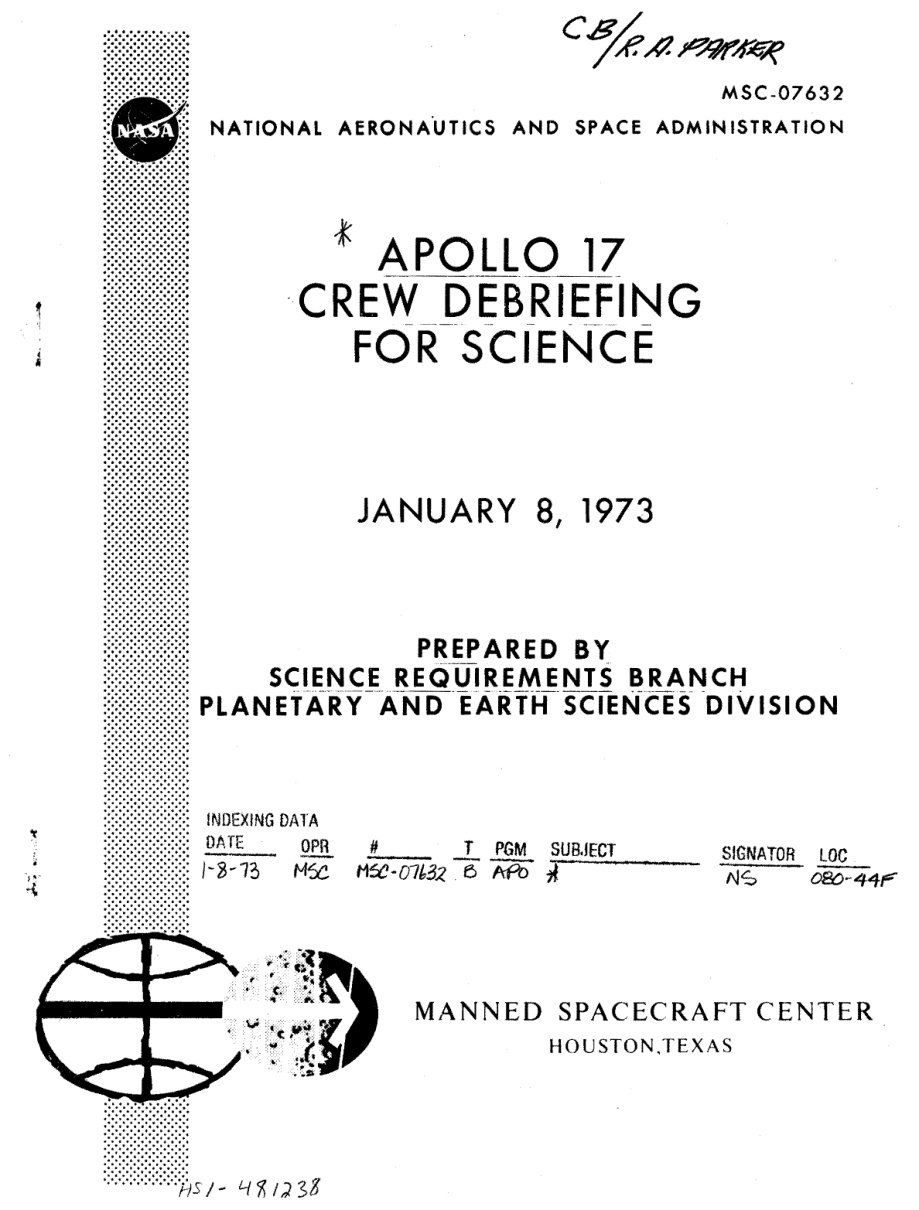
The file has only three pages: the cover of document MSC-07632, "Apollo 17 Crew Debriefing for Science," dated January 8, 1973, prepared by the Science Requirements Section of the Earth and Planetary Sciences Division of the Manned Spacecraft Center, in Houston, and pages 119 and 120 of the transcript. The official collection record says the excerpt shows Dick Henry, co-investigator of the Apollo 17 ultraviolet experiment, talking about unexpected results. On the cover there is a handwritten annotation, "CB/R. A. Parker," and an indexing stamp.
The first page begins in the middle of a line of reasoning about the Coma galaxy cluster. The researchers suspected that the mass holding the cluster together by gravity might be in the form of ionized hydrogen. They looked for the redshifted Lyman-alpha radiation from that hydrogen and found nothing. The limit obtained, Henry says, rules out the hypothesis that this hydrogen holds the cluster together, "which perhaps leaves a real mystery as to what holds the thing together." It is a question of astrophysics, unrelated to anything seen by the crew.
The fourth point, according to Henry, was perhaps the most interesting. The team pointed the spectrometer at many spots far from the plane of the Milky Way, toward the galactic poles, and recorded a spectrum above the instrument's "dark count," the background noise that was abnormally high. The spectrum looked like that of hot stars, but there were no hot stars in the field of view. The most conservative reading, he said, is starlight from the plane of the galaxy reflected by interstellar dust; some features did not fit this idea, and it was "at least possible" that it was radiation coming from outside the galaxy.
The fifth point deals with hydrogen within the Solar System, which glows in Lyman-alpha by reflecting sunlight. Henry cites Gary Thomas, of the University of Colorado, who had already observed the phenomenon with the OGO-5 satellite and thought the hydrogen came from interstellar space passing through the Solar System. Apollo 17, he says, obtained "an enormous amount of data" to clarify the picture. The page ends as he begins to talk about the spectrum of Earth seen from outside, recalling that those who were there were the astronauts.
The excerpt was published in the UAP files collection, but it does not describe lights, objects or phenomena seen by the crew. The "unexpected results" are data from a scientific instrument, with astronomical hypotheses presented by the researcher himself, who said he was awaiting a lengthy computer analysis. The complete document has at least 120 pages, but only these three are in the published file. There is no official recording of this debriefing in the list of NASA audio and video files published in the same collection.
The cover bears the number MSC-07632, right after MSC-07631, the technical debriefing of the same mission, dated January 4, 1973. The indexing data repeat the date, January 8, 1973, the agency, the Manned Spacecraft Center, and the Apollo program. There are two handwritten annotations. At the top, "CB/R. A. Parker": CB was the designation of the astronaut office in Houston, and the name matches that of scientist-astronaut Robert A. Parker, who worked on Apollo 17, but the document does not explain the annotation. At the bottom, "HS1-481238," a file code in the same format as other identifiers that appear in documents from this release.
The two transcript pages show what the meeting was like. Henry speaks in front of the crew and refers to another researcher, Dr. Trombka, who had already presented the gamma-ray background, a sign that several experiment leads took turns telling the astronauts the first results. He numbers his points: the third ends on page 119, the fourth and fifth take up both pages, and a sixth, on the spectrum of Earth seen from outside, begins at the end of page 120. In the middle of his remarks, he notes that he says "we," but those who were there were the astronauts.
Henry himself records a problem with the instrument and what it meant for the data. The spectrometer's "dark current," the signal the detector produces even without light, was abnormally high, but he says this did not hinder the observation of high galactic latitudes, because the recorded spectrum was above that background. The interpretations come with explicit degrees of caution: the "most conservative" reading is starlight reflected by dust; radiation from outside the galaxy is "at least possible"; and everything depended on a computer study that, according to him, would take a long time.
NASA published in the same collection two recordings of a meeting of the same type, one year earlier: the Apollo 16 science debriefing, NASA-UAP-D024 and D025, about an hour and a half and nearly an hour long. According to the official records, the researchers there present preliminary Apollo 16 results to help prepare Apollo 17, mention an observed and not yet reported "flash," starting at 25min15s of the first part, and a speaker remarks in passing, at 32min41s of the second, that something "could be an alien star base or something," while comparing data sets. These are not recordings of this 1973 debriefing; they are linked here as an example of the format of these meetings.
OFFICIAL MEDIA
Official videos for this case
Files published by the United States Government on DVIDS. The title of each one is that of the official publication, translated; the description of what is seen is in the dossier text.
NASA debriefing recording · 1 h 36 min · the video only loads when you start playback, directly from the official server.
Official record ↗
NASA debriefing recording · 55 min 42 s · the video only loads when you start playback, directly from the official server.
Official record ↗DIRECT READING OF THE FILE
The document, in the original
Full translation of the three pages of the file (cover, page 119 and page 120 of the transcript). The rest of the debriefing is not part of the published PDF.
EXCERPT 1 · PHYSICAL PAGE 1
Cover, physical page 1
*APOLLO 17
-CREW DEBRIEFING - - -
FOR SCIENCE
JANUARY 8, 1973
MSC-07632
SIGNATOR LOC
I\JS oso-44,=:-
MANNED SPACECRAFT CENTER
HOUSTON.TEXASCheck the original PDF
CB/R. A. PARKER [handwritten] | MSC-07632 | NATIONAL AERONAUTICS AND SPACE ADMINISTRATION | * APOLLO 17 CREW DEBRIEFING FOR SCIENCE | JANUARY 8, 1973 | PREPARED BY SCIENCE REQUIREMENTS BRANCH, PLANETARY AND EARTH SCIENCES DIVISION | INDEXING DATA: DATE 1-8-73, OPR MSC, # MSC-07632, T B, PGM APO, SUBJECT *, SIGNATOR NS, LOC 080-44F | MANNED SPACECRAFT CENTER, HOUSTON, TEXAS | HS1-481238 [handwritten]View the document record ↗ · Physical page 1, counting the cover.
EXCERPT 2 · PHYSICAL PAGE 2
Physical page 2 (page 119 of the transcript), full
ll9
HENRY gravitationally holding it together° We though it might be
(CONT D)
in the form of ionized hydrogen. We looked for Lyman-alpha
radiation, red shifted from the ionized hydrogen, and we
didn't see any. We set a lower limit, which certainly ex-
cludes the possibility that the Coma cluster is held together
J
by this ionized hydrogen. I think that may leave a real
mystery as to what is holding the thing together.
The fourth point may turn out to be the most interesting
thing of all. When you look in the Milky Way, you see a
lot of UV coming from the stars, but the question is, what
do you see when you look up to the North Galactic Pole or
down to the South Galactic Pole. One of the most exciting
results of X-ray astronomy was the fact that an X-ray back-
ground was observed over the sky that nobody had expected,
and part of this is the gamma-ray background that Dr. Trombka
talked about. In the UV, nobody knows, but you never know
until you look. You do have to deal with this background
of stars that we know is there. So we did look at a large
number of different points at high galactic latitudes, both
. north and south. The spectrum that we see is above this
dark count. In other words, this abnormally high dark
current did not, in fact, interfere with that experiment.
The spectrum that we see looks like the spectrum of the hot
'Editorial note: "We though" appears this way in the original (for "We thought"); kept. The preceding sentence, from the beginning of the reasoning, is on a page that is not part of the file.
Check the original PDF
HENRY (CONT'D): gravitationally holding it together. We though it might be in the form of ionized hydrogen. We looked for Lyman-alpha radiation, red shifted from the ionized hydrogen, and we didn't see any. We set a lower limit, which certainly excludes the possibility that the Coma cluster is held together by this ionized hydrogen. I think that may leave a real mystery as to what is holding the thing together. The fourth point may turn out to be the most interesting thing of all. When you look in the Milky Way, you see a lot of UV coming from the stars, but the question is, what do you see when you look up to the North Galactic Pole or down to the South Galactic Pole. One of the most exciting results of X-ray astronomy was the fact that an X-ray background was observed over the sky that nobody had expected, and part of this is the gamma-ray background that Dr. Trombka talked about. In the UV, nobody knows, but you never know until you look. You do have to deal with this background of stars that we know is there. So we did look at a large number of different points at high galactic latitudes, both north and south. The spectrum that we see is above this dark count. In other words, this abnormally high dark current did not, in fact, interfere with that experiment. The spectrum that we see looks like the spectrum of the hotView the document record ↗ · Physical page 2, counting the cover.
EXCERPT 3 · PHYSICAL PAGE 3
Physical page 3 (page 120 of the transcript), full
120
HENRY star; however, we know that there were no hot stars within
(CONT'D)
our field of view. Therefore, the most conservative inter-
pretation, I think, is that what we're seeing is light from
hot stars in the galactic plane going up out of the plane
and reflecting off interstellar dust. There are certain
characteristics of the spectrum, though, that don't fit that
theory, and it's at least possible that this is extragalactic
radiation. I'm looking forward very much to the detailed
computer study of this, but it's going to take a long time.
Fifth point: Lyman-alpha hydrogen radiation is a completely
separate problem, and Gary Thomas at the University of
Colorado and Charles Barthum [?] observed this from OGO-5.
We obtained Just an enormous amount of data on the Apollo
that's going to straighten out this picture and clarify it
considerably. This is hydrogen that is inside our solar
system. It's sunlight reflecting off this. The hydrogen,
Gary Thomas thinks, is hydrogen from interstellar space
streaming through the solar system, and he is looking for-
ward with great anticipation to getting detailed analyses
of that.
One more thing: the spectrum of the Earth. I keep saying
"we but these were the guys that were there. We looked
?
at the Earth from outside. A lot of people have observed
"Editorial note: The "[?]" after "Charles Barthum" is in the typed original itself, indicating the transcriber's doubt about the name; it was not corrected. The page ends mid-sentence.
Check the original PDF
HENRY (CONT'D): star; however, we know that there were no hot stars within our field of view. Therefore, the most conservative interpretation, I think, is that what we're seeing is light from hot stars in the galactic plane going up out of the plane and reflecting off interstellar dust. There are certain characteristics of the spectrum, though, that don't fit that theory, and it's at least possible that this is extragalactic radiation. I'm looking forward very much to the detailed computer study of this, but it's going to take a long time. Fifth point: Lyman-alpha hydrogen radiation is a completely separate problem, and Gary Thomas at the University of Colorado and Charles Barthum [?] observed this from OGO-5. We obtained just an enormous amount of data on the Apollo that's going to straighten out this picture and clarify it considerably. This is hydrogen that is inside our solar system. It's sunlight reflecting off this. The hydrogen, Gary Thomas thinks, is hydrogen from interstellar space streaming through the solar system, and he is looking forward with great anticipation to getting detailed analyses of that. One more thing: the spectrum of the Earth. I keep saying "we," but these were the guys that were there. We looked at the Earth from outside. A lot of people have observedView the document record ↗ · Physical page 3, counting the cover.
Dates and documentary context
- Event
- 08/01/1973 — Debriefing date, on the cover. The spectrometer observations were made during the mission, in December 1972.
- Document
- 08/01/1973 — Cover of document MSC-07632.
- Publication
- 05/2026 — First publication of the UAP files collection (Release 1), May 2026.
Origin and release
NASA, Manned Spacecraft Center, Science Requirements Section; remarks by Richard (Dick) Henry · NASA-UAP-D5-Apollo-17-Crew-Debriefing-for-Science-1973.pdf
undefined ↗ — undefined
Related accounts and their differences
Questions to continue the investigation
- Why was this astrophysics excerpt chosen for the UAP files collection, if it does not describe an observation by the crew?
- What does the rest of the January 8, 1973 science debriefing, which was not published in this collection, say?
GEOGRAPHY OF THE CASE
Houston, Texas
Approximate reference to the Manned Spacecraft Center, where the debriefing took place, placed by the editors. It does not indicate an observation site.
DOCUMENTARY TRAIL
Go back to the sources
References use physical pages of the PDF, counting the cover. Summaries are presented in English; the documents keep their original language.
- NASA-UAP-D5-Apollo-17-Crew-Debriefing-for-Science-1973.pdf
Physical pages 1 to 3: cover of document MSC-07632, of 08/01/1973, and pages 119 and 120 of the transcript, with the remarks by Richard (Dick) Henry
NASA · 3 pages
Related publications and media
Editorial summary based on the collection's research notes. How we read the documents.