Date: not stated; sensor project begun at the end of January 2009 and status as of 23/07/2009Location: Las Vegas, Nevada (BAASS and Bigelow Aerospace) and Austin, Texas (EarthTech International)
Las Vegas, 2009: BAASS proposes to the DIA using the “remote viewing” of the former Star Gate program and designs a sensor package to record UAP
BAASS's ten-month report recommends creating an in-house “remote viewing” program, supported by the founder of the Star Gate program, and says that this technique would already have “detected” bases and accidents of “exotic craft,” without giving examples. The same section describes the autonomous package of commercial sensors that Bigelow Aerospace was assembling to capture signals from these phenomena.
- Event date
- not stated; sensor project begun at the end of January 2009 and status as of 23/07/2009
- Location
- Las Vegas, Nevada (BAASS and Bigelow Aerospace) and Austin, Texas (EarthTech International)
- Topic
- AAWSAP and advanced technologies
- Source agencies
- DOW
- Documents
- 1 document · 538 pages
- Reading time
- 24 min
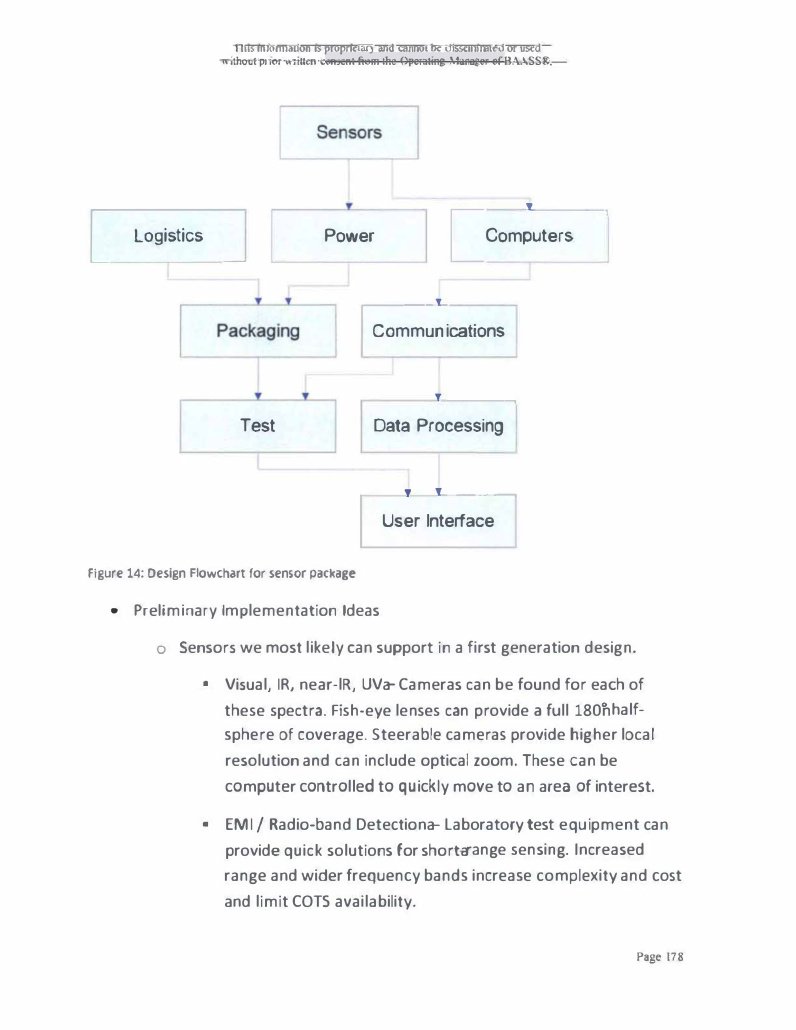 DiagramPhysical page 184
DOCUMENTARY SOURCES · DOW
What the records tell
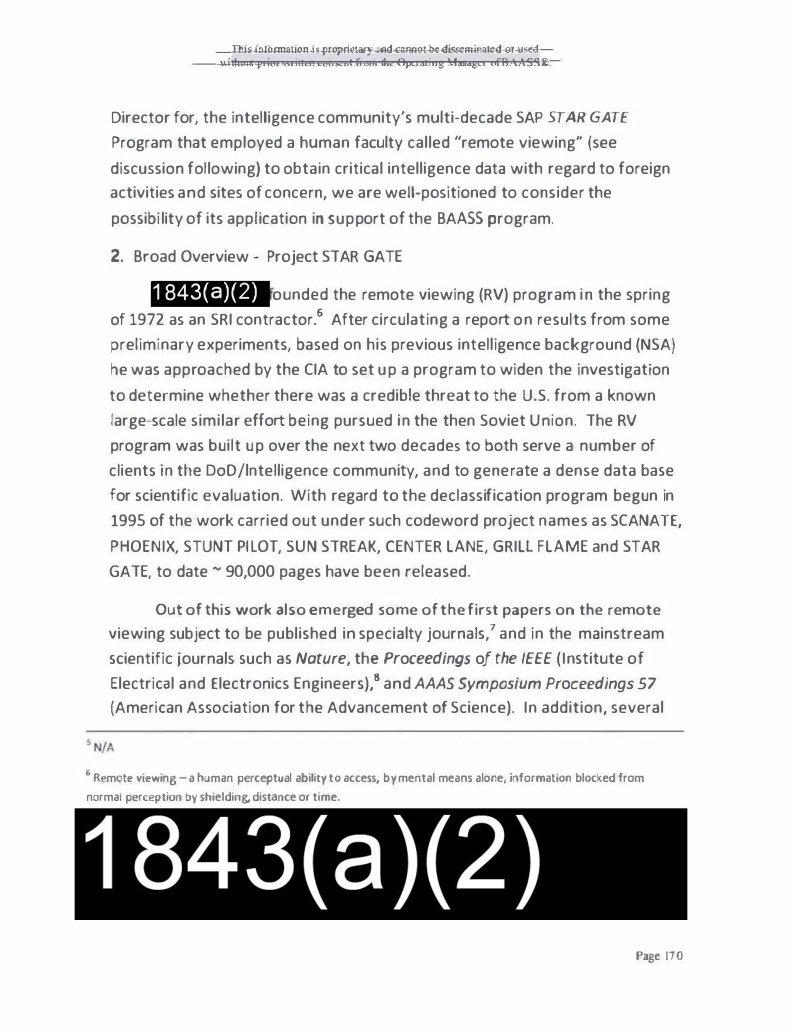
Within Project Engagement, BAASS's ten-month report to the DIA devotes an item to “remote viewing,” defined in the text itself as the human ability to obtain information “by mental means alone.” The argument is that the president of EarthTech, a BAASS subcontractor in Austin, Texas, founded and directed the intelligence community's Star Gate program for more than a decade. For this reason, the text says, BAASS would be “well positioned” to apply the technique to the questions of the contract. The executive's name is redacted.
The text summarizes the history of the program: it began in 1972 at the Stanford Research Institute, received CIA support out of fear of a similar Soviet effort, went through names such as SCANATE, Grill Flame, Center Lane and Sun Streak, and had about 90.000 pages declassified starting in 1995. It cites a public CIA statement of September 6, 1995 and an episode attributed to former president Jimmy Carter, about a Soviet aircraft that crashed in Zaire and was located by the “viewers.” These are the author's accounts, with no attached documents.
According to the report, during Star Gate there was remote-viewing “detection” of “apparent base facilities for exotic craft,” of accidents involving these craft, and of surveillance of military targets, the latter “correlated” with independent records. No example is presented. BAASS says it has protocols ready, such as blind targeting and independent analysis, and states that EarthTech approached two former participants in the Army program and one of the creators of the SRI and DIA training, who agreed to participate under secrecy. The recommendation is to negotiate an in-house program.
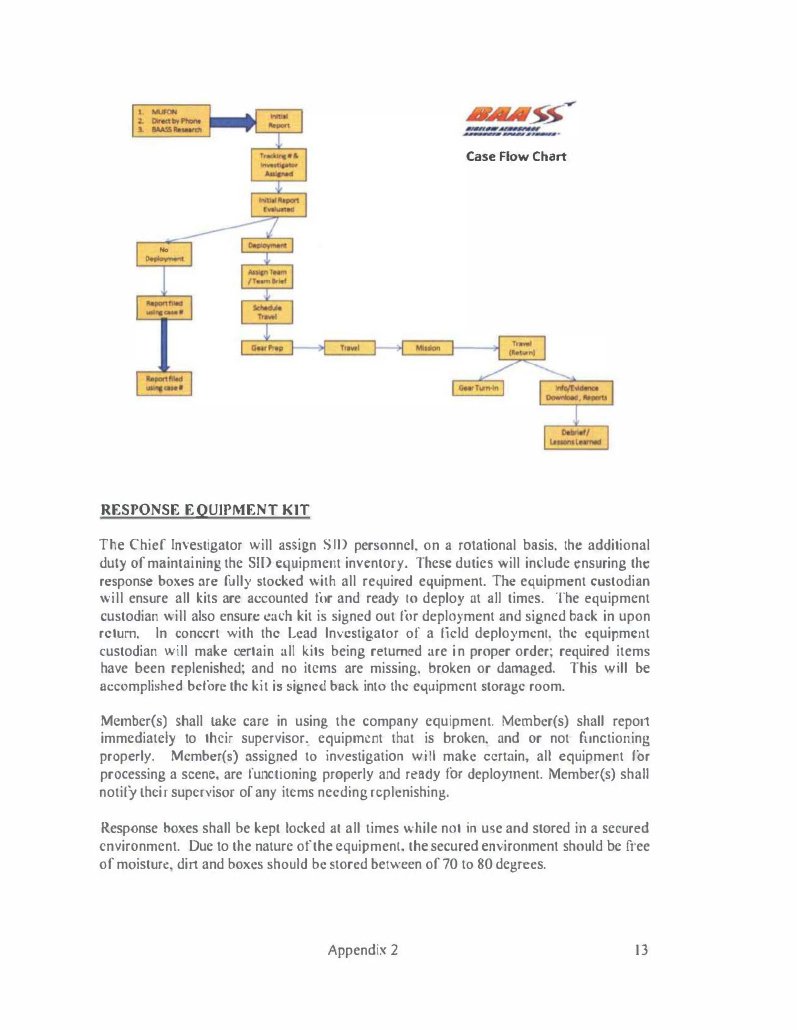
The second part describes an autonomous sensor package to record what the text calls signatures of advanced aerospace technology. A Bigelow Aerospace engineering team began the project at the end of January 2009, with goals such as operating unattended all night, being transportable by “two men and a truck,” using only commercial parts, and reaching up to 5 miles. Radar was set aside because it required government approval, and the gravimeter because none existed ready-made on the market. A flowchart shows the project stages.
The final list includes 21 commercial items, from a 100 kHz to 3 GHz spectrum analyzer to ultrasonic microphones, an inertial unit with magnetometer, a weather station and infrared cameras. The specifications table appears to swap the units of the gyroscope and the accelerometer. An EarthTech engineer, whose name is redacted, recommends separate antennas and analyzers for electric and magnetic fields, a scanning receiver and Geiger counters. On July 23, 2009 the package was in final software integration, and the project of a second team, linked to the sponsor, was left for a future report.
More images from the document
DIRECT READING OF THE FILE
The document, in the original
Physical pages 176 to 190 are translated in full in the page-by-page blocks, with tables III and IV and the flowchart. The beginning of the item on remote viewing is on page 175, linked to the Utah ranch dossier.
EXCERPT 1 · PHYSICAL PAGE 176
Physical page 176, full page
Ibis ir:ilbr:m.itioA is proprietary .•nd ͢
ARlll bo dissemiRated er used
» ilJ:\91.11pFier ·,,riuen eeA.eflt lfem lite ()perfrling Mru1agu uf8/d,SS'-9.
Director for, the intelligence community's multi-decade SAP STAR GATE
Program that employed a human faculty called "remote viewing" {see
discussion following) to obtain critical intelligence data with regard to foreign
activities and sites of concern, we are well-positioned to consider the
possibility of its application in support of the BAASS program.
2. Broad Overview - Project STAR GATE
1 843(a)(2) ounded the remote viewing (RV) program in the spring
of 1972 as an SRI contractor.6 After circulating a report on results from some
preliminary experiments, based on his previous intelligence background (NSA)
he was approached by the CIA to set up a program to widen the investigation
to determine whether there was a credible threat to the U.S. from a known
large-scale similar effort being pursued in the then Soviet Union. The RV
program was built up over the next two decades to both serve a1 number of
clients in the DoD/lntelligence community, and to generate a dense data base
for scientific evaluation. With regard to the declassification program begun in
1995 of the work carried out under such codeword project names as SCANATE,
PHOENIX, STUNT PILOT, SUN STREAK, CENTER LANE, GRILL FLAME and STAR
GATE, to date "' 90,000 pages have been released.
Out of this work also emerged some of the first papers on the remote
viewing subject to be published in specialty journals,7 and in the mainstream
scientific journals such as Nature, the Proceedings of the IEEE (Institute of
Electrical and Electronics Engineers),8 and AAAS Symposium Proceedings 57
(American Association for the Advancement of Science). In addition, several
6 RemQte viewing -a human perceptual ability to access, by mental means alone, information blocked from
normal perception by shielding, distance or time.
Page 170Editorial note: Physical page 176 of DOW-UAP-D172-BAASS_Ten_Month_Report_July-2009.pdf.
Check the original PDF
Ibis ir:ilbr:m.itioA is proprietary .•nd ͢
ARlll bo dissemiRated er used
» ilJ:\91.11pFier ·,,riuen eeA.eflt lfem lite ()perfrling Mru1agu uf8/d,SS'-9.
Director for, the intelligence community's multi-decade SAP STAR GATE
Program that employed a human faculty called "remote viewing" {see
discussion following) to obtain critical intelligence data with regard to foreign
activities and sites of concern, we are well-positioned to consider the
possibility of its application in support of the BAASS program.
2. Broad Overview - Project STAR GATE
1 843(a)(2) ounded the remote viewing (RV) program in the spring
of 1972 as an SRI contractor.6 After circulating a report on results from some
preliminary experiments, based on his previous intelligence background (NSA)
he was approached by the CIA to set up a program to widen the investigation
to determine whether there was a credible threat to the U.S. from a known
large-scale similar effort being pursued in the then Soviet Union. The RV
program was built up over the next two decades to both serve a1 number of
clients in the DoD/lntelligence community, and to generate a dense data base
for scientific evaluation. With regard to the declassification program begun in
1995 of the work carried out under such codeword project names as SCANATE,
PHOENIX, STUNT PILOT, SUN STREAK, CENTER LANE, GRILL FLAME and STAR
GATE, to date "' 90,000 pages have been released.
Out of this work also emerged some of the first papers on the remote
viewing subject to be published in specialty journals,7 and in the mainstream
scientific journals such as Nature, the Proceedings of the IEEE (Institute of
Electrical and Electronics Engineers),8 and AAAS Symposium Proceedings 57
(American Association for the Advancement of Science). In addition, several
6 RemQte viewing -a human perceptual ability to access, by mental means alone, information blocked from
normal perception by shielding, distance or time.
Page 170View the document record ↗ · Physical page 176, counting the cover.
EXCERPT 2 · PHYSICAL PAGE 177
Physical page 177, full page
Riis infuFH1u1iot1 i:, p.c;pFieliJf} afl!i Etl!rnal be t!ies1aHˢiRalˣll er 1<s:£J
\\lthout pn0Pn1ttcn const:m fnm, lhc Opc1mi11g \fw,agci ofDAASScl.\,.
books summarizing the research for the general public were published, both
by the SRI researchers9 and by government personnel who were involved
either as remote viewers10 or as Program Directors.11 The previously classified
files ("'90,000 pages) have recently been released in a 14-CD format by the
National Archives (NARA), ranging from transcripts of RV sessions, to
memoranda, to detailed reports.
3. Further Project STAR GATE Details
Project STAR GATE and its predecessors were the subject of an intense
government effort fueled by Cold War concerns as to whether there was a
credible threat to the United States from a known, similar large-scale effort
being pursued in the then Soviet Union.12 From an initial small-scale effort at
Stanford Research Institute (now SRI International) the program evolved into a
highly-classified, special-access program (SAP) carried out under a host of
codeword project names, STAR GATE being the last. These names, and the
program efforts they covered, only became public knowledge beginning in
1995 as the Cold War wound down and a declassification effort was mounted
based on President Clinton's Executive Order Nr. 1995-4-17, entitled Classified
National Security Information. That Executive Order reversed to some degree
the maxim "when in doubt, keep it classified." On September 6, 1995, the CIA
Public Affairs Office publicly admitted for the first time their involvement in
setting up the program in a release entitled "CIA Statement on 'Remote
Viewing'." And now, as indicated above, some 90,000 pages of documentation
u http://stargate.collection.free.fr/PDFs/ParaphysicsRDWarsawPact.pdf
Page 171Editorial note: Physical page 177 of DOW-UAP-D172-BAASS_Ten_Month_Report_July-2009.pdf.
Check the original PDF
Riis infuFH1u1iot1 i:, p.c;pFieliJf} afl!i Etl!rnal be t!ies1aHˢiRalˣll er 1<s:£J
\\lthout pn0Pn1ttcn const:m fnm, lhc Opc1mi11g \fw,agci ofDAASScl.\,.
books summarizing the research for the general public were published, both
by the SRI researchers9 and by government personnel who were involved
either as remote viewers10 or as Program Directors.11 The previously classified
files ("'90,000 pages) have recently been released in a 14-CD format by the
National Archives (NARA), ranging from transcripts of RV sessions, to
memoranda, to detailed reports.
3. Further Project STAR GATE Details
Project STAR GATE and its predecessors were the subject of an intense
government effort fueled by Cold War concerns as to whether there was a
credible threat to the United States from a known, similar large-scale effort
being pursued in the then Soviet Union.12 From an initial small-scale effort at
Stanford Research Institute (now SRI International) the program evolved into a
highly-classified, special-access program (SAP) carried out under a host of
codeword project names, STAR GATE being the last. These names, and the
program efforts they covered, only became public knowledge beginning in
1995 as the Cold War wound down and a declassification effort was mounted
based on President Clinton's Executive Order Nr. 1995-4-17, entitled Classified
National Security Information. That Executive Order reversed to some degree
the maxim "when in doubt, keep it classified." On September 6, 1995, the CIA
Public Affairs Office publicly admitted for the first time their involvement in
setting up the program in a release entitled "CIA Statement on 'Remote
Viewing'." And now, as indicated above, some 90,000 pages of documentation
u http://stargate.collection.free.fr/PDFs/ParaphysicsRDWarsawPact.pdf
Page 171View the document record ↗ · Physical page 177, counting the cover.
EXCERPT 3 · PHYSICAL PAGE 178
Physical page 178, full page
This infonutttitm is fJf6ptie1aiy ttt1d eamiet be tlb:ie1l'liaa1ed er
a
v. i1hau1 prianuiuen conޤent from 1be Operating Manager of I3AASS?O
on the two-decade-plus program have been declassified and are available,
both at the National Archives and Records Administration (NARA) in College
Park, Maryland, and by purchase of a 14-CD "Star Gate Collection" from the
Information and Privacy Coordinator, Central Intelligence Agency, Washington,
D.C. 20505. In addition, following declassification a concise history of the
program, including some of the previously classified results, was published by
1843(a)(2) I·
!and is included here as Appendix 2.
With the passage of time many additional details of the classified
aspects of the program have become public knowledge, sometimes from
surprising sources. For example, in response to a question from a student
while giving a speech at a university, ex-President Jimmy Carter revealed an
incident that was thought never to see the light of day. A Soviet plane went
down in Zaire, and spy satellites failed to locate the wreckage. CIA Director
Admiral Stansfield Turner then turned to the program's remote viewers who
found the plane, and agents on the ground were dispatched to the location in
a successful recovery mission.
As a result of the program's early successes, SRI was tasked with
developing a training program for the Army Intelligence and Security
Command (INSCOM) at Ft. Meade, Maryland. Several intelligence officers
went through this program and went on to use their newfound skills in
operational applications.13 As recently as 2001, an assessment of the use of
remote viewing under asymmetric warfare conditions was the topic of a
Marine War College thesis.
14
Of some interest with regard to the political aspects, it was a pleasant
surprise to find that the higher the level of the officials briefed (and this
included congressmen, military leaders, National Security Council staff, and
13 see, especially, Footnote 8.
b)(3):50 USC 3024(h), 1843(a)(2)
r)
Page 172Editorial note: Physical page 178 of DOW-UAP-D172-BAASS_Ten_Month_Report_July-2009.pdf.
Check the original PDF
This infonutttitm is fJf6ptie1aiy ttt1d eamiet be tlb:ie1l'liaa1ed er
a
v. i1hau1 prianuiuen conޤent from 1be Operating Manager of I3AASS?O
on the two-decade-plus program have been declassified and are available,
both at the National Archives and Records Administration (NARA) in College
Park, Maryland, and by purchase of a 14-CD "Star Gate Collection" from the
Information and Privacy Coordinator, Central Intelligence Agency, Washington,
D.C. 20505. In addition, following declassification a concise history of the
program, including some of the previously classified results, was published by
1843(a)(2) I·
!and is included here as Appendix 2.
With the passage of time many additional details of the classified
aspects of the program have become public knowledge, sometimes from
surprising sources. For example, in response to a question from a student
while giving a speech at a university, ex-President Jimmy Carter revealed an
incident that was thought never to see the light of day. A Soviet plane went
down in Zaire, and spy satellites failed to locate the wreckage. CIA Director
Admiral Stansfield Turner then turned to the program's remote viewers who
found the plane, and agents on the ground were dispatched to the location in
a successful recovery mission.
As a result of the program's early successes, SRI was tasked with
developing a training program for the Army Intelligence and Security
Command (INSCOM) at Ft. Meade, Maryland. Several intelligence officers
went through this program and went on to use their newfound skills in
operational applications.13 As recently as 2001, an assessment of the use of
remote viewing under asymmetric warfare conditions was the topic of a
Marine War College thesis.
14
Of some interest with regard to the political aspects, it was a pleasant
surprise to find that the higher the level of the officials briefed (and this
included congressmen, military leaders, National Security Council staff, and
13 see, especially, Footnote 8.
b)(3):50 USC 3024(h), 1843(a)(2)
r)
Page 172View the document record ↗ · Physical page 178, counting the cover.
EXCERPT 4 · PHYSICAL PAGE 179
Physical page 179, full page
11
ThiԠ jnfonnarjon is proprietary aad camia• bt· (lissvroiaԡkQ or teed
ilheu1 prfor "ri11>1A caa,eat from •be Opera•iag Mao'.lget of B \AԢԣ ll'
various Agency Directors), the more acceptance there seemed to be. Perhaps
the intuitive capacities of high-functioning executives predispose them to be
more open to the concept of extraordinary human functioning. Certainly it
makes them more enthusiastic for practical applications of such functioning, if
verified. Or there may be some support for the idea often expressed in psi
research that those who make it to the top in our hierarchical societal
structure may, at least unconsciously, tap into "psi" reserves of their own
when they have to make key decisions based on insufficient data. In any case,
the phenomena seemed time and time again to have struck a resonant chord
in these upper echelons.
Perhaps one of the most encouraging statements ever made to those
responsible for developing the program occurred at the conclusion of a highly
1843(a)(2)
classified briefing given to a congressional intelligence committee. I ..lane
his program colleagues were approached afterwards by one of the
congressmen who said "Although I see why we must pursue this as a matter of
national security, what is truly most significant about these studies is what
they tell us about the human potential."
4. RV Project Applications within the BAASS Program Structure
Of significance with regard to potential application of RV talents to
BMSS requirements is the fact that from time to time during the STAR GATE
program RV detection of exotic events and technologies relevant to the BAASS
initiative occurred. These included detection of apparent basing facilities for
exotic craft, description of apparent exotic craft accidents, and observation of
exotic craft surveillance of military targets, the latter correlated with
independent national resource records.
Protocols for use of RV as an information-gathering tool responsive to
BAASS objectives are well-developed. They include:
Page 173Editorial note: Physical page 179 of DOW-UAP-D172-BAASS_Ten_Month_Report_July-2009.pdf.
Check the original PDF
11
ThiԠ jnfonnarjon is proprietary aad camia• bt· (lissvroiaԡkQ or teed
ilheu1 prfor "ri11>1A caa,eat from •be Opera•iag Mao'.lget of B \AԢԣ ll'
various Agency Directors), the more acceptance there seemed to be. Perhaps
the intuitive capacities of high-functioning executives predispose them to be
more open to the concept of extraordinary human functioning. Certainly it
makes them more enthusiastic for practical applications of such functioning, if
verified. Or there may be some support for the idea often expressed in psi
research that those who make it to the top in our hierarchical societal
structure may, at least unconsciously, tap into "psi" reserves of their own
when they have to make key decisions based on insufficient data. In any case,
the phenomena seemed time and time again to have struck a resonant chord
in these upper echelons.
Perhaps one of the most encouraging statements ever made to those
responsible for developing the program occurred at the conclusion of a highly
1843(a)(2)
classified briefing given to a congressional intelligence committee. I ..lane
his program colleagues were approached afterwards by one of the
congressmen who said "Although I see why we must pursue this as a matter of
national security, what is truly most significant about these studies is what
they tell us about the human potential."
4. RV Project Applications within the BAASS Program Structure
Of significance with regard to potential application of RV talents to
BMSS requirements is the fact that from time to time during the STAR GATE
program RV detection of exotic events and technologies relevant to the BAASS
initiative occurred. These included detection of apparent basing facilities for
exotic craft, description of apparent exotic craft accidents, and observation of
exotic craft surveillance of military targets, the latter correlated with
independent national resource records.
Protocols for use of RV as an information-gathering tool responsive to
BAASS objectives are well-developed. They include:
Page 173View the document record ↗ · Physical page 179, counting the cover.
EXCERPT 5 · PHYSICAL PAGE 180
Physical page 180, full page
in the Army INSCOM programl1843(a)(2) I
17,is infoumrtivn i:s p,vp, ittm) and e!l:llf!B! bw tli:lSefltitmted er 11:.ed
,, idmm p, ;,11 111 ilici, 1.u1L->e1,1 fio,u th .. Ope,atillg Manage, of BAASS16.
• Assignment of RV tasking to previously-calibrated RV team
leaders/teams
• The use of blind targeting (i.e., RVer kept blind to specific target) so as
to minimize "analytical overlay'' (imagination artifacts) due to
expectations or pre-biases; i.e., no "front-loading"
• Generation of complete RV session records in the form of tape
recordings, drawings, etc., to be made available for later independent
analysis
• Integration of data from multiple RV sources, if available
• Independent evaluation of data stream by analyst(s)
• Follow-up efforts to provide for independent V&V (verification and
validation) on the basis of "ground truth" reality whenever feasible.
5. Proposed BAASS Program Structure
It was decided to set up an in-house program with expertise/oversight
by EarthTech being provided on a consulting contract.
1843(a)(2)
In anticipation that such a program may be established, I --- -)at.
EarthTech contacted two leaders of now-private remote viewing groups, both
of whom were RV participants
1843(a)(2)
as well as one of the original developers of the
SRI/DIA RV Training Program, 1843(a)(2)
.15 Without providing any details,
they were simply asked whether they would consider participating in further
work in this area under non-public-disclosure conditions, and all said yes.
Some details as to budget estimates, the willingness to sign NDAs, etc., were
discussed as well. Pending further discussion with the sponsor group as to
structure and budget, it appears that such an initiative is quite feasible, and
15 The Training Manual developed for the DIA Program is available at http://rviewer. com/crvmanual/
Page 1 74Editorial note: Physical page 180 of DOW-UAP-D172-BAASS_Ten_Month_Report_July-2009.pdf.
Check the original PDF
in the Army INSCOM programl1843(a)(2) I
17,is infoumrtivn i:s p,vp, ittm) and e!l:llf!B! bw tli:lSefltitmted er 11:.ed
,, idmm p, ;,11 111 ilici, 1.u1L->e1,1 fio,u th .. Ope,atillg Manage, of BAASS16.
• Assignment of RV tasking to previously-calibrated RV team
leaders/teams
• The use of blind targeting (i.e., RVer kept blind to specific target) so as
to minimize "analytical overlay'' (imagination artifacts) due to
expectations or pre-biases; i.e., no "front-loading"
• Generation of complete RV session records in the form of tape
recordings, drawings, etc., to be made available for later independent
analysis
• Integration of data from multiple RV sources, if available
• Independent evaluation of data stream by analyst(s)
• Follow-up efforts to provide for independent V&V (verification and
validation) on the basis of "ground truth" reality whenever feasible.
5. Proposed BAASS Program Structure
It was decided to set up an in-house program with expertise/oversight
by EarthTech being provided on a consulting contract.
1843(a)(2)
In anticipation that such a program may be established, I --- -)at.
EarthTech contacted two leaders of now-private remote viewing groups, both
of whom were RV participants
1843(a)(2)
as well as one of the original developers of the
SRI/DIA RV Training Program, 1843(a)(2)
.15 Without providing any details,
they were simply asked whether they would consider participating in further
work in this area under non-public-disclosure conditions, and all said yes.
Some details as to budget estimates, the willingness to sign NDAs, etc., were
discussed as well. Pending further discussion with the sponsor group as to
structure and budget, it appears that such an initiative is quite feasible, and
15 The Training Manual developed for the DIA Program is available at http://rviewer. com/crvmanual/
Page 1 74View the document record ↗ · Physical page 180, counting the cover.
EXCERPT 6 · PHYSICAL PAGE 181
Physical page 181, full page
'l.lfis iAfermation ii. pr:Qpricl:ir! and '-"anA<>I b<i dii:q:n>i'l'.lted oc 11gc,;J
"iclout JJ• iv, '" ittcu cv11:,c111 110111 1:he Opeftlti,:g Mnt1agr GfBA A SSi<
;
therefore it is recommended that negotiation toward the establishment of
such a program be pursued.
SENSORS
Development of an Integrated Sensor Package to Detect Evidence of Advanced
Aerospace Technology.
There are two separate approaches to development of an autonomous
sensor package for BAASS: The first approach is being developed as an informal
collaboration between Earthtech subcontractor 1843(a)(2)
multiple years
of experience in detecting signatures from advanced aerospace technology) and
an engineering team located at Bigelow Aerospace.
The second approach towards developing such a system is being developed
by a group of Measurement and Signals Intelligence (MASINT) and sensor experts
that are associated with the sponsor. The latter team has multiple years of
experience in MASINT and associated technologies.
(a) Bigelow Aerospace (BA) Approach: The following is a short summary of the
terms of reference and initial specification by which the BA engineering
team began designing an autonomous sensor package. The project began
at the conceptual stage with a team meeting in late January 2009.
• Overview
o The team met at the aerospace facility for a kickoff meeting. We
restated design requirements based on the morning meeting to
ensure we all understood the scope of the design problem. We then
discussed possible implementation paths based on COTS hardware
and software the group has worked with in the past. Where an
immediate COTS solution was not clear, research topics were
Page 175Editorial note: Physical page 181 of DOW-UAP-D172-BAASS_Ten_Month_Report_July-2009.pdf.
Check the original PDF
'l.lfis iAfermation ii. pr:Qpricl:ir! and '-"anA<>I b<i dii:q:n>i'l'.lted oc 11gc,;J
"iclout JJ• iv, '" ittcu cv11:,c111 110111 1:he Opeftlti,:g Mnt1agr GfBA A SSi<
;
therefore it is recommended that negotiation toward the establishment of
such a program be pursued.
SENSORS
Development of an Integrated Sensor Package to Detect Evidence of Advanced
Aerospace Technology.
There are two separate approaches to development of an autonomous
sensor package for BAASS: The first approach is being developed as an informal
collaboration between Earthtech subcontractor 1843(a)(2)
multiple years
of experience in detecting signatures from advanced aerospace technology) and
an engineering team located at Bigelow Aerospace.
The second approach towards developing such a system is being developed
by a group of Measurement and Signals Intelligence (MASINT) and sensor experts
that are associated with the sponsor. The latter team has multiple years of
experience in MASINT and associated technologies.
(a) Bigelow Aerospace (BA) Approach: The following is a short summary of the
terms of reference and initial specification by which the BA engineering
team began designing an autonomous sensor package. The project began
at the conceptual stage with a team meeting in late January 2009.
• Overview
o The team met at the aerospace facility for a kickoff meeting. We
restated design requirements based on the morning meeting to
ensure we all understood the scope of the design problem. We then
discussed possible implementation paths based on COTS hardware
and software the group has worked with in the past. Where an
immediate COTS solution was not clear, research topics were
Page 175View the document record ↗ · Physical page 181, counting the cover.
EXCERPT 7 · PHYSICAL PAGE 182
Physical page 182, full page
This mfom,:uion is prnpr:ict:11) aaEI romie1 be tlissemiflated or used
"id,001 piio1 "'iucn ,;ulbcul fiom d,.,Opcnrung Mwwg"' of 8/v\SSx.
assigned. An overall group task assignment list was also created.
Individual progress reports are scheduled to be submitted to the
program manager by 10am Friday, January 30th.
• Design Goals -These are the design goals as we listed them based on the
discussion at the 9am meeting.
o Device will operate unattended
■ Autonomous data collection
■ Survivability- weather, vandalism, critters
o Portable - "Two men and a truck."
o Limited power
• No reliance on AC power
■ Must be sized for full nighttime operations
o Sufficient communications
■ May use WiFi, satellite phone, cellular phone transmissions as
situation warrants.
o Internet appliance for remote connection
o Short range sensing (<20ft.)
o Long range sensing (up to 5 mile planar radius, indeterminate
altitude)
o Internal clock - GPS or network time based
o COTS or very near COTS components only
o Reduce on-site maintenance to minimum possible
o Camouflage based on geographic location
Page 176Editorial note: Physical page 182 of DOW-UAP-D172-BAASS_Ten_Month_Report_July-2009.pdf.
Check the original PDF
This mfom,:uion is prnpr:ict:11) aaEI romie1 be tlissemiflated or used
"id,001 piio1 "'iucn ,;ulbcul fiom d,.,Opcnrung Mwwg"' of 8/v\SSx.
assigned. An overall group task assignment list was also created.
Individual progress reports are scheduled to be submitted to the
program manager by 10am Friday, January 30th.
• Design Goals -These are the design goals as we listed them based on the
discussion at the 9am meeting.
o Device will operate unattended
■ Autonomous data collection
■ Survivability- weather, vandalism, critters
o Portable - "Two men and a truck."
o Limited power
• No reliance on AC power
■ Must be sized for full nighttime operations
o Sufficient communications
■ May use WiFi, satellite phone, cellular phone transmissions as
situation warrants.
o Internet appliance for remote connection
o Short range sensing (<20ft.)
o Long range sensing (up to 5 mile planar radius, indeterminate
altitude)
o Internal clock - GPS or network time based
o COTS or very near COTS components only
o Reduce on-site maintenance to minimum possible
o Camouflage based on geographic location
Page 176View the document record ↗ · Physical page 182, counting the cover.
EXCERPT 8 · PHYSICAL PAGE 183
Physical page 183, full page
Titis infou11atio11 is r,repriet:wj and euunot be di11se111i11<11ed or ti"Sed
\\ithout paio, nlittcu cu11sun fhnu the Ope,-ntiug \tlw1ngc1 ofOi\i-\:SS.Jt.
o Sensor Suite
• Visual, IR, near-lR, and UV spectra
• Microwave band detection
• Radio band detection
• EMI detection in electronics emission band
I
RADAR
• LIDAR (light Detection and Ranging)
• Audio
• Radiation (gamma, beta, alpha)
1 843(a)(2)
--
.......... .... ............................... ...... • •·· Gravimeter· (perl····
le-mail)
• Design Flowdown Charte- This design flowdown is what I have identified as
the order of design process. Work can only start on the next level once
requirements and design of the previous level have been defined.
The following (figure 14), represents a first level iteration of the design of
the sensor package. Additional iterations have produced changes and subsequent
removal of some hardware items from the package. The initial designs are
included here as a good summary of the iterative engineering process. As of July
30, the design is nearing completion.
Page 177Editorial note: Physical page 183 of DOW-UAP-D172-BAASS_Ten_Month_Report_July-2009.pdf.
Check the original PDF
Titis infou11atio11 is r,repriet:wj and euunot be di11se111i11<11ed or ti"Sed
\\ithout paio, nlittcu cu11sun fhnu the Ope,-ntiug \tlw1ngc1 ofOi\i-\:SS.Jt.
o Sensor Suite
• Visual, IR, near-lR, and UV spectra
• Microwave band detection
• Radio band detection
• EMI detection in electronics emission band
I
RADAR
• LIDAR (light Detection and Ranging)
• Audio
• Radiation (gamma, beta, alpha)
1 843(a)(2)
--
.......... .... ............................... ...... • •·· Gravimeter· (perl····
le-mail)
• Design Flowdown Charte- This design flowdown is what I have identified as
the order of design process. Work can only start on the next level once
requirements and design of the previous level have been defined.
The following (figure 14), represents a first level iteration of the design of
the sensor package. Additional iterations have produced changes and subsequent
removal of some hardware items from the package. The initial designs are
included here as a good summary of the iterative engineering process. As of July
30, the design is nearing completion.
Page 177View the document record ↗ · Physical page 183, counting the cover.
EXCERPT 9 · PHYSICAL PAGE 184
Physical page 184, full page
_
-
#
I Im mfom1&Uon 1) propncwt') und cannot Ix: th:.sc1111n.itc:d or ௌa
11ithoul p, ;M written eott5<:nl from the OJieFa¼int: Matilli;CF efBA,ͣ .SS!!;.
y_____,,
[
Logistics
Power
lComputers
__.,_
Communications
' ----,
Test
Data Processing
y
Y--ஆ--,
User Interface
Figure 14: Design Flowchart for sensor package
• Preliminary Implementation Ideas
o Sensors we most likely can support in a first generation design.
• Visual, IR, near-lR, UVa- Cameras can be found for each of
these spectra. Fish-eye lenses can provide a full 180n
° half
sphere of coverage. Steerable cameras provide higher local
resolution and can include optical zoom. These can be
computer controlled to quickly move to an area of interest.
•
EM! / Radio-band Detectiona- Laboratory test equipment can
-
provide quick solutions for shortarange sensing. Increased
range and wider frequency bands increase complexity and cost
and limit COTS availability.
Page 178Editorial note: Physical page 184 of DOW-UAP-D172-BAASS_Ten_Month_Report_July-2009.pdf.
Check the original PDF
_
-
#
I Im mfom1&Uon 1) propncwt') und cannot Ix: th:.sc1111n.itc:d or ௌa
11ithoul p, ;M written eott5<:nl from the OJieFa¼int: Matilli;CF efBA,ͣ .SS!!;.
y_____,,
[
Logistics
Power
lComputers
__.,_
Communications
' ----,
Test
Data Processing
y
Y--ஆ--,
User Interface
Figure 14: Design Flowchart for sensor package
• Preliminary Implementation Ideas
o Sensors we most likely can support in a first generation design.
• Visual, IR, near-lR, UVa- Cameras can be found for each of
these spectra. Fish-eye lenses can provide a full 180n
° half
sphere of coverage. Steerable cameras provide higher local
resolution and can include optical zoom. These can be
computer controlled to quickly move to an area of interest.
•
EM! / Radio-band Detectiona- Laboratory test equipment can
-
provide quick solutions for shortarange sensing. Increased
range and wider frequency bands increase complexity and cost
and limit COTS availability.
Page 178View the document record ↗ · Physical page 184, counting the cover.
EXCERPT 10 · PHYSICAL PAGE 185
Physical page 185, full page
I his information is proprictaq nod cannot he disseminated or 11scd
,చ itl,out p, io, ,11 ittcn co11:sc11t ltom the Oper,tli.ig Mftllttt;er of BA,\SSs.
• LIDAR - Commercial packages are becoming increasingly
available. This would be an alternative to RADAR that would
not need government approval and can range any type of
object, metallic or otherwise.
• Audio - Omni-directional and directional microphones can be
fully supported. Omni-directional microphones paired with
steerable cameras can provide cleaner data for a particular
area of interest.
• Radiation - Dose rate counters can be had as COTS products.
This would not provide wide area coverage, but could be used
to trigger other sensors active. Steerability is an option as well.
o We are researching microwave band, RADAR, and gravimeter
sensing. Microwave band may be supportable in a first gen device.
RADAR will take considerable time to get approvals and certainly at
this early stage, is not considered practical. We are looking into the
details of this effort. LIDAR may still be an acceptable substitute;
however, it will not be able to distinguish metallic from non-metallic
objects and there are potential problems with the range.
Gravimeters do not appear to be available as COTS products, tlhough
we are continuing to research this. Building our own would not be
possible in the short term. Commercially available digital
accelerometers could be substituted, but would not have the same
fidelity.
o Power is going to be a major concern for this device. Our battery
supplier for Other BA projects, K2 Energy, builds a commercial 12.8V,
16AHr battery and charger pack. There is a packaged ruggedized
version of this available as well by a third-party company. We are
looking to this as well as other battery vendors as a power option.
The battery must be sized to provide adequate power for all
operations throughout night-time observation. This also implies that
Page 179Editorial note: Physical page 185 of DOW-UAP-D172-BAASS_Ten_Month_Report_July-2009.pdf.
Check the original PDF
I his information is proprictaq nod cannot he disseminated or 11scd
,చ itl,out p, io, ,11 ittcn co11:sc11t ltom the Oper,tli.ig Mftllttt;er of BA,\SSs.
• LIDAR - Commercial packages are becoming increasingly
available. This would be an alternative to RADAR that would
not need government approval and can range any type of
object, metallic or otherwise.
• Audio - Omni-directional and directional microphones can be
fully supported. Omni-directional microphones paired with
steerable cameras can provide cleaner data for a particular
area of interest.
• Radiation - Dose rate counters can be had as COTS products.
This would not provide wide area coverage, but could be used
to trigger other sensors active. Steerability is an option as well.
o We are researching microwave band, RADAR, and gravimeter
sensing. Microwave band may be supportable in a first gen device.
RADAR will take considerable time to get approvals and certainly at
this early stage, is not considered practical. We are looking into the
details of this effort. LIDAR may still be an acceptable substitute;
however, it will not be able to distinguish metallic from non-metallic
objects and there are potential problems with the range.
Gravimeters do not appear to be available as COTS products, tlhough
we are continuing to research this. Building our own would not be
possible in the short term. Commercially available digital
accelerometers could be substituted, but would not have the same
fidelity.
o Power is going to be a major concern for this device. Our battery
supplier for Other BA projects, K2 Energy, builds a commercial 12.8V,
16AHr battery and charger pack. There is a packaged ruggedized
version of this available as well by a third-party company. We are
looking to this as well as other battery vendors as a power option.
The battery must be sized to provide adequate power for all
operations throughout night-time observation. This also implies that
Page 179View the document record ↗ · Physical page 185, counting the cover.
EXCERPT 11 · PHYSICAL PAGE 186
Physical page 186, full page
This tnfom1ation b propricUtl) and cannot b.: disseminated or IEed
without prior wrinca coo,ent from 111c Opcr,;uing M011ager efBA,c\SSJ!..
the power generation system must be sized to allow daylight
operation and battery recharging.
o The computer system will be responsible for autonomous operation
of both mission and maintenance functions. A separate computer for
sensor control, data storage, and device maintenance is
recommended. Additionally, Ethernet switches and routers will be
needed to allow the computer systems to connect back to the
mission control office. Data logging will be done within the device
with downloads being perform via the connection with the mission
control office.
o We are looking to using the Cisco Mobile IP routers we have selected
for Other BA projects to be used as the primary communications data
link. These can be outfitted with a variety of radios to best fit the
operational situation.
After several months researching optimal COTS equipment, the
following series of sensors was decided upon:
Page 180Editorial note: Physical page 186 of DOW-UAP-D172-BAASS_Ten_Month_Report_July-2009.pdf.
Check the original PDF
This tnfom1ation b propricUtl) and cannot b.: disseminated or IEed
without prior wrinca coo,ent from 111c Opcr,;uing M011ager efBA,c\SSJ!..
the power generation system must be sized to allow daylight
operation and battery recharging.
o The computer system will be responsible for autonomous operation
of both mission and maintenance functions. A separate computer for
sensor control, data storage, and device maintenance is
recommended. Additionally, Ethernet switches and routers will be
needed to allow the computer systems to connect back to the
mission control office. Data logging will be done within the device
with downloads being perform via the connection with the mission
control office.
o We are looking to using the Cisco Mobile IP routers we have selected
for Other BA projects to be used as the primary communications data
link. These can be outfitted with a variety of radios to best fit the
operational situation.
After several months researching optimal COTS equipment, the
following series of sensors was decided upon:
Page 180View the document record ↗ · Physical page 186, counting the cover.
EXCERPT 12 · PHYSICAL PAGE 187
Physical page 187, full page
•.,.,..
...
࠰
... -
...,
-.....
This ioforma1ioP is proprictill') tind nrnnol be di:.ĔemiAated or ui.:ed
\\ ithe11l 1irier '.,Tit ten cM;<cl'II fiern the Opc1tt1:il'lg Mm,age:, of RAASS1e.
Table Ill: Proposed COTS sensor suite to measure signature of Advanced
Aerospace Vehicles.
Manufacturer
Aailent
. -
,...
Knowles
-
TDl(I
Conxall
- .,
B&B Electronics
E-llmc
B&B Electronics
Waodh11d
McMaster-Carr
... --
-
.,;,;_
McMaster-Carr
- ·-
McMaster-Carr
--·
Advantech
aae»x
Lacrosse
8111w
Great Plains
Model Number
N9340B
1--....
MR23151-000
8W81GOOL-t2
17282-2SG-300
1---- ·- ·1a
ADAM-6066
ENSAM315
6409A39
11t··----
7140K55
71«JIC22
71401<21
...
.. -
ˤ -
IUU
UN0-2182
-
Duet
WS2308AL
\ICCMP1100
NT005
Description
Vendor
EM Spectrum Analyzer hand
held outdoor. 100kHz- 3GHz
-
:::.·atzffl
POWW _,.
Omni..cfirectional microphone
audible frequencies
f'Ollllr --äå .r• 12V 1064WN;
tDDC
DC Power Connector - 2-ptn,
female circular, bulkhead
OC
____.,..࠲:... - 2-ptn,
..... ...._࠳,oalam
Six Channel Ethernet Power
Control Relav
· t«,rt
Industrial Ethernet Connectors
- pou࠱. male
lo
..
··
..:., _ .,
. s , --:---:-·
Electronic Suitcase- Water and
Dust Sealed with wheels and
handle.
·/Vw ....,':,.,._ .. _.
alua
AC Power Connectoro- male,
receotacle
·/11,J ...
-r.n..,
-.i.
AC Power Connector - male,
DIUQ
una a
-
ftNtl -
Embedded Computer
I
le-
hltlrodyne lftd - dMllan
am lo 120kHz
Weather Station with Rafnfall/
Wind/ Pressure/ Humidity/
Temperature
OutdOor IP Infrared camera
Industrial Crate Wagon
12001bs capacity
Newark
..
"'
Newark
Allied
,_,,
Allied Electronics
Allad
B&B Electronics
8&8 Ellctroritcl
B&B Electronics
..
8&8
McMaster-Carr
...o....
McMaster-Carr
Mall11-
McMaster-Carr
•a
Advantech
Blllbclc.c:om
WeatherShop.com
.
.
cam
Handtrucks.com
Page 1 8 1Editorial note: Physical page 187 of DOW-UAP-D172-BAASS_Ten_Month_Report_July-2009.pdf.
Check the original PDF
•.,.,..
...
࠰
... -
...,
-.....
This ioforma1ioP is proprictill') tind nrnnol be di:.ĔemiAated or ui.:ed
\\ ithe11l 1irier '.,Tit ten cM;<cl'II fiern the Opc1tt1:il'lg Mm,age:, of RAASS1e.
Table Ill: Proposed COTS sensor suite to measure signature of Advanced
Aerospace Vehicles.
Manufacturer
Aailent
. -
,...
Knowles
-
TDl(I
Conxall
- .,
B&B Electronics
E-llmc
B&B Electronics
Waodh11d
McMaster-Carr
... --
-
.,;,;_
McMaster-Carr
- ·-
McMaster-Carr
--·
Advantech
aae»x
Lacrosse
8111w
Great Plains
Model Number
N9340B
1--....
MR23151-000
8W81GOOL-t2
17282-2SG-300
1---- ·- ·1a
ADAM-6066
ENSAM315
6409A39
11t··----
7140K55
71«JIC22
71401<21
...
.. -
ˤ -
IUU
UN0-2182
-
Duet
WS2308AL
\ICCMP1100
NT005
Description
Vendor
EM Spectrum Analyzer hand
held outdoor. 100kHz- 3GHz
-
:::.·atzffl
POWW _,.
Omni..cfirectional microphone
audible frequencies
f'Ollllr --äå .r• 12V 1064WN;
tDDC
DC Power Connector - 2-ptn,
female circular, bulkhead
OC
____.,..࠲:... - 2-ptn,
..... ...._࠳,oalam
Six Channel Ethernet Power
Control Relav
· t«,rt
Industrial Ethernet Connectors
- pou࠱. male
lo
..
··
..:., _ .,
. s , --:---:-·
Electronic Suitcase- Water and
Dust Sealed with wheels and
handle.
·/Vw ....,':,.,._ .. _.
alua
AC Power Connectoro- male,
receotacle
·/11,J ...
-r.n..,
-.i.
AC Power Connector - male,
DIUQ
una a
-
ftNtl -
Embedded Computer
I
le-
hltlrodyne lftd - dMllan
am lo 120kHz
Weather Station with Rafnfall/
Wind/ Pressure/ Humidity/
Temperature
OutdOor IP Infrared camera
Industrial Crate Wagon
12001bs capacity
Newark
..
"'
Newark
Allied
,_,,
Allied Electronics
Allad
B&B Electronics
8&8 Ellctroritcl
B&B Electronics
..
8&8
McMaster-Carr
...o....
McMaster-Carr
Mall11-
McMaster-Carr
•a
Advantech
Blllbclc.c:om
WeatherShop.com
.
.
cam
Handtrucks.com
Page 1 8 1View the document record ↗ · Physical page 187, counting the cover.
EXCERPT 13 · PHYSICAL PAGE 188
Physical page 188, full page
Ihtޥ mlonnauon is prop1 h:laJ) m,d ew1uo1 be dtisen,iaal:ed orަ
,, it:hout prior \\rilten consem fi-om die Opetanng Martagci" of ާAA3s&i.
The specifications for the above sensor suite are summarized in Table IV:
Sensing Capabilities
Sensor
Range
EM Spectrum Analvzer
EM Power Meter
1 00kHz to 3GHz
uoto 6GHz
Gyroscooe- 3-axis
Magnetometeri• 3-axis
Accelerometer - 3-axis
Temperature
Pressure
Humidity
Rainfall
Wind Speed
+/. 2g in each axis
+/- 1i.9 gauss in each
8)(1S
+/. 150 deg/sec in each
axis
-21.8°F to 157 a°F
4.35 psia to 15,94 psia
10% toi99%
0.0 in. to 98.4 in
o moh to 112 moh
Audible Microphone
Ultrasonic Microphone
Day/Night Cameras for 360i°
self observation
20Hz to 20kHz
17 kHz to 120 kHz
(converted)
80 feet w/lR illuminatlon
Table IV: Specifications of the sensor suite
1 843(a)(2)
an Earthtech subcontractor and engineer offered the
following suggestions, critique and discussion on the BA team COTS instruments.
in addition to being an accomplished engineer, also has spent decades
-
g
out and designing sensor packages for capturing data from these
events. As such,
iscussion is included as an example of the thinking
necessary behin
of instrumentation for capturing fleeting and
ephemeral performances of advanced aerospace technologies:
Magnetic/electric fields: The Tek SA2600 appears to fill the requirements
for a wide-band electric and magnetic field meter. I say electric >and< magnetic
because depending on the design of the antenna, you can measure primarily the
electric field "E" using one type of antenna (eg an electric dipole field using a
simple dipole or whip appropriately sized for the frequency range of interest), and
magnetic "H" using another type of antenna (eg an electrostatically-shielded loop
antenna of appropriate dimension for the frequency band of interest).
Page 182Editorial note: Physical page 188 of DOW-UAP-D172-BAASS_Ten_Month_Report_July-2009.pdf.
Check the original PDF
Ihtޥ mlonnauon is prop1 h:laJ) m,d ew1uo1 be dtisen,iaal:ed orަ
,, it:hout prior \\rilten consem fi-om die Opetanng Martagci" of ާAA3s&i.
The specifications for the above sensor suite are summarized in Table IV:
Sensing Capabilities
Sensor
Range
EM Spectrum Analvzer
EM Power Meter
1 00kHz to 3GHz
uoto 6GHz
Gyroscooe- 3-axis
Magnetometeri• 3-axis
Accelerometer - 3-axis
Temperature
Pressure
Humidity
Rainfall
Wind Speed
+/. 2g in each axis
+/- 1i.9 gauss in each
8)(1S
+/. 150 deg/sec in each
axis
-21.8°F to 157 a°F
4.35 psia to 15,94 psia
10% toi99%
0.0 in. to 98.4 in
o moh to 112 moh
Audible Microphone
Ultrasonic Microphone
Day/Night Cameras for 360i°
self observation
20Hz to 20kHz
17 kHz to 120 kHz
(converted)
80 feet w/lR illuminatlon
Table IV: Specifications of the sensor suite
1 843(a)(2)
an Earthtech subcontractor and engineer offered the
following suggestions, critique and discussion on the BA team COTS instruments.
in addition to being an accomplished engineer, also has spent decades
-
g
out and designing sensor packages for capturing data from these
events. As such,
iscussion is included as an example of the thinking
necessary behin
of instrumentation for capturing fleeting and
ephemeral performances of advanced aerospace technologies:
Magnetic/electric fields: The Tek SA2600 appears to fill the requirements
for a wide-band electric and magnetic field meter. I say electric >and< magnetic
because depending on the design of the antenna, you can measure primarily the
electric field "E" using one type of antenna (eg an electric dipole field using a
simple dipole or whip appropriately sized for the frequency range of interest), and
magnetic "H" using another type of antenna (eg an electrostatically-shielded loop
antenna of appropriate dimension for the frequency band of interest).
Page 182View the document record ↗ · Physical page 188, counting the cover.
EXCERPT 14 · PHYSICAL PAGE 189
Physical page 189, full page
This information is propri<-tary wd rurno• b.: diss.:mi1mteel er 11setl
,rithcrnt prior wrillCn eense+!I ff0ƅ !he Ope1111ing Manager of 8 t\ 4 SS®
One problem here is that typically you need different "sized" antennae for
different frequency ranges, that is, unless the signal is really strong you might
miss a signal at 450 MHz (which you would have picked up with a 100MHz - 1GHz
antenna installed) if you have the antenna for l0KHz - 30MHz installed. Another
problem is that, although rare, the signal might only be "broadcast" with the H
component, thus if you have only the E antenna, you might miss the H component
of the field. This naturally argues for at least 2 spectrum analyzers, typically one
for the H field at one frequency range and the other for the E field at another
frequency range.
You should also be aware of the how wide a frequency sweep can be
covered in a single displayed sweep. Some models can only display a small portion
of the full spectrum you might wish to cover. You'd have to look at the SA2600
specs for that. Also there is the question of how much data you can handle during
one unattended recording session. There is a lot of data that these things can
produce - can your computer cache handle the flow if it is "on" 24/7? In addition,
you have to make some judgments about the level of detail you wish to record. If
the signal of interest is very narrow in frequency range, eg it only spans from
145.3 MHz to 145.7 MHz, you may miss it completely if the spectrum analyzer (or
radio receiver for that matter) is set to very wide span, eg 1 MHz to 1 GHz. Also
the temporal nature of the signal is important - if it is only transitory or repetitive,
is your data collection sampling rate able to handle this?
I would also recommend a hand-held scanning receiver which can be
quickly set to a particu lar frequency that is seen on a spectrum analyzer eg the
Yeasu VR 500, see http:ljwww.universal-radio.com/catalog/widerxvr/0500.html.
This allows an audible signal to be heard if it is able to be demodulated.
Spectrum analyzers do not measure DC signals. These would be measured
by magnetometers and electrostatic meters. For DC H field measurements, the
total field magnetometer is the best choice if the structure of the field is not
known. Typical systems are seen at http://www.gemsys.ca/ and look at the
archaeology application area, for instance. These are rugged portable devices
Page 183Editorial note: Physical page 189 of DOW-UAP-D172-BAASS_Ten_Month_Report_July-2009.pdf.
Check the original PDF
This information is propri<-tary wd rurno• b.: diss.:mi1mteel er 11setl
,rithcrnt prior wrillCn eense+!I ff0ƅ !he Ope1111ing Manager of 8 t\ 4 SS®
One problem here is that typically you need different "sized" antennae for
different frequency ranges, that is, unless the signal is really strong you might
miss a signal at 450 MHz (which you would have picked up with a 100MHz - 1GHz
antenna installed) if you have the antenna for l0KHz - 30MHz installed. Another
problem is that, although rare, the signal might only be "broadcast" with the H
component, thus if you have only the E antenna, you might miss the H component
of the field. This naturally argues for at least 2 spectrum analyzers, typically one
for the H field at one frequency range and the other for the E field at another
frequency range.
You should also be aware of the how wide a frequency sweep can be
covered in a single displayed sweep. Some models can only display a small portion
of the full spectrum you might wish to cover. You'd have to look at the SA2600
specs for that. Also there is the question of how much data you can handle during
one unattended recording session. There is a lot of data that these things can
produce - can your computer cache handle the flow if it is "on" 24/7? In addition,
you have to make some judgments about the level of detail you wish to record. If
the signal of interest is very narrow in frequency range, eg it only spans from
145.3 MHz to 145.7 MHz, you may miss it completely if the spectrum analyzer (or
radio receiver for that matter) is set to very wide span, eg 1 MHz to 1 GHz. Also
the temporal nature of the signal is important - if it is only transitory or repetitive,
is your data collection sampling rate able to handle this?
I would also recommend a hand-held scanning receiver which can be
quickly set to a particu lar frequency that is seen on a spectrum analyzer eg the
Yeasu VR 500, see http:ljwww.universal-radio.com/catalog/widerxvr/0500.html.
This allows an audible signal to be heard if it is able to be demodulated.
Spectrum analyzers do not measure DC signals. These would be measured
by magnetometers and electrostatic meters. For DC H field measurements, the
total field magnetometer is the best choice if the structure of the field is not
known. Typical systems are seen at http://www.gemsys.ca/ and look at the
archaeology application area, for instance. These are rugged portable devices
Page 183View the document record ↗ · Physical page 189, counting the cover.
EXCERPT 15 · PHYSICAL PAGE 190
Physical page 190, full page
I his mlormauun is propr ictmy and cm,not be eissemim1tcd gr "'Sed
,,ilhout prior 1\iiltc11 co,rsc11t fr 011, the Opereti11g MaRager ofQAJ'SS10,
with digital output and lots of bells & whistles if required (eg GPS). For DC E field
measurements, I would investigate, the Campbell Scientific device
http://www.campbellsci.com/electric-field-meter.
For ionizing radiation, I'd suggest the Radalert or Digalert, see
http://www.geigercounters.com/index.htm.
The Memsense device appears a good choice but its temperature
coefficient should be noted. Also it may be able to replace the total field
magnetometer if the specs are more or less the same.
As of July 23, 2009, the current project is in the final stages of software
integration, prior to testing of the complete package.
(b) Conceptual design of sensor package from East Coast team.
These details are still a "Work-in-Progress" and will be available for a future
report.
Page 184Editorial note: Physical page 190 of DOW-UAP-D172-BAASS_Ten_Month_Report_July-2009.pdf.
Check the original PDF
I his mlormauun is propr ictmy and cm,not be eissemim1tcd gr "'Sed
,,ilhout prior 1\iiltc11 co,rsc11t fr 011, the Opereti11g MaRager ofQAJ'SS10,
with digital output and lots of bells & whistles if required (eg GPS). For DC E field
measurements, I would investigate, the Campbell Scientific device
http://www.campbellsci.com/electric-field-meter.
For ionizing radiation, I'd suggest the Radalert or Digalert, see
http://www.geigercounters.com/index.htm.
The Memsense device appears a good choice but its temperature
coefficient should be noted. Also it may be able to replace the total field
magnetometer if the specs are more or less the same.
As of July 23, 2009, the current project is in the final stages of software
integration, prior to testing of the complete package.
(b) Conceptual design of sensor package from East Coast team.
These details are still a "Work-in-Progress" and will be available for a future
report.
Page 184View the document record ↗ · Physical page 190, counting the cover.
Dates and documentary context
- Event
- Not established — There is no observation episode; the sensor project began at the end of January 2009.
- Document
- 23/07/2009 — Status date of the report; page 177 says the project was “nearing completion” on 30 July.
- Publication
- Not established — Published by the U.S. Department of War on war.gov, release 08 of UAP files (2026).
Origin and release
BAASS (Bigelow Aerospace Advanced Space Studies), for the Defense Intelligence Agency (DIA); Bigelow Aerospace engineering team and subcontractor EarthTech International · DOW-UAP-D172-BAASS_Ten_Month_Report_July-2009.pdf
Physical pages 176 to 190 (internal numbering 170 to 184).
undefined ↗ — undefined
Related accounts and their differences
- Ranch in Utah, 2009: military advisers and the UAP seen through night-vision goggles
- Las Vegas, 2008: the BAASS plan for AAWSAP
- Ranch in Utah, 2010: biosensor plants
Questions to continue the investigation
- Was the in-house remote viewing program ever contracted by BAASS?
- Was the sensor package installed at the Utah ranch, and did it record any data?
- What documents would support the “detections” of exotic craft attributed to Star Gate?
GEOGRAPHY OF THE CASE
Las Vegas, Nevada
Approximate reference point placed by the editorial team; it does not indicate the exact location.
DOCUMENTARY TRAIL
Go back to the sources
References use physical pages of the PDF, counting the cover. Summaries are presented in English; the documents keep their original language.
- DOW-UAP-D172-BAASS_Ten_Month_Report_July-2009.pdf
Physical pages 176 to 190
DOW · 538 pages
Editorial summary based on the collection's research notes. How we read the documents.