Date: July 2009 (date of the report)Location: Las Vegas, Nevada (BAASS headquarters)
Las Vegas, 2009: BAASS proposes to the DIA to secretly collect testimony from former senior officials about material from vehicles “of unknown origin”
BAASS's ten-month report says that team members had for decades maintained relationships of trust with former government and industry leaders who allegedly knew of programs involving material from aerospace vehicles of unknown origin. To obtain the testimony, the company asks the DIA for anonymity for the sources, an embargo on the records, and an executive authorization giving it formal access.
- Event date
- July 2009 (date of the report)
- Location
- Las Vegas, Nevada (BAASS headquarters)
- Topic
- AAWSAP and advanced technologies
- Source agencies
- DOW
- Documents
- 1 document · 538 pages
- Reading time
- 8 min
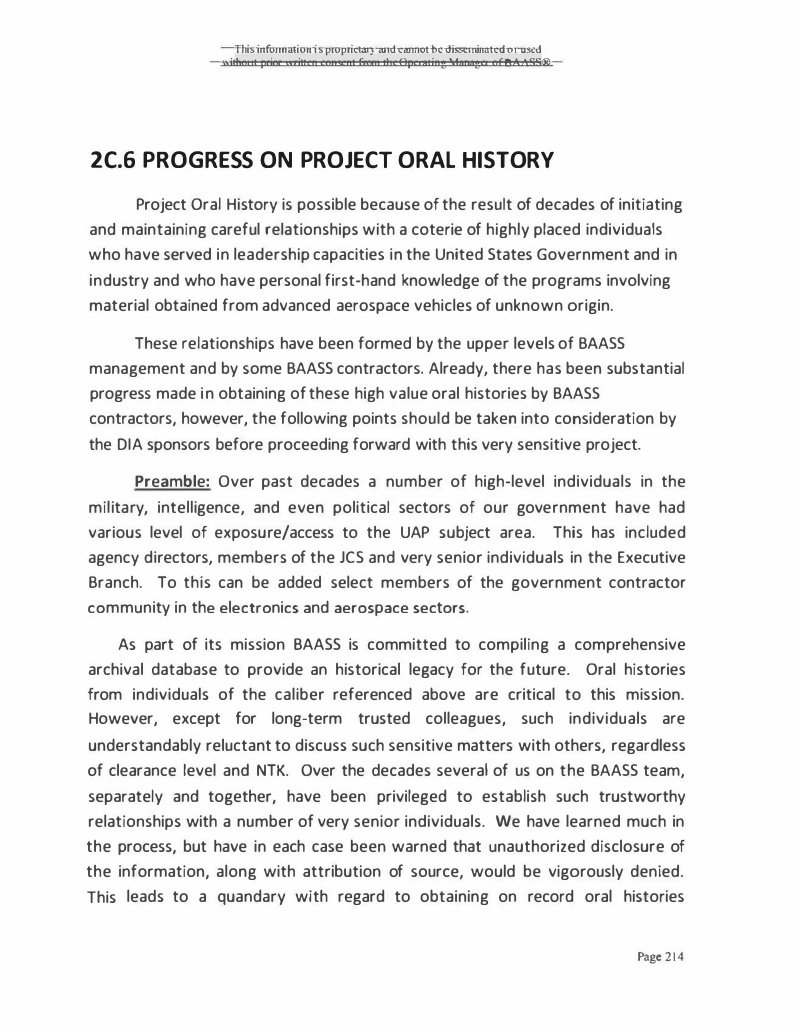 Facsimile of the documentPhysical page 220
DOCUMENTARY SOURCES · DOW
What the records tell
Date: July 2009. Location: Las Vegas, BAASS headquarters. In section 2C.6, the report presents the Oral History Project. According to the text, it relies on decades of relationships with a select group of people who held leadership positions in government and industry and who allegedly had firsthand knowledge of programs involving “material obtained from advanced aerospace vehicles of unknown origin.” The report does not identify any of these people or describe what they allegedly said.
The preamble cites, in generic terms, agency directors, members of the Joint Chiefs of Staff, senior Executive Branch officials, and executives of contractor companies in the electronics and aerospace fields. BAASS says these sources speak only to long-trusted colleagues and have warned that they would “vehemently” deny any unauthorized disclosure identifying them. The report calls this a dilemma: how to officially record information that the sources themselves would deny in public.
The company's proposal is to approach these people explaining that there is a historical archive on UAP aimed at long-term national security, in a future in which, in the words of the text, exchange with extraterrestrial species would be part of human development. This is the view recorded by BAASS. The suggested conditions include keeping the testimony in a separate TS/SCI secret-level database, granting anonymity to the sources, restricting identities to a small oversight group, and embargoing access for the lifetime of each source, if the source requests it.
The report asks the DIA to obtain a high-level executive authorization giving the BAASS interview team “need to know” status and formal legal authority. It ends by saying that, at the end of July 2009, changes in BAASS's sponsorship were underway to meet these conditions. The document does not state what those changes were.
The passage records a proposal and a claim by the company. It contains no testimony, name, date, or document confirming the existence of the programs mentioned. What can be stated is that BAASS claimed to have access to these sources and was asking the government for formal backing to record them.
DIRECT READING OF THE FILE
The document, in the original
Physical pages 220 to 222 are translated in full; the excerpt contains no source names.
EXCERPT 1 · PHYSICAL PAGE 220
Physical page 220, full page
This info11uatio11 is proptictat) wtd caiutot be dissc1ni:J1atcd o, used
11 ilhotlt prior ,..-rittcu eonscut from tl,e Ope1a:ti11g Manage, ofBAJ\SS®.
2C.6 PROGRESS ON PROJECT ORAL HISTORY
Project Oral History is possible because of the result of decades of initiating
and maintaining careful relationships with a coterie of highly placed individuals
who have served in leadership capacities in the United States Government and in
industry and who have personal first-hand knowledge of the programs involving
material obtained from advanced aerospace vehicles of unknown origin.
These relationships have been formed by the upper levels of BAASS
management and by some BAASS contractors. Already, there has been substantial
progress made in obtaining of these high value oral histories by BAASS
contractors, however, the following points should be taken into consideration by
the DIA sponsors before proceeding forward with this very sensitive project.
Preamble: Over past decades a number of high-level individuals in the
military, intelligence, and even political sectors of our government have had
various level of exposure/access to the UAP subject area.
This has included
agency directors, members of the JCS and very senior individuals in the Executive
Branch. To this can be added select members of the government contractor
community in the electronics and aerospace sectors.
As part of its mission BAASS is committed to compiling a comprehensive
archival database to provide an historical legacy for the future. Oral histories
from individuals of the caliber referenced above are critical to this mission.
However, except for long-term trusted colleagues, such individuals are
understandably reluctant to discuss such sensitive matters with others, regardless
of clearance level and NTK. Over the decades several of us on the BAASS team,
separately and together, have been privileged to establish such trustworthy
relationships with a number of very senior individuals. We have learned much in
the process, but have in each case been warned that unauthorized disclosure of
the information, along with attribution of source, would be vigorously denied.
This leads to a quandary with regard to obtaining on record oral histories
Page 214Editorial note: Physical page 220 of DOW-UAP-D172-BAASS_Ten_Month_Report_July-2009.pdf.
Check the original PDF
This info11uatio11 is proptictat) wtd caiutot be dissc1ni:J1atcd o, used
11 ilhotlt prior ,..-rittcu eonscut from tl,e Ope1a:ti11g Manage, ofBAJ\SS®.
2C.6 PROGRESS ON PROJECT ORAL HISTORY
Project Oral History is possible because of the result of decades of initiating
and maintaining careful relationships with a coterie of highly placed individuals
who have served in leadership capacities in the United States Government and in
industry and who have personal first-hand knowledge of the programs involving
material obtained from advanced aerospace vehicles of unknown origin.
These relationships have been formed by the upper levels of BAASS
management and by some BAASS contractors. Already, there has been substantial
progress made in obtaining of these high value oral histories by BAASS
contractors, however, the following points should be taken into consideration by
the DIA sponsors before proceeding forward with this very sensitive project.
Preamble: Over past decades a number of high-level individuals in the
military, intelligence, and even political sectors of our government have had
various level of exposure/access to the UAP subject area.
This has included
agency directors, members of the JCS and very senior individuals in the Executive
Branch. To this can be added select members of the government contractor
community in the electronics and aerospace sectors.
As part of its mission BAASS is committed to compiling a comprehensive
archival database to provide an historical legacy for the future. Oral histories
from individuals of the caliber referenced above are critical to this mission.
However, except for long-term trusted colleagues, such individuals are
understandably reluctant to discuss such sensitive matters with others, regardless
of clearance level and NTK. Over the decades several of us on the BAASS team,
separately and together, have been privileged to establish such trustworthy
relationships with a number of very senior individuals. We have learned much in
the process, but have in each case been warned that unauthorized disclosure of
the information, along with attribution of source, would be vigorously denied.
This leads to a quandary with regard to obtaining on record oral histories
Page 214View the document record ↗ · Physical page 220, counting the cover.
EXCERPT 2 · PHYSICAL PAGE 221
Physical page 221, full page
'fhbinformation is p1upriem1ym,d caJ111otbe disseminated 01 used
witbo11t prio• written ce11se11t frem lhe Opemting Mru,agc1 ofBAASS®.
concerning significant information that deserves to be archived as part of the
historical legacy. Following are some suggestions as to how to break the gridlock
involved in this conundrum.
•
The negative factor for the source, logically, is the loss of control over
who might obtain access to the information, and the potential for
consequent blowback to the source, political or otherwise - issues
sepairate from the parochial concerns over matters of security.
By
contrast, a positive factor is that such key sources are in general very
responsible individuals or they would not have risen to the positions of
authority or leadership that they occupied. Consequently, such individuals
are able to discern the importance of contributing their knowledge base
for the long-term historical record, as well as the significance of the loss
should it not be archived. As executives who have had to make critical
decisions on the basis of insufficient information, they would understand
well the ethical need to avoid hampering a future decision maker by
withholding critical data.
•
What is clearly required is a structure that permits each of their
unique contributions to be filed with the historical archive without
prejudice to their individual concerns with regard to privacy, loyalty and
security issues.
•
We propose that the following strategy be used. The individuals of
interest would be approached with a brief description that a program is in
place to build up an historical archive of all that is known about the UAP
issue. Its purpose is to assist in addressing the long-range national and
global security issues that need to be faced as our species transitions into
a future where intercourse with extraterrestrial species becomes part of
the fabric of the human species development. As part of this process it is
considered of primary importance to collect oral histories, especially from
those key individuals of high rank and leadership position whose exposure
to the subject is certain to be of unique character.
Page 215Editorial note: Physical page 221 of DOW-UAP-D172-BAASS_Ten_Month_Report_July-2009.pdf.
Check the original PDF
'fhbinformation is p1upriem1ym,d caJ111otbe disseminated 01 used
witbo11t prio• written ce11se11t frem lhe Opemting Mru,agc1 ofBAASS®.
concerning significant information that deserves to be archived as part of the
historical legacy. Following are some suggestions as to how to break the gridlock
involved in this conundrum.
•
The negative factor for the source, logically, is the loss of control over
who might obtain access to the information, and the potential for
consequent blowback to the source, political or otherwise - issues
sepairate from the parochial concerns over matters of security.
By
contrast, a positive factor is that such key sources are in general very
responsible individuals or they would not have risen to the positions of
authority or leadership that they occupied. Consequently, such individuals
are able to discern the importance of contributing their knowledge base
for the long-term historical record, as well as the significance of the loss
should it not be archived. As executives who have had to make critical
decisions on the basis of insufficient information, they would understand
well the ethical need to avoid hampering a future decision maker by
withholding critical data.
•
What is clearly required is a structure that permits each of their
unique contributions to be filed with the historical archive without
prejudice to their individual concerns with regard to privacy, loyalty and
security issues.
•
We propose that the following strategy be used. The individuals of
interest would be approached with a brief description that a program is in
place to build up an historical archive of all that is known about the UAP
issue. Its purpose is to assist in addressing the long-range national and
global security issues that need to be faced as our species transitions into
a future where intercourse with extraterrestrial species becomes part of
the fabric of the human species development. As part of this process it is
considered of primary importance to collect oral histories, especially from
those key individuals of high rank and leadership position whose exposure
to the subject is certain to be of unique character.
Page 215View the document record ↗ · Physical page 221, counting the cover.
EXCERPT 3 · PHYSICAL PAGE 222
Physical page 222, full page
This information is propriడtary and ean.Aet be dissentinatcd 01 used
•
Given the sensitivities involved in requesting such oral histories, of
paramount concern is the establishment of appropriate conditions of
confidentiality under which those providing data for the archives could be
satisfied that the attendant conditions meet their specific requirements
for participation in such a collection endeavor. In addition to providing for
TS/SCI archival database storage separate from other similarly secure
BAASS databases, such conditions can range over (1) the need to protect
the identity of the source by granting anonymity in the records, restricting
knowledge of the identities to a single core oversight group of a few; (2)
placing an embargo on general access to such records during the lifetime
of the source, if requested; (3) meeting conditions negotiated with the
source such that a safe sanctuary for complete disclosure is established to
the satisfaction of the source.
An underlying thread throughout the
negotiations would incorporate respect for the individual and his
concerns, while at the same time maintaining an emphasis on an intrinsic
duty to provide a complete record for future generations which would
otherwise be lost over time.
The above considerations are being put forward not in the abstract: To date,
several BAASS team members have had access to such individuals and their
information on the basis of mutual professional respect and trust, and
consequently are highly sensitized to the challenges of establishing conditions
conducive to candor in the production of detailed and comprehensive oral
histories. To maximize the potential of the Oral Histories Initiative, we request
that some form of high-level executive authorization be granted to empower the
BAASS interview team with an appropriate Need-to-Know status and formal legal
authority in the context of developing long-range National and 1Global Security
strategies.
It can be summarized that as of late July 2009, changes to BAASS sponsorship
are now underway in order to accomplish the NTK parameters described above.
Page 216Editorial note: Physical page 222 of DOW-UAP-D172-BAASS_Ten_Month_Report_July-2009.pdf.
Check the original PDF
This information is propriడtary and ean.Aet be dissentinatcd 01 used
•
Given the sensitivities involved in requesting such oral histories, of
paramount concern is the establishment of appropriate conditions of
confidentiality under which those providing data for the archives could be
satisfied that the attendant conditions meet their specific requirements
for participation in such a collection endeavor. In addition to providing for
TS/SCI archival database storage separate from other similarly secure
BAASS databases, such conditions can range over (1) the need to protect
the identity of the source by granting anonymity in the records, restricting
knowledge of the identities to a single core oversight group of a few; (2)
placing an embargo on general access to such records during the lifetime
of the source, if requested; (3) meeting conditions negotiated with the
source such that a safe sanctuary for complete disclosure is established to
the satisfaction of the source.
An underlying thread throughout the
negotiations would incorporate respect for the individual and his
concerns, while at the same time maintaining an emphasis on an intrinsic
duty to provide a complete record for future generations which would
otherwise be lost over time.
The above considerations are being put forward not in the abstract: To date,
several BAASS team members have had access to such individuals and their
information on the basis of mutual professional respect and trust, and
consequently are highly sensitized to the challenges of establishing conditions
conducive to candor in the production of detailed and comprehensive oral
histories. To maximize the potential of the Oral Histories Initiative, we request
that some form of high-level executive authorization be granted to empower the
BAASS interview team with an appropriate Need-to-Know status and formal legal
authority in the context of developing long-range National and 1Global Security
strategies.
It can be summarized that as of late July 2009, changes to BAASS sponsorship
are now underway in order to accomplish the NTK parameters described above.
Page 216View the document record ↗ · Physical page 222, counting the cover.
Dates and documentary context
- Event
- Not established — The section does not describe a dated episode.
- Document
- 07/2009 — BAASS ten-month report; the text cites the end of July 2009.
- Publication
- Not established — Published by the U.S. Department of War on war.gov, release 08 of UAP files (2026).
Origin and release
Bigelow Aerospace Advanced Space Studies (BAASS), for the Defense Intelligence Agency (DIA), AAWSAP program · DOW-UAP-D172-BAASS_Ten_Month_Report_July-2009.pdf
Physical pages 220 to 222 of 538.
undefined ↗ — undefined
Related accounts and their differences
Questions to continue the investigation
- Was the executive authorization requested by BAASS ever granted?
- What were the sponsorship changes mentioned for the end of July 2009?
GEOGRAPHY OF THE CASE
Las Vegas, Nevada
Approximate reference point placed by the editorial team; it does not indicate the exact location.
DOCUMENTARY TRAIL
Go back to the sources
References use physical pages of the PDF, counting the cover. Summaries are presented in English; the documents keep their original language.
- DOW-UAP-D172-BAASS_Ten_Month_Report_July-2009.pdf
Physical pages 220 to 222
DOW · 538 pages
Editorial summary based on the collection's research notes. How we read the documents.