Date: January to March 2009, according to the reportLocation: United States (DIA, Los Alamos National Laboratory, NORAD) and Brasília
DIA, 2009: BAASS reports that searches for UAP files at the DIA, at Los Alamos and at NORAD yielded nothing and that contact with the Brazilian Air Force stopped
BAASS's ten-month report states that the DIA library had no files on the subject, that the agency allegedly destroyed papers in the 1990s, that Los Alamos delivered only 600 already-public pages from Project Grudge, and that NORAD said it had not received pilot reports under JANAP 146. It also records that the DIA tried to obtain the Operation Prato files through Brazilian attachés, without success.
- Event date
- January to March 2009, according to the report
- Location
- United States (DIA, Los Alamos National Laboratory, NORAD) and Brasília
- Topic
- AAWSAP and advanced technologies
- Source agencies
- DOW
- Documents
- 1 document · 538 pages
- Reading time
- 11 min
 Facsimile of the documentPhysical page 192
DOCUMENTARY SOURCES · DOW
What the records tell
Project Cooperation provided for the DIA, the contract sponsor, to help BAASS obtain films, equipment, materials and information. The ten-month report records that the DIA program manager assembled an informal advisory team on the East Coast, with scientists, intelligence officers and MASINT specialists, and calls this a “major programmatic success.” It also says that a change in BAASS's “official programmatic status” was underway, to provide “deeper cover” for the most sensitive projects and free participants from need-to-know restrictions.
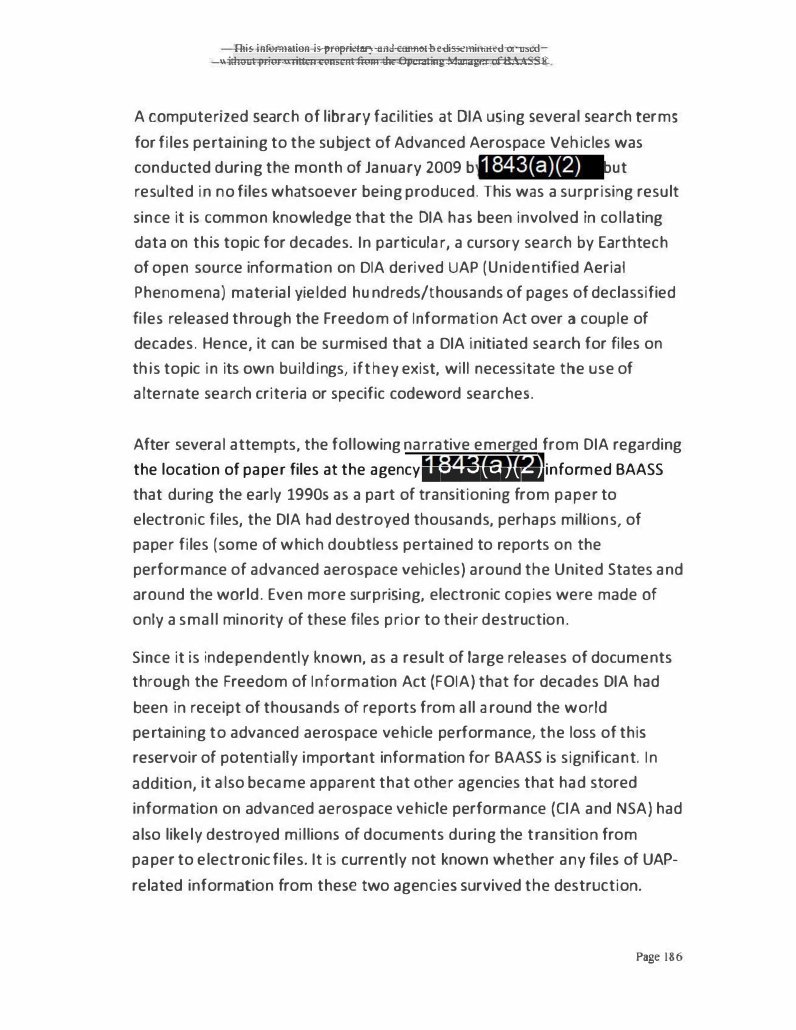
A computerized search of the DIA library in January 2009 found no files on “advanced aerospace vehicles.” BAASS called the result surprising, because Freedom of Information Act requests had already released hundreds or thousands of pages on UAP originating from the DIA. Later, according to the text, an agency contact, whose name is redacted, reported that in the early 1990s the DIA destroyed thousands, perhaps millions, of paper files, digitizing only a small portion. The report assumes that the CIA and NSA did the same, without presenting proof.
Regarding Los Alamos, the report states that a person whose name is redacted and his team said they had located, over two decades of contacts, historical files on the subject in a secure facility of the laboratory. In January 2009 direct access was refused, and the laboratory only copied the specified files. The material released to the DIA was about 600 pages from Project Grudge, mostly already declassified and available on the internet. BAASS says the difference between what was promised and what was delivered was “substantial” and was being investigated.
NORAD, according to the text, is the U.S. recipient of reports made under JANAP 146, a regulation that requires military pilots to report encounters with UAP. In March 2009 the sponsor asked how to obtain the reports from the last decade and was told that such data do not exist and that no report of this kind had been received, even though the regulation was in force. The report does not discuss whether the rule was still applied in practice or whether there was another reporting channel.
Finally, the document summarizes the Colares wave, in Pará, in 1977, repeating the BAASS version that UFOs injured and killed residents. It cites Operation Prato, of the Brazilian Air Force, to which it attributes more than a thousand pages, 500 photos and fifteen hours of film, of which 206 pages allegedly leaked. The DIA contacted two Brazilian attachés in Brasília, who informed the ambassador. According to the report, the cooperation was abruptly ended when the attachés were replaced.
DIRECT READING OF THE FILE
The document, in the original
Physical pages 191 to 195 are translated in full in the page-by-page blocks. Section 2C.4 does not appear in this excerpt; page 196 already opens section 2C.5.
EXCERPT 1 · PHYSICAL PAGE 191
Physical page 191, full page
1l1is i1Ԥfen1wiaH is J'f6pFiel:llfy @cl eaimol be disscrni11aled m used
•.. itlumt prier ;rrillef! ee11seHt ffen. the Operuting Mt1:1,t1ge1 ofO,'u'\SS®.
2C.3 PROGRESS ON PROJECT COOPERATION
Project Cooperation was to engage with the DIA in assisting BAASS to obtain
high value film, hardware, relevant materials and information that are essential to
the successful completion of the project. The following is a list of initiatives begun
in late 2008 and early 2009 by the DIA sponsor.
•
1 843(a)(2)
Since the inception of contract
the program manager, has
brought together an informal advisory team of scientists, military
intelligence officials, MASINT experts and other high value individuals that
currently serve as a high level team on the East Coast with broad ranging
and deep expertise in many of the areas that BAASS wishes to study. This
team originates from multiple divisions and departments within the
intelligence and armed forces communities. The team has high level
motivation and interest in garnering the highest quality information
regarding human interactions with advanced aerospace technologies. The
gathering and engagement of this expert team, by the sponsor, which
functions autonomously from the las Vegas based BAASS operation, even
at this early stage, is judged to be a major programmatic success.
• As BAASS's ten month anniversary of operations approaches, it has become
obvious that in order to expedite some of deeply sensitive goals inherent in
the mission, it will be necessary to alter the official programmatic status of
the BAASS operation. This change is already underway and will afford the
BAASS organization deeper cover to pursue the projects that a re deemed
more sensitive. Additionally, it will afford individuals with high levels of
knowledge, who are interested in participating with the BAAS$ operation,
the necessary privacy to perform their tasks without important need to
know (NTK) restrictions.
• A search of the databases and records of the DIA was planned for any
records, documents, manuscripts, files or otherwise that pertains to
information on the historical performance of advanced aerospace vehicles.
Page 185Editorial note: Physical page 191 of DOW-UAP-D172-BAASS_Ten_Month_Report_July-2009.pdf.
Check the original PDF
1l1is i1Ԥfen1wiaH is J'f6pFiel:llfy @cl eaimol be disscrni11aled m used
•.. itlumt prier ;rrillef! ee11seHt ffen. the Operuting Mt1:1,t1ge1 ofO,'u'\SS®.
2C.3 PROGRESS ON PROJECT COOPERATION
Project Cooperation was to engage with the DIA in assisting BAASS to obtain
high value film, hardware, relevant materials and information that are essential to
the successful completion of the project. The following is a list of initiatives begun
in late 2008 and early 2009 by the DIA sponsor.
•
1 843(a)(2)
Since the inception of contract
the program manager, has
brought together an informal advisory team of scientists, military
intelligence officials, MASINT experts and other high value individuals that
currently serve as a high level team on the East Coast with broad ranging
and deep expertise in many of the areas that BAASS wishes to study. This
team originates from multiple divisions and departments within the
intelligence and armed forces communities. The team has high level
motivation and interest in garnering the highest quality information
regarding human interactions with advanced aerospace technologies. The
gathering and engagement of this expert team, by the sponsor, which
functions autonomously from the las Vegas based BAASS operation, even
at this early stage, is judged to be a major programmatic success.
• As BAASS's ten month anniversary of operations approaches, it has become
obvious that in order to expedite some of deeply sensitive goals inherent in
the mission, it will be necessary to alter the official programmatic status of
the BAASS operation. This change is already underway and will afford the
BAASS organization deeper cover to pursue the projects that a re deemed
more sensitive. Additionally, it will afford individuals with high levels of
knowledge, who are interested in participating with the BAAS$ operation,
the necessary privacy to perform their tasks without important need to
know (NTK) restrictions.
• A search of the databases and records of the DIA was planned for any
records, documents, manuscripts, files or otherwise that pertains to
information on the historical performance of advanced aerospace vehicles.
Page 185View the document record ↗ · Physical page 191, counting the cover.
EXCERPT 2 · PHYSICAL PAGE 192
Physical page 192, full page
This iaf-effill¼lioa is prepfietflf} 11ml et1:1met be dis..e1t1i1utted 01 used
1 itJ1gut prier writ-trn c11nsC!'lt H=em thȣ Opemling Maiiag,,இr gf a6 ASSஈ
A computerized search of library facilities at DIA using several search terms
for files pertaining to the subject of Advanced Aerospace Vehicles was
conducted during the month of January 2009 b
but
resulted in no files whatsoever being produced. This was a surprising result
since it is common knowledge that the DIA has been involved in collating
data on this topic for decades. In particular, a cursory search by Earthtech
of open source information on DIA derived UAP (Unidentified Aerial
Phenomena) material yielded hundreds/thousands of pages of declassified
files released through the Freedom of Information Act over a couple of
decades. Hence, it can be surmised that a DIA initiated search for files on
this topic in its own buildings, if they exist, will necessitate the use of
alternate search criteria or specific codeword searches.
After several attempts, the following narrative emer ed from DIA regarding
the location of paper files at the agencyllil'-liMl॑
informed BAASS
that during the early 1990s as a part of transitioning from palPer to
electronic files, the DIA had destroyed thousands, perhaps millions, of
paper files (some of which doubtless pertained to reports on the
performance of advanced aerospace vehicles) around the United States and
around the world. Even more surprising, electronic copies were made of
only a small minority of these files prior to their destruction.
Since it is independently known, as a result of large releases of documents
through the Freedom of Information Act (FOIA) that for decades DIA had
been in receipt of thousands of reports from all around the world
pertaining to advanced aerospace vehicle performance, the loss of this
reservoir of potentially important information for BAASS is significant. In
addition, it also became apparent that other agencies that had stored
information on advanced aerospace vehicle performance (CIA and NSA) had
also likely destroyed millions of documents during the transition from
paper to electronic files. It is currently not known whether any files of UAP
related information from these two agencies survived the destruction.
Page 186Editorial note: Physical page 192 of DOW-UAP-D172-BAASS_Ten_Month_Report_July-2009.pdf.
Check the original PDF
This iaf-effill¼lioa is prepfietflf} 11ml et1:1met be dis..e1t1i1utted 01 used
1 itJ1gut prier writ-trn c11nsC!'lt H=em thȣ Opemling Maiiag,,இr gf a6 ASSஈ
A computerized search of library facilities at DIA using several search terms
for files pertaining to the subject of Advanced Aerospace Vehicles was
conducted during the month of January 2009 b
but
resulted in no files whatsoever being produced. This was a surprising result
since it is common knowledge that the DIA has been involved in collating
data on this topic for decades. In particular, a cursory search by Earthtech
of open source information on DIA derived UAP (Unidentified Aerial
Phenomena) material yielded hundreds/thousands of pages of declassified
files released through the Freedom of Information Act over a couple of
decades. Hence, it can be surmised that a DIA initiated search for files on
this topic in its own buildings, if they exist, will necessitate the use of
alternate search criteria or specific codeword searches.
After several attempts, the following narrative emer ed from DIA regarding
the location of paper files at the agencyllil'-liMl॑
informed BAASS
that during the early 1990s as a part of transitioning from palPer to
electronic files, the DIA had destroyed thousands, perhaps millions, of
paper files (some of which doubtless pertained to reports on the
performance of advanced aerospace vehicles) around the United States and
around the world. Even more surprising, electronic copies were made of
only a small minority of these files prior to their destruction.
Since it is independently known, as a result of large releases of documents
through the Freedom of Information Act (FOIA) that for decades DIA had
been in receipt of thousands of reports from all around the world
pertaining to advanced aerospace vehicle performance, the loss of this
reservoir of potentially important information for BAASS is significant. In
addition, it also became apparent that other agencies that had stored
information on advanced aerospace vehicle performance (CIA and NSA) had
also likely destroyed millions of documents during the transition from
paper to electronic files. It is currently not known whether any files of UAP
related information from these two agencies survived the destruction.
Page 186View the document record ↗ · Physical page 192, counting the cover.
EXCERPT 3 · PHYSICAL PAGE 193
Physical page 193, full page
'11,is i11fo,11,atio11 is i""I" iditf)' &111! emmet be dN
!mm,i aaled or 11ЈN
'd
i
•N
without prior ,·,ritЉn consent from the Opcra,ing; Mam1ger of BA.ASS®.
• Los Alamos files: As a result of painstaking investigation and networking
over two decades 1 843(a)(2) and his team located multiple historical
files pertaining to advanced aerospace phenomena in a specific secure
installation at Los Alamos National Laboratories. In January 2009, I ·- - -
1 843(a)(2)
· !
1843(a)(2} .....-l--· · ·
!contacted Los Alamos Labs to obtain entry to the location where
the files were stored in order to assess which files could be copied.
Unfortunately, the Los Alamos authority refused entry and agreed only to
1 843(a)(2)
copy those files that were enumerated and specified by!
...n.n...,t . t,,ence,.n
an opportunity to assess which additional files of interest were possibly
located at the secure installation was lost, not to mention the ability for
BAASS cleared staff to revisit the facility in the future to obtain further
information. When the files were eventually released to the DIA,
preliminary analysis by DIA and by BAASS staff indicated 600 pages of
Project Grudge Reports which, though interesting historical documents,
contained nothing of substantive value. Subsequent investigation showed
that in fact the majority, if not all, of this 600 page batch of files had been
de-classified and were available on the Internet. The discrepancy between
the original allegations on the contents of the LANL files versus what was
actually found in the files released from LANL appears substantive. This
discrepancy is currently being investigated by BAASS.
• According to their website, North American Aerospace Defense Command
(NORAD) is a bi-national United States and Canadian organization charged
with the missions of aerospace warning and aerospace control for North
America. Aerospace warning includes "the monitoring of man-made objects
in space, and the detection, validation, and warning of attack against North
America whether by aircraft, missiles, or space vehicles, through mutual
support arrangements with other commands". Aerospace control includes
11 ensuring air sovereignty and air defense of the airspace of Canada and the
United States". Coincident with their defense role, NORAD is also the
reporting organization in the United States for JANAP 146-the regulation
that mandates military pilots to report UAP encounters to an official
Page 187Editorial note: Physical page 193 of DOW-UAP-D172-BAASS_Ten_Month_Report_July-2009.pdf.
Check the original PDF
'11,is i11fo,11,atio11 is i""I" iditf)' &111! emmet be dN
!mm,i aaled or 11ЈN
'd
i
•N
without prior ,·,ritЉn consent from the Opcra,ing; Mam1ger of BA.ASS®.
• Los Alamos files: As a result of painstaking investigation and networking
over two decades 1 843(a)(2) and his team located multiple historical
files pertaining to advanced aerospace phenomena in a specific secure
installation at Los Alamos National Laboratories. In January 2009, I ·- - -
1 843(a)(2)
· !
1843(a)(2} .....-l--· · ·
!contacted Los Alamos Labs to obtain entry to the location where
the files were stored in order to assess which files could be copied.
Unfortunately, the Los Alamos authority refused entry and agreed only to
1 843(a)(2)
copy those files that were enumerated and specified by!
...n.n...,t . t,,ence,.n
an opportunity to assess which additional files of interest were possibly
located at the secure installation was lost, not to mention the ability for
BAASS cleared staff to revisit the facility in the future to obtain further
information. When the files were eventually released to the DIA,
preliminary analysis by DIA and by BAASS staff indicated 600 pages of
Project Grudge Reports which, though interesting historical documents,
contained nothing of substantive value. Subsequent investigation showed
that in fact the majority, if not all, of this 600 page batch of files had been
de-classified and were available on the Internet. The discrepancy between
the original allegations on the contents of the LANL files versus what was
actually found in the files released from LANL appears substantive. This
discrepancy is currently being investigated by BAASS.
• According to their website, North American Aerospace Defense Command
(NORAD) is a bi-national United States and Canadian organization charged
with the missions of aerospace warning and aerospace control for North
America. Aerospace warning includes "the monitoring of man-made objects
in space, and the detection, validation, and warning of attack against North
America whether by aircraft, missiles, or space vehicles, through mutual
support arrangements with other commands". Aerospace control includes
11 ensuring air sovereignty and air defense of the airspace of Canada and the
United States". Coincident with their defense role, NORAD is also the
reporting organization in the United States for JANAP 146-the regulation
that mandates military pilots to report UAP encounters to an official
Page 187View the document record ↗ · Physical page 193, counting the cover.
EXCERPT 4 · PHYSICAL PAGE 194
Physical page 194, full page
-
-
This inf-OAHal.iaH is fll'epfiClttl) wad eltlmot be di:ssc111i11axcd m used
\1©e1:1t pri6r 11Titten een3ettt ftom the Opeuliing lllrumgc, ofBAA:SS·®.
agency. Given NORAD's important status, BAASS agreed that it was a high
priority for the sponsor to approach NORAD with a view to obtaining any
data on JAN AP 146 reports for the past decade from military pilots.
Accordingly, in March 2009 1 843(a)(2) approached NORA[) to inquire
about procedures for obtaining data on JANAP 146 reports. 1843(a)(2) was
told that no such data exists. Further,!
lwas toldthat inspiteot.a1843(a)(2)
clearly written regulations on the books that mandated the reporting of
unusual encounters with advanced aerospace vehicles by military pilots, no
such reports had been received by NORAD.
• During the 1970s, with the highest activity reported during mid to late
1977, the Brazilian island of Cola res and the surrounding area of the
Amazon delta were visited by flying objects of an unknown nature (see full
report in section 2C9). Several different types of unidentified airborne
objects were seen - some big, some small, saucer-shaped, cigar-shaped,
barrel-shaped, luminous or not. The aerial objects arrived generally from
the North and were sometimes observed originating from underwater.
Fairly regularly, Colares area inhabitants were targeted by the objects
beaming strange "lights" at them, and many were badly hurt with a few
reported deaths. The Brazilian Air Force (For॒a Aerea Brasileira, FAB)
conducted an on-site investigation from September through December
1977, and possibly through 1978, which was titled "OPERAQ\O PRATO," or
OPERATION PLATE (SAUCER). The investigation supposedly generated over
1,000 pages of documents, logs, sketches, and maps; over 500
photographs; and fifteen hours of motion film. Over the years, 206 pages
documenting the Brazilian Air Force's investigation were leaked to the
public.
Because of the high value associated with Project Colares (for an extensive
background and discussion of BAASS involvement with Project Colares and
wider Brazil investigations, see section 2C9), it was deemed necessary for
the sponsor to directly and officially contact the Brazilian Air Force to try to
secure official Air Force documentation and photographs and film
Page 188Editorial note: Physical page 194 of DOW-UAP-D172-BAASS_Ten_Month_Report_July-2009.pdf.
Check the original PDF
-
-
This inf-OAHal.iaH is fll'epfiClttl) wad eltlmot be di:ssc111i11axcd m used
\1©e1:1t pri6r 11Titten een3ettt ftom the Opeuliing lllrumgc, ofBAA:SS·®.
agency. Given NORAD's important status, BAASS agreed that it was a high
priority for the sponsor to approach NORAD with a view to obtaining any
data on JAN AP 146 reports for the past decade from military pilots.
Accordingly, in March 2009 1 843(a)(2) approached NORA[) to inquire
about procedures for obtaining data on JANAP 146 reports. 1843(a)(2) was
told that no such data exists. Further,!
lwas toldthat inspiteot.a1843(a)(2)
clearly written regulations on the books that mandated the reporting of
unusual encounters with advanced aerospace vehicles by military pilots, no
such reports had been received by NORAD.
• During the 1970s, with the highest activity reported during mid to late
1977, the Brazilian island of Cola res and the surrounding area of the
Amazon delta were visited by flying objects of an unknown nature (see full
report in section 2C9). Several different types of unidentified airborne
objects were seen - some big, some small, saucer-shaped, cigar-shaped,
barrel-shaped, luminous or not. The aerial objects arrived generally from
the North and were sometimes observed originating from underwater.
Fairly regularly, Colares area inhabitants were targeted by the objects
beaming strange "lights" at them, and many were badly hurt with a few
reported deaths. The Brazilian Air Force (For॒a Aerea Brasileira, FAB)
conducted an on-site investigation from September through December
1977, and possibly through 1978, which was titled "OPERAQ\O PRATO," or
OPERATION PLATE (SAUCER). The investigation supposedly generated over
1,000 pages of documents, logs, sketches, and maps; over 500
photographs; and fifteen hours of motion film. Over the years, 206 pages
documenting the Brazilian Air Force's investigation were leaked to the
public.
Because of the high value associated with Project Colares (for an extensive
background and discussion of BAASS involvement with Project Colares and
wider Brazil investigations, see section 2C9), it was deemed necessary for
the sponsor to directly and officially contact the Brazilian Air Force to try to
secure official Air Force documentation and photographs and film
Page 188View the document record ↗ · Physical page 194, counting the cover.
EXCERPT 5 · PHYSICAL PAGE 195
Physical page 195, full page
This i11fbrn1atio11 is pfflprietai') ai,d eai111ot be disse111i11atcd 01 used
,, ithoot plio, m itte11 eo11m1t fi om the Operating MMef!;Cf of BAASS®.
pertaining to the military investigation conducted in 1977 (Operation
Prato). Accordingly, contact was established with two Brazilian attaches in
Brasilia, who in turn briefed the Brazilian ambassador, on the request from
the DIA for documents, photographs and film obtained from the Operation
Prato investigation. After an initially promising first round of contacts, due
to staff replacements at the level of Brazilian attache level, further
cooperation was abruptly terminated.
Page 189Editorial note: Physical page 195 of DOW-UAP-D172-BAASS_Ten_Month_Report_July-2009.pdf.
Check the original PDF
This i11fbrn1atio11 is pfflprietai') ai,d eai111ot be disse111i11atcd 01 used
,, ithoot plio, m itte11 eo11m1t fi om the Operating MMef!;Cf of BAASS®.
pertaining to the military investigation conducted in 1977 (Operation
Prato). Accordingly, contact was established with two Brazilian attaches in
Brasilia, who in turn briefed the Brazilian ambassador, on the request from
the DIA for documents, photographs and film obtained from the Operation
Prato investigation. After an initially promising first round of contacts, due
to staff replacements at the level of Brazilian attache level, further
cooperation was abruptly terminated.
Page 189View the document record ↗ · Physical page 195, counting the cover.
Dates and documentary context
- Event
- Not established — The searches took place in January (DIA and Los Alamos) and March 2009 (NORAD); the contact with Brazil has no date.
- Document
- 23/07/2009 — Status date of the ten-month report.
- Publication
- Not established — Published by the U.S. Department of War on war.gov, release 08 of UAP files (2026).
Origin and release
BAASS (Bigelow Aerospace Advanced Space Studies), for the Defense Intelligence Agency (DIA) · DOW-UAP-D172-BAASS_Ten_Month_Report_July-2009.pdf
Physical pages 191 to 195 (internal numbering 185 to 189).
undefined ↗ — undefined
Related accounts and their differences
- Colares, 1977: BAASS and the wave of lights and injured people
- Las Vegas, 2008: the BAASS plan requests files from Los Alamos and Colares
- RAF Lakenheath, 2007: F-15 pilot and the black UAP
- Northern Tier, 2009: BAASS reinvestigates missile bases
Questions to continue the investigation
- Is there a formal record of the destruction of DIA paper files in the early 1990s?
- What did BAASS conclude about the difference between the files promised and those delivered by Los Alamos?
- Was the change in BAASS's “programmatic status” mentioned in the report carried out?
GEOGRAPHY OF THE CASE
United States and Brasília
The report deals with searches in several agencies with no single location.
DOCUMENTARY TRAIL
Go back to the sources
References use physical pages of the PDF, counting the cover. Summaries are presented in English; the documents keep their original language.
- DOW-UAP-D172-BAASS_Ten_Month_Report_July-2009.pdf
Physical pages 191 to 195
DOW · 538 pages
Editorial summary based on the collection's research notes. How we read the documents.