Date: July 2009 (plan for 2010)Location: not stated
BAASS, 2009: the plan for 2010 seeks special access program status to reach “hardware,” EBE tissue and NORAD data
The last pages of the BAASS strategic plan propose a medical program on the health effects of UAPs and argue that the company should become a Special Access Program to obtain information it says exists in the hands of the government and contractors. The text also lists the continuation of the database projects, the northern U.S. bases and Colares.
- Event date
- July 2009 (plan for 2010)
- Location
- not stated
- Topic
- AAWSAP and advanced technologies
- Source agencies
- DOW
- Documents
- 1 document · 538 pages
- Reading time
- 13 min
 Facsimile of the documentPhysical page 492
DOCUMENTARY SOURCES · DOW
What the records tell
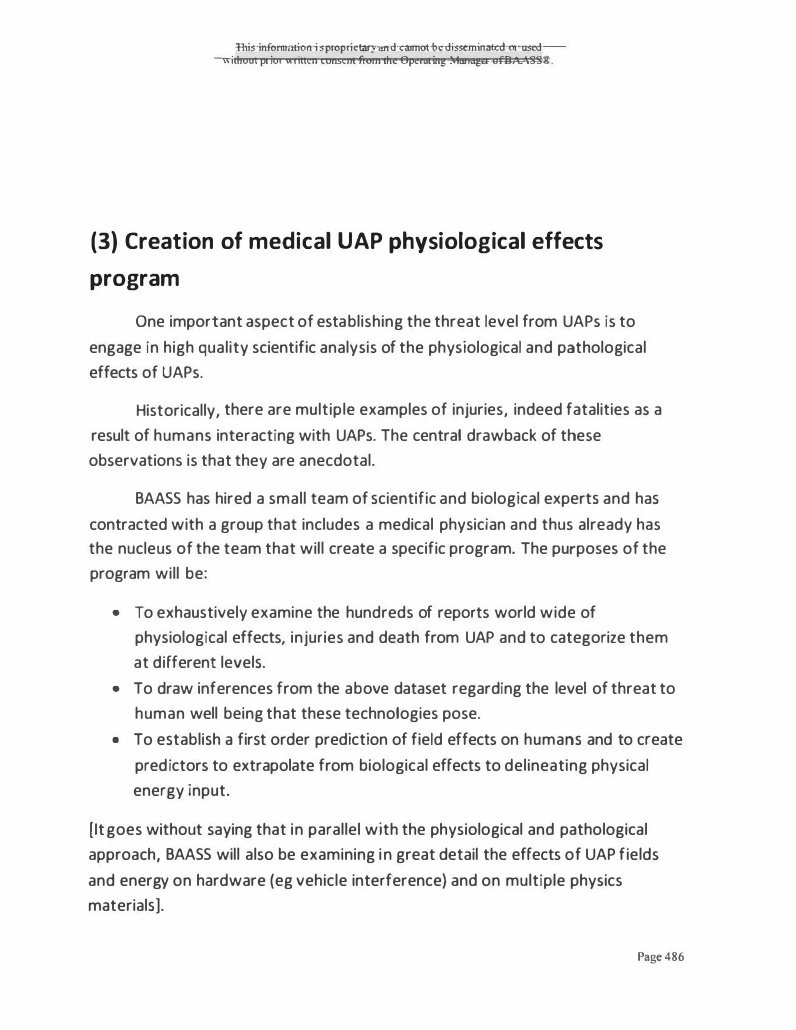
Item 3 of the strategic plan for 2010 proposes a medical program on the physiological effects of UAPs. According to the report, there are examples of injuries and deaths linked to interactions with UAPs, but all anecdotal. BAASS says it hired a small team with a physician to classify hundreds of reports worldwide, estimate the threat level and try to deduce, from the effects on the body, the energy applied. The list of tests includes memory and balance tests, a complete blood count, electron spin resonance of fingernails and DNA damage assays.
Item 4 deals with Special Access Program (SAP) status, with the corresponding “need to know.” According to BAASS, the company's managers and contractors have for decades maintained relationships of trust with high-level people in the aerospace industry and in government who allegedly had access to physical evidence, “hardware and biological samples,” of advanced vehicles and their pilots. The company says it needs this access to deliver the threat assessment. This is a BAASS claim, with no supporting document.
BAASS also wants an oral history project with ten “high-value” people, including agency directors, members of the Joint Chiefs of Staff and senior Executive Branch officials. A contractor writes that these people speak only in confidence and would deny any unauthorized quotation. Other targets are gun camera films, NORAD's database of “uncorrelated targets,” of which a subset would “probably” be advanced vehicles, according to BAASS, and EBE tissue samples in military laboratories such as the AFIP, Fort Detrick, USAMRIID and Dugway. One item of the plan is redacted.
Item 5 lists the continuation of projects. BAASS was negotiating with CUFOS to purchase the CUFOS and NICAP databases. The Northern Tier Project would build networks of retired security police officers who saw UAPs at the Malmstrom, Minot, Wurtsmith and Loring bases and would extend to other weapons storage areas. It called for new teams for Colares, the expansion of relationships in South America, the search for reports from China and access to recordings of Soviet officials about a UAP study program between the 1960s and 1980s.
These pages show how BAASS described its goals to the DIA and what it intended to obtain with the new status: access to alleged physical evidence, confidential interviews and military databases. The document does not prove that such evidence exists or that access was granted. The claims about “hardware,” EBE tissue and NORAD targets are the company's or its contractors'. Page 500 is blank.
DIRECT READING OF THE FILE
The document, in the original
Physical pages 492 to 500 are translated in full. There are passages redacted in the source; page 500 is blank.
EXCERPT 1 · PHYSICAL PAGE 492
Physical page 492, full page
TI1is info111urtio11 is p,op,ietruy and c.nmot be disseminated 01 used
"ithom p, io; ", ittc11 wnscm from tbe Operat:iftg Mwrnger ofBA.<\SSi,.
{3} Creation of medical UAP physiological effects
program
One important aspect of establishing the threat level from UAPs is to
engage in high quality scientific analysis of the physiological and pathological
effects of UAPs.
Historically, there are multiple examples of injuries, indeed fatalities as a
result of humans interacting with UAPs. The central drawback of these
observations is that they are anecdotal.
BAASS has hired a small team of scientific and biological experts and has
contracted with a group that includes a medical physician and thus already has
the nucleus of the team that will create a specific program. The purposes of the
program will be:
• To exhaustively examine the hundreds of reports world wide of
physiological effects, injuries and death from UAP and to categorize them
at different levels.
• To draw inferences from the above dataset regarding the level of threat to
human well being that these technologies pose.
• To establish a first order prediction of field effects on humans and to create
predictors to extrapolate from biological effects to delineating physical
energy input.
[It goes without saying that in parallel with the physiological and pathological
approach, BAASS will also be examining in great detail the effects of UAP fields
and energy on hardware (eg vehicle interference} and on multiple physics
materials].
Page 486Editorial note: Physical page 492 of DOW-UAP-D172-BAASS_Ten_Month_Report_July-2009.pdf.
Check the original PDF
TI1is info111urtio11 is p,op,ietruy and c.nmot be disseminated 01 used
"ithom p, io; ", ittc11 wnscm from tbe Operat:iftg Mwrnger ofBA.<\SSi,.
{3} Creation of medical UAP physiological effects
program
One important aspect of establishing the threat level from UAPs is to
engage in high quality scientific analysis of the physiological and pathological
effects of UAPs.
Historically, there are multiple examples of injuries, indeed fatalities as a
result of humans interacting with UAPs. The central drawback of these
observations is that they are anecdotal.
BAASS has hired a small team of scientific and biological experts and has
contracted with a group that includes a medical physician and thus already has
the nucleus of the team that will create a specific program. The purposes of the
program will be:
• To exhaustively examine the hundreds of reports world wide of
physiological effects, injuries and death from UAP and to categorize them
at different levels.
• To draw inferences from the above dataset regarding the level of threat to
human well being that these technologies pose.
• To establish a first order prediction of field effects on humans and to create
predictors to extrapolate from biological effects to delineating physical
energy input.
[It goes without saying that in parallel with the physiological and pathological
approach, BAASS will also be examining in great detail the effects of UAP fields
and energy on hardware (eg vehicle interference} and on multiple physics
materials].
Page 486View the document record ↗ · Physical page 492, counting the cover.
EXCERPT 2 · PHYSICAL PAGE 493
Physical page 493, full page
This if1ferma-tieF1 is preprie1ary aRd eam1e1 be disse,HiFlaled er àsed
without prior Y.'fitt,•o cooseAt Crom the 013erati1ig Manag,c1 of RAASS®.
List of possible methods to determine human health effects of UAP
A. Observational neurophysiological tests (Input From physician contractor
would be helpful)
1. Memory Test (example might be something akin to the Alzheimer's
test)
2. Balance Test (looking for possible deficits in ability to maintain
balance)
3. Manual dexterity Test
B. Physiological tests
1. Standard blood chemistry panel-modified appropriately
2. Complete blood cell count (RBC and WBC).
3. Physiological markers (CRP, cytokines, etc)
4. Electron Spin Resonance of Fingernails.
C. Cytogenetic tests (DNA damage)
1. Dicentric chromosome aberration assay.
2. Karyotyping (including G-banding).
3. Spectral Karyotyping.
4. Alkaline Comet Assay.
5. Micronucleus Assay.
6. Mitochondrial DNA damage Assay
PageP487Editorial note: Physical page 493 of DOW-UAP-D172-BAASS_Ten_Month_Report_July-2009.pdf.
Check the original PDF
This if1ferma-tieF1 is preprie1ary aRd eam1e1 be disse,HiFlaled er àsed
without prior Y.'fitt,•o cooseAt Crom the 013erati1ig Manag,c1 of RAASS®.
List of possible methods to determine human health effects of UAP
A. Observational neurophysiological tests (Input From physician contractor
would be helpful)
1. Memory Test (example might be something akin to the Alzheimer's
test)
2. Balance Test (looking for possible deficits in ability to maintain
balance)
3. Manual dexterity Test
B. Physiological tests
1. Standard blood chemistry panel-modified appropriately
2. Complete blood cell count (RBC and WBC).
3. Physiological markers (CRP, cytokines, etc)
4. Electron Spin Resonance of Fingernails.
C. Cytogenetic tests (DNA damage)
1. Dicentric chromosome aberration assay.
2. Karyotyping (including G-banding).
3. Spectral Karyotyping.
4. Alkaline Comet Assay.
5. Micronucleus Assay.
6. Mitochondrial DNA damage Assay
PageP487View the document record ↗ · Physical page 493, counting the cover.
EXCERPT 3 · PHYSICAL PAGE 494
Physical page 494, full page
a.
This information is proprietary aod cam1ot be Elissemiflated 01 used
without p, io, «1 itten eonsenl from the Operating Manager of BAASS®.
(4) Acceleration of SAP-derived need to know {NTK)
access
This is one of the most important early priorities for BAASS once our
organization accomplishes the transition to Special Access Program (SAP) status.
The importance of transitioning to SAP status cannot be overemphasized for a
variety of reasons (see discussion in section 2C6 of this report). For a list of some
of the attempts made in the past 10 months by the DIA to gain access to
cooperation and information see Section 2C3. The following are some of the more
pressing reasons for achieving SAP status with appropriate NTK:
Establish relationships with aerospace contractors---obtain hardware.
BAASS senior management and several BAASS contractors have formed
trusted relationships over a few decades with very senior personnel in
the aerospace and electronics industries, as well as government
departments. These individuals have been given access to the extremely
closely guarded information that the United States possesses regarding
the physical evidence (hardware and biological samples) of advanced
aerospace vehicles and their pilots. It is acknowledged that this
information is among the most closely guarded of secrets, but if BAASS
is to fulfill its mission of delivering an educated and factual threat
assessment regarding the presence of advanced aerospace vehicles in
United States airspace, the organization must have access to this
information.
b. Project Oral History-record interviews with ten high value people. This
need is an extension of that cited in part a. As one of the BAASS
contractors has said: "Over past decades a number of high-level
individuals in the military, intelligence, and even political sectors of our
government have had various level of exposure/access to the UAP
subject area. This has included agency directors, members of the JCS
and very senior individuals in the Executive Branch. To this can be added
Page 488Editorial note: Physical page 494 of DOW-UAP-D172-BAASS_Ten_Month_Report_July-2009.pdf.
Check the original PDF
a.
This information is proprietary aod cam1ot be Elissemiflated 01 used
without p, io, «1 itten eonsenl from the Operating Manager of BAASS®.
(4) Acceleration of SAP-derived need to know {NTK)
access
This is one of the most important early priorities for BAASS once our
organization accomplishes the transition to Special Access Program (SAP) status.
The importance of transitioning to SAP status cannot be overemphasized for a
variety of reasons (see discussion in section 2C6 of this report). For a list of some
of the attempts made in the past 10 months by the DIA to gain access to
cooperation and information see Section 2C3. The following are some of the more
pressing reasons for achieving SAP status with appropriate NTK:
Establish relationships with aerospace contractors---obtain hardware.
BAASS senior management and several BAASS contractors have formed
trusted relationships over a few decades with very senior personnel in
the aerospace and electronics industries, as well as government
departments. These individuals have been given access to the extremely
closely guarded information that the United States possesses regarding
the physical evidence (hardware and biological samples) of advanced
aerospace vehicles and their pilots. It is acknowledged that this
information is among the most closely guarded of secrets, but if BAASS
is to fulfill its mission of delivering an educated and factual threat
assessment regarding the presence of advanced aerospace vehicles in
United States airspace, the organization must have access to this
information.
b. Project Oral History-record interviews with ten high value people. This
need is an extension of that cited in part a. As one of the BAASS
contractors has said: "Over past decades a number of high-level
individuals in the military, intelligence, and even political sectors of our
government have had various level of exposure/access to the UAP
subject area. This has included agency directors, members of the JCS
and very senior individuals in the Executive Branch. To this can be added
Page 488View the document record ↗ · Physical page 494, counting the cover.
EXCERPT 4 · PHYSICAL PAGE 495
Physical page 495, full page
'fhb i11fo111rntio11 is p10p1 ietruy and ca1111ot b1,; dis:.c111illated m used
\.\itbe11• prier wriժea ee!'l:;eAI ff&m the Opu"ti11g Miiliag..,1 of BAA33®.
select members of the government contractor community in the
electronics and aerospace sectors. As part of its mission BAASS is
committed to compiling a comprehensive archival database to provide
an historical legacy for the future. Oral histories from individuals of the
caliber referenced above are critical to this mission. However, except for
Jong-term trusted colleagues, such individuals are understandably
reluctant to discuss such sensitive matters with others, regardless of
clearance level and NTK. Over the decades several of us on the BAASS
team, separately and together, have been privileged to establish such
trustworthy relationships with a number of very senior individuals. We
have learned much in the process, but have in each case been warned
that unauthorized disclosure of the information, along with attribution
of source, would be vigorously denied. This leads to a quandary with
regard to obtaining on record oral histories concerning significant
information that deserves to be archived as part of the historical legacy".
These statements reflect the urgency for BAASS in acquiring the status
and NTK where these high value individuals will be willing to divulge
what they know. It is also worth mentioning that many of these
individuals are at an advanced age and the urgency of interviewing them
before death or dementia intervenes is obvious. Hence the timely
acquisition of the status for providing cover for these individuals to be
interviewed by BAASS personnel is urgent.
c. 1 843 a
a
Page 489Editorial note: Physical page 495 of DOW-UAP-D172-BAASS_Ten_Month_Report_July-2009.pdf.
Check the original PDF
'fhb i11fo111rntio11 is p10p1 ietruy and ca1111ot b1,; dis:.c111illated m used
\.\itbe11• prier wriժea ee!'l:;eAI ff&m the Opu"ti11g Miiliag..,1 of BAA33®.
select members of the government contractor community in the
electronics and aerospace sectors. As part of its mission BAASS is
committed to compiling a comprehensive archival database to provide
an historical legacy for the future. Oral histories from individuals of the
caliber referenced above are critical to this mission. However, except for
Jong-term trusted colleagues, such individuals are understandably
reluctant to discuss such sensitive matters with others, regardless of
clearance level and NTK. Over the decades several of us on the BAASS
team, separately and together, have been privileged to establish such
trustworthy relationships with a number of very senior individuals. We
have learned much in the process, but have in each case been warned
that unauthorized disclosure of the information, along with attribution
of source, would be vigorously denied. This leads to a quandary with
regard to obtaining on record oral histories concerning significant
information that deserves to be archived as part of the historical legacy".
These statements reflect the urgency for BAASS in acquiring the status
and NTK where these high value individuals will be willing to divulge
what they know. It is also worth mentioning that many of these
individuals are at an advanced age and the urgency of interviewing them
before death or dementia intervenes is obvious. Hence the timely
acquisition of the status for providing cover for these individuals to be
interviewed by BAASS personnel is urgent.
c. 1 843 a
a
Page 489View the document record ↗ · Physical page 495, counting the cover.
EXCERPT 5 · PHYSICAL PAGE 496
Physical page 496, full page
This iflffiflttlltien i!i preprielftlf llfld eftflnet be di.>Sen,inated er t1:1ed
withotn p1 io, iuitte11 c0usc11t fmm the Ope1ati11g Ma11agc1 ofl3AA:SSథ.
d. Gun camera film, photographs: There are many other potential sources,
including Air Force archives for obtaining historical, previously classified
documents and files pertaining to military interactions with UAP utilizing
the appropriate legal authority including NTK. (see item c above)
e. NORAD database on Uncorrelated Targets
As discussed in section 2C3 of this report, according to their website,
North American Aerospace Defense Command (NORAD) is a bi-national
United States and Canadian organization charged with the missions of
aerospace warning and aerospace control for North America. Aerospace
warning includes "the monitoring of man-made objects in space, and
the detection, validation, and warning of attack against North America
whether by aircraft, missiles, or space vehicles, through mutual support
arrangements with other commands". Aerospace control includes
"ensuring air sovereignty and air defense of the airspace of Canada and
the United States". It is well known that NORAD has assembled records
of "uncorrelated targets", a subset of which likely comprises advanced
aerospace vehicles. Once BAASS attains the legally binding authority to
request these data, the information will be an invaluable addition to
BAASS's ever expanding database.
f. Launch search to obtain EBE tissue samples
In a previous report, one of the BAASS contractors has written: "under
the hypothesis that biological material of potentially non-human origin
has been recovered, or the use of biological or chemical agents of
currently-unknown type have been detected or inferred, via interagency
connections, BAASS will lobby for access to medical samples for
evaluation by liaison with such laboratories as the Armed Forces
Institute of Pathology (AFIP); the various commands housed at Fort
Detrick, e.g., U.S. Army Medical Research and Materiel Command
(USAMRMC} with its bio-defense agency, and the U.S. Army Medical
Research Institute of Infectious Diseases (USAMRIID}; Dugway Proving
Page 490Editorial note: Physical page 496 of DOW-UAP-D172-BAASS_Ten_Month_Report_July-2009.pdf.
Check the original PDF
This iflffiflttlltien i!i preprielftlf llfld eftflnet be di.>Sen,inated er t1:1ed
withotn p1 io, iuitte11 c0usc11t fmm the Ope1ati11g Ma11agc1 ofl3AA:SSథ.
d. Gun camera film, photographs: There are many other potential sources,
including Air Force archives for obtaining historical, previously classified
documents and files pertaining to military interactions with UAP utilizing
the appropriate legal authority including NTK. (see item c above)
e. NORAD database on Uncorrelated Targets
As discussed in section 2C3 of this report, according to their website,
North American Aerospace Defense Command (NORAD) is a bi-national
United States and Canadian organization charged with the missions of
aerospace warning and aerospace control for North America. Aerospace
warning includes "the monitoring of man-made objects in space, and
the detection, validation, and warning of attack against North America
whether by aircraft, missiles, or space vehicles, through mutual support
arrangements with other commands". Aerospace control includes
"ensuring air sovereignty and air defense of the airspace of Canada and
the United States". It is well known that NORAD has assembled records
of "uncorrelated targets", a subset of which likely comprises advanced
aerospace vehicles. Once BAASS attains the legally binding authority to
request these data, the information will be an invaluable addition to
BAASS's ever expanding database.
f. Launch search to obtain EBE tissue samples
In a previous report, one of the BAASS contractors has written: "under
the hypothesis that biological material of potentially non-human origin
has been recovered, or the use of biological or chemical agents of
currently-unknown type have been detected or inferred, via interagency
connections, BAASS will lobby for access to medical samples for
evaluation by liaison with such laboratories as the Armed Forces
Institute of Pathology (AFIP); the various commands housed at Fort
Detrick, e.g., U.S. Army Medical Research and Materiel Command
(USAMRMC} with its bio-defense agency, and the U.S. Army Medical
Research Institute of Infectious Diseases (USAMRIID}; Dugway Proving
Page 490View the document record ↗ · Physical page 496, counting the cover.
EXCERPT 6 · PHYSICAL PAGE 497
Physical page 497, full page
This i11fo11+1atioR is proprir.:tary aRd c,mnot hr.: dissr.;miRated or used
withaut prier ,.ritteu eemsent fio111 the Opeiati11g Mmmgc, of8AA33®.
Ground's U.S. Army Test and Evaluation Command (ATEC), etc." This
topic of research is arguably one of the most sensitive of BAASS's
projects, hence in each institution described by the contractor in the
paragraph above, providing the proper credentials, as well as
demonstrating appropriate NTK, will be vital to the success of this effort.
PageP49IEditorial note: Physical page 497 of DOW-UAP-D172-BAASS_Ten_Month_Report_July-2009.pdf.
Check the original PDF
This i11fo11+1atioR is proprir.:tary aRd c,mnot hr.: dissr.;miRated or used
withaut prier ,.ritteu eemsent fio111 the Opeiati11g Mmmgc, of8AA33®.
Ground's U.S. Army Test and Evaluation Command (ATEC), etc." This
topic of research is arguably one of the most sensitive of BAASS's
projects, hence in each institution described by the contractor in the
paragraph above, providing the proper credentials, as well as
demonstrating appropriate NTK, will be vital to the success of this effort.
PageP49IView the document record ↗ · Physical page 497, counting the cover.
EXCERPT 7 · PHYSICAL PAGE 498
Physical page 498, full page
Alis ittfeflfttllieH is pFepfie,ɕ· Mt! ewrnet be dissemiHo,ed er ttsed
wi1ho1u prior written cc;iɖeRt f-1:gm tɗe OɘeFating M1!1111ger af 0AASS9!1.
(5)
Continuation and Extension of Current BAASS
Projects
This ten month report contains extensive documentation on the progress
to date of Projects Database, Northern Tier and Cola res/Brazil. Given that a
large focus has gone into the first year of operations to create the
necessary infrastructure to build a successful organization, BAASS intends
to build upon these initial successes.
• Expanding Project Database: BAASS is currently in contact with the
leadership of CUFOS with regard to the possible acquisition of CUFOS
and NICAP databases. In addition, BAASS may pursue 1843(a)(2)
voluminous UAP database gathered over four decades o research.
BAASS intends to seek out other databases of UAP related material,
especially in other countries.
• Project Northern Tier: BAASS will accelerate the process of building
eyewitness networks comprising retired security police officers who
have witnessed UAPs on Malmstrom, Minot, Wurtsmith and Loring
AFBs. BAASS will also extend its focus south of the Northern Tier
bases to encompass all weapons storage areas and critical Air Force
bases both in the United States and, in some cases, abroad. 1843<a><1><a>
1 843(a)(1 )(a)
1843(aX1Xa)
• Project Colares: BAASS plans to deploy more investigative teams to
Brazil, in particular to the Northern coast of Brazil to focus on further
investigation of Project Colares, regarding compiling a threat
assessment of advanced aerospace vehicles.
Page 492Editorial note: Physical page 498 of DOW-UAP-D172-BAASS_Ten_Month_Report_July-2009.pdf.
Check the original PDF
Alis ittfeflfttllieH is pFepfie,ɕ· Mt! ewrnet be dissemiHo,ed er ttsed
wi1ho1u prior written cc;iɖeRt f-1:gm tɗe OɘeFating M1!1111ger af 0AASS9!1.
(5)
Continuation and Extension of Current BAASS
Projects
This ten month report contains extensive documentation on the progress
to date of Projects Database, Northern Tier and Cola res/Brazil. Given that a
large focus has gone into the first year of operations to create the
necessary infrastructure to build a successful organization, BAASS intends
to build upon these initial successes.
• Expanding Project Database: BAASS is currently in contact with the
leadership of CUFOS with regard to the possible acquisition of CUFOS
and NICAP databases. In addition, BAASS may pursue 1843(a)(2)
voluminous UAP database gathered over four decades o research.
BAASS intends to seek out other databases of UAP related material,
especially in other countries.
• Project Northern Tier: BAASS will accelerate the process of building
eyewitness networks comprising retired security police officers who
have witnessed UAPs on Malmstrom, Minot, Wurtsmith and Loring
AFBs. BAASS will also extend its focus south of the Northern Tier
bases to encompass all weapons storage areas and critical Air Force
bases both in the United States and, in some cases, abroad. 1843<a><1><a>
1 843(a)(1 )(a)
1843(aX1Xa)
• Project Colares: BAASS plans to deploy more investigative teams to
Brazil, in particular to the Northern coast of Brazil to focus on further
investigation of Project Colares, regarding compiling a threat
assessment of advanced aerospace vehicles.
Page 492View the document record ↗ · Physical page 498, counting the cover.
EXCERPT 8 · PHYSICAL PAGE 499
Physical page 499, full page
This iRferma1ciea is 13Fe13Fietary and eaaaet be disscmiaatoo aF used
witho11t prior" ritwA co11se11t fi:gm th>! 013era1.iag Managa ef BAASS®.
• As detailed in the present report (see section 2C10 plus
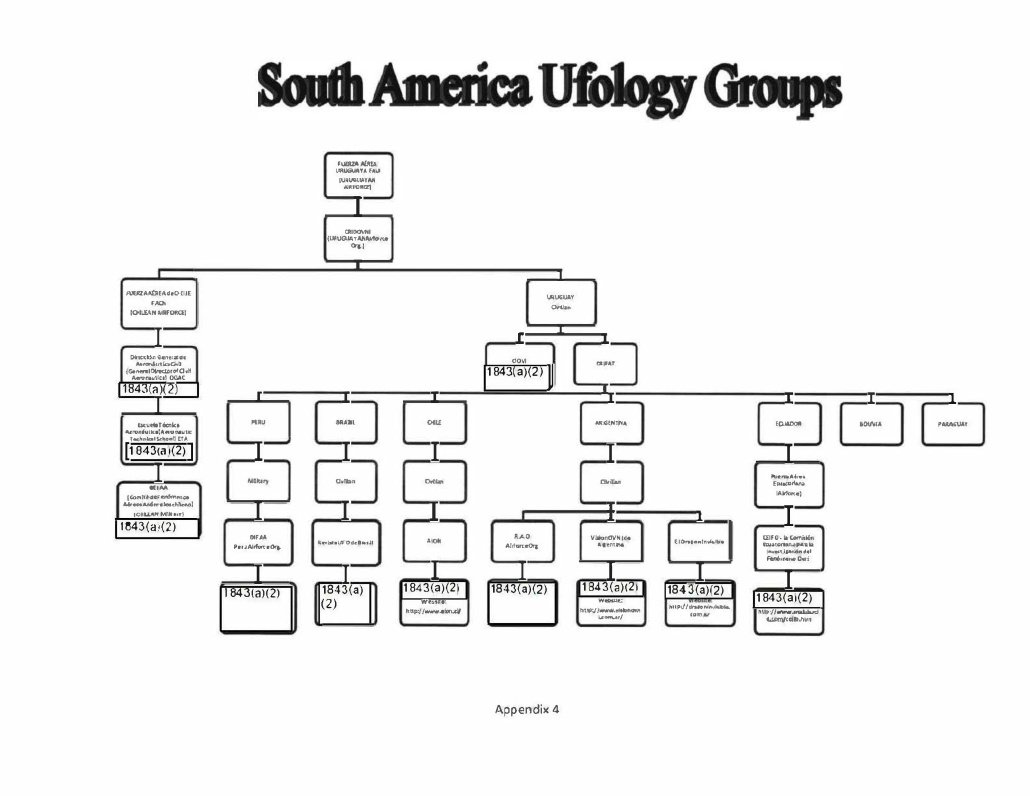
organizational chart of South American organizations in Appendix 4),
BAASS will expand multiple relationships throughout several South
American countries, including a planned visit withl1843(a)(2)
I
p843{a)(2) !in Uruguay.
• BAASS has accumulated some UAP reports from the Peoples Republic
of China (PRC), although currently these are few and far between.
Anecdotal reports suggest that BAASS intends to pursue more
information on UAP activity in the PRC.
• BAASS has potential access to recorded interviews with numerous
highly placed Soviet officials who were involved with the program
that studied UAP activity in the Soviet Union in the 1960s through
the 1980s. The majority of tlhese recordings were obtained during a
narrow window of time when Perestroika and Glastnost were at their
height immediately following the demise of the Soviet Union. These
recordings are considered precious as they may cast a unique light on
the extent and depth of the Soviet Union's program for studying the
performance of UAPs during the 1960s through the 1980s.
• Now that the investigative division is in place, equipped and trained,
BAASS foresees multiple additional deployments throughout the
United States to investigate high value UAP related cases.
• BAASS is continuing the process of creating the fundamental policies
and procedures, data measurement baselines and external standards
that are necessary to carry out proper research in this field. This
continues to be an ongoing task.
Pagee493Editorial note: Physical page 499 of DOW-UAP-D172-BAASS_Ten_Month_Report_July-2009.pdf.
Check the original PDF
This iRferma1ciea is 13Fe13Fietary and eaaaet be disscmiaatoo aF used
witho11t prior" ritwA co11se11t fi:gm th>! 013era1.iag Managa ef BAASS®.
• As detailed in the present report (see section 2C10 plus
organizational chart of South American organizations in Appendix 4),
BAASS will expand multiple relationships throughout several South
American countries, including a planned visit withl1843(a)(2)
I
p843{a)(2) !in Uruguay.
• BAASS has accumulated some UAP reports from the Peoples Republic
of China (PRC), although currently these are few and far between.
Anecdotal reports suggest that BAASS intends to pursue more
information on UAP activity in the PRC.
• BAASS has potential access to recorded interviews with numerous
highly placed Soviet officials who were involved with the program
that studied UAP activity in the Soviet Union in the 1960s through
the 1980s. The majority of tlhese recordings were obtained during a
narrow window of time when Perestroika and Glastnost were at their
height immediately following the demise of the Soviet Union. These
recordings are considered precious as they may cast a unique light on
the extent and depth of the Soviet Union's program for studying the
performance of UAPs during the 1960s through the 1980s.
• Now that the investigative division is in place, equipped and trained,
BAASS foresees multiple additional deployments throughout the
United States to investigate high value UAP related cases.
• BAASS is continuing the process of creating the fundamental policies
and procedures, data measurement baselines and external standards
that are necessary to carry out proper research in this field. This
continues to be an ongoing task.
Pagee493View the document record ↗ · Physical page 499, counting the cover.
EXCERPT 9 · PHYSICAL PAGE 500
Physical page 500, full page
This information is proprietary ood eftflflOI be disscmiuated ot USed
,rithout p, io, mitte11 co11se11t fiom the Operating Manag.:r of BAASS®.
Page 494Editorial note: Physical page 500 of DOW-UAP-D172-BAASS_Ten_Month_Report_July-2009.pdf.
Check the original PDF
This information is proprietary ood eftflflOI be disscmiuated ot USed
,rithout p, io, mitte11 co11se11t fiom the Operating Manag.:r of BAASS®.
Page 494View the document record ↗ · Physical page 500, counting the cover.
Dates and documentary context
- Event
- Not established — Plan for 2010; does not describe a dated episode.
- Document
- 07/2009 — BAASS ten-month report, July 2009; day not given.
- Publication
- Not established — Published by the U.S. Department of War on war.gov, release 08 of UAP files (2026).
Origin and release
Bigelow Aerospace Advanced Space Studies (BAASS), for the Defense Intelligence Agency (DIA), AAWSAP program · DOW-UAP-D172-BAASS_Ten_Month_Report_July-2009.pdf
Physical pages 492 to 500 (pages 486 to 494 of the internal numbering).
undefined ↗ — undefined
Related accounts and their differences
- Northern Tier, 2009: BAASS and the missile bases
- DIA, 2010: field effects on human tissue
- Las Vegas, 2008: the BAASS management plan
- California, 2010: Project Forum
Questions to continue the investigation
- Did BAASS obtain Special Access Program status and access to NORAD's uncorrelated targets database?
- Was the purchase of the CUFOS and NICAP databases completed?
GEOGRAPHY OF THE CASE
Not stated
The plan is not associated with a place; BAASS was headquartered in Las Vegas, but these pages do not indicate it.
DOCUMENTARY TRAIL
Go back to the sources
References use physical pages of the PDF, counting the cover. Summaries are presented in English; the documents keep their original language.
- DOW-UAP-D172-BAASS_Ten_Month_Report_July-2009.pdf
Physical pages 492 to 500
DOW · 538 pages
Editorial summary based on the collection's research notes. How we read the documents.