Date: planned for the last six months of fiscal year 2010Location: Coastal regions of Central and Northern California, United States
California, 2010: BAASS plans university debates in which extraterrestrial visitation would be taken as a given
Project Forum called for a series of debates with celebrities on California campuses to increase public interest in the topic and in the possible disclosure of extraterrestrial presence. The plan says the existence of UAPs and of the visits would be a fixed premise, not open to discussion, and measures success by the number of cases and contacts that reached BAASS.
- Event date
- planned for the last six months of fiscal year 2010
- Location
- Coastal regions of Central and Northern California, United States
- Topic
- AAWSAP and advanced technologies
- Source agencies
- DOW
- Documents
- 1 document · 538 pages
- Reading time
- 14 min
 Facsimile of the documentPhysical page 486
DOCUMENTARY SOURCES · DOW
What the records tell
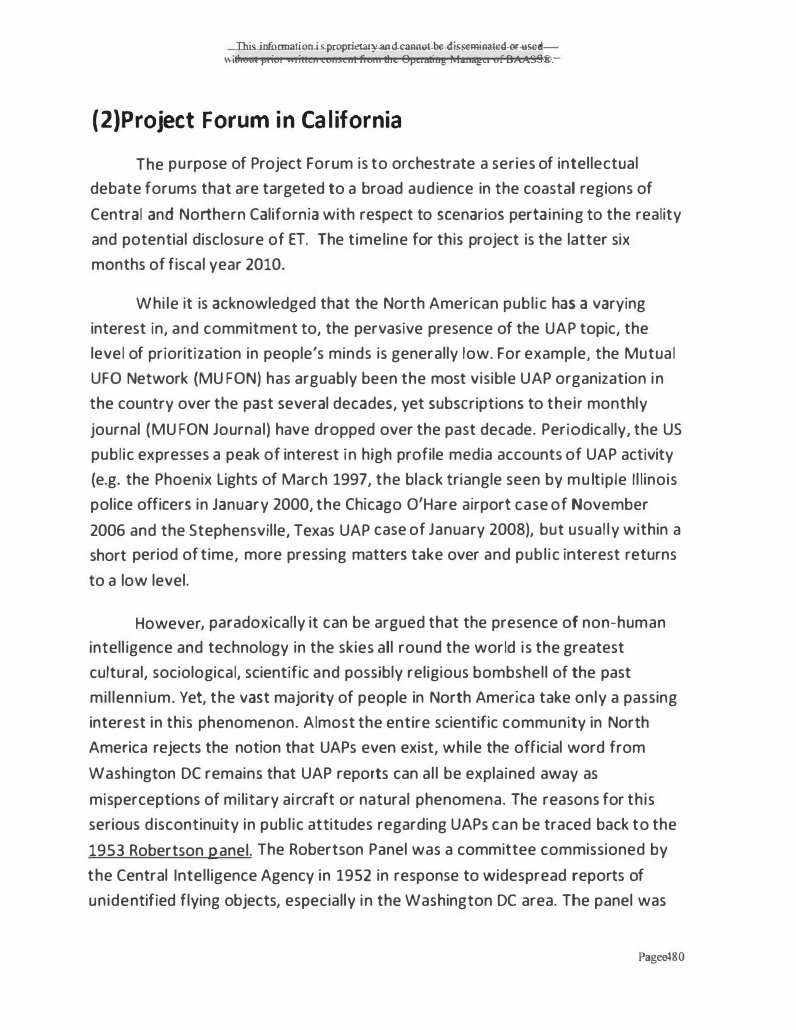
The second item of the strategic plan for 2010 is Project Forum. According to the ten-month report, BAASS intended to organize debates open to the public at universities in Central and Northern California on the “reality and possible disclosure” of extraterrestrial presence. The schedule covered the last six months of fiscal year 2010. The rationale was that the American public gave the topic low priority and that even subscriptions to the MUFON magazine had fallen over the decade.
The text cites passing spikes of interest, such as the Phoenix lights in 1997, the triangle seen by Illinois police officers in 2000, the O'Hare airport case in 2006 and the Stephenville, Texas, case in 2008. It attributes the lack of interest to the Robertson Panel of 1953, which recommended a campaign to debunk flying saucers and the monitoring of civilian groups. It also says BAASS “learned” that pilots avoid reporting UAPs for fear of harming their careers and that FAA radars filter out traffic without a transponder. These are BAASS claims, with no source given.
The logistics called for monthly debates, starting in May or June 2010, for audiences of 500 to 1.000 people. On stage there would be three or four experts, a celebrity moderator and a BAASS moderator. The plan is explicit: the existence of UAPs and of extraterrestrial visits would be the “central premise,” taken as a given and not open to debate, so that the discussion would not fall into what it calls the “quagmire” of evidence. The topics would be the consequences of disclosure for politics, science and other sectors.
Publicity would use bloggers, radio journalists, print media “receptive to UAP,” a television journalist already willing to take part and a list of more than twenty celebrities interested in the topic. There would be a hotline and an e-mail channel to receive cases, intended to offset a possible drop in the flow coming from MUFON. The report also mentions the interest in bringing the public back to the forums as a way of measuring attitudes, more accurate, according to BAASS, than opinion polls.
Among the success criteria, the first is being approached by an unknown informant with access to data on government or industry UAP “reverse engineering” programs. The others are doubling the audience in six months, receiving many new cases from California and measuring public attitude. The document is a plan; it does not say whether any forum actually took place, nor does it present proof of the claims about pilots, the FAA and the destruction of documents.
DIRECT READING OF THE FILE
The document, in the original
Physical pages 486 to 491 are translated in full. The name of the analyst who compiled the list of celebrities is redacted in the source.
EXCERPT 1 · PHYSICAL PAGE 486
Physical page 486, full page
Ibis iafocrnatioo is propriewy 3!ld canAol be disseminateEI er useEI
·
wilhollt prior 'Millet1 eonsentIi om the Operating Ma11agc1 of BAASS®.
{2)Project Forum in California
The purpose of Project Forum is to orchestrate a series of intellectual
debate forums that are targeted to a broad audience in the coastal regions of
Central and Northern California with respect to scenarios pertaining to the reality
and potential disclosure of ET. The timeline for this project is the latter six
months of fiscal year 2010.
While it is acknowledged that the North American public has a varying
interest in, and commitment to, the pervasive presence of the UAP topic, the
level of prioritization in people's minds is generally low. For example, the Mutual
UFO Network (MU FON) has arguably been the most visible UAP organization in
the country over the past several decades, yet subscriptions to thefr monthly
journal (MU FON Journal) have dropped over the past decade. Periodically, the US
public expresses a peak of interest in high profile media accounts of UAP activity
(e.g. the Phoenix Lights of March 1997, the black triangle seen by multiple Illinois
police officers in January 2000, the Chicago O'Hare airport case of November
2006 and the Stephensville, Texas UAP case of January 2008), but usually within a
short period of time, more pressing matters take over and public interest returns
to a low level.
However, paradoxically it can be argued that the presence of non-human
intelligence and technology in the skies all round the world is the greatest
cultural, sociological, scientific and possibly religious bombshell of the past
millennium. Yet, the vast majority of people in North America take only a passing
interest in this phenomenon. Almost the entire scientific community in North
America rejects the notion that UAPs even exist, while the official word from
Washington DC remains that UAP reports can all be explained away as
misperceptions of military aircraft or natural phenomena. The reasons for this
serious discontinuity in public attitudes regarding UAPs can be traced back to the
1953 Robertson panel. The Robertson Panel was a committee commissioned by
the Central Intelligence Agency in 1952 in response to widespread reports of
unidentified flying objects, especially in the Washington DC area. The panel was
Pagee480Editorial note: Physical page 486 of DOW-UAP-D172-BAASS_Ten_Month_Report_July-2009.pdf.
Check the original PDF
Ibis iafocrnatioo is propriewy 3!ld canAol be disseminateEI er useEI
·
wilhollt prior 'Millet1 eonsentIi om the Operating Ma11agc1 of BAASS®.
{2)Project Forum in California
The purpose of Project Forum is to orchestrate a series of intellectual
debate forums that are targeted to a broad audience in the coastal regions of
Central and Northern California with respect to scenarios pertaining to the reality
and potential disclosure of ET. The timeline for this project is the latter six
months of fiscal year 2010.
While it is acknowledged that the North American public has a varying
interest in, and commitment to, the pervasive presence of the UAP topic, the
level of prioritization in people's minds is generally low. For example, the Mutual
UFO Network (MU FON) has arguably been the most visible UAP organization in
the country over the past several decades, yet subscriptions to thefr monthly
journal (MU FON Journal) have dropped over the past decade. Periodically, the US
public expresses a peak of interest in high profile media accounts of UAP activity
(e.g. the Phoenix Lights of March 1997, the black triangle seen by multiple Illinois
police officers in January 2000, the Chicago O'Hare airport case of November
2006 and the Stephensville, Texas UAP case of January 2008), but usually within a
short period of time, more pressing matters take over and public interest returns
to a low level.
However, paradoxically it can be argued that the presence of non-human
intelligence and technology in the skies all round the world is the greatest
cultural, sociological, scientific and possibly religious bombshell of the past
millennium. Yet, the vast majority of people in North America take only a passing
interest in this phenomenon. Almost the entire scientific community in North
America rejects the notion that UAPs even exist, while the official word from
Washington DC remains that UAP reports can all be explained away as
misperceptions of military aircraft or natural phenomena. The reasons for this
serious discontinuity in public attitudes regarding UAPs can be traced back to the
1953 Robertson panel. The Robertson Panel was a committee commissioned by
the Central Intelligence Agency in 1952 in response to widespread reports of
unidentified flying objects, especially in the Washington DC area. The panel was
Pagee480View the document record ↗ · Physical page 486, counting the cover.
EXCERPT 2 · PHYSICAL PAGE 487
Physical page 487, full page
1 his mlonnation Is ptop, ienuy and cannot be disselliitialeEI ar WSl!;d
w1ihout pnor wnnen consent from the Op1.:raling Ma11agc1 of BAASS®.
briefed on U.S. military activities and intelligence; hence the report was originally
classified Secret. Later declassified, the Robertson Panel's report concluded that
UFOs were not a direct threat to national security, but could pose an indirect
threat by overwhelming standard military communications due to public interest
in the subject. Most UFO reports, they concluded, could be explained as
misidentification of mundane aerial objects, and the remaining minority could, in
all likelihood, be similarly explained with further study.
The Robertson Panel concluded that a public relations campaign should be
undertaken in order to debunk UFOs, and reduce public interest in the subject,
and that civilian UFO groups should be monitored. There is widespread evidence
this was carried out in the decades following the panel's conclusion. Hence, it is
unsurprising that public interest in the UAP subject is so low given that the topic
has been systematically marginalized, trivialized and ridiculed for multiple
decades to the point that the majority of people in North America are uncertain
about the truth or otherwise of a non human technological intelligence operating
in our skies.
Furthermore, BAASS has recently learned that (a) military pilots have no
enforceable instructions to report encounters with UAPs; in fact there is an
unspoken rule that reporting of UAPs will adversely affect their ability to continue
flying, (b)that airline pilots have a similar unspoken rule that reporting UAP
encounters will adversely affect their careers, (c) that FAA air traffic monitoring
systems are designed to focus on commercial and military aircraft with
transponders and to screen out all other unusual airborne traffic, (d} that security
policemen on USAF airbases in North America were routinely warned that
reporting UAP activity could trigger a psychological evaluation and cause them to
be removed from active duty under the Personnel Reliability Program, {e) that
during the 1990s more than one intelligence destroyed millions of documents
without creating electronic backups as a part of the program to move from paper
to digital files. In short, multiple different factors have conspired to create an
Page 481Editorial note: Physical page 487 of DOW-UAP-D172-BAASS_Ten_Month_Report_July-2009.pdf.
Check the original PDF
1 his mlonnation Is ptop, ienuy and cannot be disselliitialeEI ar WSl!;d
w1ihout pnor wnnen consent from the Op1.:raling Ma11agc1 of BAASS®.
briefed on U.S. military activities and intelligence; hence the report was originally
classified Secret. Later declassified, the Robertson Panel's report concluded that
UFOs were not a direct threat to national security, but could pose an indirect
threat by overwhelming standard military communications due to public interest
in the subject. Most UFO reports, they concluded, could be explained as
misidentification of mundane aerial objects, and the remaining minority could, in
all likelihood, be similarly explained with further study.
The Robertson Panel concluded that a public relations campaign should be
undertaken in order to debunk UFOs, and reduce public interest in the subject,
and that civilian UFO groups should be monitored. There is widespread evidence
this was carried out in the decades following the panel's conclusion. Hence, it is
unsurprising that public interest in the UAP subject is so low given that the topic
has been systematically marginalized, trivialized and ridiculed for multiple
decades to the point that the majority of people in North America are uncertain
about the truth or otherwise of a non human technological intelligence operating
in our skies.
Furthermore, BAASS has recently learned that (a) military pilots have no
enforceable instructions to report encounters with UAPs; in fact there is an
unspoken rule that reporting of UAPs will adversely affect their ability to continue
flying, (b)that airline pilots have a similar unspoken rule that reporting UAP
encounters will adversely affect their careers, (c) that FAA air traffic monitoring
systems are designed to focus on commercial and military aircraft with
transponders and to screen out all other unusual airborne traffic, (d} that security
policemen on USAF airbases in North America were routinely warned that
reporting UAP activity could trigger a psychological evaluation and cause them to
be removed from active duty under the Personnel Reliability Program, {e) that
during the 1990s more than one intelligence destroyed millions of documents
without creating electronic backups as a part of the program to move from paper
to digital files. In short, multiple different factors have conspired to create an
Page 481View the document record ↗ · Physical page 487, counting the cover.
EXCERPT 3 · PHYSICAL PAGE 488
Physical page 488, full page
This infonnation is proprietary andcaooat be disseminated or1Jsed
\1 ·itJ10t:Jt j:1Fier hritte11 eo11sc11t fio111 the Oper,lling Mmiager ol BMSS®,
atmosphere in the United States where interest in disclosure is downplayed,
trivialized or ignored.
Proiect Forum
The overall intent of this program is to raise the level of awareness of the
importance of ET and the potential of disclosure in North America. Since it is
readily acknowledged that to attempt to influence the entire country in this way
(i.e. to reverse the effects of decades of systematic debunking of the UAP topic) is
too ambitious, a more feasible approach would be to maximize efforts by
concentrating on a small area of the United States, preferably with a high
percentage of intellectual leaders and trend setters.
California is the acknowledged bell weather state where trends and
fashions are created, where thought leadership is considered at the forefront. The
state has hundreds of university and community college campuses (220,000
students in the University of California system, 450,000 in the California state
university system and a further 2.6 million annual enrollment in the California
community college system). Central and Northern California coastal areas,
beginning with UCLA UCSC and moving North through Silicon Valley and
encompassing Sacramento/UCDavis will be targeted for Project Forum.
Logistics of Project Forum
A series of discussion forums that will be located on strategically chosen
university campuses in Central and Northern California will be orchestrated by
BAASS in the latter six months of 2010.
A multi media approach will be utilized in order to dramatically expand
awareness of the discussion forums in Central and Northern California. An
emphasis on hiring celebrities as co-moderators will serve as an additional draw
to the public. Beginning in May/June 2010, monthly forums involving carefully
Page 482Editorial note: Physical page 488 of DOW-UAP-D172-BAASS_Ten_Month_Report_July-2009.pdf.
Check the original PDF
This infonnation is proprietary andcaooat be disseminated or1Jsed
\1 ·itJ10t:Jt j:1Fier hritte11 eo11sc11t fio111 the Oper,lling Mmiager ol BMSS®,
atmosphere in the United States where interest in disclosure is downplayed,
trivialized or ignored.
Proiect Forum
The overall intent of this program is to raise the level of awareness of the
importance of ET and the potential of disclosure in North America. Since it is
readily acknowledged that to attempt to influence the entire country in this way
(i.e. to reverse the effects of decades of systematic debunking of the UAP topic) is
too ambitious, a more feasible approach would be to maximize efforts by
concentrating on a small area of the United States, preferably with a high
percentage of intellectual leaders and trend setters.
California is the acknowledged bell weather state where trends and
fashions are created, where thought leadership is considered at the forefront. The
state has hundreds of university and community college campuses (220,000
students in the University of California system, 450,000 in the California state
university system and a further 2.6 million annual enrollment in the California
community college system). Central and Northern California coastal areas,
beginning with UCLA UCSC and moving North through Silicon Valley and
encompassing Sacramento/UCDavis will be targeted for Project Forum.
Logistics of Project Forum
A series of discussion forums that will be located on strategically chosen
university campuses in Central and Northern California will be orchestrated by
BAASS in the latter six months of 2010.
A multi media approach will be utilized in order to dramatically expand
awareness of the discussion forums in Central and Northern California. An
emphasis on hiring celebrities as co-moderators will serve as an additional draw
to the public. Beginning in May/June 2010, monthly forums involving carefully
Page 482View the document record ↗ · Physical page 488, counting the cover.
EXCERPT 4 · PHYSICAL PAGE 489
Physical page 489, full page
1l1ig iRfQrmatioR is proprietary ai:id ca1rnot be disscmiRatrd or used
without prier writti;iR ceRscIࡾt lrem the Opc1ati11g Mmmge1 of 13MSS®.
calibrated "What If" scenarios will be initiated in front of audiences ranging from
five hundred to one thousand people.
Structure of the debates:
Three or four experts in the topic at hand will be seated in wing-backed
chairs with a living room atmosphere on a raised stage in a university auditorium.
There will be a celebrity moderator and a BAAS$ moderator also located on the
stage. An audience of between five hundred and a thousand individuals will be
seated in the auditorium with multiple open microphones located strategically for
easy access. A series of large screens will display the discussion topic at hand and
will change to present relevant information and facts if needed to move the
discussion along.
The celebrity moderator will outline the premise of the discussion; that
these are a series of intellectual debates that seek to explore the consequences of
disclosure to selected demographics in society. The central premise for these
debates is that the existence of UAP and ET visitations are true. This existence is
assumed and is NOT a subject for any of the debates. This CENTRAL PREMISE
cannot be overemphasized; otherwise, the debate will be quickly dragged into the
usual morass of discussing evidence. Both the BAASS and celebrity moderators
will tightly control the discussion so that these dead-end discussions are
terminated quickly. The initial discussion will open up to the panel (for example a
panel of politicians----that might also include political celebrities--- to discuss the
political ramifications of disclosure) and then quickly engage the audience. Both
moderators must be nimble, agile and be able to lead the discussion. The BAASS
moderator will be the expert on the topic being discussed and will step in to lend
a helping hand if the celebrity moderator falters on facts or is asked a question
that is more profound than he or she can handle.
The emphasis of the forum will be on intellectual debate, focused on
rational arguments and spirited discussion. It will be the moderators' job to shift
Page 483Editorial note: Physical page 489 of DOW-UAP-D172-BAASS_Ten_Month_Report_July-2009.pdf.
Check the original PDF
1l1ig iRfQrmatioR is proprietary ai:id ca1rnot be disscmiRatrd or used
without prier writti;iR ceRscIࡾt lrem the Opc1ati11g Mmmge1 of 13MSS®.
calibrated "What If" scenarios will be initiated in front of audiences ranging from
five hundred to one thousand people.
Structure of the debates:
Three or four experts in the topic at hand will be seated in wing-backed
chairs with a living room atmosphere on a raised stage in a university auditorium.
There will be a celebrity moderator and a BAAS$ moderator also located on the
stage. An audience of between five hundred and a thousand individuals will be
seated in the auditorium with multiple open microphones located strategically for
easy access. A series of large screens will display the discussion topic at hand and
will change to present relevant information and facts if needed to move the
discussion along.
The celebrity moderator will outline the premise of the discussion; that
these are a series of intellectual debates that seek to explore the consequences of
disclosure to selected demographics in society. The central premise for these
debates is that the existence of UAP and ET visitations are true. This existence is
assumed and is NOT a subject for any of the debates. This CENTRAL PREMISE
cannot be overemphasized; otherwise, the debate will be quickly dragged into the
usual morass of discussing evidence. Both the BAASS and celebrity moderators
will tightly control the discussion so that these dead-end discussions are
terminated quickly. The initial discussion will open up to the panel (for example a
panel of politicians----that might also include political celebrities--- to discuss the
political ramifications of disclosure) and then quickly engage the audience. Both
moderators must be nimble, agile and be able to lead the discussion. The BAASS
moderator will be the expert on the topic being discussed and will step in to lend
a helping hand if the celebrity moderator falters on facts or is asked a question
that is more profound than he or she can handle.
The emphasis of the forum will be on intellectual debate, focused on
rational arguments and spirited discussion. It will be the moderators' job to shift
Page 483View the document record ↗ · Physical page 489, counting the cover.
EXCERPT 5 · PHYSICAL PAGE 490
Physical page 490, full page
This infouuatiou i., proprietai; and ewn,vt be di:S;st:1ni11uted or used
wiheti! prier written eo1,sc111 ltOin 11,c Ope,a1i11g Maitag1::1 ol BAASS:19.
the discussion if the debate is becoming tedious or bogged down in unnecessary
minutiae. In order to sustain multiple forums with audiences of five hundred to a
thousand people, BAASS will launch an aggressive multi-media promotion. The
program will stand or fall on the ability of BAASS to orchestrate an aggressive
promotional campaign and the ability to acquire noteworthy panel participants
and to maintain audience interest.
• Internet promotion: Several well known UAP Internet journalists and
bloggers will be approached and hired. BAASS can rapidly contact up to six
individuals who collectively are responsible for millions of Internet blog
postings.
• Radio promotion: BAASS has access to several well known UAP-friendly
radio journalists, a couple of whom are celebrities in their own right.
Newsprint promotion: The "UAP friendly" news media will be approached
and utilized in order to promote the BAASS agenda through newspaper and
online articles. Again BAASS can contact over half a dozen well known UAP
journalists.
• Television promotion: BAASS has discussed this with one well known TV
journalist who is also a celebrity is willing to commit to such a project.
Other lV journalists are in line for BAASS contacts.
• Celebrities: BAASS senior analystil:!f'DID]put together a list of
celebrities with a professed interest innt e UAP topic. This list comprises
over twenty individuals that may be receptive to engagement.
Establishment of a UAP case Hotline and Email Discussion center
It is intended to create a well publicized hot line and email discussion
interchange, that are staffed by trained BAASS investigators and communicators
as a measurable endpoint for the success of this program. If BAASS is flooded with
calls and emails regarding the UAP topic from the state of California, with a
concomitant increase in audience size in the monthly forums, over a sustained
period of time, then the program will be judged a success. It is recognized that a
combination of relentless promotion, of sustained creativity and of constantly
Page 484Editorial note: Physical page 490 of DOW-UAP-D172-BAASS_Ten_Month_Report_July-2009.pdf.
Check the original PDF
This infouuatiou i., proprietai; and ewn,vt be di:S;st:1ni11uted or used
wiheti! prier written eo1,sc111 ltOin 11,c Ope,a1i11g Maitag1::1 ol BAASS:19.
the discussion if the debate is becoming tedious or bogged down in unnecessary
minutiae. In order to sustain multiple forums with audiences of five hundred to a
thousand people, BAASS will launch an aggressive multi-media promotion. The
program will stand or fall on the ability of BAASS to orchestrate an aggressive
promotional campaign and the ability to acquire noteworthy panel participants
and to maintain audience interest.
• Internet promotion: Several well known UAP Internet journalists and
bloggers will be approached and hired. BAASS can rapidly contact up to six
individuals who collectively are responsible for millions of Internet blog
postings.
• Radio promotion: BAASS has access to several well known UAP-friendly
radio journalists, a couple of whom are celebrities in their own right.
Newsprint promotion: The "UAP friendly" news media will be approached
and utilized in order to promote the BAASS agenda through newspaper and
online articles. Again BAASS can contact over half a dozen well known UAP
journalists.
• Television promotion: BAASS has discussed this with one well known TV
journalist who is also a celebrity is willing to commit to such a project.
Other lV journalists are in line for BAASS contacts.
• Celebrities: BAASS senior analystil:!f'DID]put together a list of
celebrities with a professed interest innt e UAP topic. This list comprises
over twenty individuals that may be receptive to engagement.
Establishment of a UAP case Hotline and Email Discussion center
It is intended to create a well publicized hot line and email discussion
interchange, that are staffed by trained BAASS investigators and communicators
as a measurable endpoint for the success of this program. If BAASS is flooded with
calls and emails regarding the UAP topic from the state of California, with a
concomitant increase in audience size in the monthly forums, over a sustained
period of time, then the program will be judged a success. It is recognized that a
combination of relentless promotion, of sustained creativity and of constantly
Page 484View the document record ↗ · Physical page 490, counting the cover.
EXCERPT 6 · PHYSICAL PAGE 491
Physical page 491, full page
Tbis intbm1aiioR is pnࡿpriPi:l.r)':md GaRnet e@ diss@1ieiiH01eEI er 1c1seEI
w1(hoU1 prior wmt.:11 co11sc11i from rhe Opeiati11g Manage, ofBAASS®.
changing publicity will be necessary in order to fight the legacy of apathy, ennui
and inertia that has dominated the public's attitude to UAPs for multiple decades.
A central purpose of this program will be by virtue of raising the profile on
this topic in the state of California via the multi-pronged media attack outlined
above, BAASS will significantly increase the flow of cases that are coming into the
organization. This will serve as a counterfoil to the flow of cases coming from
MU FON, in the event they slow to a trickle.
The largest challenge of this program will be to maintain momentum and in
sustaining a high level of interest in the state of California. One useful
measurement of the success of the program will be in (a) divining the number of
new UAP cases coming into BAASS from the state of California and (b) assessing
the number of calls and emails incoming over a six month period of time.
Criteria that Define Success of Project Forum
(1) If BAASS is contacted by a hitherto unknown insider with access to high
value information regarding the government or private industry knowledge
of UAP reverse engineering programs, then Project Forum will have fulfilled
a major deliverable.
(2) If a significantly greater (100% increase) number of people are participating
in the audience forums after six months than at the beginning of the effort,
the program will fulfill a criterion of success.
(3) As discussed in the previous paragraphs, if BAASS hotlines and email portals
receive large numbers of new cases as a result of the publicity surrounding
the forums, this will be another criterion of success.
(4) If BAASS succeeds in calibrating the general public's {in Central and
Northern California coastal regions) attitudes to, and interest in, disclosure
and the ET topic as a result of Project Forum, this will be a much more
accurate calibration than the dozens of opinion polls on the topic that have
been launched over the past few decades.
Page 485Editorial note: Physical page 491 of DOW-UAP-D172-BAASS_Ten_Month_Report_July-2009.pdf.
Check the original PDF
Tbis intbm1aiioR is pnࡿpriPi:l.r)':md GaRnet e@ diss@1ieiiH01eEI er 1c1seEI
w1(hoU1 prior wmt.:11 co11sc11i from rhe Opeiati11g Manage, ofBAASS®.
changing publicity will be necessary in order to fight the legacy of apathy, ennui
and inertia that has dominated the public's attitude to UAPs for multiple decades.
A central purpose of this program will be by virtue of raising the profile on
this topic in the state of California via the multi-pronged media attack outlined
above, BAASS will significantly increase the flow of cases that are coming into the
organization. This will serve as a counterfoil to the flow of cases coming from
MU FON, in the event they slow to a trickle.
The largest challenge of this program will be to maintain momentum and in
sustaining a high level of interest in the state of California. One useful
measurement of the success of the program will be in (a) divining the number of
new UAP cases coming into BAASS from the state of California and (b) assessing
the number of calls and emails incoming over a six month period of time.
Criteria that Define Success of Project Forum
(1) If BAASS is contacted by a hitherto unknown insider with access to high
value information regarding the government or private industry knowledge
of UAP reverse engineering programs, then Project Forum will have fulfilled
a major deliverable.
(2) If a significantly greater (100% increase) number of people are participating
in the audience forums after six months than at the beginning of the effort,
the program will fulfill a criterion of success.
(3) As discussed in the previous paragraphs, if BAASS hotlines and email portals
receive large numbers of new cases as a result of the publicity surrounding
the forums, this will be another criterion of success.
(4) If BAASS succeeds in calibrating the general public's {in Central and
Northern California coastal regions) attitudes to, and interest in, disclosure
and the ET topic as a result of Project Forum, this will be a much more
accurate calibration than the dozens of opinion polls on the topic that have
been launched over the past few decades.
Page 485View the document record ↗ · Physical page 491, counting the cover.
Dates and documentary context
- Event
- Not established — Plan for the second half of 2010; there is no record of execution in the document.
- Document
- 07/2009 — BAASS ten-month report, July 2009; day not given.
- Publication
- Not established — Published by the U.S. Department of War on war.gov, release 08 of UAP files (2026).
Origin and release
Bigelow Aerospace Advanced Space Studies (BAASS), for the Defense Intelligence Agency (DIA), AAWSAP program · DOW-UAP-D172-BAASS_Ten_Month_Report_July-2009.pdf
Physical pages 486 to 491 (pages 480 to 485 of the internal numbering).
undefined ↗ — undefined
Related accounts and their differences
Questions to continue the investigation
- Was any project forum ever held at universities in California?
- Did the DIA approve or comment on the proposal for a public campaign within an intelligence contract?
GEOGRAPHY OF THE CASE
Coast of Central and Northern California
The plan cites a broad region, from university campuses to Sacramento; there is no single point to mark.
DOCUMENTARY TRAIL
Go back to the sources
References use physical pages of the PDF, counting the cover. Summaries are presented in English; the documents keep their original language.
- DOW-UAP-D172-BAASS_Ten_Month_Report_July-2009.pdf
Physical pages 486 to 491
DOW · 538 pages
Editorial summary based on the collection's research notes. How we read the documents.