Date: January 2009 (request to the laboratory); July 2009 reportLocation: Los Alamos National Laboratory, New Mexico
Los Alamos, 2009: BAASS seeks an alleged UAP “artifact inventory” at the laboratory and receives 600 already-known pages from Project Grudge
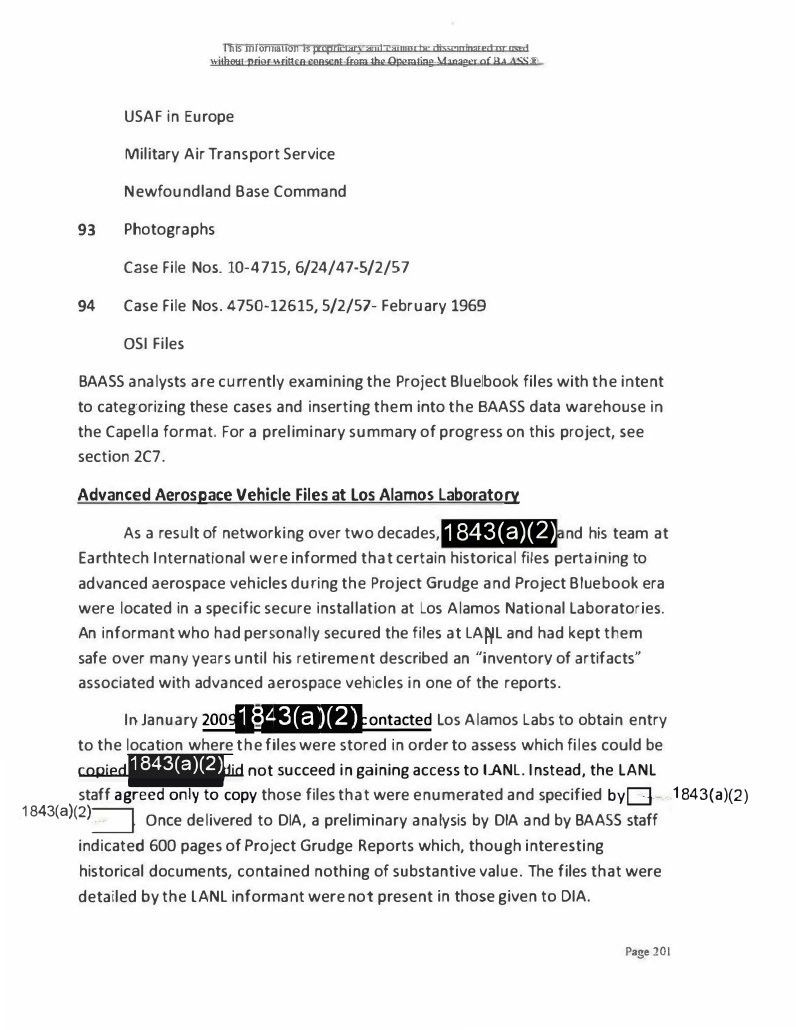
According to BAASS's ten-month report, an informant who had kept documents in a safe at Los Alamos National Laboratory said one of them contained an “artifact inventory” linked to advanced aerospace vehicles. The laboratory copied only the files that were requested, and the 600 pages delivered to the DIA, largely already declassified, did not include that material.
- Event date
- January 2009 (request to the laboratory); July 2009 report
- Location
- Los Alamos National Laboratory, New Mexico
- Topic
- AAWSAP and advanced technologies
- Source agencies
- DOW
- Documents
- 1 document · 538 pages
- Reading time
- 5 min
 Facsimile of the documentPhysical page 207
DOCUMENTARY SOURCES · DOW
What the records tell
Date: January 2009, recorded in the July 2009 report. Location: Los Alamos National Laboratory, New Mexico. The passage is part of the ten-month report that BAASS, the company contracted by the DIA for the AAWSAP program, delivered to the agency. Before it, the report lists box by box the holdings of Project Blue Book: reports from Projects Sign, Grudge, and Twinkle, congressional briefings, district files of the Air Force Office of Special Investigations, and case files from 1947 to 1969. BAASS says its analysts were entering these cases into the Capella database.
According to the report, contacts maintained over two decades by a person whose name is redacted and his team at Earthtech International led to information that certain historical files on advanced aerospace vehicles, from the era of Projects Grudge and Blue Book, were at a secure facility of the laboratory. An informant who allegedly personally kept these files until retiring described, in one of the reports, an “artifact inventory” associated with these vehicles. The document does not name the informant or describe the alleged artifacts.
In January 2009, the person whose name is redacted approached the laboratory to gain access to the site and assess what to copy. Access was denied. The Los Alamos team agreed only to copy files that were listed and specified. After delivery to the DIA, a preliminary analysis by the DIA and BAASS identified 600 pages of Project Grudge reports. The report describes them as interesting historical documents, but with “nothing of substantial value.” The files cited by the informant were not among those delivered.
A later check, still according to the text, showed that most of the package, if not all of it, had already been declassified in previous years. BAASS notes the discrepancy between the informant's account, which spoke of physical evidence of UAP in an inventory within 600 pages kept in a safe, and what the laboratory actually released. The report says the matter was still under investigation.
What the document shows is a failed attempt to obtain papers based on thirdhand information. It does not prove that the inventory exists, nor that it does not. The only source of the claim is an anonymous informant, and the only material actually received was, by the assessment of BAASS and the DIA themselves, of historical value and largely already public.
DIRECT READING OF THE FILE
The document, in the original
Physical pages 207 and 208 are translated in full; page 207 begins with the end of the inventory of the Project Blue Book holdings, which runs from pages 201 to 206.
EXCERPT 1 · PHYSICAL PAGE 207
Physical page 207, full page
Ihis mion11auon 1s propm::rar5 :aml 1.:&Iilluc be di:sseminaced m used
vrilheu1 flriar wrillee ceesent ffem tllc O!)cmting M:uiager of BA A SSi'l!)
USAF in Europe
Military Air Transport Service
Newfoundland Base Command
93
Photographs
Case File Nos. 10-4715, 6/24/47-5/2/57
94
Case File Nos. 4750-12615, 5/2/57- February 1969
OSI Files
BAASS analysts are currently examining the Project Bluelbook files with the intent
to categorizing these cases and inserting them into the BAASS data warehouse in
the Capella format. For a preliminary summary of progress on this project, see
section 2C7.
Advanced Aerospace Vehicle Files at Los Alamos Laboratory
As a result of networking over two decades, 1 843(a)(2).nd his team at
Earthtech International were informed that certain historical files pertaining to
advanced aerospace vehicles during the Project Grudge and Project Bluebook era
were located in a specific secure installation at Los Alamos National Laboratories.
An informant who had personally secured the files at LANL and had kept them
In
safe over many years until his retirement described an "inventory of artifacts"
associated with advanced aerospace vehicles in one of the reports.
In January 2ootl:!ICJfj)It9},ontacted Los Alamos Labs to obtain entry
to the location where the files were stored in order to assess which files could be
copied்
id not succeed in gaining access to lANL. Instead, the LANL
staff agcopy those files that were enumerated and specified by[:J.....J843(a)(2)
1843(a)(2) Once delivered to DIA, a preliminary analysis by DIA and by BAASS staff
indicated 600 pages of Project Grudge Reports which, though interesting
historical documents, contained nothing of substantive value. The files that were
detailed by the LANL informant were not present in those given to DIA.
Page 201Editorial note: Physical page 207 of DOW-UAP-D172-BAASS_Ten_Month_Report_July-2009.pdf.
Check the original PDF
Ihis mion11auon 1s propm::rar5 :aml 1.:&Iilluc be di:sseminaced m used
vrilheu1 flriar wrillee ceesent ffem tllc O!)cmting M:uiager of BA A SSi'l!)
USAF in Europe
Military Air Transport Service
Newfoundland Base Command
93
Photographs
Case File Nos. 10-4715, 6/24/47-5/2/57
94
Case File Nos. 4750-12615, 5/2/57- February 1969
OSI Files
BAASS analysts are currently examining the Project Bluelbook files with the intent
to categorizing these cases and inserting them into the BAASS data warehouse in
the Capella format. For a preliminary summary of progress on this project, see
section 2C7.
Advanced Aerospace Vehicle Files at Los Alamos Laboratory
As a result of networking over two decades, 1 843(a)(2).nd his team at
Earthtech International were informed that certain historical files pertaining to
advanced aerospace vehicles during the Project Grudge and Project Bluebook era
were located in a specific secure installation at Los Alamos National Laboratories.
An informant who had personally secured the files at LANL and had kept them
In
safe over many years until his retirement described an "inventory of artifacts"
associated with advanced aerospace vehicles in one of the reports.
In January 2ootl:!ICJfj)It9},ontacted Los Alamos Labs to obtain entry
to the location where the files were stored in order to assess which files could be
copied்
id not succeed in gaining access to lANL. Instead, the LANL
staff agcopy those files that were enumerated and specified by[:J.....J843(a)(2)
1843(a)(2) Once delivered to DIA, a preliminary analysis by DIA and by BAASS staff
indicated 600 pages of Project Grudge Reports which, though interesting
historical documents, contained nothing of substantive value. The files that were
detailed by the LANL informant were not present in those given to DIA.
Page 201View the document record ↗ · Physical page 207, counting the cover.
EXCERPT 2 · PHYSICAL PAGE 208
Physical page 208, full page
TI,is i11fo1111atio11 is p1op1iel.ai) and eaimot bt: dissemiHated er 11:,ed
"ithout piior "'rittcn ceHsent fre1n the Operatittg Maflager of BAJ',SS®.
Further investigation revealed that the majority if not all of the
Grudge/Bluebook packet given to DIA had in fact been declassified in the previous
few years. The discrepancy between the report from our original informant (who
claimed there was evidence of "artifacts" and UAP physical evidence in the form
of an inventory in the 600 page files that he originally stored in a safe at LANL)
versus the actual documents that were released from LANL to BAASS is still being
investigated.
Page 202Editorial note: Physical page 208 of DOW-UAP-D172-BAASS_Ten_Month_Report_July-2009.pdf.
Check the original PDF
TI,is i11fo1111atio11 is p1op1iel.ai) and eaimot bt: dissemiHated er 11:,ed
"ithout piior "'rittcn ceHsent fre1n the Operatittg Maflager of BAJ',SS®.
Further investigation revealed that the majority if not all of the
Grudge/Bluebook packet given to DIA had in fact been declassified in the previous
few years. The discrepancy between the report from our original informant (who
claimed there was evidence of "artifacts" and UAP physical evidence in the form
of an inventory in the 600 page files that he originally stored in a safe at LANL)
versus the actual documents that were released from LANL to BAASS is still being
investigated.
Page 202View the document record ↗ · Physical page 208, counting the cover.
Dates and documentary context
- Event
- 01/2009 — Month in which BAASS contacted the laboratory, according to the report.
- Document
- 07/2009 — BAASS ten-month report, July 2009; day not given in this excerpt.
- Publication
- Not established — Published by the U.S. Department of War on war.gov, release 08 of UAP files (2026).
Origin and release
Bigelow Aerospace Advanced Space Studies (BAASS), for the Defense Intelligence Agency (DIA), AAWSAP program · DOW-UAP-D172-BAASS_Ten_Month_Report_July-2009.pdf
Physical pages 207 and 208 of 538.
undefined ↗ — undefined
Related accounts and their differences
Questions to continue the investigation
- Exactly which files did BAASS list for the laboratory to copy?
- Was there any follow-up investigation of the discrepancy between the informant's account and the material delivered?
GEOGRAPHY OF THE CASE
Los Alamos, New Mexico
Approximate reference point placed by the editorial team; it does not indicate the exact location.
DOCUMENTARY TRAIL
Go back to the sources
References use physical pages of the PDF, counting the cover. Summaries are presented in English; the documents keep their original language.
- DOW-UAP-D172-BAASS_Ten_Month_Report_July-2009.pdf
Physical pages 207 to 208
DOW · 538 pages
Editorial summary based on the collection's research notes. How we read the documents.