Date: 22/12/1952, at 19h30Location: Road between a large city and an Air Force base, USA (locations not identified)
USA, 1952: on the road to an air base, an instrument technician sees a white and red UFO climb in jerks and oscillate near Jupiter
An instrument technician stopped his car to watch, for 15 minutes, a UFO that climbed in jerks, flew level showing now a white light, now a red side, and ended up oscillating south of the planet Jupiter. The report considered the witness's drawing inconsistent and discarded the case.
- Event date
- 22/12/1952, at 19h30
- Location
- Road between a large city and an Air Force base, USA (locations not identified)
- Topic
- Lights and encounters
- Source agencies
- CIA
- Documents
- 1 document · 312 pages
- Reading time
- 7 min
 Official report drawingPhysical page 92
DOCUMENTARY SOURCES · CIA
What the records tell
Case VI of Special Report 14, serial number 4822.00, is the first of the seven disc-shaped cases among the 12 "good unknowns". The witness is described only as an instrument technician who, on December 22, 1952, was driving from a large city to an Air Force base. Neither place is named. At 19h30, he saw the object from the car and stopped to watch. According to the summary, the object suddenly climbed toward the zenith, in jerks, from right to left, at an angle of about 45 degrees. Then it took off in fast level flight, mostly white, but appeared to rotate three times showing a red side; midway through the rotation, it showed no light at all.
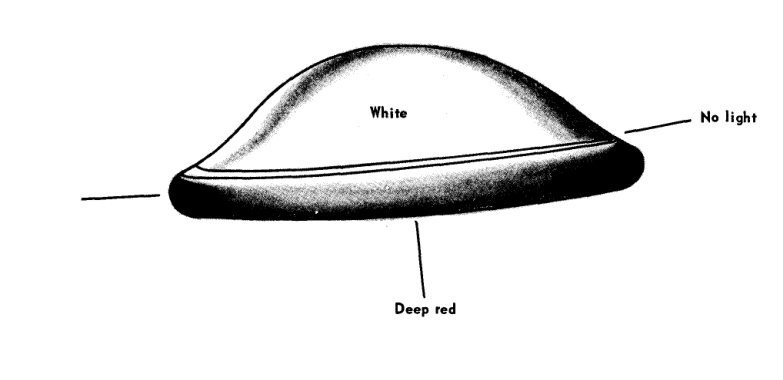
Finally, the object stayed high in the sky, south of the planet Jupiter, and there it darted to the left and to the right, alternately. The observation lasted 15 minutes and, according to the report, ended because the observer apparently stopped watching. The drawing shows a disc with a white dome, a dark red rim and a "no light" band.
The team discarded the case for lack of reliability: if the object were built as in the drawing, with the "no light band", some light should always be visible, which contradicts the account. Without the drawing, the description would not have sufficient detail. The report does not discuss any other explanation. As an editorial hypothesis, it is worth noting that the observation ends with the object stationary near a bright planet, and apparent movements of fixed points of light in the night sky are a known illusion; the document does not allow this to be confirmed or ruled out. Folder 4822.00, with the original statement and sketch, is not in this PDF.
Special Report 14, completed by the Air Force in 1955, gathered as "good unknowns" the 12 accounts that had enough detail to draw the object; in all but one, the witness had already made a drawing. The seven elliptical or disc-shaped ones received numbers VI to XII, and the instrument technician's case opens that group. Cases VIII to XII met three of the four conditions required for a model and failed only because they did not match one another. Case VII fell because its maneuvers had no parallel. Case VI had a fate different from all the others.
It was the only one of the 12 discarded solely on the reliability condition. The reason was not the person, but an internal contradiction: the witness said that at certain moments the object showed no light at all and drew a "no light band" to explain this, but, if the object were built as in the drawing, some light should always be visible. Without the drawing, the team concluded, the description did not have sufficient detail. The report does not discuss whether the contradiction came from the drawing, from the account or from the way the two were summarized.
Separating the layers: the jerky climb, the level flight, the three rotations with the red side and the final back-and-forth are the technician's account; the drawing was redone by the team from his sketch; the mention of the planet Jupiter is in the summary, which does not clarify whether it was the witness or the analysts who identified the planet; and the sentence that the observer "simply stopped watching" is a comment by the report. It is not known which city he was leaving or which base he was heading to, and the folder with serial number 4822.00 is not in the collection.
DIRECT READING OF THE FILE
The document, in the original
U.S. government document. Translated in full: the summary of case VI in Special Report 14 (physical page 92), the labels of the drawing and the entry in the case-by-case evaluation (physical page 102). The report contains no other page on this case; the original statement and the file with serial number 4822.00 are not part of this PDF.
EXCERPT 1 · PHYSICAL PAGE 92
Physical page 92 (p. 82): case VI and drawing
Case VI (Serial 4822. 00)
An instrument technician, while driving from a large city toward an
Air Force base on December 22, 1952, saw an object from his car at 1930
hours. He stopped his car to watch it. It suddenly moved up toward the
zenith in spurts from right to left at an angle of about 45°. It then moved
off in level flight at a high rate of speed, during which maneuver it appeared
white most of the time, but apparently rolled three times showing a red
·side. About halfway through its roll it showed no light at all. It finally
assumed a position to the south of the planet Jupiter at a high altitude, at
which position it darted back and forth, left and right alternately. Total
time of the observation was 15 minutes. Apparently, the observer just
stopped watching the object.
I
I
I
I
I
I
I
I
I
I
I
I
I
I
I
I
I
I
I
I
I
I
Deep red
82Check the original PDF
Case VI (Serial 4822.00). An instrument technician, while driving from a large city toward an Air Force base on December 22, 1952, saw an object from his car at 1930 hours. He stopped his car to watch it. It suddenly moved up toward the zenith in spurts from right to left at an angle of about 45°. It then moved off in level flight at a high rate of speed, during which maneuver it appeared white most of the time, but apparently rolled three times showing a red side. About halfway through its roll it showed no light at all. It finally assumed a position to the south of the planet Jupiter at a high altitude, at which position it darted back and forth, left and right alternately. Total time of the observation was 15 minutes. Apparently, the observer just stopped watching the object. [Drawing labels:] White. No light. Deep red.View the document record ↗ · Physical page 92, counting the cover.
EXCERPT 2 · PHYSICAL PAGE 102
Physical page 102: assessment of case VI in the discussion of the model
(3) Case III does not satisfy Condition 1. It also does not
satisfy Condition 4 when Case II is eliminated as a
good UNKNOWN.
(4) Case IV does not satisfy Conditions 1 or 2. There are
few cigar-shaped or rocket-shaped objects reported in
the literature. In addition, this observer is not considered to be well-qualified technically.
(5) Case V does not satisfy Condition 1. It also does not
satisfy Condition 4 when Case IV is eliminated as a
good UNKNOWN.
It might be argued here that many of the UNKNOWNS might actually
have shapes similar to these good UNKNOWNS. It will be noted, however,
that each of these five cases does not satisfy one of the other three conditions.
(6) Case VI does not satisfy Condition 2. In the description
of the object, it was stated that at certain times there
was no light seen from the object. Apparently, the
"band of no light", as diagrammed by the observer, was
an attempt to explain this. However, if the object were
constructed as shown in the diagram, light should have
been seen at all times. Because of this conflict the
drawing is not considered reliable, and without the drawing, there is not enough detail in the description to make
it useful for this study.
(7) Case VII violates Conditions 1 and 4. Although the shape
is disc-like, the maneuvers performed by the object are
unique both among the UNKNOWNS and among the good
UNKNOWNS.
Cases VIII to XII satisfy Conditions 1 through 3, but they do not
satisfy Condition 4. The features which make them different from each
other are as follows:
(8) Case VIII. The object is smooth, with no protrusions
or other details.
( 9) Case IX. The object had rocket or jet pods on each
side that were shooting out flames.
(10) Case X. The,object had a fin or rudder.
( 11) Case XI. The object had a series of portholes, or
windows, on its under side.
92
I
I
I
I
I
I
I
I
I
I
I
I
I
I
I
I
I
I
I
I
I
IEditorial note: The passage cites the five cases together because the report's conclusion depends on the comparison between them.
Check the original PDF
(6) Case VI does not satisfy Condition 2. In the description of the object, it was stated that at certain times there was no light seen from the object. Apparently, the "band of no light", as diagrammed by the observer, was an attempt to explain this. However, if the object were constructed as shown in the diagram, light should have been seen at all times. Because of this conflict the drawing is not considered reliable, and without the drawing, there is not enough detail in the description to make it useful for this study.View the document record ↗ · Physical page 102, counting the cover.
Dates and documentary context
- Event
- 22/12/1952 — At 19h30, time zone not given; 15-minute observation.
- Document
- 05/05/1955 — Date of Special Report 14, which summarizes the case.
- Publication
- Not established — Copy released by the CIA with the stamp "Approved for Release 2026".
Origin and release
U.S. Air Force (USAF), Air Technical Intelligence Center (ATIC), Wright-Patterson AFB; copy released by the CIA · CIA-UAP-015-Project_Blue_Book_Special_Report_No_14.pdf
Official summary prepared by the report staff from the case file, not the original testimony.
Related accounts and their differences
Questions to continue the investigation
- What was Jupiter's position in the sky at 19h30 on 22/12/1952 at the location? Without the city, it cannot be calculated.
- What was the destination air base? The report omits it.
GEOGRAPHY OF THE CASE
Road to an Air Force base, unidentified locality, USA
The report omits the locality; there is no reliable point to mark.
DOCUMENTARY TRAIL
Go back to the sources
References use physical pages of the PDF, counting the cover. Summaries are presented in English; the documents keep their original language.
- CIA-UAP-015-Project_Blue_Book_Special_Report_No_14.pdf
Physical page 92: case VI (serial number 4822.00) and drawing · Physical page 102: evaluation of case VI
CIA · 312 pages
Editorial summary based on the collection's research notes. How we read the documents.