Date: Between October 1962 and March 1963, according to the account; exact date not givenLocation: On a night commercial flight bound for the U.S. West Coast
U.S. West Coast, 1962-1963: Schirra is called to an airplane cockpit to see the glow that alarmed the pilots
Walter Schirra told NASA scientists that, while traveling as a passenger, he was called to the cockpit because the pilots did not know what an enormous glow in the sky after sunset was. He attributed it to the launch of a Blue Scout rocket from Vandenberg base.
- Event date
- Between October 1962 and March 1963, according to the account; exact date not given
- Location
- On a night commercial flight bound for the U.S. West Coast
- Topic
- Astronaut accounts
- Source agencies
- NASA · DOW
- Documents
- 2 documents · 329 pages
- Reading time
- 15 min
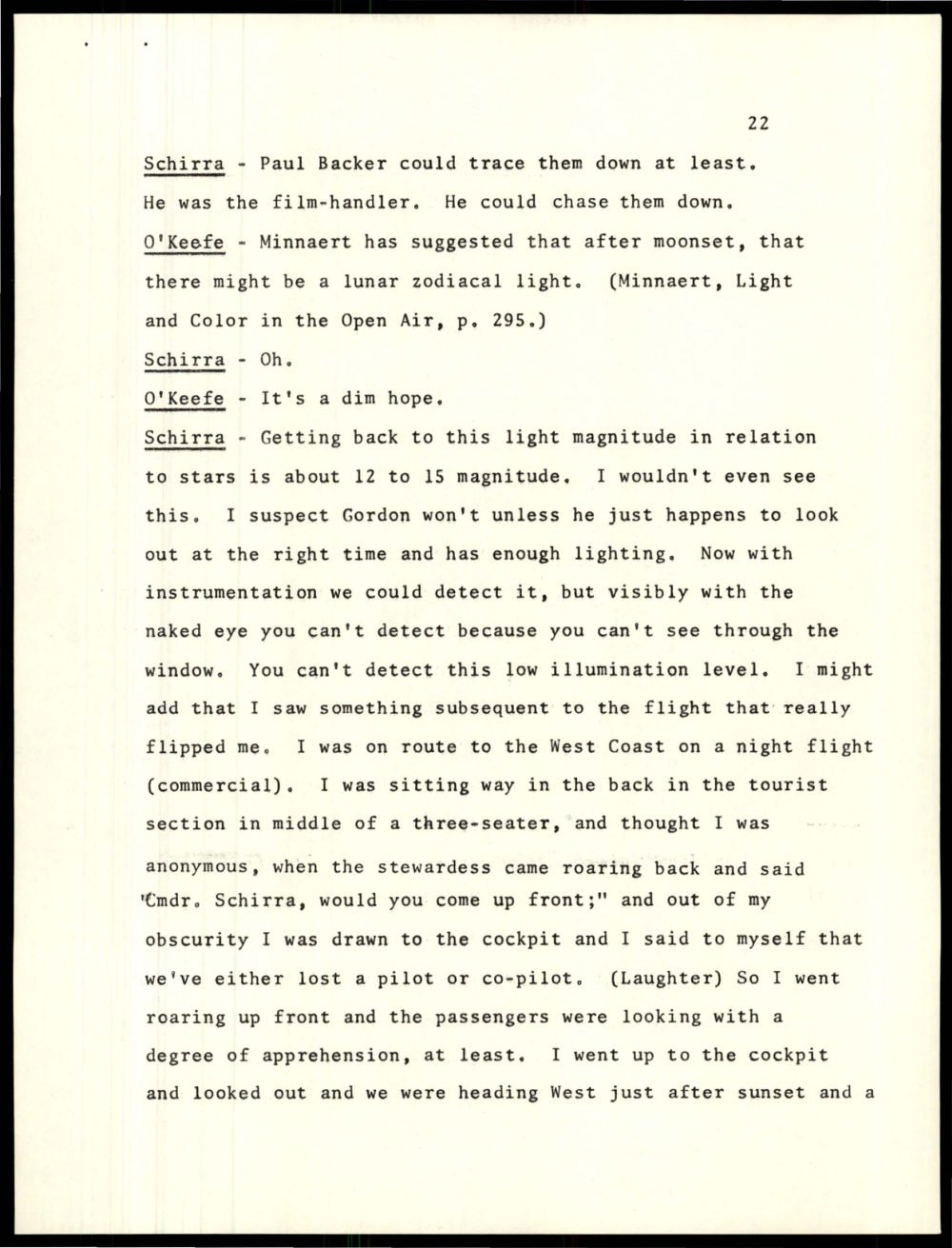 Debriefing transcriptPhysical page 136
DOCUMENTARY SOURCES · NASA / DOW
What the records tell
In the scientific debriefing of 12 March 1963, the conversation about the zodiacal light led Walter Schirra to recount something he saw after his orbital flight, on a night commercial flight to the West Coast. He was traveling in tourist class, in the middle seat of a row of three, thinking no one had recognized him, when a flight attendant came running to call him to the cockpit. He said he thought one of the pilots had fallen ill, and that the passengers were looking at him with some apprehension.
In the cockpit, with the airplane heading west just after sunset, he saw what he described as the most fantastic illumination he had ever seen. According to Schirra, it was a Blue Scout rocket launched from Vandenberg Air Force Base. There was the exhaust trail and, above the horizon, an enormous glow, which he called an ionization glow, resembling a vapor cloud. The band covered 60 to 70 degrees of the horizon, rose along the ecliptic, passing by the Moon and the planets, and extended up to the zenith.
The most revealing detail is the reaction of the airplane's crew. Schirra said the pilots were very worried because they did not know what it was. The phenomenon was hundreds of miles away, and even so they felt they were in danger and wanted immediate answers. He added that the entire West Coast was fascinated by the sight and that it made the newspapers.
Schirra explained the effect based on what he had already seen at night launches: when the rocket rises above the Earth's shadow and enters the region still lit by the Sun, a large, bright expansion wave forms behind it. John O'Keefe asked whether what he saw from the cockpit was the rocket or the zodiacal light. Schirra answered that the two things combined, but that the glow was "without a doubt" stimulated by the rocket, which was rising almost along the ecliptic.
The identification of the rocket is Schirra's own; the pages give no date, flight number, launch time, or the newspaper clippings mentioned. The account is of interest as a documented example of how a launch seen at dusk can alarm experienced observers, such as airline pilots, and of how an astronaut recognized the phenomenon by its similarity to what he had seen up close on spaceflights.
The full transcript shows how the account came into the conversation. The scientists were discussing the zodiacal light, a faint glow along the ecliptic, and Schirra remarked that he would not see it from the capsule because of the window. That was when he told the airplane episode. When he finished, John O'Keefe asked whether what he had seen from the cockpit was the rocket or the zodiacal light, and Schirra answered that the two things combined, but that the glow was stimulated by the rocket. Jocelyn Gill noted that it was the time of year to see the zodiacal light, about three quarters of an hour after sunset. Schirra said he had seen it many times from an airplane, but never so bright.
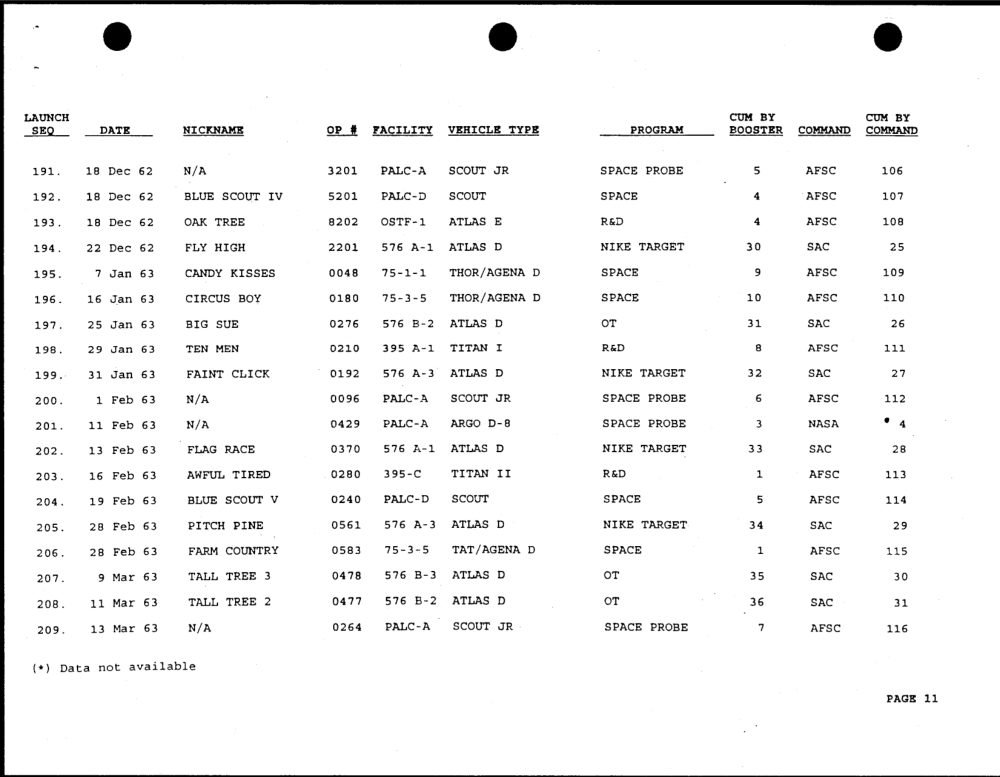
The official launch record of Vandenberg Air Force Base, prepared by the 30th Space Wing History Office and published in the archive, helps narrow down the episode without resolving it. Between Schirra's flight, on October 3, 1962, and the debriefing, on March 12, 1963, the list shows two launches with the name Blue Scout, both from the PALC-D complex: Blue Scout IV, on December 18, 1962, and Blue Scout V, on February 19, 1963. The table gives only the local date, with no time, and there are other, smaller Scout rockets in the same period. Schirra did not give the date of the commercial flight.
The account is secondhand as to the pilots' reaction and firsthand as to what Schirra saw. The identification of the rocket was made by him at the time or afterward; the page does not say whether the airplane's crew received any official information. Gill's remark, "and they did, didn't they?", suggests that the pilots got the answer from the astronaut himself. The newspaper stories Schirra mentioned, about the West Coast being "fascinated" by the sight, are not in the archive, and nothing in the pages indicates that the case was recorded as a sighting of an unidentified object.
More images from the document
DIRECT READING OF THE FILE
The document, in the original
NASA transcript, a U.S. government work: Schirra's account translated after checking against the facsimile.
EXCERPT 1 · PHYSICAL PAGE 136
Physical page 136 (page 22 of the transcript), in full
22
Schirra - Paul Backer could trace them down at least.
He was the film-handler. He could chase them down.
O'Keefe - Minnaert has suggested that after moonset, that
there might be a lunar zodiacal light. (Minnaert, Light
and Color in the Open Air, p. 295.)
Schirra - Oh.
O'Keefe - It's a dim hope.
Schirra - Getting back to this light magnitude in relation
to stars is about 12 to 15 magnitude. I wouldn't even see
this . I suspect Gordon won't unless he just happens to look
out at the right time and has enough lighting. Now with
instrumentation we could detect it, but visibly with the
naked eye you can't detect because you can't see through the
window. You can't detect this low illumination level. I might
add that I saw something subsequent to the flight that· really
flipped me. I was on route to the West Coast on a night flight
(commercial). I was sitting way in the back in the tourist
section in middle of a three-seater, and thought I was
anonymous, when the stewardess came roaring back and said
~mdr. Schirra, would you come up front;'' and out of my
obscurity I was drawn to the cockpit and I said to myself that
we ' ve either lost a pilot or co - pilot. (Laughter) So I went
roaring up front and the passengers were looking with a
degree of apprehension, at least. I went up to the cockpit
and looked out and we were heading West just after sunset and aEditorial note: Verbatim typed transcript of the scientific debriefing of Walter Schirra, 12/03/1963, with the participants' names underlined in the original. The first two remarks close the conversation about the moonset photos, which Schirra wanted located. The "light" of magnitude 12 to 15 is the lunar zodiacal light suggested by Minnaert. "Gordon" is Gordon Cooper, who would make the next flight, in May 1963.
Check the original PDF
Schirra - Paul Backer could trace them down at least. He was the film-handler. He could chase them down.
O'Keefe - Minnaert has suggested that after moonset, that there might be a lunar zodiacal light. (Minnaert, Light and Color in the Open Air, p. 295.)
Schirra - Oh.
O'Keefe - It's a dim hope.
Schirra - Getting back to this light magnitude in relation to stars is about 12 to 15 magnitude. I wouldn't even see this. I suspect Gordon won't unless he just happens to look out at the right time and has enough lighting. Now with instrumentation we could detect it, but visibly with the naked eye you can't detect because you can't see through the window. You can't detect this low illumination level. I might add that I saw something subsequent to the flight that really flipped me. I was on route to the West Coast on a night flight (commercial). I was sitting way in the back in the tourist section in middle of a three-seater, and thought I was anonymous, when the stewardess came roaring back and said "Cmdr. Schirra, would you come up front;" and out of my obscurity I was drawn to the cockpit and I said to myself that we've either lost a pilot or co-pilot. (Laughter) So I went roaring up front and the passengers were looking with a degree of apprehension, at least. I went up to the cockpit and looked out and we were heading West just after sunset and aView the document record ↗ · Physical page 136, counting the cover.
EXCERPT 2 · PHYSICAL PAGE 137
Physical page 137 (page 23 of the transcript), in full
I
23
blue scout had been launched from Vandenberg (AF$). It had
the most fantastic lighting I have ever seen anywhere~ It
had the exhaust trail and above the horizon it had this
fantastic glow - ionization glow (like a vapor· cloud)
would describe it as - which would best pin down - resemblethe zodiacal light if you ever wanted to do it~ It had a
band across the horizon about 60 to 70 degrees· and it· went
right up the ecliptic and picked up the moon· and the · planets.
It was just amazing.
Shoemaker - How far could you trace it?
Schirra - I could see it right up to the zenith as much as I
could see out the cockpit. We were all oohing and ahing.
I think you have seen this same glow from a booster· flight at
night, particularly if you can pick up a sunset or· sunrise
when you get above the earth's shadow and get into the lighted
area where the booster is. There is a tremendous · expansion wave
that's behind the vehicle and this is basically what it looks
like.
Dubin - These pictures of Glenn's Atlas flight show the same
thing . o o o
Schirra - I think it was mine you saw ...
O'Keefe - What you saw from the cockpit - was it from the blue
streak or was it the zodiacal light?
Schirra - I think the two just drew it together and that it was
definitely stimulated by this blue streak as it went up almost
up the ecliptic in relation to the arc field of view.Editorial note: Verbatim typed transcript of the scientific debriefing of Walter Schirra, 12/03/1963, with the participants' names underlined in the original. "Blue streak", in O'Keefe's and Schirra's remarks, seems to refer to the same Blue Scout rocket; it appears this way in the original. The ecliptic is the apparent path of the Sun, the Moon and the planets across the sky, where the zodiacal light also appears. The passage about the glow had already been translated on the site; the wording was kept.
Check the original PDF
blue scout had been launched from Vandenberg (AFB). It had the most fantastic lighting I have ever seen anywhere. It had the exhaust trail and above the horizon it had this fantastic glow - ionization glow (like a vapor cloud) I would describe it as - which would best pin down - resemble - the zodiacal light if you ever wanted to do it. It had a band across the horizon about 60 to 70 degrees and it went right up the ecliptic and picked up the moon and the planets. It was just amazing.
Shoemaker - How far could you trace it?
Schirra - I could see it right up to the zenith as much as I could see out the cockpit. We were all oohing and ahing. I think you have seen this same glow from a booster flight at night, particularly if you can pick up a sunset or sunrise when you get above the earth's shadow and get into the lighted area where the booster is. There is a tremendous expansion wave that's behind the vehicle and this is basically what it looks like.
Dubin - These pictures of Glenn's Atlas flight show the same thing. ...
Schirra - I think it was mine you saw...
O'Keefe - What you saw from the cockpit - was it from the blue streak or was it the zodiacal light?
Schirra - I think the two just drew it together and that it was definitely stimulated by this blue streak as it went up almost up the ecliptic in relation to the arc field of view.View the document record ↗ · Physical page 137, counting the cover.
EXCERPT 3 · PHYSICAL PAGE 138
Physical page 138 (page 24 of the transcript), in full
24
O'Keefe - It is not a difficult thing to see the zodiacal light
under reasonably favor~ble conditions.
Schirra - No, I have seen it frequently, but not ' as brilliantly.
Gill - Have you seen it in Houston by any chance?
Schiira - I have seen it just flying at night~ I haven't seen it
from Houston recently, no.
Gill - Well, this is the season to see it. You should see it . . .
about three-quarters of an hour after sunset.
Schirra - From an airplane, you can see it better than yoµ can
from a Mercury spacecraft. You don't have this dimming of ligh t
through your canopy as you do from the spacecraft~ This is rea lly
a spectacular sight. Of course, the pilots were so concerned
because they didn't know what it was. This was hundreds and
hundreds of miles away, and yet they felt they were in danger .
(Laughter) They wanted answers right away.
Gill - They got them, didn't they?
Schirra - Of course, you've heard that the whole West Coast was
enthralled by this sight. It was in the newspapers.
Roman - Speaking of the brightness of the zodiacal light,
Dr. Mulders, NSF, was in Chile at a high altitude last fall,
and he commented to me, that the zodiacal light was so bright
that he was able to see it from horizon to horizon without
difficulty.
Schirra - Amazing--horizon to horizon- ~! am not sure what we a r e
going to see at thousands of miles from earth c I suspect thatEditorial note: Verbatim typed transcript of the scientific debriefing of Walter Schirra, 12/03/1963, with the participants' names underlined in the original. NSF is the National Science Foundation. "Last fall", in the northern hemisphere, corresponds to September to November 1962. The final sentence continues on physical page 139, which already deals with another subject (clouds seen from afar) and is translated in the dossier on the brown band. The passage about the pilots' reaction had already been translated on the site; the wording was kept.
Check the original PDF
O'Keefe - It is not a difficult thing to see the zodiacal light under reasonably favorable conditions.
Schirra - No, I have seen it frequently, but not as brilliantly.
Gill - Have you seen it in Houston by any chance?
Schirra - I have seen it just flying at night. I haven't seen it from Houston recently, no.
Gill - Well, this is the season to see it. You should see it... about three-quarters of an hour after sunset.
Schirra - From an airplane, you can see it better than you can from a Mercury spacecraft. You don't have this dimming of light through your canopy as you do from the spacecraft. This is really a spectacular sight. Of course, the pilots were so concerned because they didn't know what it was. This was hundreds and hundreds of miles away, and yet they felt they were in danger. (Laughter) They wanted answers right away.
Gill - They got them, didn't they?
Schirra - Of course, you've heard that the whole West Coast was enthralled by this sight. It was in the newspapers.
Roman - Speaking of the brightness of the zodiacal light, Dr. Mulders, NSF, was in Chile at a high altitude last fall, and he commented to me, that the zodiacal light was so bright that he was able to see it from horizon to horizon without difficulty.
Schirra - Amazing--horizon to horizon--I am not sure what we are going to see at thousands of miles from earth. I suspect thatView the document record ↗ · Physical page 138, counting the cover.
EXCERPT 4 · PHYSICAL PAGE 25
Physical page 25 of the Vandenberg launch summary (page 11 of the summary): lines 191 to 209, December 1962 to March 1963
• •
LAUNCH CUM BY CUM BY
SEQ DATE NICKNAME OP I FACILITY VEHICLE TYPE PROGRAM BOOSTER COMMAND COMMAND
191. 18 Dec 62 N/A 3201 PALC-A SCOUT JR SPACE PROBE 5 AFSC 106
192. 18 Dec 62 BLUE SCOUT IV 5201 PALC-D SCOUT SPACE 4 ·AFSC 107
193. 18 Dec 62 OAK TREE 8202 OSTF-1 ATLAS E R&D 4 AFSC 108
194. 22 Dec 62 FLY HIGH 2201 576 A-1 ATLAS D NIKE TARGET 30 SAC 25
195. 7 Jan 63 CANDY KISSES 0048 75-1-1 THOR/AGENA D SPACE 9 AFSC 109
196. 16 .:Tan 63 CIRCUS BOY 0180 75-3-5 THOR/AGENA D SPACE 10 AFSC 110
197. 25 Jan 63 BIG SUE 0276 576 B-2 ATLAS D OT 31 SAC 26
198. 29 Jan 63 TEN MEN 0210 395 A-1 TITAN I R&D 8 AFSC 111
199. 31 Jan 63 FAINT CLICK 0192 576 A-3 ATLAS D NIKE TARGET 32 SAC 27
200. 1 Feb 63 N/A 0096 PALC-A SCOUT JR SPACE PROBE 6 AFSC 112
201. 11 Feb 63 N/A 0429 PALC-A ARGO D-8 SPACE PROBE 3 NASA • 4
202. 13 Feb 63 FLAG RACE 0370 576 A-1 ATLAS D NIKE TARGET 33 SAC 28
203. 16 Feb 63 AWFUL TIRED 0280 395-C TITAN II R&D 1 AFSC 113
204. 19 Feb 63 BLUE SCOUT V 0240 PALC-D SCOUT SPACE 5 AFSC 114
205. 28 Feb 63 PITCH PINE 0561 576 A-3 ATLAS D NIKE TARGET 34 SAC 29
206. 28 Feb 63 FARM COUNTRY 0583 75-3-5 TAT/AGENA D SPACE 1 AFSC 115
207. 9 Mar 63 TALL TREE 3 0478 576 B-3 ATLAS D OT 35 SAC 30
208. 11 Mar 63 TALL TREE 2 0477 576 B-2 ATLAS D OT 36 SAC 31
209. 13 Mar 63 N/A 0264 PALC-A SCOUT JR. SPACE PROBE 7 AFSC 116
( *) Data not available
PAGE 11Editorial note: Official summary of launches from Vandenberg Air Force Base (1958 to 2000), prepared by the Office of History of the 30th Space Wing of the U.S. Air Force (USAF); according to the preface (physical page 3), the dates are in Vandenberg local time. Acronyms: AFSC, Air Force Systems Command; SAC, Strategic Air Command; R&D, research and development; OT, operational test; PALC, Point Arguello launch complex. The nicknames are code names and have been kept. The table does not give launch times.
Check the original PDF
LAUNCH SEQ | DATE | NICKNAME | OP # | FACILITY | VEHICLE TYPE | PROGRAM | CUM BY BOOSTER | COMMAND | CUM BY COMMAND
191. | 18 Dec 62 | N/A | 3201 | PALC-A | SCOUT JR | SPACE PROBE | 5 | AFSC | 106
192. | 18 Dec 62 | BLUE SCOUT IV | 5201 | PALC-D | SCOUT | SPACE | 4 | AFSC | 107
193. | 18 Dec 62 | OAK TREE | 8202 | OSTF-1 | ATLAS E | R&D | 4 | AFSC | 108
194. | 22 Dec 62 | FLY HIGH | 2201 | 576 A-1 | ATLAS D | NIKE TARGET | 30 | SAC | 25
195. | 7 Jan 63 | CANDY KISSES | 0048 | 75-1-1 | THOR/AGENA D | SPACE | 9 | AFSC | 109
196. | 16 Jan 63 | CIRCUS BOY | 0180 | 75-3-5 | THOR/AGENA D | SPACE | 10 | AFSC | 110
197. | 25 Jan 63 | BIG SUE | 0276 | 576 B-2 | ATLAS D | OT | 31 | SAC | 26
198. | 29 Jan 63 | TEN MEN | 0210 | 395 A-1 | TITAN I | R&D | 8 | AFSC | 111
199. | 31 Jan 63 | FAINT CLICK | 0192 | 576 A-3 | ATLAS D | NIKE TARGET | 32 | SAC | 27
200. | 1 Feb 63 | N/A | 0096 | PALC-A | SCOUT JR | SPACE PROBE | 6 | AFSC | 112
201. | 11 Feb 63 | N/A | 0429 | PALC-A | ARGO D-8 | SPACE PROBE | 3 | NASA | *4
202. | 13 Feb 63 | FLAG RACE | 0370 | 576 A-1 | ATLAS D | NIKE TARGET | 33 | SAC | 28
203. | 16 Feb 63 | AWFUL TIRED | 0280 | 395-C | TITAN II | R&D | 1 | AFSC | 113
204. | 19 Feb 63 | BLUE SCOUT V | 0240 | PALC-D | SCOUT | SPACE | 5 | AFSC | 114
205. | 28 Feb 63 | PITCH PINE | 0561 | 576 A-3 | ATLAS D | NIKE TARGET | 34 | SAC | 29
206. | 28 Feb 63 | FARM COUNTRY | 0583 | 75-3-5 | TAT/AGENA D | SPACE | 1 | AFSC | 115
207. | 9 Mar 63 | TALL TREE 3 | 0478 | 576 B-3 | ATLAS D | OT | 35 | SAC | 30
208. | 11 Mar 63 | TALL TREE 2 | 0477 | 576 B-2 | ATLAS D | OT | 36 | SAC | 31
209. | 13 Mar 63 | N/A | 0264 | PALC-A | SCOUT JR | SPACE PROBE | 7 | AFSC | 116
(*) Data not available
PAGE 11View the document record ↗ · Physical page 25, counting the cover.
EXCERPT 5 · PHYSICAL PAGE 24
Physical page 24 of the Vandenberg launch summary (page 10 of the summary): lines 172 to 190, late September to December 1962
••
• •
LAUNCH COM BY COM BY
SEQ DATE NICKNAME QLI FACILITY VEHICLB TYPB PROGRAM BOOSTBR COMMAND COMMAND
172. 29 Sep 62 ARCTIC ZONE 4201 75-1-2 THOR/AGENA D SPACE 4 AFS-C 89
173. 2 Oct 62 BRIAR STREET 0201 576 B-2 ATLAS D ST 27 SAC 24
174. 6 Oct 62 TIGHT BRACELET 0201 395 A-1 TITAN I ST 6 AFSC 90
175. 9 Oct 62 CALL BOARD 4201 75-3-4 THOR/AGENA B ·SPACE 37 AFSC 91
176. 26 Oct 62 ANCHOR BUOY 1201 75-1-2 THOR/AGENA D SPACE 5 AFSC 92
177. 26 Oct 62 CLOSED CIRCUITS 8201 576 A-1 ATLAS D NIKE TARGET 28 AFSC 93
178. 5 Nov 62 BAIL OUT 9201 75-3-4 THOR/AGENA B SPACE 38 AFSC 94
179-, 11 Nov 62 AFTER DECK 4202 PALC-1-1 ATLAS/AGENA B SPACE 12 AFSC 95
180. 14 Nov 62 ACTION TIME 5201 OSTF-2 ATLAS F R&D 3 AFSC 96
181. 21 Nov 62 N/A 5201 PALC-A SCOUT JR SPACE PROBE 4 AFSC 97
182. 24 Nov 62 GOLDEN RUSH 9201 75-3-4 THOR/AGENA B SPACE 39 AFSC 9!3
183. 4 Dec 62 CALAMITY JANE 8201 75-1-2 THOR/AGENA D SPACE 6 AFSC 99
184. 5 Dec 62 YELLOW JACKET 4201 395 A-1 TITAN I R&D 7 AFSC 100
185. 10 Dec 62 AMERICAN BEAUTY 7201 394 A-4 MINUTEMAN A R&D 2 AFSC 101
186. 12 Dec 62 DEER PARK 6201 576 Jl.-3 ATLAS D NIKE TARGET 29 AFSC 102
187. 12 Dec 62 CORN FIELD 7201 75-1-1 THOR/AGENA D SPACE 7 AFSC 103
188. 13 Dec 62 N/A * PALC-B TERRIER/ASP IV SPACE PROBE 2 NAVY 14
189. 14 Dec 62 BABY DOLL 8201 75-3-5 THOR/AGENA D SPACE 8 AFSC 104
190. 17 Dec 62 BARGIN COUNTER 5201 PALC-1-2 ATLAS/AGENA B SPACE 13 AFSC 105
( *) Data not available
PAGE 10Editorial note: Same official summary. ST presumably indicates systems test (the acronym is not explained on the page). "Bargin" appears that way in the original. No Blue Scout launch appears on this page; it was translated to show that, between Schirra's flight (October 3, 1962) and the end of 1962, the first recorded Blue Scout is the one on December 18, on the following page.
Check the original PDF
LAUNCH SEQ | DATE | NICKNAME | OP # | FACILITY | VEHICLE TYPE | PROGRAM | CUM BY BOOSTER | COMMAND | CUM BY COMMAND
172. | 29 Sep 62 | ARCTIC ZONE | 4201 | 75-1-2 | THOR/AGENA D | SPACE | 4 | AFSC | 89
173. | 2 Oct 62 | BRIAR STREET | 0201 | 576 B-2 | ATLAS D | ST | 27 | SAC | 24
174. | 6 Oct 62 | TIGHT BRACELET | 0201 | 395 A-1 | TITAN I | ST | 6 | AFSC | 90
175. | 9 Oct 62 | CALL BOARD | 4201 | 75-3-4 | THOR/AGENA B | SPACE | 37 | AFSC | 91
176. | 26 Oct 62 | ANCHOR BUOY | 1201 | 75-1-2 | THOR/AGENA D | SPACE | 5 | AFSC | 92
177. | 26 Oct 62 | CLOSED CIRCUITS | 8201 | 576 A-1 | ATLAS D | NIKE TARGET | 28 | AFSC | 93
178. | 5 Nov 62 | BAIL OUT | 9201 | 75-3-4 | THOR/AGENA B | SPACE | 38 | AFSC | 94
179. | 11 Nov 62 | AFTER DECK | 4202 | PALC-1-1 | ATLAS/AGENA B | SPACE | 12 | AFSC | 95
180. | 14 Nov 62 | ACTION TIME | 5201 | OSTF-2 | ATLAS F | R&D | 3 | AFSC | 96
181. | 21 Nov 62 | N/A | 5201 | PALC-A | SCOUT JR | SPACE PROBE | 4 | AFSC | 97
182. | 24 Nov 62 | GOLDEN RUSH | 9201 | 75-3-4 | THOR/AGENA B | SPACE | 39 | AFSC | 98
183. | 4 Dec 62 | CALAMITY JANE | 8201 | 75-1-2 | THOR/AGENA D | SPACE | 6 | AFSC | 99
184. | 5 Dec 62 | YELLOW JACKET | 4201 | 395 A-1 | TITAN I | R&D | 7 | AFSC | 100
185. | 10 Dec 62 | AMERICAN BEAUTY | 7201 | 394 A-4 | MINUTEMAN A | R&D | 2 | AFSC | 101
186. | 12 Dec 62 | DEER PARK | 6201 | 576 A-3 | ATLAS D | NIKE TARGET | 29 | AFSC | 102
187. | 12 Dec 62 | CORN FIELD | 7201 | 75-1-1 | THOR/AGENA D | SPACE | 7 | AFSC | 103
188. | 13 Dec 62 | N/A | * | PALC-B | TERRIER/ASP IV | SPACE PROBE | 2 | NAVY | 14
189. | 14 Dec 62 | BABY DOLL | 8201 | 75-3-5 | THOR/AGENA D | SPACE | 8 | AFSC | 104
190. | 17 Dec 62 | BARGIN COUNTER | 5201 | PALC-1-2 | ATLAS/AGENA B | SPACE | 13 | AFSC | 105
(*) Data not available
PAGE 10View the document record ↗ · Physical page 24, counting the cover.
EXCERPT 6 · PHYSICAL PAGE 199
full page
85
.the Indian Ocean Ship.
Dunkelman - Yes, but the point is this is the return, what I'm
trying to get at -- the moment you saw that which no one saw at the
time on the ground is the beginning of a new period which we have
to take advantage of on the next flight.
Schirra - Oh, of course .
Dunkelman - Here's the case where an astronaut can tell the ground,
"Now look" - "here now", you see.
Schirra - Interestingly enough - it was about that same t i me whe n
the Indian Ocean ship saw me .
Dunkelman - Oh, oh, now of course they are in the clouds and ...
Gill - Much more interested (in seeing you).
Schirra - I didn't know it at that point though.
Nordberg - That lightning case, though ...
Schirra - Yes, I gave them a weather report and they didn't believe
me either. (laughter) They said, "Oh, it's clear here." Well, of
tourse, I had to look back on a very long slant line to see the
flare, and this was , then covered by clouds, well, then, if this
were Woomera, then the cloud structure would go up like this
we'll say, well, I was over here, so I really couldn ' t see Woomer a
at that time . That 0 s how I satisfied myself I never would even
though they had a beautiful clear sky over their station for that
first period.
Tennyson - This is not only great for you, it's great for t he
scientific world .
Schirra = It is.Editorial note: End of the scientific interview with Walter Schirra (Sigma 7). Schirra explains why his report of lightning and of a flash in the Woomera region did not match the clear sky seen from the ground: he was looking along a very long oblique line, which clouds could obscure. He also says that, at about the same time, the ship in the Indian Ocean sighted him. There is no description of an unidentified object here; Schirra attributes the flash and the lightning to cloud conditions along the line of sight.
Check the original PDF
85
.the Indian Ocean Ship.
Dunkelman - Yes, but the point is this is the return, what I'm
trying to get at -- the moment you saw that which no one saw at the
time on the ground is the beginning of a new period which we have
to take advantage of on the next flight.
Schirra - Oh, of course .
Dunkelman - Here's the case where an astronaut can tell the ground,
"Now look" - "here now", you see.
Schirra - Interestingly enough - it was about that same t i me whe n
the Indian Ocean ship saw me .
Dunkelman - Oh, oh, now of course they are in the clouds and ...
Gill - Much more interested (in seeing you).
Schirra - I didn't know it at that point though.
Nordberg - That lightning case, though ...
Schirra - Yes, I gave them a weather report and they didn't believe
me either. (laughter) They said, "Oh, it's clear here." Well, of
tourse, I had to look back on a very long slant line to see the
flare, and this was , then covered by clouds, well, then, if this
were Woomera, then the cloud structure would go up like this
we'll say, well, I was over here, so I really couldn ' t see Woomer a
at that time . That 0 s how I satisfied myself I never would even
though they had a beautiful clear sky over their station for that
first period.
Tennyson - This is not only great for you, it's great for t he
scientific world .
Schirra = It is.View the document record ↗ · Physical page 199, counting the cover.
EXCERPT 7 · PHYSICAL PAGE 200
full page
86
Tennyson - It's good to have somebody else who isn't constrained to
party lines.
Gill - It's a privilege to meet with you, really.
Tennyson - Something that shocks me is that the discussion from
Scott Carpenter and your discussion is the picking out of clues
from about, heaven knows, how many scientific disciplines from
your general experience etc., and integrate them all together and
be able to present them; frankly, I just find this very interesting
that anybody can do that. The wide range of experience.
Schirra - I think it's the opportunities of so many exposures we've
had and we have taken advantage of them, and as an example, we can
have an audience with you people anytime we call, and if we have
questions and this is true throughout the whole program. I can
talk to Von Braun if I'd like to right now. I can talk to a technici an
that's working on a nut and bolt on Von Braun's booster right now.
We have this prerogative which is very great for us. We are not
stuck with the disciplines of crossing party lines or anything like
this or going up to the ladder and back down again . We go - we
just take a straight path to where we want to get information . It
is a tremendous opportunity -for us, and we try not to abuse it, but
we use it liberally really. I might add that anytime you have a
question, our phones are always available for this kind of thing.
r
Don ' t ever think we are incommunicado.
Shoemaker - Good - that's very good, Commander. I'd like to thank
you very much.
Schirra - Sure, I was glad to come by.
TIIE ENDEditorial note: Last page of the transcript of the scientific interview with Walter Schirra. The scientists thank him and Schirra explains that the astronauts can consult experts and engineers directly during the program. No sighting of a light or object on this page.
Check the original PDF
86
Tennyson - It's good to have somebody else who isn't constrained to
party lines.
Gill - It's a privilege to meet with you, really.
Tennyson - Something that shocks me is that the discussion from
Scott Carpenter and your discussion is the picking out of clues
from about, heaven knows, how many scientific disciplines from
your general experience etc., and integrate them all together and
be able to present them; frankly, I just find this very interesting
that anybody can do that. The wide range of experience.
Schirra - I think it's the opportunities of so many exposures we've
had and we have taken advantage of them, and as an example, we can
have an audience with you people anytime we call, and if we have
questions and this is true throughout the whole program. I can
talk to Von Braun if I'd like to right now. I can talk to a technici an
that's working on a nut and bolt on Von Braun's booster right now.
We have this prerogative which is very great for us. We are not
stuck with the disciplines of crossing party lines or anything like
this or going up to the ladder and back down again . We go - we
just take a straight path to where we want to get information . It
is a tremendous opportunity -for us, and we try not to abuse it, but
we use it liberally really. I might add that anytime you have a
question, our phones are always available for this kind of thing.
r
Don ' t ever think we are incommunicado.
Shoemaker - Good - that's very good, Commander. I'd like to thank
you very much.
Schirra - Sure, I was glad to come by.
TIIE ENDView the document record ↗ · Physical page 200, counting the cover.
Dates and documentary context
- Event
- Not established — Schirra says it was after his flight (03/10/1962); the account is from 12/03/1963. Launch date not given.
- Document
- 12/03/1963 — Debriefing date (p. 114).
- Publication
- Not established — Published by NASA in the UAP batch (release 3).
Origin and release
NASA, headquarters in Washington; transcript distributed by Jocelyn R. Gill · NASA-UAP-D015_Astronaut-Scientific-Debriefings_1962-1963.pdf
undefined ↗ — undefined
Questions to continue the investigation
- Which Vandenberg launch corresponds to the account, and which West Coast newspapers reported the glow?
GEOGRAPHY OF THE CASE
On a commercial flight bound for the U.S. West Coast
The account does not give the route or the position of the plane.
DOCUMENTARY TRAIL
Go back to the sources
References use physical pages of the PDF, counting the cover. Summaries are presented in English; the documents keep their original language.
- NASA-UAP-D015_Astronaut-Scientific-Debriefings_1962-1963.pdf
Physical pages 136 to 138: Walter Schirra's account at the scientific debriefing of 12/03/1963
NASA · 216 pages - DOW-UAP-D49-Launch-Summary-February-2000.pdf
Physical pages 24 and 25: official summary of launches from Vandenberg Air Force Base (30th Space Wing), launches from September 1962 to March 1963, including Blue Scout IV (18/12/1962) and Blue Scout V (19/02/1963); physical page 3: preface on the local time of the dates
DOW · 113 pages
Editorial summary based on the collection's research notes. How we read the documents.