Date: 20/02/1962 (MA-6 flight)Location: Earth orbit, night side, Mercury-Atlas 6 flight
Friendship 7, 1962: the haze layer above the horizon that dimmed stars
John Glenn saw a beige-colored band about 6 to 8 degrees above the night horizon, which made stars dim and then brighten again as they approached the horizon. The account generated memoranda at NASA and a letter from a Los Alamos scientist, who proposed nitrogen dioxide as an explanation.
- Event date
- 20/02/1962 (MA-6 flight)
- Location
- Earth orbit, night side, Mercury-Atlas 6 flight
- Topic
- Astronaut accounts
- Source agencies
- NASA
- Documents
- 1 document · 216 pages
- Reading time
- 52 min
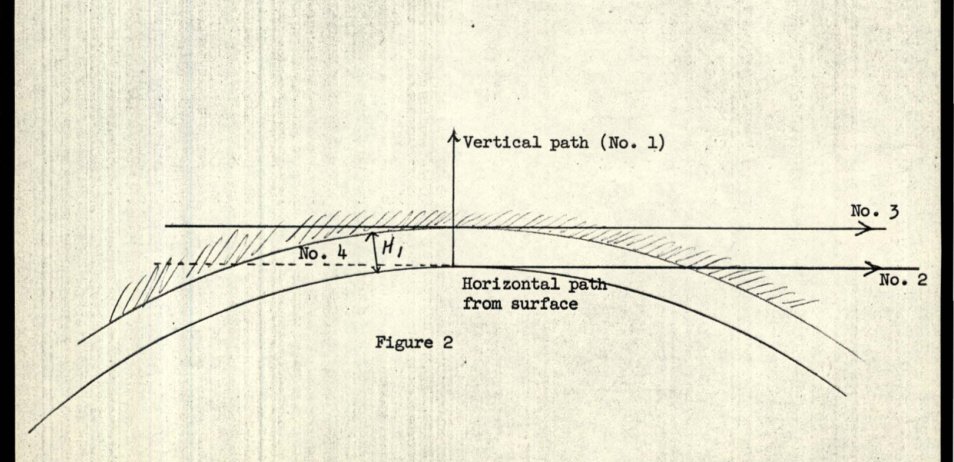 Scientific diagramPhysical page 41
DOCUMENTARY SOURCES · NASA
What the records tell
In the same interview in which he spoke about the “fireflies,” John Glenn described another unexpected phenomenon on the night side. He was following a star descending toward the horizon when it grew faint, as if it had gone behind the Earth, and then brightened again closer to the horizon before disappearing. Looking carefully, he saw a band about 6 to 8 degrees above the horizon, 1,5 to 2 degrees wide, beige in color, “not a pure white,” more solid than the sunset band.
Glenn cautioned that the angles were estimates made through the window, not protractor measurements. He also said he tried to see the airglow band with the special filter and could not, perhaps because he was not well dark-adapted. During the conversation, a scientist remarked that several photos from the flight showed a green band 15 or 20 degrees from the horizon. Glenn replied that he had never seen it and assumed it was a reflection in the window or the lens.
Before the interview, a memorandum by Maurice Dubin dated 21 February 1962 had already noted that an atmospheric boundary at 8 degrees, as reported by the press, would indicate a visible atmosphere above 150 kilometers, and listed three possibilities: scattering of light by the air, airglow or dust. The draft memorandum of 13 March recorded the band with a haze layer of about 2 degrees and recalled that Soviet cosmonaut Gherman Titov had also reported a high layer. It recommended further investigation.
In July, after the journal Science published Glenn's comments on “the high layer,” Bob E. Watt, of the Los Alamos Scientific Laboratory, wrote to Jocelyn Gill, of NASA, proposing an explanation: a concentration of nitrogen dioxide, which absorbs visible light. The letter includes diagrams of the lines of sight through a layer in the upper atmosphere and absorption calculations. Watt cautioned that he was not an expert in photochemistry, concluded that nitrogen dioxide was more likely than oxygen ions, and said that the color described by Glenn fit this hypothesis well.
Another interpretation appears in the note on the following flight, by Scott Carpenter, in May 1962. Using a filter, Carpenter identified a luminous band as the night airglow of the upper atmosphere, at about 89 kilometers. By eye, he estimated it at 8 to 10 degrees, but timed measurements gave 2 to 3 degrees. The author of the note spoke of a strong illusion that exaggerates angles near the horizon, “evidently present also” on Glenn's flight. The two explanations were recorded side by side, with no conclusion in the file.
The full transcript shows how the layer came into the conversation. Glenn cited it among the “unexpected celestial aspects,” right after saying that the sunset lasted much longer than he expected, 4 to 5 minutes of bright bands. He said he first found it odd that a star dimmed and then brightened again, and only afterward, looking carefully, did he see the band. As for the angle, he explained that he used the window as a reference, with about 30 degrees of field of view, and that the layer took up a little less than a quarter of it. He repeated that it was not a protractor measurement.
In the same session, Glenn said he tried to see the upper atmosphere's own glow with the special filter, especially over thunderstorms in the Indian Ocean, and saw nothing, perhaps due to lack of dark adaptation. Instead, he saw entire clouds light up with lightning. He also said that the small bumps in the twilight glow, visible in some photos, were at the bottom of the band and must have been clouds. He did not see the Earth's shadow in the atmosphere, nor double images through the window, information the March draft used to rule out an effect of the glass.
The green band in the photos has a different origin from what the current text suggests. It was Glenn who mentioned it: he said that, in several photos, a green band appeared 15 or 20 degrees from the horizon, first noticed by a colleague named Bob, and that he himself had never seen it. Earlier, one of the scientists had pointed out in the photos a second image of the Sun about 10 degrees from the main one, attributed to the two thicknesses of the window glass. Glenn suggested analyzing the angle of the Sun in each photo and assumed it was a reflection in the lens. Someone replied that a “John” was already doing that.
The 13 March draft, signed by Maurice Dubin, chief of the Aeronomy Program, records the observation as a band of six to eight degrees with a haze layer of about two degrees at the top. A handwritten insertion, made after Scott Carpenter's flight, adds that the airglow he saw only appeared with the 5577 angstrom filter, and that it should be visible to the naked eye after good dark adaptation. The recommendation is to investigate further. The same text proposes using weather satellites to map thunderstorms by their lightning.
The letter from Bob E. Watt, group leader at Los Alamos, runs to ten pages and two figures. He starts from the report published in the journal Science on 29 June 1962 and calculates how much more air an astronaut looks through when viewing the layer edge-on: about 75 times the vertical thickness, versus 5,5 times for someone looking from the surface. He compares three possible absorbers and rules out negative oxygen ions because they would require nighttime concentrations that are hard to accept. He proposes filming stars crossing the layer with a slow-motion camera and filters, and asking Glenn and Carpenter to reproduce the dimming with filters.
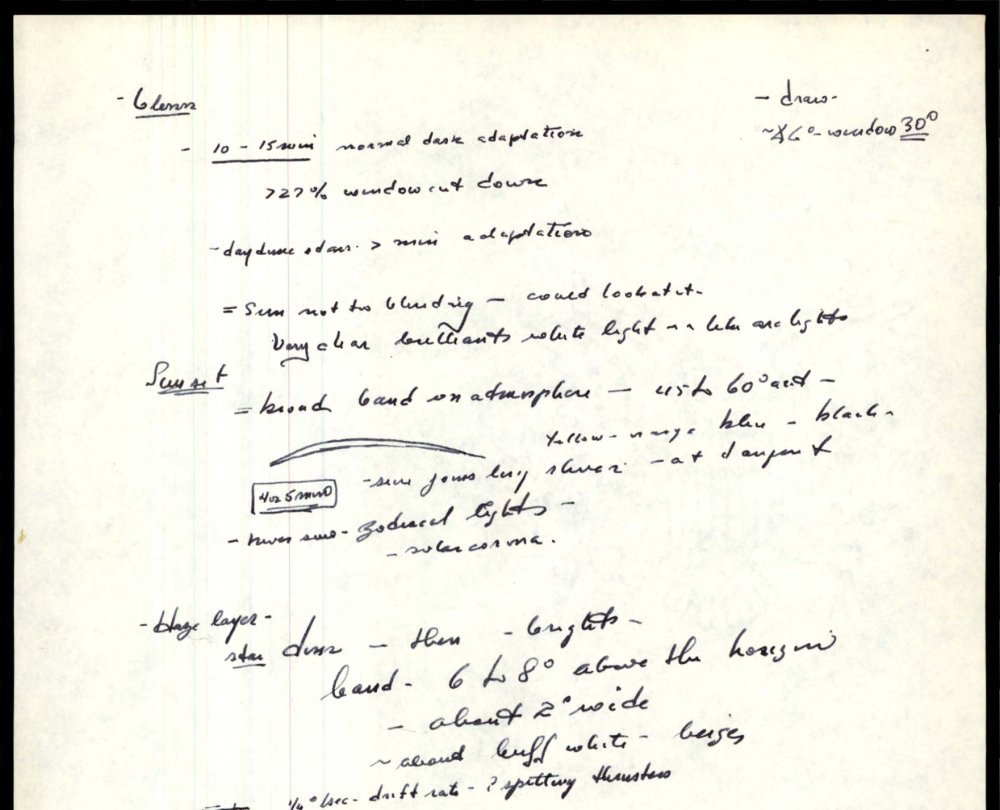
A sheet of handwritten notes kept at the end of the file summarizes the interview in bullet points: the star that dims and brightens again, the band at 6 to 8 degrees, about 2 degrees wide and beige in color, the absence of visible airglow, the lightning and the green band in the photos, with the question about the Sun's angle and the lens. It also includes a small sketch of the sunset arc. The file's papers stop there: there is no NASA reply to Watt's letter and no result of a new measurement of the layer.
More images from the document
DIRECT READING OF THE FILE
The document, in the original
NASA documents and a letter from a federal laboratory filed by NASA: excerpts translated after checking against the facsimile; the letter's equations and calculations not reproduced.
EXCERPT 1 · PHYSICAL PAGE 60
Angle illusion, physical page 60
It thus appears that there i s a strong i llusion whi ch exaggerates
angl es near the horizon, and whi ch was evi dently also present i n MA-6, si nce
Lt . Col. Glenn a lso reports 7° to 8° as the height of the luminous band. The
i llusion is perhaps comparable to the well-known illusion which makes the moon
seem larger near the hori zon.
Carpenter also noti ced and photographed the Glenn ef fect. He reports
white objects resembling snowflakes, seen at sunri.se on all three orbits. '
However, he also saw these objects 7 minutes after the f i rst sunrise and agai n
43 minutes after sunrise; and zll, llm, 23m, 26ffl, 3(1!! and 45m after the second
sunri se. It i s thus quite clear that they are not related to sunri se, except
pe rhaps i n the sense of being most easily visible then.
Carpenter managed to photograph a few of these particles. Some of them
we re very considerably brighter than the moon, which was then very near the f i rst
quarter. At this t ime, the moon i s about -10; the particles may have been bet ween -12,5 magni tude (10 x bri ghter than the moon) and -15 magni tude (100 x
bri ghter than the moon). The second i s -considered more l i kely, in vi ew of the
appearance of the full moon (-12,5) as shown on MA-6 photographs. At -15 , the
particle brightness i s consistent with centimeter size snowflakes. The
particles were verbally described by Carpenter as between l mm and 1 cm i n size ,
and having a strong visual resemblance to snowflakes.
Shortly before reentry, just at sunri se, Carpenter performed the deci si ve experi ment of hitting the capsule walls with hi s hand. The blows promptly
resulted i n the liberation of large numbers of particles. It i s thus clear that
1 7
at least those parti cles observed in the MA-6 flight emanated from the capsule .
The possibility that the particles might be dye marker or shark repe l lant , both of which are green and both of which are exposed to the vacuum,
was considered by Mr. Frank M. Crichton, NASA capsule inspector. Crichton had
test s made which demonstrated that ne i ther materi al tended to escape f rom theCheck the original PDF
It thus appears that there is a strong illusion which exaggerates angles near the horizon, and which was evidently also present in MA-6, since Lt. Col. Glenn also reports 7° to 8° as the height of the luminous band.View the document record ↗ · Physical page 60, counting the cover.
EXCERPT 2 · PHYSICAL PAGE 9
Physical page 9 (page 8 of the transcript), in full
8
Solar Corona. No. This--once again I think to obsefve these things
properly we ere going to have to be night adapted before we get there and
thats whet we lost by having other complications on the second
To get beck to the unanticipated celestial features.
Well, unanticipated celestial features--the little light spots, luzinous
spote that I saw--I don't think these are celestial features. I don't know
what they ere. Can we get back to thet later?
Ub buh.
celestial
I think unanticipated/features, another one to do with sunset is that the
sunset lested--the lightness muuch longer than I had anticipated. ‘This went
on for some 4 ox 5 minutes that you could still see bright bands and thes then
they would gradually go to @ more dim condition but this oceurred--this was
over some quite ZBEMER lengthy period of time-<about 5 minutes. I had expected
the light to juet go dow very shortly after sunset. But 1t didn't, 1t was
quite brilliant, quite bright for a long period of time.
Would you concentrate on » It would be a concentration
over the horizon but were there many
No. Another unsnticipated celestial thing at fnight thongh was this cloud
that I deseribed, the haze layer or whatever it is. I notice this at first
because as the stars were coming down toward the horizon they move rather
rapidly down toward the horizon et first. I was watehing one particular star
and 1 got rather dim and I thought well its going behind the horizon and then it
got brighter again as it came down closer to the horizon and then went out of
sight. Wik). Ghee: When X paskie wey earetully X ouith eeafananmn 6.tane tend
wee some--I think we estimated about 6 to 5 degrees above the horizon and wesEditorial note: "Here is" was typed over a crossed-out word; "celestial" was added above the line. The "small luminous dots" at the beginning are the particles dealt with in the dossier on the fireflies. The transcript does not identify the speakers, except where it indicates "Dr. Roman"; the answers are from John Glenn. The underlined blank spaces in the original, which mark passages not understood in the recording, appear as [gap].
Check the original PDF
Solar Corona. No. This--once again I think to observe these things properly we are going to have to be night adapted before we get there and thats what we lost by having other complications on the second _____.
To get back to the unanticipated celestial features.
Well, unanticipated celestial features--the little light spots, luminous spots that I saw--I don't think these are celestial features. I don't know what they are. Can we get back to that later?
Uh huh.
I think unanticipated celestial features, another one to do with sunset is that the sunset lasted--the lightness much longer than I had anticipated. This went on for some 4 or 5 minutes that you could still see bright bands and then they would gradually go to a more dim condition but this occurred--this was over some quite lengthy period of time--about 5 minutes. I had expected the light to just go down very shortly after sunset. But it didn't, it was quite brilliant, quite bright for a long period of time.
Would you concentrate on _____. It would be a concentration over the horizon but were there many _____?
No. Another unanticipated celestial thing at night though was this cloud that I described, the haze layer or whatever it is. I notice this at first because as the stars were coming down toward the horizon they move rather rapidly down toward the horizon at first. I was watching one particular star and it got rather dim and I thought well its going behind the horizon and then it got brighter again as it came down closer to the horizon and then went out of sight. Well then when I looked very carefully I could see here is a band that was some--I think we estimated about 6 to 8 degrees above the horizon and wasView the document record ↗ · Physical page 9, counting the cover.
EXCERPT 3 · PHYSICAL PAGE 10
Physical page 10 (page 9 of the transcript), in full
9
probably a degree and a half to two degrees wide and it was quite visible
onee you start locking for it. It GMRYAMEMX seemed to go out and taper out.
Ho, it @idn't taper as much as the light at the horizon aid during sunset.
Tt was more of a solid type Bu band. It locked Like the color of it would be
sort of @ buff--look like s buff light color--I don't know, something Like
this rather then a pure white, be sort of an off color, just not a pure white.
(Question by Dr. Roman inaudible)
fo. All these things you see are things that we bad pleuned to use at
first orbit, mmtix mainly just hold position, get all the redar date, all
the tracking, monitor systems closely and thats what we were doing and then
we flew the first orbit then we were going to broaden this out a little bit
on the second and third orbit end thats mm where we got trapped because the
second and third orbit kept right on doing what we were doing on the first orbit.
We over time in Astronomy. Lets try to finish up real fest end come back
Any Buu: planets?
Yes. Venus, I believe it was--I identified 1% on the tepe, on the chart.
Wasn't it Venus that went dow just above the thet particular day.
Venhs was wey VAAAMlNG Seebtbhelir etten/as dammet, The sun would go down.
Just as quick as the last light was gone I could see that very clearly. in
fact I believe on the tape I identified that before the sunset. I could see
up that close to it.
(Statement by Dr. Roman, inaudible)
That will come up on the star chart that day. Yes, and we had them all
plotted where they should be. You may be right. I'LL have to check the
chart on that. Venus end Mercury had been right--closer. We had thenEditorial note: "Dr. Roman" is probably astronomer Nancy Grace Roman, then head of NASA's astronomy program; the page gives only the surname. A word is typed over before "seemed" and before "planets". The subject of the planets continues on physical page 11, outside the episode. The transcript does not identify who is speaking, except when it indicates "Dr. Roman"; the answers are John Glenn's. The underlined blank spaces in the original, which mark passages not understood in the recording, appear as [gap].
Check the original PDF
probably a degree and a half to two degrees wide and it was quite visible once you start looking for it. It seemed to go out and taper out. No, it didn't taper as much as the light at the horizon did during sunset. It was more of a solid type band. It looked like the color of it would be sort of a buff--look like a buff light color--I don't know, something like this rather than a pure white, be sort of an off color, just not a pure white.
(Question by Dr. Roman inaudible)
No. All these things you see are things that we had planned to use at first orbit, mainly just hold position, get all the radar data, all the tracking, monitor systems closely and thats what we were doing and then we flew the first orbit then we were going to broaden this out a little bit on the second and third orbit and thats where we got trapped because the second and third orbit kept right on doing what we were doing on the first orbit.
We over time in Astronomy. Lets try to finish up real fast and come back _____ _____.
Any planets?
Yes. Venus, I believe it was--I identified it on the tape, on the chart. Wasn't it Venus that went down just above the _____ that particular day. Venus was very visible immediately after the sunset. The sun would go down. Just as quick as the last light was gone I could see that very clearly. In fact I believe on the tape I identified that before the sunset. I could see up that close to it.
(Statement by Dr. Roman, inaudible)
That will come up on the star chart that day. Yes, and we had them all plotted where they should be. You may be right. I'll have to check the chart on that. Venus and Mercury had been right--closer. We had themView the document record ↗ · Physical page 10, counting the cover.
EXCERPT 4 · PHYSICAL PAGE 13
Physical page 13 (page 12 of the transcript), in full
12
it visually or on instrument. An@ since we were having automatic control
trouble presentation on the attitude, I was trying to maintain control
looking back out the window and to check back and forth between the very
brillient end bright light coming in at @mrise through the scope and
look back out into the dark again, I finally just put filter over the seope
and go back to locking out et the stare and whet I w could see on the clouds--
moonlight coming off of them she and that seemed to be easier to hold the
position.
The moon look any different to you?
No. Not appreciably. It was brighter--a lot brighter. Just very cleer.
Once agein, clearer than 1% is around here, brighter then it is around here.
Rit Once again, out om the desert on a real clear night, its very similar.
Lets push on to the earth questions on your next page, John. You said
you hed never used the interference filter.
Ho.
Guay, haze and airglow band at night?
Yes, I id try the aizglow bend at night end I could see nothing. This
may have been the leck of night adaptation--I don't know. I wasn't too
concerned shout the night adapting so perfectly to that. I trieé the sirglow
particularly on the storm areas over the Indian Ocean. ‘There was a very
dexge storm there to the North, of course, and a saaller one to the South
of eourse, over about the first third of the Indian Ocean. We had wondered if
we could gee lightening from above end lightening from above is very, very
visible. Theres no problem at all on that. You can see the fleshes--you don't
see individual flashes like you see a lightening bolt hit the ground hereEditorial note: "Airglow" is the faint, intrinsic glow of the upper atmosphere; the "interference filter" was the special filter carried to try to see it. The part about lightning continues on the next page. The transcript does not identify who is speaking, except where it indicates "Dr. Roman"; the answers are John Glenn's. The underlined blank spaces in the original, which mark passages not understood in the recording, appear as [gap].
Check the original PDF
it visually or on instrument. And since we were having automatic control trouble presentation on the attitude, I was trying to maintain control looking back out the window and to check back and forth between the very brilliant and bright light coming in at sunrise through the scope and look back out into the dark again, I finally just put filter over the scope and go back to looking out at the stars and what I could see on the clouds--moonlight coming off of them and that seemed to be easier to hold the position.
The moon look any different to you?
No. Not appreciably. It was brighter--a lot brighter. Just very clear. Once again, clearer than it is around here, brighter than it is around here. Once again, out on the desert on a real clear night, its very similar.
Lets push on to the earth questions on your next page, John. You said you had never used the interference filter.
No.
Okay, haze and airglow band at night?
Yes, I did try the airglow band at night and I could see nothing. This may have been the lack of night adaptation--I don't know. I wasn't too concerned about the night adapting so perfectly to that. I tried the airglow particularly on the storm areas over the Indian Ocean. There was a very large storm there to the North, of course, and a smaller one to the South of course, over about the first third of the Indian Ocean. We had wondered if we could see lightening from above and lightening from above is very, very visible. Theres no problem at all on that. You can see the flashes--you don't see individual flashes like you see a lightening bolt hit the ground hereView the document record ↗ · Physical page 13, counting the cover.
EXCERPT 5 · PHYSICAL PAGE 14
Physical page 14 (page 13 of the transcript), in full
13
but you see a whole thunderhead Light up and
and another one would Sigticugumam light up over here end there would be some
Light go back and forth from here like this very horizontally. And then you
would see another one light up and there wes & £k% lot of tiomderstormm
activity particularly in the storm that was to the north, of course. A little
Legs to the one south but the Lightening was vory visible.
Pretty mich the same thing you see frem a high flying jet, isn't tt?
Yes. You're @ little farther away, of course. Its similer to that
If you've been up above the~-© or 50,000 feet Zum at night and there is some
little low thunderheads where you have the--maybe some of the flashing
@ little bit down at low altitudes, it would be a similar type thing. You're
just farther away from it but there's to problem at aiuxmkimem: all seeing
flashes, It was on that area to the North, of course, in particular that
I tried to use this airglow filter for e period of time but I didn't get any
pattern out of it at all. This may have been my lack of night adaptation.
At twilight did you see the shadow of the earth on the atmosphere?
Ho.
Last of these. Can you describe how the atmosphere changed during the
twilight process? You've already gone over this, if there's nothing you can
add--
Well, I think that about describes it. One thing I was surprésed at
Guring the twilight period that might be of some sethinuaa: tate ath
discontimities in it but I BEE tora J just weather build-ups and high
I
clouds off on the horizon. # though the horizon would be extremely even andEditorial note: "Were the", "they were" and "I" were typed in over struck-out words. 40 or 50 thousand feet is equivalent to about 12 to 15 km. The transcript does not identify who is speaking, except where it indicates "Dr. Roman"; the answers are John Glenn's. The underlined blank spaces in the original, which mark passages not understood in the recording, appear as [gap].
Check the original PDF
but you see a whole thunderhead light up and _____ and another one would light up over here and there would be some light go back and forth from here like this very horizontally. And then you would see another one light up and there was a lot of thunderstorm activity particularly in the storm that was to the north, of course. A little less to the one south but the lightening was very visible.
Pretty much the same thing you see from a high flying jet, isn't it?
Yes. You're a little farther away, of course. Its similar to that if you've been up above the--40 or 50,000 feet at night and there is some little low thunderheads where you have the--maybe some of the flashing a little bit down at low altitudes, it would be a similar type thing. You're just farther away from it but there's no problem at all seeing flashes. It was on that area to the North, of course, in particular that I tried to use this airglow filter for a period of time but I didn't get any pattern out of it at all. This may have been my lack of night adaptation.
At twilight did you see the shadow of the earth on the atmosphere?
No.
Last of these. Can you describe how the atmosphere changed during the twilight process? You've already gone over this, if there's nothing you can add--
Well, I think that about describes it. One thing I was surprised at during the twilight period that might be of some interest were the little discontinuities in it but I think they were just weather build-ups and high clouds off on the horizon. I though the horizon would be extremely even andView the document record ↗ · Physical page 14, counting the cover.
EXCERPT 6 · PHYSICAL PAGE 15
Physical page 15 (page 14 of the transcript), in full
1
that the weather would be so that you wouldn't
see any of this but you could see little bumps along in the twilight glow
after the sunset and this shows up in some of our pictures. EF You can see
these little bumps along. Do you have copies of those up here?
Not up here. I saw some that were first rm yesterday dow st the Cape.
We had a first look et these out at Grand Turk. I think the copies we
got were not the best in the West. They seem to be a little rough. They
had @ lot of spece on them and I'm looking forwaré to getting back dow
there and going over them again. But you could see some of these. You
could see a little bump out here, there would be @ little discontinuity.
No. They were in the lower part of the light bend so I assume that they
were weether build-ups.
What @id you estimate the height of the atmosphere to be under daytime
conditions? In fact, this angle of the horizon business?
Well, estimates on the angle, saying that this was some 6 to 8 degrees
wide, up te this layer for instance was about 6 to 5 degrees wide and it wes
maybe @ degrees and a kukg half or two degrees think. This sort of an estimate
of the size of the over here. We're about 30 degrees in the window
our angle we ean 2& lock out end @ little less am than a quarter, maybe a fifth
of this business of--say if you estimate shout 6 degrees. When I say &@ 6 to
8 degrees this is not en accurate protractor type meesurement.
Could you use e spacecraft as a protractor?
Well I used the window, just the window area
horizon up to the top of the atmosphere? tteesereresetereceenss Pond It off
from the axtopilot?Editorial note: "Think" appears this way in the original (probably "thick", thickness). "Not the best in the West" is a colloquial expression, translated in Portuguese as "não eram as melhores do mundo" ("they weren't the best in the world"). The transcript does not identify who is speaking, except where it indicates "Dr. Roman"; the answers are John Glenn's. The underlined blank spaces in the original, which mark passages not understood in the recording, appear as [gap].
Check the original PDF
that the weather would be so _____ that you wouldn't see any of this but you could see little bumps along in the twilight glow after the sunset and this shows up in some of our pictures. You can see these little bumps along. Do you have copies of those up here?
Not up here. I saw some that were first run yesterday down at the Cape.
We had a first look at these out at Grand Turk. I think the copies we got were not the best in the West. They seem to be a little rough. They had a lot of specs on them and I'm looking forward to getting back down there and going over them again. But you could see some of these. You could see a little bump out here, there would be a little discontinuity.
.......... angle or altitude...........(question, partially inaudible)...?
No. They were in the lower part of the light band so I assume that they were weather build-ups.
What did you estimate the height of the atmosphere to be under daytime conditions? In fact, this angle of the horizon business?
Well, estimates on the angle, saying that this was some 6 to 8 degrees wide, up to this layer for instance was about 6 to 8 degrees wide and it was maybe a degree and a half or two degrees think. This sort of an estimate of the size of the _____ over here. We're about 30 degrees in the window our angle we can look out and a little less than a quarter, maybe a fifth of this business of--say if you estimate about 6 degrees. When I say 6 to 8 degrees this is not an accurate protractor type measurement.
Could you use a spacecraft as a protractor?
Well I used the window, just the window area
..(Question, partially inaudible).... from the top of the window from the horizon up to the top of the atmosphere? ...................... read it off from the autopilot?View the document record ↗ · Physical page 15, counting the cover.
EXCERPT 7 · PHYSICAL PAGE 16
Physical page 16 (page 15 of the transcript), in full
15
You might be able to try this. I didn't try it that way. You might
be able to, holding your head@iea fix you might be able to do somthing like
that. This would be fairly accurate. ‘This would put it down, I think, where
you could pick it off within a--our gradations on that attitude control system
are fairly fine--about, I guess, three sixteenths of an inch is 10 degrees
bat you g could pick it off to within a degree and a half or 2 degrees vith
I notice in some of the pictures there is a |” (oA image of the sun
avout 10 éegrees from the primary image apparently due to the 2 thicknesses
of glase.
Yes. I think thats what 4t was from. I don't recall seeing any of those
et all. i notice them in the seme pictures and there was another phenomena
in the pictures you may have noticed. as: bee is debinsde td tie 8 tte
noticed it first before I hai--up above the horizon some 15 or 20 degrees
there appeared to be a green band go across that perellel the earth's surface.
Did you notice that in thepictures? And this wes in quite a mumber of then.
Andi I never sow any bend like thet at ali. I don't know whether it was
actually there and just showed up on the fils and I just didn't aee it or
couldn't see it or whether it wes alwaye when the sun was ete particular
eres out here and it was just a certain reflection off the window or reflection
off the lens of the camera but I think we should probably teke those pictures
and try to quelyse what angle the sun wes to them as well. as we possible can.
ft think Jobn is doing that right now.
Is he? Because this green band is @ new one on me. I never say that
until we got the pictures and I imagine its just a reflection on the XZ lens.Editorial note: "Second order" was handwritten, in blue ink, in a blank space. The one who speaks of the green band in the photos is Glenn, who attributes the first observation to "Bob"; the page does not identify who Bob is, nor the "John" who was supposedly analyzing the photos. The transcript does not identify who is speaking, except where it indicates "Dr. Roman"; the answers are John Glenn's. The underlined blank spaces in the original, which mark passages not understood in the recording, appear as [gap].
Check the original PDF
You might be able to try this. I didn't try it that way. You might be able to, holding your head fix you might be able to do something like that. This would be fairly accurate. This would put it down, I think, where you could pick it off within a--our gradations on that attitude control system are fairly fine--about, I guess, three sixteenths of an inch is 10 degrees but you could pick it off to within a degree and a half or 2 degrees with pretty fair accuracy.
I notice in some of the pictures there is a second order image of the sun about 10 degrees from the primary image apparently due to the 2 thicknesses of glass.
Yes. I think thats what it was from. I don't recall seeing any of those at all. I notice them in the same pictures and there was another phenomena in the pictures you may have noticed. In quite a number of them--I think Bob noticed it first before I had--up above the horizon some 15 or 20 degrees there appeared to be a green band go across that parallel the earth's surface. Did you notice that in the pictures? And this was in quite a number of them. And I never saw any band like that at all. I don't know whether it was actually there and just showed up on the film and I just didn't see it or couldn't see it or whether it was always when the sun was at a particular area out here and it was just a certain reflection off the window or reflection off the lens of the camera but I think we should probably take those pictures and try to analyse what angle the sun was to them as well as we possible can.
I think John is doing that right now.
Is he? Because this green band is a new one on me. I never saw that until we got the pictures and I imagine its just a reflection on the lens.View the document record ↗ · Physical page 16, counting the cover.
EXCERPT 8 · PHYSICAL PAGE 17
Physical page 17 (page 16 of the transcript), in full
16
through the window like 2 suns or satellite......2
Did. you.gee.any multiple inages./... (question partially inaudible.........X¥
No, no.
Could I @& Question here on the surface?
Go aheed.
f notice on the picture here and also the comet the description of the
on the horizon in the daytime.
eround thelorizon near the sun.. Was this a uniform thing
No. It comes out even in broad daylight. It seems to go out to a little
more of a pointed area out--way out the horizon if you leened over and Look
out the whmlewwindow way out toward the North, for instance. ‘This would not
be o& broad @ bend as it appeared to be when we're w Looking back directly
on the flight path, for instance.
It does appear to exist 350 degrees?
Oh yes.
Were there any appreciable irregularities in it or was it completely smooth!
Smooth. These are very~-there are fuzzy edges. ‘You don't run up like you
see On the spectrum to this color and to that color. They ell fade into each
other like a rainbow but its a--there are no situs discontinuities where a
yellow band vas more thick than a blue bend here or something like that. They
all just ran out even.
Arve you referring now te the sunset phenomena?
That true then toc. I was speaking primarily just during broad daylight.
Do you get different colors in broed daylight other than the blues?
dust the Blues end whites during broad daylight. Yes.Editorial note: The first question has a typed addition above the line ("through the window like 2 suns or satellite"). In the question about the extent of the band, the typed number is "350"; the sense indicates a full circle, of 360 degrees. The transcript does not identify who is speaking, except where it indicates "Dr. Roman"; the answers are John Glenn's. The underlined blank spaces in the original, which mark passages not understood in the recording, appear as [gap].
Check the original PDF
Did you see any multiple images through the window like 2 suns or satellite......(question partially inaudible.........)?
No, no.
Could I _____ a question here on the surface?
Go ahead.
I notice on the picture here and also the comet the description of the _____ on the horizon in the daytime. _____ _____ around the horizon near the sun.. Was this a uniform thing _____ _____.
No. It comes out even in broad daylight. It seems to go out to a little more of a pointed area out--way out the horizon if you leaned over and look out the window way out toward the North, for instance. This would not be as broad a band as it appeared to be when we're looking back directly on the flight path, for instance.
It does appear to exist 350 degrees?
Oh yes.
Were there any appreciable irregularities in it or was it completely smooth?
Smooth. These are very--there are fuzzy edges. You don't run up like you see on the spectrum to this color and to that color. They all fade into each other like a rainbow but its a--there are no discontinuities where a yellow band was more thick than a blue band here or something like that. They all just ran out even.
Are you referring now to the sunset phenomena?
That true then too. I was speaking primarily just during broad daylight.
Do you get different colors in broad daylight other than the blues?
Just the Blues and whites during broad daylight. Yes.View the document record ↗ · Physical page 17, counting the cover.
EXCERPT 9 · PHYSICAL PAGE 36
Physical page 36, in full: draft memorandum dated 13/03/1962 (page 3), airglow, haze and meteorology
-3-
significant observations of the sta/ ield or the moon. In
the absenf e of atmospheric scattEring the sun appeared a
brillant white, but showed no signs of corona . It is of
interest, however_, to consider Col. Glenn's observation
-.'t o{ '- band six to eight degrees
9'f t~e twill a- eix-~e -eiga~-aegPee-e&Ba
above the horizon, with a haze layer about two degrees
Although it has been speculated that
wide at the top. ~5'~~1!:irl~-.eilli-il~e
observation = ~\:-
the multipa~wl:l:,ers of the1'window cause the high
0~
angle~ the horizon ~ ~ ti&..,.a;l.la-~l'O"l~tm~te2:~~~, this
~
~ o~~~ likely because of the variatio~ a.ad angle of
\Jw&. ~--.>-"I ~Ill'\. ~ ~~w.-\ 0 :\.,:u.~ •
view a;i,10w :ee Sel '-l.lina.._o& P0'5ft'D1 Bi& the space craft,- ~.\ t.e'-M'" "~••:~
that he did not see any double imag~ing
~ :La any of his ~ observations1'1:rur ~ ther- _.,'4'4.
more, he was able to infii.is8a:ec that the stars e»serve</t,hrough
the haze layer became less intense while changi ng angle
~
_,,,..,._ .,"C
the horizon . ~ USSR repo:i;l,s by Tito'V! also ind ., .__ _,,<>I' :fJ
o\~t.. ...~,..... ~'-u"~ .t.,.a4!d.,. ~ -sm rJ.-.uL,,:.,,. •.,.\. •
~ ~l ~-.llt.,dicated a high angle haze layer. ,. n i'1 e,v:ia.ewe ~het .sf
7
~~~
-4-.,. &.·\u.~ ~~\AM ~U\~c.~Ch4.,, ...p. 4~"-"-'1--f.a~-,,.
Au-6her investigations of the air glow and haze layerKiG£
should be carried out .
~~ Meteorology: The strikinJ~of lightning discharges as observed by Glenn point the way to consideration
l~.,\
of an j ■ I · on system for monitoring lightning storms over
the earth using the meteorological satellite . The mapping
......~.l. ~ of the distribution of thunderheads i(Ji)oG. lightning during
the night appears to be relatively straightforward while
)
the similar :mapping during daylight appears feasible because~
of the short time constanu of the lightning flashes .
-..3- .A Recommendations : 'l!bere &ve ,..,.~-ot!- number ofEditorial note: Typewritten draft with many handwritten corrections, signed by Maurice Dubin on physical page 38. The translation follows the final text, with the handwritten words incorporated and the crossed-out ones omitted, unless otherwise indicated. Crossed out are, among others, "of the twilight indicating a six-to-eight-degree band", "The coloring of the observation", "allow to Col. Glenn of rotating", "and the fact" and "It is evident that". The handwritten insertion about Carpenter (May 1962 flight) was written in the margin, after the Aurora 7 flight; "5577" refers to the 5577-angstrom filter, the wavelength of the green oxygen emission. The text continues on physical page 37, translated in the dossier on the fireflies.
Check the original PDF
significant observations of the starfield or the moon. In the absence of atmospheric scattering the sun appeared a brillant white, but showed no signs of corona. It is of interest, however, to consider Col. Glenn's observation at twilight of a band six to eight degrees above the horizon, with a haze layer about two degrees wide at the top. Although it has been speculated that the multiple layers of the window might cause the high angle of haze with the horizon, this appears unlikely because of the variations of the angle of the window for different orientations of the space craft. Col. Glenn said that he did not see any double imaging during any of his observations. Furthermore, he was able to state that the stars observed through the haze layer became less intense while changing angle near the horizon. The USSR reports by Titov also indicated a high angle haze layer. [handwritten insertion:] The airglow seen by Carpenter was observed with the 5577 filter, and wasn't observed without it. The airglow should be detectable by visual observations after dark adaptation. Further investigations of the air glow and haze layer should be carried out.
Meteorology: The striking intensity of lightning discharges as observed by Glenn point the way to consideration of an detection system for monitoring lightning storms over the earth using the meteorological satellite. The mapping of the distribution of thunderheads accompanied by lightning during the night appears to be relatively straightforward, while the similar mapping during daylight appears feasible because of the short time constant of the lightning flashes.
Recommendations: A number ofView the document record ↗ · Physical page 36, counting the cover.
EXCERPT 10 · PHYSICAL PAGE 40
Physical page 40, in full: letter from Bob E. Watt to Jocelyn Gill, 13/07/1962 (page 1)
.....----:-1--- ,___ • -- UN IVERS IT Y OF CA LI FOR N I A
LOS ALAMOS SCIENTIFIC LABOltATOllY
(CoNnACT W-740S•BNG-36)
P.O. Box 1663
LOS ALAMOS, NEW MEXICO
IN JU!PLY
a1P1a TO: J -l6•8J.2
,,
I
..
JUL I 7 1962
Dr. Jocelyn Gill
Room 62033
Federal Office Bldg. No. 6
Headquarters, N.A.S.A. I
.-.·.. riot, ¥..; ,
Washington 25, D. C I • . ,.
l,, #u,\ 1AA l1 0,i
Dear Dr. Gill:
-The June 29 issue of Science brought to my attention J. H. Glenn's comments
on "The High layer~'. It seemed possible that the layer he described could be
. accounted for as a region of relatively large nitrogen peroxide (N02 ) concentration,
and the past two weeks have been spent in checking this hypothesis • Unfortunately
I am not familiar with either photochemistry or upper atmosphere physics so the
following analysis leaves much to be desired; the hypothesis seems tenable, however,
f . so I would like to bring it to your attention.
Effective path length and comparison with possible surface observations.
Referring to Figure 1, the height (H) of a point at a distance (L) from a point
on the surface of a sphere of radius (R) can be found from the formula
(1)
which has the solution
(2)Editorial note: Typewritten letter on letterhead of the Los Alamos Scientific Laboratory, operated by the University of California under contract with the U.S. government. The equations are reproduced in the notation of the original, as running text. "Nitrogen peroxide" is the old name for nitrogen dioxide (NO2).
Check the original PDF
[stamps:] JUL 17 1962; NASA Mail Room JUL 16 1962; SG JUL 17 1962 [handwritten: Dubin]
UNIVERSITY OF CALIFORNIA
LOS ALAMOS SCIENTIFIC LABORATORY
(Contract W-7405-ENG-36)
P.O. Box 1663
LOS ALAMOS, NEW MEXICO
IN REPLY REFER TO: J-16-812
July 13, 1962
Dr. Jocelyn Gill
Room 62033
Federal Office Bldg. No. 6
Headquarters, N.A.S.A.
Washington 25, D. C.
Dear Dr. Gill:
The June 29 issue of Science brought to my attention J. H. Glenn's comments on "The High Layer". It seemed possible that the layer he described could be accounted for as a region of relatively large nitrogen peroxide (NO2) concentration, and the past two weeks have been spent in checking this hypothesis. Unfortunately I am not familiar with either photochemistry or upper atmosphere physics so the following analysis leaves much to be desired; the hypothesis seems tenable, however, so I would like to bring it to your attention.
Effective path length and comparison with possible surface observations.
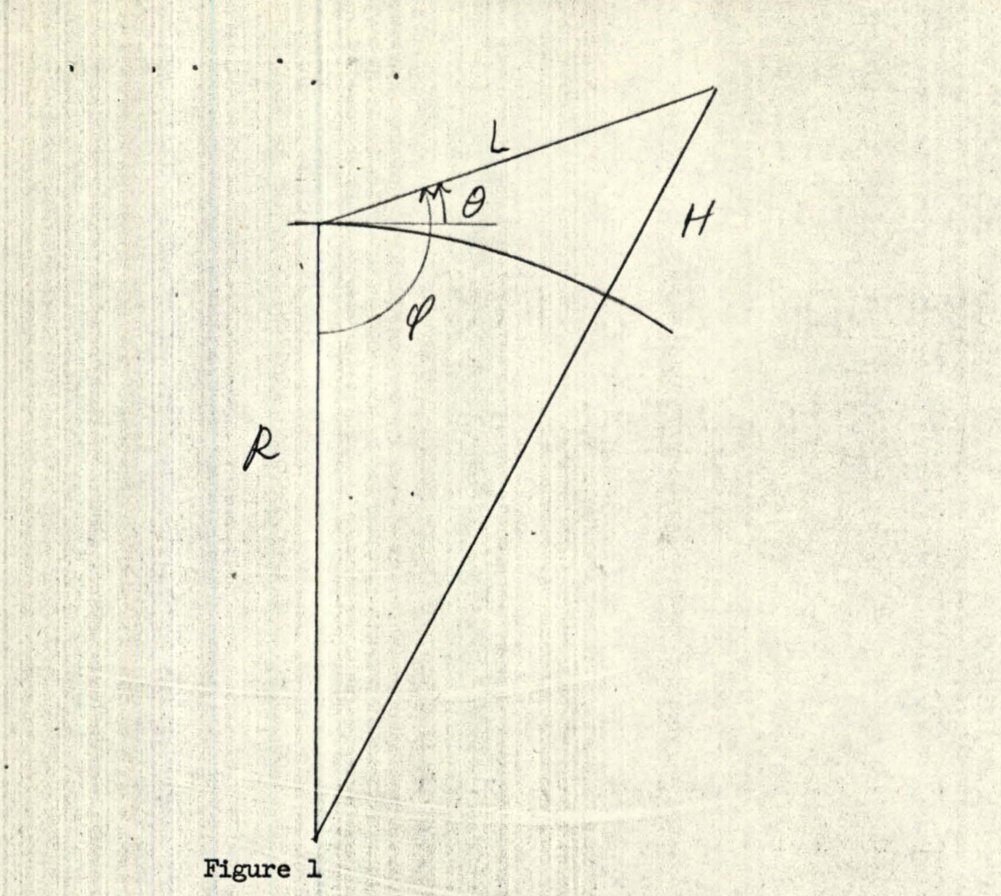
Referring to Figure 1, the height (H) of a point at a distance (L) from a point on the surface of a sphere of radius (R) can be found from the formula
(R+H)^2 = R^2 + L^2 + 2RL sin θ (1)
which has the solution
H = R [ -1 + √(1 + (L/R)^2 + 2(L/R) sin θ) ] (2)View the document record ↗ · Physical page 40, counting the cover.
EXCERPT 11 · PHYSICAL PAGE 41
Physical page 41, in full: figures 1 and 2 of Watt's letter
Figure 1
I
Vertical path (No. 1)
No. 3
No. 2
Figure 2Editorial note: Figure 1 shows the Earth's radius (R), the distance (L) to a point, its height (H) and the angles θ and φ, used in equation 1. Figure 2 shows the curvature of the Earth, a hatched layer in the upper atmosphere and four lines of sight: vertical (no. 1), horizontal from the surface (no. 2), tangent to the base of the layer (no. 3) and through the layer to a point near the surface (no. 4), with the height H1 of the base of the layer. The drawings are by Watt, the author of the letter.
Check the original PDF
[Diagram labeled:] Figure 1 [letters R, L, H, θ, φ]
[Diagram labeled:] Figure 2
Vertical path (No. 1)
No. 3
No. 4 H1
Horizontal path from surface
No. 2View the document record ↗ · Physical page 41, counting the cover.
EXCERPT 12 · PHYSICAL PAGE 42
Physical page 42, in full: Watt's letter (page 2)
LOS ALAMOS SCIENTIFIC LABORATORY
UNIVl:R ITY Of' CAI.IP'ORNIA
LO■ AI.AM0e, Nl:W MUICO
ro: DATE: Ju}¥ 13, 1962
Fox- th, followins I will assume that the concentr.ation ot absorbins mo1ecu1es
in the region of interest can be described adequate}¥ by an exponential decrease
w1th altitude above the bottom, of the layer, hence, can be represented by
where Y is the scale height in the layer and H must lie in the .ia.yer • . Then the
.number of molecules per cm2 is found to be
(4a)
(4b)
• RPo e (4c) J ' I
~ [-1 + V1 + y2 + ·2y sin e ] dy
(5)
where the integral is over the range of y desired (usua.l.ly O ex,).
·For a vertical view (sin 8 • .l) path, the sollltion is simpJ.¥
(6)
where Po is the density at the base of the layer.
LEditorial note: Typewritten letter on letterhead of the Los Alamos Scientific Laboratory, operated by the University of California under contract with the U.S. government. The equations are reproduced in the notation of the original, as running text. In equation 5, the typed letter looks like a capital "Y", but from context it designates the variable y of equations 4c and 7; it was kept as is.
Check the original PDF
TO: -2- DATE: July 13, 1962
For the following I will assume that the concentration of absorbing molecules in the region of interest can be described adequately by an exponential decrease with altitude above the bottom of the layer, hence, can be represented by
ρ = ρo e^(-H/Y) (3)
where Y is the scale height in the layer and H must lie in the layer. Then the number of molecules per cm^2 is found to be
N (molecules/cm^2) = ∫ ρ(H) dl (4a)
N = ρo ∫ e^{-(R/Y)[-1 + √(1 + (L/R)^2 + 2(L/R) sin θ)]} (4b)
= Rρo ∫ e^{-(R/Y)[-1 + √(1 + y^2 + 2y sin θ)]} dy (4c)
(Y ≡ L/R) (5)
where the integral is over the range of y desired (usually 0 → ∞).
For a vertical view (sin θ = 1) path, the solution is simply
N1 = Yρo (6)
where ρo is the density at the base of the layer.View the document record ↗ · Physical page 42, counting the cover.
EXCERPT 13 · PHYSICAL PAGE 43
Physical page 43, in full: Watt's letter (page 3)
LOS ALAMOS SCIENTIFIC LABORATORY
UNIVll:llalTY 0,, CAL.1,,0IINIA
LOe ALAM0e, NIEW MUICO
• 1'0z nr. Jocelyn Gill DATBz July 13, 1962
For a horizontal path (sin 8 • 0) te.nsent to the baae of a layer (path No. 3)
we ·note that y << l in the contributing region, hence, can get an approximate form
l ~r.
~ ex,
Y2 N • RPo •e ccy (7)
O
which has the value
~ N•\J 2 Po (8)
Here Po is the density at the base of the layer, as in eqµation (6). 'I
An astronaut's view thru a layer :from above would see twice the path computed I
by equation (7), ·giving
N3 • Po ✓ 2nRY molecu.les/-cm2 (9)
f •
Aline of sight tangent to the earth and passing thru a layer at base altitude
H (path No . 2) will have
. .1!J.,
N- ~y [pl e y J (10)
..fu.
and we note that [P1. e ~] is the density at H1 , the base of the layer, which we
set eqµal to Po as in equations (6) and (9),
N,a • Po -L RY
• Po • ~ - (11) 2H1.
r-Editorial note: Typewritten letter on letterhead of the Los Alamos Scientific Laboratory, operated by the University of California under contract with the U.S. government. The equations are reproduced in the notation of the original, as running text.
Check the original PDF
TO: Dr. Jocelyn Gill -3- DATE: July 13, 1962
For a horizontal path (sin θ = 0) tangent to the base of a layer (path No. 3) we note that y << 1 in the contributing region, hence, can get an approximate form
N ≅ Rρo ∫0^∞ e^(-(R/Y)(y^2/2)) dy (7)
which has the value
N = √(πRY/2) ρo (8)
Here ρo is the density at the base of the layer, as in equation (6).
An astronaut's view thru a layer from above would see twice the path computed by equation (7), giving
N3 = ρo √(2πRY) molecules/cm^2 (9)
A line of sight tangent to the earth and passing thru a layer at base altitude H (path No. 2) will have
N = (RY/L) [ρ1 e^(-H1/Y)] (10)
and we note that [ρ1 e^(-H1/Y)] is the density at H1, the base of the layer, which we set equal to ρo as in equations (6) and (9),
N2 = ρo (RY/L) = ρo √(R/2H1) (11)View the document record ↗ · Physical page 43, counting the cover.
EXCERPT 14 · PHYSICAL PAGE 44
Physical page 44, in full: Watt's letter (page 4)
LOS ALAMOS SCIENTIFIC LABORATORY
UNIVEllelTY Of' CAl.lf'OIINIA
LOe AI.AM09, NllW MIIXICO
tO: Dr. Jocelyn Gill DATE: July l.3, l.962
Aaeuming that 'Y • 7 km 1n ~ abaorbing layer, ve note that a. surface obaerver
vieving a layer at an altitude near l.00 km vill have availabl.e the ratio
(12)
An astronaut·vieving along path No. 3 woul.d have a mu.ch greater thickness, as
2,rR ; 75
y . (l.3)
Viewing thru the layer to a point ne.ar the surface and out again the enhancement
would be mu.ch less,
(14)
Light received by an observer :from a "point source" in space is attenuated by
-uN •
a factor e where CT 1s the absorption plus scattering cross section, giving
I -aN
-• e (15a) Io
and I •.
1n .!_ • -CTN (15b) IoEditorial note: Typewritten letter on letterhead of the Los Alamos Scientific Laboratory, operated by the University of California under contract with the U.S. government. The equations are reproduced in the notation of the original, as running text. Equation 13 is reproduced as it appears typed in the copy.
Check the original PDF
TO: Dr. Jocelyn Gill -4- DATE: July 13, 1962
Assuming that Y = 7 km in an absorbing layer, we note that a surface observer viewing a layer at an altitude near 100 km will have available the ratio
N2/N1 = 5.5 (12)
An astronaut viewing along path No. 3 would have a much greater thickness, as
N3/N1 = 2πR/Y ≅ 75 (13)
Viewing thru the layer to a point near the surface and out again the enhancement would be much less,
N4/N1 = 2 N2/N1 = 11 (14)
Light received by an observer from a "point source" in space is attenuated by a factor e^(-σN) where σ is the absorption plus scattering cross section, giving
I/Io = e^(-σN) (15a)
and
ln (I/Io) = -σN (15b)View the document record ↗ · Physical page 44, counting the cover.
EXCERPT 15 · PHYSICAL PAGE 45
Physical page 45, in full: Watt's letter (page 5)
LOS ALAMOS SCIENTIFIC LABORATORY
UNIVl:RatTY 01" CALll"ORNIA
L.09 ALAM09, NIIW MUICO
TO: Dr. Jocelyn Gill -5- DATI: July 13, 1962
From the repcrt 1n Science, I infer that for the layer reported,
(16)
or
(17)
giving
aNi • o.o4 ± 0.027 (18)
and
0N2 • 0.22 ± 0.15 (19)
Any such absorbing layer present during the day would result in rapid heating, and
•I
reradiation in the infra-red range from whatever bands may be present. However,
the absorbers postulated below would be destroyed by photodissociation and/or
heating during the day. Hence, it is not surprising that solar spectra have not
shown such an absorbing layer.
StellarJplanetary or lunar spectra might show the existence of such a layer,
if the absorption spectrum has sufficient structure.
Setting (20a)
we find the effective path length Xi.
(20b)
~ • 3.9 x 106 cm (starting absorption at (20c) .100 km altitude)
'Editorial note: Typewritten letter on letterhead of the Los Alamos Scientific Laboratory, operated by the University of California under contract with the U.S. government. The equations are reproduced in the notation of the original, as running text.
Check the original PDF
TO: Dr. Jocelyn Gill -5- DATE: July 13, 1962
From the report in Science, I infer that for the layer reported,
1 < σN3 < 5 (16)
or
σN3 = 3 ± 2 (17)
giving
σN1 = 0.04 ± 0.027 (18)
and
σN2 = 0.22 ± 0.15 (19)
Any such absorbing layer present during the day would result in rapid heating, and reradiation in the infra-red range from whatever bands may be present. However, the absorbers postulated below would be destroyed by photodissociation and/or heating during the day. Hence, it is not surprising that solar spectra have not shown such an absorbing layer.
Stellar, planetary or lunar spectra might show the existence of such a layer, if the absorption spectrum has sufficient structure.
Setting Xi ρo = Ni (20a)
we find the effective path length Xi.
X1 = 7 x 10^5 cm (20b)
X2 = 3.9 x 10^6 cm (starting absorption at 100 km altitude) (20c)View the document record ↗ · Physical page 45, counting the cover.
EXCERPT 16 · PHYSICAL PAGE 46
Physical page 46, in full: Watt's letter (page 6)
LOB ALAMOS SCIENTIFIC LABORATORY
UNIVltRelTV 01" CAL.ll"ORNIA
LOe AL.AM09, NltW MUICO
Dr. Jocelyn Gill DATB a July 13, 1962
(20d)
X4 • 7 .8·x 106 cm (20e)
Absorbers Present in the Upper Atmosphere
'lliree constituents of the atmosphere near 100 km altitude absorb light through
most or •all of,the visible range, as would be re_quired to get a noticeable d1mm1ng
of starlight.
They are: l)
2)
N~
-0
(nitrogen peroxide)
(negative atomic oxygen ion)
v
3) 02 (negative molecular oxygen ion)
Of these, I found no cross section data for o;.· For 0-, Massey (Negative Ions;
Cambridge U. Press) gives curves showing absorption cross sections starting at
• • -l.8 • . •
5620 A and approaching~ 4 x 10 cm2 /ion 1n the region A< 5000 A. 'lb.ere is
•
very little structure (only the onset at 5620 A).
From ecpation (17) we find that
~3 ± 2 l.7 N3(0-) • _ (7.5 ± 5) X 10 18 •
4 X 10
could explain the observed attenuation.
x 1010 For an effective path length of 5.4 x 107 cm, we have Po• (1.4 ± 1)
negative ions/crn.3 •
Since the daytime free electron concentration in the E layer is 1.5 x 10⁵ and
the night vallle is~ 104 it seems-hard to believe such a high nighttime concentration
• of negative atomic ions.Editorial note: Typewritten letter on letterhead of the Los Alamos Scientific Laboratory, operated by the University of California under contract with the U.S. government. The equations are reproduced in the notation of the original, as running text. Å is the symbol for the angstrom (one ten-millionth of a millimeter), a unit of wavelength of light.
Check the original PDF
TO: Dr. Jocelyn Gill -6- DATE: July 13, 1962
X3 = 5.4 x 10^7 cm (20d)
X4 = 7.8 x 10^6 cm (20e)
Absorbers Present in the Upper Atmosphere
Three constituents of the atmosphere near 100 km altitude absorb light through most or all of the visible range, as would be required to get a noticeable dimming of starlight.
They are: 1) NO2 (nitrogen peroxide)
2) O- (negative atomic oxygen ion)
3) O2- (negative molecular oxygen ion)
Of these, I found no cross section data for O2-. For O-, Massey (Negative Ions; Cambridge U. Press) gives curves showing absorption cross sections starting at 5620 Å and approaching ~ 4 x 10^-18 cm^2/ion in the region λ < 5000 Å. There is very little structure (only the onset at 5620 Å).
From equation (17) we find that
N3(O-) ≅ (3 ± 2)/(4 x 10^-18) = (7.5 ± 5) x 10^17
could explain the observed attenuation.
For an effective path length of 5.4 x 10^7 cm, we have ρo = (1.4 ± 1) x 10^10 negative ions/cm^3.
Since the daytime free electron concentration in the E layer is 1.5 x 10^5 and the night value is ~ 10^4 it seems hard to believe such a high nighttime concentration of negative atomic ions.View the document record ↗ · Physical page 46, counting the cover.
EXCERPT 17 · PHYSICAL PAGE 47
Physical page 47, in full: Watt's letter (page 7)
LOS ALAMOS SCIENTIFIC LABORATORY UNIVll:R ITY 01" CALll"ORNIA
L.09 ALAMC>e, NllW Mll:XICO
tO: Dr. Jocelyn Gill July 13, 1962
NitroGen peroxide haa been extensive~ studied and two papers were fou.nd
' ' which gave absorption coefficients in the visible region of the spectrum. Wiley
and Foord (Proceedings of the Royal Society Al35, 174 (1932) give a coefficient
which I convert to
-l.9 2/ er ~l - 3 x 10 cm molecule
depending on the wavelengths selected by their filters (the lower value was for
the range 4900 < ). < 525·0 A) •
Hall and Blacet (J. Chem. Phys. 20, 1745 (1952) give a curve obtained with
' . a Cary spectrophotometer having ~ 5 A resolution. Maxinrum absorption occurs in
the range 3500 < ). < 4500 Aand drops to ~1/2 the peak value at 5000 A. They
give no data for longer wavelengths. I convert their absorption coefficients to
~6 x 10-ia cm2 /molecu.le at 4000 A, and~ 3 x 10-ia cm2 /molecule at 5000 A.
Structure produces changes in cross section of~ 2 x 10-ia cm2 /molecule at wavelengths separated by a· few angstroms.
Ta.king an 'average value of 4 x10-ia cm2 /molecule 1 ·we find
• and using X3 • 5. 4 x 107 cm
Po• (1.4 ± 1) x 1011 molecules/cm3
. •.Editorial note: Typewritten letter on letterhead of the Los Alamos Scientific Laboratory, operated by the University of California under contract with the U.S. government. The equations are reproduced in the notation of the original, as running text.
Check the original PDF
TO: Dr. Jocelyn Gill -7- DATE: July 13, 1962
Nitrogen peroxide has been extensively studied and two papers were found which gave absorption coefficients in the visible region of the spectrum. Wiley and Foord (Proceedings of the Royal Society A135, 174 (1932) give a coefficient which I convert to
σ ~ 1 - 3 x 10^-19 cm^2/molecule
depending on the wavelengths selected by their filters (the lower value was for the range 4900 < λ < 5250 Å).
Hall and Blacet (J. Chem. Phys. 20, 1745 (1952) give a curve obtained with a Cary spectrophotometer having ~ 5 Å resolution. Maximum absorption occurs in the range 3500 < λ < 4500 Å and drops to ~ 1/2 the peak value at 5000 Å. They give no data for longer wavelengths. I convert their absorption coefficients to ~ 6 x 10^-19 cm^2/molecule at 4000 Å, and ~ 3 x 10^-19 cm^2/molecule at 5000 Å. Structure produces changes in cross section of ~ 2 x 10^-19 cm^2/molecule at wavelengths separated by a few angstroms.
Taking an average value of 4 x 10^-19 cm^2/molecule, we find
N3(NO2) = (3 ± 2)/(4 x 10^-19) = (7.5 ± 5) x 10^18 molecules/cm^2
and using X3 = 5.4 x 10^7 cm
ρo = (1.4 ± 1) x 10^11 molecules/cm^3View the document record ↗ · Physical page 47, counting the cover.
EXCERPT 18 · PHYSICAL PAGE 48
Physical page 48, in full: Watt's letter (page 8)
LOS ALAMOS SCIENTIFIC LABORATORY
UNIVIEll81TY OP' CALIP'OIINIA
LOIi ALAM09, NIEW MUICO
TO: Dr. Jocelyn Gill DATE: July 13, 1962
Readily detectable structure would produce ve.r1e.t1ons of o-N1 and aNa ot
about half the attenuation figure given in equations (18) and (19) which is
near the threshold of detectability.
I have not yet found an author who estimates the concentration of Ne or
N02 'in the atmosphere; Bates and Nicolet discuss the reactions which lead to it
in the book "'lhe Earth as a Planet", edited by G. P. Kuiper (Volume II of
The Solar System).
Nicolet calculates the photodissociation time as 200 seconds during daytime,
and shows the concentration must be so low that no effect on solar observations
would be found.
As a general conclusion, it seems to me more likely that N02 would be
responsible for an absorbing layer, generated perhaps with the aid of downward
diffusion of NO to higher pressure regions favoring oxidation to N~. 'lhe
color suggested by Glenn fits very well', as may be quickly verified by looking
thru. the vapor space above concentrated nitric acid.
Experimental Proposal.
Ideally, one could ask for the absorption coefficient as a function of wavelength (over a very wide spectral range) and time after sunset on the air volume
investigated.
It seems possible to get very useful data with a relatively simple experiment
perhaps possible of inclusion in one of the manned orbital flights.
Using a slow-speed movie camera, photograph the star field and such planets
(including the moon) as opportunity permits, with approximately a 10° field of
view and enough exposure to pennit photometric measurements as the light sourcesEditorial note: Typewritten letter on letterhead of the Los Alamos Scientific Laboratory, operated by the University of California under contract with the U.S. government. The equations are reproduced in the notation of the original, as running text. The conclusion paragraph had already been translated on the site; its wording was kept.
Check the original PDF
TO: Dr. Jocelyn Gill -8- DATE: July 13, 1962
Readily detectable structure would produce variations of σN1 and σN2 of about half the attenuation figure given in equations (18) and (19) which is near the threshold of detectability.
I have not yet found an author who estimates the concentration of NO or NO2 in the atmosphere; Bates and Nicolet discuss the reactions which lead to it in the book "The Earth as a Planet", edited by G. P. Kuiper (Volume II of The Solar System).
Nicolet calculates the photodissociation time as 200 seconds during daytime, and shows the concentration must be so low that no effect on solar observations would be found.
As a general conclusion, it seems to me more likely that NO2 would be responsible for an absorbing layer, generated perhaps with the aid of downward diffusion of NO to higher pressure regions favoring oxidation to NO2. The color suggested by Glenn fits very well, as may be quickly verified by looking thru the vapor space above concentrated nitric acid.
Experimental Proposal.
Ideally, one could ask for the absorption coefficient as a function of wavelength (over a very wide spectral range) and time after sunset on the air volume investigated.
It seems possible to get very useful data with a relatively simple experiment perhaps possible of inclusion in one of the manned orbital flights.
Using a slow-speed movie camera, photograph the star field and such planets (including the moon) as opportunity permits, with approximately a 10° field of view and enough exposure to permit photometric measurements as the light sourcesView the document record ↗ · Physical page 48, counting the cover.
EXCERPT 19 · PHYSICAL PAGE 49
Physical page 49, in full: Watt's letter (page 9)
LOS ALAMOS SCIENTIFIC LABORATORY
UNIVERSITY OP' CALIP'ORNIA . . . ' . . L.09 ALAM09, Nl:W MUICO
1'0: Dr. Jocelyn Gill DATE: July 13, 1962
"pasa through" the atmoaphere, especially the abaorbill6 layer (perhap auch
• ••• sequences already exif:>t). At the expected orbital height, I estimate a 7 km
thick layer w~ld subtend,.., 1/2 degree and a given light source would "pass
through" it in eight seconds. Attempts to derive a density distribution would
requ.ire a fair number of points in the 111-1/2 or 2 degrees" (divide by 3 ?)
so a frame interval near one per second _seems desirable. If operated continuously
thru the ni.ght passage approximately 100 feet of 16 mm film would be required
per passage •
As a crude attempt at spectroscopy, color filters could be used on some of
✓ the sequences, without too serious light loss. For example, a Corning No. 5030
or No. 5543 filter would limit exposure to the wavelength range of maximum
absorption by N02 (light loss may be considerable) ·and a Corning No. 3480 filter
would limit exposure to the wavelength range where 0- absorption is negligible.
Relatively broad band interference filters would be useable on the brighter
stars and planets. Direct visual observation through such filters would also be
useful, especially if photography is impractical and the astronaut tries to
reproduce any attenuation noted by neutral density filters in combination with
the same filters and stars used in space.
Photometric observations of some of the "intense" airglows mentioned by
various authors would also be very instructive • The increased intensity due to
J
external tangential viewing woul~ help a great deal, and precise height de .
terminations could be made •
It may be useful to ask Glenn and Carpenter to reproduce the dimming (as well
' / as memory allows) by narrow strips of neutral density filters against the star
1 • I 1Editorial note: Typewritten letter on letterhead of the Los Alamos Scientific Laboratory, operated by the University of California under contract with the U.S. government. The equations are reproduced in the notation of the original, as running text. There are check marks in pencil in the left margin. 100 feet is about 30 meters of film.
Check the original PDF
TO: Dr. Jocelyn Gill -9- DATE: July 13, 1962
"pass through" the atmosphere, especially the absorbing layer (perhaps such sequences already exist). At the expected orbital height, I estimate a 7 km thick layer would subtend ~ 1/2 degree and a given light source would "pass through" it in eight seconds. Attempts to derive a density distribution would require a fair number of points in the "1-1/2 or 2 degrees" (divide by 3 ?) so a frame interval near one per second seems desirable. If operated continuously thru the night passage approximately 100 feet of 16 mm film would be required per passage.
As a crude attempt at spectroscopy, color filters could be used on some of the sequences, without too serious light loss. For example, a Corning No. 5030 or No. 5543 filter would limit exposure to the wavelength range of maximum absorption by NO2 (light loss may be considerable) and a Corning No. 3480 filter would limit exposure to the wavelength range where O- absorption is negligible.
Relatively broad band interference filters would be useable on the brighter stars and planets. Direct visual observation through such filters would also be useful, especially if photography is impractical and the astronaut tries to reproduce any attenuation noted by neutral density filters in combination with the same filters and stars used in space.
Photometric observations of some of the "intense" airglows mentioned by various authors would also be very instructive. The increased intensity due to external tangential viewing would help a great deal, and precise height determinations could be made.
It may be useful to ask Glenn and Carpenter to reproduce the dimming (as well as memory allows) by narrow strips of neutral density filters against the starView the document record ↗ · Physical page 49, counting the cover.
EXCERPT 20 · PHYSICAL PAGE 50
Physical page 50, in full: Watt's letter (page 10), acknowledgments and signature
LOS ALAMOS SCIENTIFIC LABORATORY . ' .. UNIVERSITY OP' CALll"ORNIA
. . l.09 ALAMO., NIEW MUICO
TO: Dr. Jocelyn Gill -
10
- DATI: July 13, 1962
field they saw, or to compare the intensity and color changes noted with that
thru an absorbing cell containing N02 • • 'Ihe required thickness is readily availabl.e.
Acknowledgments
The author has benefited greatly from discussions with several associates,
especially as regards references to sources of upper atmospheric .and photochemical
data.
Dr. Robert Sherman has assisted in location of data on the absorption cross
section of N02 • Dr. Arthur Cox suggested a number of references and confirmed the
author's belief that reasonably accurate photometric observations could be made on
photographs of a star field. Dr. Ieston Miller has emphasized the importance of
even crude control of the wavelengths responsible for exposure. All of the men
mentioned·above are members of the Los Alamos Scientific Iaboratory.
Dr. J. A. 0'Keefe of the Theoretical Division of the Goddard Space Flight Center
generously discussed the observations of J. Glenn and S. Carpenter, and my hypothesis regarding N02 absorption. He has referred me to the excellent articl.es in
"'Ille F.a.rth as a Planet" and encouraged my submission of this letter.
Future Work
I would, of course, be interested in your opinion, and that of other experts in
the field, of the above hypothesis. If your group recommends inclusion of such
J observations on a future flight, we may be ·able to help on some points in data
acquisition. I am sure the project would deserve review and .control by a panel
--- of men such as Bates and Nicolet. ..........
Respectfully submitted,
~y--~
BOB E. WATI'
BEW:jo Assoc. J-Div. Ldr.
Distributi and Grp • .Ldr. J-16 on:
l - Dr. Jocelyn Gill. .I
'Editorial note: Typewritten letter on letterhead of the Los Alamos Scientific Laboratory, operated by the University of California under contract with the U.S. government. The equations are reproduced in the notation of the original, as running text. The last line of the distribution list is cut off at the edge of the page. The Los Alamos J Division handled field tests; the page shows only the abbreviation.
Check the original PDF
TO: Dr. Jocelyn Gill 10 DATE: July 13, 1962
field they saw, or to compare the intensity and color changes noted with that thru an absorbing cell containing NO2. The required thickness is readily available.
Acknowledgments
The author has benefited greatly from discussions with several associates, especially as regards references to sources of upper atmospheric and photochemical data.
Dr. Robert Sherman has assisted in location of data on the absorption cross section of NO2. Dr. Arthur Cox suggested a number of references and confirmed the author's belief that reasonably accurate photometric observations could be made on photographs of a star field. Dr. Leston Miller has emphasized the importance of even crude control of the wavelengths responsible for exposure. All of the men mentioned above are members of the Los Alamos Scientific Laboratory.
Dr. J. A. O'Keefe of the Theoretical Division of the Goddard Space Flight Center generously discussed the observations of J. Glenn and S. Carpenter, and my hypothesis regarding NO2 absorption. He has referred me to the excellent articles in "The Earth as a Planet" and encouraged my submission of this letter.
Future Work
I would, of course, be interested in your opinion, and that of other experts in the field, of the above hypothesis. If your group recommends inclusion of such observations on a future flight, we may be able to help on some points in data acquisition. I am sure the project would deserve review and control by a panel of men such as Bates and Nicolet.
Respectfully submitted,
[signature] Bob Watt
BOB E. WATT
Assoc. J-Div. Ldr. and Grp. Ldr. J-16
BEW:jo
Distribution:
1 - Dr. Jocelyn Gill
1 - Dr. J. A. O'KeefeView the document record ↗ · Physical page 50, counting the cover.
EXCERPT 21 · PHYSICAL PAGE 206
Physical page 206, in full: handwritten notes on Glenn's interview (dark adaptation, sunset and haze layer)
- d"q,.c,.:)-
~4~ 0- ...:,u,,/oeQ '30-0 =-
=- >-<AM -... I J..- (, <-.,. ~ - e,,v, t,,,A...d { o ol,, .. .J. ._f _
_R I- l,;:I e l .._ .1-,_ lL, ,...+, ,,...r;.. t; £..r'1- - , t...4 ,..• t..r w,
~ {,eu,,/ ---~ "-tl,.._,,,17tt:A..t - '-n-~ ~o .,,,. ,.f::/ -
/d...., - i~... ~ ... y_1,. .., - .,. -1 It'
5.-....,1 -.....~ j•- ~7 .,c;,.,... ,._. - ~,, ✓-, .,t.
- -- __,, - ~ ,t..., J -4t.~ -
-~ ~e4- ,,,1.. d_.._ _ ;e- - t,..1 # -
- J .,.,.1- h /4 ,po 4-~ J-t. t...-..J .-.)
- ~qt.~ ia~c•c:k
~ li.,.f'/-'·-c - ~P',,
=;,= ,;. •t,« . ../. , II ,..t - .' 7 JI.,...,/-
- ~ ~5(0_, L - J -
//ro ....<d -4.h. Aftk,7/ - d.:.,-J...,.. ,~ - ""' d.,,,o/1~ ----~ - f"•'•'f .,.,,di-, ,.i...,.__(J, ,,..,;A'-
? . I<' ?" - I,_ ,t,_,f_ ? q. 14-- ~r; .,.,...Editorial note: Handwritten pen notes, undated and unsigned, kept at the end of the file; they summarize Glenn's answers in the interview of 27/02/1962. Uncertain readings are marked with (?); the two names at the bottom of the sheet are of doubtful reading. "Buff" was translated as yellowish white.
Check the original PDF
- Glenn - draw - ~ 26° (?) - window 30°
- 10 - 15 min normal dark adaptation
? 27% window cut down
- daytime stars - > min adaptation
= Sun not too blinding - could look at it - Very clear brilliant white light ~ like arc lights
Sunset
- broad band in atmosphere - 45 to 60° each side - yellow - orange - blue - black -
[sketch of an arc] - sun joins long sliver - at sunset
[boxed: 4 or 5 min] - never saw - zodiacal lights - - solar corona.
- Haze layer -
star dims - then - brightens -
band - 6 to 8° above the horizon
- about 2° wide
~ about buff white - beige
1/4°/sec - drift rate - ? spitting thrusters
~ no airglow band -
!could see lightning!
- discontinuities - in twilight arch - probably weather build up
? - 15° up - green band - ? ∡ of sun - ~ lens
Mr. Whitlow(?) Woolfert(?)View the document record ↗ · Physical page 206, counting the cover.
EXCERPT 22 · PHYSICAL PAGE 11
full page
19
identified by the previous shot. I think maybe this one Mercury. Lee whan
cheek the chart on it.
See any stars ?
Zo@ieal light. Wo. Soler Corona. Mo. I was not well enough adapted
patterns along that line.
Shadow of earth of sky?
Ho.
To photograph the Orion region, it looked about the same as it dees from
the grouné. ‘This area in the center of the Orion that I was trying to use
as & target area, the center stex in the belt--we got several pictures of
thet. These were taken with different drift rates on the capsule. We tried
to press the capsule on manual control and get it right on very accurately
and ia then use the camera but there was still some drift in the capsule at
thet tine and I had to keep for it. This is not a stable a
platform as you would like for this type photogrephy. Made exposures of sbout
15 to 18 seconds. I was counting off the seconds ayself without explosion.
Thate about it. I been interested though to see whether those came out.
I did see some prints and I don't know enough shout evaluating those prints
te know what we got.
(Question inaudible)
Well, we discussed this during debriefing some, I think ve must have had
cic Mnbied Cieciaiahsi thats saieats cutting off absolutely clean, that would
aga just e bair of thrust in one axis or another at a time because I would
have the rates zero-ed completely and be sitting right on the spot-rethEditorial note: Draft of Glenn's debriefing (MA-6), page 10 of the transcript: absence of zodiacal light and solar corona, and the photos of Orion taken with the capsule drifting. No sighting of an unidentified object.
Check the original PDF
19
identified by the previous shot. I think maybe this one Mercury. Lee whan
cheek the chart on it.
See any stars ?
Zo@ieal light. Wo. Soler Corona. Mo. I was not well enough adapted
patterns along that line.
Shadow of earth of sky?
Ho.
To photograph the Orion region, it looked about the same as it dees from
the grouné. ‘This area in the center of the Orion that I was trying to use
as & target area, the center stex in the belt--we got several pictures of
thet. These were taken with different drift rates on the capsule. We tried
to press the capsule on manual control and get it right on very accurately
and ia then use the camera but there was still some drift in the capsule at
thet tine and I had to keep for it. This is not a stable a
platform as you would like for this type photogrephy. Made exposures of sbout
15 to 18 seconds. I was counting off the seconds ayself without explosion.
Thate about it. I been interested though to see whether those came out.
I did see some prints and I don't know enough shout evaluating those prints
te know what we got.
(Question inaudible)
Well, we discussed this during debriefing some, I think ve must have had
cic Mnbied Cieciaiahsi thats saieats cutting off absolutely clean, that would
aga just e bair of thrust in one axis or another at a time because I would
have the rates zero-ed completely and be sitting right on the spot-rethView the document record ↗ · Physical page 11, counting the cover.
EXCERPT 23 · PHYSICAL PAGE 12
full page
i
rate
of magno control inputs and you'd skart a little drift Meum very slow.
Probably the Grift rates went out over a quarter of a degree per second
during the time that I was trying to make the pictures. But. thats enough
if you drift off ana you have to correct back the Line you drift off a line
correct back lime, you do this for 15 or 20 seconds, its rather ea crude way
to take pictures.
fQuestion inaugibie)
Yes. Hand held and hed it up against the visor to steadiness and turn
it very slowly. We had the loose site on the topé of it. A loose site with
®& cross hair and so that I could keep that right on the-«lLined up on the stars.
It will be interesting to see if we came out with anything on that.
Make any other comments about our
No. Et looks about like it does on the desert on @ bright summerf night.
H Twilight. Did the twilight bother you at ail? Can you tell us anything
bout that.
You mean the light I described as after sunset?
(Statement by Dr. Roman, Inaudible)
The only time twilight bothered either way was when you
because sunrise is the--the early pickup sumrise caning up is in the scope
facing backwards, of course, to the direction of motion and you see the sun
come up and this would-~-thisiSixii@m twilight, you watch it incresing in the
Scope, meanwhile we're holdéing immmal control most of the time and this was very
Gifficult. For some reasons, this was more difficult to hold accurate control
on the periscope at sumrise that it was to Look back out the window and holdEditorial note: Draft of Glenn's debriefing (MA-6), page 11 of the transcript: capsule drift during the photos, improvised sighting, and difficulty of control in the twilight of sunrise.
Check the original PDF
i
rate
of magno control inputs and you'd skart a little drift Meum very slow.
Probably the Grift rates went out over a quarter of a degree per second
during the time that I was trying to make the pictures. But. thats enough
if you drift off ana you have to correct back the Line you drift off a line
correct back lime, you do this for 15 or 20 seconds, its rather ea crude way
to take pictures.
fQuestion inaugibie)
Yes. Hand held and hed it up against the visor to steadiness and turn
it very slowly. We had the loose site on the topé of it. A loose site with
®& cross hair and so that I could keep that right on the-«lLined up on the stars.
It will be interesting to see if we came out with anything on that.
Make any other comments about our
No. Et looks about like it does on the desert on @ bright summerf night.
H Twilight. Did the twilight bother you at ail? Can you tell us anything
bout that.
You mean the light I described as after sunset?
(Statement by Dr. Roman, Inaudible)
The only time twilight bothered either way was when you
because sunrise is the--the early pickup sumrise caning up is in the scope
facing backwards, of course, to the direction of motion and you see the sun
come up and this would-~-thisiSixii@m twilight, you watch it incresing in the
Scope, meanwhile we're holdéing immmal control most of the time and this was very
Gifficult. For some reasons, this was more difficult to hold accurate control
on the periscope at sumrise that it was to Look back out the window and holdView the document record ↗ · Physical page 12, counting the cover.
EXCERPT 24 · PHYSICAL PAGE 18
full page
i7
You notice any--very maryclouds or any peculiar cloud formation?
Yes. We got quite a mmber of cloud wish pictures and you can pick
out the relative types of clouds. We did wonder whether you could tell
vertical clouds from SER-06 clouds. ‘You can tell what clouds are vertical
development and you get a three dimensional effect. Looking et them you
can tell that some are higher than others.
Detained ahs dan: thiblk wah ils thei inihla ial, 20 ns inating
particular noteworthy that you might have seen that the pictures might not
show?
I don't think so other than the things we have mentioned here.
(Question, inaudible)
is vhat Now?
Does your window produce any pamm polorization?
We have a real limited degree of polorization in the window.
How many @o you have in EB formt
I will make a note om that one and check the exact polorization of it.
We had--thie was checked at the time that we ran sone star studies in
i. heute a Stele Nee wai Gk
The reason I asked
The exact figure on that I can't give you.
Did you pass over any snow propagations, mountains ?
No. I could see out in the West looking way up North from the area right
over--well the South of San Diego at the end of the second orbit. There was
so such cloud cover up to the North that I couldn't be real pmaikix positive.Editorial note: Draft of Glenn's debriefing (MA-6), page 17 of the transcript: clouds photographed, window polarization, and the cloud cover seen south of San Diego.
Check the original PDF
i7
You notice any--very maryclouds or any peculiar cloud formation?
Yes. We got quite a mmber of cloud wish pictures and you can pick
out the relative types of clouds. We did wonder whether you could tell
vertical clouds from SER-06 clouds. ‘You can tell what clouds are vertical
development and you get a three dimensional effect. Looking et them you
can tell that some are higher than others.
Detained ahs dan: thiblk wah ils thei inihla ial, 20 ns inating
particular noteworthy that you might have seen that the pictures might not
show?
I don't think so other than the things we have mentioned here.
(Question, inaudible)
is vhat Now?
Does your window produce any pamm polorization?
We have a real limited degree of polorization in the window.
How many @o you have in EB formt
I will make a note om that one and check the exact polorization of it.
We had--thie was checked at the time that we ran sone star studies in
i. heute a Stele Nee wai Gk
The reason I asked
The exact figure on that I can't give you.
Did you pass over any snow propagations, mountains ?
No. I could see out in the West looking way up North from the area right
over--well the South of San Diego at the end of the second orbit. There was
so such cloud cover up to the North that I couldn't be real pmaikix positive.View the document record ↗ · Physical page 18, counting the cover.
EXCERPT 25 · PHYSICAL PAGE 19
full page
18
Tt ram up and locked like it ren off the edge of a « Then there
were some white areas way up to the North and I imagine these were probably
snow fields. I thought at the time they probably were but I couldn't be
sure. I didn't specifically go over any erea where I could look right dow
at this cloud end thet snow. I was surprised at my--and another thing, #s
fax as the weather goes, and that is whet e tremendous area of the earth
oe Givttied ty dlcuhe. tab toys E don't know whether we're going to find
that this is customary not. Bat I was surprised. I had very little view
of lend. ogo agen
Yea. The intertropical » We bad been briefed on that
and, of course, thet tock care of things all the way across the Pacific.
There was cloud cover ell the way across there. There was cloud cover over
all Eastern Africa. I never saw the Leke Chad area that I was looking for.
it wes covered. The only part of Africa we really got # good lock at was
Western Africa in the desert regions. You could see the big = dust met storms
blowing and these were very visible. I commented on it and Kenya came back
ané seid yes that they hed been having these dust storms for about a week.
Tremendous blowing clouds of dust that obscured large--very large areas of
the ground. Coming ecross the states end, this whole area across WI-HAS
and Northern Mexico, Southern California and that erea bad very lerge cloud
deehs ond high WAS sets dienined chante Seen wove, Ties were
some breeke in it and you could see through momentarily.
What color were the dust clonds?
They just looked like dust. SBrownish. SMM Just looked Like « dust storm
you've seen out on the a desert. Geme color. ‘The colors from shove locked--Editorial note: Draft of Glenn's debriefing (MA-6), page 18 of the transcript: cloud cover over the Pacific and Africa, dust storms in West Africa and the color of the dust seen from above.
Check the original PDF
18
Tt ram up and locked like it ren off the edge of a « Then there
were some white areas way up to the North and I imagine these were probably
snow fields. I thought at the time they probably were but I couldn't be
sure. I didn't specifically go over any erea where I could look right dow
at this cloud end thet snow. I was surprised at my--and another thing, #s
fax as the weather goes, and that is whet e tremendous area of the earth
oe Givttied ty dlcuhe. tab toys E don't know whether we're going to find
that this is customary not. Bat I was surprised. I had very little view
of lend. ogo agen
Yea. The intertropical » We bad been briefed on that
and, of course, thet tock care of things all the way across the Pacific.
There was cloud cover ell the way across there. There was cloud cover over
all Eastern Africa. I never saw the Leke Chad area that I was looking for.
it wes covered. The only part of Africa we really got # good lock at was
Western Africa in the desert regions. You could see the big = dust met storms
blowing and these were very visible. I commented on it and Kenya came back
ané seid yes that they hed been having these dust storms for about a week.
Tremendous blowing clouds of dust that obscured large--very large areas of
the ground. Coming ecross the states end, this whole area across WI-HAS
and Northern Mexico, Southern California and that erea bad very lerge cloud
deehs ond high WAS sets dienined chante Seen wove, Ties were
some breeke in it and you could see through momentarily.
What color were the dust clonds?
They just looked like dust. SBrownish. SMM Just looked Like « dust storm
you've seen out on the a desert. Geme color. ‘The colors from shove locked--View the document record ↗ · Physical page 19, counting the cover.
EXCERPT 26 · PHYSICAL PAGE 2
full page
soesess & Little bit, my skin waswt and it didn't stick the way it had stuck
when we tried it out in the trainer and in the cepsule on the pad and I finally
gave up on it and just kept one eye shut. ‘This is marginally satisfactory, I
| guess, but I was not well nighted after coming up to the first night. There's
| @ redundancy here but you sure do have the right information or cases so 8
few of these will be repeats. Mow lets start out with the conditions of
dark adaptation.
Well, most of these things that we had planned to lock into if we could
on Astronomy sort of vent by the board gil I apologize to the people at the
Cape that wo €idu"s got ape more (done Vikas ve hed planned to és’tut as I
think most of you are avare, at the end of the first orbit we start, having
some difficulty with control system, 9ha {from then on it was pretty much systems
monitoring with some locking around outside and that was it. So a lot of the
things thet ve had planed to do 458 @ lot of the things I had hoped to bring
pout as
back just hed to go down the drain, ‘out becoming night atayted-tne first
time around I did get the eye patch out that we had gndjthis was not « very
satisfactory eye pateh. I was going to try to use it over one eye so that
aii sais amiekia: I was sweating a little bit, my skin wae wet, it didn't
stick the way it had stuck when we tried it out in the treiner and in the
capsule on the pad, sia I finally gave up on it and just kept one eye simt.
This is marginally setisfactary I guess but I was not well night adapted
coming up to the first night. What it boils dowm to is that my dark adaptation
vas just @ result of the sun going down and mms normal dark adaptation fron
being on red light and dim light,which tekes some 10 to 15 minutes to get anyEditorial note: Draft transcript of the scientific debriefing of John Glenn (flight MA-6, Friendship 7), with handwritten corrections: Glenn explains why he could not adapt well to the dark during the first orbital night.
Check the original PDF
soesess & Little bit, my skin waswt and it didn't stick the way it had stuck
when we tried it out in the trainer and in the cepsule on the pad and I finally
gave up on it and just kept one eye shut. ‘This is marginally satisfactory, I
| guess, but I was not well nighted after coming up to the first night. There's
| @ redundancy here but you sure do have the right information or cases so 8
few of these will be repeats. Mow lets start out with the conditions of
dark adaptation.
Well, most of these things that we had planned to lock into if we could
on Astronomy sort of vent by the board gil I apologize to the people at the
Cape that wo €idu"s got ape more (done Vikas ve hed planned to és’tut as I
think most of you are avare, at the end of the first orbit we start, having
some difficulty with control system, 9ha {from then on it was pretty much systems
monitoring with some locking around outside and that was it. So a lot of the
things thet ve had planed to do 458 @ lot of the things I had hoped to bring
pout as
back just hed to go down the drain, ‘out becoming night atayted-tne first
time around I did get the eye patch out that we had gndjthis was not « very
satisfactory eye pateh. I was going to try to use it over one eye so that
aii sais amiekia: I was sweating a little bit, my skin wae wet, it didn't
stick the way it had stuck when we tried it out in the treiner and in the
capsule on the pad, sia I finally gave up on it and just kept one eye simt.
This is marginally setisfactary I guess but I was not well night adapted
coming up to the first night. What it boils dowm to is that my dark adaptation
vas just @ result of the sun going down and mms normal dark adaptation fron
being on red light and dim light,which tekes some 10 to 15 minutes to get anyView the document record ↗ · Physical page 2, counting the cover.
EXCERPT 27 · PHYSICAL PAGE 3
full page
5 j
sis Xedih ques tein: nlbadiiinllia ail al gi a
when I'@ be well night adapted at the end of the period, This is some Bil 37
mimates later when you're approaching sunrise so you'd have @ -- I suppose
Slash ‘nie A pUOAd: shia Veula paliiuiiility deems sidan ak done @ half
hour, 33 minutes, something of that order.
Did you have on opportunity to count the stars?
Mo, this ts one of those things that went dow the drain. I thought
about this on a subsequent orbit but I didn't spend any time on it. I feel
that my vision, the mumbers of stars I could see was not appreciably increased.
How, I had expected to see a lot more stars. I hed thought they'd really =
dump out once you got above the atmosphere but I-~like it was in debriefing - - -
x cate Ge tbe eng, aon os'ikes ivlen cic ied sas Ea nae wil on
air is very clear and éry, px You know what it is like out around Reno and
sone of those places; how the sky really conte out oid night and you can/see
& million stars. aff thats what it locked like. It didn't look like eny more
than that.
This was a general impression but not anything you can put yme@ your
finger on?
Thats right.
You had planned at the end of the second and third orbits--during the
second ané third orbits to run the star counts an@ ve had the areas Lined up
MCO-RI-AN, CAS“I-0-PIA, and vhet was the other one--it was off a little
triangle area by SERIOUS off 0-RI-AN. We had those three areas lined up and
it was just--I was doing systems monitoring at that time rather than countingEditorial note: Draft of John Glenn's debriefing (MA-6), page 2 of the transcript: star count and general impression of sky visibility in orbit.
Check the original PDF
5 j
sis Xedih ques tein: nlbadiiinllia ail al gi a
when I'@ be well night adapted at the end of the period, This is some Bil 37
mimates later when you're approaching sunrise so you'd have @ -- I suppose
Slash ‘nie A pUOAd: shia Veula paliiuiiility deems sidan ak done @ half
hour, 33 minutes, something of that order.
Did you have on opportunity to count the stars?
Mo, this ts one of those things that went dow the drain. I thought
about this on a subsequent orbit but I didn't spend any time on it. I feel
that my vision, the mumbers of stars I could see was not appreciably increased.
How, I had expected to see a lot more stars. I hed thought they'd really =
dump out once you got above the atmosphere but I-~like it was in debriefing - - -
x cate Ge tbe eng, aon os'ikes ivlen cic ied sas Ea nae wil on
air is very clear and éry, px You know what it is like out around Reno and
sone of those places; how the sky really conte out oid night and you can/see
& million stars. aff thats what it locked like. It didn't look like eny more
than that.
This was a general impression but not anything you can put yme@ your
finger on?
Thats right.
You had planned at the end of the second and third orbits--during the
second ané third orbits to run the star counts an@ ve had the areas Lined up
MCO-RI-AN, CAS“I-0-PIA, and vhet was the other one--it was off a little
triangle area by SERIOUS off 0-RI-AN. We had those three areas lined up and
it was just--I was doing systems monitoring at that time rather than countingView the document record ↗ · Physical page 3, counting the cover.
EXCERPT 28 · PHYSICAL PAGE 4
full page
3
stera. But a general impression of locking cut at these areas was that the
mmbers of etars I could see vas not greatly increased.
You mention the tranamission through the glasa be comparable ... to the
atmosphere. faat'’s something you people can check.”
That's right.
“ esbenati, through their studies of the window haf felt that we probably
would not see too many more stars beesuse the trenmmission of light through
the window is cut down by 27 per cont or something like that. The figure
thet they came up with was almost identical to what people have computed the
atmospheric attenuation of light is. So they felt that when we got above the
atmosphere it would probably be about the same Looking through the window as
it is locking through the ataosphere here, and I think they were just about
right. It locked to be about the seme to nef.
I think 1t might be wise for you to read the next 3 or 4 paragraphs.
I think @ lot of these are going to be real quick enewers, so why don't »
you get to it.
Did you see Magellanic Clouds? No. Andromeda Nebule? Ho. How much
Ti Tremendously. We hed moon oute-almost full moon. ‘You can look at this
tain wee, US 20 'can 6 eettnld Cnthetans be th en's teenies
adventage. i prefer to think it was em adventage because it did provide a
visual capebility on the clouds--on the dark side which was sufficient that
5 ecukd Une £2 See-0 MUR betidenin Mien 46 aight hive bem Quevtenne
whether I could do that otherwise.Editorial note: Draft of Glenn's debriefing (MA-6), page 3 of the transcript: the capsule window reduces the light, and Glenn assesses the effect of moonlight on observing the dark side of the Earth.
Check the original PDF
3
stera. But a general impression of locking cut at these areas was that the
mmbers of etars I could see vas not greatly increased.
You mention the tranamission through the glasa be comparable ... to the
atmosphere. faat'’s something you people can check.”
That's right.
“ esbenati, through their studies of the window haf felt that we probably
would not see too many more stars beesuse the trenmmission of light through
the window is cut down by 27 per cont or something like that. The figure
thet they came up with was almost identical to what people have computed the
atmospheric attenuation of light is. So they felt that when we got above the
atmosphere it would probably be about the same Looking through the window as
it is locking through the ataosphere here, and I think they were just about
right. It locked to be about the seme to nef.
I think 1t might be wise for you to read the next 3 or 4 paragraphs.
I think @ lot of these are going to be real quick enewers, so why don't »
you get to it.
Did you see Magellanic Clouds? No. Andromeda Nebule? Ho. How much
Ti Tremendously. We hed moon oute-almost full moon. ‘You can look at this
tain wee, US 20 'can 6 eettnld Cnthetans be th en's teenies
adventage. i prefer to think it was em adventage because it did provide a
visual capebility on the clouds--on the dark side which was sufficient that
5 ecukd Une £2 See-0 MUR betidenin Mien 46 aight hive bem Quevtenne
whether I could do that otherwise.View the document record ↗ · Physical page 4, counting the cover.
EXCERPT 29 · PHYSICAL PAGE 5
full page
➔
Vu W.. t.Mrtid. or
=--~--===L-...::::actnaU7 .Dll":l.,IID1~
•
Oil
----. I' ~to
itlllN tMt 11U a ..tataala .
~ •tat-it
~etanI
rtson, tbe
&'tall. C
11.gbt.
tll&t ,,
C
COIie
t I
bo
•
•
at
boti.
,tbeil l ltlQ'ecl 1n
1
j( tbe
~ ont.bento • Dee'Editorial note: Draft of Glenn's debriefing (MA-6), page 4 of the transcript: effect of moonlight on the window and the sky, and visibility of stars during the day.
Check the original PDF
➔
Vu W.. t.Mrtid. or
=--~--===L-...::::actnaU7 .Dll":l.,IID1~
•
Oil
----. I' ~to
itlllN tMt 11U a ..tataala .
~ •tat-it
~etanI
rtson, tbe
&'tall. C
11.gbt.
tll&t ,,
C
COIie
t I
bo
•
•
at
boti.
,tbeil l ltlQ'ecl 1n
1
j( tbe
~ ont.bento • Dee'View the document record ↗ · Physical page 5, counting the cover.
EXCERPT 30 · PHYSICAL PAGE 6
full page
5
This didn't seen to be any problem. Looking up fairly close to the moon,
I would guess a--counting a number degrees probably, you could see right up
to the edge of the moon. ‘The stars would be vicible right up--very close, its
not like it is whens |you aru Ho parew Sum NRA pels sean ]
Pehiy faint stars?
Yes, I think so, just like the other+--the whole field of stars you're
locking at, you come up end~-the only way, when you swing the capsule around
and you'd be approaching ZHAX area where the moon was, you could tell it
because there would be moonlight coming in the window and you would see the
light moving across on the capsule. SMM Thats the only way you would know
that you're really coming close to the moom. ‘You didn't know it by the sky
getting % real light ae you come to the moon like you do here, ‘There was a
a
little area eround it where this was true. It wasn't just/complete cutoff,
but it was nothing like the buildup we have here where you are looking through
Any Comets?
Ho. Ho comets. I used the first sunset. I had this little poloroid
filter out were were going to use so that we could lock directly at the sun.
This, while I think of it, this was another thing that was rather surprising
to me. The sun is not as blinding as I thought it would be. I told the people
in debriefing down there after experimenting very carefully with this a
Little bit, I looked directly at the sun with the naked eye just as you would
ao here. You've locked up and squinted so that you have really shielded your
syne sok Lakteeh animate Gin seis Mittin tideie of Mank thneeg. AndEditorial note: Draft of Glenn's debriefing (MA-6), page 5 of the transcript: stars near the moon, absence of comets and sunlight seen through the polaroid filter.
Check the original PDF
5
This didn't seen to be any problem. Looking up fairly close to the moon,
I would guess a--counting a number degrees probably, you could see right up
to the edge of the moon. ‘The stars would be vicible right up--very close, its
not like it is whens |you aru Ho parew Sum NRA pels sean ]
Pehiy faint stars?
Yes, I think so, just like the other+--the whole field of stars you're
locking at, you come up end~-the only way, when you swing the capsule around
and you'd be approaching ZHAX area where the moon was, you could tell it
because there would be moonlight coming in the window and you would see the
light moving across on the capsule. SMM Thats the only way you would know
that you're really coming close to the moom. ‘You didn't know it by the sky
getting % real light ae you come to the moon like you do here, ‘There was a
a
little area eround it where this was true. It wasn't just/complete cutoff,
but it was nothing like the buildup we have here where you are looking through
Any Comets?
Ho. Ho comets. I used the first sunset. I had this little poloroid
filter out were were going to use so that we could lock directly at the sun.
This, while I think of it, this was another thing that was rather surprising
to me. The sun is not as blinding as I thought it would be. I told the people
in debriefing down there after experimenting very carefully with this a
Little bit, I looked directly at the sun with the naked eye just as you would
ao here. You've locked up and squinted so that you have really shielded your
syne sok Lakteeh animate Gin seis Mittin tideie of Mank thneeg. AndView the document record ↗ · Physical page 6, counting the cover.
EXCERPT 31 · PHYSICAL PAGE 7
full page
6
this was very similar. You do the same thing there and I had no--there was
no problem with the eyes. The light though, it was very noticable. The
light was a very brilliant clear, white light and what 1t looked like coming
in the window and the way it looked on the suit-<the best thing I could
relate it to were the arc lights, the brilliant search light are lights thet
they have down at the Cape that are out on thebed at might. Its that type
brilliant white light coming in--very bright. And it was warm enough that
i remenber commenting, I put it om the tape I believe at one time that riding
slong the sun was coming in end it was over on my right am and I commented
ebout my right arm getting appreciably warmer then the left when the sun vas
on it. It was e very intense light but as it come in the window end wes
on your emi here thats just what it looked Like. It looked like being on the
pad at night with these real bright search lights on. Same type light, it
wasn't any of the orange~ish yellowish light.
ovee(Tumudible)........+. im size from the UV?
Oh, yes.
This is the difference.
Any unanticipated aiestial features?
The comets I--to get back to comehs here a minute--I guess we Gidn't
completely cover that one. See any comets? Mo. Not at all. When the sun
goes down its a--well this was a very brilliant brillient thing and the light
was spread out much more in a sweh broader band out toward the horizons than
i bed anticipated. I hed thought--I don't know why, mo one had ever briefed
me on this particularly--I thought the sum dow. It would be a little bit of
light right on the ..e....... and bang, thats it. There are nothing but starsEditorial note: Draft of Glenn's debriefing (MA-6), page 6 of the transcript: sunlight in orbit and the sunset as a band much wider than he expected.
Check the original PDF
6
this was very similar. You do the same thing there and I had no--there was
no problem with the eyes. The light though, it was very noticable. The
light was a very brilliant clear, white light and what 1t looked like coming
in the window and the way it looked on the suit-<the best thing I could
relate it to were the arc lights, the brilliant search light are lights thet
they have down at the Cape that are out on thebed at might. Its that type
brilliant white light coming in--very bright. And it was warm enough that
i remenber commenting, I put it om the tape I believe at one time that riding
slong the sun was coming in end it was over on my right am and I commented
ebout my right arm getting appreciably warmer then the left when the sun vas
on it. It was e very intense light but as it come in the window end wes
on your emi here thats just what it looked Like. It looked like being on the
pad at night with these real bright search lights on. Same type light, it
wasn't any of the orange~ish yellowish light.
ovee(Tumudible)........+. im size from the UV?
Oh, yes.
This is the difference.
Any unanticipated aiestial features?
The comets I--to get back to comehs here a minute--I guess we Gidn't
completely cover that one. See any comets? Mo. Not at all. When the sun
goes down its a--well this was a very brilliant brillient thing and the light
was spread out much more in a sweh broader band out toward the horizons than
i bed anticipated. I hed thought--I don't know why, mo one had ever briefed
me on this particularly--I thought the sum dow. It would be a little bit of
light right on the ..e....... and bang, thats it. There are nothing but starsView the document record ↗ · Physical page 7, counting the cover.
EXCERPT 32 · PHYSICAL PAGE 8
full page
7
from there on. Thate what I was prepared to ses, t gusss, but this wasn't the
Wey it wag at all. The sun goes down end ite © brilliant display. ‘Theres all
the spectrum Lined up here almost. Just as the mm goes down~-well before the
@un goes down you have a broad band ......... down in the atmosphere that we
show on the pictures that I took too and I'm sorry we don't have those fhere
to brief you with those but you'll see those later where starting with the sun
Gown on the horizon there a great band that runs way out here maybe I think
I estimated sane 45 to 60 degrees on each side of the sun, way out. And it
gradually guk goes down to @ point out here like that. Starting from a
very bright white bend close to the earth and going out te « point out here
end the other bands of light going from, oh, yellowish and orange color
on up into the blues as you get off toward the black of apace. Just as the
ean sete that Lest little sliver of light where I was looking for the green
flesh thet everyone has been locking for, that I hed been briefed on, just
as I'm watching for that, jogt as the sun gets down on the horimon, why it
joins this long sliver. ‘So you don't actually see that last little sliver of
sun. It goes down, you can tell when it goes dow but ite not a clear bali
just going below the horizon Like that. Its out in this broad sliver that
goes out toward the horizon.
This bend is priwarily a horizon phenomena. It doesn't run
PORMMSHANK perpendicular wise?
fo. Ite in the stuosphere. Very definitely.
Its shows it quite well on that photograph there.
oe cate tener eta
The 2oGiacel light I locked for and I never was night adapted enough to see it.
Solar Corona?Editorial note: Draft of Glenn's debriefing (MA-6), page 7 of the transcript: Glenn describes the sunset in orbit as a colored band in the atmosphere and the green flash he expected and did not see; he also talks about the zodiacal light.
Check the original PDF
7
from there on. Thate what I was prepared to ses, t gusss, but this wasn't the
Wey it wag at all. The sun goes down end ite © brilliant display. ‘Theres all
the spectrum Lined up here almost. Just as the mm goes down~-well before the
@un goes down you have a broad band ......... down in the atmosphere that we
show on the pictures that I took too and I'm sorry we don't have those fhere
to brief you with those but you'll see those later where starting with the sun
Gown on the horizon there a great band that runs way out here maybe I think
I estimated sane 45 to 60 degrees on each side of the sun, way out. And it
gradually guk goes down to @ point out here like that. Starting from a
very bright white bend close to the earth and going out te « point out here
end the other bands of light going from, oh, yellowish and orange color
on up into the blues as you get off toward the black of apace. Just as the
ean sete that Lest little sliver of light where I was looking for the green
flesh thet everyone has been locking for, that I hed been briefed on, just
as I'm watching for that, jogt as the sun gets down on the horimon, why it
joins this long sliver. ‘So you don't actually see that last little sliver of
sun. It goes down, you can tell when it goes dow but ite not a clear bali
just going below the horizon Like that. Its out in this broad sliver that
goes out toward the horizon.
This bend is priwarily a horizon phenomena. It doesn't run
PORMMSHANK perpendicular wise?
fo. Ite in the stuosphere. Very definitely.
Its shows it quite well on that photograph there.
oe cate tener eta
The 2oGiacel light I locked for and I never was night adapted enough to see it.
Solar Corona?View the document record ↗ · Physical page 8, counting the cover.
Dates and documentary context
- Event
- 20/02/1962 — MA-6 flight; the transcript does not give the time of the observation.
- Document
- 13/07/1962 — Watt's letter dated 13/07/1962 (received stamp of 17/07/1962). Interview of 27/02/1962; memoranda of 21/02 and 13/03/1962.
- Publication
- Not established — Published by NASA in the UAP batch (release 3).
Origin and release
NASA, Office of Space Sciences; letter from Bob E. Watt, Los Alamos Scientific Laboratory (University of California), filed by NASA · NASA-UAP-D015_Astronaut-Scientific-Debriefings_1962-1963.pdf
undefined ↗ — undefined
Questions to continue the investigation
- Did NASA respond to Watt's proposal or include the suggested photometry in later flights?
- Was the green band that appeared in Glenn's photos, and that he did not see, ever explained?
GEOGRAPHY OF THE CASE
Earth orbit (Friendship 7), night side
The transcript does not associate the observation with a geographic point.
DOCUMENTARY TRAIL
Go back to the sources
References use physical pages of the PDF, counting the cover. Summaries are presented in English; the documents keep their original language.
- NASA-UAP-D015_Astronaut-Scientific-Debriefings_1962-1963.pdf
Physical pages 9, 10, 13, 15 and 16: interview with John Glenn; 36: draft memorandum of 13/03/1962; 40 to 50: letter from Bob E. Watt, Los Alamos, 13/07/1962, with diagram on p. 41; 55 and 56: memorandum by Maurice Dubin; 59 and 60: note on the MA-7 flight
NASA · 216 pages
Editorial summary based on the collection's research notes. How we read the documents.