Date: 06/06/1952, at 8h42Location: U.S. Air Force (USAF) base in Korea (not identified)
Korea, 1952: over an air base, a sergeant sees a UFO tumble, stop, climb straight up and disappear into the Sun
During the Korean War, a flight sergeant saw over his base a UFO that spun and tumbled, stopped, shot upward and went back and forth in front of the Sun; an F-86 fighter even passed between him and the UFO. The report discarded it because these maneuvers did not resemble those of any other case.
- Event date
- 06/06/1952, at 8h42
- Location
- U.S. Air Force (USAF) base in Korea (not identified)
- Topic
- Lights and encounters
- Source agencies
- CIA
- Documents
- 1 document · 312 pages
- Reading time
- 7 min
 Official report drawingPhysical page 93
DOCUMENTARY SOURCES · CIA
What the records tell
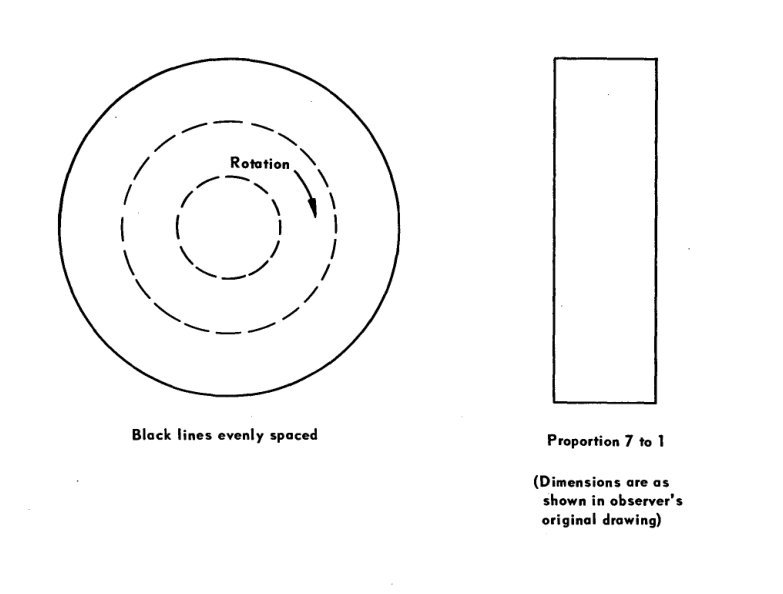
The report's drawings are two simple diagrams, made according to the observer's original drawing: a circle seen face-on, with evenly spaced black lines and a rotation arrow, and a rectangle in profile in a 7 to 1 ratio, which suggests a thin disc. The publication gives no size, distance or duration. The team discarded the case: although the shape was that of a disc, the maneuvers were unique both among the unknowns and among the good unknowns, with no other case with which to form a pair. The report does not discuss explanations. Observing an object moving near the Sun involves glare and afterimages in vision, which makes it hard to estimate shape and movement; this is an editorial observation, not one from the document. There is no record, in the PDF, of radar, photography or consultation with the F-86 pilot. Folder 2728.00 is not part of this document.
The report's drawings are two simple diagrams, made according to the observer's original drawing: a circle seen face-on, with evenly spaced black lines and a rotation arrow, and a rectangle in profile in a 7 to 1 ratio, which suggests a thin disc. The publication gives no size, distance or duration. The team discarded the case: although the shape was that of a disc, the maneuvers were unique both among the unknowns and among the good unknowns, with no other case with which to form a pair. The report does not discuss explanations. Observing an object moving near the Sun involves glare and afterimages in vision, which makes it hard to estimate shape and movement; this is an editorial observation, not one from the document.
The official summary describes a flight sergeant at a U.S. Air Force (USAF) base in Korea, at 8h42 on June 6, 1952. The object moved forward spinning and tumbling, on an irregular course: it flew level, stopped for an instant, climbed straight up, flew level again, tumbled again, changed course and disappeared into the Sun. Then it reappeared and began going back and forth in front of the Sun. At one point, an F-86 fighter passed between the sergeant and the object. He called another man, who also saw the object maneuvering near the Sun. The base and the two witnesses are not identified.
The case was included in Special Report 14 of Project Blue Book, from 1955, as one of the 12 "good unknowns". Of the 434 sightings of objects that remained unexplained in the statistical analysis, only these 12 had descriptions detailed enough to serve as the basis for a "flying saucer" model. The criterion was the possibility of drawing the object, and in almost all cases the witness had already drawn it. The sergeant's case is one of the seven elliptical or disc-shaped ones, numbered VI to XII, and the report's drawing reproduces the proportions of the original drawing.
The team tested each case against four conditions: shape and maneuvers had to recur in many other unknowns; observer and account had to be reliable; the account had to rule out common objects and phenomena; and the model had to come from at least two good unknowns without conflict between them. Case VII failed the first and the fourth. The evaluation does not point to any reliability problem with the sergeant or the account, as it did with other cases on the list; the obstacle was that the maneuvers had no parallel in any other account. None of the 12 cases made it possible to build a model, and the report concluded that the probability that the unknowns represented a class of flying saucers was low.
DIRECT READING OF THE FILE
The document, in the original
U.S. government document. Translated in full: the summary of case VII in Special Report 14 (physical page 93), the drawing labels, and the item in the case-by-case evaluation (physical page 102). The report contains no other page about this case; the original statement and the file with serial number 2728.00 are not part of this PDF.
EXCERPT 1 · PHYSICAL PAGE 93
Physical page 93 (p. 83): case VII and drawings
I
I
Case VII (Serial 2728. 00}
I A Flight Sergeant saw an object over an Air Force base in Korea at
0842 hours on June 6, 1952. The object flew in a series of spinning and
I tumbling actions. It was on an erratic course, first flying level, then
I
stopping momentarily, shooting straight up, flying level and again tumbling,
then changing course and disappearing into the sun. It reappeared and was
seen flying back and forth across the sun. At one time an F-86 passed
I
between the observer and the _object. He pointed it out to another man who
saw it as it maneuvered near the sun.
I
I
I
I
I
I
I
I
I
I Black lines evenly spaced Proportion 7 to 1
I (Dimensions are as
shown in observer's
original drawing)
I
I
I
I 83
ICheck the original PDF
Case VII (Serial 2728.00). A Flight Sergeant saw an object over an Air Force base in Korea at 0842 hours on June 6, 1952. The object flew in a series of spinning and tumbling actions. It was on an erratic course, first flying level, then stopping momentarily, shooting straight up, flying level and again tumbling, then changing course and disappearing into the sun. It reappeared and was seen flying back and forth across the sun. At one time an F-86 passed between the observer and the object. He pointed it out to another man who saw it as it maneuvered near the sun. [Drawing labels:] Rotation. Black lines evenly spaced. Proportion 7 to 1 (Dimensions are as shown in observer's original drawing).View the document record ↗ · Physical page 93, counting the cover.
EXCERPT 2 · PHYSICAL PAGE 102
Physical page 102: assessment of case VII in the discussion of the model
(3) Case III does not satisfy Condition 1. It also does not
satisfy Condition 4 when Case II is eliminated as a
good UNKNOWN.
(4) Case IV does not satisfy Conditions 1 or 2. There are
few cigar-shaped or rocket-shaped objects reported in
the literature. In addition, this observer is not considered to be well-qualified technically.
(5) Case V does not satisfy Condition 1. It also does not
satisfy Condition 4 when Case IV is eliminated as a
good UNKNOWN.
It might be argued here that many of the UNKNOWNS might actually
have shapes similar to these good UNKNOWNS. It will be noted, however,
that each of these five cases does not satisfy one of the other three conditions.
(6) Case VI does not satisfy Condition 2. In the description
of the object, it was stated that at certain times there
was no light seen from the object. Apparently, the
"band of no light", as diagrammed by the observer, was
an attempt to explain this. However, if the object were
constructed as shown in the diagram, light should have
been seen at all times. Because of this conflict the
drawing is not considered reliable, and without the drawing, there is not enough detail in the description to make
it useful for this study.
(7) Case VII violates Conditions 1 and 4. Although the shape
is disc-like, the maneuvers performed by the object are
unique both among the UNKNOWNS and among the good
UNKNOWNS.
Cases VIII to XII satisfy Conditions 1 through 3, but they do not
satisfy Condition 4. The features which make them different from each
other are as follows:
(8) Case VIII. The object is smooth, with no protrusions
or other details.
( 9) Case IX. The object had rocket or jet pods on each
side that were shooting out flames.
(10) Case X. The,object had a fin or rudder.
( 11) Case XI. The object had a series of portholes, or
windows, on its under side.
92
I
I
I
I
I
I
I
I
I
I
I
I
I
I
I
I
I
I
I
I
I
IEditorial note: The passage cites the five cases together because the report's conclusion depends on the comparison between them.
Check the original PDF
(7) Case VII violates Conditions 1 and 4. Although the shape is disc-like, the maneuvers performed by the object are unique both among the UNKNOWNS and among the good UNKNOWNS.View the document record ↗ · Physical page 102, counting the cover.
Dates and documentary context
- Event
- 06/06/1952 — At 8h42, probably local time; not stated.
- Document
- 05/05/1955 — Date of Special Report 14, which summarizes the case.
- Publication
- Not established — Copy released by the CIA with the stamp "Approved for Release 2026".
Origin and release
U.S. Air Force (USAF), Air Technical Intelligence Center (ATIC), Wright-Patterson AFB; copy released by the CIA · CIA-UAP-015-Project_Blue_Book_Special_Report_No_14.pdf
Official summary prepared by the report staff from the case file, not the original testimony.
Related accounts and their differences
Questions to continue the investigation
- What was the base, and who was flying the F-86 that passed between the observer and the object? Did he see anything?
- How long did the observation last? The summary does not say.
GEOGRAPHY OF THE CASE
South Korea
Approximate reference to the country, placed by the editorial team. The air base is not identified in the report.
DOCUMENTARY TRAIL
Go back to the sources
References use physical pages of the PDF, counting the cover. Summaries are presented in English; the documents keep their original language.
- CIA-UAP-015-Project_Blue_Book_Special_Report_No_14.pdf
Physical page 93: case VII (serial number 2728.00) and drawings · Physical page 102: evaluation of case VII
CIA · 312 pages
Editorial summary based on the collection's research notes. How we read the documents.