Date: meetings through July 6, 2009; July 2009 reportLocation: Las Vegas, Nevada (University of Nevada, Las Vegas, UNLV)
Las Vegas, 2009: BAASS's Project Campus tries to get UNLV and research institutes to study the impact of an official confirmation of UAP
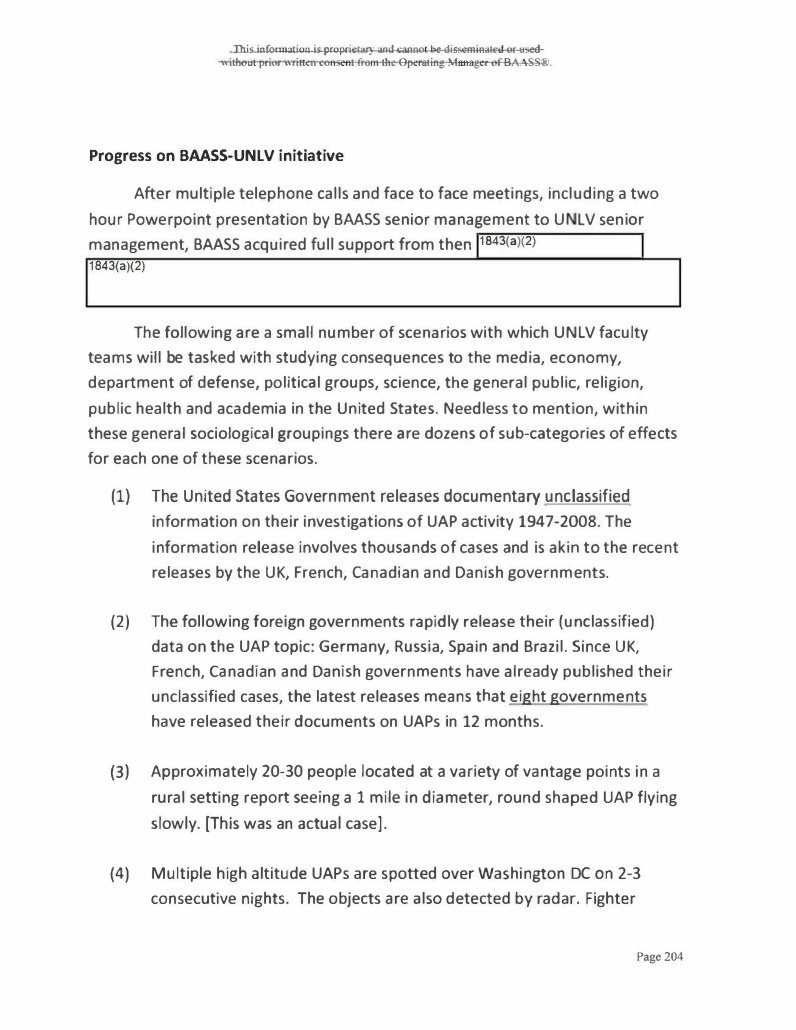
BAASS's ten-month report describes Project Campus, created to get universities to research highly advanced “spacecraft,” and lists ten scenarios, real and hypothetical, that UNLV professors would study. It also recounts that a US$ 400.000 study proposal on the likelihood of the U.S. government confirming UAP by 2050 was declined by Battelle and Sandia and went unanswered by two other organizations.
- Event date
- meetings through July 6, 2009; July 2009 report
- Location
- Las Vegas, Nevada (University of Nevada, Las Vegas, UNLV)
- Topic
- AAWSAP and advanced technologies
- Source agencies
- DOW
- Documents
- 1 document · 538 pages
- Reading time
- 18 min
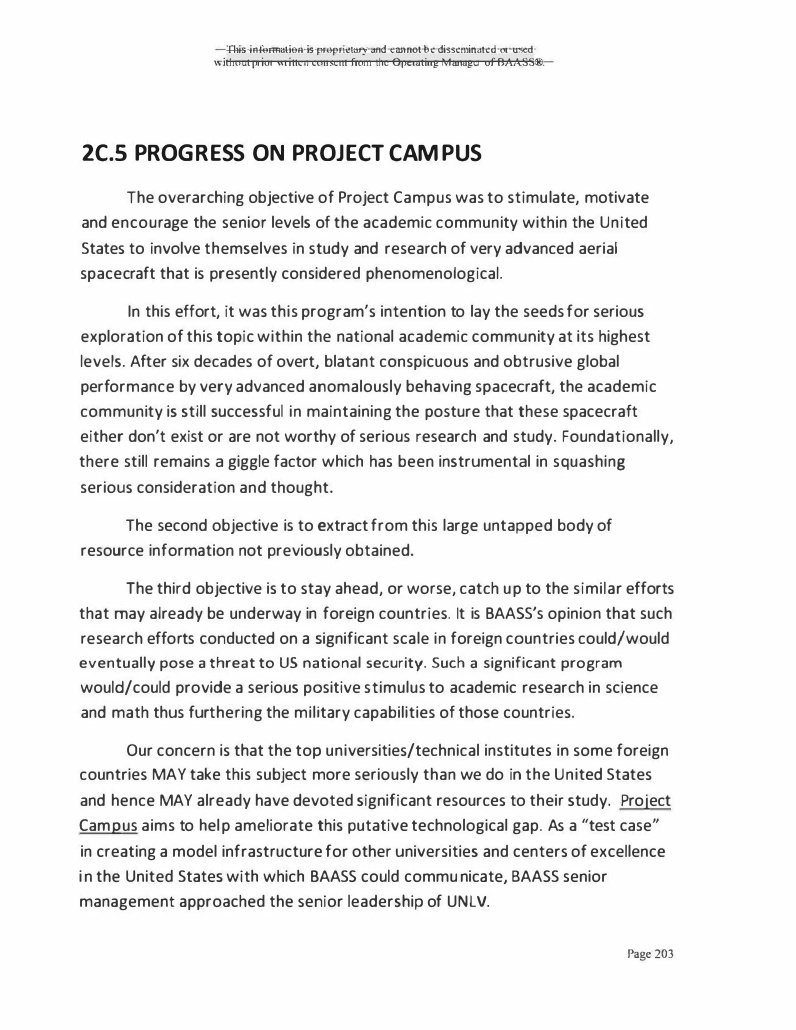 Facsimile of the documentPhysical page 209
DOCUMENTARY SOURCES · DOW
What the records tell
Date: first half of 2009, with a meeting on July 6. Location: Las Vegas, at the University of Nevada, Las Vegas (UNLV). According to the BAASS report, Project Campus had three goals: to get the American academic community to study “highly advanced aerial craft,” to extract information from that community, and not to fall behind similar efforts that might exist in other countries. The text states that, after six decades of “overt” activity by these craft, academia still treats them as nonexistent because of a “giggle factor.” This is BAASS's assessment.
BAASS says it obtained the support of UNLV's senior leadership after meetings and a two-hour presentation. The report lists ten scenarios whose effects on media, the economy, defense, religion, and public health would be studied by professors. Some are real cases: the 1952 Washington wave, the giant Phoenix UAP in 1997, and September 2007 sightings involving F-16 fighters near the airspace of a president's residence. Others are hypothetical, such as the Air Force declaring that the “two 1947 crashes” involved craft of non-terrestrial origin.
A professor who directs a crisis and emergency management program was recruited to promote the initiative. Faculty from communications, oral history, sociology, political science, marketing, security studies, public administration, English, and construction engineering responded, all with redacted names. At the July 6 meeting, according to the text, the professors were informed of the “exotic aerospace vehicle dimension” of the studies. Five of them showed strong interest in submitting a proposal by August 2009.
BAASS also sent a solicitation for proposals to the Battelle Memorial Institute, the Southwestern Research Institute, the Center for American Progress, and Sandia National Laboratories, after nondisclosure agreements. The one-year, US$ 400.000 study would start from the premise, adopted by BAASS itself, that advanced aircraft of unknown origin “roam freely in the skies.” The questions were the probability of official confirmation by 2050, the best format for announcing it, and how to “soften the blow to society.”
By the time the report was finalized, Sandia had replied that it lacked the necessary expertise and Battelle had declined. The other two organizations had not responded. The document shows what BAASS tried to do and how it framed the problem; it contains no study produced, nor proof of the premises. BAASS says it has reasons based on military and intelligence sources, but states that discussing them was beyond the scope of the text.
More images from the document
DIRECT READING OF THE FILE
The document, in the original
Physical pages 209 to 219 are translated in full, including the list of scenarios, the list of faculty areas and the text of the request for proposals; names and contacts appear redacted in the original.
EXCERPT 1 · PHYSICAL PAGE 209
Physical page 209, full page
111is iAfeflllatien is prevrietttry ttnd cm,notbe disseutiu<1ted 01 used
without p, im ", itte:11 co11sc11t fiom tltc Ope1ati11g Mauagc, of BAASS®.
2C.5 PROGRESS ON PROJECT CAMPUS
The overarching objective of Project Campus was to stimulate, motivate
and encourage the senior levels of the academic community within the United
States to involve themselves in study and research of very advanced aerial
spacecraft that is presently considered phenomenological.
In this effort, it was this program's intention to lay the seeds for serious
exploration of this topic within the national academic community at its highest
levels. After six decades of overt, blatant conspicuous and obtrusive global
performance by very advanced anomalously behaving spacecraft, the academic
community is still successful in maintaining the posture that these spacecraft
either don't exist or are not worthy of serious research and study. Foundationally,
there still remains a giggle factor which has been instrumental in squashing
serious consideration and thought.
The second objective is to extract from this large untapped body of
resource information not previously obtained.
The third objective is to stay ahead, or worse, catch up to the similar efforts
that may already be underway in foreign countries. It is BAASS's opinion that such
research efforts conducted on a significant scale in foreign countries could/would
eventually pose a threat to US national security. Such a significant program
would/could provide a serious positive stimulus to academic research in science
and math thus furthering the military capabilities of those countries.
Our concern is that the top universities/technical institutes in some foreign
countries MAY take this subject more seriously than we do in the United States
and hence MAY already have devoted significant resources to their study. Project
Campus aims to hel1p ameliorate this putative technological gap. As a "test case"
in creating a model infrastructure for other universities and centers of excellence
in the United States with which BAASS could communicate, BAASS senior
management approached the senior leadership of UNLV.
Page 203Editorial note: Physical page 209 of DOW-UAP-D172-BAASS_Ten_Month_Report_July-2009.pdf.
Check the original PDF
111is iAfeflllatien is prevrietttry ttnd cm,notbe disseutiu<1ted 01 used
without p, im ", itte:11 co11sc11t fiom tltc Ope1ati11g Mauagc, of BAASS®.
2C.5 PROGRESS ON PROJECT CAMPUS
The overarching objective of Project Campus was to stimulate, motivate
and encourage the senior levels of the academic community within the United
States to involve themselves in study and research of very advanced aerial
spacecraft that is presently considered phenomenological.
In this effort, it was this program's intention to lay the seeds for serious
exploration of this topic within the national academic community at its highest
levels. After six decades of overt, blatant conspicuous and obtrusive global
performance by very advanced anomalously behaving spacecraft, the academic
community is still successful in maintaining the posture that these spacecraft
either don't exist or are not worthy of serious research and study. Foundationally,
there still remains a giggle factor which has been instrumental in squashing
serious consideration and thought.
The second objective is to extract from this large untapped body of
resource information not previously obtained.
The third objective is to stay ahead, or worse, catch up to the similar efforts
that may already be underway in foreign countries. It is BAASS's opinion that such
research efforts conducted on a significant scale in foreign countries could/would
eventually pose a threat to US national security. Such a significant program
would/could provide a serious positive stimulus to academic research in science
and math thus furthering the military capabilities of those countries.
Our concern is that the top universities/technical institutes in some foreign
countries MAY take this subject more seriously than we do in the United States
and hence MAY already have devoted significant resources to their study. Project
Campus aims to hel1p ameliorate this putative technological gap. As a "test case"
in creating a model infrastructure for other universities and centers of excellence
in the United States with which BAASS could communicate, BAASS senior
management approached the senior leadership of UNLV.
Page 203View the document record ↗ · Physical page 209, counting the cover.
EXCERPT 2 · PHYSICAL PAGE 210
Physical page 210, full page
Ibis infom101ion is proprie•:uy and cannotb€! diss€!minaടd or used
"'-it:hout prior ,..-riiten eolt5entfrem lhe Oper-miflg }Aftfl:11:ger efBfu\SS®.
Progress on BAASS-UNLV initiative
After multiple telephone calls and face to face meetings, including a two
hour Powerpoint presentation by BAASS senior management to U LV senior
management, BAASS acquired full support from then l1 843(a)(2)
I
1 843(a)(2)
The following are a small number of scenarios with which UNLV faculty
teams will be tasked with studying consequences to the media, economy,
department of defense, political groups, science, the general public, religion,
public health and academia in the United States. Needless to mention, within
these general sociological groupings there are dozens of sub-categories of effects
for each one of these scenarios.
(1)
The United States Government releases documentary unclassified
information on their investigations of UAP activity 1947-2008. The
information release involves thousands of cases and is akin to the recent
releases by the UK, French, Canadian and Danish governments.
(2)
The following foreign governments rapidly release their (unclassified)
data on the UAP topic: Germany, Russia, Spain and Brazil. Since UK,
French, Canadian and Danish governments have already published their
unclassified cases, the latest releases means that eight governments
have released their documents on UAPs in 12 months.
(3)
Approximately 20-30 people located at a variety of vantage points in a
rural setting report seeing a 1 mile in diameter, round shaped UAP flying
slowly. [This was an actual case].
(4)
Multiple high altitude UAPs are spotted over Washington DC on 2-3
consecutive nights. The objects are also detected by radar. Fighter
Page 204Editorial note: Physical page 210 of DOW-UAP-D172-BAASS_Ten_Month_Report_July-2009.pdf.
Check the original PDF
Ibis infom101ion is proprie•:uy and cannotb€! diss€!minaടd or used
"'-it:hout prior ,..-riiten eolt5entfrem lhe Oper-miflg }Aftfl:11:ger efBfu\SS®.
Progress on BAASS-UNLV initiative
After multiple telephone calls and face to face meetings, including a two
hour Powerpoint presentation by BAASS senior management to U LV senior
management, BAASS acquired full support from then l1 843(a)(2)
I
1 843(a)(2)
The following are a small number of scenarios with which UNLV faculty
teams will be tasked with studying consequences to the media, economy,
department of defense, political groups, science, the general public, religion,
public health and academia in the United States. Needless to mention, within
these general sociological groupings there are dozens of sub-categories of effects
for each one of these scenarios.
(1)
The United States Government releases documentary unclassified
information on their investigations of UAP activity 1947-2008. The
information release involves thousands of cases and is akin to the recent
releases by the UK, French, Canadian and Danish governments.
(2)
The following foreign governments rapidly release their (unclassified)
data on the UAP topic: Germany, Russia, Spain and Brazil. Since UK,
French, Canadian and Danish governments have already published their
unclassified cases, the latest releases means that eight governments
have released their documents on UAPs in 12 months.
(3)
Approximately 20-30 people located at a variety of vantage points in a
rural setting report seeing a 1 mile in diameter, round shaped UAP flying
slowly. [This was an actual case].
(4)
Multiple high altitude UAPs are spotted over Washington DC on 2-3
consecutive nights. The objects are also detected by radar. Fighter
Page 204View the document record ↗ · Physical page 210, counting the cover.
EXCERPT 3 · PHYSICAL PAGE 211
Physical page 211, full page
(5)
TI,is infb1111atio11 is ptop, ictmj alid cimttot be disseminated 01 t1sed
,,itliout p,im 1>1ittc11 w11sc11t f.om the OperatiHg MmittҶer efBAASS®.
aircraft were launched in response. Compare the consequences of these
events in the actual incidents in 1952 versus the consequences if these
events happened in 2009.
A giant UAP (>800 meters} is seen for two successive nights over a city of
4 million people. [Actual case, Phoenix Arizona the night of March 13
1997]
(6}
Multiple day and night sightings of UAPs are seen by multiple witnesses
over a small size town. They are detected on radar and at least ten F-16s
are scrambled i n response. The UAPs are detected flying near the
restricted air space over the residence of a sitting President of the United
States (POTUS}. [Actual case September 2007]
(7)
The United States Air Force releases a statement that the both crashes in
1947 involved spacecraft of non terrestrial origin.
(8)
A retired NASA administrator, a retired POTUS, a retired head of Senate
Intelligence Committee, a retired Speaker of the House, a retired head of
the CIA and a retired Secretary of Defense hold a joint news conference
and say that extraterrestrial craft are real and the United States
Government has the evidence. [Similar to the November 12, 2007
National Press Club Press Conference].
(9)
Four separate night time sightings of very large (>800m in diameter)
UAPs over major cities (populations 3-4million people) occur over a 12
month period. [Has not occurred yet]
(10) One 5 minute unambiguous day time sighting of UAP activity (Crafto> 800
meters in diameter} occurs over a city of 4 million people. [Has not
occurred yet, but could be a tipping event].
Page 205Editorial note: Physical page 211 of DOW-UAP-D172-BAASS_Ten_Month_Report_July-2009.pdf.
Check the original PDF
(5)
TI,is infb1111atio11 is ptop, ictmj alid cimttot be disseminated 01 t1sed
,,itliout p,im 1>1ittc11 w11sc11t f.om the OperatiHg MmittҶer efBAASS®.
aircraft were launched in response. Compare the consequences of these
events in the actual incidents in 1952 versus the consequences if these
events happened in 2009.
A giant UAP (>800 meters} is seen for two successive nights over a city of
4 million people. [Actual case, Phoenix Arizona the night of March 13
1997]
(6}
Multiple day and night sightings of UAPs are seen by multiple witnesses
over a small size town. They are detected on radar and at least ten F-16s
are scrambled i n response. The UAPs are detected flying near the
restricted air space over the residence of a sitting President of the United
States (POTUS}. [Actual case September 2007]
(7)
The United States Air Force releases a statement that the both crashes in
1947 involved spacecraft of non terrestrial origin.
(8)
A retired NASA administrator, a retired POTUS, a retired head of Senate
Intelligence Committee, a retired Speaker of the House, a retired head of
the CIA and a retired Secretary of Defense hold a joint news conference
and say that extraterrestrial craft are real and the United States
Government has the evidence. [Similar to the November 12, 2007
National Press Club Press Conference].
(9)
Four separate night time sightings of very large (>800m in diameter)
UAPs over major cities (populations 3-4million people) occur over a 12
month period. [Has not occurred yet]
(10) One 5 minute unambiguous day time sighting of UAP activity (Crafto> 800
meters in diameter} occurs over a city of 4 million people. [Has not
occurred yet, but could be a tipping event].
Page 205View the document record ↗ · Physical page 211, counting the cover.
EXCERPT 4 · PHYSICAL PAGE 212
Physical page 212, full page
1
) _a4_3( )(2_)
(
_a
Professor of marketing (database
f 1
_____ I
_
....
1_s4_3
(
)
g)
(_a (2_)
Executive Director UNLV Inst. For Secur
____
l
ity
I
_
....
TI1is iufo1111ation is p1vprictar;- and erumel be ElisscmiRali.ld er w;ed
wllhout prior \\rillcil cons.:nt fiom the Opc.atiug ManttgerofBAJ'.SS®.
In subsequent meetings with!1843(a)(2)
I, the following advances have been
made:
1843(a)(2l._._.,".-(1)---- +-- I recruited l1843(a)(2)
i who leads a UNLV program in
Crisis and Emergency Management, to lead the outreach to UNLV staff
on the BAASS-UNLV program.
(2)
Based on a general outreach email,,_p_s4_3_(a_)(_2)_______,I received
positive responses from:
(a) p843(a)(2)
la Professor of Media and Communications
(b) l1843(a)(2)
l a historian (oral history of the Nevada Test Site)
(c) 11843(a)(2)
I professor of Sociology (social movements)
(d) l1843(a)(2)
!professor of Political Science (global futures
and infectious disease pandemics}
(e) 11843(a)(2)
! Professor of Political Science
(comparative politics and law, comparative religions}
marketing)
Studies
Page 206Editorial note: Physical page 212 of DOW-UAP-D172-BAASS_Ten_Month_Report_July-2009.pdf.
Check the original PDF
1
) _a4_3( )(2_)
(
_a
Professor of marketing (database
f 1
_____ I
_
....
1_s4_3
(
)
g)
(_a (2_)
Executive Director UNLV Inst. For Secur
____
l
ity
I
_
....
TI1is iufo1111ation is p1vprictar;- and erumel be ElisscmiRali.ld er w;ed
wllhout prior \\rillcil cons.:nt fiom the Opc.atiug ManttgerofBAJ'.SS®.
In subsequent meetings with!1843(a)(2)
I, the following advances have been
made:
1843(a)(2l._._.,".-(1)---- +-- I recruited l1843(a)(2)
i who leads a UNLV program in
Crisis and Emergency Management, to lead the outreach to UNLV staff
on the BAASS-UNLV program.
(2)
Based on a general outreach email,,_p_s4_3_(a_)(_2)_______,I received
positive responses from:
(a) p843(a)(2)
la Professor of Media and Communications
(b) l1843(a)(2)
l a historian (oral history of the Nevada Test Site)
(c) 11843(a)(2)
I professor of Sociology (social movements)
(d) l1843(a)(2)
!professor of Political Science (global futures
and infectious disease pandemics}
(e) 11843(a)(2)
! Professor of Political Science
(comparative politics and law, comparative religions}
marketing)
Studies
Page 206View the document record ↗ · Physical page 212, counting the cover.
EXCERPT 5 · PHYSICAL PAGE 213
Physical page 213, full page
TI11s information is p1op1itatruy and cm111ot be clis.1.:miflaled or used
without prior wriiren mnsent from the Operatiflg M.n,agc, of"BAA3S®.
(h) l1843(a)(2)
!Director Research and Policy UNLV Institute for
Security Studies {globalization, international relations, post conflict
societies)
{i) l1843(a)(2)
I Department of Public Administration
{public law, government response?)
rni1 a43(a)(2)
IDepartment of English {History of Technical
Communications)
(k) l1843(a)(2)
!Construction Management {Construction Safety,
Construction Forensics, Effects on Physical Infrastructure?)
(3)
A meeting was scheduled for Monday July 6 betweenl1843(a)(2) I
l1843(a)(2)
land the bulk of the UNLV faculty who have expressed
interest in disaster response studies拖1843(a)(2)
!formally informed the
UNLV faculty about the exotic aerospace vehicle dimension to the
proposed studies and he also outlined to them the scenarios that BAASS
had previously presented him with.
2
The end result was tha拗1843(a)(") I and four others have expressed strong
interest in submitting a specific proposal to BAASS by August 2009
Other Project Campus Initiatives
Senior officials with Battelle Memorial Institute {Columbus OH),
Southwestern Research Institute (SWRI), the Center for American Progress and
Sandia National Laboratories (Albuquerque) have been approached with a
Request for Proposals {RFP) that is summarized below.
The following is the text of the RFP, variations of which were submitted to
all four organizations {following N DA signatures):
Page 207Editorial note: Physical page 213 of DOW-UAP-D172-BAASS_Ten_Month_Report_July-2009.pdf.
Check the original PDF
TI11s information is p1op1itatruy and cm111ot be clis.1.:miflaled or used
without prior wriiren mnsent from the Operatiflg M.n,agc, of"BAA3S®.
(h) l1843(a)(2)
!Director Research and Policy UNLV Institute for
Security Studies {globalization, international relations, post conflict
societies)
{i) l1843(a)(2)
I Department of Public Administration
{public law, government response?)
rni1 a43(a)(2)
IDepartment of English {History of Technical
Communications)
(k) l1843(a)(2)
!Construction Management {Construction Safety,
Construction Forensics, Effects on Physical Infrastructure?)
(3)
A meeting was scheduled for Monday July 6 betweenl1843(a)(2) I
l1843(a)(2)
land the bulk of the UNLV faculty who have expressed
interest in disaster response studies拖1843(a)(2)
!formally informed the
UNLV faculty about the exotic aerospace vehicle dimension to the
proposed studies and he also outlined to them the scenarios that BAASS
had previously presented him with.
2
The end result was tha拗1843(a)(") I and four others have expressed strong
interest in submitting a specific proposal to BAASS by August 2009
Other Project Campus Initiatives
Senior officials with Battelle Memorial Institute {Columbus OH),
Southwestern Research Institute (SWRI), the Center for American Progress and
Sandia National Laboratories (Albuquerque) have been approached with a
Request for Proposals {RFP) that is summarized below.
The following is the text of the RFP, variations of which were submitted to
all four organizations {following N DA signatures):
Page 207View the document record ↗ · Physical page 213, counting the cover.
EXCERPT 6 · PHYSICAL PAGE 214
Physical page 214, full page
Thi,s information is pFeprielary Md eM11e1 be diఞeminatcd 01 used
wil-lio1a1l prier wFitt@n ట011s11nt from the Oper:iting M:mgger of BtvఠSS®.
Should there be interest in your organization to respond to this RFP (see
items 1-6 below}, what is envisioned is as follows.
A study would be
undertaken to address the three major issues as outlined above on the basis of
a 1-year contract with reporting requirements as follows. Given that the three
issues are inextricably interlinked, we require a broad overview of all three,
but with emphasis on coming to a satisfactory resolution of the first, to be
covered in a first Interim Report. In such an approach, the first major issue of
the three is to be addressed in some detail, but with linked referents to issues
two and three so that (a) the integrated structure of the three-issue Study is
transparent, and (b) those to whom the Interim Report are exposed will
anticipate in broad outline directions concerning the final outcome(s). In like
manner, a second Interim Report would be due 1 November 2009 in which the
second issue is brought to a satisfactory level of resolution, whHe telegraphing
key elements of an anticipated outcome concerning the third issue. A Final
Report, due 1 March 2010, with an integrated and realistic assessment of the
three issues raised, would complete the evaluation of the trilogy of issues
regarding a major factor that is considered to be of vital interest to BAASS in
its planned program to establish a thriving space exploration culture. Our
planned budget expenditure for this Paper Study is $400,000.
1. Introduction
To provide a context for our Request for a Proposal (RFP) from your
organization for a proposed Study on a topic of interest to us, BAASS (Bigelow
Aerospace Advanced Space Studies) is an analysis group associated with
Bigelow Aerospace (BAS), a Las-Vegas-based private entrepreneurial
aerospace company. The BAS space program at present has two demonstrator
inflatable space stations in orbit, Genesis I and Genesis II, both launched from
Russian launch facilities (see www.bigelowaerospace.com). Construction of
additional inflatables is under way and a demanding schedule of future
launches is planned.
Page 208Editorial note: Physical page 214 of DOW-UAP-D172-BAASS_Ten_Month_Report_July-2009.pdf.
Check the original PDF
Thi,s information is pFeprielary Md eM11e1 be diఞeminatcd 01 used
wil-lio1a1l prier wFitt@n ట011s11nt from the Oper:iting M:mgger of BtvఠSS®.
Should there be interest in your organization to respond to this RFP (see
items 1-6 below}, what is envisioned is as follows.
A study would be
undertaken to address the three major issues as outlined above on the basis of
a 1-year contract with reporting requirements as follows. Given that the three
issues are inextricably interlinked, we require a broad overview of all three,
but with emphasis on coming to a satisfactory resolution of the first, to be
covered in a first Interim Report. In such an approach, the first major issue of
the three is to be addressed in some detail, but with linked referents to issues
two and three so that (a) the integrated structure of the three-issue Study is
transparent, and (b) those to whom the Interim Report are exposed will
anticipate in broad outline directions concerning the final outcome(s). In like
manner, a second Interim Report would be due 1 November 2009 in which the
second issue is brought to a satisfactory level of resolution, whHe telegraphing
key elements of an anticipated outcome concerning the third issue. A Final
Report, due 1 March 2010, with an integrated and realistic assessment of the
three issues raised, would complete the evaluation of the trilogy of issues
regarding a major factor that is considered to be of vital interest to BAASS in
its planned program to establish a thriving space exploration culture. Our
planned budget expenditure for this Paper Study is $400,000.
1. Introduction
To provide a context for our Request for a Proposal (RFP) from your
organization for a proposed Study on a topic of interest to us, BAASS (Bigelow
Aerospace Advanced Space Studies) is an analysis group associated with
Bigelow Aerospace (BAS), a Las-Vegas-based private entrepreneurial
aerospace company. The BAS space program at present has two demonstrator
inflatable space stations in orbit, Genesis I and Genesis II, both launched from
Russian launch facilities (see www.bigelowaerospace.com). Construction of
additional inflatables is under way and a demanding schedule of future
launches is planned.
Page 208View the document record ↗ · Physical page 214, counting the cover.
EXCERPT 7 · PHYSICAL PAGE 215
Physical page 215, full page
This io[onpa1ioo is proprieJary and c:moor be disseroioalcd or used
,1 ilhoac p1 im 11, ittc11 consent f'iom the Operat:itig Mllfl&ger of B,"o''.SSȒ.
Based on BAS long-range goals with regard to space exploration (e.g., moon
habitats, Mars missions by 2050), BAASS was established to explore forefront
science concepts relevant to establishing a thriving space exploration culture.
It is a given that any program involving human expansion out into space must
deal realistically with all issues that impinge on that effort.
2. Background for Proposed Study
In planning for the human exploration of space, many factors need to be
addressed and are routinely well-covered in the literature - space sickness, the
potential hazard of radiation damage to the human organism, the need for
compact, long-life power sources, and so forth.
One factor not treated,
however, but which for our purposes we consider needs to be addressed, is
the continuing observation of advanced aerospace craft of unknown origin,
craft whose technological attributes cannot be traced to known sources,
domestic or foreign.
Though in both popular and scientific cultures
considerable debate is ongoing as to whether the observations are veridical,
and, if taken to be so, whether they constitute observations of natural
phenomena or engineered devices, for the purpose of the proposed Study we
sidestep this debate and assume the latter. Our reasons are many and based
on compelling evidence from credible military and intelligence sources, but
discussion of them is beyond the scope of this RFP. For the purpose of the
proposed Study we take the presence of such advanced exotic aerospace craft
as a given.
3. Issues to be Addressed by Proposed Study
Based on the ingoing premise that advanced aerospace craft {UFOs, if
you will) traverse the skies at will over all parts of the globe, BAASS wishes to
commission a Study that addresses three major issues, each in turn.
Page 209Editorial note: Physical page 215 of DOW-UAP-D172-BAASS_Ten_Month_Report_July-2009.pdf.
Check the original PDF
This io[onpa1ioo is proprieJary and c:moor be disseroioalcd or used
,1 ilhoac p1 im 11, ittc11 consent f'iom the Operat:itig Mllfl&ger of B,"o''.SSȒ.
Based on BAS long-range goals with regard to space exploration (e.g., moon
habitats, Mars missions by 2050), BAASS was established to explore forefront
science concepts relevant to establishing a thriving space exploration culture.
It is a given that any program involving human expansion out into space must
deal realistically with all issues that impinge on that effort.
2. Background for Proposed Study
In planning for the human exploration of space, many factors need to be
addressed and are routinely well-covered in the literature - space sickness, the
potential hazard of radiation damage to the human organism, the need for
compact, long-life power sources, and so forth.
One factor not treated,
however, but which for our purposes we consider needs to be addressed, is
the continuing observation of advanced aerospace craft of unknown origin,
craft whose technological attributes cannot be traced to known sources,
domestic or foreign.
Though in both popular and scientific cultures
considerable debate is ongoing as to whether the observations are veridical,
and, if taken to be so, whether they constitute observations of natural
phenomena or engineered devices, for the purpose of the proposed Study we
sidestep this debate and assume the latter. Our reasons are many and based
on compelling evidence from credible military and intelligence sources, but
discussion of them is beyond the scope of this RFP. For the purpose of the
proposed Study we take the presence of such advanced exotic aerospace craft
as a given.
3. Issues to be Addressed by Proposed Study
Based on the ingoing premise that advanced aerospace craft {UFOs, if
you will) traverse the skies at will over all parts of the globe, BAASS wishes to
commission a Study that addresses three major issues, each in turn.
Page 209View the document record ↗ · Physical page 215, counting the cover.
EXCERPT 8 · PHYSICAL PAGE 216
Physical page 216, full page
This info, n.a1io11 is proptielaiy and ea.mot be disseminated 01 tised
wi!houl prior writlen consent from tbc Operating Manager of BA t\SS®
First, based on an in-depth analysis of historical records, current data, and
political will, what is the likelihood that by 2050 there will be confirmation to
the public by the U.S. government and its military authorities that aerospace
craft whose technological capabilities are beyond those of our own most
advanced military craft do indeed exist and traverse our airspace at will? What
are seen as the pre-conditions for such confirmation, and the probability that
they would be met?
In response to such a question we wish to emphasize that simple
second-tier acknowledgement by various sectors of our government or the
military as to the probable reality of such advanced craft, seemingly
intelligently controlled, as has occurred in the past [1-3] would not meet the
criterion we set for truly unequivocal confirmation.
Rather, the criterion
proposed permits no ambiguity in such a confirmation.
Second, under an assumption that such confirmation does occur by
2050, what would be a recommended course of action as to an optimum
format for such confirmation? What realistically could be expected to be its
effects, first on the military sector that is charged with defending our nation's
airspace against intrusion by craft of unknown origin and secondarily on the
U.S. body politic in the areas of commerce, religion, international relations,
academia and so forth? Are denial and/or chaos to be expected, or is a
publicly-accepted official stance of acknowledgement and co-existence with
the phenomenon, especially in the absence of offense or threat from the source
of such technology, a more likely outcome?
In the consideration of the above issues, discussion of the parameters
under which various outcomes are likely are to be addressed, since such
parameters could usefully be taken into account in the policy planning stages
for such an announcement.
Third, if in the above analyses it becomes clear that, even in the
timeframe approaching 2050, official (and especially military) consideration of
a stance of publicly-acknowledged mutual co-existence is almost certain to
Page 210Editorial note: Physical page 216 of DOW-UAP-D172-BAASS_Ten_Month_Report_July-2009.pdf.
Check the original PDF
This info, n.a1io11 is proptielaiy and ea.mot be disseminated 01 tised
wi!houl prior writlen consent from tbc Operating Manager of BA t\SS®
First, based on an in-depth analysis of historical records, current data, and
political will, what is the likelihood that by 2050 there will be confirmation to
the public by the U.S. government and its military authorities that aerospace
craft whose technological capabilities are beyond those of our own most
advanced military craft do indeed exist and traverse our airspace at will? What
are seen as the pre-conditions for such confirmation, and the probability that
they would be met?
In response to such a question we wish to emphasize that simple
second-tier acknowledgement by various sectors of our government or the
military as to the probable reality of such advanced craft, seemingly
intelligently controlled, as has occurred in the past [1-3] would not meet the
criterion we set for truly unequivocal confirmation.
Rather, the criterion
proposed permits no ambiguity in such a confirmation.
Second, under an assumption that such confirmation does occur by
2050, what would be a recommended course of action as to an optimum
format for such confirmation? What realistically could be expected to be its
effects, first on the military sector that is charged with defending our nation's
airspace against intrusion by craft of unknown origin and secondarily on the
U.S. body politic in the areas of commerce, religion, international relations,
academia and so forth? Are denial and/or chaos to be expected, or is a
publicly-accepted official stance of acknowledgement and co-existence with
the phenomenon, especially in the absence of offense or threat from the source
of such technology, a more likely outcome?
In the consideration of the above issues, discussion of the parameters
under which various outcomes are likely are to be addressed, since such
parameters could usefully be taken into account in the policy planning stages
for such an announcement.
Third, if in the above analyses it becomes clear that, even in the
timeframe approaching 2050, official (and especially military) consideration of
a stance of publicly-acknowledged mutual co-existence is almost certain to
Page 210View the document record ↗ · Physical page 216, counting the cover.
EXCERPT 9 · PHYSICAL PAGE 217
Physical page 217, full page
This infurmation is preprietftf) and eatJAat be dissemiAat0EI er usªEI
,.-ithout plio1 m iiten eonsem r. om tht Opcrnting Ma11agt1 of BAASS®.
remain fraught with conflicting, irresolvable viewpoints inimical to formulation
of clear and effective policy - grid lock, as it were - what steps might be taken
in the interim in the public sector by influential leaders and by organizations to
ameliorate the potential deleterious effects of possibly unforeseen culture
shock, to "soften the societal blow,
11 so to speak?
We recognize that predicting the future is of course problematical at
best.
Nonetheless, given the realities of BAS/BAASS' space exploration
business, advanced preparation for response to various scenarios that take
into .account the above issues unquestionably appears to us to constitute an
optimally prudent policy.
As a result, our decision to commission a serious Study of the issues
raised, that includes an assessment of the attendant consequences thereof
and recommended strategies to handle same, is seen by our organization to be
not simply a curiosity-driven academic exercise, but rather a reality-driven
requirement that needs to be addressed, and this in spite of whatever cultural
or philosophical issues might be raised by such an inquiry. [4)
4. Terms and Conditions
Should an agreement between our two orgarnizations be negotiated to
our mutual satisfaction with regard to a commissioned Study as outlined
above, our requirements are that that the final product (a) be in a Report form
that can be publicly distributed, (b} be identifiable as a Study performed by
your organization, and (c) acknowledge the support of BAASS.
In the case that during the study it is determined that certain materials
required to meet the objectives of the study in full require the use of classified
information (which BAASS is certified to handle), then both a classified report
and a sanitized version of the report approved for public distribution, are to be
submitted in fulfillment of the contract. With regard to this latter point, access
Page 2 1 1Editorial note: Physical page 217 of DOW-UAP-D172-BAASS_Ten_Month_Report_July-2009.pdf.
Check the original PDF
This infurmation is preprietftf) and eatJAat be dissemiAat0EI er usªEI
,.-ithout plio1 m iiten eonsem r. om tht Opcrnting Ma11agt1 of BAASS®.
remain fraught with conflicting, irresolvable viewpoints inimical to formulation
of clear and effective policy - grid lock, as it were - what steps might be taken
in the interim in the public sector by influential leaders and by organizations to
ameliorate the potential deleterious effects of possibly unforeseen culture
shock, to "soften the societal blow,
11 so to speak?
We recognize that predicting the future is of course problematical at
best.
Nonetheless, given the realities of BAS/BAASS' space exploration
business, advanced preparation for response to various scenarios that take
into .account the above issues unquestionably appears to us to constitute an
optimally prudent policy.
As a result, our decision to commission a serious Study of the issues
raised, that includes an assessment of the attendant consequences thereof
and recommended strategies to handle same, is seen by our organization to be
not simply a curiosity-driven academic exercise, but rather a reality-driven
requirement that needs to be addressed, and this in spite of whatever cultural
or philosophical issues might be raised by such an inquiry. [4)
4. Terms and Conditions
Should an agreement between our two orgarnizations be negotiated to
our mutual satisfaction with regard to a commissioned Study as outlined
above, our requirements are that that the final product (a) be in a Report form
that can be publicly distributed, (b} be identifiable as a Study performed by
your organization, and (c) acknowledge the support of BAASS.
In the case that during the study it is determined that certain materials
required to meet the objectives of the study in full require the use of classified
information (which BAASS is certified to handle), then both a classified report
and a sanitized version of the report approved for public distribution, are to be
submitted in fulfillment of the contract. With regard to this latter point, access
Page 2 1 1View the document record ↗ · Physical page 217, counting the cover.
EXCERPT 10 · PHYSICAL PAGE 218
Physical page 218, full page
This inforrnllfion is p,op,icta13 m,d -.@mot be dissc111i11anxl 0i used
1
wilhGl-ll iirigp•TitteR GQASeRl fi:om the Opcraling ˥˦llPtlg,.'r of BA i\ ss
to classified information to fulfill the Study objectives, if relevant and value
added, would be welcomed.
5. Contact
If there is interest in your organization to respond to this RFP, for further
details (anticipated level of effort, projected timelines, and so forth) please
References
1843(a)(2), 1843(a)( 1)(8)
[2] Symposium on Unidentified Flying Objects: Hearings before the Committee
on Science and Astronautics; U.S. House of Representatives; Ninetieth
Congress, 2
nd Session, July 29, 1968 (U.S. Government Printing Office, 1968).
1'843(a)(2)
rlW3(a)(2)
Page 212Editorial note: Physical page 218 of DOW-UAP-D172-BAASS_Ten_Month_Report_July-2009.pdf.
Check the original PDF
This inforrnllfion is p,op,icta13 m,d -.@mot be dissc111i11anxl 0i used
1
wilhGl-ll iirigp•TitteR GQASeRl fi:om the Opcraling ˥˦llPtlg,.'r of BA i\ ss
to classified information to fulfill the Study objectives, if relevant and value
added, would be welcomed.
5. Contact
If there is interest in your organization to respond to this RFP, for further
details (anticipated level of effort, projected timelines, and so forth) please
References
1843(a)(2), 1843(a)( 1)(8)
[2] Symposium on Unidentified Flying Objects: Hearings before the Committee
on Science and Astronautics; U.S. House of Representatives; Ninetieth
Congress, 2
nd Session, July 29, 1968 (U.S. Government Printing Office, 1968).
1'843(a)(2)
rlW3(a)(2)
Page 212View the document record ↗ · Physical page 218, counting the cover.
EXCERPT 11 · PHYSICAL PAGE 219
Physical page 219, full page
This iRFonnatiea is preprietary and eannol be disscmi11atcd m used
without prior written consent lrom me Operating Mm,agc, of BAASS®.
BAASS has not yet received a reply from CAP or SWRI regarding the RFP. Sandia
National Laboratories volunteered that they did not have the expertise for the
project and Battelle Memorial Institute declined the RFP.
Pagee213Editorial note: Physical page 219 of DOW-UAP-D172-BAASS_Ten_Month_Report_July-2009.pdf.
Check the original PDF
This iRFonnatiea is preprietary and eannol be disscmi11atcd m used
without prior written consent lrom me Operating Mm,agc, of BAASS®.
BAASS has not yet received a reply from CAP or SWRI regarding the RFP. Sandia
National Laboratories volunteered that they did not have the expertise for the
project and Battelle Memorial Institute declined the RFP.
Pagee213View the document record ↗ · Physical page 219, counting the cover.
Dates and documentary context
- Event
- 06/07/2009 — Meeting with the UNLV faculty cited in the report; the other stages have no precise date.
- Document
- 07/2009 — BAASS ten-month report, July 2009.
- Publication
- Not established — Published by the U.S. Department of War on war.gov, release 08 of UAP files (2026).
Origin and release
Bigelow Aerospace Advanced Space Studies (BAASS), for the Defense Intelligence Agency (DIA), AAWSAP program · DOW-UAP-D172-BAASS_Ten_Month_Report_July-2009.pdf
Physical pages 209 to 219 of 538.
undefined ↗ — undefined
Related accounts and their differences
- The BAASS ten-month report, July 2009
- Phoenix, 1997: the case cited in the scenarios
- The BAASS self-assessment in 2010
Questions to continue the investigation
- Did the UNLV professors ever submit the proposal planned for August 2009?
- Did the Center for American Progress and the Southwestern Research Institute respond to the request for proposals?
GEOGRAPHY OF THE CASE
Las Vegas, Nevada
Approximate reference point placed by the editorial team; it does not indicate the exact location.
DOCUMENTARY TRAIL
Go back to the sources
References use physical pages of the PDF, counting the cover. Summaries are presented in English; the documents keep their original language.
- DOW-UAP-D172-BAASS_Ten_Month_Report_July-2009.pdf
Physical pages 209 to 219
DOW · 538 pages
Editorial summary based on the collection's research notes. How we read the documents.