Date: 1976-09-18/1976-09-19Location: Tehran, Iran
Tehran air incident involving two F-4s
On the night of 18–19/09/1976, calls about a luminous UFO north of Tehran reportedly prompted the launch of two F-4s. The crews reported radar contact, instrument/communication failures as they approached, and smaller UFOs; a missile was not fired when systems failed, according to the reproduced narrative. COMETA cites a later investigation and a search, which found no traces, at the indicated lake. Radar documents and full testimonies are not reproduced here; the source does not identify the origin of the UFO.
- Event date
- 1976-09-18/1976-09-19
- Location
- Tehran, Iran
- Topic
- COMETA and international accounts
- Source agencies
- Arquivo histórico
- Documents
- 1 document · 94 pages
- Reading time
- 16 min
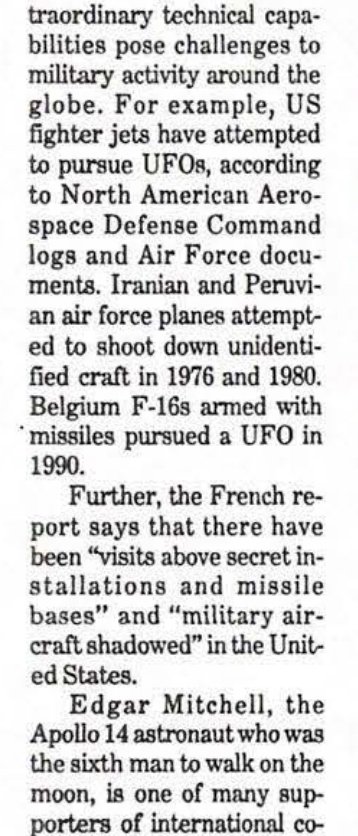
 Newspaper clippingPhysical page 89
DOCUMENTARY SOURCES · Arquivo histórico
What the records tell
Source of this entry: COMETA, private association; secondary account. The PDF brings together the private COMETA report and supplementary materials. Inclusion in the public collection does not turn its accounts or conclusions into an official position of the U.S. government.
On the night of 18–19/09/1976, calls about a light north of Tehran reportedly prompted the launch of two F-4s. The crews reported radar contact, instrument/communication failures as they approached, and smaller objects; a missile was not fired when systems failed, according to the reproduced narrative. COMETA cites a later investigation and a search, which found no traces, at the indicated lake. Radar documents and full testimonies are not reproduced here; the source does not identify the origin of the object.
The full text of page 19 details the origin of the account: an American citizen obtained the Defense Intelligence Agency (DIA) report through the Freedom of Information Act, and later interviews with generals and the Iranian controller involved supplemented the facts. According to this reconstruction, at around 23h on 18 September 1976 the Tehran tower received calls about a stationary luminous object over the Shemiran district; the night shift supervisor, Hossain Perouzi, saw through binoculars a rectangle with pulsating blue-white lights and a central red light. General Youssefi, alerted, also saw the object and ordered a first F-4 to take off, whose instruments and communications failed at a distance of 45 km.
Page 20, not previously translated, describes the second F-4: its radar showed an echo similar to a Boeing 707, and the object kept a constant distance of 45 km. A smaller object reportedly came out of the larger UFO, pursued the fighter, and caused the fire-control console and communications to fail when the pilot tried to fire a missile; it then returned to the main object. A second smaller object reportedly descended to the ground, illuminating an area of 2 to 3 km before the crew, momentarily dazzled, landed. An attached DIA note, quoted in full by COMETA, assesses the case as exemplary because it combines multiple qualified witnesses, radar confirmation, electromagnetic effects on three aircraft, and physiological effects on crew members — an institutional assessment attributed to the DIA itself, not a conclusion of COMETA or of this record.
Section 2.3 of the COMETA report begins by explaining where the account comes from. The incident was reported by newspapers in several countries, “with greater or lesser accuracy,” among them France-Soir of 21 September 1976. An American citizen later obtained, under the U.S. freedom of information law, the Defense Intelligence Agency (DIA) report, and other American documents were subsequently made public. The authors say they supplemented this material with interviews of generals and the Iranian controller, which added proper names. The DIA report is not reproduced in the PDF; what one reads is the French summary.
The summary adds details that were not in the dossier. The object's lights, arranged in a rectangle, changed rapidly from blue to green, red, and orange, and shone so brightly that the crew of the second F-4 could not estimate its size. On the way back, the crew noticed that they lost radio and intercom whenever they crossed a certain zone, and COMETA states that a civilian aircraft also lost communications when passing there. The next day, a helicopter took the crew members to the place where the object appeared to have landed, a dry lake, and nothing was found. These points are an account attributed to the crews, with no technical record in the PDF.
The report returns to the case in other chapters, always as part of an argument. In chapter 9, it says that the freedom of information law made it possible to learn of cases such as Tehran and repeats that the DIA treated it as a “radar/visual” and “classic” case. In chapter 10, the authors include Tehran among “intimidation maneuvers against aircraft,” alongside Luxeuil, within a declared exercise about the intentions of supposed visitors. In chapter 11, the case illustrates interference with onboard equipment and “apparently aggressive” behavior. These readings are hypotheses and classifications by COMETA, not conclusions of the DIA or of the Iranian Air Force.
COMETA also records the controversy. At the end of the section, it states that Philip Klass's attempt to “trivialize” the case shows how solid it is; in appendix 5, it adds that Klass correctly quotes the testimonies at the beginning of his text but fails to consider some aspects when discussing them. The bibliography refers to the chapter “UFOs over Iran” of Klass's book UFOs: The Public Deceived, and to pages 81 ff. of Clear Intent, by Lawrence Fawcett and Barry J. Greenwood. Klass's arguments are not in the PDF, so COMETA's response cannot be compared here with the criticized text.
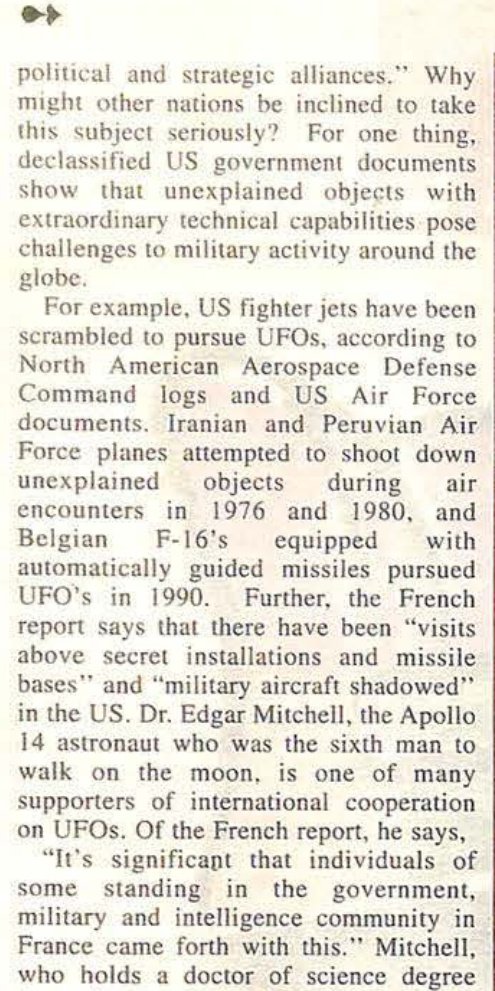
Two reports by Leslie Kean kept in the same file, from 2000, mention the episode in one sentence: Iranian Air Force planes reportedly tried to shoot down unexplained objects in 1976, as did Peruvian planes in 1980. This is a secondhand journalistic reference that brings no new data about the Tehran night. In short, the file brings together three distinct layers: the witnesses' account, conveyed through the COMETA summary; the institutional assessment attributed to the DIA, cited but not reproduced; and the interpretation of the French authors, who treat the case as evidence of deliberate maneuvers. No radar record, recording, or original testimony accompanies the PDF.
More images from the document
DIRECT READING OF THE FILE
The document, in the original
Translation of the selected excerpts checked against the image, with omissions indicated. This is not a full translation of the PDF. Summaries and evaluations are kept separate from the transcription.
EXCERPT 1 · PHYSICAL PAGE 19
Short excerpt supporting the summary, not a full translation.
I
I
Visual and radar contact were regained.
At 10522, Chase saw the object drop to around 4500 m. He had the RB-47 make a
dive from 10,500 to 6000 m. The object then disappeared from his view, from the
Utah radar, and from MacClure' s screen simultaneously.
- At 10572, still near Dallas, the object reappeared on MacClure's screen, and
I
Utah indicated
that it had prepared a "CIRVIS" (Communications Instructions for Reporting Vital
Intelligence Sightings) report, a secret urgent radio report sent to the Air Defense
Command, which is mandatory in the event ofa sighting by the Air Force of an
unidentified aerial object. At 1058Z, the pilot regained visual contact at ''2 o'clock." A
few minutes later, seeing his fuel reserves drop, he decided to return and headed roughly
I
north toward Oklahoma City. The object then positioned itself behind the aircraft at a
distance of 18 km, as reported by Utah, which tried to send fighter jets in pursuit ofthe
unknown [object]. The object, flowing lower than the RB-47 and behind it, could not be
seen from the cockpit, but it was detected on MacClure' s screen until Oklahoma City, well
outside the range ofthe Utah radar. Then it suddenly disappeared from the screen at
I 11402.
I 2.3 Tehran (September 18 to 19, 1976)
I
This incident took place during the night of September 18 to 19, 1976. Different
newspapers worldwide reported it more or less accurately: for example, France-Soir in
the September 21st issue. An American citizen took laborious steps with the U.S.
I
authorities to obtain a report, invoking the freedom of information act. He finally obtained
it from the Defense Intelligence Agency (DIA). Other U.S. documents have been obtained
I
since then.
Interviews with generals and the Iranian air [traffic] controller involved in this affair
enabled the DIA report to be confirmed and supplemented a bit, namely with the mention
I,
ofproper names. The following summary resulted from a reading ofthe all the
information:
- At around 11:00 p.m. on September 18, the Tehran airport control tower received
I
several calls reporting a strange immobile luminous object in the sky above the Shemiran
residential district in the northern part ofthe capital. The person in charge ofthe night
shift, Hossain Perouzi, went out to look at the object with binoculars. He testified that he
I
saw a rectangle, probably corresponding to a cylindrical object, the ends ofwhich pulsed
bluish-white lights. In the middle ofthe object, a small red light described a circle.
Perouzi reported this strange sighting to the Imperial Air Force Command, which alerted
I
General Youssefi, the third in command ofthis air force. He went out on his balcony and
saw an object similar to a star, but much bigger and brighter~ he ordered a Phantom F-4
reaction aircraft, the mission ofwhich he directed through Perouzi as intermediary.
When the F-4 came to 45 km from the object, its flight instruments and all its means of
communication (radio and intercom) suddenly stopped working. The pilot aborted the
I interception and headed for his base. The crew then regained use oftheir instruments and
means of communication.
- A second F-4 was sent by General Youssefi. The UFO's echo on its screen was
I similar to that of a Boeing 707. The F-4 approached the UFO at a relative speed of280
km/h. When it came to 45 km from it, the UFO accelerated and maintained a constant
distance of45 km from the F-4. The crew was not able to determine the size ofthe object
I
IEditorial note: End of the RB-47 case (1957) and beginning of the Tehran case, of 18-19/09/1976, with instrument failure on an Iranian F-4.
Check the original PDF
When the F-4 came to 45 km from the object, its flight instruments and all its means of communication suddenly stopped working.View the document record ↗ · Physical page 19, counting the cover.
EXCERPT 2 · PHYSICAL PAGE 19
Origin of the account and start of the night of 18-19/09/1976, p.19
I
I
Visual and radar contact were regained.
At 10522, Chase saw the object drop to around 4500 m. He had the RB-47 make a
dive from 10,500 to 6000 m. The object then disappeared from his view, from the
Utah radar, and from MacClure' s screen simultaneously.
- At 10572, still near Dallas, the object reappeared on MacClure's screen, and
I
Utah indicated
that it had prepared a "CIRVIS" (Communications Instructions for Reporting Vital
Intelligence Sightings) report, a secret urgent radio report sent to the Air Defense
Command, which is mandatory in the event ofa sighting by the Air Force of an
unidentified aerial object. At 1058Z, the pilot regained visual contact at ''2 o'clock." A
few minutes later, seeing his fuel reserves drop, he decided to return and headed roughly
I
north toward Oklahoma City. The object then positioned itself behind the aircraft at a
distance of 18 km, as reported by Utah, which tried to send fighter jets in pursuit ofthe
unknown [object]. The object, flowing lower than the RB-47 and behind it, could not be
seen from the cockpit, but it was detected on MacClure' s screen until Oklahoma City, well
outside the range ofthe Utah radar. Then it suddenly disappeared from the screen at
I 11402.
I 2.3 Tehran (September 18 to 19, 1976)
I
This incident took place during the night of September 18 to 19, 1976. Different
newspapers worldwide reported it more or less accurately: for example, France-Soir in
the September 21st issue. An American citizen took laborious steps with the U.S.
I
authorities to obtain a report, invoking the freedom of information act. He finally obtained
it from the Defense Intelligence Agency (DIA). Other U.S. documents have been obtained
I
since then.
Interviews with generals and the Iranian air [traffic] controller involved in this affair
enabled the DIA report to be confirmed and supplemented a bit, namely with the mention
I,
ofproper names. The following summary resulted from a reading ofthe all the
information:
- At around 11:00 p.m. on September 18, the Tehran airport control tower received
I
several calls reporting a strange immobile luminous object in the sky above the Shemiran
residential district in the northern part ofthe capital. The person in charge ofthe night
shift, Hossain Perouzi, went out to look at the object with binoculars. He testified that he
I
saw a rectangle, probably corresponding to a cylindrical object, the ends ofwhich pulsed
bluish-white lights. In the middle ofthe object, a small red light described a circle.
Perouzi reported this strange sighting to the Imperial Air Force Command, which alerted
I
General Youssefi, the third in command ofthis air force. He went out on his balcony and
saw an object similar to a star, but much bigger and brighter~ he ordered a Phantom F-4
reaction aircraft, the mission ofwhich he directed through Perouzi as intermediary.
When the F-4 came to 45 km from the object, its flight instruments and all its means of
communication (radio and intercom) suddenly stopped working. The pilot aborted the
I interception and headed for his base. The crew then regained use oftheir instruments and
means of communication.
- A second F-4 was sent by General Youssefi. The UFO's echo on its screen was
I similar to that of a Boeing 707. The F-4 approached the UFO at a relative speed of280
km/h. When it came to 45 km from it, the UFO accelerated and maintained a constant
distance of45 km from the F-4. The crew was not able to determine the size ofthe object
I
ICheck the original PDF
This incident took place during the night of September 18 to 19, 1976. [...] At around 11:00 p.m. on September 18, the Tehran airport control tower received several calls reporting a strange immobile luminous object in the sky above the Shemiran residential district [...] Perouzi reported this strange sighting to the Imperial Air Force Command, which alerted General Youssefi [...] he ordered a Phantom F-4 reaction aircraft [...] When the F-4 came to 45 km from the object, its flight instruments and all its means of communication (radio and intercom) suddenly stopped working. The pilot aborted the interception and headed for his base.View the document record ↗ · Physical page 19, counting the cover.
EXCERPT 3 · PHYSICAL PAGE 20
Second F-4, smaller objects and DIA assessment, p.20 (full page, not previously translated)
I
because it shone so intensely. Its brightness came from lights arranged in a rectangle,
changing rapidly from glue to green, to red, and to orange.
- Suddenly a bright object with an apparent diameter one half or one third of that ofthe I
moon exited the UFO and headed rapidly for the F-4. The pilot tried to shoot a
Sidewinder missile at the object, but at the same instant his fire control console and his
means of communication (radio and intercom) became inoperable. He promptly initiated a I
bank and a dive, but the object changed direction and pursued the aircraft at a distance of
approximately 6 km. Finally, the object moved inside the F-4's bank and departed in order
to reenter the UFO from which it had exited. I - A short time afterwards, an object again exited the UFO and rapidly headed straight
down to the ground. The F-4 crew waited to see it explode, but the object seemed to
touch down gently and shine a very bright light over an area 2 to 3 km in diameter. The I
crew, momentarily blinded, orbited long enough to recover their night vision before
landing at the Tehran airfield. It noted that it lost communications (radio and intercom)
whenever their aircraft crossed a certain zone. It should be pointed out that a civilian I
aircraft also lost communications when it crossed that zone. The next day, the crew was
taken by helicopter to the place where the object had apparently landed, a dried up lake, I· but it didn't find any trace [of the object].
An attached note from DIA was just as astonishing as the report itself; it indicated that
the information had been confirmed-by other sources and ended with this assessment:
"An outstanding report. This case is a classic which meets all the criteria necessary for a valid I
study ofthe UFO phenomenon. "
!!:. The obiect was seen by multiple witnesses from different locations ... ,
!!.:. The credibility ofmany ofthe witnesses was high (an Air Force General, qualified aircrews, and I
experienced radar operators),
s Visual sightings were confirmed br radar,
4.. Similar electromagnetic effects (EME) were reported by three separate aircraft,
~ There were physiological e ffects on some crew members (i. e. loss of night vision due to the I
brightness o[the obiect),
.f An inordinate amount ofmaneuverability was displayedby the UFOs."
The attempt by KJass to trivialize this case shows how solid it is. ·1
2.4 Russia (March 21, 1990) I
This case took place at night in the Pereslavl-Zalesski region east ofMoscow. It was
reported in an article by Aviation General Igor Maltsev, Air Defense Forces commander, I which appeared in the newspaper Rabochaya Tribzma ("Workers' Tribune") on April 19,
1990, entitled "UFOs on Air Defense Radars" (cf the book by Marie Galbraith
referenced in Chapter 9. 1 ). ,I
The article mentions the dispatch ofcombat aircraft on a mission to intercept the UFOs
detected. General Maltsev, who summarized over one hundred visual sightings coHected
by unit commanders, stated: I "I am not a specialist in UFOs, and therefore I can only correlate the data and express mv own
supposition. According to the evidence o[these eyewitnesses, the UFO is a disk with a diameter from
JOO to 200 meters /320 to 650 (eets/. Two pulsating lights were positioned on its sides ... Moreover, the
object rotated around its axis and performed an 'S-turn' flight both in the vertical and horitontal ·1
planes. Next the UFO hovered above the ground and then flew with a speed exceeding that ofthe
modern iet fighter bv two or three times .. The obiects flew at altitudes ranging from JOO to 7000 m.
(300
distingui
to 24,
sh
000
ed by
feet
its
/.
startling
The move
man
men
euverability.
t o[the UFOs
It
was
seemed
not
th
acco
e UFOs
mpanied
were
by
co
sound
mplete
o(anr
lv devoid
kind
o[inertia.
and was I
In other words, they had somehow 'come to terms' with gravity. At the present time, terrestrial
I
IEditorial note: End of the Tehran case (1976), with the DIA assessment, and the Russia case (21/03/1990), with a statement by General Maltsev underlined in the copy.
Check the original PDF
A second F-4 was sent by General Youssefi. [...] Suddenly a bright object [...] exited the UFO and headed rapidly for the F-4. The pilot tried to shoot a Sidewinder missile at the object, but at the same instant his fire control console and his means of communication [...] became inoperable. [...] the object moved inside the F-4's bank and departed in order to reenter the UFO [...] A short time afterwards, an object again exited the UFO and rapidly headed straight down to the ground. [...] it shine a very bright light over an area 2 to 3 km in diameter. [...] An attached note from DIA [...] ended with this assessment: "An outstanding report. This case is a classic which meets all the criteria necessary for a valid study of the UFO phenomenon." [with six numbered points on witnesses, credibility, radar confirmation, EME effects, physiological effects, and maneuverability].View the document record ↗ · Physical page 20, counting the cover.
Dates and documentary context
- Event
- 18/09/1976 to 19/09/1976 — 1976-09-18/1976-09-19. Date indicated by the secondary source, separate from the publication date.
- Document
- Not established — Individual document date not determined; see the source publication below.
- Publication
- 07/1999 — VSD (special edition, July 1999) · Publication of the source examined or cited; do not presume it is the first historical disclosure of the event. · The record reflects the COMETA summary; primary sources are not always reproduced.
Origin and release
COMETA, private association; secondhand account · UFOs and Defense: What Should We Prepare For?
This record reflects the COMETA summary; primary sources are not always reproduced. Hosting or archiving by a public agency does not imply endorsement; COMETA is a private association. The English version has not been fully compared with the French one.
Official collection · release 01 ↗ — Match indicated by the search; bytes of the remote PDF not authenticated.
A propos de la publication du rapport COMETA — GEIPAN ↗ — GEIPAN clarifies that hosting COMETA does not imply approval by CNES. It identifies the committee as private and attributes the conclusions to the authors. The note also records that the version published there was incomplete.
Questions to continue the investigation
- Locate and verify the primary records and technical documents cited.
GEOGRAPHY OF THE CASE
Tehran, Iran
Approximate reference for the location cited in the document, positioned by the editorial team. Does not indicate where the witness or the object was.
DOCUMENTARY TRAIL
Go back to the sources
References use physical pages of the PDF, counting the cover. Summaries are presented in English; the documents keep their original language.
- 255_413270_UFO's_and_Defense_What_Should_we_Prepare_For.pdf
Physical pages 5, 9, 19, 20
Arquivo histórico · 94 pages
Context and references in this document
contexto ou referencia
UFO seen over a rural school after Antananarivo ↗
contexto ou referencia
Reports of “ghost rockets” in Sweden ↗
contexto ou referencia
Reports of “foo fighters” in World War II ↗
contexto ou referencia
Reports of “airships” in the U.S. and the United Kingdom ↗
contexto ou referencia
Luminous phenomenon attributed to Goethe in 1768 ↗
contexto ou referencia
Aerial phenomena reported in Nuremberg ↗
contexto ou referencia
Aerial phenomenon reported in Basel ↗
contexto ou referencia
Medieval narrative attributed to Agobard about occupants of an “aircraft” ↗
contexto ou referencia
Contact with a Venusian attributed to Adamski ↗
contexto ou referencia
Paul Bennewicz's claims about microwaves, abductions and implants ↗
contexto ou referencia
Triangular lights reported in Arizona in 1997 ↗
contexto ou referencia
Interception attempts by military aircraft in Iran, Peru and Belgium ↗
contexto ou referencia
Shoot-down attempt by Peruvian aircraft, cited in a news report ↗
contexto ou referencia
Pursuit of UFOs by Belgian F-16s in 1990 ↗
contexto ou referencia
Mention of a military Vampire in the Orange region in 1951 ↗
contexto ou referencia
Photograph attributed to a mapping flight over Tilarán, Costa Rica ↗
contexto ou referencia
Image attributed to a Zanesville, Ohio, barber in 1966 ↗
contexto ou referencia
Image attributed to a student from Beaver, Pennsylvania ↗
contexto ou referencia
Image attributed to brothers from Detroit in 1967 ↗
Related publications and media
Editorial summary based on the collection's research notes. How we read the documents.