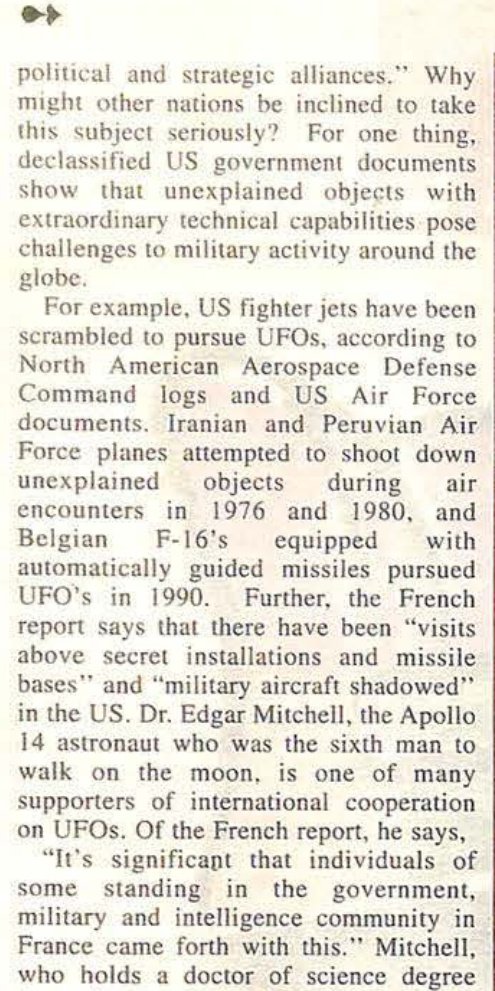
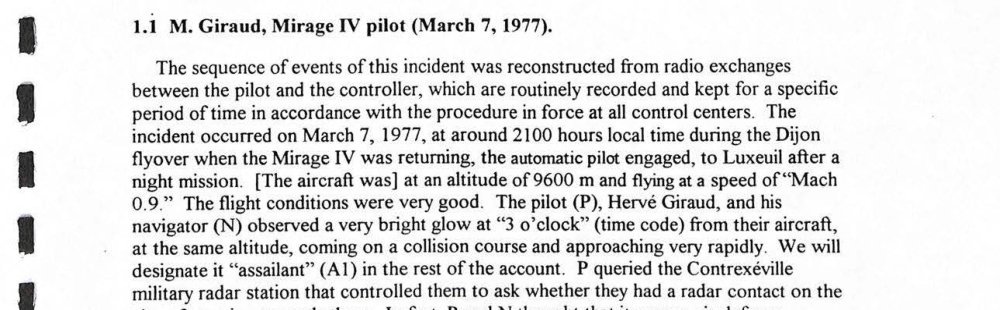
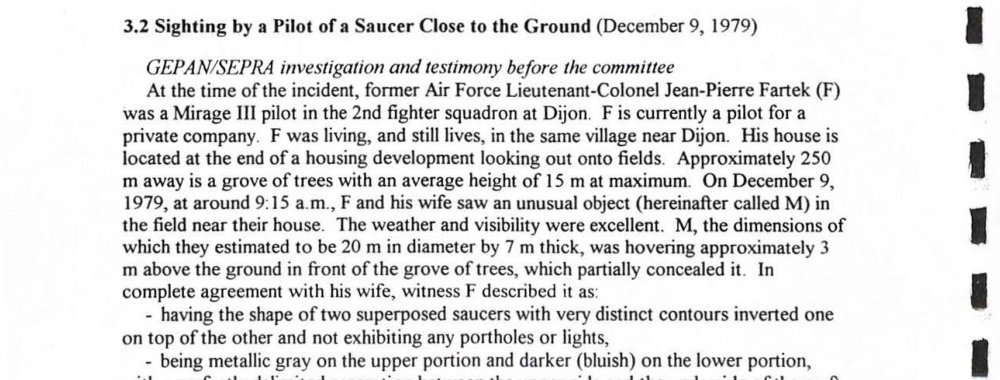
Date: 1976-03-03Location: Rennes–Nantes–Poitiers route, France
Account of a green sphere by a T-33 pilot
COMETA reproduces the written testimony of an initially anonymous pilot, later identified as Claude Bose. On 3 March 1976, he was flying a solo night training flight in a T-33, on the Rennes–Nantes–Poitiers–Tours route, at 6.000 m and about 460 km/h, under a cloudless sky.
- Event date
- 1976-03-03
- Location
- Rennes–Nantes–Poitiers route, France
- Topic
- COMETA and international accounts
- Source agencies
- Arquivo histórico
- Documents
- 1 document · 94 pages
- Reading time
- 10 min
 Report excerptPhysical page 14
DOCUMENTARY SOURCES · Arquivo histórico
What the records tell
Source of this entry: COMETA, private association; secondary account. The PDF brings together the private COMETA report and supplementary materials. Inclusion in the public collection does not turn its accounts or conclusions into an official position of the U.S. government.
COMETA reproduces the written testimony of an initially anonymous pilot, later identified as Claude Bose. On 3 March 1976, he was flying a solo night training flight in a T-33, on the Rennes–Nantes–Poitiers–Tours route, at 6.000 m and about 460 km/h, under a cloudless sky.
The pilot said he saw something initially resembling a distant green flare: it reportedly rose above the aircraft, descended toward it, and filled the windshield. He let go of the control stick and shielded his face, expecting impact; the luminous sphere reportedly passed over the right wing. He estimated a diameter of 1–2 m, an intense white center, a green tail, and a total duration of under five seconds.
The controller reportedly detected no radar contact. Two other pilots flying the same route stated that they saw the phenomenon from a distance. These are visual observation accounts summarized in COMETA; the PDF contains no records that would allow distance, size, or speed to be reconstructed independently.
The full text of pages 14-15 shows the complete context of the flight: the pilot, then a student at the Tours Combat Flight School, was flying alone at night, under a cloudless sky with visibility above 100 km, with other aircraft following the same itinerary at five-minute intervals. He first saw, far ahead and at the limit of detection, what he thought was the launch of a green flare — only later realizing that the object was climbing, leveling off, and descending directly toward him at very high speed.
The reaction recorded in the testimony is that of someone expecting a collision: he let go of the control stick and crossed his arms in front of his face. The account attributes to the sphere a tail comparable to a comet's and a very intense white center, like "magnesium fire," details that were not in the paragraphs already published in the dossier. The ground controller had no radar contact; COMETA presents here no instrumental record independent of the account of the pilot himself and of the two colleagues who said they saw the phenomenon from a distance.
DIRECT READING OF THE FILE
The document, in the original
Translation of the selected excerpts checked against the image, with omissions indicated. This is not a full translation of the PDF. Summaries and evaluations are kept separate from the transcription.
EXCERPT 1 · PHYSICAL PAGE 15
Short excerpt supporting the summary, not a full translation.
I
r
I
very last moment and passed over his right wing grazing it, all within a fraction ofa
second. P retained the following memory ofthis incident:
- S was not very large ( l to 2 m in diameter),
I
- S was extended by a tail, which was comparable to that on a comet, that was also a
fluorescent green color,
- the center ofS consisted ofa very bright white light (magnesium-fire type),
- the sighting lasted a total ofless than 5 seconds.
P, who was very shocked by this phenomenon, informed the radar controller (-)
I
!I ensuring the control of the mission on the ground; the controller had not detected anything
on his radar scope. Upon return, two other pilots who had followed the same itinerary as
P stated that they had seen the phenomenon, but from a distance.
I 1.3 Air France Flight AF 3532 (January 28, 1994)
Jean-Charles Duboc (P), captain ofAir France flight AF 3532, was assisted by Copilot
Valerie Chauffour (CP) in making the Nice-London connection on January 28, 1994. At I 1314 hours, while they were cruising at an altitude of 11,900 m in the vicinity of
I
Coulommiers in Seine-et-Mame [Department] under excellent meteorological conditions,
the chief steward, who was present in the cockpit at the time, pointed out a phenomenon
that appeared to him to be a weather balloon. His sighting was immediately confinned by
I
the copilot. P, who in tum saw it, first thought that it was an aircraft banking at a 45°
angle. Very quickly, however, all three agreed that what they were seeing did not
resemble anything that they knew of The excellent visibility and the presence of
altocumulus clouds permitted P to estimate that the phenomenon was at an altitude of
l 0,500 m and at a distance of approximately 50 km. Taking into account its apparent I diameter, they deduced that the craft was large. They were struck by the changes in the
I
shape ofthe craft, which first appeared in the form of a brown bell before transforrning
into a chestnut brown lens shape, then disappearing almost instantaneously on the left side
ofthe aircraft, as ifit had suddenly become invisible. P reported to the Reims Air
I
Navigation Control Center, which had no information on any mobile air presence in the
vicinity. However, following the existing procedure, Reims informed the Tavemy Air
Defense Operations Center (CODA) ofthe sighting made by the crew and asked P to
I
follow the "Airmiss" procedure upon landing.
CODA did in fact record a radar track initiated by the Cinq-Mars-la-Pile control center
at the same time that corresponded in location and time to the phenomenon observed.
I
This radar track, which was recorded for 50 seconds, did cross the trajectory offlight AF
3532 and did not correspond to any flight plan filed. It should be noted that the
phenomenon disappeared from the view ofthe crew and the radar scopes at the same
I
instant. The investigations conducted by CODA enabled both the hypothesis of a weather
balloon to be ruled out and the precise crossing distance ofthe two trajectories to be
determined, consequently bringing the approximate length ofthe craft to 250 min length.
I
It should be noted that the Northern Regional Air Navigation Center (CRNA), which
handles 3000 movements per day, has investigated only three cases over the last seven
years, one ofwhich was that offlight AF 3532.
I Chapter 2 - Aeronautic Cases Throughout the World
I
IEditorial note: End of the T-33 pilot's testimony (1976) and account of Air France flight AF 3532, of 28/01/1994, with a coinciding radar record.
Check the original PDF
The sighting lasted a total of less than 5 seconds.View the document record ↗ · Physical page 15, counting the cover.
EXCERPT 2 · PHYSICAL PAGE 14
Full testimony of the T-33 pilot, pp.14-15 (section "1.2 Testimony of a Fighter Pilot", full text)
I
~
surprised by the crew's question that he suspects an oxygen problem capable of causing a
"hallucination."
"Assailant A I" maintained its course towards the Mirage IV. P initiated a bank to the I
right toward A 1, a bank which he was forced to keep tightening (3 to 4 g) in order to try
to maintain visual contact on A I and to keep it from positioning itself to the rear. Despite I this maneuver, A I moved behind the Mirage IV at an estimated distance of 1500 m. At
this point P reversed his bank to regain visual contact on A 1 . He saw the glow move
away to "11 o'clock." He resumed course to Luxeuil. But 45 seconds after he resumed I
course to Luxeuil, feeling like he was being "watched" according to his own words, P
told N, "you wait and see, it's going to come back." And in fact, an identical glow,
which we will call A2, appeared at "3 o'clock." I P then initiated a very tight bank (6.5 g) to disengage his aircraft from what he now
considered to be a real threat. The glow followed the Mirage !Y's maneuver in order to
position itselfto the rear at an estimated distance of2000 m. P reversed, as before, and I
-
once again saw the glow disappear under the same conditions. C still did not have a radar . '
contact on "assailant A2." P and N continued their flight and returned nonnally to the
Luxeuil base. I Those are the facts. Two points should be emphasized: :!.
- only a combat aircraft could have had performance comparable to that of A 1 and A2
(speed, maneuverability). In this case, C would have had a radar contact on this aircraft, I
especially at that altitude, a contact that he would have seen all the better since there was
no other traffic in the vicinity ofthe Mirage lY.
• - given the apparent maneuvers of Al and A2, regardless ofwhether or not they were I
the same craft, their speed could only be supersonic, which, in the case ofcombat aircraft,
would be manifested on the ground by a very loud sonic boom due to the phenomenon of
the focusing of the shock wave generated by the bank. Th.is would have been noticed in I
the surrounding area, especially since it was nighttime. But no sound was heard in the
region. I
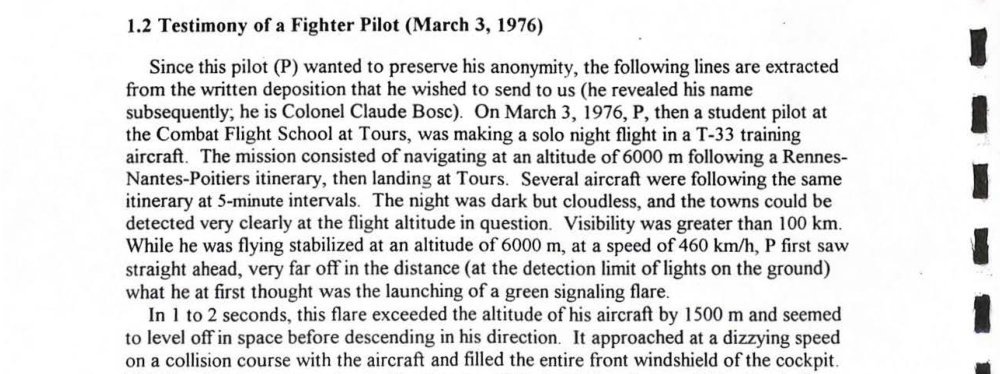
1.2 Testimony of a Fighter Pilot (March 3, 1976)
Since this pilot (P) wanted to preserve his anonymity, the following lines are extracted I
from the written deposition that he wished to send to us (he revealed his name
subsequently~ he is Colonel Claude Bose). On March 3, 1976, P, then a student pilot at
the Combat Flight School at Tours, was making a solo night flight in a T-33 training I
aircraft. The mission consisted of navigating at an altitude of 6000 m following a RennesNantes-Poitiers itinerary, then landing at Tours. Several aircraft were following the same
itinerary at 5-minute intervals. The night was dark but cloudless, and the towns could be I
detected very clearly at the flight altitude in question. Visibility was greater than 100 km.
While he was flying stabilized at an altitude of6000 m, at a speed of460 km/h, P first saw I straight ahead, very far off in the distance (at the detection limit oflights on the ground)
what he at first thought was the launching ofa green signaling flare.
In 1 to 2 seconds, this flare exceeded the altitude ofhis aircraft by 1500 m and seemed I to level offin space before descending in his direction. It approached at a dizzying speed
on a collision course with the aircraft and filled the entire front windshield of the cockpit.
Th.inking that impact was inevitable, P let go of the joystick and crossed his arms in front I of his face in a reflex protection gesture. The aircraft was completely enveloped in a very
bright and phosphorescent green light. P saw a sphere (S) that avoided his aircraft at the I
ICheck the original PDF
1.2 Testimony of a Fighter Pilot (March 3, 1976) [...] On March 3, 1976, P, then a student pilot at the Combat Flight School at Tours, was making a solo night flight in a T-33 training aircraft. [...] While he was flying stabilized at an altitude of 6000 m, at a speed of 460 km/h, P first saw straight ahead, very far off in the distance [...] what he at first thought was the launching of a green signaling flare. In 1 to 2 seconds, this flare exceeded the altitude of his aircraft by 1500 m [...] It approached at a dizzying speed on a collision course [...] Thinking that impact was inevitable, P let go of the joystick and crossed his arms in front of his face [...] S was extended by a tail, which was comparable to that on a comet [...] the center of S consisted of a very bright white light (magnesium-fire type) [...] the sighting lasted a total of less than 5 seconds. [...] the controller had not detected anything on his radar scope. Upon return, two other pilots who had followed the same itinerary as P stated that they had seen the phenomenon, but from a distance.View the document record ↗ · Physical page 14, counting the cover.
Dates and documentary context
- Event
- 03/03/1976 — 1976-03-03. Date indicated by the secondary source, separate from the publication date.
- Document
- Not established — Individual document date not determined; see the source publication below.
- Publication
- 07/1999 — VSD (special edition, July 1999) · Publication of the source examined or cited; do not presume it is the first historical disclosure of the event. · The record reflects the COMETA summary; primary sources are not always reproduced.
Origin and release
COMETA, private association; secondhand account · UFOs and Defense: What Should We Prepare For?
This record reflects the COMETA summary; primary sources are not always reproduced. Hosting or archiving by a public agency does not imply endorsement; COMETA is a private association. The English version has not been fully compared with the French one.
Official collection · release 01 ↗ — Match indicated by the search; bytes of the remote PDF not authenticated.
A propos de la publication du rapport COMETA — GEIPAN ↗ — GEIPAN clarifies that hosting COMETA does not imply approval by CNES. It identifies the committee as private and attributes the conclusions to the authors. The note also records that the version published there was incomplete.
Questions to continue the investigation
- Locate and verify the primary records and technical documents cited.
GEOGRAPHY OF THE CASE
Western France, Rennes–Nantes–Poitiers route
The marker lies on the axis of the flight route, without indicating where the contact occurred. Approximate regional reference, placed by the editors based on the place cited in the document. The marker does not represent the exact location of the account.
DOCUMENTARY TRAIL
Go back to the sources
References use physical pages of the PDF, counting the cover. Summaries are presented in English; the documents keep their original language.
- 255_413270_UFO's_and_Defense_What_Should_we_Prepare_For.pdf
Physical pages 5, 9, 14, 15
Arquivo histórico · 94 pages
Context and references in this document
contexto ou referencia
UFO seen over a rural school after Antananarivo ↗
contexto ou referencia
Reports of “ghost rockets” in Sweden ↗
contexto ou referencia
Reports of “foo fighters” in World War II ↗
contexto ou referencia
Reports of “airships” in the U.S. and the United Kingdom ↗
contexto ou referencia
Luminous phenomenon attributed to Goethe in 1768 ↗
contexto ou referencia
Aerial phenomena reported in Nuremberg ↗
contexto ou referencia
Aerial phenomenon reported in Basel ↗
contexto ou referencia
Medieval narrative attributed to Agobard about occupants of an “aircraft” ↗
contexto ou referencia
Contact with a Venusian attributed to Adamski ↗
contexto ou referencia
Paul Bennewicz's claims about microwaves, abductions and implants ↗
contexto ou referencia
Triangular lights reported in Arizona in 1997 ↗
contexto ou referencia
Interception attempts by military aircraft in Iran, Peru and Belgium ↗
contexto ou referencia
Shoot-down attempt by Peruvian aircraft, cited in a news report ↗
contexto ou referencia
Pursuit of UFOs by Belgian F-16s in 1990 ↗
contexto ou referencia
Mention of a military Vampire in the Orange region in 1951 ↗
contexto ou referencia
Photograph attributed to a mapping flight over Tilarán, Costa Rica ↗
contexto ou referencia
Image attributed to a Zanesville, Ohio, barber in 1966 ↗
contexto ou referencia
Image attributed to a student from Beaver, Pennsylvania ↗
contexto ou referencia
Image attributed to brothers from Detroit in 1967 ↗
Related publications and media
Editorial summary based on the collection's research notes. How we read the documents.