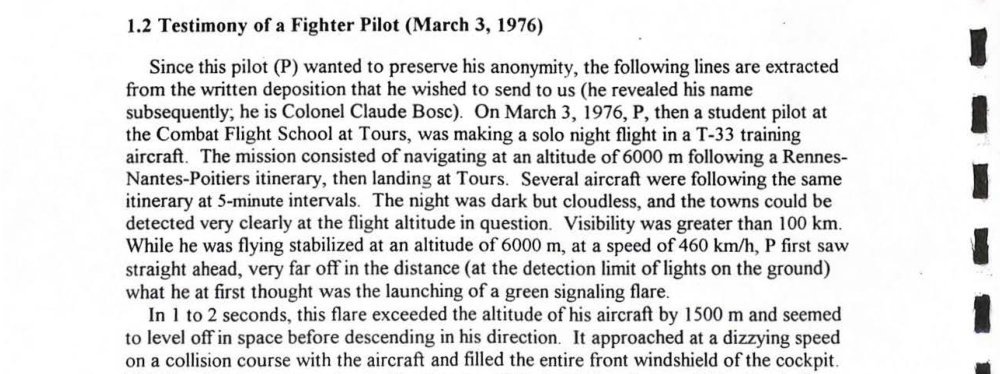
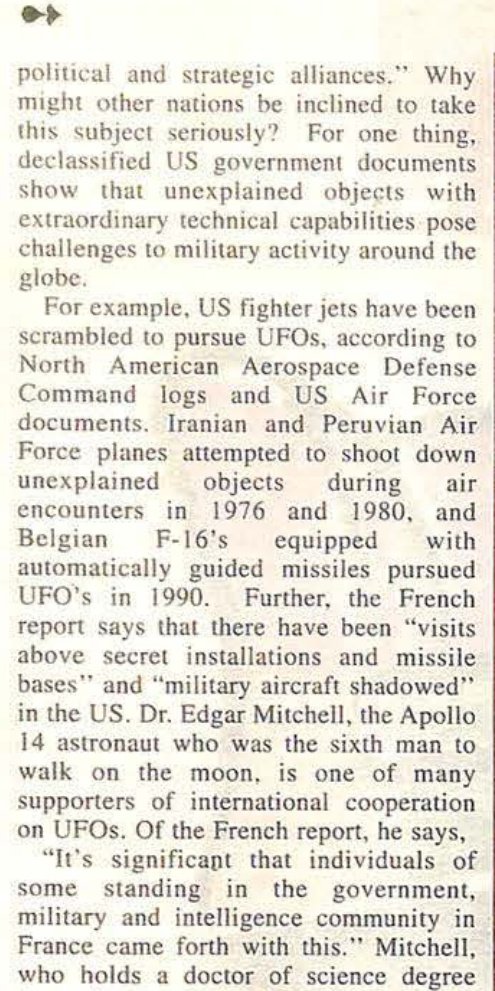
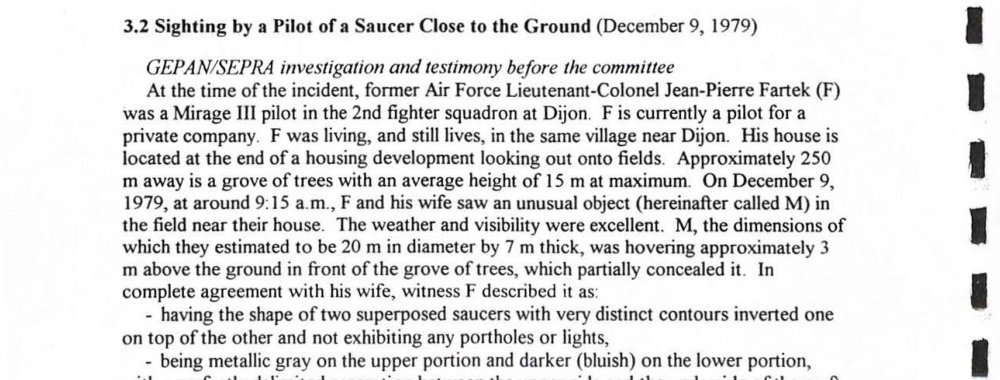
Date: 1977-03-07Location: over Dijon, France
Hervé Giraud's encounter during a Mirage IV flight
According to Hervé Giraud's testimony to COMETA, on 7 March 1977, at about 21h local time, he and his navigator were returning from a night mission in a Mirage IV, over Dijon, at 9.600 m and Mach 0,9. They saw an intense glow to their right, at the same altitude, approaching on an apparent collision course. The military controller at Contrexéville reported having no corresponding contact and asked them to check their oxygen.
- Event date
- 1977-03-07
- Location
- over Dijon, France
- Topic
- COMETA and international accounts
- Source agencies
- Arquivo histórico
- Documents
- 1 document · 94 pages
- Reading time
- 11 min
 Report excerptPhysical page 13
DOCUMENTARY SOURCES · Arquivo histórico
What the records tell
Source of this entry: COMETA, private association; secondary account. The PDF brings together the private COMETA report and supplementary materials. Inclusion in the public collection does not turn its accounts or conclusions into an official position of the U.S. government.
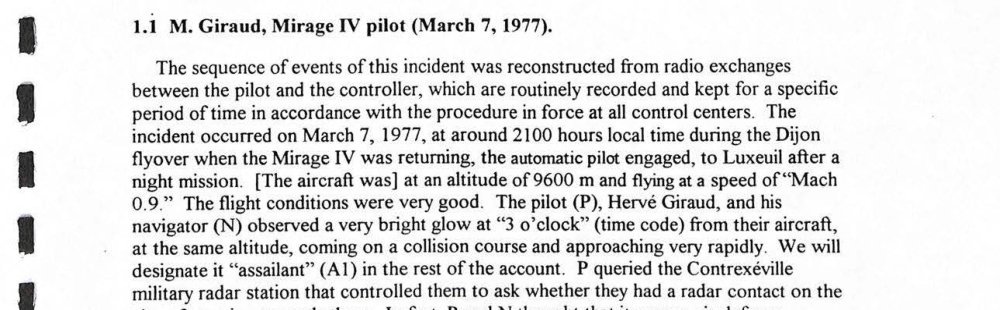
According to Hervé Giraud's testimony to COMETA, on 7 March 1977, at about 21h local time, he and his navigator were returning from a night mission in a Mirage IV, over Dijon, at 9.600 m and Mach 0,9. They saw an intense glow to their right, at the same altitude, approaching on an apparent collision course. The military controller at Contrexéville reported having no corresponding contact and asked them to check their oxygen.
The pilot reported a 3–4 g turn; the glow reportedly passed behind the Mirage at a distance estimated at 1.500 m and then moved away. After they resumed their heading toward Luxeuil, about 45 seconds later a similar glow appeared. A turn described as 6,5 g was reportedly matched by the glow, which was again seen behind, this time estimated at 2.000 m. The crew returned to base.
The report says it reconstructs the sequence using radio communications, but does not provide the recordings here. It does not establish whether the two glows were the same object; distances and dynamics are reported, while the absence of radar contact is stated explicitly. The authors' conclusions about performance and sonic boom are interpretive arguments, not additional measurements.
In later chapters, the COMETA report reclassifies the episode. On physical page 34, it appears as one of the “two other very extraordinary sightings” by military pilots, alongside the Tours case of 1976, and the text identifies it by the destination base, Luxeuil. The authors say that only three or four of the twelve French aeronautical cases brought to GEPAN/SEPRA since 1951 fall into category D, that of phenomena unidentified despite abundant data. On physical page 36, the Orange (1951), Tours (1976), and Luxeuil (1977) cases are cited in support of the idea of piloted or remotely guided objects, because the pilots said it was the object that came toward them.
On physical page 55, the case returns as an example of “apparently aggressive conduct,” with the mention “Colonel Giraud in his Mirage IV.” The volume itself spells the pilot's name in different ways: “Hervé Giraud” in the chapter 1 account (physical page 13) and “René Giraud” in the acknowledgments list of Denis Letty's preface (physical page 11). The reading of aggressiveness and piloting is the authors' interpretation; the pilot's account describes approaches and maneuvers, with no damage to the aircraft.
DIRECT READING OF THE FILE
The document, in the original
Translation of the selected excerpts checked against the image, with omissions indicated. This is not a full translation of the PDF. Summaries and evaluations are kept separate from the transcription.
EXCERPT 1 · PHYSICAL PAGE 13
Short excerpt supporting the summary, not a full translation.
advisable to eliminate here and now.
PART I
Facts and Testimonies
I Before going further, it seems worthwhile to us to present several facts and testimonies
I
that in themselves justify the interest ofthe in-depth study that we are going to develop
below:
- three testimonies ofFrench civilian and military pilots who encountered UFOs in flight,
- five major aeronautical cases in the world,
I - three sightings frQm the ground,
- four cases ofclose encounters in France.
I
These few examples are among the hundreds ofremarkable, that is to say credible and
well-documented, cases observed around the world in recent decades. None ofthese
cases has been explained, whereas the majority ohimes the investigations enable the origin
I
ofthe phenomena observed by the witnesses to be determined; we will give two significant
examples of this.
I Chapter 1 - Testimonies of French Pilots
Three French pilots who encountered UFOs in flight came to testify before the
committee. Their testimonies are all the more interesting because they can be eva1uated
I better than other aerial phenomena since they pertain to the aeronautic world.
I 1.1 M. Giraud, Mirage IV pilot (March 7, 1977).
I
The sequence of events ofthis incident was reconstructed from radio exchanges
between the pilot and the controller, which are routinely recorded and kept for a specific
period oftime in accordance with the procedure in force at all control centers. The
I
incident occurred on March 7, 1977, at around 2100 hours local time during the Dijon
flyover when the Mirage IV was returning, the automatic pilot engaged, to Luxeuil after a
I
night mission. [The aircraft was] at an altitude of9600 m and flying at a speed of"Mach
0.9." The flight conditions were very good. The pilot (P), Herve Giraud, and his
navigator (N) observed a very bright glow at "3 o'clock" (time code) from their aircraft,
I
at the same altitude, coming on a collision course and approaching very rapidly. We will
designate it "assailant" (A1) in the rest of the account. P queried the Contrexeville
military radar station that controlled them to ask whether they had a radar contact on the
I
aircraft coming towards them. In fact, P and N thought that it was an air defense
interceptor, as is currently being used, that was seeking to intercept their aircraft to then
identify it with its identification beacon.
I
The radar controller (C), who did not have a corresponding radar contact on his scope,
gave a negative response and asked the pilots to check their oxygen. This request on the
part ofthe controller is a standard emergency procedure; it shows that the controller is so
I
IEditorial note: Beginning of Part 1 of the COMETA report and start of the account by pilot Giraud, of a Mirage IV, on 7/03/1977.
Check the original PDF
A very bright glow at “3 o’clock” from their aircraft, at the same altitude, coming on a collision course and approaching very rapidly.View the document record ↗ · Physical page 13, counting the cover.
EXCERPT 2 · PHYSICAL PAGE 34
French aeronautical cases, physical page 34
I
labeled CE3s (close encounters ofthe third kind) according to the classification proposed
by Professor A. Hynek, an astronomer and consultant to the USAF, within the context of
the Blue Book Project (cf. Chapter 9.1 ). I
7.3 Typology of UAP Ds I
The detailed statistical analysis ofUAP Ds enables a precise determination ofthe
distribution oftheir physical characteristics: speed, acceleration, silence, shape, effects on
the environment. It is interesting to note that statistical studies in the USSR yielded I
distributions comparable to those determined by Claude Poher, the first head ofGEPAN,
from some 200 French cases, or 1,000 cases worldwide. It would be desirable to be able
to develop UAP D statistical studies in France. I
7.4 Investigations ofRemarkable Cases I
Around one hundred investigations have been conducted by GEP AN/SEPRA. Some of
them have highlighted rare physical atmospheric phenomena associated, for example, with I
lightning~ others have revealed unusual psychological behavior ofwitnesses caused, for
example, by taking hallucinogenic drugs. Several very in-depth investigations based on
analyses of evidence have demonstrated, in the end, the physical presence ofa I
phenomenon the nature and origin ofwhich remain unknown. Two cases related in
Chapter 4 stand out in our minds, the Trans-en-Provence case ofJanuary 8, 1981, and the
"Amaranth" case ofOctober 2 1, I 982. The investigations lead us to believe that double I
saucer-shaped objects were close to the ground for some time, then departed toward the
sky leaving traces on the vegetation and, in the Trans-en-Provence case, on the ground
itself. They are detailed in GEP AN technical memoranda no. 16 and no. 17 (see the I
reference list in Chapter 6).
I
7.5 Aeronautical Cases
7.5.l Data on French Aeronautical Cases I - Twelve French aeronautical cases have been brought to the attention of
GEPAN/SEPRA~ only three or four ofthese can be considered to fall into category D.
- The first UAP D case identified dates back to 1951. It involved Vampire military I
I
. aircraft in the Orange area. In two other very extraordinary sightings, which are presented
in Chapter 1, military pilots reported the presence ofobjects with aeronautical
performances inconsistent with the maneuvers ofclassic aircraft over the region ofTours
in 1976 and ofLuxeuil in 1977. However, not until January 28, 1994, was the crew ofa
regularly scheduled Air France commercial airplane able to collect the first case of a visual
sighting correlated with a radar detection over 50 seconds long (see Chapter 1.3). I
7.5.2 Aeronautical UAP D Cases Worldwide I
The aeronautical UAP D cases known since 1942 were initially enumerated in a
document entitled Rencontres dans le cie/ {Encounters in the Sky], by Dominique
Weinstein, the French portion ofwhich SEPRA contributed to. The list ofsightings I
I
IEditorial note: Chapter 7 of the COMETA report: typology of D-type UAP (FANI D), investigations of notable cases and French aeronautical cases, according to the authors.
Check the original PDF
In two other very extraordinary sightings, which are presented in Chapter 1, military pilots reported the presence of objects with aeronautical performances inconsistent with the maneuvers of classic aircraft over the region of Tours in 1976 and of Luxeuil in 1977.View the document record ↗ · Physical page 34, counting the cover.
EXCERPT 3 · PHYSICAL PAGE 55
Aeronautical implications, physical page 55
I
aeronautical phenomenon which numerous civilian and military pilots have come face to
face with. Ofthe several hundred confirmed aeronautical cases, there are primarily five
I
types ofimplications:
- simple sighting ofa phenomenon by the crew, passengers, or ground personnel,
- detection ofa track on a radar screen, which occurs in one out offive aeronautical
I
cases, sometimes culminating in the recording ofa track, as was the case on January 28,
I 994, at the Cinq-Mars-la-Pile Control and Detection Center (CDC) ( cf Chapter I),
- interferences with ground (San Carlos de Bariloche) or onboard (Tehran) electrical or
electronic equipment,
- shadowing ofaircraft (San Carlos de Bariloche, RB-47, etc.),
- apparently aggressive conduct ( Colonel Giraud in his Mirage IV, student pilot at
Tours, the Tehran incident, etc.).
The number oftestimonies and the quality ofthe witnesses are such that one cannot dodge
the phenomenon and aeronautic personnel, and more especially defense personnel, must be
sensitized and prepared to deal with the situation. In fact, how can one try to ignore a
phenomenon that is manifested by the regular crossing ofour air space by moving objects
1. the behavior ofwhich suggests that they are piloted by an intelligent [being]? Can one
I
claim, because this appears to exceed our technical knowledge, that it does not fall within
our purview? Ifwe do nothing, the very principle of defense and air intelligence would be
called into question.
I
The first sightings made by aviators date back to the beginning ofthe 40s. Since then,
the number ofunexplained sightings (after an expert's appraisal: UAP Ds) reported by
pilots or [air traffic] controllers has risen to over 500. As a reminder1.. in France, this figure
is three or four since 1951 . It is the responsibility of the Air Force to take into account
these phenomena, which, until proven otherwise, occur primarily in air space.
I 11.2 Who is Involved?
I 11.2.1Flight Crew
I
I
The flight crew is naturally involved, particularly the pilots, because whether they are
civilian or military, they are in a more advantageous position for making sightings and
would be the first affected in the event ofan incident (risk of collision, in particular). This
is especially true for a combat pilot, because he is trained to constantly monitor the sky
and he now has more and more advanced weapons systems capable of detecting faster and
faster and smaller and smaller targets at greater and greater distances. The pilot/weapons
system pair is now more than ever an excellent sighting instrument and would be our first
I means ofintervention if, by chance, this were to prove necessary. The concerns of a
I
commercial airline pilot are different because, in addition to the fact that he does not have
the same equipment, his priority is obviously the safety ofhis passengers. Although he
remains a primary partner in the quest for information, he would be totally powerless in
the face of an aggressive stance by a UFO.
I 11.2.2 (Air Traffic) Controllers
I
The radar [air traffic] controller is, ofcourse, involved, but depending on whether he is
civilian or military, the control equipment at his disposal offer him different options. In
both cases, since he is in radio contact with the pilot, it is he who is the first to receive the
sighting report from the crew.
I
ICheck the original PDF
- apparently aggressive conduct (Colonel Giraud in his Mirage IV, student pilot at Tours, the Tehran incident, etc.).View the document record ↗ · Physical page 55, counting the cover.
Dates and documentary context
- Event
- 07/03/1977 — 1977-03-07. Date indicated by the secondary source, separate from the publication date.
- Document
- Not established — Individual document date not determined; see the source publication below.
- Publication
- 07/1999 — VSD (special edition, July 1999) · Publication of the source examined or cited; do not presume it is the first historical disclosure of the event. · The record reflects the COMETA summary; primary sources are not always reproduced.
Origin and release
COMETA, private association; secondhand account · UFOs and Defense: What Should We Prepare For?
This record reflects the COMETA summary; primary sources are not always reproduced. Hosting or archiving by a public agency does not imply endorsement; COMETA is a private association. The English version has not been fully compared with the French one.
Official collection · release 01 ↗ — Match indicated by the search; bytes of the remote PDF not authenticated.
A propos de la publication du rapport COMETA — GEIPAN ↗ — GEIPAN clarifies that hosting COMETA does not imply approval by CNES. It identifies the committee as private and attributes the conclusions to the authors. The note also records that the version published there was incomplete.
Questions to continue the investigation
- Locate and verify the primary records and technical documents cited.
GEOGRAPHY OF THE CASE
Dijon, France
Approximate reference for the location cited in the document, positioned by the editorial team. Does not indicate where the witness or the object was.
DOCUMENTARY TRAIL
Go back to the sources
References use physical pages of the PDF, counting the cover. Summaries are presented in English; the documents keep their original language.
- 255_413270_UFO's_and_Defense_What_Should_we_Prepare_For.pdf
Physical pages 5, 9, 13, 14
Arquivo histórico · 94 pages
Context and references in this document
contexto ou referencia
UFO seen over a rural school after Antananarivo ↗
contexto ou referencia
Reports of “ghost rockets” in Sweden ↗
contexto ou referencia
Reports of “foo fighters” in World War II ↗
contexto ou referencia
Reports of “airships” in the U.S. and the United Kingdom ↗
contexto ou referencia
Luminous phenomenon attributed to Goethe in 1768 ↗
contexto ou referencia
Aerial phenomena reported in Nuremberg ↗
contexto ou referencia
Aerial phenomenon reported in Basel ↗
contexto ou referencia
Medieval narrative attributed to Agobard about occupants of an “aircraft” ↗
contexto ou referencia
Contact with a Venusian attributed to Adamski ↗
contexto ou referencia
Paul Bennewicz's claims about microwaves, abductions and implants ↗
contexto ou referencia
Triangular lights reported in Arizona in 1997 ↗
contexto ou referencia
Interception attempts by military aircraft in Iran, Peru and Belgium ↗
contexto ou referencia
Shoot-down attempt by Peruvian aircraft, cited in a news report ↗
contexto ou referencia
Pursuit of UFOs by Belgian F-16s in 1990 ↗
contexto ou referencia
Mention of a military Vampire in the Orange region in 1951 ↗
contexto ou referencia
Photograph attributed to a mapping flight over Tilarán, Costa Rica ↗
contexto ou referencia
Image attributed to a Zanesville, Ohio, barber in 1966 ↗
contexto ou referencia
Image attributed to a student from Beaver, Pennsylvania ↗
contexto ou referencia
Image attributed to brothers from Detroit in 1967 ↗
Related publications and media
Editorial summary based on the collection's research notes. How we read the documents.