Date: Report distributed on 31/07/1950; information prior to mid-1950Location: Santiago, Chile
Santiago, 1950: the CIA keeps the article by a German scientist who explained flying saucers with turbines and rotors
In July 1950, the CIA distributed the translation of an article that Dr. Eduard Ludwig, a German living in Santiago, Chile, had sent to a German-language magazine. Ludwig attributed the flying saucers to aircraft with gas turbines and spinning rotors, derived from German research that might have fallen into Soviet hands.
- Event date
- Report distributed on 31/07/1950; information prior to mid-1950
- Location
- Santiago, Chile
- Topic
- CIA file
- Source agencies
- CIA
- Documents
- 1 document · 4 pages
- Reading time
- 14 min
 CIA information reportPhysical page 1
DOCUMENTARY SOURCES · CIA
What the records tell
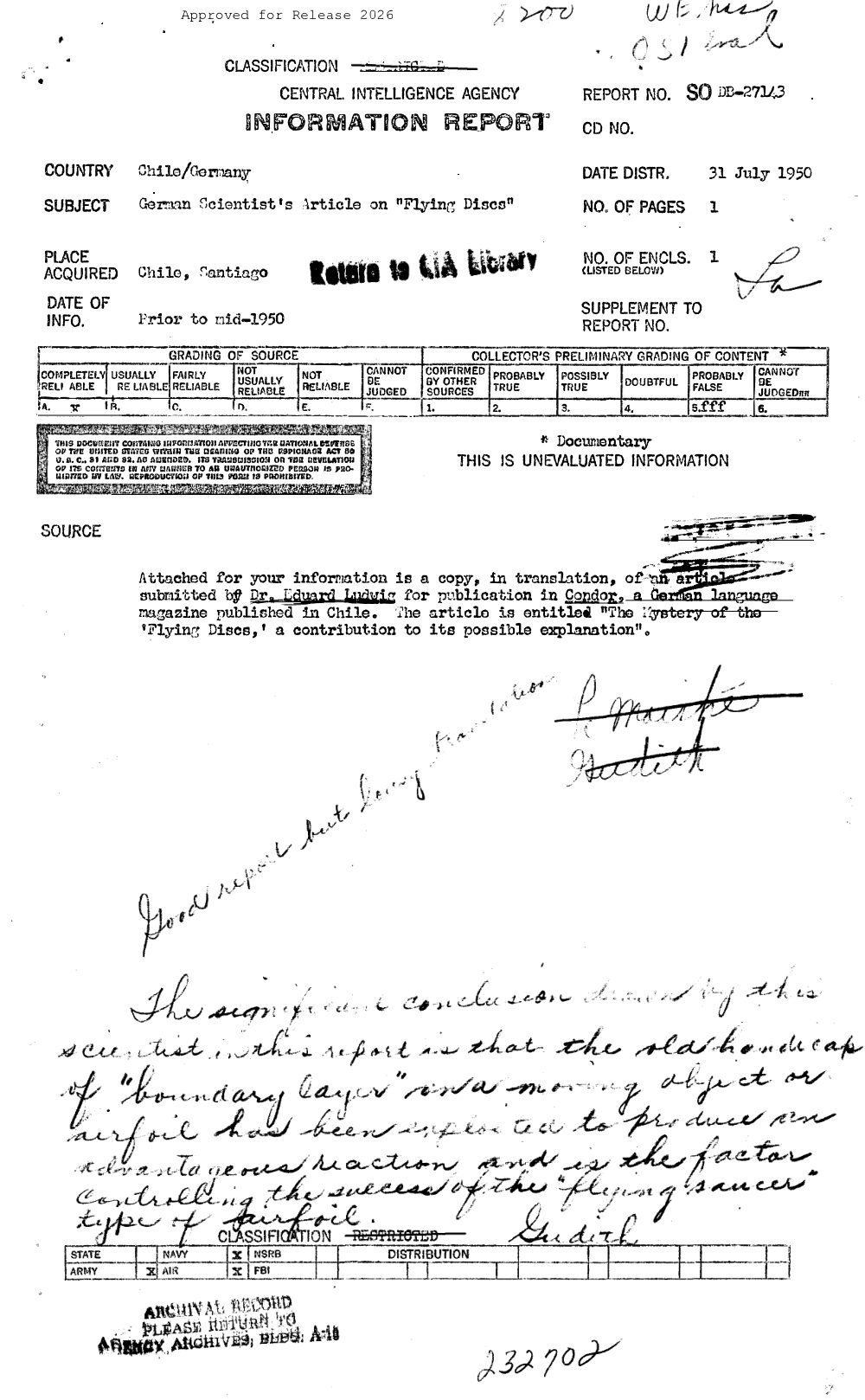
The document is a CIA information report, with restricted classification, numbered SO DB-27143 and with a distribution date of July 31, 1950. The country indicated is 'Chile/Germany', the place acquired is Santiago and the information predates mid-1950. The text of the report has one sentence: attached is the translation of an article that Dr. Eduard Ludwig submitted to Condor, a German-language magazine published in Chile, titled 'The mystery of the flying saucers: a contribution to their possible explanation'. There is no sighting account.
The form carries the standard CIA evaluation. The source received the grade A, 'completely reliable', but the content was not evaluated: an asterisk explains that it is documentary material, and the stamp says it is unevaluated information. The marked distribution includes the Navy, the Air Force and the FBI. On the same sheet, a reader wrote by hand that it was a good report, but a long translation, and left a signed note: the scientist's important conclusion would be that the old disadvantage of the boundary layer over a moving object would have been harnessed to produce a favorable reaction.
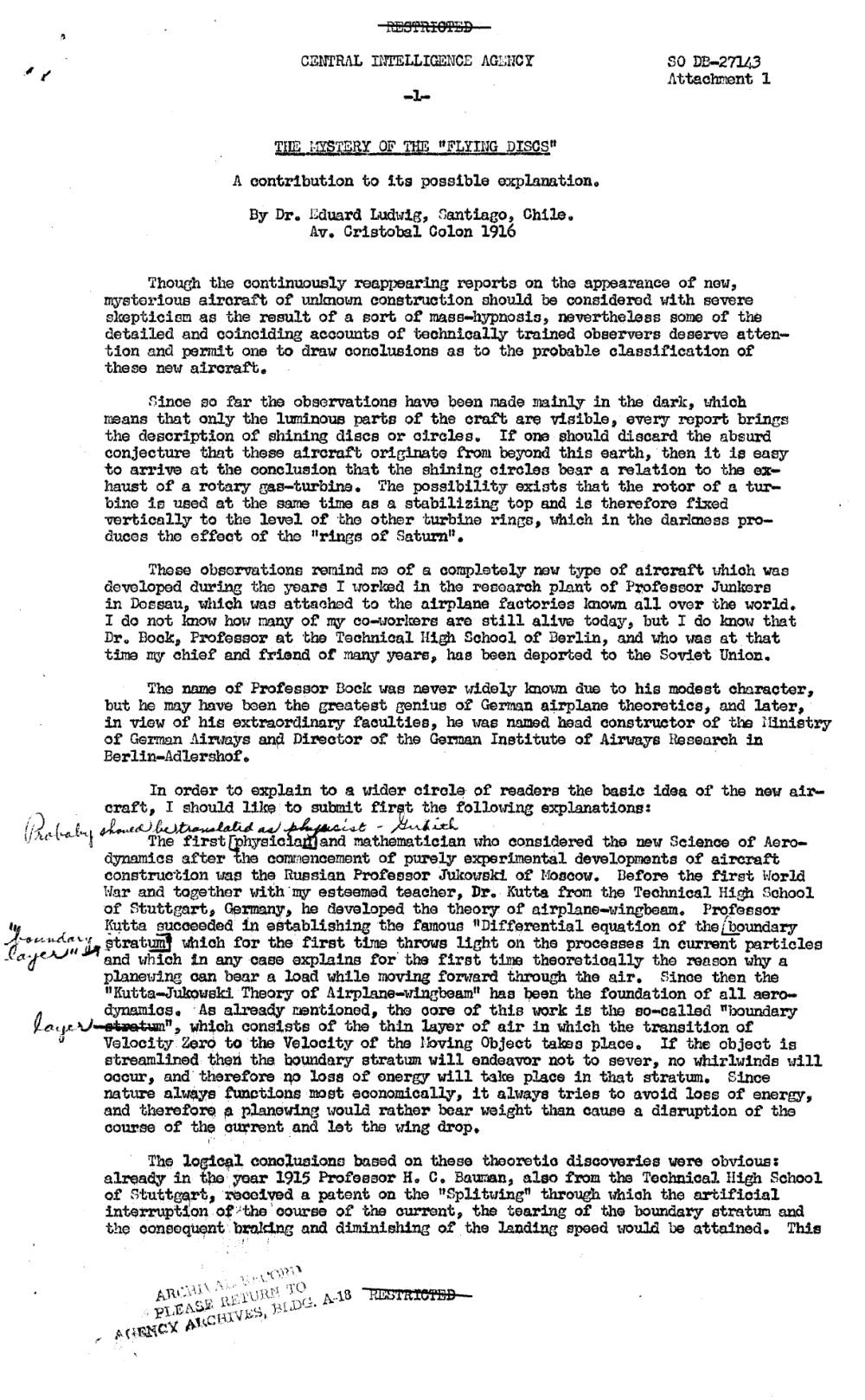
In the article, Ludwig begins with skepticism: the repeated reports of mysterious aircraft should be viewed with severe distrust, as a kind of mass hypnosis, but some detailed reports from technically trained observers would deserve attention. He calls absurd the idea that the craft come from outside the Earth. Since almost all observations would be at night, the bright circles described would be the exhaust of a rotating gas turbine, whose rotor would also work as a stabilizing gyroscope and would produce the 'rings of Saturn' effect.
Ludwig presents himself as a former member of a research group at the Junkers factory in Dessau, headed by Professor Bock, who reportedly was deported to the Soviet Union. He says the group tried to increase wing lift with a Flettner rotor, a cylinder spinning at high speed on the leading edge, and that vibrations and shaft breakages killed at least four pilots and engineers. In his view, only a gas turbine would solve the problem. The article ends by asking whether the saucers are products of the imagination or the fruit of an advanced German science that, like the nearly finished atomic bombs, would have fallen into the hands of the Russians.
The value of the document is to show what the CIA was collecting in 1950 about the idea that the saucers were secret aircraft of German origin, the same lead that appears in other files from the period, such as the Air Force's interest in the Horten brothers. Ludwig's technical and biographical claims are his own: the CIA did not confirm them, and the article presents no drawing, test data or concrete case. Some historical passages in the text, such as patent dates and the type of aircraft cited, have not been verified and should be read as the author's claims.
More images from the document
DIRECT READING OF THE FILE
The document, in the original
Press clipping reproduced in full, with the original in English and a complete translation. Names of minors, home addresses, and health data of private individuals were omitted in the original and in the translation.
EXCERPT 1 · PHYSICAL PAGE 1
Physical page 1: form of information report SO DB-27143, full text of the fields and body
-------
,,,�.,,,... ---·
1�-IAB_L_E--+_RE,_L,_ABLE r_R_E_uA_s_LE_,..R_EL_IA_B_LE_;
·M��Wffi¥B�l,'l!! • · · -·,
App�oved for
• CLASSIFICATION
CENTRAL INTELLIGENCE AGENCY REPORT NO. $0 DD-27U3
D N FO lR MATH) �\Jl R E_PO R:1� CD NO.
COUNTRY Chilo/Gorn.any DATE DISTR. 31 July 1950
Release 2026
. .;_,.:._.czo:;. __ r;
SUBJECT Germtm Scientist I s ,\rticle on "Fl.yin(! Discs" NO, Of PAGES l
PLACE NO. OF ENCLS. l
ACQUIRED Chile, :',antiago (LISTED BELOW)
DATE OF SUPPLEMENT TO INFO. Prior to nid-1950 REPORT NO.
,...
-----------------·----- COMPLOELV USUALL�- FAIRLY �giALLV N�
GRADING OF SOURCE
CANNOT CONFIRMED
COLLECTOR'S PRELIMINARY GRADING OF CONTENT,
PROBABLY POSSIBLY PROBABLY ICANN.O"f
- ElE av OTHER !JE I_
DOUBTFUL _!!R_E1._1 TRUE A_B� TRUE FALSE JUDGED SOURCES JUDGED!!!!
IA. ,r R, lC. r:,. E. i: 1, 2. 3. 4. s.!'!'!' 6.
,111s llOClilllEli'i' COilTllli.!G Hll'Ollrl.ll'l'IOII Al'l'l!CTIMC '1�11 llATIOOM. Hl'l!!llS
Ol' Till! IJUITED fl"llA'll'!G Wl'/11111 Tlllal D£Al'llt\lO 0£1 THU �IJl'IONAOll ACT 60
* Docunienta.ey
01' l'l'!l cor:rraSTo li'l llf.!'I UMWlllll TO AA UilAUTHClllZl!D fl!rulOil
o. s. c .. at ,mo 82,118 llliilllnDl?ll), ITS YilAUBlllllilllO:il on 'fllll lll!VllLATlOll 1$ J'llO THIS IS UNEVALUATED INFORMATION
Ulili?IID fn Lflllf, lilC:PIIODUC'ilOll Cl' 11113 i'Oll!.I Ill PROHllil'llU>.
SOURCE ;�S�i¥F�:::�
; _,,,,··
Attached for your in!'cme'1tion ie a copy, in tr<>nslation, oi��' oubmitted t!'J ¼", Edy,n:d LJ'Wlir for publication in QQlldoi:, a Ge�laneuage
magazine published in Chile. 'i'he articlo is entitled "Tho lzystery of" the
9Flyinr5 Discs,' a contribut,ion to its possible explanation" oEditorial note: The 'x' mark is in column A ('completely reliable') of the source evaluation. In column 5 of the content evaluation there are typed characters ('fff') with no apparent meaning, probably an erasure. The SOURCE field is covered by strike marks; its content is not inferred.
Check the original PDF
Approved for Release 2026. CLASSIFICATION [RESTRICTED, struck]. CENTRAL INTELLIGENCE AGENCY. INFORMATION REPORT. REPORT NO. SO DB-27143. CD NO. COUNTRY: Chile/Germany. DATE DISTR.: 31 July 1950. SUBJECT: German Scientist's Article on "Flying Discs". NO. OF PAGES: 1. PLACE ACQUIRED: Chile, Santiago. NO. OF ENCLS. (LISTED BELOW): 1. DATE OF INFO.: Prior to mid-1950. SUPPLEMENT TO REPORT NO. GRADING OF SOURCE: A. [x] Completely reliable. COLLECTOR'S PRELIMINARY GRADING OF CONTENT: * Documentary. THIS IS UNEVALUATED INFORMATION. This document contains information affecting the national defense of the United States within the meaning of the Espionage Act 50 U.S.C., 31 and 32, as amended. Its transmission or the revelation of its contents in any manner to an unauthorized person is prohibited by law. Reproduction of this form is prohibited. SOURCE: [suppressed]. Attached for your information is a copy, in translation, of an article submitted by Dr. Eduard Ludwig for publication in Condor, a German-language magazine published in Chile. The article is entitled "The Mystery of the 'Flying Discs,' a contribution to its possible explanation". DISTRIBUTION: Navy [x], Air [x], FBI [x]. Return to CIA Library. Archival record, please return to Agency Archives, Bldg. A-18.View the document record ↗ · Physical page 1, counting the cover.
EXCERPT 2 · PHYSICAL PAGE 2
Newspaper clipping, physical page 2 (full text)
RESTRICTED —
CENTRAL INTELLIGENCE AGENCY SO DB=27143
Attachment 1
-l-
THE MYSTERY OF THE "FLYING DIs¢s"
A contribution to its possible explanation.
By Dr. "Eduard Ludwig, Santiago, Chile.
Av. Cristobal Colon 1916
Though the continuously reappearing reports on the appearance of new,
mysterious aireraft of unlmown construction should be considered with severe
skepticism as the result of a sort of mass-hypnosis, nevertheless some of the
detailed and coinciding accounts of technically trained observers deserve atten~
tion and permit one to draw conclusions as to the probable classification of
these new aircraft.
Since so far the observations have boen made mainly in the dark, which
means that only the luminous parts of the craft are visible, every report brings
the description of shining discs or circles. If one should discard the absurd
conjecture that these aircraft originate from beyond this earth, then it is easy
to arrive at the conclusion that the shining circles bear a relation to the ex-
haust of a rotary gas-turbine. The posslbility exists that the rotor of a ture
bine is used at the same time as a stabilizing top and is therefore fixed
vertically to the level of the other turbine rings, which in the darlmess pro~
duces the effect of the "rings of Saturn".
These obsorvations remind mo of a completely new type of aircraft which was
developed during tho years I worked in the research plant of Professor Junkers
in Dossau, which was attachod to the airplane factories Imown all over the world.
I do not kmow how many of my co-workers are still alive today, but I do know that
Dr. Book, Professor at the Technical High School, of Berlin, and who was at that
time my chief and friend of many years, has been deported to the Soviet Union.
The name of Professor Bock was never widely knowm due to his modest character,
but he may have been the greatest genius of German airplane theoretics, and later,
in view of his extraordinary faculties, he was named head constructor of the Ministry
of Germon Airvays and Director of the German Institute of Airways Research in
Berlin-Adlershof.
In order to oxplain to a wider circle of readers the basic idea of the new air
craft, I should like to submit first the following explanations:
(Rebaty eee be strenatalid aa) phyweise — Hankick
eunda uy
Capers
The first [physica and mathematician who considered the new Seience of Aero
dynamics after commencement of purely experimental developments of aircraft
construction was the Russian Professor Jukowski of Moscow. Before the first World
War and together with my esteemed teachor, Dr. Kutta from the Technical High School
of Stuttgart, Germany, he developed the theory of airplane-wingbeam. Professor
Kutta succeeded in establishing the famous "Differential equation of the (boundary
stratum} which for the first time throws light on the processes in current particles
and which in any case explains for the first time theoretically the reason why a
planewing can bear a load while moving forward through the air, Since then the
"Kutta-Jukouski Theory of Airplane-wingbeam" has been the foundation of all aero~
dynamics. As already mentioned, tho core of this work is the so-called "houndary
da. yJ-ekweten", which consists of the thin layer of air in which the transition of
Velocity Zero to the Velocity of the Moving Object takes place, If the object is
streamlined ther the boundary stratum will endeavor not to sever, no whirlwinds will
occur, and therefore no loss of energy will take place in that stratum, Since
nature always functions most economically, it alwaye tries to avoid loss of energy,
and therefore a planowing would rather bear weight than cause a disruption of the
course of the current and let the wing drop,
The logical conclusions based on these theoretic discoveries were obvious:
already in the year 1915 Professor H. C. Bauman, also from the Technical, High School
Stuttgart, zeeotved a patent on the "Splitwing" through which the artificial
antorate ton ofthe course of the current, the tearing of the boundary stratum and
the consequent: braiding and diminishing of the landing speed would be attained. This
ors
i Ved
Pa) TO
ARCS purl oe AAS “RESTRICTHB—
PUES ayves, PY
- AGENE cx
sEditorial note: Article signed by Dr. Eduard Ludwig.
Check the original PDF
RESTRICTED —
CENTRAL INTELLIGENCE AGENCY SO DB=27143
Attachment 1
-l-
THE MYSTERY OF THE "FLYING DIs¢s"
A contribution to its possible explanation.
By Dr. "Eduard Ludwig, Santiago, Chile.
[omitido]
Though the continuously reappearing reports on the appearance of new,
mysterious aireraft of unlmown construction should be considered with severe
skepticism as the result of a sort of mass-hypnosis, nevertheless some of the
detailed and coinciding accounts of technically trained observers deserve atten~
tion and permit one to draw conclusions as to the probable classification of
these new aircraft.
Since so far the observations have boen made mainly in the dark, which
means that only the luminous parts of the craft are visible, every report brings
the description of shining discs or circles. If one should discard the absurd
conjecture that these aircraft originate from beyond this earth, then it is easy
to arrive at the conclusion that the shining circles bear a relation to the ex-
haust of a rotary gas-turbine. The posslbility exists that the rotor of a ture
bine is used at the same time as a stabilizing top and is therefore fixed
vertically to the level of the other turbine rings, which in the darlmess pro~
duces the effect of the "rings of Saturn".
These obsorvations remind mo of a completely new type of aircraft which was
developed during tho years I worked in the research plant of Professor Junkers
in Dossau, which was attachod to the airplane factories Imown all over the world.
I do not kmow how many of my co-workers are still alive today, but I do know that
Dr. Book, Professor at the Technical High School, of Berlin, and who was at that
time my chief and friend of many years, has been deported to the Soviet Union.
The name of Professor Bock was never widely knowm due to his modest character,
but he may have been the greatest genius of German airplane theoretics, and later,
in view of his extraordinary faculties, he was named head constructor of the Ministry
of Germon Airvays and Director of the German Institute of Airways Research in
Berlin-Adlershof.
In order to oxplain to a wider circle of readers the basic idea of the new air
craft, I should like to submit first the following explanations:
(Rebaty eee be strenatalid aa) phyweise — Hankick
eunda uy
Capers
The first [physica and mathematician who considered the new Seience of Aero
dynamics after commencement of purely experimental developments of aircraft
construction was the Russian Professor Jukowski of Moscow. Before the first World
War and together with my esteemed teachor, Dr. Kutta from the Technical High School
of Stuttgart, Germany, he developed the theory of airplane-wingbeam. Professor
Kutta succeeded in establishing the famous "Differential equation of the (boundary
stratum} which for the first time throws light on the processes in current particles
and which in any case explains for the first time theoretically the reason why a
planewing can bear a load while moving forward through the air, Since then the
"Kutta-Jukouski Theory of Airplane-wingbeam" has been the foundation of all aero~
dynamics. As already mentioned, tho core of this work is the so-called "houndary
da. yJ-ekweten", which consists of the thin layer of air in which the transition of
Velocity Zero to the Velocity of the Moving Object takes place, If the object is
streamlined ther the boundary stratum will endeavor not to sever, no whirlwinds will
occur, and therefore no loss of energy will take place in that stratum, Since
nature always functions most economically, it alwaye tries to avoid loss of energy,
and therefore a planowing would rather bear weight than cause a disruption of the
course of the current and let the wing drop,
The logical conclusions based on these theoretic discoveries were obvious:
already in the year 1915 Professor H. C. Bauman, also from the Technical, High School
Stuttgart, zeeotved a patent on the "Splitwing" through which the artificial
antorate ton ofthe course of the current, the tearing of the boundary stratum and
the consequent: braiding and diminishing of the landing speed would be attained. This
ors
i Ved
Pa) TO
ARCS purl oe AAS “RESTRICTHB—
PUES ayves, PY
- AGENE cx
sView the document record ↗ · Physical page 2, counting the cover.
EXCERPT 3 · PHYSICAL PAGE 3
Newspaper clipping, physical page 3 (full text)
ed
RESEREERED—
CENTRAL INTELLIGCUCE AGENCY SO DB=27143
Attachment 1
Q—
procedure was later applied to a great extent to the fighter plane Muster Ju. 38 ©
under the name of "dive~brake",. This patent had to %e handed to the Unglish
factory Nandley-Page after World War I, which explains that the name of "Handley-
Page Splitwing" 19 more widely known,
However, developments proceeded. It was principally the Aerodynanic Ex~
perimental Institute of the Gottingen University, directed by the renowned
Professors Prandtl and Betz, and Constructor Flettner, which drew its conclusions
from the theory of the airplane-wing-beam. Filettmer proved that the conditions
of a rotating object are similar to those which appear in a "translatorischen"
movement. Thus evolved the "Floettner-Rotor",
Professor Junkers, head of the well know airplane works in Dessau, who in
the year 1915 received his pathbreaking patent on the one=piece metal wing without
junctures, ordered a research group, which was headed by Professor Dr. Bock, and
to which I had the honor to belong, to investigate to what extent the uplift of a
wing could be increased through the attachment of a FlottnermRotor in the shape of
a cylinder turning at great speed. The cylinder was two-thirds of the length of
the wing and was installed in the nose of the wine, where it could best be adapted
to the ving's profile, To assist us with ssrodynamic problems, the Gottingen
University sent us Professor Prandtl. The experiments turned out to be extrezely
difficult and involved wany casualties. Tho purely technical question of the
speedy uplift of a leng cylinder of light construction could not be solved at that
time. Inexplicable vibrations and axle breakages occurred time after time which
Professor Junkers ordered us to investigate, and with which we were occupied for nonths
Not less than four men, all experienced and tried pilots of the first World Jar and
outstanding engineers, died in these experinents. It was clear to us that only a
gas<turbine could produce the direct uplift of the cylinder. However, since mean=
while more pressing problems awaited solution, experiments with this type of air
craft were interrupted.
Meanwhile the Aerodynamic Experimental Institute of Gottingen made new and
enlightening discoveries. Professor Betz found that supersonic speeds, such as
are produced by quickly rotating propellers, created entirely new conditions.
This investigation, however, needed the furnishing of a wind tunnel for supersonic
speeds which could only be built many years later, and which after the war was
forwarded to the United States where it greatly amazed all sciontists.
Now light was shed on nany things. It was found that the tearing of the
boundary stratum at supersonic speeds involved much greater resistance, so that
an object with full atmospheric pressure practically "hangs" from the upper layer
of air, and theoretically expericnces there the same uplift as an object of the
same surface in the water, The converting of the revelations found in research
into reality, however, needed the solution of the starting force through a gas
turbine or another equivalent machine or instrument. ne
Many heretofore umexplained phenomena now fo Jaber M ation. For example
it had often been observed that the range of q rotating missiles ("Drall-
wirkung") was much greater than could be explained according to the lays of
ballistics, Paradoxical explanations were sought for thia such as that the air
resistanca decreases with growing speeds. Today we know that theee quickly rotating
missiles "swim" in the surrounding layers of air and therefore lose part of their
weight. Full glarification was brought about only with supersonic speeds, which
were obtained in the experimonts with rockets (V-2) and were arrived at by flights
of many hundreds and thousands of kilometers, and which can only be explained by
the way in whioh these missiles literally "hang" in the air. The surprise of the
specialized scientists the world over at the astounding results of the German V-2
was not less than that which is produced today by the appearance of the mysterious
"Flying Dises".
In the same way in which the ingenious discernment of Professor Junkers
pointed the vay for airplane construction for the whole world, thus also may his
idea of attaching Flettner Rotors have a revolutionary effect. ‘irplanes of this
type must have puch an enormous carrying capacity as to be practically comparable
to amphibious planes of the sam sizo. The lack of uplift produced by the Flettner
Retors can easily be achieved through the oblique position of the entire airplaneEditorial note: Article signed by Dr. Eduard Ludwig.
Check the original PDF
ed
RESEREERED—
CENTRAL INTELLIGCUCE AGENCY SO DB=27143
Attachment 1
Q—
procedure was later applied to a great extent to the fighter plane Muster Ju. 38 ©
under the name of "dive~brake",. This patent had to %e handed to the Unglish
factory Nandley-Page after World War I, which explains that the name of "Handley-
Page Splitwing" 19 more widely known,
However, developments proceeded. It was principally the Aerodynanic Ex~
perimental Institute of the Gottingen University, directed by the renowned
Professors Prandtl and Betz, and Constructor Flettner, which drew its conclusions
from the theory of the airplane-wing-beam. Filettmer proved that the conditions
of a rotating object are similar to those which appear in a "translatorischen"
movement. Thus evolved the "Floettner-Rotor",
Professor Junkers, head of the well know airplane works in Dessau, who in
the year 1915 received his pathbreaking patent on the one=piece metal wing without
junctures, ordered a research group, which was headed by Professor Dr. Bock, and
to which I had the honor to belong, to investigate to what extent the uplift of a
wing could be increased through the attachment of a FlottnermRotor in the shape of
a cylinder turning at great speed. The cylinder was two-thirds of the length of
the wing and was installed in the nose of the wine, where it could best be adapted
to the ving's profile, To assist us with ssrodynamic problems, the Gottingen
University sent us Professor Prandtl. The experiments turned out to be extrezely
difficult and involved wany casualties. Tho purely technical question of the
speedy uplift of a leng cylinder of light construction could not be solved at that
time. Inexplicable vibrations and axle breakages occurred time after time which
Professor Junkers ordered us to investigate, and with which we were occupied for nonths
Not less than four men, all experienced and tried pilots of the first World Jar and
outstanding engineers, died in these experinents. It was clear to us that only a
gas<turbine could produce the direct uplift of the cylinder. However, since mean=
while more pressing problems awaited solution, experiments with this type of air
craft were interrupted.
Meanwhile the Aerodynamic Experimental Institute of Gottingen made new and
enlightening discoveries. Professor Betz found that supersonic speeds, such as
are produced by quickly rotating propellers, created entirely new conditions.
This investigation, however, needed the furnishing of a wind tunnel for supersonic
speeds which could only be built many years later, and which after the war was
forwarded to the United States where it greatly amazed all sciontists.
Now light was shed on nany things. It was found that the tearing of the
boundary stratum at supersonic speeds involved much greater resistance, so that
an object with full atmospheric pressure practically "hangs" from the upper layer
of air, and theoretically expericnces there the same uplift as an object of the
same surface in the water, The converting of the revelations found in research
into reality, however, needed the solution of the starting force through a gas
turbine or another equivalent machine or instrument. ne
Many heretofore umexplained phenomena now fo Jaber M ation. For example
it had often been observed that the range of q rotating missiles ("Drall-
wirkung") was much greater than could be explained according to the lays of
ballistics, Paradoxical explanations were sought for thia such as that the air
resistanca decreases with growing speeds. Today we know that theee quickly rotating
missiles "swim" in the surrounding layers of air and therefore lose part of their
weight. Full glarification was brought about only with supersonic speeds, which
were obtained in the experimonts with rockets (V-2) and were arrived at by flights
of many hundreds and thousands of kilometers, and which can only be explained by
the way in whioh these missiles literally "hang" in the air. The surprise of the
specialized scientists the world over at the astounding results of the German V-2
was not less than that which is produced today by the appearance of the mysterious
"Flying Dises".
In the same way in which the ingenious discernment of Professor Junkers
pointed the vay for airplane construction for the whole world, thus also may his
idea of attaching Flettner Rotors have a revolutionary effect. ‘irplanes of this
type must have puch an enormous carrying capacity as to be practically comparable
to amphibious planes of the sam sizo. The lack of uplift produced by the Flettner
Retors can easily be achieved through the oblique position of the entire airplaneView the document record ↗ · Physical page 3, counting the cover.
EXCERPT 4 · PHYSICAL PAGE 4
Newspaper clipping, physical page 4 (full text)
——HRESTRICTED
CENTRAL THVELLIGENCE AGENCY SO. Di=27143
Attachnent 1
3m
with a positive starting ancle in connection with the enormously high starting
speed. The attaching of speedily rotating tops assures side stability. ‘There
is also the possibility of attaching horizontal auxiliary propellers of the
helicopter type. .ind what about the question of the starting force? The safoty
of such an aireraft stands and falls on the starting force of the cylinders, and
only too well do I remember the casvalties inflicted by the lack of it. As I
nentioned before, only the development of a gas=turbine can bring the solution,
since it consists only of rotating parts and works with the dependability of a
steam engine.
There is only one more question to be answered: could such an aircraft
carry enough fuel for world=wide journeys? This question is easily answered in
the affirmative. In the first place such an aircraft has a tremendous carrying
capacity, as we have already seen; and in the second place chemical research has
nade astounding developments in this respect, We Imow today=~quite a from
atomic energy—sarriers of energy of unsuspected power and duration. (It should be
renembered that the missiles of German anti-tank weapons were coated with chemical
substances which melted up to 20 omits. of steel plates within fractions of a
second= J energy carriers of this type, if applicable to @ gas=turbine, should make
an a€tion-radius possible which far surpasses that of gasoline engines.
The. future will show whether the "Flying Discs" are only tho prodvots of
imagination or whether they are the results of a far-advanced German science which,
possibly, as well as the nearly finished atomic bombs, may have fallen into the
hands of the Russians,
ih . se
part ~
ay Ass
a) auntEditorial note: Article signed by Dr. Eduard Ludwig.
Check the original PDF
——HRESTRICTED
CENTRAL THVELLIGENCE AGENCY SO. Di=27143
Attachnent 1
3m
with a positive starting ancle in connection with the enormously high starting
speed. The attaching of speedily rotating tops assures side stability. ‘There
is also the possibility of attaching horizontal auxiliary propellers of the
helicopter type. .ind what about the question of the starting force? The safoty
of such an aireraft stands and falls on the starting force of the cylinders, and
only too well do I remember the casvalties inflicted by the lack of it. As I
nentioned before, only the development of a gas=turbine can bring the solution,
since it consists only of rotating parts and works with the dependability of a
steam engine.
There is only one more question to be answered: could such an aircraft
carry enough fuel for world=wide journeys? This question is easily answered in
the affirmative. In the first place such an aircraft has a tremendous carrying
capacity, as we have already seen; and in the second place chemical research has
nade astounding developments in this respect, We Imow today=~quite a from
atomic energy—sarriers of energy of unsuspected power and duration. (It should be
renembered that the missiles of German anti-tank weapons were coated with chemical
substances which melted up to 20 omits. of steel plates within fractions of a
second= J energy carriers of this type, if applicable to @ gas=turbine, should make
an a€tion-radius possible which far surpasses that of gasoline engines.
The. future will show whether the "Flying Discs" are only tho prodvots of
imagination or whether they are the results of a far-advanced German science which,
possibly, as well as the nearly finished atomic bombs, may have fallen into the
hands of the Russians,
ih . se
part ~
ay Ass
a) auntView the document record ↗ · Physical page 4, counting the cover.
Dates and documentary context
- Event
- Not established — There is no sighting. The article predates mid-1950 ('Prior to mid-1950'); the research at Junkers that the author describes is not dated in the text, except for patents that he places in 1915.
- Document
- 31/07/1950 — Distribution date of report SO DB-27143.
- Publication
- Not established — 'Approved for Release 2026' stamp at the top of page 1. It is not known whether the article was ever published in Condor magazine.
Origin and release
CIA, information report; source withheld; article authored by Eduard Ludwig, translated for the agency · CIA-UAP-005-GERMAN_SCIENTISTS_ ARTICLE_ON_FLYING_DISCS.pdf
Page 1: report form with handwritten annotations. Pages 2 to 4: enclosure 1, internally numbered 1 to 3.
Related accounts and their differences
Questions to continue the investigation
- Did Eduard Ludwig's article actually appear in the magazine Condor, of Santiago, and on what date?
- Who was the 'professor Bock' cited by Ludwig, and does his deportation to the Soviet Union appear in other files?
- Was there any CIA or Air Force follow-up on Ludwig's explanation after 1950?
GEOGRAPHY OF THE CASE
Santiago, Chile (place where the article was obtained)
Approximate reference for the city mentioned in the report, placed by the editors. It does not indicate a sighting location: the document does not describe any.
DOCUMENTARY TRAIL
Go back to the sources
References use physical pages of the PDF, counting the cover. Summaries are presented in English; the documents keep their original language.
- CIA-UAP-005-GERMAN_SCIENTISTS_ ARTICLE_ON_FLYING_DISCS.pdf
Physical pages 1 to 4: CIA information report SO DB-27143, distributed on 31/07/1950, and attachment with the translation of Eduard Ludwig's article
CIA · 4 pages
Editorial summary based on the collection's research notes. How we read the documents.