Date: 20/05/1950, between 12h15 and 12h20Location: Lowell Observatory grounds, Flagstaff, Arizona, USA
Lowell Observatory, 1950: meteorologist sees through binoculars a UFO crossing in front of a cloud against the wind
Meteorologist and astronomer Seymour L. Hess wrote, one hour after his sighting, that a small UFO passed between him and a cumulus cloud, moving at a right angle to the wind. The civilian NICAP report, kept by the CIA, reproduces the signed statement.
- Event date
- 20/05/1950, between 12h15 and 12h20
- Location
- Lowell Observatory grounds, Flagstaff, Arizona, USA
- Topic
- CIA file
- Source agencies
- CIA
- Documents
- 1 document · 186 pages
- Reading time
- 21 min
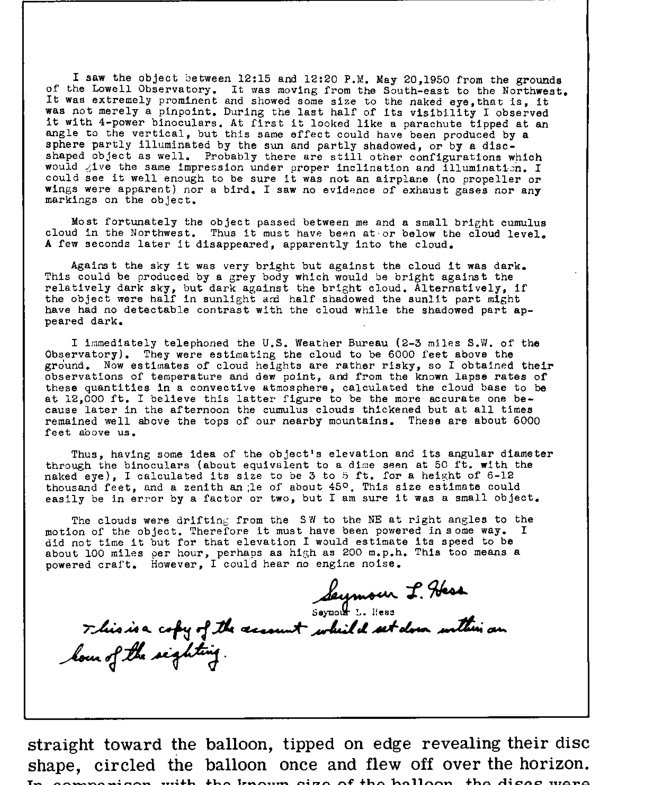 Typewritten statement reproduced in the NICAP reportPhysical page 12
DOCUMENTARY SOURCES · CIA
What the records tell
The report The UFO Evidence, published by the civilian organization NICAP in 1964 and kept in copy by the CIA, reproduces on physical page 12 a typed statement signed by Seymour L. Hess. A handwritten note on the same sheet says it is a copy of the account he wrote less than an hour after the sighting. At the time of publication, according to NICAP, Hess headed the Department of Meteorology at Florida State University and was a specialist in planetary atmospheres. The copy in the CIA archive shows only that the agency kept the report.
Hess says he saw the object between 12:15 and 12:20 on May 20, 1950, on the grounds of Lowell Observatory, moving from southeast to northwest. It was clearly visible to the naked eye and had an apparent size; it was not a mere point. During the second half of the observation he used 4-power binoculars. At first it looked like a tilted parachute, but he admits that a sphere half-lit by the sun or a disk would give the same impression. He was certain it was not an airplane, since he saw no propeller or wings, nor a bird. He saw no exhaust or markings.
The most useful point of the account is a cloud. The object passed between Hess and a small, bright cumulus cloud to the northwest, so it would have been at the cloud's height or below, and shortly afterward it disappeared, apparently into it. Against the sky it looked light; against the cloud, dark. Hess called the Weather Bureau, 2 or 3 miles from the observatory, which estimated the cloud at 6.000 feet above the ground. Using the temperature and dew point he obtained, he calculated the base at 12.000 feet, a value he considered more reliable.
With that height range and the apparent diameter in the binoculars, comparable to a dime seen at 50 feet, Hess estimated the size at 3 to 5 feet, allowing for an error of a factor of two, and the speed at about 100 miles per hour, perhaps 200. Since the clouds were moving from southwest to northeast, at a right angle to the object's motion, he concluded that it must have had its own propulsion, although he heard no engine noise. These are his calculations, based on estimates, not instrument measurements.
NICAP returns to the case in Section II, physical page 21, as an example of powered flight, and compares it to an astronomer's observation in southern New Mexico in July 1947. In note 2, it lists three scientific papers by Hess on the atmosphere of Mars, to show the observer's qualifications. The interpretation that the object was a controlled machine is the organization's. Hess does not identify the object and says only that it was small and did not seem to be carried by the wind.
DIRECT READING OF THE FILE
The document, in the original
The source is a private publication (NICAP's The UFO Evidence report, 1964), held by the CIA, which reproduces the personal statement of Seymour L. Hess. Nothing was transcribed or translated in full: there is a faithful summary per page, with short quotations. There is no government document on these pages.
EXCERPT 1 · PHYSICAL PAGE 12
Physical page 12 (printed p. 3): note on Hess in the left column and typed statement in the right column
Approved For Release 2001/04/02 : CIA-RDP81R00560R000100010001-0
the theodolite was pointed (45 degrees elevation and 210 degrees
azimuth), The object was moving east at a rate of 5 degrees of
azimuth change per second.
“When the difference in angle between the theodolite and the
supposed balloon became apparent, Moore took over the theodolite
and found the true balloon still there, whereupon he immediately
abandoned it and picked up the unidentified object as it came out
of the sun. At the time, the sun was at a computed bearing of 60
degrees elevation and 127 degrees azimuth. The object was moving
too fast to be kept in the scope through cranking the theodolite
around; one of the men, therefore, had to point the theodolite
while Moore observed the object through the telescope.
“The object was an ellipsoid about 2-1/2 times as long as it
was wide. It had a length of about .02 degrees subtended angle
and was gleaming white in color. It did not have metallic or
reflected shine. Toward the underside near the tail, the gleaming
white became a light yellow.
“The object, readily visible to the naked eye and seen by all
the members of the group, filled the field of the theodolite’s
25-power scope. Its rapid movement, unfortunately, prevented
Moore from obtaining a hard or clear focus, and no good detail
was observable.
“‘The azimuth angle decreased as the object continued on a north
heading (it originally came out of the southwest). Becoming
smaller in size it moved to an azimuth reading of 20 degrees to
25 degrees, at which point the azimuth held constant. Coinci-
dentally with this constant azimuth, the elevation angle suddenly
increased from 25 degrees minimum to 29 degrees, at which point
the object was lost to sight. It disappeared in a sharp climb
after having been visible to Moore and his group for about 60
seconds.
‘Fifteen minutes after the object had disappeared, Moore sent
up another pibal weather balloon to check wind values. This
balloon burst after an 88-minute flight to 93,000 feet and traveled
only 13 miles in a southerly direction during that time. This
was positive proof that the object could not have been a balloon
moving at such angular speed below 90,000 feet.
“The object was seen under conditions of a cloudless sky and
no haze. It left no vapor trail or exhaust. It was observed from
an isolated mud flat in the New Mexico desert where there was
extreme quiet; no noise of any kind was heard in connection with
the sighting, and there were no cars, airplanes, or other noises
nearby which might have blotted out sound coming from the
object.
“(As the day progressed and airplanes flew over and near the
balloon launching site, Moore’s group was able to identify them
by appearance and engine noise. They saw nothing again that day
which bore any resemblance to the white elliptical, unidentified
object.
“‘Moore’s sighting was an extremely fortunate one in that
tracking instrumentation was set up and a weather balloon air-
bourne at the time. It represents one of the best substantiated
and authentic unidentified object sightings on record.
“The foregoing discussion of ‘flying saucers’ does not represent
any desire by the author to become involved in this controversial
subject. The saucers have been mentioned because there has
been in a number of cases a close relationship between reported
sightings and the flight trajectories of Skyhook balloons. The
description of Moore’s instrumented sighting of an unidentified
object has been included because it is authentic, details have
not been previously published, and it occurred during a Skyhook
operation.
“The author, and indeed Moore himself, make no claim that
the unidentified object was a ‘flying saucer.’ The details have
been set forth. Let the reader take the sighting for what it is
worth and evaluate it for himself!’’ [1.
Dr. Seymour L. Hess, who sighted a UFO in 1950, is a meteor-
ologist and astronomer. Heiscurrently headof the Department of
Meteorology, Florida State University, and is considered an ex-
pert on planetary atmospheres, [2.] See letter next col.
Another sighting by General Mills, Inc., personnel in the
vicinity of White Sands, New Mexico, was reported by Capt.
Edward J. Ruppelt, former Chief of the Air Force Project Blue
Book UFO investigation. [3.] Two General Mills employees and
four others at Artesia, New Mexico, were watching a Skyhook
balloon, January 16, 1951. Suddenly they noticed two tiny specks
om te terlRpproved For Release 2001/04/02 :
I saw the object vetween 12:15 and 12:20 P.M. May 20,1950 from the ground:
of the Lowell Observatory, It was moving from the South-east to the Northwest.
It was extremely prominent and showed some size to the naked eye,that is, it
was not merely a pinpoint. During the last half of its visibility I observed
it with 4-power binoculars. At first it looked like a parachute tipped at an
angle to the vertical, but this same effect could have been produced by a
sphere partly illuminated by the sun and partly shadowed, or by a disc~
shaped object as well, Probably there are still other configurations waich
would vive the same impression under proper inclination and illumination. I
could see it well enough to be sure it was not an airplane (no propeller or
wings were apparent) nor a bird, I saw no evidence of exhaust gases nor any
markings on the object.
Most fortunately the object passed between me and a small bright cumulus
cloud in the Northwest. Thus 1t must have been at-or below the cloud level.
A few seconds later it disappeared, apparently into the cloud.
Against the sky it was very bright but against the cloud it was deri.
This could be produced by a grey body which would be bright against the
relatively dark sky, but dark against the bright cloud. Alternatively, 1f
the object were half in sunlight ami half shadowed the sunlit part might
have had no detectable contrast with the cloud while the shadowed part ap-
peared dark.
I Anmediately telephoned the U.S. Weather Bureau (2-3 miles S.W. of the
Observatory). They were eatiaating the cloud to be 6000 feet above the
Now estimates of cloud heights are rather risky, so I obtained their
Observations of temperature and dew point, and from the known lapse rates of
these quantities in a convective atmosphere, calculated the cloud base to be
at 12,000 ft. I believe this latter figure to be the more accurate one be~
cause later in the afternoon the cumulus clouds thickened but at all tines
remained well above the tops of our nearby mountains. These are about 6000
feet above us.
Thus, having sone idea of the object's elevation and its angular dianeter
through the binoculars (about equivalent to a dise seen at 50 wit
naked eye), I calculated its size to ve 5 to 5 ft. for a height of 6- te"
thousand feet, and a zenith an;le of about 45°, This size estimate could
easily be in error by a factor or two, but I am sure it was a small object.
The clouds were drifting from the SW to the NE at right angles to the
motion of the object. Therefore it mst have been powered in some way. I
id not time it but for that elevation I would estimate its speed to be
about 10 ger hour, perhaps as high as 200 m.p.h, This too means a
powered craft, However, I could hear no engine noise.
L. Fhe
Seynolt 4. ess
rhein ian copy cf De ecemunt srbacle at abrim walls am
Aon f Be ett.
straight toward the balloon, tipped on edge revealing their disc
shape, circled the balloon once and flew off over the horizon.
In comparison with the known size of the balloon, the discs were
estimated to be 60 feet in diameter.
A particularly detailed account of a lens-shaped disc was ob-
tained from an experienced engineer by the NICAP Assistant Di-
rector in personal correspondence during 1955. [4.]
Date: October 1954, about mid-month
Location: Cherry Valley, New York
Time: About 4:00 p.m.
Witness: Major A. B. Cox, graduate of Yale University, mem-
ber of the American Society of Mechanical Engin-
eers, and Society of American Engineers.
Excerpts from letter dated December 28, 1955 from Major
A. B. Cox to Richard Hall:
“The sky was more or less covered with streaks or layers of
clouds, with blue sky between, so that the rays of the sun came
through almost horizontally, the time being not far from sunset in
the Valley. I was walking in a NE direction, having been an air-
plane spotter for a long time, I have formed the habit of looking
at the sky, quite naturally.
“I happened to be looking at the West in the direction of my
farm buildings, perhaps a half mile distant, and saw something
which at first glance was about over my farm buildings. It was
quite low, and did not seem to be more than a few hundred feet
above the earth. I thought at first it was a large airplane not
moving very swiftly. . . . It was moving horizontally ina direction
parallel to my own direction. Then I noticed that it seemed to
make no noise, and then I could not see any wings or tail or
fuselage generally.
“It seemed to be a large disc or lens-shaped object, and in
comparison with the objects below I estimated it to be perhaps
30 or 35 feet in diameter. . . . It was moving like a wheel
sliding sidewise and not rotating, and in perspective presented
an elliptical appearance such as any circular object would when
viewed from an angle; the degree of ellipticity varying as it came
up and then passed me. I must have seen it for 20 seconds or a
little more. Then it got ahead of me and it presented the appear-
(CIA-RDPBIROGSEBRGGA TOSS TAOT-OEditorial note: The excerpt crosses the column break and the release stamp at the foot of the left column.
Check the original PDF
[p. 12: texto da publicação privada não reproduzido; ver o resumo]View the document record ↗ · Physical page 12, counting the cover.
EXCERPT 2 · PHYSICAL PAGE 16
Physical page 16 (printed p. 7): note 2 of Section I
Approved For Release 2001/04/02 : CIA-RDP81R00560R000100010001-0
NOTES:
1. For other examples of UFO sightings by General Mills balloon
personnel, see J, J. Kaliszewski reports, Section VI,
2. Sample contributions to astronomy literature:
Hess, Dr. Seymour L., ‘‘A Meteorological approach to the
question of water vapor on Mars and
the mass of the Martian atmos-
phere,’’ Publications of the Astro-
nomical Society of the Pacific, 60,
289, (1948).
“Some Aspects of the Meteorology of
Mars,’’ Journal of Meteorology, 7, 1,
(1950).
«‘Blue Haze andthe Vertical Structure
of the Martian Atmosphere,’ The
Astrophysical Journal, 127, 743,
(1958).
3. Ruppelt, Edward J,, The Report on Unidentified Flying Ob-
jects, (Doubleday, 1956), p. 161.
4, Letter on file at NICAP.
5. Report on file at NICAP.
6. Ruppelt, Edward J., op. cit., p. 303; True, May 1954.
7. Air Force letter on file at NICAP.
8. Quotes taken from Capt. Hull’s report to John DuBarry, former
associate editor of True magazine, published in CSI News-
letter by a New York UFO group of which DuBarry is presi-
dent.
9. Report on file at NICAP.
10. From U.S, Air Force Intelligence Report.
11.Chapman, Robert, London Evening News, December 21,
1955; Frame from movie film reproduced in RAF Flying
Review, London, July 1957.
12.It is not known whether any of these reports have been pub-
lished.
13. All quotes taken from unclassified U.S. Air Force Intelligence
Report. Exact date, names, and location were deleted in ac-
cordance with Air Force policy.
14.The average distance from the pilot’s face to the windscreen
was determined to be 2.27 feet for the F-86-D Sabrejet, and
about 2.50 feet maximum for most jets in operation at the
time. The average pencil eraser is one-fourth of an inch in
diameter. If the pilot’s face was 2.50 feet from the wind-
screen, the diameter of the UFO was about 352 feet. Even
allowing for appreciable error in the pilot’s estimation of
size, the true size of the UFO would be well over 100 feet
diameter.
15.Roerich, Nicholas, Altai-Himalaya, (Fred Stokes, N.Y., 1929),
Part Il, ppg. 361-362.
Approved For Release 2001/04/02 : CIA-RDP81R00560R000100010001-0Check the original PDF
[p. 16: texto da publicação privada não reproduzido; ver o resumo]View the document record ↗ · Physical page 16, counting the cover.
EXCERPT 3 · PHYSICAL PAGE 21
Physical page 21 (printed p. 13), left column: “Scientist Observes Powered UFO”
Approved For Release 2001/04/02 : CIA-RDP81R00560R000100010001-0
Powered, Controlled Flight
Many observations by competent observers (including engineers
and aeronautical experts) suggest that the UFOs they saw were
powered objects. The observations sometimes have included visual
signs of mechanical-functional construction, in addition to other
indicators of the UFOs’ being, literally, machines.
Most of the cases cited previously in this section contain
descriptions of observed ‘¢maneuvers.’’ However, the following
group of reports by unusually well-qualified observers is worth
special mention.
UFO Formation Tracked Above Security Area at over 4,500 mph.
During the Fall of 1949 at a key atomic post, five apparently
metallic objects in formation were tracked by radar. The UFOs
crossed the 200-mile scope in less than 4 minutes. The officer
in charge, who held a top military post, reported to Intelligence
that this was a legitimate radar contact with unidentified objects.
[4] (Official secrecy conceals other details of this case, in
particular information on tracking and other detection of the
UFOs by separate military posts. Nevertheless, it tends to sub-
stantiate the many other reports by reputable people of UFOs,
and UFO formations, moving at spectacular speeds),
Technicians at Secret Test Base Observe Mechanical UFO
At Muroc AFB (now Edwards AFB) and adjacent Rogers Dry
Lake, scientists and engineers test and develop the latest aircraft,
including secret projects. Although thoroughly familiar with
anything that flies, the base technical personnel had no explanation
for the UFOs which maneuvered over the area July 8, 1947.
Twice that morning, disc-shaped objects were observed cavorting
overhead. Then about 11:50 a.m., acrewof technicians at Rogers
saw a round white, apparently metallic object descending, moving
west northwest against the wind. They observedthick projections
on top which crossed each other at intervals, suggesting either
rotation or slow oscillation. In their official report they stated:
‘Jt was man-made, as evidenced by the outline and functional
appearance.’? [5] (Next day, near Boise, Idaho, a disc-shaped
object maneuvering in front of a cloud bank was observed from a
plane by Dave Johnson, aviation editor of the Idaho Statesman.
See Section VII.)
Top Astronomer Reports ‘‘Novel Airborne Device’’
On July 10, 1947, one of the country’s top astronomers re-
ported an elliptical UFO. At 4:47 p.m. in southern New Mexico,
the astronomer observed a smooth ellipse with firm regular
outline, motionless near some clouds, but wobbling. [See
Section XII; Flight Characteristics.] The UFO then moved into
the clouds, reappeared and rose quickly at an estimated speed
of 600 to 900 mph. Inhis report to the Air Force, the astronomer
stated: ‘‘The remarkably sudden ascent convinced me it was an
absolutely novel airborne device.’’ [4]
Scientist Observes Powered UFO
A very Similar observation was made nearly three years later
by an eminent meteorologist and astronomer. On the grounds
of Lowell Observatory, Arizona, May 20, 1950, Dr. Seymour L.
Hess, now head of the Department of Meteorology, Florida State
University, noticed a disc (or partly illuminated sphere) moving
across the front of some cumulus clouds at about 12:15 p.m.
Studying the UFO with four-power binoculars, Doctor Hess
could see no evidence of exhaust or markings on the object.
“The clouds were drifting from the southwest to the northeast
at right angles to the motion of the object. Therefore it must
have been powered in some way... I would estimate its speed
at 100 mph., perhapsashighas 200 mph. This too means a power-
ed craft. However, I could hear no engine noise.” [Full state-
ment, Section I.]
High-Speed Disc Arcs Above Airliner
Airline pilots, although not necessarily technically trained in
the sense of being scientists or engineers, are experienced ob-
servers of the sky, familiar with most atmospheric and astrono-
mical displays. At 9:29 p.m., March 31, 1950, a Chicago &
Southern Airlines plane was flying at 2,000 feeton a southwesterly
course near Little Rock, Arkansas. Captain Jack Adams and
Co-pilot G. W. Anderson, Jr., suddenly noticed a distinct circular
object, apparently disc-shaped approaching from the left. The
UFO passed in an are above their plane, proceeding north at an
estimated 700 to 1,000 mph. Eight to 10 lighted windows or ports
were visible on the underside, and ‘‘the strongest blue-white
light we’ve ever seen’’ flashed intermittently from the top. The
pilots told official investigators they believed they had witnessed
some secret experimental craft. To this date, the sighting
remains unexplained. [6]
Aeronautical Engineer Amazed by UFO Performance
Another particularly well-qualified observer was “amazed”? by
a UFO performance he witnessed on the night of July 16, 1952.
Paul R. Hill, an aeronautical research engineer of Hampton,
Virginia, at 9:00 p.m. saw two amber-colored lights speed in
from the south over the Hampton Roads channel. The UFOs
slowed and circled rapidly around each other. Two similar ob-
jects then approached and joined the first two, one from the south
and one from the north, and the formation moved off toward the
south. ‘‘Their ability to make tight circling turns was amazing,’’
Mr. Hill said. [Full report in Section Vij
Formations and Coordinated Flight
A prime indicator of intelligence behind the maneuvers of UFOs
is the observation that they often fly in formation, which requires
coordination and mechanical control. (Aircraft and birds also
fly in formations, but these can often be ruled out as cause of
the sightings.) In UFO reports, the formations are of three
general types: (a) Geometrical (V’s, lines, etc.); (b) clusters,
and (c) object with smaller objects maneuvering around it.
(a) Geometrical
1904: Circular UFOs Maneuvered Near Ship
One of the earliest formation cases was reported February 28,
1904, by a ship in the North Pacific off San Francisco. Three
members of the crew of the USS Supply, at 6:10 a.m. local time,
sighted an echelon formation of three ‘‘remarkable meteors’’
which appeared near the horizon below clouds, moving directly
toward the ship. As they approached, the UFOs began soaring,
rose above the cloud layer, and were observed climbing into
space, still in echelon. The lead object was egg-shaped and about
the size of six suns (about 3 degrees of arc). The other two were
smaller and appeared to be perfectly round. They remained
visible for over two minutes. [7] (Meteors, of course, do not
travel in echelon formation, change course and climb, nor re-
main visible for two minutes).
Precise Formation, Sharp Turn Near Airliner
Perhaps the most detailed and instructive formation case on
record is the sighting by Capt. William B. Nash, Pan American
Airways pilot, and his co-pilot, William Fortenberry, July 14,
1952, near Newport News, Virginia. [See Section V.] In addi-
tion to being an example of precise formation flight, the report
contains several other elements suggesting intelligent control.
When an in-line formation of discs made an abrupt stop, two of
the rear objects overrode the front one. This could be interpreted
as a sign of pilot error or lag in reaction time. After the six
discs flipped over and reversed course, two more sped up and
joined the formation.
Approved For Release 2001/04/02 * CIA-RDP81R00560R000100010001-0Check the original PDF
[p. 21: texto da publicação privada não reproduzido; ver o resumo]View the document record ↗ · Physical page 21, counting the cover.
Dates and documentary context
- Event
- 20/05/1950 — Between 12:15 and 12:20, according to Hess's statement.
- Document
- 20/05/1950 — The handwritten note says the statement was written less than an hour later; the sheet bears no date of its own other than that of the sighting.
- Publication
- 05/1964 — The UFO Evidence report, May 1964; CIA copy released on 02/04/2001.
Origin and release
NICAP (civilian organization), report edited by Richard H. Hall; statement by Seymour L. Hess; copy kept by the CIA in the CREST system · CIA-RDP81R00560R000100010001-0_NICAP-The-UFO-Evidence_1964.pdf
undefined ↗ — undefined
Questions to continue the investigation
- Do the Flagstaff Weather Bureau data for that day confirm the wind direction and the cloud height?
- Did Hess report the case to the Air Force, and with what response?
GEOGRAPHY OF THE CASE
Lowell Observatory, Flagstaff, Arizona
Approximate reference to Flagstaff, placed by the editorial team. It does not indicate the object's trajectory.
DOCUMENTARY TRAIL
Go back to the sources
References use physical pages of the PDF, counting the cover. Summaries are presented in English; the documents keep their original language.
- CIA-RDP81R00560R000100010001-0_NICAP-The-UFO-Evidence_1964.pdf
Physical pages 12, 16 and 21: private NICAP report The UFO Evidence (1964), statement by Seymour L. Hess and Section II commentary, copy kept by the CIA
CIA · 186 pages
Editorial summary based on the collection's research notes. How we read the documents.